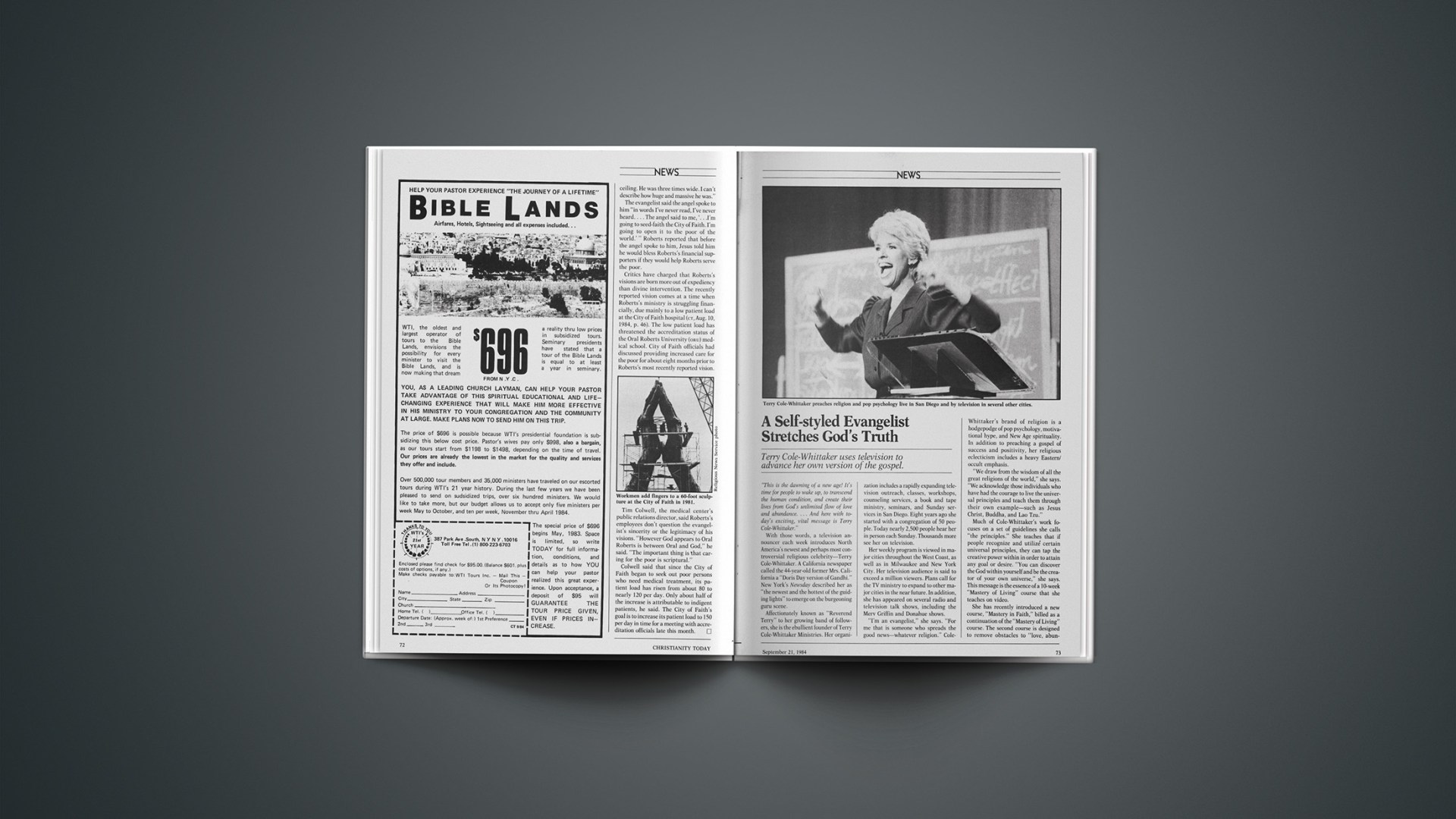
A Self-Styled Evangelist Stretches God’s Truth

Terry Cole-Whittaker uses television to advance her own version of the gospel.

“This is the dawning of a new age! It’s time for people to wake up, to transcend the human condition, and create their lives from God’s unlimited flow of love and abundance.… And here with today’s exciting, vital message is Terry Cole-Whittaker.”

With those words, a television announcer each week introduces North America’s newest and perhaps most controversial religious celebrity—Terry Cole-Whittaker. A California newspaper called the 44-year-old former Mrs. California a “Doris Day version of Gandhi.” New York’s Newsday described her as “the newest and the hottest of the guiding lights” to emerge on the burgeoning guru scene.

Affectionately known as “Reverend Terry” to her growing band of followers, she is the ebullient founder of Terry Cole-Whittaker Ministries. Her organization includes a rapidly expanding television outreach, classes, workshops, counseling services, a book and tape ministry, seminars, and Sunday services in San Diego. Eight years ago she started with a congregation of 50 people. Today nearly 2,500 people hear her in person each Sunday. Thousands more see her on television.

Her weekly program is viewed in major cities throughout the West Coast, as well as in Milwaukee and New York City. Her television audience is said to exceed a million viewers. Plans call for the TV ministry to expand to other major cities in the near future. In addition, she has appeared on several radio and television talk shows, including the Merv Griffin and Donahue shows.

“I’m an evangelist,” she says. “For me that is someone who spreads the good news—whatever religion.” Cole-Whittaker’s brand of religion is a hodgepodge of pop psychology, motivational hype, and New Age spirituality. In addition to preaching a gospel of success and positivity, her religious eclecticism includes a heavy Eastern/occult emphasis.

“We draw from the wisdom of all the great religions of the world,” she says. “We acknowledge those individuals who have had the courage to live the universal principles and teach them through their own example—such as Jesus Christ, Buddha, and Lao Tzu.”

Much of Cole-Whittaker’s work focuses on a set of guidelines she calls “the principles.” She teaches that if people recognize and utilizé certain universal principles, they can tap the creative power within in order to attain any goal or desire. “You can discover the God within yourself and be the creator of your own universe,” she says. This message is the essence of a 10-week “Mastery of Living” course that she teaches on video.

She has recently introduced a new course, “Mastery in Faith,” billed as a continuation of the “Mastery of Living” course. The second course is designed to remove obstacles to “love, abundance, and limitlessness” so that participants can be “empowered to live as spirit in sonship with God.” Cole-Whittaker says this involves the rejection of scarcity and the acceptance of abundance as a divine right.

Prosperity, success, and abundance are recurring themes in motivational talks given by the New Age evangelist. In a universe filled with abundance, Cole-Whittaker says, “the only one who denies yourself anything is you. Nothing is impossible to you.”

The same ideas can be found in her recent best-selling book, How to Have More in a Have-Not World (Rawson). “You can have exactly what you want, when you want it, all the time,” she writes. “You don’t need to take a vow of poverty to achieve spirituality. Affluence is your right.”

For a donation of $25 or more, the ministry will send a contributor a “prosperity kit” consisting of a cassette tape, a booklet, and a bumper sticker. The kit promises to “enhance one’s awareness of abundance.”

Questions about her own prosperity have given rise to controversy. Los Angeles Magazine alleged that Cole-Whittaker and her fourth husband—they have since divorced—received $20,000 a month plus expenses. She says the information is inaccurate and that it was provided by a disgruntled former employee. It has also been reported that her ministry took in between $5 million and $6 million last year.

The person who has had perhaps the greatest theological impact on Cole-Whittaker is Ernest Holmes, founder of the Religious Science movement and author of The Science of Mind. Religious Science teaches a monistic philosophy that all is One and that people can experience their oneness with God through a form of faith—positive thinking. The ultimate truth, according to Science of Mind, is that man is divine.

Cole-Whittaker studied at the Religious Science School of Ministry and was ordained in 1975. She began her ministry with a congregation of 50 in La Jolla, California. Within months, membership rose to 750 and then to 1,000. As attendance continued to rise, services were held at several temporary locations in the San Diego area. Today, two Sunday morning services are held at the El Cortez Convention Centre in downtown San Diego with a combined attendance of more than 2,000. Last Easter, an estimated 4,000 people were present.

In September 1982 she left the United Church of Religious Science to become the founder of the Science of Mind Church International and to serve as a minister of its only affiliate member, called the La Jolla Church. Most services at the church are upbeat and unconventional. The atmosphere is California casual with a lot of hugging, clapping, and swaying with the music. The order of service includes such congregational songs as “Day by Day” from the musical Godspell, as well as “Accentuate the Positive” and “On the Sunny Side of the Street.” The choir’s selections are equally nontraditional, such as the pop songs “What a Feeling” and “You Are So Beautiful.” A typical service includes elements of a motivational seminar, a Jimmy Swaggert rally, and a Robert Schuller spectacle all rolled into one.

“Her services aren’t dry,” says Harold Bloomfeld, a member of Cole-Whittaker’s ministry board and a well-known advocate of Transcendental Meditation. “She teaches you that it’s okay to have a good time when you’re with God.”

Her sermons are upbeat, reassuring, and nonthreatening. At the La Jolla Church there is no talk of sin, guilt, or eternal damnation. “God loves me, and God would never send me to hell, because it doesn’t exist,” she tells her parishioners. For Cole-Whittaker, hell is a state of mind, and human fallenness is an outmoded concept. “I don’t get that everybody’s lost, because everybody gets to make it. Heaven is a cinch.”

Cole-Whittaker teaches that traditional religion and dogmatic belief systems limit and constrict people. But despite her disdain for traditional religion, including Christianity, she is careful to retain some of its trappings. She maintains a flavor of conventional religion with her references to “the prayer ministry,” “love offerings,” and midweek services.

The self-styled evangelist sounds like a born-again Christian when she states emphatically that “Jesus of Nazareth is my savior.” She claims to be his disciple, and says his “presence … saved my life.” She says she prays to Jesus. “And I always ask, ‘What am I supposed to teach?’ And I always get the message, ‘keep doing what you’re doing, it’s working.’ ”

It is not difficult for a discerning Christian to conclude that the Jesus she refers to is not the Jesus of the Bible. She believes that Jesus was a gnostic. While she claims to be influenced by his teachings, she says she is equally indebted to Holmes, Werner Erhard (founder of est), and A Course in Miracles, which proclaims a distinctly gnostic and metaphysical gospel.

Like most sect leaders, she quotes the Bible selectively and as a means to achieve legitimacy by association. Although she is fond of quoting Jesus, she does not claim that he is the all-powerful, divine, sinless Son of God.

If her organization’s ambitious plans for expansion are realized, chances are good that many more Americans will be hearing Terry Cole-Whittaker’s version of the gospel during the coming months. “I consider myself a spokesman for the spirituality of the New Age,” she says. “My job is to tell people they are the son[s] of God.”
Canadian Better Business Bureaus Warn against Humbard’s Fund-Raising Letters

At least three Better Business Bureaus in Canada have alerted the public to high-pressure financial appeals made by television evangelist Rex Humbard.

Paul Tuz, president of the Toronto Better Business Bureau, has charged that a recent series of Humbard appeal letters apply excessive pressure, especially on the elderly. In recent telecasts, the Akron, Ohio-based evangelist has urged supporters to obey his instructions given in “faith-building” letters.

The letters include an array of items, including “holy Bible anointing oil,” a “blessed-by-prayer” cloth cross, and Mexican coins. Accompanying them are urgent appeals for funds and assurances that a generous giver will be richly rewarded.

Bob Dailey, a minister with the Rex Humbard Foundation, declined to address the criticisms directly. However, he said Humbard has videotaped a response to the Canadian Better Business Bureaus’ criticisms. The response is scheduled to be broadcast this month on about 10 Canadian television stations.

Some senior citizens told the Toronto Better Business Bureau that they faced a dilemma because, in spite of the hardship to them, they felt obligated to send their Canada Pension checks (similar to Social Security) to Humbard. “Most of the calls were not complaints,” Tuz said. “They were, ‘What am I going to do? I must send my biggest check to Rex Humbard.’ ”

One letter from Humbard contained a packet of vegetable oil which the evangelist described as “holy Bible anointing oil.” The letter said the oil was to be used “to turn God’s healing and prospering blessings on in your life.

“Make a cross on your forehead with it [the oil]; then by faith go to a room by yourself and take out any money you have and make a cross on each bill,” the letter instructed. “Do this in faith for God to heal your money problems. Anoint your checkbook if you have one.” Finally, Humbard’s letter asked his supporters to mail the “largest bills [currency] or check you have.… Give God your largest and best, and ask Him for His largest and best.” He concluded by assuring supporters that “God’s Spirit is in this letter.”

Another letter contained a red, blessed-by-prayer cloth cross, which supporters were instructed to place in their billfolds or pockets for 22 hours. Recipients were told that “your Scripture for this week” was Matthew 11:22. That passage reads: “And all things, whatsoever ye shall ask in prayer, believing, ye shall receive.” After keeping the cloth cross in their billfold or pocket for no more than 22 hours, they were told to take it out and mail it—with money—to Humbard. “The greater the sacrifice, the greater the blessing,” he assured them.

A third letter included two Mexican coins worth about six-tenths of a cent. Recipients were asked to wrap their largest bill around one of the coins and rush the coin and the Canadian currency to Humbard.

On television, the evangelist has warned of the impending financial collapse of his ministry. However, in one of his appeal letters, he wrote that “it seems like revival has hit and that God is blessing everything I touch lately.”

LESLIE K. TARRin Toronto

Citing Another Vision From God, Roberts Opens His Medical Complex To The Poor

Many have wondered what to make of Oral Roberts’s claims of visitations from Jesus. In 1980, Roberts said Jesus—standing 900 feet tall—assured him that his huge medical complex, known as the City of Faith, would be completed. Last year Roberts told of a seven-hour revelation in which God promised a breakthrough in cancer treatment at the City of Faith.

Recently, the 66-year-old evangelist told his television audience about another supernatural meeting, this time with Jesus and an angel. Roberts first spoke about the visit two months ago during a sermon at Victory Christian Church in Tulsa, Oklahoma. He said Jesus and the angel appeared in his hospital room at the City of Faith, not long after Roberts had undergone surgery for nasal polyps. Roberts said the angel was “so tall his head touched the ceiling. He was three times wide. I can’t describe how huge and massive he was.”

The evangelist said the angel spoke to him “in words I’ve never read, I’ve never heard.… The angel said to me, ‘… I’m going to seed-faith the City of Faith. I’m going to open it to the poor of the world.’ ” Roberts reported that before the angel spoke to him, Jesus told him he would bless Roberts’s financial supporters if they would help Roberts serve the poor.

Critics have charged that Roberts’s visions are born more out of expediency than divine intervention. The recently reported vision comes at a time when Roberts’s ministry is struggling financially, due mainly to a low patient load at the City of Faith hospital (CT, Aug. 10, 1984, p. 46). The low patient load has threatened the accreditation status of the Oral Roberts University (ORU) medical school. City of Faith officials had discussed providing increased care for the poor for about eight months prior to Roberts’s most recently reported vision.

Tim Colwell, the medical center’s public relations director, said Roberts’s employees don’t question the evangelist’s sincerity or the legitimacy of his visions. “However God appears to Oral Roberts is between Oral and God,” he said. “The important thing is that caring for the poor is scriptural.”

Colwell said that since the City of Faith began to seek out poor persons who need medical treatment, its patient load has risen from about 80 to nearly 120 per day. Only about half of the increase is attributable to indigent patients, he said. The City of Faith’s goal is to increase its patient load to 150 per day in time for a meeting with accreditation officials late this month.

Born-Again Minnesotans Play Political Hardball

Conservative ‘newcomers’ match their rhetorical bark with numerical bite.

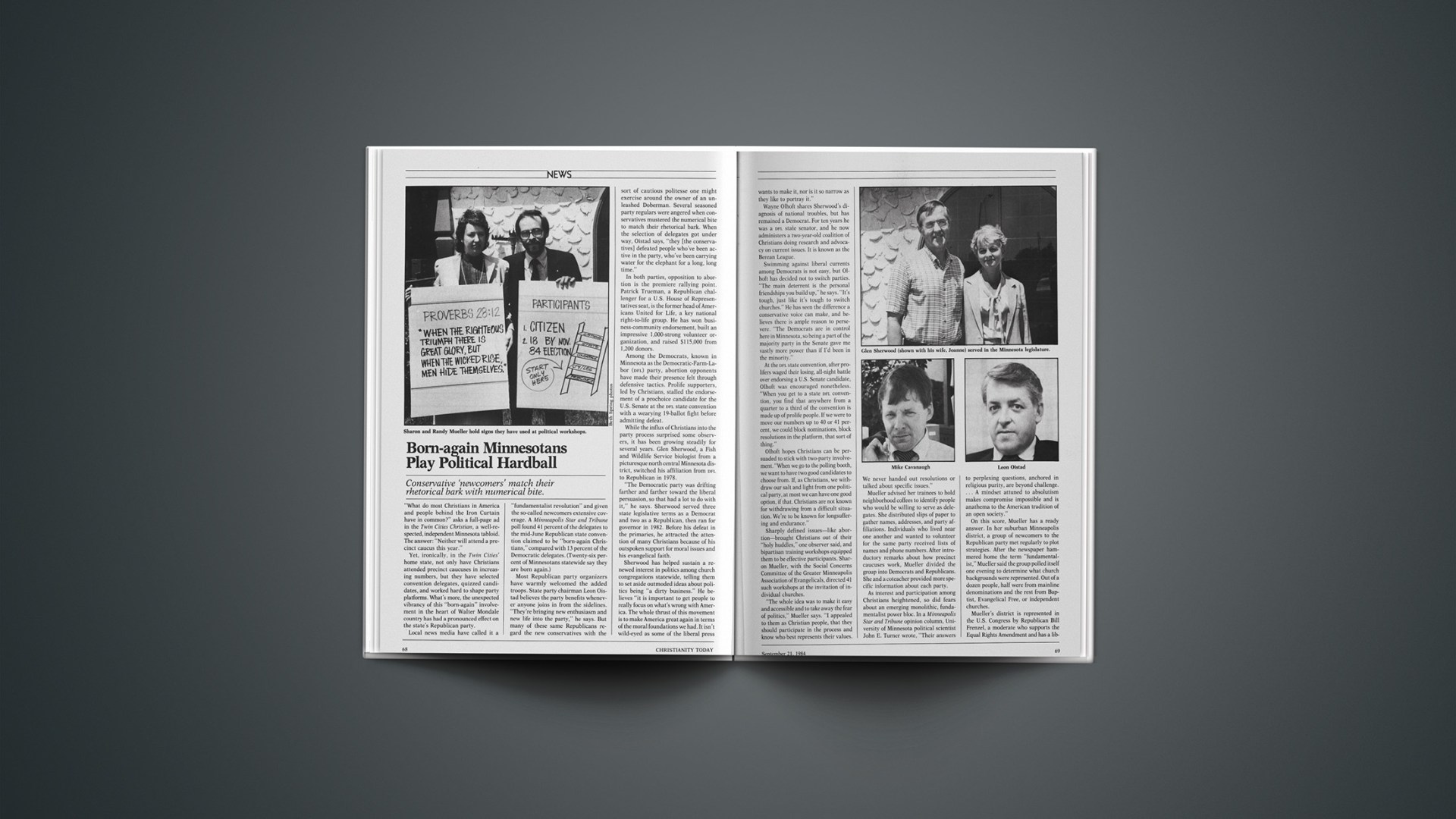
“What do most Christians in America and people behind the Iron Curtain have in common?” asks a full-page ad in the Twin Cities Christian, a well-respected, independent Minnesota tabloid. The answer: “Neither will attend a precinct caucus this year.”

Yet, ironically, in the Twin Cities’ home state, not only have Christians attended precinct caucuses in increasing numbers, but they have selected convention delegates, quizzed candidates, and worked hard to shape party platforms. What’s more, the unexpected vibrancy of this “born-again” involvement in the heart of Walter Mondale country has had a pronounced effect on the state’s Republican party.

Local news media have called it a “fundamentalist revolution” and given the so-called newcomers extensive coverage. A Minneapolis Star and Tribune poll found 41 percent of the delegates to the mid-June Republican state convention claimed to be “born-again Christians,” compared with 13 percent of the Democratic delegates. (Twenty-six percent of Minnesotans statewide say they are born again.)

Most Republican party organizers have warmly welcomed the added troops. State party chairman Leon Oistad believes the party benefits whenever anyone joins in from the sidelines. “They’re bringing new enthusiasm and new life into the party,” he says. But many of these same Republicans regard the new conservatives with the sort of cautious politesse one might exercise around the owner of an unleashed Doberman. Several seasoned party regulars were angered when conservatives mustered the numerical bite to match their rhetorical bark. When the selection of delegates got under way, Oistad says, “they [the conservatives] defeated people who’ve been active in the party, who’ve been carrying water for the elephant for a long, long time.”

In both parties, opposition to abortion is the premiere rallying point. Patrick Trueman, a Republican challenger for a U.S. House of Representatives seat, is the former head of Americans United for Life, a key national right-to-life group. He has won business-community endorsement, built an impressive 1,000-strong volunteer organization, and raised $115,000 from 1,200 donors.

Among the Democrats, known in Minnesota as the Democratic-Farm-Labor (DFL) party, abortion opponents have made their presence felt through defensive tactics. Prolife supporters, led by Christians, stalled the endorsement of a prochoice candidate for the U.S. Senate at the DFL state convention with a wearying 19-ballot fight before admitting defeat.

While the influx of Christians into the party process surprised some observers, it has been growing steadily for several years. Glen Sherwood, a Fish and Wildlife Service biologist from a picturesque north central Minnesota district, switched his affiliation from DFL to Republican in 1978.

“The Democratic party was drifting farther and farther toward the liberal persuasion, so that had a lot to do with it,” he says. Sherwood served three state legislative terms as a Democrat and two as a Republican, then ran for governor in 1982. Before his defeat in the primaries, he attracted the attention of many Christians because of his outspoken support for moral issues and his evangelical faith.

Sherwood has helped sustain a renewed interest in politics among church congregations statewide, telling them to set aside outmoded ideas about politics being “a dirty business.” He believes “it is important to get people to really focus on what’s wrong with America. The whole thrust of this movement is to make America great again in terms of the moral foundations we had. It isn’t wild-eyed as some of the liberal press wants to make it, nor is it so narrow as they like to portray it.”

Wayne Olhoft shares Sherwood’s diagnosis of national troubles, but has remained a Democrat. For ten years he was a DFL state senator, and he now administers a two-year-old coalition of Christians doing research and advocacy on current issues. It is known as the Berean League.

Swimming against liberal currents among Democrats is not easy, but Olhoft has decided not to switch parties. “The main deterrent is the personal friendships you build up,” he says. “It’s tough, just like it’s tough to switch churches.” He has seen the difference a conservative voice can make, and believes there is ample reason to persevere. “The Democrats are in control here in Minnesota, so being a part of the majority party in the Senate gave me vastly more power than if I’d been in the minority.”

At the DFL state convention, after prolifers waged their losing, all-night battle over endorsing a U.S. Senate candidate, Olhoft was encouraged nonetheless. “When you get to a state DFL convention, you find that anywhere from a quarter to a third of the convention is made up of prolife people. If we were to move our numbers up to 40 or 41 percent, we could block nominations, block resolutions in the platform, that sort of thing.”

Olhoft hopes Christians can be persuaded to stick with two-party involvement. “When we go to the polling booth, we want to have two good candidates to choose from. If, as Christians, we withdraw our salt and light from one political party, at most we can have one good option, if that. Christians are not known for withdrawing from a difficult situation. We’re to be known for longsuffering and endurance.”

Sharply defined issues—like abortion—brought Christians out of their “holy huddles,” one observer said, and bipartisan training workshops equipped them to be effective participants. Sharon Mueller, with the Social Concerns Committee of the Greater Minneapolis Association of Evangelicals, directed 41 such workshops at the invitation of individual churches.

“The whole idea was to make it easy and accessible and to take away the fear of politics,” Mueller says. “I appealed to them as Christian people, that they should participate in the process and know who best represents their values. We never handed out resolutions or talked about specific issues.”

Mueller advised her trainees to hold neighborhood coffees to identify people who would be willing to serve as delegates. She distributed slips of paper to gather names, addresses, and party affiliations. Individuals who lived near one another and wanted to volunteer for the same party received lists of names and phone numbers. After introductory remarks about how precinct caucuses work, Mueller divided the group into Democrats and Republicans. She and a coteacher provided more specific information about each party.

As interest and participation among Christians heightened, so did fears about an emerging monolithic, fundamentalist power bloc. In a Minneapolis Star and Tribune opinion column, University of Minnesota political scientist John E. Turner wrote, “Their answers to perplexing questions, anchored in religious purity, are beyond challenge.… A mindset attuned to absolutism makes compromise impossible and is anathema to the American tradition of an open society.”

On this score, Mueller has a ready answer. In her suburban Minneapolis district, a group of newcomers to the Republican party met regularly to plot strategies. After the newspaper hammered home the term “fundamentalist,” Mueller said the group polled itself one evening to determine what church backgrounds were represented. Out of a dozen people, half were from mainline denominations and the rest from Baptist, Evangelical Free, or independent churches.

Mueller’s district is represented in the U.S. Congress by Republican Bill Frenzel, a moderate who supports the Equal Rights Amendment and has a liberal voting record on abortion. Whether or not to endorse him for reelection presented the newcomers with a clear choice between principle and pragmatism. Mike Cavanaugh, a conservative organizer within the Republican party, said Frenzel was endorsed unanimously despite qualms about his positions. “The idea was we could talk to him later,” Cavanaugh said.

Frenzel, recognizing the shift in the party back home, has scheduled frequent meetings with new party conservatives. He has been the object of many letters as well. Frenzel’s press secretary, Pat Eveland, said prolife people have “laid it on pretty heavily about what they expect,” although all but a handful of letters have been reasonable in tone. “Most people say ‘Please reconsider’ when he sees them at political meetings. A few people drag him off and demand a change of mind or call him ‘ungodly’ or ‘unchristian,’ ” Eveland said.

“That is very disappointing to him. He is a religious man and a family man,” she said of Frenzel, who attends a weekly prayer meeting for congressmen. Frenzel has received about five letters that appeared threatening. However, Eveland said, “we think we can work with the new people.”

Two party stalwarts who had more difficulty working with conservative activists were David Jennings, Republican platform committee chairman, and state cochairman Marj Gruenes. Jennings resigned following a struggle between moderates and conservatives over just how specific the platform planks should be. Jennings and his committee recommended a statement of ten broad principles about the need to restrict the size and scope of government.

Conservatives objected to this and pushed through resolutions supporting a Human Life Amendment, a 21-year drinking age, prayer in schools, and dozens of other specific planks. The publisher of the Twin Cities Christian, Leonard Jankowski, noted in an editorial, “The rule is, winner take all. This year Christian delegates played hardball and came away with … [a] party platform that reads like a conservative Christian’s shopping list.”

Owing to an organized conservative effort to portray her as a traitor to the Reagan cause in 1980, Gruenes lost her bid to be a delegate to the Republican National Convention in Dallas. After the vote at the state convention, some party newcomers sent apologetic notes. One said, “Like many of the other delegates, I was acting on misinformation on your prolife position.”

Party chairman Oistad believes these power struggles were masterminded by disaffected party members who influenced Christians in order to regain a position of power for themselves. In the interests of pre-election unity, he refused to name them.

Perhaps the most serious criticism leveled at the new Christians in politics concerned their use of a religious test for public office. “Some people were calling delegates and asking them if they had Jesus in their hearts,” Oistad said. “That’s bad, that’s horrible, and it’s given this entire movement a bad name.” He acknowledged this had happened infrequently and appeared not to have been organized extensively.

To heal a growing party rift, Oistad held six meetings between moderates and conservatives. “They traded war stories,” he said. “The prolifers pointed out that they haven’t been able to be elected as delegates for ten years, and the moderates started seeing their point of view.” That is prudent, because the newcomers plan to persist in their efforts. “This is not just a lark for 1984,” Mueller said. “It is not something people did instead of joining a bowling league.”

If so, they could make a substantial difference in a state that has supplied the nation with such liberal champions as Hubert H. Humphrey, Eugene McCarthy, and Walter Mondale.

Do Jehovah’s Witnesses Still Hold to Their 1984 Doomsday Deadline?

Twenty years ago most Jehovah’s Witnesses believed the world would end by 1984. To be exact, they expected the end to come by October 2.

With that day just around the corner, members of the cult should be preparing for doomsday. But they aren’t, according to Gary Botting, coauthor with his wife, Heather, of The Orwellian World of Jehovah’s Witnesses (Univ. of Toronto Press). The Bottings’ new book challenges the cult’s views of the end of time.

The Witnesses’ Watch Tower Bible and Tract Society teaches that Jesus assumed his throne in heaven in 1914. It is a key point in Witness doctrine that at least some of those who were alive at that time will live to see the destruction of all the nations and most of their inhabitants. Formerly, it was taught that a generation was limited to 70 years. It is debatable whether most Witnesses still hold to the 1984 deadline.

“The [Watch Tower] society may not talk about it much. Not everyone may believe it. But it’s still in the back of people’s minds,” says Gary Botting, a Jehovah’s Witness since childhood. “People who might have dropped out are hedging their bets. They say to themselves, ‘What if the Jehovah’s Witnesses were right all along?’ ”

Walter Glass, registrar of the Witnesses’ Tower Bible School of the Gilead, says they do not preach that the world will end in 1984 since there is no requirement that a generation be limited to 70 years. However, he says the society holds to the view that the world will end before the generation alive in 1914 perishes.

Botting says an earlier end-time deadline set by the Witnesses passed without incident in 1975. In the 1960s, the society hinted that the world would end in 1975—ostensibly because they believed it to be the 6,000th year after Creation. But while the cult’s public pronouncements are more cautious today, Botting says the 1984 deadline remains a powerful device in holding members in line. In recent years, large numbers of formerly inactive Witnesses have become active. Membership rolls swelled in the past year by 6.8 percent, the biggest increase since 1975.

In their book, the Bottings liken the organization and its 18-member governing board to the despotic superstate portrayed by George Orwell in his novel Nineteen Eighty-Four. They argue that Jehovah’s Witnesses are citizens of a world where independent thought is not allowed and where unity must be expressed at all costs.

Botting says the Witnesses’ leadership keeps members in check by instilling fear in them. Dissidents can be excommunicated, cutting them off socially from friends in the group.

Watch Tower officials discount the authors’ criticisms. Glass cites Paul’s instructions to believers that they should “admonish” those who don’t follow his teachings. “If that is being authoritarian, then we are authoritarian,” Glass says. “There’s room for free thought, but not in the organization. Dissent would be contrary to God’s way.”

The Bottings say the Witnesses’ top leaders still hold to the 1984 end-time theory, and that it is only a matter of time before their credibility will be destroyed.

RELIGIOUS NEWS SERVICE

World Scene

The director of Campus Crusade for Christ in Nicaragua has reported increased government persecution against his organization. Nicaragua’s ministry of justice asked Jimmy Hassen to stop his organization’s evangelism efforts. He refused, and two days later a Campus Crusade worker discovered an intruder searching office files. In a second incident, four armed men entered the Campus Crusade office and assaulted a worker.

A Jamaican cult has attracted an estimated 25,000 youths in Great Britain. The Ras Tafari cult grew out of a back-to-Africa movement during the 1930s. Most of its British adherents are the children of Jamaicans who live in ghetto areas of London and Birmingham. Many of the youths identify with the cult’s reggae music and distinctive hairstyle, rather than with its beliefs. British evangelicals are attempting to reach the “Rastas” by publishing the stories of a few who have become Christians.

The Lutheran World Federations (LWF) has suspended from its membership two white South African churches for their failure to oppose apartheid. By a vote of 222 to 23, with 29 abstentions, delegates to the recent LWF meeting suspended the 6,600-member Evangelical Lutheran Church in Southern Africa (Cape Church) and the 15,000-member German Evangelical Lutheran Church in South-West Africa (Namibia). Dean Farisani, of the predominantly black Evangelical Lutheran Church in Southern Africa, charged that the suspended churches have kept silent about the suffering of black people.

Leaders of 20 national Christian groups have urged the White House to stand firm in opposing the transfer of the U.S. embassy in Israel from Tel Aviv to Jerusalem. In a meeting with national security adviser Robert C. McFarlane, the religious leaders expressed support for President Reagan’s position against the move. Legislation has been introduced in both houses of Congress to move the embassy to Jerusalem.

Intervarsity Withdraws a Book Opposed by Prolifers

InterVarsity Press, the publishing division of Inter-Varsity Christian Fellowship (IVCF), has halted further sales of the controversial book Brave New People. The book—written by medical biologist D. Gareth Jones—drew wide protest from prolifers who found Jones’s ideas on therapeutic abortion unacceptable.

The decision to withdraw the book was made by IVCF president James McLeish in response to numerous calls and letters of protest. Some donors quit giving to IVCF, and a number of others said they were reconsidering their financial support. The book generated controversy among Inter-Varsity staff workers and other employees, said IVCF public relations director Jimmy Locklear.

In a letter responding to persons who registered protests, McLeish states, “We did not publish, nor did Dr. Jones write, the book with the intention of supporting abortion in any way. However, the book is being perceived by the Christian public that way. Therefore, rather than detract from the campus ministry of reaching students for Jesus Christ to which Inter-Varsity is called, I am withdrawing the book.” It was the first time in the 43-year history of InterVarsity Press (IVP) that a book had been withdrawn.

Jones conceded in the preface to his book that his “stance on certain issues may appear liberal.” Despite his controversial views, the book—published in March—was endorsed by several leading evangelical thinkers including theologian Carl F. H. Henry and ethicist Lewis Smedes. Nevertheless, some opponents boycotted IVP materials. In its newsletter, the Christian Action Council (CAC) implied that InterVarsity advocated abortion on demand.

At this summer’s Christian Booksellers Association convention, prolife advocates distributed an open letter to IVP written by author and lecturer Franky Schaeffer. In the letter, Schaeffer said he is glad his father, the late Francis A. Schaeffer, was not alive to witness “this recent travesty, this amalgam of dishonesty published by a company largely built on the money made from his books.”

Defenders of the book say it has been unfairly portrayed by the prolife community. “This is essentially an antiabortion book,” Henry said. “Ninety-five percent of all abortions would be considered immoral by Gareth Jones.” He said banishing Jones from the evangelical community would be similar to excluding those who do not hold to the six-day theory of Creation.

CHRISTIANITY TODAY advisory editor Kenneth Kantzer, who wrote an endorsement for Brave New People, also said the book has been misjudged. In his endorsement, he said the book contains valuable information, but he made it clear that he did not agree with its conclusions. He said InterVarsity made a mistake in publishing the book since it does not represent the views of most of IVP’s constituents.

Jones, an anatomy professor at Otago University in New Zealand, parts company with staunch antiabortionists on the issue of when personhood begins. He acknowledges that a fetus is a human being. However, he distinguishes between human life and human personhood. Jones theorizes that there is no specific point at which personhood begins. He posits that a person is the product of a continuum, and that the processes of this continuum neither begin at conception nor end at birth.

Jones has a high view of fetal life. He classifies a fetus as a “potential person” on its way to achieving full personhood. He writes that there are never grounds for “lightly disposing of the fetus.” Yet he states that while “our view of the fetus should be a high one, it should not be an absolute one.”

In his book, Jones speaks out against abortion on demand. He does contend, however, that in some “extreme circumstances” abortion may be the best option. He cites as an example a fetus with Lesch-Nyhan syndrome, a rare genetic disorder. Children with this abnormality mutilate themselves compulsively, biting and destroying fingers and lip tissue. They vomit frequently, may scream incessantly, and usually don’t live more than 10 years. Even in these cases, Jones does not say abortion is “right,” but that it might be “the least tragic of a number of tragic options.”

His critics balk at the factors he uses to determine which circumstances are extreme. Among them are the degree of a fetus’s handicap, the pain the child might endure, and the financial and psychological status of the family into which the child would be born. Critics note also that since Jones does not ascribe full personhood even to babies and young children, he opens the door, at least in theory, to infanticide.

In a telephone interview, the author said he has been misunderstood. “I would not under any circumstances support infanticide,” he said. Jones said that in writing his book he considered such factors as the mental health of the mother “only in the context of severe genetic disorders, such as anencephaly (a condition in which major portions of a fetus’s brain are missing).” He said he wrote the book to inform Christians about ethical issues related to the latest medical technology. In other chapters he addresses such issues as artificial insemination and in vitro fertilization. “To lift one chapter from its context is to misunderstand the purpose of the book.”

Nevertheless, CAC executive director Curt Young said the book will cause “Christians of weak conscience to stumble and commit the sin of abortion.… InterVarsity is accountable for what they publish.

“This book represents the proabortion arguments of the 1960s, baptized in Christian terminology,” Young said. “The only public policy that can come out of Jones’s position is … abortion on demand.”

Joseph Scheidler, whose Chicago-based Pro-Life Action League picketed IVP headquarters last month, said Brave New People, because of its subtlety, “is one of the most blatant proabortion books I’ve ever seen.”

IVP editor James Sire contended that even though Jones’s view is in the minority, there is no evangelical consensus on the issue.

The branch of IVP in England, which originated and co-published Brave New People, will continue to sell the book. Overseas, most of the protest has come from prochoice advocates who think Jones’s view on abortion is too conservative. IVP in England is controlled by Universities and Colleges Christian Fellowship, which has no formal ties with IVCF.

A Woman Who Cares about Gays in Washington, D.C.

In Washington, D.C., no organized group offers a ministry to homosexuals who want to change. But the seeds for such an effort were sown throughout a four-year pilgrimage by Judy Lowry, a 34-year-old seminary student who reluctantly answered an insistent call from God.

Knowing nothing about homosexuals, Lowry seemed to meet them at every turn. She was touched by their compulsive need to talk to someone and their isolation from families who had sent them packing.

Lowry accompanied a gay friend to a bar one evening in 1979. At the bar, she says, she experienced “an incredible need to be there and to share with them. I had to go back.”

Inside the small, garishly lit bar, someone asked the inevitable question: “What are you doing here?” She mentioned her interest in counseling and her Christian faith and added, “I think you guys need someone to talk to.” In a matter of weeks, after prayer and affirmation from her mother and pastor Louis Evans of National Presbyterian Church, Lowry’s tentative trips to the bar became an eight-hour-a-day ministry.

She dropped out of Wesley Theological Seminary and studied volumes of material about homosexuality. She approached the issue with no preconceived ideas apart from a vague awareness that the Bible did not condone the practice.

“I entered this ministry totally open to what the Lord would give me,” she recalls. “I did not know if this lifestyle could be part of his plan, or if these people truly experienced contentment in their choices.” Many questions remain unanswered, but Lowry is certain now of one thing: “This lifestyle is simply out of sync with God’s plan and purpose. In the very best of circumstances, even in attempted monogamous relationships, there was always a sense of something missing, of frustration and lack of fulfillment.”

The dark side of gay life was evident to Lowry in the bars she visited. The bars are painted in dark tones, unlit and unannounced on the outside. Inside, more dark paint is punctuated harshly by flashing, pulsating lights and graphic posters or movies depicting male sexuality.

In corridors upstairs or in back rooms, gay men engage in promiscuous sex acts with a variety of partners. Besides living under the shadow of deadly Acquired Immune Deficiency Syndrome (AIDS), gays contract bowel disorders and venereal diseases far more frequently than heterosexuals.

“These men always seemed to be consumed in guilt and unrest—often well hidden, but always there,” Lowry says. “Even with the ever-increasing acceptance of society, they could not seem to accept or be comfortable with themselves.”

Lowry confined her ministry to the male homosexual community because she felt she had no rapport with lesbians. Almost every man she met had a strong church background and would initiate conversations about God, still clinging to shreds of his former faith.

One bartender loaned her a cassette tape. On it was a recording of a church choir performance in which he had soloed before he announced his homosexuality and left home. “He wanted me to know he was a Christian,” Judy said. “Then he talked about his youth group friends. He was incredibly sad.”

Judy’s attempts to counsel the young man ended when he abruptly left town, reinforcing a pattern of drifting from one gay community to the next when life turned sour.

In another case she helped restore family ties that were shattered by homosexuality. Ed (not his real name) met Lowry after being rejected by his parents. Lowry telephoned his parents and offered to visit them. Over the course of two days, she spent 20 hours answering their questions, calming fears, and holding out hope.

Before leaving their home, she told Ed’s mother to write a note to her son, even if all she could say was “From Mom.” In the morning she handed Lowry a small, sealed envelope. When Ed received it he called home and reestablished a strained line of communication.

Eventually Ed recognized the destructive effects homosexuality was having on his life and began the arduous process of repudiating the lifestyle. Without loving support from his family, Lowry believes he never would have tried to change.

Lowry urged her gay friends to develop social outlets away from the sexually charged bar scene. When a number of them formed a bowling league, they made her their treasurer.

Her involvement with homosexual ministry gave her hope about the possibility of seeing normal life patterns restored in cases where homosexuals are motivated to change and have relationships to support and sustain them in the process. Yet she despairs at the increasing magnitude of the problem. In less than a decade, the number of organizations for homosexuals in Washington, D.C., has increased fivefold and the number of gay bars has doubled. The bowling league, which at first attracted about 20 men, involves hundreds today.

“I am convinced that the Lord loves them, waits for them, and reaches out to them,” Lowry says. “It is vitally important that we as a Christian community provide an atmosphere of love and acceptance so we do not inadvertently drive our young people toward an existence like this.”

North American Scene

The United Methodist Church’s highest court will rule next month on a ban against the ordination of practicing homosexuals. The denomination’s Judicial Council will rule whether the ban, approved by the church’s general conference in May, is in accord with the United Methodist constitution. The ban is scheduled to take effect January 1.

The United Nations International Conference on Population adopted a recommendation that abortion “in no way should be promoted” as a family planning method. Adoption of the recommendation was seen as a victory for the United States and the Vatican. The United States earlier had announced that it would cut off family planning funds to nongovernment organizations that perform or promote abortion as a birth control method.

A population researcher says wider use of abortion is necessary to bring Third World population growth under control and avert mass starvation. Stephen Mumford, of North Carolina’s Center for Research on Population and Security, says developing countries will have to increase their abortion rates to more than 500 per every 1,000 live births. He says 16 nations already have abortion rates higher than that. The U.S. abortion rate is 426 abortions per 1,000 live births, he says.

The Missouri Baptist Children’s Home in St. Louis has sold its share of an X-rated theater. Children’s home administrator Bob Kenison said efforts had been underway to sell the property since 1979, the year the theater was bequeathed to the home and nine other charitable organizations. The home’s share of the sale was approximately $31,000.

Unmarried women gave birth to more than one out of every three children born in New York City last year. That ratio is triple what it was 20 years ago. Experts fear the statistic will mean increased spending for welfare, day care, police, and other social services. In 1981, Newark and Baltimore led the nation in children born to unwed mothers, with rates of 59.8 percent and 58.1 percent respectively.

Personalia

The United Methodist Church has elected Leontine T. C. Kelly, 64, as its first black woman bishop. She will lead the church’s San Francisco area. Kelly previously served as chief evangelism executive of the 9.4-million-member denomination.

Millard J. Erickson has been named vice-president and dean of Bethel Theological Seminary in St. Paul, Minnesota. He joined Bethel’s faculty in 1969 as an associate professor of theology. He later served as chairman of the seminary’s Division of Interpretation of the Christian Faith. Erickson has written numerous articles for journals, periodicals, and dictionaries.

Former National Council of Churches (NCC) president James Armstrong is working as a Washington-based liaison between church groups and transnational corporations. Last November he resigned as NCC president and as a United Methodist bishop. In January he surrendered his credentials as a United Methodist minister.

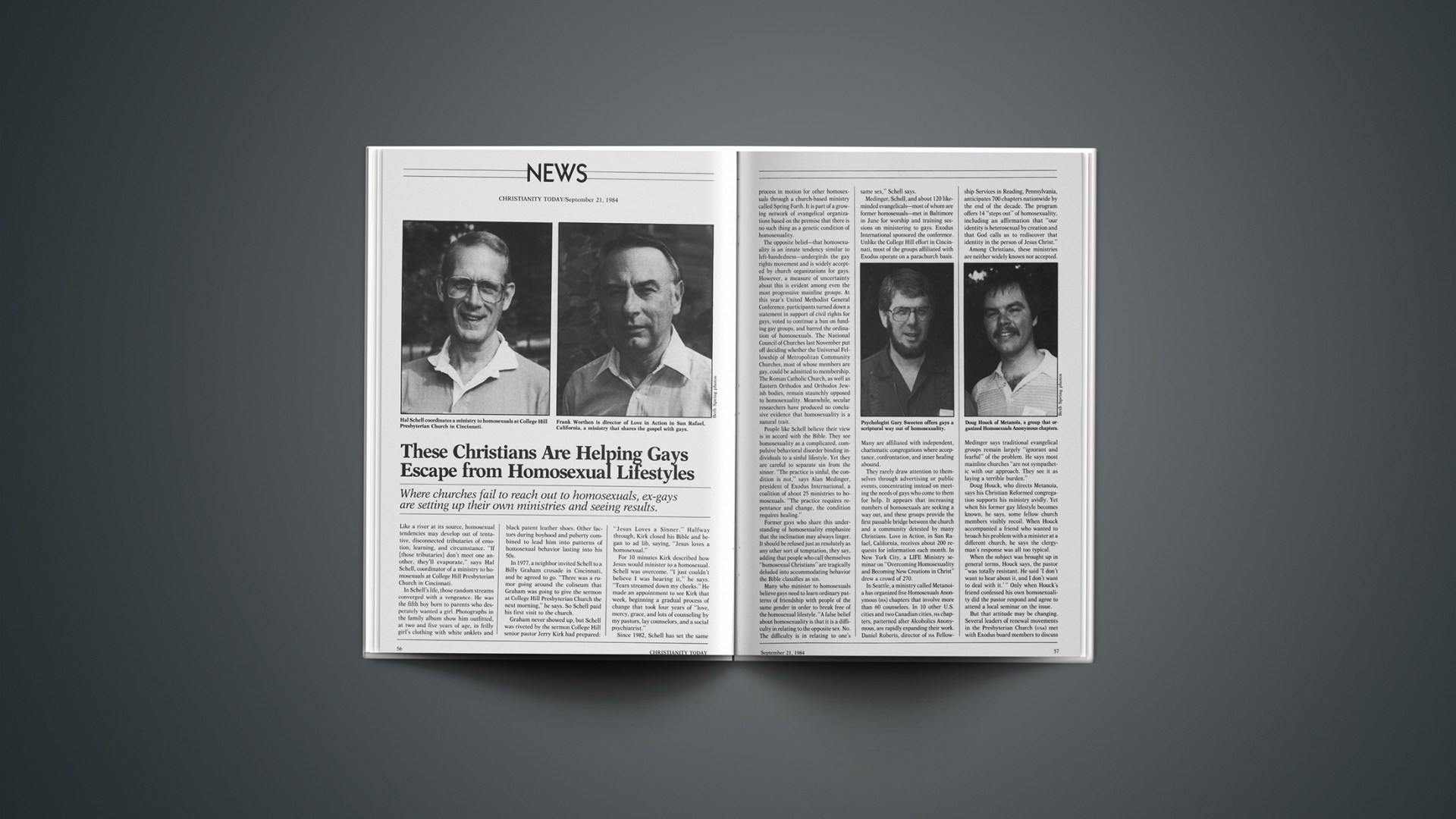
These Christians Are Helping Gays Escape from Homosexual Lifestyles

Where churches fail to reach out to homosexuals, ex-gays are setting up their own ministries and seeing results.

Like a river at its source, homosexual tendencies may develop out of tentative, disconnected tributaries of emotion, learning, and circumstance. “If [those tributaries] don’t meet one another, they’ll evaporate,” says Hal Schell, coordinator of a ministry to homosexuals at College Hill Presbyterian Church in Cincinnati.

In Schell’s life, those random streams converged with a vengeance. He was the fifth boy born to parents who desperately wanted a girl. Photographs in the family album show him outfitted, at two and five years of age, in frilly girl’s clothing with white anklets and black patent leather shoes. Other factors during boyhood and puberty combined to lead him into patterns of homosexual behavior lasting into his 50s.

In 1977, a neighbor invited Schell to a Billy Graham crusade in Cincinnati, and he agreed to go. “There was a rumor going around the coliseum that Graham was going to give the sermon at College Hill Presbyterian Church the next morning,” he says. So Schell paid his first visit to the church.

Graham never showed up, but Schell was riveted by the sermon College Hill senior pastor Jerry Kirk had prepared: “Jesus Loves a Sinner.” Halfway through, Kirk closed his Bible and began to ad lib, saying, “Jesus loves a homosexual.”

For 10 minutes Kirk described how Jesus would minister to a homosexual. Schell was overcome. “I just couldn’t believe I was hearing it,” he says. “Tears streamed down my cheeks.” He made an appointment to see Kirk that week, beginning a gradual process of change that took four years of “love, mercy, grace, and lots of counseling by my pastors, lay counselors, and a social psychiatrist.”

Since 1982, Schell has set the same process in motion for other homosexuals through a church-based ministry called Spring Forth. It is part of a growing network of evangelical organizations based on the premise that there is no such thing as a genetic condition of homosexuality.

The opposite belief—that homosexuality is an innate tendency similar to left-handedness—undergirds the gay rights movement and is widely accepted by church organizations for gays. However, a measure of uncertainty about this is evident among even the most progressive mainline groups. At this year’s United Methodist General Conference, participants turned down a statement in support of civil rights for gays, voted to continue a ban on funding gay groups, and barred the ordination of homosexuals. The National Council of Churches last November put off deciding whether the Universal Fellowship of Metropolitan Community Churches, most of whose members are gay, could be admitted to membership. The Roman Catholic Church, as well as Eastern Orthodox and Orthodox Jewish bodies, remain staunchly opposed to homosexuality. Meanwhile, secular researchers have produced no conclusive evidence that homosexuality is a natural trait.

People like Schell believe their view is in accord with the Bible. They see homosexuality as a complicated, compulsive behavioral disorder binding individuals to a sinful lifestyle. Yet they are careful to separate sin from the sinner. “The practice is sinful, the condition is not,” says Alan Medinger, president of Exodus International, a coalition of about 25 ministries to homosexuals. “The practice requires repentance and change, the condition requires healing.”

Former gays who share this understanding of homosexuality emphasize that the inclination may always linger. It should be refused just as resolutely as any other sort of temptation, they say, adding that people who call themselves “homosexual Christians” are tragically deluded into accommodating behavior the Bible classifies as sin.

Many who minister to homosexuals believe gays need to learn ordinary patterns of friendship with people of the same gender in order to break free of the homosexual lifestyle. “A false belief about homosexuality is that it is a difficulty in relating to the opposite sex. No. The difficulty is in relating to one’s same sex,” Schell says.

Medinger, Schell, and about 120 like-minded evangelicals—most of whom are former homosexuals—met in Baltimore in June for worship and training sessions on ministering to gays. Exodus International sponsored the conference. Unlike the College Hill effort in Cincinnati, most of the groups affiliated with Exodus operate on a parachurch basis. Many are affiliated with independent, charismatic congregations where acceptance, confrontation, and inner healing abound.

They rarely draw attention to themselves through advertising or public events, concentrating instead on meeting the needs of gays who come to them for help. It appears that increasing numbers of homosexuals are seeking a way out, and these groups provide the first passable bridge between the church and a community detested by many Christians. Love in Action, in San Rafael, California, receives about 200 requests for information each month. In New York City, a LIFE Ministry seminar on “Overcoming Homosexuality and Becoming New Creations in Christ” drew a crowd of 270.

In Seattle, a ministry called Metanoia has organized five Homosexuals Anonymous (HA) chapters that involve more than 60 counselees. In 10 other U.S. cities and two Canadian cities, HA chapters, patterned after Alcoholics Anonymous, are rapidly expanding their work. Daniel Roberts, director of HA Fellowship Services in Reading, Pennsylvania, anticipates 700 chapters nationwide by the end of the decade. The program offers 14 “steps out” of homosexuality, including an affirmation that “our identity is heterosexual by creation and that God calls us to rediscover that identity in the person of Jesus Christ.”

Among Christians, these ministries are neither widely known nor accepted. Medinger says traditional evangelical groups remain largely “ignorant and fearful” of the problem. He says most mainline churches “are not sympathetic with our approach. They see it as laying a terrible burden.”

Doug Houck, who directs Metanoia, says his Christian Reformed congregation supports his ministry avidly. Yet when his former gay lifestyle becomes known, he says, some fellow church members visibly recoil. When Houck accompanied a friend who wanted to broach his problem with a minister at a different church, he says the clergyman’s response was all too typical.

When the subject was brought up in general terms, Houck says, the pastor “was totally resistant. He said ‘I don’t want to hear about it, and I don’t want to deal with it.’ ” Only when Houck’s friend confessed his own homosexuality did the pastor respond and agree to attend a local seminar on the issue.

But that attitude may be changing. Several leaders of renewal movements in the Presbyterian Church (USA) met with Exodus board members to discuss ways to expand and publicize the type of ministry College Hill operates. Like many denominations, the Presbyterian Church (USA) finds itself torn between gay-rights activists and people who merely declare homosexual behavior a sin, and who do not express compassion. Some, like College Hill psychologist and lay minister Gary Sweeten, want to offer a third alternative by demonstrating a scriptural way out of homosexuality.

Homosexuals often encounter hostility from Christians. Frank Worthen, director of Love in Action, was approached by a church leader who was in California raising funds for an anti-gay cause. When Worthen described Love in Action’s goal of reaching homosexuals for Christ, the curt reply made it clear that evangelism held low priority. “We want to see them fired, evicted, and jailed,” the church leader told him.

On this issue, evangelical Christians tend to be poles apart from society at large, where acceptance of homosexual behavior is increasingly commonplace. “Most Americans now view homosexuality on the part of consenting adults as a personal and private matter,” announced a Washington Post editorial.

This year’s Democratic Party platform embraces gay rights more completely than ever, pledging to oppose discrimination based on sexual orientation in the workplace, in the military, and in immigration policies. Popular culture advances the notion that gender confusion is “in,” with rock star Boy George and similar androgynous figures attracting a large following among young people.

The widening chasm between social acceptability and church rejection makes it difficult for gays to alter course. When that happens, it is often because of a chance encounter with the gospel or through a trusted friend.

Nick Terranova, part of a traveling witnessing team from LIFE Ministry in New York City, described the life he left behind when Christ became real to him. He had discovered “acceptance and admiration” for the first time ever at a gay bar in California, “and I needed it like a junkie needs drugs.” He became a male prostitute, “getting into cars with strangers and doing whatever, if the price was right.” To preserve his sanity, he imagined himself acting out roles in a play.

He specialized in sado-masochism—acts of physical, verbal, and sexual abuse—and developed his own clientele. “Life became a roller coaster of very high highs and very low lows. My evenings were spent partying with wealthy celebrities and my days spent battling severe bouts of depression,” Terranova told the audience gathered at the Exodus conference.

As he watched television one day, he heard evangelist Jimmy Swaggart deliver a message he desperately needed. He recalled Swaggart saying, “You poor homosexual, don’t you know how much Jesus loves you? Don’t you know he can change you?” That was Terranova’s turning point, and LIFE Ministries in New York was ready to receive him.

But in most American cities, including major centers of homosexual activity like Chicago and Washington, D.C., no such group exists. Most churches would not know what to do with a newly reborn Terranova. “A trust relationship must be built between pastor and ex-gay,” Worthen wrote in his book Steps Out of Homosexuality. “This takes time to develop and cannot be forced. The ex-gay needs the counsel of his pastor. He needs care, compassion, and understanding. The pastor represents Christ, and the ex-gay’s view of the Lord will largely depend on the treatment he receives.”

Lori Thorkelson, a counselor with Love in Action, says she dreams of the day churches commit themselves to this ministry because “individual relationships within the church body is where people receive healing.” Until more churches learn to address the acute spiritual and emotional needs of homosexuals, groups that are part of the Exodus coalition intend to fill the gap. Staffed by people who have endured the pain of passage out of homosexual behavior, these ministries offer authentic models of change for men and women still struggling with a misplaced sexual identity.

Ministries to Homosexuals

A referral list of evangelical ministries for people who want to change their homosexual behavior is available from Exodus International, P.O. Box 2121, San Rafael, California 94912. Organizations mentioned in the preceding article can be reached at the following addresses:

Love in Action

P.O. Box 2655

San Rafael, California 94912

Metanoia Ministries

P.O. Box 33039

Seattle, Washington 98133

LIFE Ministry

P.O. Box 353

New York, New York 10185

Homosexuals Anonymous

c/o Quest Learning Center

P.O. Box 7881

Reading, Pennsylvania 19603

The Jesus ‘Technique’

As a Communicator He Surprised, He Befuddled, and He Was Never Predictable

If we riffle through the pages of the Gospels, looking at them as a compilation of case studies on communication, they at first seem to yield with gratifying ease to the pressure of our need. In story after story, the incarnate Word pierces the darkened understanding of this world. Jesus calls his disciples from their work and, unaccountably, they follow. He opens the book of the prophet in the synagogue and proclaims his mission with audacity. He encounters the Samaritan woman at the well and draws not only her but the entire town of Sychar into belief.

If, however, we try to analyze these stories and extract from them a set of clear-cut guidelines for communicating, we become frustated. For the more deeply we probe the Gospels for what they can teach us about communication, the more disconcertingly ambiguous they become.

Not only is there the story, set in broad daylight, of the Samaritan woman who became the catalyst for communal witness; there is also the story of Nicodemus who came to make an undercover contract with Jesus. And added to these personal encounters, we have Jesus’ communications with the multitudes. He engages in the forum for public debate his culture provided. As for nonverbal communication, he fed the crowds as well as teaching them. He often touched when he healed; he spat, held babies, overturned tables. And finally, before his accusers, the Word became silent.

Given the amazing variety of examples, we find we cannot package and market a Jesus-technique for communications guaranteed to work in every situation—not if we remain faithful to the full gospel, and not just to our favorite, self-vindicating passages.

Indeed, the one thing we can safely say about Jesus’ own communicating in the Gospels is that it was almost always unpredictable. And he warns us that it will continue to be so, coming upon us like a thief in the night. Even following the resurrection, he disguises himself as a gardener to meet Mary Magdalene; he travels incognito on the road to Emmaus. Jesus could not be packaged. He was always turning up where no one expected him. In a manger. Walking across a lake. Eating with the corrupt exploiters of his own people. On a cross in the city dump.

Jesus was so unpredictable that he was often incomprehensible, especially to his own disciples. Time and time again, we are told that they did not understand him. It was not only the parables that puzzled them. At the Transfiguration, they “did not know what to say.” Immediately following Peter’s confession of Jesus as Messiah, the disciple has to be rebuked for his misinterpretation of his own confession. And although Jesus told the disciples over and over of the suffering and death that loomed before him, they were unable to hear this straightforward message.

Christ’s own communication with his closest followers often failed because the message was not one they expected—or wanted—to hear. Their consciousness simply refused to take it in. Yet the Samaritian woman was able to hear. Despite the fact that she could only have perceived Jesus as her enemy (and that was made quite clear by her initial rejoinder to him), despite her own evasive techniques, she is surprised into belief.

Now this was an encounter of amazing intimacy, one that could have gone wrong at any moment. And no doubt Jesus did have many encounters that did not turn out well. The meeting with the rich young ruler immediately comes to our minds. Remember also the difficulty he had communicating with his own family who at one point tried to have him certified insane. The outcome of his meeting with Nicodemus hangs unresolved. John the Baptist, languishing in prison, suffers doubts about the Messiah’s authenticity. Pilate no doubt presumed he had stopped the mouth of the upstart when he asked his famous question, “What is truth?,” and got no answer. The very multitudes whom Jesus had taught and fed and healed, quickly lost their enthusiasm when his communication by signs and wonders stopped.

Thus the success of Jesus himself as a communicator, using worldly criteria, is very questionable. Not only was he often incredible, he was sometimes incomprehensible, even obstinately so, since he steadfastly refused to give in to the pressures, from unbelievers or from his own disciples, to accommodate his meaning to their expectations.

And what kind of models are the disciples themselves as either senders or receivers of communication? Thickheaded, slow to understand, opportunists, cowards. Peter himself, the rock upon whose confession the church is built, was a liar. “I do not know this man,” he told the people in the high priest’s courtyard. From the first, the church’s communication has been entrusted to a self-acknowledged liar.

Perhaps I am painting a rather grim picture here (although some of us take a certain dismal comfort in remembering that we are not alone in our failure). Perhaps I should concentrate more on the great followings of Jesus, on those who “heard him gladly,” on the authority with which he spoke. Perhaps we should invoke Pentecost or Peter’s sermon at the temple. But remember that those who heard Christ gladly also cried, “Crucify him!” Pentecost was followed by persecution and dissension. By using success-based standards of communication, these efforts failed.

In Order To Avoid This Kind Of failure in our own day, we are tempted to escape into technique. We are a good deal more self-conscious about the process of communication in our day than the apostles were. If only we can pin down this elusive element we call communication long enough to analyze it, then, we dream, it will at last become our tool. Our immediate, and quite modern, instinct is to identify the technique Jesus used with the Samaritan woman, for instance, in order to discover the “secret of his success”.

Unfortunately, however, in this, as in so many other areas, the tool is becoming the master. In fact, we are in great danger of allowing communication tools to dictate our theology, a theology that must be reducible to a telex message or taken from headlines composed for the sake of sensation and guaranteed to change tomorrow. Scripture is whittled into slogans. We do not allow it to confront us with all its puzzling paradoxes, but extract only what will fit on the current banner we are waving, what will prove useful and effective for our purposes. Jesus the unpredictable becomes Jesus the caricature.

How can the church be credible? Especially when what we have to communicate is essentially a mystery? Do we understand it any better than Peter and John? Should we try to fake credibility—which is after all a media-derived term itself—to make it appear as though the churches can actually solve the world’s problems, so that there is a statement to distribute to the press? How do we resist the unrelenting pressures to make it appear that we are not absurd, befuddled disciples?

If we are willing, if we have the ears, the gospel can still be our guide. For one of the very things that make the Gospels credible themselves is the embarrassing truth they tell about the disciples. Can we afford to do that about ourselves?

Virginia Stem Owens is the author of numerous books. Her article is taken from Beyond Technology, written and compiled by John Bluck (Friendship Press, 1984); used by permission of the World Council of Churches.

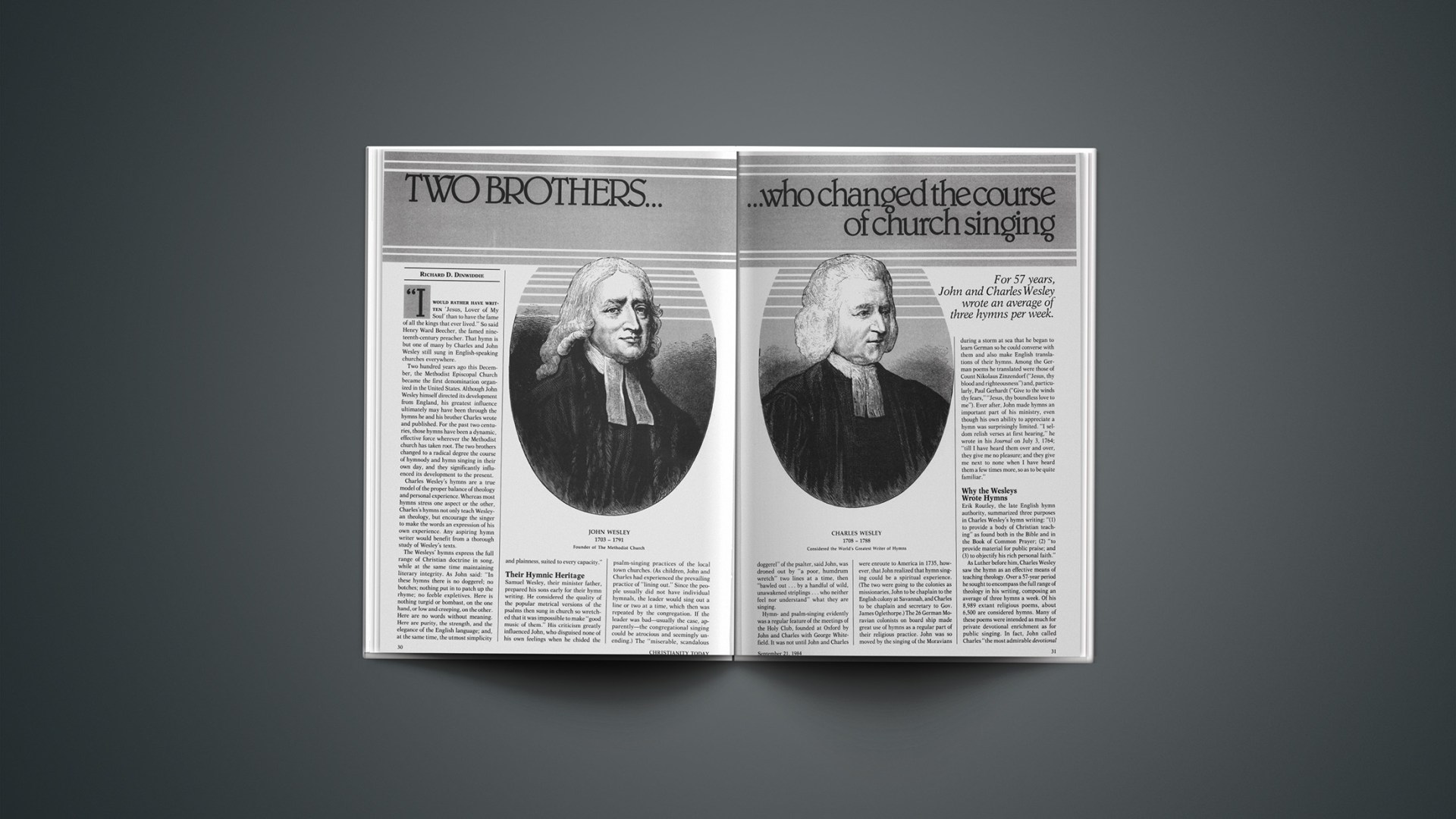
Two Brothers … Who Changed the Course of Church Singing: For 57 Years, John and Charles Wesley Wrote an Average of Three Hymns per Week

I would rather have written ‘Jesus, Lover of My Soul’than to have the fame of all the kings that ever lived.” So said Henry Ward Beecher, the famed nineteenth-century preacher. That hymn is but one of many by Charles and John Wesley still sung in English-speaking churches everywhere.

Two hundred years ago this December, the Methodist Episcopal Church became the first denomination organized in the United States. Although John Wesley himself directed its development from England, his greatest influence ultimately may have been through the hymns he and his brother Charles wrote and published. For the past two centuries, those hymns have been a dynamic, effective force wherever the Methodist church has taken root. The two brothers changed to a radical degree the course of hymnody and hymn singing in their own day, and they significantly influenced its development to the present.

Charles Wesley’s hymns are a true model of the proper balance of theology and personal experience. Whereas most hymns stress one aspect or the other, Charles’s hymns not only teach Wesleyan theology, but encourage the singer to make the words an expression of his own experience. Any aspiring hymn writer would benefit from a thorough study of Wesley’s texts.

The Wesleys’ hymns express the full range of Christian doctrine in song, while at the same time maintaining literary integrity. As John said: “In these hymns there is no doggerel; no botches; nothing put in to patch up the rhyme; no feeble expletives. Here is nothing turgid or bombast, on the one hand, or low and creeping, on the other. Here are no words without meaning. Here are purity, the strength, and the elegance of the English language; and, at the same time, the utmost simplicity and plainness, suited to every capacity.”

Their Hymnic Heritage

Samuel Wesley, their minister father, prepared his sons early for their hymn writing. He considered the quality of the popular metrical versions of the psalms then sung in church so wretched that it was impossible to make “good music of them.” His criticism greatly influenced John, who disguised none of his own feelings when he chided the psalm-singing practices of the local town churches. (As children, John and Charles had experienced the prevailing practice of “lining out.” Since the people usually did not have individual hymnals, the leader would sing out a line or two at a time, which then was repeated by the congregation. If the leader was bad—usually the case, apparently—the congregational singing could be atrocious and seemingly unending.) The “miserable, scandalous doggerel” of the psalter, said John, was droned out by “a poor, humdrum wretch” two lines at a time, then “bawled out … by a handful of wild, unawakened striplings … who neither feel nor understand” what they are singing.

Hymn- and psalm-singing evidently was a regular feature of the meetings of the Holy Club, founded at Oxford by John and Charles with George Whitefield. It was not until John and Charles were enroute to America in 1735, however, that John realized that hymn singing could be a spiritual experience. (The two were going to the colonies as missionaries, John to be chaplain to the English colony at Savannah, and Charles to be chaplain and secretary to Gov. James Oglethorpe.) The 26 German Moravian colonists on board ship made great use of hymns as a regular part of their religious practice. John was so moved by the singing of the Moravians during a storm at sea that he began to learn German so he could converse with them and also make English translations of their hymns. Among the German poems he translated were those of Count Nikolaus Zinzendorf (“Jesus, thy blood and righteousness”) and, particularly, Paul Gerhardt (“Give to the winds thy fears,” “Jesus, thy boundless love to me”). Ever after, John made hymns an important part of his ministry, even though his own ability to appreciate a hymn was surprisingly limited. “I seldom relish verses at first hearing,” he wrote in his Journal on July 3, 1764; “till I have heard them over and over, they give me no pleasure; and they give me next to none when I have heard them a few times more, so as to be quite familiar.”

Why The Wesleys Wrote Hymns

Erik Routley, the late English hymn authority, summarized three purposes in Charles Wesley’s hymn writing: “(1) to provide a body of Christian teaching” as found both in the Bible and in the Book of Common Prayer; (2) “to provide material for public praise; and (3) to objectify his rich personal faith.”

As Luther before him, Charles Wesley saw the hymn as an effective means of teaching theology. Over a 57-year period he sought to encompass the full range of theology in his writing, composing an average of three hymns a week. Of his 8,989 extant religious poems, about 6,500 are considered hymns. Many of these poems were intended as much for private devotional enrichment as for public singing. In fact, John called Charles “the most admirable devotionallyric poet in the English language.”

An ordained Anglican minister—he and John never left the Anglican church—Charles tried to create a liturgical hymnody. He wrote hymns for the entire church year, ranging from Advent (“Come, thou long expected Jesus”) and Christmas (“Hark, the herald angels sing”), to Easter (“Christ the Lord is risen today”) and Ascension (“Hail the day that sees him rise”). By contrast, Isaac Watts, the other major hymn writer of the day (whose psalm settings were in wide use), never wrote a Christmas hymn because Christmas was not celebrated in his church. Watts’s “Joy to the World,” commonly considered a Christmas hymn, clearly is about Christ’s second advent and millenial reign, not his nativity.

Charles and John attempted to reform those abominable psalm-singing practices of their day. John’s seven rules for singing (see box) were published as part of the 1780 hymnal. Their efforts to set the course of hymnody on a new path were surely effective, for the singing of the Methodists was characterized by enthusiasm and spontaneity.

Although the Wesleys ministered to the social outcasts of their day, their hymns actually were directed more to the cultured elite. Both the text and accompanying music were of a relatively sophisticated style. The brothers were more interested in reaching the educated, not the illiterate, with their hymns, and they disdained such popular musical devices as the refrain—which has remained a staple of the gospel song since its inception.

Beginning their hymn-writing career during the voyage to Georgia, John continued to translate and use new hymns upon his arrival at Savannah. His procedure was simple, systematic, and effective. First, he would translate a hymn and sing it by himself. Then he would try it out with a few people who met with him for early morning devotions. He would also visit people in hospitals and sick rooms and sing it with them. Finally, he would use the hymn in weeknight and Sunday meetings. Only after he had extensively tested each hymn in actual use would he allow it to be printed.

John printed his first hymnal at Savannah in 1737, Collection of Psalms and Hymns. Half of the 70 selections were by Watts. (Charles had not yet begun to write hymns and had already returned in disgrace to England.) The parishioners responded with such extreme hostility that, in that same year, a grand jury in Savannah charged John with altering the authorized metrical psalms and “introducing into the church and service at the Altar compositions of psalms and hymns not inspected or authorized by any proper judicature.” For this and other reasons, John slipped out of Georgia before the trial and returned to England, in disgrace and quite disillusioned with the church.

Composing The Hymns

Crushed by the narrow legalism of the church, John and Charles associated themselves with the Moravian community in Aldersgate, London. On Whitsunday, May 21, 1738, the day of his conversion, Charles opened the Scriptures to Psalm 40:3: “He hath put a new song in my mouth; many will see and fear and will trust in the Lord.” The very next day he started his first hymn, “Where shall my wand’ring soul begin?” (There is some debate as to whether that hymn or “And can it be?” was the first: they were written at about the same time, and both are largely autobiographical and reveal Charles’s despondency at his legalistic bondage.)

Many of Charles’s hymns are autobiographical. When the Moravian Peter Böhler said to Charles, “Had I a thousand tongues, I would praise him with them all,” Charles responded on May 21, 1739, with “O for a thousand tongues,” which he originally captioned, “For the Anniversary Day of One’s Conversion.” The commonly omitted first 6 stanzas of the original 19 are closely related to Charles’s conversion. For example, the original second stanza clearly is Charles’s own testimony:

On this glad day the glorious Sun

Of Righteousness arose,

On my benighted soul he shone,

And filled it with repose.

John’s conversion occurred three days after Charles’s, on Wednesday evening, May 24, which followed his attendance at an afternoon performance at Saint Paul’s Cathedral of William Croft’s setting of Psalm 130, “Out of the Deep.”

Charles influenced both the literary and musical styles of hymnody. When he began to write, only three patterns of syllables per line, or meters, were commonly used. One of his major contributions was the expansion of metric patterns. This gave greater energy and variety to the texts, for he used over 30 such patterns. He also insisted that a hymn should have genuine poetic quality and raise the masses to its level. This contrasted directly with Watts’s view that a hymn was not a poem—and should be written down to the lowest level of the masses!

The Wesleys made use of many musical sources—the German chorale, classical and popular melodies, folk tunes, and new psalm tunes. John was especially concerned that the tunes encourage total congregational participation and be both serious and reverent. He believed the function of the tune was to express the words. Trying to influence the choice of music to which the hymns were sung, he approved 102 tunes and published them in a series of tune-books.

John’s primary musical contribution became the editing and publishing of Charles’s hymns, making him the first English hymnal compiler. He tried to keep Charles’s texts from straying into areas he believed might be theologically questionable; also, Charles seemed totally incapable of self-criticism. Over a 50-year period, 1741–91, John published a series of 30 hymn tracts, each containing a group of hymns on a single subject. These were eventually collected into the definitive hymnal of 1780, A Collection of Hymns for the use of the People called Methodists (three shillings, sewed). John called it “large enough to contain all the important truths of our most holy religion.” The structure of the book reflects his conviction that a hymnal should be organized along theologically logical lines.

John and Charles’s first joint hymnal, Hymns and Sacred Poems, appeared in 1739. What it omits is nearly as instructive as what it includes—such as “Jesus, lover of my soul” because John objected to the intimate and “amatory” nature of the text. This hymn did appear in their next hymnal (1740), however, along with “O for a thousand tongues” and “Christ, whose glory fills the skies.” Over the next 47 years the Wesleys edited and substantially wrote no fewer than 64 hymnals; 36 consisted exclusively of texts by John and Charles.

Some of the sources from which Charles occasionally took inspiration for his texts would disturb some contemporary evangelicals. For example, the first line of “Jesus, lover of my soul” comes from the Apocrypha, Wisdom of Solomon 11:26, “O Lord, thou lover of souls.” Charles could even write a text based on a commentary, for, in 1762, he put comments by Matthew Henry on Leviticus 8:35 into verse. The hymn, “A charge to keep I have,” was one of 16 on Levitical texts.

Charles sometimes had particular music in mind when he wrote. When he wrote “Love divine, all loves excelling,” he was thinking of a specific tune by the English composer Henry Purcell. The title is actually based on a line from a patriotic poem by John Dryden that extols Britain as the “Fairest Isle, all isles excelling.”

In the year of his conversion, Charles wrote “Hark, how all the welkin [the heavens’ expanse] rings / Glory to the King of Kings.” George Whitefield changed the first two lines in 1753 to the now familiar “Hark, the herald angels sing / Glory to the newborn King.” As an interesting sidelight, some years ago a major British medical firm, the Beecham Pharmaceutical Company (of which the late conductor Sir Thomas Beecham was an heir), gave hymnals to churches as part of a promotional scheme. (This is not unlike a former practice of American funeral homes of providing churches with cardboard fans, usually showing a pastoral scene on one side and a printed advertisement for the funeral home on the other.) In the Beecham hymnal, the congregation at Christmastime could find itself performing a singing commercial:

Hark, the herald angels sing

Beecham’s Pills are just the thing,

Peace on earth and mercy mild,

Good for man and good for child.

Texts Of Substance

Writing in his 1780 preface, John Wesley commented on the theological comprehensiveness of their hymnal.

“In what other publication of this time have you so full and distinct an account of Scriptural Christianity? Such a declaration of the heights and depths of religion, speculative and practical? So strong cautions against the most plausible errors? And so clear directions for making our calling and election sure; for perfecting holiness in the fear of God?”

In fact, it seems that hardly any theological topic escaped Charles’s poetic hand. Though some topics emerge with greater frequency than others, one of the most significant is his emphasis on free grace and unlimited atonement.

At the time, the predominant theological views were Calvinistic, as expressed in the hymns of Isaac Watts. While Watts could thank God for his own salvation, as one of the “elect,” he did not utter a word of invitation to others. Part of the opposition the Wesleys faced was a result of their sympathy with the views of the sixteenth-century Dutch theologian Arminius. They believed a man could himself decide whether or not he would be saved since God’s grace is free and salvation is truly offered to all. Because a man could be persuaded, the Christian was responsible to move others to accept this salvation. This new note of evangelism introduced the modern evangelistic hymn.

Charles could in fact attack the doctrine of election with a startling vehemence. In 1741 he wrote “The Horrible Decree,” a 15-stanza hymn that includes these lines:

Ah, gentle, gracious Dove,

And art thou grieved in me?

That sinners should restrain thy love

And say, “It is not free;

It is not free for all;

The most thou passest by,

And mockest with a fruitless call

Whom thou has doomed to die.”

O HORRIBLE DECREE,

Worthy of whence it came!

Forgive their hellish blasphemy

Who charge it on the Lamb,

Whose pity him inclined

To leave his throne above,

The Friend and Savior of mankind,

The God of grace and love.

Charles sometimes expressed the doctrine of Christian perfection—also a frequent theme—too strongly even for John, who occasionally found it necessary to emend his brother’s texts. In stanza four of “Love Divine,” for example, John changed the original “pure and sinless let us be” to “pure and spotless.” He also objected to “Take away our power [italics Charles’s] of sinning.”

Another frequent theological emendation in that same hymn revolves around the phrase “Let us find that second rest.” Wesley meant it as a second work of grace, and the text bothered many even then. Although numerous hymnals today retain the original phrase, others use the alteration of 1760, “Let us find that promised rest.”

Yet another phrase in the same hymn, “changed from glory into glory,” refers to progressive sanctification. Most singers today, if they think about it at all, probably assume the phrase refers to our eventual entrance into heaven, although the use of the word “till” in “till in heaven we take our place” obviously precludes any interpretation other than an increasing level of holiness in this earthly life.

John was particularly jealous for the integrity of their hymn texts. He himself felt perfectly free to tamper with Charles’s hymns as well as those of others, but he warned anyone else against doing so. In the 1780 preface, he unequivocally denounced such efforts. “Many Gentlemen have done my Brother and me (though without naming us) the honour to reprint many of our hymns. Now they are perfectly welcome to do so, provided they print them just as they are. But I desire they would not attempt to mend them; for they really are not able. None of them is able to mend either the sense or the verse.”

The Wesleys would have been especially horrified at a change in their denominational hymnal from 1935–1964 that avoided the doctrine of the Virgin Birth in “Hark, the herald angels sing.” “Late in time, behold him come, / Offspring of a Virgin’s womb” was changed to “Long desired, behold him come, / Finding here his humble home.”

The personal element in the Wesleyan hymns was another departure, a major development that helped pave the way for the gospel song of the nineteenth century. English hymnody largely had avoided personal language, and a phrase such as “And can it be that I should gain?” was therefore somewhat revolutionary.

The Wesleys’ Legacy

In addition to titles already mentioned, we are familiar with many others: “Ye servants of God, your master proclaim,” “Rejoice, the Lord is king,” “Depth of mercy, can there be,” “Arise, my soul, arise,” “I want a principle within,” “O for a heart to praise my God,” “Soldiers of Christ, arise,” “Praise the Lord who reigns above.” Of 552 selections in the 1964 Methodist Hymnal, 80 selections are from the hand of the two brothers—72 hymns by Charles and 8 by John. Practically every English language hymnal also contains contributions of the Wesleys. One current English hymnal includes 240 of their hymns; even that is barely 2½ percent of Charles’s total output.

In our era, when an increasing number of believers are struggling for release from the pervasive spiritual bondage of guilt trips laid upon them by their subculture, the emphasis of the Wesleys on God’s love and grace—and subsequent freedom from such bondage—can be a much-needed relief and encouragement. They speak to our culture, and to us, with the positive message of God’s complete forgiveness and limitless love, and they set the pattern for our own responses.

Tim Stafford is a free-lance writer living in Santa Rosa, California. He is a distinguished contributor to several magazines. His latest book is Do You Sometimes Feel Like a Nobody? (Zondervan, 1980).

A Misunderstood Reformer: Sören Kierkegaard Has Burst on the Consciousness of the Twentieth Century like a Time Bomb with a Long-Delayed Fuse

On October 31, 1517, Martin Luther nailed his 95 theses on the door of the church in Wittenberg, thus initiating the Protestant Reformation. As we all know, Luther’s reforms were successful—Protestant churches today rightfully revere his memory. But, I submit, Luther would have been just as successful in God’s eyes had he been promptly burned at the stake and his reforms suppressed, as happened to other reformers. Had Luther been unsuccessful in an external sense, we might still learn every bit as much from his life and writings.

On December 18, 1854, a follower of Luther again attempted to reform the church, in this case by publishing a series of articles in newspapers and magazines. Like Luther, he risked persecution and punishment for being so bold as to criticize the established church. He had two great differences from Luther, however. First, the church this man criticized was not the Roman Catholic church, it was a Lutheran church. Second, the proposed revival and reform was stillborn; little was achieved in an external sense. But I think this Lutheran was a success in God’s eyes, and that we have much to learn from the “failed” reformer—perhaps as much as from Luther himself.

The following quote, from a newspaper article published by this man on March 26, 1855, gives a clear view of his estimate of the “official” Christianity of his land:

“The religious situation in our country is: Christianity (that is, the Christianity of the New Testament—and everything else is not Christianity, least of all by calling itself such), Christianity does not exist—as almost anyone must be able to see as well as I.

“We have, if you will, a complete crew of bishops, deans, and priests; learned men, eminently learned, talented, gifted, humanly well-meaning; they all declaim—doing it well, very well, eminently well, or tolerably well, or badly—but not one of them is in the character of the Christianity of the New Testament. But if such is the case, the existence of this Christian crew is so far from being, Christianly considered, advantageous to Christianity that it is far rather a peril because it is so infinitely likely to give rise to a false impression and the false inference that when we have such a complete crew we must of course have Christianity, too. A geographer, for example, when he has assured himself of the existence of this crew, would think that he was thoroughly justified in putting into his geography the statement that the Christian religion prevails in the land.

“We have what one might call a complete inventory of churches, bells, organs, benches, alms-boxes, foot-warmers, tables, hearses, etc. But when Christianity does not exist, the existence of this inventory, so far from being, Christianly considered, an advantage, is far rather a peril, because it is so infinitely likely to give rise to a false impression and the false inference that when we have such a complete Christian inventory we must of course have Christianity, too. A statistician, for example, when he had assured himself of the existence of this Christian inventory, would think that he was thoroughly justified in putting into his statistics the statement that the Christian religion is the prevailing one in the land.

“We are what is called a ‘Christian’ nation—but in such a sense that not a single one of us is in the character of the Christianity of the New Testament.”

The name of the would-be reformer was Sören Kierkegaard. He devoted his life to the task he described as “the reintroduction of Christianity into Christendom.” Kierkegaard considered himself a missionary whose task was to present the gospel. However, as he so clearly saw, his task was complicated by the fact that God sent him, not to a pagan country, but to a “Christian nation,” to a people gripped by the illusion that “we are all Christians.” The illusion of Christendom is the illusion that being a Christian is simply to be a nice person, to conform to the established social norms. Against this comfortable illusion, fostered by an established state church, Kierkegaard thundered that to be a Christian one must consciously, as an individual before God, strive to be a follower of Christ—the Christ who served the poor and the lowly and was willing to suffer at the hands of the rich and powerful.

Who was Sören Kierkegaard? He was born in Copenhagen in 1813 to a wealthy family. His father was a stern, conservative Lutheran who also liked to visit the local Moravian church, where young Sören no doubt absorbed some of the same earnest evangelical piety that John and Charles Wesley did earlier when, as missionaries to Georgia, they had encountered Moravians. Sören attended the university and sowed a few wild oats as a student, but was reconciled to his father and his faith before his father died. Preparing for a career as a pastor, he took a degree in theology and fell deeply in love with a young girl, Regine Olsen, whom he courted avidly. The two were engaged, but very soon thereafter Sören realized he had made a mistake.

The reasons for this are complicated and no one knows them exactly. One element was Sören’s own psychological temperament. He suffered greatly from what he termed his melancholy, what we would today call severe depression. This depression seems to have been bound up in some way with Sören’s relation to his father, whose outward piety somehow disguised what was to Sören an awful family secret. Sören felt that no one could understand him without knowing this secret, yet he felt that to tell anyone would be a violation of the memory of his dead and much-loved father.

Sören also believed that God had called him to the single life; he was called to be willing to sacrifice the thing he loved most, as Abraham had been called by God to be willing to sacrifice Isaac. The conviction slowly grew in him that a special Providence had marked him out to do something unique. He obeyed what he saw as God’s will and broke the engagement, though he loved Regine and grieved for her the rest of his life.

Instead of getting married and taking a pastorate, Kierkegaard began to write—a torrent of books, totaling 20 volumes in the latest Danish edition. Almost all were written in a brief period of about eight years. All were directed to the end of reintroducing Christianity into Christendom. The books were little read in his own time and were almost totally unknown outside Denmark. Kierkegaard’s authorship was culminated at the age of 42 with scathing newspaper and magazine articles, which are collected and printed in English under the title Attack on Christendom. In the middle of the firestorm raised by this attack, he collapsed on the street, was taken to a hospital, and shortly died. At his death he was penniless; he had exhausted his family fortune and would have faced destitution if he had lived longer.

And what were the external results of all this? The question is not one in which the melancholy Dane would have been interested since he saw so clearly that the only result that counts is whether or not he as an individual had striven, with all his heart, to will one thing God’s will. Nevertheless, the external results are interesting. In his own lifetime, there was a slight stir that may have had an impact on the growth of the Scandinavian “free churches.” But as his writings slowly became known and translated into other languages, Sören Kierkegaard burst on the consciousness of the twentieth century like a time bomb with a long-delayed fuse. Today he is a world-famous author whose writings have inspired poets, playwrights, and novelists, and he is often called “the father of existentialism” (a title I am sure he would repudiate, however).

Strangely, almost the only group that does not admire and revere Kierkegaard is the one group with whom I believe he had the strongest degree of spiritual kinship: evangelical Christians. More than once I have been asked by evangelicals whether or not Kierkegaard was a Christian. More than once I have seen shocked faces when I expressed my opinion that Kierkegaard is a great resource for Christian philosophers, theologians, and psychologists. Why should this be so?

The answer is complicated, and is probably best left to the historian. But at least one section of the complicated answer is that some well-known evangelical pastors and authors have chosen Kierkegaard as a central villain in their account of how the twentieth century lost its faith and its moorings. Francis Schaeffer, for example, describes Kierkegaard as the individual who first fell below the “line of despair.” (Schaeffer does admit that Kierkegaard’s devotional writings can be helpful.)

But another reason for the evangelical neglect of Kierkegaard is simple: We have not read his books. To students who ask me whether or not Schaeffer’s criticisms of Kierkegaard are valid, I have a standard reply: “See for yourself.” Read Kierkegaard. Especially, read his theological and devotional writings, which are the centerpiece of his authorship. Read his Works of Love, Training in Christianity, and Purity of Heart Is to Will One Thing.

Poor Kierkegaard has suffered more than any author I know of from a generation of evangelical ignorance. But that ignorance is at least somewhat understandable. When Kierkegaard was being discovered earlier in this century, evangelicals were being evicted from the seminaries and universities. The people who initially interpreted Kierkegaard were sometimes profoundly unsympathetic to orthodox Christianity. Where they could, they minimized his faith; where they could not, they distorted its meanings. Tragically, evangelicals accepted the interpretation of Sören Kierkegaard presented by his and their common enemy, and failed to understand his message.

There are exceptions. Edward Carnell, Kenneth Hamilton, Vernard Eller, and Vernon Grounds are pioneering evangelicals who appreciated his work. But by and large, their appreciation of Kierkegaard has been eclipsed by the denunciations of others.

None of this means, of course, that Kierkegaard is right on every issue. His view of the relation of faith to reason has been challenged by many as too “fideistic” (although the same charge is hurled by rationalists at Luther and Calvin). Kierkegaard did share with Pascal an appreciation of the role of passion in the Christian life, and he did strongly emphasize the limits of rational evidence in bringing someone to Christian faith. I believe that the common interpretation of Kierkegaard as an irrationalist or subjectivist is wrong. Many misinterpretations arose because Kierkegaard sometimes wrote under pseudonyms, “characters” or “personae” he invented, all with a life of their own. These pseudonyms, some of whom are non-Christian, say things that Kierkegaard himself did not agree with, just as characters in a novel often say things the novelist does not endorse. But even if I am wrong in my interpretation, and Kierkegaard’s view of faith and reason is defective, there are still many areas where evangelicals can learn from him. Must an author be infallible to be read with profit, or appreciated as a Christian brother?

There are two equally important reasons why evangelicals should read Kierkegaard. Reason number one is that he can help us to say what we have to say to the world today. He can give us the insight we need to confront both non-Christians and pseudo-Christians. Reason number two is that Kierkegaard has a prophetic message for us. He has something to say to us that we need to hear if we are not to become the fitting targets of his attack on Christendom.

Let me expand on each of these points. First, how can Kierkegaard help evangelicals articulate our message? Kierkegaard wrote at a critical period, the period when modernist, liberal theology was first coming into existence. As he saw it, the crucial issues that liberal theology put to us were the issues of the person of Jesus and the authority of Jesus, the apostles, and, ultimately, the Scriptures. Liberal theology was beginning to view special revelation as simply a record of humankind’s evolving religious sensitivity. In this schema, the Scriptures have no inherent authority except insofar as we recognize that authority. The ultimate authority is human experience and human reason. Kierkegaard saw clearly that the philosophical presupposition that underlay this was that human beings are basically good; we have an inherent relationship to God, and a capacity to know God on our own. Kierkegaard pointed out clearly that this presupposition is essentially identical with pagan thought. It was Plato who taught that the soul possesses a natural affinity for the divine, which merely has to be recollected.

This pagan assumption is the very opposite of Christianity, which begins with the assumption that human beings are sinners—that we lack the truth and the capacity to know the truth and must be given that truth and that capacity in a revelation from God. In his Philosophical Fragments, Kierkegaard argues convincingly that the only way God could reveal himself to us without destroying our freedom and our personhood was to come to us as a human being. If we loved the omnipotent wonder worker but not the one who humbled himself to be a servant, we would not truly love God, or know God as he is.

The challenge Kierkegaard presented to liberal theology was essentially a demand for honesty. There is a clear difference between paganism and Christianity. That a person might prefer paganism to Christianity is one thing. It is understandable and even natural, in a sense, given our sinfulness. But to confuse paganism with Christianity, to call what is essentially paganism Christianity, is outrageous. The argument Kierkegaard developed here is as relevant against modernist theologies today as it was in his own time. The central issues are still the issues of authority and the person of Christ. And to see that the philosophical presuppositions of modern theology are essentially pagan is to gain a powerful critical tool.

I would not want, however, for evangelicals to see Kierkegaard as merely providing us with a weapon with which to club the modernist theologian—for he has critical words we need to hear, and need to hear badly. Kierkegaard’s attack on Christendom is an attack that sometimes cuts close to home.

We might at first be inclined to think that Kierkegaard’s attack on “Christendom” is inapplicable to evangelicals today. After all, the object of his attack was an established state church, where it was assumed that baptism automatically made one a Christian. And we evangelicals stress more than anyone the necessity of a personal decision to become a Christian.

Most evangelicals would vehemently oppose the imposition of an established religion.

But we would be very wrong in thinking Kierkegaard’s criticisms of Christendom have no application to us. At the deepest level, Kierkegaard’s attack on Christendom is an attack on a Christianity that has been confused with and absorbed by a human culture. Being a Christian had become confused with being a good Dane. A state church makes this mistake easy, but it is easy enough to make without a state church.

We, too, confuse Christianity with culture. We take away its transcendent, prophetic power in at least two ways. First, by confusing Christianity with Americanism. Civil religion is in some ways a more menacing danger here than would be a state church, primarily because the confusion of Christian commitment and nationalistic and cultural values can be so easily overlooked. We are easily captured by political leaders who know how to use the term “God” cleverly, and then attach that religious devotion to nationalistic causes. We are hoodwinked by politicians who know how to sound pious, who know how to confirm our good opinion of ourselves by insinuating we are God’s chosen people as a political nation. Before we campaign too loudly for prayer in public schools, we ought to ponder carefully the effects of lowest-common-denominator religion—we ought to beware because we may come to believe this is really a Christian country.

Second, we not only confuse Christianity with our American culture, we also confuse it with our evangelical subculture. Evangelicalism can, and to a degree has, become a culture of its own, with its own cultural taboos and in-group jargon. To what extent have we consciously or unconsciously equated being a Christian with being a part of that particular subculture?

Even our theology can mislead us here. Insofar as our theological positions are used to demarcate a culture, then they have ceased to be authentic theology. When theology is used primarily to decide who belongs to our group and who does not, rather than to energize our corporate lives as followers of Jesus, then theology begets the error of Christendom, for, at bottom, Christendom is just taking your faith for granted. How easy it is to take your faith for granted when you know you are on the right side of all the intellectual issues! “Of course I’m a Christian. I’m an evangelical; I can sign the standard evangelical statement of faith!” It is easy to forget that true godliness does not consist of words but of power.

Kierkegaard, more than anyone I know, can help remind evangelicals that Christianity is a manner of being, a way of existing, not merely an affirmation of doctrine. But he can remind us of this in a way that will not precipitate a slide back into the contempt for reason and the life of the mind that has sometimes infected evangelicalism and fundamentalism.

Kierkegaard is a rare person, an intellectual’s intellectual, one of the rarest geniuses of human history. He employed that genius to help people, intellectuals and nonintellectuals, regain a sense of what human life is all about, of what it means to exist as a Christian.

In conclusion, I quote a prayer of Kierkegaard’s, a prayer that is the invocation of his book Works of Love. That book is his greatest theological work, and it is important because it reminds us that his fundamental thought is not merely negative and polemical, as this article might imply, but rather that he gives us deep and new insights into that love which is the centerpiece of Christian existence:

How could love be rightly discussed if You were forgotten, O God of love, source of all love in heaven and on earth, You who spared nothing but gave all in love, You who are love, so that one who loves is what he is only by being in You! How could love properly be discussed if You were forgotten, You who made manifest what love is, You, our Saviour and Redeemer, who gave Yourself to save all! How could love be rightly discussed if You were forgotten, O Spirit of Love, You who take nothing for Your own but remind us of that sacrifice of love, remind the believer to love as he is loved, and his neighbour as himself? 0 Eternal Love, You who are everywhere present and never without witness wherever You are called upon, be not without witness in what is said here about love or about the works of love. There are only a few acts which human language specifically and narrowly calls works of love, but heaven is such that no act can be pleasing there unless it is an act of love—sincere in self-renunciation, impelled by love itself, and for this very reason claiming no compensation.

Tim Stafford is a free-lance writer living in Santa Rosa, California. He is a distinguished contributor to several magazines. His latest book is Do You Sometimes Feel Like a Nobody? (Zondervan, 1980).

Apple PodcastsDown ArrowDown ArrowDown Arrowarrow_left_altLeft ArrowLeft ArrowRight ArrowRight ArrowRight Arrowarrow_up_altUp ArrowUp ArrowAvailable at Amazoncaret-downCloseCloseEmailEmailExpandExpandExternalExternalFacebookfacebook-squareGiftGiftGooglegoogleGoogle KeephamburgerInstagraminstagram-squareLinkLinklinkedin-squareListenListenListenChristianity TodayCT Creative Studio Logologo_orgMegaphoneMenuMenupausePinterestPlayPlayPocketPodcastRSSRSSSaveSaveSaveSearchSearchsearchSpotifyStitcherTelegramTable of ContentsTable of Contentstwitter-squareWhatsAppXYouTubeYouTube