Congress Gives Student Religious Groups Access to Public Secondary Schools

However, a federal appeals court bars a Bible club from meeting in a Pennsylvania school.

Equal-access legislation, ardently supported by almost all evangelical and mainline church organizations, has become federal law. It prevents public secondary schools from disbanding student religious groups that want to meet for prayer, Bible study, or discussions of religion (see related editorial on p. 12).

Heartfelt, sometimes rancorous, congressional debate about the measure hinged on a question that ordinarily lies dormant beneath the surface of national consciousness: May individual rights of free speech and assembly cross over the boundary between church and state?

In response, the U.S. Senate voiced a resounding yes, voting 88 to 11 in favor of the bill. The U.S. House of Representatives followed suit in July with a 337 to 77 vote. But on the same afternoon the House took its decisive vote, a U.S. Circuit Court of Appeals in Pennsylvania said no. The court overturned an earlier ruling in favor of Williamsport high school students who organized a Bible club called Petros.

To protect groups like Petros, the Equal Access Act makes it unlawful for any public secondary school to discriminate against student groups based on the subject matter they are discussing. It protects “religious, political, philosophical, or other” types of speech rather than singling out only religious speech. The law does not allow nonstudents to “direct, conduct, control, or regularly attend” such meetings.

The act does not authorize the government to withold federal financial assistance to schools that do not comply, a provision earlier drafts included. It defines “noninstructional time”—during which extracurricular groups may meet—as occurring before or after the school day begins. It does not specifically prohibit religious meetings during free periods throughout the school day, but court decisions around the country, including the recent Williamsport ruling, have done so.

Conservative members of Congress, discontent over compromises in the wording of the act, pushed ahead with proposals for vocal and silent prayer during class time. A measure endorsing silent prayer passed in the House, while a more sweeping proposal failed. The silent-prayer amendment that passed the House stood slim chance of coming up in the Senate, which would have to debate and pass it before it became law.

An earlier version of the Equal Access Act failed to pass the House in June after it was blocked by the American Civil Liberties Union (ACLU), National Education Association (NEA), and several Jewish lobby groups (CT, June 15, 1984, p. 58). In the wake of that narrow defeat, Senate sponsor Mark O. Hatfield (R-Oreg.) redoubled his efforts to work out an acceptable compromise.

Drafting the bill and nudging it through Congress proved to be a grueling decathlon of unusual procedures, power plays, and negotiation. Hatfield’s staff lawyer Randy Sterns met with strategists from the Christian Legal Society (CLS), National Association of Evangelicals, and Baptist Joint Committee on Public Affairs. They painstakingly weighed and measured the nuances of each phrase troubling the bill’s opponents. Finally, the ACLU declared itself neutral toward the measure, and Hatfield attached it to a bill providing federal funds to upgrade math and science teaching—a program dear to the heart of the NEA. Once the ACLU declared a truce, “that broke the logjam and changed a lot of votes,” Sterns said.

Hatfield’s involvement with the issue began in 1981 after a court decision in Lubbock, Texas, prevented a student religious group from meeting at school. In response, Hatfield shaped a coalition of 24 senators who filed an unprecedented friend-of-the-court brief on behalf of the Lubbock students. “We built a strong basis of support from which to introduce this bill,” Sterns said, including 50 cosponsors by the end.

After achieving Senate passage, the bill went to the House. It was promptly shelved by House Speaker Thomas P. O’Neill, who sent it to two committees from which he never expected it to emerge. But Democrats who supported the measure threatened to use an obscure confrontational tactic to upstage committee chairmen who tried to block the bill.

O’Neill backed down and agreed to suspend the usual rules of debate. That move was necessary to prevent opponents from choking off debate by offering hundreds of meaningless amendments.

Opponents voiced fears of cults infiltrating student meetings; of “student-initiated catechism or baptism or other religious services”; and of school districts “inundated by demands from students for religious meetings of various types of cults, fringe groups, and allegedly religious movements.”

Throughout the congressional wrangling, equal-access supporters drew attention to the Williamsport case, a classic illustration of the type of discrimination they wanted to remedy. To their relief, the appeals court decision opposing the students came down after Congress approved the Equal Access Act.

The appeals court ruling acknowledges the students’ right to free speech and the school’s prerogative to allow clubs to meet in its classrooms. But the court applied a traditional three-part test of whether a religious activity is constitutional, and it gave the Petros club a failing grade because it would have the effect of “advancing” religion under the auspices of the state.

The majority said high school students are apt to be immature and impressionable, thus “less able to appreciate the fact that permission for Petros to meet would be granted out of a spirit of neutrality toward religion and not advancement.” Some students may come to believe that the school endorses and encourages religious practice, the decision says, because “involuntary contact between nonparticipating students and religious groups is inevitable.” The club is unconstitutional, according to the court, because “public schools have never been a forum for religious expression.”

A strong dissent by one circuit court judge pointed out that Petros is the only club in the school’s history to be denied the right to meet. This “selective exclusion,” he said, raises a more pertinent question: Is the school officially hostile to religion?

Sam Ericsson of CLS, lead counsel for the Williamsport students, said he will appeal the case to the U.S. Supreme Court. Because a number of similar lower-court rulings conflict with a two-year-old U.S. Supreme Court decision permitting college students to meet on campus for religious purposes, it is likely that the high court will agree to rule on the Williamsport case.

Court decisions have made school officials increasingly wary of allowing student religious groups to meet. But passage of the Equal Access Act trumpets a clear signal that these clubs are legitimate and acceptable. Even so, future court challenges are expected.

“We have no sense of smugness about resolving every issue that’s going to come up,” Sterns said. “The particulars will have to be worked out in case-by-case litigation.” Meanwhile, it is up to students, parents, and schools to work out ways to exercise their equal-access rights.

U.S. Churches Debate Wide Array Of Issues During Summer Meetings

The General Board of American Baptist Churches (ABC) has affirmed the competence of Christians to make decisions regarding “covenantal, intentional family arrangements,” an apparent reference to homosexual unions. The board also asked the 1.6-million-member ABC to help strengthen family units of all kinds, including “covenantal family-like groups.”

The action came as part of a policy statement on family life approved by the general board at its summer meeting. The statement was adopted by a vote of 140 to 24, with 4 abstentions.

One denominational official stressed that the statement upholds an individual’s right to choose, and does not address the morality of all choices. Some board members asked if the reference to “covenantal, intentional family arrangements” could be construed as approving homosexual unions. Robert Chew, a member of the task force that prepared the statement, said it does not condone all family lifestyles. Instead, the statement is a “mandate to ABC churches to minister to every kind of lifestyle that exists,” he said.

The statement also says remarriage for divorced Christians is “appropriate where the issues which ended an earlier marriage have been addressed.” However, it affirmed that God intends marriage to be monogamous and lifelong.

The general board also urged the U.S. government to reject a military approach to problems in Central America and instead stress assistance in economic development. In addition, the board spent four hours debating American Baptist involvement in ecumenical organizations. At its December meeting, the board will vote on a statement that reaffirms the denomination’s commitment to the National Council of Churches and World Council of Churches.

Other major American denominations met during the summer, debating issues from abortion to ordaining women as deacons. Actions taken include the following:

• The all-male general synod of the 300,000-member Christian Reformed Church voted 82 to 75 to allow women to be ordained as deacons. The synod gave local congregations the right to decide whether to implement the decision. Women continue to be excluded from the offices of minister, elder, and evangelist.

The 160-member synod also declared that theological support for apartheid—South Africa’s ideology of racial segregation—is heresy.

• Delegates to the Lutheran Church in America (LCA) convention adopted a statement that says nuclear weapons must not be seen as a permanent deterrent to war. The statement deplored the sale of military arms and expressed alarm at the “proliferation of nuclear weapons.” The delegates, representing three million Lutherans, also condemned foreign military intervention in Central America and asked that U.S. economic aid be withheld from regimes that violate basic human rights.

• Delegates representing the Church of the Brethren’s 164,000 members adopted a statement that reiterates its opposition to abortion. In other action, delegates appointed a committee to study and make recommendations on how the historic peace church should respond to the dilemma of paying for war through taxes.

• Commissioners to the Presbyterian Church in America (PCA) general assembly voted not to call the mainline Presbyterian Church (USA) “apostate.” The assembly said it did not want to put itself in the position of labeling more liberal church bodies. Commissioners also rejected a proposed study to explore a possible role for women as deacons in the 135,000-member denomination.

As the world’s attention was fixed on Olympic athletes striving for the gold, another quieter yet massive effort was taking place. Some 11,000 Christian volunteers from 77 countries were sharing their faith with foreign visitors and Los Angeles-area residents.

The evangelistic outreach—sprawling over an 80-mile radius surrounding the Olympic competition—was assisted by 1,800 area churches. Campus Crusade for Christ, Messengers International, the International Church of the Foursquare Gospel, Youth With a Mission, and 10 other major organizations recruited volunteers. Participants served without pay, and were responsible to cover their living expenses during the effort. Some were housed by Christians in the area, while others lived in churches, schools, or missions.

Several methods of evangelism were used, from one-on-one conversations to dramatic and musical presentations. Drama and music were employed in more than a thousand outreach sites, including stages set up near Olympic athletes’ villages. Singers such as Debby Boone, Andraé Crouch, and Donna Summer, and 150 groups, performed 700 hours of gospel music.

Much of the Christian witness was focused on the athletes’ villages. The U.S. Track and Field Team contained 60 professing Christians among its 120 members. Some of these, including gold medalist Carl Lewis, gave public testimonies of their faith at an event organized by Laywitnesses for Christ International. Several Christian athletes sacrificed thousands of dollars in promotional fees from athletic clothing manufacturers by choosing to wear Christian T-shirts at public events.

Volunteers witnessed to international visitors on the streets. The mayor of Paris expressed surprise at the numbers of Christians he saw engaged in evangelism. Egyptians involved in the outreach focused on Arabs, giving Bibles to athletes from Muslim countries that are difficult to penetrate with missionary activity.

On Hollywood Boulevard, Christian groups performed on a stage set up near massage parlors and pornographic movie theaters. Other groups witnessed in Los Angeles’s many ethnic neighborhoods.

A Fijian group called Island Review was warmly received in black and Hispanic areas. At one performance in an inner-city park, 20 gang members stepped forward to acknowledge Christ as their Savior.

Olympics outreach chairman John Dawson estimates that during the Summer Games, at least 1,000 persons a day made decisions to follow Christ.

JANICE ROGERS
Liberal Bishop’s Appointment Causes a Stir in England

“Nothing short of a thunderbolt striking York Minster [cathedral] can stop the consecration of the bishop of Durham taking place.…” So said Richard Harries, dean of London’s King’s College, during a BBC Radio talk.

Harries was referring to the appointment of David Jenkins as the Church of England’s fourth most-senior bishop. A former Oxford don, Jenkins’s doubts concerning basic Christian beliefs had been widely covered in the British media.

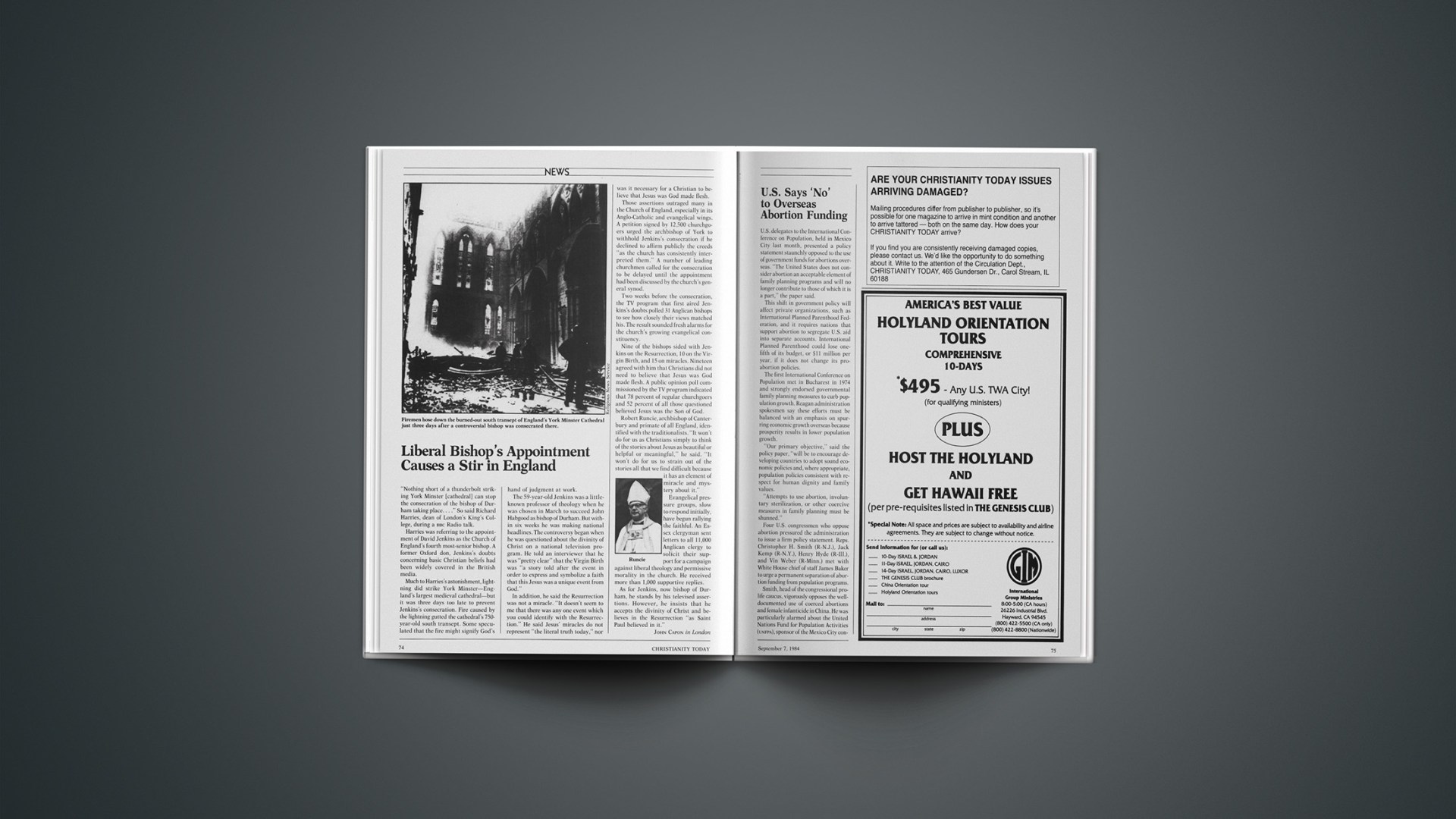
Much to Harries’s astonishment, lightning did strike York Minster—England’s largest medieval cathedral—but it was three days too late to prevent Jenkins’s consecration. Fire caused by the lightning gutted the cathedral’s 750-year-old south transept. Some speculated that the fire might signify God’s hand of judgment at work.

The 59-year-old Jenkins was a little-known professor of theology when he was chosen in March to succeed John Habgood as bishop of Durham. But within six weeks he was making national headlines. The controversy began when he was questioned about the divinity of Christ on a national television program. He told an interviewer that he was “pretty clear” that the Virgin Birth was “a story told after the event in order to express and symbolize a faith that this Jesus was a unique event from God.”

In addition, he said the Resurrection was not a miracle. “It doesn’t seem to me that there was any one event which you could identify with the Resurrection.” He said Jesus’ miracles do not represent “the literal truth today,” nor was it necessary for a Christian to believe that Jesus was God made flesh.

Those assertions outraged many in the Church of England, especially in its Anglo-Catholic and evangelical wings. A petition signed by 12,500 churchgoers urged the archbishop of York to withhold Jenkins’s consecration if he declined to affirm publicly the creeds “as the church has consistently interpreted them.” A number of leading churchmen called for the consecration to be delayed until the appointment had been discussed by the church’s general synod.

Two weeks before the consecration, the TV program that first aired Jenkins’s doubts polled 31 Anglican bishops to see how closely their views matched his. The result sounded fresh alarms for the church’s growing evangelical constituency.

Nine of the bishops sided with Jenkins on the Resurrection, 10 on the Virgin Birth, and 15 on miracles. Nineteen agreed with him that Christians did not need to believe that Jesus was God made flesh. A public opinion poll commissioned by the TV program indicated that 78 percent of regular churchgoers and 52 percent of all those questioned believed Jesus was the Son of God.

Robert Runcie, archbishop of Canterbury and primate of all England, identified with the traditionalists. “It won’t do for us as Christians simply to think of the stories about Jesus as beautiful or helpful or meaningful,” he said. “It won’t do for us to strain out of the stories all that we find difficult because it has an element of miracle and mystery about it.”

Evangelical pressure groups, slow to respond initially, have begun rallying the faithful. An Essex clergyman sent letters to all 11,000 Anglican clergy to solicit their support for a campaign against liberal theology and permissive morality in the church. He received more than 1,000 supportive replies.

As for Jenkins, now bishop of Durham, he stands by his televised assertions. However, he insists that he accepts the divinity of Christ and believes in the Resurrection “as Saint Paul believed in it.”

JOHN CAPONin London

U.S. Says ‘No’ To Overseas Abortion Funding

U.S. delegates to the International Conference on Population, held in Mexico City last month, presented a policy statement staunchly opposed to the use of government funds for abortions overseas. “The United States does not consider abortion an acceptable element of family planning programs and will no longer contribute to those of which it is a part,” the paper said.

This shift in government policy will affect private organizations, such as International Planned Parenthood Federation, and it requires nations that support abortion to segregate U.S. aid into separate accounts. International Planned Parenthood could lose one-fifth of its budget, or $11 million per year, if it does not change its proabortion policies.

The first International Conference on Population met in Bucharest in 1974 and strongly endorsed governmental family planning measures to curb population growth. Reagan administration spokesmen say these efforts must be balanced with an emphasis on spurring economic growth overseas because prosperity results in lower population growth.

“Our primary objective,” said the policy paper, “will be to encourage developing countries to adopt sound economic policies and, where appropriate, population policies consistent with respect for human dignity and family values.

“Attempts to use abortion, involuntary sterilization, or other coercive measures in family planning must be shunned.”

Four U.S. congressmen who oppose abortion pressured the administration to issue a firm policy statement. Reps. Christopher H. Smith (R-N.J.), Jack Kemp (R-N.Y.), Henry Hyde (R-Ill.), and Vin Weber (R-Minn.) met with While House chief of staff James Baker to urge a permanent separation of abortion funding from population programs.

Smith, head of the congressional prolife caucus, vigorously opposes the well-documented use of coerced abortions and female infanticide in China. He was particularly alarmed about the United Nations Fund for Population Activities (UNFPA), sponsor of the Mexico City conference,because of its four-year, $50 million grant to the Chinese government’s population control program. UNFPA receives millions of American aid dollars.

Organizations that promote abortion as a family-planning alternative call the new administration policy “a significant setback.” They may challenge it in Congress by encouraging prochoice representatives to try to legislate a repeal of the strictures on funding.

North American Scene

The U.S. Supreme Court has ruled unconstitutional a Maryland law that limited the fund-raising costs of charities. The law sought to forbid fund raisers from charging charities a fee totaling more than 25 percent of contributions raised. The court’s majority opinion said the law operated on the “mistaken premise that high solicitation costs are an accurate measure of fraud.”

A federal judge has ruled against municipal sponsorship of a Michigan nativity scene because it promoted only one set of beliefs. The U.S. Supreme Court earlier upheld a nativity display on public property in Pawtucket, Rhode Island. However, U.S. District Judge Anna Diggs Taylor noted that the Pawtucket display included secular holiday symbols. She ruled that the Birmingham, Michigan, nativity scene was strictly religious.

A number of proabortion and feminist organizations are urging President Reagan to denounce violence against abortion clinics. The National Abortion Federation, whose Washington, D.C., headquarters were damaged by a bomb blast in July, reports that 10 clinics have been bombed or damaged by arson this year.

A group of Methodist clergymen and the American Jewish Congress are challenging a federal program designed to discourage adolescent sexual activity. Filed through the American Civil Liberties Union, the suit argues that the Adolescent Family Life Program promotes religious teachings in violation of the First Amendment. Under the law, the government has distributed more than $23 million to hospitals, universities, social service agencies, and religious organizations.

The U.S. Army is using a version of theFocus on the Familyfilm series to help provide positive role models for soldiers and their spouses. Christian author James Dobson, whose organization produced the film series, is a member of the army’s Task Force on Soldiers and Families.

An association of 51 Southern Baptist churches in North Carolina has taken its denomination to task for adopting an antitobacco resolution. Southern Baptist Convention messengers (delegates) in June urged Congress to terminate subsidies to tobacco farmers and encouraged Southern Baptists who grow tobacco to switch to another crop. A recent resolution adopted by the Johnson Baptist Association in North Carolina calls the crop “the lifeline for many of our people and the majority of the churches” in the association.

The science education program at Liberty Baptist College has gained the approval of Virginia’s state board of education.Last year the program won conditional approval after a battle over whether Liberty graduates would teach creationism. College chancellor Jerry Falwell had sparked the dispute by saying Liberty graduates would teach evolution only to show that it is “foolish.” Recently, a committee appointed by the state board of education found the college’s biology curriculum to be scientifically sound.

A Washington, D.C., newspaper owned by Sun Myung Moon’s Unification Church has fired its editor and publisher. Officials at the Washington Times said James Whelan had made outrageous contract demands, including a salary increase from $90,000 to $185,000 by 1989, a rent-free $800,000 house, and a new luxury car every two years. Whelan charged that Moon’s church had assumed direct control of the newspaper. The Unification Church has pumped $150 million into the two-year-old operation to keep it alive.

A group of religious radio stations and a music licensing agency have resolved more than seven years of litigation. U.S. District Judge Whitman Knapp approved a settlement between some 75 radio stations and the American Society of Composers, Authors and Publishers (ASCAP). The stations had challenged the method ASCAP uses to charge fees to radio stations that broadcast music licensed by ASCAP. The settlement provides for a judge to determine reasonable fees when religious radio stations and ASCAP fail to agree on terms for licenses.

Citizens Battle a Booming Pornography Business

Porn opponents call for a boycott of 7-Eleven, a leading retailer of sexually explicit magazines.

Pornography was put on center stage when former Miss America Vanessa Williams was dethroned after Penthouse magazine published sexually explicit photos of her. The National Federation for Decency (NFD) is working hard to keep the porn issue in the spotlight.

Last month the group organized a nationwide, one-day picket of 7-Eleven, the convenience store leader. Demonstrators showed up at more than 400 7-Eleven stores in some 150 cities. The NFD says 7-Eleven leads the nation in retailing pornographic magazines. A 7-Eleven spokesman says the charge can neither be conclusively confirmed nor disproved.

The NFD also has urged a boycott of the convenience-store chain until it changes its policies on porn retailing. The organization says its efforts already are netting results. A number of retail chains, other than 7-Eleven, have discontinued the objectionable magazines, says NFD associate director Steve Hallman. Handy Marts Corporation, which owns 78 7-Eleven stores, has pulled the magazines on a two-month test basis.

There are almost 7,400 7-Eleven stores in the United States. Most are owned and operated by the multi-billion dollar Southland Corporation, based in Dallas. Doug Reed, Southland’s media relations coordinator, says there will be no changes in his company’s policy on porn retailing. That policy allows for the sale of just three “men’s” magazines—Playboy, Penthouse, and Forum. These are covered with blinders that allow only the titles to show, and they are not advertised.

However, independent franchisees own 35 percent of the nation’s 7-Eleven stores. Some openly display as many as 60 pornographic magazines. Reed says Southland urges compliance with corporation policy on the sale of such magazines, but has no legal control over independent owners.

“We consider ourselves a public-minded corporation,” he says. “We don’t want to offend anyone, but we recognize that [the magazines] are products some people request. We are not in the position to make moral judgments for our customers.”

The antipornography movement has embraced a boycott strategy partly because of perceived lax enforcement of laws regulating the pornography industry. Most states have enacted some form of antiobscenity laws. In addition, federal laws prohibit the shipping, mailing, and importation of obscene material.

However, it can be difficult to determine what is obscene. The U.S. Supreme Court in Miller v. California (1973) defined obscenity in terms of what an “average person” would find “patently offensive” by applying “contemporary adult community standards.” For guilt to be established, someone must initiate legal proceedings against each violation.

When a case does go to court, defense lawyers—heavily subsidized by the pornography industry—are often able to outmanuever prosecutors. Paul McCommon, legal counsel for Citizens for Decency through Law, says the current system, with its heavy emphasis on civil rights, favors pornographers. He adds that most authorities have not taken the initiative to prosecute and punish violators.

Meanwhile, the pornography industry burgeons. Some analysts say it does $8 billion worth of business annually. Accurate figures are hard to come by since some segments operate underground. “The pervasiveness of the problem increases every day,” McCommon says. “This is easily observable based on what’s available on cable TV, at video stores, corner stores, and gas stations.”

The conviction that pornography degrades women has drawn feminists into the fray. City councils in Minneapolis and Indianapolis have passed bills that would outlaw pornography as a violation of women’s rights. (The Minneapolis measure was vetoed by the city’s mayor. The Indianapolis ordinance is being challenged in court.)

The chairman of the Playboy Foundation, Burt Joseph, claims there is no connection between reading sexually explicit material and criminal behavior, such as rape. “The studies show that it’s the violence, not the sex, that causes antisocial conduct,” he says. Playboy does not publish photographs dealing with violence and refuses to accept advertising for guns, he says.

Joseph, who does not consider Playboy to be pornographic, theorizes that censors and pornographers need each other to keep their trades alive. “Only when pornography is suppressed,” he says, “does it continue to have a market interest. If people wanted to stamp out pornography, they should let it proliferate, and it would lead to boredom.” Critics call Joseph’s solution naïve and his evaluation of Playboy inaccurate. Both those who agree and disagree with him cite studies to support their views.

Not only has the pornography industry expanded, but its tone has changed markedly in recent years. Thirty years ago, when Playboy was alone in the field, pornography consisted of pictures of nude women. But Playboy, now considered relatively tame, has lost a large segment of the market. It now has 4.1 million subscribers, down from 7.2 million in its peak year of 1972. In many magazines, today’s pornography includes depictions of sadomasochism, rape, bestiality, and urination. In addition, some porn monitors estimate that more than 200 pornographic magazines exploit children. Some are published for profit; others serve a subculture of pedophiles.

Pornography’s turn toward the violent, bizarre, and grotesque has given rise to sociological and psychological analyses of the problem. Robert Moore, a professor of psychology and religion at Chicago Theological Seminary, says people who have been deprived of loving relationships early in life are prime candidates for psychological addiction to pornography.

Jean Bethke Elshtain, a University of Massachusetts professor of political science, writes in The New Republic that the porn plague mirrors “a world in which human beings … see themselves as objects of social forces over which they have no control.” She says pornography offers the viewer the illusion of “unlimited power to bend others to his will.”

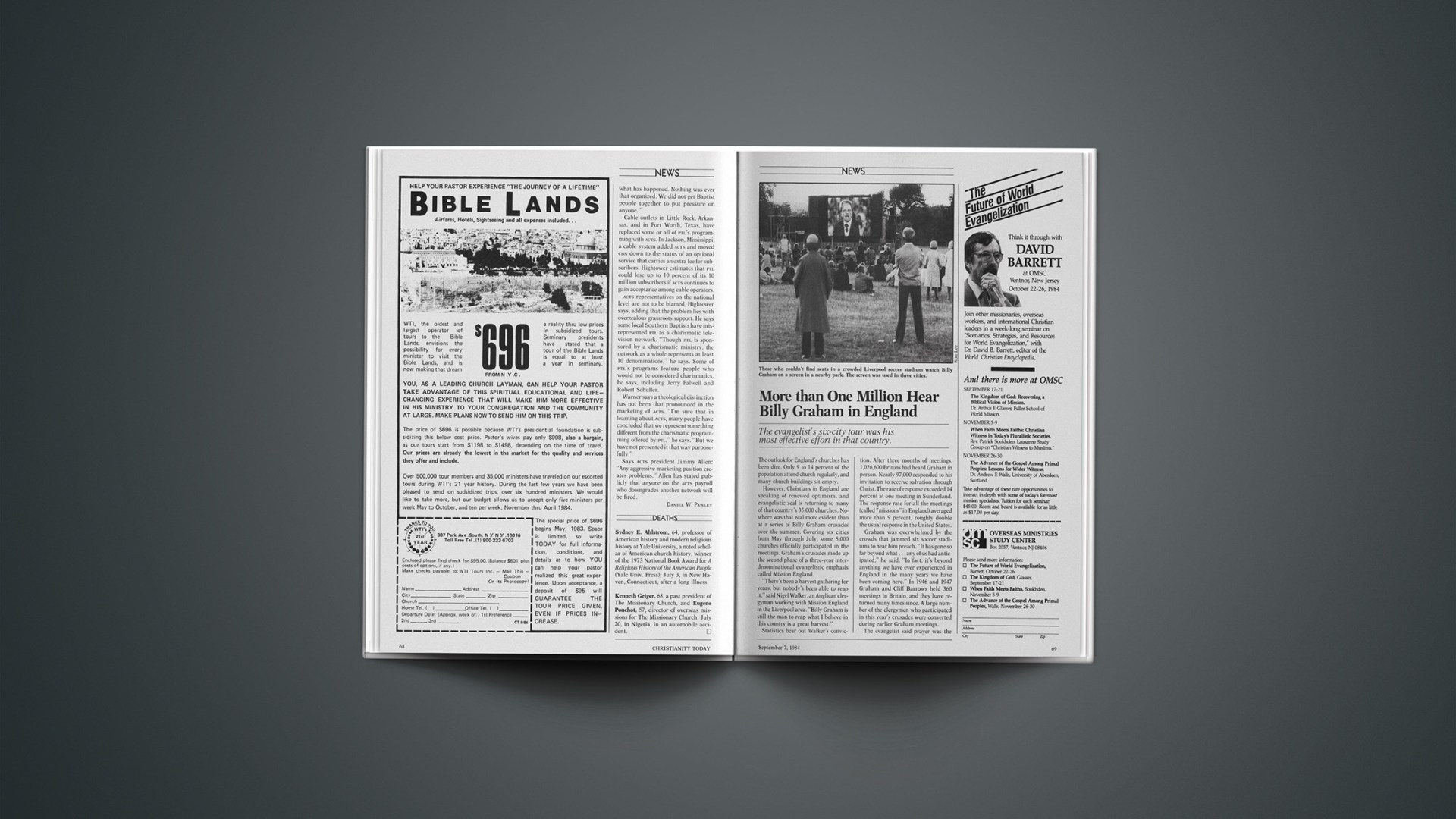
More than One Million Hear Billy Graham in England

The evangelist’s six-city tour was his most effective effort in that country.

The outlook for England’s churches has been dire. Only 9 to 14 percent of the population attend church regularly, and many church buildings sit empty.

However, Christians in England are speaking of renewed optimism, and evangelistic zeal is returning to many of that country’s 35,000 churches. Nowhere was that zeal more evident than at a series of Billy Graham crusades over the summer. Covering six cities from May through July, some 5,000 churches officially participated in the meetings. Graham’s crusades made up the second phase of a three-year interdenominational evangelistic emphasis called Mission England.

“There’s been a harvest gathering for years, but nobody’s been able to reap it,” said Nigel Walker, an Anglican clergyman working with Mission England in the Liverpool area. “Billy Graham is still the man to reap what I believe in this country is a great harvest.”

Statistics bear out Walker’s conviction. After three months of meetings, 1,026,600 Britons had heard Graham in person. Nearly 97,000 responded to his invitation to receive salvation through Christ. The rate of response exceeded 14 percent at one meeting in Sunderland. The response rate for all the meetings (called “missions” in England) averaged more than 9 percent, roughly double the usual response in the United States.

Graham was overwhelmed by the crowds that jammed six soccer stadiums to hear him preach. “It has gone so far beyond what … any of us had anticipated,” he said. “In fact, it’s beyond anything we have ever experienced in England in the many years we have been coming here.” In 1946 and 1947 Graham and Cliff Barrows held 360 meetings in Britain, and they have returned many times since. A large number of the clergymen who participated in this year’s crusades were converted during earlier Graham meetings.

The evangelist said prayer was the key to the success of this summer’s crusades. At least 30,000 English Christians each prayed for the salvation of three non-Christians. Even before Graham held the first meeting in May, many of the persons being prayed for had become Christians.

Churches prepared for the crusades for months. Some 50,000 Christians attended classes designed to help them share their faith. About 30,000 received training to assist with nurture groups. The groups are designed to help new converts become grounded in their faith and to become part of a church.

As a result of the churches’ preparations and Graham’s preaching, new converts are plentiful in England. Hundreds of buses brought Christians and their unchurched friends to hear the evangelist’s straightforward proclamation of the gospel. On one night of the Liverpool crusade, buses lined both sides of a two-mile stretch of road. In Bristol, Birmingham, and Liverpool, the soccer stadiums could not hold the crowds. Thousands in those cities had to watch Graham on a giant screen set up in nearby parks.

Those who responded to the evangelist’s invitation ranged from punk rockers to news reporters and wealthy businessmen. A member of the British royal family, Princess Alexandra, attended one of the Liverpool meetings.

On the first night of his Ipswich crusade, Graham encouraged new converts to tell someone about their decision to follow Christ. The next day, Graham’s wife, Ruth, saw a woman handing out Christian literature. When Mrs. Graham stopped to talk, the woman told her she had become a Christian the previous night at the crusade.

In another city, a boy at the crusade wanted to walk on the field where his favorite soccer team plays. When he stepped onto the field, a counselor met him and led him to faith in Christ. At another meeting, a group of pickpockets walked onto the playing field during the invitation. Instead of taking wallets they asked for counseling.

In addition to those who attended the crusades, 210,000 Britons so far have seen Graham on videotape. Several meetings were taped and shown in numerous cities and towns. As a result of the “video missions,” some 8,000 persons responded to the evangelist’s call for repentance.

Mass media coverage during the summer was more extensive and more positive than during any of Graham’s earlier crusades in England. Several of his sermons were broadcast on television and radio. The BBC’s world radio service transmitted one of his Sunderland sermons live to a global audience estimated at 60 million.

Before the crusades began, controversial newspaper publisher Rupert Murdoch, owner of tabloids in England and the United States, called a meeting to introduce his London editors to Graham. The following month, one of Murdoch’s papers and England’s largest, the Sun, editorialized that Graham would make a “wonderful” bishop “and an even better archbishop” in the Church of England.

After preaching at 41 meetings, Graham left England for South Korea where he helped celebrate the one-hundredth anniversary of Protestant Christianity there. This month the 65-year-old evangelist is scheduled to preach in several major cities of the Soviet Union. He plans to return to England next year for a crusade in Sheffield.

RON LEEin England

World Scene

President Gaafar el-Nimeiri of Sudan has imposed sharia (Islamic law) as the law of the land. The move caps the rise of the Muslim Brotherhood’s influence in the African nation. In the past several months, Muslim Brotherhood members have been given key posts in the judiciary, parliament, and the cabinet. The archbishop of Khartoum warned that sharia law “entails the suppression of Christians.” He called for Christians to protest discrimination in jobs, education, social services, and the courts.

The government of Kenya has warned that country’s branch of Campus Crusade for Christ that it would be banned unless it severs ties with a South African organization. A government official said Life Ministry—the Campus Crusade affiliate—has received religious publications from South Africa. Kenya does not have diplomatic, cultural, or trade links with South Africa, a country that enforces racial segregation.

Several of Mexico’s Roman Catholic bishops have expressed alarm at the growth of “sects” in their country. The bishops say the groups—including Jehovah’s Witnesses, Mormons, Presbyterians, Methodists, and Pentecostalists—are undermining religion, patriotism, and culture in Mexico. The Mexican press has criticized Protestant groups, calling them U.S. spies or agents of the Central Intelligence Agency.

A 35-hour protest by more than 500 Buddhist nuns has ended the making of a film in South Korea depicting the sex life of a Buddhist nun. About 30 nuns were injured in a clash with riot police. Some of the nuns cut their fingers and wrote in blood slogans such as “We shall stop the film production with life-and-death determination.”

A Quichua Indian convert in Ecuador was beaten to death by a mob when he refused to renounce his faith in Christ. The victim, Juan Toaquisa Guanina, was one of only seven Christians in his village. The mob violence and other attacks are reminiscent of persecution against Quichua Christians who penetrated villages for the first time with the gospel more than 20 years ago.

A June bomb blast is the latest in a series of incidents meant to harass the Wycliffe Bible Translators in Mexico. A bomb in a plastic bag was left near the front door of the Wycliffe office building in Mexico City. The resulting explosion shattered windows, but none of the more than 20 persons inside were injured. Some of the country’s news media are calling on the government to expel Wycliffe. The Bible translators are accused of imposing their customs and religion on Mexican Indians.

PTL Says Baptist TV Network Benefits from Unfair Marketing Practices

The three-month-old American Christian Television System (ACTS) is making inroads into a crowded cable television market. With more than one million subscribers, some of the system’s marketing practices are drawing fire from a larger, more established religious network.

ACTS was conceived and developed by the 14-million-member Southern Baptist Convention (SBC). SBC members—mobilized in a grassroots marketing thrust—are telling local cable operators that ACTS is the best choice for their communities. Cable system operators often choose only one network that offers religious programming. When they choose ACTS, it is often at the expense of another religious network.

“We are not pleased with the way local ACTS boards have approached the cable companies, given them inaccurate portrayals of who we are, and construed themselves as an ‘answer’ to Christian television,” says Jack Hightower, marketing director for the PTL network.

Hightower says the ACTS marketing effort is “a powerful political machine” that goes beyond healthy competition. “PTL, CBN, and Trinity Broadcasting Network have for years vied in the marketplace with limited channel capacity,” he says. “Because of this, sometimes one or two [religious] networks will win and the other be left out in the cold. But we have never gone to a cable operator and said, ‘Kick them off and put us on.’ This is what some local ACTS boards have done.”

ACTS representatives admit to some early marketing mistakes. But for the most part, they say PTL is overreacting. “There is no discussion of who is already on the system or who needs to be kicked off,” says Lloyd Hart, national cable affiliate manager for ACTS. “It would only hurt us to force our way onto a cable system.”

“The enthusiasm on the part of SBC members promoting ACTS has been confused as pressure,” says ACTS representative Greg Warner. “But [Hightower’s] term ‘political machine’ far overstates what has happened. Nothing was ever that organized. We did not get Baptist people together to put pressure on anyone.”

Cable outlets in Little Rock, Arkansas, and in Fort Worth, Texas, have replaced some or all of PTL’s programming with ACTS. In Jackson, Mississippi, a cable system added ACTS and moved CBN down to the status of an optional service that carries an extra fee for subscribers. Hightower estimates that PTL could lose up to 10 percent of its 10 million subscribers if ACTS continues to gain acceptance among cable operators.

ACTS representatives on the national level are not to be blamed, Hightower says, adding that the problem lies with overzealous grassroots support. He says some local Southern Baptists have misrepresented PTL as a charismatic television network. “Though PTL is sponsored by a charismatic ministry, the network as a whole represents at least 10 denominations,” he says. Some of PTL’s programs feature people who would not be considered charismatics, he says, including Jerry Falwell and Robert Schuller.

Warner says a theological distinction has not been that pronounced in the marketing of ACTS. “I’m sure that in learning about ACTS, many people have concluded that we represent something different from the charismatic programming offered by PTL,” he says. “But we have not presented it that way purposefully.”

Says ACTS president Jimmy Allen: “Any aggressive marketing position creates problems.” Allen has stated publicly that anyone on the ACTS payroll who downgrades another network will be fired.

Deaths

Sydney E. Ahlstrom, 64, professor of American history and modern religious history at Yale University, a noted scholar of American church history, winner of the 1973 National Book Award for A Religious History of the American People (Yale Univ. Press); July 3, in New Haven, Connecticut, after a long illness.

Kenneth Geiger, 68, a past president of The Missionary Church, and Eugene Ponchot, 57, director of overseas missions for The Missionary Church; July 20, in Nigeria, in an automobile accident.

Canadian Church Denies Ordination to Practicing Homosexuals

The United Church of Canada has defeated a move to admit practicing homosexuals to the ordained ministry. The denomination’s general council rejected a task force report that would have instructed the church’s conferences (regional governing bodies) to disregard sexual orientation in determining a candidate’s suitability for ordination.

Meeting last month in Manitoba, the council called for full human and civil rights for homosexuals and for their acceptance in the church. However, it said presbyteries (area governing bodies) should be left with the responsibility to inquire into a ministerial candidate’s “character, faith, motives, and general fitness.” In the past, some conferences have ordained gays, while others have rejected them. By maintaining the status quo, the general council left conferences and presbyteries without a specific directive on the ordination of practicing homosexuals.

By rejecting the task force report, the council reflected “the grassroots feeling of the church,” said Bailey Snow of the evangelical United Church Renewal Fellowship. The renewal fellowship spearheaded opposition to the report.

Supporters of gay ordination said they regarded the vote as a temporary stalemate and not a setback. AFFIRM, a network of homosexual United Church members, called on the denomination “to repent of its oppression of lesbian and gay people.” Eilert Frerichs, United Church chaplain at the University of Toronto and an AFFIRM spokesman, said the controversy reflected the deeper liberal-conservative split in the church.

A survey in British Columbia revealed that 90 percent of church members would not approve placement of a homosexual minister in their congregation. Forty-five percent said they would leave the congregation if a gay were appointed, and 42 percent said they would cut off financial support.

Clarke MacDonald, the denomination’s immediate past moderator, called the task force report scripturally unsound and said it did not make a conclusive case that homosexuality is an inherited condition. The new moderator, Robert Smith, has been a strong advocate of homosexual rights. He called for acceptance of homosexuals and lesbians in the church.

Another concern of Canada’s largest Protestant body involves its declining membership. From 1971 to 1981, the United Church of Canada’s resident membership dropped by 13 percent to 727,598. During the same period the Canadian population increased by 12 percent.

LESLIE K. TARRin Canada

Prolifers Gear Up For Election-Year Battles

As the November election draws near, the battle over abortion promises to escalate on several fronts. Antiabortionists are monitoring efforts in four states to pass constitutional amendments that would prohibit public abortion funding. In addition, they are pumping record amounts of money into 250 congressional races.

This year, prolife candidates for Congress might find unusually hefty amounts of money flowing in. The National Right to Life political action committee has raised $750,000. That is a considerable increase over its campaign spending in 1982 ($300,000) and in 1980 ($100,000). Director Sandra Faucher says the money will be divided among many election races depending upon the “vulnerability” of prolife candidates. A political action committee is allowed to contribute a maximum of $5,000 to each campaign.

“We expand two or three times with each election cycle,” gaining about 6,000 members per month, Faucher says. Her nemesis, the National Abortion Rights Action League (NARAL), has raised an equivalent amount of campaign dollars. But according to Nanette Falkenberg, NARAL’s executive director, their spending will equal rather than exceed 1982 levels.

Proabortion groups such as NARAL are concentrating on presidential politics. “Our number one priority in 1984 is to defeat President Reagan,” Falkenberg says. The next President’s probable opportunity to appoint new U.S. Supreme Court justices and the “emotionally charged tenor” of Reagan’s right-to-life rhetoric are key reasons for increased proabortionist activity, she says.

NARAL says the balance of power in Congress has shifted sharply in its favor, but two recent votes call that claim into question. The U.S. House of Representatives—by a vote of 261 to 156—defeated an effort to lift restrictions on abortion funding in federal employee health insurance coverage. This 105-vote margin is “our biggest ever,” says Janet Carroll of the National Right to Life Committee (NRLC). Some 9.5 million persons are covered by federal employee health insurance, which in 1980 paid for 17,000 abortions.

A second prolife victory involved a U.S. Senate vote favoring the rights of handicapped infants. The measure would redefine child abuse to include the practice of withholding medical treatment or nourishment from a handicapped newborn. The bill would require states to appoint hospital representatives to report cases where food or medication may have been withheld. Federal anti-child abuse funds could be withheld from states that refuse to comply. The Senate bill closely resembles a House-approved version.

In Arkansas, Colorado, Massachusetts, and Oregon, prolife activists prepared constitutional amendments to place on the November ballot. The proposed amendments would prohibit state funding of abortions. Says NRLC legislative director Douglas Johnson: “It is in part a response to a growing tendency among state courts to discover within state constitutions ‘abortion rights’ even broader than those written into the federal constitution by the Supreme Court.”

Personalia

Bob G. Slosser has been named president of CBN University in Virginia Beach, Virginia. He had been serving as executive vice-president of the university.

The World Council of Churches (WCC) has chosen a Uruguayan Methodist pastor, Emilio Castro, to succeed Philip Potter as its general secretary. Castro previously headed the WCC’s World Mission and Evangelism Commission. His concern for winning souls is seen as a strength in dealing with evangelical Christians. Castro will assume his new post in January.

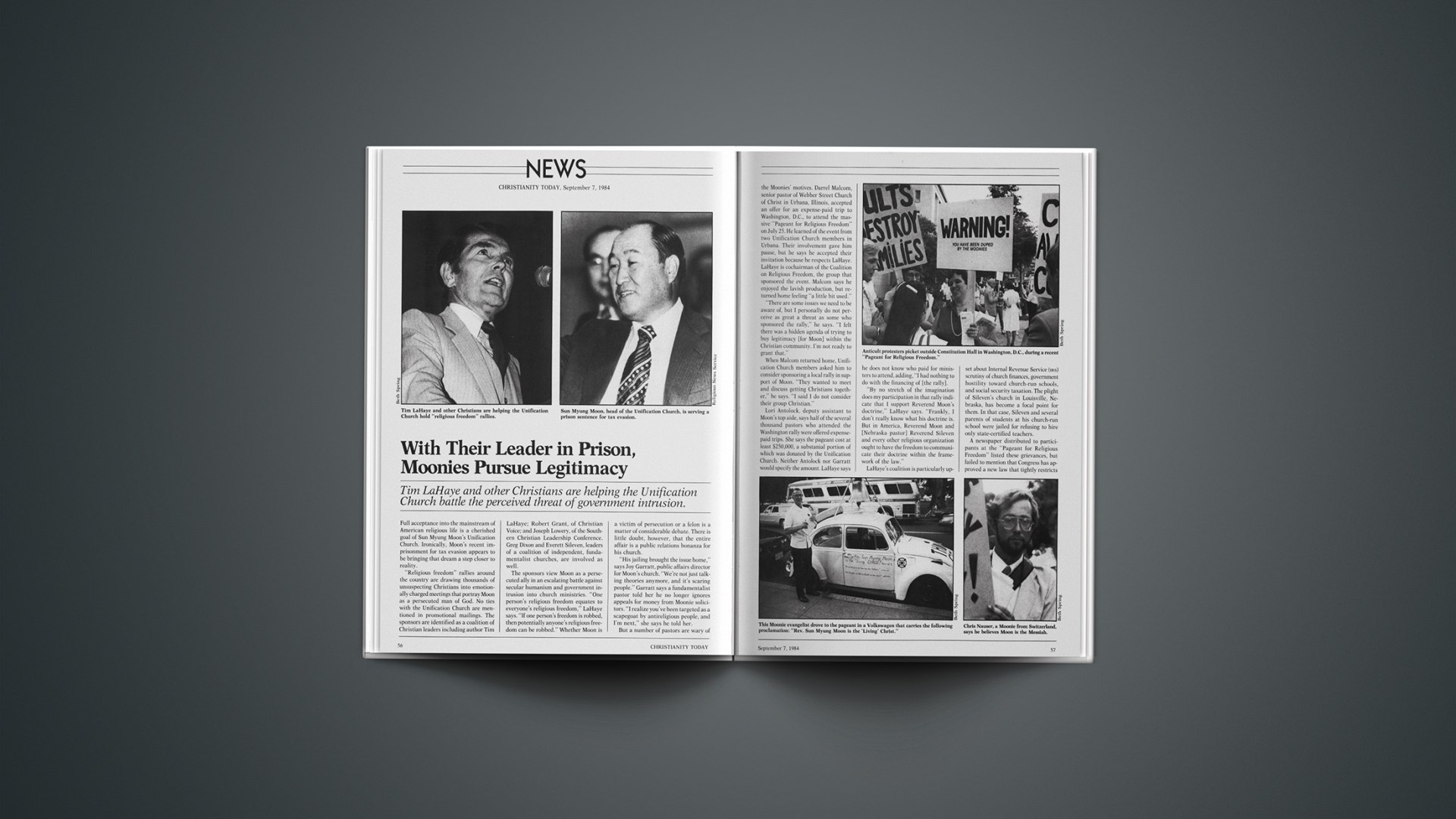
With Their Leader in Prison, Moonies Pursue Legitimacy

Tim LaHaye and other Christians are helping the Unification Church battle the perceived threat of government intrusion.

Full acceptance into the mainstream of American religious life is a cherished goal of Sun Myung Moon’s Unification Church. Ironically, Moon’s recent imprisonment for tax evasion appears to be bringing that dream a step closer to reality.

“Religious freedom” rallies around the country are drawing thousands of unsuspecting Christians into emotionally charged meetings that portray Moon as a persecuted man of God. No ties with the Unification Church are mentioned in promotional mailings. The sponsors are identified as a coalition of Christian leaders including author Tim LaHaye; Robert Grant, of Christian Voice; and Joseph Lowery, of the Southern Christian Leadership Conference. Greg Dixon and Everett Sileven, leaders of a coalition of independent, fundamentalist churches, are involved as well.

The sponsors view Moon as a persecuted ally in an escalating battle against secular humanism and government intrusion into church ministries. “One person’s religious freedom equates to everyone’s religious freedom,” LaHaye says. “If one person’s freedom is robbed, then potentially anyone’s religious freedom can be robbed.” Whether Moon is a victim of persecution or a felon is a matter of considerable debate. There is little doubt, however, that the entire affair is a public relations bonanza for his church.

“His jailing brought the issue home,” says Joy Garratt, public affairs director for Moon’s church. “We’re not just talking theories anymore, and it’s scaring people.” Garratt says a fundamentalist pastor told her he no longer ignores appeals for money from Moonie solicitors. “I realize you’ve been targeted as a scapegoat by antireligious people, and I’m next,” she says he told her.

But a number of pastors are wary of the Moonies’ motives. Darrel Malcom, senior pastor of Webber Street Church of Christ in Urbana, Illinois, accepted an offer for an expense-paid trip to Washington, D.C., to attend the massive “Pageant for Religious Freedom” on July 25. He learned of the event from two Unification Church members in Urbana. Their involvement gave him pause, but he says he accepted their invitation because he respects LaHaye. LaHaye is cochairman of the Coalition on Religious Freedom, the group that sponsored the event. Malcom says he enjoyed the lavish production, but returned home feeling “a little bit used.”

“There are some issues we need to be aware of, but I personally do not perceive as great a threat as some who sponsored the rally,” he says. “I felt there was a hidden agenda of trying to buy legitimacy [for Moon] within the Christian community. I’m not ready to grant that.”

When Malcom returned home, Unification Church members asked him to consider sponsoring a local rally in support of Moon. “They wanted to meet and discuss getting Christians together,” he says. “I said I do not consider their group Christian.”

Lori Antolock, deputy assistant to Moon’s top aide, says half of the several thousand pastors who attended the Washington rally were offered expense-paid trips. She says the pageant cost at least $250,000, a substanial portion of which was donated by the Unification Church. Neither Antolock nor Garratt would specify the amount. LaHaye says he does not know who paid for ministers to attend, adding, “I had nothing to do with the financing of [the rally].

“By no stretch of the imagination does my participation in that rally indicate that I support Reverend Moon’s doctrine,” LaHaye says. “Frankly, I don’t really know what his doctrine is. But in America, Reverend Moon and [Nebraska pastor] Reverend Sileven and every other religious organization ought to have the freedom to communicate their doctrine within the framework of the law.”

LaHaye’s coalition is particularly upset about Internal Revenue Service (IRS) scrutiny of church finances, government hostility toward church-run schools, and social security taxation. The plight of Sileven’s church in Louisville, Nebraska, has become a focal point for them. In that case, Sileven and several parents of students at his church-run school were jailed for refusing to hire only state-certified teachers.

A newspaper distributed to participants at the “Pageant for Religious Freedom” listed these grievances, but failed to mention that Congress has approved a new law that tightly restricts IRS audits of churches. Congress also has passed a measure that allows churches to opt out of paying social security taxes for their employees.

Inside Washington’s Constitution Hall, the pageant linked Sileven and Moon with victims of persecution from America’s past, including slaves during pre-Civil War days and Joseph Smith, founder of the Church of Jesus Christ of Latter-Day Saints (Mormon). Flanked by replicas of the Liberty Bell and Statue of Liberty, a 50-voice choir sang hymns and patriotic songs.

A narrator introduced actors portraying heroes of American religious history. At the end, a melodramatic enactment of Moon’s trial and sentencing drew a chorus of boos and hisses for his prosecutor and sustained cheers for Moon.

Following the performance, LaHaye spoke to the audience. “If we have the same percentage of religious freedom attacks in the next 15 years as we have had in the past 15 years, we’ll no longer have religious freedom in America,” he said. LaHaye did not mention Moon by name.

The evening’s dramatic climax came when Moon’s daughter, In Jin Moon, choked back tears as she spoke of her father. “I have almost never seen my father sleep. He is always up working and praying. I have never seen anyone so dedicated to America’s dream and to God.” She read a statement prepared by Moon for the gathering. It referred to America as God’s final hope, “his precious jewel which he prepared for the final battle against atheistic communism in the last days.”

Moon’s statement emphasized the need for churches to unite—a central theme of Unification teaching. “Here in prison God can use me to awaken America more powerfully than ever before. America’s religious communities must be united to preserve religious freedom.”

Garratt says members of the Unification Church in Washington number between 300 and 500, and many of them took part in the rally. A Moonie from New York estimates that 100 adherents traveled from that area. Most were soft-spoken, young, and earnest. They hovered near reporters and anticult protesters, interrupting conversations about Moon with spirited defenses of their cause.

Chris Nauser, a 36-year-old Moonie from Switzerland, viewed the rally as “just one part of the whole development of an awakening” that will sweep the world. He shares the belief of most of Moon’s followers that Moon himself is the Messiah. The Unification Church teaches that Jesus Christ failed in his redemptive mission and, before his death, lied about his coming resurrection. Moonies teach that mankind is in need of physical redemption, which will come by the marriage of an ideal man and woman. The man is to be from Korea—Moon himself.

According to former Moonie Steven Hassan, members of the church shed their personal religious freedom upon entering the church. Although many members leave voluntarily, Hassan says they are threatened with supernatural reprisals for doing so, such as demonic possession, an early death, or the birth of stillborn babies.

When Moon stood trial for tax evasion in 1982, numerous denominations and Christian organizations filed friend-of-the-court briefs on his behalf. He was found guilty of failing to report $112,000 in earned interest and for receiving $50,000 worth of corporate stock without declaring them taxable. His trial turned on the questions of whether the money belonged to Moon personally or was being held in trust for the church. In prosecuting the case, the U.S. Justice Department characterized Moon as a business mogul rather than a religious leader. Explanations of his behavior based on his role as a religious leader were deemed inadmissible.

That approach drew cries of outrage from many Christians who viewed it as unjust. A brief filed for the National Council of Churches and five other groups concluded, “Little of what even modern-day mainstream churches routinely do would survive intact if squeezed through a religion-extracting filter.” It pointed out that many missionaries abroad and ministers in America hold nontaxable income for their organizations.

The case brought into sharp focus a central question about the Unification Church’s primary reason for being. Critics perceive the organization as more of a multinational corporation than a church, pointing out that Moon operates three daily newspapers and hundreds of secular business enterprises.

Hassan, who coordinates support efforts in New England for former cult members from various groups, says the Unification Church is losing ground in its recruiting efforts. The church claims 30,000 American adherents and three million members worldwide. However, Hassan says fewer than 7,000 people could be considered active in the church.

Perhaps it is because enrollments are sluggish that the Unification Church is diverting resources toward establishing a firm foothold on the religious landscape. The church’s efforts include hosting scientific, technical, and religious conferences worldwide at which noted authorities participate free of charge. The church’s New Ecumenical Research Association recruits graduate students of different faiths who are perceived as future church leaders for expense-paid trips to the Holy Land.

Its march toward acceptability could signal some profound realignments. “I’m not concerned about the Unification Church advancing its cause here in America, because I’m convinced there are so many people being freed by the truth of the gospel,” says LaHaye. “What I’m concerned about is the spread of religious persecution that will lead to a totalitarian state where we will lose religious freedom.”

In Illinois, Pastor Malcom has been studying 2 Chronicles 19 and 20. “Should you help the wicked and love those who hate the Lord?” the seer Jehu asked. Malcom finds the question particularly relevant, and he sees no pat answer.

“I’ve got to think this thing through,” he says. “I’m well aware there are forces against Christianity which use their power to wreak havoc. I’m also aware there were groups in Germany that didn’t protest when minorities were persecuted, so I have mixed emotions about it.”

The Uselessness of Religion

We confuse what really works with what doesn’t.

In all seasons, after my morning run, I perform a ritual. Rain or shine, I am invariably dripping wet, so I remove my perspiration-soaked shirt and undershirt and prepare to throw them down the cellar stairs for laundering.

The throw is anything but a mindless toss: I try my best to make them land not on the steps or floor, but on the banister only—and precisely at the newel post if at all possible. And why do I put such effort into so simple a task? Why do I stand in the cellar doorway frantically putting body English on a couple of soggy shirts? I will tell you why. It is because under all my Christianity I am a pagan at heart. I am convinced that if I land the shirts properly, the day will go well: the otherwise surly powers of the universe will have been induced to smile on my projects. But I am also convinced that if I do not, my personal world will come unstuck: I have made a religion, you see, of taking off my clothes.

You are no doubt disposed to find that a silly business—an exercise that can have no more effect on reality than stepping on a crack has on your mother’s back. I agree. But I would also like you to see that the ineffectuality of such rituals is not the real root of their silliness. They are foolish not because they’re the wrong tool for the job of jimmying the universe into line, but because the job has already been done by Jesus. Indeed, thank God they are the wrong tool: if the likes of us really had the power to straighten out the world, we would make it a bigger mess than it is. What I want to do, therefore, is simply to set these pointless religiosities of ours in the light of the reconciliation freely given to us on the youngest day (the day of resurrection, a new beginning, thus the youngest day) and—if nothing else—laugh at them for the right reason.

In the long run, Christianity is not a religion. While it uses the forms of religion—observances, days, and seasons that seem to be intended to fix up our relationship with God and the universe—it is in fact the announcement of the end of any need for such influencing at all. It is the proclamation of the gospel that God has fixed up everything himself, and it is an invitation to believe that incredibly cheerful good news.

The rituals of Advent and Lent, of Easter and Pentecost, are of no more value religiously than my tossing of sweaty clothing. They are celebrations, and earthly celebrations at that, of a reconciliation already accomplished. They are emphatically not transactions by which God is conned into being nice.

Religions, from the point of view of the gospel, are useless. And their uselessness is rooted not in the truth or falsity of their tenets or in the effectiveness or ineffectiveness of their rituals, but in the very fact that they are religions at all. It lies in the profound stupidity of two assumptions they all make, and which I have already alluded to. The first is that after Jesus there is still something that needs effecting before the human race problem can be solved. And the second is that we could actually effect it if only we had the right kind of whammy to put on the problem.

Which is why I brought up my basement banister religion. The real objecttion to it is not that it can’t work, but that I shouldn’t be standing there acting as if there were a need for it to work. It is bad news not because I’ve got the wrong religion, but because I’ve got any at all. I don’t need to run around looking for the right recipe to save the world, because even if I found it I’d still use it wrong.

The real criticism of all religions—of the false ones that tell that chicken sacrifices or occult phenomena or astrology or futurism can save the world, and of the true ones that tell you morality or humanitarian values or scientific knowledge can do the job—is one and the same. True or false, all such instruments are in our hands. Whether they can actually exercise a controlling effect or not, our exercise of them is never under control. In our grip, their results are invariably less than hilarious.

It is only in some better grip, therefore, that the world can be saved. It is only in some other hand far removed from the uselessness of religion that the work of religion can be accomplished. It is only, in short, on the youngest day—in the hand of the vindicating Word—that laughter can ever be restored to the world.

But because that laughter is already fact just on the other side of death, it is also already fact just on the other side of our unbelief. We are asked to believe not that our reconciliation will be true someday but that it is true already and we are invited now into the hilarity of it all.

Capon is an Episcopal priest and was dean of Mercer School of Theology in Garden City, Long Island. His best-selling books include Bed and Board and Between Noon and Three. This column is excerpted from The Youngest Day: Shelter Island’s Seasons in the Light of Grace (Harper & Row, 1983); used by permission.

Heaven Can’t Wait

A strange fact about modern American life: although 71 percent of us believe in an afterlife (says George Gallup), no one much talks about it. Christians believe that we will spend eternity in a splendid place called heaven. Percentages don’t apply to eternity, of course; but for the sake of argument, assume that 99 percent of our existence will take place in heaven. Isn’t it a little bizarre that we simply ignore heaven, acting as if it doesn’t matter?

The past four annual volumes of the Reader’s Guide to Periodical Literature record a grand total of zero articles on heaven. Many articles concern old age, many are about death, some are on out-of-the-body experiences, but none are about heaven. More surprisingly, the Religion Index to Periodicals references only a handful of articles on heaven: two, for instance, during the years 1981–82.

This modern situation differs from the past, when heaven aroused great interest. A good library will contain dusty 1,000-page anthologies from the nineteenth century, of poetic and prose imaginings of what heaven will be like.

What happened? At least three reasons may help explain the mystery.

1. Affluence has given us in this life what former generations longed for in anticipation of heaven. We now have (most of us in the West, at least) relief from pain, plentiful food, and surroundings of beauty and luxury. The biblical promise of such a state has lost some of its luster.

Karl Marx criticized religion as the “opiate of the people” because it promised the lower classes “pie in the sky” in order to lull them away from wanting it now. Marx’s critique sounds quaint today, because few people are promising pie in the sky anymore; religious organizations such as the World Council of Churches and evangelical relief agencies instead encourage us to redistribute the pie here on earth.

2. A creeping paganism invites us to accept death as the culmination of life on earth, not as a violent interruption in an eternal life. Elizabeth Kubler-Ross (who happens to believe in an afterlife) described five stages of death, with an implicit assumption that the “Acceptance” stage is the most healthful and appropriate.

I have watched in hospital groups as dying patients worked desperately toward a calm stage of acceptance, denying the impulses of their instincts and conscience to reject the unnatural act of death. Strangely, no one ever talked about heaven in those groups; it seemed embarrassing, somehow cowardly. What convulsion of values can have us holding up the prospect of annihilation as brave and that of blissful eternity as cowardly?

3. Older images of heaven, the biblical ones, have lost their appeal. Walls of emerald, sapphire, and jasper, streets of gold, and pearly gates may have inspired Middle Eastern peasants, but they don’t mean much to the world of Bauhaus. And religious leaders and artists have failed to create satisfactory new images. What will heaven be like? A place where “all a body would have to do was to go around all day long with a harp and sing, forever and ever” sounds as unattractive to most of us as it did to Huck Finn.

In this brief column I can only begin to raise questions. But it seems to me Christian communicators have a clear responsibility to project a new understanding of heaven into modern consciousness. If we fail, we forfeit one of our faith’s greatest features.

To people who are trapped in pain, in economic chaos, in hatred and fear—to these, heaven offers a promise of a time, far longer and more substantial than this time on earth, of health and wholeness and pleasure and peace. If we do not believe that, then, as the apostle Paul noted, there is not much reason for being a Christian in the first place.

I have seen the electrifying results of what can happen when the concept of heaven comes alive. My wife, Janet, works with senior citizens in a part of Chicago recently judged the poorest community in the United States. About half of her clients are white, half are black. All of them have lived through harsh times: two world wars, the Great Depression, the waves of social upheaval that have affected major cities. And all of them, in their seventies and eighties, face the inevitability of death.

My wife has observed a remarkable difference in the way the whites and blacks face death. There are exceptions, of course, but the trend is this: many of the whites become increasingly more fearful and uptight. They complain about their lives, their families, and their deteriorating health.

The blacks, in contrast, maintain a good humor and spirit of triumph even though most of them have greater reason for bitterness and despair. Their lives were three-fourths over by the time the civil rights bills were passed.

Janet believes the difference is hope, a hope that traces directly to the blacks’ bedrock belief in heaven. “This world is not my home, I’m just passin’ through,” they say. These words and others like them came out of a tragic period of history, when everything in this world looked bleak. But black churches managed to instill a vivid belief in a home beyond this one.

Somehow, these neglected saints have learned to anticipate and enjoy God in spite of the difficulties of their lives. When we get to heaven, many of us may be shocked at what it means to enjoy God. For others, such as these elderly blacks, that joy will seem more like a long-awaited homecoming than a visit to a new place. Who knows, they may save a few hundred years’ awkward transition.

Choice Books

CHRISTIANITY TODAY again offers readers six books deemed choice (“worthy of your attention”) by a collection of evangelical leaders—denominational executives, college presidents and professors, pastors—who also happen to be avid readers. Ranging in theme and purpose from an exposé of modern times to the symbolism interweaving our physical bodies with the realities of faith, this quarter’s selection offers a variety of thoughtful viewpoints and perceptions (some controversial) that cry for consideration and application in the context of Christian living.

While not in any sense a definitive list, these Choice Books are nevertheless designed to be an effective starting point from which to begin your pursuit of the best in today’s writing—and thinking.

Ragman and Other Cries of Faith, by Walter Wangerin, Jr. (Harper & Row, 1984, 149 pp.; $11.95).

Ragman and Other Cries of Faith is a collection of 26 pieces spanning an impressive literary spectrum, including narrative, fable, autobiography, and drama. In these pages are such memorable real people as Arthur Forte, a sick old man who, “to speak the cold, disturbing truth, … lived in a rotting stuffed chair in that room, from which he seldom stirred the last year of his life.” There is also Rachel, a deranged woman wandering city streets in search of a lost grandson. And Sarah Moreau, who, in the act of dying, draws her family together with dignity.

The fictional vignettes present a no less intriguing cast, including such characters as Moses Swope, a small, amusingly accident-prone boy who meets Jesus; and the enigmatic Ragman of the book’s title.

This diverse, polished collection is welded into a whole by Wangerin’s outstanding pastoral sensitivity. Wangerin has produced and announced radio programs, taught at several universities, written award-winning books, won acclaim as a colorful and dramatic speaker, and traveled with migrant farm workers. Ragman, however, draws on Wangerin’s experience in his present occupation as pastor of a small, inner-city church in Evansville, Indiana. The book thus attests not only to Wangerin’s skill as a writer, but to the earnestness and warmth with which he enacts his vocation as a “servant of faith.”

An Excerpt: Every time you meet another human being you have the opportunity. It’s a chance at holiness. For you will do one of two things, then. Either you will build him up, or you will tear him down. Either you will acknowledge that he is, or you will make him sorry that he is—sorry, at least, that he is there, in front of you. You will create, or you will destroy. And the things you dignify or deny are God’s own property. They are made, each one of them, in his own image.…

There are no useless, minor meetings. There are no dead-end jobs. There are no pointless lives. Swallow your sorrows, forget your grievances and all the hurt your poor life has sustained. Turn your face truly to the human before you and let her, for one pure moment, shine. Think her important, and then she will suspect that she is fashioned of God.

Money & Power, by Jacques Ellul (English translation, InterVarsity Press, 1984, 173 pp.; $5.95).

What can be more relevant in this age of financial allure and fast-track living than a book on money? The rub here, however, is that the book, Money & Power, was written in 1950. Little matter though, as author Jacques Ellul rightly states in his updated afterword: “Much has changed in appearance, but little in reality.”

The power of money is still with us.

Now available for the first time in English, Money & Power presents a clear, if not completely disturbing, picture of money as an all-pervading spiritual “being” insidiously controlling saint and sinner alike. Money, says Ellul, is not a neutral object that can be used as we like, but a powerful subject that sets itself up against God’s kingdom. As such, it is impossible for Christians, for anyone, to serve two masters, regardless of the smokescreens, the justifications, the rationalizations to the contrary.

In discussing the scriptural as well as the historic Christian views regarding wealth and money (such as wealth as blessing and wealth as reward), Ellul presents the complexities (the futilities?) of living with Mammon—all without undue moralizing or setting forth a series of do’s and don’ts guaranteed to save man from his love for money. Indeed, Ellul makes it abundantly clear that such a love is almost impossible to break outside of the law of grace.

In the course of his discussion, Ellul, a retired professor of the history and sociology of institutions at the University of Bordeaux, France, drops a periodic bombshell (saying, for example, that savings accounts may indicate a lack of trust in an all-caring, all-powerful God). But whether or not you agree with all such conclusions, it is clear that InterVarsity Press has done us a favor by translating a timeless piece (in the twentieth-century context) that cuts through the success syndromes of church and state and tells it like it is.

An Excerpt: It is a strange sort of convention which leads people to attribute, both by judgment and by will, value to something [money] which in itself has no value of use or of exchange.

This is completely unexplainable and irrational. Nothing, whether in human nature or in the nature of things, whether in technology or in reason, adequately explains the original act of creating and accepting money. Nothing explains the blind confidence that we continue, in spite of all crises, to place in money. This is an absurdity which neither economists nor sociologists are able to clarify. The collective attitude of all humankind, this consensus, this submission, are incomprehensible if they are not traced back to the spiritual power of money. If money is not a spiritual power which invades us, enslaving our hearts and minds, then our behavior is simply absurd. If people everywhere place such importance on the symbol of money, it is because they have already been seduced and internally possessed by the spirit of money.

The Naked Public Square, by Richard John Neuhaus (Eerdmans, 1984, 280 pp.; $16.95).

Richard John Neuhaus is to be commended for trying to put some sense back into the misconception that the wall separating church from state is both good—and unbreachable. In his Naked Public Square, Neuhaus, the director of the Center on Religion and Society, painstakingly sets forth that the secularizing of America (a notion that is still more poli-legal sleight of mind, according to Neuhaus, than reality) can ultimately lead to a totalitarian state where religion becomes nothing more than privitized conscience.

He fairly assesses the work of the New Right in its attempts to redefine America morally; puts into proper perspective the fact that movements at both ends of the political spectrum equally share similar sins (overzealousness, single-issue interests); and calls for an accommodation that is not a compromise of principles but a requirement of democratic government—and the believer’s faith.

Perhaps above all else, Neuhaus challenges the American religious community to think through critically its pivotal role in legitimizing the reentry of religion into the American public square. In this regard, Neuhaus muses, “Perhaps Christians should, if they have the ecumenical nerve for it, first try to resolve the disputes among themselves before they attempt to articulate the implications of what they believe for the society at large.”

That secular humanism is, according to Neuhaus, “part of the air we breathe,” makes this book critical to the America of the 1980s. It is only unfortunate that the author’s intellectual style of writing will keep many of “the People” away from what is an articulate call for a public philosophy grounded in values that are based in Judeo-Christian religion.

An Excerpt: The founding fathers of the American experiment declared certain truths to be self-evident and moved on from that premise. It is a measure of our decline into what may be the new dark ages that today we are compelled to produce evidence for the self-evident. Not that it does much good to produce such evidence, however, for such evidences are ruled to be inadmissible since, again in principle, it is asserted that every moral judgment is simply an instance of emotivism, a statement of subjective preference that cannot be “imposed” upon others.… The vitalities of democracy protest that dour logic. Populist resentment against the logic of the naked public square is a source of hope. That resentment is premised upon an alternative vision that calls for a new articulation. When it finds its voice, it will likely sound very much like the voice of Christian America. That voice will not be heard and thus will not prevail in the public square, however, unless it is a voice that aims to reassure those who dissent from the vision.

In His Image, by Paul Brand and Philip Yancey (Zondervan, 1984, 291 pp.; $12.95).

This is the second book coauthored by Brand, a world-renowned hand surgeon, and Yancey, an accomplished author in his own right. The first, Fearfully and Wonderfully Made, offered a surgeon’s lifetime of insights into spiritual reality as glimpsed through the “channel” or metaphor of the physical body.

In His Image adopts a similar approach, but rather than focusing on individual men and women, it centers on “a community, that group of people who are called, more than two dozen times in the New Testament, Christ’s Body.”

Blood transfusion, in this spiritually sensitive surgeon’s eyes, offers a unique angle from which to understand the Lord’s Supper. Reflection on the brain yields fresh insight into the headship of Christ. Yancey and Brand dwell on these and other analogies with grace and agility, consistently careful not to push the parallels beyond their merit.

In His Image evidences the wide and rich experience of Brand, and the diverse reading of both authors. In their pages you meet writers from Dorothy Sayers to Dorothy Soelle.

An Excerpt: Think of a scientist, staring through his microscope’s eyepiece at a microbe population gone berserk and threatening the world. He longs for a way to remove his lab coat, shrink down to micron size, and enter that microbe world with the genetic material needed to correct it.

In the context of our own analogy, imagine God, after looking with great sadness on the virus of evil that has infected His creation, casting aside His own prerogatives to take on the shell of a victim cell of that abhorrent virus in order to vaccinate humanity against the death and destruction that are sure to follow. An analogy points to truth weakly; nothing could have more force than the simple assertion, “He became sin for us.”

God’s Foreign Policy, by Miriam Adeney (Eerdmans, 1984, 140 pp.; $6.95).

An anthropologist who confronts any developing culture finds poverty an overbearing problem. An anthropologist who is a Christian has a double burden. The author is a lecturer at Seattle Pacific University and widely traveled in the Third World. In this short book she raises the Christian conscience about hunger and political oppression, but she does not advocate liberation theology. She describes Christian endeavors that have produced change for the good when appropriate technology and cultural sensitivitiy are applied. These are encouraging accounts, seldom heard.

Her anthropological training leads her to appreciate cultures both rich and poor. Consequently, this book is not a knockout punch at the American way of life—Adeney tugs and nudges lovingly. There is positive reinforcement for a simpler lifestyle in her description of the Filipino culture, which embraces life eagerly in the face of scarcity. The book will be particularly useful for those who want to sensitize themselves to world concerns without feeling that they must choose political revolution over evangelism.

An Excerpt: God’s world is enriched by diversity. Social reparation is a commendable goal, but we Americans must back our concern for social justice with our appreciation of different cultures. Caring doesn’t mean patronizing the poor and destroying their cultures.…

Praise God for our culture. We don’t need to be ashamed of it. Praise God for our bodies—tall, strong, clean, unscarred—the result of plenty of food and good health care. For our frankness, friendliness, energy, confidence, determination to succeed.…

At the same time, let’s remember that every culture is the lifeway of people made in the image of God, regardless of their standard of living.… Was Noah literate? Did David believe in democracy? Did Mary have indoor plumbing? Probably no, yet their lives were as valid as ours.

Modern Times: The World from the Twenties to the Eighties, by Paul Johnson (Harper & Row, 1983, 734 pp.; $29.95).

Paul Johnson dates modern times from May 29, 1919, the day when photographs of a solar eclipse proved that Einstein’s theory of relativity was correct. That scientific development, woefully misunderstood and ill-reported in the public press, according to Johnson, set the course for the relativistic philosophy of the rest of the century. He writes, “It formed a knife, inadvertently wielded by its author, to help cut society adrift from its traditional moorings in the faith and morals of Judeo-Christian culture.”

Johnson, a British journalist with a conservative viewpoint, traces the blunders of weak-willed statesmen and murderous tyrants who have tried to navigate without a moral compass in a modern world. (At times, Johnson’s conservatism seems vengeful. He dismisses the Watergate episode as merely a media putsch, and John Sirica as “a publicity-hungry federal judge.”)

The old saying goes: “Democracy is the worst form of government except for all the others.” This is the book for those wanting to believe but needing only the facts. The casual reader, however, without some basic knowledge of world events since the 1920s, runs the risk of getting lost in the minor players and incidents to which Johnson alludes but does not explain.

An Excerpt: Two months later Lenin had his first stroke. But his work was already complete. He had systematically constructed, in all its essentials, the most carefully engineered apparatus of state tyranny the world had yet seen. In the old world, personal autocracies, except perhaps for brief periods, had been limited, or at least qualified, by other forces in society: a church, an aristocracy, an urban bourgeoisie, ancient charters and courts and assemblies. And there was, too, the notion of an external, restraining force, in the idea of a Deity, or natural law, or some absolute system of morality. Lenin’s new despotic utopia had had no such counterweights or inhibitions. Church, aristocracy, bourgeoisie, had all been swept away. Everything that was left was owned or controlled by the state. All rights whatsoever were vested in the state. And within that state, enormous and ever-growing as it was, every single filament of power could be traced back to the hands of a minute group of men—ultimately to one man.

New & Notable Books

The following books have been chosen from publishers’ lists of recent releases or those forthcoming in the next few months. Content descriptions are condensed from those supplied by publishers.

Augsburg Publishing House

Edna Hong, Forgiveness Is a Work as Well as a Grace (May)

Describes the struggles of C. S. Lewis, Kierkegaard, and Luther, among others, as they searched for meaning in this state of grace. Retells from literature stories of forgiveness.

Glenn W. Davidson, Understanding Mourning (May)

Findings and guidelines for healthy mourning and return to a reorganized life. A study of 1,200 mourners over a two-year period.

James B. Nelson and JoAnne Smith Rohricht, Human Medicine (paper, June; rev. of 1973 work).

New edition includes ethical analysis of developments in biomedical technology of the past 10 years and of the social, political, legal, and economic issues involved. Includes studies of abortion, human experimentation, reproductive technologies, genetics, death and dying, transplants, and care systems.

John Howard Yoder, When War Is Unjust (March)

A study of nuclear war and the just war theory.

Wayne Stumme, Christians and the Many Faces of Marxism (June)

Contributors outline common misperceptions of Marxism, the historical development of Marxism, and the dialog between Christians and Marxists.

Bridge Publishing, Inc.

David Ziomek, A Christian View of Russia

The author has made more than 25 trips to Russia, and has lived and worked there. He discusses the underground church, 50,000 Russian Christians who have been denied emigration, and the Russian view of God.

Toby Rice Drews, Getting Them Sober

Advice for the families of alcoholics as well as for helping professionals.

Cambridge University Press

Frederick Burkhardt and Sydney Smith, The Correspondence of Charles Darwin, Vol. 1 (November)

The full text of every letter of Darwin’s correspondence from 1821 to 1836.

Geoffrey B. Regan, Israel and the Arabs (October)

Sets out in simple terms the history and aspirations of Jewish and Arab peoples. Traces the development of the dispute.

Yehuda Lukacs, Documents on the Israeli-Palestinian Conflicts (July)

A compendium of documents relating to the conflict.

Carroll & Graff Publishers, Inc.

C. J. Kuppig, Nineteen Eighty-Four to 1984 (July)

A selection of articles, written since Orwell’s novel first appeared, on the origins, meaning, and impact of this work.

Crossroad/Continuum

Mark Booth, editor, Christian Short Stories (October)

Short stories by a variety of writers on Christian themes, from forgiveness to conversion. Writers include Chesterton, Dickens, Greene, and Wilde.

William C. Shepherd, To Secure the Blessings of Liberty (November)

A critique of the legal strategems employed by the antagonists of certain religious organizations to abridge their members’ constitutional rights. Based on thousands of documents.

Wm. B. Eerdmans Publishing Co.

George Goldberg, Reconsecrating America (September)

Argues that the current controversy over church-state relations is unfortunate and unnecessary, and that the solution lies not in a new amendment but rather in a return to the original understanding of religious freedom as set forth in the First Amendment.

Robert Knille, As I Was Saying: A Chesterton Reader (November)

Excerpts from almost every kind of writing G. K. Chesterton produced.

Charles Williams, He Came Down from Heaven (October)

A paperback reprint from 1938. Explores transcendent love and analyzes how love is known in the corporate life of men and women in and outside the church.

Charles Williams, The Forgiveness of Sins (October).

A paperback reprint from 1942. Examines how forgiveness is presented in Shakespeare, then how it appears in the theology of the Christian church, then how it should operate among people.

Wilton M. Nelson, Protestantism in Central America (September)

A chronological account of the movements and trends.

David L. Edwards, Christian England (November)

The third volume of the account of English Christianity. Starts with the eigthteenth century and concludes with the early twentieth century.

E. Earle Ellis, The World of St. John (August)

Addressed to readers with little or no theological background who want to know what John’s writings are about, their context, and meaning for today.

M. Evans & Co., Inc., Publications

Keith Ferrell, George Orwell: The Political Pen (October)

A young adult biography of Orwell.

Daniel Cohen, Henry Stanley and the Quest for the Source of the Nile (January)

A biography for teenagers of the adventurer who searched for David Livingston.

Fortress Press

Martin E. Marty, Being Good and Doing Good (September)

In thinking about contemporary Christian ethics, asks how we are to deal with the possible change for the worse in society and how we will pass on and foster moral values and our own impulses for good action.

John Killinger, Fundamentals of Preaching (January)

Professor of preaching, worship, and literature of Vanderbilt Divinity School focuses on the kind of preparation necessary to produce a meaningful sermon.

Ernst Feil, The Theology of Dietrich Bonhoeffer (January)

A synthesis of Bonhoeffer biography and theology. Translated by H. Martin Rumscheidt.

The Free Press

(Subsidiary of Macmillan) James Beltley, Martin Niemöller (September)

The story of Niemöller’s life, drawn from interviews with Niemöller himself. Includes an understanding of the climate in which he lived.

Robert D. Vinter and Rhea K. Kish, Budgeting for Not-for-Profit Organizations (November)

A nontechnical guide to the budgeting process, with detailed examples.

Harcourt Brace Jovanovich

Saul Levine, Radical Departures (September)

Working with young people who join radical groups, a psychiatrist tells why they leave home to become Moonies, follow gurus, and live with terrorists and fanatics. He reveals that 90 percent return within two years.

Ryszard Kapuscinski, Shah of Shahs (November)

A firsthand account of the revolutionary Islamic movement that toppled the Shah of Iran. Based on a mass of notes, tapes, and photographs he accumulated during his extended stay in Iran.

Harper & Row

(New York)

James Elliott Lindsley, This Plated Vine (October)

A history of the New York Episcopal Diocese, founded soon after the American Revolution. Explores the church’s role in a rapidly changing environment.

Gerard H. Clarfield and William M. Wiecek, Nuclear America (October)

A comprehensive history of United States nuclear policy from 1940–80.

Jean Gimpel, The Cathedral Builders (November)

Illustrated account of the medieval development of religious architecture, with details about medieval society and politics.

Harper & Row

(San Francisco)

Lewis B. Smedes, Forgive & Forget (September)

Goes step-by-step through the four stages of forgiveness (hurt, hate, healing, and reconciliation).

Tony Lane, Harper’s Concise Book of Christian Faith (September)

Highlights key Christian thinkers through the ages and encapsulates the story of Christian thought—major documents and creeds, councils, confessions, and contributions to the history of ideas.

William J. Abraham, The Coming Great Revival (September)

Tells of a new movement in American Christianity: a revitalized evangelical church modeled on Wesley’s tradition.

Doug Manning, Don’t Take My Grief Away (September)

Addresses the painful, often disorienting, aftermath of death of a loved one, and helps the reader move through grief and learn to live again.

Clark H. Pinnock, The Scripture Principle (October)

Defends the full authority of the Bible and offers the evangelical community a model for a balanced interpretation.

Richard L. Purtill, J. R. R. Tolkien, Myth, Morality, and Religion (November)

An in-depth look at Tolkien’s use of religion in such books as The Hobbit, The Lord of the Rings, and The Silmarillion.

Indiana University Press

Seth P. Tillman, The United States in the Middle East (July)

Analysis of U.S. interest in the Middle East. Assesses conflicting interests of Israelis, Arabs, and the outside powers.

Judson Press

J. Wendell Mapson, Jr., The Ministry of Music in the Black Church (September)

Explores the heritage of black music, evaluates the theological relevance of today’s music, and suggests how pastors can use music effectively to enhance worship.

Marion E. Brown and Marjorie G. Prentice, Christian Education in the Year 2000 (August)

Surveys today’s fastest-growing Sunday schools to determine what makes them so successful. Suggests guidelines to meet the educational needs of the future.

Alfred A. Knopf

Jill Frementz, How It Feels When Parents Divorce (November)

Third in a series, including How It Feels When a Parent Dies and How It Feels to Be Adopted.

Based on interviews with children.

Daniel Kevles, In the Name of Eugenics (January)

Deals with eugenics—the science of “improving” the human species by exploiting theories of heredity. Gives historical perspective to topics involving genetic engineering.

Morehouse-Carlow Co., Inc.

Arthur A. Vogel, Theology in Anglicanism (October)

A group of authors, with Bishop Vogel, describe and illustrate the appeal of Anglicanism.

Moody Press

Mary L. Hammack, Dictionary of Women in Church History (September)

A biographical dictionary of women who played decisive roles in the history of Christianity since the time of Christ.

G. Michael Cocoris, Evangelism: A Biblical Approach (September)

Examines the subject from a scriptural perspective, defining evangelism and its biblical bases, as well as its message and principles, and methods for practice.

George Allen Turner, A Geographical History of the Holy Land (October)

A comprehensive history and geography of the Holy Land, with maps and illustrations.

William Lane Craig, Apologetics: An Introduction (October)

A basic approach to apologetics, the branch of theology that seeks to give a rational justification for the truth claims of Christianity. Two primary issues emphasized here: the existence of God and the resurrection of Christ.

Earl Parvin, Missions U.S.A. (November)

A handbook, with charts and appendixes, describing 45 unchurched groups in the U.S.A. plus many mission agencies geared to serving them, and resources the church can use in training and sending workers. Geared to the U.S. as a mission field.

John MacArthur, Jr., First Corinthians (November)

A commentary geared to pastors and laymen.

Robert D. Culver, A Greater Commission: A Theology of World Missions (November)

A scholarly work that examines several portions of the Bible not traditionally considered with missions.

William Morrow And Co.

Kenneth Ring, Heading Toward Omega (August)

Focuses on the meaning of the near-death experience. A three-year study with more than a hundred people. A consistent pattern emerges in changes in outlook, values, and behavior.

Norman Vincent Peale, The True Joy of Positive Living (an autobiography) (September)

Written about the individuals who shaped his life and thinking.

Ze’ev Chafets, Double Vision (October)

Presents a controversial view of factors that influence the American press as it reports on the Middle East.

Pat Robertson with William Proctor, Beyond Reason (October)

Relates from personal experience accounts of ordinary people who found miracles at work when faced with insurmountable troubles.

Multnomah Press

Don Baker, Beyond Forgiveness

A real-life struggle of a church body that wanted to love an erring brother but maintain its own purity.

Ronald B. Allen, The Majesty of Man

To help us reaffirm the biblical dignity of man.

James W. Sire, The Joy of Reading

Everything we read projects a way of looking at life. We are good readers only when we understand the writer’s “world view.”

Thomas Nelson Co.

David Robinson, Concordance to the Good News Bible (August)

References meanings rather than words. Over 250,000 entries.

Charles C. Ryrie, The Miracles of Our Lord (September)

Miracles of Jesus examined for themes and ideas that reveal truths about Jesus and what he taught.

F. F. Bruce, Abraham and David: Places They Knew (September)

Color photographs, maps, and drawings of places significant to these two Bible personalities.

University Of Oklahoma Press

Robert L. Phillips, War and Justice (November)

An interpretation of the doctrine of the “just war” formulated by Roman Catholic philosophers of the Middle Ages and developed by the Great Jurists of the seventeenth century. It continues as a defense of the doctrine today.

Penguin Books

David K. Shipler, Russia: Broken Idols, Solemn Dreams (November)

Written by the former Moscow bureau chief of the New Work Times. Concentrates on interactions with Russian people from all walks of life.

Servant Ministries

Stephen B. Clark, Patterns of Christian Community

A scriptural, theological, and practical guide for the daily life and government of lay Christian communities.

Victor Books (Scripture Press)

Jay Kesler, Family Forum (October)

Answers to family questions, including divorce, child rearing, old age, morals and ethics, work and recreation.

Kent Hughes, Behold the Man (September)

A pastoral book on John 11–21. Follows the Lord’s footsteps to the Upper Room, Calvary, and beyond.

Warren Wiersbe, Be Alert (October)

A study of 2 Peter, 2 and 3 John, and Jude. Deals with religious imposters.

Viking

Andrew Greeley and Mary Greeley Durkin, How to Save the Catholic Church (November)

A controversial priest and his sister talk about the crisis in Catholicism, declining church attendance, uncertainty about doctrine, and increased disregard of the church’s teaching on such issues as abortion, birth control, and women in the church. A recommendation on how to save the Catholic church.

Word Publishing

Marilee Horton and Walter Byrd, Keeping Your Balance: A Woman’s Guide to Physical, Emotional, and Spiritual Well-Being (August)

A homemaker and psychiatrist deal with a balanced lifestyle for women, including dress, personal grooming, spirituality, marriage, and family relationships.

Lloyd John Ogilvie, Making Stress Work for You: Ten Proven Principles (September)

Seeks to combine the teachings of the Epistle of James and the insights of modern science to deal with the problem of stress for the Christian.

Marshall Shelley, Well-Intentioned Dragons: Dealing with Problem People in the Church (October)

Tells about ministering amid the problem people of the church, with real-life stories of pastors who have succeeded.

Fresh Ideas for Preaching, Worship & Evangelism; Fresh Ideas for Administration & Finance; Fresh Ideas for Discipleship & Nurture; and Fresh Ideas for Families, Youth & Children (October)

Four books prepared by the editors of LEADERSHIP and LEADERSHIP 100. Each deals with practical problems of the church, with ideas to help deal with these problems.

Zondervan Publishing House

Harvie M. Conn, Eternal Word and Changing Worlds: Theology, Anthropology, and Mission in Trialogue (November)

Addressed to the “Western, white evangelical community,” it calls for a radical reevaluation of our Western models for theology and missions.

Ronald H. Nash, Christianity and the Hellenistic World (October)

Examines the Book of Hebrews and Greek philosophical thought to answer the question, “Did early Christianity borrow any of its essential beliefs and practices from the pagan religions and philosophical systems of the times?”

Lane Lester and Raymond G. Bohlin, The Natural Limits to Biological Change (September)

Presents the view that there are limits to biological change. Focuses on the origin and replenishment of genetic variability, organisms changing through genetic variations.

Gleason L. Archer, Jr., Paul D. Feinberg, Douglas J. Moo, The Rapture: Pre-, Mid-, or Post Tribulational? (June)

Will the Rapture occur before, in the midst of, or after the Tribulation? A positive case for each position.

Hilla and Max Jacoby, The Jews: God’s People (August)

Oversized coffee-table book in which photographers include the faces and places of the Holy Land.

Verne Becker, How to Survive the Worst Years of Your Life (September)

Advice from CAMPUS LIFE writers and editors, as well as stories of real people who have lived through emotional highs and lows.

Apple PodcastsDown ArrowDown ArrowDown Arrowarrow_left_altLeft ArrowLeft ArrowRight ArrowRight ArrowRight Arrowarrow_up_altUp ArrowUp ArrowAvailable at Amazoncaret-downCloseCloseEmailEmailExpandExpandExternalExternalFacebookfacebook-squareGiftGiftGooglegoogleGoogle KeephamburgerInstagraminstagram-squareLinkLinklinkedin-squareListenListenListenChristianity TodayCT Creative Studio Logologo_orgMegaphoneMenuMenupausePinterestPlayPlayPocketPodcastRSSRSSSaveSaveSaveSearchSearchsearchSpotifyStitcherTelegramTable of ContentsTable of Contentstwitter-squareWhatsAppXYouTubeYouTube