Dorothy, My Sister-in-Love

Thanne’s sister’s name is Dorothy. Thanne is my wife. That makes Dorothy my sister-in-law. Sister-in-love, too.

Four feet and six bitty inches stands Dorothy; she’ll grow no more than that. Silent she can be, all the day long; but her silence expresses a multitude of things moral, emotional, judgmental, and kind. She cries easily, though she’s 32 years old; mourns noisily at the prospect of eating vegetables; weeps for her father when he lies abed and sick. Her hands and feet are miniature, her tongue thick, her eyes slant, modeled on the order of the oriental. Her palm lacks a line, though all the rest of the world closes its fist with two creases to her one. Her mind lacks the ability to reason, to solve problems in the manner of the rest of the world. So she may be classified, I suppose, abnormal. It’s her chromosomes, you see: she possesses one more than most of the race. She is mongoloid. Dorothy has Down’s Syndrome. She’s retarded.

Now, that always seemed a curious thing to me: that we should label one who lacks the reasoning capacity in terms of contempt, judging her undeveloped, subhuman, less than we are, piteous, retarded! Yet those who lack more critical capacities—such as to discern right from the wrong and to do the right, such as to love—these people, severely retarded in other ways, we take for granted, labeling them nothing at all. Why do we damn the irrational, while granting the unmoral and the unloving all the rights, choices, protections of society and law?

But Dorothy has her Ph.D. in loving and caring for her family.

I know. I broke my nose against her iron ethics …

I courted Thanne on the farm that reared her. The setting was exquisite for the melting of hearts, since it possessed a screened back porch, which possessed a hanging swing of old wood. A northern Illinois evening is cool. A farmer’s supper is satisfying. An invitation to the farmer’s daughter that she accompany me to the swing is accepted. The swing faces west, and God himself doth smile upon the project, spreading heaven with an orange quilt, needling the evening with nighthawks, sweetening the air with the breath of corn. I am smiling, too. My arm slides woman-ward, finding the far side of the farmer’s daughter that all sides might be near. My husky whisper begins a well-turned speech: “Thanne—”

—When suddenly the back door shocks the countryside with a bang! Three heavy steps, and Dorothy stands in front of us, arms akimbo, effectively blocking the sunset. Without a word she turns, presents us with her rear, then jams that cushion of morality down betwixt our knees, the farmer’s daughter’s and mine. Boom, push, tussle, and boom! Dorothy hath made a seat for herself and a division between us. And so we sit the rest of the night. There shall be no mauling of her sister (her jaw is firm). No hanky-panky on her porch (her arms are folded). And no talk but what is fit for company (her silent eyes do twinkle distantly). God may have smiled; but Dorothy frowned. And when it came to disputations between God and Dorothy, God lost.

Now, we can analyze the irrationality of Dorothy’s acts; we could even get angry at her for not understanding the ways of the world. But I haven’t the heart to do that, for her motives were unimpeachable, and her love of such sophisticated quality that few of the intelligent beings about me now—yea, even at Harvard University—have attained unto her degree.

And yet! I learn that were Dorothy’s mother pregnant with her today, a doctor could use ultrasound scans to guide a needle through the womb and into the amniotic sac, withdrawing fluid to analyze the cells there; and finding those cells to possess one extra chromosome, that mother could freely choose to abort the fetus, seeing that this baby would be born lacking the reasoning capacity.

For the baby’s sake? Life is hard on a retard? No. Without a baby, there is no sake. It’s specious reasoning, even for those who have the capacity. And there is such an infinite variety of life that one cannot determine whether a child may not find some form to fit her joyfully.

For the parents’ sake? I’m afraid so. Life is hard on a so-called retard’s parents.

Oh, people! Why must we so passionately seek to reduce sacrifice in our lives? Why do we so fear and hate hard service unto others that we at every turn—and righteously—run from it, calling the right thing wrong and the good thing bad? Do you not know that sacrifice is the very stuff of Christlike loving? And selfishness the seed of sin?

“But, it’s my body. I’ve the right to choose whether to carry a baby to term.”

No! Not if you are Christian. For coming unto Christ is no mere shaking hands with him; it is giving yourself to him wholly, body and soul. You are not your own. You were bought with a price. Another has authority of choice! So glorify God with your body, which glory is loving, which loving must needs be sacrifice (even if that be one of nine months’ duration, followed by a sharing of the love/sacrifice with an adopting couple).

For my parents-in-law, Dorothy has been a 32-year hardship, indeed. But it hasn’t been empty, debilitating suffering. It has been a Christian opportunity.

Mr. Wangerin is pastor of the Grace Lutheran Church, Evansville, Indiana. He is the acclaimed author of several books, the latest being The Ragman and Other Cries of Faith (Harpar & Row, 1984). This article was adapted from a column appearing in the Evansville Courier.
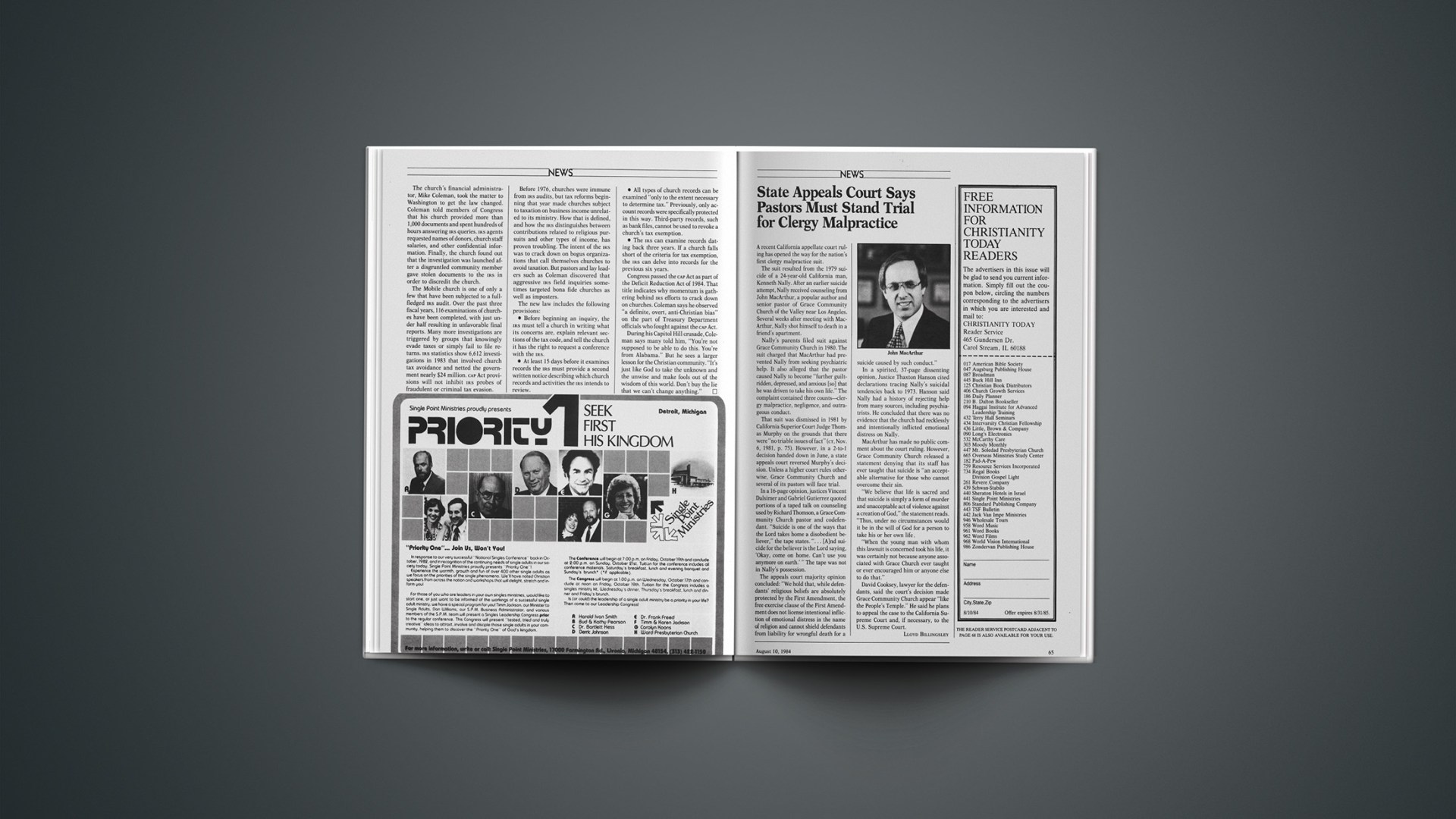

State Appeals Court Says Pastors Must Stand Trial for Clergy Malpractice

A recent California appellate court ruling has opened the way for the nation’s first clergy malpractice suit.

The suit resulted from the 1979 suicide of a 24-year-old California man, Kenneth Nally. After an earlier suicide attempt, Nally received counseling from John MacArthur, a popular author and senior pastor of Grace Community Church of the Valley near Los Angeles. Several weeks after meeting with MacArthur, Nally shot himself to death in a friend’s apartment.

Nally’s parents filed suit against Grace Community Church in 1980. The suit charged that MacArthur had prevented Nally from seeking psychiatric help. It also alleged that the pastor caused Nally to become “further guilt-ridden, depressed, and anxious [so] that he was driven to take his own life.” The complaint contained three counts—clergy malpractice, negligence, and outrageous conduct.

That suit was dismissed in 1981 by California Superior Court Judge Thomas Murphy on the grounds that there were “no triable issues of fact” (CT, Nov. 6, 1981, p. 75). However, in a 2-to-1 decision handed down in June, a state appeals court reversed Murphy’s decision. Unless a higher court rules otherwise, Grace Community Church and several of its pastors will face trial.

In a 16-page opinion, justices Vincent Dalsimer and Gabriel Gutierrez quoted portions of a taped talk on counseling used by Richard Thomson, a Grace Community Church pastor and codefendant. “Suicide is one of the ways that the Lord takes home a disobedient believer,” the tape states. “… [A]nd suicide for the believer is the Lord saying, ‘Okay, come on home. Can’t use you anymore on earth.’ ” The tape was not in Nally’s possession.

The appeals court majority opinion concluded: “We hold that, while defendants’ religious beliefs are absolutely protected by the First Amendment, the free exercise clause of the First Amendment does not license intentional infliction of emotional distress in the name of religion and cannot shield defendants from liability for wrongful death for a suicide caused by such conduct.”

In a spirited, 37-page dissenting opinion, Justice Thaxton Hanson cited declarations tracing Nally’s suicidal tendencies back to 1973. Hanson said Nally had a history of rejecting help from many sources, including psychiatrists. He concluded that there was no evidence that the church had recklessly and intentionally inflicted emotional distress on Nally.

MacArthur has made no public comment about the court ruling. However, Grace Community Church released a statement denying that its staff has ever taught that suicide is “an acceptable alternative for those who cannot overcome their sin.

“We believe that life is sacred and that suicide is simply a form of murder and unacceptable act of violence against a creation of God,” the statement reads. “Thus, under no circumstances would it be in the will of God for a person to take his or her own life.

“When the young man with whom this lawsuit is concerned took his life, it was certainly not because anyone associated with Grace Church ever taught or ever encouraged him or anyone else to do that.”

David Cooksey, lawyer for the defendants, said the court’s decision made Grace Community Church appear “like the People’s Temple.” He said he plans to appeal the case to the California Supreme Court and, if necessary, to the U.S. Supreme Court.

A Pastor Describes Brutal Conditions in Cuban Prisons

On March 28, 1962, Noble Alexander was driving home to Havana after preaching in Matanzas, Cuba. Authorities pulled him over and told him he was wanted for five minutes of questioning.

The lay preacher was taken to a kind of “deep freeze” where he was stripped and interrogated—sometimes at gunpoint—throughout the night.

A year after his arrest, Alexander faced a mock trial on charges of trying to kill Cuban President Fidel Castro. A lawyer Alexander had never seen pleaded guilty in his behalf. But the pastor says he actually was arrested for preaching the gospel.

What at first was called a five-minute detention lasted more than 22 years. But it came to an end in June when Alexander came to the United States. He was one of 26 Cuban political prisoners released by Castro after a visit by the Rev. Jesse Jackson. Twenty-two American citizens were released from Cuban jails at the same time.

A Seventh-day Adventist, Alexander was ordained as an elder in prison. He led prayer meetings and Bible studies for groups that usually included Baptists, Pentecostalists, Adventists, Roman Catholics, and others.

Thomas White, a Los Angeles schoolteacher who spent several months in prison with Alexander, says one of his most moving experiences was watching the prisoners sing hymns. “There they’d be, worshiping in rags and bedsheets, and you wouldn’t see a depressed guy in the room.” White served 17 months for dropping evangelistic leaflets over Cuba from a plane.

For a few months, White and Alexander huddled by a wall every day to listen to the Voice of America and HCJB, a Christian radio station in Ecuador. Their radio eventually was found and taken away, as were several of Alexander’s Bibles over the years. Bibles were prized possessions. American prisoners, who could obtain three books a month from the U.S. Special Interests Section in Havana, passed Bibles to the Cubans. Alexander says as many as 100 prisoners would share four or five Bibles.

Conditions varied from prison to prison. Alexander participated in several hunger strikes to protest spoiled food. Along with other political prisoners, he refused to wear the same uniform as convicted criminals. Instead, he fashioned shorts out of bed sheets. He says he was flogged daily for years, and he tells of men who were tortured brutally.

Alexander says religious activities varied, depending on the prison. In one jail, Christians met in an abandoned laundry room while other prisoners ate lunch. In another, they shouted between cells.

He describes one circular prison where inmates could walk freely among the cells while a guard stood watch in a nearby tower. During a “revival,” Alexander would visit all the cells, inviting prisoners to a meeting. Three or four men would stand in the doorway to block the view from the guard tower while dozens of inmates gathered to sing, pray, preach, and even share Communion with bread smuggled from the mess hall.

Sometimes guards would fire into the room. Alexander has two scars on his fingers from bullets that grazed him. Other guards stood at the fringes of meetings, listening.

Castro’s Marxist regime sees the church as a threat, Alexander says. During the Cuban revolution, for example, one of Castro’s nicknames was el caballo, the horse. When pastors preached about the “beast” of Revelation, Alexander says they were accused of fomenting rebellion against Castro.

Alexander says the Cuban church is growing despite persecution. And the Christian activity at Combinados del Este, the last prison where Alexander was held, continues without him. Two prisoners trained by the pastor are leading the ministry there.

A New Law Makes It Harder For The Irs To Audit Churches

Internal Revenue Service (IRS) auditors must clear a new set of hurdles before they examine the financial records of a church, now that Congress has approved the Church Audit Procedures (CAP) Act.

Before wrangling with church officers over tax matters, IRS investigators are required to provide two written notices of the inquiry, agree to a meeting with church representatives if one is requested, and end the investigation within two years. If the IRS fails to comply with these stricter procedures, any court summons served to the church could be dropped.

U.S. Sen. Charles Grassley (R-Iowa) and U.S. Rep. Mickey Edwards (R-Okla.) pushed for the legislation after they learned about a five-year IRS audit of Gulf Coast Covenant Church in Mobile, Alabama (CT, Oct. 7, 1983, p. 57). That investigation cost the church $100,000, sullied its reputation, and ended suddenly when the IRS dropped all charges of wrongdoing.

The church’s financial administrator, Mike Coleman, took the matter to Washington to get the law changed. Coleman told members of Congress that his church provided more than 1,000 documents and spent hundreds of hours answering IRS queries. IRS agents requested names of donors, church staff salaries, and other confidential information. Finally, the church found out that the investigation was launched after a disgruntled community member gave stolen documents to the IRS in order to discredit the church.

The Mobile church is one of only a few that have been subjected to a full-fledged IRS audit. Over the past three fiscal years, 116 examinations of churches have been completed, with just under half resulting in unfavorable final reports. Many more investigations are triggered by groups that knowingly evade taxes or simply fail to file returns. IRS statistics show 6,612 investigations in 1983 that involved church tax avoidance and netted the government nearly $24 million, CAP Act provisions will not inhibit IRS probes of fraudulent or criminal tax evasion.

Before 1976, churches were immune from IRS audits, but tax reforms beginning that year made churches subject to taxation on business income unrelated to its ministry. How that is defined, and how the IRS distinguishes between contributions related to religious pursuits and other types of income, has proven troubling. The intent of the IRS was to crack down on bogus organizations that call themselves churches to avoid taxation. But pastors and lay leaders such as Coleman discovered that aggressive IRS field inquiries sometimes targeted bona fide churches as well as imposters.

The new law includes the following provisions:

• Before beginning an inquiry, the IRS must tell a church in writing what its concerns are, explain relevant sections of the tax code, and tell the church it has the right to request a conference with the IRS.

• At least 15 days before it examines records the IRS must provide a second written notice describing which church records and activities the IRS intends to review.

• All types of church records can be examined “only to the extent necessary to determine tax.” Previously, only account records were specifically protected in this way. Third-party records, such as bank files, cannot be used to revoke a church’s tax exemption.

• The IRS can examine records dating back three years. If a church falls short of the criteria for tax exemption, the IRS can delve into records for the previous six years.

Congress passed the CAP Act as part of the Deficit Reduction Act of 1984. That title indicates why momentum is gathering behind IRS efforts to crack down on churches. Coleman says he observed “a definite, overt, anti-Christian bias” on the part of Treasury Department officials who fought against the CAP Act.

During his Capitol Hill crusade, Coleman says many told him, “You’re not supposed to be able to do this. You’re from Alabama.” But he sees a larger lesson for the Christian community. “It’s just like God to take the unknown and the unwise and make fools out of the wisdom of this world. Don’t buy the lie that we can’t change anything.”

A Severe Famine Threatens to Kill Millions in Africa

An area twice the size of the United States lives in fear of starving to death.

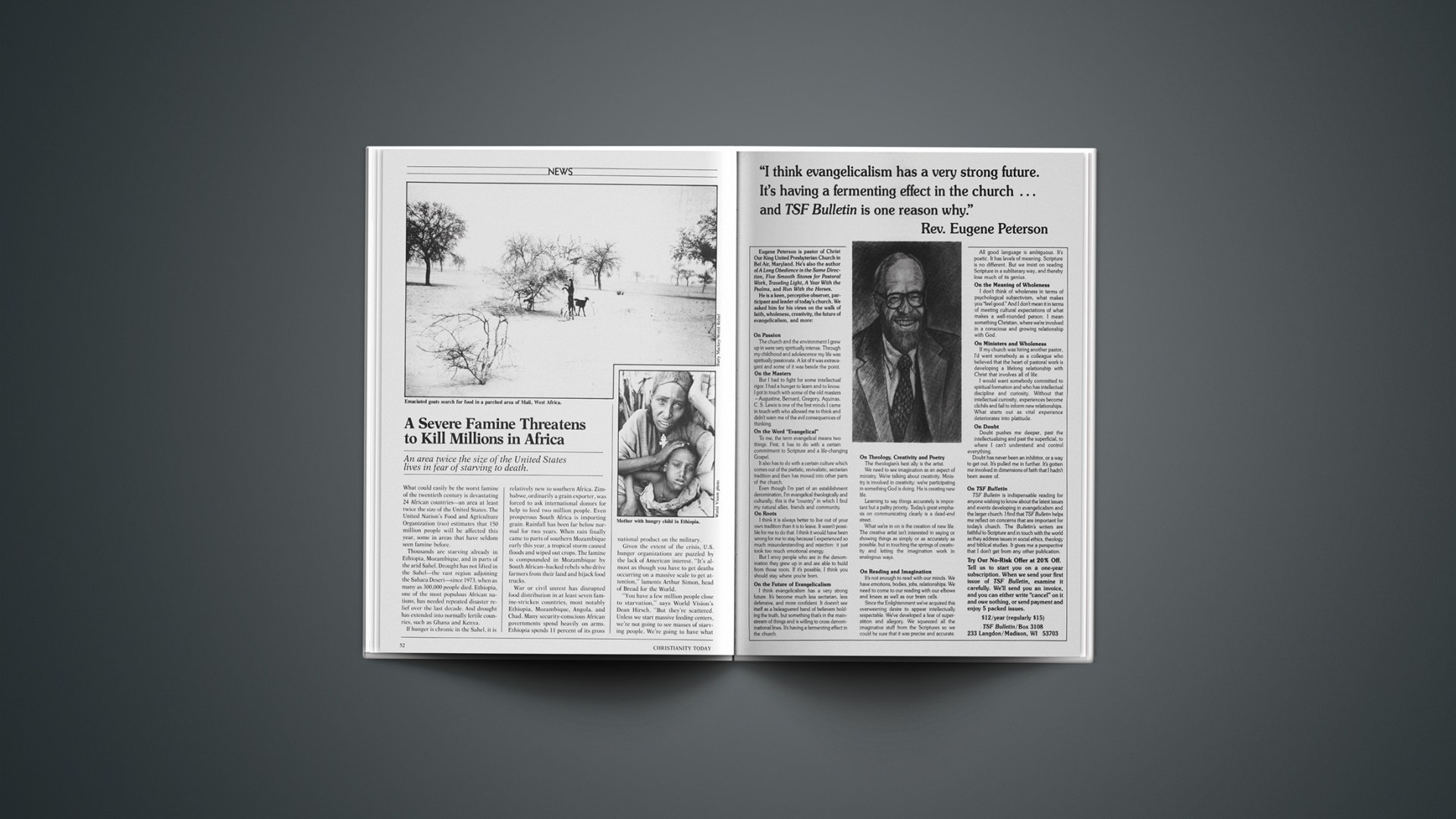
What could easily be the worst famine of the twentieth century is devastating 24 African countries—an area at least twice the size of the United States. The United Nation’s Food and Agriculture Organization (FAO) estimates that 150 million people will be affected this year, some in areas that have seldom seen famine before.

Thousands are starving already in Ethiopia, Mozambique, and in parts of the arid Sahel. Drought has not lifted in the Sahel—the vast region adjoining the Sahara Desert—since 1973, when as many as 300,000 people died. Ethiopia, one of the most populous African nations, has needed repeated disaster relief over the last decade. And drought has extended into normally fertile counries, such as Ghana and Kenya.

If hunger is chronic in the Sahel, it is relatively new to southern Africa. Zimbabwe, ordinarily a grain exporter, was forced to ask international donors for help to feed two million people. Even prosperous South Africa is importing grain. Rainfall has been far below normal for two years. When rain finally came to parts of southern Mozambique early this year, a tropical storm caused floods and wiped out crops. The famine is compounded in Mozambique by South African-backed rebels who drive farmers from their land and hijack food trucks.

War or civil unrest has disrupted food distribution in at least seven famine-stricken countries, most notably Ethiopia, Mozambique, Angola, and Chad. Many security-conscious African governments spend heavily on arms. Ethiopia spends 11 percent of its gross national product on the military.

Given the extent of the crisis, U.S. hunger organizations are puzzled by the lack of American interest. “It’s almost as though you have to get deaths occurring on a massive scale to get attention,” laments Arthur Simon, head of Bread for the World.

“You have a few million people close to starvation,” says World Vision’s Dean Hirsch. “But they’re scattered. Unless we start massive feeding centers, we’re not going to see masses of starving people. We’re going to have what you might call ‘quiet’ starvation.”

Experts disagree on whether 15 years of low rainfall in the Sahel represent a temporary cycle or an emerging climatic pattern. Even the rate of desertification—the process whereby arable land becomes desert—is unclear. A 1983 report of United Nations food donors stated that the Sahara has advanced almost 200 kilometers to the south during the current drought.

More predictable than the weather, and more troubling, are the long-term trends that make Africa increasingly susceptible to famine. Twenty years ago Africa raised all its own food. Now, even in good years, it is heavily dependent on food imports. Africa’s population represents only about 15 percent of the developing world, yet in recent years it has required more than half of the world’s food aid. The fundamental problem is that agricultural production has grown at only 1.5 percent a year, while the population is growing at the fastest rate in the world—between 2 percent and 4 percent. If the trend continues, famine will be constant by the end of the century.

Government policies are partially to blame for the widespread famine. Mozambique, for instance, emphasized big state farms over traditional small-holder agriculture after it gained independence from Portugal. But it had neither the heavy machinery nor the skilled workers to run the farms efficiently. Big state farms are the exception, but nearly all African nations have central marketing boards that buy and sell all agricultural commodities. Their usual policy has been to dictate low prices to farmers. Low food prices, critics claim, subsidize workers in the fast-growing urban areas at the expense of farmers. Farmers, producing for little or no profit, have been discouraged from making investments that would increase their yields. They also are unable to buy the consumer goods urban workers might produce. A stagnating economy results in which farmers grow only enough to feed themselves.

The world economy also has its effect on the ability of African nations to feed their people. A global recession has meant poor prices for the minerals and agricultural commodities that African nations export, making money scarce. Virtually every nation in sub-Saharan Africa faces a massive debt. Food imports alone eat up 27 percent of the earnings from exports. Often agricultural investments have been cut.

Even when food aid reaches drought-stricken countries, it is difficult to transport it to those who need it. The worst-hit famine areas are far from any road. R. Zoubeidi of the United Nations Disaster Relief Organization says food piled up at Ethiopian docks this year because the government did not have enough trucks to transport it.

The lack of good transportation also retards the development of agriculture. Some farmers are unable to transport their crops to buyers. Tanzanians have seen food rot in one area while 100 miles away people are starving. More typically, farmers simply do not plant what they cannot transport to market.

The effects of the weather might be the most difficult problem to overcome. While much of Africa would rebound with a good season of rain, the Sahel apparently requires massive, coordinated intervention. “As always, solutions require money,” writes Eric Eckholm in Down to Earth, “but they also require difficult political, cultural, and bureaucratic reforms.” So far, aid to the Sahel region has been uncoordinated, and no comprehensive plan to turn back the desert exists.

What can be done about such complex problems? The first essential, most experts agree, is to limit damage from the current famine. Congress has allocated an extra $150 million in emergency food aid this year. However, Lorette Picciano-Hanson, of Bread for the World, argues that much more money could be used, especially for trucks and gasoline to distribute the food.

Beyond the immediate crisis, the long-term dimensions of the problem must be addressed. “We are putting relatively little into agricultural education, water development, training,” says Hirsch, of World Vision. “I don’t think we’re going to see a disaster on a par with the 1973 Sahel crisis this year, in terms of the number of deaths.… I do see a worse disaster coming—a dependency on developed countries.”

However, the FAO’s experience in Asia is grounds for encouragement. India, for example, was on the brink of starvation 20 years ago. It is now self-sufficient in food. There is hope for Africa. It possesses more than one-half of the unused arable land in the world. It would require a substantial commitment of resources to make it productive. Tsetse flies and river blindness, which have driven farmers off vast tracts of good land, can only be wiped out by intensive long-term government programs. Irrigation and drainage systems could transform vast Nile swamps in the Sudan into productive farmland, but the cost would be immense.

No end to the immediate famine is in sight. Preliminary FAO reports indicate that good rains in West Africa and the Sahel might relieve that crisis later this year. But in much of eastern and southern Africa the situation promises to become worse. Kenya, for instance, will probably harvest only 10 percent of its normal crop this year.

“I would like nothing better than to eliminate emergency food aid, because it would mean that we had been successful in stimulating agricultural development,” says Hunter Farnham, of the U.S. Agency for International Development. “But I’m not sure my grandchildren will see that.”

North American Scene

The long court battle over Maine’s attempt to regulate church-affiliated schools is over. The deadline for appealing a federal judge’s ruling in favor of the Maine Association of Christian Schools passed in June. Maine’s deputy attorney general, Rufus Brown, said the state did not file an appeal because the judge refused to address constitutional questions related to the case. The ruling instead focused on an interpretation of state education law.

A judge has temporarily barred New York City from enforcing a policy designed to protect homosexuals from job discrimination by agencies holding city contracts. The judge’s action extended city social-service contracts with the Roman Catholic Archdiocese of New York and the Salvation Army, pending a court hearing. The city moved to cancel $4 million in contracts with the Salvation Army earlier this year because the group refused to agree to a city requirement prohibiting employment discrimination against practicing homosexuals (CT, May 18, 1984, p. 79).

The Louisiana House of Representatives voted down an attempt to repeal a law that requires the teaching of creation science alongside evolution in the state’s public schools. The vote allows a federal court test case to move ahead in deciding the law’s constitutionality. Supporters of the law argue that academic freedom is furthered by teaching both views of origins.

Former President Jimmy Carter says he asked Chinese leader Deng Xiaoping to allow Western missionaries to return to China, during private negotiations in 1978 and 1979. Carter also has revealed that he asked the Chinese leader to permit religious freedom and the distribution of Bibles. Deng promised to honor the last two requests. However, Carter said the Chinese leader would not allow the return of missionaries.

A federal appeals court has struck down much of Pennsylvania’s Abortion Control Act. The Third U.S. Circuit Court of Appeals rejected a provision that called for higher medical insurance rates for policies that cover abortion. It also threw out a section regarding abortion procedures likely to result in the delivery of a viable fetus and a section compelling physicians to provide women with information designed to discourage abortions. However, the court upheld parts of the law that require women under 18 to obtain parental consent for abortions and require abortion facilities to file public reports disclosing ownership.

The U.S. Senate has voted to extend for three years a program designed to lower the number of pregnancies among teenagers. The extended program will offer grants totalling about $15 million each year. The money goes to organizations that do research, offer health-care services, and develop educational and counseling programs that discourage premarital sex (CT, March 19, 1982, p. 41). The American Civil Liberties Union is challenging participation in the program by churches and religious organizations.

The number of abortions performed in the United States has leveled off for the first time since the procedure was legalized in 1973. After eight years of increases, abortions dropped slightly in 1982 after a peak figure in 1981. According to a research group affiliated with the Planned Parenthood Federation of America, 1,573,900 abortions were performed in 1982.

Two United Methodist bishops have granted ministerial appointments to homosexual ministers. This comes despite language adopted in May by the church’s highest lawmaking body specifically barring the appointment of “self-avowed, practicing homosexuals” (CT, June 15, 1984, p. 56). Bishop Melvin Wheatley of Denver appointed Julian Rush as associate pastor of Saint Paul’s United Methodist Church in Denver. Bishop Jack Tuell appointed Morris Floyd to a ministry with a social service agency in Minneapolis. The ban on gay clergy does not take effect until January 1.

The U.S. Senate has approved federal funds for a peace academy, ending a 20-year-old congressional debate. “If wars do indeed begin in the minds of men, it is there that we must wage the battle for peace,” said Sen. Mark Hatfield (R-Oreg.) in support of the academy. Church support came primarily from mainline denominations and historic peace churches. Christian College Coalition president John Dellenback served on a commission that recommended establishing the nonprofit research and training center (CT, Sep. 3, 1982, p. 70).

The Oregon Court of Appeals has reversed its decision upholding the incorporation of Rajneeshpuram, a town founded by followers of an Indian guru. To incorporate a town, the followers of Bhagwan Shree Rajneesh must persuade county officials that the town is needed. The Rajneeshees plan to appeal the decision to the Oregon Supreme Court.

A federal appeals court has ordered the village of Scarsdale, New York, to permit a crèche to be displayed in a public park at Christmas. This reverses an earlier ruling that banned the Nativity scene. The appeals court stated that use of public property for the crèche does not violate the doctrine of the separation of church and state.

World Scene

American church leaders back from the Soviet Union praised the status of religion there. A leader of the 266-member group said they saw “vital religious communities wherever we went.” However, several group members criticized tour leaders for not emphasizing human rights issues in the Soviet Union. The tour was sponsored by the National Council of Churches.

Britain’s best-known Methodist preacher has accused Billy Graham and Luis Palau of using a “totalitarian style of evangelism.” Donald Soper, a past president of the British Methodist Conference, said the evangelists “make use of the Bible as a hammer when they say, ‘the Bible says.’ And of course, the Bible says anything you want it to say.” Graham and Palau conducted a series of crusades in England this summer.

Pope John Paul II and the head of the Syrian Orthodox Church have authorized members of their churches to share three sacraments, including the Eucharist. The announcement was an important step toward healing a 1,500-year-old breach between the Roman Catholic and Syrian Orthodox churches. The leaders pledged to do everything possible to “remove the last obstacles” hindering full communion between their churches.

A district synod of the British Methodist Church has called for a full study of the nature and influence of Freemasonry in England. If approved by the church’s governing body, the study would give British Methodists guidelines on the “advisability of membership” in Masonic orders. Leaders of the denomination say they are increasingly aware of an “element of anxiety” among church members about the workings and secrecy of Freemasonry.

Hindus in India are turning to Christ at the rate of 6,000 per month. Bibles for India president John De Vries says the country “has now become so responsive that we can hardly comprehend the discipleship and church planting that is going on.… It seems to have started somewhere around 1975–77, and is now snowballing.”

A radio satellite linkup beamed five of Luis Palau’s evangelistic messages from London to 50 countries in June. The project was designed to reach as many English-speaking people as possible. Five nights of Palau’s six-week London crusade were carried on the satellite linkup. Some 200 stations broadcast the messages in the United States.

The Polish government is looking for a rabbi to shepherd the country’s dwindling Jewish community. The 6,000 to 7,000 acknowledged Polish Jews have not had a rabbi for at least seven years. Efforts by Polish officials to attract a Polish-speaking rabbi from the United States have been fruitless. A new effort focuses on training a Pole in an American seminary and sending him back to Poland as a rabbi.

Do two frozen embryos have the right to inherit an estate left by the couple that produced them? That’s the question being debated in the Australian state of Victoria. Mario and Elsa Rios produced two embryos in 1981 through artificial fertilization. The embryos were frozen, and the couple later died in a plane crash. The Victoria state government has delayed a decision pending a report from a commission of inquiry.

Members of an Indian religious sect are trying to gain political control of Herringswell, England, a tiny village 100 miles northeast of London. Members of the Medina Rajneesh sect are contesting the village’s seat on a district council and every seat on its proposed new parish council. The sect is headed by Bhagwan Shree Rajneesh. Members of his Pacific Northwest commune gained control of the Antelope, Oregon, town council in 1982.

Religious Groups Seek Protection from New Civil Rights Measure

The U.S. Senate is under pressure from religious groups to shield churches and other private organizations from the full force of civil rights legislation passed by the U.S. House of Representatives.

The measure, called the Civil Rights Act of 1984, would reverse a U.S. Supreme Court ruling that narrowed the scope of federal regulations that prevent discrimination. In its decision regarding Grove City College in Pennsylvania, the high court said Title IX—which prohibits sex discrimination—applies only to a school program that receives federal aid, and not to the entire institution (CT, April 6, 1984, p. 70). Grove City College receives no direct federal aid. The Supreme Court ruled, however, that because some Grove City students receive federal tuition aid, the school is a “recipient” of government aid and must answer to federal regulations.

The Civil Rights Act of 1984 would leave this latter ruling intact while overturning the first finding. This combination worries representatives of church groups, private schools, and the business community because it broadens the definition of “federal aid” while increasing the reach of federal regulations.

James M. Dunn, executive director of the Baptist Joint Committee on Public Affairs, told Congress why churches should be exempted. “There are constitutionally valid reasons why churches and those organizations integral to their religious mission may find it necessary—as a requirement of sincerely held religious beliefs—to discriminate against people in their hiring practices.” Limiting job interviews to evangelicals or barring women from ordained ministry are two actions that could violate antidiscrimination laws. However, Dunn said the First Amendment requires government to allow such decisions when they are based on belief.

In addition to Title IX protection against sex discrimination, three other civil rights laws prohibit discrimination based on race, age, or handicap. The Civil Rights Act of 1984 would extend the coverage of all four laws to any “entity” receiving direct or indirect federal aid.

A Reagan administration position paper said the bill would open “unlimited new opportunities for federal regulators to say that private activities are federally assisted.” Churches would be particularly subject to this, the paper maintains. “For example, if Lutheran World Relief receives government surplus food to distribute to needy persons, the whole Lutheran church, including every congregation, would appear to be covered.”

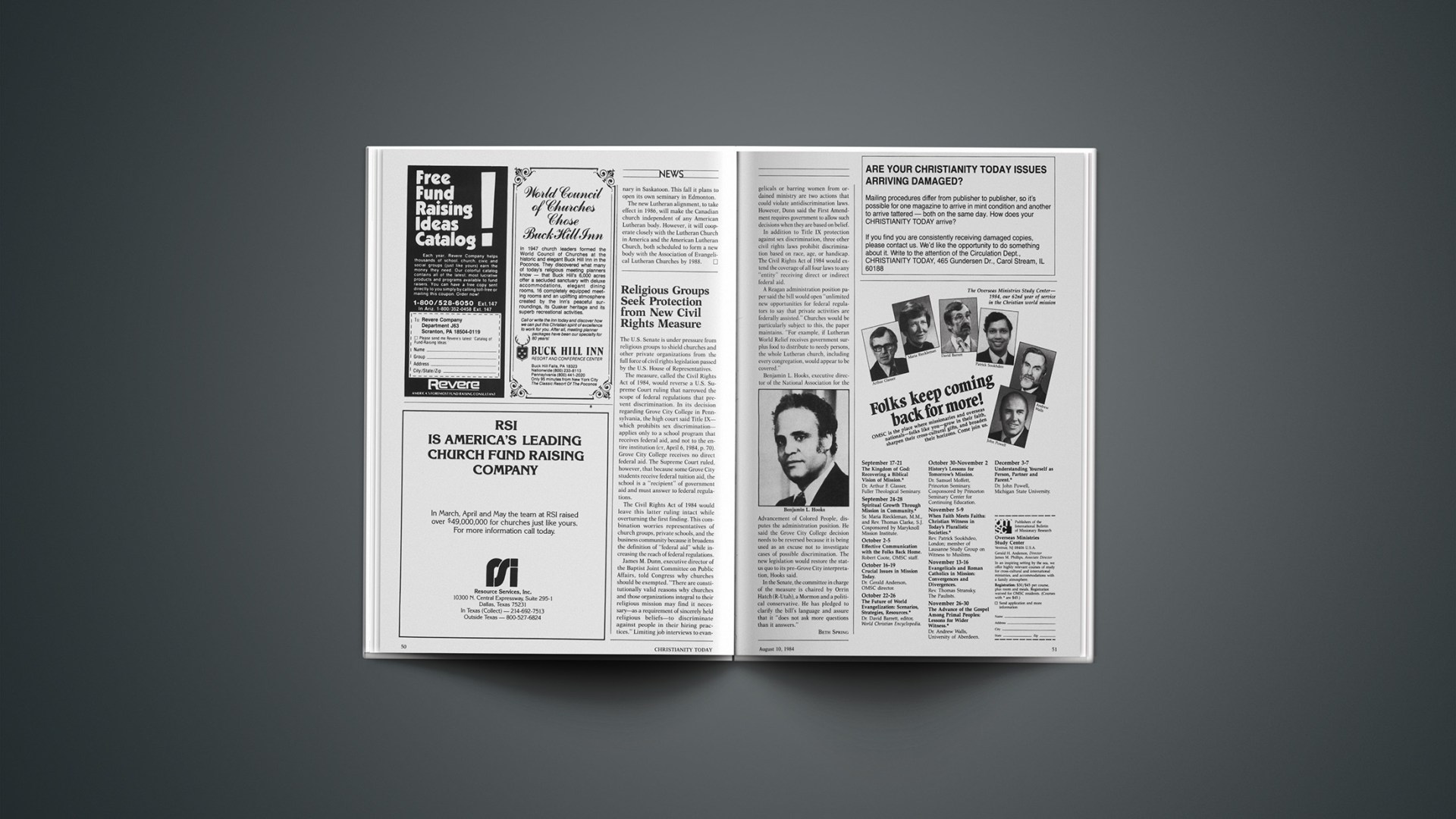
Benjamin L. Hooks, executive director of the National Association for the Advancement of Colored People, disputes the administration position. He said the Grove City College decision needs to be reversed because it is being used as an excuse not to investigate cases of possible discrimination. The new legislation would restore the status quo to its pre-Grove City interpretation, Hooks said.

In the Senate, the committee in charge of the measure is chaired by Orrin Hatch (R-Utah), a Mormon and a political conservative. He has pledged to clarify the bill’s language and assure that it “does not ask more questions than it answers.”

America’s First ‘Christian’ Bank Goes out of Business

In the face of a recent recession and increased competition among financial institutions, a bank needs more than good intentions to survive. In Portland, Oregon, a bank organized to reflect Christian principles has learned that lesson the hard way.

The Stewardship Bank of Oregon was closed by state regulators in June—three years and three months after it opened as the first “Christian” bank in the United States. Its problems—poor management and a faulty loan policy—were similar to those encountered by the nearly 40 other American banks that have failed this year.

“They were too generous on credits and didn’t analyze them carefully,” said Oregon bank superintendent John Olin. The bank’s directors were alerted to loan problems early in 1982. The following May, the Federal Deposit Insurance Corporation (FDIC) examined the bank’s books, and subsequently directed it to charge off some $700,000 in loans. That action led to a loss of $765,000 for the year.

The death blow came last May when the FDIC directed the bank to charge off an additional $762,000 in loans. The action exhausted the bank’s $359,000 in capital and forced it out of business. When last-ditch efforts to raise more capital failed, the state declared the bank insolvent and named the FDIC as receiver.

Stockholders lost their investments, some in excess of $100,000. However, most of the $5.7 million on deposit with the bank was covered by FDIC insurance. Officials said about one-third of the bank’s business involved Christian people or organizations. A number of groups outside the state had funds on deposit there.

The Stewardship Bank opened in March 1981 with $1.6 million in capital. Prospective I investors were required to profess a belief in Christian principles before they could buy stock in the bank. They agreed to donate 10 percent of any profits to worthy causes, and even to donate one-tenth of their dividends. The tithing principle was not implemented widely because, except for a few months, the bank failed to make a profit.

Robert Laughlin, a Christian businessman who spearheaded the drive to organize the Stewardship Bank, said bank regulators advised the organizers to “hire the best president, let him run the bank, and directors shouldn’t interfere.” They hired a banking veteran of 35 years. Directors, who were businessmen with little banking experience, kept hands off.

That approach was a mistake, said Lynn Wallace, who became bank chairman in March when four directors resigned. “The board was sort of naïve,” he said. “It trusted management too much. No matter what kind of credentials a person has, don’t give him a free rein. A good director is a watchdog who is not afraid to ask questions. If you have a president who doesn’t want questions asked, then you’d better fire him.”

The failure of directors to keep a close watch on loans was a critical flaw. One director, who is being investigated by the state for alleged violation of securities laws, was a principal in firms that borrowed from the bank. At least one of those loans—amounting to $125,000—was defaulted, according to court records. The recession also played a role in some of the bank’s loans going bad.

Despite the failure, Laughlin and others haven’t given up on the concept of a “Christian” bank. Laughlin has sent a summary of the bank’s mistakes to organizers of similar institutions in New Jersey and Georgia to help them avoid the same errors.

DONALD J. SORENSENin Portland

Two Lutheran Bodies In Canada Vote To Unite

Two of Canada’s three main Lutheran denominations have voted to merge. The new Evangelical Lutheran Church in Canada will be the fifth-largest denomination in the country (behind Roman Catholics, the United Church of Canada, Anglicans, and Presbyterians). The merger brings together the Lutheran Church in America-Canada Section (125,000 members) and the Evangelical Lutheran Church of Canada (85,000).

Merger discussions, initiated in 1973, originally included three groups. But in 1978, the Lutheran Church-Canada (Canadian wing of the Lutheran Church-Missouri Synod) pulled out of the talks. That decision was based on a disagreement over the ordination of women and misgivings about a perceived drift on the issue of scriptural authority. Since then, the Lutheran Church-Canada has withdrawn from a joint Lutheran seminary in Saskatoon. This fall it plans to open its own seminary in Edmonton.

The new Lutheran alignment, to take effect in 1986, will make the Canadian church independent of any American Lutheran body. However, it will cooperate closely with the Lutheran Church in America and the American Lutheran Church, both scheduled to form a new body with the Association of Evangelical Lutheran Churches by 1988.

Financial Crisis Grips Oral Roberts’s Medical Complex

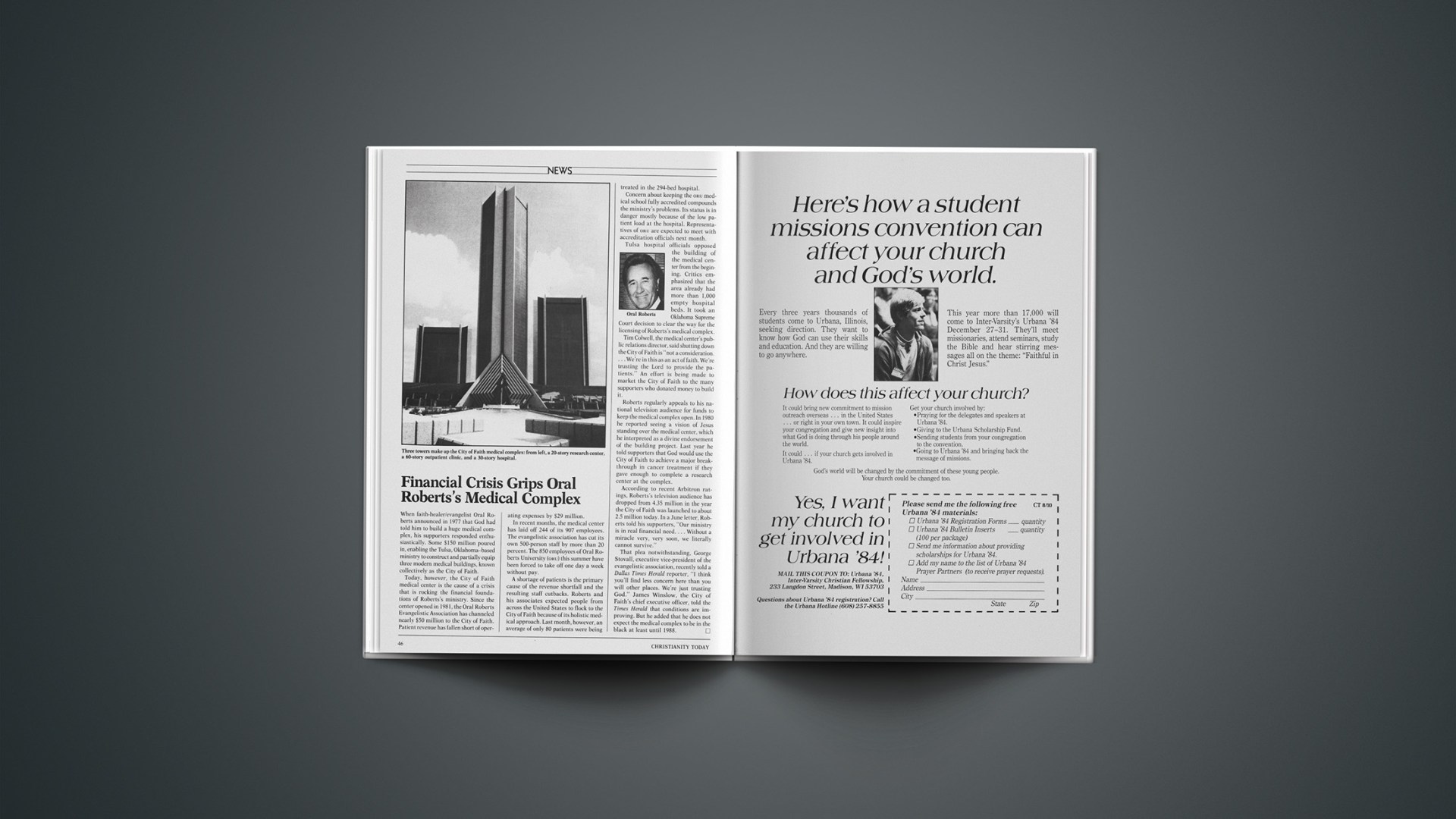
When faith-healer/evangelist Oral Roberts announced in 1977 that God had told him to build a huge medical complex, his supporters responded enthusiastically. Some $150 million poured in, enabling the Tulsa, Oklahoma-based ministry to construct and partially equip three modern medical buildings, known collectively as the City of Faith.

Today, however, the City of Faith medical center is the cause of a crisis that is rocking the financial foundations of Roberts’s ministry. Since the center opened in 1981, the Oral Roberts Evangelistic Association has channeled nearly $50 million to the City of Faith. Patient revenue has fallen short of operating expenses by $29 million.

In recent months, the medical center has laid off 244 of its 907 employees. The evangelistic association has cut its own 500-person staff by more than 20 percent. The 850 employees of Oral Roberts University (ORU) this summer have been forced to take off one day a week without pay.

A shortage of patients is the primary cause of the revenue shortfall and the resulting staff cutbacks. Roberts and his associates expected people from across the United States to flock to the City of Faith because of its holistic medical approach. Last month, however, an average of only 80 patients were being treated in the 294-bed hospital.

Concern about keeping the ORU medical school fully accredited compounds the ministry’s problems. Its status is in danger mostly because of the low patient load at the hospital. Representatives of ORU are expected to meet with accreditation officials next month.

Tulsa hospital officials opposed the building of the medical center from the begining. Critics emphasized that the area already had more than 1,000 empty hospital beds. It took an Oklahoma Supreme Court decision to clear the way for the licensing of Roberts’s medical complex.

Tim Colwell, the medical center’s public relations director, said shutting down the City of Faith is “not a consideration.… We’re in this as an act of faith. We’re trusting the Lord to provide the patients.” An effort is being made to market the City of Faith to the many supporters who donated money to build it.

Roberts regularly appeals to his national television audience for funds to keep the medical complex open. In 1980 he reported seeing a vision of Jesus standing over the medical center, which he interpreted as a divine endorsement of the building project. Last year he told supporters that God would use the City of Faith to achieve a major breakthrough in cancer treatment if they gave enough to complete a research center at the complex.

According to recent Arbitron ratings, Roberts’s television audience has dropped from 4.35 million in the year the City of Faith was launched to about 2.5 million today. In a June letter, Roberts told his supporters, “Our ministry is in real financial need.… Without a miracle very, very soon, we literally cannot survive.”

That plea notwithstanding, George Stovall, executive vice-president of the evangelistic association, recently told a Dallas Times Herald reporter, “I think you’ll find less concern here than you will other places. We’re just trusting God.” James Winslow, the City of Faith’s chief executive officer, told the Times Herald that conditions are improving. But he added that he does not expect the medical complex to be in the black at least until 1988.

Gop Spurns Bid for U.S. Senate by Conservative Southern Baptist

The Reagan administration has offered three jobs to Religious Right heavyweight Ed McAteer, a candidate for the U.S. Senate from Tennessee. Retiring U.S. Sen. Howard Baker (R-Tenn.) has offered to pay McAteer’s campaign debt if he would pull out of the race. But despite these and other not-so-subtle hints, the founder of the conservative Religious Roundtable is determined to press on.

In May, nearly three months before the Tennessee primary election, the National Republican Senatorial Committee endorsed Victor Ashe, an opponent of McAteer. The party sealed its action with a $15,000 contribution to Ashe’s campaign. McAteer then announced he would stay in the race as an independent.

The party’s pre-primary endorsement of Ashe is almost without precedent. Nancy Bocsker, of the National Republican Senatorial Committee, conceded that it was “a very unusual move.” Defending the action, she said that in a statewide poll in April, Tennessee Republicans overwhelmingly supported Ashe (73 percent to McAteer’s 9 percent). She said the lone Democratic candidate, Albert Gore, has already raised more political action committee money than any other candidate in the country.

“We are committed to saving Howard Baker’s seat,” Bocsker said. “We waited a year before making the endorsement. We couldn’t flounder any longer.”

McAteer supporters question the validity of the April poll, saying their candidate is a victim of Tennessee’s political establishment. Howard Phillips, chairman of the Conservative Caucus, charged that Baker’s presidential ambitions have abridged proper political procedure. “The party establishment is interested in preserving control,” Phillips said. He added that McAteer is viewed as being more loyal to his own convictions than he is to the party.

Efforts to dissuade McAteer are based on fears that he will split the conservative vote, handing the election to Democratic candidate Gore. McAteer has received calls from Moral Majority president Jerry Falwell and from Paul Weyrich, president of the Free Congress Foundation, urging him to pull out of the race. He did not budge.

McAteer acknowledged that he lacks name recognition, but he said his positions best reflect the views of Tennessee voters. Both he and Ashe favor a constitutional amendment banning abortion; both oppose gay rights legislation. McAteer favors tuition tax credits and abolishing the U.S. Department of Education. He opposes the Equal Rights Amendment (ERA). Ashe opposes tuition tax credits, favors an education department, and does not have a clear position on the ERA.

A number of well-known Christian leaders and organizations have supported McAteer, including Lee Roberson, chancellor of Tennessee Temple University; the fundamentalist newspaper Sword of the Lord; and the state chapter of the Fellowship of Christian Athletes. Adrian Rodgers, former president of the Southern Baptist Convention, has sent a letter endorsing McAteer to 10,000 Tennessee pastors. Singer Pat Boone has produced a fund-raising tape for the McAteer campaign.

The quest for Tennessee’s conservative vote has been characterized as a battle between Republicans and Christians. However, George Korda, a spokesman for the Ashe campaign, said Ashe also is a Christian. Korda said he expects Ashe to draw sizable support from Christian voters.

Congress Allows Churches To Opt Out Of Social Security Taxes

New tax provisions approved by Congress exempt churches from mandatory participation in the social security system. Some church groups had objected to reforms passed last year that required all private, voluntary organizations to pay into the system.

A suggestion from Forest Montgomery, legal counsel at the National Association of Evangelicals’ Washington office, provided a basis for the compromise accepted by Congress. Under the revised law, churches have one opportunity to refuse to participate. If they refuse, social security taxes will be assessed against individual church employees who must file as “self-employed persons.”

That option is more costly for the individual employee, but it lifts the burden of an unprecedented, required tax on churches. This year, the tax rate is 11.3 percent for self-employed individuals. For workers whose employers pay social security taxes, 7 percent is contributed by the employers and an additional 6.7 percent is withheld from the employees’ pay.

In testimony before a U.S. Senate committee in December, Montgomery pointed out that churches draw a clear-cut distinction between taxable, unrelated business income and money donated for carrying out church ministries. “Many churches believe that money put in the collection plate belongs to God, not Caesar, and hence cannot be paid to the government as a tax” (CT, Feb. 3, 1984, p. 38). He recommended treating church employees the same as ministers, who can file as self-employed. U.S. Sen. Robert Dole (R-Kan.) welcomed the compromise.

The agreement satisfied William Billings of the National Christian Action Coalition. Billings is a key lobbyist for independent churches. However, the American Coalition of Unregistered Churches opposed the amendment, questioning the constitutionality of levying any tax on churches.

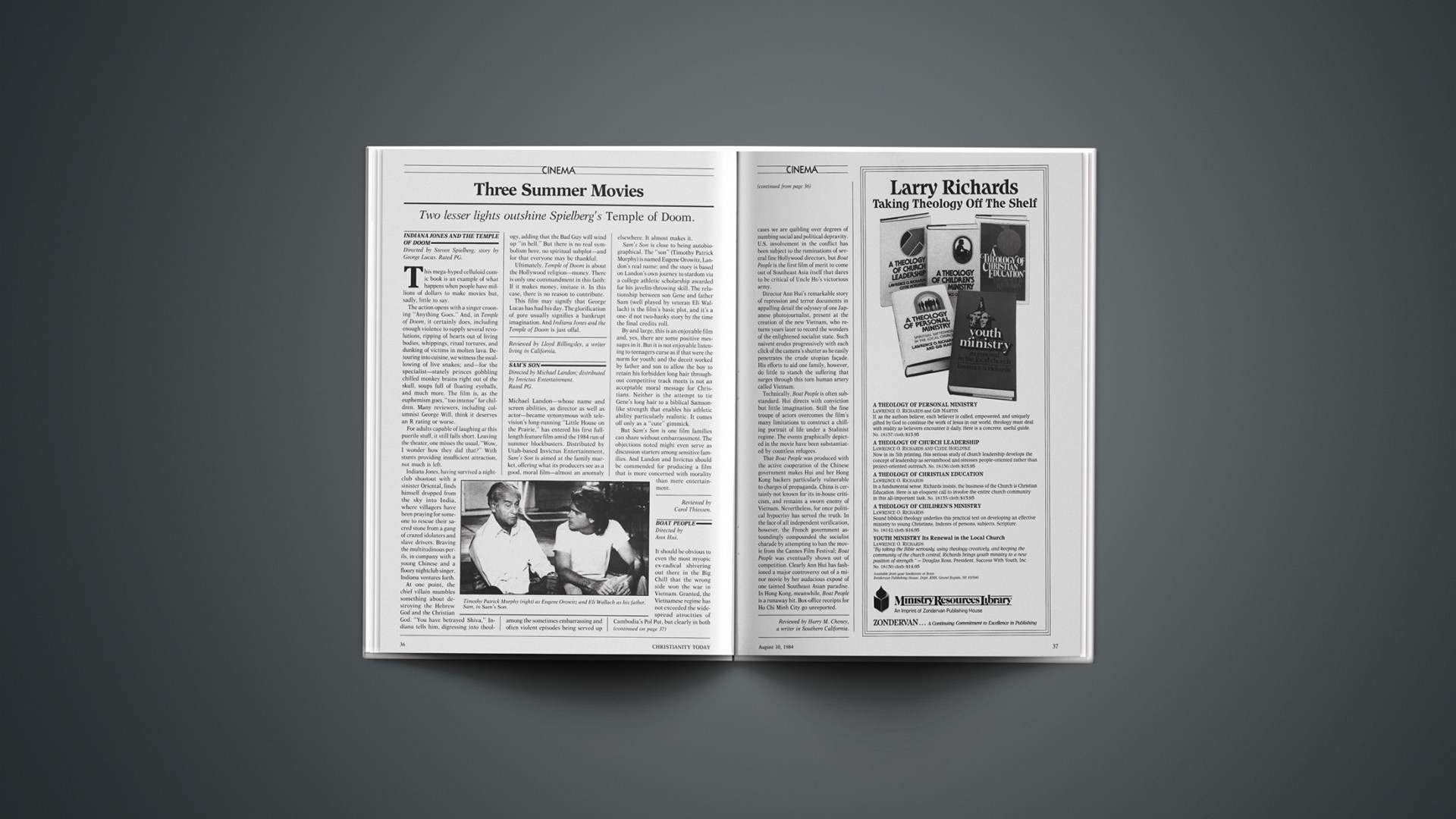
Sam’s Son

Directed by Michael Landon; distributed by Invictus Entertainment. Rated PG.

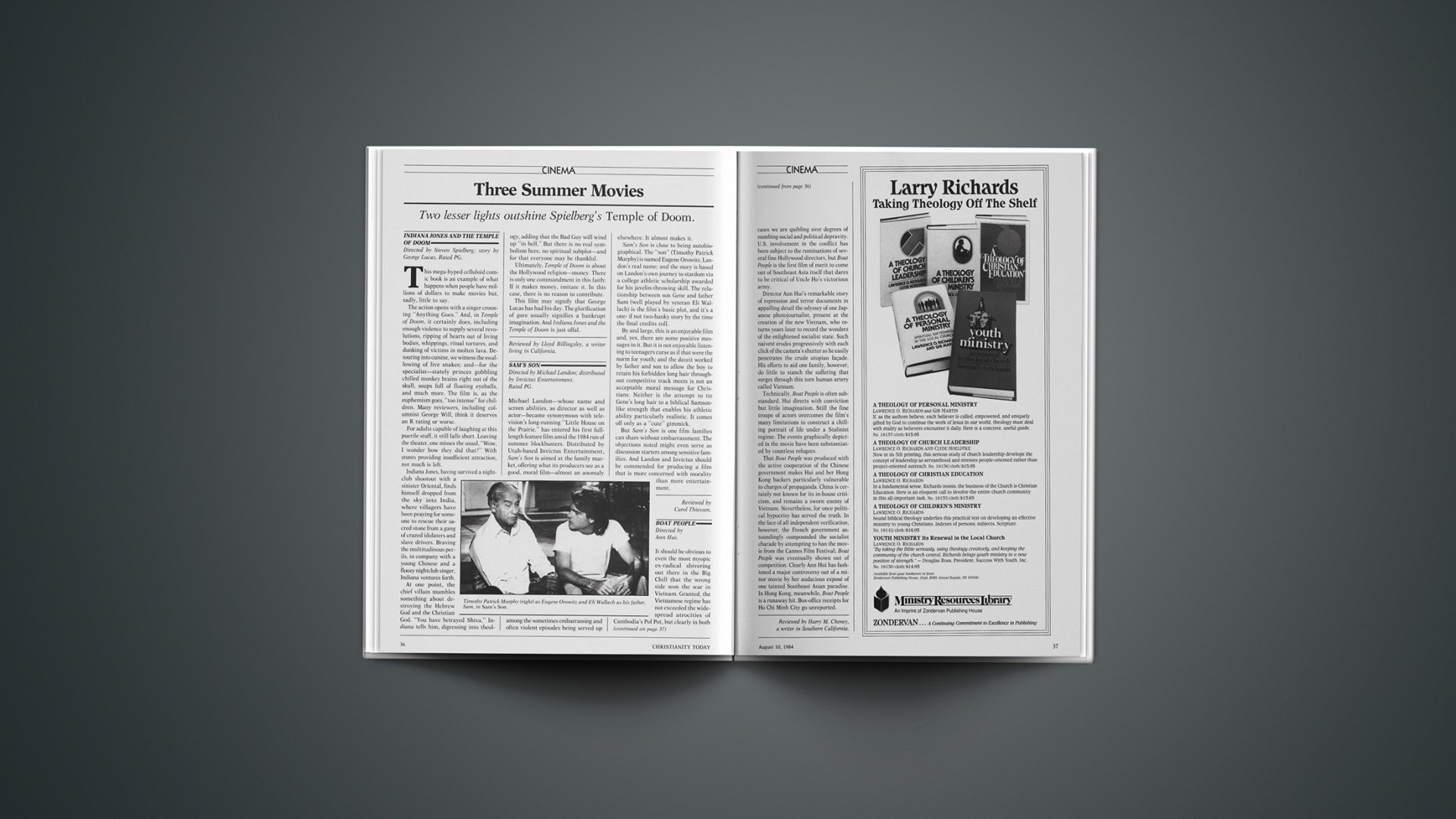
Michael Landon—whose name and screen abilities, as director as well as actor—became synonymous with television’s long-running “Little House on the Prairie,” has entered his first full-length feature film amid the 1984 run of summer blockbusters. Distributed by Utah-based Invictus Entertainment, Sam’s Son is aimed at the family market, offering what its producers see as a good, moral film—almost an anomaly among the sometimes embarrassing and often violent episodes being served up elsewhere. It almost makes it.

Sam’s Son is close to being autobiographical. The “son” (Timothy Patrick Murphy) is named Eugene Orowitz, Landon’s real name; and the story is based on Landon’s own journey to stardom via a college athletic scholarship awarded for his javelin-throwing skill. The relationship between son Gene and father Sam (well played by veteran Eli Wallach) is the film’s basic plot, and it’s a one- if not two-hanky story by the time the final credits roll.

By and large, this is an enjoyable film and, yes, there are some positive messages in it. But it is not enjoyable listening to teenagers curse as if that were the norm for youth; and the deceit worked by father and son to allow the boy to retain his forbidden long hair throughout competitive track meets is not an acceptable moral message for Christians. Neither is the attempt to tie Gene’s long hair to a biblical Samson-like strength that enables his athletic ability particularly realistic. It comes off only as a “cute” gimmick.

But Sam’s Son is one film families can share without embarrassment. The objections noted might even serve as discussion starters among sensitive families. And Landon and Invictus should be commended for producing a film that is more concerned with morality than mere entertainment.

Reviewed by Carol Thiessen.

Directed by Ann Hui.

It should be obvious to even the most myopic ex-radical shivering out there in the Big Chill that the wrong side won the war in Vietnam. Granted, the Vietnamese regime has not exceeded the widespread atrocities of Cambodia’s Pol Pot, but clearly in both cases we are quibling over degrees of numbing social and political depravity. U.S. involvement in the conflict has been subject to the ruminations of several fine Hollywood directors, but Boat People is the first film of merit to come out of Southeast Asia itself that dares to be critical of Uncle Ho’s victorious army.

Director Ann Hui’s remarkable story of repression and terror documents in appalling detail the odyssey of one Japanese photojournalist, present at the creation of the new Vietnam, who returns years later to record the wonders of the enlightened socialist state. Such naiveté erodes progressively with each click of the camera’s shutter as he easily penetrates the crude utopian façade. His efforts to aid one family, however, do little to stanch the suffering that surges through this torn human artery called Vietnam.

Technically, Boat People is often substandard. Hui directs with conviction but little imagination. Still the fine troupe of actors overcomes the film’s many limitations to construct a chilling portrait of life under a Stalinist regime. The events graphically depicted in the movie have been substantiated by countless refugees.

That Boat People was produced with the active cooperation of the Chinese government makes Hui and her Hong Kong backers particularly vulnerable to charges of propaganda. China is certainly not known for its in-house criticism, and remains a sworn enemy of Vietnam. Nevertheless, for once political hypocrisy has served the truth. In the face of all independent verification, however, the French government astoundingly compounded the socialist charade by attempting to ban the movie from the Cannes Film Festival; Boat People was eventually shown out of competition. Clearly Ann Hui has fashioned a major controversy out of a minor movie by her audacious exposé of one tainted Southeast Asian paradise. In Hong Kong, meanwhile, Boat People is a runaway hit. Box-office receipts for Ho Chi Minh City go unreported.

Reviewed by Harry M. Cheney, a writer in Southern California.

Experts fault Maranatha Campus Ministries for authoritarian practices and questionable theology.

Bobby and Jan Bonner found out in 1981 that getting out of Maranatha Campus Ministries (MCM) is not as easy as getting in. Maranatha is a charismatic Christian campus ministry based in Gainesville, Florida. When word reached MCM headquarters that Bobby wanted to leave the organization to return to school, one of Maranatha’s top leaders prophesied that the departure wasn’t God’s will. The leader, Joe Smith, told the Bonners they would face death and destruction if they left.

“I was terrified,” remembers Jan Bonner, and they stayed. But in the last two years the Bonners and some 30 other full-time Maranatha staff members have resigned, in large part due to perceived heavy-handed tactics in the group.

MCM was founded in 1972 by Robert Weiner, who serves as president. Weiner was reared in a legalistic church home. As a young man, he dropped out of Trinity College in Deerfield, Illinois, to join the air force. There he became a Christian through the ministry of Campus Crusade for Christ. He and his wife, Rose, have since dedicated their lives to reaching young people with the gospel.

In 12 years, Weiner’s organization has grown from a single ministry at Murray State University in Kentucky to some 100 campus chapters in the United States and in 16 foreign countries. Maranatha came to the attention of cult-watching organizations in 1981. Inquiries were coming in from parents worried that their children had unwittingly become part of a cult. They reported that their sons and daughters had undergone radical personality changes. Typically, their grades were failing, and they were giving Maranatha large sums of money that had been earmarked for education. Some were refusing medical and dental treatment, believing it demonstrated a lack of faith. Members told parents who questioned Maranatha that they were being used by the Devil.

To address these concerns, MCM in 1982 asked the El Toro, California-based Christian Research Institute (CRI) for a letter of endorsement. Weiner says he was shocked when CRI responded with reservations about some of Maranatha’s beliefs and practices, CRI has monitored cults and aberrational Christian groups for more than two decades under the leadership of Walter Martin, one of the foremost evangelical authorities in the field.

In November 1982, several cult-watching specialists met with the MCM leadership in Santa Barbara, California. Maranatha brought along a team of theologians representing a charismatic viewpoint, including Charles Farah of Oral Roberts University and CBN University’s Jerry Horner. Maranatha’s leaders acknowledged there were problems. As a result of the meeting, a six-member ad hoc committee was formed to help MCM address its shortcomings.

More than a year later, frustrated at Maranatha’s lack of progress, that committee issued an evaluative statement highly critical of the organization. It was signed by James Bjornstad, academic dean at Northeastern Bible College; Steve Cannon, a regional director of Personal Freedom Outreach; Ronald Enroth, sociology professor at Westmont College; Karen Hoyt, executive director of Spiritual Counterfeits Project; Gordon Lewis, theology professor at Denver Conservative Baptist Seminary; and Brian Onken of CRI. Together, committee members have more than 50 years of cult-watching experience.

In its report, the committee says Maranatha employs faulty methods of biblical interpretation, questionable practices, and deficient theology—including an unclear view of the Trinity. The committee expressed skepticism about the regular revelations or “words from the Lord” that Maranatha leaders and members claim to receive. “It appears to us that there is at least the potential for the final authority to rest more with the ‘revelations’ of MCM leaders than the Bible,” the report states. “MCM has an authoritarian orientation with potential negative consequences for members.”

Unlike other major campus ministries, which operate as Parachurch organizations, Maranatha functions as a denomination. Campus chapters are called churches. Local leaders are pastors, typically in their early- to mid-20s, with little or no formal theological training.

Pastors exercise authority over members. They have controlled the selection of marriage partners. (Maranatha members are prohibited from dating. According to Weiner’s “dating revelation,” dating is a worldly method of selecting a mate.) Some pastors have kept detailed records of members’ financial contributions. Those who don’t give enough have been admonished for having a “spirit of stinginess.” In an extreme case at the University of Kentucky, there was a revelation that women were not to use tampons. To members, disobeying a pastor is tantamount to disobeying God.

In turn, former pastors report having felt intimidated by the leadership in Gainesville. After Robert Pierce and his wife, Teena, were married, they wanted to take a few weeks off. Instead, they were told to start a new ministry at the University of Arizona. “We hardly saw each other for four months,” Robert Pierce says. “I was afraid to disagree [with the leadership]. There isn’t a pastor in Maranatha who isn’t scared to death of Bob Weiner.” Pierce says his wife suffered an emotional breakdown; they are now going through a divorce.

Although the ad hoc committee calls Maranatha an evangelical Christian ministry, the report concludes, “Until we have clearer understanding of the changes which MCM claims are being implemented, and until we see more discernible evidence of change in the lives of people being impacted by MCM, we would not recommend this organization to anyone.” Committee chairman Bjornstad says the language would have been harsher had it not been for concerns about legal reprisals.

Weiner says his ministry has done all it can to address the problems raised by the committee. “We’ve learned a lot, especially in the area of doctrine and Bible interpretation,” he says. “We spent more than $46,000 to bring our [Bible study materials] up to perfect theological standards.” However, committee members say the changes did not reach the heart of their objections.

Weiner says these objections are best explained by what he calls the committee’s anticharismatic bias. “Two of the gentlemen on the theological committee [Bjornstad and Lewis] teach at schools that forbid speaking in tongues,” he says. He also is skeptical of the claims of two committee members who say they are charismatics. In addition, Weiner charges that the committee based its report on interviews with a few disgruntled former members.

CBN’s Horner says Maranatha has made “great strides” since the Santa Barbara meeting. “I don’t agree with all their theology, but Maranatha is within the mainstream of orthodox Christianity,” he maintains. However, he says he isn’t qualified to comment on MCM’s practices.

Enroth, author of four books and a frequent lecturer on cults and aberrational groups, asserts there are clear parallels between Maranatha and the cults. Many who leave Maranatha are plagued by depression and feelings of guilt, he says. They are spiritually disillusioned, and have trouble adjusting to life, especially in the area of decision making.

“Being out of Maranatha was harder than being in it,” says Kathy Myatt, who left in 1981 after three years in the organization. She says she was led to believe that to leave was to risk her salvation. “I felt lost without a shepherdess to tell me if what I was doing was of God or of the Devil.” She spent several months in psychological counseling, and more than once considered suicide.

The committee faults Maranatha for discouraging critical thinking. Former members report that when they questioned Maranatha’s beliefs and practices, pastors attempted to deliver them from spirits of rebellion or “mind idolatry.” “There is clearly the possibility of exploitation in the guise of spirituality,” says Bjornstad, “and I doubt they’re even aware of it.” Enroth adds, “What we call control, they regard as caring for the flock.”

Several former pastors say they recognized problems in MCM and hoped the Santa Barbara meeting would lead to reform. But not long after that meeting, word circulated that Rose Weiner and Maranatha leader Walter Walker had received a “word from the Lord.” According to their revelation, those who had gathered in Santa Barbara were under a “spirit of deception.” CHRISTIANITY TODAY spoke with six former pastors who confirmed this. Weiner says he knows nothing about it.

Despite the controversy, MCM appears to enjoy a good reputation among many Christian leaders. Among those scheduled to speak at its national conference next month are Pat Boone, James Robison, Pat Robertson, Dee Jepsen, and Richard Lovelace. None of the speakers contacted by CHRISTIANITY TODAY were aware that Maranatha was being examined by the ad hoc committee.

Some of the tactics Maranatha has used to garner apparent endorsements are questionable. A picture of Billy Graham and a statement by Graham about evangelizing international students appeared on a Maranatha fund-raising pamphlet without the knowledge or permission of the Billy Graham Evangelistic Association.

An impressive list of endorsements—including one from President Reagan—helped Maranatha gain membership in the National Association of Evangelicals (NAE). The NAE did question Maranatha about a problem on the campus of Ohio State University. MCM explained that there was a conflict with a leader there who had since left the organization. Weiner says there was no need to tell the NAE about the ad hoc committee. “The committee has never said there was anything wrong with our Christianity or our evangelical status,” he reasons.

The MCM leader in question at Ohio State was Steve Jellicorse, 27, formerly a regional director of elders. He had doubts about what was going on in Maranatha. He got into trouble for approving the actions of a pastor who had pulled his church out of the organization. Jellicorse was flown to Gainesville, where the leadership accused him of being a betrayer, and attempted to cast demons out of him. Finally, he says, after Smith—one of Maranatha’s top leaders—told him they were going to have to “take control” of his life for a while, Jellicorse resigned.

Despite the criticisms, few doubt the sincerity of Maranatha’s leadership. Many have been brought to Christ through Maranatha. Members display an intense desire to follow God and live holy lives. But in practice, this has translated too easily into an obsession with being perfect.

Critics say things may be changing, but that Maranatha has a long way to go. Former pastor Stuart Small, who left about a year ago, says the recent changes are mostly for public relations purposes and that the “wheels of authoritarian control are still turning.”

Even charismatic theologians who have represented Maranatha to the committee do not support the ministry uncritically. Farah and Horner believe the committee overstated its case, and they have called for Maranatha’s acceptance by the Christian community. Yet both affirm that the committee’s concerns are legitimate. Farah says Maranatha has demonstrated “extremist tendencies” in theory and in practice. He says the organization should submit itself to mature Christians capable of providing guidance.

At least for now, however, further dialogue between Maranatha and the ad hoc committee appears unlikely.

Three Summer Movies

Two lesser lights outshine Spielberg’s Temple of Doom.

Directed by Steven Spielberg; story by George Lucas. Rated PG.

This mega-hyped celluloid comic book is an example of what happens when people have millions of dollars to make movies but, sadly, little to say.

The action opens with a singer crooning “Anything Goes.” And, in Temple of Doom, it certainly does, including enough violence to supply several revolutions, ripping of hearts out of living bodies, whippings, ritual tortures, and dunking of victims in molten lava. Detouring into cuisine, we witness the swallowing of live snakes; and—for the specialist—stately princes gobbling chilled monkey brains right out of the skull, soups full of floating eyeballs, and much more. The film is, as the euphemism goes, “too intense” for children. Many reviewers, including columnist George Will, think it deserves an R rating or worse.

For adults capable of laughing at this puerile stuff, it still falls short. Leaving the theater, one misses the usual, “Wow, I wonder how they did that?” With stunts providing insufficient attraction, not much is left.

Indiana Jones, having survived a nightclub shootout with a sinister Oriental, finds himself dropped from the sky into India, where villagers have been praying for someone to rescue their sacred stone from a gang of crazed idolaters and slave drivers. Braving the multitudinous perils, in company with a young Chinese and a floozy nightclub singer, Indiana ventures forth.

At one point, the chief villain mumbles something about destroying the Hebrew God and the Christian God. “You have betrayed Shiva,” Indiana tells him, digressing into theology, adding that the Bad Guy will wind up “in hell.” But there is no real symbolism here, no spiritual subplot—and for that everyone may be thankful.

Ultimately, Temple of Doom is about the Hollywood religion—money. There is only one commandment in this faith: If it makes money, imitate it. In this case, there is no reason to contribute.

This film may signify that George Lucas has had his day. The glorification of gore usually signifies a bankrupt imagination. And Indiana Jones and the Temple of Doom is just offal.

Reviewed by Lloyd Billingsley, a writer living in California.

Apple PodcastsDown ArrowDown ArrowDown Arrowarrow_left_altLeft ArrowLeft ArrowRight ArrowRight ArrowRight Arrowarrow_up_altUp ArrowUp ArrowAvailable at Amazoncaret-downCloseCloseEmailEmailExpandExpandExternalExternalFacebookfacebook-squareGiftGiftGooglegoogleGoogle KeephamburgerInstagraminstagram-squareLinkLinklinkedin-squareListenListenListenChristianity TodayCT Creative Studio Logologo_orgMegaphoneMenuMenupausePinterestPlayPlayPocketPodcastRSSRSSSaveSaveSaveSearchSearchsearchSpotifyStitcherTelegramTable of ContentsTable of Contentstwitter-squareWhatsAppXYouTubeYouTube