Evangelicalism: Accommodating, or Just Adapting?

Social scientists have long contented that modernization—the process of economic and social change from a pre-industrial, agrarian society to an industrial, technological society—tends to make traditional religious beliefs less plausible and religious symbols less influential in the social structure and culture. How then, asks James Hunter, can conservative Christianity “survive and even thrive” in modern industrial America?

Hunter argues that two factors explain why evangelicals—those who believe the Bible is God’s inerrant Word, that Christ is divine, and that individuals must accept Jesus as Lord and Savior—have prospered in America in recent years. On the one hand, they have remained relatively isolated from the forces of modernity, and on the other, they have accommodated their world view, and especially their cultural practices, to modernity. Complaining that evangelicals are frequently stereotyped but rarely understood, and that few scholars have seriously studied this movement, Hunter uses the results of the Gallup polls conducted for CHRISTIANITY TODAY in 1978 and 1979, and recent literature written by evangelicals to analyze this movement.

Hunter insists that the collision of religion and modernity does not simply destroy religion. Rather, out of a sort of bargaining comes “mutual accommodation, mutual permutation, or even symbiotic growth,” which occur at both the institutional level and the level of the world views. Hunter’s analysis, however, frequently contradicts this statement. In American Evangelicalism, the influence flows only in one direction: from modernity to religion. Religion appears to be an inert substance that reacts and responds but rarely initiates or evokes. Religion is constantly being shaped by, and accommodating itself to, modernity, but it seems to have little effect upon the modern world view or institutional structure.

Drawing upon the work of sociologist Peter Berger, Hunter attempts to show how the processes of rationalization, cultural pluralism, and structural pluralism force religious world views to make accommodations. The rationalization process, which rests upon a naturalistic world view, undermines the credibility of religious assumptions about life and the universe and encourages people to see the world in mechanistic terms. Cultural pluralism divides society into subunits with distinct cultural traditions, thus challenging the universality of traditional religious views. Pluralistic societies deprive people of the constant social confirmation they need to sustain their beliefs about ultimate reality. Structural pluralism separates life into public and private spheres. It confines religious symbols and authority to the private dimensions of life—church, family, and leisure—while public institutions and structures—politics, economics, education, media, and the like—come to rest upon secular values.

After providing a demographic profile of contemporary evangelicals and assessing their beliefs and practices, Hunter attempts to explain how evangelicals make concessions to rationalization, cultural pluralism, and structural pluralism. Although they have sharply resisted pressures to rationalize their theological doctrines, their world view has become highly formulated and systematized. In Hunter’s view, evangelicalism has responded to modernity by “becoming packaged for easy, rapid and strain-free consumption.” Both evangelism and spirituality have become highly structured and usually follow very precise methods.

The influence of cultural plurality, Hunter insists, has made contemporary evangelicals more tolerant than their forefathers ever were of conflicting views. Although the doctrinal core of evangelicals’ world view remains essentially unchanged, he says, “it has been culturally edited to give it the qualities of sociability and gentility.” The more offensive elements of evangelical faith such as innate evil, sin, the wrath of God, and eternal suffering in hell are not frequently mentioned.

Structural pluralism has also shaped contemporary evangelical character, Hunter argues. Its pressures to confine religion to the private sphere of life have prompted evangelicals to be more subjective and to emphasize how Christianity helps solve personal problems of worry, tension, depression, and loneliness. In Hunter’s judgment, these accommodations have been purchased at a great price. Indeed, he is convinced that evangelicalism is being divested of the “energy and force necessary to sustain it over time.”

Hunter concludes, then, that the current evangelical renaissance will be short-lived. Evangelicals have been able to resist modernity thus far chiefly because they are demographically most distant from its most powerful agents: university education, the higher socioeconomic classes, urban culture, and the professions. Although evangelicals have been able to retain their doctrinal orthodoxy, their cultural style has become very different from (and implicitly inferior to) that which characterized their forefathers. Disagreeing with Jeremy Rifkin and other more optimistic seers, Hunter maintains that a third Great Awakening is “a virtual sociological, not to mention legal, impossibility under the present conditions of modernity.” Hunter predicts that the popular support, socio-politicization, and ideological purity of evangelicalism will all diminish in the future as the pressures of modernity grow and evangelicals are more and more exposed to them.

While Hunter’s analysis offers us many helpful insights, it has several weaknesses. The first is methodological. Hunter attempts to assess the emotional, psychological, and spiritual development of the average evangelical principally by analyzing books on these subjects issued by the eight leading evangelical publishing houses. In my judgment, this source is too limited. To discover what the typical evangelical is taught and believes in these areas, is it not necessary to sample sermons of evangelical pastors, to examine major evangelical magazines such as CHRISTIANITY TODAY, Eternity, Moody Monthly, and Christian Life and, even more significantly, to survey the attitudes and behaviors of evangelicals nationwide? Far too often when trying to portray typical evangelical attitudes, Hunter relies on Jerry Falwell, Tim LaHaye, or others who speak for the fundamentalist right wing of evangelicalism.

The second problem is theoretical. Hunter suggests repeatedly that religion, specifically evangelicalism, can do little to affect or alter American society. Secularization seems inevitable and almost irresistible. It is his belief that the forces of modernity will smash everything in their path that makes Hunter pessimistic about evangelicalism’s future. Yet, it is possible, as Thomas O’Dea and others have shown, for religious movements such as evangelicalism to modify or even halt the advance of these processes. The recent history of several colleges, businesses, and some individual moral and social practices suggests as much.

Third, Hunter makes no distinction between accommodation and adaptation, between modifying one’s message in response to alternative viewpoints and adapting one’s message to changing cultural conditions. As cultural pluralism has replaced Protestantism’s dominance over American culture, evangelicals obviously have been forced to adjust their cultural style. Throughout the church’s history, Christians have sought to make the gospel message relevant to their time and place. Their basic message has remained remarkably stable while the focus and style of its presentation has changed. Yet, Hunter does not allow for a distinction between doctrinal and cultural capitulation and adjustments that allow Christians to speak more appropriately and effectively to their culture.

Finally, in contrasting present-day evangelical attitudes and beliefs with those of their forefathers, Hunter tends to portray earlier evangelicals as much more monolithic about issues than they were. In my judgment, he exaggerates their emphasis upon hell, sin, and God’s transcendence, and minimizes the extent to which they stressed this-worldly benefits of Christian belief, the intimacy believers could enjoy with God, and God’s immanence and involvement with his world.

In sum, Hunter’s study sheds new and disturbing light upon contemporary American evangelicals. It clearly shows how modernity has modified evangelicalism’s message and style in several significant and potentially enervating ways. But Hunter’s assumption that religion has little power to resist modernity and reshape culture prevents him from investigating the possibility that evangelicals and the modern secular world have been engaged in a more genuinely mutual relationship.

American Evangelicalism: Conservative Religion and the Quandary of Modernity, by James D. Hunter (Rutgers Univ. Press, 1983). Reviewed by Gary Scott Smith, assistant professor of sociology, Grove City College, Pennsylvania.

Five Romans On Their Christian Neighbors

The question of how the Romans perceived the early Christians has perhaps not received as much attention as it deserves. Robert L. Wilkens, professor of the history of Christianity at Notre Dame, has conducted an engaging opinion poll, as it were, among five prominent Romans. The results yield insights into the pagan mind, church and ancient history, and the development of apologetics. Written for both the general reader and specialist, the book also raises questions about the way Christians relate to their critics even today.

Pliny, a governor of Pontus, received complaints from the citizenry about Christians. He referred to them as a hetaeria, a “club,” a term also used of potentially disruptive organizations. Wider perceptions of Christians were often drawn from extremist Gnostic groups, much as if some future revisionist historian used the Guyana cult as his model. Christians in Pliny’s day were regarded as superstitious, even “atheistic.”

Galen, a philosopher, saw Christianity as another philosophical “school.” He considered both Christianity and Judaism objectionable. However, Wilkens states that “his [Galen’s] curiosity helped prepare the way for Christianity to be taken seriously in intellectual circles … a momentous development.”

Celus, “a conservative intellectual,” wrote of Jesus as a kind of magician, and jousted with early Christian apologists. He saw Christians as “privatizing” religion. But he was not the most learned critic. That title belongs to Porphyry, who proffered arguments from history and literary criticism. His Against the Christians occupied such theologians as Jerome, Eusebius, and Augustine. Some modern writers contend that “Porphyry has never been answered.” Perhaps someone will. His approach has “a modern ring to it,” including the view of Jesus as a “good man.”

Julian, the emperor, played Judaism and Christianity against each other. Author of Against the Galileans, he was himself raised in the faith. Then, as now, the bitterest enemies of Christianity came from within its ranks.

“When the critics were most vocal,” Wilkens observes, “they did not speak in a vacuum. There was a geniune dialogue, not simply an outpouring of abuse.” Such dialogues were possible because, to their credit, “Christians were willing to meet their critics on common ground.”

Since Wilkens’s five Romans are hardly the elusive “man in the street,” and since they dealt mainly with Christian beliefs, what of the average Roman’s view of Christians as people? One critic opines that their success “was less due to what they believed than to the way they lived.”

Though repetitive in parts, Wilkens’s book encourages because it shows that the ablest critics of Christianity often, in the long run, serve to help the Christian cause. Jesus Christ, after all, is still followed and worshiped the world over. Pliny, Porphyry, et al are, for the most part, forgotten. The church is an anvil that has worn out many hammers.

The Christians As the Romans Saw Them, by Robert L. Wilkens (Yale Univ. Press, 1984; 214 pp., cloth, $17.95). Reviewed by Lloyd Billingsley, a writer living in southern California.

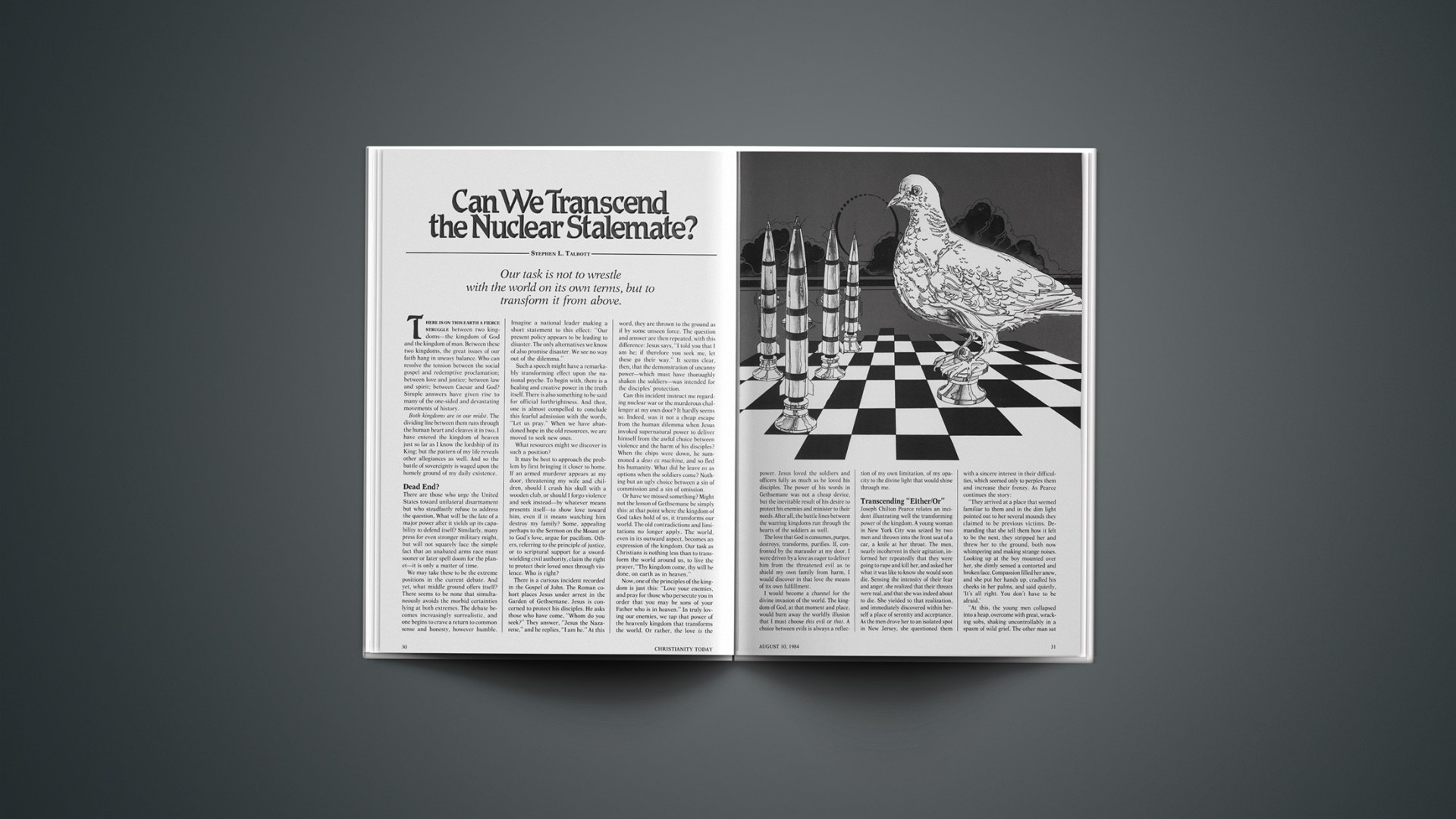
Can We Transcend the Nuclear Stalemate?: Our Task Is Not to Wrestle with the World on Its Own Terms, but to Transform It from Above

There is on this earth a fierce struggle between two kingdoms—the kingdom of God and the kingdom of man. Between these two kingdoms, the great issues of our faith hang in uneasy balance. Who can resolve the tension between the social gospel and redemptive proclamation; between love and justice; between law and spirit; between Caesar and God? Simple answers have given rise to many of the one-sided and devastating movements of history.

Both kingdoms are in our midst. The dividing line between them runs through the human heart and cleaves it in two. I have entered the kingdom of heaven just so far as I know the lordship of its King; but the pattern of my life reveals other allegiances as well. And so the battle of sovereignty is waged upon the homely ground of my daily existence.

Dead End?

There are those who urge the United States toward unilateral disarmament but who steadfastly refuse to address the question, What will be the fate of a major power after it yields up its capability to defend itself? Similarly, many press for even stronger military might, but will not squarely face the simple fact that an unabated arms race must sooner or later spell doom for the planet—it is only a matter of time.

We may take these to be the extreme positions in the current debate. And yet, what middle ground offers itself? There seems to be none that simultaneously avoids the morbid certainties lying at both extremes. The debate becomes increasingly surrealistic, and one begins to crave a return to common sense and honesty, however humble. Imagine a national leader making a short statement to this effect: “Our present policy appears to be leading to disaster. The only alternatives we know of also promise disaster. We see no way out of the dilemma.”

Such a speech might have a remarkably transforming effect upon the national psyche. To begin with, there is a healing and creative power in the truth itself. There is also something to be said for official forthrightness. And then, one is almost compelled to conclude this fearful admission with the words, “Let us pray.” When we have abandoned hope in the old resources, we are moved to seek new ones.

What resources might we discover in such a position?

It may be best to approach the problem by first bringing it closer to home. If an armed murderer appears at my door, threatening my wife and children, should I crush his skull with a wooden club, or should I forgo violence and seek instead—by whatever means presents itself—to show love toward him, even if it means watching him destroy my family? Some, appealing perhaps to the Sermon on the Mount or to God’s love, argue for pacifism. Others, referring to the principle of justice, or to scriptural support for a sword-wielding civil authority, claim the right to protect their loved ones through violence. Who is right?

There is a curious incident recorded in the Gospel of John. The Roman cohort places Jesus under arrest in the Garden of Gethsemane. Jesus is concerned to protect his disciples. He asks those who have come, “Whom do you seek?” They answer, “Jesus the Nazarene,” and he replies, “I am he.” At this word, they are thrown to the ground as if by some unseen force. The question and answer are then repeated, with this difference: Jesus says, “I told you that I am he; if therefore you seek me, let these go their way.” It seems clear, then, that the demonstration of uncanny power—which must have thoroughly shaken the soldiers—was intended for the disciples’ protection.

Can this incident instruct me regarding nuclear war or the murderous challenger at my own door? It hardly seems so. Indeed, was it not a cheap escape from the human dilemma when Jesus invoked supernatural power to deliver himself from the awful choice between violence and the harm of his disciples? When the chips were down, he summoned a deus ex machina, and so fled his humanity. What did he leave us as options when the soldiers come? Nothing but an ugly choice between a sin of commission and a sin of omission.

Or have we missed something? Might not the lesson of Gethsemane be simply this: at that point where the kingdom of God takes hold of us, it transforms our world. The old contradictions and limitations no longer apply. The world, even in its outward aspect, becomes an expression of the kingdom. Our task as Christians is nothing less than to transform the world around us, to live the prayer, “Thy kingdom come, thy will be done, on earth as in heaven.”

Now, one of the principles of the kingdom is just this: “Love your enemies, and pray for those who persecute you in order that you may be sons of your Father who is in heaven.” In truly loving our enemies, we tap that power of the heavenly kingdom that transforms the world. Or rather, the love is the power. Jesus loved the soldiers and officers fully as much as he loved his disciples. The power of his words in Gethsemane was not a cheap device, but the inevitable result of his desire to protect his enemies and minister to their needs. After all, the battle lines between the warring kingdoms run through the hearts of the soldiers as well.

The love that God is consumes, purges, destroys, transforms, purifies. If, confronted by the marauder at my door, I were driven by a love as eager to deliver him from the threatened evil as to shield my own family from harm, I would discover in that love the means of its own fulfillment.

I would become a channel for the divine invasion of the world. The kingdom of God, at that moment and place, would burn away the worldly illusion that I must choose this evil or that. A choice between evils is always a reflection of my own limitation, of my opacity to the divine light that would shine through me.

Transcending “Either/Or”

Joseph Chilton Pearce relates an incident illustrating well the transforming power of the kingdom. A young woman in New York City was seized by two men and thrown into the front seat of a car, a knife at her throat. The men, nearly incoherent in their agitation, informed her repeatedly that they were going to rape and kill her, and asked her what it was like to know she would soon die. Sensing the intensity of their fear and anger, she realized that their threats were real, and that she was indeed about to die. She yielded to that realization, and immediately discovered within herself a place of serenity and acceptance. As the men drove her to an isolated spot in New Jersey, she questioned them with a sincere interest in their difficulties, which seemed only to perplex them and increase their frenzy. As Pearce continues the story:

“They arrived at a place that seemed familiar to them and in the dim light pointed out to her several mounds they claimed to be previous victims. Demanding that she tell them how it felt to be the next, they stripped her and threw her to the ground, both now whimpering and making strange noises. Looking up at the boy mounted over her, she dimly sensed a contorted and broken face. Compassion filled her anew, and she put her hands up, cradled his cheeks in her palms, and said quietly, ‘It’s all right. You don’t have to be afraid.’

“At this, the young men collapsed into a heap, overcome with great, wracking sobs, shaking uncontrollably in a spasm of wild grief. The other man sat pounding the ground and shouting, ‘What is it? What is it? What’s going wrong?’ Then he, too, burst into the same strange, grief-stricken sobs.”

There was nothing left but for her to suggest they take her back to the city. This they did, continuing their sobbing, and when she asked for subway money, they complied. She walked away, descending the stairs to the subway, and fainted.

Law And The Kingdom

Can we extract rules from this story? Not at all. It teaches neither violence nor inaction, and what it does teach we dare not formulate as a law. Indeed, it may be only because she was bound by no law that the young woman found a way to rise above the constraining alternatives that form the content of any law. For a law can say, “strike back” or “do not strike back.” But just as it cannot decree, “When your enemies confront you, display a power that makes them fall down”—neither can it say, “Discover that place of peace and love within you that transforms the current moment and creates new possibilities for healing.” We cannot command the Spirit; rather, he commands us, and when he does, no law constrains us. We know only the overpowering presence of a reality greater than ourselves; the necessity of action that can be nothing other than what it is, namely, the inevitable expression of love in these present circumstances, at this moment, unique in all of time and space. We become the instrument of the Spirit of God. Here is the gospel that sets at nought the law.

Such, however, is not my normal experience. The moment for decision arrives, and, unfortunately, I find that my personal limitations are controlling. When the murderer appears at my door, I will most likely defend my home with violence, or else cower in fear—or perhaps I will cast about frantically for some diversion to buy time, only to realize with horror that I have let the opportunity for action pass. I am what I am.

But if, amidst my limitations, I respond according to the best guidance of my own conscience—whether it be to protect my loved ones with violence, or to follow a course of inaction on deeply felt principle—and if death follows, who then will be my judge? I myself know—or hope—that someday I will be capable of a far higher response to such a threat. But in the absence of deeper spiritual resources, my limitations rule; and it would be a moral failure for me not to remain passive, according to the demands of my conscience. While both alternatives fall short of the kingdom, and neither can be pronounced the “right” one, either may gain a moral authority over me as a result of my limitations.

We are not discussing a perspective restricted to exceptional cases or to global dilemmas. Every choice raises exactly the same considerations. Only the action is wholly good that represents the living Spirit’s transforming activity in the world. The manner of the kingdom’s working in the Garden of Gethsemane is its manner of working at all times and everywhere. The smallest gesture to my neighbor represents a choice between evils, unless I am as fully “possessed” by the Spirit as was the young woman confronting her attackers. For the gesture is an expression of all that I am—and I remain torn between two kingdoms. Who among us can help another without knowing some hint of pride?

Christian thinkers have long realized that sin is more fundamentally a state of being than a definable action. We can fully judge a man’s actions only when we see them as an expression of what he is. All that we have been discussing reflects this fact. Caught between two kingdoms, I find that my character has been formed substantially under the influence of the lower one. To speak of my limitation, then, is simply to acknowledge that my choices and actions reflect my character. While I always possess some area of freedom to alter my character—to move toward full citizenship in the higher kingdom—that freedom is rarely if ever absolute. It is constrained by what I am, by the accumulated effects of past choices and errors. Therefore, the alternatives confronting my fallen nature in the world—and those offered by every legal formula—present an apparent “choice between evils.”

Christian And State

The only escape from this choice lies in the transforming way. We see this way in the life of Jesus. We cannot imagine him forming rule-based “contingency plans” for meeting the next day’s challenges. His life was, purely and simply, the unmediated life of the kingdom. Where he was, life poured into the world. The relation between Caesar and God—to take one example—did not represent a “problem” for him. He always knew what was required of him, because he always acted within that spiritual realm where every man—whether he be Caesar or bishop—stands naked before God. At each moment there was simply the absolute, tranforming necessity posed by the severe demands of his love. It is only because we are cut off from the kingdom of heaven, and are forced to conceive its principles in terms of the possibilities of this world, that we end up with theoretical “problems.”

Jesus did not respond to his questioners by recommending particular courses of action as general rules. If he said, “Sell all your belongings,” or “Go and wash,” or “Rise up and walk,” he was addressing the innermost and present needs of the one before him. Requests for general legal formulations were met with baffling responses—baffling just because they redirected attention to unseen spiritual possibilities.

Scripture records an instructive incident in this regard. Tax collectors approached Peter, wondering whether his master paid a certain tax. Later, Jesus responded by asking, “What do you think, Simon? From whom do kings of the earth take toll or tribute? From their sons, or from others?” And when he said, “From others,” Jesus said to him, “Then the sons are free. However, not to give offense to them, go to the sea and cast a hook, and take the first fish that comes up, and when you open its mouth you will find a shekel; take that and give it to them for me and for yourself” (Matt. 17:24–27).

If earthly kings do not collect taxes from their sons, how much more should the sons of God be free from taxation? Taxes sustain the institutions of earth, and these in turn survive as institutions precisely by bowing to the either/or alternatives of a world blind to the Spirit. For the Spirit is a great destroyer, bursting every form into which we pour him. What has not yet become “as in heaven” must pass away. Not once, but many times, we must exchange old wineskins for new.

“Then the sons are free.” But, however free Jesus himself may have been, the disciples had barely glimpsed the transforming way. They still lived very much in the world, and so some sort of accommodation to the demands of the world was required. But Jesus would make no law out of the accommodation; his demand for perfection would not allow it. He said neither “You must pay the tax” nor “You must not pay the tax.” His practical guidance for the current case was solely prudential (“not to give offense”), and the immediate requirement was met by—what? Another apparent resort to a deus ex machina—which, in fact, was the perfect, transforming response flowing from the higher kingdom.

It is as if Jesus attempts to block at every turn our tendency to see the matter in the world’s terms, directing our gaze instead to the kingdom. Look again at the message: (1) as a son, the disciple is free from obligation to pay the tax; (2) in order not to give offense, he will pay it this time; (3) but—as if to give the final blow to any rule satisfying the terms of the world—the tax is actually paid by a supernaturally produced coin.

If we would elicit a principle from the episode, it must be that our relation to the institutions of the world has no fixed definition—it is prudential, incidental to the working of higher principles that do not recognize the world’s “hard realities.” The goals we strive for relate to another kingdom. But insofar as we fall short of entering that kingdom, we face the necessity of accommodation with the world. We may hope to glean treasure from the sea, and so contribute to the institutions about us in the unstained coinage of the Spirit. But all too often we will find ourselves caught between the two kingdoms. In the absence of spiritual treasure, we are left with coins of the world, with institutions we require for our livelihood but can never wholly support, and with a host of insoluble “issues.” And so we balance prudence with our highest guiding principles in the best way we can.

What Shall We Do?

“Well,” you may reply, “all this to tell us we must live in the world prudently! Have you nothing more to say? There are Christians fighting for a nuclear freeze, and there are Christians demanding a further weapons buildup. If we are not, in fact, at a dead end, what do you counsel?”

There is little more I know to say. The rules you ask for cannot be given. If our hearts do not burn within us as we contemplate the kingdom of God, then we bring no hope to the world. If they do, then while we will each individually go whatever way we must go, and while we may seem to work at cross-purposes, the result can only be an ever-greater realization of the kingdom.

This is not to say that the particulars of our choices, and our struggles to discern the right way, are unimportant. Indeed, these struggles and these choices are critical to our destiny. But the point is this: Our activities lose their importance when we view them against the backdrop of world history, rather than against the coming of the kingdom. After all, we do not measure the significance of the life of Jesus against the social, political, and military issues of the Roman world.

The effort to see kingdom history, then, is no denial of the world. For the acts that promise a transformation of the world are precisely those that descend from the Spirit. Shall anything ascend to heaven that has not already decended from there? Our task is not to wrestle with the world on its own terms, but to transform it from above. And if we do wrestle, we shall nevertheless see our wrestling in a light that is lost to the world.

A friend of mine—a deeply spiritual individual—was a pacifist and conscientious objector during his college years. This was the Vietnam era, and he faced the necessity of military service upon graduation. After a great deal of soul searching, he rejected his status as a conscientious objector, entered the army’s officer corps, and subsequently served in Vietnam. He commented to me afterward, “I believe it would be possible to train one’s rifle sights on a Viet Cong guerrilla and squeeze the trigger, all the while loving him.”

The remark startles. I do not like it. But this friend was acutely aware of the human pain and suffering likely to result from every alternative the world offered in Vietnam. He did not feel he could escape responsibility by claiming to be above the either/or of the world when in fact he was not. He studied the situation in all its complexity, and then resolved to act according to his best understanding. Above all, he knew that the particular physical cause of a man’s passing from this world is not nearly so important for the world’s future as the love and hate that accompany even the most routine chatter over afternoon tea.

I have learned to accept my friend’s stance as a genuine expression of the divine necessity pressing upon him. We may charge him with the death of that guerrilla—just as I may be charged with the death of my children if I choose nonresistance when the murderer appears at my door. Both positions are the expression of love striven for, but a love that is still imperfect and therefore subject to the choice between evils.

I urge neither stance upon my fellows. How could I? The very love sought in both causes—if once it takes hold of a man—will burst the shackles of every law. I do not even know that the two stances are, in the final analysis, different. For to love as best I can the murderer I meet pacifically at my door, or the human target sighted along my rifle barrel, is one thing. To be wholly possessed by love—and that is the goal of both strivings—is quite another. From where I stand now, I cannot know what that love, once achieved, will require of me, nor what radical transformations of the world it will make possible. I serve a Lord who, by his pain and suffering—by his ability amidst his own extremity to love the soldiers who arrested him—loosed into the world a power of healing sufficient to reconcile all things to himself.

We share in his mission. If we fulfill it well, then we will remain brothers and sisters even as we pursue opposite political strategies, even as we aim bullets—or atomic bombs—at each other, even as we drive tanks or lay our bodies down before them. And through our love we will discover … well, who can describe what the world will then see? But one thing is certain: in no other way will the kingdom come.

Tim Stafford is a free-lance writer living in Santa Rosa, California. He is a distinguished contributor to several magazines. His latest book is Do You Sometimes Feel Like a Nobody? (Zondervan, 1980).

After-School Orphans: More and More Children Are Taking Care of Themselves While Parents Work. But at What Cost?

Jeremy gets off the school bus a little after three, his bag of books, baseball cards, and gym shoes swinging at his side. He walks the block and a half to his house, stopping briefly to shoot baskets with a friend. When he reaches his door, he fishes a key out of his pocket, turns the lock, and enters the silence.

A quick foray of the refrigerator turns up a carton of ice cream, to which he helps himself. He got an A—on the science quiz today, and he’d like to tell somebody, but that will need to wait till later.

The immediate debate is homework versus a “Charlie’s Angels” rerun versus MTV. What did Mom say? Homework first, always. Well, okay. The tube was boring yesterday anyway. Jeremy spreads out his math at the kitchen table.

The phone rings. He jumps to answer it. “Hi, Mom!”

“Hi, Son. You got along all right today at school?”

“Yeah.”

“Good. When it gets to be five o’clock, turn the oven on to 425°, okay? We’re having pizza tonight.”

The call is soon over. Jeremy returns to his math, eventually getting stuck on a problem. Maybe Dad can explain it after supper.…

To some, the above scenario is an omen of family collapse in America; an outrage against the young, for whom adults are no longer willing to sacrifice. To others, it is merely the description of a boy growing up and learning to function independently. Whatever the opinion, it is a scene happening more and more frequently with every passing year of the 1980s. In many neighborhoods, latchkey children—a rarity no more than 15 years ago—are now the majority.

Firm figures are hard to come by, but estimates of how many U.S. schoolchildren come home to an empty house or apartment range from 2 million to 6.5 million and higher. Professor Lynette Long of Loyola College, Baltimore, and coauthor with her husband of The Handbook for Latchkey Children and Their Parents (Arbor, 1983), thinks it is more like 10 million, which would be almost a quarter of the nation’s school population.

The Department of Labor is certain of this much: 32 million children of all ages (infant through high school) have mothers who work outside the home. Thirteen million of those children are under age 14. While many of the mothers (or fathers) arrange their working hours to be home after school, many others do not, or cannot.

What is also irrefutable is that the latchkey legion is swelling steadily. Each year an additional 4 percent of the nation’s mothers take outside jobs in offices, stores, hospitals, factories—as well as churches, mission organizations, and Christian schools—so that now more than half the total are on payrolls. The parallel rise in latchkey statistics is nearly automatic.

How Parents Cope

“Telephones and televisions have made the latchkey arrangement possible,” says Professor Long. “The television is the baby sitter, and the telephone is the lifeline to Mom and Dad.” Most parents would not put it so bluntly; many, in fact, establish a firm list of commandments to organize their children’s after-school hours: Come straight home. No friends in the house. Do your homework. Stay away from the stove. Keep the doors locked. Don’t hassle your sister.

Older siblings are often charged with watching younger ones and, in some cases, doing housework such as laundry or dinner preparation.

The rules, however, do more to reassure parents than offspring, who say they sometimes feel like prisoners in their own homes. In one latchkey family, the younger children have dubbed the oldest brother “Adolf Hitler” for his supervisory role.

“I have nightmares a lot,” says a teenager named Debbie. “They’re usually about rats, but sometimes they’re about people trying to get into the house.” An eight-year-old named Danny in Oakland, California, says, “I don’t like it—especially in the winter when it gets dark and the wind blows.”

Danny’s mother, who has tried baby sitters but found them too expensive or unreliable, is not happy about the situation either. “Every day I pray that nothing will happen to him while I’m gone,” she says. “He’s mature for his age and very responsible, but there’s no getting around the fact that he’s only eight years old.”

On the other hand, a 12-year-old named Kevin says, “I wish my mom worked. Then I could play my radio as loud as I want without anyone yelling at me.” Debbie, despite her occasional nightmares about break-ins, told a Seventeen magazine writer, “I’m glad my mom works. She wouldn’t like staying at home, and I wouldn’t want to have her home if she was unhappy. Sometimes, when she’s home a lot, we both get a little edgy with each other and don’t talk to each other as much. Then we’re both ready for her to go back to work.”

Parental opinion, likewise, is split, depending on whom you talk to. A Los Angeles sales executive, a single mother, is proud of her ten-year-old’s growing maturity. “Kim has reached the point that she doesn’t want a baby sitter. She’s very responsible, and I trust her to obey my rules.”

Karla Braig of Dubuque, Iowa, remembers when she first left her three children to return to school. “I had so much guilt I could fry it up and serve it for supper.” But now that she is employed, she says, “There’s this myth that Mommy has to be tied to the stove so the children can spill their little guts every afternoon. Eventually, they learn that gut-spilling time is from 6 to 6:30 instead of 3:30 to 4 P.M.”

Others, however, are not convinced that their absence after school isn’t damaging. Something about that particular hour of the day seems special, a time for the young to let down their defenses after seven hours of social combat, to relax in the protection of a grown-up who has always been their refuge. Conversation somehow flows more freely; joys and disappointments both are nearer the surface.

“You can’t expect a child to go home by himself for several hours every day and not feel abandoned and frightened,” says John Yunker, director of guidance services in a suburban school district outside Saint Louis. “They suffer from a lack of adult contact and a lack of security.”

The hazards are not only internal—loneliness, boredom, fear—but practical as well. One out of six calls to the Newark fire department involves children alone at home. There is also the fact that surveys show the back seat of a car is no longer the prime site for teen intimacy; it is the girl’s home when parents are away. That’s why in one family, the 10-year-old boy may have as many friends over after school as he likes, but his 15-year-old sister may have none.

Says Vance Packard in his 1983 book Our Endangered Children (Little, Brown), “Whereas parents used to worry about what their children were up to when out at night, today … they are more likely to worry about what the youngsters are up to in the late afternoon when so many houses are empty of adults.”

A girl named Rachel is quoted in The Gilmartin Report (Citadel, 1978): “I have the whole house to myself when I come home from school.… So Bob and I just make ourselves comfortable. A lot of times we just study together. Sure, we have sex a lot. But I think that is only natural.”

Ultimately, the parents arrive home at day’s end, but that does not necessarily signal the end of problems. Says one Florida mother, “My daughter has her rules and a list of chores to do, and mostly they get done. But when I get home and find a mess in the kitchen, I wind up screaming. Who needs that after working all day?”

Three Causes

Most observers of the latchkey scene identify the same trio of reasons why the phenomenon has increased and is likely to keep growing:

1. More divorce, which results in more households led by single parents—not all of whom are able to arrange substitute care while they work. The U.S. divorce rate rose from 2.2 per thousand in 1960 to 5.3 in 1981, so that one of every six children under 18 now lives in a single-parent home. (Whether the 1982–83 reprieve in the divorce rate will become a new and welcome trend remains to be seen. Perhaps the worst is over; but then again, some analysts say it was only a temporary lull due to the recession. Divorce proceedings cost money.)

2. Hard times/welfare cutbacks. The need in some homes for two incomes has risen in recent years as inflation has sucked up more family dollars, and governments have handed out less. Fifteen percent of all Americans are now officially classified as poor, the highest in 17 years. In a tightened market, jobs traditionally held by women have been somewhat easier to find than those held by men. Thus, more and more mothers have gone to work to ward off privation, make ends meet, or save up for kids’ college bills.

3. Desire. The third group of mothers work outside the home not because they must but because they wish to. This group now runs as high as 67 percent of the total, says pollster Daniel Yankelovich, who adds, “Norms affecting whether a wife should work outside the home have reversed themselves within a single generation.” Three-fourths of the population in 1938 frowned on the idea if the husband was capable of supporting the household. In 1978, three-fourths approved.

“Whereas in the past it was mainly blue-collar women who worked for pay,” he continues, “now it is the better educated, upper-middle-class women who increasingly work outside the home.” A corollary finding is that 66 percent of those polled feel “parents should be free to live their own lives even if it means spending less time with their children.”

New Attempts To Help

Relief for latchkey distress has sprung up in recent years from several quarters. Some companies, recognizing that a worried employee is less productive, have begun offering flextime arrangements, designing jobs that can be done at home (occasionally using remote computer terminals), or running their own day-care centers on the premises. Ralston Purina in Saint Louis is one such firm that provides space for kids after school; a franchiser handles supervision. In Burbank, California, three neighboring companies—NBC, Walt Disney Studios, and Saint Joseph Medical Center—have gone in together on a joint children’s center.

Schools have begun doing likewise—sometimes in self-defense, to curb after-hours vandalism. The School-Age Child Care Project at Wellesley College studied 125 programs in 33 states, some run by educators, others by parent groups, using school buildings in the late afternoons for a mix of recreation, craft projects, snacks, and music activities. Planners, they found, have to build in enough structure to maintain control but not so much that the child feels as if he is still in school. (One vital key to these programs: the good will of the school custodian!)

A Portland, Oregon, program run by the YMCA was credited with cutting vandalism at three schools from $12,000 one year to $200 the next.

In at least two regions, telephone hot lines for latchkey children have sprung up. “PhoneFriend” in State College, Pennsylvania, averages 45 calls a week between 2:30 and 5:30 P.M. from kids needing help with homework, worried about Mom being late, or feeling lonely. One troubled boy was looking in a closet for his boots when he ran across the family Christmas presents. Another wondered what to do with a sick dog. The volunteers who answer the phones—Penn State students plus some moms—say there are few emergencies, but all deserve attention. Some youngsters seem to call and then hang up, just to make sure PhoneFriend is working. (For an information kit on organizing such a service, write: PhoneFriend Committee, AAUW, State College Branch, P.O. Box 735, State College, Penn. 16801.)

“Kids Line,” in a northwest white-collar suburb of Chicago, averages more than 500 calls a month. Its 140 volunteers have received intensive training from psychologists, psychiatrists, and social workers on everything from depression to drug abuse.

The one resource that often is not eager to volunteer her services is the stay-at-home neighbor—simply because her numbers are dwindling, and she can unwittingly become the unofficial “block mother” in charge of all first-aid problems and peer squabbles. In a recent “My Turn” column in Newsweek, Judy Paris registered her protest: “Often, during the daylight hours, mine is the only car remaining.… Since I am home anyway, my phone number is frequently listed on school records as a backup in emergencies.…

“I am not condemning mothers who work outside the home, whether through choice or need. They know and all of society must understand that a very real problem exists that needs immediate solving … because the lady down the street is not the answer.

“Who is this lady down the street? Probably she is the last of a tradition in transition. What she is not is lucky, lazy, or bored. Neither is she a doormat or drop-off place for your child.”

Facing The Tradeoffs

Social psychologists and other scholars continue their study into the long-term effects of latchkey living, trying to assess its relative merits and drawbacks. A government report in Children Today says location makes a big difference: “In a rural area that is relatively crime-free, latchkey children are not any more or less socially and academically adjusted and fearful than children who are regularly supervised by an adult.… In contrast, negative experiences for latchkey children have been demonstrated in inner-city areas.” In other words, the farm kid who comes home and starts his chores in the late afternoon is far different from the Phoenix child whom U.S. News & World Report found patrolling the house “with a baseball bat in one hand and a shoe in the other, checking the windows every 15 minutes to watch for intruders.”

The National Academy of Sciences says whether the mother works outside the home has little, if any, effect on children’s grades. However, University of Michigan professor Selma Fraiberg, whose specialty is child psychoanalysis, is not convinced. She is especially dubious about government’s involvement in what she calls “the child care industry.” In her book Every Child’sBirthright: In Defense of Mothering (Basic, 1977), she talks about “the Looking Glass World of Day Care in which hundreds of thousands of mothers on welfare take care of the children of hundreds of thousands of working mothers and other mothers on welfare, while hundreds of thousands of women take care of the children of the mothers who are taking care of the children of mothers on welfare and other mothers.”

Then she adds, “(If this sentence causes dizziness, I recommend that it be read slowly as you turn. With each full rotation, fix your eyes on a distant point. I myself use the dome of Capitol Hill.)”

A colleague of hers, Harold Shapiro, notes the economic peculiarities: “When everyone is taking care of their own children, none of this important activity is counted in the GNP. When everyone is taking care of each other’s children, it is all counted. This accounting convention makes it appear as if something new, different, and better is going on when, in fact, the opposite might very well be the case.”

The truth is, scholars do not know enough to draw summary conclusions based on research. James Garbarino, writing in Vital Issues, sums up the information so far: “No social event affects all children or youth equally.… Thus, we know that some children will thrive on the opportunity of being a latchkey child. Others will just manage to cope. Still others will be at risk, and still others will be harmed.”

The Church’S Response

In recent times, church pronouncements on the subject have gradually quieted down, and the earlier insistence on women staying home has ebbed to a whisper. That is partly because the Christian community, like government, has vested interests; it needs women to be church secretaries, college dorm mothers, camp cooks, and, of course, full-time pastor’s wives. So preachers hesitate to stand on Sunday morning and push for full obedience to Titus 2:5.

However, at the same time, church leaders have begun to worry about the weakening of the Christian home, particularly agonizing over offspring who flagrantly rebel against their heritage. More than one pastor has wondered if the institution has not helped create its own nightmare by wooing mothers away from responsibilities at home.

One person who does not equivocate is twice-widowed Elisabeth Elliot Gren, well-known author and speaker. She recently told interviewers from Commonlife, “When people say to me, ‘Why are you always telling young mothers to stay home?’ I say because the Scripture commands me as an older woman to tell younger women to stay home. In the second chapter of Titus it says that older women are to school younger women to be loving wives, to be loving mothers, to be temperate, chaste, kind, busy at home or domestic, and to respect the authority of their husbands.”

What about Christian women who already work? “The first thing I ask is if they are sure they have to work outside the home, because far too many mothers are working for reasons other than genuine economic necessity: social pressure, ambition, boredom with housework, the unwillingness to do the humble task of staying home, the desire for something exciting (what the world calls fulfilling), prestige. And I ask young women to settle the question of whether they have a genuine economic necessity. Only they and God can answer that. I can’t.

“If it is, in fact, an economic necessity, then I still am not sure they have to work outside the home.” (Elliot, in an extreme situation, look her young daughter, Valerie, “to work” with her among Ecuador’s Auca Indians after the murder of her husband, rather than returning to a more conventional livelihood in the United States.)

Focus on the Family, the James Dobson radio ministry, published a booklet last February entitled Working at Home: Ways to Supplement Family Income. It sketched out 25 ways to earn cash under your own roof, from custom typing to running an answering service to stripping furniture to fixing broken dolls. The ideas, extracted from a book called 555 Ways to Earn Extra Money (Jay Conrad Levinson; Holt, Rinehart and Winston, 1982), offered a range of possibilities for mothers needing or wanting to supplement the family income.

A trio of mothers in the Washington, D.C., suburbs, all college-educated, formed a support organization last year called Mothers at Home and began a 24-page monthly newsletter, Welcome Home. “I have working friends who say my mind is too good to stay home,” says Linda Burton, mother of two. “I decided my mind was too good not to stay home with my children. The best minds are required there.”

When a wire service story on the group appeared last December, inquiries skyrocketed. The AP reporter was repeatedly phoned at home to get the group’s address; eventually Burton and her colleagues installed a recorded message to handle the volume ([1–703] 352–2292). More than 5,000 letters poured in within six months, and subscriptions mounted to 2,500 with no promotion. The mothers appeared on the “Phil Donahue” show last March and testified before a House Select Committee on Children, Youth, and Families in early April.

The three founders, though church attenders, do not want their group dubbed religious. They have taken no position on ERA, for example. They simply mean to encourage women who choose not to take employment outside the home and assure them they’re not odd.

Meanwhile, other Christians are turning their attention to relief for those children already in latchkey situations. While many churches offer after-school care in their buildings, at least one church takes its ministry to where the latchkey children live. Wheaton (Ill.) Bible Church’s “Sidewalk Sunday School” is a three-afternoons-a-week outreach to a nearby apartment complex that teems with unsupervised children. The entire ministry is led, staffed, and funded by the church’s high school department.

“High school kids are the perfect resource to minister to latchkey kids,” says Ridge Burns, youth pastor, “because their schedules mesh. Here are all these children running loose after school—and here are all our senior highs wondering what they can do for God now that the two-week summer mission trip is over. We poured all that training into them for two weeks in Appalachia—why not put it to use here at home instead of letting them stagnate?”

A dozen church teens meet the school bus when it unloads in front of the apartments. They kick soccer balls with the children and play games on the grassy area until 4:30, when they begin an hour of singing, a Bible story, crafts, and prayer. During cold weather, they meet in the apartment the group has rented for $380 a month. (Two single adults occupy it in order to meet regulations.) In warm weather, the activities stay outdoors. At 5:30, the teens walk the children to their individual apartment doors, then return to clean up.

Inland Real Estate Corporation, the landlord, credits “Sidewalk Sunday School” with cutting vandalism by 90 percent. Their main problem before was simply kids using the hallways for a bathroom. Now, everyone knows the church’s apartment is open and available if you get locked out of your own.

More than 50 church teenagers are involved in the program, assigned to various days. They remember the children’s birthdays and listen sometimes to accounts of shocking abuse at home. “The missiologists talk about reaching hidden people groups,” says Burns. “Here they are!—a mile and a half from Wheaton Bible Church. They just happen to be 10 years old and under.” He hopes someday to start a branch church in the complex, which has a large concentration of Southeast Asians trying to get an economic toehold. “This is the best thing our youth group has ever done.”

Such cases affirm the undeniable fact that children cannot raise themselves. Unlike robins and rabbits, who fare well enough within weeks of birth, the human young require love and nurture from older care givers for at least a decade and a half. They must be near the top of someone’s agenda if tragedy is to be forestalled.

Thus, Christian parents (male and female) must assess their lifestyles in light of their confession that sons and daughters are gifts from above. The conclusions may not be the same for everyone, especially if financial hardship is a factor. But the questions must be faced regardless. And all Christians may well ask if the latchkey children in their communities do not constitute a new kind of victim on the road to Jericho, wondering if the religious passersby will notice the fear in their eyes.

Tim Stafford is a free-lance writer living in Santa Rosa, California. He is a distinguished contributor to several magazines. His latest book is Do You Sometimes Feel Like a Nobody? (Zondervan, 1980).

Schuller Clarifies His View of Sin: Four Views of Sin Are Popular Today. Which Is Right?

1Sin does not exist. This view makes some strange bedfellows: Communists, atheists, secular humanists. They would explain problems like rape and murder in different ways, but not as the result of sin dwelling in the soul. Some think it is due to economics. Some think it stems from a lack of education. Some think it is a failure to think positively.

2Sin is something everyone has, but no one is born with. This is classical Pelagianism. According to this view, every person is born sinless, but we all “catch it” and “get infected” with it. I often ran into this when I rang doorbells 29 years ago. I tried to convince people of the doctrine of original sin, but they wouldn’t accept it. They thought sin was something we do, not something we are. Since a newborn baby is innocent of rebellious acts, it is not a sinner. Repentance, for people holding this second view, means they are not going to lie any more, or get drunk any more, or commit adultery any more. Some may accept Christ as their Savior to escape the effects of their sins. But they remind me of an absolutely clean field in Iowa—not a weed anywhere. But where is the corn?

3We are born in sin—that is, every person is born as rebellious as Adam was when he willfully chose to disobey God. This is called “federal theology,” and traces to Saint Augustine. Each child, from his conception, is as guilty of rebellious disobedience as if he were Adam himself. This view makes no distinction between “Adam’s sin” and “original sin,” as if every newborn baby had chosen by an act of free will to disobey God. From this viewpoint, to bring a child to salvation he has to be led into a negative experience of conviction of sin as soon as possible. Catechize him, program him to say, “I am a sinner. My heart is wicked.” This is supposed to produce such a sense of guilt that repentance will result. To be genuine, this has to emerge in self-humiliating, self-denigrating statements like, “I’m totally worthless.” As a result, God will reward him by forgiving him his sin. In this system, repentance becomes a meritorious “good work,” and, for salvation, is in addition to belief in Christ.

4My view is that every person is conceived and born in sin. But this condition is, unlike that in the third view, a state of unbelief first—before it is an act of rebellion. The core of sin is lack of faith, a total inability to trust oneself, one’s parents, or God.

While Adam and Eve were aware of God’s existence, and could have either remained innocent or become rebellious, we, as their children, were never given that option. Born nontrusting, we become naturally fearful and adopt negative reactions to relationships that we see as threatening because of our alienation from the Father-God. Lack of trust makes us unable to love, barring an act of God’s grace. So every human becomes fearful, then angry, then rebellious.

But when a person is saved by God’s grace, he becomes a trusting person at his inner core. The nontrusting core is transformed—reborn—through an experience of redemption. This happens when we meet the Ideal One, Jesus Christ. In this experience, we see that he treats us with compassion rather than condemnation, offers forgiveness rather than rejection, loves us before we have repented. “While we were yet sinners, Christ died for us.” His nonjudgmental love allows us to experience genuine grace. We do not merit it, even by the act of repenting.

Encountering such unjustified mercy, we sinners find ourselves incapable of not repenting. Repentance, then, becomes not a self-condemning act that feeds a negative self-image, but a turning from sin to the Savior. We turn from “I am nothing and nobody,” to “I am somebody”—a friend of Jesus, redeemed by him.

Now “I can do all things through Christ who strengthens me,” because he assures me of my incredible value in his sight. He has assumed the punishment due my sins, by experiencing separation from God on the cross.

Original sin, then, is distinct from Adam’s sin. The evangelist’s first objective is not to contrive a sense of guilt. Rather it is to lead the already fearful, nontrusting person into a personal experience with Jesus Christ. By the Holy Spirit he discovers hope, and this leads to faith. Then love becomes a possibility, and miracles happen—he is born again.

The sense of human dignity that was Adam’s nature before the Fall now descends on him. False humility and false pride dissolve, and a satisfying, sacred self-esteem takes its place—the Savior’s kiss on the heart of the new believer. “By grace are ye saved by faith, and that not of yourselves, it is the gift of God.”

Tim Stafford is a free-lance writer living in Santa Rosa, California. He is a distinguished contributor to several magazines. His latest book is Do You Sometimes Feel Like a Nobody? (Zondervan, 1980).

Eutychus and His Kin: August 10, 1984

In Search Of Sustenance

Ever since Richard Foster, in Celebration of Discipline, introduced me to the prospect of fasting for spiritual purposes, I’ve hungered to know more. Closer communion with God at the cost of a few meals is a rare bargain indeed. And so, with journal in hand, I proceeded.

Sunday, 12 Noon—What better day to enter “communion” than the Sabbath. Foster recommends that beginners fast from lunch to lunch. I first decide to stock up. I down a two-fisted corned beef sandwich, then begin the fast with prayer—and a stomachache.

2 P.M.—Prayer and meditation postponed by a ballgame on television. (I can still taste the corned beef. Who said fasting was tough?)

4 P.M.—My stomach is growling. No matter, I’m almost there, right?

6 P.M.—Wrong! I’m starting to realize that fasting is not a piece of cake. (Oh that it were! Chocolate, preferably.)

8 P.M.—I’m beginning to wonder about Richard Foster. This is one book he should never have written.

9 P.M.—Symptoms of hunger setting in. All the ones Foster talks about. The coated tongue. The bad breath. I’m feeling weak. Must forgo bedtime prayers. (God knows my heart anyway.)

7 A.M.—What a night! I dreamed I was standing in line at McDonald’s. Some old woman was behind me asking “Where’s the beef?” I told her, “Forget the beef, I’ll settle for a nice big bun.”

8 A.M.—Drag myself to work. I feel like Gandhi after 30 days. I ask my secretary if she thinks I’m losing weight. She says I look “as chubby as ever.”

10 A.M.—No fair. Chocolate frosted donuts stand in the way of my perfect communion with God. My coworkers ask me why I won’t take one. I can’t tell them. Foster says it’s against the rules. I tell them I don’t like chocolate frosteds.

10:30 A.M.—I realize I lied about the chocolate frosteds. Lying is against the rules too. For penance, I must eat one.

10:32 A.M.—Donuts gone. I say a hasty “Our Father”—less for communion purposes, more for “daily bread.”

12:00—It’s over! Time to celebrate my newfound discipline—over a Big Mac and fries.

1:30 P.M.—Final entry. Fast was worth it. I covenant with God to maintain tighter spiritual communion—between meals, of course.

EUTYCHUS

Bicentennial Reflections

As a full-time observer of the 1984 United Methodist General Conference in Baltimore, I appreciated your coverage of that pivotal event [News, June 15]. However, you and some others perpetuate a myth about why many of us prompted a “cap” on denominational programs there. Some, like Ed Robb, saw it as a reflection of “a lack of confidence in the liberal leadership of our boards and agencies.” In reality, the members of the Eastern Pennsylvania Annual Conference initiated that action to limit general church spending (and therefore annual conference spending) in order to stimulate a radically increased spending for missions at the local church level. Criticism of general boards and agencies was a secondary issue which many people like yourself picked up and made primary.

KENT E. KROEHLER

United Methodist

Eastern Pennsylvania Conference

Valley Forge, Pa.

I was thankful to see the article regarding the bicentennial of Methodism. As an ordained United Methodist elder, I have found my spirit torn between trying to understand my conservative evangelical identity in Jesus Christ and trying to understand the whole spectrum of other identities the same Lord seems to bring to others.

While theological pluralism may be the biggest problem of our denomination, it has brought us blessings as well. When we celebrate Communion at our annual conference, hundreds of laity and clergy come forward and kneel before the Lord’s Table. This is one time each year I experience togetherness with people I normally oppose dramatically. In that brief moment we are one—in God, in Christ, and in his family, the church. There is neither male nor female (nor black or white; nor rich or poor; nor old or young; nor gay or straight; nor liberal or conservative).

Perhaps if we can now come together around the Lord’s Table, we shall one day go together in his service around the world.

REV. ALLEN LEE EDWARDS

United Methodist Church of LaMonte,

Dresden, and Georgetown

LaMonte, Mo.

I believe strongly that language is important. We ought, therefore, not to be using the language preferred and misused by the homosexuals [“gay”] or the sodomites, as the Bible refers to them.

JOHN LOFTON

Conservative Digest

Washington, D.C.

Numbers Game

The article, “Frankly, I Don’t Care How Many Are in Your Sunday School” [June 15], was a good reflection of how many of us feel. However, much of its impact was lost when the acknowledgement of the author said, “He is the author of four books and more than 200 magazine articles.”

Frankly, I don’t care how many books and articles he has written.

REV. J. WADE PARKER

Mira Mesa Grace Chapel

San Diego, Calif.

J. Grant Swank, Jr., gives a one-sided view of church measurement. Apparently, he doesn’t care about numbers; but his master, the Lord Jesus Christ, did. He taught that the shepherd counted only 99 sheep and went looking for the one that was lost.

Swank should have balanced his article and suggested that numbers alone are not the criteria for measurement. Instead, he implies that qualitative questions dealing with nurture and relationship are the sole standard.

In the final analysis, one cannot have church quality without quantity or, to put it another way, one cannot have a spiritual church without giving attention to organization matters and vice versa.

ELMER L. TOWNS

Liberty Baptist College

Lynchburg, Va.

The Schaeffer Legacy

The news report on the death and life of Francis A. Schaeffer IV by Stephen Board [News, June 15] rightly recognizes many of the contributions he made to twentieth-century evangelicalism. However, Mr. Board’s comments about criticisms of Schaeffer by “some faculty members at evangelical colleges” go a bit overboard in defending Schaeffer.

Scholars can be petty and jealous in their criticisms. In the case of Francis Schaeffer, my personal experience suggests that the critiques arose from legitimate, scholarly differences of opinion. My personal gratitude for the intra-evangelical debate over Schaeffer can scarcely be put into words. My gratitude for what Schaeffer did for individuals at L’Abri and elsewhere is likewise full and overflowing.

DENNIS D. MARTIN

Associated Mennonite

Biblical Seminaries

Elkhart, Ind.

Francis Schaeffer had the ability to speak with clarity to a certain type of “modern” mind and to point the way to the truth of Christ.

For those of us awash in the mind-boggling chaos and confusion of secularism (which has invaded so much of the church), and disoriented by the monumental changes in both church and culture, meeting Schaeffer through his work could be, and often was, a life-changing experience.

He will be missed.

GLORIA WARNER

Anacortes, Wash.

Neither Southern Nor Rural!

While I am not a subscriber to your magazine, I could not help but react when I was shown your story [News, May 18] concerning the Gallup-University of Pennsylvania study on what you called “the electronic church.” Your summary of its findings was an attempt to denigrate ministries, such as my father’s, whose messages and results apparently cause you considerable intellectual discomfort.

I would note by way of example your conclusion that “Swaggart draws rural Southerners.” That statement, which has no basis in the report, reflects an apparent effort to pigeonhole this ministry and its viewers. Our relative southern viewership is indeed the highest, according to the report. But even at that, over half of our viewers are not located in the South. As for rural viewership, you have again misrepresented the statistics in the report: 54 percent of the viewers are nonrural. Obviously, then, most of our viewers are neither southern nor rural.

Despite that, however, the point I wish to make has nothing to do with the South. What I object to is your creative twisting of the facts. It cannot benefit the cause of Christianity when a magazine such as yours engages in the same sort of distorted and selective reporting for which the secular media is known.

DONNIE SWAGGART

Jimmy Swaggart Ministries

Baton Rouge, La.

A False Sense of Security

Your magazine is giving readers a false sense of security by publishing articles like “Humanism Suffers from Lack of Leadership” [June 15]. Humanism is an atheistic cause embraced by millions of people (including Christians) who are so enamored by the “world” that they don’t recognize demon worship when it is staring them in the face.

Please spare us your idealism and naïveté concerning issues so vital to our very existence. Humanists would do away with CHRISTIANITY TODAY if they could. Please don’t help their cause.

DONNA EYMAN

Florida City, Fla.

City Limits

Raymond Bakke [“The City and the Scriptures,” June 15] neglected to say that specific cities were also roundly denounced by Jesus (“Woe unto you Chorazin, Bethsaida! If Sidon had seen what you have seen, its people would have repented.”)

God deals not with corporate entities so much as he does with the people they embrace. There clearly are cities today out of which he still calls his faithful Lots.

MARY A. SPENCER-MCCOY

Birmingham, Ala.

Where’s the Church?

The news report on North Korean churches [June 15] is misleading. You say no churches can be built, but also say there are 1,000 house churches. Are there or are there not “churches” in North Korea?

JACK ISAACSON

Houston, Tex.

(The North Korean government will not permit the building of churches. Religious expression in private homes is toleratedbarely.Eds.)

Theology

Schuller Clarifies His View of Sin

Four views of sin are popular today. Which is right?

1. Sin does not exist. This view makes some strange bedfellows: Communists, atheists, secular humanists. They would explain problems like rape and murder in different ways, but not as the result of sin dwelling in the soul. Some think it is due to economics. Some think it stems from a lack of education. Some think it is a failure to think positively.

2. Sin is something everyone has, but no one is born with. This is classical Pelagianism. According to this view, every person is born sinless, but we all “catch it” and “get infected” with it. I often ran into this when I rang doorbells 29 years ago. I tried to convince people of the doctrine of original sin, but they wouldn’t accept it. They thought sin was something we do, not something we are. Since a newborn baby is innocent of rebellious acts, it is not a sinner. Repentance, for people holding this second view, means they are not going to lie any more, or get drunk any more, or commit adultery any more. Some may accept Christ as their Savior to escape the effects of their sins. But they remind me of an absolutely clean field in Iowa—not a weed anywhere. But where is the corn?

3. We are born in sin—that is, every person is born as rebellious as Adam was when he willfully chose to disobey God. This is called “federal theology,” and traces to Saint Augustine. Each child, from his conception, is as guilty of rebellious disobedience as if he were Adam himself. This view makes no distinction between “Adam’s sin” and “original sin,” as if every newborn baby has chosen by an act of free will to disobey God. From this viewpoint, to bring a child to salvation he has to be led into a negative experience of conviction of sin as soon as possible. Catechize him, program him to say, “I am a sinner. My heart is wicked.” This is supposed to produce such a sense of guilt that repentance will result. To be genuine, this has to emerge in self-humiliating, self-denigrating statements like, “I’m totally worthless.” As a result, God will reward him by forgiving him his sin. In this system, repentance becomes a meritorious “good work,” and, for salvation, is in addition to belief in Christ.

4. My view is that every person is conceived and born in sin. But this condition is, unlike that in the third view, a state of unbelief first—before it is an act of rebellion. The core of sin is lack of faith, a total inability to trust oneself, ones parents, or God.

While Adam and Eve were aware of Gods existence, and could have either remained innocent or become rebellious, we, as their children, were never given that option. Born nontrusting, we become naturally fearful and adopt negative reactions to relationships that we see as threatening because of our alienation from the Father-God. Lack of trust makes us unable to love, barring an act of God’s grace. So every human becomes fearful, then angry, then rebellious.

But when a person is saved by God’s grace, he becomes a trusting person at his inner core. The nontrusting core is transformed—reborn—through an experience of redemption. This happens when we meet the Ideal One, Jesus Christ. In this experience, we see that he treats us with compassion rather than condemnation, offers us forgiveness rather than rejection, loves us before we have repented. “While we were yet sinners, Christ died for us.” His nonjudgmental love allows us to experience genuine grace. We do no merit it, even by the act of repenting.

Encountering such unjustified mercy, we sinners find ourselves incapable of not repenting. Repentance, then, becomes not a self-condemning act that feeds a negative self-image, but a truing from sin to the Savior. We turn from “I am nothing and nobody,” to “I am somebody”—a friend of Jesus, redeemed by him.

Now “I can do all things through Christ who strengthens me,” because he assures me of my incredible value in his sight. He has assumed the punishment due my sins, by experiencing separation from God on the cross.

Original sin, then, is distinct from Adams sin. The evangelist’s first objective is not to contrive a sense of guilt. Rather it is to lead the already fearful, nontrusting person into a personal experience with Jesus Christ. By the Holy Spirit he discovers hope, and this leads to faith. Then love becomes a possibility, and miracles happen—he is born again.

The sense of human dignity that was Adam’s nature before the Fall now descends on him. False humility and false pride dissolve, and a satisfying, sacred self-esteem takes its place—the Savior’s kiss on the heart of the new believer. “By grace are ye saved by faith, and that not of yourselves, it is the gift of God.”

Theology

A Theologian Looks at Schuller

Dr. Kantzer has read extensively the writings of Robert Schuller and was a member of the trio sent by CT to spend a day interviewing him.

Robert Schuller is an evangelist—first, last, and always. I admire his zeal to reach the ear of twentieth-century Americans and to win them to Christ and the gospel. But I am never quite certain what gospel they are being won to. I ask myself: "Is there something wrong with his message? Or is it just his method that troubles me" Yet that poses a problem. One cannot really separate message and method, for each shapes the other at essential points.

Perhaps my hesitation is a kind of sour grapes. When people complained to evangelist Dwight L. Moody about the way he preached the gospel, he replied, I like my way of preaching the gospel better than your way of not preaching it."

He Accepts Fundamentalist Doctrine

Robert Schuller is no liberal exhorting lost and helpless sinners to lift themselves. . . . [He] believes all the “fundamental" doctrines of traditional fundamentalism. He adheres to every line of the Apostles' Creed with a tenacity born of deep conviction. He offers no slippery acquiescence to the lordship and deity of Christ, but sets his feet solidly on Nicene and Chalcedonian Christology—one person, who is fully human and fully divine, and divine in the same sense as the omnipotent, omniscient, omnipresent Father in heaven.

Probed by two very picky theologians (David F. Wells and Kenneth S. Kantzer), he avowed belief in a literal hell. He was not sure about its location, and the fire is to be understood figuratively; but on these points he aligned himself with most reputable theologians from Augustine through Calvin (see Institutes, III, XXV, 12).

He rings true on the Reformation doctrine of salvation by grace through personal faith in Jesus Christ as Lord and Savior. He even insists upon skirting at careful distance any subtle tendency toward salvation by works. We are not saved “by” faith as though our faith were a good work for which God rewards us. We are saved by grace and solely on the condition of faith. And the basis for divine forgiveness lies in the love of God, whose holiness is satisfied by the atoning sacrifice of Jesus Christ.

Holy Scripture, for Robert Schuller, is the written Word of God, the infallible authority for faith and life. And he prefers it in the King James Version. He affirms the Lausanne Covenant and does not blink at the word inerrancy. He was not questioned on such issues as redaction criticism, the authorship of Peter’s epistles or the Book of Isaiah, the date of Daniel, or the composition of the Pentateuch, because he is obviously not interested in such things. He simply accepts the Bible as it is. The Bible is Gods true Word, and he affirms it as the guide for his life and thought.

In his basic theology, Robert Schuller claims with good reason to be unequivocally orthodox—a Protestant in the mainstream of the Reformed tradition. What more could anyone ask?

What Troubles Many Evangelicals

Three things, so many believe, are lacking in the message of Robert Schuller: (1) A proper doctrine of sin: that is, an understanding of the human predicament for which the biblical gospel is the remedy. (2) A gospel message that is consistent with his profession of a biblical and evangelical faith. (3) A method of presenting his message that is consistent with the biblical gospel.

We understand better where Robert Schuller is coming from in the doctrines connected with the first two criticisms if we see that he is overreacting against an overreaction. He is reacting against a radical perversion of the doctrine of total depravity. Traditionally, as Schuller understands it, the church sees every unbeliever as a condemned sinner, utterly worthless, who must be threatened with the eternal punishment he so richly deserves. The sinner is rejected by God and stands outside his love. He must be made to confess his absolute worthlessness, grovel in mortification, and repent for his sin. Only then may he come to God and become the object of God’s love.

Schuller is also overreacting against a method—one that, in a 30-minute gospel message, allots 29 minutes to sin, the divine wrath against sin, and the need for repentance. Only at the last moment, almost as an afterthought, does it allow for mention of Gods overflowing heart of love for the sinner, his reaching out for the sinner in grace, and his call to faith.

Schuller’s Doctrine of Sin

What is the human predicament? According to Robert Schuller, the root problem of man is sin, and sin is essentially a weakness or a helplessness—an inability to trust anyone and, therefore, an inability to love or to be loved. As a consequence, humans possess a poor self-image and are beset with a tragic sense of their own worthlessness. For them life is, at best, boring and, at worst, despairing. Robert Schuller does not see sin as a will not to believe, or as a perversion of the will. He certainly does not see it as red-handed rebellion against God or even as centering in pride or human selfishness.

What kind of person is it, then, whom the evangelist is seeking to win? Schuller readily agrees that all humans are sinners and need to repent and seek divine forgiveness. But people today do not know that. They are secularists seeking to live without God and, therefore, without self-esteem; so they are desperately unhappy about themselves. To tell such a person he is a great sinner is pointless. He does not believe the Bible, and sin makes no sense to him. A stick of wood or a rotten tomato is not a great sinner. Only a being who recognizes moral values can know he is a sinner.

Schuller’s Gospel

What, then, is the message by which this modern secular person can be won? Robert Schuller’s logic is as clear as his Crystal Cathedral. More flies are always caught with sweet, sticky flypaper than with a swatter. Tell people God loves them. They are important to him. They are, in fact, of infinite value. In Jesus Christ God has come down to meet us. So turn to him, have faith in God, and you will find in his nonjudgmental accepting love a sense of your own self-worth. You will come to have faith in yourself. You will be somebody! And as you discover your own value, you will gain self-esteem. You will find true dignity, purpose, meaning in life, and hope for the future; and you will come to feel good about yourself.

But some evangelicals protest: What about sin? And repentance? Has Robert Schuller not read the Book of Romans? Is not the gospel the good news that Christ died for our sins? Yes, Schuller replies. And that will come. But until the sinner knows God in Christ, he has no adequate standard by which to judge his sin. And until he knows his own worth, he has no motive to be saved. Eventually, through acceptance of the lordship of Jesus Christ, he will realize he is a sinner, seek forgiveness, and turn from sin. But the first step must be to recognize that he is worth something. Belief in ones self-worth is a corollary of belief in God, and is the threshold that must be crossed first. Then, in the knowledge of God’s love and acceptance, a person will discover that he is a sinner, repent for his sin, and turn to the preaching of the Word, the celebration of the sacraments, the fellowship of the saints, and the crucified life.

But to begin with sin is, according to Schuller, to reverse the right order and make true repentance impossible. The secular sinner is simply not prepared to handle the sin question. To heap guilt upon the sinner who already believes himself worthless is to drive him away from his only source of life and hope. So give him a pill containing medicine coated with sugar. He needs the medicine and will get it, but he swallows the pill because he tastes only the sugar coating—not the bitter quinine.

Learning from Schuller

Before considering method, we should note that Robert Schuller has grasped some important pieces of biblical truth. We live in a secular and disbelieving world (though it is impregnated with a large residue of biblical Christianity). Most of our contemporaries are unfamiliar with biblical terms. Three-quarters of the American people do not accept the Bible as their final authority.

Moreover, Gods love is not conditional. He loves sinners while they are yet sinners. We evangelicals must tell them that, and in addition show it in our own unconditional love for them. And God does not call sinners to renounce their self-worth. By creation he made them of infinite value, and by redemption he proves that he still considers them so. The gospel calls sinners to confess not that they are worthless, but rather that they are unworthy of God’s forgiveness and loving kindness because of their sin.

We can also learn from the fact that Schuller is now reaching more non-Christians than any other religious leader in America. At least in part, this is due to his unusual sensitivity to the secular mind. He has a handle on modern society that many of his critics do not see (or else they think he has too much of a handle on it, and is swinging with it).

We cannot respond to Self-esteem: The New Reformation merely by upholding Luther, Calvin, and Wesley as infallible authorities, and the Reformation confessions as above all criticism and incapable of reform—not if we are true to the Reformers. New light can break forth from Gods Word. We must also be willing to allow Robert Schuller to change his mind. Indeed, upon reading the text of the preceding interview article, he came to modify his original criticism of Paul’s methodology. He now believes his problem is not with Paul, but with “the way some negative Christians” misuse Paul’s doctrine of sin as they emphasize mortification rather than grace.

Nevertheless, a note is missing in the message of Self-esteem and the “Hour of Power.” We believe that to one tuned to the teaching of Holy Scripture, this message lacks the ring of truth. The missing note is a right doctrine of sin that, in turn, mars the gospel message, and finally determines the method by which the house of faith is to be built.

Schuller’s Method

Schuller, the evangelist, is like the barker outside the gospel tent at a country fair, hawking his wares to the passing throng. He sees their unhappy faces and their lack of self-worth. And his root problem is simply this: he is so earnestly zealous to win people and make them happy, that he jeopardizes the possibility of making them holy. The problem is further compounded by his television program, where he can only bark his wares; there he has no tent into which he can herd those who respond and set them straight with a fuller Christian message.

Even the Crystal Cathedral is only a mission platform from which he can address the crowd that he hopes to lure into the more private ministries of the inner circle that constitutes the church.

To understand Robert Schuller, you must mot think of his television program as a church service planned for faithful worshipers scattered across the nation. It’s strictly “Show-Biz.” It’s competing with the Astrodome and professional sports. It’s competing with soap operas and newscasts from Washington, the Middle East, and Central America. It’s competing with “20/20," “The Little House on the Prairie”; with “Wild Kingdom" and "Sesame Street.” It’s competing for the souls of men.

And you must not even think of the Crystal Cathedral as a church. Robert Schuller’s theology is too good for that. The Crystal Cathedral is a mission station—to attract to it the lost, the spiritually hungry, the desperate of this world. The church is a much smaller body that meets for Sunday school, Sunday evening study, and midweek Bible study; and that works in the ministry of the gospel. In this, Schuller is like John Calvin, who allowed that maybe as many as one-fifth of those coming to his St. Peters church were real believers.

Nevertheless, the biblical gospel is not just good news about the value of the human soul (Robert Schuller’s “self-esteem”), and its invitation is not merely to those who would like a lift from their depression. The biblical gospel probes more deeply to the root of the human predicament—and finds it in the issue of sin. It calls for a change at the heart of the sinner. Man chooses to create idols instead of trusting in God. He centers his affection on something other than God. He is proud. He is selfish. He is red-handedly rebellious. And he is infinitely clever in disguising his motives—even from himself.

Yet by the very act of choosing anything other than God, he may (if he is consistent) recognize that he has lost any reason to believe in his own worth. He has no proper grounds for self-esteem, but is a part of the flotsam and jetsam drifting on the vast and unfriendly sea of a chance universe.

The biblical gospel calls him to turn from his cleverly disguised selfishness and his rejection of God. He must turn to the God who has already accepted him for Christs sake, and find full forgiveness, meaning, and value for life, and a new power to live the kind of life to which God calls us.

The Example of Our Lord

Here the preaching of our Lord sets a model in proper balance. He does not grind the sinner into the dust, or demand that he renounce his own worth as a human being. But neither does he gloss over human selfishness and the ability of humans to deceive themselves as they substitute their manmade idols for God. Avoiding both extremes, he strikes a balance that acknowledges the truth in each.

No one stresses more than our Lord the infinite value of the human soul. “What shall a man give in exchange for his soul?” Robert Schuller is on solid biblical grounds when he urges us to meet the sinner’s problem of a poor self-image. Our Lord is also extremely sensitive in his dealing with any person he is trying to win. Notice the delicate way he seeks to communicate to the woman taken in adultery (John 8). He has compassion for the crowds. His tender concern for those who come to him for help touches us all.

On the other hand, while he never seeks to humiliate the seeking sinner, neither does he avoid the sin question. Human sin and the need for repentance are recurring themes throughout his ministry. This is true not just of the Pharisees and lawyers who lead others astray. He deliberately calls all those he is trying to win to face up to the moral need of their life. Again and again by his probing analysis he shows up the devices we use to cover up our greed and selfishness. To the adulterous woman, in all tenderness, he has only this message: "Neither do I condemn you; go and sin no more." Some evangelicals see only “Go and sin no more.” Robert Schuller sees only “Neither do I condemn you." Our Lord says both.

Right up front, he depicted the cost of discipleship even when it cost him a convert. He demanded that the rich young ruler give up all his possessions, because they had become an idol. The man turned away because he was rich. And though our Lord loved him, he permitted him to go. Jesus knew that those who followed him would have to pay a price. And many times he warned those who would make overeasy decisions, pointing out that they must count the cost before turning to him. His messages are full of woes against sin. He often referred to divine judgment and, in fact, spoke of eternal punishment more frequently than any other person in the Bible. Our Lord was always sensitive, always tender, always understanding, but he never stopped short of probing for the root of man’s grief in sin.

Those who appeal only to the divine love and a gospel of sweetness and light may win all those who find sweetness and light attractive. But those who are won discover on the inside a holy God who does not condone sin. Our Lord never stopped short of presenting the gospel in its wholeness. He invited to his kingdom those who recognized the infinite worth of the human soul and who wished to turn from sin to seek the good. If our ultimate goal for humans is Christlike goodness, we must follow Jesus in presenting the wholeness of the biblical message.

Jesus Christ is Savior. It is important to say that he saves from a low self-image, one that fails to account for the value of a human soul.

But Jesus is not just that. He is also savior from sin and all its consequences. And we dare not divide the elements of the gospel which our Lord keeps together.

Refiner’s Fire: Rock Video: 24-Hour-a-Day Pacifier for “Tv Babies”

In the film Network, newscaster Howard Beal, distraught over the impending cancellation of his show, hears a strange voice urging him to oraculate over the airwaves, to dispense nightly jeremiads on the hypocrisies of our time—a sort of script Savonarola. “Why are you telling this to me?” he asks. The voice responds, “Because you are on television, dummy.”

Some record company executives must have been listening, for, says RCA’s Steve Kahn, “I think video is going to save the record industry. We have to find new ways to sell records, and I can’t think of a better way than MTV.”

Started in 1981 by Warner Amex Satellite Entertainment Company, MTV is essentially a rock station that you watch. Seven days a week, 24 hours a day, it transmits rock videos over 2,200 cable systems and into a whopping 19.3 million homes. (Both figures are significantly up from last year.) But though it proclaims itself Music Television, MTV has more to do with the Wall Street Journal than Rolling Stone magazine: it is one enormous ad campaign.

The videos, though costing up to $300,000, are supplied free by record companies. Kahn’s prophecy has been fulfilled: album sales are up, stockholders are happy. And with good reason. The average MTV viewer watches one hour a day during the week and an hour and a half per day on weekends.

But what, if anything, does this have to do with art? The youth market is perceived by MTV brass as so mindless and credulous as to be almost clinical. The station’s logo is very much in the style of cartoon programs. MTV executive Bob Pittman says, “You’re dealing with a culture of TV babies. What kids can’t do today is follow things that are too long. They get bored and distracted, their minds wander. If information is presented to them in tight fragments that don’t necessarily follow each other, kids can follow that.”

Without question, this is true. The audience, for the most part, is a goose-stepping Konsumerjugend with disposable income, living under a dictatorship of freedom, and waiting to be told what to do and buy. MTV tells them. “And you knew,” intones a VJ (video jockey), “the first time you heard that song that you’d like it more and more each and every time you heard it!” Advertisers have been quick to respond because, as another MTV executive, Julian Goldberg, says, “They [the videos] suck you in.”

This is also true. Compared to the banal visuals of network television, MTV is dazzling, packed with virtuoso camera work, special effects, macro closeups, stock footage, animation, multiple images, robotics, intricate choreography, and beautiful people—in short, a visual Disneyland. Occasionally there will be images of sensitivity and beauty, but these are rare and fleeting; bombardment and seduction are better descriptions. And, of necessity, the scene always leaps on to the next performer—as if to say, “Your three minutes are up, Sir.”

Robert DiMatteo of Cablevision magazine describes MTV as “a world of youth and exotic possibilities, of situations out of old Hollywood movies, of easy sex, tarnished romance, pretty girls and pretty boys, too.” The New York Times, certainly no fundamentalist paper, stated: “After all, adolescent sexual fantasies are what many rock numbers—and therefore rock videos—are all about.” The video for Hurts So Good features a writhing, chain-bound woman. Vignettes of violence and destruction abound. White Wedding by Billy Idol strays into the satanic. An astute observer can find social and political messages as well.

The industry term for cable transmission is “narrowcasting”—certainly applicable to MTV. Within the total edifice of music, rock is only a rather crowded crawlspace. “Music” television is a bit generous and self-serving, like a politician claiming to be the candidate of “compassion.” MTV limits “music” to rock, and then only certain kinds of rock, mainly white. Black musicians have accused MTV of artistic apartheid. There are now more videos by blacks, but this probably has more to do with the popularity of Michael Jackson than a desire for affirmative action by management.

Other critics of MTV have included psychologists concerned about its violent overtones. Bob Pittman’s reply that various bands are “spoofing” sadomasochism can hardly be taken seriously. One awaits a statement on MTV sexism by Christian feminists, but little criticism from anyone has been forthcoming.

Indeed, a surprisingly sycophantic media usually hostile to big business has been almost hagiographical with MTV, echoing much record-industry pillow talk (“vibrant,” “life affirming,” “breaking down barriers,” etc.). Even those Christians in whose demonology corporate America ranks high have been surprisingly docile. What would they say to a 24-hour parade of youth-targeted Nestlé or Exxon commercials?

Added to all this, MTV is television incarnate: noisy, indifferent to pain, containing all the joy of a tax audit, plotless, and too often, meaningless. Behind the gloss lies little more than hype, shiny images, and, of course, wads of money. What was long feared has come to pass: “We interrupt this commercial to bring you a commercial.”

And the kids just love it.

Mr. Billingsley contributes to numerous publications and also writes for film and stage. He lives in Southern California and is currently at work on a novel.

God, the Universe, and My Aquarium

When I look out my window, I see a 12-story apartment building, all concrete and glass, with bicycles, Weber grills and lawn chairs propped up at random on its balconies. And also twisted metal aerials protruding from a video store, the pebble-gray roof of Winchell’s Donut House, the aluminum vent from an Italian restaurant, and a web of black wires to bring electricity to all these monuments of civilization. We didn’t choose this place for the view.

But if I turn my head to the left, as I often do, I can watch a thriving tropical paradise. A corner of the Caribbean has reproduced itself in my study. A glass rectangle contains five seashells coated with velvety algae, stalks of coral planted like shrubbery in the gravel bottom, and seven creatures as exotic as any that exist on God’s earth.

Salt-water fish have pure, lustrous colors, so rich that it seems the fish themselves are creating and radiating the hues, rather than merely reflecting light waves to produce them. The most brightly colored fish in my aquarium is split in half, with a glowing yellow tail portion and a shocking magenta head portion, as if he had stuck his head in a paint bucket.

My marine tastes tend toward the bizarre, and in addition to the beautiful fish, I have two that are startling but hardly beautiful. A long-horned cowfish, who gets his name from horns extending from his head and tail, propels his boxy body around the tank with impossibly small side fins. If a bumblebee defies aerodynamics, the cowfish defies aquatics. Another, a lion fish, is all fins and spikes and menacing protruberances, resembling one of the gaudy paper creatures that dances across the stage in Chinese opera.

I keep the aquarium as a reminder. When writer’s loneliness sets in, or personal suffering hits too close, or the gray of Chicago sky and buildings invades to color my mind and moods, I turn and gaze. There are no Rockies out my window, and the nearest grizzly bear or blue whale is half a continent away. But I do have this rectangle that reminds me of the larger world outside. Half a million species of beetles, ten thousand wild butterfly designs, a billion fish just like mine poking around in coral reefs—a lot of beauty is going on out there, often unobserved by human eyes.

Yet even here in the beauty of my artificial universe, suffering thrives as well. Nature, said Chesterton, is our sister, not our mother; it too is fallen. The spikes and fins on my lion fish are appropriately menacing; an adult’s can contain enough toxin to kill a person. And when any one fish shows a sign of weakness, the others will turn on it, tormenting without mercy. Just last week the other six fish were brutally attacking the infected eye of the cowfish. In aquariums, pacifists die young.

I spend much time and energy trying to counteract the parasites, bacteria, and fungi that invade the tank. I run a portable chemical laboratory to test the specific gravity, nitrate and nitrite levels, and ammonia content. I pump in vitamins and antibiotics and sulfa drugs, and enough enzymes to make a rock grow. I filter the water through glass fibers and charcoal and expose it to an ultraviolet light. Even so, the fish don’t last long. Fish are dubious pets, I tell my friends; their only “tricks” are eating, getting sick, and dying.

The arduous demands of aquarium management have taught me a deep appreciation for what is involved in running a universe based on dependable physical laws.

To my fish I am deity, and one who does not hesitate to intervene. I balance the salts and trace elements in their water. No food enters their tank unless I retrieve it from my freezer and drop it in. They would not live a day without the electrical gadget that brings oxygen to the water.

You would think, in view of all this energy expended on their behalf, that my fish would at least be grateful. Not so. Every time my shadow appears above the tank, they dive for cover into the nearest shell. Three times a day I open the lid and drop in food, yet they respond to each opening as a sure sign of my designs to torture them. Fish are not affirming pets.

Whenever I must treat an infection, I face an agonizing choice. Ideally, I should move the infected fish to a quarantine tank to keep the others from pestering it, and also to protect them from contagion. But such violent intervention in the tank, the mere act of chasing the sick fish with the net, could do more damage than the infection. The treatment itself may cause death because of the stress it produces.

I often long for a way to communicate with those small-brained water dwellers. In ignorance, they perceive me as a constant threat. I cannot convince them of my true concern. I am too large for them, my actions too incomprehensible. My acts of mercy they see as cruelty; my attempts at healing they view as destruction. To change their perceptions would require a form of incarnation.

I bought my aquarium to brighten a dull room, but ended up learning a few lessons about running a universe. Maintaining one requires constant effort and a precarious balancing of physical laws. Often the most gracious acts go unnoticed or even cause resentment. As for direct intervention, that is never simple, in universes large or small.

Apple PodcastsDown ArrowDown ArrowDown Arrowarrow_left_altLeft ArrowLeft ArrowRight ArrowRight ArrowRight Arrowarrow_up_altUp ArrowUp ArrowAvailable at Amazoncaret-downCloseCloseEmailEmailExpandExpandExternalExternalFacebookfacebook-squareGiftGiftGooglegoogleGoogle KeephamburgerInstagraminstagram-squareLinkLinklinkedin-squareListenListenListenChristianity TodayCT Creative Studio Logologo_orgMegaphoneMenuMenupausePinterestPlayPlayPocketPodcastRSSRSSSaveSaveSaveSearchSearchsearchSpotifyStitcherTelegramTable of ContentsTable of Contentstwitter-squareWhatsAppXYouTubeYouTube