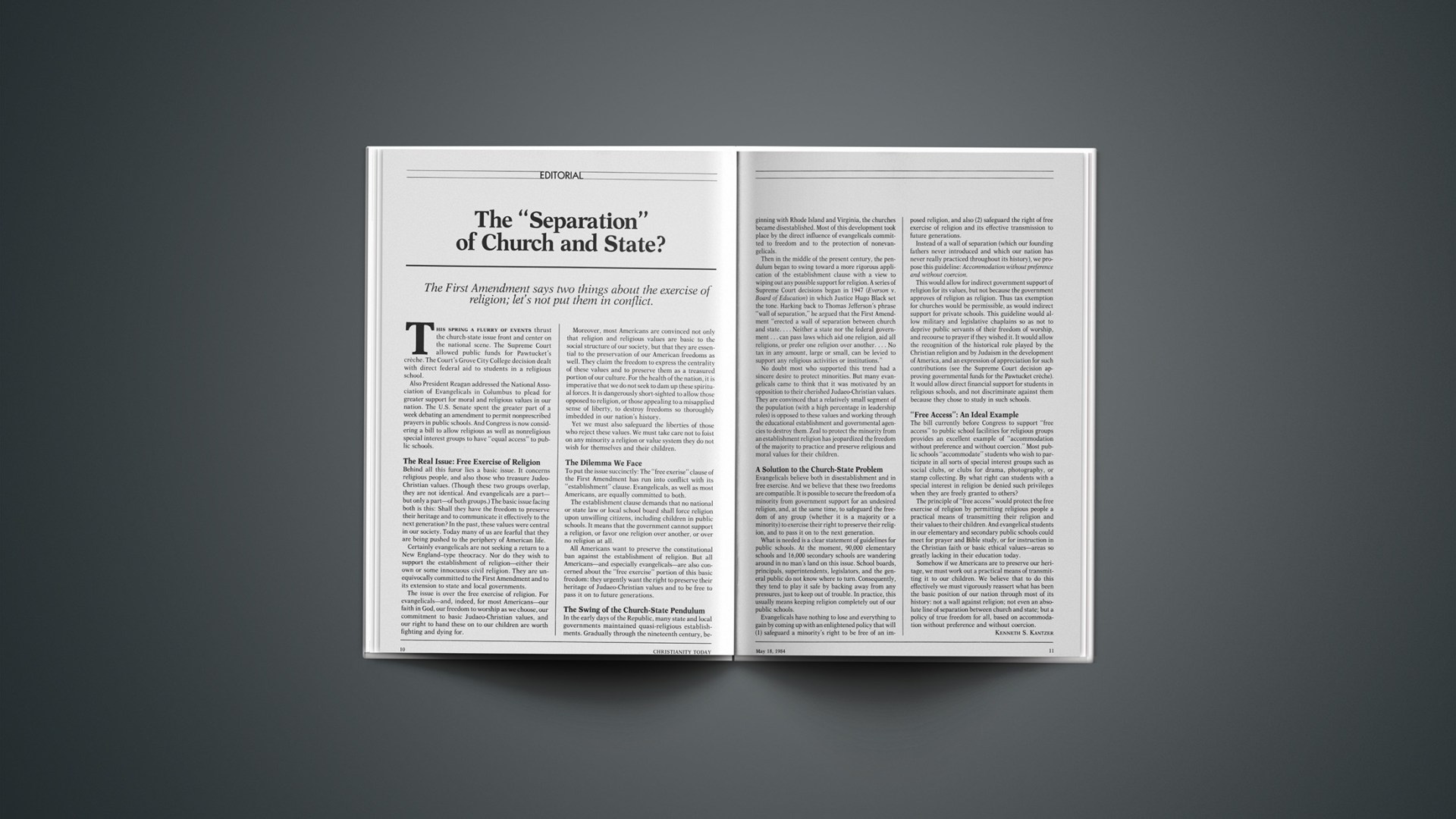
The Real Issue: Free Exercise of Religion

The Real Issue: Free Exercise Of Religion

Behind all this furor lies a basic issue. It concerns religious people, and also those who treasure Judeo-Christian values. (Though these two groups overlap, they are not identical. And evangelicals are a part—but only a part—of both groups.) The basic issue facing both is this: Shall they have the freedom to preserve their heritage and to communicate it effectively to the next generation? In the past, these values were central in our society. Today many of us are fearful that they are being pushed to the periphery of American life.

Certainly evangelicals are not seeking a return to a New England-type theocracy. Nor do they wish to support the establishment of religion—either their own or some innocuous civil religion. They are unequivocally committed to the First Amendment and to its extension to state and local governments.

The issue is over the free exercise of religion. For evangelicals—and, indeed, for most Americans—our faith in God, our freedom to worship as we choose, our commitment to basic Judaeo-Christian values, and our right to hand these on to our children are worth fighting and dying for.

Moreover, most Americans are convinced not only that religion and religious values are basic to the social structure of our society, but that they are essential to the preservation of our American freedoms as well. They claim the freedom to express the centrality of these values and to preserve them as a treasured portion of our culture. For the health of the nation, it is imperative that we do not seek to dam up these spiritual forces. It is dangerously short-sighted to allow those opposed to religion, or those appealing to a misapplied sense of liberty, to destroy freedoms so thoroughly imbedded in our nation’s history.

Yet we must also safeguard the liberties of those who reject these values. We must take care not to foist on any minority a religion or value system they do not wish for themselves and their children.

The Dilemma We Face

To put the issue succinctly: The “free exerise” clause of the First Amendment has run into conflict with its “establishment” clause. Evangelicals, as well as most Americans, are equally committed to both.

The establishment clause demands that no national or state law or local school board shall force religion upon unwilling citizens, including children in public schools. It means that the government cannot support a religion, or favor one religion over another, or over no religion at all.

All Americans want to preserve the constitutional ban against the establishment of religion. But all Americans—and especially evangelicals—are also concerned about the “free exercise” portion of this basic freedom: they urgently want the right to preserve their heritage of Judaeo-Christian values and to be free to pass it on to future generations.

The Swing Of The Church-State Pendulum

In the early days of the Republic, many state and local governments maintained quasi-religious establishments. Gradually through the nineteenth century, beginning with Rhode Island and Virginia, the churches became disestablished. Most of this development took place by the direct influence of evangelicals committed to freedom and to the protection of nonevangelicals.

Then in the middle of the present century, the pendulum began to swing toward a more rigorous application of the establishment clause with a view to wiping out any possible support for religion. A series of Supreme Court decisions began in 1947 (Everson v. Board of Education) in which Justice Hugo Black set the tone. Harking back to Thomas Jefferson’s phrase “wall of separation,” he argued that the First Amendment “erected a wall of separation between church and state.… Neither a state nor the federal government … can pass laws which aid one religion, aid all religions, or prefer one religion over another.… No tax in any amount, large or small, can be levied to support any religious activities or institutions.”

No doubt most who supported this trend had a sincere desire to protect minorities. But many evangelicals came to think that it was motivated by an opposition to their cherished Judaeo-Christian values. They are convinced that a relatively small segment of the population (with a high percentage in leadership roles) is opposed to these values and working through the educational establishment and governmental agencies to destroy them. Zeal to protect the minority from an establishment religion has jeopardized the freedom of the majority to practice and preserve religious and moral values for their children.

A Solution To The Church-State Problem

Evangelicals believe both in disestablishment and in free exercise. And we believe that these two freedoms are compatible. It is possible to secure the freedom of a minority from government support for an undesired religion, and, at the same time, to safeguard the freedom of any group (whether it is a majority or a minority) to exercise their right to preserve their religion, and to pass it on to the next generation.

What is needed is a clear statement of guidelines for public schools. At the moment, 90,000 elementary schools and 16,000 secondary schools are wandering around in no man’s land on this issue. School boards, principals, superintendents, legislators, and the general public do not know where to turn. Consequently, they tend to play it safe by backing away from any pressures, just to keep out of trouble. In practice, this usually means keeping religion completely out of our public schools.

Evangelicals have nothing to lose and everything to gain by coming up with an enlightened policy that will (1) safeguard a minority’s right to be free of an imposed religion, and also (2) safeguard the right of free exercise of religion and its effective transmission to future generations.

Instead of a wall of separation (which our founding fathers never introduced and which our nation has never really practiced throughout its history), we propose this guideline: Accommodation without preference and without coercion.

This would allow for indirect government support of religion for its values, but not because the government approves of religion as religion. Thus tax exemption for churches would be permissible, as would indirect support for private schools. This guideline would allow military and legislative chaplains so as not to deprive public servants of their freedom of worship, and recourse to prayer if they wished it. It would allow the recognition of the historical role played by the Christian religion and by Judaism in the development of America, and an expression of appreciation for such contributions (see the Supreme Court decision approving governmental funds for the Pawtucket crèche). It would allow direct financial support for students in religious schools, and not discriminate against them because they chose to study in such schools.

“Free Access”: An Ideal Example

The bill currently before Congress to support “free access” to public school facilities for religious groups provides an excellent example of “accommodation without preference and without coercion.” Most public schools “accommodate” students who wish to participate in all sorts of special interest groups such as social clubs, or clubs for drama, photography, or stamp collecting. By what right can students with a special interest in religion be denied such privileges when they are freely granted to others?

The principle of “free access” would protect the free exercise of religion by permitting religious people a practical means of transmitting their religion and their values to their children. And evangelical students in our elementary and secondary public schools could meet for prayer and Bible study, or for instruction in the Christian faith or basic ethical values—areas so greatly lacking in their education today.

Somehow if we Americans are to preserve our heritage, we must work out a practical means of transmitting it to our children. We believe that to do this effectively we must vigorously reassert what has been the basic position of our nation through most of its history: not a wall against religion; not even an absolute line of separation between church and state; but a policy of true freedom for all, based on accommodation without preference and without coercion.

KENNETH S. KANTZER
Ideas

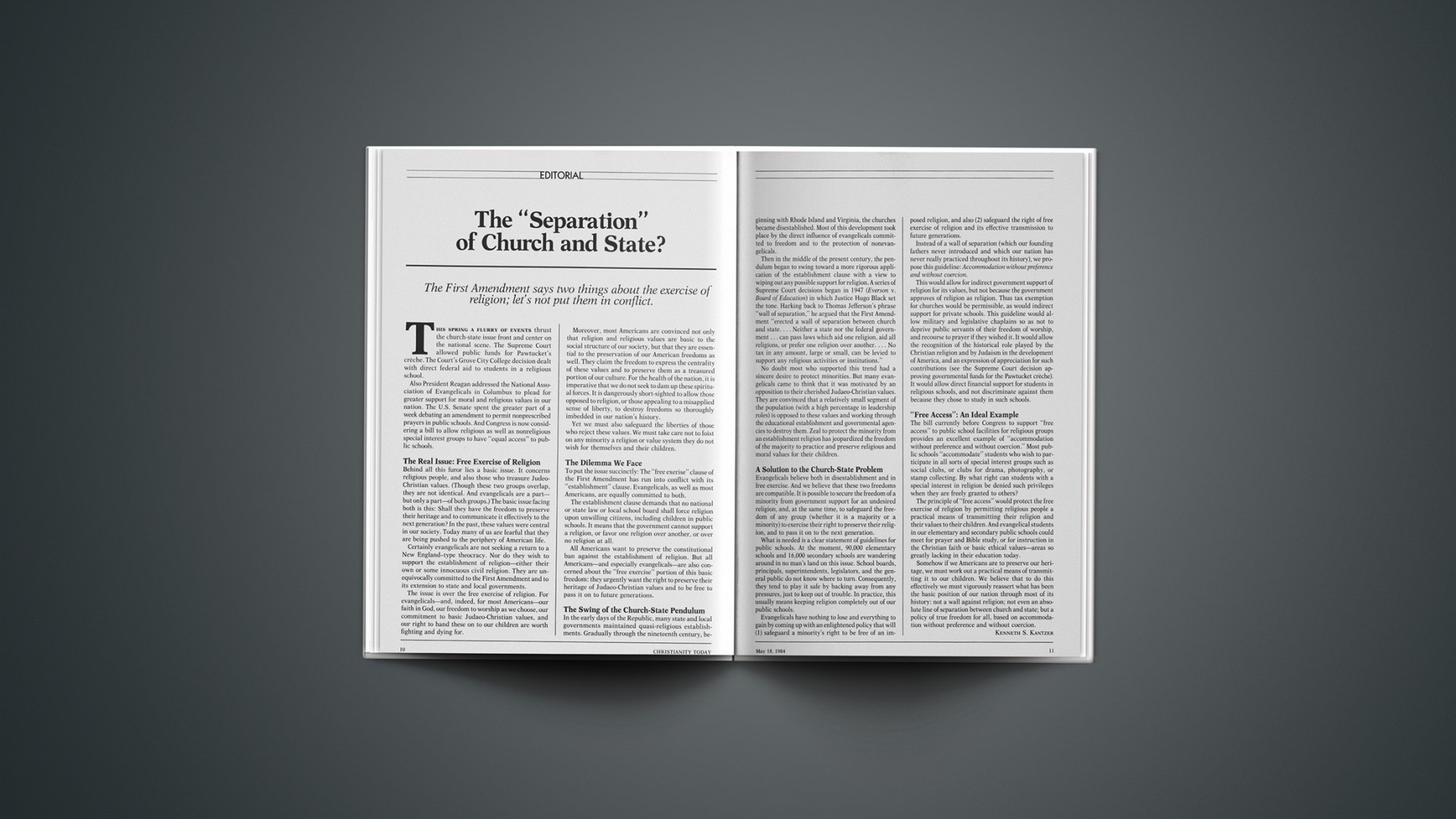
The “Separation” of Church and State?

The First Amendment says two things about the exercise of religion; let’s not put them in conflict.

This spring a flurry of events thrust the church-state issue front and center on the national scene. The Supreme Court allowed public funds for Pawtucket’s crèche. The Court’s Grove City College decision dealt with direct federal aid to students in a religious school.

Also President Reagan addressed the National Association of Evangelicals in Columbus to plead for greater support for moral and religious values in our nation. The U.S. Senate spent the greater part of a week debating an amendment to permit nonprescribed prayers in public schools. And Congress is now considering a bill to allow religious as well as nonreligious special interest groups to have “equal access” to public schools.

Eutychus and His Kin: May 18, 1984

Autolalia: The Theological Art Of Talking To Ourselves

Theologians who practice their theology too far from the common haunts of workaday laymen soon acquire the habit of talking to themselves. Seminary in-house conversation is thought of as scholarly, but it follows a line that the peasant-carpenter Son of God would never have used. To assist those who may suspect themselves of having fallen into the trap of talking to themselves, let us parallel the words of Christ with that elitist tongue known as Seminaryese:

• Jesus: I am the light of the world.

Autolalia: Christ is the pneumatic enlightenment of our existential arena.

• Jesus: I am the vine, ye are the branches.

Autolalia: The incarnational event is the trunk of faith relationships.

• Jesus: A city that is set on a hill cannot be hid.

Autolalia: Urbanization at certain altitudes cannot prohibit its own self-disclosure.

• Jesus: I am He.

Autolalia: My Messiahship is volition-ally revealed.

• Jesus: Go ye into all the world.

Autolalia: Your disjunctive sociology must dissolve into a cross-cultural matrix.

• Jesus: I go to the Father.

Autolalia: My transcendence will shortly be absorbed into the ground of all being.

• Jesus: If I go away I will come again.

Autolalia: Ascension is but the preface of eschatological event.

• Jesus: Who will cast the first stone?

Autolalia: Whose projectiles will be preliminary?

• Jesus: Ye must be born again.

Autolalia: It’s umbilically urgent that you pass the birth canal of transcendence.

• Jesus: Behold, I come quickly.

Autolalia: Immanence is characteristic of this post-Pannenberg event.

EUTYCHUS

Government—Good or Evil?

Harold Myra has a point about Christians cheating the government by rationalizations and tax dodges [“The IRS Is Not Always the Enemy,” Mar. 2]. Government, in principle, is good and not inherently evil, as some sectarian groups teach. Furthermore, we are to be subject to government; that is, Christians should not incite insurrection against de facto government.

Perhaps our most important service to government would be honest and constructive criticism against its many abuses, a responsibility early Christians had little opportunity to exercise. Why should we uncritically encourage in government—waste, dishonesty, and graft—what we deplore everywhere else?

ARTHUR DAVIES

Holland, Mich.

Ambassador—Where?

The President has not actually appointed an “ambassador to the Vatican,” as you state in “That Controversial Appointment” [Mar. 16], but an ambassador to the Holy See. The difference is one not just of form, but of substance.

In Everson v. Board of Education, the Supreme Court said the First Amendment means at least this: that government may not “prefer one religion over another.” That is precisely what the administration has done in appointing an ambassador to the head of a church with more than 700 million adherents worldwide, including 50 million in the United States.

CHRISTIANITY TODAY’s conclusion that the constitutional argument against the administration’s action “is not very strong” is about as credible as its statement that the Vatican has “a standing army.” The 100 Swiss guards, armed with their sixteenth-century halberds and two-handed swords, would be impressed to hear themselves so described! America’s first Roman Catholic president stated his conviction that an ambassador to the Vatican would be unconstitutional. We agree.

FOREST MONTGOMERY

National Association of Evangelicals

Washington, D.C.

It’s unfortunate that my fellow Protestants have made this an issue. At least the Catholic church has maintained some sense of unity over the years so that they actually have one place to which to send an ambassador! If one were to try to do it with the Protestant churches, I fear we would rapidly deplete the entire governmental work force, so factious we’ve become.

NICHOLAS SCHACHTERLE

Lansing, Mich.

James Dunn: Right or Wrong?

You are certainly right about Dunn [“James Dunn the Focus of a Southern Baptist Controversy,” Mar. 16]. The Bible says one thing and Dunn says something else. Be assured that 95 percent of the time Dunn will oppose Christians.

In his former statements and writings, Dunn displays an amazing ignorance or willful distortion of U.S. history, and many times the Scriptures. Neither of these are acceptable for one claiming the name of Christ or representing Christians.

REV. ROYCE BEASLEY

Fellowship Baptist Church

Ocala, Fla.

Your article fails to mention that many in this large, diverse denomination do appreciate James Dunn’s work. In fact, as a member of another Baptist denomination that supports the BJC, I highly esteem his vision of our heritage and mission and am grateful he stands so firmly against the trends of our time that compromise this vision.

RICHARD V. PIERARD

Terre Haute, Ind.

Christian Writers

I am in agreement with Philip Yancy’s belief in “Christian Publishing: Too Many Books & Too Few Classics?” [Mar. 2] that Christian writers should “strive for high literary standards.” But should it be so “classic” that the gospel loses its true meaning?

It is true that Chesterton, Buechner, and other writers have the ability to attract Christian and secular audiences to their works. And yes, they also have the ability to present biblical characters as a part of present-day society. But after reading these books, would an unbeliever be persuaded to accept the beliefs of Christianity or would he simply classify the writings as just another Christian “classic” and place it on the shelf along with other “classics”?

Christian writers should not compromise the gospel at the expense of writing a “classic.”

ELIZABETH COBBS

Virginia Beach, Va.

Philip Yancey often graces us with style and insight that displays him as a practitioner of the very virtues he praises.

But surely style has run away with substance in the gnostic nonsense that suggests we are “spirit and immortality trapped in matter” (“How Dirty Jokes and the Fear of Death Prove There Is a Heaven” [Mar. 2]). How can Christians facing the materialism of the resurrection suppose matter to be a prison house from which we need flee? The problem lies with the oddities of every “natural” theology. We evangelicals need to take a page from Barth at this point and admit that every “natural” theology betrays us in the end into a negation of theology. What is “natural” depends upon a humanly constructed world view. Combining it with theology inevitably leads to Christian nonsense.

REV. DAVID A. FRASER

Norristown Schwenkfelder Church

Norristown, Pa.

Embryo Transplants

I believe all of your respondents missed the main ethical point in regard to “Brave New World” reproductive/genetic manipulations [“A Woman Can Now Give Birth to Her Own Stepchild, Mar. 2]. The fundamental biblical principle that should guide us in these issues is that all human sexuality and procreation should be kept within the marriage bond between one man and one woman. In vitro fertilization is not unethical in this light because it is seen as only technical assistance to a process that is kept within the divinely mandated bounds. Embryo transfer, on the other hand, brings another person into procreational involvement—with the resultant moral fallout that Dr. Wells so carefully describes. Artificial insemination and embryo transplants both take human sexuality/procreation out of the arena God intended. The practice of either will lead to hurting people.

REV. CLINT L. FISK

Church of the Nazarene

Princeton, Ill.

I have been an associate of Dr. Robert Wells for the past 16 years. He implies that all fertilized human eggs, or at least the majority of them, will eventually become babies. Many investigators have shown that approximately 80 percent of mammalian eggs that are fertilized do not result in living offspring. Many that do not mature are defective, and many are lost at a stage even before implantation when the animal, or woman, is unable to detect that she is pregnant. God in his wisdom has devised a system to prevent the majority of abnormal embryos from developing.

Ten percent of married couples cannot have children, and every week I and other obstetricians receive letters from desperate couples unable to become pregnant on their own. This new technique offers hope for some of these childless couples; I would hate to see a conscientious Christian couple make a decision based upon questionable data.

The purpose of embryo transfer is not to destroy fertilized eggs but to transfer them from one uterus to another. The fact that an occasional fertilized egg may be lost by human error does not seem to me to be a valid indication to condemn the entire procedure.

S. GAINER PILLSBURY, JR., M.D.

Long Beach, Calif.

Creationism/Evolutionism

Bravo, Baer! [“They Are Teaching Religion in the Public Schools,” Feb. 17]. Bravo for not being intimidated by the extremes in the creationism/evolutionism debate. His fine analysis of Saganism is equaled by his perception of the public school problem. The problem is not that creationism (whose?) is not taught but that science really is not. This is borne out by the generations of students ignorant of the assumptions and limitations of science, as are their instructors, apparently. LaHaye’s comments bear this out; he has never been confronted by the concept that practically all science is theoretical and certainly not weaker for it. For this reason, presentation of evolution in its theoretical mode, warts and all, is not particularly bad. What is unacceptable is the scenario of assumption confused with conclusion, a theory of general evolution accepted as underlying philosophy; this is the ultimate scientism. After all, the creation has been confused with the Creator.

ALBERT J. SMITH

Wheaton College

Wheaton, Ill.

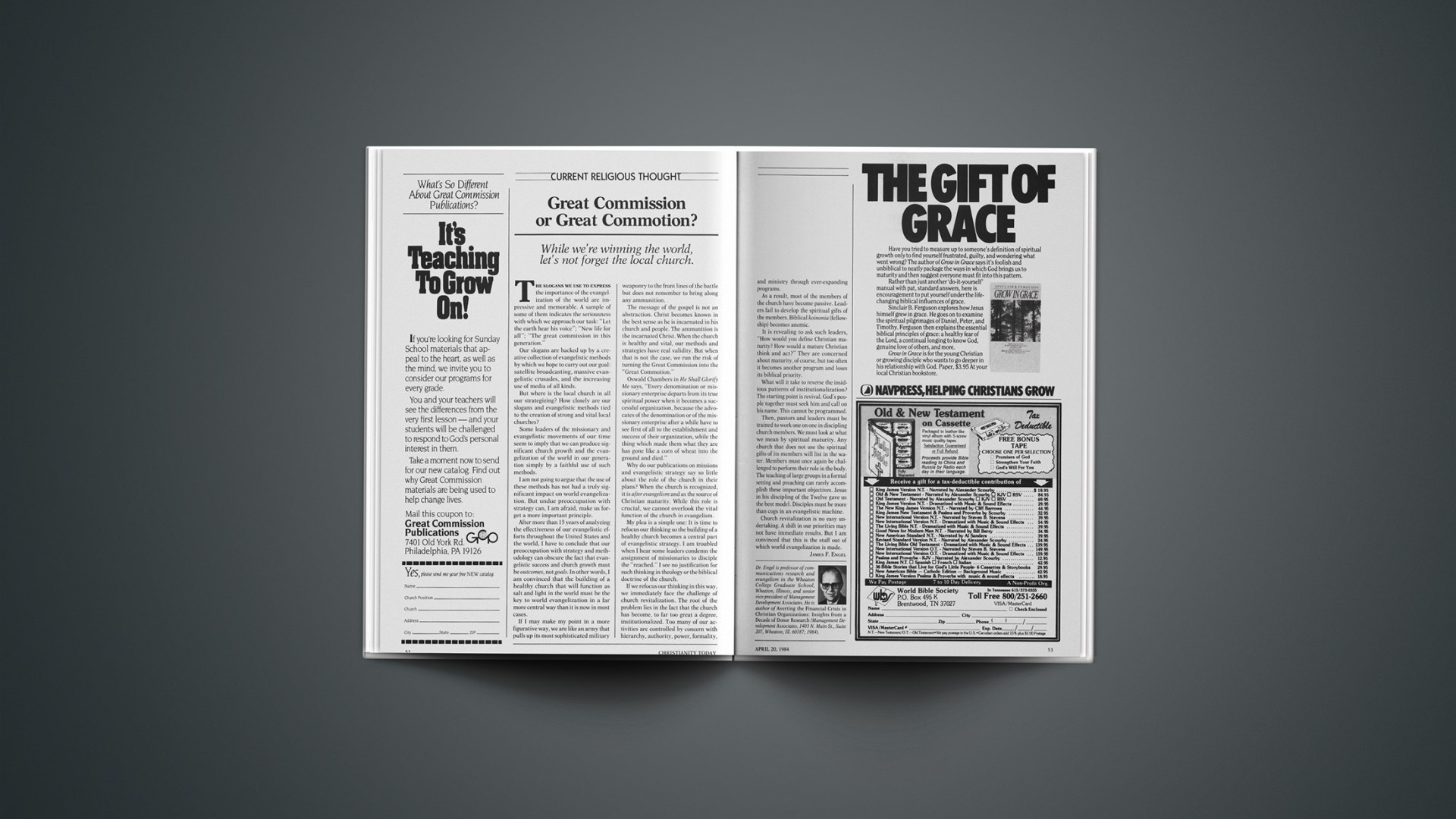
Great Commission or Great Commotion?

While we’re winning the world, let’s not forget the local church.

The slogans we use to express the importance of the evangelization of the world are impressive and memorable. A sample of some of them indicates the seriousness with which we approach our task: “Let the earth hear his voice”; “New life for all”; “The great commission in this generation.”

Our slogans are backed up by a creative collection of evangelistic methods by which we hope to carry out our goal: satellite broadcasting, massive evangelistic crusades, and the increasing use of media of all kinds.

But where is the local church in all our strategizing? How closely are our slogans and evangelistic methods tied to the creation of strong and vital local churches?

Some leaders of the missionary and evangelistic movements of our time seem to imply that we can produce significant church growth and the evangelization of the world in our generation simply by a faithful use of such methods.

I am not going to argue that the use of these methods has not had a truly significant impact on world evangelization. But undue preoccupation with strategy can, I am afraid, make us forget a more important principle.

After more than 15 years of analyzing the effectiveness of our evangelistic efforts throughout the United States and the world, I have to conclude that our preoccupation with strategy and methodology can obscure the fact that evangelistic success and church growth must be outcomes, not goals. In other words, I am convinced that the building of a healthy church that will function as salt and light in the world must be the key to world evangelization in a far more central way than it is now in most cases.

If I may make my point in a more figurative way, we are like an army that pulls up its most sophisticated military weaponry to the front lines of the battle but does not remember to bring along any ammunition.

The message of the gospel is not an abstraction. Christ becomes known in the best sense as he is incarnated in his church and people. The ammunition is the incarnated Christ. When the church is healthy and vital, our methods and strategies have real validity. But when that is not the case, we run the risk of turning the Great Commission into the “Great Commotion.”

Oswald Chambers in He Shall Glorify Me says, “Every denomination or missionary enterprise departs from its true spiritual power when it becomes a successful organization, because the advocates of the denomination or of the missionary enterprise after a while have to see first of all to the establishment and success of their organization, while the thing which made them what they are has gone like a corn of wheat into the ground and died.”

Why do our publications on missions and evangelistic strategy say so little about the role of the church in their plans? When the church is recognized, it is after evangelism and as the source of Christian maturity. While this role is crucial, we cannot overlook the vital function of the church in evangelism.

My plea is a simple one: It is time to refocus our thinking so the building of a healthy church becomes a central part of evangelistic strategy. I am troubled when I hear some leaders condemn the assignment of missionaries to disciple the “reached.” I see no justification for such thinking in theology or the biblical doctrine of the church.

If we refocus our thinking in this way, we immediately face the challenge of church revitalization. The root of the problem lies in the fact that the church has become, to far too great a degree, institutionalized. Too many of our activities are controlled by concern with hierarchy, authority, power, formality, and ministry through ever-expanding programs.

As a result, most of the members of the church have become passive. Leaders fail to develop the spiritual gifts of the members. Biblical koinonia (fellowship) becomes anemic.

It is revealing to ask such leaders, “How would you define Christian maturity? How would a mature Christian think and act?” They are concerned about maturity, of course, but too often it becomes another program and loses its biblical priority.

What will it take to reverse the insidious patterns of institutionalization? The starting point is revival. God’s people together must seek him and call on his name. This cannot be programmed.

Then, pastors and leaders must be trained to work one on one in discipling church members. We must look at what we mean by spiritual maturity. Any church that does not use the spiritual gifts of its members will list in the water. Members must once again be challenged to perform their role in the body. The teaching of large groups in a formal setting and preaching can rarely accomplish these important objectives. Jesus in his discipling of the Twelve gave us the best model. Disciples must be more than cogs in an evangelistic machine.

Church revitalization is no easy undertaking. A shift in our priorities may not have immediate results. But I am convinced that this is the stuff out of which world evangelization is made.

Dr. Engel is professor of communications research and evangelism in the Wheaton College Graduate School, Wheaton, Illinois, and senior vice-president of Management Development Associates. He is author of Averting the Financial Crisis in Christian Organizations: Insights from a Decade of Donor Research (Management Development Associates, 1403 N. Main St., Suite 207, Wheaton, Ill. 60187; 1984).

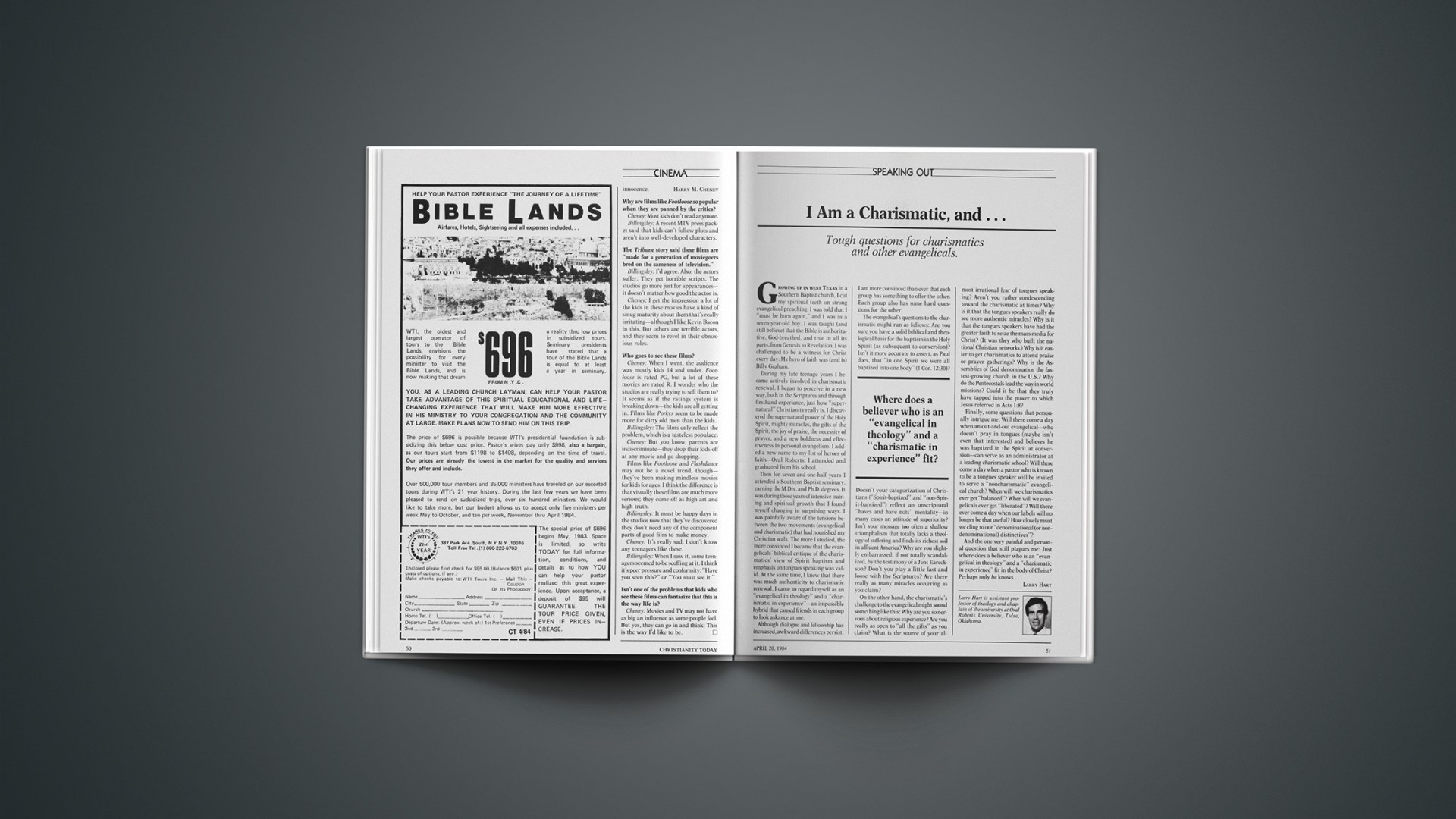
Speaking out: I Am a Charismatic, and …

Tough questions for charismatics and other evangelicals.

Growing up in west texas in a Southern Baptist church, I cut my spiritual teeth on strong evangelical preaching. I was told that I “must be born again,” and I was as a seven-year-old boy. I was taught (and still believe) that the Bible is authoritative, God-breathed, and true in all its parts, from Genesis to Revelation. I was challenged to be a witness for Christ every day. My hero of faith was (and is) Billy Graham.

During my late teenage years I became actively involved in charismatic renewal. I began to perceive in a new way, both in the Scriptures and through firsthand experience, just how “supernatural” Christianity really is. I discovered the supernatural power of the Holy Spirit, mighty miracles, the gifts of the Spirit, the joy of praise, the necessity of prayer, and a new boldness and effectiveness in personal evangelism. I added a new name to my list of heroes of faith—Oral Roberts. I attended and graduated from his school.

Then for seven-and-one-half years I attended a Southern Baptist seminary, earning the M.Div. and Ph.D. degrees. It was during those years of intensive training and spiritual growth that I found myself changing in surprising ways. I was painfully aware of the tensions between the two movements (evangelical and charismatic) that had nourished my Christian walk. The more I studied, the more convinced I became that the evangelicals’ biblical critique of the charismatics’ view of Spirit baptism and emphasis on tongues speaking was valid. At the same time, I knew that there was much authenticity to charismatic renewal. I came to regard myself as an “evangelical in theology” and a “charismatic in experience”—an impossible hybrid that caused friends in each group to look askance at me.

Although dialogue and fellowship has increased, awkward differences persist. I am more convinced than ever that each group has something to offer the other. Each group also has some hard questions for the other.

The evangelical’s questions to the charismatic might run as follows: Are you sure you have a solid biblical and theological basis for the baptism in the Holy Spirit (as subsequent to conversion)? Isn’t it more accurate to assert, as Paul does, that “in one Spirit we were all baptized into one body” (1 Cor. 12:30)? Doesn’t your categorization of Christians (“Spirit-baptized” and “non-Spirit-baptized”) reflect an unscriptural “haves and have nots” mentality—in many cases an attitude of superiority? Isn’t your message too often a shallow triumphalism that totally lacks a theology of suffering and finds its richest soil in affluent America? Why are you slightly embarrassed, if not totally scandalized, by the testimony of a Joni Eareckson? Don’t you play a little fast and loose with the Scriptures? Are there really as many miracles occurring as you claim?

On the other hand, the charismatic’s challenge to the evangelical might sound something like this: Why are you so nervous about religious experience? Are you really as open to “all the gifts” as you claim? What is the source of your almost irrational fear of tongues speaking? Aren’t you rather condescending toward the charismatic at times? Why is it that the tongues speakers really do see more authentic miracles? Why is it that the tongues speakers have had the greater faith to seize the mass media for Christ? (It was they who built the national Christian networks.) Why is it easier to get charismatics to attend praise or prayer gatherings? Why is the Assemblies of God denomination the fastest-growing church in the U.S.? Why do the Pentecostals lead the way in world missions? Could it be that they truly have tapped into the power to which Jesus referred in Acts 1:8?

Finally, some questions that personally intrigue me: Will there come a day when an out-and-out evangelical—who doesn’t pray in tongues (maybe isn’t even that interested) and believes he was baptized in the Spirit at conversion—can serve as an administrator at a leading charismatic school? Will there come a day when a pastor who is known to be a tongues speaker will be invited to serve a “noncharismatic” evangelical church? When will we charismatics ever get “balanced”? When will we evangelicals ever get “liberated”? Will there ever come a day when our labels will no longer be that useful? How closely must we cling to our “denominational (or nondenominational) distinctives”?

And the one very painful and personal question that still plagues me: Just where does a believer who is an “evangelical in theology” and a “charismatic in experience” fit in the body of Christ? Perhaps only he knows …

Larry Hart is assistant professor of theology and chaplain of the university at Oral Roberts University, Tulsa, Oklahoma.

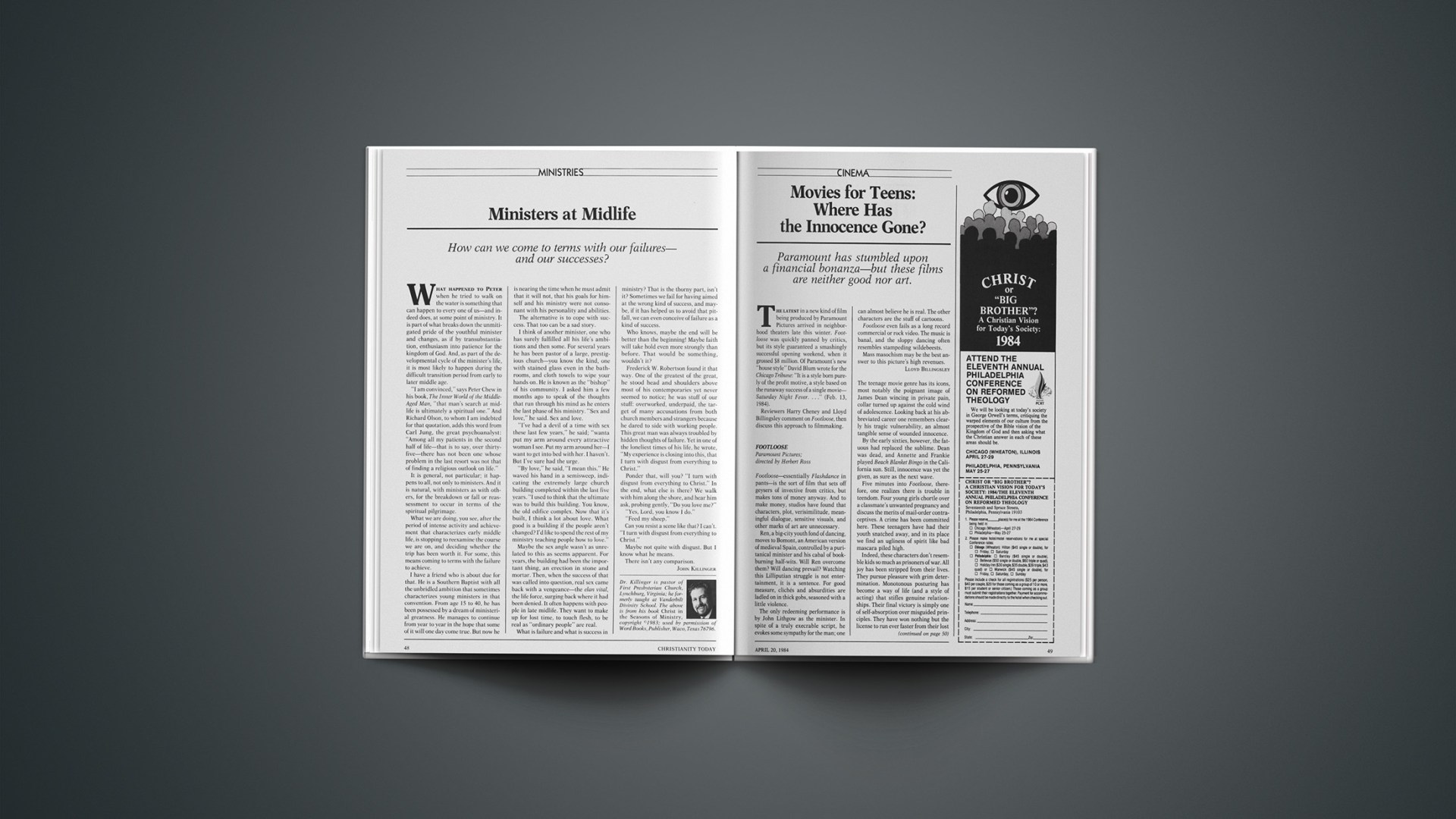
Movies for Teens: Where Has the Innocence Gone?

Paramount has stumbled upon a financial bonanza—but these films are neither good nor art.

The Latest in a new kind of film being produced by Paramount Pictures arrived in neighborhood theaters late this winter. Footloose was quickly panned by critics, but its style guaranteed a smashingly successful opening weekend, when it grossed $8 million. Of Paramount’s new “house style” David Blum wrote for the Chicago Tribune: “It is a style born purely of the profit motive, a style based on the runaway success of a single movie—Saturday Night Fever.…” (Feb. 13, 1984).

Reviewers Harry Cheney and Lloyd Billingsley comment on Footloose, then discuss this approach to filmmaking.

Footloose

Paramount Pictures;

directed by Herbert Ross

Footloose—essentially Flashdance in pants—is the sort of film that sets off geysers of invective from critics, but makes tons of money anyway. And to make money, studios have found that characters, plot, verisimilitude, meaningful dialogue, sensitive visuals, and other marks of art are unnecessary.

Ren, a big-city youth fond of dancing, moves to Bomont, an American version of medieval Spain, controlled by a puritanical minister and his cabal of book-burning half-wits. Will Ren overcome them? Will dancing prevail? Watching this Lilliputian struggle is not entertainment, it is a sentence. For good measure, clichés and absurdities are ladled on in thick gobs, seasoned with a little violence.

The only redeeming performance is by John Lithgow as the minister. In spite of a truly execrable script, he evokes some sympathy for the man; one can almost believe he is real. The other characters are the stuff of cartoons.

Footloose even fails as a long record commercial or rock video. The music is banal, and the sloppy dancing often resembles stampeding wildebeests.

Mass masochism may be the best answer to this picture’s high revenues.

LLOYD BILLINGSLEY

The teenage movie genre has its icons, most notably the poignant image of James Dean wincing in private pain, collar turned up against the cold wind of adolescence. Looking back at his abbreviated career one remembers clearly his tragic vulnerability, an almost tangible sense of wounded innocence.

By the early sixties, however, the fatuous had replaced the sublime. Dean was dead, and Annette and Frankie played Beach Blanket Bingo in the California sun. Still, innocence was yet the given, as sure as the next wave.

Five minutes into Footloose, therefore, one realizes there is trouble in teendom. Four young girls chortle over a classmate’s unwanted pregnancy and discuss the merits of mail-order contraceptives. A crime has been committed here. These teenagers have had their youth snatched away, and in its place we find an ugliness of spirit like bad mascara piled high.

Indeed, these characters don’t resemble kids so much as prisoners of war. All joy has been stripped from their lives. They pursue pleasure with grim determination. Monotonous posturing has become a way of life (and a style of acting) that stifles genuine relationships. Their final victory is simply one of self-absorption over misguided principles. They have won nothing but the license to run ever faster from their lost innocence.

HARRY M. CHENEY

Why are films like Footloose so popular when they are panned by the critics?

Cheney: Most kids don’t read anymore.

Billingsley: A recent MTV press packet said that kids can’t follow plots and aren’t into well-developed characters.

The Tribune story said these films are “made for a generation of moviegoers bred on the sameness of television.”

Billingsley: I’d agree. Also, the actors suffer. They get horrible scripts. The studios go more just for appearances—it doesn’t matter how good the actor is.

Cheney: I get the impression a lot of the kids in these movies have a kind of smug maturity about them that’s really irritating—although I like Kevin Bacon in this. But others are terrible actors, and they seem to revel in their obnoxious roles.

Who goes to see these films?

Cheney: When I went, the audience was mostly kids 14 and under. Footloose is rated PG, but a lot of these movies are rated R. I wonder who the studios are really trying to sell them to? It seems as if the ratings system is breaking down—the kids are all getting in. Films like Porkys seem to be made more for dirty old men than the kids.

Billingsley: The films only reflect the problem, which is a tasteless populace.

Cheney: But you know, parents are indiscriminate—they drop their kids off at any movie and go shopping.

Films like Footloose and Flashdance may not be a novel trend, though—they’ve been making mindless movies for kids for ages. I think the difference is that visually these films are much more serious; they come off as high art and high truth.

Billingsley: It must be happy days in the studios now that they’ve discovered they don’t need any of the component parts of good film to make money.

Cheney: It’s really sad. I don’t know any teenagers like these.

Billingsley: When I saw it, some teenagers seemed to be scoffing at it. I think it’s peer pressure and conformity: “Have you seen this?” or “You must see it.”

Isn’t one of the problems that kids who see these films can fantasize that this is the way life is?

Cheney: Movies and TV may not have as big an influence as some people feel. But yes, they can go in and think: This is the way I’d like to be.

Ministers at Midlife

How can we come to terms with our failuresand our successes?

What Happened To Peter when he tried to walk on the water is something that can happen to every one of us—and indeed does, at some point of ministry. It is part of what breaks down the unmitigated pride of the youthful minister and changes, as if by transubstantiation, enthusiasm into patience for the kingdom of God. And, as part of the developmental cycle of the minister’s life, it is most likely to happen during the difficult transition period from early to later middle age.

“I am convinced,” says Peter Chew in his book, The Inner World of the Middle-Aged Man, “that man’s search at midlife is ultimately a spiritual one.” And Richard Olson, to whom I am indebted for that quotation, adds this word from Carl Jung, the great psychoanalyst: “Among all my patients in the second half of life—that is to say, over thirty-five—there has not been one whose problem in the last resort was not that of finding a religious outlook on life.”

It is general, not particular; it happens to all, not only to ministers. And it is natural, with ministers as with others, for the breakdown or fall or reassessment to occur in terms of the spiritual pilgrimage.

What we are doing, you see, after the period of intense activity and achievement that characterizes early middle life, is stopping to reexamine the course we are on, and deciding whether the trip has been worth it. For some, this means coming to terms with the failure to achieve.

I have a friend who is about due for that. He is a Southern Baptist with all the unbridled ambition that sometimes characterizes young ministers in that convention. From age 15 to 40, he has been possessed by a dream of ministerial greatness. He manages to continue from year to year in the hope that some of it will one day come true. But now he is nearing the time when he must admit that it will not, that his goals for himself and his ministry were not consonant with his personality and abilities.

The alternative is to cope with success. That too can be a sad story.

I think of another minister, one who has surely fulfilled all his life’s ambitions and then some. For several years he has been pastor of a large, prestigious church—you know the kind, one with stained glass even in the bathrooms, and cloth towels to wipe your hands on. He is known as the “bishop” of his community. I asked him a few months ago to speak of the thoughts that run through his mind as he enters the last phase of his ministry. “Sex and love,” he said. Sex and love.

“I’ve had a devil of a time with sex these last few years,” he said; “wanta put my arm around every attractive woman I see. Put my arm around her—I want to get into bed with her. I haven’t. But I’ve sure had the urge.

“By love,” he said, “I mean this.” He waved his hand in a semisweep, indicating the extremely large church building completed within the last five years. “I used to think that the ultimate was to build this building. You know, the old edifice complex. Now that it’s built, I think a lot about love. What good is a building if the people aren’t changed? I’d like to spend the rest of my ministry teaching people how to love.”

Maybe the sex angle wasn’t as unrelated to this as seems apparent. For years, the building had been the important thing, an erection in stone and mortar. Then, when the success of that was called into question, real sex came back with a vengeance—the elan vital, the life force, surging back where it had been denied. It often happens with people in late midlife. They want to make up for lost time, to touch flesh, to be real as “ordinary people” are real.

What is failure and what is success in ministry? That is the thorny part, isn’t it? Sometimes we fail for having aimed at the wrong kind of success, and maybe, if it has helped us to avoid that pitfall, we can even conceive of failure as a kind of success.

Who knows, maybe the end will be better than the beginning! Maybe faith will take hold even more strongly than before. That would be something, wouldn’t it?

Frederick W. Robertson found it that way. One of the greatest of the great, he stood head and shoulders above most of his contemporaries yet never seemed to notice; he was stuff of our stuff: overworked, underpaid, the target of many accusations from both church members and strangers because he dared to side with working people. This great man was always troubled by hidden thoughts of failure. Yet in one of the loneliest times of his life, he wrote, “My experience is closing into this, that I turn with disgust from everything to Christ.”

Ponder that, will you? “I turn with disgust from everything to Christ.” In the end, what else is there? We walk with him along the shore, and hear him ask, probing gently, “Do you love me?”

“Yes, Lord, you know I do.”

“Feed my sheep.”

Can you resist a scene like that? I can’t.

“I turn with disgust from everything to Christ.”

Maybe not quite with disgust. But I

know what he means.

There isn’t any comparison.

Dr. Killinger is pastor of First Presbyterian Church, Lynchburg, Virginia; he formerly taught at Vanderbilt Divinity School. The above is from his book Christ in the Seasons of Ministry, copyright ©1983; used by permission of Word Books, Publisher, Waco, Texas 76796.

Refiner’s Fire: A TV Special: The Challenge of Helen Keller

Her story argues against the prevailing notion that handicapped children cannot have meaningful lives.

Review of TV movie Helen Keller: The Miracle Continues. Castle Comb Productions and Twentieth Century—Fox Television; airing over independent television during April and May.

There Are Two Things,” contended Orson Welles, “that the movies will never be able to show. A man making love to his wife, and a man praying to his God.”

It is not that they haven’t tried. Though Welles’s statement is surely accurate, it is incomplete. Even goodness, in general, does not translate well to the screen. Too often, in dramatic jargon, it simply “doesn’t play.” Hence, the ceaseless parade of cavorting heavies and assorted maniacs, accompanied by the din of guns and the falling of bodies, with the patter of banality always in the background, like Muzak.

Helen Keller: The Miracle Continues succeeds in portraying two aspects of goodness—romantic love and personal sacrifice—over which many filmmakers have fallen on their faces. It is a clean, visually interesting production, with strong characters and performances, especially from Blythe Danner and Mare Winningham, the former as Anne Sullivan, the latter as Keller. It is certainly well worth viewing above normal television fare. (Readers should check local listings for date and channel.)

Born in 1880, Keller was blind, deaf, and mute from an early age. Her case seemed hopeless until the advent of Anne Sullivan, known to Helen simply as “teacher.” The daughter of Irish immigrants who abandoned her, Sullivan grew up in wretched poverty and had her own bouts with blindness. Her dedication to Keller was truly remarkable, her patience endless. Anne became the major force in Keller’s life—a savior—often to the consternation of relatives and teachers.

Under Sullivan’s tutelage, Helen learned four alphabets for the blind before the age of seven. An intelligent, gifted girl, she went on to astonish the world, graduating cum laude from Radcliffe. Before leaving that institution, she developed into an accomplished writer and best-selling author. Keller eventually became an icon, friend of the famous (Bernard Shaw, Mark Twain), and celebrated in films and plays, notably The Miracle Worker. Adored the world over, she died in 1968.

Based on Joseph Lash’s massive (800 pages) Helen and Teacher, the story begins with Helen as a young adult in her days at Radcliffe. This affords a peek at a genteel, polite world that existed not so long ago, but is now gone forever. Young men approached girls at dances, bowed, and asked, “Excuse me, would you like to polka?” Helen learns, as it might be termed today, “social skills.” In her early life she was apparently quite a brat.

Ladies Home Journal serializes Helen’s life story, which she writes as an assignment for English class. It is a thumping success. Enter John Macy, a dapper writer sent to help her with the work. He drinks too much and is an armchair socialist, but proves a tremendous help to Helen. Both women become emotionally involved with him. It is a most unusual love triangle.

John sweeps Anne off her feet. She is torn between love for him and dedication to Helen. John insists the three of them can live together. Anne is stubborn, but eventually agrees. They marry. Once made aware of the romance, Helen begins to ask, “When will it happen for me?”

But John finds that he is married to an institution. He, Anne, and Helen are bound together in a kind of strange three-legged race. He begins to drink heavily. The marriage dissolves.

Helen’s new secretary is Peter Fagan, one of Macy’s colleagues. Their relationship blossoms and they plan marriage. But the paper publicizes the acquisition of a marriage license. Mrs. Keller is outraged. Anne corners the star-struck Fagan. Her speech to him is the highlight of the drama and ought to be mandatory reading for anyone contemplating marriage.

Peter, of course, sees nothing ahead but roses and kisses. Anne brings him to earth. “After a while,” she tells him, steely-eyed, “self-sacrifice starts to stink.” She ought to know. The relationship, she says, will be work, and tears and allegiance very unlike “falling in love.” They plan to elope anyway. Helen waits for Peter on the porch, suitcase in hand. He does not show up. In need of money, Anne and Helen enter vaudeville where Helen gives her first public speech. Here the story ends.

A few things have been left out. Keller was not, as she often appears, an ingénue. She was a woman of deep political involvements—a kind of early Jane Fonda. She followed Emanuel Swedenborg, a prevailing guru and promoter of Unitarian-like views. This, combined with total acceptance of the primitive, foot-washing socialism of the day, made her true creed one of naïve utopianism in which the blood of the Lamb is replaced with, as it were, municipal water. (For Keller’s religious views, see her own book My Religion.)

But Keller’s story is inspiring, a powerful refutation of the idea that the severely handicapped cannot have “meaningful lives.” The depictions of romantic love and personal sacrifice are among the best ever done specifically for television.

Though the selfless Anne Sullivan had no use for Christianity, she is an outstanding example of sacrifice. As a non-Christian, she serves to challenge us who are committed to the selfless Christ.

Mr. Billingsley contributes to numerous publications and also writes for film and stage. He lives in Southern California and is currently at work on a novel.

Christian Activists Help Kill a California Gay Rights Bill

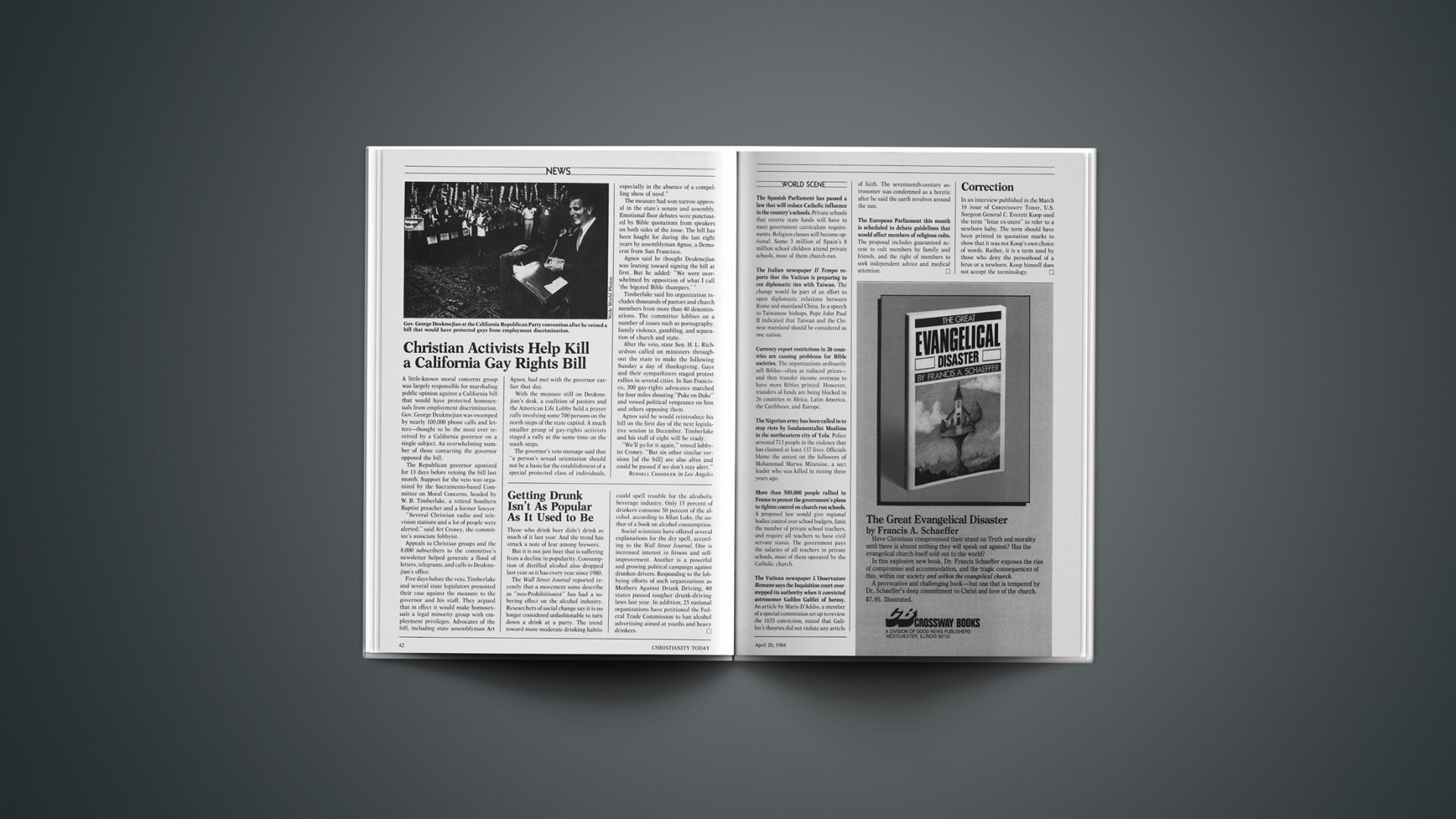
A little-known moral concerns group was largely responsible for marshaling public opinion against a California bill that would have protected homosexuals from employment discrimination. Gov. George Deukmejian was swamped by nearly 100,000 phone calls and letters—thought to be the most ever received by a California governor on a single subject. An overwhelming number of those contacting the governor opposed the bill.

The Republican governor agonized for 13 days before vetoing the bill last month. Support for the veto was organized by the Sacramento-based Committee on Moral Concerns, headed by W. B. Timberlake, a retired Southern Baptist preacher and a former lawyer.

“Several Christian radio and television stations and a lot of people were alerted,” said Art Croney, the committee’s associate lobbyist.

Appeals to Christian groups and the 8,000 subscribers to the committee’s newsletter helped generate a flood of letters, telegrams, and calls to Deukmejian’s office.

Five days before the veto, Timberlake and several state legislators presented their case against the measure to the governor and his staff. They argued that in effect it would make homosexuals a legal minority group with employment privileges. Advocates of the bill, including state assemblyman Art Agnos, had met with the governor earlier that day.

With the measure still on Deukmejian’s desk, a coalition of pastors and the American Life Lobby held a prayer rally involving some 700 persons on the north steps of the state capitol. A much smaller group of gay-rights activists staged a rally at the same time on the south steps.

The governor’s veto message said that “a person’s sexual orientation should not be a basis for the establishment of a special protected class of individuals, especially in the absence of a compelling show of need.”

The measure had won narrow approval in the state’s senate and assembly. Emotional floor debates were punctuated by Bible quotations from speakers on both sides of the issue. The bill has been fought for during the last eight years by assemblyman Agnos, a Democrat from San Francisco.

Agnos said he thought Deukmejian was leaning toward signing the bill at first. But he added: “We were overwhelmed by opposition of what I call ‘the bigoted Bible thumpers.’ ”

Timberlake said his organization includes thousands of pastors and church members from more than 40 denominations. The committee lobbies on a number of issues such as pornography, family violence, gambling, and separation of church and state.

After the veto, state Sen. H. L. Richardson called on ministers throughout the state to make the following Sunday a day of thanksgiving. Gays and their sympathizers staged protest rallies in several cities. In San Francisco, 300 gay-rights advocates marched for four miles shouting “Puke on Duke” and vowed political vengeance on him and others opposing them.

Agnos said he would reintroduce his bill on the first day of the next legislative session in December. Timberlake and his staff of eight will be ready.

“We’ll go for it again,” vowed lobbyist Croney. “But six other similar versions [of the bill] are also alive and could be passed if we don’t stay alert.”

RUSSELL CHANDLERin Los Angeles

Getting Drunk Isn’T As Popular As It Used To Be

Those who drink beer didn’t drink as much of it last year. And the trend has struck a note of fear among brewers.

But it is not just beer that is suffering from a decline in popularity. Consumption of distilled alcohol also dropped last year as it has every year since 1980.

The Wall Street Journal reported recently that a movement some describe as “neo-Prohibitionist” has had a sobering effect on the alcohol industry. Researchers of social change say it is no longer considered unfashionable to turn down a drink at a party. The trend toward more moderate drinking habits could spell trouble for the alcoholic beverage industry. Only 15 percent of drinkers consume 50 percent of the alcohol, according to Allan Luks, the author of a book on alcohol consumption.

Social scientists have offered several explanations for the dry spell, according to the Wall Street Journal. One is increased interest in fitness and self-improvement. Another is a powerful and growing political campaign against drunken drivers. Responding to the lobbying efforts of such organizations as Mothers Against Drunk Driving, 40 states passed tougher drunk-driving laws last year. In addition, 25 national organizations have petitioned the Federal Trade Commission to ban alcohol advertising aimed at youths and heavy drinkers.

World Scene

The Spanish Parliament has passed a law that will reduce Catholic influence in the country’s schools. Private schools that receive state funds will have to meet government curriculum requirements. Religion classes will become optional. Some 3 million of Spain’s 8 million school children attend private schools, most of them church-run.

The Italian newspaper Il Tempo reports that the Vatican is preparing to cut diplomatic ties with Taiwan. The change would be part of an effort to open diplomatic relations between Rome and mainland China. In a speech to Taiwanese bishops, Pope John Paul II indicated that Taiwan and the Chinese mainland should be considered as one nation.

Currency export restrictions in 26 countries are causing problems for Bible societies. The organizations ordinarily sell Bibles—often at reduced prices—and then transfer income overseas to have more Bibles printed. However, transfers of funds are being blocked in 26 countries in Africa, Latin America, the Caribbean, and Europe.

The Nigerian army has been called in to stop riots by fundamentalist Muslims in the northeastern city of Yola. Police arrested 713 people in the violence that has claimed at least 137 lives. Officials blame the unrest on the followers of Mohammad Marwa Mitatsine, a sect leader who was killed in rioting three years ago.

More than 500,000 people rallied in France to protest the government’s plans to tighten control on church-run schools. A proposed law would give regional bodies control over school budgets, limit the number of private school teachers, and require all teachers to have civil servant status. The government pays the salaries of all teachers in private schools, most of them operated by the Catholic church.

The Vatican newspaper L’Osservatore Romano says the Inquisition court overstepped its authority when it convicted astronomer Galileo Galilei of heresy. An article by Mario D’Addio, a member of a special commission set up to review the 1633 conviction, stated that Galileo’s theories did not violate any article of faith. The seventeenth-century astronomer was condemned as a heretic after he said the earth revolves around the sun.

The European Parliament this month is scheduled to debate guidelines that would affect members of religious cults. The proposal includes guaranteed access to cult members by family and friends, and the right of members to seek independent advice and medical attention.

Correction

In an interview published in the March 16 issue of CHRISTIANITY TODAY, U.S. Surgeon General C. Everett Koop used the term “fetus ex-utero” to refer to a newborn baby. The term should have been printed in quotation marks to show that it was not Koop’s own choice of words. Rather, it is a term used by those who deny the personhood of a fetus or a newborn. Koop himself does not accept the terminology.

Billy Graham Loses His Voice

Something happened to evangelist Billy Graham during his recent Alaska crusade that had never occurred before. He lost his voice while preaching the gospel.

Just 10 minutes into a sermon about Samson and Delilah, Graham’s voice faltered. Song leader Cliff Barrows brought him a glass of hot honey water (center photo). Graham attempted to finish the sermon, but his voice failed again. He left the pulpit, and associate evangelist John Wesley White completed the message (bottom photo). The Alaska crusade was telecast to more than 90 percent of the state and broadcast by radio into Siberia.

Medical Groups Challenge Rules To Protect Disabled Infants

The American Medical Association (AMA) and five other medical groups are going to court to challenge a new federal regulation designed to protect handicapped infants. The medical groups say the federal government has no legitimate role in determining whether an impaired newborn should receive treatment.

The Reagan administration maintains that civil-rights laws assure equal treatment of every infant, regardless of its condition or presumed quality of life. Because of reports of infanticide, the government issued a rule to prevent federally funded hospitals from discriminating against handicapped infants.

That regulation was blocked in court last year, so a new version was crafted by U.S. Surgeon General C. Everett Koop (CT, Feb. 17, 1984, p. 44). It established patient-care review committees, a provision dear to the hearts of those in the medical establishment. The committees would be sponsored by hospitals to monitor decisions in difficult cases and to serve as sounding boards for doctors who are uncertain about available resources for handicapped children.

Koop gained the support of the American Academy of Pediatrics, a group that opposed the original rule. But the AMA would not accept any compromise measure. “Parents and physicians, not the government, should be responsible for making decisions about care,” an AMA position paper states. A spokesman says the AMA will oppose any federal decision-making role in medical treatment.

The U.S. Department of Health and Human Services (HHS) plans to stand its ground as well. Before the matter goes to federal court, the department has several weeks to amend or drop the regulation. But spokesperson Claire del Real says HHS has no plans to change the regulation.

Joining the AMA in the suit against the regulation are the American Academy of Family Physicians, the Association of American Medical Colleges, the American College of Obstetricians and Gynecologists, the American Hospital Association, and the Hospital Association of New York State.

They argue that civil rights law cited by HHS was never intended to “mandate treatment decisions or to require physicians or hospitals to override parental decisions” about medical care. In addition, they say Medicare and Medicaid reimbursements to hospitals—targeted to be witheld if a hospital violates the new regulation—do not count as “federal financial assistance.” Finally, the regulation would “violate a family’s right to privacy and set up an adversary relationship between the family and the physician and hospital,” according to the AMA.

“The AMA is the only organization that believes an impaired child’s future is only up to the parents and physician,” says Surgeon General Koop. “If that’s the case, why do 50 states have child-abuse laws on the books?”

Koop is distressed about the increasing emphasis placed on “quality-of-life” considerations in determining what treatment is appropriate. An AMA spokesperson affirms that the quality-of-life criterion is important. “At any age, decisions about the terminally ill have to be made on the basis of outcome,” the spokesperson says. “The goal by which we work is to alleviate pain and extend and improve the quality of life.”

The spokesperson, who asked to remain anonymous, says the AMA is unconvinced that handicapped newborns are being left untreated. “That generalization is killing us,” he says. “No doctor is going to turn down an opportunity to save a life if its quality is guaranteed.”

Says Koop, in response: “For anybody who is a spokesman for the AMA to deny that infanticide is being practiced in this country when it is reported in medical journals by doctors who do it is beyond my comprehension.”

BETH SPRING

Donors Are Told How To Identify Improper Fund-Raising Tactics

It may seem incongruous to tell Christian organizations that their fund-raising practices must be honest. But that task consumes considerable energy at the Evangelical Council for Financial Accountability (ECFA).

The issue of raising money has troubled growing numbers of donors and Christian leaders, not to mention the Internal Revenue Service and the Better Business Bureau. One year ago, ECFA’S board appointed a task force on fund raising. The task force has developed 16 guidelines that address a range of concerns: Is donated money being spent the way the donor intends? Have donor expectations been raised to unrealistic heights? Are gifts being offered that have nothing to do with an organization’s ministry? Are royalties being collected on books that are used for fund raising?

The guidelines were approved by ECFA’S board in February. Its 257 members will be invited to comment on them before they are incorporated into the council’s standards for membership. As ECFA spreads the word to its members, it plans an outreach to donors as well. Executive director Arthur C. Borden believes teaching people how to guard their pocketbooks may be the most convincing way to get organizations to comply with the fundraising guidelines.

“This is changing the thrust of ECFA,” he says. “We will put major emphasis on telling the public what the standards are and asking the public to start asking some of the same questions we are asking.”

The organization plans to spend $150,000 on advertisements, television spots, and other means of raising public consciousness. It hopes the effort will result in ministries announcing that their fund-raising standards meet ECFA’S criteria. The guidelines spell out what donors should watch for:

• Overblown promises about what will be accomplished with a contribution. Emotional writing that leads a contributor to believe the forward movement of the gospel will halt without the donor’s help is common.

• Events described and illustrated in direct mail appeals should be accurate and complete. Frequently, “composite” stories blur the truth or exaggerate the urgency of an appeal.

• Funds raised for a specific project or purpose cannot be used to meet other needs. And organizations must report to donors upon request about the projects they promote.

• Donors may not be told their gifts are tax deductible when the fund-raising appeal includes a “free gift” that is unrelated to the purpose of the ministry. If fund raising depends heavily on the use of such incentives, the market value of the giveaway item must be subtracted from the tax-deductible portion of the donor’s gift.

The need for self-regulation became clear in 1977, when the U.S. House of Representatives debated a bill to allow sweeping government scrutiny of nonprofit fund-raising activities. The measure failed, and several evangelicals in Congress encouraged parachurch leaders to establish ethical ground rules for themselves. As a result, ECFA emerged in 1979.

“We certify standards, not programs,” Borden explains. “We’re in no position to say whether relief agency A is doing a better job than relief agency B. But we can say whether it has a legitimate, ethical program.”

In Poland, Church and State Square off over Crucifixes

Despite a history replete with political divisions, Poland enjoys an unfragmented identity. The credit belongs not to the state, but to the Roman Catholic church, a major force in Poland for nearly 1,000 years.

Poland’s Catholic church is an integral part of the identity it has preserved. Ninety percent of the country’s citizens are Catholic. And they raised their voices in protest when their Communist government moved recently to remove crucifixes from a public school.

Communists took control of Poland in 1945 and immediately deprived the church of its legal status. Negotiations in the 1950s led to government approval of publicly displayed crosses. But that approval was withdrawn a few years later.

Polish-born researcher Grazyna Sikorska says crosses began to reappear in 1980 as part of the same grassroots movement that spawned the Solidarity labor union. Sikorska works for Keston College, an organization that studies religion in Communist lands.

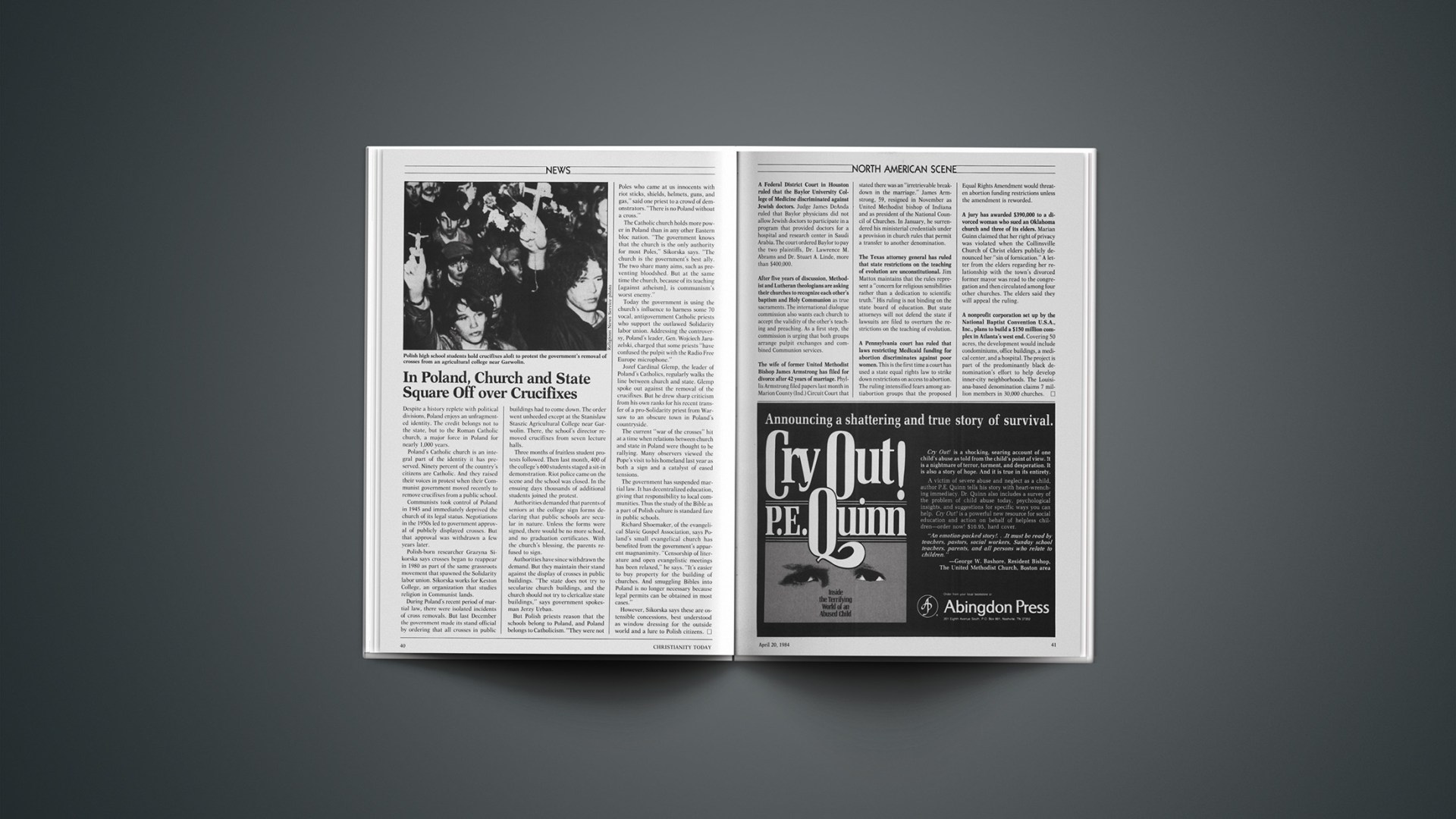
During Poland’s recent period of martial law, there were isolated incidents of cross removals. But last December the government made its stand official by ordering that all crosses in public buildings had to come down. The order went unheeded except at the Stanislaw Staszic Agricultural College near Garwolin. There, the school’s director removed crucifixes from seven lecture halls.

Three months of fruitless student protests followed. Then last month, 400 of the college’s 600 students staged a sit-in demonstration. Riot police came on the scene and the school was closed. In the ensuing days thousands of additional students joined the protest.

Authorities demanded that parents of seniors at the college sign forms declaring that public schools are secular in nature. Unless the forms were signed, there would be no more school, and no graduation certificates. With the church’s blessing, the parents refused to sign.

Authorities have since withdrawn the demand. But they maintain their stand against the display of crosses in public buildings. “The state does not try to secularize church buildings, and the church should not try to clericalize state buildings,” says government spokesman Jerzy Urban.

But Polish priests reason that the schools belong to Poland, and Poland belongs to Catholicism. “They were not Poles who came at us innocents with riot sticks, shields, helmets, guns, and gas,” said one priest to a crowd of demonstrators. “There is no Poland without a cross.”

The Catholic church holds more power in Poland than in any other Eastern bloc nation. “The government knows that the church is the only authority for most Poles,” Sikorska says. “The church is the government’s best ally. The two share many aims, such as preventing bloodshed. But at the same time the church, because of its teaching [against atheism], is communism’s worst enemy.”

Today the government is using the church’s influence to harness some 70 vocal, antigovernment Catholic priests who support the outlawed Solidarity labor union. Addressing the controversy, Poland’s leader, Gen. Wojciech Jaruzelski, charged that some priests “have confused the pulpit with the Radio Free Europe microphone.”

Jozef Cardinal Glemp, the leader of Poland’s Catholics, regularly walks the line between church and state. Glemp spoke out against the removal of the crucifixes. But he drew sharp criticism from his own ranks for his recent transfer of a pro-Solidarity priest from Warsaw to an obscure town in Poland’s countryside.

The current “war of the crosses” hit at a time when relations between church and state in Poland were thought to be rallying. Many observers viewed the Pope’s visit to his homeland last year as both a sign and a catalyst of eased tensions.

The government has suspended martial law. It has decentralized education, giving that responsibility to local communities. Thus the study of the Bible as a part of Polish culture is standard fare in public schools.

Richard Shoemaker, of the evangelical Slavic Gospel Association, says Poland’s small evangelical church has benefited from the government’s apparent magnanimity. “Censorship of literature and open evangelistic meetings has been relaxed,” he says. “It’s easier to buy property for the building of churches. And smuggling Bibles into Poland is no longer necessary because legal permits can be obtained in most cases.”

However, Sikorska says these are ostensible concessions, best understood as window dressing for the outside world and a lure to Polish citizens.

North American Scene

A Federal District Court in Houston ruled that the Baylor University College of Medicine discriminated against Jewish doctors. Judge James DeAnda ruled that Baylor physicians did not allow Jewish doctors to participate in a program that provided doctors for a hospital and research center in Saudi Arabia. The court ordered Baylor to pay the two plaintiffs, Dr. Lawrence M. Abrams and Dr. Stuart A. Linde, more than $400,000.

After five years of discussion, Methodist and Lutheran theologians are asking their churches to recognize each other’s baptism and Holy Communion as true sacraments. The international dialogue commission also wants each church to accept the validity of the other’s teaching and preaching. As a first step, the commission is urging that both groups arrange pulpit exchanges and combined Communion services.

The wife of former United Methodist Bishop James Armstrong has filed for divorce after 42 years of marriage. Phyllis Armstrong filed papers last month in Marion County (Ind.) Circuit Court that stated there was an “irretrievable breakdown in the marriage.” James Armstrong, 59, resigned in November as United Methodist bishop of Indiana and as president of the National Council of Churches. In January, he surrendered his ministerial credentials under a provision in church rules that permit a transfer to another denomination.

The Texas attorney general has ruled that state restrictions on the teaching of evolution are unconstitutional. Jim Mattox maintains that the rules represent a “concern for religious sensibilities rather than a dedication to scientific truth.” His ruling is not binding on the state board of education. But state attorneys will not defend the state if lawsuits are filed to overturn the restrictions on the teaching of evolution.

A Pennsylvania court has ruled that laws restricting Medicaid funding for abortion discriminates against poor women. This is the first time a court has used a state equal rights law to strike down restrictions on access to abortion. The ruling intensified fears among antiabortion groups that the proposed Equal Rights Amendment would threaten abortion funding restrictions unless the amendment is reworded.

A jury has awarded $390,000 to a divorced woman who sued an Oklahoma church and three of its elders. Marian Guinn claimed that her right of privacy was violated when the Collinsville Church of Christ elders publicly denounced her “sin of fornication.” A letter from the elders regarding her relationship with the town’s divorced former mayor was read to the congregation and then circulated among four other churches. The elders said they will appeal the ruling.

A nonprofit corporation set up by the National Baptist Convention U.S.A., Inc., plans to build a $150 million complex in Atlanta’s west end. Covering 50 acres, the development would include condominiums, office buildings, a medical center, and a hospital. The project is part of the predominantly black denomination’s effort to help develop inner-city neighborhoods. The Louisiana-based denomination claims 7 million members in 30,000 churches.

Apple PodcastsDown ArrowDown ArrowDown Arrowarrow_left_altLeft ArrowLeft ArrowRight ArrowRight ArrowRight Arrowarrow_up_altUp ArrowUp ArrowAvailable at Amazoncaret-downCloseCloseEmailEmailExpandExpandExternalExternalFacebookfacebook-squareGiftGiftGooglegoogleGoogle KeephamburgerInstagraminstagram-squareLinkLinklinkedin-squareListenListenListenChristianity TodayCT Creative Studio Logologo_orgMegaphoneMenuMenupausePinterestPlayPlayPocketPodcastRSSRSSSaveSaveSaveSearchSearchsearchSpotifyStitcherTelegramTable of ContentsTable of Contentstwitter-squareWhatsAppXYouTubeYouTube