
Speaking out: Let’s Get the Church off the Soapbox

Christianity is more than anybody’s single-issue drumbeat.

One of the most disruptive tendencies in the church today is the inclination to exaggerate the importance of one (valid) concern to the neglect of others. Some segments of the church make the search for peace and justice so important that they have virtually no time or money for evangelism. Others do the reverse. Some judge political candidates almost exclusively by their stand on abortion; others, by their stand on reducing global poverty.

I have a passion for balance. A one-sided emphasis provokes an equally one-sided response. What we need today is balance—biblical balance.

For the Christian, Christ is Lord—he is Lord of every area of life, including our politics. That means that biblical revelation, not secular ideologies of the Right or Left, must shape our politics.

Our political activity, therefore, should reflect a biblical balance. If we focus all our political concern on the nuclear arms race and justice for the poor, we are unbiblical because the Bible also has a great deal to say about the family and the sacredness of human life. Therefore, a biblically balanced political agenda will be very concerned to oppose abortion on demand, creeping euthanasia, and government programs that weaken the family. On the other hand, a political agenda that lacks a central focus on justice for the poor is equally unbiblical because the Bible repeatedly teaches that God has a special concern for the poor, weak, and oppressed.

At this time of growing influence, it is crucial that the evangelical political agenda reflect the balance of concerns that we see in God’s Word. I plead for a “consistent prolife” approach. Certainly abortion, euthanasia, and the family are central concerns. But world hunger is also a prolife issue. (Twelve million children will starve this year. That is the equivalent, in one year, of two Nazi Holocausts.) When each year drunken drivers kill as many Americans as did the whole Vietnam war, we face a prolife issue. When cigarette advertisements persuade us to kill ourselves slowly, we confront a prolife issue. Surely too we have a prolife issue when the nuclear arms race reaches a point where Admiral Rickover (who built our nuclear navy) says, “I think probably we’ll destroy ourselves.” Dare prolife Christians permit the ultimate abortion of hundreds of millions of deaths in a nuclear holocaust?

I am opposed to one-issue politics—partly because it is bad for the health of the body politic, but even more because it is unbiblical. Following secular drummers will lead to one-sidedness. Only God’s revelation can provide a proper balance.

Dr. Sider is associate professor of theology at Eastern Baptist Theological Seminary, Philadelphia. He is president of Evangelicals for Social Action and author, with Richard K. Taylor, of Nuclear Holocaust and Christian Hope (IVP, 1982).

Book Briefs: March 16, 1984

Digging into Recent Discoveries in Biblical Archaeology

A survey of fascinating excavations and controversial conclusions.

Few things are more fascinating to the student of the Bible than new archaeological discoveries. These discoveries are more and more frequent, but it would be impossible to enumerate even the most significant ones. Instead, the more important books in this field are annotated here, emphasizing books for the nonspecialist and those published after 1979.

Two short paperbacks provide an excellent place to begin. R. Moorey’s Excavation in Palestine (Eerdmans, 1983, 128 pp., $6.95) is actually an introductory and background volume to a new series, Cities of the Biblical World. (Two others in the series, Jericho and Qumran, are referred to below.) Seven chapters provide basic information, including what archaeology is, its history, methods, process of excavation, and interpreting of the finds. Expecially valuable is the last chapter on the use and abuse of archaeology in biblical studies. This chapter is essential reading because it succeeds so well in showing both the values and limitations of archaeology for the study of the Bible.

Since archaeology usually provides general background information rather than specific details, it can neither prove (nor disprove) the accuracy or historicity of the Bible. In fact, Moorey points out, when applied too specifically it gives information that differs from the biblical text on the conquest of Ai and Jericho.

Another good book for beginners is H. D. Lance’s The Old Testament and the Archaeologist (Fortress, 1981, 112 pp., $4.50). Lance is a field archaeologist who succeeds well in showing both the values and limitations of archaeology. By referring to some of his own experiences, he makes very clear some of the uncertainties in interpreting archaeological discoveries. Two chapters include material not covered by Moorey. One is on archaeological publications and their use, and another deals with the future of biblical archaeology, an issue creating a good deal of controversy and dividing archaeologists. On the one side are archaeologists who (for various reasons, including what they believe has been an overenthusiasm in using archaeology to illuminate the Bible) completely abandon the term “biblical archaeology.” Instead, they prefer the term Syro-Palestinian archaeology and concentrate on archaeology (and to some extent anthropology or history) rather than try to illuminate the Bible. The other side (including Lance) prefers the term Biblical Archaeology (or Archaeology and the Bible) and continues to use archaeology as an aid to understanding the Bible. This is a very significant issue that will influence the field for several years to come.

Old Testament

The last decade of excavations and research has revealed the complexity of such biblical events as the exodus from Egypt and the conquest of Canaan. Gone forever are the days of the past when one scholar, such as W. F. Albright, could dominate the field with his views. The explosion of new information made an old standard synthesis, such as Albright’s Archaeology of Palestine, very dated, and yet no one immediately stepped forward to provide a good synthesis of all the new discoveries. At the same time, the last several decades saw the rapid development of a new generation of Israeli archaeologists trained primarily by Y. Yadin and Y. Ahroni. It was Ahroni who wrote such a synthesis in Hebrew (now available in English). In The Archaeology of the Land of Israel (Westminster, 1982, 344 pp., $27.50; paper, $18.95), Aharoni builds on his expertise in historical geography and excavations he directed, such as Arad, Beersheba, and Ramat Rahel, to produce an excellent textbook that may well become the standard in university and seminary courses. Almost one-third of the book is devoted to the period before Abraham, while the period after the fall of Jerusalem, 587–86 B.C., is not covered at all. It is written for the student of archaeology, is more technical than the other books mentioned here, and makes little direct reference to the Bible.

A simpler textbook would be Keith Schoville’s Biblical Archaeology in Focus (Baker, 1978, 511 pp., $19.95). However, there is less synthesis here because the last two-thirds of this book is devoted to a site-by-site survey.

J. A. Thompson’s The Bible and Archaeology (3rd ed., Eerdmans, 512 pp., $17.95) covers both the Old and New Testaments and follows the biblical order of events. Thompson writes simply and with a minimum of unfamiliar terms. He tends to emphasize the positive way that archaeology illuminates the Bible and minimizes problems and difficulties that archaeological discoveries sometimes create. Unfortunately, the revision could have been more thorough; but extensive indexes, a good bibliography, and chronological charts make this a useful volume.

J. R. Bartlett’s Jericho (Eerdmans, 1983, 128 pp., $5.94) is another book in the new Cities of the Biblical World series. It is a readable summary of the literary and archaeological evidence of the city of Jericho throughout history. A helpful section deals with the apparent lack of archaeological evidence for occupation at the time of Joshua’s attack. Bartlett concludes that there is no solution yet to the apparent conflict between literary and archaeological evidence. He believes any solution is likely to come from further evaluation of the biblical text rather than from further excavation.

New Testament

On the whole, New Testament scholars have stressed literary sources and been much less involved in archaeology than their Old Testament counterparts. However, the last decade has seen an increasing number of excavations at sites relating to the New Testament period. Not all the results of this field activity are readily accessible yet, but a very significant (some would say groundbreaking) book makes some of this material available. It is E. M. Meyers and J. F. Strange’s Archaeology, the Rabbis and Early Christianity (Abingdon, 1981, 208 pp., $7.95). Both authors are superb field archaeologists with a decade of excavation experience in Galilee. They are selective rather than exhaustive in attempting to show the importance of nonliterary (as well as literary) evidence in the reconstruction of early Christianity and Judaism. This is a stimulating book with a useful glossary, index, maps, and diagrams, but no photos.

Two books deal with early Christianity in Asia Minor and the western Mediterranean. The more narrowly focused is Edwin Yamauchi’s The Archaeology of New Testament Cities in Western Asia Minor (Baker, 1980, 180 pp., $7.95). Twelve cities, including the seven cities of Revelation, are covered. Each chapter is logically organized, including sections on New Testament references, excavations, and monuments. This book is not intended to discuss the specific implications of New Testament references to the cities but rather the broader historical background of them.

In 1959, J. Finegan authored The Archaeology of the New Testament: The Life of Jesus and the Beginning of the Early Church (Princeton, 297 pp., $45.00; paper, 1978, $8.95). Finegan has followed this with a companion volume, The Archaeology of the New Testament: The Mediterranean World of the Early Christian Apostles (Westview, 1981, 282 pp., $36.50). The first two chapters deal with literary sources and chronological issues. Then, moving geographically, he starts with Paul and his beginnings and follows him to Rome. The emphasis is on statues, frescoes, mosaics, art, and architecture. However, there is next to nothing on everyday life to illustrate how Paul lived, ate, and worked.

Two other books are more narrowly focused. P. R. Davies’s Qumran (Eerdmans, 1983, 128 pp., $6.95) is another in the new Cities of the Biblical World series. It maintains the high standards of the others in the series, focusing on the site where the Dead Sea Scrolls were produced. Although the nonspecialist will find the going a little difficult in places, numerous pictures and diagrams will help make the text understandable and maintain the reader’s interest. Davies is effective in demonstrating the interrelationship of the literary (Dead Sea Scrolls) and archaeological evidence of Qumran. Most of J. Murphy-O’Connor’s St. Paul’s Corinth (Glazier, 1983, 214 pp., $7.95) is devoted to texts. However, 20 pages are devoted to archaeology, with very interesting results. One example would be the study of the homes in Corinth that helps explain the divisions surrounding the celebration of the Lord’s Supper in 1 Corinthians 11.

Reference

A helpful new reference work is The New International Dictionary of Biblical Archaeology (Zondervan, 1983, 540 pp., $24.95), E. M. Blaiklock and R. K. Harrison, editors. Twenty scholars (including the editors) contributed over 800 articles, ranging from a few sentences to over 14 pages. Coverage is quite broad, including the Greco-Roman and Ancient Near Eastern worlds, and articles cover peoples, places, characters, and texts or inscriptions bearing on the Bible. Most daily life—type items are grouped by topic and discussed there. “Spear,” for example, is discussed under “Arms and Weapons.” The usefulness of the volume is increased with good cross referencing, 16 colored plates, over 240 black-and-white photos, 16 pages of colored maps with an index of all places noted on the maps, and 4 pages of black-and-white maps. Especially helpful are the articles on archaeological techniques and methods and the two-page list of briefly annotated archaeological periodicals in English.

Unfortunately, there are several significant weaknesses:

1. It appears that the majority of articles were written six-to-ten years ago since they show no awareness of archaeological discoveries during that time. Some of the articles and bibliographies are brought up to 1979 and a few up to 1981, but they are the exception. This is unfortunate, because the field changes so rapidly.

2. Although the editor’s preface states that archaeology should not be used to prove the Bible, too little of the limitations (or values) of archaeology are discussed in articles such as “Archaeology.” Furthermore, there is a general reluctance to discuss apparent conflicts between archaeological and literary (biblical) evidence. Good examples would be the articles on Jericho, Ai, Heshbon, and Beersheba: each of these sites seems to have little or no evidence of occupation at the time of Israel’s conquest.

3. Synthesis is always difficult for dictionaries or encyclopedias. However, the omission of articles such as archaeology-Old Testament; archaeology-New Testament, exodus, conquest, and so on, where at least something of the current state of research could be given, is regrettable.

4. The articles on daily life are far too brief and omit discussion of some artifacts and procedures that the reader would expect to be covered.

5. Over one-half of the articles are contributed by the two editors, with Blaiklock doing about one-third of all the articles himself. This means the editors, especially Blaiklock, have done articles outside their special expertise.

6. Finally, the articles are often quite brief; much fuller coverage on most of the articles in this dictionary can be found in multivolume dictionaries or encyclopedias, such as The Zondervan Pictorial Encyclopedia of the Bible (1975); the revised International Standard Bible Encyclopedia (1979–); and the Interpreter’s Dictionary of the Bible (1962, 1976).

Despite these weaknesses, this is a handy one-volume dictionary that is sigificantly better than its only competitor, A. Negev’s Archaeological Encyclopedia of the Holy Land (SBS Publishing, 1972, 356 pp., $14.95).

Other

Intellectually curious travelers to Bible lands are often disappointed by the standard travel guidebooks or superficial tour guides who tell them only what (they think) they want to hear. J. Murphy-O’Connor has now rectified this with The Holy Land: An Archaeological Guide from Earliest Times to 1700 (Oxford, 1980, 336 pp., $9.95). Part 1 is devoted to Jerusalem and part 2 covers the land (Israel and the West Bank—not Jordan and Sinai). This is the finest guide available and is best used on location rather than read at one sitting. The treatment of archaeological remains is so well done that even archaeologists will find it useful.

G. Cornfeld and D. N. Freedman’s Archaeology of the Bible, Book by Book (Harper & Row, 1976, 352 pp.) first appeared as a hardback. It has been reissued in paperback (1982, $12.45) in slightly larger page format to avoid the crowded appearance of the hardcover edition. Numerous mechanical errors have been corrected and page numbers added where they were omitted in the earlier edition. This book is unique in that it claims to give an archaeological commentary on the Bible. However, it is often disappointingly selective, and it sometimes includes such nonarchaeological material as the author, date, and purpose of a biblical book.

Finally, another unique set of books is The Book of Life, by V. G. Beers (Zondervan, 1980, 8,000 pp., 24 vol., $299). These volumes cover most of the Bible and are designed as a set for Bible reading. Beautiful color pictures and drawings abound and are well worth the price of the set. It is not an archaeological work as such, but it puts the Bible into the context of daily life and uses archaeology to illuminate the Bible. It would be an excellent aid to personal or family Bible reading.

Reviewed by James C. Moyer, professor, Southwest Missouri State University, Springfield, Missouri.

Should There Be Southern Baptists in Canada?

Baptists on both sides of the border dispute the affiliation of 62 Canadian churches.

Does it matter whether Canadian Baptists join America’s largest Protestant denomination? The answer depends on whom you are talking to.

The controversy between Canadian Baptists and the Southern Baptist Convention (SBC) has been brewing for 30 years. Denominational officials on both sides of the border disagree over ties between the 14-million-member SBC and its 4,300 Canadian members.

Southern Baptist activity in Canada began in the fifties when two Vancouver, British Columbia, churches affiliated with the SBC’s Northwest Baptist Convention. Since then, Southern Baptist churches have multiplied in western Canada. More recently, the Ohio Baptist Convention has established two churches in southern Ontario.

Some officials are calling for the expansion of the SBC to enable its 62 Canadian churches to send messengers to the denomination’s annual meeting. But others, both in the SBC and in the Canadian Baptist Federation (CBF), prefer a cooperative venture between the two denominations.

Leaders in the CBF want to find ways to share resources with Southern Baptists. The CBF and the SBC already are cooperating in education, media, and evangelism projects. But Michael Steeves, executive secretary of the 130,000-member CBF, says the joint ventures are more at the denominational level than among local churches.

Before the SBC could seat Canadian messengers it would have to amend its constitution to redefine the denomination as a binational, rather than a national, body. SBC Foreign Mission Board president R. Keith Parks opposes the move. He says the denomination should cooperate with Canadian Baptist bodies that have their own national structures. However, SBC Home Mission Board president William Tanner disagrees. He says it is natural for Southern Baptists to establish their own churches in Canada.

The man who has helped start many of those churches agrees with Tanner. Henry Blackaby, home mission director for the western Canadian arm of the Northwest Baptist Convention, says Canadian Southern Baptists should be part of the SBC. At the same time, he sees room for cooperation between the SBC and the CBF. He notes, for example, that Southern Baptists are interested in funding a Christian education chair at Carey Hall, a Canadian Baptist college at the University of British Columbia.

Carey Hall principal Roy Bell welcomes that idea. A past president of the CBF, Bell believes in developing a strong partnership between his denomination and the SBC. But Doug Moffat, executive minister for the CBF’s western sector, wonders if the SBC is equally committed to the concept, SBC missionaries say churches are started at the request of local people, he says. But he adds that the SBC’s planning goals call for forming 50 new Canadian congregations by 1989.

A 21-member committee chaired by Dallas home builder Fred Roach has been studying the issue. Late last month the committee was expected to come up with recommendations to present to this summer’s Southern Baptist Convention.

LLOYD MACKEYin Vancouver

A New Survey Shows Families Are Better Off Than Most Think

Church-going families with young adolescents refute the stereotype that families are falling apart, according to a major national study.

The research project gathered information about children in the fifth through ninth grades. The survey’s national sample tends to represent families that are involved in a local church.

“We do not mean to imply that youth and families are functioning at optimal levels,” the directors of the study say. “Indeed, there are stresses and problems in most families. However, we find that the needs, despairs, and the longings of youth and parents are less catastrophic, more subtle, and perhaps more benign than we have been led to believe.”

Thirteen groups cooperated in the study, including the Evangelical Covenant Church, the Lutheran Church-Missouri Synod, and Southern Baptist Convention.

The study was based on in-depth questioning of 8,000 adolescents and 10,000 parents. It was directed by the Search Institute of Minneapolis and funded by the Lilly Endowment of Indianapolis.

The questions investigated values and goals, conflicts and communication between children and parents, sexuality, chemical use, exposure to mass media, faith, concerns of youth, and interest in youth programs.

More than 50 percent of the youths said they watched three or four hours of television on an average school day. The most important goal for boys, and the second most important for girls, was “to get a good job when I am older.” Fifth graders placed a higher value than ninth graders on such global issues as a “world without war.”

The desire “to be part of a church or synagogue” tends to be in the middle of the early adolescents’ value hierarchy. Church commitment among youth declined between fifth and ninth grades, and the decline was sharper for boys.

What do young adolescents worry about? School performance, physical appearance, and peer acceptance were the three most prevalent concerns. More than 42 percent worry that their parents might die. More than 20 percent worry about nuclear annihilation.

Some 22 percent of fifth graders and 53 percent of ninth graders said they have used alcohol. Twelve percent of fifth graders and 20 percent of ninth graders said they have used marijuana.

The number of youths who said they have had sexual intercourse ranged from 12 percent of sixth graders to 20 percent of ninth graders, although the researchers are skeptical. They say data for fifth and sixth graders “may be suspect, reflecting in part uncertainty about the meaning of the term ‘sexual intercourse.’ ”

Some 40 percent of the youths said they desire more opportunities to discuss sexuality with their parents. Even higher percentages of parents say they desire parent-child communication in this area. In addition, 42 percent of the youths claimed their family never discusses religious topics.

RELIGIOUS NEWS SERVICE

James Dunn Is the Focus of a Southern Baptist Controversy

Wrangling among Southern Baptists is nothing new. But the controversy swirling around James Dunn is extraordinarily intense.

The combative Texan is executive director of the Baptist Joint Committee on Public Affairs (BJC). The Washington, D.C.—based group conducts research, reports news, and serves as a government liaison on issues related to church and state. It is funded by nine Baptist denominations, but the Southern Baptist Convention (SBC) provides more than 80 percent of its support.

Some SBC leaders are fuming about the controversial positions Dunn has taken on issues close to conservatives’ hearts. At the denomination’s annual meeting last year, messengers voted to support President Reagan’s proposed constitutional amendment to restore oral prayer in public schools. But Dunn testified against the measure in Congress, denouncing Reagan for “despicable demagoguery” and for “playing petty politics with prayer.” The statements placed Dunn high on the hit list of Southern Baptist conservatives.

“I part company with them at the point of tampering with the Constitution by adding another amendment that would put upon the Constitution the inflexibility of the moment,” Dunn told CHRISTIANITY TODAY.

But no matter what his reasoning, SBC conservatives oppose him. In fact, they oppose the very idea of a Baptist Joint Committee. “We pay 85 percent of the BJC’s budget. We fail to see why we shouldn’t have our own representative in Washington,” says Paige Patterson of the Criswell Center for Biblical Studies in Dallas.

Patterson says a motion for separate Southern Baptist representation in Washington is likely to surface at the SBC’s June meeting in Kansas City. Meanwhile, he says Southern Baptist conservative leaders simply go over Dunn’s head to gain access to government officials.

“Dunn has been extremely antagonistic against the President, guaranteeing that he would have no influence at all in representing us regarding the Vatican envoy question,” Patterson says. “He hobnobs with the liberal establishment in the House and Senate.… That doesn’t make us very happy either.”

In his defense, Dunn points out that several liberal senators, including Mark Hatfield (R-Oreg.) and Lowell Weicker (R-Conn.), are leading the congressional opposition to Reagan’s appointment of an ambassador to the Vatican. Patterson suffers from a “terrible misconception,” Dunn says.

“Face-to-face contact is not the way most things happen in Washington,” he says. “We have excellent relationships with decision makers that cut across political and ideological lines.”

Conservative Southern Baptists believe Dunn fraternizes with the wrong sort outside of government as well. For three years he was a board member of People for the American Way (PAW), a group founded by television producer Norman Lear to oppose the Moral Majority and much of the so-called electronic church. When his term ended in December, Dunn refused renomination to the PAW board, mainly because of the criticism it stirred.

“I’ve got enough to do on religious liberty concerns without wasting time with people who are bothered about my being part of it [PAW],” he says.

Lear’s organization raised the ire of some Southern Baptists because of its relationship with the Playboy Foundation. PAW received a $40,000 grant from the foundation and has placed ads free of charge in Playboy magazine. It enraged Southern Baptist conservatives when PAW mentioned the BJC in connection with Dunn.

“It’s not appropriate at all for him to use the name of the organization [BJC] to support PAW when they’re willing to accept funding from Playboy,” says Albert Lee Smith, a member of the Southern Baptist Public Affairs Committee, a BJC subsidiary.

Dunn’s decision to decline renomination to the PAW board has not satisfied all of his critics. “Dunn is still a member of the organization and is clearly identified with them,” Patterson says. “It’s like putting Sodom together with Jerusalem.”

Patterson says the Southern Baptists are growing increasingly wary of the BJC. Calls for Dunn’s resignation have cropped up around the country. And the Alabama Baptist Convention last year asked the SBC to withdraw its funding of the BJC because of Dunn’s association with PAW.

A year ago, First Baptist Church of Wichita Falls, Texas, which strongly supports cooperative Baptist endeavors, withdrew its funding of the BJC. “That was the shot heard ‘round the world,” Patterson says. “We are totally at the mercy of what Dunn and his staff happen to think. Once Baptists understand that fully, even the moderates will not put up with that.”

Dunn is undaunted. He says Christians should work with “many people with whom we do not agree on everything.… I believe in the long haul it is terribly important that we continue to work in the real world.”

A major showdown is expected this year between progambling interests and religious groups that oppose betting.

If anyone were putting money on the outcome, the odds would favor the gambling industry. Backed by millions of dollars for lobbying and public relations, gambling interests are planning a major expansion in several states. Religious groups are gearing up for a fight. But the general public has been receptive to gambling when it promises to supplement a state’s tax base.

Eighty-two percent of those who responded to a Gallup poll last year said they would approve of some form of legalized gambling if it meant increased state revenues.

Most states already allow some form of gambling. Bingo is legal in 46 states, horse race betting in 32, lotteries in 18, and casinos in two. Only four states (Hawaii, Indiana, Mississippi, Utah) prohibit all forms of gambling, according to the Congressional Research Center.

Legislation that would legalize lotteries is expected to be considered this year in Arkansas, Mississippi, Missouri, and Virginia, says Larry Braidfoot of the Southern Baptist Christian Life Commission. Pari-mutuel betting proposals are being studied in Hawaii, South Carolina, and Tennessee.

Southern Baptist leaders from 11 states met last fall to formulate a major campaign against pari-mutuel betting, state lotteries, and casino gambling. Ironically, in battling the issue, churches are confronted with the role religion has played in fostering legalized gambling. Proponents of a North Carolina lottery point out that the first lottery approved by the state’s colonial council was held to raise money to build churches.

“About 44 percent of the people living in states where bingo is illegal think it is legal because of its close association with churches and charitable groups,” reports the United Methodist magazine engage/social action. Some of the states that prohibit bingo and lotteries make exceptions for charitable groups.

Catholic churches have been particularly associated with the use of bingo to raise money. But some Catholics are rethinking their position on the subject. “The temptation of church bingo has caused me and others that I know to commit sin,” wrote Nathan Kollar in U.S. Catholic magazine. “The church shouldn’t tempt us. Christ said we shouldn’t make his Father’s house a house of business.”

The dilemma came to a head when Bishop Walter F. Sullivan of Richmond, Virginia, opposed a move to legalize pari-mutuel betting in 1978. “Many institutions, including our own parishes, sponsor bingo, raffles, and bazaars to raise needed funds for educational and charitable purposes,” he said. “Gambling is not generally regarded by our tradition as immoral and sinful.”

But he added that “after study and reflection, I am convinced that only a select few would benefit greatly from pari-mutuel betting.… Serious questions need to be raised about the participation of our own parishes in legalized bingo.”

In addition to moral objections, religious forces are adding social-justice questions to their arguments against gambling.

“An industry which wrecks lives, leads to an increased crime rate, fails to deliver what it promises in financial rewards, breaks homes, leaves families in financial stress, and preys upon the poor is not an industry which is a matter of personal morality,” Braidfoot says.

In their book The Atlantic City Gamble, George Sternlieb and James Hughes write that “every study of casino gambling has indicated its regressive nature … that is, that lower-income groups spent a greater percentage of their income on gambling than other income groups.”

Sternlieb says thefts, murders, and prostitution have increased and the influence of organized crime has grown in Atlantic City since it legalized casinos in 1978. In spite of those problems, he says, “no one wants to slash the throat of the golden calf.”

Indeed, some Americans are addicted to the practice. The problem of compulsive gambling has attracted attention through mass-media coverage and the work of the National Council on Compulsive Gambling. Joseph Dunne, a New York police chaplain who is a cofounder of the council, says there are some 6 million compulsive gamblers in the United States.

Opponents of gambling have succeeded in defeating legislation in several states. But such proposals don’t go away forever, says David Lindsay, a United Methodist minister and a veteran of anticasino battles in Florida.

“The continuing battle against casinos raises a degree of frustration,” he says. “It would be nice to defeat the proposal once and for all. But we are struggling against an idea. While we can defeat a specific proposal by a ballot, or we can provide sufficient opposition to discourage proponents on one specific attempt, we do not seem to defeat the idea.”

The challenge is great. But CHRISTIANITY TODAY advisory editor Kenneth Kantzer says there is reason for optimism. “A century ago, our nation reversed its position and began to oppose gambling,” he points out. “It can do it again—if we have the will.”

RELIGIOUS NEWS SERVICE

World Scene

In Poland, 21 million people watched The Day After, an American film about nuclear war. It was the first full-length showing of the film in a communist country. Immediately before the film, an announcer accused the United States of failing to match a Moscow pledge not to be the first to use nuclear weapons.

The British House of Commons voted against restoring the death penalty for murder, terrorism, and other crimes. Violent crime has risen in Great Britain, but there were only 619 homicides in 1982. The government has instituted stricter measures, including a minimum 20-year term for crimes such as the murder of policemen and prison officers, and for terrorist acts or armed robbery in which someone is killed.

The number of Lutherans in the world has risen to nearly 69 million, an increase of about 50,000. Data collected by the Lutheran World Federation showed the greatest growth in Africa, where there are 3.8 million Lutherans. The most significant decline occurred in West Germany, with a loss of 167,000 members.

Religious extremists in India stopped a public showing of the film Jesus and forced the Baptist pastors who brought the film to leave. However, villagers protected the pastors as they fled, and promised to arrange for another showing of the film. The group that stopped the showing has been opposing Christianity in the the area for several years.

Some British Methodists are accusing the house church movement of authoritarian and unscriptural tendencies. William R. Davies, principal of Cliff College, says some extremists claim the house church is the one true church. The term refers to groups of Christians that meet in members’ homes. British Methodists have lost about 550 members to house churches over the past two years.

A Romanian magistrate has delayed the trial of Baptist pastor Iosif Stefanut for the second time. Stefanut faces charges of distributing religious literature without government approval. His trial was delayed the first time to assign a public defender to the case. There was no clear reason for the second delay. But sources indicate the court might be waiting to gauge reaction from the West.

Deaths

Paul De Ballester, 56, auxiliary bishop in the Greek Orthodox Archdiocese of North and South America, former Roman Catholic monk, first convert to Greek Orthodoxy to become a bishop in the Western Hemisphere; January 31, in Mexico City, of bullet wounds.

Leslie Frederick Weber, 71, former executive secretary for social ministry services of the Lutheran Church-Missouri Synod, former pastor; January 27, in Saint Louis, Missouri, of cardiac arrest.

John Coventry Smith, 80, former president of the World Council of Churches, former moderator of the former United Presbyterian Church in the U.S.A.; January 15, near Philadelphia, of a heart attack.

Fast-Growing Gospel Music Now Outsells Jazz and Classical

Since 1969, when singer Larry Norman combined Christian lyrics with a rock beat, modern music has become a major vehicle for Christian outreach. Two years after Norman’s pioneering work, Word Records hired Billy Ray Hearn to start a label for contemporary gospel music. After establishing the Myrrh label for Word, Hearn founded his own company, Sparrow Records.

“I saw in contemporary music the best vessel to reach young people with the gospel,” says the former church youth and music director. “They listen to the music that is current. That’s their language.”

At first, so-called rock gospel was frowned on by many Christians. But the combination of pop music and Christian lyrics gradually gained a following. Fifteen years later contemporary gospel, as well as more traditional styles, is gaining prominence in the American music world.

As recently as 1977, gospel music occupied a barely visible segment of the American music industry. In a market study that year, Warner Communications lumped Christian music into a category called “other,” along with humor, spoken word, and miscellaneous records. The entire category accounted for only 3 percent—slightly more than $100 million—of all record sales.

A more recent Warner Communications study indicates that annual sales of gospel records increased from $180 million to $210 million between 1980 and 1983. In contrast, overall record sales in the United States remained steady. The gospel market accounted for nearly 6 percent of last year’s total sales of records and tapes. Gospel music now outsells both jazz and classical.

Christian music is receiving increased attention on the airwaves and in the press. Pop and rock artists like Donna Summer, U2, Kansas, and Bruce Cockburn are singing about their faith on popular secular albums. And at least one gospel label is entering the world of music videos.

Sparrow Records is leading the Christian record industry in the use of video presentations of gospel artists. The company sells several full-length performance and teaching videos, as well as a number of shorter promotional clips, similar to those shown on the cable television channel MTV (Music Television). A Sparrow video featuring singer Sheila Walsh has been broadcast on secular stations.

Sparrow maintains a roster of popular contemporary gospel singers. But children’s records account for more than half of the company’s sales. Its Music Machine series has sold more than one million copies.

The first album in the series, The Music Machine, is one of only three gospel albums that have been certified “gold” by the recording industry. Alleluia: A Praise Gathering for Believers (Benson) and Age to Age (Word) also have been certified gold. In order to achieve gold status, an album has to sell more than 500,000 copies. A gospel album normally is considered a “best seller” if it sells 150,000 copies.

“We’ve seen not only increased sales, but an improvement in the quality of recordings,” says Don Butler, executive director of the Nashville-based Gospel Music Association. “We’ve also seen a more credible approach to lyrics, with more meaningful messages and less rhetoric, trite messages, or pie-in-the-sky lyrics.”

Recognizing the growing interest in gospel music, some secular record companies attempted to cash in on the market, CBS and MCA started Christian-oriented labels. But both companies later discontinued their gospel music divisions, saying sales were slower than expected. ABC, owner of Word Records, remains the only major secular owner of a gospel music company.

With increased sales has come a growth in the styles of gospel music. Dan Johnson, a vice-president at Word Records, says pop and rock gospel comprise 40 percent of his company’s sales. Middle-of-the-road artists, such as the Bill Gaither Trio, account for 20 percent of sales. Black gospel music makes up 15 percent; southern and country gospel represent 10 percent; and traditional gospel music, children’s music, and miscellaneous products account for 5 percent each.

At the Benson Company, a subsidiary of the Zondervan Corporation, traditional and inspirational artists such as Sandi Patti and Doug Oldham account for 45 percent of record sales. Pop and rock gospel artists account for 30 percent, southern gospel for 20 percent, and black gospel for 5 percent.

The three major gospel music companies—Benson, Word, and Sparrow—reported either increased sales or sales in excess of projections for 1983. But Christian record producers say recent sales increases are only part of the story. Songs that highlight the gospel message, they say, are still the most important aspect of the business.

A Federal Judge Upholds The U.S. Army Chaplaincy

A federal district judge has ruled that the U.S. Army is within the bounds of the Constitution in paying the salaries of military chaplains.

Judge Joseph M. McLaughlin issued the ruling last month in response to a lawsuit filed by two Harvard University law students in 1979. Joel Katcoff and Allen Weider had charged that the military chaplaincy violated the establishment clause of the First Amendment.

The plaintiffs argued that civilian chaplains could adequately serve military personnel. They filed an affidavit from Carl Mischke, president of the Wisconsin Evangelical Lutheran Synod, to support their argument. By funding its own chaplains, Mischke said, his denomination is able to “adequately provide religious support to our members in peace and war, at home and overseas.”

In response, the army argued that a civilian chaplaincy could not reach large numbers of soldiers and military personnel stationed in remote areas. McLaughlin did not rule on the effectiveness of a civilian chaplaincy. But he upheld the constitutionality of chaplains paid by the army.

“It is not without significance that the first Congress drafted the First Amendment and, at the same time, authorized a paid chaplain for the army,” he wrote. “The army chaplaincy program is a constitutionally permissible means to a constitutionally mandated end.”

Is This What Jesus Really Looked Like?

A new portrait of Christ is based on the Shroud of Turin and several years of research.

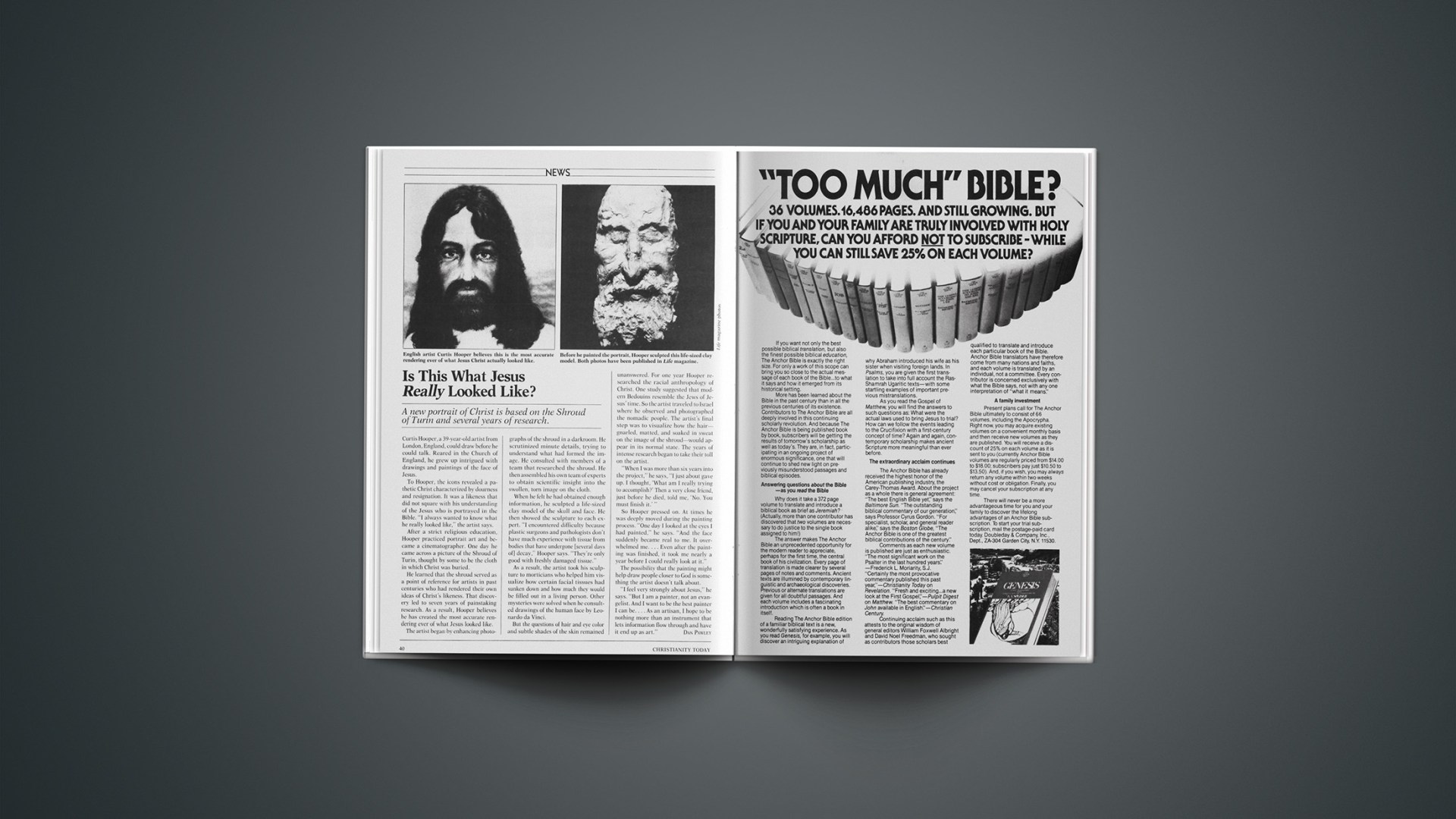
Curtis Hooper, a 39-year-old artist from London, England, could draw before he could talk. Reared in the Church of England, he grew up intrigued with drawings and paintings of the face of Jesus.

To Hooper, the icons revealed a pathetic Christ characterized by dourness and resignation. It was a likeness that did not square with his understanding of the Jesus who is portrayed in the Bible. “I always wanted to know what he really looked like,” the artist says.

After a strict religious education, Hooper practiced portrait art and became a cinematographer. One day he came across a picture of the Shroud of Turin, thought by some to be the cloth in which Christ was buried.

He learned that the shroud served as a point of reference for artists in past centuries who had rendered their own ideas of Christ’s likeness. That discovery led to seven years of painstaking research. As a result, Hooper believes he has created the most accurate rendering ever of what Jesus looked like.

The artist began by enhancing photographs of the shroud in a darkroom. He scrutinized minute details, trying to understand what had formed the image. He consulted with members of a team that researched the shroud. He then assembled his own team of experts to obtain scientific insight into the swollen, torn image on the cloth.

When he felt he had obtained enough information, he sculpted a life-sized clay model of the skull and face. He then showed the sculpture to each expert. “I encountered difficulty because plastic surgeons and pathologists don’t have much experience with tissue from bodies that have undergone [several days of] decay,” Hooper says. “They’re only good with freshly damaged tissue.”

As a result, the artist took his sculpture to morticians who helped him visualize how certain facial tissues had sunken down and how much they would be filled out in a living person. Other mysteries were solved when he consulted drawings of the human face by Leonardo da Vinci.

But the questions of hair and eye color and subtle shades of the skin remained unanswered. For one year Hooper researched the racial anthropology of Christ. One study suggested that modern Bedouins resemble the Jews of Jesus’ time. So the artist traveled to Israel where he observed and photographed the nomadic people. The artist’s final step was to visualize how the hair—gnarled, matted, and soaked in sweat on the image of the shroud—would appear in its normal state. The years of intense research began to take their toll on the artist.

“When I was more than six years into the project,” he says, “I just about gave up. I thought, ‘What am I really trying to accomplish?’ Then a very close friend, just before he died, told me, ‘No. You must finish it.’ ”

So Hooper pressed on. At times he was deeply moved during the painting process. “One day I looked at the eyes I had painted,” he says. “And the face suddenly became real to me. It overwhelmed me.… Even after the painting was finished, it took me nearly a year before I could really look at it.”

The possibility that the painting might help draw people closer to God is something the artist doesn’t talk about.

“I feel very strongly about Jesus,” he says. “But I am a painter, not an evangelist. And I want to be the best painter I can be.… As an artisan, I hope to be nothing more than an instrument that lets information flow through and have it end up as art.”

Surgeon General Koop and the Fight for the Newborn

What is the responsibility of government and the church to promote the sanctity of life?

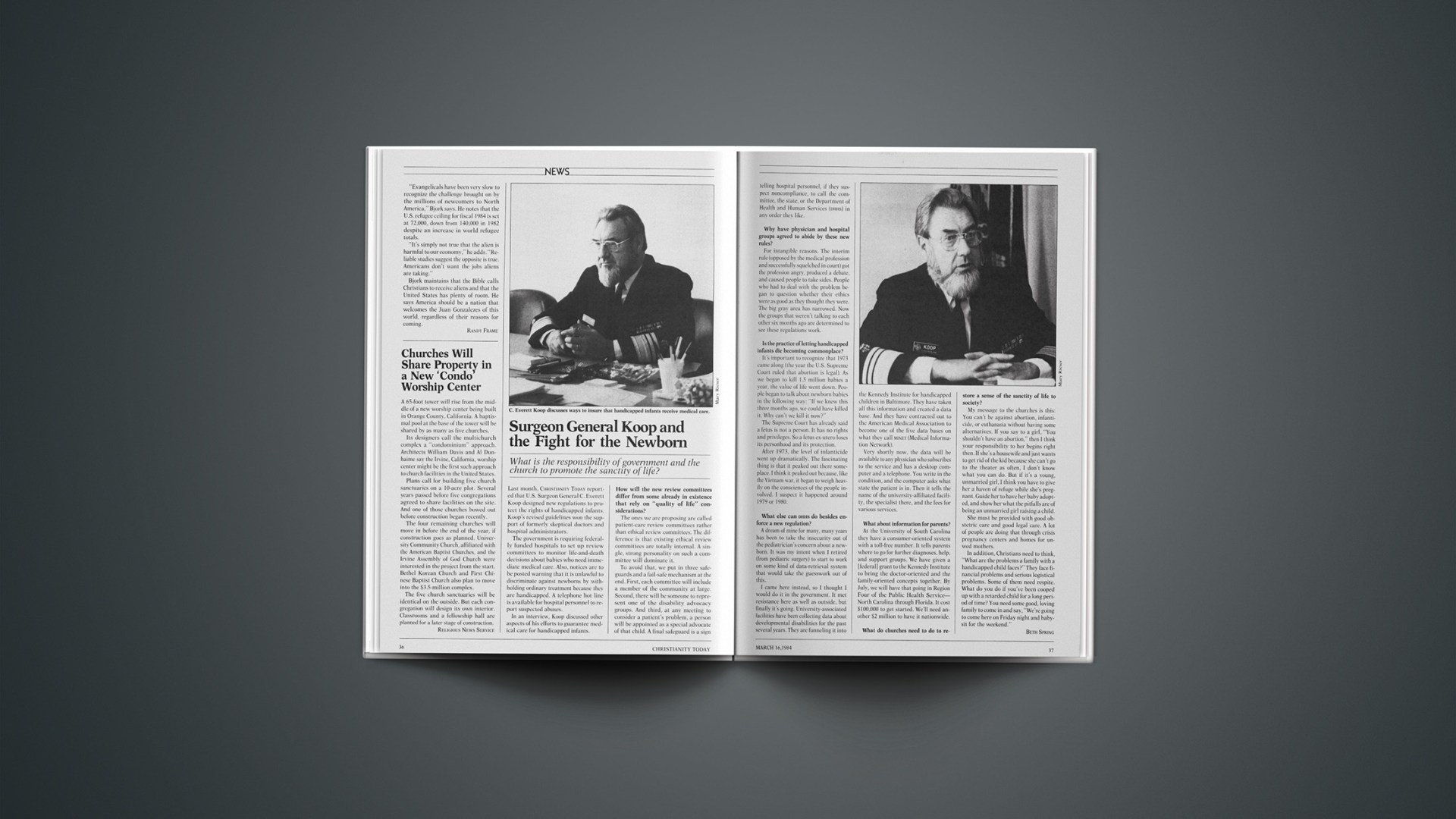
Last month, CHRISTIANITY TODAY reported that U.S. Surgeon General C. Everett Koop designed new regulations to protect the rights of handicapped infants. Koop’s revised guidelines won the support of formerly skeptical doctors and hospital administrators.

The government is requiring federally funded hospitals to set up review committees to monitor life-and-death decisions about babies who need immediate medical care. Also, notices are to be posted warning that it is unlawful to discriminate against newborns by withholding ordinary treatment because they are handicapped. A telephone hot line is available for hospital personnel to report suspected abuses.

In an interview, Koop discussed other aspects of his efforts to guarantee medical care for handicapped infants.

How will the new review committees differ from some already in existence that rely on “quality of life” considerations?

The ones we are proposing are called patient-care review committees rather than ethical review committees. The difference is that existing ethical review committees are totally internal. A single, strong personality on such a committee will dominate it.

To avoid that, we put in three safeguards and a fail-safe mechanism at the end. First, each committee will include a member of the community at large. Second, there will be someone to represent one of the disability advocacy groups. And third, at any meeting to consider a patient’s problem, a person will be appointed as a special advocate of that child. A final safeguard is a sign telling hospital personnel, if they suspect noncompliance, to call the committee, the state, or the Department of Health and Human Services (DHHS) in any order they like.

Why have physician and hospital groups agreed to abide by these new rules?

For intangible reasons. The interim rule (opposed by the medical profession and successfully squelched in court) got the profession angry, produced a debate, and caused people to take sides. People who had to deal with the problem began to question whether their ethics were as good as they thought they were. The big gray area has narrowed. Now the groups that weren’t talking to each other six months ago are determined to see these regulations work.

Is the practice of letting handicapped infants die becoming commonplace?

It’s important to recognize that 1973 came along (the year the U.S. Supreme Court ruled that abortion is legal). As we began to kill 1.5 million babies a year, the value of life went down. People began to talk about newborn babies in the following way: “If we knew this three months ago, we could have killed it. Why can’t we kill it now?”

The Supreme Court has already said a fetus is not a person. It has no rights and privileges. So a fetus ex-utero loses its personhood and its protection.

After 1973, the level of infanticide went up dramatically. The fascinating thing is that it peaked out there someplace. I think it peaked out because, like the Vietnam war, it began to weigh heavily on the consciences of the people involved. I suspect it happened around 1979 or 1980.

What else can DHHS do besides enforce a new regulation?

A dream of mine for many, many years has been to take the insecurity out of the pediatrician’s concern about a newborn. It was my intent when I retired (from pediatric surgery) to start to work on some kind of data-retrieval system that would take the guesswork out of this.

I came here instead, so I thought I would do it in the government. It met resistance here as well as outside, but finally it’s going. University-associated facilities have been collecting data about developmental disabilities for the past several years. They are funneling it into the Kennedy Institute for handicapped children in Baltimore. They have taken all this information and created a data base. And they have contracted out to the American Medical Association to become one of the five data bases on what they call MINET (Medical Information Network).

Very shortly now, the data will be available to any physician who subscribes to the service and has a desktop computer and a telephone. You write in the condition, and the computer asks what state the patient is in. Then it tells the name of the university-affiliated facility, the specialist there, and the fees for various services.

What about information for parents?

At the University of South Carolina they have a consumer-oriented system with a toll-free number. It tells parents where to go for further diagnoses, help, and support groups. We have given a [federal] grant to the Kennedy Institute to bring the doctor-oriented and the family-oriented concepts together. By July, we will have that going in Region Four of the Public Health Service—North Carolina through Florida. It cost $100,000 to get started. We’ll need another $2 million to have it nationwide.

What do churches need to do to restore a sense of the sanctity of life to society?

My message to the churches is this: You can’t be against abortion, infanticide, or euthanasia without having some alternatives. If you say to a girl, “You shouldn’t have an abortion,” then I think your responsibility to her begins right then. If she’s a housewife and just wants to get rid of the kid because she can’t go to the theater as often, I don’t know what you can do. But if it’s a young, unmarried girl, I think you have to give her a haven of refuge while she’s pregnant. Guide her to have her baby adopted, and show her what the pitfalls are of being an unmarried girl raising a child.

She must be provided with good obstetric care and good legal care. A lot of people are doing that through crisis pregnancy centers and homes for unwed mothers.

In addition, Christians need to think, “What are the problems a family with a handicapped child faces?” They face financial problems and serious logistical problems. Some of them need respite. What do you do if you’ve been cooped up with a retarded child for a long period of time? You need some good, loving family to come in and say, “We’re going to come here on Friday night and babysit for the weekend.”

North American Scene

Marijuana use among teenagers has dropped to its lowest level since the government began keeping records in 1975. A study by the University of Michigan’s Institute for Social Research also shows an overall decline in the use of other illegal drugs.

A House subcommittee chose not to override a District of Columbia law that prohibits the investment of city pension funds in companies doing business with South Africa. A committee spokesman said the proposal was rejected because of the immorality of the South African practice of forced racial segregation. The District of Columbia was granted home rule 10 years ago. But Congress retains the right to veto any decision made by the 13-member city council.

A survey indicates that 18- to 24-year-old Americans are becoming more conservative where traditional values are concerned. Only 49 percent think a married woman should be able to obtain an abortion, compared to 68 percent 10 years ago. However, their attitudes haven’t changed significantly on matters of equal rights and individual choice.

The United States Catholic Conference (USCC) has endorsed an addition to the proposed Equal Rights Amendment (ERA). The suggested revision would make the ERA neutral on issues related to abortion. The USCC had not taken a position in the past because of uncertainty over the ERA’s effects on family life and the abortion issue.

A federal judge has temporarily blocked an Illinois law that requires parents to be notified before their teenage daughters can obtain abortions. The American Civil Liberties Union filed suit against the law, claiming its judicial bypass provision does not insure anonymity or a rapid appeal. The law allows minors to go to court to waive the notification requirement if they don’t want their parents to know about an abortion. The case is scheduled for a hearing late this month.

Raising the legal drinking age and imposing tougher laws against drunk drivers have helped reduce the number of alcohol-related traffic deaths. However, experts agree that this trend may diminish unless attitudes toward drinking and driving are changed. “To too many people, drinking and driving is still socially acceptable,” says John A. Volpe, chairman of the Presidential Commission on Drunk Driving.

An Alabama judge has overruled a jury and sentenced a member of the Ku Klux Klan to death in the electric chair. A jury of 11 whites and one black convicted Henry Francis Hays of killing a young black man and hanging his body from a tree. Judge Braxton Kittrell, Jr., imposed the death penalty despite the jury’s recommendation of life imprisonment.

Caesars Palace, a Las Vegas hotel and casino, has erected a Buddhist deity at its entrance. The casino installed the statue as a marketing gimmick. Gambling is prohibited for devout Buddhists.

Personalia

Reuben H. Gums has been named executive director of the Laymen’s National Bible Committee. He has served as acting director for the past year. Gums, a United Methodist minister, succeeds John F. Fisler who retired in 1982. The organization distributed more than 300,000 pieces of free literature about the Bible in 1983.

Americans United for Separation of Church and State has named Robert L. Maddox as its executive director. The pastor of Mayfield Road Baptist Church in Arlington, Texas, Maddox formerly served as a liaison to the religious community under President Carter. Americans United was formed to defend the principles of religious liberty and the separation of church and state.

Carl F. H. Henry is the latest scholar to be featured in the “Makers of the Modern Theological Mind” series published by Word Books in Waco, Texas. Bob Patterson, professor of religion at Baylor University, wrote the summary and evaluation of Henry’s thought. Henry is a former editor of CHRISTIANITY TODAY.

Stan Cottrell plans to run more than half the length of the Great Wall of China. A 40-year-old member of Atlanta’s First Baptist Church, Cottrell will be the first person to attempt the run. He intends to cover 2,800 of the wall’s 4,000 miles. The runner’s Friendship Sports Association plans to hold evangelistic rallies along the wall where the Chinese government will allow them.

Churches Violate Federal Law to Shelter Illegal Aliens

Evangelicals are entering the debate on the morality of the sanctuary movement.

The parishioners of the Wheadon United Methodist Church in Evanston, Illinois, call him Juan Gonzalez. But that’s a name he adopted to remain anonymous.

Juan is an 18-year-old undocumented alien from El Salvador, one of hundreds of thousands of Salvadorans living in the United States illegally. He believes that if word of his whereabouts gets back to his home country, the family he left behind will be killed.

Gonzalez is living under the protection of the Wheadon church, one of about 100 U.S. congregations that since 1982 have declared themselves “sanctuaries.” More than 1,000 other churches endorse and support the growing sanctuary movement. To support their actions, they cite the church’s biblical and historical role as a haven for those fleeing persecution.

Like many others who have fled Central America, Gonzalez has a dramatic story to tell. He says his village was raided by Salvadoran government soldiers. He and his brother escaped, but lost track of each other. Gonzalez returned a few days later to find his brother hanging in a tree, his heart cut out and his hands cut off. Says Wheadon copastor Greg Dell, “I have no doubt that if Juan would return to El Salvador, he would be killed, too.”

The U.S. government does not regard most of those who have come from Central America as refugees. According to the Refugee Act of 1980, an alien must demonstrate “well-founded fear of persecution based on race, religion, nationality, membership in a particular group, or political opinion” to achieve refugee status. Less than 3 percent of the Central American applicants for political asylum receive it. Hundreds of Central Americans are deported each month.

The government says most of the aliens are not fleeing bullets, but chasing jobs. Congressmen who support legislation to limit alien immigration argue that the influx has a negative effect on the American economy.

What happens to Central American aliens when they are returned is disputed. Some question the accuracy of the horror stories they hear. Others point out studies indicating that a high percentage of those who go back to El Salvador are killed.

A recent U.S. State Department report acknowledges the “ongoing civil strife” in El Salvador. The problem is complicated by a corrupt judiciary and political violence. But civil strife in an alien’s homeland is not sufficient reason for the granting of refugee status. “If civil strife or a government that may be somewhat oppressive were the standard, a high percentage of the world’s population would be eligible for asylum,” says Verne Jervis of the U.S. Immigration and Naturalization Service (INS).

Supporters of the sanctuary movement maintain that Central America, and particularly El Salvador, is different from the rest of the world. They say the United States is largely to blame for oppression in El Salvador. And they contend that America does not regard Salvadorans as refugees because it backs the Salvadoran government.

U.S. Representative John Moakley (D-Mass.) has proposed legislation that would grant Salvadorans the right to stay in the United States temporarily. They would be allowed to remain at least until the completion of a study to determine what has happened to those who have been sent back. The legislation was prompted by Massachusetts churches active in the sanctuary movement.

The Chicago Religious Task Force is coordinating the movement nationally. Aliens are met at the border and transported to sanctuary sites. Routinely, churches notify the government of their sanctuary status. So far the INS has made no effort to apprehend those who have sought refuge in churches.

As a corollary to the sanctuary movement, some are involved in an effort to transport aliens to Canada, where it is easier for them to achieve refugee status. Some 75 American and Canadian churches participate in the “overground railroad” headed by Julius Belser of the Reba Place Fellowship in Evanston. While preparing for migration to Canada, aliens buy time in the United States by applying for asylum. Virtually all applicants are turned down. But until their requests are acted on, U.S. law recognizes them as legal residents.

The overground railroad is an alternative for churches who support the spirit of the sanctuary movement but wish to remain loyal to United States law.

Of the hundreds of thousands who have come from Central America, only about 200 have taken advantage of sanctuary. Explaining the meager numbers, Chicago task force spokesman Dan Dale says the movement “was never envisioned as a mass resettlement program. Our goal is to protest U.S. intervention and to bring peace to Central America.”

Most church groups active in the sanctuary and overground railroad movements belong to mainline denominations and the historic peace churches. But some evangelicals also are involved, including the Sojourners community in Washington, D.C., and Evanston’s Reba Place. Evangelicals for Social Action is beginning to assess its role. And some of the constituents of the National Association of Evangelicals (NAE) endorse the movement.

Don Bjork, of World Relief, NAE’s humanitarian arm, believes Salvadorans should be allowed to stay in the United States until conditions in El Salvador stabilize. “A strong biblical and historical case for sanctuary can be made,” he says. But neither Bjork nor the NAE endorse the movement as a whole because it was born out of political protest and has been a deliberate adversary of U.S. foreign policy.

Bjork says more can be accomplished by working with the government to make immigration and refugee laws more “flexible, humane, and nondiscriminatory.” A growing number of evangelicals are addressing some of the issues that helped spawn the sanctuary movement, including U.S. immigration laws.

“Evangelicals have been very slow to recognize the challenge brought on by the millions of newcomers to North America,” Bjork says. He notes that the U.S. refugee ceiling for fiscal 1984 is set at 72,000, down from 140,000 in 1982 despite an increase in world refugee totals.

“It’s simply not true that the alien is harmful to our economy,” he adds. “Reliable studies suggest the opposite is true. Americans don’t want the jobs aliens are taking.”

Bjork maintains that the Bible calls Christians to receive aliens and that the United States has plenty of room. He says America should be a nation that welcomes the Juan Gonzalezes of this world, regardless of their reasons for coming.

Churches Will Share Property In A New ‘Condo’ Worship Center

A 65-foot tower will rise from the middle of a new worship center being built in Orange County, California. A baptismal pool at the base of the tower will be shared by as many as five churches.

Its designers call the multichurch complex a “condominium” approach. Architects William Davis and Al Dunhaime say the Irvine, California, worship center might be the first such approach to church facilities in the United States.

Plans call for building five church sanctuaries on a 10-acre plot. Several years passed before five congregations agreed to share facilities on the site. And one of those churches bowed out before construction began recently.

The four remaining churches will move in before the end of the year, if construction goes as planned. University Community Church, affiliated with the American Baptist Churches, and the Irvine Assembly of God Church were interested in the project from the start. Bethel Korean Church and First Chinese Baptist Church also plan to move into the $3.5-million complex.

The five church sanctuaries will be identical on the outside. But each congregation will design its own interior. Classrooms and a fellowship hall are planned for a later stage of construction.

RELIGIOUS NEWS SERVICE

Is There Hunger in America?

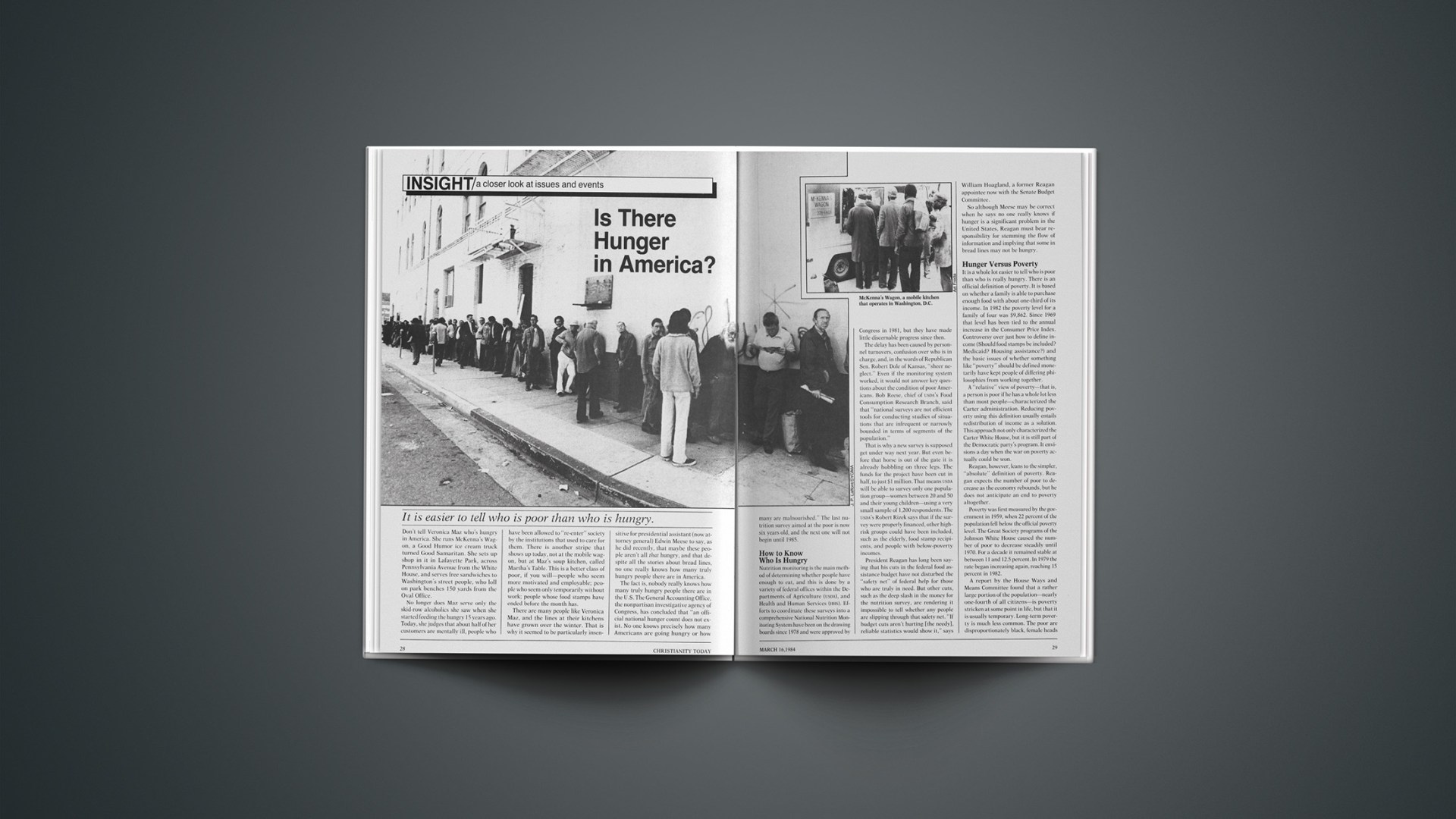
Don’t tell Veronica Maz who’s hungry in America. She runs McKenna’s Wagon, a Good Humor ice cream truck turned Good Samaritan. She sets up shop in it in Lafayette Park, across Pennsylvania Avenue from the White House, and serves free sandwiches to Washington’s street people, who loll on park benches 150 yards from the Oval Office.

No longer does Maz serve only the skid-row alcoholics she saw when she started feeding the hungry 15 years ago. Today, she judges that about half of her customers are mentally ill, people who have been allowed to “re-enter” society by the institutions that used to care for them. There is another stripe that shows up today, not at the mobile wagon, but at Maz’s soup kitchen, called Martha’s Table. This is a better class of poor, if you will—people who seem more motivated and employable; people who seem only temporarily without work; people whose food stamps have ended before the month has.

There are many people like Veronica Maz, and the lines at their kitchens have grown over the winter. That is why it seemed to be particularly insensitive for presidential assistant (now attorney general) Edwin Meese to say, as he did recently, that maybe these people aren’t all that hungry, and that despite all the stories about bread lines, no one really knows how many truly hungry people there are in America.

The fact is, nobody really knows how many truly hungry people there are in the U.S. The General Accounting Office, the nonpartisan investigative agency of Congress, has concluded that “an official national hunger count does not exist. No one knows precisely how many Americans are going hungry or how many are malnourished.” The last nutrition survey aimed at the poor is now six years old, and the next one will not begin until 1985.

How To Know Who Is Hungry

Nutrition monitoring is the main method of determining whether people have enough to eat, and this is done by a variety of federal offices within the Departments of Agriculture (USDA), and Health and Human Services (HHS). Efforts to coordinate these surveys into a comprehensive National Nutrition Monitoring System have been on the drawing boards since 1978 and were approved by Congress in 1981, but they have made little discernable progress since then.

The delay has been caused by personnel turnovers, confusion over who is in charge, and, in the words of Republican Sen. Robert Dole of Kansas, “sheer neglect.” Even if the monitoring system worked, it would not answer key questions about the condition of poor Americans. Bob Reese, chief of USDA’s Food Consumption Research Branch, said that “national surveys are not efficient tools for conducting studies of situations that are infrequent or narrowly bounded in terms of segments of the population.”

That is why a new survey is supposed get under way next year. But even before that horse is out of the gate it is already hobbling on three legs. The funds for the project have been cut in half, to just $1 million. That means USDA will be able to survey only one population group—women between 20 and 50 and their young children—using a very small sample of 1,200 respondents. The USDA’s Robert Rizek says that if the survey were properly financed, other high-risk groups could have been included, such as the elderly, food stamp recipients, and people with below-poverty incomes.

President Reagan has long been saying that his cuts in the federal food assistance budget have not disturbed the “safety net” of federal help for those who are truly in need. But other cuts, such as the deep slash in the money for the nutrition survey, are rendering it impossible to tell whether any people are slipping through that safety net. “If budget cuts aren’t hurting [the needy], reliable statistics would show it,” says William Hoagland, a former Reagan appointee now with the Senate Budget Committee.

So although Meese may be correct when he says no one really knows if hunger is a significant problem in the United States, Reagan must bear responsibility for stemming the flow of information and implying that some in bread lines may not be hungry.

Hunger Versus Poverty

It is a whole lot easier to tell who is poor than who is really hungry. There is an official definition of poverty. It is based on whether a family is able to purchase enough food with about one-third of its income. In 1982 the poverty level for a family of four was $9,862. Since 1969 that level has been tied to the annual increase in the Consumer Price Index. Controversy over just how to define income (Should food stamps be included? Medicaid? Housing assistance?) and the basic issues of whether something like “poverty” should be defined monetarily have kept people of differing philosophies from working together.

A “relative” view of poverty—that is, a person is poor if he has a whole lot less than most people—characterized the Carter administration. Reducing poverty using this definition usually entails redistribution of income as a solution. This approach not only characterized the Carter White House, but it is still part of the Democratic party’s program. It envisions a day when the war on poverty actually could be won.

Reagan, however, leans to the simpler, “absolute” definition of poverty. Reagan expects the number of poor to decrease as the economy rebounds, but he does not anticipate an end to poverty altogether.

Poverty was first measured by the government in 1959, when 22 percent of the population fell below the official poverty level. The Great Society programs of the Johnson White House caused the number of poor to decrease steadily until 1970. For a decade it remained stable at between 11 and 12.5 percent. In 1979 the rate began increasing again, reaching 15 percent in 1982.

A report by the House Ways and Means Committee found that a rather large portion of the population—nearly one-fourth of all citizens—is poverty stricken at some point in life, but that it is usually temporary. Long-term poverty is much less common. The poor are disproportionately black, female heads of households, and elderly people.

Reagan formed his understanding of poverty when he was governor of California. He believed there should be rigid standards of eligibility for welfare, that programs should be run by state or local government agencies instead of the federal government, and that recipients should have to work if they can.

All of Reagan’s goals became law in California. And when that happened, the number of people on welfare dropped, many former welfare recipients re-entered the work force, and benefits to the needy actually increased.

In 1972, Reagan testified before a congressional committee in Washington to draw attention to the success of the California program. A number of California state officials moved to Washington as a result, and, according to Edward D. Berkowitz of George Washington University, the Department of Health, Education and Welfare (now HHS) became a battleground between those trying to institute the California ideas and those defending the status quo.

When Reagan was elected president in 1980, his commitment to the California approach was firmly fixed. However, ideas about “workfare” and local control of welfare programs—“new federalism” as it was called—encountered severe opposition on Capitol Hill. In January 1982, Reagan called for the federal government to withdraw from the largest welfare program, called Aid to Families with Dependent Children, as well as from food stamps, leaving those initiatives up to the individual states. In response, there was criticism over how the new approach would work, the vast institutional changes it would require, and worry about possible unfairness to the poor as laws changed from state to state. There was so much resistance that the proposal never materialized in Congress. It faded completely from public view until this January, when Reagan’s Task Force on Food Assistance completed its work.

The Task Force Controversy

Last year, Reagan appointed a blue-ribbon committee to investigate the extent of hunger in America and to answer in particular the perplexing question of why people still seem to be hungry in the face of massive government efforts to feed them. Its work came under biting attack from Democrats and food advocacy groups who felt the task force was stacked with people too prone to see only Reagan’s views on hunger and poverty. Robert Greenstein, an effective spokesman for the outsiders, pointed out that the only members of the task force with any academic, research, or administrative background in federal food programs were those who had worked in the White House with the specific assignment of cutting the programs. Greenstein is the director of a nonprofit research center on federal budget policy. During the Carter administration he was administrator of the Food and Nutrition Service in the USDA.

The political climate surrounding the work of the task force grew so sour that, as it debated and approved its final report during a public meeting in a Labor Department auditorium, the atmosphere was that of a three-ring circus. Members of several advocacy groups roamed the aisles, distributing press releases and analyses of the draft report. During coffee breaks they held court for the television cameras, refuting task force findings and proffering studies of their own about the problem. Greenstein infuriated the task force chairman, J. Clayburn LaForce, by passing notes to a task force member who was raising questions about the report’s conclusions during the final session.

Later, at joint congressional hearings on the report, most of the critics turned down the volume on their objections and agreed to support many of the task force recommendations. Curiously, the White House has been silent about what the task force had to say, leading some policy experts to conjecture that the recommendations go well beyond what Reagan expected from these like-minded appointees.

The final report of the task force maintains an uneasy tension between endorsing federal hunger programs and recognizing their shortcomings. “Although social programs relieve the symptoms of poverty,” the report said, “we have come to see how these same programs also help to perpetuate the very poverty they were created to relieve.”

Its conclusions are tentative: “Since general claims of widespread hunger can neither be positively refuted nor definitely proved, it is likely that hunger will remain as an issue on our national policy agenda for an indefinite future.” The task force made recommendations on four issues. They break little new ground, but they have at least reinvigorated the desire in Congress for government to be more responsive to whatever hunger does exist. Legislation has been introduced in Congress to convert all four of these proposals into law. The recommendations are these:

• Giving states the option of running their own food-assistance programs, financed by federal “block grants.” This has been rejected before by Congress on grounds that states would not be as uniform in benefits as is the federal government. Bureaucrats in the federal “hunger establishment” of the poverty agencies also object to losing control.

• Increasing food stamp benefits allotments by 1 percent. The report also urges government to raise the amount of assets a family may own and still qualify, and says food stamp recipients should not be required to have fixed addresses. The report also asks that the disabled and the elderly receive cash instead of stamps to help relieve the social stigma attached to food stamps.

• Encouraging the private sector to help out by having the IRS clarify rules under which corporations can gain greater tax deductions for donations of food, as well as allowing military commissaries to give away food.

• Better monitoring of who is going hungry and why, and a more generous definition of the official poverty level.

Other Voices

The federal task force and the federal government generally are not the only centers of information on the state of hunger in the United States. A variety of other organizations also exists to cope with the problem. These organizations often disagree with the White House about the scope of hunger, particularly when they perceive that the President and his staff are skeptical about its extent. Here is a summary of what some of these groups have been saying:

The Center on Budget and Policy Priorities, a nonprofit research organization in Washington run by Greenstein, surveyed 181 privately run food assistance programs nationwide. More than half reported 50 percent more people requesting help in February 1983 than a year earlier.

Clinical tests conducted by the Massachusetts Department of Public Health found 9.8 percent of children in low-income families suffering from chronic malnutrition—more than twice the number that was expected, based on national norms.

Agnes Lattimer, a pediatrician at Cook County Hospital in Chicago, testified before a congressional subcommittee about a study of inner-city children entering the hospital’s emergency room. From 1981 to 1983, she said, admissions of children with symptoms of malnutrition, such as “failure to thrive,” diarrhea, and dehydration, increased 24 percent. Nearly half the children in a designated “high-risk” group were found to have poor diets, beginning with infants younger than six months who were receiving inadequate amounts of formula.

Thomas Brush, mayor of Cincinnati and a member of the U.S. Conference of Mayors Task Force on Joblessness and Hunger, described the squeeze his city is facing: The food stamp case load increased by 10 percent to 36,964 households last year; clients served by private food pantries and soup kitchens have doubled in number, and 78.3 percent of them are unemployed; the city has donated $125,000 in general funds to keep the private efforts afloat.

Local chapters of Bread for the World conducted “Hunger Watch U.S.A.” to document how low-income people are faring. They conclude that hunger is on the increase.

Many of these nongovernmental hunger groups tend to see hunger in economic terms—if someone is poor or hungry, the government ought to give him money for food. One of the task force members is John Perkins, a black evangelical who founded the Voice of Calvary Ministries, an outreach to poor blacks in Mississippi. He takes a different tack on the question. He says that merely looking at one’s purchasing power is not enough. “I come from a justice perspective,” he says. “Does welfare provide justice? We have to ask the victims. I see our people being destroyed, because welfare is not adequate. Folks have been dehumanized by it.” Breaking poverty cycles that trap whole families and neighborhoods requires “creatively involving the poor in the distribution process,” he says, by giving them control over their surroundings.

In his book, With Justice for All, Perkins describes an inner-city Philadelphia family he observed: “The welfare system encouraged them to have more kids, to live together without getting married [broken homes qualify for more aid], and to lie to qualify for more food stamps. It gave them no incentive at all to get out of their situation.… Designed to assist when there was no father, the welfare system stepped in and replaced the father.”

The government’s occupation with questions of quantity—how many people are hungry, how much spending is enough, what is the extent of fraud and waste—belie, to critics, an absence of concern about a more basic question: What quality of care do poor people need, and how will they get it? Reagan’s full-steam-ahead approach to cutting the federal food assistance budget without making sure there is a usable safety net under the truly needy and his appointment of what has been generally regarded as a politically partisan task force make many of his critics more strident.

But they may find the task force report more helpful than they first imagined. It has finally fixed attention on hunger as a national issue, and it has generated congressional legislation in all four of its areas of recommendation. That alone is an encouraging sign of determination on all sides to address finally the question of hunger in America.

BETH SPRING

The Strange Embraces of Jesus: A Divine Hug for the Unlovely

Most of us are familiar with Grimm’s fairy tale of the princess and the frog. A prince, having fallen under the hex of a witch, was changed into a frog, and a frog he would have to remain until a certain princess should take him home and share her table and bed with him. Only then would he be a prince again.

Each day the frog sat by a spring in the forest lamenting his fate. One hot day the princess retired into the coolness of the forest, tossing a golden ball into the air as she went. As she came to the spring she inadvertently dropped the ball, and it fell into the depths of the pool. All attempts to retrieve it proved in vain. Seizing the opportunity, the frog volunteered to fetch the precious ball, provided the princess would promise to grant a request of his. In hopes of getting back the golden ball, the princess hastily agreed. Thereupon the frog dove to the bottom of the pool and soon produced the golden ball. In her excitement over recovering the treasure, the princess dashed home happily, forgetting her promise to the hapless frog. As the story turns out, not until later—and after the persistent efforts of both the frog and her own father—was the princess persuaded to keep faith with the frog.

Most of us, I think, are inclined to criticize the princess for lapsing in her promise to the frog. But we know something the princess does not know: namely, that the frog is actually a prince in the shape of a frog. That, the princess does not know. To her the frog is merely a frog. The thought of the little beast eating off the same plate with her causes each bite of food to stick in her throat; the thought of having to share the clean linen on her bed with the cold creature throws her into spasms of repulsion.

Who of us, had we known only what the princess knew, would have reacted differently? It is hard to embrace the unlovely: not simply a frog, but perhaps a spouse in an ugly mood, or a defiant child, or a work associate who opposes us—let alone the dirty, the sick, and the dying of our world.

One cannot help being impressed in reading the Gospels that Jesus responded differently to the unlovely than we normally do. Rather than avoidance or condemnation, Jesus accepted—indeed, embraced—the unlovely. Such embraces not only broke dramatically with the people of his day, but they contributed in no small measure to his sentence of death.

Jesus And Children

The Gospels reveal three such embraces of Jesus. The first was his embrace of children, and it represents Jesus’ concern for those who had not yet “arrived” in Jewish society. A second was his embrace of a leper. This embrace represents Jesus’ solidarity not simply with those who had not yet arrived, but those who could never arrive. This embrace included all who were either disinherited or outcast, ranging from women and Geniles to the sick and lame, sinners and tax collectors, and even the leprous. Finally, Jesus embraced a cross, and in so doing he embraced the sins of the world, the very ugliness that separates us from God himself. Consider, first of all, Jesus’ embrace of children.

“And they were bringing children to him, that he might touch them; and the disciples rebuked them. But when Jesus saw it he was indignant, and said to them, ‘Let the children come to me, do not hinder them; for to such belongs the kingdom of God. Truly, I say to you, whoever does not receive the kingdom of God like a child shall not enter it.’ And he took them in his arms and blessed them, laying his hands upon them” (Mark 10:13–16).

What, we might ask, was so unusual about Jesus putting his arms around children? And why did his disciples attempt to prevent the little ones from coming to him? Is not the maternal instinct a universal instinct of sorts, compelling us to show tenderness to children? Do not human relief organizations appeal to this instinct by showing the pitiful faces of starving children? Do not political candidates secure our votes by kissing the heads of babies?

We would be quite mistaken if we assumed that the society of Jesus’ day viewed children with the same affection ours does. In her book A Distant Mirror, Barbara Tuchman says that in the Middle Ages no element of society received less attention than children. And for good reason: with an infant mortality rate of 50 percent, adults could scarcely afford an excessive emotional involvement with the young. When a child of seven was considered a miniature adult and expected to perform a full day’s work, sentimentality over children had little chance to blossom.

So it was in Jesus’ day. The rabbis considered children, like women, to be members of the people of God by virtue of their association with adult male members of the family. True, a newborn boy of eight days was circumcised as a sign of this covenant relationship, but it was not until he was 13 that he was considered to have reached an age of religious maturity and granted full status in the synagogue. One would have to search long and hard in ancient Jewish society to find any benevolence toward the young comparable to Jesus’ embracing and blessing of children. W. C. Fields is said to have once remarked sarcastically, “Anyone who hates children and dogs can’t be all bad.” Presumably, people in Jesus’ day would have found little, if anything, humorous or objectionable about that quip. In Jewish society a child reached maturity when he could understand and assent to the Torah. Jesus, on the other hand, embraced the children. More than that, he declared them models of the kingdom of God—precisely because they had nothing to show for themselves and were most likely to receive God’s kingdom as a gift of grace.

Jesus And Outcasts

“And a leper came to him beseeching him, and kneeling said to him, ‘If you will, you can make me clean.’ Moved with pity, he stretched out his hand and touched him, and said to him, ‘I will; be clean.’ And immediately the leprosy left him, and he was made clean” (Mark 1:40–42).

We live in a society that institutionalizes the insane, deformed, and seriously crippled, and as a consequence, we may find it difficult to conceive of the vast social contrasts of Jesus’ day. Much as in many Third World countries today, the rich and poor, the fit and deformed, the clean and dirty in Jewish society lived in close proximity.

But proximity did not necessarily lead to contact or community; instead, it often led to increased separation among the various social classes. In the case of leprosy, the Old Testament prescribed the following regulations: “The leper who has the disease shall wear torn clothes and let the hair of his head hang loose, and he shall cover his upper lip and cry, ‘Unclean, unclean.’ He shall remain unclean as long as he has the disease; he is unclean; he shall dwell alone in the habitation outside the camp” (Lev. 13:45–46).

As if this condition were not humiliating enough, Josephus and some of the rabbis intensified the plight of the leper, referring to him as a “living corpse,” whose cure was difficult as resurrection from the dead (see Num. 12:12).

In Mark’s story, the leper compounded his offensiveness: not only did he embody a dread contagion (so it was thought), but, so great was his longing to be healed, he broke through the prescribed zone of separation between himself and others and came right up to Jesus. In a sense, Jesus’ response was offensive also. Rather than countering this social blunder with spit, stones, or curses, Jesus reached out and touched him, saying, “Be clean.” That touch did more than heal a physical ailment. It made it possible for one who had had to abandon his clothes, home, hygiene, family and friends, and even his relationship with the people of God—in short, one who had been banished to nonexistence—to return to himself, to human society, and to God.

Jesus And The Cross

Finally, Jesus’ strangest embrace was that of a cross.

“So they took Jesus, and he went out, bearing his cross, to the place called the place of a skull, which is called in Hebrew Golgotha. There they crucified him, and with him two others, one on either side, and Jesus between them.” (John 19:17–18).

There is no record in antiquity of a nobleman suffering the penalty of death by crucifixion. On the contrary, crucifixion was reserved for the most despised elements of society—rebellious foreigners, violent criminals, and especially slaves. It was a barbaric form of execution of the utmost cruelty, and was practiced by the Romans especially as a deterrent against slave uprisings. Appian, a Roman writer, informs us that when Crassus quashed the slave revolt of Spartacus in 71 B.C. he crucified 6,000 slaves along the Via Appia from Rome to Capua, a distance of well over 100 miles. With this in mind, one can scarcely escape Paul’s striking contrast when he spoke of Christ’s preexistent glory compared with his earthly humility: “He was in the form of God … but emptied himself, taking the form of a servant … and became obedient unto death, even death on a cross” (Phil. 2:6–8).

The Gospels tell us that Jesus predicted he would go to Jerusalem to die on a cross, and that, in fact, he spent his dying breath crucified between two criminals on the Hill of the Skull. Why did Jesus embrace a cross? He embraced a cross for the same reason he embraced children, women, the poor, sick, and outcast: out of love for the unlovely. In truth, it was not his cross but ours that he bore. Peter says, “He bore our sins in his body on the cross, that we might die to sin and live to righteousness; for by his wounds you were healed” (1 Peter 2:24).

Embraces Of A Real God

The strange embraces of Jesus! Each shares something in common with the others. Each is an embrace of those who, in the words of the Beatitudes, are “poor in spirit” (Matt. 5:3). Each is an attempt to “seek and save the lost” (Luke 19:10). And each is what may be called an “ultimate embrace”—that is, either God or nothing. With each embrace Jesus conveyed the same thing, that everything can be expected from God where all hopes have been exhausted from man.

It is not surprising that the people of Jesus’ day found such embraces hard to accept, for they had rejected the strange embraces of God before. Hosea writes, “When Israel was a child, I loved him, and out of Egypt I called my son. The more I called them, the more they went from me; … Yet it was I who taught Ephraim to walk, I took them up in my arms; but they did not know that I healed them” (Hos. 11:1–3).

There is, indeed, an attitude that disdains the tangible overtures of God in human life. The elder brother in the parable of the Prodigal Son had such an attitude: his father should not have embraced such a worthless son. Once the Jews had shunned God’s embrace of themselves, they found it harder to tolerate his embracing of others. In the history of religion, especially “enlightened religion,” one sometimes meets the view that God is above our troubled world and too holy to condescend to real life. Helmut Thielicke has this to say in his book, I Believe:

“Tell me how lofty God is for you, and I’ll tell you how little he means to you.… It is certainly remarkable, but it is true. God has become of concern to me only because he has made himself smaller than the Milky Way, only because he is present in my little sickroom when I gasp for breath, or understands the little cares I cast on him, or takes seriously the request of a child for a scooter with balloon tires.… If God has no significance for the tiny mosaic-pieces of my little life, for the things that concern me, then he doesn’t concern me at all.

The strange embraces of Jesus reach out for the needy, the forgotten, and the forsaken of each generation. They extend to those whose problems surpass human abilities to solve. The embraces of Jesus encompass both our personal and global inpoverishment, if only we come, like the children or the leper, knowing our need of them. His embraces demonstrate that God is a real God, committed to the needs of a real world.

Tim Stafford is a free-lance writer living in Santa Rosa, California. He is a distinguished contributor to several magazines. His latest book is Do You Sometimes Feel Like a Nobody? (Zondervan, 1980).

Apple PodcastsDown ArrowDown ArrowDown Arrowarrow_left_altLeft ArrowLeft ArrowRight ArrowRight ArrowRight Arrowarrow_up_altUp ArrowUp ArrowAvailable at Amazoncaret-downCloseCloseEmailEmailExpandExpandExternalExternalFacebookfacebook-squareGiftGiftGooglegoogleGoogle KeephamburgerInstagraminstagram-squareLinkLinklinkedin-squareListenListenListenChristianity TodayCT Creative Studio Logologo_orgMegaphoneMenuMenupausePinterestPlayPlayPocketPodcastRSSRSSSaveSaveSaveSearchSearchsearchSpotifyStitcherTelegramTable of ContentsTable of Contentstwitter-squareWhatsAppXYouTubeYouTube