
Eutychus and His Kin: March 16, 1984

The Word Processed

In my mind’s eye I can nearly see Saint John trying to use a computer (the New Logos Processor) to write his Gospel. The machine is up now; John marks his margins and begins.

In the beginning was the Word, and the Word …

[Delete “word”—used once in previous phrase. Use “sentence unit” and trip change key. The next eight verses contain repetitions. Go to verse 14.]

In the beginning was the Word, and the sentence unit was made flesh …

[Delete “flesh” change to “protoplasm,” trip change key.]

In the beginning was the Word, and the sentence unit was made protoplasm and dwelt among us, (and we beheld …

[Delete “beheld,” change to “scoped out,” trip change key.]

In the beginning was the Word, and the sentence unit was made protoplasm, and dwelt among us, (and we scoped out his glory …

[BEEP! Does not compute. What is glory? See the cross-merge file. Substitute “indescribable wow.” Depress total construct key.]

In the beginning was the Word, and the sentence unit was made protoplasm and dwelt among us, (and we scoped out his indescribable wow, full of grace and truth …

[BEEP! “Grace” and “truth” are abstract and noncorrelative—activate synonym sync file. Then insert verse 10.]

In the beginning was the Word, and the sentence unit was made protoplasm and dwelt among us, (and we scoped out his indescribable wow, full of undeserved appreciation and integrated trust). He was in the world …

[BEEP! BEEP! Be explicit. Say which world; type “Sagan” on left keyboard and read display monitor.]

In the beginning was the Word, and the sentence unit was made protoplasm, and dwelt among us, (and we scoped out his indescribable wow, full of undeserved appreciation and integrated trust). He was on the third planet out from the sun, which was made by him …

[Incorrect! Depress “Sagan” key again, and watch right unit. Information incorrect. World was not made; say evolved. Interchange discs; material will copy correctly.]

In the beginning was the Word, and the sentence unit was made protoplasm, and dwelt among us, (and we scoped out his indescribable wow, full of undeserved appreciation and integrated trust). He was on the third planet out from the sun, which evolved, but the world knew him not … OH, FORGET IT!

[Attitude incorrect. Type “Wayne Dyer” on unit two, using disc one.…

EUTYCHUS

Church Music—Worship or Entertainment?

What is the role of music [Ministries, Jan. 13]? You have used all the right words, but may I add something? The “tension between the concept of music as ‘worship’ and as ‘entertainment’ ” is unfortunate, but probably unavoidable. We are going to lead some into the Holy of Holies with the music we offer up; some will be merely entertained. Bob Mumford speaks of the “truth in tension” in the Word of God. A truth will always be balanced by another truth, seemingly contradictory. Those who read the life of Jesus will observe a certain seeming contradictoriness, which is only apparent. He was responding to his Father, and the inconsistency was only there for those viewing his actions through Pharisaical eyes, blinded by “the Law.” If some in the congregation are being “merely entertained,” don’t worry about it. The music offered in a true spirit of evangelism and worship is for them also. Jesus instructed people all along his path without expecting all to follow him. Some followed more closely than others, even among his twelve disciples. Some in the congregation will not get as close to the Holy of Holies as others. We must expect this.

The key is that the music minister offer good music in the right spirit and not attempt merely to entertain. The Holy Spirit will take care of the rest.

REV. GENE M. LACY

River of Life Church

Houston, Tex.

Come On!

Regarding Bob Dylan [News, Jan. 13]: If he decides not to be a part of the mass evangelism effort at the Olympics, must that cast doubt on his faith? Come on! I seem to remember something about Saint Paul laying low in Arabia before moving on to ministry and evangelism. It seems to me we show a lack of sensitivity when we put people like Dylan under the microscope.

REV. THOMAS A. SONLEY

Mt. Lebanon United Presbyterian Church

Pittsburgh, Pa.

The end of the article has sound and important advice given by Paul Emond. He advises the church, more or less, to stop gossiping. I fear this advice will be missed due to the article’s controversial subject matter, or simply not heeded. It has been said that Christians are the only people who kill their wounded. While this is not entirely true, a quick glance will reveal that the statement has some truth. Why would anyone make such a comment if there was not some reason? Too often we expect Christians in the limelight to fit our own ideal of how a “good” Christian should act. When he or she does not live up to our standards, immediately we begin to gossip—we take aim and stab in the back. Let us first take the logs out of our own eyes; let us not promote speculations. Rather, let us be the “shelter from the storm” we should be.

MARK S. BEATTY

Philadelphia, Pa.

Wrong Title?

Your article, “Why We Can’t Always Trust the News Media,” [Jan. 13] should be headed, “Why We Should Seldom (If Ever) Trust the News Media!” As a former working newsman, I see a 180-degree shift in reporting attitudes and ethics. Traditionally, news writers were indoctrinated with the importance of impartiality and objectivity. Now the standard seems to be “as I see it”—and often written by the deliberately blind and prejudiced!

On their own admission, media men are now arrogating to themselves the right and authority to mold public opinion. And their standard is one of personal prejudice, limited observation, inadequate research, and slanted reporting.

REV. DONALD E. HOKE

Cedar Springs Presbyterian Church

Knoxville, Tenn.

Your article about the media, Amnesty International, and Guatemala hits the nail squarely on the head. It is time for churchmen and -women to demand accountability as well as “coverage” of far-off corners of the world by the news media.

REV. G. D. WIEBE

Hayward, Calif.

“Fads, Fads, Fads”

“Fads, fads, fads” is about all the Episcopal church has been pursuing for the last two decades-plus [News, Jan. 13]. In my mind, jumping on this latest bandwagon is one of the most dangerous. Protestantism basically directs everyone to read the Holy Scriptures and then form his or her personal opinion as to what the Scriptures say; the logical end of this process can be nothing more than chaos amplified. The “Spirit-filled” movement is one of the same illogical ilk and reminds me of the New Yorker cartoon some years ago depicting two monks walking in the cloister, with the caption: “But I am holier than thou!”

The Episcopal church has suffered much during the past 20 years because it has not held to its true heritage of a solid, reformed Catholic faith; the contemporary emphasis in the Episcopal church on being “Spirit-filled” will not lead to lasting growth in numbers, the exaltation and preservation of the historic Christian faith, or to the greater glory of the Triune Godhead.

REV. GERALD L. CLAUDIUS

St. John’s Episcopal Church

Kansas City, Mo.

Sports Versus the Lord’s Day

Here’s hoping the “demigods” of America’s now-popular religion, sports, come up with their own Lord’s Day. Surely they must miss ours [News, Jan. 13].

MRS. ROBERT W. TEAGUE

York, Penn.

Your article ignores the fundamental inconsistency between profession of Christ as King and participation in a sport that weekly distracts millions from devoting the Lord’s Day to worshiping God. As long as these athletes continue to play on the Lord’s Day, they proclaim football—not Christ—as king.

D. LEE BARCLAY

Seattle, Wash.

Orwell’s 1984

The coverage of Orwell’s 1984 [Jan. 13] might do more for us Christians than most of the sermons that encourage us to be satisfied with today’s churches.

Religious freedom is the opiate of the cults—including those of Satan—for in the eyes of the world it gives them equal time and equal status with Jesus Christ. There can be no Holy Spirit—led believer—in Christ—who can accept such a glaring contradiction of the teaching of Holy Scripture. Religion must be replaced with the true church or face apostasy by the world.

How many of us today are crying peace and revival in a nation that caters to any religion—good or bad—that is free to practice slavery and imprisonment of those kept in spiritual darkness and who will remain ill-equipped to overcome, much less discern, the true enemy?

Are humankind’s institutions of “religious freedom” a substitute for Jesus Christ? Even so, Lord Jesus, come.

JOHN MCINTIRE

Bradenton, Fla.

Stafford’s concise and accessible presentation of the pivotal concerns that molded Orwell’s thought and world view brought about some serious reflection as Orwell’s insight was juxtaposed with present reality. Though being appreciative, several flaws should receive some attention.

To put Orwell in the same hall of fame with the Old Testament prophets is to reduce prophecy to mere sociology and applaud the merits of Orwell’s insight with extravagant hyperbole. It seems that Christians can acknowledge one’s contribution to this world without having to make that individual out to be a “cryptic-Christian.”

Among the younger contributors to CT’S articles there seems to be a marked bias against “conservative” remedies or answers when the topic of social evil is introduced. An example of this hidden bias is Stafford’s connection of the Reagan administration’s peace through strength policy (specifically calling missiles “Peacemakers”), and the Orwellian concept of Doublethink. My concern is not that Stafford accept this policy but that serious subjects receive the attention they deserve. Therefore, if Alexander Solzhenitsyn is willing to entertain such a position as peace through strength (cf. National Review, Dec. 9, 1983), then it would seem befitting of solid journalism not to trivialize issues with back-handed innuendo.

REV. DAVID K. WEBER

Trinity Inter-Parish School

Billings, Mont.
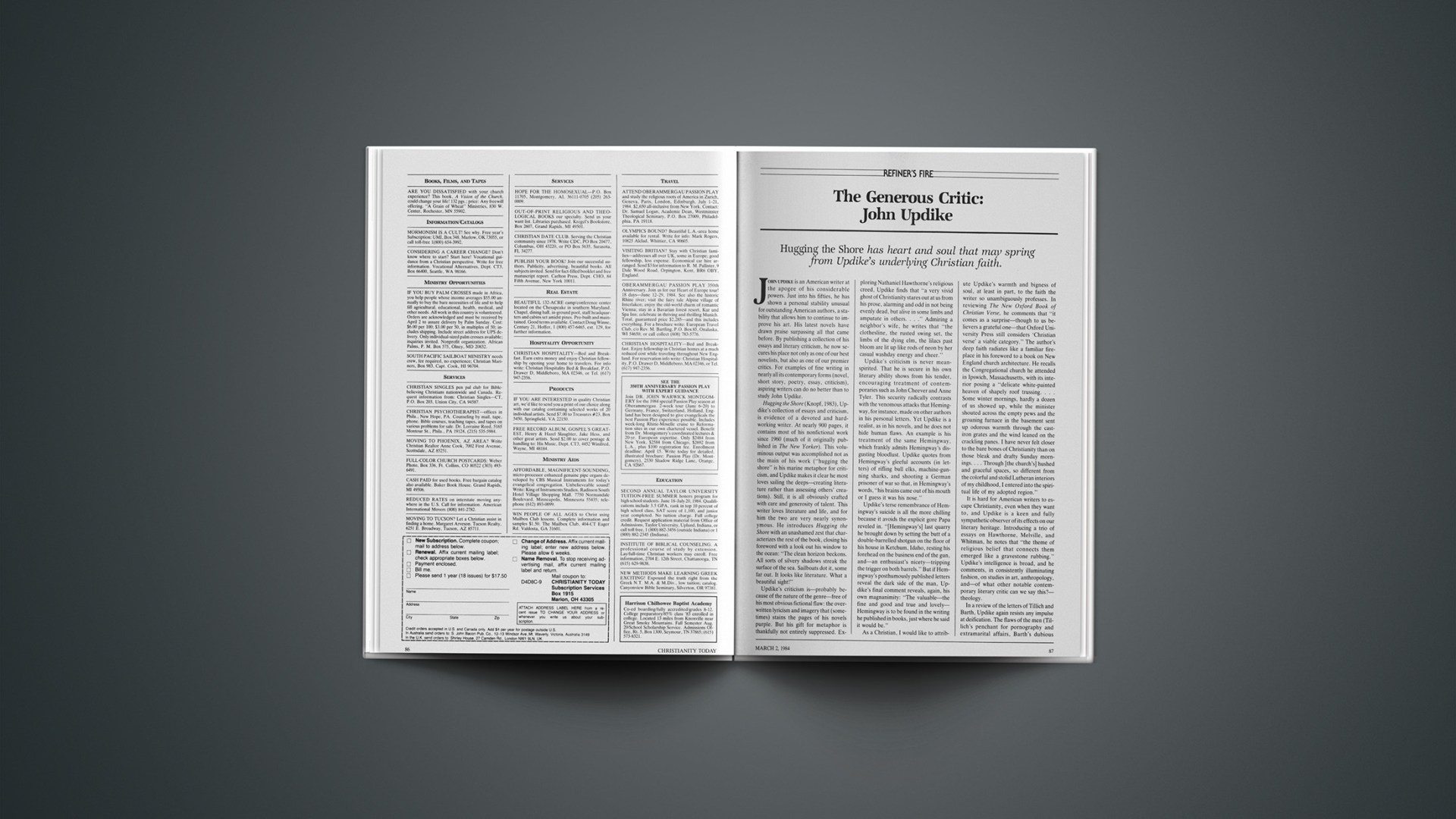
Refiner’s Fire: The Generous Critic: John Updike

Hugging the Shore has heart and soul that may spring from Updike’s underlying Christian faith.

John updike is an American writer at the apogee of his considerable powers. Just into his fifties, he has shown a personal stability unusual for outstanding American authors, a stability that allows him to continue to improve his art. His latest novels have drawn praise surpassing all that came before. By publishing a collection of his essays and literary criticism, he now secures his place not only as one of our best novelists, but also as one of our premier critics. For examples of fine writing in nearly all its contemporary forms (novel, short story, poetry, essay, criticism), aspiring writers can do no better than to study John Updike.

Hugging the Shore (Knopf, 1983), Updike’s collection of essays and criticism, is evidence of a devoted and hard-working writer. At nearly 900 pages, it contains most of his nonfictional work since 1960 (much of it originally published in The New Yorker). This voluminous output was accomplished not as the main of his work (“hugging the shore” is his marine metaphor for criticism, and Updike makes it clear he most loves sailing the deeps—creating literature rather than assessing others’ creations). Still, it is all obviously crafted with care and generosity of talent. This writer loves literature and life, and for him the two are very nearly synonymous. He introduces Hugging the Shore with an unashamed zest that characterizes the rest of the book, closing his foreword with a look out his window to the ocean: “The clean horizon beckons. All sorts of silvery shadows streak the surface of the sea. Sailboats dot it, some far out. It looks like literature. What a beautiful sight!”

Updike’s criticism is—probably because of the nature of the genre—free of his most obvious fictional flaw: the overwritten lyricism and imagery that (sometimes) stains the pages of his novels purple. But his gift for metaphor is thankfully not entirely suppressed. Exploring Nathaniel Hawthorne’s religious creed, Updike finds that “a very vivid ghost of Christianity stares out at us from his prose, alarming and odd in not being evenly dead, but alive in some limbs and amputate in others.…” Admiring a neighbor’s wife, he writes that “the clothesline, the rusted swing set, the limbs of the dying elm, the lilacs past bloom are lit up like rods of neon by her casual washday energy and cheer.”

Updike’s criticism is never mean-spirited. That he is secure in his own literary ability shows from his tender, encouraging treatment of contemporaries such as John Cheever and Anne Tyler. This security radically contrasts with the venomous attacks that Hemingway, for instance, made on other authors in his personal letters. Yet Updike is a realist, as in his novels, and he does not hide human flaws. An example is his treatment of the same Hemingway, which frankly admits Hemingway’s disgusting bloodlust. Updike quotes from Hemingway’s gleeful accounts (in letters) of rifling bull elks, machine-gunning sharks, and shooting a German prisoner of war so that, in Hemingway’s words, “his brains came out of his mouth or I guess it was his nose.”

Updike’s terse remembrance of Hemingway’s suicide is all the more chilling because it avoids the explicit gore Papa reveled in. “[Hemingway’s] last quarry he brought down by setting the butt of a double-barrelled shotgun on the floor of his house in Ketchum, Idaho, resting his forehead on the business end of the gun, and—an enthusiast’s nicety—tripping the trigger on both barrels.” But if Hemingway’s posthumously published letters reveal the dark side of the man, Updike’s final comment reveals, again, his own magnanimity: “The valuable—the fine and good and true and lovely—Hemingway is to be found in the writing he published in books, just where he said it would be.”

As a Christian, I would like to attribute Updike’s warmth and bigness of soul, at least in part, to the faith the writer so unambiguously professes. In reviewing The New Oxford Book of Christian Verse, he comments that “it comes as a surprise—though to us believers a grateful one—that Oxford University Press still considers ‘Christian verse’ a viable category.” The author’s deep faith radiates like a familiar fireplace in his foreword to a book on New England church architecture. He recalls the Congregational church he attended in Ipswich, Massachusetts, with its interior posing a “delicate white-painted heaven of shapely roof trussing.… Some winter mornings, hardly a dozen of us showed up, while the minister shouted across the empty pews and the groaning furnace in the basement sent up odorous warmth through the cast-iron grates and the wind leaned on the crackling panes. I have never felt closer to the bare bones of Christianity than on those bleak and drafty Sunday mornings.… Through [the church’s] hushed and graceful spaces, so different from the colorful and stolid Lutheran interiors of my childhood, I entered into the spiritual life of my adopted region.”

It is hard for American writers to escape Christianity, even when they want to, and Updike is a keen and fully sympathetic observer of its effects on our literary heritage. Introducing a trio of essays on Hawthorne, Melville, and Whitman, he notes that “the theme of religious belief that connects them emerged like a gravestone rubbing.” Updike’s intelligence is broad, and he comments, in consistently illuminating fashion, on studies in art, anthropology, and—of what other notable contemporary literary critic can we say this?—theology.

In a review of the letters of Tillich and Barth, Updike again resists any impulse at deification. The flaws of the men (Tillich’s penchant for pornography and extramarital affairs, Barth’s dubious relationship with Charlotte von Kirschbaum) are unflinchingly examined. But the review ends with the Updike trademark, the final sentence gently but unequivocally asserting the greatness of his review’s subjects: “What lingers of Barth, still ringing in the air of churches and seminaries, was his tone of fearlessness, his bold, encyclopedic, and hearty exposition of the word of God as over against the word of Man; whereas Tillich, unable to exclude anxiety and doubt, brought them into the sanctum, and called them holy emotions.”

Hugging the Shore also sketches Updike’s philosophy of fiction writing—and how the Christian faith affects it. He believes “theology can be vexed but not conclusively discussed in fiction; cosmic conclusions depend upon evidence no novel—no mere emblem of the world—can contain.” And he offers a hint of one way his fiction may serve his faith: “Our actions, our decisions, our vows do matter; what can fiction tell us more important than that?”

There is no question but that Updike’s storytelling often vexes our theology and, with its profuse and explicit sex, challenges our conception of proper Christian art. Just the same, we can be grateful that among famous contemporary authors—with all their fixations on bizarre violence and sex—is one man who unembarrassedly goes to church each Sunday, and sincerely recites the Creed.

College Students and the Church Can Get Together

But too often campus organizations and local churches fail to meet the needs of the students they both serve.

For all the successes and enthusiasm displayed by university groups of Christians, there exists a serious flaw.

These groups are effectively preparing students for participation in evangelism, in group Bible studies, and for the development of healthy personal devotional habits. In addition, some campus groups have sought to help students develop a more thoroughly Christian world view.

But student organizations should not be seen as ends in themselves; they exist on behalf of, and as a result of, the church. The New Testament witness indicates that a small group (as in Matt. 18:20) is not a church. John Stott, for example, has remarked that students should beware of regarding an “InterVarsity chapter as a church.” There exists a vital distinction between the two, though the proper functioning of the former as an extension of the church is perfectly in order. More basically, members of ad hoc Christian groups, as genuine believers, are part of Christ’s church universal.

Therefore, a campus Christian group’s long-term effectiveness should be measured largely “not in terms of numbers attending meetings, nor even of the numbers of those converted, but by the number of its former members who, as a result of its teaching and training, become useful and fruitful members of local congregations when they graduate or qualify.”

“The real test of student group effectiveness,” insists English churchman, college administrator, and former missions executive Michael Griffiths, “is whether or not the group is preparing the members properly for the role they will need to play in a local congregation for the next 50 years.”

I am not attacking the marvelous work done on behalf of Jesus Christ and his church (sadly, in cases, because the church had no vision) by university Christian groups. And I believe that most, if not all, organizations—nondenominational and the denominationally affiliated alike—include the goal of “preparation for churchmanship” as part of their ministry rationale. But too many of the leaders of these groups possess few effective strategies for accomplishing such a goal. I suspect that the goal of helping students “become fruitful members of local congregations” is not being attained because it lies near the bottom of the groups’ actual priorities.

The following situations highlight the problem:

• The adult campus representative plans the yearly calendar for the group’s activities with student leaders. No consultation with local church leaders takes place. Students are encouraged to spend two entire weekends per semester, for instance, on their group’s retreat, thereby absenting themselves from worship services. Local churches may discover such a schedule too late adequately to plan special events that include students.

• Members of student groups are perpetually challenged to participate in varieties of activities sponsored by their Christian group: weekly large group meetings for teaching, cell group meetings, special training events, evangelism outreach, one-to-one discipleship relationships, and so on. As a result, most students hesitate to offer themselves for service in a local congregation; they are already too busy.

• Adult campus leaders do not specifically encourage participation by the students in churches.

• Local churches do little to encourage student involvement, either by the pastoral staff or lay leaders.

• Local churches allow the myth of spectatorism to persist by not expecting more of students than simply their observer status in worship services.

• Literature published by the students’ Christian group’s organization includes little instruction on the nature of the church or participation in it. Christian students are not only learning to undervalue the church during their student days, they are also forming bad church habits that may seriously impair their lifelong usefulness to the church of Jesus Christ.

Perhaps the role of the campus student group has been magnified to the detriment both of its individual members and the local congregation. Though he did not foresee our century’s university climate, the apostle Paul argued forcefully for the necessary inclusion and functioning of all members in a church body. Much as no one would wish to be without a vital bodily function indefinitely, so we should not encourage a temporary disharmony in the church body while certain members stop contributing their functions. (Can you imagine your human body lacking the use of its right thumb for four years?) The result is disharmony and a crippling of total effectiveness on behalf of the kingdom of God.

Practical benefits will result as students become acquainted and involved with local congregations. Here are a few:

• Campus-led studies can be supplemented with a systematic teaching ministry by the local church.

• Students can fill gaps in many ministries of the church such as music, education, club activities for children, community service and outreach, neighborhood evangelism, special events, and drama.

• As they participate, students can gain a feel for what they enjoy and where their skills and gifts lie.

• Through deeper involvement, students, by their youthful enthusiasm, can encourage and stimulate the local church.

• Students may gain a deeper friendship with adults who can then vouch for their abilities and character on job résumés or applications for missionary service.

• The local church may offer a diversity of fellowship that is not normally available on campus, which is conducive to Christian growth.

• Students can gain experience in the life of the local congregation that will prepare them for later participation.

What can we all do to develop better ties between church and university students? Here are suggested first steps:

• Campus leaders should prayerfully plan strategies to encourage participation in the life of local churches. Denominational leaders will find natural avenues for accomplishing this aim.

• Nondenominational leaders of university groups should insure that their personal involvement in a local church is worthy of the example it most certainly sets for the students.

• Pastoral staff should encourage a kind of student membership (affiliate) while young people are away from home churches.

Church leadership should redesign ministry opportunities away from 12-month, weekly commitments toward some that are flexible, thereby encouraging student involvement.

• Church leaders should create special events or programs to recognize students or acquaint them with church families or ministries: host family programs, hosting students for a day; “welcome back” luncheons for returning students; “have a good year” luncheons for departing students; telephone canvasses of students who prove to be regular attenders during fall quarter.

• Biannual gatherings of campus representatives and church leadership might be held for mutual upbuilding and communication.

• Church families should engage in active financial and prayer support for the local university Christian group(s).

In our youth ministries, as elsewhere, let us hold firmly to our commitment to build Christ’s church through local congregations.

Mr. Hawkins is director of Christian education at Blacknall Memorial Presbyterian Church, Durham, North Carolina.

Controversial Theologian Hans Küng Affirms Faith in Life after Death

What does it mean to believe in a consummation in eternal life by God as he showed himself in Jesus of Nazareth?

To believe in an eternal life means—in reasonable trust, in enlightened faith, in tried and tested hope—to rely on the fact that I shall one day be fully understood, freed from guilt and definitively accepted, and can be myself without fear; that my impenetrable and ambivalent existence, like the profoundly discordant history of humanity as a whole, will one day become finally transparent and the question of the meaning of history one day be finally answered. I need not then believe with Karl Marx in the kingdom of freedom only here on earth or with Friedrich Nietzsche in the eternal recurrence of the same. But neither do I have to consider history with Jacob Burckhardt in stoic-epicurean aloofness from the standpoint of a pessimistic skeptic. And still less do I need to mourn as a critic of civilization, with Oswald Spengler, the decline of the West and that of our own existence.

No, if I believe in an eternal life, then, in all modesty and all realism and without yielding to the terror of violent benefactors of the people, I can work for a better future, a better society, even a better church, in peace, freedom, and justice—and knowing that all this can only be sought and never fully realized by man.

If I believe in an eternal life, I know that this world is not the ultimate reality, conditions do not remain as they are for ever, all that exists—including both political and religious institutions—has a provisional character, the division into classes and races, poor and rich, rulers and ruled, remains temporary; the world is changing and changeable.

If I believe in an eternal life, then it is always possible to endow my life and that of others with meaning. In belief in God, however, as he showed himself in Jesus of Nazareth, I must start out from the fact that there can be a true consummation and a true happiness of humanity only when not merely the last generation but the full number of human beings—including those who have suffered, wept, and shed their blood in the past—will share in it. Not a human kingdom, but only God’s kingdom is the kingdom of consummation: the kingdom of definitive salvation, of fulfilled justice, of perfect freedom, of unequivocal truth, of universal peace, of infinite love, of overflowing joy—in a word, of eternal life.

Eternal life means liberation without any new enslavement. My suffering, the suffering of man, is abolished, the death of death has occurred. It will then be the time (in Heine’s words) to sing “a new song, a better song.” History will then have attained its goal, man’s becoming man will be completed. Then, as Marx hoped, the state and the law, and also science, art, and particularly theology will really have become superfluous.

No longer will the rule of Christ in the interim period, under the sign of the cross, accepted in faith, prevail in the church, but God’s rule directly and solely, for the happiness of a new humanity. Yes, God himself will rule in his kingdom, to which even Jesus Christ his Son will submit and adapt himself, in accordance with that other great saying of Paul: “And when everything is subjected to him [the Son], then the Son himself will be subject in his turn to the One who subjected all things to him, so that God may be all in all.”

God all in all: I can rely on the hope that in the eschaton, in the absolutely last resort, in God’s kingdom, the alienation of Creator and creature, man and nature, logos and cosmos, the division into here and hereafter, above and below, subject and object, will be abolished. God then will not merely be in everything, as he is now, but truly all in all, but—transforming everything into himself—because he gives to all a share in his eternal life in unrestricted, endless fullness. For, Paul says in the Letter to the Romans, “all that exists comes from him; all is by him and for him. To him be glory for ever.”

God all in all: For me it is expressed in unsurpassed and grandiose poetic form—interweaving cosmic liturgy, nuptial celebrations, and quiet happiness—on the last pages of the New Testament at the end of the Book of Revelation by the seer in statements of promise:

“Then I saw a new heaven and a new earth; the first heaven and the first earth had disappeared now, and there was no longer any sea [the place of chaos]. I saw the holy city, and the new Jerusalem, coming down from God out of heaven, as beautiful as a bride all dressed for her husband. Then I heard a loud voice call from the throne, ‘You see this city? Here God lives among men. He will make his home among them; they shall be his people, and he will be their God; his name is God-with-them. He will wipe away all tears from their eyes; there will be no more death, and no more mourning or sadness. The world of the past has gone.’ ” It will no longer be a life in the light of the Eternal, but the light of the Eternal will be our life and his rule our rule: “They will see him face to face, and his name will be written on their foreheads. It will never be night again and they will not need lamplight or sunlight, because the Lord God will be shining on them. They will reign for ever and ever.”

Dr. Küng is professor of theology at the University of Tubingen in Germany. This extract is from the book, Eternal Life, Life After Death As a Medical, Philosophical, and Theological Problem, by Hans Küng. English translation ©1984 by William Collins Sons Co., Ltd., and Doubleday & Co., Inc. Published by Doubleday & Co., Inc. Used by permission.

How Dirty Jokes and the Fear of Death Prove There Is a Heaven

C. S. Lewis had the literary gift of one-liners. His tongue lodged securely in cheek, he once said something like this: In the absence of any other evidence, almost all essential natural theology could be argued from the human phenomena of coarse jokes and the commotion surrounding death.

Coarse jokes, for example, dwell almost entirely on the processes of excretion and reproduction, two of the most “natural” acts we perform. We share a reliance on these processes with all other creatures. And yet, strangely, in our smirks and jokes we treat those activities as utterly unnatural, even comical. In contrast, try to envision a horse or cow bashful about the need to excrete in public. Or imagine a dog or cat with sexual hangups, reluctant to perform reproductive functions.

Lewis goes on to explain that these anomalies (like the more commonly cited human conscience) hint at a permanent state of disunity characteristic of every human being. An individual person is a spirit, made in the image of God but merged temporarily with a shell of flesh. Coarse jokes blithely express a rumbling sense of discord that each of us feels in this in-between state.

THIEF

O Thief,

O Thief upon the beam

How does it seem so

Helplessly to hang up there,

The gravity of Sin and sinew

Pulling down?

Have you ever once been clean?

O Thief,

O Thief, what does it mean?

Why do they lift up sour wine,

Heap scorn upon that Nazarene

There in between,

Who even now speaks

Of forgiving?

Is He not a man, like you?

O Thief,

O Thief, how can it be

That you have changed your mind,

That you would follow

Him if Only you weren’t pinned Like Him

Upon that awful tree?

With His stripes have you been healed?

O Thief,

O Thief, now that He’s gone

And you have yet to die Do you think it’s real,

This life you feel, even

While the sinews keep on Pulling down?

Can it be that you’re reborn?

O Thief,

O Thief, what is the symbol?

Veil torn, the Earth to tremble,

Darkness on all sides.

How does it feel, O Thief?

What is it like this day In Paradise?

—Tom Locheed

We should feel dissonance; we are, after all, immortals trapped in mortal surroundings. Long ago a gap fissured open, destroying the former unity between our mortal and immortal parts; theologians trace the fault line back to the Fall.

Not everyone, of course, subscribes to such a natural theology. Materialists, said Tolstoy, mistake that which limits life for life itself. Modern-day biologists, psychologists, and anthropologists operate from a materialistic assumption that denies human duality. Many of them look at our mortal parts and conclude there is nothing more. I simply suggest, following Lewis, that these observers have some explaining to do. I have not yet seen a paper by a sociobiologist speculating on the origin of dirty jokes. What function do they serve in perpetuating the gene pool? Whence come these stirrings of dissonance?

As for death, man acts even less “natural” in its presence. Nature treats death as normal and everyday, not exceptional: an octopus lays a million eggs to produce one surviving offspring. Flies, buzzards, bacteria, and all carnivores build their entire careers around a presumption of death. But we humans treat it with something like shock and revulsion. We simply can’t get used to the reality, universal though it may be.

Even those of us in the Christian West, with our traditional belief in an afterlife, seem obsessed with ritually denying what obviously happens. We dress up our corpses in new suits, embalm them, and bury them in airtight caskets and concrete vaults in order to postpone decay. In our rituals, we act out a stubborn reluctance to yield to this most powerful of human experiences.

We should not flail ourselves for such human oddities. It is natural that we blush at excretion and rear back from death—natural, that is, if you accept a biblical view of humanity. Excretion and death seem odd because they are odd. In all of earth there are no exact parallels of spirit and immortality trapped in matter. The unnaturalness and discomfiture we feel may be our most accurate human sensations, reminding us we are not quite “at home” here.

C. S. Lewis used hyperbole: one would be hard pressed to derive almost all essential theology from coarse jokes and our attitudes toward death. But, one might be harder pressed to deny all natural theology in the face of these and other rumors of transcendence.

In addition to these oddities of human nature, Lewis elsewhere mentions one more: our startled reactions to the concept of time. I close with this quote, taken from the last page of Reflections on the Psalms. It summarizes the transitory, suspended state we live in.

“We are so little reconciled to time that we are even astonished at it. ‘How he’s grown!’ we exclaim, ‘How time flies!’ as though the universal form of our experience were again and again a novelty. It is as strange as if a fish were repeatedly surprised at the wetness of water. And that would be strange indeed; unless of course the fish were destined to become, one day, a land animal.”

In Wonder of the Psalms

When he was only 15, John Milton wrote this verse, based on Psalm 136:

Let us with a gladsome mind

Praise the Lord, for he is kind:

For his mercies aye endure,

Ever faithful, ever sure.

Bible scholars have described their appreciation for the Psalms in glowing terms. Martin Luther summed up their teaching characteristically: “In the Psalms we looked into the heart of all the saints, and we seem to gaze into fair pleasure gardens—into heaven itself, indeed—where blooms in sweet, refreshing, gladdening flowers of holy and happy thoughts about God and all his benefits.”

The study of the Psalter has engaged the minds of the most eminent, spiritually minded scholars of every age. Preachers desiring effective pulpit material find no lack in the vast library of psalmodic literature those scholars have given us.

For more than 20 years C. H. Spurgeon studied works on the Psalms. The fruit of his labor is in his incomparable Treasury of David. As he finished this monumental task, he confessed: “A tinge of sadness is on my spirit as I quit The Treasury of David, never to find on earth a richer storehouse, though the whole palace of revelation is open to me. Blessed have been the days in meditating, mourning, hoping, believing, and exalting with David.”

John Calvin wrote in his preface to his own Commentary on the Psalms: “What various and resplendent riches are contained in this treasury, it were difficult to find words to describe.… I have been wont to call this book not inappropriately, an anatomy of all parts of the soul; for there is not an emotion of which any one can be conscious that is not here represented as in a mirror.”

Saint Augustine stressed the necessity of having heart and lips in full accord with the truth of the Psalms, if we could study them aright. “Attune thy heart to the Psalms. If the Psalm prays, pray thou; if it mourns, mourn thou; if it hopes, hope thou; if it fears, fear thou. Everything in the Psalter is the looking glass of the soul.”

Ambrose of Milan reveled in their spirituality: “Although all Scripture breatheth the grace of God, yet sweet beyond all others is the Book of Psalms. History instructs, the Law teaches, Prophecy announces, rebukes, chastens, Morality persuades; but in the Book of Psalms we have the fruit of these, and a kind of medicine for the salvation of men.”

There are at least four ways we can look at study of this precious collection of sacred hymns.

1. Revelation. The Psalms are seen preeminently as an unveiling of God as Creator of the universe and the covenant God of his redeemed people. Throughout the Psalter, both the transcendent majesty of God and his imminent presence with his people are conspicuous. Such revelation gives it unparalleled height and depth. God’s holiness, omniscience, omnipresence, omnipotence, and righteousness are revealed.

In such perilous times as the world is presently experiencing, how relevant is the revelation of God to the tangled skein of the world’s history.

2. Reflection. We can see how the Psalms reflect the inner hearts of those who wrote them, especially David. By the illumination of the Spirit he could find:

Tongues in trees, books in running brooks.

Sermons in stones, and good in everything (Shakespeare, As You Like It).

The Psalms reveal how those who wrote them could turn even the tragedies and the rugged experiences of life into immortal beauty. As you reflect on the dark valleys and exalted mountaintops of their experiences, you may see your own pilgrimage more clearly.

3. Relationship. We may trace the Psalms’ relationship to our Lord Jesus Christ, who could say, “These are the words … in the Psalms, concerning me” (Luke 24:44). While we have referred to various writers of the Psalms, he was naturally their divine Author.

The Psalms, messianic in nature, must ever occupy a unique place in the praise-worship of the church because of their portrayal of Christ in his deity, humiliation, redeeming grace, and coming glory. He himself used the Psalms in his devotional hours and made them his textbook when instructing his followers in the mysteries of his person, work, and majesty.

4. Religious instruction. We can meditate upon the Psalms for our personal enlightenment and edification. There is hardly any experience of religious life the psalmists do not touch upon. In the language of their lyrics, our deep yearnings for God, our contrition for sin, and our joy of sins forgiven find an echo.

Augustine relates with profound emotion what the Psalms meant to him when he became a Christian:

“How did I then converse with thee when I read the Psalms of David—those songs full of faith, those accents which exclude all pride!

“How did I address thee in these Psalms, how they did kindle my love to thee, how they did animate me, if possible to read them to the whole world, as a protest against the pride of the human race? And yet they are sung in the world, for nothing is hid from their heart.”

The Book of Psalms, then, is unique: it provides adequate expression for our varied spiritual experience. When you learn their language, you find it easier to express yourself in prayer. As you adopt the psalmist’s attitude of consecrated praise, you grow in your Christian experience. How blessed and enriched you are when you make the confessions, prayers, aspirations, and praises your own!

Excerpted from God’s Book of Poetry: Meditations from the Psalms by Herbert Lockyer (Nelson, 1983); used by permission. Dr. Lockyer lives in Colorado Springs, Colorado.

What Is the Best Systematic Theology for a Pastor or Lay Person?

There has been a rebirth of such works, but which one stands out?

If a pastor or lay person were looking for a compact presentation of Christian theology today, which one would be the best choice? The “giants” in the field of systematic theology—Karl Barth, Emil Brunner, Paul Tillich, for example—died in the 1960s. In the two decades since then, systematic theologies that present the whole compass of Christian belief have been few and far between. The older works are still useful to the specialist, yet fresh presentations of the faith beg to be made.

But rejoice! In the last six years, American readers have been treated to a virtual smorgasbord of theological cuisine. Since 1978, five major works of systematic theology covering the complete list of usual Christian doctrines have been published. Each work is unique in itself in terms of method and approach. Together, though, these five works are signs of a virtual revival of systematic theology writing in our time.

Given the varieties of theological palates (and the limits of book budgets!), what delicacies do each of these volumes contain, and how do they differ from one another? We need an answer to these questions so we can tastefully choose from the enticing menu.

Donald Bloesch’s Essentials of Evangelical Theology (Harper & Row, 1978, 1979) is a two-volume work consciously directed toward the evangelical community. The author wishes to “enunciate the salient tenets of evangelical faith,” and does so by avoiding the traditional topics of systematic theology in favor of treating “controversial themes that have proven barriers to Christian unity in the past.” For example, he devotes chapters to total depravity, salvation by grace, the New Birth, scriptural holiness, and the two kingdoms. Bloesch interacts not only with theologians of all persuasions, but also with modern philosophy and the church confessions of the past.

Hendrikus Berkhof’s Christian Faith (Eerdmans, 1979) is a translation from a 1973 Dutch original. The author is a Dutch Reformed theologian who, in the tradition of Karl Barth, adds extended discussions in small print to the body of his writing. He dialogues frequently with classical and modern theologians and with philosophers. Distinctive is his stress on Israel and the covenant theme. Since his work follows an initial discussion of revelation by a broadly Trinitarian outline, critics have understandably based their criticisms on his views of the Trinity and Christology.

Geoffrey Wainwright’s Doxology (Oxford, 1980) is the work of a Methodist who teaches at Duke University Divinity School. The uniqueness of its approach is its focus on the interplay of theology and worship. Wainwright adopts a liturgical perspective on theology. His theology’s focus is on the praise of God in worship, doctrine, and life. He draws heavily on the early church theologians and many ancient liturgies and hymns to illuminate his theological vision. He provides detailed discussions of baptism and the Eucharist, as well as a wealth of information on things liturgical. Less detail is given to such traditional subjects as sin and salvation.

Reasonable Faith, by Anthony and Richard Hanson (Oxford, 1981), is most surely the only theology ever written by twin brothers. Though the Anglican authors do not claim their book is a systematic theology, it is basically that, though it is written without a single footnote. Continuing in the tradition of Alan Richardson, they dialogue with Eastern religions and modern philosophy. Arguing for the validity of a natural knowledge of God, they wish to justify Christian belief in terms of the witness of Scripture, the history of Christian tradition, and the insights of reason. Though they give their own unique interpretations at some points and fully accept the results of biblical criticism, they also seek to be faithful to the church’s central teachings.

Dale Moody’s The Word of Truth(Eerdmans, 1981) is “a summary of Christian doctrine for all who wish to probe more deeply into the truth of Christian theology as it is unfolded in biblical revelation.” The author leans most heavily on biblical exegesis as the means of ascertaining theological truth. Moody, a Southern Baptist, calls for “a posture of critical conservatism,” by which he means listening to both critical and conservative scholars. He wants his theology to be both biblical and systematic. In 10 chapters and 81 sections he covers everything from “the sources of Christian theology” to “the Holy City.”

These five “complete” systematic theologies clearly show new attempts by Christian thinkers to cover the whole range of theology from within the framework of the classical Christian faith and the church. Though they are scholarly, they are written from within the context of church traditions. We can be grateful that they are not works by scholars who are speaking only to other scholars, but rather scholars who are addressing Christian communities.

Which one should you choose? There is theology here for every appetite. To savor the aroma of contemporary evangelical thought, read Bloesch. To digest the ponderous theological systems of the past, read Berkhof. For a new flavor, try Wainwright. To taste theology specifically engaged with the contemporary scene, order the brothers Hanson. And if your palate appreciates exegesis with the main course, turn to Moody.

The old “giants” are gone. New ones may be arising. Fortunately for us and the church, Christian systematic theologies are being written once again after a brief hiatus.

Reviewed by Donald K. McKim, assistant professor of theology at the University of Dubuque Theological Seminary, Dubuque, Iowa, editor of The Authoritative Word (Eerdmans, 1983) and the author of Readings in Calvin’s Theology (Baker, 1983).

A Twentieth-Century Report Card

The state was the great gainer of the twentieth century; and the central failure. The state had proved itself an insatiable spender, an unrivalled waster. Indeed, in the twentieth century it had also proved itself the great killer of all time.”

That is the kind of statement that makes one take notice: sweeping, unqualified, devoid of euphemistic cant, opposed to prevailing dogmas. Its author, Paul Johnson, was educated at Magdalen college, Oxford. Like another British writer associated with that place, he came to Christianity later in life. He is the author of The Recovery of Freedom and The History of Christianity, and he edited The New Statesman from 1964 to 1970. Johnson asks, “What had gone wrong with humanity? Why had the twentieth century turned into an age of horror, or, as some would say, evil?” The answers amount to an important intellectual oeuvre, enormous in scope, a much-needed report card for this century. Also a valuable reference book, it is heavy artillery in a time of unilateral spiritual, intellectual, and moral disarmament. It is a great book on all counts.

Modern times began, Johnson writes, with the confusion between Einstein’s theory of relativity and moral relativism. This, combined with the new gnosticisms of Freud and Marx, helped “cut society adrift from its traditional moorings in the faith and morals of Judeo-Christian culture.” The collapse of traditional religious belief left a huge vacuum, and recent history is “in great part how that vacuum has been filled.” The main substitute has been the “Will to Power,” which has produced a “new kind of messiah, uninhibited by any religious sanctions whatever.”

They are all here, kind of a living Animal Farm: Hitler, Mussolini, Mao, Lenin, Stalin, as well as their clones and reincarnations in the Third World: “They marched across the decades and hemispheres: mountebanks, charismatics, exaltes, secular saints, mass murderers, united by their belief that politics was the cure for human ills … usually bringing poverty and death in their train.”

The meticulously documented record of modern atrocities—“moral relativism in monstrous incarnation”—does not make for pleasant reading, particularly when one realizes that leading luminaries in the West (including churchmen) denied that they happened at all. At the very time Stalin was liquidating millions, the Rev. Hewlett Johnson of Canterbury spoke of him as bringing in the kingdom of Christ.

Social engineering, “The notion that human beings can be shoveled around like concrete,” is fingered as “the century’s most radical vice.” Economics, sociology, and psychology “and other inexact sciences,” which “constructed the juggernaut of social engineering,” not only could not provide answers as to what had gone wrong, but they were “an important part of the problem.” Johnson shows how determinism and collectivization, necessary components of social engineering, are “impossible without terror.”

He also understands and explains the language of this century, where meanings, like the consequences of actions, are often the opposite of what is intended. Like Orwell, he attacks the “higher humbug” and its oxymorons: liberation theology, Soviet people, democratic socialism.

Indeed, “modern thought,” in Johnson’s view, might be another contradiction in terms. “A prime discovery of modern times is that reason plays little part in our affairs.” Writing like a scholarly Malcolm Muggeridge, Johnson states, “In many ways, an educated man in the 1980s was less equipped with certitudes than an ancient Egyptian in 2500 B.C. At least the Egyptian had a clear cosmology.”

What Johnson shows as the dominating rule of the entire age could indeed be depressing: “The holistic principle of moral corruption operates a satanic Gresham’s Law in which evil drives out good.” But, fortunately, there is hope, because, “the outstanding nonevent of modern times was the failure of religious belief to disappear. What looked antiquated, even risible in the 1980s was not religious belief, but the confident predictions of its demise by Feuerback, Marx, Sartre and countless others.” The cosmology and hope of Christians may still be ridiculed as “pie in the sky,” but after reading this book, one finds little positive to say about pie on the earth. Johnson could have added a final quote from Solzhenitsyn, whom he frequently cites: “Men have forgotten God. That is why all this has happened.”

Modern Times: The World from the Twenties to the Eighties, by Paul Johnson (Harper and Row, 1983, $27.95, 817 pp.). Reviewed by Lloyd Billingsley, a writer living in Southern California.

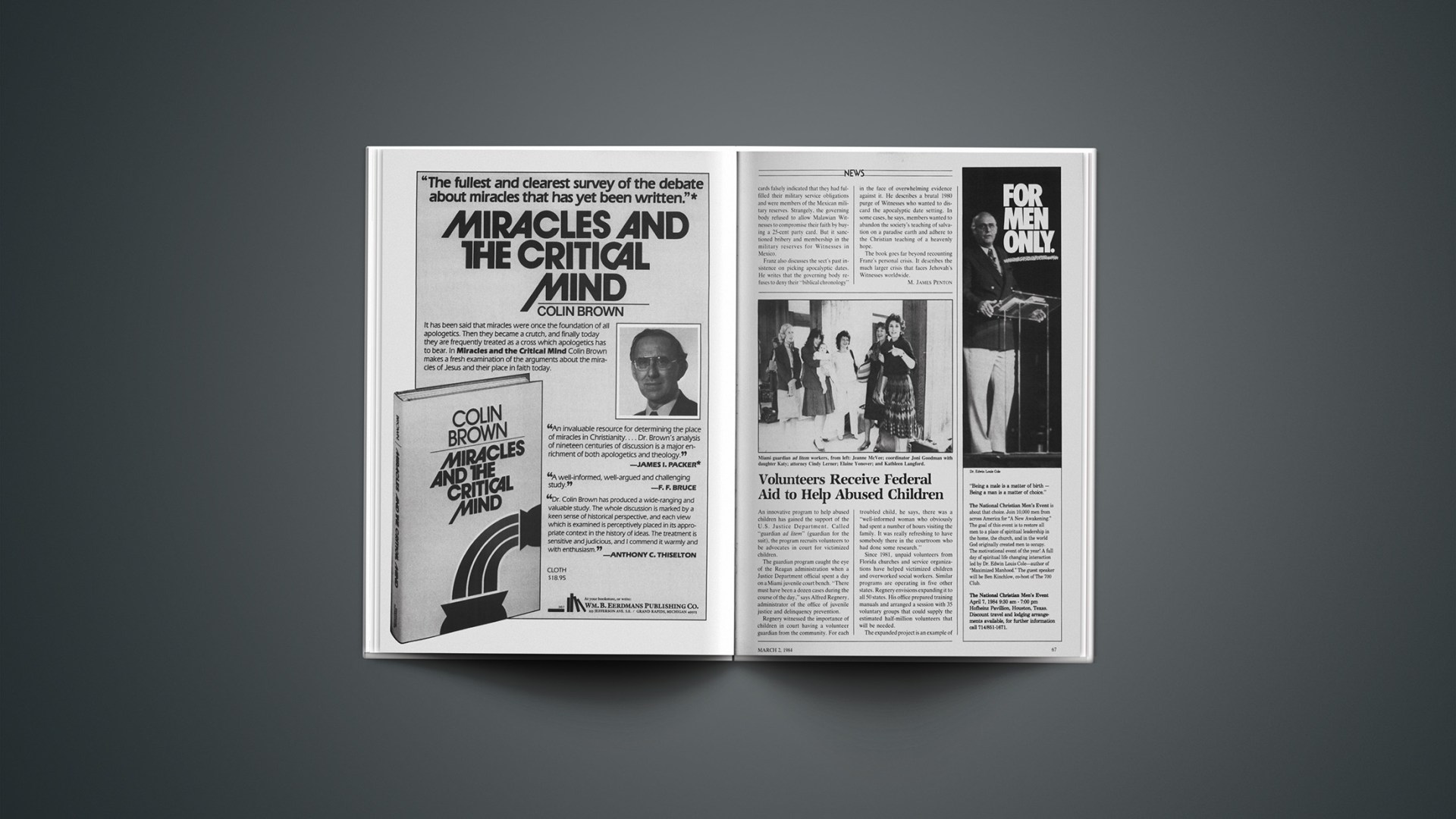
Volunteers Receive Federal Aid to Help Abused Children

An innovative program to help abused children has gained the support of the U.S. Justice Department. Called “guardian ad litem” (guardian for the suit), the program recruits volunteers to be advocates in court for victimized children.

The guardian program caught the eye of the Reagan administration when a Justice Department official spent a day on a Miami juvenile court bench. “There must have been a dozen cases during the course of the day,” says Alfred Regnery, administrator of the office of juvenile justice and delinquency prevention.

Regnery witnessed the importance of children in court having a volunteer guardian from the community. For each troubled child, he says, there was a “well-informed woman who obviously had spent a number of hours visiting the family. It was really refreshing to have somebody there in the courtroom who had done some research.”

Since 1981, unpaid volunteers from Florida churches and service organizations have helped victimized children and overworked social workers. Similar programs are operating in five other states. Regnery envisions expanding it to all 50 states. His office prepared training manuals and arranged a session with 35 voluntary groups that could supply the estimated half-million volunteers that will be needed.

The expanded project is an example of how President Reagan’s profamily and provolunteer philosophy is emerging in federal policy. The program’s goal is to find a suitable, permanent home for children who are likely to slide into a life of exploitation or deliquency.

Regnery says active involvement by volunteers “increases the likelihood of these children being returned to the natural family, if that is possible, or put up for permanent adoption instead of being put in the foster-care system.

“One of the reasons children don’t find permanent homes is because when abuse and neglect cases get into the courtroom, they’re not very well represented,” he says. “Someone who works for the state or the county—and has a caseload of 50 to 100 kids—appears before a judge who has to rely on what other people tell him. Volunteers can give the judge an educated analysis of the problem and the solutions.”

In Florida, the use of volunteer guardians has cut in half the length of time that abused children are shuttled from one foster home to the next. The Miami project is sponsored by the National Council for Jewish Women and the Junior League. Coordinator Joni Goodman has trained more than 100 volunteers from those groups and others. The volunteer guardians spend 5 to 10 hours per week on each case. “They monitor the system as the child flows through to see that the child doesn’t languish,” Goodman says.

One of the volunteers, Kathleen Langford, devotes almost full time to the project. She enlisted the support of her United Methodist church to start support groups for sexually abused children and their siblings, and for women who were abused when they were young. Her role as a guardian involves being a buffer between the child and the impersonal, sometimes hostile, court system.

Once, a prosecuting attorney wanted to call a 5-year-old girl to the witness stand to discuss a sexual abuse incident. “I went with her to the depositions, and I was the only one who spoke up and said the questions were inappropriate,” Langford says. “Had a guardian not been there, she would have been subjected continuously to the harangue of the lawyers.”

Attorneys sometimes resent interference by a lay advocate. But judges tend to support the program. An organization for juvenile court judges received a $4.4 million federal grant from Regnery’s office to promote and organize the guardian program nationwide. The Miami project was begun with $37,000 and has expanded to an annual budget of more than $50,000.

Regnery measures the cost of guardian programs against a grim statistic: It costs taxpayers $40,000 a year to house a teenage lawbreaker in a correctional institution. “Some 40 percent of serious crime is committed by juveniles,” he says. Overwhelming numbers of young offenders and runaways have a history of abuse or neglect, which often leads to a life spent drifting through foster homes.

“When you add all these things up, you realize that where there’s not a permanent home, you’re very likely to wind up with this kind of lifestyle,” he says. “No matter where you look, a stable family setting is the place where criminality and delinquency are prevented.”

A Jewish Scholar Calls Christ’S Resurrection A Historical Fact

An Orthodox Jewish scholar argues in a new book that the resurrection of Jesus is a historical fact. The author, Pinchas Lapide, a New Testament specialist who teaches in West Germany, denies that Jesus was the divine Son of God or the long-awaited Messiah of the Jews. He does, however, suggest that Jesus is the Messiah of the Gentile church.

The book, The Resurrection of Jesus: A Jewish Perspective, was first published in German in 1977. The English translation was released by Augsburg Publishing House late last year.

Lapide says his work has rocked the boat in some Jewish scholarly circles. “I don’t know of anybody in the history of Judaism who has not gotten into trouble for saying something new,” he says. “But I have written that God raised Jesus from the dead because I’m thoroughly convinced it’s true.”

He writes that the New Testament account could only have been written by men “deeply convinced that this miserable dying of the Nazarene [was not] the last word of God.” He asserts that dismissing the Resurrection as a vision or hallucination does not explain that revolutionary transformation that followed the Easter event.

The scholar says virtually all the witnesses to the earthly life of Christ were Jews, and that both before and after the crucifixion Jesus ministered only within his homeland. He thus describes the Resurrection as “a Jewish faith experience.” Lapide compares Christ’s suffering and martyrdom to the suffering experienced by Jews in Auschwitz, concluding that “the cause of Jesus is basically the cause of Israel.”

Lapide notes that the Old Testament reports the resurrections or resuscitations of several individuals. Judaism later came to believe in a future, generalized resurrection of believers, which became a tenet of Jewish Orthodoxy. While providing a context for the Resurrection in the Jewish faith, he criticizes modern theologians who seem “ashamed of the material facticity of the Resurrection.”

Has his acknowledgment of the Resurrection brought him any closer to embracing Christianity? “Certainly not,” Lapide says. “Every day I wait and pray for the coming of the Messiah.” Yet he affirms that God was behind the faith that sprang from the Resurrection. He writes that the “experience of the Resurrection as the foundation act of the church which has carried the faith in the God of Israel into the whole Western world must belong to God’s plan of salvation.…”

Lapide, 62, devotes much of his time and energy to Jewish-Christian dialogue. Some American religious scholars have hailed his book as a major contribution to that dialogue. United Methodist theologian Albert Outler says the book is valuable for its “illumination of the Jewish perspective on resurrection, its critique of Christian demythologizing of the Resurrection of Jesus, [and] its refocusing of the crucial issue of kinship and alienation between Jews and Christians.”

RELIGIOUS NEWS SERVICE

Churches’ Support Falters When Their Workers Organize

United Methodist and Roman Catholic leaders are being accused of following a double standard when it comes to workers’ rights. Both churches have stood behind the trade union movement in the past. But when some of their own employees have organized to bargain for improved wages and benefits, the churches have not always been supportive.

The 9.5-million-member United Methodist Church has long stated its support for collective bargaining. In 1908, the Methodist Episcopal Church—a forerunner of the United Methodist Church—issued a statement upholding the right of workers to organize. United Methodists supported California farm workers in 1976 and employees of the formerly antiunion J. P. Stevens Company in 1980.

But when denominational employees are involved, the support seems to falter. In 1982, employees of the church’s General Board of Global Ministries, with headquarters in New York City, voted 133 to 88 to join the United Auto Workers Union. However, their attempts to negotiate a contract with improved wages and benefits has been fruitless so far.

They say they are among the lowest-paid denominational workers in the nation. Although a wage increase became effective this year, it was less than the employees wanted, and they lost many benefits they had previously enjoyed.

In a letter to union members, the employees’ negotiating committee accused the Global Ministries’ director and its legal counsel of “outright deceit,” “a violation of good faith bargaining,” and a “patronizing attitude” toward its approximately 250 workers. Most of the employees are secretaries, receptionists, and clerical workers.

“There is definitely a discrepancy between the church’s teachings and its actions,” says Ron Stoner, a member of the union’s negotiating committee. “In nine months of negotiating, we have had 33 sessions, all called by management and none of them dealing with our list of problems. Our salaries start at around $150 [per week] and go to around $420, well below the wages for employees of the National Council of Churches, which our church supports.…”

“We have tried to be principled and forthright throughout the negotiations,” says Don Will, another union member. “Our most confrontative action was a 10-minute pray-in at the office of the general secretary. I feel we have been more in line with the principles of the church than the board, which has conducted itself in an authoritarian manner and hired an antiunion lawyer.”

The General Board of Global Ministries referred all questions to its attorney, Robert Lees. Lees is a Philadelphia lawyer who has defended major corporations in union disputes.

“Global Ministries has a lot of employees,” he says. “They live in a very expensive city, and they see a lot of other people making a lot of money. Both sides are very serious.”

He denies the charge that the church is turning its back on its workers. “The employees had very favorable conditions of employment,” he says. “And I don’t think you can turn the workers’ right to organize into a policy that would inhibit the right of stewardship that the board exercises on behalf of the whole denomination. The board has acted in perfectly good faith.”

Stoner disagrees with Lees’s assessment. The negotiating committee member says the workers presented a wage and benefit proposal to the board a year ago. He says the board responded with a counterproposal that “started at point zero, removing any benefits that were not federally mandated. So we had to talk months just to reinstate what we had lost.”

United Methodist employees aren’t the only church workers who find themselves at odds with management. Many of the nation’s Catholic school and hospital employees are engaged in a similar struggle. Pope John Paul II has publicly supported the right of workers to organize. But the Catholic church in this country has opposed several efforts at collective bargaining among its school and hospital employees.

Many of America’s 120,000 Catholic lay teachers are organizing to try to improve their wages and benefits, says Rita Schwartz, secretary-treasurer of the National Association of Catholic School Teachers. The teachers’ salaries vary from $9,000 to $30,000 per year, she says, and many work without health benefits. Lay teachers are organizing or negotiating in Pittsburgh; Philadelphia; Chicago; Saint Louis; Newark; Fort Wayne and South Bend, Indiana; and in other cities, she says. Their national union claims 3,000 members.

The teachers association has met with mixed success. Some of the teachers have gone on strike after contracts expired. And the church doesn’t always accept union negotiators with open arms.

“There is definite opposition to teachers organizing,” Schwartz says. “Catholic lay teachers have seen an amazing number of roadblocks and games.”

Like their counterparts in Catholic schools, organized workers in Catholic hospitals are meeting church opposition. Some dioceses have fought unionizing attempts by hiring one of 5,000 consulting firms that specialize in preventing or decertifying unions, says George Higgins, a priest who formerly headed the social action department of the U.S. Catholic Conference. Another tactic involves petitioning a federal court to prohibit the government from ordering union elections in parochial schools, he says.

For the workers, unions mean more than the possibility of improved wages and benefits. Says Schwartz: “They want representation and something they can have a say in, not something handed to them in a take-it-or-leave-it attitude.”

North American Scene

A North Carolina judge has declared the state’s bingo law unconstitutional. District Judge Paul Wright dismissed gambling charges against an employee of a Goldsboro tavern after the defense lawyer argued that the law was unconstitutional. The law allowed churches and other tax-exempt groups to conduct bingo games and raffles. But that right was denied to other groups. Unless the state’s supreme court upholds Wright’s ruling, it might have no effect outside his courtroom.

The parents of a 13-year-old cancer victim are dropping their battle to have their daughter removed from court-ordered medical treatment. Larry Hamilton, a fundamentalist Tennessee pastor, had cited religious grounds for refusing to allow his daughter to be treated for a rare type of bone cancer. The girl is responding well to the chemotherapy she has been receiving since September.

Biology textbooks used in Texas public schools do not have to mention Charles Darwin. The state’s board of education rejected a proposal that would have required that biology texts mention Darwin and others “who have advanced biological science.” Critics accused the board of bowing to pressure from Christians who opposed any requirement that the theory of evolution be mentioned.

An antiwar group has won the right to counsel Chicago public school students against registering for the draft. Federal District Judge George Leighton ruled that the school board’s practice of giving military recruiters access to the school while denying antiwar groups the same privilege violated the free speech provisions of the First Amendment. The Chicago school board has filed for reconsideration of the ruling.

Laws requiring parental consent before minors can obtain abortions have failed to increase parents’ involvement in such decisions, according to a report in Family Planning Perspectives. Abortion clinics and referral centers in Massachusetts, Minnesota, and Rhode Island report that 20 to 50 percent of their teenage clients choose court appearances rather than seek their parents’ consent for abortions. The U.S. Supreme Court has ruled that a state can require parental consent only if a minor is allowed to seek permission from a judge if she doesn’t want to consult her parents.

The United Methodist women’s agency is organizing a nationwide drive to train women to run for political office and to work in political campaigns. Theressa Hoover, of the United Methodist women’s division, said the agency will conduct workshops in nearly every state to train 10,000 women in the basics of running a campaign. The agency hopes to train at least 250 women who will run for local and state offices in the 1986 elections.

President Reagan’s views opposing abortion will appear in a book to be published next month by Thomas Nelson. The book, Abortion and the Conscience of the Nation, will include an article by Reagan originally published in Human Life Review. The book also will include articles by Malcolm Muggeridge and U.S. Surgeon General C. Everett Koop.

Brain research has failed to develop evidence to disprove the Christian idea that man has a free will, a soul, and an eternal destiny, according to David Mackay, professor of communications and neuroscience at the University of Keele in Keele, England. Speaking in the United States, Mackay denounced the idea that once science develops a purely mechanistic theory of the brain, it could “debunk all religious and moral concepts of man.”

World Scene

Romanian President Nicolae Ceausescu has called for an increased emphasis on atheistic teaching in his country’s schools. The action comes in the wake of evidence that young people are turning to religious groups, especially to the 200,000-member Romanian Baptist Church.

Leftist guerrillas in Colombia have freed an American missionary they held for five months. U.S. embassy officials in Bogotá said Russell Stendal, 28, was freed in early January. The guerrillas had asked for a $500,000 ransom. It isn’t known how much Stendal’s family paid for his release.

The Portugese Parliament has voted to liberalize the country’s abortion laws. Sponsored by members of the socialist party, the bill does not legalize all abortions. But it waives prosecution in cases of fetal deformity, pregnancy following rape, and when a woman’s life would be endangered by giving birth.

The city council of Gävle, Sweden, is experimenting with a civil ceremony intended as a substitute for infant baptism. In the ceremony, a text is read that reminds parents of their responsibility to raise their children properly and safely. “Even people who are not religious want to have traditions and festivity in life,” said Olle Melin, the city council member who wrote the text.

A boycott against the Nestlé Corporation has been suspended after nearly seven years. However, the International Nestlé Boycott Committee said it will continue to monitor the company’s compliance with the World Health Organization code for marketing infant formula. Critics argued that unsanitary water supplies and illiteracy in developing nations led to the deaths of thousands of formula-fed infants.

China has canceled its formal campaign against “spiritual pollution.” The three-month crusade was intended to combat unwelcome foreign values and influences. However, it created more problems than it solved. Maoists were taking advantage of the opportunity to criticize changes brought about by increased Chinese trade with the West.

The United States has approved the sale of $28.3 million in arms technology to South Africa. The American Friends Service Committee and the Washington Office on Africa say the sale violates the United Nations embargo on arms and related material going to South Africa. The white-ruled country enforces a form of racial segregation known as apartheid.

An Excommunicated Scholar Reveals Errors In The Jehovah’S Witnesses

From 1971 to 1980, Raymond Franz was a prominent member of the Jehovah’s Witnesses governing body. A nephew of the society’s president, Fred Franz, and a well-known Witness in his own right, Raymond Franz was a highly influential figure.

Franz was one of the sect’s foremost scholars. But in 1980, after being forced to resign from the governing body, he left the sect’s headquarters in Brooklyn. The following year he was excommunicated, supposedly for dining with his friend and employer Peter Gregerson. Gregerson already had resigned from the Witnesses and was officially regarded as an apostate.

Franz says that his own excommunication was designed to keep him from talking to his Witness brethren. If they had been allowed to associate with him, he says, they would have learned about the problems at the sect’s headquarters. To get the story out, Franz wrote Crisis of Conscience (Commentary Press).

In the recently published book, he describes the 14 years he spent at Watchtower headquarters. He writes that legalism dominates the thinking of the sect’s leaders. They are constantly concerned with violations of Watchtower sexual morality; they are hostile to the academic world; and they are preoccupied with their predictions of the end of the world, he says.

One of Franz’s most shocking accounts deals with the governing body’s double standards. The sect has long taught that adherents must not belong to political parties, vote in elections, salute flags, or perform military service because of their supposed Christian neutrality. As a result, when Malawian President Kamuzu Banda demanded that every Malawian buy a party card from the Malawi Congress Party, Jehovah’s Witnesses refused. They were assaulted, raped, and tortured for their stand. Thousands of them were driven out of the country, and many of them died.

Yet, at the same time, Franz writes, Jehovah’s Witnesses in Mexico were illegally buying military service cards. The cards falsely indicated that they had fulfilled their military service obligations and were members of the Mexican military reserves. Strangely, the governing body refused to allow Malawian Witnesses to compromise their faith by buying a 25-cent party card. But it sanctioned bribery and membership in the military reserves for Witnesses in Mexico.

Franz also discusses the sect’s past insistence on picking apocalyptic dates. He writes that the governing body refuses to deny their “biblical chronology” in the face of overwhelming evidence against it. He describes a brutal 1980 purge of Witnesses who wanted to discard the apocalyptic date setting. In some cases, he says, members wanted to abandon the society’s teaching of salvation on a paradise earth and adhere to the Christian teaching of a heavenly hope.

The book goes far beyond recounting Franz’s personal crisis. It describes the much larger crisis that faces Jehovah’s Witnesses worldwide.

M. JAMES PENTON

Apple PodcastsDown ArrowDown ArrowDown Arrowarrow_left_altLeft ArrowLeft ArrowRight ArrowRight ArrowRight Arrowarrow_up_altUp ArrowUp ArrowAvailable at Amazoncaret-downCloseCloseEmailEmailExpandExpandExternalExternalFacebookfacebook-squareGiftGiftGooglegoogleGoogle KeephamburgerInstagraminstagram-squareLinkLinklinkedin-squareListenListenListenChristianity TodayCT Creative Studio Logologo_orgMegaphoneMenuMenupausePinterestPlayPlayPocketPodcastRSSRSSSaveSaveSaveSearchSearchsearchSpotifyStitcherTelegramTable of ContentsTable of Contentstwitter-squareWhatsAppXYouTubeYouTube