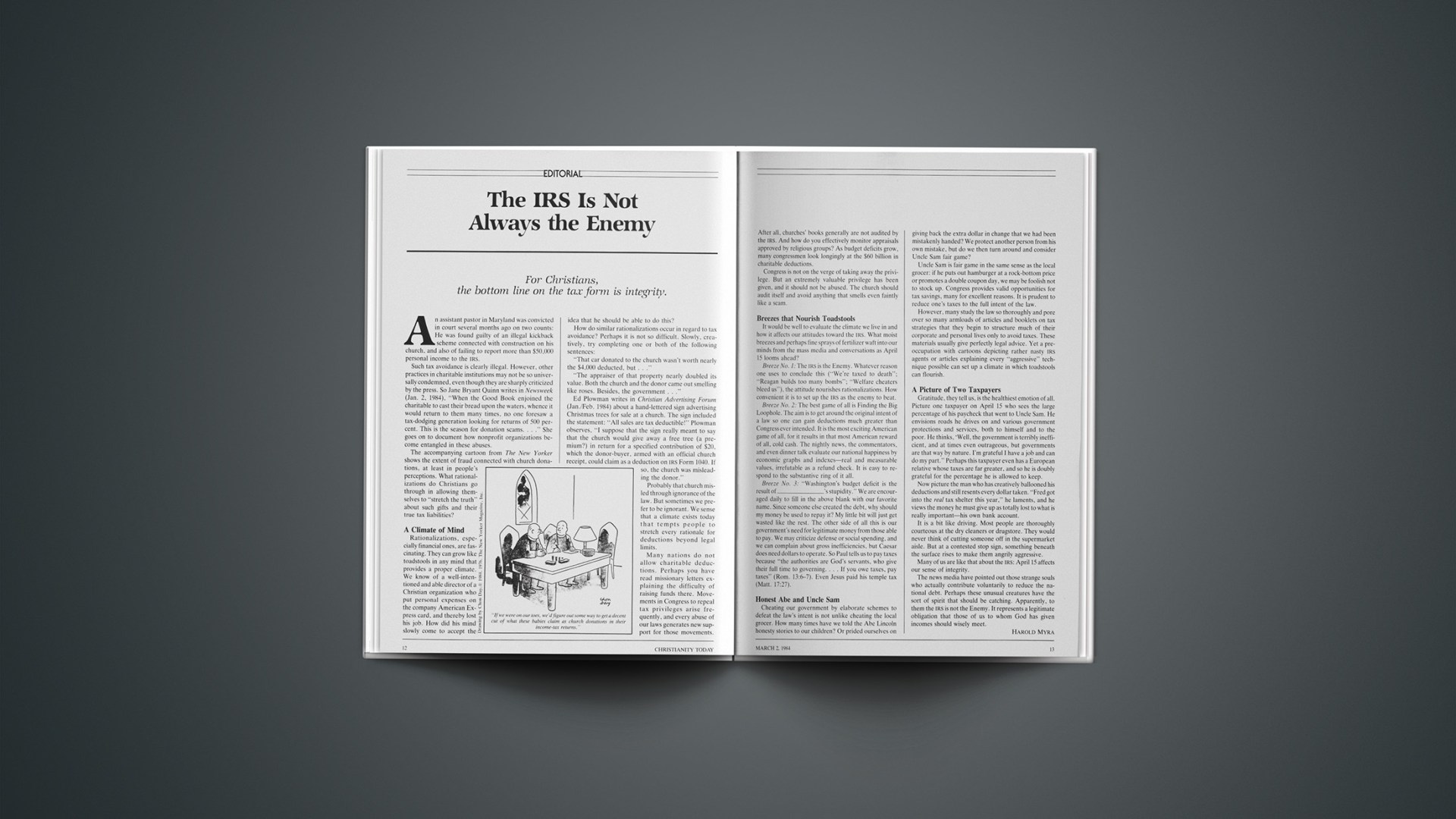
A Virginia College Bans an Antiabortion Painting

A five-month-old fetus is part of the artwork. Is it a human body? That’s the crucial question.

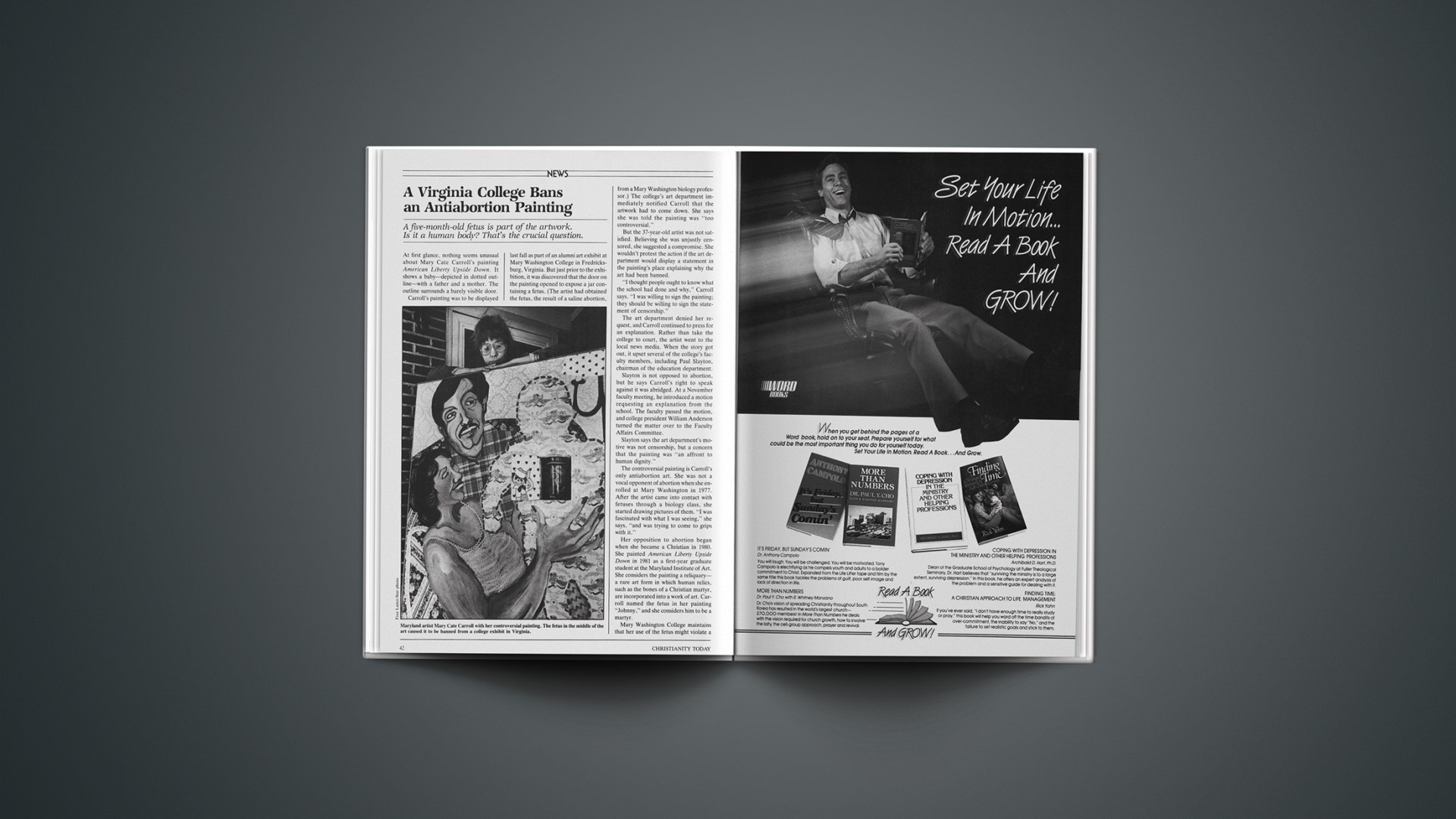
At first glance, nothing seems unusual about Mary Cate Carroll’s painting American Liberty Upside Down. It shows a baby—depicted in dotted outline—with a father and a mother. The outline surrounds a barely visible door.

Carroll’s painting was to be displayed last fall as part of an alumni art exhibit at Mary Washington College in Fredricksburg, Virginia. But just prior to the exhibition, it was discovered that the door on the painting opened to expose a jar containing a fetus. (The artist had obtained the fetus, the result of a saline abortion, from a Mary Washington biology professor.) The college’s art department immediately notified Carroll that the artwork had to come down. She says she was told the painting was “too controversial.”

But the 37-year-old artist was not satisfied. Believing she was unjustly censored, she suggested a compromise. She wouldn’t protest the action if the art department would display a statement in the painting’s place explaining why the art had been banned.

“I thought people ought to know what the school had done and why,” Carroll says. “I was willing to sign the painting; they should be willing to sign the statement of censorship.”

The art department denied her request, and Carroll continued to press for an explanation. Rather than take the college to court, the artist went to the local news media. When the story got out, it upset several of the college’s faculty members, including Paul Slayton, chairman of the education department.

Slayton is not opposed to abortion, but he says Carroll’s right to speak against it was abridged. At a November faculty meeting, he introduced a motion requesting an explanation from the school. The faculty passed the motion, and college president William Anderson turned the matter over to the Faculty Affairs Committee.

Slayton says the art department’s motive was not censorship, but a concern that the painting was “an affront to human dignity.”

The controversial painting is Carroll’s only antiabortion art. She was not a vocal opponent of abortion when she enrolled at Mary Washington in 1977. After the artist came into contact with fetuses through a biology class, she started drawing pictures of them. “I was fascinated with what I was seeing,” she says, “and was trying to come to grips with it.”

Her opposition to abortion began when she became a Christian in 1980. She painted American Liberty Upside Down in 1981 as a first-year graduate student at the Maryland Institute of Art. She considers the painting a reliquary—a rare art form in which human relics, such as the bones of a Christian martyr, are incorporated into a work of art. Carroll named the fetus in her painting “Johnny,” and she considers him to be a martyr.

Mary Washington College maintains that her use of the fetus might violate a Virginia law regarding the disposition and control of dead human bodies and body parts.

In an address to the faculty, college president William Anderson said the decision to remove the controversial painting was based not on “moral, political, or philosophical considerations” but on concern for the law.

Anderson implied in his address that the college had sought expert legal opinion, including an interpretation from Virginia’s attorney general, before having the painting removed. But Carroll says she was not told about the possible violation of law until weeks after the exhibit had ended.

The artist has no plans to sue the college. But on her behalf, a lawyer is seeking an interpretation from the attorney general’s office of state laws governing the handling of dead bodies.

“I would feel good if they rule against me,” Carroll says. By ruling that she violated a law pertaining to dead bodies, she says, “it would mean they are saying that Johnny is a dead human body. And if there’s a body, it follows that there has to be a crime.”

Former Ncc Head Leaves Ministry Of The United Methodist Church

Former National Council of Churches (NCC) president James Armstrong has surrendered his credentials as a minister in the United Methodist Church. Last November, Armstrong resigned as United Methodist bishop of Indiana and as president of the NCC (CT, Dec. 16, 1983, p. 46).

Armstrong informed the church of his latest decision in a brief letter to the bishop who replaced him. By citing a provision in the church’s Book of Discipline. Armstrong left open the possibility that he might become a minister in another denomination. But he has not indicated that he plans to do so.

His withdrawal from the church’s ministry in January is believed to be unprecedented for a former United Methodist bishop. Church spokesman James Steele emphasized that Armstrong has not abandoned Christian service. He described Armstrong’s action as “a routine procedure for someone who wants to leave open the possibility of serving in another denomination.”

When he resigned as a United Methodist bishop last fall, Armstrong said he was “physically and emotionally depleted” due to “an exhausting and inhuman work schedule.” He is working as a counselor for international students at a community college in Fort Lauderdale, Florida.

March For Life

As many as 75,000 banner-waving demonstrators converged on Washington, D.C., January 23. The March for Life protested the 1973 U.S. Supreme Court decision Roe v. Wade, which legalized abortions. Since that ruling, some 15 million abortions have been performed in this country. The annual march attempts to rally support for a constitutional amendment to protect the rights of the unborn.

Photos, counterclockwise from top: Marchers walk from the White House to the Supreme Court building. U.S. Representative Henry Hyde (R-Ill.) speaks to the crowd. March leader Nellie Gray with Melody Green, widow of the late gospel singer Keith Green. The 1984 March for Life was the largest in recent years.
Reagan Stirs the Broadcasters with an Evangelical Speech

Thunderous applause for John 3:16.

President Reagan opened his reelection campaign by aligning himself more closely than ever before with conservative Christian moral causes.

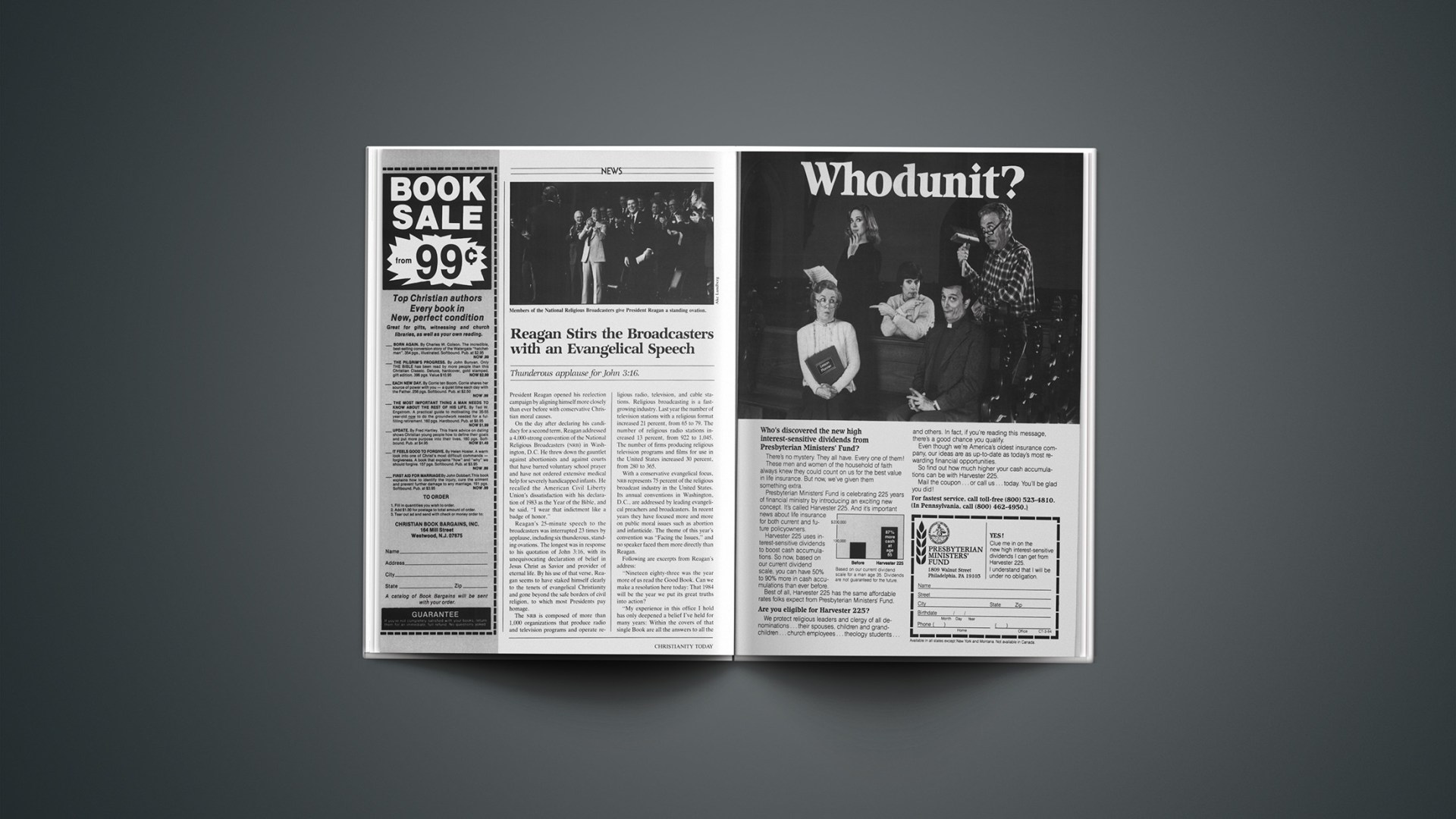
On the day after declaring his candidacy for a second term, Reagan addressed a 4,000-strong convention of the National Religious Broadcasters (NRB) in Washington, D.C. He threw down the gauntlet against abortionists and against courts that have barred voluntary school prayer and have not ordered extensive medical help for severely handicapped infants. He recalled the American Civil Liberty Union’s dissatisfaction with his declaration of 1983 as the Year of the Bible, and he said, “I wear that indictment like a badge of honor.”

Reagan’s 25-minute speech to the broadcasters was interrupted 23 times by applause, including six thunderous, standing ovations. The longest was in response to his quotation of John 3:16, with its unequivocating declaration of belief in Jesus Christ as Savior and provider of eternal life. By his use of that verse, Reagan seems to have staked himself clearly to the tenets of evangelical Christianity and gone beyond the safe borders of civil religion, to which most Presidents pay homage.

The NRB is composed of more than 1,000 organizations that produce radio and television programs and operate religious radio, television, and cable stations. Religious broadcasting is a fast-growing industry. Last year the number of television stations with a religious format increased 21 percent, from 65 to 79. The number of religious radio stations increased 13 percent, from 922 to 1,045. The number of firms producing religious television programs and films for use in the United States increased 30 percent, from 280 to 365.

With a conservative evangelical focus, NRB represents 75 percent of the religious broadcast industry in the United States. Its annual conventions in Washington, D.C., are addressed by leading evangelical preachers and broadcasters. In recent years they have focused more and more on public moral issues such as abortion and infanticide. The theme of this year’s convention was “Facing the Issues,” and no speaker faced them more directly than Reagan.

Following are excerpts from Reagan’s address:

“Nineteen eighty-three was the year more of us read the Good Book. Can we make a resolution here today: That 1984 will be the year we put its great truths into action?

“My experience in this office I hold has only deepened a belief I’ve held for many years: Within the covers of that single Book are all the answers to all the problems that face us today—if only we’d read and believe …

“I know what I am about to say now is controversial, but I have to say it. This nation cannot continue turning a blind eye and a deaf ear to the taking of some 4,000 unborn children’s lives every day. That’s one every 21 seconds. We cannot pretend America is preserving her first and highest ideal—the belief that each life is sacred—when we have permitted the death of 15 million helpless innocents since the Roe v. Wade decision.

“Fifteen million children who will never laugh, never sing, never know the joy of human love; will never strive to heal the sick, feed the poor, or make peace among nations. Abortion has denied them the most basic of human rights. We are all infinitely poorer for their loss.…

“I think we are making progress in upholding the sanctity of life of infants born with physical or mental handicaps. The Department of Health and Human Services has now published final regulations to address cases such as Baby Doe in Bloomington [Ind.]. That child was denied lifesaving surgery and starved to death because he had Down’s syndrome; and some people didn’t think his life would be worth living. Not too long ago I was privileged to meet in the Oval Office a charming little girl filled with the joy of living. She was on crutches, but she swims and rides horseback. Her smile steals your heart. She was born with the same defects as those ‘Baby Does’ who have been denied the right to life.

“Restoring the right to life and protecting people from violence and exploitation are important responsibilities. But as members of God’s family we share another—helping to build a foundation of faith and knowledge to prepare our children for the challenges of life. ‘Train up a child in the way he should go,’ Solomon wrote, ‘and when he is old he will not depart from it.’

“Teddy Roosevelt told us, ‘The American people are slow to wrath, but when their wrath is once kindled, it burns like a consuming flame.’ I think Americans are getting angry. I think they have a message, and Congress better listen: We are a government of, by, and for the people. And people want a constitutional amendment making it unequivocally clear our children can hold voluntary prayer in every school across this land. And if we could get God and discipline back in our schools, maybe we could get drugs and violence out. I know that some believe prayer in schools should be restricted to a moment of silence. Well, we already have the right to remain silent. We need a new amendment to restore the rights that were taken from us. Senator [Howard] Baker has assured us we will get a vote on our amendment. With your help, we can win. And that will be a great victory for our children.

“ ‘For God so loved the world, that he gave his only begotten Son, that whosoever believeth in him should not perish, but have everlasting life.’ I’m a little self-conscious, because I know you all could recite that verse to me. Helping each other, believing in him, we need never be afraid. We will be part of something far more powerful, enduring, and good than all the forces here on earth. We will be a part of paradise. May God keep you always, and may you always keep God.”

TOM MINNERYin Washington

Here’s a Novel Way to Help Put a Student through College

Here’S A Novel Way To Help Put A Student Through College

It can cost more than $7,000 per year to send a student to a major private college—a price that is out of reach for many families. That is why two corporate executives and an attorney established Assistance Ltd. The Illinois-based bartering system has helped finance the educations of more than 60 students who otherwise could not afford it.

“We encourage corporations to donate their excess, obsolete, or slow-moving inventory items,” says George Ferris, treasurer of the not-for-profit organization. “Then we contact private liberal arts colleges who can use the items and are willing to grant college scholarships in exchange for them.

“We have helped a number of Christian kids who wanted to attend Christian colleges,” he says. “But Assistance Ltd. is not restricted to Christian schools.”

After companies donate goods and equipment, the items are listed in brochures and mailed to colleges. Interested schools send representatives to examine the goods. If a college accepts any donated items, it agrees to award a scholarship to a needy student in the name of the corporate donor. Most of the scholarships have ranged from $1,000 to $3,000. The bartering approach is believed to be unique among scholarship efforts within the private sector.

A young man whose father had died years earlier received help that enabled him to enroll at Missouri Valley College in Marshall, Missouri. His scholarship was made possible by a donation of office furniture from the Monsanto Company. Monsanto provided Assistance Ltd. with $100,000 worth of furniture. Already $80,000 worth has been bartered for scholarships at three colleges. An additional $20,000 in furniture still is available to be bartered.

Ferris and his cofounders at Assistance Ltd.—V. R. Roskam and Gordon Trapp—say businesses are receptive to the idea. W. W. Grainger, Inc., donated motors, pumps, compressors, vacuum machines, and other pieces of maintenance equipment. So far $12,000 worth of the equipment has been split between North Park College and Loyola University, both in Chicago. Some 50 colleges have participated in the bartering system. Ferris says he would like to involve as many as 300 private colleges across the country.

He and his partners help match company donations with colleges. And they often recruit needy students themselves. In at least one case, a thankful student is planning to repay the scholarship he received.

“He’s an All-American in college football,” Ferris says, “and he’s been approached by a professional football team.” He says the athlete told him: “ ‘If I get this contract, I’d like to help Assistance [Ltd.] out—at least to pay back what I was given.’ ”

DAN PAWLEY

Dobson Tells Reagan To Focus On The Family

Christian psychologist James Dobson took advantage of a chance to advise President Reagan during a January White House luncheon. At the President’s invitation, Dobson suggested ways the government could better meet the needs of American families.

He said the President should help call the nation back to traditional family values. And he recommended that studies be conducted to determine how government policies affect families.

In addition, Dobson told Reagan that the government could do more to promote adoption as an alternative to abortion. Other advocates of family values attended the luncheon, along with Vice President George Bush and presidential advisers Edwin Meese and James A. Baker.

Dobson later presented detailed suggestions to administration officials. White House aides had been discussing ideas related to family well-being in preparation for Reagan’s reelection campaign. One staff report suggested that families are the most important area of involvement for most Americans.

As a result of such interest on the part of the administration, experts on the family might find they have easier access to the Oval Office between now and the November election.

A Royal Reception for Billy Graham in England

A rally for his forthcoming crusade draws what may be the largest gathering of churchmen in British history.

Someone has said that England is a nice country—it only needs a roof. This January, the dampness came with cutting cold temperatures. The weather caused the organizers of Mission England to scale back their estimate of the number of pastors and laymen expected in Birmingham for a preparatory rally.

Mission England is a mammoth spring and summer evangelistic outreach featuring Billy Graham. At the January meeting, the churchmen were to hear Graham explain the nature of revival and encourage them to take part in the six-city crusade, which will run from May 12 through July 27.

With the atrocious winter weather, estimates of attendance at the January rally were low. Perhaps as few as 400 would come, or as many as 2,000. As the meeting day approached, however, it was clear there would be many more than that. In all, some 11,800 clergymen and lay leaders jammed into the new National Exhibition Center to hear Graham. Some speculated that it might be the largest gathering of churchmen in British history.

The electricity in the huge crowd, and the triumphal attitude of so many in even having made it to Birmingham (some boarded chartered trains at 4:15 A.M.), were an apt conclusion to Graham’s 12-day midwinter visit to England. It was a publicity-building, rally-the-troops tour, and it was successful beyond imagination. British interest in Graham and his message is higher than at any time since his first London crusade 30 years ago, when crowds overflowed Harringay Arena and forced him to move into the city’s largest stadium, Wembley.

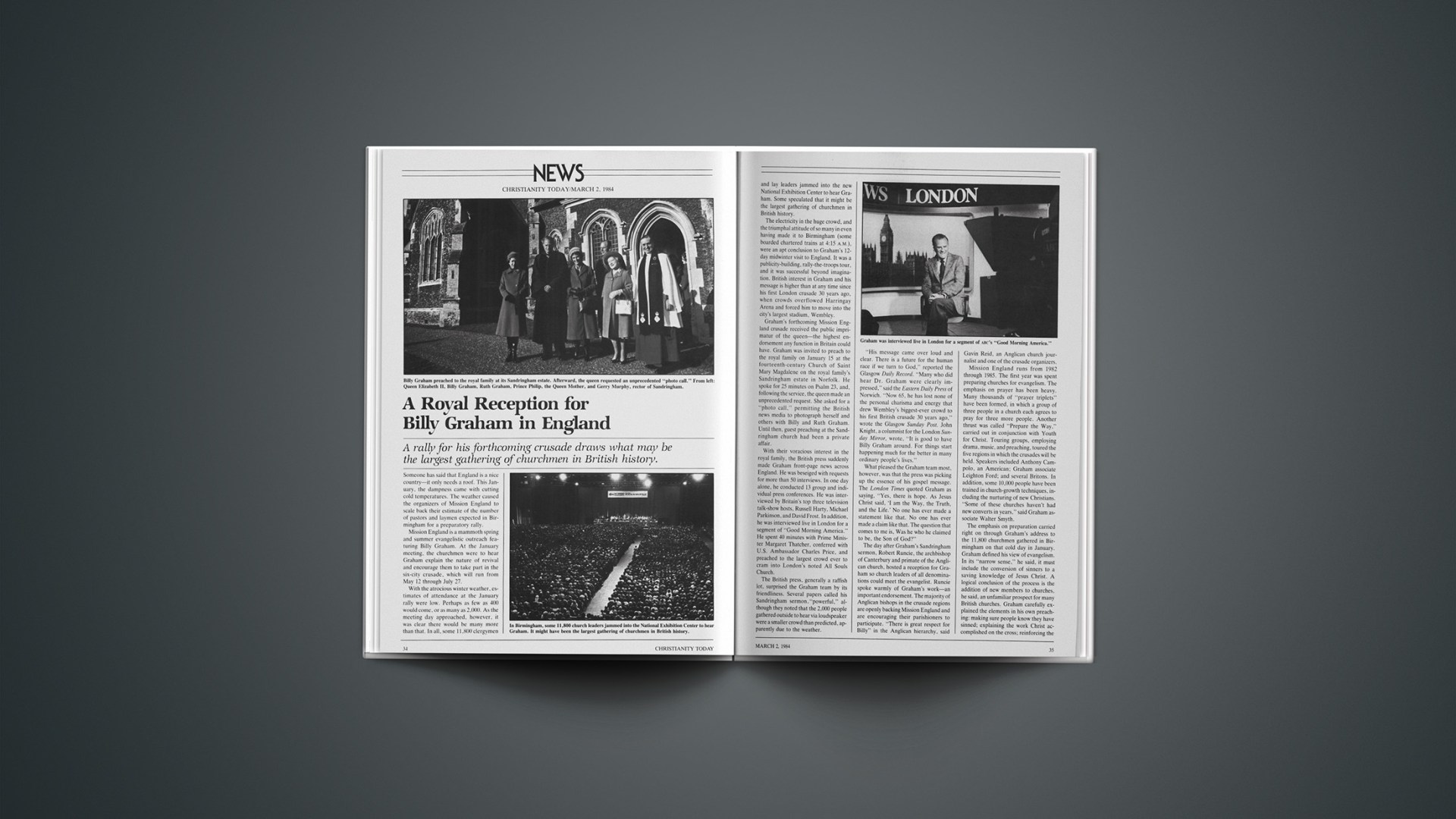
Graham’s forthcoming Mission England crusade received the public imprimatur of the queen—the highest endorsement any function in Britain could have. Graham was invited to preach to the royal family on January 15 at the fourteenth-century Church of Saint Mary Magdalene on the royal family’s Sandringham estate in Norfolk. He spoke for 25 minutes on Psalm 23, and, following the service, the queen made an unprecedented request. She asked for a “photo call,” permitting the British news media to photograph herself and others with Billy and Ruth Graham. Until then, guest preaching at the Sandringham church had been a private affair.

With their voracious interest in the royal family, the British press suddenly made Graham front-page news across England. He was beseiged with requests for more than 50 interviews. In one day alone, he conducted 13 group and individual press conferences. He was interviewed by Britain’s top three television talk-show hosts, Russell Harty, Michael Parkinson, and David Frost. In addition, he was interviewed live in London for a segment of “Good Morning America.” He spent 40 minutes with Prime Minister Margaret Thatcher, conferred with U.S. Ambassador Charles Price, and preached to the largest crowd ever to cram into London’s noted All Souls Church.

The British press, generally a raffish lot, surprised the Graham team by its friendliness. Several papers called his Sandringham sermon, “powerful,” although they noted that the 2,000 people gathered outside to hear via loudspeaker were a smaller crowd than predicted, apparently due to the weather.

“His message came over loud and clear. There is a future for the human race if we turn to God,” reported the Glasgow Daily Record. “Many who did hear Dr. Graham were clearly impressed,” said the Eastern Daily Press of Norwich. “Now 65, he has lost none of the personal charisma and energy that drew Wembley’s biggest-ever crowd to his first British crusade 30 years ago,” wrote the Glasgow Sunday Post. John Knight, a columnist for the London Sunday Mirror, wrote, “It is good to have Billy Graham around. For things start happening much for the better in many ordinary people’s lives.”

What pleased the Graham team most, however, was that the press was picking up the essence of his gospel message. The London Times quoted Graham as saying, “Yes, there is hope. As Jesus Christ said, ‘I am the Way, the Truth, and the Life.’ No one has ever made a statement like that. No one has ever made a claim like that. The question that comes to me is, Was he who he claimed to be, the Son of God?”

The day after Graham’s Sandringham sermon, Robert Runcie, the archbishop of Canterbury and primate of the Anglican church, hosted a reception for Graham so church leaders of all denominations could meet the evangelist. Runcie spoke warmly of Graham’s work—an important endorsement. The majority of Anglican bishops in the crusade regions are openly backing Mission England and are encouraging their parishioners to participate. “There is great respect for Billy” in the Anglican hierarchy, said Gavin Reid, an Anglican church journalist and one of the crusade organizers.

Mission England runs from 1982 through 1985. The first year was spent preparing churches for evangelism. The emphasis on prayer has been heavy. Many thousands of “prayer triplets” have been formed, in which a group of three people in a church each agrees to pray for three more people. Another thrust was called “Prepare the Way,” carried out in conjunction with Youth for Christ. Touring groups, employing drama, music, and preaching, toured the five regions in which the crusades will be held. Speakers included Anthony Campolo, an American; Graham associate Leighton Ford; and several Britons. In addition, some 10,000 people have been trained in church-growth techniques, including the nurturing of new Christians. “Some of these churches haven’t had new converts in years,” said Graham associate Walter Smyth.

The emphasis on preparation carried right on through Graham’s address to the 11,800 churchmen gathered in Birmingham on that cold day in January. Graham defined his view of evangelism. In its “narrow sense,” he said, it must include the conversion of sinners to a saving knowledge of Jesus Christ. A logical conclusion of the process is the addition of new members to churches, he said, an unfamiliar prospect for many British churches. Graham carefully explained the elements in his own preaching: making sure people know they have sinned; explaining the work Christ accomplished on the cross; reinforcing the need to repent; and explaining the cost of following Christ in discipleship.

Graham asked the ministers to prepare for the Mission England crusade by making sure no personal sin separates them from God, and by concentrating on prayer. He said he has seen poorly organized crusades become successful because of a strong prayer emphasis. He concluded his message to them by saying, “I will come here on my knees as your servant, not as a great preacher or evangelist, but as a servant in Christ’s name, to serve you.”

Starting with Harringay in 1954, Graham has preached five major British crusades, all but one in London. Partially for that reason, he will not preach there during this crusade. Luis Palau launched a London crusade last fall and will return to the city in June (CT, Feb. 17, 1984, p. 35). Graham will be touring six cities (Bristol, Sunderland, Norwich, Birmingham, Liverpool, and Ipswich). Three of those areas have been hard pressed by unemployment, a topic the crusade’s British organizers have asked Graham to be particularly sensitive to. There are other sensitivities as well. In Birmingham’s large Moslem community, the word “crusade” has an unsettling connotation.

Graham’s 12 days in London were among the most intensive of his long career. The strenuous schedule left him ill and exhausted. He checked into the Mayo Clinic upon his return to the United States, and was treated for an acute infection of the sinuses and left inner ear.

Six days later, he was well enough to check out and leave the country once again. He headed for an undisclosed location where he planned to rest and start work on the 40 sermons he will deliver during the coming crusade.

After Graham’s departure from England, crusade momentum kept building. Some 18,000 were expected at counseling classes in February, but the actual number of students was nearer 50,000.

Embryo Transfer: A Women Can Now Give Birth to Her Own Stepchild: But What Are the Moral and Legal Implications?

Marsha, age 32, and her husband, Tom, sat across from me in my office. I knew what they would be asking, for just weeks before the newspapers had described how a woman with permanently damaged Fallopian tubes became pregnant by a very new procedure, called ovum transfer (scientifically called in vivo fertilization).

The Kennedys had only one child and wanted another, but Marsha had suffered the loss of both Fallopian tubes. “Dr. Wells,” she said, “we’re desperate. All we want is one more baby.” They wanted a baby, but they also wanted to know from a Christian doctor whether they, as believers, should even be considering ovum transfer.

What Ovum Transfer Is

Over the next 45 minutes we talked about this controversial new procedure. Ovum transfer is a method of achieving pregnancy in women who have a uterus but absent or permanently damaged Fallopian tubes. It can even be used when the ovaries are gone. In other words, it is a bypass procedure that gets the male sperm to the female egg when the natural anatomic pathways are blocked or missing.

Ovum transfer is also called, with equal accuracy, human embryo transfer. Because the process necessarily involves what I believe is abortion and creates the possibility of genetic manipulation, it is certain to be among the most hotly debated issues of this decade. It is important, therefore, that Christians thoroughly understand it.

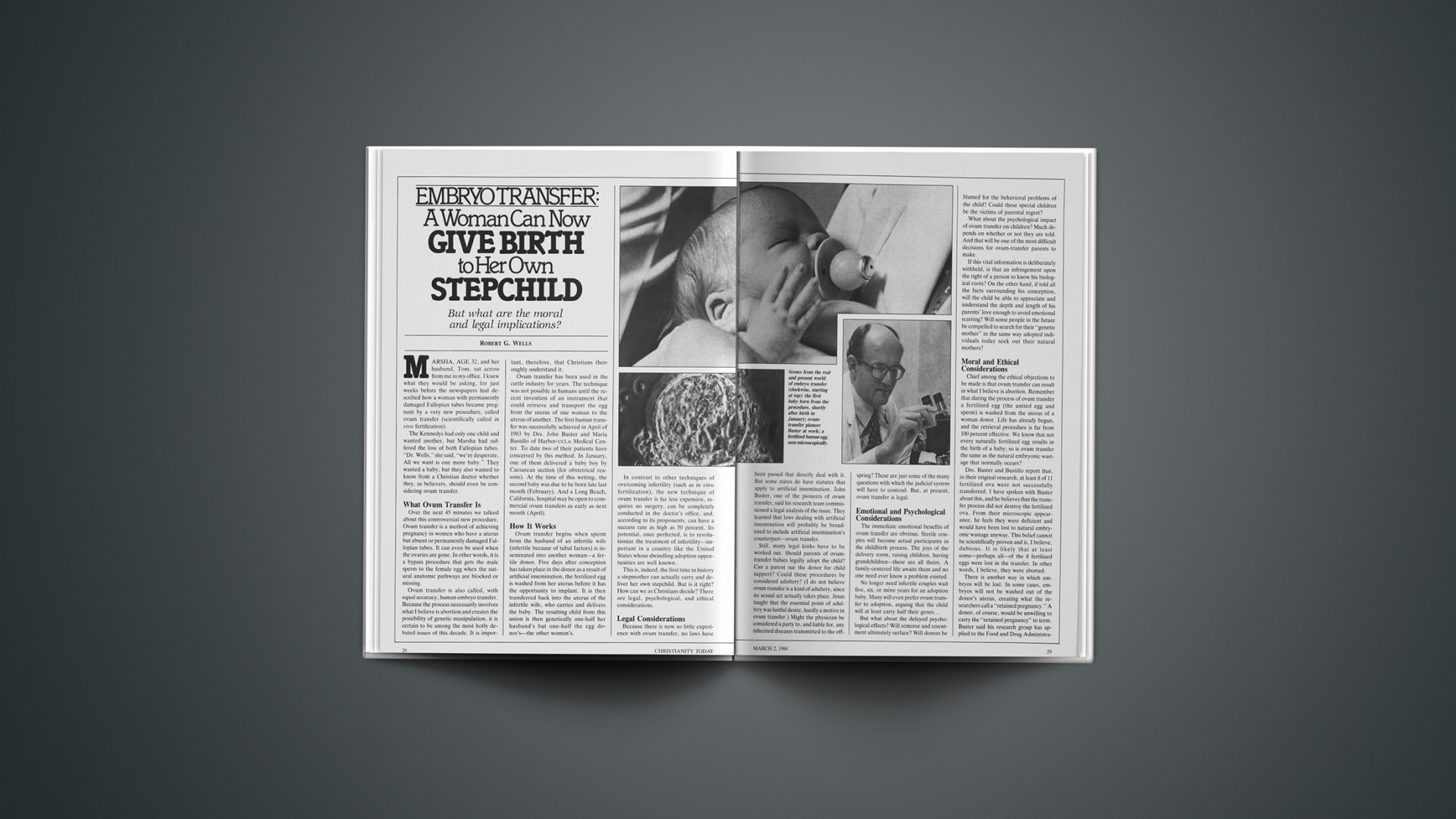
Ovum transfer has been used in the cattle industry for years. The technique was not possible in humans until the recent invention of an instrument that could retrieve and transport the egg from the uterus of one woman to the uterus of another. The first human transfer was successfully achieved in April of 1983 by Drs. John Buster and Maria Bustillo of Harbor-UCLA Medical Center. To date two of their patients have conceived by this method. In January, one of them delivered a baby boy by Caesarean section (for obstetrical reasons). At the time of this writing, the second baby was due to be born late last month (February). And a Long Beach, California, hospital may be open to commercial ovum transfers as early as next month (April).

How It Works

Ovum transfer begins when sperm from the husband of an infertile wife (infertile because of tubal factors) is inseminated into another woman—a fertile donor. Five days after conception has taken place in the donor as a result of artificial insemination, the fertilized egg is washed from her uterus before it has the opportunity to implant. It is then transferred back into the uterus of the infertile wife, who carries and delivers the baby. The resulting child from this union is then genetically one-half her husband’s but one-half the egg donor’s—the other woman’s.

In contrast to other techniques of overcoming infertility (such as in vitro fertilization), the new technique of ovum transfer is far less expensive, requires no surgery, can be completely conducted in the doctor’s office, and, according to its proponents, can have a success rate as high as 50 percent. Its potential, once perfected, is to revolutionize the treatment of infertility—important in a country like the United States whose dwindling adoption opportunities are well known.

This is, indeed, the first time in history a stepmother can actually carry and deliver her own stepchild. But is it right? How can we as Christians decide? There are legal, psychological, and ethical considerations.

Legal Considerations

Because there is now so little experience with ovum transfer, no laws have been passed that directly deal with it. But some states do have statutes that apply to artificial insemination. John Buster, one of the pioneers of ovum transfer, said his research team commissioned a legal analysis of the issue. They learned that laws dealing with artificial insemination will probably be broadened to include artificial insemination’s counterpart—ovum transfer.

Still, many legal kinks have to be worked out. Should parents of ovum-transfer babies legally adopt the child? Can a parent sue the donor for child support? Could these procedures be considered adultery? (I do not believe ovum transfer is a kind of adultery, since no sexual act actually takes place. Jesus taught that the essential point of adultery was lustful desire, hardly a motive in ovum transfer.) Might the physician be considered a party to, and liable for, any inherited diseases transmitted to the offspring? These are just some of the many questions with which the judicial system will have to contend. But, at present, ovum transfer is legal.

Emotional And Psychological Considerations

The immediate emotional benefits of ovum transfer are obvious. Sterile couples will become actual participants in the childbirth process. The joys of the delivery room, raising children, having grandchildren—these are all theirs. A family-centered life awaits them and no one need ever know a problem existed.

No longer need infertile couples wait five, six, or more years for an adoption baby. Many will even prefer ovum transfer to adoption, arguing that the child will at least carry half their genes.

But what about the delayed psychological effects? Will remorse and resentment ultimately surface? Will donors be blamed for the behavioral problems of the child? Could these special children be the victims of parental regret?

What about the psychological impact of ovum transfer on children? Much depends on whether or not they are told. And that will be one of the most difficult decisions for ovum-transfer parents to make.

If this vital information is deliberately withheld, is that an infringement upon the right of a person to know his biological roots? On the other hand, if told all the facts surrounding his conception, will the child be able to appreciate and understand the depth and length of his parents’ love enough to avoid emotional scarring? Will some people in the future be compelled to search for their “genetic mother” in the same way adopted individuals today seek out their natural mothers?

Moral And Ethical Considerations

Chief among the ethical objections to be made is that ovum transfer can result in what I believe is abortion. Remember that during the process of ovum transfer a fertilized egg (the united egg and sperm) is washed from the uterus of a woman donor. Life has already begun, and the retrieval procedure is far from 100 percent effective. We know that not every naturally fertilized egg results in the birth of a baby; so is ovum transfer the same as the natural embryonic wastage that normally occurs?

Drs. Buster and Bustillo report that, in their original research, at least 8 of 11 fertilized ova were not successfully transferred. I have spoken with Buster about this, and he believes that the transfer process did not destroy the fertilized ova. From their microscopic appearance, he feels they were deficient and would have been lost to natural embryonic wastage anyway. This belief cannot be scientifically proven and is, I believe, dubious. It is likely that at least some—perhaps all—of the 8 fertilized eggs were lost in the transfer. In other words, I believe, they were aborted.

There is another way in which embryos will be lost. In some cases, embryos will not be washed out of the donor’s uterus, creating what the researchers call a “retained pregnancy.” A donor, of course, would be unwilling to carry the “retained pregnancy” to term. Buster said his research group has applied to the Food and Drug Administration for approval to test drugs that block the development of young embryos. These “safety net” drugs could abort unwanted donor pregnancies in the future.

Ovum transfer, then, knowingly sacrifices some human fertilized eggs in the effort to establish and secure one life. Is this justified?

For Christians, the abortion question is extremely important. I believe the Bible teaches very clearly that life begins at fertilization (see Ps. 51:5 and Jer. 1:5, for example). It was only in the early 1970s that the American College of Obstetricians and Gynecologists quietly changed the definition of conception to implantation (the embedment of the fertilized egg in the wall of the uterus), rather than the historically accepted fertilization. Finally, the Christian must answer that the embryonic wastage of ovum transfer is not identical to natural embryonic wastage. As Curtis Young, executive of the Christian Action Council, points out, all people die natural deaths. But human beings, except in the cases of murder and suicide, do not cause or intend these deaths. Ovum transfer takes embryonic wastage out of God’s hands and places it in human hands.

Ovum transfer must deal with another ethical challenge, namely, the potential abuses of this kind of technology. For example, one day we may see professional “on call” egg donors—women carefully chosen because of physical attractiveness, intellectual superiority, and flawless family health backgrounds. The financial backers of Buster and Bustillo’s team hope that by next year computers might locate an infertile patient in New York, and a donor in Dallas (or wherever) with a matching ovulation date, appropriate blood type, and physical characteristics. Packages containing the embryos could then be sent by plane. Such a scenario would be streamlined and economized by freezing and storing the embryos, then thawing them out when an appropriate recipient is most receptive to starting a pregnancy. Eugenic advocates are going to see a real “friend” in ovum transfer.

No discussion of ethics would be complete without touching on the corporate financing of the research and development of ovum transfer. Ovum transfer ushers in an era in which the medicine of reproduction is linked more closely than ever to the principles of business and marketing. Critics, with good reason, will openly worry about “humanitarian” medical achievements spawned in a profit setting.

In fairness, it should be noted that the pioneers of ovum transfer applied for government grants, but were turned down. The private sector was more obliging. The researchers are financed by Fertility and Genetics Research (FGR) of Chicago. FGR estimates that 50,000 women a year will be eligible and willing to try an embryo transfer. The company hopes to patent the procedure. Patent applications are under the name of Richard G. Seed, the founder of a cattle breeding company, who conceived the notion of applying to human beings the techniques of the $32-million-a-year cattle breeding industry.

Other Views on Embryo Transfer

Mark Noll is professor of history at Wheaton College, Wheaton, Illinois.

I am less inclined than Dr. Wells simply to equate embryo wastage with abortion. For one thing, the Scriptures he cites from Psalm 51 and Jeremiah 1 do not speak to technical questions of sperm-ovum union versus implantation so much as to the total sovereignty of God over all of life.

Still, Wells is justified in his apprehension on this score. No matter how good the end (children for childless couples), the means must also be ethically sound. And the possibility that a large number of fertilized ova will be lost, even for good purposes, should give Christians pause.

Christians probably should encourage further scientific work on this procedure even as they explore means of putting the technique to use with justice and careful ethics. A great outcry that condemns the procedure without discrimination will not be helpful. Thoughtful and informed reflections, like those of Dr. Wells, are precisely what we need.

Lewis Smedes is professor of theology and ethics at Fuller Theological Seminary, Pasadena, California.

We should remember that the woman undergoing an abortion and the woman seeking an ovum transfer intend two different things. The woman who has an abortion intends to be rid of the fetus. The woman receiving an ovum transfer intends to gain a fetus she could not otherwise have. Her desire is precisely the opposite of a woman seeking an abortion.

We also know that some women are capable of conception, but, for some reason, their uterine walls are inhospitable to the fertilized egg. Such women, with their mates, may try every month—sometimes for years—to get pregnant. But the fertilized eggs wash out of the uterus. That means those fertilized eggs die and go down the drain. I would not accuse such couples, attempting to have a baby, of abortion. I think such cases are parallel to the best possible uses of ovum transfer.

There is also the “brave new world” aspect of ovum transfer. I am sympathetic with those who say there should not be a rupture between the sexual act and procreation. But no trend is being set with ovum transfer. It would involve a small number of people, so intercourse would still be normative for procreation. However realistic the fear of a manufactured and commercialized means of bearing children may be, simply having that fear is not going to hold back the march of medical technology. We should use what in it is good, work to prevent its exploitation, and help people in need to make responsible decisions.

Norman Geisler is professor of systematic theology at Dallas Theological Seminary, Dallas, Texas.

I agree with the ethical points that Dr. Wells raises. If life begins at conception, as medical evidence indicates and Scripture does not contest, then ovum transfer would, as presently practiced, involve taking a life.

I would also agree with Wells that adultery is not at issue. There is no lustful intent involved and no sexual act. It would be a far-fetched definition of adultery to say that something without either of those is actually adultery.

Two fallacious ethical principles are exposed in the ovum-transfer debate. One is that the end justifies the means. If this procedure can bring about a good end, namely a baby for a childless couple, isn’t the means thereby justified? But no Christian ethical system has ever accepted the principle that the end justifies the means. Another fallacious principle is that if it can be done, it ought to be done. Just as David Hume showed that it is fallacious to argue from “is” to “ought,” I think it is equally fallacious to argue from “can” to “ought.” The fact that we can do something doesn’t mean we ought to do it.

The Christian’S Response

Too many times I have sat in my office and heard the wrenching sorrows of couples who could not have children. I have listened to the pleas: “Is there nothing you can do?” I have seen the tears, felt the pain, and tried to understand.

Now, seemingly so suddenly, there is something medical science can do. Ovum transfer makes it possible for thousands of infertile women—Christians included—to bear and deliver children. They can know the joy of pregnancy and childbirth. What sort of a sin can this be? They want only to be what millions of others are without a tinge of bad conscience: parents, and parents of children uniquely theirs.

So I write with sadness. Ovum transfer presents a heartbreaking temptation to childless Christians. But I cannot endorse the process because it necessarily, though incidentally, involves what I believe are abortions. It is true that medical techniques and instruments have a history of improving rapidly. John Buster assures me that the recovery rate of fertilized eggs will “approach the ideal within the next 18 to 24 months.” Buster believes it is possible, but not likely, that ovum transfer may be improved to the point that the embryos are fully safeguarded. (This improvement could occur with or without human experimentation.) If this happens, my basic ethical objection will be removed.

But if and until then, I believe Christians should resist what will probably be widely accepted in our society. Ovum transfer may appear to appreciate and even enhance the value of life (after all, all those babies would not have been born!), but I believe it actually devalues life. It moves into the human arena the choice of life and death over eventually millions of embryos. We cannot assume that humans are, as the New York Times Magazine puts it, simply “the 15th mammalian species in which embryo transfer is expected to produce normal young.”

At the same time, Christians must act with compassion and understanding toward those yearning for ovum transfers. Rather than reacting judgmentally, we can remember the extraordinary dilemma the process will present to infertile couples. Our counsel must display the love only Christ can give as he works through us.

Tim Stafford is a free-lance writer living in Santa Rosa, California. He is a distinguished contributor to several magazines. His latest book is Do You Sometimes Feel Like a Nobody? (Zondervan, 1980).

Did You Hear the One about Cardinal Sin …: … or the Nurse Named Basin … or the Doctor Named Bonecutter?

Now that everyone has had fun making the original observation that NASA took a new kind of ride—Sally Ride—into outer space, we can all conjugate about how well Ride rode. Some of us had noticed her selection months before the flight—not because of her sex, but because of her name.

A few years ago I noticed in a similar way that a certain Mr. Aslan of King City, California, was the new president of Lions International. As coincidences go, this one seemed to be going too far. I called the local lodge and asked if Lions International realized that Aslan means lion in Turkish and that in C. S. Lewis’s best-selling Narnian books, Aslan the Lion is King. No, none of the Lions had known any such facts. I always like to light a little candle in the corner where I am.

I belong to the Mythopoeic Society, a literary group with special interest in the fantasies written by C. S. Lewis, J. R. R. Tolkien, and Charles Williams. There is much emphasis upon medieval culture in the journal Mythlore and at the annual Mythopoeic conference. The founder and president of this society is Glen GoodKnight. He swears it is the name he was born with.

Likewise, for many years there has been a professor at Dallas Theological Seminary named J. Dwight Pentecost. And now we have a president at Concordia Seminary named Karl Barth. What I can’t understand is that the head of the Roman Catholic hierarchy in the Philippines is Jaime Cardinal Sin.

I got on the mailing list of the Ku Klux Klan recently (I think they got my name from the Nazi groups that send me junk mail), and I thereby discovered that the current Grand Dragon is a Mr. Black. Beautiful, in my opinion.

Once I was rushed to a hospital, and hurtled into surgery because of appendicitis. Later I learned that my surgeon had been a Dr. Corpus, and one of my nurses was Ms. Basin. Another time I was examined in a hospital by a Dr. Bonecutter. I can’t imagine how these men got through medical school. I read of a woman who went through medical school with the name Penny Wise, but that’s a different story.

I suppose there are many unforgettable names in the sports industry that I have never heard of. But I have heard of a six-foot, seven-inch basketball player named Purvis Short. And I wonder how Amby Burfoot liked his name when he was a runner; now he is a journalist.

In England today the only proper way for a lady to address her butler is by his last name alone. But Josephine Louis, wife of the current U.S. ambassador to Britain, insists upon calling her butler “Mister.” “His name is Kenneth Dear,” she explains. “I think it would sound rather odd if I said, ‘Would you pass the biscuits, Dear’.”

One of my favorite bookstores, full of art and whimsy, used to be owned by the Darlings. “Oh, the Darlings!” pleased customers remarked.

Western University School of Law is located near Disneyland, and its new president is Dr. William Lawless. The teacher of creative writing at a nearby college is William Blake. And a local religious workshop for improved communication in marriage is offered by Dr. David Bicker.

I saw an article a few months ago about the breed of computer fanatics who are addicted to playing with computers day and night; they are called hackers. My husband recently decided to take a class in computer literacy for teachers. His instructors were Mr. and Mrs. Gary Hacker. They did not tell the class the meaning of their name.

The Hackers remind me of a computer expert who has gone public with his misgivings about “computer literacy.” He is a New Hampshire computer consultant who did his graduate work in computer science at Harvard, and he works with some of IBM’s largest. He warns that computer literacy needs to begin with a healthy skepticism of these machines. All too often the output of computers is treated like the Word of God. All too often the output lacks quality, completeness, or appropriateness.

Who is this brutally honest and outspoken traitor in the computer industry? His name is Arthur Fink.

Tim Stafford is a free-lance writer living in Santa Rosa, California. He is a distinguished contributor to several magazines. His latest book is Do You Sometimes Feel Like a Nobody? (Zondervan, 1980).

We Are in Love with Our Own Destruction: But Faith Is an Oasis Where Green Things Can Grow

Every once in a while, life can be very eloquent. You go along from day to day not noticing very much, not seeing or hearing very much, and then all of a sudden, when you least expect it very often, something speaks to you with such power that it catches you off guard, makes you listen whether you want to or not. Something speaks to you out of your own life with such directness that it is as if it calls you by name and forces you to look where you have not had the heart to look before, to hear something that maybe for years you have not had the wit or the courage to hear. I was on my way home from a short trip I took not long ago when such a thing happened to me—three such things, actually, three images out of my journey, that haunt me still with what seems a truth that it is important to tell.

The first thing was this. I was on a train somewhere along that grim stretch of track between New Brunswick, New Jersey, and New York City. It was a grey fall day with low clouds in the sky and a scattering of rain in the air, a day as bleak and insistent as a headache. The train windows were coated with dust, but there isn’t all that much to see through them anyway except for the industrial wilderness that spreads out in all directions around you and looks more barren and more abandoned as you approach Newark—the flat, ravaged earth, the rubble, the endless factories black as soot against the sky with their tall chimneys that every now and then are capped with flame like a landscape out of Dante. I was too tired from where I’d been to feel much like reading and still too caught up in what I’d been doing to be able to doze very satisfactorily, so after gazing more or less blindly out of the dirty window for a while, I let my eyes come to rest on the nearest bright thing there was to look at, which was a large color photograph framed on the wall up at the front end of the coach.

It was a cigarette ad, and I forget what was in it exactly, but there was a pretty girl in it and a good-looking boy, and they were sitting together somewhere—by a mountain stream, maybe, or a lake, with a blue sky overhead, green trees. It was a crisp, sunlit scene full of beauty, of youth, full of life more than anything else, and thus as different as it could have been from the drabness I’d been looking at through the window until I felt just about equally drab inside myself. And then down in the lower left-hand corner of the picture, in letters large enough to read from where I was sitting, was the Surgeon General’s familiar warning about how cigarette smoking can be hazardous to your health, or whatever the words are that they use for saying that cigarette smoking can cause lung cancer and kill you dead as a doornail.

It wasn’t that I hadn’t seen such ads thousands of times before and boggled at the macabre irony of them—those pretty pictures, that fatal message—but for some reason having to do with being tired, I suppose, and having nothing else much to look at or think about, I was so stunned by this one that I haven’t forgotten it yet. “Buy this; it will kill you,” the ad said. “Choose out of all that is loveliest and greenest and most innocent in the world that which can make you sick before your time and bring your world to an end. Live so you will die.”

I’m not interested here in scoring a point against the advertising business or the tobacco industry, and the dangers of cigarette smoking are not what I want to talk about; what I want to talk about is something a great deal more dangerous still, which the ad seemed to be proclaiming with terrible vividness and power. We are our own worst enemies, the ad said. That’s what I want to talk about. I had heard it countless times before as all of us have, but this time the ad hit me over the head with it—that old truism that is always true, spell it out and apply it however you like. As nations we stockpile new weapons and old hostilities that may well end up by destroying us all; and as individuals we do much the same. As individuals we stockpile weapons for defending ourselves against not just the things and the people that threaten us but against the very things and people that seek to touch our hearts with healing and make us better and more human than we are. We stockpile weapons for holding each other at arm’s length, for wounding sometimes even the ones who are closest to us. And as for hostilities—toward other people, toward ourselves, toward God if we happen to believe in him—we can all name them silently and privately for ourselves.

The world is its own worst enemy, the ad said. The world, in fact, is its only enemy. No sane person can deny it, I think, as suddenly the picture on the wall of the train jolted me into being sane and being unable to deny it myself. The pretty girl and the good-looking boy. The lake and trees in all their beauty. The blue sky in all its innocence and mystery. And, tucked in among it all, this small, grim warning that we will end by destroying ourselves if we’re not lucky. We need no urging to choose what it is that will destroy us because again and again we choose it without urging. If we don’t choose to smoke cigarettes ourselves, we choose at least to let such ads stand without batting an eye. “Buy this; it can kill you,” the pretty picture said, and nobody on the train, least of all myself, stood up and said, “Look, this is madness!” Because we are more than half in love with our own destruction. All of us are. That is what the ad said. I suppose I had always known it, but for a moment—rattling along through the Jersey flats with the grey rain at the window and not enough energy to pretend otherwise for once—I more than knew it. I choked on it.

The second thing was not unlike the first in a way, as if, in order to put the point across, life had to hit me over the head with it twice. I haven’t led an especially sheltered life as lives go. I’ve knocked around more or less like everybody else and have seen my share of the seamy side of things. I was born in New York City and lived there off and on for years. I’ve walked along West Forty-Second Street plenty of times and seen what there is to see there though I’ve tried not to see it—wanted to see it and tried not to see it at the same time. I’ve seen the double and triple X-rated movie houses catering to every kind of grotesqueness and cruelty and patheticness of lust. I’ve seen the adult bookstores, the peep shows, the massage parlors, and sex shops with people hanging around the doors to con you into entering. I’ve seen the not-all-that-pretty girls and less-than-good-looking boys—many of them hardly more than children, runaways—trying to keep alive by clumsily, shiftily selling themselves for lack of anything else to sell; and staggering around in the midst of it all, or slumped like garbage against the fronts of buildings, the Forty-Second Street drunks—not amiable, comic drunks you can kid yourself into passing with a smile, but angry, bloodshot, crazy drunks, many of them blacks because blacks in New York City have more to be angry and crazy about than the rest of us.

I’d seen it all before and will doubtless see it all again, but walking from my train to the Port Authority Bus Terminal—and with that ad, I suppose, still on my mind—I saw it almost as if for the first time. And, as before, I’m not so much interested in scoring a point against the sex industry, or against the indifference or helplessness or ineptitude of city governments, or against the plague of alcoholism; because instead, again, it was the very sight I saw that scored a point against me, against our world. I found myself suddenly so scared stiff by what I saw that if I’d known a place to hide, I would have gone and hidden there. And what scared me most was not just the brutality and ugliness of it all but how vulnerable I was to the brutality and ugliness, how vulnerable to it we all of us are and how much it is a part of us.

What scared the daylights out of me was to see suddenly how drawn we all are, I think, to the very things that appall us—to see how beneath our civilizedness, our religiousness, our humanness, there is that in all of us that remains uncivilized, religionless, subhuman, and which hungers for precisely the fare that Forty-Second Street offers, which is basically the license to be subhuman not just sexually but any other way that appeals to us—the license to use and exploit and devour each other like savages, to devour and destroy our own sweet selves. And if you and I are tempted to think we don’t hunger for such things, we have only to remember some of the dreams we dream and some of the secrets we keep and the battle against darkness we all of us fight. I was scared stiff that I would somehow get lost in that awful place and never find my way out. I was scared that everybody I saw coming toward me down the crowded sidewalk—old and young, well dressed and ragged, innocent and corrupt—was in danger of getting lost. I was scared that the world itself was as lost as it was mad. And of course in a thousand ways it is.

By faith we understand that the world was created by the word of God, so that what is seen was made out of things which do not appear.… By faith Noah, being warned by God concerning events as yet unseen, took heed and constructed an ark for the saving of his household.… By faith Abraham … went out, not knowing where he was to go.… By faith Sarah herself received power to conceive, even when she was past the age.… These all died in faith, not having received what was promised, but having seen it and greeted it from afar, and having acknowledged that they were strangers and exiles on the earth. For people who speak thus make it clear that they are seeking a homeland.

—Hebrews 11:3, 7–14

The third thing was finally getting home. It was late and dark when I got there after a long bus ride, but there were lights on in the house. My wife and daughter were there. They had waited supper for me. There was a fire in the woodstove, and the cat was asleep on his back in front of it, one paw in the air. There are problems at home for all of us—problems as dark in their way as the dark streets of any city—but they were nowhere to be seen just then. There was nothing there just then except stillness, light, peace, and the love that had brought me back again and that I found waiting for me when I got there. Forty-Second Street was only a couple of hundred miles from my door, but in another sense it was light years away.

Part of what I felt, being home, was guilt, because feeling guilty is one of the things we all are so good at. I felt guilty about having, at home, the kind of peace that the victims and victimizers of Forty-Second Street not only don’t have but don’t even know exists because that is part of the price you pay for being born into the world poor, unloved, without hope. “I was hungry and you gave me food,” Christ said. “I was a stranger and you welcomed me.… I was sick and you visited me,” Christ said, and by coming home I was turning my back not just on Christ but on all the sick, the hungry, the strangers in whom Christ is present and from whom I’d fled like a bat out of hell—just that, because hell was exactly where I’d been. But I wouldn’t let myself feel guilty long; I fought against feeling guilty, because as I sat there in that warm, light house, safe for the moment from the darkness of night and from all darkness, I felt something else so much more powerful and real.

Warmth. Light. Peace. Stillness. Love. That was what I felt. And as I entered that room where they were present, it seemed to me that wherever these things are found in the world, they should not be a cause for guilt but treasured, nurtured, sheltered from the darkness that threatens them. I thought of all such rooms everywhere—both rooms inside houses and rooms inside people—and how in a way they are like oases in the desert where green things can grow and there is refreshment and rest surrounded by the sandy waste; how in a way they are like the monasteries of the Dark Ages where truth, wisdom, charity were kept alive surrounded by barbarity and misrule.

The world and all of us in it are half in love with our own destruction and thus mad. The world and all of us in it are hungry to devour each other and ourselves and thus lost. That is not just a preacher’s truth, a rhetorical truth, a Sunday school truth. Listen to the evening news. Watch television. Read the novels and histories and plays of our time. Read part of what there is to be read in every human face including my face and your face. But every once in a while in the world, and every once in a while in ourselves, there is something else to read—there are places and times, inner ones and outer ones, where something like peace happens, love happens, light happens as it happened for me that night I got home. And when they happen, we should hold on to them for dear life, because of course they are dear life. They are glimpses and whispers from afar: that peace, light, love are where life ultimately comes from, that deeper down than madness or lostness they are what at its heart life is. By faith we know this, and I think only by faith, because there is no other way to know it.

“By faith we understand that the world was created by the word of God, so that what is seen was made out of things which do not appear,” says the author of Hebrews. Faith is a way of looking at what is seen and understanding it in a new sense. Faith is a way of looking at what there is to be seen in the world and in ourselves and hoping, trusting, believing against all evidence to the contrary that beneath the surface we see there is vastly more that we cannot see.

What is it “that is seen,” as Hebrews puts it? What is seen is the ruined landscape I saw through the train window, the earth so ravaged you can’t believe any green thing will ever grow there again. What is seen is all the streets in the world like Forty-Second Street—the crazy drunks, the child whores, the stink of loneliness, emptiness, cruelty, despair. Maybe most of all what is seen, if we’re honest, is that there is in all of us what is both sickened and fascinated by such things, attracted and repelled. What is seen is a world that tries to sell us what kills like the cigarette ad and never even gives it a second thought as you and I rarely give it a second thought either but rush to buy what the world sells, and in our own way sell it ourselves.

Who or what created such a world? On the face of it, there seems to be only one answer to that question. We ourselves created it—that is the answer—and it is hard to see on the face of it—hard to see—that what created us can have been anything more than some great cosmic upheaval, some slow, blind process as empty of meaning or purpose as a glacier. But “by faith,” says Hebrews, we see exactly the same world and yet reach exactly the opposite answer, which is faith’s answer. “By faith we understand that the world was created by the word of God,” it says, “so that what is seen was made out of things which do not appear.”

By faith we understand, if we are to understand it at all, that the madness and lostness we see all around us and within us are not the last truth about the world but only the next to the last truth. Madness and lostness are the results of terrible blindness and tragic willfulness that whole nations are involved in no less than you and I are involved in them. Faith is the eye of the heart, and by faith we see deep down beneath the face of things—by faith we struggle against all odds to be able to see—that the world is God’s creation even so. It is he who made us and not we ourselves, made us out of his peace to live in peace, out of his light to dwell in light, out of his love to be above all things loved and loving. That is the last truth about the world.

Can it be true? No, of course it cannot. On the face of it, if you take the face seriously and face up to it, how can it possibly be true? Yet how can it not be true when our own hearts bear such powerful witness to it, when blessed moments out of our own lives speak of it so eloquently? And that no-man’s land between the Yes and No, that every-man’s land, is where faith stands and has always stood. Seeing but not seeing, understanding but not understanding, we all stand somewhere between the Yes and the No the way old Noah stood there before us, and Abraham, and Sarah his wife, all of them. The truth of God as the last and deepest truth—they none of them saw it in its fulness any more than we have, but they spent their lives homesick for it—seeking it like a homeland, like home, and their story is our story because we too have seen from afar what peace is, light is, love is, and we have seen it in something like that room that love brought me back to that rainy day, and where I found supper waiting, found love waiting, love enough to see me through the night.

That still, light room in that house—and whatever that room represents of stillness and light and the possibility of faith, of Yes, in your own life—is a room to find healing and hope in, but it is also a room with a view. It is a room that looks out, like the window of the train, on a landscape full of desolation—that looks out on Forty-Second Street with its crowds of hungry ones, lonely ones, sick ones, all the strangers who turn out not to be strangers after all because we are all of us seeking the same homeland together whether we know it or not, even the mad ones and lost ones who scare us half to death because in so many ways they are so much like ourselves.

Maybe in time we will even be able to love them a little—to feed them when they are hungry and maybe no farther away than our own street; to visit them when they are sick and lonely; maybe hardest of all, to let them come serve us when the hunger and sickness and loneliness are not theirs but ours. “Your faith has made you whole,” Jesus said to the woman who touched the hem of his garment, and maybe by grace, by luck, by holding fast to whatever of him we can touch, such faith as we have will make us whole enough to become something like human at last—to see something of the power and the glory and the holiness beneath the world’s lost face. That is the direction that home is in anyway—the homeland we have seen from afar in our dearest rooms and truest dreams, the homeland we have seen in the face of him who is himself our final home and haven, our kingdom and king.

Tim Stafford is a free-lance writer living in Santa Rosa, California. He is a distinguished contributor to several magazines. His latest book is Do You Sometimes Feel Like a Nobody? (Zondervan, 1980).

Christian Publishing: Too Many Books & Too Few Classics?: Christian Writers Often Express Their Theological Concepts without Emotion, Drama, or Tension

Thou hast conquered, O pale galilean, and the world has grown gray with Thy breath.” Thus concluded the poet Charles Swinburne about the wearisome effect of Christianity on culture at large.

I can speak comfortably only about the field of writing, and some conclude that it indeed has grown gray in recent years. Is Christian literature penetrating culture, or is the fissure separating Christian readers from the broader public yawning ever wider?

An underlying question haunts me as a Christian author: Why should anyone read anything religious? Hundreds of Christian books have crossed my desk in the last decade and, I must admit, after a time they can seem to look and sound alike. I have watched literary sparks flare up in the Jewish and Catholic subcultures, but why have evangelicals produced so few classics?

I have tried to analyze trends in the books I have seen in order to erect “Caution!” signs around the pitfalls of Christian writing. Below, I outline four criticisms of Christian writing, criticisms that I accept for myself, as a Christian author. I do not intend to point to specific negative examples, and therefore must paint “Christian writing” with a very broad brush. Will high standards of quality improve sales? Who knows? I am convinced, however, that we Christian authors must strive for higher literary standards for our works to be taken seriously in the world at large. A captive audience will read indiscriminately; a skeptical or even hostile audience must be lured.

Thought Without Art

Too often Christian writing performs a kind of literary decapitation: we render the head without the body, the thought without the art. We allow someone to speak to us with his or her brain only, while keeping concealed the background and context that produced those thoughts. For example, we will record Christian leaders’ thoughts about lifestyles without delving into how they spend their own money and free time. In our profiles of Christian leaders, we give little regard to the stages of development and processes that contributed to form their opinions.

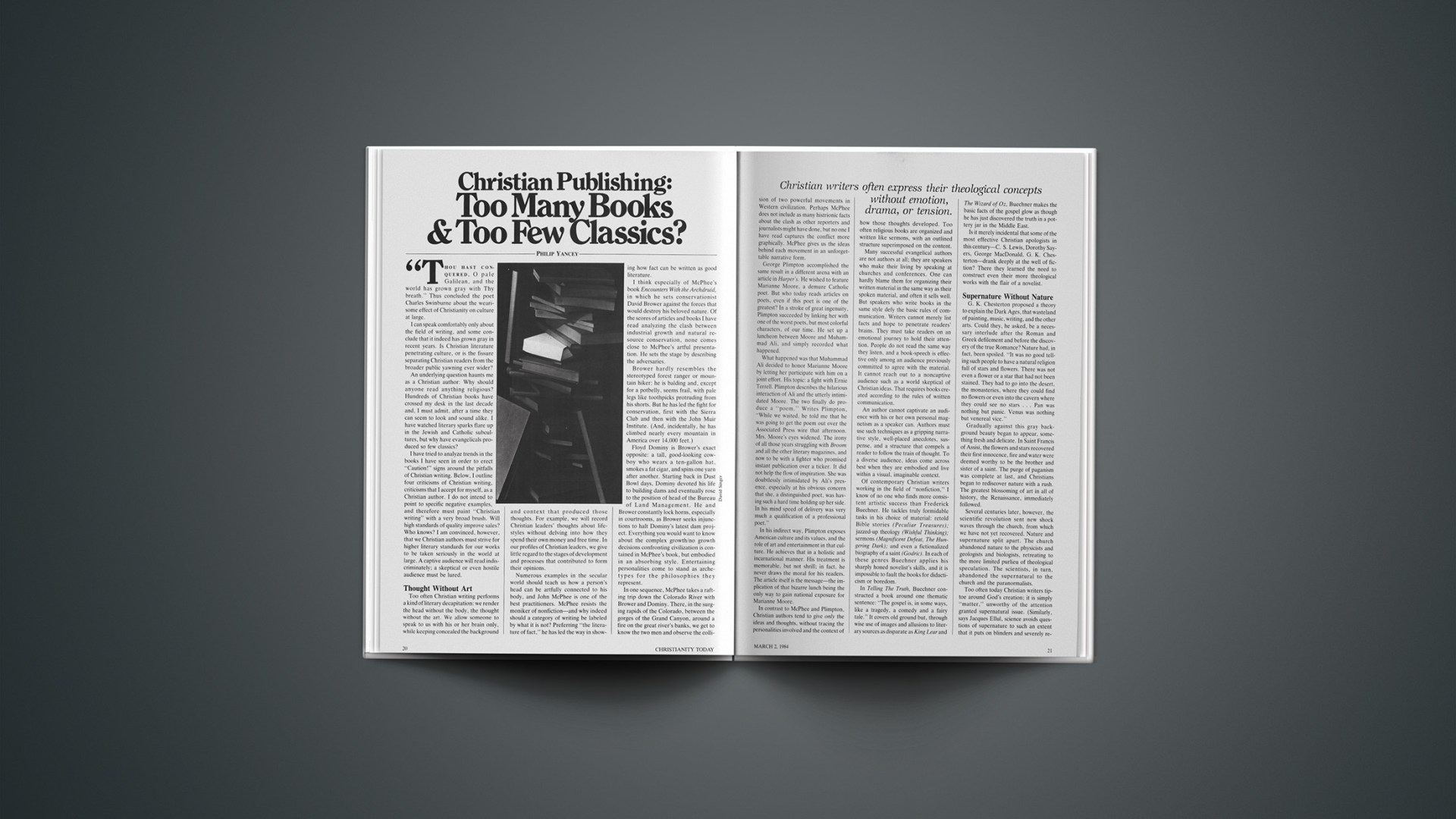
Numerous examples in the secular world should teach us how a person’s head can be artfully connected to his body, and John McPhee is one of the best practitioners. McPhee resists the moniker of nonfiction—and why indeed should a category of writing be labeled by what it is not? Preferring “the literature of fact,” he has led the way in showing how fact can be written as good literature.

I think especially of McPhee’s book Encounters With the Archdruid, in which he sets conservationist David Brower against the forces that would destroy his beloved nature. Of the scores of articles and books I have read analyzing the clash between industrial growth and natural resource conservation, none comes close to McPhee’s artful presentation. He sets the stage by describing the adversaries.

Brower hardly resembles the stereotyped forest ranger or mountain hiker: he is balding and, except for a potbelly, seems frail, with pale legs like toothpicks protruding from his shorts. But he has led the fight for conservation, first with the Sierra Club and then with the John Muir Institute. (And, incidentally, he has climbed nearly every mountain in America over 14,000 feet.)

Floyd Dominy is Brower’s exact opposite: a tall, good-looking cowboy who wears a ten-gallon hat, smokes a fat cigar, and spins one yarn after another. Starting back in Dust Bowl days, Dominy devoted his life to building dams and eventually rose to the position of head of the Bureau of Land Management. He and Brower constantly lock horns, especially in courtrooms, as Brower seeks injunctions to halt Dominy’s latest dam project. Everything you would want to know about the complex growth/no growth decisions confronting civilization is contained in McPhee’s book, but embodied in an absorbing style. Entertaining personalities come to stand as archetypes for the philosophies they represent.

In one sequence, McPhee takes a rafting trip down the Colorado River with Brower and Dominy. There, in the surging rapids of the Colorado, between the gorges of the Grand Canyon, around a fire on the great river’s banks, we get to know the two men and observe the collision of two powerful movements in Western civilization. Perhaps McPhee does not include as many histrionic facts about the clash as other reporters and journalists might have done, but no one I have read captures the conflict more graphically. McPhee gives us the ideas behind each movement in an unforgettable narrative form.

George Plimpton accomplished the same result in a different arena with an article in Harper’s. He wished to feature Marianne Moore, a demure Catholic poet. But who today reads articles on poets, even if this poet is one of the greatest? In a stroke of great ingenuity, Plimpton succeeded by linking her with one of the worst poets, but most colorful characters, of our time. He set up a luncheon between Moore and Muhammad Ali, and simply recorded what happened.

What happened was that Muhammad Ali decided to honor Marianne Moore by letting her participate with him on a joint effort. His topic: a fight with Ernie Terrell. Plimpton describes the hilarious interaction of Ali and the utterly intimidated Moore. The two finally do produce a “poem.” Writes Plimpton, “While we waited, he told me that he was going to get the poem out over the Associated Press wire that afternoon. Mrs. Moore’s eyes widened. The irony of all those years struggling with Broom and all the other literary magazines, and now to be with a fighter who promised instant publication over a ticker. It did not help the flow of inspiration. She was doubtlessly intimidated by Ali’s presence, especially at his obvious concern that she, a distinguished poet, was having such a hard time holding up her side. In his mind speed of delivery was very much a qualification of a professional poet.”

In his indirect way, Plimpton exposes American culture and its values, and the role of art and entertainment in that culture. He achieves that in a holistic and incarnational manner. His treatment is memorable, but not shrill; in fact, he never draws the moral for his readers. The article itself is the message—the implication of that bizarre lunch being the only way to gain national exposure for Marianne Moore.

In contrast to McPhee and Plimpton, Christian authors tend to give only the ideas and thoughts, without tracing the personalities involved and the context of how those thoughts developed. Too often religious books are organized and written like sermons, with an outlined structure superimposed on the content.

Many successful evangelical authors are not authors at all; they are speakers who make their living by speaking at churches and conferences. One can hardly blame them for organizing their written material in the same way as their spoken material, and often it sells well. But speakers who write books in the same style defy the basic rules of communication. Writers cannot merely list facts and hope to penetrate readers’ brains. They must take readers on an emotional journey to hold their attention. People do not read the same way they listen, and a book-speech is effective only among an audience previously committed to agree with the material. It cannot reach out to a noncaptive audience such as a world skeptical of Christian ideas. That requires books created according to the rules of written communication.

An author cannot captivate an audience with his or her own personal magnetism as a speaker can. Authors must use such techniques as a gripping narrative style, well-placed anecdotes, suspense, and a structure that compels a reader to follow the train of thought. To a diverse audience, ideas come across best when they are embodied and live within a visual, imaginable context.

Of contemporary Christian writers working in the field of “nonfiction,” I know of no one who finds more consistent artistic success than Frederick Buechner. He tackles truly formidable tasks in his choice of material: retold Bible stories (Peculiar Treasures); jazzed-up theology (Wishful Thinking); sermons (Magnificent Defeat, The Hungering Dark); and even a fictionalized biography of a saint (Godric). In each of these genres Buechner applies his sharply honed novelist’s skills, and it is impossible to fault the books for didacticism or boredom.

In Telling The Truth, Buechner constructed a book around one thematic sentence: “The gospel is, in some ways, like a tragedy, a comedy and a fairy tale.” It covers old ground but, through wise use of images and allusions to literary sources as disparate as King Lear and The Wizard of Oz, Buechner makes the basic facts of the gospel glow as though he has just discovered the truth in a pottery jar in the Middle East.

Is it merely incidental that some of the most effective Christian apologists in this century—C. S. Lewis, Dorothy Sayers, George MacDonald, G. K. Chesterton—drank deeply at the well of fiction? There they learned the need to construct even their more theological works with the flair of a novelist.

Supernature Without Nature

G. K. Chesterton proposed a theory to explain the Dark Ages, that wasteland of painting, music, writing, and the other arts. Could they, he asked, be a necessary interlude after the Roman and Greek defilement and before the discovery of the true Romance? Nature had, in fact, been spoiled. “It was no good telling such people to have a natural religion full of stars and flowers. There was not even a flower or a star that had not been stained. They had to go into the desert, the monasteries, where they could find no flowers or even into the cavern where they could see no stars … Pan was nothing but panic. Venus was nothing but venereal vice.”

Gradually against this gray background beauty began to appear, something fresh and delicate. In Saint Francis of Assisi, the flowers and stars recovered their first innocence, fire and water were deemed worthy to be the brother and sister of a saint. The purge of paganism was complete at last, and Christians began to rediscover nature with a rush. The greatest blossoming of art in all of history, the Renaissance, immediately followed.

Several centuries later, however, the scientific revolution sent new shock waves through the church, from which we have not yet recovered. Nature and supernature split apart. The church abandoned nature to the physicists and geologists and biologists, retreating to the more limited purlieu of theological speculation. The scientists, in turn, abandoned the supernatural to the church and the paranormalists.

Too often today Christian writers tiptoe around God’s creation; it is simply “matter,” unworthy of the attention granted supernatural issue. (Similarly, says Jacques Ellul, science avoids questions of supernature to such an extent that it puts on blinders and severely restricts intellectual thought.) It is time for Christian writers to rediscover our natural environment and the characteristics of true humanity. By avoiding nature we divorce ourselves from the greatest images and carriers of supernature, and our writing loses its chief advantage, the ability to mimic creation. When Tolstoy describes spring, the wonder of tiny flowers poking up through the thawing tundra, he invests in it the same exuberance and significance that he gives to a description of Christian conversion. It too is an expression of God’s world. As a result, both passages stir up the feeling of longing in a sensitive reader. People live in the world of nature; we must first affirm that and plumb its meaning before leading them on to supernature.

Recently some fine authors have led the way in attempting to reveal nature as a carrier for supernature. Annie Dillard’s Pilgrim at Tinker Creek was a landmark in that genre. Lewis Thomas applies the same approach but from a less explicitly religious viewpoint. Response to these two authors demonstrates the hunger in readers for a more holistic approach to the world. Nature and supernature are not two separate worlds; they are different expressions of the same reality, and effective writing must deal with both.

In a brief passage, Pablo Neruda shows what can be done with the subject of writing itself, the choice of words as carriers of expression: “You can say anything you want, yes sir, but it is the words that sing; they soar and descend. I bow to them, I love them, I cling to them, I run them down, I bite into them, I melt them down. I love words so much: the unexpected ones; the ones I wait for greedily are stalked until, suddenly, they drop. Vowels I love: they glitter like colored stones, they leap like silver fish. They are foam, thread, metal, dew. I run after certain words. They are so beautiful I want to fit them all into my poem. I catch them in mid-flight as they buzz past. I trap them, clean them, peel them. I set myself in front of a dish: they have a crystalline texture to me: vibrant, ivory, vegetable, oily, like fruit, like algae, like agate, like olive. And then I stir them, I shake them, I drink them, I gulp them down, I garnish them, I let them go. I leave them in my poem like stalactites, like slivers of polished wood, like coal, pickings from a shipwreck, gifts from the waves. Everything exists in the word.”

The concept of creation is, at heart, a Christian concept. That thought did not exist among the Greeks, who instead used the word techna, from which we derive our word “technological.” The great Greek poets and playwrights thought in terms of arranging or manufacturing their works; they had no model of divine creatio ex nihilo to mimic. It staggers me that we Christians so blithely forfeit our opportunity to explore that magnificently created world. We fly instead to a supernatural world so elevated from our fringe readers that they cannot possibly make the leap.

Conversely, when we discuss the realm of the supernatural, we must do so with unflinching realism. An article I read recently described a solemn vigil in which the author, standing before the Washington Monument, listened reverentially as someone read aloud the names of thousands of those killed by the Hiroshima bomb. He was participating in some anniversary sponsored by an antiwar group. He described a terrible dilemma: while doing his very best to concentrate on the horrible immolation of Hiroshima’s victims, his mind ineluctably dragged him back to the more immediate present: the pain of his aching feet. His weak arches could not bear this vigil. Similarly, why cannot we be honest about such spiritual acts as praying and truly portray the dilemma of unholy people performing holy acts while contemplating fallen arches, twitching eyelids, and wobbly knees?

In short, we need a more supernatural awareness of the natural world and a deeper natural sensitivity to the supernatural world. In our art the two must come together, and fuse.

Action Without Tension

Sometimes when I read Christian books, especially in the fields of fiction and biography, I have a suspicion that characters have been strangely lobotomized. It is as if an invasion of body snatchers has sucked out the humanity I know and replaced it with a sterilized imitation. Just as a lobotomy flattens out emotional peaks and valleys, Christian writers can tend to safely reduce life’s tensions and strains to a more acceptable level.

A biblical book such as Jeremiah or Hosea spends a full chapter describing, in graphic terms, Israel’s resemblance to a harlot who goes awhoring, sleeping with every nation that comes down the street. We tend to take those same thoughts and express them as “God is mad at us,” or “God is disappointed in Israel.” Tragically, we also miss the emotional force of forgiveness that follows such gross adultery. We lobotomize the relationship between God and ourselves, and ourselves and other people.

We express theological concepts without the emotion, the drama, or the tension. Old Testament Jews understood the full impact of words like atonement and forgiveness: they watched as the priest slid a knife across the spurting artery of a fear-stiffened lamb.

A perverse fear of overstatement keeps us confined to that flatland realm of “safe” emotions and tensions—a fear that seems incredible in light of the biblical model. Why is it that 300-page novelizations of biblical characters somehow seem more stereotyped than the 5-page description in the original source? As a beginning, we must turn to the masters of good writing and learn how tension and emotion can be expressed in print. Of modern authors, few excel James Dickey, John Updike, and William Faulkner in ability to take the most ordinary event, say, a dinner conversation, and render it in a captivating manner. As for drama, Dickey can sustain a climb up a hundred-foot cliff for 50 pages, keeping the reader’s heart pounding violently all the way. These skills can be acquired, but only through intense study and effort.

Far more difficult is the task of weaving morality into the fabric of the narrative. We Christian writers lapse in thinking of the world in terms of good or evil instead of the inseparable mixture of good and evil present in every person and nearly every action. Earlier times yearned for caricatured saints; they ascribed miracles when there were none. Our time scoffs at miracles and debunks saints. In order to communicate to a skeptical audience, Christian writers must temper their portrayal of good with a strong emphasis on realism.

Again, successful models abound. Consider Dostoevski, perhaps the greatest “interior” novelist, who displayed such profound insight into the human psyche. His Christ figure, the protagonist of The Idiot, appears as a strange, unpredictable epileptic prince. His goodness, though, is unquestioned, and The Idiot’s final scene presents perhaps the most moving depiction of grace in all of literature: the “idiot” prince compassionately embracing the man who has just killed his lover. In Crime and Punishment, Dostoevski presents the darkest side of human nature, but even there the deranged murderer softens in the glow of Sonya’s love. Somehow Dostoevski accomplishes both justice and forgiveness. In The Brothers Karamazov, Dostoevski presents a truly good man, but counterbalances that character with two brothers. How is it that, a hundred years after Dostoevski, Christian literature has, by and large, fallen back into a heroes-and-villains mentality?

A few novelists manage a believable blending of good and evil. Interestingly, these all present a badly flawed protagonist, seemingly a sine qua non of modern literature. Consider the whiskey priest in Graham Greene’s The Power and the Glory, Mauriac’s irascible curmudgeon in Viper’s Tangle, Bernanos’s frail saint in Diary of a Country Priest, and Buechner’s tragicomic evangelist in the Leo Bebb series.

Light Without Darkness

Reading religious books sometimes reminds me of traveling through a mile-long mountain tunnel. Inside the tunnel, headlights provide the crucial illumination; without them I would drift dangerously toward the tunnel walls. But as I near the tunnel exit, a bright spot of light appears that soon engulfs my headlights and makes them useless. When I emerge from the tunnel, a “check headlights” sign reminds me that I still have them on. In comparison to the light of day they are so faint that I have lost awareness of them.

Christian books are normally written from a perspective outside the tunnel. The author’s viewpoint is already so flooded with light that the author forgets the blank darkness inside the tunnel where many of his or her readers are journeying. We forget that, to someone in the middle of the mile-long tunnel, descriptions of blinding light can easily seem unreal.

When I pick up many Christian books, I get the same sensation as when I read the last page of a novel first. I know where it’s going before I start. We desperately need authors with the skill to portray evolving viewpoints and marks of progression along the spiritual journey as accurately and sensitively as they show the light outside the tunnel.

I think of William Faulkner’s The Sound and the Fury or Ken Kesey’s One Flew Over the Cuckoo’s Nest as examples of shifting points of view. Kesey tells his tale through the viewpoint of the mute Indian who, at the beginning, is thoroughly insane. As McMurphy weaves his liberating spell on 12 fellow inmates, however, the qualities of courage, hope, and self-confidence suddenly seep into that human prison. You can watch the Indian edge toward sanity as the book progresses; his own narrative begins to make more sense. Near the end of the book, Kesey slips in an unexpected hint that perhaps there is only one truly insane person in the entire asylum—McMurphy, the one who seemed defiantly sane. At last McMurphy is lobotomized and brought back to the ward strapped to a frame in a symbolic cruciform posture, and the captives (12) finally rebel. The movie version, of course, did not capture that subtlety; the medium cannot sustain it.

Kesey’s book succeeds because he writes as compellingly from the insane person’s point of view as from the sane person’s, just as Dostoevski in Karamazov argued the agnostic’s views as strenuously as the believer’s. Christian books should allow the reader to understand lack of faith as well as faith; if not, they will be read only by those predisposed to belief. The insanity must sound like insanity, not just glimmers of insanity as recalled by the sane. Doubt must sound like true doubt. In the middle of the tunnel, where one can barely fathom a headlight, pure daylight may blind.

These four criticisms of religious writing I accept for myself. Other Christian authors share my perceptions and are working hard to raise the standards of religious publishing.

Dorothy L. Sayers dedicated one of her books: “In the name of One who assuredly never bored one in the thirty-three years He passed through the world like a flame.” But we Christian authors must confess to having bored plenty of people. So far the evangelical reading public has been tolerant, buying millions of books of uneven quality each year. But a saturation point is inevitable. If Christian writing is not only to maintain interest in the forgiving Christian audience, but also to arouse interest in the skeptical world beyond the Christian subculture, then it must grow up.

If we need models of how to do it well, we need only look as far as the Bible. Only 10 percent of the Bible’s material, the Epistles, is presented in a thought-organized format. The rest contains rollicking love stories, drama, history, poetry, and parables. There humanity is presented as realistically as in any literature.

Why else do the paired books of Samuel, Kings, and Chronicles exist, if not to give a detailed context to the environment in which angry prophets were to deliver their messages? Can we imagine a more skillful weaving of nature and supernature than the great nature psalms, the theological high drama of Job, and the homespun parables of Jesus? What literary characters demonstrate a more subtle mixture of good and evil than David, or Jeremiah, or Jacob? And, from the despair of Ecclesiastes to the conversion narratives of Acts, is any wave-length on the spectrum of faith and doubt left unexpressed in the Bible?

C. S. Lewis once likened his role as a Christian writer to an adjective humbly striving to point others to the Noun of truth. For people to believe that Noun, we Christian writers must improve our adjectives.

Tim Stafford is a free-lance writer living in Santa Rosa, California. He is a distinguished contributor to several magazines. His latest book is Do You Sometimes Feel Like a Nobody? (Zondervan, 1980).

Looking at the Death Penalty from behind Bars: Two Prisoners Offer an “Inside” Opinion

Unlike Abortion, capital punishment evokes little response from most Christians. This may be because Christians seldom have anyone in their family considered for the death penalty. For whatever reason, few have much concern for those on death row.

So why should the two of us be concerned? Neither of us is under sentence of death, or has committed a capital offense. We are not concerned only because we have discovered, firsthand, that prisoners are humans too. One of us still favored the death penalty even after being imprisoned. Our opposition to the death penalty springs from our study of the Bible.

Recently a number of TV ministers have advocated the death penalty, thereby fanning into a fire the embers that have been smoldering for the last 20 years. Scriptural support to justify these ministers’ statements, however, is virtually nonexistent. They attempt to justify their position three different ways: the use of statistics; quotation of Old Testament Scriptures; and misinterpretation of one New Testament Scripture.

Statistics And The Death Penalty

Those who rely on statistics try to show that when there are fewer executions there are more murders. Trying to prove this point statistically is a can of worms. Depending on how the figures are manipulated, almost anything can be proven. For instance, one minister tried to show that in the 11-year period from 1959 to 1969, when executions dropped from 49 at the beginning of this period to 0 by 1969, murders increased from 8,580 to 14,830. This is a very convincing statistic until one realizes that no mention is made of the population increase during the same period. Furthermore, no allowance is made for the fact this happened to be at a time when racial unrest was at a peak in the United States. Martin Luther King, Jr., was assassinated and ghettos were exploding.

Any person who has been in prison knows the reactivation of the death penalty will not reduce the number of murders. Men and women basically go to prison for three reasons: hatred, greed, or lust. Any one of these three reasons can produce the circumstances that result in murder. Until these three basic reasons can be eliminated—and we know that won’t happen until Christ returns—murders will continue, death penalty or no death penalty.

The Old Testament And The Death Penalty

There is no question that the Old Testament Law demanded the death penalty for murder. It also demanded it for rape, kidnaping, cursing a parent, dealing in witchcraft, being a wizard, performing beastiality, sacrificing to another God, working on the Sabbath, committing adultery, having stubborn and rebellious sons, practicing mediumship and contacting familiar spirits, blaspheming the name of the Lord, being a false witness in a case dealing with the death penalty, and lying. Finally, if a man lay with his father’s wife, both the man and woman were put to death.

Today few of these still carry the death penalty. If the Old Testament commands for the death penalty for murder apply today, consistent interpretation would also require contemporary fortunetellers and blasphemers to be executed. And what about adulterers, or liars? Most of the crimes on the Old Testament list legally demand some form of punishment today, but it is the murderer alone who can be sentenced to death.

Jesus said in Matthew 5:17, “Think not that I am come to destroy the Law, or the Prophets: I am not come to destroy, but to fulfill.” Supporters of the death penalty cite this passage as evidence that Old Testament demands for the death penalty apply today. The logic is that since the Old Testament recommended the death penalty for murder, and Jesus didn’t destroy the law, we should still have the death penalty for murder.

This argument falters because Jesus’ emphasis was not on the indestructibility of the Law, but on the fact that he fulfilled the Law. He took all the death penalties of the Law upon himself, both physically and spiritually. Christ redeemed us from the curse of the Law, being made a curse for us. The Law has been fulfilled. We don’t need to kill people for adultery anymore. We don’t need to kill liars or murderers, or witches, as done in Salem, Massachusetts.

The new covenant demands that we pray for these people and break the bondage of Satan over them. We need to bind Satan so the light of the gospel of Christ can end blindness. God can forgive all manner of sin and wills that no one should perish. Do we then have the right to execute people before they are saved?

Examples of men who have found the Lord in prison and changed their lives are too numerous to mention. Tex Watson, of the Charles Manson gang, is one of the most famous born-again Christians still in prison.

And consider some capital offenders of the Bible.

• When Cain murdered Abel, God didn’t kill Cain. Instead he ensured Cain’s safety by placing a mark on him. After the murder, Cain raised a family in the land of Nod.

• By today’s standards, Moses committed what is commonly called “premeditated murder” (Exod. 2:11–12). Obviously God forgave him.

• Joseph was kidnaped by his brothers and sold into slavery. He could legally have put all his brothers to death, but his forgiveness of them is one of the most touching stories in the Bible, and an example to all Christians.

• King David had Bathsheba’s husband killed so he could marry her. He deserved the death penalty. But David repented and the prophet Nathan told him the Lord had put away his sin and he would not be put to death.

• Paul thought he was doing God’s will when he put Christians to death. Later he stated that Jesus saved him, the worst of all humans, to show perfect grace. God was not interested in seeing Paul executed under the Law: he wanted to see a new, regenerate man.

• When Jesus was confronted with the woman caught in the act of adultery, a crime that should have required the death penalty, he did not condemn her but had mercy on her, giving us the perfect example of how a Christian should act.

• Finally, although Paul told the Corinthian church to expel the man who was having sexual relations with his father’s wife, he made it clear that after the man repented of his evil deed he should be received back into fellowship.

It is obvious the God of the Old Testament feels exactly the same way in the New Testament: he desires mercy. He no longer needs the blood of bulls or of men to satisfy the Law. In Matthew 9:13, Jesus emphasized Hosea 6:6 by stating that God desires mercy and not sacrifice. James 2:13 states: “For he shall have judgment without mercy that hath showed no mercy; and mercy rejoiceth against judgment.”

The Old Testament Law was certainly without mercy. According to Hebrews 8:7, the first covenant was not perfect: “For if that first covenant had been faultless, then should no place have been sought for the second.” The major thing wrong with the first covenant and the Law is that it made no provision for love and mercy. It perpetuates revenge instead of forgiveness and love.

Paul says in Romans 7:6 that Christians no longer follow the old way, but follow the new way, the way of the Spirit, the way of love and mercy. We are instructed not to return evil for evil but rather to pray for those who do harm to us and our families. This was virtually impossible for the people in the Old Testament because they did not have the advantage of having regenerated spirits. New Testament believers are commanded to love everyone.

Romans 13 And The Death Penalty

There are a few who claim Romans 13:1–7 indirectly allows the death penalty. This section of Scripture speaks of every soul being in subjection to the authorities who are over them, and teaches that the authorities have been appointed by God.

Some people misinterpret this Scripture and use it to their benefit. Paul was trying to tell us that civil government, in general, is an ordinance of God for our welfare, and we should obey it. However, when the civil government’s laws conflict with God’s laws, we should obey God first. A law allowing the death penalty does not necessarily mean the death penalty is God’s will. If that were true, it is also God’s will for women to have abortions and for prayer to be disallowed in public schools.

Peter and John refused to obey the authorities when told to stop preaching about Jesus. Shadrach, Meshach, and Abednego were thrown into the fiery furnace because they refused to bow down and worship the golden image of Nebuchadnezzar. Daniel refused to obey the law of the land and was thrown into the lion’s den.

We can see the ridiculous extremes of obeying the higher authorities when we consider the Nazi war criminals. Certainly God does not expect us to obey our governments blindly.

Becoming A National Example

Today the President wants to allow prayer in the classroom. As Christians, we should support him in this effort, but at the same time we should ask the President to excuse the approximately 1,150 people on death row from the death sentence, and commute their sentences to life imprisonment. As a nation that purports to be a nation under God, we should set an example for the world and extend mercy to the people Satan has in bondage.

Reminiscent of the reply Jesus gave the people wanting to kill the woman caught in adultery, a sign should be placed near every execution chamber in the nation: “Let him who is without sin throw the switch.”

Tim Stafford is a free-lance writer living in Santa Rosa, California. He is a distinguished contributor to several magazines. His latest book is Do You Sometimes Feel Like a Nobody? (Zondervan, 1980).

A Climate of Mind

A Climate Of Mind

Rationalizations, especially financial ones, are fascinating. They can grow like toadstools in any mind that provides a proper climate. We know of a well-intentioned and able director of a Christian organization who put personal expenses on the company American Express card, and thereby lost his job. How did his mind slowly come to accept the idea that he should be able to do this?

How do similar rationalizations occur in regard to tax avoidance? Perhaps it is not so difficult. Slowly, creatively, try completing one or both of the following sentences:

“That car donated to the church wasn’t worth nearly the $4,000 deducted, but …”

“The appraiser of that property nearly doubled its value. Both the church and the donor came out smelling like roses. Besides, the government …”

Ed Plowman writes in Christian Advertising Forum (Jan./Feb. 1984) about a hand-lettered sign advertising Christmas trees for sale at a church. The sign included the statement: “All sales are tax deductible!” Plowman observes, “I suppose that the sign really meant to say that the church would give away a free tree (a premium?) in return for a specified contribution of $20, which the donor-buyer, armed with an official church receipt, could claim as a deduction on IRS Form 1040. If so, the church was misleading the donor.”

Probably that church misled through ignorance of the law. But sometimes we prefer to be ignorant. We sense that a climate exists today that tempts people to stretch every rationale for deductions beyond legal limits.

Many nations do not allow charitable deductions. Perhaps you have read missionary letters explaining the difficulty of raising funds there. Movements in Congress to repeal tax privileges arise frequently, and every abuse of our laws generates new support for those movements. After all, churches’ books generally are not audited by the IRS. And how do you effectively monitor appraisals approved by religious groups? As budget deficits grow, many congressmen look longingly at the $60 billion in charitable deductions.

Congress is not on the verge of taking away the privilege. But an extremely valuable privilege has been given, and it should not be abused. The church should audit itself and avoid anything that smells even faintly like a scam.

Breezes That Nourish Toadstools

It would be well to evaluate the climate we live in and how it affects our attitudes toward the IRS. What moist breezes and perhaps fine sprays of fertilizer waft into our minds from the mass media and conversations as April 15 looms ahead?

Breeze No. 1: The IRS is the Enemy. Whatever reason one uses to conclude this (“We’re taxed to death”; “Reagan builds too many bombs”; “Welfare cheaters bleed us”), the attitude nourishes rationalizations. How convenient it is to set up the IRS as the enemy to beat.

Breeze No. 2: The best game of all is Finding the Big Loophole. The aim is to get around the original intent of a law so one can gain deductions much greater than Congress ever intended. It is the most exciting American game of all, for it results in that most American reward of all, cold cash. The nightly news, the commentators, and even dinner talk evaluate our national happiness by economic graphs and indexes—real and measurable values, irrefutable as a refund check. It is easy to respond to the substantive ring of it all.

Breeze No. 3: “Washington’s budget deficit is the result of ________’s stupidity.” We are encouraged daily to fill in the above blank with our favorite name. Since someone else created the debt, why should my money be used to repay it? My little bit will just get wasted like the rest. The other side of all this is our government’s need for legitimate money from those able to pay. We may criticize defense or social spending, and we can complain about gross inefficiencies, but Caesar does need dollars to operate. So Paul tells us to pay taxes because “the authorities are God’s servants, who give their full time to governing.… If you owe taxes, pay taxes” (Rom. 13:6–7). Even Jesus paid his temple tax (Matt. 17:27).

Honest Abe And Uncle Sam

Cheating our government by elaborate schemes to defeat the law’s intent is not unlike cheating the local grocer. How many times have we told the Abe Lincoln honesty stories to our children? Or prided ourselves on giving back the extra dollar in change that we had been mistakenly handed? We protect another person from his own mistake, but do we then turn around and consider Uncle Sam fair game?

Uncle Sam is fair game in the same sense as the local grocer: if he puts out hamburger at a rock-bottom price or promotes a double coupon day, we may be foolish not to stock up. Congress provides valid opportunities for tax savings, many for excellent reasons. It is prudent to reduce one’s taxes to the full intent of the law.

However, many study the law so thoroughly and pore over so many armloads of articles and booklets on tax strategies that they begin to structure much of their corporate and personal lives only to avoid taxes. These materials usually give perfectly legal advice. Yet a preoccupation with cartoons depicting rather nasty IRS agents or articles explaining every “aggressive” technique possible can set up a climate in which toadstools can flourish.

A Picture Of Two Taxpayers

Gratitude, they tell us, is the healthiest emotion of all. Picture one taxpayer on April 15 who sees the large percentage of his paycheck that went to Uncle Sam. He envisions roads he drives on and various government protections and services, both to himself and to the poor. He thinks, ‘Well, the government is terribly inefficient, and at times even outrageous, but governments are that way by nature. I’m grateful I have a job and can do my part.” Perhaps this taxpayer even has a European relative whose taxes are far greater, and so he is doubly grateful for the percentage he is allowed to keep.

Now picture the man who has creatively ballooned his deductions and still resents every dollar taken. “Fred got into the real tax shelter this year,” he laments, and he views the money he must give up as totally lost to what is really important—his own bank account.

It is a bit like driving. Most people are thoroughly courteous at the dry cleaners or drugstore. They would never think of cutting someone off in the supermarket aisle. But at a contested stop sign, something beneath the surface rises to make them angrily aggressive.

Many of us are like that about the IRS: April 15 affects our sense of integrity.

The news media have pointed out those strange souls who actually contribute voluntarily to reduce the national debt. Perhaps these unusual creatures have the sort of spirit that should be catching. Apparently, to them the IRS is not the Enemy. It represents a legitimate obligation that those of us to whom God has given incomes should wisely meet.

HAROLD MYRA

As more and more executions make the news, here are the questions Christians need to face

At 8:30 P.M. ON SEPTEMBER 5, 1983, the small Communion service began, five men passing the bread and the cup in the state penitentiary in Parchman, Mississippi. A few hours later, shortly after midnight, one of the participants, Jimmy Lee Gray, entered the gas chamber and was executed for the rape and murder of a three-year-old girl six years earlier.

Another participant in the Communion, Joe Ingle, recalls, “We got to the end of the service, and we stood holding hands, going around the circle, praying.” The men sweltered in the small visiting room. Ingle’s hands were damp, and sweat dripped from his face.

“I couldn’t think of anything to say. My soul was parched,” said Ingle, a soft-spoken United Church of Christ minister working with the Southern Coalition on Jails and Prisons. “They were getting ready to kill Jimmy.”

Gray, 32, became a Christian in 1977 while awaiting trial. Says Ingle, “As Jimmy put it, ‘I was waiting for a lightning bolt of justice and was hit by a lightning bolt of mercy.’ And from that day on, he lived out his Christian commitment.”

When it was his turn to pray, Ingle, who has spent time with most of the prisoners executed in the last seven years, couldn’t think of anything to say. So he read Romans 8:33–39 as his prayer: “Who shall bring any charge against God’s elect? It is God who justifies; who is to condemn?… For I am sure that neither death, nor life … will be able to separate us from the love of God in Christ Jesus our Lord.”

“Somehow the Spirit spoke through that prayer in a way that reached all of us around the circle,” said Ingle. “Then they took Jimmy out and put him to death.

“Any man who can hold my hand, share Communion with me, and participate in the love of God—I don’t care what he’s done—he’s forgiven, reconciled. Yes, people will do horrible things in their sinful state. The question is: How do we respond when they repent?

“Killing them is not the answer.”

Los Angeles police officer Robert Vernon was on patrol when he heard over his radio that a robbery was in progress. Since he was closest to the scene, he responded.

When he arrived at the small “mom and pop” liquor store, the robbers had already fled, but inside he found the owner and his wife tightly bound with wire—and hysterical.

Freeing and trying to calm them, Vernon gradually got their story.

After taking money from the cash box, the two robbers, armed with handguns, had tied the couple to two wooden chairs, and for 15 minutes debated whether or not to kill them.

One man wanted to eliminate them as possible witnesses.

The other insisted, “I’m willing to risk prison for this, but I’m not going to the Green Room [California’s gas chamber].” Eventually he convinced his partner, and the two ran off shortly before Vernon arrived, leaving their victims shaken. But alive.

Robert Vernon is no longer a beat cop; he is now assistant chief of the Los Angeles Police Department. But that experience from his early days on the force has stuck in his memory.

“If that robbery happened today, the owner and his wife would probably be killed,” said Vernon. “In the mid-1950s, when convicted murderers were being executed in significant numbers, the threat of death was a deterrent. For two decades, the number of homicides each year in L. A. hovered around 450. Three years ago it suddenly jumped, and now we have nearly 1,100 homicides each year in the Los Angeles city limits. That’s due, at least in part, to the lack of capital punishment.”

As an example, he cites the “Bob’s Big Boy” killings two years ago in Los Angeles. Two men and a woman with shotguns entered the restaurant and demanded everyone turn over watches, billfolds, and jewelry. The dozen people in the restaurant cooperated, and quietly handed over their valuables. The gunmen, however, herded them into a refrigerated back room, made them lie on the floor, and calmly shot each of them before making their escape. Four of the victims died.

“When we ask suspects why they shoot their robbery victims,” said Vernon, “they’ll often reply, ‘What did I have to lose?’ If they’re caught, they know the punishment is the same whether or not they’ve killed anyone. They can be sentenced to ‘life without possibility of parole,’ but in actuality, they’ll get a parole hearing within seven years.

“A death penalty merely on the books doesn’t deter killings—only executions deter murders.”

Christians on both sides of the capital punishment issue agree on one point: they don’t like the way the death penalty is currently administered.

Abolitionists, including many evangelicals involved in prison ministries, oppose the death penalty because they believe it is unfairly and arbitrarily administered. They feel that proceeding with the scheduled executions of the nearly 1,300 current death-row residents is a tragedy.

Proponents insist that capital punishment is necessary for an orderly, stable society, though many feel the current legal system allows so many to avoid the death penalty that it has lost much of its value as a deterrent to crime.

The deterrent value is a hotly debated point. Statistics can be marshaled on both sides. Deterrence, however, requires would-be murderers to reckon with the probable costs of their actions, a rational assessment unlikely to be made by those drunk, high on drugs, or in fits of anger. And the United States seems unwilling to execute in numbers sufficient to impress calculating killers. Even in the peak year of 1933, the 199 who were executed represented a scant 2 percent of all murderers convicted.

The United States is the only Western industrial nation still practicing the death penalty in peacetime. Canada abolished it in 1976, France did so in 1981, and England last summer refused an effort to resume hanging. Abolitionists point out that the death penalty puts the U.S. in company with the Soviet Union, South Africa, Saudi Arabia, Japan, and Iran.

Public opinion in the U.S., however, has changed dramatically in the last 20 years, and momentum now seems to be on the pro-death-penalty side. In 1966, one poll discovered 47 percent against and 42 percent for the death penalty. In a 1982 Gallup poll, 72 percent were in favor of capital punishment for certain types of first degree murder.

The legal picture changed in 1967 when a five-year moratorium on executions was declared. In the famous Furman v. Georgia decision of 1972, the U.S. Supreme Court declared the death penalty, as then administered, unconstitutional. But in 1976, after several states had rewritten their laws, the Court decided the new laws sufficiently prevented inequities. On January 16, 1977, Gary Gilmore became the first person executed in 11 years. A dozen have been executed since, with steadily increasing numbers likely to follow.

Earlier this year, the Supreme Court ruled in the case of Robert Alton Harris, whose guilt was not at issue.

After robbing a San Diego bank six years ago, Harris and his brother needed a getaway vehicle. At a fast-food restaurant, they forced their way into a car occupied by two teenage boys, drove them to a nearby lake, and killed them. The California attorney general says Harris “took special relish in firing a final and unnecessary bullet into one boy’s head just to see what the effect would be.” Harris then calmly ate the boy’s hamburger.

What the Supreme Court had to decide, however, was whether Harris should die for his crime when other California murderers commit similar crimes and are not executed. By ruling against Harris and “proportionality reviews,” the Court’s decision will likely lead to more executions.

In the face of these legal complexities, Christians struggle to determine what justice is.

Biblical Ambiguity

Proponents of the death penalty point primarily to two Bible passages: Genesis 9:6 (which states that “whoever sheds the blood of man, by man shall his blood be shed; for in the image of God has God made man” NIV), and Romans 13:4 (which describes God as granting government the right of “the sword” in dealing with evildoers). These suggest a timeless principle, they say, that allows the state to execute murderers.

They point to Achan in Joshua 7 and Ananias and Sapphira in Acts 5 as examples of God endorsing the death penalty in both Old and New Testaments.

Abolitionists argue that Genesis 9:6 cannot be applied today and, indeed, it was not even applied consistently in the Bible. God, for instance, gave Cain a “life sentence” rather than death for the murder of Abel. Moses was a murderer and Paul an accessory. Manasseh and David were both responsible for capital crimes, but God chose to extend mercy. They also suggest that “the sword” of Romans 13 permits force in maintaining order but does not demand the death penalty.

In addition, opponents of capital punishment such as Charles Colson point out that the Bible stipulates how the death penalty is to be meted out. Numbers 35:29–30, for instance, requires two eyewitnesses for any conviction—a condition unmet in today’s courts, where circumstantial evidence plays an important role. Deuteronomy 17:7 also instructs the witnesses to be involved in the execution—certainly not the case with today’s electric chairs and lethal injections.

What are we to make of the biblical evidence? As an extensive 1979 report by the Christian Reformed Church concluded, “The Scriptures lay no mandate on modern states to exercise capital punishment” but they “do permit modern states to inflict capital punishment.” The carefully worded document closes, “According to the spirit of Scripture, capital punishment is prudently exercised only under extreme conditions and not as a general rule.”

Must Justice Be Fair?

Deuteronomy 16:19 instructs judges not to “pervert justice or show partiality.” Lynn Buzzard, executive director of the Christian Legal Society, opposes capital punishment because “in this country we’re unable to administrate the death penalty fairly.”

What is unfair about it? Opponents cite several factors:

1. Prosecutors must decide in which cases to seek the death penalty. An important factor is whether they feel the case will trigger the jury’s sense of outrage. This subjectivity leads to racial discrimination, say opponents, as prosecutors choose cases where the victims are almost always white. Murderers of blacks and other races usually get lesser sentences.

Sometimes individuals involved in the same crime will get totally different sentences. Charles Brooks was killed by lethal injection on December 7, 1982, in Huntsville, Texas, for the murder of a garage attendant during a robbery. His accomplice, who may actually have pulled the trigger, could be eligible for parole within two years because of a technicality in the jury-selection process.

Occasionally, prosecutors grant immunity to one partner to persuade him to testify against the other. Unfair? Perhaps, though death-penalty advocates call it a necessary evil.

“It is disturbing,” says Judge Herbert A. Swanson of the Washington State Court of Appeals. “But if prosecutors didn’t have the discretion to offer some [a chance] to turn state’s evidence, a great many crimes would go unsolved. And normally, they try to select the least culpable person.”

2. Sentencing varies widely from state to state. The South has been dubbed “the death belt” since 80 percent of death-row residents are in Southern states, a full 36 percent in Florida, Georgia, and Texas alone.

Sentencing even varies within a state, and for this reason, Harry G. Fogle, a Florida circuit court judge, opposes the death penalty, though he has handed down death sentences twice.

“John Spenkelink shot his homosexual partner in the back of the head and got the electric chair,” says Fogle. “But I know another case where a young girl, her mother, and grandmother were raped and brutally beaten to death with a hammer, and the defendant got life imprisonment. That’s arbitrary and unfair.”

3. The poor can’t afford the same legal defense as the rich. “Having a court appointed lawyer can get you killed in this country,” says Joe Ingle of Southern Prison Ministries, pointing out that public defenders are overburdened and don’t have the time or resources to handle the complexities of capital cases.

Judge Herbert Swanson disagrees. “Public defenders are just as well trained and well funded as state prosecutors,” he said. “In addition, once the case reaches the appeals stage, defendants are assigned an appellate defender, a specialist in appeals.” Nearly 70 percent of death sentences are overturned in the appeals process, according to the NAACP Legal Defense Fund. Nevertheless, death-row inmates are disproportionately poor.

At about the time drifter John Spenkelink was executed for murder in Florida, Dan White killed San Francisco Mayor George Moscone and another city official in their offices. White, a city supervisor, was sentenced to seven years and eight months in prison for the double homicide. He was released earlier this year after serving five years of the sentence.

Proponents of capital punishment counter that the answer to these inequities is not to abolish the death penalty but to clean up the system.

“In California, we’re beginning to define the ‘unusual circumstances’ necessary for a death sentence—such things as lying in wait or multiple murders,” says Robert Vernon. “Just because the system is unfair and some things slip through the cracks doesn’t mean you do away with the process. We can’t cite every speeder, but that doesn’t mean we don’t enforce the law when we can.”

Vernon suggests that a presidential commission, similar to the one assigned to study drinking and driving, be appointed to suggest ways to apply the death penalty fairly.

Reason Versus Reaction

Applying the death penalty often becomes a battle between high-minded reason and visceral reaction. When particularly gruesome crimes are committed, people react with fear, disgust, and the feeling that the culprit doesn’t deserve to live.

In southern Cook County, Illinois, on the night of June 3, 1973, a woman driving on Interstate 57 was forced off the road by a car carrying four men. According to Time magazine, one of them pointed a shotgun at her, ordered her to strip and climb through a barbed-wire fence beside the road. As she begged for her life, the man thrust the gun into her vagina and fired. After watching her agonies for several minutes, he finished her off with a blast to the throat.

An hour later, another car was stopped and the man and woman inside ordered to lie on the pavement. The couple pleaded for mercy, saying they were engaged to be married in six months. The man with the gun said, “Kiss your last kiss,” then fatally shot both of them in the back.

Henry Brisbon, Jr., was convicted of the “I–57” murders and sentenced to 1,000 to 3,000 years in prison. In less than a year, Brisbon killed again, stabbing a fellow inmate with the sharpened handle of a spoon. This time he was sentenced to death. Proponents of the death penalty say he deserves it: death is the only appropriate and just response.

Christian abolitionists argue that only God can adequately judge Henry Brisbon for his crimes, and that he, like each of us, is already under the death penalty—imposed by God while evicting Adam from Eden. Capital punishment, they say, prematurely ends a person’s life in the interest of vengeance, which belongs to God alone.

“Some people ought to be locked up and the door welded shut,” says Bill Groseclose, a death-row resident in the Tennessee State Penitentiary in Nashville. “Some people aren’t fit to live in society, and they should be set aside until God sees fit to take them home. That’s God’s prerogative, not ours.

“My most significant spiritual experience in my seven years here has been seeing three fellow inmates come to Christ. To a minister on the street, that might be slow business, but to me, that’s made my seven years here worthwhile. No one is beyond the reach of God’s love.”

When In Doubt …

Perhaps the most serious charge against the death penalty is that it is irreversible and an innocent person could die. “In my career,” says Florida Judge Harry Fogle, “I’ve seen four people convicted of first-degree murder, sentenced to the chair, and later saved by confessions of those who actually committed the crime. The idea that human beings can decide who should live and die is specious. In the last 100 years we’ve had 100 mistakes in capital cases. One is too many, and we’ve averaged one a year! The system doesn’t ferret out all the errors.”

He is countered by William Ellis, a Christian Legal Society board member who, as a Washington state representative, cosponsored successful capital punishment legislation. Ellis says, “The death penalty is terrible and permanent, but you must balance the prospect of a safe, peaceful society against the occasional mistake. Our safeguard—the appeals system—helps. But ask the public which they prefer, and they’re voting on the side of the death penalty.”

Last December, Joseph Cardinal Bernardin of Chicago spoke of the prolife issues as “a seamless garment” that included opposing both abortion and capital punishment. Urging a “comprehensive and consistent ethic of life,” he admitted the state has the right to employ capital punishment, but he argued that the state shouldn’t exercise that right. “More humane methods of defending the society exist and should be used,” he said.

While many see a difference between the unborn and convicted criminals, at least one argument against abortion probably applies to capital punishment as well: Doubt should always be resolved on the side of life.

The Foreseeable Future

What is the future of the death penalty?

Given the recent record of the Supreme Court, which has tended to uphold capital punishment laws, it seems unlikely the death penalty will be abolished in the United States anytime soon.

Proponents will continue to push for more frequent death sentences, arguing that convicted killers have forfeited their right to life. Opponents will continue exercising every possible appeal to prolong the lives of those on death row, and pointing out the inequities of the system. Juries and judges will continue having to make life-and-death decisions.

As anyone who has served jury duty can attest, passing judgment is never a happy exercise. Justice, even when guilt is beyond doubt, can never fully reimburse a wrong.

Christians believe in a perfect Judge who will one day administer absolute justice, but in the meantime, like it or not, he has granted the responsibility to us.

Apple PodcastsDown ArrowDown ArrowDown Arrowarrow_left_altLeft ArrowLeft ArrowRight ArrowRight ArrowRight Arrowarrow_up_altUp ArrowUp ArrowAvailable at Amazoncaret-downCloseCloseEmailEmailExpandExpandExternalExternalFacebookfacebook-squareGiftGiftGooglegoogleGoogle KeephamburgerInstagraminstagram-squareLinkLinklinkedin-squareListenListenListenChristianity TodayCT Creative Studio Logologo_orgMegaphoneMenuMenupausePinterestPlayPlayPocketPodcastRSSRSSSaveSaveSaveSearchSearchsearchSpotifyStitcherTelegramTable of ContentsTable of Contentstwitter-squareWhatsAppXYouTubeYouTube