Ideas

The IRS Is Not Always the Enemy

For Christians, the bottom line on the tax form is integrity.

An assistant pastor in Maryland was convicted in court several months ago on two counts: He was found guilty of an illegal kickback scheme connected with construction on his church, and also of failing to report more than $50,000 personal income to the IRS.

Such tax avoidance is clearly illegal. However, other practices in charitable institutions may not be so universally condemned, even though they are sharply criticized by the press. So Jane Bryant Quinn writes in Newsweek (Jan. 2, 1984), “When the Good Book enjoined the charitable to cast their bread upon the waters, whence it would return to them many times, no one foresaw a tax-dodging generation looking for returns of 500 percent. This is the season for donation scams.…” She goes on to document how nonprofit organizations become entangled in these abuses.

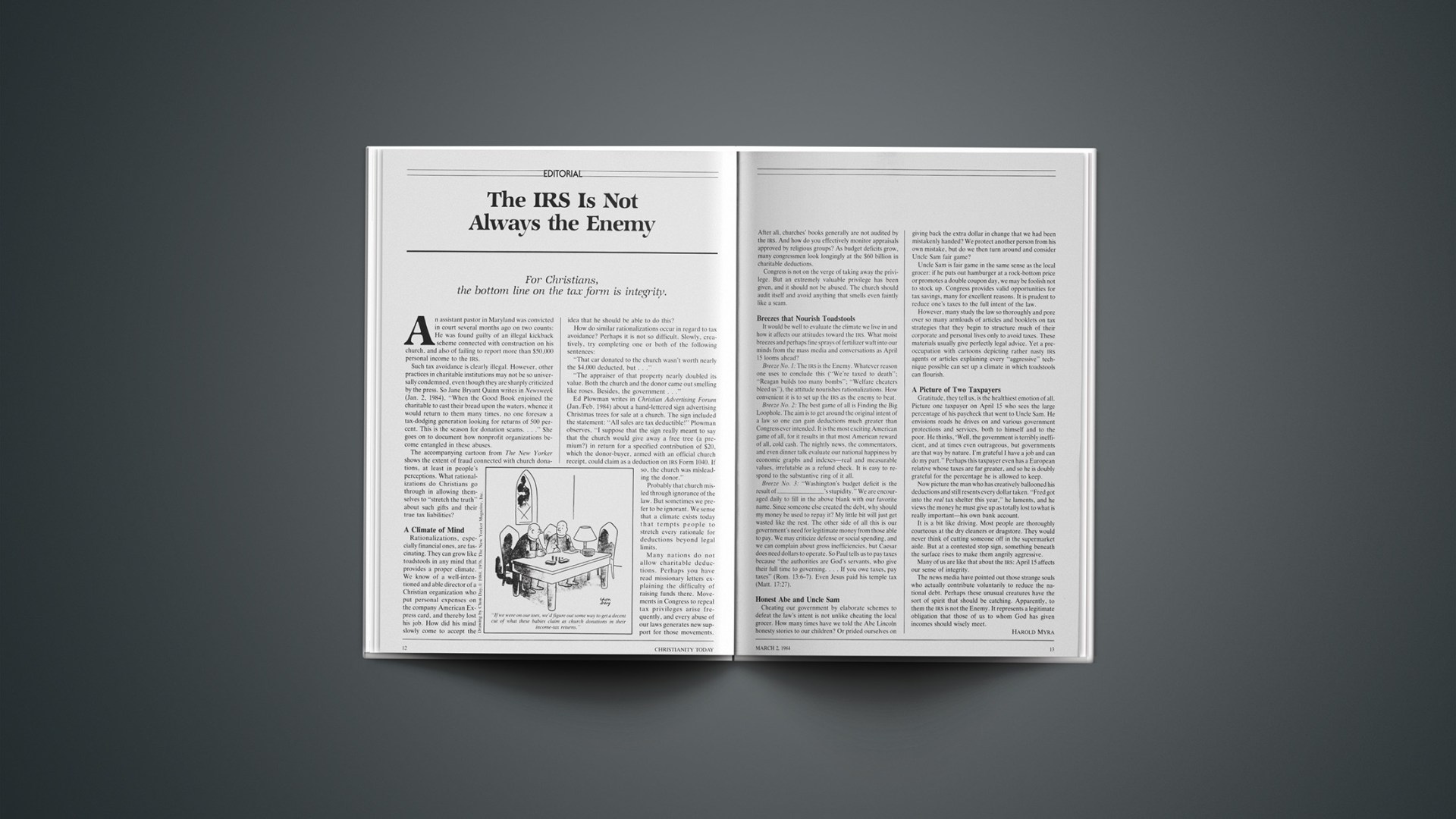
The accompanying cartoon from The New Yorker shows the extent of fraud connected with church donations, at least in people’s perceptions. What rationalizations do Christians go through in allowing themselves to “stretch the truth” about such gifts and their true tax liabilities?
Eutychus and His Kin: March 2, 1984

Clergy-Kong

It was a long time coming, but Gospel-Tronics, Incorporated, has finally produced a video game just for preachers. It is fairly realistic. Clergy-Kong is an old, arthritic Bible blip that tries to climb a set of ladders to the upper levels of clerical success. At each of the seven levels, Deacon-Trons try to push the ladders over to keep Clergy-Kong on the lowest possible level of the television grid. It’s a very fast game, in which the Clergy-Kong has to avoid sudden constitutional lasers, which are fired by bright board-member blips and can pierce at every level of Clergy-Kong’s climb.

The game was well researched before being marketed. Taking into account low clergy salaries, the machine operates on a dime, in contrast to the 25-cent machines that laymen can afford. Further, each time Clergy-Kong is struck by a constitutional laser, the electronic beeps play three bars of “Come, Ye Disconsolate.” Its computerized, solid state system is constructed so that if any man of the cloth plays the machine using his tithe, the machine shuts down, returns the dime, and plays in synthesized chimes, “Is He Satisfied with You?” (This is an improvement over popular lay models where an entire tithe and much time can be spent.)

I know one pastor who has become proficient at Clergy-Kong. He tends to get a little carried away with it, but he has built a great church by quick maneuvering and political prowess. He is a natural at Clergy-Kong. I slipped up behind him and peered over his shoulder the other day just as he injected his dime.

The machine bleeped on.

Clergy-Kong started up the first ladder.

“I’ve got you now, Elder Smith!” cried my friend. The little blip cheeped and ground out three beeps of “Victory in Jesus” just as the first deacon toppled from the laddertop and fell, in disintegrating shards of light, to the bottom of the grid.

“Haaaa, Haaaa, you’re next, Chairman Jones,” he shouted. His eyes tightened into hardness as he swirled the levers and Clergy-Kong climbed the second set of ladders. Clergy-Kong raised the tiny electronic Bible and struck the second blip of light, which toppled from the ladder and disintegrated.

“Out of my way!” he shouted. “Jesus, help me; Gladys Conklin is on the third level! Help me.” He started up the third set of ladders: “You’re gonna get yours, old girl!” cried the pastor. His hands gripped the pistol levers of the Clergy-Kong machine and the blip of light moved up. Clergy-Kong smote the female blip, and light exploded as the electronic chimes played three bars of “God, Give Us Christian Homes.”

He cried, “Hah-hooo, I got ’er, boys! I’ll reach pastoral success in no time.”

But his victory was premature.

A constitutional laser caught him from the side and he exploded.

“This game is over! Go back to the seminary graduate position and deposit another coin!” said an electronic voice just before the grid went dark.

When I left my friend, he was crumpled before the dark grid and fumbling in his pocket for another dime. He seemed on the verge of tears. “Must it always end like this? Help me, please help me,” he said, staring high above the grid into the empty void beyond the machine.

EUTYCHUS

Dylan Inquest Questioned

I am sorry to see your inquest into the matter of what Bob Dylan would say if you had the opportunity to ask him the question [News, Jan. 13]. I’m not quite sure, though, what the question would be. Are you born again? Are you running with us?

From a theological point of view, the question of judgment belongs to God, and on this earth, to whoever has ecclesiastical jurisdiction. Otherwise, decisions about where other people’s hearts are maybe should be left behind.

REV. JOHN MASON

Bristol, Tenn.

1984!

As the media crank up big plans in recognition of the “prophecy” of George Orwell, let us Christians remind the world by voice and pen that 1984 is—as always—the year of our real Big Brother. (It has the makings of a timely and arresting bumper sticker, doesn’t it!)

R. L. VEENSTRA

Rehoboth, N.M.

With all the discussion on 1984, let’s not forget Orwell’s Animal Farm. While we are sighing in relief that 1984 is inaccurate, someone, in a much more subtle way, has been changing the rules. The government is gaining control over the family and the church. Our press and educational system are controlled by secularist views. It would seem right in line with Orwell’s irony that 1984 would be the year that Animal Farm comes to pass.

JIM HALVORSEN

Minneapolis, Minn.

Duplication Impossible

I think I understand the point Eutychus was trying to make [“Dr. Seuss, M.Th., M.Div., Th.D,” Jan. 13]. But what I really learned was that as easy as it seems it should be to duplicate Dr. Seuss’s style, it can’t be done! In fact, ’twould seem to me better to be “blatant and dry” than to try to imitate Dr. Seuss (or even Eutychus!). I remember all too well when, despite my red suit and false whiskers, I was informed by a three-year-old: “You’re not Santa Claus, you’re old Brother Bob”!

REV. ROBERT E. HOLLIS, JR.

Montgomery, La.

A Real Winner

I was so pleased with “Why We Can’t Trust the News Media” [Jan. 13]. It agrees with so much of what my firsthand sources in Guatemala were saying about the situation during Ríos Montt’s presidency. Tom Minnery has done a real service to the cause of truth by seeking out witnesses who can refute Amnesty International’s and the press’s misrepresentations of Ríos Montt’s wonderful days of reform in Guatemala. Catholics in Guatemala and here appreciate his work in the service of truth.

JUAN FELIPE CONNEALLY, S.J.

Los Angeles, Calif.

Divine Healing

Paul Brand and Philip Yancey’s article, “A Surgeon’s View of Divine Healing” [Nov. 25], could be misleading and damaging to the Christian community. I am referring to the passage: “Let me illustrate the mind’s power with a few examples recently documented by modern science.…” The fallacy is that the mind is a channel of “divine energy,” an ideology found rampant in the Eastern mysticism and occult metaphisics of Holistic/New-Age health modalities. Furthermore, the line between Jesus/Christianity and “universal energy” is fading.

Perhaps it was an oversight on Brand and Yancey’s part. Nevertheless, what concerns me as a Christian is the growth of spiritual counterfeits, especially in the realm of medicine. The Bible clearly condemns practices designed to gather knowledge from invisible sources and to exercise “spiritual power” apart from God.

As believers of the one, true God, and his Son Jesus Christ, we do have an enemy, Satan. Either Brand and Yancey are talking about a personal God, or a “divine energy” that enables the mind to have power. I sincerely doubt the latter was the authors’ intent; however, there are disturbing features in their article. The shaman they cited who could cause death by the power of suggestion is no example of the “mind’s power.” If as Christians they cannot see that, I shudder at the fulfillment of Paul’s warning to Timothy: “The Spirit clearly says that in later times some will abandon the faith and follow deceiving spirits and things taught by demons.”

PAM MITCHELL

Chicago, Ill.

I do not agree with any description that “ridicules” faith healer doings. After all, God is the Author and Source of healing. God works in mysterious ways, and his foolishness, if any, is wiser than our wisdom, and the weakness of God is stronger than men (1 Cor 1:25).

LUKE H. C. SHENG, M.D.

Brighton, Mich.

While it is difficult for a believer to present a clear and unbiased survey of Christian healing, the article “Faith Healing: A Look at What’s Happening” [Dec. 16] shows that it is practically impossible for a nonbeliever to do so. The remarkable events in the less-developed areas of the world, where faith in material methods of healing is not so overwhelming, have been ignored. The lives of those for whom God has been the only physician all their lifetime, and sometimes for several generations in the family, have been unreported.

JOSEPH G. S. ROBINSON

Worchester, Mass.

Sinless Perfection?

With regard to “The Salvation Army: Still Marching to God’s Beat after 118 Years” [Dec. 16], I can’t believe that you let Mr. Billingsley’s reference to “sinless perfection” get past your blue pencil. “The perfection I teach,” Wesley wrote in 1761, “is perfect love: loving God with all the heart; receiving Christ as Prophet, Priest and King, to reign alone over all our thoughts, words, and actions.”

In A Plain Account of Christian Perfection, completed in 1777, he wrote, “… ‘sinless perfection’ is a phrase I never use.”

ROBERT D. WOOD

OMS International

Greenwood, Ind.

Theology Explanation Fails

The articles by Robert K. Johnston and Donald Bloesch [“After Fundamentalism: The Future of Evangelical Theology,” Dec. 16] both fail, as does Bernard Ramm in his new book Beyond Fundamentalism, to detect and therefore analyze and explain the theology of Karl Barth.

The reason Ramm, Johnston, and Bloesch have failed, and all who up till now have published analyses of Barth’s theology, is that they all apparently accept the assumption that God, in his essence, is actually timeless and spaceless. They have failed to see that the assumption was first advanced by Eastern mysticism. The difference between all of them and Barth is very simple. They have, in their own theologizing, refused to develop the consequences of such an assumption logically, while Barth has done just this. Why? He followed the argument as presented and developed by Immanuel Kant. They followed it as they found it stated in Athanasius, Augustine (but not in Calvin, for he warns against such speculation in his Institutes), and the later Reformed theologians. None of these, however, developed it logically.

The modern evangelical apologist and theologian must face the facts mentioned above or we shall all be swept into a neoorthodoxy that is neither new nor orthodox but simply a “new modernism,” and a new form of paganism.

R. ALLAN KILLEN

Reformed Theological Seminary

Jackson, Miss.

Letters are welcome. Only a selection can be published. Since all are subject to condensation, those of 100 to 150 words are preferred. Address letters to Eutychus and his Kin, CHRISTIANITY TODAY, 465 Gundersen Drive, Carol Stream, Illinois 60187.

Best Picture of the Year?: Terms of Endearment

Paramount; produced and directed by James L. Brooks

French director Francois Truffant once stated half in jest that a train would be the ideal place to stage a movie—the forward locomotion being akin to the movement of film through a projector. Indeed, the entire film-going experience can be likened to a journey by rail; we become passive spectators of a vast and varied human landscape—with our own reflection occasionally superimposed on the scene.

Terms of Endearment has all the right ingredients for a marvelous excursion, with its boxcar of eccentric characters pulled along by some fine acting and snappy dialogue. But once the destination is reached, you have to ask yourself whether the trip was necessary. In this particular instance, when all is cinematically said and done, the inevitable question must be: Is this all there is?

Inexplicably hailed by many critics as the year’s best picture, Terms is surprisingly drab. The ambitious plot attempts to cover too much territory in too little time with the overall effect of emotionally flattening both the characters and our reactions to them. Writer/director James L. Brooks has adapted from Larry McMurtry’s novel this story of the stormy relationship between an overbearing mother (Shirley MacLaine) and her easygoing daughter (Debbie Winger). The film covers several decades in their lives, from one death to another, with a series of extended vignettes that would serve, in another movie, as mere introduction. Brooks, however, hangs the whole project on this one technique. That our fondness for these wacky Texans remains so strong is a tribute to the fine acting of MacLaine, Winger, and Jack Nicholson (a sleazy ex-astronaut). Their performances are controlled and natural. Anyone who has grown up within a family will recognize Winger’s amused tolerance for her mother’s behavior: impatience tempered by years of love and devotion. Their relationship rings true, but one yearns, throughout the film, for the kind of intimate identification that good drama can so easily evoke. Yet, even in the terrible climactic moment of separation, we simply acknowledge the truth of the emotions without experiencing the reality.

Terms of Endearment never achieves the quiet dignity of last year’s stunning Tender Mercies, though their themes are similar. The concepts of grace under pressure, personal change, even common self-doubt, have eluded Brooks and his dramatic offspring. Ultimately, our shallow affection for his characters, our lack of real feeling for their plight, can only be attributed to our profound belief that life—and the giver and taker of life—demands transformation and a sense of meaning even in fictional people. Their drudging immorality and passive march toward death are, quite simply, unendearing and unendurable. At the end, one is left with the distinct impression that MacLaine and company haven’t come to terms with anything at all.

Reviewed by Harry Cheney, a writer living in Southern California.

Refiner’s Fire: Real People Struggle with Evil

Piers Paul Read’s characters are not all squeezed into a predictable mold.

In his essay After Strange Gods: A Primer of Modern Heresy (1934), T. S. Eliot observed: “… with the disappearance of the idea of intense moral struggle, the human beings presented to us both in poetry and in prose fiction today … tend to become less and less real. It is in fact in moments of moral and spiritual struggle depending upon spiritual sanctions … that men and women come nearest to being real.”

Eliot would have found the characters of Piers Paul Read, the English Catholic novelist, to be an important exception to the trend he lamented. As one reviewer notes, Read writes about “decent, well-intentioned people who suddenly find themselves up to their lily-white necks in evil.” And he writes well indeed. The New York Times Book Review has compared him to Tolstoy and said he is one of Britain’s “most intelligent and disturbing writers.” He has also been compared to another English Catholic, Graham Greene, although even Greene cannot equal the psychological density of his characterization and the arresting quality of his story lines.

Read is a social novelist, a realist, but unlike some other writers of this type he is no mere determinist, and his characters are not hopelessly enmeshed in some hapless weave of circumstance and fate. While finding themselves up to their necks in evil, his characters also possess the power to choose another future. A case could be made that Read takes human freedom as seriously as any novelist since Dostoevsky, and so repentance is always a possibility in his world. In novels such as Monk Dawson, A Married Man, The Upstart, The Professor’s Daughter, and The Villa Golitsyn, the reader knows it is possible for Read’s protagonists to “open their eyes,” in the words of Acts, and “to turn from darkness to light and from the power of Satan to God.”

Monk Dawson, for example, is about a Roman Catholic priest who abandons his vocation because of religious doubts. He becomes a fashionable journalist in London and writes an article about why people no longer need religion. He takes up with a smart set and carries on with a beautiful young widow. She eventually throws him over and on the rebound he marries someone else. She works hard at the marriage, Dawson does not. Finally, in desperation, she takes her life. It is only then that the most interesting chapter in Dawson’s life comes to be written.

Karl Menninger writes that a suffering conscience can bring about an experience of repentance that leads to a higher level of life. This is what happens to Dawson. He reenters the church, a Trappist monastery, not for comfort or out of weakness, but because he learns a new truth: the conscience cannot be destroyed. The experience Read depicts here is as old as Christian faith itself. Its prototype is Peter’s breakdown after his denial of Christ. Peter’s tears were an opportunity for God to begin in him a ministry that would be fruitful because at last he could fathom his utter dependence on God. So, too, Dawson discovers that one “does not attain a state of grace through a continuous succession of right actions, but by the understanding of the contradictions within oneself, a containment of them, and hence the preservation of one’s moral integrity. Sin was inevitable, but there was an antidote in repentance.”

Not all of Read’s characters choose to repent, however. His most recent novel, The Villa Golitsyn, is about two men who were together in school and then in the Foreign Office. Ludley has left the FO, ostensibly to look after his family business, but now the FO has reason to think he passed along secrets to the Asian Communists. Milson is sent to visit him, win his confidence, and extract a confession. We learn, too, that Ludlow has an even more shocking secret.

At one point Milson thinks his old friend is on the verge of confessing. Urging him on, he says: “One can always confess a sin.” But Ludlow only coughs and laughs.

“No, dear boy,” he says. “I can’t confess because I can’t repent, and I can’t repent because I’m not sorry. That is what leads to despair. To feel acute remorse yet know that one would do what one did all over again.”

Since moral freedom figures so prominently in his books, Read gets around a criticism frequently aimed at religious novelists. John Gardner, for example, criticized John Updike’s novels for being too much like sermons. He wrote: “No man can serve two masters, the artistic ideal, which makes its premise an essential and radical openness to persuasion, and the religious ideal … which is ‘deaf even to the best counterarguments’ (On Moral Fiction).” This is true for some religious writers. Spotting their religious premises, the reader quickly gathers what their conclusions will be and has the unpleasant experience of watching characters squeezed into the mold of some inevitable outcome.

But Read, on the other hand, gives us characters who are full of ambiguities and contradictions, and because freedom is real in his artistic universe, their course is unpredictable and “open to persuasion.” It is Read’s great distinction that his theology, instead of flattening his characters, illumines them by revealing their struggles to be what they are, in Eliot’s words, “moments of moral and spiritual struggle depending upon spiritual sanctions.”

Mr. Bachelder is minister of the First Congregational Church in Shrewsbury, Massachusetts, and the author of Mystery and Miracle (C.S.S., 1982).

Speaking out: Let’s Put Worship into the Worship Service

And let’s end gospel pep rallies and Sunday morning variety shows.

For the past decade I have made it my business to sample various services of worship and to ask pastors, students, and lay people to define worship for me. Occasionally I have come across some people with extraordinary insight into the subject. But more frequently the answers are groping, tenuous, and even muddled. Recently a student who knows of my interest in worship renewal caught the frustration many of us experience by saying, We are working against 400 years of neglect.”

Unfortunately, there is more truth than fiction in that statement. The fact is that we have not continued the interest in worship demonstrated by the Protestant Reformers. Rather, we have allowed worship to follow the curvature of culture.

I contend that there are at least four substitutes for worship in our contemporary culture, substitutes shaped more by the culture than by biblical teaching.

The first may be aptly called the lecture approach to worship. The cultural source that gave rise to the “classroom” church is the Enlightenment. The emphasis on the mind, learning, and education to the neglect of the senses and the inner spirit has resulted in a worship mentality that views the sermon as the be-all and end-all of worship. All else is lightly dismissed as “preliminaries.”

A second substitute for worship is evangelism. This approach to worship resulted when evangelistic field preaching replaced worship in some quarters. It turned the church into an evangelistic tent. In churches influenced by such preaching, Sunday morning is seen as the most propitious time to get the unconverted saved. All else is made subject to this overriding theme. The climactic point of the service is the altar call.

A third replacement for worship occurs when the overriding concern is entertainment and numbers. Television has given this approach its powerful support. It speaks in terms of the stage, the performers, the package, and the audience. It is a three-ring circus by the roadside. It gets the crowds, but what it feeds them is frequently shallow, hollow, and tasteless.

Last and not least is the self-help approach to Sunday morning. It’s the Me generation dressed up in church clothes. Those who attend learn how to affirm and fulfill the possibilities of personal greatness, wealth, health, and beauty. The ministers in churches with this emphasis play into the hands of such narcissistic indulgence. “Come to Jesus, and he will make you one of the beautiful people. An expensive home, a big car, popularity, and power are yours for the asking.”

At this point you are probably saying, “Webber, you are too hard on these approaches to worship.” Worship, however, is one of the most important callings of the Christian church—along with evangelism, education, mission, fellowship, servanthood, and emotional healing. If some biblical, historical, and theological instruction could help us to do worship better, what have we lost?

And “do” is an appropriate word. Worship is not something that someone does for us or to us. Rather, it is done by us. It is a verb, not a noun. It requires action. It is not passive—it is not merely watching or observing.

False approaches to worship perturbed the Reformers. The medieval church had taken worship away from the people and located it in the work of the celebrants and choir. Everyone else watched as if they were at a play. A monumental achievement of the Reformers was to give worship back to the people. Now we have come full circle. Worship no longer belongs to the people. It has become something someone does for us. Ministers lecture at us, move us into decisions, entertain us, and tell us how great we are. And we put up with it. We pay our money, go home, complain, and come back for more.

But the Bible understands worship as God-centered. In worship, God’s people act out the Christ event and thereby praise, honor, and glorify God. God himself is present in the telling that occurs through Scripture and preaching. And the God who was in Christ reconciling the world to himself is savingly present as we act out his death and resurrection in the Lord’s Supper. In and through the telling and acting out of the Christ story we respond to God in prayer, praise, confession, and thanksgiving. Our purpose is to give, not to get. The giving of praise and the offering of thanks is the supreme calling of the church. In those actions we minister to God and do what we were created to do—give him, Creator, Redeemer, and Judge, the glory due to his matchless name.

It is time to turn our backs on substitutes for real worship and to learn what it means to be a people who truly worship God. We are working against centuries of neglect, so we must not expect instant success. Rather, in our local congregation we must commit ourselves to honest evaluation, to study and prayer, and to new directions for Sunday morning that will bring greater glory to God.

Dr. Webber is professor of theology at Wheaton College. His latest book is Worship Old and New (Zondervan, 1982).

The Difference between Liberals and Evangelicals

West German church leaders focus sharply on distinctives.

Many evangelicals complain that mainline denominations are unwilling to discuss evangelical beliefs. When, therefore, 20 theologians gathered recently at the German Protestant Church’s Institute for Confessional Research in Bensheim to discuss “Traditionalism and Evangelicalism,” it was welcome news.

However, since none of the scholars was a member of the evangelical movement, their observations tended to reveal more about the presuppositions of mainline theology than they did of evangelicalism. The overall tone was one of hostility to conservative Christianity. Some of the criticisms were, quite frankly, unfair. The critics failed to appreciate the fact that contemporary evangelicalism is firmly committed to rigorous theological inquiry.

One criticism the theologians made, however, is of special interest. One participant suggested that evangelicalism is not sufficiently faithful to the biblical witness because it ignores Paul’s contention that everything has been relativized by Christ (Phil. 2:9–10). Evangelicals fail to employ Christology as a way to criticize certain biblical texts. Scripture, rather than Christ, becomes the absolute.

A more careful assessment of the evangelical movement would have revealed the error of this charge. Although many evangelicals would be uncomfortable with the idea that everything is relative except Christ, there is a sense in which they have permitted considerable diversity in doctrine so long as there is agreement about doctrines concerning Christ.

The consultation concluded that most theologians in the mainline denominations also hold this position. Every element of Christian theology must be relativized in relation to Christ and the experience of the gospel. One theologian argued that evangelicals and mainline theologians agree that all Christians must accept certain fundamental doctrines of the faith. Without the fundamentals concerning the person and work of Christ, Christian faith and theology are not possible.

But the participants were unwilling to acknowledge any agreement between themselves and evangelicals. This failure to recognize such a common ground is no doubt related to the presuppositions of the participants concerning the way we understand and interpret the Bible.

The single most important difference between evangelicals and nonevangelicals is the evangelical conviction that God has given us objective truth about himself. All truth must be relative, the participants argued. For contemporary mainline theology the “theology of the cross” seems to demand that the gospel is not heard except by believers who have taken a “leap of faith” to overcome the despair of meaninglessness. (In this sense Carl Henry’s assessments of mainline contemporary theology in volume 1 of God, Revelation and Authority seem vindicated.) The meaning of the Word of God is necessarily correlated with the faith experience or cultural context of the interpreter. These theologians have no place for an objective Word of God standing over against human experience.

Such a viewpoint creates a number of troublesome problems, however. Despite the apparently good intentions of mainline theology to affirm the fundamentals of the faith (the absolute authority of Christ and the gospel), the affirmation of God’s radical transcendence over against human experience seems undercut. The door is opened for the purely immanent god of secular theology.

Likewise, the evangelical suspicion that the theology of the established denominations is forfeiting a biblical perspective seems to be confirmed. Mainline theology cannot affirm with the Reformation that the Bible alone is its authority. Rather, both Scripture and the believer’s spiritual or cultural experience function as its theological norm.

The recent German consultation held at the Bensheim Institute summarizes the precise nature of the disagreement between evangelical theology and the theology of the established denominations. Both agree on the authority of Scripture, the absoluteness of Jesus Christ, perhaps even to some extent the use of historical-critical tools. But the fundamental disagreement between evangelicals and the contemporary theology of the established denominations has to do with the way in which they understand the idea that the Bible is God’s revelation. Evangelicals insist that in the Bible God has given us objective truth about himself and our relationship to him. That truth is not conditioned by the personal experience of the individual. Most participants in the conference appeared to deny the existence of such objective knowledge of God and his will for his people.

The discussions at the Bensheim consultation raise a very important question. If what ultimately divides mainline and evangelical theology is the former’s denial of objective truth, could a mainline theological position that espouses a limited use of historical criticism, accepts the authority of the Bible in its entirety, and presupposes the possibility of objective religious truth be regarded as a legitimate alternative?

Every Christian needs to understand this difference. Unless the Bible gives us objective knowledge of God and his relationship to the world, we walk through the corridors of life without knowing what it means.

The evangelical welcomes the opportunity to share his reasons for such convictions with anyone who will listen to him.

Dr. Ellingsen is associate professor at the Institute for Ecumenical Research, Strasbourg, France, and author of Doctrine and Word (John Knox, 1983).

Book Briefs: February 17, 1984

The writings of Francis Schaeffer and Rousas J. Rushdoony, popularizers and appliers of Cornelius Van Til’s theology, have for a long time made us aware of the opposing world views of Christianity and the world, between believers and unbelievers. In the mid-1970s, Os Guinness (Dust of Death) and James W. Sire (The Universe Next Door) wrote two powerful books that outlined and critiqued the available world views. They offered a Christian world view that answered questions posed by other major world views.

During the past three years these world views have come to focus on two opposing systems of thought: secular humanism and Christianity. Secular humanism represents the totality of Western thought when it refuses to believe in God.

The conservative Christian fight against secularism has grown hot. It is seen as the fence behind most of the evils of the world. The New Christian Right has raised its banners against secularism, fighting with fervor what they describe as the “religion of man.”

The Threat

Evangelicals have produced at least five books on the subject of humanism that deserve attention. One book published in this contemporary movement against the tide of humanism is Tim LaHaye’s The Battle for the Mind (Revell, 1980, 247 pp., $4.95). LaHaye sent it to 75,000 pastors and church leaders throughout the country. It is popularly written, designed to stimulate Christians to political involvement and action against secularism. The author finds the roots of secularism in Greek philosophy. According to him, Christian philosophy laid Greek secularism to rest until the Renaissance when it again began to flourish in all its bright colors. LaHaye stated that France later became the center for secular writings and politics, whereas America was built upon a predominantly Christian philosophy.

LaHaye sees secularism as being in direct opposition to Christianity and all that Christianity stands for. The former is an unscientific, religious force that is actively controlling America despite America’s moral, conservative majority. He blames secular humanism for the increases in immorality, pornography, drug abuse, self-indulgence, lack of responsibility, and disillusionment with America. He urges Christians to pray, evangelize, and especially to get involved politically in order to stop this evil force.

At about the same time, Ernest Gordon came out with his book Me, Myself and Who? (Logos, 1980, 264 pp., $4.95), treating the “false premise” of society’s humanism. Gordon likewise describes secularism as a direct contrast to Christianity. Secularism is bankrupt, however, because as a copy of Christianity it has abandoned the main tenets of the Christian faith. Gordon focuses on this process within the university. He asks Christians to live out their faith in real terms in order to influence and change the university. A mature, living faith will open the eyes of those who attempt to live with an empty, secular humanism.

Harvie Conn, in his Four Trojan Horses of Humanism (Mott Media, 1982, 143 pp.), shows how secular humanism has subverted psychology, sociology, politics, and theology by its philosophical presuppositions. Empiricism destroys morality’s base. Freud’s emphasis on behavioral causations has destroyed belief in man’s individual responsibility. The effect of secularism has been antilife. It advocates legalized abortion, euthanasia, genetic engineering, state-enforced birth control, and the acceptance of homosexuality and suicide as normal. The effect of secular humanism in politics is atheistic communism. Although Conn’s book lacks solid argumentation, it forcefully sets Christian philosophy in direct contrast to humanistic philosophy.

The Challenge

In contrast to LaHaye, Gordon, and Conn, Robert E. Webber in his book, Secular Humanism: Threat and Challenge (Zondervan, 1982, 137 pp., $7.95), does not say that all forms of humanism are from the pit. Defining the central concern of humanism as man and his welfare, Webber contrasts secular humanism with Christian humanism. He believes that Christian humanism offers a more human view of man and is more concerned with human welfare than secular humanism. The effects of secular humanism are described in terms of a “playboy mentality”: free sex, TV sex, pornography, “a violent society” that produces TV violence, child abuse, the breakdown of the family, and nuclear arms build-up, and a “schoolroom nightmare” that includes relativistic values clarification and sex education programs while it prohibits prayer on school grounds. Webber is more cautious than LaHaye in advocating political action. Instead, Webber challenges the church as an institution to “act as a social critic in its life of prayer, baptism, the Lord’s Supper, preaching, and lifestyle example,” and he urges individual Christians to take their Christian values and world view into the world through their vocational callings.

The Ammunition

Although all of these books have very important and timely things to say about humanism, I have felt the need for a book on this subject that I could give to my non-Christian, college-educated friends. A book that meets this need for me is Norman Geisler’s Is Man the Measure? (Baker, 1983, 201 pp., $7.95). It is a truly academically respectable evaluation of humanism. Geisler shows the diversity within humanism by describing and summarizing eight forms: evolutionary, behavioral, existential, pragmatic, Marxist, egocentric, cultural, and Christian. He compares and contrasts these forms of humanism. Then he draws together the common elements of non-Christian humanism into what he calls “secular humanism.” Although some of the elements of secular humanism have been helpful, secular humanism is comparatively inferior to Christian humanism. Secular humanism is internally inconsistent; scientifically, religiously, and philosophically inadequate; and socially arrogant. In short, while Christianity offers a solid rational justification for being a humanist—that is, concerned about the welfare of humankind—secular humanism does not.

The clashing world views of secular and Christian humanism are at the heart of differences between alternative solutions to the problems that we are presently facing. Secular humanism dehumanizes man, whereas Christian humanism humanizes him. This is a message that can be proclaimed from the rooftops. While many books effectively describe the effects of secularism, Geisler gives us the intellectual arguments that will enable us to understand and conquer its forces. It will enable us to preach a gospel that is truly human, a gospel fashioned after our human needs, longings, and hopes.

Reviewed by Bradley P. Hayton, adjunct assistant professor of psychology, Azusa Pacific University, and a member of the Orange County Christian Psychiatric Institute, California.

Sobran: A Common Bond?

In an increasingly confused, hostile, and secularized world, evangelicals need all the friends they can get. More than a friend, indeed an ally, is Joseph Sobran, a Catholic, a CBS radio commentator, a senior editor of National Review, and a contributor to the Center Journal of the Center for Christian Studies at Notre Dame University. He addresses abortion, fatherhood and the family, homosexuality, sex education, and other topics.

That the material in his book Single Issues originally appeared in The Human Life Review should discourage no one from reading it. Few writers can be “trans-prosed” from the glossy page to between hard covers and pull it off; Sobran is one. He is a master of a lost art form, the essay, and none of them is the kind of thing one reads over donuts and coffee. He is not trading on celebrity status, just saying what he feels needs to be said.

And he says it well. There is no humbug in this book, no wasted space. Indeed, Sobran, who has been compared to Chesterton, so lucidly and incisively exposes modern bufooneries and barbarities that one must sometimes set the book aside—only to pick it up again. The salient feature of Sobran’s writing is its fearlessness; behind it is a high, biblical view of human life.

Abortion and human life are recurring themes, and this is without apology: “Abortion might be called the single issue about which you mustn’t be a single-issue voter. Civil rights, Israel, farm policy, nuclear energy, entitlement programs, whales—you can be downright obsessive about any of these, and nobody will say boo.… What single issue [abortion] lies nearer the heart of civilization?”

Of particular value are his judgments on modern media and its linguistic gymnastics. The Christian who would engage in polemics with secularists and their media allies would do well to master his lexicon. The careful reader will be outfitted with a new nose for euphemistic jargon and weasel words, and insight into what they betoken in the speaker.

The bonus in this collection is “Happy at Home,” which deals with C. S. Lewis and his views on politics, education, culture, and mass media. Sobran sees Lewis as a conservative, “But Lewis’s conservatism was not of the Right that mirrors the Left. There is a world of difference between the man who wants to be left alone in his cottage and the man who wants to hold a mass-rally in the city. Lewis was a cottage dweller.” It is not easy to give a fresh perspective on C. S. Lewis, but Sobran has done it.

Single Issues will not only challenge and enrich the reader, but it confirms that Catholics and evangelicals have much more in common than has previously been imagined.

Single Issues: Essays on the Crucial Social Questions, by Joseph Sobran (Human Life Press, 1983, $12.95, 189 pp.). Reviewed by Lloyd Billingsley, a writer living in Southern California.

Campolo’S Theology

Anthony campolo, one of the most popular lecturers on the contemporary Christian scene, discusses in depth in A Reasonable Faith the theology he has developed as the result of his reflections upon modern secular thought. Rather than simplistically rejecting all modern philosophies as variants of “secular humanism,” he uses a number of secular thinkers to construct a theology for the modern age. Campolo argues that many of the discoveries of science and insights of contemporary philosophy are in actuality signposts that point to God, although that may not have been the secular scientist’s or philosopher’s original intention.

The author has a breadth of knowledge that includes the natural and social sciences as well as theology. Being a trained sociologist, he is particularly effective at demonstrating the relevance to Christian thought of such figures as Auguste Comte, Karl Marx, Émile Durkheim, and Max Weber. For example, Campolo discusses the value of George Herbert Mead’s social psychology in understanding the genuine possibility of Christian conversion (pp. 84–5). From Soren Kierkegaard, Campolo concludes that every Christian believer is a kind of existentialist because of the total faith commitment that God requires (p. 12). In his reliance on the philosophy of Martin Buber, Campolo presents us with a way to escape the narcissistic trap that many contemporary Christian psychologists have fallen prey to. The author views self-actualization as the highest goal of the Christian lifestyle, but this process should take place within the context of an “I-Thou” relationship in which each Christian brother or sister is fundamentally concerned with helping the other to reach his or her full humanity rather than placing primary concern upon the self.

An example of Campolo’s understanding of modern science appears in his examinations of the implications of Einstein’s theory, showing the Calvinistic belief in predestination and the Arminian tradition of free will to be compatible and not contradictory theologies (pp. 130–1).

In a postscript, Campolo admits that some may see the results of his theology as a form of heresy, but he argues that such attempts to contextualize the biblical message are a necessity. “I believe the Bible to be an infallible message from God,” he says, “but I also believe that it remains a task for men and women in each new culture to express that biblical message in ways they think might be relevant to their contemporaries” (p. 191).

Despite the fact that many of the thinkers discussed in the book present complex ideas, Campolo writes about their theories in a style that most will find comprehensible. The book will prove to be particularly valuable to Christians who are struggling with modern thought and seeking to find its relevance to their lives.

A Reasonable Faith: Responding to Secularism, by Anthony Campolo (Word, 1983, $8.95). Reviewed by Cecil E. Greek, New School for Social Research, New York, N. Y.

Appointment of an Ambassador to the Vatican Meets Mild Opposition

Protestant opposition to President Reagan’s appointment of an ambassador to the Vatican has fallen far short of the angry levels it reached in 1951 when President Harry S Truman tried to establish similar diplomatic ties. However, a handful of groups plans to voice concern about preferential treatment and the separation of church and state during this month’s Senate confirmation hearings for ambassador-designate William A. Wilson.

Opponents, including the National Association of Evangelicals (NAE), Seventh-day Adventists, and the Southern Baptist Convention were caught by surprise when Congress repealed a 116-year-old ban on formal diplomatic ties last November (CT, Dec. 15, 1983, p. 36). Their efforts to encourage grassroots expressions of alarm generated little response, and Reagan announced on January 10 that Wilson, the President’s special envoy to the Vatican, was his choice for ambassador.

The groups opposing the move have no quarrel with Wilson, a Catholic and a close friend of Reagan. But they object to what they consider to be an unconstitutional violation of the principle of separation of church and state. Sending an ambassador to the pope, they say, favors one religion over all others and could set a dangerous precedent.

“How long before Mecca makes such a request?” asked Jerry Falwell, a fundamentalist preacher and president of Moral Majority. As a whole, however, Falwell’s prepared statement reflected the ambiguity of the situation. “The Vatican is an internationally recognized sovereign entity,” he noted, epresented at the UN, the OAS, and other international bodies. The Vatican has entered into international treaties, some of which the U.S. has also signed.”

Falwell opposes the appointment, but he will not join efforts to block Wilson’s confirmation. It is “unblockable,” he said, due to overwhelming congressional support and Pope John Paul II’s popularity. “I would urge one thing,” Falwell said, “that the appointment be conditioned on Vatican recognition of the state of Israel.”

The Pope’s dual role as a prominent international statesman and spiritual leader of the world’s 700 million Roman Catholics is the source of the controversy. Because Wilson is already the de facto ambassador, the move is seen by the administration as a pragmatic way to improve official communications with Pope John Paul II and to endorse his pro-Western foreign policy initiatives, particularly in his native Poland.

Bob Reilly, associate director of public liaison at the White House, said the move “overcomes a diplomatically embarrassing situation in which the U.S. alone among its principal allies is not represented.” More than 100 nations have full diplomatic relations with the Holy See.

Along with Falwell’s ambivalence on the issue, other Protestant leaders have either withheld comment or downplayed the importance of the appointment. Things got a little sticky for White House-evangelical relationships when someone in the government leaked to the press a letter from Billy Graham to William Clark, the President’s national security advisor at the time the letter was written last spring. The confidential letter summarized the views of evangelical leaders on the matter. Graham took the soundings at White House request. Graham himself did not express opposition to the appointment.

Groups that feel strongly about it are considering ways to press the issue. If Wilson is confirmed as expected, Americans United for the Separation of Church and State (AU) may file suit. “We’re still hoping something will happen in the Senate, and we’re encouraging people to contact the White House and Congress,” said AU’s Joseph Conn.

Possible political damage to President Reagan as a result of this move is considered unlikely. “For most evangelicals it’s a disappointment. But other issues such as traditional values, national defense, and the economy will loom much more importantly” in the reelection campaign, said Robert Dugan of NAE’s Washington office.

Among fundamentalists, Falwell believes Reagan will sustain his popularity since “his total performance has been in the A+ range.”

Catholic reaction to the appointment has been positive but quiet. “It is not a religious issue but a public policy question, which happily has now been addressed and settled in that context,” said a spokesman for the U.S. Catholic Conference (USCC). It does not confer a “special blessing” on Catholicism, he said, but recognizes the power, influence, and prestige of the current pope.

Catholics are pleased as well about the tone of the opposing groups, which the USCC spokesman described as “restrained, courteous, and friendly—a tribute to ecumenical progress.”

In 1951, unified, vigorous Protestant opposition blocked Truman’s appointment of an ambassador to the Vatican. Today, Christians are less easily stirred to action on the issue. There is general agreement that the right President chose the right time to change a situation that had remained unresolved and uncomfortable for more than a century.

When Airman First Class Wayne Stayskal became a Christian in 1951, he considered becoming a pastor. Then 19, he remembers that a pulpit ministry seemed to be the right move.

Stayskal, now 52, chose another line of work, but he got a pulpit anyway. After art school and a stint with the old Chicago American newspaper, he became an editorial cartoonist for the Chicago Tribune. His pulpit is the newsprint that carries his views to hundreds of thousands of readers each week.

My work represents a Christian viewpoint. I’m not sure that a reader who didn’t know that I am a Christian would pick up on it immediately,” he says. “I don’t represent a particular evangelical or fundamentalist view, but there is a rightness, a sense of morality in my work.”

He decides what to comment on, and he is under no obligation to support the Tribune’s editorial stance. On a few occasions the Tribune has refused to print his cartoons because it disagreed with a view he expressed.

Stayskal produces five cartoons a week for the Chicago paper, arriving at work as early as 6 A.M. to complete a cartoon by 9:30. But his work receives wide exposure beyond the Tribune readership. His cartoons have appeared in at least 68 newspapers and in several magazines, including Time, U.S. News & World Report, and some Christian magazines.

He says many political cartoonists lack compassion for the people they comment on. Stayskal tries to understand people and their viewpoints before criticizing them in a cartoon, a principle he attributes to his faith. When he does criticize a public figure, he focuses on a situation or the person’s position rather than on the individual. But Stayskal is less charitable with the American Civil Liberties Union.

“It’s just one of my things to pick on,” he says, “to try to counterbalance some of their ideas—not that they are always wrong. But when I, as a Christian, don’t agree with their position, I speak out against them.

“I sometimes comment on situations that other cartoonists don’t handle. I don’t really consider myself very opinionated, except on issues that I feel the Bible issues a clear directive on. If the Bible teaches something very plainly, then I feel I must also take a definitive stand.”

When he makes a strong statement about current events, Stayskal softens the blow with humor.

“I like to visualize people … being able to laugh at a cartoon that is saying something about the news. In an earlier time, cartoons were largely political and full of symbolism. There was humor in the drawing, not so much in the message.”

Stayskal hasn’t limited himself to editorial cartooning. The Chicago-born artist has broadened his craft to include comic strips. His latest is “Balderdash,” a comic strip about a dog. Begun last October, it is already syndicated in some 20 newspapers. There might be a new role for the comic character in the future. Says Stayskal: “I would like to use him in a children’s book, conveying a message about life and ethics that would support what I believe as a Christian.

DEATHS

Ira L. North, 62, for 12 years the television host of the “Amazing Grace Bible Class,” for 32 years pastor of the Madison Church of Christ, Madison, Tennessee, the largest Church of Christ in the world (more than 5,000 members); January 15, at Nashville Memorial Hospital, of cancer.

Raymond McLaughlin, 66, head of the homiletics department at Denver Conservative Baptist Seminary from 1950 until recently, author of the award-winning book The Ethics of Persuasive Preaching; January 19, in Denver, of cancer.

John Westbrook, 36, pastor of Antioch Baptist Church in Houston, graduate of Baylor University, first black athlete to play collegiate football in the Southwest Conference; December 17, at Citizens General Hospital in Houston, of an apparent heart attack.

David Hugh Jones, 83, professor emeritus of music at Princeton Theological Seminary where he taught from 1934 to 1970, editor of hymnals, composer of choral works; December 21, in North Conway, New Hampshire, of an apparent heart attack.

Wilbur H. Davies, 80, former president of Fleming H. Revell Company; January 14, in Houston, of complications from Parkinson’s disease.

Norman Johnson, 55, for 20 years an editor at Singspiration, a division of Zondervan Corporation, and largely responsible for producing the hymnals Praise! Our Songs and Hymns, and The Covenant Hymnal; December 19, at his home in Grand Rapids, Michigan, of amyotrophic lateral sclerosis, commonly known as Lou Gehrig’s disease.

Charles Hays Craig, 71, former president of Presbyterian and Reformed Publishing Company; November 28, in Nutley, New Jersey, of complications from Parkinson’s disease.

U.S. Surgeon General C. Everett Koop’s healing skills have been evident recently in the government’s effort to revive a regulation protecting handicapped infants. Last spring, a “Baby Doe” hotline was proposed so nurses or other observers could call the federal government if they knew of a handicapped infant being refused medical care (CT. May 20, 1983, p. 41).

That regulation angered the medical establishment, and it all but expired under the weight of a successful court challenge. Hopes for resuscitation appeared dim until Koop grafted in a key provision doctors and hospitals demanded: voluntary committees in each hospital to review difficult cases.

The compromise has gained largely unenthusiastic support among right-to-life groups and professional medical associations. Barring a court challenge, the measure will take effect this month.

Right-to-life groups that have pushed for federal intervention in cases like that of Baby Jane Doe, a New York baby born with a spinal deformity, remain wary of the review committees. Medical groups, such as the American Academy of Pediatrics, are fretting over the level of government oversight still present in the regulation. But Koop’s careful merger appears to possess the stamina to withstand such criticism.

Besides providing for “infant care review committees,” the revised rule allows for hotlines that will be available to nurses and doctors only. Notices in hospitals about the hotlines will be displayed less prominently than before and will channel complaints first to the review committee and second to state or local health agencies. Complaints would reach the federal government only as a last resort.

The regulation allows the government to step in under federal civil rights law should another Baby Doe situation develop. This troubles the influential American Medical Association (AMA), which has not yet taken a public stand on the compromise regulation.

Most right-to-life groups recognize the wisdom of Koop’s willingness to settle for half a loaf. “We will look for [the government] to use these [provisions] and enforce them vigorously and not back down,” says Doug Badger, of the Christian Action Council (CAC).

Lobbyists representing medical interests are among Washington’s most powerful, Badger says. “It was politically necessary to give them something, and it could have been far worse. The regulation could have given hospitals the sole authority” to protect infants.

CAC wants the government to appoint a person to the civil rights office at the Department of Health and Human Services to do nothing but monitor and enforce the regulation. Second, CAC would like to see the Justice Department consider prosecuting some current cases, including the Bloomington, Indiana, case in which a baby with Down’s syndrome was starved to death in a hospital after doctors, parents, and a state court agreed that no treatment should be given.

The committees provided for under the revised regulation are suspect because, in the handful of hospitals where they exist, their members are almost all from the medical community. The Koop regulation, however, calls for the committees to include one community member, one handicapped person, and a child advocate to defend the rights of the infant.

One prolife group, American Life Lobby, vehemently opposes the revised regulation. Government relations director Gary Curran says Koop “caved in” to the demands of the medical establishment. Curran calls the review committees “part of the problem, not the solution.” The rule is only as good as its enforcement, he says. He doubts whether the government will ever be equipped to monitor committees in the 6,800 hospitals nationwide that receive federal funds and thus must abide by the new rule.

Right-to-life skepticism arises from observations of how existing committees work outside the boundaries of the new federal rule. An article in the October 1983 issue of Pediatrics describes how such a group reached decisions on babies with spina bifida—Baby Jane Doe’s condition—at the University of Oklahoma Health Sciences Center.

During five years, 69 newborns with the spinal deformity were evaluated. Thirty-six received vigorous treatment and 33 were to receive “custodial” care. If medical treatment is not recommended but the family insists on it, their wishes are honored. This happened in five cases, and three of the babies lived.

While many critics are quick to blame the medical community for trying to play God, doctors respond that current medical technology gives them no choice. The article in Pediatrics cites textbooks from the 1950s that categorically say spina bifida babies are expected to die in infancy.

Since then, a revolution in treating birth defects has occurred, thrusting physicians into uncharted moral and ethical territory they did not choose to enter. The dilemma of “selective treatment” has been addressed haphazardly and left unstated, so groups like the Oklahoma team have felt compelled to take matters into their own hands.

Groups that advocate rights for the handicapped have urged medical representatives to sign a statement of principles that sets a standard for treatment. This formed the basis for Koop’s compromise. Two important groups, the American Academy of Pediatrics and the National Association of Children’s Hospitals, signed the statement, saying that “when medical care is clearly beneficial, it should always be provided.…”

Reconciling these standards with the trend in professional medicine toward autonomous review committees using a quality of life guideline remains a formidable task. It moved a step closer, however, when Koop’s regulation was reluctantly accepted by both opposing sides.

BETH SPRING

Billy Graham’s latest book, Approaching Hoofbeats: The Four Horsemen of the Apocalypse (Word), sold 200,000 copies during its first month. The book made the best-seller lists in the New York Times, Publishers’ Weekly, and Time magazine.

However, most Christian books don’t fare so well. Francis Schaeffer’s A Christian Manifesto (Good News) sold more than 325,000 copies, but it never appeared on a major secular best-seller list.

Some critics, like Cal Thomas, author of Book Burning (Good News), say the exclusion of Christian books from most best-seller lists constitutes a subtle form of censorship. On the other hand, Chuck Phelps, sales manager for Crossway Books, points out that Christian best-seller lists ignore secular books.

Television preacher Robert Schuller’s latest book, Tough Times Never Last, But Tough People Do! (Thomas Nelson), has appeared on major secular best-seller lists. But the book hasn’t been included among Bookstore Journal’s best sellers, a list based on sales in Christian bookstores. Most of the 255,000 copies have been sold through general bookstores, says Mark Cady, sales manager for Thomas Nelson’s book division.

Ron Land, Word Books’ national sales manager, says Graham’s latest book would rank higher on best-seller lists if sales in religious stores were included. “The Graham book has been selling 25,000 to 30,000 [copies] a week, and had some weeks of more than 50,000,” he says. “There’s not many books that sell more than that.”

The New York Times reported last year that sales of religious books increased by 20 to 25 percent during each of the last ten years. Christian books account for one-third of all books sold in America. In spite of such significant sales figures, critics say secular best-seller lists ignore most of the Christian books sold in America.

“Nobody calls me for their lists,” says Dan Penwell, director of purchasing for Zondervan Family Bookstores, a chain of 83 stores. “I don’t think some of them realize how many books are sold in Christian bookstores. I have doubts about the lists at times, because I know how strongly certain Christian books are selling.”

Book Burning author Thomas, Moral Majority’s vice-president for communications, agrees. “The list makers are only counting sales in a predetermined group of stores,” he says. “The New York Times list, for example, is a phony best-seller list. It does not deal with total sales in all stores. It is a gerrymandered system that routinely excludes the large Christian sales.”

Brad Miner, a Bantam Books senior editor and president of the New York—based Religion Publishing Group, says it’s wrong to expect any best-seller list to be completely objective. “Many of the lists rely on Waldenbooks or B. Dalton, because in those stores the cash registers are computer terminals that record sales,” he says. “In addition, these chains have more stores in more locations than any other chains. So I view their sales as a pretty fair bellwether of what is happening industrywide.”

Miner says sales in Christian bookstores alone may not produce sufficient volume to earn a place on the secular lists, where books are ranked after selling several thousand copies in two months.

“With the Christian Manifesto, I think some of the Christian complaints are much ado about nothing,” he says. “The book has tremendous sales figures. But a book not only has to have large numbers, it also has to sell at a tremendous velocity to make the lists. I’m not sure the Schaeffer book had that velocity.”

Those who compile the lists say they accurately reflect what they measure—sales of books in general-interest bookstores. They say Christian books appear on the lists when the books accumulate sufficient sales. But they don’t poll Christian bookstores to determine sales of Christian books.

“We are trying to measure general reader tastes, and general-interest stores are the best places to find that,” says Adam Clymer, the person in charge of the New York Times’s best-seller list. “There’s no question that religious bookstores sell a great number of books. Some titles probably sell far more copies in religious bookstores than in any of the general stores. And I wouldn’t be at all surprised that these figures might change the rankings on our list. But that’s not what we’re trying to measure.”

As for criticism, Clymer says he’s used to it. “If people have opinions about the best-seller list, want to argue about it or present suggestions, we’ll listen,” he says. “We’ve changed our coverage over the years. I don’t mind if people offer us suggestions about how we could do it better.”

STEVE RABEY

Protest Letters Prompt Paramount To Drop A Movie About Christ

Novelist Nikos Kazantzakis expected his unorthodox biography of Christ to raise a stir. And it did. The Catholic church officially condemned his book, The Last Temptation of Christ.

More than 30 years later, the book again is coming under fire from the religious community. This time conservative Christians objected to Martin Scorsese’s planned film version of the novel. Citing creative differences and a deluge of letters protesting the film, Paramount Studios dropped the project.

“We did get a large negative response,” says Paramount spokesman John Gould. “And it was taken into consideration with everything else.”

The Tupelo, Mississippi-based National Federation for Decency (NFD) prompted the letter-writing campaign. The organization urged its constituents to contact the film’s producers and the president of Gulf and Western, Paramount’s parent corporation.

NFD spokesman Randall Murphree says he was pleased with Paramount’s decision to drop the project. Kazantzakis’s book, he says, is “blasphemous from beginning to end.”

Gould says letters of protest always influence studio decision makers. It is rare, however, for a project to be dropped this late in the game. Two million dollars already had been spent on the project, and filming was scheduled to begin this month. The decision left filmmakers searching for financial backers to take over the $12 million project.

Warner Brothers and Universal Studios already have turned it down. But supporters hope Scorsese’s reputation will help sell the movie. His agent, Harry Ufland, said a breakthrough in negotiations is expected soon.

The theological controversy surrounding the book involves Kazantzakis’s handling of the human side of Christ. He portrays Christ as a man who didn’t want to be the Messiah, an approach the NFD considers blasphemous.

Robert Schaper, associate professor of practical theology at Fuller Theological Seminary, agrees that the novelist’s exegesis is faulty. But he says the film version of the book shouldn’t be censored as a result.

“The book is a thoughtful probing of a very mysterious area in Christ’s life, done with great depth and insight,” he says. “I don’t know what people expect from Kazantzakis. He had no real understanding of the sinlessness of Christ. But there was certainly no malice involved.…

To get upset about bad theology from poor sources is rather juvenile.”

Does Your Church Meet In A School? It Won’T If The Aclu Has Its Way

A federal court case in Rhode Island could affect the use of public school facilities by churches in that state and across the country.

In a class-action suit filed against the Warwick (Rhode Island) School Committee, the state affiliate of the American Civil Liberties Union (ACLU) is challenging the use of public school buildings by religious groups. The suit was filed after some Warwick citizens complained to the ACLU regarding the use of schools by Catholic and Jewish congregations for after-hours religious instruction. Because the suit was filed in federal district court, the decision will set a legal precedent for other states.

“This is a very important case, not just for us, but for any religious group in any public facility,” says David Gadoury, pastor of the Cranston Christian Fellowship. Gadoury’s church has intervened in the case.

The church’s daughter congregation has met in a Warwick public school for two years. The parent congregation meets in a school in neighboring Cranston, Rhode Island.

“Other pastors who are planting new churches tell us they have tried to rent school buildings in other communities, but are given a hard time by school boards who tell them, ‘We don’t want a suit,’ ” Gadoury says. He says a ruling against the churches would be detrimental to the establishment of new congregations in Rhode Island.

“If the ruling says religious groups can’t meet in public schools, public officials might assume the use of any public facility is illegal, having a chilling effect on the availability of facilities for new congregations,” he says.

The City of Warwick is defending the right of churches and other religious organizations to use public schools. City Solicitor William Murphy says the city created a public forum by opening schools to community groups. “We can’t exclude community groups from that public forum because of their religious beliefs,” he said.

“The decision in First Amendment cases like this is, which right is paramount—the right to free speech versus the use of public funds for the establishment of religion,” says Henry Lane, attorney for Cranston Christian Fellowship. “We think our right to free speech and equal access is greater.”

Lane says rulings in other jurisdictions have upheld the government’s obligation to give churches access to public facilities.

The ACLU holds that allowing religious organizations to use public school facilities creates an unconstitutional entanglement between church and state. ACLU cooperating attorney Martin W. Aisenberg says their position is consistent with previous federal court rulings.

Legal briefs were to be filed by January 30, with a possible extension to February 14. Lane says a ruling could be reached within two months of the filing date.

Should the court rule against the churches and the Warwick School Committee, Gadoury says his church might file an appeal.

SALLY CHAPMAN CAMERON

A New View of the World

A German mapmaker says the Third World has suffered long enough from a distorted map.

The National Council of Churches (NCC) has begun distributing a map of the world that its designer says gives a true picture of the size of countries, unlike the maps we are accustomed to seeing.

Called the “Peters Projection” (after its creator, Arno Peters), the map attempts to show land masses in their correct sizes. To do so, it enlarges and elongates most Third World countries at the expense of the northern hemisphere, particularly Europe. That’s exactly what Peters, a historian from Bremen, West Germany, had in mind when he drew the map.

Another German, Gerhard Kramer, first drew the more familiar Mercator map in 1569. (Kramer Latinized his last name to “Mercator.”) His map produced severe size distortions in some countries because he located his own homeland, Germany, in the center of the map. It actually lies in the northern quarter of the globe. Countries in the southern hemisphere appear much smaller than they actually are.

Peters says the Euro-centered Mercator map contributed to colonialist thinking through the centuries. Peters’s map accords accurate size to all countries, although it distorts shapes in order to preserve accurate geographical relationships.

“In our epoch, relatively young nations of the world have cast off the colonial dependencies and now fight for equal rights,” he says. “It seems important to me that the developed nations are no longer placed at the center of the world, but are plotted according to their true size.” His work is perhaps more of a contribution to world politics than it is to cartography, since its shape distortion renders it unsuitable for use in navigation.

In correcting size distortions, Peters’s map renders a startlingly different view of the world to those accustomed to the Mercator map. No longer is the Soviet Union shown as twice the size of Africa, when Africa is actually a third larger. No longer is Greenland shown as larger than South America, when South America is nearly nine times as large.

Peters first presented his map in Germany 10 years ago, and its influence has been growing in schools and institutions there. Some European news outlets also have adopted it. The U.S. distribution marks the first time the map has been translated into English.

The NCC, with its penchant for involving itself in Third World political struggles, is distributing the map through Friendship Press, its publishing arm, and through Church World Service, its relief and development agency. Said Ward L. Kaiser, director of Friendship Press: “Because our world view as human beings is so largely dependent on our picture of the world, as long as our picture of the world presents us with distortions, our world view will be distorted.”

In Peters’s map, the United States appears to grow in comparison with the Soviet Union. Don’t forget, he says, that the United States was just another exploited territory at the time the Mercator map was developed.

Personalia Update: February 17, 1984

A Dallas Theological Seminary student has made Olympic gold his goal in 1984. Jerry Mungadze will compete this summer in the 1,500-meter, the 5,000-meter, and the marathon races, representing his home country of Zimbabwe. Mungadze started running 30-to-40 miles a day while in grade school.

Homer Dowdy, formerly a top executive with the Charles Stewart Mott Foundation, has been named executive vice-president of Food for the Hungry International (FHI), based in Geneva, Switzerland. He will direct FHI’s International Institute for Relief and Development, organizing seminars and conferences on world relief. Udo Middlemann, a L’Abri Fellowship trustee, will join FHI in April to direct the education program for the International Institute for Relief and Development. He will develop an educational program on hunger awareness, relief, and development.

More than 2,000 Brazilian evangelical leaders attended the country’s first nationwide congress on evangelism. In addition to discussing evangelization in Brazil, they addressed such problems as violence, poverty, corruption, and prejudice. In a joint statement, the leaders called for a “clear proclamation by word and life of the gospel in its totality for all men in Brazil.” Organizers disavowed any acceptance of liberation theology. But many leaders struggled with the church’s role in changing society.

A letter-writing campaign by 34 U.S. congressmen has led to the release of a jailed Chinese Christian. The human rights group Christian Response International credits pressure from Washington for the release of the man, identified only as the son of a prominent Shanghai house-church leader who remains imprisoned. In their letters to Chinese officials, the congressmen also inquired about reports that hundreds of Christians in China have been jailed since a crackdown on crime was initiated last August. Chinese Christians are under constant pressure to register with China’s official church.

A Baptist youth organization in Nagaland, India, has launched an antiliquor campaign in the state. Nagaland Baptist Youth is one of several organizations protesting the rapid rise in liquor licenses now being issued in Nagaland. The groups have asked their government to prohibit liquor sales.

The government of Spain has granted free television and radio time to broadcast non-Catholic church services. To take advantage of the opportunity, Spanish evangelicals are creating evangelistic programs to reach a potential audience of more than 12 million.

The Church of Sweden has been reprimanded for sex discrimination. The denomination was ordered to award $1,000 to Sylva Edvall, a woman who was denied a position as pastor of a congregation in Goeteborg. Edvall appealed to the Swedish government after the job was given to a man with less experience and fewer qualifications. The government then ordered the church to give her the position and a $1,000 settlement.

The Baptist World Alliance reports growth during 1983 in the number of Baptist churches and church members worldwide. Membership increased by 70,000 in Asia, and it topped one million for the first time in Africa. However, Baptists lost 90 churches and 1,051 members in Europe. Worldwide membership stood at 31,553,278 in 123,305 churches, a 3 percent increase over 1982.

Some 20,000 volunteers are coming to Los Angeles to spread Christianity among the throngs.

An estimated 900,000 visitors from around the world will converge on Los Angeles this summer to witness the 1984 Summer Olympics. In addition, nearly half of the world’s population is expected to watch the athletic events on television.

With international attention focused on Southern California, Christian leaders are planning an ambitious missionary outreach there. Some 20,000 volunteers will travel to Los Angeles in July to evangelize the multitude. More than 70 Christian organizations and churches—both Protestant and Catholic—are helping to plan the outreach. In addition to reaching the lost, organizers hope the massive outreach will revive a passion for world missions.

The Olympics Outreach Committee, which began its work early last year, is divided into a national advisory committee, a Los Angeles advisory committee, and a working committee. The national advisory committee is headed by two well-known Los Angeles-area pastors, Lloyd Ogilvie, of Hollywood Presbyterian Church, and Jack Hayford, of The Church on the Way. The working committee includes more than 30 full-time volunteers.

The plans are ambitious. Programs will cover everything from prayer to entertainment to crisis intervention. Evangelistic projects under consideration include the use of multimedia presentations at Olympics game sites, mime and drama troupes, street bands and street evangelists, rallies, and tent meetings. Volunteers will hand out gospel tracts, sports magazines, and Bibles in foreign languages.

Youth With a Mission (YWAM) is planning to bring in some 7,000 teenagers from around the world to help share the gospel. The army of young evangelists will be housed in church basements and in the homes of church members. The teenagers will witness to foreign visitors in their own native languages. They also will preach in ethnic communities.

It has been suggested that the flood of gospel literature and street preaching will result in overkill. But Bernie Ogilvy, a YWAM staff member who will coordinate youth outreach, disagrees. “You can never oversaturate with such a huge population,” he says. “The outreach will be very diversified. Different speciality groups will be targeted with specific evangelistic programs.”

Before the Olympics begin, outreach planners will be tackling problems associated with such a large-scale evangelistic undertaking. Organizers have to obtain permits to set up booths and to mobilize street evangelists. Housing, meals, and transportation for out-of-town volunteers need to be lined up. Arrangements need to be made for discipling those who will accept Christ.

The biggest problem is raising the money necessary to conduct the Olympics ministry. Funds are being solicited through advertising and through participating churches and ministries.

Despite the potential difficulties, organizers believe strongly in what they will be doing in Los Angeles this summer. Says media committee chairman Mike Hernandez, “God could use the Olympics to fan the flames of revival throughout the world.”

RICK GRANTin Los Angeles

Apple PodcastsDown ArrowDown ArrowDown Arrowarrow_left_altLeft ArrowLeft ArrowRight ArrowRight ArrowRight Arrowarrow_up_altUp ArrowUp ArrowAvailable at Amazoncaret-downCloseCloseEmailEmailExpandExpandExternalExternalFacebookfacebook-squareGiftGiftGooglegoogleGoogle KeephamburgerInstagraminstagram-squareLinkLinklinkedin-squareListenListenListenChristianity TodayCT Creative Studio Logologo_orgMegaphoneMenuMenupausePinterestPlayPlayPocketPodcastRSSRSSSaveSaveSaveSearchSearchsearchSpotifyStitcherTelegramTable of ContentsTable of Contentstwitter-squareWhatsAppXYouTubeYouTube