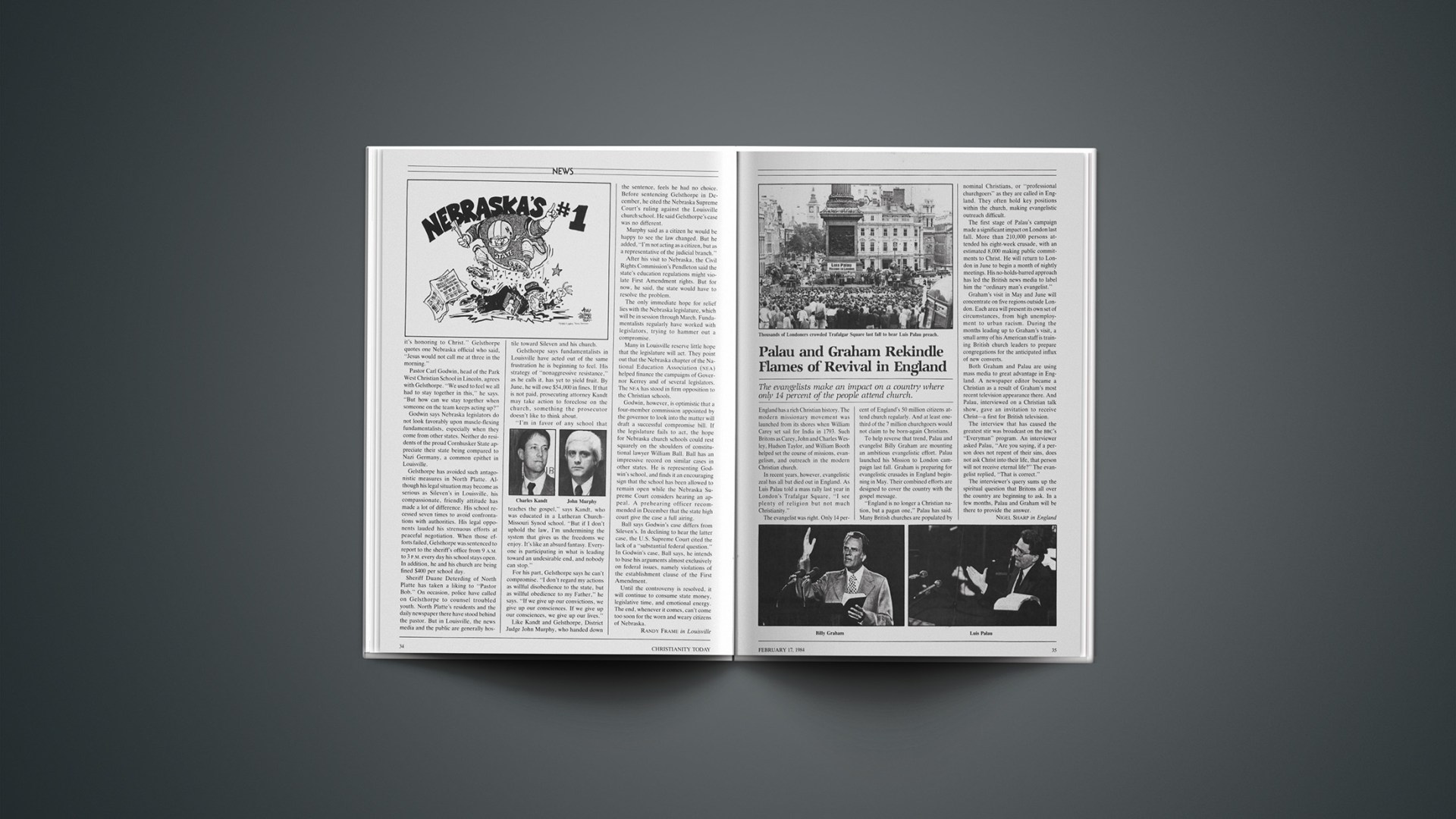
Palau and Graham Rekindle Flames of Revival in England

The evangelists make an impact on a country where only 14 percent of the people attend church.

England has a rich Christian history. The modern missionary movement was launched from its shores when William Carey set sail for India in 1793. Such Britons as Carey, John and Charles Wesley, Hudson Taylor, and William Booth helped set the course of missions, evangelism, and outreach in the modern Christian church.

In recent years, however, evangelistic zeal has all but died out in England. As Luis Palau told a mass rally last year in London’s Trafalgar Square, “I see plenty of religion but not much Christianity.”

The evangelist was right. Only 14 percent of England’s 50 million citizens attend church regularly. And at least one-third of the 7 million churchgoers would not claim to be born-again Christians.

To help reverse that trend, Palau and evangelist Billy Graham are mounting an ambitious evangelistic effort. Palau launched his Mission to London campaign last fall. Graham is preparing for evangelistic crusades in England beginning in May. Their combined efforts are designed to cover the country with the gospel message.

“England is no longer a Christian nation, but a pagan one,” Palau has said. Many British churches are populated by nominal Christians, or “professional churchgoers” as they are called in England. They often hold key positions within the church, making evangelistic outreach difficult.

The first stage of Palau’s campaign made a significant impact on London last fall. More than 210,000 persons attended his eight-week crusade, with an estimated 8,000 making public commitments to Christ. He will return to London in June to begin a month of nightly meetings. His no-holds-barred approach has led the British news media to label him the “ordinary man’s evangelist.”

Graham’s visit in May and June will concentrate on five regions outside London. Each area will present its own set of circumstances, from high unemployment to urban racism. During the months leading up to Graham’s visit, a small army of his American staff is training British church leaders to prepare congregations for the anticipated influx of new converts.

Both Graham and Palau are using mass media to great advantage in England. A newspaper editor became a Christian as a result of Graham’s most recent television appearance there. And Palau, interviewed on a Christian talk show, gave an invitation to receive Christ—a first for British television.

The interview that has caused the greatest stir was broadcast on the BBC’S “Everyman” program. An interviewer asked Palau, “Are you saying, if a person does not repent of their sins, does not ask Christ into their life, that person will not receive eternal life?” The evangelist replied, “That is correct.”

The interviewer’s query sums up the spiritual question that Britons all over the country are beginning to ask. In a few months, Palau and Graham will be there to provide the answer.

NIGEL SHARPin England

North American Scene

The Southern Christian Leadership Conference (SCLC) is supporting Sun Myung Moon’s appeal of his tax-fraud conviction. The Internal Revenue Service charged that the Unification Church leader failed to report income from stocks and a bank account held in his name. Moon maintains he was holding the assets in trust for church purposes. The SCLC plans to file a friend-of-the-court brief when Moon’s case goes before the U.S. Supreme Court. “The government does not have the right to tell a church how its funds should be administered,” says SCLC president Joseph Lowery.

A newly organized group of conservative Lutherans is concerned about the theological direction of the new Lutheran church to be formed from the merger of three Lutheran denominations. The Fellowship of Evangelical Lutheran Laity and Pastors (FELLP) sent a statement of “affirmation of faith and expression of theological concerns” to some 38,000 fellow Lutherans. FELLP has urged the new church to adopt the terms “inerrant and infallible” when describing the Bible. In addition, FELLP opposes theologies that imply that people can be saved without personal faith in Christ and repentance from sin.

The leader of the House of Judah sect has been found not guilty of child cruelty in the death of a 12-year-old boy at the sect’s camp in Michigan last summer. William Lewis, the sect’s founder, was acquitted because the prosecution could not prove he was responsible for protecting the boy. Police have charged that the boy’s mother and other sect members beat him for refusing to do his chores, a punishment prescribed by the sect. The boy’s mother still faces a manslaughter charge.

A federal judge has dismissed a suit brought against the Year of the Bible. The suit was filed by the American Civil Liberties Union (ACLU) on behalf of 16 plaintiffs, including Jews, Christians, Buddhists, and atheists. The ACLU charged that a presidential proclamation and a congressional resolution recognized Christianity as the official religion of the United States. Chief U.S. District Judge Manuel Real said the measures did not have the force of law, and therefore did not mandate religious conduct.

Violent lyrics in rock music have increased 115 percent since 1963, according to the National Coalition on Television Violence (NCTV). The organization also reports substantial violence in music videos shown on the MTV cable-television channel. The NCTV says sadistic violence appears more frequently on MTV than on any other television channel.

A computer analysis of photos of the Shroud of Turin indicates that the burial cloth came from Palestine at the time of Christ’s death. Francis Filas, professor of theology at Loyola University in Chicago, says a “digital image analysis” detected letters that appear on coins that were placed on the eyes of the dead during the time of Christ.

In Nebraska, the War between Church and State Rages On

Fundamentalists refuse to bend in their six-year battle against state regulation of church schools.

The Cass County Jail in Plattsmouth, Nebraska, stands near the geographic center of the freest nation in the world. But since last November 23, that jail has been home for six fundamentalist Christian fathers, held in contempt of court on a matter of their faith. Whatever the legal merits of the issue, more and more people are focusing on its larger implications, and the situation threatens to worsen before it improves.

The men refuse to testify in a case involving the Faith Baptist Church School in Louisville, Nebraska, which their children attended until recently. Their wives fled Nebraska after warrants were issued for their arrests. They took with them their 23 children, fearing the children would be placed in foster homes. The church’s pastor, Everett Sileven, and his daughter, Tresa Schmidt, a teacher at the school, also have fled the state.

Nebraska is one of ten states that exercise some form of control over private schools. Some 20 churches that operate schools there are fighting state regulation in court. They maintain that their schools are part of their ministries. Submitting to state approval, they say, would in principle give the state the power to control their schools and thus their churches.

Faith Baptist Church in Louisville started its school in 1977 without government approval. Criminal charges were filed against Sileven the following year. But the church stood its ground, and in 1979 a Nebraska court ordered the school closed. In 1981, the Nebraska Supreme Court upheld the lower court order, and the U.S. Supreme Court declined to review the case. Nevertheless, the school remained open.

In 1982, Sileven was jailed for contempt, and the church was padlocked (CT, Nov. 12, 1982, p. 54). In their latest attempt to force the school into compliance, Cass County officials arrested parents whose children attend it.

On January 18, Sileven returned to his church, daring law enforcement authorities to arrest him. But county sheriff Fred Tesch didn’t take the bait. “We have more important things to do,” he said. Sileven left the state a few days later.

Through the years, the opponents in this conflict have been bloodied, but they remain unbowed. The state still insists on approving teachers and curriculum. State officials contend that allowing schools to operate free of regulation would set a dangerous precedent. They fear that if the door is opened to fundamentalists, any group could set up its own school with its own requirements. Officials want to ensure that Nebraska’s school-age children receive a quality education.

Fundamentalists generally concede that the state has the right to regulate health and safety standards, and to verify, through attendance records and achievement tests, that children are receiving an adequate education. But they draw the line at state certification of teachers and curriculum.

Lincoln County attorney Charles Kandt, who is prosecuting a Baptist church school in North Platte, Nebraska, calls both sides in the conflict “Don Quixotes.”

“They think they’re charging dragons,” he says. “They’re really charging windmills.” Kandt says the fears of both the state and the church are unreasonable. Either side could give in, he says, and nothing would change.

Those in Louisville disagree. The jailed fathers see themselves as prisoners of an all-out war against nationwide government control.

“The education issue is only part of it,” says 54-year-old Ralph Liles, one of the prisoners. “If things continue going the way they are, in less than five years we’ll lose our freedom in America. Things will be worse here than in Russia.”

Courts in other states have ruled in favor of churches that operate schools. However, leaders of the movement in Louisville believe that as Louisville goes, so will go the nation. They have billed this tiny town of 1,000 as the final bastion of American freedom. As a result, hundreds of fundamentalists from across the country have dropped everything to go there.

The out-of-state visitors have established headquarters inside the church, where metaphors of war are casually tossed about. Hundreds have come to lobby in the state legislature, to rally outside the courthouse and the jail, to help run the school for the few students who remain, and to raise money. Phone bills in December and January averaged nearly $1,000 a day.

The public relations effort has gained national attention. In December, Sen. Jesse Helms (R-N.C.) offered his assistance to Nebraska Governor Robert Kerrey. U.S. Representative George Hansen (R-Idaho) has called the arrest of the parents an “embarrassment to the country.” At Hansen’s urging, Clarence Pendleton, chairman of the U.S. Civil Rights Commission, visited Nebraska last month. Presidential candidate Jesse Jackson and Moral Majority leader Jerry Falwell have considered a joint trip to Nebraska.

Fundamentalists who have come to Louisville say they won’t leave until the war is won. However, most Nebraska pastors who are battling the state over school certification think the outsiders should go home.

“There’s no question that we’ve been hurt by some of the antics that have gone on in Louisville,” says pastor Robert Gelsthorpe. Gelsthorpe’s North Platte Baptist Church School, like Faith Baptist, continues to operate in violation of court orders. But he objects to such Louisville tactics as staged media events, threatening letters, and middle-of-the-night phone calls to legislators and state education officials.

“We have to do something about the problem,” he says. “But we have to make sure that what we do is right, that it’s honoring to Christ.” Gelsthorpe quotes one Nebraska official who said, “Jesus would not call me at three in the morning.”

Pastor Carl Godwin, head of the Park West Christian School in Lincoln, agrees with Gelsthorpe. “We used to feel we all had to stay together in this,” he says. “But how can we stay together when someone on the team keeps acting up?”

Godwin says Nebraska legislators do not look favorably upon muscle-flexing fundamentalists, especially when they come from other states. Neither do residents of the proud Cornhusker State appreciate their state being compared to Nazi Germany, a common epithet in Louisville.

Gelsthorpe has avoided such antagonistic measures in North Platte. Although his legal situation may become as serious as Sileven’s in Louisville, his compassionate, friendly attitude has made a lot of difference. His school recessed seven times to avoid confrontations with authorities. His legal opponents lauded his strenuous efforts at peaceful negotiation. When those efforts failed, Gelsthorpe was sentenced to report to the sheriff’s office from 9 A.M. to 3 P.M. every day his school stays open. In addition, he and his church are being fined $400 per school day.

Sheriff Duane Deterding of North Platte has taken a liking to “Pastor Bob.” On occasion, police have called on Gelsthorpe to counsel troubled youth. North Platte’s residents and the daily newspaper there have stood behind the pastor. But in Louisville, the news media and the public are generally hostile toward Sileven and his church.

Gelsthorpe says fundamentalists in Louisville have acted out of the same frustration he is beginning to feel. His strategy of “nonaggressive resistance,” as he calls it, has yet to yield fruit. By June, he will owe $54,000 in fines. If that is not paid, prosecuting attorney Kandt may take action to foreclose on the church, something the prosecutor doesn’t like to think about.

“I’m in favor of any school that teaches the gospel,” says Kandt, who was educated in a Lutheran Church-Missouri Synod school. “But if I don’t uphold the law, I’m undermining the system that gives us the freedoms we enjoy. It’s like an absurd fantasy. Everyone is participating in what is leading toward an undesirable end, and nobody can stop.”

For his part, Gelsthorpe says he can’t compromise. “I don’t regard my actions as willful disobedience to the state, but as willful obedience to my Father,” he says. “If we give up our convictions, we give up our consciences. If we give up our consciences, we give up our lives.”

Like Kandt and Gelsthorpe, District Judge John Murphy, who handed down the sentence, feels he had no choice. Before sentencing Gelsthorpe in December, he cited the Nebraska Supreme Court’s ruling against the Louisville church school. He said Gelsthorpe’s case was no different.

Murphy said as a citizen he would be happy to see the law changed. But he added, “I’m not acting as a citizen, but as a representative of the judicial branch.”

After his visit to Nebraska, the Civil Rights Commission’s Pendleton said the state’s education regulations might violate First Amendment rights. But for now, he said, the state would have to resolve the problem.

The only immediate hope for relief lies with the Nebraska legislature, which will be in session through March. Fundamentalists regularly have worked with legislators, trying to hammer out a compromise.

Many in Louisville reserve little hope that the legislature will act. They point out that the Nebraska chapter of the National Education Association (NEA) helped finance the campaigns of Governor Kerrey and of several legislators. The NEA has stood in firm opposition to the Christian schools.

Godwin, however, is optimistic that a four-member commission appointed by the governor to look into the matter will draft a successful compromise bill. If the legislature fails to act, the hope for Nebraska church schools could rest squarely on the shoulders of constitutional lawyer William Ball. Ball has an impressive record on similar cases in other states. He is representing Godwin’s school, and finds it an encouraging sign that the school has been allowed to remain open while the Nebraska Supreme Court considers hearing an appeal. A prehearing officer recommended in December that the state high court give the case a full airing.

Ball says Godwin’s case differs from Sileven’s. In declining to hear the latter case, the U.S. Supreme Court cited the lack of a “substantial federal question.” In Godwin’s case, Ball says, he intends to base his arguments almost exclusively on federal issues, namely violations of the establishment clause of the First Amendment.

Until the controversy is resolved, it will continue to consume state money, legislative time, and emotional energy. The end, whenever it comes, can’t come too soon for the worn and weary citizens of Nebraska.

RANDY FRAMEin Louisville

In the Ghetto, Where Authentic Christianity Lives: A White Minister in the Inner City Finds Hope as Well as Poverty

In the following interview, Nees discusses some of the issues and difficulties facing a white minister serving an inner-city congregation.

One Washington columnist described the Community of Hope as “a pit stop on the way to hell.” What strategy have you adopted for ministering to the desperate needs in your area?

We don’t have a strategy or a set program; we came here to build relationships with people. Different programs have evolved, but only as a consequence of these relationships, the skills of the people who work with us, and an identifiable need.

We don’t see ourselves as “the answer” to our neighbors’ problems, nor do we pretend to have a response to every need we see. We are here to use the few resources we have in a constructive way, and to help our neighbors live in the midst of their distress. I tell people that I am here to work out my own salvation—and if in the process others get helped, I am grateful. This attitude helps us all to receive as well as give, and to avoid looking at our ministry as traditional “missionary work.”

What makes inner-city ministry different from traditional mission efforts?

In the popular view of missions, we send people to foreign cultures to save the heathen. Here, in this neighborhood, I’ve found more authentic Christianity than perhaps anywhere else I have ever been. The word that best describes black culture is “religion,” and the percentage of black people who attend church in this city far outstrips the percentage of whites.

Do you find that this religion is by and large a genuine expression of Christian commitment, or is it merely a manifestation of a cultural heritage?

We all tend to assume that we are normal and that whatever deviates from our style is “cultural.” I find the evangelical church, of which I am a part, just as culturally contained as the black church, and maybe even more so.

Incredibly, while slavery could not have happened without the theological endorsement of the established church, black people looked beyond the abusive understanding of the people who oppressed them. Somehow they were able to catch the essence of the gospel and preserve it.

Along with the gospel, the black church has carried the culture of black people, and that is its strength. In many mainline churches the minister is the pastor of the status quo; in the black community the minister is expected to take the lead in all kinds of community activities. The cultural connection is sometimes abused, and not all that passes for Christian faith in the black community is genuine; but then that is true in every culture.

Black ministers and community leaders are sometimes critical of white church groups for moving into the inner city and establishing their own programs. Did you consider working with an already existing black organization?

I came here determined to work behind the scenes, supporting the black leadership in this neighborhood. As time went on, I heard more and more criticism from black people because I wasn’t taking a strong enough leadership role. They said, “Unless some of you white folks get on the front lines and struggle with us, it’s not going to happen.”

Of course, if I came into the neighborhood as “the great white hope,” I wouldn’t be welcome. But a tragedy of our times is that there are no white leaders who we easily identify with the cause of black people. In the past there were people like William Lloyd Garrison and groups like the Quakers and the Abolitionists. Where today can you find white leaders who say to black people, “Okay, what’s the agenda, and how can we pool our resources?”

Do you see your community activities as a model for urban renewal, or are you making a last-ditch effort on a sinking ship?

We don’t see ourselves as a model but as a sign of hope, a sign that it is possible for the church to be effective in bringing about change both in individuals and in social structures. But I think there is a growing realization, both at the government level and among private agencies, that there are no wholesale solutions to the problems of the inner city. These problems are enormously complex. When we try to develop a set of solutions, we inevitably simplify and generalize to the point where programs become abusive.

Can you give an example?

The government program, AFDC (Aid to Families with Dependent Children). It was a well-meaning attempt to respond to the needs of children living in poverty, but a good case can be made for the claim that, as a result of this program, families have been dismembered. The guidelines that were necessary to make the program work nationally couldn’t possibly take into account the complexities of individual situations. So now it is more economical for women with children not to be married, and we are developing “the feminization of poverty.” Statistically speaking, in another 10 years, nearly all poor people will be women and children.

The truth is that the problems of any one individual or family are so complex that only small groups, like the Community of Hope, can be effective. We have to work at the level of personal relationships.

Is there any effective role that the government could and should be playing?

From a biblical perspective, one of the chief functions of government is to make sure that the poor are protected from the natural avarice of the rich. The notion that governments exist to protect our right to get as rich as possible is a pagan understanding of government responsibility. From Leviticus 25, where God proclaims the Year of Jubilee, through the Old Testament prophets and in the words of Jesus, the Bible is clear: government leaders, as servants of God, exist in part to protect the rights of the poor and needy.

What can the church do to encourage the government to play this protective role?

The history of government response to the poor in this country has always been up and down. A generous response comes only from some kind of pressure or outburst. As Christians, we need to create a moral and spiritual climate where it is unthinkable that a government would ignore the needs of poor people.

This won’t happen overnight. But as it is now, there is such a dichotomy between Christian thought and action that Christian politicians can inflict tremendous damage on the poor without ever seeing the contradiction between their commitment to Christ and the political measures they sponsor.

There has always been a tension inherent in the Christian faith between our need to endure suffering patiently and our desire to challenge existing social structures in order to alleviate the suffering of others. How do you reconcile the two?

My feeling is that the church has too narrowly defined its mission. Before the social gospel controversy it was just assumed that part of the church’s agenda was to reform society. Today, we have so confined ourselves to the “spiritual” that it is difficult for the rank and file to make the connection between the development of personal Christian piety and its application to peace and justice issues.

It’s a chicken and egg situation, but the fact is that people are damaged by social structures, and there is no concern of society that lies outside the legitimate care of the churches. In this neighborhood, we are literally picking up the dead and wounded off the street. You can only stand so long at the base of a cliff picking up bodies. Sooner or later you have to start wondering if it isn’t time to head for the top for some preventive fence building.

Sociologists speak of an “underclass,” a culture of poverty whose membership in our country includes millions of the urban and rural poor. How can the church respond to the needs of these people?

There are always going to be weak people in society, people who for whatever reasons never are going to break out of the cycle of poverty. We can’t shoot them or put them out in the cold just because they are unlikely ever to change. And while the church and government need to work together on general policies affecting the poor, it is the church itself that has the ongoing mandate to care for people who fall beyond the reach of any policy. Such people need to be absorbed into the life of the church community so that their basic physical and spiritual needs can be met.

The “volunteer syndrome” sometimes perpetuates the myth that helping people is a matter of quick and easy solutions. What advice do you give to volunteers to prepare them for service in the inner city?

The only reason short-term workers can be effective is because there are other people who are committed for the long haul. We make sure our volunteers understand this.

White volunteers sometimes come to us for the wrong reasons. They are ridden with guilt or suffering from idealism. Before they can make a healthy contribution, they have to be helped over these hurdles. We tell them, “Black people have a good sense of humor and if you come in here all serious and uptight, well, they have enough problems without taking on all your psychological baggage.” If volunteers can’t come with joy and enthusiasm, with an excitement about the direction of their own lives, then they might as well not come.

How are white volunteers received by residents of the neighborhood?

When I first started coming here to the riot corridor people said, “There are two kinds of folks who should never get out of their cars: policemen and white people.” That just isn’t true. I can’t imagine a white community in the country where a busload of black people could unload and announce, “We’re here to help you get your act together.” The reverse of that happens all the time here and the people of the neighborhood say, “Right on, if you’re here to help; in spite of all that has gone wrong, you are welcome.” Black people as a whole are still more open to reconciliation than white people.

The Community of Hope is an extension of the Church of the Nazarene. Do you think denominational ties are a plus or a minus in inner-city work?

There is certainly a place for parachurch ministries, and any of us are going to have questions about the denominationalism around us. But we are here not only to help meet needs in the inner city but to educate our congregations as well. Through urban studies programs, seminars, and seminary classes, we’ve developed genuine two-way communication. There are people in the church who never in their lives are going to understand what we are doing in the same way we do, but they are still extremely supportive. And I find more and more people want to support social ministries that haven’t compromised the personal dimensions of the gospel.

Frankly, the battle is here on the streets, not with the church. If the church thinks we are doing something inappropriate it can tell us, and that is a real safety net for everyone. I think of Dorothy Day in this connection. She was once asked if she would leave her ministry in New York City if the bishop told her to quit. She said, “Yes. The church may be wrong, but God can forgive the church just as he does individuals.”

After six years in the inner city, what tangible signs do you see that Christian groups like the Community of Hope can make a difference?

When you are dealing with life-and-death issues there are a lot of failures, both at personal and corporate levels. But we are encouraged to know that across the street are 40 families paying rent at half the market value, and no landlord can evict them. There are people getting medical help who otherwise would not even be alive—adequate health care in this city is a luxury that some people can’t afford.

Just as significant, old barriers are breaking down and relationships are being built. We set up dinners specifically so that the poor and rich can come together and share a meal. Watching these encounters, I am convinced that Christian people are basically generous. They aren’t going to sit down and eat their lunch in front of a starving person.

Society needs the church to provide more places like the Community of Hope, where black people and white people can come together because they want to be together, not because they are forced together by busing or the courts. People are confused by political systems they don’t understand or control. But when they are face to face with human need, labels like “liberal” and “conservative” disappear. The spiritual issues become clearer and genuine change is possible.

How has your understanding of who God is and what he expects of you changed since you came to the inner city?

Whereas most white people approach the gospel from the standpoint of affluence, black people have hammered out their faith on the anvil of suffering. Because of my contacts here, I’ve felt I needed to relearn the Scriptures. There are passages that simply never spoke to me before because I wasn’t poor or downtrodden.

Cultural white religion tends to be guilt-producing and dominated by a fear of sinning and going to hell. Black religion tends to look heavenward. While some of that is “pie in the sky,” it also reflects a transcendent view of life, a conviction that there is something more than suffering. So while I have come to understand better the crucified Jesus, the suffering God who stands beside us, I also am moving away from guilt and condemnation toward a God who is more accepting and understanding of my weaknesses.

Tim Stafford is a free-lance writer living in Santa Rosa, California. He is a distinguished contributor to several magazines. His latest book is Do You Sometimes Feel Like a Nobody? (Zondervan, 1980).

A Letter to My Sons about Lebanon: After 11 Years in Lebanon, a Father Writes to His Draft-Age Boys

Leonard H. Rodgers, based in Cyprus, is the Middle East program director for World Vision International. He speaks Arabic and has traveled widely throughout the region. He was a Youth for Christ missionary in Lebanon, and for 11 years he and his family lived in Beirut. His sons, Len and Craig, are students at Seattle Pacific University. Shortly before Christmas, he wrote his boys this letter, in which he offered a viewpoint not normally seen in the news media.

Dear Len and Craig,

Since you are the age of the American and French marines who died in the suicide bombing of the multinational forces in Lebanon, I wanted to write to you in order to clarify some issues you probably are thinking about. I know that the two of you are more informed about Lebanon and the Middle East than most people, since you grew up there. However, the situation continues to change almost daily, and I wanted you to have from me the clearest explanation possible. A lot of your classmates and professors will be asking you questions since they know of your interest in that part of the world.

Do Not Succumb To Despair

There is a lot of fatalism in the Western world about the Middle East. People inside and outside the church are projecting a good deal of cynicism, and at the outset I want to say that there is hope. In no other time has the church in Lebanon had so many opportunities to display this hope. In a special way we have a responsibility in the situation since we believe Jesus Christ is the Life of the world. We see hope in the immediate future because we know there is ultimate hope. Our faith keeps us full of hope! You would be so proud of the people we know in Lebanon.

Recently, two Lebanese Christians were kidnaped from the mountain village Naba Safa where we are helping a village rebuild about 65 homes destroyed in a tank battle between Israeli and Syrian forces in the summer of 1982. The local reconstruction committee is half Druze (a Muslim sect) and half Christian. Kidnaping in this mountainous area known as the Shouf is deadly and predictable.

The bodies are normally discovered the next day. Two Druze from the reconstruction committee went to the Druze vigilante group holding the kidnaped Christians and offered themselves as replacements for those kidnaped. They said, “Whatever you were planning to do to these people you can do to us, but let them go. They are our neighbors. In the community of Naba Safa we work together.” The militia leaders were so moved by this expression of community solidarity that they released the two Christians along with the Druze who had offered themselves as ransom. The two Druze and the two Christians returned to their village together.

In this case, followers of Jesus were saved by the very mercy they had shown. Their faith was spontaneous in the midst of despair, and they displayed inner lives full of love, peace, and goodness. These people are not working to be good and kind, they are good and kind. It would be work for them to refrain from being good and kind because goodness and kindness are a part of their nature (Gal. 5:22–23). Shakespeare once wrote, “The quality of mercy is not strained.” These are the untold stories of nine years of war in Lebanon and more than 130 broken cease-fire agreements. There is hope in the midst of despair.

The War In Lebanon Is Not Between Muslims And Christians

The news media give the impression that the war in Lebanon is a religious war. This is unfortunate. At the end of World War II Lebanon became a nation on the basis of a religious population. Political lines were drawn by this census and continue today. Religion has become a political designation encouraged by party chieftains. These chieftains represent the various sects of Christianity and Islam along party lines. To simplify matters the news media simply use the term Christian or Muslim rather than explain the intricate background or the way the unscrupulous party leaders have used religion as a political tool. Keep in mind that there are still strong, ethical, and moral leaders among Christians and Muslims. For example, Shafik Al Wazan, the present prime minister of Lebanon, is a Muslim. He represents solid human values and is one of the unsung heroes of the Lebanese tragedy. There are people in Lebanon like him who do not allow their religion to be stereotyped but instead hold up ethical values for the welfare of all citizens, both Christian and Muslim. There are many fair people in Lebanon who have not been deceived by the news media’s attempt to categorize and simplify the war in terms of Christian and Muslim. President Amin Gemayel of Lebanon is a trustworthy and reliable political partner who is worthy of U.S. support. He desires to bring together the warring factions and to create power sharing in Lebanon. Christians should pray for him and his government that he will be able to bring about reconciliation on an equitable basis.

The Arabs Look West, Not East

Today I saw a paper by a well-meaning and rather well-informed journalist, who said, “Arabs now hate us with a passion.” Most people in Western countries assume that the Arabs hate Western civilization. You know from your own childhood this is not true. The Arab world is inextricably linked to the West. They have no desire to look East, especially to the Soviet Union. Our long acquaintance with the Arab people has shown us that for the most part they desire to be linked to Western nations not only economically but in other ways. This does not exclude their looking to other parts of the world, particularly the nonaligned world, for certain identification. However, most intelligent Arab people have a quiet love affair with Western society. They are, however, frustrated by the double standard they see. On the one hand they are aware of the great political and moral reformers of the West, but they do not observe the application of that reform in the democracy that the Western world exports to the Middle East. This causes a great deal of frustration. A case in point would be the condemnation by Western powers of Iran as a fanatic religious/political society and not a true democracy, but the same standard is not applied to Israel, which is a religious/political entity and not a true democracy. Another example of this dual standard is the stated ideal coming out of the West that all races are equal. The Arab world sees films and reads literature about Abraham Lincoln and Martin Luther King, Jr., but Arabs also see that equal rights are not applied to the Palestinian people in the Middle East.

U.S. Policy In The Middle East

A journalist interviewed one of the sailors on one of the U.S. gunships firing on the Shouf mountain region of Lebanon. He was asked what the war was all about. His answer was, “I think it has something to do with communism.” This statement seems to summarize the way the present administration sees the situation. U.S. policy toward Third World trouble spots is widely faulted for neglecting root causes, dissent, and conflict, concentrating instead on Soviet-Cuban (Syrian-Libyan) inflammation of the resulting chaos. Getting the U.S. Marines out of Lebanon, or at least into safer positions, is no more a Middle East policy than putting them there. The marines were sent to Lebanon for short-range reasons: first, to cover for the Palestinian withdrawal; then, as a gesture of U.S. commitment to protect the Christian community from reprisals in civil war after the Israelis withdrew from Beirut. But no one seems to know exactly what the long-range reasons might be for U.S. involvement in Lebanon. The U.S. could be of help in Lebanon, but not for the reasons stated by the administration. U.S. forces could be there to encourage self-reliance for those who seek justice and equality, but not to offer power carte blanche to “Christians” who have the capability to be as ruthless and as violent as militant Islamic groups. By listening to the news, one would think that we were involved in the modern-day crusades, thus harking back to that dreadful era in history some 700 years ago when Christians imagined that the sword was more effective than the spirit, to wrench from Muslim grip the holy places sacred to Christianity. We could not encourage a return to that mentality in this last part of the twentieth century.

Western Powers Are Interested In The Revival Of Islam To Offset Communism

Although we read a great deal about the evil of Iran and the lunacy of Libya, one cannot but acknowledge that a great deal of the present unrest in the Middle East is manufactured by Western interests in order to encourage an even stronger ideology (Islam) to offset possibilities of Marxism in the area. The great powers, instead of helping to ease tensions, have at times inflamed them, or used them for their own economic, political, and strategic interests. This situation has led to violation of human rights, and moral and physical violence.

The Poor In The Middle East

In spite of the fantastic revenue from oil, stark contrast between rich and poor continues to dominate the Middle East. Oil wealth has not been invested for the elimination of poverty, illiteracy, and injustice in the Arab world. Much of the income is recycled into Western economies, and large sums are used in financing wars by proxy. Some Mideast countries have promoted highly visible relief programs, but the majority of the funds have been spent on pleasure and Islamic missionary activities in Africa, Asia, and the West. In sum, the money has created violence among individuals and groups as well as wars between nations. All of this underscores why I’m giving my time to the kind of holistic ministry that World Vision is encouraging. The needs are great, and few are meeting them, simply because it is assumed that the Middle East is affluent.

The Forces At Play

1. Islamic fanaticism. There is a revival of militant Islam in the Middle East. As I have mentioned, some of this is encouraged by Western intelligence. Nevertheless, it is a vital force at work today. It should be emphasized that it is only one force at work.

2. Nationalism. Some leaders of Arab states, on the other hand, represent a desire for legitimate Arab nationalism. Not surprisingly, some of the leading Arab nationalists in this century have been Orthodox Christians, and two in particular stand out as founders of important political parties and movements. These include the Al Ba’th (Renaissance) and the Al’Hisb Al-Qawmi (Nationalist party). One early Christian politician said, “I am Christian by religion but Muslim by nationality.” For the majority of Christians, however, some kind of commitment by Muslims to a purely secular nationalism was necessary before they would abandon themselves wholely to the Arab cause. Charles Malik put it this way, “For the Christians of the Near East, Muslim culture is in a deep sense their culture. They cannot be too deeply interested in the development of their common heritage.” But Malik also felt strongly that there was a need for reciprocity on the part of Muslims, for whom Christianity is an important part of their cultural heritage. The majority of the Arab political leadership of the Middle East today wants Arab nationalism and a form of Arab democracy rather than militant Islam.

3. Secularism. Secularists are people who really are not religious at all and in fact are often ideologically Marxist and want to use religion only as a way of gaining the political allegiance of the religious. The nationalist and secularist movements of the Middle East were promoted mainly by Christians, joined by Muslims and some Jewish intellectuals who had been in contact with European culture. These movements were based on the values of the Western humanist movement, the principles of the French Revolution, and in some cases, Marxist philosophy and economic analysis—all of them aiming at a society based on equality among individuals regardless of their ethnic or religious backgrounds.

Crisis Of Identity

Individuals in the Middle East are being forced to redefine their identities along ethnic and religious lines. Christians are experiencing a difficult time. They can leave the region out of fear and despair or they can opt for political power and political existence similar to that of the Jews or Muslims. The third option is to continue the struggle toward a deconfessionalized society. As you know, young Christians with big crosses around their necks are taking up guns and killing innocent people in revenge and retaliation. Their argument is that the only language Islam and Judaism understand is the language of power and force. Such situations are making Christians raise the basic question of what it means to be a Christian in the Middle East today. Is our faith the faith of power and therefore of politics, of preserving our physical well-being? Or do we accept with courage the call to witness to truth, love, and peace until death, if necessary, for the sake of the resurrection of all? Do we accept an earthly kingdom, or do we long for the kingdom of God whose rule and power are of a completely different nature?

With the fragmentation of the Middle East into ethno-religious groupings, there is a need for Islamic/Christian/Jewish understanding and cooperation. Christians, for example, should help Jews go beyond their practice of reading history from the Holocaust and help them understand history in light of the Cross and the Resurrection. Reconciliation between Arabs implies that Israel does not build its security at the expense of Palestinian rights and security but does help the Palestinians recover their identity and human dignity.

And so, Len and Craig, I share this analysis and background with you because you care. In the future, I feel you will do much more than I’ve been able to do to see these values put into action. I learn so much from you with regard to authentic faith since I see you take, and live out, the values I speak about. I value your insights, since I’ve noticed how much you are able to practice the qualities of reconciliation and peace in your own contacts with friends from the Middle East.

Your Dad.

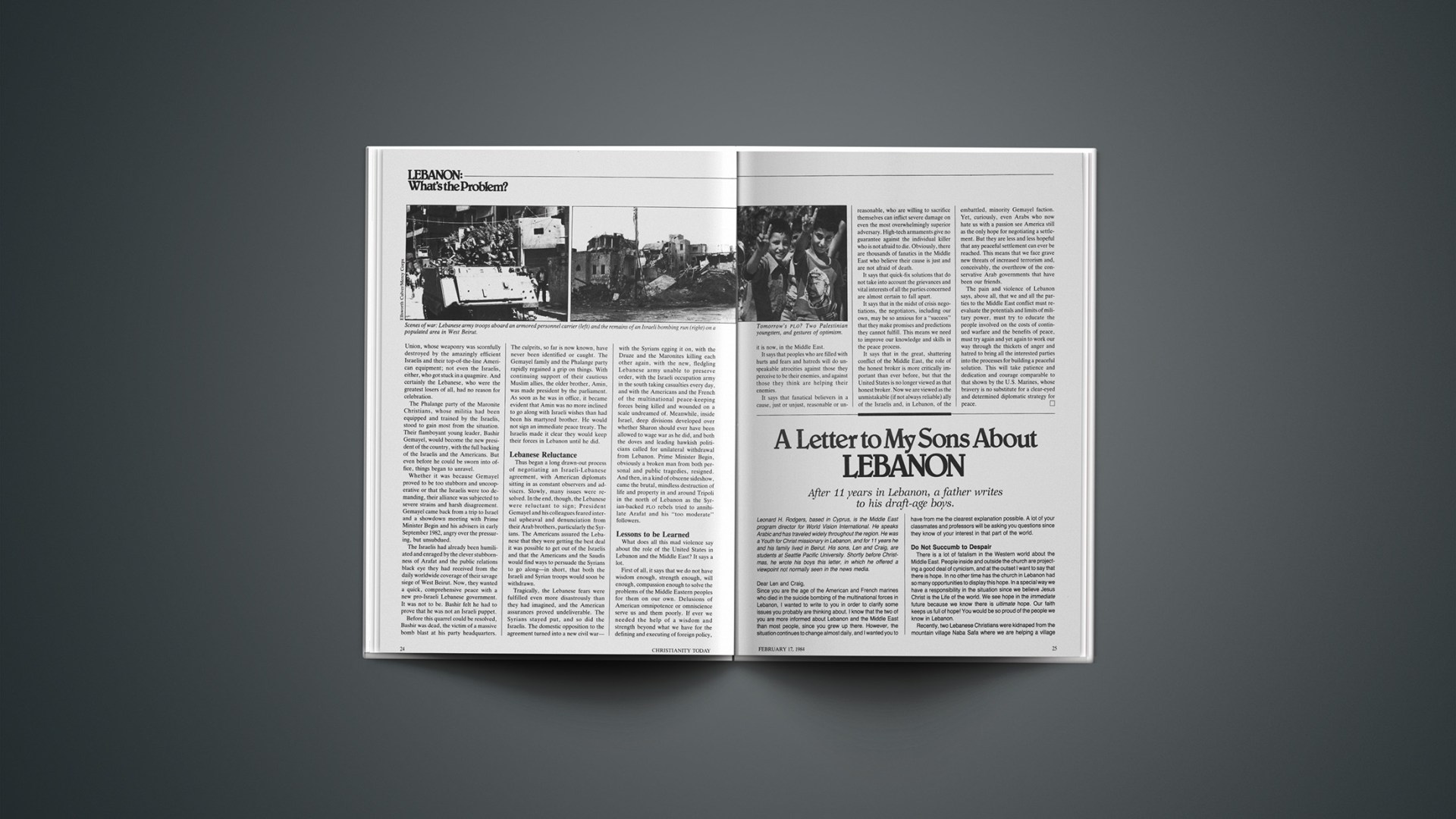
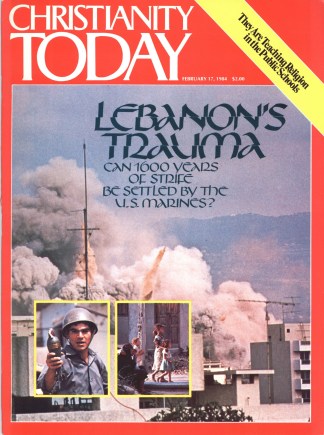
Lebanon: What’s the Problem?: Can 1,600 Years of Strife Be Settled by the U.S. Marines?

Landrum Bolling was a war correspondent in World War II, then became a professor of political science and president of Earlham College (Richmond, Ind.), a Quaker school, for 15 years. He was president of the Lilly Endowment, and a professor of diplomacy at Georgetown University School of Foreign Service. He is now president of the Ecumenical Institute for Advanced Theological Studies at Tantur in Israel. During the 1960s he headed an international Quaker study team examining the Arab-Israeli conflict in depth. Since then he has traveled frequently to the Mideast to meet with leaders on all sides of the conflict and has been a consultant to several administrations in Washington on questions of Mideast policy.

Bloody conflict is no new thing to the beautiful land of Lebanon, whose mountainous shores are washed by the easternmost waters of the Mediterranean Sea. Long before the birth of Christ, a minor Old Testament prophet warned that those who deal unjustly with other nations may expect harsh retribution. Matter-of-factly, Habakkuk predicted dreadful consequences for those involved in the “violence of Lebanon.”

The recurring waves of foreign conquest and intertribal convulsions in and around Lebanon make up a history of lamentations too tedious to tell. Brutal strife has been the lot of the diverse peoples of the region, generation after generation.

Violence in Lebanon did not begin with the Israeli invasion of 1982. Nor did it arrive with the first hundred thousand Palestinian refugees who fled northward after the creation of Israel in 1948. Nor was it initiated by another 200,000 Palestinians who were dumped on Beirut and southern Lebanon when King Hussein threw the PLO out of Jordan in 1970 and 1971. Israelis and Palestinians have, of course, been killing each other for years on Lebanese soil, or along the border. Through armed political and religious factions, the Lebanese have gone through an unbelievable cycle of civil wars, assassinations, and attempted coups ever since the modern independent state of Lebanon came into being. Those factional struggles stretch back centuries.

What the Israelis and the Palestinians have done in their struggle with each other over the past decade has been to exacerbate the internal Lebanese feuds—and to encourage the Lebanese to join the Israelis and the Palestinians in theirs.

The sprawling land bridge between Asia and Africa—now divided into nation states called Syria, Lebanon, Jordan, and Israel, plus the Sinai district of Egypt—has been fought over since time immemorial. Old Testament passages tell of numerous wars. The great emperors from Alexander to Napoleon have sent their legions swarming over the region, and the European Crusaders held sway for a century.

Parenthetically, the Old Testament tells of friendly cooperation, as well as warfare, between peoples and rulers on both sides of what is now the international boundary between Israel and Lebanon. According to 1 Kings 5, confirmed by 2 Chronicles 2, when Solomon succeeded his father as king of Israel, Hiram, the king of Tyre (still the southernmost Lebanese port), sent congratulations to the new ruling neighbor. Solomon, in turn, asked for Hiram’s help in building the great temple. Quickly they struck a mutually advantageous business deal.

Solomon’s workmen, 30,000 of them, labored alongside the hewers and stonemasons provided by Hiram. In seven years their magnificent work was finished. As recorded in 1 Kings 5:12, “There was peace between Hiram and Solomon; and they two made a league together.” Who is to say that there cannot eventually be a genuine peace between present-day Israel and its neighbors to the north and east?

Ancient Alliances

Of all the overlapping conflicts in the Middle East, none is so complicated as the many-layered struggles among the Lebanese. It could be said that, at bottom, it is a more-than-millenium-long war between Christianity and Islam. That would be partly true, but only partly. Along with the ceaseless interfaith rivalry over the centuries, there have been long stretches of wary peaceful Christian-Muslim coexistence. Moreover, many of the conflicts have been of Muslim faction against Muslim faction, Christian sect against Christian sect. In recent times, there have been working political coalitions of some Christians with some Muslims against other Christians linked to other Muslims.

One of the most ancient and powerful of the religious sects is the Maronite Christian. It coalesced in fifth-century Syria around a deviant view of the divinity of Christ, was persecuted, and fled into the Lebanon mountains. It reunited with the Roman Catholic church in the twelfth century. Its Phalange party, the political base of President Amin Gemayal, a Maronite, is backed by the most powerful of the private militias that operate in Lebanon, and it controls the traditional mountain village strongholds of the Maronites north and east of Beirut. Their most bitter enemies, the Druze, are concentrated in neighboring mountain villages to the south. Hatred and violence have characterized their relations since the early part of the nineteenth century when the Maronites pushed down into this region from northern Lebanon.

The Druze, a heretical offshoot of the Shi’ia division of Islam, have, like the Maronites, a long tradition as fighters. Back in 1860 their fighting against each other resulted in a massacre of Maronites that led to anti-Christian outbreaks throughout the area. This brought on direct intervention by the Europeans, including an expeditionary force from France, against the feeble protests of the sickly, disintegrating Ottoman empire, which controlled the region. Subsequently, the Turks created a semiautonomous district around Mount Lebanon, in which the Maronites had clear local control.

After World War I, in accord with a secret Franco-British agreement, the French acquired mandatory authority over the territories that became Syria and Lebanon, while the British took similar responsibility for an even larger expanse of land that they divided into Iraq, Jordan, and Palestine. The boundaries and basic government arrangements were imposed by the European mandatory allies.

A Map Fatefully Drawn

A primary concern of France was to make sure the Lebanese Christians could have a state in which they would have the dominant role. All the other Arab countries would be overwhelmingly Muslim; that was clear. There should be one place where the Christians could be in control, and there was already the old autonomous district of Mount Lebanon to start with. To this was added the port city of Beirut and enough good agricultural lands in the coastal plain and the mountain valleys to make possible a viable economy. Tragically, the French did not take into account the relative strength of the religious communities included. So, as the French and their Christian friends drew the map for the new Lebanon, they added to the core of Mount Lebanon and Beirut more and more Muslim territory—with far-reaching consequences that are being felt to this day.

Many of the Muslims affected had expected and wanted to be a part of the new state of Syria; they did not welcome the idea of becoming a minority in a Christian-run Lebanon, and some did not really accept the idea that there should be a separate country called Lebanon at all. Many Syrian politicians are accused of holding these ideas still. To abolish Lebanon or to reduce its territory today seems not a serious or desirable possibility; yet the idea that the Christians, now a minority in Lebanon, will maintain the upper hand the French intended them to have can no longer be taken for granted.

The necessity for reexamining the governing power in Lebanon has long been recognized. The basis of the constitutional system is a cumbersome, unwritten agreement negotiated by a few Christian and Muslim leaders in 1943. It affirms that Lebanon is an Arab country of many faiths, whose Muslim citizens should not be controlled by Muslim countries and whose Christians should not be dependent on or subservient to Western Christian powers.

According to the 1943 agreement, the country’s president and the commander of the armed forces are always drawn from among the Maronite Christians, the prime minister from among the Sunni Muslims, and the speaker of the National Assembly from the Shi’ia Muslims. The seats in the National Assembly are distributed on a ratio of six for the Christians to five for the Muslims—on the basis of the census of 1932! There has been no census since then. Meanwhile, it has become evident that the Shi’ia population is now the largest single bloc, the discriminated-against Druze may be now nearly as numerous as the dominant Maronites, and the Muslims in total outnumber the Christians.

The Palestinian Factor

However precarious the balance was earlier, it was drastically upset by the arrival of masses of Palestinian refugees from Israel in 1948, most of whom are Sunni Muslims. The struggle over the distribution of power is at the bottom of Lebanon’s troubles, compounded by the virtual universal distribution of lethal weapons and the widespread acceptance of the notion that using them is the way to settle political disputes. The PLO brought in a lot of weapons and endless grievances to justify their use.

The initially forgotten players in the whole tragic drama, the Palestinian Arabs, saw Israel as a usurper that had driven them from their homes. Gradually they developed a sense of national identity. Spurred on by their bitter experience of Israeli military power, grim camp existence, and dispersal over many lands, they began to agitate for a homeland of their own, presumably to be acquired by driving out the Israelis. For a time their hopes were fed by fiery rhetoric in the United Nations and bombastic broadcasts over Radio Cairo, but nothing happened to make them realize their dreams.

In the late 1960s, a little group of Palestinian exiles, working and making good money in Kuwait and other parts of the gulf, seized control of the Palestine Liberation Organization and embarked upon a “military option,” operating primarily from bases in Jordan. They raised funds, secured arms, set up training camps, and undertook raids into Israel and terrorist attacks against Israelis abroad. Yasir Arafat, their “chairman,” became a world figure. More than a hundred governments around the world gave the PLO diplomatic recognition, and its representative was accorded permanent official observer status at the United Nations. Meanwhile, terrorist activities and an apparent threat to the regime of King Hussein led him to expel the PLO in 1970 after bloody fighting.

In time, PLO terrorist activity was curtailed in favor of the “political option,” and dovish spokesmen were encouraged to make contacts with peace activists inside Israel. These peace feelers hinted at a “two state” solution, of a Jewish Israel and an Arab Palestine dividing the territory between the Mediterranean and the Jordan River. However, the PLO never came forward with concrete plans for meaningful negotiations, and within the loose structure of the PLO, with all its discordant factions, there was constant loud and public denunciation of the peace gestures that were made. Moreover, the notorious Abu Nidal gang, which had been kicked out of the PLO in the mid-1970s, went ahead with mindless atrocities, while the main body of the PLO, Al Fatah, built up its supply of Soviet-supplied arms and threatened more attacks across the Lebanese-Israeli border. The Israelis continued, naturally, to denounce all PLO members and supporters as “terrorists” and argued that there were no true “moderates” within the PLO, no Palestinians with whom they could negotiate. In any case, the vast majority of the Israelis rejected the “two state” solution.

Frustrated in their ambitions for a homeland of their own, the Palestinians set about building a ministate in the south of Lebanon. Among the more radical Lebanese the PLO found some sympathizers, but to a large percentage of the local people, the Palestinians were unwelcome intruders and oppressors. The PLO inevitably became the ally of certain Lebanese factions, generally Muslim and antiestablishment, and the enemy of the Christians, the affluent, and the factions in power.

When the quarrels of the Lebanese factions erupted into open civil warfare in April 1975, the PLO was quickly in the middle of the fighting—a major factor in helping the Lebanese tear their country apart. When the war ended, through Syrian intervention, in November 1976, the assorted militias still had considerable local power in various communities around the country, the Lebanese army was virtually nonexistent and the central government enfeebled, the PLO ruled in West Beirut and much of the South, and there was a Syrian “peace-keeping force” throughout much of Lebanon, north of a “Red Line” the Israelis warned the Syrians not to cross. The PLO, however, became a law unto itself in that forbidden zone, an irritant to the local people and a concern and an appealing target for the Israelis. The undisciplined, dictatorial ways of the PLO and the raids by the Israelis combined to drive many thousands of the local Lebanese to flee to the north, refugees in their own country.

Following Arafat’s zig-zag tactical maneuvers, the PLO tried to make credible both its “military option” and its “political option.” Neither one, in fact, was believable. The political option was never spelled out or seriously pursued. And there were never enough PLO weapons or trained military manpower to pose a real security threat to Israel. Still, with its Soviet-supplied Katusha rockets, the PLO could hit communities in northern Galilee in Israel. Even such limited damage was, of course, wholly unacceptable to the Israelis, and there was broad popular support in Israel for tough action against the PLO bases.

Israeli Invasions

The Israelis invaded southern Lebanon in 1978, drove the PLO north of the Litani river, then, under strong internal and foreign pressure, withdrew. The PLO came right back, and there were more thrusts and counterthrusts between these two bitter adversaries, culminating in an Israeli aerial raid on the center of Beirut in July 1981, aimed at destroying Arafat’s headquarters. About 300 people were reportedly killed, most of them civilians, many of them Lebanese. The resulting outcry spurred U.S. negotiators to obtain a cease-fire. The Israelis and the PLO negotiated a truce that held, so far as Lebanon was concerned, until April 21, 1982. On that day Israeli planes bombed Palestinian and Lebanese refugee settlements on the outskirts of Beirut, near the airport.

A few weeks later came the justification for General Sharon to initiate another invasion of Lebanon, as he had been openly signalling for months. At the beginning of June, there was an attempted assassination of Israeli Ambassador Argov in London. According to Scotland Yard’s investigation, it was the work of the anti-PLO, anti-Israeli terrorists directed by Abu Nidal. Nevertheless, the Israelis blamed the PLO, and Sharon sent his planes and tanks into action.

“Operation Peace for Galilee,” as the Israelis and the world were told, had a simple objective: to push back the PLO roughly 25 miles so that their shells could no longer hit northern Galilee. That objective was virtually achieved in the first two days of fighting. Then Sharon announced he would push on to the outskirts of Beirut. That was accomplished within another couple of days. Then he swept up into the Shouf Mountains, cut the main road from Damascus into Lebanon, and moved into East Beirut. Warning the population of West Beirut to flee, he demanded that the surrounded PLO surrender.

Plo Pushed Out Of Beirut

Arafat’s answer, in effect, was, “Come and get me, if you can.” Thus, these two proud, arrogant, and ruthless men brought down upon a helpless half of a city, with close to 500,000 terrified inhabitants, one of the most horrible bombardments in the annals of modern urban warfare. It lasted 75 days, and in the end, after interminable negotiations through Lebanese Muslim leaders and U.S. mediator Philip Habib, the Israelis and the PLO (who still wouldn’t talk to each other directly) reached a withdrawal agreement. Arafat and some 16,000 of his fighters walked out proudly, holding their rifles in their hands—and impudently, naïvely, making the V-for-victory sign.

There were few reasons for anyone to celebrate: not the PLO, who lost their state-within-a-state in southern Lebanon and their political and military headquarters in Beirut; not the Syrians, who were soundly beaten and lost a large portion of the planes and military hardware supplied by the Russians; not the Soviet Union, whose weaponry was scornfully destroyed by the amazingly efficient Israelis and their top-of-the-line American equipment; not even the Israelis, either, who got stuck in a quagmire. And certainly the Lebanese, who were the greatest losers of all, had no reason for celebration.

The Phalange party of the Maronite Christians, whose militia had been equipped and trained by the Israelis, stood to gain most from the situation. Their flamboyant young leader, Bashir Gemayel, would become the new president of the country, with the full backing of the Israelis and the Americans. But even before he could be sworn into office, things began to unravel.

Whether it was because Gemayel proved to be too stubborn and uncooperative or that the Israelis were too demanding, their alliance was subjected to severe strains and harsh disagreement. Gemayel came back from a trip to Israel and a showdown meeting with Prime Minister Begin and his advisers in early September 1982, angry over the pressuring, but unsubdued.

The Israelis had already been humiliated and enraged by the clever stubbornness of Arafat and the public relations black eye they had received from the daily worldwide coverage of their savage siege of West Beirut. Now, they wanted a quick, comprehensive peace with a new pro-Israeli Lebanese government. It was not to be. Bashir felt he had to prove that he was not an Israeli puppet.

Before this quarrel could be resolved, Bashir was dead, the victim of a massive bomb blast at his party headquarters. The culprits, so far is now known, have never been identified or caught. The Gemayel family and the Phalange party rapidly regained a grip on things. With continuing support of their cautious Muslim allies, the older brother, Amin, was made president by the parliament. As soon as he was in office, it became evident that Amin was no more inclined to go along with Israeli wishes than had been his martyred brother. He would not sign an immediate peace treaty. The Israelis made it clear they would keep their forces in Lebanon until he did.

Lebanese Reluctance

Thus began a long drawn-out process of negotiating an Israeli-Lebanese agreement, with American diplomats sitting in as constant observers and advisers. Slowly, many issues were resolved. In the end, though, the Lebanese were reluctant to sign; President Gemayel and his colleagues feared internal upheaval and denunciation from their Arab brothers, particularly the Syrians. The Americans assured the Lebanese that they were getting the best deal it was possible to get out of the Israelis and that the Americans and the Saudis would find ways to persuade the Syrians to go along—in short, that both the Israeli and Syrian troops would soon be withdrawn.

Tragically, the Lebanese fears were fulfilled even more disastrously than they had imagined, and the American assurances proved undeliverable. The Syrians stayed put, and so did the Israelis. The domestic opposition to the agreement turned into a new civil war—with the Syrians egging it on, with the Druze and the Maronites killing each other again, with the new, fledgling Lebanese army unable to preserve order, with the Israeli occupation army in the south taking casualties every day, and with the Americans and the French of the multinational peace-keeping forces being killed and wounded on a scale undreamed of. Meanwhile, inside Israel, deep divisions developed over whether Sharon should ever have been allowed to wage war as he did, and both the doves and leading hawkish politicians called for unilateral withdrawal from Lebanon. Prime Minister Begin, obviously a broken man from both personal and public tragedies, resigned. And then, in a kind of obscene sideshow, came the brutal, mindless destruction of life and property in and around Tripoli in the north of Lebanon as the Syrian-backed PLO rebels tried to annihilate Arafat and his “too moderate” followers.

Lessons To Be Learned

What does all this mad violence say about the role of the United States in Lebanon and the Middle East? It says a lot.

First of all, it says that we do not have wisdom enough, strength enough, will enough, compassion enough to solve the problems of the Middle Eastern peoples for them on our own. Delusions of American omnipotence or omniscience serve us and them poorly. If ever we needed the help of a wisdom and strength beyond what we have for the defining and executing of foreign policy, it is now, in the Middle East.

It says that peoples who are filled with hurts and fears and hatreds will do unspeakable atrocities against those they perceive to be their enemies, and against those they think are helping their enemies.

It says that fanatical believers in a cause, just or unjust, reasonable or unreasonable, who are willing to sacrifice themselves can inflict severe damage on even the most overwhelmingly superior adversary. High-tech armaments give no guarantee against the individual killer who is not afraid to die. Obviously, there are thousands of fanatics in the Middle East who believe their cause is just and are not afraid of death.

It says that quick-fix solutions that do not take into account the grievances and vital interests of all the parties concerned are almost certain to fall apart.

It says that in the midst of crisis negotiations, the negotiators, including our own, may be so anxious for a “success” that they make promises and predictions they cannot fulfill. This means we need to improve our knowledge and skills in the peace process.

It says that in the great, shattering conflict of the Middle East, the role of the honest broker is more critically important than ever before, but that the United States is no longer viewed as that honest broker. Now we are viewed as the unmistakable (if not always reliable) ally of the Israelis and, in Lebanon, of the embattled, minority Gemayel faction. Yet, curiously, even Arabs who now hate us with a passion see America still as the only hope for negotiating a settlement. But they are less and less hopeful that any peaceful settlement can ever be reached. This means that we face grave new threats of increased terrorism and, conceivably, the overthrow of the conservative Arab governments that have been our friends.

The pain and violence of Lebanon says, above all, that we and all the parties to the Middle East conflict must reevaluate the potentials and limits of military power, must try to educate the people involved on the costs of continued warfare and the benefits of peace, must try again and yet again to work our way through the thickets of anger and hatred to bring all the interested parties into the processes for building a peaceful solution. This will take patience and dedication and courage comparable to that shown by the U.S. Marines, whose bravery is no substitute for a clear-eyed and determined diplomatic strategy for peace.

Tim Stafford is a free-lance writer living in Santa Rosa, California. He is a distinguished contributor to several magazines. His latest book is Do You Sometimes Feel Like a Nobody? (Zondervan, 1980).

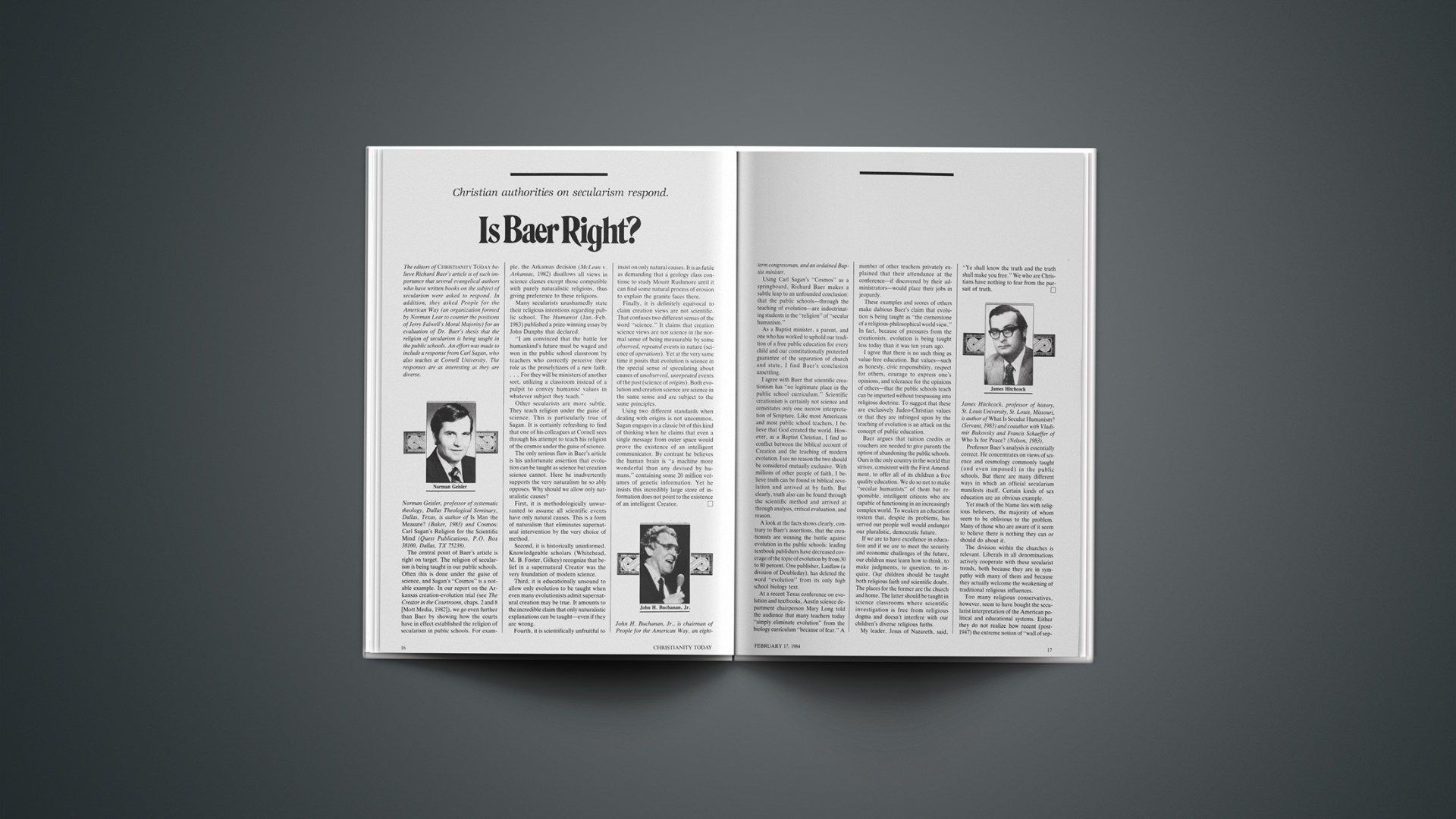
Is Baer Right?: Christian Authorities on Secularism Respond

The editors ofCHRISTIANITY TODAYbelieve Richard Baer’s article is of such importance that several evangelical authors who have written books on the subject of secularism were asked to respond. In addition, they asked People for the American Way (an organization formed by Norman Lear to counter the positions of Jerry Falwell’s Moral Majority) for an evaluation of Dr. Baer’s thesis that the religion of secularism is being taught in the public schools. An effort was made to include a response from Carl Sagan, who also teaches at Cornell University. The responses are as interesting as they are diverse.

The central point of Baer’s article is right on target. The religion of secularism is being taught in our public schools. Often this is done under the guise of science, and Sagan’s “Cosmos” is a notable example. In our report on the Arkansas creation-evolution trial (see The Creator in the Courtroom, chaps. 2 and 8 [Mott Media, 1982]), we go even further than Baer by showing how the courts have in effect established the religion of secularism in public schools. For example, the Arkansas decision (McLean v. Arkansas, 1982) disallows all views in science classes except those compatible with purely naturalistic religions, thus giving preference to these religions.

Many secularists unashamedly state their religious intentions regarding public school. The Humanist (Jan.–Feb. 1983) published a prize-winning essay by John Dunphy that declared:

I am convinced that the battle for humankind’s future must be waged and won in the public school classroom by teachers who correctly perceive their role as the proselytizers of a new faith.… For they will be ministers of another sort, utilizing a classroom instead of a pulpit to convey humanist values in whatever subject they teach.”

Other secularists are more subtle. They teach religion under the guise of science. This is particularly true of Sagan. It is certainly refreshing to find that one of his colleagues at Cornell sees through his attempt to teach his religion of the cosmos under the guise of science.

The only serious flaw in Baer’s article is his unfortunate assertion that evolution can be taught as science but creation science cannot. Here he inadvertently supports the very naturalism he so ably opposes. Why should we allow only naturalistic causes?

First, it is methodologically unwarranted to assume all scientific events have only natural causes. This is a form of naturalism that eliminates supernatural intervention by the very choice of method.

Second, it is historically uninformed. Knowledgeable scholars (Whitehead, M. B. Foster, Gilkey) recognize that belief in a supernatural Creator was the very foundation of modern science.

Third, it is educationally unsound to allow only evolution to be taught when even many evolutionists admit supernatural creation may be true. It amounts to the incredible claim that only naturalistic explanations can be taught—even if they are wrong.

Fourth, it is scientifically unfruitful to insist on only natural causes. It is as futile as demanding that a geology class continue to study Mount Rushmore until it can find some natural process of erosion to explain the granite faces there.

Finally, it is definitely equivocal to claim creation views are not scientific. That confuses two different senses of the word “science.” It claims that creation science views are not science in the normal sense of being measurable by some observed, repeated events in nature (science of operations). Yet at the very same time it posits that evolution is science in the special sense of speculating about causes of unobserved, unrepeated events of the past (science of origins). Both evolution and creation science are science in the same sense and are subject to the same principles.

Using two different standards when dealing with origins is not uncommon. Sagan engages in a classic bit of this kind of thinking when he claims that even a single message from outer space would prove the existence of an intelligent communicator. By contrast he believes the human brain is “a machine more wonderful than any devised by humans,” containing some 20 million volumes of genetic information. Yet he insists this incredibly large store of information does not point to the existence of an intelligent Creator.

Using Carl Sagan’s “Cosmos” as a springboard, Richard Baer makes a subtle leap to an unfounded conclusion: that the public schools—through the teaching of evolution—are indoctrinating students in the “religion” of “secular humanism.”

As a Baptist minister, a parent, and one who has worked to uphold our tradition of a free public education for every child and our constitutionally protected guarantee of the separation of church and state, I find Baer’s conclusion unsettling.

I agree with Baer that scientific creationism has “no legitimate place in the public school curriculum.” Scientific creationism is certainly not science and constitutes only one narrow interpretation of Scripture. Like most Americans and most public school teachers, I believe that God created the world. However, as a Baptist Christian, I find no conflict between the biblical account of Creation and the teaching of modern evolution. I see no reason the two should be considered mutually exclusive. With millions of other people of faith, I believe truth can be found in biblical revelation and arrived at by faith. But clearly, truth also can be found through the scientific method and arrived at through analysis, critical evaluation, and reason.

A look at the facts shows clearly, contrary to Baer’s assertions, that the creationists are winning the battle against evolution in the public schools: leading textbook publishers have decreased coverage of the topic of evolution by from 30 to 80 percent. One publisher, Laidlaw (a division of Doubleday), has deleted the word “evolution” from its only high school biology text.

At a recent Texas conference on evolution and textbooks, Austin science department chairperson Mary Long told the audience that many teachers today “simply eliminate evolution” from the biology curriculum “because of fear.” A number of other teachers privately explained that their attendance at the conference—if discovered by their administrators—would place their jobs in jeopardy.

These examples and scores of others make dubious Baer’s claim that evolution is being taught as “the cornerstone of a religious-philosophical world view.” In fact, because of pressures from the creationists, evolution is being taught less today than it was ten years ago.

I agree that there is no such thing as value-free education. But values—such as honesty, civic responsibility, respect for others, courage to express one’s opinions, and tolerance for the opinions of others—that the public schools teach can be imparted without trespassing into religious doctrine. To suggest that these are exclusively Judeo-Christian values or that they are infringed upon by the teaching of evolution is an attack on the concept of public education.

Baer argues that tuition credits or vouchers are needed to give parents the option of abandoning the public schools. Ours is the only country in the world that strives, consistent with the First Amendment, to offer all of its children a free quality education. We do so not to make “secular humanists” of them but responsible, intelligent citizens who are capable of functioning in an increasingly complex world. To weaken an education system that, despite its problems, has served our people well would endanger our pluralistic, democratic future.

If we are to have excellence in education and if we are to meet the security and economic challenges of the future, our children must learn how to think, to make judgments, to question, to inquire. Our children should be taught both religious faith and scientific doubt. The places for the former are the church and home. The latter should be taught in science classrooms where scientific investigation is free from religious dogma and doesn’t interfere with our children’s diverse religious faiths.

My leader, Jesus of Nazareth, said, “Ye shall know the truth and the truth shall make you free.” We who are Christians have nothing to fear from the pursuit of truth.

Professor Baer’s analysis is essentially correct. He concentrates on views of science and cosmology commonly taught (and even imposed) in the public schools. But there are many different ways in which an official secularism manifests itself. Certain kinds of sex education are an obvious example.

Yet much of the blame lies with religious believers, the majority of whom seem to be oblivious to the problem. Many of those who are aware of it seem to believe there is nothing they can or should do about it.

The division within the churches is relevant. Liberals in all denominations actively cooperate with these secularist trends, both because they are in sympathy with many of them and because they actually welcome the weakening of traditional religious influences.

Too many religious conservatives, however, seem to have bought the secularist interpretation of the American political and educational systems. Either they do not realize how recent (post-1947) the extreme notion of “wall of separation” really is. Or they believe that the judicial revolution that has brought this about is irreversible.

Yet this revolution has occurred in large measure because of the boldness of the secularists, who do not mind being abrasive and combative, and whose tactics have won for them more than they could have realistically hoped for 35 years ago. They continue their strategy of keeping religious believers always on the defensive and of intimidating public school officials, who will go to extraordinary lengths to avoid charges of church-state conflict. (Recently the St. Louis public schools removed a series of readers from classroom use merely because they contained some Bible stories.)

By contrast, few religious believers are willing to lobby before school boards or themselves to seek office. (If they do attain office, they are likely to put their religion in their pocket for the duration!) Few are willing to risk notoriety by making a public stand. Many run for cover when their more aggressive coreligionists are pilloried in the news media as dangerous fanatics.

Religious believers do not seem to understand the rules of American pluralist democracy or, if they do understand them, are unwilling to take the personal risks necessary to reverse the secularist trend.

During the late fifties I was invited to address the senior class of an English department in a city high school. When I arrived at the school, I introduced myself to the assistant headmaster, whose office was at the entrance. He guided me to the appropriate lecture hall.

Twenty years later I was invited to the same school for the same purpose. I presented myself to the same office, but it was no longer the habitat of an educator. It was the command post of a police inspector. Corridors and classrooms were monitored by police officers who reported regularly to the inspector. The reasons for the change were obvious: violence, assault, rape, drug-induced madness.

I interpret this scene as evidence of the end times of a civilization that had once benefited from the Christian world view, one that exalted creation and people, and provided the ideals essential for an authentic education. I recognize that civilization does not create Christians. However, the community of faith created and still creates the civility that is evidence of civilization.

That demoralized school is the tragic consequence of a society’s rejection of the biblical world view that provided the intellectual dynamic of Western education. What is education but an expression of the prevailing culture?

I realize there is no such thing as Christian mathematics, physics, chemistry, or astronomy. But I also realize that there is a particular world view that enables us to perceive the cosmos as capable of scientific analysis because it has been created by God in an orderly fashion. This is not a self-evident truth. Science is not a culture in itself. It is an expression of culture. It is one way of knowing about one aspect of reality (see William Temple’s Gifford lectures, Nature, Man, and God, AMS Press, reprinted 1979).

The only point at which I have ever agreed with the mystical atheism of Eric Fromm is his statement, made in one of his later books, that the intellectuals abolished God in the eighteenth century and man in the nineteenth.

Secular education is an invention of the nineteenth century. It is based upon the unexamined belief in the negation of the former culture, the infinity of matter, and the necessity of atheism. The secondary premise is that the state is sovereign over the people with the authority to initiate and sponsor this world view. Deviations from it, in terms of Christian affirmations, are regarded as heresy, and therefore a violation of the First Amendment.

The greater tragedy is that the mainline denominations have all too readily exchanged the Christian world views for the secular one in their enthusiasm for the equality of public education.

The Christian community is obligated to encourage the best form of public education. After all, the first act of universal education was initiated by Jan Hus, and the second by John Knox.

It is refreshing to find a professional educator like Baer in a secular humanist university who aggressively addresses the number-one problem in public education today—the religious takeover of schoolrooms by those who do not represent the majority of the American people. Many of the estimated 300,000 Christians teaching in secular education today have been so brainwashed by atheistic humanism that they don’t recognize the evangelistic nature of this subtle religion. Many others have been intimidated into “neutrality,” so the only ones who use “academic freedom” are the secular humanists in the system.

Baer’s voice is particularly credible because he sees the manner in which secular humanism stalks the corridors of education. We ministers are often ridiculed by humanists (and even some Christian leaders) as unqualified to speak out on these subjects because we are not “educational authorities.” They would have us believe that if education does not begin with a humanistic base of assumptions it is not quality education.

I am perplexed by Baer’s agreement that evolution should be taught “as science,” especially after his superb analysis of Carl Sagan’s “Cosmos” as pure atheistic religious indoctrination.

Why would a writer who is so obviously Christian concede that evolution is “science”? That it is a “theory,” all would agree. But science is a study of fact, and there is no scientific evidence for this overemphasized theory.

Parents don’t object to atheists and other religious humanists teaching evolution as a theory in our public schools. What they do object to is the teaching of only the theory of evolution. Why cannot both theories of origins be taught in a school system paid for by the taxes of the public, 82 percent of whom believe in some form of creation?

Public education today is not representative of the American people, the parents, or the taxpayers. It represents instead the secular humanist educational bureaucrats who control it and use it as a conduit to indoctrinate the minds of youth with their religious ideology. Few institutions generate more conflict in the home between parents and teens than the public school that teaches secular humanism.

The idea that education is neutral is a myth. Secular humanists are ardently evangelistic in their efforts to teach their values in our public schools. “Neutrality” for them means that Christians must let them, in the name of academic freedom, teach their doctrines to our children. What happened to “community public schools” that were to reflect the values of the community? They disappeared when federal aid was approved. Now only what is approved by secularists in Washington is “neutral.”

Ministers, parents, and taxpayers must now face the fact that our once great American school system has been taken over by a cult whose great high priest is John Dewey. No one has stamped his philosophy on public education more in this century.

The solution is not to call piously for “religious neutrality” or “pluralism.” We must rather become militant and demand the expulsion of secular educators who have imposed their religious doctrines on our youth and violated our First Amendment rights. If we don’t, they will continue to bilk the American taxpayer, defraud our nation’s youth, and ridicule our Lord Jesus Christ. We must not let them continue to indoctrinate our children with an atheistic religion.

How can we do this? In the same way in which secular humanists stole it from us in the first place—through the ballot box. We must get out of our church pews on election day and campaign for school board members who are committed moralists, men and women who will demand academic excellence, teaching accountability, and religious freedom in our public schools.

Secular humanism cannot survive in such an environment.

Several years ago Newsweek reported that secular humanism was the new bogeyman of evangelicalism. According to the report, evangelicals were finding secular humanists behind every bush, much as a previous generation found Communists in every movement. On the other end of the spectrum there were churchmen like Martin E. Marty who denied the influence of secular humanists altogether. Marty looked on evangelical concern over secular humanism to be, as Shakespeare said, “much ado about nothing.”

Richard Baer comes up somewhere in the middle. On the one hand, he sees secular humanism as real. It does exist, it is a religion, a philosophy of life, a trend within our society and within education. On the other hand, he sees it as one of many contending viewpoints in our educational system. It is not, as the statistics show, the most prevalent common view.

The issue, then, is not whether secular humanism exists (it does), or even whether it has a right to exist (in a Western pluralistic society it has as much right to exist as any other point of view). The issue is whether the state in its attempt to be neutral is not in fact casting its vote for a secularistic and materialistic outlook on life. I agree with those who believe the state often inadvertently supports the secular view. The question for Christians is: What do we do about it?

One thing we can do is assume that we are in a state of war with the secularists. We can fight them through litigation, or we can pull away from them by starting secondary Christian schools all over this country. Both of these tactics are now being pursued. I subscribe to neither. Rather, I subscribe to two points implicit within Baer’s article.

First, let’s encourage Christians to enter education. The Christian teacher who does not rest his or her faith in science seems to me to be the best qualified to teach science objectively. Open-minded Christians are willing to explore various scientific theories as theories, recognizing that there is a dimension of uncertainty to all theories. Consequently, one of the best ways to counteract secularism in education (science teaching being a case in point) is for Christians to invade public school education. Teaching in high school as a Christian vocation is no less a calling than to enter ministry or to be an educator in a Christian school. Many are already exercising Christian servanthood in this capacity.

Second, let’s push pluralism. The history of our country is steeped in religion. For this reason I don’t believe it is possible to divorce education from religion. The story of American history and culture cannot be adequately studied apart from religion. Consequently, in a truly pluralistic setting all religions should be treated with equal respect. Both Christian and Jewish holidays and festal occasions should be recognized and studied. The school is a good setting in which an appreciation of religious backgrounds and perspectives can be studied.

In conclusion, this is a secular society, and if historic religious sensibilities are being replaced by materialistic concerns, the way to combat this shift in culture is not to insist that this country is Christian, nor to ask for equal time for a Christian view. Rather, it is to support a genuine pluralism that allows a true freedom to exist within public education. In this context the Christian teacher will be free to teach objectively and to expose students to various viewpoints. The Christian world view may be presented in an indirect and subtle way that is truly legitimate in a free and pluralistic culture. Let’s spend less time fighting and denouncing the system and more time figuring out how we can work within it in a constructive and redeeming way.

They Are Teaching Religion in the Public Schools: It’s the Religion of Secularism, Many People Don’t like It, and Parents Have a Right to Stop It!

George gallup has made a rather astonishing discovery, one with considerable significance for educational policy making in this country: Almost half of all Americans believe that God created man in his present form sometime within the past 10,000 years.

According to a New York Times report of August 29, 1982, 44 percent of the Americans polled—nearly a quarter of them college graduates—hold to the Genesis account of Creation. Of the rest, 38 percent believe that although man has evolved from lower life forms, God directed that process. Only 9 percent believe in an evolution in which God had no part, and another 9 percent say they don’t know.

The reaction among some theologians to the Gallup results has been one of genuine surprise. The newspaper quoted Bishop John S. Spong, the Episcopal bishop of Newark, as saying that no reputable biblical scholar takes the biblical account of Creation literally. Surprising or not, however, Gallup’s findings shed considerable light on why many public school parents are speaking out against the way evolution is currently taught in the public schools. If 82 percent of Americans believe that God has guided the origin and development of humankind—and if more than half of that 82 percent reject any kind of evolutionary process—it is small wonder that many object to the teaching of evolution. Especially is that true when evolution is taught as the cornerstone of a religious-philosophical world view rather than as scientific theory and the conceptual basis of modern biology.

The concern of parents not only about evolution but, more widely, about the overall religious-philosophical underpinnings of elements in the public school curriculum has been scoffed at by many who deny that any particular perspective is a force in the public schools, much less a threat to the moral and religious values of America’s schoolchildren. Yet one need not look far for some quite convincing evidence of the legitimacy of these vocal parents’ concerns.

Religious Dimensions Of Carl Sagan’S “Cosmos”

A case in point, one worth exploring in detail, is Carl Sagan’s public television series “Cosmos.” It first aired in the fall of 1980—the year in which the best-selling book by the same title was published. The 13 hour-long TV presentations of “Cosmos” were well received by the public. The shows became required viewing for many high school biology courses across the nation, both in 1980 and during a replay of the series in 1981.

Sagan presents much more than science to his television audience. He also shares his religious testimony, his witness to a strange and beautiful cosmos that for him is the ultimate reality. “The cosmos is all that is or ever was or ever will be,” he proclaims. “It is the universe that made us,” he declares, and “we are creatures of the cosmos.” Somehow, we are even morally indebted to the cosmos: “Our obligation to survive and flourish is owed, not just to ourselves, but also to that cosmos, ancient and vast, from which we spring.”

If such declarations sound vaguely familiar, it is because Sagan presents to his viewers virtually all the key terms of the Judeo-Christian drama of creation and salvation. All that is missing is the element of worship and the services of the priest. But in a sense, even these are present, for throughout the series we repeatedly see Sagan at the controls of his cathedral-like spaceship of the imagination, his face reflecting awe, wonder, and mystery. His voice is reverent, the background music worshipful.

The seventeenth-century Westminster divines asserted that “the chief end of man is to glorify God and to enjoy him forever.” Sagan’s claim is similar: “We are born to delight in the world,” and our obligation to this world is to understand it and to survive. Throughout “Cosmos” Sagan goes far beyond the traditional descriptive and interpretive role of science. His presentation involves a host of metaphysical and value statements that are not a part of science as ordinarily understood and practiced. He transforms a very fruitful method for understanding the world into an all-embracing metaphysic or world view. He takes science to be the only really significant mode for understanding reality.

The “Cosmos” package is appealing, to be sure—and that is a problem for public school parents who object to the values implicit in it. Why would anyone object to a series that brings science to life as effectively as “Cosmos” does? In many ways, the series is indeed extremely successful: the photography is interesting, at times outstanding. Sagan’s obvious delight in the subject matter is contagious. Many of the specific bits of history and stories about individual scientists are superbly narrated, and it is fair to say that “Cosmos” as a whole catches the imagination and stretches the mind. The series is also sobering, especially when Sagan imagines what nuclear holocaust would be like, the destruction of life on planet Earth.

As television, “Cosmos” is indeed a success; nevertheless, it remains objectionable for classroom use in public high schools. The reason is that Sagan does not stop at presenting science in an interesting way; rather, throughout the series, he carries on an insidious assault against traditional religion, especially Christianity.

Most frequently (apart from a few references to Hinduism) Sagan conjoins religion and superstition. Science gives us reliable knowledge, he suggests, whereas religion is connected with fanaticism, narrowness of mind, and bigotry. With a mixture of glee and contempt, he describes in detail the oppression of Kepler, Galileo, Copernicus, and others by the Catholic church. Kepler “lived in a time when the human spirit was fettered and the mind chained.” The seminary at Maulbronn, where Kepler studied as a boy, Sagan describes as “a kind of theological boot camp, training Protestants in the use of theological weaponry against the fortress of Roman Catholicism.” “Suppression of ideas may be common in religion,” Sagan reminds his viewers, but not so in science.

In contrast to a direct attack, which the viewer would quickly recognize for what it was, Sagan’s many almost-incidental comments about religion create a tone, a mood, a flavor. It is deprecative expressions such as “a vast industry of priests,” “abject surrender to mysticism,” and “if we capitulate to superstition” that gradually affect the listener. And it is the insidious nature of Sagan’s attack that makes the assignment of “Cosmos” for high school biology classes not merely objectionable, but an infringement of the student’s First Amendment right not to be indoctrinated by the state in a particular religious position.

Throughout “Cosmos” Sagan presents his speculations about the origin of religion and belief in the God (or gods) as facts, with no discussion of alternative possibilities. He simply assumes that the gods (or God) are a human creation, a primitive attempt to explain natural phenomena that science later helped us to understand correctly.

Viewed in the light of his own strong commitment to a form of nature mysticism, Sagan’s unsympathetic treatment of Western religion becomes particularly noteworthy. From the beginning to the end of “Cosmos,” we see Sagan the admirer, the devotee, the worshiper—one who is not simply trying to understand nature scientifically and objectively. “Our ancestors worshiped the sun,” we are told, “and they were far from foolish. It makes good sense to revere the sun and the stars, because we are their children.”

In fact, Sagan’s stance in “Cosmos” is thoroughly religious. It is simply that it is a different religion from that of Christianity or Judaism. It is fair to say that Sagan’s attitude toward religion and mysticism throughout “Cosmos” is not that of the unbeliever. It is rather that of one committed to an alternative religion—indeed, committed in such a way that he has little time to sympathetically understand rivals to his own position.

The Cosmos And Nature

In his last presentation, after recounting his dream about the destruction of the planet through thermonuclear war, Sagan suggests that science could have saved us, but we did not give it a fair chance. “We accepted the products of science,” he tells us, but we rejected its methods.” But how science possibly could have saved us, Sagan does not indicate. Treating the world as value free is a part of modern scientific method—a necessary and fruitful part. But how, then, does one move from this value-free world of science to the wider world of moral commitments and responsibilities? Here Sagan is silent.

“Cosmos” reflects the dilemma of much of modern culture, Sagan espouses a kind of scientism and a radical split between facts and values (we can know facts, but values are a matter of subjective preference), but then proceeds to exhort us about values. He glorifies skepticism and doubt but fails to realize that in the practical world of everyday affairs human beings cannot survive (nor can science carry on as a discipline) without commitments to “values”—such as, for example, truth telling.

Sagan appears to support cultural relativism when he tells us approvingly that “Einstein believed that every culture had its own validity,” but then he proceeds with scorn to belittle the beliefs and practices of the Catholic church. He states that we inhabit “an insignificant planet on a humdrum star” but fails to point out that, if it is to have any meaning, this statement must presuppose the prior value claim that there is a direct positive correlation between significance (for humans) and bigness—a not altogether obvious truth.

Sagan’s position appears plausible partly because of ambiguities inherent in the term cosmos. On the one hand, cosmos closely parallels the term world in the sense of referring to “all that is.” As such, cosmos is not an empirically perceivable reality at all but an intellectual construct that makes possible the ordering and understanding of all specific objects and events.

On the other hand, cosmos can be used as equivalent to the term nature when nature refers to the observable phenomena of experience, such as mountains, trees, and galaxies.

In his opening statement, Sagan proclaims that “the cosmos is all that is or ever was or ever will be.” He apparently wants to affirm that nature “is all that is,” and so forth. Otherwise, his actual statement is either a definition or a tautology. It is the semantic slippage between these two fundamentally different meanings of the term cosmos (cosmos as world and cosmos as observable nature) that makes it possible for the reader to miss the fact that Sagan in effect is proclaiming a form of philosophical materialism or atheism.

The problem becomes acute when we recall that nature as modern science understands it is radically different from the nature of the classical world. The latter—for instance, in Stoicism—was a teleological order that provided an appropriate context for man, not just as a physical-chemical organism, but also as a personal-purposive being. But if we limit ourselves to the nonteleological, value-free nature of modern science, it becomes very difficult to explain the origin and meaning of human freedom and moral responsibility.

I do not fault Sagan for not dealing with these issues in a systematic fashion. But to reflect virtually no awareness that such problems even exist is a serious shortcoming of “Cosmos,” one that leads to specific misleading and confusing statements such as the opening sentence of the series.

Implications For Public School Policy

Many parents of school children react with less than enthusiasm when material such as Carl Sagan’s “Cosmos” is assigned in high school science courses. What arguments can they muster in defense of their views? More important, how should public school policy—even governmental policy—treat this sensitive area? I would suggest five specific conclusions relevant to the ongoing debate over how science and religion should be dealt with in the public schools.

1. Avoid Religious Materials In Science

Any science films, texts, or curricula that attack traditional religion and/or support new “religious” positions of their own should not be used for science education in public, tax-supported schools. Indeed, to do so is to jeopardize seriously the First Amendment rights of students and, indirectly, their families.

This point is particularly critical insofar as children in public schools constitute in important respects a captive audience. The rich have the option of private schools. But except for those parents who are willing to make heroic sacrifices for their children’s education—at the same time paying both tuition fees for private schools and taxes to support public schools—most parents have little realistic choice but to accept the fact of the state’s monopoly in education. The public schools constitute the only reasonable option open to them. This makes it all the more critical that school authorities (including teachers) not exploit the state’s monopoly position to engage in sectarian religious or antireligious indoctrination.

Though in quantitative terms “Cosmos” easily qualifies as a science series, in its fundamental assumptions and overall tone it is religious throughout. As a straightforward, not-at-all subtle apology for secular materialism, it presents a position that stands in direct competition with and contradiction to the basic Judeo-Christian commitments of a large part of our society. To offer “Cosmos” and similar material immunity from the religious establishment clause of the First Amendment is to act arbitrarily and in a socially divisive manner. The public schools are not the proper place for evangelism, even when it is as attractively packaged as is Sagan’s “Cosmos.”

2. Teach Evolution The Right Way

My analysis of “Cosmos” suggests that public schools should pay more attention to how evolution is taught. In short, it should be taught as science, not as religion. Creationism has no legitimate place in the public school science curriculum, for it does not qualify as bona fide science. But equally clear, when evolution is presented in ways similar to the way it is handled in “Cosmos,” it too, strictly speaking, does not qualify as legitimate science. It rather must be seen as a curious blend of science, philosophy, and religion.

When one looks at the world as a scientist, the theory of evolution appears far and away the best explanation of the data at our disposal. I believe it is a convincing theory, at least in its broad outlines. From a scientific perspective, I also recognize the importance of emphasizing the random and nonteleological quality of mutations in their impact on the evolutionary process: The refusal of scientists to deal with questions of ultimate purpose and value has contributed strongly to the technical success of modern science.

Yet millions of thoughtful people see evolution as the natural mechanism of the Genesis story. And from a religious perspective they accept the Genesis Creation narratives as a profoundly true account of human beings in relationship to God, the world, and other human beings. Scientifically, they would agree with Sagan about the key place of evolutionary theory in modern biology. But religiously, they would also affirm that in some more basic sense the process of evolution itself is enfolded within the more ultimate context of a creator God of love and mercy, purpose and meaning.

Does this latter conviction make such believing Christians and Jews less “scientific” than Sagan? Hardly. It only means they are not philosophical materialists but rather theists—as have been many great scientists, both past and present.

3. Listen To Parental Protests

School authorities should listen more carefully to the objections of those who claim that public schools often undermine the religious and moral teachings of the home. School authorities have frequently misunderstood and even patronized groups of concerned parents when they have insisted that such curricular developments as values clarification and sex education undermine their basic moral and religious values. Even after numerous articles appeared in scholarly journals substantiating many of the parents’ complaints, school authorities still frequently ignored the substance of their arguments and instead tried to discredit the protesters by labeling them right-wing extremists, religious fanatics, and anti-intellectuals.

Actually, the shift in public schools away from a basically theistic framework (mainly Protestant-Unitarian) to humanism has been well documented. Traditionally, both public and private schools in America were thoroughly religious in orientation. “Christian” values and beliefs pervaded elementary and secondary education. As recently as the immediate post-World War II period, Bible readings and prayers were common in public schools.

Textbooks, however, have changed drastically, not just since the time of McGuffey’s Readers, but even over the past few decades. References to God and traditional religious values have become less and less common, and those that remain are often pejorative in nature. Many educators believe that all of these changes have brought the schools closer to a position of religious neutrality, thus more in line with what they see as the intent of the First Amendment. Yet a glance at the writings of the most prominent proponents of this mode of education raises serious doubts.

John Dewey, to take one of the most prominent and influential humanists of modern times, concluded A Common Faith with the following statement:

“Here are all the elements for a religious faith that shall not be confined to sect, class, or race. Such a faith has always been implicitly the common faith of mankind. It remains to make it explicit and militant.”

Likewise, Corliss Lamont, who signed both the 1933 and 1973 Humanist Manifestos, argued that humanism has many similarities with religion, among which is the fact that it is “an integrated and inclusive way of life” and “a supreme commitment.” Apparently thinking along the same line as Dewey and Lamont, the U.S. Supreme Court in Torcaso v. Watkins in 1961 referred to “those religions based on a belief in the existence of God as against those religions founded on different beliefs” and, in a clarifying footnote, includes “Secular Humanism” in the latter category.

The point is this: Education never takes place in a moral and philosophical vacuum. If the larger questions about human beings and their destiny are not being asked and answered within a predominantly Judeo-Christian framework, they will be addressed within another philosophical or religious framework—but hardly one that is “neutral.” The arrogance and philosophical implausibility of secular humanism are demonstrated by the insistence of many humanists that their position possesses such neutrality, lack of dogma, and essential rationality. It is an arrogance that also quickly becomes coercive and imperialistic, as is clearly seen in the widespread opposition among such educators toward genuine choice in education, for instance, the kind of choice that would be possible through a system of education tuition vouchers.

4. Seek Needed Educational Reform

Americans concerned about genuine freedom in teaching and learning should explore alternatives to our current state-monopoly public school system, a system in which only the rich can afford to exercise genuine educational choice. As public servants supported by tax dollars, faculty in state schools of education have a special responsibility to encourage the open and fair discussion of alternatives to the current state monopoly in education.

Unfortunately, responses to date by the public school establishment to proposals for tax credits and tuition vouchers seem far more to reflect a concern for maintaining power, jobs, and ideological control of the public schools than a genuine commitment to the welfare of students and respect for parents’ legitimate interests in their children’s educations.

Although the question of prayer and Bible readings in public schools is complex and typically oversimplified by the mass media, any comprehensive effort to make Christianity the dominant world view of the public schools cannot be supported by those who are committed to freedom of conscience and religion.

On the other hand, since most public schools today give a state-sponsored advantage to secular-humanistic ideas and values, Christians should increasingly question the legitimacy of the present system. Stephen Arons may be correct when he argues that “the present political and financial structure of American schooling is unconstitutional.”

5. Work For A Constitutional Amendment

Rather than try to “Christianize” the public schools, Christians should seek a constitutional amendment that would facilitate structural pluralism in education by guaranteeing freedom in teaching and learning. The 1948 United Nations Universal Declaration of Human Rights might serve as a model. It declares that everyone is entitled to a free education at the “elementary and fundamental stages,” but also maintains that “parents have a prior right to choose the kind of education that shall be given to their children.”

Those educators and others genuinely concerned about religious neutrality in public schools should note that nations such as Holland and Canada—in which state funds are available for religious as well as public schools—demonstrate far more neutrality regarding religion and education than does the United States. Those seriously interested in religious pluralism should consider that in societies in which religious expression is suspect, as in the Soviet Union, religious groups such as Baptists and Jews consider the survival of their traditions to be highly uncertain unless they can take a major role in educating their own children. They know that traditions do not survive without institutional support.

Similarly, American pluralism will either survive as structural pluralism, or it likely will not survive at all. And, as is true of every society, one of our key structures is the schoolhouse. To deny citizens the right (including the financial capability to exercise the right) to educate their children in schools of their own choosing is to erode seriously what is perhaps the most important single support of genuine American pluralism.

Tim Stafford is a free-lance writer living in Santa Rosa, California. He is a distinguished contributor to several magazines. His latest book is Do You Sometimes Feel Like a Nobody? (Zondervan, 1980).

Ideas

Why It Is Easy to Be Confused about Lebanon

Peace will come only when three levels of conflict are resolved.

The lebanon puzzle is like three-dimensional tic-tac-toe. The first level is the religious/ethnic maze: Shi’ite Muslim versus Sunni Muslim versus Maronite Christian versus Eastern Orthodox versus Druze. The second level is the regional conflict: the Arab-Israeli rivalry and the unresolved Palestinian issue. The third level is the international confrontation between superpowers.

Independent only since the end of World War II, Lebanon has failed at the first level in making its citizens nation-conscious. They think of themselves first as members of smaller communities, and only secondarily as Lebanese.

The issue is also confused because these communities are identified by their religious labels (Christian, Sunni or Shi’ite Muslim, Druze, and so on). It would therefore be easy to assume that a religious war is under way, with freedom of worship at stake. This is not the case. The Metropolitan of the Greek Orthodox church in Lebanon has correctly observed that “Christians are not killed because they confess Christ.” Evangelicals witnessing to the various communities of Lebanon have encountered more hostility in the past from Maronite and Orthodox elements than they have from Muslims.

When the various communities in Lebanon are identified by their religious affiliations, these labels should be understood sociologically more than theologically.

To break the impasse at this first level of conflict, three steps must be taken:

1. Redistribute power in a manner seen to be fair by the underrepresented Muslim communities. The government led by the minority Christian communities does not like to face up to genuine discontent among the Muslim majority, although it first surfaced some 30 years ago. Instead, it looks for excuses to explain away the increasingly violent protest.

2. Provide safeguards for the minority Christian communities. Some have recommended the abolition of political sectarianism. Such sweeping reform is now not a practical possibility since the Christian communities would perceive it as an attempt by the Muslim communities to dominate. This would increase their historical fear of being swallowed up in a Muslim-Arab world.

Significantly, representatives of the major communities were coaxed into meeting in Geneva last November, and they agreed to major changes in Lebanon’s 40-year-old National Covenant, which had awarded the Christian communities political power over the Muslim communities. Thus, the theoretical groundwork for reconciling the Lebanese communities is largely in place.

3. Create a central government more assertive than the current laissez-faire system. The Lebanese government has ensured freedom unmatched in the Arab world. But there have been few checks on those freedoms, making it more of a playground—social and financial at first, now military—than a nation. Even before 1975, many major politicians maintained their own well-armed militia as bodyguards or enforcement services, unstopped by the government so long as they did not stray too far into official terrain. There are now 17 major militias as well as dozens of smaller groups.

It was the second level of conflict, regional tension, that started the pot boiling again. This was stimulated particularly by the 1980 invasion of Lebanon by Israelis, their brutal seige of West Beirut, and their introduction of Maronite community militia into areas that have been Druze for generations. Predictably, the Israeli arch rivals in the region jumped in too. In seeking to pull Israel’s chestnuts out of the fire, the U.S., French, Italian, and British forces have suffered heavy casualties.

There are some ironic results of this whole episode: The militia of the Maronite community, long subsidized by the Israelis, is now in a weaker position relative to those of the Druzes and Shi’ites. And Syria has completed what Israel was unable to do, driving the PLO from Lebanese territory.

The third level of conflict, between superpowers, was recently addressed by former Undersecretary of State George W. Ball. In a column addressed to President Reagan, he charged: “You are misinterpreting local Middle Eastern conflicts to fit your anti-Soviet rhetoric. You try to blame Syria for all the complex problems of Lebanon and talk as though Syria were a mere puppet of Moscow, which is manifestly not the case.” Ball’s blunt assessment is on target because Syria has a mind of its own. But the Soviets do provide massive aid, and this means influence. Unquestionably, foreign elements, particularly Syria, have played an important role in the conflict. But they would have found no opportunity to enter the fray had the Lebanese communities not been fighting each other already.

We can think of no easy answers. Internally, the conflict between the various ethnic groups must be addressed. Regionally, the Arab-Israeli rivalry and the Palestinian question cry for solution. Internationally, the confrontation between the superpowers must be defused.

Lasting peace will come to Lebanon only if conflict at all three levels is resolved.

Eutychus and His Kin: February 17, 1984

The X-Rated Pulpit

Sin is passé. Conviction is out of the question. No one should ever be made to feel guilty in church. It is a liberated day: Down with sermons that correct us! All people should feel good when they leave church.

Some pastors have been known to persecute their congregations by preaching too directly against sin. Until now there has been little help offered, but today there is an agency especially designed to protect the flock from abusive shepherds. The organization is called FROCC (Freedom Over Cruel Clergy), and it can be reached by dialing 02B-FREE locally, or 1–800-IM2-GOOD nationally. (The number in Canada is 301–216-OUCH.)

Really, FROCC can help. The next time you are forced to sit through a tirade against anything that makes you feel guilty or ashamed of your current lifestyle, dial the magic number and set yourself free. The truth is, we at FROCC believe sheep should never be sheared or even approached with intent. We are trying to appeal a case to the Supreme Court right now in which a pastor not only preached against sin but said that commitment to Christ should require a man to “take up his cross” daily. The sermon left many of the sheep feeling intimidated and unworthy.

Sermons should soothe, and FROCC is here to cut the abrasives out of theology, the rasp out of the rector, the grit out of grace. Smile, be at ease in Zion; the offense is gone, the candles of your favorite altar will now beam with golden light, and serious confession will die without any guilt. Enjoy! We even have a hymnal in which the old “worm-theology” songs are upgraded to congratulate human dignity: there are “FROCC of Ages,” “Oh Safe to the FROCC,” “He Hideth my Soul in the Cleft of the FROCC.”

So, the next time you hear a sermon that seems to condemn your lifestyle, call FROCC—the people who have eliminated sin and replaced old-fashioned guilt with new, fun-filled Christianity.

EUTYCHUS

Confusion Reigns

According to “Lutherans and Catholics Reach Surprising Agreements” [News, Dec. 16], the rift between Lutherans and Roman Catholics may soon be healed. Does that mean that “minor” issues such as papal infallibility, Maryology, transubstantiation, the cult of the saints, and celibacy of priests have been resolved? Could it be that the Lutherans have pitched the Augsburg Confession and the Catholics have rescinded the Council of Trent? I must have had my head in the sand not to recognize the “immediacy” of that historic day.

Maybe the Lutheran-Roman Catholic Dialogue Group operates like boys trading baseball cards. “I’ll trade you one Papal Infallibility for one Sola Scriptura.” “No, but I would give up one Sola Gratia and one Sola Fides to get your endorsement as an expression of the perennial Catholic tradition.” Is this the way they did it?

JEFFREY B. STEPHENS

Christ The King Lutheran Church

Memphis, Tenn.

Original or Paraphrase?

In the article “C. S. Lewis on Christmas” [Dec. 16], Kathryn Lindskoog quotes Lewis as stating in Mere Christianity that “The Son of God became a man to enable men to become sons of God.” As quoted here, this suggests the statement is original to Lewis. But is it not more likely that Lewis was simply paraphrasing Augustine, who called Christ “the one who, already Son of God, came to become Son of man, so as to give us who were already sons of men the power to become sons of God” (Letter 140)?

REV. MICHAEL P. KNOWLES

St. Paul’s Church

Halifax, Nova Scotia, Canada

Sinless Perfection?

Thank you for the excellent article on the Salvation Army in the December 16 issue. It states, however, that the question of whether the Army believes in sinless perfection receives no direct answer in official literature. A statement in response to that question occurred as far back as the first publication of the Salvation Army’s “Handbook of Doctrine” in 1923. There was a section in that document that stated: “Sanctification does not include certain supposed experiences with which it is sometimes confused.” Article (b) under that heading stated the following: “It is not Adamic perfection (sometimes called ‘sinless perfection’), or the perfection enjoyed by Adam before he fell, when he, having powers unimpaired by sin, could perfectly obey God’s perfect law. Such perfection is impossible to us, for the Fall has rendered us imperfect both in mind and body. God does not require what is impossible, but expects us to keep His law of love; in other words, to love and serve Him to the best of our knowledge and ability. Our best service is imperfect, but it is acceptable to God, provided it is prompted by pure love.”

I possess a booklet dated 1892 entitled “The Doctrines of The Salvation Army Prepared for the Training Homes by the General” in which the same points are made in a question-and-answer format. This has remained the teaching of the Salvation Army throughout its history. Article 9 of the statements of belief reinforces this thought with a corollary doctrine on the possibility of backsliding: “We believe that continuance in the state of salvation depends upon continued obedient faith in Christ.”

MAJ. EARL ROBINSON

Catherine Booth Bible College

Winnipeg, Man., Canada

De-Sexing Attempts Grotesque

While attempts at making our language more inclusive have much to commend them, the NCC lectionary appears to have gone to extremes that will only serve to heap ridicule upon this attempt [News, Dec. 16]. Somehow the committee has missed the point that humans come in only two forms: male and female. So God had only limited choices when the Word was made flesh. Christ had to be born male or female. For God’s own reasons, male was chosen. So I find the attempt to de-sex the expressions about Jesus rather grotesque.

Throckmorton’s view that the Scripture is the church’s book, to be added to or deleted from at the church’s pleasure, is a complete denial of the Reformation. One of the main points of the Protestant Reformation was that Scripture judges the church. If the church can add to, or take away from, Scripture, then there is no longer a basis for reforming. Following Throckmorton’s view, the Mormons, Moonies, and other groups that have added to Scripture have done something entirely proper, and there is no longer any “orthodoxy,” but only authoritative churches that can decree what members ought to believe.

The Scripture stands; let the church and the world be judged.

REV. DONALD R. HYER

Calvary Evangelical

Presbyterian Church Butler, Penn.

The issue here is not the quality of the wording of the Bible, but whether anyone has the right to tamper so loosely with the Scriptures. Catering to the opinions of a few seems to me to be, at the least, straining out a gnat while swallowing a camel, and at worst, rebellion against the authority of the inspired Word of God.

ANDY BAKER

Clear Creek Christian Church

Clear Creek, Ind.

Clergy to Laity

As I read “Who Counsels Ministers when They Have Problems?” [Nov. 25], I couldn’t help but be saddened by the background picture the author painted of the ecclesiastical environment in which he seeks to minister. It highlights a very real shortcoming in much of the church today—the artificial distinction between “clergy” and “laity.” Surely, as people indwelt, empowered, and graciously gifted by the same Spirit, we ought all to be able to minister to one another, including pastors and other leaders.

If pastors would see the members of their congregation as ministers and colaborers (and help them to see themselves as such) and themselves as equippers, not set apart from, or above, but among them, perhaps they wouldn’t have to look so far for someone to minister to them in their times of need.

KEVIN J. WHEELER

Honolulu, Hawaii

God’s Presence—All Functions

Themes from three recent articles on decision making and God’s will [Sept. 16] and physical healing [Nov. 25; Dec. 16] can be integrated elegantly and extended to all human function. God’s emphasis in our lives is not on the sensational, the dramatic, the extraordinary, but on the quiet, continuous working of his Spirit within us. An extraordinary event should not cause us to prescribe such events as normative or lead us to seek another such event from God. Rather, it should vividly remind us that at every moment God’s breath is quietly at work within us in all decision making, in all physical healing, in all human function.

PHILIP BITAR

Berkeley, Calif.

Let’s Share!

The article “Five Reasons for Not Giving to the Poor” [Nov. 25] really made me think about the many gifts Christ has given me and how selfish I have been. I hope it also affected other people. It is a shame that we are too selfish to share our many gifts and our happiness with those who are not as fortunate.

KARYN DEVRIES

South Holland, Ill.

Mark Galli’s article is only half the story. With only a single sentence buried toward the end does he address the question: How should we then give? The misuse of the principle of stewardship does not invalidate it. Each of us has very finite resources, and we should give in ways that will maximize the benefits.

Since few of us are able to follow our gifts with the nonfinancial help so many of the poor need, the best recipients are those who can help in this way (Salvation Army, inner-city churches, social agencies). Other groups are far more capable of helping materially than we are alone, so we should aid soup kitchens and similar efforts in their work. The gift of self is far greater than the gift of money. The rest of us should aid and encourage them.

KELVIN SMITH

Alma, Mich.

Art or Images?

I would like to take issue with the Giesers’ proposal that we “Put Art Back into Our Churches” [Nov. 11]. We must recognize that art is used wrongly not only when the images themselves are objects of worship. It is also idolatry to think that our worship of the true God can be enhanced or helped along by the use of manmade images. As J. I. Packer demonstrates in chapter 4 of Knowing God, images used in this way dishonour God by obscuring his glory, and they mislead men by conveying false ideas about God.

Our “sense of celebration” in worship must come from the knowledge that we are in communion with a gracious, awesome God, not from the “worshipful feelings” we get by beholding the works of man.

REV. DAVE COLES

Koinonia Church

Potsdam, N.Y.

What Is the Major Shift in Theological Focus?

Theologians are turning to the God who meets us where we are.

It is increasingly apparent that a shift in theological focus has again occurred in the West. In the 1950s the predominant interest was in Christology. Influenced both by the biblical theology movement and by Karl Barth, Christian theologians centered their thinking on the second person of the Trinity. This was the case for us evangelicals as well.

In the 1960s, Christian reflection tended to turn on the one hand to the person of God the Father, and on the other to the nature of the church. In its most radical form, liberal theology considered the death of God. Altizer, Van Buren, and John A. T. Robinson of Honest to God fame were widely read. But even in its more conservative manifestations, there was widespread interest in the transcendence of God. Perhaps as a means of providing some balance, theologians also increasingly commented on the role of the church. George Webber’s God’s Colony in Man’s World (1960) and Mark Gibbs and T.R. Morton’s God’s Frozen People (1964) were widely influential.

This in turn led in the 1970s to a focus on the nature and ministry of the Holy Spirit. The charismatic renewal movements came into full power. Pentecostals began to take theological reflection more seriously. Book after book concerning the Holy Spirit was published. The shift was so pronounced that Thomas Smail, editor of Britain’s Theological Renewal, felt compelled to write at the end of the decade a book entitled The Forgotten Father.

Now, as we move into the 1980s, a change has again taken place. It is not that God the Son, God the Father, or God the Holy Spirit is any less central to Christian theology. We remain committed to a triune God. Similarly, God continues to speak through his church. Nevertheless, the cutting edge of theological reflection has moved from the divine to the human. The God-intended shape of human life has become the overarching concern of evangelicals and ecumenicals alike.

Evidence for this fact is as diverse as (1) the sociologically oriented biblical studies of Norman Gottwald and Wayne Meeks, (2) Wolfhart Pannenberg’s “theology from below,” (3) Ron Sider’s ethical reflections on nuclear holocaust, (4) Henri Nouwen’s books on the psychology of the Christian life, (5) Robert Roberts’s Spirituality and Human Emotion (1983), (6) Lewis Smedes’s book on the second tablet of the Decalogue (the part concerned with human relationships), (7) Richard Foster’s Freedom of Simplicity (1981), and (8) the countless books on the family that continue to be written by James Dobson, Kevin Leman, Norman Wright, and Gary Collins.

Evangelicals have traditionally been suspicious of a theological concentration upon the human. To begin with “creature” rather than “Creator” has been considered dangerous, a form of natural theology. However, evangelicals are recognizing that this need not be the case. One recalls Jesus’ comment, for example, “Truly, I say to you, as you did it to one of the least of these my brethren, you did it to me.”

The importance of human issues in current theological discussion was highlighted for me by three Christian gatherings I attended last summer. The first event was an informal meeting of evangelical church leaders. Coming together for personal reflection and sharing, with no larger agenda in mind, three dozen leaders from a cross section of evangelical Christian colleges, seminaries, and parachurch organizations, together with a sprinkling of pastors, brainstormed concerning the future of the church. Time and again throughout the three days of interaction I was struck by the importance attached to the topic of humanity. Ethical responsibility, the role of women, peace, self-esteem, abortion, the nature of the family, the threat of technology to the human spirit, the importance of nurturing the soul—such concerns made the shape of human life the spontaneous theological focus of the conference.

Late in the summer I attended the World Council of Churches meeting in Vancouver as an accredited visitor. The theme for the conference was “Jesus Christ, the Life of the World.” Traditionally the WCC has chosen its organizing themes with one eye tilted toward the historic faith and the other toward the contemporary scene. In Nairobi in the 1970s, for example, the topic was “Jesus Christ Divides and Unites.” This was during the era when confrontation between First and Third World Christians was pronounced. This year, however, discussion centered on the meaning of life in our modern age—“life in Christ” to be sure, but nevertheless life.

My third summer conference was the annual meeting of the Evangelical Covenant Church. As the keynote speaker for the gathering, Robert Schuller gave a theological rationale for his own ministry. Schuller challenged the leaders of the Covenant church to take seriously the implications of the Incarnation for our day: the theocentric must become anthropocentric. There is nothing wrong with Christian humanism, he argued. “If we are to succeed in missions, we must be willing to be secular. When the sacred becomes secular, then God can work. The danger in such a strategy, of course, is that the church will become a country club and theology will become pop psychology. But the church that fails to identify with people’s concerns will die. It will be so heavenly that it is of little earthly good.”

Without becoming sidetracked in a discussion of the relative merits of the WCC or Bob Schuller, we can draw several conclusions from this theological shift to the God-intended shape of human life. First, if the emphasis in our Christian reflection is increasingly on the human spirit rather than on the Holy Spirit, we will need to rethink our apologetics. We might need to start more from the world than from the Word. Our argument may well move more from “man” to God than vice versa, and from Jesus the true human to Jesus as divine. This has been, for example, the approach of Karl Rahner, whose discussion of the human capacity for transcendence precedes his analysis of grace.

I am not suggesting a “natural” theology. A turn to the human subject need not imply a denial or downplaying of the divine Subject. Surely God in Christ is Alpha and Omega, the beginning and the end. But our knowledge of him need not always be our starting point. The old distinction between the ordo essendi (the order of being) and the ordo cognoscendi (the order of knowing) is relevant here.

A second implication centers on the nature of church life. To use Robert Schuller as an illustration, a recent IRS ruling wrongly denied his church tax-exempt status because it was involved in activities deemed too worldly by the IRS—that is, the church was involved in sponsoring profit-making concerts, aerobics classes, and similar activities. But such will be an important ingredient of Christian community and witness in the 1980s. Who, for example, is better than the church to create a healthy context for single adults (widowed, divorced, never married) to meet each other and develop friendships? Churches will need to take seriously the importance of recreation and community involvement. Southwestern Baptist Theological Seminary is leading the way with its specialized degree in church recreation.

A third area of increased concern will be in the field of social ethics. If God created men and women in his image and saw that it was good, must the church not become involved “politically,” whether in lobbying for the family or in arguing for peace in the world? From the Moral Majority to the World Council of Churches, Christians are entering the struggle for a more just world. As the WCC’s sixth assembly concluded: “Since Jesus Christ healed and challenged the whole of life, so we are called to serve the life of all.” Certainly the church’s social agenda will differ radically depending on whether one listens to Moral Majority’s Jerry Falwell or WCC’s Philip Potter, but the fact of Christian political involvement seems an undebatable issue in the 1980s.

Theology’s turn toward the human has its consequences even with regard to biblical studies. Although I have been convinced for some years that Old Testament Wisdom literature is the best biblical window for post-Christian Americans to hear the good news of the gospel, few others have agreed with me—until recently. Now Wisdom literature is experiencing a renaissance of interest. The Books of Proverbs, Ecclesiastes, and Job are rooted in God the Creator and are centered in observations concerning the contours of successful life. As Roland Murphy has suggested, the “kerygma” of the Book of Proverbs is life.

In these ways and others, Christian theology is helping the church restructure its life and witness. Basing its understanding of the human in the doctrines of Creation and Incarnation, the theology of the 1980s is focusing on the shape of human life: first the human, then the divine; first the secular, then the sacred. We evangelicals would have rejected such an approach in the 1950s as heretical. It might be discarded in the 1990s as inappropriate to the times. But for the moment, it is an ongoing witness to Christianity’s incarnational perspective. God continues to stop to meet us where we are.

Dr. Johnston is dean of North Park Theological Seminary, Chicago, and author of The Christian at Play (Eerdmans, 1983).

Apple PodcastsDown ArrowDown ArrowDown Arrowarrow_left_altLeft ArrowLeft ArrowRight ArrowRight ArrowRight Arrowarrow_up_altUp ArrowUp ArrowAvailable at Amazoncaret-downCloseCloseEmailEmailExpandExpandExternalExternalFacebookfacebook-squareGiftGiftGooglegoogleGoogle KeephamburgerInstagraminstagram-squareLinkLinklinkedin-squareListenListenListenChristianity TodayCT Creative Studio Logologo_orgMegaphoneMenuMenupausePinterestPlayPlayPocketPodcastRSSRSSSaveSaveSaveSearchSearchsearchSpotifyStitcherTelegramTable of ContentsTable of Contentstwitter-squareWhatsAppXYouTubeYouTube