Make the Most of What God Has Given You!

Have you ever reflected on how much of our Gross National Product depends on romantic love? Turn on any pop music station and try to find a song that does not feature that theme. In publishing, Gothic romances outsell every other line of books. And is there a television soap opera or comedy without a steamy romance woven through the plot?

The fashion, jewelry, and cosmetic industries all tempt us to perfect techniques of attraction between man and woman. Phrases like “catching a man” and “hunting a woman” have come to summarize a fact of life in our culture and, we assume, in every culture. This is the way life is, we think.

Ah, but herein lies a remarkable phenomenon: still today, in our international global village, over half of all marriages occur between a man and woman who have never felt a twinge of romantic love and might not even recognize the sensation if it hit them. All of Africa and most of Asia take for granted the notion of marriages arranged by parents in the same way we take for granted romantic love.

A modern young Indian couple, Vijay and Martha, explained to me how their arranged marriage came about. Vijay’s parents scoured their social circles, pondering all the young girls, before deciding on one (Martha) for Vijay to marry. Vijay was 15 then, and Martha had just turned 13. The two teenagers had met, briefly, only once before. Their four parents got together and agreed on a wedding date eight years away. Only then did they inform both teenagers whom they would be marrying.

During the next eight years, Vijay and Martha saw each other only twice, under close supervision. They moved in together as virtual strangers, yet today their marriage is as secure and loving as any I have known.

In a nation of arranged marriages, a young couple does not build marriage around mutual attraction. You listen to your parents’ decision and accept that you will live for many years with someone you now barely know. The predominant question is not “Whom should I marry?” but rather “Given this partner, what kind of marriage can we construct?”

As I have talked to Christians from Third World countries, I have begun to see how this kind of accepting spirit, the “spirit of arranged marriages,” can permeate other areas of life as well. It seems to foster an attitude that shows up in theology, for example.

It has always struck me as strange that Western theology has fixated on the problem of suffering for the past hundred years. We live in a society that lives longer, in far better health, with less physical pain than any in history. And yet our artists, playwrights, philosophers, and theologians stumble over themselves seeking out new ways to rephrase the ancient questions of Job. Why does God allow so much suffering? Why doesn’t he intervene? Curiously, the intense outcry of alienation does not come from the Third World—where misery abounds—or from such persons as Solzhenitszyn, who endured great suffering. The cry of anguish comes primarily from those of us in the comfortable, narcissistic West.

In thinking through this trend, I keep coming back to the parallel of arranged marriages. It has become for me a parable of how different people relate to God.

Some people approach faith as a solution to their problems, choosing God in the way one would choose a spouse, by looking for desirable qualities. They expect God to bring them good things; they give to missions because they believe their money will come back tenfold; they try to live right because they believe God will bless them for their performance.

These people interpret the phrase “Jesus is the answer” in its most literal, inclusive sense. The answer to what: Unemployment? A retarded child? A crumbling marriage? An amputated leg? An ugly face? They count on God to intervene on their behalf by arranging a job for them, curing the retarded child and amputated leg and ugly face, and patching together the marriage.

And yet, we keep raising the problem of suffering precisely because life simply does not always work out so neatly. In many countries, in fact, becoming a Christian guarantees a person unemployment, family rejection, societal hatred, and even imprisonment.

In her wonderful book The Mind of the Maker, Dorothy Sayers suggests another way of viewing God’s involvement with us. She drops in this profound sentence: “The artist does not see life as a problem to be solved, but as a medium for creation.” She extends the principle from art to theology, claiming that we easily fall into a trap of viewing the pitfalls of our lives as problems we expect God to solve. Perhaps, instead, he gives us the freedom of an artist, allowing each of us to start out with different materials.

Some of us are ugly, some beautiful, some brilliant, some dense, some charming, some shy. God does not promise to solve all the “problems” we have, at least not in the manner we may wish them to be solved. Rather, he calls us to be trusting and obedient to him whether we become affluent Americans entrusted with great resources or Christians locked in an Albanian concentration camp. What matters most is what we create from the raw material.

In this view, the spirit of arranged marriages applies to our relationship with God as well. We approach him insecure at first, unsure of what the future holds. There is a risk. Yet we have, so to speak, taken a vow “for better or worse, in sickness and health” to love him and cling to him no matter what. Faith means believing he has taken that same vow to us, and Jesus Christ is the proof.

God made me the way I am: with my peculiar facial features, my handicaps and limitations, my body build, my mental capacity. I can spend my life resenting this quality or that one, trying to repair what I perceive as a defect. Or I can humbly accept myself, flaws and all, as the raw material God can work with. In a way, the relationship does resemble an arranged marriage. I precommit to him regardless of how it may work out; he precommits to me. I do not go in with a list of demands that must be met before I take the vow. Happily, God does not accept me conditionally, on the basis of my projected behavior. He keeps the vow, and therein is grace.

Refiner’s Fire: Must Art Be “Christian” to Be Good?

The metropolitan museum of art in New York has restored on its grounds an ancient Egyptian temple. Walking through it, thinking about Moses and the Israelites, I noticed with a thrill of recognition that this temple, built to a pagan god, consists of three inner chambers—exactly like the tabernacle and the Jerusalem temple. The temple structure was, in fact, common in the ancient world, as were portable “arks,” tents of worship, certain details of ritual, and even what seem to be figures of cherubim. Archaeological research and Old Testament scholarship have uncovered many parallels in Hebrew life and worship to Egyptian, Syrian, and Canaanite practices. Liberal theologians sometimes make much of these connections, using them to minimize the uniqueness of God’s special revelation and relationship to the Jews. The point here is the relationship between art, culture, and religion.

Art, by its very nature, is open to and a function of human culture: sacred truths can be expressed through a wide variety of culturally conditioned art forms. Artifacts are made by and for human beings and will accord with the assumptions and imagination of the people who use them. When the Hebrews thought of a temple, then, they thought of the three-part divisions they had seen in all other temples. They could not have built a Gothic cathedral; they had neither the technology nor the culture for it. And they would not have understood it. Gothic cathedrals are not sacred—although again, God can use them to make himself known. In the biblical view, since God alone is sacred, there is a certain sense in which the special places and styles of art do not matter.

Thus, when the temple was to be built, Solomon turned to the best artists he knew, the Phoenicians. He sent to Hiram, the king of Tyre, asking for material and workmen. Notice that Solomon, wishing to glorify God, was concerned first with excellence, not doctrinal purity in the artists. And though complimentary about Israel’s God, Hiram was not one of God’s chosen people, and almost certainly not a believer. The actual craftsman he sent was part Hebrew on his mother’s side, and no doubt a believer in the God of Israel (2 Chron. 2:13–14) despite his pagan environment. Nevertheless, the art of the temple likely was Phoenician in accordance with his training. Scripture specifically says that Solomon set the aliens to work on the temple, both as laborers and overseers (2 Chron. 2:17–18). As Canaanite remnants, they definitely were not believers. The art of the temple, open to the culture of its day, was probably similar to buildings of the Phoenicians and other peoples of the land. Nevertheless, the temple and its art pleased God and was made an instrument of his purpose (2 Chron. 7:12–16).

This point is important for Christians involved in the arts. Because a painter is not a Christian does not mean his paintings cannot be enjoyed or even imitated by Christians. To be sure, any thematic content must be critically scrutinized through the lens of Scripture, but art as art is essentially neutral. That Picasso was not a Christian does not mean he was not a great artist nor that Christians are not free to appreciate or emulate his works. To think otherwise may be to overvalue or sacralize art, to ascribe to it a significance it must not assume.

Was the person who made my shoes or cooked for me in a restaurant a Christian? Or the scientist who discovered penicillin? Or Beethoven? I can never know; I should pray so for the sake of the person. But even if that one was not a Christian, I am not harmed spiritually by my clothing or my meal, or by receiving my medicine or listening to a symphony. Art is part of human life like food, clothing, politics, scientific knowledge, and social customs. All are valuable gifts of God, essential parts of our humanity, created by sinners in need of Christ’s redemption who may or may not know him. For aesthetics, although not for theology, a Christian may “go to the Sidonians.”

Always a function of human culture rather than divine revelation, no particular style or type of art ought to be sacralized or made into an absolute. The history of art shows continuous change, because cultures change. It follows that Christians need not be overly scrupulous in regard to types of art. Abstract, representational, and symbolic arts are all given prominence in Scripture. Certainly the content of art, its underlying assumptions and messages, must be examined with wariness and scriptural discernment.

But questions of form are basically indifferent. Christians are free to pursue any formal mode of art they find congenial. It is the secular aesthetes who take artistic movements and manifestoes with such dogmatic seriousness. Classical, romantic, and realistic styles are all suited to Christian literature. Christian painters can work with abstract art if they want to (actually, it is probably the safest for those who fear offending the second commandment), or they can be photographic realists or expressionists—whatever fits their talents and inclinations.

Since art is a function of history and culture, Christian artists should be aware of the contemporary context of their work. To be deliberately old-fashioned, simply reworking earlier styles that seem “more Christian,” is an empty gesture. One style is not “more Christian” than any other; the result is to make one’s work irrelevant and, worse, to imply that Christianity is outdated, a nineteenth- or sixteenth-century religion that some reactionaries stubbornly cling to, faith that has nothing to say to the twentieth-century imagination. Throughout the Psalms it is a new song that is to be offered to the Lord.

Dr. Veith teaches English at Northeastern Oklahoma A & M College, Miami, Oklahoma. His article is adapted from his book, The Gift of Art, ©1984 by InterVarsity Christian Fellowship of the USA. Used by permission of InterVarsity Press, Downers Grove, IL 60515.

Religious Freedom in China—Is It Fact or Fiction?

Robert Runcie, the archbishop of Canterbury, is the first Western church leader to be officially received by the Chinese government. During his visit last December he tried to build bridges between British and Chinese Protestants. But more important, he wanted to determine the extent of religious freedom in the world’s most populous atheistic state.

For two weeks, Runcie was escorted by Ding Guangxun, president of the China Christian Council (CCC) and the leader of China’s official Protestant church. Ding says there are three million Protestants in China. However, reliable China observers say there are at least 20 million.

The disparate figures are easily explained: Ding ignores China’s massive house-church movement, which consists of millions who have chosen to worship illegally rather than submit to government regulation. The movement blossomed in the midst of severe persecution during China’s Cultural Revolution (1966–76). However, after the death of Mao Zedong in 1976 and the subsequent political uncertainty, toleration of religion increased. Underground churches began to go public.

But religious freedom has its limits. Unable to halt the growth of Christianity, the government took steps to regulate it. In 1979, China’s Three-Self Patriotic Movement (TSPM), dormant for almost 20 years, was revived. Its constitution describes it as the “anti-imperialist, patriotic organization of Chinese Christians.” In addition, in 1980 the government established the CCC as TSPM’s sister organization to oversee Christian activities.

The government has sought to enroll all Chinese Christians in TSPM and to convince the world that its citizens enjoy full religious freedom. Since 1980, TSPM has printed more than 135,000 Bibles. But they are available only to members of the state-regulated church. And most of China’s Christians find unacceptable TSPM’s restrictions on evangelism, contacts with Christians overseas, and radio broadcasts, among other things.

Even so, TSPM has attracted some former house-church members. After spending years underground, they found the prospect of free, open worship too refreshing to resist. The increase in TSPM’s popularity has been accompanied by growing suppression of the house-church movement.

In 1982, the Communist party issued its definitive religious policy, stating that house-church meetings “should in principle not be permitted.” House-church leaders are frequently arrested, and Christian literature is often confiscated.

Runcie walked a tightrope in China on the issue of religious freedom. The evangelical Chinese Church Research Center, based in Hong Kong, reports that the Anglican leader “is aware of evangelical reports on China, but has chosen to make public friends in the hope that he can retain some private influence with the Three-Self leaders.”

“I have seen evidence that there are more churches opened, more Bibles available,” Runcie said, “and I can only assume that is the result of less political pressure against such things.” But he did not say China had achieved full religious freedom. And he doesn’t endorse the government policy that all church contacts with the West be channeled through Communist authorities. Chinese officials try to control foreign contacts because they suspect political motivations. Recently, two well-known Chinese Christians were executed. Evidence indicates they were working for the overthrow of the Communist government.

Meanwhile, millions of Chinese Christians—fearing persecution but wanting to remain faithful to the task of the church—must choose between China’s two churches. Hopeful that conditions will improve, they are thankful for the meager freedom they enjoy.

North American Scene

The Unification Church has launched an unprecedented national campaign to increase its membership. For the next three years, international teams of followers of Sun Myung Moon, the church’s leader, will rotate from city to city at three-week intervals. Fifty teams of 25 to 50 members each are planning “evangelistic” crusades in the nation’s major cities. They plan to spread their belief that Moon is the new messiah whose purpose is to complete the unfinished work of Christ. The membership drive is accompanied by a message that America is in trouble if it does not “stand up against immorality and communism.”

Instead of the Ten Commandments, quotations of American Presidents about the Bible are on display in Campbellsville, Kentucky, public schools. A 1980 U.S. Supreme Court decision struck down a Kentucky law requiring the posting of the Ten Commandments. When the Campbellsville school district opened its new high school, the board of education voted to decorate the walls with the words of Thomas Jefferson, Andrew Jackson, Abraham Lincoln, Dwight Eisenhower, and Ronald Reagan.

An estimated 30,000 people at 56 sites viewed a live satellite broadcast of the December dedication of the Church Satellite Network (CSN). President Reagan called the launching of CSN “a significant advance in satellite communications.” And he recognized “the thoughtful leadership of those committed to utilizing the most modern means in the promotion of religious values.” Advertising agency president Michael Ellison, and Thomas Zimmerman, general superintendent of the Assemblies of God, were instrumental in establishing the network.

Atheists in Denver, Colorado, are protesting a proposal to convert two federal warehouses into shelters for the homeless. The atheists object to the proposal because the shelters would be operated by the Denver Catholic archdiocese. Billy Talley, of the American Atheist Recovery Group, told a government official that if the Catholics gain use of a government building, his group wants one too. “We are here for the … atheists and agnostics whose painful recoveries [from alcohol and drug addiction] can only be made more painful … by moralizing, praying, and preaching,” he wrote. The U.S. Supreme Court has upheld the right of the government to give property to churches.

Interest in the Bible increased significantly during 1983, designated as the Year of the Bible, the American Bible Society (ABS) reports. The society says it distributed 5.7 million copies of Scripture-related items. All of them were directly traceable to requests for materials designed in connection with the Year of the Bible celebration. The most popular ABS Year of the Bible item was a four-page selection called “God Speaks.” The booklet contains the Ten Commandments and the Beatitudes.

Minneapolis Mayor Donald Fraser has vetoed an amendment to the city’s civil rights ordinance that would have defined pornography as a form of discrimination against women. Strongly supported by feminists, the measure was passed by the city council in a 7-to-6 vote. Fraser said the amendment’s definition of pornography was vague and too broad. He said the linkage between pornography and violence is “arguably not settled” and that “when in doubt, I probably err on the side of the First Amendment.”

The California Workers’ Compensation Appeals Board has awarded death benefits to the homosexual lover of a Los Angeles County deputy district attorney who committed suicide. Earl Donovan will collect $25,000 as a result of the board’s ruling that he was dependent for total support on Thomas P. Finnerty, Jr., who died in 1976. The two lived together from 1949 until shortly before Finnerty’s death. The board determined that the homosexual nature of the relationship should not preclude Donovan’s rights as a primary dependent.

The U.S. Supreme Court has turned down a request that it enter the legal battle over Baby Jane Doe. Baby Jane is the name given to an infant born in October with spina bifida and other birth defects (CT, Dec. 16, 1983, p. 47). Without comment, the justices unanimously let stand an October ruling by the New York Court of Appeals supporting the parents’ decision against surgery that might prolong the baby’s life.

A recently issued Vatican document advocates sex education in public schools. The 36-page declaration, titled “Educational Guidance in Human Love,” is the result of more than 10 years of preparation. It accords the primary role of sex education to the family. But it calls on schools to assist and complete the work of parents. Though some Catholics noticed more liberal attitudes on issues such as homosexuality, the document generally was regarded as a stern restatement of the church’s traditional attitudes toward sex.

World Scene

A drastic rise in pornography has led to sharp increases in woman and child abuse in Israel, says the Jewish feminist magazine Lilith. In a report called “Porn in the Promised Land,” mass media specialist Judith Bat-Ada quotes psychologists and others who say that pornography triggers rape, wife battery, incest, and other forms of sexual violence. Israeli police statistics show a 45 percent increase in reported rapes since pornography became popular. A rape crisis center in Tel Aviv reports that younger women are being victimized by rape.

The five judges of the Australian high court have ruled unanimously that the Church of Scientology is a legitimate religious institution. The decision overturns a lower court ruling that declared the church “a sham.” Once banned in several Australian states, Scientology will now enjoy tax-exempt status. Founded by L. Ron Hubbard, the organization claims 150,000 adherents in Australia and New Zealand. But critics say that figure is exaggerated.

Filipino president Ferdinand Marcos has alleged that Roman Catholic clergy and the middle class are plotting to topple his regime. Marcos, who has ruled the Philippines for 18 years, says the “clergy-bourgeois clique” was discussed in a Communist document “which fell into the hands of government authorities,” Catholic leader Jaime Cardinal Sin has called on Marcos to begin a process of national reconciliation or face a violent rebellion in the country.

The ABC film The Day After was seen by some 15 million Britons in December. The film depicts the effects of a nuclear attack on the city of Lawrence, Kansas. Despite sensitivity to the nuclear issue in England, three times as many Britons watched the televised wedding of Prince Charles and Diana Spencer in 1981. British defense secretary Michael Heseltine said the film was politically biased in favor of a nuclear freeze. In a televised interview after the airing, he defended England’s policies on the issue. He did not participate in a studio discussion that followed the screening because it included the chairperson of Britain’s Campaign for Nuclear Disarmament.

A coalition of black Africans is urging that white Lutheran churches in South Africa and Namibia be dropped from the Lutheran World Federation (LWF). Presented at the All Africa Lutheran Consultation in Zimbabwe, the proposal calls for white Lutherans to be suspended from the LWF until they reject the South African government’s policy of enforced racial segregation, called apartheid.

Nearly 150 million Africans could face famine in 1984, says Adebayo Adedeji, head of the United Nations’ Economic Commission for Africa. Drought, along with other catastrophes, has contributed to economic decline and political instability throughout the continent. Recently, former Nigerian president Shehu Shagari was deposed in a bloodless coup led by military ruler Mohammed Buhari. The country’s military gave way to civilian government in 1979. With 90 million people, Nigeria is Africa’s most populous country.

Some 800 Pentecostals in Nicaragua are facing imprisonment for not registering for the military draft. At a recent national congress, the youths agreed not to answer the call of the Sandinista government, which is drafting men ages 18 to 40 to fight counterrevolutionaries.

The Churches of Christ in New Zealand have voiced strong opposition to abortion. At the denomination’s sixty-first annual conference, it passed a six-point statement condemning abortion in New Zealand and offering what it sees as a Christian viewpoint on the issue. The statement includes affirmations that human life begins at conception and that all Christians have a responsibility to protect human life.

Some 40 percent of Britain’s children, ages 5 to 16, have seen at least one videocassette showing violence and perverted sex. A Church of England research team interviewed 6,000 children before issuing its report. According to the study, more than 10 percent of children ages 9 and 10 have seen Driller Killer, which depicts a murderer killing a victim with a power drill. More than 3 percent have seen Cannibal Holocaust, in which a man is emasculated. Clifford Hill, a theologian and sociologist who led the research team, says the videos are being used as “baby sitters.”

A New Group Will Defend The Bible In Coming Lutheran Merger

A recently formed group of Lutherans will try to make sure that the new Lutheran Church in North America “identifies Scripture clearly as the Word of God.” The new denomination is scheduled to unite three Lutheran bodies by 1988.

The group, called Friends for Biblical Lutheranism, was formed in York, Pennsylvania, late last year. The group is reacting to a preliminary statement on the theological basis for the new Lutheran church, issued by the 70-member commission that is planning the new denomination.

That statement avoided describing the Bible as inerrant. Frank Seilhamer, pastor of Advent Lutheran Church in York, said his group wouldn’t fight for the word “inerrant.” But he added, “We would like to see it said somewhere that the Scriptures be cited as eternally true and the norm for the faith and practice of the church.”

“We feel that Scripture is being eroded in the church,” said Ben Johnson, pastor of Salem Lutheran Church in Saint Cloud, Minnesota. He added that some of those forming the new church “are trying to avoid identifying Scripture as the Word of God.”

“There has been a weakening position of the Scriptures in the church,” Seilhamer said. He and others said they feared that contemporary methods of interpreting the Bible ignored some aspects of the “clear biblical message” in order to deal with contemporary social concerns.

“They treat the Scriptures as culturally and historically conditioned documents, which I don’t believe at all,” he said.

Seilhamer and Johnson were critical of attempts to revise the church’s condemnation of homosexuality because, they said, such efforts represented attempts to contradict the clear teaching of the Bible.

“When biblical belief erodes, churches become [either] organizations selling positive feelings or social action agencies,” Johnson said.

In addition to making their views known to those shaping the new Lutheran denomination, Johnson said Friends for Biblical Lutheranism will try to hold Bible study conferences that would demonstrate the way they approach the Scriptures.

Members of the group say they don’t oppose the merger, which will unite the American Lutheran Church, the Lutheran Church in America, and the Association of Evangelical Lutheran Churches. The new denomination will number about 5.4 million members.

RELIGIOUS NEWS SERVICE

Christian Schools In Maine Win Right To Operate

A federal judge in Maine has ruled that the state’s education department has no authority to shut down independent Christian schools merely because the schools do not have state licenses. Judge Conrad Cyr’s decision protects some 60 fundamentalist schools in Maine with about 3,000 students.

The lawyer for the defendents, William Ball, noted that the decision “is peppered with references to the Constitution,” and is likely to affect the outcome of similar cases in Nebraska and elsewhere.

The Maine suit stems from 1979, when the Maine Association of Christian Schools (MACS), founded by Herman C. Frankland, notified the Maine Department of Education and Cultural Services that MACS schools are “integral parts of their religious ministries and not susceptible … to state control.” MACS leaders felt that “Christ, not the state, is the sole sovereign in such matters” and “to permit such regulation would be to render unto Caesar that which belongs to God,” according to the court record.

About 3,000 people packed a hearing in the Maine state legislature in 1980, to back a bill exempting Christian schools from state control. The measure failed, and later that year Ball, newly hired by MACS, wrote the Maine commissioner of education saying that state statutes were directed only at public schools.

Then on October 9, 1981, after a year and a half of correspondence, the department notified nine new schools of its intention to “commence legal action.” MACS countered on October 16, 1981, by filing the complaint against the department that was heard in Cyr’s U.S. District Court.

The state education department argued that “pastors, administrators, or church schools … have induced habitual truancy through their statements to parents that the education of their children is a religious duty.”

The Christian school leaders responded that permitting the Department of Education to close the schools on these grounds “would violate the rights secured … by the First and Fourteenth Amendments of the United States Constitution.” These amendments guarantee the freedoms of religion and speech and protect citizens from deprivation of life, liberty, or property without due process of law.

Cyr held that the intent of Maine legislatures, which have built the present school codes over some 30 years, was to direct the education department in the control of public schools only. Legal methods for dealing with students not in school require local superintendents, not the state office, to prosecute, and action could be taken only after due process procedures, including determining if the youngsters were receiving “equivalent instruction,” were exhausted, Cyr concluded.

“Everywhere throughout the opinion [Cyr is] suggesting the force of constitutional problems,” Ball said. He noted also that two powerful lessons for school authorities in Nebraska and elsewhere across the nation can be drawn from Cyr’s opinion. These are, first, that officials must be sure their actions are spelled out clearly by legislative mandate. And second, that references to the First Amendment, especially in the ruling’s 24-page, end-note addendum, make “a very valuable statement” that individual rights cannot be carelessly disregarded by government bureaucrats.

ERIC C. WIGGINin Maine

A vital tool grows rusty from disuse.

Is it constitutional or unconstitutional for students to meet for prayer and Bible study on school premises? Depending on where the school is located, the answer could be “yes,” “no,” or “maybe.” High school students in Texas, for example, may not hold Bible club meetings at school, but in Pennsylvania such meetings are allowed.

A patchwork of lower court decisions in recent years has confused school officials and alarmed churchgoers over the question of “equal access”—whether students may use school facilities for religious meetings on the same basis as other extracurricular clubs, such as debate, chess, or current events. The Christian Legal Society (CLS) has represented Christian students in three major equal-access cases.

While they await a definitive Supreme Court ruling on the issue, CLS has developed guidelines for school administrators and pastors faced with deciding what sorts of meetings should be allowed or encouraged. CLS’s Samuel E. Ericsson also points out that there is an “overlooked open door” for religious instruction, known as “released-time” programs.

According to Ericsson, students are entitled to equal access if their meetings are student-initiated and student-run rather than organized by the state, sponsored by the school, or led by a teacher. In addition:

• A faculty member may serve as a contact person for the group, but faculty involvement at meetings should be limited to maintaining discipline and taking attendance.

• A disclaimer stating that the school is neutral toward any religious creed should accompany group advertisements, and the club’s name should avoid any hint of school affiliation or sponsorship.

• The school should provide only a time and place to meet and a faculty contact person. No requests should be made for school funding, supplies such as Bibles, or any other benefits.

• Students may discuss controversial topics, including different world views and beliefs, but they should not engage in organized evangelism at school.

• School officials may distinguish between what is allowed at secondary and elementary schools. The courts are less likely to uphold an “equal access” principle for younger students.

• No court has addressed the issue of outsiders participating in the student-run meetings, whether they are parachurch representatives or local pastors. If nonreligious student groups are permitted to invite guest speakers or other outsiders, then a religious group also should be able to invite a guest.

• Unpopular religious groups may be discouraged by requiring a minimum number of student participants or parental consent for all extracurricular pursuits.

In addition to encouraging voluntary student meetings at school, Ericsson believes churches could play a vital role through “released-time” programs. Started in 1914 by pastors in Gary, Indiana, released-time programs allow students to leave school grounds every week for religious instruction.

For several reasons, the concept has been abandoned by most states even though it is thoroughly constitutional. The profusion of church-state court cases in recent decades, a shift in mainline church priorities away from evangelism, and the rise of the Christian day school movement have all contributed to the decline of released-time.

In Utah, however, the Mormon church has systematically built several hundred released-time facilities near junior and senior high schools. Doug Bates, spokesman for Utah’s State Office of Education, says this program has prevented conflict over “equal access” inside school buildings. “It’s a financial drain on the church, but the church has felt it is well worth the effort,” Bates said. “A majority of students take advantage of it.”

Protestant and Catholic curriculum alternatives being used in the few hundred other released-time programs include materials prepared by Missouri Synod Lutherans, the Bible Club Movement, Child Evangelism Fellowship, and the National Council of Churches. In Wisconsin, the program is known as “Time Out,” and takes a high-energy, Young-Life approach.

Ericsson says released-time is immune to court challenge because it simply accommodates a child’s spiritual needs at the request of the parent and involves no state funds, personnel or facility. Nonetheless, “evangelical churches have abandoned the field,” says Ericsson. “When people began to say that the Supreme Court expelled God from schools, evangelicals played right into that” and lost an opportunity to reach 40 million American school children.

Guatemala After Ríos Montt: More Political Killings

Long after the dust settled from the August 8 coup that removed General Efraín Ríos Montt from the Presidency of Guatemala, the reasons behind the move by the military high command are still unclear. Most observers concur that the downfall of Latin America’s first professed born-again president was due to a combination of factors. These include pressure from right-wing politicians and the Catholic church, rumors that a mild land-reform program was being planned, and tensions between senior military officers and the young captains and majors who had put Ríos Montt in power and then instituted themselves as advisers. There also was unhappiness over the new value-added tax (IVA), which took effect August 1 amid a welter of criticism.

The joke going around that Ríos Montt was ousted because he was an IV Angelical may not have been far from the truth. But there was also a belief across the spectrum of Guatemalan society that the coup had been engineered in the U.S. embassy, presumably due to Ríos Montt’s refusal to take a hard line against Nicaragua and allow Guatemala to be used as a staging area for the “contras.”

Ironically, the new government headed by Gen. Oscar Mejía Víctores has made few substantive changes. The IVA continues (it apparently was a condition imposed by the International Monetary Fund), though it was eventually reduced from 10 to 7 percent. After much hemming and hawing about democracy, the elections for a constituent assembly have been announced for next July, the same timetable Ríos Montt had set.

And after a brief honeymoon and the manifestation of popular enthusiasm at the removal of the country’s most visible evangelical, relations between the government and the Catholic church are showing signs of strain, with charges of harassment of Catholic workers reminiscent of the days of Ríos Montt’s predecessor, Lucas García.

In fact, in many ways Guatemala appears to be returning to the style of the Lucas regime. Kidnapings, murders, and delinquency are increasing. Most of the government officials accused of corruption and jailed by the Ríos Montt administration have been freed; the guerrilla threat is looming again. While abolishment of the secret courts, one of Mejía Víctores’s first acts, was widely heralded, the comment is heard that they have been replaced with the paramilitary death squads that accounted for an average of 30 bodies daily left in ditches during Lucas’s last days.

Relations between Guatemala and the U.S. government were deeply chilled when one employee of a U.S.-funded educational program was killed recently and another kidnaped. Both were teaching Indians to speak Spanish. These acts were part of a new wave of political violence that left 98 dead in August, 163 dead in September, and 220 in October, according to the Washington Post.

Ríos Montt’s campaign for morality was an immediate victim of the August 8 coup. The speed and zeal with which government employees ripped off their badges and tore down the posters with the famous three fingers for “No lying, no stealing, no abuse” was astounding. Some officials objected to having to take the pledge and wear the badge as infantile and demeaning, but there seems to have been more than a grain of truth in the tongue-in-cheek comment by several newspaper columnists that “now we can all lie, steal and abuse again.”

Reaction among Guatemala’s evangelicals to Ríos Montt’s ouster was generally outrage and sorrow, but there were some expressions of relief. Some church leaders feared that Christians would be blamed for any government mistakes or shortcomings. And apart from a handful of advisers from his own Verbo Church, including the two elders who served as his right-hand men in the administration, Francisco Bianchi and Alvaro Contreras, Ríos Montt had little significant input from the country’s evangelical leaders.

The fear that when Ríos Montt went the whole evangelical church would pay for it seemed at first to be well grounded. Within hours of the August 8 coup, there were threatening phone calls to pastors, inquiries by uniformed and plainclothes police concerning church leaders, and at least two or three cases of interruption by police of church services.

At the same time, some vandalism of Catholic shrines was blamed—with no evidence—on the evangelicals. A new Catholic militancy was evident in the massive celebration of the Assumption of Mary (the Virgin of the Assumption is Guatemala City’s patron saint) on August 15 when a capacity crowd in the soccer stadium heard Msgr. Ramiro Pellecer, the acting archbishop, call for a crusade to convert evangelicals back to the one true church.

A group of evangelical leaders met with head-of-state Mejía Víctores and were told the incidents of harassment were due to “misunderstanding” by low-level officials and would stop. Since then, according to the Rev. Guillermo Galindo, president of the Evangelical Alliance of Guatemala, the situation has improved greatly.

Apart from the half-dozen members of the Verbo Church who lost their jobs in the government, the most prominent evangelical Christian official to fall victim to the coup was Jorge Serrano Elías, president of the Council of State, an advisory body formed by Ríos Montt to draft legislation, and a member of the large, Pentecostal Elim Church. Serrano Elías was initially confirmed in his post by Mejía Víctores, but a few days later, despite a unanimous vote of confidence by the council, he was removed. Shortly after that the head of state abolished the council itself, saying it had fulfilled its purpose.

As for Ríos Montt, he has been living quietly at home since August 8, getting involved again with his church and the Verbo Christian School where he had served as administrator. He has not made any public statements, although he did tell a reporter from Guatemala’s new Christian daily newspaper, La Palabra (The Word), “The military called me to the presidency and the military took me out. I’m satisfied that when I was in the office I did my duty.”

STEPHEN SYWULKAin Guatemala

Federally Funded Program Has Helped Christian Colleges

A series of federally funded workshops has boosted the level of academic excellence at many of America’s Christian colleges. Arranged by the Christian College Coalition, the workshops will culminate this July with a month-long Interdisciplinary Institute on Christianity and the Humanities.

The project has been funded by a $125,000 grant from the National Endowment for the Humanities. The federal grant is a first for academicians seeking to integrate scholarship and Christian faith (CT, Oct. 22, 1982, p. 62).

Kenneth Shipps, academic dean at Barrington (Rhode Island) College, said the workshops have acknowledged Christianity’s role in the development of Western values, art, and literature. The program has been a boon to the 70 colleges that are members of the Christian College Coalition.

This summer’s institute, to be held at Barrington College, will bring together faculty from a variety of liberal-arts disciplines. Participants will concentrate on improving teaching skills and developing a better understanding of the role Christianity plays in their subject areas.

Up to one-third of the faculty participants will be selected from colleges outside the Christian College Coalition, an association for distinctively Christian institutions. Instructors will include Shipps and Jerry H. Gill of Barrington College; Arthur F. Holmes of Wheaton (Illinois) College; and James E. Barcus of Baylor University in Waco, Texas.

Methodists Form A Mission Agency Outside Official Church Channels

After watching their denomination’s overseas missionary force shrink from about 1,500 in 1965 to 500 today, several dozen United Methodist ministers decided it was time to take action. They have moved outside official church channels to form the independent Mission Society for United Methodists.

The church’s official Board of Global Ministries has argued with evangelical United Methodists for a decade that U.S. missionaries are not needed as they were in the past. The official mission agency says indigenous churches are able to evangelize their countries on their own. But the founders of the new mission society, primarily pastors of large congregations from across the country, said Methodists overseas are asking for more American help, especially to help equip them for evangelism.

The new mission society will try to fill those needs as well as send missionaries to areas where there are no churches, said L. D. Thomas, pastor of First United Methodist Church in Tulsa, Oklahoma. Thomas is chairman of the new mission agency.

“This reflects the failure of a decade of dialogue with [the Board of] Global Ministries to persuade it to send missionaries to make disciples of Christ as well as to be involved in social missions,” he said.

Thomas said the board’s emphasis on liberation theology in missionary screening and orientation has kept hundreds of qualified United Methodists from entering the denomination’s missionary force. He said many of those candidates have become missionaries for independent agencies and raised their support from individual United Methodist churches. “Many want to get back into the denomination,” he said.

Dissatisfaction with the 9.5-million-member church’s Board of Global Ministries has been growing. The agency was widely criticized last fall when it nominated Peggy Billings, then head of the church’s most controversial social action office, to be the new director of overseas missions. Several evangelical pastors warned they would start a separate missions agency if Billings’s nomination were confirmed. She later was confirmed, galvanizing support for an independent missions agency that extended beyond evangelical circles, including a number of middle-of-the-road United Methodists.

That was apparent last month when the independent mission society announced it had hired H. T. Maclin away from the Board of Global Ministries. Maclin will be director of the new Mission Society for United Methodists. A former missionary, he had promoted mission programs for the Board of Global Ministries since 1974.

In addition, the new mission society has on its board of directors James H. Pike, professor of missions at the United Methodists’ Wesley Seminary in Washington, D.C.; Ken Weatherford, president of the United Methodist national men’s organization; and Gerald Anderson, director of the Overseas Ministries Study Center at Ventnor, New Jersey.

Randolph Nugent, chief executive of the Board of Global Ministries, has said the new mission society likely will “harm more than help the mission of the church. Wherever rivalry and duplication of mission efforts occur, the result diminishes the witness of those who would proclaim Jesus Christ.”

Campus Crusade Plans To Build A Grad School And A Housing Development

Campus Crusade for Christ International is known for its aggressive evangelistic efforts conducted on American college campuses as well as in Third World nations. But in San Diego, the parachurch organization is moving from gospel tracts to housing tracts.

In 1979, Campus Crusade purchased more than 5,000 acres in San Diego for $28 million. The organization plans to build a graduate university, a housing development, and a high-technology industrial park.

For William R. Bright, Campus Crusade founder, such plans aren’t unrealistic. The organization he founded in 1951 now boasts an international staff of 16,000 and an annual budget approaching $100 million. Bright says his organization is ready to move into the field of higher education.

“God has instructed me to marshal the resources of this ministry to develop the International Christian Graduate University [ICGU],” Bright has said. Promotional literature proclaims: “We are not building another traditional Christian university. What God has now called us to do with this university far surpasses all else that had been done in Christian or secular education.”

The ICGU has been operating a school of theology at Campus Crusade headquarters near San Bernardino, California, since 1978. Branches have been established in Kenya and in the Philippines. The San Diego campus would feature ten schools, including theology, business, law, and medicine. University officials would not say whether Campus Crusade would move its headquarters to the new site.

Lane Adams, ICGU vice-president of spiritual integration, says the new graduate school will provide “a true biblical world view in all disciplines.” That dimension is lacking, he says, even in some Christian institutions.

ICGU provost Ed Pauley is recruiting faculty. Theologian Carl F. H. Henry is scheduled to lecture part-time. And Charles Ryrie, formerly of Dallas Theological Seminary, has been retained to develop the school’s doctrinal statement. Faculty, but not students, would be required to sign the document.

The graduate university is only one part of Campus Crusade’s planned development in San Diego. The school would occupy only 1,000 acres of the 5,000-acre tract, called La Jolla Valley. The entire package is managed by University Developments, Inc., a consortium of Campus Crusade and Tecon Reality, a business holding of Clint Murchison, owner of the Dallas Cowboys.

On the remaining 4,000 acres, the organization plans to build a planned community modeled after Rancho Bernardo, a fashionable north San Diego suburb. The commercial and residential development of La Jolla Valley will be used to “perpetually endow the university,” according to Bright.

The area would be developed over a 30- to 40-year period, providing new roads, 25,000 new homes, and jobs. However, not everyone supports the project. San Diego Mayor Roger Hedgecock has called it “planned urban sprawl.” Environmentalists, a number of local residents, and some members of the San Diego City Council don’t welcome the prospect of 40,000 new residents coming into the area.

Officially, the La Jolla Valley area has been given “future urbanizing status” with no development permitted until 1995. To proceed with current plans, the area would have to be changed to “present urbanizing status.” One such reversal has been allowed for another development. Meanwhile, the La Jolla Valley planners have spent more than one million dollars for fees and studies, while the city council continues to squabble over changes in development rules.

La Jolla Valley spokesman Carl Baehne says some opponents view the university as a Trojan horse used to smuggle in the residential and commercial development. But he says the project has a good chance for approval.

The issue presents a major test for Mayor Hedgecock, a Republican elected last year on a “controlled growth” platform.

The San Diego zoning board is expected to make a recommendation on the development this month. The city council could vote on the issue as early as next month.

LLOYD BILLINGSLEY

Can a Deaf Mute Jew Become a Christian? A Court Says Yes

Robin Polin, of Tulsa, Oklahoma, is 18 years old. She is attractive, friendly, intelligent, deaf, and mute. Last April she abandoned Judaism—the faith of her childhood—and embraced Christianity. She believes she knew what she was doing. But an Oklahoma judge thought otherwise.

Not long after Polin became a Christian her father told her she was not welcome in his home unless she conformed to his religious views. So she left. Less than a week later, her parents, seeking custody of their daughter, petitioned to have her declared incompetent. After a five-day trial, Special District Judge Robert Frank ruled that Polin was “judgmentally immature” and therefore regarded as incompetent by the laws of the state. She was placed, against her will, in the custody of an older sister.

Late last year the Oklahoma Supreme Court, in an 8-to-l decision, overturned Frank’s judgment. The state’s highest court ruled that Polin’s constitutional rights guaranteeing the free exercise of religion had been violated. The court labeled the issue of her judgmental immaturity “camouflage,” and described Polin’s beliefs as “consistent and specific ideals which have motivated her to desire a career as a Christian minister to the deaf.”

The evangelical organization Jews for Jesus backed Polin from the beginning. After the lower court ruled against her, Jews for Jesus bought advertising space in the Tulsa World and the Tulsa Tribune. The ad asked: “If you are 18 years old, Jewish, and deaf, does it mean that you are mentally incompetent because you want to believe in Jesus?” The goal of the ad was to bring in financial support for Polin’s legal defense and to raise public awareness in anticipation of an appeal.

The state supreme court ruling in Polin’s favor came as a pleasant surprise to Moishe Rosen, Jews for Jesus founder and president. Rosen says the “significance of this case goes far beyond the boundaries of Oklahoma. Had Judge Frank’s ruling stood, it would have meant that families could gain control over the lives of their adult children who choose to differ in matters of religion.”

Polin has been accepted at Tennessee Temple University, where she plans to prepare for a career as a missionary to the deaf.

Francis Schaeffer Is Rushed To The Mayo Clinic For Medical Treatment

Critically ill, noted Christian philosopher and author Francis Schaeffer was rushed from his home in Switzerland to the Mayo Clinic last December. Doctors in Switzerland were unable to control his high fever or pinpoint its cause.

Exhausted and severely dehydrated, Schaeffer was listed in critical condition upon his arrival at the Rochester, Minnesota, clinic. Doctors determined that a bleeding ulcer in his colon was causing the fever. After an operation to remove part of his colon, Schaeffer’s condition stabilized. But he is still seriously ill, due primarily to the cancer he has battled for more than five years.

In 1978, the author was diagnosed as having lymphatic cancer. He has since been receiving regular chemotherapy treatments, which can break down the body’s immune system. Swiss doctors suspended the treatments last November in an effort to control his fever. Robert Petitt, Schaeffer’s physician at the Mayo Clinic, discovered in December that the cancer had recurred.

Schaeffer, 72, was released from the clinic but was returned in mid-January when his fever recurred. That was preventing necessary surgery in connection with Schaeffer’s chemotherapy.

Millions Respond to National Evangelistic Media Blitz

Celebrities talked about their relationships with God, and America listened.

Cabbage Patch dolls weren’t the only rage of the recent Christmas season. Some 2.5 million of the dolls were sold. But since October, more than four million Americans have obtained a copy of the 130-page evangelistic book Power for Living.

The book hasn’t made the New York Times best-seller list because it isn’t being sold. The paperback is being given away as part of a massive evangelistic campaign sponsored by the Arthur S. DeMoss Foundation of Philadelphia.

The highly visible campaign—conducted to celebrate 1983 as the Year of the Bible—began last October. Advertising ended January 2, but requests for the book are still being filled. Each ad featured a celebrity testifying to his or her personal relationship with God. The ads appeared in several national publications, including TV Guide, U.S. News & World Report, Time, Newsweek, and Parade. They also appeared in local newspapers and on television stations throughout the country.

Details of the campaign’s scope are hard to obtain because the DeMoss Foundation has maintained a low profile. Steve Douglass, the project’s director, says the foundation’s name appeared in the ads only because it was required by law. Tom Turner, president of the Frank Vos Advertising Agency (the agency that handled the campaign), says the foundation was “out to reach people for the Lord and did not want a lot of publicity.”

“There has never been anything quite like [the campaign] in the advertising world, let alone in the Christian realm,” Turner says. He said the DeMoss Foundation asked him not to give details.

A spokesman from the New York-based Association of National Advertisers told the (Orange County, Calif.) Register that advertising for the campaign probably cost a minimum of $8 million to $10 million.

Former Nixon aide Charles Colson, entertainer Pat Boone, Dallas Cowboys head coach Tom Landry, ice skater Janet Lynn, and baseball star Gary Maddox were among those featured in the campaign. A typical ad consisted of a celebrity saying that what he does best—whether it’s throwing a football or debating on the Senate floor—is not as important as his relationship with God. The ads offered a free copy of Power for Living with “no strings attached.” The millions who took advantage of the offer did so by dialing a toll-free telephone number or by mailing in a coupon.

In addition to the book, they received a Living Bible paraphrase of the Gospel of John; an evangelistic tract; a copy of the congressional resolution declaring 1983 the Year of the Bible; a letter written by Nancy DeMoss, chairman of the foundation’s board; and a postcard to be returned for more information. Those who sent in the postcard received a devotional guide and a book, A Handbook for Christian Maturity, written by Bill Bright, national Year of the Bible committee chairman.

Not everyone received the same version of Power for Living. The first version of the book was produced by American Vision, a Christian communications organization based in Atlanta. The book was written primarily by American Vision staff writers and by writers associated with the Institute on Christian Economics (ICE), based in Tyler, Texas. The ICE writers were recruited by American Vision.

The second edition is similar to the first. However, two chapters were added, and two were deleted. The order of chapters was rearranged. Though some of the wording in the second edition is identical to that in the first, much of the language is reworked. But the only author credited in the second edition is Jamie Buckingham.

ICE writers Dave Chilton and Ray Sutton and others were credited as the authors of the first edition. Chilton and Sutton say the DeMoss Foundation proceeded with the second edition without informing them or seeking their permission to use what they had written.

In early October, the foundation asked Buckingham, a professional writer and an editor-at-large for Charisma magazine, to rewrite the book.

“We don’t care about our names not being listed in the second version,” Chilton says. “But we did not turn our material over in order for it to be gutted and radically changed theologically.

“What we wrote contained clearly identifiable, objective standards for what it means to be a Christian,” he says. “We feel that the second book tends to reduce Christianity to sentimentality.”

As an example, Chilton cites a sentence he wrote for the first version. The sentence states that living the Christian life “means you take your standards for your thoughts and actions from the Word of God, rather than from those around you.” In Buckingham’s version, the same sentence states that living the Christian life involves “staying attached to Jesus at all times.”

“It’s still an evangelistic book,” Buckingham says. He insists that the second edition is not significantly different from the first version theologically or doctrinally.

Buckingham says the DeMoss Foundation informed him in mid-December that 4.8 million people had requested copies of Power for Living. The foundation would not go beyond saying there were “several million” requests for the book.

Foes Of Abortion Start A Prolife Insurance Company

A person who opposes abortion probably doesn’t realize that his medical insurance premiums help pay for someone else’s abortion, since most companies offer the coverage.

To avoid that situation, a northern Illinois insurance agent and three doctors have formed an insurance company that won’t offer abortion coverage to any policyholder. Called the American Pro Life Assurance Society, the company was granted permission late last year to begin selling life insurance in Illinois. It has to sell 500 policies by November 7 before it can become a fully authorized insurance company. If it receives authorization, the company plans to sell medical insurance that would not violate the consciences of antiabortionists. Nearly 100 people already have signed up for the company’s life insurance coverage.

“We believe about one-third of the people in this country oppose abortions,” says John de Paul (Jack) Hansen, president of the new company. “If we can insure even a small percentage of them, we will be successful. We won’t get everyone, but we hope to enlist enough people to have a significant impact.”

An insurance salesman, Hansen founded the company with three doctors. Two of them served on the Chicago chapter of the National Federation of Catholic Physicians’ Guilds. The third is Robert S. Mendelsohn, a Jewish physician who writes “The People’s Doctor,” a nationally syndicated column. Hansen estimates that $250,000 in services and materials has been donated to start the prolife insurance company.

Churches Might Get a Reprieve from Paying Social Security

Representatives of Christian organizations are working with Congress to avoid a major conflict between church and state. Uncle Sam wants churches to “render unto Caesar” in the form of mandatory social security taxes. Some church groups object to the law, saying it violates their religious freedom.

A compromise is possible. Congress is fine-tuning part of last year’s sweeping social security reform legislation. To shore up the debt-ridden system, the law requires private voluntary organizations—including churches—to pay into the social security fund. Beginning January 1, churches were to withhold 6.7 percent of their employees’ wages and contribute an additional 7 percent. Ministers can continue to file as self-employed persons, paying 11.3 percent in 1984.

The government will collect an additional $166.5 billion in social security revenues over the next five years as a result of the total reform package. William Billings, of the National Christian Action Coalition, estimates that a two-year delay in mandatory church participation would cost the system $890 million, about one-half of 1 percent. He said some 20 percent of the nation’s 328,000 churches do not participate in social security. Most of them are small, have few paid employees, and operate on limited budgets, he said.

On their behalf, Billings orchestrated a lobbying effort to seek a two-year delay in the mandatory tax on church employees. He believes that would give Congress and other interested groups, including Moral Majority and the National Association of Evangelicals (NAE), time to work out an acceptable compromise.

At a December hearing, Senate Finance Committee Chairman Robert Dole (R-Kan.) was cool to the idea of a delay. But he was receptive to a change in the legislation.

A suggestion from Forest Montgomery, legal counsel at NAE’s Washington office, formed the basis for the change that is considered most likely to pass Congress. He recommended making social security coverage optional for church employees. They would be required to file as self-employed if their church opts out of the system. If this recommendation is passed and signed into law, it would be retroactive to January 1.

Billings said this approach would resolve religious freedom concerns, but it might create other problems. Agreeing on a workable definition of “church” could be difficult, he said. Determining the status of Christian schools that are not under the auspices of a particular church also would be a problem.

In his testimony, Montgomery likened the situation to that of the Amish when they were exempted from social security taxes in the 1960s because of their religious beliefs.

“Failure to act, especially in light of the fact that solutions are readily available to avoid the threatened church-state confrontation, will send an ominous message to the church community,” Montgomery said.

“There is a clear-cut distinction between unrelated business income of churches which is subject to tax and paid by the church community without objection, and a tax with respect to the religious activities of a church,” he told Dole. “Many churches believe that money put in the collection plate belongs to God, not Caesar, and hence cannot be paid to the government as a tax.”

Some pastors have threatened to become “criminals of conscience” over the issue. James A. Southerland, head of the Pilgrim Holiness Church, wrote to President Reagan: “I cannot encourage my pastors and churches to fill the outstretched hand of the bureaucracy with God’s money.”

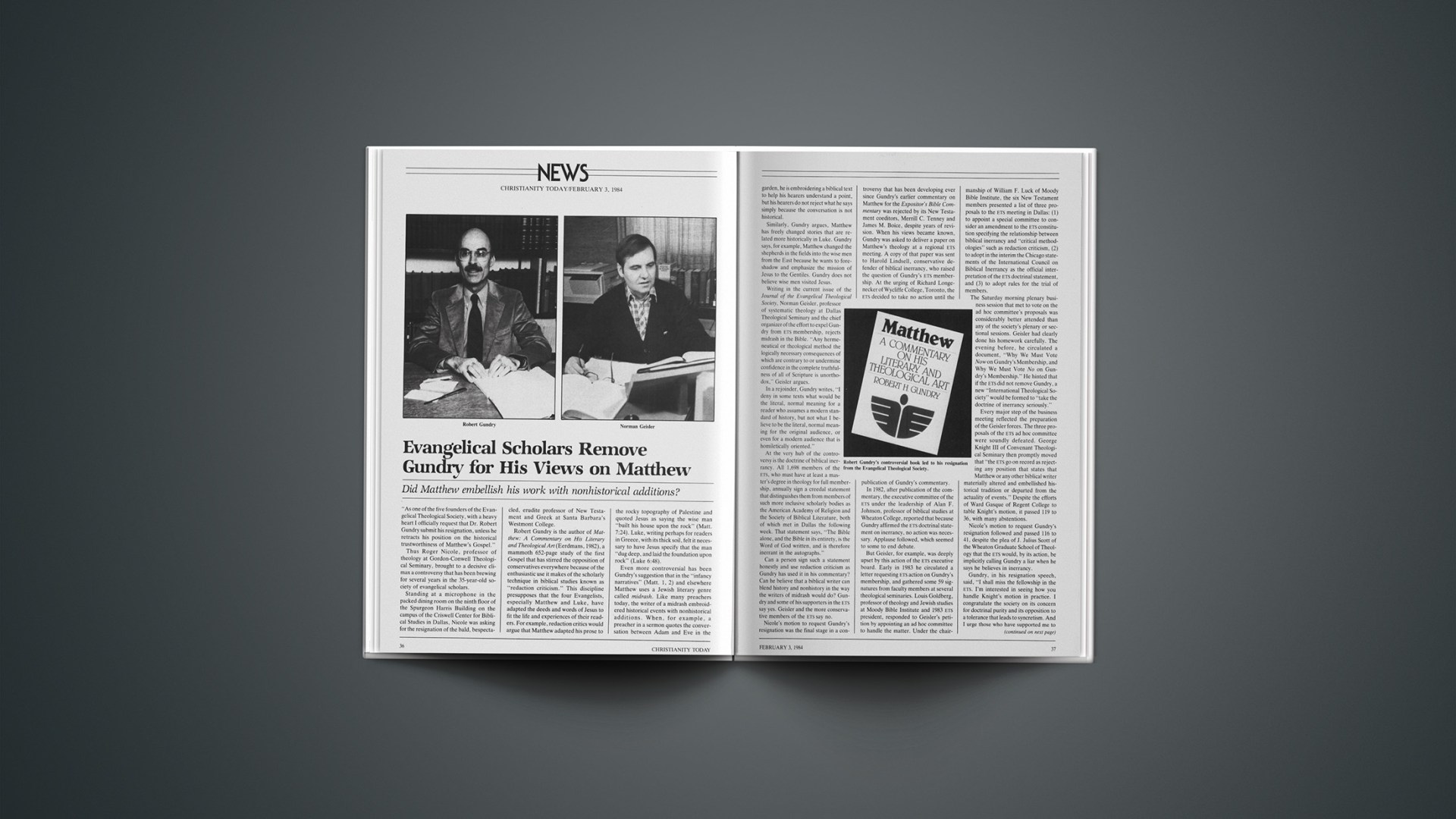
Evangelical Scholars Remove Gundry for His Views on Matthew

Did Matthew embellish his work with nonhistorical additions?

“As one of the five founders of the Evangelical Theological Society, with a heavy heart I officially request that Dr. Robert Gundry submit his resignation, unless he retracts his position on the historical trustworthiness of Matthew’s Gospel.”

Thus Roger Nicole, professor of theology at Gordon-Conwell Theological Seminary, brought to a decisive climax a controversy that has been brewing for several years in the 35-year-old society of evangelical scholars.

Standing at a microphone in the packed dining room on the ninth floor of the Spurgeon Harris Building on the campus of the Criswell Center for Biblical Studies in Dallas, Nicole was asking for the resignation of the bald, bespectacled, erudite professor of New Testament and Greek at Santa Barbara’s Westmont College.

Robert Gundry is the author of Matthew: A Commentary on His Literary and Theological Art (Eerdmans, 1982), a mammoth 652-page study of the first Gospel that has stirred the opposition of conservatives everywhere because of the enthusiastic use it makes of the scholarly technique in biblical studies known as “redaction criticism.” This discipline presupposes that the four Evangelists, especially Matthew and Luke, have adapted the deeds and words of Jesus to fit the life and experiences of their readers. For example, redaction critics would argue that Matthew adapted his prose to the rocky topography of Palestine and quoted Jesus as saying the wise man “built his house upon the rock” (Matt. 7:24). Luke, writing perhaps for readers in Greece, with its thick soil, felt it necessary to have Jesus specify that the man “dug deep, and laid the foundation upon rock” (Luke 6:48).

Even more controversial has been Gundry’s suggestion that in the “infancy narratives” (Matt. 1, 2) and elsewhere Matthew uses a Jewish literary genre called midrash. Like many preachers today, the writer of a midrash embroidered historical events with nonhistorical additions. When, for example, a preacher in a sermon quotes the conversation between Adam and Eve in the garden, he is embroidering a biblical text to help his hearers understand a point, but his hearers do not reject what he says simply because the conversation is not historical.

Similarly, Gundry argues, Matthew has freely changed stories that are related more historically in Luke. Gundry says, for example, Matthew changed the shepherds in the fields into the wise men from the East because he wants to foreshadow and emphasize the mission of Jesus to the Gentiles. Gundry does not believe wise men visited Jesus.

Writing in the current issue of the Journal of the Evangelical Theological Society, Norman Geisler, professor of systematic theology at Dallas Theological Seminary and the chief organizer of the effort to expel Gundry from ETS membership, rejects midrash in the Bible. “Any hermeneutical or theological method the logically necessary consequences of which are contrary to or undermine confidence in the complete truthfulness of all of Scripture is unorthodox,” Geisler argues.

In a rejoinder, Gundry writes, “I deny in some texts what would be the literal, normal meaning for a reader who assumes a modern standard of history, but not what I believe to be the literal, normal meaning for the original audience, or even for a modern audience that is homiletically oriented.”

At the very hub of the controversy is the doctrine of biblical inerrancy. All 1,698 members of the ETS, who must have at least a master’s degree in theology for full membership, annually sign a creedal statement that distinguishes them from members of such more inclusive scholarly bodies as the American Academy of Religion and the Society of Biblical Literature, both of which met in Dallas the following week. That statement says, “The Bible alone, and the Bible in its entirety, is the Word of God written, and is therefore inerrant in the autographs.”

Can a person sign such a statement honestly and use redaction criticism as Gundry has used it in his commentary? Can he believe that a biblical writer can blend history and nonhistory in the way the writers of midrash would do? Gundry and some of his supporters in the ETS say yes. Geisler and the more conservative members of the ETS say no.

Nicole’s motion to request Gundry’s resignation was the final stage in a controversy that has been developing ever since Gundry’s earlier commentary on Matthew for the Expositor’s Bible Commentary was rejected by its New Testament coeditors, Merrill C. Tenney and James M. Boice, despite years of revision. When his views became known, Gundry was asked to deliver a paper on Matthew’s theology at a regional ETS meeting. A copy of that paper was sent to Harold Lindsell, conservative defender of biblical inerrancy, who raised the question of Gundry’s ETS membership. At the urging of Richard Longenecker of Wycliffe College, Toronto, the ETS decided to take no action until the publication of Gundry’s commentary.

In 1982, after publication of the commentary, the executive committee of the ETS under the leadership of Alan F. Johnson, professor of biblical studies at Wheaton College, reported that because Gundry affirmed the ETS doctrinal statement on inerrancy, no action was necessary. Applause followed, which seemed to some to end debate.

But Geisler, for example, was deeply upset by this action of the ETS executive board. Early in 1983 he circulated a letter requesting ETS action on Gundry’s membership, and gathered some 59 signatures from faculty members at several theological seminaries. Louis Goldberg, professor of theology and Jewish studies at Moody Bible Institute and 1983 ETS president, responded to Geisler’s petition by appointing an ad hoc committee to handle the matter. Under the chairmanship of William F. Luck of Moody Bible Institute, the six New Testament members presented a list of three proposals to the ETS meeting in Dallas: (1) to appoint a special committee to consider an amendment to the ETS constitution specifying the relationship between biblical inerrancy and “critical methodologies” such as redaction criticism, (2) to adopt in the interim the Chicago statements of the International Council on Biblical Inerrancy as the official interpretation of the ETS doctrinal statement, and (3) to adopt rules for the trial of members.

The Saturday morning plenary business session that met to vote on the ad hoc committee’s proposals was considerably better attended than any of the society’s plenary or sectional sessions. Geisler had clearly done his homework carefully. The evening before, he circulated a document, “Why We Must Vote Now on Gundry’s Membership, and Why We Must Vote No on Gundry’s Membership.” He hinted that if the ETS did not remove Gundry, a new “International Theological Society” would be formed to “take the doctrine of inerrancy seriously.”

Every major step of the business meeting reflected the preparation of the Geisler forces. The three proposals of the ETS ad hoc committee were soundly defeated. George Knight III of Convenant Theological Seminary then promptly moved that “the ETS go on record as rejecting any position that states that Matthew or any other biblical writer materially altered and embellished historical tradition or departed from the actuality of events.” Despite the efforts of Ward Gasque of Regent College to table Knight’s motion, it passed 119 to 36, with many abstentions.

Nicole’s motion to request Gundry’s resignation followed and passed 116 to 41, despite the plea of J. Julius Scott of the Wheaton Graduate School of Theology that the ETS would, by its action, be implicitly calling Gundry a liar when he says he believes in inerrancy.

Gundry, in his resignation speech, said, “I shall miss the fellowship in the ETS. I’m interested in seeing how you handle Knight’s motion in practice. I congratulate the society on its concern for doctrinal purity and its opposition to a tolerance that leads to syncretism. And I urge those who have supported me to stay in the society.”

Echoes from the ETS action have reverberated throughout the corridors of evangelical academia, especially where those who support Gundry’s methodology are teaching. There is some fear among Gundry’s supporters that Geisler may try to “pick on others.” The members of the evangelical Institute for Biblical Research, founded over a decade ago, expressed considerable sympathy for Gundry’s position at their Dallas meeting the same weekend. Some scholars are talking of forming a parallel Institute for Theological Research as an alternative to ETS, which they feel is becoming too “fundamentalistic.” Though some ETS members have indicated they plan to resign in protest, most of those sympathetic to the Gundry position (though they may not support his conclusions) will stay in the organization. Their strategy will be to recruit evangelical scholars who are more likely to support their viewpoint.

Whatever the long-range implications of Gundry’s forced resignation, few who attended ETS this year will forget that dramatic business meeting in Dallas on December 17.

in Dallas

When Doubt Can Help You: It’s Too Bad Christians Have Given It a Bad Name

G. K. Chesterton has remarked that “materialists and madmen never have doubts.” Could an authentic mark of a believer be his ability to doubt honestly?

Not according to the rather determined opinion of one person in a Bible study I attended. He declared: “Doubt is sin!”

I wonder how many share that second view, if only as a private, unexamined notion. This can make a Christian so timid that he may cling only to the edge of faith, hesitant to examine it too closely for fear he will lose it altogether.

Do we promote this hesitancy by discouraging anything less than continuous certainty? Faith is not promoted by intellectual innocence. Yet obviously the church aims to be a community of faith, not a collection of doubters. Doubt can no more be the intention of the church than cutting away tissue is the real aim of surgery. But just as surgery requires that there be a precise kind of injury in order to promote healing, the church can aim to help its people work through their doubts in order to generate a stronger faith.

To do this, however, requires a discriminate view of doubt. Doubt is not necessarily constructive. But the biblical expression of doubt is simply an honest admission that things do not always seem to fit, that for all the answers we have, rather significant questions are still outstanding.

Growth Can Rise From Doubt: Jeremiah

Jeremiah is a fair example. Here we have a great man of faith doubting God’s leadership: “O Lord, you have deceived me, and I am deceived; You are stronger than I, so you have won. So here I am: everyone laughs at me.”

If anyone had reason to doubt, Jeremiah did. He spent the energies of his youth in the cause of Josiah’s reform. Its success was spectacular—but fleeting. In a moment Josiah was killed in battle, the reform was lost, the enemy was at the gates. And the temple, which had been the subject of that great reform, would soon be destroyed. Why bother to work for reform at all? How could one have understood these matters to be the Lord’s will, when all that is left is a strange desolation?

It was only by going through such periods of doubt that Jeremiah could begin to see that God’s will transcended even Josiah’s reform. He was not wrong in thinking that God would be honored in a reformed temple worship. But he had to learn to doubt his earlier preoccupation with the temple in order to see beyond it to that time when the ark, that central relic of the temple, shall not “come to mind, neither shall they remember it, neither shall they miss it” (Jer. 3:16). For now God’s law will be present in a new covenant, one that is not written on stone but entered on the human heart (Jer. 31:33).

Without his doubts, Jeremiah could have been content with temple reform. And without his doubts that led him to a greater faith, he could have been left altogether without faith, and he could have been cynical when the whole reform came to nothing with the enslavement of the nation and the destruction of the temple. Instead, his constant seeking for a larger and grander vision from God—his dissatisfaction with an earlier inadequate understanding—led him to a faith that could not be assailed even when the populace was taken captive by Babylon.

Presumptuous Doubt

This honest doubt, a “doubting unto faith,” must be carefully distinguished from two other forms. The first is presumptuous doubt. It becomes the natural companion to egotism.

Both T. S. Eliot and Friedrich Nietzsche were impressed by the doubts of Blaise Pascal—but in altogether different ways. T. S. Eliot saw Pascal as a man of great faith and formidable doubts. But, for Eliot, the doubts were a component of his great faith:

“And Pascal, as the type of one kind of religious believer, which is highly passionate and ardent, but passionate only through a powerful and regulated intellect, is in the first sections of his unfinished Apology for Christianity facing unflinchingly the demon of doubt which is inseparable from the spirit of faith.”

In contrast, Nietzsche holds nothing but scorn for the way Pascal expresses his doubt. “The most deplorable example [of Christianity’s opposition to the ‘higher type’ of man]: the depraving of Pascal, who believed his reason had been depraved by original sin while it had only been depraved by his Christianity!”

Eliot, as a believer, saw Pascal’s modest distrust of reason to be the necessary prelude to a real search for truth. Nietzsche, on the other hand, saw that same tendency as intellectual cowardice. The distinction between Eliot and Pascal on the one hand, and Nietzsche on the other, points up an important difference between the doubt I am calling “doubt unto faith,” and “presumptuous doubt, the doubt of pride.” In the first instance, Pascal doubted himself and recognized his limits. This caused him to cast about in disbelief concerning the God-ordered creation, and even God himself. Eliot noted that for this reason some think Pascal was an unbeliever. But the point is that he seldom loses perspective because he always keeps in view his own limitations. Most of all he recognizes the limitation imposed by a human will and intellect distorted by original sin.

Nietzsche, on the other hand, presumes to throw off all limitations. His doubt is cast outward upon the world, God, and the Christian faith. He doubts all things except the romanticized human will, the enlarged ego. For Pascal, both doubt and knowledge have balance, moderation. The apparent energy in Nietzsche’s writing is achieved by an intentional imbalance, and a deliberate effort to assert his will against all moderating considerations.

If his expression is skillful, disciplined, and under artistic control, it is nevertheless like a controlled madness. “What is good?—All that heightens the feeling of power, the will of power, power itself in man.” There is no regard for decent limits, for civilizing restraints—either in language or in life. In the end it means there is no regard for truth. Doubt is not honest questioning; it is a device for asserting one’s will.

For Nietzsche doubt is no problem: he parades his doubts, he congratulates himself for them. “One must be honest in intellectual matters to the point of harshness,” he said in his introduction to The Anti-Christ, “to so much as endure my seriousness, my passion.” He exults in the fact that he has not been made as these other poor souls—gullible and believing. (“One must be superior to mankind in force, in loftiness of soul—in contempt.…”) The presumptuous doubter has answered the questions even before they are asked. Doubt is a defense, a barricade: it blocks the way to further inquiry.

Doubt Born Of Fear

Another type of doubt bears a similarity to the “doubt of pride,” in spite of appearing superficially to be its precise opposite. It is a doubt that disguises itself as faith.

A student once told me that her pastor, who knew only that she was taking a course in Bible at a state university, advised her, “Don’t listen to a thing that professor has to say.” Another student confessed to me once that she hesitated to take biblical studies for fear of the doubts such a study would provoke. This may disclose a common fear that one’s faith actually will not stand the test of close examination. Faith turns out to be not faith at all, but a very profound and subtle kind of doubt. The doubt arising from fear, ironically, is the fear of doubt.

The doubt born of fear, like the “doubt of pride” arms itself against questions. Either of these forms can mislead us into believing that doubt is always the enemy of faith. Biblical examples of “doubting unto faith” have convinced me that such is not the case.

It is not only in certainty that a person grows toward a stronger trust in God. Where understanding ends, and we admit to it, we experience “doubt.” Doubt struggles against that limit, and calls out to God for the answer. Doubt searches for solutions where none are apparent. Doubt is not the opposite of faith, it is not inimical to faith; but it is the opportunity for faith. It stands at the edge of past understanding and searches for more: that “more” comes through faith.

The place of honest doubt is that of a servant who prepares the guest room for the guest. Not the servant but the guest is expected to reside there. It is not doubt that is the aim, but faith. Nevertheless, doubt can prepare the way, if it is honest, and if it becomes neither arrogant nor deceitful. Real doubt, coming from a reverence for truth, is from God: it does not forbid questions, nor does it answer questions prematurely. Instead, it reaches beyond understanding and asks honest questions.

This preparation is essential: if we do not contend seriously with the question we will not understand the richness or the depth of the answer. Doubt is only that point at which we have posed the question and have not yet received the answer. Sometimes the question must be turned over and over in our minds, and it must be posed in its most devastating form. Sometimes it remains unanswered: it has served to bring us into the presence of the One to whom it is addressed. Though he remains silent, it is enough.

But often enough, against the dark horizon of doubt, new understanding bursts forth like the daysprings of a resurrection morning.

Tim Stafford is a free-lance writer living in Santa Rosa, California. He is a distinguished contributor to several magazines. His latest book is Do You Sometimes Feel Like a Nobody? (Zondervan, 1980).

Does the Bible Really Say All that about Romance?

The Bible speaks not only of ardent love between men and women, but it presents God himself as a lover and his courting of creation as the Great Romance.

The symbol seems a strange one, considering the Christian reluctance to embrace romantic love. Yet it is distinct throughout Scripture. God desires Israel for his bride: “For, as a young man weds a maiden, so you shall wed him who rebuilds you” (Isa. 62:5; all quotations from the NEB). He fondly recalls the days of harmony, “the love of your bridal days, when you followed me in the wilderness” (Jer. 2:2). Yet Israel is unfaithful—God is the unrequited lover. “Will a girl forget her finery or a bride her ribbons? Yet my people have forgotten me over and over again. How well you pick your way in search of lovers!” (Jer. 2:32). God is a passionate lover, and passion can fuel anger. Like the country singer who wonders, “If I saw you, would I kiss you or want to kill you on sight?” God storms at his lover for her prostitution.

After all, he rescued her as a newborn baby lying in her own blood, raised her to full womanhood, gave her fine clothes and jewelry, provided for her the best of foods, and presented her with sons and daughters (Ezek. 16:1–14). In return, she imperviously fornicates. “How you anger me!” shouts God (Ezek. 16:30). He threatens to turn her over to her many lovers, to strip her naked before them. The lovers will rob her jewelry, stone her, and hack her to pieces (Ezek. 16:39–40).

Which is it, then, kiss or kill?

Wait, for God is the perfect lover. He vents his anger, then whispers: “But now listen, I will woo her, I will go with her into the wilderness and comfort her” (Hos. 2:14). He follows her through fires, floods, dark woods, wherever she goes, then pleads “How shall I deal with you? Your loyalty to me is like the morning mist, like dew that vanishes early.” Don’t you see, he adds, “loyalty is my desire, not sacrifice” (Hos. 6:4–5). Love will heal: it will reveal the eternal identity and make all things new. Come, God says, and Israel may be “fair as the olive” and “flourish like a vine” (Hos. 14:6–7).

Then the persistent lover takes another tack. He is not out to woo only one tribe, one people, but all, and all of creation. This wild lover will stop at nothing. He condescends and assumes the nature of a slave. He walks among us and heals and proclaims peace and routes demons (and takes up a whip to show some of that old anger too). He demonstrates his power over death by raising the dead, he tells story after story to win our trust. He looks on us adoringly, and yearns, “How often have I longed to gather you children, as a hen gathers her brood under her wings: but you would not let me” (Luke 13:34).

And still we will not let him. He is embarrassing us. He keeps company with prostitutes, for one thing. Sometimes he acts too happy, and he eats and drinks more than a holy man should. Worst of all, he makes outlandish claims that he is the same God who has been chasing us all along. Finally, cruelly, we turn our backs on him once more, and nail his back to a cross.

But he is God, and mad in love enough to bear it, to take all our anger and guilt. Three days later, he is back—and this shocks us into trying to love him better. Our infidelity is long and habitual, though, and we still slip often. There are yet many other gods winking at us, seducing us. Our resolve to be unfaithful is weakened, just the same. We have been betrothed to our “true and only husband” (2 Cor. 11:2). We have seen that love really is stronger than death, stronger than life or angels or principalities or powers or anything else. In the end, there is no fighting it. We already hear fiddles scratching away at a distant feast, and we wonder more and more why we ran so hard from this lover. “Happy are those who are invited to the wedding-supper of the Lamb!” (Rev. 19:9).

We hear much of the wedding day, of great, jubilant crowds rumbling like a dozen waterfalls or rolling thunder. They have stopped running and, at long last, accepted true love. “Alleluia!” they cry. “The Lord our God, sovereign over all, has entered on his reign! Exult and shout for joy and do him homage, for the wedding-day of the Lamb has come! His bride has made herself ready, and for her dress she has been given fine linen, clean and shining” (Rev. 19:7–8).

Ah: the bride. Finally she is made new. God’s people bear renewed bodies; bodies sown in humiliation but raised in glory, mortal bodies clothed with immortality (1 Cor. 15:43 and 53). And so suns and moons, rocks and trees, all creation drawn into the heart of God, consummating the praise for which it was made (Ps. 148:5–6). Consumation is what weddings are all about.

Soon, very soon, the wedding of all weddings will begin. Heaven will crash open and the bridegroom appear on a white horse. God’s people may yet be panting from their headlong dash away from him, but they will gather breath to shout.

“ ‘Come!’ say the Spirit and the bride.

“ ‘Come’ let each hearer reply” (Rev. 22:17).

What Hollywood Doesn’t Know about Romantic Love

Christians celebrate Easter and Christmas as religious holidays. In the United States, we find some religious significance in Thanksgiving and even Independence Day. CHRISTIANITY TODAY, in its 27-year history, has devoted two dozen articles to the themes of Easter, Christmas, and Thanksgiving. Valentine’s Day (even Saint Valentine’s Day) is another matter. The pudgy Cupid, bow and arrow in hand, is obviously pagan. Cute, maybe, but pagan. We can make something religious of prayerful pilgrims or the birth of “one nation, under God.” But a naked, overfed, flying imp? Or candy, flowers, and cards? The word “cute” cries to be said again. Valentine’s Day is fun and cute: deathly cute. No wonder it is not considered a Christian holiday. No wonder Christian magazines never fail to have Easter essays, but rarely (if ever) rise to the challenge of Valentine’s Day.

I am here to break the tradition. Valentine’s Day is too, yes, cute for my taste. But I like what’s behind it. The idea of that obese baby shooting arrows through hearts never appealed to me. Falling in love did. And does.

I admit at the outset that falling in love is a crazy thing. The kind of love we fall into—romantic love—is a boiling mix of the sensual and the spiritual. It can be ecstatic as well as heartbreaking. It is ardent and particular; that is, we find ourselves intensely attracted to one woman or man but not another. Psychologists say romantic love involves similar basic world views, or “senses of life,” and “complementary differences.” Not even the scientist fully understands it, though, and is inclined to agree with the sage that the “way of a man with a woman” is one of life’s great wonders (Prov. 30:19). This much is clear: the romantic looks at life differently than others. “The proper study of mankind is man,” Alexander Pope declared in a levelheaded moment. No, “The proper study of mankind is woman,” Coventry Patmore corrected in a romantic moment.

Levelheaded or not, romantic love is no joke in our culture. It is the linchpin of a multibillion-dollar advertising industry, the subject of innumerable movies, novels, and television shows, and the personal preoccupation of millions of people on any given day. Christians agree with the cultural consensus of much of the West that romantic love is a desirable base for marriage. Parents do not arrange marriage. Instead, young adults socialize, then pair off in dates or what could be called little experimental romances. Sober and rational counseling may come after a couple has fallen in love and decided to marry, but we mostly agree that it would be a shame for a couple to get married if they had not first fallen in love.

This fact alone ought to move Christians to reflection. What place does romantic love have in our life and thought? Romantic love offers both bliss and turmoil for the unmarried adult. How can the single Christian handle this experience? The married Christian has another set of questions: Can romantic love deepen and strengthen a marriage? And how does the married Christian react if he or she falls in love with someone other than a spouse? British author Harry Blamires has already asked such questions. The church, he laments, has had little to say about “the meaning of youth’s keen responsiveness to beauty and love.” Christianity “must be presented … as something more exciting than a lot of prohibitions aimed at disinfecting life of its torrential delights.” If it is not shown to touch people “at the points of profoundest personal longing and joy, it will indeed be condemned … as being unrelated to real life.”

But Christianity, of course, is related to real life. Seen from the Christian perspective, romantic love is far from a chronic and threatening problem. It can, in fact, enhance all relationships—teaching us to treat all persons with the dignity they deserve. Romantic love and dignity? The two have a lot to do with one another. And that leads us to the dignified, if eccentric, world of a man named Charles Williams.

Charles Williams’S Theology

Most Christians have done one of two things with romantic love: condemn it out of hand, or sloppily paste it to marriage and then inadequately say no more about it. Charles Williams was one twentieth-century Christian who thought there was more to it than that, and he took the trouble to construct what he called a “theology of romantic love.”

As a personal friend of C. S. Lewis and J. R. R. Tolkien, Williams was among those Oxford Christians we know as the Inklings. He had a slight build and was, according to Lewis, “ugly as a chimpanzee.” His hands, due to a mild nervous affliction, trembled enough that a barber had to shave him. Despite Williams’s appearance, Lewis wrote, “he emanates more love than any man I have ever known,” and talked in such a way “that he is transfigured and looks like an angel.” Lewis observed that “women find him so attractive that if he were a bad man he could do what he liked either as a Don Juan or a charlatan.” Not a bad man, Williams was married 28 years until his death at the age of 58.

To understand romantic love, Williams began with the doctrines of the Incarnation and Creation. Since God was flesh in Christ, the body was not and is not intrinsically evil. The body, Williams said, has not fallen “farther than the soul.” Second, each person is created in the image of God and thus uniquely reflects some aspect of God’s glory. Human beings are not mere mortals. As Lewis said, “the dullest and most uninteresting person you can talk to may one day be a creature which, if you saw it now, you would be strongly tempted to worship, or else a horror and a corruption such as you now meet, if at all, only in a nightmare.”

How does this apply to romantic love? Let me appeal to my experience, which is a common one. I have noticed that romantic love is a sort of vision. Conventional wisdom regards it as a vision, as a way of seeing. We often hear the phrase, “I don’t know what she sees in him.” Parents frequently cannot understand how sons fall in love with ordinary Janes, or daughters with workaholics. Friends are baffled when someone they care about falls in love with a freeloader, even a criminal. The parents and friends are looking rationally, but only rationally. They see how ordinary our lover is, or how flawed she is. When I am in love, though, I see something different. In the words of an old George and Ira Gershwin song, “She may not be the girl some men think of as pretty, but to my heart she carries the key.” I see not how ordinary or how worthless she is, but how extraordinary and priceless she really is. This, of course, accords with the Christian faith. To God, no woman or man is worthless or ordinary.

For Williams, then, the romantic vision was not confused, but illuminated. The lover sees through the beloved’s flaws to the image of God. The lover is not blind to pigeon toes and ill manners but, caught up in love, discerns the true creature, the one who, when perfected in heaven, “you would be strongly tempted to worship.” It is this truest and deepest self of the person—the person as created and potentially redeemed by God—that Williams called that person’s “eternal identity.”

Romantic love is a grace, a gift, a reality again shown in the way we casually speak of it. We admit that we “fall” in love. It awaits us and is given to us. The eternal identity of every person (something hinted at in Rev. 2:17?) is always present, but we may become acutely aware of it in the state of romantic love.

Windfalls Of Love

Williams proposed that romantic love reveals the true person. I want to go a step further. Romantic love strengthens and enhances the beloved’s eternal identity, her truest and deepest self. Under such love, Robert Farrar Capon writes, the beloved “blossoms into a fullness of being.” Her clothes, hair, and skin are more “becoming” than they were. “We all recognize her in a process, not of ceasing to be what she was and becoming some alien thing, but of being called into the fullness of her own being. We see, not a foreign perfection forced upon her from the outside, nor yet some inevitable development built into her bones; we see a creature in pursuit of her own goodness as pronounced by her lover.”

We don’t have to get overly mystical on this point. French psychiatrist Ignace Lepp can speak psychologically of the dynamic Capon mentions. In friendship, Lepp said, we may not understand why we are attracted to a certain person, but the unconscious “may have divined between him and us mysterious affinities that will perhaps take years to become fully conscious.” The unconscious may even sense what the other person is “capable of becoming, perhaps precisely because of our friendship.”

Romantic love (and friendship to a lesser degree) not only recognizes the vastly appealing eternal identity in a man or woman, then, but can draw them toward achieving that glory. I remember the high school experience of falling in love and suddenly working harder—but more naturally and comfortably—at everything from studies to football. Being loved, realizing someone sees something uniquely attractive in us, does that. Loving in return, we are drawn out of ourselves to build up another. For the Christian, romantic love cannot begin and end in the lover. No, building up another entails helping him or her to love others and God more intently. We help that one to create what Kierkegaard calls “heart-room”—the spaciousness of heart that allows a loving family of five to live in a room cramped by one unloving person.

Heart-room is what we need so as to dare to love as indiscriminately as Jesus did. The risk of loving is real and terrible. As Capon says, “What is love if it is not the indulgence of the ultimate risk of giving one’s self to another over whom we have no control?” We may be rejected. We may be manipulated, cheated, or used. Still, God commands us to love, to love even our enemies, who are indeed likely to reject and use us in return. Romantic love, with its irresistible power and attraction, compels us to love at least one person. Being romantically loved by another in turn, we are assured of our unique worth. We can then risk being rejected or used in other kinds of love.

Because it is often stronger than our fears, romantic love can drill into us a bitter truth, and point to a way beyond it. It can teach us that we are incomplete in ourselves. Christian psychologist William Kirk Kilpatrick says it well. “We are, as Lewis put it, ‘one vast need.’ Our intuitive feeling when we are in love is that we were only half-living up to the moment we fell in love. We realize then how much our wholeness depends on someone outside ourselves. Take away our love, and we feel reduced to almost nothing.” This, Kilpatrick believes, is a “peek at the real nature of things.” We do need other people. Ultimately, of course, we need God, and are completely dependent on him. In a very basic way, romantic love is concerned with humility. No one can fall in love without facing and admitting humility. The lover’s conviction that the romance is “too good to be true” is another way of saying, “This is too good to happen to me.”

On a more mundane level, romantic love can help lovers carry out their everyday tasks. An impressive example comes from the letters of President Woodrow Wilson. Wilson’s first wife died in 1914. America was being sucked into the dark whirlwind of World War I. German submarine warfare had begun in British shipping lanes. In 1915, the Lusitania was sunk and 128 Americans died. At that time, in Winston Churchill’s estimation, President Wilson “played a part in the fate of nations incomparably more direct and personal than any other man.” And Wilson was falling in love.

During days filled with urgent briefings and nights of sleepless anxiety, Wilson somehow found time to write Edith Galt and tell her he was “absolutely dependent” on her love for the “right and free and most effective use of my powers.” With her, he experienced a “new confidence God’s in his heaven and all’s right with the world. Duty looks simple and the tasks of the day pleasant and easy.”

Romantic love, naturally, is better from the inside than the outside. Edith Galt’s love certainly lifted Wilson from the depression he suffered after his first wife’s death, and was his still point in a chaotically turning world. But it is also true that Wilson’s aides worried that the 58-year-old world leader was acting like a smitten college boy. They even concocted an (unsuccessful) plot to break up the couple.

Problems Of Romantic Love

Like Wilson’s aides, Charles Williams realized that romantic love is not above abuse. Anything experienced by imperfect creatures is bound to be flawed in the process. He saw three principal misperceptions: (1) the assumption that romantic love lasts forever, when in fact it nearly always passes with time; (2) the assumption that the glory we now behold only in particular persons does not reside in all; and (3) the assumption that romantic love is sufficient in itself, while God and God alone is. Williams did not approve a romantic love unchecked by the intellect. “Accuracy, accuracy, and again accuracy! Accuracy of mind and accuracy of emotion,” he wrote. Once romantic love occurs, it “desires and demands the full exercise of the intellect for its exploration.”

It is indisputably wise, when we fall in love, to back off occasionally and ask sober questions—perhaps in consultation with a friend or pastor. Romantic love can be immature or sick, just as some parents develop a sick love for their children and “smother” them with affection. Rationally examining our feelings and drives can help us determine if they are part of a deep and true romantic love, or something such as masochism or worse. Even here, with a distorted or stunted romantic love, there can be growth in Christianity. Millions of women and men have given up a love for another for the good of the other. Millions more have done it because they realized their warped romantic love was thwarting their love for God. They have done so despite great pain, and have earnestly followed the example of Christ to give up self and follow God. The very depth and intensity of romantic love can make it a profound arena for living out true spirituality.

Marriage is the ideal instrument for exploring the ramifications of romantic love. Williams called marriage the “great experiment.” He did not mean wedlock was tentative, to be abandoned if troubles arise, but that marriage was to be an arena in which to “experiment” how to better love our spouse and all individuals. Romance in marriage passes, Williams wrote, “but the things that have been said and done in the light of that quality remain; vows, if they have been serious vows, remain.”

Chesterton considered the wonder of one woman enough for a single lifetime. “Keeping to one woman is a small price for so much as seeing one woman,” he said. “To complain that I could only be married once was like complaining that I had only been born once. It was incommensurate with the terrible excitement of which one was talking. It showed, not an exaggerated sensibility to sex, but a curious insensibility to it.”

To begin to realize the depth of one woman (or one man) is enough to impress us with the rich depths of all persons. There are hitches. I have been married a short time—only six years—but long enough to know that living day in and day out with the same person can be boring (do not think I believe my wife’s experience is different). I have gone months, even years, thinking I knew my wife’s every habit, every talent, every fault. Then something happens, as it did in the summer of our fourth year.

We had reached something of a crisis. I wanted to move from Oklahoma to Chicago. She and her parents did not want us to. My mother-in-law said so, and my reaction was one of anger. Sandy’s reaction angered me more, because she obviously sympathized with her mother. I considered myself betrayed. It took two weeks of angry (sometimes tearful) conversations before Sandy convinced me she was not betraying me. She was empathizing with me—and with her parents. She was torn by an amazing ability to empathize with and understand everyone concerned. Finally I saw that I had misunderstood not only her but her parents, and all ended well (though I still relish mother-in-law jokes, and my mother-in-law remains adept at converting them into son-in-law jibes). I saw something new then in Sandy, something I had not seen in four years of marriage. Now I trust her uncanny empathy, and I believe that when she has a gray head and wrinkled hands, new treasures of her character will still turn up.

In such ways the lovers’ cup fills and overflows. We are humbled for one another, and the humility flows over into other relationships. We are charitable to one another, and charity is engendered for others.

Of course, romantic love is not exclusive to marriage, and may even be felt after marriage. Here, perhaps, is one of its greatest potentials for destruction. If the years can bring boredom with my wife, I meet other women I have never had time to be bored with. I see my wife at her worst as well as her best. But the women in the neighborhood, or at work or church, I see only at their best—and it can be a very attractive best. Falling in love, head over heels, would clearly threaten my marriage (something Charles Williams learned the hard way, as Alice Mary Hadfield’s new biography shows). But the marriage ceremony does not magically remove all the rich complexities of personality that cause us to fall in love. No Christian affirmation of romantic love can eliminate the hard work or (sometimes) sheer drudgery of staying true to the marriage commitment.

But Williams saw that the romantic vision of a married person does not have to be denied or repressed. On such an occasion, to “observe and adore the glory is not sin, nor to receive the humility and charity shed from the glory.” The vision is true: another person is seen in depth, a hint of an eternal identity glimpsed and appreciated. No equivocation: sexual expression must be reserved for marriage. It alone is the great experiment. We are only to “observe and adore the glory,” not appropriate it as we do the glory of the one we married. Again, ruthless and rational analysis is necessary. When are feelings getting out of hand, when is innocent appreciation becoming out-and-out temptation? A good rule of thumb is that any feelings or actions we are afraid to discuss with our spouse are probably dangerous.

I would suggest that marriages will differ: some spouses will be more comfortable with cross-sexual friendships than others. “Tenderness,” writes Joseph Joubert, “is passion in repose.” I suspect there is more space for such tenderness than many Christians have admitted, but the dangers are no less real and can never be ignored. It is imperative that cross-sexual friendships be carefully maintained as friendships (not romances), and that passion remain in repose.

Realization Of The Vision

The ideal, of course, would be not to betray marriage and still know all persons as delightfully and completely as our spouse. Could Jesus have had something of the sort in mind when he told the Sadducees, “The men and women of this world marry; but those who have been judged worthy of a place in the other world do not marry” (Luke 20:34–35, NEB)? I. Howard Marshall comments, “At the resurrection, all relationships will be taken up to such a high level that the exclusiveness of marriage will not be a factor in heaven as it is on earth.” It is not that in heaven marriage will be less. Rather, all relationships—husband to wife, lover to lover, parent to child, friend to friend, and yes, enemy to enemy—will be infinitely more joyful than we can now imagine.

Lewis guessed that all earthly experiences (sensory and emotional) might vanish in heaven “not as a candle flame that is put out but as a candle flame which becomes invisible because someone has pulled up the blind, thrown open the shutters, and let in the blaze of the risen sun.” We see reflections of this blazing sun in romantic love. A single reflection bedazzles us and takes our breath away. If we saw the eternal identity of every person we would surely collapse under the overwhelming weight of it, weakened as we are in our fallen condition. Imagine being “in love” 24 hours a day, seven days a week, and “in love” not simply with one person, but with everyone you pass on the street or glance through a revolving door. Only resurrected creatures will be strong enough to endure the weight—indeed, to enjoy it and see in each person a unique aspect of God’s beauty. Perhaps in this sense hell is merciful. It may save the selfish one from a weight he could never bear and will not give over to God, may spare his corrupted eyes a light that would burn them more than the fires of hell.

The Song Of Solomon

Several overarching biblical truths (Creation, the Incarnation, Redemption, and the Resurrection) contribute to a Christian understanding of romantic love. I have not, however, quoted at great length from the Bible nor shown that it explicitly addresses romantic love. But it does (see box).

The Song of Solomon is the most clearly romantic book, enough so that, even though it is firmly ensconced in the canon, Christians are still hesitant about it and uncertain what to do with it. It starts out steaming: “I will sing the song of all songs to Solomon that he may smother me with kisses” (Song of Sol. 1:1, NEB). Finally there is as unmitigated a declaration of love’s power as we may find anywhere in literature. Love is “strong as death, passion cruel as the grave; it blazes up like blazing fire, fiercer than any flame. Many waters cannot quench love, no flood can sweep it away” (Song of Sol. 8:6–7, NEB).

The book bothered Origen enough that he forbade it for simple, uneducated Christians, fearing they would take the eroticism literally. It was to be interpreted allegorically. Leave the Song to Christians who understood that, Origen said, and feed the simple with milk.

Surely we can agree with Andrew Harper that the Song of Solomon, above all other books in Scripture, can remind men that their “highest moments” of earthly love, when love has become a “pure flame of utter devotion, are typical of what the relation between the soul and God ought to be.” But at the same time we cannot forget that the Song exalts physical love. Verse by verse, it unrolls an ardent catalogue of nearly every part of the body: neck, eyes, cheeks, breasts, hair, teeth, lips, stomach, legs, feet, navel, nose, and arms. The Song may be symbolic of spiritual love, but a property of the symbolic object is that it must remain what it literally is even after the symbolic value is attached. Physical love may symbolize spiritual love and remain physical love, just as a wooden crutch can symbolize dependence on God but must first actually support the crippled man’s weight when he leans on it.

Conclusion

Do we dare celebrate Valentine’s Day in the spirit of the Song of Solomon? Why not? Lived in light of our faith, romantic love can help us to love, to love romantically but also with agape love. It can teach us humility and the reality of our dependence on God and others. It can show us, in a special way, the beauty of God—seen through his image in a person he had made. It provides us an arena for sacrifice and charity; it can draw us toward being better than we are or could be on our own. It reminds us of the wonder of gifts, and so that gift of all gifts, grace.

Romantic love is not a unique road to salvation. It is not even, by itself, at all a road to salvation. It is, I believe, part of God’s incredibly rich creation. We, our teenagers, our friends, keep enjoying (sometimes hating) the delicious experience of being “in love.” As psychologist Nathaniel Branden puts it, lovers are “moved by a passion they do not understand toward a fulfillment they seldom reach, they are haunted by the vision of a distant possibility that refuses to be extinguished.” Can this haunting, this vision, strike us with the lover’s real beauty and—by the joy reflected in his or her eyes—with our own? If so, romantic love is not merely a childish infatuation, but a true call—an echo from heaven.

Tim Stafford is a free-lance writer living in Santa Rosa, California. He is a distinguished contributor to several magazines. His latest book is Do You Sometimes Feel Like a Nobody? (Zondervan, 1980).

Apple PodcastsDown ArrowDown ArrowDown Arrowarrow_left_altLeft ArrowLeft ArrowRight ArrowRight ArrowRight Arrowarrow_up_altUp ArrowUp ArrowAvailable at Amazoncaret-downCloseCloseEmailEmailExpandExpandExternalExternalFacebookfacebook-squareGiftGiftGooglegoogleGoogle KeephamburgerInstagraminstagram-squareLinkLinklinkedin-squareListenListenListenChristianity TodayCT Creative Studio Logologo_orgMegaphoneMenuMenupausePinterestPlayPlayPocketPodcastRSSRSSSaveSaveSaveSearchSearchsearchSpotifyStitcherTelegramTable of ContentsTable of Contentstwitter-squareWhatsAppXYouTubeYouTube