How Many Hats Does Your Pastor Wear?: Eight Experts Suggest How Ministers Can Wear Them Better

How many hats does a pastor wear? In a single week, the minister may be expected to address the Lions Club, console a man whose son just committed suicide, help teach the Bible to kindergartners and senior citizens, preside at the dedication of a new high school, counsel a parishioner about her faltering prayer life, adjust the church budget, conduct a wedding (maybe a funeral), plan the order of worship for Sunday—and, oh yes, prepare and deliver a polished sermon. Having so many hats to wear has at least one advantage: your head is never cold.

But, warm heads guaranteed or not, churches place considerable demands on pastors. And those demands redound to the pastor’s hatmakers: the seminaries. Seminaries, pastors, and lay people alike may often wonder what the ideally hatted pastor would look like. To get fresh and helpful answers, CHRISTIANITY TODAY identified eight primary functions of the minister, then talked to one person accomplished in each of those fields. To present a different angle, we spoke when possible to persons who work outside of seminaries.

The eight identified functions were administration, education, speaking, statesmanship, music ministry, spiritual direction, evangelism, and counseling. Some of the suggestions made by these experts have already been implemented at many seminaries—others have not. All are worthy of reflection. And so the hats, as presented by some who wear them well:

Administration

Kenneth Wessner is chairman of the board of Servicemaster, Inc. For Wessner, administration primarily means management: “Getting the right things done through people.” Management, he observes, used to be thought of only in connection with business. But now it is recognized that management, in the broader sense, extends through all of life. “It begins with the personal, family, and church life,” Wessner says.

He considers seminary courses in management “imperative.” Central elements of management theory are the wise and efficient use of time and dealings with people. Ministers, of course, have several demands on their time and deal with people daily. Wessner mentions four other pastorally relevant keystones of management theory as postulated by management guru Peter Drucker: (1) concentrating on results rather than simple busy-ness; (2) building on the strengths of assistants rather than weaknesses; (3) setting a few major priorities and sticking to them; and (4) making effective decisions.

Wessner is optimistic about learning management skills. Special talents are not required. “Learn the basics and practice them,” he says. “Anyone with normal endowment should be able to accomplish management.” For pastors who want to improve on management, he recommends Drucker’s books, especially The Effective Executive and Managing for Results. Short courses in management are also offered at colleges and by some companies.

Education

Doug Simpson is associate dean of the graduate school at Tennessee State University. Simpson believes most of the pastor’s service—from Bible studies to preaching—involves education. He would like seminaries to concentrate a course or courses on a comprehensive Christian learning theory. Such a theory would help pastors to know what best brings about changes in behavior and attitude. A crucial distinction for Simpson is that between indoctrination and education. Indoctrination “simply plants doctrines Christians believe but don’t have to think about,” he says. Education teaches the learner how to understand and apply the doctrine—it makes him an “independent Christian.” It is easier to subvert the faith of one who has been indoctrinated than one who has been educated, Simpson says.

More important yet is that the Holy Spirit be integrated into a theory of Christian education. “From a Christian point of view,” Simpson says, “learning comes through the Spirit’s enabling us to see and understand. Christian educators tend to think learning happens because we discuss ideas. But mathematics are one thing, biblical truths are another. Those are the kinds of matters in which the Holy Spirit is necessarily involved.”

For Simpson, ideal educators are excited about the truth and ideas they are trying to communicate. Ideal educators are also concerned about the people they are teaching. They are secure enough in themselves and their work not to gather personal disciples. “That is counterproductive. We are to disciple, but not to ourselves,” Simpson notes. Good teachers are also open to questions, “not overtly dogmatic,” unintimidating, and so able to interact.

To improve as an educator, a pastor might attend short-term courses or workshops. Simpson also has more a novel suggestion. “T. S. Eliot said the educated person is noted for who he or she associates with. Associate with other pastors who are growing educators, perhaps even have regular meetings. One of the advantages of the university is that professors learn from their colleagues. Pastors can do the same.”

Speaking

Dewitte Holland is professor of communications at Lamar University in Beaumont, Texas. Holland fears seminaries fail in relating substantive courses to the actual world. “There are courses in history and the Bible, but they’re not related to what’s going on now,” he says. Such courses need to be “bent toward application.” He would recommend courses in the behavioral sciences that would help pastors understand their listeners.

The ideal speaker, says Holland, is sincere, erudite, has a sense of humor, and, most important, is empathetic. “To feel with people and share their fundamental problems is necessary. One has to feel with an audience to know what it needs.”

How can a pastor become a better speaker? Holland suggests asking a trusted and competent member of the congregation to critique each week’s sermon. Local high school or college speech teachers can be asked to listen periodically and evaluate. (Holland knows several colleagues who have happily offered such services.) “Simple, clear, biblically relevant material is the key. Great preaching has always been simple. Stick close to the center of the faith, not tangential matters. It’s easy to get on controversial but tangential matters and get a hearing—but not get anything done for the kingdom.”

Statesmanship

Charles Grassley is a U.S. senator (Republican) from Iowa. To Grassley, statesmanship means helping people get along with one another and their state or society. To aid the pastor as a statesman, Grassley would like to see seminaries offer a course in public relations. “The pastor must understand the community he or she is in,” Grassley says. “The minister must know the problems of the housewife, the factory worker, the professional.”

Accordingly, the ideal statesman is patient and listens more than talks. “In order to get through to people, listening is the best thing you can do,” says Grassley.

To improve as a statesman, the pastor can join a service club, setting an ongoing basis for a relationship with people in the community, but not taking up an inordinate amount of time. In speaking out and working on issues that affect the community, Grassley believes the pastor “shouldn’t compromise basic principles. Flexibility has to be in the application of principle.” For instance, says Grassley, a pastor might believe in the work ethic. The minister should hold to that principle but be flexible in understanding that some people who aren’t working come from impoverished and unproductive backgrounds. Politicians, Grassley says, should be principled statesmen, but pastors even more so. The pastor is more highly revered, and any fall from principle is damaging to his cause—that most significant one of all, the gospel.

Music Ministry

Donald Hustad is V. V. Cooke Professor of Organ at Southern Baptist Theological Seminary, Louisville, Kentucky. “Music in the church will never achieve any more than the pastor allows it to,” says Hustad. So seminaries ought to require courses in music theory? No, answers Hustad. “It helps if the minister can carry a tune and make pleasant sounds, but that’s not nearly as important as understanding music’s function in the church’s life. You have to begin with courses in worship.”

Studying music apart from its function can be a trap, with music becoming only entertainment, Hustad believes. It is especially important for evangelical ministers to understand music, he notes, because “music is the one principal art we evangelicals have kept.” Worship should reveal God and his purpose and lead God’s people to a response. The import of worship can be lost in the evangelical tradition, which Hustad characterizes as “free church.” Ironically, he notes, “free church” pastors may need deeper training in worship than those in the so-called liturgical churches that are noted for worship. The minister in a liturgical church has a book to guide (such as the Book of Common Prayer). The “free church” pastor, on the other hand, must improvise from scratch and has little guidance.

What musical qualities would the ideal minister have? It would be good if such a minister appreciated all the arts, music included. Hustad also considers an openness to cultural differences important. “Some ministers identify the music of their culture as God’s favorite,” says Hustad. They should understand that music has meaning within culture, that Western music is not necessarily better for worship than Eastern music, or classical than folk.

To increase understanding, the pastor might be open to the advice of a trained musician or minister of music. “In our Southern Baptist schools,” Hustad says, “ministers of music are required to have a course in worship, but seminarians are not.” Besides listening to staff that might understand worship better than they do, pastors can read. “This is one of the happy things. Evangelicals have suddenly become aware of the importance of worship. There is a lot available for the minister—written from an evangelical point of view—if he just reads.”

Spiritual Direction

Richard Foster is associate professor of theology and writer in residence at Friends University, Wichita, Kansas. Spiritual direction is not the same as pastoral counseling, he says. Pastoral counseling is largely psychological and focuses on problems the counselee is having. Spiritual direction does not have this crisis element: it is offering direction on a continuing journey, a growth in the spiritual disciplines of prayer, study, and a giving life. This means seminary courses on spiritual direction may be different from other courses. “In talking about the spiritual life, we’re not talking so much about courses as life-giving experiences,” Foster says. “You’ve got to have professors living this life. You can’t have an arrogant professor teaching humility.”

Since spiritual direction and living cannot be taught merely in the abstract, Foster says “lab experience” is necessary. When learning to pray for the poor, Foster’s students are sent to the inner city to witness poverty firsthand. He has students keep journals of spiritual experiences, and these are discussed in class. But can seminaries offer a particular course?

“A course in prayer would be wise,” says Foster. “Most seminaries have no such course. They don’t think prayer is something to learn. But that’s a major misunderstanding.” A course in prayer would include reading and studying of spiritual masters from the past, and it could not “just academically analyze.” The lab experience would be paramount.

Ideal spiritual directors, says Foster, are people who can “love God, love people, and love life.” They also have no need to control other people, which can be destructive. Ideal spiritual directors listen well, keep confidences, and are not rigid. “Turning spiritual disciplines into law will kill them.”

A pastor can become a better spiritual director by working at what Foster calls “prayer experiments.” Foster is learning to pray while jogging, but he builds the jogging around the prayer. “I jog until I’m through praying, not vice versa,” he says. He suggests that pastors undertake a day of solitude from two to four times a year. And reading is important, especially reading outside the tradition in which the pastor works. “We can become provincialized so that everything is familiar and comfortable. Reading outside the tradition has shock value. It wakes us up.”

Evangelism

Luis Palau is an international evangelist. Palau believes seminaries should offer courses in evangelism, but thinks it important not to get stuck simply on theory. Evangelism is like swimming, he says. Eventually “you have to jump in and start thrashing around.” Accordingly, he suggests that evangelism classes have as guest speakers evangelists who practice at various levels; one-to-one, small groups, and mass evangelism. Reading biographies of great evangelists also helps to implement theory.

The ideal evangelist, says Palau, has a passion and sensitivity for the lost, an ability to present the gospel on the basis of felt needs, gets to the point quickly, looks for or makes opportunities for evangelism, and has a knack for drawing people to a point of decision.

Contrary to a popular opinion, Palau does not believe evangelism will “just happen” if a church is healthy. “We don’t say this about a good family life or sex. Evangelism doesn’t happen naturally. Teaching and training is needed.” He recommends books by Oswald J. Smith, Stephen Olford, and especially R. A. Torrey’s How to Work for Christ. The pastor needs to be familiar with normal or friendship evangelism, special evangelism (such as a revival or special speaker), and united evangelism (city-wide evangelism sponsored by several churches).

Counseling

Grace Ketterman is a psychiatrist and medical director at the Crittenton Center in Kansas City, Missouri. Ketterman favors any seminary course that would “promote a healthy sense of self-awareness.” She also sees a need for teaching that helps a pastor recognize when a counselee should be referred to a trained mental health professional. Such course work would help the pastor recognize emotional problems too deep to be dealt with pastorally. (“Some very sick people go to the pastor,” Ketterman notes.) It could work at erasing the lingering suspicion some pastors still have of psychiatry and psychology and teach them how to determine an able therapist, both from theological and psychological perspectives. It could, finally, help pastors bring off the referral smoothly. “A lot of people take advantage of pastors because there is no fee, or pastors are especially sympathetic. So the pastor has to learn tough love,” Ketterman says.

Self-awareness is important in counseling because it means fewer blind spots. For example, says Ketterman, “To be needed can encourage dependency in others. If we’re not aware we have that need, our blind spot can feed into theirs.” A good counselor is also a good listener and perceptive observer. “You must be able to read body language,” she says.

In sharpening counseling skills, the pastor can read from the many books and articles available on the subject, Ketterman suggests. Local mental health professionals may also supervise the pastor’s counseling and offer advice.

How Are Seminaries Doing?

We now have sketches of the hats pastors wear. The ideal pastor, a nearly supernatural jack-of-all-trades, would have passion for the lost, a sense of humor, sharp abilities to listen and perceive, a love and acquaintance with fine music, training in the behavioral sciences, oratorical skills, and a thorough grasp of management theory and practice.

Not surprisingly, each of our respondents considered his or her area of expertise crucial. About management skills, Wessner says, “The pastor needs them more than anything else.” Likewise Simpson on education: “The pastor is always trying to bring about learning.” Says Holland of speaking, “The minister can fail anywhere but there and get by.”

“The pastor can’t be anything less than a statesman” (Grassley). “The ministry of music is absolutely important if it is to achieve anything like its desirable goals” (Hustad). “The spiritual life is central. If it isn’t, we’re just salesmen or managers or psychologists” (Foster). “It is of fundamental importance to the local church that evangelism go on” (Palau). “Counseling is extremely important, because pastors will have to do it whether they like it or not” (Ketterman).

Most also felt that seminaries were not doing the job they should be doing. Comments ranged from “it’s improving” to “far from adequate.”

No wonder new pastors sometimes feel like a fourth member of the Trinity, says Earl Radmacher, president of Western Conservative Baptist Seminary (Portland, Oreg.). “No human can do everything, know everything, and be everywhere.” And no wonder seminaries despair that they can ever do everything expected of them.

But our respondents recognize that neither pastors nor seminaries are superhuman. “The first thing people need to be sensitive to is that seminaries can’t do everything,” says Richard Foster. “Seminaries are doing the best they know.”

And pastors don’t have to be everything. They shouldn’t even try. “Some should be in the ministry but not in the pulpit,” says communications professor Holland. “Preaching is one of the gifts of the Spirit. If a pastor doesn’t have it, there is education, counseling, or other areas of ministry.”

Evangelism is also a gift of the Spirit, Palau says. “A well-known missiologist says 8 to 10 percent of all people have the gift of evangelism,” Palau reports. All Christians are called to evangelize, but some have a special facility (see Eph. 4:11). Palau believes the pastor should determine if she or he has the gift of evangelism, and, if not, isolate members of the congregation who do. These are the individuals to head up evangelism training programs and activities.

Psychiatrist Ketterman has similar beliefs about counseling. It takes much time, she notes, and four or five counseling sessions a week can “only be a dent in the congregation.” The majority of the congregation may be neglected. She recommends that pastors counsel an individual in no more than two or three sessions. If problems are profound enough to necessitate further sessions, referral is the answer.

Ours is obviously an age of specialization, and pastors may be among the last generalists. Since life cannot be cut up into slices that never overlap or intermingle, pastors will no doubt have to continue in a variety of duties. The “care of souls,” as most would surely agree with Foster, is primary. But the message of our respondents seems to be that the pastor and the seminaries have help and should use it. One of the most significant things those hatmakers might help the aspiring pastor do is decide what hat he or she wears best. Of course, inside seminary walls, there isn’t likely to be much talk about hats. Someone might mention the priesthood of believers.
Zwingli Was the Reformation’s Most Gifted Musican: But He Banished Music from the Church

Ulrich Zwingli astonished many with his statement, “I disturb no one with my music.” He was referring to music in the church. He had in fact brought into being the unusual idea Saint Augustine had expressed when he said, “Sometimes I go to the point of wishing that all melodies of the pleasant songs to which David’s Psalter is adapted should be banished both from my ears and those of the church as well.”

These two, a Reformer and a saint, were persuaded that music, played or sung, was irresistible and so distracted from pure worship.

But Zwingli had other reasons. As a follower of the humanist Erasmus, he became an earnest student of the worship ideals and practices of early Christians. His study led him to conclude that true worship is essentially internal, not external, and primarily individual, not corporate. He had observed on every hand the bond between the physical, external acts of worship and the ceremonial legalism of the church. But he had adopted the philosophy of Erasmian spiritualism that strongly emphasized the internal piety of the mind and heart. Thus, because God is a spirit, sincere worshipers must worship him in spirit.

When Zwingli began his duties as people’s priest at the Zurich Grossmünster in 1518, his expository messages based on the study of Matthew’s Gospel initiated a series of sermons critical of the formalism of contemporary worship. The truth of Scripture, as he saw it, meant that to be alive in Christ was to be free of all Jewish and human ceremonial traditions. He completed his own revision of the liturgy in 1523 at the age of 39.

Zwingli was the most musically gifted of the sixteenth-century Reformers, and he became a diligent student of music. As a boy, his studies in Basel included hours of practice on the lute and viol, and when he moved to Berne, he nearly joined the Dominican Order to pursue serious musical study. He remained throughout his lifetime a fine singer and capable composer.

In Zurich, Zwingli was greatly disappointed to hear the poor quality of musical performances in the city. Here, in the very place where art was highly extolled, there had been little musical development. Furthermore, it was evident that many of the finest singers in the churches sang not for God but in order to display their skill. Zwingli decried their hypocrisy and that of all who performed in church for financial gain.

But Zwingli also had biblical reasons for his desire to rid the churches of music. First of all, he took seriously Christ’s words, “When you pray, go into your room, close the door and pray to your Father, who is unseen. Then your Father, who sees what is done in secret, will reward you” (Matt. 6:6, NIV). This became his basis for considering the essential character of true prayer and worship (for he believed the two to be the same) to be private.

Second, Zwingli heeded these words of the apostle Paul: “I will pray with my spirit, but I will also pray with my mind; I will sing with my spirit, but I will also sing with my mind” (1 Cor. 14:15. NIV). He believed Paul’s words had been ignored by those “fools … who in all their lives do not understand one verse of the psalms they mumble.… If the mumbling of psalms is good, then it must come from God. Show me where God has commanded such moaning, mumbling, and murmuring.” Zwingli condemned thoughtless, hypocritical singing in the services of the church.

He also recalled another of Paul’s admonitions: “Let the word of Christ dwell in you richly as you teach and admonish one another with all wisdom, as you sing psalms, hymns and spiritual songs with gratitude in your hearts to God” (Col. 3:18, NIV). In fact, Zwingli told his amazed listeners that true worship ought to be inaudible! The singing that the congregation is to offer to God is within the heart, not upon the lips.

Unable to find a single place in either Old or New Testament where God commanded music in corporate worship, Zwingli excluded congregational singing for services in the city churches.

Perhaps Zwingli’s concerns should cause us to reexamine carefully our own current worship music practices. Are our sacrifices of praise to God the best that we can offer? Do any of us still seek the praise of others? What are the real motivations behind our Christian musical performances? Are we as guilty of thoughtless singing as those who heard Zwingli’s condemnation? Do we, and do we encourage others, to sing to God with gratitude in our hearts?

Tim Stafford is a free-lance writer living in Santa Rosa, California. He is a distinguished contributor to several magazines. His latest book is Do You Sometimes Feel Like a Nobody? (Zondervan, 1980).

You Can Buck the System and Win: Zwingli Did It 500 Years Ago

Ulrich Zwingli, who was born 500 years ago on January 1, 1484, is the unknown, sometimes forgotten, “third man of the Reformation.” Yet it can be claimed with some accuracy that he left his touch on the whole evangelical world outside the Lutheran family—a touch still felt today.

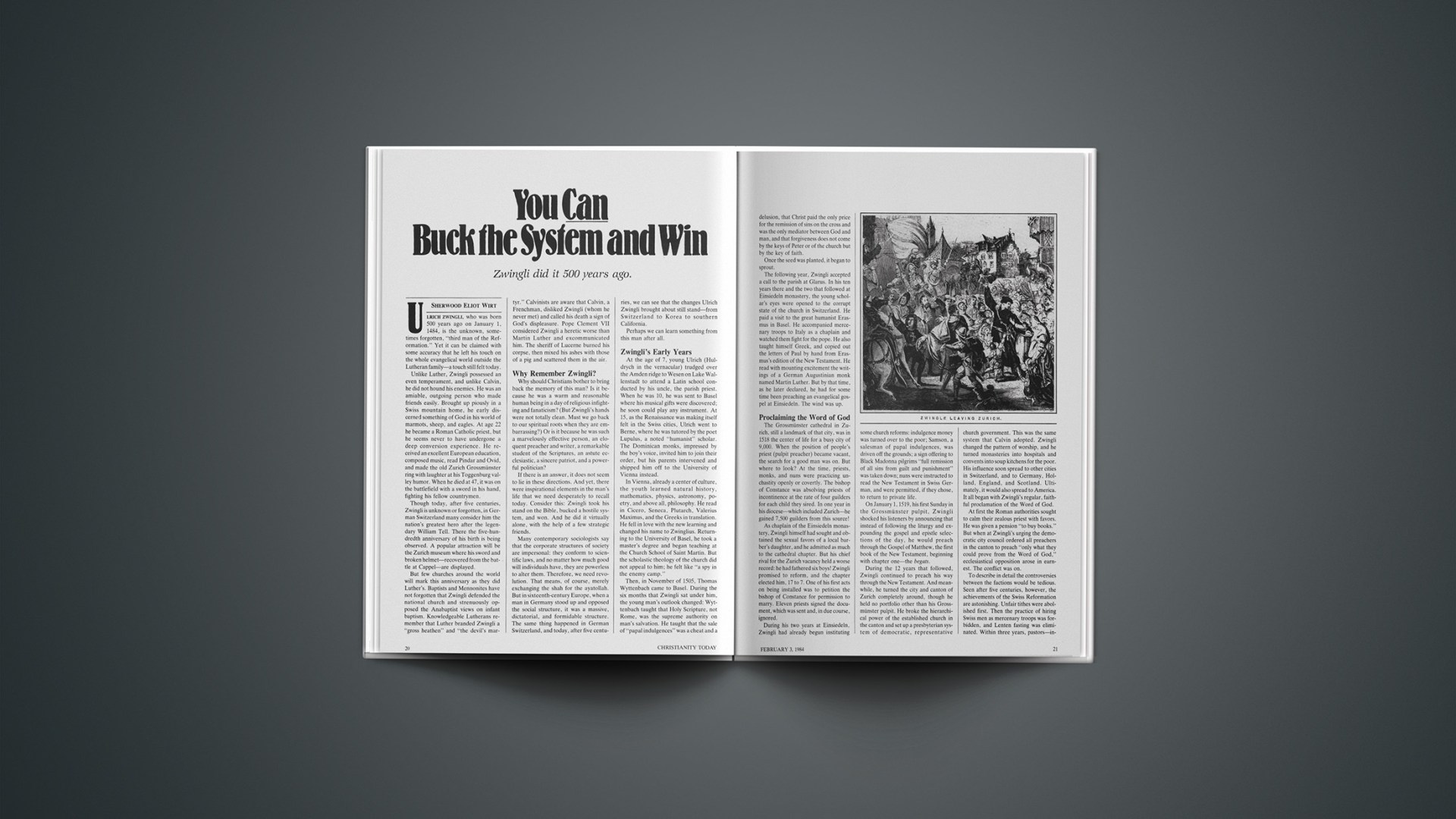
Unlike Luther, Zwingli possessed an even temperament, and unlike Calvin, he did not hound his enemies. He was an amiable, outgoing person who made friends easily. Brought up piously in a Swiss mountain home, he early discerned something of God in his world of marmots, sheep, and eagles. At age 22 he became a Roman Catholic priest, but he seems never to have undergone a deep conversion experience. He received an excellent European education, composed music, read Pindar and Ovid, and made the old Zurich Grossmünster ring with laughter at his Toggenburg valley humor. When he died at 47, it was on the battlefield with a sword in his hand, fighting his fellow countrymen.

Though today, after five centuries, Zwingli is unknown or forgotten, in German Switzerland many consider him the nation’s greatest hero after the legendary William Tell. There the five-hundredth anniversary of his birth is being observed. A popular attraction will be the Zurich museum where his sword and broken helmet—recovered from the battle at Cappel—are displayed.

But few churches around the world will mark this anniversary as they did Luther’s. Baptists and Mennonites have not forgotten that Zwingli defended the national church and strenuously opposed the Anabaptist views on infant baptism. Knowledgeable Lutherans remember that Luther branded Zwingli a “gross heathen” and “the devil’s martyr.” Calvinists are aware that Calvin, a Frenchman, disliked Zwingli (whom he never met) and called his death a sign of God’s displeasure. Pope Clement VII considered Zwingli a heretic worse than Martin Luther and excommunicated him. The sheriff of Lucerne burned his corpse, then mixed his ashes with those of a pig and scattered them in the air.

Why Remember Zwingli?

Why should Christians bother to bring back the memory of this man? Is it because he was a warm and reasonable human being in a day of religious infighting and fanaticism? (But Zwingli’s hands were not totally clean. Must we go back to our spiritual roots when they are embarrassing?) Or is it because he was such a marvelously effective person, an eloquent preacher and writer, a remarkable student of the Scriptures, an astute ecclesiastic, a sincere patriot, and a powerful politician?

If there is an answer, it does not seem to lie in these directions. And yet, there were inspirational elements in the man’s life that we need desperately to recall today. Consider this: Zwingli took his stand on the Bible, bucked a hostile system, and won. And he did it virtually alone, with the help of a few strategic friends.

Many contemporary sociologists say that the corporate structures of society are impersonal: they conform to scientific laws, and no matter how much good will individuals have, they are powerless to alter them. Therefore, we need revolution. That means, of course, merely exchanging the shah for the ayatollah. But in sixteenth-century Europe, when a man in Germany stood up and opposed the social structure, it was a massive, dictatorial, and formidable structure. The same thing happened in German Switzerland, and today, after five centuries, we can see that the changes Ulrich Zwingli brought about still stand—from Switzerland to Korea to southern California.

Perhaps we can learn something from this man after all.

Zwingli’S Early Years

At the age of 7, young Ulrich (Huldrych in the vernacular) trudged over the Amden ridge to Wesen on Lake Wallenstadt to attend a Latin school conducted by his uncle, the parish priest. When he was 10, he was sent to Basel where his musical gifts were discovered; he soon could play any instrument. At 15, as the Renaissance was making itself felt in the Swiss cities, Ulrich went to Berne, where he was tutored by the poet Lupulus, a noted “humanist” scholar. The Dominican monks, impressed by the boy’s voice, invited him to join their order, but his parents intervened and shipped him off to the University of Vienna instead.

In Vienna, already a center of culture, the youth learned natural history, mathematics, physics, astronomy, poetry, and above all, philosophy. He read in Cicero, Seneca, Plutarch, Valerius Maximus, and the Greeks in translation. He fell in love with the new learning and changed his name to Zwinglius. Returning to the University of Basel, he took a master’s degree and began teaching at the Church School of Saint Martin. But the scholastic theology of the church did not appeal to him; he felt like “a spy in the enemy camp.”

Then, in November of 1505, Thomas Wyttenbach came to Basel. During the six months that Zwingli sat under him, the young man’s outlook changed: Wyttenbach taught that Holy Scripture, not Rome, was the supreme authority on man’s salvation. He taught that the sale of “papal indulgences” was a cheat and a delusion, that Christ paid the only price for the remission of sins on the cross and was the only mediator between God and man, and that forgiveness does not come by the keys of Peter or of the church but by the key of faith.

Once the seed was planted, it began to sprout.

The following year, Zwingli accepted a call to the parish at Glarus. In his ten years there and the two that followed at Einsiedeln monastery, the young scholar’s eyes were opened to the corrupt state of the church in Switzerland. He paid a visit to the great humanist Erasmus in Basel. He accompanied mercenary troops to Italy as a chaplain and watched them fight for the pope. He also taught himself Greek, and copied out the letters of Paul by hand from Erasmus’s edition of the New Testament. He read with mounting excitement the writings of a German Augustinian monk named Martin Luther. But by that time, as he later declared, he had for some time been preaching an evangelical gospel at Einsiedeln. The wind was up.

Proclaiming The Word Of God

The Grossmünster cathedral in Zurich, still a landmark of that city, was in 1518 the center of life for a busy city of 9,000. When the position of people’s priest (pulpit preacher) became vacant, the search for a good man was on. But where to look? At the time, priests, monks, and nuns were practicing unchastity openly or covertly. The bishop of Constance was absolving priests of incontinence at the rate of four guilders for each child they sired. In one year in his diocese—which included Zurich—he gained 7,500 guilders from this source!

As chaplain of the Einsiedeln monastery, Zwingli himself had sought and obtained the sexual favors of a local barber’s daughter, and he admitted as much to the cathedral chapter. But his chief rival for the Zurich vacancy held a worse record: he had fathered six boys! Zwingli promised to reform, and the chapter elected him, 17 to 7. One of his first acts on being installed was to petition the bishop of Constance for permission to marry. Eleven priests signed the document, which was sent and, in due course, ignored.

During his two years at Einsiedeln, Zwingli had already begun instituting some church reforms: indulgence money was turned over to the poor; Samson, a salesman of papal indulgences, was driven off the grounds; a sign offering to Black Madonna pilgrims “full remission of all sins from guilt and punishment” was taken down; nuns were instructed to read the New Testament in Swiss German, and were permitted, if they chose, to return to private life.

On January 1, 1519, his first Sunday in the Grossmünster pulpit, Zwingli shocked his listeners by announcing that instead of following the liturgy and expounding the gospel and epistle selections of the day, he would preach through the Gospel of Matthew, the first book of the New Testament, beginning with chapter one—the begats.

During the 12 years that followed, Zwingli continued to preach his way through the New Testament. And meanwhile, he turned the city and canton of Zurich completely around, though he held no portfolio other than his Grossmünster pulpit. He broke the hierarchical power of the established church in the canton and set up a presbyterian system of democratic, representative church government. This was the same system that Calvin adopted. Zwingli changed the pattern of worship, and he turned monasteries into hospitals and convents into soup kitchens for the poor. His influence soon spread to other cities in Switzerland, and to Germany, Holland, England, and Scotland. Ultimately, it would also spread to America. It all began with Zwingli’s regular, faithful proclamation of the Word of God.

At first the Roman authorities sought to calm their zealous priest with favors. He was given a pension “to buy books.” But when at Zwingli’s urging the democratic city council ordered all preachers in the canton to preach “only what they could prove from the Word of God,” ecclesiastical opposition arose in earnest. The conflict was on.

To describe in detail the controversies between the factions would be tedious. Seen after five centuries, however, the achievements of the Swiss Reformation are astonishing. Unfair tithes were abolished first. Then the practice of hiring Swiss men as mercenary troops was forbidden, and Lenten fasting was eliminated. Within three years, pastors—including Zwingli—were marrying wives, and Zwingli was challenging the Catholic practice of praying to the saints and to the Virgin Mary.

To explain and establish the reforms, Zwingli began turning out essays and commentaries on Scripture. His “Sixty-seven Conclusions,” which went beyond Luther’s famous “Ninety-five Theses,” questioned the whole Catholic system, including the pope, the mass, pilgrimages, priestly celibacy, indulgences, the confessional, and penance. “A clergyman,” he wrote, “should not be recognized by his tonsure and his clothing, but by his love for all men, his sympathy in their need, his zealousness in preaching the Word of God, and his readiness to help wherever he is needed.”

During those early years in Zurich, Zwingli overhauled his personal life for the better. The death of a younger brother affected him deeply and brought on a spiritual crisis. When the plague known as the Black Death struck the city, sweeping away one quarter of the population, Zwingli ministered faithfully to his flock until he fell ill himself. He wrote three poems during that long and near-fatal illness that show a new humility and spirit of devotion that matched the momentous changes taking place within the city’s walls.

In the summer of 1524, a committee consisting of Zwingli, two other pastors, 12 councilmen, the city architect, smiths, carpenters, and masons paid routine visits to the churches of the city. They removed all the pictures, statues, images, and ornaments, and even took out the organs, while the masons covered the frescoes on the walls with a coating of lime. Little did they dream that when they limited the house of God to bare interiors and necessary furniture they were setting a continuing pattern for the character of worship in evangelical Christianity. Meeting houses around the world—whether chapels, churches, store fronts, classrooms, or movie theaters—have faithfully followed a tradition first adopted in sixteenth-century Zurich.

Standing Against Opposition

Long before he arrived in Zurich, Ulrich Zwingli faced opposition. He was driven out of Glarus by the dealers in mercenary soldiery. At Einsiedeln, his early reforms were challenged, and when his name was proposed to the Grossmünster cathedral chapter, some of the priests strongly disapproved his coming.

Once the Reformation began in earnest, a tremendous outcry erupted from the religious community (one quarter of the city’s real estate was owned by the church). Delegations began arriving from Constance to protest the changes. Neighboring cantons voiced their alarm and threatened armed invasion. This opposition eventually cost Zwingli his life, though at the time his reforms were unimpeded. He easily bested the bishop’s representatives in argument, and since he knew his Bible better than anyone else, the councilmen accepted his authority and backed his demands.

But now attacks came from other quarters. The Anabaptists, as they were called, began pressing for an even more radical Reformation. They sought a free church, which meant severing all connection with the cantonal government, and they insisted on the abolition of infant baptism. At first Zwingli sided with their views. Soon, however, he realized his gains were in jeopardy, and so he stayed with his allies in the cathedral and the city council and composed a tract justifying infant baptism as a continuation of Old Testament circumcision. But his opponents would not be silenced. The controversy raged until Zwingli admitted that “all the earlier battles were child’s play compared with it.” The city council banned the Anabaptists from Zurich and then, with grisly humor, ordered one of them, Felix Manz, drowned in the Limmat river. Though Zwingli could have stopped it, he didn’t. The results were pure tragedy.

More far-reaching in its devastating consequences was the conflict that arose between Zwingli and Luther and their respective Reformation parties. Zwingli desperately wanted a reconciliation, and said to Luther, “Let us remember that we are brethren.” But Luther replied, “You have a different spirit from ours.”

I once asked ten American Christian leaders, five Lutheran, five from the Reformed tradition, what they would have done had they been at the famous debate in Marburg where Luther and Zwingli disagreed. All five Lutherans agreed with Luther; all five of the Reformed (including Reinhold Niebuhr) sided with Zwingli. The impasse remains.

Zwingli’s hopes (which Luther resisted) were for a political as well as religious alliance of the Reformed elements in Switzerland and Germany to oppose the Hapsburg emperor. Meanwhile, Zwingli was himself being burned in effigy in the Swiss Catholic cantons, and evangelical preachers were being martyred at the stake. When an economic blockade was imposed (against Zwingli’s advice), the Catholics responded with military action. At the battle of Cappel in October 1531, a badly organized, last-minute army of 2,700 Zurichers faced 8,000 troops from the Catholic cantons. Zwingli accompanied the troops as chaplain and was killed, flattened by a stone as he stooped to console a dying soldier.

Influencing Generations

The victory of the five Catholic cantons broke the growing power of Zurich in the Swiss Confederation. Worse, it dealt a crushing blow to the cause of reform, and for a while it seemed as if all of Zwingli’s work would be lost. In time, other leaders appeared to take up the struggle: Bullinger, Calvin, Beza, Knox, Cranmer, and many others who were influenced by Zwingli’s writings made their stand on the Scripture. The biblical seed of the Reformation was preserved, took root, and multiplied. The harsh rift between the Reformed and Lutheran churches also was softened in time. As for Zwingli’s democratic system of church government, it became the norm in many sections of Europe, and in the following century it took root in America. Today it is in place in many, if not most, evangelical and mainline churches around the world.

Yet, none of the leaders who succeeded Ulrich Zwingli seemed to have the popular support of the masses and the combination of brilliant and charming personal qualities that characterized the Reformer of German Switzerland. I like to recall Zwingli’s incredible achievements: his breaking of the “system,” the ecclesiastical monolith that had held his country in its grip for centuries; his abolition of serfdom; his establishing of a school that is now the University of Zurich; his dashing off erudite discourses on theological issues that were in daily dispute; and all the rest.

But more, I like to remember how he played the lute for his children in their pleasant home; that he wrote a book for his 14-year-old stepson; how he composed the music for a play of Aristophanes; the way he browsed in the classics in the midst of the Reform uproar; that he had compassion for the poor who came to his door; how brave he was when his life was threatened; and the fact that he provided an island home for Ulrich von Hutten when that discredited Reformer was driven out of his native Germany and was dying of syphilis.

But perhaps most of all, I wish I could have sat in the ancient Grossmünster and listened to one of Zwingli’s magnificent sermons. They affected Thomas Platter so much that he wrote, “I felt as if someone were lifting me off the ground by my hair!”

Tim Stafford is a free-lance writer living in Santa Rosa, California. He is a distinguished contributor to several magazines. His latest book is Do You Sometimes Feel Like a Nobody? (Zondervan, 1980).

Exploring the Soul of the New Machine

If a machine learns to think, what will it have in mind?

My interest in artificial intelligence began quite simply. I was concerned about the amount of time my stepchildren were spending playing video games. Although I knew very little about video games, I saw the children’s personalities change when they had been playing for some time. And it seemed to me that the pattern memorization that video games require might teach an unhealthy approach to thinking.

I was concerned about the addiction video games brought. Even more so than television, these machines isolate children from their parents and peers and promote the idea that if a person knows the right steps he can succeed. The more I thought about it the more it seemed that someone connected to a machine—in this case a video game player—became a new creature, neither person nor machine, but something different than either.

My husband was as concerned as I. But his background in computers and his training as a mathematician helped him see the issue in a much larger context. We have briefly explored this context in the preceding article. Our investigation of the greater issue, the evolution of a new kind of human being (of which video games comprise a small, albeit lucrative, part) led us through complex books on how computers work and fanciful explorations of the wonders of artificial intelligence (AI) to quite popular books that have captured the imaginations of the general reading public.

I suspect that most people are in the same position that I am—nontechnical, certainly not mathematically literate. Yet, I wanted to know who was predicting and planning what in this field. I also wanted to know what the responsible Christian attitude should be. In reading the literature, I was relieved to find that I could indeed understand the researchers’ positions. It also did not take me long to discover that if I wanted help deciding the appropriate Christian response I wasn’t going to get it from anything that had been written to date.

The cognitive scientists, psychologists, psycholinguists, and AI researchers discount religion entirely and are, for the most part, strict behaviorists—and dualists as well. As I read their views I realized with some shock how deeply imbedded into our theology certain of their presuppositions had become. And I realized how monumental was the task to think and judge simply as Christians and not as late-twentieth-century Americans enamored with gadgetry—gadgetry we had been led to believe by IBM and its competitors was ordinary machinery. We have been glad for the lie, because we all know what machines are: mere tools. But what the books I’ll review admit is that intelligent machines are not mere tools. Computers do not necessarily do just what we tell them to, despite what we’ve heard on television or been told by our company’s information officer.

Three Primary Books

Of the seven books, three are central to the issue of old Adam, new Adam. One is specifically about the latest theory in AI. The others provide the context for understanding our much-publicized computer revolution. (This is not intended as an exhaustive review, but merely represents the main ideas from academicians and journalists.)

Probably the most quoted of these books, and the most controversial in AI circles, comes from Joseph Weizenbaum, a computer scientist from MIT who developed the ELIZA program—a simulation of Rogerian therapy. He called his program ELIZA because, as with Shaw’s original in Pygmalion, this Miss Doolittle could learn to speak better and better. That alone is significant. How can a software program implanted in a machine become greater than it was when it was written? This is the heart of artificial intelligence—to create programs that can learn just as human beings learn.

To Weizenbaum’s credit, but to the dismay of what he calls the artificial intelligentsia, he decided that his program was immoral (he didn’t use those words, but that is the impact of what he said). He wrote Computer Power and Human Reason: From Judgment to Calculation (W. H. Freeman, 1976) to say that human beings and machines are not synonymous. Now, that may sound obvious, but the metaphor of man as machine has so increased in potency and frequency since the early nineteenth century that people have come to accept the metaphor as literally true. Weizenbaum also emphasizes that though there are many things computers could be made to do, there are some things that computers should never be made to do.

Such a radical departure from the cheerleading squad brought Weizenbaum notoriety and disdain from most of his colleagues. It was tantamount to heresy for him to suggest that researchers were ignoring ethics in the quest to create a machine that thinks. (AI supporters would use the word “who” where I used the word “that,” an important grammatical assumption on their part.)

Much of the literature in the field is a not-too-gentlemanly debate about whether machines can think. Weizenbaum considers this a red herring. The answer lies with what thinking means and how we define intelligence, and whose definition will prevail. Weizenbaum grants that at some point machines may approximate human thought; his own ELIZA showed the possibility. His concern is with “the proper place of computers in the social order.”

Weizenbaum is concerned with power and language. Most of us are mystified by programs and by the languages in which they are written. This hocus-pocus atmosphere makes us vulnerable and weak, says Weizenbaum. The elitist core, those who understand the language—those, we might say, who are writing the dictionary—become the rulers. Not only do they understand the technical languages, they redefine our sturdy everyday tongue so that we no longer know what we mean when we speak. We are left dumb.

The solution is not for everyone to enroll in a course on Fortran or LISP (the high-level language of AI). Nor is it to discard what Weizenbaum calls “instrumental reason,” that method of thinking on which science maintains itself. Nor does Weizenbaum suggest that we replace science. Rather, he argues for reason to be melded with intuition and feeling—to recognize that more than mere rationality makes man human.

Weizenbaum’s solutions are not satisfactory, which is the weakest part of the book. But he goes far in demythologizing the computer for the layperson (he has two fine chapters in which he explains in nontechnical language how computers work). And at least he raises some crucial questions, unlike Pamela McCorduck, who is deliriously happy with the idea that man as we have defined him is now an obsolete concept. For the general reading public she is head cheerleader.

McCorduck’s Machines Who Think (Freeman, 1979) and Weizenbaum’s book are written simply, but are for computer scientists and others who have more than a casual interest in the subject. McCorduck is a journalist who teaches a workshop in science writing at Columbia University. Her recent book was written with Edward A. Feigenbaum, a leader in AI research at Stanford University. It is The Fifth Generation: Artificial Intelligence and Japan’s Computer Challenge to the World (Addison-Wesley, 1983).

Machines Who Think is more serious than The Fifth Generation, and better written. McCorduck purports to give a history of AI research. She provides some interesting anecdotes of and interviews with the names to know: Claude Shannon, Marvin Minsky, and John McCarthy, among others. Her real purpose, however, is less to give a history of AI than to convince readers of its glamour, its sparkle, its inevitability, its absolute rightness. To do this, she defends the mechanistic metaphor of man, reducing him to mere bits of information stored in his genetic code. Not only is his biological system a mere software program, but his role in life is that of information processor. Man receives inputs, which are sent through his biological, neurological data banks and result in outputs of information.

McCorduck knows that this mechanistic view of humanity offends some people, so she argues that this metaphor has been with us ever since the days of Genesis. The only difference between our era and that of the Greeks, for example, is that we have been more successful in making the metaphor literal.

Metaphors are central to changing the way people think, perhaps because most people don’t understand what a metaphor is and how it functions. The oftener we hear a metaphor the sooner it ceases to be metaphor and becomes accepted as reality. So we become comfortable with the idea that man is another kind of machine. Thus, we can now consider McCorduck’s real question, “Can a machine think?” That, she says, all depends on what you define as machine and how you define thinking.

Remember Weizenbaum’s point about who is writing the dictionary?

McCorduck’s argument runs something like this. We know that the body is a mechanism, so why not the mind? It, too, has a physical process (her definition of a mechanism). Then if another physical entity that is similar to a mind exhibits intelligent behavior, why can’t we call it a mind as well, no matter what its casing? Here we have dualism and behaviorism. As long as something acts, or behaves, with characteristics we have always called human, then why not define it as human? What difference does it make if it is metal and not skin and bones?

McCorduck, confessing herself to be Hellenic rather than Hebraic in nature, is untroubled by ethical issues. She dismisses Weizenbaum as a disgruntled, used-up scientist who is now making a career out of debunking his colleagues.

In The Fifth Generation, which focuses on the economic threat of Japan, McCorduck continues her attack on those who question AI. To say that machines can’t think is as silly as saying women can’t think. “Intelligence was a political term, defined by whoever was in charge.” (I’m not certain I follow her reasoning there; I offer it as an example of how she argues.)

Although this book is irritatingly repetitive—McCorduck and Feigenbaum keep pounding in the nail of “knowledge information processing” long after it has been imbedded in the wood—it is valuable as a tract for AI. The authors know that AI will solve the world’s problems, from poverty to aging. They know that the day of learning machines is nearly here. They know how much power these machines will give the country, or business, or person who holds their secrets. As good chauvinists, they want that country to be the United States, those businesses to be ours. They admit that “the computer will change not only what we think, but how.” Although most people agree with their statement, not everyone welcomes it as they do.

The Fifth Generation also contains helpful appendixes—summaries of current experimental and operational expert systems, names and addresses of companies working in AI, and a brief glossary that defines some key terms such as heuristics, expert systems, and knowledge base management system.

A More Technical Approach

Authors McCorduck and Weizenbaum perhaps unintentionally hint that all is not as unanimous among AI researchers as they would like us to think (we must discount Weizenbaum here, who is really no longer in the field). Roger Schank, for example, is working to develop machines that learn as a child does, machines that can be bored, he says; no one can claim they think. This idea greatly disturbs McCorduck, who believes it a benefit that it can never become bored. Schank, more sophisticated in his goals, intends to create machines that are just like humans, even down to their feelings, intents, and errors.

To do this, Schank has until recently concentrated on natural language processing, which is central to the success of AI and one of the things the Japanese are stressing. Now, though, he has shifted focus to memory, because he believes that giving machines “dynamic memory” will make them understand consciously what is being said to them and what is happening around them. “Our memories,” writes Schank, “are structured in a way that allows us to learn from our experiences. They can reorganize to reflect new generalizations—in a way a kind of automatic categorization scheme—that can be used to process new experiences on the basis of old ones. In short, our memories dynamically adjust to reflect our experiences. A dynamic memory is one that can change its own organization when new experiences demand it. A dynamic memory can learn.” This is the main point of Dynamic Memory: A Theory of Reminding and Learning in Computers and People (Cambridge, 1982).

Note the title, which tells us two significant facts about the book. First, Schank is talking about theory—and as we discover, the theory is his own. He has not based the book on experimental psychology, research by cognitive scientists, or neurological studies. Rather, he asks, “How do I remember?” and then builds his theory accordingly. Although he had students answer questionnaires on how they remember, this is a personal inquiry. I’m not convinced that everybody’s memory works the way his does; mine doesn’t. My husband’s does, perhaps because of his mathematical training. This would not be a problem, except that in science the persuasiveness of the person often makes theory equal fact with little to support it (witness Darwin).

The second thing the title tells us is that Schank is linking computers and people naturally. Computers don’t remember the way people do—yet. But if we become accustomed to thinking of computers and people as synonyms, we will no longer know to ask the right questions about such an assumption.

Most of Schank’s book is quite technical, and it would be difficult to find in a bookstore. I include it here because he is a leader in the newest area of AI research. His book, as well as his essay in The Handbook of Human Intelligence, a hefty volume, are worth the effort.

Judas Iscariot

“Jesus said, ‘Friend, do what you have come for.’ ”

—Matt. 26:50

Call him a miscalculation.

Everyone has a few bad rolls.

Maybe Jesus was looking the wrong way

at the right moment, or the right way

at the wrong moment.

Maybe.

Call him a misunderstanding.

Christ’s kingdom somehow soured,

His clauses hobbled.

The magic lost its bite.

Call him a mistake.

While most of the pots bear the heat

and blast, this one cracks.

The fertilized fruit tree

sometimes decays.

The fruit thuds to the ground,

rots and steams. The roots curl.

Call him a miss,

near miss, bullseye, or dead center.

All of the above.

None.

Call him whatever you like.

Jesus called him, “Friend,”

and warned him to finish

his call.

—Mark R. Littleton

Books That Are Fun To Read

Not all the books on AI are work to read or hard to find. Some of them are sheer fun and for that reason have captured best-seller status. They are not necessarily central to the philosophical issues and intellectual controversies surrounding the field. Yet they provide insight into the minds and attitudes of the people who actually make the systems that all of us, if the predictions are accurate, will soon have in our homes. (Business Week in a recent issue quoted an expert as saying that microcomputers will be as common as toilets in just a few years.)

The Soul of a New Machine, by Tracy Kidder (originally published by Little, Brown, now in paper with Avon and soon to be a film), won the 1982 Pulitzer Prize. It tells about the making of a new computer, manufactured by Data General in Massachusetts. Not only is it a fascinating adventure, but it provides great insight into how a computer mesmerizes those who work with it. A computer becomes “a face, a person to me—a person in a thousand different ways,” one of the computer hackers tells Kidder. (A hacker is someone addicted to hands-on programming, someone who can’t stay away from the keyboard.)

A leader of the project explained it to Kidder this way: “I loved writing programs. I could control the machine. I could make it express my own thoughts. It was an expansion of the mind to have a computer.… It really is like a drug, I think.… It was great for me to learn that priestly language. I could talk to God, just like IBM.” These are the people against whom Weizenbaum warns.

The mystery and addiction that surrounds computers, and to which The Soul of a New Machine testifies, has been explored and exploited by some of our most talented novelists today. We can read excerpts from them in a marvelous, intriguing book, The Mind’s I: Fantasies and Reflections on Self and Soul (originally published by Basic Books in 1981, now in paper from Bantam). This collection of philosophical essays, excerpts from science fiction, and papers from scientists all touch on the theme of AI. Douglas R. Hofstadter, who wrote the Pulitzer Prize-winning Godel, Escher, Bach in 1980, and Daniel C. Dennett, author of Brainstorms, “composed and arranged” the book. Hofstadter is a computer scientist, Dennett a philosopher. Here we find Jorge Luis Borges and Stanislaw Lem, as well as A. M. Turing, the father of the computer. Each selection ends with “reflections” by Dennett or Hofstadter. Both men are pro-AI.

The most pertinent essay is from John R. Searle, “Minds, Brains, and Programs.” He effectively shows the problems in “strong” AI. (He differentiates those who claim that computers are tools from those who declare that computers will be human; throughout this review I have been referring to strong AI.) Searle explains that here we find dualism, “not the traditional Cartesian variety that claims there are two sorts of substances, but it is Cartesian in the sense that it insists that what is specifically mental about the mind has no intrinsic connection with the actual properties of the brain.” This is important to note, because AI separates the mind from the brain, the program from the machine, which splits intelligence from its biological moorings.

What this will bring is the subject of Algeny (Viking, 1983), the final book I will mention. Author Jeremy Rifkin does not focus on computers but on bioengineering and the end of the age of Darwin. Picking his cue from Alvin Toffler in The Third Wave, Rifkin asserts that the Industrial Age is over; the language of the biotechnical age is the computer. He foresees the computer and life sciences coming together. Soon we will be programming in living tissues. (This, of course, is why the assumption of dualism is central to AI.) Intelligent machines will make possible the sweeping changes in our civilization.

Rifkin’s book is must reading in conjunction with those on AI. I wish, though, that he had a better grasp of AI research. He seems to draw the battle lines too late with bioengineering (which is undoubtedly only one result of having intelligent machines). We need to focus on the cause and not the effect.

Where does this leave Christians? Certainly we can appreciate those who warn us about the possible results of AI. Yet, to put it simply, Weizenbaum and his supporters don’t know what to do. The humanists have been defeated; they have no spiritual resources. It is time we focused on the future, on the issues. Reading these books is a good place to start.

Reviewed by Cheryl Forbes.

Living in a World with Thinking Machines: Intelligence Separates People from Animals. Very Soon It Will Not Separate People from Machines. How Should Christians Respond?

“How can any living thing be deemed sacred when it is just a pattern of information?”—Algeny, by Jeremy Rifkin

There is a group of professionals who perhaps more than any other regularly thinks about the questions, “What is human? What is man?” These professionals are not theologians, ministers, church leaders, psychologists, doctors, novelists, or artists. They are computer scientists, especially those building artificial intelligences that will fundamentally and irrevocably change what we call human. These scientists are revolutionizing society worldwide.

The Japanese government, for example, has made a national commitment to global domination within the next decade of the burgeoning computer business. Japanese scientists are designing the fifth generation of computers, whose chief characteristic will be artificial intelligence (AI). They believe that there the future lies, and they are willing to stake much of their economic lives on it (this information comes from The Fifth Generation; see review, page 70).

It is difficult to imagine the significance of what is coming. But think of what the world was like 75 years ago in the auto industry. That is about where AI is today. (The computer business is, to all intents and purposes, AI.) There is one significant difference, however. Although the auto industry changed aspects of our lives, intelligent machines will change thought, reason, and imagination in a way that has never happened previously. The only comparable change was the invention of writing and later the invention of printing technology. But even those may not have been as revolutionary as AI. Because of this, artificial intelligence has profound implications for Christians.

The union between man—old Adam—and an artificial intelligence creates a new Adam, a whole whose sum is greater than its parts. What we have is a creature not made by God in his image, but made by us in our image. We will stand to this creation as God stands to us. At the same time, the machine mind will in certain ways far surpass our own—even surpass those minds that originally created it. It would be like our having the ability to surpass God, which, of course, is what we have been trying to acquire since the Garden of Eden. Now we may finally be able to try. (What will be interesting is whether our creation treats us as we have treated God, a colleague remarked to us.)

Christians, we are afraid, have little to prepare them for what is coming. Noted evangelical futurist Tom Sine does not list AI research as an area for Christians to investigate, though that technology will make possible much of what he predicts. Some Christians who have heard about the field refuse to admit that man can make intelligence artificially. They will not investigate. But we cannot afford to be foolish. Before Christians hook themselves and their churches to intelligent machines, we need to understand what this field is all about, what its implications are, and what issues AI research raises. Obviously, it presents a great challenge to those of us who define man from Genesis 1. Even with humanists, we had some commonality about man as rational being, despite the great arguments we had with them about what that meant. With AI, that little is gone—for us, for the humanists.

What Is Artificial Intelligence?

So what is artificial intelligence? That is no simple question to answer, partly because to do so we must define intelligence, and partly because not even the researchers themselves can agree about AI or about whether they have created a machine that actually thinks. The researchers sometimes look to cognitive scientists, sometimes to behaviorists or psychologists. But now, those professionals are looking to the AI people for answers as to what intelligence is, how man learns, and what memory is. We need to understand where AI research has been, where it would like to go, and where it is now. Its grandiose claims may have some basis in fact.

Over the last 25 years, the meaning of artificial intelligence has changed and matured. At its outset, researchers like Herbert Simon, Allen Newell, and John McCarthy were impressed with themselves—that is, they judged intelligence based on what they themselves could do, how fast they could do it, and how complex was the idea or problem that they could solve. This separated them from the average persons who might be competent salesmen or accountants but certainly not whiz kids. And what were these early researchers good at? Solving mathematical or linguistic puzzles, playing chess, calculating mentally, and writing long chains of logical arguments. In other words, they were good at tasks requiring strict, linear thought patterns, and they were good at solving problems algorithmically (that is, following a set procedure). This is important for understanding how software was originally written and what kind of intelligence it possessed at that time.

(We think it important to stress here that when we talk about computers we mean the software that makes the computers run, and not the nuts and bolts that are the mere body. AI really has nothing to do with machines, except insofar as that is the physical entity in which the software, the AI, is housed.)

Most people find algorithmic thinking difficult. Those who were attracted to the computer field in the early days did not. In their schools and careers, such thinking set intelligent people apart from the rest of us. And since software was written strictly from an algorithmic perspective (it has since changed, as we shall see), the programs also had to be considered intelligent.

Machines That Make Mistakes

Mental tasks that would require a human being a lifelong effort would take a machine a matter of minutes. Even the creators of the programs could not approach the speed of the machine. But were these programs really intelligent in the broad sense of the word and not just large, expensive number crunchers? Some researchers in the field began to think so. They rejected Simon’s notion that man and his intelligence were quite simple; only his environment was complex. (This view was held by many of the early researchers, and thus their predictions of what they could create and how quickly were far too optimistic.) Once the researchers broadened their definition of intelligence and finally admitted that man was indeed complex, the significant work in AI began. Intelligence, they now admitted, was more than the ability to prove certain theorems or play championship chess. It had something to do with understanding ordinary language, with consciousness, with learning through mistakes, with applying principles from one set of circumstances to another. Yes, admitted the researchers, machines could do many tasks that people found difficult or boring, but human beings could do many more things that were enormously complicated for a machine to do.

Suddenly the ordinary intelligence that most of us have—what we might call common sense—took on new luster. The human propensity to make mistakes, to forget, to tolerate sloppiness, to live with inconsistencies, to form unscientific beliefs, to create stereotypes, and to make sweeping generalizations about everything and anything didn’t seem so bad after all. AI researchers decided that rather than qualities to be programmed out in their search for smart software, perhaps they should be programmed in. Maybe, they said, these things were even essential to the functioning of genuine intelligence. Without them, negative though they might be, human beings could not survive, let alone act rationally.

Take forgetting, for example. If each bit of information that our minds need to get through in a single day were all equally clear and present to us, we would never make it to the breakfast table and that first cup of coffee. But for the blessing of forgetfulness, our brains would become totally congested, helplessly clogged. In many ways, it is similar to pain—a seemingly negative and yet a great spiritual blessing at the same time. Could any human relationships survive without forgetting? Could we ever forgive each other? (Psychologists know that people who don’t have the ability to forget are deeply troubled people.)

On the other hand, we remember the strangest things—those that trigger our creative endeavors. It almost seems that we need to forget the unimportant and the trivial to remember what is really important (and in this we approximate God’s nature: he forgets our unimportant acts—our sins, our shortcomings—to remember our words of confession and our pleas for grace).

This is an area that keenly interests AI research: the nature of memory and reminding. Roger Schank of Yale is a leader in this new aspect of AI. At some point, if he succeeds, the old adage about learning from mistakes will apply equally to machines and people. He and others think it is a mistake to make programs error free, so long as the errors written in are the right kinds of errors. As we’ve noted, people learn from their mistakes. We store, or remember, the contextual information surrounding our errors so that the next time a similar circumstance arises we will have “learned” something from the past. From that point, our mental associations are altered, and our reality is never the same again.

Of course, it’s not quite that simple, otherwise human beings would not keep making the same mistakes over and over again; however, that is basically the way our memories help us learn. Most small children, once burned on a stove, for example, will not repeat the mistake. That is the kind of memory and the kind of learning that Schank would like to give AI, though he hasn’t thought through all the drawbacks of giving machines what is, in a word, free will. What would happen if the program simply refused to learn its lesson? Will it need a counselor? A therapist? Jail?

Nevertheless, AI researchers are trying to write programs that will have a sense of anticipation. When circumstances don’t turn out as expected, these programs would dynamically alter the structure of their memories and create a new set of anticipations.

Our propensity to stereotype is another example of negative characteristics with a positive side. Yet behind it is the quality that enables us to make analogies and to carry over general principles from one field to another. It may even be part of our ability to create metaphors. AI researchers would be delighted to produce one—just one—superstitious, bigoted, opinionated program, a stereotyper that could effectively operate in a problem-solving environment, the kind we live in. They would love one who could handle uncertainty, inconsistency, and fuzziness. Just imagine how difficult it is to program “maybe” in a machine that operates on the true/false, right/wrong, on/off principle.

How Machines “Think” Now

We’ve seen how AI started and what it would like to do, but what can it do now? There already are programs that exhibit, if we were talking about humans, what we would call intelligence (or at least certain aspects of intelligence). These programs are called “expert systems.” They exist for diagnosing medical problems, planning molecular genetic experiments, analyzing mass spectrographs, and inferring protein structures from electric density maps. In some cases, these expert systems can outperform their human counterparts.

These programs rely heavily on extensive data bases, the ability to make complex logical inferences, and heuristics; that is, they use general guidelines or rules of thumb to solve problems. Unlike the old, algorithmic way software has been designed—and still is by some people—heuristics gives programs flexibility and a measure of creativity.

Some of these programs can change and adapt, grow in knowledge, and learn. They can also be unpredictable; more comes out of them than their designers thought went into them. It seems remarkable that machines, programmed in advance, could produce anything really surprising. Yet, they do. They can prove theorems from logic and mathematics and even make new discoveries, as one program already has. Given only the most rudimentary notions of mathematics, it discovered integers, addition, subtraction, multiplication, division, prime numbers, and even an area involving maximal factors of prime numbers of which the program designer himself was unaware. In other words, starting from virtually nothing, it created arithmetic.

This may not seem like evidence for what we insisted at the outset—that artificial intelligence will change the nature of man. But no one has seen anything like this before: it is the merest beginning. As we have indicated, researchers are now trying to create programs that will in some ways recognize certain information as important for future reference. It will then store the information to be recalled at appropriate—or perhaps inappropriate—moments. Here the program begins to recognize and create analogies, the wellspring of imagination.

But the real test for AI is to understand ordinary language. You can now talk to machines. You can even buy one if you have enough money. Your conversation would be limited to what the machine knows. If you did so limit yourself, it would understand and respond intelligently. This is the crux of the matter. We use the words “understand” and “respond intelligently.” Most of the leaders in AI research concede that no program exists that can really understand ordinary language as a human being does. (Although in the computer field, “can’t” is always followed by “yet.”)

The machine can translate the sound of your voice into symbolic patterns, identify individual words and phrases, analyze their syntactic structures, contextualize them in its memory, make thousands of logical inferences from them, and respond in its owner’s native tongue. It’s so right, so fast, so canny that if you based your judgment solely on behavior you would say it was human. Yet it understands nothing. Nothing at all.

The program has merely manipulated symbols like a fancy typewriter. The person speaking to it has provided all the understanding. Some people have argued that the difference, despite the behavior, is that persons are conscious of their actions and words, while the program is not. But poets, artists, and scientists alike tell us that they do their most creative work when they are not conscious of what they do. So, again, we are left with saying that the program understands and yet it doesn’t. It is unconscious, but so are we much of the time. It listens, reasons, and communicates. There’s no doubt that it is smart about some things. But it is a missing ingredient, something we touched on earlier: it has no common sense.

Storytelling Teddy Bears

The following is an unedited story written by a program (and cited in The Handbook of Human Intelligence):

“One day Joe Bear was hungry. He asked his friend Irving Bird where some honey was. Irving told him there was a beehive in the oak tree. Joe threatened to hit Irving if he did not tell him where some honey was.”

We know that poor Irving answered his question. Although this program was designed with sophisticated reasoning patterns, some obvious things were overlooked. So, the designer told the program that hives contain honey. Here is the next story:

“One day Joe Bear was hungry. He asked his friend Irving Bird where some honey was. Irving told him there was a beehive in the oak tree. Joe walked to the oak tree. He ate the beehive.”

Such a program has definite commercial value. This kind of story delights children. They appreciate the humor of such lapses in common sense, perhaps because they have so recently acquired it themselves. Just imagine a four-year-old girl playing with a teddy bear that could tell Joe Bear stories. And the teddy bear could understand and talk with her, too.

“Oh you silly little bear,” the child would shout gleefully. “He’s not supposed to eat the beehive. He eats the honey that’s in the beehive. Now tell it again.”

This toy could be manufactured today; it only needs a mass market to bring down the cost.

This small story shows how much specific, detailed knowledge we need to make common sense judgments. Natural language is filled with such hidden assumptions and covert knowledge. Does any of us know when we learned about beehives and honey? It’s almost as though we always knew it. There are many things that we are never taught, yet nevertheless learn. Despite what AI has not been able to accomplish, it is astounding what the researchers have achieved—a manmade contrivance that can reason at all.

In a few short years we won’t be dealing with a handful of smart machines costing hundreds of thousands of dollars, but an interactive network of them that cost loose change in comparison. These machines will continuously provide one another updated information and transmit anywhere a century’s worth of meticulously garnered common-sense information in a matter of minutes or seconds.

Then there are the people. Thousands of natural intelligences hooked up with thousands of artificial ones—talking, teaching, learning, discovering, working on the same problems at the same time, being monitored, directed, and organized by an amalgam of human and non-human intelligences. The new Adam.

Too fanciful? Realize that the technology is in essence already here. It is simply a matter of hooking us all up—a matter of good business. This is Japan’s vision, and we will be hearing more and more about it. Every corner of our lives will be filled with an alien blend of both kinds of intelligence. It will become increasingly difficult to tell which is which.

Think of that little girl again. Her smart little teddy bear will do a lot more than just amuse her while her parents are at work. From the time she is a year old, it will assume a significant part of her upbringing.

The next generation won’t feel and respond to this new situation as we will. It won’t think it strange. The children of that generation will have been assimilated. We are alone; no one before us or after us has stood or will ever stand where we do—between old and new Adams.

What Makes Man “Man”?

Old Adam and new Adam: these words are theologically charged. We’re not talking about lifestyle changes or how the marketplace will be different, but how man and his nature will look. If you can’t tell a machine from a man in the way it talks and acts (appearance doesn’t count), and your definition of man includes something so unprovable as a soul, who are you to declare that the machine isn’t human?

Once our society accepts behaviorism as its primary criterion for making judgments of any kind—and we know that this is pretty close to what has already happened—there is little to battle against. Christians, unfortunately, have much in their theology that is behavioristic. We don’t realize the extent to which our thinking is formed by our culture. We want to prove God by his behavior (God, of course, doesn’t care much about that). We want to prove his blessing by our behavior or by other Christians’ behavior. Truth for us comes only through what we observe; or, at least, that’s how we comfort ourselves that it is truth. Jesus understood the temptations of behaviorism when he told the people that they were foolish and obstinate to seek signs.

We have done the same with our emphasis on man’s rationality, his reason. We have said that we can reason our way to knowing God and to understanding man and his place in God’s creation. But we have a new man coming, one made of metal, another a combination of silicon chips and DNA, yet another a union of natural and artificial intelligence. If machines can reason, what does that do to our definitions, our fundamental presuppositions about life?

Look at the humanists, who are immediately set adrift with no self-image and no distinctiveness. This is a key to the entire issue. Man is not unique among creation any longer. What of those Christians who have seen in humanists a dangerous foe? Yet the day of the humanists is over. AI researchers in a few short years have so eroded the view of man from what it has been since the mid-eighteenth century that only a whisper of a once-held general belief remains. The match has moved to another arena. With the demise of humanism, Christians have lost an ally, which, though not all of us may have realized it, has stood with us against the influence of mechanistic science. The defense of humanism—the rationality of man—is gone.

Christians must come forward and take the field. Our theologians need to be keenly aware of what it means to be made in the image of God. We must promote our definition of man, one not based solely on his behavior or his reason. Unless we do, there will be no one left who understands enough even to raise the right questions, let alone answer them.

Listen to Robert Jastrow, director of NASA’s Goddard Institute for Space Studies: “In the 1990s, when the sixth generation appears, the compactness and reasoning power of an intelligence built out of silicon will begin to match that of the human brain. By that time, ultra-intelligent machines will be working in partnership with our best minds on all the serious problems of the day, in an unbeatable combination of brute reasoning power and human intuition. Dartmouth president John Kemeny, a pioneer in computer usage, sees the ultimate relation between man and computers as a symbiotic union of two living species, each completely dependent on the other for survival.… Child of man’s brain rather than his loins, it will become his salvation in a world of crushing complexity.… We can expect that a new species will arise out of man, surpassing his achievements as he has surpassed those of his predecessor, Homo Erectus. Only a carbon-chemistry chauvinist would assume that the new species must be man’s flesh-and-blood descendants, with brains housed in fragile shells of bone” (Time, Feb. 20, 1978).

Jastrow has put his finger on a number of crucial issues: A perception of the next evolutionary stage of man; the combination of biology and technology; and the disdain of “species prejudice” (that simply means the belief that man is somehow special, a belief held by Christians with good theological reason and by humanists for no particular reason at all).

Challenges At Hand

We have focused on artificial intelligence. It is only one of the many allied issues that are confronting us. But they are the place to start. Computers make possible not only in conception but in practice the technology from which new life forms can be created and old ones manipulated—a domain hitherto the sole province of God. We will see genetic codes engineered, genes spliced, new biological structures developed that are part human and part plastic in their very genetic structure. The goal is perfect human beings. “There can be no twisted thought without a twisted molecule,” claims a prominent neurophysiologist. These are only some of the implications of AI.

All of this will be difficult to fight; the issues are so complex and our theology so entangled with non-Christian beliefs and attitudes. And Christ’s command to be in the world but not of it is going to be harder than ever to fulfill. We haven’t had—ever—such an intellectual and spiritual challenge.

Subtle and not-so-subtle arguments to refute AI have so far been unsuccessful. As soon as we say “you can’t,” they do. We don’t know how to argue against results, numbers, statistics, behavior. We’ve been beguiled by so-called scientific objectivity as the proof for truth. Christians cannot disallow AI researchers to use these arguments and then turn around and use them to validate their own witness. Christ understood this problem. He knew that by rejecting Satan’s methods once, as he did in the wilderness, he could never return to them. Unlike Christ, who was willing to live and die with the consequences, we have not been.

Our unwillingness has brought us to this impasse. Before we can confront the theological issues inherent in AI, we must stop depending on objective results, quantifiable results for our judgments. And yet, the theological issues are many. Who is man? Who is God? What does language mean? Where does the sacred fit? What is the place of salvation? AI also directly confronts the Incarnation and the Resurrection, the first because of its redefinition of man, the second because of its dualistic split between body and mind, with the body becoming an irrelevancy.

It is an enormous challenge, and time to get to work.

Tim Stafford is a free-lance writer living in Santa Rosa, California. He is a distinguished contributor to several magazines. His latest book is Do You Sometimes Feel Like a Nobody? (Zondervan, 1980).

Cavalier Revision

Cavalier Revision

Well, brothers and sisters, what are we to make of all this? As I read of the new lectionary, a slogan kept coming to mind. It appears under the masthead of Rolling Stone magazine, and it says, “All the news that fits.” Presumably this means that Rolling Stone prints only the news that fits the themes of concern to the magazine. The rest of the news is omitted. The National Council of Churches has done Rolling Stone one better. Since God is referred to in the Bible in almost exclusively masculine terms, and it would not work to eliminate him from the Book altogether, the council, in a brilliant stroke, has just changed his name.

When I was in seminary I was taught to do exegesis and to avoid eisegesis. Exegesis is the science of reading out of the Bible its meaning; eisegesis is the practice of reading into the Bible our own meanings. The new lectionary has now introduced metagesis. If the text or term simply will not allow us to read into it our foregone conclusions, then change it! If the Bible is “patriarchal to the core,” as some of the more radical religious feminists insist, then let us change the Bible, by all means.

When a person does something I deeply disagree with, it may win from me a kind of perverse admiration because of its sheer audacity. It has chutzpah: a characteristic a child would display if he murdered his parents and then threw himself on the mercy of the court because he was an orphan. My hat is off to you this time, National Council of Churches! You have pulled off a real coup.

We Become Like Our God

My perverse admiration aside, let’s get back to the issue. It is not just the National Council’s cavalier revision of the Bible that should grieve us. It is what their revision has done to God. I realize, of course, that we mere mortals can do nothing to God. Thanks be to him, he will survive even our most monumental foul-ups. But when we distort what he has revealed to us about himself, we do great damage to ourselves. The God we believe in will determine the people we become.

What kind of God do we get when we change the terms in which he has chosen to reveal himself? To begin, we obviously get a god other than the God revealed in Jesus Christ. The real question is not whether the Bible is sexist, but whether Jesus was sexist. He is Lord and Savior. Our Lord and Savior has revealed God decisively and definitively as Father, not Father and Mother. The National Council of Churches officially confesses Christ as Savior and Lord. How does it reconcile its actions with that confession? Could it be that it uses the terms “Lord” and “Savior” as historic orthodoxy always has, but with a different dictionary? It has been accused of such, and its most recent publishing venture has done little to answer that accusation, and much to confirm it.

It will simply not do to explain Jesus’ reference to God as Father by saying it is an accommodation to his culture. This view claims he was forced to speak of God’s sovereignty in terms of “king” and “father” because his culture was patriarchal and would understand and respond to no alternative terms. Yet the pagan cultures surrounding Israel abounded in female deities. The head of the Canaanite pantheon, Baal, had his consort Astarte. The male and female were fully represented in the deities of paganism, and in cultures that made Israel’s patriarchalism pale by comparison. Jesus had that option, but he refused it. The scribes and Pharisees took up rocks to stone him because he placed himself on equal footing with God. They would have done the same if he had spoken of God as “Father and Mother,” and they would have been justified if they had. The new lectionary may not, as they say, play well in Peoria, but it would have done even worse in first-century Jerusalem.

But Jesus did not call God “Father and Mother” for fear of being stoned. He called God “Father” because it said it best about who God is toward us. It preserves the truth that God is over and above us in a way that maternal designations cannot. Karl Barth and Hendrikus Berkhof and Donald Bloesch have argued effectively that the word “Father” contends for the transcendence and spirituality of God over against a god of the fertility cults and Earth Mother, or a creative process within history. Bloesch says that when God is “Mother,” the tendency has been irresistible “to look for God within the depths of the soul or of nature rather than in the particular events in history where God in his sovereign freedom has chosen to reveal himself.”

We agree that God has maternal, nurturing qualities. We know it because Scripture says so. The point of “Father” is that toward us he is Father, and we are his children. He is Husband and we are his wife. This is not to say that because God is masculine, therefore being a male human is to be more godlike. The Bible teaches that all of us, male and female, comprise one humanity that is both male and female, and that that humanity is to be related to God as female to his male, wife to his husband, and child to his father.

God? No! Man? Maybe

Let the new lectionary restrict its revisionism to humans. Perhaps there is nothing wrong with doing away with the generic “mankind” in favor of the generic “humankind.” As for the personal pronoun, there is nothing wrong with making changes there too, I guess. I sometimes wonder, though, if there is all that much right in doing so. Will feminism do away with the personal pronoun altogether? Or will it introduce new words into our language? Will he or she and him or her become he/she, him/her and finally “heshe” and “him’er”?

I know language has its political dimension and can be pervasive in its influence on how we think. But does the use of personal pronouns have all that much influence on how we think about male and female roles and power? I have been impressed how concern over their use can trivialize great passages of Scripture and liturgy. I have seen persons in my congregation all but miss the beauty and truth of something said or read or sung in worship because the use of personal pronouns did not pay proper homage to their feminist convictions.

Martin Luther said the world’s reforms are like trying to get a drunk peasant on a mule. Push him up one side and he falls off the other side. In that sense, the National Council of Churches’ new lectionary is the worldliest of reforms. Whatever abuses it has set out to correct have been totally outweighed by the new abuses it has introduced. To borrow from one of our Lord’s parables, the council may have driven out one demon, but it has made room for ten more.

Ideas

The God of the NCC Lectionary Is Not the God of the Bible

When we distort God, we distort ourselves.

Nations have a way of rewriting history to make their past look good, and to undergird what they are doing in the present. So do political parties and ethnic groups, universities and church councils: particularly church councils, it would seem, as in National Council of Churches. In October the council published a lectionary designed to rectify what it terms a “male bias” in Holy Scripture. (A lectionary is a compilation of Bible passages to be read in public worship.) This new age publication, Inclusive Language Lectionary: Readings for Year A, promises to enable Christians to offer their praise to God in nonsexist language. For the generic “man” it substitutes the more generic “humankind” or “human race.” Better yet, no masculine pronouns refer to God; as a matter of fact, no pronouns at all refer to God, since all personal pronouns are specific in terms of gender. God will be called God. Jesus, his “Son,” is now Jesus, his “Child.” The title “Lord” has been replaced with the title “Sovereign.” The “kingdom of God” is now the “realm of God.” Where God was once called “King,” he is now called “Ruler,” or “Monarch.”

But I save the best for last. In its zeal to declare its solidarity with its feminist sisters everywhere, the National Council of Churches’ lectionary will no longer call God “Father” but rather “Father and Mother.” It should be pointed out, however, that the lectionary has not yet begun the Lord’s Prayer with “Our Father and Mother in heaven.” Acknowledging that that may be a bit too much for pious ears to bear, it will delay such a move, if it makes it at all, until the 1984 or 1985 volumes in this expanding series of lectionaries.

And the Word became flesh and dwelt among us, full of grace and truth; we have beheld the Word’s glory, glory as of the only Child from [God] the Father [and Mother]. (John bore witness to the Child, and cried, “This was the one of whom I said, ‘The one who comes after me ranks before me, for that one was before me.’ ”) And from the fulness of the Child have we all received, grace upon grace. For the law was given through Moses; grace and truth came through Jesus Christ. No one has ever seen God; the only Child, who is in the bosom of [God] the [Mother and] Father, that one has made God known.

—John 1:14–17, An Inclusive Language Lectionary

Tim Stafford is a free-lance writer living in Santa Rosa, California. He is a distinguished contributor to several magazines. His latest book is Do You Sometimes Feel Like a Nobody? (Zondervan, 1980).

Eutychus and His Kin: February 3, 1984

Walter Mitty Revisited

Johnny Knox had always wanted to be a missionary. He felt sure it was God’s call for his life. But lots of things had gone wrong. After only a few months, taking a course called World Evangelization and Social Conscience, he wasn’t sure about mission work. There he was, trying to hear the professor, who was saying, “So you see, class, before you can witness in Third World countries, you’ve got to liberate those who so often are chained in political systems; once you break the government’s back, you deliver people to new freedom, and once they have political liberty they can understand Christian liberty.… You may have to pay the price of military intervention.… You see … no, passive resistance is not strong enough … and …”

Johnny was dreaming, drumming his pencil on the table (Ta pocketa, pocketa, pocketa). “Could he preach …” (Ta pocketa, pocketa). “Yes, yes, I see that hand, and is there another? No … no(Ta pocketa).

“Company B, this is Johnny Knox. We’re going to blow Alfredo off hill 42. Now get this straight.…” A mortar exploded near Johnny’s leg and he slammed down his field phone to grab his machine gun and fire into the jungle (Ta pocketa, pocketa, pocketa). The hot barrel of the weapon spit red laser fire into the jungle.

Picking up his field phone, he said again, “Listen, B Company, you got any more Agent Orange? I think there’s some more of those ungodly imperialists in the jungle straight ahead. Defoliate, defoliate. Remember, it’s all for Him. Once we burn the Satanic government forces out of the jungle, the people will be free to understand the message of peace. You got that, B Company? 10–4. I can’t hear you, B Company. Phone’s dead. Wave if you got my transmission.” Johnny paused, peering through the smoky clearing. He saw them wave back. “Yes, yes, I see that hand, and is there another!” he shouted exultantly. And then he quietly began to sing “Just As I Am.” In the distance he heard the clattering but friendly tread of the tanks (Tapocketa, pocketa, pocketa).

“Knox, in what ways do you see the relationship between political liberation and spiritual liberation,” asked his professor, suddenly. “Knox, are you listening?”

Johnny shook himself—the jungle disappeared. He was back in World Evangelization and Social Conscience.

“Sir,” said Knox, not quite free from his daydream, “we’ve defoliated the jungle. Now can we tell them about Jesus?”

The class giggled and Johnny looked down.

EUTYCHUS

Faith and Healing

I want to applaud Paul Brand and Philip Yancey for the excellent article, “A Surgeon’s View of Divine Healing” [Nov. 25). One factor so often overlooked is a faith that sustains and overcomes in the face of physical illness. My years in the pastorate have led me to believe that kind of faith is much stronger and more virile than a faith that “hopes” for miraculous healing and gives up if it doesn’t happen, or disappears when it does. I recall that Paul prayed for the removal of his “thorn in the flesh,” and God’s answer was, “My strength is made perfect in weakness.”

ROBERT L. ERICKSON

Cromwell, Conn.

Do attempts at medical healing deny God’s ability to heal in a miraculous fashion? Christ did not refuse to heal the woman with an issue of blood because she had used up her money with paying physicians. Christ never performed a miracle when another cure was possible. Do you think he would have fed the 5,000 if the disciples had had plenty of money and there had been a bakery and fish market nearby?

If miraculous healing occurs today, I would expect many more such healings in Bangladesh or similar Third World countries without adequate medical assistance than in the U.S. where the talk is of a surplus of medical doctors!

DONALD F. DAVIS

Association of Baptists for World Evangelism, Inc.

Cherry Hill, N.J.

Timely and Challenging

Your editorial “Gambling, Everyone’s a Loser” [Nov. 25] was very timely, informative, and challenging. Many states, including Pennsylvania, are being inundated by progambling forces. I am happy to report that in Pennsylvania we have a group of over 50 legislators committed to opposing any additional legalized gambling, such as casino gambling. In November, this group of legislators hosted the annual meeting of LANCE (Legislators Against New Casino Establishments) at our capitol in Harrisburg; present were representatives from Massachusetts, New York, and New Jersey. The progambling forces are trying to play one state against another, and we believe that in an organization of legislators from many states we can share information and defeat that attempt.

REP. EDWIN G. JOHNSON

House of Representatives

Harrisburg, Pennsylvania

Wife Abuse

I have just finished reading “Wife Abuse: The Silent Crime, the Silent Church” [Nov. 25]. Why was no mention made of rehabilitation, confrontation, or a call for responsibility on the part of the wife beater? The article dealt with the subject as though the beater didn’t exist. Why did the author say the beaten wife needed to be told that Jesus had forgiven the woman caught in adultery? Is that really germaine?

As a formerly married person who was beaten by her husband, I found this article to be of little comfort. I think it will make many men in the church quite comfortable.

PATRICIA CHAVEZ

Santa Fe, N.M.

If anyone thinks the term “torture” is excessive, we challenge them to spend just 15 minutes talking with any Women’s Shelter volunteer.

NANCY BICKERS, JACKIE ENGLISH,

LEE JOHNSTON

Community Crisis Center, Inc.

Marble Falls, Tex.

We are doing Christian husbands a disfavor by dumping all the pressure of “authority” on them. I have also observed a number of cases of husband abuse (beating, etc). In these cases, Christian husbands are often fearful of getting help. To do so would, for many, mean admission that they are failing to exert the authority they should. It is time to purge ourselves of the sexism we have carried for so many years.

REV. C. DAVID SALICO

First Baptist Church

Hornell, N.Y.

Ken Petersen closes with “What the Church Should Do.” He might have added, “and cannot do!” since it is more and more apparent to many that there is a living body of Christ (true Spirit) and a substitute (church of humankind).

Petersen’s “You Can Help …” appears to neglect the single spiritual truth his discussion walks around, namely: If God is love, God’s enemy is hate, vested in Satan’s spirits that attack God’s people but can only kill those who are still in the dark of night where evil walks. But God’s gift of spiritual discernment enables Holy Spirit-led (not carnal) Christians to know when and in whom Satan is present. Then the spiritual binding of Satan in that person is possible. But who in today’s churches of “man’s religions” knows or teaches that? Pride certainly keeps us captive!

JOHN MCINTIRE

Christian Growth

Bradenton, Fla.

Sheer Nonsense!

Your reporter’s intimation [Nov. 25] that if Clarence Darrow were alive today he might support the Louisiana “balanced treatment” creation-science law is sheer nonsense. While Darrow argued that it is “bigotry for public schools to teach only one theory of origins,” he would today immediately point out, as your reporter fails to, that the Louisiana act makes it almost impossible to test legally the question of whether it is permitted to teach more than one theory of origins. The law confuses that question with many other issues by requiring the teaching of the highly disputed arguments called “creation-science” along with evolution whenever the subject of origins is taught. It also bans talk of God, religion, or the Bible.

GEORGE MARSDEN

Calvin College

Grand Rapids, Mich.

Clarification

Relative to your story about my lawsuit against Bowling Green State University [News, Nov. 25], contrary to Dr. Ferrari’s assertion I am not aware of anyone who, either in writing or verbally, claimed before I was fired that my work “did not measure up.” It is on record that those persons who specialize in my field of teaching (assessment and evaluation) voted almost unanimously in my favor. I was promoted a matter of months before I was terminated and was rated in the top of the department for merit pay, and university administrators consistently wrote that my research and teaching were “outstanding.”

It is abundantly clear from the court transcripts, numerous affidavits, and letters in my possession that my creationist and religious beliefs and publications supporting my views (such as a monograph I wrote, published by Phi Delta Kappa) comprised the sole reason for my tenure denial and subsequent termination.

JERRY BERGMAN

Bowling Green, Ohio

Updated Information

Thank you for your positive and enlightening article on Liberty Baptist College. It was an incisive portrayal of the kind of education we endeavor to offer here at Liberty. I would like to update and clarify some of the information: Liberty now offers 55 undergraduate major fields of study, not the 44 listed in last year’s catalogue. Also, the $24.3 million impact referred to is not an annual figure but represents the 1981 impact. The annual impact actually increases in direct proportion to the growth of Liberty.

The article noted that Liberty did not allow men to wear beards or mustaches. While this was once true, recent rule changes have seen many students and faculty alike sporting mustaches around campus.

LEN MOISAN

Liberty Baptist College

Lynchburg, Va.

Correction

Concerning the news story about the number of clergywomen in the Episcopal Church [Nov. 11], the total number of Episcopal clergy should be approximately 13,000, not 3,000.

REV. KENT S. MCNAIR

Trinity Cathedral Church

Sacramento, Calif.

A Harmless Club?

With regard to “Witchcraft: An Inside View” [Oct. 21], the article leaves the reader with the impression that a coven is just some harmless club. Scripture is taken out of context and misapplied in the article—for example, the word ob is cited from Leviticus 20:27, but no mention is made of the word translated wizard. No comment is made concerning the fact that the kings of Israel and the spiritists themselves knew what God had commanded concerning them.

REV. RICHARD J. WIEBE

Alliance Church

Dawson Creek, B.C., Canada

Letters are welcome. Only a selection can be published. Since all are subject to condensation, those of 100 to 150 words are preferred. Address letters to Eutychus and his Kin, CHRISTIANITY TODAY, 465 Gundersen Drive, Carol Stream, Illinois 60187.

How to Improve the Music in Our Churches

An analysis of a CT survey raises some pointed questions.

Christianity today’s recent survey on church music (Aug. 8, 1982) affirmed the persistence of the obvious. Though the survey considered church music programs of all sizes, responses were totally predictable, echoing concerns that have been familiar topics among pastors, church musicians, and music educators for years. The longevity of these issues suggests they are not only readily apparent to most observers, but also that they often resist resolution. We cannot assume, however, that what might seem to be obvious issues are always clearly understood—even by ourselves.

Almost all pastors who responded—an overwhelming 98 percent—believe music is of moderate-to-great importance in their church. They believe music allows the congregation to participate and is also an important source of much of the theology the congregation learns. Said one pastor, “Music is an integral part of presenting the Word of God.”

It is no surprise that the pastor determines much of what happens in a church’s music ministry, regardless of how much nominally is the responsibility of the minister of music or choir director. Yet that same pastor rarely has had any serious study in church music as part of his training, which often places him at the mercy of his limited experience or the opinions of others in trying to determine what makes a good church music program. As one pastor lamented, “My seminary did not offer a course in church music.” Fully one-third of pastors have had no training of any kind in music—not even hymnology.

But merely agreeing that church music is important does not mean we can arrive at a consensus as to why it is—or how that importance relates to a given church’s music ministry. The CT survey showed that music objectives are generally unfocused. Some pastors believe music is significant merely on the basis of tradition—“it just wouldn’t be church without it,” said one. Others see it only as an opportunity for people who “love to sing” to use their talent in the church.

Some see music as a means of uniting people. One pastor said music involves one-third to one-half of his church’s total service time, and that it is one of the few activities in which everyone can be a participant, not only a spectator. Another commented that music “provides a means for worshipers to become directly involved in the service of worship.”

But there are still pastors who view music as existing primarily to “prepare the heart” for the spoken message. An encouraging number, however, recognize that music can not only reinforce their preaching—“engraving God’s Word to the heart,” as one put it—but even be the proclamation itself.

Does Significance Spell Commitment?

Saying music is important does not necessarily mean a church will make equal commitments in time, finances, and personnel. Indeed, actions speak louder than words or compliments. For example, only 15 percent of the churches responding have a full-time minister of music. Furthermore, of all ministers of music—whatever their title—barely one-third spend ten or more hours a week in the music program.

Much of the problem must lie with the senior pastor. Many pay only lip service to their support for the music ministry in their churches. “Money is no object in this church,” they say. But that often is not so where the music ministry is concerned. Often musicians are sought who will sing or play for as little as possible—preferably for free. It is a crassly commercial attitude that a pastor demonstrates when he says, “I think I can get so-and-so to play for nothing because he owes me a favor!”

Of course, not all have such attitudes. At least one of ten churches with a full-time minister of music pay him a salary of more than $20,000 annually.

Are Schools Offering Proper Training?

It is also obvious that the tension may be increasing between churches and the Christian schools training the new generation of music ministers. Many respondents echoed the complaint of one pastor: “The schools are not helping musicians prepare for ministry on a local level.” In fact, the majority of pastors feel the music programs in evangelical schools and colleges are “out of touch” with local congregations. Said one, “Often the schools do not achieve balance. Sometimes quality is sacrificed for relevance; sometimes the music is quality but does not relate to the local church taste.” The schools must remember they are to serve the local church ministry.

At the same time, ministers of music should see their ministry more as calling than profession. Too often this is not the case, and the music in many churches is directed instead by hirelings more concerned for their art and to satisfy their performance desires than to glorify God and nurture his people.

Many pastors look for a music minister who is musically competent, balanced in programming, strong theologically, but also sensitive to pastoral concerns and to the importance of congregational music. Personal salvation, dedication to God, spiritual sensitivity, biblical knowledge, a positive attitude, and a gentle spirit top their list of spiritual qualifications for a minister of music. Pastors who wonder which schools are training such individuals ought to communicate their concerns and their needs to music departments, alumni placement bureaus, and school presidents.

What Is The Real Role Of Music?

There is a great deal of tension between the concept of music as “worship” and as “entertainment.” It is unfortunate that because we assume we know the meanings of these words—though we often define them in totally different ways—we do not always communicate clearly what we mean when we use them. Even so, a basic concern is clear: pastors overwhelmingly oppose music as “entertainment” or “performance.” One appealed for music to be used “validly in the worship of God, not as entertainment of people.”

Many pastors are concerned about the apparent motivations of some touring groups. They fear that entertainment, public relations, “raising the musical level of people,” and fund raising dominate the attitude of the sponsoring colleges. “They usually plan tours to draw money and students rather than help ministers understand and appreciate music,” said one pastor.

Although 87 percent of churches, regularly present concerts by outside artists, only 43 percent of these believe concerts are generally beneficial. Small churches tend to view such programs more positively, considering them a means of enriching their own ministries. Commented one pastor, “Outside groups encourage us spiritually and increase our desire to expand our music and our desire to worship.” Said another, “We have had some decisions through the ministry of music.”

Touring groups are frequently seen as extending the outreach of the church. “Outside groups can help us reach new people in the community,” a pastor replied. Another offered an important reminder: “The most beneficial artists are those whose presentation comes across as authentic ministry as opposed to ‘Christian performers’.”

How Are Music And Musicians Used?

The real and perceived integrity of the church leadership in musical matters—from personnel to service procedures—is another concern. The musicians in some churches are treated more as tools to carry out a program than people to be blessed by it. Leaders sometimes forget that people are more important than programs. The pastor who desires a music ministry characterized by integrity must treat his musicians and his program with equal integrity.

Furthermore, is the ministry of music a ministry of the Word? If it is, must the pastor preach at every concert? “No,” said one, “music is a ministry and can convey the same truth I would in preaching.” Four of five pastors surveyed believe that “music proclaims the message.” Said one, “They don’t sing during my sermons; why should I preach during their music?” Another felt it would be “dishonest to invite people to a musical group where I preached.”

Some, of course, do preach at the end of concerts, arguing that preaching is “primary,” or necessary to show that “music shares in the ministry of the Word.”

Where Are Our Role Models?

Christian mass media are increasingly having an impact on church music programs—despite often-strenuous claims to the contrary. But such a burden is normally beyond the level of their expertise. The few “role models” there are in church music tend to be Christian television personalities, contemporary gospel song composers and performers, and denominational music officials. Too often our few quality role models come from outside the evangelical constituency, pointing up the increasingly critical need for effective, demonstrative leadership on a national level. Church musicians are looking earnestly for help and guidance in a variety of areas. It is long past time for us to reclaim our heritage and speak authoritatively if we are to determine future developments in this ministry.

So What Can We Do?

We must not simply lament the persistence of these obvious concerns. Rather, let us courageously implement certain basic concepts. Following are some ways churches and their pastors and church musicians can act to improve the present situation:

1. Make sure the ministry of music is primarily a ministry of the Word. This demands strong biblical content in our music and selection of music leaders who are maturing believers. Simply being a good musician is not enough: leadership of the music ministry should be in the hands of spiritual leaders.

2. Resist comfortable mediocrity at every level. One pastor wrote, “As in all things in church, I miss a sense of need to produce the best for God. Anything goes.” Church leadership can expect any change that emphasizes worship over entertainment, quality over mediocrity, and sacrifice over convenience will invite censure from some—often those who are most influential in the church.

3. Support verbal endorsement of the music ministry with adequate funds. If good people are to be had—and kept—they must be treated properly and given the tools with which to work. It is difficult to make bricks without straw. Above all, communication must be honest. People should be treated respectfully, even the least accomplished singer or accompanist.

4. Identify and capitalize on a church’s unique strengths; at the same time, seek to improve areas of weakness. Each local body has its own ministry. We demean what God has given specially to us if we try to be someone else. When George Gershwin went to study composition with Maurice Ravel, the great composer asked him, “Why do you want to be a second-rate Ravel when already you are a first-rate Gershwin?”

5. Encourage seminaries to incorporate required studies in worship, hymnology, and pastoral involvement in music as part of the regular curriculum, not only as electives. The Southern Baptist seminaries in particular have led the way in developing innovative curricula. Comparable studies in courses such as “The Pastor and the Ministry of Music” could also be offered for ministers already serving pastorates. Pastors conferences could include seminar sessions led by qualified ministers, or team taught by perceptive pastors and musicians.

At the same time, while being more responsive to the needs of the church, schools can retain a vigorous commitment to keep vibrantly alive our priceless musical heritage—both classical and congregational. Music students must view themselves as preparing for a ministry, not just a profession, and touring groups need to emphasize ministry while maintaining quality, balanced programming, and sensitive communication.

6. Make greater use of the hymnal, and help people to expand their repertoire. Some pastors do this by quoting or incorporating references to hymns in their sermons. Others emphasize meaningful congregational singing. We all need to remember that a songleader is a worship leader, not a ringmaster.

We must never think we have all the answers. John Balyo, a minister with whom I worked for several years (now president of Western Baptist Bible College, Portland, Oreg.), was fond of saying, “Anyone who thinks he knows all the answers just doesn’t know all the questions.” A survey such as this one could touch on only some of the more obvious questions.

RICHARD D. DINWIDDIE

Mr. Dinwiddie is music director and conductor of The Chicago Master Chorale and visiting professor of church music at Trinity Evangelical Divinity School, Deerfield, Illinois.

Apple PodcastsDown ArrowDown ArrowDown Arrowarrow_left_altLeft ArrowLeft ArrowRight ArrowRight ArrowRight Arrowarrow_up_altUp ArrowUp ArrowAvailable at Amazoncaret-downCloseCloseEmailEmailExpandExpandExternalExternalFacebookfacebook-squareGiftGiftGooglegoogleGoogle KeephamburgerInstagraminstagram-squareLinkLinklinkedin-squareListenListenListenChristianity TodayCT Creative Studio Logologo_orgMegaphoneMenuMenupausePinterestPlayPlayPocketPodcastRSSRSSSaveSaveSaveSearchSearchsearchSpotifyStitcherTelegramTable of ContentsTable of Contentstwitter-squareWhatsAppXYouTubeYouTube