In Africa, 16,400 People Became Christians Today

Now for the bad news …

World mission strategists connected with the Lausanne Committee on World Evangelization have prepared a long-range planning report that presents a fascinating snapshot of world Christianity and trends for the future.

It says some 16,400 people a day are converting to Christianity in Africa, or nearly 6 million per year. In East Asia and South Asia, churches are gaining 360,000 and 447,000 new members a year respectively. Although the Chinese government has officially approved only several hundred churches in that country, there might be between 25 and 50 million believers meeting in hundreds of thousands of house churches throughout China.

In the West, by contrast, the picture is dismal. The churches of Europe and North America together are losing 2.8 million people a year to nominalism and unbelief, and that number more than offsets the growth of evangelical churches on the two continents. The report says greater emphasis must be given to reevangelization of the West.

The Lausanne committee report made these further points:

• About one billion people throughout the world consider themselves Christians but are only nominally so. There are enough evangelicals throughout the world to evangelize these people, but one hindrance is the tendency of many Western evangelicals to emphasize salvation without preaching the necessity of a new life in Christ.

• The Westernizing and modernizing trends of the world are rapidly moving Christians away from commitment to prayer and meditation upon the person of Christ.

• The trend toward secularization in the West will continue, and that will lead many to promote secular answers, such as Marxism, to the world’s problems. “An ever-increasing pluralism will make an appeal to ‘what is right’ ever more difficult.”

• The number of “hopelessly poor” people in the world is increasing at a faster rate than the world population. Many people in unstable countries seem ready to give up much of their freedom in exchange for assurance of social and economic stability. That means there will be stronger trends toward dictatorships of the Left and the Right.

In light of that, the Lausanne strategists say, “We must recapture a vision of the church’s responsibility towards the poor. We must remember the biblical admonition that God has a special concern for the poor and demands justice for them.”

• The most dramatic change in the world’s population is the movement of people into cities. By the year 2000, the percentages of populations living in cities will be: the United States, 94 percent; Europe, 82 percent; the Soviet Union and Eastern Europe, 80 percent; Latin America, 73 percent; Australia, 85 percent; Asia, 60 percent, and Africa, 45 percent.

• Populations of some cities will swell immensely by the turn of the century. Mexico City will have an estimated population of 31.6 million; Calcutta, 19.7 million; greater Bombay, 19.1 million; greater Cairo, 16.4 million; Jakarta, 16.9 million; Seoul, 18.7 million; Manila, 12.7 million; Bogotá, 9.5 million; and Lagos, Nigeria, 9.4 million.

The Lausanne committee, which supervised preparation of the report, stems from the conference on world evangelization that met in Lausanne, Switzerland, in 1974.

World Scene

Officials from the Verbo Church of Eureka, California, have found it necessary to deny allegations the church has political motivations in Guatemala. The Church’s most noted member is Guatemala’s deposed president Efraín Ríos Montt, who has been accused of unfairly using his political power to advance Protestant theology (CT September 2, 1983). The Verbo Church is one of some 50 congregations in seven countries associated with Gospel Outreach, a loosely organized Pentecostal church consisting of numerous groups organized by members of the counter-culture movement of the 1960’s.

Organized Christian activity in Saudi Arabia has ceased. It reportedly began after a representative of the Carter administration persuaded King Khalid in 1977 to allow low profile Christian religious expression in the Islamic country. Eventually, Christians were meeting weekly in large groups. But the Islamic revolution in Iran reversed the trend. Hopes that Khalid’s death in 1982 would ease the suppression were crushed. Since King Fahd has taken over, Christians have been interrogated, deported, and generally denied the limited freedoms they had been granted.

Tonga people in the drought-stricken Gokwe region of Zimbabwe have dug deep into their meagre resources to show Southern Baptists their gratitude. Drought victims raised more than $100 to help replace a 10-ton Southern Baptist-owned relief truck that had been destroyed by anti-government dissidents in May. The money won’t come close to replacing the truck, but missionaries were touched by the generosity of the Tonga people.

A Roman Catholic faith-healer in Zambia has been forced to resign his post as archbishop, Emmanuel Milingo has been named a special delegate to a small Vatican office in Rome. Sources close to Milingo said the resignation was forced and that he was “deeply grieved.” Milingo, 53, was called to Rome last year after he ignored Vatican orders that he curb his faith-healing activities and devote more time to standard duties.

A survey sponsored by the British and Foreign Bible Society concludes that less than half of England’s population has even a passing knowledge of the Bible. Most English people (81 percent, according to the survey) have a Bible in their home. But only 8 percent read it more than once a week, and more than a third never read it at all.

The World Council of Churches has added two denominations to its membership. At its recent Vancouver meeting the council added the Baptist Convention of Nicaragua, with 35,000 active members, and the Evangelical Presbyterian Church of South Africa, with 30,000 members, all of whom are black. The current WCC membership consists of 301 denominations in 100 countries.

The Russian Orthodox Church demonstrated its support for Soviet foreign policy in a statement delivered at the recent Vancouver assembly of the World Council of Churches. The statement read in part, “… the foreign policy of our government … is the policy of peace. Only the nuclear freeze, which our Soviet government and party General Secretary Yuri Andropov support, can bring peace to mankind.”

Nearly a million Ethiopians are in danger of starving to death because of a famine caused by a severe drought. Three organizations—Catholic Relief Services, Church World Service, and Lutheran Relief Services—believe the tragedy can be averted if the United States government would grant emergency aid for the transportation of food. The government has expressed concern that aid will be used for military purposes.

Two United Methodist Church agencies have asked President Reagan to cancel his trip to the Philippines, scheduled for November. The church’s Board of Global Ministries and Board of Church and Society, in a telegram to the President, called the murder of former Philippine Senator Benigno Aquino a political murder that raises questions about the credibility of the Marcos regime.

Pope John Paul has proposed that 1983 be recognized as the 2000th anniversary of the Virgin Mary’s birth. The Pope made the proposal during his recent trip to Lourdes, France. Catholics celebrate Mary’s birthday on September 8, but had never officially set a year for her birth. Since tradition holds that she was 17 when she bore Jesus, 1983 is a logical choice, though most of modern scholarship holds that Christ was born in about 4 B.C.

An evangelical seminary is scheduled to open next September in Holland. Tyndale Theological Seminary fulfills the dream of Bob Evans, who founded Greater Europe Mission. Arthur Johnston, professor of missions at Trinity Evangelical Divinity School, will be Tyndale’s first president. Currently, none of the few conservative seminaries on the European continent offer instruction in English.

In West Germany, It Is Only Natural To Teach Religion In Public Schools

Ronald Reagan could be forgiven for a twinge of jealousy should he ponder the question of church-state separation in West Germany. In that country, not only is prayer allowed in public schools, church and state officials work together to provide a religious education to every school child who wants it.

If a school has at least 10 children from the same religious tradition, parents have the right to demand a teacher from that confession to give religious instruction.

Karl Heinz Potthast, who chairs Germany’s national Protestant Board on Religion and Training, states that “Christian values are one of the important foundations of education.” Nonetheless, the courses are not mandatory. Parents may have their children excused, and students 14 years or older may decide for themselves whether to attend. Still, nearly all schoolchildren do attend, because, according to Potthast, they find they can confront questions that never come up in other classes. Potthast adds, however, that despite the religious freedom, public schools are humanistic and secular in their outlook.

The greatest problem religious teachers in Germany face is how to educate some 700,000 Islamic students in the public schools there. German law says they have a right to receive Islamic instruction. But the law also states that religious education in public schools “must correspond to the value system of the constitution.” The constitution is based on Judeo-Christian ethics.

RELIGIOUS NEWS SERVICE

Will a Do-It-Yourself Abortion Drug Hit the Market Soon?

The Upjohn Company denies it has plans, but a salesman, believing otherwise, resigns.

Abortion, a generally safe procedure, is still one that must be performed in a hospital or doctor’s clinic. The drugs necessary for a reliable early abortion at home, however, are in advanced stages of testing. The side effects that have thus far kept them off the market are being eliminated.

The Upjohn Company of Kalamazoo, Michigan, is largely responsible for researching the drugs, called prostaglandins. The company denies it is researching a product for do-it-yourself abortions, but the direction of its work has become all too clear, at least to one of the company’s top salesmen, who recently resigned as a matter of conscience.

Prostaglandins, which are naturally occurring hormonelike bodily substances, cause contraction of the uterine wall, then menstruation, and, consequently, abortion. They were developed by Upjohn and have been used since the early 1970s to end second-trimester abortions. But because of the severe side effects, which include vomiting, diarrhea, nausea, and uterine pain, their use has been confined to hospitals.

It was his suspicion that Upjohn was sponsoring further research on prostaglandins for home use that caused pharmacist George Schimming, one of the company’s most productive salesmen, to resign in April. He left after he discovered that Upjohn was providing drugs and financial support for projects whose clearly stated goals included the refinement of an abortion-inducing drug for home use.

Prostaglandins have many uses, including treatment of ulcers, asthma, and cardiovascular disorders such as hypertension. Prostaglandins are used to dilate a woman’s cervix to make childbirth at term easier. They are also used to abort dead fetuses to spare women the physical and psychological trauma of carrying a dead baby to term.

Ironically, prostaglandins offer lifesaving temporary therapy for certain kinds of “blue babies” awaiting surgery.

For these reasons, Schimming defended Upjohn for years, but questions from skeptical prolife organizations kept surfacing. Late last year, he sent off a long letter to Upjohn, asking for the full story.

Upjohn responded with a form letter that stated that it was “developing an abortion product to be used in early abortions.” The letter went on to state the company’s stand on abortion: “Where a woman decides in concert with her physician to have an abortion we believe that if it’s within our ability to deliver a safe and effective medical agent for the procedure, we have a responsibility to do so.”

The letter, however, denied that Upjohn has plans of marketing a home, “do-it-yourself” abortion product. Schimming’s research has led him to believe otherwise. In the February 1983 issue of Contraception, a monthly medical journal, an introduction to a research report calls “post-conceptional menses induction” a “high priority therapeutic need.” The introduction further states that this “non-invasive method … might receive wider acceptance in lesser developed countries and by users who prefer a self-administered method,” and point out that the method “facilitates large scale use.…”

Schimming noticed that in almost all the abortion-related research he found in Contraception, and in another medical journal called Prostaglandins, Upjohn was credited for providing drugs and financial support. Although the January letter said the drug was being tested only in the United States, Schimming found reports of Upjohn’s involvement in research in Sweden and in other countries. Schimming also ran across a statement by Edward M. Southern, a fertility researcher for Upjohn, who wrote that “self-administration of prostaglandins during the first six weeks of pregnancy look favorable” and “there seems to be no doubt that we can expect a continued expansion in this direction and that possibly an important field of fertility control is evolving.”

“I knew that if they were going to continue the research, I couldn’t continue to support them in any way,” says Schimming. And so he called it quits. There was no hesitancy on his part, and Upjohn had no questions.

“Until I actually resigned,” says Schimming, “I felt a burden I couldn’t carry.”

Schimming is now trying to educate people about Upjohn. He maintains high respect for the company, and he rejects the hard-hitting attacks on Upjohn by the Moral Majority, calling them inflammatory. He believes a more compassionate and more pragmatic approach is to appeal to Upjohn’s moral sensitivities. He says that Upjohn is responsive to public opinion.

For its part, Upjohn stands by the accuracy of its January letter to Schimming. Despite the direction of Upjohn-sponsored research, a company spokesman reaffirms that Upjohn is developing an abortion product not for home use but for first-trimester abortions in hospitals.

If it is true that Upjohn has no plans to market a home abortion drug, it may only be true because such a drug is not yet marketable. Physician John Willke of the National Right-to-Life Committee, which has a bulging file on Upjohn, calls its denial of plans for home use “completely absurd.” He says, “That’s where the money will be.

Willke can only speculate about when a do-it-yourself abortion drug will be marketed. He says the “threat of it happening in the next few years is real.” Schimming’s guess is five years.

In a 1979 issue of American Pharmacy, it was stated that Upjohn took “the longest of long shots” in its decision to research prostaglandins when only a handful of scientists had ever heard of them. Today, thousands of man hours and millions of dollars later, Schimming cannot foresee Upjohn, with its ambivalence on abortion, turning down the opportunity to reap the financial benefits of its investment.

His hope and his prayer is that sensitive public protest will cause a change of heart and mind at Upjohn.

The nation’s two major Mennonite groups have adopted a resolution calling on the government to end all foreign military aid. The Mennonite Church General Assembly and the General Conference Mennonite Church also called on the United States and Canada “to actively encourage a negotiated settlement of the conflicts in Central America.”

X-rated films are attracting audiences in the millions, reports the newspaper Electronic Media. The weekly publication estimates there are one million subscribers to cable systems offering the films and 370,000 subscribers to multiple distribution systems and subscription channels offering them. Twelve states are studying legislation to ban indecent programming.

The legality of a Nativity scene sponsored by the City of Pawtucket, Rhode Island, is being challenged by four organizations, including the National Council of Churches. In briefs submitted to the U.S. Supreme Court, opponents maintain the display violates church-state separation. They also say that using a religious symbol for commercial purposes degrades a symbol that is sacred to devout Christians.

A man with a wife and seven children has been ordained a Roman Catholic priest. Paul Thomson, 66, was ordained an Episcopal priest in 1941. Eight years later he became a Roman Catholic. The Catholic church now allows former Episcopal priests, even married ones, to be ordained Catholic priests.

The on-again, off-again law that would deny college students financial aid if they do not register for the draft is on again. But three historic peace churches are trying to soften the law. The Church of the Brethren, the Mennonite Church, and the Society of Friends have established funds to replace federal aid lost to young men who do not register. The Supreme Court revived the law in June, lifting a federal judge’s injunction that would have prevented it from taking effect.

Two allies in the church-state separation movement have taken opposite sides on the issue. Should a religious students’ club in Williamsport, Pennsylvania, be permitted to meet on school property during nonclass hours? The Baptist Joint Committee on Public Affairs, which represents nine Baptist denominations, says yes, noting that the group is student initiated and student run. But Americans United for Separation of Church and State disagrees, saying such activity would lead to competition and proselytism among students.

The Mormons have broken ground for a temple in the Midwest. It is being built in the Chicago suburb of Glenview and will be the twenty-fourth in the world. At present, Midwestern Mormons must travel to Washington, D.C., for temple rites.

Robert Schuller and his Garden Grove Community Church (Crystal Cathedral) have paid $473,000 in back taxes. The payment was delivered under protest and with the charge that the cathedral is the object of religious harassment. A church spokesman said the church was prepared to take the matter to court. A hearing with California’s Board of Equalization has been scheduled for October 31. The board has charged that Schuller’s church should not receive a property tax exemption because it is overcommercialized (CT, Aug. 5).

The organization Jews for Jesus has a survey it says refutes the charge it preys on the young and uneducated. Such accusations come frequently from Jewish leaders. The survey revealed that most subjects are a minimum of 25 years of age and have at least a few years of college education. Critics of the survey, however, point out that the survey did not reveal how well the converts were educated in Judaism.

Evangelical Relief Efforts Are under Way in Violent Sri Lanka

Racial turmoil between Hindus and Buddhists leaves 100,000 people homeless.

By the time racial violence ended in the central Asian island nation of Sri Lanka recently, some 400 people had been killed and 100,000 left homeless. It was thought the centuries-old tension between the majority (70 percent) Buddhist Sinhalese and the minority (22 percent) Hindu Tamils was easing. But the outburst crashed those hopes and devastated an economy that had been slowly recovering.

The recent turmoil began with the July 23 slaughtering of 13 Sinhalese (government) soldiers by a radical group of Tamils seeking, ostensibly, the establishment of an independent Tamil state in Sri Lanka.

Retaliation by the Sinhalese was swift and sure. Throughout Sri Lanka, but especially in its capital city, Colombo, Tamil homes and businesses were looted and burned. Some Tamils were reportedly doused with gasoline and burned alive, to the cheers of onlooking Sinhalese.

The bulk of the relief and rehabilitation effort is being carried on by Christian organizations, although Christians make up less than seven percent of Sri Lanka’s 15 million people.

Some of the wealthier Tamils have fled to India; others have begun to rebuild their businesses. But tens of thousands have nothing and nowhere to go.

Evangelical Christians and organizations are seeking to provide both short-term care and a long-term plan to channel the displaced Tamils back into Sri Lankan society, MAP (Medical Assistance Programs) International sent emergency medical supplies valued at $250,000. Southern Baptists donated materials for a portable field hospital.

Other organizations involved include World Relief, Campus Crusade, and the Salvation Army. Anglicans, Missouri Synod Lutherans, Presbyterians, and the Assembly of God Church have crossed denominational boundaries to coordinate their effort.

The Sri Lankan Evangelical Alliance Development Services (LEADS) is the coordinating organ for a large part of the evangelical effort. The head of LEADS, Reg Ebenezer, is a Tamil and a Dutch Reformed minister. He sees in this time of Tamil persecution unlimited opportunity for church growth. “They have trusted in padlocks, iron gates, and in their gods,” he says. “And these have not provided security.”

Christians In Nepal Are Harassed By The Government

The Christian church in the Southeast Himalayan nation of Nepal endures under the scrutiny of the government’s watchful eye. A recent crackdown by the district administration in the Katmandu Valley led to the jailing of several believers, including a pastor, on charges the church was leading Hindus to change their religion.

Late last year, Nepal’s only Bible school was shut down. Since then, special police in plain clothes have been mingling with Christians at church services.

In Nepalese law, attempting to change another’s religion is considered a serious crime. But at a public inquiry, Christian missionaries and nationals testified that the major role of the church was not to change Hindus but to serve as a place for worship, prayer, and spiritual growth among Christians. Freedom of worship for Christians is guaranteed by Nepal’s constitution.

During three weeks of meetings with police, the jailed pastor’s friends were able to build rapport. He was eventually released, and worship services at his church have resumed. The church is confident the government will drop its charges that the church is prompting Hindus to change their religion. But evangelism in Nepal has received a message.

A New Christian Legal Group Fights For Religious Liberty

In Delaware, a Roman Catholic nurse was denied unemployment compensation because she refused to work for an abortionist. An Orthodox Jew in the same state was denied an absentee ballot for an election held on Saturday, the Jewish Sabbath.

In North Carolina, two men were sued for libel after they picketed an abortion clinic with signs that indicated that doctors performing abortions are murderers. At an abortion clinic in New York, a man was arrested for criminal trespassing after he knelt to pray.

What do these persons have in common? They all have had run-ins with the law after they acted on their religious convictions. And they all have received legal assistance from the Rutherford Institute, a nonprofit organization dedicated to protecting human life and preserving religious freedom.

Attorney John W. Whitehead, the institute’s president, says the organization provides legal aid for religious people who cannot afford their own attorneys. The Virginia-based institute is funded by private donations.

Whitehead says the United States government has strayed from the principles on which the country was founded. The Declaration of Independence, he says, was based on Judeo-Christian principles, which he sums up as “you are to love God with all your heart, mind, and soul, and … to love your neighbor as yourself.

“If you love your neighbor as yourself, you’ll give your neighbor his rights,” says the 37-year-old lawyer. “That’s the key there. It’s protecting his rights—his rights to property, his rights to be born, his rights to worship his God.”

Since its founding in July 1982, the Rutherford Institute has taken part in six legal cases involving the infringement of religious liberty or the freedom of speech. Defending opponents of abortion is in line with the institute’s first priority: protecting the sanctity of human life.

The organization’s other four priorities include the protection of the “traditional family”; protection of churches and Christian schools; the protection of free speech and freedom of religion in the public arena, including public schools; and helping people in Communist countries who are oppressed because of their religious beliefs.

Whitehead says freedoms in this country are slowly being eroded, a trend he says could lead to an authoritarian state.

“It first begins with a nation that forgets God. Once they move away from the source of their blessings … it all ends up the same place—oppression of people.”

To reverse the trend, he says, Christians need to resist the forces that are trying to secularize American society. He says one of those forces is the American Civil Liberties Union (ACLU).

“Our problem’s not so much the ACLU as it is their mentality,” he says. “But their mentality is the same as in a lot of state governments—what I call secularism.… I think their philosophy is antireligious.”

In one instance, the ACLU sued the city of Pawtuckett, Rhode Island, to force the removal of a nativity scene from the city’s Christmas display. Lower courts ruled in favor of the ACLU. The case has been appealed to the U.S. Supreme Court, where the Rutherford Institute filed a friend-of-the-court brief in favor of the city’s creche display.

However, the ACLU is not always on the opposite side in legal battles. The ACLU filed a brief in support of an Orthodox Jewish woman who was denied an absentee ballot to vote in an election held on a Saturday. The Rutherford Institute is representing the woman in court.

The institute also is defending a Delaware woman who was arrested for disorderly conduct after she entered an abortion clinic to counsel women and to distribute prolife literature.

By request of the U.S. Justice Department, the institute prepared a legal memorandum on the issue of state regulation of religious schools. Representatives of the institute also testified before a U.S. Senate subcommittee in behalf of a bill that would guarantee equal access to public school facilities for student-initiated religious gatherings.

The author of five books, Whitehead recommends that Christians get involved politically to provide a Christian influence in society and government. But he cautions against supporting candidates just because they are Christians.

While his books advocate Christian political involvement, Whitehead stresses that he is not arguing in favor of a “Christian America” or a theocracy. “Christianity that comes in and makes people pray [in public schools] and becomes oppressive is no better than the other system.”

RON LEE

Dee Jepsen Resigns from Her White House Job

Dee Jepsen, a prominent evangelical figure in Washington. D.C., has resigned as a special assistant to President Reagan and will campaign in her home state of Iowa for her husband’s reelection. Sen. Roger W. Jepsen (R-Iowa) expects a difficult challenge from U.S. Rep. Thomas R. Harkin, an Iowa Democrat, in 1984.

Jepsen was appointed in August 1982 as the president’s liaison with women’s groups (CT, Feb. 4, 1983. p. 54). As the gender gap widened to crisis proportions, the task of closing it received higher-echelon attention at the White House, and Jepsen took on additional liaison duties with religious and agricultural constituencies. She told the White House at the outset that she would eventually leave to assist her husband.

Organizations including the National Women’s Political Caucus, National Organization for Women, and the American Association of University Women viewed Jepsen skeptically because of her antiabortion, anti-ERA convictions, and her husband’s support of the conservative Family Protection Act.

However, she was consistently well received among conservative women and Christian groups. An interview with her on James Dobson’s national radio broadcast, “Focus on the Family,” generated more than 1,000 letters from women who identified with her point of view. The women she is in touch with, Jepsen said in an interview, “are very much involved in their everyday lives, and they are about the business of living. They are not all caught up in this media gender flap.”

A Shroud of Turin Scientist Speaks out: Evidence that Nearly Demands a Verdict

Whether or not the shroud is Christ’s, it is an extracanonical witness to his death.

John H. Heller, Southern Baptist and biophysicist, does not particularly care whether the Shroud of Turin is the authentic burial garment of the crucified Christ. “My belief in Christ is an article of faith, and I see no reason to extend that faith to a piece of cloth. It’s not required,” he explains. Yet, Heller the biophysicist is fascinated with the scientific enigma the shroud poses.

His participation over the past several years with the Shroud of Turin Research Project (STURP) has now resulted in a book, Report on the Shroud of Turin, that documents what went on behind the scenes of STURP’s investigation. For 120 hours in 1978, a team of 40 scientists performed a battery of tests on the linen cloth, which is housed at Turin, Italy. All but one or two of them fully expected to expose it as a medieval fake—a relic forged to dupe the faithful, like slivers of the true cross.

However, the 14-foot length of fabric, bearing a faint negative image of a battered man, refused to yield its secrets to space-age techniques. The scientists concluded that the shroud is no forgery, cannot be reproduced by any known means, bears traces of real blood and dirt, and casts a startling three-dimensional human likeness when it is subjected to photographic-image analysis (that is the technique used in astronomy to project lifelike photographs of planets). It was Heller who discovered the presence of actual blood on the shroud, using a technique he helped develop at the New England Institute.

“I started out very arrogant,” Heller recalls. “Nobody could have convinced me that there was any way the shroud could have eluded a scientific answer. Scientists do one thing: measure. We’re remarkably good at it, and the instruments we have are incredible.” Despite extensive, overlapping experimentation, though, the STURP team remained stumped.

Heller and his colleagues insist on separating their faith from their science in order to maintain professional credibility. But what the shroud has done for the faith of individual team members is nearly as complex and intriguing as what they did to the shroud. Primarily, it has heightened interest among hard-bitten empiricists in what Science magazine called “the physics of miracles.” As Heller interviewed fellow team members for his book, he recalls one scientist who was a confirmed agnostic saying, “I’m still an agnostic, but now my antenna is up.”

The team consisted of six avowed agnostics, two Mormons, three Jews, four Catholics, and the rest Protestants, John Jackson, a theoretical physicist at the Air Force Academy, is the project’s leader and chief organizer, and he was inclined to believe the shroud was authentic from early on. In Heller’s book, Jackson reacts to his first glimpse of a three-dimensional projection of a shroud photograph by commenting, “we may be the first people in 2,000 years who know exactly how Christ looked in the tomb.”

This possibility—however remote—impelled the team members to keep at their task no matter what the costs. Heller recounts that his pastor warned him, “If this is of Christ, remember one thing: you’re going to run into Satan.” Heller dismissed this as “Old Testament bombast,” but recanted later on when he was besieged by controversy. He was accused of misappropriating public funds to pursue a “private religious hobby,” and the assistant attorney general of Connecticut, where Heller lives, was persuaded to take the matter to court. Heller says, “When this happened, I knew where it came from, and I knew whose side I was on.”

For their part, the team has been forced to conclude, according to Heller, that the shroud “is an extracanonical witness to what happened to Jesus Christ, whether the man in the shroud was Jesus or not.” Further, STURP’s findings corroborate the Gospel accounts.

Heller quotes from a forensic pathologist (a specialist in determining the cause of violent death) who analyzed the shroud image:

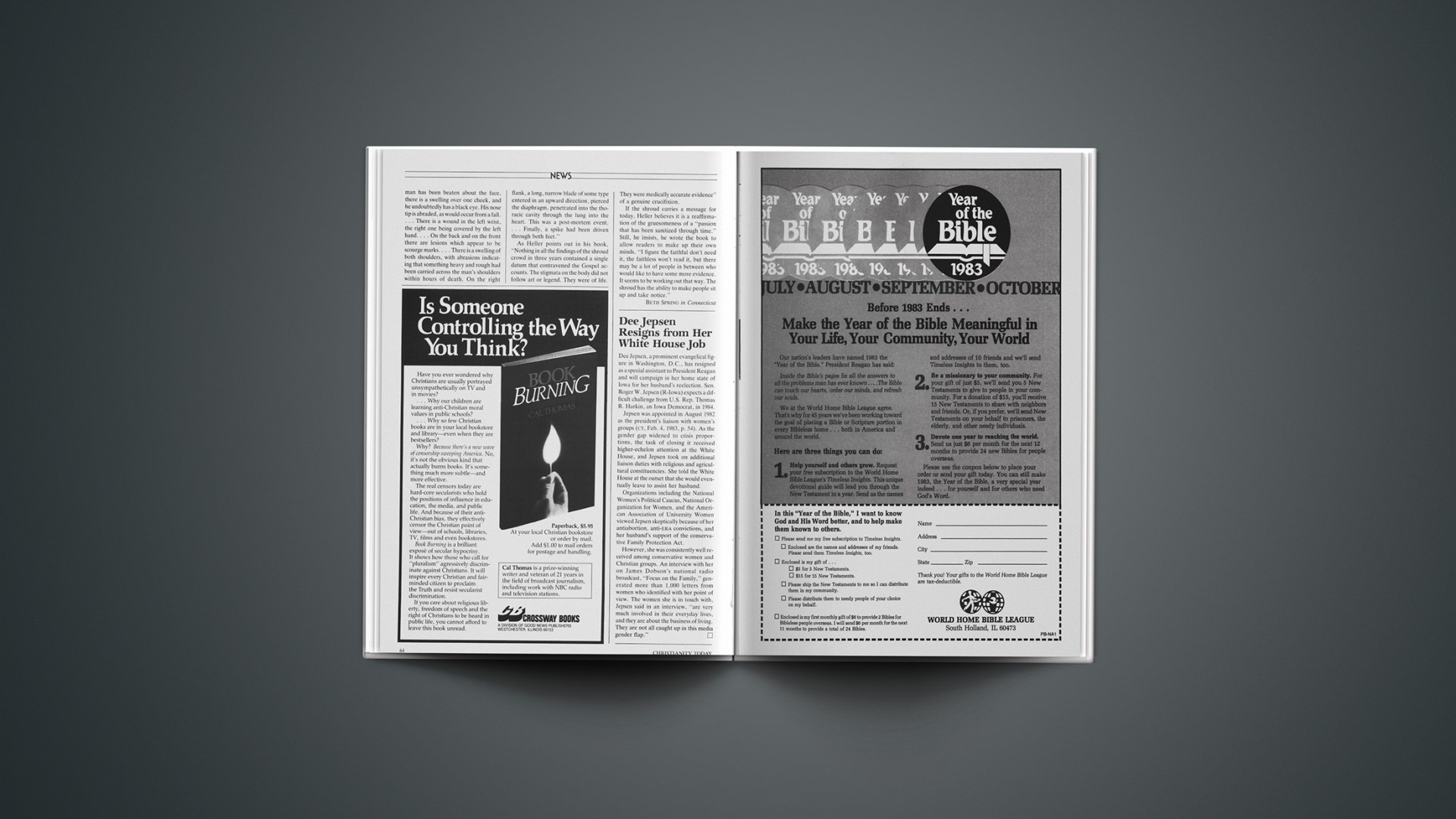
“This is a five-foot, eleven-inch male Caucasian weighing about 178 pounds. The lesions are as follows: beginning at the head, there are blood flows from numerous puncture wounds on the top and back of the scalp and forehead. The man has been beaten about the face, there is a swelling over one cheek, and he undoubtedly has a black eye. His nose tip is abraded, as would occur from a fall.… There is a wound in the left wrist, the right one being covered by the left hand.… On the back and on the front there are lesions which appear to be scourge marks.… There is a swelling of both shoulders, with abrasions indicating that something heavy and rough had been carried across the man’s shoulders within hours of death. On the right flank, a long, narrow blade of some type entered in an upward direction, pierced the diaphragm, penetrated into the thoracic cavity through the lung into the heart. This was a post-mortem event.… Finally, a spike had been driven through both feet.”

As Heller points out in his book, “Nothing in all the findings of the shroud crowd in three years contained a single datum that contravened the Gospel accounts. The stigmata on the body did not follow art or legend. They were of life. They were medically accurate evidence” of a genuine crucifixion.

If the shroud carries a message for today, Heller believes it is a reaffirmation of the gruesomeness of a “passion that has been sanitized through time.” Still, he insists, he wrote the book to allow readers to make up their own minds. “I figure the faithful don’t need it, the faithless won’t read it, but there may be a lot of people in between who would like to have some more evidence. It seems to be working out that way. The shroud has the ability to make people sit up and take notice.”

BETH SPRINGin Connecticut

Congressmen Sponsor a Bill to Limit Irs Church Audits

Fraudulent mail-order schemes prompted IRS interest.

Legislation that would limit the Internal Revenue Service’s (IRS) authority to audit churches is making headway through both houses of Congress. Sponsored by Sen. Charles Grassley (R-Iowa) and Rep. Mickey Edwards (R-Okla.), the Church Audit Procedures Act is intended to stop a potential problem before it gets out of hand.

Only 10 churches underwent an IRS audit in 1982. But growing numbers—particularly among independent congregations—have been receiving “preexamination” letters and questionnaires from the IRS.

What this amounts to, according to a member of Edward’s staff, is “defacto government certification for churches.” Since 1969, Congress has allowed the IRS to tax business income that is unrelated to a church’s primary religious mission. The proliferation of new religions, as well as fraudulent mail-order schemes to evade taxes by forming a “church,” is prompting the IRS interest. But Congress did not authorize IRS fishing expeditions that reel in established churches and phony ones alike, Grassley and Edwards said.

Their bill would require the IRS to limit its investigation to one year’s records, explain to a pastor why his church is under scrutiny, and abide by a three-year limit on the assessment of back taxes. In addition, the act would give churches the right to prohibit an IRS procedure if their rights are violated.

With these safeguards in place, supporters of the measure say bona fide churches will be protected from ordeals similar to the one experienced by Gulf Coast Covenant Church in Mobile, Alabama. A five-year IRS investigation cost the church $100,000 as well as hundreds of man-hours. The investigation ended abruptly with a complete exoneration.

The church’s financial administrator, Mike Coleman, testified before Congress in 1981, attracting the attention of Grassley and Edwards. In his testimony, Coleman said that after four years of preliminary IRS inquiries, he received 20 questions from the IRS and was told to answer them within a month.

“These questions took us totally by surprise,” he said. “We had no idea of their purpose or their implications, nor was there any information provided by the IRS as to the reason for the inquiry.”

A second set of questions asked about ordination requirements, names of contributors, church staff salaries, and “other questions that indicated to us their mistrust of the integrity of our church,” Coleman said. The IRS refused repeated requests for an in-person conference, and eventually embarked on a five-week audit. The church complied by providing 1,100 documents and explaining virtually all its financial transactions. Costly defense expenses were paid by contributions from other churches. Coleman said the church eventually discovered that the IRS had received stolen church documents from a disgruntled community resident intent on making the church appear suspect.

“If they had been honest with us we would have had to go through only about 35 percent of the process,” Coleman testified. “Once we had an opportunity to answer the questions in the audit that were generated by these [stolen] documents, the issues were resolved to the satsifaction of the IRS.”

IRS officials were to respond to the legislation, and to the problems that caused it, at a congressional hearing in late September.

Religious groups stand united in support of the bill, and the American Civil Liberties Union is expected to join them. Representatives of the National Council of Churches, the National Association of Evangelicals, the Moral Majority, and the Baptist Joint Committee on Public Affairs have been invited to testify on Capitol Hill.

One independent Baptist church in Texas came up with an innovative response to its preexamination questionnaire from the IRS. To comply with a request for a copy of the church’s bylaws, it sent a King James Bible to Washington. Assistant pastor Dave Stockard said the IRS was told, “We go by the Bible. You’ll find our bylaws and procedures in here.” The IRS dropped the investigation.

Federal Judge Says Public School Bible Classes Can Be Legal

‘A basic background in the Bible is essential to fully appreciate western culture and current events.’

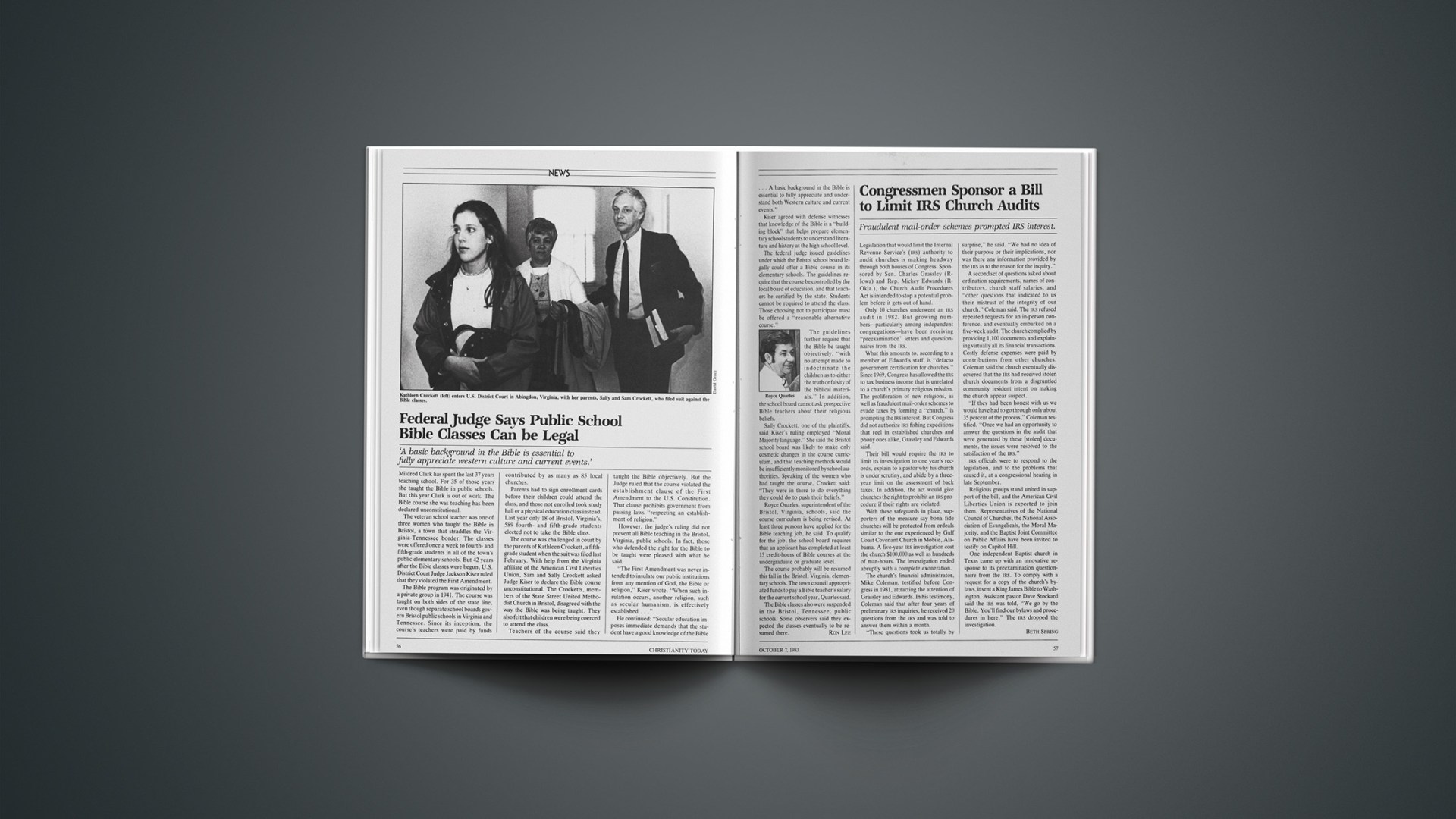
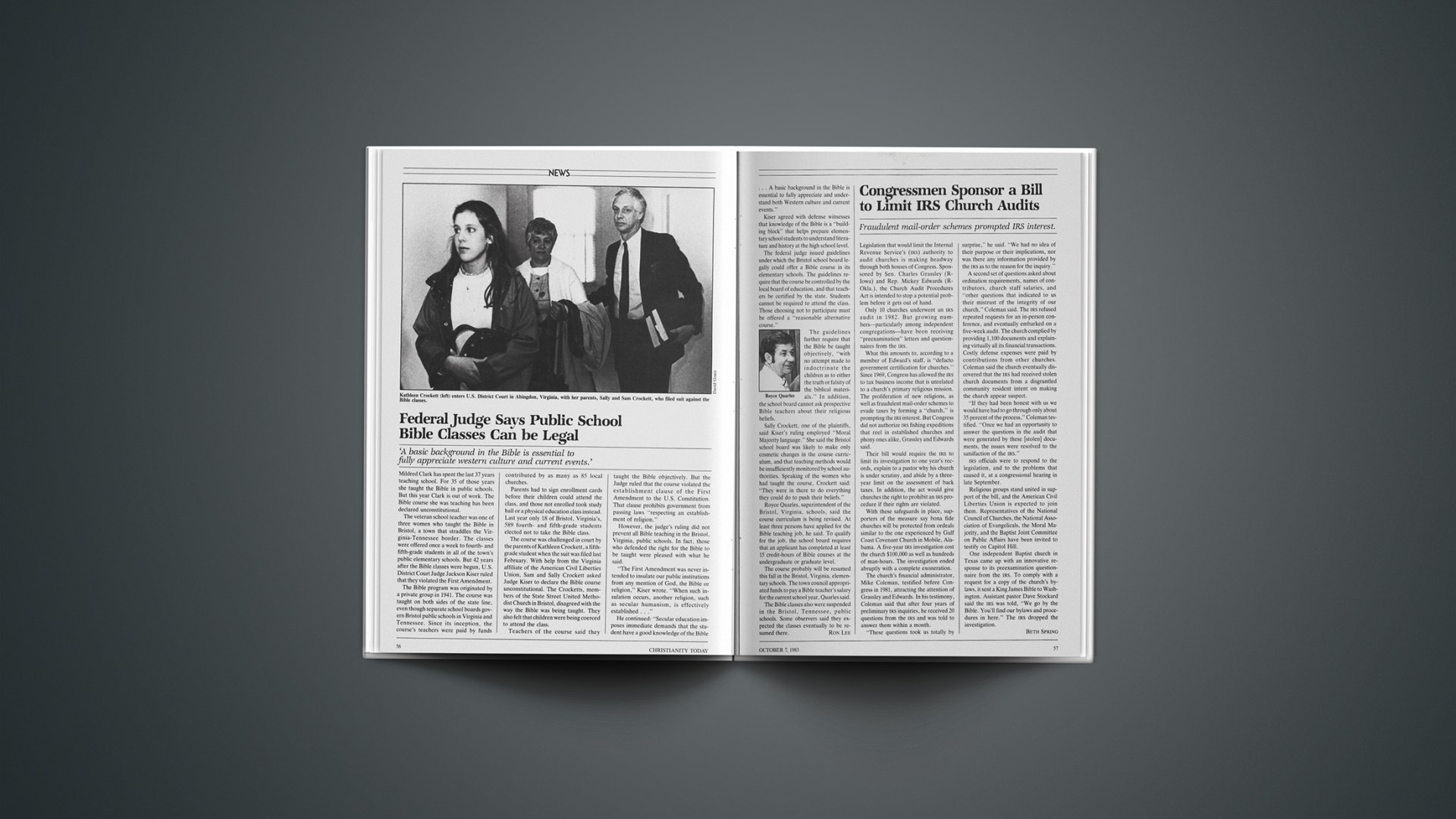
Mildred Clark has spent the last 37 years teaching school. For 35 of those years she taught the Bible in public schools. But this year Clark is out of work. The Bible course she was teaching has been declared unconstitutional.

The veteran school teacher was one of three women who taught the Bible in Bristol, a town that straddles the Virginia-Tennessee border. The classes were offered once a week to fourth- and fifth-grade students in all of the town’s public elementary schools. But 42 years after the Bible classes were begun, U.S. District Court Judge Jackson Kiser ruled that they violated the First Amendment.

The Bible program was originated by a private group in 1941. The course was taught on both sides of the state line, even though separate school boards govern Bristol public schools in Virginia and Tennessee. Since its inception, the course’s teachers were paid by funds contributed by as many as 85 local churches.

Parents had to sign enrollment cards before their children could attend the class, and those not enrolled took study hall or a physical education class instead. Last year only 18 of Bristol, Virginia’s, 589 fourth- and fifth-grade students elected not to take the Bible class.

The course was challenged in court by the parents of Kathleen Crockett, a fifth-grade student when the suit was filed last February. With help from the Virginia affiliate of the American Civil Liberties Union, Sam and Sally Crockett asked Judge Kiser to declare the Bible course unconstitutional. The Crocketts, members of the State Street United Methodist Church in Bristol, disagreed with the way the Bible was being taught. They also felt that children were being coerced to attend the class.

Teachers of the course said they taught the Bible objectively. But the Judge ruled that the course violated the establishment clause of the First Amendment to the U.S. Constitution. That clause prohibits government from passing laws “respecting an establishment of religion.”

However, the judge’s ruling did not prevent all Bible teaching in the Bristol, Virginia, public schools. In fact, those who defended the right for the Bible to be taught were pleased with what he said.

“The First Amendment was never intended to insulate our public institutions from any mention of God, the Bible or religion,” Kiser wrote. “When such insulation occurs, another religion, such as secular humanism, is effectively established …”

He continued: “Secular education imposes immediate demands that the student have a good knowledge of the Bible … A basic background in the Bible is essential to fully appreciate and understand both Western culture and current events.”

Kiser agreed with defense witnesses that knowledge of the Bible is a “building block” that helps prepare elementary school students to understand literature and history at the high school level.

The federal judge issued guidelines under which the Bristol school board legally could offer a Bible course in its elementary schools. The guidelines require that the course be controlled by the local board of education, and that teachers be certified by the state. Students cannot be required to attend the class. Those choosing not to participate must be offered a “reasonable alternative course.”

The guidelines further require that the Bible be taught objectively, “with no attempt made to indoctrinate the children as to either the truth or falsity of the biblical materials.” In addition, the school board cannot ask prospective Bible teachers about their religious beliefs.

Sally Crockett, one of the plaintiffs, said Kiser’s ruling employed “Moral Majority language.” She said the Bristol school board was likely to make only cosmetic changes in the course curriculum, and that teaching methods would be insufficiently monitored by school authorities. Speaking of the women who had taught the course, Crockett said: “They were in there to do everything they could do to push their beliefs.”

Royce Quarles, superintendent of the Bristol, Virginia, schools, said the course curriculum is being revised. At least three persons have applied for the Bible teaching job, he said. To qualify for the job, the school board requires that an applicant has completed at least 15 credit-hours of Bible courses at the undergraduate or graduate level.

The course probably will be resumed this fall in the Bristol, Virginia, elementary schools. The town council appropriated funds to pay a Bible teacher’s salary for the current school year, Quarles said.

The Bible classes also were suspended in the Bristol, Tennessee, public schools. Some observers said they expected the classes eventually to be resumed there.

Slain Philippine Leader Aquino Is a Christian Martyr, Says Colson

‘He was one of the most remarkable men I have ever met.’

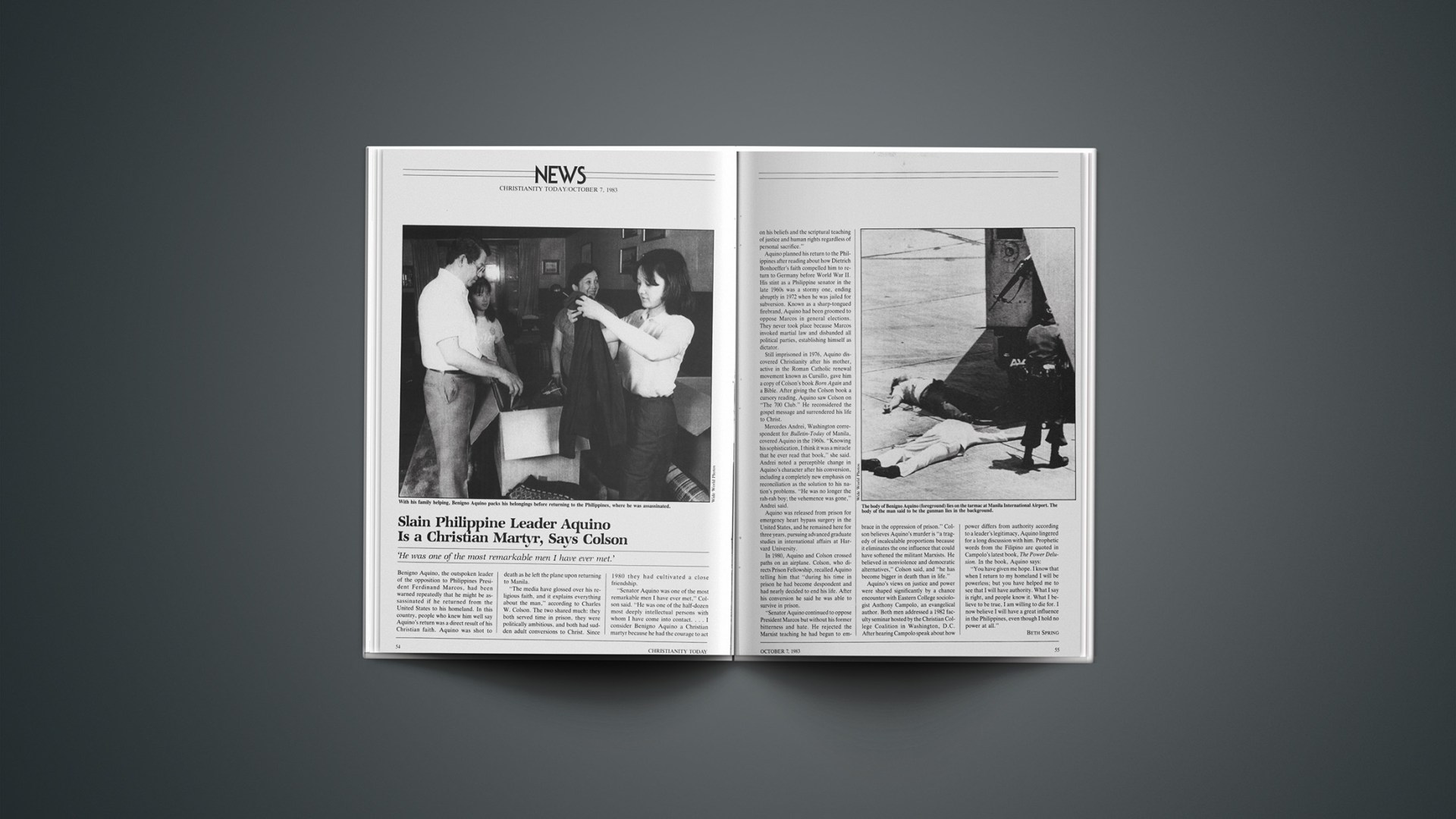
Benigno Aquino, the outspoken leader of the opposition to Philippines President Ferdinand Marcos, had been warned repeatedly that he might be assassinated if he returned from the United States to his homeland. In this country, people who knew him well say Aquino’s return was a direct result of his Christian faith. Aquino was shot to death as he left the plane upon returning to Manila.

“The media have glossed over his religious faith, and it explains everything about the man,” according to Charles W. Colson. The two shared much: they both served time in prison, they were politically ambitious, and both had sudden adult conversions to Christ. Since 1980 they had cultivated a close friendship.

“Senator Aquino was one of the most remarkable men I have ever met,” Colson said. “He was one of the half-dozen most deeply intellectual persons with whom I have come into contact.… I consider Benigno Aquino a Christian martyr because he had the courage to act on his beliefs and the scriptural teaching of justice and human rights regardless of personal sacrifice.”

Aquino planned his return to the Philippines after reading about how Dietrich Bonhoeffer’s faith compelled him to return to Germany before World War II. His stint as a Philippine senator in the late 1960s was a stormy one, ending abruptly in 1972 when he was jailed for subversion. Known as a sharp-tongued firebrand, Aquino had been groomed to oppose Marcos in general elections. They never took place because Marcos invoked martial law and disbanded all political parties, establishing himself as dictator.

Still imprisoned in 1976, Aquino discovered Christianity after his mother, active in the Roman Catholic renewal movement known as Cursillo, gave him a copy of Colson’s book Born Again and a Bible. After giving the Colson book a cursory reading, Aquino saw Colson on “The 700 Club.” He reconsidered the gospel message and surrendered his life to Christ.

Mercedes Andrei, Washington correspondent for Bulletin-Today of Manila, covered Aquino in the 1960s. “Knowing his sophistication, I think it was a miracle that he ever read that book,” she said. Andrei noted a perceptible change in Aquino’s character after his conversion, including a completely new emphasis on reconciliation as the solution to his nation’s problems. “He was no longer the rah-rah boy; the vehemence was gone,” Andrei said.

Aquino was released from prison for emergency heart bypass surgery in the United States, and he remained here for three years, pursuing advanced graduate studies in international affairs at Harvard University.

In 1980, Aquino and Colson crossed paths on an airplane. Colson, who directs Prison Fellowship, recalled Aquino telling him that “during his time in prison he had become despondent and had nearly decided to end his life. After his conversion he said he was able to survive in prison.

“Senator Aquino continued to oppose President Marcos but without his former bitterness and hate. He rejected the Marxist teaching he had begun to embrace in the oppression of prison.” Colson believes Aquino’s murder is “a tragedy of incalculable proportions because it eliminates the one influence that could have softened the militant Marxists. He believed in nonviolence and democratic alternatives,” Colson said, and “he has become bigger in death than in life.”

Aquino’s views on justice and power were shaped significantly by a chance encounter with Eastern College sociologist Anthony Campolo, an evangelical author. Both men addressed a 1982 faculty seminar hosted by the Christian College Coalition in Washington, D.C. After hearing Campolo speak about how power differs from authority according to a leader’s legitimacy, Aquino lingered for a long discussion with him. Prophetic words from the Filipino are quoted in Campolo’s latest book, The Power Delusion. In the book, Aquino says:

“You have given me hope. I know that when I return to my homeland I will be powerless; but you have helped me to see that I will have authority. What I say is right, and people know it. What I believe to be true, I am willing to die for. I now believe I will have a great influence in the Philippines, even though I hold no power at all.”

“Rejuvenating” or “Out of Balance”?

Five religious leaders critique Reagan’s performance.

Carl F. H. Henry: “The President has reflected the conviction that moral absolutes are indispensable to the survival and well-being of the nation, notably on the issue of abortion. On balance, Reagan has helped the cause of Christianity, but the major battle remains ahead in the struggle against moral relativism. The notion that a democracy requires uncritical tolerance of all ethical deviations will, unless challenged, catapult America into chaos and undermine tolerance itself as a virtue.”

Martin E. Marty: “The Reagan policy that pays least notice to biblical and other Christian mandates to be stewards of the earth is most disturbing to me. For all his public relations and window-dressing, his Interior Department policies are very much directed to the short-range, not long-range, self-interest of the society and can lead to irreversible misuse of landscape, environment, and resource. Certainly the Bible mandates care of the earth, care of the body, care of the neighbor, care for justice and peace. No one doubts that President Reagan believes in these mandates, but millions have the freedom to believe that he does not carry them out properly.”

Richard John Neuhaus: “The Bible has an inordinate amount to say about the widow, the orphan, the stranger at the gate. It is outrageously preoccupied with the marginal. The Administration has seriously failed to communicate a different set of policies that can be equally as concerned for the poor and more effective than liberal New Deal proposals. To the extent that this Administration has lifted up the religiousness of the American people and particularly the increasing role of evangelicals, this Administration has helped. Reagan has unabashedly affirmed traditions of civic virtue that much of the elite in America had disdained.”

Os Guinness: “It is significant that both the Reagan administration and evangelicalism share a similar dilemma: they will last or fade according to their capacity to demonstrate some philosophic integrity and effectiveness. Both must break the long-held equation that to be intellectual is to be liberal (politically in one case; theologically in the other). Unless they succeed at this point, each will be a short-lived movement unable to go beyond the historical circumstances that brought them center stage.”

Eddie B. Lane (pastor of Bibleway Bible Church and assistant dean of students at Dallas Theological Seminary): “To some degree, Mr. Reagan has made Christianity a middle-class American tradition and in this context is reflecting to the world a Christ whose compassion and blessings are reserved for the middle class. The Christian gesture of proclaiming 1983 the Year of the Bible rings hollow in that, on the other hand, the President promotes injustice, inequality, and racism by supporting Bob (ones University’s tax-exempt status; seeks to have Affirmative Action repealed, fires most of the aggressive Civil Rights Commission members, and cuts social programs.”

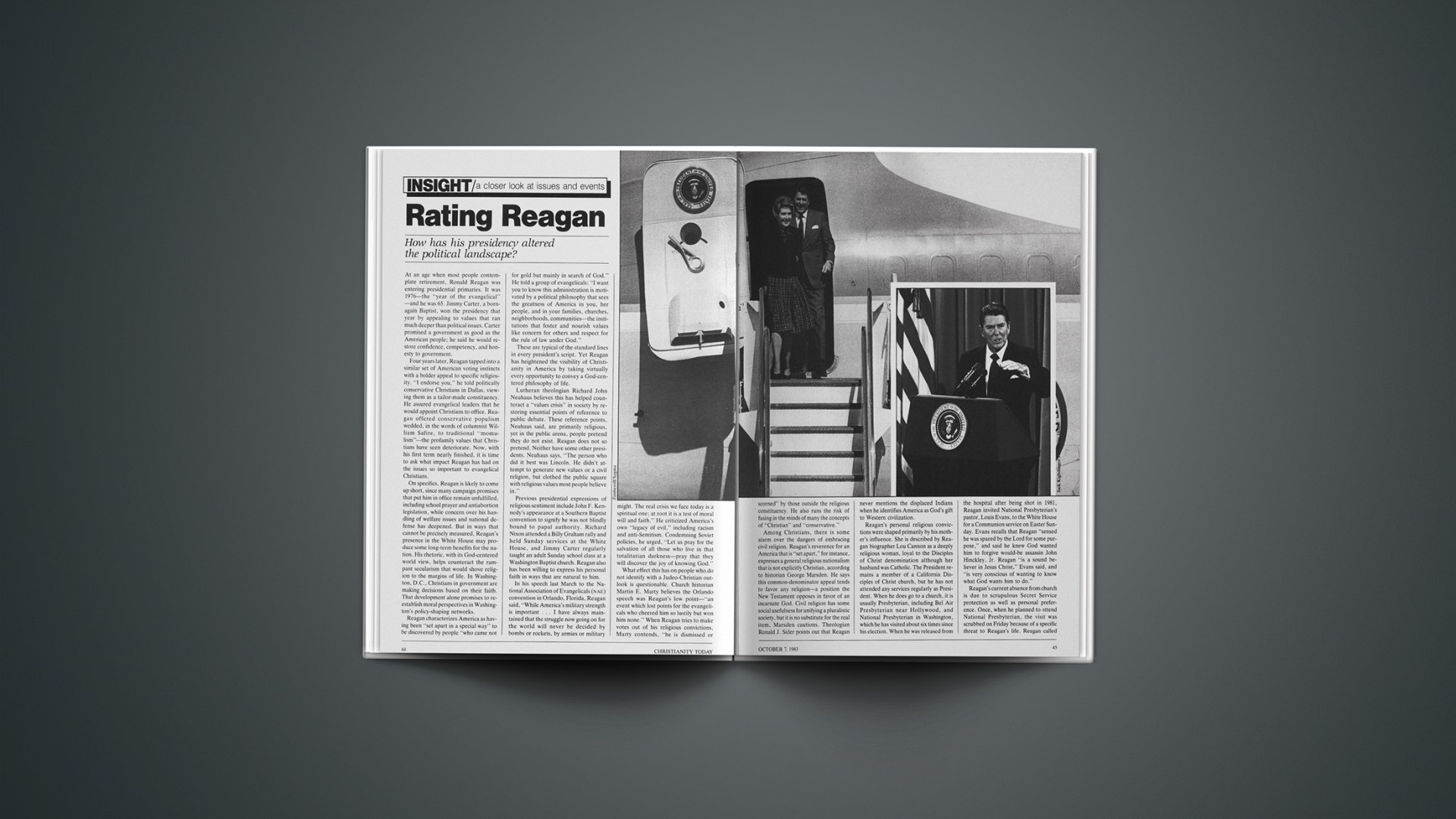
Rating Reagan

How has his presidency altered the political landscape?

At an age when most people contemplate retirement, Ronald Reagan was entering presidential primaries. It was 1976—the “year of the evangelical”—and he was 65. Jimmy Carter, a born-again Baptist, won the presidency that year by appealing to values that ran much deeper than political issues. Carter promised a government as good as the American people; he said he would restore confidence, competency, and honesty to government.

Four years later, Reagan tapped into a similar set of American voting instincts with a bolder appeal to specific religiosity. “I endorse you,” he told politically conservative Christians in Dallas, viewing them as a tailor-made constituency. He assured evangelical leaders that he would appoint Christians to office. Reagan offered conservative populism wedded, in the words of columnist William Safire, to traditional “momulism”—the profamily values that Christians have seen deteriorate. Now, with his first term nearly finished, it is time to ask what impact Reagan has had on the issues so important to evangelical Christians.

On specifics, Reagan is likely to come up short, since many campaign promises that put him in office remain unfulfilled, including school prayer and antiabortion legislation, while concern over his handling of welfare issues and national defense has deepened. But in ways that cannot be precisely measured, Reagan’s presence in the White House may produce some long-term benefits for the nation. His rhetoric, with its God-centered world view, helps counteract the rampant secularism that would shove religion to the margins of life. In Washington, D.C., Christians in government are making decisions based on their faith. That development alone promises to reestablish moral perspectives in Washington’s policy-shaping networks.

Reagan characterizes America as having been “set apart in a special way” to be discovered by people “who came not for gold but mainly in search of God.” He told a group of evangelicals: “I want you to know this administration is motivated by a political philosophy that sees the greatness of America in you, her people, and in your families, churches, neighborhoods, communities—the institutions that foster and nourish values like concern for others and respect for the rule of law under God.”

These are typical of the standard lines in every president’s script. Yet Reagan has heightened the visibility of Christianity in America by taking virtually every opportunity to convey a God-centered philosophy of life.

Lutheran theologian Richard John Neuhaus believes this has helped counteract a “values crisis” in society by restoring essential points of reference to public debate. These reference points, Neuhaus said, are primarily religious, yet in the public arena, people pretend they do not exist. Reagan does not so pretend. Neither have some other presidents. Neuhaus says, “The person who did it best was Lincoln. He didn’t attempt to generate new values or a civil religion, but clothed the public square with religious values most people believe in.”

Previous presidential expressions of religious sentiment include John F. Kennedy’s appearance at a Southern Baptist convention to signify he was not blindly bound to papal authority. Richard Nixon attended a Billy Graham rally and held Sunday services at the White House, and Jimmy Carter regularly taught an adult Sunday school class at a Washington Baptist church. Reagan also has been willing to express his personal faith in ways that are natural to him.

In his speech last March to the National Association of Evangelicals (NAE) convention in Orlando, Florida, Reagan said, “While America’s military strength is important … I have always maintained that the struggle now going on for the world will never be decided by bombs or rockets, by armies or military might. The real crisis we face today is a spiritual one; at root it is a test of moral will and faith.” He criticized America’s own “legacy of evil,” including racism and anti-Semitism. Condemning Soviet policies, he urged, “Let us pray for the salvation of all those who live in that totalitarian darkness—pray that they will discover the joy of knowing God.”

What effect this has on people who do not identify with a Judeo-Christian outlook is questionable. Church historian Martin E. Marty believes the Orlando speech was Reagan’s low point—“an event which lost points for the evangelicals who cheered him so lustily but won him none.” When Reagan tries to make votes out of his religious convictions, Marty contends, “he is dismissed or scorned” by those outside the religious constituency. He also runs the risk of fusing in the minds of many the concepts of “Christian” and “conservative.”

Among Christians, there is some alarm over the dangers of embracing civil religion. Reagan’s reverence for an America that is “set apart,” for instance, expresses a general religious nationalism that is not explicitly Christian, according to historian George Marsden. He says this common-denominator appeal tends to favor any religion—a position the New Testament opposes in favor of an incarnate God. Civil religion has some social usefulness for unifying a pluralistic society, but it is no substitute for the real item, Marsden cautions. Theologian Ronald J. Sider points out that Reagan never mentions the displaced Indians when he identifies America as God’s gift to Western civilization.

Reagan’s personal religious convictions were shaped primarily by his mother’s influence. She is described by Reagan biographer Lou Cannon as a deeply religious woman, loyal to the Disciples of Christ denomination although her husband was Catholic. The President remains a member of a California Disciples of Christ church, but he has not attended any services regularly as President. When he does go to a church, it is usually Presbyterian, including Bel Air Presbyterian near Hollywood, and National Presbyterian in Washington, which he has visited about six times since his election. When he was released from the hospital after being shot in 1981, Reagan invited National Presbyterian’s pastor, Louis Evans, to the White House for a Communion service on Easter Sunday. Evans recalls that Reagan “sensed he was spared by the Lord for some purpose,” and said he knew God wanted him to forgive would-be assassin John Hinckley, Jr. Reagan “is a sound believer in Jesus Christ,” Evans said, and “is very conscious of wanting to know what God wants him to do.”

Reagan’s current absence from church is due to scrupulous Secret Service protection as well as personal preference. Once, when he planned to attend National Presbyterian, the visit was scrubbed on Friday because of a specific threat to Reagan’s life. Reagan called Evans on Saturday to apologize, expressing his concern for the safety of the whole congregation. He has recently lobbied his staff and guards to allow more frequent church attendance, and those visits are now made without any advance public announcement.

In one of his most visible expressions of identification with the religious community, Reagan proclaimed 1983 the “Year of the Bible.” The ACLU and a “freedom-from-religion” group filed suit challenging Reagan’s constitutional right to do this.

Sen. William L. Armstrong (R-Colo.) sponsored the legislation that created the Year of the Bible, and he sees it as an indication of more openness in Washington toward belief in God. “In the ’60s and ’70s, you just didn’t hear a lot of talk at the highest levels of government about Christian things. Instead, everyone was trying to prove how tough he was.” The change became palpable in 1976, Armstrong believes, because “something happened in our bicentennial year—a refocusing of national thought life on our spiritual roots.” Besides that, the election of a Southern Baptist as president that year, a man who spoke unapologetically about his faith, made it much easier for many in Washington to be forthright about their own Christian convictions.

Several issues in the ’70s served to galvanize fundamentalist Christians. The Equal Rights Amendment, the Supreme Court’s decision to overthrow all state antiabortion laws, and various efforts to position homosexuals as simply another oppressed minority, deeply offended their religious beliefs. Evangelical Christians, as opposed to fundamentalists, are much more diverse in theology, and that has prevented them from coalescing on these issues.

But the Religious Right’s call to action has helped to sensitize evangelicals to public issues, and it has done so across a broad range of concerns. In addition, leaders such as Francis Schaeffer and James Dobson are educating their constituents about national issues. Reagan is a product of this morally outspoken environment, rather than its cause.

Cabinet and subcabinet appointments in the Reagan administration reflect these realities and may constitute the most significant legacy of his administration. What is important is not the number of committed Christians in government, but their success at introducing morally motivated thinking into government policy making. This is especially true in areas where a God-centered world view makes a big difference—such as education, health care, and constitutional law.

Surgeon General C. Everett Koop, renowned pediatric surgeon and outspoken prolife evangelical, has had difficulty swimming against the bureaucratic tide. His efforts to advocate government protection for handicapped infants met solid resistance in the medical community and in court. Yet at lower echelons in the Department of Health and Human Services (DHHS), other appointees are quietly pursuing accomplishments without attracting many headlines. It is these midlevel appointees and the career civil servants who operate the controls of government.

Progress in the area of federal grants doled out by DHHS is especially noteworthy. Grants consist of tax dollars distributed to organizations and individuals to carry out research or to run programs. The Adolescent Family Life Program, headed by Marjory Mecklenburg, is replacing old family planning programs with a fresh emphasis on teenage abstinence from sex, and adoption rather than abortion. It will distribute $13.5 million in grants to groups such as Catholic Charities in Arlington, Virginia, which is conducting workshops to train parents to provide sex education at home.

Jerry Regier, also at DHHS, is a former Campus Crusade for Christ staff member who has been instrumental in bringing Christian points of view into play. He has encouraged evangelical family experts to help review grant applications in the areas of runaway youth, adoption and foster care, child abuse prevention, and employment strategies.

Working on these same issues is the newly formed Family Research Council, a group of professionals including James Dobson, who make themselves available for congressional hearings and other government forums. They hope to see “religious moral values be as much a part of decision-making considerations as secular humanistic values currently are,” according to council spokesman L. Michael Lynch.

One of Reagan’s key reelection issues will be education. Charged with evaluating policy and developing new legislative packages is Doug Holladay, a midlevel appointee who is well known in Washington for his work with the “fellowship,” which arranges small-group meetings among Christians in government.

Another Education Department employee, Robert Billings, heads ten regional federal offices. A former executive director of the Moral Majority, Billings is one of the few Religious Right appointees serving in government. He caused a stir at the department by writing an editorial, which was swiftly squelched, urging college students to speak up publicly for God. Many Christians in the executive branch maintain an extremely low profile and draw fire from fundamentalists for not being “fighters.” But the more outspoken Christian employees rarely see much progress because they are effectively blocked by career bureaucrats who know more about how the system works.

Court appointments are of growing interest to Christians because so many critical issues of the day are being decided there rather than in the Congress. Abortion, tax credits and tax exemptions for church-related institutions, and the constitutionality of military chaplains have all come before the Supreme Court this year. Reagan’s only appointment to the Court thus far is Sandra Day O’Connor, who is proving to be an advocate of judicial restraint.

She led a strong dissent against the Court’s recent proabortion ruling. If Reagan serves a second term, it is likely he will have the chance to appoint several more justices since five of them are in their mid-seventies and are expected to retire. Of the nation’s 677 other federal judges, Reagan has appointed 101, and this figure also would escalate during a second term. The President’s authority to appoint judges in accord with his own philosophy is critical.

His administration has filed numerous friend-of-the-court briefs, many of which are researched by Carl Horn, a lawyer in the Justice Department’s civil rights division. He helped prepare a brief arguing that it is constitutional to display a nativity scene on municipal property at Christmas, pointing out that the First Amendment was never intended “to secularize our public life so rigidly that we cannot continue to mark our public holidays in a manner that includes traditional acknowledgment of their religious character.”

Before he joined the government early this year, Horn directed the prelaw program at Wheaton College and served as general counsel for the Christian Legal Society. Another former CLS lawyer, Stephen Galebach, works on domestic legal policy questions at the White House, including abortion, school prayer, and pornography.

Dee Jepsen, also at the White House, has promoted private sector voluntaryism and was the President’s liaison with women’s groups. Her avid prolife position drew sharp criticism from the leaders of many women’s groups, and although she made some overtures to them, communication remained frozen. Now, the task of shrinking the “gender gap” is back in the hands of White House aides closer to the President.

Among Reagan’s top aides, counselor Edwin Meese (a Missouri Synod Lutheran), along with numerous other Christians in government, attends informal, off-the-record fellowship meetings. There are as many as 20 of these small groups meeting throughout the city, usually on a weekly basis, for Bible study, prayer support, and discussion.

Conservative Christians outside government have found the Reagan White House very accessible, and meetings between the President and religious leaders are commonplace. Morton Blackwell, presidential liaison with religious groups, listed Bill Bright, Jimmy Draper, Adrian Rogers, Jerry Falwell, Cardinal John Krol, and Pat Robertson as having met frequently with Reagan. He said no one has greater influence with the President than the others. The National Association of Evangelicals carries a high profile at the White House, and Blackwell credited Washington Office director Robert P. Dugan with being “immensely helpful in explaining how the evangelical community feels on a variety of issues.”

Diversity among evangelicals tends to create confusion in Washington about who really represents the movement. An authority on Christians in public life said he believes this very diversity prevents evangelicals from making significant public policy strides: “Each prominent evangelical leader gets what he wants in the way of a special tie-in for his program, and they present no singly unified political front as do Catholics and Jews.” Better organized, perhaps, but little noticed by the White House are mainline religious leaders represented by the National Council of Churches. “We have gotten a stone wall from this Administration,” a spokesman said.

In his interactions with Congress—where political initiatives are hammered into laws—Reagan has a mixed record. Few big successes stand out among the campaign issues he highlighted in his 1980 appeal to religious conservatives. Legislation to end abortion bogged down in the face of a liberal-led filibuster last year, and Reagan was reluctant to endorse any particular initiative because prolife groups failed to patch up their intramural differences.

On prayer in schools, the President revealed a stubborn streak that has pitted his proposed constitutional amendment against more supportable efforts in the Senate. Reagan stuck to his guns, tolerating no alterations to his proposal, even when Senate Judiciary Committee Chairman Strom Thurmond said it would never pass, and Christian groups supported it half-heartedly, if at all, because of some serious reservations. At the same time, Reagan is perceived to have expended very little political capital on the prayer issue. Dean M. Kelley of the National Council of Churches testified against the amendment in Congress. He said, “I was impressed by the lack of enthusiasm even among sponsoring senators. It was a big ho-hum.” There was no evidence of congressional jawboning by the President that often accompanies priority legislation. A new Reagan version of the amendment, stating that no state officials may compose school prayers, mollified some critics.

In less well-publicized areas, small victories of special concern to Christians have been won. These include charitable-contributions legislation giving taxpayers the right to deduct all their charitable contributions whether or not they itemize other deductions. Also, an adjustment in the overseas earned income act will exempt missionaries from paying federal income tax if they already pay taxes in the country where they serve.

Two issues loom especially large in the reelection campaign—nuclear policy and welfare. Reagan wants evangelicals to oppose a nuclear freeze, yet they are being pulled in the opposite direction by some well-respected Christian leaders. A Gallup Poll indicated mixed evangelical support for Reagan’s current nuclear policies, and further sifting of the issue is likely.

On poverty issues. Democratic contenders for the White House already are focusing on “fairness”—a political buzz word for policies that are said to hurt the poor and help the rich. Evangelicals differ on the specifics of Reagan’s program, which includes cuts in food stamps and welfare, coupled with a call for voluntaryism by the private sector. Reagan has spotlighted the role churches can play in helping out. This elicits energetic efforts from some, but stunned disbelief from others.

Black evangelicals ministering to the poor are often least able to shoulder an added burden, as Reagan wishes, yet their communities are hardest hit. C. J. Jones, director of development for Mendenhall Ministries in Mississippi, sees growing discouragement among the 400 to 500 people the ministry regularly reaches through job training and counseling programs as well as a health center, school, and law office. “Their idea is … that there is nothing they can do for themselves that will work,” Jones said. He explains, “Racism is a fact of life in this country. It is so institutionalized it takes new laws to change the old system and make the changes felt. The church can’t do that.”

Richard C. Halverson, U.S. Senate chaplain and an experienced Presbyterian pastor in Washington, D.C., defends Reagan’s “supply-side” economics as having a basis in justice. “The tendency has been to see justice only in terms of distribution—our responsibility to share,” Halverson said. “That’s true, but justice also has to do with using our talents to create wealth. Reagan’s policies encourage that aspect.”

Like his religious faith, Reagan’s tenacious belief in neighbor helping neighbor is a product of his boyhood experiences during the Depression and the silent lessons modeled by his mother who delivered packages of food to destitute families. Reagan sincerely believes America is a country where anyone can get rich and gain influence, because he has seen it happen—to himself.

His vision of an ideal America no doubt resembles very closely the image cherished by most of the rest of the nation. In articulating that vision, the President draws on a complex set of experiences and convictions that are not easily dismissed as throwbacks to the past or the by-products of an irrelevant belief in the supernatural. Neither, however, are they based purely on an evangelical faith. Reagan is preeminently a political leader and a patriot. He is less prophet or priest than either his most ardent critics or admirers claim.

He appeals to the American in evangelicals, more so than to any exclusive allegiance befitting citizens of the kingdom of God. Reagan provides direction, momentum, and goals that mesh with evangelical beliefs, but that is neither a calculated political move by Reagan nor evidence that evangelicals are becoming particularly successful at political power brokering.

They are, however, making inroads into networks of public debate and decision making. Evangelical professionals in the Reagan administration do not always advertise their faith, but they find they have the freedom to speak up about it when appropriate, and to involve more Christians outside the government in formulating policy. So far, many of their efforts have ended in defeat, but they are largely undeterred. They view their stint in government as a valuable source of experience and bridge building for the future.

They have grasped an important truth: for better or worse, any effect Reagan has on Christianity in America will be shaped more by Christians who get involved in politics than by anything the President does directly. The legislative scorecard keepers are likely to remain disgruntled, but—win or lose on specifics—people with a Judeo-Christian outlook are involved for the long haul, and the environment in Washington is fertile soil in which to cultivate their growth.

Apple PodcastsDown ArrowDown ArrowDown Arrowarrow_left_altLeft ArrowLeft ArrowRight ArrowRight ArrowRight Arrowarrow_up_altUp ArrowUp ArrowAvailable at Amazoncaret-downCloseCloseEmailEmailExpandExpandExternalExternalFacebookfacebook-squareGiftGiftGooglegoogleGoogle KeephamburgerInstagraminstagram-squareLinkLinklinkedin-squareListenListenListenChristianity TodayCT Creative Studio Logologo_orgMegaphoneMenuMenupausePinterestPlayPlayPocketPodcastRSSRSSSaveSaveSaveSearchSearchsearchSpotifyStitcherTelegramTable of ContentsTable of Contentstwitter-squareWhatsAppXYouTubeYouTube