Truth in Transition: A Case Study

The vulnerability of orthodox churches goes beyond the semblance of due process.

The lutheran scene in the United States is divided into three major denominational segments: the “liberal” Lutheran Church in America, the “conservative” Lutheran Church-Missouri Synod, and—in-between—The American Lutheran Church, organized in 1960. Someone has said with fair accuracy that a liberal Lutheran is like a conservative in the United Church of Christ, and it is generally true that even liberal Lutherans are remarkably gospel-centered in their preaching. But the years since 1960 have seen the American Lutheran Church march steadily in the direction of modern critical theology, especially where the Bible is concerned. In 1969, Case Western Reserve University sociologist Jeffrey K. Hadden, in his Gathering Storm in the Churches, found that ALC clergy, while officially subscribing to the Bible as the “inerrant Word of God” (Art. 3 of the ALC constitution), held a much different view in practice. By their own admission, only 23 percent of all ALC clergy believed in scriptural inerrancy, and the statistics correlated significantly with age (50 percent over 55 years of age believed in inerrancy, while only 6 percent of those under 35 years of age did so).

Since the founding of the American Lutheran Church in 1960, only one ALC congregation has been removed from the roster of the denomination after carrying its case through the full system of church courts—right to the National Committee on Appeals and Adjudication. This congregation is Central Lutheran Church of Tacoma, Washington (Dr. Reuben H. Redal, pastor). Though the ultimate result after more than a year of litigation was virtually a foregone conclusion, the case is well worth reviewing for the insights it gives into the theology and administrative practices of denominations in transition between orthodoxy and liberalism.

Central Lutheran is a large and dynamic church in the heart of urban Tacoma. Typically, Pastor Redal found himself in need of additional staff for evangelism, teaching, and gospel proclamation. But the congregational members were not about to call a young graduate of the ALC seminaries, which, they fully realized, were the prime cause of the decline of belief in the inerrancy of Scripture on the part of ALC clergy. (Warren Quanbeck of Luther Seminary was perhaps most influential in shifting students from the historic Lutheran position, but he was by no means alone; see my Crisis in Lutheran Theology, passim.) So Central called a graduate of the independent, conservative Faith Evangelical Lutheran Seminary to assist Pastor Redal. This assistant had been ordained by the Lutherans Alert-National organization and was thus a clergyman, but Central called him as a “full-time lay theological worker and assistant to the pastor.” Naturally, being an ordained clergyman, he was also referred to as “assistant pastor.” This gave the North Pacific District Executive Committee its opportunity to get rid of a Bible-believing thorn in the flesh: it determined, after a perfunctory hearing in which no attempt at all was made to examine the assistant’s call document or duties in the congregation, that Central should be suspended for calling a clergyman to serve it who was not on the ALC clergy roster or approved by the district president (bishop).

In vain did the congregation plead that the Lutheran doctrine of the priesthood of all believers surely allowed the assistant to function in his lay capacity; that the ALC constitution was being violated right and left by clergy who did not believe in the inerrancy of the Bible and nothing was done about it; and that the ALC constitution permitted a district president to approve a non-ALC pastor to serve an ALC congregation “in special circumstances” (Art. 6.12.12.b.4). Here the special circumstance was that a Bible-believing parish wanted an assistant whose attitude toward Scripture was beyond reproach!

When the District Executive Committee, contrary to the 1978 ALC Rules of Procedure, was not going to give the congregation any hearing on appeal, Pastor Redal retained legal counsel. As a result, a hearing did take place, and the stenographic record of the full day’s trial makes fascinating reading (it is slated for publication—a kind of ecclesiastical Peyton Place). Here are a few highlights:

• Central was refused access to documents relating to other congregational suspensions. Concerning one of these, even nonconservative ALC professor Roy Harrisville had flayed the lack of proper due process in he ALC (Dialog, Spring 1968, pp. 86–87).

• The ALC nowhere defined and the Appeals Committee never employed a standard of proof by which the defendant congregation was to be judged. Central never knew whether it was being found guilty by a preponderance of evidence, or beyond reasonable doubt, or by some other measure.

• Bishop Solberg declared that geography was the essential “special circumstance” to justify calling a non-ALC clergyman to an ALC parish. The defense then (1) proved by a survey of the non-ALC clergy presently serving ALC parishes in the U.S. that fully one-fourth were in the same cities as other ALC churches served by ALC pastors, and (2) put on the stand a United Methodist clergyman whom Solberg himself had approved to serve an ALC parish only 17 miles from another ALC church served by an ALC pastor, and who testified that he held a Barthian, noninerrancy view of Scripture, contrary to Article 3 of the ALC constitution.

Central, to be sure, lost its appeals on the district and on the national church levels, and is now an independent Lutheran congregation. Fortunately, ALC congregational church polity gave the denomination no title to or interest in the local church’s property, so Central lost no physical assets; the ALC gained but a Pyrrhic victory, winning its case, but losing a stalwart congregation that faithfully represented the theology the denomination itself should have stood for.

The Tacoma Church case offers at least two sobering lessons for conservatives in mediating church bodies. First, recognize how vunerable you are if your denomination lacks (as does the ALC) a sufficiently clear and specific procedural law to insure due process. (Even W. J. Henry and W. L. Harris’s old Methodist Episcopal Ecclesiastical Law and Rules of Evidence [rev. ed., 1881] gave more protections than the ALC offered Central.) Second, recognize that even where there is a semblance of due process, when a denomination is going liberal, the liberals will be able to get away with the grossest deviations in doctrine and practice, but conservative Bible believers will be promptly cut off by whatever tools—legal or extralegal—come to hand.

Dr. John Warwick Montgomery, an attorney-theologian, is dean of the Simon Greenleaf School of Law, Costa Mesa, California, and director of studies at the International Institute of Human Rights, Strasbourg, France. He served as Central Lutheran Church’s counsel.
Evolution, Creationism Backers Tangle over Teaching of Origins

Religion as science and vice-versa

Proponents of the so-called theory of scientific creationism are requesting equal time. As a result, bills requiring the teaching of creationism alongside evolution in public schools have been introduced in at least a dozen states including Illinois, Florida, and South Carolina. Enthusiastic supporters of Georgia House Bill 690 (see related story) had predicted that as many as 40 states would call for similar legislation in the 1980s if the bill passed. But it, like another hard-fought bill in Iowa, failed last month.

Defending their theory on scientific grounds, spokesmen for scientific creationism assert that all species were created separately according to an orderly plan, and by an intelligent creator. They believe the earth is young—somewhere between 10,000 and 12,000 years old. They dispute evolutionists, who say the earth is several billion years old, and that creation resulted from random processes.

“Man was always a man, and dog was always a dog,” said Richard Bliss, director of curriculum development at the San Diego-based Institute for Creation Research. (As the research arm of Christian Heritage College, a liberal arts school operated by pastor Tim LaHaye’s Scott Memorial Baptist Church, ICR conducts seminars, sponsors research, and produces study materials supporting scientific creationism.) Bliss said ICR does allow for the concept of genetic variation within groups, and regards the question of time—whether earth was created in six symbolic or actual 24-hour days—an “open question.”

Many of the bills endorsing the “two-model approach”—the public school teaching of both evolution and creation—reportedly are based on a model bill being promoted nationwide by Paul Ellwanger, an Anderson, South Carolina, hospital worker. He says the bill developed a year ago out of a consultation of scientists and lawyers; it has no religious language, he says, and “contains the ingredients of a constitutionally impregnable bill.”

Attorney Wendell Bird of Atlanta, a former editor of the Yale Law Review, frequently is cited as the leading legal theorist for creationism. Denying that creationism is an establishment of religion, Bird has argued that creation as described in Genesis can be taught legally without mentioning the Bible or religion.

The San Diego-based Creation Science Research Center has spent nearly $30,000 and enlisted attorney John Whitehead of the Christian Legal Society in its ongoing legal battle with the California State Board of Education. The CSRC opposes the present system, in which creationism can be taught only in social science classes as a religious philosophy, and not in biological science classes. Former associates of Morris formed the CSRC because they had a greater desire to get creationism into the schools by legislative and courtroom channels, and didn’t want to be identified as a sectarian group. (The ICR is church-run.)

Even though most of the present legislation supporting the two-model approach avoids mention of God or the Bible, opponents say the proposed bills still constitute an effort by fundamentalist Christians to present their religion as science. They say many educators would teach Christianity even if legislation allowing creationist teachings has no religious language.

But ICR director Henry Morris, a Ph.D. from the University of Minnesota, whose study of both the Bible and science caused him to repent of his former sup port for evolution, says evolution is just as much a religion—but for humanists and atheists—as creationism is for Christians. Both origin models are theories, he says, and creationism can be defended on scientific grounds as well as or better than evolutionists can scientifically defend their own view.

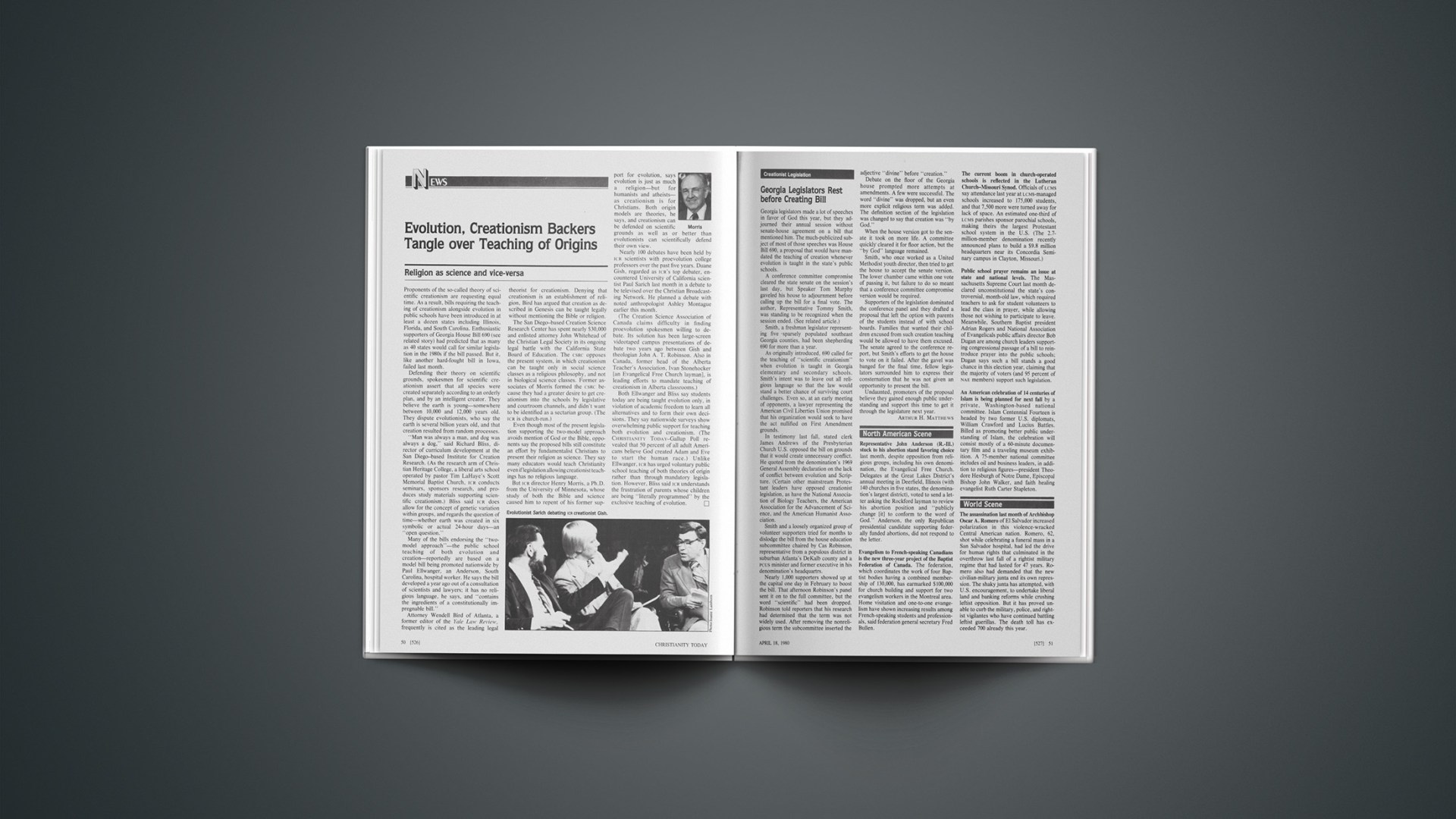
Nearly 100 debates have been held by ICR scientists with proevolution college professors over the past five years. Duane Gish, regarded as ICR’s top debater, encountered University of California scientist Paul Sarich last month in a debate to be televised over the Christian Broadcasting Network. He planned a debate with noted anthropologist Ashley Montague earlier this month.

(The Creation Science Association of Canada claims difficulty in finding proevolution spokesmen willing to debate. Its solution has been large-screen videotaped campus presentations of debate two years ago between Gish and theologian John A. T. Robinson. Also in Canada, former head of the Alberta Teacher’s Association, Ivan Stonehocker [an Evangelical Free Church layman], is leading efforts to mandate teaching of creationism in Alberta classrooms.)

Both Ellwanger and Bliss say students today are being taught evolution only, in violation of academic freedom to learn all alternatives and to form their own decisions. They say nationwide surveys show overwhelming public support for teaching both evolution and creationism. (The CHRISTIANITY TODAY-Gallup Poll revealed that 50 percent of all adult Americans believe God created Adam and Eve to start the human race.) Unlike Ellwanger, ICR has urged voluntary public school teaching of both theories of origin rather than through mandatory legislation. However, Bliss said ICR understands the frustration of parents whose children are being “literally programmed” by the exclusive teaching of evolution.

Creationist Legislation

Georgia Legislators Rest before Creating Bill

Georgia legislators made a lot of speeches in favor of God this year, but they adjourned their annual session without senate-house agreement on a bill that mentioned him. The much-publicized subject of most of those speeches was House Bill 690, a proposal that would have mandated the teaching of creation whenever evolution is taught in the state’s public schools.

A conference committee compromise cleared the state senate on the session’s last day, but Speaker Tom Murphy gaveled his house to adjournment before calling up the bill for a final vote. The author, Representative Tommy Smith, was standing to be recognized when the session ended. (See related article.)

Smith, a freshman legislator representing five sparsely populated southeast Georgia counties, had been shepherding 690 for more than a year.

As originally introduced, 690 called for the teaching of “scientific creationism” when evolution is taught in Georgia elementary and secondary schools. Smith’s intent was to leave out all religious language so that the law would stand a better chance of surviving court challenges. Even so, at an early meeting of opponents, a lawyer representing the American Civil Liberties Union promised that his organization would seek to have the act nullified on First Amendment grounds.

In testimony last fall, stated clerk James Andrews of the Presbyterian Church U.S. opposed the bill on grounds that it would create unnecessary conflict. He quoted from the denomination’s 1969 General Assembly declaration on the lack of conflict between evolution and Scripture. (Certain other mainstream Protestant leaders have opposed creationist legislation, as have the National Association of Biology Teachers, the American Association for the Advancement of Science, and the American Humanist Association.

Smith and a loosely organized group of volunteer supporters tried for months to dislodge the bill from the house education subcommittee chaired by Cas Robinson, representative from a populous district in suburban Atlanta’s DeKalb county and a PCUS minister and former executive in his denomination’s headquartrs.

Nearly 1,000 supporters showed up at the capital one day in February to boost the bill. That afternoon Robinson’s panel sent it on to the full committee, but the word “scientific” had been dropped. Robinson told reporters that his research had determined that the term was not widely used. After removing the nonreligious term the subcommittee inserted the adjective “divine” before “creation.”

Debate on the floor of the Georgia house prompted more attempts at amendments. A few were successful. The word “divine” was dropped, but an even more explicit religious term was added. The definition section of the legislation was changed to say that creation was “by God.”

When the house version got to the senate it took on more life. A committee quickly cleared it for floor action, but the “by God” language remained.

Smith, who once worked as a United Methodist youth director, then tried to get the house to accept the senate version. The lower chamber came within one vote of passing it, but failure to do so meant that a conference committee compromise version would be required.

Supporters of the legislation dominated the conference panel and they drafted a proposal that left the option with parents of the students instead of with school boards. Families that wanted their children excused from such creation teaching would be allowed to have them excused. The senate agreed to the conference report, but Smith’s efforts to get the house to vote on it failed. After the gavel was banged for the final time, fellow legislators surrounded him to express their consternation that he was not given an opportunity to present the bill.

Undaunted, promoters of the proposal believe they gained enough public understanding and support this time to get it through the legislature next year.

ARTHUR H. MATTHEWS

North American Scene

Representative John Anderson (R.-Ill.) stuck to his abortion stand favoring choice last month, despite opposition from religious groups, including his own denomination, the Evangelical Free Church. Delegates at the Great Lakes District’s annual meeting in Deerfield, Illinois (with 140 churches in five states, the denomination’s largest district), voted to send a letter asking the Rockford layman to review his abortion position and “publicly change [it] to conform to the word of God.” Anderson, the only Republican presidential candidate supporting federally funded abortions, did not respond to the letter.

Evangelism to French-speaking Canadians is the new three-year project of the Baptist Federation of Canada. The federation, which coordinates the work of four Baptist bodies having a combined membership of 130,000, has earmarked $100,000 for church building and support for two evangelism workers in the Montreal area. Home visitation and one-to-one evangelism have shown increasing results among French-speaking students and professionals, said federation general secretary Fred Bullen.

The current boom in church-operated schools is reflected in the Lutheran Church-Missouri Synod. Officials of LCMS say attendance last year at LCMS-managed schools increased to 175,000 students, and that 7,500 more were turned away for lack of space. An estimated one-third of LCMS parishes sponsor parochial schools, making theirs the largest Protestant school system in the U.S. (The 2.7-million-member denomination recently announced plans to build a $9.8 million headquarters near its Concordia Seminary campus in Clayton, Missouri.)

Public school prayer remains an issue at state and national levels. The Massachusetts Supreme Court last month declared unconstitutional the state’s controversial, month-old law, which required teachers to ask for student volunteers to lead the class in prayer, while allowing those not wishing to participate to leave. Meanwhile, Southern Baptist president Adrian Rogers and National Association of Evangelicals public affairs director Bob Dugan are among church leaders supporting congressional passage of a bill to reintroduce prayer into the public schools; Dugan says such a bill stands a good chance in this election year, claiming that the majority of voters (and 95 percent of NAE members) support such legislation.

An American celebration of 14 centuries of Islam is being planned for next fall by a private, Washington-based national committee. Islam Centennial Fourteen is headed by two former U.S. diplomats, William Crawford and Lucius Battles. Billed as promoting better public understanding of Islam, the celebration will consist mostly of a 60-minute documentary film and a traveling museum exhibition. A 75-member national committee includes oil and business leaders, in addition to religious figures—president Theodore Hesburgh of Notre Dame, Episcopal Bishop John Walker, and faith healing evangelist Ruth Carter Stapleton.

World Scene

The assassination last month of Archbishop Oscar A. Romero of El Salvador increased polarization in this violence-wracked Central American nation. Romero, 62, shot while celebrating a funeral mass in a San Salvador hospital, had led the drive for human rights that culminated in the overthrow last fall of a rightist military regime that had lasted for 47 years. Romero also had demanded that the new civilian-military junta end its own repression. The shaky junta has attempted, with U.S. encouragement, to undertake liberal land and banking reforms while crushing leftist opposition. But it has proved unable to curb the military, police, and rightist vigilantes who have continued battling leftist guerillas. The death toll has exceeded 700 already this year.

Laotian refugee representatives last month gave formal approval to the project to resettle them in Guyana. The consortium of evangelical relief agencies that proposed the project (March 7 issue, p. 48), has chartered and is refitting a ship owned by Youth With A Mission, with a capacity of 700 passengers, for transporting the Hmong tribal people. The consortium expected to begin ferrying the refugees to Guyana before the end of this month. The Hmong were pressing to expand the agreed-upon pilot project from 1,500 persons to 10,000.

A significant step toward normalization of relations between East and West German Lutheran churches was taken last month. The chairman of the West German Lutherans, Bishop Eduard Lohse, met with his East German counterpart, Bishop Albrecht Schönherr, and the East German state secretary for church affairs, Klaus Gysi. It was the first such meeting since the East German government forced its Lutheran churches to withdraw from the united German church in 1969. Two years ago the East German government called a truce with the East German church, promising to end discrimination against Christians in education and employment. Since then the Lutherans have resumed formerly forbidden religious radio and TV programs and long-blocked church construction and repair.

At the last minute last month, Pope John Paul II announced a synod of Ukrainian rite bishops (Roman Catholics from the area of the Soviet Union annexed from Poland at the end of World War II). The Ukrainian Catholics want the status of a Uniate Church, such as the Melchite and Maronite rites of the Middle East enjoy. They also want Cardinal Josef Slipyi, 88, who was exiled to Siberia for 18 years at the end of World War II, as their patriarch. But compliance with these demands would complicate efforts toward reunion between the Roman and Eastern Orthodox churches, and would anger the Soviet government because it had officially transferred the Ukrainian Catholics to Russian Orthodox jurisdiction in 1946.

Seven Soviet soldiers who refused orders to fire on Afghans were summarily executed by firing squad, according to a report in the National Catholic Reporter. Sources indicated that all were conscientious objectors from Tashkent, in the Turkmen Soviet Socialist Republic, and members of unregistered Baptist churches there.

An uproar in the main Dutch Reformed Church grouping resulted when the South African government said it might consider amending legislation that prohibits marriage and sexual relationships between whites and blacks. The prospect was debated last month at a joint meeting of the Afrikaans-speaking Nederduitse Gere-formeerde-Kerk(NGK) and its three “daughter” churches—black, Indian, and Colored or racially mixed. They issued a statement that said they would have no objection “in principle” if the government were to “reconsider” the laws. It was the mildest statement the nonwhite churches could agree to. But within hours, the head of the NGK repudiated the joint statement. The three nonwhite churches for the first time publicly accused the NGK of a breach of faith and threatened to cut their ties with it.

Christians in Nepal were granted permission to hold public evangelistic meetings for the first time recently in the capital city, Katmandu. Robert Cunville, a member of the Billy Graham India team and a leader of the strong Khasi church in northeast India, was the speaker for the meetings.

Combined weekly attendance at reopened “official” Protestant churches in China is ranging between 8,000 and 10,000 persons in 15 churches. The Chinese Coordination Center of World Evangelism made this assessment last month, adding that its sources indicate that preparations are being made to open several more churches.

Personalia

Academia: Long-time Mennonite pastor and Princeton Seminary graduate Richard C. Detweiler, 55, was selected president of Eastern Mennonite College. He succeeds outgoing president of 15 years Myron Augsburger. Leon Pacala will leave his post as president of Colgate Rochester (N.Y.) Divinity School in order to become general secretary of the Association of Theological Schools in the United States and Canada. The association has nearly 200 member schools, with an increasing number of them since Vatican II being Roman Catholic.

Former UCLA basketball star Ralph Drollinger has announced plans to enter the professional ranks. The seven-foot, two-inch, 250-pound center created a stir in 1978 when he turned down a $400,000, three-year contract offer to play with the New Jersey Nets in order to fulfill a personal four-year commitment to Athletes in Action, a barnstorming-witnessing basketball ministry of Campus Crusade for Christ. His ultimate goal is a full-time evangelistic ministry.

Exiled Soviet Baptist pastor Georgi Vins, now living in South Bend, Indiana, has opened in nearby Elkhart a Bible-sending and news information agency for persecuted Christians in Eastern Europe and the Soviet Union. The agency will be an international office for Vins’s unregistered Council of Churches of Evangelical Christians and Baptists.

Rumbles of Realignment in U.S. Presbyterianism

The congregation of historic, 150-year-old Tenth Presbyterian Church in Philadelphia voted overwhelmingly to withdraw from its denomination, the United Presbyterian Church in the U.S.A. (UPCUSA). Two days later, pastor James Boice worked in relative seclusion in a cramped, book-lined study upstairs at the rear of the sanctuary. An organist was practicing for the following Sunday’s service, and coffee water was heating in the church lounge. “We’ll go on as we did before—things won’t change,” said Boice, from behind a desk topped by a stack of letters supporting the church’s secession.

While business was running smoothly last month at Tenth Church, the United Presbyterian Church continued bouncing from one controversy to the next. Presbyterian watchers had trouble keeping tabs on the fast-breaking events that could result in major realignments within the 2.6-million-member denomination and for American Presbyterianism in general.

Some conservative pastors, such as Boice, feel the UPCUSA is pushing them to a “must leave” situation by requiring that pastoral candidates agree to ordain women and by ordering local churches to elect women elders. The conservatives allege that UPCUSA leaders have abandoned biblical authority, as well as traditional Presbyterian beliefs, and have exercised heavy-handed treatment of local churches. Departing conservatives most likely would join one of the smaller, more conservative Presbyterian denominations. Observers doubt that conservatives would form an entirely new denomination.

At the same time, some moderate evangelicals are advising patience. They say the UPCUSA hierarchy is showing increased openness to conservatives and evangelicals. These “churchly” Presbyterians believe differences should be resolved from within, rather than through separation.

Watching developments with no less concern has been the UPCUSA bureaucracy. The denomination has dipped in membership by 14.6 percent, from 3 million in 1974 to 2.6 million in 1979, and leaders don’t relish the thought of widespread defections now. Anticipating possible defections, the UPCUSA property committee has drafted proposed constitutional changes, which would close loopholes that have allowed some congregations to withdraw with their property. At the same time, stated clerk William Thompson and moderator Howard Rice (a San Francisco seminary professor regarded by some conservatives as an evangelical and an ally) have met frequently with unhappy groups, and have been praised for their willingness to listen.

Some observers expected a number of conservative churches would pull out in sympathy with Boice. The popular, 41-year-old pastor has national influence, through his weekly “Bible Study Hour” radio program, books and Bible commentaries, and leadership in such evangelical think tanks as the International Council of Biblical Inerrancy. (Tenth Church leaders last month leaned toward uniting with the Reformed Presbyterian Church, Evangelical Synod. The presbytery had not taken legal action to gain control of Tenth Church property, although such action was discussed.)

To the relief of denominational officials, however, no schism so far has resulted. Whether the denomination escapes widespread defections may depend on what happens next month in Detroit at the 1980 General Assembly.

The most pressing issues before the church:

• Overture L: Adopted a year ago by the 1979 General Assembly, this constitutional amendment requires the election of women elders. Anywhere from 150 to 250 churches identify with Concerned United Presbyterians, a group of pastors and laymen who organized out of opposition to Overture L in a meeting last fall in Boice’s Tenth Church. At the time, the fledgling group pledged to remain in the UPCUSA until the May General Assembly, but vowed to leave if they got no relief from Overture L.

• Deity of Christ: Over the protests of conservatives, the National Capital Union Presbytery reaffirmed last month its earlier approval of the transfer of United Church of Christ pastor Mansfield Kaseman to a Rockville, Maryland, UPCUSA church. The denomination’s Permanent Judicial Commission had ordered Kaseman’s reexamination after an appeal that Kaseman had denied the deity of Christ during his previous examination. Pastor Glen Knecht of Hyattsville, Maryland, who led the first appeal, still wasn’t satisfied with Kaseman’s answers and three-page “Pilgrimage of Faith” presented at the second Presbytery examination. Knecht said Kaseman was ambiguous regarding the deity of Christ, and claimed the pastor had indicated disbelief in Christ’s bodily resurrection, vicarious atonement, and sinlessness.

• Property disputes: Recent Supreme Court decisions have awarded church property to the withdrawing majority of the congregation over the protests of denominations with traditional claims that all local church property belongs to the denomination. The General Assembly will consider a proposed amendment, which would state clearly in the constitution that local churches hold their property “in trust” for the entire denomination. Some UPCUSA churches, such as Mayfair in Chicago and First Presbyterian in Waukegan, Illinois, have responded in advance by passing resolutions stating their property is their own and not held in trust for the entire denomination.

Can a crisis be avoided? Steering committee chairman David Williams of Concerned United Presbyterians said there is still hope that Overture L may be changed. However. Williams said like-minded pastors would not be satisfied with a proposed overture (constitutional amendment) requiring the nomination, rather than the election, of women elders to church boards: “We cannot nominate someone whom we cannot elect.”

The Pitcairn, Pennsylvania, pastor is part of the influential bloc of Pittsburgh-area conservatives, many of them former students of Pittsburgh seminary professor and noted Reformed theologian John Gerstner. The CUP steering committee includes Gerstner, Boice, and prominent radio pastors Bruce Dunn of Peoria, Illinois, and Albert Lindsay, of Tacoma, Washington.

An estimated 1,300 local churches presently do not have women elders, but Williams said presbyteries generally have declined enforcement of Overture L.

Seceding churches in most cases have acted only after much deliberation and a prayerful search for alternatives. When the members of Tenth Church voted 362 to 7 in favor of withdrawal, elder Linward Crowe exemplified the emotional intensity of the meeting when he asked that members “not create hostilities among themselves which can’t be healed,” and then broke down in tears and was unable to continue.

Among those speaking in favor of withdrawal was Margaret F. Barnhouse, widow of Donald Grey Barnhouse, probably Tenth’s most famous pastor (1927–1960) through his radio preaching, Bible commentaries, and Eternity magazine, which he founded. Mrs. Barnhouse said her husband would have approved withdrawal, and quoted him as once saying the UPCUSA had “spiritual smallpox.” (Other observers criticized the withdrawal in the name of Barnhouse—saying the late pastor would have wanted to keep his evangelical witness within the denomination.)

Boice said his church had sought renewal primarily by sponsoring evangelical men at the seminaries. That avenue has been largely shut off since 1974, he said, when the Permanent Judicial Commission made willingness to ordain women pastors a prerequisite for ordination. Boice said that ministerial candidates sponsored by Tenth Church, who, like himself, cannot in conscience ordain women, have been barred from the ministry.

Executive director Matthew Welde of the Presbyterians United for Biblical Concerns (PUBC), a 15-year-old evangelical renewal movement within the UPCUSA, asked Boice, a personal friend, not to withdraw from the denomination. Welde believed Boice’s action was premature and mistaken. The denomination is showing “theological, social, and spiritual renewal,” Welde told correspondent William Shuster. Welde and like-minded moderates believe that withdrawals of conservative churches will only further divisions between liberals and conservatives, and alienate the church bureaucracy, which, they say, is showing increased openness to evangelicals.

Welde agrees with Harry Hassall of the Covenant Fellowship of Presbyterians (CFP), an influential, conservative movement within the 830,000-member Presbyterian Church U.S., that Hassall the best hope for Presbyterian renewal may be the long-anticipated merger of the two churches.

Because of pressure from conservatives, the 11-year-old Joint Committee on Reunion recently added four evangelicals: Bartlett Hess of the PUBC, Douglas Harper and Andrew Jumper of the CFP, and Helen Webster of the Presbyterian Lay Committee (an UPCUSA renewal group). Provided certain conditions are met, such as a mutually agreed upon evangelical confession or faith statement, Hassall has estimated that a satisfactory plan of union could be accomplished by 1982.

In an interview, Boice discounted claims that evangelicals are gaining influence in the UPCUSA. Any concessions that have been made are due to church leaders’ fears of widespread pullouts, he said. Saying the UPCUSA is “far more secular now” than in the past, Boice claimed that “not since the early 1970s has the General Assembly made any real attempt to see what the Bible says” in its resolutions, and actions.

Other UPCUSA conservatives might agree, but so far most have been restrained from bolting by their denominational loyalties and hopes for better days ahead. The outcome for the UPCUSA may depend on how many churches and pastors decide like Boice, “We would rather not go, but we have lost the battle from within.”

JOHN MAUST

The Pca Magnet Tugs At The Disenchanted

The rapidly growing Presbyterian Church in America may soon grow a little larger.

Formed in 1973 by conservatives separating from the Presbyterian Church U.S., the 75,000-member PCA presently is exploring merger with three smaller conservative Presbyterian bodies. Interchurch relations committees of the PCA, the Orthodox Presbyterian Church, and the Reformed Presbyterian Church, Evangelical Synod, plan to recommend to their judicatories that the three church bodies come together under the PCA. The 1980 PCA General Assembly will consider a proposal for inviting the 4,000-member Reformed Presbyterian Church in America as well into the merger.

The combined church would have a membership approaching 110,000, with its 900 congregations scattered across 45 states and four Canadian provinces.

The PCA also may receive on the rebound disgruntled United Presbyterian conservatives. A number of UPCUSA pastors have expressed interest in joining the PCA, said J. Philip Clark of the PCA Mission to the United States Committee. Clark’s committee invited many of these inquirers to a Presbyterian Consultation on Presbyterian Alternatives, a two-day session last month in Pittsburgh. The 150 pastors and laymen (about three-fourths of them United Presbyterians) listened with interest to such conference speakers as Reformed theologian R. C. Sproul.

L’Abri Fellowship founder Francis Schaeffer cautioned against hasty separation, but said separation sometimes is necessary. Now a minister of the Reformed Presbyterian Church, Evangelical Synod, Schaeffer left his former denomination, the Presbyterian Church in the U.S.A., in 1936, when Princeton Seminary professor J. Gresham Machen led conservatives into what became the Orthodox Presbyterian Church.

Schaeffer said he could not personally stay in a church that did not practice discipline in the theological realm—asserting that in the UPCUSA it is not possible to try a minister for heresy. (Schaeffer reportedly tried without success to persuade noted pediatrician C. Everett Koop, coauthor with him of Whatever Happened to the Human Race? and member of Tenth Presbyterian Church in Philadelphia, to support the church’s withdrawal from the UPCUSA.)

Some UPCUSA leaders saw the conference as “sheepstealing,” but Clark denied any “hidden agenda” during a final session. He said the conference had been staged to provide answers to questions about the PCA and to provide a forum for discussion of larger issues about denominational connections. Several speakers, although not scheduled on the program, were allowed to present their cases against conservatives bolting immediately from the denomination.

Renewal Advocates in the Mainstream

‘We’d Rather Fight than Switch,’ They Insist

Many left-of-center Protestant leaders shouldn’t be called liberals. By definition, a liberal is tolerant and broad-minded; but these denominational leaders have preached narrow liberalism, while squelching conflicting views—particularly those held by theological conservatives.

Such was the consensus during a recent meeting of self-styled “renewalist” leaders. These leaders of theologically conservative movements within mainstream Protestantism affirmed their desire to renew their respective denominations from within by impressing upon liberal leaders the need for evangelism and full biblical authority.

Many Protestant bodies now have such renewal groups; most of them grew during the 1960s, when conservatives banded together against what they saw as the mainstream church’s neglect of Scripture in favor of liberal and social action causes.

The Episcopal church has at least 20 renewal groups—14 of which have organized into the coalition, PEWSACTION. Within American Lutheranism are an estimated 200 renewal movements devoted to youth work, missions, social ministry, and evangelism.

Spreading the word

Perhaps the best known renewal group has been Good News, of the United Methodist Church. Founded in 1966 by former news reporter Charles Keysor—converted at age 35 during a Billy Graham crusade—Good News publishes a monthly magazine (15,000 circulation) and has become increasingly active in lobbying for evangelical causes within the 9.6-million-member denomination.

Keysor, a United Methodist pastor in Elgin, Illinois, for nine years before starting Good News in Wilmore, Kentucky, convened a small, first meeting of renewal group leaders in 1977. Since then, as word spread and renewal groups flourished, the interdenominational gatherings have grown. At the fifth such meeting last month in Philadelphia, nine renewal movements and 10 denominations (16 persons total) were represented.

Following the pattern of previous meetings, the Philadelphia group took turns sharing both the good and the bad trends affecting conservatives in their respective denominations. Several indicated a new receptivity to evangelical concerns. But all was not positive:

• Some United Methodist seminaries discriminate against evangelicals: Keysor said that Perkins School of Theology in Dallas, Texas, recently forbade Good News officials from meeting on campus with students, and that some United Methodist seminaries have shown an unwillingness to hire evangelical faculty members.

• Indications are that charismatics are being denied leadership posts and local pastorates in the Presbyterian Church U.S. (Southern), even though since 1971 the denomination officially has recognized the charismatic experience as scripturally valid, said French O’Shields of the Presbyterian Charismatic Communion, a 20-year-old pan-Presbyterian group of laity and clergy.

• The majority of a new, 10-member, human Weller sexuality study panel in the United Church of Christ have expressed sympathy with the ordination of practicing homosexuals, said Barbara Weller of the United Church People for Biblical Witness, a UCC renewal group organized three years ago against such ordination.

• One-third of the Church of the Brethren pastors surveyed at the denomination’s annual meeting last summer believed in biblical inerrancy; in contrast, none of the 30 or so national Brethren staff members have supported biblical inerrancy, asserted James F. Myer of the 21-year-old Brethren Revival Fellowship.

Other participants criticized feminist groups, which increasingly are pushing to remove all sexist language in worship; for example, deleting references to God as father and Christ as son in favor of neuter terms. Some complained that liberation theologians in the seminaries are teaching there is no difference between Marxism and Christianity. (One person declined to name liberal seminaries and theologians—fearing publication of such would result in negative treatment of evangelicals at those schools.)

Despite their complaints, the renewalists deny being schismatic. Their goal is to bring renewal while working within their respective church bodies. Gordon-Conwell Seminary church historian Richard Lovelace, who convened the Philadelphia meeting, believes evangelicals can unite across denominational lines to effect a spiritual awakening similar to those in the late eighteenth and early nineteenth centuries.

Ironically, the group met upstairs at prominent evangelical pastor James Boice’s Tenth Presbyterian Church. Less than 24 hours prior to the two-day meeting, the Tenth Presbyterian congregation had voted overwhelmingly to withdraw from the United Presbyterian Church.

Lovelace said the withdrawal introduced a “note of sadness” to the meeting. He and fellow Presbyterian evangelicals Matthew Welde and Harry Hassall feared this kind of withdrawal and similar acts of separation would further polarize liberals and evangelicals, and negate gains presently being made by evangelicals in their denominations.

However, several renewalists expressed sympathy with Boice, and said that patience is wearing thin for many of their own constituents.

“Charismatics are leaving the church [PCUS] in droves,” said O’Shields of the Presbyterian Charismatic Communion. He asked the group for suggestions on how to bring relief to charismatics. Regarding those charismatics not getting fair treatment, he said, “I’ve known some kooky charismatics, but I’m not talking about kooks—these are strong men of God and faithful to Presbyterian polity.”

If they see no progress this month at the UMC quadrennial meetings, many United Methodist conservatives will leave the denomination, Keysor predicted. His soundings of United Methodists around the country have indicated to him that conservatives are asking for (1) an end “once and for all” to the question of ordination of practicing homosexuals; (2) restoration of bureaucratic accountability; (3) freedom for local churches to determine how their denominational apportionments are spent; and (4) resolution of the “spiritual crisis” in the church.

Working with the system

Hearing some of the frustrations of the group, program speaker Wayne Schwab spent time discussing the principles of change agentry. “We need to work with the structure of the church,” said Schwab, since 1975 the first evangelism and renewal officer of the Episcopal church. The renewal leaders were pleasantly surprised at the apparent freedom and financial support being given Schwab for renewal and evangelistic programs by his denomination, assumed to be liberal.

Raymond S. Rosales of the Affiliation of Lutheran Movements, which represents 10 renewal groups within the American Lutheran Church and the Lutheran Church in America, said establishment Lutherans have been invited to his group’s series of theological conferences. Many have responded favorably, he said. American Baptist Fellowship representative Guy Gabelman expressed pleasure that several conservatives, such as general secretary Robert Campbell, occupy leadership posts in his denomination.

Regarding the value of renewal movement leaders meeting together, Mrs. Weller of the United Church People said insights gained at the previous meeting had saved her group “about five years of trial and error” in setting up group programs. Her group formed three years ago, after the denomination rejected requests to publish alternative human sexuality study materials that would be acceptable to conservatives: “We had to incorporate to publish our own,” she said.

George Booker of the Philadelphia-based Presbyterian Lay Committee expressed satisfaction over what can be done even within one denomination: “What makes our work worthwhile is the people who say, ‘If it weren’t for you, we would have left the denomination a long time ago.’ ”

JOHN MAUST

Molebatsi of Soweto

South African Caesar’s Trials in Rendering to God …

Caesar Molebatsi, a black evangelical leader in Soweto, was imprisoned by South African authorities for seven days in late February and early March. Journalist Lorry Lutz was in South Africa at the time and interviewed him upon his release.

For the last three years the South African security forces have periodically harassed Caesar Molebatsi with midnight searches, interrogations, and warnings. Then in February, Molebatsi, who directs Youth Alive, a growing youth ministry in the heart of Soweto, was detained by police for questioning about his brother’s alleged terrorist activities. He was held in solitary confinement for seven days.

Molebatsi has used his influence to promote racial reconciliation ever since returning to South Africa from studies in the United States in August 1976, in the midst of the country’s worst racial riots. He has challenged Soweto’s youth with an alternative approach—one that avoids compromising one’s principles in mindless submission, and rejects resorting to violence Molebatsi and hate.

Molebatsi was chosen to deliver the closing evangelistic message at the South African Christian Leadership Assembly last July, where 5,000 Christians of all races met to consider the role of the church in South Africa’s racially segregated society. Many believe SACLA marked a turning point in bringing together white and black churches desiring reconciliation in Christ.

In an interview after his release, Molebatsi explained that he was held under Section 22 of the Security Laws, which allows for questioning for up to 14 days. Had his interrogators been dissatisfied he could have been held incommunicado indefinitely under another law. “The charge,” Molebatsi explained, “was ‘assisting and harboring a terrorist.’ My brother had come to my house after midnight one night last October at the time my mother was dying of cancer. I had not seen nor heard from him for over two and a half years. I was questioned about his activities and face possible indictment for not reporting his presence to the police.”

Although his interrogators often resorted to abusive language, Molebatsi said, they did not threaten him physically. He said he was interrogated three times for several hours at a stretch.

“The security police know my feelings about violence—by the state or by the Africans. I’m committed to a scriptural position. They also know,” Molebatsi candidly acknowledges, “that I’m not happy with the South African government.”

Molebatsi said he was able to share his testimony with the police: “But, though they seemed to be religious men, they wouldn’t believe what I said. They can’t believe that a youth organization reaching almost 1,000 young people in Soweto could be simply a Christian ministry, standing for truth and against violence.”

The police told Molebatsi to stop discussing anything political with the young people. But Molebatsi says he responded, “If I don’t do it, somebody else will, and it won’t be from a biblical perspective. Youth constantly hear other positions in the schools and in the community.”

Molebatsi admitted to becoming angry when questioned about the loss of his leg. “What happened to your leg?—you were probably drunk,” they taunted him, he said. “I told them I’d never taken a drink of hard liquor in my life. After the truck, driven by a white, struck me and mangled my leg, I felt that I could have killed that man. But I told my interrogators that the Lord saved me and dealt with my hatred toward white people.”

Regarding his unexpected release after only seven days of confinement, Molebatsi said he was sure many Christians of all races had been praying for him. The very next Sunday Molebatsi was preaching the message of reconciliation to a large, white congregation.

But observers fear that Molebatsi’s future is in danger. Though he knew nothing of his brother’s alleged involvement in terrorism, he was asked to turn state’s witness against him. He has refused, not only because he feels he cannot testify against his own brother, but because it would destroy his ministry among Soweto youth. He could be held in contempt of court and imprisoned for this refusal.

Molebatsi’s imprisonment has made him a hero among Soweto’s youth, but even a hero cannot minister from a prison.

The chief of security forces in Soweto told a mission leader, “You may as well know that Caesar will never stay out of politics,” and implied that they would be picking him up again. The final warning of the security police before releasing him was, “You can be sure we will be watching you and your Christianity.”

Religious Corporation Law 9230

Californians Protest Law as Church Intrusion

A new California law that gives the state attorney general investigative authority over nonprofit charitable religious organizations hadn’t been in effect even 60 days before it was challenged in the state legislature. State Senator Nicholas Petris (D-Oakland) in February introduced a bill in the senate judiciary committee that would substitute a provision for the controversial Religious Corporation Law 9230, which went into effect January 1, 1980. Petris’s bill would bar altogether the attorney general from looking into the affairs of religious organizations, except for criminal matters and a few narrowly defined civil complaints.

Opposition to the existing new law from most religious leaders has been heightened by publicity surrounding the Worldwide Church of God case, in which the California attorney general is investigating alleged misuse of church funds by church founder Herbert W. Armstrong, 87, and Stanley Rader, treasurer and second in command.

Last month, a coalition of 18 civil rights and religious groups, ranging from mainstream denominations and the National Council of Churches to the National Association of Evangelicals and Sun Myung Moon’s Unification Church, petitioned the U.S. Supreme Court for permission to file friend of the court briefs on behalf of the Worldwide Church. The briefs say that such intrusion by the state into the affairs of one church threatens First and Fourth Amendment rights and freedom of worship for all religious groups.

Under California’s new Religious Corporation Law (9230), the attorney general is allowed to examine a religious group in these areas: (1) whether it fails to qualify as a religious corporation; (2) whether there has been any fraudulent activity in connection with its property; (3) whether corporate property has been improperly diverted to personal benefit; and (4) whether property solicited from the general public by the group for one purpose has been used in a “manner inconsistent” with that purpose. The law also authorizes examination to see if corporate assets have been diverted. In all the above cases, the attorney general is empowered to correct any “wrongful activity” discovered.

The California attorney general began his probe of the Worldwide Church of God a year before the new Religious Corporation Law went into effect. He relied instead on Section 9505 of the California Corporation Code, which state government lawyers have interpreted as requiring the state to oversee incorporated, nonprofit religious organizations in the same way it watches over other nonprofit charitable trusts. The new law, opposed by Petris and most religious leaders, protects the confidential nature of church membership lists and says examinations “shall not unnecessarily interfere with normal operations and religious observances of the corporation.”

The sticky issue in all such investigations continues to be how to separate the financial from the ecclesiastical.

RUSSELL CHANDLER

Book Briefs: April 18, 1980

A Model Of Evangelical Scholarship

The Gospel of Luke: A Commentary on the Greek Text, by I. Howard Marshall (Eerdmans, 1978, 928 pp., $24.95), is reviewed by David M. Scholer, associate professor of New Testament, Gordon-Conwell Theological Seminary, South Hamilton, Massachusetts.

I. H. Marshall’s splendid work is the first major commentary in English on the Greek text of Luke in nearly 50 years and takes its place as the best commentary on the Gospel of Luke in English. Massive and detailed, it always discusses the text in Greek; no English translation is included.

The major strengths of Marshall’s commentary are these: (1) the detailed consideration of virtually every lexical, grammatical, and historical issue in the Gospel of Luke; (2) the extensive use of scholarly literature on Luke and Gospel studies in which other positions are regularly summarized and evaluated; (3) the careful presentation of his own interpretation with the evidence he considers relevant to his decision; (4) the excellent introductory discussions for each paragraph of Luke; (5) the sensitive and balanced discussion for nearly every paragraph of the questions of historicity and the relation between tradition and redaction; and (6) the good bibliographies of recent literature for every paragraph of Luke.

Marshall’s eight-page introduction is rather scant for such a commentary, but he considers his 238-page Luke: Historian and Theologian to be the introduction to his commentary. He holds that the third Gospel was written by Luke about A.D. 70, utilizing Mark as we know it, Q in a form different from that form of Q known to Matthew, and many independent traditions that are peculiar to his own Gospel.

Marshall argues that the commentator’s primary task is to discover the author’s theological intentions, a task often referred to as redaction criticism. In other words, Marshall wishes to establish by careful exegesis what Luke intended in his written text, rather than to focus on the traditions and sources prior to Luke. “The primary purpose of the present commentary,” says Marshall, “is thus to carry out exegesis of the text as it was written by Luke so that the message of his Gospel for his readers may stand out clearly and in its distinctiveness over against the other Gospels” (p. 32).

Marshall does engage, however, the question of the historical origin of the gospel tradition in the ministry of Jesus. He rejects the view that the basic tradition was created by the early church, noting that “… where there is no positive evidence that a saying must have originated in Judaism or in the early church, it is wiser to reckon with its origin in the ministry of Jesus” (p. 33). He is willing to concede, however, that the basic tradition was modified both in its transmission and by Luke “… in order to reexpress its significance for new situations …” (p. 33).

In spite of the wealth of material in the commentary, Marshall should have given more explicit attention to the purpose and occasion of Luke’s Gospel. His outline of the structure of Luke is fine, but the division between the so-called Central Section and the Ministry in Jerusalem would better be placed between Luke 19:27 and 19:28 rather than between 19:10 and 19:11.

These and other relatively small problems do not detract from Marshall’s monumental work. He has faced with integrity and care the issues raised by the text of Luke, by the comparison of Luke and Mark, and by the research and hypotheses of other scholars. His careful, sane scholarship, and his respect for biblical authority provide a model for evangelical scholarship, indeed for scholars generally, in the study of the synoptic Gospels.

A Case For Eternal Punishment

Whatever Happened to Hell?, by Jon Braun (Nelson, 1979, 205 pp., $7.95), is reviewed by Dan Nicholas, publicist, Mendocino County Public Schools, Ukiah, California.

Jon Braun is old fashioned. He really believes that the lost will go to hell—forever.

In his latest book, What Ever Happened to Hell?, Braun addresses a serious theological subject with a clarity of language that makes one think perhaps “theology” is not a bad word after all. He is the common man’s theologian, who knows his subject well. Braun says plainly that he believes the doctrine of eternal retribution for the unbelieving is basic Christian truth. He also believes this place is hot and that neither you nor your friends would ever want to go there.

The subject of hell is no longer fashionable, says Braun. Many modern Christians tip their hat to this teaching but little more. And it hasn’t gone out of style due to the pernicious work of the liberal theologians alone. Evangelicals are also at fault for slipping into a convenient forgetfulness of this portion of the old-time religion in order to have an easier time winning converts.

“The book’s basic message is a plea for the faithful to return to a doctrine that was for centuries taken by all corners of the church as an apostolic truth. Braun relies heavily on the literature of the church’s history to make his point. He cites both the Old and New Testaments, the Reformers, Augustine, Aquinas, Gregory of Nyssa, the Confessions of the European churches, and, most authoritatively, Jesus Christ’s own words on the subject.

The book is an interesting combination of scholarly research and earth-level preaching. Nowhere does Braun try to convince you that it is rational or scientifically defensible to believe in an eternal hell. He presents a two-fold argument that is not hard to follow: (1) the Scriptures teach the eternal punishment of the wicked, and (2) the mainstream church has always held to this doctrine as basic, apostolic, and orthodox. Braun believes that a proper return to this doctrine will aid rather than deter from the strength of the pulpit ministry. He makes clear that a “pop gospel” that is image conscious does not lend well to either orthodoxy or effective evangelism.

It is not enough for the author that the reader have a mental assent to a doctrine of eternal retribution for the unbelieving. He wants you to know that the wicked go to a place that is painful and lonely, where “the worm dieth not,” and that you do your pagan friend a service to warn him against such a place.

The pastor who has been afraid to address this subject from the pulpit will benefit most from the book, as will his parishioners.

Putting The Truth In Human Terms

Christianity in Culture: A Study in Dynamic Biblical Theologizing in Cross Cultural Perspective, by Charles H. Kraft (Orbis, 1979, 445 pp. $12.95 pb), is reviewed by William A. Dyrness, associate professor of Theology, Asian Theological Seminary, Manila, Philippines.

Missiological studies have come a long way since the pioneering work of Eugene Nida (Customs and Cultures, 1954) and the old Practical Anthropology, founded about the same time. Charles Kraft, professor at the Fuller School of World Mission, with a Ph.D. in anthropological linguistics and missionary experience in Nigeria, offers us the opportunity to assess the nature of this progress, its value and its problems. Kraft addresses Christian communicators and theologians who are interested in a broad, culturally informed perspective on Christianity that is cross-culturally valid, and who need to recognize the importance of what the author calls translational expertise.

In a series of 13 models (which confusingly do not correspond to the 18 chapters and leave readers paging back and forth), Kraft develops his views on communicating the Christian message. He begins by defining biblical Christians (those who base their views on the data of Scripture and yet are open to change) and cultures (those models of reality that govern our perceptions and actions and which are conceptually organized and directed by “worldviews”). In the latter he distinguishes between form and perceived meaning and yet emphasizes the underlying human commonality that makes intercultural communication possible.

In a second section, Kraft proposes what he calls ethnotheological models; that is, those revised theological understandings that may have cross-cultural validity. God is above culture but uses culture “as the vehicle for interaction with human beings.” God communicates supracultural meanings through specific cultural forms, which provide for adequate, but not perfect, perception of his truth, Theology is then a culture-bound process that involves a dialogue between the culture of the Bible and that of the interpreter. To illustrate God’s revelation in culture, Kraft makes use of a communications model: source-message-receptor. Revelation is God’s receptor-oriented communication across the supracultural gap. The Bible is an inspired, multicultural case book: “a collection of descriptions of illustrative real-life exemplifications of the principles to be taught.” Revelation has an informational base and a Spirit activator (its inspiration); it is truth plus impact. The constant in the message is God’s appeal to people throughout history (though Kraft nowhere defines this call explicitly, it appears to be something like “have faith in God”), wherein he starts where they are and seeks to transform them through a process.

In the most helpful chapters of the book, Kraft explains his views of communication as a translation that seeks dynamic equivalence. As in the translation of a language, to which communication is the cultural analogue, what is called for is not a formal correspondence, but an equivalent process that accomplishes in the receptor’s frame of reference what we see happening in Scripture. Theologizing is the interpretation and communication of revelation that seeks equivalent understandings of the church and conversion in order to transform cultures from within.

Though we cannot here even summarize the dense argumentation and the various case studies and diagrams, we will try to give some account of the achievement and the problems of Kraft’s approach. First, it is impossible any longer to ignore Kraft’s contention that hermeneutics is an essentially cross-cultural enterprise. What we see in Scripture is clearly conditioned by the biblical cultures and defined by our own. Kraft calls the interpreter to take full advantage of this by using an ethnolinguistic method of exegesis that goes beyond the traditional grammatical-historical techniques.

Second, the communicator can make full use of the social sciences for the theological reason that God deals with us as we are: creatures of cultures. People need not be extracted from their settings to respond to God. Kraft notes: “People don’t seem to need more ideals (especially foreign ones) to increase their feeling of guilt and frustration. What they need in the first instance is assistance in dealing with their own ideals.”

Finally, Kraft’s transformational model points up in helpful fashion how the gospel best works in culture: slowly (like yeast rather than dynamite), from within, at the deepest level of allegiance and world view, outward. For wherever an indigenous word or form is pressed into service to convey Christian meaning, there “the process of Christianity-stimulated conceptual transformation has begun.”

All of this—and much more—is indispensable for the Christian communicator. But Kraft’s approach also has certain limitations that may be pointed out. In doing his ethnotheology, Kraft seems overly impressed by a model of a communications system for understanding revelation. Kraft desperately wants to avoid seeing revelation as static information, but the model he has chosen (source-message-receptor) leaves him little choice. We are told: “Revelation like all communication is a matter of information structured into messages designed to stimulate response.” This conviction has certain interesting corollaries: he cannot see how revelation can progress from the Old Testament to the New—the coming of Christ is an “elaboration of our understanding of the way God brought about human salvation, not an alteration of that way.” He does not believe revelation can have stopped with the closing of the canon—can we believe God “changed his method of operation to such an extent that he now limits himself to the written record”? Information in Scripture without the Holy Spirit activator is only potential revelation, and even general revelation is not deficient as a basis for salvation—special revelation is only more “impactful.”

Strangely, Kraft often quotes Geerhardus Vos, but he does not see Vos’s point that revelation is the redemptive world-changing work of God in which Scripture self-consciously participates. Its information is dynamic, as Kraft says; but that is because God’s self-revelation is the powerful remaking of the fallen order focusing on Christ’s binding of the strong man. It is true, of course, that God continues to communicate himself, but only because Christ’s work is finished and we live in the last days in which God is pouring out his Spirit. Perhaps, in other words, revelation is simply not “like all other communication” and we need a model that grows out of the abundant, loving, triune character of God and that takes seriously his people as the embodiment (and not only bearers) of this life message.

We also look in vain for any theory of the relation between cultural forms and their meaning. Kraft says that meaning flows through the forms like water through a pipe, and that culture is really a neutral vehicle with only perceived meaning—but clearly he does not mean this, for elsewhere he insists that forms are very important and “certain cultural forms do, apparently, allow for a greater possibility of being employed to serve Christian functions.” But Kraft does not pause to consider why this might be so: cultural forms do not seem to have any intrinsic meaning; we are not to seek a culture that we can call Christian. Significantly, the only reference Kraft makes to art—where the meaning is intrinsic to the form—is to allow drama a role in repersonalizing the message. Similarly, words can only receive their meaning from the context, they do not bear meaning (contrast with P. Ricoeur: “The word preserves the semantic capital constituted by these contextual values deposited in its treasury,” Rule of Metaphor). One may not agree with Cassirer and his followers that the form and meaning are inseparable, but clearly there must be some reciprocal relation between them. For it was God himself who first recognized the intrinsic value in the created order and created this symbolizing potential in man. Here, certainly, is a basis for a theology of culture that Kraft eschews.

This is not an easy book and some may be uncomfortable with Kraft’s persistent polemic against closed conservatives; but it is an important contribution to a discussion of concern to all Christian communicators, and it deserves a wide and careful reading.

An Evangelical Look At Theology

Tensions in Contemporary Theology, edited by Stanley Gundry and Alan Johnson (Moody Press, 1979, 478 pp. $10.95), reviewed by Guy Oliver, Jr., professor of Christian mission, Reformed Theological Seminary, Jackson, Mississippi.

When Tensions in Contemporary Theology was first released in 1976, it was widely praised as a significant and timely book, likely to become a standard text in evangelical seminaries and colleges. Now a potential shortcoming has been remedied in an “expanded edition” that adds two chapters dealing with the theologies of liberation.

This book was planned and written by evangelicals for evangelicals to defend the evangelical faith against its contemporary alternatives within the Christian world. It was mostly written by systematic theologians from outstanding evangelical seminaries in the United States. Its stated aim is to help “the student rather than the academician” focus on the theologies of the sixties and seventies in a “concise yet comprehensive manner.” It seeks to meet “the present crucial need for a positive, scholarly, world-related and evangelical theology.”

The heart of Tensions consists of chapters dealing with “Secular Theology” by Harold Kuhn, “Theology of Hope” by David Scaer, “Process Theology” by Norman Geisler, “Recent Roman Catholic Theology” by David Wells, and “Theologies of Liberation” by Harvie Conn. Basic background for these topics is provided by preliminary chapters giving historical, philosophical, and semantical analyses by Bernard Ramm, Vernon Grounds, and Stanley Obitts. A concluding overview of the issues by Harold O. J. Brown points to “The Conservative Option.”

Tensions fares better than most collections of this kind, thanks to the editorial forethought and direction of Stanley Gundry and Alan Johnson. Their hope for “a strong unity that binds the material together and creates the impression of a singular development” is largely realized, partly because most of the writers operate from within the same discipline (systematic theology) and partly because they seem to prefer as their theological stance that of “conservative evangelical.”

In a work of this type it is expected that there will be some minor disagreements. For example, Grounds and Kuhn seem to disagree about whether there is really “an earlier and a later Bonhoeffer.” But, on the whole, Tensions is remarkably free from such differences. A more critical divergence is found in the general attitude of the writers toward their subjects. Some approach those with whom they disagree in a spirit of openness, believing they have something to learn as well as much to share. The chapters by Kuhn, Geisler, and Conn follow this approach especially well by setting forth the contributions or good points of their opponents as well as their errors or faulty judgments. Other contributors, however, apparently see little or nothing to be learned by evangelicals from the sector of contemporary theology assigned for their evaluation. Scaer especially, and Wells to a lesser degree, seem to follow this modus operandi. A crucial question arises: Are these differences related more to the subject matter of the contributor, or to a particular understanding of the proper approach to others in theological disputation? Are there positive as well as negative evaluations to be offered by “conservative evangelicals” in relation to the “theology of hope” (Scaer) and recent Roman Catholic theology (Wells)? This reviewer believes that there are and that the usefulness of Tensions is hindered by its failure to recognize them.

Tensions becomes a “must buy” for the serious evangelical student, however, because of the contributions of Geisler and Conn. Believing that one does not have “the right to criticize a view who has not first understood it and learned something from it,” Geisler offers eight positive contributions and eight basic criticisms of “process theology.” This follows a summarization of the philosophical and theological roots of the movement. Throughout, Geisler is scrupulously fair to his opponents while maintaining a firm commitment to evangelicalism.

Conn, in a hundred pages, offers the best evaluation of “liberation theology” yet written from an evangelical perspective. He concentrates on both the liberation theology being done in Latin America and that which is usually known as “black theology” in the U.S. The major figures in each movement are surveyed for both ideas and influence. While Conn finds great pluralism in the movement (“theologies of liberation”), he is able to locate a unity as well: “The commonness of the struggle unites the diversities of the liberation theologians’ responses. But it does not remove the uniqueness of each response.” In another place he explains that the commonness of the liberation theologies is expressed in their economic, cultural, and theological criticism of North Atlantic influences. Conn seeks constantly to guard against a simplistic approach by overlooking neither the commonness nor the uniqueness of the liberationists.

The most significant criticisms of liberation theologies, according to Conn, are put forth by the “radical evangelicals” (e.g., Samuel Escobar, René Padilla, and Orlando Costas). This is harder to agree with after reading Conn’s own evaluation, which must place him at the forefront of the informed critics of the liberationists. His major criticism is that the liberation theologies are not “radical enough”—their “new” way of doing theology is not really new enough, because it does not involve the constant dialectic of action and reflection with God’s Word. Thus, they “flatten out” or distort the wholeness of the gospel. According to Conn, a middle-class evangelical mentality distorts the whole gospel by spiritualizing and privatizing it, and interpreting it within the myths provided by capitalism; a liberationist mentality distorts the whole gospel by externalizing and collectivizing it, and interpreting it within the myths provided by Marxism. Conn sees the way of deliverance through a “contextual hermeneutic” (René Padilla) that stresses “the necessity of listening to God’s Word in our own context and obeying it” with the result that we continuously deepen our knowledge of God in our response to his will (“the hermeneutical spiral”).

A crucial question for evangelicals is raised by this book: What shall we make of that union of “conservatism” and “evangelicalism” throughout (except for Conn)? Granted the historical connection, at least during this century, is it a legitimate union in the light of evangelical allegience to sola scriptura? Furthermore, might this union become a bias that would hinder at some points evangelical receptivity to hearing the Word and being obedient to it? If it is true, as most contributors here contend, that an underlying fault of liberal theology has been its cultural captivity to the spirit of its age coupled with a rejection of biblical authority, can evangelicals be faulted for a conservative commitment that sometimes makes an equally humanistic spirit determinative for faith and practice? Perhaps a new symposium is needed to deal with “tensions in evangelical theology” by bringing “conservative evangelical” scholars into dialogue with those who refuse to surrender the name “evangelical” because their ethos is “progressive” or “radical.”

Minister’s Workshop: Search Committees: A Strategy for Success

Making the right choices in the proper style.

Search committees abound in the Christian community today, but many who are elected or appointed to search committees are novices. To help them get started, here are some practical, proven suggestions that combine the best of the secular search process with the peculiar needs of the church, college, mission or other organization.

1. Depend on God. We depend on God to direct us to the leader of his choosing and we work hard to find that leader. Continual prayer support of the constitutency must be sought. Every member of the search committee must faithfully ask for God’s help.

The relationships of those in the search process must reflect biblical principles of fellowship, integrity, and love. It may be necessary for the search committee members to spend months building their own spiritual lives and interpersonal relationships before they can productively move on to the actual search.

Dependence on God means faithfulness to biblical standards of leadership. The characteristics of leaders listed in 1 Timothy 3 and Titus 1 cannot be ignored when some otherwise highly desirable candidate is available.

2. Be willing to work. Everyone involved must be willing to invest the time required to accomplish the task properly. Frequent, regular meetings, homework by committee members, extensive travel, and lengthy interviews are necessary.

Committee meetings should be scheduled on a regular basis with full attendance expected. The chairman of the committee has an important role in writing and distributing agendas well in advance of every meeting. Members will have specific assignments to conduct research on the organization, draft position papers and job descriptions, study scriptural qualifications, check references, and contact candidates. The committee discusses concepts, approves procedures, edits documents. Almost all of the work of individual committee members should be prepared in writing and distributed to the rest of the committee for study before the next meeting.

3. Be well prepared. Much of the success of the search hinges on advance preparation. The well-prepared search committee has carefully defined the needs of the church or organization, the qualities necessary for leadership, and the process to be followed in finding leaders.

Once the needs of the church/organization are clearly understood the committee moves on to define more precisely the type of pastor/leader who will best serve those needs. Qualifications may be divided into “nonnegotiable” and “negotiable” items. Nonnegotiables (apart from basic spiritual and doctrinal qualifications) may include earned degrees for an academic institution, cross-cultural ministry for a mission society, professional licensing for a counseling agency. Negotiables are areas of preference, but flexible. These may include age, denomination, years of experience, familiarity with the organization, geographic location, and time of availability for the position. The negotiables should be ordered by the committee in order of importance.

Advance plans must be made for every step. These include making contacts for names of potential candidates, setting detailed procedures for checking references, knowing how to approach the candidate, interviewing procedures, understanding steps in negotiating a contract, establishing rules for making the final decision, and understanding how to make the transition from candidate to executive officer.

4. Work for excellence. This includes even the mechanical details of letters, phone calls, visits, and dress. Quality pastors and leaders receive many contacts and they learn to distinguish between the haphazard approach and the qualitatively superior approach. Mimeographed letters and questionnaires won’t do. The candidate who receives a well-written letter followed in a few days by a warm and gracious telephone call will be far more inclined to consider your inquiry favorably.

5. Approach the process from the candidate’s perspective. Instead of working solely from the point of view of the church or organization, make every attempt to see things through the eyes of a potential candidate. There are many examples of special consideration that can be given. You know all about your city and area, but does he or she? Send brochures and maps. Provide a car for use the day before or after the initial interview. Anticipate expenses and send the money in advance for plane tickets, airport parking, long-distance calls, baby sitting while away, and any other expenses. Invite the candidate’s spouse to come along for every interview.

Remember that by the time you contact a candidate, you have given lots of thought to the whole process. Give him time to think through the process. Allow him to ask his questions when you visit with him and tell him to call you (collect) with those questions that don’t occur to him until after you have gone.

6. Maintain Christian ethics and integrity. Do not withhold information about the new pastor/leader. For example, it is not fair to hide the fact that he lost his last job because of some personal sin. Such secrecy is a time bomb that will eventually hurt the leader and the institution.

Be completely open with the candidate. Avoid unofficial promises of “extras.” You don’t want a disillusioned leader who discovers that the search committee misled him in order to recruit him. The church’s or the organization’s strengths and weaknesses, opportunities, and problems should be honestly shared. Questions about salary, vacation, honoraria, and perquisites should be clearly understood and exchanged in writing.

7. Be thorough. Time pressure should not force sloppiness. Multiple references are a must. The formality of written references and restrictions made by federal law make telephone contacts or face-to-face visits far superior. Pursue secondary and tertiary references. Find out about the candidate from those he worked for and from those who worked for him. Ask his permission to run a credit check and consider requesting medical and psychological assessments. Find out about his spiritual example, marriage, family, preaching, administrative skills, fundraising experience, doctrinal position, devotional habits, writing abilities.

Research shows that in over 90 percent of cases the future behavior and performance of the leader will be an extension of past behavior and performance. If you want to find out what he will do, find out what he has done. Don’t be so naive as to think that there are going to be drastic changes in the candidate when he signs on with your church or organization.

Few decisions will have greater long-term impact on an organization than those made by the search committee for executive leadership. The task should be fulfilled as a significant service to God.

Leith Anderson is senior pastor of Wooddale Baptist Church, Minneapolis, Minnesota.

Refiner’s Fire: Twentyonehundred: Images that Pierce the Soul

Reaching their unchurched audience demands a level of excellence equal to the best secular efforts.

When it comes to communication by means other than the spoken word, Christians are usually in the process of catching up with the best in the secular media.

One exception to this generalization are the efforts by Twentyonehundred Productions, the multimedia ministry of Inter-Varsity Christian Fellowship. Ten years ago, when multiimage was in its infancy, Fuller Seminary student Eric Miller was serving with African Enterprise in Nairobi, Kenya, during his “middler year in mission.” Looking for a way to compete successfully for the imagination of Kenyan students, he began experimenting with many different approaches, but always with disappointing results. Then he decided to use as discussion starters some of the lyrics of the more poignant popular songs. Student curiosity about the psychedelic light shows they were reading about in the Western press gave rise to the idea of adding a visual dimension to what he and Don Andresen, now head of Clearlight Productions in Fort Lauderdale, Florida, were to bill as a psychedelic light and sound show.

The premiere at a girl’s boarding school attracted nearly every student and 113 decisions for Christ followed. This new evangelistic concept aroused the same response each time it was tried. Miller then transported the idea to Cape Town, South Africa, where further refinement incorporated the talents of “the more artistic photography-type students” there.

When he returned to Fuller, Miller shared his successful experience with his Inter-Varsity coworkers. In November 1969, he was assigned to experiment with a show for evangelism in the southern California area. The initial experiment, titled Twentyonehundred (the Roman numeral equivalent of MMC, an acronym for multimedia communication), was previewed in April 1970 at California State University at Fullerton. Two years later the growing Twentyonehundred team, now working full-time for the southern California region of Inter-Varsity, refining the multiimage evangelistic event, was invited to become a part of the national organization in Madison, Wisconsin.

Each year their multimedia ministry has broadened to include more shows (there are currently 15 productions available using a two-projector, one-screen format). The name was amended to Twentyonehundred Productions to reflect the transition from just one, traveling, multiimage, multiscreen event. They have been responsible for more plenary program time at the last two Inter-Varsity Urbana conventions than any other single activity or speaker. At Urbana ’79 the program theme in the assembly hall each evening was either introduced or summarized by two-projector media shows of from 13 to 20 minutes in length.

The opening show, Doors of Opportunity, traced the history of missions through 2,000 years. Missions no longer felt to students like an invention of the ’50s.

Midway through the five-day convention the show, It Takes All Kinds—building on the talks by Luis Palau and others—captured the spirit of servanthood and mutual respect that Christians of Third World countries are seeking from Western missionaries. The scope and emotional impact of that presentation filled a space larger than the assembly hall itself.

For these shows, eight huge projection screens were suspended from the overhanging light platform under the domed ceiling of the assembly hall. A viewer could see at least one, and from some seats, as many as three of the screens. There was a ring of projector stations situated around the hall, each with a pair of projectors and a computerized dissolve unit aimed at one of the eight screens.

All five shows prepared for Urbana ’79 are to be included in the expanding repertoire of Twentyonehundred’s portable, two-projector shows, which are available to Inter-Varsity chapters. The inventory of these shows, besides the two already mentioned, includes: Family Portraits, a sweeping but sensitive survey of the challenges confronting the church in different parts of the world; The Effective Ambassador, a special teaching tribute to the creative, evangelistic style of the late Paul Little; The Promise and the Blessing, a biblical mandate for world evangelization; and others that are instructive in aspects of missiology or personal spiritual growth and discipleship.

These excellent teaching tools may also be rented by churches, camps, and other interested groups through local Inter-Varsity chapters or directly from Twentyonehundred Productions in Madison. The specialized nature of the screening equipment is a barrier to broader distribution and use of the shows, even though Inter-Varsity has distributed 110 of the necessary Pocket Star projection systems to local I–V chapters. There are perhaps another 30 units owned by other Christian organizations.

Each of these Clearlight units is comprised of two Kodak Carousel 110 projectors, a built-in cassette tape player for soundtrack and recorded control signals, a computerized dissolve unit, and a small, collapsed screen—all organized in a package the size of a large suitcase and weighing only about 40 pounds. (Clearlight Productions, founded by Don Andresen, Miller’s coworker in Kenya, makes the best, most versatile control equipment for multiprojector presentation, according to one Kodak executive with whom I talked.)

Miller believes the productions contain sufficient gospel content for the Holy Spirit to use singularly to bring people to a decision for Christ. They are, however, designed to be the centerpiece of a total evangelistic event or package. The images and soundtrack are a springboard Christian students can use for discussion about spiritual matters with their non-Christian friends.

Intense work with their new multiimage show, Habakkuk, has kept the tour team home most of this past year. A nearly completed but unrefined version was screen-tested for audience reaction at Urbana ’79. Using a battery of 28 computerized projectors, an original musical score played through a three-track sound system, and a screen 50 feet long, Habakkuk proclaims on a grand scale with power and relevance the good news of God’s imminent and sovereign involvement in history. The depiction of God actively judging unrighteousness on personal, national, and international levels is both convincing and, at moments, frightening. The way this show has been put together—the pacing, the visual impact, the soundtrack, the practically prophetic development—produces a masterful total effect.

But why a multiimage, huge-screen format? I prodded Eric Miller and other team members to justify their choice of medium—especially considering the difficulties of portability and setup.

An early consideration was cost: mixing a sequence of slide stills with sound is less expensive to produce than motion picture film. But Miller and producer Scott Wilson also judge that multiimage communicates more powerfully than film. It demands audience involvement to make sense of the pieces and moments of reality thrust into new and unfamiliar relationships on the screen. The format can function effectively independent of a story line, and it adjusts easily to sudden shifts in topical or thematic constructions. The images, because they are distinct, are perceived as representative or typical, rather than as depictions of particular persons, things, or events. The images are readily perceived as symbolic.

The context in which the visual slices of reality are cast allows for a controlled interpretation of their relationship to one another. Sometimes still images race across the screen in animation-like sequence; at other times, the entire screen forms one congruous scene; at still other times, one image breaks up into many different images, one dissolving into another. The pace is ever-changing, unpredictable, all-absorbing. It is at once fluid, like film, yet it retains the sense of real, related things; there is a capacity to deal with tremendous amounts of content in the 50-minute life of a show.

The I–V team has stayed free of the impulse to think of their work as entertainment—a prejudice most people have toward film. Another drawback to working in film is the high degree of audience expectation. People have become accustomed to a very high level of sophistication in film, whereas slide presentations done at a professional level are still rare.

Paul Byer, who has been with Inter-Varsity for 29 years, offered his evaluation of Twentyonehundred’s effect on the total ministry of Inter-Varsity. “It has changed the scope of our ministry from being totally verbal. Using visuals which are generally contemporary has involved Inter-Varsity in contemporary issues in a way that was not necessarily true before. It has helped us to be a more biblical movement in the sense that it is taking the concepts of Scripture and forcing us to rethink what it means for them to be brought into our culture today.”

Are Protestants and Catholics Really that Different?

Our Gallup Poll reveals an even spread of doctrinal ignorance among Christians of different labels.

The Christianity Today-Gallup Poll findings on the beliefs and practices of Protestants in the major denominations and of Roman Catholics reveal significant contrasts and comparisons. Fifty-eight percent of those polled were Protestants and 30 percent were Catholics (table 1). Among the denominations, 19 percent were Baptists not members of the Southern Baptist Convention, 7 percent were Southern Baptists, 6 percent were Lutherans, 5 percent were Presbyterians, and 2 percent were Episcopalians (table 2).

Perhaps most surprising was the finding that Protestants as a group and Catholics share similar convictions on a number of fundamental issues:

• Belief in God: both 98 percent.

• Belief that God sees our actions and responds to them: Catholics 73 percent; Protestants 69 percent.

• Belief that the Ten Commandments are valid for today: Catholics 86 percent; Protestants 85 percent.

• Belief in a personal devil: Protestants 40 percent; Catholics 32 percent.

• Belief that the Bible does not make mistakes: Protestants 48 percent; Catholics 41 percent.

• Belief that human life began when God created Adam and Eve: Protestants 58 percent; Catholics 47 percent.

On the other hand, it was not surprising to find that on other important doctrinal issues, basic differences remain between Protestants and Catholics. As might be expected, the most striking difference concerns religious authority. When asked which religious authority to turn to first to “test your own religious beliefs,” 52 percent of the Protestants said the Bible, compared to 25 percent of the Catholics. On the other hand, 27 percent of the Catholics said the church, compared to only 4 percent of the Protestants. Interestingly, 64 percent of the Protestants and 42 percent of the Catholics put the Holy Spirit either first or second.

Another fundamental difference concerns salvation by faith. Since the Reformation, Protestant doctrine has insisted that salvation is by faith in Christ alone. Catholic doctrine, however, while not teaching righteousness by works, says faith must be active. Or, in the language of the Council of Trent, good works must “cooperate” with faith in the process of justification. Therefore, it is understandable that on a percentage basis more Protestants than Catholics claim their “only hope for heaven is through personal faith in Jesus Christ” (59 percent to 31 percent). Likewise, a greater percentage of Catholics than Protestants said “heaven is a divine reward for those who earn it by their good life” (43 percent to 20 percent).

Consistent with this finding was one that showed a greater percentage of Protestants than Catholics having had a life-changing religious experience (41 percent to 23 percent). Other differences emerged between Protestants and Catholics who have had such an experience. Protestants are more likely to call such an experience “conversion” (84 percent to 64 percent), and for them, the conversion is more likely to be sudden than gradual (47 percent to 30 percent.)

Yet there was basic similarity in the conversion experience for Protestants and Catholics. Eighty-eight percent of the Protestants and 82 percent of the Catholics said the focus of their conversion was Jesus Christ, and 97 percent of the Protestants and 90 percent of the Catholics said the experience was still very important in their lives.

In terms of knowing the Bible, more Catholics than Protestants could name at least five of the Ten Commandments (49 percent to 40 percent), but the Protestants did much better than the Catholics in identifying “Ye must be born again” as words spoken by Jesus to Nicodemus (39 percent to 17 percent).

As reported previously (Dec. 21 issue), both among the general public and among evangelicals there is a lack of preciseness in understanding the deity of Christ. This confusion and uncertainty carried over in the denominational breakdowns of this question. People were asked to choose one of the three following statements as best “describing your feelings about Jesus Christ”:

1. Jesus Christ was a man, but was divine in the sense that God worked through him; he was the Son of God.

2. Jesus Christ is not God or the Son of God, but was a great religious teacher.

3. Jesus Christ is both fully God and fully man.

Well-instructed Christians, Catholic or Protestant, would recognize that the first statement is inadequate and, indeed, heretical. Yet this is the statement chosen by 63 percent of the Protestants and 55 percent of the Catholics. Among the Protestant groups, 71 percent of the Baptists (Southern and others), 65 percent of the Lutherans, and 64 percent of the Methodists also selected the first answer. Conversely, a larger percentage of Catholics than Protestants correctly identified the third choice as the proper one (36 percent to 25 percent).

Robert Preus, president of the Lutheran Church-Missouri Synod’s Concordia Theological Seminary (Fort Wayne, Ind.), commented on this part of the survey: “My personal reaction is one of shock and grave disappointment, especially in what seems to be a gross ignorance on the part of all professed Christian groups concerning the very fundamentals of Christianity. I make this judgment on the basis of the one most important question of all, the question concerning the individual’s ‘feelings’ about Jesus Christ.”

When it comes to their religious practices, Catholics and Protestants share much common ground. Ninety percent find considerable consolation from their belief in God and half of them profess to living up to their moral standards most of the time. About the same percentages belong to a church (Catholics, 75 percent; Protestants 73 percent), and there is not much difference in the percentages of those who actually attend church at least once a week (Catholics 41 percent; Protestants 38 percent). However, when it comes to witnessing, the percentage of Protestants is higher (37 percent to 30 percent). In terms of regular personal Bible reading (two to three times a week or more), Protestants rate much higher than Catholics on a percentage basis (29 percent to 7 percent). And a considerably higher percentage of Protestants than Catholics speak in tongues (22 percent to 9 percent).

Somewhat more Protestants than Catholics do volunteer work for their churches (48 percent to 36 percent). Of those who do volunteer, a slightly higher percentage of Protestants contribute at least one hour a week or more (59 percent to 49 percent). Yet of the volunteers, the same percentages of both Catholics and Protestants contribute more than 6 hours a week (13 to 14 percent). A higher percentage of Protestants than Catholics hold a church office or position (26 percent to 14 percent), and more give 10 percent or more of their income to the church or religious causes (22 percent to 8 percent). Given the Protestant origins of the Sunday school, it is not surprising to see a greater percentage of Protestants also active in this ministry (18 percent to 6 percent).

Protestants and Catholics: Interpreting the Information

Interpretations of the data will probably vary. David W. Preus, president of the American Lutheran Church, caught the country’s religious ambivalence when he commented on the poll. In response to the finding that 98 percent of the country’s Catholics and Protestants believe in God, he wrote: “No surprise here. Most Americans, and most people in any age, do not believe existence is accidental. That is good, but there is no assurance that Christian faith will result. The unique claims of Christ must still be set forth by his church.” He put responses concerning the Ten Commandments into a similar perspective. Of the 85 percent of Catholics and Protestants who believe in the continuing validity of the commandments, Preus concluded: “A look at the Ten Commandments ought to convince any believer of their ongoing validity. The bigger problem is to obey them.”

Robert Preus noted how close Catholics and Protestants came to each other on most answers and how the Protestant groups as well seemed to cluster around the same percentages in responding to various questions:

“I was impressed with the similarity of answers (percentages) to the questions among the very divergent groups approached. One would have expected that the differences in answers coming from members of different denominations would have been greater. This fact suggests to me that denominational lines mean less and less relative to members’ beliefs, and it suggests that Christianity in America is gradually assuming a kind of watered-out character where most (even those who call themselves evangelical) believe pretty much the same common denominator body of doctrine and beyond that can’t say very clearly what they believe because they have no opinion.”

CHRISTIANITY TODAY sought out Ralph McInerny, a layman who teaches philosophy at the University of Notre Dame, for an unofficial Catholic response to the poll. McInerny, an acknowledged expert on the theology of Thomas Aquinas as well as a widely read novelist on Catholic life in modern America (The Priest, Bishop as Pawn), is well qualified to comment on the findings about Catholics. He was not particularly impressed with the general religiosity of the Catholics, nor especially surprised about the religious ignorance or lapses in practice that Catholics share with Protestants. He was more concerned about the many people who claimed to be Catholics but who did not believe some of the basic truths of even the Apostles’ Creed.

“How has it come about,” McInerny wrote, “that there are people who style themselves Catholic and who yet do not believe what the Church teaches? One possibility would be to take ‘Catholic’ as a sort of ethnic or cultural designation which would bite no deeper than saying one was from Pittsburgh or of Irish extraction or the way many Jews are Jews—as in the phrase ‘Jewish writer.’ A darker possibility is that the laity have been confused by the theological free-for-all that has characterized Catholicism since roughly the [Second Vatican] Council. The bishops, who are the teachers in the Church, seem to have abdicated their function to quarrelsome academics who regard themselves presumptuously as the ‘second magisterium’ and see the task of the theologian as shaking and battering the faith of the faithful. The self-description of the theologian over recent years requires an Evelyn Waugh to do it justice. When media-renowned theologians waffle on the Hypostatic Union [of Christ as both divine and human] and on Infallibility and on the Real Presence, it is scarcely surprising that the laity, not receiving from their bishops and pastors the kind of sane and forceful strengthening Pope John Paul II provided on his visit, come to think of the articles of the Creed as cafeteria offerings from which one might choose as he wills. But such choosing provides the etymology of ‘heresy.’ This poll makes me think again what I have thought before. Our theologians have a lot to answer for.”

Baptists, Southern Baptists, Methodists, and Lutherans

The most striking thing about this aspect of the poll is the numerical strength and theological conservatism of America’s Baptists. The Southern Baptist Convention is the nation’s largest Protestant denomination (with over 13 million members), yet the Gallup Poll identified nearly three times as many Baptists who were not from the Southern Baptist Convention as those who were. Southern Baptists and the other Baptists responded in virtually the same percentages. In no instance were differences between Southern Baptists and other Baptists great enough to be certain that they reflected actual differences.

The poll suggests that Baptists are clearly the most orthodox of the larger denominational families. Considerably more Baptists believed that the only hope for heaven is through personal faith in Jesus Christ (Southern Baptists 72 percent, other Baptists 66 percent) than did Methodists (55 percent), Lutherans (58 percent), or Protestants at large (59 percent). Similarly, more Baptists believed the devil to be a personal being (Southern Baptists 53 percent, other Baptists 52 percent) than Lutherans (34 percent), Methodists (24 percent), or all Protestants (40 percent). By a small margin, more Baptists agreed that the Bible did not make mistakes (all Baptists 53 percent) than did Lutherans (50 percent), the general Protestant population (48 percent), or Methodists (33 percent). Baptists also read the Bible more frequently (34 percent of all Baptists at least two to three times a week against 18 percent of the Methodists and 29 percent of the Lutherans) and scored higher on the question regarding what Jesus said to Nicodemus (47 percent of Southern Baptists and 46 percent of other Baptists knew it was “Ye must be born again” against only 35 percent of Methodists and 20 percent of Lutherans).

Baptists were also more likely to have had a life-changing religious experience (57 percent Southern Baptists, 53 percent other Baptists, against 37 percent Methodists and 23 percent Lutherans). More of them gave at least 10 percent of their income to church or religious causes (37 percent Southern Baptists, 27 percent other Baptists, against 12 percent Methodists and 15 percent Lutherans). And more visited the sick or elderly (44 percent Southern Baptists, 42 percent other Baptists, against 16 percent Methodist and 26 percent Lutherans). The one finding that showed Baptists at a disadvantage compared to other groups was the amount of time spent working with young people. Of those who did volunteer work in church, only 10 percent of the Southern Baptists and 20 percent of the other Baptists worked with youth, compared to 28 percent of the Methodists and 30 percent of the Lutherans.

The picture that emerges of the Methodists is not nearly as encouraging from an evangelical viewpoint. Methodists ranked slightly below the Baptists, Lutherans, and the general Protestant figures for belief in God, belief in a real Adam and Eve, and belief that Christ was both God and man. They were considerably below the other Protestants in percentages of individuals who believed in the devil as a personal being, who trusted Christ alone for the hope of heaven, and who read the Bible regularly.

For Lutherans, the poll reveals a relatively high degree of orthodoxy, a deemphasis on conversion and other sudden religious experiences, and some of the same weaknesses seen in the other groups. Lutherans generally are as orthodox as the Baptists in belief of God, views of the Bible, the person of Christ, and the creation of Adam and Eve. They were only slightly less so on most other doctrinal matters. President David Preus of the American Lutheran Church explains the Lutheran lack of emphasis on conversion by reference to the structure of traditional Lutheran theology: “Lutherans place great confidence in the beginning work of the Spirit in Baptism, with growth to Christian maturity always within the context of Christian faith. There may be identifiable religious experiences that bring remarkable change in Christian life without considering it a move from pagan to Christian.”

The impression should not be left that Baptists, Methodists, and Lutherans constitute groups that differ systematically in religious belief and practice. (Table 3 summarizes some of the major differences.) In many areas, results for the denominational groups were very similar. Baptists, Lutherans, and Methodists include similar percentages of Pentecostals or charismatics (about 20 percent); they join their churches in roughly equal numbers (75 to 85 percent); they attend about as often (30 to 40 percent at least once a week); they know the Ten Commandments about the same (35 to 45 percent can name five); and they accept the Bible as the most important religious authority in roughly equal proportions (about 50 percent).

In conclusion, we found some good news and much that was bad. Church leaders who study the denominational breakdown can recognize a base from which to build—America’s churched people do believe in God, respect Scripture’s integrity, and are willing to volunteer time and money in often generous quantities. Yet cause for alarm exists as well. Even Baptist leaders, who might take momentary satisfaction in the poll’s results, certainly will see tremendous work to be done. What can we make, after all, of the 2 percent of the Southern Baptists who do not believe in God, the 24 percent who regard the Bible as merely a collection of ancient religious philosophy, the 32 percent who attend church less than once a month, the 32 percent who read the Bible less than once a month, and the 48 percent who never volunteer for church work—in the most evangelical of the major denominational groupings?

It is often painful to take a searching look in the mirror. While denominational leaders may be satisfied with much of what they see here, there is also much that should urgently appeal for shaping up the body of Christ in the United States.

Carl F. H. Henry, first editor of Christianity Today, is lecturer at large for World Vision International. An author of many books, he lives in Arlington, Virginia.

Facing the Scriptures Squarely

Controversies should take us back to the Word, not back to the halfway points of tradition and commentaries.

Conservatives have been on the whole a remarkably quarrelsome segment of Christendom,” according to James Barr’s critique of American evangelicalism in his work, Fundamentalism. Barr observes that “marked conflicts and tensions lie at the heart of the movement, though an outsider might imagine that the conservative evangelical faith possesses a monolithic unity.” A Scotsman, far removed from American evangelicalism both geographically and theologically, Barr illustrates his contention by discussing the perennial issues of Calvinism/Arminianism, millennialism, and Pentecostalism.

He could have chosen other issues. Fuller Seminary’s David Hubbard has noted the following areas of tension among evangelicals: women’s ordination, the charismatic movement, ecumenical relations, social ethics, strategies of evangelism, biblical criticism, biblical infallibility, contextual theology in non-Western cultures, and applications of behavioral sciences to the church.

We evangelicals find it difficult to achieve anything like consensus on theological topics we address. Moreover, we are too often acrimonious in our debates with fellow evangelicals, and seem stymied in any effort toward real unity. Basic to our problem is our inability to agree on a strategy of biblical interpretation that will help us move beyond current controversies. Our commitment to biblical authority should be a commitment to take the task of interpretation seriously, but too often it is not. It should be a commitment to join with those who share a similar norm, to carry on mature conversations with evangelical friends, and to affirm a oneness in the gospel even while working on the issues that currently divide. But such is often not the case.

The common interpretive task must become central for the evangelical community. It entails risk, but this is a necessary ingredient of a commitment to biblical authority. As G. C. Berkouwer has recognized, “To confess Holy Scripture and its authority is to be aware of the command to understand and to interpret it. It always places us at the beginning of a road that we can only travel in ‘fear and trepidation.’ ”

Unfortunately, some evangelicals have viewed this common road of biblical interpretation as too hazardous to travel. Interpretations have seemed to lead in questionable directions—directions that either have moved away from traditional biblical consensus or have disputed current cultural analysis.

For example, one group of evangelicals have viewed a concern for social ethics as forfeiting the biblical mandate to preach to the lost. They have also interpreted an interest in ministering to the hurts of homosexuals as blindness to the clear ethical teaching of Scripture. On topics such as these evangelicals are too often allowing traditional interpretations to interfere with the task of biblical interpretation.

At the other end of the evangelical spectrum are those who opt out of the interpretive struggle for different reasons. They have unwisely accepted as accurate to the text certain traditional but erroneous interpretations. Then, in contrast to the group above, they have seen the wisdom of contemporary judgments and have abandoned the authority of the Bible on that point. For instance, some traditional biblical interpretations concerning women are rightly being judged inadequate and chauvinistic. Some thus say the Bible is wrong here. Another illustration of this concerns the premature judgment by some evangelicals that there is “error” in the intended message of the biblical writers at such points as the Israelites’ conquest of Canaan (Josh. 10:40; could God be behind such violence?) and David’s taking of a census (2 Sam. 24:1–2; how can God “cause” David to sin?).

In all these cases traditional interpretations have led to problems because they were rigidly clung to by evangelicals at both extremes who were unwilling to reexamine the text.

Renewed Commitment

Evangelicals must instead give themselves to the ongoing, corporate theological task. They must not forsake the interpretive struggle, believing the project either unnecessary or hopeless. This will mean several things. First, evangelicals both on the right and on the left must recognize that a commitment to interpretation will allow the “inadequate” opinions of others a freedom of expression. This is not to adopt a “low” view of Scripture (as some claim) or an “uninformed” approach to theology (as others claim). It is to take one’s commitment to biblical authority with increased seriousness, for censorship will never prove an adequate method for achieving unity.

But a commitment to theological unity must go even beyond this freedom from censorship. We will need to encourage new interpretive possibilities for traditional theological judgments. To contend for change as some evangelicals are doing on an increasing number of topics is not necessarily to play “fast and loose” with biblical authority. Perhaps, rather, on a particular issue, traditionalists are the ones who have misinterpreted the Bible, as aspects of the topic of women in the church illustrate. It might also be true, as with the current discussion of homosexuality, that revisionists are straying from the Bible. But both traditionalists and revisionists can share a commitment to the full authority of Scripture in faith and life, and the vast majority of those who call themselves evangelicals do just that. It is not either traditional theological opinion or the lack of it that will guarantee biblical authority, but the commitment of the entire evangelical community to work creatively together at the interpretive task of handling rightly and faithfully the Word of truth.

A renewed evangelical commitment to theology will demand a careful, creative, communal listening to the theological sources. For theology is the translation of Christian truth into contemporary idiom with an eye toward (1) biblical foundations; (2) traditional formulations; and (3) contemporary judgments. It is the existence of these differing sources that makes the matter of interpretation, or hermeneutics, so crucial. The word “hermeneutics,” as used in the New Testament, means to expound or to translate. It is particularly in the sense of translation, or “bridging the gap,” that the theologian practices hermeneutics. The theologian must build bridges with his interpretations between the biblical writer, the church fathers, and the contemporary man or woman. His interpretations will succeed only if he bases them on a sound analysis of these theological components.

Biblical Foundations

Scripture has been rightly valued by evangelicals as “God’s-word-in-human-words.” Because it is “God’s Word,” it is the ultimate norm of evangelical theology. One’s order of theological discovery need not begin with Scripture, nor must one’s subsequent order of theological presentation. But an adequate evangelical theology must always have Scripture as its final authority. This is not always easy to accomplish. Even if we use the Bible to initiate the theological process and subsequent presentation, we run the risk of confusion. For the Bible is also human words, so it demands a proper reading and understanding before it can function authoritatively.

The task of careful, critical, biblical scholarship has perhaps never been as apparent as today. But even this does not insure biblical authority. Perhaps the key issue in allowing Scripture to be heard on its own terms is the recognition that even the biblical interpreter must be a bridge builder. Biblical theologians who come to Scripture must overcome the gap that separates their world from that of the biblical writers—a gap that involves language, thought forms, cultural practices, and historical situations. Commenting on Calvin’s recognition of this, Karl Barth wrote of “how energetically Calvin, having first established what stands in the texts, set himself to re-think the whole material and to wrestle with it, till the walls which separate the sixteenth century from the first become transparent! Paul speaks, and the man of the sixteenth century hears. The conversation between the original record and the reader moves round the subject-matter, until a distinction between yesterday and today becomes impossible.”

Evangelicals believe that the biblical writers knew of God what others do not know, and their writings allow others to know what they knew. But only if we are open to biblical scholarship and are willing to undertake fresh exegesis can that authoritative message be heard in our day. As John Robertson said centuries ago, “God has yet more truth to break forth from His Holy Word.”

Tradition

Traditional formulations are a second source for contemporary evangelicals as they seek consensus in their theology. To reject the direct study of the Bible would be theological suicide. But to isolate its conclusions from the judgments and experience of the Christian community through the ages is almost as unsatisfactory. John Leith has commented: “The Christian community has a theological maturity and an historical discernment that should not be easily surrendered and which should impinge upon all technical studies of the Scriptures. Augustine, Luther, Calvin, the English Puritans, and Kierkegaard, among others, read Scripture with a profundity of understanding that has not been surpassed by those who are the beneficiaries of modern critical studies.”

As evangelical theology is done “again and again” in each generation, it should not ignore its roots, but rather attempt to translate the truth of previous ages into contemporary expression. It must examine criticially and gratefully all that came before. If, after analysis, it concludes it must reject some part of the corporate convictions of the community of the faithful through the ages, it accepts the burden of proof concerning that change.

Contemporary Judgments

In addition to the need to listen both to the Bible and tradition, the evangelical theologian must also listen to today’s cultural insights. Some evangelicals have been particularly resistant here, but as even Calvin recognized, they need not be. Not only was Calvin’s theology biblical and traditional, but it sought to build bridges between it and the larger secular humanist culture. In his Institutes Calvin argues: “Whenever we come upon these matters in secular writers, let that admirable light of truth shining in them teach us that the mind of man, though fallen and perverted from its wholeness is nevertheless clothed and ornamented with God’s excellent gifts.”

Evangelicals can learn from those like Robert McAfee Brown who argue for cultural input to the theological equation. In his book, The Pseudonyms of God (i.e., those ways God is speaking to man through the disguise of human culture and natural event), Brown argues that “traffic between the gospel and the world travels on a two-way street.”

Brown is not arguing for a natural theology—one that would seek to build from man to God—or for destroying the infinitely qualitative distinction between the two. Rather, he recognizes that within human life and culture the theologian can get evidence of the divine reality with which the resources of Scripture and tradition can interact. Evangelicals have, unfortunately, failed all too often to make use of the world as a third God-given source for theological creativity.

On occasion an evangelical theology will begin with man and not God. But one’s starting point need not be confused with one’s ultimate theological authority. A cultural starting point might well demand a “hermeneutical suspension,” that is, a temporary bracketing of one’s previous understanding of Scripture. But it will also assist in the renewed hermeneutical task, allowing us to experience, understand, and apply the biblical witness in a fresh way.

An Art

Evangelical theology will be a united voice only as we attend to each of the three theological resources, though we can lay down no set of rules that would guarantee the successful interaction between them. All one can say is that the creative dialogue will seek to build bridges between Scripture and church and world in a way appropriate to the subject matter in view. Seen in this light, evangelical theology at its best is an “art”; we entrust to words what we have creatively perceived in the dialogue between Scripture, church, and world.

General consensus is the goal of this risky, communal process of theological interpretation that seeks to give serious thought to Scripture, tradition, and contemporary culture. Obviously, unified opinion does not happen by fiat. It is much more difficult to say, however, how we can achieve such an end. Theological interpretation is only in part a “science.” It is scientific in that its sources and their relations lend themselves to careful analysis, deduction, and critique—whether these are biblical, traditional, or contemporary. Biblical scholars, church historians, and social scientists can offer operational suggestions concerning the theological task. But while we must consider methodological questions carefully, we must remember also, as Bernard Lonergan has observed, that theological “method is not a set of rules to be followed meticulously by a dolt. It is a framework for collaborative creativity.”

Theology remains an art in that if we are properly to value and interact with its sources, we need a wisdom that defies a comprehensive codification. As John Leith suggests, “Theology is wisdom, not precisely defined scientific knowledge. Just as there is a human wisdom that comes with maturity and is the result of the interaction of experience and critical reflection, so there is a theological wisdom that comes with maturity and is the result of the interaction of critical reflection, of experience in the church, of engagement with Scripture, of Christian witness today, and of the testimony of the Holy Spirit.”

Leith continues, quoting Joseph Sittler with approval: “My own disinclination to state a theological method is grounded in the strong conviction that one does not devise a method and then dig into the data; one lives with the data, [and] lets their force, variety, and authenticity generate a sense for what Jean Danielou calls a ‘way of knowing’ appropriate to the nature of the data.”

If contemporary evangelical theologians carried out such an agenda, they might find, for instance, that biblical hermeneutics provided the key to an understanding of the role of women in the church and home. Also, dialogue between those whose traditions that have heard the Word of God differently might hold the key for discussing social ethics. And engagement with the full range of cultural activity (from psychotherapy to radical protest, from personal testimony to scientific statement) might be the focus for theologically evaluating homosexuality. The evangelical should view such differences in theological method as signifying a health in the creative process rather than a confusion over technique. Living with the data and letting them suggest the theological agenda is the necessary approach for evangelicals who want Scripture to remain authoritative in faith and life.

Guidelines

Although an evangelical theologian cannot be programmed for success any more than an artist can paint by number, he can profit from several guidelines.

Community. Primarily, we must recognize theology as the perennial task of the church and for the church. We must do theology in community, not competition. The present pluralism-in-isolation that characterizes much of evangelical thought must give way, as an initial step in the consensus-building process, to a pluralism-in-dialogue. We must face diversity openly and in love, as evangelicals together seeking theological consensus. Moreover, we shall not view even an evangelical consensus as an end in itself, but rather as a tool of the church in strengthening its faith and life. “The theologian’s task,” as Calvin recognized, “is not to divert the ears with chatter, but to strengthen consciences by teaching things true, sure, and profitable.”

Prayer. Second, theology must be done as prayer. It is not merely begun in prayer, or accompanied by prayer. It is in its entirety an act of prayer. This is because the subject matter of theology is the Word of God (his address to man), and because we must always understand theology as our faithful response to that subject.

Humility. Moreover, the prayerful response is made by finite man. The theologian is overwhelmed by the magnitude of what he has received, so he must put his theological constructions forward humbly. Theology must never claim too much for itself.

The evangelical theologian who thinks too highly of his own meager efforts at capturing the truth of a transcendent God has never fully been overcome by the subject matter he is addressing. Prayer and humility are reverse sides of a correct theological posture.

To seek prayerfully and humbly within the believing community a theological consensus, one arising out of biblical, traditional, and contemporary data, is the evangelical’s task. Only in this way can we overcome the current tensions within evangelical thinking. Only in this way can we maintain the evangelical commitment to biblical authority. Only in this way can we achieve a unified voice. Only in this way will the evangelical church be an authentic witness to the Christian faith.

Carl F. H. Henry, first editor of Christianity Today, is lecturer at large for World Vision International. An author of many books, he lives in Arlington, Virginia.

New Teaching Tools for the Church

Our Culture Is No Longer Tuned To The Printed Page Or The Spoken Word.

The church of today exists in a world saturated by mass communications in a revolution made possible by advanced technology. There is a certain irony in this battle, since the evangelical Christian movement was brought out of the Dark Ages and experienced one of its greatest advancements as a result of the invention of movable type. The medium of print ushered in an era that allowed man to carry his books anywhere—to isolate himself and thereby learn by himself.

But many Christians today, when witnessing the extraordinary and astonishing advances in modern technology, are beginning to wonder what all this splendid new knowledge is for. One has only to read contemporary periodicals to discover that the impact of modern communications media on the home is under constant debate, for when the technology of communications media changes, there is a concomitant change in the culture’s way of perceiving reality. The church, concerned with edifying its members, must confront these essential problems in contemporary culture. The Christian educator must not overlook the cultural implications that grow out of the current communication revolution: the perceptive apparatus of modern man cannot be ignored by proceeding to communicate in the ways of another generation and culture. The methods and channels used by the church must be contemporary and able to reach today’s people.

The discerning Christian communicator must first develop a sound philosophy and understanding of the effects of contemporary communications media. The church is not in the business of entertaining, but of teaching and training in biblical truths and principles. The very power of these media on the human psyche must be understood before one brings them into the educational program of the church, which is concerned with life-changing values. These modern media have become potent forces for influencing man; their pervasive power cannot be ignored by any institution that is concerned with how the minds and wills of people are being affected.

The use of modern communications media in the church, then, would seem to be a key to reaching the human spirit and intellect with the truth of God’s Word. The exciting reality is that the Christian has the most dramatic, impelling message in the world. Yet many churches continue to disseminate this dynamic script through a drab, lifeless format, relying solely on the lecture method of teaching and the traditional sermon in the worship service.

Those in secular mass media view man as a consumer, for modern man has, perhaps unconsciously, surrendered his senses to the power of these manipulators. And if the church refuses to acknowledge or even recognize this influence, a major channel into the human psyche is not being tapped.

Thus, a rationale and understanding of the power of these media would seem a necessary base from which to build or incorporate their use in the educational program of a church. A look at the religious media available unveils a panorama of material, and discernment is imperative for the educator who is concerned with content and its effect.

The proper place to begin is with identification of need: tools or materials should never be selected without an assessment of purpose and need. What is the audience—age, knowledge, education, experience? Needs of a particular communication task can be categorized in learning objectives: to convey facts, teach skills, move to action, create atmosphere, stimulate discussion, inspire loyalty, develop values, create interest.

The use of these media brings to the church a form of communication that involves the design and use of messages to determine learning outcomes. Mere technicians, then, or even media equipment and materials, are not the key to learning. When the decision is made to utilize modern communications media, a complete understanding of the instruments is required. And while the educator may serve as motivator, he may be able to enlist church members with particular talents in technology to serve in this ministry. Any evaluation of resources should therefore include the human resources. Special talents can be tapped and utilized. Training workshops can provide training for those who are interested. Expertise comes from experience.

When the need has been established and the resources evaluated, a definite plan should be outlined. Planning should be precise and focused—the intended message must be understood at the outset or it will never be communicated.

Today’s technology offers a wide choice of media formats, and a format may be used independently, or in a collage. One of the most exciting communication formats is drama, and while the connotation of drama has usually been that of a stage, lights, curtains, costumes, and make-up, dramatic forms can be used in every area of the church program. These include mime, choral speaking, monologue, playmaking, role playing, tableaux, puppets, pageants, dramatizations, improvisation, and, of course, plays. Prepared scripts may be used or material can be original. What excitement is generated when a creative endeavor is brought to life!

Other communications media forms available to the church are slides, films, filmstrips, recordings, overhead transparencies, and videotapes. Each medium can form an entire program or be used with other formats.

Adequate time must always be allowed for preparation and rehearsal. All electronic equipment should be tested ahead of time; equipment should be set up and prefocused well ahead of the program production. Such attention to detail marks a communications media production as professional and effective. Mechanical or technical mistakes distract the audience and hamper the communication flow.

Communications media productions should always be placed in a proper setting. An overpowering medium such as a three-screen slide show accompanied by a powerful soundtrack can shock the senses if it is presented in an intimate setting. Attention should be given to orientation, preparation, and follow-up. The communication objective should be matched with the appropriate medium.

The Christian has always been concerned with his message, but in order to reach the world with his message, he must also be concerned with the tools of communication. His job today is to reach twentieth-century man with the gospel. The Epistles reveal how the New Testament writers used contemporary communication tools to reach their generation with the gospel message. When preaching in Antioch, the apostle Paul made reference, too, to the fact that King David had served his own generation.

God always begins with man where he is. But man always tends to limit God through his own fear, lack of faith, and short-sighted vision. God’s mandate to man throughout the ages has always been to reach his own generation with the truth. In this generation, modern communications media provide powerful tools to penetrate the world with the gospel message. The concerned Christian will seek to incorporate this powerful vehicle into the program and ministry of the church. He will begin where he is with what he has to reach his own generation and culture with the unchanging message of Christ as revealed in the Bible and validated through historical Christianity.

Genesis Project: A Many-Sided Teaching Tool

We reviewed the initial stages of the New Media Bible by John Heyman’s Genesis Project in October 1976. Putting the Bible on film might describe a project of incredible magnitude even without the volumes of ancillary support materials woven into the scheme of this many-sided teaching tool. The first installment, representing six years of research and production, included the first 22 chapters of Genesis and the first and second chapters of Luke. To complete the remaining 1189 chapters of the Bible with the same degree of thoroughness and quality will be a considerable achievement—especially considering the projected 26-year timetable.

During the past three years the remaining 34 chapters of Genesis and Luke have been completed. They are packaged into 33 different films, each 15 to 20 minutes in length. The visual part of these full-color films is a historical reenactment of the biblical text it covers. The actual biblical text is voiced over an original language dialogue that is used by the characters that are seen on the screen. Just before narration of the text begins in English, the original language dialogue of the actors, which has “realistically” introduced a given scene, fades out.

The teaching supports that accompany each film (called “Genesis Teaching Systems”) include a narrated filmstrip with a frame-by-frame projectionist’s script, a corresponding issue of Bible Times magazine, and a teacher’s guide. Both the filmstrips and the magazine establish the cultural, geographical, and historical context for the portion of Scripture covered by a particular film. The teacher’s guides break the teaching sessions for each film into portions appropriate for the different age levels from elementary to adult. For example, the lesson plan for the film of Luke 23:50–24:53 titled “Resurrection and Ascension” divides the material into two sessions at the elementary level but divides it into three sessions for the junior high school, high school, and college/adult levels.

The graphics, in both the magazine and filmstrips, are often stills taken of the carefully researched film, but also included may be maps, geographical or cultural features, and so on. The accompanying cassette tape narrations add an interesting, sometimes fascinating, dimension to the biblical account. There are, for example, in the magazine that accompanies the portion of the Lucan film about the resurrection, quotations by early church fathers such as Clement of Rome or Origen on what meaning the resurrection had for them. In the same issue there is an essay on the early church controversy between Justin Martyr and the Gnostic Marcion over the relevance of the Old Testament. The language and the arguments are clear. So, too, is the orthodoxy of the conclusion.

Still in the conceptual stage are topical studies on the teachings of Jesus and the major Christian celebrations of Christmas and Easter. The teaching packages on these topics will be similar to those already mentioned.

The next portions of Scripture to be filmed are the other books of the Pentateuch and Acts. The Epistles that overlap the book of Acts will be incorporated into the Acts films.

What the Genesis Project has brought us so far are teaching aids that bring the content of Scripture to life in memorable and interesting fashion. An “inductive” method of study is used with the film, filmstrips, and magazine—but all are focused back toward the biblical story and its setting. Publishers of the New Media Bible materials have not narrowed their market through attempts at contemporary application or relevance of Scripture. But they remain consistently orthodox in their orientation.

DAVID SINGER

David Singer is art director for CHRISTIANITY TODAY.

“Focus On The Family” Film Series By James Dobson

Hats off to a man who practices what he preaches! “All over this country little children are reaching for fathers who aren’t there,” says James Dobson in the third of his seven-film series, Focus on the Family (produced by Word, Inc., Educational Products Division). In an attempt to disqualify himself from the absentee-father category by staying home with his family, Dobson has taken his books and his family seminars from the circuit to the screen. There, in living color, you can take a front-row seat as the child psychologist from the University of Southern California School of Medicine walks you through the volume of information he has gathered on the strong-willed child, shaping the will without breaking the spirit, Christian fathering, preparing for adolescence, and what wives wish their husbands knew about women.

In his 45-to 60-minute each, highly anecdotal, often humorous, chalkboard-style packages, Dobson encourages parents to distinguish between willful defiance and childish irresponsibility in their children. He zeroes in on the problem of masturbation in adolescence and lays to rest the myths that masturbation leads to psychological disorders and sterility in adulthood. The series takes on a more emotional, cathartic tone as Dobson draws upon his relationships with his own father to talk with dads about priorities, time pressures, and transmitting value systems.

There are not a lot of Ph.D.’s who can put almost seven hours worth of lecture notes on film and get away with it—but Dobson has done it. His style is casual, his delivery clear and concise. The professor of pediatrics has left his psychological jargon in the classroom and professional journals, and he speaks in layman’s terms. The strength of his communication lies not so much in the profundity of his message as in his ability to illustrate principles, which he does with simplicity and wit.

Dobson’s film segments on childhood and adolescence reflect his professional expertise. He comes across as a credible source who has done his homework. He skillfully incorporates secular literature on children and youth into a biblical framework. His three adult sequences, however, lack the same credibility and definitiveness. His discussions on Christian fathering and what wives wished their husbands knew about women rely heavily on anecdotes and “informal surveys.” In those three films he fails to give his audience the same handles for action that were obvious in his earlier lectures.

One is willing to overlook the diluted attempt at explaining adult behavior, the sometimes emotional scenarios of childhood past, the poor editing, and the overworked audience shots in light of the strong statements the series makes about children and youth. Some of its appeal to the local church lies in its educational packaging: the Educational Products Division of Word, Inc., has put together a 16-page film series study guide and a 12-tape cassette series for follow-up discussion and interaction with the films. They’ve also designed a workbook for teens to be used with the two-part series on preparing for adolescence. Youth leaders will find films 4 and 5 particularly helpful to offer teens who are struggling to understand their sexuality.

James Dobson in book and film alike has given the Christian community a valuable tool.

RUTH AND MARK SENTER

Mark and Ruth Senter live in Wheaton, Illinois. Mark is Pastar of Christian Education at Wheaton Bible Church; Ruth is a Jree-lance writer and contributing editor for Campus Life.

Other Attempts To Reach The Mind And Heart

The evangelical Christian subculture is one in which the word is central, both historically and in our contemporary society. Spoken, written, and as God’s Holy Word, words are central in our tradition. Teaching and preaching are primarily verbal. Other means of communication are usually employed only to aid the written and verbal message. Communicating with visual images to promote effective learning is rare.

Effective multimedia materials, where the visual image is allowed to communicate in its unique way and where the words contribute to verbal understanding, are still the exception both in the church and outside of it, but more are to be found outside.

The review of a group of audio-visual materials from several Christian organizations bears this out.

Gospel Light/International Center for Learning: Filmstrips and cassette tapes; a boxed set. Planning a Session—Youth; Discipline—The Road to Discipleship; Objectives; Joy of Discovery—Youth.

The visuals in this set are primarily ink drawings with color; many frames contain charts or lists of words alone. The illustrations vary in quality, and where photographs are used, most are technically poor and amateurish. The filmstrips fail to capture the imagination and hold the viewer’s attention. The visuals are crutches for the words, rather than visual communicators of effective information. The soundtrack is interesting: the visuals let the mind wander—although the pictures change often enough to keep interest in the soundtrack.

• The second boxed set of filmstrips and cassette tapes from Gospel Light/ICL contained the following titles: This Is the Way We Train and Plan; The Adult Sunday School Class That Works; Recruiting Is Everybody’s Job; Operation: Changed Lives; Make Learning a Joy.

The first three in this set suffer many of the same inadequacies of the first set. Recruiting especially has too few interesting visuals to accompany the length of the narration. The Adult Sunday School is illustrated with often amateurish and stiff photos. Supplementary lighting, when used, is too obvious; it weakens the mood and adds to a sense of artificial setting and situation.

Operation: Changed Lives and Make Learning a Joy are the best in the set. The first moves well and contains interesting illustrations. The second is nearly a model for what the others ought to be: the photographs were made with available light and composed well, establishing a mood that is sustained well in a believable, empathy-arousing filmstrip. A few art graphics are mixed well among the photographs, and it all moves at a lively pace, helping keep the interest at a high leve.

Double Sixteen. Canon Series, filmstrips and cassette. Two filmstrips and cassettes: Teach Them a Lesson They Won’t Forget; and Jesus Goes to Calvary.

The first filmstrip is an introduction to the Canon series, which is of high professional quality. The photographs, while varying in quality, are of realistic, believable situations. The sound has a live, documentary quality, adding to the realistic feeling of the situations portrayed. The filmstrip moves well: it contains many visuals and leaves the words to carry only their own weight.

Jesus Goes to Calvary is one of a number of filmstrips that tell Bible stories. They are short (about 4 minutes), well-paced, and colorful. Dramatic voices and sound effects add realism to the soundtrack. The illustrations are ink drawings with color washes, and are well done.

Winston House. “Community” set; four filmstrips and a cassette tape soundtrack. What Sort of Community Is This?; In Your Lifetime; Christian Community; Community Renewal.

This set uses available light photographs where possible, and the filmstrips move along at a pace that keeps viewer interest. The sound is realistic and interesting.

There are just enough photos of poor quality to weaken the impact and mood of the series. While there is good variety among the photos, those that are technically bad weaken the overall effect.

Winston Press. “Death”; four filmstrips, cassette sound. What is Death?; The Dying Person; Loss and Grief; Funerals.

This set is basically a very good example of the filmstrip as a visual medium: there is good sound-image coordination; the mood is well-established early and carried through consistently. The photographs communicate more than the words alone could, thereby adding their content. The only weakness was an occasional uneven quality of photographs.

World Home Bible League. “Project Philip,” The Touch of His Hand; four filmstrips, cassette sound.

A kind of magazine montage/layout format appears in nearly every frame in this set. Images in the layouts are from magazine editorial and advertising pages, cut out and arranged on colored background paper. (There were no picture source credits given, which raises the question of the legality of their use.)

The perceptive apparatus of modern man cannot be ignored by continuing to communicate in the ways of another generation and culture.

Unfortunately, the montage/layouts are not contemporary in feeling; many look like 1950s Sunday school illustrations. The execution is amateurish, often making the purpose confusing. Many frames are repeated later, making for tediousness of the visual content.

Burt Martin Association, Inc.Les Prisonniers; film.

Made for the International Religious Liberty Association, this film is a fine example of using the cinematic medium well. Through the eyes of an American teen-age girl visiting a French family, the story of Huguenot persecution in sixteenth- and seventeenth-century France is unfolded. The girl, Margaret, rebels against the Christianity she has experienced and is sent by her mother to live with a Christian family in France.

She discovers her own ancestors are Huguenots and begins a quest to learn more about them. Using excellent voice-over technique, we are introduced to key sites that relate to her quest, with reenacted scenes from history interspersed. The scenery is spectacular, and the story moves along well. The camera work is believable and keeps us involved.

Before effective use can be made of such visual media as the ones described, considerable study, research, and viewing of good examples needs to be done to gain insight into the possibilities and the techniques of good visual communication. Effective multimedia tools are much more than packaged, prerecorded, verbal instruments. Well done, they can reach the mind and heart of an audience.

DOUGLAS R. GILBERT

Douglas R. Gilbert is assistant professor of art at Wheaton College, Wheaton, Illinois.

The Potential Of Videocassettes For The Church

Experts claim the “age of video” has arrived. The growing use and distribution of prerecorded videotape programming and the development of the videodisc are moving this audio-visual format into an ever widening acceptance for both entertainment and nonentertainment use.

While lists of titles of prerecorded video programs packaged for the popular home “VCRS” (videocassette recorders) are multiplying rapidly, religious producers to date have few entries. A just-published Video Source Book from the National Video Clearinghouse, Inc., lists over 15,000 entries, with a second edition that will include another 15,000 already in the works. But finding religious titles in this plethora of available material is like searching for the proverbial needle in a pile of hay. One can find among the alphabetical listings Columbia Pictures’ Academy Award-winning A Man for All Seasons, the television version of J.R.R. Tolkien’s The Hobbit, something called Martin Luther and the Protestant Reformation from Time-Life Multimedia, and a four-minute oddity entitled Hush, Hoggies, Hush that shows one man’s 35-year program to train pigs to pray before they eat. But religious VCR materials for church or home use are scarce.

A Video Programs Index, also published by the National Video Clearing-house, lists names of only two companies that would be familiar as producers of primarily religious materials: Broadman (Nashville) and Paulist (Pacific Palisades, Calif.). As VCR prices drop and giant screen projection is more readily available, religious A-V producers may wish they had more to offer.

The format is exceedingly expensive to produce, I’m told, which is one obvious reason little is yet available. And most secular VCR teaching programs are often poor models at best. Add to that a public accustomed to using television only to entertain, not teach, while sitting mesmerized in front of a screen, and it is easy to understand why religious publishers are reluctant to move into VCR program development. But a few are looking into the potential—like Covenant Press Video in Chicago with a catalog listing nearly 200 entries—and gearing up to meet anticipated demand. VCR programs may be the church’s now and future A-V tool.

CAROL R. THIESSEN

Carol R. Thiessen is CHRISTIANITY TODAY’s copy editor.

Carl F. H. Henry, first editor of Christianity Today, is lecturer at large for World Vision International. An author of many books, he lives in Arlington, Virginia.

Watching While Life Goes By

Family life stagnates while we watch the tube, vicariously living the vexations and glamour of others.

We need to do some hard thinking about television’s impact on the home.

Of course, we have given a great deal of attention to certain aspects of television—violence, for example. Many Christians have taken up the cry against televised gore. But this is a narrow criticism. It is swatting at camel flies while stabling the camel. Having granted television a dominating position in our homes, we protest one of its unpleasant habits.

The implication is that if we could reduce television’s body count to an acceptable level, we could settle back and safely allow the medium to pervade our lives. Do we really believe that?

Television has truly become a member of our household. But when Christians think comprehensively about family life and child rearing, they usually have little to say about the place of television. Here and there may be an oblique reference. For example, many authors of Christian (and secular) books on these subjects give the impression that television plays no greater role in family life than a subscription to National Geographic magazine or the children’s membership in scouts.

We should, however, step back and get a broad perspective on television’s impact. Violence in programming is a relatively minor problem. Much more important is the way television reshapes family life and child raising, and its influence on attitudes and world view.

The Act of Watching

Most of us, when we think about the effect of television, consider the content of the programs it presents. We feel some programs are beneficial because they successfully entertain, inform, or provoke us to think. We see others as harmful because they entertain us with sex and mayhem, inform us of only half the truth, or numb our thinking with banal game show/soap opera/situation comedy blather.

The content of programming is, of course, an important consideration. But we ought to ask ourselves a prior question: What are the effects of simply watching television? What should first concern us is not what we watch but that we watch.

Whether we are viewing a public affairs documentary or a rerun of the “Flintstones,” we are sitting with our attention on the sights and sounds emanating from an electronic box. Whatever may be going on in our heads, we are engaged in the same kind of behavior. What are the consequences of this act of watching television? What are people not doing for three or four hours a day while they watch television? What is being replaced—and what are the effects of the substitution?

The most important kind of activity that television tends to replace is interaction among family and friends:

• Parents find it easier to let television tranquilize the children than to deal with squabbles between them or devote time to directing them. Television thus makes caring for children easier by allowing adults and children to be less involved with each other.

• Spouses can let television substitute for communication. While the evening’s programs are on, the pressure to talk is off.

• Friends and relatives visit each other less. And if the television is on when they visit, they converse less.

These consequences have been documented as television has been introduced in the United States and other countries. They exacerbate two other trends that are destructive of Christian family life and child rearing.

First, family life has been weakened by the shrinkage of extended family structures and the decline of natural community in small towns, city neighborhoods, and churches. Modern society increasingly leaves the nuclear family to deal with the stresses of family life on its own.

Second, at the same time, the home has been divested of many of its older functions. Connections with farm, craft, and commerce have been cut; the family’s role in education, treatment of the sick, and care for the elderly has been reduced. Home is less a center of activity than formerly. In many ways, it is a less interesting place to be.

To these trends, television contributes its part. It helps erode traditional extended family and community ties, and it tends to displace domestic activities further. The great amount of time most people spend with television suggests that its effect of displacement in the home is considerable.

Turning Off Growing Up

The results are especially harmful to children. Children develop through their interaction with adults, children, and the world around them. Anything that interferes as extensively as television does with these interactions is an obstacle to their maturing into the men and women God wants.

One research psychologist, Urie Bronfenbrenner, has expressed this rather poetically: “Like the sorcerer of old, the television set casts its magic spell, freezing speech and action, turning the living into silent statues so long as the enchantment lasts. The primary danger of the television screen lies not so much in the behavior it produces—although there is danger there—as in the behavior it prevents: the talks, the games, the family festivities and arguments through which much of the child’s learning takes place and through which his character is formed. Turning on the television set can turn off the process that transforms children into people.”

Christians should be particularly concerned about television’s interposition between parents and children. We have the responsibility to train our children in knowledge of God, in his character, in obedience to his laws. We carry out that duty most effectively in the natural course of things—eating together, running errands, working around the house, traveling, playing, visiting with friends. Television competes with this process of natural instruction. While children are watching television they are not receiving training from us. They are not gaining experience in obeying their parents, relating to their peers, serving people, or anything else.

Parents who, consciously or unconsciously, use television to withdraw from active child rearing will likely suffer the consequences. Children who are not disciplined properly grow more willful and harder to handle with every passing year. Parents who substitute television for training can expect that their children will grow more rebellious and less disciplined. Television may be an effective narcotic for undisciplined children; but the temporary peace bought by television may have long-range side effects as children grow less compliant and parents less confident to deal with them. (One observer has noted that, used as a narcotic, television is peculiarly insidious, because its users, parents, must administer it to someone else, their children, to experience its effects.)

What Are We Imitating?

When we turn to consider the effects of the content of television programs, we encounter an enormous mass of research on the impact of violence on television. This is by no means the most important issue regarding programming, but simply the most discussed. The research has led, however, to significant findings.

The accumulated evidence shows that an increase in violent behavior is the short- and long-term effect of seeing a lot of violence on television. This finding confirms a common sense supposition: what we see a lot of, we tend to imitate. A further confirmation of this comes from research into the consequences of viewing what psychologists call prosocial behavior—generosity, for example: television watchers tend to imitate this kind of behavior too.

If watching violence leads to violence and watching kindness leads to kindness, then what are the results of watching the numerous non-Christian ways of thinking and acting television represents? What, for example, are the effects of constant exposure to the pattern of rebellion and individualism that television draws on for much of its material? One reviewer, Michael Arlen, describes it this way:

“Consider … how many of the more successful network entertainment programs play or replay a continuous drama whose primary virtues appear to be those that are associated with the sensibilities of the modern adolescent: a certain surface coolness that conceals a passionate and usually misunderstood nature, and an alienation from the modern world (“the system”), which often takes the form of outright rebellion. Adolescent rebellion actually seems to be the most common single virtue currently possessed by heroes in commercial TV series, although, unlike the rebelliousness of real adolescence, which rises and wanes throughout the day—often with no great conviction—it has been elevated on television to something of an art form.”

Among the adult characters who exemplify this adolescent pattern to varying degrees are Chico (“Chico and the Man”), Sanford (“Sanford and Son”), Fonzie (“Happy Days”), Kotter (“Welcome Back, Kotter”), Baretta (“Baretta”), Kazinski (“Kaz”), Starsky and Hutch (“Starsky and Hutch”), and Kojak (“Kojak”).

It seems likely that the way television programs often portray respect, family life, and youth has contributed to such noticeable changes in our society as repudiation of expressions of honor and respect, disparagement of family ties, and glorification of youth.

Cultivation of Perspectives

Beneath television characters’ actions and attitudes are underlying assumptions about life. In its varied forms—comedy, adventure, news, games, and the rest—television communicates a loosely coherent world view. Certain ways of thinking, certain aspects of reality, are made prominent, absolute; others are ignored or relativized. Between this secular televised consciousness and what we might call the Christian mind there is a great gap.

Television, like the other mass media, views the world without Christian coordinates. That media world of fact and fiction considers right and wrong in humanistic terms, never in terms of God’s authority to set standards and to reward and punish. It defines freedom in material and political terms, rather than as liberty from the dominion of sin and evil. It insists on knowing only the natural world, and on ignoring the supernatural.

In the television world, divine providence and faith in God are simply aspects of some people’s religion, rather than fundamental dynamics of human life. On television, truth is absolute only for those who think it so; but belief in human progress, individualism, and democratic political methods are hidden absolutes.

Many Christians spend many hours every week looking at such views of the world. This heavy television viewing dulls their ability to see the world from the Christian perspective.

Television’s effectiveness in cultivating perspectives on the world may be more important than the medium’s immediate impact on viewers’ behavior and attitudes. Our basic perspectives on life may not cause us to do anything, but they determine what kinds of things we will do, and what kinds of things we won’t.

The conflict between world views becomes clearest when television looks directly at Christianity (I am referring to secular programs, not “religious” ones). News programs view Christianity through the lens of secular presuppositions; for example, reporters see the church in terms of traditional versus progressive—hardly a scriptural perspective.

But if television journalism’s approach to religious news is misguided, television entertainment’s portrayal of Christians and Christianity is downright libelous. Most Christians portrayed on television fall into one of three types:

• The gentle, slightly muddled, and highly ineffectual preacher (Fr. Mulcahey, the Catholic chaplain in “M*A*S*H,” was once stunned when one of his prayers actually “worked” and a sick patient recovered).

• The fast-talking, Bible-thumping, and probably money-grubbing, Elmer Gantry—type of evangelist.

• The spaced-out cult member (an episode of “The Rockford Files” portrayed a young woman’s rather ridiculous journey through the world of Rolfing, Primal Scream, est, and the local ashram, until she reached what the producers evidently thought was her logical destination: passing out tracts on a street corner). One shudders to think how common this motif may become in the wake of Jonestown.

The first model is nice, perhaps, but scarcely challenging; the second, ridiculous; the third, vicious.

The world of television is a world in which Christians are either dim-witted, dishonest, or dangerous. If one is taking his cues from television, a Christian is not something he is likely to want to be.

In point of fact, television rarely portrays genuine Christianity at all, merely its own smug, snickering, and wildly erroneous stereotypes. Seeing is believing (alas).

Is the clash between television’s world view and the Christian mind important? Are Christians affected by the medium’s perspective, or do they recognize and discount it? It is reasonable to believe that television powerfully influences Christians’ thinking, because it has been shown that heavy television viewing does shape aspects of people’s ideas about reality.

George Gerbner and Larry Gross of the University of Pennsylvania have analyzed characteristics of the world of television. For instance, they have observed that compared to the real world, a disproportionate percentage of characters are professionals, athletes, entertainers, and law enforcement people, and that television characters have a greater chance of encountering personal violence than do people in real life.

Gerbner and Gross have discovered that heavy television viewers have distorted perceptions of the world—in the direction of the television distortions. Even taking account of differences in sex, age, newspaper reading, and college education, the differences between light and heavy television viewers remain. Heavy viewers, for instance, see the world as populated by more professional people than it is. In consequence, they probably think society is more affluent than it is. They also see the world as more dangerous than it is, and so are more fearful than are light viewers.

If heavy television watching gives viewers a skewed perspective on such aspects of the world as the composition and violence of society, it will have similar effects on their thinking about how powerful God’s providence is, how wrong sin is, how important a personal relationship with Christ is, and so on.

The Issue: Control

It is difficult to write about the dangers of television without sounding old-fashioned. The issue is not, however, whether television can be used well. The issue is one of control. Controlled, the medium can serve us. Uncontrolled, it certainly harms us.

Too many Christians exercise only the vaguest control over television. And they are unprepared to handle wisely recent and coming advances in television technology. If Christians don’t handle television wisely now, what will they do with six-foot-square screens that, with the help of player-recorders, dominate their hours even more than they do today with limitless replays of programs they might otherwise have missed?

In America, the most popular avenue of attempted control is political action against advertisers, networks, and government to see that what everyone is watching is freed from the grossest corruptions of violence and sex. While there is something to be said for such a goal, what if it were achieved? Christians would still be spending three to four hours a day watching television instead of doing other things, and they would still be seeing mostly non-Christian views of reality.

Christian leaders ought to help Christians control television at the home end: Christians need help in choosing the programs they watch, and in investing their time. They need to cultivate judgment on what to make of the view of reality presented. And they need a sense for the biblical family that puts television back in its cage and develops other aspects of family life.

Carl F. H. Henry, first editor of Christianity Today, is lecturer at large for World Vision International. An author of many books, he lives in Arlington, Virginia.

Apple PodcastsDown ArrowDown ArrowDown Arrowarrow_left_altLeft ArrowLeft ArrowRight ArrowRight ArrowRight Arrowarrow_up_altUp ArrowUp ArrowAvailable at Amazoncaret-downCloseCloseEmailEmailExpandExpandExternalExternalFacebookfacebook-squareGiftGiftGooglegoogleGoogle KeephamburgerInstagraminstagram-squareLinkLinklinkedin-squareListenListenListenChristianity TodayCT Creative Studio Logologo_orgMegaphoneMenuMenupausePinterestPlayPlayPocketPodcastRSSRSSSaveSaveSaveSearchSearchsearchSpotifyStitcherTelegramTable of ContentsTable of Contentstwitter-squareWhatsAppXYouTubeYouTube