Book Briefs: April 4, 1980

What Will Tomorrow Bring?

The World Council of Churches and the Demise of Evangelism by Harvey T. Hoekstra (Tyndale, 1979, 300 pp. [pb], $5.95), is reviewed by Arthur P. Johnston, professor of world missions, Trinity Evangelical Divinity School, Deerfield, Illinois.

Harvey T. Hoekstra, recently elected moderator of the Reformed Church and former missionary among the forest people of Ethiopia, has added another voice to the rising concern over evangelism in the WCC. As a minister whose church has been a member of the WCC from its inception, Hoekstra has studied the constitutional commitment of the WCC “to support the churches in their worldwide missionary and evangelistic task.” He questions whether the present WCC understanding of the mission of the church provides the churches with the support they need for this task.

Hoekstra points his finger at the key change from “missions” to “mission” introduced when the International Missionary Council was integrated into the WCC at the Third Assembly in New Delhi in 1961. It was renamed the Division of World Mission and Evangelism. The great debate in the IMC preceding the integration focused upon two principal viewpoints: first, the integrationists insisted that mission and evangelism would be brought into the WCC churches so that the church would be “mission.” The church would be the great instrument of mission in the world with the IMC within the structure of the WCC.

Second, great mission leaders at Ghana in 1958 had grave reservations about integration. Leslie Newbigin had said that integration would make missions a more narrow concern in the total mission of the church. M. A. C. Warren voted for it with profound regret because the full case for nonintegration had not been presented to the assembly. Stephen Neill was concerned because the WCC did not show any “signs of strong missionary passion” and, consequently, “missionary work cannot yet be safely left in its hands.” According to Hoekstra it is this structural inclusion of missions as part of the mission of the WCC churches that has introduced the demise of evangelism.

Hoekstra further researched the change in the mission of the WCC: the classical goal of the mission movement was from God to the church and then to the world. The unresolved issue at the CWME assembly in Mexico City, 1963, centered on God’s providential action in the world independent of the Christian community. By Bangkok in 1973, emphasis shifted from God-Church-World to God-World-Church. Between Mexico in 1963, and Bangkok in 1973, “the CWME progressively abandoned the historic aims of the IMC to steadily embrace the new emphasis produced at Uppsala [the Fourth Assembly of the WCC, 1968] which accented the horizontal and lifted up humanization as the goal of missions.”

Since Nairobi, 1975, Hoekstra asserts, a basic contradiction exists between the churches concerned about evangelism among unreached peoples of the world and the fact that the ecumenical leadership in Geneva have not established any existing programs focusing specifically upon evangelism and mission in the tradition of the IMC. He is hopeful, however, of seeing changes slowly introduced by pressure from the central committee so that evangelistically oriented men representing the viewpoint of the churches will replace those in key positions at Geneva.

Hoekstra has given evangelicals within the WCC a chart on how to reinstate evangelism of unreached people as a mission of the church. He has made a singular contribution to the study of post-New Delhi 1961 evangelism in the wcc and to the apparent cause for its demise. Several problems should have been considered that would have made his research more realistic.

First, there are deep and historical changes in the definition of evangelism in the WCC. The IMC abandoned historical evangelism at the conference in Jerusalem, 1928, and revived a neoorthodox evangelism at Madras (Tambaram) in 1938. The WCC changed a basically evangelical understanding of evangelism expressed in the First Assembly at Amsterdam in 1948, to a humanistic salvation quietly recognized by the central committee in 1959. The theology of these two integrated movements could not possibly result in classical evangelism and mission. The problem does not seem to lie in the structure of the CWME within the WCC, but with the basic theology of sin, Christology, redemption, the world, eschatology, and universalism. WCC evangelism was totally redefined from its 1910 Edinburgh theology.

Second, the leadership of the WCC is now preoccupied with Roman Catholic relationships in anticipation of a conciliar church. Since the main bodies of Eastern Orthodoxy entered the WCC at New Delhi in 1961, the focus of effort is upon whatever new relationships will be forged with Roman Catholicism—probably in this new decade. The complexities of the present soteriologies within the WCC would be further complicated if evangelicalism were introduced.

Third, the doctrine of universalism is so extensively accepted by the WCC churches and, especially, by the Geneva staff, that it seems very unlikely that there can be a sincere and unequivocal evangelistic movement addressed to non-Christian religions and non-Christian ideologies. Dialogue with them has replaced proclamation and the humanization of society has utterly obliterated the historical evangelical understanding of personal evangelism.

Hoekstra has addressed a message to the WCC, to the churches of the WCC, and to the evangelicals within it concerned about the unreached peoples. The preconference material for the CWME meeting in Melbourne in May 1980 reveals a theological pluralism with overtures to evangelicals by those of the radical and liberation theology wing of evangelicalism. It remains to be seen if “classical evangelism” will have a “simultaneous” place in the WCC with that of changing the world—and if it can be implemented without major changes in the Geneva staff.

The Shape Of Evil Today

The Seven Deadly Sins Today by Henry Fairlie (New Republic Books, 1978, 216 pp. $10.00), and The Seven Deadly Sins: Society and Evil by Stanford M. Lyman (St. Martin’s Press, 1978, 329 pp. $5.95), are reviewed by Cecil E. Greek, instructor in social science, Barrington College, Barrington, Rhode Island.

Both of these books are attempts to locate the sources and results of evil in the age in which we live. Despite their propensity for discussing sin, it is interesting to note that neither author would classify himself as a Christian thinker. Stanford Lyman refers to himself as an agnostic Jew while Henry Fairlie admits that he is a reluctant unbeliever.

Fairlie, however, a Washington-based British journalist, presents us with highly orthodox Christian notions of evil, drawing from both Old and New Testament sources. He locates evil within human nature itself, the vestige of original sin. He defines each of the seven deadly sins as demonstrations of love that has gone wrong: pride, envy, and anger are sins of perverted love; love is directed in a false manner to an otherwise worthy object—the self; sloth is defined as a sin of defective love—the love may be directed to a deserving object, but it is not given in the proper measure; avarice, gluttony, and greed are sins of excessive love, a self-love so excessive that it destroys a person’s capacity to love others.

Fairlie’s attempt to fit each of these ancient sins to its modern condition is only partially successful. For example, he equates gluttony with the plethora of cookbooks on the market. In many of his other examples he resorts to vulgar sermonizing about what he feels are the evil features of modern society. However, his discussion of such self-actualization movements as transactional analysis, transcendental meditation, Scientology, and Silva Mind Control as modern forms of sloth is good.

In his final chapter Fairlie finds the answer to our evil in love: each of the seven deadly sins has its opposing virtue—humility, generosity, meekness, zeal, liberality, temperance, chastity; each is an example of love that is in order. Individuals have the power to resist the evil within their natures and develop “character” by practicing love.

Stanford Lyman, a prominent sociologist whose previous writings have established him as an eminent scholar in the fields of race and ethnic relations and phenomenological sociology, has also written a book on sin. Like Fairlie’s, this book contains chapters on sloth, lust, anger, pride, envy, gluttony, and greed. However, Lyman’s discussions of each sin go beyond the Old and New Testament descriptions; Christian thinkers should find these enlightening as they consider views of major Christian theologians concerning each of the sins. For example, the chapter on lust includes discussions of the ideas of Saint Augustine, Martin Luther, and John Calvin on the subject.

Lyman’s book employs a multidisciplinary approach. In addition to his discussions of evil in the area of theology, the author also displays a wide breadth of knowledge in such other fields as sociology, psychology, history, and literature—something greatly lacking in Fairlie’s book.

It is interesting that the author, who is not a theologian but a sociologist, has chosen to discuss sin. Not since the last decade of the nineteenth century when the Social Gospel Movement influenced American sociology and E. A. Ross’s Sin and Society (1907) pointed out the moral defaults of a burgeoning industrialism, have sociologists been very eager to discuss sin. This is because positivism has gained control of American sociology, and in hopes of achieving objectivity, sociologists developed a “value-free” approach, thus becoming unwilling to make moral statements or to refer to the term sin. But Lyman shows that much that has been written in sociology can be reinterpreted as discussions concerning sin.

There are, however, aspects of the book that some evangelicals will find disturbing, such as the ambiguous nature of sin. Lyman states that pride has certain positive elements that in certain situations can negate its sinfulness, such as self-respect or self-confidence. Likewise, overconcern with resisting the sin of pride may make one overly submissive to the will of others.

A second point evangelicals will certainly dispute is the author’s statement that it is the devil who understands man’s propensity to sin because he is forced to dwell with man on earth, while a perfect God living in the heavens does not.

Lyman does not offer us a solution to the problem of evil as Fairlie attempts to do. However, Lyman’s work accomplishes what Fairlie’s fails to do convincingly: he shows that sin and evil have not disappeared in our “secular” world because some men no longer recognize them, but are forever part of the dramas of life in which men engage.

Inaugurated Eschatology

The Bible and the Future by Anthony A. Hoekema (Eerdmans, 1979, 343 pp., $12.95), is reviewed by Royce Gordon Gruenler, professor of New Testament, Gordon-Conwell Theological Seminary, South Hamilton, Massachusetts.

Every now and again a book on eschatology appears that warms the heart of the scholar. Anthony Hoekema, recently retired from Calvin Theological Seminary, brings to the study of biblical prophecy and eschatology a maturity that is rare among contemporary works on the subject. Free of sensationalism, he evinces a reverence for the Scriptures and a measured scholarship that make his book both a pleasure to read and a useful text for college and seminary as well as for the advanced lay reader.

Hoekema’s position is Reformed and amillennial. One would hope that premillennialists, and especially those of dispensational persuasion, would engage with his interpretations, for he argues cogently and irenically on the fragile questions of the literal restoration of Israel and the millennium (which he interprets as the “realized millennium” of the departed saints in heaven). These questions of interpretation are held in perspective, however, and do not comprise much more than 3 chapters out of 20 on other eschatological themes, such as the Holy Spirit, physical death, immortality, the intermediate state, the resurrection of the body, the final judgment, and the new earth. Every evangelical ought to read the book with care and gratitude, regardless of his millennial leanings, for Hoekema is not only fully abreast of the classical tradition but of twentieth-century scholarship, and presents one of the best studies on eschatology available today.

His major theme is inaugurated eschatology, with its tension between the already and the not yet: Jesus inaugurated the kingdom of God in his earthly ministry and will complete it at his return. The reader may be surprised to learn that with their acceptance of inaugurated eschatology, many historic premillennialists like G. E. Ladd are much closer to Hoekema’s amillennialism than to dispensational premillennialism.

One contemporary eschatological school has eluded the attention of Hoekema (and Robert Clouse), understandably perhaps, since it has not yet produced a large literature. The amillennial/postmillennial position of some charismatic evangelicals needs to be reckoned with, since it represents large numbers of charismatics and carries on a holiness tradition that postpones the second coming of Christ until his bride is spotless and pure. Once achieved, according to this school, this “millennial” state of holiness will announce the postmillennial return of Christ to consummate the marriage of his bride. A subject index should have been provided—a serious oversight in a book of this quality.

Theology In Outline

What Does the Old Testament Say About God? by Claus Westermann (John Knox Press, 1979, 107 pp., $7.95), is reviewed by Roland K. Harrison, professor of Old Testament, Wycliffe College, University of Toronto.

This slim volume is a revised form of the Sprunt Lectures Westermann delivered at Union Theological Seminary (Richmond, Va.) in 1977. The author is professor of Old Testament at the University of Heidelberg, and is well known for numerous articles and books in his field

The lectures endeavor to root Old Testament theology in history, and then they proceed to study God’s activity in the experience of the Israelites as that of a saving, blessing, judging, and merciful God. The nature of human response is examined in terms of praise, obedience, and worship, and the book concludes with a section on the Old Testament and Jesus Christ. In an appendix, a series of notes to the various lectures amplifies the author’s thought, mostly by reference to works in German.

The scholarship is that of the literary-critical variety, with its uncritical appeal to composite documentary authorship of the Pentateuch, “deuteronomic history,” the “priestly code,” “deutero-Isaiah,” and so on. Thus, the Pentateuch is an essentially late compilation, and even such crucial passages as Exodus 20 and Deuteronomy 5 contain for the author clear signs of a gradual origin. In true Well-hausenian fashion the commencement of history writing is assigned to the beginning of the Hebrew monarchy; before that time we must depend on oral tradition in the form of sagas, legends, tribal stories, and family narratives for the revelation of God to man, which, following von Rad, he thinks of as a story or history developing between God and man.

Westermann attempts to deal with the diversity of what the Old Testament says about God in verbs rather than nouns, as is the case with most Old Testament theologies to date. Thus, instead of treating salvation as a condition, he looks for a more dynamic “act of saving,” which represents one result of the interaction between God and his human creation. The author is fashionably critical of the concept of “salvation history” as being inadequate for representing a full theology of the Old Testament, and shows quite rightly that a theological anthropology must be rooted firmly in the nature-nurture relationship. Whether by design or accident, he mercifully says nothing about the “sanctity of human life,” nor does he deal with the ever-expanding list of “rights” that most people imagine they possess.

The author sees the Servant Songs of Isaiah as pointing to the work of Christ for human salvation, but denies that the Immanuel passage in Isaiah 7:14 has any relationship to the birth of Christ. He establishes a firm historical continuity between the Old and New Testaments, and shows the pivotal importance of the work of Christ in the sequence. But he is vague about the nature of that work, and I missed the emphasis upon vicarious atonement that could have been made so readily by reference to the Levitical sacrificial system.

The book is at best only an outline of Old Testament theology, and suffers from presentation of the material in lecture format. While it contains some provocative suggestions, it also shows how difficult it is to formulate an “Old Testament theology.”

A Philosophy Of Youth Ministry

Youth Ministry: Its Renewal in the Local Church by Lawrence O. Richards (Zondervan, 1979, 364 pp. $11.95), is reviewed by Scott Hawkins, director of Christian education, Blacknall Memorial Presbyterian Church, Durham, North Carolina.

“What went wrong with him?” “What would possess her to do such a thing?” “Our kids are bored with church.” “I just knew he would lose his faith if he went to that state school.” “Why don’t they consider the repercussions of such an action? What of the future?”

With questions like the above from youth ringing in my mind, I read Youth Ministry; it was reading time well-spent. Though our high school and college campuses may appear calmer than they were eight years ago (when this book was first published), the task of youth ministers hasn’t grown any easier. For those seeking to relate Christ in the youth marketplace, the challenge grows in complexity. The modern culture, with all its attractive (though fake) trappings—a breakdown in family structure, the powerful influence of mass media, and the push for personal gratification through it all—illustrate the difficulties confronting youth ministers who must deal with it.

But after reading Youth Ministry, I feel renewed in spirit and purpose as I help our youth leaders plan for sharing the Christ-life with youth. Youth Ministry is not an easy book. It is definitely not a book with “40 gimmicks to increase your attendance at youth group”; it is, instead, a book of theory, of philosophy. It pays more attention to why we design youth ministry a certain way rather than how we carry out specific plans. There are no sure-fire answers, but the reader is motivated to interact with Scripture and the ways of God as he proceeds chapter by chapter. In addition, insights from psychology and other secular disciplines help the reader to implement a complete philosophy of youth ministry. As a result, one comes away with key insights into a biblical model for preparing for and ministering to youth.

After studying “Youth in our Culture,” “Youth as Persons,” and “Adults as Leaders,” the author attacks the meat of his premise. Part three of the book guides the reader to form a three-fold stance of youth ministry. “Youth in Scripture, in Body Relationship, and in Life” become the focuses for organizing program elements. Since Christian education is the teaching and learning of Christian faith from “life to life,” youth ministry must be perceived as youth and adults involved together in those three focuses. The perspective is biblical, straightforward, and compelling.

Only after this foundation is laid can the building blocks of planning and specific programming be added. The serious reader, who participates in chapter-ending “Probe” assignments throughout the book, will find that a workable and scriptural design for planning youth ministry has been generated. For most value, do the “Probes” with another interested youth leader.

Youth Ministry is an excellent guidebook for renewal of youth ministry, for use primarily in local churches, but also for stimulating thought at the college and seminary level.

Brazil: The Spiritual Climate

The biggest surprise is the spell spiritism has cast over the country.

“Latin America is a region of untold natural wealth and untold human misery.” Such is the evaluation of Derek Winter, former Baptist missionary in Brazil, in his Hope in Captivity (1977). Similarly, a UN report a few years ago described two-thirds of the population as “physically undernourished to the point of starvation in some regions,” while illiteracy varied in different countries between 20 percent and 60 percent, and millions had no medical care at all.

Brazil shares these problems, with its industrial achievements and modern cities on the one hand and its inhuman “favelas” (slums) on the other. And Brazil dominates the South American continent, for it encompasses nearly half the land mass of Latin America and is larger than the United States without Alaska. It is in the context of this enormous social need that the Christian churches are called to witness and to serve.

The biggest surprise awaiting the Christian visitor to Brazil is the spell spiritism has cast over the country. Its origin goes back to the African slaves who were imported in the middle of the sixteenth century to work on the sugar plantations. Today 15 percent of the population are negroes, and two of the most popular spiritistic cults—Macumba and Umbanda—are clearly Afro-Brazilian. Other types give evidence of Hindu influence, especially Kardecism (named after the Celtic poet Alan Kardec), which teaches Karma and reincarnation. The greatest tragedy, however, is not spiritism’s mixture of African and Asian religions, but its identification of the deities of African traditional religion with Christian saints, and the weakness of the Roman Catholic Church in tolerating such syncretism.

The popularity of spiritistic cults has been variously explained. Some trace it to the hunger for transcendence many churches are failing to satisfy; others to the desire for physical healing, personal blessing, or business success that spiritism promises; while the many educated people who have embraced it appreciate its offer of a complete world view, without too many embarrassing ethical demands, and even claim that it is the logical completion of Judaism, Christianity, and Islam. It presents one of the biggest challenges to Christianity in Brazil, for there are said to be about half a million active mediums, 15 million professed members, and (according to some) a fringe following of up to 50 million, which is approaching half the population of the country.

Ever since Pedro Alvaras Cabral took possession of Brazil in 1500 in the name of the king of Portugal, however, it has been overwhelmingly Roman Catholic in its nominal allegiance. Today at least three different forms of Catholicism compete with one another—traditional, charismatic, and revolutionary. Traditional Catholicism continues to give Protestants big problems. True, the era of physical violence to Protestant churches, pastors, and members has passed. Also without doubt there is some sincere Catholic devotion to Christ. Yet popular syncretism and superstition remain rife, particularly in relation to the virgin Mary and the saints, and are deeply distressing to the evangelical conscience. One fears that Pope John Paul II on his forthcoming visit, because of his outspoken veneration of Mary, will not speak out (as he should) against those attitudes and practices that undermine the sufficiency of Jesus Christ. Instead, perhaps the growing movement of Catholic charismatics, whose personal commitment to Christ appears to be very real, will register their protest against everything that is derogatory to his unique glory.

Liberation theology, a largely Roman Catholic phenomenon, is said to have given birth to “a new breed of Christians.” It has to be understood against the background of the colossal social problems of Latin America. The Roman Catholic bishops expressed themselves on these problems at their two most recent meetings, namely at Medellín in Colombia (strongly) and at Puebla in Mexico (less strongly), and in 1970 the Brazilian bishops, meeting in Brasilia, urged their government to initiate social reforms, give the opposition a voice, and investigate allegations of torture. Blanket approvals and disapprovals of liberation theology are equally inappropriate; what is needed is a critical evangelical assessment. I will make only three basic points.

First, we should have no quarrel with the goal of human liberation. On the contrary, with our biblical doctrine of the created dignity of human beings, everything that dehumanizes should arouse our indignant opposition, and everything that humanizes, our enthusiastic support. Our criticism is that liberation theologians tend either to emphasize humanization at the expense of salvation or even to equate the two.

Second, we should welcome these theologians’ insistence on “praxis,” that is, on active Christian involvement on behalf of all needy and oppressed people. For, as Paul put it, “faith works through love.” We should therefore agree with Professor José Miguez Bonino in his Doing Theology in a Revolutionary Situation (1975) that “love … demands efficacy. It is not content to express and demonstrate, it intends to accomplish” (p. 114). Our criticism concerns the form this commitment will take. I for one accept neither that Marxism is “the unavoidable historical mediation of Christian obedience” (Miguez, p. 98), nor that revolutionary violence is the way to secure justice for the oppressed.

Third, the evangelical debate with liberation theologians needs to focus on the hermeneutical question. They are right to urge us to scrutinize more critically our cultural presuppositions, since our theologians often mask our ideologies. But I do not find them equally suspicious of their own hidden ideological presuppositions, and sometimes their biblical exegesis appears to be totally unprincipled.

Although the Dutch invaded Brazil in the second quarter of the seventeenth century, Protestantism in general reached Latin America between 1870 and 1890. Church historians criticize its arrival for having been just as “colonial” as the introduction of Portuguese Catholicism in the sixteenth century: the European Protestant churches brought their ecclesiastical culture with them. Moreover, those churches that have clung to their traditions and have failed to become authentically Brazilian are in steady decline today. The two Protestant church groups that continue to experience growth are the Baptists and (especially) the Pentecostals. The Brazilian Baptist Church registered an 8.8 percent growth in 1978, has doubled its membership in eight years to about half a million baptized members, and hopes to double it again by 1982, its centenary year. This denomination has more than 4,000 churches, and 72 missionaries in other lands.

Most of us are aware of the phenomenal explosion of the Pentecostals, but may not have inquired into its causes. They attribute it, of course, to the work of the Holy Spirit. But since he uses means, it is not improper to ask what these have been, particularly in relation to the alternatives of Catholicism, spiritism, and Marxism.

First, Latin American Pentecostalism has been described by Lalive D’Epinay as a “haven of the masses.” Certainly most of its members are peasants and workers, socially marginalized people who have found security and significance in their church. Second, Brazilian Pentecostalism is very evidently not a foreign import, but genuinely indigenous and exuberantly Latin, as its worship and music testify. Third, both Catholicism and spiritism have accustomed Brazilians to an easy acceptance of the supernatural, and Pentecostals take it for granted that exorcism and healing are readily available through the power of the Holy Spirit. Fourth, the doctrine of the Body of Christ is so central to their beliefs that they encourage lay ministries and expect every church member to be active in evangelism.

Although there have been seemingly endless splits, which to me are regrettably schismatic, yet these have also enabled charismatic leaders to develop their own spheres of service (as in the African Independent Churches) and so have contributed to church growth. Our prayer should be that, in addition to evangelists, God will give conscientious pastors and teachers to these churches, so that their members may become stable, holy, and mature in Christ.

My visit to Brazil last January was sponsored by the Aliança Biblica Universitaria do Brasil, the Brazilian Inter-Varsity movement. Founded officially in 1963, it has active groups in the universities and high schools of more than 60 cities. It seeks to minister to students caught in the conflict between the old world and the new. They and the Christian graduates or “professionals” constitute a fine resource for the future Christian leadership of their country.

John R. W. Stott is rector emeritus of All Souls Church, London, England.

Refiner’s Fire: We Don’t Want to Own the Likeness

Contemporary literature and films have recast Judas as a tragic and therefore noble figure.

“Poor old Judas.” The chorus sings his lament in Jesus Christ Superstar, but it is a dirge for a different kind of Judas than the one portrayed by the church over the centuries. The age of the antihero rejects both the possibility of dynamic positive good and of corruptive unqualified evil. Popular psychology asks that we review the character of Judas in the light of our self-understanding and speculate on justifiable motives that could have prompted his actions. The attempt to rehabilitate Judas Iscariot, however, may be based less on these transitory reasons than on the hidden but heartfelt realization that we all participate in the great betrayal. It is not Judas that is being excused, it is we, ourselves.

The personality of Judas and his relationship to Christ as portrayed in the Bible are enigmatic. To the modern—skeptical of prophecy and miracle—there may even appear something conspiratorial. The brief, oblique references to Judas give little hint of any depths of character. His actions seem prompted by a pettiness that is inconsistent with the high position to which we now elevate our villains. But one thing is clear in the biblical account: the man of Kerioth stood in contrast both to the man of Nazareth and to the other disciples. Judas, tempted, nurtured his temptation: corrected, fed his resentment. Doubting, he succumbed to faithlessness and, sinning—in the betrayal—compounded his sin by denying any possibility of reconciliation. His character is wholly without merit, but like Dorian Grey’s mouldering portrait he leers at us and an identity too shocking to admit is disclosed.

As if to confirm our brotherhood with Judas, our history presents a stream of unbelievable events accelerating at Future Shock speed in disorienting contradiction to our apparent technological progress. From mass murder to ecological rape, we seem convicted as a species of abject betrayal of our physical environment, our fellow man, and even of the few we hold in closest regard. With every new shock there occurs again the tension between the assertion, “I could never do anything like that” and the knowledge, “Yes, I could.”

For the churchgoer, the formula, “Christ died for our sins,” involves the individual in the betrayal and death of Christ—and at that point does so without necessarily communicating the redemptive and reconciling nature of that death. Judas then accurately represents man in his collectivity and his individuality. That is, Judas and man coincide in character, action, and condition in terms of a destructive and self-willed relationship to God and to God’s creation. More specifically, Judas and man share in the event of Christ’s death—the one in a localized and historical sense and the other in a less direct but even more causal way. The weight of our culpability is beyond our strength to endure.

What then? We may seek redemption; we may “curse God and die.” Or we may change our perspective on the problem. In contemporary literature and film, at any rate, it is the last choice that is taken.

Judas has come to be pictured as a tragic and therefore noble figure, the only one of the apostles to struggle honestly with the identity of Christ. Nikos Kazantzakis in The Last Temptation ofChrist takes the reader on a breathless and oppressive march to the cross. It is a march in which Judas acts both to set the reeling pace and to initiate the final outcome. Judas and Christ—in essential conflict—at the same time are joined in mind. They know each other. It is Judas, the strong flesh, that must propel Christ, the transcendent spirit, toward the ultimate moment of temptation and triumph. The minor characters—apostles, priests, merchants, and fishermen—float in a surreal montage around the Christ who must die and Judas who must betray.

More current and of much wider readership is Taylor Caldwell’s I, Judas. Caldwell, writing in association with Jess Steam, offers her readers a novel, a work of fiction, but one in which the foreword purports the book to be an apocryphal Gospel of Judas, and the history of its preservation is given in sufficient detail to be convincing. While many recognize this as a literary device, many more assume that the text is indeed a hidden version of the Christ story—a true story long suppressed by authoritarian churchmen. The advertising copy on the cover of the paperback edition supports this mistaken idea. Judas, the man, is contrasted with Judas, the myth (i.e., the Judas of the biblical account) and an impressed reviewer has concluded that “… we have to look at the story of Judas and Christ in an entirely new light.” A public primed by the distorted picture of biblical research presented in the film version of Irving Wallace’s The Word will not find it difficult to lend credence to this new “revelation” about Jesus.

Caldwell majors on the development of Judas as a man betrayed. He is depicted as a young idealist enlisted by a coalition of the Sanhedrin and the temple rulers to investigate the claims of a popular Galilean preacher; his sincerity and innocence turned, at the last, to the false purposes of the crafty Annas and Caiaphas. He is described as a Jewish patriot whose dedication is betrayed by the self-serving and cowardly bar-Abbas. He resists the cruel Roman procurator only to be tricked and trapped by his own impulsiveness and passion. Indeed, in each event, betrayal hinges on choices made by Judas that might easily be judged as understandable if not admirable. In the end he indicts Christ not as an act of personal betrayal but in the sincere expectation that Jesus—the Messiah—will grasp the moment of crisis and challenge to exert superhuman power over the people of Israel, freeing them from the domination of Rome.

In I, Judas, as in The Last Temptation of Christ, Judas is the one apostle who struggles with the identity of Christ. The others are either buffoons, liars, or cowards, responding to Jesus out of sheep-like obedience or out of expectation of personal gain. The Gospels certainly affirm that Christ was misunderstood during his life by his own apostles, but to characterize the apostles solely on the basis of these references does violence to the larger witness to their understanding.

Caldwell dazzles the reader with Bible quotes, with Bible-like passages, and with an impressive array of details and folk-life references. These, however, do not remove the impression that her characters act in ways entirely inconsistent with their day. Cultural minutia are provided but, in general, the major characters conduct themselves as though they were twentieth-century men in first-century costume. Judas’s rationale for seducing and abandoning his fiancée, Rachel, does not seem to come from the mind of a Palestinian Jew in the days of Pontius Pilate. A second gratuitous love scene takes place in the Fortress Antonia during a break in an audience with the procurator; not only is the event culturally improbable but logistically difficult.

Judas, in I, Judas, becomes such a shallow and bombastic character as the novel progresses that it is difficult to accept him as the theme character of the book. Judas, rather, plays the role of a foil—not to another character, but to an idea.

It is this idea, the casual substitution of the term “reincarnation” for “resurrection,” that poses the most difficult problem for the unwary reader. Suddenly the puzzling term “born again” seems to be clear. The concept of reincarnation long ago gained respectability among the general public as the first of the occult or psychic ideas to do so. In a society where acceptance of pseudo-scientific proof of such ideas is common, the step from one belief to the other is a small one.

In I, Judas, Jesus is pictured in conflict with the Sadducees not over the resurrection of the dead but over the reincarnation of the soul; his teachings are explained in terms of being born again in a cyclic or progressive sense, not in terms of being born again through a personal and transforming experience with the present and living God. The character of Jesus is altered to be compatible with the magical use of secret spells and of elemental power. He becomes a mediator of this power, a heavenly messenger—vague and unreal.

There may be more to trouble the believer here than in such skeptical works as the Passover Plot. You can hear the noise as the cynic grinds his axe, but there is little warning of bias in I, Judas. It is just that here and there, among the details and the Bible quotes, there are those small changes that alter the picture of Christ: of his person, of his teaching, and of his promise of resurrection.

David R. Phillips is minister of education and outreach at South Main Baptist Church, Greenwood, South Carolina.

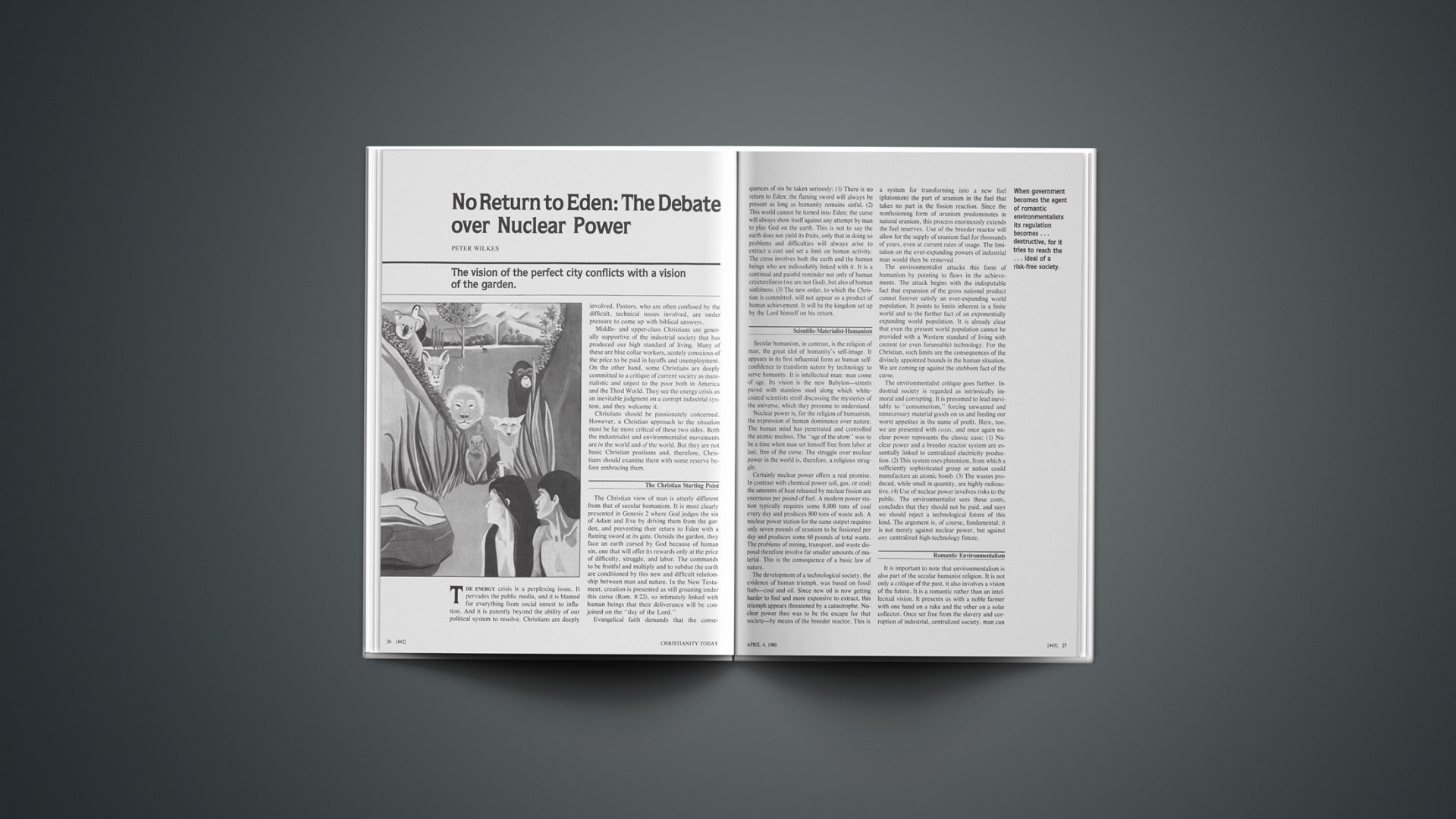
No Return to Eden: The Debate over Nuclear Power

The vision of the perfect city conflicts with a vision of the garden.

The energy crisis is a perplexing issue. It pervades the public media, and it is blamed for everything from social unrest to inflation. And it is patently beyond the ability of our political system to resolve. Christians are deeply involved. Pastors, who are often confused by the difficult, technical issues involved, are under pressure to come up with biblical answers.

Middle- and upper-class Christians are generally supportive of the industrial society that has produced our high standard of living. Many of these are blue collar workers, acutely conscious of the price to be paid in layoffs and unemployment. On the other hand, some Christians are deeply committed to a critique of current society as materialistic and unjust to the poor both in America and the Third World. They see the energy crisis as an inevitable judgment on a corrupt industrial system, and they welcome it.

Christians should be passionately concerned. However, a Christian approach to the situation must be far more critical of these two sides. Both the industrialist and environmentalist movements are in the world and of the world. But they are not basic Christian positions and, therefore, Christians should examine them with some reserve before embracing them.

The Christian Starting Point

The Christian view of man is utterly different from that of secular humanism. It is most clearly presented in Genesis 2 where God judges the sin of Adam and Eve by driving them from the garden, and preventing their return to Eden with a flaming sword at its gate. Outside the garden, they face an earth cursed by God because of human sin, one that will offer its rewards only at the price of difficulty, struggle, and labor. The commands to be fruitful and multiply and to subdue the earth are conditioned by this new and difficult relationship between man and nature. In the New Testament, creation is presented as still groaning under this curse (Rom. 8:22), so intimately linked with human beings that their deliverance will be conjoined on the “day of the Lord.”

Evangelical faith demands that the consequences of sin be taken seriously: (1) There is no return to Eden; the flaming sword will always be present as long as humanity remains sinful. (2) This world cannot be turned into Eden; the curse will always show itself against any attempt by man to play God on the earth. This is not to say the earth does not yield its fruits, only that in doing so problems and difficulties will always arise to extract a cost and set a limit on human activity. The curse involves both the earth and the human beings who are indissolubly linked with it. It is a continual and painful reminder not only of human creatureliness (we are not God), but also of human sinfulness. (3) The new order, to which the Christian is committed, will not appear as a product of human achievement. It will be the kingdom set up by the Lord himself on his return.

Scientific-Materialist-Humanism

Secular humanism, in contrast, is the religion of man, the great idol of humanity’s self-image. It appears in its first influential form as human self-confidence to transform nature by technology to serve humanity. It is intellectual man: man come of age. Its vision is the new Babylon—streets paved with stainless steel along which white-coated scientists stroll discussing the mysteries of the universe, which they presume to understand.

Nuclear power is, for the religion of humanism, the expression of human dominance over nature. The human mind has penetrated and controlled the atomic nucleus. The “age of the atom” was to be a time when man set himself free from labor at last, free of the curse. The struggle over nuclear power in the world is, therefore, a religious struggle.

Certainly nuclear power offers a real promise. In contrast with chemical power (oil, gas, or coal) the amounts of heat released by nuclear fission are enormous per pound of fuel. A modern power station typically requires some 8,000 tons of coal every day and produces 800 tons of waste ash. A nuclear power station for the same output requires only seven pounds of uranium to be fissioned per day and produces some 60 pounds of total waste. The problems of mining, transport, and waste disposal therefore involve far smaller amounts of material. This is the consequence of a basic law of nature.

The development of a technological society, the evidence of human triumph, was based on fossil fuels—coal and oil. Since new oil is now getting harder to find and more expensive to extract, this triumph appears threatened by a catastrophe. Nuclear power thus was to be the escape for that society—by means of the breeder reactor. This is a system for transforming into a new fuel (plutonium) the part of uranium in the fuel that takes no part in the fission reaction. Since the nonfissioning form of uranium predominates in natural uranium, this process enormously extends the fuel reserves. Use of the breeder reactor will allow for the supply of uranium fuel for thousands of years, even at current rates of usage. The limitation on the ever-expanding powers of industrial man would then be removed.

The environmentalist attacks this form of humanism by pointing to flaws in the achievements. The attack begins with the indisputable fact that expansion of the gross national product cannot forever satisfy an ever-expanding world population. It points to limits inherent in a finite world and to the further fact of an exponentially expanding world population. It is already clear that even the present world population cannot be provided with a Western standard of living with current (or even forseeable) technology. For the Christian, such limits are the consequences of the divinely appointed bounds in the human situation. We are coming up against the stubborn fact of the curse.

The environmentalist critique goes further. Industrial society is regarded as intrinsically immoral and corrupting. It is presumed to lead inevitably to “consumerism,” forcing unwanted and unnecessary material goods on us and feeding our worst appetites in the name of profit. Here, too, we are presented with costs, and once again nuclear power represents the classic case: (1) Nuclear power and a breeder reactor system are essentially linked to centralized electricity production. (2) This system uses plutonium, from which a sufficiently sophisticated group or nation could manufacture an atomic bomb. (3) The wastes produced, while small in quantity, are highly radioactive. (4) Use of nuclear power involves risks to the public. The environmentalist sees these costs, concludes that they should not be paid, and says we should reject a technological future of this kind. The argument is, of course, fundamental; it is not merely against nuclear power, but against any centralized high-technology future.

Romantic Environmentalism

It is important to note that environmentalism is also part of the secular humanist religion. It is not only a critique of the past, it also involves a vision of the future. It is a romantic rather than an intellectual vision. It presents us with a noble farmer with one hand on a rake and the other on a solar collector. Once set free from the slavery and corruption of industrial, centralized society, man can reach peace and plenty in harmony with nature. Such is the vision of romantic humanism. If ideal man (free from sin) is not to be found along the intellectual path, then set him free from “the system” to regain innocence in nature. It is an attempt to reenter Eden, as if the Fall had never occurred. It is to attempt to ignore the flaming sword.

The first form of secular humanism has always faced a running battle with the second. The vision of the perfect city has always been opposed by a vision of the garden. People like Rousseau, Thoreau, and Blake have always presented not only a critique of the industrial community, but an alternative vision as well.

The critique has often been compelling. When Blake described the “dark satanic mills” of the early industrial revolution, he was pointing to brutal injustices. The critique by romantic environmentalism is cogent, but this philosophy is more than a mere critique of industrial society: at its root it is antithetical to it. It offers in its place a new secular vision.

In fact, romantic environmentalism is full of illusions. It fails to recognize that in moving along the industrial path a cost has already been entailed and that there is no return. Farming today is industrial; it is centralized. In 1979 the U.S. had a record harvest of $61 billion, 17 percent higher than the previous year, which was also a record. It is being harvested with powerful machines by some 5 million workers. Without the machines 30 million workers would be needed, along with twice as many horses and mules. This harvest was grown by means of fertilizers, pesticides, and herbicides from the chemical industry; it will go to feed a hungry world by means of a distribution network that is also part of the industrial system.

Consider the solar collector in the romantic vision. It is made of copper and glass. The copper is found in only a few places, mostly in the West. It requires bulk ore processing and extraction. (Mao Tse-Tung tried the idea of backyard blast furnaces and found, as any metallurgist would predict, they did not work; that is why we have centralized systems for metal extraction.) In order for every home to have the system of collectors, pipes, and pumps associated with solar heating, it will require a centralized industrial system.

The illusion of somehow returning to a preindustrialized society is necessary to maintain the argument of secular humanism. It must not be human nature that is shown to be wrong but the system, so that humanity can reenter Eden. Instead of seeking to improve the faults in centralized society, it must be condemned, root and branch, in the name of human innocence. The illusion touches not only centralization but also each of the criticisms of the nuclear power option described.

For example, it is not plutonium that is evil, but people. (This should surely be obvious, but romantic environmentalists in the National Council of Churches have played exactly this theological game in their first report on nuclear energy.) Similarly, the romantic yearning for a risk-free society is an illusion. There never has been and never will be any such thing. Even hunting was dangerous!

The growth of industrial society has reduced risks overall while changing their nature. Current developments will continue this process. Nuclear power historically has had a lower accident rate than coal-based industry with its 140 mining deaths per year, black lung disease for miners, and widespread sulfur air pollution.

A Christian Perspective

In this internecine war between the two wings of secular humanism, we Christians need to find a third position that is uniquely our own, and one that reflects the basic truths found in Genesis 2 and Romans 8. First, we cannot commit ourselves to any view that treats earth as ultimate. Our commitment is to heaven and for that reason we cannot be standard bearers for either side. Second, we should be strongly aware of implications for the Christian view of human society now. We should not be surprised that each new technological advance will carry a corresponding price. In just this way the curse and the sword are made manifest. That does not mean that there are really no advances; the earth does yield a fruit, but it does so at a price, which may be painful. After all, thistles often are!

Such an approach allows us to be neither naively optimistic of human scientific progress, nor condemning of it as radically unfruitful. We will avoid the idea that Eden can be planted in the world without turning to impale ourselves on the flaming sword in a doomed attempt to reenter Eden. We will accept the cursed and temporary status of our earth and work within those limitations. We are at last ready to realize that an infinite growth of both population and living standard is impossible.

Accepting the sinfulness inherent in the human situation is necessary. We should reassert the role of law—the biblical check on an unredeemed world. That technology requires careful use and serious safeguards should not surprise us. But neither should it deter us from setting up appropriate constraints against its abuse. A plutonium-based system, if it delivers greater benefits, should not be rejected merely because it requires careful safeguards. Nor can we merely hope, as present U.S. policy dictates, that an example of forebearance will suffice. We need to be involved actively in developing a safeguarding system to counter human sinfulness.

The realistic appraisal of human nature found in Scripture provides an important part of our protection against abuse. Humans can never be expected to be perfect, and the rule of law is our defense against inevitable consequences. This constructive approach leads to what one might describe as Christian environmentalism: regulation in which continual watchfulness is applied to all our organizations, especially those that are commercial. This watchfulness is institutionalized through government, but when government becomes the agent of romantic environmentalists, its regulation becomes negative and destructive, for it tries to reach the impossible ideal of a risk-free society.

But government regulation can be constructive when it is not chasing an impossible ideal. Considerable gains have already been made in this direction by the environmental movement. As a result, a substantial cleanup of air, water, and land is now under way, involving every industry. The good record of the nuclear industry is due in part to the increased public scrutiny it has experienced. This sort of practical, constructive environmentalism can only be welcomed by Christians as fully attuned to our view of man. Unlike romantic environmentalism, it is not destructive, nor does it apply its vigilance to industry and government only. Its suspicions extend to all organizations, including lobbying groups, whether industrial or environmentalist.

A Possible Christian Program

Since personal judgment is required in applying broad Christian principles to detailed energy programs, it is not expected that Christians will agree on future policies. However, our discussion should differ sharply from that of the world, because it is based on a different world view.

But there are areas of agreement. In the current world situation Christians must surely give great weight to the needs of those millions who live outside industrial society, for whom the energy crisis is understood as deforestation—no more wood for the fire—and starvation. Especially under such circumstances, Christians agree on the necessity to renounce the greedy materialism so common in the West. We have not done well in ensuring that the benefits of industrial society extend to the poor, even to those in our own society. Improvement in these areas must take precedence for the Christian over gains in middle-class lifestyle, for the Bible is emphatic about the responsibilities of those who have many possessions toward those who do not. At the very least, all this implies a strong effort toward conservation. In this situation, waste is unconscionable!

Christians must also come to a sober acceptance of an industrial future, not just for ourselves, but also in order to provide the means to help the poor in our society and in the world. To abandon technology in favor of a bucolic environmentalist illusion is to give up hope of helping. To accept it, knowing that its use involves a cost we must undertake responsibly for the sake of others as well as ourselves, is to accept the biblical view of the human situation.

Christian responsibility also requires that the U.S. stop absorbing so much of the world’s dwindling supply of oil. This is the only way to deal with the continuing increase in oil cost that has priced poorer countries out of their most important source of industrial energy. We must have a serious national commitment to eliminate our dependence on foreign oil. In spite of the rhetoric, we do not have such a commitment. The reason is twofold. First, as a nation we refuse to take the issue sufficiently seriously; this is the legacy of our past acceptance of the optimism of materialistic humanism. Second, a wild reaction into romantic environmentalism paralyzes us from responsible acceptance of available technological solutions. We demand the illusion of technology without risk and without cost.

The argument for an industrial future without the romantic illusion takes us to the energy sources of coal and uranium, and both involve human costs in terms of risks to life and health in our society. The price of a nonindustrial future is even higher—not only to us but to the peoples of the world. The responsible Christian view entails the sober acceptance of the cost to increase the use of both our major energy sources in order to replace oil. It results finally in acceptance of a partly nuclear future—including the breeder reactor—acceptance of the price to be paid in disposal of small volume/high activity waste, and national and international safeguards in the use of plutonium.

I accept these realities because I believe technology is to be used responsibly for our benefit, without any starry-eyed illusions. As a Christian I cannot resort to illusion. I have made my choice in the context of a fading world still struggling with the curse. The only solution is, “Maranatha, even so, come, Lord Jesus.”

Carl F. H. Henry, first editor of Christianity Today, is lecturer at large for World Vision International. An author of many books, he lives in Arlington, Virginia.

The Bedfellows of Revival and Social Concern

The achievements of nineteenth-century Christians in Germany through social ministry were indeed remarkable.

Evangelicals have recently begun again to minister to the whole person. As Richard Lovelace points out in his new book, Dynamics of Spiritual Life, “authentic spiritual renewal inevitably results in social and cultural transformation.” He also says that “no deep and lasting social change can be effected by Christians without a general spiritual awakening of the church.”

A fine example of this dynamic is the “Awakening” (Erweckung), a spiritual movement that swept Germany in the early nineteenth century. Rooted in the older Pietism, it was also influenced by the contemporary Wesleyan and evangelical revivals. German believers motivated by their faith performed deeds of love for needy people. Evangelicals today can benefit by reflecting on those achievements.

These believers led the way in alleviating the human misery resulting from the Napoleonic wars and the growth of cities and industry. The Awakening’s ideal of a life devoted to serving others is epitomized in Baron Hans Ernst von Kottwitz (1757–1843), a Silesian noble converted through the influence of Moravian friends. He decided to base his life’s work on Exodus 6:9: “Moses spoke thus to the people of Israel; but they did not listen to Moses, because of their broken spirit and their cruel bondage.” He believed that misery of the body depressed the human spirit, and therefore earthly pain had to be relieved before the poor and needy could expect their spiritual needs to be met.

After studying social conditions in Germany, he concluded that the solution was to help the poor help themselves. He invested large sums to provide jobs for over 4,000 impoverished textile workers in Silesia. He even obtained the necessary raw materials so they could produce a high quality linen that would compete with imports. As a result, the workers obtained higher wages and improved their standard of living.

In 1807 Kottwitz moved to Berlin, a city economically depressed because of the French occupation following defeat of the Prussians at Jena. Using his own funds, he started a “voluntary work house” to help unemployed men by giving them work, as well as lodging for their families. He housed them cheaply or free of charge in an empty barracks; the husband, wife, and children over 12 lived and worked together while the younger children received schooling. Every evening there was a community worship service, often directed by the baron himself. When a family became established, it moved out and made room for another one. Within a short time the “work house” was serving 600.

He also made a deep impression on a new generation of activists. One disciple, Otto von Gerlach (1801–49), was a founder of the Berlin Missionary Society and pastor of the Elisabeth Church, which sponsored a program of social services in Berlin. Gerlach used the diaconate concept pioneered by Scottish Presbyterian Thomas Chalmers to care for the poor in his parish. Even more significant was his influence on a young theology student, Johann Hinrich Wichern (1808–81), who founded the Rauhe Haus in Hamburg (a training school for poor youths) and then the Inner Mission, the most important of all the Protestant social programs in Germany.

A remarkable story was that of writer Johannes Falk (1768–1826), who composed the popular German Christmas Carol, O du frohliche. The son of a Danzig wigmaker, he was converted while studying at Halle University, then settled in Weimar. The economic and social catastrophe that swept Thuringia following Napoleon’s triumph in 1806 deeply affected his Christian conscience. He became a councilor for the Duke of Weimar and intervened with the French authorities to improve conditions there.

Then personal tragedy struck. In 1813 war once again raged in that part of Germany, and four of his six children (three within one month) died from epidemic diseases that followed in its wake. As Falk saw large numbers of orphaned children roaming the city streets and country lanes, he began to gather them into his modest dwelling, saying, “God has taken my four angels and spared me that I might be your father.”

Earlier that year Falk had founded the Society of Friends in Need to aid local peasants in reconstruction. After his children died, the society concentrated on finding homes for orphans. He opened a “Reformatory” in his house to provide shelter and education for delinquent vagabonds, some of whom he had himself plucked from local jails. Because resentful neighbors opposed the presence of these ragamuffins in their genteel residential area, Falk finally purchased and remodeled a rundown castle in the town, and called it “Lutherhof.” Besides this, he trained school teachers to work with poor children and placed hundreds of youths as apprentices with local craftsmen.

Falk believed that the root of societal evil was not ignorance but sin, and that it was necessary to implant in young people the secret of a religious life. Education, he felt, was not the true way to a moral life and to reform of the world, so along with the three “R’s” he taught that a Savior died even for the outcasts of society. The unwanted children came in touch with genuine love and learned how to make a living. The foundation in Weimar survived long after Falk’s death, a sign of the life-changing power of the gospel. Falk’s model of linking shelter and care with elementary education was followed by Protestant child welfare work in nineteenth-century Germany.

Amalie Sieveking (1794–1859) was the first woman in this period to gain distinction in humanitarian work. She belonged to a prominent Hamburg family, possessed a pietistic faith, and had ties with English evangelicals. She demonstrated the depth of her concern during a cholera epidemic by laboring selflessly in the hospitals to help disease victims. In 1832 she formed the Women’s Association for Care of the Poor and Sick, a group of Christians who distributed food and visited those in need. When a serious fire ravaged the city in 1842, she and her coworkers provided food and shelter for the victims. Although she restricted her own activity to Hamburg, women in other cities formed similar groups.

One of the major “Awakened” activists was Theodor Fliedner (1800–64). He started the “deaconess” movement, which decisively opened up the field of philanthropic work in the German Protestant church to women. Upon completing his theological studies, he accepted a call from a tiny congregation at Kaiserswerth, a village on the Rhine just north of Düsseldorf. Shortly after he arrived in 1822, the town’s main industry, a textile mill, closed down and caused his parishioners severe hardship. To keep the struggling church afloat, he traveled widely, even to Holland and England, seeking funds.

The successes of the British evangelicals impelled Fliedner to action in his own country. He began to preach in the Düsseldorf jail and to visit individual prisoners. In 1826 he formed the first prison reform group in Germany, the Prison Society of the Rhineland and Westphalia. It sought to provide pastors and teachers for the prisons, segregated inmates according to their ages and nature of their crimes, gave them work to do while in jail, and helped them get a new start after release. The society preached that the purpose of detaining criminals should be to reform rather than to avenge them. Fliedner was particularly concerned about female prisoners, and in 1833 he opened the first “Magdalene Home” for women ex-convicts and prostitutes in Kaiserswerth.

During his travels he noticed the achievements of Elizabeth Fry and the Dutch Mennonite practice of using deaconesses to minister to the poor. He also recognized that women served in the early church (especially Phoebe, whom Paul called a “deacon” in Romans 16:2), but the medieval nun seemed to be an unfortunate replacement for the female diaconate. Moreover, Count Recke had publicly called for the restoration of the “office of deaconess,” and Amalie Sieveking was an ideal model of devoted service. Fliedner’s wife Friederike (1800–42), who before their marriage worked in a home for abandoned children, played a major role in his decision to start a deaconess order. She helped energetically in his various ministries and was the moving spirit behind the Kaiserswerth Deaconess Institute.

Wherever he went, Fliedner recognized the difficulties facing the sick due to inadequate health care facilities and nursing staffs. In 1836 he decided to purchase a large house to serve as a training hospital for nurses. The idea of preparing young women for service in hospitals quickly found approval in the Awakened circles, and from all over Germany women began making their way to Kaiserswerth. Within five years the number of “nursing sisters” had reached 29, and by 1900 over a thousand.

Out of the nursing school emerged the first “mother house,” since Fliedner was firmly committed to the deaconess concept. The nursing sisters would serve the church by caring for the sick and infants and be equal in status to the male diaconate. Although Fliedner saw this as the restoration of an apostolic church practice, historian Erick Beyreuther comments that this was really a new idea animated by the spirit of the Reformation. With the breakup of the old social order caused by the industrial revolution, new avenues for purposeful service by women were needed and the female diaconate offered one possibility.

The deaconess order, with its overseers and stress on obedience, reflected the traditional German pattern of subordination. The women lived in a community, but not a democratic one. Assignments were made by the order’s authorities to whatever position and place of service they so determined. The women were not allowed to marry because Fliedner believed this would interfere with their flexibility. On the other hand, the vows of obedience, faithfulness, devotion to her calling, and willingness to remain in the sisterhood were not as binding as those of a Roman Catholic order, and they did not lead to a contemplative existence.

The sisters were schooled in nursing, kitchen work, gardening, and child rearing, with special attention to their spiritual life. They wore simple clothing, much like the average bourgeois woman of the time. The color blue was chosen because it allegedly was worn by temple personnel in Bible times. The garb cultivated modesty and simplicity, guarded against vanity, and was utilitarian.

Fliedner tried to work closely with the ecclesiastical structures, but most church leaders, having succumbed to the deadening spirit of rationalism, had little sympathy with ventures that flowed from grassroots pietistic and revivalistic elements. As a result, he had to turn to the Prussian state for legal recognition and financial support. He also spent much time soliciting funds from individuals and congregations. Fliedner’s ministry, like those of Hudson Taylor and George Mueller, was a prototype of the “faith mission” concept. Since German Protestant churches were divided into regions and territories and many of their leaders had no interest in spiritual questions, all social service agencies (and foreign missionary societies as well) had to be private foundations that raised their own support.

Fliedner influenced other notables such as Friedrich von Bodelschwingh (1831–1912), director of the world famous mental institution at Bethel; Wilhelm Lohe (1804–72), who organized a confessional Lutheran diaconate at Neuendettelsau; and Florence Nightingale (1820–1910), an English evangelical who led in the development of modern nursing. Even the so-called free churches, such as the Baptists, began to use deaconesses. Fliedner traveled around Germany establishing new mother houses, and even transplanted the Kaiserswerth model to the Near East and the United States.

The deaconess movement was significant because it enabled Christian women to help relieve poverty, sickness, and other human distress. More important, it allowed them to be active in the public life of the church. Since it involved forms of service that often went beyond traditional roles, the movement was a step forward in the women’s liberation process. It accurately reflected the desire of revived believers to apply their faith to practical human needs.

It is easy to criticize the efforts of these German Christians from today’s perspective. Of course they were too individualistic and tied to the existing social order. Yet, considering the nature of the times and the environment in which they functioned, their achievements were indeed remarkable. In an age when few cared about the suffering of others, these Christians cared. While most others ignored the problems, they acted. Although the flame of an active Christian faith had died down, theirs was fanned by the wind of revival. Thus we should pay our respects to these stalwart giants of the faith and allow them to challenge us to perform greater deeds for our Lord.

Kampuchea

Selfishness …,

The cause of all this,

Suffering, hunger and pain,

War, the many silent slain,

Guns fire and mines explode,

A child’s tears linger on a thin face,

Stumbling footsteps over a barren waste,

Glazed eyes, feverridden …,

They have no hope at all,

Skeletons move and bodies shake,

Babies die and spirits ache,

People pass away, alone at the last,

But no one knows or pretends to weep,

Their hearts are gone, the wound is deep,

Greed has crushed this tiny land,

And balances it in his cruel hand.

RUTH ATKINSON

Carl F. H. Henry, first editor of Christianity Today, is lecturer at large for World Vision International. An author of many books, he lives in Arlington, Virginia.

Loving the World: Rightly or Wrongly

Loving the world but not the things of the world.

Are christians to love the world or hate it? Are we to cherish or despise it? Are we to view it with indifference, detachment, and even contempt? Or are we to view it with reverence, joy, and concern? In order to live as obedient disciples of Jesus Christ, are we to be world-affirming or world-denying? Can we become holy while we are active and busy in the affairs of this world? Or is holiness impossible without a radical otherworldliness, an otherworldliness that motivates us to turn our backs resolutely on this world? What, then, ought to be a Christian’s relationship to the world? Ought it to be appreciative involvement or ought it to be condemnatory separation? Should our relationship be positive or negative—or maybe neutral?

That’s our perplexity. What ought to be a Christian’s relationship to the world in all its God-created wonder and fallen sinfulness? As we ponder this, perhaps we can gain clarifying insight by looking back on the experiences and examples of our Christian forebears. The value of history is that it can prevent us—though there is no guarantee it will—from repeating yesterday’s mistakes today. Let us look back, therefore, all the way to the church’s earliest years when devout believers were attempting to flesh out some of those New Testament texts with which we still wrestle today.

One such text is Colossians 3:1–3: “If ye then be risen with Christ, seek those things which are above, where Christ sitteth on the right hand of God. Set your affection on things above, not on things on the earth. For ye are dead, and your life is hid with Christ in God.” How do you flesh out a text like that? Another such text is Galatians 5:24: “They that are Christ’s have crucified the flesh with the affections and lusts.” How do you flesh out a text like that?

In the earliest Christian centuries, deeply committed believers tried to make those texts operative in their lives. They aspired to a discipleship of total obedience. Woefully deficient hermeneutically, they were admirable in their misguided fanaticism, for they decided that the New Testament requires a ruthless self-denial, life-denial, and world-denial. Holiness, they argued, is impossible without a complete renunciation of all worldly comforts and pleasures; and to them apparently anything was worldly if it failed to make the body miserable. (Some Christians, one suspects, are still of that conviction.) Consequently, a host of early disciples became hermits, forsaking the world literally.

Those early Christians with their commendable zeal for holiness and their deficient understanding of biblical interpretation wrote a sad though admittedly heroic chapter in church history, a chapter that shows the excesses and extremes to which a warped spirituality can go with this self-denial, life-denial, and world-denial. And this denial was carried out, ironically, in the name of the God who, according to 1 Timothy 6:17, gives us richly all things to enjoy.

Another sad chapter in church history was written by the monks and nuns of the Middle Ages—not by all of them, to be sure, but by many who were fugitives from the world. Trying to be holy, they, like the hermits of the earlier centuries, renounced normal needs and affections, inflicting pain on their bodies in the hope of purifying their souls.

But having recalled some of these grosser medieval excesses, let us consider another chapter in church history, one much closer to our own time, and one that continues to affect American evangelicalism. Consider our forbears in nineteenth-century England, the sons and daughters of the Wesley revival of the eighteenth century. Many of them were remarkable Christians indeed: remarkable for their piety, remarkable for their social and political impact, remarkable for their seriousness, their decorum, their nitpicking spirituality.

For instance, most of them were rigid Sabbatarians. God would be highly displeased, they felt, if anything enjoyable was done on Sunday. Thus, in a typical evangelical home the Lord’s Day was celebrated with the prohibition of all activities except solemn church going and edifying reading. Toys and games were locked away. No hot food was served; well, there might be an egg for breakfast. Even letter writing was forbidden.

Evangelical legalism extended far beyond strict sabbath keeping, however. It included lengthy lists of dos and far longer lists of don’ts, which reduced the Good News of liberating grace to a stifling code of conduct. In its worst forms, evangelical legalism, whether in the British Isles or elsewhere, was a first cousin of the hair-splitting Pharisaism Jesus fought against in his day.

This legalistic negativism, all of us are aware, has persisted until the present day, creating among conscientious Biblicists a guilty confusion about worldiness and a distorted concept of holiness. Repeatedly we who are evangelicals quote Romans 12:2 in paraphrase, “Don’t let the world around you squeeze you into its mold.” We insist, and we insist rightly, that we ought to be different from unregenerate society. But we proceed to define worldliness as Paul emphatically teaches us it ought not to be defined. We define it as a matter of externalities—what a believer eats and drinks and wears, whether a believer keeps Sunday as we do. Then we judge the holiness of a fellow believer by his conformity to the code of conduct we have drawn up. We define worldliness as if Paul, under the inspiration of the Holy Spirit, had never written Colossians 2:16 together with verses 20 through 22.

“Let no man therefore judge you in meat, or in drink, or in respect of an holyday, or of the new moon, or of the sabbath days … Wherefore, if ye be dead with Christ from the rudiments of the world, why, as though living in the world, are ye subject to ordinances, (Touch not; taste not; handle not; Which all are to perish with the using;) after the commandments and doctrines of men?”

Whatever else Paul may be saying to the Colossians and to us, he is saying that worldliness is a legalistic preoccupation with eating and drinking and sabbath keeping. He is saying that worldliness is a legalistic preoccupation with externalities, a legalistic preoccupation with conformity to a man-made code of don’ts. Thus in the light of this passage, we may find ourselves under obligation to reformulate our view of worldiness. If we are to be obedient Biblicists, we may find it necessary to slough off the lingering influence of legalistic traditionalism in order to bring our doctrine and practice into a closer alignment with the Word of God.

While we are pondering our view of worldliness, suppose we take into account another pertinent passage. In 1 John 2:16–17 the apostle breaks down worldliness into three components: “For all that is in the world, the lust of the flesh, and lust of the eyes, and the pride of life, is not of the Father, but is of the world. And the world passeth away, and the lust thereof: but he that doeth the will of God abideth forever.”

What is worldliness, then, as John here analyzes it? Is it a matter of legalism or externalism or negativism? Is it a matter of conformity to any man-made code of conduct? Not in the least! Worldliness is the lust of the flesh—sensualism. Worldliness is the lust of the eyes—materialism, a covetous itching to own what we see. Worldliness is the pride of life—egotism, the desire to push ourselves up even at the cost of pushing someone else down. Probe with me these three components of worldliness.

Sensualism, first, is anything that selfishly gratifies our senses. There is nothing wrong, to be sure, with a legitimate satisfaction of our needs or even a rightful titillation of our bodies. But when we selfishly glut our senses, then we are sliding into worldliness. When unbridled flesh takes over and appetite becomes animal-like self-indulgence, then we are worldly. In that sense, we can fault some great Christians of the recent past, some whose shoelaces we would have been unworthy to tie. Sadly overweight, they simply overate. They allowed appetite to become excessive, and to that degree and in that way they were worldly. But, focusing on ourselves, we need to ask whether, in the deeper meaning of John’s phrase, “the lust of the flesh,” we are worldly? Am I? Are you?

What is the lust of the eyes, that second component of worldliness as the apostle analyzes it? It is the selfish desire that arises when we see things we really do not need but want. It is the selfish desire that arises when we look, lick our lips, and long to possess. It is the selfish desire to get, to own, to have for ourselves. It is covetousness, acquisitiveness, and greediness. It is more food than we need in a world where millions of people are hungry. It is new and nicer homes we really do not need in a world where millions of people are without decent shelter. It is bigger, more elegant, air-conditioned churches—even glass cathedrals—that we really do not need for the worship of our carpenter-Savior in a world where millions of people have never yet heard the gospel. In this deeper meaning of John’s phrase, “the lust of the eyes,” am I worldly? Are you?

The third component of worldliness, as John analyzes it, is the pride of life. This is egotism, the self-centered hankering to inflate our own little reputations. Whatever we do, no matter how helpful it may be, if we do it to enhance our sense of superiority and feeling of importance, that is the pride of life. It may be a noble deed, but if it is done to have people notice and flatter us, that is the pride of life. It may even be a spiritual act, but if it is done to have the ecclesiastical spotlight shining on ourselves, that is the pride of life. If we pray in order to call attention to our spirituality, that is the pride of life. If we give in order to be applauded for our stewardship, that is the pride of life. If we witness in order to be praised for our evangelistic zeal, that is the pride of life. So in that deeper meaning of John’s phrase, “the pride of life,” am I worldly? Are you?

You see, worldliness is not essentially a matter of externalities and negatives. It is rather essentially a matter of motives and attitudes and values. We need to examine ourselves, then, asking whether our motivation is honestly to glorify God, sharing his grace and truth with a lost world, or whether our deepest motivation is to please men as we conform to evangelical traditions that have a very debatable biblical sanction.

We need to ask ourselves whether our attitudes, our deep-down attitudes, are honestly attitudes of love for God and love for the ungodly world God loves, or whether they are attitudes of coldness towards God and harsh, judgmental, uncaring indifference toward the unreached masses of humanity. Is it possible that deep inside we are not worried about what God thinks of us as long as we can kid our fellow Christians into thinking we are spiritual? We need to ask ourselves whether our values, our deep inner values, are honestly the values of the New Testament, or whether they are the values of American society—money, cars, clothes, comfort, security, success. Or are we indifferent deep-down to earthly riches and concerned about God’s concerns?

We need to ask ourselves whether as Christians who preach nonconformity to the world we may be blind to our own subtle worldliness, our sensualism, materialism, and egotism. We need to ask ourselves whether our churches, despite their codes of externalities and negatives, are worldly. We need to ask ourselves whether our relationship to the world is like that of our Lord Jesus Christ. How different he was from the worldly people of first-century Palestine—and twentieth-century America! Not that he was otherworldly, detached from the world. He was in the world, immersed in it for some 30 years, yet he was not of the world, never a captive of its motives, attitudes, and values.

How different Jesus was! Different because he was totally God-centered and completely self-forgetting; different because of his intense and steadfast fellowship with his father; different because he came into the world not to be served but to serve. He was, as we read in Hebrews, “holy, harmless, undefiled and separate from sinners,” but he loved the world, taking delight in the beauty of flowers, the gracefulness of flying birds, the joyful innocence of “Children’s faces looking up—holding wonder like a cup.”

He was holy, yet he loved the world. Think of his unwearying compassion expressed so concisely in Peter’s words, “He went about doing good” (Acts 10:38). Jesus was holy, yet he loved the world. Think of his courage in confronting and challenging evil. He was holy, yet he loved the world. Think of his refusal to be bound by legalistic taboos about Sabbath keeping. He was holy, yet he loved the world. Think of his willingness to share in weddings and feasts and to be labeled the friend of publicans and prostitutes. Jesus was holy, yet he loved the world. Think of the humility that prompted him to wash the feet of his disciples. Jesus was holy, yet he loved the world. Think of his optimistic faith in the divine redeemability of such social scum as thieves and robbers. He was holy, yet he loved the world with a love that cost him misunderstanding, hate, loneliness, and an agonizing death on a Roman cross.

If we evangelicals in the twentieth century are to be anything like Jesus, then our otherworldliness must be just as worldly as that of Jesus, who did not love the sinful structures and self-centered values of the world-system, but who did indeed love lost mankind in all of its pain and frustration and need. If we are to be holy as Jesus was holy, our lifestyle must be that of holy worldliness and worldly holiness, the lifestyle Charles Wesley celebrates:

Not in the tombs we pine to dwell,

Not in the dark monastic cell

By vows and grates confined.

Freely to all ourselves we give,

Constrained by Jesus’ love we live

The servants of mankind.

Carl F. H. Henry, first editor of Christianity Today, is lecturer at large for World Vision International. An author of many books, he lives in Arlington, Virginia.

The Reasonable Reality of the Resurrection

It is inherent in the nature of this event to confound those who would either deny the miracle or its significance.

Disquiet for Christian believers at Easter does not come from the antics of the Easter Bunny; it’s difficult to get angry at a fuzzy rabbit with a basket of eggs. Rather, it comes from certain skeletons at the Feast of the Resurrection. These arise from today’s unbelief, specifically from secularism outside the church and pervasive liberal doubts within it. Some question Christ’s resurrection, and others deny the festivity outright. Even more disturbing to genuine believers, many voice doubts in the sophisticated guise of indifference: “Even granting that Jesus rose, what does it prove?”

Philosopher Antony Flew represents recent critics of miracles and especially of Christ’s resurrection. He writes in God & Philosophy: “The basic propositions are: first, that the present relics of the past cannot be interpreted as historical evidence at all, unless we presume that the same fundamental regularities obtained then as still obtain today; second, that in trying as best he may to determine what actually happened the historian must employ as criteria all his present knowledge, or presumed knowledge, of what is probable or improbable, possible or impossible; and, third, that, since miracle has to be defined in terms of practical impossibility the application of these criteria inevitably precludes proof of a miracle.”

Flew’s argument is really two in disguise; we shall take up each. On one hand, he seems to say that proponents of miracles have no right to argue for them on the basis of a consistent method of investigation (empirical method), since they cannot first assume its absolute regularity and applicability and then use it to prove deviations. Once we grant a miracle, Flew thinks, we have no reason to consider empirical method as necessarily applicable without exception. So it could perfectly well be inapplicable to the investigation of the miracle claim in the first place!

But empirical methodology does not commit us to a regular universe, to one where events must always follow given patterns. Empirical method always investigates the world in the same way—by collecting and analyzing data—but it involves no prior commitment to what the data must turn out to be. Thus a team of researchers could conceivably go down the rabbit hole with Alice and empirically study Wonderland, where Alice cried, “Dear, dear! How queer everything is today! And yesterday things went on just as usual. I wonder if I’ve been changed in the night?”

We could even investigate a world of maximal miracles (where predictability would approach zero) by empirical method, for the consistent collection and analysis of data can occur even when the data are not themselves consistent and regular. It’s true that irregularity in basic empirical methodology would keep us from investigating anything. But the discovery of unique, nonanalogous events by empirical method in no way vitiates its operation or opens the investigator to the charge of irrationality.

Flew’s Encyclopedia of Philosophy article on miracles expresses a more potent variation on this same argument in the following terms: the defender of the miraculous is acting arbitrarily when he claims that “it is (psychologically) impossible that these particular witnesses were lying or misinformed and hence that we must accept the fact that on this occasion the (biologically) impossible occured.” Flew’s criticism here is that the advocate of miracles must commit himself to certain aspects of substantive regularity in order to analyze the evidence for a historical miracle. He must, for example, assume that human motivations remain the same in order to argue that neither the Romans, the Jewish religious leaders, nor the disciples would have stolen Jesus’ body in order to claim that Jesus was miraculously resurrected. But, we are told, such argumentation inconsistently uses regularity of experience where it serves a purpose, and discards it at the point of the desired miracle, instead of there also insisting on a natural, ordinary explanation.

This argument seems somewhat inappropriate for the rationalist to propose. Since he himself is committed to employ only “ordinary” explanations of phenomena, explanations arising from “common experience,” he is in a particularly poor position to suggest any abnormal explanations for any aspect of a miracle account, including the psychological motivations or responses of the persons involved. Presumably the rationalist would be the last to appeal to a “miraculous” suspension of ordinary psychology so as to permit the Jewish religious leaders (for example) to have stolen the body of Christ when they knew it to be against their best interests.

However, the issue lies at a deeper level than this, and we may be able to arrive there by posing the question in the starkest terms. Suppose we are to interpret or explain historical events along ordinary lines (in accord with ordinary experience) where this does not contradict the events we are interpeting. Are we therefore required to conclude that unique, nonanalogous events never occur even when ordinary observable evidence exists in their behalf? Flew demands a yes to this. If we use common experience of regularities at all in historical interpretation, he says, we have precluded all possibility of discovering a miracle, even if our use of such common experience provides the very convergence of independent probabilities (as Newman would put it) for asserting that the event is miracle.

Curiouser and curiouser, if we may again appeal to Alice! The fallacy in this reasoning arises from failing to perceive how the general and the particular properly relate in historical investigation. In interpreting events, our proper goal is to find the interpretation that fits the facts best. Ideally, then, we will set alternative explanations of an event against the facts themselves to make an intelligent choice. But which “facts” will we test our explanations against—the immediate fact we are to interpret, or the entire range of experience? Where particular and general experience are in accord, we face no problem; but where they conflict, we must choose the particular, for otherwise our “investigations” of historical particulars will be investigations in name only since the results will always reflect already accepted general experience. Unless we are willing to suspend “regular” explanations at the particular points where they are inappropriate to the particular data, we in principle eliminate even the possibility of discovering anything new. We then limit all new (particular) knowledge to the sphere of already accepted (general) knowledge.

The proper approach is just the opposite: the particular must triumph over the general, even when the general has given us immense help in understanding the particular.

How does a historian properly determine what has occurred, and interpret it? Admittedly, he takes to a study of any particular event his fund of general, “usual” experience. He relies upon it wherever it serves a useful function and not because he has any eternal, metaphysical justification for doing so. But the moment the general runs into tension with the particular, the general must yield for two reasons. First, the historian’s knowledge of the general is never complete, so he can never be sure he ought to rule out an event or an interpretation simply because it is new to him. Second, he must always guard against obliterating the uniqueness of individual historical events by forcing them into a Procrustean bed of regular, general patterns. Only the primary source evidence for an event can ultimately determine whether it occurred or not, and only that same evidence will establish the proper interpretation of the event.

Thus, in the argument for Christ’s resurrection, nothing in the primary documents forces the historian to miraculous explanations of motives or actions of the Romans, the Jewish religious leaders, or the disciples. Indeed, the documents show them to have acted with exemplary normality, as typically sinful and insensitive members of a fallen race. But these same primary documents do force us to a miraculous understanding of the resurrection, since any other explanation runs directly counter to all of the primary-source facts at our disposal. The documents, in short, force us to go against biological generalizations as to corpses remaining dead, but do not require us to deviate from psychological generalizations as to behavior of individuals and crowds. Contrary to what Flew imagines, we do not arbitrarily prefer biological miracles over psychological miracles; we accept no miracles unless the primary evidence compels us to it: if in fact that evidence required psychological miracles rather than biological ones, we would go that route.

French Judge Jacques Batigne describes a bizarre case in which a corrupt magistrate’s clerk, in the face of overwhelming scientific proof of his guilt, stubbornly maintained his innocence for almost a year, even when he knew it was unquestionably in his best interest to come clean. Those involved in the case were so impressed by the clerk’s fine past record and sincerity that they did everything possible to believe that a “physical miracle” accounted for the evidence against him, but the facts finally brought them to conclude the “miracle” was psychological: the clerk inexplicably preferred to act against his own interest.

The gospel narratives give us no such situation. They force a biological miracle upon us, like it or not. The primary facts, and those facts alone, can arbitrate such questions; generalizations, though helpful to us in reaching the point of primary investigation, must bow to the facts revealed there.

Secularists are also heard to argue today that a proven miracle, even the miracle of Christ’s resurrection, would be vacuous, for it still would not require belief in God. This viewpoint is held by those opposing miracles, but even a philosopher such as M. A. Boden, who is at pains to show their epistemological meaningfulness, makes the assertion in the December 1969 issue of Ratio: “The fact that theological underpinnings are necessary to the very identification of a miracle in the first place is, of course, one reason why miracles could never be regarded as a proof of the existence of some god or God to an unbeliever who was aware of the various different super-rational powers which could in principle be invoked as explanations of scientifically anomalous events.”

Often the claim that “miracles can’t prove God” is little more than a variation on Lessing’s theme that “the accidental truths of history can never become the proof of necessary truths of reason.” Insofar as the argument proceeds in this fashion, we can easily dispose of it, for Lessing confused what contemporary analytical philosophers term the “synthetic” (factual) and the “analytic” (purely formal) areas of assertion. Only in the analytic realm are “necessary truths” possible—truths about which we can be 100 percent certain. Synthetic evidence, involving probabilities and plausibilities, can never rise to such a level of proof.

God-statements do not fall into the analytic realm, unless by “God” we mean only a formal assertion of deductive logic or pure mathematics! However, if by “God” we mean an existent, factual being, then any proof of his existence or statement about him must lie in the realm of the synthetic; that is, it must be factual.

So only “the accidental truths” of historical experience are ever capable of becoming the proof of God’s existence! Granted, the proof will never reach 100 percent (faith will have to jump the gap from plausibility to certainty), but such proof is the basis of all our factual decisions in life, so we cannot summarily dismiss it just because a vital religious question is at issue. Thus Jesus was quite willing to use his miraculous healing of the paralytic to demonstrate (not to analytic certainty but with synthetic persuasiveness) that he could forgive sins and was therefore truly divine (Mark 2:1–12).

But how persuasive is such a miraculous demonstration, after all? If I were to grow hair on a billiard ball, would I be justified in claiming deity? Hardly, and likewise the significance of a miracle does not depend in the final analysis on the degree to which it “violates natural law” (whatever that means, and I doubt that it can mean much in the age of Einstein). Rather, the significance depends on the character of the miracle, on whether it speaks to universal human need.

Even an event that allows for the full range of secondary causes to explain it can have significant miraculous impact if it operates at the point of man’s existential need. In the January 1965 issue of American Philosophical Quarterly, R. F. Holland offers this example: an express train suddenly stops just before striking a child on the railroad track. Why? Because the engineer has a sudden heart attack as a result of an argument with a colleague. Holland perceptively comments on the “coincidence” or “contingency” miracle:

“Unlike the coincidence between the rise of the Ming dynasty and the arrival of the dynasty of Lancaster, the coincidence of the child’s presence on the line with the arrival and then the stopping of the train is impressive, significant; not because it is very unusual for trains to be halted in the way this one was, but because the life of a child was imperiled and then, against expectation, preserved. The significance of some coincidences as opposed to others arises from their relation to human needs and hopes and fears, their effects for good or ill upon our lives. So we speak of our luck (fortune, fate, etc.). And the kind of thing that, outside religion, we call luck is in religious parlance the grace of God or a miracle of God. But while the reference here is the same, the meaning is different. The meaning is different in that whatever happens by God’s grace or by a miracle is something for which God is thanked or thankable, something which has been or could have been prayed for, something which can be regarded with awe and be taken as a sign or made the subject of a vow (e.g., to go on a pilgrimage).”

When we turn to the unique, nonanalogous event of the resurrection Jesus and classical Christian apologists used to attest the claim that “God was in Christ, reconciling the world unto himself” (2 Cor. 5:19), we find a compelling reason to bring God into the picture: this miracle deals effectively with the most fundamental area of man’s universal need, the conquest of death. Not just a single child is saved from a railway accident; rather, the entire race is freed from death by Jesus’ act and consequent promise that “whoever lives and believes in me shall never die” (John 11:26) and “because I live, you will live also” (John 14:19).

Philosopher Paul Dietl correctly observes in the April 1968 issue of the American Philosophical Quarterly that “to prove the existence of a being who deserves some of the predicates ‘God’ normally gets would be to go some way toward proving the existence of God” and “when and for whom He did miracles would be evidence as to His character.” This is precisely why the resurrection has led so many to affirm the deity of Jesus, and why we may properly infer his deity from his resurrection. The conquest of death for all men is the very predicate of deity that a race dead in trespasses and sins can most clearly recogize, for it meets man’s most basic existential need to transcend the meaninglessness of finite existence. Not to worship One who gives us the gift of eternal life is hopelessly to misread what the gift tells us about the Giver. No more worthy candidate for deity is in principle imaginable than the One who conquers death on mankind’s behalf.

The gospel events, if they can in fact be shown to have occurred, require an answer to Jesus’ straightforward question, “But who do you say that I am?” (Matt. 16:15). Now, as then, only one answer will fit the facts.

And we should note that once we have granted the factual character of Christ’s resurrection, all explanations for it reduce to two: Christ’s own (he rose because he was God) and every interpretation of the event contradicting this explanation. Surely it is not difficult to make a choice here, for Jesus (unlike anyone else offering an explanation of the resurrection) actually arose from the dead! His explanation has prima facie value as opposed to those in contradiction to it, presented as they are by persons who have not managed resurrections themselves.

The very fact that a miracle is a nonanalogous event offers an even greater reason than ordinarily to let it interpret itself, to seek its interpretation within itself. What other event or interpreter, after all, could help us understand it? But when we do go to the One who personally experienced the resurrection, all gratuitous interpretations of the chariot-of-the-gods, creature-from-outer-space variety evaporate in the light of his own affirmation of his divine character, to which the sign of Jonah unequivocally points.

Carl F. H. Henry, first editor of Christianity Today, is lecturer at large for World Vision International. An author of many books, he lives in Arlington, Virginia.

Ideas

Religious Conviction: Power Beyond the Political

Foreign policy insensitive to the religious climate continues to be costly.

Question: What fellowship hath the CIA with the KGB? And what communion hath the U.S. with the USSR?

Answer: In the Middle East both have given knee-jerk obeisance to the myth that God is dead—and both have suffered the consequences.

It makes no difference whether we have in mind the Christian’s God or the Muslim’s God; it is all the same to the dyed-in-the-wool secularists of the West, who long ago decided that religion was a paper tiger.

The CIA thought it had Iran in the bag, but due to its secular outlook it underrated the clout of Islam as the Shah relieved the mullahs of their political leverage. After all, God is dead, long live King Oil. We know the result.

But not to be outdone, the KGB blithely led Moscow into the same trap. Afghanistan? Piece of cake! Drop paratroopers into the Hindu Kush Mountains to nail down the Salang Pass, and it’s free-wheeling all the way to Kabul.

Then the ninth division of the supposedly pro-Soviet Afghan army defected to the guerrilla side, partly for religious reasons. They took along their Kalashnikov rifles, and a few other mementos of Moscow. Soviet supply trucks rumbling down desolate Afghan highways from Uzbekistan SSR to Kabul and points beyond suddenly found themselves attacked by, of all things, mujahideen, “holy warriors,” shrieking praises to Allah.

We do not intend to compare Allah with the God and Father of our Lord Jesus Christ. Nor do we plan to weigh the force of nationalism against the force of religious enthusiasm. No doubt they have fused in the present cataclysm.

But, granite-like as the Afghan mountains, one fact juts out amid recent events in the Middle East. Religion is no more dead there than here. This is not a world of “spent sacred forces,” Philip Rieff notwithstanding. The powerful men behind the politicians of Moscow and Washington would be well-advised to shuck off those outmoded teachings they learned at Stalingrad and Harvard. Religion is not a toothless tiger. And these days, any Soviet soldier looking at the business end of a guerrilla-held .30-caliber rifle is likely to swear to it by all that’s, er, holy.

Costly as secularism has been for the U.S. position in Iran, it has been worse for the USSR. Till now many in South America, Africa, and Asia have regarded the Soviet Union as the savior of the Third World. And that world embraces every Muslim country in existence.

Now such an image is badly damaged. Certainly the Soviets have the power to subjugate Afghanistan, but secularism may well have rendered that a Pyrrhic victory.

The Soviet monolith has ears. Occasionally we are surprised by just how sensitive to criticism and world opinion Soviet leaders can be.

With that in mind, U.S. churchmen should consider again the plight of Soviet Christians. Researchers agree that persecution of Soviet believers has increased in recent months. Some blame the summer Olympics in Moscow: police are forcibly removing Christians from Moscow in order to prevent their contact with Westerners and other visitors to the Olympics, exiled Baptist Georgi Vins has said. Religious persecution also may have increased because of the Soviet invasion of Afghanistan and the resulting damage to Soviet-America relations.

The news pages of this magazine have chronicled this repression: the arrest in November of Orthodox activist Gleb Yakunin, the leader of the Committee for the Defense of Believer’s Rights in the USSR; the arrest in January of Russian Orthodox pastor Dimitri Dudko, who had preached fearlessly against the labor camps and informers in the church hierarchy. There have been shutdowns of underground Christian printing presses, and no one knows the full extent of the sufferings of grassroots laymen and pastors whose persecution never reaches the mass media.

Some U.S.-based Christian organizations had anticipated a gospel outreach in Moscow during the Olympics, and now see those opportunities fading in the light of the U.S. boycott of the games. However, we can provide just as great a service to Soviets—Soviet Christians in particular—by letting them know that we know about this persecution, and that we don’t like it one bit.

Call the Soviet embassy in Washington, D. C. at (202) 628–7551, and inquire about the persecution—naming the imprisoned or harrassed believers whenever possible. We did—asking about the nature of Dudko’s arrest. As we expected, a press officer said he’d never heard of Dudko, but we hope he got our message of concern. Similar calls from the 200,000 or so readers of CHRISTIANITY TODAY might have a greater effect. Letters to Soviet Ambassador Anatoliy F. Dobrynin would also help: 1125 16th St. N.W., Washington, D.C. 20036.

Top level pressure may have greater impact for lessening the persecution. Christians can express their concern to congressmen. Senator Roger Jepsen (R-Iowa) and Representative Jack Kemp (R-N.Y.) are primary sponsors of companion resolutions now before Congress protesting mistreatment of Christians by the Soviet Union as in violation of the Helsinki accords.

Being a Christian in the Soviet Union costs a lot more than the gas money we pay for going to church. We in the United States need to share more of their burden.

It’s too early to cheer the political outcome in Rhodesia, but what is remarkable is that the prophets of doom apparently have been wrong again. It was not too long ago that Zimbabwe (Rhodesia) had one word written over it: “Hopeless.” Apparently the best American diplomatic proposals were going nowhere; the terrible civil war seemed endless.

Even after Britain’s proposals were accepted by the incumbents and the guerillas, it was touch and go whether elections would be held. Now that the election results are in, whites are understandably nervous; blacks are understandably claiming majority control in the new government with zeal, joy, and anticipation. Thus far, there is more reason for hope than at any time in the last decade, and we desire to see Zimbabwe be a politically and economically stable, viable, national entity.

Postcolonial Africa has too few success stories. The world needs to see more examples of how deeply ingrained racial, political, and economic issues can be settled peacefully. A stable Zimbabwe will bring much needed encouragement to surrounding nations, some of them struggling with socialism and some of them still trying to find the right formula for black-white cooperation.

A stable Zimbabwe, with blacks controlling a majority government, would also do much to dispel fears in South Africa and in Namibia. Quite possibly totalitarian pressures in Mozambique could also lessen. Now that the voting in Zimbabwe is over, we can’t forget that nation. It’s comparatively easy for Christians to pray when missionaries and churches are threatened by civil war, but when the crisis is over we tend to forget the continuing need of intercession. Zimbabwe’s leaders and its people still need God’s wisdom and direction.

So they came, both men and women; all who were of a willing heart brought brooches and earrings and signet rings and armlets, all sorts of gold objects, every man dedicating an offering of gold to the Lord (Exod. 35:22).

This scene, prior to the building of Israel’s tabernacle in the wilderness, is being repeated all over America—not for the benefit of churches, not for the benefit of God’s work, but for the benefit of inflation-crazed citizens who want to cash in on the world’s gold mania. In city after city we see the people coming with their shopping bags laden with old silver trays and college class rings, among other things that have suddenly gained remarkable cash values. Suddenly, in a quite unpredictable way, gold has unleashed man’s fears and greed to an extent that neither ivory-tower economists nor federal planners can account for or control.

Christians also are rummaging around their drawers and closets. Why not get 20 dollars for an old ring you can’t wear? Why not get some cash for Aunt Minnie’s silver tray that never sees daylight anymore? Why not indeed? Economically, it makes sense.

On the other hand, why has God’s sovereignty over the affairs of men led to the explosion in the value of gold? Is this simply part of his unpredictable blessing on those who are fortunate enough to have some of it stowed away? Is it simply an upscale version of sending his rain on the just and unjust alike?

Or, might it be a further test of our loyalty and commitment to him? Imagine how the Israelites felt when they got out of Egypt, not only with their political freedom, but also with the Egyptians’ gold and jewelry. Many of them no doubt were counting on a tidy nest egg for the future. Then came God’s command to give it away, to give it to build a place of worship, to give it away so that his name might be honored in the world. It was too late to take it to the corner coin dealer and cash it in.

God will require an accounting of what we do with our wealth, not just with old class rings and trays, but with everything. Christians’ eyes can be glazed over with the allure of gold and silver. In the midst of the ’80s gold rush, it is time to “dedicate an offering of gold to the Lord.”

Eutychus and His Kin: April 4, 1980

Camel Soup—Not So Good

Everybody knows that the President’s ban on grain exports to Russia has greatly upset American farmers. What people do not know is that this ban is quietly undermining one of America’s most profitable evangelical industries: tours to the Holy Land.

What is the connnection? Very simple: as reported in the national press, the Russians have taken to eating camel meat as a substitute for grain. And camels are a very important part of a Holy Land tour. Ipso facto and e pluribus unum: we are in trouble.

When I heard this awesome news, I immediately made a long-distance call to my dear friend Dromedary Dan, the used camel dealer, whose bright neon sign “Grin and Beirut” is known to every evangelical pilgrim.

In a trembling voice I asked, “Is it true, Dan, that the camel business is in trouble?”

“In trouble!” Dan replied. “It should be that easy! We are ruined!”

After I retrieved the phone with a shaking hand, I said, “Please explain—gently—just how bad things are. Will I have to cancel my next three tours and stay home and preach?”

“I’ll tell you how bad it is. Camelnapping is terrible. Last night I lost six good used camels—stolen right off the lot! It’s terrible!”

“Camelnapping! Have they passed any new laws to control this new crime?”

Dan replied in disgust, “Pass laws? All they do is pass the buck from one department to another. The police say the Interior Department is in charge. The Interior Department says the zoo should initiate new legislation. The zoo says that, since the camel is the ship of the desert, the navy is in charge. So, while all this is going on, the Russians are eating up my profits.”

“But are there sufficient camels for our tour people? Can they still take rides and have their pictures taken?”

Dan sighed. “We’re using two old camels, and the lines look like Disneyland. The camels can’t take it much longer.”

I hung up with humps in my throat. My tour ministry was over. Unless—unless—would it work? Yes! I’ll do it!

Can I send you a brochure of my Holy Land tours—the only tours using dune buggies?

EUTYCHUS X

Brave and Honest

I am grateful to English theologian J. I. Packer for his refreshing evangelical perspective on the charismatic renewal (“Charismatic Renewal: Pointing to a Person and a Power,” Mar. 7). He was brave and honest in exposing his concerns and articulating the lessons evangelicals should learn from the movement.

I, too, am for the Holy Spirit and what he desires to do in, among, and through Christians today. The article solemnly exhorts charismatics and noncharismatics to humbly submit themselves to sound exegetical study of God’s authoritative Word to erase fears, prejudices, irreverence, and suspicions in both extreme camps. A biblically renewed mind will find no room for judgmentalism and spiritual elitism.

T. V. THOMAS

National Evangelist

Christian and Missionary Alliance

Regina, Sask.

Misleading

The article appearing under my name entitled “The Loss of Soul in Rock Music” (Refiner’s Fire, Feb. 22) was too drastically edited and contained a few inaccuracies:

1. One of my major purposes was to demonstrate the parallels between the history of rock music and Francis Schaeffer’s analysis of the history of Western culture. The final product omitted much of this theme.

2. In its edited form the article could be interpreted as a tirade against the whole rock music scene. But I wrote the article out of compassion for those in my generation and in the present generation who have accepted the current world view of apathy and affluence. My major goal was not to grind an axe, but to point those in the rock culture to Christ.

PHILIP M. BICKEL

Lafayette, Ind.

Still Alive

In this bicentennial year of the Sunday school, we expect many to highlight the history and contributions of this movement. Doris A. Freese’s article, “How Far Has Sunday School Come? Where Is It Headed?” is a prime example.

Her discussion of the American Sunday School Union, however, lacked one important fact. The ASSU is still alive. It is now known as the American Missionary Fellowship, headquartered in Villanova, Pennsylvania. It continues its Sunday school ministry as part of a multimethod approach to church planting in rural and urban areas of the U.S.

The name has changed (in 1974), but its commitment to the teaching of the Word remains constant.

IAIN W. CRICHTON

Assistant to Director of Ministries

American Missionary Fellowship

Villanova, Pa.

One of the Best

The February 8 issue of CHRISTIANITY TODAY is in my opinion one of the best you have ever published. Carl Henry’s interview with Martyn Lloyd-Jones, “Apostolic Preaching,” by H. D. McDonald, and “Toward a Holiness Beyond the Obvious,” by Earl G. Hunt, Jr., proclaim the type of Christian witness that needs to be heard in our land—particularly from our clergy.

In addition, Ed Plowman’s report on “The Shaking Up of Adventism?” (News), and Cheryl Forbes’s essay on artist Joe DeVelasco (Refiner’s Fire) give the issue a kind of balance that is both stimulating and satisfying.

HAROLD HOSTETLER

Managing Editor

Logos Journal

Plainfield, N.J.

Clear Thinking

Thank you for printing the article “Finding the Energy to Continue,” by Mark Hatfield (Feb. 8). Even many Christian people do not understand that they have the greatest responsibility for the use or abuse of our resources. Christians have been generally irresponsible and have let the world affect their thinking too much. Senator Hatfield recognizes this and addresses the important issues at stake here. His practical suggestions show the clarity of his thinking and the true value of this article, though they will go unrecognized by many.

REV. GARY KITCHEN

First Christian Church

Brookport, Ill.

Lonely Vigil

How long I have waited for some in-depth spiritual guidance in CHRISTIANITY TODAY that delved into the Word of God. The article “Apostolic Preaching” by H. D. McDonald was outstanding. Mr. McDonald has shown us from the Bible what the Bible teaches and how it is relevant to us today.

ROY F. WOODS

Keesler Air Force Base

Biloxi, Miss.

Editor’s Note from April 04, 1980

CHRISTIANITY TODAY presents interesting and thoughtful articles of substance: some focus on timeless truths of Christian teaching; others apply eternal verities to current problems demanding difficult decisions on highly mooted issues.

Dr. John Montgomery’s background as historian and lawyer prepares him specially to write on the nature of the evidence for the resurrection of Christ—a basic doctrine of Christianity. Without opting for any kind of “Christian rationalism,” it is important to reaffirm that Christian faith is not contrary to sound reason; rather, it is in full accord with the highest reason. Biblical faith does not rest on logical paradox, but is consistent and, rightly understood, provides the believer with a coherent body of truth.

In his article on the debate over nuclear power, Peter Wilkes tackles one of the truly tough questions of our time. You may not agree with his solution. But as an evangelical Christian you are your brother’s keeper, and thus you dare not avoid weighing the dreadful alternatives before us in the light of biblical revelation. Prof. Wilkes calls us to face a very real, fallen world where no alternative is safe or pleasant. Sooner or later we will have to face the hard realities of earthbound existence—or the parousia of Christ.

Vernon Grounds’s high-level devotional piece prods us to live separate from the world, but warns us that biblical unworldliness takes surprising forms. Finally, Richard Pierard tells the moving story of nineteenth-century German pietists who gave their lives to minister to the unwanted outcasts of their society.

Apple PodcastsDown ArrowDown ArrowDown Arrowarrow_left_altLeft ArrowLeft ArrowRight ArrowRight ArrowRight Arrowarrow_up_altUp ArrowUp ArrowAvailable at Amazoncaret-downCloseCloseEmailEmailExpandExpandExternalExternalFacebookfacebook-squareGiftGiftGooglegoogleGoogle KeephamburgerInstagraminstagram-squareLinkLinklinkedin-squareListenListenListenChristianity TodayCT Creative Studio Logologo_orgMegaphoneMenuMenupausePinterestPlayPlayPocketPodcastRSSRSSSaveSaveSaveSearchSearchsearchSpotifyStitcherTelegramTable of ContentsTable of Contentstwitter-squareWhatsAppXYouTubeYouTube