First Amendment Threat Brings WCG Some Improbable Allies

The following article was compiled with information submitted by CHRISTIANITY TODAY correspondent Joseph M. Hopkins.

More than a year has passed since the California attorney general placed Herbert W. Armstrong’s Worldwide Church of God under state receivership. The takeover came after six dissident church members alleged that Armstrong and top aide Stanley Rader had “pilfered” millions of church dollars for their own use and sold properties at prices below market value.

Since then, Worldwide Church of God and state officials have argued inside and outside the courtroom. The state has based its case on a section of the state’s corporations code, which it interprets as giving the state authority to investigate nonprofit corporations, such as the WCG, whose funds are regarded as being held in the public trust. The state believes its oversight of such funds protects the public from charity ripoffs.

WCG lawyers, however, say the receivership violates the church’s First Amendment freedoms; they contend the church should have the power to spend its money as it pleases. If Armstrong wants to live lavishly and jet around the world, as some WCG members have complained, then that is the church’s business, not the state’s, they say.

The WCG case has gained national interest because some observers say it indicates a First Amendment threat to all U.S. churches, not just the Worldwide Church. Differences in theology have not prevented a number of religious groups from supporting the WCG in its appeal of the receivership. Groups sending letters to the California State Supreme Court in support of the WCG’s request for a hearing ranged from the National Association of Evangelicals to Sun Myung Moon’s Unification Church. Roman Catholic, Baptist, Lutheran, and Methodist groups also support the WCG on First Amendment grounds, as do the National Council of Churches and the American Civil Liberties Union—two groups whom Armstrong has criticized strongly in past years.

The church has remained in state receivership, although no court-appointed receiver was physically present last month at church headquarters in Pasadena, California. The U.S. Supreme Court let stand (by declining to review) a California Supreme Court ruling that refused to dissolve the receivership. The church has had a number of appeals still pending in the state court, and most observers expect the case will eventually return to the U.S. Supreme Court.

The difficult question is that of reconciling religious freedom and protection of the public. Robert Toms, of the Christian Legal Society’s Center for Law and Religious Freedom, told a reporter, “There has to be a balance. Society needs some protection from frauds and bunco artists, but religious liberty must be protected.”

Even if WCG lawyers are able to prove that churches aren’t covered by the state corporations law, more church-state problems in California may be coming. A new state law specifically citing nonprofit corporations with religious purposes as coming under the attorney general’s investigative authority took effect January 1.

In the meantime, Armstrong and his religious empire have functioned as vigorously as ever. Armstrong, 87, the former advertising man who built the WCG into an $80 million empire, called the receivership Satan’s “conspiracy” to destroy the church. (Armstrong regards the WCG as the only true church and himself as the only true interpreter of Scripture. Church doctrine emphasizes prophecy and Old Testament law and practices. It believes the 10 “lost tribes of Israel” remain to this day—Anglo-Saxons, for instance, being the descendants of Ephraim and Manasseh.) Rader said the WCG is prospering despite the “Satanic attack.”

Rader, 47, reportedly the first in line as Armstrong’s successor, said any losses incurred by the church since imposition of the receivership have been offset by new support gained from publicity generated by the crisis. A number of disfellowshiped former church executives were included in the exodus, but Rader considers them “chaff” and says the WCG is stronger for being rid of the defectors.

According to the 1978 church financial report, the WCG showed a deficit of $4,927,000. The same report recorded Armstrong’s “annual basic compensation” as $200,000 plus expenses until and for the duration of his retirement. Rader, as “Treasurer of the Church and senior personal adviser to Mr. Armstrong,” was rewarded with a $25,000 salary increase to “approximately $200,000” plus expenses in January 1979.

The church’s Plain Truth magazine has a circulation of almost 2 million, down from a one time peak of 3 million. In its heyday, Armstrong’s broadcast, “The World Tomorrow,” emanated from more than 500 radio and television stations around the world. Today, coverage is about one-fourth that number. The aging Armstrong may not match the on-the-air charisma of his son Garner Ted, whom he replaced behind the church microphone 18 months ago.

Still, Armstrong remains vigorous. In October, he addressed via closed-circuit television 14 American sites of the WCG’s eight-day worldwide Feast of the Tabernacles. The 85-minute speech, excerpted for the “Today” show, squelched rumors that he is senile and in failing health.

The power struggle that ended with Garner Ted’s banishment from the church and its airwaves in June 1978 has benefited Rader. An Associated Press article called Rader “the crown prince” of the Armstrong empire. Garner Ted calls Rader the real power behind his father’s throne.

Garner Ted hasn’t done badly on his own, however. He established the Church of God, International, in Tyler, Texas. During its first 18 months of operation, the church has grown to include 80 congregations in 32 states, five Canadian provinces, England, France, and Australia. He has an outreach to North America and Europe via more than 40 radio and television stations.

The church’s 12-member Ministerial Council reads like a Who’s Who of deposed WCG top brass and includes three former heads of pastoral administration: David Antion, Ronald Dart, and Wayne Cole. Father Herbert responded to all of this in a recent Worldwide News article, saying that his son is in the grip of Satan: “God has only one Church … We are ‘the household of God.’ ”

The Soviet Union

Democracy versus Authority in Moscow

Correspondent Michael Rowe of Keston College in England filed this report from Moscow after attending the All-Union Congress of the Council of Evangelical Christians and Baptists in the U.S.S.R.

Calls for greater democratic participation marked the forty-second congress of the Evangelical Christians and Baptists held in Moscow Baptist Church in December. The leadership seemed unprepared when a significant number of delegates (though still a minority when it came to a vote) felt that some decisions were being pushed through without the proper discussion.

During the opening session, dissident delegates succeeded in forcing a brief debate on the procedure for electing the top leadership. It was argued forcefully that the congress should have the right to elect the officers and executive committee of the union.

But the present system was reaffirmed by the congress. Delegates elect the so-called All-Union Council, which in turn chooses from its own members the president, general secretary, and other members of the executive committee.

(The All-Union Council of Evangelical Christians and Baptists, with an estimated 250,000 members, is the legal, or registered, church body. It contrasts with the illegal, or unregistered, Council of Churches of Evangelical Christians and Baptists. The latter group, denomination of exiled Soviet Pastor Georgi Vins, has roughly 70,000 members, most of them young people. The two church bodies are at odds over the best way to function within a totalitarian state.)

Speeches by delegates, while mostly constructive, contained direct and indirect criticism of the leadership. There were calls for a greater emphasis on youth ministry, and even the distribution of part of a consignment of 20,000 Bibles did not stop numerous requests for more literature, especially in languages other than Russian. Some delegates openly shared their problems with local officials over acquisition or improvement of church premises.

The clearest indication of the spirit of democracy came during elections for the All-Union Council. These took up three sessions instead of the one planned. Candidates must receive a two-thirds vote to be elected. There was only one candidate for each elected position, so problems resulted when Pyotr Shatrov, hitherto the Pentecostal representative on the executive committee, failed to secure the necessary number of votes. The controversial Shatrov is distrusted by many Baptists and unregistered Pentecostals because of his apparent closeness to the state authorities. However, he is popular among Pentecostals within the Baptist Union because he has worked to strengthen their position.

The failure to elect Shatrov led to deadlock. Pentecostals threatened to walk out of the union if he was not reappointed. The situation was resolved only after the congress had formally ended. The Pentecostals finally agreed to be represented instead on the executive committee by Vladimir Glukhovsky, deputy superintendent minister in the Ukraine, and Dimitri Voznyuk, superintendent minister for the Ternopol Region in the Western Ukraine.

Both the All-Union Council and the executive committee have a high proportion of new members following the retirement of a number of elderly leaders and the increase in size of both bodies. The new executive committee in particular was seen by delegates as a marked improvement over the previous one, though some were disappointed that Alexei Bychkov was reappointed general secretary. Overall, the new executive committee can expect to enjoy the confidence of the membership, but it will have a difficult task balancing the desires and aspirations of the churches with limitations imposed by the Soviet authorities.

The World Methodist Council

Fiji: Jumping-off Place for Mission to the 80s

World Methodism launched a year-long series of evangelistic programs last month in Fiji, a multi-island nation located about 1,100 miles north of New Zealand. The people there responded more favorably to the latest evangelistic outreach than when the first English-speaking missionaries arrived on the islands.

In 1835 Wesleyan missionaries William Cross and David Cargill entered a culture reddened by cannibalism and cyclic tribal wars. They and later missionaries faced persecution. (The first missionaries to Fiji, native Tahitian Christians, were driven out in 1830.)

Once, Fijian warriors feasted on the bodies of their slain victims several feet away from the hut of missionary John Hunt. When his wife closed and blinded the windows to shut out the sight and smell, the chief—upset by this slight—threatened to kill the family, who might have become next course on the menu.

But the gospel took root in Fiji in the mid-nineteenth century. The Christian cause strengthened considerably in 1854 with the conversion of the fierce and influential chieftain Cakobau. Whole villages and islands (more than 320 islands comprise Fiji) chose to follow Christ.

Today most of the 270,000 native Fijians, or Melanesians, are at least nominal Christians. Most of these are Methodists, so it was appropriate, perhaps, that the sponsoring World Methodist Council should choose Fiji as the starting point of its “Mission to the 80s” program.

An estimated 30,000 persons attended an opening stadium rally in the capital city of Suva. In the presence of the governor general of Fiji, which became independent of Great Britain in 1970, a 1,000-voice choir presented special music and actors performed a dramatic pageant intended to show the impact of Christianity on personal and national life. Fijian preacher Daniel Mustapha emphasized the need for personal witness.

Opportunities are plenty for witness on Fiji. More than half of the population (300,000) are Indian and Hindu. Indians came to Fiji in the late nineteenth and early twentieth centuries as indentured laborers for the sugar plantations. Today they comprise a large percentage of the Fijian business community, but they have less land and political power than the native Fijians. The two groups function almost as separate nations, and almost never intermarry.

Australian Alan Walker also spoke at the service in Suva. He declared war on spiritual and economic poverty, calling the latter one of the greatest social issues of this century. Walker, world director of Mission to the 80’s, helped coordinate the two-week Fijian campaign and other programs in the overall world evangelism program.

Walker had preached previously in Suva in 1978; he attracted an audience of 25,000, then the largest-ever religious gathering in Fiji. Churchmen invited him back, explaining partly why the WMC chose Fiji as the starting point for its missions program.

The local church will be the foundation for evangelistic outreach throughout Mission to the 80s, said Walker. The World Methodist Council has developed a variety of printed resource materials for the local churches: a Bible study series in several laguages, a book dealing with church growth, and a series of “pass-it-on” booklets for use in personal witnessing.

The council has planned projects during the coming year that include evangelistic meetings in 14 Australian cities; an International Christian Youth Conference in July in Cornwall, England; and 40 “New World Missioners” from six continents, who will preach in Washington, D.C., and in other U.S. cities.

The World Methodist Council is an association of 62 different Methodist or Methodist-related groups working in 90 countries. In existence since 1881, but organized formally in 1951, representatives of WMC member groups meet once every five years. Mission to the 80s crystallized at the last meeting in Dublin, Ireland, in 1976, when the 2,000 delegates (representing an estimated 50 million Methodists) adopted a five-year plan to reach as many people as possible who “have not received the good news of Jesus Christ.”

Methodists haven’t always agreed on how to approach evangelism: by verbal witness or social action. The present program seems to link both, calling for “a personal experience of God, private Hale integrity of living, and a radical challenge to the unjust structures of society.” American clergyman Joe Hale, who made his Christian commitment at a Billy Graham crusade, was elected WMC general secretary at the 1976 meeting, and has been directing council efforts from its world headquarters in Lake Junaluska, North Carolina.
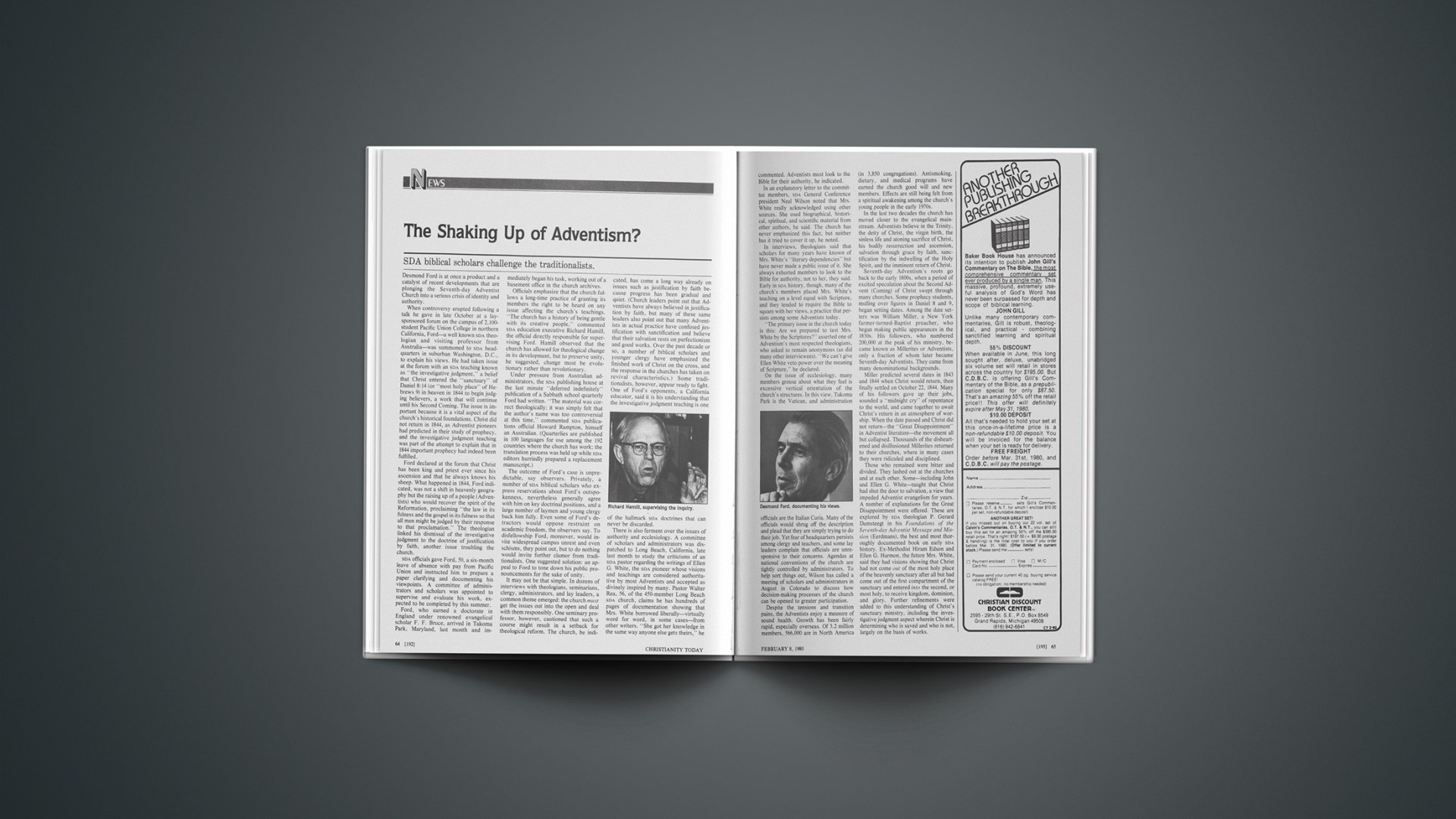
The Shaking up of Adventism?

SDA biblical scholars challenge the traditionalists.

Desmond Ford is at once a product and a catalyst of recent developments that are plunging the Seventh-day Adventist Church into a serious crisis of identity and authority.

When controversy erupted following a talk he gave in late October at a lay-sponsored forum on the campus of 2,100-student Pacific Union College in northern California, Ford—a well known SDA theologian and visiting professor from Australia—was summoned to SDA headquarters in suburban Washington, D.C., to explain his views. He had taken issue at the forum with an SDA teaching known as “the investigative judgment,” a belief that Christ entered the “sanctuary” of Daniel 8:14 (or “most holy place” of Hebrews 9) in heaven in 1844 to begin judging believers, a work that will continue until his Second Coming. The issue is important because it is a vital aspect of the church’s historical foundations. Christ did not return in 1844, as Adventist pioneers had predicted in their study of prophecy, and the investigative judgment teaching was part of the attempt to explain that in 1844 important prophecy had indeed been fulfilled.

Ford declared at the forum that Christ has been king and priest ever since his ascension and that he always knows his sheep. What happened in 1844, Ford indicated, was not a shift in heavenly geography but the raising up of a people (Adventists) who would recover the spirit of the Reformation, proclaiming “the law in its fulness and the gospel in its fulness so that all men might be judged by their response to that proclamation.” The theologian linked his dismissal of the investigative judgment to the doctrine of justification by faith, another issue troubling the church.

SDA officials gave Ford, 50, a six-month leave of absence with pay from Pacific Union and instructed him to prepare a paper clarifying and documenting his viewpoints. A committee of administrators and scholars was appointed to supervise and evaluate his work, expected to be completed by this summer.

Ford, who earned a doctorate in England under renowned evangelical scholar F. F. Bruce, arrived in Takoma Park, Maryland, last month and immediately began his task, working out of a basement office in the church archives.

Officials emphasize that the church follows a long-time practice of granting its members the right to be heard on any issue affecting the church’s teachings. “The church has a history of being gentle with its creative people,” commented SDA education executive Richard Hamill, the official directly responsible for supervising Ford. Hamill observed that the church has allowed for theological change in its development, but to preserve unity, he suggested, change must be evolutionary rather than revolutionary.

Under pressure from Australian administrators, the SDA publishing house at the last minute “deferred indefinitely” publication of a Sabbath school quarterly Ford had written. “The material was correct theologically; it was simply felt that the author’s name was too controversial at this time,” commented SDA publications official Howard Rampton, himself an Australian. (Quarterlies are published in 100 languages for use among the 192 countries where the church has work; the translation process was held up while SDA editors hurriedly prepared a replacement manuscript.)

The outcome of Ford’s case is unpredictable, say observers. Privately, a number of SDA biblical scholars who express reservations about Ford’s outspokenness, nevertheless generally agree with him on key doctrinal positions, and a large number of laymen and young clergy back him fully. Even some of Ford’s detractors would oppose restraint on academic freedom, the observers say. To disfellowship Ford, moreover, would invite widespread campus unrest and even schisms, they point out, but to do nothing would invite further clamor from traditionalists. One suggested solution: an appeal to Ford to tone down his public pronouncements for the sake of unity.

It may not be that simple. In dozens of interviews with theologians, seminarians, clergy, administrators, and lay leaders, a common theme emerged: the church must get the issues out into the open and deal with them responsibly. One seminary professor, however, cautioned that such a course might result in a setback for theological reform. The church, he indicated, has come a long way already on issues such as justification by faith because progress has been gradual and quiet. (Church leaders point out that Adventists have always believed in justification by faith, but many of these same leaders also point out that many Adventists in actual practice have confused justification with sanctification and believe that their salvation rests on perfectionism and good works. Over the past decade or so, a number of biblical scholars and younger clergy have emphasized the finished work of Christ on the cross, and the response in the churches has taken on revival characteristics.) Some traditionalists, however, appear ready to fight. One of Ford’s opponents, a California educator, said it is his understanding that the investigative judgment teaching is one of the hallmark SDA doctrines that can never be discarded.

There is also ferment over the issues of authority and ecclesiology. A committee of scholars and administrators was dispatched to Long Beach, California, late last month to study the criticisms of an SDA pastor regarding the writings of Ellen G. White, the SDA pioneer whose visions and teachings are considered authoritative by most Adventists and accepted as divinely inspired by many. Pastor Walter Rea, 56, of the 450-member Long Beach SDA church, claims he has hundreds of pages of documentation showing that Mrs. White borrowed liberally—virtually word for word, in some cases—from other writers. “She got her knowledge in the same way anyone else gets theirs,” he commented. Adventists must look to the Bible for their authority, he indicated.

In an explanatory letter to the committee members, SDA General Conference president Neal Wilson noted that Mrs. White really acknowledged using other sources. She used biographical, historical, spiritual, and scientific material from other authors, he said. The church has never emphasized this fact, but neither has it tried to cover it up, he noted.

In interviews, theologians said that scholars for many years have known of Mrs. White’s “literary dependencies” but have never made a public issue of it. She always exhorted members to look to the Bible for authority, not to her, they said. Early in SDA history, though, many of the church’s members placed Mrs. White’s teaching on a level equal with Scripture, and they tended to require the Bible to square with her views, a practice that persists among some Adventists today.

“The primary issue in the church today is this: Are we prepared to test Mrs. White by the Scriptures?” asserted one of Adventism’s most respected theologians, who asked to remain anonymous (as did many other interviewees). “We can’t give Ellen White veto power over the meaning of Scripture,” he declared.

On the issue of ecclesiology, many members grouse about what they feel is excessive vertical orientation of the church’s structures. In this view, Takoma Park is the Vatican, and administration officials are the Italian Curia. Many of the officials would shrug off the description and plead that they are simply trying to do their job. Yet fear of headquarters persists among clergy and teachers, and some lay leaders complain that officials are unresponsive to their concerns. Agendas at national conventions of the church are tightly controlled by administrators. To help sort things out, Wilson has called a meeting of scholars and administrators in August in Colorado to discuss how decision-making processes of the church can be opened to greater participation.

Despite the tensions and transition pains, the Adventists enjoy a measure of sound health. Growth has been fairly rapid, especially overseas. Of 3.2 million members, 566,000 are in North America (in 3,850 congregations). Antismoking, dietary, and medical programs have earned the church good will and new members. Effects are still being felt from a spiritual awakening among the church’s young people in the early 1970s.

In the last two decades the church has moved closer to the evangelical mainstream. Adventists believe in the Trinity, the deity of Christ, the virgin birth, the sinless life and atoning sacrifice of Christ, his bodily resurrection and ascension, salvation through grace by faith, sanctification by the indwelling of the Holy Spirit, and the imminent return of Christ.

Seventh-day Adventism’s roots go back to the early 1800s, when a period of excited speculation about the Second Advent (Coming) of Christ swept through many churches. Some prophecy students, mulling over figures in Daniel 8 and 9, began setting dates. Among the date setters was William Miller, a New York farmer-turned-Baptist preacher, who began making public appearances in the 1830s. His followers, who numbered 200,000 at the peak of his ministry, became known as Millerites or Adventists, only a fraction of whom later became Seventh-day Adventists. They came from many denominational backgrounds.

Miller predicted several dates in 1843 and 1844 when Christ would return, then finally settled on October 22, 1844. Many of his followers gave up their jobs, sounded a “midnight cry” of repentance to the world, and came together to await Christ’s return in an atmosphere of worship. When the date passed and Christ did not return—the “Great Disappointment” in Adventist literature—the movement all but collapsed. Thousands of the disheartened and disillusioned Millerites returned to their churches, where in many cases they were ridiculed and disciplined.

Those who remained were bitter and divided. They lashed out at the churches and at each other. Some—including John and Ellen G. White—taught that Christ had shut the door to salvation, a view that impeded Adventist evangelism for years. A number of explanations for the Great Disappointment were offered. These are explored by SDA theologian P. Gerard Damsteegt in his Foundations of the Seventh-day Adventist Message and Mission (Eerdmans), the best and most thoroughly documented book on early SDA history. Ex-Methodist Hiram Edson and Ellen G. Harmon, the future Mrs. White, said they had visions showing that Christ had not come out of the most holy place of the heavenly sanctuary after all but had come out of the first compartment of the sanctuary and entered into the second, or most holy, to receive kingdom, dominion, and glory. Further refinements were added to this understanding of Christ’s sanctuary ministry, including the investigative judgment aspect wherein Christ is determining who is saved and who is not, largely on the basis of works.

Associations with Seventh Day Baptists led to the adoption of a Sabbath doctrine. Mrs. White, a prolific writer, was seen as having the “Spirit of Prophecy” by which she received revelations from God. A group of Adventists set up a headquarters in 1855 in Battle Creek, Michigan, home of vegetarian Adventist W. K. Kellogg, inventor of corn flakes. Under the leadership of Ellen White’s husband James, an editor, the SDA was formally organized in 1863. Following a spat between Kellogg and other SDA leaders, offices were moved in 1903 to Takoma Park. Mrs. White died in 1915.

The keystone doctrine of the Protestant Reformers—justification by faith (God’s declaration that a believer through faith is righteous in Christ)—apparently received little attention from the SDA pioneers. Mrs. White later stated that she and her husband had stood alone for 45 years in teaching the doctrine. Moreover, the predominant view of justification embraced by early Adventists was akin to the Catholic one hammered out at the Council of Trent: Christ died for the sins of the past, but if the believer is to survive judgment, he must provide evidence of his righteousness through obedience and good works with the aid of the Holy Spirit. This confusion of justification with sanctification, linked as it was to a pre-Advent judgment, led many Adventists into perfectionism.

The Adventists came to the brink of a theological revival in 1888, according to SDA watcher Geoffrey J. Paxton, an Anglican who is president of the Queensland Bible Institute in Brisbane, Australia. In The Shaking of Adventism (Baker, 1977), an attempt to trace the development of the doctrine of justification among Adventists, Paxton notes that two SDA ministers preached righteousness by faith at the church’s 1888 general conference in Minneapolis. Even though Mrs. White supported their views, the conference was divided. Periodic meetings have been called over the years since then to analyze what happened in 1888, and to see if some agreement could be reached on the meaning of the gospel of righteousness by faith. Desmond Ford has been a central figure at some of these meetings, pleading for the church to repent and to embrace Christ’s finished work on the cross. It is this call, amplified by Ford and others, that leads Paxton to conclude that Seventh-day Adventism is being shaken right down to its foundation.

SDA officials consider Paxton a troublemaker, and they have tried to ban him from speaking at SDA gatherings.

SDA officials are quick to emphasize that the church has always taught righteousness by faith. The full impact of the message, however, somehow seems to get bottled up.

The official SDA youth publication not long ago complained that Seventh-day Adventism’s greatest problem is related to “the consequences of years and years of unceasing perfectionism that has infiltrated every sphere of our denominational existence, be it church, Sabbath school, or home.” The result, said the paper, is “a generation of spiritually exhausted and frustrated people” who end up either pretending everything is okay or dropping out of the faith “because they know they will never reach the perfect standards of the church.”

Ford isn’t the only Australian who has gotten into trouble with traditionalists in the church over the justification issue. Robert D. Brinsmead, graduate of an SDA college in Australia and one of the most vigorous voices for theological reform among Adventists, is another. While Brinsmead was lecturing in the United States in the early 1960s, a denominational executive and a tiny Australian church disfellowshiped him from the denomination. Although he now refers to himself as an independent evangelical, he has remained in touch with Adventists around the world and is frequently called on to speak at unofficial gatherings. One of his weekend series is entitled “1844 Reexamined.” In it, he challenges the validity of virtually the entire SDA historical foundation, including the matters pertaining to the investigative judgment.

For some reason, Ford has been under heavy pressure from unnamed officials to condemn Brinsmead and his teachings publicly. Ford, however, agrees with Brinsmead on many positions and has declined to rebuke him. Says Ford about his own position: “I am not attacking any basic doctrine of the church, but I am suggesting that the traditional mode of teaching the judgment can be made more exegetically sound and more vital in its impact on the spiritual lives of our people.”

Public Events

The Exercise of Religion at the Winter Olympics

Spiritual fitness is on the program of next month’s Winter Olympics in Lake Placid, New York. For the first time, a committee devoted solely to the spiritual needs of the athletes and spectators is part of the official Olympics organization.

“The Committee on Religious Activities of the 13th Winter Olympic Winter Games, 1980,” is the brainchild of a United Methodist pastor in Lake Placid, J. Bernard Fell. He, along with other Lake Placid clergymen, was concerned about the spiritual needs of the international contingent of athletes and spectators. In 1976, shortly after their city was designated as the winter games site, the clergymen asked the International Olympic Committee in Lausanne, Switzerland, for permission to add the committee to the official Olympics organization. The 10 clergymen members of Lake Placid’s clerical association, representing Protestant, Catholic, and Jewish faiths, are the committee’s members. They first sought an executive director, and selected Daniel J. McCormick, 33, from more than 75 applicants. McCormick, then a professor at the State University of New York in Plattsburgh, had seen an ad in his local newspaper and applied. A former Roman Catholic seminarian, he saw the job as an ideal opportunity, “covering the best of both worlds—religious programs and human services.”

Though McCormick is the only paid staff member, the committee has over 100 volunteers. It held five “consultations” in 1977 and 1978 with up to 85 representatives from over 40 church and church-related organizations. “We wanted to draw on the resources of various church groups in order to develop a comprehensive ecumenical approach, so there wouldn’t be duplication [in activities or resources of religious groups at the Olympics], but cooperation in the best possible way to address spiritual needs,” said McCormick.

Out of those meetings, the committee formulated its six main functions: providing chaplains for the athletes; arranging worship services (including a community ecumenical service on February 11, the night before the games’ official start, in the 8,000-seat Olympic arena, with Fell as main speaker); providing the news media with stories and information of religious interest; presenting religious entertainment; and arranging a “human services” center.

The amount of available money has determined the scope of committee activities. The IOC gave $100,000 to operate the 24-hour human services center in the town’s American Legion Hall. The center will have a “sobering-up service”; a lost-and-found; a center for holding and placing lost children; counseling service; a hot line; general information; and a religious literature section.

The IOC wouldn’t allow any of its funds to be used for any religious purpose, no matter how remote. Thus, between the summers of 1978 and 1979 the committee went soliciting. Originally, a $100,000 goal was set; only half that amount had been raised by last month.

“We went to the denominations, but some objected [that] it wasn’t within their means or [permitted] by commitments from their own contributors,” said McCormick. “Others didn’t want to share with ecumenical groups.” Most of the $50,000 came from the Roman Catholic Church ($30,000), the United Methodists ($10,000), the Southern Baptists ($5,000), and the Episcopalians.

The American Bible Society is providing $100,000 in the form of goods and services. It has printed flyers, identification tags, rules, and other items for the committee, as well as providing Bibles and Scripture excerpts in various languages.

The committee’s chaplaincy program is “our most important” function, said McCormick. The 15 chaplains (12 men and 3 women) represent Southern Baptist, Lutheran, United Methodist, Episcopal, and Evangelical Covenant denominations, as well as Roman Catholic, Greek Orthodox, and Jewish bodies. (A Hindu chaplain from the United Nations had to resign because of ill health.) They were chosen from 100 applicants on the basis of “linguistic, pastoral, and ecumenical experiences.”

The chaplains’ pastoral duties won’t include proselytizing: the IOC has a rule against such activities at Olympic Games sites. “We aren’t encouraging it. We’re forbidding it,” said McCormick. Any chaplain found persuading athletes “in the direction of any particular denomination [will] be asked to leave.”

The committee has come out officially against what McCormick calls “street evangelism.” That position has provoked criticism from some evangelical groups; the New York Association of Evangelicals is “perplexed and displeased,” said McCormick. The committee “is not indulging in or endorsing” evangelistic activities at the games, in order to take an “ecumenical” approach, McCormick explained.

The area’s churches will have extra services and hospitality suites. There will probably be some coffee-house-type ministries and also religious musical programs. Many groups seeking to participate will be referred to the various churches, said McCormick.

In addition, the literature racks in the human services center will be “available to interested parties who ask” for permission to put materials there, he said. “We hope to have a unified, comprehensive approach, as opposed to individual groups doing their own thing and having chaos.”

WILLIAM SHUSTER

Taxing Subjects

Deductive Reasoning

Scripture says that God loves a cheerful giver. And what makes a giver happier—and more generous—than a healthy tax deduction?

Such thinking prompted pending legislation that would allow taxpayers to deduct their charitable contributions whether or not they use the so-called standard deduction. The National Council of Churches, among other religious and nonprofit groups, has lobbied for such a bill, believing that billions of dollars in contributions are lost because of the rising standard deduction: persons find it less beneficial to itemize their deductions, and, as a result, less beneficial for them to contribute.

California businessman Parker Dale is carrying the thinking one step farther. In national newspapers, he advertises his sale of Bibles as a tax shelter.

Forbes magazine describes Dale’s method of buying Bibles wholesale, and then selling them at a profit of perhaps a dollar on each. At this rate, on a sale of 400,000 Bibles (which Dale anticipates for 1980), Dale would earn himself a tidy $400,000.

His customers, however, can donate the Bibles to churches or missions and deduct from their tax return the full retail price of the Bible, which may be three times their own cost. They may get up to $3 in deductions for every $1 they invest, with the Internal Revenue Service bearing the difference.

An archeologist digging around a millennium hence might conclude from all these Bibles that Americans were a very religious people. But Forbes reporter Howard Rudnitsky notes, “How could he understand that it wasn’t our souls we were trying to preserve but our overtaxed pocketbooks?”

Financial Irregularities

Troubling of the Waters at Bethesda Christian Center

Many people first became acquainted with Bethesda Christian Center as the progressive publisher of Virtue magazine, a slick, four-color publication for Christian women with articles showing that yes, even Christian women can have culture and wear nice clothes. Some wondered how the small, charismatic congregation of about 1,100 (500 members) could afford to publish the magazine.

But then generous tithing by members made possible a number of ventures. The center has 56 full-time employees, and operates high, middle, and grade schools, the 141-student, four-year Bethesda Christian College, a Christian arts center, a radio station, and a gas station. The church has a strong spiritual influence on the central Washington community of Wenatchee. (The church building is located in nearby Monitor.)

Pastor Larry Titus and his wife Devi, the stylish and smartly-coifed editor of Virtue magazine, started the church 11 years ago, mostly with young people coming out of the Jesus movement. A local newspaper reporter said the growing church has been controversial, but is a “solid group, a dynamic movement,” with loyal members—many of them respected persons in the community.

But now a major financial scandal threatens to curb the center’s style and mar its good name with red ink. Former business administrator James E. Eyre, 48, was being held in Chelan County Jail last month on $1 million bond, charged with first degree theft in connection with the alleged misappropriation of several million dollars in Bethesda funds.

The church released Eyre from his duties in late December after discovering “discrepancies” and “lies” in the church books, said assistant pastor Leslie Coughran. Later, Titus went to Chelan County Prosecutor E. R. Whitmore. “He [Titus] advised me of some of the things he discovered and asked me to proceed,” Whitmore told the Wenatchee World.

The affadavit filed with the charge by Whitmore specifically accuses Eyre of writing a check on a church account to pay for some electrical work at his private duplex. However, Titus told the World that several million dollars are missing.

The scandal has developed to national proportions. In a copyrighted story, the World indicated that both the Internal Revenue Service and the Federal Securities and Exchange Commission are investigating the allegations. The SEC got involved since the center, beginning in 1978, sold $850,000 in public bonds—the proceeds from which were to pay off various church debts—in Texas and other states in the South and Midwest. If, indeed, Bethesda has lost several million dollars, it could affect whether the church can repay those bonds.

The bonds were secured by a mortgage on various Bethesda properties, and sold through A. B. Culbertson, a Forth Worth, Texas firm, which specializes in public bond sales for churches, hospitals, and other nonprofit organizations.

(In many states, such as Washington and Texas, churches are exempted from filing registrations statements on public bond sales with state and federal securities officials, the World reported. The statements give full disclosure of an organization’s financial condition, and are a safeguard for potential buyers of an organization’s bonds.)

Since Eyre’s arrest, a number of church members have come forward saying he owes them money, said assistant pastor Coughran. Until recently, Coughran said, the church hadn’t known about Eyre’s private business enterprises involving church members: “The latest would seem to have been diamonds,” he said. Members have individual claims against Eyre that run as high as $255,000, and total nearly $1 million, reported Coughran.

Church officials suspect that Eyre used church money for personal investments, but say they won’t know more until a financial audit is completed. An investigation by a county special prosecutor was expected to last at least two months.

Eyre had been business administrator since 1974. Coughran said the church did not suspect wrongdoing earlier, partly because Eyre had control of all center books as administrator of a central, general accounting office. Eyre was a good friend of the Titus family. Titus told the World that Eyre had given him and his wife cars, diamond jewelry, and other expensive gifts. Titus said his wife gave Eyre the power of attorney over her financial affairs in 1977. Some members trusted Eyre enough not to request written statements of their transactions.

While Bethesda members remained loyal through the crisis, the church is concerned particularly about repaying any money owed to members, Coughran indicated. He said that 84 members made a $341,000 loan to Bethesda after Eyre requested it. That money has disappeared mysteriously, said Coughran, while the members still must be repaid.

JOHN MAUST

North American Scene

Certain American cults may in time become dominant religions, said Rodney Stark, spokesman for a team of University of Washington sociologists that just completed a study of changing religious patterns in the U.S. He said the nation’s 1,000 religious cults and sects have grown as individuals continue to leave the traditional denominations: “Cults will continue to proliferate as secularization makes ruins of the dominant churches.” The study dismissed the notion of a “Bible belt” in the South, while detecting a “cult belt” on the West coast.

The fledgling Evangelical Orthodox Church has begun official dialogue with the one-million-member Orthodox Church in America.EOC presiding bishop Peter Gillquist, an editor for Thomas Nelson Publishers, said his church is attracted to the Orthodox body’s “continuity with the historic Church and the majesty of their worship.” The Evangelical Orthodox denomination organized a year ago with 50 congregations and about 2,500 members who were previously affiliated with the New Covenant Apostolic Order, established in 1974 by Gillquist and six other former Campus Crusade for Christ staff members. The group has stated its commitment to the historic church and church authority: Gillquist announced last fall his church’s renewed emphasis on biblical teachings regarding church discipline.

The nation’s first test-tube baby project has been given the go-ahead, and doctors hope to attempt the first pregnancy next month. Virginia Health Commissioner James Kenley sanctioned an in vitro fertilization program at Norfolk General Hospital, deciding after five months of hearings and studies that the clinic would violate no state or federal laws.

A United Presbyterian pastor who has been accused of denying Christ’s deity, must be reexamined by his presbytery. The UPC Permanent Judicial Commission (highest ruling body) last month ordered that the National Capital Union Presbytery “conduct a proper examination” of Mansfield Kaseman’s doctrinal and theological beliefs. In so doing, it avoided speaking directly to protests regarding Kaseman’s alleged denial of the divinity of Christ during the presbytery’s examination. Conservatives had threatened a schism if the judicial commission upheld Kaseman’s installation. Kaseman since has said he supports Christ’s deity, but that “God is supreme.”

A popular book about angels is being questioned in charismatic circles. In response to Roland H. Buck’s Angels on Assignment (Hunter Ministries), the Melodyland School of Theology has issued five guidelines for determining whether “angelic visitations”—such as those described in the book—are authentic according to the Bible. Buck, a Boise, Idaho, pastor, has been unable to defend his book: he died suddenly of a heart attack last November.

A Baptist leader has been censured publicly by his denomination. When confronted in December by the National Association of Free Will Baptists executive committee, former executive secretary (for 12 years) Rufus Coffey confessed to committing adultery over a year’s time during his recently completed final term in office (1978–79). The committee issued a brief statement in the denomination’s magazine Contact, saying in part, “We cannot tolerate nor condone sin in any person, especially one who occupied an office of such high denominational trust.”

Personalia

In the courtroom: Former Black Panther-turned-Christian convert Eldridge Cleaver was sentenced to probation and 2,000 hours of community service work in Alameda (Calif.) Superior Court last month. Cleaver had pled guilty to three assault charges, in connection with a 1968 shootout between Black Panthers and Oakland police. Hustler magazine publisher Larry Flynt, another turnabout convert, became addicted to painkilling drugs after being shot and becoming paralyzed in 1978. A Franklin County, Ohio, judge ordered a delay in Flynt’s trial, involving a $160 million defamation suit filed against him by publishers of Penthouse magazine, until Flynt finishes a detoxification process.

Mission appointments: Jack Estep has been named general director of the Conservative Baptist Home Mission Society, which supports about 300 missionaries in North America. Previously the CBHMS director of church relations, Estep will succeed Rufus Jones, retiring after 28 years as the society’s first and only general director. Missionary Frank M. Severn, 39, was appointed general director of Far Eastern Gospel Crusade, succeeding Philip E. Armstrong, who becomes FEGC minister of missions.

Book Briefs: February 8, 1980

Love And Marriage

Love and Marriage: Some Recent Books reviewed by Dr. David G. Benner, chairman, Department of Psychological Studies, Wheaton College (Ill.) Graduate School.

Although critics of marriage have been predicting its imminent demise for some time now, Christian publications on the topic show nothing but robust life and growth. Unfortunately, the quality of these publications has not always kept up with the quantity. The following titles, drawn from almost 50 recent works dealing with both dating and marriage, have something significant to offer the interested reader.

Perhaps the best-written and most thoughtful discussion of the issues involved in a dating relationship is Sex, Love, or Infatuation (Augsburg, 1978). Sociologist Ray Short presents 14 clues to help the reader differentiate between sexual attraction or infatuation and genuine love. Although the discussion of secularity seems to be less conservative than many evangelicals would be comfortable with, the book offers the mature young person an excellent presentation of critical issues. Sammy Tippit’s, You Me HE (Victor Books, 1978) is a rather simple discussion of Christian principles of dating. Most suitable for a high schooler, Tippit challenges the reader not to dismiss the book by saying, “Man, you’ve got to be kidding. This is too straight!” (p. 8), but to consider carefully the biblical standards for love relationships. Love and Living Together by Dale Robb (Fortress Press, 1978) explores similar themes for the college-age young adult. Here the focus is more specifically on the place of sex in dating relationships, the test of true love, and evidences of marriage readiness.

Three books extend the discussion from dating to the issues involved in determining marriage readiness and mate selection. Of these, Charlie Shedd’s How to Know if You Are Really in Love (Sheed Andrews and McMeel, 1978) is the simplest; perhaps it is too simple. It does, however, present 10 biblical tests of love and will undoubtedly appeal to many. Somewhat more thoughtfully researched and prepared is How to Have a Good Marriage by Mark Lee (Christian Herald Books, 1978). Here we have a discussion of 50 questions the author suggests every couple contemplating marriage needs to discuss. Love and Sex Are Not Enough by Charles De Santo (Herald Press, 1978) is a more scholarly treatment of the mate selection and courtship process. Drawing skillfully from sociological and psychological insights, both subjects are examined from a firm biblical foundation. It will be particularly useful for the college student.

In a category of its own is Dwight Hervey Small’s How Should I Love You? (Harper and Row, 1979), which provides an excellent discussion of love as it applies to both dating and marital relationships. Small begins by examining the popular myth of romantic love and then by showing how genuine Christian love differs from this. The book is a carefully written, well-balanced discussion that demonstrates what is involved in caring for another in a truly committed manner.

Several good treatments of sex roles in marriage have also appeared recently. Equality and Submission by John Howell (Broadman Press, 1979) presents a careful biblical consideration of not only the theme suggested in the title but also of a broader theology of marriage and the sexes. In his final chapter entitled “Developing Your Own Marriage Style,” he suggests principles for selecting a style from the continuum of biblically sanctioned marital possibilities, a continuum ranging from partnership styles to patriarchal or traditional styles of marriage. Even those disagreeing with the conclusion will benefit from a careful study of this work. Gary Demarest’s Christian Alternatives within Marriage (Word Books, 1977) addresses the same issues, suggesting that “there are alternatives to traditional marriage within the principles of marriage and family life pictured so graphically in the Bible” (p. 14). In a carefully presented manner he considers some of the most crucial scriptural passages and then draws together his conclusions in a fresh and rather creative statement about ways to maintain vitality in Christian marriage. Peter DeJong and Donald Wilson have also considered the question of sex roles both in and beyond marriage in their book Husband and Wife (Zondervan, 1979). Biological, psychological, sociological, and biblical data relevant to the question are examined with painstaking care; the result is a book of broad interest and usefulness.

The largest category of books in the area of love and marriage is of a self-help variety, written to help the reader improve an already relatively intact marriage. It is here one usually finds most of the low quality material. However, recent publications have included a number of good to excellent works. At a fairly practical level, Pillars of Marriage by H. Norman Wright (Regal Books, 1979) deals with such vital areas of marriage as handling conflict, meeting each other’s needs, and learning to forgive completely. John Drakeford’s book, Marriage: How to Keep a Good Thing Growing (Impact Books, 1979) presents 14 action strategies (such as “Put It Down in Black and White” and “Trade Behaviors with Your Partner”) designed to provide concrete steps for the couple interested in improving their marriage.

The Spirit of Your Marriage by David Ludwig (Augsburg, 1979) is less of a how-to manual and more a discussion of what the author calls “the inner dynamics of the marriage relationship.” In this he deals most helpfully with such areas as competition as a block to communication, and emotional intimacy. Similar in emphasis is The Together Experience (Beta Books, 1978). Written by Len Sperry, this balanced presentation of a range of important psychological insights on marriage gives the reader a good understanding of some of the major stages of marital development along with the opportunities provided at each for deepening intimacy. Although not written from an explicitly biblical perspective, this book contains much that will benefit the Christian couple seeking to grow in their marriage. In the same category is Warren Molton’s Friends, Partners and Lovers (Judson Press, 1979). He writes that “friends fantasize the future … lovers embrace their dream … partners roll up their sleeves and go to work.” He goes on to suggest that it takes a combination of all three roles to make the marital union work and illustrates just how the three do merge in a growing successful marriage.

In The Art of Married Love (Harvest House, 1978), Pamela Heim shares richly from her own personal experience something of the process of “growing in love.” Directed primarily to women, the book discusses love clearly and practically. Two books, Making Decisions by David Leaman (Herald Press, 1979) and Love and Negotiate by John Scanzoni (Word Books, 1979), present a discussion of decision making in marriage. Leaman’s book provides a simple though useful discussion of problems in decision making, followed by a decision-making plan for use by couples. Included in this is a consideration of the use of scriptural resources. Scanzoni’s work is subtitled “Creative Conflict in Marriage” and is a somewhat more thorough treatment of the broader issues of conflict in marriage. Arguing for mutual submission as the biblical pattern of marriage, he suggests that “passion for justice” or the “concern that others be treated fairly and equitably” (p. 56) is the quality that must be cultivated in both husband and wife if the marriage is to find creative growth in the inevitable conflicts of the relationship.

Saying Yes to Marriage by William Willimon (Judson Press, 1979) is a broad affirmation of the continuing legitimacy of Christian marriage in a society committed to “doing your own thing.” In it he provides an excellent presentation of a biblical perspective on sexuality. Perhaps his best chapter is “The Challenge of Commitment,” which goes beyond contrasting marriage to nonmarital unions by presenting to all Christian married couples the challenge of total commitment. Two other books also deal with sexuality. Rusty and Linda Wright’s Dynamic Sex (Here’s Life, 1979) is a simply written book, not about techniques, but rather biblical attitudes and principles that relate to sexuality both in and out of marriage. Sexual Problems in Marriage by F. Philip Rice (The Westminster Press, 1978) is a frank and well-presented discussion of human sexuality and specific sexual problems common in marriage. For the couple experiencing sexual problems or interested in understanding their sexuality more fully, this book by an experienced Christian marital counselor should be helpful.

Finally, two recent books address the growing area of marital enrichment programming. Keeping a Good Thing Going by Stephen Carter and Charles McKinney (Concordia, 1979) presents a model program for a group-run, 13-session, marital enrichment program. Consisting of only 48 pages, this book gives suggested goals, devotional thoughts, group exercises, and assignments for each session. Making Good Marriages Better by Robert and Carrie Dale (Broadman Press, 1978) presents a slightly longer and more detailed guidebook suitable either for use with groups or by individual couples. Together these two books should begin to meet a need felt by many for good program materials in the area of marriage enrichment.

In summary, these books clearly demonstrate that the institution of marriage is far from dead. But more important, they also present us with the challenge to make the establishment and maintenance of healthy, growing marriages one of our highest priorities.

Ways To Defend The Faith

Faith Founded on Fact: Essays in Evidential Apologetics, by John Warwick Montgomery (Nelson, 240 pp., $4.95 pb), is reviewed by Irving Hexham, assistant professor of philosophy of religion, Regent College, Vancouver, British Columbia.

This is a stimulating book written in Montgomery’s usual abrasive style. It begins with a strong attack on the first two volumes of Carl Henry’s God, Revelation and Authority (Word), in which Montgomery makes clear his disdain for all attempts at a presuppositional apologetic. Such apologetics are portrayed as a “descent into the abyss of fideism.” In his view, Henry’s approach is “little more than circular.” In the process of attacking Henry, Montgomery takes swipes at professors Gordon Clark, Cornelius Van Til, Herman Dooyeweerd, Edward John Carnell, and Harold Kuhn. The heroes of this book appear to be Schubert Ogden, Harold Pinter, Paul Feinberg, and of course Montgomery himself, whose own works are frequently quoted. In concluding his introduction, which is intended to show how poor evangelical apologetics is, Montgomery chastises “Henry’s badly confused presentation of my philosophy of history” and suggests that Henry ought to have read his works more closely.

The first essay, “The Place of Reason in Christian Witness,” is a sustained attack upon various other Christian positions. The hero appears to be Anthony Flew, who, we are told, has made “a damning judgment on all religious truth claims save that of the Christian faith.” In his introduction Montgomery asserts that non-Christians would not be impressed by apologetics such as those of Carl Henry. Here he seems to be implying that agnostics like Flew would be more impressed by the Montgomery approach. Unfortunately, the example he gives from Flew’s work is one which Flew uses against theologians who hold views like those of Montgomery.

In the second essay, “Science, Theology and the Miraculous,” Montgomery attempts to refute David Hume and to assert the importance of the miraculous in any defense of the Christian faith. Here he lashes out again at all around. He rebukes theologians influenced by Hume for not sufficiently considering that we now live in an “Einsteinian universe” in which there is no such thing as “absolute natural law.” While this argument has some validity, Montgomery seems to miss the main force of Hume’s argument. Hume does refer to natural law, but the thrust of his argument concerns evidence rather than a dogmatic assertion that miracles are impossible, as Montgomery implies. Nowhere in this chapter does Montgomery attempt to tackle the question of the criteria to be used in assessing the miraculous.

The third essay has the intriguing title “Are You Having a Fuddled Easter?” It is a very short attempt to defend the historicity of Christ’s resurrection. In this chapter Montgomery attacks Paul Tillich, Karl Barth, and “three fuddlers from a certain Calvinistic institution that shall remain nameless.” This essay left me the most befuddled of all the ones in the collection.

Changing stride, the fourth essay discusses “How Muslims Do Apologetics: The Apologetic Approach of Muhammad Ali and Its Implications for Christian Apologetics.” This chapter shows Montgomery’s breadth of interest and prolific scholarship. Muhammad Ali, it turns out, is a presuppositionalist and as such very close to “not a few Christian theologians.” Like his misguided counterparts in Christianity, Muhammad Ali is wrong and Montgomery shows us why. The idea of comparing Islamic apologetics with those of Christianity is a good one, but it needs better implementation.

In the sixth essay Montgomery makes a frontal attack upon the apologetics of Cornelius Van Til. He also devotes a couple of paragraphs to attacking Bernard Zylstra and the Dooyeweerdian school. One wonders if he has adequately read Dooyeweerd or Van Til, so superficial is his rejection of them. This chapter was originally published in a work edited by E. R. Geehan, Jerusalem and Athens: Critical Discussions on the Philosophy and Apologetics of Cornelius Van Til. There it appeared with an able 12-page reply by Van Til. Unfortunately, that reply is not in this book.

Though bearing the title “Mass Communication and Scriptural Proclamation,” the eighth and ninth essays are tirades against various theologians who, according to Montgomery, are betraying the faith. He makes some very good points, but again and again the tone in which he makes them undermines his argument. Here Ludwig Wittgenstein emerges as one of Montgomery’s heroes. This is because, according to Montgomery, Wittgenstein “gave new light to the classic ‘correspondence theory’ of truth.” In the light of recent developments in Wittgensteinian studies, I wonder if Montgomery is correct in this assertion.

Harold Lindsell’s The Battle for the Bible is the subject of Montgomery’s final essay, “The Fuzzification of Biblical Inerrancy.” In it he agonizes over the departure from biblical inerrancy by various theologians and institutions. The process of “fuzzification” originated with the Roman Catholics, from whom the Lutherans caught it; now it is threatening the New Evangelicals. Although Montgomery tells us that others “fuzzify,” he does not here attempt to “unfuzzify” the issue.

To Montgomery, the verification principle is the basis of all Christian apologetics. Yet he tells us that this principle must not be taken “too narrowly.” He goes on to explain that the verification principle, in its simplest form, “states that if factual assertions are to be sensible, they must at least be subject to evidential testability.” This sounds good but nowhere in this book does Montgomery really discuss the problems of “testability.” He does not, for example, refer to the discussion of verifiability by philosophers like Alvin Plantinga.

This is a provocative book with some interesting ideas, but it is marred by constant attacks upon other theologians. It makes bold claims and Montgomery is constantly asserting the intellectual viability of his position, yet nowhere does he really come to grips with the philosophical issues involved in the position he espouses. It is easy to lambast opponents and to say that they are confused. It is far more difficult to grapple with their arguments and to show in a sustained way where they go wrong. It is even more difficult systematically to defend the philosophical position that one advocates. This book may well impress the layman, but it will not impress those with philosophical training. Neither, unfortunately, is it going to impress the non-Christian philosopher, like Antony Flew, who is well aware of Montgomery’s arguments and yet rejects them on the basis of Montgomery’s own beloved principle of verification.

Getting Into The Old Testament

The Word Becoming Flesh; An Introduction to the Origin, Purpose, and Meaning of the Old Testament, by Horace D. Hummel (Concordia, 1979, 679 pp. $17.95), reviewed by Glenn A. Wyper, chairman, Department of BiblicalStudies, Ontario Bible College, Willowdale, Ontario, Canada.

Professor Hummel writes this introduction from the standpoint of confessional Lutheranism, which affirms the Bible’s verbal inspiration and inerrancy. His concern is to confront the major problems of the Old Testament generally and liberal higher criticism specifically. For him, liberalism is the “enemy,” and an “almost infinite gulf” is seen to separate the liberals’ camp from the conservatives’. As one might expect, he supports such traditional conclusions as the essentially Mosaic authorship of the Pentateuch, the unity of Isaiah, and the Danielic authorship of the Book of Daniel. The conclusions of liberal scholars, nevertheless, are not understood as being entirely mistaken. For example, frequent use is made of form critical classifications of biblical literature, apart from the subjective attempts to plot the history of individual units. While rejecting JEDP, he suggests that theories about Moses’ sources may be exegetically stimulating as long as the inspired, authoritative text is seen to be the final product and not an earlier draft. Another example is that he finds no theological reason why Isaiah’s disciples and others may not have been involved in the final production of that book, but not to the extent usually assumed by liberals. Conservatives do not escape criticism, but it is minor compared with the frontal assault on liberal scholarship.

The distinctive feature of this introduction is the space it devotes to biblical theology. Believing that questions of background, date, authorship, and so on are the “means to theological ends,” Hummel finds that when Old Testament introductions are about to reach those ends, the matter is dropped. To correct this lack he has incorporated for the major sections of each Old Testament book a running commentary that falls somewhere between Bible survey and detailed exegesis.

An important aspect of this emphasis on biblical theology is typology. While acknowledging that typology can become mere allegory or a kind of matching game, he presses for a sacramental approach whereby the ultimate meaning lies in, with, and under the external history. “The work’s title, The Word Becoming Flesh, was chosen to give expression to that deep, organic unity between the testaments, and via Word and Sacrament, also in us. The logos incarnandus of the Old Testament, the preexistent Christ in His many manifestations, is the same as He who became flesh of our flesh at Bethlehem.”

The intended readers are not professional scholars, but seminary students, pastors, and teachers with some training in both Old Testament and theology. Consequently, the book is designed as a middle level presentation. Pertinent questions about history, text, canon, and so forth are dealt with in the discussions of the individual books. The exceptions to that rule are the chapters on the history of criticism, Pentateuchal criticism, and the introductions to the Latter Prophets and wisdom literature. Three indexes round out the work: one each for topics, authors, and Scripture passages.

Most noticeably absent are footnotes and bibliographies. (Only two brief bibliographies appear.) One can certainly sympathize with the author’s choice to eliminate footnotes altogether and to substitute a general acknowledgement of indebtedness, but that choice would seem to reduce the usefulness of the book.

An addition that could be made in the future to assist the non-Lutheran reader is a brief appendix on the Lutheran concept of Law-Gospel. Since it is an important concept for the author, a reader should not be expected to trace it throughout the book by means of the index.

Generally, the tone is not acrimonious, but at times the author’s impatience with liberals and fellow conservatives is openly expressed. Hummel’s style, despite a penchant for foreign phrases, makes for easy reading. One wonders, however, if the focus on special introduction and the increased space allotted to biblical theology will, in conservative seminaries in which introduction and biblical theology are distinct courses, remove this volume from prospective textbook to the supplementary reading list.

Calling for Peacemakers in a Nuclear Age, Part I

Christ’s ministry is not symbolized by the whip but by the cross.

The contemporary build-up of the superpowers’ nuclear arsenals is a horrendous reality. Each Poseidon submarine has 10 missiles, each of which has 14 MIRV warheads, each of which is equivalent to the Hiroshima bomb. So one submarine carries enough power to destroy 140 Hiroshimas. America’s 11,000 nuclear warheads could annihilate the complete world population 12 times over, SALT II sets a ceiling on the number and type of missiles, but not on warheads, so that within a few years the two superpowers are likely to have between 20 and 30 thousand of them. What lunacy is this?

Five nations are now known to have both nuclear weapons and delivery systems, while five more have the capability to develop them, SIPRI (the Stockholm International Peace Research Institute) forecasts that by 1985 the nuclear club may have grown to 35 member nations.

Nobody can predict with any accuracy how much devastation a nuclear war would cause. It would depend on a number of factors. But the U.S. Congress document The Effects of Nuclear War (1979) says that “the minimum consequences would be enormous.” It provides four case studies ranging from a single megaton weapon attack on a city the size of Detroit or Leningrad to “a very large attack against a range of military and economic targets” in which the USSR struck first and the U.S. retaliated. The former would mean up to two million dead, and the latter up to 77 percent of the American population (about 160 million) and up to 40 percent of the Russian. Moreover, many more millions would die later of their injuries, or starve or freeze to death the following winter, while in the long term cancer would claim yet more victims.

It is against this background of horror that we need to hear again the words of Jesus: Blessed are the peacemakers, for they shall be called God’s children. Peacemaking is a divine activity, and we can claim to be authentic children of God only if we seek to do what our heavenly Father is doing. Thus, the basis for peacemaking is theological: it derives from our doctrine of God.

To be sure, the God of the Bible is a God of both salvation and judgment. But not equally so, as if these were parallel expressions of his nature. For Scripture calls judgment his “strange work”; his characteristic work, in which he delights, in salvation or peacemaking. Similarly, Jesus reacted to willful perversity with anger, uttered scathing denunciations upon hypocrites, drove the moneychangers out of the temple. He also endured the humiliation and barbarities of crucifixion without resistance. Thus we see in the ministry of the same Jesus both violence and nonviolence. Yet his resort to violence of word and deed was occasional, alien, uncharacteristic; his characteristic was nonviolence; the symbol of his ministry is not the whip but the cross.

It is on the ground of this theology—of this revelation of God in Christ and in Scripture—that we Christians must all be opposed to war and dedicated to peace. Of course, throughout the centuries different Christians have formulated their conclusions differently. Some have been total pacifists, arguing that the example and teaching of Jesus commit his disciples to renounce the use of force in any form and to follow instead the way of the Cross, that is, of nonviolent love. Others have seen that according to Paul, officers of the state are “ministers of God” appointed to reward good conduct and punish bad, have argued that Christian citizens may share in the state’s God-given role, and have sought to extend it into the international arena in terms of the “just war.” Although this notion has been expressed in various forms, it may be said to have at least four essential aspects.

First, the cause must be righteous. That is, the war must be defensive not aggressive, its goal must be to secure justice and peace, and it may be justified only as a last resort after all attempts at reconciliation have failed.

Second, the means must be controlled. The two key words have been used regarding the limitation of violence. One is “proportionate.” That is, the degree of injury inflicted must be less than that incurred. The other word is “discriminately.” Police action is essentially discriminate, namely the arresting, bringing to trial, and punishment of specific criminals. Similarly, a war could not be in any sense “just” unless directed only against enemy combatants, leaving civilians immune. This principle is enough to condemn the saturation bombing of German cities in World War II (as Bishop George Bell of Chichester had the courage to argue in the House of Lords), and the fact that Hitler started it is no excuse. I believe the same principle is sufficient to condemn the use of strategic nuclear weapons. Because they are indiscriminate in their effects, destroying combatants and noncombatants alike, it seems clear to me that they are ethically indefensible, and that every Christian, whatever he may think of the possibility of a “just” use of conventional weapons, must be a nuclear pacifist. As the Roman Catholic bishops expressed it at Vatican II: “Any act of war aimed indiscriminately at the destruction of entire cities or of extensive areas along with their population is a crime against God and man himself. It merits unequivocal and unhesitating condemnation” (Gaudium et Spes, par. 80).

Third, the motive must be pure, for in no circumstances whatever does Christianity tolerate hatred, cruelty, envy, or greed. And fourth, the outcome must be predictable: there must be a reasonable prospect of victory, and of gaining the just ends for which the war is fought.

My point, however, is not so much to weigh the respective arguments which some adduce for total pacifism and others for the “just war” position, but rather to emphasize that the advocates of both positions are opposed to war. Both should be able to affirm the statement made by the Anglican bishops at successive Lambeth conferences (1930, 1948, 1968) that “war as a method of settling international disputes is incompatible with the teaching and example of the Lord Jesus Christ.”

So then, although “just war” proponents may seek to justify engagement in war in certain restricted circumstances, they should never seek to glorify it. They may acquiesce in it with the greatest reluctance and the most painful qualms of conscience, but only if they perceive it as the least of all the alternative evils. And we should steadfastly refuse to glamorize war; war remains inhuman, unchristian, bestial. It is peacemaking we are to glorify. In brief, the only possible way Christians can try to justify war is to present it as the only possible way to make peace.

In my next “Cornerstone” article I hope to make some practical suggestions about Christian peacemaking.

John R. W. Stott is rector emeritus of All Souls Church, London, England.

Refiner’s Fire: How One Artist Reflects God’s Creation

Through everything he draws or paints he is both the illuminator and illuminated.

What can you recall from the age of three or four? Anything? Few of us have any specific recollections. Thus, it is hard to accept a novelist who has a character say, “I can remember, at the age of four, holding my pencil and transferring the world around me to pieces of paper, margins of books, bare expanses of wall.”

Highly unlikely, we think. Yet, Joe DeVelasco has such memories. The only difference is that he began at three, not four. He drew his family, his friends, his street—lampposts, fire hydrants, buildings, anything and everything. He was compelled to draw. He still is.

DeVelasco’s parents attended Catholic services in Chicago while he was growing up, but the children were dropped off at an evangelical Protestant Sunday school. Although he and his parents were close and his home life sound, early in life he began to run with gangs. The gang members were his friends; he supported them, no matter what they did.

But simultaneously he lived a different life, one of paper and pencil, of pictures, of imagination. His friends knew little of his other existence. He recalls that while he waited to leave home for a fight, he would stare at the pictures he had drawn and wonder how to put the two parts of his life together. His love of drawing—in grade school he received a Saturday scholarship to the Art Institute of Chicago—compelled him while he was still in grade school to ask himself some basic questions: Why am I here? What do I want? What will make sense out of life? His street experiences didn’t provide the answers, but they taught him to survive. They also taught him what he didn’t want.

What he did want were answers. He found them in Christ at Grace Youth Camp, a church camp in Michigan. What meant most to him was his connection with the church where he attended Sunday school, and which sent him to camp. Later, after serving in the army, he attended Milwaukee Bible College for two years, and then went on to art school.

His decision to become a Christian, DeVelasco says, not only changed his direction and answered his questions, but profoundly affected the way he would see art and his role as an artist. Without realizing it at the time, he became part of the classic struggle between the secular and the sacred. What can an artist who is a Christian draw or paint? Are some subjects appropriate, others inappropriate? Is art itself an occupation acceptable for a Christian?

Such questions would sound foolish to a Dürer or a Rembrandt. The distinction between sacred and secular didn’t exist for them: all of life lived to the glory of God was sacred. Work was sacrament—all work, any work. And an artist who reflected the image of God through his creations (God creates, we create), certainly had a high calling.

DeVelasco found that the Christian community no longer had that view of the arts or the artist. (He also has seen a definite change in the last few years in this regard.) Throughout his two years in Bible school and his further study as an artist, Christians assured him that art was fine—as a hobby. But he was determined not to be a weekend painter and not to become discouraged. When he was told that art school was acceptable provided he avoid the one class he found most helpful—life class—he was surprised.

In life class, art students learn to draw the human figure. They learn anatomy, the structures of bone and muscle, the geometric shapes of the body. Students use live nude models. Until you can draw a nude figure, you can never draw a figure clothed. DeVelasco insists that the most difficult object to draw—as would be appropriate for the crown of God’s creation—is the human form. After you conquer that, still life and landscape are simple. He refused to forsake life class.

The problem, DeVelasco says, is that many Christians equate nudity and sexuality. For him they have little in common. True, some artists have misused their gifts; he readily admits that. But so have people in other professions. Does that mean Christians should avoid the medical, legal, or even ministerial professions? To forbid this aspect of painting, one would have to forbid all kinds (which, of course, is what Hasidic and conservative Judaism have done).

But almost more important than learning to draw the shapes of the body (and every shape that exists in creation can be found in the human form) is learning to see. The light is all important.

DeVelasco’s inner eyes were opened when he became a Christian; that in turn helped to open his artistic eyes. Light is the primary symbol in his life. By light, we see everything; without it, nothing. Jesus Christ, he reminds us, said he was the “light” of the world. It was that light which created color, shape, form, texture. And without light none of these things can be apprehended. DeVelasco tries to see everything he draws or paints through that Creator Light. Christ, then, is both the illuminator and the illumination.

When we see with that light, the dichotomy between secular and sacred disappears. DeVelasco thinks a Christian artist always sees with the eyes of the spirit, no matter what he chooses for a subject. But he cautions us to look at all that an artist does and the integrity with which it is done. For example, if an artist paints nudes to the exclusion of the rest of creation, then, he thinks, a problem exists. But it is equally a problem to avoid that aspect of creation. He delights in painting all of God’s world—city and country and everything in between.

And for him, one of the most important things to illustrate is Scripture. He is a committed “note-taker in pictures.” He studies the Bible by drawing in the margins. “I can say more in a sketch than I can in a paragraph,” he explains. He uses the Bible as his script in much the same way a commercial illustrator uses advertising copy. He draws the Word of God.

Television has taken over as the principal communication tool of the twentieth century. That’s what we’re competing with, DeVelasco insists. Why can’t we use a new approach to studying the Bible? “I can make God’s Word just as interesting to kids as television.” Certainly the idea of illustrating the Bible is not new. Rembrandt did it, and his drawings helped people in seventeenth-century Holland remember the Bible better. But we have become so far removed from art as a natural part of life that the suggestion sounds revolutionary.

DeVelasco has strong views on what young Christians who are interested in becoming illustrators or painters should be taught—and what traps they should avoid. For him, the strength of the artist lies in his commitment to art. No one can make you an artist, he says, any more than someone can make you a Christian. You have to want it enough to overcome hostility and mockery. The more secular our society becomes, the more difficult it is to live a Christian life. And the more secular the society, the wider the gap there is between it and the sacred. Artists who don’t share your religious commitments won’t take you seriously, and Christians who don’t share your artistic commitment will suspect your faith. That is an uncomfortable position in which to be. DeVelasco gives his wife the credit for helping him maintain his commitment to both.

Once a young Christian artist has decided to take the risks, says DeVelasco, then the work and the sacrifice begin. He needs to draw nonstop; he needs to decide who he is as an artist; and above all, he needs to learn to see. With sight illumined from within as he keeps his eyes on the prize of the high calling of God, a young Christian artist can fulfill his talent and hold his faith.

Cheryl Forbes, editor of the publishing division of The Genesis Project, lives in New York City.

Toward a Holiness beyond the Obvious

What can transform the faltering church into a redemptive force?

At an ecumenical consultation, predominantly of United Methodists, and sponsored by the Foundation for Theological Education, church leaders assembled for an in-depth study of the loss and recovery of the sacred in our society. Bishop Earl G. Hunt, Jr., delivered the concluding address, which warmed the heart of the “fundamentalist” editor of C.T. (or so he was called) and yet challenged the mind and moved the will of the more liberally oriented participants.

The apparent absence of God led Isaiah at one point to pray for a universal theophany: a manifestation of God’s presence. Isaiah implores God (chap. 64) to reveal himself in a cataclysmic invasion of the natural order. He pleads for God to “rend the heavens,” so that “the mountains might flow down” and “the melting fire cause the waters to boil.”

Then he bursts poetically into praise to the God who performs incalculable wonders for those who wait for him. “For since the beginning of the world men have not heard, nor perceived by the ear, neither hath the eye seen, O God … what he hath prepared for him that waiteth for him.”

This almost vehement supplication for an advent of God states the Bible’s faith that it is God who assumes the initiative and works in ways almost beyond the comprehension of human imagination. Here, it seems to me, is one of the most splendid affirmations of the sacred to be found anywhere in Scripture. The Christian religion is based on a revelation from God that virtually defies the categories of modern thought. On the other hand, when I was beginning my ministry the attitude of studied unfaith was most popular. In place of the idea of divine self-disclosure men almost gleefully substituted the scientific method. Many preachers, trained in this tradition, became very little more than “humanists in vestments.”

But pendulums swing. The old-time liberalism is long since bankrupt. The pity is that so many people trained under its banners are not really aware of its demise, and in their positions of responsibility and leadership are continuing to project programs predicated on its now outdated presuppositions.

The church community must now focus on the urgency of a new outcry by the faithful for divine self-disclosure. We acknowledge the loss of the sacred in Western culture. The question then faces us: What can possibly transform the faltering church we know today into a redemptive force? Spiritually sensitive people answer by calling for a genuine renaissance of the kind of belief in God and his gospel that once more will make real to us both his demanding disciplines and his precious promises. Only then can the moving phraseology of the Song of Songs describe the church: “Fair as the moon, clear as the sun, and terrible as an army with banners”! How can we become agents of this miracle? Let me explore four pathways.

The Lighted Mind

We seem to be moving rapidly into a largely unrecognized era of antiintellectualism in our own country and perhaps in Western civilization. In much of our public school system today the element of substantive content in classroom teaching and the factor of disciplined demands upon the student have vanished. This is so total as to release upon the colleges generations of young people who can neither read nor write with acceptable accuracy, and who have never been introduced to the skills of study and thought. Hardpressed institutions often believe they must of necessity admit such young people. They fear that otherwise they face economically disastrous attrition and costly litigation.

In many instances this has caused the virtual collapse of reasonable standards of quality and excellence. Dean Henry Rosovsky of Harvard (arts and sciences) said in a 1974 letter to his teachers, “The B.S. degree is becoming little more than a certificate of attendance.” The president of a distinguished church-related university in the Methodist family charged recently that the church has “accepted the pleasure principle of society without firing a shot against it. It behaves like a political aspirant looking for a public image. It forgets and sometimes seems ashamed of the Gospel.”

These are heavy indictments; and if they are true where the church is concerned, we can understand how they could be basically true where education, always intimately related to religion, is involved. What we have traditionally referred to as liberal education, or the liberal arts, may be terminally ill in our time.

This kind of education has always insisted on exposure to the great books and concepts of the centuries, including the Bible and the ideas of Christianity. It glories in grappling with the hard questions of human existence and experience, the stubborn but intriguing “why” issues. It deliberately seeks to train the student to think, and it struggles purposefully to develop an ability to make value judgments. Most significantly, it offers the option of God and informed faith, an understanding of the place of the spiritual in life that is whole.

My concern over antiintellectualism is matched by a second concern: I seriously question whether this nation or Western civilization itself can hope to survive the years just ahead unless education recovers its sense of the sacred. By this I mean its ancient obligation to offer content that builds moral sensitivity and value response, and provides exposure to the rich religious legacy of human culture and history. I wonder, too, whether leadership for an awakened church can be supplied from the ranks of young men and women who are victims of this sweeping removal of the sacred from the learning process.

I urge two actions. The first is that Christian scholars, with the rest of us helping as we can, rededicate themselves to the strengthening of Christian liberal education. I do not believe that the merely church-related college has much hope or reason for survival between now and the year 2000. But what of the deliberately Christian institution of higher learning that is honest enough not to be ashamed of the gospel and bold enough to demand quality performance in the classroom? I believe such a school will find support among thoughtful people in the Christian community—in spite of spiraling inflation and diminishing student enrollment.

My second plea is that the Christian community speak urgently and courageously to both religion and the secular university concerning their duty to build an awareness of the holy, the sacred, back into perspective and curricula.

How does this relate to the welcomed resurgence of historic evangelicalism? If it is to have permanent meaning and value, that very evangelicalism is required to be more than casually conversant with the best in human culture. Yet much of it fails here, as we see in many presentations on television and radio, and even more in utterances in local churches and in print. I know we must take into consideration the general decline in the public’s willingness to study and reflect for itself; the gospel must be served up to this kind of intellectually limited constituency also. But unless the church can continue to discover and train an informed nucleus of believers able to relate the gospel excitingly to the wisdom of the centuries, the church will lack that quality of viable leadership required to accomplish God’s will now and in the dangerous tomorrows. In the spirit of the text I plead for our prayers in behalf of a new divine self-disclosure that can restore, in this moment of history, the glory of the lighted mind.

Hell Shall Not Prevail

The church is in deep human trouble, its fabric tattered by many current agonies. It is being blitzed by the community of homophiles and sexual aberrationists. Even a multitude of worthy human causes, seeking a significant forum for their pleas, are badgering the church to compromise its fundamental roles as Scripture defines them. A strangely sanctified worldliness, the product of economic affluence and its concomitant problems, has invaded and polluted Christian motivation, discipline, and commitment. And in the midst of it all, happily engaging in the oldest dodge there is, the church in too many instances avoids addressing its real problems by tinkering awkwardly with its structure and machinery!

By God’s grace the institutional church still occupies a unique position in our society and, oddly enough, its presence awakens certain expectations on the part of a population not always or even often religiously sensitive. But just beneath the surface of public consciousness lies a subterranean perception, possibly placed there by the Holy Spirit, of what the church ought to be and what it ought to be doing. This should alert Christians to the dangers that confront them. I suspect that the general patience of society toward the institutional church may be running out. I also have a conviction that those of us who have positions of leadership in that church need to recognize this sobering fact honestly and immediately.

I plead for us to learn again how to “let the Church be the Church,” as Elmer George Homrighausen wrote nearly four decades ago. This will call for Christian courage that may prove professionally costly. For example, I think we must begin to apply without compromise the principles of biblical teaching to all the problems of human sexuality so prominent in public thinking today.

To be sure, we must have compassion for the deviationist, whether homosexual or heterosexual. And we must endeavor with Christian love and with gentle but informed evangelistic skill to offer redemptive help. But we must declare, always without judgmental malice but always with unmistakable clarity, that the practice of homosexuality is incompatible with Christian teaching; and that the celebration of the joys of sex itself, a nearly sacramental act ordained by God in his love for human beings, is always to be reserved for the marital relationship. This is the unequivocal teaching of biblical religion and to compromise it is to injure mortally the witness of the church.

Moreover, while continuing to cultivate an acute awareness of all human problems, we must never allow the church to slacken its preeminent emphasis on bringing men and women into newness of life through faith in the saving grace of Christ. Historically and biblically this is our primary function; but it is a function involving both the whole person and the whole gospel. So conversion must include not only a person’s right relationship with his or her heavenly Father but also with his or her fellow human beings. Confession of the Savior and bold implementation of social justice are indissolubly interrelated in the economy of grace.

Again, I am persuaded that the church, in order to recover its essential servant role in the human family, must deliberately throw off the unfortunate accouterments of affluence that have caused its critics to accuse it of mercenary objectives and luxurious self-aggrandizement. Its leadership and membership, to a large extent, must be willing to change their lifestyles and impose upon themselves once more those time-honored and sacred disciplines of austerity, prayer, study, meditation, and utter self-giving which, through the centuries, have been the most precious hallmarks of Christian dedication and commitment.

What I am saying is simply this: the church—beginning with people like you and me—must be willing to pay the price involved in the recovery of its authentic character in our world if men and women are to hear its ancient evangel again with open minds, and to respond to it.

Besides this, we must consider as part of a new evangelical commitment the miracle of worship. By the Spirit’s action it is the gathered congregation, come into one place to glorify God and receive his message, that becomes the energizing event for all the church’s activities. Perhaps there are two ways to look at it:

First, the act of worship has meaning for God himself. Years ago Sören Kierkegaard used an illustration taken from the theater. He pointed out that ordinarily a congregation regards itself as an audience before which the minister and the choir give their presentation or performance—with God identified in the process as a kind of unseen playwright or producer. However, the great Danish theologian reminds us, the true picture is quite different. The congregation actually is the cast of actors, with the minister and the choir serving as directors and prompters, offering cues from the wings. The audience is God, and the entire presentation is offered for his good pleasure and everlasting glory.

We need this corrective thought to make us bring God back into the center of things and to help us realize, in the old catechetical language, that our chief end is “to glorify God and enjoy Him forever”! In some way we cannot altogether comprehend, our recovered effort to delight the Almighty’s heart may prove of substantive importance in the fresh release of his saving power.

The other way to think of this has to do with the redemptive transaction which, again by God’s Holy Spirit, occurs in the act of worship. John Wesley often said that in the Word and in the sacraments, as they are proclaimed and celebrated in the church, an objective holiness produces a subjective holiness in the people, or else the church is not actually the church at all. He also taught that faith itself is a gift of the Holy Spirit that enables a man or woman to comprehend spiritual realities, the things that belong to God. It seems to me that the entire theory of corporate worship is here: when the Holy spirit informs the message of the minister and instructs the worshipers, he produces a redemptive interaction between pupil and pew, so God again and yet again performs his wonderful works in the lives of people.

When you put together these two ways of looking at worship, the objective and the subjective, you have at least a faint suggestion of the power we ought to find in this event.

A Quality of Life

An essential corollary to the recovery of the sacred must be the renewal of that elusive quality, “holiness,” in our lives. I know that any real goodness must be imputed by God, who is the source of holiness in daily personal living. But we must long to be holy, and strive for it, if God is to use us.

Professor Leroy Loemker, long-time dean of Graduate Studies at Emory University, exemplified this holiness. In scholarship, his brilliance was mesmerizing; but in addition, he was constantly probing our lives as young theologues to determine the quality of our spiritual integrity. With gentle but penetrating courtesy he made us realize how awesome is God’s call to preach the gospel. He sent us to our knees to examine the authenticity of our Christian experience.

The pursuit of holiness, the New Testament ideal of personal excellence, is not just a human enterprise; rather, it is a clear prescription of the gospel, as these passages suggest: “… this is the will of God, even your sanctification …” (1 Thess. 4:3). “According as he hath chosen us in him before the foundation of the world, that we should be holy and without blame before him in love …” (Eph. 1:4). “… as the elect of God, holy and beloved …” (Col. 3:12a). “God is love and he that dwelleth in love dwelleth in God, and God in him” (1 John 4:16b).

We need desperately to lift the grand New Testament term “saint” out of disrepute. Those who embrace the disciplines God uses to impart his holiness are constantly presenting to the world Christianity’s most convincing credential: the transformed life. Very few happenings could possibly cleanse the church and inform its witness with new vigor like a sweeping resurgence of New Testament quality in the lives of believers. The Loemkers and such others helped me to an inescapable rendezvous with God and started for me a divine tremor that not all the “desacralization” of three decades has stilled. Should not each of us give the Holy Spirit fresh regnancy in our lives so he may reach through us to others?

Earthen Vessels

Responding to an overly elaborate introduction, Dr. Buttrick once retorted rather shortly, “There are no great preachers; there is only a great gospel!” And that gospel, purely and simply, is of God himself. I believe in all the historic doctrines central to the Protestant Christian tradition. It has not been easy for me to come to this point for I have known my personal ordeal of doubt and bewilderment. Many years ago Associate Justice Oliver Wendell Holmes said he would not give a fig for the simplicity this side of complexity, but that he would give his life itself for the simplicity on the other side of complexity. I know what he meant, for I have struggled to that point in my faith.

I believe that God is able to save to the uttermost all those who come to him in penitence and childlike trust. I believe that Jesus Christ died for my sin and rose again from the dead to become the first fruits of them that sleep. I believe in the power of prayer and the gift of the Holy Spirit. I believe in life everlasting. I believe that the kingdoms of this world shall become the kingdoms of our Lord and of his Christ. I am still supremely confident that the church belongs to God, not to any of us, and that he will guide those of us who are in it. I have failed him many, many times, but he has yet to fail me.

Dare I suggest that individual commitment to Jesus Christ and the entirety of his gospel is what finally will give any new insights permanent meaning?

We wrestle with ideas wholly beyond ourselves, ideas that have to do with the forces of almighty God. They relate to his spiritual energies and activities and are therefore mightier even than his powers in the natural world shown by the rays of the sun, the tides of the ocean, the furies of the storm, the procession of the seasons, the germination of seeds.

We handle, though with heavily-padded gloves, what an unpolished but Spirit-filled preacher in my denomination calls “the forked lightning of the gospel.” We know the church is in mortal trouble today because much of it has lost touch with the explosive dynamic of that gospel. The church’s recovery of this divine and elemental energy in our nearly apocalyptic moment of history could set in motion a series of social, political, and religious forces potent enough to bring new life to the body of Christ—and to the nations of earth.

And Beyond This

We must, however, do more than consider and implement our Christian responsibility in education, the church, our own lives, and the interpretation of the gospel. Professor James S. Stewart of Edinburgh puts it: “Bring everything you have and are to your ministry—bring it without reserve. But when you have brought it, something else remains. Stand back, and see the salvation of God!”

Beyond all of our awareness, praise God Almighty, we believe in the salvation of God. We believe also in the possibility—even the probability—of an imminent new epiphany, a fresh divine self-disclosure such as the prophet long ago prayed for: “For since the beginning of the world men have not heard, nor perceived by the ear, neither hath the eye seen, what He hath prepared for him that waiteth for Him.”

Carl F. H. Henry, first editor of Christianity Today, is lecturer at large for World Vision International. An author of many books, he lives in Arlington, Virginia.

Apostolic Preaching

True apostolic succession takes place when the Word of God is preached in the power of the Spirit.

Is it all that necessary for our seminaries to turn out good preachers? Or is it enough that those entering the ministry be good counselors, administrators, or social activists? Unfortunately, many seminary graduates excel in one or more of these areas rather than in the area of preaching. Those who downplay the importance of preaching fail to recognize that it was the central activity of the apostles. In this brief study, we will examine the apostolic function of preaching, and then discuss how we are to preach.

Early in the life of the church, the apostles had to decide how to order their time. In the opening verses of Acts 6, they found themselves overburdened with the social outworking of the gospel. “It is not right that we should give up preaching the word of God to serve tables,” they told the disciples gathered there (6:2). Seven men were then chosen to handle these necessary social affairs so the apostles could devote themselves to the “ministry of the word” (6:4). The serving of tables had diverted the apostles from their main purpose and desire. When the seven men undertook their service and the apostles were able to teach and preach again, “the word of God increased; and the number of the disciples multiplied greatly” (6:6).

The word translated “ministry” in Acts 6:4 is the same word rendered “distribution” in 6:1 (“ministration,” KJV). A common idea underlies each term. The daily distribution was the early church practice of giving appropriate portions of food or money to the needy among them. Likewise, God’s apostles, as ministers of the Word, distributed Christian truth to soul-hungry individuals. The word “serve” in 6:2 has the same Greek root as “ministry” and “distribution.” Just as ministering to the poor is a service, so also is ministering the Word. The apostolic preacher, then, is a minister of the Word, a distributor of divine truth. No other activity should take a more important place in his life.

In 2 Timothy 4:2, Paul charges Timothy to “preach the word.” His decisive challenge sums up the whole motive and measure of a preacher’s ministry. Preaching the Word had to be Timothy’s one all-embracing purpose. It had to absorb his total being. Timothy may count himself, in Charles Wesley’s words, “Happy, if with my latest breath / I might but gasp His name; / Preach Him to all, and cry in death: / Behold, behold the Lamb!”

Throughout the Book of Acts and the Epistles, preaching clearly dominates the activity and desire of the apostles. While the apostolic office is no longer valid today, the apostolic function of preaching the divine word is still necessary for men of apostolic spirit. True apostolic succession takes place as we proclaim the truth of God revealed in the power of the divine Spirit.

The charge for us to preach remains, but that is not enough. One can find a bad preacher in any city. How then can we best fulfill the apostolic function of preaching?

The Greek verb euaggelizō (or its close relative, kataggellō) suggests the scope of the preacher’s message. It means to tell out glad tidings, that is, to declare the good news about God. The preacher’s message must focus on God, not man. Man is needy and guilty, although, as Pascal said, his lostness is a sign of his greatness. “Man has more grandeur than the Milky Way,” Jacques Maritain said, “but how easy evil is for him, how inevitable.” Man has rebelled against God, yet God has reconciled man to himself in the Cross of Christ and seeks after him. Such is the preacher’s word of reconciliation, his good news about God.

Euaggelizō suggests the scope of the preacher’s message. The verb kērussō underscores the source of the message. It conveys the idea of a royal proclamation, a word carrying regal authority. Absolute finality and power should characterize the divine word of the preacher.

In order for today’s preachers to continue in the apostolic spirit, they must follow the apostles’ example in three areas. First, they must focus on the Word of God. To declare the good news is to minister and herald the Word of God. Ultimately, the New Testament presents Jesus Christ himself as the Word, as God’s final utterance (John 1:1, 14; Heb. 1:2). Christ is the Word who became flesh for man’s salvation. But in order to know and understand this Word-became-flesh in a historic context, we must depend totally on the inspired documents. In the Bible, the church possesses in written form the gospel that the apostles heralded in oral form. The Christian preacher who functions as agent of this organic word stands squarely in the apostolic line. He sees the written Word as the divinely accredited medium through which human lives come into creative contact with Christ the living Word. He approaches the Bible as God’s positive revelation, the source and flow of divine authority.

To the biblical preacher, the Bible does more than make pious suggestions or venture the guesses of past religious geniuses about a deity. It is the Word of God. As such, it has the central place in the witness and worship of the church. Neither the church itself nor its sacraments should have a more prominent place. Placing ritual in the front pushes the preacher to the rear; to enhance the priest is to eclipse the preacher. The sacrament of the Word gives meaning and value to all other sacraments.

When the Word of God takes a secondary place in the pulpit, danger lurks nearby. In some quarters the Christian pulpit differs little from the public platform—except, perhaps, for its shape. Men air their opinions to their “dear friends” about the contemporary political and economic situation, or complain about what’s wrong with the world, or pontificate on how they would distribute wealth more equally or insure more secure oil resources. To be “with it,” these modern preachers look for Sunday discourse material in the religion section of the newspaper rather than in the Book of God. Their authority is the journalist, not Jesus.

Such preaching may stir a passing humanitarian emotion or inspire someone to vote for a cause, but it will never bring one face to face with God. Many forms of pulpit preaching lack substance. But “we will never mend these deficiencies by thrusting into the background the testimony of Jesus,” James Denney declared. “Such a testimony is the only inspiration of the worship in the Christian sense of the term, and it is the primary mark of the true Church that it gathers round this testimony and is unreservedly loyal to it.” The church possesses only one reliable testimony: the biblical records. They bear witness to our Lord, and he himself authenticated them by interpreting “all the scriptures” in relation to himself (Luke 24:27).

The true Christian preacher is the voice of the church; an officer of the Word that created it, and an expositor of the message that establishes it. He is not the organ of a human fraternity, but the oracle of a divine gospel. He acts essentially and supremely as the messenger of God’s grace and God’s demands to people, rather than merely speaking for their causes, advocating their rights, or giving divine sanction to their ideals, grievances, and programs. He is not first, if at all, the champion of a social movement or a political ideology. He represents the divine gospel and serves as the apostle of God’s holy salvation.

Above all else, apostolic preachers focus on the Word of God. Second, they engage in exposition rather than exhibition. They have no time for vague, topical, story-telling episodes echoed in many modern pulpits. Exposition is not exhibition. We should not be like “The things that mount the rostrum with a skip / And then skip down again: pronounce a text, / Cry, ‘hem!’ and reading what they never wrote, / Just fifteen minutes, bundle up their work, / And with a wellbred whisper close the scene.”

To preach in an expository way is to “expose” or to “place out” before men the message of God in a given section of Scripture. When we expound on a passage of God’s Book, we draw out the argument, doctrine, or ethical implication. Expounding the Word takes much more time and thought than mulling up a “message” or typing up a “thought for today.” It means unfolding the power of the Cross. True preaching must set forth the reality of the Cross. The Cross turns a speech into a sermon, and a sermon into the gospel.

Finally, the apostolic preacher must not only expound the Word, he must live the Word. He must himself incarnate its message. Kierkegaard satirized his contemporary Bishop Mynster by saying, “Your reverence is absolutely not in the character of your sermons.” The preacher nullifies the effect of his message when his life does not harmonize with it.

Walter Bagehot has written that King George III of England was a kind of “consecrated obstruction” for the greater part of his life. Too many preachers are themselves the chief obstruction in their task.

Once a friend of the great Scottish preacher Alexander Whyte said to him, “You preached today as if you had come straight from the Presence.” Whyte answered softly, “Perhaps I did.” That was just it; he did. That was his secret; it is the open secret for all who interpret the eternal truths of God’s Word in a meaningful and relevant way.

Carl F. H. Henry, first editor of Christianity Today, is lecturer at large for World Vision International. An author of many books, he lives in Arlington, Virginia.

Martyn Lloyd-Jones: From Buckingham to Westminster

Truth must also move the heart.

Dr. D. Martyn Lloyd-Jones, one of Britain’s great evangelical churchmen, was called by the late Wilbur M. Smith the “greatest Bible expositor in the English-speaking world.” Dr. Lloyd-Jones, who retired in 1968, is recuperating from serious surgery.

When called to the Christian ministry at age 27, Lloyd-Jones was a brilliant young doctor on the staff of Lord Horder, physician to the royal family. With no formal theological training, he and his wife, also a talented physician, went to South Wales where he made the Bible his full-time text as he ministered to a small Presbyterian congregation. He soon became known as a dedicated and disciplined expository preacher.

He was called in 1938 at G. Campbell Morgan’s bidding as associate minister of Westminster Chapel, and became sole minister in 1943.

Lloyd-Jones preached 45-minute sermons on Sunday mornings and hour-long expositions at night. His Friday evening Bible studies, begun in 1952, attracted 1,200 persons. He taught without interruption for an hour, and many listeners wished he would continue longer. He took 12 years in expounding the Epistle to the Romans.

Until his recent illness, Lloyd-Jones traveled widely and preached regularly. When not ministering elsewhere, he is in his favorite pew at Westminster Chapel, supporting the ministry of the present pastor, R. T. Kendall, an American Southern Baptist with an earned doctorate from Oxford. Westminster Chapel still draws one of the largest morning and evening congregations in London.

The Pulpit Eagle Turns 80

Question: Your early credentials as a gifted young physician presaged a brilliant medical career. What prodded you toward the pulpit, and was there a deep struggle?

Answer: Yes, there was a very great struggle. It went on throughout my last 18 months in medicine. I literally lost over 20 pounds in weight. Friends said, why not continue with medicine and preach occasionally? I tried that, but it didn’t satisfy. I was more interested ultimately in people than in their physical diseases. I became increasingly impressed that most of my patients were suffering from functional and not organic troubles.

Q: What influences shaped your decision?

A: I belonged to a Welsh Presbyterian church in London. But I was greatly attracted by Dr. John A. Hutton, later to become editor of The British Weekly, who was then minister of Westminster Chapel where I attended occasionally. While he was not an expository preacher, he was very dramatic and impressed me with the power of God to change men’s lives. The time came when I no longer wanted to be a physician who acts as a preacher only occasionally; I wanted to be a preacher who at times might act as a physician. To my surprise, my decision got tremendous publicity in the press because of my staff position with Lord Horder, physician to the royal family.

Q: By the early 1930s, I’m told, word had spread of your “gift of wisdom” in diagnosing spiritual malady and of your scientific exposition of Scripture.

A: I deliberately went to South Wales, to a small mission center of 93 members, to do pioneer work. The mission, under the Welsh Presbyterian Church, was in both a mining district and a center of steel and tinplate works. Many of the people were dock laborers. Partly because of the extensive press coverage—some of it annoyed me greatly—the church was filled from the very first. There were amazing conversions. In my 11½ years the church grew to 530 members and the attendance ran about 850.

Q: When did you first meet G. Campbell Morgan whom you succeeded at Westminster Chapel?

A: I went to hear him during meetings he was conducting in Swansea. A friend of his in the congregation introduced me to him. I didn’t see him again until early December 1935, when on a miserably foggy night I spoke at a Bible Witness Rally in Albert Hall, the biggest hall in London. Campbell Morgan was present and almost the next day I got a letter from him inviting me to preach in Westminster Chapel on the last Sunday of 1935. In 1937, when I was in the States to address preassembly evangelism meetings of the then United Presbyterian Church (North), my itinerary took me to Philadelphia. There the presiding minister told me that in the congregation would be Dr. G. Campbell Morgan who had arrived the previous night from England. My heart sank. From the pulpit, I noticed him sitting in the front. Just as I began to preach I saw him pulling out his watch; he was going to time me. For some reason that stimulated me, and we had a good service. The first one to greet me at the close was Campbell Morgan; then, as people gathered, he slipped away. I knew intuitively that he was weighing an invitation to me to join him. That June night in 1937 he decided to invite me to Westminster Chapel. When he later learned that I was scheduled for a teaching post in a Welsh theological college the following year, he asked me to come for the interim to alternate preaching services with him. In September 1938, I came; six weeks later I received a unanimous call to serve as associate pastor.

Q: What was it like to labor in the shadows of such a giant?

A: He was a great pulpit master, in many ways the greatest I have ever heard. He was also a very kind and very generous man. But I always wanted to be myself; I never wanted to duplicate him or any other preacher. My main concern was to convey the message to the best of my ability. I believed the message and that God would honor my efforts. Between us we alternated morning and evening services monthly. Our congregations were almost identical in number during the entire year we ministered together before the war.

Q: What impact did World War II have?

A: It was shattering. I well remember Sunday morning, September 3, 1939. A radio bulletin was to be given at 11 o’clock, so we delayed the service until the unsettling announcement came: war! Immediately everyone expected air raids over London. Since our chapel had no facilities for sheltering people, we dismissed the congregation. That very day, in fact, an air raid warning sounded, though it was a false alarm. People who could move out of London did so and our congregation dwindled to about 300. We blacked out the church windows and moved the evening service to mid-afternoon. In a flying bomb attack, a bomb dropped just across the road in June 1944, and blew off half the chapel roof, so that for 14 weeks we met in a borrowed hall with about 150 people. Only 100 to 200 were left of Campbell Morgan’s great congregation. Campbell Morgan retired in 1943 and died in 1945.

Q: Were you ever discouraged to the point of wanting to forego a pulpit ministry?

A: No, never. During the war I traveled extensively throughout Britain, at least two days a week, for combined meetings or special services. In 1947 many people urged me to take the superintendency of the Forward Movement of the Welsh Presbyterian Church, but I stayed in war-scarred London. The congregation had slowly begun to build, and at war’s end roughly 500 people attended quite regularly.

Q: Once the Nazis were repelled, what happened?

A: People began to return to London. But we lost the vast majority of our membership; the prewar remnant that remained was middle-aged and elderly. We developed a virtually new congregation. In 1948 attendance reached 1,300–1,400 people and we opened the first gallery. The National Centenary Exposition in 1951 brought throngs to London, and for the first time since Campbell Morgan’s day the Chapel was again completely filled as 2,500 persons at times crowded the auditorium, first gallery, and balcony.

Q: If not in numbers, how does one then measure the effectiveness of such a large pulpit ministry?

A: By an atmosphere of expectancy in the services, for one thing. We placed notice in the pews that the minister was available for private conference after each service. I spent well over an hour service after service with individuals seeking conversion or counsel.

Q: Word reached America that because you were not only steeped in Scripture but also abreast of medicine, science, and history, nonevangelical intellectuals were attracted to your preaching.

A: I was invited to speak at the Inter-Varsity Fellowship conference in 1936. During the war years I served as their president. Students came in large numbers, especially after the war. The New Testament scholar, Professor R. V. G. Tasker, attended on Sunday nights; he forsook liberalism and told me that under my ministry he became convinced of original sin and the wrath of God, and that led to a complete change. There were others in whom an evangelical faith was revived.

Q: You and I met in 1966, I believe, to discuss the projected Berlin World Congress on Evangelism. You declined to be either a participant or observer. You were also, I think, the only minister of a major church in London that did not cooperate in the Graham crusades? What kept you on the sidelines?

A: This is a very vital and difficult matter. I have always believed that nothing but a revival—a visitation of the Holy Spirit, in distinction from an evangelistic campaign—can deal with the situation of the church and of the world. The Welsh Presbyterian Church had roots in the great eighteenth-century evangelical revival, when the power of the Spirit of God came upon preachers and churches, and large numbers were converted. I have never been happy about organized campaigns. In the 1820s a very subtle and unfortunate change took place, especially in the United States, from Azahel Nettleton’s emphasis on revival to Charles G. Finney’s on evangelism. There are two positions. When things were not going well, the old approach was for ministers and deacons to call a day of fasting and prayer and to plead with God to visit them with power. Today’s alternative is an evangelistic campaign: ministers ask, “whom shall we get as evangelist?” Then they organize and ask God’s blessing on this. I belong to the old school.

Q: What specific reservations do you have about modern evangelism as such?

A: I am unhappy about organized campaigns and even more about the invitation system of calling people forward. Mark you, I consider Billy Graham an utterly honest, sincere, and genuine man. He, in fact, asked me in 1963 to be chairman of the first Congress on Evangelism, then projected for Rome, not Berlin. I said I’d make a bargain: if he would stop the general sponsorship of his campaigns—stop having liberals and Roman Catholics on the platform—and drop the invitation system, I would wholeheartedly support him and chair the congress. We talked for about three hours, but he didn’t accept these conditions.

I just can’t subscribe to the idea that either congresses or campaigns really deal with the situation. The facts, I feel, substantiate my point-of view: in spite of all that has been done in the last 20 or 25 years, the spiritual situation has deteriorated rather than improved. I am convinced that nothing can avail but churches and ministers on their knees in total dependence on God. As long as you go on organizing, people will not fall on their knees and implore God to come and heal them. It seems to me that the campaign approach trusts ultimately in techniques rather than in the power of the Spirit. Graham certainly preaches the gospel. I would never criticize him on that score. What I have criticized, for example, is that in the Glasgow campaign he had John Sutherland Bonnell address the ministers’ meetings. I challenged that. Graham replied, “You know, I have more fellowship with John Sutherland Bonnell than with many evangelical ministers.” I replied, “Now it may be that Bonnell is a nicer chap than Lloyd-Jones—I’ll not argue that. But real fellowship is something else: I can genuinely fellowship only with someone who holds the same basic truths that I do.”

Q: You haven’t been a Keswick enthusiast either?

A: I refused to speak there. I was unhappy about the so-called Keswick message concerning sanctification. I considered it unscriptural and have tried to show why in my volumes on Romans 6 and 8. To me, sanctification is a process, and the Keswick formula “Let go and let God” is quite unscriptural. Today Keswick no longer requires speakers to adhere to the doctrine of a modified perfectionism.

Q: What great emphases do evangelicals too much neglect?

A: To me, the missing note in modern evangelicalism is the matter of godliness, or what was once called spirituality. We evangelicals are too smug, too self-satisfied, too healthy. The notion of being humbled under the mighty hand of God has gone. We live too much in the realm of a pseudo-intellectualism and an emphasis upon the will. The heart is being ignored. I see no hope until we return to the great emphasis of Jonathan Edwards who, though a brilliant intellect and outstanding philosopher, put ultimate emphasis upon the heart. By the heart I mean the whole man, with special emphasis on the emotional element. Today a vague sentimentality has replaced deep emotion. People are no longer humble; there is little fear of the Lord. Modern evangelicalism is very unlike the evangelicalism of the eighteenth century and of the Puritans. I’m unhappy about this. The genuine evangelicalism is that older evangelicalism.

Q: Was it not also intellectually and theologically powerful?

A: Tremendously so. But today we have a pseudo-intellectualism that is theologically shallow. We need both brilliant theological comprehension and the warm heart. When I first came to England evangelicalism was nontheological, pietistic, and sentimental, and I stressed engaging the intellect to its maximum. But now many evangelicals are far too conscious of their intellects; some are preoccupied with secondary things like the Christian view of art or of drama or of politics.

Q: You would surely want the Christian intellectual dimension to be strong enough to expose the shallowness of all speculative alternatives to the great truths of revelation?

A: Of course. But that alone is not enough. The most important chapter in the Bible today from the standpoint of modern preaching is 1 Corinthians 2. Without the demonstration of the Spirit’s power, all theology leads to nothing. My key verse, in a sense, is Romans 6:17, “Ye have obeyed from the heart the form of sound words delivered unto you.” While truth comes primarily to the intellect it must move the heart, which then, in turn, moves the will. Today many people go no farther than having the form of sound words; others place their emphasis upon decision. Both approaches ignore the heart.

Q: What evangelical gains and losses are noteworthy in Anglican circles and in the free churches of Britain?

A: The main trouble at the moment is confusion.

Q: In the free churches as well as the Anglican Church?

A: Yes; particularly among the Anglicans, but among the others as well.

Q: Why so?

A: Because the technical linguistic and ecclesiastical “experts” have wrested control from the theologians. Concessions have been made to so-called scholarship, and there has been a slide toward a liberal view of the Scriptures and of particular doctrines. James Barr’s Fundamentalism correctly represents some of this country’s prominent evangelicals as having quietly and subtly crossed the line by concessions to higher criticism. At stake is the loss of a doctrine of the full inspiration and inerrance of Scripture.

Q: In view of the loss to England, what do you think of the evangelical exodus, that is, of James Packer’s move to Canada, of Colin Brown’s to the United States, and of John Stott’s heavy overseas ministry?

A: I have great regard for these men. It’s very sad when a country loses evangelical scholars and leaders. They should stay here in Britain and fight. But it’s hard to fight things out in a mixed denominational situation. Anglican evangelicalism today has an identity crisis; the same holds for other compromised churches, many of whose leaders and teachers of students disown basic Christian doctrines. For dedicated evangelicals to labor in such circles ultimately suggests that these truths do not matter. Today priority must be given anew to the doctrine of the church. Too many people regard institutional organizations as the church. I believe in evangelical ecumenism. I believe evangelicals should combine forces—not to form a new denomination, but for fellowship and cooperation. Such mutual strengthening is the hopeful way into the future.

Q: You have a great sense of humor, your friends say, but seldom use it in the pulpit.

A: I find it very difficult to be humorous in the pulpit. I always feel in the pulpit that I am in the terrible position of standing between God and souls that may go to hell. That position is too appalling for humor.

Q: You’ve cancelled four months of preaching engagements, I’m told, because of your hospitalization and recovery last year. Friends are eager for some word of your physical condition.

A: I’m such a sinner that God has always had to compel me to do things. I struggled a year and a half before entering the ministry. Then, in the beginning of 1968—I was 68—I naturally thought of retiring. But I carried on, until, when facing major surgery in March that year God clearly signaled me to leave Westminster Chapel in order to put my sermons into print and to prepare spiritual reminiscences. That was God’s assurance just before surgery that the surgery, though serious and radical, would be successful. I shall curtail itinerant preaching and concentrate on writing. The last six of my twelve volumes on the Epistle to the Romans and the last two of the eight volumes on Ephesians are soon going to press, and I am ready now to commence spiritual autobiography.

Politics, Civilization, and End Time

Q: What do you think Christianity ought to say to the economic situation today?

A: I think the great message we must preach is God’s judgment on men and on the world. Because man is a sinner, any human contrivance is doomed to fail; the only hope for the world is the return of Christ—nothing else. It amazes me that evangelicals have suddenly taken such an interest in politics; to do so would have made sense 50 or 100 years ago, but such efforts now seem to me sheer folly, for we are in a dissolving world. All my life I’ve opposed setting “times and seasons,” but I feel increasingly that we may be in the last times.

Q: What undergirds that conviction?

A: To me 1967, the year that the Jews occupied all of Jerusalem, was very crucial. Luke 21:24 is one of the most significant prophetic verses: “Jerusalem” it reads, “shall be trodden down of the Gentiles until the time of the Gentiles be fulfilled.” It seems to me that that took place in 1967—something crucially important that had not occurred in 2,000 years. Luke 21:24 is one fixed point. But I am equally impressed by Romans 11 which speaks of a great spiritual return among the Jews before the end time. While this seems to be developing, something even more spectacular may be indicated. We sometimes tend to foreshorten events, yet I have a feeling that we are in the period of the end.

Q: Would you agree that even if we might have only 24 or 48 hours, to withhold a witness in the political or any other arena is to withdraw prematurely from the social responsibility of the Christian and to distrust the providence of God? Might he not do something even in the last few hours that he had not done before? The closer we get to the end time, isn’t it that much more important to address public conscience? Must we not press the claims of Christ in all the arenas of society and remind people, whether they receive Christ or not, of the criteria by which the returning King will judge men and nations?

Peace, Silver Stilled and Iced Transparent

Oh, the gratitude

for comfort in the quietude,

the solitude of silvery mornings,

winter-stilled in silence,

iced transparent with tranquility,

glistening pure with peace.

No wistfulness, no longing for spring’s first burst of beauty,

summer’s fervent radiance, autumn’s harvest heat.

No emptiness, no yearning for family sharing,

friendship caring, people-glow. All sufficient

is this inner warmth of God’s own touch,

healing heartache, soothing sorrow, sweetening soul’s bright

song with patience—patience that knows once winter

has begun, icier days will deeper purge and follow

with denser snows to insulate and feed

while like a seed held deep within Love’s core,

I await unfoldment, confident of design, designer;

comforted by wonderment of winter-meant peace:

peace polished crystalline without,

peace poised diamond-like within. So blessed,

I rest in reverent, calm content.

VIVIAN STEWART

A: No; I’m afraid I don’t agree. It seems to me that our Lord’s own emphasis is quite different, even opposed to this. Take Luke 17 where we read, “As it was in the days of Noah, so shall it be also in the days of the Son of man. They did eat, they drank, they married wives … until the day that Noah entered into the ark, and the flood came …” You can’t reform the world. That’s why I disagree entirely with the “social and cultural mandate” teaching and its appeal to Genesis 1:28. It seems to me to forget completely the Fall. You can’t Christianize the world. The end time is going to be like the time of the Flood. The condition of the modern world proves that what we must preach more than ever is “Escape from the wrath to come!” The situation is critical. I believe the Christian people—but not the church—should get involved in politics and in social affairs. The kingdom task of the church is to save men from the wrath to come by bringing them to Christ. This is what I believe and emphasize. The main function of politics, culture, and all these things is to restrain evil. They can never do an ultimately positive work. Surely the history of the world demonstrates that. You can never Christianize the world.

Q: Let’s grant that the regenerate church is the New Society and the only enduring society, that the world as such can never be Christianized and turned into the New Society, and that apart from regeneration there is no participation in the kingdom of God. Having said that, does not the church nonetheless have a mission of light and salt in the world? Even if the institutional church is not to be politically engaged, does not Christ wish to expand his victory over evil and sin and all the forces that would destroy him, by penetrating the social order with Christians to exemplify godliness and justice? Are they not to work for good laws and a just society, even though they cannot hope to Christianize society?

A: Certainly. Such effort prevents the world from putrefying. But I regard it as entirely negative. I do not regard it as anything positive.

Q: Is it not possible that here or there at some points Christian effort might bring about what in quotation marks might be called “Christian culture”?

A: No. It will never come. All Scripture is against that. It’s impossible. In the present world situation—surely it has never been more critical—all civilization is rocking, and we are facing collapse, morally, politically, and in every other way. I would have thought that surely at this time our urgent message should be, “Flee from the wrath to come!”

Q: Would you therefore encourage young people to consider the pulpit ministry or a missionary call above every other vocational call?

A: No. That’s something I have never done and never would do. Such a decision must be a personal call from God. But seeing the critical danger of the world we must surely urge people to escape. It’s amazing that any Christian could be concerned about anything else at this present time.

Q: Would you be happier if Sir Fred Catherwood, your son-in-law, were in the Christian ministry rather than in his present political work in the European Parliament?

A: No, I wouldn’t. In fact, I was glad he resisted when pressure was brought upon him to go into the ministry. I’ve always tried to keep men out of the ministry. In my opinion a man should enter the ministry only if he cannot stay out of it.

Q: Did you indicate to him the remarkable contribution that he could make in the political arena?

A: Yes. But I also said that he should never—speaking as a Christian—claim that “this is the Christian political view.” That approach was the mistake of Abraham Kuyper. Kuyper placed himself in a compromise position: a Christian minister becoming prime minister and then needing to form a coalition with Roman Catholics and claiming Christian sanction for specific political positions.

Q: Was there some ambiguity about evangelical doctrine in your own earliest preaching?

A: In the early part of my ministry I preached regeneration as the great message, but not justification (George Whitefield did the same for a time, you know). I preached what I was sure of. I neglected the Atonement, but within about two years I came to see that was an incomplete message.

Q: Do you think that present-day evangelical preaching too much neglects the doctrines of Atonement and justification while emphasizing the need for the new birth, and thus unwittingly gives the impression that God tolerates sin?

A: Precisely.

Q: Do you see any prospect for evangelical renewal in England?

A: I really don’t. Nothing but a great outpouring of the Spirit—which is what I meant by revival—can possibly retrieve the situation.

Q: How would you chart the next 20 years of world history, if we have them? What will give way, and what will endure?

A: I’m afraid I see nothing but collapse. I think that democracy is the ultimate position politically; we’ve passed through all other forms of government. But beyond democracy there now looms either dictatorship or complete chaos. The end is more likely: 666 is the number of man, and this is democracy—man worshiping himself, his own likeness. I’m not sure at all that we have 20 years. Several factors are present that have never been present before. In the past, great civilizations in various parts of the world would collapse but would not devastate the rest of the world. Today the world is one vast whole. What happens in one place happens everywhere. I think we are witnessing the breakdown of politics. I think even the world is seeing that. Civilization is collapsing.

Q: What parting word have you for the secular man or woman who does not take Jesus Christ seriously?

A: I can only say: “Flee from the wrath to come” and “Believe on the Lord Jesus Christ.”

Carl F. H. Henry, first editor of Christianity Today, is lecturer at large for World Vision International. An author of many books, he lives in Arlington, Virginia.

Finding the Energy to Continue

The mandates of stewardship.

In Washington, people are fascinated, even addicted, to the daily events of politics. They focus intensely on the headlines: what the latest poll discovered, what the President just said, what a foreign country has done. It is not unlike our fascination with waves of the ocean.

But in the flurry of these daily events we often neglect deeper currents, which are less visible, but which actually shape our future.

The Christian’s political involvement should begin, therefore, with a look beneath the surface at the broad forces shaping the events. Of particular interest are questions raised by our new awareness that the resources of earth are limited. This has striking implications in the realm of values, economics, and global justice.

This awareness helps us see that our society needs a new vision, because it reveals the flaws in many unquestioned assumptions of the past. A philosophic vacuum is growing, one that gives opportunity to exercise a decisive influence on our culture’s future.

To get a sense of where our society is coming from, we must look at the roots of our “modern” era in the Reformation and the Enlightenment. Past ideas about man’s purpose and fulfillment in life were drastically changed by these special events.

With the Reformation came a strong individual reliance on God’s blessing and grace. But with the Enlightenment, faith was placed more directly in man and what he could achieve. People began to trust not religion, but science and technology, to free them through material abundance and unlimited economic growth. And further, it became an article of faith that the pursuit of individual self-interest would automatically benefit all society. Specifically, the more a person made and accumulated, the more the whole society would improve. Thus, faith in the intrinsic goodness of man was declared. If man were simply free to pursue what he naturally wanted, we could create the ideal society and achieve social harmony.

To Adam Smith and John Locke, man’s egoism was seen as a natural good. Morality was no longer necessary in economics or government; it would simply take care of itself. Progress became defined as satisfying all our material desires by giving free rein to individual self-interest. Environment was viewed as something to be conquered by science.

Several economic assumptions have thus been regarded as gospel since the time of the Reformation and Enlightenments. First, nature is generous, able to yield the necessary new wealth and resources continually. Second, the individual’s pursuit of self-interest leads to the social good. Third, the goal of economic order is constant expansion. Any negative results or side effects for which simple compensation must be made have been handled primarily by tinkering with such things as tax structures, trust busting, and establishing government regulations on pollution standards. But fundamentally, we are still living with the same world-and-life view we inherited from the beginning of the modern age.

These assumptions and structures have been made to look trustworthy by the experience of our country’s unsurpassed growth. But that growth has not yielded the results of social harmony, economic justice, and personal fulfillment it promised. It has not solved the issue of justice, either at home or around the globe. The gaps have increased and the poor have been left on the bottom.

We are, in fact, now reaching the fringes of the modern vision which has been guiding our culture. We are now confronting the finite limits of our economic and technological possibilities. We can begin to see how the guiding assumptions and values of the past are inadequate. This is creating a vacuum philosophically, politically, and spiritually. Therefore, the key question for our future is: What forces and what vision will fill this vacuum?

But have we indeed reached the limits of earth’s physical resources? The point is so important that we must examine its proof. Here are some examples worth considering:

Energy. This is the area where we all have experienced most concretely the limitation of national and global resources. Oil reserves are being depleted. Many experts estimate that at the present rate of use, the reserves we can probably tap will be used by the end of the century. Yet the use of energy in the United States is continuing to increase year by year.

Minerals. Today the United States uses 40 thousand pounds of new mineral supplies per person each year for transportation and for such projects as building homes, bridges, schools, and power plants. If the rest of the world were to reach the U.S. standard in per capita mineral use, it would consume 200 times its present use of nonrenewable minerals.

Forestry. Throughout most of the world, and especially the Third World, there is a worsening shortage of wood. In these areas forestry is not just a source of building materials; it is a primary source of energy for heating and cooking. The depletion of forests also results in erosion and upsets the ecological balance; land for growing crops is washed away.

Water. The United Nations Food and Agricultural Organization has recently warned that the globe could be facing a serious shortage of fresh water by the end of the century.

Food. If world population increases by 73 million people per year, it will double by the year 2000—only 21 years from now. Just producing the fertilizer and fuel for machinery to grow the necessary food would require a tenfold increase of the energy that agriculture alone uses.

Fish. Even the oceans show that what they can yield has a limit. In the past seven years the international fish catch per person has gone down 11 percent.

Solid waste. By next year the United States will be accumulating eight pounds of solid waste per person per day—a total of 340 million tons a year. And much of it is not biodegradable.

Therefore, as we look at our resources we realize that limitations do exist; we are reaching the end of the line.

Options. We must conclude that it is simply impossible to continue our existing rates and patterns of economic growth. Many of the foundational economic assumptions that have guided us in the past cannot guide us in the future. Experts differ over how severe the problem is and how much time we have before these resources are depleted, but there is no doubting the fundamental issue: the globe’s wealth is finite.

Faced with these realities, we have two possibilities for the future shape of our social and political order. What does a Christian say to these?

The first possibility is for the privileged to hang on to their share of scarce and dwindling resources, both at home and abroad, with all the competition that entails. Those with power and wealth would become more defensive. Social, economic, and class divisions in our own country would intensify. We would witness rising political pressure for the United States to intervene abroad to protect our resources. In light of recent international turbulence, many people have stated that the United States should use military force to protect the flow of oil from the Middle East.

This option denies the reality of the globe’s finite limits. By insisting on our rights to continue our present course, we would inevitably strengthen the patterns of injustice, and that would lead to more conflict in the world.

But we have a second option, one that is more hopeful. This comes from within the Christian’s compassionate heart, but it would require the basic change of embracing the alternative of a nongrowth, steady-state economy.

To achieve this, we would need to change our fundamental idea of growth and progress. We would have to nourish a new value system and a new vision of human fulfillment. We would have to decentralize power, both politically and economically, diffusing it among the people.

We would have to alter basic components of our lifestyle. We would need to shift dramatically and swiftly to an increased reliance on renewable energy resources, and govern our use of energy accordingly. Solar, wind, and other such sources that can be decentralized would play a major role, rather than such alternatives as nuclear power. We would replace our throwaway consumer ethic with an ethic of conservation and ecological responsibility. We would encourage models of local self-sufficiency. Our economic goal would no longer be increased consumption; rather, it would be responsible use and distribution of resources.

This second option, the hopeful direction for change, is by no means assured; in many respects it is most unlikely. What is needed, though, is a whole new undergirding vision that revolutionizes our sense of meaning and system of values.

Secular society is unable to provide this; it is leaving us all in a vacuum. But we who are part of the church of Jesus Christ—and I mean the spiritual church, all who follow Christ as Lord and Savior—can provide a witness, a vision. We can provide an example that can enter this vacuum and move society toward a more hopeful future.

The basic questions for our culture are these: In the face of limited resources, what is each person due? And who or what acts as steward? The heart of this is theological; it is the issue of stewardship. Christians are faced with two challenges: to provide a new ethic of stewardship that can guide the direction of society; and to become the model of that vision.

Before we in the Christian community can offer our vision, we must recognize that perhaps we have been part of the problem. These assumptions of the modern era have been accepted by much of the Christian community. We have, for instance, often been guilty of believing that bigger is better, that meaningful life is found through material accumulation, and that God blesses the exploitation of his world when it is done in the name of making the nation stronger and more prosperous.

Some churches judge the success of their ministry by growth of the number of members or by the size of their new buildings. Some evangelistic campaigns are judged purely on the numbers of dollars contributed or decisions made, rather than on the qualitative basis of relationships and incarnational love. Within the church, we have too frequently allowed the style of the culture to take over, with its belief in success, growth, abundance, and fame.

Furthermore, the church has on occasion thoughtlessly baptized the economic assumptions of our society as if they were theological truths. But our economic system often fosters human selfishness, as we can see simply by turning on television and watching the commercials. To many, the goal of nurturing human greed comes before meeting human need.

If the church is to make a biblical and redeeming contribution to our society in this time of transition, it must be free from the society’s idolatries. We must ask for God’s grace to liberate us from being captive to our culture’s ways of thinking.

As Christians we have two solid reasons for offering society the seeds for a new vision for our social and political order. First, as we have already seen, the pragmatic realities of the limits to growth leave the average person’s spirits in a vacuum waiting to be filled by some vision. We must also consider a second great reason: Our biblical roots compel us to question our present course, and to set forth a Christian alternative.

What is the starting point for a Christian witness to global problems today? It is the biblical injunction to be stewards of God’s creation. This means that we relate to all created order according to God’s own purpose for it. In Genesis the Lord looked at his creation and pronounced it good. Later the Psalmist tells us that the earth is the Lord’s and the fullness thereof. Throughout the Old Testament the creation and its resources are set forth as God’s gifts to be used according to God’s purposes.

In Leviticus 25 the Old Testament Law refers to the Jubilee. Part of observing the Jubilee meant allowing the earth to replenish itself by refusing to plant crops every seventh year. Then every fiftieth year, the Jubilee year, the holdings of the large landowners were to be redistributed among the people so that none would hoard a disproportionate share of land, and thus, a disproportionate share of wealth.

The Jubilee was a means for responsible stewardship of the Lord’s resources, and insured that they were distributed according to God’s design for economic and social justice. But the plan made sense only because all the land was viewed as belonging to the Lord in the first place. The people of Israel were simply entrusted with the use of the land and its fruits as caretakers for the Lord.

The message of the prophets also emphasized stewardship. Amos, for instance, said the people of Israel were violating their trust as stewards of God’s creation, and that this would bring judgment. Isaiah said that the vision of God’s shalom meant peace and fulfillment for all creation. This is a peace built upon the fulfillment of human needs and a sharing of the earth’s gifts for all to be satisfied. This reaches, of course, beyond the provision of food, but it specifically includes such material blessing.

The New Testament reinforces this doctrine of stewardship. Christ inaugurated his ministry with references to economic justice most likely taken from the tradition of the Jubilee (Luke 4). His call to discipleship involved a call to relate to one’s possessions in a new way. As his followers, we are to share freely with others for the sake of God’s kingdom. The New Testament epistles also command that the church’s economic life be lived in light of the responsibility for the need of the entire world because of the breadth of God’s love. So the biblical doctrine of stewardship is clear: we own nothing. In spite of all our legal structure and economic presumptions, we own nothing. The earth is the Lord’s, not ours. We cannot act as though our possessions and use of the earth’s resources are our own private business, no matter what deeds and legal documents we may employ. They are God’s business.

Consider an example. Suppose we were placed in charge of a public library as steward—as caretaker—and decided to turn the basement into a gambling casino. Would this not be a violation of our trust?

God’s intention is for the earth’s resources to be used wisely to sustain life for all the earth’s people. There is an intended sharing and equality in God’s design. No group of privileged people has more claim on those resources than any other. Nothing in Scripture says there is a privileged class.

Further, the biblical vision includes God’s focused compassion for the poor, the oppressed, the disadvantaged. In using the earth’s resources we are to give priority to alleviating their plight. If you search for a guiding biblical principle on how the gifts of creation should be treated, you will find the consistent theme that they should be shared with the poor. The Bible teaches no lesson more frequently on how God judges our righteousness than by the criterion of how we relate to the poor.

Our responsibility of stewardship begins with those who are most needy and then extends to all who are our neighbors. And this extends to future generations as well. The Bible underscores the sanctity of life because all life was created and has been redeemed and belongs to God. We are given the responsibility and the calling to be stewards of God’s possession.

What are the political implications of stewardship? They are dramatically far-reaching. Here are a few examples:

Energy policy. Despite the limits to our nonrenewable sources of energy, we continue to squander resources. And our demands for energy are increasing. But to act as true stewards of this resource of God would necessitate a sharp reversal of this. We should examine how our use of nonrenewable resources could be consistently reduced, not enlarged, and how these resources could serve more justly the needs of all the earth’s people. We should vigorously develop those energy resources that do not deplete the earth: the renewable ones such as the sun, wind, and even organic waste. We should do this not just for ourselves, but for all people, especially the world’s poor.

Nuclear arms race. We must also judge this in light of the doctrine of stewardship. The United States today possesses about 31 thousand nuclear warheads, both strategic and tactical. This equals eight billion tons of TNT, or the equivalent of 625 thousand Hiroshima-type bombs. This stockpile can kill every Russian 36 times. Unleashing this power would ensure the virtual destruction of the earth, yet we continue to pour our financial and intellectual resources and our scientific ingenuity into increasing these arsenals still further. Committing ourselves to be God’s faithful stewards means committing ourselves against this course, and against the whole mentality of the arms race.

Global economic policy. Currently the United States, with 6 percent of the world’s population, consumes between 33 and 40 percent of the world’s energy and natural resources. This is geared, of course, to sustaining and increasing our lifestyle. It is propelled by the idol of unlimited economic growth. A consumptive hoarding mentality feeds this process. The biblical teaching of stewardship calls us to ask God’s forgiveness and to turn to his new lifestyle as Jesus Christ taught it.

Because of the limits to these resources, economic growth cannot continue indefinitely. If the earth is the Lord’s, it must be used for the welfare of all the earth’s people. Stewardship, therefore, means that our first commitment cannot be to the protection of our own extravagant economic self-interests or to the perfection of our own share of the earth’s resources at others’ expense. Rather, we must instill a new mentality, a new vision, that must give priority to building global economic justice. Our aim must be to close the gap between the globe’s privileged minority and its underprivileged majority.

Power of a lifestyle. The responsibility of the church in all this is monumental. The Bible assumes that society’s political and economic life will be influenced by the life of God’s gathered people. However, I can offer no easy how-to formula. Rather, the Bible stresses a simple fact: it is not the individual’s action alone that makes the difference as much as it is that of the people of God gathered together and showing forth a new lifestyle. The whole story of the Bible is one of calling people together who will live faithfully according to God’s purposes.

God pulled Moses off the hillside and said, “Go and lead the people out of Egypt.” Christ called the Twelve, taught them together to minister to one another, to grow, and then to minister to others. It was that commitment to one another, as well as to the Lord, that gave them the vitality to penetrate the Roman world’s pagan society.

Thus, God’s desire is to create this new peoplehood, this new community. We who are God’s people, a community of believers, are to show in our life together the purposes of God for all creation. Our life together is to be a model and a means for refashioning society. God intends that no society be the same when it experiences in its midst the presence of those committed to Christ and his kingdom.

Christ used many metaphors like salt and light to describe his followers. These elements transform their environment. Thus, our responsibility for Christian political witness actually rests on the quality of our fellowship with one another. Our political involvement begins with the shape of our church, the church spiritual, the church catholic. Those of us who are called by Christ, living according to the values of the kingdom of God, might ask ourselves, “Does our corporate life shine as a bright light? Do we display those new ways of living that hold the key to transforming society?”

The body of Christ should live out for all to see the meaning of being trustworthy stewards of God’s creation. This will be seen in how we view our possessions, in our style of living, in how we relate to the poor and disadvantaged, in how we respond to global economic injustice, and in how we show love for one another by sharing ourselves and what we own. If we belong to one another spiritually, then economic bonds must join us. And if we have been deeply touched by God’s compassion, we will naturally feel a call to help the hurting in the world God so loves.

Changes in economic and political policy must have their roots in changes within the thinking and action of people. The sweeping and fundamental changes, the revolution of new values essential for the well-being and peace of all humanity, must have spiritual roots. That change can begin among those of us called to follow Jesus as Lord.

That life which we show can become, in Isaiah’s words, a promise, “a covenant to the people, a light to the nations” (Isa. 42:16). God’s plan is for the church to make known to the powers and principalities of society the truth of the gospel. In how we live, in what we say, and in how we minister, the world should feel its normal patterns and assumptions challenged, overturned, and transformed for the sake of God’s kingdom. Only this kind of witness can influence those deep currents of change, and provide us all with the basis of hope for the future.

God’s call to each of us is to pour out our life together in such a witness that his kingdom might come and his will be done on earth as it is in heaven.

Carl F. H. Henry, first editor of Christianity Today, is lecturer at large for World Vision International. An author of many books, he lives in Arlington, Virginia.

Ideas

Martyn Lloyd-Jones: For Whom Proclamation was Paramount

To ignore that conviction is to misunderstand this gifted little Welshman.

We are delighted to carry in this issue an interview with Dr. Martyn Lloyd-Jones, who for three decades had a remarkable ministry in central London and whose reputation as an expository preacher has become legend in North America as well. In London, his Westminster Fellowship still provides a meeting place for ministers and an opportunity for that cut and thrust so dear to the heart of one sufficiently identified by British evangelicals as “The Doctor.”

His retirement from Westminster Chapel in 1968 marked the end of a line of distinguished Free Church preachers in the British capital. He had worked with, or in close proximity to, well-known figures such as G. Campbell Morgan, W. R. Sangster, and Leslie Weatherhead, yet Lloyd-Jones was an original who developed his own unique type of ministry.

Basic to it was his strongly held view of preaching as “the highest and greatest and the most glorious calling.” To ignore that conviction is to misunderstand this gifted little Welshman who was sometimes dismissed as quirky and idiosyncratic. He expressed himself forcefully against choirs and songleaders, church processions and liturgical embellishments, public testimonies and responsive readings, pulpit entertainers, and literary lecturers. Why? Out of simple reaction to anything that took time or attention from reading or preaching the Word of God.

There was no self-exaltation in this: he once said he would not cross the road to listen to himself preach, and he seldom referred to himself in sermons. He was hesitant too of putting overmuch emphasis on personal work or counseling, holding that such activity goes up when preaching goes down.

But there was no imbalance. While he gave the impression of being reticent and withdrawn (not the type of pastor you would telephone on a Saturday afternoon without good reason), those who did call on him for counsel found him a caring shepherd. No one knows how many marriages he saved, how many fellow physicians kept the track because of his strong faith, or how many students he guided through theological thickets and personal problems. To those in genuine need he gave unstintingly of his time and wisdom. Letters still come to him from all over the world, indicating how much he meant to former members or lonely wayfarers who regard Westminster Chapel as their spiritual birthplace. The Doctor is remembered, too, for his books, particularly for his meticulous and comprehensive handling of the Pauline Epistles. There was no shoddy or incomplete work here!

Carl Henry’s interview legitimately included a question about mass evangelism, an issue to which Lloyd-Jones responded with candor and graciousness. Some will disagree with him, or possibly be upset. His views deserve a responsible hearing. Agree or disagree, we are called to marvel that God uses different men and methods to bring souls into the kingdom. We do not think it is an either-or issue; churches may and should be rightly involved in mass evangelism, but ought not let the periodic occurrence of a joint crusade become a cop-out regarding the day-to-day, hard-slogging personal witness and evangelism every church and every Christian should be doing.

Lloyd-Jones also found it difficult to understand the position of some in mainline denominations who companied with clergy who denied the divinity of Christ and other cardinal doctrines. Indeed, in 1966 he caused a stir among British evangelicals by challenging them to leave such denominations (perhaps especially the Church of England) for the sake of truth uncompromised. He denied that he was advocating the founding of a new church body. This provoked a rejoinder from John Stott who suggested that both Scripture and history were against such a move, and that differences of belief and practice were matters of secondary importance.

Here, too, things are not quite what they seem. Lloyd-Jones is a great believer in evangelical ecumenicity, and once refuted an American magazine’s description of himself as “the devil’s agent, dividing evangelicals in Britain.” For many years he supported and spoke at Inter-Varsity and meetings of kindred groups. He often traveled to Scotland, where his ministry has been warmly appreciated by the spiritual descendants of John Knox.

He is no narrow-minded bigot. He reads widely in all schools of thought, and encourages others to do the same, but he remains profoundly convinced of one thing lacking today, something that is the greatest need of the church: a return to expository preaching. Spoken by one who could keep people motionless for 45 minutes at a time in the most uncomfortable seats in London, it is a conviction that should give clergy a thoughtful ponder or two. Dr. Lloyd-Jones is engaged on his spiritual autobiography. We will have much to learn from it.

The embassy crisis in Iran has produced a heightened public sensibility and unity unlike anything we can recall since Pearl Harbor.

The crisis comes at an auspicious time: the Muslim world enters its fifteenth century (dated from the Hegira) and can, thanks to petroleum, petrodollars, and political independence, look to a rise in its fortunes among the nations of earth.

At such a point in history we can well ask, “What is our attitude toward Muslims?” One can make a pretty strong case that Americans are conditioned to hate and fear Muslims, or at least disdain them, on ethical, aesthetic, religious, and economic grounds.

However, this approach only imperfectly expresses biblical teaching on relationships with those who have not yet received Christ as their Lord. In examining this we want to focus not on the relation of the U.S. government to the Iranian government, but on the personal attitude of individual Christians in North America to Muslim people in Iran. A later editorial will deal with the issue of statecraft.

Consider 1 Corinthians 9:22, where Paul declares, “I have become all things to all men, that I might by all means save some.” He refused to be enslaved by visceral reaction or cultural preference. Bound only by “the law of Christ” (the essentials of Christian theology and ethics), he set aside all obstacles to casting his life and message in terms accessible to his hearers.

How did this work out? The Book of Acts tells us. In Acts 17 we learn of his visit to Athens, a city so full of idols that a traveler of the day wryly remarked on how it was easier to find a god than a man there. How sickened, even convulsed, must Paul have been when surrounded by a plethora of idols (and the evil spirits they fronted for). Yet because the love of Christ constrained him, he became acquainted with the Athenian way of thinking, showed friendliness to its best parts (its poets and philosophers), looked for neutral or positive elements that could serve as bridges for the gospel (theism, an altar “to an unknown God”), and identified with the felt needs of the people (that altar, phrases like “seek God … feel after him … find him”). In all this Paul, speaking Greek, presented Christ.

How can we who find ourselves so negative toward Muslims (as Paul was toward Athenian idolatry) appreciate them, as Paul appreciated the best in Greek culture? Perhaps we should take steps to become better informed than our folk-cultural sources allow. We might find, for example, that we respond to the imagery of one of Persia’s greatest poets, Omar Khayyám, in the Rubáiyát:

Awake! For morning in the bowl of night

Has flung the stone that put the stars to flight,

And lo the Hunter of the East

Has caught the Sultan’s turret in a noose of light!

Or if we look fairly at religious matters, we see the justice of listing Islam as one of the world’s great monotheisms (along with Christianity and Judaism). These three stand together against the belief in the multiple gods of, say animism or Hinduism. Further, we see in Islam a solemn view of a transcendent God who commands total devotion.

In addition, Paul’s appreciation of the Greeks suggests that he saw them not merely as people with religious interests, but as culture builders, too. Note how Paul often showed sympathy with the Greco-Roman perseverance in athletic training, expertise in government, capability in martial arts, and fairness in civil law. Would he not see Muslims today, likewise culture builders, as working out a cultural expression that partly reflects Muslim theology, but takes into account such other factors as aesthetic aspirations, radical nationalism, industrial growth, and urban crowding?

Might not Paul see a particular Muslim, for instance an Iranian, as a man at once proud of his ancient Persian roots and fretful over a cash flow problem in his shop down at the bazaar? Yes, he interrupts his day five times to kneel and pray to Allah, but he also worries over whether his son will settle down and be a good family man.

Can we not fairly ask the questions, “How do Muslims think? What do they value? What are their hopes and fears?” Paul saw non-Christians as people with needs; he was a Christian with heart, and addressed the whole man. Do we see all Iranians as carbon copies of the Ayatollah Khomeini? Have we taken time to consider where they—and he—might be coming from, what pressures and hopes impel them? We need not fear looking at them as human if we know the consolation of the Holy Spirit; we lead from strength.

We can freely ask, as missionary anthropologist Charles Taber suggests, “How do [Muslims] experience their own particular version of the lostness and alienation of humanity? This might be specially helpful as we talk with students in our midst from Iran.

Paul identified with idolatrous Greeks. Today would he not try to figure out how things look from a Muslim’s-eye view? Would he not take into account a history of virtually ceaseless wars between Christians and Muslims? Would he ignore the massive “Christian” violence of centuries of Crusades directed against the “infidel” Muslims in the Near East? Might he not consider that this and other mistakes have provided at least some provocation for present day Muslim “intransigence?” Further, we see our shortage of oil; they see our extravagance of driving—and the depletion of the deposits of their one big-money export. How would we feel in similar circumstances?

Or consider the effects of creeping secularism. A frog sits in a beaker of cool water being heated slowly by a Bunsen burner. Unaware of the gradual rise in temperature, he passively awaits his fate. When the water finally boils, the frog is dead. The average American sitting in his living room before TV has likewise been bathed for 30 years in the hotting-up sensuality of sitcoms, soaps, variety shows, movies, ads. Were the American of 1950 suddenly plunged into the superheated programming of 1980 he would leap from his house and join a march on Washington to demand that TV clean up its act.

Yet is this not analogous to the way Western culture can burst upon, say, the Ayatollah Khomeini? His culture is decades behind that of the U.S. in “modernization,” yet he and the still largely traditional society of Iran are being suddenly plunged into the West’s secular value system. Is it any wonder he leaps out kicking and screaming?

And is it so surprising that Muslims equate the West with Christianity? Might they not see the U.S. as a “Christian” country just as we see Iran and other Middle Eastern nations as “Muslim” countries? How might a practicing Iranian Muslim view the newspaper report of a sex orgy in Los Angeles or a brawl in New York? Surely as a Christian sex orgy or Christian brawl. How might he view the divorce rate in the U.S.? “Oh,” someone might say, “that’s only the non-Christians!” Is it? The CHRISTIANITY TODAY-Gallup Poll shows no great difference between divorce rates of evangelicals and the general public.

Appreciating Iranian and Muslim strengths and seeing America from an Iranian point of view obviously help us as Christians do a better job of being “all things to all men, that by all means we might win some.” Books like The Gospel and Islam (edited by Don McCurry) and A Christian’s Response to Islam by William M. Miller can help us here.

Yet in spite of such insights, many of us still find ourselves downright angry with Iranians concerning the embassy takeover. How do we handle this?

The answer seems to lie in the balance displayed by Jesus. He was firm yet loving. On one hand he stressed God’s justice and called for repentance, pronouncing woes on the persistently unrepentant. This suggests firmness in the face of intransigence, and advises against any Pollyanna sentimentality toward the Ayatollah Khomeini. Rather, we should vigorously work for just treatment—release—of the embassy captives.

On the other hand, we know Christ primarily not as a fierce judge, but as the One who seeks and saves. Otherwise, who could stand before him? And he died saying of his tormentors, “Father, forgive them; for they know not what they do.” Not vengeance but abounding graciousness characterized his attitude to them.

His loving toughness warned them of catastrophe to come, yet his tough love maintained an openness to receive them should they repent. That meant a great deal to many in Acts 3 whom Peter pointedly told, “You killed the Author of Life” (v. 15), because Peter was then able to say, “Repent … that your sins may be blotted out.”

Are we who champion that message ready to give it life even in our attitude to those who take humans hostage and inflict what may well be lifelong psychological wounds? The situation calls for spiritual strength: patience in the face of provocation. Have we failed here? Each of us might ask himself the question, “How Christ-like are my thoughts toward the Ayatollah? Am I praying that Christ will illuminate his mind? Have I found Christ’s blend of justice and mercy?”

Missions researcher Edward Dayton has written in another context, “I would like to hoard my love for my wife and children, my mother, my father. For they love me too. Jesus quietly takes me by the arm and introduces me to people I don’t feel very comfortable with, people I suspect don’t love me; and he demands I love them too.”

Hard, hard words.

And what may we expect when we love them this way? That God will be pleased? Certainly. That thousands will be saved? Perhaps. But we must recall that we follow One who was the prototype of such love, yet they took him and.…

As evangelicals we see ourselves at the midpoint between Christmas and Easter. We look back thankfully on the event celebrated by the “Magi,” men called by a term given us by the Medes, inhabitants of northwest Iran. And we look forward in the Spirit of the forgiving and risen Christ to that day when wise men will again emerge in the (Middle) East—and in the West—saying, “Where is the one who has been born king of the Jews?… We have come to worship him.”

Apple PodcastsDown ArrowDown ArrowDown Arrowarrow_left_altLeft ArrowLeft ArrowRight ArrowRight ArrowRight Arrowarrow_up_altUp ArrowUp ArrowAvailable at Amazoncaret-downCloseCloseEmailEmailExpandExpandExternalExternalFacebookfacebook-squareGiftGiftGooglegoogleGoogle KeephamburgerInstagraminstagram-squareLinkLinklinkedin-squareListenListenListenChristianity TodayCT Creative Studio Logologo_orgMegaphoneMenuMenupausePinterestPlayPlayPocketPodcastRSSRSSSaveSaveSaveSearchSearchsearchSpotifyStitcherTelegramTable of ContentsTable of Contentstwitter-squareWhatsAppXYouTubeYouTube