Eutychus and His Kin: December 7, 1979

The most profound discussion to come out of our family’s Christmas last year was on the topic, “When does the Christmas season really end?” I maintained that the Christmas season was over on the twelfth day of Christmas, and that I had a song to prove it.

“How utterly fantastic!” said our oldest daughter. “Are you going to let a parade of leaping lords, milkmaids, and noisy birds make your decision for you? I vote for the day we take down the decorations and the tree. That is the official end of the Christmas season.”

“You people who live by sight and not by faith,” grumbled our married son who reads deep theological books. “What difference would decorations make? Suppose you were in the catacombs without any decorations? You need to look at these things existentially.”

My wife had patiently waited her turn. “I have two suggestions; take your pick. Christmas is over when the last bill is paid. Or, Christmas is over when you’ve eaten the last cookie and cleaned up all the leftover turkey.”

“Whose god is their belly,” muttered our theologian son under his breath. “Mother, how can you let such gross things as money and food govern your enjoyment of such a wonderful thing as Christmas? It’s almost pagan!”

“A lot you people know about Christmas,” retorted the youngest daughter. “Take it from an expert: when you get tired of your toys, or when they’re all broken, then Christmas is over. When the fun is gone, Christmas is gone.”

“And suppose you don’t get any toys, smarty!” argued her sister. “I haven’t received a toy for Christmas in years. I get adult gifts!”

About that time, we all started talking at once. It probably would have turned into a free-for-all, with everybody throwing tinsel and assorted decorations; but at that point, my nephew blew his new policeman’s whistle and brought us all to a dead stop.

“Fine bunch of Christians you people are!” he said. “Who ever said the Christmas season was supposed to end?”

My wife slipped to the piano, and the discussion ended with all of us singing “Joy to the World.”

Merry Christmas—forever.

EUTYCHUS X

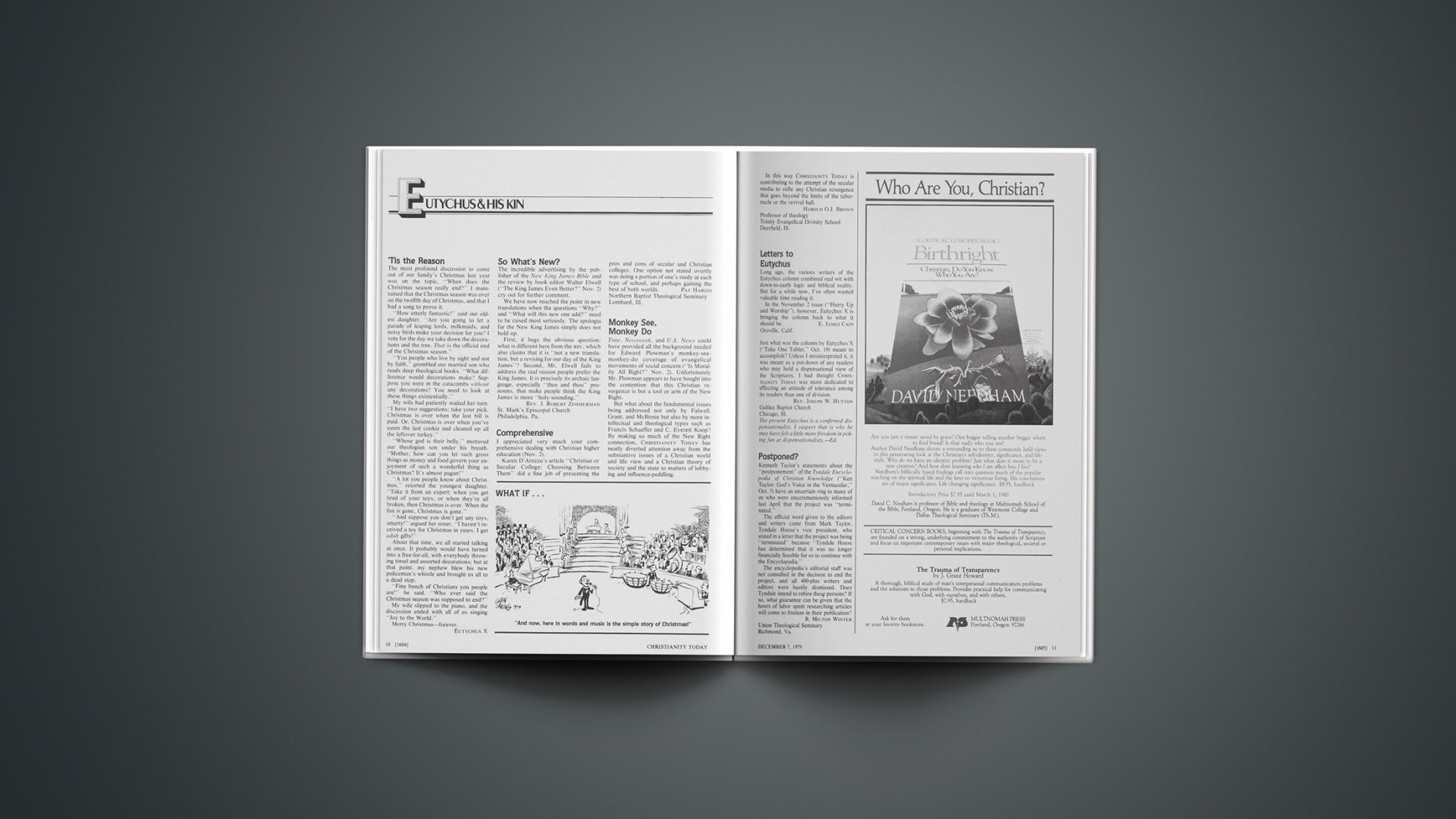
So What’s New?

The incredible advertising by the publisher of the New King James Bible and the review by book editor Walter Elwell (“The King James Even Better?” Nov. 2) cry out for further comment.

We have now reached the point in new translations when the questions “Why?” and “What will this new one add?” need to be raised most seriously. The apologia for the New King James simply does not hold up.

First, it begs the obvious question: what is different here from the RSV, which also claims that it is “not a new translation, but a revising for our day of the King James”? Second, Mr. Elwell fails to address the real reason people prefer the King James. It is precisely its archaic language, especially “thee and thou” pronouns, that make people think the King James is more “holy-sounding.”

REV. J. ROBERT ZIMMERMAN

St. Mark’s Episcopal Church

Philadelphia, Pa.

Comprehensive

I appreciated very much your comprehensive dealing with Christian higher education (Nov. 2).

Karen D’Arezzo’s article “Christian or Secular College: Choosing Between Them” did a fine job of presenting the pros and cons of secular and Christian colleges. One option not stated overtly was doing a portion of one’s study at each type of school, and perhaps gaining the best of both worlds.

PAT HARGIS

Northern Baptist Theological Seminary

Lombard, Ill.

Monkey See, Monkey Do

Time, Newsweek, and U.S. News could have provided all the background needed for Edward Plowman’s monkey-see-monkey-do coverage of evangelical movements of social concern (“Is Morality All Right?” Nov. 2). Unfortunately Mr. Plowman appears to have bought into the contention that this Christian resurgence is but a tool or arm of the New Right.

But what about the fundamental issues being addressed not only by Falwell, Grant, and McBirnie but also by more intellectual and theological types such as Francis Schaeffer and C. Everett Koop? By making so much of the New Right connection, CHRISTIANITY TODAY has neatly diverted attention away from the substantive issues of a Christian world and life view and a Christian theory of society and the state to matters of lobbying and influence-peddling.

In this way CHRISTIANITY TODAY is contributing to the attempt of the secular media to stifle any Christian resurgence that goes beyond the limits of the tabernacle or the revival hall.

HAROLD O.J. BROWN

Professor of theology

Trinity Evangelical Divinity School

Deerfield, Ill.

Letters to Eutychus

Long ago, the various writers of the Eutychus column combined real wit with down-to-earth logic and biblical reality. But for a while now, I’ve often wasted valuable time reading it.

In the November 2 issue (“Hurry Up and Worship”), however, Eutychus X is bringing the column back to what it should be.

E. JAMES CAIN

Oroville, Calif.

Just what was the column by Eutychus X (“Take One Tablet,” Oct. 19) meant to accomplish? Unless I misinterpreted it, it was meant as a put-down of any readers who may hold a dispensational view of the Scriptures. I had thought CHRISTIANITY TODAY was more dedicated to effecting an attitude of tolerance among its readers than one of division.

REV. JOSEPH W. HUTTON

Galilee Baptist Church

Chicago, Ill.

The present Eutychus is a confirmed dispensationalist. I suspect that is why he may have felt a little more freedom in poking fun at dispensationalists.Ed.

Postponed?

Kenneth Taylor’s statements about the “postponement” of the Tyndale Encyclopedia of Christian Knowledge (“Ken Taylor: God’s Voice in the Vernacular,” Oct. 5) have an uncertain ring to many of us who were unceremoniously informed last April that the project was “terminated.”

The official word given to the editors and writers came from Mark Taylor, Tyndale House’s vice president, who stated in a letter that the project was being “terminated” because “Tyndale House has determined that it was no longer financially feasible for us to continue with the Encyclopedia.”

The encyclopedia’s editorial staff was not consulted in the decision to end the project, and all 400-plus writers and editors were hastily dismissed. Does Tyndale intend to rehire these persons? If so, what guarantee can be given that the hours of labor spent researching articles will come to fruition in their publication?

R. MILTON WINTER

Union Theological Seminary

Richmond, Va.
Editor’s Note from December 07, 1979

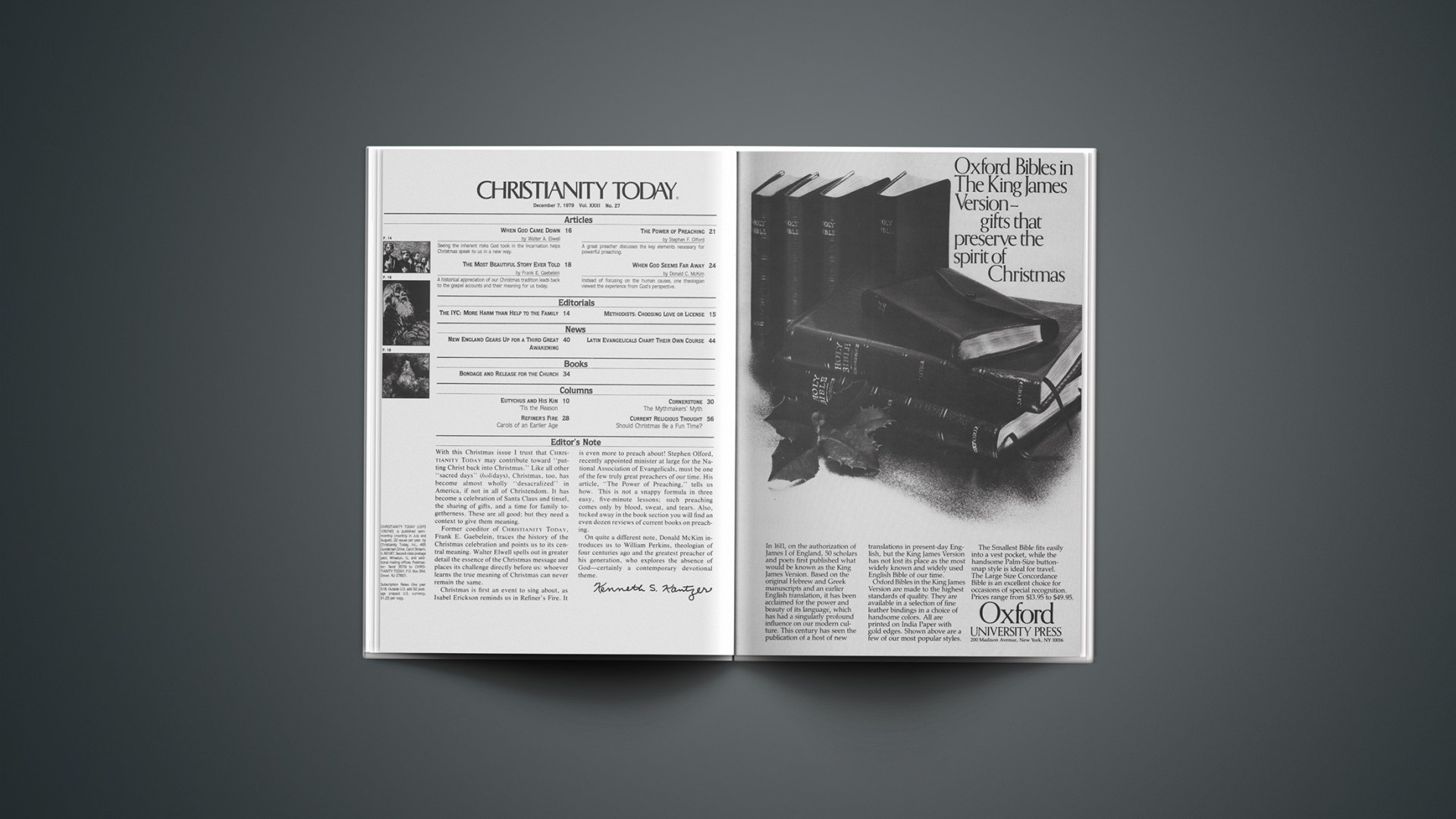
With this Christmas issue I trust that CHRISTIANITY TODAY may contribute toward “putting Christ back into Christmas.” Like all other “sacred days” (holidays), Christmas, too, has become almost wholly “desacralized” in America, if not in all of Christendom. It has become a celebration of Santa Claus and tinsel, the sharing of gifts, and a time for family togetherness. These are all good; but they need a context to give them meaning.

Former coeditor of CHRISTIANITY TODAY, Frank E. Gaebelein, traces the history of the Christmas celebration and points us to its central meaning. Walter Elwell spells out in greater detail the essence of the Christmas message and places its challenge directly before us: whoever learns the true meaning of Christmas can never remain the same.

Christmas is first an event to sing about, as Isabel Erickson reminds us in Refiner’s Fire. It is even more to preach about! Stephen Olford, recently appointed minister at large for the National Association of Evangelicals, must be one of the few truly great preachers of our time. His article, “The Power of Preaching,” tells us how. This is not a snappy formula in three easy, five-minute lessons; such preaching comes only by blood, sweat, and tears. Also, tucked away in the book section you will find an even dozen reviews of current books on preaching.

On quite a different note, Donald McKim introduces us to William Perkins, theologian of four centuries ago and the greatest preacher of his generation, who explores the absence of God—certainly a contemporary devotional theme.

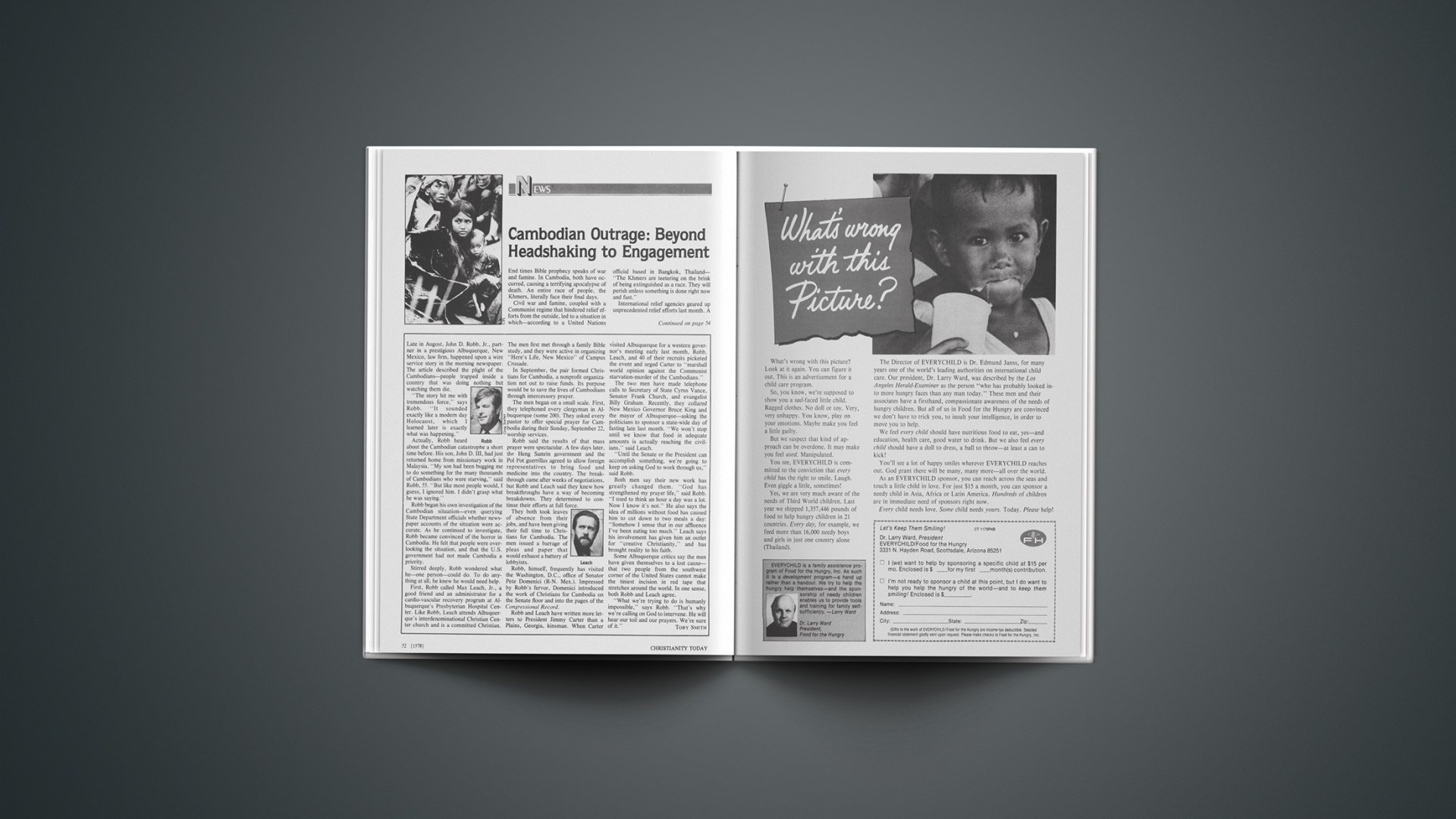
Cambodian Outrage: Beyond Headshaking to Engagement

End times Bible prophecy speaks of war and famine. In Cambodia, both have occurred, causing a terrifying apocalypse of death. An entire race of people, the Khmers, literally face their final days.

Civil war and famine, coupled with a Communist regime that hindered relief efforts from the outside, led to a situation in which—according to a United Nations official based in Bangkok, Thailand—“The Khmers are teetering on the brink of being extinguished as a race. They will perish unless something is done right now and fast.”

International relief agencies geared up unprecedented relief efforts last month. A private British agency, Oxfam, the International Red Cross, and the United Nations UNICEF program, organized initial efforts and the first assistance from within Cambodia. The agencies hoped for an initial $110 million for food and medical supplies.

Stan Mooneyham of World Vision flew into Cambodia late last month, and reported back to his California headquarters that “friends have been found.” Mooneyham had conducted evangelistic meetings in Cambodia prior to the 1975 Communist takeover, and his reported contact was remarkable in light of the subsequent deaths and displacement of persons. Cambodia’s tiny, but growing, Christian community has all but vanished from sight since 1975.

Both World Vision and World Relief sent shipments of rice and supplies into Cambodia late last month. Mooneyham and World Vision officials from Australia and New Zealand met with the Samrin government to discuss relief assistance procedures. Reginald Reimer, Southeast Asia director for World Relief, was overseeing continued relief assistance in the crowded Thailand refugee camps.

Ironically, the funds and supplies necessary for alleviating the most immediate needs were available. United Nations officials said money was no problem—that funds were volunteered from 30 countries. The U.S. State Department, for example, pledged an initial $7 million on October 10, and a bill pending in Congress would provide $30 million in disaster relief assistance.

The problem was rather one of getting the food and medical supplies to the people who needed them. The Soviet-backed Heng Samrin regime, the so-called People’s Republic of Kampuchea, at first denied that a famine existed. Then it tried to control distribution of supplies.

The International Red Cross and UNICEF last month sought the Cambodian government’s permission to open administrative offices in the depopulated capital city, Phnom Penh. In many cases, relief agencies weren’t sure if airlifted supplies would reach the needy, or be confiscated by Samrin’s troops, trying to root out the surviving troops of former dictator Pol Pot, deposed in January 1979 by invading Vietnamese troops.

During the civil war, food became a military weapon on both sides. Crops were destroyed, and rice planting was almost impossible. U.S. satellite photos showed that only 5 percent of the arable rice land was under cultivation. Observers said airlifts of between 600 and 1,000 tons of rice per day would be needed to check the widespread starvation and malnutrition.

An estimated 2.5 million people—including 600,000 children between the ages of five and nine—faced starvation last month. Many already were eating bark and leaves, and officials said conditions would worsen this month and next—the months of rice harvest—since there would be little, if any, produce in the fields.

Not since the Nazi holocaust has one race of people been subjected to such direct and indirect persecution. The Khmer people comprised 90 percent of Cambodia’s 7.5 million population in the mid-1970s—before the Communist regime of Pol Pot took over in 1975. He instituted a genocidal policy, aimed at eliminating the educated class and creating a peasant, agrarian society. An estimated 2 to 3 million persons died—either by murder or from disease and malnutrition. Current conditions would indicate that Pol Pot’s successor has done little to improve the situation.

Late in August, John D. Robb, Jr., partner in a prestigious Albuquerque, New Mexico, law firm, happened upon a wire service story in the morning newspaper. The article described the plight of the Cambodians—people trapped inside a country that was doing nothing but watching them die.

“The story hit me with tremendous force,” says Robb. “It sounded exactly like a modern day Holocaust, which I learned later is exactly what was happening.”

Actually, Robb heard about the Cambodian catastrophe a short time before. His son, John D. III, had just returned home from missionary work in Malaysia. “My son had been bugging me to do something for the many thousands of Cambodians who were starving,” said Robb, 55. “But like most people would, I guess, I ignored him. I didn’t grasp what he was saying.”

Robb began his own investigation of the Cambodian situation—even querying State Department officials whether newspaper accounts of the situation were accurate. As he continued to investigate, Robb became convinced of the horror in Cambodia. He felt that people were overlooking the situation, and that the U.S. government had not made Cambodia a priority.

Stirred deeply, Robb wondered what he—one person—could do. To do anything at all, he knew he would need help.

First, Robb called Max Leach, Jr., a good friend and an administrator for a cardio-vascular recovery program at Albuquerque’s Presbyterian Hospital Center. Like Robb, Leach attends Albuquerque’s interdenominational Christian Center church and is a committed Christian. The men first met through a family Bible study, and they were active in organizing “Here’s Life, New Mexico” of Campus Crusade.

In September, the pair formed Christians for Cambodia, a nonprofit organization not out to raise funds. Its purpose would be to save the lives of Cambodians through intercessory prayer.

The men began on a small scale. First, they telephoned every clergyman in Albuquerque (some 200). They asked every pastor to offer special prayer for Cambodia during their Sunday, September 22, worship services.

Robb said the results of that mass prayer were spectacular. A few days later, the Heng Samrin government and the Pol Pot guerrillas agreed to allow foreign representatives to bring food and medicine into the country. The breakthrough came after weeks of negotiations, but Robb and Leach said they knew how breakthroughs have a way of becoming breakdowns. They determined to continue their efforts at full force.

They both took leaves of absence from their jobs, and have been giving their full time to Christians for Cambodia. The men issued a barrage of pleas and paper that would exhaust a battery of lobbyists.

Robb, himself, frequently has visited the Washington, D.C., office of Senator Pete Domenici (R-N. Mex.). Impressed by Robb’s fervor, Domenici introduced the work of Christians for Cambodia on the Senate floor and into the pages of the Congressional Record.

Robb and Leach have written more letters to President Jimmy Carter than a Plains, Georgia, kinsman. When Carter visited Albuquerque for a western governor’s meeting early last month, Robb, Leach, and 40 of their recruits picketed the event and urged Carter to “marshall world opinion against the Communist starvation-murder of the Cambodians.”

The two men have made telephone calls to Secretary of State Cyrus Vance, Senator Frank Church, and evangelist Billy Graham. Recently, they collared New Mexico Governor Bruce King and the mayor of Albuquerque—asking the politicians to sponsor a state-wide day of fasting late last month. “We won’t stop until we know that food in adequate amounts is actually reaching the civilians,” said Leach.

“Until the Senate or the President can accomplish something, we’re going to keep on asking God to work through us,” said Robb.

Both men say their new work has greatly changed them. “God has strengthened my prayer life,” said Robb. “I used to think an hour a day was a lot. Now I know it’s not.” He also says the idea of millions without food has caused him to cut down to two meals a day: “Somehow I sense that in our affluence I’ve been eating too much.” Leach says his involvement has given him an outlet for “creative Christianity,” and has brought reality to his faith.

Some Albuquerque critics say the men have given themselves to a lost cause—that two people from the southwest corner of the United States cannot make the tiniest incision in red tape that stretches around the world. In one sense, both Robb and Leach agree.

“What we’re trying to do is humanly impossible,” says Robb. “That’s why we’re calling on God to intervene. He will hear our toil and our prayers. We’re sure of it.”

India

Evangelicals Break Through the Social Justice Barrier

Last month Carl F. H. Henry, first editor ofCHRISTIANITY TODAY, participated in the All India Conference on Evangelical Social Concern as the World Vision-sponsored main lecturer. He filed this story from Bangalore after speaking also to faculty, students, pastors, and Christian workers in that city, and in Bombay, Madras, and Yavatmal.

Meeting in Madras for an All India Conference on Evangelical Social Concern, 125 evangelical leaders—under the authority of the Bible and in devotion to the finality of Jesus Christ—for the first time shaped a comprehensive commitment to social justice alongside their long-standing dedication to evangelism and education as indispensable aspects of the Christian mission.

In a 1500-word Madras “Declaration on Evangelical Social Action,” participants rejected revolution and violence as means of social change, yet called for rectification of systemic and structural evils. The statement is not pacifistic, since it does not rule out nonviolent resistance. It demonstrated that aggressive commitment to social action among many Indian evangelical leaders runs deeper and wider than that of the American churches that have sponsored and supported them for so long.

An example from the declaration: “Whereas the Bible witnesses that God’s action included the judgment of systemic evils such as poverty and injustice, we have identified the Bible’s view of sin only with personal, spiritual, and moral rebellion and wrongdoing. For this we repent and commit ourselves … to challenge and correct social sins such as dowry, bribery, and corruption, especially within the Christian community.”

Madras conferees singled out illiteracy and the exploitation of child labor, alongside famine and destitution, as issues that evangelicals should promptly address. India has a child labor force of 16.5 million. Women participants lamented that women are not as ready as men to be involved publicly.

The conference coincided with what spokesmen called “an all-time low” on social, political, and economic fronts in India: fierce monsoon rains had destroyed crops in some areas and bypassed other, parched areas; political instability prevailed; and the entrenchment of castism and failure to respond to the 60 percent of the people in poverty invited communal violence.

A Declaration passage reads, “Whereas Jesus identified injustice and took sides with women and social outcasts of His day—tax collectors, lepers, and Samaritans—in our concern to be distinct from the world and its values we have isolated the community of the King from other human communities. For this we repent and commit ourselves … to counteract the communalistic spirit in our land by crossing barriers of wealth, color, caste, and religion.”

The Madras statement is thought by Indian Christians to be no less historically significant than when Alexander Duff placed education alongside William Carey’s emphasis on evangelism as a necessary aspect of the church’s mission. Only 2 to 3 percent of India’s population of 600 million is Christian, but the same statistics can be read more optimistically: less than two centuries after the arrival of the first modern missionaries, India has 15 million Christians.

Evangelical participants insisted that social action must not be pursued at the cost of evangelism. But they stood impressively with my call for dedication to the God of justice and of justification.

All other conference speakers were Indian:

• D. John Richard, executive secretary of the Evangelical Fellowship of India, gave the opening address and a subsequent paper stressing the apostle Paul’s emphasis on human rights before the law. Discussing Christian lifestyle, Richard commented, “You can’t enjoy the life of Jesus unless you have His lifestyle.”

• Rudy Rodriques, one of the 29 Christian members of parliament before the recent dissolution of the government, gave a lucid address on political engagement.

• Vinay K. Samuel, pastor of Saint John’s Church, Bangalore, and leader in the work of EFICOR (Evangelical Fellowship of India Committee on Relief), described the theology of development pursued by that agency, and also presented a paper on social justice.

• Samuel Kamaleson, for 13 years a Madras pastor and now World Vision vice-president at large, was the nightly devotional speaker. He declared that the time for evangelical action is at hand “unless evangelicals disobey Christ and accommodate themselves to the secular environment, a time in the fortunes of India when ‘the people of the Way’ can move forward in devout and dedicated leadership.” (World Vision is currently the largest social service agency in India, with a child care program for almost 22,000 needy children and an active program of relief, development, and training in Christian living.)

The Madras conference elected a seven-member Commission on Human Rights and Social Action, which included V. K. Nuh of Nagaland, where 60 percent are Christians but where, evangelical spokesmen protest, Indian politicians deprive the Nagas of equal treatment, preserving a primitive status in order to maintain their dependence on India in light of an earlier threat to secede.

Corrections

Jack Hyles and Jack Wyrtzen were not part of the evangelical delegation that met last month with presidential candidates (Nov. 2 issue, p. 81).

The correct title for folk rock singer Bob Dylan’s new album (Oct. 5 issue, p. 60) is “Slow Train Coming.”

North American Scene

“When I read this book [Bible], I don’t critique it—it critiques me,” said evangelical theologian R.C. Sproul. His keynote address set the tone for a recent four-day gathering, “Interpreting God’s Infallible Word,” held at Westminster Theological Seminary as part of its fiftieth anniversary celebration. Some two dozen speakers discussed various aspects of hermeneutics from a position of biblical inerrancy; the 400-student seminary expected to publish a compendium of the conference papers.

President Jimmy Carter’s pastor, senior minister Charles Trentham of First Baptist Church in Washington, D.C., was dismissed last month by a 166 to 140 vote of the congregation. The twice-divorced Trentham, 60, was accused of having a romantic relationship with a 28-year-old divorcee in the congregation, who reportedly had come to him for counseling. Trentham told the Baptist Press that the woman “never sought and never received counseling” from him, and has declared in his defense that his relationship with the woman is a “Christian” one involving no violation of church principles. A White House spokesman said Carter would have no comment.

Homosexuality remains a big issue in the United Methodist Church. The UMC General Board of Church and Society last month requested a major shift in UMC policy on homosexuality: it recommended to the 1980 General Conference the deletion of the “Social Principles” statement that rejects practicing homosexuality as “incompatible with Christian teaching.” The board asked that the statement, which has been a primary defense against ordination of practicing homosexuals, be replaced with one saying that the issue is open for reexamination—that “we are seeking the truth” in the matter. In September the UMC Commission on the Status of Women rejected “sexual orientation” as a factor in its employment practices—insuring that homosexuals would not be discriminated against in its hiring and personnel policies.

Private Christian schools in Kentucky last month won a battle over state regulation. The Kentucky Supreme Court said the state constitution does not permit the state to force nonpublic schools to meet the same accreditation requirements for courses and teachers as public schools. The court’s 12-page decision resulted from a suit filed in 1977 by the Kentucky Association of Christian Schools. It contested the state board of education’s refusal to grant accreditation to 20 Christian schools that, among other things, rejected state-approved textbooks and state certification of teachers.

Spiritual Counterfeits Project devoted its entire 55-page October Journal to a critical analysis of Eckankar, the California-based cult that claims to help persons become “God-realized” through the “Ancient Science of Soul Travel.” SCP studied the development of the 15-year-old, U.S.-born movement, and by using Eckankar writings and publications, points out inconsistencies and contradictions in Eck doctrine, which “represents a direct challenge to all that is biblically true of God and man.” Eckankar is one of the largest, but least publicized, cults in the U.S., and SCP chose this extensive study, saying “it has become painfully obvious that religious cults present grave dangers to society and to the individual.”

World Scene

A Christian Church (Disciples of Christ) international gathering issued a report critical of traditional missionary evangelism at a meeting in Kingston, Jamaica. The first world study conference of the Disciples Ecumenical Council declared last month that mission efforts that stress a “highly individualistic” concept of conversion are oppressive, destructive, self-centered, and a new form of “Western religious imperialism.”

A secret “blacklist” of Church of England clergymen came to light recently. Its existence was disclosed by clergy who have joined a white-collar trade union (and presumably surmised that their names might be entered). A spokesman at Lambeth Palace, official residence of the archbishop of Canterbury, confirmed the existence of the secret file. Archbishop of Canterbury-designate Robert Runcie said he would investigate the matter as soon as he becomes primate in March.

A Church of England commission last month called for lifting a ban on homosexual clergymen. Under the proposal, clergymen who are or who become practicing homosexuals would be required to offer their resignations to their bishop, but the bishop would have discretion to accept or reject the resignation. The report is not scheduled to be submitted to the church’s General Synod for debate before 1981. But opponents were expected to seek its rejection at this month’s meeting of the synod in London.

A former lecturer at Leningrad University has been placed in a psychiatric hospital for forced treatment. Vyacheslav Zaitsev was declared a schizophrenic at a Minsk court hearing last June 15. He was arrested a year ago for distributing leaflets describing Christ’s second coming. Two Zaitsev doctoral dissertations were banned because they contained the view that religion is a determining factor in the history of mankind. After becoming a member of the Russian Orthodox Church, Zaitsev was dismissed from his Academy of Sciences post. His case is described in detail in the Information Bulletin of the Moscow-based Commission to Investigate the Use of Psychiatry for Political Ends.

Ethiopian church leader Gudina Tumsa is being held and tortured in a secret prison in Addis Ababa. That is the report, based on “unconfirmed information from a usually reliable source in the Ethiopian capital,” carried in the Norwegian newspaper Vaart Land in late September. Tumsa, general secretary of the (Lutheran) Mekane Yesus Church and chairman of the Council of Ethiopian churches, was kidnapped on July 28 by unknown men. Vaart Land reported that Ethiopian authorities were shocked by international publicity given their two earlier arrests of Tumsa, and speculated that the government did not want to expose itself to similar criticism again and therefore arranged the kidnapping. Since no official arrest was made, there has been little basis for a direct appeal to the authorities.

The religious rationale for the policy of racial discrimination in South Africa was challenged from its bastion of strength last month. A commission of theologians from the Dutch Reformed Church’s seminary at the University of Stellenbosch called apartheid “an evil which is in conflict with the biblical message of the equality of all people.” Delegates to the church’s Cape Province synod passed a resolution opposing “all racial discrimination which is in conflict with the ethical norm of love for one’s neighbor” or that conflicts with “justice.” Conservatives were partially placated with a passage stating that “the practical implementation of scriptural principle [that racial discrimination is wrong] does not imply that in practice the diversity of people may not be taken into account.”

More than half the members of the Evangelical Church in Iran have left the country since it became an Islamic republic early this year. But those remaining say there is no persecution of Christians, and the Bible Society of Iran reports that the sale of Bibles has increased considerably. Protestants reportedly number less than 5,000 of Iran’s 35 million people. ECI members, mostly of Assyrian and Armenian background, are estimated to be 1,500.

Deaths

WALTER TROBISCH, 55, family counselor who, through writing, lectures, and seminars, had a worldwide ministry to families; his latest book, Living with Unfulfilled Desires (InterVarsity Press), is scheduled for publication next month; October 13 in Saint Georgen, Austria, of a heart attack.

Church-and-State Issues: Grove City in Legal Thicket as HEW Hews to Its Line

Church-And-State Issues

Grove City in Legal Thicket as HEW Hews to Its Line

Grove City College officials say they have nothing against women—just against governmental controls. This 103-year-old Christian liberal arts college in the hills of western Pennsylvania has locked legal horns with the vast federal Department of Health, Education, and Welfare. The case may have a direct effect on other private colleges in the United States, if for no other reason than that student dollars are involved.

Since 1977, HEW has asked Grove City to sign forms showing its compliance with Title IX of the Education Amendments of 1972, which bans discrimination against women. Grove City consistently has refused to do so. President Charles MacKenzie told Associated Press, “If we signed this, we’d be expected to sign compliance forms for everything under the sun.”

Since the school never has received a dollar in direct government aid, its officials say the government should have no jurisdiction over the college’s affairs. They refused to sign as a matter of principle.

However, HEW stands behind principles of its own. The agency argued that it had jurisdiction over Grove City through those Grove City students who receive federal aid. After a 1978 hearing in Philadelphia, HEW administrative law judge Albert Feldman ruled that financial assistance to Grove City students in the form of personal grants, the Basic Educational Opportunity Grants; and loans, Guaranteed Student Loans; was in fact aid to the college, and that such funds should be cut off.

Feldman noted, “… there was not the slightest hint of any failure to comply with Title IX save the refusal to submit an executed assurance of compliance with Title IX. This refusal is obviously a matter of conscience and belief.” But he said he had no authority to rule on the constitutionality of the regulations, and that the HEW director is given “unlimited discretion” in compliance procedures.

Public relations director Robert Smith said 700 to 800 of the 2,200 Grove City students presently receive aid through BEOG or GSL programs. This money goes directly to the students, said Smith, and the college’s only role in the process is “to certify that these students are in fact enrolled.”

The courts will determine how long such student aid will continue. Grove City and four of its students threatened with an aid cutoff filed a complaint against HEW in the U.S. District Court, Western District of Pennsylvania, in Pittsburgh last November. They argued that HEW had exceeded its constitutional authority by seeking to regulate a private college that accepts no government funds.

On October 10, both the college and HEW submitted briefs stating their respective positions to the federal court. Later, each party studied the other’s briefs, and submitted “reply briefs” to the same court.

This way, “both sides would have their facts out on the table” before the scheduled November 13 hearing, Smith said. Lawyers didn’t expect a decision on the case until early next year, he added. College president MacKenzie has said the college is ready to take its battle to the United States Supreme Court, if necessary.

In the meantime, various other college officials are awaiting the outcome. Hillsdale (Michigan) College also has refused to sign the Title IX compliance form; but it has argued its case through HEW administrative channels, rather than the federal courts. An administrative law judge earlier ruled that the HEW was “overstepping its bounds” by attempting to cut off student aid at the college, said college spokesperson Cheryl Yurchis. She said HEW appealed that decision, and that an HEW review board reviewed the case, but still had not given a decision.

Rockford (Illinois) College refused to sign the compliance forms, and in 1977 HEW informed the school that student federal aid would be cut off, said Vic Peterson, vice-president for development. Rather than contest the decision, this independent college of 1,100 students voluntarily adopted a policy to deny admission to students receiving BEOG or GSL assistance.

The school’s action ended any HEW claim to jurisdiction, but as a result, the school has been forced to seek other means of financial support for its students. Peterson said the school launched a fund raising drive in May; the school hoped to build a fund from which students could borrow to meet the $3,175 annual tuition fees.

Grove City, Hillsdale, and Rockford are among the very few colleges in the United States that refuse both government aid and the signing of HEW compliance forms. A number of private colleges, however, have expressed support for Grove City, a United Presbyterian-affiliated college. (Public relations director Smith said Grove City is loosely affiliated with, but not under the control of, the UPCUSA.) Through the Christian College Consortium, Wheaton College (Illinois) entered a friend of the court brief with Grove City. (Wheaton, itself, signed the Title IX compliance forms.) College president Hudson T. Armerding explained Wheaton’s action in a summer alumni magazine, saying, “… we think that [the case] will affect us as well as the other colleges in the consortium, depending upon the way in which the decision is rendered.”

Until that decision, Grove City will continue piling up legal expenses, which college officials say total over $55,000 so far. Sympathetic publicity has generated financial support, said Smith. “Our alumni giving fund has really mushroomed in the last two years,” he said, adding that a legal defense fund has been established.

“We have promised the students that it [defense costs] will not affect the operating budget,” he said, “and I can assure you it hasn’t.” The school recently launched a $1 million athletic facilities construction project.

The situation is crucial for students who, faced with rising tuition costs, base their college choice on the available financial aid. Small independent colleges see the Grove City dispute as a test case determining how far the federal government can go in its regulation of the private education realm.

Hillsdale spokesperson Yurchis argued against HEW’s claim that giving financial aid to students is the same as financial aid to the college; “That’s like saying a grocery store is federally funded because people use social security checks to buy food.”

The Homosexuality Issue

Gays: Marching As to War

As thousands of demonstrators passed within a block of the White House in what was billed as the first national gay rights march, a bystander waved a sign that warned: “Repent or perish—2 Peter 2:12.” Shouted back a young marcher: “The Lord is my Shepherd, and he knows I’m gay.”

Organizers had predicted 100,000 homosexuals, lesbians, and sympathizers would take part in last month’s march from the Capitol to a rally site at the Washington Monument. But fewer than 25,000 persons, mostly young and white, showed up from across the country. Participants were about evenly divided between men and women, and wore “gay is groovy” buttons and carried posters saying “Closets are for clothes.” Scattered among the Sunday afternoon marchers were parents; their posters said things like “I love my gay son,” and “We march with our children for human rights.” A few antigay picketers were jeered.

On hand were large contingents from such religious gay rights groups as Dignity (Roman Catholic), Integrity (Episcopalian), Affirmation (United Methodist), the Catholic Coalition for Gay Civil Rights, Gay Mormons United, and Lutherans Concerned. Also marching together were hundreds of members of the Universal Fellowship of Metropolitan Community Churches, a homosexual-oriented denomination of some 40 churches. UFMCC founder-moderator Troy Perry was among the rally speakers; he also preached later in the day at a UFMCC church service that attracted nearly 1,000.

The demonstration was staged in part to commemorate the tenth anniversary of the gay rights movement. (Leaders say the movement emerged from the turbulent aftermath of a 1969 police raid on a gay bar in New York City.) The other main purpose of the demonstration, say spokesmen, was to serve notice that the movement is shifting from gay pride to gay politics. Among other things, the group called for repeal of all local and state sodomy laws, passage of federal gay rights legislation, and issuance of a presidential order banning discrimination by the military, the government, and federally subsidized contractors. They called for an end, through some form of legal protection, to alleged discrimination against gay parents in child custody cases and an end to harassment of homosexual youths.

Leaders of the movement visited congressional offices for several days following the event, to press their demands. Among the movement’s friends in Congress are Democrats Ted Weiss of New York and Phillip Burton of California, who have introduced gay rights legislation in the House. Their move, however, has been countered by Democrat Larry McDonald of Georgia, a strong ally of the conservative Christian lobbies on Capitol Hill. McDonald’s bill would ban homosexuals from status as a special minority group eligible for federal programs and funds.

While the demonstration was in progress, nearly 100 Christians gathered in a hearing room in the Rayburn congressional office building and prayed that homosexuals would repent. It was the symbolic rallying point of a hurriedly called National Day of Prayer for Homosexuals, sponsored by several Christian lobbies. The lobbies had sent letters to 40,000 ministers, asking them to pray during the afternoon for homosexuals. Representative McDonald arranged for the use of the hearing room, and the prayer meeting was led by television minister Jerry Falwell of Lynchburg, Virginia, and Richard Zone, executive director of Christian Voice, one of the Christian lobbies.

Falwell and Zone conducted a press conference prior to the prayer meeting. “God created Adam and Eve, not Adam and Steve” quipped Falwell. But then he got down to business, and warned that homosexuality is a serious threat to the family and a danger to America. Homosexuality, he declared, is a sin that one can choose to take up or give up, just like stealing or drug addiction; it can be conquered by turning to Christ.

In response to a question, Falwell said that he would not object to homosexuals having equal housing or employment opportunities, but that he would oppose permitting them to teach in schools and to hold positions of leadership where their influence could damage others. He served notice that the Christian lobbies will examine political candidates to see where they stand on homosexuality and other issues affecting the family.

In reply to a query on presidential candidates, Falwell said he respects President Carter and his wife as “exemplary persons” but finds himself in “almost total disagreement with them philosophically.” He also said he would oppose vigorously the candidacy of Senator Edward Kennedy because of Kennedy’s own family troubles and the alleged immorality connected with Chappaquiddick.

Afterward, Adam DeBaugh, the UFMCC’s Washington lobbyist, commented on the Falwell meeting. “It is the height of arrogance for any single person to imply that he speaks for all of Christianity on any topic,” said DeBaugh. “We are Christians, too,” he said, “and we have different views.” Falwell and his supporters would agree, at least, with the part about “having different views.”

EDWARD E. PLOWMAN

Personalia

A college planning and management specialist, William Shoemaker, has been named director of the Billy Graham Center at Wheaton College. Shoemaker served for the past seven years as vice-president for research with the Council for Advancement of Small Colleges in Washington, D.C. He succeeds David Johnston, Wheaton College vice-president for finance, who became acting director when Donald Hoke resigned in 1978 to return to the pastorate.

For reasons of age, Roman Catholic Cardinal Leo Suenens of Belgium submitted his resignation soon after his 75th birthday in July. Pope John Paul II accepted the resignation. Appointed a Cardinal in 1962 and one of the major shapers of the Second Vatican Council, Suenens was authorized by the Vatican to oversee the growing charismatic movement, which he supports.

Converted during a revival at age 10 and a licensed pastor at 17, W. A. Criswell preached his first sermon at Dallas First Baptist Church in 1944. Since then, the church has grown from 7,800 to 20,500 members and in financial contributions from $250,000 to $8.4 million, and the self-described “old-fashioned preacher” has become a leading Southern Baptist spokesman for inerrancy and traditional Baptist beliefs. Dallas civic leaders and his congregation spent a week last month honoring Criswell, 69, on his thirty-fifth anniversary as Dallas First Baptist pastor.

Mother Theresa, 69, Roman Catholic nun who has spent most of her adult life working among the poor and diseased in Calcutta, India, received the 1979 Nobel Peace Prize with the comment, “I am unworthy.” Born of Yugoslavian parents in Albania, she became a nun at 18 and taught in a Catholic high school in Calcutta for 20 years. In 1950 she founded the Missionaries of Charity, an organization with more than 150 houses for the poor, three of them in the United States.

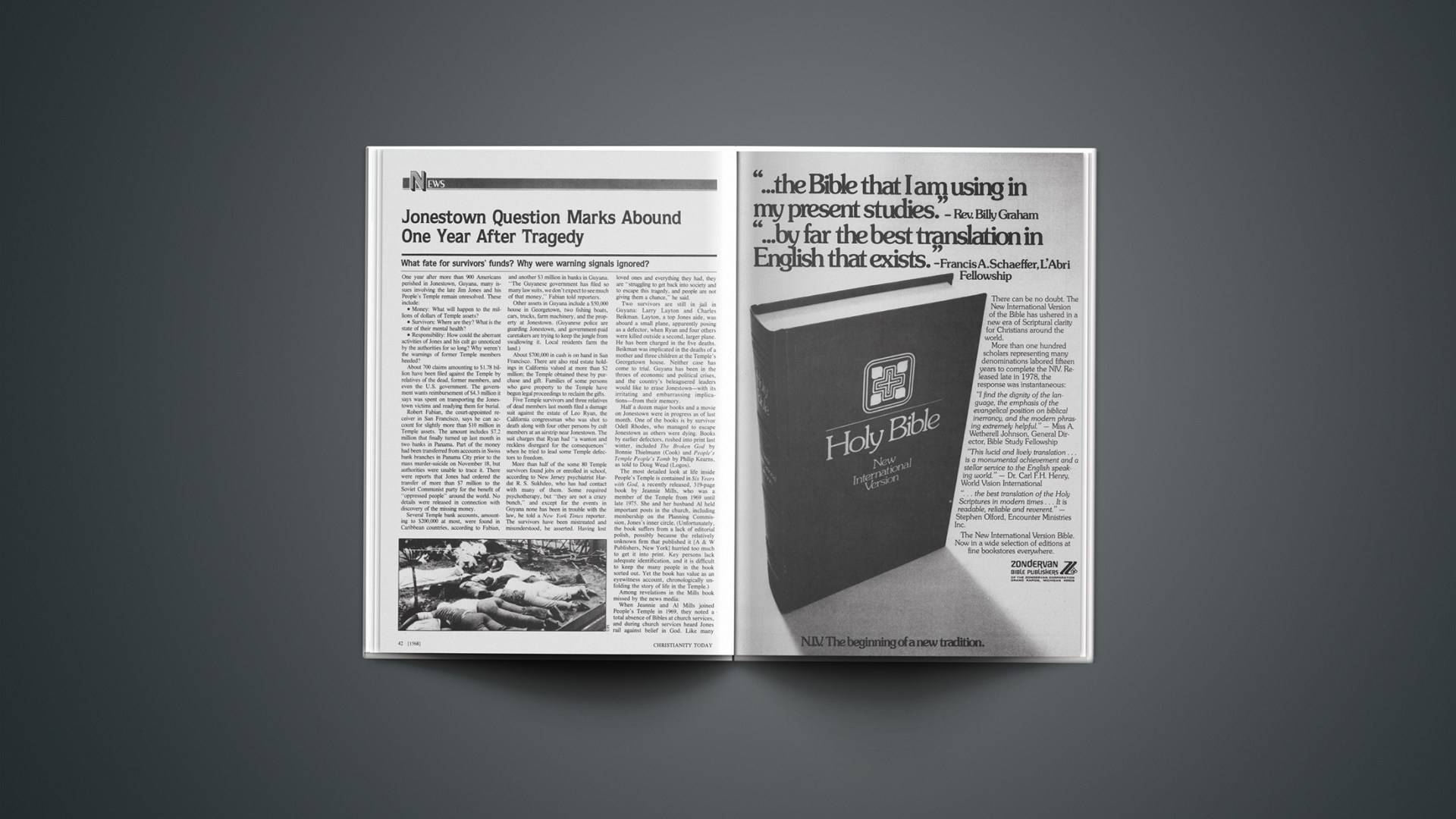
Jonestown Question Marks Abound One Year after Tragedy

What fate for survivors’ funds? Why were warning signals ignored?

One year after more than 900 Americans perished in Jonestown, Guyana, many issues involving the late Jim Jones and his People’s Temple remain unresolved. These include:

• Money: What will happen to the millions of dollars of Temple assets?

• Survivors: Where are they? What is the state of their mental health?

• Responsibility: How could the aberrant activities of Jones and his cult go unnoticed by the authorities for so long? Why weren’t the warnings of former Temple members heeded?

About 700 claims amounting to $1.78 billion have been filed against the Temple by relatives of the dead, former members, and even the U.S. government. The government wants reimbursement of $4.3 million it says was spent on transporting the Jonestown victims and readying them for burial.

Robert Fabian, the court-appointed receiver in San Francisco, says he can account for slightly more than $10 million in Temple assets. The amount includes $7.2 million that finally turned up last month in two banks in Panama. Part of the money had been transferred from accounts in Swiss bank branches in Panama City prior to the mass murder-suicide on November 18, but authorities were unable to trace it. There were reports that Jones had ordered the transfer of more than $7 million to the Soviet Communist party for the benefit of “oppressed people” around the world. No details were released in connection with discovery of the missing money.

Several Temple bank accounts, amounting to $200,000 at most, were found in Caribbean countries, according to Fabian, and another $3 million in banks in Guyana. “The Guyanese government has filed so many law suits, we don’t expect to see much of that money,” Fabian told reporters.

Other assets in Guyana include a $50,000 house in Georgetown, two fishing boats, cars, trucks, farm machinery, and the property at Jonestown. (Guyanese police are guarding Jonestown, and government-paid caretakers are trying to keep the jungle from swallowing it. Local residents farm the land.)

About $700,000 in cash is on hand in San Francisco. There are also real estate holdings in California valued at more than $2 million; the Temple obtained these by purchase and gift. Families of some persons who gave property to the Temple have begun legal proceedings to reclaim the gifts.

Five Temple survivors and three relatives of dead members last month filed a damage suit against the estate of Leo Ryan, the California congressman who was shot to death along with four other persons by cult members at an airstrip near Jonestown. The suit charges that Ryan had “a wanton and reckless disregard for the consequences” when he tried to lead some Temple defectors to freedom.

More than half of the some 80 Temple survivors found jobs or enrolled in school, according to New Jersey psychiatrist Hardat R. S. Sukhdeo, who has had contact with many of them. Some required psychotherapy, but “they are not a crazy bunch,” and except for the events in Guyana none has been in trouble with the law, he told a New York Times reporter. The survivors have been mistreated and misunderstood, he asserted. Having lost loved ones and everything they had, they are “struggling to get back into society and to escape this tragedy, and people are not giving them a chance,” he said.

Two survivors are still in jail in Guyana: Larry Layton and Charles Beikman. Layton, a top Jones aide, was aboard a small plane, apparently posing as a defector, when Ryan and four others were killed outside a second, larger plane. He has been charged in the five deaths. Beikman was implicated in the deaths of a mother and three children at the Temple’s Georgetown house. Neither case has come to trial. Guyana has been in the throes of economic and political crises, and the country’s beleaguered leaders would like to erase Jonestown—with its irritating and embarrassing implications—from their memory.

Half a dozen major books and a movie on Jonestown were in progress as of last month. One of the books is by survivor Odell Rhodes, who managed to escape Jonestown as others were dying. Books by earlier defectors, rushed into print last winter, included The Broken God by Bonnie Thielmann (Cook) and People’s Temple People’s Tomb by Philip Kearns, as told to Doug Wead (Logos).

The most detailed look at life inside People’s Temple is contained in Six Years with God, a recently released, 319-page book by Jeannie Mills, who was a member of the Temple from 1969 until late 1975. She and her husband Al held important posts in the church, including membership on the Planning Commission, Jones’s inner circle. (Unfortunately, the book suffers from a lack of editorial polish, possibly because the relatively unknown firm that published it [A & W Publishers, New York] hurried too much to get it into print. Key persons lack adequate identification, and it is difficult to keep the many people in the book sorted out. Yet the book has value as an eyewitness account, chronologically unfolding the story of life in the Temple.)

Among revelations in the Mills book missed by the news media:

When Jeannie and Al Mills joined People’s Temple in 1969, they noted a total absence of Bibles at church services, and during church services heard Jones rail against belief in God. Like many others, though, they were attracted to the church, then located 110 miles north of San Francisco, by the racial integration exhibited there and the spirit of community they felt.

Visitors were regulated and often barred from the church. Sometimes entire services were rigged for special guests.

Savings accounts, jewelry, and antiques had to be donated to the church. Members were instructed to sign over property deeds and insurance policies. Tithing was enforced, and beginning in 1973 the members were required to give 25 percent of their income. Jones and his family meanwhile lived in relative luxury, and his wife and children were exempted from many of the church restrictions.

Conditions were harsh. Buses carried Temple members hundreds of miles between church locations every weekend. Children were jammed into overhead luggage racks and under seats; some adults rode in the baggage compartments underneath. Many members lived in overcrowded housing and had to take turns sharing sleeping accommodations.

Discipline was tight. Members were encouraged to tattle on each other. Those whom Jones found guilty of erring—even children—were paddled, punched, or thrown fully clothed into the church’s swimming pool. Some were forced to humiliate themselves by confessing publicly to immoral or illegal acts they had not committed.

In time, Jones seemed overcome by paranoia. Enemies were out to get him and the church, he warned. He appointed bodyguards and sentries. Suicide drills were instituted. He told his congregation of previous incarnations when he was Buddha, Christ, and Lenin; the next stage, he said, would be better for everybody in the church.

There were serious acts of violence. At a 1974 Jones meeting in Philadelphia, Temple guards beat a man into unconsciousness. They later confided to intimates at the Temple that the man died and they dumped his body in the river. (Philadelphia police did fish a badly beaten corpse from the river following Jones’s visit; the crime was never traced to People’s Temple members.)

Member Patty Cartmell refused to partake of a supposed poison potion during a suicide drill in 1974. She ran from the church, but guards brought her back. At a signal from Jones, alleges the Mills book, one of the guards shot her in the arm with a rifle.

Those who quit the church were warned to remain silent. There were threats of both physical violence (Temple toughs sometimes patrolled in front of former members’ homes) and blackmail (the signed confessions of illegal or immoral acts). After Jeannie and Al Mills left the Temple, they attempted to sound an alert about Jones through an anonymous but accurate letter to consumer advocate Ralph Nader. The letter, however, found its way back to Jones who recognized its source and promptly dispatched a goon squad to harass the Mills family. A family friend offered to be a conduit, linking the despairing and frightened Mills family to authorities and journalists. Again word leaked back to Jones, and again there were more threats. But by then other journalists were hot on the trail, and Jones abruptly fled to Guyana. The Mills couple, along with several other Temple defectors, agreed to make their story public in a New West article. Along the way, they organized a Human Freedom Center in Berkeley to help ex-members of the Temple and other cults.

Since People’s Temple no longer exists, it has been stricken from the yearbook of the 4,500-congregation Christian Church (Disciples of Christ), with which it was nominally affiliated. The Temple bruised the denomination but did not scar it for life, says Kenneth L. Teegarden, president of the 1.3-million-member church. No ministers or congregations quit over the handling of the Temple, he adds. Disciples executives were kept busy fending off criticism following Jonestown. They tried to explain that the denomination is not set up to keep close tabs on what a church or its minister does, and has almost no recourse to discipline. Since then, new procedures have been drafted that will make it easier to suspend a minister for misbehavior and to keep track of what churches are doing.

Book Briefs: November 16, 1979

The Multifaceted Greeley

The Best of Times, The Worst of Times by John N. Kotre (Nelson-Hall, 275 pp., $6.95), is reviewed by Harold B. Kuhn, professor of philosophy of religion, Asbury Theological Seminary, Wilmore, Kentucky.

This volume, which surveys the brilliant career of one of Roman Catholicism’s contemporary literary figures, concerns itself with the manner in which Father Andrew Greeley coped with the kaleidoscopic changes in the religious and social climate in America between 1950 and 1975. It takes for granted the famous priest’s early relationships to the priesthood—to Christ the King parish and the conditions in the life of the church of which he became aware there and in which he found himself involved.

Father Greeley appears to have found his first major challenge in his relation to the so-called New Breed of priests, emerging in the 1950s and being lifted into prominence by the events in the world of academe in the 1960s. In relation to this group, Andrew Greeley made a sort of “trial run,” one which would become typical of his relation to public movements in subsequent years. This involved a fairly regular sequence: attraction, acceptance, and gradual disillusionment.

This pattern occurred again and again, and reveals to us several qualities in his character. He was a priest who constantly manifested a growing edge; he sought always to be innovative; he identified himself with what seemed to be best at the time, and he possessed a fierce personal honesty. He rested great hopes in the outcome(s) of Vatican II, and when many of these hopes came to be ephemeral, he refused to resign himself to cynicism.

Father Greeley never escaped his Chicago background. He sought in a variety of ways to operate creatively and redemptively within its politics and somehow found more in Mayor Daley than he could find in the Berrigans. As in his relation to the church, he sought also to plumb the dilemmas facing public life and public figures. He showed here his fantastic ability to absorb reverses and disappointments without falling into despair.

His lifelong ambition to receive a tenured position on the faculty of the University of Chicago met frustration after frustration. John Kotre’s volume reveals here the dimensions of the famous priest. It would be impossible in a review of moderate length to survey the several yardsticks by which Greeley is measured—by his relation to human sexuality, his mode of Christian apologetics, or his attitude toward conventional Catholicism with its emphases upon celibacy of the priesthood. These should tempt the reader to make his way through some rather pedestrian pages and to savor the sections that offer us a portrait of the lonely priest whose figure still stands out tall against the sky.

Concerning the title of the volume, The Best of Times, The Worst of Times, we are never certain whether it is the times that are under study, or the character of Father Greeley. Certainly he was—and is—a man of great contrasts. In his relation to the church, which he finds to be in a state of emotional exhaustion, he stands as a beacon of hope, perhaps as an embodiment of that hope.

The man himself embodies the conflicting elements of pessimism and optimism. Perhaps the biography John Kotre is giving us, under the veiled theme of “times,” is an insight into the central and sometimes perplexing mysteries lying at the center of Father Greeley’s person. If this is the case, the task is well done, and the book well worth reading.

A Plea For Prison Reform

Life Sentence, by Charles Colson (Chosen Books, 1979,304 pp., $9.95) is reviewed by Carl F. H. Henry, lecturer at large for World Vision International, Arlington, Virginia.

Chuck Colson’s Life Sentence belongs on the reading list of every pastor and churchgoer. The reasons are three. It carries us beyond Born Again into the sphere of Christian service as a vital reminder that the Christian life begins—not ends—with regeneration. It opens a wide picture window on imprisoned legions that evangelical compassion should encompass, and exemplifies what concerned Christians can do. Finally, it mirrors the inner spiritual struggle of one-time Watergate convict #23226 that yielded a national witness for Christ instead of a life of private isolation.

Colson’s book hopefully will stimulate both evangelical devotion to prison reform and evangelistic mission to prisoners in a day when the national crime rate nears a record high, and when the imprisoned masses lack moral vision and hope. Prisons don’t rehabilitate (more than half the ex-prisoners are repeaters) but Christ can and does liberate—that is Colson’s own story.

I thought Colson should not write a second book so soon, and told him so. But I was wrong. For he has—as I hoped he would, and feared he might not—spoken to national conscience, on at least one level where evangelical sensitivities need also to be pricked: the plight of prisoners in their squalid environs. Many churchgoers have been more dedicated to stiffer sentences than to spiritual outreach; Colson’s Prison Fellowship seeks to temper justice with mercy, but through spirituality rather than sentimentality.

The book artfully combines past political perspectives with the altered attitudes of a man twice-born. Colson’s political boldness has been turned to boldness for Christ. His comments are candid, sometimes blunt; some judgments may well be tempered in another decade. Not only does he have a critical eye for the world’s failings, but for evangelical self-interest and evangelistic huckstering as well, and additionally for his own weaknesses.

Colson’s next book, the reviewer hopes, will give more attention to the ideas and ideals that a one-time Watergate organization man now thinks could restore a vacillating nation to true world greatness. In this volume Colson effectively scores the important preliminary point, that a gospel with power to change the worst of humans has all the necessary potency for social renewal.

An Evangelical Pacesetter

Edward John Carnell: Defender of the Faith, by John A. Sims (University Press of America, 1979, 175 pp., $8.95 pb), is reviewed by Ronald Nash, head, department of philosophy and religion, Western Kentucky University, Bowling Green, Kentucky.

Edward John Carnell was one of the pacesetters of the renaissance of evangelical scholarship during the years immediately following World War II. He gained widespread recognition and respect in 1948 with the publication of his first book, An Introduction to Christian Apologetics. When he died in 1967 at the age of only 47, he left behind a rather remarkable legacy. He had authored eight books and many major articles; he had taught at Fuller Seminary for 19 years and been its president for 5. What commended Carnell to so many was his burning conviction that conservative Christians did not have to be ashamed of their commitment to Scripture and their fidelity to historic, orthodox theology. The fact that this issue is so much less a problem today is due in no small measure to the influence of Carnell and the other elder statesmen of contemporary evangelicalism like Gordon Clark and Carl F.H. Henry. Research into Carnell’s life and thought is also important because of the changes that occurred in his thinking. Carnell was honest enough to admit when he was wrong. He was responsible enough to change his views when they were no longer adequate. But none of those changes ever affected the heart of his evangelical commitment. He retained his allegiance to a high view of Scripture.

Sims, a professor at Lee College in Tennessee and holder of the Ph.D. from Florida State University, has attempted to do justice to the full range of Carnell’s writings. He succeeds in presenting what is generally a clear and sympathetic account of Carnell’s intellectual odyssey. While Carnell moved away from the rather chilly rationalism of his first book, while he came to stress the role of commitment and subjectivity in his later writings, he never did so at the expense of objective truth or the canons of logic. In Carnell’s view, Christianity commends itself to the wise man because it meets the needs of the whole man, including his reason, values, and emotions. Carnell refused to get bogged down in the morass of a neoorthodox or fundamentalist fideism in which faith is divorced from knowledge and isolated from either evidence or logic.

The fickleness of a new generation of students and teachers along with changing tastes in apologetic style are already pushing Carnell’s contributions to the background of contemporary discussion. Contemporary apologetics and philosophy of religion as exhibited in the work of evangelical philosophers like Alvin Plantinga and George Mavrodes are technically more sophisticated and intellectually more satisfying. But in spite of this, it would be regrettable if Carnell’s work is forgotten too quickly. It is therefore encouraging to note the appearance of this first book-length study of Carnell’s thought. One can only hope it will receive the wide and sympathetic audience it deserves.

Toward A Rational Faith

Religious Reason: The Rational and Moral Basis of Religious Belief, by Ronald Green (Oxford, 1978, 303 pp., $12.00, $4.00 pb), is reviewed by Clark H. Pinnock, professor of Christian theology, McMaster Divinity College, Hamilton, Ontario, Canada.

The aim of this book is to offer a clearly reasoned alternative to the widespread attempt to distance religion from reason. Green is convinced that religion is a fully rational activity, and he seeks to prove his conviction in the realm of moral discourse. People who are serious about morality are compelled to engage in religious reflection and will come eventually to hold religious beliefs. Unlike H. P. Owen, he is not arguing for Christian theism in this book, but rather for the moral wisdom of several religions (he discusses Judaism, Christianity, and Hinduism).

Green is aware of Kant’s groundbreaking work along these lines two centuries ago, but feels that Kant’s thought has been little understood or appreciated. We are in a better position today to reconstruct and appreciate Kant’s thinking on religion and morality, Green argues, and he offers to lead us in such an investigation. On the other hand, this is not a work in Kant-scholarship per se, but an independent argument in the Kantian tradition.

The book falls into two parts. Part one is an attempt to penetrate and lay bare the universal structure of reason that underlies religion, while part two proceeds to see whether actual religious systems display an adherence to that structure. The reader should not jump to the conclusion, however, that Green wishes to reduce religion to morality after the fashion of earlier rationalistic views, as though religion were “morality touched by emotion” (Arnold). His aim is entirely positive, to uncover the religious dimension basic to moral reasoning, and thus to prove religion rational. The argument Green uses could be related to the simpler argument of C. S. Lewis in Mere Christianity, which has struck large numbers of readers as plausible and helpful.

The constructive argument is centered on the question, “Why should I be moral?” Green contends it cannot be rational to choose against one’s own self-interest in a moral decision unless there is truth in religion. He wishes to argue that a rationally constituted morality will be compelled to resort to one form or another of religious belief in order to render its dictates coherent. I think he is right; I appreciate such a full exposition of this line of evidence on behalf of religion.

This is a well-documented, sure-footed treatment of a plank in traditional apologetics. Because it is philosophically mature it should gain a hearing in professional circles, and because it is clearly written it will be useful to many more who seek to give a reason for the hope that is in them.

A Tale Of Lore

The Portent: a story of the inner vision of the highlanders commonly called the second sight, by George MacDonald (Harper and Row, 1979, 160 pp., $8.95).

When George MacDonald died in 1905 G. K. Chesterton said of him, “If we test the matter by originality of attitude, George MacDonald was one of the three or four greatest men of the nineteenth century.” However, in 1924 when the centennial of MacDonald’s birth was celebrated, the Times Literary Supplement lamented that although he was a good novelist, a true poet, in some respects a genius, and one who wrote fantasy better than anyone else had ever done, MacDonald had not yet received the recognition he deserved. True enough. For years his influence was subterranean, surfacing mostly as an influence on others, such as W. H. Auden, C. S. Lewis, J. R. R. Tolkien, and Charles Williams.

The last two decades have seen a change in all that. New editions of MacDonald’s works are slowly appearing in greater numbers, promising—let us hope—a MacDonald revival. A token of this is The Portent, which has been unavailable for over 50 years. It is a preternatural love story, primly Victorian, yet chillingly compelling. It draws one on like an airy wraith through its moon-washed heather, dark-oaked chambers, and the smell of peat fire, to haunted lovers’ meetings. It is the story of Duncan Capbell, possessed of an ancestral second sight and strange power of love that commands the actions of others. The family curse naturally went along with it, as you would expect, in this supernatural classic of good versus evil. So just when Duncan and Lady Alice are making their plans, the sinister hoofbeats are heard thundering toward them once more and … well, you read the story for yourself.

For those who care about such things, it also shows the influence of German idealism of a Kantian sort beginning to make itself felt in British thought. It came through Scotland via the Caird brothers, but also by MacDonald himself. There are also a large number of semi-autobiographical passages that shed important light on the author’s past. There’s something here for everybody. Harper and Row say it could be the first of a series of special MacDonald editions. Let’s hope that’s true.

WALTER A. ELWELL

Nehemiah For Today

Hand Me Another Brick: Building Character in Yourself and Others, by Charles R. Swindoll (Nelson, 1978, 207 pp., $7.95), is reviewed by Joel MacCollam, associate rector of St. Mark’s Episcopal Church, Glendale, California.

This book’s subtitle is almost misleading. What sounds like just another “self-help” book is really an interesting expository study of the Book of Nehemiah.

The twentieth century “Everyman” and his friends will appreciate the direction and encouragement Swindoll offers. Preachers who lack big smiles, stained-glass voices in the pulpit, and choirs of 200 for back-up will be reassured that leadership abilities are not always measured by the self-confidence of high-powered personalities. Lay people will be encouraged by Nehemiah: the man with a boss who will not cooperate, the man who is criticized and discouraged, who faces financial hardship, who must resolve strained relationships, who must persevere toward important goals, and who emerges on top of it all!

Part of Swindoll’s strength is his inclusion of some charitable and pointed observations about church leadership today. “Many people in God’s work are short-sighted.… Many leaders no longer admit their human weakness.” The author has laid a good foundation for a future work that will deal specifically with the problems he senses in churches as well as in secular leadership today.

Swindoll’s greatest weakness is an occasional lapse in style. What proceeds as smooth reading will often break down in a manner that suggests that earlier versions of the work come from sermon transcriptions. If anything, these slips may prove the author himself to be a Nehemiah-figure, like Teddy Roosevelt, the Rough Rider, who saw himself as “simply a plain, ordinary man—highly motivated.”

Far from offering cheap solutions to problems, Hand Me Another Brick gives a fresh and powerful presentation of the biblical basis for human character.

Self-Discovery

Keeping Your Personal Journal byGeorge F. Simons (Paulist, 144 pp., $4.95 pb) is reviewed by Joel A. MacCollam, associate rector, St. Mark’s Church, Glendale, California.

The importance of this book will be undervalued by many who have never considered journal keeping as a viable form of self-discovery. The whole idea of keeping a journal will be quickly turned aside by escapists who would rather turn to television or recreation for their reality instead of looking inward.

George Simons is not deterred by people who view his art form as extra baggage for life; journal keeping is represented as a means of staying honest with oneself, avoiding boredom or disillusionment, and maintaining realistic perspective.

In spite of numerous groups that encourage different types of journal keeping, such as Marriage Encounter, the fact remains that few people preserve such observations on their lives, more from a lack of discipline or escapism than any fears of invasion of privacy. Simons would have helped his own cause if he could have included a wider variety of first-person accounts; the importance of journal keeping is discussed in such a low-key manner that few people will be tempted to adopt serious discipline.

There are great strengths in this book, including sections on the use of journals for inner healing and the creative use of photojournalism. Also included are numerous exercises that would be effective for individual consideration or adaptation to a group setting.

Minister’s Workshop: Tragedy: Talking It out in Church

Bridging the gap between weekday devastation and Sunday’s sermon.

The murder of Linda Vander Veen, age 11, greatly affected people in the Grand Rapids area this year. Linda was abducted from her safety patrol post near Mulick Park Public School at 8:30 on the morning of February 12, 1979, by a man in a black car. Eight agonizing hours later her body was found in a snow bank, less than a mile away, strangled from behind with her own chain necklace. Dazed with grief and ill with anger, we groped through the week after the horror of the first news on Monday.

The following Sunday members of a sick community gathered in the many churches, needing, more than we knew, help and healing for our heartaches and resentments.

An informal survey found that in a few churches the sermon dealt specifically with the wounds of grieving congregations. These pastors recognized their opportunity and responsibility to use the sermon and the Scriptures to heal the brokenhearted throngs who spiritually staggered to church, shocked and bleeding from Linda’s murder.

But what the majority of others experienced that Sunday may not have been unusual, for many have grown accustomed to a gap between weekday devastation and the Sunday morning sermon.

In my own adult Sunday school class that weekend, we tried in vain to discuss the lesson for the day. But almost every comment led back to the incredible events of the preceding Monday. We had to talk about it. Fortunately, our leader didn’t pressure us to keep to the text, but he allowed our hidden agendas to be dealt with. Battlefield experience and research has shown us that the best thing that can be done for soldiers who have faced combat is to give them a chance very soon to debrief. They talk about what they’ve gone through, they air their feelings and verbalize their thoughts with someone else.

The pastoral opportunity to bring healing to large groups of hurting people through the Sunday sermon, music, and prayers is deeply appreciated by a few members of the clergy. They recognize how, for example, an act of violence, a threat of war, natural disasters both near and far dispirit people, sicken them, make them vulnerable to illness, irritability, temperamentalness, resentment, and even violence. Cancers of the spiritual variety are precipitated by events which disrupt or threaten faith and disturb settled theological thinking.

Cataclysmic acts, hardships, threatening circumstances, or tragedies do not take place in a vacuum. Even when these things happen to others, who may even be in distant places, they have ill effects on all. Ripples from such events go out in a wide circle, affecting millions; the aftershocks continue to jar the lives of people everywhere.

The past two decades have been notable for instances of national and international tragedy, events that have jolted notions of safety and integrity among civilized people. The assassination of President John F. Kennedy is believed by some to have set in motion waves of despair throughout the United States, resulting in the chaos of the sixties. The subsequent murders of Martin Luther King, Jr., and Robert Kennedy, the many confusing and disturbing issues of the Viet Nam war, the cave-in of national leaders in the long, drawn out Watergate scandal that culminated in impeachment proceedings and then President Nixon’s unprecedented resignation, all are memorable times of recent national grief in the U.S. To apply God’s Word specifically to enable healthy mourning to take place, to soothe the frightened and weary, to facilitate clear Christian thinking about disasters, is to seize an opportunity that is unique to the parish pastor. Few others have so much to say; few have such a platform.

The sunday sermon can be a time of helping people to admit and recognize and put in proper perspective intense feelings of anger or fear or hatred. It can be a time to reflect on the inevitability of violence and to refocus on the need members of the body of Christ have for one another in bearing each other’s burdens and in weeping together. Articulated grief can make resurrection hope more powerful and meaningful than ever.

In whatever way it is done, this intentional dealing with what is eating at the hearts of the members of the congregation because of what happened on Monday becomes a healing ministry. It lifts up to God that which is at the surface of everyone’s consciousness. It applies the balm of heaven to wounds afflicting everyone. It becomes a way of showing Christ’s acceptance of our negative feelings. It can disclose how Christians can come to terms with tragedy in human affairs.

Being together at church on Sunday has a healing effect all its own. Public prayers, sermons, and music all can enhance our awareness of Christ’s healing—regardless of their individual themes. A further step is the deliberate ministry, through the sermon, to lives that have been disrupted by tragic events. It is a unique opportunity; it is also a healing responsibility.

The immediacy of some crises may prevent preparation of a highly polished and logical, well-developed sermon. But settling for less content and perfection in presentation may be necessary so that the need of the moment may be met.

Pastors may further aid the healing process by encouraging families to talk openly at home about their individual attitudes and emotions because of a shattering event. Family members may nudge one another toward acts of help—letters, cards, visits, phone calls, or contributions—which provide added means of relieving those who have been wounded.

Pressing on with an already planned service and sermon when the scores of people in front of us are hurting may not be far from failing to stop to help the man by the side of the road because of duties at the temple.

James R. Kok is chairman of Pastoral Services at Pine Rest Christian Hospital, Grand Rapids, Michigan.

Refiner’s Fire: Monty Python’s ‘Life of Brian’

Monty python’s Life of Brian was born in the mid 1960s. The rosy comedies of the 1950s lay like heavy pancakes on the belly laughs that never came; the art of Hollywood comedy seemed dead at the end of the era. In 1965 appeared The Greatest Story Ever Told, an $18 million disaster that added the biblical spectacular to the celluloid graveyard. Secularism, and a history Hollywood could bill as “centuries in the making,” had molded an audience mentality that saw Jesus as a Hallmark card figure with which they could no longer identify, an un-man without credible letters of recommendation. He had become part of a past that was no longer ours.

In the mid-1960s what some have called “the great comedy revival” began. But revival doesn’t quite fit the change. Associated with warmth and a gentle spirit, comedy became something cold and tough. Frank Capra’s Oscar-winning You Can’t Take It With You (1938) had symbolized the old ways. But by 1975, the symbol of the new comedy had become One Flew Over the Cuckoo’s Nest.

Monty Python’s Life of Brian scavenges parts of its anatomy from the corpse of the old biblical genre and electrifies it with the lighting of comedy’s new mood. The result for the Christian is a burlesque Frankenstein monster that is blasphemously funny and repellant. It is a creature made up of misappropriated and incongruous parts.

It is undeniably funny, from the opening moments when the three wise men mistake “Brian, called Brian,” for the infant Christ, to a stoning and the schoolmasterish official who warns against throwing stones until he blows his whistle. Brian hides from his raving followers in a hole occupied by a mystic silent for 18 years, who then erupts into a hilarious response of Hava Nagilas and choruses of “Hello trees! Hello sky! Hello rocks!!” And all this while Brian desperately slaps hand after hand over the mouth of the loquacious hermit and tries to hide.

The agony of it all is in the Christian’s inability to find control as he watches this. Humor by its very nature does not lend itself to control. It is built on the mismatch of reality to response; it is the unexpected. The timing does not leave you the opportunity to withdraw, to withhold. Lumps in throats and sentimental tears can be held back. Not laughter.

Some things need laughing at. In the pursuit of Brian’s new followers after their Messiah, Brian loses a sandal. Someone picks it up and cries, “Follow the shoe.” “Bring the sandal,” someone responds. “No, it’s a shoe!” “Follow the shoe-ites!” “Follow the way of the sandalites.” “He has given us a sign.” Surely the Lord has a good laugh sometimes at our divisions into “shoe-ites” and “sandalites.”

But then suddenly we cross the line. Shall we laugh at the satirical portrait of the prophets? And at the final shot of the film with Brian on a cross, surrounded by a dozen others being crucified? One by one they join in a song, kicking their legs in a chorus line, and cheerfully proclaim, “Forget about your sin—give the audience a grin. Enjoy it—it’s your last chance anyhow. So always look on the bright side of death. Just before you draw your terminal breath … And always look on the bright side of life (whistle) …”

The satirical nature of the film compounds our questions. It is not a spoof, though some have called it that. “Unlike satire, spoofing has no serious objectives,” Pauline Kael wrote some years ago. Spoofing doesn’t attack anything that anyone could take seriously. The spoof apologizes for its existence. It assures us that it’s harmless. It isn’t aiming for beauty or expressiveness or meaning. The Marx Brothers were masters of the spoof, boiling cynics but never nihilists, the true heirs of Lewis Carroll.

By contrast, Life of Brian is satire. Satire is subversive; the spoof isn’t. There is a touch of maliciousness in spoof, but it reaches epic proportions in the satire. No target is too low or too serious for it. It assaults even its ultimate point of reference. In that sense, it is anarchy.

The repertory group, Monty Python, works from this point of view. Their first film, Monty Python and the Holy Grail (1975) set the pattern, not of artful outrage, but of anarchic blitzkrieg. Chivalry was their target then, a childish foray into mud, squalor, and death by knights riding make-believe horses while their servants trot behind, making hoofbeat sounds by clapping coconut shells together. The shells are hollow. And so is the world, they tell us.

In Life of Brian, the message is repeated on a more explicit level; the anachronism becomes not the middle ages but its religious sources and the life of Christ. Some care is taken at the start of the film to distinguish Brian from Christ. We’re not going to be talking about Jesus, the troop seems to be assuring us. But the effort is not fully convincing. The whole structure of the movie is built around Brian’s flight from messiah candidacy and its eventual end at the cross. Brian attempts to convince the crowd he is a bona fide false prophet in language that takes off from Matthew 7:1, 6:26–28, and the parable of the talents. And, in between the hilarity with which all of this is treated, our senses are further assaulted by four letter words, some frontal nudity, and the Benny Hill variety of British double-entendre.

Even the repertory character of the playing works against the stability of an ultimate return to givens. The Marx Brothers spoofed, but their individual identities reminded us there was a “cosmic center” to their laughter and ours. The Monty Python players have no such identifiable individuality. The six players take a total of 37 speaking parts in the film, write the script, and one of them directs. The laughter continues. But it comes from the meaninglessness of the compass center. The chorus on the crosses at the end tell it all. “Life is quite absurd/And death’s the final word/You must always face the curtain with a bow … Keep ’em laughing as you go/Just remember that the last laugh is on you / And always look on the bright side of life …” Out of this vacuum Albert Camus provided his “absurd hero.” Out of it the Monty Python players provide their “absurd comedians.” I find myself asking, “On what basis can you laugh? Laughter is an acknowledgment of your recognition of a God-given world, and the mismatch of what we are to what we know is there at the center.” This film undermines the possibilities of human laughter by a deep pessimism concerning the possibilities of divine grace.

This is the basic difference between Life of Brian and the 1977 George Burns hit, Oh, God! One offers a blurred picture of God as Creator, softened and warmed by Burns’s portrayal of deity. It is an optimistic sentimentalism which denies the Lord of his work as Sustainer and Redeemer. But its reduction of God to the level of a Jewish old man in sneakers has enough of the real thing left to assure us that loving one another can overcome greed and cynicism. The tentativeness of that possibility is underlined but the possibility still exists. In Life of Brian the pessimism wins out and the possibilities vanish. Oh, God! belongs closer to the comedy world of the 1930s and can still affirm, though obscurely, that man can have a personal relationship with deity. Life of Brian belongs to the new world of comedy and questions even this humanistic possibility. Common grace has gone further to seed and becomes just commonness.

Is “life of brian” blasphemy? Stanley Kauffmann defends it against that charge. The story of Jesus, he says, is kept quite separate. Brian “is mistaken for a messiah, in an age that is visibly hungry for messiahs and has many candidates” [Nothing like us, right?]. His argument to me does not work. Blasphemy is more than strings of four-letter words in reaction to God. An unbelieving Paul may blaspheme by degrading the Lord with his contemptuous assault on the church (Acts 9:4). Bringing discredit to Christianity may involve a subtler form of slander (Rom. 2:24, 1 Tim. 6:1, James 2:7). There is such a thing as blasphemy by vicarious substitution. It is reflected in the words of a man walking out of the theater ahead of me. “Now, that’s the way I like my religion.” One shudders as he thinks of others walking out of other theaters with the same response.

The world is indeed a fortunate place. Even contempt on this deepest level cannot erase the divine realities of forgiving grace. And, because of that, we can laugh even when we are hurt by our laughing.

Harvie M. Conn is associate professor of missions and apologetics at Westminster Theological Seminary, Philadelphia.

The Graham Image: A Parable of America’s Blindness?: Finding a Scapegoat: Frady’s Analysis of the Problem Is Right. But He Puts the Blame in the Wrong Place

A Great deal has been written over the years about Billy Graham. He is perennially on “most admired” lists and among the most talked about religious figures of this generation. Not everyone likes Mr. Graham, of course. Some have erroneously imputed to him just about every base motive or action imaginable. Such changes usually have done no permanent damage, because a careful check showed the falsity of the allegations—or simple common sense dismissed them all as nonsense growing out of bad taste. Not that Mr. Graham is perfect. He would be the first one to admit that he is a sinner and has his faults.

So why the fuss about the recent biography by Marshall Frady, Billy Graham: A Parable of American Righteousness? It’s difficult to say precisely why this book has stirred so much interest, because in many respects it is the same old story simply retold in American Gothic prose. It can’t be just the style that attracts so much attention. Its attraction to some comes rather from its attempt to find a scapegoat for what is perceived as America’s moral malaise. That American leadership has lost its moral strength is a commonplace belief. But who is to blame? Failing to find the roots of this in liberal theology and situation ethics, Frady turns instead to the theological right and fixes the blame on the chief spokesman of evangelicalism. The result is a badly twisted picture of why things are so bad in America today.

So, Frady’s book is being read and being given maximum exposure in the secular press because it meets a basic need of today’s secular and liberal religious establishment: to fix the blame for the unfortunate results of their own presuppositions and ideology on someone else. CHRISTIANITY TODAY feels it necessary to speak to this underlying issue, not solely in defense of Mr. Graham, but also in defense of evangelicalism.

The following review-essay was prepared by members of our editorial staff.

Editor

First-rate biographical writing is a delicate exercise. It requires both imaginative thinking and objective interpretation. Objectivity can get along without the imagination, and the result will be merely tedious precision. But when the imagination tries to get along without objectivity, the consequences can be devastating.

Marshall Frady’s recent biography, Billy Graham: A Parable of American Righteousness (Boston/Toronto: Little, Brown and Company, 1979), is a case in point. Frady possesses a vivid imagination and he can be perceptive.

However, Frady’s work, which uses Graham as a paradigm of American righteousness, is fundamentally flawed in its basic interpretation of Graham and his relationship to America. Because of this, Frady is forced to deal loosely with the evidence, often twisting it to make it support his thesis that Graham, as the conscience of America, is largely responsible for the plastic character of our society. Frady’s basic point relates Graham to the last 40 years of America’s history. He sees an inexorable advance of emptiness, a cancerous void, which he identifies as the source of all evil. Shaken to the core, Frady rises up like Kurtz in Conrad’s Heart of Darkness to warn us that evil

dwells among graphs, charts, statistics … that whole paper universe of bureaucracies, research centers, government agencies, [and] corporations, which are collectively accomplishing … a strange new brutalization of mankind (p. 467). [We are] to be assimilated at last without pain or even notice into some new, undefined, unknown twilight of computered Touch-Tone barbarism (p. 471). [We will be ushered into an] age of the Pop-Metaphysic, [which is] the totalitarian, pop-reality of an electronically homogenized society—a culture of the instantaneous and simultaneous and endlessly various, in which nothing lingers beyond its brief flash of celebrity [and] the end of it all is monolith, sameness: the extinction of the individual in every active and meaningful sense save for a last mere petty illusion that he is still an individual—but finally not even that. Even that ceases to matter (p. 471).

For Frady, the deepest crisis of our time is that we do not see it coming; indeed,

the next totalitarianism is coming upon us with the innocuous, pleasant familiarity of a McDonald’s commercial chorale (p. 472).

How do Frady’s grim premonitions relate to Billy Graham? We learn that Graham has become the apotheosis of America’s hypocritical, polyester rectitude, in effect, the epitome of fallen America itself. He should have known better than to let it happen, but Graham is not particularly bright and is almost pathologically in need of approval so he has allowed himself to be mesmerized by mass-media-think and crooked politicians like Nixon. This has led him to identify with the current decadent American system and to bestow his blessing upon its shameless defilements of the earth and its numbing of people into blind submission. Graham should have spoken out like a hammer that crushes the rock, but he was too hopelessly compromised to do so. More’s the pity, because according to Frady, Graham is a very likable person. But Graham’s very niceness is part of the reason the new totalitarianism is upon us, because when it comes it will not have

the swaggers or blusters of German or Stalinist precedent. It will have far more to do here with Disneyland and suburban shopping malls and Kiwanis luncheons on Wednesday afternoon at the local Holiday Inn. It is coming not in jackboots and helmets, but in polymer Dacron Fortrel leisure-suits. It will be choired by Doublemint-fresh, relentlessly glad and grinning youths like the Up With People Chorus.… It will stroll right in through the front door, wearing the congenial, wholesome, reassuring grin of Fred MacMurray (p. 472).

Frady’s point is that America is evil and Graham, instead of standing against it like a true prophet, identifies with it and reinforces it by falsely preaching to America that it is nice and it is good and it is on the right track.

Such is the general thrust of the book. To evaluate it we shall turn first to its literary style, then to the more fundamental issues of its accuracy and objectivity, and finally we shall turn again to Frady’s understanding of Graham’s ministry to contemporary society—especially as it concerns the gospel he preaches, his stance toward sin, and the quality of his crusades.

Concerning Frady’s literary style, we observe that his reviewers have praised his way with words, and there is no question that he is capable of using words artistically. At times, however, Frady seems to bend artistic license a bit far with his penchant to coin words. He also makes much of the suffix ment, and we read of enamorment and nettlement, of disconcertment and self-cloisterment and salvagement, of bufferment and clobberment, of astoundment and confoundment and propoundment. This leaves us with a sense of (to use two of Frady’s words) bedazement and bogglement.

But these are minor matters in his use of language. The real problem is that he uses words as dishonest weapons to hurt, rather than as honest means of conveying truth. He invariably paints a cleverly negative picture of anyone or anything associated with Graham, and an approvingly warm portrait of anything anti-Graham. For example: W. B. Riley comes across as a raucous anti-Semite having large gently slabbed lips, fluttering bony fingers, and a crow-like voice that caws to Billy Graham, “You are the man to succeed me” (p. 175). Grady Wilson is described as “sitting squat and amiable and sly-eyed behind him [Graham] with something of the look of Huey Long in his smoked-ham face” (p. 217). Dorothy Kilgallen “warbled” about Graham in the New York Journal-American and Murray Kempton was “beguiled to accede that he would ‘make no sport of any honest prophet of Christ’ ” (p. 225). The Billy Graham Evangelistic Association is described as a fantasy world where life is always improbably serene, movement artificially graceful, personal appearance deceivingly attractive, and the vegetation garishly colorful.

On a more crucial level, the reader wants to know whether the facts of the book are accurate. Without this, false impressions may form, and biases find unjustified support.

The reader soon begins to sense that all is not well here. For example, Bethany, originally the name of a village in New Testament times, is stated to be “four thousand years earlier” than American colonial days (p. 210). Israel is erroneously said to contain “catacombs holding in them some old dank of anonymous dreadful asceticisms and dark pieties” (p. 345). There are no catacombs in Israel, of course. Methodists, adherents of a basically Arminian theology, are said to be part of “a Calvinist commonry” in the South in the early twentieth century (p. 53).

John F. Kennedy is said to have become president in 1959—over a year before he took office. Bill Moyers, one-time press secretary to Lyndon Johnson and now in public television, was, Frady notes, “a ministerial student once at a dusty little Southern Baptist Seminary in Texas.” Texans and Southern Baptists perhaps will be surprised to learn how Frady thus describes Fort Worth’s Southwestern Baptist Theological Seminary, the largest Protestant seminary in the world (over 3,500 students).

One of the more serious, though less immediately obvious, characteristics of Frady’s book is its confused chronology. Often the uninformed reader will conclude that Graham said or did something at such-and-such a time and place, when the event occurred elsewhere or at a significantly different time. Misplacing chronology can be trivial—except that Frady manages to misplace events so that they seem to provide illicit motives for Graham’s actions, when the actual sequence would have made impossible any devious intentions. As a result, it is impossible to count on Frady’s work as a resource for tracing developments in Graham’s thinking.

For example, Frady claims that when Graham learned of the true implications of Watergate and of what they would do to his erstwhile friendship with Richard Nixon, “he simply removed himself to Switzerland for an international congress on world evangelism” (p. 479). Frady is evidently unaware that Graham was virtually the prime mover behind the conception of the 1974 conference in Lausanne. As a congress that had claimed Graham’s attention for years, it could scarcely have provided a sudden excuse for escaping a distasteful situation. This example is multiplied many times over.

It is also unfortunate that Frady decided virtually to end his account with Watergate, because in so doing he has failed to chronicle the significant developments in Graham’s viewpoint on a variety of issues over the past five years. Concerning the nuclear arms race, he said last August, “There have been times in the past when I have, I suppose, confused the kingdom of God with the American way of life.… I am grateful for the heritage of our country.… But the kingdom of God is not the same as America.…” Later he commented, “Is it God’s will that resources be used for massive armaments which could otherwise be used for alleviating human suffering and hunger? Of course not. Our world has lost sight of true values and substituted false gods and false values.”

Another example of inaccurate information, one that seems to reflect on Frady’s objectivity and suggests bias, concerns the kind of people Graham is supposed to attract. They are usually depicted as odd or highly undesirable characters. For example, Russell Maguire is described as a vicious anti-Semite and lawbreaker and Graham “had managed to remain strangely insensible of the anti-Semitic stridors that had become by now unusually common and recurrent through the sources and progress of his ministry” (p. 230). Others are described as relishing sleazy novels (p. 159) or looking like a “Breughel painting [with] a round bulb of a nose and round eyes that widen large as two poached eggs with emphasis” (p. 156). These distorted pictures are created by Frady in order to make Graham look guilty of attracting the disreputable or foolish by associating with the absurd.

At one point Frady tells the intriguing story of how Graham reached for his Bible to check the wording of a Scripture verse that former President Lyndon Johnson was attempting to quote during a conversation (p. 263). Frady here gives us an unwitting example of what he himself should have been doing: checking his sources, his protests to the contrary notwithstanding (pp. vii–xi). Repeatedly he quotes out of context, fails to footnote important points, and cites in more than one form what he apparently intends as direct quotations (pp. 72, 122, 280, 284).

A check of many Frady interviews, including eight of his important sources, revealed that he took no notes at the time, and used no tape recorder. Many of those interviewed wondered how he could recall the information. The book gives the answer: he relied on a bad memory that seems happy with massive inaccuracy.

The curious affair of Eugene Carson Blake typifies this. Frady says Dr. L. Nelson Bell, a surgeon and Graham’s father-in-law, was at one time operating on Blake, a theological liberal. Just as Blake was going under the anesthetic, Bell said to him, “In your heart you know the evangelicals are right,” or something to that effect. This breach of professional ethics sounds especially heinous—except that Bell never operated on Blake. The actual story concerns Calvin Thielman, a Presbyterian pastor in Montreat, North Carolina. Thielman, an ardent supporter of Lyndon Johnson, had been operated on by Dr. George Gilbert, with Bell as observer. As he emerged from the effects of the anesthetic, Thielman heard the two men laughing and asked the reason for their mirth. They told him his last words before succumbing to anesthesia were, “In your heart you know he’s right”—the Republican Goldwater election slogan.

Many of Frady’s errors are trivial and do not affect his overall interpretation; but many others become part of a tapestry that gives an inaccurate impressionistic view of both Graham and the evangelicalism he represents. They are also symptomatic of a method of research so careless and random that it has the net effect of distorting some critical issues and entirely missing others.

But let us now examine more carefully Frady’s analysis of Graham’s relation to America’s deepest problems. Frady’s concern is impressive, but his inaccurate reading of Graham’s involvement has caused him to go almost completely astray in interpreting Graham and his ministry.

Consider first what Frady says about the gospel Graham preaches. Frady is attempting to depict Graham as the benign tool of a synthetic system. As a result, he says Graham’s ultimate disservice to Middle America in the decades after the war was

to affirm rousingly, not only for America’s proprietorial estate, but for the savings-and-loan manager in Wichita and the real-estate developer in Anaheim, that they were, in fact, fundamentally good … Their essential worthiness … was indeed still authentic … [and] not only that, but immortally good (p. 216). [In the fifties, Frady says, Graham] rousingly verified those sensible virtues that made up the Christian canon of the chambers of commerce and offices of authority over the land … that … duty, hard work, soberness, [and] discipline [are] the way not only of redemption but prosperity and well-being (p. 235). [Graham’s effect was] to exalt the ordinary proprieties—a tidiness and hygiene of behavior and habits—to the cosmic magnitude of salvation or damnation: niceness, in the end, was the ticket to immortality (p. 301).

Only Frady’s single-minded desire to make Graham fit his own theoretical mold could cause him to miss the content of Graham’s gospel so badly. Nowhere has Graham said that people are fundamentally good or that duty, hard work, et cetera are the ways of redemption or that tidiness and hygiene are what earn salvation, or that niceness is the ticket to immortality. Graham has never preached any other gospel than that found in the New Testament which asserts that all men are sinners by nature, who cannot save themselves by any good acts; that only God’s grace shown in Christ’s death for our sins alone can save; and that the ticket to immortality is repentance and faith. Let Frady look at a thousand of Graham’s sermons and see if there is a single deviation from that formulation of the gospel. Again we seem to be faced with inaccuracy and bias.

But Frady misunderstands Graham’s preaching in another way. Because he wants to depict Graham as a tub-thumping fundamentalist on the one hand and a watered-down George Whitefield on the other, he is forced to paint two flatly contradictory pictures of Graham’s message. He says it is

made up of the rudimentary elements of pentecostal fundamentalism (p. 218) [and has contained] an unabating incantation of imminent apocalypse … moving always in this context of Armageddonal crisis.… In fact, in this obsessive litany over the years … there seems to emerge after a while almost a lust for the Götterdämmerung, an impatience for the holocaust (pp. 396–97). His pentecostalism remained as astringent as always … as he delivered those ammoniacal Calvinist austerities (p. 339).

And yet by contrast, Frady says,

In the end [Graham’s message] was somehow an oddly denatured variety of the harsh vinegars of frontier Calvinism—reconstituted into a kind of mild mass-consumption commodity, a freeze-dried instant sanctity, a rather sensible and efficient salvation (p. 215).

But how can Graham both lust apocalyptically for the damnation of society and at the same time preach a mild condoning sanctification of the status quo?

Frady’s anxiety that a new totalitarianism of a fascist sort is upon us—grinningly American, of course—has also distorted his vision of the citywide crusades. Graham’s mass evangelism

operates out of the pop-metaphysic that the more, the truer and the mightier (p. 287).… There is something of the Nuremberg mystique at work in such excitements—the faceless and impersonal grandeur of immense throngs; regarding the movements of huge crowds as “the breath of God” (p. 288). [Graham preaches] a kind of Wehrmacht Christianity (p. 405) [and] central and enduring in Graham’s somewhat Prussian species of Christian piety through the Sixties was a rigorous authoritarian ethic (p. 405). [In his crusades, Graham is] supremely a creature of the peculiar catatonia of the pop age—that frantic ceaseless interruption of any longer, evolving, more comprehending sense of time and sequence in experience, which some have cited as an intrinsic part of the totalitarian conditioning of a people (p. 398),

and hence Graham is an unwitting dupe of the coming fascist state.

To summarize this rather excessively stated position, Graham preaches a Hitler-like Wehrmacht gospel that uses totalitarian methods of conditioning to turn people into a Prussian species of Christian who will blindly submit to authoritarian rule.

But what could be farther from the truth? Let Frady find one instance where Graham says we should submit to anyone but God, or that we should give in to authoritarianism or totalitarianism. When does he show that the Nuremberg mystique is the model to follow?

How do the crusades relate to Graham’s supposed authoritarianism and techniques of conditioning?

[Further,] the crusade system itself had come to exist for the sake of [its] own self-propagation. And with Graham’s mutation in New York on into television, that circular syllogistic system suddenly registered a quantum leap into its simple perfection: crusades now existed for their televised reproductions; the television event now existed to produce more television events (p. 314).

And all these imposing machineries (p. 294) existed to feed Graham’s massive, if juvenile, ego; indeed,

what it all arises from finally—all the boards and offices and financial machineries—is that central activating principle of Graham’s whole life and ministry: the ultimate significance of the mass-reality (p. 285).

So Frady believes the Billy Graham Evangelistic Association is, like Graham himself, wholly self-centered, existing only to go on existing in ever-increasing proportions, mindlessly dazzled by its own magnitude and utterly sold out to the modern Baal of mass reality.

But is this really the case? Have only an insignificant number been saved or helped by a Graham crusade? Is Graham’s whole life and ministry—together with that of the BGEA—activated only by a seemingly pathological need to tune into mass reality? For his answer, let Frady interview the hundreds of thousands who have come to know Jesus Christ as Lord through the Graham crusades. Some readers may even suspect a malicious twist in Frady that makes him deliberately choose to believe Graham is not motivated by a desire to help people but rather by an ambition merely to keep the show on the road.

We are forced to conclude, at any rate, that Frady makes no concerted attempt to understand the essential nature of the crusades or mass evangelism. Rather he dwells only and interminably on its external manifestations. He simply never enters empathetically into the life and thought of mainstream evangelicalism. If he had, he would have perceived more in the crusades. He would have related them to biblical Christianity’s consuming desire that everyone know Jesus Christ.

In summary, this volume displays three basic flaws:

(1) It provides us with a factually unreliable account of Billy Graham and those with whom he dealt. It mixes truth and error by garbling incidents so badly they are often almost unrecognizable. It sets pieces of truth out of context. This volume simply cannot be trusted factually.

(2) Concerning interpretation, it distorts the picture of Graham to fit Frady’s own imaginary construction. And he uses his warped account to attack not simply Graham, but evangelicalism. Of course, to those who have already made up their minds such data seem to “fit.” But they fit as two false descriptions of any situation that may be consistent with each other and seem to support each other. They fit because they agree with an initially perverted picture. We believe this explains the widespread acceptance of Frady’s misinterpretation of Graham reflected in the reviews that have recently appeared in American news media. Frady is telling many what they already believe and concocting evidence that lends support to their prejudice.

(3) Frady betrays an essential misunderstanding of evangelicalism and the gospel; he therefore finds it impossible to understand Billy Graham.

Please do not misunderstand: we are not arguing for Billy Graham’s innocence or that he is free from mistakes. He, too, is a sinner in need of divine forgiveness. He has not always seen the sins of America with the foresight we might wish, as he himself would be the first to admit. But all of this is tangential to the problem: Who is it that is responsible for leading America into the moral paralysis of the present day? Is it Billy Graham, or the moral relativists of the past generation? Is it Billy Graham who has crossed America to call all men and women everywhere to repent of their sins, to eschew selfishness, to forsake their materialism, to tell the truth, to cast down their pride, to destroy their idols, to love their fellows even to their own hurt, and to turn to the living God for grace and mercy and moral strength to do the right at any cost? Or, is it not rather those who, like John Dewey, Ruth Benedict, and Joseph Fletcher, argue that judgments are merely practical adjustments to society, or that moral truth is relative to our culture, or that God’s laws are never absolute? America’s problem is a loss of confidence in moral absolutes—absolutes to which Graham is calling us back. Frady is apparently incapable of putting the blame in the right place.

In the closing pages (509–510) Frady describes with heavy irony the testimony of a Korean girl at a Graham crusade. She told how she had been blinded by the flash of an exploding bomb when she was five. As a result, her father threw her into a river in an unsuccessful attempt at infanticide. At the crusade meeting she sang of seeing Christ’s love, which kept her from bitterness and isolation. (“The love of God is greater far/than tongue or pen can ever tell.…”)

However, in what she said and the way in which she said it (“a gladly ringing voice,” “a pretty crystal voice”), she made a mistake—a mistake, that is, from Marshall Frady’s point of view. To him she represented not someone profoundly touched by the measureless love of God, but a “cheerful sweet barbarity of mindless piety.”

Yet that girl has a brilliant mind and has completed her Ph.D. course work at one of our finest universities. But that is beside the point. What does it tell us about Frady who must interpret her acceptance of divine love as barbarous mindlessness?

The title Frady chose for his book suggests, tongue in cheek, that Billy Graham is a parable of American righteousness. Frady’s remark about the effects of grace on a blinded Korean girl, however, suggests he himself may be a parable—a parable of a blind man who would not see, a parable of American blindness.

Psychology Is Not a Panacea but …: Points in People Helping: Now Is the Time to Broaden Our Concepts of Psychology and Its Role in the Church

Do you really think psychology can have any practical value for the Christian?” The man who asked this question recently is a well-known writer, teacher, and speaker. Convinced that psychology is a “godless, secular science,” he refuses to read the psychological literature, is critical of professional counseling, and staunchly maintains that the social sciences, including psychology, have nothing to offer those in the local church or parachurch organizations.

As a Christian trained in psychology, I must disagree. Just as truth about God’s created universe may come through natural sciences like medicine, or physics, or philosophical logic, or the insights of students in the humanities, so can truth come by way of psychology, psychiatry, and other social sciences. There is, of course, much within psychology that the Christian cannot accept. Some psychological conclusions about man’s nature, for example, some techniques used by professional counselors, and some proposals for altering our future are clearly contrary to Christian ethics and the teaching of Scripture. If we test our psychological conclusions empirically, logically, and against the inspired Word of God, however, we will discover that the psychological sciences contain much of practical value to the Christian seeking to serve Christ both inside and outside the church.

In at least six major areas Christian psychologists and their psychological conclusions can help the body of Christ. These areas are represented in the illustration shown, a wheel revolving around a central axis.

At the center is the Word of God, around which we must build our psychology. Without the stabilizing influence of God’s verbal revelation the wheel could spin off uncontrolled in a variety of directions. This appears to have happened with much secular psychology. With the Scriptures at the center, however, the Christian has a firm and unwavering core around which he can arrange all psychological conclusions and techniques.

Of the six divisions in this wheel, three refer to people: professional, pastoral and peer; three refer to church programs: preventive, public and psychological apologetic. Each division deals with one aspect of “people helping” as it relates to the church.

Let us examine each of these divisions.

1Professional people helping. The psychological sciences and Christianity historically have not been friendly. Freud (1927), for example, criticized religion as a “universal obsessional illusion” that neurotic people invent to protect themselves from the pressures of life. Modern writers have explained away religion or dismissed it as being irrelevant to modern man.

Within recent years, this breach has been partly bridged. Nevertheless, very few training programs that prepare professional counselors are based both on the truths of Scripture and the practical techniques of modern psychotherapy. We need highly qualified Christian professionals and programs that can train people to help individuals, couples, and families within, as well as outside, the church.

All professional people helpers are trained to counsel with severely disturbed persons; but these professionals can do much more. They should help (1) train, supervise, and assist pastoral and lay counselors; (2) offer guidance in establishing church-related programs aimed at preventing problems; (3) speak and write books and articles; (4) muster both a strong defense for and a strong offense against the psychological critics of Christianity; (5) conduct research on the effectiveness of counseling and church-related programs; (6) contribute expertise to the selection, training, and placement of church workers (including missionaries); and (7) devise creative approaches that will serve to strengthen the therapeutic effectiveness of the local church and parachurch organizations.

2Pastoral people helping. When the U.S. government-sponsored Joint Commission on Mental Health conducted a national survey several years ago, it discovered that almost half of all people in need of counseling had sought help from a clergyman. It is not difficult to discover some of the reasons for this, for pastors are more accessible than professional counselors and they are more numerous and cost much less. Furthermore, society attaches less stigma to the position of the pastoral counselor. It is less threatening to think, “I’m talking with my minister (or priest) about a problem,” than to believe, “I’m so far gone that I need a psychiatrist.” Church counselors also bring the healing balm of religion to their guidance, and because they are familiar figures they are often more trusted by people in need than professionals who may be perceived as aloof “mind readers.”

In addition to its research, the Joint Commission revealed some startling conclusions about help from pastoral people. “Pastoral counseling by clergymen is unquestionably the single most important activity of the churches in the mental health field.” And, Jahoda says, “A host of persons untrained or partially trained in mental health principles and practices—clergymen … and others—are already trying to help and treat the mentally ill in the absence of professional resources.… With a moderate amount of training through short courses and consultation on the job, such persons can be fully equipped with an additional skill as mental health counselors.… Teaching aid must be provided … schools of theology … and others so that they may have part-time and full-time faculty members who will integrate mental health information into the training programs of these professionals.”

Since this pronouncement, seminaries and other religious training institutions have invested considerable time and money in programs designed to train pastors and potential pastors as people helpers. In one sense, the training has just begun; in the future it needs to be more in-depth, more practical, and more a part of seminary curricula. In another sense, however, many pastors are already performing in this role at full capacity, whether or not they have been trained in counseling. It is common to find pastors who are swamped with counselees, overwhelmed by the needs of those all around them, frustrated by a lack of time to get their noncounseling work done, and discouraged by the inability to find professionals to whom they can refer needy people. Lay people within the church must be trained as people helpers, and encouraged to bear each other’s burdens, to rejoice with those who rejoice, and to weep with those who weep (Gal. 6:2; Rom. 12:15).

3Peer people helping. If you had a personal problem, who is the first person to whom you would turn for help? For many people, the answer appears to be, “I would turn to a friend, or a neighbor, or a relative,” for these are the people who understand us best and who are most readily available in times of need. They comprise what is perhaps the most influential people-helping force in the country.

Friends and relatives of needy people can be effective as people helpers. When Robert Carkhuff surveyed the literature on peer or “paraprofessional” helpers, he concluded that lay persons, with or without training, could counsel as well as—and in some cases better than—professional counselors. This was true whether these peer counselors were working with normal adults who were having problems, with children, with psychiatric patients in out-patient clinics, or with psychotics in psychiatric hospitals. Unconcerned about professionalism, more relaxed, informal, down-to-earth, and compassionate, these lay counselors have demonstrated in numerous studies that they can be highly competent people helpers.

Within recent years, several programs have appeared for the training of peer counselors; however, little has been developed to aid in the specific task of training laymen within the church. Initial research with one of these programs (Collins, How to Be a People Helper, 1976), has demonstrated that Christian peer counselors can raise their levels of empathy, warmth, and genuineness, and increase their counseling skills as the result of a relatively brief training program. The further training of lay persons needs to take place within the local church and church-related organizations. Such training must focus on such areas as teaching of counseling skills and techniques, development of counselor attributes, methods of crisis intervention, identification of potential and developing problems in oneself and others, the importance and techniques of referral, evaluation of self-help formulas or books, ways to build greater family unity and stability, and some understanding of the dynamics and treatment of depression, anxiety reactions, self-esteem problems, and other common adjustment difficulties.

4Psychological-apologetic people helping. Several decades ago, when the controversy over evolution was a frequent topic of discussion among Christians, biology was viewed as the greatest intellectual threat to the church. More recently, however, it appears that psychology has been cast in this role.

A Christian student in a university classroom often hears convincing arguments designed to prove that conversion is primarily an emotional reaction to techniques of persuasion, that prayer is wishful thinking, that miracles are impossibly nonscientific, that worship is a ritual and thus evidence of compulsive and obsessive neuroses, that God is a projection of an illusory father figure, or that all religion is a result of conditioning. A student can easily be persuaded to abandon the faith in favor of the religious conclusions of psychological science if he or she has not been prepared to counteract this teaching.

Christian apologetics can answer most psychological arguments decisively, but freshmen students in psychology classes do not often realize this, and neither do many of their professors. As psychology becomes more technical and sophisticated, so can the arguments against religion, especially Christianity. Knowledgeable, committed scholars who can think clearly and are thoroughly acquainted with the methods and conclusions of modern psychology must decisively counteract these challenges to the Christian faith.

5Public people helping. It is easy to misinterpret books or articles or speeches about human needs. Needy people especially tend to hear or see only what they are looking for, and sometimes pull information out of context in an attempt to find help with a problem.

Thousands of people apparently look to the communications media for help; and many of them evidently find solace and guidance through reading or listening to tapes and sermons and “how to” lectures. Professional psychologists are inclined to criticize people helping in public, particularly if naive persons are led to believe that one specific book or self-help formula will solve all their problems. Human difficulties are rarely so easily overcome, and when a formula is tried and found not to work, the user often feels guilty for failing, especially if the formula he tried was tied to the Bible and presented as “the scriptural answer” to his problems.

However, this is the only help some people will ever get. It is threatening and uncomfortable for them to talk about their problems, even to their friends; as a result, many people turn to books, tapes, or lectures and hope that these will provide help, but anonymously. And help is indeed provided! Public people helping, however, could be better—these guides should be clearer, offer more realistic promises, be more biblically based, more alert to the established findings of modern psychology, and less dependent for support on single case histories and poor biblical exegesis. To be effective, public people helping should adhere to clearly established principles of homiletics and communication. It should also stress individual differences so people will feel less guilty when principles or suggestions fail to work in their own lives. The value and respectability of discussing problems with a friend, pastor, or professional counselor should be emphasized as preferable to seeking all help from the impersonal pages of a book or the generalized words of a sermon or lecture.

6Preventive people helping. Prevention is always the best way to counteract disease. In medicine, vaccination programs, health education, and community projects for disease control are familiar ways to avoid or contain illness.

In 1964, Gerald Caplan’s Principles of Preventive Psychiatry called for a program to prevent psychological problems. Caplan described three aspects of prevention: avoid problems before they emerge, check developing problems before they worsen, and eliminate harmful effects from previous problems.

People must be aided in identifying and avoiding potential stresses. (Premarital counseling is an example of this.) People should be helped in anticipating and preparing for such future crises as retirement, divorce, or death. Lay people should be taught to recognize developing problems in others so that they can offer help before problems grow worse. We must learn to use worship, study programs, discussion groups, church socials, and other activities—whether or not they are religious—to help people avoid problems or show them how to cope more effectively with them. The church is strategic for the prevention of psychological problems. It is in contact with whole families over extended periods of time. Church leaders can visit in homes and are present in times of crisis and at life’s turning points. Sunday school teachers, youth leaders, elders, deacons, and other laymen within the body of Christ working closely with fellow Christians are able to intervene in a helpful, nonthreatening way before serious problems develop.

In conclusion, these six areas clearly relate to the ministry of the local church. But the influence of professional, pastoral, peer, psychological-apologetic, public, and preventive psychology is not limited to the local body of believers. Missions, seminaries, Christian colleges, youth programs, denominations, evangelistic associations, and radio and television outreaches all could benefit from such a biblically based psychology.

In past years we have trained a few Christian professionals and focused attention on training pastors to counsel with parishioners in times of crisis. Now is the time to broaden our concept of psychology and its role in the church of Jesus Christ. Psychology is not a panacea. But this science of human behavior does have practical value that is far greater than many Christians have recognized. There is a challenge now before Christian professionals and nonpsychologists to work together to build a biblically based psychology that can have a broader influence on the lives of Christians, on local churches, and on parachurch organizations.

G. Douglas Young is founder and president of the Institute of Holy Land Studies in Jerusalem. He has lived there since 1963.

Apple PodcastsDown ArrowDown ArrowDown Arrowarrow_left_altLeft ArrowLeft ArrowRight ArrowRight ArrowRight Arrowarrow_up_altUp ArrowUp ArrowAvailable at Amazoncaret-downCloseCloseEmailEmailExpandExpandExternalExternalFacebookfacebook-squareGiftGiftGooglegoogleGoogle KeephamburgerInstagraminstagram-squareLinkLinklinkedin-squareListenListenListenChristianity TodayCT Creative Studio Logologo_orgMegaphoneMenuMenupausePinterestPlayPlayPocketPodcastRSSRSSSaveSaveSaveSearchSearchsearchSpotifyStitcherTelegramTable of ContentsTable of Contentstwitter-squareWhatsAppXYouTubeYouTube