Renaissance of the Muslim Spirit: A Swing of the Pendulum: The Sun Is Rising Again over the World of Islam as It Begins Another Century

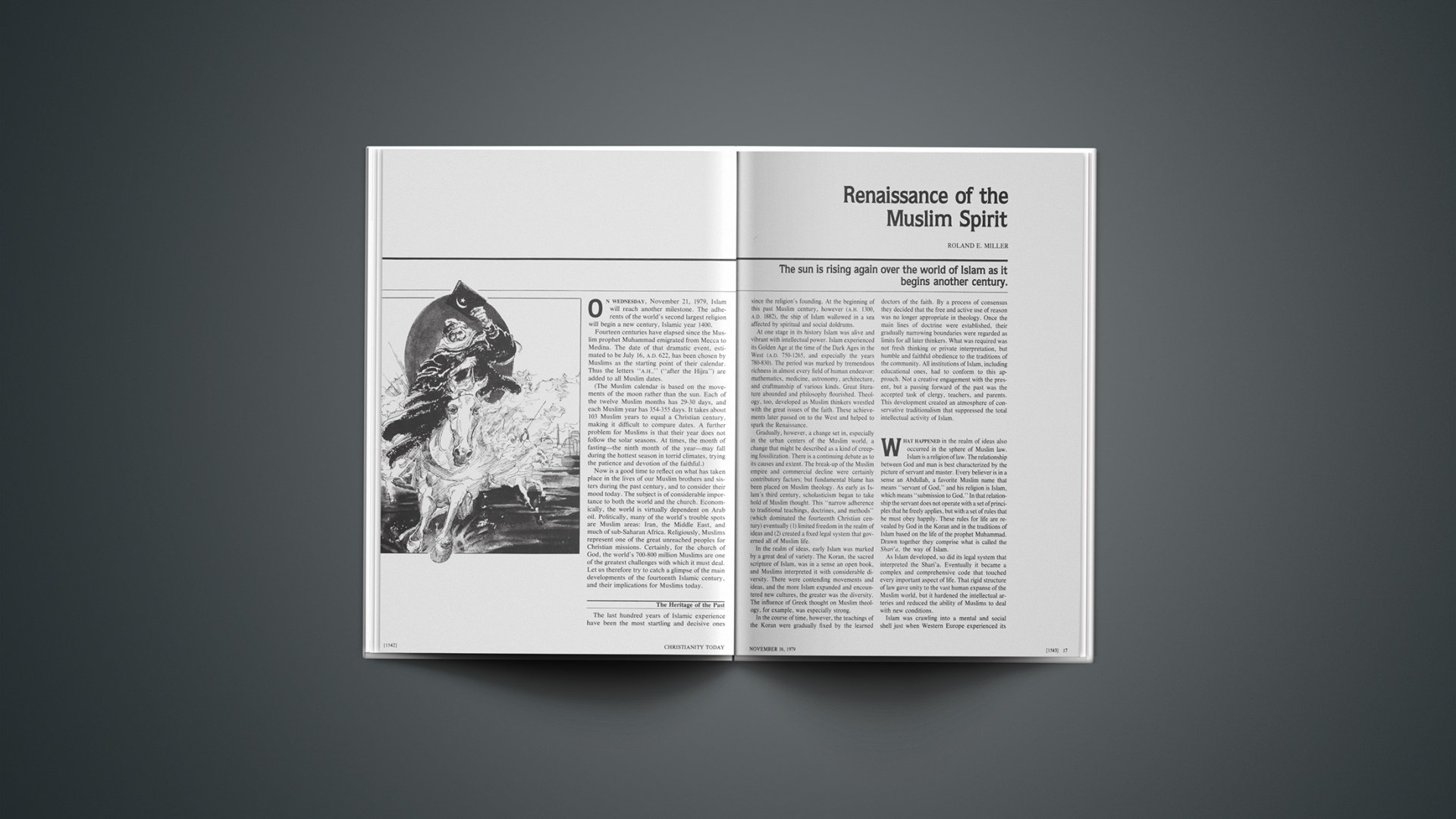
On wednesday, November 21, 1979, Islam will reach another milestone. The adherents of the world’s second largest religion will begin a new century, Islamic year 1400.

Fourteen centuries have elapsed since the Muslim prophet Muhammad emigrated from Mecca to Medina. The date of that dramatic event, estimated to be July 16, A.D. 622, has been chosen by Muslims as the starting point of their calendar. Thus the letters “A.H.,” (“after the Hijra”) are added to all Muslim dates.

(The Muslim calendar is based on the movements of the moon rather than the sun. Each of the twelve Muslim months has 29–30 days, and each Muslim year has 354–355 days. It takes about 103 Muslim years to equal a Christian century, making it difficult to compare dates. A further problem for Muslims is that their year does not follow the solar seasons. At times, the month of fasting—the ninth month of the year—may fall during the hottest season in torrid climates, trying the patience and devotion of the faithful.)

Now is a good time to reflect on what has taken place in the lives of our Muslim brothers and sisters during the past century, and to consider their mood today. The subject is of considerable importance to both the world and the church. Economically, the world is virtually dependent on Arab oil. Politically, many of the world’s trouble spots are Muslim areas: Iran, the Middle East, and much of sub-Saharan Africa. Religiously, Muslims represent one of the great unreached peoples for Christian missions. Certainly, for the church of God, the world’s 700–800 million Muslims are one of the greatest challenges with which it must deal. Let us therefore try to catch a glimpse of the main developments of the fourteenth Islamic century, and their implications for Muslims today.

The Heritage Of The Past

The last hundred years of Islamic experience have been the most startling and decisive ones since the religion’s founding. At the beginning of this past Muslim century, however (A.H. 1300, A.D. 1882), the ship of Islam wallowed in a sea affected by spiritual and social doldrums.

At one stage in its history Islam was alive and vibrant with intellectual power. Islam experienced its Golden Age at the time of the Dark Ages in the West (A.D. 750–1265, and especially the years 780–830). The period was marked by tremendous richness in almost every field of human endeavor: mathematics, medicine, astronomy, architecture, and craftmanship of various kinds. Great literature abounded and philosophy flourished. Theology, too, developed as Muslim thinkers wrestled with the great issues of the faith. These achievements later passed on to the West and helped to spark the Renaissance.

Gradually, however, a change set in, especially in the urban centers of the Muslim world, a change that might be described as a kind of creeping fossilization. There is a continuing debate as to its causes and extent. The break-up of the Muslim empire and commercial decline were certainly contributory factors; but fundamental blame has been placed on Muslim theology. As early as Islam’s third century, scholasticism began to take hold of Muslim thought. This “narrow adherence to traditional teachings, doctrines, and methods” (which dominated the fourteenth Christian century) eventually (1) limited freedom in the realm of ideas and (2) created a fixed legal system that governed all of Muslim life.

In the realm of ideas, early Islam was marked by a great deal of variety. The Koran, the sacred scripture of Islam, was in a sense an open book, and Muslims interpreted it with considerable diversity. There were contending movements and ideas, and the more Islam expanded and encountered new cultures, the greater was the diversity. The influence of Greek thought on Muslim theology, for example, was especially strong.

In the course of time, however, the teachings of the Koran were gradually fixed by the learned doctors of the faith. By a process of consensus they decided that the free and active use of reason was no longer appropriate in theology. Once the main lines of doctrine were established, their gradually narrowing boundaries were regarded as limits for all later thinkers. What was required was not fresh thinking or private interpretation, but humble and faithful obedience to the traditions of the community. All institutions of Islam, including educational ones, had to conform to this approach. Not a creative engagement with the present, but a passing forward of the past was the accepted task of clergy, teachers, and parents. This development created an atmosphere of conservative traditionalism that suppressed the total intellectual activity of Islam.

What happened in the realm of ideas also occurred in the sphere of Muslim law. Islam is a religion of law. The relationship between God and man is best characterized by the picture of servant and master. Every believer is in a sense an Abdullah, a favorite Muslim name that means “servant of God,” and his religion is Islam, which means “submission to God.” In that relationship the servant does not operate with a set of principles that he freely applies, but with a set of rules that he must obey happily. These rules for life are revealed by God in the Koran and in the traditions of Islam based on the life of the prophet Muhammad. Drawn together they comprise what is called the Shari’a, the way of Islam.

As Islam developed, so did its legal system that interpreted the Shari’a. Eventually it became a complex and comprehensive code that touched every important aspect of life. That rigid structure of law gave unity to the vast human expanse of the Muslim world, but it hardened the intellectual arteries and reduced the ability of Muslims to deal with new conditions.

Islam was crawling into a mental and social shell just when Western Europe experienced its great awakening with the Renaissance and Reformation, followed by the Enlightenment and Industrial Revolution. The new power of the West sought release in colonial ambition and imperialist expansion. Western nations soon ruled supreme in almost every major Islamic area of the world. To the regression of intellectual life was now added the bitter potion of political defeat it had helped make possible.

The combination of these internal and external forces had an oppressive effect on the Muslim spirit. While it was not entirely dampened, the general atmosphere was gloomy. The melancholy situation reinforced a theology of passiveness that had already developed earlier in Islam. That theological development was based on an important emphasis in the Koran that had been isolated and dogmatized, namely the teaching that God predestines all things.

Orthodox Muslim theology was ruthlessly logical in its primary concern to give all glory to God. He is the sole Creator in the universe, and therefore nothing can happen unless he creates it. He is sole Lord of the universe; thus, he has decreed all things for it, including human action. What happens, happens because of his sovereign will. His inscrutable will and power, therefore, lie behind every human condition, individual and social. Even the grievous events that have occurred in Islamic history took place because of his will and doing, although not with his pleasure. Necessity often becomes a virtue. This theology of passivity helped to make sense out of what was otherwise senseless for Muslims, for if God was on their side, why had Islam fallen so low?

This heritage of the past explains the gloom in which the Muslim world found itself a hundred years ago. The trends described simply continued in the Muslim fourteenth century. Traditionalism and inertia characterized the community. Want and disease reigned in many areas. Spiritually, the pious life was overlaid with ritualism. Psychologically, Muslims had a defeatist attitude. Instead of looking ahead, they looked backwards. A sense of loss and nostalgia for past glories pervaded the atmosphere. Muslims felt that they were a persecuted minority in a hostile world, and facets of a corporate minority complex developed.

Apparently the last and only refuge was their religious faith, so they built “walls” to prevent any breach in that last bulwark and a ghetto mentality took over. As Islam retreated into the fortress of faith and salved its wounds, it bitterly declined any messages, intellectual or spiritual, that threatened to take away its sacred inheritance and the hope that was left. As part of that process, Christian missions were shut out and Muslims turned a deaf ear to the gospel when it did occasionally reach their hearing.

What for many seemed like the end of the tragic road—the final deathblow for Islam—came after the First World War when the Ottoman Empire was ruthlessly dismembered and parceled out among European nations. But life for Muslims was far from over. Things were happening within the body of Islam that were energizing it for a new and lively phase in its history, a phase through which it is now passing.

The Winds Of Change

It is easy to overstate the condition of Islam in the first part of the just-completed Islamic century. Official Islam was declining—some say slumbering; but at the elemental levels, the pattern of religion was going on. There may have been less excitement and creativity, but there was faith, and a deep reservoir of loyalty and energy. The tremendous resurgence and revival of Islam in recent times cannot be explained apart from the spiritual commitment of ordinary Muslims. A revival was necessary, but the basic material for it was there in that loyalty and energy.

Today the revival has come. Changes that in Christianity took centuries have been compressed into one generation for Muslims. These have left some Muslims gasping and troubled, and others exhilarated and alive with hope.

A powerful mix of internal and external stimuli have brought about this Muslim revival. Granting that the influence of these factors is complex, I would like to suggest three major ones: (1) the influence of modern education, (2) the recovery of economic and political power, and (3) the pressure of Muslim laity for social reform.

First, modern education was the chief benefit that Islam received from its occupation by colonial powers, although Muslims did not always regard it as such. The spirit of traditional Muslim education was to respect, to memorize, to hand on, and to repeat again what was received from the past. This included all aspects of knowledge, natural as well as spiritual, for all significant truth had been decided. For Muslims, the Koran had become a closed book. Its holy language was to be remembered and recited, not reflected upon and freshly applied. Picture a shadowy room filled with white-garbed male students listening intently to a beshawled teacher reading in Arabic from a medieval commentary: this kind of educational process was carried on with the greatest of dedication in countless mosque schools throughout the Muslim world.

Western education, with its probing, analytic, and questioning spirit now came on the scene. To some it seemed wildly threatening, and every attempt was made to resist its influence. To other Muslims, however, it seemed like a ray of hope, and in the end it is the latter vision that has been victorious. At the beginning of the past Islamic century stand two individuals who typify two different kinds of approval that were given to modern education. In India, Sir Syed Ahmad Khan (d. 1898) accepted rationalism as the guiding spirit for modern Muslims. He taught that modern knowledge does not contradict, but confirms the essential truths of the Koran. There is, he said, no difference between God’s word and God’s work. Both are equally the sources of divine truth and, in fact, revelation must be interpreted in the light of natural truth. Out of his University of Aligarh poured forth a stream of young Muslim idealists for whom the hope of Islam rested in the scientific temper that Sir Syed inculcated and typified.

More Muslims, however, preferred the less radical approach of Muhammad Abduh (d. 1905) in Egypt, who held that Islam must be reformed and returned to its true and original state. Once reformed of ignorance, abuses, and the un-Islamic accretions that have crept in over the years, Islam will be in perfect harmony with modern life and thought.

To that end, he said, the Koran must be liberated from traditional interpretations and approached reasonably. Reason must bow before the mysteries of God, for which revelation is essential, but it is the necessary tool for the proper interpretation of the Koran and its wise application to modern conditions. Religion and science each have its proper domain, he taught; the two are mutually supportive, interactive, and beneficial for the life of humanity.

Muhammad Abduh’s primary thesis, that there is nothing wrong with Islam but a great deal wrong with Muslims, became the basic approach for most Muslims who supported modern education. In the course of time, not only did some form or other of Western education become the model for advanced Muslim universities, but Muslims themselves began to stream to Western halls of learning. Today that stream has become a flood. As Muslims become engaged with the scientific and technological age, a veritable intellectual revolution is taking place in Islam. Ten years ago when the Apollo mission circled the moon, some Muslims in an interior village of southwest India argued that it could not have happened because in traditional Islamic cosmology moon and stars are studded into the seventh and final heavenly layer, beyond which there is no passage. But in Islam today the mind has broken through. What will it mean for the faith?

That is exactly the question that perturbs many Muslims at the close of their fourteenth century. Christians can understand that problem well. They know how hard change comes, and they realize how difficult it is to define its limits. They have watched many of their own adherents follow the alluring siren of intellectualism through doubt to loss of faith. In Islam today at one end of the spectrum are those who call for a more rational exposition of the faith, while at the other end stand those who cry for outright resistance against all contemporary trends.

The Recovery of political and economic power is the second major factor in the resurgence of Islam. Considering the recovery of political power first, we find that during the early years of their fourteenth century many Muslims still lived with the dream of restoring pan-Islamic unity. That dream was first born in the early days of Islam when the prophet Muhammad organized believers as one community under his leadership. But divisions occurred soon after his death, and the ideal of Islamic unity was never fully realized thereafter. But at the start of the Islamic fourteenth century, Jamal al-Din al-Afghani (d. 1897), the great Middle Eastern revivalist, ignited a new fire of appreciation for this vision. “Muslims of the world, unite!” was his call. The primal vision he proclaimed is still held by some Muslim idealists, but for the most it has yielded place to another reality.

That reality is the emergence of modern independent Muslim nations. After World War I the imperialist powers of Europe began their retreat, which accelerated and climaxed after World War II. Colonialism was outdated and outrun. Nation after nation gained its freedom, among them the 46 independent states with Muslim majorities. Each of these nations had its own pilgrimage to selfhood that holds its citizens together. Although 20 of these nations are in the Arab world, the majority of Muslims live outside that belt, with only 10 to 15 percent having Arabic as their native tongue. In order of size of their Muslim population, the leading nations that have emerged are Indonesia, Pakistan, India, Bangladesh, Turkey, Egypt, Iran, and Nigeria. With their emergence, Muslim nationalism rather than pan-Islam nationalism has become the dominant force in modern Islam.

It is hard to overestimate the importance of the fact that political power has been restored to Muslims in their fourteenth century. It has placed Muslims in charge of their lives and futures and reinvigorated their self-respect. It has removed the basic cause of their resentful and defensive attitudes. It has restored to prominence the old Islamic interest in statecraft, and in fact has made salvation by politics the unwritten theme of contemporary Muslim life. Barring the uncertainties of the Palestine issue, Muslim states are now able to feel at ease in the world community of nations.

Muslim nationalism, however, has also produced a number of serious problems, both internal and external. Internally Muslims have struggled with the question of how far Muslim religion shall control a Muslim state. Is there after all a distinction between the sacred and the secular? Islam has always denied that there is. All of life, including political life, is under God. But how is the sacred to be expressed in and through the complexities of a modern nation state?

At one end of the spectrum are countries like Saudi Arabia where the Koran and Shari’a are the explicit constitution of the nation. At the other end is Turkey, which has chosen to be a secular state along Western lines. In the middle are nations like Pakistan, Iran, and others that are struggling to find their way.

Externally the development has raised the question of how Muslim nations should relate to each other when they have conflicting perceptions and interests. Muslim nationalism expresses and reinforces the geographic and cultural differences of the Muslim world. The basic unifying elements are still there in the tradition of Islam. Muslims confess the same creed, proclaiming together: la ilaha ilia lah, wa muhammadu rasul ilahi. “There is no god but God, and Muhammad is the Apostle of God.” They pray to God with a common prayer, and at the same time. They fast in the identical month. They meet together on the pilgrimage to Mecca, the focus of Islamic unity. They celebrate the same two major festivals: the breaking of the fast and the commemoration of the sacrifice of Abraham. But the divisive forces of national self-interest and cultural self-affirmation frequently overwhelm these unifying elements, a tense fact that received notable expression when the idealistic state of Pakistan split in 1972.

Islam’s recovery of economic power went hand in hand with its regaining of political power. For Muslims to rule their own destiny and not to have the resources to do it was their dilemma in the second third of the past century. This contradiction was one of the factors that enabled communism to infiltrate the supposedly impregnable barrier of Islam. The poverty and suffering of ordinary Muslims coinciding with political liberation and growth in education provided inflammable material on which secular philosophies could and did feed. Many of these ordinary Muslims who turned to extreme movements did so without denying their faith; in frustration they were following anyone who might relieve their hapless condition. Within the last third of the fourteenth century, however, the situation dramatically changed.

We are all participants in that drama, whose acts and scenes are daily described in our news media. The dependence of Western nations on Islamic oil has spectacularly altered the Muslim situation.

The new oil wealth of the Islamic nations has the capacity to dominate global economies for years to come, an utterly astonishing turnabout in world history. The little kingdom of Kuwait symbolizes the change that oil has brought to Muslim lives. Once it was a sleepy, nomadic region, whose most prominent features were the desert, the ruler’s palace, and a Protestant mission hospital. But oil was discovered in 1938, and production began in 1946. Now the people of Kuwait have the highest per capita income of any nation in the world, and its ruler is said to be the world’s richest person!

This New economic power is full of implications for Muslims. On the physical side it gives them the capacity to transform their societies into modern nations almost overnight, and they are doing so. On the psychological side it gives Muslims a strong sense of self-confidence. There is an élan, a spirit of buoyancy and optimism among them that has not been present for centuries. That spirit percolates through every area of Muslim life. Granted that the distribution of the new wealth is uneven and is still concentrated among the few, and there continue to be vast numbers of Muslims in different lands suffering from severe physical needs, nevertheless, the expectations of the many have risen with the fortunes of the few.

Muslims therefore face the challenge of how to distribute their wealth. The traditional pattern of almsgiving, worked out in a premodern age, seems inadequate to the new situation. Muslims are being suddenly forced to formulate a system of Islamic economics that is both true to the faith and, at the same time, realistic.

For example, the Koran forbids the taking of interest. What are Muslims to do? Apply the admonition, ignore it, or reinterpret it? A more serious problem is how to deal with mammon and its love. Pious Muslims are already horrified by the growth of materialism and the advance of the secular mood. The faith of Islam now faces the most serious testing in its history.

Intellectual, political, and economic factors have all played major roles in the revival of Islam. The third factor is the spiritual one. Faithful and religiously-oriented Muslims have also been involved in the remarkable changes of the past century. Sometimes it was the oft-maligned religious leaders, the clergy of Islam, who led the way toward renewal. The bulk of the clergy, however, were the sincere but ill-educated guardians of the status quo, and were frequently lampooned by other Muslims.

It was from the laity of Islam that the most powerful pressures for reform built up. These were not the mystical devotees of earlier years who made such a spiritual impact on Islam. Rather, they were modern, educated, and socially conscious businessmen, lawyers, journalists, doctors, and teachers, who called for pragmatic change. Personally, they were believers, but not theologically trained, and they could not easily integrate the new developments with the old faith. So they held on to the old faith in relatively undisturbed compartments and directed their attention to social reform. Through their influence and efforts, social reform carried theology (I am tempted to say, kicking and screaming) into the modern age, where it has now begun a process of adaptation.

The social reformers directed their attention to community problems of every kind, but especially toward those conditions for which Islam was criticized. They worked to establish colleges and scholarship funds, medical care facilities, job training programs, improved orphanages, cultural centers and educational journals; they strove to raise the status of women, to better relations with non-Muslims, and even to reform Muslim personal law. They called for “revolutionary changes,” defining the revolution as an end to the tendency to blame God or past events for present conditions, and the beginning of a philosophy of self-help and cooperative action.

“We will not wait to achieve progress … we will start where human knowledge has ended.”—King Faisal of Saudi Arabia.

Gathering Clouds

As frequently happens, however, these winds of change have now produced a severe reaction in Islam as it stands on the threshold of its fifteenth century. The backlash has swept stormily across the Muslim world in the past five years. Cries of too much, too fast, are rising everywhere. The call is ringing out to return to the old verities, and to apply strictly the literal interpretation of the Koran and the hallowed directives of the Shari’a. Fazlur Rahman, a perceptive Muslim scholar, has well stated the phenomenon:

“The movement inspired by the initial modernist impulse split into two developments moving in two directions, one in the direction of almost pure Westernism and the other gravitating towards fundamentalism.…”

As any newspaper reader will recognize, the fundamentalist wave is surging strongly in reaction to all that has transpired in the second phase of the past Islamic century. More and more Muslims today are saying “enough!” to progress; it is time now to conserve the faith of Islam.

As Islam celebrates a milestone and enters a new century, it is engaged in a monumental physical, mental, and spiritual struggle that is full of implications for the lovers of Muslims.

That, of course, is what Christians by definition are: lovers of Muslims. A lover is understanding and sympathetic with the condition of the one he loves, and is equally committed to sharing that which has helped him most in his own experience. Through the turmoil of the past century a favorite Koran passage has been Surah 13, verse 11: “God will not change the condition of a people, until they change what is in their hearts.”

Christians who are on the divinely appointed mission of love to their Muslim friends and neighbors believe that in Jesus Christ, whom they adore and Muslims respect, God reveals the power that speaks to the conditions of human hearts as nothing else. It is only the power of God’s love that can bring true and godly change. It is the task of the church in the days ahead to achieve such a relation with Muslims and to communicate well his powerful message of love.

An old Arab proverb says: “What comes from the lips reaches the lips; what comes from the heart reaches the heart.” I hope that Christians in the coming century will be able to convey, from their heart to the Muslim heart, God’s message for all people everywhere, in every condition.

G. Douglas Young is founder and president of the Institute of Holy Land Studies in Jerusalem. He has lived there since 1963.
Ideas

Society’s Yearnings Surface

Society’S Yearnings Surface

Pope John Paul II was a smash! Who would have thought that a preacher of righteousness would attract millions in sophisticated, materialistic, hedonistic America in 1979? Yet, there he was, standing amid the throngs and beaming across the television screens of the land. There he was, enjoying the beneficent smile of the Southern Baptist layman who now occupies the White House.

Two decades ago such a scene would have been a political disaster, and a religious blunder of the first magnitude. But in the fall of 1979 only a few bothered to point out the blurring of state-church separation lines—and one of them was the atheist Madelyn Murray O’Hair. Apparently most Americans were quite content to have their tax monies and their chief executive contribute to something that spoke of the old-time virtues, even though the spokesman was the human head of a specific religious organization. Times do change.

The Pope’s performance not only proved that interreligious attitudes change, but also that America’s moral dilemma is so acute that previous animosities and political ideologies could be cast aside for the sake of a public proclamation of righteousness, even if such proclamation came from the lips of a native of Poland, who now occupies the Holy See of Catholicism in Rome, Italy. Most Americans apparently saw Pope John Paul II as a symbol of the righteousness they believe in, rather than as the promulgator of a religious system they do not necessarily accept.

There are those who out of biblical convictions, or even out of tradition, do not accept Roman Catholic dogma—or, quite possibly and understandably consider some of it heresy—but who found themselves admiring Pope John Paul II for his courageous statements of biblical principles of morality. The issue quite properly is not that a Roman Catholic spoke, but what he said. From a biblical, evangelical standpoint, it goes without saying that the Pope did not preach righteousness by faith. He did not talk about receiving Christ’s righteousness as the only means of securing eternal life. But he did clearly enunciate moral positions held by Christians committed to biblical authority.

America’s spiritual condition is such that perhaps this kind of statement of the law’s demands—the eternally valid and binding moral principles revealed by the Creator—is one means God is using to prepare people to repent and confess that they cannot make it with God on their own terms. The apostle Paul’s reference to the law as a schoolmaster, or custodian, to lead us to Christ is pertinent in this regard. Those who think seriously about personal moral failure, as well as about the country’s, are open to the Spirit’s conviction, which, if obeyed, will lead to the knowledge of the righteousness which is by faith in Jesus Christ.

If we point out that theologically the Pope had the cart before the horse, we must also acknowledge that evangelicals who profess to have the proper biblical sequence—faith first and then works of righteousness—may be unmindful of society’s yearning for specific, uncompromising statements of the kind of morality the gospel demands. Secular, relativistic views of morality and ethics have subverted some theological institutions, churches, and pastors for so long that people on the outside have come to believe that Christians in general have no sure way out of the current moral morass.

Pope John Paul II, at the least, explicated a consistent moral ethic, a different way to live, a way to survive a predominantly materialistic (whether communist or capitalist) world and life view. Evangelicals need to see the urgency of the large issue of the survival of Christian values in society.

Stereotype Of The Muslim Monolith

The Muslim world enters its fifteenth century in a better position to exert influence on the West than at any time since the close of its golden age. But it would be a tragic mistake for Western Christians to react defensively, presuming that the stereotype of a monolithic Muslim society uniformly impervious to the gospel is true.

It is not. As Roland Miller observes in his article on page 16, a fundamentalist wave is surging through parts of the Muslim world. It is a reaction to a parallel wave of modernization by an educated Muslim laity that assimilated as its own Western social concerns based on Christian values. The interplay between these contradictory forces means there is no uniformity in Islam but flux.

To perceive Muslims as forming a broad phalanx in doctrinal lockstep is misleading. Compare, for example, the differences in attitudes between Egypt’s Anwar Sadat and Iran’s Ayatollah Khomeini. Think of them as pieces in a mosaic varying in sizes, shapes, colors, and textures—an aggregate of distinct groupings whose shared formal identity is outweighed by divergent traditions and differing brands of folk Islam.

To acknowledge the current turbulence and diversity in Islam is to recognize the potential for evangelization with the promise of fruit. Conditions are ripe for creative encounters. The kernel of the gospel can take root in Muslim cultures, if our witness does not take the form of a frontal attack on those cultures.

Let us stress the common ground we share without compromising the basic Christian gospel. Let us use the best techniques of transcultural evangelism to insure that the primary obstacle to a Muslim’s conversion to Christ is the offense of the Cross rather than the stigma of capitulating to Western culture or an evangelical subculture.

The yield may be harvested in the form of congregations that resemble a Western Protestant church no more than a Messianic Jewish gathering does. When Muslims are turning to Jesus as not only a prophet but also Messiah, their new Master is gratified, and his Western servants are rewarded and enriched.

Beyond Personal Piety

Time magazine tells us there are 50 million evangelicals in the United States. But Dr. Francis Schaeffer and company complain that they aren’t able to break into the collective routine of personal piety.

Not that the Schaeffers’ popularity has waned—their books are selling as well as ever. But the new film seminar series, Whatever Happened to the Human Race?, has fallen flat when compared with the first series, How Should We Then Live? Only 700 attended the seminars in New York’s Madison Square Garden. A disappointing 1,500 attended in Chicago, and a meager 700 in Houston.

The ambitious scope of the first series has undoubtedly caused some to prejudge the integrity of this second effort. Others question the $28.00 price tag for the two-day series. Do Christians really want to know “that much” about euthanasia, infanticide, or abortion?

Euthanasia or infanticide still seem far away, either buried in the past or lurking as a remote possibility for the future. Advocating strong positions on these issues does not loom as potentially costly. Many Christians divert themselves with these two “theological” issues.

But abortion is messy. It can push its way into our lives or the lives of our wives, our daughters, or our friends. Intransigent opponents who shout at each other from both sides of the abortion issue with polemics much like those used about homosexuality seem, for many, to generate more confusion than clarity and resolution. But, unlike homosexuality, millions of lives are sacrificed on the proabortionists’ altar of the “right to choose.”

Whatever Happened to the Human Race? uses biblical authority to challenge the Supreme Court. Only by mobilizing the Christian community and other morally sensitive people can human dignity be preserved. But perhaps, as Schaeffer now suggests, the church has already compromised itself by collusion with the self-interests of society. If this is so, the Schaeffer series will only embarrass and indict us; but it will not move us. He is saying that if evangelicals will not take a stand on this issue he doubts that they would take a stand on anything. He characterizes the evangelical community as “apathetic” and caught in “self-absorption,” suggesting it is too fat and prosperous—too comfortable—to take an aggressive stand against abortion.

The films and lectures graphically and methodically depict erosion of the Judeo-Christian consensus with a commensurate devaluation of man. In them, Schaeffer calls upon Christian people for a moral reversal. In an hour-long seminar, he delineates specific strategies individual Christians and churches can use to help reinstate the rights of the unborn, the defective, and the aged.

The 1973 Supreme Court decision legalizing abortion settled the argument for many. But that decision should not settle anything for conscientious Christians. The Supreme Court has been wrong before and for the wrong reasons. Economic and political factors swayed the court to declare nonhuman status for slaves. It is not surprising that the court should assign unborn children similar status today. Its decisions have sidestepped such moral principles as the sanctity of human life. In the case of abortion, it appears the court’s decision rested exclusively on the arbitrary and open-ended criteria of the quality of life—primarily the quality of life for expectant mothers.

Unborn babies, too, need an advocate. For all practical purposes, the Supreme Court has unwittingly legalized murder. One million babies are aborted in this country each year. Pediatrician C. Everett Koop says that in some hospitals it has become common practice to allow unwanted and deformed babies to starve to death.

We are not advocating absolute rejection of all abortions, but we stand solidly with Schaeffer in calling a spade a spade. Whether or not a one-day fetus is fully human life, it is at the very least potential human life. And there is certainly no way even an early development of the fetus can be regarded as anything but human life. To take human life for reasons of convenience, or for the protection of the quality of other lives, is murder. Cutting through the rhetoric and confusion of the issues and setting aside debatable points (such as taking of one life to save another or immediate abortions in the case of rape), Christians must stand up, speak out, and be counted. The sacredness of human life is at stake.

Maybe now Christians no longer need to puzzle about the absent witness of the church in Nazi Germany. Unless there is a Christian outcry against man’s diminished dignity, history may once again repeat itself.

Eutychus and His Kin: November 16, 1979

A friend of mine, who is a Very Important Christian Leader, takes time to answer his mail but not to sign the finished letters. His signature is so poor that anybody could sign the letters. His secretary merely stamps the signature: “Dictated by Dr._______ but signed in his absence.” The twenty-second time I saw that stamp, I received a brilliant idea from my muse which, if it pays off, ought to give my wife and me a trip to Winona Lake Bible Conference.

I plan to market a complete set of “Sacred Stamps” that every pastor can use in his ministry and which will save him a lot of time and trouble. For example: “Passed by the official church board but never carried out.” (This one you use on the church clerk’s reports, and also on annual reports that don’t report anything.)

This one is for sermon outlines: “Originally preached by Spurgeon, but borrowed by _______.”

For use in books only: “Borrowed from _______ but not returned.”

“United with the church and has not been seen since.” (This one is for membership record cards and also visitation cards. We include two of these stamps. They wear out in a hurry.)

“United with the church and I hope he/she never comes back.” (The pastor uses this on his own private records.)

“Sorry, our church does not support free-lance missionaries even if they have seen a vision.” (This one will save you a lot of letter-writing.)

I will also prepare special stamps made to order. No sooner had this exciting news gotten out when a well-known pastor wrote asking for: “Baptized by Dr._______ and not to be baptized again.” He wants to stamp this on the candidate, so I’m suggesting he use the kind of ultra-violet system they have at Disneyland.

I’ll be watching for your order.

EUTYCHUS X

(signed in his absence)

A Bit Unfair

The article “Does Male Dominance Tarnish Our Translations?” by Berkeley and Alvera Mickelsen (Oct. 5) was very thought-provoking. It made me aware of very real dangers in “one-person translations.” The article was a bit unfair, however.

There seemed to be a convenient attempt made to show that the word “head” in 1 Corinthians 11:3 meant source and only source (according to the Greek-English Lexicon of Liddell and Scott). But in Bauer, Arndt, and Gingrich’s Greek-English Lexicon the word “head” (kephale) is used “in the case of living beings to denote superior rank …” (p. 431). This does not mean inequality, but superior roles among equals, i.e., God and Christ in 1 Corinthians 11:3.

SCOTT OLIPHINT

Young Life staff

Amarillo, Tex.

The Mickelsen’s article interested me almost as much as it bewildered me. They pointed out correctly that the Greek kephale means “head,” not “supreme.” But they stretch the Greek too far to state that there is no sense of authority implied in the word—that the meaning comes closer to “source.”

Ephesians 1:22 and 5:23 both speak of Christ as “head” of the church. Does this mean that he is only the church’s source—with no authority over the church’s life and mission?

REV. DIRK VAN DER LINDE

Trinity Lutheran Church

Kearney, Mo.

As to “improving” or “clearing up” expressions of Scripture, those who seek to do “dynamic” translations know that it is not a case of word-for-word transference of Greek into English. Every conscientious translator seeks to render the meaning of the passage. Contemporary translators have sought to do just that in the passages to which the authors take such strong exception. The Mickelsens follow the same pathway—to “make plain” what they think the Scriptures ought to mean. They shoot very wide indeed of the mark.

A. E. HORTON

Tracy City, Tenn.

All in all the article upholds the basic translation principle of faithful reproduction in the target language of what was written in the original. The “Editor’s Footnote,” however, was gratuitous.

As for Psalm 68:11 you would advocate the opposite of what the Mickelsens are saying. You would have the translator insert words that are not in the Hebrew: “Great was the company of those women who publish the Word of the Lord.” The editor claims that the Hebrew word is “explicitly feminine.” So is the word for water. So is the word for house. The word for father—our male parent—has a feminine ending in the plural. This has nothing to do with sex. The word in 68:11 is “heralds of good news,” and simply means “those who proclaim the good news,” whether male or female.

REV. GEROW F. CARR

Atlanta, Ga.

I was surprised at the misleading statements in your “Editor’s Footnote” to the Mickelsens’ article. You say that in Acts 18:26 the KJV “reverses the Greek order to place Aquilla (sic) before Priscilla,” but in fact the Textus Receptus used by KJV translators has Aquila first.

Also, when you say that the KJV “correctly notes the feminine Junia in Romans 16:17” and that the masculine Junias has “little or no justification,” you mislead the nonspecialist in Greek, for in fact it is impossible to decide on the basis of grammar: Iounian could be the accusative form of a masculine or feminine name.

WAYNE GRUDEM

Assistant professor of theology

Bethel College

St. Paul, Minn.

I was most astonished to read the Mickelsen’s article. I had almost given up hope that a major Christian publication would ever recognize the fact of so much un-Christlike chauvinism in our Bible translations and, therefore, from our pulpits and Sunday school classrooms. My only regret is that you waited until so many Christian women and men had already laid the groundwork for dialogue about sexism in the church before you felt it was safe enough to speak on this topic.

LAURIE CASSELLS ZIMMERMAN

Berkeley, Calif.

It was a welcome surprise to see Berkeley and Alvera Mickelsen discuss linguistic matters related to translating some of the Bible’s “woman passages.”

Obviously the time has come for conservative church people to acknowledge with repentance these centuries-old misconceptions about the biblical view of women. In recent years, when members of the Evangelical Women’s Caucus have tried to clarify misleading translations, they have usually either been ignored or given a fast putdown.

VIRGINIA HEARN

Berkeley, Calif.

The Paraphraser

We want to thank you for sharing the interview with Kenneth N. Taylor, the Living Bible paraphraser (Oct. 5). We appreciate his willingness to share some of the battles he fought and even the mistakes he made. His spirit of humility is overwhelming.

ROCHUNGA AND MAWII PUDAITE

Bibles for the World

Wheaton, Ill.

Telling how someone or other came to know the Lord through the Living Bible because it was “the first time he read the Scriptures and understood them” leaves the Holy Spirit out altogether. In other words, what the Holy Spirit cannot do, Ken Taylor’s Bible can.

I would guess that the overwhelming majority of men and women saved from sin during the last several hundred years came to know the Lord as the Holy Spirit made the teaching and preaching from the KJV real to their hearts. If only Taylor’s Bible had been available, who knows what Charles Finney, Jonathan Edwards, D. L. Moody, R. A. Torrey, Evan Roberts, and others could have accomplished for the Lord!

I’m not one of those who says, “If the King James was good enough for Peter and Paul, it’s good enough for me.” There are many good translations. I just don’t feel that the Living Bible is one of them.

RICHARD ELLISON

Elmwood Place, Ohio

The Bible: True and Romantic

Leland Ryken’s article “The Bible: God’s Storybook” (Oct. 5) was very stimulating and equally satisfying. As a student of literature and a fledgling poet, I and many others are always inquiring for a sound base for resolving the apparent “conflict” between realism and mythological romance. It is refreshing and encouraging to see another writer challenge the accepted notions and appeal to the Scriptures as both the divine authority and the grandest romance ever told.

P. B. BURTON

Austin, Tex.

Strong Response

I have read with keen interest “The Ironies and Impact of PTL” by Philip Yancey (Sept. 21). There was a strong response in my heart to that article. I feel that it was written in a very fair and unbiased way, and yet the observations and information about PTL that need to be made public were also included.

As a minister of the gospel, I have been greatly concerned about a number of things that were dealt with in that masterly article.

PAUL C. SORENSEN

Executive Director

The Pentecostal Benevolent Association of Ontario

Agincourt, Ont.

Correction

David F. Wells, author of “Prayer: Rebelling Against the Status Quo” in the November 2 issue, was incorrectly identified as associated with Trinity Evangelical Divinity School. Dr. Wells is now on the faculty of Gordon-Conwell Theological Seminary, South Hamilton, Massachusetts.

Editor’s Note from November 16, 1979

Missiologists have predicted that by the year 2000, Africa will have become a Christian continent with more Christians living there than anywhere else on planet earth. Most of these, moreover, will be not merely adherents of the church, but evangelicals—products of a century of mission advance throughout sub-Saharan Africa. In the last decade two unanticipated events have occurred to mar this scenario. The first is the military intervention by Soviet and Cuban forces to support Communist regimes and their inevitable repression of religious freedom. The second factor disrupting the advance of missions is a resurgent Islam fueled by Muslim oil. The vast windfall of oil dollars brought with it a revival of Islamic religion, accompanied by a renewal of its missionary zeal. This year Muslims enter their fifteenth century (according to the Islamic calendar), and Islamic specialist Roland Miller traces for us the dramatic history of Islam through the revolutionary century just ended. A subsequent article will analyze the theology of Islam, its challenge to the gospel, and some fascinating breakthroughs in recent mission strategy.

Ever since psychology first appeared as an independent discipline in the academic curriculum, Christians have tended to view it with suspicion. Perhaps this suspicion was fanned by the old saw: “First psychology lost its soul, then it lost its mind.” Be that as it may, Gary Collins calls upon us to eschew foolish fears of psychology and to avail ourselves of its insights to help people in need.

Also in this issue, our staff presents a review article of a new biography of Billy Graham. Ordinarily, CHRISTIANITY TODAY would have ignored such a work; but the wide acceptance of this clever mix of fact and fiction not only spreads a false picture of Graham and his role in contemporary American history, but indirectly it also fosters a basic misunderstanding of evangelicalism as a whole and of the moral malaise of our times.

Personalia Update: November 02, 1979

Church growth specialist Paul Benjamin has been appointed executive director of the American Festival of Evangelism, a July 1981 evangelism strategy session sponsored by the Lausanne Committee for World Evangelization. Benjamin, the director of the National Church Growth Center in Washington, D.C., has written extensively and directed seminars on the subject of church growth.

New Miss America Cheryl Prewitt of Ackerman, Mississippi, professes a born-again faith, which she says was strengthened by miraculous healings of her left leg, shattered in an auto accident. Prewitt, 22, a gospel music composer and singer, says she won’t use her position to proselytize, but will have no qualms about discussing her Christian faith.

Stacking Sandbags against a Conservative Flood

Evangelicals for Social Action, a small group of politically moderate-to-liberal Christians, huddled last month to map plans for a modest counterattack on the formidable conservative barrage that is shaping up this election season.

(The ESA calls itself “Christians committed to justice and liberty,” and has its headquarters in Philadelphia. ESA president Ron Sider, Eastern Baptist seminary professor perhaps best known for his book, Rich Christians in an Age of Hunger, heads a 40-member board of directors that includes college, denominational, and political figures. The fledgling organization recently began publishing a series of tracts on justice issues that will be made available to churches, and will sponsor workshops to train local pastors for “social justice ministries.”)

Since its formation in 1973, ESA has attempted to prod evangelicals to turn from a largely passive approach to society to an active effort to influence it. This, it acknowledges ruefully, is now happening, but in directions not to its liking. It points to dangers in the current awakening: “American Christians have too often mixed their zeal for building the Kingdom of God with a narrow and uncritical allegiance to partisan political goals, either liberal or conservative. Politicians, in turn, have used evangelical leaders for their own ends.”

Meeting in Northbrook, Illinois, the board drafted a “Call to Responsible Christian Action” and probed the possibilities of a consultation to help bridge the wide communication gaps it perceives between pastors, theologians, and political activists within the church.

The call says, in part, “Today we are increasingly concerned that the resurgence of evangelical concern for public policy is not sufficiently biblical. There is a danger that evangelicals will be preoccupied with a selective list of concerns that does not reflect truly biblical priorities and emphases.…

“The gospel of Jesus Christ must not be bound in any singular political philosophy, program, party, or leader. It always stands above these and judges them. Christ’s lordship over all these realms, including the political, must not be limited or compromised. We therefore strongly warn against the efforts of religious leaders, however sincere and well meaning, to affirm conservatism, liberalism, or any other political party line as distinctively and uniquely Christian.…

“We call on all Christians concerned for our society to search out biblical principles to govern and direct that concern, and to allow their inherited prejudices to be judged and transformed by these principles. Among these we would especially call attention to the following:

“1. Each individual is created in the image of God and is the object of his loving concern. Anything which degrades or does violence to the integrity of the human personality is antithetical to divine purposes.

“2. God commands us to be especially concerned for the weak and powerless in society.…

“3. God has appointed us to be stewards of his creation, even though it is presently marred by sin. We are to care for our physical environment in as loving and responsible a fashion as possible because it belongs to him. Biblical teaching on justice summons us to work against the individualistic, materialistic idolatry of our age, which has led both to despoilation and depletion of God’s creation and to an unjust distribution of wealth, power, and income within our country and among the nations of the world.

“4. Our Lord calls his followers to be peacemakers.… We must endeavor in every way possible to promote peace among individual human beings, social classes, and even nations.”

In other action, the ESA board issued a strong condemnation of the renascent Ku Klux Klan, skirted approval or disapproval of SALT II, but approved the Hatfield amendment to SALT II that rules out development and deployment of new weapons systems, and decided not to endorse the Sojourners magazine-sponsored “Call to Faithfulness” because of its unilateral disarmament tendencies. (The Sojourners and Other Side constituencies tended to disengage from ESA after its 1977 reorganization, in which it explicitly focused its attention on evangelicals and placed a higher priority on influencing change in the existing system than on advocating radical alternatives to it.)

For several years there have been extensive explorations of the limits that may/will be imposed upon technological and economic growth in our world. Impetus to this was given by the success of the Apollo project, which enabled mankind to view the earth in terms of a spaceship or, less dramatically, as a sphere with built-in boundaries.

Out of this newer perception of the nature of planet earth has emerged what may be called a “science of limits” by which the frontiers of the use of resources and of the attainable limits in production of goods (i.e., economic growth) may be determined. Since 1972 there has developed a sizeable body of literature in which environmental scholars have sought to determine the factors that serve to set such boundaries.

In response to the somewhat shadowy Club of Rome, a panel (including authors Donella H. Meadows, Dennis L. Meadows, Jørgen Randers, and William H. Behrens III) wrote the volume, The Limits of Growth (1972). This book developed the thesis that technological and economic growth is limited basically by physical factors. It offered what may be called a material-growth-limitation model. The so-called Second Report to the Club of Rome (Mankind at the Turning Point, by Mihajlo Mesarovic and Eduard Pastel, 1974) added a dimension to the discussion in terms of man’s environment. Attention was called here to the fragility of the ecological setting of human life.

A further refinement in the discussion of the physical and environmental limits set upon production to satisfy man’s material comforts was offered by a team of scholars under the direction of Wassily Leontief. In The Future of the World Economy (1977), this group of thinkers proposed a series of scenarios, based upon world economics, and including a series of goal projections, pointing to the year 2000.

Leontief’s volume is highly sophisticated, and introduced a wide range of considerations into the discussion of the fateful gap between the per capita gross production of the developed and the developing countries (with which previous models had been compared). Emphasis was laid upon the complex of economic activities that lay between available resources on the one hand, and the end result (including possible environmental disaster) on the other.

Each of the models projected in these volumes concentrated on the physical factors that affect and limit economic growth. As a consequence, too little attention was given to the sociological and spiritual elements that enter into the dynamics of the growth situation.

In 1976 there appeared a carefully written volume, the result of a study sponsored by the Twentieth Century Fund, and written by Fred Hirsch, earlier a research fellow at Nuffield College, Oxford. The volume incorporating this study, under the title Social Limits to Growth (Harvard University Press, 1976 and 1978) comes to grips with the human, as opposed to the merely physical factors that affect economic growth. The author analyzes today’s economic predicament in terms of “three issues: (1) the paradox of affluence, (2) the distributional compulsion, and (3) the reluctant collectivism” (p. 1).

In developing his analysis, Hirsch underscores the anomaly contained in current developments: away from the fashionable “onward and upward”; the “beyond” as Daniel Bell calls it. He sees a resultant view of limits that suggests retrogression rather than advance.

There surface at this point the frustrations that affluence, especially in its present day form, is producing in the developed countries. Our author sees this malaise as a result of the inability of quantitative goods and services to meet needs that are qualitative in nature. Hirsch sees this factor as being especially significant for the discussion of the social limitation of consumer scarcity goods (pp. 20ff).

This accounts, of course, for much of suburban boredom, and for the frequent assaults against property by the children of the affluent. It is also pointed out that there are few areas in which surfeiture-through-affluence cannot occur—whether in possession of luxury commodities, in the acquisition of education, or the gaining of such intangibles as success or prestige occupation.

Throughout the volume, Hirsch emphasizes the manner in which increase in the production of goods turns back upon the consumer at all levels. The major losses in society are in interpersonal relations, within which elements “such as love, trust and mutual obligation” deteriorate (p. 96). The deterioration extends, notes our author, to sexual distortion. This occurs not only extramaritally but within marriage, as typified by contractual marriage which, in effect, places marriage within the category of a consumer commodity.

The reader feels that the line of thought moves, slowly but surely, to deeper considerations. In chapter 10, under the caption, “The Moral Re-entry” the author examines the “social virtues” that ought to underlie a humane social economy. He lists these as: truth, trust, acceptance, restraint, obligation” (p. 141). These social virtues are, as Hirsch suggests, grounded in religious belief, with their altruistic elements directly rooted in Christianity. Further, he notes that merely socialized norms are totally inadequate as a basis for justice in the area of community action.

In my view it is left to Christian faith to provide substantive answers to the major issue which is raised at the end of chapter 10. Mr. Hirsch recognizes that individuals are unable to put into practice that which they know, deep down, to be either “right” toward themselves or “just” toward others in their use of material goods and possessions.

Could it not be that any adequate Science of Limits will need to accept as basic at least two of the key points in the biblical understanding of man? The first and most obvious of these would be the statement of our Lord, that “a man’s life does not consist in the abundance of things he possesses” (Luke 12:15).

A second key motif appears pictorially in the parable of the rich fool, spoken by our Lord in the same context. A bounteous land suddenly projected a farmer into a new and unexpected affluence. Responding to this appearance of success, the man committed a tragic and fatal error. Bidding his soul (as he thought) to adopt a new and luxurious lifestyle, he confused soul with body, saying “take your ease, eat, drink and be merry” (Luke 12:19).

Here our Lord sets profoundly spiritual boundaries to “economic growth.” It would seem that any adequate Science of Limits should accord a place of high prominence to the kind of insights which express the deepest reality of the life of “man under God.”

Harold B. Kuhn is professor of philosophy of religion, Asbury Theological Seminary, Wilmore, Kentucky.

Is Morality All Right?: The New Religious Lobbies Say ‘Yes’—With Impact

For years, religion lobbyists have been quietly knocking on doors around the nation’s capital, informing the people who run the country where churches and synagogues stand on various issues. With only occasional exceptions, though, Washington’s religion lobby has wielded little political clout: legislators listen politely, but, as many of the religion lobbyists themselves wistfully acknowledge, that’s about all most of them do.

This is not so, however, in the case of the newest religious lobbying force in town—the Christian allies of the political New Right. Backed by prominent television preachers and with links to both New Right political organizations and conservative members of Congress, several Christian “profamily, promorality” groups have popped into public view this year, and the political establishment—from President Jimmy Carter down—is taking note.

The new groups have Protestant fundamentalist and evangelical origins, but they are inclusivist in their political strategy, eager to recruit anyone from Mormons to Roman Catholics who will help them win their objectives. They have declared war on immorality in America’s social life, on “secular humanism” in the schools and elsewhere, and on government intrusion in Christian education and other church affairs. One notable victory: Congress, under heavy pressure mustered mostly by the Christian groups and their allies, shackled the Internal Revenue Service, preventing the agency from applying new tests aimed at determining whether religious and other private schools practice racial discrimination in enrollment (see Oct. 5 issue, p. 58).

The Christian political activists have drawn a bead on legislation and legislators alike, and they intend to carry the fight into the uttermost precincts of the nation by election time next year. Candidates who don’t take a forthright position against gay rights and permissive abortion, for example, or for the return of prayer and Bible reading in the public schools, may be in deep trouble.

Leaders of the Christian groups reject the accusation that they are reactionaries hopelessly mired in negativism. Earlier this year, in action described as “positive,” they and their New Right allies drafted a proposed bill known as the Family Protection Act, and Republican Senator Paul Laxalt of Nevada, a Catholic, dropped it into the legislative hopper in September.

Among the dozens of provisions in the bill: a return of voluntary prayer to public schools; an end to compulsory intermingling of the sexes in sports programs; tax incentives to help families provide better care for elderly and student dependents; an end to income tax inequities for married couples (unmarried couples presently have a tax advantage); tax deductibility for a wife’s housework; tightening of the food stamp program; greater freedom from federal regulations for religious organizations; withholding of funds from any entity that promotes homosexual life-styles; protection of parental rights from government encroachment; and a requirement that clinics and doctors notify a minor’s parents before commencing treatment for pregnancy or venereal disease.

Two of the groups, Christian Voice and Moral Majority, are registered as non-profit, nonexempt corporations (contributions are not tax deductible). They can therefore lobby extensively and even become involved in election campaigns, unhampered by the restrictions that limit the political activities of most religious organizations.

Christian Voice was founded last January by a group of Californians headed by travel agent Robert Gordon Grant, 43, of Los Angeles. Grant, a Fuller Theological Seminary graduate with a Christian and Missionary Alliance background, served for eight years as assistant pastor under Americanism preacher W. Stewart McBirnie at the 1,200-member Glendale Community Church. He also was founding dean of the California Graduate School of Theology. More recently he founded American Christian Cause to combat the gay activist movement.

Voice, says Grant, was created out of a ground swell of interest among evangelicals who wanted to become more involved politically in shaping America’s moral future. “They felt that Christians were losing by default,” comments Grant. He speaks of “a tidal wave of unrest and frustration sweeping the Christian community.… We seek to guide its power so it has a massive impact on Washington, rather than dissipating aimlessly.”

He points out that Voice is actually an amalgamation of organizations that include the ACC, the antipornography Citizens for Decency Through Law, and the Pro-Family Coalition. Among the policy committee members are well-known southern California Baptist pastors Ted Cole and Jess Moody, television producer Paul Webb, and author-lecturer Hal Lindsey (The Late Great Planet Earth).

So far, 16 members of Congress have been recruited for the Voice’s congressional advisory committee. They include four Republican senators: Mormon Orrin G. Hatch of Utah, Lutheran Roger Jepsen of Iowa, Baptist Gordon Humphrey of New Hampshire, and Methodist James McClure of Idaho. (The influential McClure chairs a group of New Right senators known as the Steering Committee.)

Grant serves as president, and a former Foursquare Gospel minister, Richard Zone, is executive director. Zone will work out of offices in Pasadena and Pacific Grove, California. The Voice’s Washington office is headed by its legislative director, Gary Jarmin, a Southern Baptist who served for several years in a similar capacity for the American Conservative Union. Before that, he worked Washington’s legislative haunts for six years for controversial Korean evangelist Sun Myung Moon. At the time of his defection from Moon in 1974 in a squabble over policy and beliefs, Jarmin was secretary general of the Freedom Leadership Foundation, the Unification Church’s most effective front. He believes that Christians are potentially “the most powerful political force in the nation.”

The Voice has budgeted $1 million for its efforts in 1979, and $3 million next year—some of it earmarked for conservative candidates. Its direct mail fund raising campaign is being handled by Jerry Hunsinger, 46, of Richmond, Virginia, a former Methodist minister whose accounts include the television ministries of Jerry Falwell and Robert Schuller, singer Anita Bryant’s antigay and profamily work, Citizens for Decency Through Law, and a number of Catholic organizations and other charities. An evangelical, he also oversees fund raising for the Moral Majority.

There are at least 50 million conservative-minded church people out there, muses Grant, and he hopes to enlist many of them in Voice’s promorality political crusade. Already, some 130,000 persons—including 1,200 Protestant ministers and several hundred Catholic priests—have become members, he discloses.

Voice plans to blitz millions of viewers of Christian television with spot announcements alerting them to issues in Congress and suggesting what they ought to do. There will be weekly half-hour commentary shows and a 30-minute special featuring prominent Christian and government leaders. Meanwhile, a 30-minute documentary film, The Doomsday Report, produced by Hal Lindsey and featuring Senator Hatch, will be promoted throughout the country. It deals with America’s moral decline.

Clergy will receive a monthly legislative bulletin, complete with recommendations to share with parishioners.

At the end of the year, says Jarmin, Voice will produce the first of its morality report cards on Congress. Legislators will be rated on a “morality scale,” according to how they vote on a variety of issues deemed by Voice leaders to have a morality factor.

It is this element that seems to bother critics most. For example, Voice leaders have a way of reasoning how a vote to lift sanctions against Zimbabwe is moral, while a vote against it is immoral. They apply the same sort of reasoning to other controversial issues as well, almost always arriving at the same positions as those held by New Right politicians. Like the New Right, they opposed Carter’s China policy and the Panama Canal treaties.

But on many issues, the critics contend, no “Christian position” as such exists. They argue that equally devout and biblically informed Christian legislators may cast opposing votes on an issue. If that occurs, the critics insist, it is more a matter of difference in philosophy, not morality.

Moral Majority was organized last June by television preacher Jerry Falwell, 45, of the 16,000-member Thomas Road Baptist Church in Lynchburg, Virginia. His goal is to mobilize two million people to work for government policies based on traditional moral and biblical principles. One possibility: a constant bombardment of Congress with millions of letters every time an issue vital to Moral Majority is at stake.

Serving with Falwell on the board of directors are Baptist ministers Tim LaHaye of San Diego and Greg Dixon of Indianapolis.

LaHaye and his wife, Beverly, authors of books on family relationships, chair what amounts to a Christian family lobby in Washington: Family America. It disseminates advance information on family and moral issues in government, and it serves as a resource agency for family-oriented organizations needing assistance in their programs. Jay Grimstead of the International Council on Biblical Inerrancy is president, and Susan Wismar looks after legislative research.

Dixon, of the 7,000-member Indianapolis Baptist Temple, is a veteran of political wars. Earlier this year he led 400 ministers to form a human chain around Texas evangelist Lester Roloff’s home for problem children, temporarily preventing authorities from closing the home. He has organized antigay and antipornography rallies, and he pushed through the Indiana legislature an omnibus bill designed to protect religious organizations from government interference.

Falwell’s “Old Time Gospel Hour” is aired weekly on more than 300 television stations and has an audience numbering in the millions. (Two million persons are on record as active donors to the telecast within the past year alone.) Falwell recalls that as he thought about his TV audience, he realized that a “moral majority” exists in America: people from many church backgrounds, concerned about the nation’s moral drift and its impact upon their families, but unorganized and unable to stop the decline. Meanwhile, the “other side” was getting all the press attention.

Although from a strongly separatist church background, Falwell decided it was time for the majority to join hands, himself included. Some of his strongest support, he noted, had come from Mormons and Catholics when he preached against pornography, gay rights, abortion on demand, the Equal Rights Amendment, and on other topics that touched on family life and morality. Doctrinal differences could be thrashed out later, he concluded: more urgent matters were at hand, and he needed all the help he could get.

Robert Billings was named executive director of the Moral Majority lobby. Billings, a graduate of Bob Jones University, was the founding president of Hyles-Anderson College, a school sponsored by well-known fundamentalist pastor Jack Hyles and his 18,000-member First Baptist Church of Hammond, Indiana.

Billings resigned his college post in 1976 to run for Congress. Unsuccessful, he moved to Washington anyway and set up shop as a consultant representing fundamentalist Christian schools in their dealings with the government. In the process, he established friendships with important people on Capitol Hill that are now paying off.

As he visited among leaders of anti-abortion and New Right political organizations, Billings discovered that many of them were as concerned as he about America’s overall moral state and the alarming disintegration of traditional family values. He was soon accepted into the inner circle of New Right leadership as friend and adviser. He became treasurer of the Free Congress Research and Education Foundation, which publishes Family Protection Report, a conservative profamily newsletter. The foundation is headed by New Right leader Paul Weyrich, a devout Eastern rite Catholic who also directs the Committee for the Survival of a Free Congress.

Meanwhile, Billings organized the National Christian Action Coalition to research and publicize national issues of special interest to church people, and to provide a rallying point for likeminded Christians to work for change.

When Billings, who also sits on the policy committee of Christian Voice, took the helm of Moral Majority, his son William, 29, assumed leadership of NCAC. The younger Billings, likewise a Bob Jones graduate with a background in Christian school administration, has also directed another Washington-based organization, the Conservative Leadership Youth Foundation.

The elder Billings was the person most responsible for mobilizing the powerful church opposition that eventually led to the demise of the IRS’s plans to make it tougher for private schools to pass nondiscrimination tests and retain their tax exemptions.

Using Falwell’s 250,000-name prime donors list, Moral Majority last month raised nearly one-third of its first-year budget of $1 million. Like Christian Voice and other groups, Moral Majority will send legislative alerts to its constituency, and it may mount campaigns similar to those envisioned by Voice.

Falwell, Moral Majority’s founder, has become increasingly active in political circles in the past several years. He is a familiar figure in Virginia Republican gatherings: some lawmakers say that his endorsement—or lack of it—can mean the difference in an election. At election time, politicians from both major parties beat a path to his church. He played a key role in the defeat of the Equal Rights Amendment and pari-mutuel gambling in Virginia.

Some legislators in Washington sense that Falwell, with his vast television following, is becoming a powerful figure on the national political scene as well. When earlier this year the minister taped his “I Love America” rally on the Capitol steps for airing on national television, a number of senators and representatives (including Mormons) unabashedly took seats next to Falwell, and some gave testimonials on camera supporting Falwell’s antiimmorality, profamily, and pro-God views. One of the senators was Republican Jesse Helms of North Carolina, a Southern Baptist who has been trying for years to restore prayer to public schools. He is perhaps Falwell’s staunchest backer in the Senate.

Liberals in and out of Congress resent Falwell’s involvement in politics. Some religious leaders are upset, too. Executive James Payne of the Virginia Council of Churches has been quoted as saying that the close relationship between Falwell and Virginia Governor John N. Dalton, a fellow Baptist, comes close to infringing on the doctrine of separation of church and state.

A ruckus broke out recently over a remark Falwell made at an “I Love America” rally in Richmond attended by Dalton, Lieutenant Governor Charles S. Robb, and Attorney General Marshall Coleman. While making a strong defense of Israel during his talk, Falwell quipped that a Jew “can make more money accidentally than you can on purpose.” Falwell explained to critics later that his remark was made “in jest” and was not intended to be taken as a racial slur. He promised not to repeat it. Unmoved, the critics suggested that Dalton and the other politicians should have walked out after Falwell made the remark. Dalton and Robb disagreed. Said Robb: “It was an unfortunate choice of words, but in the context in which they were spoken, I don’t think it was an anti-Semitic remark.”

Both on television and in print, Falwell has been blasting the SALT II arms limitation agreement as a sell-out to the Soviets, a position held unanimously by the New Right. In September, Robert L. Maddox, a Southern Baptist minister who serves on the White House staff as Jimmy Carter’s liaison officer with religious groups, and a State Department official, traveled to Lynchburg to discuss SALT II with Falwell. They apparently failed to change his mind, however.

Insiders acknowledge that SALT II is in trouble in the Senate as opposition mail pours in, much of it prompted by New Right-aligned religious groups and preachers like Falwell. As part of a counterattack, the administration invited a contingent of 155 leaders representing 27 national religious organizations, including the National Council of Churches, to a White House breakfast in September. They were briefed on SALT II by Carter himself and by other administration officials.

Afterward, many of the participants fanned out among Senate offices to lobby for the treaty’s ratification. Echoing some liberals on Capitol Hill, several participants said they are opposed to SALT II because they do not feel it goes far enough on the issue of disarmament. They said they were willing to back it, however, as a step in the right direction.

(In a separate development that cheered the Carter administration but dismayed politically conservative evangelicals, evangelist Billy Graham announced he’d had a change of mind and now favors nuclear disarmament and SALT II.)

Falwell and the new Christian political action movement have been receiving major press coverage over the past several months, including cover stories in Conservative Digest and U.S. News and World Report. In addition to Falwell, the cover stories featured another television personality, Pat Robertson, 48, founder of Christian Broadcasting Network and cohost of its popular “700 Club” show.

The son of a former U.S. senator from Virginia, Robertson has openly backed conservative Christian candidates in that state, and he has invited several conservative congressmen as guests on the “700 Club.” The program is viewed by millions on 150 TV stations and about 3,000 cable systems.

Robertson has publicly questioned President Carter’s competence, warned against the excessive influence of liberals in public policy, and suggested that the American government is really under the control of a leftist elite. Conservative Catholics and Protestants need to unite to rescue America, he says. Together, he wrote recently, “we have enough votes to run the country.” To get the point across, he hopes to rally one million Christians to a meeting in Washington next year.

The broadcaster joined 17 other conservative Christian leaders in a private meeting with Republican presidential candidate John B. Connally at Connally’s Texas ranch in August to discuss issues and possible support. Others in the party included Falwell, Billings, Dixon, educator Bob Jones III, executive director Ben Armstrong of National Religious Broadcasters, Robert Dugan of the National Association of Evangelicals Washington office, Southern Baptist Convention president Adrian Rogers, and Ed McAteer, who is the national field director of the Conservative Caucus. (A member of Roger’s church in Memphis, McAteer is said to be a key figure in bringing together New Right leaders and the emerging conservative Christian activists.)

Sources say the group was more than pleased for the most part by Connally’s positions on issues. The same delegation, with the addition of pastor Jack Hyles and evangelist Jack Wyrtzen, also met with Ronald Reagan, Howard Baker, Jr., and Philip Crane last month. So far, Reagan seems to be the favored candidate among the Christian leaders, with Connally a close second.

The partiality shown Reagan has caused some minor tension in New Right circles. Richard A. Viguerie, the conservative direct mail expert (he raised $8 million for Jesse Helms’s 1978 campaign), recently parted company with Illinois Republican Congressman Crane and went to work for Connally. “I think the conservative movement should support him,” Viguerie said. “In four or eight years, we can try to work for someone more conservative.”

Viguerie, a Catholic who sends his children to a fundamentalist Christian school in suburban Washington, is part of the inner circle of the conservative Christian-New Right coalition in Washington. He controls mailing lists that contain the names of four million political conservatives, and he published Conservative Digest. For the first time, outsiders now have access to Viguerie’s lists, and fund raiser Hunsinger is expected to use them to build support for Christian Voice and Moral Majority.

The big difference between the New Right and the Old Right is one of tone and style. The contemporary conservatives are more optimistic, more activist, and more cooperative with each other than their ideological forebears, according to analysts. In some respects, the same is true of the latter-day fundamentalists. Perhaps the most striking change from past days is their willingness to cooperate with nonfundamentalists and even non-Christians to achieve mutual objectives.

Leaders of the Christian lobbies attend weekly strategy meetings of the Kingston Group, a broad coalition of conservative political and special-interest organizations. They also attend twice-a-month meetings of the Library Court Group, a coalition of conservative religious, morality, and antiabortion lobbies. Many of the Library Court people are also members of Kingston. The coalition meetings serve as an information clearinghouse and a coordination center for lobbying and other activities. Members are pledged to maintain secrecy about what goes on in the meetings. It is known, however, that mutual-support agreements are forged at some of them (one Christian leader, for example, acknowledged that he had agreed to help out the National Rifle Association on an issue in return for backing of his causes). The “support” may involve anything from simply contacting a single congressman to mounting a major letter-writing and mass media campaign.

Comments Paul Weyrich; “This is no false unity based on papering over doctrinal differences.… Our very right to worship as we choose, to bring up our families in some kind of moral order, to educate our children free from the interference of the state, to follow the commands of Holy Scripture and the church is at stake. These leaders have concluded it is better to argue about denominational differences at another time. Right now, it is the agenda of those opposed to the Scriptures and the church which has brought us together.”

Falwell expressed similar sentiment before 12,000 at a rally in Dallas a few months ago to raise $100,000 for a legal fund for Texas evangelist James Robison. The evangelist, who preaches weekly on nearly 100 TV stations, was cancelled by WFAA-TV in Dallas for his hotly worded sermons against homosexuality. Station executives, including at least one evangelical, feared they would be forced to provide free time to gays as a consequence. (The rift was later resolved and Robison’s program was reinstated.)

Seated with Falwell on the platform were ministers of varying racial, ethnic, and denominational backgrounds, including traditionalist Catholic theologian William H. Marshner (a brilliant New Right theoretician), and president Gary Potter of the Washington-based Catholics for Christian Political Action. A Jew, director Howard Phillips of Conservative Caucus, gave the opening address.

Falwell looked toward the press table and said: “The media had better understand that in another context we would be shedding blood [over our doctrinal differences]. But our commitment to the family has brought those of us of differing religious views and backgrounds together to fight a just cause … to fight for the family.”

Until Billings and the other Christian activists hit town, the Washington religion lobby was composed of about 100 persons representing several dozen organizations. Most of the big denominations and groups like the National Council of Churches and the National Association of Evangelicals have Washington staffs to look after their interests.

With several exceptions, including the NAE, their lobbying priorities have been such social issues as disarmament, poverty, hunger, health care, and racism, and their viewpoints have been mostly liberal. The only major parting of ranks occurs when the Catholics go their own way on abortion (against) and parochiaid (for).

The groups prepare newsletters, do research on pertinent issues, develop background papers, compile voting records, testify at legislative hearings, file court briefs, and jawbone with legislators and bureaucrats. Most tread lightly, in accord with IRS policy specifying that “no substantial part” of a nonprofit organization’s activity should involve “carrying on propaganda or otherwise attempting to influence legislation.”

Only two of the liberal-oriented religious groups have registered as nonexempt lobbies and thus are not bound by the IRS policy: the Quaker-related Friends Committee on National Legislation, and Network, an effective 4,300-member organization headed by Catholic nuns.

To coordinate their work better, and to make up for staff and budget limitations, the religion lobbyists have formed an association: the Washington Interfaith Staff Council.

Many of those in WISC are distressed over Christian Voice and Moral Majority. To them, the new conservative groups represent a cruel attempt to baptize right-wing and even extremist politics, thereby exploiting millions of uninformed believers and distorting the Christian message. “They claim they will finally get us Christian representation in Washington, but I think that shows considerable arrogance,” Lutheran lobbyist Charles Bergstrom told reporters. “There are many Christians, and it’s impossible to talk about one point of view representing Christian views.”

The conservative Christian campaign, the critics warn, can lead to demagoguery and radical divisiveness in America’s religious life. Adam DeBaugh, director of the Washington office of the predominantly homosexual Universal Fellowship of Metropolitan Community Churches, sees it as a direct threat to the civil rights of homosexuals and possibly other minority groups.

Nonsense, says Senator Hatch. He says he sees nothing wrong in fundamentalists and other conservative Christians making up for a lack of representation of their views in traditionally liberal religious bodies like the NCC and denominational lobbies. “The other side has been working too long without opposition,” he says.

A Washington columnist suggests that the liberals have only themselves to blame. He asks: “How can you be so concerned about the sugar-coated cereal that goes into a kid’s mouth without also being concerned about the filth that goes into his mind?”

The NAE’s Robert Dugan, a Baptist minister from Colorado who failed in a bid for Congress says he sympathizes with many of the goals of the conservative Christian lobbyists, but he hopes they do not mistakenly attach religious labels to issues that should have none. He also hopes they will broaden their concerns to encompass more of the spectrum of human need.

Partially in response to the formation of Christian Voice and similar groups, the Christian Life Commission of the 13-million-member Southern Baptist Convention launched the Christian Citizenship Corps. Spokesman William Elder said that the corps will be an alternative to organizations that have “wedded conservative politics and conservative Christianity.”

The goal of the program is to enlist “a grassroots network of Southern Baptists’ who will become involved in political action “to promote public righteousness.” The commission will collect and channel information on legislative issues “and their ethical implications” to corps members, primarily through a “Moral Alert” newsletter when fast action is called for on special issues, Elder said. Although headquarters may take positions on issues, he indicated that corps members will not be told “what they should think and how they should vote.”

According to an SBC news release, formation of the corps marks the first time the nation’s largest Protestant denomination has attempted to mobilize political action through an organized structure.

It may or may not remove some of the heat from the Southern Baptist who occupies the White House.

The Pope’s Presence: Enough to Sell His Unpopular Stand?

By the time Pope John Paul II ended his historic American tour early last month, he had managed to win the admiration of millions of U.S. citizens, Catholic and non-Catholic alike.

Those who saw the pontiff in person seemed even more electrified by the papal presence than those who watched his movements on television.

American atheists, however, were not so enamored. Madalyn Murray O’Hair sought a federal court order, on grounds of church-state separation, to block the use of the Washington Mall for the Pope’s final celebration of mass in this country. She lost.

Mrs. O’Hair was furious to learn that Americans United for Separation of Church and State filed an amicus curiae brief in the case, defending the right of the Roman Catholic Church to hold the mass on public-owned property.

(Americans United had supported a suit—filed by the American Baptist Churches in the U.S.A., and the American Civil Liberties Union—that sought to prevent the city of Philadelphia from using public funds to pay for an altar and platform from which the Pope celebrated mass.)

In Chicago, Mrs. O’Hair led a march of atheists, feminists, and gay rights activists into Grant Park, where the Pope was holding a public mass. Their protest that the church is “oppressive” was swallowed up by the presence of more than one million of the committed and curious.

Yet, for the most part, the balances tipped far in favor of the Pope and the American Catholic Church during the papal visit. The sheer magnitude of this present-day symbol of Christ and modern successor of Peter, plus his influence over more than 700 million Catholics worldwide, is awe-inspiring to many people, despite personal thoughts or feelings about the papacy.

John Paul’s week-long visit to America was a fast-paced round of air travel, motorcades, outdoor celebrations, international diplomacy, meetings with Catholic bishops, clergy, and other religious, prayer sessions with women in the church and ecumenical leaders outside Catholicism, and a reception in the White House. In seven days he visited six American cities: Boston, New York, Philadelphia, Des Moines, Chicago, and Washington, D.C.

In Boston, the Pope called for a wholesale return by Americans to Christian love, warning that “hatred, neglect, and selfishness threaten to take over the world.”

In New York, he made an impassioned plea to the United Nations General Assembly for peace, citing the need to solve two of the world’s thorniest problems: the arms race and Mideast tensions. He said no Mideast peacemaking effort has value unless it recognizes “the first stone” of peace—“the consideration and just resettlement of the Palestinian question.”

In Philadelphia, city of “brotherly love,” his message switched to internal matters of debate in the Catholic church: women’s ordination and priestly celibacy. He came out squarely against both. He said the church’s decision not to call women to the priesthood is not, contrary to what some insiders advocate, a statement about human rights. For priests to marry would violate traditional Catholic teaching, he said.

In Des Moines, during a brief stop at the Living History Farms, the pontiff spoke of the church’s ability to help save the world from hunger. “You have the potential to provide food for the millions who have nothing to eat and thus help to rid the world of famine,” he said.

The Pope’s longest and, perhaps, most significant stay in any U.S. city occurred in Chicago, where he spent 37 hectic hours. The Chicago visit held particular significance for those inside and outside the Catholic church because of the insight provided into the convictions of the man leading the world’s Catholics.

At a meeting with the nation’s Catholic bishops, the Pope reaffirmed his stand on the reforms of the Second Vatican Council to date. He also joined the bishops in their stand against divorce, artificial means of birth control, extramarital sex, homosexual practice, abortion, mercy killing, and racism. His message to the bishops also touched on his view of ecumenism: “With God’s help we will continue to work humbly and resolutely to remove the real divisions that still exist, and thus to restore the full unity in the faith …”

At the same time, the Pope affirmed his faithfulness to the Catholic doctrine—something not to be compromised in a push for ecumenism. He quoted the Testament of Pope Paul VI, who said, “Let the work of drawing near to our separated brethren go on, with much understanding, with much patience, with great love; but without deviating from the true Catholic doctrine.”

Later, in Chicago’s Grant Park, overlooking a sea of more than one million persons, the Pope again addressed the subject of Christian unity: “There are certain conditions that are necessary if we are to share in the evangelizing mission of the church,” he said. “I wish to stress one of these conditions in particular. I am speaking about the unity of the church, our unity in Jesus Christ.

“Let me repeat what Paul VI said about this unity: ‘The Lord’s spiritual testament tells us that unity among his followers is not only the proof that we are his, but also the proof that he is sent by the Father. It is the test of credibility of Christians and of Christ himself … Yes, the destiny of evangelization is certainly bound up with the witness of unity given by the church.’ ”

Two days later, in the nation’s capital, Pope John Paul II led a prayer service at Trinity College to advance Christian unity. The meeting went virtually unnoticed by the news media, but the brief and simple service symbolized a healing of wounds in Christendom inflicted as long ago as the fifth century.

Joining the Pope in prayer were American clergy from the Eastern Orthodox churches, Lutheran, Presbyterian, and Episcopalian churches, and from the Methodist, Southern Baptist, and Disciples of Christ denominations. Some 600 worshipers joined the pontiff and the leaders of the eight Orthodox and Protestant churches in prayer.

Even the private meeting between Pope John Paul and President Jimmy Carter, a born-again Southern Baptist, was interpreted as having significant religious meaning.

David Tracy, a Catholic theologian at the University of Chicago Divinity School, said of that historic meeting in the White House: “I think there is a symbolic significance for the acceptance and contribution of Catholics in this country as a whole, as well as a distinctively ecumenical flavor of American Christianity. It is an unusual and good gesture by the President, who himself is a deeply religious man.”

The President, clearly moved by the pontiff’s presence, called the Pope “an extraordinary man …” who had brought the nation a compelling moral vision. The Pope’s visit, he said, provided an opportunity for individual reflection and renewal of spiritual strength. Carter listed four areas of awareness dramatized by the Pope’s visit to the United States:

• Spiritual strength and the value of human life as the most vital resources of any nation.

• The importance of action, not just words, as a means of ending social inequality and deprivation.

• Peace.

• The enhancement of human rights as the compelling idea and goal of our time.

It was also in Washington that the Pope received the only public challenge to church tradition. While being introduced to a gathering of American nuns, he was urged to consider women for the priesthood. Sister Theresa Kane, president of the Leadership Conference on Women Religious, said the Roman Catholic Church must admit women to “all ministries of our church.”

The Pope, seated behind her, appeared pained by the statement. But after concluding her remarks, Sister Theresa walked to the Pope’s chair, knelt, and kissed the papal ring. The Pope reached out and touched her head.

Sister Theresa had said: “I urge you to be mindful of the intense suffering and pain which is part of the life of many women in the United States. The church must respond with the possibility of allowing women to be included as persons in all ministries of our church. I call upon you to listen with compassion and to hear the call of women. It is an honor, a privilege, and an awesome responsibility to express in a few moments the sentiment of women present.”

The Pope never responded to her plea directly, and while 53 nuns wearing blue armbands stood in silent protest of the church’s traditional view of women, the overwhelming majority of the 5,000 nuns in the audience applauded the pontiff’s message.

The Pope criticized modern trends in the sisterhood and admonished them to return to “a simple, religious garb.”

Sister Theresa was dressed in a brown suit and a beige blouse. She and about one-third of the audience of nuns at the National Shrine of the Immaculate Conception wore the type of ordinary clothing about which the pontiff spoke critically.

Pope John Paul II’s final message to the nation and its leaders was preached on the Washington Mall, halfway between the Washington Monument and the Capitol. There, he delivered an appeal for strong family life and an attack on divorce, abortion, contraception, and extramarital affairs.

He chose as his text the tenth chapter of Mark, and said he had to speak out “when the institution of marriage is abandoned to human selfishness or reduced to a temporary, conditional arrangement that can easily be terminated.”

Reaffirming the traditional Catholic view on having children, the pontiff made perhaps his most controversial statement:

“Decisions about the number of children and the sacrifices to be made for them must not be taken only with a view to adding to comfort and preserving a peaceful existence. It is certainly less serious [for parents] to deny their children certain comforts or material advantages than to deprive them of the presence of brothers and sisters, who could help them to grow in humanity and to realize the beauty of life at all its ages and in all its variety.”

Condemning abortion, he said: “I do not hesitate to proclaim before you and before the world that all human life from the moment of conception, and through all subsequent stages, is sacred.” His statement was applauded vigorously.

“Human life is not just an idea or an abstraction. Human life is the concrete reality of a being that is capable of love and of service to humanity.”

He said: “The church defends the right to life. When God gives life, it is forever.… No one has authority to destroy unborn life.… Every child is a … gift of God.”

The effect of the Pope’s visit to America is yet to be seen. Initially, there was a great outpouring of love and joy for the man of large human proportions.

Even before he reached Washington, the pontiff had learned of negative response to some of his statements in Philadelphia and Chicago, particularly with regard to women’s ordination, priestly celibacy, and birth control.

At the Los Angeles convention of the National Organization for Women, Ellie Smeal, a Catholic and president of the group, said the views the Pope was expressing on political and social issues are “absolutely out of touch with the people.”

Meanwhile, in Washington, D.C., the Rev. Richard McCormick of the Kennedy Center for Ethics at Georgetown University said the Pope’s remarks, particularly on birth control, will provoke renewed controversy in the church.

Even before his arrival in the United States, NBC News and the Associated Press conducted a survey that found overwhelming support for the Pope’s leadership but disagreement with his positions on major social issues.

Regarding birth control, the survey found by a 66 to 27 percent margin that Catholics believe the church should approve of artificial means of birth control.

About divorce, the survey found by a 63 to 28 percent margin that Catholics approve of divorce, even when children are involved. On priestly celibacy, Catholics, by a 53 to 40 percent margin believe priests should be allowed to marry.

On the women’s ordination issue, Catholics were found to be nearly equally divided. Regarding abortion, by a margin of 50 to 45 percent, American Catholics said they approve of abortion.

It was interesting to note that at the beginning of his homily on the Mall, the Pope reminded listeners that when certain people wanted him to endorse current views, Jesus, in comparable situations, referred to the teaching of Scripture.

Interestingly, many of the moral doctrines expounded by Pope John Paul II during his U.S. tour fit closely to those held by the evangelical community. (Before retiring for the night at Cardinal John Cody’s residence in Chicago, the Pope asked well-wishers standing outside the house if they knew the gospel chorus, “Alleluia,” composed by Jerry Sinclair. The predominantly Catholic audience hesitated, so the Pope led out alone—much like a songleader among Protestant evangelicals.)

While the Pope gave strong support to Christian morality on a biblical basis, little was said about the kind of Catholic doctrine that separates Catholics from Protestants.

Such doctrines were not voiced by the pontiff, but they were implied by various unspoken gestures and symbols. These include the impartation of the life of Christ through the Eucharist and the shortening of sentence to Purgatory through the papal blessings directed at the crowds.

The State of the Pope’s Church in the United States

The Roman Catholic Church remains by far the largest single church body in the United States. Its 49.6 million members comprise roughly 22 percent of the U.S. population.

But like a restless ocean, the Catholic Church today is spilling in several directions and bubbling with change. Long-time Catholics find it increasingly difficult to define what constitutes a “good Catholic.” A number of members have leaked away.

The Second Vatican Council, from 1962–65, stirred the Catholic waters more than anything else. It broke down such traditions as the required Latin mass, and opened the way to a more personalized—less church-dictated—faith. Our Sunday Visitor claimed that during the five years following Vatican II, “the American Catholic community experienced more change and disruption than in the rest of its entire history.”

The same Catholic publication categorized U.S. Catholics by their relationship to Vatican II: (1) the “over 40” Catholics—those raised with the high mass, Friday abstinence, and Lenten fasts of pre-Vatican II, who see their church as an “institution” and feel frustrated by change and abandoned by a church turning to its young; (2) “bridge Catholics”—those between the ages of 25 and 39 who were raised in the traditional church, but who faced the full whirlwind of Vatican II, many of whom have left the church or entered various renewal movements; and (3) the “under 25” group—those to whom the council is history, and who cannot identify with a church in a state of constant change.

There is no such thing as the typical “white Anglo-Saxon Catholic.” Hispanics now comprise 27 percent of the U.S. Catholic membership, and an estimated two million Hispanic Catholics enter the U.S. annually, primarily from Mexico. An estimated 400,000 Cuban Catholics have moved into south Florida since 1960. The number of black Catholics is growing—with now about one million, or 2 percent of the U.S. membership.

The Catholic hierarchy worries most about the declining interest in religious vocations. While the number of priests remained stable from 1968 to 1978 (roughly 59,000), during the same period the number of seminarians dropped more than 60 percent, from 40,000 to 15,000. In 1978 alone, the number of seminarians dipped by 1,200, or 20 percent. If present trends continue, says one Catholic writer, the church can expect to have a 50 percent net loss of priests by 2015. The number of women in 360 religious orders dropped from 177,000 to 131,000, or 22 percent during the same 10-year period.

One solution to the shortage of priests is lay involvement. Indeed, in recent years the Catholic laity has received, and responded to, increased opportunities for ministry. Nonordained members have been filling specific church tasks, such as religious education, liturgical planning, and administration of the Eucharist. More than 1,600 persons attended the first National Catholic Lay Celebration of Evangelization in August.

Other dominant trends within the church include:

• Evangelism. Through its recently created office for evangelization (the term Catholics prefer for evangelism), the church has launched a program geared to reach the 12 million inactive Catholics and the 70 million unchurched Americans. Evangelization director Alvin Illig, who describes evangelization as a personal discovery of Jesus Christ, also hopes the outreach will strengthen existing Catholic commitment.

• Charismatic renewal. Thousands of members have entered the Catholic charismatic movement, which has roots in a student-faculty retreat at Duquesne University in Pittsburgh in 1967, and which later spread to Notre Dame and other campuses, then throughout the church.

With its changing face, and a globetrotting, baby-kissing, human rights-advocate Pope, the Catholic Church has gained new visibility in the American church scene. Many religion writers see the Catholic Church as the religion-related story of the coming decade.

North American Scene

Herbert W. Armstrong’s Worldwide Church of God was kept in state receivership last month. The U.S. Supreme Court let stand (by declining to review) a California Supreme Court ruling that refused to dissolve the state’s receivership of the WCG. The state in January had placed the WCG under its corporations code, in which a charitable or public trust is accountable to the state for the way it uses its donated funds. While not agreeing with its theology, several Protestant groups have sided with the WCG in its opposition to the state controls. The case is likely to return to the U.S. Supreme Court.

California cannot collect unemployment insurance and disability taxes from a number of church schools, according to a recent decision by a Los Angeles federal judge that could have nationwide ramifications. The ruling directly affected 85 schools run by the Lutheran Church-Missouri Synod and about 15 other church-sponsored schools. The schools successfully contested a Labor Department interpretation of a 1978 amendment to the Federal Unemployment Tax Act, which extended unemployment compensation coverage to all employees in religious schools except those doing “strictly church duties” more than 50 percent of their working time. Another six states have been sued in separate state or federal actions in the dispute.

World Scene

The majority of the Irish Republic’s 3.2 million citizens turned out to cheer the Pope during his visit last month. More than 1.2 million participated in his Dublin mass. And Catholics from Northern Ireland streamed across the border in bumper-to-bumper traffic that stretched for 40 miles to his northernmost stop, Drogheda. Dublin government officials kept a low profile to minimize Protestant protests from the North, and John Paul II met with leaders of Protestant churches in Ireland to emphasize his ecumenical commitment. But he said the goal of his journey was the shrine of Our Lady of Knock, where 20 Irish peasants professed to have seen an apparition of the Virgin Mary on the gable of the parish church 100 years ago.

The Church of Sweden decided at a recent assembly to permit recognition of non-baptized persons as members. American Roman Catholic missioner to Sweden, Robert Olson, complains that the state Lutheran church is now “so open” it includes non-Christians. Ecumenical relations have been strained, said the member of the Oblates of Mary Immaculate, “because in order to have ecumenism you have to have at least two religions which have Christ at the center.”

A bishop of the Church of Norway has resigned in protest over Norway’s liberalized abortion law. Lutheran Bishop Per Lønning resigned from the episcopacy, and one Norwegian pastor has refused to accept his state-paid salary. The new law provides for state-paid abortions during the first 12 weeks of pregnancy.

The Hungarian Communist Party has published a best seller: an Encyclopedia of the Bible. The first edition of 50,000 copies was quickly sold out. “The Communist movement is part of a European-wide development,” explains the party, “and has its roots in our culture which is very much determined by this book.”

Iran has ruled that only three minority religions will be officially recognized in the Islamic republic, and these may exercise their rights only within the principles of Islam. The Council of Constitutional Experts in September approved a clause that named Christianity, Judaism, and Zoroastrianism, but excluded the Baha’i community, Iran’s largest minority religion. (Approximate figures: Baha’i, 450,000; Christians, 300,000; Jews, 60,000; and Zoroastrians, 20,000.) Thirty-seven national Baha’i leaders have been put on the list of those who may not leave Iran, some 20 are in prison, and at least 50 have been dismissed from government service because of their religious beliefs. Baha’i centers have been raided and records removed, and Baha’i enterprises and properties have been taken over.

More churches are being reopened in China with government approval. The largest Methodist church building in Shanghai, known before the 1949 Communist revolution as the Moore Chapel, was reopened in September, with some 1,000 in attendance at the opening service. A Chinese-American leader has received correspondence indicating that open church services have resumed in Canton. The Christian Study Center on Chinese Religion and Culture in Hong Kong reports the reopening of a church in Ningpo, Chekian Province. Six former pastors have been called out of retirement to serve the congregation, with attendance averaging around 700 persons.

Mexico

Translators are Reduced to a Precarious Toehold

A pot that has been heating since 1975 finally boiled over for Wycliffe Bible Translators in Mexico. Occasional attacks on the translators in the local press gave way to an all-out onslaught during the months of August and September.

The result of these printed attacks is that Mexico’s Secretariat of Education in late September suspended the country’s contract with the Summer Institute of Linguistics, Wycliffe’s academic overseas branch. In a tersely worded communique, the government office noted that both SIL and the government were released from their respective obligations. The Mexican government formerly had included SIL in its plan of national education, especially for Indian peoples, and had given special permission for SIL to carry on its activities in the country.

The sharpest attack against the translators came in early September when the National College of Ethnologists and Anthropologists published a study accusing SIL of attempting to hinder the political development of indigenous peoples, and of using a Protestant ethical base to promote nascent capitalism. SIL’s main activities have been linguistic analysis, the preparation of primers for new readers, and translation of the Bible.

Mexican intellectuals and indigenous leaders defended the work of SIL, but the Secretariat of Education decided to proceed with suspension of the contract. At present there are 250 linguists working in Mexico under SIL.

SIL representatives believe that criticisms of the organization originate with shadowy groups, including one called “North American Council on Latin America.” They report that similar attacks on translators have been used in Peru, Colombia, and Ecuador.

A leading Mexican news magazine, Proceso, which led the recent attack on SIL, stated that the material used in the denunciations came from the “Barbados Declaration of 1977.” The Barbados Conference of Anthropologists was sponsored by the World Council of Churches.

John Alsop, SIL’s director of operations in Mexico, told CHRISTIANITY TODAY, “The contract with the Mexican government is terminated but we have not been asked to leave Mexico. We will speed up our work and try to finish as soon as possible the translation projects we have already started.”

A recent radio report by the Secretary of Education noted the suspension of SIL’s contract “does not mean that they can’t continue their translation work.” However, leaders of the College of Ethnologists and Anthropologists have stated they want SIL and anyone who does like work to be put out of the country.

An SIL official in another Latin American country observed that the organization has enjoyed generally good relations with government officials in various countries. (The SIL Peruvian branch last month signed a 10-year contract with the Peruvian government.) But it has been less successful of developing contacts among the national press.

Tibetans

Recognition for Friends in Need

When the Dalai Lama, exiled spiritual leader of Tibet, visited in Los Angeles recently as part of a 49-day tour of the United States, among those given a private audience with the 44-year old Buddhist leader were Elcho and Millie Redding, former missionaries to India and champions of the Tibetan cause in this country for several years.

Although the Dalai Lama said on this trip that he is not a god, he is still worshipped by his people as a god, the Reddings said. “He is their protector, their sustainer, and he accepts their worship,” said Redding. “He says, ‘I am a very high incarnation.’ ”

The Redding’s contact with the Dalai Lama goes back to 1959 when, during the Chinese takeover of Tibet, the Dalai Lama and approximately 100,000 Tibetans moved into India. The Reddings were missionaries with TEAM (The Evangelical Alliance Mission) in Mussoorie, Uttar Pradesh in northern India at the time and the Dalai Lama moved to their hill station.

Redding began teaching English to children of Tibetan nobility and in 1964 started the Tibetan Tutorial Class, a school for Tibetans who, under Indian regulations, were restricted from advanced academic study. That school today has an enrollment of 2,000 students.

During their time in India, the Reddings entertained hundreds of Tibetans in their home, holding weekend socials for their many students, and using these get-togethers as an avenue for sharing the gospel. Among their guests, both in India and in the United States, have been the Dalai Lama’s two sisters and his niece.

The Reddings also were instrumental in raising scholarships to send 5,000 Tibetans to mission schools in India. Upon returning to the United States in 1968, they brought along eight Tibetan young men whom they sponsored in colleges here.

“We were happy to tell the Dalai Lama that they did very well in school and financially,” said Redding. “The eight young men we brought with us arrived eleven years ago with only eight dollars each [the maximum amount the Indian government would allow them to take] and now have college degrees, own their own homes and cars, and have done well in business.”

This same group of eight men acted as bodyguards for the Dalai Lama during his stay in Los Angeles. The Dalai Lama’s interpreter on this trip was also a former student of Redding.

On previous visits with the Dalai Lama while they were in India, the Reddings had presented him with various translations of the Bible. This time, however, they gave him a copy of Redding’s Ph.D. dissertation, “The Effects of Western Education and Western Environment on Tibetans’ Religious Beliefs and Attitudes.”

Redding, who received his doctorate in education from Claremont Graduate School, California, told the Dalai Lama, “The results may surprise you!” In studying the effects of education upon Tibetans both in India and the United States, Redding found that the more education Tibetans received, the more their religious beliefs changed and the more likely they were to deny superstitious beliefs. Education, he discovered, was the key factor in significant religious change for Tibetans.

Nevertheless, Redding noted, Tibetans are strongly nationalistic people and rarely will totally deny their Buddhist upbringing. As a result of this link the number of Tibetans the Reddings have known to accept Christ has been very small.

Redding estimates that there are only between one and two hundred Tibetans living in the United States, with the biggest settlement in the Seattle area. He claims that Buddhism for Westerners and for Tibetans is very different, despite the fact that American Buddhists warmly received the Dalai Lama and acknowledged him as their spiritual leader. “Tibetan Buddhism is sheer animism with a Buddhist facade,” he said. “Buddhists here who think they’re one with Tibetan Buddhism aren’t really one at all.”

The Reddings noted that in his speeches here the Dalai Lama talked about the need for compassion and loving one’s enemies. “He’s picked up a lot of Christian ideas,” Mrs. Redding said.

Dr. Redding added, “All I can say is that I think the biggest test of his own faith came when he first came out of Tibet. It was the Christians—not fellow Buddhists—who demonstrated compassion. As a result, the Tibetans have great respect for the Christians.”

The Reddings are currently Orange County directors for International Students, Inc.

PHYLLIS ALSDURF

South Africa

Botha Tugs at the Pillars of Apartheid

A suggestion last month by South African Prime Minister Pieter W. Botha that the country’s Mixed Marriages and Immorality Acts could be changed has met with mixed reaction from churches in the country.

The Mixed Marriages Act, widely criticized by English-speaking churches, prohibits interracial marriages. The main provision of the Immorality Act under consideration is Section 16, which outlaws sexual intercourse between people of different races. It has been this aspect of the act that has been most stringently enforced over the years.

An estimated 15,000 persons have been prosecuted under the Immorality Act since it was first introduced in 1950. The effect of both acts has been to leave suicides, broken homes, disgrace, deportations, and lost jobs in their wake.

Now Botha has clearly indicated that changes to these Acts could be in the offing. And, as has been the case in his arguments to bring about other changes in South Africa, he cited Christian principles to support his case.

While maintaining that mixed marriages are undesirable in South Africa’s plural society, he has pointed out that there are biblical examples of such unions. He told delegates to the National Party’s Cape provincial congress, where he made his “suggestion,” that they should read in the Bible what happened to Miriam and Aaron when they cursed Moses because of his mixed marriage.

Together, the two acts are viewed by many hardline Nationalist ideologues as the cornerstone of the party’s apartheid (racial segregation) policy. Consequently, Botha’s implied suggestion that they could be scrapped caused consternation in some Dutch Reformed Church circles (often referred to in South Africa as “the National Party at prayer”).

This is not surprising, since it was these churches that put pressure on the Nationalist government of D. F. Malan in the late 1940s to introduce such legislation.

Frans O’Brien Geldenhuys, chief executive officer of the largest of the Dutch Reformed Churches, the Nederduitse Gereformeerde Kerk, has pointed out that his church’s last general synod in 1974 opposed repeal of the laws. He cautioned that the government should handle these laws with care, adding that it should not simply give in to pressure and “throw these laws out the window.”

He acknowledged, however, that nowhere in the Scriptures were mixed marriages forbidden. Nevertheless, in view of South Africa’s “involved ethnic makeup,” these laws could not simply be repealed.

THEO COGGIN

Pentecostal World Conference: Pentecostals Proliferate and Bridge Barriers

Pentecostal World Conference

Pentecostals Proliferate and Bridge Barriers

The Twelfth Pentecostal World Conference in Vancouver, British Columbia, last month, stayed close to its agenda of fellowship and spiritual nurture. As might be expected, however, in any gathering involving several thousand people from 80 countries, the political and social action implications never were far from the surface.

The question of whether to display the flag of the Republic of China at the opening parade resulted in a boycott of the first night’s events by the visitors from Taiwan. The Canadian government, in a security measure, ruled against displaying flags from either the Republic of China or the People’s Republic of China. The ruling apparently was the result of an agreement between Canada and the People’s Republic to permit visitors from that country into Canada for the conference. While the ROC flag did not fly, verbal recognition was given the islanders and that was enough to help heal the rift before it became public knowledge.

Attempts to bridge barriers were seen on several levels, including:

• The inclusion for the first time of a neocharismatic, Episcopalian Dennis Bennett from Seattle, on the speaker’s roster.

• The presence of visitors from Eastern bloc countries and Cuba, who appeared capable of mingling with those from such ideologically opposite countries as Chile and South Korea.

• The carefully stated references, by conference advisory committee chairman Thomas Zimmerman of the United States, to the Pentecostal role in social action.

Zimmerman’s remarks came during his opening night address, when he stressed that Pentecostals, as a natural consequence of their message, have traditionally been on the cutting edge of social improvement. He pointed to the recent relief aid Pentecostals sent quickly to the Dominican Republic as an example of that emphasis.

In interviews, participants showed some variations in their expectation, as well as in their differing perceptions of Pentecostalism.

Reinhold Ulonska, general superintendent of the Pentecostal churches of West Germany, commented on the “excellent preaching and music,” but said he missed the “exercise of spiritual gifts”—such as healing.

Referring to his churches at home, Ulonska suggested there is a new sense of “evangelizing and pioneering” in West Germany, with healings “happening regularly in church services.” He noted that churches in the Eastern bloc appeared to be emerging from a “dried out” period brought on by lack of contact with Pentecostals in the West.

Among the Eastern bloc visitors was Miroslaw Fochtman, pastor of the 60-member United Evangelical Church of Oliwice, Poland. Fochtman spoke of a relative freedom for Pentecostals to reach out in Poland, through summer youth missionary teams and follow-up of radio broadcasts prepared in Warsaw but broadcast from Monte Carlo.

One Eastern bloc country that was unrepresented was the Soviet Union. At a premeeting press conference, several Pentecostal journalists quizzed Zimmerman about the absence of the Soviets, noting that five had been slated to attend. Questioners wondered if the recent defection of several Soviet performers had created an atmosphere inconducive to the Russian visit. Zimmerman maintained that previous heavy work schedules and a lack of budget prevented the Soviet conferees from coming.

An attitude of diplomacy, as personified by Zimmerman, prevailed in the advisory committee. Paul Yonggi Cho, pastor of the 100,000-member Full Gospel Central Church of Seoul, South Korea, spoke during an interview of his impatience to see stances taken against persecution of Christians in Communist countries.

He noted, however, that “brethren wiser than I” counsel against such outspokenness for the sake of potential victims of repression.

The presence of Dennis Bennett, who spoke at the conference and at sessions of the Society for Pentecostal Studies, was not the only evidence of rapport between denominational Pentecostals and neocharismatics in mainline churches. Also on hand was the archbishop of Bangalore, India, Paul Arokiaswamy, who took the opportunity to make new friends for charismatic Catholics.

Varying perceptions of church growth methods also were evident. John Thannickal, president of New Life Ashram of Bangalore, India, was cautious about the idea of introducing Seoul or Santiago, Chile, superchurch methods into the Indian cultural setting. He said that in his country there is a need to teach before asking people to accept Christ.

Thannickal currently is pioneering a discipling program in which he hopes to train 100 people by December 1980. These people in turn will teach sessions of 20 people each, with a potential to reach 10,000 persons a year, he said.

Thannickal believes India is on the verge of a Pentecostal revival. Yonggi Cho and Javier Vasquez, pastor of the 80,000-member Santiago Evangelical Cathedral, view their countries as being in the midst of continuing revival.

The situations in India on the one hand, and in Chile and Korea on the other, might not be as divergent as they seem. Vasquez spoke of leading weekly sessions with 1,200 Sunday school teachers, who carry the Pentecostal message to dozens of thousands more throughout the city. And Cho spoke of the cell unit system, which involves several thousand trained deacons in similar roles.

But visitors seemed to concede that Africa is the continent to watch. Samuel Odunaike, general supervisor of the Four Square Gospel Church in Nigeria, made reference to some demographic projections that see Africa as being highly Christianized by the end of the century.

That appeared to be the reason for slating the 1983 Pentecostal World Conference for Nairobi, Kenya. As advisory committee secretary Percy Brewster of Wales put it: “Africa is at the boiling point. It is now or never.”

LLOYD MACKEY

Conflicts Stretch Presbyterian Unity to Breaking Point

Some unhappy United Presbyterians (UPCUSA) declared what amounted to their spiritual independence last month. Upset by a church government that requires them to ordain women, a small, mostly pastoral, group voted to withdraw from their denomination unless requested constitutional changes are made.

At the same time, they formed an association to pursue those changes. Their elected 11-man steering committee, which will have the power to raise funds to further the cause, included such well-known conservative evangelicals as pastor James Boice and Reformed theologian John Gerstner.

Perhaps appropriately, the group met in historic Philadelphia, where several blocks away and 200 years ago, another deliberative body studied what to do about government controls it could not agree with. The one-day meeting in Boice’s Tenth Presbyterian Church was far from a liberty bell-ringing affair, however. Participants repeatedly denied they were schismatic, and said in their resolution that they would leave the denomination only “as a last resort.”

More than 100 concerned pastors and laymen met all morning October 11 for a question and answer period with UPCUSA stated clerk (chief executive officer) William Thompson. In an afternoon address to a larger group of 225 persons who gathered in the church sanctuary, Thompson said the issue of women’s ordination should not be a cause for schism. He promoted church unity, and said that any decision to withdraw “should not be approached casually.” In an evening session, prior to the association-forming vote, participants lined up behind a microphone for 25 minutes of individual prayers in behalf of their denomination and for the actions of that night.

Pastor David Williams and several other Pittsburgh area pastors whose biblical understanding prevents them from ordaining women, organized the Philadelphia meeting. Specifically, they were concerned about the passage of Overture L, which requires that churches elect women to their boards. (This controversial change in the church’s Book of Order was ratified by the May 1979 General Assembly, after being approved by the presbyteries in a 79–70 vote. Besides requiring the election of women elders, Overture L also mandates the “fair representation” on church boards of persons of “all ages and of all ethnic minorities.” Prior to Overture L, the church constitution said the office of elder should be “open” to all persons and that congregations should “give attention” to fair representation of men and women of all ages and ethnic minorities.)

Williams sent invitation letters to the more than 1,300 United Presbyterian churches that presently have no women elders—thus being most directly affected by Overture L. Meeting planners invited a smaller group of 27 pastors—those “most directly under the gun” because of their opposition to women elders,” to the morning session with Thompson. Because news of the meeting got out, however, more than 100 persons showed up.

The group had decided to allow only those persons conscientiously opposed to women’s ordination to vote on the resolution. (Some participants supported women’s ordination, but had attended out of sympathy for those who would be forced to do so against their will by the church constitution.)

With few dissenting votes, the group approved the final resolution, which read in part: “We understand if there is no relief from the stipulation of Overture L provided for those who in conscience cannot approve the ordination of women … we will be forced to acknowledge that the actions of the denomination are so contrary to prayerful conscience, that as a last resort we will withdraw from the fellowship of the denomination.”

The group adopted the name Concerned United Presbyterians, and the newly-elected steering committee selected from within itself a smaller executive committee with pastor David Williams of Pitcairn, Pennsylvania, as chairman; along with Boice; Thomas Graham, Baltimore, Maryland, pastor; and Gerstner, professor of church history at Pittsburgh Theological Seminary.

The meeting may or may not lead to schism. But in any case, it represented another fissure in this 2.6-million-member denomination, whose designation as the “United” Presbyterian body increasingly has become a misnomer. The denomination still is recovering from divisive debate in the 1978 General Assembly over ordination of practicing homosexuals, and it fears an increasing number of denominational-local church property disputes.

In recent months, two other events sent heavy rumblings throughout the denomination, and particularly within the evangelical wing: (1) The Denver Presbytery in September “took over” the South Presbyterian Church of Denver—even sending armed guards to seal off the property—because the pastor and board indicated they could not endorse a church constitution that requires women elders; and (2) The National Capital UPCUSA membership and Union Presbytery approved in March the transfer of a United Church of Christ pastor to the Rockville, Maryland, UP church, even though the pastor reportedly denied the deity of Christ during his examination by the presbytery.

A number of the Philadelphia participants had contemplated leaving the church ever since 1974, when candidate Wynn Kenyon was denied ordination because his biblical understandings made him conscientiously opposed to women’s ordination. In a landmark decision, the church’s Permanent Judicial Commission overturned the Pittsburgh presbytery’s approval of Kenyon’s ordination, saying his position violated the church constitution, which all UPC pastors must affirm.

(Since that decision, a test for ordination has been whether or not a candidate will affirm ordination of women. Reportedly, 18 United Presbyterian churches and 83 persons have left the denomination over the Kenyon decision.)

During the three-hour question period, Thompson indicated that congregations not having women elders would be in “technical violation” of the constitution. He noted, however, that the church “cannot force a congregation to vote for anyone.” Asked what should be the response to Overture L by pastors who oppose it, Thompson said they have the responsibility to inform their congregations of the requirements of Overture L. If the pastor “actively testifies against Overture L, then I think the presbytery can take action (against him),” said Thompson.

Answering carefully—showing the experience of 20 years in law practice and a stint as president of the National Council of Churches—Thompson also asserted:

• “Congregations cannot withdraw from the denomination; only individuals can.”

• A pastor would be on “shaky ground” by teaching his congregation that the church constitution violates Scripture—the proper forum for such talk is in the presbytery.

• He affirmed the denomination’s claim to the property of any congregation that withdraws.

Saying there may be further litigation, Thompson commented little on the case most pressing on the minds of the participants—that involving pastor Dale Schlafer of the South Presbyterian Church. In an unprecedented action, the Denver Presbytery had locked the doors of the church, in effect taking over the property of the 687-member congregation. Schlafer and his board had signed statements after the passage of Overture L, saying they could no longer endorse the church’s constitution, and the presbytery voted to take over the church.

Schlafer, who since has moved with the majority of his congregation (renamed the South Evangelical Presbyterian Fellowship) to a nearby Christian school, explained his situation in an afternoon session. He said he had avoided taking legal action against the presbytery on biblical grounds, and to avoid “dragging the name of Christ into the mud” through media exposure. He did, however, feel bad about the presbytery’s methods of resolving the problem.

Thompson indicated that various presbyteries probably will seek implementation of Overture L in varying degrees, and that it would be difficult to enforce. He acknowledged widespread dissatisfaction in the denomination with Overture L, and anticipated that it would be amended. Newly-elected moderator Howard Rice, a San Francisco seminary professor, communicated to the Philadelphia gathering that Overture L was “badly timed, badly-written, unenforceable, and basically inconsistent with United Presbyterian polity,” and hoped it would be amended in some form.

The group seemed united, however, in its stand on the deity of Christ issue. The National Capital Union Presbytery had voted to install pastor Mansfield Kaseman, even after questioners during Kaseman’s examination protested his denial of the deity of Christ. Pastor Glen Knecht of Hyattsville, Maryland, and two of his elders filed a complaint to the Synod of Piedmont Judicial Commission, which upheld the presbytery, saying “it lies with the presbytery to receive, dismiss, ordain, install, remove, and judge ministers.” A subsequent appeal went to the church’s highest ruling authority, the General Assembly’s Permanent Judicial Commission. The 15-member body will review the case in January 1980.

In a telephone interview, Kaseman acknowledged his denial that Christ is God. He explained, however, that this was only a partial answer—that he had further explained that he only intended to make clear the dominance of God. “While I’m not questioning the divinity of Christ, I want God to be dominant.” Philadelphia participants were told, however, that written transcripts of Kaseman’s testimony conclusively showed his categorical denial of Christ’s deity.

The case was still pending, but the presbytery planned to install Kaseman last month anyway. He has served as co-pastor of the Rockville church since February. (Presbytery officials explained that since the United Church of Christ and the United Presbyterian Church are “in corresponding relationship,” pastoral transfers usually are made without examination and as a “matter of courtesy.” National Capital is a union presbytery with the Presbyterian Church in the U.S., however, and the latter body requires examination of a pastoral candidate in a transfer process.)

Interestingly, the United Church of Christ does not make a public affirmation of Christ’s deity a prerequisite to ordination. Reuben Sheares, director of the UCC Church Life and Leadership Office, knew of no UCC pastors that had denied Christ’s deity.

However, Sheares observed: “Knowing the UCC as I do, there are probably represented among us every Christological position that has ever come down the pike.”

Book Briefs: November 2, 1979

The King James Even Better?

The New King James Bible: New Testament, (Nelson, 1979, 407 pp., $7.95 hb, $4.95 pb).

The king james Version (KJV) became the “authorized” version of the Bible in the English-speaking church for many reasons, but it did so primarily because of its own intrinsic worth. That it has needed overhauling has been known for centuries; numerous attempts to do it have been made. The most recent revision is a New King James Bible (NKJB) New Testament, the purpose of which, according to its publishers, is “to make the King James even better”! To analyze how well this has been accomplished is the purpose of this review. In doing so, 10 of the most significant criticisms of the KJV will be listed and the NKJB tested to see how it has answered these complaints and whether it is in fact an improvement.

1. Obsolete words and forms. The KJV has been criticized for using archaic or obsolete words, forms, and phrases, making it almost unintelligible in spots.

The NKJB has handled this problem very well. Almost all of the archaic forms are gone, replaced by more modern terms. For example, “fetched a compass” in Acts 28:13 becomes “circled round” and all of the thees, thous, wilts, saiths, and so forth, are gone. But even better, misleading archaic terms (as opposed to merely archaic terms) have been replaced by more accurate words. Thus, in Matthew 15:21, Acts 19:1, “coast” becomes “region”; in Romans 1:29 “debate” becomes “strife”; in 2 Corinthians 4:2 “dishonesty” becomes “shame”; and in Acts 17:23 “devotions” becomes “objects of worship.” There is no need to multiply examples; as far as I can tell almost all such terms were caught.

I did notice a few minor problems. In Matthew 6:25, 31, 34 “take no thought” becomes “do not worry,” and rightly so; but the same idea in 1 Peter 5:7 stays “casting all your care.” This following Matthew 6, should have become “anxiety” or “worry.” In Philippians 2:13, I can’t see how “for his good pleasure” is an improvement over “of his good pleasure,” nor how in Philippians 2:17 “on the sacrifice” is better than “upon the sacrifice.” Neither one is clear. Keeping “stock” in Philippians 3:5 and “belly” in Philippians 3:19 are also open to question.

2. Faulty grammar. The KJV has been faulted for not understanding Greek grammar and thus mistranslating in numerous places.

The NKJB corrects virtually all of the problem passages that I examined and handles them very well. As examples, in 2 Corinthians 5:14 (aorist tense) “all were dead” becomes correctly “all died”; in Acts 19:2 (two aorists), the very inadequate “Have you received the Holy Spirit since you believed?” becomes “Did you receive the Holy Spirit when you believed?”; in Acts 2:47 (present tense) “should be saved” becomes “were being saved”; in Matthew 3:1, 13, two historical presents are straightened out from “came … cometh” to “came … came”; in 1 Thessalonians 4:6 “any matter” becomes “this matter” giving the definite article due force; Luke 6:17 “in the plain” becomes quite accurately “on a level place” reflecting both the meaning of the words lexically and the absence of a definite article; in John 4:27 “the woman” becomes “a woman,” again, properly reflecting the absence of an article.

In one troublesome place only partial correction was made. In 1 John 3:4–8, the NKJB translates a series of present tenses (four participles) this way: verse 4, “commits sin”; verse 6, “whoever sins”; verse 7, “practices righteousness”; verse 8, “practices sin.” The problem here is that in the Greek they all have the same force as present tenses, and in fact in verses 4 and 8 the Greek is identical. So why should verse 4 be “commits sin” and verse 8 be “practices sin”? They ought all to be the same, stressing the practicing of sin or righteousness.

In another place, Colossians 1:19, the NKJB made no correction at all. The KJV says “For it pleased the Father that in him should all fulness dwell.” The NKJB accepted that translation and kept “the Father” even though these words are not in the original text; they did not take any notice of the definite article with “fulness”; and they did not make “the Fullness” the subject of the sentence, which it in all probability is. The NKJB should have translated it “All the Fullness was pleased to dwell in Him.”

This is a large subject and many examples could be given; but on the whole, the translators did a good job.

3. One English word for many Greek words. The KJV has been criticized for using one English word when the Greek text used different Greek words, thus obscuring the meaning of the original by not preserving the differences.

Here the NKJB does fairly well, but several instances were missed. On the credit side, there are these examples (the Greek words are different, naturally): in 1 Corinthians 14:20 “Children … children” becomes “children … babes”; in John 10:16 “fold … fold” becomes “fold … flock”; in Galatians 1:6–7 “another … another” becomes “different … another.”

On the debit side, however, the NKJB left the following the same: in Acts 19:15 “I know … I know” stays the same; in 1 Corinthians 13:12 “I know … I shall know … I am known” stays the same; in John 8:58, “Before Abraham was, I am” (both are forms of the English verb “to be”) stays the same, but the Greek text has two different words, one that stresses Abraham’s coming into being and the other stressing Christ’s eternal existence.

4. Many English words for one Greek. The KJV has been criticized for using several English words unnecessarily when only one Greek word was used, creating several ideas when there was actually only one.

The NKJB handles this problem quite well. For example, in Romans 5:10, 11, “reconciled … reconciled … atonement” becomes “reconciled … reconciled … reconciliation”; in 1 Corinthians 11:29, 34 “damnation … condemnation” becomes “judgment … judgment”; the jumble of terms translating praetorium in Matthew 27:27, Mark 15:16, John 18:28, 33; 19:9 all become “Praetorium”; in 2 Thessalonians 2:6–7 “withholdeth … letteth” becomes “restrain … restrain”; “hades” becomes uniformly “hades”; and gehenna” becomes uniformly “hell.”

Others could have been corrected as well. In 1 Corinthians 11:29, 31 “discern … judge” remains unchanged, although it is the same Greek word. In 1 John 2:1parakletos stays “advocate” rather than becoming “Helper” as translated in John 14:16, 26; 15:26; 16:7, where “Comforter” became “Helper.” In Matthew 25:46 “everlasting … eternal” stays two words even though the same Greek word is used.

5. Old Testament quotes. The KJV translated identical quotations from the Old Testament differently, creating confusion.

The NKJB gets high marks here. Numerous checks have shown that most of the inconsistencies have been ironed out. For example, in Romans 12:19 and Hebrews 10:30 (quoting Deuteronomy 32:35), and James 5:20 and 1 Peter 4:8 (quoting Proverbs 10:12), the problem was corrected.

In one place the NKJB rather oddly only corrected part of the problem. Hebrews 3:11 and 4:3 both quoted Psalm 95:11 using exactly the same words in the Greek. The KJV translated it this way: Hebrews 3:11, “So I swore in my wrath, they shall not enter into my rest”; Hebrews 4:3, “As I have sworn in my wrath, if they shall enter into my rest.” The NKJB only partially corrects these in this way: Hebrews 3:11, “So I swore in My wrath, They shall not enter My rest”; Hebrews 4:3, “As I have sworn in My wrath, They shall not enter My rest.”

In another place the NKJB simply missed it. Genesis 15:6 is translated three different ways in the New Testament (the Greek is identical in each case): Romans 4:3, “It was counted to him for righteousness”; Romans 4:22, James 2:23, “It was imputed to him for righteousness”; Galatians 3:6, “It was accounted to him for righteousness.” The NKJB left it all unchanged even though the Greek is exactly the same in all four places.

6. Hard to follow. The KJV has been accused of being cumbersome, hard to follow, and misleading in spots because of bad grammar and poor word usage.

The NKJB has handled all this very well. All of the classic problems are solved, as well as others I checked. For example, in Galatians 6:2, 5 where the KJV has Paul contradicting himself (“Bear one another’s burdens … each shall bear his own burden”) the NKJB is clear as a bell. Philippians 2:4 now makes sense in the NKJB with “Let each of you look out not only for his own interests, but also for the interests of others.” In Philippians 3:20 “conversation” becomes, properly, “citizenship.”

The NKJB perhaps could have done a better job at cutting up some of Paul’s very long sentences, but they did try. Check Ephesians 1:3–14, which is one 202-word sentence in Greek.

7. Coins, weights, measures. The KJV has been accused of misunderstanding and mistranslating the Roman coins, weights, and measures mentioned in the New Testament.

The NKJB does a very bad job of straightening this out. They state a principle in their introduction, “Words representing ancient objects, such as chariots and phylacteries, have no modern substitutes and are necessarily retained” (p. iii). If this principle had been consistently applied to the coins, the confusion would have been cleared up, but they only applied it in one case, calling the denarion a “denarius.” Unfortunately, lepton in Mark 12:42, Luke 12:55, 21:2, stays “mite”; drachmē in Luke 15:8, 9 stays “piece of silver” or “piece”; statēr in Matthew 17:27 stays “piece of money.” Oddly kordantēs becomes “penny” in Matthew 5:26, but quadrans in Mark 12:42, only partially following their rule. Assarion in Matthew 10:29, Luke 12:6 goes from “tribute” to “temple tax.” The NKJB obviously felt the problem here because two of their only four explanatory notes are given to describe the modern value of money (see notes on John 12:5 and Revelation 6:6). Had the NKJB carried the excellent principle through, as stated in the introduction, it would have solved a real problem. As it is, neither the text nor the notes help much.

Weights and measures fare no better. Translating saton, Matthew 13:33, Luke 13:21; batos, Luke 16:6; koros, Luke 16:7; and choinix, Revelation 6:6 all “measure” is inexcusable.

The NKJB is no improvement over the KJV here.

8. Inconsistent spelling of names. The KJV has been criticized for not being consistent in spelling of names.

A lot of these have already been corrected by other editions of the KJV, and the NKJB has followed suit, working it out very well. No longer is Mark “Marcus” in Philemon 24 and 1 Peter 5:13; nor is Judah “Judas” in Matthew 2:6 and “Jude” in Hebrews 7:14. Many other examples could be given, but these incongruities were all taken care of, from my observation.

9. Adding words to the text. The KJV has been criticized for adding words to the text of sacred Scripture, saying they were implied. These words are italicized in the KJV to alert the reader to the fact that no Greek words stand behind them.

The NKJB has continued the policy of using additional words, which in some instances are warranted; but in my opinion the translators exercised very bad editorial judgment in not italicizing them. Now the reader has no way of knowing which words are actually in the text and which are thought to be implied by the translator. The translators have compounded this problem by keeping only some of the words, while retranslating others—but the reader has no way of knowing any of this, because the NKJB presents it all in straight text. This is not a minor point; there are thousands of such words in the KJV.

Hebrews 9 is an example. There are 22 additional words in the KJV. The NKJB has kept 16, with three retranslated (in verse 8 “testament” becomes “covenant” and in verse 10 “which stood” becomes “concerned”). The additions in verses 10, 12, and 15s are omitted—in verse 12 “for us” rightly so. But “of God” in verse 6 should also have been omitted but wasn’t. I could find no consistency in the way this problem was handled, but the worst of it is that the reader will never know what was done by looking only at the NKJB.

10. Inferior text. The KJV has been accused of using an inferior text, hence a retranslation of it is not only unnecessary, but wrong.

There are two points being made here, which need separate treatment. First, is the text of the KJV inferior to some modern reconstructions? In my judgment, and in the judgment of the vast majority of modern biblical scholars and textual critics, it is. There is no doubt in my mind that some of the modern reconstructions of the text more closely approximate the original text of Scripture than does the so-called Textus Receptus from which the KJV is translated. It is evident that some of the NKJB translators have reservations at this point as well. The only textual note in the whole book is found at the crucial spot, 1 John 5:7–8. It reads “The words from ‘in heaven’ (v. 7) through ‘on earth’ (v. 8) are from the Latin Bible, although three Greek manuscripts from the fifteenth century and later also contain them.” If the purpose of this is not to alert the reader to the fact that there is no justification for retaining these words, I can’t imagine why it appears here. Explanatory notes should have been added at John 5:4, 7:53–8:11, Mark 16:9–20, and so on.

Second, does the foregoing mean a newKJV should not exist? While I don’t want to sound like I’m fudging, I cannot find myself saying yes. It is a simple fact that 34.8 percent of American homes still use the KJV as the primary Bible. The second choice was not even close. This is true in spite of all the other excellent translations that exist today and this situation is likely to continue into the foreseeable future. So, in a real sense, it doesn’t matter what I think; people will buy the KJV for their own reasons and read it as God’s Word. Since this is true, at least let them read one they can understand, and the NKJB can be understood. The important thing is to read God’s Word, not wonder about which version to use. The KJV text may be inferior—but no one will lose his faith by reading it.

11. Summary. The NKJB is an important publishing event because now readers of the KJV have a readable and fairly accurate version to use. In most important respects the NKJB is far superior to the KJV and to be preferred. Its faults do not make it less valuable than the KJV in those respects but simply not as good as it could be. If these problems are cleared up it will be a superior piece of work. As it now stands it is very good—not excellent—but very good indeed.

WALTER A. ELWELL

A Catholic Examination Of The Basics

Foundations of Christian Faith, by Karl Rahner (Seabury, 1978, 470 pp., $19.50), is reviewed by Donald G. Bloesch, professor of theology, Dubuque Theological Seminary, Dubuque, Iowa.

In this noteworthy book, Karl Rahner, one of the leading voices in the new Catholicism, outlines the fundamentals of Christian theology. True to his Catholic heritage, he seeks a synthesis of theology and philosophy whereby the latter establishes the presuppositions for hearing and understanding the real message of Christianity. A philosophical anthropology makes it possible for the “message of grace to be accepted in a really philosophical and reasonable way.”

Rahner contends that in our proclamation we appeal to an experience already present in the unbeliever. This is because the grace of God encompasses all humanity and thereby enables every person to understand and assent to the redemptive message of Jesus Christ. Every person is endowed with a “supernatural existential,” a possibility for salvation that is universal but that resides not in nature as such but in human existence as it is acted upon by the Holy Spirit. In marked contrast to Barth, he affirms a point of contact between reason and revelation because natural reason is already illumined by universal prevenient grace. He goes so far as to suggest that all persons are given “the light of faith,” though they need to be made aware of this fact.

While acknowledging the propositional dimension of revelation, Rahner refuses to speak of a verbal inspiration of Scripture in the sense of Protestant orthodoxy. Scripture is the norm for the teaching office of the church, but this norm needs to be interpreted by the church if it is to function effectively.

In the area of Christology he champions what he calls a Christology from below, one that begins with the humanity of Jesus. He speaks of a “closeness” of Jesus to God, which is to be distinguished from identity.

Salvation is understood in terms of the universal outreach of grace of which Jesus is a supreme revelation. Anyone who accepts his own humanity fully “has accepted the Son of Man because in him God has accepted man.” Rahner upholds what he terms as “anonymous Christianity,” which means that any person who acknowledges the mystery of his existence can be considered a member of the body of Christ even though conceptually he may be a Hindu, a Buddhist, or even an atheist.

Rahner stands in that tradition of Christian mysticism that reflects the influence of Plato and Plotinus. He also manifests a marked affinity for Hegel and Teilhard de Chardin. Divinization becomes more important than substitutionary expiation, and the inexhaustible mystery of God is stressed over his rationality.

Despite fundamental disagreements in most major areas, the evangelical Christian can appreciate Rahner’s effort to include biblical and evangelical insights in his schema. Rahner sees a positive significance in evangelical Christianity for the Catholic church, and this includes a respect for its scriptural basis. His contention that the sacraments are efficacious only in faith, hope, and love signifies a qualification of the ex opere operato doctrine. He acknowledges that there can be no Christian faith in the full sense of this word without reference to real history.

Yet when Rahner portrays all of history as sacred history and when he regards the universal presence of love rather than the particularity of the self-revelation of God in Jesus Christ as the “ground and essence of the church,” then the biblical Christian must demur. Rahner recognizes that there remain “substantial” differences between his position and that of evangelical Protestants in the area of Scripture and tradition. At the same time he insists that what unites us is more fundamental and decisive than what divides us. This could indeed be so, if Rahner freed himself from his decided dependence on a secular evolutionary philosophy.

Why The Shift?

Small Colleges and Goal Displacement (268 pp., $9.50) by Wilson L. Thompson, is a dissertation presented to the Department of Sociology and to the Graduate School of the University of Oregon, March 1978. (The work may be obtained from the author at 423 N. Moffet, Joplin, Mo. 64801, or on microfilm through Inter-library Loan.)

Why does a Christian college turn away from its original position and become just another school? A good attempt at answering that question can be found in this University of Oregon doctoral dissertation. In it Wilson Thompson has analyzed the history of four colleges—pseudonymously called Walter Scott Bible College, Alexander Campbell Bible College, Stone Christian College, and Thomas Campbell Christian College—and shown the factors that were at work diverting the schools from their originally stated goals. The four schools all serve the so-called independent Disciples of Christ, a conservative segment of what is to be known as the Restoration movement.

Thompson begins his study with a brief overview of goal displacement in American higher education, and after discussing a series of factors that have historically deflected schools from their original goals, proposes his thesis: “Christian college goal displacement results from inadequate organizational insulation of these schools from the secularizing influence of their academic task environment” (p. 25). A history of the Restoration movement follows and then a comparative study of goal displacement in the four schools named, with the usual dissertation charts, graphs, measurements, and rankings. In this comparative study numerous factors are discussed, all of which contributed to deflecting these colleges from their original course. One of the greatest offenders is the pursuit of accreditation, requiring as it does, accommodation at so many levels.

Thompson draws it all together in his conclusion, adding pertinent and sobering comments. He observes, “There is no explicit intention to deflect Christian colleges from their original goals. The collective wisdom of the academic community which is incorporated into regional association recommendations, however, when implemented without interruption, ultimately transforms a church-related college program until it conforms in most significant respects to academic programs of secular institutions” (p. 249). He also stresses the crucial importance of the president of the institution in determining whether or not the school changes its goals. The board of trustees were found to be “… ill-equipped to prevent or reverse goal displacement resulting from the administration’s policy even if its members are so inclined” (p. 250). Thompson ends with the disheartening remark that, “The persisting cycle of Christian college establishment and goal displacement constitutes an important social mechanism contributing to the liberal-conservative ‘symbiosis,’ whose continuance seems to be indefinitely assured by American society’s commitment to religious freedom and pluralism” (p. 260).

This study is not without its limitations. For one thing, it is very narrow in scope—four colleges of one tradition. Some of the conclusions are also open to question, particularly those concerning the role of the board of trustees and the president. It also suffers from being written in a dense sociological jargon that is often difficult to follow. But these comments do not affect the substance of what Thompson is saying. The principles he enunciates are important and probably apply everywhere. I think every Christian college administrator ought to read this and then take a good hard look at his school.

WALTER A. ELWELL

Apple PodcastsDown ArrowDown ArrowDown Arrowarrow_left_altLeft ArrowLeft ArrowRight ArrowRight ArrowRight Arrowarrow_up_altUp ArrowUp ArrowAvailable at Amazoncaret-downCloseCloseEmailEmailExpandExpandExternalExternalFacebookfacebook-squareGiftGiftGooglegoogleGoogle KeephamburgerInstagraminstagram-squareLinkLinklinkedin-squareListenListenListenChristianity TodayCT Creative Studio Logologo_orgMegaphoneMenuMenupausePinterestPlayPlayPocketPodcastRSSRSSSaveSaveSaveSearchSearchsearchSpotifyStitcherTelegramTable of ContentsTable of Contentstwitter-squareWhatsAppXYouTubeYouTube