Preserving the Richness of Racial Diversity

I have a dream that one day … little black boys and black girls will be able to join hands with little white boys and white girls as sisters and brothers.… With this faith we will be able to transform the jangling discords of our nation into a beautiful symphony of brotherhood.” So said Martin Luther King in his famous “dream” speech in Washington, D.C., not long before his assassination. His dream lives on. It needs to be dreamed not only in the United States, and in Southern Africa, but in Britain as well.

Britain has now suffered 20 years of racial tension, beginning in 1958 when racial violence erupted in Notting Hill (London) and in Nottingham. There followed a decade in which four Commonwealth Immigration Acts were passed. These made Christians ashamed not because they limited immigration (which every country must do) but because the legislation was weighted against colored immigrants. Meanwhile, Mr. Enoch Powell, M.P., was fomenting racial tension by emotive speeches about “watching the nation heaping up its own funeral pyre” and about Britons “becoming strangers in their own country.” Then some measure of justice was secured for racial minorities by two Race Relations Acts (1968 and 1976), since the first created a board to hear complaints and promote reconciliation, while the second created a “Commission for Racial Equality” that put teeth into the enforcement of the law.

But in 1967 the National Front, a coalition of the extreme right, came into being. Its policy is to stop immigration, promote repatriation, and fight communism. Its leaders had all been involved previously in Nazi activities and were ardent admirers of Hitler. Colin Jordan said in 1959, “I loathe the Blacks—we’re fighting a war to clear them out of Britain,” while John Tyndall’s fourth “principle of British Nationalism” (1966) was to “oppose racial integration and stand for racial separateness.” Fortunately, such extreme statements are those of a small racist minority. Nevertheless, the well researched book Racial Disadvantage in Britain, by David J. Smith (Penguin, 1977), documents the conclusion that, especially in employment and housing, “there is still very substantial racial discrimination” against nonwhite people.

A growing number of British Christians are deeply troubled by this stain on our society, and the Evangelical Race Relations Group is seeking to spread facts, allay fears, and arouse concern. Above all we need to think biblically about the issue. Let me draw out some basic principles from Paul’s great Areopagus speech (Acts 17).

First, Paul affirmed the unity of the human race, or the God of creation. For God had “made from one man every nation of men” (v. 26), and all human beings are therefore his “offspring” (28, 29). We evangelicals rightly reject the concept of “the universal fatherhood of God and the universal brotherhood of men” if it is used to deny the special fatherhood and fellowship God gives to his redeemed people. But we should acknowledge the truth about creation it expresses. All men and women, having been created in God’s image, are equal before him in worth, and therefore have an equal right to respect. Moreover, this human unity is not destroyed by interbreeding. Martin Webster of the National Front stated his view in 1975 that “racialism is the only scientific and logical basis for nationalism,” and that “the identity of the British nation” would be “destroyed by racial interbreeding.” But this is a historical and biological myth. The British nation was actually created by interbreeding. There is no such thing as “pure British blood.”

Second, Paul affirmed the diversity of ethnic cultures, or the God of history. For the “periods and boundaries” of the nations are in God’s hand (26). The apostle was probably alluding to the primeval command to multiply and fill the earth. It was certainly this human dispersal that inevitably resulted in the development of distinctive cultures. Now culture is the complement of nature. What is “natural” is God-given and inherited; what is “cultural” is manmade and learned. Culture is an amalgam of the beliefs, values, customs, and institutions every society develops and transmits to the following generation. Scripture celebrates the colorful mosaic of human cultures, and even declares that their “glory” will be brought into the New Jerusalem (Rev. 21:24). This being so, we should seek to ensure that human society remains multicultural, and does not become monocultural. For cultural diversity is a source of human enrichment.

Third, Paul affirmed the finality of Jesus Christ, or the God of revelation. For “now he commands all men everywhere to repent,” having raised Jesus from the dead and appointed him the universal Judge (30, 31). The apostle refuses to acquiesce in the multireligious condition of Athens. He does not hail the city as a living museum of religions. No, its idolatry was abhorrent to him. We learn, therefore, that to welcome the diversity of cultures does not imply an acquiescence in the diversity of religions. On the contrary, Christians who appreciate cultural achievement must at the same time resist the idolatry which lies at the heart of many cultures. We cannot tolerate any rivals to Jesus Christ. They “provoke” us, as they did Paul (16). We must therefore proclaim to all mankind that the God they may “worship as unknown” (23) has actually made himself known, uniquely and decisively, in Jesus Christ.

Fourth, Paul affirmed the glory of the Christian community, or the God of redemption. For God acted through Jesus Christ to abolish the barriers which divide human beings from one another and to create a single new humanity. His fullest exposition of this theme is in Ephesians. Luke only hints at it in Acts 17 by mentioning two converts by name, “Dionysius the Areopagite and a woman named Damaris” (34). Here was the nucleus of the new society of Jesus, in which men and women of all social, racial, and cultural origins are reconciled to each other through him.

Whatever policies a country may develop for racial integration, they must reflect and not compromise these four theological truths. Because of the unity of the human race we must demand equal rights for racial minorities. Because of the diversity of ethnic cultures, we must renounce cultural imperialism and seek to preserve the riches of every culture. Because of the finality of Jesus Christ, we must insist that religious freedom includes the right of Christians to propagate their faith, and we must not deny this right to others. Because of the glory of the new community in Christ, we must rid it of all lingering racism and strive to make it a model of multiracial harmony.

Jesus calls all his followers to be peacemakers. We must pray, witness, and work, to the end that the multiracial dream may come true.

John R. W. Stott is rector emeritus of All Souls Church, London, England.

A Memorable Diarist

A Memorable Diarist

This year marks the centennial of the death of a writer who combined literary excellence with Christian convictions: English clergyman Francis Kilvert (1840–1879). Critics have acclaimed his Diary, published in three volumes from 1938–1940, as one of the six best in the English language. In 1978 BBC television devoted a series of 18 15-minute programs to episodes from Kilvert’s journal.

Kilvert’s Diary, which covers the years 1870–1879, is most distinguished by its fine but unpretentious prose. A graduate of Wadham College, Oxford, Kilvert served only Anglican churches—in Wiltshire, Radnorshire in Eastern Wales, and Herefordshire. He delighted in the Wye valley around Clyro where he was a curate for seven years. His observant eye registered every detail of nature and of human idiosyncrasy. Each night his pen recorded what his eye saw. Look at one example:

“I fear those grey old men of Moccas, those grey, gnarled, low-browed, knock kneed, bowed, bent, huge, strange, long-armed, deformed, hunchbacked, misshapen men that stand waiting and watching century after century, biding God’s time with both feet in the grave and yet tiring down and seeing out generation after generation, with such tales to tell, as when they whisper them to each other in the midsummer nights, make the silver birches weep and the poplars and aspens shiver and the long ears of the hares and rabbits stand on end. No human hand set those oaks. They are ‘the trees which the Lord hath planted.’ ” That shows an understanding of trees which rivals Tolkien’s.

Remarkable also are his portraits of interesting individuals. With the art of a skilled novelist he could bring to life squire and cottage or such eccentrics as William Barnes; Dorset clergyman-poet, J. K. Lyne, who as “Father Ignatius” founded an Anglican monastery at Llanthony; and John Price, Vicar of Llandbedr Painscastle, chaplain to tramps.

Readers of Kilvert’s Diary will find the theology more implicit than explicit. Although he mentioned sermon topics and texts, he recorded none of his sermons. His faith was simple and childlike. Raised in a rectory, and possessing no seminary training, Kilvert approached theology intuitively rather than logically. Evangelicals may fault him for being insufficiently strong on the authority of Scripture or justification by faith. The doctrines that most aroused his enthusiasm were the fatherly character of God the Creator and the certainty of heaven. Yet in the teeth of what he termed “the prevailing scepticism of the day” he declared, “If I had children I should teach them to believe all the dear old Bible stories.” Moreover, on catching sight of pure white snowdrops in January, he thought immediately of Christ: “Oh that all our sins might thus be washed away and we be presented spotless through the Savior’s atoning blood.”

Kilvert’s piety found typical expression in this artless prayer: “Lord! Lead me as Thy child both night and day, And help me for Thy face to watch and pray.”

Kilvert adored children, and they him. His most appealing characteristic was his tender sympathy for ordinary people. He proved himself a devoted pastor whose heart went out to the lowly, the poor, and the bereaved. He once turned down the offer of a chaplaincy on the French Riviera to remain with the common folk of Herefordshire. Seventy years after his death, a one-time parishioner still cherished his photograph and recalled that whenever he had a chicken for dinner he would cut off a generous helping before he ate and then take it to a sick member of the parish.

After what he himself called “a humble and uneventful life,” Kilvert died unexpectedly of peritonitis on September 23, 1879, at the age of 38, less than five weeks after his marriage. “Some day,” he wrote, “will come the last illness from which there will be no convalescence.… May I then be prepared to enter into the everlasting Spring and to walk among the birds and flowers of Paradise.”

DAVID R. KING

David R. King is rector of St. John’s Church, Elisabeth, New Jersey.

Refiner’s Fire: Overdoing a Good Thing?

One day when I was talking to the local evangelical history professor, I happened to mention what seems to be a brewing bibliographical problem concerning C. S. Lewis. Since he was a regular visitor to England and no doubt had contacts in professional circles that I did not, I hoped he could clarify the matter. I was quite unprepared for his answer: “I’ve never been what you would call a Lewis devotee.” That conversation started me thinking, and I recalled other similar experiences. Is it possible to develop a kind of spiritual pedantry that drives away potential friends from our favorites, that prevents others from acknowledging their greatness precisely because of the inordinate attention these figures seem to receive?

Lewis is, of course, omnipresent in evangelical circles. Not a few publishers have mined gold by linking his name with their books. Dissertations, master’s theses, and garden variety term papers abound on him. “He’s a ‘phenomena,’ ” as one of my students would say. Everyone has a personal reminiscence to share, letters to collect, memorabilia to display.

But perhaps I come into the discussion a bit late. When I discovered Lewis there were few handbooks, study guides, and so forth around. I came to him as much for his literary criticism as for his fiction or apologetics, which are the most popular routes to him. Lewis was steadfastly opposed to any apparatus that kept people out of the books and into the sources.

It may sound like I am arguing for some kind of general obscurantism. Hardly that. Bring on the Kilbys and Holmers, the Lindskoogs and Howards. But a moratorium would be restful. Soon it will become fashionable to criticize Lewis, to find reasons for looking the other way, to discover him superseded by those with lesser talent. At that moment, the glut will loom as one vast, whimpering “much ado about nothing,” and by dismissing the glut, people will conclude that they have dispensed with the man as well.

I personally cannot imagine Lewis being overpraised. But debate about whether or which of his books “will endure,” his exact relationships with the Inklings, or just how many people were converted through his letters—all of which, I confess, provokes great interest in me—may ultimately create the opposite effect.

Bruce Edwards, Jr., teaches at Kansas State University in Manhattan, Kansas.

Prayer: Rebelling against the Status Quo: Are We Angry Enough to Pray?

You will be appalled by the story I am about to relate to you. Appalled, that is, if you have any kind of social conscience.

A poor black, living on Chicago’s South Side, sought to have her apartment properly heated during the frigid winter months. Despite city law on the matter, her unscrupulous landlord refused. The woman was a widow, desperately poor, and ignorant of the legal system; but she took the case to court on her own behalf. Justice, she declared, ought to be done. It was her ill fortune, however, to appear repeatedly before the same judge who, as it turned out, was an atheist and a bigot. The only principle by which he abode was, as he put it, that “blacks should be kept in their place.” The possibilities of a ruling favorable to the widow were, therefore, bleak. They became even bleaker as she realized she lacked the indispensable ingredient necessary for favorable rulings in cases like these—namely, a satisfactory bribe. Nevertheless, she persisted.

At first, the judge did not so much as even look up from reading the novel on his lap before dismissing her. But then he began to notice her. Just another black, he thought, stupid enough to think she could get justice. Then her persistence made him self-conscious. This turned to guilt and anger. Finally, raging and embarrassed, he granted her petition and enforced the law. Here was a massive victory over “the system”—at least as it functioned in his corrupted courtroom.

In putting the matter like this I have not, of course, been quite honest. For this never really happened in Chicago (as far as I know), nor is it even my “story.” It is a parable told by Jesus (Luke 18:1–8) to illustrate the nature of petitionary prayer.

The parallel Jesus drew was obviously not between God and the corrupt judge, but between the widow and the petitioner. This parallel has two aspects. First, the widow refused to accept her unjust situation, just as the Christian should refuse to resign himself or herself to the world in its fallenness. Second, despite discouragements, the widow persisted with her case as should the Christian with his or hers. The first aspect has to do with prayer’s nature and the second with its practice.

I want to argue that our feeble and irregular praying, especially in its petitionary aspect, is too frequently addressed in the wrong way. When confronting this failing, we are inclined to flagellate ourselves for our weak wills, our insipid desires, our ineffective technique, and our wandering minds. We keep thinking that somehow our practice is awry and we rack our brains to see if we can discover where. I suggest that the problem lies in a misunderstanding of prayer’s nature and our practice will never have that widow’s persistence until our outlook has her clarity.

What, then, is the nature of petitionary prayer? It is, in essence, rebellion—rebellion against the world in its fallenness, the absolute and undying refusal to accept as normal what is pervasively abnormal. It is, in this its negative aspect, the refusal of every agenda, every scheme, every interpretation that is at odds with the norm as originally established by God. As such, it is itself an expression of the unbridgeable chasm that separates Good from Evil, the declaration that Evil is not a variation on Good but its antithesis.

Or, to put it the other way around, to come to an acceptance of life “as it is,” to accept it on its own terms—which means acknowledging the inevitability of the way it works—is to surrender a Christian view of God. This resignation to what is abnormal has within it the hidden and unrecognized assumption that the power of God to change the world, to overcome Evil by Good, will not be actualized.

Nothing destroys petitionary prayer (and with it, a Christian view of God) as quickly as resignation. “At all times,” Jesus declared, “we should pray” and not “lose heart,” thereby acquiescing to what is (Luke 18:1).

The dissipation of petitionary prayer in the presence of resignation has, as John Baillie noted, an interesting historical pedigree. Those religions that stress quietistic acquiescence always disparage petitionary prayer. This was true of the Stoics who claimed that such prayer showed that one was unwilling to accept the existent world as an expression of God’s will. One was trying to escape from it by having it modified. That, they said, was bad. A similar argument is found in Buddhism. And the same result, although arrived at by a different process of reasoning, is commonly encountered in our secular culture.

Secularism is that attitude that sees life as an end in itself. Life, it is thought, is severed from any relationship to God. Consequently the only norm or “given” in life, whether for meaning or for morals, is the world as it is. With this, it is argued, we must come to terms; to seek some other referrent around which to structure our lives is futile and “escapist.” Those theologians who have accepted secularism as the new wineskin within which they are going to deposit their wine always reiterate this contention. And it is no surprise that petitionary prayer has been the first casualty. John Robinson wrote honestly, but pathetically, of the increasing difficulties he encountered sustaining a conventional devotional life along with his radical theology. The death-of-God theologians in the 1960s wrote disparagingly about prayer. Paul Tillich declared that, no, he did not pray but he did meditate. And Jürgen Moltmann has declared that this is an aspect of “privatized” religion that ought to be jettisoned.

In these and cases like them it is not only that God, the object of petitionary prayer, has often become indistinct, but that his relationship to the world is seen in a new way. And it is a way that does not violate secular assumptions. God may be “present” and “active” in the world, but it is not a presence and an activity that changes anything. So the essence of piety, in this type of theology, is really no different from the spirit in secularism. One accepts life, as we encounter it, as divinely unchangeable. The only apparent exception to this would be those theologies of liberation that have structured themselves on Moltmann’s idea of “hope.” But inasmuch as this “hope” itself was derived from Ernst Bloch, a revisionist Marxist, one immediately sees that what is being recognized again is simply the inevitability of life as we encounter it, although its unfolding through the Marxist perception of inherent principles within it is being packaged in religious terminology. Petitionary prayer is still absurd.

Against all of this, it must be asserted that petitionary prayer only flourishes where there is a twofold belief: first, that God’s name is hallowed too irregularly, his kingdom has come too little, and his will is done too infrequently; second, that God himself can change this situation. Petitionary prayer, therefore, is the expression of the hope that life as we meet it, on the one hand, can be otherwise and, on the other hand, that it ought to be otherwise. It is therefore impossible to seek to live in God’s world on his terms, doing his work in a way that is consistent with who he is, without engaging in regular prayer.

That, I believe, is the real significance of petitionary prayer in our Lord’s life. Much of his prayer life is left unexplained by the Gospel writers (e.g., Mark 1:35; Luke 5:16; 9:18; 11:1), but a pattern in the circumstances that elicited prayer is discernible.

First, petitionary prayer preceded great decisions in his life, such as the choosing of the disciples (Luke 6:12); indeed, the only possible explanation of his choice of that ragtag bunch of nonentities, boastful, ignorant and uncomprehending as they were, was that he had prayed before choosing them. Second, he prayed when pressed beyond measure, when his day was unusually busy with many competing claims upon his energies and attention (e.g. Matt. 14:23). Third, he prayed in the great crises and turning points of his life, such as his baptism, the Transfiguration, and the Cross (Luke 3:21; 9:28–29). Finally, he prayed before and during unusual temptation, the most vivid occasion being Gethsemane (Matt. 26:36–45). As the “hour” of evil descended, the contrast between the way Jesus met it and the way his disciples met it is explained only by the fact that he persevered in prayer and they slept in faintness of heart. Each of these events presented our Lord with the possibility of adopting an agenda, accepting a perspective, or pursuing a course that was other than God’s. His rejection of the alternative was each time signaled by his petitionary prayer. It was his means of refusing to live in this world or to do his Father’s business on any other terms than his Father’s. As such, it was rebellion against the world in its perverse and fallen abnormality.

To pray declares that God and his world are at cross-purposes; to “sleep.” or “faint,” or “lose heart” is to act as if they are not. Why, then, do we pray so little for our local church? Is it really that our technique is bad, our wills weak, or our imaginations listless? I don’t believe so. There is plenty of strong-willed and lively discussion—which in part or in whole may be justified—about the mediocrity of the preaching, the emptiness of the worship, the superficiality of the fellowship, and the ineffectiveness of the evangelism. So, why, then, don’t we pray as persistently as we talk? The answer, quite simply, is that we don’t believe it will make any difference. We accept, however despairingly, that the situation is unchangeable, that what is will always be. This is not a problem about the practice of prayer, but rather about its nature. Or, more precisely, it is about the nature of God and his relationship to this world.

Unlike the widow in the parable, we find it is easy to come to terms with the unjust and fallen world around us—even when it intrudes into Christian institutions. It is not always that we are unaware of what is happening, but simply that we feel completely impotent to change anything. That impotence leads us, however unwillingly, to strike a truce with what is wrong.

In other words, we have lost our anger, both at the level of social witness and before God in prayer. Fortunately, he has not lost his; for the wrath of God is his opposition to what is wrong, the means by which truth is put forever on the throne and error forever on the scaffold. Without God’s wrath, there would be no reason to live morally in the world and every reason not to. So the wrath of God, in this sense, is intimately connected with petitionary prayer that also seeks the ascendancy of truth in all instances and the corresponding banishment of evil.

It is not beside the point, therefore, to see the world as a courtroom in which a “case” can still be made against what is wrong and for what is right. Our feebleness in prayer happens because we have lost sight of this, and until we regain it we will not persist in our role as litigants. But there is every reason why we should regain our vision and utilize our opportunity, for the Judge before whom we appear is neither an atheist nor corrupt, but the glorious God and Father of our Lord Jesus Christ. Do you really think, then, that he will fail to “bring about justice for his chosen ones who cry to him night and day? Will he keep putting them off?” “I tell you,” our Lord declares, “he will see that they get justice, and quickly” (Luke 18:7–8).

Fifteen Books on Prayer

Christians have always known that prayer is the source of their strength, but unfortunately have not always given it the thought it deserves. The last 10 years have seen a drastic change, with over 500 books appearing on the subject, and written from every point of view. The following is a sampling of some of the more current works.

George Martin has given us a very simple (almost too simple) discussion of what prayer is in To Pray As Jesus (Servant, 1978). It is good for a high-schooler, perhaps, with the thesis that Jesus “taught us to pray as he prayed” (p. 86). Talk With Us, Lord (Abingdon, 1979) is a nicely written introduction to the practice of prayer that grew out of a women’s study group. In it Jayne Lind goes over some basics for those who want to begin at square one. The Hour that Changes the World (Baker, 1978), is also an introduction to prayer but is better thought out and more practical. Its author, Dick Eastman, discusses 12 aspects of prayer carefully and helpfully, and although it would probably be difficult to follow his program exactly (called “a unique twelve-step prayer program”), it is well worth reading.

Two books deal with questions about prayer. Iverna Tompkins’s God and I (Logos, 1978) is said to answer “all the questions you’ve ever asked about prayer” but it is mainly a series of folksy sermonettes on Jabez (“we know very little about this man Jabez,” p. 23). Prayerfully Yours (Broadman, 1979) by Brenda Poinsett is more to the point. She deals with 12 specific questions, such as: Why pray when God already knows what we need? Although simplistic in spots, it does answer questions.

Roman Catholics are also making a contribution to the subject. Robert Sargent, S.M., in The Listening Heart (Liturgical Press, 1978), is more reflective than practical in his treatment of prayer and uses the Virgin Mary as an example of a listening heart. In Loving Awareness of God’s Presence in Prayer (Alba House, 1978), Fabio Giardini, O.P., deals with the question of God’s reality as it is made known in prayer. He treats this biblically, theologically, and psychologically in a sensitive and enlightening way. Mieczyslaw Malinski, chaplain at the University of Cracow (Poland) and biographer of Pope John Paul II, has put together 365 prayerful and searching meditations in Our Daily Bread (Seabury, 1979), enough for an entire year. These haunting meditations from behind the Iron Curtain are well worth pondering.

Transcendental Meditation and biofeedback have also influenced, to a greater or lesser degree, some recent books on prayer. James Fenhagen, More Than Wanderers (Seabury, 1978), spent several years studying Zen and TM, which is reflected in this book on inner discipline. He uses some of the jargon of Eastern religions but is careful to distinguish between Christianity and what they say, asserting that when we turn inward “we find not ‘nothingness,’ but Christ welling up within us, claiming us as his own” (p. 44). In Two-Way Prayer (Word, 1979), Priscilla Brandt offers “not simply a new name to add to our list of names for prayer … [but] a different form of prayer to add to our lives” (p. 17). She claims to have found four states of consciousness and six levels of the mind, as well as a way to work through it all to God, allowing God to relate (speak) to us; these are the two ways of prayer. Christian Meditation (Christian Herald, 1979) by Doris Moffatt is more traditional and a bit oversimplified. It is really a plug for private devotions under a new name. A somewhat better introduction to the relation of TM to Christian meditation is Edmund Clowney’s CM (Craig, 1979). CM is, of course, Christian Meditation and the first two chapters deal with the differences between TM and CM. The rest of the short book is traditional but helpful devotionalizing.

Lois Walford Johnson’s Either Way I Win (Augsburg, 1979) is a personal testimony about the way her struggle with cancer and its cure resulted in a new understanding of life and prayer, and affirming that either way (by life or death), a Christian wins. The book rings true, coming from the crucible of experience.

Finally, Pat McGeachy has given us Help, Lord! (John Knox, 1979), which is offered as an “innovative and entertaining volume that adds sparkle to one of the oldest and most cherished religious acts.” I found it to be disjointed and a bit too cute for me.

This sampling shows that although a lot is being written, more remains to be done on the subject of prayer, especially of a serious nature. Much is being said about basics, but not much is being said in depth. Perhaps it will be next time around.

G. Douglas Young is founder and president of the Institute of Holy Land Studies in Jerusalem. He has lived there since 1963.

What Are Christian College Students like?: A Survey

What are their social attitudes, their goals, and their vision for the church?

Many stories are told of how multitudes of Christian students came to choose to attend a Christian college. Some chose it for the academics, some to escape from the sinful world; others made the choice because that was where their parents studied.

Seeking to develop a profile of the Christian college student, the Association of Evangelical Students (an affiliate of the National Association of Evangelicals) talked with students and administrators and surveyed students at several Christian colleges; some of the results are shown in the accompanying graphs.

According to the survey, students attend Christian colleges primarily because the colleges are Christian (see fig. 1). Whether the students sensed God’s leading or wanted to grow as Christians, they clearly wanted more than just a college education. Christian distinctives were a major part of their decision. Other reasons show generally why students chose one particular college over another.

Asked about college programs, some 30 percent said they had transferred from other colleges, mostly secular, and about 10 percent said they planned to leave their present college to attend another. Most of these students were less than 200 miles away from home and fairly evenly distributed among urban, suburban, and rural areas. About one-half of the students had reservations or questions about returning to their home areas.

To determine which social habits they found to be acceptable, students at four Christian colleges were asked how they felt about six “worldly practices” (fig. 2). About 60 percent felt that listening to rock music and social dancing would not compromise their Christian witness. Dating non-Christians, performing rock music, and drinking alcoholic beverages rated close behind, but were not as acceptable (40 percent). Students at all four schools rated smoking as least acceptable; 25 percent at one school felt it would not compromise their witness.

Vocational interests were top-heavy in interpersonal professions (fig. 3), with counseling, church work, education, and the ministry the most popular choices. Social work and business rated relatively high, while medicine, communications media, agribusiness, and politics rated rather low. “Students persist in preparing for vocations they know are full,” one administrator said, probably referring to education majors, although another mentioned there are new opportunities in Christian school education. All said that homemaking was by far the largest single vocational goal.

Christian college students overwhelmingly feel “God is preparing them for a special ministry,” though 15 percent do not know specifically how God is working with them, and an additional 35 percent said they had trouble understanding that calling. Three-fourths of those surveyed felt that they would be involved in “full-time Christian service.” Many, however, made a distinction between full-time ministry in a vocation and being a full-time Christian. Each, they felt, is full-time Christian service.

Spiritual renewal is what Christian college students think is the greatest need in the church, according to the survey (fig. 4). Following in order of importance are the needs for better leadership, better evangelism, better worship services, stronger youth groups, and stronger Sunday schools. The students seem to recognize the shortcomings of the church today, and realize their responsibility to deal with them. They may well approach these problems in a new way, however, because more of these Christian college students are beginning to see their faith as drawing them into the world rather than separating them from it.

Will the students attending Christian colleges naturally gravitate toward the core leadership of the Christian community in the future? Some will, of course; but as the Christian community seeks ways to meet changing world needs and as growing ministries such as Inter-Varsity, Campus Crusade, and Youth for Christ help students on secular campuses grow spiritually as they desire, the Christian college less and less can claim a monopoly on dedicated young people.

“Many Christian leaders have secular college or university backgrounds and some Bible training through seminaries, Bible colleges, or Christian graduate schools,” said Jimmy Locklear, director of public relations for Inter-Varsity Christian Fellowship.

The future seems to be bright for the Christian college and its students—as long as colleges are committed to acquainting their students with the real world and simultaneously instructing them in the Christian way of life, nurturing them to full and responsible Christian maturity.

G. Douglas Young is founder and president of the Institute of Holy Land Studies in Jerusalem. He has lived there since 1963.

The Marks of a Christian College: Seven Checkpoints

The founding of private colleges in America has been primarily a Christian endeavor. This was true of the creation and early operation of nearly all colleges, private and public, before the Civil War, and in the great majority of private institutions since. Yet only a few remain avowedly Christian today. Most state universities had become secularized by 1900; however, not until this century did the Christian religion lose its dominant intellectual position in the institutions that began as private Protestant colleges.

The secular character of liberal arts colleges has increased steadily since 1900, so that by 1966 the authors of a major study on small, private colleges in America could conclude that “the intellectual presuppositions which actually guide the activities of most church colleges are heavily weighted in the secular direction” (Manning M. Pattillo and Donald M. MacKenzie, Church-Sponsored Higher Education in the United States).

Analysts are now using terms like “non-affirming colleges,” “Protestant-change colleges,” and “post-Protestant colleges” to describe institutions that either have become or are becoming nonreligious. Frequently these institutions have held a historic connection with mainline denominations. By contrast, clearly Christian institutions most often are aligned with conservative Protestant denominations (e.g., Assemblies of God, most Baptists, Brethren, Christian Reformed, Church of God, Churches of Christ, Evangelical Friends, Free Methodist, Lutheran, Mennonite, Nazarene, Wesleyan), or are transdenominational in nature.

While one can distinguish a decidedly Christian college from an obviously secular one, it is difficult to separate it from one that has recently begun to change.

Despite this difficulty, many high school students, their parents, youth counselors, and pastors, want to know how to evaluate the Christian character of the institutions where they might study. Are there signs they can look for? Yes, but they must realize that the completely Christian college does not exist. And the practice of institutions where all members are clearly orthodox Christians in their beliefs will still fall short of the Christian ideal. No completely Christian college exists; so also probably no secular college in America totally lacks at least some Christian influence. This may take the form of chapters of Inter-Varsity Christian Fellowship, Campus Crusade for Christ, or denominational foundations. Is it then inappropriate to identify certain institutions as Christian and others as non-Christian? The answer is that we can do this—but so long as we recognize that our judgments cannot be precise with neat unambiguous lines drawn between various institutions.

What are the marks of the decidedly Christian college?

1. A clear statement of faith and/or Christian purpose in the college catalogue or other publication.

2. A clear faculty-hiring policy that upholds the twin necessities of Christian faith and intellectual ability.

3. A faculty who operate from a vocational sense of mission and who actively seek to integrate the Christian faith with their professional disciplines.

4. A general education requirement in Bible and/or Christian thought.

5. A regular, well-attended, dynamic chapel program.

6. A campus that displays a positive attitude toward the sponsoring church or religious constituency, and an above average spirit of friendliness and general decorum.

7. A program that gives major emphasis to evangelism.

But the college in transition from primarily Christian to primarily secular has its marks, too.

1. The public statements about its Christian nature begin to include equivocal rather than explicit phrases; these statements often describe Christian goals in sociological but not theological terms.

2. The faculty-hiring policy begins to reduce its emphasis on the importance of the scholar being a committed Christian.

3. The importance of the Bible and the Christian religion in the general education curriculum declines.

4. Chapel is a dying institution to which the students do not respond well.

5. The college reduces and then perhaps drops its church affiliation; if it is an independent institution, it identifies less with interdenominational and parachurch organizations.

6. Budget decisions reflect a drop in emphasis on Christian programs.

7. Students and faculty increasingly come to the college in spite of rather than because of the remaining Christian influences, and the deeply committed Christian students begin to feel isolated and lonely.

How can we apply these tests?

Decidedly Christian Statement of Faith. We can tell much about the religious orientation of a college by examining its catalogue. A college with decidedly Christian purposes will usually say so unmistakably. On the other hand, colleges drifting toward secularity often describe themselves as “church-related” because they fear that “Christian” suggests they are narrow or sectarian. Some colleges proclaim a continuing connection with the Christian religion by identifying with its broad social principles as opposed to its specific theological ones. For example, one college notes that it retains a “basic Christian outlook in the values it espouses,” and another states that its “focus of … church relatedness is the enhancement of human dignity and purpose in the world.” Still other colleges frankly describe their relationship to the Christian faith as historic, but not current.

Hiring policy. On what terms can a college warrant calling itself Christian? Two commitments must characterize the decisive majority (“the critical mass”) of its trustee, staff, and faculty decision-makers and instructors. First, they must confess Jesus Christ as Savior and Lord; second, they must be dedicated to the search for an understanding of God and the universe he created. (I would argue that a Christian college should, in fact, restrict its trustee, administrative, and full-time faculty appointments to confessing Christians, though it might reasonably identify itself as a Christian institution if only a clear majority of its personnel are Christian.)

A problem arises here. A surprisingly widespread belief holds that the hiring policy of Christian colleges restricts the academic freedom of professors, and makes it impossible to give students the breadth or perspective necessary for a liberal education.

But does this hiring policy limit intellectual freedom? Such a view misunderstands the essential difference between public and private institutions. The Constitution that prohibits public institutions from discriminating against a professor because of his religious views also protects religious institutions from being forced to support—under the name of academic freedom—philosophical views contrary to their religious convictions. It is no more inappropriate for a college to hold a religious test for membership than for a church to do the same. The college, however, must carefully distinguish between an institutional test for membership and one for truth. It must never attempt to create the latter. The college, like a church, must be a voluntary association of those who share similar views on the basic issues of life. There must be no pressure applied for anyone to subscribe to these views initially or to continue to hold them. Each professor must be uninhibited in his continuing search for truth. He must realize, however, that should his search ever lead him to the point where he can no longer hold the views that originally made him a part of the Christian community, then his choice to withdraw from the group intellectually carries with it the moral obligation to withdraw from the college physically.

If a Christian college hires only Christian faculty members, is it then able to expose its students to varying opinions on major issues? Those who say no assume Christian faculty are automatically too provincial to see and fairly explain alternate value systems. But surely such a narrow instructor, though he may be a devout Christian, is unsatisfactory as an educator; he is no better than the secular professor who cannot communicate fairly the case for religious interpretations. His college probably should not have hired him in the first place. One of the criteria for a Christian college in hiring a faculty member must be his ability to be open and fair with alternate world views, while at the same time holding deep convictions about the Christian faith.

Integration. The Christian college faculty member is dedicated primarily to fulfilling the call of God in his life and only secondarily to his academic discipline; however, he strives to apply biblical teaching to his specialty. An example of the concept of a faculty member as a divinely called minister appears in the following statement by a college administrator in Michigan:

“[At our college] all of us are considered as ministers for the church, and we consider ourselves as servants of God—not merely employees.”

In the last 10 or 15 years evangelical colleges have emphasized the need to integrate faith and learning. Christian professors have always sought this, but the unique element of the last decade is the conscious, overt effort of many colleges—such as the members of the Christian College Consortium—to inspire their faculty members to work even harder to realize this goal.

The Bible in General Education. It is difficult to imagine that an institution would claim to be a Christian college and yet not have a general education requirement in biblical Christianity. It is not a satisfactory substitute for a college to allow students to meet an “area” requirement by choosing between a Bible course and a wide range of other religious and metaphysical subjects (e.g., “Living Religions of Asia,” “Patterns of Religious Experience,” and “Religion as Story”). When a curricular pattern suggests that any one theological/philosophical subject is as worthy of investigation as another, a sense of values disappears. Students quickly understand that the college no longer believes the Judeo-Christian tradition is uniquely important in understanding the meaning of the universe.

Campus Worship. The decline of required chapel frequently is one of the more visible symptoms of decay in the Christian orientation of a school. It often follows gradually after the frequent appointment of faculty who are not committed Christians. A college may say it has eliminated chapel because “we don’t want to force religion on anyone,” as though a chapel requirement is more akin to the medieval state-church system than to the college’s other requirements for graduation. What such a college is really saying, however, is, “We don’t think Christian worship is very important anymore—certainly not as important as other requirements in, say, English composition or physical education.”

In most colleges where chapel is a dying institution, the students complain that the programs lack meaning. The charge is often valid. As colleges place less emphasis on the importance of the Christian religion, it naturally follows that their officials will appropriate a lot fewer resources to assure high quality religious programming. Also as students and faculty members see an institution reducing its commitment to the uniqueness of the Christian religion, they see less reason to continue participating in religious services whose theology is increasingly relativistic.

Required chapel attendance makes sense only when the message proclaimed in the chapel is considered essential and authoritative.

College chapel is the recurring event the greatest number of students are required to attend. Does it not follow, then, that the college must make certain that the quality of chapel is exceeded by no other campus activity?

The Sponsoring Group. A close correlation exists between two factors: the campus attitude toward the sponsoring denomination, and the denomination’s degree of theological orthodoxy. For example, college-church relations tend to be much more positive with denominations that have held faithfully to their evangelical origins, as with new evangelical and fundamentalist groups. Colleges related to churches or denominations that have drifted from their heritage are often even more liberal theologically than their denominations, and as the gap between college and church widens, frequently the two reduce and then end their relationship. When this official divorce takes place, often it is merely the culminating step in a secularizing process active for many years.

Evangelism. Both the vocational plans of Christian college students and the evangelistic programs of Christian colleges have changed over the years. However, Christian colleges must not allow these shifting patterns to alter the practice of giving major emphasis to evangelism. A much smaller percentage of Christian college graduates now enter the ministry or go to the mission field than formerly. This is partly because the rapidly growing Bible institute and Bible college movement now prepares so many Christian workers. Also, young people attend Christian colleges for a broader range of purposes than training for professional Christian ministries.

The Christian college, however, must never forget that evangelism is a responsibility of all Christians, regardless of whether they are preparing for “full-time Christian work” or some other profession. One means of stimulating evangelistic interest—revivals—has become less popular on the Christian college campuses in recent years. This is not necessarily bad, however, if the colleges are able to replace them with other equally effective methods.

Central Issue. What then is the ultimate question in determining the extent to which a college is Christian? We must ask how completely do a college’s trustees, faculty, and staff believe that the supreme revelation of God to man through Christ is the central act of history, and therefore is the key to ultimate meaning in the universe.

When doubt begins to grow on this primary issue, many of the later stages in the process of secularization follow quite normally. For example, if the Christian religion is merely one of many good systems of thought, and if Jesus is only a good man, then there is no reason to hire only Christian scholars rather than good and knowledgable men of all persuasions. Nor is there reason to maintain a Bible requirement for all students instead of, say, a course in religion or values in general. Nor to commit precious college resources to maintaining a carefully planned program for campus-wide Christian worship.

The character of an institution, then, develops from its theological foundation; that foundation, however, can be eroded. It is a critical task of Christian college leaders to prevent this. Also, it is the responsibility of Christian ministers, youth leaders, and parents to assist these high school young people looking for a Christian college to identify those intellectually anchored to the Rock of Ages.

To measure the Christian orientation of colleges accurately and fairly is not easy, but it can be done. Moreover, it must be done if Christian young people are to have the best possible information in making the critical decision of where to spend what may be the last major developmental period of their lives.

G. Douglas Young is founder and president of the Institute of Holy Land Studies in Jerusalem. He has lived there since 1963.

The Marks of an Educated Person: Minds Touched by Greatness

A look around shows that colleges create both men and monsters—and perhaps worse, a middle group without the initiative to be either: graduates who mindlessly live out lives feverish over incidentals or placid before enormities.

But of course such people didn’t go to colleges that were Christian. Or did they?

It would seem that attending a Christian college—even with its strong emphasis on the humanities—is no more an automatic ticket to educated adulthood than attending the Olympics is an automatic ticket to athletic prowess. Every field has its potbellied bystanders.

What does it really mean to be “educated”? Suppose a student in a Christian college genuinely wants to be a 100 percent participant. Toward what goals should he stretch?

One goal, or cluster of goals, that calls for special attention concerns the intellect. While for convenience this will be discussed in the context of a Christian college, the Christian student (or teacher) in the secular college should find that the same ideas fit his own situation.

A problem immediately arises. Can we justifiably consider goals related to the intellect? Are they even fitting for the obedient Christian? Some say scholarship and piety are mutually exclusive, and many evangelicals find themselves distrusting the academic life. Often this is because we know professors who are such cold fish—bland rationalists miles away from the warm and generous spirit of Paul or Jesus. They may even use their icy knowledge to attack biblical truth. Such academics seem to force us to make a severe decision: Choose you this day whom you will serve—scholarship or devotion.

We may even find ourselves calling on Scripture to support such a decision. “Knowledge puffs up, but love builds up” (1 Cor. 8:1). The passage seems to say that if we choose the scholarly goal of knowledge, we will walk the road of pride and arrogance. Love, on the other hand, seems to go quietly about its concern for the welfare of others.

But is Paul teaching this? Does he mean that being informed about our cultural heritage and aware of important issues will undermine godliness? We find a clue in modern versions that place the word “knowledge” in quotation marks. Paul was not speaking about genuine knowledge; he was rebuking the Corinthian liberals for their inflated self-complacency. It was not genuine knowledge that was “puffing up,” but a pseudo-wisdom many felt they had received by special revelation. They had fallen victim to the prevailing temptation of the Greek mind that confused character with knowledge.

Overbearing pride and arrogance unfortunately often characterize the so-called educated person—but not because his knowledge by its nature is antagonistic to spiritual growth. It all depends on his attitude; if a student couples knowledge with biblical humility, he will not parade his information. He will not seek an advantage by clever use of esoteric vocabulary. Superficial learning is proud that it has mastered so much, but true wisdom is humble both because there is so much yet to learn, and because God is so much more than a computer-stocked answer man.

So the college student who wishes to become educated need not fight shy of knowledge if he keeps his eye on the Jesus who was perfect yet humble, omniscient yet a servant. A student who is wholly given to Christ is under no necessity of choosing between the “unscrupulous genius and the virtuous ignoramus,” to borrow words from Horace Mann.

If the Bible fails to place a premium on ignorance, by contrast it places us under obligation to use our minds for God’s glory. In answer to the lawyer’s question, “Teacher, which commandment is first of all?” Jesus answered, “You shall love the Lord your God with all your heart, and with all your soul, and with all your strength, and with all your mind” (Luke 10:27). Do we, while acknowledging God’s claim to our heart, soul, and strength, refuse him lordship over our mind? The Greek word for “mind,” dianoia, means “the process or faculty of rational thought.” The greatest commandment is to love God with every power we possess—emotional, volitional, and intellectual. We have an obligation to think! God does, of course, give us varying abilities, but the command to “love the Lord … with all your mind” binds us all to the searching use of whatever mental capacity he has given us.

The history of Christian thought convinces us that precisely where scholarship and devotion have been properly blended, theological greatness has been born. Bernard Ramm has said that true greatness results when the spirit of free inquiry joins in harmony with a profound saturation with the Word of God.

Philip Melanchthon, the famous Lutheran theologian, demonstrates this harmony of free inquiry and scriptural insight, scholarship, and devotion. As Ramm notes, in his first year of teaching at Wittenberg “he taught Hebrew and Greek, translated one of Lucian’s works, published his work on Titus with a lexicon, completed a treatise on Athenagoras, one on Plato’s Symposium, and wrote three volumes on rhetoric!” Philip Melanchthon was an educated man.

Or consider the classical and biblical insights of men such as John Calvin. At only 27, he wrote the first edition of his famous Institutes of the Christian Religion—a work that after 200 years still stands as the finest expression of Reformed theology. John Calvin was an educated man.

We usually think of John Wesley as an ardent evangelist. Traveling 5,000 miles a year on horseback he preached over 42,000 sermons—an average of three a day. But in addition, he wrote more than 200 books and edited over 450 publications. He could quote the Greek New Testament more exactly than the English Bible. As a don at Lincoln College, Oxford, he taught logic and also the classics in the original Greek and Latin. John Wesley was an educated man.

So knowledge and piety are not mutually exclusive! Every student who seeks to become educated must pursue the high goal of scholarship. Professor Ebeling has said it well: “The faith that is afraid to think is unbelief in the mask of piety.”

If then the intellect can serve the glory of God, toward what goals in terms of scholarship should the ordinary Christian student stretch? What characterizes the “educated man” he seeks to be? We will focus on three factors, and try to show the relation of both Christian student and teacher to each.

First, the educated person has developed the habit of inquiry. Many years ago Plato said that the mark of a philosopher was “wonder.” James Watt wondered about a kettle; Newton about an apple; Archimedes about a bath—and in each case science leaped forward. The life of the mind is basically curiosity overcoming inertia.

To help a student develop an inquiring mind is perhaps the major obligation of the teacher. There is no place in a Christian college for a professor who views himself as a vast repository of knowledge to be dispensed in manageable segments on Monday, Wednesday, and Friday at 11 o’clock. A teacher worth his salt views himself as a stimulant to the student’s intellectual maturity. If all we want from college is information, public libraries are adequate. But when we personally interact with and synthesize some portion of that knowledge, we are engaging in the process properly called “education.” An evangelical Scottish schoolmaster, James Stalker, summed this up: “A teacher has done nothing unless he has awakened the mind to independent activity.”

How does this habit of inquiry affect the student? To be a student one must ask questions. Not questions that simply invite authoritative answers, but questions that constantly test the validity of all proposed answers. The goal is not skepticism but careful and unhurried progress from premise to conclusion and back to premise again. The heart of the intellectual discipline is the constant asking for evidence—whether in mechanics and medicine, or philosophy and religion.

An educated person has also developed the power of discernment. We live out our lives in an atmosphere where truth and error constantly intermingle. If we are searchers after truth we accept the obligation to discern, to evaluate, to choose. There is an urgency about life because the larger issues that shape our destiny cannot be learned by trial and error. Discernment in these areas is our most critical need.

To develop the student’s capacity for rational judgment is one of the college’s supreme responsibilities. This means that the student may well be exposed to a bewildering array of ideologies. Even his faith must sometimes pass through the traumatic experience of doubt before he can possess it as his own. At times the teacher must be a troubler of the water, not simply a beacon giving direction.

I am not advocating a sink-or-swim policy. I am not suggesting that the ideal academic situation is characterized by some sort of neutrality free from all presuppositions. Historian Carl Becker has said that a genuinely detached mind would lie among the facts of history like unmagnetized steel among iron filings—no synthesis ever resulting. Rather, the role of the college is to open up the various possibilities, allow the student the conflict of personal engagement, yet stand by for guidance and direction. Neither a protected indoctrination nor an undisciplined tolerance is the friend of truth. The one creates an automaton; the other turns a running stream into a stagnant marsh.

If true discernment is our goal, we cannot sacrifice intellectual honesty for a biased presentation of the major alternatives, nor can we set the student adrift on the sea of possibilities without direction.

The educated person possesses what Alfred North Whitehead has called The Habitual Vision of Greatness. There must be constant exposure to great ideas. The student must enter into the heroic exploits of the mind of man as it has journeyed into the unknown to return with reports of the promised land. These are the transforming experiences that lie at the center of effective education. It is psychologically sound that, as C.L. Rose has written, “when we walk with great men we seek almost unconsciously to match their stride.”

The habitual vision of greatness provides the inquiring mind with a criterion for excellence and a constant source of motivation for maximum growth. It exposes the trivial and the mediocre as the real enemies of life. A college must bring its students into contact with greatness at as many points as possible, and the student must seek to face greatness wherever possible.

It would seem to me that here is the place where Christian higher education has its greatest opportunity. According to the biblical view, man is the special creation of a personal and all-powerful God. He is not a fortuitous arrangement of matter whose uniqueness lies in a remarkable central nervous system, but he is the climax of God’s creative activity that reflects the very image of God.

If an educated person is the one who has been molded by the habitual vision of greatness, then the Christian college has the finest conceivable opportunity to educate. Only eyes opened by faith can recognize true greatness as the reflection of God in human achievement.

It is no exaggeration to say that we have entered into a new era of human history qualitatively distinct from all ages past. Its uniqueness lies in the very rapidity with which it is becoming something else. According to J. Lewis Powell, if all earth’s history were compressed into fifty years, then two years ago Christ arose from the dead, five months ago the printing press was invented, ten days ago electricity was discovered, yesterday the Wright brothers lifted off the surface of the earth in controlled flight. And almost everything from inside plumbing to Saturn I was invented within the last 24 hours. This tremendous acceleration in acquiring knowledge and applying it to technology characterizes the twentieth century.

With the fund of available knowledge doubling every ten years, it is peculiarly true that “what’s past is prologue.” How will the evangelical student or educator respond to this? We say we believe moral education must keep pace with technological progress; our greatest need is to be, not simply to do or to have.

Will we be forced into the future against our will, or will we turn and lead the way, taking the intellectual initiative?

G. Douglas Young is founder and president of the Institute of Holy Land Studies in Jerusalem. He has lived there since 1963.

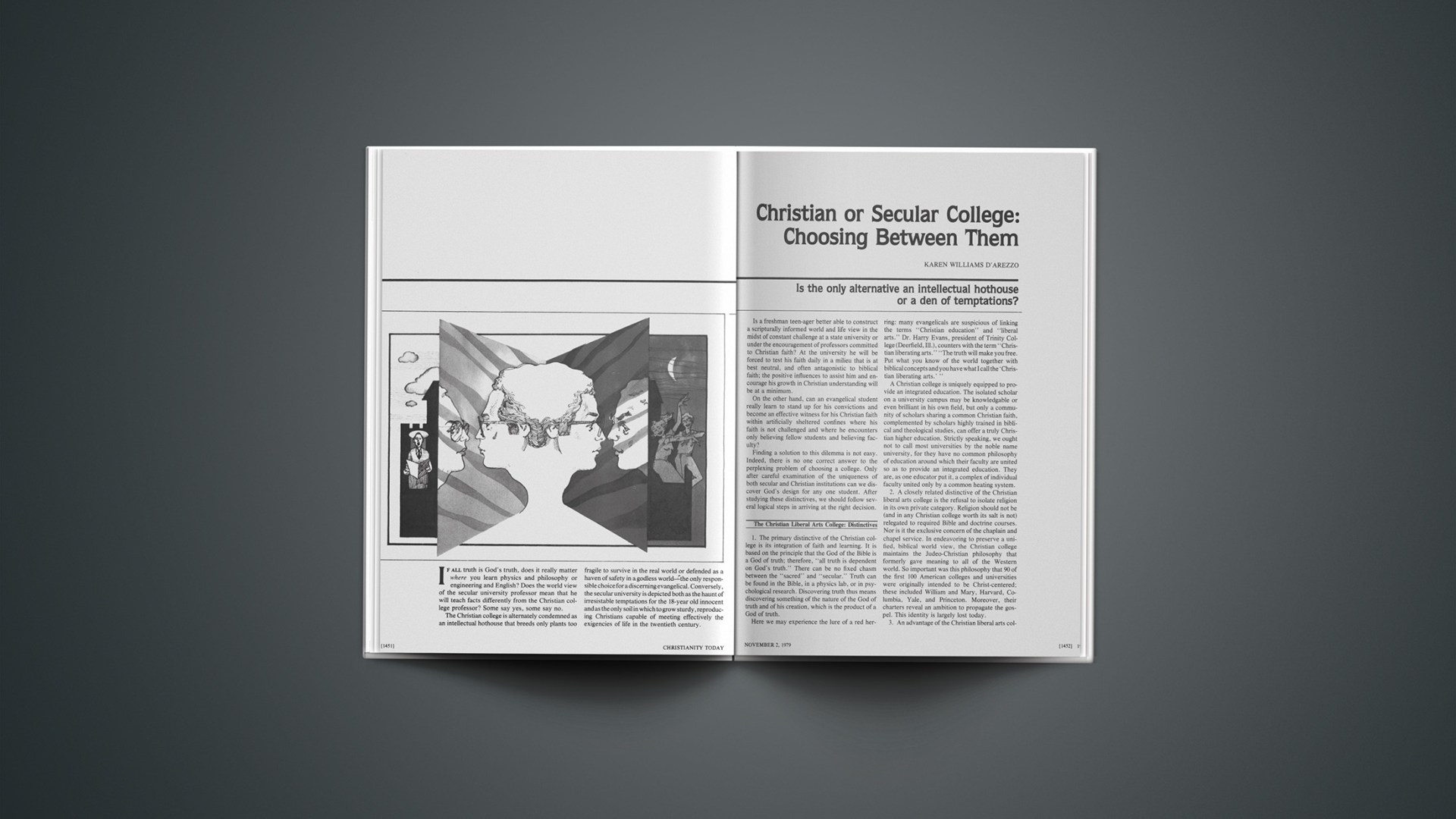
Christian or Secular College: Choosing between Them: There Is No One Answer

Is the only alternative an intellectual hothouse or a den of temptations?

If all truth is God’s truth, does it really matter where you learn physics and philosophy or engineering and English? Does the world view of the secular university professor mean that he will teach facts differently from the Christian college professor? Some say yes, some say no.

The Christian college is alternately condemned as an intellectual hothouse that breeds only plants too fragile to survive in the real world or defended as a haven of safety in a godless world—the only responsible choice for a discerning evangelical. Conversely, the secular university is depicted both as the haunt of irresistable temptations for the 18-year old innocent and as the only soil in which to grow sturdy, reproducing Christians capable of meeting effectively the exigencies of life in the twentieth century.

Is a freshman teen-ager better able to construct a scripturally informed world and life view in the midst of constant challenge at a state university or under the encouragement of professors committed to Christian faith? At the university he will be forced to test his faith daily in a milieu that is at best neutral, and often antagonistic to biblical faith; the positive influences to assist him and encourage his growth in Christian understanding will be at a minimum.

On the other hand, can an evangelical student really learn to stand up for his convictions and become an effective witness for his Christian faith within artificially sheltered confines where his faith is not challenged and where he encounters only believing fellow students and believing faculty?

Finding a solution to this dilemma is not easy. Indeed, there is no one correct answer to the perplexing problem of choosing a college. Only after careful examination of the uniqueness of both secular and Christian institutions can we discover God’s design for any one student. After studying these distinctives, we should follow several logical steps in arriving at the right decision.

The Christian Liberal Arts College: Distinctives

1. The primary distinctive of the Christian college is its integration of faith and learning. It is based on the principle that the God of the Bible is a God of truth; therefore, “all truth is dependent on God’s truth.” There can be no fixed chasm between the “sacred” and “secular.” Truth can be found in the Bible, in a physics lab, or in psychological research. Discovering truth thus means discovering something of the nature of the God of truth and of his creation, which is the product of a God of truth.

Here we may experience the lure of a red herring: many evangelicals are suspicious of linking the terms “Christian education” and “liberal arts.” Dr. Harry Evans, president of Trinity College (Deerfield, Ill.), counters with the term “Christian liberating arts.” “The truth will make you free. Put what you know of the world together with biblical concepts and you have what I call the ‘Christian liberating arts.’ ”

A Christian college is uniquely equipped to provide an integrated education. The isolated scholar on a university campus may be knowledgable or even brilliant in his own field, but only a community of scholars sharing a common Christian faith, complemented by scholars highly trained in biblical and theological studies, can offer a truly Christian higher education. Strictly speaking, we ought not to call most universities by the noble name university, for they have no common philosophy of education around which their faculty are united so as to provide an integrated education. They are, as one educator put it, a complex of individual faculty united only by a common heating system.

2. A closely related distinctive of the Christian liberal arts college is the refusal to isolate religion in its own private category. Religion should not be (and in any Christian college worth its salt is not) relegated to required Bible and doctrine courses. Nor is it the exclusive concern of the chaplain and chapel service. In endeavoring to preserve a unified, biblical world view, the Christian college maintains the Judeo-Christian philosophy that formerly gave meaning to all of the Western world. So important was this philosophy that 90 of the first 100 American colleges and universities were originally intended to be Christ-centered; these included William and Mary, Harvard, Columbia, Yale, and Princeton. Moreover, their charters reveal an ambition to propagate the gospel. This identity is largely lost today.

3. An advantage of the Christian liberal arts college over the secular university is its small size. The educational process is greatly enhanced when a student develops a relationship with a professor or administrator beyond that of a mere name or number listed on the class roll. The manageable size of Christian colleges fosters a more familial relationship between students and faculty of a type that is less common in a major university.

4. The accusation that academic excellence is lacking at the Christian college level is not necessarily true and often directly opposes the facts. At better Christian colleges the usable library actually available for underclassmen is thoroughly adequate for its purposes. Instructors, particularly of lower level courses, are frequently full professors and rarely, if ever, graduate students who are struggling to meet the requirements of their classes in master’s and doctoral programs. By contrast, the vaunted scholars of the university are absorbed in individual research and tutoring of doctoral candidates, but sometimes are inaccessible to lowly undergraduates. In this connection, it is worthy to note that the percentage of graduates from the small Christian liberal arts colleges who are found in Who’s Who is much higher than of graduates from our teeming universities, whose reputations are based less on the quality of undergraduate programs than on the research and scholarship of their graduate schools.

5. The Christian campus provides a socially constructive environment for the development of Christian leaders. Here the youthful Christian makes friends for life; he or she may discover a life partner. The student here learns the skills of leadership in a Christian community. Evangelical organizations around the world to a significant degree depend on Christian colleges and Bible colleges for their laders.

6. The charge that students on a Christian college campus are isolated from the real world need not be true, and quite frequently is invalid. Rather, students are in a temporarily controlled environment for the express purpose of providing opportunity for them to learn under Christian tutelage how life is to be understood and how it is to be lived on planet earth. The educational curriculum of the Christian college demands off-campus service and projects that bring the student into contact with the real world.

8. A Christian college is not a glorified Sunday school that offers a four-year diploma. It is not a sanctuary in which a parent can hide a teen-ager from a pervasively evil society in hopes that the only ensuing change in lifestyle will be marriage to another pleasing and doctrinally pure Christian followed by a valiant missionary career. The Christian campus is not one on which doubts will be stifled or silenced as the student is indoctrinated. Rather, it is an ideal environment in which to pose legitimate questions and to examine differing viewpoints—and to do so with dedicated evangelicals who are also experts in the areas of their academic specialities.

“The concern for individual students shown by professors is not due just to the small size of my alma mater, but because of commitment to Christ. The disadvantage, though, is for the student whose parents force him to attend. It’s easy to get close to a not-so-genuine Christian professor and then Christianity seems even phonier.”

—A student at a Christian college.

The Secular University: Distinctives

1. The secular university also provides its own unique advantages for the Christian student. The goal of the secular university is broad education in the sciences, humanities, and arts with the opportunity to learn technical specialization that prepares the student with professional skills. (This is at variance with the scope of the liberal arts education that seldom offers professional courses in depth.) The strength of this broad scope has also sometimes been called its weakness; the university is often better defined as a multi-versity. It has become, in many cases, a conglomerate of isolated colleges under the broad sponsorship of the university. However, most see this wide breadth of specialized courses as a potential strength since it allows for highly respected specialists in given fields to teach as well as to concentrate on advanced research. Unfortunately, knowledge often becomes an end in itself at the secular institution. In such professional schools, with their abundance of specialized courses, a student can learn how to earn his living but he does not learn how to live; he does not secure a truly liberating education.

2. In the modern world, secular universities have become the pacesetters within our culture. Here are to be found the think tanks for the twenty-first century. Here are gathered the intellectual leaders whose research and writings are shaping the direction of human thought. Unfortunately, the college freshman rarely sees or hears these exalted intellectual leaders (and their published works are available on the Christian college reading list as well as in the university bookstore). In upper division courses, however, these leaders of thought are often the teachers.

3. It is true that occasionally professors in secular universities take undue delight in destroying the naive religious faith of their gullible students, but this is more likely to occur in the small, secular liberal arts colleges with historic but not current Christian commitment. And the Christian student will usually find this a profitable, though perhaps painful, experience. Such opposition spurs him to sink his own roots deeper. It becomes a powerful incentive to reexamine and deepen his faith. Those who survive such testing are stronger for it. And often past religious training and the presence of a nearby evangelical church make the difference between success and failure.

4. The resources available to an evangelical Christian on a large university campus are often overlooked. There are probably 2,500 evangelical Christians at the University of Illinois—more than the total enrollment at many Bible schools and Christian colleges—and these Christian students provide a mutual support group of immense importance. Moreover, conservative Christian organizations like Campus Crusade for Christ, Navigators, and Inter-Varsity encompass hundreds of students on a given campus, providing ministry and teaching opportunities unavailable on the Christian campus. Further, on every major university campus evangelical teachers are a constructive force of major proportions. Western Kentucky University is almost unique with its evangelical religion department fired by Dr. Robert Mounce’s conviction that students should have seminary level teaching available at the state university. The Wisconsin Association of Biblical Studies, located just off the University of Wisconsin campus in Madison, offers a core of academic study with university credit. John Stott’s Basic Christianity, Josh McDowell’s Evidence that Demands a Verdict, and Colin Chapman’s Christianity on Trial have been designed specifically to help students confront the hostile secular viewpoint and are frequently used with academic integrity and thoroughness in seminars and on satellite campuses to encourage Christian faith.

5. Any committed Christian must face the missionary challenge of the secular university. Here are thousands of students, largely uncommitted, in the process of forming their world and life views, wide open to the reexamination of their most fundamental values. Christian students can adamantly, lovingly, and relentlessly press the Christian alternative in classroom, dormitory, school organizations, and student government. No nonstudent can carry on such an effective witness for Christ in such receptive and fertile soil for the gospel.

6. Finally, the secular junior college or university is usually far less expensive than the accredited Christian college.

Clearly, a student can receive an intense spiritual education at a secular university or college, coupled with unique challenges and personal confrontations, God-tailored to insure spiritual growth. The student in a secular situation is not left alone to flounder, but is surrounded by other Christian peers and spiritual and intellectual leaders who are eager to help him.

“I wouldn’t trade my degree from the university with any other. It gave me a realistic exposure to the world’s way of thinking and dealing, and its rewards, along with plenty of opportunity to learn about confronting secularism in ‘trial runs.’ I wouldn’t have wanted to have been cloistered in a strictly Christian community or I would have forgotten that the majority of Americans are still in need of a Savior.”

—A student at a secular university.

How To Choose

It should be clear that not all Christian students will have their needs best met at a Christian college—or at a secular university. Needs vary; each student is an individual. Many factors have a decisive bearing on what type of school best meets the needs of a particular student. One man’s meat is another man’s poison.

In reality, most students—and their parents—have no definite philosophy of a college experience beyond strictly vocational or social aspirations, and these are often extremely vague. The decision on the best way to acquire a college education depends on many variables: personal inclinations, specific talents, previous background, general intelligence, major field, geography, tuition, financial assistance, job availability—along with many others. The judgment must be highly individualistic.

In looking at preliminary alternatives, the following suggestions are given to aid a student in his methodical search for God’s will.

1. The prospective student and his or her parents should formulate written lists of expectations and goals, defining the purpose of college education and social life, and listing life aspirations.

2. Very early the student should order catalogues and brochures from several different types of schools and from all of the schools that attract his or her serious attention. These should be read carefully. The availability of programs should be noted, as well as the training of the faculty, the statement of religious faith, and other pertinent information.

3. The student should talk with recent graduates of both Christian and secular schools. Such a survey should not be narrowed only to graduates of those institutions he or she already was considering, but should include a broad scope.

4. The prospective college student should visit various types of schools. He or she should visit admissions counselors, sit in on classes, and note the size of classes, of the library, and of the availability of library stacks to freshmen. A student should stroll through the dorms, and talk with the chaplain, representatives of local parachurch groups, or pastors of nearby evangelical churches to assess spiritual life and opportunities for growth. (Names and addresses of these people are available from the school activity office.) Above all, questions should be asked. If certain queries are resented or left unanswered, that too will tell something.

5. The prospective student should check carefully into the accreditation of any school in which a year or more of his or her life is about to be invested. This not only reveals something about the quality of the education available; it is critical in case the student later transfers to another college, either to complete undergraduate work or to go on to graduate studies. The new college may well accept transfer credits only of certain courses if the first college is not fully accredited.

“I get excited about sharing Christ with guys on the hall and inviting them to church and other Christian meetings. I think that learning to tell men about Christ while in college will help me be a better church member in the future and it will give a whole new dimension to my job.”

—A student at a secular university.

Note that some colleges are “accredited” by their state to offer degrees, but are not accredited by the multi-state “regional” accrediting associations (such as, in the case of Ohio, for example, the North Central Association of Colleges and Schools). A student may choose to go first to a college whose credits will not transfer to a state university or (in Canada) to a provincial or (overseas) to a national university; but he should know in advance that this is the situation.

In the case of accreditation for Bible colleges and Bible institutes, a Bible college accrediting association exists. (However, specialized Christian courses like homiletics may not transfer to accredited colleges, and admission to better graduate schools may be more difficult.)

6. The student should compare his other interests and strengths with those of preferred schools. A student who wishes to become a home economics teacher must find a school that offers adequate courses in that field.

7. The student should pray with family, pastor, and concerned friends that God will indicate which school will provide to him or her the education described in Proverbs 1:5: “A wise man will hear and increase in learning, and a man of understanding will acquire wise counsel.”

Finally, a personal note to the prospective student: Trust! Do not nourish self-doubts about your decision. Believe in God’s guidance promised in Scripture. Remember, your choice is not necessarily between two bad things but between two good things; and in reality, each can be very good and God’s best for you.

The decisive factor is not the school, but you and what you yourself make out of the situation to which God directs you. Give your choice a good try—at least a full year—before you consider transferring or dropping or stopping out. And give it your best. God demands nothing less, and you can’t afford to give less.

G. Douglas Young is founder and president of the Institute of Holy Land Studies in Jerusalem. He has lived there since 1963.

Ideas

The Indispensable Christian College

The Indispensable Christian College

What a difference a decade makes! Ten years ago Christian colleges ducked into the 1970s under the cloud of the question, “Would they survive the decade with strength and quality?” Economically, a “New Depression” had been declared in American higher education and Christian colleges were predicted to be the first victims. A “shrinking pool” of high school graduates was forecast for the middle of the decade, with a devastating impact upon smaller institutions. Worse yet, most Christian colleges had been written off as “invisible” in a national study of educational impact.

All of these doses of doom were being spooned out in the violent days of student revolt. Although Christian colleges were relatively immune from the rebellion, they were expected to feel the aftershock in changing moral values that would render them obsolete. No wonder grossly exaggerated rumors about the death of the Christian college circulated far and wide at the opening of the 70s.

Experts are still trying to figure out where their predictions went wrong. The 1970s was a decade of birth, growth, and maturity for Christian higher education. Enrollment increased ahead of the national average. Parents and students sacrificed for the values of the Christian campus despite rising tuition costs. After a period of adjustment and financial self-discipline, the ink on the books for the average Christian college changed from red to gray to black.

Most amazing of all against the malaise of moral deterioration in the secular culture, Christian colleges became centers for spiritual and intellectual renewal. Students who were products of the born-again movement led the way with fresh and joyful experiences in the body of Christ around the Word of God. Faculties followed with serious attempts to integrate faith and learning in the classroom. Students and faculty began to explore the dimension of Christian witness in the secular world.

Not without significance, 1979 saw the National Congress on Church-Related Colleges, an event that would have been impossible in 1969. Seven hundred delegates from every stripe of Christian college came together at the University of Notre Dame to pursue the meaning of the Christian faith in higher learning.

In the opening session, the chaplain of Furman University preached from the text, “No man can call Jesus Christ Lord except the Holy Spirit lead him.” His final plea was for a common confession around the biblical truth “Jesus Christ is Lord. We may say more but we cannot say less.” Most evangelical Christian college leaders would think it important to say more rather than less, but certainly no college that dares to claim the label Christian could say less.

As we move into the 1980s, the question for the future changes: What role will the Christian college play in the future of the church? Will the church need it to help resolve future issues, meet future needs, and achieve future goals? Yes.

Future issues in the church are already surfacing. From every sector, there are cries for help on ethical issues. Yet when codes of ethics are written and courses in ethics are proposed, the efforts founder in the absence of absolutes. One cannot stand on moral quicksand. Sooner or later the church will have to extract itself from the easy alliance with the secular culture and address these moral concerns. When it does, the Christian college will be indispensable because enlightened understanding of complicated issues cannot be separated from revealed understanding of the Word of God. As the church works its way through the quagmire of a culture in conflict with its faith, the Christian college will serve as a guide.

Future needs of the church in the 1980s are also becoming evident. Spirit-filled, visionary leadership for the ministry and the laity will be needed. At Christian college campuses at the present time is a generation of students who have the qualities to take the church far beyond its present ministry. In twentieth-century versions of the Holy Club and the Haystack Group, they pray early in the morning, study throughout the day, and search the Scriptures late at night. Without reservation, they are willing to see what God can do with the fully committed life.

If world evangelization is the goal of the church for the 1980s, the Christian college is indispensable. Evangelization is a method that reaches far beyond passing out tracts and preaching in the streets. To evangelize the world, we must develop and use every resource for Christian witness. Missionaries without portfolio in government, economics, and communications will stand alongside missionaries under appointment with stethoscopes, textbooks, and hammers, and Bibles in their hands. Across the country, Christian colleges are already gearing up for that future with career development programs that bring faith and work together.

No other institution can resolve these future issues as well as the Christian college. Our churches, homes, and secular schools are not equipped to integrate faith and learning on moral issues, to identify and develop future Christian leaders, or to relate professional careers to world evangelization. If the Christian college did not exist, it would have to be invented. It does exist with honor and strength. Thus, in the 1980s the Christian college deserves more friends, funds, and freshmen. □

Others Say

Calling for a Yardstick for Excellence

When Parsons College was alive, it shared two things with Harvard University. Both boasted of the beauty of their campuses and the excellence of their academics. Beauty, of course, is a relative thing. Excellence need not be as relative, particularly if one recognizes a distinction between the “excellence of rhetoric” and the “excellence of record.” In their academic bulletins and brochures, Harvard and Parsons both had the rhetoric, but only Harvard had the record. The point of that distinction impinges most painfully on today’s evangelical Christian colleges.

With the rapid growth of the evangelical movement, many established Christian liberal arts colleges are growing and new ones are being founded. All go under the label “Christian colleges.” All make a claim of academic excellence.

In order to qualify to be on the faculty of a Christian college, the candidates must have a firm commitment to the Christian doctrines and mission of the school and hold a good command of their academic disciplines. The spiritual commitment comes first, for all Christian colleges insist that their professors integrate the Christ of their faith with the concepts of their discipline.

Most Christian liberal arts colleges now are able to boast of regional accreditation. Unfortunately, the impression is often given that accreditation, the minimum level of “excellence,” has been elevated to the maximum. Full accreditation, which frequently took a long time to attain, became not only a worthy goal, but the final goal. Because most of the Christian colleges boast of regional accreditation, the distinction between the “excellence of rhetoric” and the “excellence of record” tilts heavily in favor of rhetoric. What can be done, then, to isolate from the pack the colleges with the recognized record of academic excellence?

The solution is simple. Just as the Christian liberal arts colleges decided to join the secular and private institutions in seeking regional accreditation, they should also join these colleges in seeking to establish chapters of Phi Beta Kappa, the society that has stood for academic excellence in the liberal arts as far back as 1776. Such chapters on campuses are more than window dressing; their presence testifies that the honored colleges have passed the society’s academic scrutiny for the “excellence of record.” The presence or absence of a Phi Beta Kappa chapter is certainly not the only way to measure excellence. But of some 2,000 four-year colleges, only 225 have Phi Beta chapters, and almost anyone’s list of top schools is drawn from their number.

It is important to note that to be considered for membership, the Christian liberal arts colleges will not be asked to violate the integrity of their purpose or mission. This is made clear in Phi Beta Kappa’s stated criteria for “The Founding of New Chapters.” Those criteria state in part; “Because of the great difference among institutions and even among the various aspects of an institution, such as the number and kind of books in the library, the nature of the teaching and the publications of the faculty, the character of the students, the careers of the graduates, and the general attitude toward scholarship, no absolute standards can be formulated. The Society is above all interested in the development of the liberally educated men and women. In measuring the success with which institutions work toward this goal, the [review] Committee evaluates each institution individually.”

“Each institution,” the criteria go on to note, “is expected to produce both qualitative and quantitative evidence that it has a promising student body, a scholarly faculty, a library and other educational facilities sufficient for the course offerings, an adequate and dependable income, and most significant of all, an educational program that is liberal in emphasis and objectives.”

“Phi Beta Kappa holds that a liberal education is not primarily vocational. A liberal education seeks to quicken man’s mind and spirit by encouraging him to achieve his full capacities.” No reasonable Christian institution will disagree with this general concept of a liberal education. “The greater part of an undergraduate’s time, if he is getting a liberal education, … will be devoted to subjects which reveal man in his relations to the world around him, subjects which necessarily bring into view problems of taste and feeling, of individual and group responsibility, of the meaning of life as a whole.… It may be assumed that courses in literature, languages, philosophy, religion, the fine arts, history, the social sciences, mathematics, and the natural sciences will fall within these areas.”

All such subjects and courses are taught at most Christian colleges. Some questions remain: Are they taught to promising students or to recruits who are highly deficient in the basics of reading and writing, let alone science and mathematics? Are they taught by competent faculty members who stay abreast of their disciplines and contribute to them by their scholarly pursuits, or are they taught by connoisseurs of dated knowledge? Are the library and financial resources good enough to support the demands of the college, or are these resources so weak that the college struggles from year to year?

Needless to say, not all colleges can reply to such questions in a satisfactory way. The road to academic mediocrity—even accreditation—is wide and easy, but the road to excellenge is narrow and difficult. No Christian college has taken the Phi Beta Kappa road and arrived at the summit. Some Christian colleges should try.

Such excellence, the Phi Beta Kappa society assumes, begins at the faculty level. Accordingly, a committee of five society members who teach at a given college must initiate the application for the society’s rigorous evaluation process. Surely there are many Christians who are also members of Phi Beta Kappa and who are pursuing a college teaching career. One relatively new and staunchly conservative college of which I know recently added two Phi Beta members to its English faculty. The older, more prestigious, Christian colleges certainly can attract such faculty.

Until a Christian liberal arts college achieves the status of Phi Beta Kappa excellence, or something equivalent, the non-Christian world is entitled to bypass all our rhetoric and ask: “Is there really an excellent Christian college?”

SUHAIL HANNA

Chairman, Division of Humanities

Sterling College, Sterling, Kansas

Eutychus and His Kin: November 2, 1979

Recently I attended a church service in which the pastor was obviously anxious to “get rid of the preliminaries” so he could make the announcements. If there was any time left, he would preach. His practice was to have the congregation sing the hymns so rapidly that nobody could recognize either the words or the music. The pianist broke the little finger on her left hand trying to keep up with “Marching to Zion,” which should have been listed as “Jetting to Zion.”

I have never felt that the worship activities of the church were “preliminaries” to anything. I have always considered every act in a service a vital part of worship. But if a congregation insists on racing through its worship, perhaps one of the following ideas will help.

1. Assign different verses of the hymn to different sections of the congregation, and sing them simultaneously. That way you can sing the whole hymn at regular speed and perhaps get something from it.

2. Work the announcements into the choir selection. A gifted minister of music ought to be able to use the verse of an anthem to announce the various meetings of the church. I have no musical training at all, but I was able to come up with the following example:

Come we that love the Lord,

And let our joys he known;

We need two hundred volunteers,

To man the telephone.

I found it! I found it! (to be repeated)

3. Better yet, work the choir anthem into the body of the sermon. When the pastor signals, the choir can sing an appropriate song to emphasize the point he is making. This means, of course, that the pastor must have his message ready by the Wednesday evening choir rehearsal, and that’s asking a lot.

4. Teach the congregation to read the bulletin. I know this is a radical suggestion, but it has worked in a few isolated churches.

Maybe the best approach is simply to worship God from the heart and forget about the time. Make each minute count, stop preaching the announcements, omit all ad libs and promotional propaganda, and focus on the Lord. You will probably lose some people, but you just might gain a blessing.

EUTYCHUS X

Making (Air) Waves Over PTL

Philip Yancey’s article on “The Ironies and Impact of PTL” (Sept. 21) is not unsympathetic to this arm of the so-called electronic church. However, like so many recent articles of this type, its strong negative implication is unjustified.

I do not understand why PTL’s ministry is seen as being somehow opposed to the local church. Thousands of people have joined local churches or become more effective in their local churches because of the outreach of ministries such as PTL, CBN, and others.

To say that people who watch PTL are too busy watching TV to help their neighbors is utter nonsense.

LYON G. TYLER

Charleston, S.C.

Where the institutional church has dismally failed to teach God’s enduring Word, Jim Bakker’s PTL Club—“hyped” though it may be in some respects—has met a crying need of hungry sheep, and thus has been mightily used of God.

MARY A. MCCOY

Birmingham, Ala.

Every time I read an article criticizing PTL or any religious program, the money problem sticks out as the main concern. I’m sick of it. I will continue to support PTL or any other program that I feel led to. “Feeling led,” by the way, seemed to puzzle Mr. Yancey. I hope some day he feels led to do a better article about Christian television. I believe it has God’s blessing.

MRS. JOE C. EASON

Bowdon Baptist Church

Bowdon, Ga.

Divorce and suicide were the two choices I faced in 1976. I also had a problem with child abuse. In despair I watched the PTL Club and was given a third choice: to become a child of God as a new creature in Christ. Thank God that I made that choice.

Since then my husband and I have had two children. We have joined a church and are becoming involved in the Christian community. My outreach to others has grown greatly.

If it were not for PTL I might never have had the Christian lifeline to reach out to those around me and help.

DIANE PAPAY

North Royalton, Ohio

I honestly believe that Jim Bakker is a genuinely good person who happened to succeed beyond his wildest dreams, only to learn belatedly that he lacked the management skills and personal depth to deal with the problems of running an enterprise the size of PTL. He deserves our prayers.

VINCENT A. ELVINGTON

Chattanooga, Tenn.

Philip Yancey discussed Jim Bakker and the PTL Club very fairly. It was a great satisfaction to read the credit given to him as well as the questions raised.

NORMA S. ASHBROOK

Flourtown, Pa.

“The Ironies and Impact of PTL” is a strong article. While it recognizes the constructive role of the evangelical talk show, it also recognizes the dangers in trying to meet the needs of people by long distance.

I do not always approve of the stance you take on many issues, but you are certainly keeping us folks on our toes.

REV. LAWTON W. POSEY

Charleston, W.Va.

After reading Philip Yancey’s article, I was left with the feeling that the impact of PTL outweighed the ironies. Mr. Yancey skimmed the surface of many of the arguments against PTL, but failed to give any serious comment to the unscriptural aspects of Mr. Bakker’s actions.

REV. RON FLURRY

Grace Baptist Church

Augusta, Ark.

Whether we’re lusting after “Charlie’s Angels” or glued to the PTL Club, we need to be reminded that the Second Coming will not be televised.

DAN HARTZLER

Albuquerque, N.M.

CIRCULATION STATEMENT

Statement required by the act of August 12, 1970, section 3685, Title 39, United States Code, showing ownership, management, and circulation of CHRISTIANITY TODAY.

Published 22 times per year at 465 Gundersen Drive, Carol Stream, Illinois 60187.

Publisher: Harold L. Myra. 465 Gundersen Drive, Carol Stream, Illinois, 60187. Editor: Kenneth S. Kantzer, 465 Gundersen Drive, Carol Stream. Illinois. 60187. Managing Editor: James W. Reap-some. 465 Gundersen Drive. Carol Stream, Illinois, 60187.

The owner is CHRISTIANITY TODAY. Inc., 465 Gundersen Drive, Carol Stream, Illinois, 60187

The known bondholders, mortgagees, and other security holders owning or holding one percent or more of total amount of bonds, mortgages, or other securities are: None.

I certify that the statements made by me above are correct and complete.

(signed) Harold L. Myra

Plain and Simple

I commend Frank Gaebelein on his article “Challenging Christians to the Simple Life” (Sept. 21). It speaks very strongly to our materialistic society. Christians have much wealth these days, but their misuse of it bears a striking resemblance to the Book of Amos. We must remember that we are stewards and not owners of all that we have.

PHILIP FAUSTIN

Codirector

Daniel’s Den Ministries

Denver, Colo.

Leon Morris, in “Thinking Things Through” (Current Religious Thought, Sept. 21), writes that “On a visit to the United States, I worshipped on successive Sundays in Honolulu, Los Angeles, and Washington, D.C.” He then goes on to argue for simple living, stating his belief that we in the affluent world must use less of the world’s resources, and reject “the values of a selfish, affluent, materialistic society.” I agree.

REV. ALFRED C. KRASS

Coeditor, The Other Side

Philadelphia, Pa.

Well, well, well. Everyone likes to ride the newest train going through town. Now the latest kick or fad is “The Simple Life Style.” I see that Frank Gaebelein and Leon Morris tried it out in CHRISTIANITY TODAY.

But they always give us vague biblical theory and very general directions. Never do they tell us exactly what they’re doing and how well it works in detail.

I find it hard to take a kick in the conscience for living in a country where we can afford something better—if we are willing to work for it. If the poverty-stricken of the world would like some of the good life too, all they have to do is boot out the socialist governments they live under and adopt a free enterprise economy under a constitutional republic. Then they can take their hands out of my pocket and get to work.

REV. JAMES MILLER

The Kingdom of God Ministries

Denver, Colo.

Your September 21 cover is positively brilliant. It took my twelve-year-old son to make me stop and get into the power of its communication as he compared the original piously grim-faced couple with your added affluency touch-ups. For him it was a game. For me it was a message more powerful than a thousand words.

KATHLEEN W. SANTUCCI

Culver City, Calif.

Not Very Punchy

Marlene Lefever’s article “Is Sunday School Losing Its Punch?” (Sept. 21) was interesting to those of us involved in the church curriculum enterprise. However, her treatment fell disappointingly short of answering the important question of the article’s title.

A funeral dirge for the Sunday school is already being sung by a small but growing number of churchmen, lay and clergy. If that mournful song is to be turned into a hymn of praise again, a more realistic assessment of the Sunday school movement and its alternatives will be required, while we are still response-able.

The unqualified “no” of curriculum editor Lefever to the question, “Is Sunday school losing its punch?” is hardly a bold step in that direction.

LT. COL. DAVID G. GROSSE

Protestant Curriculum Consultant

USAF Chaplain Resource Board

Maxwell AFB, Ala.

I greatly appreciate the space given to Christian education in the September 21 issue, and the intuitive, perceptive and balanced manner with which Marlene Lefever discussed the development and issues of the Sunday school movement. I hope that our concern with teaching the gospel effectively does not override the importance of its essential content.

The “punch” of Sunday school lies not in our effort but in the fiat of the Spirit.

IVAN GAETZ

Secretary, Christian Education Dept.

The Pentecostal Assemblies of Canada

Toronto, Ont.

A Real Gem

Scott Curtis’s review, “Fresh Glimpses of a Many-Faceted Jewel” (Refiner’s Fire, Sept. 7), brought an ear-to-ear grin to my face. The music of Michael Kelly Blanchard is definitely something to be excited about! The kingdom of God needs more performers like him who can communicate the meaning of a deep, living faith in Christ in a way that appeals to all ages.

WALT MUELLER

Oakland United Methodist Church

Johnstown, Pa.

Many heartfelt thanks for your “Refiner’s Fire” article on our album “Quail” in your September issue. Thanks also to Scott Curtis for his sensitive review. Many wonderful responses have come in because of your article and we are deeply grateful for the interest and enthusiasm people around the country have shown.

We thought it would be prudent to give our address and phone number so people who have read the column can find us:

MICHAEL AND

GRETA BLANCHARD

c/o Gotz Records

Box 251

Harwinton, Ct. 06791

203-658-5373

Apple PodcastsDown ArrowDown ArrowDown Arrowarrow_left_altLeft ArrowLeft ArrowRight ArrowRight ArrowRight Arrowarrow_up_altUp ArrowUp ArrowAvailable at Amazoncaret-downCloseCloseEmailEmailExpandExpandExternalExternalFacebookfacebook-squareGiftGiftGooglegoogleGoogle KeephamburgerInstagraminstagram-squareLinkLinklinkedin-squareListenListenListenChristianity TodayCT Creative Studio Logologo_orgMegaphoneMenuMenupausePinterestPlayPlayPocketPodcastRSSRSSSaveSaveSaveSearchSearchsearchSpotifyStitcherTelegramTable of ContentsTable of Contentstwitter-squareWhatsAppXYouTubeYouTube