Editor’s Note from November 02, 1979

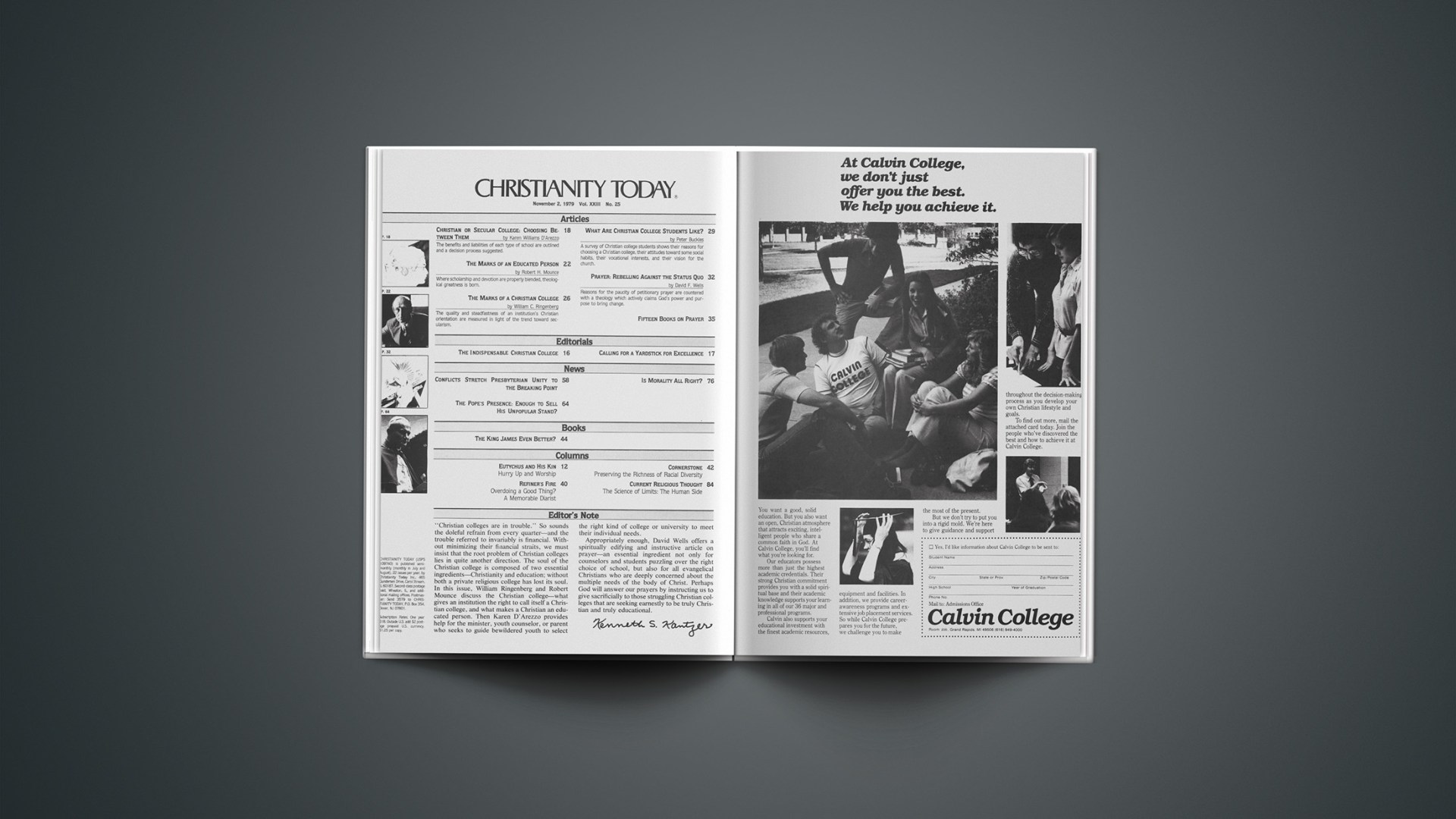
“Christian colleges are in trouble.” So sounds the doleful refrain from every quarter—and the trouble referred to invariably is financial. Without minimizing their financial straits, we must insist that the root problem of Christian colleges lies in quite another direction. The soul of the Christian college is composed of two essential ingredients—Christianity and education; without both a private religious college has lost its soul. In this issue, William Ringenberg and Robert Mounce discuss the Christian college—what gives an institution the right to call itself a Christian college, and what makes a Christian an educated person. Then Karen D’Arezzo provides help for the minister, youth counselor, or parent who seeks to guide bewildered youth to select the right kind of college or university to meet their individual needs.

Appropriately enough, David Wells offers a spiritually edifying and instructive article on prayer—an essential ingredient not only for counselors and students puzzling over the right choice of school, but also for all evangelical Christians who are deeply concerned about the multiple needs of the body of Christ. Perhaps God will answer our prayers by instructing us to give sacrificially to those struggling Christian colleges that are seeking earnestly to be truly Christian and truly educational.

Savorless Salt: A Social Curse

If Communists brush their teeth regularly, should evangelicals knock theirs out?

Certain plants, such as the marigold, are heliotropic: they naturally turn toward the sun. Certain evangelicals could well be termed isolatropic: they naturally turn away from society’s problems toward a narrow separationism. Whatever good is advocated outside the limited confines of the evangelical community is suspect per se; if it does not square, in content and vocabulary, with the model of nineteenth-century revival preaching, its demonic origin is considered self-evident.

That this mentality is still very much with us can hardly be better illustrated than in the field of human rights. When Jimmy Carter makes universal respect for human dignity at least a theoretical cornerstone of his presidential policy, certain evangelicals take this as an illustration of a less than thoroughly conservative theology (“the Bible talks about human responsibilities, not human rights”). When the International Year of the Child is proclaimed, an undercurrent of evangelical criticism is heard everywhere: the IYC is a Communist plot, typically promoted through the United Nations, to take children from the tutelage of their parents so that they can be indoctrinated by the socialist state. The Council of Europe, with its European Court of Human Rights—the most sophisticated juridical human rights machinery in the world—is turned into an apocalyptic agent of Antichrist by the evangelical prophetomaniacs (the members of the council, we are told, are the toes of the eschatological image in Daniel 2).

One hesitates to dignify the silliness of such attitudes by formal criticism. To take an obvious example: the European states in the Council of Europe presently number 18, not 10 as the apocalyptic image requires. And it will not help to take the number of states who are current members of the European Economic Community (the Common Market), for their number likewise does not now conform to the eschatologically required figure.

But the separationist mentality we have been describing is not merely silly; it is tragic. While many non-Christians are desperately concerned about the maltreatment of children and the disregard of their rights as human persons, certain evangelicals give the impression that they are on the side not of children but of their oppressors! Even if Communists do attempt to use the International Year of the Child to their ideological advantage, should evangelicals therefore quit the field, leaving the Marxists to play the role of defenders of childhood? If Communists brush their teeth regularly, should evangelicals knock theirs out?

Think what it could mean in world public opinion if the evangelical community throughout the globe stood at the forefront in the IYC, proclaiming, in our Lord’s words: “Suffer little children to come unto me, and forbid them not, for of such is the kingdom of heaven.” Imagine what a positive effect it could have in global evangelism if American evangelicals were outspoken in favor of U.S. ratification of such human rights treaties as the American Convention on Human Rights, instead of supporting an existing nationalistic indifference that makes our country look hypocritical in the eyes of uncommitted Third World nations.

Here is one example of what can be done along such lines; it is offered only as a model of what Charles Williams termed the “way of affirmation” as contrasted with the “way of negation” (i.e., separation).

Ten years ago René Cassin, the architect of the Universal Declaration of Human Rights, used the proceeds of his Nobel Peace Prize to found the International Institute of Human Rights in Strasbourg, France, the city that would later become the seat of the Parliament of Europe and the European Court of Human Rights. Every summer since that time, the institute has conducted the foremost study program in human rights in the world, inviting to it the leading scholars in the human rights field from every corner of the gobe. Over a thousand students of all ideological stripes and from both “developed” and “developing” countries have participated in the courses offered, and have returned home to commence human rights instruction in their own law schools and universities, and to influence their governments to respect the dignity of the human person.

This past summer two hundred students came to us and sat under more than 20 eminent professors and specialists, who were invited to conduct courses in English or French. Included were Thomas Buergenthal of the University of Austin, Texas (author of the most comprehensive legal casebook on human rights law); A. H. Robertson (author of such standard works as Human Rights in Europe); T. C. Van Boven, director of the Division of Human Rights of the United Nations; Z. Resich, dean of the Faculty of Law of the University of Warsaw, Poland; and so on. (Resich, not so incidentally, dealt with “The International Protection of the Rights of the Child,” and stated, inter alia: “The most general need, aside from the organization of the school system, is that the state reinforce, protect, and sustain the family, which still remains the primary and indispensable milieu for the education of children.… The protection of the child requires that he be juridically guaranteed all the facilities and possibilities for his physical, moral, spiritual, and social development with liberty and dignity.”)

Alongside the general institute program, as director of studies I organized, under the joint sponsorship of the Christian Research Institute and the Lawyers’ Christian Fellowship, a parallel and coordinated first annual International Seminar in Theology and Law, in which some 30 students were enrolled. Here we endeavored to show (1) that, as Marc Agi has argued in his French biography of René Cassin (1979), the “human rights and fundamental freedoms” set forth in the Universal Declaration (and those in the European Convention and American Declaration on Human Rights also, for that matter) ultimately derive from Holy Scripture; and (2) that human rights law and principle, like all positive jurisprudence, requires a revelational basis for its ultimate justification—and a Savior to pick up the fallen race whose sin manifests itself particularly in the inhumane treatment we have accorded to and continue to accord to each other, despite the fact that his light “lighteth every man that cometh into the world.”

John Warwick Montgomery is professor at large, Anaheim Christian Theological Center, Anaheim, California.

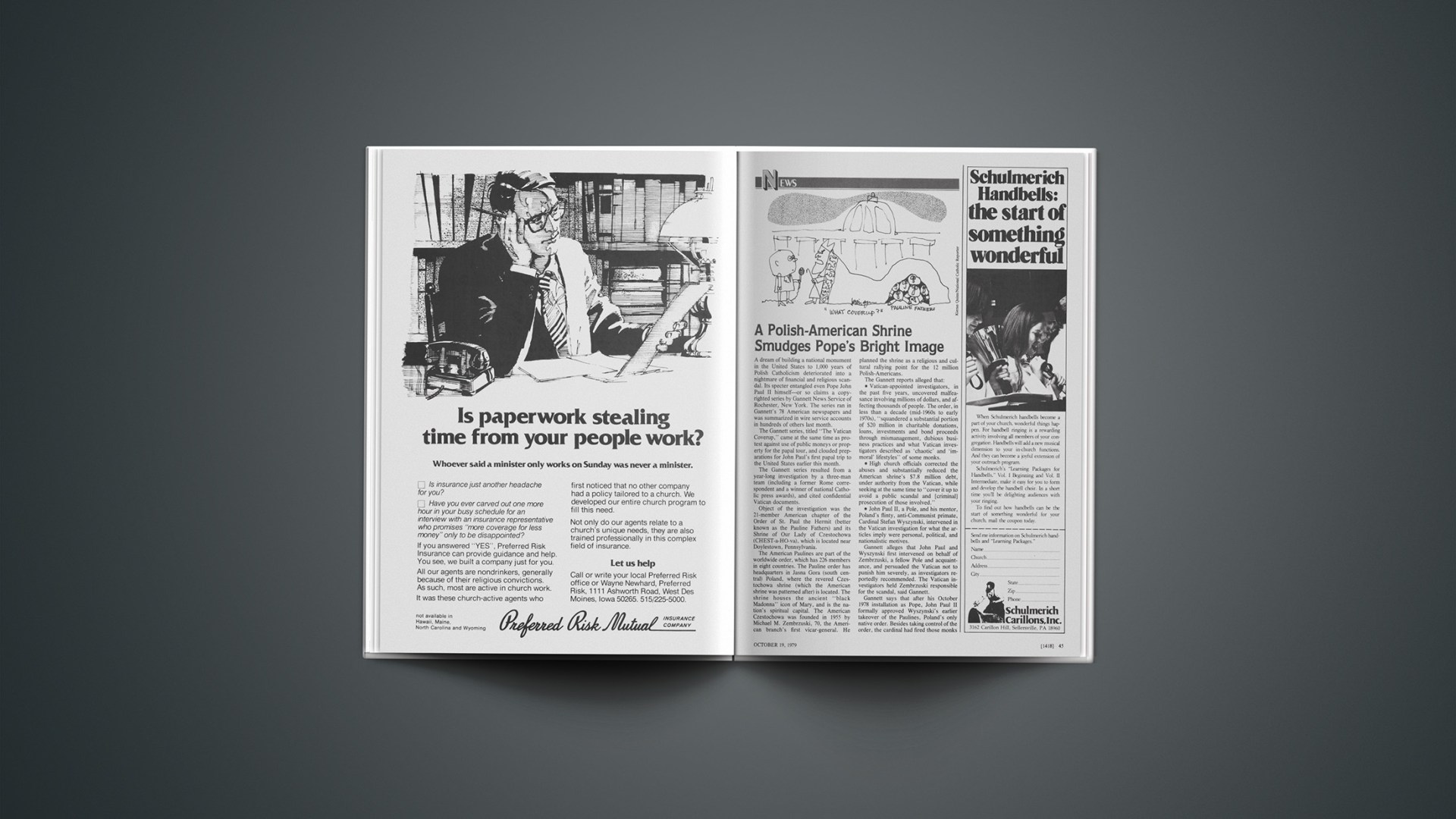
A Polish-American Shrine Smudges Pope’s Bright Image

A dream of building a national monument in the United States to 1,000 years of Polish Catholicism deteriorated into a nightmare of financial and religious scandal. Its specter entangled even Pope John Paul II himself—or so claims a copyrighted series by Gannett News Service of Rochester, New York. The series ran in Gannett’s 78 American newspapers and was summarized in wire service accounts in hundreds of others last month.

The Gannett series, titled “The Vatican Coverup,” came at the same time as protest against use of public moneys or property for the papal tour, and clouded preparations for John Paul’s first papal trip to the United States earlier this month.

The Gannett series resulted from a year-long investigation by a three-man team (including a former Rome correspondent and a winner of national Catholic press awards), and cited confidential Vatican documents.

Object of the investigation was the 21-member American chapter of the Order of St. Paul the Hermit (better known as the Pauline Fathers) and its Shrine of Our Lady of Czestochowa (CHEST-a-HO-va), which is located near Doylestown, Pennsylvania.

The American Paulines are part of the worldwide order, which has 226 members in eight countries. The Pauline order has headquarters in Jasna Gora (south central) Poland, where the revered Czestochowa shrine (which the American shrine was patterned after) is located. The shrine houses the ancient “black Madonna” icon of Mary, and is the nation’s spiritual capital. The American Czestochowa was founded in 1955 by Michael M. Zembrzuski, 70, the American branch’s first vicar-general. He planned the shrine as a religious and cultural rallying point for the 12 million Polish-Americans.

The Gannett reports alleged that:

• Vatican-appointed investigators, in the past five years, uncovered malfeasance involving millions of dollars, and affecting thousands of people. The order, in less than a decade (mid-1960s to early 1970s), “squandered a substantial portion of $20 million in charitable donations, loans, investments and bond proceeds through mismanagement, dubious business practices and what Vatican investigators described as ‘chaotic’ and ‘immoral’ lifestyles” of some monks.

• High church officials corrected the abuses and substantially reduced the American shrine’s $7.8 million debt, under authority from the Vatican, while seeking at the same time to “cover it up to avoid a public scandal and [criminal] prosecution of those involved.”

• John Paul II, a Pole, and his mentor, Poland’s flinty, anti-Communist primate, Cardinal Stefan Wyszynski, intervened in the Vatican investigation for what the articles imply were personal, political, and nationalistic motives.

Gannett alleges that John Paul and Wyszynski first intervened on behalf of Zembrzuski, a fellow Pole and acquaintance, and persuaded the Vatican not to punish him severely, as investigators reportedly recommended. The Vatican investigators held Zembrzuski responsible for the scandal, said Gannett.

Gannett says that after his October 1978 installation as Pope, John Paul II formally approved Wyszynski’s earlier takeover of the Paulines, Poland’s only native order. Besides taking control of the order, the cardinal had fired those monks in Poland who had assisted the American probe, claiming the monks had collaborated with the Communists and were undermining the church, said Gannett. The actions “astonished” veteran Vatican officials because of the “blatant nationalism” involved and because the order is one of 3,000 exempt from control by local bishops or cardinals, according to church law.

Finally, Gannet alleged, the new Pope (who as cardinal had twice visited the American shrine) ordered investigators to bring their probe to a speedy conclusion. The investigators submitted their final, confidential report and recommendations in February. A May 21 Vatican decree, approved by John Paul, admonished the American Paulines to obey church laws regarding loans and investments and to cooperate more closely with local church authorities—thus formally closing the inquiry. The decree ignored the investigators’ recommendations that those reponsible for one of the worst scandals in recent church history be disciplined, Gannett claimed.

What actually did visitators (Vatican term for investigators) Bishop George H. Guilfoyle of Camden, New Jersey, and Paul M. Boyles, then of Chicago, now in Rome as superior of the Passionist Fathers, uncover? Aided by auditors and lawyers, they found:

• That the order was actually $7.8 million in debt, instead of the reported $4.3 million, and had only $100,000 in assets, with local merchants refusing to sell the chapter any more goods or services until paid.

• Business deals and tax-avoidance schemes in five states.

• Alleged “lavish living” by Zembrzuski and some other monks in New Britain, despite vows of poverty, including their use of credit cards, autos, and stereos.

• A breakdown in the order’s spiritual discipline.

• Investment in two hospitals, a trade school, and several businesses—all made to take advantage of the order’s tax exempt status, but in violation of church law.

• Misappropriation of hundreds of thousands of dollars intended for such services as mass requests, placement of memorial plaques, or perpetual care of plots in the shrine’s own cemetery—all neglected until the investigators stepped in.

• Purchase of a Philadelphia-area cemetery, eventually driven to bankruptcy by Zembrzuski, with a $1.1 million debt.

• Use of a disbarred attorney who had been convicted of tax evasion as the shrine’s legal and financial adviser.

Gannett says the visitators informally told Cardinal John J. Krol of Philadelphia of their findings in 1975. Krol, the first Polish-American cardinal, immediately authorized a $722,000 loan from archdiocese funds to cover the shrine’s most immediate, pressing debts, mainly those of the cemetery. He agreed to chair a national fund drive to “save Czestochowa” and reduce its multi-million-dollar debt.

(Gannett later reported that two federal agencies had entered the investigation of the Pauline order: the Securities and Exchange Commission and the Internal Revenue Service.)

In a statement to the press, Bishop Guilfoyle said the Gannett series was old news—raking up subjects reported years ago. “Every recommendation of the visitators relating to the administration of the shrine” he said, “was carried out.”

Cardinal Krol, who was instrumental in the election of his friend John Paul II, and the one who requested the Vatican “visitation” in 1974, also denied any cover-up.

The carefully worded statements issued by Krol and Guilfoyle, while seeming to refute many of the Gannett allegations, focused only on the scandal’s administrative and financial aspects. Left unanswered were the charges that the Pope intervened on Zembrzuski’s behalf, that he ordered the case closed, and that he ignored recommendations of severe discipline for the offending monks.

A member of Krol’s staff said privately that the cardinal would speak to the press only about the papal visit. “He doesn’t want to cloud the papal visit with this one issue,” said the staff member. “It has already been clouded. He doesn’t want to keep talking about it and keep the issue alive. We just want it to go away.”

Zimbabwe

Guerrilla Grants: The WCC Dishes Up a Second Serving

In apparent defiance of the furor caused in its member churches by a 1978 grant to the Zimbabwe Patriotic Front, the World Council of Churches has done it again.

Meeting in Bosse, Switzerland, last month, the WCC Executive Committee approved a gift of $35,000 from the Special Fund of the Program to Combat Racism to the Zimbabwe Patriotic Front.

The only concession this time around—after more than a year of heated debate on the issue, which led a few church bodies to suspend their WCC membership—was a more careful targeting of funds. The grant was designated for supportive and administrative costs for the guerrilla grouping’s delegation at the constitutional conference in London. The all-parties conference was convened to bring a settlement to troubled Zimbabwe, formerly Rhodesia.

In a letter addressed to all WCC member churches, the executive committee explained that although the costs of the three official delegations were being met by the British government, costs for their support staffs were not. The Patriotic Front, it pointed out, was the only delegation without a government to pick up the resulting tab. Thus, it maintained, responding favorably to the Patriotic Front request was within the PCR Special Fund criteria, one of which provides for “strengthening the organizational capacity of racially oppressed people.”

Among the most criticized aspects of the earlier $85,000 grant was that specific uses were not designated. Critics contended that the funds could be spent for weapons, not just for humanitarian aid (and that in either case more funds could be diverted to arms). The WCC at the time replied that earmarking the funds would have implied a lack of trust.

While PCR officials’ faith in the Patriotic Front appears undiluted, the previous storm of criticism does seem to have induced them to specify the purpose for their gift this time around, and to present their rationale for the funding to member denominations carefully. Early indications are that at least some churches that choked on the first grant will find this one easier to swallow.

As U.S. Says ‘Hello, Dalal’

An Altered Tibet Emerges from Its Communist Cocoon

After two decades of invisibility, Tibet is making a shadowy reappearance. In July, the foreign press corps in Peking paid a visit to the region of Tibet at the express invitation of the Chinese government. Earlier this month, the Dalai Lama, 44-year-old Tibetan Buddhist leader, completed a six-month tour of the United States. And now the Chinese government has invited the exiled leader to return and play a “patriotic role” in the future of China and Tibet.

These events may indicate an easing of government controls in the mountainous region. Since 1959, when an abortive anti-Chinese uprising led to full-fledged Chinese occupation and the exile of the Dalai Lama (meaning “oceans of wisdom”) along with thousands of his countrymen, Tibet has remained under Chinese rule.

Straddling the world’s most formidable topography (an average altitude of 14,000 feet), Tibet always has been next to inaccessible. Under the old Lamaist theocracy, the country had no roads. One-fifth of Tibet’s population were lamas (priests or monks), and they showed almost no interest in the outside world.

Tibet’s new visibility may indicate that China has consolidated its rule sufficiently to unlock the gates. It also reflects the shift in Chinese policies since the death of Mao Tse-tung. During the Cultural Revolution, China pressed for eradication of religion and suppression of minority groups. But now it is reverting to toleration of religions (with manipulation) and motivating of minorities to productive participation in the economic and political system. (The last 376 people held in Tibetan prisons for their role in the 1959 uprising were released last April.)

Observers stress that the invitation to the Dalai Lama does not mean that the Communists would ever allow him officially to regain his role as spiritual leader of Tibet nor that he would be allowed to set up residence in Lhasa, the Tibetan capital. What the Communists want, observers say, is the Dalai Lama’s seal of approval on Chinese control of Tibet.

For his part, the Dalai Lama would like to win some tangible autonomy for the Tibet Autonomous Region. In recent months both sides have been putting out feelers for a reconciliation.

The Dalai Lama since 1971 has made repeated attempts to visit the United States. But until late last year, he was rebuffed: it was believed a Dalai Lama visit might jeopardize the delicate U.S. rapprochement with China. His recent visit was scheduled only after the U.S. State Department decided to grant him a visa as a religious leader, not as an exiled head of state.

How has Tibet’s distinctive form of Buddhism fared during the two decades Tibet has been sealed off from the outside world? (Originating in India, Buddhism reached Tibet in the eighth century A.D. and absorbed preexisting beliefs.)

According to figures supplied by Chinese officials in Tibet, 2,500 monasteries have been destroyed or closed, leaving only 10. More than 100,000 lamas have been persuaded by one means or another to give up their religious habits and homes, leaving only about 2,000.

But earlier this year, for the first time since the Cultural Revolution of the late 1960s, two major monasteries were reopened. The Jokka Kang in Lhasa is open to the public three mornings a week. The visiting journalists reported that hundreds of pilgrims, of whom the vast majority are under 40, stand in line for the chance to prostrate themselves before one of its images. Prayer wheels and beads abound, they report.

Most Buddhist sects would not look to the Dalai Lama as their spiritual authority; but the symbolic power of his office and the importance of Tibet as the repository of ancient texts are significant even to Buddhists whose traditions have undergone greater evolution. For nearly five million Buddhists in Tibet, China, and beyond, he is the fourteenth reincarnation of Avalokiteśvara, the patron saint of Tibet.

During his 20 years of exile in Dharamsala, India, the Dalai Lama has begun each day at 4 A.M., with eight hours of prayer, meditation, and religious duties. He runs a de facto government in exile, organizing the affairs of 100,000 refugees—their settlements, schools, monasteries, and orphanages. In his few spare moments, he does gardening in his greenhouse or repairing of transistors in his small electronics lab.

Terry Clifford has noted in New York magazine that one of the ironies of the Chinese conquest of Tibet is that it spread Tibetan religious teachings at a time when the “spiritual quest” and Eastern thought were appealing to many Americans. Had it not been for the Chinese, it is unlikely any American would ever have seen a lama: Tibet maintained a policy of virtual isolation for centuries, and only a handful of foreigners ever penetrated its borders or the “Forbidden City” of Lhasa.

The Dalai Lama acknowledges that the Chinese have provided certain benefits along with their colonial-style rule. “They have built good roads and introduced small industries,” he says.

“But they also destroyed everything, the good and the bad. In one monastery near Lhasa before 1959 there were 17,000 monks. Now 200 remain. The rest were either killed through military action or sent to labor camps or to villages as farmers.”

The Dalai Lama says he has devoted much study to the question of linking secular materialist systems with traditional religious doctrines. Man’s yearning for happiness, he says, follows two distinct channels: the material search for goods and comforts and the spiritual quest for inner peace. Material development, he says, should be combined with development of the mind and spirit. He concedes error in that in the past spiritual growth in Tibet has been far more important than material growth. Currently, he adds, materialism excludes “the other side,” which is equally wrong.

The Dalai Lama has hinted at the possibility of a form of union with China that would recognize the national character of the Tibetans while it maintains economic ties.

Whatever evolves, the Dalai Lama’s visit to the United States, along with his recent visits to the Soviet Union, Mongolia, Japan, and Europe, should be a boost to his long, patient struggle to regain a measure of freedom for Tibet—a cause that until recently seemed hopelessly lost.

Central African Republic

The Church Waxes as the Course of Empire Wanes

The Central African Empire reverted to a republic last month when self-proclaimed emperor Jean-Bedel Bokassa, 58, was ousted in a bloodless coup. The leadership returned to David Dacko, Bokassa’s cousin. Dacko was president of CAR until Bokassa, then an army colonel, ousted him in a military coup d’etat on New Year’s Eve, 1965.

Unrest had been building in the Texas-sized empire since the first of the year, when all students in government schools were ordered to buy $25 uniforms emblazoned with the emperor’s portrait. Bokassa owned the store that was to sell them. The following protest by university students became a full-blown riot in the capital city of Bangui.

Then, in April, younger students launched their own protest. They insisted that their parents, who eke out a bare existence in this poor nation that exports cotton, coffee, and peanuts, could not afford uniforms. After some of the students threw stones at the imperial car, the emperor’s guards swept through some Bangui neighborhoods and arrested several hundred students, ages 8 to 16. On Bokassa’s orders, 50 to 100 of the school-children were killed by stoning, bayoneting clubbing, and suffocation. Witnesses told an African commission of inquiry that they saw the emperor himself shoot 39 persons.

Bokassa appears to have been capricious—less consistently ruthless than Idi Amin of Uganda and Macias Nquema Biyogo of Equatorial Guinea. The day after the massacre he announced he would free youths still in custody.

A similar inconsistency proved his undoing. After unseating his cousin Dacko and keeping him under house arrest for a decade, Bokassa three years ago restored Dacko’s full presidential salary and made him a close adviser. While Bokassa was visiting Libya last month, Dacko seized the opportunity to engineer his coup.

Observers expected Dacko’s rule to have a calming effect on the country. At the request of the new regime, French troops were promptly dispatched to help assure an orderly transition. Dacko’s return did not necessarily signal the reintroduction of democracy, however. During his previous presidency, Dacko banned all political parties.

Surprisingly, during Bokassa’s 13 years of wasteful and increasingly idiosyncratic rule, the church and evangelistic endeavors prospered. Bokassa was raised a Roman Catholic; but at least twice he professed conversions from Christianity to Islam and then back again. In 1976, for instance, after Libyan strongman Muammar Qaddafi paid an official visit to Bangui and promised considerable aid, Bokassa announced his conversion to Islam and he assumed the name Salah Eddine. Two months later, however, he dropped the name and became a Roman Catholic again.

Although CAR is landlocked and isolated (midway between Nigeria and Ethiopia), mission groups established an evangelical witness in nearly every tribe and district. Baptist Mid Missions, the largest missionary agency in CAR, entered the then French colony of Oubangui-Shari in 1920. Today some 72 missionaries work with more than 300 churches in the central region of the country. To the west, the National Fellowship of Brethren Churches (Grace Brethren) works with some 400 churches. Swedish Baptists also serve in the western areas through the Orebro Mission. Africa Inland Mission is related to some 70 churches in the east.

New Life for All campaigns in the last decade have spurred vigorous church growth. Today nearly half of the nation’s 2.5 million population is Protestant, and nearly all of these are evangelical.

Geographical centrality and the strong evangelical base in CAR were factors that led the Association of Evangelicals of Africa and Madagascar to settle on CAR as the site for the first evangelical-sponsored graduate school of theology with French-language instruction. Ironically, the Bangui Evangelical School of Theology was launched in 1977 after Bokassa, in one of his grand gestures, donated property for the project.

North American Scene

The United Presbyterian Missions Council (UPCUSA) last month voted against calling a special general assembly. The church’s property committee had suggested the assembly as the quickest way to amend the denomination’s constitution to make clear that local church property belongs to the entire church, not to the local congregation. The council will instead send study materials to the synods, presbyteries, and sessions—giving them time to consider the proposed change prior to the regular general assembly next spring. If adopted by the assembly, the measure would be voted upon by the 152 presbyteries.

Voting irregularities did occur, but not on a widespread basis, during the annual meeting last summer of the Southern Baptist Convention, according to SBC registration secretary Lee Porter, who was mandated by a vote of convention delegates to conduct the voting investigation. He offered in his report to the SBC executive committee ten recommendations for preventing future flaws, ambiguities, and “sloppy procedures.” Baptist officials believed the irregularities weren’t widespread enough to have affected the election of president Adrian Rogers, who won a first-ballot triumph in an election marked by considerable politicking over the issue of biblical inerrancy.

Post-hurricane relief efforts for the Dominican Republic and Dominica continue. WMCU, radio station at Miami Christian College, suspended normal operations one day last month to make an appeal for funds. The hoped-for $20,000 would cover primarily the transportation costs involved in sending to the Caribbean the large quantity of donated goods that was dropped at the campus. The college also held a day of prayer.

World Scene

The World Council of Churches budget deficit has reached $2.2 million. The WCC Executive Committee, meeting in Switzerland last month, blamed soaring living costs and the decline of the dollar in relation to the Swiss franc. The committee studied reorganization and a cutback of activities in an effort to reduce the deficit.

The Baptist Church of Leningrad is constructing a new building that will seat 1,200. The Soviet church’s 3,000 members are financing the $500,000 project, and believers from various parts of the USSR have volunteered to help with the construction. In addition to its pastor, the church has 30 preachers and 8 ordained deacons.

An evangelical seminary was launched in Angola last month with government approval. Already uncertain conditions there were accentuated with the death of President Agostinho Neto and assumption of the post by José Edoardo Dos Santos. But formation of the Portuguese-language seminary, sponsored by the Association of Evangelicals in Angola and staffed by Africa Evangelical Fellowship, indicates quiet church growth.

A Christian radio station opened last month in the narrow strip of land known as “Free Lebanon.” Major Saad Haddad, secessionist who controls the area, donated the land for the transmitter, and charismatic evangelist George Otis of High Adventure Ministries in Van Nuys, California, operates the station. The 30,000-watt AM station, “Voice of Hope,” broadcasts newscasts and Scripture readings in English, Arabic, and French, as well as gospel and country western music. Under the broadcasting arrangement, Haddad can use the station at will to speak to his predominantly Maronite Christian constituency of between 75,000 and 100,000.

A tribal grouping of 800 in Vietnam became Christians after listening to evangelistic radio broadcasts. A North Vietnamese church leader, cited in the Alliance Witness, said that the converts were all from the Nung ethnic people situated near the Chinese border. After responding to the Far East Broadcasting Company programs, the new believers asked the Christian and Missionary Alliance-related Evangelical Church in Hanoi to supply a pastor, Bibles, and hymnbooks. The hard-pressed church sent all it could spare: one Bible and one hymnbook.

Personalia

Former Manson family member Charles (Tex) Watson recently got married in a prison waiting room at the California Men’s Colony near San Luis Obispo. His wife, Kristin Svege, 20, began corresponding with Watson after reading his autobiography, Will You Die for Me, in which he describes details and his part in the 1969 Tate-La Bianca murders and his subsequent conversion to Christianity. Watson has been an associate pastor and Bible class preacher at the prison, where he is serving life terms for his part in the Manson-inspired murders.

Pulitzer Prize-winning journalist Haro E. Martin has stepped down after six months as head of the Southern Baptist Radio and Television Commission to accept a college teaching position. Martin took the commission post in February when commission trustees relieved Paul M. Stevens of his duties, primarily over questions of commission funding priorities. Martin subsequently reorganized the commission’s internal operations, and retired a debt of $700,000—making the commission debt-free.

The Episcopalians’ Great Debate on Ordination of Homosexuals

The homosexuality issue surged out of the closet and onto the floor of the General Convention of the Episcopal Church last month.

The debate was for and against the ordination of avowed, practicing homosexuals. Perhaps not since the United Presbyterians debated, and then rejected, ordination of practicing homosexuals in the summer of 1978 has a major Protestant denomination studied the issue so seriously.

In the end, the church’s two-chamber legislature rejected homosexual ordination. Its House of Bishops and House of Deputies (clergy and lay delegates) approved a resolution stating, in part, “it is not appropriate for this Church to ordain a practicing homosexual.” The resolution was in the form of a recommendation, not mandatory legislation; but many were pleased that now, at least, the church is on record against such ordination.

The resolution opposed the ordination of persons engaged in extramarital heterosexual relations as well, which was in keeping with an introductory explanation: “We re-affirm the traditional teaching of the Church on marriage, marital fidelity, and sexual chastity as the standard of Christian morality.”

The church did, however, hold open the possibility of ordaining persons of homosexual orientation “whose behavior the Church considers wholesome.” While gay rights Episcopalians were happy about that, they did oppose the resolution in its totality. They argued unsuccessfully to delete the final sentence, which rejected ordination of practicing homosexuals.

Many Episcopalians came to the September 9–20 triennial convention in Denver already astir over the homosexual issue. The Standing Commission on Human Affairs and Health—created by the 1976 triennial convention primarily for the purpose of studying the matter of homosexual ordination—had reported in July, after two and a half years of study, “There should be no barrier to the ordination of those homosexual persons who are able and willing to conform their behavior to that which the Church affirms as wholesome.”

The report failed to please groups at both ends of the gay rights spectrum. Integrity, an organization of self-described “gay Episcopalians and their friends,” felt generally sympathetic to the report. But Integrity members, who distributed in-house materials from an exhibition hall display booth, criticized the report for treating homosexuals as a “category,” rather than as individuals, and for inferring that their sexual orientation was a “disorder.” (Integrity president John Lawrence claimed an Integrity membership of 1,000—at least 200 of whom, he said, are priests.)

Authors Letha Scanzoni and Virginia Mollenkott signed copies of their new book, Is the Homosexual My Neighbor?, in the Integrity booth. Mollenkott, an Episcopalian, asserted that one’s sexual orientation—whether heterosexual or homosexual—is a gift from God. To suppress that orientation is to deny God’s will, she said. The authors approve practicing homosexuality if between persons in a “covenanted” relationship—something akin to heterosexual marriage, and say their position does not violate Scripture.

Among those groups opposed to the type of view espoused by Integrity was King’s Ministries, a Denver-based group that calls itself a healing ministry for homosexuals. Its printed materials in the exhibition hall expressed love for the homosexual, but called practicing homosexuality sin—basing that position on Scripture that includes Romans 1:26–27, 1 Corinthians 6:9–10, and Leviticus 18:22.

The bishops’ ministry committee had submitted the resolution recommending against ordination of practicing homosexuals as a substitute for the standing commission’s report. Chairman Robert Appleyard of Pittsburgh said the substitute resolution was not the “unanimous resolution of the committee,” but that there was “general agreement.” He distributed copies of the resolution to the bishops on a Saturday afternoon, and a special Monday morning session was slotted for its debate.

Excited journalists said the resulting debate over homosexuality was sharper, more forceful, than in the United Presbyterians’ assembly in 1978—perhaps because the bishops had an entire weekend to examine the ministry committee’s substitute resolution. Many came to the Monday session with prepared statements.

Recurring arguments against antigay legislation included: sexuality is a “mystery” that can’t be legislated; candidates for ordination should be judged on an individual basis and not by “category,” and that some practicing homosexuals still can live “wholesome” lives, through responsible, long-term relationships.

Among the more vocal bishops:

• Otis Charles of Utah: “In order to survive in this world, most of us need a close, intimate personal relationship. In the homosexual’s case, it is another male.”

• Ned Cole of Syracuse, New York: “I’ve never asked them [clergy candidates] about their sex life … it’s none of my business …”

• C. Kilmer Myers of California: “This could lead to possible legal entrapments.

… This destroys whatever pastoral relationship we bishops of the church may have [with homosexuals].”

Arguments in favor of the resolution included: Scripture and Christian tradition forbid practicing homosexuality; the church should love the homosexually-oriented person, but deny practicing homosexuality.

Among the bishops arguing this position from the floor:

• William Frey of Colorado: “We are simply being asked to restate the traditional teachings of the church of 2,000 years. We should be as inclusive as Jesus Christ who found Mary Magdalene but did not leave her in her condition.”

• Charles Persell of Albany, New York: “Don’t be put off by the feeling you’re old hat … I’m proud to be old-fashioned if that means standing for Christian morality.”

• Gerald McAllister of Oklahoma: “We are a part of the larger church … By rejecting this resolution, we would be disassociating ourselves from the vast majority of Christianity.”

In the end, the “yeas” won: the final vote in the House of Bishops was 99–34 in favor. The following day, the House of Deputies’ ministry committee submitted an amended resolution, which deleted that part speaking against ordination of practicing homosexuals. The amendment narrowly met defeat. Then, by a wider margin, the deputies voted approval of the original bishops’ resolution.

(The bishops and the deputies both must approve a resolution for its adoption by the church.)

Some Episcopalians complained that the homosexuality debate had obscured the many “good things” being done in the church.

These included:

• A new church outreach to the inner city. The General Assembly laid the foundations for an Urban Episcopal Caucus, which will have its formative meeting in Indianapolis in February.

• Several church leaders praised a spiritual renewal in the church. The Episcopal Charismatic Fellowship has grown considerably, and 16 organizations now are part of an evangelical umbrella agency, PEWSACTION.

• Presiding bishop John Allin said the church had overcome its crisis over women’s ordination. (That crisis was eased somewhat in 1977 when the bishops approved a “conscience clause,” saying that bishops could refuse to ordain women.) The breakaway Anglican Catholic Church, not the Episcopal Church, recently has come upon rocky times—being embroiled in a high church versus low church controversy.

Since 1976, 175 women have been ordained as Episcopal priests; however, only 16 so far are rectors or vicars—either because no positions are available or because Episcopal parishes won’t accept them.

By Episcopal Church estimates, more than 20,000 persons left the denomination after the 1976 General Assembly approved women’s ordination. And there’s no guessing about the consequences had the 2.8-million-member body okayed the ordination of practicing homosexuals.

There are no self-admitted homosexual bishops in the Episcopal Church, said assistant to the presiding bishop Richard Anderson, but he acknowledged the existence of some homosexual priests. An Integrity official from New York, however, said he knew of several homosexual bishops but that Episcopalians were “too polite” to single them out.

Immediately after the House of Bishops approved their resolution, Bishop John Krumm of the Southern Ohio diocese declared that he and 15 or 20 other bishops would not implement it.

Krumm placed a copy of a protest statement on a table for bishops to sign, and 23 did so. The statement, in noting first that the resolution was only a recommendation, said: “… we cannot accept these recommendations or implement them in our diocese.” More than 80 deputies signed a similar statement.

Bishop Paul Moore of New York, who created a furor in 1977 when he ordained avowed lesbian Ellen Barrett, told a reporter after passage of the bishops’ resolution, “I care more about a candidate’s honesty, sincerity, courage … than I do about his sexuality.” So an obvious question facing the Episcopal Church is, what happens when, and if, a bishop ordains another admitted homosexual?

Will the church censure the bishop, scold him, or ignore the action? In the not too distant future, that question may have an answer.

Finding Common Ground on the Book of Prayer

Everyone came up a winner in the Episcopal prayer book debate. The progressive element saw approval for a modernized Book of Common Prayer. And traditionalists, who remained loyal to the 1928 edition, won a conditional approval for continued use of the older model.

It was a surprisingly quiet end to a debate that perhaps only veterans of the “King James only” wars can appreciate.

As expected, the church’s House of Bishops and House of Deputies quickly voted to make the controversial Proposed Book of Common Prayer the authorized liturgical book of the church. Episcopalians had used the book on a trial basis since 1976, when the General Convention gave it a first reading approval.

The question all along, however, had been the status of the 1928 book, a liturgy that is markedly similar in language and style to the original 1549 version edited by Archbishop Thomas Cranmer.

The Society for the Preservation of the Book of Common Prayer had led the opposition to the modernized prayer book. SPBCP president K. Logan Jackson complained that the new book waters down important doctrines of the church, provides too many alternatives in various worship rites (the new book is twice as large as the 1928 volume), and is “not as rich in meaning” as the 1928 edition.

But even the Nashville-based SPBCP felt comfortable with the way the General Convention resolved the prayer book debate. The bishops and deputies approved a resolution saying that “liturgical texts from the 1928 prayer book may be used in worship” according to certain guidelines and under the authority of the diocesan bishop.

The resolution made clear that the 1979 book was still the official liturgy: “… this in no way sanctions the existence of two authorized books of common prayer …” And the resolution also recommended that congregations using the 1928 book make provision for regular and frequent use of the modernized book.

Some church officials theorized that many laymen supported the 1928 book out of opposition to change, not doctrine. Many long-time Episcopalians know by rote large portions of the 1928 book. And the newer version dares to reword such bedrock rites as the Lord’s Prayer, in which “Lead us not into temptation” becomes “save us from the time of trial.” And the book introduces an “exchange of peace,” a pause for mutual greetings between worshipers, in which reserved Episcopalians feel uncomfortable.

During small-group discussions in Denver, the bishops discussed ways to implement the General Convention’s action on the prayer books; and the SPBCP board of directors met this month for the same reason. Undoubtedly, a number of parishes will continue using the 1928 prayer book. One Texas priest, who favors the modernized version, said he still would “do a burial or a wedding from the 1928 book if requested by a parishioner.” For the time being, at least, few churchmen seem dogmatic on the issue.

Authors

A Far Cry from the Book Blurbs

Friends knew her as Linda Davison, honors student who graduated from tiny Woodland Park, Colorado, High School. The 1961 “Panther Tracks” yearbook showed Linda’s attractive senior picture smile alongside a list of her extracurricular activities, including the writing and drama clubs.

Knowing her background, some of these friends couldn’t understand why Linda later wrote two books in which she presented herself as an uneducated, mixed-breed Indian who had spent a poverty-stricken childhood with her grandmother on a Kickapoo reservation. Some asked questions of the publisher, Moody Press.

So began a three-month Moody Press investigation of who exactly is Linda Davison—better known to thousands of evangelical readers as the Indian convert, Crying Wind.

The result was an announcement to Christian booksellers on August 31 by marketing manager Floyd Robinson: “The books Crying Wind and My Searching Heart have been declared out of print,” with the cryptic explanation, “After extensive and thorough investigation, Moody Press has determined both editions include material that extend literary privilege above and beyond the editorial standards of Moody Press.” That means no more Crying Wind books will be printed, and none will be shipped from the warehouses. Bookstores will sell them only until existing stocks are depleted.

In a subsequent telephone interview, Moody Press executive editor David Douglass explained more clearly Moody’s action: investigations revealed “a number of crucial accounts were fictional.”

Douglass said most discrepancies involved the first book, Crying Wind (1977), which described the author’s “earlier years,” her claim to an Indian background and upbringing. My Searching Heart describes events since her Christian conversion, and has not been seriously questioned. (Linda Davison Stafford now lives with her husband and four children near Divide, Colorado.)

Booksellers didn’t know quite what to make of the Moody announcement. Crying Wind’s books were among their (and certainly Moody’s) fastest moving items. A summer listing of national religious bestsellers placed Crying Wind (over 175,000 copies in print) sixth among paperbacks, while the more recent My Searching Heart ranked twelfth in sales for clothbound books. (Crying Wind’s third book was ready for the Moody presses, and a fourth was being written at the time of the announcement.)

The decision to pull the books was made only after extensive interviews with Linda Stafford’s relatives and friends—much of it obtained in writing, as a legal protection. Among the apparent discrepancies in Crying Wind’s written accounts, as determined by Moody Press:

• Crying Wind, Linda Davison, didn’t spend her childhood with her grandmother on an Indian reservation, but was raised by her parents in Kansas and Colorado towns.

• She didn’t quit school after six weeks when schoolmates harrassed her for being an Indian, but graduated from high school.

Paul Hamlet of Woodland Park—Uncle Cloud in the books—acknowledged in a telephone interview that he was Linda’s uncle. He also said Linda’s mother (his sister) was born on a Kickapoo reservation near Lawrence, Kansas.

However, he said, the family didn’t use Indian names or dress. His sister has “about as much Indian blood as I do—maybe 1/64.” He remembers that Linda had an interest in studying about Indians. She has used the name Crying Wind only since a post-high school missionary stint among Indians in Arizona, (an experience described in her book), Hamlet said.

Questions about Crying Wind’s integrity surfaced more than two years ago. At the time, Moody editors asked Crying Wind about the alleged inaccuracies, and she blamed any minor errors on her loss of memory over the years.

As a result, the preface in subsequent printings of Crying Wind stated: “Some of the names, dates, and places have been changed or slightly altered to protect the privacy of those involved.” My Searching Heart carried a similar disclaimer.

Dressed in her Indian garb, Crying Wind gave her testimony at numerous churches and conferences around the nation. The story of her rejection of native Indian religion and acceptance of Christianity endeared her to thousands. Several acquaintances attested in interviews to her Christian commitment.

Crying Wind could not be reached for comment. Her pastor, Glenn McPherson of Pikes Peak United Methodist Church in Colorado Springs, said she had been in church just the previous Sunday. But McPherson, whom Crying Wind says led her to Christ, would not comment regarding the turn of events, and said, “She doesn’t want to make any statements.”

A former classmate—a Christian whose notification to Moody set off the summer investigation—said: “I believe we can tell a lie so often that it becomes reality to us. I think this is what Linda has done.”

JOHN MAUST

Book Briefs: October 19, 1979

The Holy City In History

Jerusalem: The Tragedy and the Triumph, by Charles Gulston (Zondervan, 1978, 302 pp., $12.95), and Jerusalem as Jesus Knew It by John Wilkinson (Thames and Hudson, 1978, 208 pp., $8.95), are reviewed by William Sanford LaSor, professor of Old Testament, Fuller Theological Seminary, Pasadena, California.

These two books on Jerusalem are both good, but quite different. Gulston’s work seeks to give us a portrait of Jerusalem that stresses the emotional impact on the reader, whereas Wilkinson’s volume deals entirely with the Jerusalem of Jesus’ day, and is principally concerned with determining the scientific acceptability of the various sites. Each has its place, and both are necessary for careful study of the city that is holy to three faiths.

Gulston paints on a very broad canvas. He gives us the story of Jerusalem from the time of David to A.D. 1973, and then moves ahead into the Millennium. He sees history as moving toward a goal, and he sees the reestablished Israel in the messianic age as that goal. Everything else fits into that view of history. Such a view is probably not scientifically defensible, and perhaps not even scientifically credible. It is based on faith. But that does not invalidate the view. Even science would never move into new areas if it were not for the visions of men of faith. In the opinion of this reviewer, Gulston’s faith is based on biblical teachings, therefore he deserves careful consideration by biblical students.

Part I deals with Jerusalem in the pre-Christian era. Part II covers the period from the arrival of the Romans to the end of the earthly life of our Lord. Part III includes the two Jewish revolts, the various rulers of Jerusalem, from the Romans to the present century, and the modern State of Israel. Chapters 34–37 deal with the revival of Israel and messianic implications. The book is well produced and bound, and contains many pictures and line drawings.

Unfortunately, the author has let a number of errors in dates and details get past him. Errors in dates are not instances where his system does not agree with mine; rather, they are caused because he is not consistent with himself. For example, David captured Jebus in 1048 B.C. (p. 42) and died in 970 B.C. (p. 47)—which would give David a reign of around 80 years. Samaria fell in 722 (p. 48) and in 721 (p. 67). Suleiman the Magnificent rebuilt the walls of Jerusalem between A.D. 1537 and 1541 (p. 205), but Jesus entered Jerusalem on that first Palm Sunday “through the now blocked-up Golden Gate before you in the eastern wall” (p. 59). These and other errors should be corrected before the book is reprinted.

Wilkinson’s work, one of a large number of valuable volumes on peoples and places published by Thames and Hudson, seeks “to describe the Jerusalem of Jesus’ time as precisely as possible, especially in its physical aspects, such as climate, topography, and archaeology” (p. 196). It, too, contains a very large number of photos and line drawings, including many excellent aerial photos of specific sites in Jerusalem.

Reminding us that “Gospels are not biographies” (p. 9), and that the Gospel writers are more concerned with a spiritual belief than a material truth, Wilkinson nevertheless makes a strong case for understanding the historical and geographical background of the Gospels. Dividing his work into “The Background,” “Jesus Comes to Jerusalem,” “City of Wrath,” “Beyond Jerusalem,” and “Memories,” the author leads us step by step through the gospel story, taking up the places, assessing their identities, evaluating the traditions on which many sites are identified, and building as strong a case as he believes to be scientifically acceptable for each. The work is very carefully done, but doubtless will leave many readers less than satisfied, particularly those who want “proof” for every item in the Bible.

Wilkinson’s study of the site of Golgotha is particularly noteworthy (pp. 180–194). In addition, he has given us the full letter by General Charles Gordon, setting forth his reasons for identifying Skull Hill (“Gordon’s Calvary”) with Golgotha (pp. 198–200). Of course, as goes Gordon’s Calvary, so goes the Garden Tomb. At this point we might profitably consider Wilkinson’s distinction between the “intellectual approach” and the “devotional approach”:

“It is not going to make a great deal of difference whether a site is scientifically acceptable if the visitor’s only object is to pray at it. Indeed it sometimes proves easier to pray in an attractive place, like the beautifully kept Garden Tomb, than in the far less attractive Holy Sepulchre, regardless of the fact that one is likely to have been the place where Jesus rose from the dead and the other is not” (p. 196).

Faith is built on knowledge, and the Christian faith is built on our knowledge of the testimony of those who were with Jesus in the days of his flesh. But that is something quite different from the modern identification of the sites where the gospel events took place. These books will help us to know what is knowable, to believe what is believable, and to distinguish between the two.

A Critique Of John Rawls

Justice or Tyranny? by David Lewis Schaefer (Kennikat, 1979, 150 pp., $12.50) is reviewed by Winfried Corduan, assistant professor of religion and philosophy, Taylor University, Upland, Indiana.

Justice or Tyranny? is a book of broad implications. It is a critique of the political philosophy of John Rawls and while it appears to be a technical philosophical work, it speaks beyond that to moral and political philosophy as a whole, as well as to the role of religion in ethics.

Schaefer, who teaches political science at Holy Cross College in Massachusetts, attempts to counter the tide of widespread acclaim for the work of Rawls. His central claim is that Rawls has merely legitimized an arbitrary commitment to a liberal ideology by applying a veneer of philosophical methodology.

Rawls believes that the considered judgments of people reveal an innate sense of what is just. Based on this premise, it is possible to hypothesize an “original position” in which representatives of the human race, completely abstracted from specific circumstances and moral or religious commitments, would then arrive at the foundational principles of what constitutes justice. Rawls comes up with two such principles, which are summarized as, “Liberty can be restricted only for the sake of liberty”; and “Social and economic inequalities are to be arranged … to the greatest benefit of the least advantaged.” Previous commentators on Rawls have found this theory particularly appealing since it lends itself to easy application to contemporary society.

Schaefer raises some telling questions against Rawls, however. For one, he questions the legitimacy of positing the original position, a situation in which the participants are entirely ignorant of their commitments, yet agree to Rawls’s principles. Rawls gives no convincing reasons for his choice of principles except that, supposedly, this is the original, intuitive meaning of justice. Such a procedure strikes Schaefer as an arbitrary imposition of Rawls’s personal view.

The second major criticism raised by Schaefer concerns the inculcation of Rawls’s doctrine into society. Particularly galling to Schaefer is the egalitarianism which arises out of Rawls’s own application of his second principle. Gifted, resourceful people would be discouraged from developing their talents lest their success be offensive to anyone less motivated. As a result, Schaefer claims, society would not be based on justice, but on a tyranny of the mediocre.

Apart from the specific criticisms raised against Rawls, this book is successful for two reasons. First, it recalls the philosopher to his proper role as reflective critic of the intellectual fashions of the day, rather than as the servant of a prevalent ideology. Philosophy ought to question the intuitive moral judgments of the masses, not to assume them as true and lend them a philosophical imprimatur.

Schaefer also successfully questions the possibility of deriving a notion of justice apart from any commitments. It is at this point that he appears very congenial to an evangelical position. There is no indication in the book that he would agree with the idea that a valid concept of justice must be based on the revealed will of God, but Schaefer recognizes that a Christian may come up with an idea of what is just that is very different from that of an atheistic materialist, something Rawls is not willing to do. Insofar as Schaefer shows up the impossibility of a purely abstract derivation of justice, he certainly breaks ground for those of us who want to argue for revelation as the only ultimately valid starting point.

Refiner’s Fire: Shedding Light on the Darkness

A review of “Apocalypse Now.”

Seldom do you, and hundreds of others in an audience, leave a film quietly, soundlessly. Seldom do you sit through a two-and-a-half hour film—about an hour longer than the average movie these days—in total silence. Seldom are you soothed, shattered, sucked into the screen from the quiet parting of the curtains to their equally quiet closing. And even then you stare screenward, wondering, Has it released me? Will it ever?

Francis Coppola wanted to make a film about Vietnam. He failed, and did much more. He transcended that controversial, ugly war to bare the heart of man. When Coppola claimed that his film was about morality, Hollywood scoffed. We shouldn’t. For that is what Apocalypse Now (a United Artists release) considers.

From the title we know what to expect. The word has entered our vocabulary by way of the Bible; all that it symbolizes in the book of Revelation is in its meaning here. It is the end—for American morality as Coppola has known it, for the will to righteousness, and to the myth of man’s growing goodness and humanitarian tendencies. It is the end for Willard, Kurtz, and those caught in this destruction, as well as for those real people for whom those characters stand. This film enters the heart of darkness: there the action occurs; there it stays.

The plot is relatively simple. Captain Benjamin Willard, played by the powerful Martin Sheen, asks for a new mission. He gets it. “For my sins,” he says, “they give me a new mission, and I would never want another one.” He must find Colonel Kurtz (who is brilliantly played by Marlon Brando), a renegade army officer. Kurtz is entrenched in the hills of Cambodia, at the time still off limits to the U.S. Willard must “terminate” the colonel’s command. The army considers Kurtz “insane, his methods unsound.”

Most of the action, then, focuses on Willard’s trip on a navy patrol boat through Vietnam into Cambodia. The river snakes sinuously through the ravaged countryside, becoming not only the scene of Willard’s trip into Cambodia, but the symbol of his journey face to face with evil—a worm boring into the dank hole of death. Despite the men in the boat whom he must take with him, he goes alone.

Willard stands apart from humanity. He is the only one who knows his mission, which is classified (if he fails or gets caught the army will deny their part in it; it does not exist, then, except in Willard’s mind). The captain alone sees the immorality of both sides—and, incidentally, of his own, as well. Yes, Kurtz kills indiscriminately, using whatever means he can to defeat the declared enemy. But so do others—for example, Lieutenant Colonel Kilgore (Robert Duvall), who helps Willard get upriver. But Kilgore merely wants to surf; he kills villagers to clear the beaches of “the gooks.” Kurtz knows why he kills and it has driven him insane.

If the action focuses on Willard, the force comes from Kurtz. Although unseen throughout much of the film, his presence pervades the action. His voice. His brilliant career. His pain. His darkness, unleashed from his heart. Amoeba-like the darkness has overtaken and overcome him. Through Kurtz it reaches out to bring everyone into subservience. They must worship the darkness. They do.

At the end Kurtz is only darkness. Coppola reinforces this by the absence of light when the colonel is on the screen. His house is lit with pale candles, casting blackness everywhere. We see Kurtz in shadow, in silhouette; Willard stands full face. The colonel has lived so long with shadows that he cannot suffer the light. Or so Coppola seems to say. The shadows are the physical manifestation of the horror in which Kurtz lives.

He tells Willard that there are two choices with horror: you either make it your friend, or it overcomes you with fear. He has chosen the former; he knows what he has done. The colonel has, in effect, sold his soul to Satan. And he longs for death. When he dies, so, perhaps, will the darkness. This Willard understands. But, he explains, Kurtz wants to die “like a soldier,” not like a common criminal.

Coppola uses his medium well. Under his direction the photography becomes a well-honed writing style—beautiful, distinctive, yet one that does not call attention to itself but rather to the story. The juxtaposition of images and characters undergirds the themes. There sits Willard, isolated with his mission, studying Kurtz’s dossier. Behind him, Lance waterskis his way through Vietnam and Clean boogies to the sounds of Saigon rock.

Or look at Killer Kilgore, surfing fanatic, who, after destroying a village—to the sounds of Wagner’s “Ride of the Valkyries,” a truly brilliant conceit—demands that his men either surf or fight. When one of his men protests that it’s not safe to surf, Kilgore radios in a napalm bombing unit. Not safe? “I love the smell of napalm in the morning,” he explains. “There’s nothing like it.” Outside the circle of men stands Willard, watching.

The most potent juxtaposition of images comes near the end of the film with the death of Kurtz. Willard surprises him, killing him with a machete. As he slaughters him, the natives sacrifice a caribou—a religious ritual. Coppola caught a tribe of Ifugao Philippine aborigines in an actual ritual slaughter; the tribe played Kurtz’s Cambodian followers. Is this death to expiate the sins of the U.S. Army? Is Kurtz a sacrificial cow, being killed for all the Kilgores? Or is this only the death of a pathetic man who has broken with the norm of his society? Coppola supplies no answers.

As Kurtz dies he whispers, “the horror, the horror.” Willard, leaving Cambodia, hears them again; we know that he will hear them always.

Life without light is a horror, a ritual slaughter of the spirit. Before someone can comprehend the light, he must face the darkness in his own heart. Coppola has brought this truth to the screen; we are all guilty. But do we really believe that “the heart is deceitful above all things, and desperately wicked”? Look again.

Cheryl Forbes, editor of the publishing division of The Genesis Project, lives in New York City.

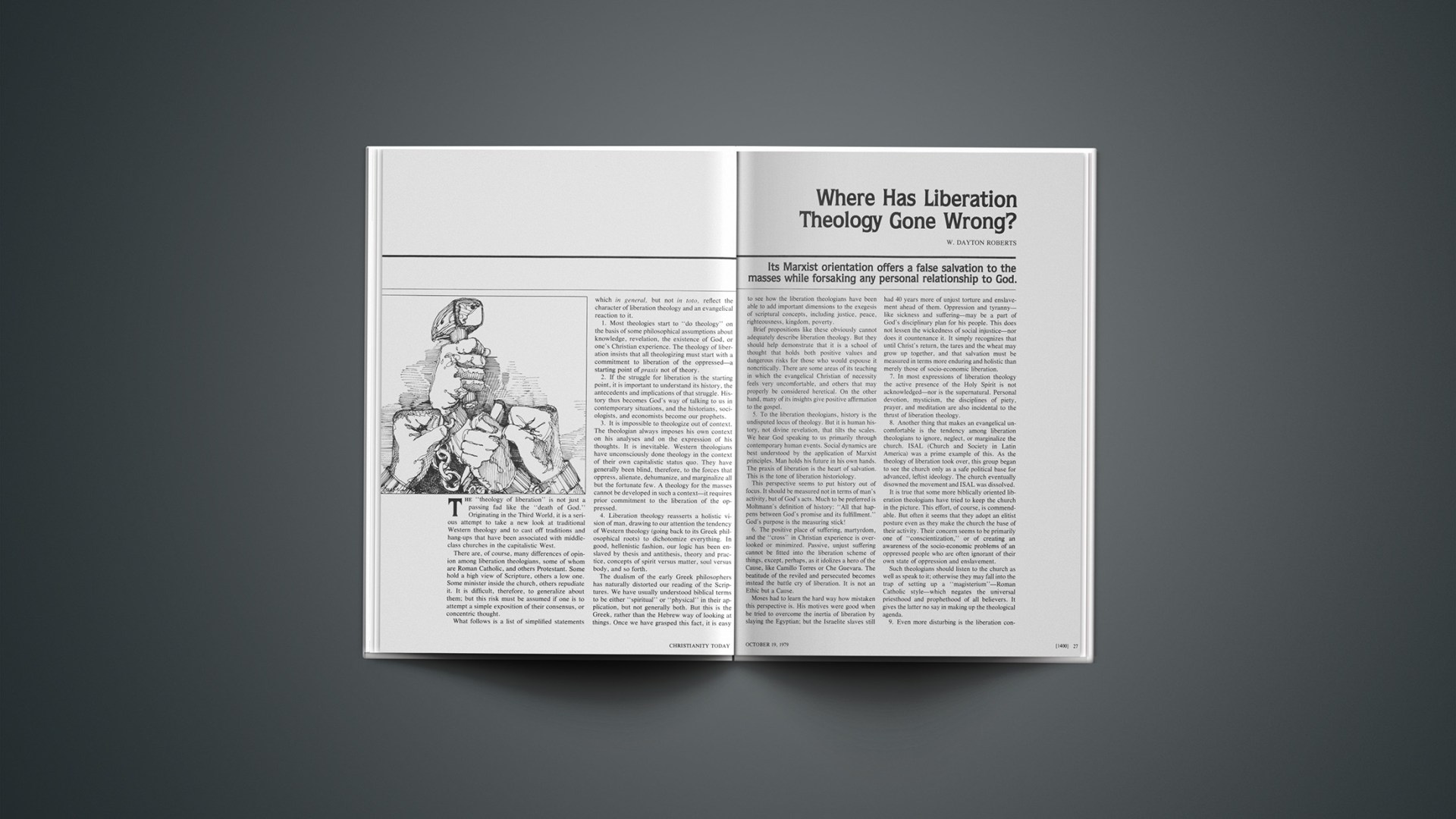
Where Has Liberation Theology Gone Wrong?: A-Do-It-Yourself Salvation

Its Marxist orientation offers a false salvation to the masses while forsaking any personal relationship to God.

The “theology of liberation” is not just a passing fad like the “death of God.” Originating in the Third World, it is a serious attempt to take a new look at traditional Western theology and to cast off traditions and hang-ups that have been associated with middle-class churches in the capitalistic West.

There are, of course, many differences of opinion among liberation theologians, some of whom are Roman Catholic, and others Protestant. Some hold a high view of Scripture, others a low one. Some minister inside the church, others repudiate it. It is difficult, therefore, to generalize about them; but this risk must be assumed if one is to attempt a simple exposition of their consensus, or concentric thought.

What follows is a list of simplified statements which in general, but not in toto, reflect the character of liberation theology and an evangelical reaction to it.

1. Most theologies start to “do theology” on the basis of some philosophical assumptions about knowledge, revelation, the existence of God, or one’s Christian experience. The theology of liberation insists that all theologizing must start with a commitment to liberation of the oppressed—a starting point of praxis not of theory.

2. If the struggle for liberation is the starting point, it is important to understand its history, the antecedents and implications of that struggle. History thus becomes God’s way of talking to us in contemporary situations, and the historians, sociologists, and economists become our prophets.

3. It is impossible to theologize out of context. The theologian always imposes his own context on his analyses and on the expression of his thoughts. It is inevitable. Western theologians have unconsciously done theology in the context of their own capitalistic status quo. They have generally been blind, therefore, to the forces that oppress, alienate, dehumanize, and marginalize all but the fortunate few. A theology for the masses cannot be developed in such a context—it requires prior commitment to the liberation of the oppressed.

4. Liberation theology reasserts a holistic vision of man, drawing to our attention the tendency of Western theology (going back to its Greek philosophical roots) to dichotomize everything. In good, hellenistic fashion, our logic has been enslaved by thesis and antithesis, theory and practice, concepts of spirit versus matter, soul versus body, and so forth.

The dualism of the early Greek philosophers has naturally distorted our reading of the Scriptures. We have usually understood biblical terms to be either “spiritual” or “physical” in their application, but not generally both. But this is the Greek, rather than the Hebrew way of looking at things. Once we have grasped this fact, it is easy to see how the liberation theologians have been able to add important dimensions to the exegesis of scriptural concepts, including justice, peace, righteousness, kingdom, poverty.

Brief propositions like these obviously cannot adequately describe liberation theology. But they should help demonstrate that it is a school of thought that holds both positive values and dangerous risks for those who would espouse it noncritically. There are some areas of its teaching in which the evangelical Christian of necessity feels very uncomfortable, and others that may properly be considered heretical. On the other hand, many of its insights give positive affirmation to the gospel.

5. To the liberation theologians, history is the undisputed locus of theology. But it is human history, not divine revelation, that tilts the scales. We hear God speaking to us primarily through contemporary human events. Social dynamics are best understood by the application of Marxist principles. Man holds his future in his own hands. The praxis of liberation is the heart of salvation. This is the tone of liberation historiology.

This perspective seems to put history out of focus. It should be measured not in terms of man’s activity, but of God’s acts. Much to be preferred is Moltmann’s definition of history: “All that happens between God’s promise and its fulfillment.” God’s purpose is the measuring stick!

6. The positive place of suffering, martyrdom, and the “cross” in Christian experience is overlooked or minimized. Passive, unjust suffering cannot be fitted into the liberation scheme of things, except, perhaps, as it idolizes a hero of the Cause, like Camillo Torres or Che Guevara. The beatitude of the reviled and persecuted becomes instead the battle cry of liberation. It is not an Ethic but a Cause.

Moses had to learn the hard way how mistaken this perspective is. His motives were good when he tried to overcome the inertia of liberation by slaying the Egyptian; but the Israelite slaves still had 40 years more of unjust torture and enslavement ahead of them. Oppression and tyranny—like sickness and suffering—may be a part of God’s disciplinary plan for his people. This does not lessen the wickedness of social injustice—nor does it countenance it. It simply recognizes that until Christ’s return, the tares and the wheat may grow up together, and that salvation must be measured in terms more enduring and holistic than merely those of socio-economic liberation.

7. In most expressions of liberation theology the active presence of the Holy Spirit is not acknowledged—nor is the supernatural. Personal devotion, mysticism, the disciplines of piety, prayer, and meditation are also incidental to the thrust of liberation theology.

8. Another thing that makes an evangelical uncomfortable is the tendency among liberation theologians to ignore, neglect, or marginalize the church. ISAL (Church and Society in Latin America) was a prime example of this. As the theology of liberation took over, this group began to see the church only as a safe political base for advanced, leftist ideology. The church eventually disowned the movement and ISAL was dissolved.

It is true that some more biblically oriented liberation theologians have tried to keep the church in the picture. This effort, of course, is commendable. But often it seems that they adopt an elitist posture even as they make the church the base of their activity. Their concern seems to be primarily one of “conscientization,” or of creating an awareness of the socio-economic problems of an oppressed people who are often ignorant of their own state of oppression and enslavement.

Such theologians should listen to the church as well as speak to it; otherwise they may fall into the trap of setting up a “magisterium”—Roman Catholic style—which negates the universal priesthood and prophethood of all believers. It gives the latter no say in making up the theological agenda.

9. Even more disturbing is the liberation concept of salvation, which is defined in collective terms to the virtual exclusion of individual redemption. This represents a needed corrective to a traditional understanding of salvation that perhaps has been too pietistic and self-centered. But liberation theology seems to have thrown out the baby with the bath water!

Most liberationists virtually equate salvation with socio-economic-political liberation. It is a strongly Pelagian experience with a “do-it-yourself” gospel. Oppression is the starting place, human history is the stage, and an awakened (or “conscienticized”) human race is the hope of liberation. God is at work, they say, in secular society—which he is. But to the degree that salvation is defined in terms of liberation from economic and political oppression, to that degree the “gospel” becomes universalist. This is because God’s work is seen to be in the world rather than in the church, and all society is struggling towards liberation (i.e., “salvation”).

Evangelicals have good reason to be suspicious of this kind of soteriology—because it is a direct throwback to the “modernists” and “social gospelers” of a past generation. It undercuts the personal encounter with Jesus Christ and the “justification by faith” that have always been the cherished hallmarks of evangelicalism.

10. Fundamental to the above distortions is the liberation theologians’ view of the Bible. Generally, it is not much different from what one expects from Roman Catholic or liberal Protestant theologians.

Hugo Assman is a more radical liberationist than most, but he continues to be one of its respected voices, and a leader with whom the school of liberation theology is publicly identified. This is his attitude: “The word of God is no longer a fixed absolute, an eternal proposition we receive before analyzing social conflicts and before committing ourselves to the transformation of historical reality. God’s summons to us, God’s word today, grows from the collective process of historical awareness, analysis and involvement, that is, from praxis. The Bible and the whole Christian tradition do not speak directly to us in our situation. But they remain as a basic reference about how God spoke in quite a different context, which must illuminate his speaking in our context.

“It is true that this kind of historical hermeneutics may destroy the false security of the word of God given once for all, the absolute of the word of God in itself. The word doesn’t exist for us in that sense” (Torres & Eagleson, Theology in America, Orbis, 1975, p. 299).

So here we get back to our starting point. Do we begin with the praxis of oppression or with the divine revelation? Liberationists say we cannot begin to interpret God’s Word until we locate ourselves in our chosen context—because the nature of our context will determine how we interpret the Word! We must choose, first of all, to identify ourselves with the struggle of the oppressed. Then, and only then, may we “theologize.”

The evangelical responds that the context, while important, is an accident: God speaks to man in Moses’ Egypt, in David’s Israel, in Jonah’s Nineveh, in Daniel’s Persia, in Nero’s Rome, in Nixon’s United. States, and in Somoza’s Nicaragua. The context is extremely important and cannot be overlooked. But neither can it become an a priori to God’s revelation, which is for all men everywhere. We must contextualize our theology, but not allow context to usurp the authority or universality of God’s Word itself.

11. Finally, we are in no way satisfied with the liberationists’ understanding of the person and ministry of Jesus Christ. He is somehow seen in messianic (small “m”) dimensions, but he is not glorified as the Messiah. The Gospel accounts are sometimes stretched even to the point of portraying Jesus as a political revolutionary and tolerant of violence (the temple cleansing incident) when used against injustice. Much of his teaching is ignored, as is the Christology of the Pauline Epistles. The hero image of the theology of liberation seems to fit Judas Maccabeus better than Jesus of Nazareth.

The critical question, then, about liberation theology is this: Can one accept some of its insights and obvious contributions without swallowing the whole bag with its humanistic, Pelagian, universalist, and radical overtones? Our reply would be: Perhaps, but …!

One can indeed accept its values while rejecting its heresies. This is naturally risky, but risk has always been the clinging shadow of theology. And there is too much value in the theology of liberation to throw it all out. We might find ourselves again discarding the baby with the bath.

But—the evangelical must be selective as he pans for gold. He must insist on the normative and final authority of the Word of God. Because, in the last analysis, the two systems—liberationism and evangelicalism—are not really compatible. The evangelical can allow no a priori that takes precedence over God’s Word. It will inevitably distort or partialize the truth. Our first loyalty must always be to Jesus Christ and the gospel. Sociology, economics, and political science may well be handmaidens of the gospel, but the relationship cannot be reversed.

This is where the theologians of liberation have left the trail!

G. Douglas Young is founder and president of the Institute of Holy Land Studies in Jerusalem. He has lived there since 1963.

In Support of Parents with Handicapped Children: Some Questions Have No Answers

When no natural cause is found, the search turns inward.

Surprisingly many people seem to believe there is nothing accidental about the birth of a physically or mentally handicapped child. Some see this misfortune as a God-sent punishment for a secret sin that the parents have stubbornly refused to confess. I have heard it too frequently to be amazed any longer when parents tell me their friend or neighbor has urged them to “repent, so God can forgive you and heal your child.” Other people, by contrast, may attempt to comfort hurting parents by stating, “God only sends exceptional children to exceptional parents.” Or, if compassionate words escape them, they may elect to send a “poem” such as the following, of which my wife and I received several copies after the diagnosis 14 years ago of retardation in our son. Far from comforting, however, it only added to our sense of hurt and bewilderment because many more questions were raised than answered by it.

A meeting was held quite far from earth.

“It’s time again for another birth,”

The angels said to the Lord above.

“This dear little child will need much love;

His progress on earth may be quite slow;

Accomplishments great he may not show,

And he will require some extra care

From the folks he meets on earth down there.

He may never run or laugh or play;

His thoughts may seem odd and far away.

In various ways he won’t adapt,

And he will be known as handicapped.

Please, Lord, find some parents for this child

Who’ll do this work as unto You.

They’ll not understand it right away,

The difficult role You have them play;

But with this dear child sent from above

Comes strength and new faith and richer love.

And soon they’ll know the privilege given

To care for this gift that’s straight from heaven.

This precious young charge so meek and mild

Will always remain Your Special Child.”

Besides violating biblical teachings under the guise of poetic license—nowhere is such a meeting described, nor does Scripture permit us to assume handicapped children come to us from a different place or through a different process than normal children—the poem abuses parents at the very time they suffer what may easily be the most traumatic experience of their life.

The reality is that this child will not necessarily be meek and mild. While some are, others are hyperactive or destructive. Without previous training, ordinary parents are suddenly thrown into the bewildering role of therapist, but they cannot go home after eight hours or remain emotionally unaffected. Nor will their faith be magically renewed through this struggle. To be sure, it can be, since God has promised his grace will be sufficient (Deut. 33:25; 2 Cor. 12:9). But the reality is that most parents will long wrestle with the agonizing Why? of it all, like Job who at first did not see God’s behind-the-scene involvement. Unable to reconcile the awful happening with what they thought was God’s beneficent providential rule, they are afraid now—lest they be hurt more—to entertain hope that out of the calamity good will yet be created, especially when the truth sears into their consciousness that this handicap has no cure. In time there may well come a brilliant morning of renewed and transformed faith, but meanwhile there is the long and bitter night of weeping.

It may start with the brusque manner in which the tragic news is too often broken. Too often the diagnosis is simply dropped like a bomb into the lap of the unsuspecting parents, frequently the mother alone, since she is more likely the one to take the child for professional help. One mother told me how her doctor said just a few hours after delivery, “Your child is retarded and she’ll never amount to anything; why don’t you put her away.” Then he walked out and was not available for several days. This unprofessional behavior told these parents they were not worthy of the doctor’s time and their problem was insignificant. But what was perhaps to him a common experience was new and terrifying to the parents. Predictably, the father’s reaction was, “There isn’t any man I hate like that man.” While perhaps there is no painless way to break bad news, the availability of adequate information will do much to avert fears and the overwhelming sense of shame.

Parents must hear that this tragedy is no reflection upon their worth. They need to know that. After hearing the diagnosis, most parents move through predictable stages of disbelief and shock, anger and guilt. Searching for a cause is a natural reaction to a tragic occurrence. Misfortune must have a source, a real genesis that can be identified and either conquered or yielded to. Often parents illogically blame each other for bringing defective genes into the marriage, as though anyone has control over his genes. The mother may attempt to recall each incident of her pregnancy that has possibly triggered her child’s handicap.

When no natural cause can be discovered, the search tends to turn inward. Both parents may be so conditioned to the theory that punishment always follows bad behavior that instinctively they assume their child’s affliction to be punishment for a past sin, even when they cannot identify any transgression grave enough to warrant so horrible a consequence. Sometimes it is less painful to assume undeserved responsibility than to live with the frustration of unanswered questions. I have yet to meet the parents, however, who thought themselves privileged or blessed by their child’s handicap. Normally, the feeling of having been cursed is far stronger. Frequently parents tell of their compelling desire to run away or die so they can escape the stigma of having produced this defective child.

Because our culture emphasizes success, beauty, and knowledge, parents of the handicapped commonly harbor a deep sense of failure. Dr. Sol Gordon has written that the man who sires healthy sons and daughters and the woman who bears them are traditionally considered virile or feminine and a credit to the human race. The handicapped child, then, is considered proof of his parents’ inferiority. More likely to stand out conspicuously from the crowd than to be outstanding, he is frequently in subtle or harsh ways rejected and always must prove himself. Understandably, parents sometimes feel the compulsion to explain or excuse the child or apologize for his handicap when they sense the discomfort of their peers and interpret it to mean that they themselves have failed as cocreators, that they have disappointed God and society. It becomes tempting to avoid crowds, including those in church, or at least leave the child at home. Understandable also is the feeling of resentment and jealousy that is virtually inescapable when parents compare their child with the normal children of others. Because the situation will never change, parents live with what some have called “chronic sorrow,” which so easily leads to depression, illustrating again the truth that “hope deferred makes the heart sick” (Prov. 13:12).

Though parents of the handicapped initially seem to share an almost universal reluctance to face their acquaintances, sensitive friends and understanding relatives are perhaps the best agents to lessen their struggle by providing nonjudgmental support and encouragement and by accepting the child with joy. The extended family and circle of friends may well itself grieve over the impaired child. Sharing, then, and honest expression of feelings and faith can be immensely helpful to all. Mothers of handicapped children—and fathers as well—feel pride when others take an interest in their child and rejoice over his progress, slow though it may be. But they feel pain when others ignore their child, or don’t know what to say. And it hurts to be in a group where the accomplishments of children are compared, accomplishments not matched by one’s own child.

It may help to share with parents one’s conviction that this handicapped child is as much God’s child as a normal one. The repeated references in Genesis 1 that plants, animals, and even people reproduce “after their kind” can be immensely reassuring. This child is not a demon (Luther), or a menace (Goddard), or even an “angel unaware” (Dale Evans Rogers), but a true human being created in God’s image. As the Bible tells us frequently, God has a very special concern for little people (Matt. 18:1–14), and particularly for people who are handicapped, whether blind (Matt. 20:30–34), deaf (Matt. 11:5), paralyzed (Luke 5:18–20), or speech-impaired (Mark 7:32–35). I find it of supreme significance that the guests at the banquet referred to in Luke 14:15–21 turn out to be handicapped.

It is difficult to predict the impact of a child’s handicap on his parents’ faith. Research suggests it can lead to a weakened faith as easily as to greater strength. Inevitably, the struggle and pain lead to a challenged and changed view of God and his dealings with the world. Pastors and church workers should realize that an apparently strong faith and deeply-rooted religious habits are great assets, but no guarantee that parents will escape the feelings of depreciation, failure, and shame. Christians do not necessarily react differently or better than non-Christians to the reality of their child’s handicap, for they are as sensitive to pain as anyone. Only when that pain subsides somewhat can theological and philosophical questions be considered. Even then, a more positive response is by no means guaranteed. A professional working at a Christian facility for the retarded told me that less than one-fourth of all residents had any contact with their (Christian) families. The other three-fourths were abandoned and forgotten. This percentage is exactly the same as it is for the public institution where I work. Much as I dislike that situation, I would nevertheless fault neither faith nor feeling. What would we do?

Faith, I would suggest, may well intensify the process of adjustment. It may be theologically correct to say that God makes no mistakes, but this is hardly comforting to parents who are just now coming to grips with the agony of knowing that a beloved child is crippled, deaf, or retarded. If God made no mistake, then who did? And if nobody made a mistake, then why did this defect occur? There must be a cause. It is not too helpful, either, for parents to hear, “This is God’s will; it is all part of God’s wonderful plan for your life.” If it is because of God’s love that my child is handicapped, so a parent may reason, surely it would be far better were I loved less and the child healthy.

The struggle is similar to that of the believer par excellence, Job. While first, numbed by shock and grief, he mumbles the expected words, “The Lord has given, the Lord has taken away, blessed be the name of the Lord,” questioning starts soon afterward. Far from being the stoic and patient figure often upheld as the Christian ideal, he searches for meaning in the irrational events that turned his life upside down. Caught up in the same stereotyped notions as his contemporaries that suffering is caused by sin, he examines himself and reaches the conclusion God expressed earlier: he is a man blameless and upright. Out of that conviction arises the courage to question and probe and challenge traditional thinking, to confront even God. It is a healthy activity, for by giving vent to his fears and his feelings, by openly expressing that something is badly out of joint, he grows in faith and understanding, even, at last, in his ability to accept what happened.

Like Job’s friends then, fellow believers today are not always aware of the inner torment that may be hidden behind a mask of seeming courage and acceptance and, consequently, provide insufficient emotional and spiritual support. Or they are too easily shocked when parents, perhaps after an initial silence, voice their doubts and anguish even to the point of questioning God. But why should parents like what happened to their child or accept it as normal? Why should they not complain? Their anguish is not a matter of loving their child more than their God, but simply a human reaction to the painful intrusion of evil into their life. Unless parents are permitted to express these feelings, they are unlikely ever to reach the point where they can fully accept their child and express their love for him, or where they will honestly testify to a greater and warmer faith.

Counselors and comforters should bear in mind that on their part better by far than criticism, and pastorally more beneficial, would be temporary silence as a humble admission that some questions have no answers, and that a troubled heart must be allowed time to regain its tranquility. It remains most telling that Job felt the need to reject his three friends—whose quiet presence presumably had comforted him the first week—as “miserable comforters” only when they began to utter pious and critical platitudes from the safety of their own untouched position. The worst possible accusation to direct toward parents—and yet one frequently made—is that their child is afflicted because of flaws in their faith or conduct. Who would not immediately feel the urge to respond with an impassioned plea of self-justification? But out of such forms of destructive dialogue come barriers, not the bridges that make consolation and healing possible. It is most imperative to proceed with great caution. Set apart through this tragedy, instinctively withdrawing from others, struggling with the tedious, logistical problems of braces or diapers or pills or the right school, parents perhaps feel only obstacles and little love. So easily they reason that, because they feel no love, therefore they are not loved. Jean Vanier has wisely reminded us, “One has to begin with wounded people by living with them.… We tend to forget that the basis of life is mutual confidence, mutual respect, deep love and acceptance. Once people have this, they can begin to grow with the professional help they need.”

Growth indeed is possible. Many parents gain through this trial a deeper sensitivity to, and greater awareness of, suffering as it is present in our society. That is not to say they needed this insight, and that is why trouble came. It is merely a rewarding consequence. They may also develop greater confidence in their own value as persons. But, just as their lifestyle is irrevocably changed, so their faith may have become more casual about religious practices while more deeply committed to redefined principles. Looking back, they can perhaps identify positive good that has resulted from their child’s handicap. But they would unhesitatingly exchange all that for wholeness for their child. Acceptance of their child’s handicap does not mean the struggle is over. Time and again new crises will arise to trigger once more the cycle of grief and guilt and doubt. Moving into a new community means repeating the adjustment process. Parents wonder about the future. Where will the child live or work, what will happen when the parents are dead? Will the church continue to care? Just as scars remain, after the wounds and stitches of successful surgery are gone, so parents will always have a sensitive spot in their soul. They may not ever conquer that, but they will have learned to cope with their child’s handicap.

Coping is easiest in a supportive environment. Pastors can give leadership by interpreting to their parishioners the nature of handicaps and the needs of the handicapped and their families. Superstitious stereotypes must be exposed for what they are: fantasies arising out of fear. Parents should as a matter of course be able to expect from their church equal treatment for all their children. Courts have repeatedly affirmed the rights of the handicapped: a right to education, a right of access to public buildings, a right to humane and decent living conditions. Though court decisions are perhaps not yet legally binding on churches, they surely make moral obligations inescapable.

A handicap should in itself be no reason to deny anyone participation in worship services or the sacraments. In the case of the mentally retarded, even the most elementary knowledge of religious truth should be considered sufficient, in keeping with Jesus’ words (Matt. 18:2–6, 10, 14; 19:14), or Paul’s (Rom. 10:9). Mental limitations, moreover, should spur churches even more into making available specific religious instruction geared to a child’s ability. The mentally or physically handicapped are neither automatically saved nor lost. Like anyone else they must be led to Christ. This involvement of the church with the child, along with such practical help as sitter services at home, financial help with the often high medical bills, young people taking the handicapped person to a park—in short, providing whatever help needed—will more than anything else convince the parents that they belong with their child to a loving, caring, supportive fellowship. With joy will they realize they are not different, or inferior.

Great blessings often flow from the presence of a handicapped child in a family or a church or a, community. They are detectable, however, only within an atmosphere of love, within a household of faith where it is an established truth that even the weakest member has something to contribute to the body of Christ.

G. Douglas Young is founder and president of the Institute of Holy Land Studies in Jerusalem. He has lived there since 1963.

The Spiritual Clairvoyance of a Late Renaissance Man: Seeing Patterns in Spiritual Paradox

Blaise Pascal (1623–1662) was a late Renaissance man—philosopher, mathematician, physicist, inventor, and writer. He discovered the direct relationship between barometric pressure and altitude; he constructed the first functional mechanical calculator; he established in Paris the world’s first public transportation system; he solved innumerable “impossible” problems of mathematics; but probably his greatest legacy to the world were his “thoughts.” Discovered after his death, jotted on scraps of paper scattered and hidden among his belongings, were over 900 random thoughts and fragments of thoughts that have come to be known in Western literature as the Pensées of Pascal. These fragments preserve for us Pascal’s attempt, as he was dying in his late 30s, to systematize on paper a grand apology for the Christian faith.

That this was his design is certain, for four years before his death he revealed to his friends a verbal outline of the comprehensive work he had in mind. When his papers were examined it was recognized that many of the 900 jotted thoughts were the raw material of his projected Apology. These have been published in various arrangements as different editors have attempted to pull the fragments into logical groupings. The reconstruction of the intended Apology from the Pensées remains one of the most tantalizing textual problems in literary history.

The following fragment may reveal Pascal’s own conceptual outline for his unfinished work:

“First part: Misery of man without God. Second part: Happiness of man with God.” Or, “First part: That nature is corrupt. Proved by nature itself. Second part: That there is a redeemer. Proved by Scripture” (60). (Léon Brunschvicg’s numbering scheme for the fragments is the arrangement most often encountered in modern editions of the work.)

This simple, two-part theme is echoed many times throughout the Pensées. “For the Christian faith goes mainly to establish these two facts: the corruption of nature, and redemption by Jesus Christ” (194). In reverse order, “The Christian religion, then, teaches men these two truths; that there is a God whom men can know, and that there is a corruption in their nature which renders them unworthy of him” (556). Fragment 527 speaks of “The knowledge of man’s misery.… The knowledge of Jesus Christ …” Central to his whole apologetic scheme is man. Even as Calvin begins his Institutes with “the knowledge of God and of ourselves,” Pascal’s analysis of the faith finds at its center man’s relationship to God—miserable without him, happy with him.

In the mid-seventeenth century Pascal, a scientist and mathematical genius, was writing in reaction to a method of Christian apologetics that held that the faith could be proven by empirical and objective proofs. He argued that the courses of the moon and stars do not prove the existence of God to the scientific mind, but rather they are proof of God’s creative power only to the heart that already has the living faith (242). He says, in fact, that “it is a sign of weakness to prove God by nature” (428). Hence the apologetic cannot be outside man, but must deal with man as its subject.

In the Pensées is the solution to a philosophical dilemma that Pascal found typified by his two favorite authors, Epictetus and Montaigne. Epictetus, the stoic, regarded man’s nature as inherently virtuous and strong, while Montaigne, the skeptic who doubted everything—even to the absurdity of doubting that he doubted—relaxed in a state of extreme epicurianism, indulging the nature that he found wretched and irreparable. Thus Epictetus recognized the former grandeur of man but ignored the present state of corruption; Montaigne recognized corruption but failed to see the original created dignity. Neither perceived the key that Pascal used to close the gulf between them: that the present state of man differs from his state at creation. It is man without God that is wretched, and it is these two words, without God, that identify both the problem and its solution.

In the extended and polished argument of Pensée 72, Pascal dwells on two opposite natures of man, soul and body; but he insists that man is a whole (115). Though man may be dissected into many parts, no part is man; rather, all the parts in combination are man, so although man seems to have differing natures of soul and body, Pascal concludes that these are inseparable in the ultimate definition of man. He gives much more attention to a different twofold nature of man, that is, his greatness and his wretchedness, comparing man simultaneously to angels and to brutes (418). He observes that “this twofold nature is so evident that some have thought that we had two souls” (417).

Pascal is considered by some to be a misanthrope because of his dismal view of the natural state of man. His view is strangely detached, as though he were an outsider looking in upon humanity. This trait may be accounted for by his isolated youth, when he was kept apart from other children and a normal pattern of schooling. Before the reader of the Pensées finds the hope of salvation thoroughly presented he is bombarded by a multitude of misanthropic pronouncements: man is deceitful (82), full of error (83), false, egocentric, and hypocritical (100), inconstant (127), vain (150), feeble (347), and mad (414). Man tries to hide his hopeless condition from himself by self-deceit and a constant search for divertissement. His self-love leads him to believe an imaginary idea of himself and his restlessness and dissatisfaction demand distraction and motion—constant motion. “The struggle alone pleases us, not the victory” (135). The chase is better than the capture. Man labors to gain rest, but finds the rest insufferable. “Complete rest is death” (129).

This echoes a theme from The Preacher, “The eye is not satisfied with seeing, nor the ear filled with hearing” (Eccl. 1:8). Pascal acknowledges in Solomon an expert who, with Job, has “best spoken of the misery of man” (174).

But in the very totality of the misery that defeated Montaigne, the genius of Pascal saw the hope of victory: “The greatness of man is great in that he knows he is miserable” (397). “All these same miseries prove man’s greatness. They are the miseries of a great lord, of a deposed king” (398). No other part of creation has the ability to recognize its wretchedness as does man, and in this man is different from all the beasts. He seems to know that he has fallen from a better state.

The fall is described thus: “ ‘I created man holy, innocent, perfect. I filled him with light and intelligence. I communicated to him my glory and my wonders.… But he has not been able to sustain so great glory without falling into pride. He wanted to make himself his own center, and independent of my help. He withdrew himself from my rule; and, on making himself equal to me by the desire of finding his happiness in himself, I abandoned him to himself’ ” (430). Pascal’s explanation of original sin is so crisp and clear it should be better known. His lucid observation rightly places the responsibility for sin not on any tempting agent—the serpent, the fruit, or the allurements of Eve—but squarely on man’s desire to make himself his own center. In that desire he made himself equal with God, the ultimate blasphemy, and the sin at the center of all sin.

Man has fallen from his true place (427). “He has fallen from a better nature which once was his” (409). “A ruined house is not miserable. Man only is miserable” (399) in that he can perceive his ruin from a better state. So Pascal identifies a fall from a former state, a state of lordship, of greatness, rest, and happiness to one of misery; and the misery is only man’s because man alone is a thinking creature (346). Man alone has an obscure but powerful nostalgia for the eternal destiny that he lost. The desire for independence brought the fall, described in 430, and then man’s self-love became his consuming sin, for, no longer able to love God, he fell into total love of himself. Now man is in a state of need; he desires release and redemption from his state of corruption. “This desire is left to us, partly to punish us, partly to make us perceive wherefrom we are fallen” (437). But in a state of total egocentricity how can man even recognize his need for a return to God?

Pascal suggests a remnant of the first state, though not a remnant in the sense of some vestigial working fragment of goodness or perfection that remains. His theology follows that of Augustine and Jansen in defining man as utterly sinful and incapable of any natural righteousness of his own. However, he is not a totally orthodox Jansenist because he allows to man the free will to claim or reject the Cross of Christ for himself. Man has the power to choose and his choice may be influenced by his intuitive memory of something better. Pascal’s concept of “remnant” is explained in the vague memory of the better state, which function Jan Miel refers to as “nostalgia.”

Man has a “secret instinct, a remnant of the greatness of our original nature” (139). “There was once in man a true happiness of which there now remain to him only the mark and the empty trace” (425). “ ‘And so estranged from me that there remains to him a dim vision of his Author.… There remains to them some feeble instinct of the happiness of their former state’ ” (430). Pascal makes much of the role of intuition even in the physical sciences, and claims the primacy of it in religion. “The heart has its reasons, which reason does not know” (277), perhaps the most quoted sentence from the Pensées, and “reason must trust these intuitions of the heart” (282).

Pascal’s strong and repeated arguments for intuition, the reasons of the heart, secret and feeble instincts, the empty trace, the dim vision—all such description are attempts to define the remnant of the former grandeur. It is that remnant in the form of the dim vision that enables the willing heart to find God; it is the dimness of the vision that allows the unwilling to ignore him. The responsibility is thus squarely on man in his willingness or unwillingness. “There is sufficient clearness to enlighten the elect, and sufficient obscurity to humble them. There is sufficient obscurity to blind the reprobate, and sufficient clearness to condemn them, and make them inexcusable” (578). In the unraveling of this double paradox Pascal illustrates his concept of the “hidden God” who is there for those who seek, but who remains unknown to those who do not.

Man’s “infinite abyss can only be filled by an infinite and immutable object, that is to say, only by God himself” (425). And more particularly, Pascal confesses that Jesus Christ is the only means of salvation (547). He also reflects the opening statement of Calvin’s Institutes when he says, “Not only do we know God by Jesus Christ alone, but we know ourselves only by Jesus Christ” (548). There is no theology more Christocentric than Pascal’s. Jesus reconciles for Pascal the contradiction between Epictetus and Montaigne. “The knowledge of God without that of man’s misery [a condition akin to Epictetus] causes pride. The knowledge of man’s misery without that of God [Montaigne] causes despair. The knowledge of Jesus Christ constitutes the middle course, because in him we find both God and our misery” (527). Only man can experience the sin of man, only God can save man from his sin, and Jesus Christ is both God and man in his own person. The greatness of the remedy—the Incarnation, his suffering with our misery—demonstrates to us just how great was the misery that had to be remedied (526).

Pascal was loyal to the Jansenist sect of Catholicism and the monastic community of the Port Royal abbey in France in which his sister and his niece were nuns and in which he had lifelong friends. Yet his Catholicism is remarkably close to a Protestant position in its doctrinal essentials. He has little to say about Mary, the mother of Jesus, and almost nothing about the pope or the ecclesiastical structure. Though he set about his apologetic task to preserve the authority of the church, the logic of his arguments appeals to Jesus as the final authority and tends toward the freedom of the individual conscience. His own certainty of the gospel and, therefore, the authority of the church, came in the confirmation of his own experience with a personal God. Early in life he had given his intellectual consent to the authority of the church but it was his second conversion, when he met God in a night of ecstasy, late in his life, that was the proof of his salvation. Pascal is tantalizingly close to the Protestant position that recognizes in each soul the freedom to meet God without the necessary mediation of the church.

Man, in Pascal’s theology, is totally corrupt and damned, destined to fall into the hands of an angry God. Yet the fear of eternal punishment is not a noteworthy theme in his work. There is not a dwelling on the horrors of damnation so much as on the contrast of eternal salvation with the misery and wretchedness of the present state. Man was once perfect in his love of God and himself, fallen from this state of grandeur because of desire to be self-sufficient, and now miserable in a state of separation wherein he retains a vague and instinctive nostalgia for the former state. God has provided man redemption through the incarnation and sacrifice of Jesus Christ. Man feels his very great need and the vacuum within himself, but tends to seek a self-deluded fulfillment in pointless diversions and a whirl of activity.

Pascal argues beautifully and, in a sense, scientifically, the proof of man’s only fulfillment in Jesus Christ. But he also reveals a sense of understanding that his great labor of apology may largely be in vain.

“Men despise religion; they hate it and fear it may be true” (187).

Disciplined

On a tight tether to wind and sun,

willow shadows stand still or run

across the grass. They follow the lines

of pattern the pull of the leash defines.

As God is more than sun and wind

I am more than shadow, yet disciplined

I must be, tethered, tugged by His hand

this way or that, to run as He planned.

PEARL LUNT ROBINSON

Sonnet XXII

Thrice holy, three times spoken, meant, and heard

By one voice speaking once, once only hearing,

One only multifold, all-meaning Word,

From out of time, in time and flesh appearing

Separate, though inseparably one,

Thou who art not the Father, yet art God.

Thou who are Son of Man, though no man’s son;

Root of Jesse, Rock of Ages, Rod

Of Aaron blossoming in barren soil,

Whose petals’ blades are of a burning sword

Which strikes its deep wounds full of healing oil,

Servant of all, and universal Lord;

With literal metaphars we stumbling seek

To praise thee, strong first-born of all who speak.

DONALD T. WILLIAMS

His Rod and His Staff

Sons of thunder, I have seen it too

And heard the word wherein are contained

The planets, lights, and space, by faith maintained,

Spoken from the void each day anew.

Holy daughters, armed with truth and might,

You cherish dreams that will not let you be.

Till by your faith the promise becomes sight:

The fire falls, the captive world is free.

Try the searchless limits of our God.

Who can know the power of our God?

Who slays us and restores us once again,

Sends love, with pain and joy unto all men;

Stands us where the meteors are hurled,

Heals us where the silent streams purl.

We reel in vertigo without his rod:

Falling off the edge of the world.

PEGGY MUNN

G. Douglas Young is founder and president of the Institute of Holy Land Studies in Jerusalem. He has lived there since 1963.

Puritan Work Ethic: The Dignity of Life’s Labors: Setting the Record Straight

The Puritans never conceived of work apart from a context of service to God and man.

A job should be a job, not a death sentence.” “Jobs are demeaning. You walk out with no sense of satisfaction.”

“One minute to five is the moment of triumph. You physically turn off the machine that has dictated to you all day long.”

So said three of the 133 workers interviewed by Studs Terkel for his book Working: People Talk about What They Do All Day and How They Feel about What They Do (Pantheon, 1972). Terkel’s 589-page book confirms that our society is suffering from a work crisis. The opening paragraph of Terkel’s introduction suggests the extent of the crisis: “This book, being about work, is, by its very nature, about violence—to the spirit as well as to the body. It is about ulcers as well as accidents … about nervous breakdowns as well as kicking the dog around. It is, above all (or beneath all), about daily humiliations. To survive the day is triumph enough for the walking wounded among the great many of us.”

One of the commonest responses to the work crisis is to blame the Puritans for our plight. The phrase “Puritan work ethic” is used to cover a whole range of current ills: the workaholic syndrome, drudgery, competitiveness, worship of success, materialism, and the cult of the self-made person. It has become such an axiom that the Puritans started all this that we may be shocked to learn that the so-called “Puritan work ethic” is in many ways the opposite of what the Puritans actually believed about work. For the past three centuries Western civilization has been dominated by a secularized perversion of the original Puritan work ethic.

The Puritans bequeathed four attitudes toward work that should be welcome to any Christian today. To profit from the Puritan example we need only to be open-minded enough to allow the Puritans to speak for themselves. For completeness we will also refer to the Reformers, to whom the Puritans were much indebted.

1The Puritans declared the sanctity of all honorable work. In doing so, they rejected a centuries-old division of callings into “sacred” and “secular.” The earlier views held that work done by members of the religious profession was “sacred,” with all other work bearing the stigma of being “secular.”

The cleavage between sacred and secular work can be traced all the way back to the Jewish Talmud. The same division became a leading feature of medieval Roman Catholicism. The attitude was formulated already in the fourth century by Eusebius, who wrote, “Two ways of life were given by the law of Christ to His Church. The one is above nature, and beyond common human living.… Wholly and permanently separate from the common customary life of mankind, it devotes itself to the service of God alone.… Such then is the perfect form of the Christian life. And the other, more humble, more human, permits men to … have minds for farming, for trade, and the other more secular interests as well as for religion.… And a kind of secondary grade of piety is attributed to them” (Demonstratio Evangelica).

It was Martin Luther who, more than anyone else, overthrew the notion that clergymen, monks, and nuns were engaged in holier work than housewives and shopkeepers. Household tasks, writes Luther, have “no appearance of sanctity; and yet these very works in connection with the household are more desirable than all the works of all the monks and nuns” (commentary on Genesis 13:13).

The English Puritans followed the Reformers on this point. William Tyndale typifies their attitude when he writes that if we look externally, “there is difference betwixt washing of dishes, and preaching of the word of God; but as touching to please God, none at all” (Parable of the Wicked Mammon).

This Puritan rejection of the dichotomy between sacred and secular work has far-reaching implications. It judges every honorable job to be of intrinsic value, and integrates every vocation with a Christian’s spiritual life. It makes every job consequential by regarding it as the arena for glorifying and obeying God and for expressing love (through service) to a neighbor.

The most important aspect of this attitude is that it sanctifies the common. In a particularly memorable passage Luther comments, “Our natural reason … takes a look at married life … and says, ‘alas, must I rock the baby, wash its diapers, make its bed …, labor at my trade?’ … What then does the Christian faith say to this? It opens its eyes, looks upon all these insignificant, distasteful, and despised duties in the Spirit, and is aware that they are all adorned with divine approval as with the costliest gold and jewels.… When a father goes ahead and washes diapers … God, with all his angels and creatures, is smiling—not because that father is washing diapers, but because he is doing so in Christian faith” (The Estate of Marriage).

“Our Savior Christ,” adds Latimer, “was a carpenter, and got his living with great labor. Therefore let no man disdain … to follow him in a … common calling and occupation” (sixth sermon before King Edward VI).

For the Puritans, all of life was God’s. Their goal was to integrate their daily work with their religious devotion to God. The Puritan divine Richard Steele asserts that it is in the shop “where you may most confidently expect the presence and blessing of God” (The Tradesman’s Calling). According to Calvin, “Paul teaches that there is no part of our life or conduct, however insignificant, which should not be related to the glory of God” (commentary on 1 Corinthians 10:31). John Milton, in his famous Areopagitica, satirizes the businessman who leaves his religion at home, “trading all day without his religion.”

2 Another mighty affirmation the Puritans made was that God calls every person to his or her vocation. Every Christian, they said, has a calling. To follow it is to obey God. The important effect of this attitude is that it makes work a response to God.

For the doctrine of vocation the Puritans were once again indebted to Luther and Calvin. “The apostle Peter,” Luther states, “wants to remind everyone in particular to attend to his occupation or office and, in discharging it, faithfully to do whatever is demanded of him. For, as Scripture teaches in many places, no work is nobler than obedience in the calling and work God has assigned to each one” (sermon on 1 Peter 4:8–11).

The Puritans made this doctrine of the calling a major doctrine. Perkins comments, “A vocation or calling is a certain kind of life, ordained and imposed on man by God, for the common good.… Every person of every degree, state, sex, or condition without exception, must have some personal and particular calling to walk in.”

One effect of the Puritan concept of calling is to make the worker a steward who serves God. Work, in this view, ceases to be impersonal. Its importance, moreover, does not lie within itself; instead, work becomes one of the means by which a person lives out his or her personal relationship to God.

Richard Steele views work as a stewardship when he writes, “He that hath lent you talents hath also said, ‘Occupy till I come!’ Your strength is a talent, your parts are talents, and so is your time. How is it that ye stand all day idle?… Your trade is your proper province.”

To work in one’s calling, in the Puritan view, is to work in the sight of God. Cotton Mather asserts, “Oh, let every Christian walk with God, when he works at his calling, act in his occupation with an eye to God, act as under the eye of God.”

Another practical result of the doctrine of Christian calling is that it leads to contentment in our work. If a Christian’s calling comes from God, we have a reason to accept our lot that the unbeliever lacks. “Nothing is so bad,” Luther writes, “but what it becomes sweet and tolerable if only I know and am certain that it is pleasing to God” (The Estate of Marriage). In his commentary on Psalm 128:2, he writes that “the world does not consider labor a blessing. Therefore it flees and hates it.… But the pious, who fear the Lord, labor with a ready and cheerful heart; for they know God’s command and will.”

And Cotton Mather encourages us to believe that “a Christian should follow his occupation with contentment.… Is your business here clogged with any difficulties and inconveniences? Contentment under those difficulties is no little part of your homage to that God who hath placed you where you are.”

To sum up, the Puritan ideal of calling viewed work as the response of a steward to God, and taught contentment with one’s task. These ideals are admirably captured in John Cotton’s exhortation to “serve God in thy calling, and do it with cheerfulness, and faithfulness, and an heavenly mind.”

3 Another great gift the Puritans gave was a true estimate of the motivation and goals of work. On this point we especially need to distinguish between what the early Puritans believed and what has passed for three centuries as the “Puritan work ethic.” From the time that Benjamin Franklin uttered his worldly-wise proverbs about wealth as the goal of work, to our own century when industrial giants have claimed that their success was proof that they were God’s elect, our culture has viewed work primarily as the means to wealth and possessions. This secularized work ethic has been attributed to the Puritans, and especially to Calvin; it has become an axiom that the Puritan ethic is based on wealth as the ultimate reward of work, and prosperity as a sign of godliness.

But is this what the Puritans really believed? The rewards of work, according to Puritan theory, were spiritual and moral; that is, work glorified God and benefited society. Luther said that “work should … be done to serve God by it, to avoid idleness, and to satisfy His commandments” (sermon on the fourth petition of the Lord’s Prayer). Elsewhere he adds that “all stations are so oriented that they serve others.” Calvin says in his commentary on Luke 10:38 that “we know that men were created to busy themselves with labor … for the common good.”

William Perkins asserts, “The main end of our lives … is to serve God in the serving of men in the works of our callings.… Some man will say perchance: What, we must not labor in our callings, to maintain our families? I answer: this must be done: but this is not the scope and end of our lives. The true end of our lives is to do service to God, in serving of man.”

Spiritual and moral rewards should also govern one’s choice of vocation, according to Baxter. “Choose that employment or calling,” he writes, “in which you may be most serviceable to God. Choose not that in which you may be most rich or honorable in the world; but that in which you may do most good, and best escape sinning.” Elsewhere Baxter writes that in choosing a trade or calling, the first consideration is “the service of God and the public good, and therefore that calling which most conduceth to the public good is to be preferred.”

The counterpart of this emphasis on the spiritual and moral rewards of work is the frequent denunciation of people who use work to gratify their selfish ambitions. Contrary to what many think, the idea of the self-made person did not appeal to the Puritans, if by “self-made person” we mean the person who claims to have been successful by his own efforts and who ostentatiously gratifies his materialistic inclinations.

“ ‘Every man for himself, and God for us all,’ ” writes Perkins, “is wicked, and is directly against the end of every calling.” Luther speaks slightingly of people who “do not use their talents in … the service of their neighbor” but “use them only for their own glory and advantage.” Latimer says regarding wealth that “we may not do as many do, that greedily and covetously seek for it day and night” (sermon, February 21, 1552).

Did Calvin and his followers regard work as the means by which people earn their own success and wealth? It is commonly asserted that they did, but I look in vain for substantiation of the claim. Calvinism does not teach an ethic of self-reliance, as our modern work ethic does; it is instead an ethic of grace. Whatever tangible rewards come from work, this viewpoint says, are the gift of God’s grace.

Calvin even denies that material success is always the result of work. It is Franklin, not Calvin, who has the confidence that “early to bed and early to rise makes a man healthy, wealthy, and wise.” In his commentary on Psalm 127:2, Calvin writes, “Solomon … affirms that neither living at a small expense, nor diligence in business will by themselves profit anything at all.” Luther, in commenting on the same text, writes, “You must, of course, labor—but the effort is futile if you do nothing but labor and imagine that you are supporting yourself.… Labor you should, but supporting and providing for you belongs to God alone.”

In his exposition of Deuteronomy 8:17–18, Luther comments, “When riches come, the godless heart of man thinks: I have achieved this with my labors. It does not consider that these are purely blessings of God, blessings that at times come to us through our labors and at times without our labors, but never because of our labors; for God always gives them because of His undeserved mercy.”

It is true that the Puritan lifestyle, a blend of diligence and thrift, tended to make people relatively prosperous. The important thing, however, is how the Puritans looked upon their wealth. The Puritan attitude toward wealth was that it was a social good, not a personal possession.

Hugh Latimer states, “For God gave never a gift, but he sent occasion at one time or another to show it to God’s glory. As if he sent riches, he sendeth poor men to be helped with it” (sixth sermon before King Edward VI). Latimer also believed that “the poor man hath title to the rich man’s goods; so that the rich man ought to let the poor man have part of his riches to help and to comfort him withall” (fifth sermon on the Lord’s Prayer).

Instead of regarding success as a sign of God’s approval or of their own virtue, the Puritans were much more likely to look upon prosperity as a temptation to forget God. In this attitude they are remarkably like Jesus in the New Testament. A marginal note to Genesis 13:1 in the Geneva Bible speaks volumes: Abraham’s “great riches gotten in Egypt hindered him not to follow his vocation.” Benjamin Colman writes, “God’s blessing a people obliges them to be religious, and yet how often is prosperity a means of a people’s irreligion.”

The Puritans never conceived of work apart from a spiritual and moral context of service to God and man. President Richard Nixon’s Labor Day message of 1971 probably sums up the popular conception of the Puritan work ethic, but, if so, it is an inaccurate picture: “The ‘work ethic’ holds that labor is good in itself; that a man or woman becomes a better person by virtue of the act of working. America’s competitive spirit, the ‘work ethic’ of this people, … the value of achievement, the morality of self-reliance—none of these is going out of style.” I hope that I have shown that the Puritans would not have accepted such a work ethic. Their ideals were obedience to God, service to humanity, and reliance on God’s grace.

4 The final inheritance the Puritans bequeathed was a sense of moderation in work. They tried to maintain a middle position between the extremes of laziness on the one hand and slavish addiction to work on the other.

At one point the modern interpretation of the Puritan work ethic is correct: the Puritans scorned idleness and praised diligence.

Luther writes, “God … does not want me to sit at home, to loaf, to commit matters to God, and to wait till a fried chicken flies into my mouth. That would be tempting God” (exposition of Exodus 13:18).

While condemning idleness, the Puritans admired diligence in work, not so much because it was inherently virtuous as because it was God’s appointed means of providing for human needs. Baxter writes, “It is action that God is most served and honored by.”

Some ask if the Puritan ethic does not lead inevitably to the workaholic syndrome. My answer is no, because the Puritans balanced their diligence with definite curbs against overwork. If today we cannot conceive of diligence without overwork, this is an index to how far we are from the very idea of moderation.

The Scottish divine Robert Woodrow writes, “The sin of our too great fondness for trade, to the neglecting of our more valuable interests, I humbly think will be written upon our judgment.” In a day when moonlighting and multiple incomes for families have become a rule, we might benefit from listening to the advice of Richard Steele when he writes that a person ought not to “accumulate two or three callings merely to increase his riches.”

The goal of the Puritans was moderation. To work with zeal and yet not give one’s soul to his or her work was what they strove for. John Preston expressed it this way: “You might meddle with all things in the world and not be defiled by them, if you had pure affections, but when you have an inordinate lust after anything, then it defiles your spirit.”

Such, then, was the Puritan doctrine of work. It found literary expression in the great Puritan epic, Milton’s Paradise Lost. Milton incarnates the Puritan attitude toward work in his portrayal of Adam’s and Eve’s life of perfection in the garden. He repeatedly emphasizes that work in Paradise is not only pleasant but also necessary, and to emphasize the latter is “the most strikingly original feature of Milton’s treatment” of paradisal life, as J. M. Evans recently pointed out.

There is no better summary of the Puritan doctrine of work than these words of Adam to Eve in Book IV, lines 618–20:

Man hath his daily work of body or mind

Appointed, which declares his dignity,

And the regard of Heaven on all his ways.

G. Douglas Young is founder and president of the Institute of Holy Land Studies in Jerusalem. He has lived there since 1963.

Apple PodcastsDown ArrowDown ArrowDown Arrowarrow_left_altLeft ArrowLeft ArrowRight ArrowRight ArrowRight Arrowarrow_up_altUp ArrowUp ArrowAvailable at Amazoncaret-downCloseCloseEmailEmailExpandExpandExternalExternalFacebookfacebook-squareGiftGiftGooglegoogleGoogle KeephamburgerInstagraminstagram-squareLinkLinklinkedin-squareListenListenListenChristianity TodayCT Creative Studio Logologo_orgMegaphoneMenuMenupausePinterestPlayPlayPocketPodcastRSSRSSSaveSaveSaveSearchSearchsearchSpotifyStitcherTelegramTable of ContentsTable of Contentstwitter-squareWhatsAppXYouTubeYouTube