Ideas

The Evangelicals of 1517

At high noon on the last day of October, 1517, so the legend goes, Martin Luther marched up to the door of the university church at Wittenberg, Germany, and there posted 95 theses or debating propositions. By this act he announced in good medieval fashion that he was willing to defend the truth of his theses against all comers.

Luther’s theses dealt largely with indulgences. The pope had commissioned a priest, Tetzel, to sell indulgences in central Germany to raise money for the completion of St. Peter’s Cathedral at Rome. The exact meaning of these indulgences is uncertain. Ever since Tetzel’s day, historians have argued over their precise theological definition. It is quite clear, however, that many who purchased indulgences valued them as permits to sin without fear of punishment.

In any case, Luther became so incensed at their sale that he advertised his debating topics, which included not only a discussion of indulgences, but also set forth what was of far deeper significance: his basic understanding of the biblical gospel that undergirded his objections to indulgences.

According to Luther, we are saved not as a final reward for living a good life. Rather, we are saved wholly by God’s gracious work of redemption in our behalf and on the sole condition of faith, that is, personal trust in Jesus Christ as divine Lord and Savior.

Luther came to this knowledge of the gospel only after severe struggle. In his early years in the monastery he had accepted the common doctrine of his day that salvation is by the grace of God through faith plus churchly and moral good works. But his soul was in agony. “If salvation is by doing good, have I done enough? Is God satisfied? Am I safe?” Luther didn’t know. But as he studied the Bible, he discovered that the answer to those questions is no.

God loves all men. In spite of their sin he receives them freely into his favor and fellowship if they repent of their sin and turn to him in Christ by faith. This is the first great principle of Protestantism and the true fundamental of biblical Christianity.

The second principle of historic Protestantism follows from the first. When Luther nailed his 95 theses to the door of the Wittenberg church, he had no intention whatsoever of any break with the church of Rome. He was advocating no new theology. He was only rebuking a wicked priest and laying a theological foundation for that rebuke in the teaching of Holy Scripture.

But to his astonishment, others didn’t see it that way. Luther appealed to the pope, urging him to administer appropriate discipline to this mercenary monk who was deceiving the people and despoiling the church. To his dismay, however, the pope exonerated Tetzel and instead charged Luther himself with heresy.

In the discussions and debates that followed, Luther returned again to the source of his conclusions—the Scriptures and Jesus Christ, the Lord of Scripture. Loyalty to his Lord and Savior drove him back to Holy Scripture. The Bible, in fact, is the instrument by which Jesus Christ exercised his Lordship over his obedient disciples. This is the second great principle of evangelical Protestantism—the divine authority of the Bible as God’s Word to man, the only entirely trustworthy guide for all of man’s thought and life.

These two principles dare not be separated. They are related, as Luther himself put it, like baby and crib. Christ is the baby. He alone is the object of our adoration and worship. Scripture is the crib, and we treasure it because it is the bearer of Christ. Unfortunately, some today seek to remove the crib of scriptural authority and retain only the Christ. But the baby taken out of its crib and laid in the street will not long survive. The crib is made for the baby and is essential to its welfare.

By the Holy Scriptures we come to our knowledge of Christ and his salvation, and by that same Holy Scripture Christ instructs us so that we may become his believing and obedient disciples. Christ the Lord and Savior stands behind his written Word of Scripture, and we who celebrate Reformation Day on October 31, 1979, are grateful for Martin Luther and the great truths of the Reformation that he enunciated clearly and faithfully.

Evangelicals gladly trace their historical roots back to Luther. Not that evangelicalism began with him. But it took on its basic structure and became a recognizable movement within the nominal Christian church with Luther and the Protestant Reformation. Evangelicals themselves insist that the ancient church was essentially evangelical and that evangelicalism even in its darkest hours never disappeared altogether from the church catholic. Nor are the precise boundaries of evangelicalism easy to draw.

Still Luther claimed for his followers the name evangelical at least as early as 1520. At one point he even declared that “evangelicalism is Christianity.”

The word “Protestant” found its way into modern European languages only much later. In its original sense it did not arise as a negative word of protest in reaction to Catholic Christianity. Certainly Luther himself never conceived of his message in this way. Rather it was a protestimonium (Latin pro, in behalf of, and testimonium, a testimony or witness)—a positive proclamation of God’s grace in offering sinners full and free forgiveness. A Protestant is one who bears witness to this faith.

A witness, we should note, has seen or heard something firsthand for himself. He does not rely on hearsay or rumor or on what someone else has seen; he tells what he himself saw out of his own experience. A witness also points beyond himself to the event or scene that he witnessed. A witness has something to tell others.

Twentieth century followers of Martin Luther must ask themselves: Am I a Protestant in this sense? Have I personally experienced Jesus Christ as my divine Lord and Savior from sin and do I place myself under obedience to his written word of Scripture? Do I have something to say to others about my Savior? And as a witness do I point others not to myself but to Jesus Christ, the Savior of sinners and the Lord of my life? May we all truly live as Protestants in Martin Luther’s sense of the term.

A Courteous Condemnation

Every age of Christian history, it seems, has its special temptation to “simplify” the simple gospel. According to theologian Georges Florovsky, the gospel is simplified from a Person to a principle. The cosmic Christ, the Christ-principle, the Logos or what-have-you is acceptable, but the human and divine Man Jesus is a stumbling block and foolishness. Yet, as Peter replied when troubled by Jesus’ hard sayings, there is no other Person, nor any principle, to which we can go, for it is he who has the words of eternal life.

Through the ages, other views have come and gone, and often come back. In the nineteenth century, Albrecht Ritschl “simplified” the gospel into the challenge to fulfill one’s calling with total integrity and fidelity, even as Jesus fulfilled his. His view became an important root of the distorted loyalty that caused even Christian commanders to kill for a demented Führer.

Martin Luther, never a gentle man with words, reserved some of his greatest vehemence for the downtrodden peasants of 1525 who transmuted the evangelical promises of Christian freedom that Luther had rediscovered into the license to overthrow their feudal ties and kill their feudal lords.

In our day, the so-called theology of liberation claims in similar fashion to simplify biblical salvation. Eric Vögelin sees Marxism with its hatred of creation as well as of the Creator as the Gnosticism of our day. Liberation theology is only a slightly Christian-tinted Marxism, like the “Christian” Gnosticism of the second century. Gnosticism saw all reality as fundamentally different from what had been created, and what all men but Gnostics thought it to be. Marxism sees the world order as totally different from what Scripture tells us, and from what all men other than those “enlightened” by Marxism suppose it to be.

Liberation theology—like Marxism, incidentally—contains valid observations. It espouses some, if not many, moral positions that Christians must also endorse. At best, when these insights only tint our Christian faith, then the theology of liberation may serve as a useful if not dangerous stimulant—like nitroglycerin to the failing heart. But only a mildly Christian tint to liberation theology is as dangerous in our era as Gnosticism was to the early church.

Fundamentalist George Pickering sorrowfully criticized evangelicals who lack the courage to take a stand where a stand must be taken. We are, he implies, so enticed by the desire to be up-to-date and to enjoy the approval of the sages of secular culture that we will compromise every principle; but we do it gradually, so we will not notice that we are forsaking Christ. If that stern charge wounds us, it should also wake us; for if it is true, we will lower ourselves alive into our grave.

The siren call of the liberation theologians is one place where Christians must exercise discernment. Even though we share in the guilt of an oppresive society and are called to much atonement, we must label anything that replaces the biblical doctrine of salvation as another and a different gospel. And with the other gospel verdict, we add, as Paul commands, the damnamus: though it be an angel who proclaims it, let him be accursed. As Peter Berger wrote of starry-eyed students talking of “revolution,” they mean something fine, but he sees dead children in the streets.

Some—not all—of the theologians of liberation mean something fine. But whatever it is, it is not the gospel of Jesus Christ, and there is no nice way to say what Paul says to those who counterfeit the gospel. A courteous condemnation is difficult to pronounce, but sometimes it is necessary. Liberation theology is a case in point.

Eutychus and His Kin: October 19, 1979

An unsuspecting archaeologist named Harvey Jenkins has made the find of the year at a dig near the ancient city of Nippur. It is a clay tablet with an inscription that has been deciphered as a dispensational chart. Fortunately, the tablet has the date 1863 B.C. stamped on it, so there is no need to make estimates of its age. Harvey is sure the tablet is authentic.

“My discovery was really accidental,” he told our man in Nippur. (We always keep a man in Nippur just in case there are any accidental discoveries.) “I really wasn’t looking for tablets. I had lost my can of wheat germ and was searching for it when I discovered the tablet.

Experts at the British Museum refused to comment. In fact, they refused to look at the tablet. “Stuff that’s already dated is not of interest to us,” snorted Sir Hilary Boswell-Bangbeetle, head of the tablet department. “It takes all the fun out of archaeological guesswork.”

Harvey’s sister-in-law, Mrs. Gertrude Gaswinder, a waitress in Keokuk, Iowa, stated dogmatically that the find was no doubt the greatest in modern archaeological history. “It is no doubt the greatest find in modern archaeological history,” she told our man in Keokuk. “It proves that the dispensational system is not a new invention, but an old invention.”

Dr. Howard Scroggins, the eminent amillennial archaeologist, examined the tablet carefully and concluded that it was not a dispensational chart. “It is definitely the marks of a horse’s hoof, a rather nervous horse at that,” he explained. “And I will believe this until kingdom come.”

Harvey has interrupted his work to fly back to the U.S. where he is to be involved in: (1) an illustrated lecture tour, (2) writing a book for Moody Press, (3) negotiating a professorship at Dallas Seminary, and (4) possibly making a movie and producing a series of cassettes.

“That piece of clay has transformed my life,” he told our man in Dallas. “But I do wish I could find that can of wheat germ.”

EUTYCHUS X

The Electronic Church

I thoroughly enjoyed Philip Yancey’s article on Jim Bakker and the PTL Club (“The Ironies and Impact of PTL,” Sept. 21). Yancey clearly points out the pros and cons of the “electronic church,” and states that Christians in America can no longer attempt to justify American materialism as scriptural.

HODGE DRAKE

Hamilton, Ohio

You certainly are a magazine of evangelical conviction! You have convicted PTL, its supporters, and the living dead it has raised to eternal life. You certainly must be feeding the ego of your audience, which is not doing the job of reaching people to help their neighbors.

BILL LEFFLER

Fairborn, Ohio

There are cooperating local churches and even charismatic prayer groups in most local Catholic churches that give assistance to the needs of people like the woman Yancey mentioned on page 33. I am one of many cooperating pastors who attempt to help these people as Jesus would have done. We do have an extension of PTL and the 700 Club in local churches and pastors.

REV. RICHARD JENNINGS

Faith Temple Church of Pasadena

Pasadena, Tex.

Moody and the Feminists

It was disappointing to see John Maust project himself into his news story on Stanley Gundry, “A Male Casualty of the Feminist Movement” (Sept. 7).

Rather than questioning the integrity of Moody Bible Institute by suggesting that it dealt with Gundry because its conservative donors objected to Mrs. Gundry’s advocating the ordination of women, CHRISTIANITY TODAY could have written of an institution which expects its staff to uphold certain doctrinal and scriptural principles.

REV. WALTER D. OTTEN

St. Paul’s Lutheran Church

Brookfield, Ill.

As alumni of Moody Bible Institute, we would like to express thanks for your article on Stanley Gundry. John Maust did an excellent job of covering a difficult issue. The fate which befell Stan Gundry has happened to others in the past, and will happen in the future unless drastic changes occur at the institute.

MR. AND MRS. JAMES HUFFMAN

Burlington, N.C.

As a graduate of MBI and a past employee of Moody Press, I am inclined to agree with the unnamed school official in your article who blames Mrs. Gundry’s views—and the MBI administration’s “concern” for donor opinion—for Dr. Gundry’s departure.

Though the issues and opinions Mrs. Gundry presents may not find full reception in the evangelical community, her unquestioned adherence to biblical inerrancy and authority make her a valuable contributor to the debate on issues of female inclusion in the church’s ministries.

It truly is a shame that the institute feels such compulsion to bow to constituent pressure on its “historic position” of women in the church, for this acquiescence will leave the appearance to many that financial pressure from donors now overrules decisions in an institution so historically committed to the principle of faith in the divine sustenance of an omnipotent God.

N. DAVID HILL

Grand Rapids, Mich.

The Bible in the Classroom

The interview with Jon T. Barton, “Teaching the Bible in Public Schools” (Sept. 7) was timely. I have heard many preachers and teachers state that the Supreme Court has driven prayer, Bible reading, and God out of the schools. The court has never said one could not pray or read the Bible in school. It has only said that no governing body could require mandatory religious exercises in the schools.

It has been the fundamentalists who have blocked the teaching of the Bible by contending for the teaching of religion as well.

THOMAS G. CARSON

Decatur, Ga.

As an attorney I am bothered when I see fellow Christians trying to make an end run around the First Amendment. Public schools by constitutional mandate are and ought to be religiously neutral. Instead of trying to find loopholes to sneak the Bible through, evangelicals need to direct their efforts toward constitutionally permissible alternatives such as parochial school and after-school instructional classes.

CHARLES MCKINSTRY

Elementary Principal

San Diego Academy

National City, Calif.

Smoke Signals

In the news report of the Smoketown meeting of Mennonite leaders (“Smoke Signals from Smoketown,” Aug. 17), when I stated that students in our seminaries are often more concerned about spiritual realities than their professors, I did not mean to imply that this was true of the Mennonite seminaries at Harrisonburg, Virginia; Elkhart, Indiana; and Fresno, California.

J. C. WENGER

Professor of historical theology

Associated Mennonite Biblical

Seminaries

Elkhart, Ind.

Editor’s Note from October 19, 1979

With this issue, the name of James W. Reapsome appears for the first time as managing editor of CHRISTIANITY TODAY. For a year I have functioned as my own managing editor while I have been learning the business of being an editor, and I am grateful to God for sending Jim to us. He will not only share with me the editorial tasks, but also free me for the editorial leadership I have longed to provide for CHRISTIANITY TODAY.

Jim, together with his wife Martha and daughter Sara, come to us from Pennsylvania, where he has been serving as pastor of the Congregational Bible Church in Marietta and as editor of the Evangelical Missions Quarterly. A graduate of Franklin and Marshall College and Dallas Theological Seminary, he began his journalistic career as a news reporter, served as public relations director of Inter-Varsity Christian Fellowship, was editor of the Sunday School Times, taught religion and journalism at Malone College—and in the meantime managed to write several books and produce an impressive quantity of feature stories, magazine articles, and news columns, not to mention serving since 1969 as editor of Youthletter, published by Evangelical Ministries (publishers of Eternity magazine). Jim is also a member of the Board of Directors of Inter-Varsity Christian Fellowship and of Greater Europe Mission.

We pray for God’s guidance for Jim as well as for the entire staff of CHRISTIANITY TODAY as we seek to honor the Lord in this magazine.

The Living Bible: For Children Only?

Last january Chicago celebrated my twenty-fifth transatlantic trip with the worst winter in the city’s recorded history.

To counter what my host described fearfully as “cabin fever,” I spent much of my nonworking time during those two months exploring his magnificent library. There I found a bunch of news clippings about the Living Bible from the five years following its 1971 publication; these reactions confirmed the high incidence of lunacy in the evangelical world. As Barbara Stoops put it, “It’s hard to convince some church folk that God didn’t actually present Moses with a richly bound copy of the King James Version up there on Mount Sinai.”

The defense of orthodoxy brings out the worst in some writers; the spirit of 1 Corinthians 16:13 is not necessarily violated by rendering “Quit you like gentlemen.” Infallibility attaches only to Scripture, not to the words of its self-appointed champions. There are times when we have to speak out stoutly for that which we most surely believe, but not in graceless, intemperate language that attacks personalities, impugns motives, and blights fellowship. Ministers of rebuking should recall John Newton’s counsel: “Do it in secret, in season, and in love.”

But back to the LB. To Carl McIntire it was “the worst of all the different new Bibles that have been produced.” A.D. complained that it used the first person in Psalm 132, “whereby David is unjustifiably made the author,” and introduced substitutionary atonement (“a particular and possibly incorrect theory”) into Romans 3:25 and 1 John 2:2. A Texas columnist had another angle. “Can you imagine,” he scoffed, “any English professor urging a modernized version of Shakespeare to meet the modern hippie vocabulary?” The writer went on to plug his own “Bible booklet.”

Some resented the LB’s simplicity. A Toledo newspaper quoted a Bible college professor’s view that the Bible was not intended to be “simple and easy,” that biblical versions produced by a group were superior to those translated only by one man, and that the LB was “originally produced for children.” The Winnipeg Free Press echoed a similar point, but with an added twist: the LB, it objected (whose publishers “are naturally anxious to make as much profit as possible”), “allows simple minds to understand instantly and easily,” but offers no challenge to “those people who have come to believe that reading is an intellectual exercise.”

Another question-begger was a comment on the Roman Catholic-approved edition that had met with a sympathetic reception. Monsignor Joseph G. Bailey, in the North Country Catholic, criticized the bishop who had given it the imprimatur. His reasoning: the LB’s warning against reciting the same prayers over and over as the heathen do (Matt. 6:7) might be a dig at Catholics as well as heathen.

The South-West News-Herald was horrified by the LB’s rendering of Genesis 4:1. “Does this mean,” it asked, “that every time a baby is born in the Bible we have to explain to a child how it was done?” The outraged writer went on to wonder how “those sex-oriented authors” would cope with nursery rhymes. Children could now be told “that Jack and Jill really weren’t thinking about fetching water when they went up the hill,” or enlightened on “why the old woman in the shoe had so many children.”

There was, of course, another side. Jeannie C. Riley of “Harper Valley P.T.A.” fame attributed her conversion to reading “a Bible I could understand.” In 1972 and 1973 the LB was the best-selling nonfiction book in the USA; in 1979 it reportedly accounted for over half of all Bibles sold here. During one summer month in 1974, tourists took 100,000 copies of the LB New Testament from U.S. motel rooms, in response to an invitation from the World Home Bible League. The paraphrase became a major item on sale in J.C. Penney and other stores.

Asked what he would put in a bicentennial time capsule to represent American life in 1976, singer Pat Boone opted for the LB, calling it “the single most important contribution America has made to the world.” As a group of professional athletes left a 1976 White House “Prayer Brunch,” each was presented with a copy of the LB signed by Gerald and Betty Ford. Trans-America runners Tony and Joel Ahlstrom announced that they would give each U.S. senator and congressman a copy in order to call attention to the “real crisis in this nation.”

And not this nation only. The aim of Living Bibles International, a nonprofit ministry, is to put the paraphrase into the 100 major tongues of the world, used by 90 percent of the world’s population, with cassettes made for those who cannot read. Sales of all editions have now topped the 24-million mark.

Kenneth Taylor spent 14 years in preparing his paraphrase. His name does not appear on the cover. “I’m more interested in people reading the Bible than I am in them reading this particular edition of the Bible,” says the man who received the first Nelson Bible Award from one of his business competitors. Improvement on the first text of the LB has been an ongoing process. Taylor has sought advice from expert linguists, and is always grateful for suggestions, some of which have led to the dropping of one or two infelicitous phrases. “For study purposes,” he had earlier advised, “a paraphrase should be checked against a rigid translation.”

In 1974 it was found that more than 37 percent of those who purchased the work were in the 35–49 age category, but for younger people, too, this has become a living Bible. Twentieth-century America has confirmed the words of the sixteenth-century biblical translator after whom Taylor named his publishing house. “I had perceived by experience,” wrote William Tyndale, “how that it was impossible to establish the lay-people in any truth, except the Scripture were plainly laid before their eyes in their mother-tongue.” The success of this book in modern narrative style has also taken people back to the KJV to find how the traditional text puts things.

Conclusion: I disagree strongly with the minister who wanted to do away with all other Bibles and use only the LB. On the other hand, it is indisputable that the LB has done what the KJV, NASB, RSV, and others have failed to do: confront many people with something more than printed propositions—that Word of God which is living, which is personal, and which is Jesus Christ.

J. D. Douglas is an author and journalist living in St. Andrews, Scotland.

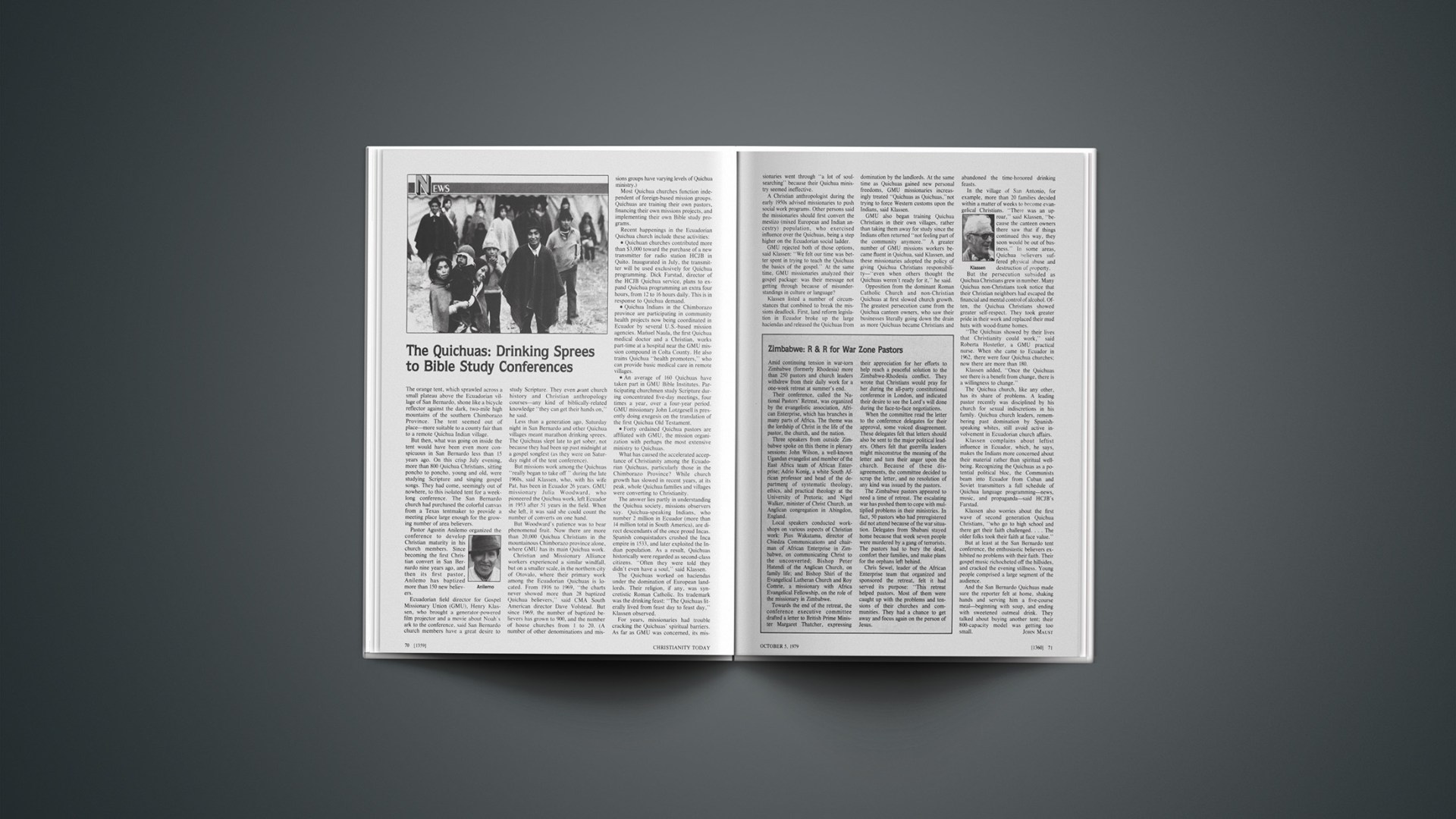
The Quichuas: Drinking Sprees to Bible Study Conferences

The orange tent, which sprawled across a small plateau above the Ecuadorian village of San Bernardo, shone like a bicycle reflector against the dark, two-mile high mountains of the southern Chimborazo Province. The tent seemed out of place—more suitable to a county fair than to a remote Quichua Indian village.

But then, what was going on inside the tent would have been even more conspicuous in San Bernardo less than 15 years ago. On this crisp July evening, more than 800 Quichua Christians, sitting poncho to poncho, young and old, were studying Scripture and singing gospel songs. They had come, seemingly out of nowhere, to this isolated tent for a week-long conference. The San Bernardo church had purchased the colorful canvas from a Texas tentmaker to provide a meeting place large enough for the growing number of area believers.

Pastor Agustín Anilemo organized the conference to develop Christian maturity in his church members. Since becoming the first Christian convert in San Bernardo nine years ago, and then its first pastor, Anilemo has baptized more than 150 new believers.

Ecuadorian field director for Gospel Missionary Union (GMU), Henry Klassen, who brought a generator-powered film projector and a movie about Noah’s ark to the conference, said San Bernardo church members have a great desire to study Scripture. They even want church history and Christian anthropology courses—any kind of biblically-related knowledge “they can get their hands on,” he said.

Less than a generation ago, Saturday night in San Bernardo and other Quichua villages meant marathon drinking sprees. The Quichuas slept late to get sober, not because they had been up past midnight at a gospel songfest (as they were on Saturday night of the tent conference).

But missions work among the Quichuas “really began to take off” during the late 1960s, said Klassen, who, with his wife Pat, has been in Ecuador 26 years. GMU missionary Julia Woodward, who pioneered the Quichua work, left Ecuador in 1953 after 51 years in the field. When she left, it was said she could count the number of converts on one hand.

But Woodward’s patience was to bear phenomenal fruit. Now there are more than 20,000 Quichua Christians in the mountainous Chimborazo province alone, where GMU has its main Quichua work.

Christian and Missionary Alliance workers experienced a similar windfall, but on a smaller scale, in the northern city of Otovalo, where their primary work among the Ecuadorian Quichuas is located. From 1916 to 1969, “the charts never showed more than 28 baptized Quichua believers,” said CMA South American director Dave Volstead. But since 1969, the number of baptized believers has grown to 900, and the number of house churches from 1 to 20. (A number of other denominations and missions groups have varying levels of Quichua ministry.)

Most Quichua churches function independent of foreign-based mission groups. Quichuas are training their own pastors, financing their own missions projects, and implementing their own Bible study programs.

Recent happenings in the Ecuadorian Quichua church include these activities:

• Quichuan churches contributed more than $3,000 toward the purchase of a new transmitter for radio station HCJB in Quito. Inaugurated in July, the transmitter will be used exclusively for Quichua programming. Dick Farstad, director of the HCJB Quichua service, plans to expand Quichua programming an extra four hours, from 12 to 16 hours daily. This is in response to Quichua demand.

• Quichua Indians in the Chimborazo province are participating in community health projects now being coordinated in Ecuador by several U.S.-based mission agencies. Mañuel Naula, the first Quichua medical doctor and a Christian, works part-time at a hospital near the GMU mission compound in Colta County. He also trains Quichua “health promoters,” who can provide basic medical care in remote villages.

• An average of 160 Quichuas have taken part in GMU Bible Institutes. Participating churchmen study Scripture during concentrated five-day meetings, four times a year, over a four-year period. GMU missionary John Lotzgesell is presently doing exegesis on the translation of the first Quichua Old Testament.

• Forty ordained Quichua pastors are affiliated with GMU, the mission organization with perhaps the most extensive ministry to Quichuas.

What has caused the accelerated acceptance of Christianity among the Ecuadorian Quichuas, particularly those in the Chimborazo Province? While church growth has slowed in recent years, at its peak, whole Quichua families and villages were converting to Christianity.

The answer lies partly in understanding the Quichua society, missions observers say. Quichua-speaking Indians, who number 2 million in Ecuador (more than 14 million total in South America), are direct descendants of the once proud Incas. Spanish conquistadors crushed the Inca empire in 1533, and later exploited the Indian population. As a result, Quichuas historically were regarded as second-class citizens. “Often they were told they didn’t even have a soul,” said Klassen.

The Quichuas worked on haciendas under the domination of European landlords. Their religion, if any, was syncretistic Roman Catholic. Its trademark was the drinking feast: “The Quichuas literally lived from feast day to feast day,” Klassen observed.

For years, missionaries had trouble cracking the Quichuas’ spiritual barriers. As far as GMU was concerned, its missionaries went through “a lot of soul-searching” because their Quichua ministry seemed ineffective.

A Christian anthropologist during the early 1950s advised missionaries to push social work programs. Other persons said the missionaries should first convert the mestizo (mixed European and Indian ancestry) population, who exercised influence over the Quichuas, being a step higher on the Ecuadorian social ladder.

GMU rejected both of those options, said Klassen: “We felt our time was better spent in trying to teach the Quichuas the basics of the gospel.” At the same time, GMU missionaries analyzed their gospel package: was their message not getting through because of misunderstandings in culture or language?

Klassen listed a number of circumstances that combined to break the missions deadlock. First, land reform legislation in Ecuador broke up the large haciendas and released the Quichuas from domination by the landlords. At the same time as Quichuas gained new personal freedoms, GMU missionaries increasingly treated “Quichuas as Quichuas,”not trying to force Western customs upon the Indians, said Klassen.

GMU also began training Quichua Christians in their own villages, rather than taking them away for study since the Indians often returned “not feeling part of the community anymore.” A greater number of GMU missions workers became fluent in Quichua, said Klassen, and these missionaries adopted the policy of giving Quichua Christians responsibility—“even when others thought the Quichuas weren’t ready for it,” he said.

Opposition from the dominant Roman Catholic Church and non-Christian Quichuas at first slowed church growth. The greatest persecution came from the Quichua canteen owners, who saw their businesses literally going down the drain as more Quichuas became Christians and abandoned the time-honored drinking feasts.

In the village of San Antonio, for example, more than 20 families decided within a matter of weeks to become evangelical Christians. “There was an uproar,” said Klassen, “because the canteen owners there saw that if things continued this way, they soon would be out of business.” In some areas, Quichua believers suffered physical abuse and destruction of property.

But the persecution subsided as Quichua Christians grew in number. Many Quichua non-Christians took notice that their Christian neighbors had escaped the financial and mental control of alcohol. Often, the Quichua Christians showed greater self-respect. They took greater pride in their work and replaced their mud huts with wood-frame homes.

“The Quichuas showed by their lives that Christianity could work,” said Roberta Hostetler, a GMU practical nurse. When she came to Ecuador in 1962, there were four Quichua churches; now there are more than 180.

Klassen added, “Once the Quichuas see there is a benefit from change, there is a willingness to change.”

The Quichua church, like any other, has its share of problems. A leading pastor recently was disciplined by his church for sexual indiscretions in his family. Quichua church leaders, remembering past domination by Spanish-speaking whites, still avoid active involvement in Ecuadorian church affairs.

Klassen complains about leftist influence in Ecuador, which, he says, makes the Indians more concerned about their material rather than spiritual well-being. Recognizing the Quichuas as a potential political bloc, the Communists beam into Ecuador from Cuban and Soviet transmitters a full schedule of Quichua language programming—news, music, and propaganda—said HCJB’s Farstad.

Klassen also worries about the first wave of second generation Quichua Christians, “who go to high school and there get their faith challenged.… The older folks took their faith at face value.”

But at least at the San Bernardo tent conference, the enthusiastic believers exhibited no problems with their faith. Their gospel music richocheted off the hillsides, and cracked the evening stillness. Young people comprised a large segment of the audience.

And the San Bernardo Quichuas made sure the reporter felt at home, shaking hands and serving him a five-course meal—beginning with soup, and ending with sweetened oatmeal drink. They talked about buying another tent; their 800-capacity model was getting too small.

JOHN MAUST

Zimbabwe: R & R for War Zone Pastors

Amid continuing tension in war-torn Zimbabwe (formerly Rhodesia) more than 250 pastors and church leaders withdrew from their daily work for a one-week retreat at summer’s end.

Their conference, called the National Pastors’ Retreat, was organized by the evangelistic association, African Enterprise, which has branches in many parts of Africa. The theme was the lordship of Christ in the life of the pastor, the church, and the nation.

Three speakers from outside Zimbabwe spoke on this theme in plenary sessions: John Wilson, a well-known Ugandan evangelist and member of the East Africa team of African Enterprise; Adrio Konig, a white South African professor and head of the department of systematic theology, ethics, and practical theology at the University of Pretoria; and Nigel Walker, minister of Christ Church, an Anglican congregation in Abingdon, England.

Local speakers conducted workshops on various aspects of Christian work: Pius Wakatama, director of Chiedza Communications and chairman of African Enterprise in Zimbabwe, on communicating Christ to the unconverted; Bishop Peter Hatendi of the Anglican Church, on family life; and Bishop Shiri of the Evangelical Lutheran Church and Roy Comrie, a missionary with Africa Evangelical Fellowship, on the role of the missionary in Zimbabwe.

Towards the end of the retreat, the conference executive committee drafted a letter to British Prime Minister Margaret Thatcher, expressing their appreciation for her efforts to help reach a peaceful solution to the Zimbabwe-Rhodesia conflict. They wrote that Christians would pray for her during the all-party constitutional conference in London, and indicated their desire to see the Lord’s will done during the face-to-face negotiations.

When the committee read the letter to the conference delegates for their approval, some voiced disagreement. These delegates felt that letters should also be sent to the major political leaders. Others felt that guerrilla leaders might misconstrue the meaning of the letter and turn their anger upon the church. Because of these disagreements, the committee decided to scrap the letter, and no resolution of any kind was issued by the pastors.

The Zimbabwe pastors appeared to need a time of retreat. The escalating war has pushed them to cope with multiplied problems in their ministries. In fact, 50 pastors who had preregistered did not attend because of the war situation. Delegates from Shabani stayed home because that week seven people were murdered by a gang of terrorists. The pastors had to bury the dead, comfort their families, and make plans for the orphans left behind.

Chris Sewel, leader of the African Enterprise team that organized and sponsored the retreat, felt it had served its purpose: “This retreat helped pastors. Most of them were caught up with the problems and tensions of their churches and communities. They had a chance to get away and focus again on the person of Jesus.

The Church Of England

Anglican Choice: An Essentially Nonreligious’ Archbishop

What is to be expected from the man chosen to succeed Donald Coggan as primate of the Church of England?CHRISTIANITY TODAYasked David Coomes, editor of the Church of England Newspaper, to provide its readers with his personal assessment:

The Crown Appointment Commission’s choice of successor to Donald Coggan as archbishop of Canterbury should have surprised no one. It reflected the makeup within the 16-member commission itself: drawn strongly from the Anglo-Catholic wing of the Church of England. The next archbishop, Robert Runcie, 57, at present bishop of St. Albans, describes himself as a “radical Catholic,” meaning that he is not part of the evangelical wing but is a traditionalist who is open to change.

Trevor Beeson of Westminster Abbey observed that the commission had chosen “the best of a mediocre bunch,” which was not really fair, as the “bunch” included Stewart Blanche, archbishop of York, a decidedly able man.

Evangelicals are not bubbling with enthusiasm either. They forsee, and regret, an inevitable change in emphasis and direction. It was possible to see an intended criticism of his evangelical predecessor when Bishop Runcie told the press that “the hollowness of reading declarations and general moralizing divorced from a direct experience of the doubts and difficulties of ordinary people is only too evident.”

Some evangelicals, who prayed long and hard that God’s will be done, are now complaining that the wrong man—that is, the man they themselves would not have chosen—has been given the job.

But while these evangelicals may be unduly concerned with the next archbishop’s churchmanship, they certainly should be concerned with his stand on the eternal and irreducible truth in which the church is supposed to believe. It is reported that so far Runcie has enunciated the truth about Jesus Christ and the Scriptures.

Many issues on which an archbishop should speak and provide leadership are, of course, complex and open to more than one conclusion.

So where does he stand on crucial issues facing the church today? He refuses to state his position on homosexuality, preferring to wait for the publication of the eagerly awaited Anglican Report. He has nothing definite to say on abortion, either, feeling that he needs to seek advice before he can comment with conviction. He wishes to pursue church unity between Anglicans, Catholics, and Orthodox churches—and for this very reason, opposes the ordination of women.

On marriage and divorce he is keen to stress the traditional stand of the church to recognize, teach, and support marriage as a life-long relationship. But he does feel that a Christian jurisdiction should have forgiveness and renewal built into it, so that there should be provisions to marry some divorced people in church.

“The church that spends too much of its time firming up the center and tightening up pastoral regulations for font and altar will not necessarily become more Christian at heart,” he says. “It might become pharisaic.”

There is nothing here to put to rest the fear that the next archbishop—unlike Coggan—sees the Church of England facing a series of battles, whether they be moral or practical, whereas the church above all else faces one battle—and that is intensely spiritual.

Bishop Runcie, however, has made clear his own priorities: “In keeping the church true to the gospel there are dangers on two fronts,” he said. “There are signs that a ghetto-minded church may be emerging. There are contrary signs of the emergence of a church that is just an echo of fashionable trends. Both these must be resisted.

“The church is already too easy to ignore, too much on the periphery. It needs to turn its back on the ghetto. Helping to keep the church mindful of the gospel, faithful to Christ, and in touch with the world of ordinary people—that should be the first concern of any archbishop.”

Bishop Runcie’s background is essentially nonreligious: his father was a lapsed Presbyterian, and he was baptized into the Church of England only because his mother thought “she ought to have him done.” His religious upbringing consisted of two Sunday school lessons at the Methodist church; even his subsequent confirmation at Merchant Taylors’ School in Liverpool was principally to please a fellow pupil.

During the war he was a troop leader, reaching the rank of captain in a tank battalion of the Scots guards; he won his Military Cross on the Rhine in 1945 for pulling a soldier from a burning tank under fire. He returned to his interrupted studies at Oxford in literature and the humanities and, he has said, only in the final term did he decide to enter the ministry. Most of his career, since his 1951 ordination, has been in theological education.

Runcie will succeed Archbishop Coggan (who is 70 this month) when he retires on January 25, the fifth anniversary of his enthronement at Canterbury. Coggan may not have been the most exciting archbishop, but he has been conscientious, creative, and widely traveled. At very least, his clearly defined and unshakable faith has helped the Church of England recover its nerve. Many Anglican clergy, however, remain confused about their roles and their status. It is possible that Runcie’s long experience in education will help here.

One newspaper’s church correspondent wrote: “In a period of secular skepticism the people of England may just be prepared to respond anew to a primate who keeps pigs and who attended the local council school.” Actually, the people of England care little about the Archbishop of Canterbury—who he is or where he comes from; they care still less about his pigs. But they may just be prepared to respond anew to a primate who knows what he believes, is not afraid to say it clearly, and unequivocally, and is unswerving in his devotion to Christ and the Scripture.

Disasters

Although Structures Give Way, the Living Church Extends Its Hand

Church buildings proved to be an uncertain sanctuary as David turned into a Goliath and lashed across the Dominican Republic early last month.

Twenty-two persons who huddled in a small concrete block church on a hill in the city of San Cristóbal were among the hurricane’s first victims on the island of Hispaniola (which the Dominican Republic shares with Haiti). “The zinc on the rooftop went first, then the wooden section,” reported a horrorstruck eyewitness, who lost a son and a brother when walls collapsed on those clustered inside.

Then disaster struck some 480 Dominicans. They had sought shelter in a larger Roman Catholic church in the tiny mountain town of Padre las Casas, only to have the overflowing Yaque River abruptly change its course and sweep through the church. The waters rose so rapidly that only about 80 persons, many of whom had climbed to the top of the steeple before the structure was swept downstream, avoided drowning.

Together, the two tragedies accounted for more than half of the country’s known fatalities during the first week of grim disaster reporting. The toll continued to climb, however, and revealed at least 1,000 dead and an estimated 150,000 homeless.

Also devastated was the tiny banana-growing island of Dominica, where 22 were reported dead, and the capital city of Roseau was virtually leveled, along with nearly all the banana trees. Prime Minister Oliver Seraphin ordered government buildings, schools, and churches opened to an estimated 60,000 persons whose flimsy, wooden homes were destroyed by the hurricane.

(The Christian Medical Society center on the island, designed to house 50, and badly damaged, was nevertheless sheltering about 300.)

Evangelical churches quickly were transformed into distribution centers for food, medicines, and building materials in areas sure to be without power, communications, and passable roads.

Six church groupings are sharing responsibility for distribution: Free Methodists, Missionary Church, Evangelical Mennonites, Templo Biblico (Brethren), Alianza Biblica Christiana (Unevangelized Fields Mission-related), and Templo Evangelicos (Worldteam-related). Worldteam’s Dan Wiebe is interagency relief coordinator on the scene.

In Miami, Florida, Worldteam’s office became the liaison for eight agencies that quickly formed a coordinating committee. The charter planners: Campus Crusade for Christ, Christian Medical Society, Christian Aviation Fellowship (formerly Christian Pilots Association), Food for the Hungry, International Crusades (formerly Literature Crusades), World Relief (of NAE), World Vision, and Worldteam. Geoff Tunnicliffe of International Crusades, a trained administrator, is coordinating operations in North America.

The first relief flight, on a Jungle Aviation and Radio Service DC-3, left September 13 with 8,000 pounds of staple foods. A ship cargo was dispatched from New Orleans at about the same time—85,000 pounds of foodstuff from Food for the Hungry stocks.

The quick merging of disaster assessments into one cohesive picture, the setting of complementary plans, and the establishment at the outset of a coordinating structure were encouraging signs that evangelical relief efforts are coming of age.

World Scene

Ten thousand Bibles have been shipped to Cuba with government approval. The Ecumenical Council of Cuba is importing the United Bible Societies’ modern Spanish-language version entitled Dios Habla Hoy (“God Speaks Today”) from the UBS regional center in Mexico City. This is the fifth import of Scriptures permitted since the Cuban Bible Society was closed in 1968.

Argentina has implemented a law requiring denominations and religious organizations to register and be officially recognized. As decreed by the military junta, the measure appears targeted at smaller, newer, and less orthodox denominations and cults. (Groups already banned include the Jehovah’s Witnesses, Hare Krishna, Divine Light, and the Children of God.) Roman Catholicism, the nation’s majority religion, is exempted. Enacted in February 1978, and effective last month, the law gives religious groups 90 days to furnish the National Bureau of Religions with information including: a summary of doctrine, a schedule of regular activities, a description of ties and dependence on other institutions inside the country and abroad, and the approximate number of adherents in Argentina.

The Church of England’s General Synod declined to reconfirm its loyalty and commitment to the World Council of Churches in a session held last summer. Instead, by a vote of 149 to 136, the synod merely commended for study in the churches the report of a church delegation that earlier went to WCC headquarters in Geneva to discuss the controversial grant to the Zimbabwe Patriotic Front by the WCC’s Program to Combat Racism.

Lutheran pastors in both East and West Germany last month read a joint statement in all their churches. The pastoral statement, issued on the fortieth anniversary of the German invasion of Poland, confessed to a common German guilt for the start of World War II. The statement was the first common action of the two bodies since 1968, when passage of a new constitution in the German Democratic Republic prohibited East German participation in a common grouping with West German counterparts.

Italian Protestants are worried about trends under the new Pope. The Protestants always have been sensitive to the overwhelming Roman Catholic dominance within the country, but relationships improved dramatically under the papacies of John XXIII and Paul VI. Under John Paul II, however, according to an article in the British Weekly and Christian World, Protestants sense “a cooling off of ecumenical relations” and “increased influence of those who oppose ecumenism in the Italian context, and who want to uphold and increase the special powers and distinctive privileges of the Roman Catholic Church in Italy, to the detriment of the other churches.” In reaction, Protestants are launching their own news agency, starting religious television, and stepping up their radio outreach. They hope to increase the gospel proclamation to their fellow Italians and to voice the Protestant viewpoint.

Soviet Pentecostals founded an underground central church council recently during an illegal meeting in a forest outside Moscow. Their action may indicate growing militancy among the approximately half million Soviet Pentecostals, many of whom—perhaps 200,000—refuse to join the officially tolerated All-Union Council of Evangelical Christians-Baptists. The purposes of the new council, according to one delegate to the meeting, are to unite the Pentecostals in resisting what they call man-made laws that go against their beliefs and to mobilize support for the 30,000 or so Pentecostals who want to emigrate.

Nigeria’s Evangelical Churches of West Africa (ECWA) added 138 married couples to its missionary force this past summer—104 of them new graduates of ECWA Bible schools. The remaining 34 couples were pastors and their wives released and sent by their congregations for one year of missionary service in a campaign to evangelize all of Nigeria. Nigerian contributions to the Evangelical Missionary Society (the missions arm of the Sudan Interior Mission-related denomination) during 1978 totaled nearly $250,000.

The Lutheran World Federation’s plans to establish a major African radio ministry on a broad ecumenical basis received a setback. The World Association for Christian Communications, which had tentatively agreed to a partnership in new radio services from Sierra Leone and the Seychelles Islands, has reconsidered and rejected participation. The African region of the WACC decided that transnational broadcasting facilities were less likely to be “truly African” than localized outlets. The Lutheran federation wants to create an alternative to its former Radio Voice of the Gospel facility in Ethiopia, which was nationalized in 1977.

Ethiopian Mennonites may send their pastoral students to the Soviet Union instead of North America. Leaders of the Meserete Kristos Mennonite Conference reported during a recent visit to Dutch Mennonites that students sent into the affluent Western culture had become confused and uprooted. They plan to send their future pastors to a soon-to-be-opened Baptist seminary in Moscow, where they expect less harmful effects from the simpler Russian lifestyle.

The home of the Anglican bishop in Iran was ransacked by raiders this past summer, according to reports reaching the Church Missionary Society in London. Bishop Hassan Dehqani-Tafti was absent at the time, but church documents and personal papers were removed from his Isfahan home and burned. Episcopal hospitals were seized earlier without any offer of compensation. Dehqani-Tafti has made a strong protest to Ayatollah Khomeini’s Revolutionary Council—so far without result.

India’s controversial anticonversion bill is now dead according to government sources. Vigorous protests, both in India and from abroad, along with the recent change of government were responsible for its defeat.

The Chinese government has approved publication of the Bible in the Chinese language for the first time since the 1949 Communist revolution. Yin Ziehzeng, pastor of Peking’s only Protestant church, last month announced that a government publishing house would print the revised version in the simplified Chinese characters adopted by the government in the 1950s to increase literacy. Yin said he hopes at least 100,000 copies will be printed.

Taiwan is preparing legislation that would require church services to be conducted in the official Mandarin Chinese language of the mainland minority. Persons who do not speak Mandarin would be permitted to speak in another dialect or language so long as it is interpreted into Mandarin; 85 percent of the population speaks Taiwanese. The proposed regulations would also give the government power to nullify church actions regarded as detrimental to state interests and to order churches to reorganize. The legislation has been sent from Taiwan’s executive branch to the legislature for ratification.

Church leaders in Korea have declared that “the Unification Church is not a sect of the Christian Church.” The statement, which lists 16 reasons why Sun Myung Moon’s Unification Movement is unchristian, was signed last May by representatives of 19 major denominations in Korea. The document asserts that this unbiblical movement “sneaked into the hearts of those who were very much in depression, uncertainty, and fear during and after the Korean War.”

A unit of the Australian Presbyterian Church has voted to withdraw from the World Council of Churches. The action of the Queensland General Assembly of the church was taken without dissent, citing as reason the WCC’s support of revolutionary groups in Southern Africa.

The Kosheral Revolution

From San Francisco headquarters came the command: Pull back the troops, retrain, recharge, even cleanse the ranks when necessary, then go out fighting harder and more effectively.

With that, Jews for Jesus leader Moishe Rosen and his advisory board launched a militant new program, “Avodah” (Hebrew, meaning “work and worship”), in which all the agency’s methods and materials will be reexamined for greater effectiveness.

The entire evangelistic staff of Jews for Jesus—at least 65 persons—returned under orders last month to San Francisco for nine months of retraining and intensive evangelism. Staff members began morning classes under such teachers as W. A. Criswell of First Baptist Church, Dallas; James Boice of Tenth Presbyterian Church, Philadelphia; Charles A. Ryrie of Dallas Theological Seminary; and Rachmiel Frydland, a Jewish Christian scholar in rabbinics and apologetics. In the afternoons, the staff planned concentrated evangelism on university campuses in northern California.

“Our new basis of ministry,” explained Rosen, “will involve intensive campaigns for extended periods of time.”

Information officer Sue Perlman said staff members will evaluate “what works and what doesn’t” in evangelistic witness during their northern California campaign. The agency had asked the uprooted staff members to find San Francisco area apartments with a spare bedroom, said Perlman. The expected influx of Jewish converts will create a need for places to stay—to allow converts both to escape unsettled home situations caused by their conversions and to be discipled.

In the long run, “Avodah” will mean growth for the six-year-old Jews for Jesus organization and its programs, said Rosen. Some volunteer workers will be brought on to the full-time staff. New programs will include an outreach to Jewish families, evangelistic banquets, a series of teaching tapes, Jewish gospel music albums, and the addition of new titles to the agency’s tract selection.

But in the short term, “Avodah” meant the termination of leases for six branch offices, and the pullback of the four mobile evangelistic teams. (Work will be carried on by volunteers in cities where branch offices were located.)

“Avodah” also meant the uprooting of staff members and, without doubt, some degree of uncertainty on their part. Rosen explained that no position was sacred: “We feel that some of our staff members should be replaced in order to build more effective teams.” Information officer Perlman further explained that depending on what happens in the training sessions, some present subordinates may end up replacing their superiors. Members who cannot “work as a team” may be replaced, she said.

Jews for Jesus has taken pains to explain the new program to donors (Rosen and his advisory board conceived the plan more than a year ago), and Perlman said response has been favorable. She called the program a “step of faith.”

The next big step will be eastward. After the nine-month California campaign, Jews for Jesus will begin a similar concentrated outreach in the New York City area, where the Jewish population approaches 3 million. Later the agency will decide which, if any, branch offices to reopen.

Rosen, who called “Avodah” a mission board’s dream—although it may have been a staff member’s nightmare—said, “If what we do succeeds, it will be a stepping stone for worldwide missions strategy and other mission agencies are sure to follow this example.”

Financial Accountability

Voluntary Disclosure: So Far So Credible

The participants drank ice water, not soft drinks, at the first membership meeting last month of the newly-formed Evangelical Council for Financial Accountability. ECFA organizers explained that the hotel management wanted 75ȼ per can—too much for an afternoon thirst-quencher.

It was thus within this context of money consciousness that nearly 300 persons heard a well-organized sales pitch for ECFA membership. The gathering, which included college, mission, and parachurch officials from the Salvation Army to the PTL Club, seemed receptive to the idea. When asked about their organizations’ likelihood of applying, more than three-quarters of the crowd raised their hands.

But only the forthcoming number of applications will indicate whether the hand raising was a polite gesture or, more important, a commitment to the ECFA’s call for voluntary financial disclosure. The fledgling council bills itself as “An association of evangelical, nonprofit organizations requiring the highest standards of financial accountability and disclosure to government, donors, and the world.”

All ECFA members will be able to display their ECFA “seal of approval.” Depending on response and the speed with which ECFA bureaucratic machinery moves, ECFA seals may begin appearing within the next several months on member organizations’ printed and promotional materials.

“The seal alone … will be well worth the membership fee,” said Olan Hendrix, recently appointed executive director of the ECFA. Hendrix, an ordained Baptist best known for his management seminars, sees the ECFA seal as an indicator of an organization’s financial integrity—“although in no way do we want to imply that nonmembers are suspect,” he said.

Applicants must be able to meet the seven standards that were approved at an organizational meeting in the spring (April 6 issue, p. 48). The standards are listed on ECFA application forms—which were distributed to everyone at the meeting. A standards committee had formulated follow-up questions that indicate how, if at all, each standard is met.

The standards require that member organizations have:

• An annual audit by a public accounting firm performed in accordance with generally accepted auditing standards.

• An audited financial statement to be made available upon request.

• An active audit committee and an active governing board—in each case, the majority of whom are not to be employees, staff, or immediate family members.

In addition, each ECFA member must “carry on its business with the highest standards of integrity and avoid conflicts of interest,” and have an evangelical statement of faith. Also, each member organization’s programs should be consistent with its stated purposes and its incoming donations must “be applied for the purposes for which they are raised.”

The latter standard was important to those wanting complete financial disclosure. A follow-up question asks, “How do you insure that the donated funds are used for the purposes for which they were raised?” Several blank lines are provided on the application for the response.

Leading ECFA organizer Stanley Mooneyham of World Vision told the gathering that escape from government regulation was not the sole motivation behind ECFA’s formation. However, even he would not deny that government pressures, such as the much publicized congressional bill HR 41, were involved.

Mooneyham and George Wilson of the Billy Graham organization conceived the idea for an ECFA-type group more than two years ago—about the time several religious groups were being exposed in financial scandals that spurred discussion about creating government regulations to prevent future irregularities.

U.S. Senator Mark Hatfield, from the evangelical camp, had threatened to introduce congressional legislation himself if religious groups did not voluntarily make themselves more financially accountable to the donor public.

For that reason, ECFA organizers were especially pleased that Hatfield’s chief legislative assistant, Tom Getman, gave his blessing to ECFA at the meeting last month, held near Chicago’s O’Hare airport.

“Your rigorous standards are helping you to do voluntarily what the strictest government standards would require,” Getman said.

He added, however, that the true test for ECFA is whether it will refuse membership to organizations that cannot satisfactorily meet the council’s standards. World Vision’s Ted Engstrom, chairman of the temporary board of directors, said in a speech that Hendrix and the ECFA standards committee will exercise that prerogative when necessary. Hendrix and the committee “have the strength of character to meet this test,” he said.

At present Hendrix is the only paid, full-time ECFA staff member. Membership applications will be sent to his recently opened office (1444 Wentworth Ave., P.O. Box 1750, Pasadena, Calif. 91109). The council plans to begin publication of a newsletter in January, and, when sufficient funds from membership fees arrive, it may open a Washington office. (Until that time, Robert Dugan, public affairs officer for the National Association of Evangelicals, will be the Washington liaison. He, too, attended the Chicago meeting, and in a speech commended the formation of ECFA as the best way to forestall government intervention.) Hendrix hopes to add a lawyer and a certified public accountant to the ECFA staff, each of whom can be available as consultants to ECFA members.

Some attenders wondered about the “teeth” in ECFA standards. One attender asked, “How do we police those groups that might be slightly less than forthright in their applications?”

Engstrom said that the temporary board of directors (a permanent board will be elected by the new ECFA members at an April 21, 1980, meeting in Washington, D.C.) and the standards committee will make “independent inquiries” when questions are raised about an applicant’s financial integrity. Information on applications will be known only to Hendrix, the board, and the standards committee, he added.

In practice, however, each application will be reviewed only by Hendrix and one standards committee member. Their approval will be sufficient for an applicant organization’s acceptance into ECFA.

Some participants questioned the ECFA membership fee: organizations will pay $250 per $1 million annual income, with a $250 minimum and a $2,500 maximum. They asked that smaller organizations be allowed to pay less than the minimum.

Along the same line, several persons said smaller organizations might not be able to afford the required annual audit by a public accounting firm. Engstrom, however, said the standards committee would hold firm on that requirement.

Some attenders weren’t sure how much financial information about their organizations should be made public. In the past, many groups have made available a statement showing only annual income and expenses. This would not be enough for ECFA, said standards committee member and TEAM (The Evangelical Alliance Mission) controller Don Mortenson. Member organizations must make available upon request a statement showing their (1) financial position (also known as the balance sheet), (2) income and expenses, and (3) any changes in financial position. This statement “would give you the entire financial picture of the organization,” said Mortenson.

The number of requests for an audited statement probably will be low, said standards committee Vic Glavach—basing his assessment on past experience with Youth for Christ as assistant to the president—hoping to alleviate the fears of potential ECFA members.

“Many people don’t really care what the financial statement says,” he explained. “They just want to show if an organization is honest and open enough to make one available.”

JOHN MAUST

Church-And-State Issues

Private Schools Get IRS Procedure Suspended

Many private school administrators heaved a sigh of relief last month when the U.S. Senate endorsed a House stand and in effect ordered the Internal Revenue Service to stay off these educators’ backs.

It all started when the IRS unveiled a new “procedure” aimed at stripping tax exemptions from private schools that failed to meet certain standards of minority enrollment. Civil rights organizations and some government officials contended that new guidelines were necessary to deal with many private religious schools that were founded allegedly on racially discriminatory grounds following court-ordered desegregation of public schools 25 years ago. Under the old procedure, schools were required merely to have an explicit nondiscriminatory enrollment policy. The new procedure would have applied a number of tests, including quotas, to help IRS investigators determine if schools are racist.

The controversial IRS proposal sparked some of the stiffest opposition bureaucratic Washington has ever encountered. Supported by key members of Congress, religious leaders and lawyers representing the bulk of the nation’s estimated 18,000 Catholic, Protestant, Jewish, and other private schools, unanimously argued against the proposal in hearings (See January 5, 1979, issue, p. 42). Most of them condemned racism but warned that the IRS action would violate constitutional guarantees of religious liberty. Congressional offices were inundated with protest mail. As a result, the IRS backed off.

Then in February the IRS issued a revised version of the procedure exempting ethnic schools from certain requirements and instituting what amounted to double standards in other cases. For most critics, this final version was also unacceptable.

To thwart the IRS, Republican congressmen Robert Dornan of California and John Ashbrook of Ohio were among others who this past summer introduced restrictive amendments to a Treasury-Postal Services appropriations bill. The Dornan amendment, which passed easily, specifically forbade the IRS from spending federal funds to implement its proposed policy. The Ashbrook amendment went much farther: it prohibited the IRS from spending money to formulate or apply any rule or policy that would jeopardize the tax-exempt status of private schools unless it was in effect prior to August 22, 1978. That amendment passed 297 to 63 in late July.

When the bill arrived in the Senate last month, a committee deleted the Ashbrook provision, but allowed the Dornan amendment to stand. During deliberation by the full Senate, Republican Jacob Javits of New York failed by a vote of 54 to 31 to have the Dornan amendment struck. Republican Jesse Helms of North Carolina next introduced an amendment identical to Ashbrook’s, and it squeaked through in a 47 to 43 vote.

The effect of the action is to place a year’s moratorium (the life of the appropriations measure) on any new IRS efforts to police private schools. In the meantime, congressional committees are supposed to deal with the controversy.

Helms pointed out in floor debate that the IRS still has plenty of power under the old rules to take action against truly racist schools and that under these rules more than 100 such schools have had their tax exemptions removed.

Personalia

His stated goal is putting the “Christian” back into the Young Men’s Christian Association. James O. Plinton, the recently elected president of the National Council of the YMCAs of the USA, says his faith helped him through some difficult boyhood experiences, such as the time he was banned from membership in a New Jersey YMCA because he was black. A marketing executive for Eastern Airlines, Plinton has helped organize employee prayer groups within the company.

Rock music critics are speculating about religious lyrics in the new album, “New Train Coming,” by Bob Dylan, the rock-singing, social conscience of the 1960s. One song goes: “There’s a Man up on a cross/And he’s been crucified for you/Believe in his power/That’s all you got do.” Reviewers say the album confirms rumors that Jewish-born Dylan has made a Christian commitment.

Former Postmaster General W. Marvin Watson accepted the presidency of Dallas Baptist College, promising to make the school “more Bible-oriented than any school in the area.” But the first task for Watson, who has held a variety of business posts since his one-year stint in 1968 as postmaster general, is to correct financial problems that have plagued the Southern Baptist school for nearly a decade.

The announced retirement on January 1 of Lillian Block as editor-in-chief of Religious News Service means bidding farewell to a long-respected fixture in interreligious journalism. Ms. Block, with the New York-based agency since 1943 and its editor since 1957, will be succeeded by RNS managing editor Gerald Renner. Through its network of correspondents, RNS provides more than 800 media outlets with religious news, features, and photos from the United States and around the world.

Evolution/Creationism

Georgia’s Legislature and the God Who May Refuse

Should a child be required to choose between “a God who may work through evolution” and “a God who may refuse to work through evolution?” In the words of James E. Andrews, stated clerk of the Presbyterian Church in the United States, that is what would happen if Georgia’s legislature passes a bill now under consideration by its lower house. Andrews warned an education subcommittee that the proposed law would create unnecessary conflict in the classroom.

The Atlanta-based denomination’s top administrator opposed House Bill 690 in a recent hearing attended by over 300 persons. Representative Tommy Smith of Alma, who introduced the legislation, emphasized in his testimony that the bill will not require the teaching of evolution or scientific creation across the state, but that it will mandate that when evolution is taught, the creation viewpoint will also be offered. Andrews, who quoted from his denomination’s 1969 General Assembly declaration on the lack of conflict between evolution and Scripture, was the only clergyman to testify against the bill. Five other opponents of the bill represented educational organizations opposed to legislative dictation of curriculum.

More than 25 proponents of the bill told committee members in testimony why they thought the legislature should “give direction” to the state’s schools. Among them was pro football linebacker Greg Brezina of the Atlanta Falcons, who left training camp during the week before the season’s first game to voice his support of equal treatment for the creation position. The chief judge of the state court of appeals, Braswell Deen, declared that inclusion of teaching about “a purposeful Creator” would be the best thing Georgia’s legislature could possibly do to stem the state’s crime wave. The appellate court judge specified, however, that creationists are not asking for “the Bible in the biology room.” Pastors, parents, politicians, lawyers, teachers, and scientists spoke for the bill, some of them calling it a question of academic and religious freedom. Subcommittee chairman Cas Robinson, formerly an executive of the Presbyterian Church U.S., warned participants in the hearing not to expect an early decision. The next meeting of the whole legislature will be in January.

Deaths

PAUL C. EMPIE, 70, a founder and president since 1968 of Lutheran World Relief; his leadership in inter-Lutheran efforts included film production and world relief and development; September 1 in Zionville, Pennsylvania, of a heart attack.

Motion Pictures

Luke Belatedly Gets His Film Credits

The advance publicity shows empty sandals in the sand and asks, “Have you seen Jesus?” The answer is: nobody has—at least not the filmed version of Jesus that has been in the making over the past five years.

The Genesis Project—a New York-based organization that developed the New Media Bible—is preparing with much fanfare an October 19 release for its two-hour movie, Jesus. English producer John Heyman calls it “the most authentic film of the life of Jesus” ever done. He shot his docu-drama on location in Israel, and based the script entirely on the Gospel of Luke. Shakespearean actor Brian Deacon plays the part of Jesus, while about 5,000 Israelis and Arabs round out the cast.

So far, the behind-the-scenes supporting cast has gotten top billing. Ken Bliss, former director of distribution for evangelist Billy Graham’s World Wide Pictures, and Paul Eshleman, special assistant to Campus Crusade president Bill Bright, were hired to lead Inspirational Film Distributors. This Genesis subsidiary will promote the film in the religious community, while Warner Brothers will be paid a “distribution fee” for advertising the movie through regular motion picture channels and for booking the film in theaters across the country.

Denny Rydberg left the editorship of the satirical Wittenburg Door to play straight man as coordinator for national publicity. He said the film will be released in two waves in the United States: beginning October 19 in the West and South, then around Easter 1980 in the East and Midwest. Later the film will be sold to theaters and television outlets around the world. In countries lacking in movie and television facilities, missionaries will be given permission to use 16-mm prints of the film for evangelistic and educational purposes.

Heyman, who has won three Cannes Film Festival awards during his career, extols most the authenticity of the film. The props, he says, are realistic—right down to sheep dung and garbage in the temple courtyard—“because that’s the way it was. It was not the picture postcard world that the Renaissance painters have made it.”

The film ends with Christ’s Great Commission. The Genesis Project will be eyeing its own commission from theater ticket sales; the film cost six million dollars to produce.

Deaths

Upward Calling of an Outreacher

Insurance executive Arthur DeMoss and his wife Nancy frequently invited as many as 500 business executives and professionals to their Philadelphia area estate for “outreach dinner parties.” Invitations to these pre-evangelistic dinner parties came highly regarded. Guests supped on a savory spread, and afterwards heard testimonies from Christian notables—from cowboy Roy Rogers and pro football’s Terry Bradshaw to Watergate figure Charles Colson—and were encouraged to consider a Christian commitment.

Last month another group of evangelical notables traveled to DeMoss’s home town, but this time for a somber occasion. They attended a service in the Wayne, Pennsylvania, Church of the Savior, held as a memorial for DeMoss, 53, who died of a heart attack while playing tennis September 8.

DeMoss’s death sent ripples through the highest church circles. Following his conversion under the preaching of evangelist Hyman Appelman in 1950, DeMoss parlayed his own insurance marketing company into the present-day National Liberty Corporation, with 1,500 employees and assets of over $500 million. He channeled his wealth toward a number of Christian organizations, and was a board member of such groups as Campus Crusade for Christ, Gordon-Con well Theological Seminary, and TV evangelist Jerry Falwell’s Virginia-based ministry. DeMoss’s white collar evangelism gained him prominence in the Philadelphia area and nationwide—as indicated by the memorial service contingent. Speakers included Campus Crusade’s Bill Bright, evangelist Leighton Ford, and Falwell, with special music provided by bass Jerome Hines of the New York City Opera and vocalist Ken Medema.

Broadcasting

Decisions Ahead on Deregulation

The Federal Communications Commission last month proposed rule changes which, if implemented, will result both in the widescale deregulation of the nation’s 8,653 radio stations and in the disruption of some religious broadcasting. The proposals call for elimination of:

• Requirements that radio licensees demonstrate they have addressed the needs and problems of their communities.

• Restrictions of the amount of time stations can devote to commercials.

• Requirements that a certain amount of time be devoted to nonentertainment programming, such as news and public affairs.

• The need for commercial stations to keep detailed logs of their programming for FCC and public inspection.

Broadcasters—including religious ones—for the most part hailed the FCC announcement. They foresaw relief from red tape, mounds of paper work, and from hassles with both federal officials and community malcontents. However, some consumer and religious groups criticized the proposed changes, warning that portions of the public will be disserved and that the airwaves will become overcommercialized. Industry spokesmen argue that competition in the marketplace will keep the brake on exploitation, and FCC Commissioner Charles Ferris contends that most stations already exceed federal requirements for news and public affairs programming because of public demand.

Many stations presently provide free air time to one or more religious broadcasters, usually on Sunday mornings, as partial fulfillment of FCC public-service mandates. Many of these free-time broadcasters fear they will be dropped in favor of income-producing programs if the FCC’s public service requirements are lifted. In such circumstances evangelicals could be big losers.

For example, “The Lutheran Hour,” sponsored by the Lutheran Laymen’s League of the Lutheran Church-Missouri Synod, is aired on some 1,100 stations—about half of them airing the broadcast free. “The program is so good and the audience is so large that some of the free-time stations would retain it, but a number of stations undoubtedly would drop us,” commented league spokesman Walt Cranor. In many communities Sunday morning public service slots feature local evangelical church services. Deregulation will endanger most of these broadcasts, say observers.

The FCC proposals are open for public comment until the end of the year. Responses to the comment will be taken until next April. Then the FCC will have an indefinite time to decide what action, if any, to take.

A congressional bill to free both radio and television from virtually all federal regulation except for technical aspects died in committee in July. Sponsored by Democratic Congressman Lionel Van Deerlin of California, the proposed legislation would have unfettered radio immediately and freed television over the next 10 years, starting with elimination of the obligation to provide public interest programming. Licenses would have been made permanent, and the FCC’s equal time provisions and the so-called Fairness Doctrine would have been eliminated.

The bill was sharply opposed during 95 days of public hearings, and Van Deerlin finally threw in the towel. Among the vociferous religious opponents were the United Church of Christ and the U.S. Catholic Conference.

North American Scence

Religious leaders are condemning as blasphemous a new Warner Brothers film, “Life of Brian.” The film, by the British comedy group, Monty Python, depicts a fictional contemporary of Christ, Brian Cohen, a dull-witted character mistaken as the Messiah, who joins the People’s Liberation Front of Judea, and is crucified by the Roman Army. The film received favorable reviews and high ticket sales after its August 17 release in New York. But the Roman Catholic Archdiocese of New York, among other groups, criticized the film—with its obscenity-spouting, son of a prostitute, Brian—as “a mockery of Christ’s life.”

A recent Gallup Poll indicates an increase in religious tolerance in the United States. Of 1,511 adults interviewed, only 1 to 2 percent were willing to profess personal dislike for Jews, Catholics, or Protestants. This compares to a 4 to 7 percent figure in a similar survey in 1965.

The American Lutheran Church defines taboos for its pastors in guidelines prepared by the ALC ministerial department and district presidents. The denomination previously had procedures for disciplining clergy but, until the guidelines, had never specified exactly what is conduct unbecoming a pastor. The proposed guidelines, which will be reacted to by the church’s 6,000-plus clergy before final action by a 1980 Church Council meeting, say pastors should not: neglect personal debts, have extramarital affairs, or be prejudiced about race, sex, age, or social classes, among other things.

The Jehovah’s Witnesses are building a new Canadian headquarters in the Ontario community of Georgetown. The $5 million structure will contain the group’s printing and publishing plant, and provide living accommodations for 240 people.

The World Home Bible League wants used Bibles. The Bible distribution agency began a used Bible collection campaign last month, hoping to alleviate English Bible shortages overseas. Bible requests have come particularly from several African countries and India, said League officials. More than 500,000 Scriptures, they say, could be placed in India within a year. Bibles should be mailed fourth class to the League’s offices at 16801 Van Dam Road, South Holland, 111. 60473.

Charles Colson’s growing Prison Fellowship ministry held a first annual leadership conference recently in Washington, D.C. Various ministry workers from around the country heard Colson discuss, among other things, his goal for developing prison ministries on the local level and for church-planting behind bars. In August the Arlington (Virginia) County board rejected a special zoning permit for the Fellowship, which wanted to buy a local Nazarene church for its national headquarters. Area residents had opposed the request—apparently not wanting furloughed inmates (Christians taking part in Colson’s training program) in a facility in their neighborhood.

The third assembly of the World Conference on Religion and Peace was ecumenical in the broadest sense. Christians, Muslims, Jews, Shintos, Confucianists, Zoroastrians, and Sikhs, were among the 360 delegates who sought guidelines and a program for use by the major world religions to work toward global peace. The broad range of guests included William Howard of the National Council of Churches, activist Jesse Jackson, and an eight-man delegation from China. The WRCP, formed in 1970 with headquarters opposite the United Nations building in New York, held two previous assemblies in Japan and Belgium.

Prayer commentary author Rosalind Rinker spoke at the annual meeting of the predominantely homosexual Universal Fellowship of Metropolitan Community Churches. In an address to 2,000 MCC members in the Los Angeles Biltmore Hotel, she discussed unconditional acceptance and prayer, while avoiding the homosexual issue. In an interview, she explained her presence, saying, “I’m an expert on prayer, and God wants me here.” Rinker, whose Prayer: Conversing with God has sold more than I million copies, recently became an advisory board member of Evangelicals Concerned—an organization that allows practicing homosexuality, calling itself a nationwide support group for gay Christians.

The North Carolina General Assembly rejected a bill that would have shortened the mandatory waiting period for a divorce from 12 to 6 months after the date of separation. Thomas A. Fraser, bishop of the 40,000-member Episcopal Diocese of North Carolina, rallied various other state church leaders in opposition to the bill, which, until their protests, appeared likely to receive state house approval.

Correction

Correctly spelled, the name of the president of the newly-formed Union of Messianic Jewish Congregations is Daniel C. Juster. Juster says the group is an association, not a denomination, as described in the August 17 issue, since it has no controlling authority over member congregations.

Freedom, Unity Make Stanford ’79 a Truly Ecumenical Experience

The Stanford University motto, “The wind of freedom blows,” became a reality for 750 leaders from mainline Protestant denominations, the Roman Catholic Church, the charismatic movement, and evangelical churches. This diverse contingent showed remarkable freedom of dialogue and unity of spirit at the first National Convocation of Christian Leaders on the Stanford University campus in Palo Alto, California, August 27–31.

The ecumenical gathering explored the theme “Ministry for the 80s and Beyond.” With no obligation to produce a conference consensus statement or to defend doctrinal or ecclesiastical positions of their respective churches, these Christians, who represented a variety of geographical and spiritual backgrounds, listened openly to biblical preaching and teaching, shared their burden to bring Christ to the world, discussed creative new means of ministry, and pledged themselves to God and each other.

The “Stanford ’79” convocation was initiated by Lowell Berry, a 77-year-old United Presbyterian layman, Stanford alumnus, and retired industrialist.

David Hubbard, president of Fuller Theological diocese of San Francisco and the Diocese of Oakland, charismatic leader David du Plessis, and the Stanford Memorial Church, planned and coordinated the program. It consisted of 17 major addresses by a galaxy of pastors, priests, theologians, church executives, and 40 seminars and workshops in church strategy conducted by Christian scholars. As dean of the convocation, Hubbard provided an introduction and insightful expositions of Psalms 49, 141, and 147, in which he emphasized that “God has left nothing to chance, not where the welfare of his people is concerned.”

Ecumenical pioneer and Pentecostal leader David du Plessis said of “Stanford ’79”: “I have never in America been able to attend a more ecumenical conference of national Christian leaders with a more complete Christian abandon to the Holy Spirit for unity and mission.”

Participants seemed untouched by the old mind-set which convocation worship leader and Stanford Chaplain Robert Hammerton-Kelley described as “Christians peeping at each other from their theological bunkers.”

From the opening address by Jesuit theologian Herbert Ryan of Loyola Marymount University of Los Angeles to the closing celebration of commitment led by Hollywood Presbyterian pastor Lloyd John Ogilvie, the convocation’s focal point was on Jesus Christ as the Lord of the church.

Father Ryan declared, “We have come here because we share the same faith in Christ, are moved in the same spirit to love the same God our Father, and are filled with the same hope that the risen Christ may enkindle every human heart with the warmth and light of the good news of salvation.”

Berry, who made his mark in the fertilizer business, underwrote most costs of the week-long conference through his Lowell Berry Foundation. Now retired and a member of Walnut Creek Presbyterian Church in Oakland, he spends his time and money on a variety of religious and philanthropic projects. However, his “basic mission in life is strengthening ministry at the local church level.” With this idea in mind, he planned the Stanford gathering.

Berry specifically wanted local pastors to attend the conference. Businessmen and executives are able to attend idea-challenging seminars where they can get and exchange ideas, “but the average pastor doesn’t get this,” said Berry. Instead, he explained, pastors go only to denominational conferences, where they conduct elections and pass resolutions. As a result, the pastor doesn’t get “a whole lot of inspiration,” any helps for his own local ministry, or the necessary “cross-fertilization of ideas.”

Berry, who says “the church should be the most important institution in the community,” has promoted local church ministry for years. He gave evangelist Billy Graham the idea for, and then helped finance, the Schools of Evangelism—which are now a central part of local preparation for all Graham crusades. Berry estimates that 68,000 pastors and their wives have attended the schools over the years.

Convocation speakers called the conferees (most of them pastors) to assume in their parish ministries the role of a servant whose loving lifestyle will lead to personal involvement with suffering humanity and give opportunity for Christian witness. Kenneth Chafin, Baptist pastor from Houston, challenged the church “to overcome the sense of distance from the world.”

San Antonio Lutheran minister Guido Merkens declared there is “no such thing as a nonsocial gospel … parishes are the vehicle of mission for accomplishing [God’s] purpose …” Roman Catholic professor of catechetics Christianne Brusselmans from Louvain, Belgium, stated that in view of Western society’s materialism, “when you become a Christian today you sign up to become a member of the counterculture.” University of Notre Dame chaplain William Toohey called for balance in the church’s ministry: struggle both for interior transformation and social reform in a total mission that involves the spiritual, the social, and the political.

Concern for evangelism permeated most of the addresses. United Methodist preacher Charles L. Allen of Houston said, “Evangelism is the main business of the church.” Verbal witness was seen as emerging within the context of the Christian’s total life witness.

United Methodist executive for evangelism George Hunter observed that since the Jim Jones tragedy, the sleeping giant—mainline American Christianity—is awakening to the fact that it matters who wins the souls of people. He called Christians to recognize that God by his prevenient grace is making people receptive to the gospel. He said Christians should pray to be led to receptive people; they should seek to reach people in transitional periods of life and those in groups where religious interest is growing; they should study the characteristics of people already joining the church in order to discover the felt needs of people today for which the gospel offers solutions.

Dr. Alvin Illig, executive director of the National Conference of Catholic Bishops’ Committee on Evangelization, conveyed excitement about strides in Catholic evangelism. He outlined four essential elements of evangelism: (1) personal discovery of Jesus Christ: “the evangelist himself must first be evangelized”; (2) the finding of those who do not know Christ; (3) creatively overcoming obstacles so that witness may be made; and (4) stepping back and leaving the matter “in the hands of the Lord since he is the one who brings about conversion.” Illig, a convocation favorite, enlightened the Protestant conferees regarding the 23,000-word Apostolic Exhortation of Pope Paul VI, “The Gospel Must Be Proclaimed.”

Brusselmans said that Catholics have progressed in their Christian education programs for adults: “The restoration of the catechumenate and the rite of Christian education in the Catholic church is probably the most radical and revolutionary document we have received from our leadership.… It leads to radical new concepts of what the church, the ministries in the church, … evangelism, and Christian education are all about.”

Leaders in the church growth movement were optimistic about the increasing responsiveness in American churches. Television minister Robert Schuller said: “The church is just coming into a new historical age—the age of church growth.” He encouraged creative ministry and said his missionary efforts in Garden Grove, California, are patterned not after policies, but people. In order to reach American non-Christians, Schuller said he preaches Christ as the crucified Son of God, the ideal One who can give self-dignity to guilt-ridden people.

National Church Growth Research Center executive Paul Benjamin said the mood is right for a Christian harvest in America: believers should use available church growth resources for winning the lost and “forget about who has the reputation for being the greatest harvester.”

Lutheran Hour speaker Oswald Hoffman and his thundering sermon on the Good News, Episcopal rector Dennis Bennett with his heart-warming message on the living water of the Spirit, the eloquent, alliterative gospel treatise by San Diego Baptist pastor Shadrach Lockridge, Marilyn Van Derbur’s session on motivation, and Jimmie McDonald’s soul-stirring singing were other high points of “Stanford ’79.”

A special attraction arranged by Lowell Berry was an appearance by entertainer Tony Orlando. Orlando said, “I am proud to say without shame that I am a Christian today.” Then to the delight of conferees he put on a fast-paced nightclub type show with band, singers, and special effects. Remarked Hollywood Presbyterian’s Paul Cedar, “If only we ministers gave ourselves in preaching the way Tony does in entertaining!” The audience responded to Orlando by singing “God Be with You Till We Meet Again.”

Observations on stereotype breaking “Stanford ’79” were enthusiastic:

• “There is dynamic life in the major denominations that I never saw until coming here; this gave more depth in my perspective of the body of Christ”—Mark Buckley, pastor of a charismatic “Jesus People” church, Novato, California.

• “Proof to ourselves that we have one faith, one Lord, one baptism”—Lloyd Galloway, black Congregational pastor of Los Angeles.

• “A better understanding on the part of all parties with reference to the place of Scripture, preaching, and music in the life of the church”—Michael Daniel, ecumenical staff officer, the Archdiocese of San Francisco.

• “The ease with which we entered into in-depth conversations with each other”—Richard McFarlin, Presbyterian pastor, Kingman, Arizona.

• “For the first time a gathering, other than for a prayer rally, of evangelical, charismatic, and Roman Catholic Christians sharing concerns about mission”—Thaddeus Horgan, Catholic priest, Codirector Graymoor Ecumenical Institute, Garrison, New York.

• “A more unanimous spirit of appreciation than I’ve ever noticed before in similar conferences for ministers”—Lowell Berry.

Book Briefs: October 5, 1979

The Basis For Belief

Subjectivity and Religious Belief, by C. Stephen Evans (Eerdmans, 225 pp., $5.95 pb), is reviewed by Robert C. Roberts, associate professor of philosophy and religion, Western Kentucky University, Bowling Green, Kentucky.

This is a clear and convincing examination of a certain kind of argument in favor of religious beliefs. Purely “theoretical” or “objective” arguments for religious faith build their case solely upon considerations like the logical character of such concepts as “cause” and “God,” the design which seems to be evident in the natural order, the difference between the physical and the mental, and the reliability of certain historical testimonies. “Subjective” justifications, by way of contrast, take into consideration human needs such as are generated when a person takes it upon himself to live a moral life, or to become human in a fully satisfying way.

Evans expounds in careful detail Kant’s, Kierkegaard’s, and William James’s subjective arguments for a religious understanding of the universe. He then compares and evaluates these arguments. While recognizing some significant differences between these thinkers, Evans discerns a structure common to their defenses of religious belief.

The first step is to establish, by an examination of theoretical arguments such as the traditional proofs of God’s existence, that though we cannot hereby have knowledge that God exists, the assertion that he exists is plausible. Kant shows that the traditional proofs will not work, yet he acknowledges that they reflect natural ways of thinking, and even ones that are inevitable for rational beings like ourselves. A little-recognized fact about Kierkegaard is that although he thinks the traditional proofs commit the fallacy of begging the question, he holds that there is an innate, nontheoretical knowledge of God hidden in the bosom of every person. James finds the indisputably salutary effects of many religious conversions to be evidence in favor of a religious world view, while admitting that these data will bear other nontheological interpretations.

The second step is to show that the question about God’s existence or about the identity of Jesus is one about which it is not reasonable for us to remain neutral, because of “subjective” considerations. Kant argues, for example, that the moral life does not ultimately make sense unless we believe in God. Kierkegaard gives a kind of psychological argument that the project of becoming religious (which is necessary if we are to become fully human) runs into an inescapable snag if we do not accept the grace of God in Jesus Christ. James argues that our having a “unified self” and a moral interpretation of the universe depends on the belief in God. Thus all three of these thinkers, according to Evans, conclude that since the religious beliefs in question are not unreasonable on theoretical grounds, and since we are, in practical ways, better off if we believe them, then it is positively reasonable to believe them.

For those of us who find the arguments of natural theology suggestive but far from satisfying, and yet insist that if religious belief is to be reasonable we must be able to give some kinds of grounds for preferring it to its alternatives, the kinds of arguments that Evans examines here are very attractive. His book also has the virtue of heading off some standard misinterpretations of the philosophers under examination: that Kant was a destroyer of religion and that Kierkegaard and James advocate that we abandon reasonableness and the concern for truth. The book is written about as simply as it could be, given its subject matter. It should be of considerable interest to anyone occupied with apologetics or the relation of faith and reason.

Meet A Good Writer

Walker Percy: An American Search, by Robert Coles (Little, Brown, 250 pp., $12.95), is reviewed by Alan Beasley, pastor, Lincoln Park Presbyterian Church, San Francisco, California.

The first thing to know about Walker Percy, if he is new to you, is that he writes very interesting novels. When I read Percy’s first novel, The Moviegoer (published in 1961), the sheer delight of it made me run out and get The Last Gentleman (1966), then later Love in the Ruins (1971), and finally Lancelot (1977). Walker Percy has many valuable things to say, but what made me go to him and listen were the humor, the excellent writing, the characters that were as real as the people I see every day, and the settings that seemed genuine whether he was writing about his native South, or about New York, Chicago, or Santa Fe.

The next thing to know about him is that he is a believer. In this excellent book, Robert Coles quotes him as saying, “I am a Christian, and I don’t think anything I write is unrelated to that fact.” This is worth emphasizing because Percy’s faith is a large factor in his novels—in my opinion even larger than Coles, who is himself a Christian. He holds that the biggest contribution to Percy’s thinking comes from the insights of the existentialists. It is true that Percy has been doing rigorous and systematic reading in philosophy, particularly existentialism, for almost 40 years and that his purpose in starting to write novels was to express more concretely what he had learned. Yet Coles’s own analysis seems to show that it is Kierkegaard and especially Marcel to whom Percy is closest and in my opinion, what they are really talking about is Christian salvation. Frederick Copleston says in his Contemporary Philosophy, “… Marcel is concerned … to show how one ‘becomes’ a person by transcending one’s self-enclosedness in love for other persons and in the free acceptance of a personal relationship to God.” I think this very sentence could also serve as a summary of Percy’s concern, and given a goal like that, the faith of neither of them should be seen as subordinate to their philosophy.

It seems to me that Percy has chosen very well in what he has appropriated from the existentialists. I am not knowledgeable enough to say that he has taken their best ideas for his own use, but he has at least avoided the worst of them. In spite of the benefit he has derived from Kierkegaard, for instance, he has refused to go to the extreme with him on his idea of “truth as subjectivity” and the unfortunate belief that faith has nothing to do with knowledge. In Philosophical Fragments, Kierkegaard, applying this idea to the Incarnation, says, “No knowledge can have for its object the absurdity that the eternal is the historical.” Percy’s response to this, as Coles summarizes it, is that “the very use of the word absurd on Kierkegaard’s part was a needless bow to the Hegelian, or in our time, the ‘scientific’ view of things.” One of the fruits of Percy’s extensive background in the natural sciences and the various branches of philosophy is a good, sane view of both the value and the limitations of reason.

Moving back to the novels for a moment, I must issue a warning about Lancelot, lest someone, reading it unprepared, conclude that I have gone crazy for recommending Percy at all. This is the only novel of his that offended me; I think most of us “straight” Christians would be disturbed by the vile language and the truly repugnant ideas that Lance expresses. At his worst, this character sounds like nothing quite so much as a combination of Nietzche, Henry Miller, and a Southern version of John Brown warming up for Harpers Ferry. This is made all the more unnerving by Percy’s tendency in each of his novels to make us love the main character. That is fine in a book like The Last Gentleman because the protagonist, Will Barrett, is lovable; but it is rather disconcerting in Lancelot because Lance deserves to be hanged. The fact that Percy doesn’t keep the proper distance from this multiple murderer means that our horror at Lance carries over into doubt about the novelist. If, however, you read the novels in the order in which they were written, you will probably give Percy the trust he deserves. You will be more likely to read the novel all the way through and thus understand what he is really getting at.

Coles’s book consists mainly of three sections: (1) a 50-page introduction to the thinkers that have influenced Percy; (2) 85 pages of biographical material, combined with a running exposition of the most important of his philosophical essays; and (3) 100 pages of commentary on the novels.

Robert Coles obviously feels a debt of gratitude to Percy. He indicates many times that he has not only been entertained and instructed by him, but he has been edified as well. I would say the same thing, and I think many of you who read him will also.

The Bible On The Church

What the Church Is All About, by Earl Radmacher (Moody, 441 pp., $5.95 pb), is reviewed by Frederic Howe, assistant professor of systematic theology, Dallas Theological Seminary, Dallas, Texas.

Church renewal continues to challenge American evangelical Christians, and a solid theological basis is imperative in the search for biblical vitality and integrity in church life. Unfortunately, some of the appeals made for renewal shift the basis of this search for reality away from the truth of Scripture to the test of experiential response. The president of Western Conservative Baptist Seminary gives readers of this work a strong foundation upon which to build the structure of vital church life. This book is a revision of an earlier work, The Nature of the Church.

Approaching the subject matter in the classical manner of thorough research in primary source documents, Radmacher develops first the history of the doctrine of the church. Actually, the book is an entire theological study in the realm of ecclesiology, and the historical foundation laid, grounded as it is upon these primary source materials, provides a valuable study tool. Historical backgrounds of church life are traced from the patristic period through American Christianity in the post-World War II era. The groundwork is laid here for one of Radmacher’s major emphases: a careful and discerning correlation between the universal church and the local church.

He next traces the biblical data, giving as foundational an exhaustive study of the usage of the term ekklẽsia in secular and biblical literature. This segment of the work offers a corrective to lexical studies that oversimplify the dynamic concepts involved in the term. Radmacher concludes his linguistic studies with this idea: the term ekklẽsia stressed a physical meeting, an entity thriving in and of itself for any purpose. The word had largely lost its connection with the formal Greek assembly of free citizens by the time the New Testament writers used it, and it simply meant meeting or assembly. The New Testament writers used the word to reveal the massive truth of a new people of God, called into being through his sovereign grace, and united around the person of Christ. The word is shown to have an important strand of usages that are clearly metaphorical.

The reader is offered detailed study in the figures of speech that are used in the Bible to define and clarify the life of the church. Such figures as the body, bride, building, priesthood, flock, and vine are studied thoroughly and biblically. It is at this point that the author makes his vital contribution to contemporary church renewal efforts. Any revitalization must be closely built upon the outworking of the dynamic truths of these biblical figures in the crucible of church life on a daily basis.

In sum, the author attempts to show a close correlation between the universal and local aspects of the church and appeals for a biblical model of vibrant church life stressing growing maturity, involvement, and outreach on the part of the members. This is what church renewal seems to be all about.

The Great State Of Lewisiana

There has been an explosion of literature on C.S. Lewis and his friends recently. Some of these titles have been or will be more fully reviewed in these pages, but others can only be mentioned briefly. The Taste for the Other by Gilbert Meilaender (Eerdmans), and C.S. Lewis on Scripture by Michael Christensen (Word), look competently at what Lewis thought of society and ethics, the Holy Spirit, and the Holy Scriptures.

Images of Salvation in the Fiction of C.S. Lewis by Clyde Kilby (Harold Shaw) is a helpful summary of the seven Narnia tales plus seven other works of fiction. The Longing for a Form, edited by Peter Schakel (Baker), and Shadows of Imagination, edited by Mark Hillegas (Southern Illinois University), are reprints of collections of scholarly essays on Lewis’s fiction. The latter volume also looks at Tolkien and Williams and adds an essay on The Silmarillion to the original 1969 edition.

A collective biography of Lewis, Tolkien, Williams, and close friends is The Inklings by Humphrey Carpenter (Houghton Mifflin). One of the Inklings is the subject of 14 memorial essays edited by Mary Salu and Robert Farrell: J.R.R. Tolkien: Scholar and Storyteller (Cornell).

Another of Lewis’s friends was a famous writer of detective fiction, Christian apologetics, and much else, Dorothy Sayers. She has not been as seriously studied as has been warranted, but that is beginning to change. A Bibliography of the Works of Dorothy L. Sayers by Colleen Gilbert (Archon) is a carefully done, thorough compilation. Dorothy L. Sayers: A Literary Biography by Ralph Hone (Kent State University) relates her writings both to her private and public lives. As Her Whimsey Took Her, edited by Margaret Hannay (Kent State University), contains 15 scholarly essays that examine her writings themselves with special emphasis on religious themes. The book also contains a detailed list of her manuscripts and letters that are accessible in the United States, the largest portion being at Wheaton College. Sayers’s 1941 classic, The Mind of the Maker, was recently published in paperback from Harper & Row.

But interest in his friends has not diverted attention from Lewis. Indeed, 22 of the less well-known friends have contributed to a most interesting volume, C. S. Lewis at the Breakfast Table and Other Reminiscences, edited by James Como (Macmillan). Titles of some of the chapters: “Orator,” “A Chance Meeting,” and “Jack on Holiday.” Also a welcome inclusion: a needed updating by Walter Hooper of his bibliography of Lewis’s writings. Also from Macmillan comes They Stand Together, edited by Walter Hooper, a collection of 50 years of letters (1914–1963) from C. S. Lewis to Arthur Greeves. These letters are a major addition to our knowledge of Lewis’s life and thought.

In 1949 Chad Walsh wrote the first book on Lewis. Thirty years later we have from his pen The Literary Legacy of C. S. Lewis (Harcourt Brace Jovanovich), a major evaluation, particularly from the aesthetic dimension.

It is likely that most of the rising and future generations will be introduced to Lewis through seven stories about a certain country. Martha Sammons gives us A Guide Through Narnia (Harold Shaw). The geography, history, government, and characters of the land are presented as well as the key concepts of the tales and an index of names from Narnia. Much of this ground is also covered in Past Watchful Dragons by Walter Hooper (Macmillan). Soon Narnia will issue postage stamps and be admitted to the U.N. Meanwhile, the American reader can marvel in the addition to our union of the state of Lewisiana.

DONALD TINDER

The Chicago Call To Evangelicals

The Orthodox Evangelicals, edited by Robert Webber and Donald Bloesch (Nelson, 239 pp., $4.95 pb), is reviewed by Charles Twombly, teacher of language arts, Tennille School, Tennille, Georgia.

The burden of the heralded “Chicago Call” (see issues of June 3, 1977, and June 17, 1977) was to remind evangelicalism of the glories of its own past and to point it toward the best features of the wider Christian tradition, past and present. The appeal was based on the conviction that evangelicalism has largely lost its sense of history and, in so doing, has sacrificed much of its former fullness and depth.

The thinking underlying the “Call” is already beginning to bear fruit. The Call’s chairman, Robert Webber, led the way with his Common Roots: A Call to Evangelical Maturity (Zondervan). Now, he has joined forces with Donald Bloesch and ten other contributors to give an expanded discussion of each major item in the Call’s agenda.

Webber introduces the symposium with an interesting account of how the Chicago gathering came about. He also gives some insightful reflections on his own theological evolution from a rather ahistorical evangelicalism to one grounded in the enduring central heritage of the church. One guesses similar stories could be repeated by many of the participants.

The next eight essayists address themselves specifically to the contents of the Call. Richard Lovelace’s discussion of historical roots and continuity abounds in incisive insights into the forces at work in Christian history. Several fresh lines of investigation are suggested here. A more conventional, though characteristically lucid, discussion of biblical authority is provided by Roger Nicole. Many good things are said, but a deeper probe into how the perspicuity of Scripture relates to the divergencies of interpretation embodied in various theological traditions would have been helpful. Some assistance in this direction is offered by Morris Inch in his remarks on creeds and confessions. He recognizes the limitations of confessional statements, but makes a compelling case for their necessity. The issue of whether some creeds, such as the Nicene, might have a claim to be normative, isn’t raised.

Much theological wisdom is to be found in Lane Dennis’s analysis of holistic salvation. I was temporarily put off by “holistic,” an overused catchword often hung on newer platitudes. What Dennis gives, however, is anything but platitudinous. Along with insightfully relating the spiritual and temporal in the realm of salvation, he sketches a brilliant picture of the impact of the dualistic tendency in Western thought on theology. Thomas Howard carries this thinking forward into the area of sacramental integrity. The sensitivity and literary power of his essay set it apart artistically from the other contributions. Also to be set apart is Jon Braun’s ringing appeal for biblical standards in the exercise of church authority. The sermonic tone puts it in quite a different key from the more academic approach of the others.

Donald Bloesch views the issue of spirituality with his accustomed penetration. Classical Protestant models, drawn from the Reformers, Puritanism, and Pietism, provide his main inspiration; but he values the “evangelical” tendencies of many others outside Protestantism, and points the way to an evangelical catholic spirituality strongly grounded in the key doctrines of the Reformation. His appreciation of the Christian past is shared by F. Burton Nelson, who traces the efforts of Protestants, from the Reformation onwards, to achieve real church unity. Nelson exposes some of the areas where reorientation of evangelical thinking is most drastically called for.

Two essays reacting to the Call and an annotated bibliography conclude the book. David Wells was a participant at the meeting but was left with serious reservations about its worth. Unfortunately, his remarks are not directed toward the contributions in this volume. As for the Call itself and the discussion that surrounded it, Wells was dissatisfied with the positions taken on Scripture, the sacraments, and salvation. Space doesn’t permit elaboration, but, in one way or another, views derived from Roman Catholic, Anglo-Catholic, Eastern Orthodox, and Liberation theology were felt to have been given too much credence. Wells has some telling criticisms, but I think this volume goes a long way toward answering his objections. His own views might be open to some criticism as well. His understanding of salvation, for instance, seems to fall prey to the very dualism that Dennis capably shows to be alien to the biblical view.

Benedict Viviano, a Dominican, responds as an “evangelical” Roman Catholic. He has tremendous regard for the Protestant emphasis on the proclamation of the Word and evident enthusiasm for joining hands with evangelicals approaching from the opposite end of the Word and sacrament poles. His grasp of the dynamics of both contemporary evangelicalism and his own communion holds a lot of promise.

Jan Dennis ends the book with a bibliography which will provide some helpful leads. One would hope that the various contributors to The Orthodox Evangelicals will continue to add to their own contributions found in that list.

Help For Youth Workers

Youth Education in the Church, edited by Roy B. Zuck and Warren S. Benson (Moody, 478 pp., $9.95), is reviewed by Greg Hullinger, pastor, Blueball Congregational Christian Church, Walton, Indiana.

Recognizing the great potential of youth today, yet keenly aware of the growing seriousness of the needs and problems young people face, over 30 leaders in the field of Christian education have contributed from their respective areas of specialty to produce this major resource work for youth leaders and other church workers.

The authors, “chosen because of their direct involvement and experience with youth,” are well known to the evangelical community. Lawrence O. Richards, Rex E. Johnson, David M. Howard, Gary Collins, H. Norman Wright, Jay Kesler, and Kenneth Gangel are included. This is actually the second edition of this helpful book. As the editors say of the first edition: “The world of youth has changed dramatically since that volume was published in 1968.” Even those who already have the first edition should obtain the second.

I especially appreciate the book’s emphasizing that the “major thrust of youth ministry should not be on problem solving but on helping youth to become aware of the possibilities found in a relationship with Jesus Christ.” This tone is set toward the beginning in Kenneth Gangel’s article where he declares that “an adequate program of youth work in the church must be based on a solid foundation of biblical theology.” Gangel rightly affirms that a church can have the best men, equipment, and materials but little of lasting value will result if the entire operation is not based on the Word of God.

The book has 33 chapters, only 10 of them essentially the same as in the first edition. Virtually every aspect of youth work is covered. There is bound to be some overlap, but generally the chapters complement one another. The first third of the book provides the perspective for youth education and the contemporary world of adolescence, while the remainder presents youth involvement in the local church and beyond as well as methods and materials for working with youth.

Several chapters I found especially helpful. Let me mention just a few. In “Objectives and Standards of Youth Work,” William M. Pinson, Jr., and Edwin J. Potts reveal their evangelical base in the statement that the primary challenge of youth leaders is “to lead youth to Christ for salvation and then into responsible spiritual maturity.” Warren Benson, in “Discipling of Youth,” gives nine helpful guidelines for the process of making disciples. Mark Senter, in an excellent chapter on “youth programs,” presents six models and makes the important point that “the needs of the young people must be adequately determined before any attempt is made to change a youth ministry.” He notes the key is people, not programs. Helpful materials on preparing youth for marriage can be found in H. Norman Wright’s chapter. He gives six resources designed to prepare youth for marriage. The final chapter, “Working with Parents of Youth,” stresses the concept that the youth worker is a bridge between parents and their teens. This chapter provides good material for parents and youth workers to read and discuss together.

The book is not without its shortcomings. Some chapters fall short of the high quality of others by rambling and providing little help for workers. According to the editors, this volume is designed to be for all youth leaders. However, the content of many of the chapters in the first third of the book seem to be geared only for the youth worker with special training.

PERIODICALS

Occasional Papers of the American Society for Reformation Research has been launched to provide another, much needed, outlet for scholarly articles in that field. The first issue appeared last year and contains 13 articles in its 204 pp. It is available for $9.50 from the Center for Reformation Research, 6477 San Bonita Ave., St. Louis, MO 63105.

Bulletin of the Evangelical Philosophical Society was launched late last year by an affiliate of the Evangelical Theological Society. The initial issue contains an article on Wittgenstein and inerrancy by William Young and a lengthy review by Norman Geisler of Stephen Davis’s book, The Debate about the Bible. Bible college and seminary libraries should be sure to subscribe. $4/year (2 issues). Stephen Clinton, International Christian Graduate University, San Bernardino, CA 92414.

Freeing a Stalwart People from Fatalism

Religion is hardly an appropriate word for the Eskimo system of belief—there is no worship of God.

It was commercial interests that first turned European eyes toward the white wilderness of the Canadian Arctic. The trade routes between Europe and Asia, which took ships around the southern tips of the African and American continents, were long and hazardous. If a Northwest Passage above Canada could be found, it would almost halve the distance. After the failures of Christopher Columbus in 1492 and of John Cabot in 1497, a whole series of further expeditions was launched.

Now in the latter part of the twentieth century the possible commercial use of the Northwest Passage is again being canvassed. It was the discovery of oil in Alaska that led to the conversion of the Manhattan into a giant ice-breaking tanker of 150,000 tons, fitted with highly sophisticated, computerized equipment. The huge costs of construction and of antipollution insurance have led at present to pipelines as an alternative means of transporting oil and gas to the south. But we may yet hear more of the Northwest Passage before the century ends.

Nevertheless, Christian interest in the Arctic focuses less on fossil fuels and mineral deposits than on the people who for centuries have maintained their brave struggle for survival against cold and starvation. We tend to call them “Eskimos” (a corruption of a contemptuous Indian term meaning “raw flesh eaters”), but they call themselves “Inuit,” signifying just “the people,” the plural of “inuk,” a “person.” Although they are divided into numerous subcultures, speak different dialects and refer to themselves and each other by picturesque expressions like “people of the muskox,” “people of the rich fishing grounds,” and even “people of the back of the earth,” yet they are one people. Most scholars seem to agree that their ancestors came from northern China, some migrating northwest through Mongolia to Siberia and Lapland, and others northeast across the Bering Strait to Alaska, Arctic Canada, and Greenland. There are thought to be about 85,000 Eskimos living today, 40,000 in Greenland, 25,000 in Alaska, 18,000 in Canada, and the remaining 2,000 in Siberia.

The traditional religion of Eskimos has been a form of animism. Although, according to Roger P. Buliard, a Roman Catholic missionary among them for 15 years, in their ancient faith “God was regarded as primary,” he was remote and uninterested in human affairs, “leaving mundane matters entirely in the hands of lesser authorities,” i.e., the spirits (Inuk, 1950, p. 273). “Religion” is hardly an appropriate word to use for their system of beliefs and practices, however, for it contains no worship of God—only the appeasement of spirits. These spirits are thought to be in control of everything. They inhabit birds, beasts, and fish; they animate inanimate objects like rocks and ice; they direct the weather, and they influence the whole of human life, especially birth and death. Moreover, they are mostly malicious.

Hence, they have a felt need for an angakuk (medicine man or shaman). Indeed, Eskimo animism is really a combination of shamanism (placating the spirits by magic) and fetishism (gaining protection by wearing amulets or charms), together with a set of social taboos. Yet all this elaborate procedure for gaining power over the spirits leaves the Inuk ultimately powerless. He “simply accepts things as they are,” explains Raymond de Coccola, another Roman Catholic missionary, “and lets them go at that. If they do not work out for him, he will dismiss misfortune with one word: Ayorama, “that’s destiny, that’s life, there isn’t anything I can do about it.’ ”

The earliest expression of Christian concern for the Eskimos that I have come across was Pope Gregory’s instruction in A.D. 835 that the Greenlanders be evangelized. Norse missions began soon afterwards, and in A.D. 999 Leif, the son of Eric the Red, arrived in Greenland, preached the gospel, and baptized the king and other leaders. The first bishop was consecrated in the year 1121. Hans Egede, a Danish Lutheran pastor, came to Greenland in 1718, and the Moravian Brethren came in 1733.

Anglican involvement in the Arctic may be traced back to August 1578 when Robert Wolfall, Chaplain to Admiral Sir Martin Frobisher’s third expedition, administered the Lord’s Supper on Baffin Island. The 400th anniversary of this first Anglican Communion on the North American continent was celebrated last year by a special synod of the Diocese of the Artic. The first Anglican missionary, however, was the first chaplain to the Hudson’s Bay Company (1820), John West, a convert of John Wesley. In 1876 the Rev. E. J. Peck, often called “the Apostle to the Eskimos,” arrived from England to pioneer for 48 years the Christian mission in the eastern Arctic around Hudson Bay. He believed in indigenous principles, and encouraged the Eskimo churches to become self-reliant and self-propagating. Today the Anglican Diocese of the Arctic, which stretches some 2000 miles from Inuvik at the Mackenzie River Delta to Northern Quebec, has about 30 clergy, of whom 12 are Inuit.

I myself have now had the opportunity on four occasions to travel north of the Arctic Circle, and in particular to visit Bathurst Inlet, whose lodge at the mouth of the Burnside River has been created by the enterprise of former R.C.M.P. Glenn Warner and his wife Trish. Only after my arrival did I learn to my surprise that the small Inuit community, who call themselves the kringaunmiut or “people of the nose mountain” (from the shape of the rocky peak behind their camp), were all Anglicans! Since this discovery, having been appointed their “Honorary Chaplain,” I have had the privilege of seeking to minister the gospel to them by word and sacrament. This last July I was there again. Since my previous visit in 1976 there were two more healthy Eskimo babies to baptize, and there was another marriage to bless.

Pray that God will bless these fine Inuit people, and enable them to fight under Christ’s banner against sin, the world, and the devil as manfully as they fight against the rigors of the Arctic winter.

John R. W. Stott is rector emeritus of All Souls Church, London, England.

Refiner’s Fire: Pre-evangelism through the Arts: Are We Missing Out?

Christians are making little effort to counter the secular impact of the graphic arts on our culture.

When the first-century church went out to evangelize, it was a different world than the one we try to reach today. The good news, with its message of forgiveness and salvation through grace, must have been good news indeed to many first-century Jews. What is more, they already understood the concept of a personal God. They were even expecting a Messiah. The pagan world, too, had an understanding of the supernatural.

Today, the good news is now old news. Our culture is the antithesis of Christianity. Humanism, with its emphasis on the sovereignty of man, is a great barrier to Christianity. Another barrier is the rationalistic dualism of Descartes. To put it simply, most popular secular thought concerns that which can be perceived by the senses and understood rationally. The Christian world view opposes those ideas. Add to that subjective morality, materialism, nihilism, and so forth. The gospel needs to be explained as well as proclaimed; the prima facie cases against Christianity are too numerous.

The point here is that if people in the first century were ready to respond to the gospel, people in the twentieth century are not. You cannot tell someone that God loves him if he does not believe in God. You cannot tell someone his sins are forgiven him if the word means nothing to him. Yet these truths must be told. But to do it we must prepare the ground; without that we cannot reap the harvest.

How do we go about it? One important way is through the arts. Many people now take literature, the visual arts, music, theater, film, and television more seriously.

Film, in particular, is considered one of the most important forces for change in this country. Television is also important, and together, these two, film and television, offer images of life that are much more accessible than reality itself. Because of that, those images become reality for the masses. No one film or television program can single-handedly shape a new public consciousness, although some have succeeded significantly. The subtlety of such films as Cousin Cousine, where adultery is justified, glorified, and normalized, penetrates our moral consciousness. In this film, morality and adultery are not part of the same issue. Television programs often deliberately attempt to shape our moral views. For example, in an episode of “All in the Family,” the cause of gay rights was sanctioned and homosexual marriage accepted.

Other films attack Christianity itself: M*A*S*H, Marjoe, The Magic Christian, and In the Name of the Father. Even films where everyone charmingly lives happily ever after present their characters as doing so without God. The Hiding Place is, of course, encouraging, but the effect of one film on the whole of the mass media is minimal. We need more films by Christians, and these will have to be subsidized by the church and other Christian organizations. No commercial company or producer will produce Christian films unless they become “popular.”

In literature, Christianity fares somewhat better than it does in the mass media. We have T. S. Eliot, Flannery O’Connor, C. S. Lewis, J. R. R. Tolkien, and W. H. Auden, for example. The Lord of the Rings and The Chronicles of Narnia clearly and gracefully depict courage, purity, valor against impossible odds, and honor. The works of Charles Williams go further, reminding the twentieth century that there is a spiritual realm, and Lewis’s space trilogy convinces readers of the potential for evil within that realm. But the grotesque modern human condition can be understood best through the reading of such secular authors as Kafka, Lawrence, Miller, or Beckett. And we should admit that with dismay. Where are the Christian writers who can penetrate the bewilderment of the soul? Where are the Christian writers who can explain and answer issues?

The same thing can be said of all the other arts. Visit any gallery of contemporary paintings and you come away with a true feeling for angst. Or look at the screaming “portraits” of Francis Bacon: you will understand more about despair and alienation from them than could be conveyed by any essay. Is there a reason why the conditions of hope and reconciliation could not be presented with as much depth and power?

I cannot say too strongly that Christians should be involved in the arts. But we should understand each art form in terms of its possibilities and limitation—a difficult task. Art is complex and there are few experts among us. Nevertheless, we must begin. We should not, however, exploit art as if to justify our involvement in it. Art may be prophetic, even didactic, but never propagandists. If it is, our art will be insincere and third-rate.

Art can be a quiet witness, in the same way that an individual Christian life can be. In such media as the novel or film we can put the truth into words. But that does not mean using a heavy-handed or contrived plot. Subtle nuances speak more powerfully. The greatest art, after all, was created by those who valued something far greater than their art. How much more should we be able to contribute, knowing the highest value of all?

James L. Hodge directs Still Point Films, Inc., in Beverly Farms, Massachusetts.

Apple PodcastsDown ArrowDown ArrowDown Arrowarrow_left_altLeft ArrowLeft ArrowRight ArrowRight ArrowRight Arrowarrow_up_altUp ArrowUp ArrowAvailable at Amazoncaret-downCloseCloseEmailEmailExpandExpandExternalExternalFacebookfacebook-squareGiftGiftGooglegoogleGoogle KeephamburgerInstagraminstagram-squareLinkLinklinkedin-squareListenListenListenChristianity TodayCT Creative Studio Logologo_orgMegaphoneMenuMenupausePinterestPlayPlayPocketPodcastRSSRSSSaveSaveSaveSearchSearchsearchSpotifyStitcherTelegramTable of ContentsTable of Contentstwitter-squareWhatsAppXYouTubeYouTube