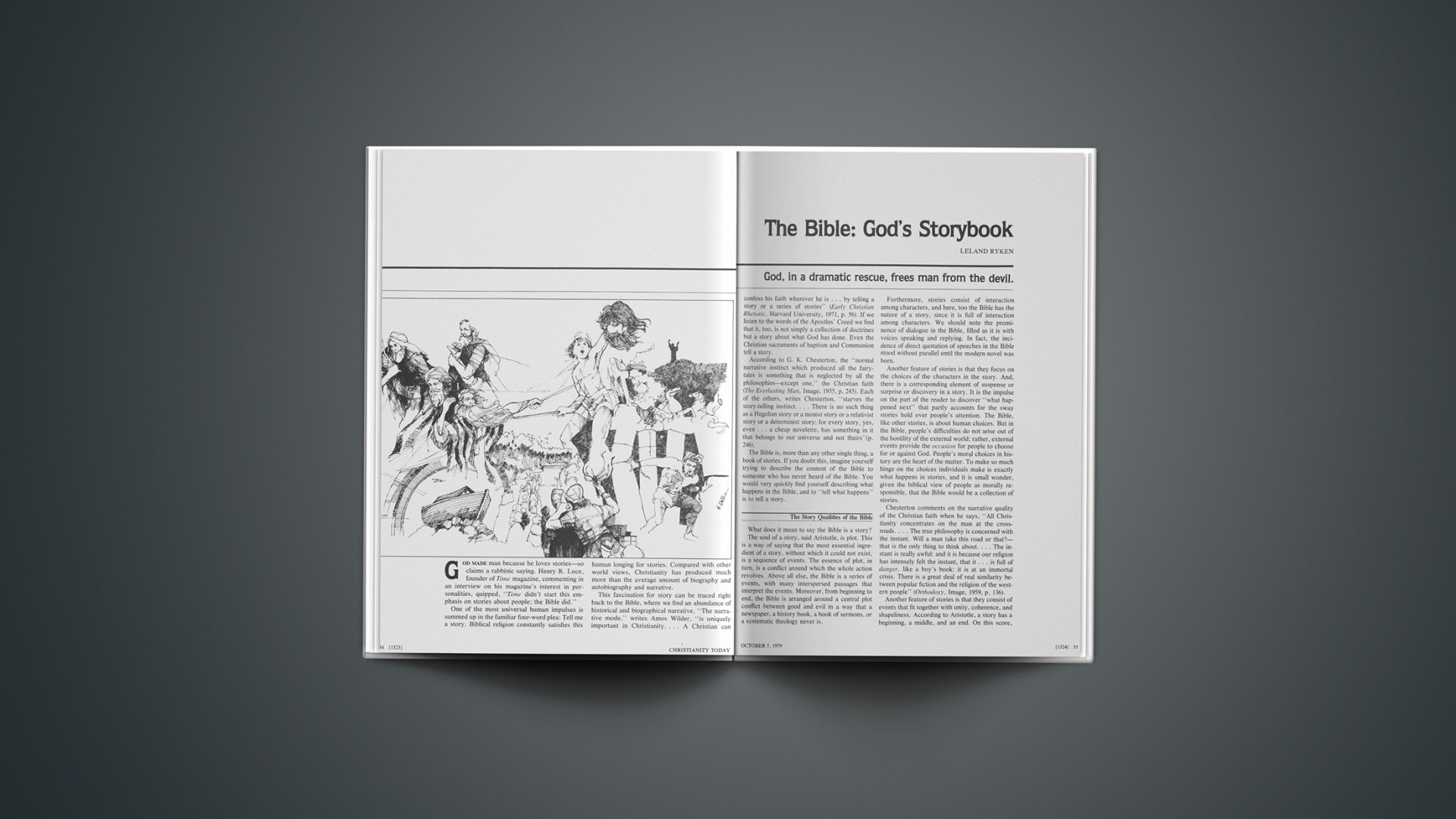
The Bible: God’s Storybook

A mystical romance come true.

God, in a dramatic rescue, frees man from the devil.

God made man because he loves stories—so claims a rabbinic saying. Henry R. Luce, founder of Time magazine, commenting in an interview on his magazine’s interest in personalities, quipped, “Time didn’t start this emphasis on stories about people; the Bible did.”

One of the most universal human impulses is summed up in the familiar four-word plea: Tell me a story. Biblical religion constantly satisfies this human longing for stories. Compared with other world views, Christianity has produced much more than the average amount of biography and autobiography and narrative.

This fascination for story can be traced right back to the Bible, where we find an abundance of historical and biographical narrative. “The narrative mode,” writes Amos Wilder, “is uniquely important in Christianity.… A Christian can confess his faith wherever he is … by telling a story or a series of stories” (Early Christian Rhetoric, Harvard University, 1971, p. 56). If we listen to the words of the Apostles’ Creed we find that it, too, is not simply a collection of doctrines but a story about what God has done. Even the Christian sacraments of baptism and Communion tell a story.

According to G. K. Chesterton, the “normal narrative instinct which produced all the fairy-tales is something that is neglected by all the philosophies—except one,” the Christian faith (The Everlasting Man, Image, 1955, p. 245). Each of the others, writes Chesterton, “starves the story-telling instinct.… There is no such thing as a Hegelian story or a monist story or a relativist story or a determinist story; for every story, yes, even … a cheap novelette, has something in it that belongs to our universe and not theirs” (p. 246).

The Bible is, more than any other single thing, a book of stories. If you doubt this, imagine yourself trying to describe the content of the Bible to someone who has never heard of the Bible. You would very quickly find yourself describing what happens in the Bible, and to “tell what happens” is to tell a story.

The Story Qualities Of The Bible

What does it mean to say the Bible is a story?

The soul of a story, said Aristotle, is plot. This is a way of saying that the most essential ingredient of a story, without which it could not exist, is a sequence of events. The essence of plot, in turn, is a conflict around which the whole action revolves. Above all else, the Bible is a series of events, with many interspersed passages that interpret the events. Moreover, from beginning to end, the Bible is arranged around a central plot conflict between good and evil in a way that a newspaper, a history book, a book of sermons, or a systematic theology never is.

Furthermore, stories consist of interaction among characters, and here, too the Bible has the nature of a story, since it is full of interaction among characters. We should note the prominence of dialogue in the Bible, filled as it is with voices speaking and replying. In fact, the incidence of direct quotation of speeches in the Bible stood without parallel until the modern novel was born.

Another feature of stories is that they focus on the choices of the characters in the story. And, there is a corresponding element of suspense or surprise or discovery in a story. It is the impulse on the part of the reader to discover “what happened next” that partly accounts for the sway stories hold over people’s attention. The Bible, like other stories, is about human choices. But in the Bible, people’s difficulties do not arise out of the hostility of the external world; rather, external events provide the occasion for people to choose for or against God. People’s moral choices in history are the heart of the matter. To make so much hinge on the choices individuals make is exactly what happens in stories, and it is small wonder, given the biblical view of people as morally responsible, that the Bible would be a collection of stories.

Chesterton comments on the narrative quality of the Christian faith when he says, “All Christianity concentrates on the man at the crossroads.… The true philosophy is concerned with the instant. Will a man take this road or that?—that is the only thing to think about.… The instant is really awful: and it is because our religion has intensely felt the instant, that it … is full of danger, like a boy’s book: it is at an immortal crisis. There is a great deal of real similarity between popular fiction and the religion of the western people” (Orthodoxy, Image, 1959, p. 136).

Another feature of stories is that they consist of events that fit together with unity, coherence, and shapeliness. According to Aristotle, a story has a beginning, a middle, and an end. On this score, too, the Bible makes up a story; its beginning is literally the beginning—God’s creation of the world and his placing of Adam and Eve in the garden; the middle is the universal history of the human race, controlled by a sovereign God; and its end is literally the end—the end of history, as portrayed in the book of the Revelation. We can contrast the simple garden populated by two people at the beginning of the story with the city at the end that contains a multitude no man can number.

By ending where it did not begin, the Bible follows a basic principle of stories. “All the other philosophies,” writes Chesterton, “avowedly end where they begin; and it is the definition of a story that it ends differently; that it begins in one place and ends in another. From Buddha and his wheel to … Pythagoras with his abstraction of number to Confucius with his religion of routine, there is not one of them that does not in some way sin against the soul of story” (The Everlasting Man, p. 245).

Stories are unified around a central protagonist, and so is the Bible. The characterization of God is the main concern of the Bible, and it is pursued from beginning to end. All other characters and events interact with this great Protagonist. The story of the Bible is the story of God’s acts in history, which biblical scholars have popularized in the terms “salvation history” or “holy history.” Salvation history is the story of how God entered history to save individuals and, in the Old Testament, a nation, from physical and spiritual destruction. Wilder comments, “God is an active and purposeful God and his action with and for me has a beginning, a middle and an end like any good story” (p. 56).

Stories, finally, are full of the concrete experience of everyday life. The storyteller is never content with abstract propositions: his impulse is to show, not merely to tell about an event. Stories appeal to us through our senses and emotions. A storyteller does not have a thesis to prove with arguments—he has a story to tell. Flannery O’Conner, the Catholic fiction writer, has said it all when she observes that a storyteller speaks “with character and action, not about character and action” (Mystery and Manners, Farrar, Straus & Giroux, 1957, p. 76). In stories, including those in the Bible, theological and moral meanings are incarnated in the story itself. This means that it is impossible to state the message of a biblical story without first interacting with the characters and events and settings in the story.

The Bible, then, should be regarded as a story because it consists of those very things that we associate with stories. These include plot conflict, interaction among characters, emphasis on human choice, a unified and coherent pattern of events that ends where it did not begin, a central protagonist, and the incarnation of meaning in concrete settings and characters and events. The narrative quality of the Bible is rooted in the character of God, for God is above all the God who acts.

The Bible: A Realistic Story

Anyone who simply starts to read the stories of the Bible will sense at once that they are full of facts and details, rooted firmly to the earth and to actual human experience as we know it. They are full of what is called realism.

For one thing, the writers of biblical stories are preoccupied with locating their stories in space-time history. Consider, for example, how the stories of the Bible typically begin:

“And Abram took Sarai his wife, and Lot his brother’s son, and all their possessions which they … had gotten in Haran; and they set forth to go to the land of Canaan. When they had come to the land of Canaan, Abram passed through the land to the place at Shechem, to the oak of Moreh. At that time the Canaanites were in the land” (Gen. 12:5–6).

“In the days when the judges ruled there was a famine in the land, and a certain man of Bethlehem in Judah went to sojourn in the country of Moab, he and his wife and his two sons” (Ruth 1:1).

“In the days of Ahasuerus, the Ahasuerus who reigned from India to Ethiopia over one hundred and twenty-seven provinces, in those days when King Ahasuerus sat on his royal throne in Susa the capital, in the third year of his reign he gave a banquet for all his princes and servants …” (Esth. 1:1–3).

Such preoccupation with the details of history and biography goes well beyond describing “local color.” The passages read much more like entries in a diary or biography or history book than an ordinary story. The impulse of the biblical writers is to give a full, circumstantial, and factual basis to their stories and to this impulse we can link realism. Like history and biography, realism is empirical: it does what Aristotle said all literature does, namely, it imitates observable reality.

We associate realism, for example, with the tendency to be concrete, vivid, and specific. The story of Ehud’s assassination of Eglon in Judges 3 illustrates such realism:

“And Ehud reached with his left hand, took the sword from his right thigh, and thrust it into his belly; and the hilt also went in after the blade, and the fat closed over the blade, for he did not draw the sword out of his belly; and the dirt came out. Then Ehud went out into the vestibule, and closed the doors of the roof chamber upon him, and locked them.”

The stories of the Bible frequently display this type of realism; they are of the earth, earthy.

We also associate realism with the portrayal of unidealized human behavior. Given this criterion, the Bible is a realistic book, for it paints its characters as Cromwell wished to be painted, “warts and all.” What Franz Delitzsch says about the patriarchs of Genesis is true of most biblical characters: “they have almost more shadow than light.” Among fully developed characters in the Bible, there are only a handful of wholly idealized characters; we think of Joseph (some would dispute even him), Ruth, Daniel, Jesus, and not many others. This impulse to portray common human failings is part of the realism we find in the Bible.

Another thing that links the Bible with realism is the focus on common experience and characters of average social standing, and the way the workings of God reach down into common experience. Furthermore, the Bible is full of minor characters and ordinary people who are named and treated as significant in the stories. Named individuality is important in the Bible. We find lists of names of people who carried the tabernacle (Num. 10), came back to the promised land (Ezra 2), rebuilt the walls of Jerusalem (Neh. 3), and who were priests, gatekeepers, and singers in Jerusalem under David, along with those who mixed spices and made the flat cakes for worship (1 Chron. 9). And this is to say nothing, of course, of the numerous genealogies of the Bible.

There is an equal attention to common, everyday events. In Genesis we learn such seemingly insignificant things as the fact that Abraham planted a tamarisk tree in Beersheba (21:33), Isaac had several run-ins with neighbors over a well (26:17–22), Rebekah’s nurse was buried under an oak below Bethel (35:8), and Joseph shaved and changed his clothes before going to see Pharaoh (41:14). My personal favorite among these examples is the startling information that Benaiah “slew a lion in a pit on a day when snow had fallen” (1 Chron. 11:22).

This emphasis on distinct details gives an astonishing sense of reality. The one charge I have never seen leveled against the Bible is that its characters are not real, for wherever we turn in this book we find ourselves and our acquaintances.

If the story the Bible tells is factual and realistic, it also has the characteristics of a type of story that is in many ways the exact opposite and what literary scholars call romance—the type of story that delights in the extraordinary. It is full of mystery, the supernatural, and the heroic. Romance stories are replete with adventure, battle, capture and rescue, surprise, the exotic and marvelous, poetic justice (good characters are rewarded and bad ones are punished), and happy endings. Such stories tend to portray life as we desire it to be: the underdog wins, the villain gets his comeuppance, the slave girl marries the king, the dead come back to life.

The Bible’s resemblance to this type of story is obvious, for it is filled with adventure, marvelous events, battles of many kinds, anger, supernatural characters, villains who get what they deserve, witches, brave heroes, beautiful and courageous heroines, an occasional talking animal, dragons, dungeons, castles, giants, quests, shipwrecks, captures and rescues, kings and queens, romantic love, and a few boy heroes. Stories in the Bible, moreover, tend to exhibit poetic justice and end happily.

The Bible as a whole ends with a barrage of literary conventions that are familiar to us through our reading of fairy tales: a lady in distress who is marvelously rescued, a hero who kills a dragon, a wicked witch who is finally defeated, the marriage of the triumphant hero to his bride, the celebration of the wedding with a feast, and the description of a palace glittering with jewels in which the hero and his bride live happily ever after.

It is small wonder that the stories of the Bible belong to children in a way that the Sunday morning sermon does not. Nor is it surprising that the stories of the Bible merge in a child’s mind with romance stories. I recall asking my daughter, then aged five, what passage I should choose for study at a prayer meeting, and being told that I might select “the story of Gideon, and his knights, and their fiery swords.”

The Story That Will Please Everyone

The Bible is a story that combines the two tendencies of narrative that have most appealed to the human race and that we tend to think of as opposites: it is a story that is both factually true and romantically marvelous. The biblical story brings together two impulses that ancient paganism and modern technological cultures have never been able to join—imagination and reason, or mystery and fact. The Bible nourishes both our imaginative taste for story and our rational need for truth. It appeals both to that part of us that is firmly planted on the earth and to that part of us that soars to the heavens.

The Christian story, says G. K. Chesterton, “met the mythological search for romance by being a story and the philosophical search for truth by being a true story. That is why the ideal figure [Christ] had to be a historical character, as nobody had ever felt Adonis or Pan to be a historical character. But that is also why the historical character had to be the ideal figure; and even fulfill many of the functions given to these other ideal figures; why he could be shown under the emblems of the growing vine or the rising sun.… Otherwise the two sides of the human mind could never have touched at all” (The Everlasting Man, p. 247). “And that,” adds Chesterton, “is the reason why the myths and the philosophers were at war until Christ came” (p. 246).

The parables of Jesus, too, combine the two qualities I claim for the Bible as a story. From one point of view, the parables are thoroughly realistic and secular. They contain few references to anything overtly religious and are concerned instead with seeds and sheep and banquets and pigs. From another point of view, the parables are about such spiritual and transcendent and mysterious things as the kingdom of heaven and the future age and the new life.

The Bible is a true story. To deny either the story quality or the factual quality is to weaken and distort the Bible. The tendency of evangelical scholarship and preaching has been to downplay the Bible as story and accentuate it as a repository of theological truth. The tendency of liberal scholarship has been to minimize the factual and historical element of the story. Neither tendency does justice to the Bible as a true story.

Some Practical Implications

If the Bible really is a story, we as Christians need to explore some pertinent questions:

Why does the Bible contain so many stories? Is it possible that stories reveal some truths and experiences in a way that no other literary form does—and if so, what are they? What is the difference in our picture of God, when we read stories in which God acts, as compared with theological statements about the nature of God? What does the Bible communicate through our imagination that it does not communicate through our reason? If the Bible uses the imagination as one way of communicating truth, should we not show an identical confidence in the power of the imagination to convey religious truth? If so, would a good starting point be to respect the story quality of the Bible in our exposition of it?

Why, when I ask my 12-year-old son what passage I should select for a prayer meeting study, does he reply, “Choose a story, not a psalm”? Is it true that evangelical preaching has usually taken the style of Paul rather than Jesus for its model? Paul tended to be theological, abstract, and propositional, while Jesus tended to be narrative, anecdotal, and poetic. Do we need to rethink our theories of what constitutes the best model for preaching? What is the lesson to be learned from the impact and memorability of Jesus’ parables and the Old Testament stories?

In a day when the average person is exposed to an enormous amount of television and other forms of entertainment, how can a preacher, Bible study leader, or Sunday school teacher compete successfully for his listeners’ attention? Is it true that a preacher or Bible study leader who is not a reader or who reads only Bible commentaries when he does read will be boring to listen to? If the appeal of a story is universal, why don’t speakers make more allusions to literature, use more stories? Where did we get the idea that the average person is uninterested in literature? What do people do in their leisure time—and how can a speaker appeal to that interest?

If any piece of writing needs to be approached in terms of the kind of writing it is, the right methodology for talking about a biblical story may be the methodology we first encounter in literature classes in high school and colleges. Why do we hear so little from preachers and Bible study leaders and Sunday school teachers about plot conflict and plot structure and characterization? Do these terms belong only in the literature classroom? Or are they the right and necessary terms to use whenever we are dealing with a story?

What difference does it make to us that the book we regard as sacred is not dull, but an interesting book to read? What part do the stories play in making it interesting? A notorious disparager of Christianity in our century called the King James Bible “unquestionably the most beautiful book in the world”; should a person who believes the content of the Bible and who has been saved by faith in its message be more enthused or less enthused than the cultured unbeliever about the literary quality of the Bible? Did God inspire only the ideas of the Bible—or also its forms?

G. Ernest Wright wrote, “Christian theology has tended to think of the Bible chiefly as ‘the Word of God,’ though in point of fact a more accurate title would be ‘the Acts of God’ ” (God Who Acts, Regnery, 1952, p. 12). I would suggest something different yet: the Bible is the story of God.

G. Douglas Young is founder and president of the Institute of Holy Land Studies in Jerusalem. He has lived there since 1963.

Meanings from God’s Message: Matters for Interpretation

Present day problems in hermeneutics.

Current hermeneutical debates question whether we can ever know what the writers originally meant.

The discipline of hermeneutics is emerging as the new dominant movement in both European and American theology. The number of articles and books appearing on this topic is matched only by the magnitude of the questions they are raising.

These questions are not the traditional hardy annuals: What is literal and what is figurative? What is descriptive reporting and what is normative teaching? Instead, our generation is being invited to ask the most fundamental question of all communication and interpretation. It is, surprisingly, in the area of general hermeneutics that the debate has aroused the sharpest disagreement. The implications of this debate for the evangelical and for the interpretation of Scripture are enormous. Our energetic entry into this discussion is thus no longer an optional luxury; it must be placed highest on our list of investigative priorities.

The New Orientation

The basic crisis is this: hermeneutics is more a matter of the text interpreting itself and the interpreter, than it is our interpreting the text. It is not the former focus on “What does the text mean?” or “What did the author mean?” Rather, we now ask the text to interpret us, and to become itself a new event as we read or hear it.

This new orientation has sprung from the philosophical roots of Martin Heidegger, who concluded that understanding happens when the reality to which language points becomes present for the individual and merges in such a way as to coincide with his own present reality.

Currently, however, the most important theoretician of philosophical hermeneutics is Hans-Georg Gadamer. In Wahrheit and Methode (1960) he accepted and extended Heidegger’s thought. Thus by 1964 James M. Robinson could speak of the school of “The New Hermeneutic.” At the heart of Gadamer’s concern was the premise that the meaning of a text was not the same as the author’s meaning. The author’s meaning was, in any case, inaccessible to us. Instead, the meaning of a text was in its subject matter, which was at once independent of both the author and reader, and somehow also shared by both of them. Moreover, no one could ever say this is the meaning of a text, since the number of possible meanings was practically endless and constantly changing. And, argued Gadamer, what a text meant to an author could not be reproduced in the present. The past was alien to the present, for differences in time necessarily involved difference in being.

If Gadamer signaled a new modern consensus for what may be called the Heideggerian version of hermeneutics, Emilio Betti, an Italian historian of law, and E. D. Hirsch, Jr., an American professor of English, represented the minority opinion that was trying to reinstate the older form of hermeneutics. Both scholars insisted on two basic distinctions: “meaning” was that which was to be found in a text as indicated by its grammar, the author’s use of his words, and his truth-intentions; and “significance” merely named a relationship between that discovered “meaning” and another person, time, situation, or idea. Thus meaning was unchanging and single, while significance did and must change since interests, questions, times, and concerns of interpreters also changed. Betti did acknowledge that in the interpretive process the interpreter involved his own subjectivity. But if the interpreter does not succeed in penetrating beyond that subjectivity, Betti cautioned, he most likely will achieve nothing more than projecting his own ideas and preferences onto the text he honestly believed he was interpreting.

Of course, Gadamer justifiably insists that every interpretation also involves an application to the present. This is precisely the situation in interpreting legal cases to locate precedents for the contemporary situation. But according to Betti and Hirsch the significance of the text is grounded in the text itself as judged by the author’s use of grammar. Gadamer, however, is too preoccupied with the interpreter’s assignment of meaning to an object, and with the easy equation of this subjective assignment to the text’s meaning.

Both Betti and Hirsch insist that the price for ignoring this distinction and definition of meaning and significance is high. It will jeopardize the integrity of all that is objectively valid in the whole spectrum of the humanities, for there will be no method of validating and testing which meaning more adequately represents the correct one. All criteria for measurement are abandoned for purely subjective and personal replacements.

Understanding of the objective model argued here (and we definitely prefer Betti and Hirsch to Gadamer) is like grasping the inner logic and coherence of a mathematical proposition or the working parts of a machine (Otto Bollnow’s illustrations). Nor can such understanding be “better than an author’s,” unless we mean “better” in the sense that we can complete what is unfinished in the subject, or that we can better clarify certain assumptions or guiding principles that the author’s work uses without consciously reflecting on them or explicitly stating them as such.

When the New Hermeneutic or aspects of it are applied to the biblical text, the results are startling. Every text has a plethora of meanings that are said to exist without any norms for deciding between which are right and which wrong. If and when norms are allowed, by some evangelical forms of this hermeneutical revolution, they still stand opposed to what the author intended to say through his use of these words. Rather, it is claimed that the text itself is autonomous and free from the author once he has written it; it is ready only to be shaped by our act of understanding it. This we cannot accept. Should this argument persist, this writer would recommend that beginning immediately, all explanations of the theory of understanding emanating from this Heideggerian fountainhead be interpreted on the basis of their own theory and not on the basis of the objective single meaning theory they are attacking. In fact, one of the best critiques of this position is deliberately to take the exact opposite point of view as the meaning we [that is, “what it means to me”] allegedly receive from their statements—which eventually makes communication impossible.

The New Contextualization

The crisis over the general theory of understanding (= general hermeneutics) and its high price of an eventual loss of communication is not the only problem we face in biblical interpretation. Recently, Charles Taber has also raised the question of whether one’s hermeneutical stance is not part and parcel of the cultural heritage each received (Gospel in Context I, 1978, pp. 8–9).

Taber’s point is that possibly there are as many proper, yet differing, approaches to the text of Scripture as there are cultures and societies. In Taber’s curious line of reasoning, the precedent and legitimization for so many hermeneutical approaches to the Scripture may be found in that same text. In his view, the New Testament writers practiced a form of rabbinic hermeneutics in that they appealed to Old Testament citations which said “X was the fulfillment of Y,” when to Western moderns it seemed to be no more than “X reminds us of Y.” Yet contemporary Western Christianity rejects this hermeneutic, presumably because of our cultural heritage.

If Taber is right in his analysis of the New Testament, his suggestion might follow. But his question ought not to be as troublesome as it appears. As we have argued and documented elsewhere (“Legitimate Hermeneutics,” Inerrancy, ed. N. Geisler, Zondervan, 1979), the general rules for interpreting oral or written speech are not learned, invented, or discovered by men; rather, they are part and parcel of our nature as individuals made in the image of God. This art has been in use since God gave the gift of communication and speech itself. Thus the person spoken to is always the interpreter; the speaker is always the author.

This is not to argue that everyone is automatically and completely successful in the practice of the art and science of hermeneutics just because each possesses this gift of communication as part of the image of God. Precisely at this point the distinctiveness of the cultural context of the reader/interpreter becomes most embarrassingly obvious. Certainly even when the speaker and listener/reader share the same culture and age there may still be some general subjects and vocabularies that may not be a part of the interpreter’s experience and therefore his ability to interpret is frustrated. In this case, it will be necessary for the interpreter to engage first in some serious study before he can be a successful interpreter.

But when the interpreter is removed from the original author by many years, governments, societies, and even religious conditions, how can the general rules for interpreting be part and parcel of our natures as made in the image of God? Again, the answer is the same. This question merely confuses one type of learning—which is only preparatory and an antecedent study—with the task of interpretation which still must follow. Had birth and providence favored us so that they would have been present and would have participated in that culture from which the writing emanated, we could have dispensed with this search into backgrounds, culture, and even at times languages. But we would still have been obligated to engage in the task of interpreting the text. Thus we still contend that the principles of interpretation are as natural and universal as is speech itself. To argue the reverse (in human speech which assumes someone is listening with understanding) is either to involve oneself in downright duplicity or ultimately to be reduced to a solipsism where only I speak, and only I know what I am saying.

All men and women in all cultures are made in the image of God. And when this fact is joined with a biblical concept of truth as having an objective grounding and reference point in the nature of God and in the doctrine of creation, the possibility for adequate (even if no one knows comprehensively except God) transcultural communication has been fairly provided and secured.

Furthermore, few have argued in this generation more strenuously than this writer against inference that the New Testament writers were following midrashic or pesher types of exegesis when they cited passages from the Old Testament to establish doctrine. Taber’s charge is an old one. But to quote only one source from 1885, Fredric Gardner in his book The Old and New Testament in Their Mutual Relations was right in asserting: “In all quotations, which are used argumentatively, or to establish any fact or doctrine, it is obviously necessary that the passage in question should be fairly cited according to its real intent and meaning, in order that the argument drawn from it may be valid.”

He challenged the very charge currently made: “There has been much rash criticism of some of these passages, and the assertion has been unthinkingly made that the Apostles, and especially St. Paul, brought up in rabbinical schools of thought, quoted the Scriptures after a rabbinical and inconsequential fashion. A patient and careful examination of these passages themselves will remove such misapprehension” (pp. 317–18). This examination we have undertaken in a number of articles elsewhere and have found it entirely correct.

Nevertheless, none of the above arguments should be interpreted as a denial of the presence of cultural items in Scripture or that there are real problems in transcultural communication. We have merely contended that there is in principle the possibility of communicating with and understanding men and women in other cultures and times than our own.

Hermeneutics enters into this discussion when we encounter truth that comes in a cultural vehicle or context. It then becomes the interpreter’s job to recognize the vehicle, illustration, or clothing for what it is without evaporating the revelation of God one whit. This task, we are learning, is easier said in theory than accomplished in practice. But never mind the difficulty; Peter’s apostolic status and revelatory stance did not guarantee even to him any kind of automatic and trouble-free path to interpreting some of his fellow apostles’ meanings. In 2 Peter 3:16 he frankly admitted that his “beloved brother Paul” had indeed written “some things hard to understand” that were liable to be twisted by the ignorant and unstable to their own undoing. And what was true for Paul, Peter allowed, was also possible in “the other Scriptures.” The church must give more attention to this aspect of hermeneutics than it has in the past. (See this writer’s seminal suggestions for some guidelines in the essay mentioned above, “Legitimate Hermeneutics.”)

The New Rule Of Faith

One more current crisis needs to be discussed here. This has its roots in Origen’s misappropriation of the words from Romans 12:6, “according to the analogy of faith” (which in the context of spiritual gifts did not refer to a body of truth) and in the Reformers’ proper rejection of the Glossa ordinaria, a commentary that preserved a uniformity in all matters relating to doctrine and discipline. The Reformers’ objection to this Regula fidei (Rule of faith) set up by the church of Rome was that it was an authority independent of Scripture.

By what means, then, could the Reformers determine which interpretations were valid and which were not true? They could not appeal to any new rule of faith, for they had by now trumpeted forth the principle of sola scriptura: doctrine and discipline must now be based on Scripture alone. The solution was to argue that the Bible was to be its own interpreter. In opposition to the principle that allowed tradition or the Glossa ordinaria to interpret Scripture, the Reformers championed the hermeneutical principle that “Scripture interprets Scripture,” commonly called “the analogy or rule of faith.”

Unfortunately, contemporary men and women pervert this dictum that “Scripture interprets Scripture” when they fail to realize that the Reformers used it only as a relative expression aimed especially at tradition; it was never intended to be understood as an absolute and positive principle that excluded learning, grammar, syntax, and the need of commentaries, or a trained ministry that would return to the original languages for a detailed and more precise understanding of the text. Otherwise, why did Calvin and Luther also write commentaries and preach God’s word to the church?

Some will then ask, “What has happened to the teaching about the ‘perspicuity of the sacred writings’? Are not the Scriptures ‘clear enough’ so that the simplest person can understand all that is in them?” But here again, we respond that the Reformers never meant to declare that the Bible was totally perspicuous to all alike. Rather, perspicuity was again a relative expression and not an absolute one that claimed everything in the Bible to be equally clear and apparent to all readers at all times. Instead, it too was a word aimed at the objectionable application of tradition to the exposition of Scripture. As far as the Reformers were concerned, the Bible was sufficiently perspicuous without the need for the church’s tradition or regulation of interpretation. The Bible is sufficiently clear in and of itself to bring its learned and unlearned readers into an understanding of the basic message of salvation and a walk with God.

Yet there was at least some room left for ambiguity, if not outright opposition between principles, when the Reformers went on to illustrate and define their further use of the “analogy of faith.” Some passages of Scripture, the Reformers assured us, could only be understood by the analogy of faith. In some passages, Luther confessed, faith might force us to abandon the natural or grammatical sense of a passage!

The corrective for some of the past and present cries generated by an improper or premature use of the analogy of faith, is the recognition that there is indeed a theological aspect to interpreting Scripture. But this analogy, when used as a hermeneutical tool, must be carefully restricted to those passages that preceded in time the passage currently under study. It must be controlled diachronically and put into the sequence of the progress of revelation. And to minimize subjectivity, this should be done only when the passage being exegeted warrants it. Such clues in the passage under examination will be: (1) the use of terms that by now have taken on technical status, (2) the allusion to the same events, and (3) the quotation of or general reference to previous passages that are now part of the Holy Scriptures in the possession of that author and audience to which this new word is being delivered. Only such a procedure of limiting ourselves for exegetical purposes (doing systematic theology is another matter which ought to follow this step in any case) to the “informing theology” or that “rule of doctrine” in the existence when this new passage came in the progress of revelation will save us from allowing the analogy of faith to undercut the principle of sola scriptura. Otherwise, we will have quietly restored tradition to its previous place of authority alongside Scripture.

Conclusion

These are not the only matters troubling the hermeneutical house, but these three crises are, in our estimation, each in and of themselves sufficient to bring the whole orthodox case for Scripture tumbling down. It would be the ultimate irony if our generation were to be noted as the generation that contested most earnestly for the sole authority and inerrancy of Scripture as its confessional stand, but which generation also effectively denied that stance by its own hermeneutical practice and method of interpretation. This in itself, given the contemporary pressures, is reason enough to call the evangelical community throughout Christendom to a whole new hermeneutical reformation. We trust that under God we may be so favored in our generation.

The Naming

I am that I am

could have

reigned alone the universe

of fuguéd echoes

but named himself again:

Word (for those who would have ears)

Spirit (for those who would someday listen)

and they

one

birthed our fragile souls,

named themselves again:

Father. Redeemer. Comforter.

SUSAN MIRIAM ZITZMAN

G. Douglas Young is founder and president of the Institute of Holy Land Studies in Jerusalem. He has lived there since 1963.
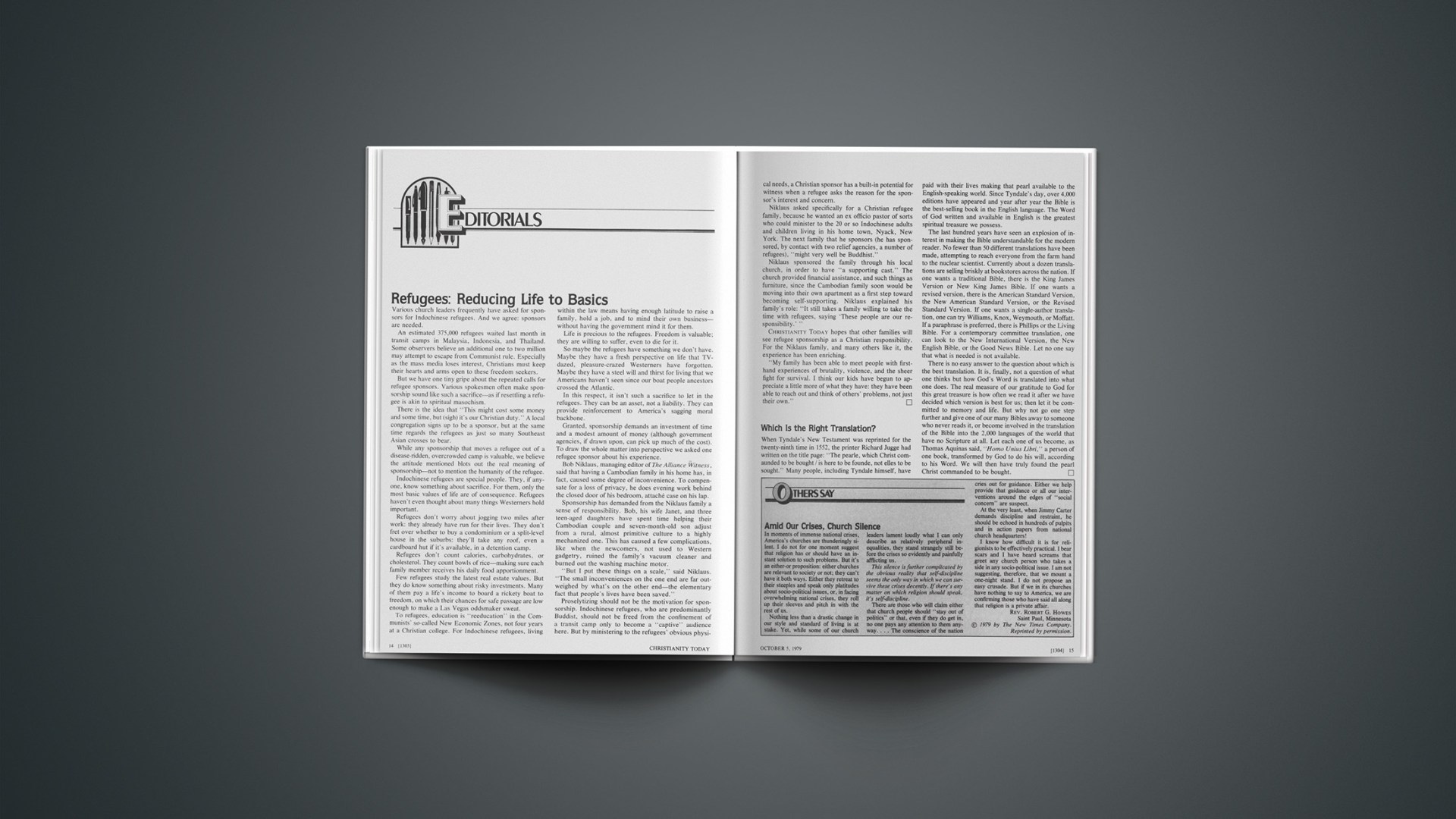
Does Male Dominance Tarnish Our Translations?: Obedience to Whose Word?

Should we attempt to “improve” or “clear up” what the Holy Spirit chose to do?

Recently we led a study in a Roman Catholic church on biblical teachings about men-women relationships. We were pleased to find that the church had provided seminar participants copies of Good News for Modern Man—a translation now generally approved for Roman Catholics.

In answer to a question, we asked the women to read 1 Corinthians 11:3–12, which describes in detail how men and women were to pray and prophesy in the church at Corinth.

The passage begins (literal translation from the Greek), “Indeed, I want you [plural] to know that the head of every man is the Christ; and head of every woman is the man; and head of Christ is God.”

This is a difficult passage; the sense of some of the rest of the chapter depends on what Paul meant here by the word “head.” We explained that “head” in Greek usage (according to the standard Greek-English Lexicon by Liddell, Scott, Jones, McKenzie) does not mean “boss” or “final authority.” In classical Greek “head” usually meant a person’s physical head; as a figure of speech it sometimes stood for the whole person or for life itself (e.g., “I stake my head on that”); or it could also mean the brim or upper part of something, as the “head” of an architectural column. A more common meaning was source, or origin, as we use it in the “head of the Mississippi River.” This was the meaning it apparently had for Paul in Colossians 1:18: “He [Christ] is the head of the body, the church; he is the beginning, the first-born from the dead, that in everything he might be pre-eminent.”

We began to explain to the women that this meaning of origin or source that Paul used elsewhere made good sense in the phrase “and the head of every woman is the man” in 1 Corinthians 11:3 because five verses later (1 Cor. 11:8) Paul states, “man was not made from woman, but woman from man” (referring to the account of creation in Gen. 2:18–25). It was clear, however that the group had not the slightest idea of what we were talking about. One of them handed us her Bible and we read, “But I want you to understand that Christ is supreme over every man, the husband is supreme over his wife, and God is supreme over Christ.”

“We’re sorry,” we said, “but that translation is not what the original writing says. The translator, unfortunately, is giving his opinion about how the words should be interpreted, rather than giving you the actual words that Paul wrote, which are ‘the head of every man is the Christ; and head of every woman is the man; and head of Christ is God.’ ”

They were troubled, of course. Only in recent years had they been encouraged to study the Bible for themselves. And now we had to tell them that the Bible in their hands was not faithfully translating what the Greek said—it was instead giving a commentary on what the translator thought it meant and what its application should be.

But then, a few verses later, in 1 Corinthians 11:10, we came to another passage where interpretation got in the way of the translator’s faithful handling of the text. The literal Greek text in this verse is: “Because of this, the woman ought to have authority upon the head because of the angels.” That is all it says.

Of the passage’s several possible interpretations, we think Paul was saying that the women who were praying and prophesying in the church at Corinth (the subject under discussion here) should have some symbol on their heads (perhaps a veil or a special hair style) to show that they had authority from God to speak.

Now this is our interpretation or application of the words that Paul wrote. Bible scholars have the right and responsibility to work hard, weighing and evaluating what they think Bible passages mean and how they should be applied. This is interpretation and it is one of the purposes of Bible commentaries. But this is not the responsibility of the translator; his job is to tell us what the passage says.

Note how Good News for Modern Man translates 1 Corinthians 11:10: “On account of the angels, then, a woman should have a covering over her head to show that she is under her husband’s authority.”

The Greek text says nothing about husbands or men. Paul used no words that can be translated husband or man in that passage. The translator, instead of telling us what Paul said, added to the text his personal interpretation and application of Paul’s words.

We hated having to tell this group of women who were eager to study the Bible that their version was not telling them what Paul said, but rather what the translator thought it meant. They were crestfallen. “Then how can we ever know what the Bible actually says?” they asked. We had no easy answers except to urge them to consult several translations, especially committee translations such as the Jerusalem Bible, Revised Standard Version, and New International Version.

That experience started us on a broader examination of what appear to be traces of male chauvinism in Bible translations we use. Many of our current translations have been the work of committees of biblical scholars, including the King James Version, the Revised Standard Version, the New English Bible, and the New International Version. We also have several currently popular one-person translations, including Living Letters (Kenneth Taylor); the New Testament in Modern English (J. B. Phillips); and Good News for Modern Man (Robert Bratcher).

We doubt if any of the men on translation committees or who did their own translations are conscious of any male chauvinism. All are honest, godly scholars, dedicated to doing their best work, trying faithfully to bring to today’s readers the message of the Bible.

But like all of us, these translators grew up in a society that assumed males should dominate home, church, and society at large. It has been as much a part of our culture (and of most pagan cultures) as the air we breathe. Translators naturally tend to read and interpret the Bible from the framework in which they have lived and thought.

Meanwhile, Christians now trying to work through the actual teachings of the Bible on the strategically important issue of men-women relationships are thrown off course by translations that may reflect more of the translator’s interpretations and biases than the actual words of the Bible.

As examples of this situation, we have chosen four short passages to show how the individual views of translators may have influenced the way they translated the Bible.

In looking at these passages, we must consider how faithful the translations are to the Greek text—not whether we “like” or agree with what the translator says. The translator’s responsibility is to say neither more nor less than the inspired writers of Scripture said.

If we really believe in the absolute authority of the Word of God, we dare not add to or subtract from what the text says. If the text itself is ambiguous—the meaning is not clear or is open to several possible interpretations—conscientious translators must leave the material ambiguous and open to several possible interpretations. If they “clear up” the difficult section by choosing which interpretation they like best and incorporate that into their translation, are they not claiming for themselves the divine inspiration that belongs only to the Word of God as it was originally “God-breathed” by the Holy Spirit? If the Holy Spirit inspired words or thoughts that are ambiguous or open to several interpretations, should we attempt to “improve” or “clear up” what the Holy Spirit chose to do?

Translators may surely choose to footnote certain sections and give possible interpretations and even indicate what their preference is; but their own preference should not influence the text itself.

Let’s look at four short verses that may illustrate the problems involved.

1. 1 Corinthians 11:3. The committee translations of this verse are clearly more faithful to the text than the one-man paraphrases. Both Living Letters and Good News for Modern Man have tried to “clarify” the text by giving the translator’s interpretation of the meaning of “head”—interpretations not supported by Liddell, Scott, Jones, McKenzie. For Greek-speaking people in New Testament times who had little opportunity to read the Greek translation of the Old Testament, there were many possible meanings for “head” but “supreme over” or “being responsible to” were not among them. If the meaning of “head” in this passage is ambiguous, we are far safer to struggle with the ambiguity and examine all the possibilities than to be misled about what the writer originally said.

2. 1 Corinthians 11:10. This is confessedly difficult. We cannot be sure what “because of the angels” means. The text does not spell out what was the “authority” on the head. “Veil” does not appear anywhere in this chapter but may have been what Paul had in mind. Or it may not have been. Should we second-guess him in the text, or leave the interpretations for the commentaries?

All the translations except King James and RSV add “a sign of” to the text. This probably was what the author had in mind—but he did not say it. Should the translator do so—without indicating that he is adding something?

All the one-man translations—Taylor, Phillips, Bratcher—added man or husband to this passage despite the fact that Paul says nothing about a man or a husband. (The same Greek word anẽr is used both for man and husband.) The unsophisticated reader is led to think that Paul wrote about a woman being under a man’s or her husband’s authority. If that was what Paul had in mind, he did not say it. What Paul wrote is open to several interpretations, but most readers of these paraphrases will never know that; they think they are reading a translation of what Paul said, and are unaware they are only reading commentaries on what individual translators think Paul meant.

3. Romans 16:1. This is interesting because not one of the translations says what Paul said. Paul said, “I commend to you Phoebe, our sister, a deacon in the church at Cenchrea.” There is no such Greek word as deaconess. The text simply says she was a “deacon.” The word diakonos appears 21 times in the writings of Paul in the New Testament. A literal translation for the word is “servant.” Paul, Timothy, Tychicus, Epaphras, and the church leaders in 1 Timothy 3:8, 12, are all called “deacons.” The term is also used of secular leaders in Romans 13:4.

Exactly what the role of “deacons” was in the church of the New Testament is a subject of considerable debate among Bible scholars. Was it technically a church office? If so, at what point in the development of the church did it become one? These are questions for interpreters and church historians to deal with.

The question for translators is: How shall they translate the word diakonos when it applies to Phoebe and others such as Paul, Timothy, Apollos and the church leaders in 1 Timothy 3:8, 12?

Although the King James Version is less chauvinistic than some other versions, this passage is one great exception. Only in reference to Phoebe does the King James translate Paul’s word as “servant.” In 1 Timothy 3:8, 12, it is translated “deacon” but in all other places the King James uses the term “minister.” Only of Phoebe is Paul’s word diakonos translated “servant.”

The modern translations don’t do much better. The Revised Standard Version and Phillips speak of her as “deaconess” although there is no such word in Greek. The NIV follows King James with “servant” and a footnote saying “deaconess.” Good News for Modern Man uses “servant,” but in this case cannot be faulted, for it always translates diakonos as “servant” or “helper”—never using “deacon” or “minister.”

Living Letters does the gravest injustice to Phoebe. It translates diakonos as “deacon” in reference to the leaders of the church at Philippi (Phil. 1:1) and of the church leaders in Ephesus (1 Tim. 3:8, 12). In reference to Timothy, it translates diakonos as “pastor” (1 Tim. 4:6). But of Phoebe in Romans 16:1, Living Letters says, “a dear Christian woman from the town of Cenchrea.” Reading this, no one would ever guess that Paul called her a “deacon [or servant] of the church at Cenchrea.” Although in many passages Living Letters adds material in the effort to clarify the text, in this passage it omits an important idea.

4. 1 Corinthians 14:34. This is familiar to most people. It is Paul’s famous command for women to be silent in the church, and here, too, preconceived ideas of the translators sometimes come to the foreground, adding to and interpreting Paul’s actual statements.

This is another of Paul’s ambiguous statements. He says here that women should “be silent in churches because to speak is not allowed to them, but let them subject themselves [or be in subjection] just as the law says.” Yet three chapters earlier in the same book (1 Cor. 11) Paul gave instructions about how women were to pray and prophesy in public gatherings.

Careful Bible scholars know that there is no Old Testament law that says women are not permitted to speak in religious gatherings or that they should be subordinate. Some have pointed to Genesis 3:16 as the law of subordination: “thy desire shall be to thy husband, and he shall rule over thee.” However, this was the curse that came as the result of sin, and it is certainly questionable to treat the curse (the effects of sin) as a “law” to intensify these effects and make them worse!

What law was Paul referring to? He may have been speaking of some written or unwritten Roman law, or of civil Greek law about women not speaking in public, or some accepted but unwritten regulation. He may have been thinking about rabbinical teachings that interpreted the Old Testament, or even about the regulations that he himself is giving about activities in the Corinthian church. No one knows for sure what Paul had in mind. But should translators “clear it up” by overlaying it with their own interpretations?

The RSV handles this passage quite literally. The King James gives a fairly literal translation except that “let them subject themselves” is changed to the stronger “they are commanded to be under obedience.” The Greek text says nothing about commands or obedience.

The NIV, Phillips, and Good News have added their own interpretations to “the law” by capitalizing it—indicating that it speaks of the Old Testament law. The text does not say that. Good News adds more of the translator’s interpretation by saying, “they must not be in charge.” The text says nothing like that.

The worst additions are made by Living Letters, which says, “they are not to take part in the discussion, for they are subordinate to men as the Scriptures also declare.” But the text says nothing about men. The translator is assuming that Paul meant men. Paul could mean subordinating themselves to a regulation against women speaking in public. Living Letters also assumes “the law” meant the Scriptures. It may; it may not. Where the text permits more than one interpretation, the translator should stay with the text.

It is obvious that Christians who are serious about studying the Bible on any subject need to be aware of how easy it is for translators to incorporate their own ideas into their translations. This tendency has certainly confused the issues regarding women and we probably will find, as other issues arise, that other confusions exist.

Certainly we should consider our modern plethora of Bible translations a blessing. Many of them are remarkably easy to read and have a refreshing sense of vitality. But all translations are human products, produced by people who, like all of us, have unconscious sets of blinders. Like all of us, translators work from their own outlooks, their own prejudices. We have all been bent and influenced by the many forces of the society in which we live and by the traditions of the churches of which we are a part. This is true of every translator, every commentator, every preacher, every lay reader and every student of the Bible. Usually we are not even vaguely aware of our blind spots—and we all have many.

But only the original words of the Holy Scriptures can claim unique inspiration. This is why many scholars spend their lives poring over old manuscripts, comparing one with another in the effort to come as close as possible to what was the original text of the writings. It is generally acknowledged that the text is well established in most of the New Testament. Among the examples given in this article, there are no serious questions about the original texts.

We all agree that a good translation cannot be word for word. There must be an easy flow of language not possible in word-for-word translations. But a good translator tries to see what the original writer was saying and then express that as accurately as possible in the idiomatic language of the reader. It is at this point that the translator’s preconceived ideas sometimes get in the way.

What can the Bible student who does not know Greek or Hebrew do to be sure he is not getting a translator’s additions or omissions rather than the Holy Spirit’s message?

The answers are not easy, but there are some precautions the reader can take. (1) Be aware of the possibility of the translation’s unconscious biases in the words chosen. (2) If an idea appears in a one-man translation (especially paraphrases such as Living Letters, Good News for Modern Man, or Phillips’s Modern English) that does not appear in most committee translations (KJV, RSV, NEB, NIV) it is a tip that the idea may represent the interpretation of the translator. This is one reason we should read more than one translation, especially if we are trying to study any subject in depth. (3) Never read paraphrases by themselves. Always compare them with at least one committee translation such as KJV, RSV, NIV, NEB.

A Greek interlinear translation may help readers who know no Greek to evaluate whether their translation stays close to the actual text.

In short the Bible is uniquely inspired by the Holy Spirit—but the translators are not. Let the reader beware!

EDITOR’S FOOTNOTE

The Mickelsens have made no attempt to be exhaustive in pointing out examples of chauvinistic translations. The King James Version has twisted many a passage to save the male ego—or its chauvinistic theology.

The King James Version, for example, reverses the Greek order to place Aquilla before Priscilla in deference to the husband—in spite of the fact that in the biblical text, Priscilla is clearly the leader (Acts 18:26). In 1 Timothy 2:11, the King James Version translates hēsychia “Let the woman learn in silence,” but when referring to men (2 Thess. 3:16), it renders the same word, “with quietness they work and eat.” Psalm 68:11 reads, “great was the company of those that publish the word of the Lord” in spite of the fact that the Hebrew is explicitly feminine: “great was the company of those women who publish the word of the Lord.” On the other hand, the KJV correctly notes the feminine Junia in Romans 16:7 in contrast with most contemporary translations that with little or no justification transform mir abile dictu, the woman Junia, into the man Junias to avoid the unthinkable—a woman among the apostles!

G. Douglas Young is founder and president of the Institute of Holy Land Studies in Jerusalem. He has lived there since 1963.
Amid Our Crises, Church Silence

In moments of immense national crises, America’s churches are thunderingly silent. I do not for one moment suggest that religion has or should have an instant solution to such problems. But it’s an either-or proposition: either churches are relevant to society or not; they can’t have it both ways. Either they retreat to their steeples and speak only platitudes about socio-political issues, or, in facing overwhelming national crises, they roll up their sleeves and pitch in with the rest of us.

Nothing less than a drastic change in our style and standard of living is at stake. Yet, while some of our church leaders lament loudly what I can only describe as relatively peripheral inequalities, they stand strangely still before the crises so evidently and painfully afflicting us.

This silence is further complicated by the obvious reality that self-discipline seems the only way in which we can survive these crises decently. If there’s any matter on which religion should speak, it’s self-discipline.

There are those who will claim either that church people should “stay out of politics” or that, even if they do get in, no one pays any attention to them anyway.… The conscience of the nation cries out for guidance. Either we help provide that guidance or all our interventions around the edges of “social concern” are suspect.

At the very least, when Jimmy Carter demands discipline and restraint, he should be echoed in hundreds of pulpits and in action papers from national church headquarters!

I know how difficult it is for religionists to be effectively practical. I bear scars and I have heard screams that greet any church person who takes a side in any socio-political issue. I am not suggesting, therefore, that we mount a one-night stand. I do not propose an easy crusade. But if we in its churches have nothing to say to America, we are confirming those who have said all along that religion is a private affair.

Saint Paul, Minnesota

© 1979 by The New Times Company.

Reprinted by permission.

“Six years ago our only son died suddenly from a brain hemorrhage. I knew I had to have God’s Word to find the comfort and strength I so desperately needed. The Living Bible had just come out and I read and reread it. At last! I had found a Bible I could understand. I’ve grown in my Christianity during the past six years from a lukewarm believer into an evangelical Christian and I want to pay tribute to you for helping in my growth.”

“I have been a Catholic sister for over 30 years. I was no stranger to the Bible, but never before have I experienced such joy and yes, excitement in Scripture.”

Scholars continue to debate the merits of the Living Bible; but letters such as these, addressed to Kenneth N. Taylor, affirm for him its original purpose: to see lives changed through understanding Scripture. Taylor’s first paraphrases appeared more than 15 years ago. Today, well over 20 million copies of the entire Living Bible, and several million more Living Letters (the New Testament epistles) and other portions have been sold.

A seminary-trained clergyman who has never had a pastorate, Taylor, 62, has been involved in publishing for most of his adult life. Using his pen as a pulpit, he has preached to millions of readers all over the world. But although his work has made him famous, he remains a retiring and modest figure—“one of the few people I know who has not allowed wealth to change him,” says a colleague. “He simply has not been corrupted by money or prestige. His spiritual intensity and commitments are unquestioned.”

After taking an undergraduate degree in zoology at Wheaton College (Illinois), he attended Dallas Theological Seminary for three years, and graduated from Northern Baptist Seminary in 1944 with a master’s degree in theology. For three years he edited Inter-Varsity Christian Fellowship’s magazine, HIS, and for 15 years was director of Moody Press in Chicago. He left that position in 1962 to publish the Living Bible.

He has also authored 10 children’s books, including his best-selling Bible Story Book.

Question: How many publishers originally turned down the Living Letters paraphrase when you first tried to get it published? And how did you react?

Answer: Probably five or six publishers, some secular and some religious, returned the manuscript. There was the feeling lurking in the back of my mind that it might be better to publish it personally so that there would be more control and more opportunity to give it undivided promotional attention. Sometimes I’ve been asked whether I expected such a vast circulation to occur, and I really don’t know how to answer that because God did give me some intimations that it was going to have a wide usefulness. I felt that since reading the completed manuscript helped me so much in my own understanding of the Word of God, others with less than my seminary education would be even more greatly helped in being able to understand the Bible easily.

So my emotional reaction was very mixed. I was disappointed, but excited that perhaps God was going to let me publish it myself.

Q: What kind of pressures did you face as you translated the Bible?

A: There was an enormous burden on my soul for complete accuracy on the one hand and complete readability and understanding on the other. A paraphrase is an entirely different kind of translation. A standard translation can best be termed a “word-by-word” or “phrase-by-phrase” translation because a “dynamic equivalent” English word or expression is found to replace the Greek or Hebrew word in the original manuscript. But it is almost impossible to find an exact equivalent, so the result is a series of English words reconstructed into a fairly readable English sentence, but not quite accurate and often not conveying what the various Bible writers were really saying.

A paraphrase, on the other hand, is concerned about the accuracy in translating thoughts, to express something the way the authors would if they had been writing in English. This “paraphrase-translation,” as I call it, is understood more accurately by the average reader than are the standard modern translations such as the New International Version, the New American Standard, and others. These are excellent, especially the NIV, but they leave much to be desired in getting across the original thought to the average reader of English. Both kinds of translation are needed. I use the Living Bible for my devotional reading because I get so much more out of it, but in a Sunday school class I like to take along a standard translation, too.

Q: Were the pressures of translation related to the partial loss of voice that you have experienced?

A: I was under great pressure, having been brought up with such a huge reverence for the Bible. One fears a mistake will be made. The committed paraphrase-translator, trying to insure accuracy of thought, has a far greater pressure upon his spirit than does the person doing a word-by-word or phrase-by-phrase translation.

Whether this is the cause of my voice problem, no one seems to be sure. It broke while I was giving a luncheon talk—I believe it was in Portugal—about 15 years ago, and it gradually deteriorated until I could hardly use it at all. Now, however, it is improving, although it still comes and goes. I suspect probably it is as one doctor told me, “Some people get ulcers and some people get a psychosomatic disorder that can affect the voice.” Emotions can make the voice falter, and emotional pressure during 16 years of paraphrasing can produce severe impairments.

Q: How did your own children respond to the Living Bible?

A: My older children were not brought up on the Living Bible because it did not exist during their formative years. The younger half of the tribe (I have 10 children) have frequently expressed appreciation and enjoy it very much—as do some of the older children.

The children were one of the chief inspirations for producing the Living Bible. Our family devotions were tough going because of the difficulty we had understanding the King James Version, which we were then using, or the Revised Standard Version, which we used later. All too often I would ask questions to be sure the children understood, and they would shrug their shoulders—they didn’t know what the passage was talking about. So I would explain it. I would paraphrase it for them and give them the thought. It suddenly occurred to me one afternoon that I should write out the reading for that evening thought by thought, rather than doing it on the spot during our devotional time. So, I did, and read the chapter to the family that evening with exciting results—they knew the answers to all the questions I asked!

Q: What financial arrangements were made once the Living Bible began to sell? Were you tempted to use the royalties for your own gain—especially since you have 10 children?

A: Margaret and I have always been “missionary minded” and anxious to honor God in all we do. Since the Bible is the Word of God and God is the author, it seemed logical that he should get the royalties for his work. So we set up a foundation to receive the royalties from the first printing (2,000 copies) and any succeeding editions that might be called for. I have wondered, had I known at the time how huge the royalties would become, whether I would have been quite so “devoted”; but I think I would have.

Q: How do you respond to the various criticisms brought against the Living Bible—that it’s a “translation once removed,” since it is based on English versions and not on Hebrew and Greek originals?

A: It is not true to say that the Living Bible is not based on the Hebrew and Greek originals. It is a matter of procedure as to whether the Greek and Hebrew are put into a rough translation and then given style by another group of communicators (as with the NIV, for instance), or whether one begins with the flowing thought of a paraphrase and then turns it over to Greek and Hebrew scholars to check and recheck for ultimate accuracy. It was this latter system I used. The first way tends inevitably to produce a somewhat stilted “feel,” whereas the paraphrase method is the ultimate method of understandability with accuracy.

Q: What about the criticism that translating the Living Bible into other languages results in a translation twice removed from the original?

A: Our Living Bibles in other languages are not translations of the English Living Bible. The English version is the model for its understandability, emotive qualities, clarity, and exegesis. But each language group has its own resource of Greek and Hebrew scholars.

Q: Some people maintain translations like the Good News Bible (Today’s English Version) are superior since they are based on the original manuscripts and translated by a committee of scholars.

A: I do not believe that the Good News Bible is considered by very many people to be superior to the Living Bible. Each has its place of usefulness. Both make use of the original manuscripts. I feel that a committee translation where everyone rewrites everyone else’s work is apt to be less vital and exciting. In my opinion, it is best for the basic translation to be done by one person, then for others to contribute their suggestions.

Q: Does criticism of the Living Bible dishearten you?

A: I am not particularly concerned about those who criticize the Living Bible because of its translation procedures, but I am very much concerned about certain people who have condemned it along with all other modern language translations, and have made millions of people fearful of using anything except the King James Version. It seems to me that this is a terrible disservice to God and man. I think it is a sad thing when people are discouraged from reading whatever translation the Holy Spirit will use to open their lives to God in fresh and wonderful ways.

Q: How do you see the Living Bible in terms of the entire history of the English Bible?

A: I see the Living Bible as a translation for this generation. Although I am not permitted to question God’s timing, I wish someone had been called to this task a hundred years ago so that the Living Bible instead of the King James would be in hotel rooms. Many traveling businessmen glance at the KJV and decide that it is not for them because it is too hard for them to understand. They go away with the impression that the Bible is not an open book, not readable except to the experts, and thus they are terribly and eternally deprived.

The great Bible translations seem to me to be Wycliffe’s in the fourteenth century, Tyndale’s of 1526, the King James Version of 1611, and then the many good, modern-language translations of the last 70 or 80 years, including the paraphrase-translations exemplified by J. B. Phillips and the Living Bible. I suppose there will be other paraphrases in the future and the result will be that vast numbers of Christians will understand the Bible and read it as never before; others who are not yet Christians will come to Christ by being able for the first time to understand the Word of God.

Q: Describe the publishing program at Tyndale House.

A: Tyndale House Publishers is the major publisher of the Living Bible, and the royalties from the Bibles go through the Tyndale House Foundation to missionary organizations all over the world. These royalties must be paid by contract to the Foundation, whether or not Tyndale House can afford them. In 1965 we began to publish a few Christian books other than the Bible. We are now releasing about 100 new titles each year.

Tyndale House (but not the Foundation) has been hurt financially by several poor business decisions I’ve made over the past several years, most of them related to overexpenditures in my attempts to bring about a wider circulation of Christian books, including the Living Bible. I remember an advertising campaign a few years ago where we spent well over $100,000 for television advertising in the spring, promoting the Living Bible. We learned to our sorrow that such expenditures should be made toward Christmastime.

Q: Would you tell us about the Tyndale Encyclopedia of Christian Knowledge? We understood this work was planned as a five-year project, but that it has now been stopped. How much time had actually gone into it up to the time the work was stopped, and how many more years do you estimate would be required to complete the encyclopedia?

A: The encyclopedia had been on the way for three and a half years and was about 90 percent completed when, regretfully, it was stopped. We tried to do in five years what should have been set up as a 10- or 15-year program, and we simply ran out of money that could be invested in it.

Q: Do you think Tyndale will be able to complete the project?

A: We have stopped the project for a couple of years until we recoup, and then we will proceed in an orderly financial manner. We particularly regret the decision because 400 of the finest scholars in the world have worked on this project. But although the editorial work was so near completion, we simply ran out of money. We made some very bad decisions for which we are terribly sorry. We are determined, however, that the sacrificial work of these scholars shall not be lost, but that these splendid articles will be published so the public can profit from them. I expect that we will have the encyclopedia available by 1985.

Royalties from Bible sales go to the Tyndale House Foundation and the Foundation is by law prohibited from assisting Tyndale House publications, such as the encyclopedia. That is why the royalties did not prevent the encyclopedia project from being postponed.

Q: What future do you see for Christian book publishing?

A: I constantly ask myself whether the evangelicals of the English-speaking world really need the hundreds of new evangelical books that roll off presses every year. New, small Christian publishers are continuing to enter this field. My conclusion is that although the 10 percent (estimated by the Christian Booksellers Association) of evangelicals who frequent Christian bookstores are well supplied, we have a long, long way to go to get the other 90 percent reading Christian books and magazines. Then there are the three quarters of the American population who do not count themselves as evangelicals. It is our obligation to try to reach them with books that will attract them to the Lord. That is why I am just as concerned about distribution as I am about publishing.

Q: How have you dealt with areas in your past that you might consider major failures?

A: There have been times when I was proud in thinking that I was a good businessman, but through the poor results from some of my business decisions, the Lord has helped me see that although I can often analyze a business opportunity correctly, I’m not as able as many others to implement the decisions. I’ve also seen both from the Word and from experience that my decisions can be dangerously biased by acquisitiveness, which is a problem that has troubled me since my childhood, when I was brought up in a lower-middle-class standard of living. Now I have learned to see the red danger flags flying when I make decisions, if there is a possibility that pride or money hunger may be involved in a business or personal decision.

Strangely enough, I have not had any problem of pride so far as the Living Bible is concerned. It is a special gift of paraphrasing which God gave to me, and I accept it as an objective fact, very impersonally; although I am deeply involved, it is almost as though I am watching from a distance.

Q: Describe Living Bibles International’s plan to produce the Living Bible in all the major world languages, from both a ministry and a marketing standpoint.

A: There are approximately 4.5 billion people in the world and 80 percent of them have never heard or seen any portion of the Scriptures. LBI is attempting to overcome this communication gap by translating, producing, and distributing easily understood Living Bibles in the major languages of the world—Bibles in the popular language of the people, which can be understood by the man or woman of average education.

LBI works in a country through national Christian communicators, including church leaders, in translation and distribution. Their knowledge of the nation’s language and culture helps us to be much more effective in using the finished product. Once in a while we find a person who has a special gift for paraphrasing, but mostly it comes through training and hard work. Often the LBI distribution program is carried out in cooperation with other major evangelical organizations. Many LBI editions are sold at full market prices in order to create a revolving fund. This assures a continual supply of Bibles in that language, and generates funds for subsidies in countries where sales are difficult.

Q: How do you relate to the Bible societies?

A: The need for Bibles is great enough to keep the Bible societies and LBI both busy! We try to coordinate our work wherever possible in order to use available resources to the best advantage.

Q: How have you coped with the responsibilities—physical, mental, and spiritual—of raising 10 children, overseeing Tyndale House and Living Bibles International, and the other duties you have?

A: I have never had physical problems (except for my voice) and for this I am very, very grateful. While the children were at home I had a significant emotional problem in knowing how to give them the time and attention they each needed, and I failed badly in this. I spent too many hours working on the Living Bible when they needed my love. My wife is a marvelous person, full of patience and discernment, and this has made all the difference as she has encouraged and helped me. We don’t always agree, and I am finally realizing that she is usually right—though not always!

Q:Proverbs 22:6 states, “Teach a child to choose the right path, and when he is older he will remain upon it.” Do you see that verse as a “promise” or as a general statement of fact?

A: Frankly, I was amazed when things began to go wrong in the lives of some of my own children. I had never questioned their following on in the faith, just as I and my brothers (I have no sisters) had followed along in the teaching from the Word and the convictions of our parents. Now that these things have happened I can look back and see mistakes I made which, if I had not made them, might have significantly helped the children in following the Lord. However, regardless of the mistakes, during the last few years several of my children who were uncertain in spiritual matters have found a renewed relationship with the Lord and are steadily moving forward.

I have also been surprised and deeply concerned about many of my friends who have children who have not followed the Lord. My generation still hesitates to follow the Scriptures in this matter by sharing our problems with one another; that is a great mistake, for we need to pray for each other and for each other’s children. But I also praise the Lord for many who have mentioned to me how their children have come back into the sunlight of God’s presence.

Q: If you had the opportunity to do over again things you have done in the last 30 years, what would you do differently?

A: I would spend more quality time with my children, I would pay more attention to showing my wife that I appreciate her, and I would examine myself more thoroughly to detect spiritual faults and have them dealt with by my Lord much earlier in the personal spiritual process.

Refugees: Reducing Life to Basics

Various church leaders frequently have asked for sponsors for Indochinese refugees. And we agree: sponsors are needed.

An estimated 375,000 refugees waited last month in transit camps in Malaysia, Indonesia, and Thailand. Some observers believe an additional one to two million may attempt to escape from Communist rule. Especially as the mass media loses interest, Christians must keep their hearts and arms open to these freedom seekers.

But we have one tiny gripe about the repeated calls for refugee sponsors. Various spokesmen often make sponsorship sound like such a sacrifice—as if resettling a refugee is akin to spiritual masochism.

There is the idea that “This might cost some money and some time, but (sigh) it’s our Christian duty.” A local congregation signs up to be a sponsor, but at the same time regards the refugees as just so many Southeast Asian crosses to bear.

While any sponsorship that moves a refugee out of a disease-ridden, overcrowded camp is valuable, we believe the attitude mentioned blots out the real meaning of sponsorship—not to mention the humanity of the refugee.

Indochinese refugees are special people. They, if anyone, know something about sacrifice. For them, only the most basic values of life are of consequence. Refugees haven’t even thought about many things Westerners hold important.

Refugees don’t worry about jogging two miles after work: they already have run for their lives. They don’t fret over whether to buy a condominium or a split-level house in the suburbs: they’ll take any roof, even a cardboard hut if it’s available, in a detention camp.

Refugees don’t count calories, carbohydrates, or cholesterol. They count bowls of rice—making sure each family member receives his daily food apportionment.

Few refugees study the latest real estate values. But they do know something about risky investments. Many of them pay a life’s income to board a rickety boat to freedom, on which their chances for safe passage are low enough to make a Las Vegas oddsmaker sweat.

To refugees, education is “reeducation” in the Communists’ so-called New Economic Zones, not four years at a Christian college. For Indochinese refugees, living to Basics within the law means having enough latitude to raise a family, hold a job, and to mind their own business—without having the government mind it for them.

Life is precious to the refugees. Freedom is valuable; they are willing to suffer, even to die for it.

So maybe the refugees have something we don’t have. Maybe they have a fresh perspective on life that TV-dazed, pleasure-crazed Westerners have forgotten. Maybe they have a steel will and thirst for living that we Americans haven’t seen since our boat people ancestors crossed the Atlantic.

In this respect, it isn’t such a sacrifice to let in the refugees. They can be an asset, not a liability. They can provide reinforcement to America’s sagging moral backbone.

Granted, sponsorship demands an investment of time and a modest amount of money (although government agencies, if drawn upon, can pick up much of the cost). To draw the whole matter into perspective we asked one refugee sponsor about his experience.

Bob Niklaus, managing editor of The Alliance Witness, said that having a Cambodian family in his home has, in fact, caused some degree of inconvenience. To compensate for a loss of privacy, he does evening work behind the closed door of his bedroom, attaché case on his lap.

Sponsorship has demanded from the Niklaus family a sense of responsibility. Bob, his wife Janet, and three teen-aged daughters have spent time helping their Cambodian couple and seven-month-old son adjust from a rural, almost primitive culture to a highly mechanized one. This has caused a few complications, like when the newcomers, not used to Western gadgetry, ruined the family’s vacuum cleaner and burned out the washing machine motor.

“But I put these things on a scale,” said Niklaus. “The small inconveniences on the one end are far outweighed by what’s on the other end—the elementary fact that people’s lives have been saved.”

Proselytizing should not be the motivation for sponsorship. Indochinese refugees, who are predominantly Buddist, should not be freed from the confinement of a transit camp only to become a “captive” audience here. But by ministering to the refugees’ obvious physical needs, a Christian sponsor has a built-in potential for witness when a refugee asks the reason for the sponsor’s interest and concern.

Niklaus asked specifically for a Christian refugee family, because he wanted an ex officio pastor of sorts who could minister to the 20 or so Indochinese adults and children living in his home town, Nyack, New York. The next family that he sponsors (he has sponsored, by contact with two relief agencies, a number of refugees), “might very well be Buddhist.”

Niklaus sponsored the family through his local church, in order to have “a supporting cast.” The church provided financial assistance, and such things as furniture, since the Cambodian family soon would be moving into their own apartment as a first step toward becoming self-supporting. Niklaus explained his family’s role: “It still takes a family willing to take the time with refugees, saying ‘These people are our responsibility.’ ”

CHRISTIANITY TODAY hopes that other families will see refugee sponsorship as a Christian responsibility. For the Niklaus family, and many others like it, the experience has been enriching.

“My family has been able to meet people with firsthand experiences of brutality, violence, and the sheer fight for survival. I think our kids have begun to appreciate a little more of what they have: they have been able to reach out and think of others’ problems, not just their own.”

Which Is The Right Translation?

When Tyndale’s New Testament was reprinted for the twenty-ninth time in 1552, the printer Richard Jugge had written on the title page: “The pearle, which Christ comaunded to be bought/is here to be founde, not elles to be sought.” Many people, including Tyndale himself, have paid with their lives making that pearl available to the English-speaking world. Since Tyndale’s day, over 4,000 editions have appeared and year after year the Bible is the best-selling book in the English language. The Word of God written and available in English is the greatest spiritual treasure we possess.

The last hundred years have seen an explosion of interest in making the Bible understandable for the modern reader. No fewer than 50 different translations have been made, attempting to reach everyone from the farm hand to the nuclear scientist. Currently about a dozen translations are selling briskly at bookstores across the nation. If one wants a traditional Bible, there is the King James Version or New King James Bible. If one wants a revised version, there is the American Standard Version, the New American Standard Version, or the Revised Standard Version. If one wants a single-author translation, one can try Williams, Knox, Weymouth, or Moffatt. If a paraphrase is preferred, there is Phillips or the Living Bible. For a contemporary committee translation, one can look to the New International Version, the New English Bible, or the Good News Bible. Let no one say that what is needed is not available.

There is no easy answer to the question about which is the best translation. It is, finally, not a question of what one thinks but how God’s Word is translated into what one does. The real measure of our gratitude to God for this great treasure is how often we read it after we have decided which version is best for us; then let it be committed to memory and life. But why not go one step further and give one of our many Bibles away to someone who never reads it, or become involved in the translation of the Bible into the 2,000 languages of the world that have no Scripture at all. Let each one of us become, as Thomas Aquinas said, “Homo Unius Libri,” a person of one book, transformed by God to do his will, according to his Word. We will then have truly found the pearl Christ commanded to be bought.

Eutychus and His Kin: October 5, 1979

The massive advertising campaign for the Ryrie Study Bible has, unfortunately, taken away the attention of the evangelical public from The New Amazing Sermon Bible, known to the trade as the NASB. Published by Alliteration Press, this new edition of the Bible is exactly what the sermonizer needs. Let me describe its many features.

Instead of the usual concordance in the back of the Bible, there is a complete Roget’s Thesaurus (third edition), an indispensible tool for the man who writes sermon outlines that stand out. Following the thesaurus there is a rhyming dictionary. If the first point of your sermon is “Condemnation,” you can look up other –ation words and complete your message: invitation, vindication, ventilation, and so on. This rhyming dictionary opens up a whole new field for the serious homiletician.

There is a concordance of sorts at the end of the book, but it contains only Bible words that begin with the letter P.

Now for the pièce de résistance, an idea worthy of a genius, and also a masterpiece of the printer’s art. Get this: the initial letters of the key words in each chapter are printed in different colors! For example, in Psalm 23:1, the letter L in “Lord” is printed in blue, the letter s in “shepherd” is printed in green, the letter w in “want” is printed in brown, and so on. By using the series of plastic overlays that comes with the Bible, you can spot instantly every word in a chapter that begins with the same letter. Our printers have developed 26 distinctive colors, including a new shade of magenta for the letter x. We call it neomagenta.

Is there a system of cross-references? Of course there is, but it is so unique that all other systems pale in comparison. Our system connects words and phrases that begin with the same letter. By using these cross-references, you can locate every phrase that begins with “let us” or “we say” or “let there be.”

We feel that the New Amazing Sermon Bible will be a best seller, and Alliteration Press is looking for salesmen. Please send them your appellation, address, academics, and the appellations of three advocates who have been acquainted with you at least one annum. Be the first in your church to have this unique book. No crowding, please!

EUTYCHUS X

Ecclesiastical Palaces

A word of appreciation for the articles by Ron Sider and Tom Howard on ecclesiastical palaces (Aug. 17). It seems to me that Howard’s position represents a supplement, rather than a refutation, to Sider, and that Sider’s arguments against ecclesiastical extravagance are unanswerable. Certainly we must make room for those occasional acts of lavish abandon in our worship of God, but it is all too easy to twist this allowance into a justification for a lifestyle foreign to the spirit of Jesus.

HOWARD A. SNYDER

Light and Life Men International

Winona Lake, Ind.

Having been a member of Eastminster United Presbyterian Church in Wichita, Kansas, I was pleased that Mr. Sider used our church’s response to the situation in Guatemala as an example of thoughtful stewardship. I’m wondering, however, when our pastor, Frank Kik, changed his name to “Kirk.”

KELSEY MENEHAN

McLean, Va.

We regret the error. The pastor’s correct name is Dr. Frank Kik.Ed.

A beautiful church, whether “expensive” or not, can and should be a testimonial to the congregation’s stewardship. Beauty is a gift from God entrusted to his servants—be it physiological, musical, pictorial, architectural, or whatever. As with every such gift, it can be made an end in itself, an object of worship without giving proper credit to the source. Stewardship is the name for our responsibility not to let this happen.

ROBERT A. SCHADLER

Editor

The Intercollegiate Review

Bryn Mawr, Pa.

While many congregations use good materials to construct their buildings, they often skimp on the selection of a good church architect. The result may be a well-constructed building with a dull, squalid design. The Lutherans with their denominational architectural consultants might be an example of the leadership needed in this regard.

LOREN J. DYKSTRA

Elmhurst, Ill.

When you decide to print articles on the rights and wrongs of church buildings, please ask pastors to write your articles rather than seminary professors and professional writers. I appreciate the armchair lieutenants, but let me hear from the guys in the trenches on such an important and practical issue.

REV. CARL W. BAKER

Grace Church

Fresno, Calif.

Your oblique swipes at Bob Schuller and his Crystal Cathedral will delight small minds everywhere. The Crystal Cathedral may well become almost as big a drawing card as Disneyland, will be visited by people from all over the world, and may well be a magnificent tool for God’s Spirit.

JAMES L. ROHRBAUGH

Seattle, Wash.

Sorry, no swipe intended.—Ed.

Expensive churches do not take money away from giving to other causes—they inspire such giving. Those who have labored to erect them know what sacrificial giving is. They have set high standards. As Christians, how can we settle for anything less?

BRIAN W. ASHURST

Carmel Valley, Calif.

I am weary of the frequently heard criticism that America is taking undue advantage of the less fortunate parts of the world and living in affluence at the expense of the underdeveloped and emerging nations. Where does this wealth that Mr. Sider deplores come from? It is created by hard-working, diligent Americans. It is not extracted. Our affluence has all been made possible by the simple ingenuity of Americans.

Let me also say that my wife and I give a 40 percent tithe yearly, have two Ethiopian refugees in our home, and sponsor a family of six Cambodian refugees. Waterloo, Ind.

DONALD RUEGSEGGER

As an architect, the logic of both Ron Sider and Tom Howard leaves me very cold and disappointed. The questions of “how much money” or “if money ought to be spent” are the wrong questions, as the ambiguous conclusions of these articles illustrate.

The real issues are (1) what is appropriate to honor God as we fulfill our roles as creators made in his image; (2) how are we best inspired to corporately worship God through the liturgies of our various traditions; and (3) what are the appropriate symbols for churches in the secular, structural surroundings, and in relation to God’s natural physical setting.

JACK KREMERS

Munroe Falls, Ohio

Southern Baptists

Your news article on the Southern Baptist Convention (“Feuding and Finessing in The Family,” Aug. 17) was perceptive and enlightening. However, one minor point needs to be clarified. You say, “Harold Lindsell … held two news conferences in which he discussed his new book, The Bible in the Balance.…” This gives the impression that the press conferences were called to discuss the book, which is quite inaccurate.

They were called by the Baptist Faith and Message Fellowship to discuss the situation in the Southern Baptist Convention. The only reason I was there is that I happen to be the president of the fellowship at this moment. The conferences were not designed to discuss my book or anyone else’s for that matter.

HAROLD LINDSELL

President

Baptist Faith and Message Fellowship

Countercultural?

Klaus Bockmühl’s analysis “Is Christianity a Counterculture?” (Current Religious Thought, Aug. 17) was valuable. A biblically Christian counterculture will be active and participatory, not secretive and evasive. Too long have we misapplied “separation of church and state” and avoided “worldliness.” We have done so to the detriment of an evangelistic witness to the American people.

GLEN DICKERSON

Christian Focus, Inc.

Lubbock, Tex.

We call attention here to a mistake that appeared in Dr. Bockmühl’s article. A sentence that read, “Is it true that only Christians must not reject homosexual relationships?” should read as follows: “Is it true that only Christians must reject homosexual relationships?” We regret the error.Ed.

Distorted Reporting

In a subtle way your news article on Dr. Carl McIntire (“Carl McIntire: On the Move from Cape to Cape,” Aug. 17) had the characteristics of an editorial. Curiously, some very important things McIntire has done were talked down or completely ignored, such as his providing housing for senior citizens, aiding refugees from Communist Asian countries, and providing tuition-free education at Faith Seminary.

The secular media have tried to make McIntire look foolish in his stand for the Bible and against Communism. Is it any wonder when a “Christian” magazine is fearful of reporting fairly about a minister?

LINDY VALENTINE

Lakewood, N.J.

Your article gave a distorted picture of the International Council of Christian Churches by discrediting its leader, Dr. Carl McIntire. Christians from all over the world have united with the ICCC to stand for the fundamentals of the faith, and to oppose false doctrines and movements. It was established to counter the impact of the World Council of Churches. The ICCC should be lauded, not dragged through the mud.

REV. MARK W. EVANS

Bible Presbyterian Church

Greenville, S.C.

Editor’s Note from October 05, 1979

In this “Bible issue,” Berkeley and Alvera Mickelsen prick our consciences: they show how deeply and subtly tradition has warped evangelical thinking—even the evangelical Bible. Tradition itself is good. We owe much to it—far more than we think. Yet according to an old and honored Protestant tradition, the only infallible rule of faith and practice is the Bible. And that tradition passes its own test. It is taught by Christ, the Lord of the church, and by the Scripture, which he inspired for the guidance of his church.

Friends of the Living Bible will want to become friends of Ken Taylor, the author of the translation/paraphrase that has proved to be such a spiritual blessing to millions in the past two decades.

Leland Ryken points up the nature of the Bible as a book of salvation history. The heart of the Bible is a story—the greatest story ever told. It tells how God himself out of his infinite love for lost and despairing humanity chose to come down into the world, to become a human—the God-man, to live and to die on our behalf, and to conquer death so that we might live, live abundantly, and live forever.

Finally, Walter Kaiser explores for us the so-called “new hermeneutic” with its covert denial of biblical authority, and offers direction for a valid interpretation of Scripture as the written Word of God.

Deaths

HERBERT BUTTERFIELD, 78, eminent preacher and spokesman for British Methodism, author, and professor of modern history at Cambridge University for 19 years; in Cambridge, England.

Robert Baptista resigned in May as president of Taylor University, Upland, Indiana, because of a “conflict in management philosophy” between Baptista and the board of trustees. Milo Rediger, chancellor and former president of the college for 10 years before Baptista became president, has again assumed the presidency.

M. Wendell Belew is the new president of the American Society of Missiology. Belew, who has been with the Southern Baptist Home Mission Board since 1956, reportedly is both the first Southern Baptist and the first missions strategist to head the society, which has about 600 members in the United States and Canada.

Missionaries again will be able to work in Brazil under resident visas, according to church sources in Rio de Janeiro. Last year the Brazilian government tightened restrictions on foreign visitors, issuing only tourist visas. The change reportedly was in reaction to the United States government’s stand on human rights and its subsequent pressure on Brazil.

Rehearsals are under way for an altered shorter version of the famed Oberammergau Passion Play. The small Roman Catholic Bavarian village has presented the seven-hour spectacle almost every decade since 1680. However, the 1980 version contains changes in response to criticisms from the Jewish community, which is upset with implications in the 170-year-old script that all Jews of Jesus’ time called for his death and that all of Jewry has inherited their guilt. An Anti-Defamation League spokesman said last month that the changes “have significantly reduced the anti-semitic potential” of the play. But Rabbi Marc Tanenbaum of the American Jewish Committee dissented. “The basic problems remain,” he asserted. “The basic structure of the play is that the Jews killed Christ.”

The pastor and choir leader of an unregistered Baptist church near Moscow have received sentences of three years each. They were charged with slandering the Soviet state, apparently because they circulated copies of the Bulletin of the Council of Evangelical Christian-Baptist Prisoners’ Relatives, which reports cases of persecution of the church. Alexander Nikitov, a full-time pastor supported by the Ryazan Church, also was charged with parasitism (living off of others without working). Nikolai Popov, the choir leader, served a three-year sentence from 1966 to 1969 for religious activities.

Church bells rang last month in Equatorial Guinea for the first time in a year. That was because the military in this tiny West African nation—formerly a Spanish colony—had just overthrown its 11-year first president, Macias Nguema Biyago. Although elected by popular vote, Macias had killed off many of his political opponents, some by beatings, and had given his country a reputation as the “Auschwitz of Africa.” A Roman Catholic turned atheist, Macias at first ordered that his name be included in all masses. Later he expelled or killed most priests in a nation that is 80 percent Roman Catholic. A year ago all churches and mosques were ordered closed.

Prime Minister Abel Muzorewa of Zimbabwe requested and received a leave of absence from his other job as bishop of the United Methodist Church there. He asked for a six-month leave, but was granted one of indefinite length. Muzorewa was succeeded earlier this month by Ralph E. Dodge, the retired white bishop who had preceded Muzorewa. Dodge was bishop in absentia from 1964 to 1968 after he was expelled for criticizing the government and advocating black majority rights.

The outlook for missionary activity in Chad remains clouded. Heads of the six states bordering Chad last month were pressing for a cease-fire, dissolution of the fractured Government of National Union, and formation of a new coalition government. But internal conflict continued. All missionaries, except for a handful in the capital, N’djamena, have been evacuated. Missionary Aviation Fellowship last month announced it was ending its two-plane operation in Chad, since all flying had been stopped by government order. No early resumption was anticipated.

Baptists report starting 56 new congregations this summer in Tanzania. They also baptized 2,575 members of the Sukuma tribe living in villages formerly untouched by the denomination. Seven two-man evangelistic teams each spent a week in a different village, then proceeded to another for a total of eight weeks. The government earlier had settled 4.5 million Sukuma people in easily accessible villages of 1,000 to 10,000 in order to provide them education and other services. This resettlement made the missions project feasible. At the end of each week, the village’s converts were baptized and leaders were chosen. Follow-up teams will train these congregations until next June, say Southern Baptist sources, when a new evangelism cycle is planned.

Ayatollah Khomeini’s regime in Iran is taking seriously biblical and koranic injunctions against usury. One of Iran’s largest banks, Sepah, is about to open a special account at all its branches. Money deposited by the public will accrue no interest. Instead, the funds will be used for interest-free loans to the poor and investment in development projects. Other banks are expected to follow.

Current China policy toward religion may be returning to that which prevailed before the cultural revolution. That is the judgment of experienced observers, who note that from 1949 to 1966 authorities sought to control Christians through a Bureau of Religious Affairs and through merging the Protestant and Catholic churches into two “patriotic” organizations. The Red Guards, attempting to obliterate religion, devastated this “visible” church more than the “hidden” church. As a result, even former pastors and priests of the “official” churches are reluctant to serve as pastors of newly reopened official churches. Participants in secret house meetings are even more skeptical of recent trends. They see them as government attempts to lure believers back into the political mainstream by rehabilitating but controlling the church.

The witness of the church is adulterated by the affluent lifestyle of its members.

On a visit to the United States, I worshipped on successive Sundays in Honolulu, Los Angeles, and Washington, D.C. The congregations were very different and there were not many similarities among the services. But all three preachers called for a greater simplicity in lifestyle at one point or other in their addresses. They criticized the materialism they saw penetrating the church from contemporary culture and they found it hard to reconcile this with the biblical picture.

It is possibly a coincidence that this one theme should recur in such widely separated places. But it seems more likely that the recurrence points to a need deeply felt by an increasing number of Christians, in the United States as elsewhere.

The fact is that Christians these days often lead lives that are characterized by affluence. This is probably not due to any set determination to depart from previous Christian practice. It arises rather from a natural desire to seek comfort coupled with the fact that we live in a society where that comfort is not very difficult to obtain. But the result may well be that we are taken away from “the simplicity that is in Christ” (2 Cor. 11:3). There is need for care here.

It is inevitable that Christians share in the general acceptance of ideas that are common in the culture to which they belong. It is part of life that we all enter into a cultural heritage and that we find it easy to agree with most of the ideas commonly accepted throughout our community. We absorb many such ideas quite unconsciously. We do not think them through. We do not give reasons for and against. We simply accept them.

We should not regret this or rebel against it. We do not have time to think through everything. And many of the ideas we pick up from the community are good ones, well worth acquiring. They help us establish a frame of values into which we can fit comfortably. This is an inevitable part of life and we should not be surprised when it happens to us.

But we should be on our guard, nevertheless. It is not easy to maintain that a community like that to which most of us belong these days is in any meaningful sense a Christian community. It will have some Christian ideas; it will engage in some Christian practices. But these will not be the essential thing. The fact is that many of our fellow citizens—and particularly many of those who shape public opinion—owe no allegiance to Christ. Much of what we read in our newspapers or hear on radio or television emanates from a non-Christian source.

This does not mean that we should not read it or listen to it. We must. We must pay attention if for no other reason than that we are members of the community in which it originates and we cannot but play our part as members of that community. We must know what is going on.

Further, we are committed to the task of commending the gospel to the people of our day. Unless we understand them and meet them on their own ground we cannot fulfill that Christian duty. Indeed, one reason for the limited success of much of our evangelism is that all too often we present the eternal gospel in a time-conditioned and stereotyped form. People dismiss it accordingly as a relic of the past. We have then failed to lead them to appreciate its relevance to their need.

For these and other reasons it is important that we enter into an understanding of the thinking of our day. But that does not mean that we must simply accept it. Part of the duty of the Christian in any state is to survey the policies of that state and line them up against Christian standards. He cannot demand that the whole community, Christian and non-Christian alike, live by Christian standards. But he can make plain what those standards are. He can advocate them. He can try to persuade people that those standards are better than other standards. He can try to get them to accept them for themselves. He can follow Jesus Christ’s direction to be like salt or like light.

There is no great problem understanding all this, though there are difficulties in putting such a proposal into practice. But there is danger that, when we are not consciously thinking about what Christianity has to say to our generation, we may relax a little and simply take over the generally accepted ideas of the day. Some of those ideas, as we have noted, are good ones; then there is no harm done. But others of them involve a denial of important elements of the Christian way.

Like the preachers referred to above, Christians in many parts of the world are realizing the importance of a simple lifestyle. Although they often live in rather affluent communities, they are coming to realize that the people of the Bible did not. Jesus himself was poor. He could point to the fact that, whereas foxes had holes and birds had nests, he himself did not have a place where he could lay his head (Luke 9:58).

And his teaching contains some forthright statements about poverty. While we have tended to take them figuratively, many are now asking whether this is justified, and point to the frequent warnings against the peril of riches. They are asking whether Christians in the modern world, particularly in the more affluent sections of the modern world, may not be taking these too lightly.

It can scarcely be denied that most of us share in the luxuries of affluence. We rarely think of ourselves as rich—but compared with the millions of people in the world’s poorer countries, we are wealthy. But we do not compare ourselves with such people. We compare ourselves instead with others among whom we live. We see them enjoying the luxuries modern technology and modern income put within their (and our) reach. And we find it hard to resist the temptation to keep up with our particular Joneses.

We read impressive statistics about the large percentages of the world’s goods and energy employed in our country compared with its small percentage of the world’s population. We realize that there is a tremendous imbalance but we see no way to reconcile it with the Bible’s teaching about poverty.

What are we to do about it? There would seem to be no way that individual Christians—or even the church as a whole—can carry out a redistribution of the world’s wealth. We can agitate for more enlightened policies on the part of our governments, and we should. As much as in us lies we must see to it that action is taken to relieve the world’s appalling poverty.

In the circumstances of modern life, we cannot go back to the lifestyle of biblical times. But we can certainly live far more simply than is the custom of many today. In the words of the title of the important book by John V. Taylor, we can realize that “Enough is enough.” We can reject the values of a selfish, affluent, materialistic society.

Leon Morris is principal of Ridley College, Victoria, Australia.

Connectional Denominations Try Retying Their Property Slipknots

A mailman in Macon, Georgia, has to know his Presbyterian churches. Otherwise, he might deliver mail to the wrong Vineville Presbyterian Church. There have been two churches by that name in Macon for the past six years—the result of a church split.

But what was once only a matter of local confusion, now has attracted the concern of several mainline Protestant denominations as well as Roman Catholic and Orthodox bodies. At stake is the question: Who owns the church property of a local congregation—the congregation or the parent body?

A recent U.S. Supreme Court ruling involving the Vineville church seemed to cast a vote on the side of the local congregation. For that reason, at least one group—the United Presbyterian Church in the U.S.A.—rang its alarm bells. At a hastily called meeting on September 16, the church’s Missions Council voted whether to convene a first ever special General Assembly.

If called, the General Assembly would consider an amendment to the church constitution that would clearly specify that local church property is held in trust for the entire denomination.

For more than a century, the bodies merged into the UPCUSA, often called the Northern Presbyterians, have operated on the principle that property is held in trust for the parent body. This policy evolved primarily from an 1871 U.S. Supreme Court ruling, Watson vs. Jones, which said that decisions of church courts were final in cases involving “connectional” churches.

However, in its July 2 ruling involving the Vineville church, Jones vs. Wolf, the high court said that if “religious societies” want local church property to revert to the denomination in the event of a congregational schism, they can either write such provisions into their constitutions, or local congregations can write such provisions into their local charters.

Specifically, in its 5–4 majority ruling, the U.S. Supreme Court gave state courts the freedom to decide church property ownership cases on secular considerations when the denomination’s constitutional provisions are not specific. The court said. “We cannot agree that the First Amendment requires the states to adopt a rule of compulsory deference to religious authority in resolving church property disputes.”

In effect, the Supreme Court upheld its 1970 ruling involving two Savannah, Georgia, churches. This case was decided on the basis of “neutral principles of law,” rather than on the denomination’s doctrine, theology, or arbitrary decision.

This and the most recent U.S. Supreme Court ruling involved the Presbyterian Church in the United States (PCUS), often called the Southern Presbyterians, which is the reason some observers question why the UPCUSA, and not the PCUS, reacted hastily to the Supreme Court ruling.

UPCUSA stated clerk William Thompson told the Denver Post that the ruling posed “troublesome questions” for his denomination since the Northern and Southern Presbyterians have similar constitutions. Each body operates under the “implied trust” theory, which only assumes that denominations control congregational property.

Thompson told the Post there have been perhaps six property cases involving United Presbyterian congregations, but that “you never know” when others might surface.

One Presbyterian observer wondered if UPCUSA officials are worried about certain congregations’ dismay over a ruling passed by the General Assembly last spring. The measure, which met approval of 79 of the 152 presbyteries, requires local congregations to give “fair representation” to women, youth, and ethnic minorities, when electing deacons and elders. Some conservatives opposed this ruling as placing physicial characteristics before spiritual ones in the election process. There have been rumblings that some local congregations would rather pull out of the UPCUSA than abide by the ruling.

The Southern Presbyterians at press time had announced no plans for a special assembly. Commenting about the assembly vote by the northern body, PCUS news director Marj Carpenter said, “They’re trying to shut the bam door before their horses get out; ours have already gotten out.”

PCUS lawyers and the denomination’s property committee discussed the implications of the Vineville decision soon after it was announced. And the property committee said it would withhold recommendations pending the outcome of a church property case involving Trinity Presbyterian Church in Montgomery, Alabama.

That case since has been decided—and not as the PCUS wanted. By unanimous decision last month, the Alabama State Supreme Court awarded the $2 million Trinity property to the majority of the congregation that withdrew from the Southern body to join the Presbyterian Church in America (PCA).

The decision implied that the simple identification of a church as Presbyterian does not establish the denomination’s claim to local church property.

The southern body has experienced numerous church splits and resulting property disputes in recent years. Scores of PCUS congregations abandoned their parent body in 1973 in favor of the newly-formed, more conservative, PCA. Some of these congregations reportedly paid money in various amounts to the PCUS for their “freedom.”

Unlike the larger UPCUSA and PCUS, the rapidly growing PCA specifically disavows in its constitution any claim or interest in property belonging to member congregations. Several smaller Presbyterian bodies—a total of seven in the United States—give similar autonomy to member congregations.

G. Aiken Taylor, editor of the independent weekly The Presbyterian Journal, pointed this out in his written brief, which was presented during the Vineville deliberations by the U.S. Supreme Court. The justices were surprised, Taylor said, when “I pointed out that the word Presbyterian doesn’t automatically carry with it a hierarchical philosophy of property ownership.”

Meanwhile, back in Macon, the issues are unresolved. Six years have passed since a majority of the Vineville congregation voted to withdraw from the parent PCUS to join the PCA. (About two dozen other PCUS congregations in that area simultaneously left the denomination for the PCA, said Taylor.)

Georgia state courts again must judge whether the Vineville majority has a rightful claim to the church’s property. The state supreme court earlier had ruled that the withdrawing majority did, in fact, own the property according to state law. That ruling prompted the appeal which led to the recent Surpreme Court ruling.

After its August recess, the state supreme court would consider whether to put the Vineville case back onto its docket. Observers say the case likely will return to the U.S. Supreme Court, regardless of how the state court rules.

The minority of the Vineville congregation that remained loyal to the PCUS continues worshiping under the name Vineville Presbyterian Church—but with a “U.S.” added. “You can imagine how this creates confusion with the other Vineville church,” said Spencer C. Murray, pastor of the 110-member congregation, which has been meeting on the Wesleyan College campus.

The PCUS loyal had asked their presbytery for a change of names, said Murray. However, the denomination’s lawyers told them to wait until the court dispute is settled. Murray said his congregation has “moved beyond the emotional issues of 1973,” although there are “still some scars.”

Murray, like certain other PCUS and UPCUSA officials, says property value has little to do with the dispute. More important, they say, is use of church property and the denomination’s principles of government.

United Presbyterian information officer Vic Jameson said “the symbolic unity” of his denomination is involved. Murray, of the Southern Presbyterians, said, “It is my feeling that a congregation does not have absolute sovereignty.

Vineville Presbyterian Church—PCA branch—would disagree. The church is one of the “fastest growing in the PCA,” said Taylor, the immediate past moderator of the denomination. Its 491 members continue meeting on the original church property.

How long they will continue to do so, the courts ultimately will decide.

Homosexual Controversy

Gay Church Music: Litigation, Not Jubilation

A potential landmark case that pits evangelical Christianity against the gay rights movement is under way in a San Francisco municipal court.

On one side is Kevin Walker, a musician in his early 20s who is being represented by Gay Rights Advocates, a San Francisco legal firm that looks after the interests of homosexuals. (San Francisco’s homosexual population exceeds 100,000, according to most estimates.) On the other side are Charles A. McIlhenny, 32, of the First Orthodox Presbyterian Church of San Francisco, the 41 members of his congregation, and the nine-congregation regional body of the Orthodox Presbyterian Church. At issue is Article 33 of the San Francisco Municipal Code, an ordinance enacted in April 1978 that prohibits employers from discriminating against employees on the basis of their sexual orientation.

In April 1978, McIlhenny hired Walker, then a music student, as church organist for $10 a week. Church employees are required to be Christians, and McIlhenny recalls that Walker gave an acceptable Christian testimony in a prejob interview. Five months later McIlhenny received a report that Walker was a practicing homosexual.

When the minister confronted him, Walker acknowledged that he is indeed a homosexual. McIlhenny says he read Scripture to Walker, reviewed the church’s position on homosexuality, and asked him to repent. Walker replied that he saw no need to repent. McIlhenny dismissed him as organist because of “the sin of homosexual practice” but invited him to keep attending the church services. “I’ve been wanting to start a ministry to gays,” said the pastor. But Walker never showed up again.

A few months ago, Walker filed a suit against the church, seeking an unspecified amount for general damages and $1,000 in punitive action; he did not ask to be reinstated in his job.

McIlhenny and his congregation, backed by their denomination and other interested evangelical groups, have vowed to fight the case all the way to the U.S. Supreme Court, if necessary. They are soliciting financial aid for their Christian Rights Defense Fund. Pretrial depositions were to begin this month.

In a reply to the Walker suit filed last month, McIlhenny’s lawyer, John Whitehead of Washington, D.C., argued that the complaint conflicts with the U.S. Constitution. He also argued that the city ordinance is not only unconstitutionally vague, but that it also has been preempted by a similar California law that exempts churches.

The only major chink in the defense, according to some observers, is that Walker was never required to become a member of the church—an oversight that technically exempted him from the disciplines of membership. Therefore, the observers say, his only relationship to the church was as an employee in a job that did not require involvement in verbal ministry—seemingly excluding him from the doctrinal standards of those who engage in public ministry. That point is certain to be argued long and hard.

EDWARD E. PLOWMAN

Assemblies Of God

Establishmentarianism

Greater institutionalization coupled with a slowing pace of membership growth were evident as the Assemblies of God celebrated its sixty-fifth anniversary during its biennial general council meetings last month in Baltimore.

While a record 11,662 registered for the convention, Joseph R. Flower, general secretary, stated that church membership in the Assemblies had slowed to a 3.7 percent growth during the last two years, compared to a 14.4 percent growth in the previous biennium. The number of actual conversions dropped by more than 50,000 over the previous period.

On the other hand, the Assemblies have absorbed a steady stream of charismatic clergy from other denominations—largely the results of the denomination’s charismatic liaison committee (and a larger charismatic resource committee). General superintendent Thomas F. Zimmerman said that in the previous two months alone 63 ministers from other denominations have joined the Assemblies of God.

During the council business sessions, there were attempts to shore up the standardization of beliefs among members. A motion to establish a committee for the purity of doctrine—something that had generated considerable opposition in earlier meetings—passed without vocal dissent. Committee members, who will be appointed by the general presbytery, will be scholars in the area of biblical theology. They are expected to counter a younger, more liberal minority, which rejects inerrancy and questions bedrock Assemblies’ beliefs, such as the initial evidence belief about tongues.

A parallel motion repealed the right of the frocked ministers to trial by jury. Under the adopted ruling, the general presbytery may decide if an appealing minister has the option of such a jury.

Gerald Sheppard, an Assemblies of God professor at Union Theological Seminary, expressed dissatisfaction with these changes, but hopes that older Pentecostals will resist attempts to defy or purge the membership on doctrinal grounds. (The Assemblies was founded on the idea that the movement should not have formal creeds and centralized authority—an idea that has been gradually eroded in recent years.)

JAMES S. TINNEY

Free Methodists

Vetoing a ‘More Equal’ Bishop

Free Methodist Church delegates meet only once every five years. And at their most recent World Convocation last month in Indianapolis, the delegates cast their eyes on the next 10.

Specifically, the five bishops of the Free Methodist Church in North America called their constituents to a simpler lifestyle “consistent with the challenge of the eighties.” Their no-nonsense statement, which many believed to be the strongest pastoral statement ever made by Free Methodist bishops, spoke to all church members: “None, from the least to the greatest, should exempt himself; none should consider this unimportant.”

The bishops also lamented membership growth statistics in their North American churches. They cited an 18 percent membership growth rate in overseas Free Methodist churches during the past five years, and compared that figure to a smaller 7 percent growth rate in the North American churches. (The denomination has 150,000 members worldwide.)

In their pastoral letter, the bishops said “it grieves us” that some North American pastors and churches are “content to exist year after year without new converts.…” Their solution was a reemphasis on clear Bible preaching, the message of holiness, and local church revival meetings.

Perhaps the most controversial action during the convocation involved the bishops themselves. The delegates had considered a resolution calling for the election of an administrative bishop who would oversee the denomination’s headquarters complex in Winona Lake, Indiana. Four of the five Free Methodist bishops now live in Winona Lake (a fifth lives in Canada), and the resolution was intended to free those four to live in their own jurisdictions and do primarily pastoral work.

However, the presiding bishops opposed the resolution. They charged that such a person would, in effect, become an archbishop with four assistants. Their opposition had a veto effect, and the proposal was voted down. As a result, David L. McKenna, president of Seattle Pacific University and the man whom many hoped would become administrative bishop, became runner-up as delegates turned to the more pastorally oriented Robert F. Andrews. They elected Andrews, who had been speaker and director of the denomination’s radio program, “Light and Life Hour,” to replace retiring Bishop Paul N. Ellis.

VICTOR M. PARACHIN

Panama

The Zone Twilight

A going out of business sale took place last month at the Panama Canal Company commissary in Balboa, the U.S. enclave on the Pacific side of the canal that resembles an affluent Midwest suburb with palm trees. That was the only outward indication of things to come in the Canal Zone. Since its creation nearly 75 years ago, the 533-square-mile Canal Zone has been a tropical “little America”—almost a nation unto itself. But after midnight, September 30, the Canal Zone becomes the territory of the Panamanian government under terms of the Panama Canal treaties, which the U.S. Senate passed last year.

In interviews, several U.S. Zonians worried that Panamanian authorities would be unpredictable, corrupt, and leftist. There would be far more bureaucratic red tape when Panama gains sovereignty over the Zone after a 30-month transition period, they said.

Canal Zone church leaders, who represent nearly every Protestant denomination, also were concerned—especially since the Summer Institute of Linguistics (SIL) was informed recently by its government supervisor that the agency’s 10-year contract with the Panamanian government would not be renewed. The contract with SIL (the overseas designation used by the U.S.-based Wycliffe Bible Translators) expired in June. SIL reportedly was given seven months to phase out its Panamanian work: five teams of translators working among indigenous Indians. SIL director in Panama Robert Gunn blamed “political pressures” from the Panamanian government for the no-renewal decision.

American churchmen in the Canal Zone hoped the Wycliffe situation was not an indication of things to come. But T. M. Schoewe, Lutheran pastor in Balboa, said U.S. churches would have to learn to function under a different governmental system—just as U.S.-based missions agencies have always done in other countries. American Zonians have been sheltered and living in an “unreal situation,” he said, and that now “a lot of people are imagining things are going to be a lot worse than they are.”

Schoewe and other Canal Zone pastors weren’t waiting idly for October 1, however. They have been attending meetings of the Joint Subcommittee on Nonprofit Organizations, one of 23 binational committees working out various aspects of the Canal Zone transition. The Panamanian government has classed together all nonprofit organizations, both churches and civic groups, and leaders of these groups are worried about excessive regulation from the Panamanian government.

Probably the most immediate concern for Canal Zone churches is financing. The churches now enjoy considerable financial privilege. Many officials of nonprofit organizations receive the same commissary and duty-free buying privileges as Panama Canal Company employees. Churches have been able to license property for a nominal annual fee from the Canal Zone Government.

But after October 1, church staff members begin to live within the Panamanian economy. Churches, suddenly resting on Panamanian land, will pay higher property taxes. Houses that now rent for $200 per month in the Canal Zone might cost nearly $500, said Zone residents.

Interestingly, some Canal Zone churches have benefited from the Zonians’ queasiness. Spencer Bower, pastor of the evangelical Crossroads Bible Church, said the impending transition, if anything, has “enhanced his ministry.” Some persons who previously have felt secure—since most of their physical needs were provided by the Canal Zone system—now are seeking spiritual guidance, he said.

One Crossroads member, Vicki Boatwright, said, “We’re seeing people coming to church now that never came before.” Mrs. Boatwright, editor of the Panama Canal Company weekly newspaper, the Panama Canal Spillway, was aware of U.S. Zonians who have sought spiritual comfort because of the “emotional and mental strain.”

Church involvement has never been particularly strong in the Canal Zone: year-round sports and some of the richest fishing waters in the world tempt potential churchgoers. Frequent Canal Company personnel changes and military reassignments have disrupted the continuity of church membership. One pastor called the social scene in the Zone “a miniature Peyton Place.”

But several churches, such as Crossroads and the long-established Balboa First Baptist, have had an evangelical input in this 50-mile long, 10-mile wide, strip of land surrounding the canal.

From Panamanian church leaders, the transition may demand an increased sense of ownership and responsibility, one U.S. missions worker said. In the past, he said, some Panamanian churches have leaned on the richer Zone churches for “handouts,” which might end when the U.S. churches become part of the same Panamanian economy.

Nationals operate the only Christian radio station in Panama. The Balboa First Baptist Church began Radio Station HOXO 30 years ago, and later gave the station to World Radio Missionary Fellowship (WRMF) when the ministry became “bigger than it could handle,” said HOXO English programming director Robert Hall. WRMF took the station with the intention of turning it over to national control, and did so at the turn of the decade, said Hall.

JOHN MAUST

North American Scene

Charismatics are uniting within the mainline denominations. United Methodist Renewal Services Fellowship—an unofficial group within the denomination—organized last month the first national conference for United Methodist charismatics, “Aldersgate ’79,” in Louisville. Robert Tuttle, who recently left Fuller Seminary for a teaching post at Oral Roberts University, told the 1,500 participants in an address that they must maintain United Methodist theology in order to avoid splitting the denomination. About 8,000 Lutheran charismatics attended the eighth International Conference on the Holy Spirit last month in Minneapolis. Lutheran Church—Missouri Synod president J.A.O. Preus addressed the group—the first time a president of a major Lutheran body has done so.

A small group of black activists want a letter by Martin Luther King, Jr., added to the Bible. This proposal emerged last month from the annual conference of the Black Theology Project—a three-year-old group of black clergy and laity formed three years ago to develop the theological implications of the Black Power movement. The unconventional group, which claims the support of 1,500 black Christians in its programs, hopes King’s 1963 “Letter from Birmingham Jail” eventually can be the final book in the Bible. King wrote the letter to Birmingham area clergymen to explain his involvement as a minister in a social action campaign. The letter became something of a doctrine for the civil rights cause.

About 1,500 Roman Catholic priests and laypersons attended a three-day National Catholic Celebration of Evangelization. They kicked off a campaign to evangelize the estimated 80 million unchurched Americans, as well as about 12 million “fallen away” Catholics. Churched persons are not targeted within the evangelization effort.

The first Heart of America Bible Conference had expository preaching and emotional calls to revival, and, for the most part, it avoided the attacks on “liberals” in Southern Baptist colleges and seminaries that characterized the denomination’s annual convention two months earlier. Dallas pastor W. A. Criswell and evangelist James Robison organized the conference—the first of a series to be held nationwide—in which Southern Baptist churchmen will promote biblical inerrancy. The conference last month was held in Saint Louis at Tower Grove Baptist Church; its pastor, Larry Lewis, was one of the most vocal conservatives at the denominational convention in attacking “liberalism” in Southern Baptist seminaries.

The doors of Glen Cove Bible College stayed shut this fall. School officials announced last month that higher operating costs had forced the closing of the Baptist-related school in Rockport, Maine, which had been training pastors since 1959. The most immediate impact will be on area churches, which have relied in the past on Glen Cove graduates for pastoral support.

The upcoming CBS-TV movie “Flesh and Blood” has a scene of implied incest, despite the protests of the mass media watchdog group, National Federation for Decency. A controversial scene, which involves a mother and her son entering a bedroom together, remains in the movie (to be aired next month), which is based on author Pete Hamill’s book by the same name. “I would say you know exactly what’s going on,” said CBS press information officer Jim Sirmans. NFD president and Methodist minister Donald Wildmon says this indicates CBS was “flat-out lying” about the movie. Last May, when NFD-inspired protest letters flooded CBS, audience services director Marjorie Holyoak issued a letter saying the movie “will not, as has been reported in the press, ‘feature a case of incest.’ ”

Apple PodcastsDown ArrowDown ArrowDown Arrowarrow_left_altLeft ArrowLeft ArrowRight ArrowRight ArrowRight Arrowarrow_up_altUp ArrowUp ArrowAvailable at Amazoncaret-downCloseCloseEmailEmailExpandExpandExternalExternalFacebookfacebook-squareGiftGiftGooglegoogleGoogle KeephamburgerInstagraminstagram-squareLinkLinklinkedin-squareListenListenListenChristianity TodayCT Creative Studio Logologo_orgMegaphoneMenuMenupausePinterestPlayPlayPocketPodcastRSSRSSSaveSaveSaveSearchSearchsearchSpotifyStitcherTelegramTable of ContentsTable of Contentstwitter-squareWhatsAppXYouTubeYouTube