Refiner’s Fire: “Whatever Happened to the Human Race?”: A Film Preview

A warning to men everywhere of medicine that murders.

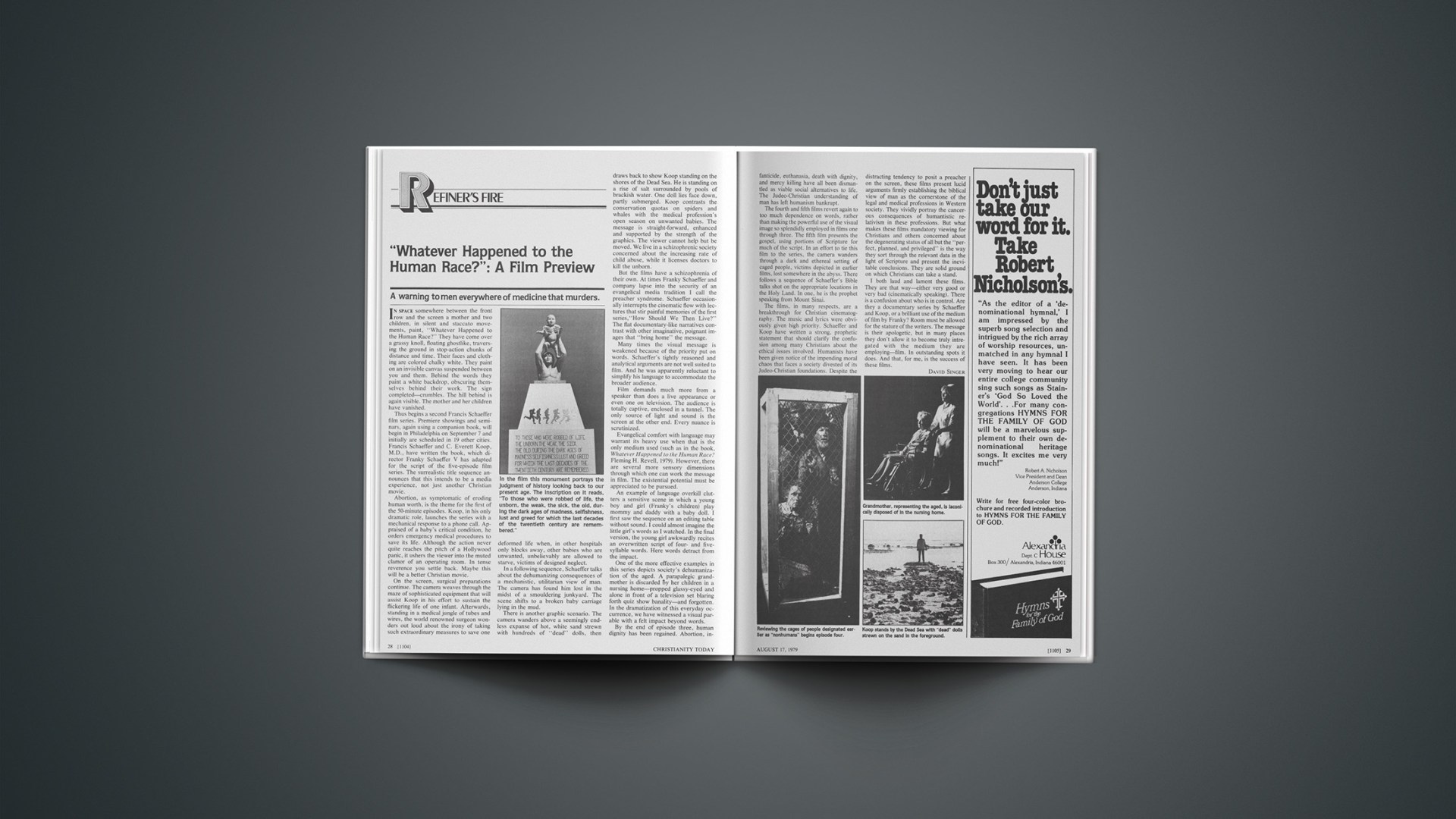
In space somewhere between the front row and the screen a mother and two children, in silent and staccato movements, paint, “Whatever Happened to the Human Race?” They have come over a grassy knoll, floating ghostlike, traversing the ground in stop-action chunks of distance and time. Their faces and clothing are colored chalky white. They paint on an invisible canvas suspended between you and them. Behind the words they paint a white backdrop, obscuring themselves behind their work. The sign completed—crumbles. The hill behind is again visible. The mother and her children have vanished.

Thus begins a second Francis Schaeffer film series. Premiere showings and seminars, again using a companion book, will begin in Philadelphia on September 7 and initially are scheduled in 19 other cities. Francis Schaeffer and C. Everett Koop, M.D., have written the book, which director Franky Schaeffer V has adapted for the script of the five-episode film series. The surrealistic title sequence announces that this intends to be a media experience, not just another Christian movie.

Abortion, as symptomatic of eroding human worth, is the theme for the first of the 50-minute episodes. Koop, in his only dramatic role, launches the series with a mechanical response to a phone call. Appraised of a baby’s critical condition, he orders emergency medical procedures to save its life. Although the action never quite reaches the pitch of a Hollywood panic, it ushers the viewer into the muted clamor of an operating room. In tense reverence you settle back. Maybe this will be a better Christian movie.

On the screen, surgical preparations continue. The camera weaves through the maze of sophisticated equipment that will assist Koop in his effort to sustain the flickering life of one infant. Afterwards, standing in a medical jungle of tubes and wires, the world renowned surgeon wonders out loud about the irony of taking such extraordinary measures to save one deformed life when, in other hospitals only blocks away, other babies who are unwanted, unbelievably are allowed to starve, victims of designed neglect.

In a following sequence, Schaeffer talks about the dehumanizing consequences of a mechanistic, utilitarian view of man. The camera has found him lost in the midst of a smouldering junkyard. The scene shifts to a broken baby carriage lying in the mud.

There is another graphic scenario. The camera wanders above a seemingly endless expanse of hot, white sand strewn with hundreds of “dead” dolls, then draws back to show Koop standing on the shores of the Dead Sea. He is standing on a rise of salt surrounded by pools of brackish water. One doll lies face down, partly submerged. Koop contrasts the conservation quotas on spiders and whales with the medical profession’s open season on unwanted babies. The message is straight-forward, enhanced and supported by the strength of the graphics. The viewer cannot help but be moved. We live in a schizophrenic society concerned about the increasing rate of child abuse, while it licenses doctors to kill the unborn.

But the films have a schizophrenia of their own. At times Franky Schaeffer and company lapse into the security of an evangelical media tradition I call the preacher syndrome. Schaeffer occasionally interrupts the cinematic flow with lectures that stir painful memories of the first series, “How Should We Then Live?” The flat documentary-like narratives contrast with other imaginative, poignant images that “bring home” the message.

Many times the visual message is weakened because of the priority put on words. Schaeffer’s tightly reasoned and analytical arguments are not well suited to film. And he was apparently reluctant to simplify his language to accommodate the broader audience.

Film demands much more from a speaker than does a live appearance or even one on television. The audience is totally captive, enclosed in a tunnel. The only source of light and sound is the screen at the other end. Every nuance is scrutinized.

Evangelical comfort with language may warrant its heavy use when that is the only medium used (such as in the book, Whatever Happened to the Human Race? Fleming H. Revell, 1979). However, there are several more sensory dimensions through which one can work the message in film. The existential potential must be appreciated to be pursued.

An example of language overkill clutters a sensitive scene in which a young boy and girl (Franky’s children) play mommy and daddy with a baby doll. I first saw the sequence on an editing table without sound. I could almost imagine the little girl’s words as I watched. In the final version, the young girl awkwardly recites an overwritten script of four- and five-syllable words. Here words detract from the impact.

One of the more effective examples in this series depicts society’s dehumanization of the aged. A parapalegic grandmother is discarded by her children in a nursing home—propped glassy-eyed and alone in front of a television set blaring forth quiz show banality—and forgotten. In the dramatization of this everyday occurrence, we have witnessed a visual parable with a felt impact beyond words.

By the end of episode three, human dignity has been regained. Abortion, infanticide, euthanasia, death with dignity, and mercy killing have all been dismantled as viable social alternatives to life. The Judeo-Christian understanding of man has left humanism bankrupt.

The fourth and fifth films revert again to too much dependence on words, rather than making the powerful use of the visual image so splendidly employed in films one through three. The fifth film presents the gospel, using portions of Scripture for much of the script. In an effort to tie this film to the series, the camera wanders through a dark and ethereal setting of caged people, victims depicted in earlier films, lost somewhere in the abyss. There follows a sequence of Schaeffer’s Bible talks shot on the appropriate locations in the Holy Land. In one, he is the prophet speaking from Mount Sinai.

The films, in many respects, are a breakthrough for Christian cinematography. The music and lyrics were obviously given high priority. Schaeffer and Koop have written a strong, prophetic statement that should clarify the confusion among many Christians about the ethical issues involved. Humanists have been given notice of the impending moral chaos that faces a society divested of its Judeo-Christian foundations. Despite the distracting tendency to posit a preacher on the screen, these films present lucid arguments firmly establishing the biblical view of man as the cornerstone of the legal and medical professions in Western society. They vividly portray the cancerous consequences of humantistic relativism in these professions. But what makes these films mandatory viewing for Christians and others concerned about the degenerating status of all but the “perfect, planned, and privileged” is the way they sort through the relevant data in the light of Scripture and present the inevitable conclusions. They are solid ground on which Christians can take a stand.

I both laud and lament these films. They are that way—either very good or very bad (cinematically speaking). There is a confusion about who is in control. Are they a documentary series by Schaeffer and Koop, or a brilliant use of the medium of film by Franky? Room must be allowed for the stature of the writers. The message is their apologetic, but in many places they don’t allow it to become truly intregated with the medium they are employing—film. In outstanding spots it does. And that, for me, is the success of these films.
Jews and Evangelicals: A Breech Born in Heaven?: Sorting out Faith and Culture

Assessing the risks of Jewish-Christian dialogue.

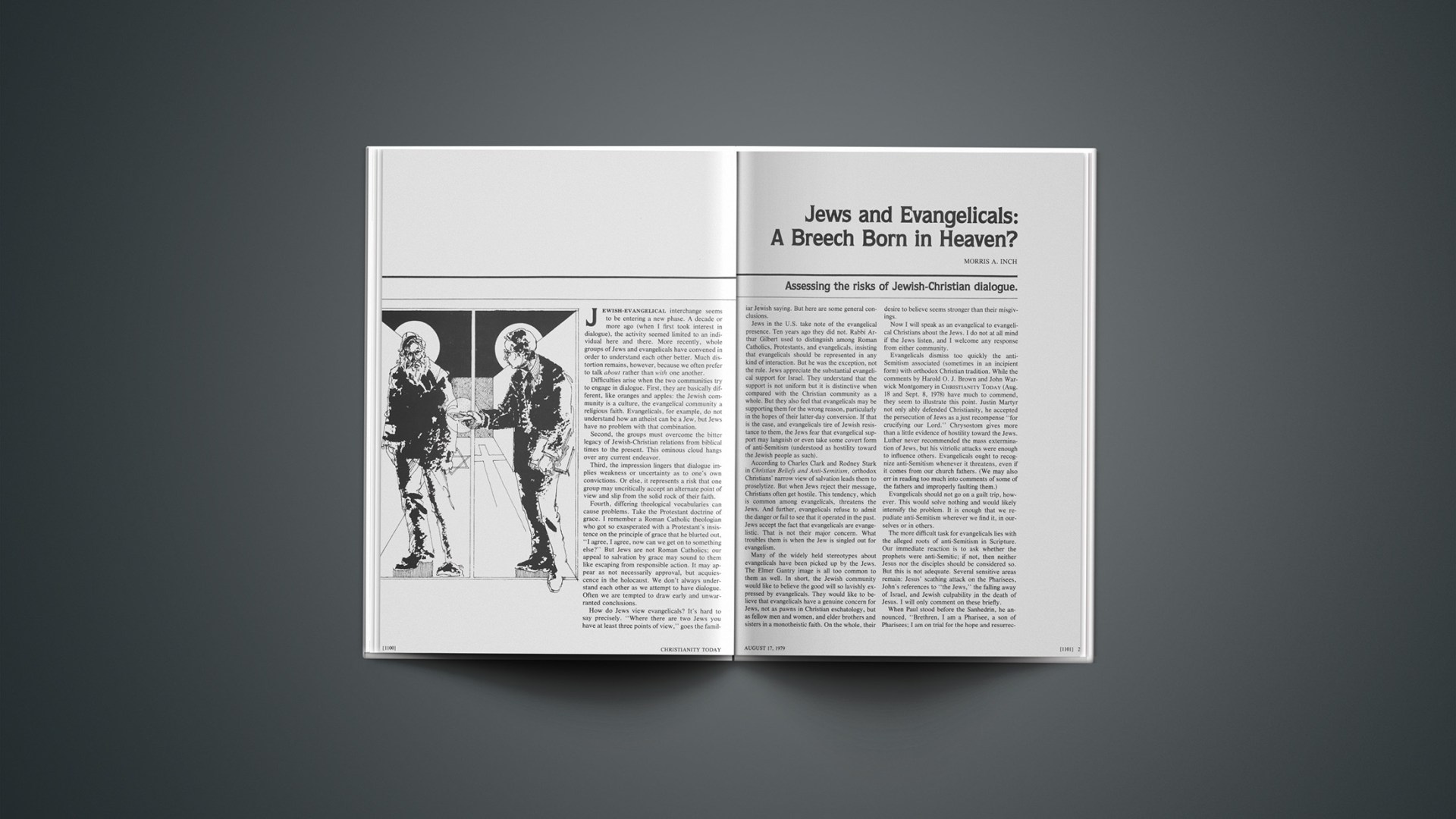
Jewish-evangelical interchange seems to be entering a new phase. A decade or more ago (when I first took interest in dialogue), the activity seemed limited to an individual here and there. More recently, whole groups of Jews and evangelicals have convened in order to understand each other better. Much distortion remains, however, because we often prefer to talk about rather than with one another.

Difficulties arise when the two communities try to engage in dialogue. First, they are basically different, like oranges and apples: the Jewish community is a culture, the evangelical community a religious faith. Evangelicals, for example, do not understand how an atheist can be a Jew, but Jews have no problem with that combination.

Second, the groups must overcome the bitter legacy of Jewish-Christian relations from biblical times to the present. This ominous cloud hangs over any current endeavor.

Third, the impression lingers that dialogue implies weakness or uncertainty as to one’s own convictions. Or else, it represents a risk that one group may uncritically accept an alternate point of view and slip from the solid rock of their faith.

Fourth, differing theological vocabularies can cause problems. Take the Protestant doctrine of grace. I remember a Roman Catholic theologian who got so exasperated with a Protestant’s insistence on the principle of grace that he blurted out, “I agree, I agree, now can we get on to something else?” But Jews are not Roman Catholics; our appeal to salvation by grace may sound to them like escaping from responsible action. It may appear as not necessarily approval, but acquiescence in the holocaust. We don’t always understand each other as we attempt to have dialogue. Often we are tempted to draw early and unwarranted conclusions.

How do Jews view evangelicals? It’s hard to say precisely. “Where there are two Jews you have at least three points of view,” goes the familiar Jewish saying. But here are some general conclusions.

Jews in the U.S. take note of the evangelical presence. Ten years ago they did not. Rabbi Arthur Gilbert used to distinguish among Roman Catholics, Protestants, and evangelicals, insisting that evangelicals should be represented in any kind of interaction. But he was the exception, not the rule. Jews appreciate the substantial evangelical support for Israel. They understand that the support is not uniform but it is distinctive when compared with the Christian community as a whole. But they also feel that evangelicals may be supporting them for the wrong reason, particularly in the hopes of their latter-day conversion. If that is the case, and evangelicals tire of Jewish resistance to them, the Jews fear that evangelical support may languish or even take some covert form of anti-Semitism (understood as hostility toward the Jewish people as such).

According to Charles Clark and Rodney Stark in Christian Beliefs and Anti-Semitism, orthodox Christians’ narrow view of salvation leads them to proselytize. But when Jews reject their message, Christians often get hostile. This tendency, which is common among evangelicals, threatens the Jews. And further, evangelicals refuse to admit the danger or fail to see that it operated in the past. Jews accept the fact that evangelicals are evangelistic. That is not their major concern. What troubles them is when the Jew is singled out for evangelism.

Many of the widely held stereotypes about evangelicals have been picked up by the Jews. The Elmer Gantry image is all too common to them as well. In short, the Jewish community would like to believe the good will so lavishly expressed by evangelicals. They would like to believe that evangelicals have a genuine concern for Jews, not as pawns in Christian eschatology, but as fellow men and women, and elder brothers and sisters in a monotheistic faith. On the whole, their desire to believe seems stronger than their misgivings.

Now I will speak as an evangelical to evangelical Christians about the Jews. I do not at all mind if the Jews listen, and I welcome any response from either community.

Evangelicals dismiss too quickly the anti-Semitism associated (sometimes in an incipient form) with orthodox Christian tradition. While the comments by Harold O. J. Brown and John Warwick Montgomery in CHRISTIANITY TODAY (Aug. 18 and Sept. 8, 1978) have much to commend, they seem to illustrate this point. Justin Martyr not only ably defended Christianity, he accepted the persecution of Jews as a just recompense “for crucifying our Lord.” Chrysostom gives more than a little evidence of hostility toward the Jews. Luther never recommended the mass extermination of Jews, but his vitriolic attacks were enough to influence others. Evangelicals ought to recognize anti-Semitism whenever it threatens, even if it comes from our church fathers. (We may also err in reading too much into comments of some of the fathers and improperly faulting them.)

Evangelicals should not go on a guilt trip, however. This would solve nothing and would likely intensify the problem. It is enough that we repudiate anti-Semitism wherever we find it, in ourselves or in others.

The more difficult task for evangelicals lies with the alleged roots of anti-Semitism in Scripture. Our immediate reaction is to ask whether the prophets were anti-Semitic; if not, then neither Jesus nor the disciples should be considered so. But this is not adequate. Several sensitive areas remain: Jesus’ scathing attack on the Pharisees, John’s references to “the Jews,” the falling away of Israel, and Jewish culpability in the death of Jesus. I will only comment on these briefly.

When Paul stood before the Sanhedrin, he announced, “Brethren, I am a Pharisee, a son of Pharisees; I am on trial for the hope and resurrection of the dead!” (Acts 23:6, NASB). He did not say that he had been a Pharisee prior to his experience with Christ on the way to Damascus. Now Paul hardly would have said that he was a Pharisee if Jesus had categorically denounced all Pharisees as hypocrites. It would also be difficult to appreciate Jesus’ warning to the disciples to “beware the leaven of the Pharisees” (Luke 12:1), as if the disciples might fall prey to the same hypocrisy. We must not interpret selective attack on the Pharisees to apply to Pharisees in general, much less to Jews as a whole.

John’s references to “the Jews” reflect the growing separation of Christians (both Jew and Gentile) and the Jewish community as distinguished from them (see also 1 Thess. 2:14–16). He uses the term in contrast to the disciples of Jesus, whether Jew or Gentile (John 5:16, 18; 7:13; 9:18; 10:31; 11:19; 18:36). At one point (John 4:22), he breaks the pattern to record Jesus’ comment that “salvation is from the Jews.” If we do not read more into the phrase than John intends, we will find no basis for anti-Semitism.

Paul carefully orchestrates the theme of Israel’s falling away (already familiar from the prophets) and the ingathering of the nations (anticipated in the prophets). He asserts that the falling away provides no cause for the Gentiles to become complacent or arrogant (Rom. 11:18), and the ingathering is to make the Jews jealous (Rom. 11:11). Concerning the obstinate nature of his people, Paul concludes, “I say then, God has not rejected his people, has he? May it never be! For I too am an Israelite, a descendant of Abraham, of the tribe of Benjamin” (Rom. 11:1, NASB). NO fair appraisal of these words can justify hostility toward the Jews.

The question of Jewish responsibility for Jesus’ death has been variously understood. Some even charge the Jews with deicide. When Rabbi Gilbert asked my opinion years ago, I replied that Jesus died for the sins of all humanity, and that the sins of the Jews should not be singled out. I still feel comfortable with that answer.

What shall we draw from these brief observations? The conditions that gave rise to anti-Semitism are already in place: the establishment of Christianity as distinct from the Jewish community as such, persecution, and the increase of partisan polemics. But Christians were admonished by teaching and example to love rather than hate the Jews, and as grafted branches not to boast over those who were originally part of the vine.

This point is critical for evangelicals because they take Scripture seriously. They can discover in Scripture the circumstances that gave rise to anti-Semitism, but they will find no justification for walking that dismal road. In fact, the reverse is true. The pages plead for them to love all humanity, the Jew no less than any other. Dietrich Bonhoeffer wrote, “We cannot hate what God has created and claim to love Him.” Anti-Semitism is a denial of the evangelical faith.

Evangelicals would do well to keep in mind a corrective to anti-Semitism: we ought to see in Israel both the wrath and the mercy of God, not wrath alone. And we ought to weigh our own standing before God in terms of his mercy and wrath, not mercy alone. This balance will help us immeasurably as we confront the Jew.

Jews are a part of this beloved world, not a device to trigger the end days. Love them for themselves; help them as we would help others; build bridges of friendship.

And what of evangelism? Evangelicals have the feeling that if something moves, we must convert it. We are too concerned with visible results. It is our responsibility to share our faith with whoever cares to hear, but the results are in God’s hands.

We should also keep in mind the striking similarities between Jews and evangelicals: the high regard for Scripture; allegiance to the God of Abraham, Isaac, and Jacob; the awareness of being a people of God; common elements in ritual and worship; the legacy of suffering for our faith; and a hope that transcends all the tragic events of life. However we wish to explain it, we have a special kinship. That, too, should be part of our approach to the Jew.

Samuel Schultz shared with me an experience that illustrates this kinship. One day he was waiting to view the famous Isaiah scroll and two bearded rabbis stood in line before him. When they came to the scroll, they stood transfixed before the ancient text while tears trickled down their faces. Once they gained their composure, they moved quickly on their way, probably without knowing how deeply my friend would identify with their response to the sacred text. They were, each in his own way, people of the Book.

I conclude with an appeal to dialogue. By nature dialogue suggests the willingness to hear and be heard. It suggests that we go beyond speaking at Jews to speaking with them. Rightly understood, dialogue does not compromise the integrity of those who participate or the communities they represent. I have never met a person I could not learn from or one so profound that I had nothing to offer in return. The opportunity today for Jewish-evangelical dialogue is unprecedented. With these thoughts in mind, therefore, let us proceed with care, but proceed nonetheless.

G. Douglas Young is founder and president of the Institute of Holy Land Studies in Jerusalem. He has lived there since 1963.

When Is a Missionary Not a Missionary?: Defining the Nature of God’s Special Call

Current definitions of this key word give negative guidance.

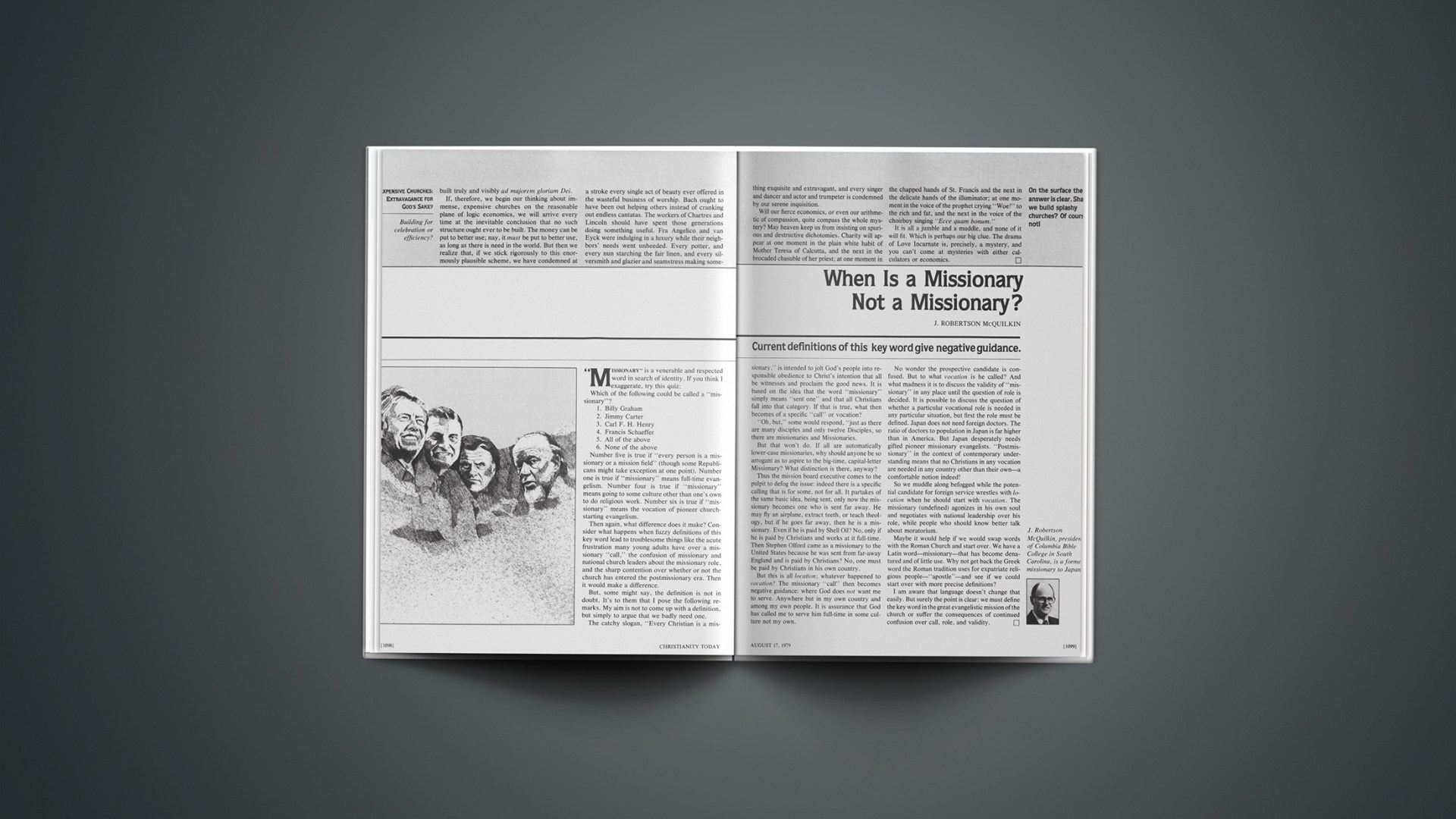
Missionary” is a venerable and respected word in search of identity. If you think I exaggerate, try this quiz:

Which of the following could be called a “missionary”?

1. Billy Graham

2. Jimmy Carter

3. Carl F. H. Henry

4. Francis Schaeffer

5. All of the above

6. None of the above

Number five is true if “every person is a missionary or a mission field” (though some Republicans might take exception at one point). Number one is true if “missionary” means full-time evangelism. Number four is true if “missionary” means going to some culture other than one’s own to do religious work. Number six is true if “missionary” means the vocation of pioneer church-starting evangelism.

Then again, what difference does it make? Consider what happens when fuzzy definitions of this key word lead to troublesome things like the acute frustration many young adults have over a missionary “call,” the confusion of missionary and national church leaders about the missionary role, and the sharp contention over whether or not the church has entered the postmissionary era. Then it would make a difference.

But, some might say, the definition is not in doubt. It’s to them that I pose the following remarks. My aim is not to come up with a definition, but simply to argue that we badly need one.

The catchy slogan, “Every Christian is a missionary,” is intended to jolt God’s people into responsible obedience to Christ’s intention that all be witnesses and proclaim the good news. It is based on the idea that the word “missionary” simply means “sent one” and that all Christians fall into that category. If that is true, what then becomes of a specific “call” or vocation?

“Oh, but,” some would respond, “just as there are many disciples and only twelve Disciples, so there are missionaries and Missionaries.

But that won’t do. If all are automatically lower-case missionaries, why should anyone be so arrogant as to aspire to the big-time, capital-letter Missionary? What distinction is there, anyway?

Thus the mission board executive comes to the pulpit to defog the issue: indeed there is a specific calling that is for some, not for all. It partakes of the same basic idea, being sent, only now the missionary becomes one who is sent far away. He may fly an airplane, extract teeth, or teach theology, but if he goes far away, then he is a missionary. Even if he is paid by Shell Oil? No, only if he is paid by Christians and works at it full-time. Then Stephen Olford came as a missionary to the United States because he was sent from far-away England and is paid by Christians? No, one must be paid by Christians in his own country.

But this is all location; whatever happened to vocation? The missionary “call” then becomes negative guidance: where God does not want me to serve. Anywhere but in my own country and among my own people. It is assurance that God has called me to serve him full-time in some culture not my own.

No wonder the prospective candidate is confused. But to what vocation is he called? And what madness it is to discuss the validity of “missionary” in any place until the question of role is decided. It is possible to discuss the question of whether a particular vocational role is needed in any particular situation, but first the role must be defined. Japan does not need foreign doctors. The ratio of doctors to population in Japan is far higher than in America. But Japan desperately needs gifted pioneer missionary evangelists. “Postmissionary” in the context of contemporary understanding means that no Christians in any vocation are needed in any country other than their own—a comfortable notion indeed!

So we muddle along befogged while the potential candidate for foreign service wrestles with location when he should start with vocation. The missionary (undefined) agonizes in his own soul and negotiates with national leadership over his role, while people who should know better talk about moratorium.

Maybe it would help if we would swap words with the Roman Church and start over. We have a Latin word—missionary—that has become denatured and of little use. Why not get back the Greek word the Roman tradition uses for expatriate religious people—“apostle”—and see if we could start over with more precise definitions?

I am aware that language doesn’t change that easily. But surely the point is clear: we must define the key word in the great evangelistic mission of the church or suffer the consequences of continued confusion over call, role, and validity.

G. Douglas Young is founder and president of the Institute of Holy Land Studies in Jerusalem. He has lived there since 1963.

Expensive Churches: Extravagance for God’s Sake?: Building for Celebration or Efficiency?

If holiness is beautiful, dare churches be drab?

The question before us, as I understand it, might be put like this: “What about splashy churches?” That is to say, ought the Christian church to pour enormous amounts of cash into erecting tremendous edifices to house its activities?

The question is not a new one. And before one has got through trying to arrange the issues that come crowding along the minute the question is asked, he has discovered that it opens out onto gigantic imponderables.

On the surface, the answer is clear. Indeed, it would hardly seem to admit of any discussion at all. Shall we build splashy churches? Of course not. Who do we think we are? Whom do we follow anyway? The pioneer of our faith never set about to upstage Nebuchadnezzar and Caesar. He never built so much as a lean-to for his followers, nor left any blueprint for such a structure. Let the pomps of Babylon and Rome memorialize themselves with golden images and arches of triumph, for they are all, precisely, Babylon and Rome. The pomps and triumphs of the kingdom of heaven are of such unlikely and unimpressive kinds as a girdle of camel’s hair and a colt, the foal of an ass. Fasting in the desert. No gold, nor silver, nor scrip, neither two coats, nor shoes, nor staves. A borrowed room upstairs; a borrowed grave. Come—why waste time even raising the question?

It seems to me that arguments against the proposal that we build big churches group themselves under at least four headings, although there are, no doubt, more than that. And underlying all of the four would be the whole prophetic biblical picture that would seem to rule out the enterprise to begin with. The headings under which we may group some of the arguments against our building huge and expensive churches would seem to be (perhaps on a rising scale of weightiness): taste, efficiency, imagery, and economics.

1. Taste. From a merely aesthetic and architectural point of view, what sort of harmony can we discern between what the Christian church is supposed to be and what these gigantic piles look like? Surely this is a basic principle of aesthetics, and hence of architecture: the thing you are making ought to answer somehow to its use. The form articulated in the stone or brick or concrete (the World Trade Center, the Whitney Museum, the Opera in Paris) should address exactly the idea at work in the enterprise. Let us leave on one side for the moment medieval cathedrals and abbeys. The question being put to us here is whether we ought to be building big churches. The twelfth-century achievement is a fait accompli, and hence beyond our immediate reach.

But what about the churches that are being built now? Anyone with semi-civilized taste would have to grimace at most of them: great, looming, sprawling “plants,” all landscaped and tricked out like suburban office parks. Alack! We perceive millions of dollars’ worth of bricks and ersatz-Colonial woodwork, bland and functional, all announcing, “Get a load of the size of this operation.” One wants to creep under the nearest cabbage leaf in sheer embarrassment.

But that is all a matter of taste. My point is simply to observe that the category of taste does, in fact, carry some possible arguments against building expensive churches. The fact that there are some churches being built here and there that might be candidates for genuine architectural immortality (Le Corbusier, for example) would carry us into later categories in this discussion. A corollary consideration, of course, still under this heading, is the awkward fact that we don’t seem able very often to achieve good taste either expensively or cheaply; we are as likely to erect a botch if we scrimp as if we lavish. And the final, obvious factor is that for any Christian, taste is a highly ambiguous business in any event, since it seems to be more or less irrelevant to the category “sanctity,” which is all that seems to matter when the chips are down—at least, if we take our cues from the prophets, the apostles, and the Lord’s teaching.

2. Efficiency. Look at all that gaping space standing vacant for six days out of every seven. Think of the fuel being pumped into the furnace just to keep the cavern at 50 degrees. And the classrooms! Who can justify all this?

Of course, some churches can respond that they are, in fact, using the space quite efficiently, and that countless meetings, both of parish and of community activities, occur all week long. Fair enough. The rejoinder to this often takes the form of a suggestion that homes and rented rooms about town might serve as well for most of what we house in these big plants. After all, the church is supposed to keep it simple. While I am not asked to settle that phase of the discussion, I suppose that if I were forced to take up a position here, I would want to raise the prior question of whether the church, locally, should ever be big. When you get 2,000 people in the assembly, is it still possible to live the corporate, disciplined, mutual, sacramental life that is the apostolic pattern, and which we have no choice but to follow?

3. Imagery. This category is, perhaps, almost indistinguishable from the first category of taste. It seems to me, however, that there is a different nuance here, beyond the merely immediate business of some congregation’s erecting of an immensity that signals “Money! Success! Great fund raising techniques!” to the local populace. We address rather the whole question of the image of what the church is in history. Shall we have a pilgrim imagery, or a triumphalist imagery? Do we want to herald Christ as reigning gloriously over all the works of man, or as kneeling with a towel? Do we hail human imagination with Annunciation, Transfiguration, and Ascension in what we build, or with kenosis, Nazareth, and Golgotha? Shall it be the prince St. Vladimir, or St. Francis? Shall it be the rich Joseph of Arimathea, or Martha of Bethany? Michael the Archangel or Mother Teresa?

At this point, many Christians may want to shout, Wait! We can’t quite separate all that out. There must be some paradoxes there: Christ’s majesty and his humility; Christ as conqueror and as servant; the church as glorious and as pilgrim; the gospel as both the fulfillment and the antithesis of human aspiration; both gold and sackcloth as images that must be kept alive; the feast table that is also an altar; the sword and the healing hands; sceptre and towel; terror and comfort. We have a jumble of contradictions—all symbolizing the paradoxes roused by the appearance of the ineffable in the middle of our ordinariness.

But I am ahead of my argument. Here I would point out that there is an argument that proceeds from the problem of imagery. For what exactly does the church wish to signal, if anything at all, in its buildings? Christians in Chartres, Bec, and Amiens, had one idea. The First Church in Americasville that has just finished its $3 million plant has another. And Christians meeting upstairs in a rented Elks hall in Altoona have yet another.

4. Economics. What we mean is biblical economics. How on earth can we justify vast sums of money when half the world is starving? The equation is outrageous. Have we never read the prophets? Who among us wants to be found at Dives’s table in this era of widespread poverty? But, alas, all of us sojourners in America are at Dives’s table, strip down as we will.

Can we not, then, conclude that the case is clear? In the light of such considerations, is there any doubt about the answer we should give to the question of erecting opulent church buildings? It would seem not. If taste, efficiency, imagery, and economics mean anything, then it would appear that the pouring of immense sums into church buildings is at least grotesquely inappropriate, if not immoral, in this age.

But we cannot quite leave it at that. There are at least two matters left dangling if we close off the discussion here.

First, there is the vexed question of what sum we should arrive at as a “Christian” ceiling for church building expenditure. If it is granted at all that there should be a roof over the heads of God’s gathered people, and if all of them are not to meet forever in borrowed Elks halls, then how much shall we allot as a permissible per capita (or per communicant) outlay? Immediately, we meet a dozen sliding factors such as size of congregation, geographical location, labor costs, material costs, inflation, depression, desired durability of structure (grass? wood? adobe?), appropriateness to local culture (is it rural Idaho, urban Zaire, or suburban Mexico City we are talking about?), demands of the ministries carried on by the congregation in question, and willingness of the Christians to contribute offerings for the structure. Unless we grip things in some doctrinaire and bureaucratic headlock in the interest of Christian “economics,” we will all hesitate to come up with a maximum or a minimum figure. Who knows what is appropriate?

From our editorial desks it is easy to pontificate about how Christians all over the world are to budget their money. But then we stumble into a culture somewhere whose whole vision of what is supremely precious knocks into a cocked hat those ferocious prescriptions we thought we were inferring so precisely from prophetic biblical texts. Any reflective Christian would wish to receive hesitantly those shrill encyclicals handed out as “biblical” from theorists who claim to have found the right formula.

It is awkward, of course, that neither the Lord nor the apostles ventured to hammer out an economic system. What was surely needed was the overthrow of the “system” under which humanity then staggered—as avaricious and unjust a system as any modern Marxist or capitalist has devised. But they seemed rather to appeal to prior principles—don’t be greedy, give extravagantly, care for the poor and oppressed—that would work themselves out visibly in the Christian community, as a sign in Rome and Babylon of the kingdom of heaven.

Which of us has a warrant to walk up to a church building, point the finger, and say, “That is a sin”? That is the sort of inquisitorial righteousness the Pharisees excelled in, for they knew what was wrong with everyone, and were prepared to assign guilt. How do I know, when I approach some painstakingly-made and exquisitely-crafted church building in Asia or Austria—or America—whether what I am looking at represents the pig-eyed egoism of some hard-sell preacher or the loving offering to God of the resources and labor of his people in this locale? My theories may shout one thing at me; I had better hold them tentatively and humbly.

I may think I know that the money in question should have been used for some other, more urgent purpose (and I must confess that most of the time I do think this). But one has to watch out when commenting on others’ offerings—spikenard, and that sort of thing.

This raises the second matter that must be stirred into our thinking before we close off the discussion. It is the mystery of the eternal in time; the mystery of the ineffable appearing in visible form. On this frontier we have awful paradoxes, and God deliver us from flattening them all out in the name of logic, pragmatism, economics, or even compassion. Here there will be things that defy our calculations. For example, there is a tabernacle made extravagantly, lavishly, wastefully even, of gold and acacia and fine-twined linen, for the inefficient purposes of the cult of a God named Yahweh. There were people who could have used those funds.

But here the objection may be raised that this is an old covenant item: everything has been superseded in the new. All that visible imagery is now brought to its fulfillment and enacted in the tabernacle of our flesh. It is charity of life, and not gold and acacia, that is to announce “holiness unto the Lord” now.

While this is true and taught in the epistle to the Hebrews, the whole thrust of the epistle—and indeed of the whole new covenant—surely drives us into deeper, not shallower channels. It does not end the offering of the works of our hands to Yahweh, but rather places these offerings in the greater context of charity. It is not mere gold I am after, says the Lord, it is your heart. Learn to love me above all, and your neighbor next. And then make your offerings. All of your work—your domestic routines, your professional duties, your skills and your crafts, your sculptures and dances and poetry, along with your limitations and your sufferings and your gold and silver—bring it all to me. For in the oblation of these you signal their redemption from the profanity that you brought on things by trying to seize them for your own in Eden, and you will herald the joyous return to the seamless goodness of Creation.

But how did we get from expensive churches to Eden and the hallowing of Creation? Was it not by reflecting on the mystery of the eternal in time? Heaven, in finding its way into our history, does not always do things the way our schemes might have thought it should. It calls us, for example, to feed the hungry—but then it asks us to bring lambs, bullocks, and doves to the altar, which is a waste of meat. Mary and Joseph could have put those poor turtle doves to much more obviously charitable uses. The woman with her costly ointment could have done better than to pour it out in a hysterical act of rhapsodic penitentiality and adoration. And, while the suggestion was made, it was silenced, and her waste was extolled and held up for the honor and emulation of all humanity forever.

The forerunner of the Messiah might have done better to preach insurrection against the system, since that, surely, was by far the worst evil abroad. But instead he, and the Messiah after him, called on everyone to be baptized. That is most impractical and futile business, unless it is acknowledged that the visible tokens and vehicles of the eternal will not always make sense on a pragmatic accounting. The kingdom of heaven does not come always and strictly in plausible economic terms. It may do so, to be sure. But it will escape even that category from time to time—in spilled spikenard (a waste), or in a bunch of yellow roses taken to a shut-in (why not feed the old woman?), or in a song composed and sung as an act of praise (no bread is buttered), or (even) in a church built truly and visibly ad majorem gloriam Dei.

If, therefore, we begin our thinking about immense, expensive churches on the reasonable plane of logic economics, we will arrive every time at the inevitable conclusion that no such structure ought ever to be built. The money can be put to better use; nay, it must be put to better use, as long as there is need in the world. But then we realize that, if we stick rigorously to this enormously plausible scheme, we have condemned at a stroke every single act of beauty ever offered in the wasteful business of worship. Bach ought to have been out helping others instead of cranking out endless cantatas. The workers of Chartres and Lincoln should have spent those generations doing something useful. Fra Angelico and van Eyck were indulging in a luxury while their neighbors’ needs went unheeded. Every potter, and every nun starching the fair linen, and every silversmith and glazier and seamstress making something exquisite and extravagant, and every singer and dancer and actor and trumpeter is condemned by our serene inquisition.

Will our fierce economics, or even our arithmetic of compassion, quite compass the whole mystery? May heaven keep us from insisting on spurious and destructive dichotomies. Charity will appear at one moment in the plain white habit of Mother Teresa of Calcutta, and the next in the brocaded chasuble of her priest; at one moment in the chapped hands of St. Francis and the next in the delicate hands of the illuminator; at one moment in the voice of the prophet crying “Woe!” to the rich and fat, and the next in the voice of the choirboy singing “Ecce quam bonum.”

It is all a jumble and a muddle, and none of it will fit. Which is perhaps our big clue. The drama of Love Incarnate is, precisely, a mystery, and you can’t come at mysteries with either calculators or economics.

G. Douglas Young is founder and president of the Institute of Holy Land Studies in Jerusalem. He has lived there since 1963.

Cautions against Ecclesiastical Elegance: Ambiguities in an Age of Hunger

Presenting affluence and preaching sacrifice.

In early 1976, Eastminster Presbyterian Church in suburban Wichita, Kansas, had an ambitious—and expensive—church construction program in the works. Their architect had prepared a $525,000 church building program. Then a devastating earthquake struck in Guatemala on February 4, destroying thousands of homes and buildings. Many evangelical congregations lost their churches.

When Eastminster’s board of elders met shortly after the Guatemalan tragedy, a layman posed a simple question: “How can we set out to buy an ecclesiastical Cadillac when our brothers and sisters in Guatemala have just lost their little Volkswagen?”

The elders courageously opted for a dramatic change of plans. They slashed their building program by nearly two-thirds and settled instead for church construction costing $180,000. Then they sent their pastor and two elders to Guatemala to see how they could help. When the three returned and reported tremendous need, the church borrowed $120,000 from a local bank and rebuilt 26 Guatemalan churches and 28 Guatemalan pastors’ houses.

I talked recently with Eastminster’s pastor, Dr. Frank Kirk. Eastminster stays in close touch with the church in Central America and has recently pledged $40,000 to an evangelical seminary there. The last few years have seen tremendous growth—in spiritual vitality, concern for missions, and even in attendance and budget. Dr. Kirk believes that cutting their building program to share with needy sisters and brothers in Guatemala “meant far more to Eastminster Presbyterian than to Guatemala.”

The Eastminster Presbyterian congregation asked the right questions. They asked whether their building program was justified at this moment in history given the particular needs of the body of Christ worldwide and the mission of the church in the world. The question was not, Are gothic (or glass) cathedrals ever legitimate? It was rather: Was it right to spend $3.9 billion (in 1967 dollars) on church construction in the 1970s, when over 2.5 billion people had not yet heard of Jesus Christ and when one billion people were starving or malnourished?

Almost all (five out of six) of the more than 2.5 billion persons who have not heard of Jesus Christ live in social groupings and subnations where the church has not yet effectively taken root. Cross-cultural missionaries are needed. Gottfried Osei-Mensah, executive secretary of the Lausanne Committee on World Evangelization, recently called on every 1,000 evangelicals to send one missionary couple to these unreached peoples. That can be done—but it requires that the church live a simpler lifestyle, as called for in the Lausanne Covenant.

The grim realities of world hunger also raise questions about expensive church construction. The World Food Council recently reported that “up to one-third of all children born alive die from malnutrition or (malnutrition-induced) diseases before the age of five.” At least five hundred million and perhaps as many as one billion persons are starving and/or malnourished. The National Academy of Science published a study in 1977 in which it was stated that “seven hundred and fifty million people in the poorest nations live in extreme poverty with annual incomes of less than $75.” In the U.S., on the other hand, the middle class feels poor when it makes only $15,000, $18,000, or even $25,000 each year (“The Middle Class Poor,” Newsweek, Oct. 1977). We are 14 times as rich as the average person in India and the gap continues to widen. It is in that kind of world that North American congregations must decide whether buying expensive organs, rugs, and multimillion dollar cathedrals is justified.

What biblical teaching is relevant to that decision?

First, this created world is a beautiful and good gift from our Father. Our places of worship ought to be a joyful celebration of his gorgeous gift.

Second, Christians are not committed to a simple lifestyle: we are committed to Jesus Christ. We are, therefore, also committed to faithful participation in the mission of our servant King in a lost, broken world. It is because two and a half billion have never heard the gospel and because perhaps as many as one billion people are starving or malnourished that Christians today must question expensive church construction.

Third, God is on the side of the poor and oppressed. But do not misunderstand this—I do not mean that poverty is the biblical ideal. Nor do I mean that the poor are Christians just because they are poor, nor that God cares more about the salvation of the poor than the salvation of the rich.

But the Bible does teach three things:

1. At the central moments of revelation history (e.g., the Exodus, the destruction of Israel and Judah, and the Incarnation), the Bible repeatedly says that God acted not only to call out a chosen people and reveal his will (although he certainly did that), he also acted to liberate poor, oppressed folk (Exod. 3:7–9; 6:5–7; Deut. 26:5–8; Amos 6:1–7; Isa. 10:1–4; Jer. 5:26–29; Luke 4:16–21).

2. God acts in history to pull down the unjust rich and to exalt the poor (Luke 1:46–53; 6:20–25; James 5:1). And God does this both when the rich get rich by oppression (James 5:3–5; Ps. 10; Jer. 5:26–29; 22:13–19; Isa. 3:14–26) and also when they are rich and fail to share (Ezek. 16:49–50).

3. The people of God, if they are really the people of God, are also on the side of the poor (Matt. 25:31–46; Luke 14:12–14; 1 John 3:16–18; Isa. 1:10–17; 58:3–7).

If we want to worship, we must also imitate the God who, Scripture says, is on the side of the poor.

Fourth, the uniform teaching of Scripture in both Old and New Testaments is that God wills transformed economic relationships among his people. God desires major movement toward economic equality in the new society of the church. Paul’s advice to Greek-speaking, European Christians collecting an offering for Aramaic-speaking, Asian Christians puts it bluntly: “I do not mean that others should be eased and you burdened, but that as a matter of equality your abundance at the present time should supply their want so that their abundance should supply your want, that there may be equality” (2 Cor. 8:13–14).

If we examine what the Bible says about economic relationships among the people of God, we will discover that over and over again God specifically commanded his people to live together in community in such a way that they would avoid extremes of wealth and poverty. That is the point of Old Testament legislation on the jubilee (Lev. 25) and sabbatical years (Deut. 15), on tithing (Deut. 14:28–29), gleaning (Deut. 24:19–22), and loans (Exod. 22:25).

Jesus, our only perfect model, shared a common purse with the new community of his disciples (John 12:6). The first church in Jerusalem (Acts 2:43–47; 4:32–37) and Paul in his collection (2 Cor. 8–9) were implementing what the Old Testament and Jesus had commanded.

Compare that with the contemporary church. Present economic relationships in the worldwide body of Christ are unbiblical, sinful, a hindrance to evangelism, and a desecration of the body and blood of Jesus Christ. The dollar value of the food North Americans throw in the garbage each year equals about one-fifth of the total annual income of Africa’s 120 million Christians. It is a sinful abomination for a small fraction of the world’s Christians living in the Northern Hemisphere to grow richer year by year while our brothers and sisters in Christ in the Third World ache and suffer for lack of minimal health care, minimal education, and, in thousands and thousands of cases, just enough food to escape starvation.

We are like the rich Corinthian Christians who feasted without sharing their food with the poor members of the church (1 Cor. 11:20–29). Like them, we fail today to discern the reality of the one worldwide body of Christ (v. 29). The tragic consequence is that we profane the body and blood of the Lord Jesus we worship. Christians in the United States spent $5.7 billion on new church construction alone in the six years from 1967–72. Would we go on building lavishly furnished, expensive church plants and adding air conditioning, carpeting, and organs if members of our own congregations were starving?

These biblical principles lead me to question much of the church construction in affluent nations at this moment in history. But not everyone agrees.

One of the most common reasons advanced for erecting expensive church facilities is that they attract individuals to the church and thus have an evangelistic impact. Robert Schuller defends his multimillion dollar church plant in this way:

“We are trying to make a big, beautiful impression upon the affluent non-religious American who is riding by on this busy freeway. It’s obvious that we are not trying to impress the Christians!… Nor are we trying to impress the social workers in the County Welfare Department. They would tell us that we ought to be content to remain in the Orange Drive-In Theater and give the money to feed the poor. But suppose we had given this money to feed the poor? What would we have today? We would still have hungry, poor people and God would not have this tremendous base of operations which He is using to inspire people to become more successful, more affluent, more generous, more genuinely unselfish in their giving of themselves” (Your Church Has Real Possibilities [Regal Books, 1974], p. 117).

But several questions arise: Does God really want rich North Americans to be still more affluent? Do people who are attracted to that kind of church really give more generously to world evangelism and a biblically-grounded search for justice for the poor? Are we attracting people to the kind of God the Bible says Yahweh is—or are we attracting them to a God made in the image of affluent North Americans? The programmatic account in Luke 4:16–21 makes it very clear that preaching to the poor, releasing captives, and liberating the oppressed were central to Jesus’ mission. Is a multimillion dollar church building the best setting for calling people to follow that kind of Lord?

I feel more ambiguity about a second objection: “Since the good Creator has made such a gorgeously beautiful world, our places of worship ought to reflect that splendor. And that costs money.” Now, I must confess that I love Gothic cathedrals. (I suspect, however, that if the medieval church had devoted more resources to the kind of economic sharing across class and ethnic lines exhibited in the New Testament, the church would have been much stronger.) Certainly the good Creator has no interest in drab, dreary churches. He loves celebration and beauty. But need that always be expensive? Joyful, colorful banners and Spirit-filled singing can enliven even cheerless community centers and school auditoriums.

Some things, of course, are invariably costly. You cannot produce good organ music from burlap banners. Actually, I would not have too much trouble with one “cathedral” built to celebrate the splendor of the Creator in each larger population center if all Christ’s body in that area could share it. But most of the expensive church plants I know are for the exclusive use of rich suburban folk rather than for the poor, blacks, and Hispanics.

More intensive use of existing church buildings or other buildings that stand idle on Sunday would make much church construction unnecessary. At Dallas’s Fellowship Bible Church (Gene Getz, pastor), four different congregations use one sanctuary. Obviously, a bit of flexibility is necessary. One congregation meets on Friday evening, two on Sunday morning (8:00 and 10:45) and one on Sunday evening.

Philadelphia’s Living Word Community used a different approach when their congregation outgrew the original downtown structure, which seated about 400. They subdivided into two (and later, four) weekend gatherings for worship. One group continued to use the downtown church. But the second group (and then the third and fourth groups) arranged to meet in a school auditorium or a warehouse or in church buildings that were available on Saturday or Sunday evenings. The absence of costly building programs has provided large financial resources for more significant programs. (And it certainly hasn’t hindered church growth!)

Howard Snyder suggested in The Problem of Wineskins that the early church’s model of house churches meeting in private homes was an inexpensive way to begin new congregations in the city. Unfortunately, many denominational church-extension agencies assume that the first step in starting a new congregation is to purchase land for a new building. In my own church, Jubilee Fellowship of Germantown, we discovered that when we grew too large for the delightfully informal atmosphere of private homes, a local community center was adequate.

But not all church construction is wrong. What we need are guidelines to help a congregation decide when it ought to build a new church or expand existing facilities. Obviously there are no revealed norms. And woe betide those who dare to try, legalistically and self-righteously, to impose their hunches on others! But, does that mean that each congregation should do what is right in its own eyes?

That is the typical, individualistic American approach. But it is not the biblical pattern. Certainly each individual and each congregation should pray and seek the Spirit’s guidance for themselves. But they should also solicit the advice and wisdom of the other members of the body of Christ as they endeavor to apply biblical principles in today’s world. And that worldwide body includes not just other affluent North American congregations who have lovely facilities that others would love to duplicate. It also includes poor, inner-city churches struggling to meet minimal budgets, and Third World churches where sisters and brothers in Christ cannot afford minimal health care, adequate clothing, or elementary education for their children. Defending our building programs before their church boards would dramatically alter the discussion.

Would it be possible to develop a set of guidelines for future church construction in North America resulting from dialogue with all segments of the body of Christ worldwide? I offer the following as an attempt to begin such a dialogue:

1. Carefully explore the relevant biblical teaching. The congregation should spend a couple of months studying how the Bible’s teaching about God’s special concern for the poor and about redeemed economic relationships among the worldwide body of Christ relates to its proposed plans. Sermons, Sunday school sessions, prayer meetings, and fellowship evenings would all be appropriate for this.

2. Study the world scene today. Carefully analyze, as a congregation, the current needs for both world evangelism and relief, development and justice programs abroad.

3. Examine your motives with ruthless honesty. Ask questions such as: Do we want a new (or larger or renovated) building because it is necessary to carry on the biblically defined mission of the church, or because other Christian congregations (of our social status) have similar facilities? How many of the items (carpet, organ, etc.) are necessary and how many are planned “because that’s the way they are doing things these days”?

4. Explore alternate ways to meet the same need. Can we use other facilities in the community instead? Could a second congregation use our present church facility on Saturday evening or Sunday afternoon? Would we be willing to make modest changes in our traditional time of worship in order to free resources for worldwide evangelism? If not, what does that say about our priorities?

5. Consider the effect of the new facilities on the thinking and activity of your members. Will the new building (or organ) help the members of the congregation identify more easily with the poor? If new facilities require a new location, will the new location make it easier to engage in Jesus’ special concern to preach to the poor?

6. Engage in extended dialogue with other members of the worldwide body of Christ before beginning any new church construction. Ask nearby congregations if they have any suggestions on how to meet growing demands for additional space. The church board could spend a weekend visiting an inner-city minority congregation to review the building plans in great detail with them, to pray together about the plans, and to seek their honest reaction. Invite your denomination’s cross-cultural missionary agency to respond to the proposals in light of evangelistic opportunities abroad. A few key members of the congregation who could might visit a Third World country to discuss the building plans with Christian leaders there in light of the needs of their evangelistic and development programs.

7. Include equal matching funds for Third World (or inner-city) evangelism and long-term development in your fund-raising proposal. If we decide we need a $500,000 educational facility, then we would raise $1 million and give one-half of it to inner-city or Third World churches. Of course, if we can do what Eastminster Presbyterian did (i.e., slash the original cost by two-thirds), we might even be able to go beyond a 50–50 matching arrangement. But I want to keep the proposal modest, so I’ll stick to the idea of an equal matching fund.

Obviously, this is not the usual procedure for planning church construction. But it certainly would not be difficult to implement. It would be an easy, visible way to implement our confession that all Christians in the world are our brothers and sisters. Undoubtedly all church construction that the risen Lord truly desired would still take place after open consultation with a few more members of his body. We really have nothing to lose but church construction that God does not want.

And there is not one suburban congregation in North America that could not afford this matching funds arrangement if it cared half as much about evangelism and justice for the poor as the Bible says God does.

Should we build large, expensive church facilities today? Occasionally, perhaps—after we have studied relevant biblical teaching, explored the needs of our hungry, unevangelized world, vigorously tested our motives, looked carefully for alternatives that would permit us to give more to missions, made sure that the new facility would help us imitate Jesus’ identification with the poor, honestly sought the advice of other Christians (especially poor Christian congregations), and implemented a matching fund for evangelism and development in the Third World.

If the North American church followed that process and immersed itself in deep prayer and unconditional openness to the Holy Spirit, how many more ecclesiastical Cadillacs do you honestly think it would order?

G. Douglas Young is founder and president of the Institute of Holy Land Studies in Jerusalem. He has lived there since 1963.

CBA Gets beyond the Flaky Fringe

Cba Gets Beyond The Flaky Fringe

Each year the Christian Booksellers Association holds a convention for publishers and other suppliers to enable them to meet the thousands of Christian bookstore owners from across the country. And a mammoth event it is; only a few of the largest cities can host it. Last month in Saint Louis, more than 7,000 people came to visit 800 displays, and to listen to authors and musicians.

When one sees this event described in the newspapers of the host city, it is common to read many clever words describing the more flaky fringe items—including silly slogans, cheap jewelry, and plastic banners. We note that Christian writers have also lightened and brightened their copy with reports of dubious items in various corners of the enormous exposition halls. These writers have wondered with justification where Christ was in all this hoopla. It is indeed a valid question. However, having just returned from the CBA convention, we find that although we did see embarrassing items, these did not make the dominant impact.

It is true that we don’t feel very comfortable, for example, with frisbees that spin out the slogan, “The Rapture: The Only Way to Fly,” or T-shirts emblazoned with “Heaven or Hell? Turn or Burn.” But as we walked the mammoth hall and talked to various publishers, we found a lot of things right. There was Zondervan selling the NIV Bible by the thousands—and ultimately, millions. If this was hucksterism, it didn’t come across that way; we’re glad for every one of the NIV’s that go out. As we wandered past the very tasteful and impressive displays—from Moody Press and Gospel Light and Revell and Word and Thomas Nelson and Tyndale House and Scripture Press and David C. Cook—it was hard to find an oily palm among the sales representatives. In fact, several times we heard the remark, “I’m really impressed by the clean, professional approach of the men and women representing the companies.” Even after we had passed by the major suppliers, we noted a marked improvement in the quality of exhibits of greeting cards, decorative plaques, and posters over previous years. We even saw some tasteful ichthys sport shirts that a slightly stuffy CHRISTIANITY TODAY editor might even be persuaded to wear!

The tacky fringe stuff, unfortunately, cannot be kept out of CBA conventions because of trade regulations. Some of these are embarrassing, and we have also disliked the heavy hype-and-dazzle events of some past conventions. But overall, this annual conclave and the CBA organization have done a tremendous job in increasing the sale of Christian books and other materials over the past 10 to 15 years. Somehow we did not feel at all like throwing brickbats as we came away from the convention.

So, in spite of warts seen here and there, we congratulate Christian Booksellers Association for its strong effort to influence hundreds of lives through a broad range of Christian products. We would encourage CBA to keep pressing for better and better quality so that the gimmicky items shrink into dusty corners.

Public Conversation With God: Choosing The Right Words

Many Christians, especially among the older generations, are offended by the increasing use of “you” and “your” when God is addressed in public prayer. They grew up thinking that only such old English forms as “thee” and “thou” were appropriate. Many other Christians are pleased with the change, thinking the older forms represent an unbiblical picture of a remote deity who is not interested in ordinary men and affairs.

We need to remember that prayer is communion with God. The words used are not crucial; the attitude of the person toward God is everything. In private prayer we should speak to God simply, naturally, and without ostentation. The less we think about words and the more we think about God, the better.

In public prayer the words take on relatively more importance. The person who leads in prayer represents the whole congregation. His words should be understood by those whom he represents before God as he leads in prayer. The prayer should be so phrased as not to call attention to the words but to God and to what the leader prays. As far as possible, the words should be those with which the individuals who make up the body can identify so as to make it their own prayer.

In private prayer, therefore, use either “you” or “thou” depending on which best expresses for you personal relationship and the appropriate reverence you have toward God. If you use “thou,” make sure it is not because God is remote and something less than a true person like your mother or father or bosom friend. If you use “you,” be sure it is not out of presumption or a lack of a true awe and reverence appropriate for a sinner when he steps into the presence of a holy God.

In public prayer, be sensitive to the language habits of those you represent, and to the word that will enable you to help those you represent identify with you and pray with you in your prayer.

Public prayers may develop the proper habits of a congregation and may even educate. But public prayer is not the mode for instruction of the congregation; it is people addressing God. And the one who leads in public prayer leads best when he knows his congregation well and can express their prayers in ways they can make their own.

Ideas

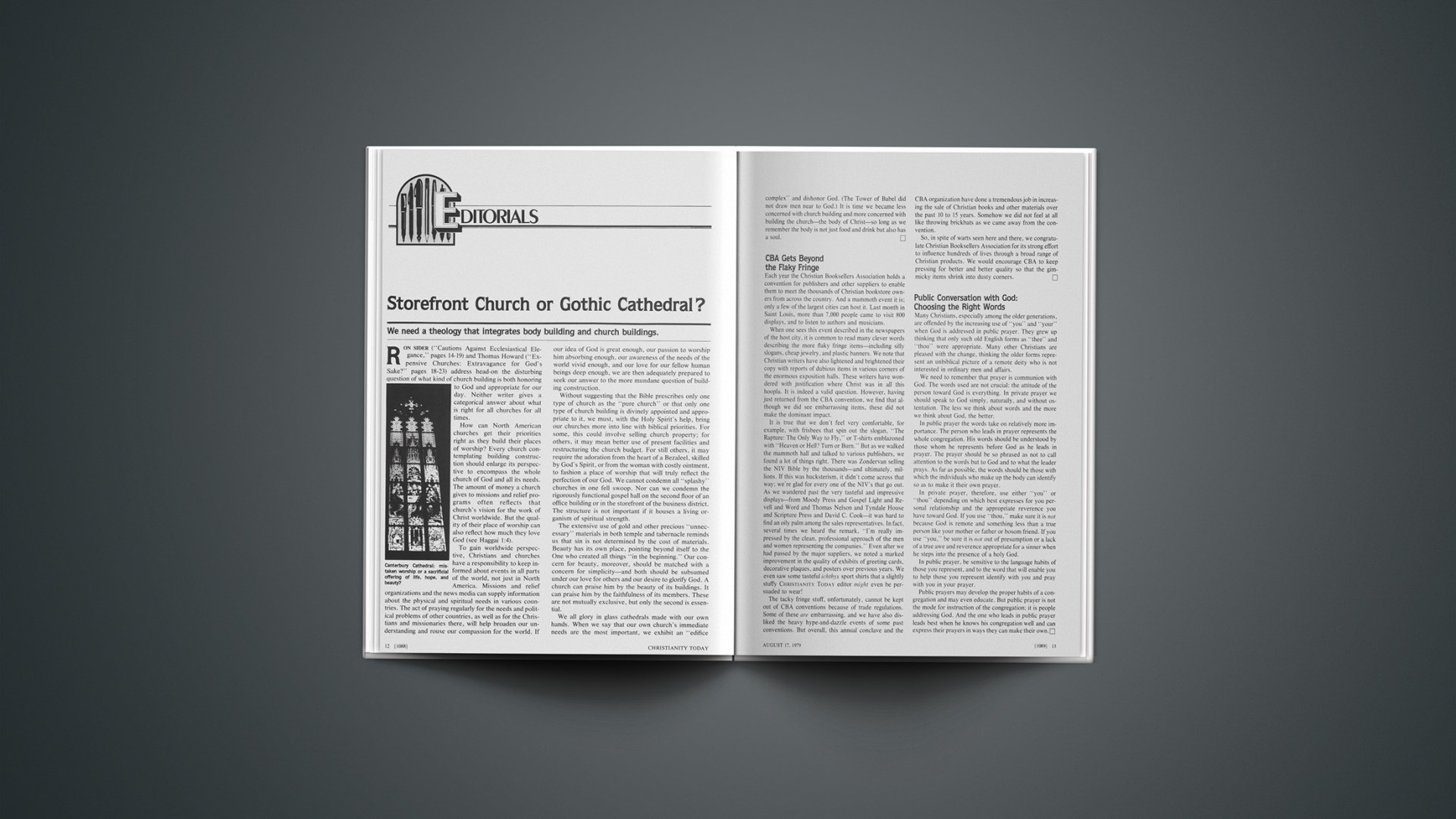
Storefront Church or Gothic Cathedral?

We need a theology that integrates body building and church buildings.

Ron sider (“Cautions Against Ecclesiastical Elegance,” pages 14–19) and Thomas Howard (“Expensive Churches: Extravagance for God’s Sake?” pages 18–23) address head-on the disturbing question of what kind of church building is both honoring to God and appropriate for our day. Neither writer gives a categorical answer about what is right for all churches for all times.

How can North American churches get their priorities right as they build their places of worship? Every church contemplating building construction should enlarge its perspective to encompass the whole church of God and all its needs. The amount of money a church gives to missions and relief programs often reflects that church’s vision for the work of Christ worldwide. But the quality of their place of worship can also reflect how much they love God (see Haggai 1:4).

To gain worldwide perspective, Christians and churches have a responsibility to keep informed about events in all parts of the world, not just in North America. Missions and relief organizations and the news media can supply information about the physical and spiritual needs in various countries. The act of praying regularly for the needs and political problems of other countries, as well as for the Christians and missionaries there, will help broaden our understanding and rouse our compassion for the world. If our idea of God is great enough, our passion to worship him absorbing enough, our awareness of the needs of the world vivid enough, and our love for our fellow human beings deep enough, we are then adequately prepared to seek our answer to the more mundane question of building construction.

Without suggesting that the Bible prescribes only one type of church as the “pure church” or that only one type of church building is divinely appointed and appropriate to it, we must, with the Holy Spirit’s help, bring our churches more into line with biblical priorities. For some, this could involve selling church property; for others, it may mean better use of present facilities and restructuring the church budget. For still others, it may require the adoration from the heart of a Bezaleel, skilled by God’s Spirit, or from the woman with costly ointment, to fashion a place of worship that will truly reflect the perfection of our God. We cannot condemn all “splashy” churches in one fell swoop. Nor can we condemn the rigorously functional gospel hall on the second floor of an office building or in the storefront of the business district. The structure is not important if it houses a living organism of spiritual strength.

The extensive use of gold and other precious “unnecessary” materials in both temple and tabernacle reminds us that sin is not determined by the cost of materials. Beauty has its own place, pointing beyond itself to the One who created all things “in the beginning.” Our concern for beauty, moreover, should be matched with a concern for simplicity—and both should be subsumed under our love for others and our desire to glorify God. A church can praise him by the beauty of its buildings. It can praise him by the faithfulness of its members. These are not mutually exclusive, but only the second is essential.

We all glory in glass cathedrals made with our own hands. When we say that our own church’s immediate needs are the most important, we exhibit an “edifice complex” and dishonor God. (The Tower of Babel did not draw men near to God.) It is time we became less concerned with church building and more concerned with building the church—the body of Christ—so long as we remember the body is not just food and drink but also has a soul.

Eutychus and His Kin: August 17, 1979

I had not seen my preacher friend Emeritus Thatcher for several months, when I met him coming out of Ace Hardware. He was carrying a shovel and he informed me that he was now in the business of renting holes.

“Well, not actually renting holes,” he explained. “I’m really digging wells, which are holes of a sort. I’m building a park in which I duplicate the wells that Abraham and Isaac dug. I think people will want to pay to visit these wells and renew their faith. It’s a step toward the deeper life.”

Emeritus is calling the venture “Wells Go Far,” and he hopes to establish branches in every major city. “You can always find a vacant lot,” he said, “and it just takes some elbow grease to transform it into a Wells Go Far park.”

At his first park, he featured dramas from Genesis, such as Abraham sacrificing Isaac, and Isaac meeting his bride. They were going to present Abraham casting out Hagar and Ishmael, but the local Arab nationalist league threatened to test an atomic bomb if they did. “We Christians have to expect persecution,” Thatcher declared.

The sacrificing of Isaac posed a problem at first because the ram kept getting loose from the thicket and running away. Emeritus solved the problem by putting iron on the ram’s horns and hiding an electromagnet in the bushes. When he pushed the button, the ram was free. “Of course, we didn’t really kill the ram,” he said. “The local SPCA threatened to fill up our wells if we did. But, we have to expect persecution.”

While studying his Bible one day, Emeritus hit upon the idea of also letting people build “faith altars,” just as the Old Testament patriarchs did. Now he has a collection of rocks near each well, and for only $5.00 a visitor can build his own altar the same way Abraham did. “Some people may laugh at this,” said Emeritus, “but many visitors have had life-changing experiences because of the altars. One man dropped a rock on his foot and had to be taken to the hospital. There he fell in love with his nurse and they’re going to be married at the park at the end of next month.”

Being a traditionalist, Emeritus calls the names of the wells after the same names Abraham used. “We were going to write the names in Hebrew, but some of the local kosher butchers threatened to dump their garbage in the wells if we did. But, we have to expect persecution.”

Well, well, well.

EUTYCHUS X

Cheryl Forbes, gifted writer and former CHRISTIANITY TODAY assistant editor, has concluded her six-month stint as Eutychus IX. Cheryl has the distinction of being the only woman Eutychus—but she will not be the last. As she lays down her (Eutychus) pen, Eutychus X picks up his pen and immerses it in a new bottle of ink for the next six months.

The Editor

Courageous and Honest

A special thank you for Ted Ward’s article “The Church in the Intermediate Future” (June 29). It is more than good and insightful. It is creatively in touch with the future of the church. His works are a courageous and honest probing in awesome respect for the providence of God.

DONALD CHARLES LACY

First United Methodist Church

Princeton, Ind.

Christianity in America needs to return to its biblical heritage and thrust before its people the presence of God now. God will take care of tomorrow (the distant future).

God’s future is present when we can cast aside our three-car garage, our private pew, our tax writeoffs, and our secularity and become free to live according to the will of God.

REV. BOB WARD

Rapidan Lutheran Parish

Orange, Va.

The Virgin and the Vatican

In reference to the editorial “The Pope in Poland” (June 29), my husband and I both found one sentence in particular disturbing and paradoxical: “His excessive references to Mary notwithstanding, the evidence indicates that Pope John Paul II is Christ-centered in his thinking.” Rather, we feel that his excessive references to Mary indicate that he is not Christ-centered in his thinking.

BILL AND RUTH HOLLEY

Reno, Nev.

As a Catholic who reads your periodical with interest, I must take exception to your editorial comments on the Holy Father’s visit to Poland. You indicate that Catholics have learned from Protestants in the area of Bible reading. This is true, but Protestants can and should also learn from Catholics. One area where this can be done is in devotion to Mary. Comments about “excessive references” to the Blessed Virgin are not helpful. Dialogue is a two-way street and we can all profit from it.

GERALD HERRIN

Pella, Iowa

Why did you find it necessary to ruin what was otherwise a very positive editorial with what I and other Anglicans regard as a “cheap shot” about his “excessive references to Mary”?

As one who loves the Blessed Mother in the same manner and degree as does the Holy Father I find that this devotion (commanded by Scripture in Luke 1:48) not only adds a new dimension to my commitment-in-faith to her Son, our Lord Jesus Christ, but also provides me with an example of what through God’s mercy and my faithful obedience to his will and commandments I may one day become.

REV. FR. G. D. WIEBE

St. Martin of Tours Church

Walnut Creek, Calif.

I read your editorial, “The Pope in Poland.” I was very pleased to see most of your comments, but you allowed your Protestantism to overcome your Christianity by being disobedient to God and unscriptural in your reference to the Blessed Virgin Mary. Please see Luke 1:48–50.

We honor the Blessed Virgin Mary not for her person but for the God that came through her; not for the personal worthiness that she had, but rather for her obedience to God’s declaration to come through her and receive flesh.

GEORGE J. TZANGAS

President

Worldwide Orthodox Renewal for Christ

A Good Example?

Regarding your editorial “Taking a Costly Stand” (June 29): Certainly Christians are often called to take costly stands, and certainly all of us fail to live up to what we are called to. But I seriously question your use of Anita Bryant as a good example for evangelicals to look up to in this area.

Surely she is “forthright.” But in this forthrightness she has shown much ignorance and lack of love for those who struggle with homosexual problems.

MARTY HANSEN

Chicago, Ill.

Had evangelicals and priests taken a stand on the issue of homosexuality before Anita Bryant did, she would not have had to take a stand herself.

DAVID L. GERMAN

Shepherd, Tex.

Ire over Ireland

I was both dismayed and disheartened by the lack of knowledge or understanding shown in the editorial, “The Travail of Northern Ireland” (June 29).

Neither Speaker O’Neill nor Governor Carey is my favorite political figure, but I can only applaud their courage in bringing to light a situation too long ignored.

Somehow your editorial seems to indicate that Northern Ireland “terrorists” were the only ones shedding blood in this horrible period. Or, alas, that it is only deplorable when British blood is shed. You do not recount any British provocation or participation. Are we then to assume that the British are the “good guys” while the Irish are the “bad guys”?

MONICA DURKIN

Cleveland, Ohio

Thank you for your understanding editorial on the troubles in Northern Ireland. As one who is English, Protestant, and temporarily living in the U.S. with several Irish Christian friends, I have been appalled to discover how easily Irish-Catholic politicians in the U.S. can exploit the tragedy for themselves. Perhaps even sadder is the lack of understanding among U.S. Christians for their brothers and sisters in Ulster, both Protestant and Catholic, who do not want any more violence yet do not want union.

Bernadette Devlin—known for her support for terrorism—once announced that when union was obtained, the battles in the streets would really begin as a workers’ republic was founded! All is not always what it may seem on the surface.

PAUL D. GARDNER

Jackson, Miss.

Religious Radio

I appreciated Jim Pennington’s comments in the June 29 Refiner’s Fire (“Christian Radio: Breaking Out of the Gospel Ghetto”).

I’ve been in broadcasting 13 years now and am grateful finally to see a handful of progressive stations and formats emerging. KNIS, for one, is a noncommercial Christian radio station serving Reno/Carson City/Lake Tahoe, Nevada. The format is 80 percent contemporary Christian music with air personalities making brief and thoughtful remarks in between cuts. If it can happen here, it can happen anywhere.

TOM HESSE

Program Director, KNIS-FM

Carson City, Nev.

Editor’s Note from August 17, 1979

Christian churches have worshipped God in catacombs deep in the earth, behind prison walls, on mountain tops, in open fields, in storefront halls, in beautiful cathedrals, in tin-roofed barns, and in neighborhood homes; but the Spirit of God has been equally present in all. With the growth of the church and the changing structure of the church, the construction of buildings for the worship of God has become big business. Evangelicals seldom can avoid the troublesome question: “What sort of church building shall we erect? Or, indeed, ought we to build at all?” It’s a rare congregation in which some earnest members do not opt for doubling or tripling the use of the old building “so we can send more missionaries to the field.” Others, equally sincere, argue for a strictly functional, no-nonsense structure with plenty of help from the faithful membership “to keep the labor costs in line.” Still others will hold out for a noble and beautiful edifice that will reflect, however faintly, the manifold splendor of God. Coming from opposite ends of the evangelical spectrum, Thomas Howard (pp. 18 to 23) and Ronald Sider (pp. 14 to 19) boldly probe the alternatives and seek to provide guidance for today’s Christians on an issue that defies easy solutions.

Spreading a Table for Fortune

Last month an unemployed hairdresser in Wales won nearly $1.75 million on the football pools. Skill had nothing to do with her accurate forecasting of match results: she knew nothing about the game Americans call soccer.

About $500 million is wagered yearly on the pools in Britain. On legal gambling of all kinds, Britons spend annually at least $6 billion—say $106 for each citizen. At a rough guess the comparable figure for Americans is $275, but wages are just about that much higher proportionately to account for the difference.

Someone has called gambling “the growth industry of the 1970s.” New Jersey legislation permitted casino gambling in Atlantic City, with the result that “property taxes quickly soared in the decaying resort city, and … developers planned to spend more than $1 billion for casino-hotel complexes there during the next ten years” (Encyclopedia Britanica).

In 1948 a Lambeth Conference resolution in England drew attention to “the grave moral and social evils” attendant on large-scale gambling; warned that it frequently led to “the deterioration of character and ruin of homes”; urged that no church organization should profit by it; and deprecated “the raising of money by the State, or by any organization through sweepstakes or similar methods, however good may be the object.”

The government was not listening to the bishops, though twenty-six of them sit in the House of Lords, for in 1956 the Conservative administration introduced Premium Bonds. Customers could buy these at any post office. The principal remained intact and was returnable at any time on application. The interest, after a three-month interval during which the government profited, went into a lottery. Maximum prize: about $2,000. At that time a Labour parliamentarian expressed scathing denunciation of the whole wretched business. “Britain’s strength, freedom, and solvency apparently depend on the proceeds of a squalid raffle.” That denouncer in due course became prime minister, and suffered a sad sea change, for he promptly multiplied the biggest prize by five. Squalor is in the eye of the beholder.

Thus did Britain move a step nearer to the national lotteries so beloved of some Continental friends. However Premium Bonds are regarded (and they have not lacked defenders), a word from John Knox has a certain pertinence: “Give the devil entry with his finger, and straightway he will shoot forth his whole arm.”

So it happened. Shortly afterwards, the Betting and Gaming Act gave gambling, according to a Church of Scotland report, “its biggest boost of the century,” with betting shops and bingo halls two of the more spectacular results.

Gambling confronts the Christian with a critical problem. It is not, alas, seen as such by some churches, a substantial portion of whose income depends on their not seeing it. A mass of specious trivialities is trotted out here. They say that the man who gambles is little worse than he who gives money away; that there are moderate gamblers just as there are moderate drinkers—and immoderate book-buyers. Argument on this level with its tacit stress on losses can ultimately prove only that abuse of gambling is wrong, and that the ecclesiastical gamblers have an imperfect grasp of the Christian gospel. Would it be overmuch simplification to suggest that gambling is wrong more for its gains than for its losses?

In his Inventing the Future (1963; a reading of which, with its 1972 sequel The Mature Society, I recommend to all), Dennis Gabor suggests three dangers that confront our civilization: “The first is destruction by nuclear war, the second is being crippled by over-population, and the third is the Age of Leisure.” The first two, he holds, could make life very unpleasant, but people would cope. “Only the Age of Leisure will find man psychologically unprepared.”

A Scottish judge, thinking along the same lines, has described as characteristic of our age the misuse of leisure and the worship of false gods. Gambling is indictable on both counts. It may be, like alcohol, “the quickest way out of Manchester,” but Maurice Maeterlinck would disagree. He calls gambling “the stay-at-home, squalid, imaginary, mechanical, anaemic, and unlovely adventure of those who have never been able to encounter or create the real, necessary, and salutary adventure of life.”

Not only does it discourage more “natural” forms of activity, it tends to become not just a recreation, but the very center of life. Its demands on money and time can be insatiable—and can be heedless of the effects on others. It is certainly gain at the expense of others. It looks not to work, but to chance, for reward, and the man who makes chance his idol is in a moral decline.

Of course this industry gives employment to a vast army of people: betting shops alone in Britain number many thousands. This led to a somewhat bizarre interlude in 1972, when a top lay official on the staff at Church of England headquarters in Westminster attempted his own form of outreach. He helped found the Union of Bookmakers” Employees (TUBE), for which the fraternity showed touching gratitude. Challenged on whether this was the sort of thing the church had hired him to do, he reportedly replied, “It is our duty to help all who seek our assistance—even if they are atheists.”

I recall having trouble with that statement at the time. It seemed to be saying, “No matter what your thing is, let the church help you do it.” And that in turn might prompt the question, Why encourage people to do together what they ought not to be doing at all?

Two years earlier, however, the bishop of a northern England diocese had chaired a meeting in London. Its aim: to keep alive small gambling clubs whose licenses the government might have withdrawn.

Yet a remarkably unequivocal declaration had come some years before that, from William Temple, archbishop of Canterbury for three wartime years. “Gambling,” he said, “challenges that view of life which the Christian Church exists to uphold and extend. Its glorification of mere chance is a denial of the divine order of nature. To risk money haphazard is to disregard the insistence of the Church in every age of living faith, that possessions are a trust, and that men must account to God for their use. The persistent appeal to covetousness is fundamentally opposed to the unselfishness which was taught by Christ.… The attempt to make profit out of the inevitable loss of others is the antithesis of that love of one’s neighbor on which our Lord insisted.”

Now there’s as sound an utterance as ever came out of Canterbury. I would like to think of it as the authentic voice of the Church of England rightly informed.

J. D. Douglas is an author and journalist living in St. Andrews, Scotland.

Apple PodcastsDown ArrowDown ArrowDown Arrowarrow_left_altLeft ArrowLeft ArrowRight ArrowRight ArrowRight Arrowarrow_up_altUp ArrowUp ArrowAvailable at Amazoncaret-downCloseCloseEmailEmailExpandExpandExternalExternalFacebookfacebook-squareGiftGiftGooglegoogleGoogle KeephamburgerInstagraminstagram-squareLinkLinklinkedin-squareListenListenListenChristianity TodayCT Creative Studio Logologo_orgMegaphoneMenuMenupausePinterestPlayPlayPocketPodcastRSSRSSSaveSaveSaveSearchSearchsearchSpotifyStitcherTelegramTable of ContentsTable of Contentstwitter-squareWhatsAppXYouTubeYouTube