The Four Steps to Cultic Conversion: A Sociologist’s Perspective

A case for introspection.

Nine hundred people die in the jungle of Guyana.” The headline is still fresh in our minds. Death on this scale was tragic enough, but the idea that so many people would take their own lives voluntarily seemed scarcely conceivable. Charges of brainwashing were quick to follow, in an attempt to fathom how this could occur.

Since the Jonestown incident, People’s Temple has lost most of its followers. But fears of mindless obedience to cult authority figures are kept alive by accounts of coercive conversion to other cults and by concern for the welfare of the countless thousands who have joined them.

Do cults really engage in coercive conversion and brainwashing? Can their tactics be successfully resisted? How can the church prevent loss of its members to such unchristian groups? To answer these questions requires first some familiarity with the procedures cults use to win converts. To clarify the nature and operation of these procedures we have taken elements common to such cults as People’s Temple, the Unification Church, The Way, the Children of God, and the Hare Krishna movement and have developed a fourphase model.

1. Impression management. Someone attending a cult meeting for the first time quickly finds himself the object of attention and loving regard. Feelings of warmth and acceptance are experienced as the group—which may initially refrain from disclosing its true identity—presents itself as a closely knit family bound together by ties of affection and common purpose. The messages refer to some basic problem in the individual and/or society that the group promises to resolve. Such problems range from evil to ignorance, while the effects attributed to them encompass the full range of human suffering. The promises are also often vague and general; one group, The Way, promises that “You can have whatever you want.” To confirm its ability to make good its promise, the group offers personal testimonies and other dramatic evidences.

2. Grooming. After the initial presentation, the visitor is invited to remain with the group. If he decides to stay, the visitor—now a guest—finds himself isolated from outside contact and is subject to intense group interaction. During this period he typically receives less sleep than usual, eats low protein foods, and, perhaps without fully realizing it, begins to be exhausted. His reasoning capacity is thereby reduced, and since there is no alternative support group nearby, he becomes a prime candidate for cultic indoctrination.

3. Intensive indoctrination. During this phase an individual is bombarded with the idea that one’s self amounts to very little, that the group and its leader are everything, and that “outsiders” are misguided or hostile and to be feared and avoided. A person’s feelings of guilt and personal insufficiency are highlighted, and in such a context the idea of being directed by a perfect leader begins to be attractive.

4. Action. At this point a critical moment arises as the guest, by now a seeker, is requested to take some action. This may involve confession of guilt or weakness, a renunciation of past behavior, and a pledge of loyalty to the group and to its leader in particular. Pressure to evoke a “concrete” expression of commitment typically follows. For example, People’s Temple members were induced to sign away property holdings, bank accounts, and even their children to the cult. One former member recalled: “After you’ve made a commitment of this magnitude, it’s hard to admit you’ve made a mistake, and you’ll go to great lengths to rationalize what you’ve done.”

To determine whether the techniques employed by the cults would be best described as super-salesmanship or whether cults really engage in coercive conversion and brainwashing would require a cult-by-cult and case-by-case analysis. It is clear, however, that many of the techniques closely parallel those described by Edgar Schein, Robert Lifton, and others, who have studied brainwashing techniques used on American soldiers captured during the Korean War. (Chinese brainwashing techniques included efforts to undermine physical resistance, removal of all social and emotional supports, mortification exercises, and intensive indoctrination procedures.) Moreover, the results are sometimes similar in that converts experience altered personalities, altered world views, and partial or complete loss of the ability to think clearly and abstractly.

How should the church respond to this cultic conversion phenomenon? First, to be true to its charge to be the light of the world, the church is obligated to direct attention to, and forcefully condemn, all cults that try to deceive, mortify, manipulate, and exploit people. Such action exposes the danger posed by the cults to potential converts and the rest of society, and glorifies Christ by contrasting unethical cultic procedures with Christian values.

Second, in denouncing the cults for their unethical or immoral conversion practices, the church is obliged to examine its own methods. Is the church always careful to avoid deception (impression management) by stressing the costs of discipleship as well as the benefits of conversion? Is it careful to allow reasoned and sober reflection while promoting conversion? Does it emphasize the liberating power of grace alongside the debilitating effects of sin? When it emphasizes the sinfulness of society and the frailty of man, does it avoid insistence on social isolation and withdrawal? And, while encouraging loyalty to leaders, does the church resist the temptation to elevate them to such levels of influence that what they preach overshadows what Scripture teaches? These difficult questions must be confronted.

Third, the church must do all in its power to prevent its members from being taken in by the cults. Cultic conversion can be successfully resisted. The answer lies in equipping Christians with an appropriate armor of defense. In fashioning this armor, three ingredients are crucial.

1. A sound knowledge of Scripture. Many cults, including those of Asian origin, frequently quote Scripture and liberally incorporate references to God and Jesus in their teachings. For the person not saturated with biblical teaching, such appeals may prove most convincing.

2. A knowledge of cult conversion techniques and the purpose they serve. Methods of persuasion and coercion prove most effective on those who are unfamiliar with them and their effects.

3. A Christian support group. People tend to become involved in a cult during a period of personal stress, sorrow, or uncertainty. A Christian support group not only helps to keep the vitality of an individual’s faith alive, but it provides him with a source of direction and encouragement that is invaluable when facing the problems of life.

Anointment

“Verily I say unto you, Insomuch as ye

have done it unto one of the least of these

my brethren, ye have done it unto me.” Matthew 25:40

Deny me that presumptious lack of spirit

that would dare to try to fill God’s role

of judging. Help me deeper trust my brother

as we deeper trust our maker. Let my cup

spill encouragement; let mercy be my call.

Teach me to befriend; not like Job’s

“friends,” the unhumbled, self-called,

who came with analytical expertise

and spiritual thermometers

to presuppose, prescribe.

Strip from me that awful lack of sight

that blinds and binds another to his

plight. Forbid that I should

come to oil, and instead salt

raw wounds.

VIVIAN STEWART

G. Douglas Young is founder and president of the Institute of Holy Land Studies in Jerusalem. He has lived there since 1963.
Countering the Cultic Curse: A Theologian’s Perspective

Biblical definitions of the Jonestown phenomenon.

To come to grips with the immense problem caused by cultic conversion techniques is to face a dilemma—especially if we recognize that a large proportion of converts to the newer cults come from evangelical churches. It is one thing to condemn the false teaching and practices of these movements; it is quite another to solve the enormous problems within our traditional evangelical churches that have allowed cults to develop as they have. We need not merely a cure for the disease, but a preventive medicine that will enable us to end the disease altogether.

Jonestown and other excesses should teach us a crucial lesson: that we must protect the weak, the lonely, and the peripheral members of our churches from charletans who would prey upon their ignorance and needs. To discover preventive principles, we need look no further than the Word of God. The early church was forced to defend itself against very similar tactics, and its experience provides us with answers that we can apply to our own day.

1. Jesus’ principle. In John 10 Jesus referred to wolves who would destroy and the self-centered hireling who would not protect the sheep. The first principle, then, is to examine our leaders and discern when self-interest or false teaching begins to erode their ideals. The church should never assume that a great leader will always make correct decisions. Whenever an autocratic power begins to assert itself, a church is in a dangerous situation; when it intrudes itself into the teaching ministry, the church must take direct action.

We should be aware of the number of cult leaders who have come out of evangelical ranks to become vocal in their opposition—not merely after they have declared themselves but, more importantly, as they are developing their heretical ideas. Jesus’ declaration of the “woes” in Matthew 23 must serve as our model—not, of course, with a “head-hunter” mentality, but as a positive caution. It is not wrong for the church to develop strong models and leaders. It is wrong for leaders to elevate themselves above their office and to deny the servant approach to their ministry.

2. The principles of Acts. In Acts 17:11 the Berean Christians were described as “of more noble character” than the Thessalonians because they “received the message with great eagerness and examined the Scriptures every day to see if what Paul said was true” (NIV). We must prepare this type of layperson, eager for the Word—yet desiring to examine it for himself/herself before accepting the truth of a statement. Men and women must be hungry for spiritual truth, but not so naive that they will accept anything they are told. Luke, in Acts, assumed that the Bereans knew truth when they saw it; we cannot do so.

The church today must teach methodology as well as content. Pastors need to encourage their flocks to interact with their messages, not merely to accept without thinking whatever they are told. This is naturally threatening to an insecure pastor; but it does not need to be. Pastors should be shepherds who lead their flock in the great adventure of spiritual growth; they should never separate themselves from that process and speak from outside the realm of scriptural study. Pastor and congregation should be pilgrims together on the highway of God’s plan. When this is true, the congregation will be able to discern truth from error.

In Acts we also note the strong stress on fellowship and relationships. This is stated in the thesis paragraph of 2:42–47 and exemplified in the illustrations that follow in 3:1–5:11. The early church was typified by unity and social togetherness. Our churches must balance their strong teaching programs with programs of caring and sharing. People today yearn desperately for a feeling, caring group in which they can receive love and protection. We must provide this and not throw countless searching hearts to the wolves because of our lack of concern. This cannot be stressed too much. More than any other single factor, the lack of sharing in the average church has produced lonely, frustrated Christians.

This sharing is especially needed in the family. The new cults all seek to remove from their adherents the roots of familial togetherness. Reports of indoctrination techniques recount how a group leader will ask seekers to describe experiences in which their families have let them down. The group will then enclose such persons and exude “love” and promises to fill those gaps in their lives. The church must begin to help reestablish family sharing and unity; together these make up one of the greatest bulwarks against cult manipulations.

3. Paul’s approach. Two stresses can be noted in Paul’s writings, especially in the pastoral Epistles. He emphasizes first the importance of tradition: the truths handed down from the founders of the church were to be used as controls against aberrations. We see this in several of the Epistles (e.g., 1 Cor. 15:3–5, 2 Tim. 2:2). The “traditions” were statements of accepted dogma, which in the early church were used as hedges against new teachings that twisted truth.

When we examine cults today we discover that few, if any, have constructed a “new” heresy. Teachings such as the Arianism and gnosticism of Jehovah’s Witnesses and of The Way to the libertinism of the Children of God and of the People’s Temple, have all been condemned before. We should become students of church history to enable us to observe heretical tendencies as they evolve. Above all, our churches must be Bible-centered and not leader-centered. We must not ask, “Who said it?” but rather, “Is what was said truly biblical?” The canonical works, properly interpreted, provide the “tradition” by which our people will be protected from the false teachers.

Second, Paul stresses the importance of church discipline. This is a sensitive area, but one in which many of our churches are lax—especially when we realize that in his epistles Paul applied discipline to the leaders as often as to others. The early church believed that the discipline should fit the offense. We see this in 2 Thessalonians 3, where Paul commands the brethren to “stay aloof” from those who were living off others (vv. 6–8), and to “take special note” and refuse to associate with (an intensification of the earlier charge) those who further refused to obey the letter (vv. 14–15). The type of discipline varied according to the offense.

Above all, 2 Timothy 2:24–26 tells us that the erring brother must be “corrected with gentleness” and a desire to bring him to repentance. Love and redemptive purpose rather than stern judgmentalism must be the attitude behind discipline. Nevertheless, churches are prone to allow situations to deteriorate before they react (the problem in Philippians 4:2–3 is an example); they must get involved before it is too late. If cult leaders had been dealt with properly before they became aberrant, many movements may never have started.

4. The Johannine formulae. In I John we find two criteria for distinguishing true teachers from false. The first test is their ethics. If a ministry is characterized by a self-centered lifestyle rather than a love-centered servant attitude, this must be dealt with—and it must be an ongoing examination. Jim Jones’s early ministry was above all characterized by social concern. But as his message began to deviate, so did his moral and ethical stance. The same could be said of David Berg, founder of the Children of God. One cannot divorce his words from his deeds (1 John 2:15–17, 3:17; cf. James 1:22–27).

The second criterion is the message. We must constantly watch the truth-content of the teaching, checking it against a scriptural basis. John stresses the Christological test: whether one assents to the traditional statements of the incarnation (4:2) and deity (4:15) of Jesus Christ. The problem again is the lack of serious hermeneutical methodology among both preachers and laymen. A strong preacher/teacher could take the average evangelical church congregation over a period of years and, winning its confidence and wholehearted adherence, gradually lead it cultic. Some, of course, would recognize the growing aberration (as did some at Jonestown); but the majority would follow blindly. The church should be taught to think for itself.

5. The method in Jude and II Peter. These two epistles have a very direct approach, with two focuses: confronting and repudiating false teachers (Jude 8–10), and mercifully and apologetically helping to restore those swayed or convinced by the heretics (Jude 22–23). When someone is proclaiming falsehood, we dare not wait until a movement has developed, but we must deal with it immediately and forcefully—especially with respect to those who are being led astray. An approach must be developed and begun, if possible, before a person is totally converted to the cult movement. Above all, a detailed renunciation of these cults must be presented in our churches as a protective hedge against the modern heresies.

In order, therefore, to avoid future Jonestowns, the church must begin a positive program to prevent cult groups from developing and proselytizing. We must begin with a serious study of the sociological factors that allow deviant groups to grow. Until we are aware of the problems in society as a whole and in our churches in particular, it is impossible to deal with them. Once we have accomplished this, we must work at alleviating the pressures and meeting the needs.

Above all, the church must avoid overreacting as a result of Jonestown and the mind-control techniques used by other cults. It is wrong for us to retreat to a hyperconservative austerity that merely condemns and judges. Rather, we should take a positive but careful approach, making Scripture our rule, but seeking to approve and authenticate the message rather than to discredit the individual. We must remember the message of 1 Corinthians 13: “Love does not delight in evil but rejoices in the truth” (v. 6). Further, we should create an atmosphere of seeking after truth with the absolute standard of God’s Word as our criterion. If we do this, we will not place our leaders on a pedestal, but we will strive together to discover relevant solutions to the sociological and religious pressures that mark our age.

We need one final word of caution: before church discipline is applied to heretical teaching, we must define “heresy” carefully. In the New Testament and in church history it is always the central, fundamental doctrines—such as the deity of Christ or the Atonement—that are treated thus. Peripheral or “pet” doctrines as, for example, the rapture question or Calvinism-Arminianism, are not matters for orthodoxy-heresy examination. Two criteria may help us distinguish the issue: (1) Is the Word of God absolutely clear on the centrality of this doctrine? (2) Are evangelicals with the same love and treatment of Scripture divided on this issue? If these both point to the peripheral nature of a topic, it must be approached through dialogue and not discipline and with tolerance rather than intolerance.

G. Douglas Young is founder and president of the Institute of Holy Land Studies in Jerusalem. He has lived there since 1963.
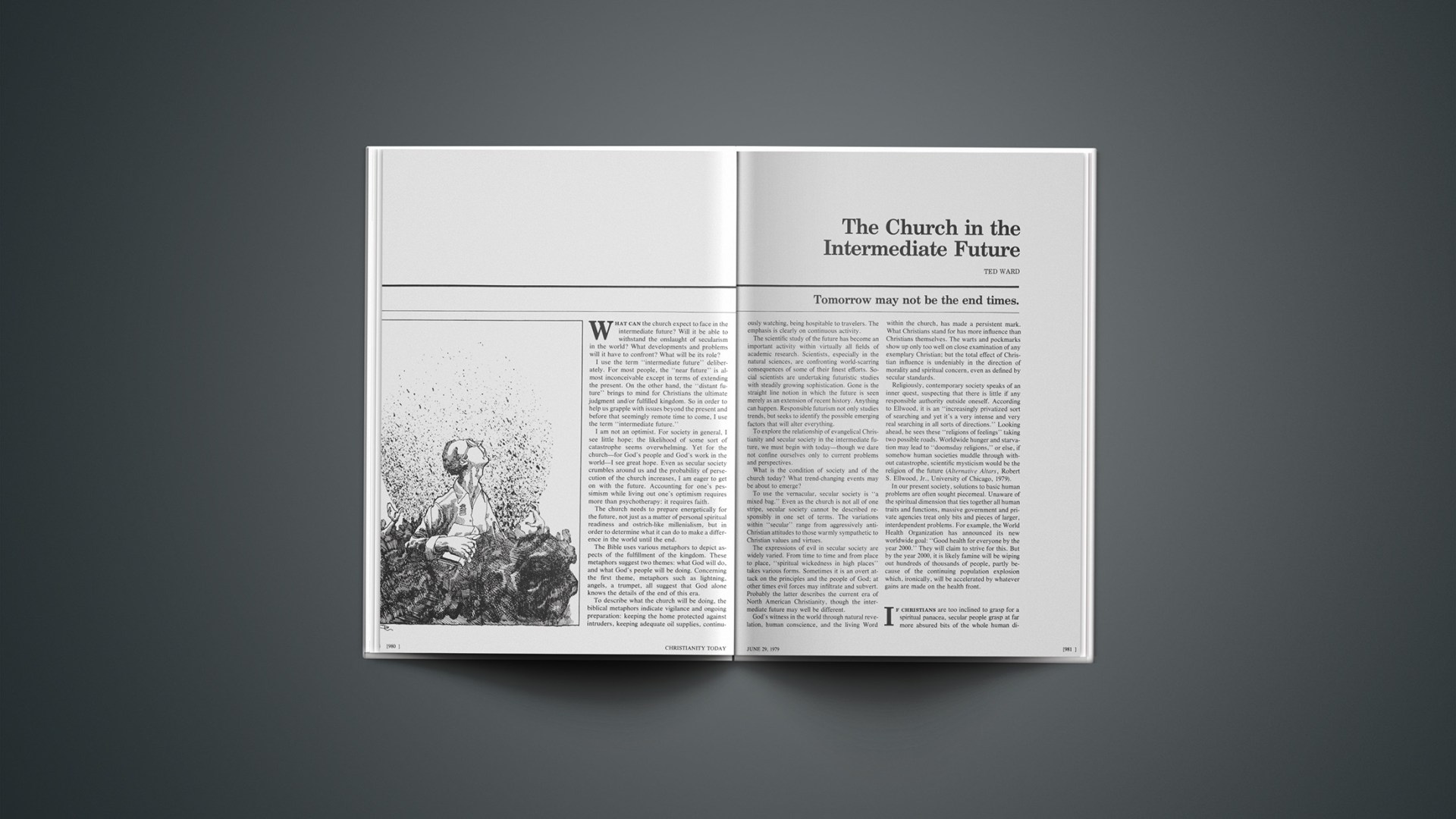
Abandoning the Psyche to Secular Treatment: Of Mental Health, Medicine, and Morals

Most peopleare surprised to find that treatment of mental illness using moral treatment was very effective 150 years ago. This fact is no secret among mental health professionals, but it is not widely discussed among the laity. When moral treatment is mentioned even in textbooks, it is looked upon as a prescientific curiosity in the history of therapy, and its recovery rates are seldom compared to those of contemporary therapies. It is the forgotten success in the history of treating the disturbed. Christians were highly involved in the development and use of moral treatment, but abandoned it when everyone else did.

Moral treatment began at the end of the eighteenth century with the French physician Philippe Pinel, who held the radical view that the “insane” should be treated with kindness and consideration rather than as animals or criminals. In 1793 he received permission to unchain the patients at his hospital. He moved people out of dungeons, permitted exercise, and treated the patients with kindness. The effect was astounding. Noise, filth, and abuse were replaced by order and peace. People began to recover and leave the hospital.

At about the same time an English Quaker, William Tuke, established the “York Retreat,” a pleasant place where patients lived in a kindly, religious atmosphere. Tuke also faced resistance, some of it from the church. As word of Pinel’s success spread to England, Tuke’s small band of Quakers gradually gained support. Success in France and England revolutionized treatment of the maladjusted throughout the civilized world, including the United States. Friends Asylum was built in Pennsylvania by the Quakers.

American society of the early nineteenth century was an ideal place for the development of moral treatment. Most communities were small, close-knit communities where people were united by religious ties. Moral treatment was never clearly defined because its meaning was then self-evident. It included compassionate and understanding treatment of innocent sufferers, and even those not so innocent. Hospitals were cheerful, homelike, and not monotonous. Cruel punishments and almost all “shock” treatments were forbidden. Emphasis was placed on the relationship between physician and patient. The term “moral” carried connotations of zeal, hope, spirit, and confidence. Therapists kept in mind that the patients were sensitive to their interest and good will, and they limited their number of patients to those they could know personally.

In 1842 Charles Dickens described his visit to what is now Boston State Hospital. Patients were working, reading, or playing games. Every patient sat down to dinner with a knife and fork, and the superintendent ate with them. Every patient was trusted with the tools of his trade. Patients walked, ran, fished, painted, and rode in carriages. Once a week they had a ball in which the doctor, his family, all the nurses, and all the attendants took an active part. “Immense politeness and good breeding” were observed everywhere. The superintendent and his family lived and ate with the patients, who were considered part of his family.

In 1873 Isaac Ray wrote about the role of the mental hospital superintendent of that era. The superintendent was a man of distinction and highly regarded. He knew every patient in his care because hospitals rarely had more than 200 patients. He did not boast about the number of patients he had, but about the many whose experiences he discovered, whose needs he supplied, whose moods and fancies he had watched. A formal walk through the wards and the ordering of drugs was only a small part of his means of restoration.

This treatment was most effective, though “unscientific.” During the first half of the nineteenth century, when moral treatment was at its peak, at least 70 percent of the patients who had been ill for a year or less were released as recovered or improved. Some hospitals had recovery rates of 80 or 90 percent—higher than at previous or subsequent times. Moral treatment did all this without tranquilizers, antidepressants, shock treatment, psychosurgery, psychoanalysis, or any other kind of psychotherapy. Kindness, patience, attention to needs, opportunities for expression of creativity, trust, and the maintenance of self-respect were very effective.

Nonetheless, the use of moral treatment declined during the second half of the nineteenth century. The results were disastrous. Recovery and discharge rates went down as moral treatment gave way to the medical approach. Mental hospital directors often tried to obscure this fact and continued to contend that insanity was curable—curable as a physical disease of unknown origin. Definitions of “mental illness” also changed, as they continue to do today. Between 1833 and 1846, the discharge rate at Worcester State Hospital was 70 percent, using moral treatment. By 1893 it had declined to only 5 percent—once committed, chances were nineteen out of twenty that a person would never get out. Some psychiatrists claimed that mental illness was changing its form and becoming increasingly malignant.

Why was moral treatment abandoned? Many reasons have been proposed. The industrial revolution brought many changes in our culture. With the emphasis on mass production and desire to run expensive mental hospitals at a profit, hospitals grew from handling less than two hundred patients to handling several thousand. Large, centralized state hospitals were more efficient. To some people, Dorothea Dix is the Florence Nightingale of psychiatric treatment. A resolution by Congress in 1901 characterized her as “among the noblest examples of humanity in all history.” Although no one questions her motivation or effectiveness, the net results of her efforts may have actually set treatment back. While teaching a Sunday school class in a New England jail, she became enraged at the confinement of the mentally ill there under such deplorable conditions. As a direct result of her personal efforts more than thirty state institutions were built or enlarged. She also had an influence in fourteen countries other than the United States. She lived to see her goal of placing all mentally ill in mental hospitals rather than in jails, almshouses, cellars, and attics. Unfortunately, automatic increases in staff and number of hospitals did not accompany increases in patients. Overcrowded and understaffed, moral treatment simply could not function. Recovery rates began to decline.

Another reason for the decline of moral treatment was the emergence of the disease model of mental “illness.” The success of medicine in the nineteenth century led to its adoption as the model for psychiatric treatment and research. Dr. John Gray, appointed superintendent of the largest state hospital in America in 1854 and made editor of The American Journal of Insanity in 1855, held that insanity was always due to a physical lesion and treated patients accordingly, emphasizing rest, diet, fresh air, and so forth. Replacing the optimistic enthusiasm of the moral therapist was the restrictive watchfulness of an administrative custodian waiting for a cure to be discovered. Rather than seeing the patient as competent to meet expectations, carry out tasks, and make decisions, therapists assumed that they were helpless. The superintendency of mental hospitals was taken out of the hands of stewards or wardens and given to medical men. Neuropathologists were added to psychiatric staffs to search for the relationships between mental symptoms and brain pathology.

A final reason for the decline of moral treatment was that none of the early moral therapists developed theoretical conceptualizations of their principles. They considered this unnecessary since the principles were a part of the everyday life of the early American settler. Cultural changes, however, undermined the entire philosophy of moral treatment.

A more difficult question is, why not return to the use of moral treatment? It seems unlikely that therapists have not heard about it: a book on the subject appeared fifteen years ago, journal articles are available, and it is briefly presented in most abnormal psychology textbooks and handbooks. A more logical reason is found in the dominance of the medical model and the fear of being called unscientific if “moral treatment” were seriously proposed. When psychologist O. H. Mowrer used the terms “sin” and “morality” in his writing, other psychologists did not take him seriously. They pointed to his own past mental illness. Another reason is more philosophical. Although they are really not value-free, many scientists at least strive to be so. Then if scientists are to be value-free, and are not to impose their own morality on anyone else, how can they use something called “moral treatment”? The very concept of “moral” seems to conflict with the whole approach of modern secular psychology and psychiatry.

A final important question is this: what will Christians do? During the Middle Ages, treatment of the disturbed was left largely to the clergy, and the mentally ill were usually treated with considerable kindness. However, as theological beliefs about demonic influence on such behavior became more widely accepted by the secular world, treatment was taken over by the secular world and became more harsh. People were whipped, starved, chained, and immersed in hot water to make the body such an unpleasant residence that the demon would leave. This happened with the consent of the church. Then people like William Tuke and his group of Quakers revived kindness and consideration in treatment. Again the secular world took over. Again the church withdrew.

Compared to the physically ill, the church has largely ignored the mentally ill for the last hundred years. Hundreds of hospitals have been built to care for the physically ill, but only a very few to care for the mentally ill. Of course, this is not to say that the church should have built large hospitals modeled after those being built by others, but it did not continue to build effective centers for treatment, such as the York Retreat or Friends Asylum mentioned earlier. The church, like the secular world, abandoned moral treatment for the medical model.

The church has also watched the rise and decline of psychoanalysis. Although there are some Christian psychiatrists and psychologists, there are not enough. Too often we send our seriously disturbed church members to secular therapists. We give pastoral counseling to the less serious cases, then send them to the secular world if they are too difficult for us and we do not have ready access to a Christian therapist willing to handle difficult cases. Jesus did not avoid the “lunatic,” as the King James English puts it (Matt. 4:24).

What we need is a Christian approach to the treatment of the mentally ill, one that organizes the truths found in these secular approaches around a central Christian world view. In some cases physical disorders may cause mental disorders, and in these cases physical methods of therapy can be very effective. If a person has an undersecretion of thyroxin by the thyroid gland it will bring about retardation, both physical and mental. This can be prevented or, in some adult cases, reversed by taking thyroxin. General paresis may be prevented if syphilis is treated early. Although drugs are useful in some cases, they are not the answer to all disorders. Sometimes people simply learn inappropriate responses, in which cases behavior therapy may be effective. The person who has a phobia about dogs can learn not to fear them, through the methods of behavior therapy. Individuals who have underlying conflicts may be helped through traditional methods of psychotherapy.

As Christians, we must go beyond simply integrating these secular therapies. Sin and its resulting guilt feelings may be at the root of the person’s problem. In these cases we must bring the person to the point of seeking God’s forgiveness. Demon possession may cause psychotic-like behavior. We must learn to distinguish between demon possession and psychotic behavior, and to study Jesus’ methods for dealing with each. We must also not be content with merely making “sick” individuals “normal,” but with taking “normal” people and making them Christlike. As we consider developing a Christian approach, we must consider not only contemporary secular approaches, but also the old (and successful) approach to the treatment of the mentally ill. Why not the methods of moral treatment?

Anchored Heart

Mere human logic

that would ever taunt

and toss mankind from fad

to whim to notion, setting us

in whirlwind motion, sweeping us

from shifting sand to barren shore—be still.

Be still and know one thing for certain:

This heart of mine is solely fixed on God.

And when all else has passed away

and crumbled, Love will remain

my light, my steadfast rock,

my constant guide.

VIVIAN STEWART

G. Douglas Young is founder and president of the Institute of Holy Land Studies in Jerusalem. He has lived there since 1963.
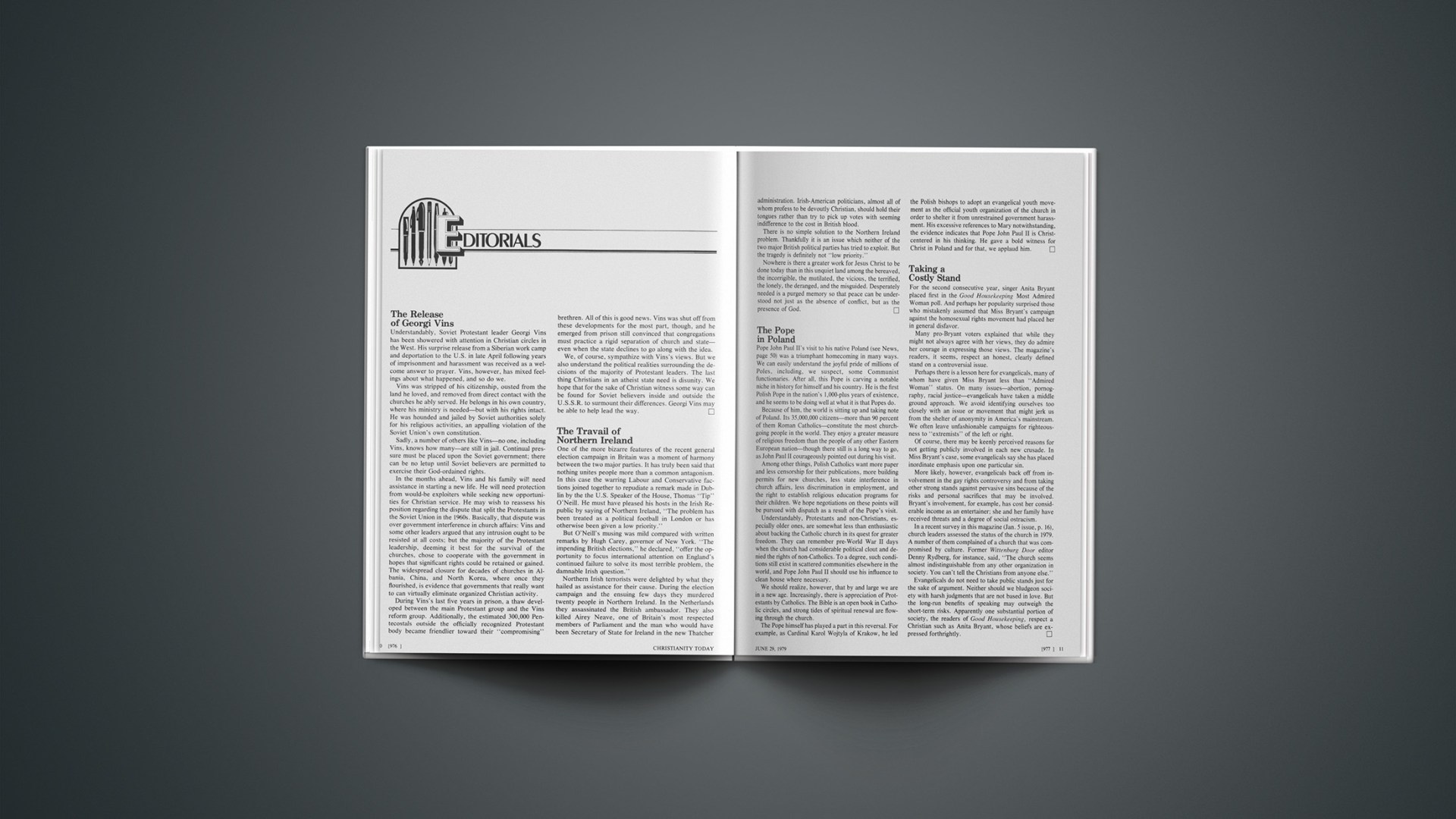
The Church in the Intermediate Future: Conditioning Requires Pain

Tomorrow may not be the end times.

What can the church expect to face in the intermediate future? Will it be able to withstand the onslaught of secularism in the world? What developments and problems will it have to confront? What will be its role?

I use the term “intermediate future” deliberately. For most people, the “near future” is almost inconceivable except in terms of extending the present. On the other hand, the “distant future” brings to mind for Christians the ultimate judgment and/or fulfilled kingdom. So in order to help us grapple with issues beyond the present and before that seemingly remote time to come, I use the term “intermediate future.”

I am not an optimist. For society in general, I see little hope; the likelihood of some sort of catastrophe seems overwhelming. Yet for the church—for God’s people and God’s work in the world—I see great hope. Even as secular society crumbles around us and the probability of persecution of the church increases, I am eager to get on with the future. Accounting for one’s pessimism while living out one’s optimism requires more than psychotherapy: it requires faith.

The church needs to prepare energetically for the future, not just as a matter of personal spiritual readiness and ostrich-like millenialism, but in order to determine what it can do to make a difference in the world until the end.

The Bible uses various metaphors to depict aspects of the fulfillment of the kingdom. These metaphors suggest two themes: what God will do, and what God’s people will be doing. Concerning the first theme, metaphors such as lightning, angels, a trumpet, all suggest that God alone knows the details of the end of this era.

To describe what the church will be doing, the biblical metaphors indicate vigilance and ongoing preparation: keeping the home protected against intruders, keeping adequate oil supplies, continuously watching, being hospitable to travelers. The emphasis is clearly on continuous activity.

The scientific study of the future has become an important activity within virtually all fields of academic research. Scientists, especially in the natural sciences, are confronting world-scarring consequences of some of their finest efforts. Social scientists are undertaking futuristic studies with steadily growing sophistication. Gone is the straight line notion in which the future is seen merely as an extension of recent history. Anything can happen. Responsible futurism not only studies trends, but seeks to identify the possible emerging factors that will alter everything.

To explore the relationship of evangelical Christianity and secular society in the intermediate future, we must begin with today—though we dare not confine ourselves only to current problems and perspectives.

What is the condition of society and of the church today? What trend-changing events may be about to emerge?

To use the vernacular, secular society is “a mixed bag.” Even as the church is not all of one stripe, secular society cannot be described responsibly in one set of terms. The variations within “secular” range from aggressively anti-Christian attitudes to those warmly sympathetic to Christian values and virtues.

The expressions of evil in secular society are widely varied. From time to time and from place to place, “spiritual wickedness in high places” takes various forms. Sometimes it is an overt attack on the principles and the people of God; at other times evil forces may infiltrate and subvert. Probably the latter describes the current era of North American Christianity, though the intermediate future may well be different.

God’s witness in the world through natural revelation, human conscience, and the living Word within the church, has made a persistent mark. What Christians stand for has more influence than Christians themselves. The warts and pockmarks show up only too well on close examination of any exemplary Christian; but the total effect of Christian influence is undeniably in the direction of morality and spiritual concern, even as defined by secular standards.

Religiously, contemporary society speaks of an inner quest, suspecting that there is little if any responsible authority outside oneself. According to Ellwood, it is an “increasingly privatized sort of searching and yet it’s a very intense and very real searching in all sorts of directions.” Looking ahead, he sees these “religions of feelings” taking two possible roads. Worldwide hunger and starvation may lead to “doomsday religions,” or else, if somehow human societies muddle through without catastrophe, scientific mysticism would be the religion of the future (Alternative Altars, Robert S. Ellwood, Jr., University of Chicago, 1979).

In our present society, solutions to basic human problems are often sought piecemeal. Unaware of the spiritual dimension that ties together all human traits and functions, massive government and private agencies treat only bits and pieces of larger, interdependent problems. For example, the World Health Organization has announced its new worldwide goal: “Good health for everyone by the year 2000.” They will claim to strive for this. But by the year 2000, it is likely famine will be wiping out hundreds of thousands of people, partly because of the continuing population explosion which, ironically, will be accelerated by whatever gains are made on the health front.

If christians are too inclined to grasp for a spiritual panacea, secular people grasp at far more absured bits of the whole human dilemma. Technology is seen as the major alternative to moral renewal, especially because of its proven capacity to usher in “brave new worlds.” It is both the oppressor and the savior. “What science has created, science can overcome” is the first article of faith for a dominant sector of secular society. At the same time, others are becoming aware that some technological creations cannot be brought under control.

Christians who walk away and mumble, “I told you so,” are irresponsible. Perhaps as never before, Christians are needed in science and technology—not to be slaves of materialism designing automobile bodies and attachments for electric hairdryers, but to bring the marvels of God’s creation back into God-honoring control before they become any further the tools of intentional, accidental, or negligent death and destruction.

The secular world is changing. The church and its ministries are changing. At the very least, any discussion of the future relationship between the church and the world must deal with change. The important questions are: (1) What is happening? and (2) What are the implications for the church? These two questions center on change. Most traditional societies resist change and thus avoid change-related questions. Consequently, they develop only minimal competency in dealing constructively with change.

Because of its historical-documentary eschatology, North American evangelical Christianity tends to explore the future by asking deterministic “is” questions—What is God’s plan for the ages? What is the surest sign of the end times? When is Christ returning?—rather than by focusing on the developmental unfoldings that characterize Scripture. Forcing questions into the concrete “is” has impoverished our theology and weakened our ability to cope with the intermediate future. We evangelicals seem quite at home with the present and happy to think about the ultimate future (“the end of this age”). Observers wonder at our lack of burden for the needs of the lost world between now and the Lord’s return.

The desperate here and now demands foresight and planning as never before in history. Within less than a century—in our own time—all of humanity has been made subject to petrochemical technology, the energy for which is now virtually defunct. The oldest among us are no younger than the petroleum industry. The single-century doubling of world population arrived in our lifetime. The conquering of disease and the global proliferation of biodamage is the mindless tradeoff of our lifetime. The war to end wars and the looming possibility of the war to end life: these are of our lifetime.

Where will the needed thinking and planning come from? Can evangelicals rise quickly to the challenge of the times? Can we learn to do belatedly—what the evangelical subculture has previously discouraged—to think and plan for the intermediate future? Or will we continue to burn our midnight oil for the charming discussions of when, where, and how the rapture?

Preoccupations and anxieties tell much about people’s faith. The Christian’s faith is not taken seriously if it is only concerned with the mechanics and chronology of rapture and tribulation. Nor is faith worth having if it forces us to overlook human need. Does the dividing of sheep and goats in Matthew 25 reflect the value system of the kingdom of God—or does it only inform us of the logic of some future judgment when Nazis and Arabs will suffer for their treatment of Israel? Faith that refuses to address the realities of our troubled times is not worth having. Our bumper stickers make us a laughing stock: “What do Christians miss? Hell.” Ho hum. It may be good enough for the insiders, but not for those outside watching for evidence of a viable alternative.

If the issues of the intermediate future are not static, neither should be our means of dealing with them. We must seek ways to deal with the dynamics of change in the relationship between the church and the world.

Our heritage is a vital asset: we believe in the future. Secular society may well become more despairing; the trend is clear. We believe in the future because of faith: not in technology, not in utopian dreams, not in man’s self-improvement, but in Jesus Christ as Lord of the universe. Such faith makes us flexible and responsive. Many surges of creative spirit in human history may be traced to Christians who saw visions of the possible while secular society despaired. There is no reason why it cannot happen again. So we must choose well the path to walk into the future.

What are some of the roads the church may take? In what situations might the church find itself? Consider the following four metaphors, which may describe the church in the intermediate future:

1. The unheeded conscience. If Herman Kahn and others who foresee a rosy future are right, the church is likely to be all but forgotten. If science and technology are able to solve the dominant human social problems (hunger, disease, political oppression, war), Christians should thank God for yet another reprieve for sinful humankind. But with the passage of time—especially of an easy time—Christians will find the “light of the world” less welcome. “Who needs it?” the world will say. The church of Jesus Christ will be seen as superfluous. Good times produce less God-consciousness than do foxholes. Thus the church—the unheeded conscience—may itself lapse into profound neglect or apostasy.

Though it is unnatural to choose hardship, we must hope that the intermediate future will not be a time of fatness and ease. The church in North America, at least, has had about all the fatness and ease it can take. Indeed, the church here today is flabby partly because secular society has incorporated a cultural religion (with Christian name and overtones) that wants Christianity’s benefits but not its conscience. Were it not for the ominous clouds on time’s horizon, we might pass from lukewarmness into oblivion: the church as the unheeded conscience of secular society.

2. The ghetto. Minorities of various sorts, particularly religious and racial, have been pushed into ghettos. Throughout history, minorities that posed a psychic threat to groups in the ascendancy were enslaved or oppressed. In the Middle Ages, a ghetto was where a minority population chose or was required to live. The people were distinct and peculiar and had an assigned place within the larger society. Interestingly, the institutionalization of the ghetto in Europe and much later in the United States was to keep God’s ancient people, the Jews, “in their place.”

It can happen again. If conditions reach the point where a scapegoat is needed (as in Nazi Germany) to mobilize and encourage the ascendant society, some minority may once again be singled out for “special treatment.” In order to qualify for this dubious benefit, a group of people must indeed be distinct—different in dress, look, belief, or custom. People should view them as thinking themselves superior in some way that is irritating or offensive to their larger society.

As long as evangelical Christians are mostly white, middle class, aspiring, acquisitive winners in the capitalistic game of secular society, they are unlikely to qualify as unique (except for their self-proclaimed pietisms). An offense for the sake of the gospel? “Defamed … made as filth of the world … the offscouring of all things”? Hardly today. Yet, even as it was true of the vigorous young church in the apostle Paul’s time, so it will be again when the church truly takes Christ seriously.

As the church comes more directly into confrontation with secular society, the conditions for persecution will have been met; then it will be only a matter of time and a question of intensity, and the church will once again come under sustained and systematic persecution. The community of God’s family may be invited, encouraged, or even compelled to keep to itself. The church will then be the ghetto of godly influence—isolated, its effect as salt and light neutralized.

Through their experiences during the holocaust of Nazi occupation, Polish Jews learned something very curious about ghettos. Forced into isolation, people have to come to accept a “ghetto mentality.” They see being cut off from the ascendant society as somehow appropriate or deserved. Today, “ghetto mentality” has come to mean a lack of self-esteem that makes a person or group particularly vulnerable to persecution.

Since the church in modern times has had no large-scale experience with the demeaning effects of the ghetto, Christians may do even as the Jews did in the early Middle Ages by voluntarily creating their own ghettos as a misguided investment in group security.

God never meant for his people to accept the ghetto mentality. The ghetto proclaims a hope for saving oneself and one’s own, but it sidesteps any love or burden for the outside world. To retreat to the ghetto is to relinquish the contacts by which the church ministers to a dying society.

3. The underground. “Underground” connotes the necessity to achieve principled objectives in covert ways. For example, in the period when the United States was developing a moral conscience about slavery, the Underground Railroad, a slightly organized network of godly and humanitarian people working together, spirited escaped slaves to freedom in free states and Canada.

Evangelical Christianity in North America encountered its own “underground” in the late 1960s. Alienated young people, “turned off by the (formalized) church but turned on to Jesus,” sought alternate ways of Christian expression and communion. Increasing coldness and rejection by the Christian “establishment” led them to go underground. Much of the movement was spiritually motivated and biblically sound. But reaction to the changing of the political guard and the suspending of American military vandalism reduced the need young people felt to be underground.

The broader use of the term underground refers to resistance or guerilla movements within an invaded or occupied country. There is something romantic, almost rhapsodic, in the courage and persistence of resistance fighters. Their heads are high. To live is honor; to die is greater honor. While the underground lives, the enemy’s victory is hollow. If the underground dies, hope dies with it.

This is our Father’s world. We claim it in his name to further his redemptive works. But the Enemy has invaded and occupied our Father’s world. The church, if not highly visible, is at least present as underground resistance. Satan’s victory is hollow as long as this underground lives. And it will live. Our Lord promised, “I will build my church” (Matt. 16:18).

The underground metaphor has one major problem. In wartime the watchword of any resistance movement is “kill or be killed,” but the Christian command to love our enemies and to pray even for those who despitefully use us requires a most unusual underground. If the metaphor applies at all, it suggests that we subvert secularism though love and good works: we need to be infiltrators.

The church may become a bold and brave underground if it seeks to recapture the secular world in the name of Christ.

4. The field hospital. Conscientious objectors in some countries are given alternative service assignments in wartime. While they do not condone or support immoral acts of war and would prefer to be as far away and as unsupportive as possible, they often find themselves in or close to the front lines of action. The debate has raged over whether medical services contribute directly to a war effort—bolstering morale and fitting men for return to combat, or relieving the consciences of politicians—but humanitarian values almost always outweigh others.

The conscientious objectors are needed to staff the field hospitals. The Christian community, although resented and persecuted in annoying but tolerable ways, may well be appreciated for its healing and restoring influence.

The world is literally and figuratively at war. Nations use war to express “righteous” concern about other nations; to “settle” old grievances; to test their “superiority.” Always war is an expression of or a reaction to sin, and as long as sin dominates human processes there will be war. Even if one tribe or nation were to build a near-Utopia, it would be so sinfully self-centered that those less fortunate would demand warfare.

There is a spiritual warfare that affects all humankind and shows every promise of increasing. As secular society seeks freedom without responsibility, truth without source, and “the good life” without justice, the decline will lead to hysterical trauma. Casualties are already piling up; one can hardly imagine the suffering to come.

It is part of the redeemed nature to engage in the relief of human suffering and to be active in constructive and restorative processes. Evangelical Christians are beginning to move in that direction. No longer can we self-righteously weigh each good deed according to its “opportunity” to serve as a vehicle for verbal witness. Rather, we need to return to the heart of Christ’s compassion wherein the motive of good works is not clever strategy but to express what we are (Matt. 25:31–46).

The field hospital is more than a tent and a stack of medical supplies. What makes it work is people who know what they are doing. The field hospital as one of the proposed metaphors of the church in the intermediate future demands the most in the way of preparation. To fulfill Christ’s ministry to a needy world we must claim and enhance (train for the skills involved) gifts of healing and helping. It may well be the church’s destiny to minister in the front lines among the spiritual, emotional, and physical traumas inflicted by the Enemy. The church may honor its Lord best as a field hospital—as a prepared community of relief and restoration in tragic times.

These four metaphors, which may describe the church in the intermediate future, have in common an increasing distance between the church and secular society. In North America today the distance is not great at all. Although this country has reflected some of its heritage of Christian social values, the continuing move toward worldly values may force the church finally to put its own house in order. After centuries of drifting with the secular tide, the church can hardly go further; even the one crucial issue of family values (love, fidelity, and responsibility) may differentiate Christians as a peculiar minority.

Nevertheless, I remain optimistic about the place of Christians in the intermediate future. “The world is tiring, but we are to endure,” John Perkins has written. “The world will become frustrated, but we can have hope. The world will withdraw, but we must strike. We are God’s guerilla fighters, his spiritual saboteurs. We must now go to battle in our communities armed with the evangelism, social action, and political encounter through which Jesus can work.”

Persecution will come. Christians could be forced to go underground. More and more we will need to maintain a godly lifestyle in the face of increasing secularism, especially since that secularism is destined to be materialistic and spiritually vapid. But the church of Jesus Christ will stand. We need not fear the intermediate future. Let us eagerly prepare for it by acting as God’s agents of redemption in the world today, so that the world will have been profoundly affected by the church when the end finally comes.

G. Douglas Young is founder and president of the Institute of Holy Land Studies in Jerusalem. He has lived there since 1963.
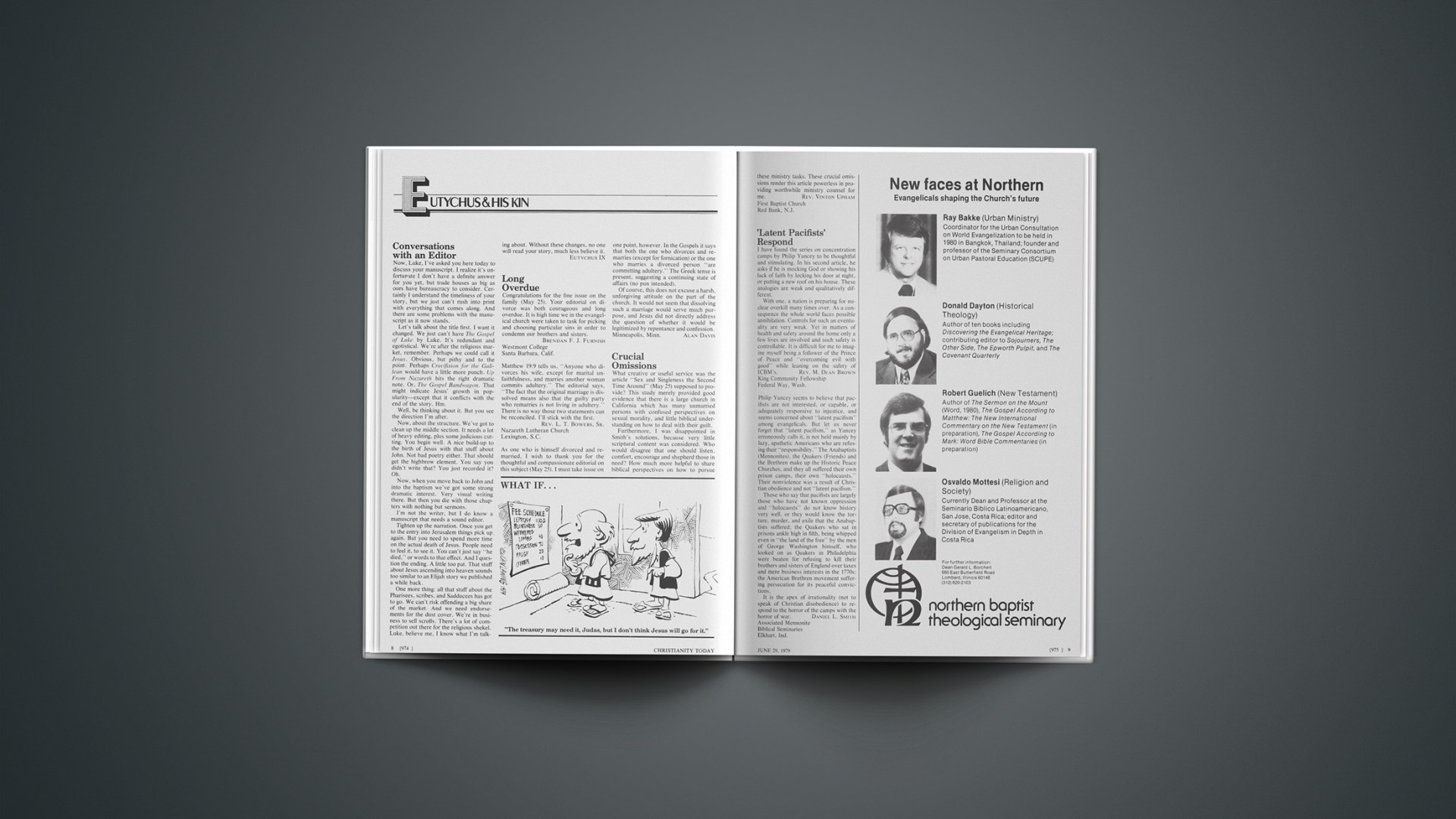
Ideas

The Release of Georgi Vins

Understandably, Soviet Protestant leader Georgi Vins has been showered with attention in Christian circles in the West. His surprise release from a Siberian work camp and deportation to the U.S. in late April following years of imprisonment and harassment was received as a welcome answer to prayer. Vins, however, has mixed feelings about what happened, and so do we.

Vins was stripped of his citizenship, ousted from the land he loved, and removed from direct contact with the churches he ably served. He belongs in his own country, where his ministry is needed—but with his rights intact. He was hounded and jailed by Soviet authorities solely for his religious activities, an appalling violation of the Soviet Union’s own constitution.

Sadly, a number of others like Vins—no one, including Vins, knows how many—are still in jail. Continual pressure must be placed upon the Soviet government; there can be no letup until Soviet believers are permitted to exercise their God-ordained rights.

In the months ahead, Vins and his family will need assistance in starting a new life. He will need protection from would-be exploiters while seeking new opportunities for Christian service. He may wish to reassess his position regarding the dispute that split the Protestants in the Soviet Union in the 1960s. Basically, that dispute was over government interference in church affairs: Vins and some other leaders argued that any intrusion ought to be resisted at all costs; but the majority of the Protestant leadership, deeming it best for the survival of the churches, chose to cooperate with the government in hopes that significant rights could be retained or gained. The widespread closure for decades of churches in Albania, China, and North Korea, where once they flourished, is evidence that governments that really want to can virtually eliminate organized Christian activity.

During Vins’s last five years in prison, a thaw developed between the main Protestant group and the Vins reform group. Additionally, the estimated 300,000 Pentecostals outside the officially recognized Protestant body became friendlier toward their “compromising” brethren. All of this is good news. Vins was shut off from these developments for the most part, though, and he emerged from prison still convinced that congregations must practice a rigid separation of church and state—even when the state declines to go along with the idea.

We, of course, sympathize with Vins’s views. But we also understand the political realities surrounding the decisions of the majority of Protestant leaders. The last thing Christians in an atheist state need is disunity. We hope that for the sake of Christian witness some way can be found for Soviet believers inside and outside the U.S.S.R. to surmount their differences. Georgi Vins may be able to help lead the way.

The Travail Of Northern Ireland

One of the more bizarre features of the recent general election campaign in Britain was a moment of harmony between the two major parties. It has truly been said that nothing unites people more than a common antagonism. In this case the warring Labour and Conservative factions joined together to repudiate a remark made in Dublin by the the U.S. Speaker of the House, Thomas “Tip” O’Neill. He must have pleased his hosts in the Irish Republic by saying of Northern Ireland, “The problem has been treated as a political football in London or has otherwise been given a low priority.”

But O’Neill’s musing was mild compared with written remarks by Hugh Carey, governor of New York. “The impending British elections,” he declared, “offer the opportunity to focus international attention on England’s continued failure to solve its most terrible problem, the damnable Irish question.”

Northern Irish terrorists were delighted by what they hailed as assistance for their cause. During the election campaign and the ensuing few days they murdered twenty people in Northern Ireland. In the Netherlands they assassinated the British ambassador. They also killed Airey Neave, one of Britain’s most respected members of Parliament and the man who would have been Secretary of State for Ireland in the new Thatcher administration. Irish-American politicians, almost all of whom profess to be devoutly Christian, should hold their tongues rather than try to pick up votes with seeming indifference to the cost in British blood.

There is no simple solution to the Northern Ireland problem. Thankfully it is an issue which neither of the two major British political parties has tried to exploit. But the tragedy is definitely not “low priority.”

Nowhere is there a greater work for Jesus Christ to be done today than in this unquiet land among the bereaved, the incorrigible, the mutilated, the vicious, the terrified, the lonely, the deranged, and the misguided. Desperately needed is a purged memory so that peace can be understood not just as the absence of conflict, but as the presence of God.

The Pope In Poland

Pope John Paul II’s visit to his native Poland (see News, page 50) was a triumphant homecoming in many ways. We can easily understand the joyful pride of millions of Poles, including, we suspect, some Communist functionaries. After all, this Pope is carving a notable niche in history for himself and his country. He is the first Polish Pope in the nation’s 1,000-plus years of existence, and he seems to be doing well at what it is that Popes do.

Because of him, the world is sitting up and taking note of Poland. Its 35,000,000 citizens—more than 90 percent of them Roman Catholics—constitute the most church-going people in the world. They enjoy a greater measure of religious freedom than the people of any other Eastern European nation—though there still is a long way to go, as John Paul II courageously pointed out during his visit.

Among other things, Polish Catholics want more paper and less censorship for their publications, more building permits for new churches, less state interference in church affairs, less discrimination in employment, and the right to establish religious education programs for their children. We hope negotiations on these points will be pursued with dispatch as a result of the Pope’s visit.

Understandably, Protestants and non-Christians, especially older ones, are somewhat less than enthusiastic about backing the Catholic church in its quest for greater freedom. They can remember pre-World War II days when the church had considerable political clout and denied the rights of non-Catholics. To a degree, such conditions still exist in scattered communities elsewhere in the world, and Pope John Paul II should use his influence to clean house where necessary.

We should realize, however, that by and large we are in a new age. Increasingly, there is appreciation of Protestants by Catholics. The Bible is an open book in Catholic circles, and strong tides of spiritual renewal are flowing through the church.

The Pope himself has played a part in this reversal. For example, as Cardinal Karol Wojtyla of Krakow, he led the Polish bishops to adopt an evangelical youth movement as the official youth organization of the church in order to shelter it from unrestrained government harassment. His excessive references to Mary notwithstanding, the evidence indicates that Pope John Paul II is Christ-centered in his thinking. He gave a bold witness for Christ in Poland and for that, we applaud him.

Taking A Costly Stand

For the second consecutive year, singer Anita Bryant placed first in the Good Housekeeping Most Admired Woman poll. And perhaps her popularity surprised those who mistakenly assumed that Miss Bryant’s campaign against the homosexual rights movement had placed her in general disfavor.

Many pro-Bryant voters explained that while they might not always agree with her views, they do admire her courage in expressing those views. The magazine’s readers, it seems, respect an honest, clearly defined stand on a controversial issue.

Perhaps there is a lesson here for evangelicals, many of whom have given Miss Bryant less than “Admired Woman” status. On many issues—abortion, pornography, racial justice—evangelicals have taken a middle ground approach. We avoid identifying ourselves too closely with an issue or movement that might jerk us from the shelter of anonymity in America’s mainstream. We often leave unfashionable campaigns for righteousness to “extremists” of the left or right.

Of course, there may be keenly perceived reasons for not getting publicly involved in each new crusade. In Miss Bryant’s case, some evangelicals say she has placed inordinate emphasis upon one particular sin.

More likely, however, evangelicals back off from involvement in the gay rights controversy and from taking other strong stands against pervasive sins because of the risks and personal sacrifices that may be involved. Bryant’s involvement, for example, has cost her considerable income as an entertainer; she and her family have received threats and a degree of social ostracism.

In a recent survey in this magazine (Jan. 5 issue, p. 16), church leaders assessed the status of the church in 1979. A number of them complained of a church that was compromised by culture. Former Wittenburg Door editor Denny Rydberg, for instance, said, “The church seems almost indistinguishable from any other organization in society. You can’t tell the Christians from anyone else.”

Evangelicals do not need to take public stands just for the sake of argument. Neither should we bludgeon society with harsh judgments that are not based in love. But the long-run benefits of speaking may outweigh the short-term risks. Apparently one substantial portion of society, the readers of Good Housekeeping, respect a Christian such as Anita Bryant, whose beliefs are expressed forthrightly.

Eutychus and His Kin: June 29, 1979

Now, Luke, I’ve asked you here today to discuss your manuscript. I realize it’s unfortunate I don’t have a definite answer for you yet, but trade houses as big as ours have bureaucracy to consider. Certainly I understand the timeliness of your story, but we just can’t rush into print with everything that comes along. And there are some problems with the manuscript as it now stands.

Let’s talk about the title first. I want it changed. We just can’t have The Gospel of Luke by Luke. It’s redundant and egotistical. We’re after the religious market, remember. Perhaps we could call it Jesus. Obvious, but pithy and to the point. Perhaps Crucifixion for the Galilean would have a little more punch. Up From Nazareth hits the right dramatic note. Or, The Gospel Bandwagon. That might indicate Jesus’ growth in popularity—except that it conflicts with the end of the story. Hm.

Well, be thinking about it. But you see the direction I’m after.

Now, about the structure. We’ve got to clean up the middle section. It needs a lot of heavy editing, plus some judicious cutting. You begin well. A nice build-up to the birth of Jesus with that stuff about John. Not bad poetry either. That should get the highbrow element. You say you didn’t write that? You just recorded it? Oh.

Now, when you move back to John and into the baptism we’ve got some strong dramatic interest. Very visual writing there. But then you die with those chapters with nothing but sermons.

I’m not the writer, but I do know a manuscript that needs a sound editor.

Tighten up the narration. Once you get to the entry into Jerusalem things pick up again. But you need to spend more time on the actual death of Jesus. People need to feel it, to see it. You can’t just say “he died,” or words to that effect. And I question the ending. A little too pat. That stuff about Jesus ascending into heaven sounds too similar to an Elijah story we published a while back.

One more thing: all that stuff about the Pharisees, scribes, and Sadducees has got to go. We can’t risk offending a big share of the market. And we need endorsements for the dust cover. We’re in business to sell scrolls. There’s a lot of competition out there for the religious shekel. Luke, believe me, I know what I’m talking about. Without these changes, no one will read your story, much less believe it.

EUTYCHUS IX

Long Overdue

Congratulations for the fine issue on the family (May 25). Your editorial on divorce was both courageous and long overdue. It is high time we in the evangelical church were taken to task for picking and choosing particular sins in order to condemn our brothers and sisters.

BRENDAN F. J. FURNISH

Westmont College

Santa Barbara, Calif.

Matthew 19:9 tells us, “Anyone who divorces his wife, except for marital unfaithfulness, and marries another woman commits adultery.” The editorial says, “The fact that the original marriage is dissolved means also that the guilty party who remarries is not living in adultery.” There is no way those two statements can be reconciled. I’ll stick with the first.

REV. L. T. BOWERS, SR.

Nazareth Lutheran Church

Lexington, S.C.

As one who is himself divorced and remarried, I wish to thank you for the thoughtful and compassionate editorial on this subject (May 25). I must take issue on one point, however. In the Gospels it says that both the one who divorces and remarries (except for fornication) or the one who marries a divorced person “are committing adultery.” The Greek tense is present, suggesting a continuing state of affairs (no pun intended).

Of course, this does not excuse a harsh, unforgiving attitude on the part of the church. It would not seem that dissolving such a marriage would serve much purpose, and Jesus did not directly address the question of whether it would be legitimized by repentance and confession.

ALAN DAVIS

Minneapolis, Minn.

Crucial Omissions

What creative or useful service was the article “Sex and Singleness the Second Time Around” (May 25) supposed to provide? This study merely provided good evidence that there is a large church in California which has many unmarried persons with confused perspectives on sexual morality, and little biblical understanding on how to deal with their guilt.

Furthermore, I was disappointed in Smith’s solutions, because very little scriptural content was considered. Who would disagree that one should listen, comfort, encourage and shepherd those in need? How much more helpful to share biblical perspectives on how to pursue these ministry tasks. These crucial omissions render this article powerless in providing worthwhile ministry counsel for me.

REV. VINTON UPHAM

First Baptist Church

Red Bank, N.J.

‘Latent Pacifists’ Respond

I have found the series on concentration camps by Philip Yancey to be thoughtful and stimulating. In his second article, he asks if he is mocking God or showing his lack of faith by locking his door at night, or putting a new roof on his house. These analogies are weak and qualitatively different.

With one, a nation is preparing for nuclear overkill many times over. As a consequence the whole world faces possible annihilation. Controls for such an eventuality are very weak. Yet in matters of health and safety around the home only a few lives are involved and such safety is controllable. It is difficult for me to imagine myself being a follower of the Prince of Peace and “overcoming evil with good” while leaning on the safety of ICBM’s.

REV. M. DEAN BROWN

King Community Fellowship

Federal Way, Wash.

Philip Yancey seems to believe that pacifists are not interested, or capable, or adequately responsive to injustice, and seems concerned about “latent pacifism” among evangelicals. But let us never forget that “latent pacifism,” as Yancey erroneously calls it, is not held mainly by lazy, apathetic Americans who are refusing their “responsibility.” The Anabaptists (Mennonites), the Quakers (Friends) and the Brethren make up the Historic Peace Churches, and they all suffered their own prison camps, their own “holocausts.” Their nonviolence was a result of Christian obedience and not “latent pacifism.”

Those who say that pacifists are largely those who have not known oppression and “holocausts” do not know history very well, or they would know the torture, murder, and exile that the Anabaptists suffered; the Quakers who sat in prisons ankle high in filth, being whipped even in “the land of the free” by the men of George Washington himself, who looked on as Quakers in Philadelphia were beaten for refusing to kill their brothers and sisters of England over taxes and mere business interests in the 1770s; the American Brethren movement suffering persecution for its peaceful convictions.

It is the apex of irrationality (not to speak of Christian disobedience) to respond to the horror of the camps with the horror of war.

DANIEL L. SMITH

Associated Mennonite

Biblical Seminaries

Elkhart, Ind.

Editor’s Note from June 29, 1979

We hesitate to call too much attention to ourselves, but our readers have a legitimate interest in knowing how CHRISTIANITY TODAY fares in contests with other periodicals. The Associated Church Press, comprising some 100 periodicals that mostly serve the major Protestant denominations, honored us with its 1978 Award of Merit for “general excellence” in our category of nondenominational magazines (one of four in the competition). The other three winners were Canadian Churchman, A.D., and Journal of Current Social Issues. The Evangelical Press Association (230 members) conferred on CHRISTIANITY TODAY 11 awards out of 94, including a first place for John Lawing’s review of the Chuck Colson movie, that were presented for specific kinds of articles and graphics. We realize that we have a lot of room to improve; but as we try to put out a consistently better product for our readers, it is nice to have a few tokens of recognition along the route such as these provided by contest judges.

In this issue we present readers with a series of thought-provoking articles. A sociologist and a theologian each draw lessons from Jonestown. Ted Ward gives guidance for the church in the interim before the end times. Ronald Koteskey shows us that modern technological skills are not enough: we can learn much from old-fashioned remedies for mental illness. D. A. Carson brings a devotional message based on Revelation 2. And be sure to check the book reviews.

Celam III: A Gospel of Freedom and Justice

The Puebla document is critical of both unfettered capitalism and Marxism.

Celam III (the third Latin American Conference of Bishops) will pass down in history as a continuation and deepening of CELAM II (Medellín, 1968) but with a clear-cut effort to steer the church away from the so-called theology of liberation and to bring it in line with the Evangelii Nuntiandi of Paul VI.

Initially convened over two years ago by Pope Paul VI and last year by John Paul I, CELAM III took place in Puebla de los Angeles, Mexico, January 27 to February 12 (see Mar. 23 issue, p. 46). A full evaluation of the results of this conference on “The Present and Future Evangelization in Latin America” must wait for the study of the final document.

CELAM II dealt with “The Latin American Reality in the Light of Vatican II.” The sixteen Medellín documents viewed the church as “the church of the poor” and committed her to the struggle for the liberation of the oppressed and to the development of communidades de base (basic communities). In the words of an observer, the greatest accomplishment of CELAM II was “a holistic liberation springing out of man’s heart but including all the structures which, as emerging from the human heart, are evil.”

In a real sense, at Medellín a new day dawned for the Roman Catholic Church in Latin America. One aspect of it was the willingness of many in the clergy to suffer for the sake of justice; so much so that it has been estimated that during the last decade approximately 840 bishops, priests, and nuns have been brutally treated, jailed, tortured, exiled, or assassinated in Latin America. On the other hand, the liberation theologians (among them Gustavo Gutierrez, one of the chief drafters of the Medellín documents) appealed to CELAM II for endorsement of their leftist approach to socioeconomic problems.

The years following CELAM II saw a growing chasm between “conservative” and “progressive” forces within the Roman Catholic Church. As the dates of the third conference approached, the debate between those who wished to divest the gospel of all its social implications and those who wanted to identify it with an ideology of social change reached its hottest point. The big question was whether Puebla would turn out to be a blunt denial or a deepened affirmation of Medellín.

The 356 participants (21 cardinals, 66 archbishops, and 131 bishops among them) arrived in Puebla after two years of intense and careful preparation for the conference, including their study of a “working draft” of more than a thousand mimeographed pages divided into three parts: (1) a historical perspective and a survey of the Latin American situation; (2) a doctrinal reflection on this situation; and (3) guidelines for pastoral action for the church in Latin America. Of no less importance than all that preparation for the direction of the discussions that followed was the stance taken by Pope John Paul II in the “encyclical” with which he inaugurated the conference. In his homily at Basilica de Guadalupe on the previous day he had already pointed out that some current interpretations of the Medellín documents were “contradictory, not always correct, and not always beneficial to the church.” In his opening speech at Seminario Palafoxiano near Puebla (where the conference was held) he condemned the “rereadings of the gospel” in which Jesus Christ was stripped of his deity, and stated that the church must remain “at the margin of competitive systems, so that her only option may be man.” The church, said the Pope, “has no need to appeal to ideological systems in order to love, to defend, and to cooperate with the liberation of man.” At the same time, he claimed that “national and international peace can only prosper within a social and economic system based on justice” and affirmed that according to the social teaching of the church “all property implies a social mortgage.” His condemnation of modern attempts to reduce the Christian faith to a socioeconomic ideology and the mission of the church to political activism was balanced by an affirmation of the gospel as the basis for social involvement and concern for the poor.

Presided over by Cardinal Sebastiano Baggio (the Pope’s representative). Cardinal Aloisio Lorsheider (archbishop of Fortaleza, Brazil, and president of CELAM), and Cardinal Enrique Corripio Ahumada (primate archbishop of Mexico), the bishops debated the issues on the agenda, organized in twenty-one commissions which later met together. The final document issued at the end of the conference is divided into five chapters dealing with the following topics: (1) “Pastoral Vision of the Latin American Reality”; (2) “Doctrinal Reflection”; (3) “Evangelization in and by the Church in Latin America”; (4) “Today’s Evangelizing and Missionary Church in Latin America’s Future”; and (5) “Pastoral Options on the Basis of Puebla.”

Of particular importance in the Latin American context is the document’s condemnation of all kinds of violence. On the one hand, following the Pope in his inaugural speech, it rejects the image of Jesus as a political revolutionary and of the church as a political party, and states that crime “can never be justified as a means of liberation.” “Violence,” it adds, “inevitably generates new forms of oppression and slavery which are much worse than those from which it claims to liberate; above all, it is an attack against life, which depends on the Creator alone.” On the other hand, the document denounces the abuse of power present in many Latin American countries today, and accuses harsh military governments of suppressing political rights and fostering injustice, sheltered behind the excuse of “promoting Western civilization.” In an uncompromising statement on poverty, it describes the luxury of the rich minority as “an insult to the misery of the great masses” and as “contrary to the Creator’s plan and to the honor due to him.” It also calls for major political and economic changes.

The Puebla document is critical of both unfettered capitalism and Marxism. In their place (echoing the Evangelii Nuntiandi) it proposes a “civilization of love” inspired by Christ’s word, life, and action and based on justice, truth, and freedom. If it encourages Latin Americans to recognize the power of the gospel for personal and social transformation, it may turn out to be the most significant document ever issued by the Roman Catholic Church in this part of the world.

C. René Padilla is the director of Ediciones Certeza, the publishing house of the International Fellowship of Evangelical students in Buenos Aires, Argentina.

The Australian Archbishop and the Evangelist

Marcus Loane made the decision to invite Billy Graham for a three-week crusade in Sydney, Australia, while in the hills of Irian Jaya (Indonesian New Guinea) in 1976. As he walked along jungle trails where two Australian missionaries had been killed by headhunters not long before, Loane prayed about the spiritual state of Australia.

And from Loane’s perspective as Anglican archbishop of Sydney, with a nominal one million believers under his spiritual jurisdiction, he concluded that a Graham crusade was needed. As he explained several months later to a group of church leaders in the Chapter House of St. Andrew’s Cathedral in Sydney, Australia needed to experience a spiritual impact similar to the one made during a 1959 visit by Graham.

“That crusade,” he said, “had a most remarkable impact on the city of Sydney, on the churches of all denominations, and on an amazingly large number of totally uncommitted people. For the Church of England the benefits were felt right through to the late 1960s, and were evident in the number of men who offered themselves for theological training and missionary service, and in greatly increased numbers who offered themselves for adult confirmation.

“There was a rising tide of spiritual interest in the 1950s. We are now moving in the opposite direction towards an agnostic, humanistic and an a religious society.”

The decision to invite Graham, then revealed for the first time to other church leaders, was an almost totally personal decision by Loane. Some of his closest advisers were doubtful. Others thought that Graham would not consent to staying three weeks. But from that day the conviction spread that the invitation was right, and people got behind it in amazing numbers.

Loane stands tall in a historic evangelical succession. Few Anglican leaders outside “missionary posts” would give such strong support to mass evangelism in the Graham style. And yet Loane, now the primate (presiding bishop) of the Anglican Church of Australia, is no lover of America or things American. (He once went to the United States to give Bible studies—and stayed only two days.) He is an Anglophile, with a touch of a British accent acquired while a student in England. He is in fact a native Australian with roots in the early colonial days; but his sympathies are royalist, not republican.

Within this Anglophilia there is a deep respect for Reformation history, a love for the gospel, and a determination to encourage evangelism. In what is generally regarded as a most conservative diocese, there have been, since Loane became archbishop in 1966, some unique experiments in evangelism: an Italian evangelist worked for years with newly arrived migrants in the working class suburb of Leichhardt; an Aboriginal pastor was sponsored to start a congregation in the inner city; and, following cross-cultural discussions at the Lausanne Congress, a Turkish evangelist was brought out from Germany.

To add authenticity to this primary evangelism, there has been built up over 100 years a very substantial diocesan social welfare network, described by Donald Coggan, archbishop of Canterbury, as “the most massive welfare work conducted by any diocese in the Anglican Communion.” All this helps to explain how a most conservative Australian archbishop came to invite a most outgoing American evangelist for a most massive one-million-dollar crusade in Randwick Racecourse, Sydney.

The archbishop welcomed Graham at a press conference before the Sydney crusade: “Mr. Graham has, since 1959, travelled the world on an even more extensive scale than before. His crusades have taken him into countries of exceptional interest for people in our own land of Australia.

“In some cases he has been where few others have been. He has conducted crusades in Hungary and Poland behind the Iron Curtain; and he has been to the hills of Nagaland on the northeast frontier of India, an area completely closed to all foreigners in normal circumstances and to most Indians as well.

“He comes to us with a lifetime of experience in this work. I look forward to this crusade because I believe that in the good providence of God it may be the means of a spiritual impact on the city of Sydney … not merely in 1979, but for the twenty years that remain in the twentieth century.”

At the opening crusade meeting, April 29, Archbishop Loane said to the 50,000 gathered: “The city of Sydney and indeed the Commonwealth of Australia stand in need of a proclamation of the gospel on the widest possible scale.

“God has answered our prayers in such a remarkable way in all that has preceded this gathering this afternoon, and we believe that the answers to prayer will exceed all that we ask or think. If one million people came to the Royal Easter Show recently, will there not be one million people who come to the Sydney Crusade?”

Cambodia

Safety after Grim Struggle to Survive

A young Cambodian family, staff members of a North American-based Christian organization, began a new life in the United States last month after surviving four years of constant peril in their homeland.

Vek Huong Taing, 30, his wife Samoeun, 28, and their four-year-old son, Wiphousana, Cambodian staff members of Campus Crusade for Christ International (CCC) had dropped from sight in Phnom Penh in 1975.

Two weeks before they flew to California they had crossed the Thai border from Cambodia along with twenty-three other Cambodian Christians, after having lived in continuous danger, mostly in the forests, since April 1975.

Early this year they reached Sisophon, a Battambang Province town near the Thai border. There a woman who had become a Christian in 1975 through French-speaking missionaries of the Christian and Missionary Alliance paid $9,000 in gold to hire guides to lead the group to a place where they could cross into Thailand and at least temporary safety.

On April 25 the Taings were discovered in the Taphraya camp, a refugee concentration area near the Thai-Cambodian border, by Reuters reporter Michael Battye. He included their names and CCC affiliation in an April 26 dispatch. A Trans World Radio staffer in Guam noticed the story in a pile of wire copy and notified CCC staff in Guam, setting off urgent moves to secure the Taings’ release from the camp.

The urgency of the effort came from the fact that Thai policy for several months had been to repatriate the Cambodians crossing into Thailand. As many as eighty thousand Cambodians were reported to be in the border area. A return to Cambodia was regarded by knowledgeable observers in Bangkok as virtually guaranteeing the Taings’ death, especially since they had been identified as Christians.

After several days of all-out effort involving CCC staff, the Thai government, and U.S. State Department officials in Bangkok and Washington, the young family was released from the temporary refugee camp on May 1. In accordance with conditions set by the Thai government, United States visas were arranged on a priority basis, and the Taings boarded a plane for the United States on May 5.

In a press conference at Ontario International Airport, near the CCC San Bernardino headquarters, the family expressed deep gratitude to God for their deliverance. “We did not think we could see any of you again on this earth,” Taing told CCC staff, “but God showed his mercy on us.” Composed and looking rested, he spoke of the frustration that he and his wife had felt about being unable to have a more open ministry during the four years they were living in Cambodia under the Pol Pot regime.

They said that intercessory prayer had been their chief ministry during that period, impressing on them the crucial importance of living by faith.

Despite the obstacles to ministry, they explained, they had seen twenty Cambodians come to profess Christ as Savior during the four years, even though the people realized that making that decision meant they might well be killed.

Taing said that he had become known in Cambodia as a Christian and had been marked for execution by the Khmer Rouge before the Vietnamese invaded Cambodia earlier this year. Nonetheless, Taing said, the couple had made up their minds to die for their faith if need be and had resolved, despite the danger, not to lie about their names, their Christian faith, or their mission affiliation.

Speaking in distinct English while his wife and son sat nearby, Taing told a story of apparent miracles, including what he said was God’s miraculous provision of food to ward off the constant threat of starvation.

He spoke of being able at one place they stayed in Pursat Province to catch one fish a day, even though fish were sparse and he had no particular skill as a fisherman. “It was only one a day, and it was about the same size,” he recalled, but it helped keep the family going at that stage.

At another location he was given the difficult skill of climbing coconut palm trees, enabling him to obtain a small number of coconuts to supplement his family’s meager diet.

He told of being befriended again and again by other Cambodians, even, on occasion, by local Khmer Rouge officials. At one village, he said, the local Khmer Rouge leader liked the family so well that he would take them to his house at night, turn off the lights, and cook rice to keep them from starving.

Despite such instances, however, he spoke grimly of mass killing by the Khmer Rouge and of widespread starvation throughout Cambodia. Taing said it was a common sight to see dead bodies everywhere. At one village in which they stayed, the population went from 388 to less than 50 in four or five months as a result of killings and starvation.

India

Is Religion a Deadly Weapon?

Christians from all over Kerala and from every walk of life rallied by the thousands in April in the city of Trivandrum to protest the religious discrimination they saw behind the Freedom of Religions Bill now before the Indian Parliament.

Ignoring the heat of the tropical sun and forgetting their doctrinal differences, Roman Catholics, Protestants, Syrian Orthodox, and other religious groups in this state with India’s highest concentration of Christians stood as one to fight the bill they believe would violate fundamental rights guaranteed them in the Indian constitution: freedom to practice, preach, and propagate their religious faith.

Similar unprecedented, large-scale Christian demonstrations were occurring in many parts of India (the Christian community numbers 15 million out of a total population of 650 million). The Christians denounced the controversial bill and appealed to the members of Parliament to withdraw it.

The bill was introduced by Om Prakesh Tyagi, a member of Parliament belonging to the former Hindu nationalist Jana Sangh, a party merged into India’s ruling Janata Party. He is also a member of the Arya Samaj, a militant Hindu organization known for its antimissionary and anti-Christian stance.

His bill seeks to “prohibit conversions from one religion to another by the use of force or inducement or by fraudulent means.” It also prohibits converting persons under eighteen years of age. The bill recommends one- to two-year prison terms and a fine of from 3,000 to 5,000 rupees ($400 to $600) for those who violate its requirements.

In answer to the question of a reporter from Himmat, an Indian weekly, Tyagi gave the following explanation for his bill: “The government has now given economic protection to the socially and educationally backward. But what about protection of their culture? There is danger to it because foreign money is coming into the country on a large scale, legally and illegally, and particularly to foreign missions.” He conceded that the missions were performing significant service by operating schools and hospitals but, in so doing, “if they deprive someone of his religion or culture, then it is not right.”

While proponents of the bill say that its purpose is to protect the religious rights of the minorities, opponents respond that the bill’s definitions of force, fraud, and inducement are so broad as to be vulnerable to governmental abuse.

Force may include “a threat of injury of any kind including threat of divine displeasure,” fraud may include “misrepresentation,” and inducement may include “the grant of any benefit.”

No Christian, they say, can preach the gospel and obey the mandate of Christ without fully or partially violating the bill. Preaching of heaven or hell, of eternal life and death, can be interpreted as threat or force. Proclaiming Jesus Christ as the only Savior, in a country credited with being the cradle of many religions, could be construed as misrepresentation or fraud. Works of charity to the poor and sickly—even help to a convert in need—could be interpreted as an inducement.

In its commentary, Mainstream, another Indian weekly, points out, “The apprehensions caused among religious minorities, especially Christians, by O. P. Tyagi’s bill, now before the Parliament, are easy to understand. The controversy has been started at a time when the Rashtriya Swayamsevak Sangh [perhaps the most militant and anti-Christian Hindu sect in India, of which Tyagi is a member] believes that to be an Indian one has to be a Hindu.… The organs of the RSS have been making a log of noise about ‘indigenous’ and ‘alien’ religions. The aim is obviously to brand those who believe in or practice any religion other than Hinduism as either victims or agents of some aslien culture.”

I. Jesudason, bishop of the Church of South India for the diocese of South Korela, expressed the sentiments of most Christians when he said, “Even though Christianity is not mentioned in the bill, it is against Christianity.… A year ago, a similar bill was introduced in Arunachal Pradesh, and there it is against Christianity.

For years Christians in Arunachal Pradesh, many being converts from various primitive tribes, have been persecuted by non-Christians with the approval of anti-Christian government officials in the state. More than forty of their churches have been destroyed, homes have been burned, and members—including women and children—have been beaten up. There also have been reports of killing of Christians by non-Christians who think that Christians are destroying the primitive Hindu culture. Christian organizations are banned and Christians are not allowed to construct church buildings without government permission—permission that is often withheld. Christians from other parts of India are not allowed to visit Arunachal Pradesh.

While visiting Arunachel Pradesh just after passage of the Freedom of Religion Bill in that state, Indian Prime Minister Morarji R. Desai is reported to have said that similar bills should be introduced in all sixteen states. (Bills similar to the one now before the national Parliament have become law in Orissa and Madhya Pradesh in addition to Arunachal Pradesh.)

Opposition to the bill has also come from the other religious minority groups that fear a Janata party government bias in favor of the overwhelming Hindu majority. Many politicians, including some members of the Janata party, are also against the bill. Madhu Limaye, a prominent member of the Janata party, said that the bill is “needless and provocative.” He, like many others, feels that if there are unhealthy practices, clauses already in the penal code are adequate to deal with them.

Because of mounting opposition to the bill, mainly spearheaded by the leaders of all sections of the Christian community, Desai has promised that the bill will not be considered in its present form.

A positive effect of the bill has been to unite Christians of all denominations and groups as never before. It has created an awareness among Christians in isolated areas that they are part of a strong national church. It has alerted a once complacent church that it can no longer take religious freedom for granted.

T. E. KOSHY

Poland

Authorities Move to Restrict Papal Visit

Although the Roman Catholic Church in Poland has been entrusted with organizing the Pope’s visit this month, the authorities have issued a number of directives in order to limit the impact of the event. According to information reaching Keston College, England, from a private source in Warsaw, all teachers and professors are to hold classes during the visit. Anyone absent from school may either be dismissed or incur a “disciplinary transfer.” School-leaving examinations, as well as university entrance examinations, were changed to coincide with his stay.

John Paul II will not be permitted to visit the two shrines at Kalwaria Zebrzydowska and Piekary near his former home in Krakow as planned, for fear of large crowds gathering. He will only be allowed to cover short stretches of his route by car and will mostly be flown by helicopter. The mass scheduled for Victory Square, Warsaw, is now to be held in front of the small church of St. Anne instead. People have been advised to stay at home and watch the proceedings on television.

There is fear that this pressure being exerted by the authorities may provoke an unmanageable situation. Great concern is being voiced among the Polish bishops.

Mexico

Liberation Theology to Leftist Politics

No small stir has been created in Mexico by the announcement of a former Methodist minister that he seeks a seat in Mexico’s Chamber of Deputies under the Communist Party.

Raúl Macín, pastor of Methodist churches in Mexicali and Monterrey from 1960 to 1972, stated in an April interview published on the front page of Excelsior, Mexico’s most influential newspaper, that “even if it should become atheist, the Church cannot fulfill what the Gospel requires in our day without Marxism.”

He contended in the interview that God is a human creation, and argued that he has not defected from the faith, but has “found the faith in leftist political practice.” He noted that his political pilgrimage began while he was pastor, and was nourished by participation in the ecumenical movement Church and Society in Latin America (ISAL). He defined his political views during study visits with ISAL in Uruguay.

Macín seeks election July 1 to the second political district of Mexico City in the nation’s legislative body.

Just four days after the interview appeared, Gonzalo Baéz-Camargo, Mexican Methodism’s most visible figure, commented in his Excelsior editorial column on Macín’s leftist political stance and “congratulated” him for finally declaring himself. “For many years he tried to sail two currents and play two hands of cards. Now he has torn off the mask of what he pretended to be, and has revealed his true face.”

Added Baéz-Camargo, “Backed by the World Council of Churches and the Methodist Board of Missions, and supported by ‘imperialist’ dollars, he acted as an instrument of Marxist infiltration.” Baéz-Camargo further charged that Macín maliciously maligned the Mexican Methodist Church after withdrawing from it.

A high Mexican official in the Methodist Church stated that Macín has renounced biblical principles, that he influenced four other pastors to leave the church with him, and that he is dedicated to proclaiming the extreme leftist interpretations of the theology of liberation. This official revealed that upon leaving the church, Macín traveled to Geneva where, after stating his case, he was given a warm welcome by World Council of Churches officials. The Mexican Methodist Church, the only Mexican church that holds membership in the WCC, is not pleased with the council’s support of Macín. The official pointed out categorically that Macín has no present relations with the Methodist Church in Mexico.

Raúl Macín presently directs Mexico’s Coordinating Center for Ecumenical Projects, (CCEP) though he has asked for a six-month leave of duty for “personal reasons.” The CCEP is “directly related” to the WCC, according to one of its employees.

WILLIAM W. CONARD

World Scene

Christian broadcasters to China report a dramatic upsurge in letter responses. Far Eastern Broadcasting Company reported receiving more than fifty-six hundred letters from the People’s Republic in its Hong Kong office this year through mid-April. This compares with fifty-eight letters received in all of 1978, and an average of eighteen letters received annually over the past ten years. In previous years it was obvious that the letters had been opened and censored; this year the envelopes are arriving intact. The Christian Broadcasting Association of Hong Kong also reports an upswing. Both groups say that 90 percent or more of the mail is coming from non-Christians.

Turkey has expropriated five Greek Orthodox churches, charges Ecumenical Patriarch Demetrios. He named five church properties that he said had been “occupied” in April. The Orthodox primate urged Turkish Prime Minister Bulent Ecevit to “intercede” with the government department that oversees church properties, which, he charges, “is more oppressive than ever before,” including the rule of the Ottoman Empire. Demetrios appealed to Ecevit for “an immediate halt to abusive treatment” of Greek Orthodox Christians. “This is a time to heal existing wounds,” he said, “not to open new ones.”

Proposals to merge Britain’s Free Church Federal Council into the British Council of Churches were overwhelmingly repulsed at recent meetings of both bodies as “not immediately practical.” The Free Churches in Britain are all the Protestant denominations that are not “established”—the Churches of England, Wales, and Ireland (and the Scottish Episcopal Church), and the Church of Scotland (and the Presbyterian Church of Ireland). These established churches make pronouncements on their own behalf apart from the BCC; the Roman Catholic Church is not a member. This leads the Free Churches, most of whom also belong to the BCC, to feel a need for the separate FCFC to specially represent their interests.

Sexual relationships between Christians should be guided by ideals rather than by rules, according to a controversial report issued by British Methodists. The report is expected to create a furor at the denomination’s annual meeting later this month. “Rules …” the report maintains, “are inadequate if the aim is perfect love rather than formal virtue.” It recommends acceptance of homosexuality, does not rule out premarital sex, and says that masturbation may be “healthy and helpful.”

An Argentina evangelism crusade, Youth ’79, was climaxed in the Buenos Aires Luna Park stadium late last month. Samuel O. Libert, pastor of the fastest-growing Baptist church in Argentina, at Rosario, preached. Five area campaigns preceded the intensive five-day crusade in the capital.

An evangelistic rally in Haiti drew what local observers believe to be the largest assembly ever gathered in that country. The estimated forty thousand were at the final service of a crusade held in the Port-au-Prince stadium by North Carolina evangelist Clyde Dupin in March under the auspices of the nation’s Council of Evangelical Churches.

Correction

The article on Romania in the May 25, 1979, issue (page 47) refers to and depicts Patriarch Justinian in error. It was actually Patriarch Justin, who succeeded Justinian after his death in 1977.

Deaths

MARVELLA BAYH, 46, wife of U. S. Senator Birch Bayh, whose professed faith and tireless campaign against cancer provided encouragement to many American women; she had selected Christian rebirth as the theme for her memorial service, which was attended by political and religious leaders, including Oral Roberts; April 24, in Bethesda, Maryland, after an eight-year battle with cancer.

NORMAN S. MARSHALL, 86; commissioned as an officer in the Salvation Army at age 22, he rose within its ranks to become the denomination’s national leader in the United States, from 1957 to 1963; April 26, in Asbury Park, New Jersey, after a long illness.

FRED RENICH, 62, former director of Missionary Internship, one-time missionary to China, and a leader of family workshops; May 8, in Montrose, Pennsylvania.

O. Eugene Pickett was named president of the Unitarian Universalist Association to fill the unexpired term of Paul Carnes, who died of cancer in March. For twelve years, from 1962 to 1974, Pickett was pastor of the denomination’s largest congregation, a 1,000-member church in Atlanta.

Carl E. Armerding, 43, has been named principal (chief executive) of Regent College in Vancouver, British Columbia. A faculty member since the school’s inception in 1969, and a CHRISTIANITY TODAY editor at large, Armerding succeeds James M. Houston, who has been appointed chancellor.

Abe C. Van Der Puy next month becomes the new “Voice of Missions” for the weekly missionary radio program of “Back to the Bible” broadcast. Van Der Puy, who will continue as president of World Radio Missionary Fellowship (which operates station HCJB), replaces the retiring “Voice of Missions” for twenty-eight years, G. Christian Weiss.

Agostino Casaroli, 64, Italian archbishop who specializes in Eastern Europe study, was selected by Pope John Paul II as Acting Secretary of State. Observers link Casaroli’s appointment to efforts of the Roman Catholic Church and its Polish Pope to improve conditions for Catholics living within Communist systems.

When Mozambique President Samora Machel announced an all-out confrontation between his government and the nation’s churches on May 1, political observers in this southern African state were not surprised. Ever since Machel’s Frelimo guerrilla movement formally took control of the government from Portuguese colonials on June 25, 1975, ties between this avowedly Marxist administration and the churches have ranged from bad to disastrous.

Now, following Machel’s address in the capital of Maputo, church and state relations are worse than ever. Machel scathingly denounced the Christian churches in his country, “in particular the Catholic church,” dubbing some of its bishops as “agents of imperialism.” The “enemy,” he charged, was trying to subvert the ongoing revolution in Mozambique.

The churches’ insistence on proseletizing and their alleged efforts to turn people against socialism also were cited by the mission-educated leader as reasons for the church and state showdown.

It is ironic that Catholics have been singled out for attack: many in the Catholic hierarchy had, in varying degrees, backed the Frelimo independence fight. Priests in Mozambique openly embraced the Frelimo cause, while the late Pope Paul VI once welcomed a senior group of the movement’s leaders—including Frelimo vice-president Marcelino dos Santos—to a meeting in Rome.

But the church won little sympathy or recognition from the Machel government after independence in mid-1975. Church schools and mission hospitals were closed, and the approximately 1.5 million Catholics and 500,000 other Christians became subject to increasing government harassment.

Government hostilities against the church subsided after the initial spate of attacks following independence. But late last year Frelimo-Catholic ties in particular turned sour when the Vatican representative in Maputo, who had been attending a clergymen’s meeting in Lichinga, was detained for three days. Last December the Catholic leadership sent Machel a list of criticisms: they demanded an end to “arbitrary detentions,” described nationalization programs as a “source of dissatisfaction,” and rejected the policy of sending students to Cuba “without their parents knowing it.”

Machel responded on both ideological and practical fronts. The government newspaper Noticias ran a series of articles attacking Catholics in particular for their alleged past collaboration with the Portuguese colonialists. In various parts of the country, churches were closed, religious services were banned, and missions activities were restricted.

The situation deteriorated to the extent that Pope John Paul II asked Catholics in late March to pray for the Mozambique church. (Machel’s May Day speech also forbade persons under age eighteen to be involved with the churches and curbed all building of churches.)

Observers cite several reasons for Machel’s hostility towards the churches. A former Maputo resident, who now writes about Mozambique affairs, says that Machel’s staunch Marxism places him in bitter opposition to the church—even though Machel, like many in the Frelimo leadership, received his education in mission schools. The nation’s one million Muslims also have suffered; the government has closed all mosques and has curtailed the Muslims’ normal religious activities.

But political factors also may influence Machel, say Mozambique watchers. It is argued that recent successes by anti-Frelimo guerrilla groups have forced Machel to seek a scapegoat for his domestic troubles. The chief resistance group, Resistencia Nacional Mocambicana, destroyed a fuel depot at the port of Beira in March, causing much embarassment for Machel. Popular unrest over food and commodity shortages in a faltering economy, as well as opposition to the government policy of collectivism, are given as other possible reasons for the president’s virulence towards the church.

Zimbabwe-Rhodesia

A Temperate Regime Heartens the Church

White-ruled Rhodesia becomes black-ruled Zimbabwe-Rhodesia with white participation. Salisbury journalist Pius Wakatama provides an African Christian perspective on the turmoil behind the transition.

Rhodesia came to the attention of the world on November 11, 1965, when its racial supremacist government under the premiership of Ian Smith unilaterally declared the colonial territory independent from Britain. The declaration was aimed at stopping moves by the British towards handing the self-governing colony over to black nationalists.

In an ineffectual attempt to stop the rebellion the British went to the United Nations and asked the world body to institute economic sanctions against the rebellious colony. In response, member nations, including the U. S., severed their economic and diplomatic relations with Rhodesia. Simultaneously black nationalists, who until then were reluctant to use force, resorted to an armed guerrilla war, which is still raging.

In retaliation, the white Rhodesian government imprisoned all leading nationalists, among them Joshua Nkomo (now based in Zambia); and Robert Mugabe (now based in Mozambique). Their organizations—Nkomo’s Zimbabwe African National Peoples Union and Ndabaningi Sithole’s Zimbabwe African National Union—were banned, thus leaving the black population with no political leadership or direction.

After several abortive attempts to reach a settlement with the rebel regime, the British in 1971 finally worked out a formula acceptable to Smith. Called the Smith-Home Proposals, they had been worked out by Smith and Sir Alec Douglas Home, then British Foreign and Commonwealth Secretary.

A condition put on the agreement by the British, however, was that the constitutional formula would have to be acceptable to the country of Rhodesia as a whole. They therefore proposed establishment of a commission of inquiry headed by Lord Pierce to test public opinion about the proposals.

With all the nationalist leaders behind bars, the African masses had no leadership to advise them on the merits and defects of the proposals for a settlement. Faced with this situation members of the two banned parties, who had previously clashed violently with each other, decided to bury the hatchet to meet the crisis. They believed the British hoped to legalize the Smith regime by making only cosmetic changes.

These men sought for someone to mobilize the people against the Smith-Home agreement. They needed a man who was of national stature: politically astute but with no previous history of political allegiance. The man of the moment needed to be respected and acceptable to members of both banned organizations.

After considering a number of names it was unanimously decided that such a man was fifty-four-year-old, American educated, Abel Tendekai Muzorewa, leader of the 55,000-member United Methodist Church. When approached and called upon to lead the people, the bishop did not immediately reply, but spent three weeks in meditation and prayer. After this period, he accepted the call to lead the hurriedly formed umbrella organization, called the African National Council.

It was thus that the diminutive Methodist prelate was reluctantly thrust upon the Rhodesian political stage. After accepting the challenge, he immediately set about to organize and mobilize the people to reject the proposals worked out in the Smith-Home proposal.

The ANC was not completely alone in this task, for the Christian Council of Rhodesia had published a pamphlet showing some of the shortcomings of the proposals. This did not set a precedent, because Rhodesian black and white Christians had become well known for protesting against the unjust and racist laws of successive governments.

The government had already banned Bishop Muzorewa from African reservations for fear he would incite the people against the government. He and five other church leaders had strongly and publicly renounced the Land Tenure Act that divided the country into white and black areas. In his sermons he often spoke out against government injustices.

When the ANC was formed it was jokingly referred to as the “ecclesiastical party” because of the many church lead-party” because of the many church leaders and pastors in its hierarchy. The executive alone was composed of not less than six Christian ministers.

When the Pierce Commission came to Rhodesia to test black opinion they were faced with a massive rejection of the proposals, even in the most primitive and remote areas. The British government had to withdraw.

As the guerrilla war escalated and took a severe toll on both blacks and whites, the need for some form of accommodation became urgent. On March 3, 1978, Muzorewa, representing the United African National Council, Smith representing the white Zimbabwe United Peoples Organization, and Ndabaningi Sithole representing the internal faction of ZANU, worked out constitutional proposals acceptable to each of them as a basis for a settlement.

Despite opposition from the international community and the externally-based nationalists, one-man one-vote elections were held under the new agreement. Despite the war situation, 65 percent of the voting population turned out to vote. Muzorewa emerged the victor, (see May 25 issue, page 51), charged with leading the first black government of Zimbabwe-Rhodesia, the country’s new name according to the March 3 agreement.

In 1973 Muzorewa was awarded the United Nations Peace Prize. Friends and foes alike respect him for his humility and unquestioned integrity. On several occasions he has attributed his source of strength to prayer. Each morning before the day’s business he spends half an hour in prayer and meditation.

In his book, Rise Up and Walk, Muzorewa recounts the events leading to his becoming a Christian. He says, “At one revival meeting Rev. Josia Chimbadzwa preached a stirring sermon and invited those who wished to meet Christ in a new way to come forward. Although I had been brought up in a devout Christian home, I made that morning my own commitment to follow Christ as my Savior.… I realized that I was a sinner, but that God loves me and forgives me.”

As prime minister, Bishop Muzorewa is faced with a formidable task. In an interview after the results of the elections were announced he said that the issues before him are “to effect a cease-fire, to create peace, securing the lifting of sanctions and gaining international recognition.”

Mission Improbable

Effecting a cease-fire will not be an easy task. The two externally-based and Communist-backed black leaders refused to participate in or to recognize the elections. Both Nkomo and Mugabe have vowed to continue fighting and win Zimbabwe “through the barrel of the gun.” They accuse Muzorewa and those participating in forming the new black government of being puppets and traitors. They criticize the provision in the new constitution for twenty-eight parliamentary seats reserved for whites, and entrenched clauses that protect the rights of minorities. They have several hundred guerrillas fighting the security forces. As in any conflict of this kind, civilians suffer the heaviest casualties. An average of twenty people die every day.

Since the agreement, however, there have been encouraging signs. The bishop has successfully persuaded some guerrillas to lay down their arms and to participate in the democratic process now established. Those who have come back tell of “killer squads” of guerrillas sent to kill those who decide to heed Muzorewa’s call for total amnesty.

The bishop, however, stresses that the majority rule program needs to be implemented quickly so that more guerrillas can see that what they are fighting for has in fact been achieved.

His strategy is to reach the “boys” who are actually fighting, the majority of whom have no personal political ambitions. Persuading Nkomo and Mugabe to come home is next to impossible for two reasons. Both Nkomo and Mugabe will not serve under a government which they, themselves, do not lead. This is demonstrated by the fact that the front line states harboring their guerrillas have totally failed to forge unity between the two. Their joint name of Patriotic Front is a unity on paper only. In fact, their two 1 “armies” have been known to fight each other within Rhodesia. A recent effort by the Organization of African Unity and the front line states to unify the two groups ended in total failure because neither of them is willing to serve under the other.

The second reason is that the guerrillas are largely armed and funded by Communist countries who seem now to control them. One can’t imagine either Russia or China allowing their proteges to accept a compromise which does not give them dominance and which will leave the mineral-rich country in the western sphere of influence.

A majority in the U.S. Congress is pressing for the lifting of sanctions. Many members of Congress see it as ludicrous that their government refuses to recognize the one-man one-vote elections, observed and deemed to be fair by American observers, while it recognizes one-man dictatorships elsewhere in Africa.

The new Tory government in Britain has made it clear that it would treat the government of the new Zimbabwe-Rhodesia sympathetically. The UANC believes that a number of small countries will recognize the new government soon and that others will follow suit.

Recognition by the UN is not expected any time soon because of the dominance of the OAU and the Communist influence in that body. The OAU officially recognizes only the Patriotic Front of Nkomo and Mugabe as truly representing the people of Zimbabwe. The attitude of those in the new government is, “So what. We can survive as a nation without the OAU or the UN.”

Most Christian leaders are happy with the turn of events. In an interview with this writer, the Rhodesia field chairman of TEAM (The Evangelical Alliance Mission), Wilfred Strom, expressed his satisfaction. Strom has been a missionary in Rhodesia for twenty-five years. He said, “These new black leaders are pragmatic and have the interest of the people at heart. They will not make needless and ruthless changes. One is amazed with the moderation of Bishop Muzorewa’s men. After the abuse they have suffered at the hands of the whites they would be justified if they were bitter, but they are not. These are men who acknowledge God. Under them many doors will be opened for evangelism.

“I feel there are good prospects for the unhindered growth of the church. However, many things will have to change in our own approach. We will see more leadership being exercised by Africans both in the churches and missions.”

Asked whether mission stations closed by the war will be opened, Strom said that this was unlikely, as the mission would adopt a different strategy. He sees the mission station approach as outdated. Since the beginning of the war TEAM has had to close eight mission stations, including a hospital, several clinics, and schools. One high school was closed after guerrillas murdered the African church pastor and the school boarding master.

A leading black evangelical leader, Phineas Dube, associate director of Scripture Union, hailed the bishop’s victory as a good thing. He said, “The fact that our political leader is a born-again man who seeks to do God’s will makes a big difference. Of course, all will not be smooth sailing. There are still the negotiations with the British and the external leaders. The war will still go on for a while but we are in a better position now than we have ever been.”

South African Assembly

Helping Unthinkable Relationships Happen?

SACLA sounds like just another acronym, but it represents anything but the routine. The South African Christian Leadership Assembly, to be held in Pretoria, July 5–15, is an event unprecedented in the country’s history—and one that could play a key role in helping to shape South Africa’s future.

This is the view of some of South Africa’s leading Christians, such as evangelist Michael Cassidy. SACLA could bring together as many as 10,000 Christians, from a wide range of racial, linguistic, cultural, and denominational backgrounds; Cassidy, 42, says the event will “provide an unprecedented opportunity for almost unthinkable relationships to be established, out of which almost anything could come—and it may turn the tide of history in these parts.”

Besides its size, the assembly is especially significant because of the readiness of Christians from all parts of South Africa’s theological and ecclesiastical spectrum to give SACLA their support. Five main constituencies of the South African Church will be represented:

• the Afrikaans churches;

• the evangelicals (mainly English-speaking);

• the mainline denominations, many with large black memberships, linked to the South Africa Council of Churches;

• the Interdenominational African Ministers Association of South Africa; and

• the Pentecostal churches and the Renewal movement.

SACLA will consist of a number of parallel conferences that cater to specific groups of Christians. The first of these will draw together leaders from business, the professions, politics, and other such fields. The other four conferences are for leaders in local churches (ministers and up to ten delegates from the congregations), college ministries, high school groups, and church youth programs. While there will be some overlap in the sessions of the five groups, delegates will spend most of their time in separate “conferences” exploring the assembly theme: “To discover together what it means to be faithful and effective witnesses to Jesus as Lord in South Africa today.”

Although most plenary sessions will be led by South Africans, there will also be addresses by several foreign speakers, including Bolivia’s Bruno Frigoli, Orlando Costas from Costa Rica, Festo Kivengere from Uganda, Cecil Kerr from Northern Ireland, and Ron Sider from the U.S.

SACLA grew from the experience of eighty South Africans who attended the Pan African Christian Leadership Assembly (PACLA) in Nairobi, Kenya, in December 1976. Their experience of reconciliation at this meeting spurred them toward initiating a similar event back home. Cassidy describes SACLA as “a God-given vehicle through which South African Christians of all persuasions, races and backgrounds can come together not only to find each other but to discover in fellowship what it means to be faithful witnesses to our Lord in South Africa in these tumultuous times.”

David Bosch, a University of South Africa theologian, notes that SACLA will not solve in ten days what the church has failed to solve in scores of years. But he and the others involved in organizing SACLA see the assembly as a catalyst through which God can work.

GORDON JACKSON

Apple PodcastsDown ArrowDown ArrowDown Arrowarrow_left_altLeft ArrowLeft ArrowRight ArrowRight ArrowRight Arrowarrow_up_altUp ArrowUp ArrowAvailable at Amazoncaret-downCloseCloseEmailEmailExpandExpandExternalExternalFacebookfacebook-squareGiftGiftGooglegoogleGoogle KeephamburgerInstagraminstagram-squareLinkLinklinkedin-squareListenListenListenChristianity TodayCT Creative Studio Logologo_orgMegaphoneMenuMenupausePinterestPlayPlayPocketPodcastRSSRSSSaveSaveSaveSearchSearchsearchSpotifyStitcherTelegramTable of ContentsTable of Contentstwitter-squareWhatsAppXYouTubeYouTube