Eutychus and His Kin: June 8, 1979

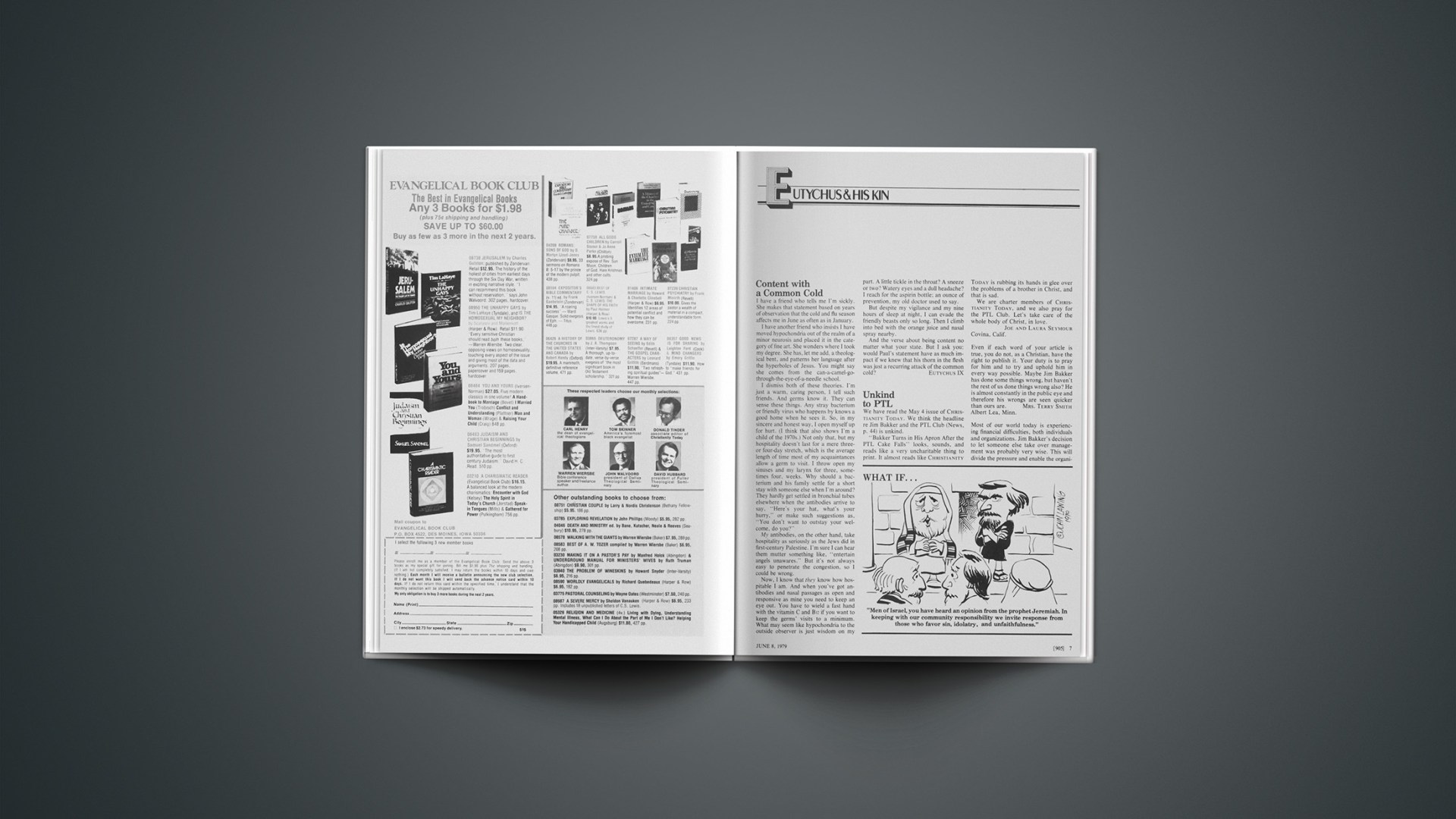
I have a friend who tells me I’m sickly. She makes that statement based on years of observation that the cold and flu season affects me in June as often as in January.

I have another friend who insists I have moved hypochondria out of the realm of a minor neurosis and placed it in the category of fine art. She wonders where I took my degree. She has, let me add, a theological bent, and patterns her language after the hyperboles of Jesus. You might say she comes from the can-a-camel-go-through-the-eye-of-a-needle school.

I dismiss both of these theories. I’m just a warm, caring person, I tell such friends. And germs know it. They can sense these things. Any stray bacterium or friendly virus who happens by knows a good home when he sees it. So, in my sincere and honest way, I open myself up for hurt. (I think that also shows I’m a child of the 1970s.) Not only that, but my hospitality doesn’t last for a mere three- or four-day stretch, which is the average length of time most of my acquaintances allow a germ to visit. I throw open my sinuses and my larynx for three, sometimes four, weeks. Why should a bacterium and his family settle for a short stay with someone else when I’m around? They hardly get settled in bronchial tubes elsewhere when the antibodies arrive to say, “Here’s your hat, what’s your hurry,” or make such suggestions as, “You don’t want to outstay your welcome, do you?”

My antibodies, on the other hand, take hospitality as seriously as the Jews did in first-century Palestine. I’m sure I can hear them mutter something like, “entertain angels unawares.” But it’s not always easy to penetrate the congestion, so I could be wrong.

Now, I know that they know how hospitable I am. And when you’ve got antibodies and nasal passages as open and responsive as mine you need to keep an eye out. You have to wield a fast hand with the vitamin C and B12 if you want to keep the germs’ visits to a minimum. What may seem like hypochondria to the outside observer is just wisdom on my part. A little tickle in the throat? A sneeze or two? Watery eyes and a dull headache? I reach for the aspirin bottle; an ounce of prevention, my old doctor used to say.

But despite my vigilance and my nine hours of sleep at night, I can evade the friendly beasts only so long. Then I climb into bed with the orange juice and nasal spray nearby.

And the verse about being content no matter what your state. But I ask you: would Paul’s statement have as much impact if we knew that his thorn in the flesh was just a recurring attack of the common cold?

EUTYCHUS IX

Unkind to PTL

We have read the May 4 issue of CHRISTIANITY TODAY. We think the headline re Jim Bakker and the PTL Club (News, p. 44) is unkind.

“Bakker Turns in His Apron After the PTL Cake Falls” looks, sounds, and reads like a very uncharitable thing to print. It almost reads like CHRISTIANITY TODAY is rubbing its hands in glee over the problems of a brother in Christ, and that is sad.

We are charter members of CHRISTIANITY TODAY, and we also pray for the PTL Club. Let’s take care of the whole body of Christ, in love.

JOE AND LAURA SEYMOUR

Covina, Calif.

Even if each word of your article is true, you do not, as a Christian, have the right to publish it. Your duty is to pray for him and to try and uphold him in every way possible. Maybe Jim Bakker has done some things wrong, but haven’t the rest of us done things wrong also? He is almost constantly in the public eye and therefore his wrongs are seen quicker than ours are.

MRS. TERRY SMITH

Albert Lea, Minn.

Most of our world today is experiencing financial difficulties, both individuals and organizations. Jim Bakker’s decision to let someone else take over management was probably very wise. This will divide the pressure and enable the organization to do the job more effectively.

I must say how disappointed I am in CHRISTIANITY TODAY’S statements about PTL. I for one will be continuing my support of them and when they have problems, I will seek to give them a helping hand rather than a punch in the nose.

STEVE CASEY

Fifth Street United Methodist Church

Meridian, Miss.

Three Mile Island

The editorial on “Three Mile Island” by Nancy Tischler (May 4) was a treat compared to the pot shots which came from the news media, especially some TV analysts. The author kept both feet on the ground.

WALTER KEISKER

St. Paul Lutheran Church

Jackson, Mo.

Your editorial on the Three Mile Island event can only be branded irresponsible. It not only failed to take any kind of stand, it didn’t even raise any questions. The Apostle Paul tells us to “awake” (Eph. 5:14); your editorial seems like an attempt to keep God’s people asleep and complacent—in direct opposition to our responsibility as stewards of creation.

BRON TAYLOR

Fuller Theological Seminary

Pasadena, Calif.

The article on Three Mile Island shows our present-day desire for a fail-safe life and our fear of facing any other way of life. After escaping one supposedly possible calamity, we reflect on escaping from a time of “tribulation.” The real calamity of the day is people’s own fear of facing life or death or tribulation. The living Jesus enables us to face reality without fear.

RT. REV. FRANK H. BENNING

St. James Anglican Church

Atlanta, Ga.

Good Vibes and Bad

As a minister to youth in a large progressive evangelical church, I greatly appreciated the article by Richard Mountford, “Does the Music Make Them Do It?” (May 4).

I quickly agree with the author regarding the amorality of sound impulses as an art form. As a former professional trombonist I enjoy many musical art forms from classical to jazz-rock.

However, I strongly feel that the amazing capacity of our minds to receive subliminal messages, whether in the form of visual images or audio images, is a factor that needs some treatment. One suggested research project might be the relationship of youngsters involved in sexual experimentation to the affinity of the same for sexually suggestive music (determined by lyrical content), regardless of conscious awareness or intent of the listener.

DEL RAY GUYNES

Rockwood Park Assembly

Fort Worth, Tex.

While admitting that rock music has produced ill results on some people, the author contends that the Christian should not take issue with it until he or she finds proof that it causes harm to all people in the same manner. That sounds like the same arguments I hear in favor of social drinking and legal use of marijuana.

Why doesn’t Mountford repeat some of the lyrics of popular rock songs and allow his readers to decide how difficult they are to understand? Is he really trying to tell us, through his limited trio of researchers, that the message doesn’t matter, only the beat?

REV. WILLIAM J. JOHNSTON

Pleasant View Wesleyan Church

Muncy, Pa.

I was very disappointed in the treatment of rock music by Richard Mountford. The subject was treated almost exclusively from a psychological standpoint based on secular studies and not from a biblical perspective.

While it is true that sin is not simply a result of environmental causes apart from the inner condition of the heart, this does not mean a Christian can tolerate any form of entertainment which does not directly lead to overt sins. The fact that a majority of the men who read pornography do not become rapists does not mean a Christian should condone this.

WILLIAM J. MCCONNELL

Carlisle, Pa.

Need Sensitive Dialogue

The editorial on “Resurging Islamic Orthodoxy” (May 4) has muddied the waters on the issue of dialogue with Muslims. At one point you criticized the Anglican bishops for rejecting an amendment stating that dialogue could never be substituted for evangelism. On what grounds do you make this judgment? Ralph E. Brown has written, “Although evangelicals believe in dialogue, we insist that it is not synonymous with evangelism but only one method of evangelism. And in witness to Muslims it is an important one.” (“How Dialogue Can Be Used to Witness to Muslims,” Evangelical Missions Quarterly, Winter 1971).

In missions to Muslims perhaps the most desperately needed element at present is a sincere effort to communicate through dialogue. Because so much dialogue between Christians and Muslims has been, as you write, “to convince others of the truth …,” the Christian and Muslim have become alienated from one another. As R. Pierce Beaver writes, “Dialogue is not disputation, which is a verbal attempt to conquer a foe.”

Missionaries who engage in dialogue to convince only, do not convince, nor do they have the advantage of learning what the Muslim’s viewpoint may be. Dialogue must be used to learn about the people from the people. When we have listened, and when we have learned, we have earned the right to be heard.

MRS. ALICE BALDWIN

Wheaton, Ill.

Courageous and Incomplete

Your April 20 editorial on the “Israeli-Egyptian Peace Treaty” was both courageous and incomplete.

I commend your even-tempered argument for an American Christian perspective that begins “to see the Palestinian issue in human terms instead of in terms of the maps in the backs of (our) Bibles.” And I am much warmed by your commendation of peacemaking as a laudable public policy.

But, in both your editorial and news article, you ignored an obvious irony. Congruent with the longstanding militarist American policy of “peace through strength,” President Carter forged peace with a huge influx of advanced military weaponry to both Egypt and Israel.

Why was more than $2.5 billion worth of new arms in the Mideast necessary to make peace? I am afraid the answer to this question defines the character and durability of this peace. I hope otherwise.

PHIL M. SHENK

Dayton, Va.

In your April 20 editorial you succeeded in cutting through the heavy swaddling of myth and put the issues in a truly Christian perspective.

Until “justice and compassion,” as you put it, are applied to this issue, it will never be resolved.

GLEN LARUM

Fort Stockton, Tex.

Unreal Heroes Only?

Harold O.J. Brown, in his article “Superman on the Screen: Counterfeit Myth?” (Refiner’s Fire, April 20), has exhibited a keen understanding and a creative pen in regard to the recent phenomenon of the superhero.

But I do not see how superhero stories are necessarily telling us that heroic qualities can be manifested only in unreal persons. We do not need a historical person to show us that virtue can be admired and emulated, though an example of a historical person would, indeed, be much better.

MARTY MADDOX

DeKalb, Ill.

Editor’s Note from June 08, 1979

Reading aloud is now a lost art. It received its coup de grace from television. My own earliest memories of childhood hark back to sitting at my mother’s knee or father’s or Aunt Sophia’s (even the name carries the ring of another era) as they read aloud to us from Hurlbut’s Story of the Bible, Lamb’s Tales from Shakespeare, Mother Goose (a giant folio edition with brightly colored pictures on every page), Hans Christian Andersen, and a host of similar treasures. “Just one more story,” we would plead; and mother, pretending extreme worry over the hazard to our health from the lateness of the hour, would grudgingly yield to just one more. How cheated is the child’s heritage from whom this untold wealth has been stolen! And in its place is nothing but three hours before the tube—truly “a mess of pottage.”

Eve Perera spells out for us the joys of reading aloud to young or old. Cheryl Forbes returns to bring us a fascinating interview with the gifted Christian writer, Madeleine L’Engle. Stuart Babbage warns us sharply of the awful risk in spurning the tender promptings of the Holy Spirit; and finally, to top off a full issue, Chad Walsh brings us a new word about an old friend, C. S. Lewis.

Church Precedes State in Ugandan Relief Aid

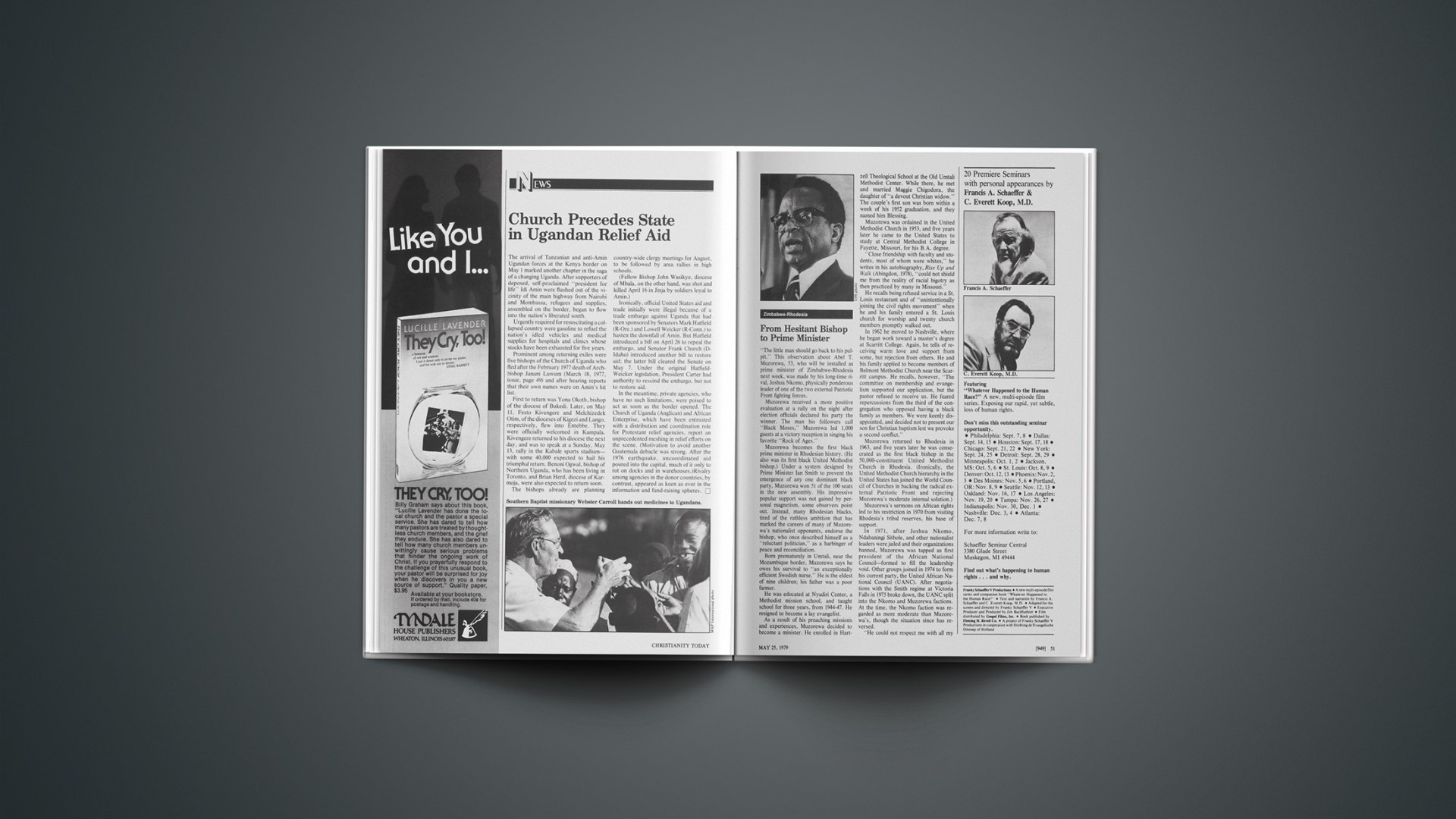
The arrival of Tanzanian and anti-Amin Ugandan forces at the Kenya border on May 1 marked another chapter in the saga of a changing Uganda. After supporters of deposed, self-proclaimed “president for life” Idi Amin were flushed out of the vicinity of the main highway from Nairobi and Mombassa, refugees and supplies, assembled on the border, began to flow into the nation’s liberated south.

Urgently required for resuscitating a collapsed country were gasoline to refuel the nation’s idled vehicles and medical supplies for hospitals and clinics whose stocks have been exhausted for five years.

Prominent among returning exiles were five bishops of the Church of Uganda who fled after the February 1977 death of Archbishop Janani Luwum (March 18, 1977, issue, page 49) and after hearing reports that their own names were on Amin’s hit list.

First to return was Yona Okoth, bishop of the diocese of Bukedi. Later, on May 11, Festo Kivengere and Melchizedek Otim, of the dioceses of Kigezi and Lango, respectively, flew into Entebbe. They were officially welcomed in Kampala. Kivengere returned to his diocese the next day, and was to speak at a Sunday, May 13, rally in the Kabale sports stadium—with some 40,000 expected to hail his triumphal return. Benoni Ogwal, bishop of Northern Uganda, who has been living in Toronto, and Brian Herd, diocese of Karmoja, were also expected to return soon.

The bishops already are planning country-wide clergy meetings for August, to be followed by area rallies in high schools.

(Fellow Bishop John Wasikye, diocese of Mbala, on the other hand, was shot and killed April 16 in Jinja by soldiers loyal to Amin.)

Ironically, official United States aid and trade initially were illegal because of a trade embargo against Uganda that had been sponsored by Senators Mark Hatfield (R-Ore.) and Lowell Weicker (R-Conn.) to hasten the downfall of Amin. But Hatfield introduced a bill on April 26 to repeal the embargo, and Senator Frank Church (D-Idaho) introduced another bill to restore aid; the latter bill cleared the Senate on May 7. Under the original Hatfield-Weicker legislation, President Carter had authority to rescind the embargo, but not to restore aid.

In the meantime, private agencies, who have no such limitations, were poised to act as soon as the border opened. The Church of Uganda (Anglican) and African Enterprise, which have been entrusted with a distribution and coordination role for Protestant relief agencies, report an unprecedented meshing in relief efforts on the scene. (Motivation to avoid another Guatemala debacle was strong. After the 1976 earthquake, uncoordinated aid poured into the capital, much of it only to rot on docks and in warehouses.) Rivalry among agencies in the donor countries, by contrast, appeared as keen as ever in the information and fund-raising spheres.

Zimbabwe-Rhodesia

From Hesitant Bishop to Prime Minister

“The little man should go back to his pulpit.” This observation about Abel T. Muzorewa, 53, who will be installed as prime minister of Zimbabwe-Rhodesia next week, was made by his long-time rival, Joshua Nkomo, physically ponderous leader of one of the two external Patriotic Front fighting forces.

Muzorewa received a more positive evaluation at a rally on the night after election officials declared his party the winner. The man his followers call “Black Moses,” Muzorewa led 1,000 guests at a victory reception in singing his favorite “Rock of Ages.”

Muzorewa becomes the first black prime minister in Rhodesian history. (He also was its first black United Methodist bishop.) Under a system designed by Prime Minister Ian Smith to prevent the emergence of any one dominant black party, Muzorewa won 51 of the 100 seats in the new assembly. His impressive popular support was not gained by personal magnetism, some observers point out. Instead, many Rhodesian blacks, tired of the ruthless ambition that has marked the careers of many of Muzorewa’s nationalist opponents, endorse the bishop, who once described himself as a “reluctant politician,” as a harbinger of peace and reconciliation.

Born prematurely in Umtali, near the Mozambique border, Muzorewa says he owes his survival to “an exceptionally efficient Swedish nurse.” He is the eldest of nine children; his father was a poor farmer.

He was educated at Nyadiri Center, a Methodist mission school, and taught school for three years, from 1944–47. He resigned to become a lay evangelist.

As a result of his preaching missions and experiences, Muzorewa decided to become a minister. He enrolled in Hartzell Theological School at the Old Umtali Methodist Center. While there, he met and married Maggie Chigodora, the daughter of “a devout Christian widow.” The couple’s first son was born within a week of his 1952 graduation, and they named him Blessing.

Muzorewa was ordained in the United Methodist Church in 1953, and five years later he came to the United States to study at Central Methodist College in Fayette, Missouri, for his B.A. degree.

“Close friendship with faculty and students, most of whom were whites,” he writes in his autobiography, Rise Up and Walk (Abingdon, 1978), “could not shield me from the reality of racial bigotry as then practiced by many in Missouri.”

He recalls being refused service in a St. Louis restaurant and of “unintentionally joining the civil rights movement” when he and his family entered a St. Louis church for worship and twenty church members promptly walked out.

In 1962 he moved to Nashville, where he began work toward a master’s degree at Scarritt College. Again, he tells of receiving warm love and support from some, but rejection from others. He and his family applied to become members of Belmont Methodist Church near the Scarritt campus. He recalls, however, “The committee on membership and evangelism supported our application, but the pastor refused to receive us. He feared repercussions from the third of the congregation who opposed having a black family as members. We were keenly disappointed, and decided not to present our son for Christian baptism lest we provoke a second conflict.”

Muzorewa returned to Rhodesia in 1963, and five years later he was consecrated as the first black bishop in the 50,000-constituent United Methodist Church in Rhodesia. (Ironically, the United Methodist Church hierarchy in the United States has joined the World Council of Churches in backing the radical external Patriotic Front and rejecting Muzorewa’s moderate internal solution.)

Muzorewa’s sermons on African rights led to his restriction in 1970 from visiting Rhodesia’s tribal reserves, his base of support.

In 1971, after Joshua Nkomo, Ndabaningi Sithole, and other nationalist leaders were jailed and their organizations banned, Muzorewa was tapped as first president of the African National Council—formed to fill the leadership void. Other groups joined in 1974 to form his current party, the United African National Council (UANC). After negotiations with the Smith regime at Victoria Falls in 1975 broke down, the UANC split into the Nkomo and Muzorewa factions. At the time, the Nkomo faction was regarded as more moderate than Muzorewa’s, though the situation since has reversed.

“He could not respect me with all my robes, all my clerical collars and my position as Episcopal leader,” Muzorewa later said of Smith. “When I cried and talked with Smith, and sat with him and pleaded with him, he laughed.”

A United Methodist Church official once called Muzorewa a case study in “the gradual and forced radicalization of a Christian moderate.” The failure of passive resistance persuaded him, after years of internal conflict, to advocate temporarily a policy of “righteous violence.”

In 1976 (his home was blasted the previous year by a hand grenade attack), Muzorewa sent his wife and three youngest children back to Nashville to live. His family remained there early this month, waiting for the nod to rejoin him.

In a recent interview in Salisbury, the dapper cleric with the awkward public manner said that he rises every morning at six o’clock for personal devotions. Some observers note, wryly, that he will need all the divine resources he can draw on.

“If Zimbabwe is to be truly free and liberated,” Muzorewa wrote in his autobiography, “the head of state must be a liberated person himself.… free from the shackles of evil deeds … liberated from the constraints of tribalism and racism … capable of love.

“The nation is going to need a great deal of loving after 100 years of burning hate.”

Japan

Christians Lose Face as War Leaders Gain

Many Japanese Christians were shocked last month when the name Hideki Tojo appeared in newspaper headlines across the nation: the bristle-mustached wartime prime minister, who was hanged in 1948 as a war criminal, had been secretly enshrined last fall by Shinto priests as a hero and a god, the newspapers revealed. But the Japanese churchmen were also shocked when their new prime minister, Masayoshi Ohira, a professing Christian, paid homage to the spirits of Tojo and other Japanese war dead at the Yasukuni (Shinto) Shrine in Tokyo.

It is political custom for the prime minister to visit Yasukuni during winter and spring rites. With one exception, every prime minister since World War II has done so. And Ohira, not one to make major policy changes, maintained that pattern. The Liberal-Democratic Party, of which he is president, is sympathetic with polytheistic traditions and has strongly insisted that Yasukuni again fall under state control. (The Japanese constitution dictates separation of religion and politics and, since World War II, the Yasukuni Shrine, which was to “enshrine, in principle, the war dead,” has existed as a religious corporation.)

The shrine has been the object of protests by Japanese churches for more than twenty years. Many churchmen participated in protest marches and hunger strikes in the early 1970s. But this year, controversy was particularly sharp.

Church leaders were upset by revelations of the enshrinement of Tojo and thirteen other “Class A” criminals of the war. One Christian told the Japan Times that the enshrinement “contributes to a revival of militarism and state Shintoism.”

And in spite of strong urgings by Christians that their prime minister refuse, in effect, to bow before other gods, Ohira, accompanied by white-robed and black-hatted priests, prayed for Japan’s 2.4 million war dead at the altar in the main worship hall, remaining in the shrine for at least twelve minutes.

One Japanese language newspaper said that “the Christian prime minister went through the ritual of washing his hands [a Shinto purification ceremony], was conducted by a Shinto priest through the oratory, worshiped at the main shrine building, and offered a sprig of the sacred tree at the altar.”

Some forty representatives of various Christian groups assembled on the shrine grounds and handed out leaflets protesting Ohira’s visit. They were kept away from the prime minister by lines of policemen. But their banners remained visible: “Don’t praise Class A war criminals” and “Prime Minister’s visit to the Shrine violates the Constitution.”

To many Christians, Ohira’s presence at the shrine indicated a betrayal of his faith: his wife is a Roman Catholic, and he refers to himself as a Protestant Christian from youth. The following day, some pastors prayed from their pulpits for forgiveness for their nation. Some wept. “We don’t know what else to do,” one pastor said, “except ask again, and give thanks for mercy on Japan.”

The Shinto sanctuary was established in 1869 by Emperor Meiji as a place where the nation could revere those who died for their country. The shrine differs from Arlington National Cemetary in the U.S.: syncretistic Buddhist-Shinto teaching deifies deceased persons, encouraging their worship by sharing patrons.

Prime ministers have claimed they visited the shrine in a private capacity (while they signed the register as prime minister) in order to sidestep the constitutional ban. Ohira said the same—a political plus, no doubt, but also a minus in the religious realm.

Until the end of World War II, Yasukuni Shrine was controlled by the Imperial Army and Navy to strengthen Japanese militarism, since enshrinement at Yasukuni was the greatest honor servicemen could receive.

NELL KENNEDY

Black Evangelicals

Moving from Protesting On to Producing

A new national magazine aimed at black evangelical Christians may soon be a reality, according to John Perkins, president of Voice of Calvary Ministries (VOC) in Jackson, Mississippi. Speaking at the sixteenth annual meeting of the National Black Evangelical Association (NBEA) in Atlanta, Perkins said such a magazine is “long overdue” because white Christian magazines give “limited” coverage to activities in the black community. “We need a magazine that tells the story of our people, that speaks to their needs, and that will draw us together in the unity of our faith.”

Perkins said such a high-quality magazine would provide a Christian perspective on issues that affect the black community, profile dynamic black Christian laypersons and leaders, and call people to be faithful to the Word of God.

Though the proposed magazine is intended for a black audience, Perkins emphasized that its uniqueness would attract white Christians who are interested in racial reconciliation and understanding.

Perkins met privately earlier at the convention with a group of leaders, most of them black. Some of those leaders in the past had made proposals of their own for a black general interest Christian magazine—only to see their hopes dashed because of limited financial support.

This group decided to create an ad hoc committee and task force that will draw up plans for developing a magazine format, raising finances, forming a board, and doing market research. The magazine is expected to be launched next year.

Perkins’s proposal was particularly appropriate since it underscored pragmatically the second prong of a three-pronged NBEA convention theme—“Mandate ’79, To the Masses: Proclamation, Communication, Liberation.”

A few weeks before the delegates arrived in Atlanta, a fire swept through the original convention site, forcing a last-minute switch to another facility. But this didn’t reduce the attendance. More than 600 conferees (400 delegates) heard major addresses by evangelist Tom Skinner; George McKinney, a San Diego pastor; and James Massey, voice of the Church of God (Anderson, Indiana) weekly radio broadcast.

Skinner challenged the delegates to get a “clear-cut vision of what God’s agenda is for black people,” and to rid themselves of the “survivalist” mentality—a mentality that fails to do any long-range planning. “We must be people of longevity … and people of excellence,” he said. McKinney said evangelism must be a priority for the church. “The Great Commission is not the Great Suggestion,”he said. Massey presented ideas on how to communicate effectively.

Women, a number of whom sit on the NBEA board, played a prominent role in this year’s conference. Two of them, Ruth Bentley, director of support systems at the University of Illinois Medical Center, and Etta Ladson, head of the African Christian Teachers Association in Long Island, New York, were featured speakers. Bentley urged the delegates to stay in the inner city and work for the holistic liberation of the black community.

Charging that the dominant culture used Scripture to oppress blacks, Ladson, the closing night banquet speaker, called on blacks to develop “a biblical theology that frees everybody and oppresses no one”—a theology that includes females as well as males. “God’s messengers must be both males and females,” she added.

Ladson’s remarks ruffled some of the more conservative delegates who feel women should not be preachers. They privately criticized her speech, but apparently were in the minority: the banquet audience gave her a standing ovation.

There was a wide array of workshops geared to provide resources and information to enhance the ministries and services of NBEA members. In the theology workshop, chaired by NBEA vice-president Anthony Evans, NBEA board chairman William Bentley delivered a position paper that provoked spirited, though not rancorous, debate. Bentley contended that black evangelical theology is “as grounded in the Scriptures and as valid as any of the Euro-American versions of theology.” A workshop dealing with creative prison ministries featured Calvin and Mary Lucas, the first husband and wife chaplaincy team at Cook County Jail in Chicago.

As was the case last year, a number of predominately white parachurch and educational organizations sent staff members, both black and white, to the convention. Black staff members of at least three of these organizations were program participants. Crawford Loritts, an Atlanta Campus Crusade for Christ evangelist, was a featured speaker. Glandion Carney, national director for urban development for Youth For Christ, and Nadine Smith, Wheaton College assistant dean for minority affairs, were workshop leaders.

At a special seminar for ministers, Joseph Lowery, president of the Southern Christian Leadership Conference (SCLC), spoke on the implications of the Jonestown tragedy. Lowery had visited Guyana to investigate the mass murder suicides.

In at least one respect, the fire proved beneficial to the NBEA—the change in location enabled NBEA officials to establish dialogue and relationships with those attending the National Conference of Black Mayors (NCBM) at the same hotel. Officials of the NBEA and the NCBM attended each other’s luncheons. President Jimmy Carter sent a special assistant, Jack H. Watson, to speak to the mayors and their guests.

According to NBEA’s national field director, Aaron Hamlin, the NBEA (originally called National Negro Evangelical Association) was formed in 1963 in Los Angeles by black evangelicals who wanted “a national medium of fellowship among themselves.” The need for fellowship was intensified because of the “ambiguous and uncertain acceptance of the white evangelical community.” Through its annual convention and local chapters, NBEA seeks to provide a forum where Christians—both blacks and whites—holding differing theological, social and political views, can find common biblical ground for fellowship and service.

Hamlin maintains that this year’s convention was “the best ever,” and comments from delegates confirmed that opinion. One said that the NBEA has now gone from “protest to production.”

HENRY SOLES, JR.

White House Staff

Spirited Sermons to Ghosted Speeches

Other U.S. Presidents have prayed with clergymen—even asked them for moral and spiritual advice. But President Jimmy Carter has brought one on staff: R. L. “Bob” Maddox, pastor of the First Baptist Church of Calhoun, Georgia, began duties this month as a White House speechwriter.

“I can say right now that I won’t be writing sermons,” said Maddox in a telephone interview prior to leaving for Washington (perhaps to allay the fears of sleepy-eyed churchgoers who get enough preaching from the pulpit, let alone from their President). Instead, Maddox joins five others who write speeches, proclamations, and formal correspondence for Carter and the First Lady. His boss is Gerald Rafshoon, Carter’s director of communication and image-maker, who invited Maddox to accept the $37,000 a year post.

Maddox is a Carter acquaintance of many years. During the middle 1960s, Carter traveled on several occasions from nearby Plains to preach at Maddox’s Vienna, Georgia, Baptist Church. Later, Carter led a “rap session” for teen-agers who attended an Atlanta Baptist Church where Maddox was pastor.

There are other links. Carter’s press secretary Jody Powell is a Vienna native. And the President’s son Jack is a good friend of Maddox and regularly attends the 850-member Calhoun church; the two men’s wives spent a week together on the campaign trail for Carter in 1976.

More relevant to Maddox’s selection, however, was his writing experience. At Powell’s request, Maddox had drafted a speech given by President Carter in Atlanta to the Brotherhood Commission of the Southern Baptist Convention (SBC). Later he wrote a speech Rosalynn Carter gave to delegates attending a family seminar held under the auspices of the SBC. At his own initiative, Maddox had submitted a draft for Carter’s speech on the signing last March of the Egyptian-Israeli peace treaty. Maddox said Carter “drew heavily from my draft” for this speech on the White House lawn.

Maddox and his wife Linda both are graduates of Baylor University, and he has degrees from Southwestern Baptist Seminary and the Candler School of Theology in Atlanta. He has written three quarterlies for the Baptist Sunday School Board and a commentary on the Book of Acts.

The forty-two-year-old Georgian enjoys the transition from pulpit to politics: “It doesn’t take much of a reading of the Old Testament to see how much of the Lord’s activity was done in the political arena,” he said. “In my preaching and style of ministry, I have always had that kind of a marketplace, political arena flavor.”

Personalia

More than 1,200 persons attended a testimonial dinner honoring Harold J. Ockenga in anticipation of his July retirement as president of Gordon-Conwell Theological Seminary. Speaker Billy Graham paid tribute to Ockenga, who is board chairman of CHRISTIANITY TODAY and a founder of the National Association of Evangelicals. The dinner also marked the fiftieth anniversary of Ockenga’s ordination; he was pastor for thirty-five years of Park Street Congregational Church in Boston prior to accepting the Gordon post in 1969.

John Gatu resigned as general secretary of the East African Presbyterian Church last month. Gatu, relatively young for retirement at age fifty-four, stepped down early, explaining that church leaders “should set an example by resigning their posts to give way to younger people instead of being forced to resign.” Gatu is chairman of the All Africa Conference of Churches; he stirred controversy in 1974 when he called for a temporary moratorium on Western missionaries going to Africa.

Everett Graffam last month resigned for health reasons as director of development for the World Evangelical Fellowship. Graffam accepted the post last fall, having resigned the previous June as executive director for eleven years of the World Relief Commission of the National Association of Evangelicals.

World Scene

A Caribbean accrediting association for theological schools was launched in Barbados in March by the six-year-old Caribbean Association of Bible Colleges. It will regulate standards and procedures for accreditation at both secondary and post-secondary levels. English, Spanish, and French language areas are represented.

A recent gathering of evangelical professional people was a first of its kind for Latin America. In Itaici, Brazil (outside Saõ Paulo), early this spring under International Fellowship of Evangelical Students (Inter-Varsity) sponsorship, some eighty-eight IFES alumni from ten Latin American countries grappled with the question of how to apply their faith to themselves and their families, their vocations, the church, and the state.

Conservative German evangelicals are again boycotting the Kirchentag, a bienniel day of Bible study, worship, discussions, and exhibitions, to be held next month in Nuremberg. Earlier it was thought that the “No Other Gospel” movement might cooperate this year, since the list of Kirchentag leaders includes more evangelicals than on the previous two occasions. But the movement backed off, expressing “great anxiety” about other participants who, it says, advocate radical biblical criticism, political socialism, group dynamics, and the antiracism program of the World Council of Churches. Conservatives in 1977 launched a kind of counter-Kirchentag—the annual “Church Days under the Word.”

Thousands of Muslims were killed in Chad amid rumors that the new government there would force conversion to Islam of the southern population—mostly animist and Christian. Rampaging tribal gangs, together with mutinous troops and police, killed Muslim merchants and moneylenders and their families in scattered areas of southern Chad. Estimates of the number of deaths ranged from 11,000 by Jesuit missionaries, to 1,000 by the United States State Department. Goukouni Oueddei, a Muslim tribal chief of northern Chad (mostly Muslim), became interim president.

New cracks in the Bamboo Curtain: several “showcase” churches in China are being reopened and repaired, according to Hong Kong newspapers. The Anglican Holy Trinity Cathedral in Shanghai, the old Roman Catholic Cathedral in Canton, and an unidentified church in Peking were mentioned.

New Zealanders finally have an evangelical radio station. After seventeen years of trying, Radio Rhema received permission to operate from Christchurch (“Rhema” is Greek for “word.”)

North American Scene

An admitted lesbian was dismissed from the staff of the United Methodist Women’s Division—but only after the division board voted to rescind its earlier decision that Joan Clark be retained. Clark, 32, a field staff worker in the Dallas region, initially had disclosed her homosexuality publicly as a way of fighting “homophobia” in the church, and had offered to resign. The women’s board refused by vote at their April convention to accept her resignation. But subsequent criticisms from various United Methodist officials caused the board to reconsider. The board voted days later in a special closed session to fire Clark.

The oldest Bible publishing firm in the United States—the A. J. Holman Company, founded in 1801—was purchased for $2.3 million earlier this month by the Sunday School Board of the Southern Baptist Convention. The board is already heavily into book publishing through its Broadman Press imprint.

A bill that would have required Minnesota schools, including public colleges, to teach creation and evolution theories “with reasonably equal emphasis” was defeated in the state legislature. Representative Paul Aasness, Evangelical Free Church layman and author of the bill, blamed its defeat on “liberal theologians”: a dozen education and religious leaders testified against the bill—most cited its impracticality—before the House Education Committee.

Family Concern, a seventeen-year-old agency that conducts seminars and offers resource materials designed to strengthen the family unit, last month became a division of Youth For Christ International. YFC officials suggested the merger; YFC in recent years has broadened its outreach to include family, not just youth, programs.

An updated revision of the King James New Testament is to be published next month by Thomas Nelson. Over 100 evangelical scholars and churchmen spent four years on the project, substituting contemporary terms for words such as “thee,” and trying to preserve the original cadence of the King James. Project editor Arthur Farstad, a former teacher at Dallas Seminary, used the “majority text” concept. In his own words, he accepts the view of a small number of scholars that “the Greek text used for the 1611 King James Version [the Textus Receptus] is, with only minor changes, the most accurate compilation available.” He rejects using “the few different but older manuscripts which have heavily influenced recent translations,” such as the New American Standard and the New International versions.

Romania: Church Unity Cracks under Regime Pressure

Romania

Church Unity Cracks under Regime Pressure

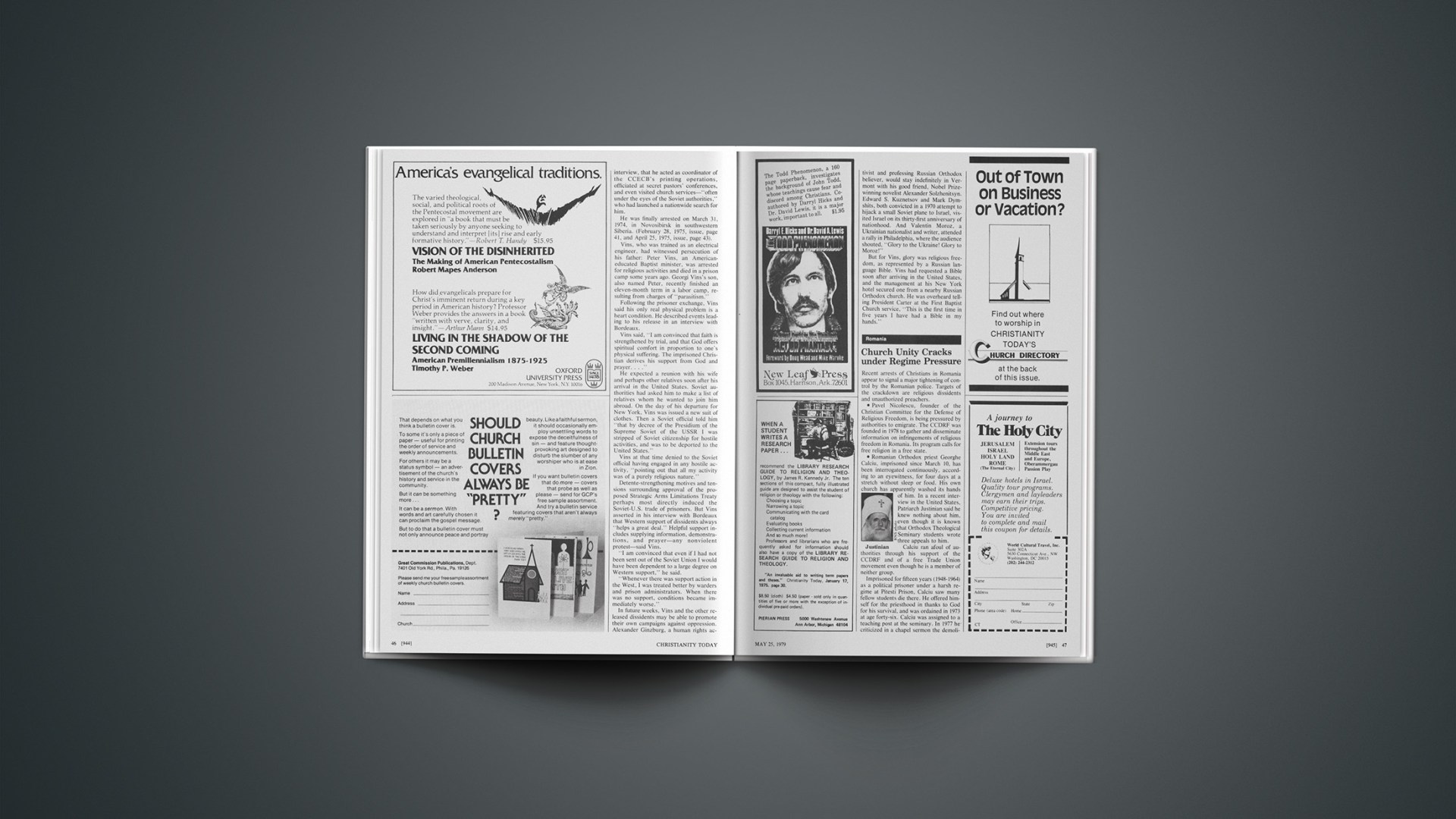
Recent arrests of Christians in Romania appear to signal a major tightening of control by the Romanian police. Targets of the crackdown are religious dissidents and unauthorized preachers.

• Pavel Nicolescu, founder of the Christian Committee for the Defense of Religious Freedom, is being pressured by authorities to emigrate. The CCDRF was founded in 1978 to gather and disseminate information on infringements of religious freedom in Romania. Its program calls for free religion in a free state.

• Romanian Orthodox priest Georghe Calciu, imprisoned since March 10, has been interrogated continuously, according to an eyewitness, for four days at a stretch without sleep or food. His own church has apparently washed its hands of him. In a recent interview in the United States, Patriarch Justinian said he knew nothing about him, even though it is known that Orthodox Theological Seminary students wrote three appeals to him.

Calciu ran afoul of authorities through his support of the CCDRF and of a free Trade Union movement even though he is a member of neither group.

Imprisoned for fifteen years (1948–1964) as a political prisoner under a harsh regime at Pitesti Prison, Calciu saw many fellow students die there. He offered himself for the priesthood in thanks to God for his survival, and was ordained in 1973 at age forty-six. Calciu was assigned to a teaching post at the seminary. In 1977 he criticized in a chapel sermon the demolition of Bucharest’s famous Enea Church. Later, in a sermon in the Patriarchal Cathedral, he labeled atheism “a philosophy of despair.”

Despite warnings against such outbursts, he called on students, in the spring of 1978, to “rebuild Enea Church within your hearts.” He was dismissed from the seminary in May 1978, and assigned clerical duties in the Patriarchate.

• In Medias in February, Pentecostal gypsy evangelist loan Samu was sentenced with two others to three years imprisonment on grounds of “propagating antisocialist propaganda.”

But perhaps the incident that best illustrates the complexity of church-state relations under a Communist regime occurred in Caransebes last October. Only recently have Western observers pieced together the story, drawing on letters from Ioan Bunaciu, director of the Baptist seminary, and Baptist pastor Josif Ton.

Three Baptists were imprisoned after a church business meeting. The official version of the incident, circulated in Romania and the West, is that the three—Nicolai Radoi, Petru Cocirteu, and Ioan Prejban—resisted police. But the legal complaint Baptist Union leaders handed Caransebes police, along with the letters, paints a different picture.

The Union states that Radoi and Cocirteu provoked a disturbance and physically intimidated officials of the Baptist Union and members of their local church during the meeting. Ton criticizes them for attempting to impose their will on the local church in an undemocratic manner, and of behaving rudely toward the denomination’s leadership.

While a disturbance did occur at the meeting, eyewitnesses suggest that the aggressiveness of the Baptist Union officials set the stage. They issued the church an ultimatum: members must reject the active participation of the previously expelled deacons, including Rodoi and Cocirteu, or be rejected by the Union as a legally recognized congregation.

That Union leaders met with party officials the next day indicates an inconclusive outcome to the meeting. The legal complaint of the Union provided the grounds for arrest. According to Bunaciu, cooperation of the accused with the police should have resulted in only a fine. But the three, along with others drawn into the incident the following day, were severely beaten. The arrest of Prejban, a CCDRF member, appears without basis since he was neither cited in the Union complaint nor present at the business meeting.

Cocirteu, it has been learned, was released in April after serving six months of his sentence.

Observers infer that authorities are exerting pressure on the Baptist Union so that it will set its house in order—expelling and disowning Baptists who participate in the CCDRF. But in order to comply, the Union has had to overstep its constitutional guidelines concerning expulsion of church members.

Strong pressure is being felt by Vasile Talos, Bucharest pastor of the Mihai Bravu Church and overseer of the Ploiesti Baptist Church, because of his support of Nicolescu and others in the CCDRF. The Union’s ban on public prayers on behalf of the imprisoned men contrasts with the open support being given them by their respective local churches.

(In a late development, the more-than-600-member Mihai Bravu Church has been informed that it is to be demolished in the fall due to redevelopment plans. It has been refused an alternate building although the church has enough money for a new one. The congregation will be distributed among the other Bucharest churches.)

Reacting to Baptist Union suppression, members of the CCDRF have adopted a negative stance toward the Union leadership. But Bunaciu stresses that the Union has not capitulated. He writes that 6,000 baptisms took place in 1978, that nine new churches were opened, that enrollment increased at the seminary, and that new openings were offered to outside preachers of stature. Ton, in his statement, disapproves of the recalcitrance of those in the CCDRF, although only a few months earlier he wrote a letter supporting them. His personal situation is difficult and he appears to be searching for middle ground between Baptist Union accommodation to the regime and CCDRF confrontation.

An apparent catalyst in the recent rumblings in Romanian churches is a number of top-level changes in the Romanian Department of Cults. The new officials have already shown themselves more stringent than their predecessors. They continue to operate within a general policy of accommodating the churches, but the recent arrests and the encouragement for dissenters to emigrate may indicate a resolve to restrain the church’s critical stance—either by removing “malcontents,” or by employing the age-old strategy of divide and conquer.

ALAN SCARFE

Vins Swaps Internal for External Exile

Soviet Baptist pastor Georgi Vins arrived at John F. Kennedy Airport in New York April 27 a free man, and many Christians worldwide saw living proof of answered prayer. Baptist groups, missions agencies, and local churches had mobilized prayer and letter support for Vins, who was released along with four other Soviet dissidents in an exchange with the United States government for two convicted Soviet spies.

Vins, 51, probably the best-known of the persecuted Soviet churchmen, had just finished a five-year jail term deriving from his involvement with the illegal Council of Churches of Evangelical Christians-Baptists (CCECB). He had begun serving an additional five years in Siberian exile, when the White House announced his release.

He immediately began a hectic schedule—meeting with dignitaries, State Department officials, and former acquaintances. Vins was met at the airport by Olis Robison, an ordained Baptist who is president of Middlebury College in Vermont. Vins planned to stay several weeks at Robison’s home near the 1,800-student campus. (Robison has made a number of trips to the Soviet Union, and on one such trip last year, he began the negotiations that led to Vins’s release.)

Michael Bordeaux, a Vins biographer from Keston College near London, England, called U.S. State Department contacts immediately after hearing of Vin’s release. Those contacts arranged for him to meet with Vins. Bordeaux traveled to New York at his own expense.

Bordeaux, who is fluent in Russian, served as Vins’s interpreter during Vins’s first days in the U.S. Bordeaux helped arrange an interview between Vins and CHRISTIANITY TODAY senior editor Edward Plowman in New York, less than a week after Vins’s arrival. (See box.)

On the Sunday following his release, Vins worshiped with President Jimmy Carter at the First Baptist Church in Washington. Carter taught the adult couples Sunday school class that day, and Vins listened through an interpreter. The lesson in the denominational quarterly focused on justice—an appropriate theme, said Carter, noting that four days earlier Vins “was in a cattle [truck] being transported from Siberia, in exile in his own country because of his belief in Christ.”

Carter drew frequent contemporary analogies from the Old Testament lesson, which described Queen Jezebel’s plotting against Naboth. Jezebel wanted to silence Naboth, said Carter, “but there was no Siberia in Israel so she decided to have Naboth destroyed.” Through his interpreter, Vins told Carter, “I thank you, that you are teaching us not to be silent when we see injustice.”

Vins’s own interpretations of justice led him to years of confrontation, both with Soviet authorities and with the officially tolerated All-Union Council of Evangelical Christians-Baptists (AUCECB).

Vins spent three years at hard labor after his 1966 conviction in connection with a Baptist demonstration outside Communist party headquarters in Moscow. He went into hiding in 1971, after a new case was opened against him.

But for the next three years, Vins secretly carried on the work of the CCECB, of which he was secretary. The CCECB was launched formally in 1965 after Vins and other Baptist leaders failed in their attempts to initiate reforms in the AUCECB, the government-recognized conglomerate of Baptists, Pentecostals, Plymouth Brethren, and Mennonites (December 20, 1974, issue, p. 26). Their protests had begun as early as 1960, when the AUCECB underwent structural changes that led to increased government controls and influences, and that reduced the autonomy of local congregations—two things sternly opposed by Vins and his sympathizers. (The AUCECB apologized for its structural changes in 1966 and revised its constitution, but by then, Vins and many other reformers were in prison.) The Soviet government refused to recognize the breakaway CCECB, and its member congregations were regarded by the state as illegal.

Vins, a Ukrainian from Kiev, revealed in an exclusive CHRISTIANITY TODAYinterview, that he acted as coordinator of the CCECB’s printing operations, officiated at secret pastors’ conferences, and even visited church services—“often under the eyes of the Soviet authorities,” who had launched a nationwide search for him.

He was finally arrested on March 31, 1974, in Novosibirsk in southwestern Siberia. (February 28, 1975, issue, page 41, and April 25, 1975, issue, page 43).

Vins, who was trained as an electrical engineer, had witnessed persecution of his father: Peter Vins, an American-educated Baptist minister, was arrested for religious activities and died in a prison camp some years ago. Georgi Vins’s son, also named Peter, recently finished an eleven-month term in a labor camp, resulting from charges of “parasitism.”

Following the prisoner exchange, Vins said his only real physical problem is a heart condition. He described events leading to his release in an interview with Bordeaux.

Vins said, “I am convinced that faith is strengthened by trial, and that God offers spiritual comfort in proportion to one’s physical suffering. The imprisoned Christian derives his support from God and prayer.…”

He expected a reunion with his wife and perhaps other relatives soon after his arrival in the United States. Soviet authorities had asked him to make a list of relatives whom he wanted to join him abroad. On the day of his departure for New York, Vins was issued a new suit of clothes. Then a Soviet official told him “that by decree of the Presidium of the Supreme Soviet of the USSR I was stripped of Soviet citizenship for hostile activities, and was to be deported to the United States.”

Vins at that time denied to the Soviet official having engaged in any hostile activity, “pointing out that all my activity was of a purely religious nature.”

Detente-strengthening motives and tensions surrounding approval of the proposed Strategic Arms Limitations Treaty perhaps most directly induced the Soviet-U.S. trade of prisoners. But Vins asserted in his interview with Bordeaux that Western support of dissidents always “helps a great deal.” Helpful support includes supplying information, demonstrations, and prayer—any nonviolent protest—said Vins.

“I am convinced that even if I had not been sent out of the Soviet Union I would have been dependent to a large degree on Western support,” he said.

“Whenever there was support action in the West, I was treated better by warders and prison administrators. When there was no support, conditions became immediately worse.”

In future weeks, Vins and the other released dissidents may be able to promote their own campaigns against oppression. Alexander Ginzburg, a human rights activist and professing Russian Orthodox believer, would stay indefinitely in Vermont with his good friend, Nobel Prize-winning novelist Alexander Solzhenitsyn. Edward S. Kuznetsov and Mark Dymshits, both convicted in a 1970 attempt to hijack a small Soviet plane to Israel, visited Israel on its thirty-first anniversary of nationhood. And Valentin Moroz, a Ukrainian nationalist and writer, attended a rally in Philadelphia, where the audience shouted, “Glory to the Ukraine! Glory to Moroz!”

But for Vins, glory was religious freedom, as represented by a Russian language Bible. Vins had requested a Bible soon after arriving in the United States, and the management at his New York hotel secured one from a nearby Russian Orthodox church. He was overheard telling President Carter at the First Baptist Church service, “This is the first time in five years I have had a Bible in my hands.”

Georgi Vins: From Solitude to a Blurr of Activity

New York Mayor Edward Koch served his honored guest, Georgi Vins, a lunch of London broil and caesar salad. Outside the mayor’s office in the streets below, thousands of unionized city employees demonstrated against the mayor’s plan to close some hospitals.

It was a study in contrasts. Vins, who had been living a meager existence in Siberian exile, and who observed upon seeing the demonstrators, that this was “the first time in my life that I saw such a demonstration” against the government, must have suffered culture shock during those first days after his release.

In an interview with Edward Plowman of CHRISTIANITY TODAY, Vins asserted that more evangelistic activity than ever before is being carried out by members of his dissident Baptist movement in the Soviet Union, the Council of Churches of Evangelical Christians-Baptists (CCECB). A secret seminary was set up two years ago to train pastors for the CCECB, he disclosed. It apparently relies heavily on correspondence methods to accomplish its work. A number of Sunday schools have been organized, he said, and a network of printing presses are churning out Bibles, hymn books, and other Christian literature.

All of these CCECB activities are in violation of Soviet laws, and as a result a number of church workers have gone to prison. Some are still in prison, said Vins, yet “the work goes on.”

A CCECB printing press in Latvia was seized in 1974 by the government and its operators arrested (April 25, 1975, issue, page 44), noted Vins, but at that time there were two other presses still operating in Moscow and Kiev. Today, he said, “there are many more.”

Currently, according to Vins, the CCECB—outlawed by the government—has between 60,000 and 70,000 members, while the All Union Council of Evangelical Christians-Baptists has about 250,000. (Western observers have usually estimated the numerical strength of both groups at twice those figures.) Seventy percent of the CCECB members are young people and young adults, said Vins. The majority of the AUCEB’s are elderly, he added.

Although a thaw seems to be taking place in relations between some AUCECB and CCECB leaders, Vins remains wary. Full-scale reconciliation, he said, would be “complicated and dangerous.” A lot of internal church issues must be resolved, he indicated, and the AUCECB “has many KGB agents in it and is to a certain extent under the KGB’s control.”

That view is challenged by AUCECB leaders. These leaders acknowledge that certain compromises have been made in order to function legally, but they deny that the KGB controls the churches. Whatever, it all indicates that the policy dispute among evangelicals in the Soviet Union is far from over.

Divorce and Christians

Divorce And Christians

Beyond Divorce, by Brenda Hunter (Revell, 160 pp., $6.95), The Long Way Back, by Arliss R. Benham (Master’s Press, 55 pp., $1.50pb), Living With Divorce, by Kathleen Sheridan (Thomas More, 130 pp., $6.95 hb and $3.45 pb), An Answer to Divorce, by Norman Wright (Harvest House, 62 pp., $.95 pb), How to Avoid Divorce, by Luciano L’Abate and Bess L’Abate (John Knox, 141 pp., $4.95 pb), Divorce: Prevention or Survival, by William V. Arnold, et al. (Westminster, 128 pp., $4.95 pb), Alone Again, by Richard Krebs (Augsburg, 125 pp., $6.95 hb and $3.50 pb), and Daddy, Come Home, by Irene Aiken (Victor, 100 pp., $1.75 pb), are reviewed by Helen Hosier, editor, Thomas Nelson Publishers, Nashville, Tennessee.

Approaching the topic of divorce is an extremely risky thing to do. As Kathleen Sheridan says, “Such an issue is hardly neutral in most people’s minds. Divorce is one of those disturbing, controversial subjects that we tend to link with abortion, marijuana, sexuality, and murder—whether it belongs there or not Divorce is an issue about which many of us have long-standing, well-ingrained opinions.” Hard on the heels of this and other revelatory statements, Sheridan says most of these positions she regards as prejudiced, narrow, presumptuous, and irrational. Instead, this clinical psychologist has come to believe that divorce may be a good choice, a viable decision, an essential alternative. This is, of course, a controversial conclusion.

There was a time, not too many years ago, when a person going through divorce could find few if any books that spoke to his or her need written from a largely Christian perspective. Such is no longer the case. Booksellers may well be saying now, “Not another one!” as they view the plethora of such books already available and announced as forthcoming.

Beyond Divorce, with the subtitle “A Personal Journey,” offers broad perspectives on the possibilities open to the divorced individual and much encouragement and hope. Brenda Hunter states: “Among the divorced, there are essentially two categories of people: those who leave marriages and those who are left. Those who leave marriages may have their guilt, but those who are left definitely have their rejection.” She asks the question: “Who recovers first?”

Because the author was one who was left, she struggled with the feelings of rejection. She went through the full gamut of emotions: anger, bitterness, sadness, grief. Confronted with the harsh realities of creating a new life for herself and two children, she proved to herself and others that with God’s help she could rebuild an existence for herself that was meaningful and, at the same time, provide what her children needed. In the process, however, she discovered new strengths in herself—a discovery other divorced individuals frequently make and which contributes to the recovery process and makes it possible to live with one’s self and the inevitable feelings of rejection. One wishes all divorced individuals possessed Brenda Hunter’s resourcefulness.

In rehearsing the saga of her struggle, Hunter has not cast aspersions upon her former husband, nor made herself look like a saint. If you are looking for help on how the church regards divorce and remarriage, or what the Bible specifically has to say, you will not find it in this book. Apparently the author was not confronted with the alienation many others experience. What she has experienced, however, and shares in abundant measure, is the grace of God as she chose to allow divorce to move her along the path of growth, drawing always on the fact of God’s nearness.

No less a struggle was faced by Arliss R. Benham who, too, was the woman who was left. She describes the “sheer terror of being 54 years old with no home, no money, no job, and stripped of a deep love relationship that had survived 35 years.” In The Long Way Back we get an almost too intimate glimpse of how one woman learned to live with divorce. One wishes Benham could have read Sheridan’s volume before writing her own book.

Sheridan stresses that there are rarely victims and villains in marriages. “People rarely have operations unless there are problems with the bodily systems.… Operations are necessary, valuable, and often life-saving. So should be divorces.” Sheridan’s book does not offer spiritual guidance; it is factual and forthright, calling for the divorced person to grow, develop, and become the best kind of person he or she can be under the circumstances.

In Alone Again, Dr. Krebs combines sound psychological knowledge with clear Christian faith and gives brief histories of those who came to terms with their new, single life. Written for either the divorced or widowed, the book will provide guidelines.

How to Avoid Divorce, subtitled “Help for Troubled Marriages,” was written by a husband-wife professional team and gives extensive information—counselors, organizations, and addresses—on where one can go for specialized help. An excellent book that pulls no punches; it really tells the couple what to do to mend the marriage and make it work. There are no quasi-magic solutions here; no emotional band-aids; no miracle cures. What is offered, however, is the fact that energy must be expended to avoid divorce. Get off the fence of indecision, doubt, and postponement and start practicing the authors’ seven points toward marriage enhancement.

An Answer to Divorce is a small but practical book that answers the pressing questions facing the family threatened by divorce today. The author is a licensed marriage and family counselor and draws from his extensive experience to offer help.

Divorce: Prevention or Survival was written by three divorced women authors and Dr. William Arnold, their counselor. It is refreshing to see books that are written in an effort to help save marriages. This book offers many practical ways the church can join in marriage-saving efforts, and in support groups for those who do divorce.

Daddy, Come Home spans four days in the life of a 12-year-old girl faced with the possibility that her daddy might not come home to live again. Irene Aiken has handled the sensitive subject of divorce as it affects a child, with a realistic approach. This is not a story with the usual happy-ever-after ending; but neither is it as sad as one might suppose. A child whose parents are divorced would easily identify and, I believe, could be encouraged to trust God.

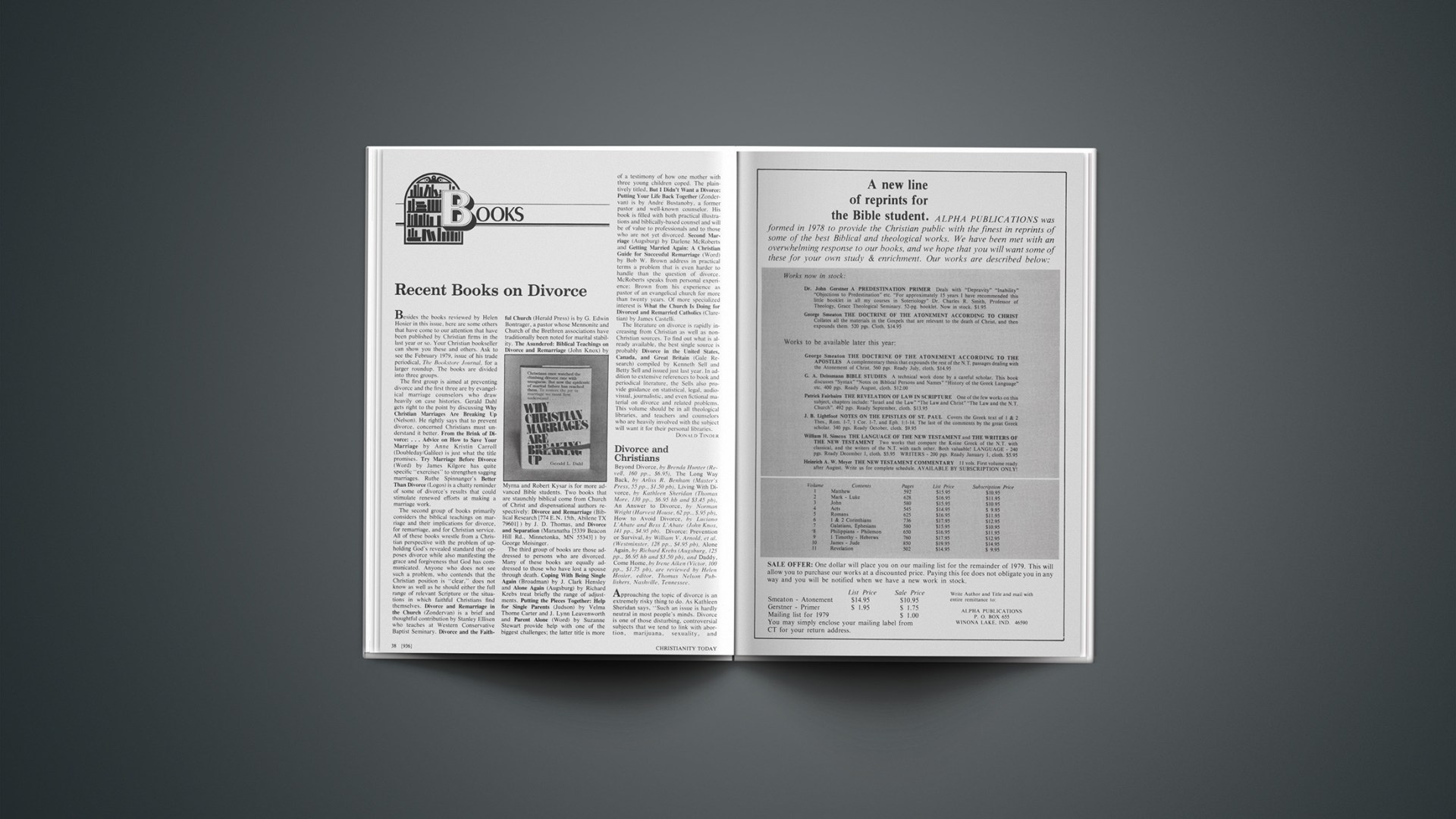
Recent Books on Divorce

Besides the books reviewed by Helen Hosier in this issue, here are some others that have come to our attention that have been published by Christian firms in the last year or so. Your Christian bookseller can show you these and others. Ask to see the February 1979, issue of his trade periodical, The Bookstore Journal, for a larger roundup. The books are divided into three groups.

The first group is aimed at preventing divorce and the first three are by evangelical marriage counselors who draw heavily on case histories. Gerald Dahl gets right to the point by discussing Why Christian Marriages Are Breaking Up (Nelson). He rightly says that to prevent divorce, concerned Christians must understand it better. From the Brink of Divorce: … Advice on How to Save Your Marriage by Anne Kristin Carroll (Doubleday/Galilee) is just what the title promises. Try Marriage Before Divorce (Word) by James Kilgore has quite specific “exercises” to strengthen sagging marriages. Ruthe Spinnanger’s Better Than Divorce (Logos) is a chatty reminder of some of divorce’s results that could stimulate renewed efforts at making a marriage work.

The second group of books primarily considers the biblical teachings on marriage and their implications for divorce, for remarriage, and for Christian service. All of these books wrestle from a Christian perspective with the problem of upholding God’s revealed standard that opposes divorce while also manifesting the grace and forgiveness that God has communicated. Anyone who does not see such a problem, who contends that the Christian position is “clear,” does not know as well as he should either the full range of relevant Scripture or the situations in which faithful Christians find themselves. Divorce and Remarriage in the Church (Zondervan) is a brief and thoughtful contribution by Stanley Ellisen who teaches at Western Conservative Baptist Seminary. Divorce and the Faithful Church (Herald Press) is by G. Edwin Bontrager, a pastor whose Mennonite and Church of the Brethren associations have traditionally been noted for marital stability. The Asundered: Biblical Teachings on Divorce and Remarriage (John Knox) by Myrna and Robert Kysar is for more advanced Bible students. Two books that are staunchly biblical come from Church of Christ and dispensational authors respectively: Divorce and Remarriage (Biblical Research [774 E.N. 15th, Abilene TX 79601]) by J. D. Thomas, and Divorce and Separation (Maranatha [5339 Beacon Hill Rd., Minnetonka, MN 55343]) by George Meisinger.

The third group of books are those addressed to persons who are divorced. Many of these books are equally addressed to those who have lost a spouse through death. Coping With Being Single Again (Broadman) by J. Clark Hensley and Alone Again (Augsburg) by Richard Krebs treat briefly the range of adjustments. Putting the Pieces Together: Help for Single Parents (Judson) by Velma Thorne Carter and J. Lynn Leavenworth and Parent Alone (Word) by Suzanne Stewart provide help with one of the biggest challenges; the latter title is more of a testimony of how one mother with three young children coped. The plaintively titled, But I Didn’t Want a Divorce: Putting Your Life Back Together (Zondervan) is by André Bustanoby, a former pastor and well-known counselor. His book is filled with both practical illustrations and biblically-based counsel and will be of value to professionals and to those who are not yet divorced. Second Marriage (Augsburg) by Darlene McRoberts and Getting Married Again: A Christian Guide for Successful Remarriage (Word) by Bob W. Brown address in practical terms a problem that is even harder to handle than the question of divorce. McRoberts speaks from personal experience; Brown from his experience as pastor of an evangelical church for more than twenty years. Of more specialized interest is What the Church Is Doing for Divorced and Remarried Catholics (Claretian) by James Castelli.

The literature on divorce is rapidly increasing from Christian as well as non-Christian sources. To find out what is already available, the best single source is probably Divorce in the United States, Canada, and Great Britain (Gale Research) compiled by Kenneth Sell and Betty Sell and issued just last year. In addition to extensive references to book and periodical literature, the Sells also provide guidance on statistical, legal, audiovisual, journalistic, and even fictional material on divorce and related problems. This volume should be in all theological libraries, and teachers and counselors who are heavily involved with the subject will want it for their personal libraries.

Minister’s Workshop: Personal Experience Adds Punch

We enhance our communication when we use personal illustration in our message.

Sunday morning while shaving, I heard an uplifting sermon on the radio. The speaker knew his text well and had carefully prepared his message. I rated him an excellent communicator. But twice he flawed his own message.

After making his first major point that God is like a loving father who forgives, he said, “Permit me to use a personal illustration.” He then recalled a preteen experience when he had deliberately thwarted his father’s authority and plunged into serious trouble. The story ended with a tearful father hugging an equally tearful son.

Near the end of the sermon, the preacher said, “Allow me to digress again to use a personal illustration.” A poignant experience followed that nicely illustrated his theological principle.

When I say he flawed his message, I mean he flawed, not by using personal illustrations, but because he apologized for using them. He came across as saying, “I really shouldn’t talk about myself, so please overlook that they’re personal.”

His stories not only added spark to his message by deepening the content, but I found myself listening more closely. When he described his own history, even his voice changed. It softened in volume and slowed in cadence. Even more significant is that five days after hearing that sermon, I can’t remember all his theological points, but I’ll long remember his two personal stories of how he lived and learned more about God. He communicated the gospel of Jesus Christ in concrete terms. Why should that require any apology? What’s wrong with using ourselves as illustrations for sermons and teachings? In fact, I believe we enhance our communication when we bring ourselves into our messages.

The Bible itself lends support to this idea. In theological circles we talk of the kenosis. The word comes from Philippians 2:7 where it says that Jesus “emptied himself” (RSV) of his divine glory. The doctrine states that Jesus took on the full form of humanity as his self-limitation. It is the concept of incarnation—God living in this earth in a physical body. We could state it in a principle: God chose to effect the salvation of human beings. Or we can give it flesh and blood terminology and say, “God so loved … that he gave His … son” (John 3:16).

The great plan of God and the self-giving of Jesus both say a lot about God’s desire to communicate with mortals. He proclaims a gospel in human equations. When we read passages in the Gospels such as Jesus weeping at Gethsemane and crying out, “Father, if it be possible, let this cup pass from me,” we encounter a human Jesus. When John tells us that Jesus wept or that he hungered, we know we are reading about a man. We read of Peter’s foibles in the Gospels and say, “Ah, yes, I can identify with him.” Or when Paul says he rebuked Peter for his fickleness (Gal. 2:11–16), we see no plastic-coated saint—but a man who failed, got up, fell again, and kept getting up. We identify with a person like that.

Paul admits he was a murderer before his conversion. He hints (or so many of us think) that he had poor eyesight. Perhaps we need to allow the human characteristics of the biblical heroes and heroines to become guidelines for contemporary preaching.

For today’s preaching we have to fasten upon a style that communicates. Charles Spurgeon did a splendid job in the nineteenth century, but no one (I hope!) would preach his sermons today—or those of Jonathan Edwards of the eighteenth century. I enjoy reading the messages of Calvin, Luther, Bunyan, and other Reformers, but I would hardly expect to preach them today. Their culture was different, their situations foreign to us. I also believe that in the present age, we need a different type of approach to preaching.

And if Phillips Brooks’s definition of preaching holds true, we need to think it through again. If preaching truly represents “truth through personality,” let’s stop denying personality in the communication process. In short, put the human you into the sermon.

I can think of several reasons for this.

1. We teach values. We are always teaching by what we say, by our silence, and by our examples, as well as by the illustrations we use.

Twice recently, people expressed appreciation for the way I treat my wife. In a Tuesday night sharing group, Richard said, “You really make us men realize how important our wives are.”

The next morning, a young husband said, “Susan and I have both noticed the love you show for your wife.”

I had made no attempt to teach husband-wife relationships. My sermon had been on controlling the tongue.

The young husband reminded me of an illustration I had used on Sunday. During the early days of our marriage, Shirley had a friend I didn’t particularly like. I blurted out an unkind remark about Alice and Shirley walked over to me. She put her arms around me, looked into my eyes and said softly, “Cec, Alice is my friend. Please don’t say anything against her to me.” I concluded the illustration, “And like the Mennen commercial, I wanted to say to my wife, ‘Thanks, I needed that.’ ”

As I recalled the illustration the husband said, “We’ve all noticed the way you respect Shirley. It makes me want our marriage to be like that.”

2. We show our imperfections. Who says clerics are holier than the laity? Who says we who are ordained have arrived at a spiritual height that others haven’t? Yet our preaching often gives that impression. Telling our success stories implies our spiritual superiority. We preach a sermon and ten people make professions of faith. In a counseling situation the Holy Spirit puts words of wisdom on our lips and we reconcile a marriage. Fine. Let’s share those. But let’s share the other side, too.

I have fought a battle with my temper since the days of my conversion. Some days I win; other days I end up with confession to God and a plea for additional strength.

Prayer plays an important role in my life. But some days I’m bored and have to struggle to make my devotional time relevant and enriching. I keep on trying, even on those dreary November-like days. And I tell my congregation of specific spiritual failures.

The people I admire most are those who struggle and overcome—or at least put up a great fight. I don’t much admire the billionaire who inherited five million dollars and catapulted that into astronomical figures. But don’t we all love the stories of Joan of Arc? Of David who came from the sheepfold to the throne? Of Dickens’s David Copperfield and Oliver Twist, those orphan boys who rose to success?

3. We live by the grace of God. When we put ourselves into our preaching, we show ourselves realistically. I’m not a third sex, not a cloistered hermit. I worry about handling money, about how my children are going to turn out, as well as about my spiritual ups and downs.

A few months ago, my sermon revolved around the Golden Rule. The most difficult time for me to treat people as I want to be treated is when I get behind the wheel of a car. I shared this, but I also described the way the Lord had been helping me grapple with my problem. “Friday afternoon I crept along in snail-paced traffic. And only once did I even get irritated when a car cut in front of me. I’m learning.”

My intention was to say, “It is by God’s grace that I grow. And that same grace is available to you.”

4. We recreate a spirit of openness. During the first years after my conversion, I found it difficult to talk to my pastor. I loved him. I revered him. But I didn’t feel comfortable talking to him about certain areas of my life. Obviously, he was a man who had never harbored a grudge, never entertained a salacious thought, and never considered cheating on his income tax.

Recently a young couple came to see me. “We’ve been living together for six months. We know it’s wrong and we want to get married. But we felt that if we told you the whole story, you would understand.”

Can a pastor hear any more affirming words than those? To know that parishioners believe they can talk to him, open themselves up to him and know that he understands?

5. We pay the price of not opening up. If I’m open about myself, it encourages others to be open. We put ourselves into our sermons—whether we realize it or not. We either project the untarnished saint image or else a person too locked into himself to be helpful to others.

During my seminary days, one of my professors had a reputation for brilliance and erudition in his field. I went to him for counseling once—only once. One of my classmates, who had helped me by his caring and willingness to listen, asked me what I thought of the professor. I answered, “He’s got a mind like a computer. And about that much feeling for people, too.” I was probably too harsh in my judgment, but he never did understand my problem. He gave me several logical solutions; but he never really gave me himself.

A fellow pastor read an earlier draft of this article. As he laid it down, he said, “I’m convinced you’re right. Do you want to know why? As I think about everything you’ve said, I can’t recall your main points—but I remember your personal illustrations. And they helped me.”—CECIL B. MURPHEY, pastor, Riverdale Presbyterian Church, Riverdale, Georgia.

Refiner’s Fire: The Sage and the Cynic: Two Views of the Priesthood

Destructive satire and a lack of symbolic language separates one from the other.

Novelists J. F. and John R. Powers could be father and son. Both grew up in Illinois and attended Northwestern University. Both are Roman Catholic, and write about present-day church problems. J. F. is about thirty years older than John R. But they aren’t related. Their work reveals that they are strangers in fact, philosophy, style, and temperament.

J. F. Powers, 61, has published four books in thirty-five years. His novel, Morte d’Urban (Doubleday, 1962) received the 1963 National Book Award. He has also published collections of short stories: Prince of Darkness and Other Stories (Doubleday, 1947); The Presence of Grace (Doubleday, 1956); Look How The Fish Live (Knopf, 1975). His fiction concerns the daily lives of Catholic priests.

The meticulous layering of symbols on symbols, a Powers trademark, accounts for his slow working pace. The short stories can be read on several levels. In Morte d’Urban eight major symbols exist in the coat of arms Powers designed for Father Urban Roche, his protagonist.

Along with the book’s link to the King Arthur legends, Powers makes use of urban and rural symbolism, taking Father Urban from the fleshly life in Chicago to his “home on the hill” (Calvary), the retreat at Duesterhaus, Minnesota. The book not only deals with the difficult parable in Luke 16:1–9, but also carries Urban, the worldly-wise salesman-priest, along a path of modern-day conversion that closely mirrors New Testament events.

In a reversal of the temptation of Christ, Urban accedes to the blandishments of Billy Cosgrove (the stinking goat, Satan) on the roof of a luxury apartment building in Chicago.

This sets in motion a chain of events placing Urban on the retreat house golf course, where he is struck down by an unseen golf ball. As with Paul on the Damascus road, Urban recovers radically converted, which strengthens him against world, flesh, and devil. And, like Paul, he bears an infirmity brought on by this. Urban becomes a spiritual winner by taking the path of temporal loss.

Although Powers is a practicing Catholic whose fiction deals reverently with church doctrine, Catholic readers and critics are uneasy with his stories, seeing them as “a kind of family joke that would best not be shared with outsiders.” The critics have simplified his vision, viewing his work as an indictment of the church’s failure to cope with its problems.

John R. Powers, too, deals with the individual, but his most important characters come from the other side of the confessional window—the youngsters whose views of God are shaded by priests much like those in the elder Powers’s books.

In his thirties, he has published two “fictionalized memoirs”—The Last Catholic in America (Saturday Review Press, 1973) and Do Black Patent Leather Shoes Really Reflect Up? (Henry Regnery, 1975)—and a novel, The Unoriginal Sinner and the Ice-Cream God (Contemporary Books, 1977). Without the aid of national critical attention, he has captured a widespread audience. Apparently, when John R. Powers writes about growing up Catholic in America, he reflects others’ feelings as well as his own.

John R. Powers chooses his victims among clergy and laity and pole-axes them: “He was our shepherd and we were his sheep. And if a sheep got out of line, Father O’Reilly cut his head off” (Last Catholic, p. 47). “My religion teacher in junior year was Brother Falley … Every day when we came to class he’d tell us to … study and he’d be with us in a moment. Then he’d pick up a book from his desk and start reading. The ‘moment’ never arrived. (Later that year) Brother Falley walked through a glass door and nearly cut his head off. At that time, he was reading a book” (Patent Leather Shoes, p. 161). This destructive satiric vision, along with a lack of symbolic language, is what separates John R. from J. F., who handles satire like a rapier. He carves away at the attitudes and actions of priests without skewering individuals in whom lie the seeds of grace.

Powers’s books document the spiritual path along which a Catholic education leads him. Last Catholic, set in a parochial elementary school, emphasizes the church’s legalistic teachings: catechism class and first confession. Patent Leather Shoes continues in the same vein, detailing the watering of “that seed of solid guilt, buried deep within my cranium, which would shortly grow into a full-size Catholic conscience.”

There are plenty of Catholics in Powers’s books, as well as Protestants, Jews, religious people, and agnostics, but there is only one Christian—Gordon Feldameano, who goes out of his way to amuse the fat and ugly girls at school dances. “Gordon had a soft spot in his head. He was a Christian” (Patent Leather). Powers is capable of recognizing a Christian when he sees one; he just doesn’t encounter many.

In spite of the hope that glimmers through some of the characters, and in spite of Power’s humorous and irreverent style, his underlying preoccupation with the shortness of life draws each of the books to a wistful, vaguely depressing conclusion.

J. F. Powers’s priests are aware, even at their least sanctified moments, of where the truth can be found. There is a strong scriptural underpinning that is missing from the younger Powers. In fact, many of J. F. Powers’s stories seem on one level, to be written to illustrate particular biblical passages. For example, the two published stories that form the basis for his novel-in-progress depict a priest unwilling or unable to fulfill the requirements for a bishop found in 1 Timothy 3:1–5.

“A saint is not an abnormal person. He is simply a mature Christian. Anyone who is not a saint is spiritually undersized—the world is full of spiritual midgets,” Powers said in 1943. But his priests are more accurately spiritual runts, able to grow to sainthood simply by feeding on the Word they know so well.

The true spiritual midgets are John R. Powers’s characters, permanently stunted by the neglect of priests more interested in career, golf game, or joking around with the parishioners than they are in teaching the Word of God. If there is an indictment against Catholicism in any of these works, it lies here.

Susan M. Eckert is a writer who lives in Rochester, New York.

Concentration Camps: Part II: A Latent Pacifism Has Gained Ground

In part 1 of this article, published May 4, Philip Yancey looked at the phenomenon of concentration camps under the Stalin and Hitler regimes and, drawing from survivors’ accounts, concluded that they teach observers several important lessons. Victims did not go as “sheep to the slaughter” as some have blithely assumed. Rather, victims often displayed great reserves of mercy and moral courage. And even in the midst of a completely materialistic environment from which every vestige of beauty had been removed, art—poetry, music, literature—continued to surface. Yancey concluded that these signs of resilient morality and aesthetics are rumors of transcendence pointing to a human immortality that could not be snuffed out, even in the camps.

To the victims of the camps in Germany and Russia, hope was the daily bread of survival. How can a man condemned to face twenty-five years of hard labor in Siberia make it through a day? He lowers his expectations, sets small goals and achievements for himself, anxiously searches for objects of hope.

Solzhenitsyn’s account of one day in Ivan Denisovich’s life ended with him falling asleep fully content. “He’d had many strokes of luck that day: they hadn’t put him in the cells; they hadn’t sent his squad to the settlement; he’d swiped a bowl of kasha at dinner; the squad leader had fixed the rates well; he’d built a wall and enjoyed doing it; he’d smuggled that bit of hacksaw blade through; he’d earned a favor from Tsezar that evening; he’d bought that tobacco. And he hadn’t fallen ill.

“A day without a dark cloud. Almost a happy day.” (One Day in the Life of Ivan Denisovich, p. 158).

To those of us who spend our days worrying about excessive static on the car’s FM radio, the worn pile on living-room carpet, and whether to add an extra layer of insulation in the attic, those hopes seem small indeed. But such is the nature of the human spirit. It adapts. And the great Solzhenitsyn, as well as the concert violinists, the mayors, and artists shipped off to German and Russian camps, adapted downward. Their hopes became visceral and universal.

The daily hope is not a foolish, Pollyanna belief that tables will soon be turned and all will be right. It is simply a decision, a mechanism of survival that feeds a will to live. Solzhenitsyn concluded, “All that the downtrodden can do is go on hoping. After every disappointment they must find fresh reason for hope.” And they did.

In addition to this daily hope, however, there surfaced a deeper, more mysteriously uplifting hope—a hope for freedom.

How can any of us embrace the deep lust for freedom that fuels the inmates of concentration camps? We can read a thousand pages of Solzhenitsyn’s accounts within the gray walls and then stumble upon his descriptions of those first few days outside. We can watch freedom-crazed Papillon, old and hobbled, as he dives off the 100-foot cliff into the raging ocean. Or perhaps, we can gaze on the freeze-frame on which the movie Midnight Express ends: Billy Hayes in his stolen guard uniform leaping for joy as he steps into the bright sunlight outside the Turkish prison.

Freedom. To those visionaries who have had it sucked from them, freedom is worth all enduring. To a committed escaper, the two days outside the camp are worth any quantity of torture and beatings back inside.

Embarrassed, we wonder why Solzhenitsyn wags his finger at us, as he did at Harvard, for flaunting our freedom to the world and not caring enough to bring it to people who have been deprived. Solzhenitsyn vividly remembers his first breath of freedom as he walked outside, his sentence completed.

“And off I walk! I wonder whether everybody knows the meaning of this great free word. I am walking along by myself! With no automatic rifles threatening me, from either flank or from the rear. I look behind me: no one there! If I like, I can take the right-hand side, past the school fence, where a big pig is rooting in a puddle. And if I like, I can walk on the left, where hens are strutting and scratching.…

“I cannot sleep! I walk and walk and walk in the moonlight. The donkeys sing their song. The camels sing. Every fiber in me sings: I am free! I am free!” (Gulag, Vol. 3, pp. 417, 421).

The experience of hope beyond all hoping, pregnant with symbolism, and the lust for freedom that burns inside the victims of the camp are to me more rumors of transcendence, evidences of the image of God stamped indelibly upon the spirit of man. For God invested in man such a healthy dose of freedom that men ultimately perverted it to create the very camps that try to eliminate it.

Freedom has its abuses, of course. As C. S. Lewis said of democracy, we should seek it not because it is a romanticized ideal, but because we cannot entrust one man or a few with the precious gifts of power and freedom; we need spread them among the many.

One step beyond even the hope that expresses itself in a zeal for freedom is the religious hope that prevails among victims of the camps. “When things are bad,” said Solzhenitsyn, “we are not ashamed of our God. We are only ashamed of Him when things go well.”

Bruno Bettelheim, a psychologist and survivor of the camps, states flatly, “It is a well-known fact of the concentration camps that those who had strong religious and moral convictions managed life there much better than the rest. Their beliefs, including belief in an afterlife, gave them a strength to endure which was far above that of most others.”

Religious hope did not survive for everyone. To some, the tragedy of the camps was final proof that God did not care about the human plight. But to others, in Stalin’s Russia and Hitler’s Germany, religious faith was a hope that could not be extinguished. Rumors of freedom and amnesties came and went; God could be counted on forever, even though he seemed very distant at the time.

Who Will Get You Out?

We have surveyed some of the more remarkable effects of concentration camps on their victims. Contrary to expectations, the victims did not lose their identities and become faceless, obedient automatons. Many showed a highly developed sense of morality, art, and beauty.

Unlike an animal bred in a zoo, man never loses sight of his higher destiny. He never learns to belong to the camps.

Yet, that uplifting conclusion is far from satisfying. Solzhenitsyn emerged a stronger man; but what of his fellow-zeks who died? Elie Wiesel today stirs the world’s emotions with his memories of suffering—but what of the dead ones Wiesel describes? Six million Jews were killed; only one percent of that number were liberated from the camps.

And what of those who are permanently scarred? Some live with terror in their eyes, unable to cope with the outside world, incapable of trust. The sight of a German shepherd dog reduces them to trembling.

The message of Ivan Denisovich is that an iron will, some luck, and perhaps God, can get you through one day in the concentration camps. But a larger question resounds: Who will get you out?

In the spring of 1978, while the TV series The Holocaust was being shown, my church introduced a service of identification for the Jews who had suffered, a Yom HaShoah liturgy for Christians. Various members of the congregation, including children, read us voices from the survivors.

The congregation sat quietly while each of the readings was given. A few people had to leave when the descriptions became too graphic. A friend thoughtfully absorbed all that was said, and after the service gave me this reaction: “Something pains me more than all the agony and guilt I feel hearing those voices of the Jews. All I can do for them is empathize and feel sorry. What really bothers me is how many situations like that we are ignoring now. It’s easy to blame the Christians in World War II for not acting quicker, more decisively. But are we reacting today—in places like Cambodia and Uganda? Should we be having services about those places instead?”

The facts of the Jewish death camps were published in great detail in advertisements in The New York Times as early as 1939. Few believed them, no one responded, and the United States did not even enter the war until two years later, after a direct attack by the Japanese.

Outside of Auschwitz, there is a field covered with twelve inches of fine bone loam, the remains of 60,000 Jews burned there. Yet one million Cambodians were killed in the last two years. How did we respond?

A tormenting question echoes and re-echoes throughout volume 3 of Solzhenitsyn’s Gulag Archipelago: “Did I do enough to resist?” Survivors of the camps seem tortured with that issue. Yet to those of us on the outside, our attitude is seen in the fact that the publishers delayed publication of volume 3 for almost two years, because American readers had grown bored with Solzhenitsyn’s descriptions of the camps, and volume 2 was losing money.

Appeals to direct intervention in places like Uganda and Cambodia, by the radical right or even by people like Senator George McGovern, were met either with self-righteous indignation (“Didn’t you learn from the experience of Vietnam?”) or a prolonged yawn. Who cares?

Yet it seems to me an unavoidable conclusion from the camps that one lesson is more important than all others: justice must come from the outside. Every victim of a camp is apocalyptic—he can only wait for relief by an outside force. No amount of morality, courage, sense of beauty, and infection of hope will assure his survival apart from the outside force. For the overwhelming majority, survival depends on the destruction of the concentration camp world. The main issue is not what the prisoner can do—he is impotent—but the need to overcome in some way the perpetrators of the camp.

Until the Allied liberation, of all the millions of Jews imprisoned, only three had managed to escape—the German camps were that efficient.

Why Don’T We Respond?

The cries of the survivors—Solzhenitsyn, Bettelheim, and the others—are so compelling, one would expect them to unite a free world against tyranny of all forms. Somehow, the opposite proves true. Jimmy Carter is scorned for foolishly trying to inject morality into foreign policy, daring to let issues of torture and human rights interfere with the more weighty matters of trade.

If we uncovered genocide today, on the scale of the persecution of Jews by Germans, would we respond? Should we? To me, this is the complex but inescapable burning issue that arises from the concentration camps. And it is an issue we are politely ignoring. After reading dozens of accounts of the German and Russian tragedies, I have recoiled with indignation against the evil they comprise. Yet, almost immediately, subtle forces enter in to soften the anger, soothe it away, ease me back to complacency. I have tried to identify those forces.

1. First, there is the simple fact that a man who is warm finds it hard to understand one who is cold. Solzhenitsyn himself, a repository of unquenchable resistance against oppression, found this process seeped into his consciousness after he gained respectability in the Khrushchev era and his novel One Day was printed by the national magazines. He was called into the opulent bureaucratic headquarters in Red Square to testify about the injustices he had seen and felt. He gave his report to understanding technocrats who had reasonable answers to all his protests. “And indeed,” he records, “seen from this bright, festive room, from these comfortable armchairs, to the accompaniment of their smoothly flowing eloquence, the camps look not horrible but quite rational.… Well, would you let these terrible people loose on the community?” (Gulag, Vol. 3, p. 500).

Wary of the dangers of forgetting, Solzhenitsyn started an annual ritual on the anniversary of his arrest. He organized “a zek’s day”: in the morning he cut off 650 grams of bread for his daily ration, and for lunch fixed himself some broth and a ladleful of thin mush. “How quickly I get back to my old form: by the end of the day I am already picking up crumbs to put in my mouth, and licking the bowl. The old sensations start up vividly.” (Gulag, Vol. 3, p. 461).

This phenomenon of numbness to suffering took on terrible proportions shortly before World War II as Joe Bayly recently pointed out in his Eternity magazine column. The Manchester Guardian’s Peggy Mann recently visited the resort area in Evian-Lesbains, France, and talked to one employee who remembered the conference where President Roosevelt and other world leaders discussed Hitler’s atrocities. He recalled, “Very important people were here and all the delegates had a nice time. They took pleasure cruises on the lake. They gambled at night in the casino. They took mineral baths and massages at the Establissement Thermal. Some of them took the excursion to Chamonix to go summer skiing. Some went riding; we have, you know, one of the finest stables in France. Some played golf. We have a beautiful course overlooking the lake.

“Meetings? Yes, some attended the meetings. But, of course, it is difficult to sit indoors hearing speeches when all the pleasures that Evian offers are waiting outside.”

The conference failed. Immigration quotas were not changed to allow more Jews to escape to freedom. Hitler was not censured.

And, I might add, it is difficult to sit indoors reading about the suffering and oppressed of the world when all the pleasures that America offers are waiting right outside.

2. Our resistance to fury at oppression has been aided, I think, by a healthy reaction to our bumbling in Vietnam. Most people admit our policy there was mistaken in some way—either in conception or technique. Combining that experience with the one in Korea, we learned our nation cannot be policeman to the world. And now, as conflagrations flare around the world, America takes a strident but muscleless posture.

Solzhenitsyn dares to hammer home at what he sees as the logical consequence of this reaction. In his Harvard speech he thundered, “The most cruel mistake occurred with the failure to understand the Vietnam War. Some people sincerely wanted all wars to stop just as soon as possible; others believed that there should be room for national, or Communist, self-determination in Vietnam, or in Cambodia, as we see today with particular clarity. But members of the U. S. anti-war movement wound up being involved in the betrayal of Far Eastern nations, in a genocide and in the suffering today imposed on 30 million people there. Do these convinced pacifists hear the moans coming from there? Do they understand their responsibility today? Or do they prefer not to hear? The American intelligentsia lost its nerve, and as a consequence thereof danger has come much closer to the United States. But there is no awareness of this. Your short-sighted politicians who signed the hasty Vietnam capitulation seemingly gave America a carefree breathing spell; however, a hundred-fold Vietnam now looms over you.”

Solzhenitsyn drew those conclusions; I’m not sure I am ready to. But I admit I am affected by a reaction against our country’s failure in the past. A dog bitten by a snake is less apt to chase snakes again.

3. A latent pacifism has gained ground in evangelical circles.

In September of 1978 Sojourners ran an article entitled “Security in a Nuclear World,” by Gordon Cosby. In it Cosby argued that our dependence on spending millions for national defense is “a negation of biblical faith.”

“One thing history confirms,” he continues: “The nation who trusts in anything other than God is abandoned by God. Every attempt at security fails because God abandons that people. We feel that the danger of extinction is being held back by 9,500 missiles. They are not holding anything back. God in his mercy is holding it back. The missiles are the vials of his wrath waiting to be overturned. We would be safer without them.”

I wondered why the Rev. Cosby didn’t apply the same logic to other areas of life. Am I mocking God and showing my lack of faith by locking my door at night? Am I mocking God by putting a new roof over my house? Should I instead trust him to send the weather that is best to me? Do our fire departments, police departments and laws mock God? Or has he instead sanctioned these means to assist us in coping with a fallen world?

Christians who support the military do not support it, one would hope, for a great love of bloodshed and violence. They do so sadly, as an expression of the restraints needed to contain the forces of evil which, unchecked, can create such monstrosities as the concentration camps. Perhaps the term “just war” is a misnomer. No war is just, but Christians through the centuries have concluded that the results of fighting some wars are more just than the injustices the war is waged to overcome.

Today the trend is to emphasize the injustices of wars. Author Kurt Vonnegut dwells on the Dresden bombing of World War II rather than the liberation aspects. In the film Seven Beauties, Lina Wertmuller states her case superbly. By interspersing scenes from the concentration camps with scenes of American soldiers a-whoring through the streets of Naples, she seems to imply that those Americans who fought Fascism were as bad, really, as the forces they defeated. She seems to say that nothing makes any difference—Hitler or his demise, the camps or their liberation. Tragedy, comedy, and injustice are equally found in all of them.

Bruno Bettelheim, a survivor of the camps, wrote a stinging denunciation of Seven Beauties in a lengthy New Yorker article in 1976. He concluded the piece with this paragraph. “Our experience did not teach us that life is meaningless, that the world of the living is but a whorehouse, that one ought to live by the body’s crude claims, disregarding the compulsions of culture. It taught us that, miserable though the world in which we live may be, the difference between it and the world of the concentration camps is as great as that between night and day, hell and salvation, death and life. It taught us that there is meaning to life, difficult though that meaning may be to fathom—a much deeper meaning than we had thought possible before we became survivors” (The New Yorker, August 2, 1976, p. 52).

The survivors of the concentration camps show the worthiness of the project left to us by Jesus, who came into the Gulag of earth to release the captives and to bring freedom to the enslaved. The survivors are still with us. Their morality, art, and sense of hope are glimmers of the immortal soul within them, souls worth freeing and redeeming.

A passive watching of the diminution of freedom is far easier. The lesson of the camps teaches me that we dare not abrogate our responsibility and pretend that the lessons from the camps are mere history lessons.

G. Douglas Young is founder and president of the Institute of Holy Land Studies in Jerusalem. He has lived there since 1963.

Apple PodcastsDown ArrowDown ArrowDown Arrowarrow_left_altLeft ArrowLeft ArrowRight ArrowRight ArrowRight Arrowarrow_up_altUp ArrowUp ArrowAvailable at Amazoncaret-downCloseCloseEmailEmailExpandExpandExternalExternalFacebookfacebook-squareGiftGiftGooglegoogleGoogle KeephamburgerInstagraminstagram-squareLinkLinklinkedin-squareListenListenListenChristianity TodayCT Creative Studio Logologo_orgMegaphoneMenuMenupausePinterestPlayPlayPocketPodcastRSSRSSSaveSaveSaveSearchSearchsearchSpotifyStitcherTelegramTable of ContentsTable of Contentstwitter-squareWhatsAppXYouTubeYouTube