Human Rights: A Concern of the Righteous: Obedience Demands Vigilance

The way prisoners of conscience in other countries are treated seems far removed from the lives of most American Christians. As U.S. citizens, we do not live in fear of illegal abductions, arbitrary arrests, brutal interrogations, forced confessions, torturous prison conditions, and harsh sentences. Yet faithful disciples of the most famous “prisoner of conscience” in the history of mankind should know that the Word of God calls them to speak, pray, and act on behalf of persons whose rights are violated by regimes of the right or the left. The psalmist expressed the faith needed for our times: “Lord, I know that you defend the cause of the poor and rights of the needy” (Psalm 140:12, TEV).

While newspapers and television document cases of a few famous persons subjected to sudden arrests, one-sided trials, and long sentences, American Christians should not forget that there are literally thousands of others who receive no publicity in the outside world. Only a few groups such as churches or voluntary organizations like Amnesty International make the effort to stay informed about imprisoned men and women who are not famous scientists, writers, or dissidents. The 1977 report of the latter group lists more than one hundred nations where human rights violations occurred in that year. Here are a few names of forgotten people who represent many who suffer similar fates:

Heinz Reineke, a thirty-seven-year-old sculptor in East Germany, once belonged to the ruling Communist party there, but he soon became disillusioned. Last year he wrote an open letter challenging Erich Honecker, the head of state, for failing to live up to the Universal Declaration of Human Rights and the UN Covenant on Civil and Political Rights. Reineke was quickly arrested and sentenced to four years in the Brandenburg prison for speaking out of his conscience.

Mykola Plakhotnyuk is a physician who graduated with honors and worked in a children’s sanatorium. Because he published a human rights samizdat (unofficial) journal, the Ukrainian Herald, Soviet authorities have detained him in a psychiatric hospital since 1972. Under harsh conditions his health has steadily deteriorated.

International church leaders wonder what has happened to the well-known Christian scholar Mauricio Lopez, an official of the World Student Christian Federation in Argentina. Because of his work on behalf of political refugees, he was dismissed from his post as rector of the state university of the San Luis province. Lopez was abducted in 1976 at Christmas; there has been no news of him since from the military government.

These modern cases make the Bible’s witness on behalf of human rights even more vivid and compelling. The book of Jeremiah, in its biographical sections about the prophet, often reads like a contemporary news release describing an authoritarian government’s attempts to silence a famous dissident.

Jeremiah lived in an age much like our own. While the kings of Judah adopted the ill-fated politics of shifting alliances with various power blocs, Jeremiah kept calling for internal renewal of the people’s covenant with God. His preaching was not the bitter denunciation of a turncoat, but the heartbroken pleadings of a man who could say, “My heart has been crushed because my people are crushed.… Is there no medicine in Gilead? Are there no doctors there?” (Jer. 8:21, 22, TEV).

When Jeremiah’s public proclamations were not heeded and his personal contact with the ruling authorities cut off, he registered his protests by means of an open letter to the king—much as some contemporary dissidents have done to bring world attention to their cause. But when Jeremiah’s scroll calling for the spiritual freedom of the people was read in King Jehoiakim’s presence, the monarch cut it to pieces and fed it into the royal fireplace (Jer. 36).

Jeremiah received even more contemptuous treatment later from King Zedekiah, who reigned when Jerusalem fell before the besieging Babylonian armies. Again, God’s spokesman was accused of being a traitor even though he showed his faith in the nation’s future by investing in property. Arrested on the false grounds of deserting to the Babylonians when he tried to leave to inspect his property, Jeremiah was incarcerated in an underground cell and endured weeks of this brutal imprisonment until he was finally brought up into the palace to be interrogated by the king (Jer. 37:11–16). He seized the opportunity to appeal for better prison conditions and was transferred to a courtyard where he existed on a meager diet of bread (Jer. 37:17–21).

The biblical witness further parallels modern violations of human rights. Jeremiah’s situation again deteriorated when government “hardliners” convinced the king that the prophet was dangerous to the security of the state: “This man must be put to death. By talking like this he is making the soldiers in the city lose their courage, and he is doing the same thing to everyone else left in the city” (Jer. 38:4). His fate was to be thrown into an empty cistern in the palace precincts, and he sank into the mud in solitary confinement.

But Jeremiah was not without friends who kept track of his situation. It is interesting that relief came to the prophet not through disciples like his secretary Baruch, who was probably also persona non grata in the royal precincts, but from a domestic servant in the palace. The Scriptures tell us that it was Ebedmelech, a Sudanese eunuch, who dared to approach the king to seek relief for Jeremiah. Ebedmelech’s words are a classical protest by a faithful man of God on behalf of a prisoner of conscience: “Your Majesty, what these men have done is wrong. They have put Jeremiah in the well, where he is sure to die of starvation, since there is no more food in the city” (Jer. 38:9).

This vivid case history in the book of Jeremiah not only illustrates the ancient prophetic concern for human rights, but also illuminates the painful struggles of faithful people in our world today. It is only one example of the Bible’s teaching about the human rights of prisoners. Indeed, the very constitution of Israel at the Exodus was linked to the compassion of God for his people in the slave labor camps of Egypt.

As God’s people moved into the Promised Land and were shaped by divine law, they found God’s commandments often ran contrary to common practices in the ancient world. Think of the amazing concern shown for the gerim, which our English Bibles translate variously as strangers, sojourners, aliens, or foreigners. In most ancient societies the gerim or resident aliens were looked upon as potential, if not outright, enemies. U.S. treatment of Japanese Americans during World War II should remind us that such suspicion of resident foreigners is hardly limited to the ancient world. Even within Israel these gerim usually held second class citizenship: Solomon’s census reminds us that 153,600 were pressed into work on the temple (2 Chron. 2:17).

In spite of their second class status, however, the gerim were singled out at various points in the laws of Israel, and their human rights were to be honored. Even Leviticus, primarily concerned with ritual purity and religious observances, describes God’s demand for the rights of the gerim: “Do not mistreat foreigners who are living in your land. Treat them as you would a fellow Israelite, and love them as you love yourselves. Remember that you were once foreigners in the land of Egypt. I am the Lord your God” (Lev. 19:33, 34, TEV).

Deuteronomy extends this commandment by setting it in the context of God’s election of Israel out of all other nations and of God’s supremacy over all powers. “He [God] does not show partiality and he does not accept bribes. He makes sure that orphans and widows are treated fairly; he loves the foreigners who live with our people and gives them food and clothes. So then, show love for those foreigners, because you were once foreigners in Egypt” (Deut. 10:17–19, TEV). Such “primitive” concepts of justice and human rights still seem to be unattainable in many twentieth-century states where the treatment of aliens and racial and religious minorities is often harsh and oppressive.

The Old Testament gives both negative and positive illustrations of the divine command for protection of rights. In ancient Israel, as under many military regimes even today, life could be uncertain and justice only a dream. When regimes changed, often those associated by kinship or service to the former ruler were in danger of cruel punishment or death. The bloody story of Abner and Joab, the respective commanders of Saul’s and David’s armies, is typical of biblical occurrences of the violation of rights. Though David had guaranteed Abner’s safety after the victory over Saul’s forces, Joab still wanted blood revenge because Abner had killed his brother at the battle of Gibeon. Joab dared to assassinate Abner openly on the street in the king’s city—perhaps relying on the common assumption that such revenge was acceptable. But David cursed him and mourned Abner. “He died like someone killed by criminals!” David lamented over Abner (2 Sam. 3:34).

The Old Testament shows us both the hope and the violation, the victory and defeat, of human rights. The divine law and the prophetic call were clear; but they were often ignored in the history of Israel. Particularly during the corrupt and unsettled period of the divided kingdom, bloody retribution as well as the abandonment of fair trials and just punishment became commonplace. The Scriptures use the notorious reign of King Manasseh as an example of the most flagrant abuse of human rights. Judgment quickly followed, and the Exile was understood by the faithful as the Lord’s punishment.

Like the Egyptian bondage, the Exile was another bitter lesson about the inevitability of God’s judgment if his people wantonly sinned against him and violated the standards of his law. Time and again the divine commands of justice and mercy had been proclaimed by law, prophets, and wisdom sayings. But as such teaching was violated or forgotten, the faithful of Israel began to realize that more than wise counsel was needed. The messianic hope grew ever brighter, particularly as the people saw their temple destroyed and the kingdom of Judah lose all earthly power. The hope was for a new covenant, for a time when the law would be within the human heart and not just written on tablets of stone (Jer. 31:33).

In the life and work of our Lord that messianic hope came to fruition. With his coming the matter of human rights takes on deeply personal meaning for his followers. He began his ministry in Galilee by announcing that the Spirit had anointed him “to proclaim release to the captives” (Luke 4:18, Phillips). Often that teaching has been interpreted too metaphorically, as twentieth-century Christians have forgotten the social-political context of the police state in which Jesus spoke. John the Baptist, after all, was not the only one to land in jail in first-century Palestine; but certainly John’s death at the whim of Salome and Herodias was one of the most notorious examples of “justice” that Jesus’ contemporaries feared.

It is no wonder that in Jesus’ parables and sayings he often referred to the indignities and violations of basic human rights his fellow Jews might meet. Thus, the Lord’s teachings of love for enemies were all the more shocking to those who listened. That disciples should pray for the very persons who persecuted them seemed an incredible demand (Matt. 5:44).

The issue of human rights, however, becomes most poignant for us in the Passion of our Lord. He was summarily arrested and dragged off in the middle of the night. Even his most faithful friends deserted him (Luke 22:33, TEV). Interrogated before various authorities, Jesus knew the indignities of public humiliation. His physical pain on the cross was augmented by emotional and spiritual agony as he saw Mary and his friends in utter anguish. He expressed in his lonely prayer the desolation of condemned innocents of all ages, “My God, my God, why have you forsaken me?” The Lord was willing to lose his rights, that we might be right with God (Rom. 5:1).

After the joy of the resurrection, the apostles soon learned that the servants were not greater than the master; that they too must endure tortures and even death for his name’s sake. Both the Acts of the Apostles and the Epistles continue the theme we have traced in the Old Testament and in the Gospels: the innocent often suffer as their faith is tested in the refiner’s fire (1 Peter 1:6, 7).

Peter and the apostles were jailed for daring to obey God rather than men (Acts 5:29). They, like their Lord, knew the cruelty of the whip. Stephen found justice subverted when men were bribed to testify that he had blasphemed against Moses and God (Acts 6:11). Even the great apostle to the Gentiles, who enjoyed the privileges of Roman citizenship, learned what loss of rights meant on many occasions when he was a prisoner of conscience. In fact, Paul claimed that the authenticity of his apostolic authority rested on his identification with Christ in suffering. “I have been in prison more times, I have been whipped much more, and I have been near death more often. Five times I was given the thirty-nine lashes by the Jews; three times I was whipped by the Romans, and once I was stoned” (2 Cor. 11:25, TEV).

How did the young church respond to such trials? Certainly by prayer for the imprisoned (Acts 12:5) and for political authorities who could insure justice and peace (1 Tim. 2:1, 2). There is also evidence that other assistance was rendered when possible, as when Paul’s friends in Philippi sent him gifts to help with his expenses while he was in the Roman prison (Phil. 4:18). Church members sometimes even petitioned the prison authorities on behalf of the prisoners, as when Paul’s nephew convinced the commander of the Jerusalem jail of the dangerous plot to assassinate Paul as he was being brought into court. Paul sought justice for himself and used every legal means open to him, as when he appealed to Caesar so that his trial would not take place in the biased Jerusalem court (Acts 25:10).

In spite of this wealth of detail about human rights, the New Testament shows us only the tip of the iceberg, a few instances out of the countless times that human rights became an issue for early Christians. The Revelation of John perhaps best describes the faithful who suffered innocently: “These are the people who have come safely through the terrible persecution. They have washed their robes and made them white in the blood of the Lamb” (Rev. 7:14, TEV). In this magnificent vision we understand the eternal hope that “He who sits on the throne will protect them with his presence” (Rev. 7:15, TEV).

God’s Word reminds us constantly of the anguish and rights of the oppressed, particularly of those who are prisoners of conscience and brothers and sisters in Christ. Through the efforts of contemporary churches, and through letters and telegrams from individuals, we can stand by those who are in prison, even in other lands. We can be reminded of what our help can mean to a prisoner as we read what Paul wrote long ago from his cell: “In my life in union with the Lord it is a great joy to me that after so long a time you once more had the chance of showing that you care for me. I don’t mean that you had stopped caring for me—you just had no chance of showing it. And I am not saying this because I feel neglected, for I have learned to be satisfied with what I have.… I have the strength to face all conditions by the power that Christ gives me” (Phil. 4:10, 11, 13, TEV).

G. Douglas Young is founder and president of the Institute of Holy Land Studies in Jerusalem. He has lived there since 1963.

Books on ‘How to Be’ in Marriage

“Why didn’t I think of that?” is my response to Judson Swihart’s How Do You Say, “I Love You?” (InterVarsity). This 95-page book is fantastic in its depth and simplicity. Men and women say “I love you” and hear “I love you” in different ways. It is almost as if a man speaks German while his wife speaks French. Thus, no matter how much they say, “I love you,” the other has difficulty getting the message.

How do we solve this problem? “It is the primary task of every marriage partner to discover the languages that are used and then to learn to effectively use these languages to communicate feelings and attitudes of love” (p. 14). It seems so simple, so obvious; but there are couples who are screaming “I love you” to their partners and never getting through because they do not understand how the other person needs to receive love. “Love expressed is not sufficient. It must be heard to have any meaning. If it lands on deaf ears, it is ineffective” (p. 16). When partners speak different love languages both feel hurt and neglected, not because they are not loved but because they do not know how their spouse says, “I love you.” This book is intended to help both parties speak the same language.

Swihart has written a fine book. Out of the hundreds of new books being published on marriage and family themes, how do you determine what has potential?

The best marriage and family authors are seminar leaders and conference speakers. This is the first criterion I use in selecting good books on marriage and family. After that I look for books by previously published authors—although two of these wrote bombs this time around. Finally, I want a book that deals in depth with a specialized aspect of marriage or family living as Swihart’s does. These criteria narrow the field for me as I examine the publishers’ latest attempts to woo my dollars.

I detect certain trends from a score of books I received as a representation of what was published over a twelve-month period. First, there is a mild tendency to use ideas developed by other authors without giving them credit. I particularly noted some authors who drew from Norman Wright’s publications without giving him credit. This ought not to be.

Second, husband and wife teams are writing more books (Mace, Miles, Mayhall, Christenson). This has its comic aspects. Jack and Carole Mayhall each wrote exactly seventeen chapters. Women’s lib will have truly arrived only when each writes according to his/her ability without having to be concerned about numerical equality.

Increasingly, marriage and family books are in manual format. Users are not only to read the books but to write in them. Extensive assignments are often given. This is an excellent trend because simply reading without doing often leaves a person with the knowledge that something is wrong, but no insight into how to correct it.

One of the more pleasant trends is the move away from the extreme positions of women’s liberation/male headship. Increasingly, people recognize that whether the husband is the head or a partner, his role is described by loving service to the rest of the family.

Finally, there is an almost overwhelming rehash of material treated more effectively in earlier books. The latest is not necessarily the best, advertisements to the contrary notwithstanding.

The manual format is exemplified by two of the best recent books. What do you do When You Don’t Agree (Herald) author James Fairfield asks. Is conflict good or bad for a marriage? Ever since publication of The Intimate Enemy counselors have said that conflict is neutral. Our methods of dealing with conflict are either good or bad. Conflict, properly handled, is an effective means of growth. In fact, some would go so far as to say that conflict resolution is the primary way we grow in interpersonal relationships.

Given this basic attitude, Fairfield teaches people how to fight—effectively. The principles for fighting are drawn from a wide variety of sources. Little in this book is original, but it is original for a Christian to put this material in one book. Others allude to the value of conflict resolution, particularly Norman Wright, but no one else has yet put together the material on fighting into a Christian context. Regrettably, the book is frustrating to read. The chapters are too short, often only 3–4 pages. While the author knows well the literature on conflict resolution, he has not organized it well. Nonetheless, because of its manual format, much good could come from working through it. It would be a particularly valuable tool in counseling a person who does not know how to handle conflict.

The patriarch and matriarch of American marriage enrichment have created another gem using the manual format, How To Have a Happy Marriage (Abingdon). David and Vera Mace challenge, “We are even prepared to guarantee that any normal couple can improve their relationship if they will faithfully follow our directions.” They follow this with a manual “meant to be written in” that gives a six-week, self-help program for marriage enrichment.

How good is your marriage? A chapter is devoted to helping you assess your level of adjustment. Do you communicate well with your spouse? A chapter teaches you how to improve your communication. Is your fighting effective or destructive? The Maces suggest a pattern for conflict resolution that will help you grow through fighting.

At the end of each chapter is an assignment. The first half of the assignment is for a two-hour session each Saturday during the six-week period. In addition the couple use a tool developed in marriage encounter called ten and ten. Each day they write down their thoughts about the marriage relative to the subject under discussion. Then they share what they have written. Eventually this procedure becomes oral rather than written.

Improperly handled anger destroys people and marriages. The Maces propose a three-step process for dealing with anger. First, admit it. Second, promise the other person you will not attack him/her because of your anger. Finally, work with the other person to resolve your anger. This means that the whole focus of the interaction is resolution of the problem creating the anger. This is so different from attacking the other person—the way most people handle anger in a marriage.

Other recent books contain chapters or ideas worth mentioning. Linda Dillow in Creative Counterpart (Nelson), for example, shows women how to establish priorities for their lives with a “Priority Planner.” At the same time her chapter on being sexually available for your husband is exceptionally good. Many women would object that their husbands would take advantage of them if they were always available. Dillow counters, “Someone who bangs on the door forty times when it is locked only knocks once if you open right away.” Dillow presents sexual freedom without farce.

Every woman who becomes a Christian before her husband should create a plan to win him to Christ suggests Godfrey Exel in Live Happily with the Woman You Love (Moody). Similarly, John Lavender in Your Marriage Needs Three Love Affairs (Accent) says that a man will come to Christ only when he sees the benefits for himself. The woman who becomes less of a wife because she is now a Christian will have difficulties winning her husband. These two books speak to a neglected area of evangelism as part of their total presentation.

Ralph Martin, with Husbands, Wives, Parents, Children (Servant), offers a traditional book on marriage that is almost nineteenth-century—except that he has learned that leadership and servanthood are synonymous in New Testament thought. He writes with refreshing candor that the foundation for Christian marriage is a growing Christian life where the fruit of the Spirit is evident. Whereas he says nothing new (apart from his emphasis on communal living) his book radiates a spirit of godliness and Christian commitment rarely communicated in print.

The Christian Couple (Bethany Fellowship) by Larry and Nordis Christenson contains much of value, but it is so mixed with questionable material that I cannot recommend it. I am particularly concerned that the Christensons advocate “natural” contraception. In an extended chapter they suggest that couples should not use “artificial” means of contraception but should use the woman’s natural cycle. For them this might have been successful (although their family would have been much larger had it not been for miscarriages), but it would place an unbearable burden on many families. Besides, I seriously question whether most couples would be able to handle the complicated figuring necessary to follow this method.

Most parents today have given over the task of child rearing to the professionals (psychologists, physicians, social workers) writes Christopher Lasch in Haven in a Heartless World (Basic). As a result, children have lost all respect for authority because they never learned to follow authority at home. Nonetheless they still submit to authority most of the time because this is the easiest thing to do. Parents need to reestablish their authority in the home. Although he suggests no ways to accomplish this, his basic thesis is needed. Being a parent is too important a task to give to the professionals.

Marriage is a business writes Paul Hauck. In Marriage Is a Loving Business (Westminster) he proposes that people are only happy in a marriage when they think they are getting as much as they are giving. He suggests that many marriages would be happier if each partner spelled out for his/her spouse exactly what he/she considers a minimum level of acceptable behavior. He is right. But marriages based primarily on this idea would simply be the association of two very selfish people. Maybe that is better for some, however, than an unsatisfying association of two selfish people.

G. Douglas Young is founder and president of the Institute of Holy Land Studies in Jerusalem. He has lived there since 1963.

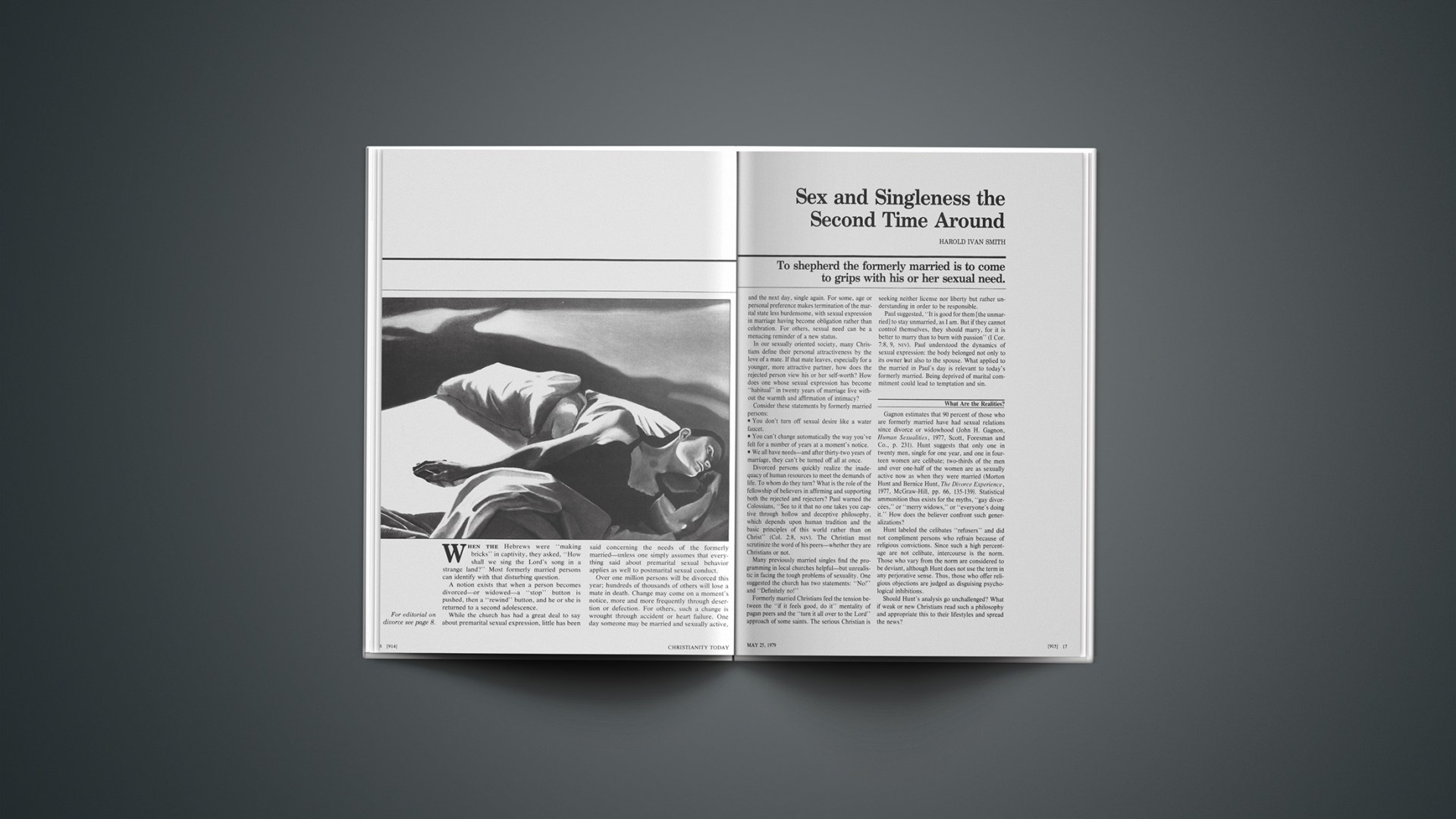
Sex and Singleness the Second Time around: Picking up the Pieces

To shepherd the formerly married is to come to grips with his or her sexual need.

When the Hebrews were “making bricks” in captivity, they asked, “How shall we sing the Lord’s song in a strange land?” Most formerly married persons can identify with that disturbing question.

A notion exists that when a person becomes divorced—or widowed—a “stop” button is pushed, then a “rewind” button, and he or she is returned to a second adolescence.

While the church has had a great deal to say said about premarital sexual expression, little has been said concerning the needs of the formerly married—unless one simply assumes that everything said behavior applies as well to postmarital sexual conduct.

Over one million persons will be divorced this year; hundreds of thousands of others will lose a mate in death. Change may come on a moment’s notice, more and more frequently through desertion or defection. For others, such a change is wrought through accident or heart failure. One day someone may be married and sexually active, and the next day, single again. For some, age or personal preference makes termination of the marital state less burdensome, with sexual expression in marriage having become obligation rather than celebration. For others, sexual need can be a menacing reminder of a new status.

In our sexually oriented society, many Christians define their personal attractiveness by the love of a mate. If that mate leaves, especially for a younger, more attractive partner, how does the rejected person view his or her self-worth? How does one whose sexual expression has become “habitual” in twenty years of marriage live without the warmth and affirmation of intimacy?

Consider these statements by formerly married persons:

• You don’t turn off sexual desire like a water faucet.

• You can’t change automatically the way you’ve felt for a number of years at a moment’s notice.

• We all have needs—and after thirty-two years of marriage, they can’t be turned off all at once.

Divorced persons quickly realize the inadequacy of human resources to meet the demands of life. To whom do they turn? What is the role of the fellowship of believers in affirming and supporting both the rejected and rejecters? Paul warned the Colossians, “See to it that no one takes you captive through hollow and deceptive philosophy, which depends upon human tradition and the basic principles of this world rather than on Christ” (Col. 2:8, NIV). The Christian must scrutinize the word of his peers—whether they are Christians or not.

Many previously married singles find the programming in local churches helpful—but unrealistic in facing the tough problems of sexuality. One suggested the church has two statements: “No!” and “Definitely no!”

Formerly married Christians feel the tension between the “if it feels good, do it” mentality of pagan peers and the “turn it all over to the Lord” approach of some saints. The serious Christian is seeking neither license nor liberty but rather understanding in order to be responsible.

Paul suggested, “It is good for them [the unmarried] to stay unmarried, as I am. But if they cannot control themselves, they should marry, for it is better to marry than to burn with passion” (1 Cor. 7:8, 9, NIV). Paul understood the dynamics of sexual expression: the body belonged not only to its owner but also to the spouse. What applied to the married in Paul’s day is relevant to today’s formerly married. Being deprived of marital commitment could lead to temptation and sin.

What Are The Realities?

Gagnon estimates that 90 percent of those who are formerly married have had sexual relations since divorce or widowhood (John H. Gagnon, Human Sexualities, 1977, Scott, Foresman and Co., p. 231). Hunt suggests that only one in twenty men, single for one year, and one in fourteen women are celibate; two-thirds of the men and over one-half of the women are as sexually active now as when they were married (Morton Hunt and Bernice Hunt, The Divorce Experience, 1977, McGraw-Hill, pp. 66, 135–139). Statistical ammunition thus exists for the myths, “gay divorcées,” or “merry widows,” or “everyone’s doing it.” How does the believer confront such generalizations?

Hunt labeled the celibates “refusers” and did not compliment persons who refrain because of religious convictions. Since such a high percentage are not celibate, intercourse is the norm. Those who vary from the norm are considered to be deviant, although Hunt does not use the term in any perjorative sense. Thus, those who offer religious objections are judged as disguising psychological inhibitions.

Should Hunt’s analysis go unchallenged? What if weak or new Christians read such a philosophy and appropriate this to their lifestyles and spread the news?

Because of the absence of research on formerly married Christians, I studied a group of singles at a large church in California. I recognized that such research would be subject to challenge because of the implications of the findings—particularly if I found that a high percentage of those interviewed proved to be sexually active. The first criterion I used was faith, asking, “Are you a Christian?” and then, “Would you call yourself ‘born again’?” Questions about church membership, attendance, and activity in the fellowship followed.

Initially I was surprised by the number of new Christians who said they had been born again during or after divorce. Many were dealing with sexual issues from a Christian perspective for the first time (a fact that makes the need for such research more pressing). Others had rededicated their lives and were more active in church than before.

In the data report, respondents identified themselves as born-again Christians. The information is true only of a group within the singles program at this church. It is important to note that generalizations from this data with regard to behavior and attitudes cannot be made.

1. Is celibacy realistic for the formerly married Christian? Forty-seven percent of the divorced men and 24 percent of the women reported that celibacy is realistic. Twenty-nine percent of the men and 28 percent of the women reported they were “uncertain.” These persons are struggling to define their sexual expression. One-fourth of the men and almost one-half of the women found celibacy unrealistic.

2. How many times have you had sexual relations in the last year? This question was necessary to confront Hunt’s frequency findings (i.e., 90 percent). It is one thing to know what formerly married Christians believe—but another to see what they practice. Based on 203 participants (146 women and 57 men), only 9 percent of the men and 27 percent of the women were celibate, although many noted the intimacy had been with only one partner and/or in a “serious” relationship.

It is worth noting that 67 percent of the men and 58 percent of the women reported a conflict between their faith and sexual experiences:

• Sometimes I feel so despondent after having been out—having a good time in companionship and sexually—that I feel like I want to die rather than live this torn-apart feeling.

• I felt the need to prove my sexuality to myself and to other men.… But that inner conflict between my sexual needs and moral and spiritual needs still tears away at me. One part of me says, “It is right and beautiful.” The other part tells me that as a Christian, I should not be doing it.

• How do you deal with the feelings and still be a Christian?

• [I have] tremendous guilt when I am sexual. My guilt prevents my spiritual growth.

Clearly, tension exists among those seeking to integrate two positions, traditionally held to be opposing.

• I’ve prayed about my sexual needs and God has answered them and given me someone to relate with. I couldn’t have planned it that way (10–20 episodes).

• I don’t feel condemned by God (20–50 episodes).

• My personal faith affirms God’s laws for the whole of man, not unreal, antiquated rules (10–20 episodes).

• I worry that I won’t go to heaven because I keep repeating myself (10–20 episodes).

• Christ wants us to live abundant lives; to me that includes sex (50-plus episodes).

For some Christians such thinking is blasphemous. Some will conclude, “They’re not really Christians!”—thereby avoiding the dilemma. Others may quote Romans 6:15, “Shall we sin because we are not under law but under grace?” Can we be charitable? Can “we who are strong … bear with the failings of the weak” (Rom. 15:1, NIV)?

3. Why do the formerly married have sexual relations? The respondents ranked the answers: (1) loneliness; (2) strong sex drive; (3) it is natural; (4) reaffirmation of sexual attractiveness; (5) fear; (6) retaliation; (7) necessity to dull the pain; and (8) boredom. One young woman explained she had sex “because I need someone to hold me.”

Conscious believers are grappling with the reality that permissiveness creates tension in the believer’s life.

• I cry and cry and want even more to have back what I have lost.

• … guilt at myself for giving in and resentment of the man for continuing to push me.

• I feel like a tramp.

• … feelings of guilt and hopelessness.

• I wonder why the need is there?

There are also consequences for those who practice celibacy. One woman wrote, “I believe and practice celibacy, but in America in the 1970s I have to hide this fact even from church people.” Peer pressure is as significant to those who are formerly married as to adolescents.

The woman who says “no” may face a dilemma because of the dating structure. If she rejects a certain level of intimacy she may find herself not dating. Dates thus may respond to “no”:

• They tell me there is something wrong with me.

• Usually I don’t get asked out again.

• Usually called “old-fashioned.” Most often the man never calls for another date.

• I feel guilty of depriving that person of a good feeling.

• They express amazement that I can hold such puritanical notions.

The formerly married Christian must deal with the conflict between biblical standards and realities; few wish to be hypocrites. Several questioned the bias of the researcher:

• I resent the “extramarital sex is normal” attitude of this questionnaire. Doesn’t anyone live as a Christian?

• Your questionnaire seems to imply that the single must have sex.

• Christianity has to do with Jesus Christ, not with sex or no sex. Set your sights higher!

• The Bible has the answers; it’s people who try to change God’s words.

• The two sides [faith and sex] are completely different subjects and one in no way has to do with the other.

The absence of clear, precise teaching frustrates most formerly married Christians. The large numbers of undisciplined Christians and the misuse of Scripture (by foes and advocates alike) fuels the debate between unbelieving realists and unrealistic believers.

If Paul did not flinch in addressing the behavior and attitudes toward sex, why are we so timid?

What Can The Church Do?

The church, first of all, should respond rather than react. Formerly married people believe in the church: 42 percent of the divorced men and 47 percent of the women reported their church was supportive during the divorce process.

• 57 percent of the men and 55 percent of the women said they were active in a local church.

• 61 percent of the men and 36 percent of the women are members of the church they attend.

• Only 33 percent of the men and 43 percent of the women changed churches because of their divorce.

• Only 29 percent of the men and 44 percent of the women believe the church is more supportive of widows than the divorced.

• Only 22 percent of the men and 30 percent of the women say married friends in the church are suspicious when they come into contact with their mates.

It is not insignificant that the singles ministry at the church studied has evolved as an including, loving community. Thus, “I came here because there was no support elsewhere,” “They stood by me,” “They supported me,” or “They kept me together,” were frequent responses. Several ex-Catholics reported they have become part of the fellowship because they felt rejected by their communion and that they experienced acceptance at this particular church.

However, there are some who divorce the church. They find the easiest way to eliminate guilt and confusion is to flee—at least until inner conflicts can be resolved or until they remarry.

Marriage on the rebound is a third consequence. The notion persists that the best evidence of healing after divorce is remarriage, and many handle rejection by a quick remarriage: “See, someone loves me!” Some remarry to accommodate themselves to 1 Corinthians 7:2: “Since there so much immorality, each man should have his own wife, and each woman her own husband.” One forty-two-year-old woman noted, “Let’s go back to what God had to say about premarital sex. Those who cannot abstain should remarry.”

In some instances, a single with children who questions his or her ability as a solo parent—and where there is strong religious commitment—may, when he or she is unable to deal with sexual needs, ignore the most obvious warning signals and remarry.

And what of the single who comes from a fellowship that demands “grounds” for remarriage? Fellowships that quickly and heavily wield Matthew 19 and similar passages to deny both permission and congregational support, need to weigh their message carefully. To deny an individual the blessings of marriage may be to condemn that one to promiscuity and to a roller-coaster spiritual experience.

The fourth reality is a self-fulfilling prophecy. A person punishes himself through a sexual spree—perhaps after an unaffectionate marriage, perhaps after rejection. We may never understand the depth of humiliation to which Satan can take those who have a low “self-destruct” threshold.

Finally, there are those who welcome with relief the end of intimacy. Some with less than intense needs have difficulty understanding the pressures of others who, like themselves, are single again. But if they establish themselves as examples, they can be as destructive as promiscuous Christians.

How Can We Respond?

1. Listen. Dietrich Bonhoeffer wrote in Life Together that the first service Christians owe a man is to listen to him. The divorced Christian expects neither license nor complete, final answers. But he does want to be heard. Most formerly marrieds already know what is best; they want support to help them do the best. Many need guidance in facing honestly their sexual needs and in bringing them under discipline.

Many singles want the church to recognize their needs. But others feel the needs are as suspect or wrong as the resolution of the need. The church for its part fears recognition of the need, believing that in essence this recognizes equally satisfaction of the need. Although 75 percent of the men and 56 percent of the women said they could discuss their sexual needs with their minister, only 18 percent actually have. Responses to the question, “Why not?” were (1) “He’s not a counselor” (2.82 percent); (2) “He might judge me” (9.86 percent); (3) “He would not understand” (14.08 percent); (4) “He would be embarrassed” (4.23 percent); (5) “He would question my religious experience” (26.76 percent); (6) “I would feel uncomfortable” (61.97 percent); (7) “I do not know him” (33.80 percent); and (8) a combination of factors (25.35 percent).

Despite prevalence of the double standard, men reported they too would feel uncomfortable sharing with their ministers. Tragically, one in four believes the minister would question his religious experience if he shared. They reported:

• My minister would be threatened.

• He lives in an unrealistic world.

• I could—but he passes on supposed confidences.

• The minister never called or took an interest.

• The pastor tried to support and counsel but he became less accepting when he did not get a reconciliation and demanded compliance with his view of the Word.

If the formerly married are not confiding in their ministers, in whom are they confiding? Two-thirds have talked with another formerly married person, reflecting a strong conclusion that “You have to have been there to understand.” In order of frequency, people talked with (1) a formerly married (65.91 percent); (2) a date (42.61 percent); (3) a married friend (30.68 percent); (4) a psychologist (30.11 percent); (5) a counselor (23.86 percent); and tied for (6) a minister and the “ex” (18.18 percent); 11 percent reported they had talked with their children and 10 percent had talked with “no one.”

2. Comfort. We may not have the answers to uncomfortable questions, but we are beginning to listen. If the church can reaffirm those formerly marrieds who are struggling with their sexuality, they in turn can share their comfort with others in the spirit of 2 Corinthians 1.

The formerly married Christian has a right to learn the extent of his ignorance and misinformation and to expect the Christian community to replace such misinformation with facts. Although he has uncomfortable questions to ask, he should expect biblically sound answers. The formerly married, when he is adequately informed, will be more responsible than when he is intellectually misinformed—or underinformed.

3. Encourage. Emotionally hurt people make mistakes; but when they do, they want to know they are not alone. We must respond sensitively to those who have fallen.

We can encourage by defining a clear biblical understanding of sexuality: it is not what a person does, but rather what he is. Both the church and the world have overemphasized genital aspects that are only a part of all it means to be male or female.

Biblical standards are up to date despite one respondent’s observation that “the Bible was written a long time ago and the West coast is a far cry from those days.” Hundreds of thousands of single Christians choose to live by those standards; few go on talk shows to praise them. The world does not need someone to say, “Hey, look at me. I’m celibate!” It desperately needs Christians living by the power of the Holy Spirit, who is the Enabler, the Comforter.

We cannot pass out medals for celibacy as we once did for perfect Sunday school attendance. We must affirm celibacy as not only choosing not to seek intimacy, but also not to accept intimacy outside the bonds of marriage. Unfortunately, celibacy is equated as a “no” when it is in reality a “yes” to what is best for us.

We can encourage formerly marrieds through small groups and ministries to them. While many congregations have gone into singles ministries with the same enthusiasm with which they wandered into bus ministries—or because “First Baptist has this”—singles will sift through the fad to find substance. Many well-educated, professional, articulate, formerly marrieds have more than a “Sunday-schoolesque” understanding of the Bible and Christian tradition and are seeking application not accommodation.

4. Shepherd. We must recognize the distinctive needs of formerly married Christians. Their status influences perceptions, biases, and sensitivities that affect every facet of their lives. They are God’s children: forgiven and forgiving. In responding, we may be preparing ourselves for such a status should fate or mate determine.

To shepherd is to stand with these people as they confront issues that cause uneasiness or temptation or distress. To shepherd is to believe in the individual.

To shepherd is to help the formerly married come to grips with his or her sexual need. Some will be angry at a mate for leaving (thus denying the outlet); others will deny the existence of need. The answer to the dilemma is not suppression or repression or self-righteous “works,” but rather discipline: “I can do all things through Christ which strengtheneth me” (Phil. 4:13), with the emphasis not on I but on Christ.

G. Douglas Young is founder and president of the Institute of Holy Land Studies in Jerusalem. He has lived there since 1963.

The Fractured Family: Following It into the Future: Visiting Our Sins on Our Children

Social scientists warn us the family is disintegrating and may not survive this century.

In the most recent issue of the Futurist, a magazine published by the World Future Society, the lead article discusses the book 1984. Eric Blair—a British author better known by his pen name George Orwell—wrote the book over thirty years ago, describing in gripping detail the horrors of life in a though-controlled totalitarian England of 1984.

The novel has come to haunt the Western World. 1984 has become a code word for the new science of futurism. The article points out that Orwell made 137 specific predictions about the future, over 100 of which have already come true. He predicted three super-powers waging “continuous warfare of limited aims in Africa, the Middle East, and Asia, defoliants that would strip the earth barren, think tanks where experts plan the future, helicopter gunships, large TV screens, voice analyzers, data banks containing detailed personal information, rapid retrieval of data. “A number of his predictions relating to medicine have come true—artificial insemination, subcortical surgery, and the state using drugs to control behavior (interesting in light of recent revelations about the FBI’s and the CIA’s expensive research on behavior-altering drugs). But I found most interesting of all Orwell’s prediction of the breakup of the family and the dissolution of emotional ties between men and women and their children.

Most people understand “family” to mean “parents and their children,” but only one U. S. household in three consists of parents and their children. An increasing number of homes have only one parent. One-parent families are growing about twenty times faster than two-parent families.

Early family experience determines our adult character structure, the inner picture we harbor of ourselves, how we see others and feel about them, our concept of right and wrong, our capacity to establish the close, warm, sustained relationships necessary to have a family of our own, our attitude toward authority and toward the Ultimate Authority in our lives, and the way we attempt to make sense out of our existence. No human interaction has greater impact on our lives than our family experience.

For several years now social scientists have warned us the family is disintegrating and will not survive this century. Several writers have criticized the family and stated that this process of disintegration ought to be encouraged. In a book titled The Death of the Family, a British physician suggests doing away with the family because it is a primary conditioning device for a Western, imperialistic world view. In Sexual Politics, Kate Millett writes that the family must go because it oppresses and enslaves women. This idea is reflected in women’s liberation literature.

Is there danger that the American family will cease to exist? I do not think so. A larger percentage of Americans marry today, have children, and commit themselves to living in a family household than ever before. We do, however, have serious cause for concern—not that the family will disappear, but that certain trends prevalent today will incapacitate the family, destroy its integrity, and cause its members to suffer such crippling emotional conflicts that they will become an intolerable burden to society.

Before mentioning a few of these trends, let me make an observation about the emotional health of a family. If any one factor influences the character development and emotional stability of an individual, it is the quality of the relationship he or she experiences as a child with both parents. Conversely, if people suffering from severe nonorganic emotional illness have one experience in common, it is the absence of a parent through death, divorce, a time-demanding job, or for other reasons. A parent’s inaccessibility, either physically, emotionally, or both, can profoundly influence a child’s emotional health.

These impressions come from a vast body of research that led the World Health Organization over twenty years ago to make this statement: “What is believed to be essential for mental health is that the infant and young child should experience a warm, intimate, and continuous relationship with his mother.…” Then the group presented evidence that many psychoneuroses and character disorders can be attributed to the mother’s absence or to discontinuities in the child’s relationship with his mother. In the years following that statement, research throughout the world has demonstrated that even a brief separation from the mother, and the quality of the mother’s relationship with the child, can profoundly affect both the child’s physical and emotional development. The same is true of the child with a missing or inaccessible father. What has been shown to contribute most to the emotional development of the child is a close, warm, sustained, and continuous relationship with both parents. Yet certain trends in our society make this most difficult today. Let’s look at a few of these.

The trend toward quick and easy divorce and the ever-increasing divorce rate subjects more and more children to physically and emotionally absent parents. The divorce rate has risen 700 percent in this century and continues to rise. There is now one divorce for every 1.8 marriages. Over a million children a year are involved in divorce cases and 13 million children under eighteen have one or both parents missing.

The increasing numbers of married women who have joined the labor force and work outside of the home—especially mothers with young children—have a profound effect on family life. In 1948, 18 percent of the nation’s mothers worked outside of the home. In 1971 this figure jumped to 43 percent. Today it is over 50 percent. This phenomenon has increased marital stress and contributed to the high rate of divorce. What I find most disturbing is that an increasing percentage of mothers who work have young children. Nearly six million preschool children have working mothers. Only a small fraction of these mothers work because of economic necessity.

Many colleges and universities convey the notion that the role of wife and mother is passé, and to settle for such a role in life is to settle for second-class citizenship. The women’s liberation movement has had an impact here. Though it focuses on many legitimate grievances, it appears eager to deny the responsibility of being a wife and mother. Unless these women can pursue a career while raising a family, they consider their lives a failure. My clinical experience indicates clearly that no woman with young children can do both at the same time without sacrificing either the quality of work or the quality of child care.

Another trend that imposes great stress is the tendency for families to move frequently. Technical advances, especially progress in transportation, have made our society extremely mobile. Parents who work often travel long distances as part of that work. Because of such travel, a father may be absent from home for days or weeks at a time. The job also frequently causes the whole family to move. According to the 1970 census, 50 percent of the population had lived at a different address only five years earlier. We have only begun to understand the enormous psychological uprooting that a move can have on the family.

The obtrusion of television into the home has affected the North American family in ways we have not yet begun to fathom. Parental inaccessibility encourages children to spend enormous amounts of time watching television. The TV set has become a baby sitter in many homes. It acts as a two-edged sword: it both results from and causes parental inaccessibility. When parents are home physically, television often prevents meaningful interaction between family members.

We are just beginning to experience the first generation brought up completely on television. Some studies have shown that the average viewing time of the American child from six to sixteen years of age is between twenty and twenty-four hours per week. If he lives to be eighty, and continues to watch TV at that rate, he will have spent eight to ten years of his life watching television. Or to put it another way, he lives about 20,000 days. One fifth of his waking life or about 4,000 days will have been spent watching television.

The family is also affected by the lack of impulse control in our culture today. Society seems to have given up on its traditional civilizing task of controlling aggressive and sexual impulses. The deep moral confusion we have observed over the past decade seems to have lifted all restraint. During the past ten years, I have noticed a marked change in the type of problems that bring people to a psychiatrist. Previously, a great many came because of their inability to express impulses and feelings. Today, the majority come because of an inability to control their impulses. (People in my field relate this lack of control to the declining influence of the father in the home.)

The steady rise of violent crime in this country most clearly demonstrates our inability to control aggression. In Boston, where more people pursue higher education than perhaps any place on earth, a murder occurs about every third day. Aggression in the home has been increasing steadily. Since it has been required to report “battered child” cases, we have observed an alarming increase in this phenomenon. Authorities expect between two and four million cases to be reported this year. About 15,000 of these will suffer permanent brain damage; about 2,000 will die. Many more cases go unreported.

Even more prevalent in society is the failure to control sexual impulses. The number of illegitimate births in this country continues to rise and more than one-quarter of a million occur each year. Twenty-one percent of all births in the United States occur in the age group between twelve and nineteen; half of these girls are unmarried. Teen-age pregnancies have increased by 33 percent within the past five years. Statistics for 1974 show more than one-half million teen-age pregnancies, half of which terminated in abortion. That 50 percent of teen-age marriages end in divorce within five years makes these findings no less disturbing. I have also noticed an increased incidence of homosexuality among young people and also much greater freedom in expressing it.

These trends hurt the family because they contribute to a change in child rearing that has taken place in this country during the past few decades. Child care has shifted from parents to other agencies. A home in which both parents are available to the child emotionally as well as physically has become the exception rather than the rule.

Cross-cultural studies show that U.S. parents spend less time with their children than parents in almost any other country in the world. Although both Russian parents work and Russian children spend a great deal of time in family collectives, emotional ties between children and parents are stronger and the time spent together considerably greater than in the United States. There is relatively little juvenile delinquency in Russia. Some Russian fathers have said they would never let a day go by without spending two hours with their sons. A study in a small U.S. community shows that the average time per day fathers spend with their very young sons is about 37 seconds.

A child experiences an absent or an emotionally inaccessible parent as rejection. Rejection inevitably breeds resentment and hostility. Depending on the age and particular makeup of the child, and the sex of the parent who is missing or inaccessible, the child when he or she becomes an adult may experience various kinds of crippling emotional conflict. And this can occur in a Christian home quite as well as in a non-Christian home. Consider the following case:

A young man in his late twenties suffers bouts of extreme anxiety and inability to establish close relationships with either sex. He feels worthless and fears others will reject him. When people fail continually to give reassurance that they like him, he is hostile and repeatedly incurs the rejection he fears. He breaks an engagement in a panic that confuses him. At work, he diligently avoids his superiors because all authority makes him extremely uncomfortable. He finds little peace in the avid faith he professes. Since a young boy he has been haunted by the conviction that God has ordained he must some day suffer great physical torture. He consults a doctor and begins to recall vivid childhood experiences. His mother, chronically depressed, was inaccessible to him emotionally. She attempted on occasion to compensate for her neglect by being excessively demonstrative physically. This both aroused and frightened the boy. The father, a busy physician, was seldom home and appeared always preoccupied and irritable. At the slightest provocation, the father would terrify the boy by taking him to the bathroom, removing the boy’s trousers, and beating him with a belt until he drew blood. He would then pick the boy up, hug him and tell how much he loved him. The boy feared, hated, and at the same time loved his father; he struggled all of his life to win his father’s attention. The parents sent the boy to a boarding school at an early age, confirming his feelings of being unwanted. When he returned home for his first vacation his mother immediately left for the hospital to deliver a younger sibling—who then became the focus of the limited attention and affection the parents had to give. So the child grew up excessively dependent, and, enraged by his emotional deprivation—terrified at being rejected and abandoned, and feeling totally worthless—the stage was thus set for the suffering and frustration he experienced as an adult.

This brief example does not do justice to the complex dynamics that are a part of life, but it illustrates how inaccessible or rejecting parents can cause emotional disorder later in life. Families who are deeply committed, evangelical Christian families, may produce children who grow to be adults with emotional conflicts that interfere with their spiritual growth. As these individuals resolve their conflicts, they are freer to grow spiritually and to come to know God, not as their neurotic conflicts tend to distort him, but as revealed through Scripture and personal experience.

From my clinical experience and from my research with college students, I begin to notice: (1) a large number suffer from an incapacitating emotional problem; (2) they seem to have in common a number of traumatic early experiences with a rejecting, inaccessible, or absent parent; and (3) when we look at their histories carefully, their earlier experiences appear to be directly related to the emotional illness they are suffering as adults.

About ten years ago, I began to study several hundred young men who had dropped out of Harvard for psychiatric reasons. Two characteristics were (1) a marked isolation and alienation from their parents, especially their fathers, and (2) an overwhelming apathy and lack of motivation. In addition, among those who had the most serious illness—those hospitalized and diagnosed as schizophrenic—a large number had lost one or both parents through death. This gave me my first clue that there might be a relationship between a missing parent and emotional illness.

As I began to work with patients clinically, I realized that absence through death was the most severe kind of absence, but a parent could also be emotionally absent or inaccessible. Research studies are still trying to refine our understanding of this and trying to understand why some children are paralyzed by these experiences and others seem to be unaffected (in the same way some people are paralyzed by polio and others not).

More recently, studies on missing fathers have been conducted in various countries. One study, published in the Archives of General Psychiatry, analyzed the effect the periodic absence of the father had on 200 children aged three to eighteen at a military clinic, where the absence was due to the father’s military occupation. Researchers found that the children’s early reaction to the father’s departure resembled reactions of those who lose a father by death: (1) rageful protest over desertion, (2) denial of the loss and an intense fantasy relationship with the parent, (3) efforts at reunion, (4) irrational guilt and a need for punishment, (5) exaggerated separation anxieties and fears of being abandoned, (6) a decrease in impulse control, and (7) a wide variety of regressive symptoms.

When the father left home, the child was often allowed to do things not otherwise permitted. This made it difficult for the child to internalize a consistent set of standards for controlling his behavior. In several instances, the father’s leaving was followed by disobedience, decline in school performance, and aggressive antisocial behavior. The child seemed unable to control himself. Such loss of control is especially significant in the light of the observation mentioned earlier that more people today come to psychiatrists because of a lack of impulse control.

Several other recent studies point to the same conclusions: Absent fathers contribute to their child’s (1) low motivation for achievement, (2) inability to defer immediate gratification for later rewards, (3) low self-esteem, and (4) susceptibility to group influence and to juvenile delinquency. The absent father tends to have passive, effeminate, dependent sons lacking in achievement, motivation, and independence. These are general findings; of course, there are many exceptions.

What about the future? What can we expect if these trends continue? First, the quality of family life will continue to deteriorate, producing a society with a higher incidence of mental illness than ever before. Ninety-five percent of our hospital beds may be taken up by mentally ill patients.

This illness will be characterized primarily by a lack of self-control. We can expect the assassination of people in authority to be a frequent occurrence, as well as events like the sixteen-year-old girl who recently began shooting people “for the fun of it.” Crimes of violence will increase, even those within the family. Because battered children (if they survive) tend to become parents who abuse their children, the amount of violence within the family will increase exponentially. The suicide rate will continue to rise—mostly among teen-agers and those in midlife. In the past twenty years, however, the suicide rate in ten- to fourteen-year-olds has tripled. We already are producing an enormous number of angry, depressed, and suicidal kids.

We will also continue to witness changes in the expression of sexual impulses. As sexuality becomes more unlimited, more separated from family and emotional commitment, the deadening effect will cause more bizarre experimenting and widespread perversion. Jean O’Leary has written in the National Organization for Women publication that lesbianism should be taught in our schools and that school counselors should take courses “to teach a positive view of lesbianism.” And a group in Boston called the Boston Boise Committee has been trying to convince the public that there is nothing “inherently wrong with sex between men and boys,” to lower the age of consent to fourteen, and to change the child molestation laws to reduce legal barriers against such relationships.

What can the church do? Let me offer some suggestions.

1. Place greater emphasis on the Christian responsibility of the family. The two great commandments spoken by Jesus make it clear that our lives must focus on relationships—first of all with God, and then with our neighbor—and successful relationships take time and effort and accessibility. Christ’s story of the good Samaritan implies that our neighbor is the first person we come across in need; and since we are all in need, does that not include first and foremost our family, those who share our home and for whom we have primary responsibility?

Too often, even in Christian homes, we fail to make ourselves accessible; we take others for granted, and treat children with less respect and courtesy than we give visitors. The church needs to teach Christians how to practice agape in their moment-by-moment interactions within the family. Agape involves stepping out of our own needs sufficiently to become aware of the needs of others and then acting to meet those needs. It involves thought, effort, time, accessibility, and at times sacrifice and self-denial, resources that only our vertical relationship can provide. Christian homes ought to be at least a little more free of the tension and strife and resentment of other families. But even the minister is often so busy taking care of others’ needs that he neglects the emotional and spiritual needs of those for whom he is most responsible.

2. Develop a more sophisticated understanding of emotional illness in order to meet the needs of modern society in the future and minister effectively to the needs of the congregation. The evangelical church, it seems to me, is about forty years behind in its understanding of what modern medicine can do for the emotionally ill. Seminarians need considerably more training in this area. They need to observe psychopathology firsthand so they can recognize it when they see it as pastors, and refer people for medical help before it is too late. A person suffering with an obsessive compulsive neurosis who feels he has committed the unpardonable sin needs psychiatric treatment before he will be emotionally free to draw on the spiritual resources available to him. Pastors need to be able to distinguish between emotional and spiritual problems: though they are often interrelated, they are not synonymous.

3. The church needs to realize more fully its enormous potential for healing, especially of emotional problems medicine has not been able to deal with effectively. Jerome Frank, a professor of psychiatry at Johns Hopkins University, commented at a research conference on alcoholism that little was said about the most consistently effective cure for alcoholism: religious conversion. The church has a healing ministry in many other areas that have only recently been explored.

4. Christian moral values need to be spelled out more clearly. As a nation we appear to be more confused morally than at any time in our history, and the church has failed to give leadership. Perhaps we need to hear a little less about self-fulfillment and a little more about self-denial. Could it be that denial is a key to fulfillment?

We need to hear more about the infinite worth of a human being, that one child or one spouse transcends in time and significance all of our secular institutions put together—even our institutional churches. Parents today often resent children because they interfere with their “fulfillment.” If a woman of twenty-five with two children, two years apart, gives full time to rearing them until they are eighteen, this leaves her with two-thirds of her adult life to follow whatever interest she desires. Is this too great a sacrifice?

5. Sex is one area of confusion within many Christian homes, and the church should spell out clearly the Christian sexual ethic. The church’s reluctance to speak out clearly on this issue has resulted in confusion within many homes. So many voices in our society point in opposite directions, and enormous stress falls upon the young person who has no clear guidance in this area.

6. Take more steps to curtail the negative influence of television in the home. Most damage comes not from programs that directly attack the Christian faith or standards, but from those that make anti-Christian assumptions and whose attack is subtle and indirect. The impact of television on the home is so pervasive and potentially dangerous that the church cannot afford to ignore it.

7. The church should be more aware of legislation that has a negative influence on the family. Oppose bills that are destructive to the family and support other bills that will be helpful.

When a family disintegrates, both children and adults suffer a form of intense loneliness. Loneliness is an extremely painful and frightening human experience—so painful that modern psychiatry has pretty much avoided the study of it. Today’s drug addicts, alcoholics, workaholics, and even psychotics, may in large measure be attempting to avoid the pain of loneliness.

The first terrifying fear we experience as a child is the fear of being abandoned, of being left alone. Also, according to research on dying patients, the fear of being abandoned is one of the last fears we experience in this life. Because of family disintegration, we all struggle with loneliness at some level thoughout our lives, regardless of how closely we work with people. Professional relationships can never give us the emotional sustenance and support that the close, warm, personal relationships within the family ought to provide.

Social scientists have recently been trying to clarify scientifically through large surveys what constitutes happiness and fulfillment. These studies describe the most significant prediction of fulfillment and happiness to be family relationships and love within those relationships. Yet we have known this for 2,000 years. If the Scriptures are what they claim to be, “inspired by God … useful for teaching the faith and correcting error … the comprehensive equipment for resetting the direction of a man’s life and training him in good living …,” then we might expect to find in them guidelines on how to live on this planet with a sense of fulfillment.

I have found that the time necessary to maintain and nurture these family relationships seldom becomes available unless I schedule it into my day—and give it no less priority than a medical emergency. We need to take time for our vertical relationship, and for relationships with members of the family, whether at home or away. Not only do they need us, but whether we realize it or not, we need them.

G. Douglas Young is founder and president of the Institute of Holy Land Studies in Jerusalem. He has lived there since 1963.
Ideas

Divorce and Remarriage

The problem of divorce and remarriage strikes at the roots of our social structure. With such root problems the temptation is always to teeter between the extremes of the ostrich and the jay: either we isolate our heads and hearts from the problem or we frantically announce our passing fancies as final solutions. Certainly the concerned Christian must bend every effort to understand the complexity of the problem as it works itself out in everyday living.

But for Christians who claim biblical authority for life and thought, such analyses must be accompanied by equally honest and rigorous application of scriptural principles bearing on the problem. Indirectly, the teaching of Holy Scripture must become our starting point. Each of us individually and within the fellowship of the body of Christ must perform the necessary tasks of first ascertaining and faithfully reaffirming exactly what the Bible in each part and as a whole teaches on this delicate issue and, second, of shaping an honest and caring application of that teaching within the home and church.

As we approach these tasks, we frequently confuse two closely related but quite distinct questions: (1) Are divorce and remarriage permitted? and (2) How are divorced persons who remarry to be treated in the church? The answer of the church to the first question is abundantly clear and consistent in its broad outline. It is also solidly in accordance with Holy Scripture.

No Christian ought ever to seek to break up a marriage—his own or anyone else’s. Marriages may be made on earth but they are sealed in heaven. They are designed for life. That means “for better or for worse, in sickness and in health, till death do us part.”

Christ, the Lord of the church, provided unequivocal instruction for his disciples. In response to a question from certain Pharisees, he appealed to the original purpose of God in creation. God’s intent, he implied, was a union of one man and one woman. And what God joins, no human dares separate.

In his instruction to the Corinthian church, the apostle Paul first appealed to an authoritative word from the Lord and then applied it vigorously to a problem in the church. Even if married to an unbeliever, the Christian wife or husband is bound to remain faithful (1 Cor. 7:10–14). When a Christian couple takes wedding vows, therefore, their commitment is irrevocable. All the spiritual energies of believers are to be concentrated upon the preservation and support of marriage. Even the mixed marriage of believer with unbeliever must be preserved by the Christian at all cost.

On biblical grounds and in the church, therefore, the irreversibility of marriage in principle is not seriously questioned: the only area of disagreement focuses on exceptions. In his dispute with the Pharisees our Lord responds, “I tell you that anyone who divorces his wife, except for marital unfaithfulness, and marries another woman commits adultery” (Matt. 19:9, NIV).

Although the exceptive clause is omitted in some Greek manuscripts, all the standard Greek texts rightly include it. The Greek word porneia (often translated “fornication”) stood broadly for “every kind of unlawful sexual activity (Arndt and Gingrich). Against the Pharisees who would permit many grounds for divorce, Jesus insists that to divorce and remarry another is to commit adultery—with the exception of divorce on the grounds of sexual unfaithfulness (porneia).

The force of our Lord’s statement cannot be avoided by referring the warning to an engaged couple still unwed but bound by a “betrothal contract.” In context, the passages have under consideration a wife in a valid marriage. Moreover, the exceptive phrase cannot be limited merely to “putting away” and unrelated to remarriage. Neither the syntax of the sentence structure nor the good sense of the passage will permit this. It is the remarriage alone that raises the question of adultery, and unless the exception applies to this, the entire statement is nonsense. Separation does not carry with it the idea of adultery; but separation and remarriage does—unless the separation was on the ground of marital unfaithfulness. This is the clear meaning of the passage.

In the deepest sense, this is not really an exception at all. The meaning is not that a Christian can break up a marriage on grounds of adultery or fornication. Rather, a Christian must never break up a marriage. But if his spouse breaks the marriage by sexual unfaithfulness, then the Christian may recognize this fact. The point is that the Christian does not enter into a marriage with the option that he may or may not stick with it for life. As far as he is concerned, there is no alternative to lifelong marriage.

Although the thrust of our Lord’s discussion is slightly different in Matthew 5, sexual unfaithfulness (porneia) is again mentioned as the only legitimate ground on which a Christian may secure a divorce.

The Christian husband who breaks up a marriage and divorces his wife is forcing her into a situation where she will become an adulteress if she forms a new alliance. But this would not be the case if the divorce were on grounds of adultery. In the case of a wife who had made herself into an adulteress, by her adultery she would have broken the marriage relationship. The believing husband would neither have broken up the marriage nor be responsible for having pushed his wife into adultery.

The christian, of course, is not told that he or she must divorce an unfaithful marriage partner. Like Hosea in the Old Testament and like God himself with all of us, the Christian can forgive. The more clearly he recognizes his own lack of perfection, the more will forgiveness seem to be appropriate. But if a spouse has been sexually unfaithful and has thus broken the first marriage relationship by joining another, the believer who divorces an unchaste partner and marries again does not commit adultery and is not guilty of pushing that partner into adultery.

First Corinthians takes up quite a different problem. Here the apostle reaffirms the inviolability of the wedding vow, even in marriages with an unbeliever. Paul then adds that a believing wife is not bound if her unbelieving husband willfully and permanently deserts her. In context, this must mean she is free to marry another because it is contrasted with the previous situation in which believers, though they ought never to do so, if they nonetheless actually do separate, are to remain single or be reconciled. By making a sharp contrast between two situations the apostle indicates that in the latter case, the believing wife is not bound to remain single but is free to remarry.

Pressure to lower the biblical standard is unbelievably strong in this antiauthoritarian, individualistic, and sensate culture of contemporary America. Some evangelicals argue that adultery and willful permanent desertion are merely two examples of exceptions to the permanency of marriage. Any breaking of the marriage relationship, even marital incompatibility or falling out of love, is sufficient ground for divorce, they say.

Such a lax interpretation destroys both the letter and the spirit of the biblical injunctions. The point of biblical teaching in the Gospels and in I Corinthians is precisely in the opposite direction.

In the final analysis, marriages are made in heaven and, therefore, to break asunder those whom God put together is always wrong under all circumstances. It is never permitted with divine approval. At most, a Christian may recognize that a marriage has been broken by the unchastity or willful permanent desertion of his or her spouse and is free to remarry.

The second issue facing the contemporary evangelical church is: how to treat the divorced and formerly married—particularly when they remarry. All too often the church will not fully accept those who have been divorced even on biblical grounds. Equally disconcerting is the unforgiving and unredemptive attitude of most evangelicals towards those who have been divorced and remarried either in ignorance or in defiance of biblical teaching. Murder and theft the evangelical freely forgives, but not divorce. In part, this different attitude is based on the conviction that other sins are completed and have been repented of, but divorce and remarriage involve a continuous living in adultery. The conclusion is not warranted by the biblical data. The guilty partner in a divorce on the grounds of adultery has already broken the original marriage. The marriage is dissolved and that is why the “innocent” party is free to remarry. But the fact that the original marriage is dissolved means also that the guilty party who remarries is not living in adultery, for his original marriage was dissolved. His sin was in the adultery, that brought on the divorce. Since he is no longer married, his new alliance is not adulterous. Similarly in the case of divorces secured on trivial grounds, a move to marriage by either partner serves (as does adultery) to break the original marriage; and on biblical grounds the church is not justified in treating the remarried as though they were continuing to live in adultery.

The church, therefore, must clearly and unhesitatingly teach the biblical condemnation of easy divorce as the moral equivalent of adultery. But it must also learn to forgive and to minister to the fallen. It must not condemn those whom the Bible does not condemn. It must be prepared to bind up the wounds of the brokenhearted, to comfort the lonely and grieving, and to restore to spiritual wholeness those whose lives have fallen apart in the breakup of their marriages.

The evangelical church must not merely sharpen its theology of divorce and marriage, it must also practice the forgiving love of the gospel to bring a healing ministry to all who fall short of the biblical ideal.

Eutychus and His Kin: May 25, 1979

Children aren’t alike. Just ask any parent who has more than one child. One child may be naturally assertive, another naturally neat, a third naturally quiet. And they show these characteristics quite early.

Take my brother. It didn’t matter what you said to him. If he didn’t want to do what he was told, he didn’t. But he never said he wouldn’t. He soon learned that the best way to get your own way was to keep quiet about it. You might say he was stubborn. I know my parents did.

He was also independent. He couldn’t have been more than four the summer my grandmother came to visit. We had finished breakfast and my mother was off to the grocery store. Everybody disappeared, including my four-year-old brother. His habit that summer was to leave after breakfast and, because he’s never missed a meal in his life, return promptly at lunch time. It didn’t matter that he couldn’t tell time. He just knew when it was 11:30.

My grandmother, though, didn’t understand his lifestyle. Or approve. She’s from the old school. She could always answer the question, “Do you know where your child is tonight?” My casual attitude toward my brother’s whereabouts mystified her.

About 11 o’clock she started wondering where he was. And every few minutes she would ask me, “Don’t you think you should go find your brother?” Or, “I wonder where he is? Do you know where he is?” Now, how could I answer that question? I was sitting in the house with her. (When I was younger I always thought adults asked strange questions. Now that I am one I realize I was right.)

There are many drawbacks to being the oldest child. One of them is that everybody thinks you should take care of everybody else who is younger than you. I tried quoting Scripture. “Am I my brother’s keeper?” I asked. But my grandmother wasn’t interested in a theological discussion. Then, I tried to explain that my brother’s pattern was to leave in the morning and return at lunch, having put in a few hard hours of play, ready for his humble soup and simple sandwich. No luck.

Although a grandmother isn’t quite the same thing as a mother, when Grandma told me point blank to do something, I did it. So out I went to look for him. I’ll admit I didn’t look all that hard, but I spent ten minutes or so calling his name and roaming up and down our street. But no brother. There was nothing for it but to tell Grandma I couldn’t find him.

I had just broken the bad news to her when, true to form and ready to eat, my brother walked in. Grandma rushed up to him and said, “We were so worried, because we couldn’t find you and you were lost.”

My brother even at four was not at a loss for words. “No I wasn’t, Grandma,” he said. “I knew where I was all the time.”

Wouldn’t it be great if all of us could say that?

EUTYCHUS IX

Timely Words

I especially appreciated your editorial on the “Israeli-Egyptian Peace Treaty” (April 20). On balance I believe it presents the whole aura of the situation in perspective. It was refreshing, for a change, for someone to praise President Carter for his risk, and his willingness to negotiate and not merely to exert power. Thanks for your timely words.

B. THOMAS TRIBBLE

First United Methodist Church

Winters, Tex.

Yes, It’s a Hoax

I was deeply disturbed by the ad in the April 6 “Marketplace” section for “Nominations for Antichrist” placed by the Illuminati Society in Brussels, Belgium. Is this intended to be some kind of a hoax, or is it for real?

NANCY H. YERKS

Austin, Tex.

Yes, it’s a hoax. Since December 1978, The Marketplace has included one or two fictional classified ads written byCHRISTIANITY TODAYcartoonist John Lawing. These ads will always include his name in some way. We hope they add a touch of humor to the classifieds and encourage more people to read them.-Ed.

Credible or Incredible?

Clark Pinnock’s defense of the bodily resurrection (April 6) is one of the best articles printed on the subject; however, the title “The Incredible Resurrection: A Mandate for Faith” is sadly inappropriate. Far from being “incredible,” the bodily resurrection of Jesus Christ is historical fact.

TIM JOHNSON

Capital City Church of Christ

Raleigh, N.C.

Clark Pinnock’s article reminds me of a man “wearing out his reverse gear” trying to prove something every true evangelical accepts.

JOHN M. BERENTSCHOT

Rancho Temecula Bible Church

Rancho, Calif.

Casts a Negative View

I was pleased to read the interview of Francis Schaeffer (March 23 and April 6), but I was very disappointed with the accompanying negatively-slanted article by Philip Yancey (“Francis Schaeffer: A Prophet for Our Time?” March 23). While there is no need to gloss over honest and real weaknesses in a man’s work, it is unconscionable to cast a negative view upon him in a general sense, as this article does. Denver, Colo.

SYLVIA PAGE

The article and interview with Francis Schaeffer are to be warmly commended, despite a few errors of interpretation and the tendency to share a little gossip. Schaeffer’s impact on Rochester during his time of treatment for cancer was one of the most remarkable things I have ever experienced. He and his family, during a time of severe trial and pain, were totally self-giving.

During his stay, Schaeffer made calls in the hospitals to others suffering from cancer. He spoke to groups of doctors and hospital chaplains. For five Sunday evenings he shared “How Should We Then Live?” with hundreds of people, and spent over an hour each of those nights discussing the Christian faith with people from every discipline. The man’s love and humility were truly evident as he shared Christ intelligently.

L.G. PARKHURST, JR.

First Christian Church

Rochester, Minn.

Editor’s Note from May 25, 1979

With this issue CHRISTIANITY TODAY offers its readers a new editorial format with two full pages, double columns, and larger print. Even though we might wish it, we really can’t expect you to agree with everything we say in our editorials. We shall be satisfied if we spur you to think biblically and realistically (the two are not incompatible) about the religious and ethical problems the Christian must face if he would live responsibly in our world.

Articles focus on two subjects. On political and social justice, Thomas Niccolls sets forth a biblical approach to human rights and Philip Yancey concludes his analysis of man’s inhumanity to man in this century’s most outrageous violations of those rights. In the second pair of articles, psychiatrist Armand Nicholi of the Harvard medical faculty explores the devastating consequences of the breakdown of the nuclear family, while Harold Smith, Southern California singles specialist, describes the plight of the formerly married in an evangelical church. The dilemma of the church becomes all too evident: how to preserve the biblical emphasis upon the integrity of marriage and the family and, at the same time, preserve the equal biblical emphasis upon forgiveness and compassion towards those whose marriage has ended in shipwreck. Both Nicholi and Smith offer suggestions as to how the church can best achieve this delicate balance. A survey of recent books on marriage, together with reviews of several books on divorce, completes the discussion of this very relevant and controversial subject of divorce.

More than a Matter of Labels

That life is not easy for Christians in Western lands these days is obvious. Falling congregations in the churches and a confident movement of secular humanism in the community at large leave us in no doubt but that things are very different from what they once were. Christians have a battle on their hands.

Sometimes they make it harder for themselves by failing to recognize who their enemies are and who are their friends. Dr. W. A. Visser ’t Hooft points to those who see Goethe as “the first consistent representative of the Christianity of the future.” A little later he says, “A more recent example is to be found in Bishop Robinson’s Honest to God, where he quotes a typical passage from the Plumed Serpent, D. H. Lawrence’s restatement of the primitive Mexican paganism, and says that this comes near to what he (the bishop) has been saying. Even if the God is very different, there is a way through here to the transcendent in a world without religion. Lawrence would have been astonished to hear this and might well have asked what on earth he would have to write in order to be recognized not as a secret ally of Christianity, but as an honest-to-goodness adherent of a radically different, pagan religion.”

We can all recognize this. Christians like to put the best possible face on things. We sometimes claim victories in what seem to other people to be plain defeats. And we like to think that those who appear to be our enemies are deep down really friends. We remember that Jesus said, “He who is not against us is on our side” (Luke 9:50). We prefer to give less weight to the fact that Jesus also said, “He who is not with me is against me” (Luke 11:23).

The position is complicated by the fact that there are others who reverse the importance of the two texts. They are so sure of the rightness of their own narrow way that they do not see that others may be accounted by Jesus as his faithful servants, even though they do not mouth all the shibboleths of one particular group. So they unnecessarily restrict the number of those who are Christ’s.

Getting the right balance is not easy. But it is a task to which the church must always set herself. She must resist the temptation to reduce Christianity to the confines of a narrow sect. And she must not give way to the temptation to make Christians out of any men of good will, however slight their commitment to the great teachings of the Christian faith.

In countries where Christianity has been the accepted religion it is natural to think of almost everyone as Christian. Especially is this the case when it is the custom for most people to undergo some ceremony of reception into the church.

This kind of thinking yields some curious results. Visser’t Hooft points out that according to the last World Christian Handbook Sweden has 7,500,000 Christians out of a total population of 7,630,000, Switzerland 5,190,000 out of 5,420,000 and the two Germanys 72,000,000 out of 75,000,000. These are incredible statistics. One would think that Europe is a continent full of dynamic Christianity. With no disrespect for the people of God in that continent it is impossible to accept this as the whole story. We all know that the church in Europe has problems, as it has elsewhere.

The trouble is that we are not seeing the picture clearly enough and this gives us a false idea of the strength of the church and the magnitude of the task before us. This must hinder us in our task of evangelizing this generation. We must have a clear sight of the task if we are to perform it adequately.

And just as we are apt to exaggerate the number of adherents of the Christian way, so we are apt to misinterpret the status of those who are not with us. We persist in regarding them as something like lapsed Christians. Even though they are not completely with us we see them as people who really belong with us. They are church members who have fallen down a little on their obligations and our task is simply to recall them to their duty.

But this oversimplifies the position. Many of those who are not with us are secular humanists or the like, people who are not rightly to be regarded as adherents of any religion. Others are crass materialists. Gorged with the good things of this affluent, technological age, they are too much caught up in the pleasures and problems of the moment to rank as serious adherents of any way of life or as thoughtful opponents of Christianity.

But there are still others. A new form of paganism is emerging. While some of its adherents seem not to realize that they have departed from Christianity, most of them are not trying to be Christian in any sense. They do not join in any cult, nor do they consciously see themselves as proclaiming a new religion. But they are to be distinguished from secularists, humanists, and materialists in that they do have a religious attitude to life, albeit one that belongs with ancient paganism rather than with any of the world’s great religions.

A striking example a few years back was the religion of Hitler. There was an emphasis on nationalism, on blood and soil and race, something of pantheism, something of rationalism. Those great rallies at Nuremberg and elsewhere had every attribute of religious fervor. Hitlerism was a blatant form of paganism with a real opposition to Christianity.

Not every form of modern paganism goes to such extremes. Some pagans simply take up a religious attitude to nature. The relation of man to nature has become an urgent question with our exploitation of natural resources and our frequent pollution. Christians have not made clear how their doctrine of creation leads to respect for God’s handiwork. They have too often been avid polluters and defenders of pollution. It is more than time that a right attitude to nature was developed and made plain. Instead of which we leave the way open for modern pagans to see God and nature as identical. A pagan nature worship emerges.

Others emphasize love in the sense of Eros. Or wholehearted vitalism, the worship of the life-force. This does not mean that either is consciously seen as a deity. But the religious attitude involved is often indistinguishable from that of classical paganism.

Such religion is dangerous. The return to Eros all too often means an eroticism that lacks due respect for the other. Eros is concerned to get, not to give. And unbridled vitalism emphasizes self rather than social justice. The most vital are certain to dominate in a society where their view is accepted.

We must be on our guard against seeing such religion as simply a less than perfect form of Christianity. Unless we see this our evangelism will necessarily be handicapped.

Leon Morris is principal of Ridley College, Victoria, Australia.

World Scene: May 04, 1979

World Scene

The Baptist Mission of South Haiti, with assistance from Worldteam, has established a congregation among Haitian refugees in Miami Beach, Florida. The congregation of more than 150 has rented an existing church building and called a Haitian pastor, currently a missionary pastor on the Island of Guadeloupe.

Bishops attending a Conference of Latin American Catholic Bishops (CELAM) assembly last month (a follow-up meeting to the much publicized CELAM III [March 23, issue, p. 46]) elected a conservative Colombian prelate as president. Archbishop Alfonso Lopez Trujillo narrowly edged out two progressive candidates.

The editor of a Catholic magazine in Poland is being interrogated by the secret police. Janusz Krupski, editor in chief of the independent quarterly Spotkania, was first picked up by police in Lublin on March 26.

Rebel French Roman Catholic Archbishop Marcel Lefebvre says he will ordain another thirty-one men to the priesthood before the end of the year. Suspended by Pope Paul VI in 1976 for opposing Vatican Council reforms—the ban against celebration of the Latin mass in particular—Lefebvre has continued to ordain priests in defiance of the suspension—most recently last Christmas Eve after his audience with Pope John Paul II. Lefebvre has appealed to the Pope to relax the ban on Latin mass, substituting a policy of laissez faire.

Converts among the Maguzawa people of northern Nigeria are increasing so rapidly that church leaders say “We are no longer able to keep count.” They are part of the predominantly Muslim Hausa tribe, and have been evangelized during the past two years mainly by pastors and Bible school graduates of the Evangelical Churches of West Africa (related to the Sudan Interior Mission). ECWA’s missionary arm, the Evangelical Missionary Society, had planned seventeen short-term Bible schools for the Maguzawas this year, but now is expanding its program to cope with the response.

Coptic Orthodox Christians are being harrassed along with evangelicals in Ethiopia, according to reports from the Lutheran World Federation and the Swedish Foreign Ministry. Those sources report: one Coptic bishop was murdered, four were imprisoned, and nine were deposed after being forced at gunpoint to sign documents saying they were too old to continue in office. Observance of Sunday as a day of rest and worship reportedly has been abolished, and all public officials are compelled to attend Soviet/Marxist indoctrination classes twice a week.

Chinese churches in Singapore are planning to organize their own missionary association. The more than 1.7 million Chinese in Singapore make up about 75 percent of its population, but only about 10 percent of their number are Christian.

Rumors that Jesuits have been invited to enter China to help reopen the medical school at the University of Aurora are without substantiation. Speculation apparently arose from a Le Monde report of exploratory conversations between French and Chinese officials in Peking that included the idea of allowing the French faculty to return to Aurora. The Chinese likely were unaware that the former medical faculty included Jesuits.

The Chinese government has decided to finance a new printing of the Koran and to authorize establishment of a Karanic school in Kunming, according to Peking radio. The broadcast noted that the city’s four mosques, closed since 1970, were reopened in 1977. Kunming is capital of the southern province of Yunnan, while most of China’s estimated 25 million Muslims are in northwestern provinces.

Britain: A Union with a Difference

British trade unions often attract international headlines with a strike or a “go-slow.” This spring, however, a different kind of British union made the news: Scripture Union (SU) celebrated its centenary on the first of April with a service of thanksgiving at St. Paul’s Cathedral in London. Chairman of the event was the bishop of Norwich, Maurice Wood; the archbishop of Canterbury, Donald Coggan, gave the main address.

Known as “the world’s oldest and largest Bible reading movement,” SU exerts a worldwide impact. Over 1.7 million people in eighty countries regularly receive SU Bible reading notes. More than one-third of all SU staff members live and work in Africa. On the South Pacific island of Tonga there is a branch in every town and village.

Connected with the centenary celebrations is an appeal for $300,000. The money would put more SU staff members into the field and give special assistance to inner-city ministries throughout Britain. Furthermore, additional Bible reading notes would be translated for Indian children and Arabic-speaking adults. (Before the actual anniversary day, more than half of the needed funds had been given or pledged.)

A further centennial event was a reception at the House of Commons. A Christian member of Parliament, Michael Alison, served as host, and leaders in education and community services were invited. The Lord Mayor of London, Sir Kenneth Cork, sponsored a reception at the Mansion House, ceremonial center for the city, and he told the SU representatives, “I have the Bible on cassette beside my bed” for easy access.

Such prominence and respectability is the legacy of a century—but was obviously not the case when SU was formed on “All Fools’ Day” 1879. A teen-age Sunday school teacher from Keswick in the Lake District hatched the idea that led to SU’s formation. Annie Marston devised a successful plan to encourage daily Bible reading among her pupils, and wanting to have her plan published, she approached T. B. Bishop, the noted layman who led the Children’s Special Service Mission. Bishop embraced the plan and the cause, and on April 1, 1879, a little card began circulating that bore a schedule of Bible readings. Almost immediately the cards were placed into the hands of 6,000 children; that number burgeoned to 30,000 within a few months.

Because of its simplicity and usefulness, the Scripture reading plan soon spread overseas. Explanatory notes were added in 1886 at the suggestion of a Cambridge medical student, Charles Harford-Battersby. In that year a periodical containing aids to understanding the Bible appeared under the quaint Victorian title Our Boys Magazine. British troops in the trenches of World War I were supplied with special notes. It was 1920, however, before the notes were released to the general public.

The backbone of the SU program is still Bible reading notes, which are written by pastors and laymen throughout the British Isles. One young reader recently complimented those writers: “The people who write Daily Bread seem to understand the doubts and niggles that every young Christian has at the back of his mind.” And unlike many devotional materials, SU notes get people into Scripture; one can’t use them without an open Bible.

Today SU is more than a Bible reading association. It provides a full range of Sunday school materials that are used throughout the United Kingdom. These are supplemented by a line of filmstrips, cartoons and cassettes, which often feature noted British entertainers such as Cliff Richard and Roy Castle.

Since 1960 new emphasis has been placed on direct evangelism, and on Bible teaching and training for children’s and youth work. SU binds together a network of 2,000 Christian Unions (Bible clubs) in schools throughout the British Isles; training and materials are supplied to leaders of these groups. The Frontier Youth Trust targets youth work in inner-city areas, and special training and pastoral support is supplied to persons working in these concrete jungles. SU also has a growing chain of bookshops in the British Isles.

SU is often recognized by its symbol, a small badge depicting an ancient lamp. When he was a newscaster on national television, Ronald Allison often wore the badge and by doing so gave impetus to Christian witness. Later Allison became press secretary to the Queen.

Commenting on the SU centenary was general director Alan Martin: “We are convinced that the centenary year can be a launching pad for a significant advance in sharing the Word of God.” As a Manchester Guardian article underlined recently, there is a tremendous revival of interest in Christian faith. SU will use this interest to spur Scripture reading in its second century.

Scripture Union in North America

Introduced to Canada as early as 1890 and calling its first Canadian secretary in 1915, Scripture Union (SU) had nearly lapsed by the end of World War II. Stacey Woods infused new life into the movement in the late 1940s, however, and today, under William Tyler, it boasts about 25,000 subscribers for the Bible reading notes, with Quest Clubs (for juniors), Key Clubs (for junior highs), and Holiday Clubs (summer beach evangelism).

SU spilled over from Canada into the United States in 1959, through Woods’s efforts, beginning with 5,000 U.S. subscribers. SU had trouble establishing its identity during its first decade in the States. Its long-established Daily Bread was confused with Richard DeHaan’s Radio Bible Class Our Daily Bread. Clifford Swanson, director since 1972, has stimulated growth by changing notes titles—from Daily Bread to Discovery and from Daily Notes to Encounter With God—pushing church-wide distribution, and adding a Bible study materials line for campers. Subscriptions have climbed to about 40,000, and 28,000 camper packs were used last summer.

Apple PodcastsDown ArrowDown ArrowDown Arrowarrow_left_altLeft ArrowLeft ArrowRight ArrowRight ArrowRight Arrowarrow_up_altUp ArrowUp ArrowAvailable at Amazoncaret-downCloseCloseEmailEmailExpandExpandExternalExternalFacebookfacebook-squareGiftGiftGooglegoogleGoogle KeephamburgerInstagraminstagram-squareLinkLinklinkedin-squareListenListenListenChristianity TodayCT Creative Studio Logologo_orgMegaphoneMenuMenupausePinterestPlayPlayPocketPodcastRSSRSSSaveSaveSaveSearchSearchsearchSpotifyStitcherTelegramTable of ContentsTable of Contentstwitter-squareWhatsAppXYouTubeYouTube