Campus Ministiers: Low-Profile Coalition Grows behind Scenes

About 3,000 college students converged last month on Pittsburgh—the Pennsylvania city of labor—where they worked to define a relevant faith. This was in keeping with the theme of their weekend conference, “Jubilee ’79,” which was described during an opening session as “helping students relate their Christian faith to their education and future vocations.”

A unique Pittsburgh-headquartered ministry, the Coalition for Christian Outreach, sponsored the conference, and its leaders invited speakers who would challenge the students to put their faith to work.

U.S. Senator Mark Hatfield (R-Ore.), a Conservative Baptist layman, said in a keynote address that the world’s resources are being depleted and that in the void there is now a spiritual vacuum. He told the students to provide the world with “A new vision,” a new stewardship model for God-given resources. Students should live that model, he said, and seek “global economic justice” and an end to the nuclear arms race.

Robert Lavelle, who runs a savings and loan company in inner city Pittsburgh, described how he has applied his Christian faith to his business practices. He gives home loans at below market interest rates (to the displeasure of other loan dealers) to poor blacks as a way to encourage community rehabilitation. He also refuses to bar his company’s windows, as do most other businesses in the neighborhood, because, “I want people to know that I trust them. If you trust them, they’ll trust you.” He sticks with this policy, despite a number of break-ins that have caused him to lose his insurance coverage on the building.

During the conference, students attended the various seminars according to their vocational interests. Workshops fell into nine different “tracks;” including business, medicine, education, and politics. Prominent evangelicals from each field led the workshops.

Responsible for all of this was the conference sponsor, the Coalition for Christian Outreach. The Coalition differs markedly from other agencies that minister to college students. It is neither church nor parachurch. The fact that little has been written or spoken about the group perhaps is attributable to its localized and behind-the-scenes organizational set-up that, according to one Coalition leader, is a “protection against kingdom building.”

Over 150 Coalition staff members operate on forty-one church-related and state college campuses—all within a 200-mile radius of Pittsburgh. Within this radius are ninety-one colleges and 350,000 students total; except for the Boston area, it is probably the most institutionally-saturated region for its size in the United States.

Coalition staff members counsel students and lead small group, on-campus Bible studies in much the same way as Inter-Varsity, Campus Crusade, and other parachurch groups. However, Coalition staff members do not function under the banner of their organization. They are hired either by a church located near the college campus, or by the college itself. The employer—either the church or the college—pays half of the Coalition staff member’s salary (a minimum of $4,200), while the staff member raises the other half from family and friends.

In this way, the church or college has a sense of ownership, said James Welch, the Coalition’s director of church and campus relationships. Also, the colleges get a needed staff person—Coalition personnel work as athletic coaches, instructors, and administrators—plus an added moral and evangelical influence on the campus. Many colleges hire Coalition personnel as residence hall directors, believing, according to Welch, those persons can provide a good influence in dormitories affected by vandalism or drinking problems.

In the case of churches, a congregation gets an extra pastoral staff person. Coalition staff members take mandatory summer training classes, from which college credit can be obtained through Fuller Seminary. In either case—for the colleges or the churches—the employer gets a qualified employee at half the cost.

The Coalition evolved from a 1960s Pittsburgh ministry to high school students. But since its chartering in 1971, the group has dealt exclusively at the college level. Coalition executive director Robert Long said the group has two goals for college students: (1) to help them relate Christianity to their vocations, and (2) to prepare them for church leadership roles.

The program does have its frustrations, say Coalition leaders. “It is sometimes hard,” says Welch, to show a naive 22-year-old staffer from a Christian college how to be discreet on a secular campus—so that he doesn’t go banging on doors, handing out tracts.” He and Long both agreed that evangelism is a primary goal of the Coalition, and that staff members can be more openly evangelistic on a Christian campus. However, Long said, “We’re not going to pin anybody to the wall to evangelize them.”

Coalition staff members are cautioned not to split their on-campus roles into two categories: the work, as opposed to the ministry. “Staff members sometimes can get so involved handing out room keys and toilet paper that they don’t minister to the students,” said Welch. A Coalition member is not a “tentmaker,” he said, since the “job is the ministry.”

The Coalition has no plans to operate outside the 200-mile radius of Pittsburgh. “Our uniqueness is that we’re local—the program has grown out of the needs of this area,” said Welch. “We’re not sure this could work anywhere else.”

Correction

The February 2 news story on John Todd (p. 42) erroneously reported that Senator Strom Thurmond had resigned from the Bob Jones University (BJU) board over the freemasonry issue. The error was based on a published news account that apparently misquoted letters written by Thurmond and the BJU president, Bob Jones III. The senator says he remains both a Mason and a BJU board member.
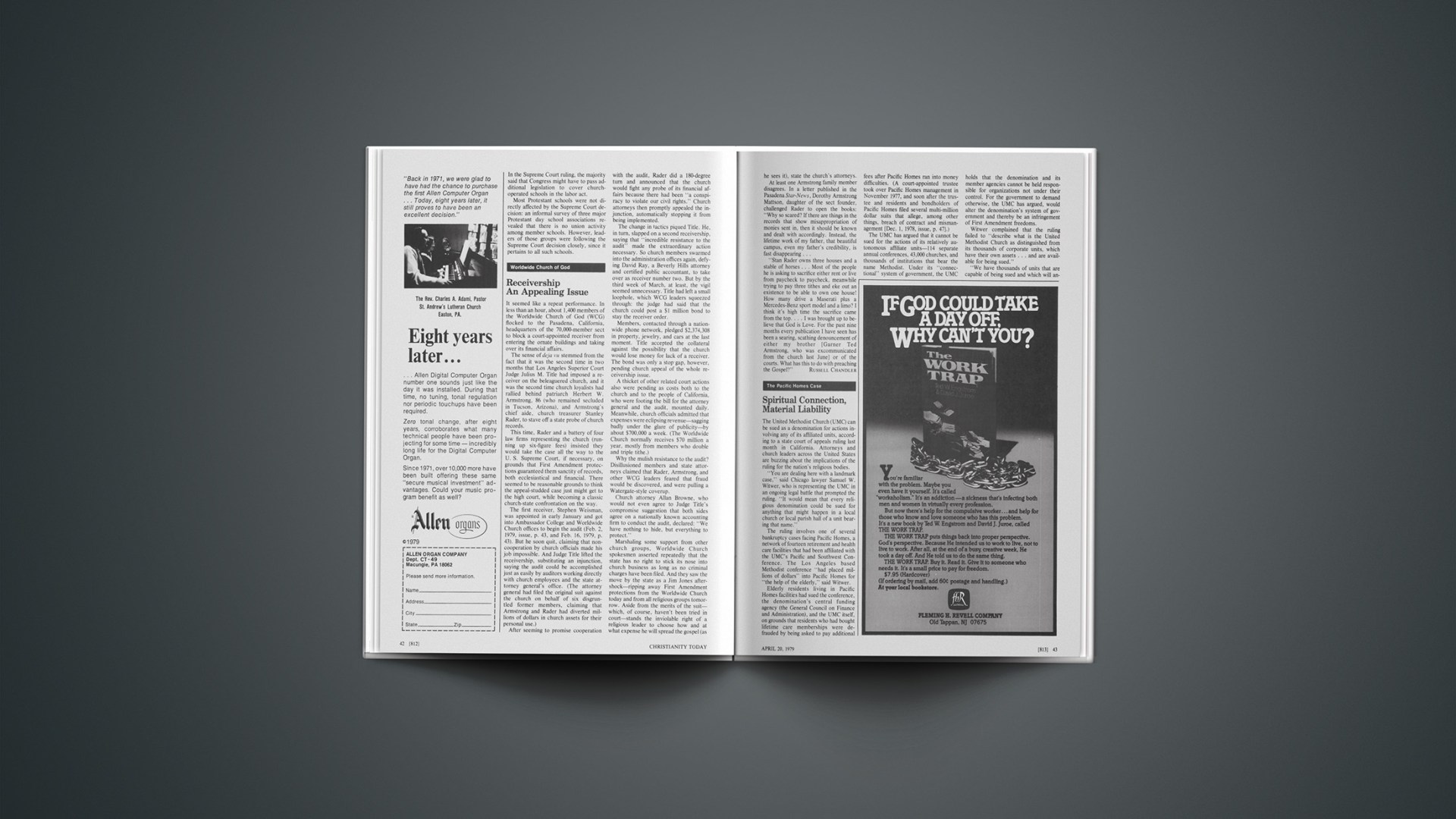
The Pacific Homes Case: Spiritual Connection, Material Liability

The United Methodist Church (UMC) can be sued as a denomination for actions involving any of its affiliated units, according to a state court of appeals ruling last month in California. Attorneys and church leaders across the United States are buzzing about the implications of the ruling for the nation’s religious bodies.

“You are dealing here with a landmark case,” said Chicago lawyer Samuel W. Witwer, who is representing the UMC in an ongoing legal battle that prompted the ruling. “It would mean that every religious denomination could be sued for anything that might happen in a local church or local parish hall of a unit bearing that name.”

The ruling involves one of several bankruptcy cases facing Pacific Homes, a network of fourteen retirement and health care facilities that had been affiliated with the UMC’s Pacific and Southwest Conference. The Los Angeles based Methodist conference “had placed millions of dollars” into Pacific Homes for “the help of the elderly,” said Witwer.

Elderly residents living in Pacific Homes facilities had sued the conference, the denomination’s central funding agency (the General Council on Finance and Administration), and the UMC itself, on grounds that residents who had bought lifetime care memberships were defrauded by being asked to pay additional fees after Pacific Homes ran into money difficulties. (A court-appointed trustee took over Pacific Homes management in November 1977, and soon after the trustee and residents and bondholders of Pacific Homes filed several multi-million dollar suits that allege, among other things, breach of contract and mismanagement [Dec. 1, 1978, issue, p. 47].)

The UMC has argued that it cannot be sued for the actions of its relatively autonomous affiliate units—114 separate annual conferences, 43,000 churches, and thousands of institutions that bear the name Methodist. Under its “connectional” system of government, the UMC holds that the denomination and its member agencies cannot be held responsible for organizations not under their control. For the government to demand otherwise, the UMC has argued, would alter the denomination’s system of government and thereby be an infringement of First Amendment freedoms.

Witwer complained that the ruling failed to “describe what is the United Methodist Church as distinguished from its thousands of corporate units, which have their own assets … and are available for being sued.”

“We have thousands of units that are capable of being sued and which will answer for their own actions,” he said. “But we are saying that you can’t take them collectively, throw them into a conglomerate to seek an overriding judgment.

The three-judge panel in San Diego perceived the matter otherwise. In a twenty-three-page opinion, the court indicated that “a religious organization should not be relieved of its lawful obligations arising out of secular activities because the satisfaction of those obligations may, in some tangential fashion, discourage religious activities.”

Justice Howard Weiner said the UMC should be amenable to suit as part of its commitment and involvement in society, since it has “elected to involve itself in worldly activities.”

The ruling by the Fourth District Court of Appeals overturned an earlier ruling by San Diego Superior Court Judge Ross Tharp, who had declared the United Methodist Church was a “spiritual confederation” and not subject to suit under California law. He warned that if the UMC could be sued, such action “could effectively destroy Methodism in this country.”

Speculation has been that individual church members could be held liable for any judgment against the denomination. Attorney Witwer discounted that possibility. However, he said that contributions of individual members to UMC units (local church, annual conference, for example) might be tapped should one of those UMC units be forced to pay damages in a class action suit.

Church attorneys applied for a rehearing in the most recent decision. If that attempt fails, the UMC will take its case to the Supreme Court of California. “We will exhaust every conceivable legal right for review,” said Witwer.

Receivership an Appealing Issue

It seemed like a repeat performance. In less than an hour, about 1,400 members of the Worldwide Church of God (WCG) flocked to the Pasadena, California, headquarters of the 70,000-member sect to block a court-appointed receiver from entering the ornate buildings and taking over its financial affairs.

The sense of deja vu stemmed from the fact that it was the second time in two months that Los Angeles Superior Court Judge Julius M. Title had imposed a receiver on the beleaguered church, and it was the second time church loyalists had rallied behind patriarch Herbert W. Armstrong, 86 (who remained secluded in Tucson, Arizona), and Armstrong’s chief aide, church treasurer Stanley Rader, to stave off a state probe of church records.

This time, Rader and a battery of four law firms representing the church (running up six-figure fees) insisted they would take the case all the way to the U. S. Supreme Court, if necessary, on grounds that First Amendment protections guaranteed them sanctity of records, both ecclesiastical and financial. There seemed to be reasonable grounds to think the appeal-studded case just might get to the high court, while becoming a classic church-state confrontation on the way.

The first receiver, Stephen Weisman, was appointed in early January and got into Ambassador College and Worldwide Church offices to begin the audit (Feb. 2, 1979, issue, p. 43, and Feb. 16, 1979, p. 43). But he soon quit, claiming that non-cooperation by church officials made his job impossible. And Judge Title lifted the receivership, substituting an injunction, saying the audit could be accomplished just as easily by auditors working directly with church employees and the state attorney general’s office. (The attorney general had filed the original suit against the church on behalf of six disgruntled former members, claiming that Armstrong and Rader had diverted millions of dollars in church assets for their personal use.)

After seeming to promise cooperation with the audit, Rader did a 180-degree turn and announced that the church would fight any probe of its financial affairs because there had been “a conspiracy to violate our civil rights.” Church attorneys then promptly appealed the injunction, automatically stopping it from being implemented.

The change in tactics piqued Title. He, in turn, slapped on a second receivership, saying that “incredible resistance to the audit” made the extraordinary action necessary. So church members swarmed into the administration offices again, defying David Ray, a Beverly Hills attorney and certified public accountant, to take over as receiver number two. But by the third week of March, at least, the vigil seemed unnecessary. Title had left a small loophole, which WCG leaders squeezed through: the judge had said that the church could post a $1 million bond to stay the receiver order.

Members, contacted through a nationwide phone network, pledged $2,374,308 in property, jewelry, and cars at the last moment. Title accepted the collateral against the possibility that the church would lose money for lack of a receiver. The bond was only a stop gap, however, pending church appeal of the whole receivership issue.

A thicket of other related court actions also were pending as costs both to the church and to the people of California, who were footing the bill for the attorney general and the audit, mounted daily. Meanwhile, church officials admitted that expenses were eclipsing revenue—sagging badly under the glare of publicity—by about $700,000 a week. (The Worldwide Church normally receives $70 million a year, mostly from members who double and triple tithe.)

Why the mulish resistance to the audit? Disillusioned members and state attorneys claimed that Rader, Armstrong, and other WCG leaders feared that fraud would be discovered, and were pulling a Watergate-style coverup.

Church attorney Allan Browne, who would not even agree to Judge Title’s compromise suggestion that both sides agree on a nationally known accounting firm to conduct the audit, declared: “We have nothing to hide, but everything to protect.”

Marshaling some support from other church groups, Worldwide Church spokesmen asserted repeatedly that the state has no right to stick its nose into church business as long as no criminal charges have been filed. And they saw the move by the state as a Jim Jones aftershock—ripping away First Amendment protections from the Worldwide Church today and from all religious groups tomorrow. Aside from the merits of the suit—which, of course, haven’t been tried in court—stands the inviolable right of a religious leader to choose how and at what expense he will spread the gospel (as he sees it), state the church’s attorneys.

At least one Armstrong family member disagrees. In a letter published in the Pasadena Star-News, Dorothy Armstrong Mattson, daughter of the sect founder, challenged Rader to open the books: “Why so scared? If there are things in the records that show misappropriation of monies sent in, then it should be known and dealt with accordingly. Instead, the lifetime work of my father, that beautiful campus, even my father’s credibility, is fast disappearing …

“Stan Rader owns three houses and a stable of horses … Most of the people he is asking to sacrifice either rent or live from paycheck to paycheck, meanwhile trying to pay three tithes and eke out an existence to be able to own one house! How many drive a Maserati plus a Mercedes-Benz sport model and a limo? I think it’s high time the sacrifice came from the top.… I was brought up to believe that God is Love. For the past nine months every publication I have seen has been a searing, scathing denouncement of either my brother [Garner Ted Armstrong, who was excommunicated from the church last June] or of the courts. What has this to do with preaching the Gospel?”

Church-Operated Schools: Supreme Court Limits

For leaders of church-related schools who want to be spared from government intervention, a United States Supreme Court decision last month signified a victory. Specifically, the high court ruled that the National Labor Relations Board has no jurisdiction in labor disputes involving teachers in church-managed schools.

The case most directly affected Catholic schools. Five years ago, the NLRB ordered union representation elections for lay teachers at two Roman Catholic schools in the Chicago area and at five high schools in the Fort Wayne-South Bend, Indiana, diocese. (Teachers at the schools had sought to unionize by filing representation petitions with the NLRB.) The NLRB also had ordered the Indiana diocese to reinstate two teachers who reportedly were fired for taking part in prounion activities.

School administrators challenged the NLRB’s orders on First Amendment grounds, and a federal appeals court in Chicago sided with the schools. The court held that the NLRB was infringing on the religious character of the schools and upon the bishops’ authority. It also ruled that NLRB jurisdiction in church-run schools would violate both the free exercise and no establishment clauses of the First Amendment.

The Supreme Court decision, as revealed in a narrow 5–4 majority opinion, upheld the lower court ruling. However, the ruling skirted the constitutional issues raised by the Catholic officials and addressed by the lower court. The high court stated instead that there “would be a significant risk of infringement of the religion clauses of the First Amendment if the National Labor Relations Act conferred jurisdiction over church-operated schools.” (The Act guarantees to employees the right to join a labor union and penalizes employers who interfere with that right.)

Chief Justice Warren Burger, who delivered the Supreme Court decision, said that church-teacher relationships in a church-operated school differ from those in a public or nonreligious school. He maintained, “We see no escape from conflicts flowing from the [NLRB’s] exercise of jurisdiction over teachers in church-operated schools and the consequent serious First Amendment questions that would follow.”

Dissenting justice William Brennan argued that the constitutional issues should have been faced directly. Following that, some observers caution that disputes between the NLRB and church-related schools are not over, since the matter of government regulation of church-run schools remains somewhat open-ended. In the Supreme Court ruling, the majority said that Congress might have to pass additional legislation to cover church-operated schools in the labor act.

Most Protestant schools were not directly affected by the Supreme Court decision: an informal survey of three major Protestant day school associations revealed that there is no union activity among member schools. However, leaders of those groups were following the Supreme Court decision closely, since it pertains to all such schools.

What’s Unique about Biblical Seminary?

Almost every theological seminary today is busily engaged in producing a constant stream of new course offerings, new programs, and new degrees, in order to meet the new problems, changing emphases, and emerging challenges of the current scene. In the midst of all of this activity, it is easy to lose sight of the basics.

Biblical Theological Seminary emphasizes basics. The objective of this emphasis is to produce Christian leaders who can not only speak into the world as it is today, but also deal with the issues of the future.

At Biblical, students learn how to research the Scriptures in the original languages, how to do original theological studies, how to analyze theological arguments and synthesize theological constructs, and how to think for themselves. Thus they learn both how to handle God’s Word in a sensible, reasonable, balanced way, and how to arrive at confident answers for today’s needs.

If you are considering theological education, and want to be thoroughly knowledgeable about all of the current fads in theological thought and wonderfully articulate on all of the exotic developments in the ecclesiastical scene, perhaps Biblical is not for you. If your desire is to get in three years all of the Bible knowledge you will ever need, Biblical is surely not your Seminary But if you are interested in acquiring all of the basic tools and skills and methods and knowledge you will need to study and to handle the word of God during a lifetime of ministry, perhaps Biblical can meet your need. If you are interested in a Seminary which is fully committed to the historic Christian faith, perhaps Biblical is what you have been looking for. If you have been asking God for guidance to a school in which great stress is placed upon the full inerrancy and authority of Scripture, upon study of the Bible in the original languages (throughout the entire program, not merely at the beginning), upon the maintenance of a high level of scholarship coupled with vital spiritual life, upon the need for truly Biblical evangelism, and upon the premillennial return of Christ, then perhaps Biblical is your kind of Seminary. And if you are seeking a school in which students enjoy an unusually warm relationship with the faculty, then perhaps Biblical is the seminary to which you should apply.

Biblical’s President is Dr. Allan A. MacRae and Board Chairman is Dr. Jack Murray. Fora brochure that describes Biblical’s program and philosophy in greater depth, write to the Director of Admissions, Biblical Theological Seminary, P. O. Box 9, 200 N. Main St., Hatfield, Pennsylvania 19440.

G. Douglas Young is founder and president of the Institute of Holy Land Studies in Jerusalem. He has lived there since 1963.

Signing Is Steeped in Religious Overtones

The Egypt-Israel Treaty

A forty-five-minute ceremony last month on the White House lawn ended—at least on paper—thirty years of hostilities between Egypt and Israel. (See editorial, p. 8). And, as has been the case during the sixteen months of negotiations that culminated in the peace treaty signing, the atmosphere seemed as spiritual as it was political.

Egyptian President Anwar Sadat and Israeli Prime Minister Menachem Begin both praised U. S. President Jimmy Carter for his mediator’s role in the peace initiative, saying he should win the Nobel Peace Prize. But each also linked Carter’s success with God. During speeches, Sadat talked about Carter “being armed with the blessing of God,” while Begin told the Southern Baptist layman, “Your labors and your devotion [in the pursuit of peace] bore God’s blessed fruit.”

All three leaders quoted from Isaiah 2:4: “Nations shall beat their swords into plowshares, and their spears into pruning hooks …” An astute Begin pointed out that the same words were spoken by the prophet Micah (ch. 4:3), and he also quoted in Hebrew from Psalms 122 and 126. Carter injected into his speech a quotation from an essay, “The Peacemakers,” written by Walker L. Knight, editor of the Southern Baptist Convention Home Missions magazine in Atlanta.

After an Oklahoma speech several days before the peace signing, in which Carter said Christ would have supported the Equal Rights Amendment, the chief executive had made perhaps his most explicit public statement of faith. A questioner asked Carter to state “with your own mouth” that he was a believer and to describe his devotional life.

Carter said in response, “I am a believer in Jesus Christ and a born-again Christian. I do worship regularly. I spend a lot of time in prayer. Every evening my wife and I have religious services together.” He then added, “So I do perform my partial duties as a Christian. I still fall far short of what God expects of me.”

Carter had said that he had no illusions about the peace initiative. But following the peace treaty signing at a state dinner—held in brightly-colored tents on the White House lawn and replete with chocolate mousse—Carter said, “For much too long, the people of Israel and the people of Egypt, two of the nations of the children of Abraham, trusting in the same God, hoping for the same peace, knew only enmity between them. That time—thank God—is now at an end.”

Carter led in table grace at the meal, an apparent first at a state dinner. He said he had been requested by several persons to thank God for peace, and he told the 1,300 guests, who represented a variety of faiths, “If you don’t mind, I’d like all of us who worship the same God to bow our heads for a moment of prayer.” In attendance were at least sixteen rabbis, three dozen heads of Jewish organizations in the U.S., President Theodore Hesburgh of Notre Dame (the only Catholic leader), the president’s pastor—Charles A. Trentham of Washington’s First Baptist Church—and several leaders of Islamic groups, including Muhammed Abdul-Rauf of the Islamic Center in Washington, D.C.

The President’s sister, evangelist Ruth Carter Stapleton, attended the state dinner, and she also participated by giving the closing prayer at an interfaith worship service held the same evening at the Lincoln Memorial. Invitations to the meeting were sent by the White House, but the Washington-based Fellowship House, an evangelical outreach group most known for its prayer breakfast ministry, “coordinated” the event. Fellowship member and former U. S. Senator Howard Hughes moderated the meeting.

The service had been scheduled originally for the National Cathedral, but was moved to a “neutral” place, in order not to offend Jews and Muslims. Abdul-Rauf did not attend, though he was scheduled to address the 500-person turnout. Many suspected that he bowed out under pressure from anti-treaty Arabs, but a representative in his place attributed Abdul-Rauf’s absence to “extreme fatigue.” Those giving speeches included Hesburgh, Episcopal Bishop John Walker of Washington, D. C., and Rabbi Stanley Rabinowitz.

Choirs from the U. S. Naval Academy and a local black church led the audience in singing, “Let There Be Peace on Earth,” thus ending an emotion-filled day. Anti-treaty Arabs and Palestinians demonstrated near the White House during the signing—their shouts partly drowned out by the pealing bells of St. John’s Episcopal Church.

Jerusalem’s fate still looms as a question mark to future peace. Begin said his happiness over the peace treaty was topped only by Israel’s independence in 1968 and the liberation of Jerusalem during the 1967 Six Day War.

But at least for this day, March 26, peace seemed imminent for the two historical enemies, Egypt and Israel. Even the weather was blessed: cloudy skies broke just before the signing, and the three treaty versions—Arabic, Hebrew, and English—were inked in the sunlight.

Now What for China?

China: A New Day by W. Stanley Mooneyham (Logos, 248 pp., $2.50 pb) is reviewed by J. D. Douglas, editor-at-large, CHRISTIANITY TODAY.

A British writer once pointed out about the Chinese that their ancestors were examining the stars while his were keeping pigs. Perhaps this is why the Chinese themselves traditionally regarded themselves as having two eyes, while dividing the rest of the world into the one-eyed and the totally blind.

In this book the president of World Vision International is rightly concerned that contemporary developments in China be regarded against the background of 5,000 years of history. The old patience is now coupled with opportunistic pragmatism. A false euphoria could be built up, for example, unless one remembers the current Chinese rehabilitation of an ancient slogan: “Make foreign things serve China.”

Mooneyham outlines the direction taken so far in the new relationship with America as the aging Vice-premier Teng accelerates as much as he can in pursuit of the prosperity dreamt of by his mentor Chou En-lai. All this in a land with almost five times the population of the United States but with only one-fifth the gross national product, and a per capita income of less than $400 a year.

Mooneyham is convinced that China cannot be understood without noting the “solidly entrenched sense of place [that] has given the Chinese a deep-seated personal identity”—of being each a member of the “Middle Kingdom,” and not of some vague region dismissed airily by us Westerners as “the Far East.” Not only did the Chinese develop a certain xenophobia: such an attitude was totally justified because of the frightful treatment suffered at the hands of the British and other Europeans (who then were the barbarians?). It was easier, however, to exorcise the foreign devils than to cope with the centuries-old tradition of mother China.

All this is dealt with before Mooneyham returns to pick up the story of the farmer’s son born in Hunan province in 1893. He harbors no illusions about Mao who (the prologue reminds us) had been responsible for more deaths than anyone who ever lived, but neither does he neglect to catalogue Mao’s solid achievements.

Stanley Mooneyham over the past fifteen years has lived and travelled extensively in the Orient. He has an observant eye, a judicious mind, a compassionate heart, and a training in journalism. This is a lively and moving book. Whether he is dealing with American visitors to China (“China needs dollars for modernization”), Chinese students in America (“the shock of Western culture”), the communist attack on the family (“creating a generation gap”), or foreign investment in China (“giving overseas companies more freedom in China than in many noncommunist nations”), the author speaks out of careful research and personal experience. Referring to the closed door behind which the state assailed the church, he points out that God never left China, that “thirty years of Marx have not changed China at the core.”

With true journalistic objectivity he does not spare us an account of the serious weaknesses in past missionary efforts in China—indeed, he goes on to identify them. Neither, however, is he reluctant to obtrude a subjective note. “Is China,” he asks, “somehow, someway, sometime—in your future?”

Even then he is not finished with us. Right up to the last page he is a purveyor of discomforting thoughts. It will not be long, he reminds us, before Christians from the Chinese mainland will be coming to the West. And we may not like them, we in a church that is “rich, and increased with goods, and has need of nothing.” Altogether, this is $2.50-worth of strong medicine.

Book Briefs: April 20, 1979

The Real Old-Time Religion

Common Roots by Robert Webber (Zondervan, $8.95, 256 pp.) is reviewed by Jan Dennis, general editor, Good News Publishers, Westchester, Illinois.

Robert Webber, a professor in the Bible department at Wheaton College, has written Common Roots with the firm conviction that evangelicalism must be revitalized if it is to continue as a life-giving force in contemporary Christianity. Webber applauds evangelicalism for grasping the central message of Christianity (the necessity of conversion and a personal relationship with Jesus Christ) and for preserving it in what he calls the “evangelical spirit.” But too often this evangelical spirit has been prevented from receiving its full expression by structures that are deficient or defective. Despite signs of evangelicalism’s robust health, Webber isolates three deadly viruses within it: modernity—doctrinal, liturgical, and ecclesiastical innovation posing as apostolic belief; historical amnesia—neglect of the 1500 years of Christianity preceding the Reformation; and over-enculturation—an uncritical appropriation of secular methodologies and structures that tend to drive out biblical ones.

Where should evangelicals look for revitalization? To the historic orthodoxy of the church of the second through fifth centuries. Why there? Because, says Webber, “the best insights of the early church … were … apostolic” (p. 8). Initially, the early church completely identified itself with the teachings it had received from the apostles. Because of its proximity in time and outlook on the gospel events, the early church profoundly understood the significance of the redemptive activity of God in Christ and expressed this understanding in its faith and practice. Indeed, Webber believes the faith and practice of the early church as manifested in its ecclesiology, worship, theology, mission, and spirituality was nothing more, and nothing less, than the visible expression of the evangelical spirit. He is not so much concerned to prove this as to lay it before our eyes by holding a mirror up to the life of the early church and letting us compare what we see with our own experience.

The greater part of the book examines the five areas mentioned above—ecclesiology, worship, theology, mission, and spirituality—and calls for evangelicals to recover the early church’s outlook, understanding, and visible expressions of these. For the majority of evangelicals, who are probably unfamiliar with this period of the church’s life, Common Roots will be nothing short of revelatory. Those more familiar with the early church will perhaps be even more impressed with the book’s wealth of information and provocative analysis.

Especially significant is the section on worship. Here the Lord’s Supper is clearly shown to be the central activity of the church as a worshipping community. For the early church, eucharistic worship was a mystical reenactment and representation of God’s redemptive work on behalf of man. This emphasis was lost to evangelicalism under the influence of Protestant scholasticism. The latter produced a false propositionalism that affirmed only what could be proved by rational analysis. (Though Webber does not mention this, the bitter fruits of this anti-supernatural rationalism are still being harvested in the higher critical, demythologizing, and positivistic schools of Protestant thought.)

One thing clearly emerges from the book: if evangelicalism and the early church share the evangelical spirit, as Webber assumes, they have given visible expression to it in quite different ways. Given these dissimilarities of expression, one wonders if the faith and practice of the early church and the faith and practice of evangelicalism are indeed informed by the same principles. This question receives insufficient attention in the book. If the principles informing evangelicalism and the early church are different, evangelicals can scarcely be expected to adopt the faith and practice of the early church without accepting its underlying principles.

Many, perhaps not so sanguine as Webber, have noted that a real separation exists between evangelicalism and the historic orthodoxy of the early church, and have identified it as springing from a different conception of the relationship between the gospel and the church. This different conception is itself a result of a different understanding of the way the gospel endures in time. Evangelicalism, following classical Protestantism, conceives of the gospel’s enduring in time by the sovereign, charismatic, ad hoc operation of the Spirit calling to Christ individuals who then under his Lordship band together in local churches. While historic orthodoxy does not discount the reality of the Spirit’s working in this fashion, it also sees the gospel enduring through a visible, permanent, inviolable expression or axis, with the church, divinely founded and organically linked to the redemptive acts of God in Christ. These links are the apostolic ministry, the apostolic teaching office, and the sacraments. Right or wrong, these conceptions were already present and operative in the early church, according to the consensus of scholarship, both Protestant and Catholic.

Though different, the principles informing evangelicalism and historic orthodoxy are not necessarily in conflict. Indeed, a growing number of Christians feel the two understandings are harmonizable. But whereas many (e.g., Newman, Chesterton, Ronald Knox, W. E. Orchard, whose book, From Faith to Faith, is the definitive work on this theme) have seen historic orthodoxy as a fulfillment of evangelicalism and have subsequently left Protestantism to join one of the catholic communions, afterwards advocating a kind of evangelical Catholicism, Webber suggests the process can be reversed: perhaps evangelicalism can become a full expression of the faith by applying to its life the structures of historic orthodoxy, becoming a kind of catholic evangelicalism. If it could do this without diluting its distinctive character, the prospect for healing the rent Body of Christ would be greatly enhanced. Because of the pioneering steps it takes in that direction, this book should be read by every evangelical concerned about the future of the church.

Archaeology And The Old Testament

The Bible in Its World by Kenneth A. Kitchen (InterVarsity, 168 pp., $3.95 pb) is reviewed by Samuel J. Schultz, professor of Bible and Theology, Wheaton College, Wheaton, Illinois.

If you are interested in updating your knowledge of the Old Testament in the light of recent discoveries, here’s the book for you. It even includes a concise report on the Ebla excavations in Syria that have only recently been widely publicized.

Kenneth Kitchen, lecturer in Egyptian and Coptic at the University of Liverpool, shares with the reader his expert knowledge and infectious enthusiasm in relating the recent spectacular discoveries to OT times and its literature. This volume provides an excellent complement to the author’s earlier work, Ancient Orient and the Old Testament (InterVarsity, 1964).

With an awareness of a century of controversy from Wellhausen, who allowed no historicity for Abraham, to Albright, who considered Abraham a travelling trader, Kitchen evaluates the current skeptical reaction by such men as T. L. Thompson and J. van Seters. Against the background of second and third millennium documents currently available, he suggests that these narratives are not legend or fiction but are closest to the historical class of literature. Kitchen is cautious in relating archaeology to the Scriptures. For example, rather than flat assertions, he simply observes that anyone in Joseph’s position would have been in close contact with writing, and that in the Middle Bronze period when alphabetic writing seems to have been invented, there is “the attractive (but totally unproven) possibility of patriarchal traditions being put into such script, in West-Semitic, from the seventeenth/sixteenth centuries B.C. onwards, as the basis of what later we now find in Genesis” (p. 74).

Kitchen’s scope is wide. He summarizes what we know about the most ancient cultures as they have developed since 10,000 B.C. He surveys and evaluates the literature of the “brilliant third millennium c. 3200–2000 B.C.” and the creation and flood traditions of later periods so often related to biblical accounts by modern scholars. Against this background he asserts that “… the unit Genesis 1–11 best finds its literary origins in the early second millennium B.C.” and that the “earliest narratives in Genesis appear to be neither late concoctions nor mere bowdlerizations of Mesopotamian legend” (p. 35).

Can Solomon be associated with the Book of Proverbs? Kitchen grants that “no-one can prove that Solomon collected, wrote or inspired” Proverbs 1–29. But his “possible authorship of one complete work (1–24), drawing on older wisdom, and role of collector of material copied-up later (Hezekiah, 25–29) are entirely feasible suppositions in the context of the literary, linguistic and conceptual world of the forty or so other works of the kind known to us today” (p. 107).

For students, pastors, and anyone else who wants a better understanding of the Old Testament in its world this book is essential.

Jesus And The Year Of Jubilee

The Favorable Year of the Lord: A Study of Jubilary Theology in the Gospel of Luke, by Robert Bryan Sloan, Jr. (Schola [Box 14317, Austin, TX 78761] 213 pp., $3.25 pb) is reviewed by James Parker III, visiting assistant professor of New Testament interpretation, Southeastern Baptist Theological Seminary, Wake Forest, North Carolina.

In what was originally his doctoral dissertation at Basel, Sloan has attempted to answer a currently popular question of whether Jesus declared a Year of Jubilee in his Nazareth sermon in Luke 4:16–30.

He begins with a discussion of the theological assumptions behind the provisions of the jubilee-sabbath year legislation. In this context Sloan also examines the eschatological features of the jubilee legislation, features which account for the eschatological use of the code in Daniel, the Book of Jubilees, Qumran (11Q Melch.) and later rabbinic literature. In my judgment, he convincingly shows that the idea of Jubilee indeed stands behind the Nazareth reading by Jesus of Isaiah 61:1–2a, 58:6d. For Jesus, the proclamation of “the favorable year of the Lord” is the proclamation of the long-awaited eschatological year of Jubilee. The very important implications of this for understanding Jesus’ self-consciousness and his “preaching of the kingdom” are treated, as well as the pervasiveness of the idea of Jubilee in Luke.

The final chapter will undoubtedly provoke the greatest stir among those who see the year of Jubilee as a model for present Christian social involvement. Sloan does not accept John H. Yoder’s conclusion in The Politics of Jesus that the year of Jubilee as proclaimed by Jesus is a purely social event. Likewise he rejects the traditional view that it refers only to “spiritual” release, that is, the forgiveness of sins. Rather the year of Jubilee as proclaimed by Jesus refers to both. He argues for the necessary interrelatedness of the “social” and “spiritual” dimensions of the year of Jubilee. The discussion of the theological relationship between these two oft-polarized aspects of Christian mission is very helpful and worthy of careful consideration by those who are prone to limit the message of Jesus to one or the other.

This topic is of particular interest today because many groups and movements take Luke 4:16–30 as their rallying cry without a clear understanding of what the passage is actually teaching. It is unusual when a technical scholarly work has such immediate and direct application to contemporary discussions of Christian mission. I hope that the author will soon provide a popular, more easily readable version of this superb book, so that a wider audience can be challenged by his thesis.

Succinct But Solid

Commentary on the New Testament, by E. M. Blaiklock (Revell, 271 pp., $9.95) is reviewed by Lanney Mayer, Wheaton, Illinois.

Why another commentary on the New Testament? For one thing, Blaiklock’s comments are simple enough not to overwhelm. Reflecting his years of preparing notes for Scripture Union, the retired classics professor from New Zealand presupposes no background or technical competence. His succinct presentation of each book of the New Testament is forceful and penetrating. There is a pleasant blend of scholarly acumen and the excitement of fresh discovery which offers something of value to students and pastors alike.

Furthermore, when many commentaries seem merely antiquarian, Blaiklock provides a contrast. He presents the New Testament so as to enhance the likelihood of his readers being confronted with the message that brought the apostolic writings into being in the first place. Commenting, for example, on John’s account of the betrayal of Judas (John 13:21ff.) he says (p. 91): “He was about to dismiss Judas on his errand of evil, but gave him yet another chance. The ‘sop’, a choice morsel, was a mark of friendship (26). He saw Judas’ eyes harden. He left, and John, watching in horror, remembered, sixty or more years later, the oblong of dark as the door opened and closed. It was like the theme of darkness and light which runs through all his writings. The door closed—for ever (30).” And again, the historian Luke is pictured as scouring Palestine for details concerning the empty tomb (pp. 7ff.): “The exquisitely told tale of the Emmaus road is one of Luke’s discoveries. Nothing could be more eloquent of the broken despair of the disciples.…”

If a Bible student is tempted to become overly involved with the details of John’s Revelation or of a Pauline argument, Blaiklock’s format will not permit it. Revelation is distilled to twenty pages and Romans to merely thirteen, hardly more than the biblical accounts themselves. For these reasons a new Christian and even the busy pastor may find this commentary a profitable place to start.

It is only natural that some parts of more traditional commentaries are left out of the treatment. There are no outlines, nor are there formal introductions to each book. Discussions of theological issues and alternative interpretations are minimized. Regrettably, a page or two telling about aids to further study are also absent.

Overall, the impression is not one of a commentary reduced to skin and bones but rather a presentation of what is really indispensable. If one desires a provocative encounter with the fundamental message of the New Testament, this can be it.

What To Do About Drinking?

Alcohol: Its Use, Abuse, & Therapy by Gerald Schomp, (Our Sunday Visitor, 208 pp., $7.95), The Trouble with Alcohol by Tom Shipp (Revell, 160 pp., $6.95), and I’m Worried About Your Drinking by Judith Mattison (Augsburg, 104 pp., $2.95 pb) are reviewed by William Miller, intern chaplain, Alexian Brothers Medical Center, Elk Grove Village, Illinois.

As a result of various developments, many evangelical churches are receiving new members from among their own children and from outsiders who see nothing wrong with social drinking, and who want to know why many evangelicals are so uptight about the consumption of alcoholic beverages. Also people are being converted who have a history of problem drinking. What do we say to those who want intelligent answers to their honest questions about alcohol? How are we going to help our children who are growing up in a drug oriented society where alcohol is more often than not the “drug of choice”? These three books are intended, from different angles, to help answer such questions.

Alcohol: Its Use, Abuse and Therapy could have been subtitled “Everything you did and did not want to know about alcohol.” This short book is a veritable compendium on the subject of alcohol. Everything from “How to sober up” and “How to handle a hangover” to a simple explanation of “The three most common methods of producing alcohol” is included. We are told how to identify a drinking problem and where to get help for alcoholics and their families. Discussion questions accompany each of the nineteen chapters and a glossary of technical and slang terms is included. The information is clear, complete, and in terms readily understood by one not versed in the technical terminology of the subject.

Unfortunately, the book does have some features that will not be appreciated by many evangelicals. Two of the chapters are “How to be a good host” and “How to teach your children about alcohol.” The latter tells us that “the crucial question” regarding our children and alcohol is “How can parents best ensure that their children as adults will drink responsibly if they choose to drink at all?” The author assumes that all teens will inevitably drink so therefore we must “… face up to the issue of how to introduce a child most effectively to alcohol.…”

Although the dust jacket claims that “Christian attitudes are emphasized, with the role of religion in recovery,” in practice this means an emphasis on how “AA is a basically spiritual program” together with many examples of Catholic priests who have had alcoholic problems and a lengthy discussion of CALIX, the “Catholic AA.” In sum, this is an excellent, well-written book, filled with very useful information; but it cannot be considered specifically theological or religious in its presentation or expressed attitudes. Professionals and discerning laymen can profitably use it as a reference book.

The Trouble with Alcohol is by the late pastor of the Lovers Lane United Methodist Church in Dallas. The best feature of this presentation is the use of illustrations, case histories, and analogous stories. In many ways the book is the story of the author’s work with alcoholics, and it lives up to its subtitle, “Expert practical advice with Christian insights.”

The book has a two-pronged purpose. First, it is intended to be a help to the suffering alcoholic by giving guidelines for self-assessment, a plan of action, “pitfalls on the road to recovery,” and a good explanation of Alcoholics Anonymous. But this is not the best feature of the book. There is other literature available, especially AA produced, that can as well or better reach out to the alcoholic in need. The second purpose is to provide guidance and insight for those who wish to help alcoholics and their families. Much of what Shipp learned about working with alcoholics came by trial and error. Pastors who have had no personal experience with alcohol abuse will be able to learn from Shipp’s experience. This book is better for those who are ministering to alcoholics than for the alcoholics themselves.

The chapter on youth and alcohol is probably the best in the book and one which most evangelicals will find both acceptable and helpful. Shipp attacks the underlying problem of youthful drinking. “Children must be taught the business of living. They must learn to deal with the reality of life, disappointments, and heartbreaks, because they live in an imperfect world with people who have faults. But they do not have to turn to a chemical to deal with the world’s deficiencies.”

Throughout the book the author is able to bring the reader face to face with the feelings experienced by alcoholics and their families. A real sensitivity to people and their needs most obviously characterized the life of this pastor.

Yet another approach is presented in I’m Worried About Your Drinking. It is essentially a poetic book. The author tells us: “As you read this book, experience its feelings. Are they like yours? Is this what is happening to you or to someone you care about? Are you indecisive and concerned? The intent of this book is to help you clarify your feelings and problems.” She succeeds in her intended purpose. Each poem confronts the reader with true feelings experienced by alcoholics and their families. The book can be very helpful for those wanting help in sorting out feelings about an alcoholic family situation of which they are a part. It can also be very helpful in gaining understanding of those who are trapped in the web that is spun out by alcohol abuse.

Any worthwhile view on alcohol consumption must be founded on knowledge and understanding of facts and feelings. In distinct ways each of these books can make its contribution to a more effective Christian ministry in an increasingly alcohol oriented society.

FILMSTRIPS

A truly unusual filmstrip is from Twenty-Third Publications (Box 80, West Mystic, CT 06388). The Happy Ones is based on the Beatitudes. It combines photographs from the inner city and dialog that is spontaneous yet well edited. The teenagers in this production are mostly black or Catholic. Suburban evangelical youth can gain understanding of inner-city youth.

Lilie Sparrows, subtitled “God’s Dear Child,” is a multimedia kit for the very young, from Concordia (3558 S. Jefferson Ave., St. Louis, MO 63118). Everything about this kit from the clever filmstrip animation to the complementary components is good. The Lutheran principle of law and grace is lovingly portrayed by coordinating art, crafts, music, physical activities, and imagination. Designed to give children a positive image of God and themselves in response, this set of four filmstrips is an unqualified success.

In Winston House’s Discovering God’s Creative Goodness (23 Groveland Terrace, Minneapolis, MN 55403), finely tuned feelings characterize the narration and sound effects. Though perfect for the very young, the kit includes separate reading scripts for adult viewers that are very effective. Superior aids accompany the splendid photography of the usually good audiovisual line from Winston. Christian educators may want to examine Winston’s “Joy” line of curricula with which this set of four is easily coordinated, though it can stand alone.

The Church Media Center (Broadman, 127 Ninth Ave., N., Nashville, TN 37234) is a tour of a center stocked and staffed to rival secular centers. But as is pointed out, all one needs to begin is an orange crate. The church media center is also the subject of Slides, Preparation and Use—a filmstrip organizationally and pictorially well-arranged. Broadman’s line of practical filmstrips is long.—DALE SANDERS, pastor, United Presbyterian Churches, Orleans and Stamford, Nebraska.

World Scene: April 20, 1979

Colombia’s minister of foreign relations said his government plans to limit the number of entering foreigners—especially those working in the area of religion—by granting only one new visa for every two visa holders who leave the country. This plan, currently only in verbal form, was outlined in a meeting between the minister and evangelicals.

A Modern-language Italian New Testament, jointly sponsored by the United Bible Societies and Italy’s Catholic publishers, Libradia Dottrina Cristiana, was published last November. But the new version’s translation of Matthew 6:18—“I say unto you that you are Peter and that upon you, as upon a rock, I will build my church”—raised an immediate outcry from Protestants. The Italian Evangelical Alliance called the rendering “an act of infidelity” and “distorted,” and the Waldensian Synod said it could not approve the text pending “various corrections in the context of a general revision.”

The 83-year-old leader of the Seventh-day Adventist Church in the Soviet Union for the last thirty years has been sentenced to five years at hard labor. Vladimir Sholokov was convicted on charges of slandering the state and infringing citizens’ rights under the guise of religious activities. He was one of five Adventists who were sentenced in Tashkent last month.

Peter Vins, son of imprisoned Soviet Baptist leader Georgi Vins, was beaten twice last month by men believed to be KGB secret police—according to a report by Soviet dissident Andrei D. Sahkarov. The younger Vins had just finished an eleven-month term in a labor camp on charges of “parasitism”; the beatings have been attributed to his efforts to see an American consular official in Kiev. Vins was part of the Ukranian group set up to monitor Soviet compliance with the Helsinki accords. His father, now in a Siberia prison, has five years remaining in a ten-year prison- and-exile sentence.

Christian Ugandan exiles, including Festo Kivengere, Anglican bishop of Kabale, participated in a secret meeting of Idi Amin’s foes last month in Moshi, Tanzania. The exiles have been split into factions supporting and opposing former president Milton Obote, and are splintered along tribal, geographical, and religious lines. The exiles formed a tenuous united front at the meeting and discussed establishment of a provisional government. Christian figures see their role as promoting reconciliation. Kivengere summed up their message: “Brethren, brethren, don’t fight over the cake before it is baked.”

Japan’s eighteenth Keswick convention this spring had a new twist. The forty or so missionaries who attended the event in Hakone, out of a total attendance of 1,500, received a travel subsidy. Last year the Keswick leaders collected a $3,000 offering for the purpose. Recently they collected $3,800 to defray missionary travel costs for next year.

Minister’s Workshop: Punch Lines from the Pulpit

They didn’t know it was coming. The buildup began like any other story illustrating a biblical text. But then came the punch line, and the pastor looked out over a laughing congregation.

But wait a minute!

Not everyone was laughing. In fact, one or two even had their heads bowed. Were they embarrassed, ashamed? What happened?

Not every preacher can tell a funny story; not every preacher should. And even those who have a “sense of humor” had better know what they are doing when they tell a joke or funny story, and be aware of whom their humor is going to affect.

Some people laugh because they are feeling good; they come to church ready for a blessing. They hang on the preacher’s words, and the humor he uses has its expected effect—it drives home a point in a way that the hearer will remember for a long time. A joke or a funny story is a hook, a means of pulling along the minds of the hearers. It even gives a little mental vacation in the midst of concentration.

Humor is enjoyable; often it is even therapeutic. “A cheerful heart is a good medicine,” states Proverbs 17:22. Recent studies on humor support that. It has been found that hospital patients who are given something to laugh about sleep better. Many experience a reduction in pain, and in one experiment reported by Science Digest (Nov. 1977) a young polio victim in an iron lung was able to breathe for up to forty minutes on his own because he had been laughing.

But even though laughter is good for people, and smiling is known to help create a happier frame of mind, some people in church aren’t laughing, and aren’t ready to be made to laugh. A pastor can’t assume that his humor will always help people.

What about the person who comes to church with a longing for answers to some critical need? What about those who are hurting, or are in spiritual depression, or are under emotional stress? What does pulpit humor do to a person who has gone through one of the most difficult weeks of his life? He may need humor—it may even be good for him—but he isn’t ready for it. The laughter of people around him reinforces his loneliness and pain. In the midst of humor, he feels worse.

There are others who do not see the humor in a story because they have a different idea about what is funny. One recent study of fifty people who read the same “funny story” showed that seventeen of the people laughed aloud, six snickered self-consciously, and the rest either had no response or asked if the story was supposed to have some meaning. The researcher’s conclusion was a question: what is really funny?

Tell a joke or story from the pulpit, and the parishioner may or may not think it is funny. It depends on his conditioning and his feeling at the moment. And if he doesn’t think it is funny, what does he think? His reaction may be that his pastor is making light of God’s truth, mocking something that is serious, being sacrilegious. Some may even begin to question his sympathies as a pastor—“if he laughs about that, how will he react to me and my needs?”

We assume that humor is going to be beneficial, and usually it is. It loosens up an audience, gets oxygen to the brain, and even relaxes the speaker. Executives pay for jokes to use in their speeches. Their writers draw large checks and are kept busy.

Humor is a helpful tool to any public speaker who can use it well, and it is especially helpful to preachers. Oswald C. J. Hoffman, radio preacher on “The Lutheran Hour,” is a master at humor. The late Norman Paullin, former pastor of Baptist Temple in Philadelphia, and homiletics professor at Eastern Baptist Theological Seminary, was known for his humorous pauses. His hearers would wait, deliciously savoring the moment when he would say what they knew was coming. With his eyes twinkling, he would hold his audience as the laughter built up in anticipation of the punch line. Then when he finally gave the last line, he would use the receptivity of the congregation to drive home a biblical point. Not everyone has that gift.

A pastor can’t always know what is happening when he uses humor. Humor is unpredictable because it is personal, and people are unpredictable. A parishioner is as different as each new day and event in his life can make him.

And what about the pastor himself? Why do I tell a story or joke? Am I sincerely trying to make a point in my biblical teaching? Am I using a joke to show that God likes humor too, and pastors are not dull? Is my humor constructive and positive?

Or am I consciously or unconsciously taking a thinly disguised jab at someone? Am I reacting to some personal pain that perhaps has not been dealt with adequately outside the pulpit? Pastors are human too. Is the pulpit my platform for getting even? If it is, I am engaging in public torture. Many may laugh at what I say, but some will not. It was Will Rogers who said, “Everything is funny as long as it is happening to somebody else.” A pastor has to be sure of his motives.

Does humor help your message? Does it illustrate a point? Will it make the hearer more receptive to what is coming? Does it justify the amount of time you give to it in a twenty- to thirty-minute sermon? Humor, Reinhold Niebuhr explained, “must move toward faith.”

A prayed-for sermon includes prayed-for illustrations and prayed-for humor—even prayed-for spontaneous remarks. God communicates by his Holy Spirit through all of the emotional channels which he has placed within us—and he made us with the ability to laugh.

Knowing that he made us for laughter, and obeying God’s call to communicate his Word, we can preach freely, relaxed in the awareness that the humor we use is from him and for him. When it is dedicated to God, our humor can send people home with cheerful hearts.—ROGER C. PALMS, editor, Decision, Minneapolis, Minnesota.

Apple PodcastsDown ArrowDown ArrowDown Arrowarrow_left_altLeft ArrowLeft ArrowRight ArrowRight ArrowRight Arrowarrow_up_altUp ArrowUp ArrowAvailable at Amazoncaret-downCloseCloseEmailEmailExpandExpandExternalExternalFacebookfacebook-squareGiftGiftGooglegoogleGoogle KeephamburgerInstagraminstagram-squareLinkLinklinkedin-squareListenListenListenChristianity TodayCT Creative Studio Logologo_orgMegaphoneMenuMenupausePinterestPlayPlayPocketPodcastRSSRSSSaveSaveSaveSearchSearchsearchSpotifyStitcherTelegramTable of ContentsTable of Contentstwitter-squareWhatsAppXYouTubeYouTube