News from the North American Scene: April 06, 1979

A school board in the Chicago suburb of Glen Ellyn voted to bar on-campus student visitation by religious groups—ending the presence of Young Life and Campus Life representatives in the four high schools of Glenbard District 87 (March 2 issue, p. 62). The board’s action signified a victory of sorts for nine local clergymen who filed a protest last June against alleged proselytizing by religious groups in the high schools. The novisitation order was included in one of five policies passed by the board, all designed to ensure “religious neutrality” in the schools. The board tabled a policy that would forbid public prayer at school functions. (An editorial on the subject appeared in the March 23 issue, p. 12).

The fifty churches and 2,500 members previously served by the New Covenant Apostolic Order (NCAO) have organized as a denomination—the Evangelical Orthodox Church. Peter Gillquist, one of seven former Campus Crusade staff members who formed the NCAO five years ago, said the denomination’s purpose is to promote unity among Christians, or restoration of “the One Holy Church.” Gillquist said the denomination, of which he is presiding bishop, will seek intercommunion with other churches; the group already has sought ties with the Orthodox Church in America, the largest Russian Orthodox body in the U.S.

Eleven leaders of conservative renewal movements, representing eight groups from within six Protestant denominations, pooled common concerns at a third annual meeting. Conference convener Matthew J. Welde, of Presbyterians United for Biblical Concerns, noted an increase in renewalist groups, and Gordon-Conwell Seminary professor Richard Lovelace told the group that greater unity among evangelicals, across denominational lines, is possible. One concern of the group: prayerlessness. They cited recent studies showing that “the average pastor surveyed prays only three minutes each day.

The National Council of Churches sent “listening teams” to thirteen areas of the United States during the past year; the purpose was to determine church and community opinion regarding the council and American society in general. Conclusions are still being analyzed. However, NCC general secretary Claire Randall noted one discovery—that Americans have a preoccupation with self, the result of a loss of faith in society’s institutions and values. She said, “There is a prevalent feeling … that the churches have lost their spiritual mandate and must get back to a more basic faith.”

Though anti-abortion groups are making political headway, results of an ABC News-Harris Survey do not reflect prolife sentiments. Approximately 60 percent of Americans support the U.S. Supreme Court decision that legalized abortions performed during the first three months of pregnancy, according to his poll of 1,200 adults nationwide. However, two groups, blacks and Catholics, opposed the court decision by 50 to 48 percent.

Personalia

Walter O. Meloon, Orlando, Florida, businessman who is president of the Correct Craft skiing boat manufacturing firm, was named the National Association of Evangelical’s Layman of the Year. Meloon was cited for his leadership in volunteer overseas relief work of the Christian and Missionary Alliance Church.

Clyde Cook, Biola College professor and former missionary to the Philippines, was named president of Overseas Crusades. Cook, 43, succeeds evangelist Luis Palau, who resigned last year to devote full time to his preaching ministry.

Thomas A. Murphy, board chairman and chief executive officer of General Motors, is this year’s chairman of National Bible Week. He was selected by the sponsoring Laymen’s National Bible Committee, an interfaith group that has organized Bible week observances since 1941.

Southern Baptists: Mr. Broadcasting Goes off the Air

When Paul M. Stevens announced his early retirement in February as president of the Southern Baptist Radio and Television Commission, he pledged himself to generating an investigation of “charlatans” in religious broadcasting. During Stevens’ twenty-six years as president, the commission grew from one radio program, “The Baptist Hour,” to thirty programs aired on 3,000 radio and television stations. He promised to use his long-time influence and expertise in efforts to force “the glamour boys of religious broadcasting” to make full financial disclosure.

Stevens’s plans haven’t changed and have been lauded by some. But in recent weeks, Stevens himself has been subject to scrutiny—by the Baptist and secular press who discovered that his retirement may not have been entirely voluntary. Commission trustees told the Dallas Times-Herald that they were prepared to force Stevens from his position if he had not stepped aside voluntarily. They expressed dissatisfaction with Stevens’s administrative policies, substantial retirement benefits, and lack of evangelistic emphasis in programming. They may grasp a firmer rein on the agency, which has clearly borne Stevens’s stamp.

Frederick W. Isaacs, chairman-elect of the commission and chairman of a committee to find a successor for Stevens, said there were complaints that Stevens often acted on his own authority without prior trustees’ approval. He said the commission questioned certain Stevens-directed expenditures, such as $30,000 to film the symphony in Fort Worth, where the commission has its headquarters. (Stevens said the filming was a good will gesture to the city, since the commission pays no taxes for police and fire protection.)

The trustees also were embarrassed by Stevens’s retirement benefits. A special nonparticipatory retirement fund, established by the commission’s trustees in 1966, will give him 60 percent of his annual salary, or $27,000, per year after his retirement. The commission in 1972 also granted him full use for life of a commission-owned home, now valued at $185,000, upon retirement. With social security and other funds to which Stevens contributes, he reportedly would receive more than $55,000 per year upon retirement. While established through legitimate channels, the benefits, said Isaacs, would disturb “a whole lot of grassroots Baptist pastors.” He promised that the commission would make full disclosure of information to its trustees and the general public. If Stevens had been fired, he would have lost the $27,000 payment and use of the commission-owned home.

Finally, Isaacs and certain other trustees said commission programming often reflected too little emphasis on evangelism. Stevens responded by saying the trustees wanted “preachers preaching to preachers and preachers preaching to Christians.” The 63-year-old Stevens, who is credited with creating a number of Baptist media programs, including the popular program for teen-agers, “Powerline,” said he was more interested in producing quality programming aimed at the “noninterested, nonreligious audience.”

Stevens, who could not be reached for comment, was relieved immediately of all administrative duties following his retirement announcement, though he would retain his president’s title until October 31. All parties involved hoped that ill feelings would be avoided. Isaacs told the Baptist Press, “We don’t want to destroy the credibility of a man who has done so much for Southern Baptists over the years. I wish none of this had happened.”

Homosexuality: Anglicans: Defining without Judging

The decision to ordain homosexuals who abstain from homosexual relations was defended by Archbishop Edward Scott, the primate of the Anglican Church in Canada, at a press conference on February 27. The House of Bishops, after some months of closed-session study of sexuality in its totality, had taken that step regarding homosexuals.

“Throughout the ages there have been many people of homosexual orientation who have served and given tremendous service to the church—so we are not making a change,” Scott told the press. “We are trying to bring something out into the open, to recognize something that has always been there.”

The primate said that his church was trying to face up to “the conditions that actually exist in our society and to think about them with the mind of Christ.” Asked if he was not watering down the teaching of the Bible, the archbishop replied: “We have not modified Scripture. We have made an attempt to understand it at a deeper level.” He made a distinction between homosexual orientation and sexual relations. “Homosexual orientation is not sinful, except in the sense that it may have been conditioned within a sinful world.”

In reply to a question as to whether the church considers homosexual relations to be sinful, the primate said: “it is not my job or the job of the church to be always defining and judging things.”

A member of Integrity, an organization of homosexuals within the Anglican Church in Canada, agreed with the distinction but regretted that the House of Bishops had restricted ordination to those who would refrain from having homosexual relations.

The man, identified only as John, was a member of the task force that had helped the bishops to reach their decision. “It was scary being a token fag in front of all those bishops,” he told the press. John was concerned that all celibate Anglican priests might now be suspected of being homosexual. “I hope that ministers will not be forced into marriage to avoid it,” he said. John expressed admiration for the courage of the bishops in making their decision.

Scott said that he hoped there would be no discrimination against priests of homosexual orientation when they came up for promotion. Any disciplinary action taken against a priest who became actively homosexual after ordination would be within a pastoral context, he declared.

A double standard between the homosexual and the heterosexual whose ordination is not dependent upon a promise of abstinence has been created by this decision, Editor Jerry Hames says in the March issue of The Canadian Churchman, the national paper of the Anglican Church in Canada. The editorial claims the decision also sets up a double standard between church and society. The House of Bishops had stated a year ago that homosexuals are entitled to equal protection under the law, including the right to employment. Now the bishops appear to be saying that while they expect society to abide by one set of rules, the church will abide by another set.

The greatest need of homosexual priests is for a pastoral relationship with their bishops, says the editor. “Unfortunately, the bishops’ statement does not encourage this; the homosexual ordinand now knows that his case has been prejudged and, regardless of what he says, his concerns can be resolved only by a promise of abstinence. There is nothing in the statement to encourage a homosexual ordinand to declare himself to the bishop.”

“The bishops have not yet come to grips with the issue of sexuality,” Hames writes. “They have provided a dogmatic statement of position without letting the rest of the church know the reasons underpinning their decision.… In theory, the statement offers a promise of equal acceptance to Anglican homosexuals. In practice, it does nothing substantial to erase the mistrust, alienation, and fear that is a constant companion to every homosexual person in the church.”

In response the primate issued a statement which said in part: “I do not believe it is a necessary contradiction to accept a person’s orientation and yet ask him to abstain from giving expression to the orientation in certain types of activity. We, in fact, do this to persons in a wide variety of situations in life. If it were completely clear that homosexuality is totally genetically determined then a charge of double standard could logically be defended.… People who accept leadership roles in church and society have historically been expected to accept standards beyond the average as they are expected to model conduct which it is hoped will be emulated. The bishops have also recognized the right of all to the love, acceptance, and pastoral care of the church.”

Scott made it clear that the church confines its nuptial blessing to heterosexual marriages; it cannot authorize clergy to bless homosexual unions. The relationships of homosexuals must not be confused with holy matrimony, and the church must do nothing which appears to support any such suggestion. He called upon Anglicans to discover the ability to uphold basic Christian values, and at the same time to minister with love and concern to those who have not been able to live up to Christian standards.

Financial Reporting: The Good Fund Raising Seal of Approval

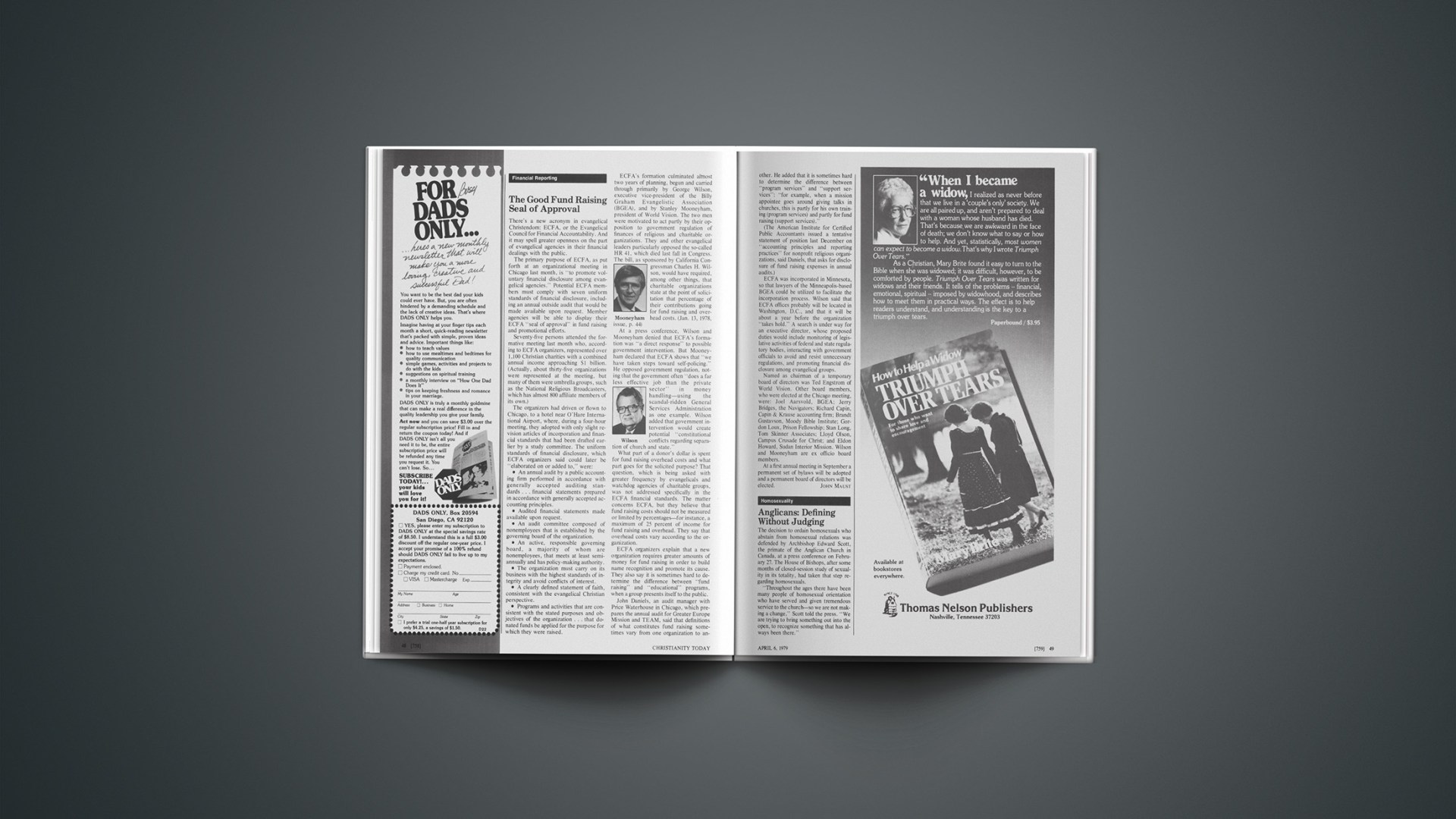
There’s a new acronym in evangelical Christendom: ECFA, or the Evangelical Council for Financial Accountability. And it may spell greater openness on the part of evangelical agencies in their financial dealings with the public.

The primary purpose of ECFA, as put forth at an organizational meeting in Chicago last month, is “to promote voluntary financial disclosure among evangelical agencies.” Potential ECFA members must comply with seven uniform standards of financial disclosure, including an annual outside audit that would be made available upon request. Member agencies will be able to display their ECFA “seal of approval” in fund raising and promotional efforts.

Seventy-five persons attended the formative meeting last month who, according to ECFA organizers, represented over 1,100 Christian charities with a combined annual income approaching $1 billion. (Actually, about thirty-five organizations were represented at the meeting, but many of them were umbrella groups, such as the National Religious Broadcasters, which has almost 800 affiliate members of its own.)

The organizers had driven or flown to Chicago, to a hotel near O’Hare International Airport, where, during a four-hour meeting, they adopted with only slight revision articles of incorporation and financial standards that had been drafted earlier by a study committee. The uniform standards of financial disclosure, which ECFA organizers said could later be “elaborated on or added to,” were:

• An annual audit by a public accounting firm performed in accordance with generally accepted auditing standards … financial statements prepared in accordance with generally accepted accounting principles.

• Audited financial statements made available upon request.

• An audit committee composed of nonemployees that is established by the governing board of the organization.

• An active, responsible governing board, a majority of whom are nonemployees, that meets at least semiannually and has policy-making authority.

• The organization must carry on its business with the highest standards of integrity and avoid conflicts of interest.

• A clearly defined statement of faith, consistent with the evangelical Christian perspective.

• Programs and activities that are consistent with the stated purposes and objectives of the organization … that donated funds be applied for the purpose for which they were raised.

ECFA’s formation culminated almost two years of planning, begun and carried through primarily by George Wilson, executive vice-president of the Billy Graham Evangelistic Association (BGEA), and by Stanley Mooneyham, president of World Vision. The two men were motivated to act partly by their opposition to government regulation of finances of religious and charitable organizations. They and other evangelical leaders particularly opposed the so-called HR 41, which died last fall in Congress. The bill, as sponsored by California Congressman Charles H. Wilson, would have required, among other things, that charitable organizations state at the point of solicitation that percentage of their contributions going for fund raising and over-Mooneyham head costs. (Jan. 13, 1978, issue, p. 44)

At a press conference, Wilson and Mooneyham denied that ECFA’s formation was “a direct response” to possible government intervention. But Mooneyham declared that ECFA shows that “we have taken steps toward self-policing.” He opposed government regulation, noting that the government often “does a far less effective job than the private sector” in money handling—using the scandal-ridden General Services Administration as one example. Wilson added that government intervention would create potential “constitutional conflicts regarding separation of church and state.”

What part of a donor’s dollar is spent for fund raising overhead costs and what part goes for the solicited purpose? That question, which is being asked with greater frequency by evangelicals and watchdog agencies of charitable groups, was not addressed specifically in the ECFA financial standards. The matter concerns ECFA, but they believe that fund raising costs should not be measured or limited by percentages—for instance, a maximum of 25 percent of income for fund raising and overhead. They say that overhead costs vary according to the organization.

ECFA organizers explain that a new organization requires greater amounts of money for fund raising in order to build name recognition and promote its cause. They also say it is sometimes hard to determine the difference between “fund raising” and “educational” programs, when a group presents itself to the public.

John Daniels, an audit manager with Price Waterhouse in Chicago, which prepares the annual audit for Greater Europe Mission and TEAM, said that definitions of what constitutes fund raising sometimes vary from one organization to another. He added that it is sometimes hard to determine the difference between “program services” and “support services”: “for example, when a mission appointee goes around giving talks in churches, this is partly for his own training (program services) and partly for fund raising (support services).”

(The American Institute for Certified Public Accountants issued a tentative statement of position last December on “accounting principles and reporting practices” for nonprofit religious organizations, said Daniels, that asks for disclosure of fund raising expenses in annual audits.)

ECFA was incorporated in Minnesota, so that lawyers of the Minneapolis-based BGEA could be utilized to facilitate the incorporation process. Wilson said that ECFA offices probably will be located in Washington, D.C., and that it will be about a year before the organization “takes hold.” A search is under way for an executive director, whose proposed duties would include monitoring of legislative activities of federal and state regulatory bodies, interacting with government officials to avoid and resist unnecessary regulations, and promoting financial disclosure among evangelical groups.

Named as chairman of a temporary board of directors was Ted Engstrom of World Vision. Other board members, who were elected at the Chicago meeting, were: Joel Aarsvold, BGEA; Jerry Bridges, the Navigators; Richard Capin, Capin & Krause accounting firm; Brandt Gustavson, Moody Bible Institute; Gordon Loux, Prison Fellowship; Stan Long, Tom Skinner Associates; Lloyd Olson, Campus Crusade for Christ; and Eldon Howard, Sudan Interior Mission. Wilson and Mooneyham are ex officio board members.

At a first annual meeting in September a permanent set of bylaws will be adopted and a permanent board of directors will be elected.

Womens’s Role: Reversing the Curse

His six-week series of sermons on “The Divine Pattern for Marriage” progressed well until the topic, “The Wife’s Priorities.” Then, California pastor John MacArthur found himself in the national spotlight, bombarded by calls from the media, including a woman talk-show host who warned before her interview went on the air, “I’m going to tear you to shreds.”

MacArthur had said that wives and mothers should not work outside the home. He believes that if a family can’t live on the earnings of the husband, then its members are living beyond their God-intended means and their priorities are out of order.

The substance of the 39-year-old pastor’s remarks fueled controversy by itself; but an apparent media error further ignited the issue. A newspaper had headlined the mistaken information that “Grace Community Church in Panorama City Fires Secretaries” in the wake of MacArthur’s comments.

“We haven’t fired anybody and the press got the story all wrong,” the popular Bible expositor said in an interview. An anonymous person, one of up to 7,000 who gather each week for services in the nondenominational church, gave a Los Angeles newspaper reporter the impression that the pastor was discriminating against women. The reporter then phoned a friend, who was the wife of an elder in the church, and that resulted in a garbled story which since has been retracted. The woman apologized in writing after the story had hit the national news networks.

MacArthur is not unused to attention. His Grace Community Chapel ranks with Robert Schuller’s Garden Grove Community Church and Chuck Smith’s Calvary Chapel for size and influence among evangelical churches in the Los Angeles area. He is a former college football star who frequently leads Bible studies for Los Angeles professional sports teams, an author, a seminar leader, and has an extensive cassette and radio ministry.

“In my sermon on “The Wife’s Priorities,’ ” MacArthur said, “I was emphasizing what happens when women go to work outside the home. I had shown earlier that a woman’s priorities are in the home and I have listed her priorities: to the husband, to the children, to the poor, the needy, and so forth.”

MacArthur continued, “When this divine priority is cared for and she has time to be creative outside the home, great! All I did was urge my people to examine their priorities.”

MacArthur, a fifth generation clergyman, said “I am basically a Bible teacher trying to delineate what the Scripture says. If someone disagrees we don’t get on their case.”

The thirty-five elders at Grace Church support MacArthur’s teaching that a believer’s responsibility extends to the entire household of faith, not just to his own family. If a widow or divorced woman at the church is destitute and can’t support herself without working outside the home the elders are committed to contributing to her monthly income. The church currently provides financial assistance to several widows and plans to help more.

“Examine your priorities,” MacArthur admonishes his female members. “Society is pressuring you because it says that you have to get your identity from work or a career. The Bible gives you identity from your children and from your family. Take the example of the woman of Proverbs 31. After the priorities of the family are met properly, then a woman can buy land, plow it, plant it, make things for the community.… You’ve got to be a pretty sharp gal to pull off all she did!”

MacArthur calls his biblical definition of the home “neither novel nor new” and one which is taught in the “mainline evangelical churches.”

He bases his case on Ephesians 5:21 and 22, passages that he says exhort wives to follow the headship of the husband and for the husband to love the wife sacrificially. MacArthur supported his views from Genesis 3:16 where, he said, the “battle of the sexes began.” The verse reads in part, “and thy desire shall be to thy husband and he shall rule over thee.” MacArthur says the passage is a problem linguistically. He agrees with the conclusion of one writer who said that the Hebrew should be rendered, “Her desire is to overrule you. You must control her.” MacArthur says there is conflict in marriage pitting the unregenerate natural woman who desires supremacy against the man who rules despotically.

“Of course there is male chauvinism and unfortunately men abuse this right and become despots over women,” he said. “They often turn women into sex objects and in other ways also destroy their dignity and beauty. On the other hand there arises what one would expect—women’s liberation. We should expect women to try to usurp the place that isn’t theirs. Women seek to override the bounds of their situation and men dominate.

MacArthur advanced his teaching a step further. According to Genesis 3, the man is to be the breadwinner and the woman’s point of contact is the home, the children, he said. “It’s always been that way. The Epistle of Paul to Titus and his first letter to Timothy talk about older women teaching the young women to love their husbands and their children and to be keepers at home.”

Preaching the Gospel and Bill of Rights

National Association of Evangelicals

Adrian Rogers ended with a flourish, much as he would in his 11,000-member Bellevue Baptist Church in Memphis, Tennessee. “If you’re going to heaven,” he preached, “you’re not going on the ladder of logic, or the rocket of reason, but on the railroad of redemption—the old T & O, Trust and Obey.”

Rogers’s opening night address set the tone for the 37th annual convention of the National Association of Evangelicals. At an ultra-modern hotel near Orlando, Florida, over 900 conferees heard old-time preaching and emphasized the gospel fundamentals of salvation and evangelism—all built around the theme, “Jesus Christ: Now More Than Ever.”

A position paper, adopted by the assembly, explained that in today’s “dangerous world, with its economic, political, and moral ills, Christ alone offers an ‘answer.’ ” NAE pledged itself to an evangelistic concern for the world’s 2.9 billion unreached peoples, including the 80 million unchurched and 60 million inactive church members in the United States.

Reiterating those themes during conference addresses were morning Bible study leader Bruce Dunn, a Peoria, Illinois, Presbyterian pastor and radio broadcaster; Warren Webster, general director of the Conservative Baptist Foreign Mission Society; and Paul Smith, pastor of People’s Church, Toronto, one of the largest evangelical churches in Canada.

Some delegates complained privately that the two-day conference lacked the “intellectual challenge” of previous years. But NAE executive director of twelve years Billy Melvin, who said convention themes are varied from year to year to provide a “rhythm,” felt good about the program. “It’s been a long time since we’ve had some real Bible teaching and been challenged to reach the lost,” he said.

The conferees also spent a considerable amount of time exegeting the First Amendment. In their resolution, “Religious Freedom,” convention delegates protested against government activities that violate the separation of church and state. The resolution criticized the Internal Revenue Service (IRS), which “continues to propose and adopt one resolution after another that seriously erodes First Amendment rights”; specifically cited was an IRS proposal to withdraw the tax exempt status of private church schools that do not maintain a racial balance stipulated by the IRS commissioner (Jan. 5 issue, p. 42). The NAE asked Congress to legislate limits to IRS involvement in “the enforcement of social policy as distinct from the collection of taxes.”

The resolution also warned evangelicals that the Charitable Contribution Disclosure Act, formerly called H.R. 41, had been reintroduced in Congress as H.R. 825, a bill that would open church records to more intensive government inspection. The NAE also warned that the proposed Lobby Disclosure Act would curtail church groups’ contact with, and influence of, legislators unless those groups registered as lobbyists and worked through other “red tape.” The resolution concluded with a call to evangelicals for self-regulation, to prevent any abuses that may have prompted greater IRS and congressional involvement in religious sectors.

Other resolutions lacked bite, or were toned down to prevent disunity within the body. A resolution advocating legislation to provide tuition tax credits to parents of children in private schools was tabled since convention opinion was divided. The social action commission drafted a resolution to protest the nuclear arms race; and the NAE resolutions committee used the commission’s document as a reference to draft a similar resolution, but one less likely to alienate the nonpacifist “peace through strength” members. The final resolution adopted by the assembly urged the United States government to “exercise reasonable restraint in the production and use of its military capability.”

By resolution, the NAE also expressed concern for the security of Taiwan and for the preservation of religious freedoms there. The NAE, whose membership represents 3.5 million Christians in thirty-eight denominations, also reaffirmed its opposition to abortion on demand and to “attempts to obliterate sexual distinctions between men and woman in order to promulgate unisexual or homosexual preferences and practices.”

Though its convention theme was traditional, the NAE indicated it is breaking ground in other areas—in the literal sense in Carol Stream, Illinois, where its $1 million headquarters is nearing a July completion date.

The NAE has begun two new communications efforts. At a convention-ending banquet, noted preacher and radio broadcaster Stephen Olford was commissioned as NAE’s “minister-at-large.” His 30-minute radio show, “Encounter,” will continue, but as a vehicle of NAE and with accompanying informational blurbs from the organization. He also will conduct seminars and speak at NAE events.

NAE’s Office of Public Affairs in Washington, D.C., last month issued its first “Washington Insight,”—a newsletter designed to keep evangelicals informed about the latest happenings on Capitol Hill. The project is largely the work of Robert Dugan, formerly involved in Colorado politics, who recently joined the office staff as its executive director.

World Relief, which only recently became directly involved with the U.S. government in refugee assistance programs, announced that it intends to find sponsors for and to place 500 refugees by the end of this month and up to 200 more each month thereafter. As the emergency relief arm of NAE, World Relief announced at the convention the first winner of its “Helping Hand Award,” Paul Munshi. He heads the Christian Service Society, World Relief’s counterpart agency in Bangladesh, and was cited for establishing and maintaining a number of self-help, assistance-to-the-poor programs there.

Convention workshops covered a broad spectrum, from social justice with black leader John Perkins to minority evangelism with American Indian Thomas Claus to religious broadcasting and politics with former congressman John Conlan. And the conference participants, who hail from diverse denominational backgrounds, left satisfied—either for home or for a postconvention weekend at Disney World or another Florida spot. They had survived another year without major controversy—something Melvin attributes to the group’s common ground approach, in which members ask “At what points do we all agree?” and work from there.

The National Association of What?

Evangelicals … who are they really? Finding a conclusive definition for evangelical is as elusive as the Holy Grail.

“I think of a carnival revival, tent shows, and Elmer Gantry,” said a Wyandotte, Michigan, travel agent, who was staying at the same hotel as the NAE delegates during their recent convention. While serving ice cream to a hungry NAE delegate at the much-frequented coffee shop, hotel employee Charlene Watson opined, “An evangelical is a religious person, I guess, somebody who goes to church every Sunday … a real saint.”

When several NAE conferees themselves were asked to define evangelical they modestly declined calling themselves saints, but they didn’t agree on a single definition.

In his NAE presidential address, Carl H. Lundquist called an evangelical “a person who has heard the good news—who’s responded to the good news, and now is actively sharing that good news.”

As the administrative head of World Evangelical Fellowship, Waldron Scott travels widely. He said that he finds four characteristics, “four things that come up again and again,” of Christians around the world who could be typified as evangelical: (1) a personal experience with God; (2) a strong priority for Scripture—believing that it is authoritative; (3) a passion for holiness in the Christian life; (4) an interest in evangelism and missions.

John Perkins, founder and president of Voice of Calvary ministries in Jackson, Mississippi, says an evangelical “believes the gospel has to be proclaimed—believes in the power of the Holy Spirit to work the conversion experience.” Most NAE convention participants would fit this “bottom line” definition, Perkins said. But to his way of thinking, he said the definition “ought to go further than that.” He said an evangelical also should be “vitally involved in human needs.”

Rufus Jones, general director of the Conservative Baptist Home Mission Society, was asked to define evangelical at a “think tank” meeting of church leaders called by former CHRISTIANITY TODAY editor Carl Henry in 1965. Then, as now, Jones said an evangelical is “one who believes in the evangel, the gospel of the kingdom as preached by Jesus and the apostles, which seeks to persuade people to submit to Jesus Christ as Lord in every aspect of their lives, and in all their social, economic, and political relationships.”

At least at the NAE convention in Orlando perhaps the only certain way to distinguish an evangelical was by his or her name tag—and by the heavenward gazes of pale northerners who had fled the snows in search of Florida sun.

World Scene: April 06, 1979

The tiny island of Iona, an early center of Celtic Christianity off the western coast of Scotland, is for sale. The twelfth Duke of Argyll, whose family has owned the island for 300 years, intends to sell it to pay off estate taxes. Columba, an Irish monk, came to Iona in A.D. 563, founding an abbey from which the Christian faith began to spread through Britain.

Under an agreement between Spain and the Vatican signed in January, state aid to the Roman Catholic church will be maintained at an annual level of $977 million through 1982. After that, the church “declares its intention of obtaining by its own efforts sufficient funds to meet its own requirements,” but the state “may assign the Catholic church a portion of the revenue raised by income taxes.”

The constituted assembly of the (Lutheran) Church of Sweden has voted against separating church and state by a vote of 54 delegates to 42. The assembly also voted acceptance of equal rights for men and women to serve as pastors. Men who oppose serving with ordained women may continue to serve, but it is they, and not the women, who in order to follow their convictions must step aside.

Pope John Paul II has improved the atmosphere between the Vatican and the government of Poland by postponing the dates of his visit to Poland. He had wanted to visit during the mid-May period when the Roman Catholic Church will be observing the 900th anniversary of the martyrdom of St. Stanislaus. Warsaw authorities had said he would be welcome, but were unhappy about a visit at the sensitive height of the anniversary. The new dates—June 2 to 10—are conducive to less tense church-and-state relations in Eastern Europe.

The London Daily Telegraph reports the recent closing of a number of churches in a southern province of Mozambique, including the Anglican cathedral at Maciene. All religious services were also banned following a February confrontation between the Marxist government of President Samora Machel and the churches.

Persecution and revival both characterize Ethiopia today. One hundred believers are imprisoned in one district, and church members are known to be suffering in eight others. At the same time, reports from the Word of Life (Sudan Interior Mission-related) churches tell of 19,000 new believers being baptized last year in the Wolayta area of southern Ethiopia.

The two decrees limiting evangelistic activity issued by the Indonesian minister of religion last August (see the Nov. 3, 1978, issue, p. 70) were suspended in January. Although the suspension is qualified, it eases the pressure on the churches somewhat and provides a basis for discussion with the Suharto government. The majority Muslims stood most to gain from the suspended decrees, while minority Christians were perceived as the target.

Guatemala: Good Grades for a Latin Seminary

The year 1929 was not an auspicious time for new enterprises anywhere in the world. But as the Central American Theological Seminary in Guatemala City celebrated its fiftieth anniversary this February, it was apparent that it had not only survived, but prospered. What began as the Central American Bible Institute in 1929, with nine students in borrowed quarters, has become one of the leading evangelical centers of theological preparation in the Spanish-speaking world.

Several hundred of the 802 graduates, along with local Christians, took part in the February week of festivities, which included special meetings, workshops on various topics relating to ministry, and alumni reunions. There was also a unique Bible exhibit which featured a number of valuable manuscripts and early editions along with copies of New Testaments or portions in twenty of Guatemala’s Indian languages, as well as a live demonstration by veteran translator Edward Sywulka and his Mam informant. Also included in the celebration was the dedication of the seminary’s new 500-seat chapel building.

The seminary program was added to the Bible institute in 1966 as the need for a higher academic level of preparation for pastors became apparent with increasing urbanization and a general rise in education across the continent. “The social structure of Latin American Protestantism has been changing,” says Dr. Emilio Antonio Nuñez, rector (president) of the seminary (known as SETECA from its name in Spanish). “More and more, professional people are found in the churches. In addition, young people who feel a call to the ministry are looking for an institution that will respond to their academic aspirations.”

Operated by CAM International (formerly the Central American Mission), SETECA has a current enrollment of 132 representing 17 countries, as far away as Argentina and Spain.

The seminary’s drawing power internationally underscores the basic paucity of high-quality, conservative theological education in Latin America as a whole. There are perhaps a half-dozen interdenominational institutions on this level to serve the rapidly growing evangelical churches among the 300 million Spanish-speaking inhabitants of the world.

While SETECA celebrates its fiftieth anniversary, the evangelical church in Guatemala is approaching its centenary. Presbyterian missionary J. C. Hill arrived in the country in 1882 in response to a call by President Justo Rufino Barrios, a liberal reformer who was seeking to counter the entrenched power of the Catholic church. Guatemala has been one of the countries in Latin America most responsive to the gospel, and evangelicals are estimated to make up at least 10 percent and perhaps as many as one out of the six million population. The largest groups include the Central American Evangelical Churches, which relate to CAM International, the Assemblies of God, and the Church of God (Cleveland, Tennessee). Some sixty missionary agencies with more than 400 foreign personnel work in Guatemala, and there are 110 Protestant denominations in the country.

The current vice-president of Guatemala, Francisco Villagrán Kramer, identifies himself as an evangelical, one of the few in high government office in Latin America. His uncle was a pioneer Plymouth Brethren missionary.

Given the theological and ecclesiastical situation in Latin America, it would seem that SETECA and the other conservative seminaries have their work cut out for the next fifty years.

The First Problem Is Admitting …

A long dormant dispute between the South African government and some of the country’s church schools threatened to erupt into the open once again during February. A showdown seemed imminent last month between the schools and the administrator of the Transvaal province, Sybrand van Niekerk. In contrast to his counterpart in the traditionally more liberal Cape province, van Niekerk has refused to admit almost all the black, coloured (mixed race), and Indian children who had applied to attend church schools in the Transvaal (Feb. 16 issue, p. 61).

Only 4 of 223 applications were approved, but the churches—mainly Roman Catholic and Anglican (Episcopal)—went ahead and admitted many of the pupils anyway. Now, with van Niekerk refusing to recognize their admission, the Catholic church is willing to risk having its schools closed rather than back down and expel the pupils.

In terms of central government policy, nonwhite pupils can be admitted to formerly white church schools only in “highly exceptional circumstances.” But this ruling has been far more strictly applied in the Transvaal than in the Cape, where most similar applications have succeeded.

An unnamed Catholic church source in the Transvaal was quoted as saying: “I think the whole thing is going to come to a head now.” He added, though, that his church saw the conflict as being a struggle within the ranks of different factions in the government, rather than primarily a clash between the Catholics and the state.

An irony of the situation is that it was the Pretoria government that first approached the Catholic schools several years ago and asked them to take in the children of black diplomats. The children could not have been accommodated in ordinary government schools without acute embarrassment. The Catholics who, like the Anglicans, have an especially large black constituency in South Africa, complied readily. But now their insistence on providing church education for all their members—and van Niekerk’s opposition—could lead to a showdown from which neither they nor the authorities can emerge unscathed.

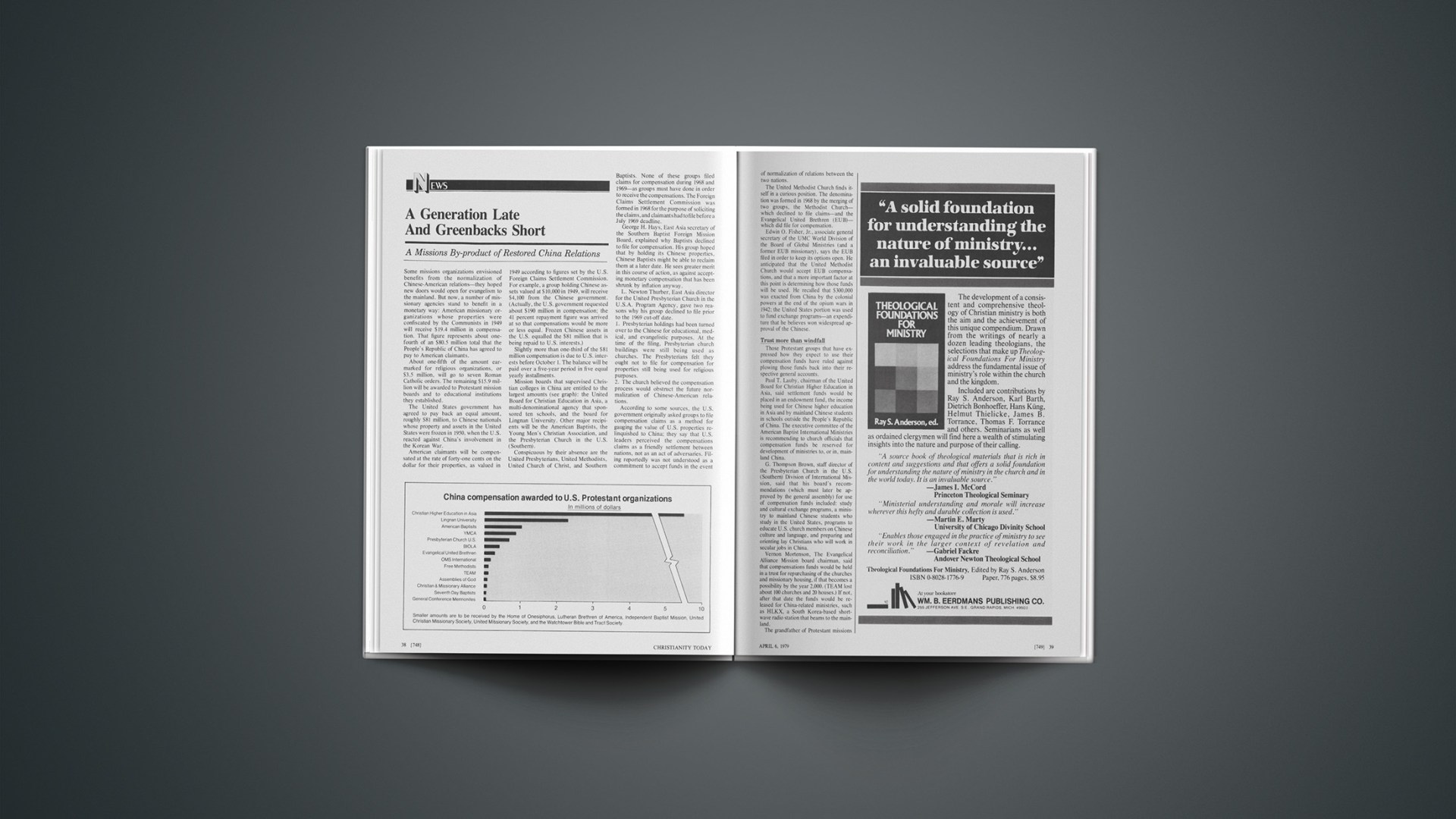
Trust More than Windfall

Trust More Than Windfall

Those Protestant groups that have expressed how they expect to use their compensation funds have ruled against plowing those funds back into their respective general accounts.

Paul T. Lauby, chairman of the United Board for Christian Higher Education in Asia, said settlement funds would be placed in an endowment fund, the income being used for Chinese higher education in Asia and by mainland Chinese students in schools outside the People’s Republic of China. The executive committee of the American Baptist International Ministries is recommending to church officials that compensation funds be reserved for development of ministries to, or in, mainland China.

G. Thompson Brown, staff director of the Presbyterian Church in the U.S. (Southern) Division of International Mission, said that his board’s recommendations (which must later be approved by the general assembly) for use of compensation funds included: study and cultural exchange programs, a ministry to mainland Chinese students who study in the United States, programs to educate U.S. church members on Chinese culture and language, and preparing and orienting lay Christians who will work in secular jobs in China.

Vernon Mortenson, The Evangelical Alliance Mission board chairman, said that compensations funds would be held in a trust for repurchasing of the churches and missionary housing, if that becomes a possibility by the year 2,000. (TEAM lost about 100 churches and 20 houses.) If not, after that date the funds would be released for China-related ministries, such as HLKX, a South Korea-based short-wave radio station that beams to the mainland.

The grandfather of Protestant missions in China—the China Inland Mission (CIM), now the Overseas Missionary Fellowship—is not in line to receive compensation. The most obvious reason is that the group was registered under British jurisdiction. But beyond that, CIM founder J. Hudson Taylor had established the principle that his mission would never press for reparations and thus would avoid any links with colonial regimes. (Interestingly, CIM headquarters buildings in Shanghai were not directly expropriated. Instead, they were rented by Communist authorities and converted into a hospital. Rent payments for the first several years’ use, made in advance, financed the evacuation of CIM missionaries.)

James Hudson Taylor III, president of the China Evangelical Seminary in Taipei, Taiwan, clings to his grandfather’s convictions (see his letter on page 8). He therefore disagrees with the leadership of his sponsoring Free Methodist Church of North America, which is accepting compensation funds.

Some Presbyterian and Methodist officials, who are affiliated with the United Board for Christian Education in Asia, expressed displeasure that this school-sponsoring group filed for compensations. Filing, they say, was rejected during a UBCEA board meeting. But at a thinly attended board session held shortly thereafter, the board’s attorney pressed for, and obtained, a reversal of that decision. By not filing, the attorney reportedly argued, the board would be abrogating its legal obligations.

One board member wondered if the attorney hadn’t been motivated more by his own commission. The full UBCEA board was told later that the claim, once filed, could not be withdrawn.

HARRY GENET

Apple PodcastsDown ArrowDown ArrowDown Arrowarrow_left_altLeft ArrowLeft ArrowRight ArrowRight ArrowRight Arrowarrow_up_altUp ArrowUp ArrowAvailable at Amazoncaret-downCloseCloseEmailEmailExpandExpandExternalExternalFacebookfacebook-squareGiftGiftGooglegoogleGoogle KeephamburgerInstagraminstagram-squareLinkLinklinkedin-squareListenListenListenChristianity TodayCT Creative Studio Logologo_orgMegaphoneMenuMenupausePinterestPlayPlayPocketPodcastRSSRSSSaveSaveSaveSearchSearchsearchSpotifyStitcherTelegramTable of ContentsTable of Contentstwitter-squareWhatsAppXYouTubeYouTube