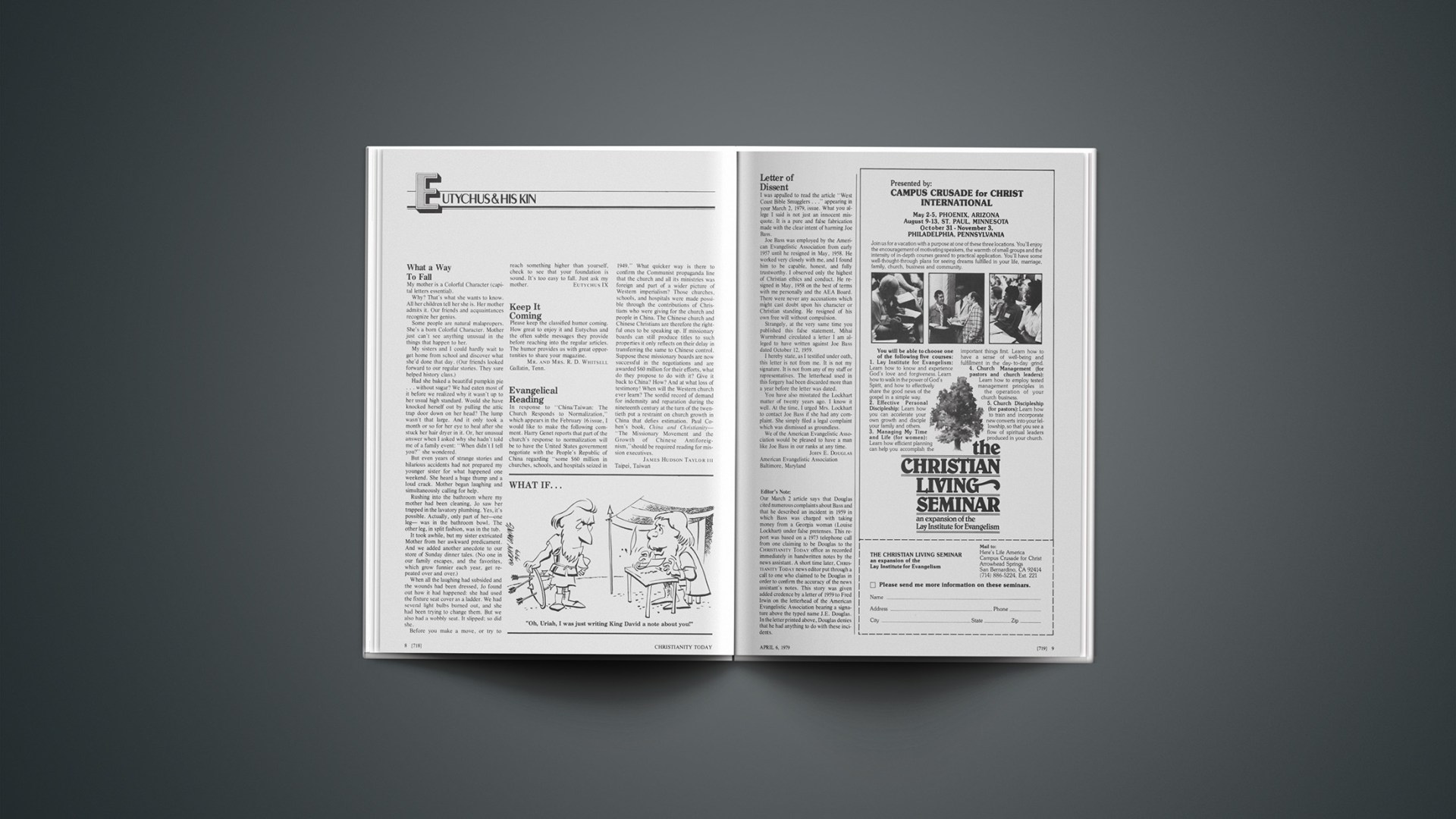
Eutychus and His Kin: April 6, 1979

My mother is a Colorful Character (capital letters essential).

Why? That’s what she wants to know. All her children tell her she is. Her mother admits it. Our friends and acquaintances recognize her genius.

Some people are natural malapropers. She’s a born Colorful Character. Mother just can’t see anything unusual in the things that happen to her.

My sisters and I could hardly wait to get home from school and discover what she’d done that day. (Our friends looked forward to our regular stories. They sure helped history class.)

Had she baked a beautiful pumpkin pie … without sugar? We had eaten most of it before we realized why it wasn’t up to her usual high standard. Would she have knocked herself out by pulling the attic trap door down on her head? The lump wasn’t that large. And it only took a month or so for her eye to heal after she stuck her hair dryer in it. Or, her unusual answer when I asked why she hadn’t told me of a family event: “When didn’t I tell you?” she wondered.

But even years of strange stories and hilarious accidents had not prepared my younger sister for what happened one weekend. She heard a huge thump and a loud crack. Mother began laughing and simultaneously calling for help.

Rushing into the bathroom where my mother had been cleaning, Jo saw her trapped in the lavatory plumbing. Yes, it’s possible. Actually, only part of her—one leg—was in the bathroom bowl. The other leg, in split fashion, was in the tub.

It took awhile, but my sister extricated Mother from her awkward predicament. And we added another anecdote to our store of Sunday dinner tales. (No one in our family escapes, and the favorites, which grow funnier each year, get repeated over and over.)

When all the laughing had subsided and the wounds had been dressed, Jo found out how it had happened: she had used the fixture seat cover as a ladder. We had several light bulbs burned out, and she had been trying to change them. But we also had a wobbly seat. It slipped; so did she.

Before you make a move, or try to reach something higher than yourself, check to see that your foundation is sound. It’s too easy to fall. Just ask my mother.

EUTYCHUS IX

Keep It Coming

Please keep the classified humor coming. How great to enjoy it and Eutychus and the often subtle messages they provide before reaching into the regular articles. The humor provides us with great opportunities to share your magazine.

MR. AND MRS. R. D. WHITSELL

Gallatin, Tenn.

Evangelical Reading

In response to “China/Taiwan: The Church Responds to Normalization,” which appears in the February 16 issue, I would like to make the following comment. Harry Genet reports that part of the church’s response to normalization will be to have the United States government negotiate with the People’s Republic of China regarding “some $60 million in churches, schools, and hospitals seized in 1949.” What quicker way is there to confirm the Communist propaganda line that the church and all its ministries was foreign and part of a wider picture of Western imperialism? Those churches, schools, and hospitals were made possible through the contributions of Christians who were giving for the church and people in China. The Chinese church and Chinese Christians are therefore the rightful ones to be speaking up. If missionary boards can still produce titles to such properties it only reflects on their delay in transferring the same to Chinese control. Suppose these missionary boards are now successful in the negotiations and are awarded $60 million for their efforts, what do they propose to do with it? Give it back to China? How? And at what loss of testimony! When will the Western church ever learn? The sordid record of demand for indemnity and reparation during the nineteenth century at the turn of the twentieth put a restraint on church growth in China that defies estimation. Paul Cohen’s book, China and Christianity—“The Missionary Movement and the Growth of Chinese Antiforeignism,” should be required reading for mission executives.

JAMES HUDSON TAYLOR III

Taipei, Taiwan

Letter of Dissent

I was appalled to read the article “West Coast Bible Smugglers …” appearing in your March 2, 1979, issue. What you allege I said is not just an innocent misquote. It is a pure and false fabrication made with the clear intent of harming Joe Bass.

Joe Bass was employed by the American Evangelistic Association from early 1957 until he resigned in May, 1958. He worked very closely with me, and I found him to be capable, honest, and fully trustworthy. I observed only the highest of Christian ethics and conduct. He resigned in May, 1958 on the best of terms with me personally and the AEA Board. There were never any accusations which might cast doubt upon his character or Christian standing. He resigned of his own free will without compulsion.

Strangely, at the very same time you published this false statement, Mihai Wurmbrand circulated a letter I am alleged to have written against Joe Bass dated October 12, 1959.

I hereby state, as I testified under oath, this letter is not from me. It is not my signature. It is not from any of my staff or representatives. The letterhead used in this forgery had been discarded more than a year before the letter was dated.

You have also misstated the Lockhart matter of twenty years ago. I know it well. At the time, I urged Mrs. Lockhart to contact Joe Bass if she had any complaint. She simply filed a legal complaint which was dismissed as groundless.

We of the American Evangelistic Association would be pleased to have a man like Joe Bass in our ranks at any time.

JOHN E. DOUGLAS

American Evangelistic Association

Baltimore, Maryland

Editor’s Note:

Our March 2 article says that Douglas cited numerous complaints about Bass and that he described an incident in 1959 in which Bass was charged with taking money from a Georgia woman (Louise Lockhart) under false pretenses. This report was based on a 1973 telephone call from one claiming to be Douglas to the CHRISTIANITY TODAY office as recorded immediately in handwritten notes by the news assistant. A short time later, CHRISTIANITY TODAY news editor put through a call to one who claimed to be Douglas in order to confirm the accuracy of the news assistant’s notes. This story was given added credence by a letter of 1959 to Fred Irwin on the letterhead of the American Evangelistic Association bearing a signature above the typed name J.E. Douglas. In the letter printed above, Douglas denies that he had anything to do with these incidents.
Editor’s Note from April 06, 1979

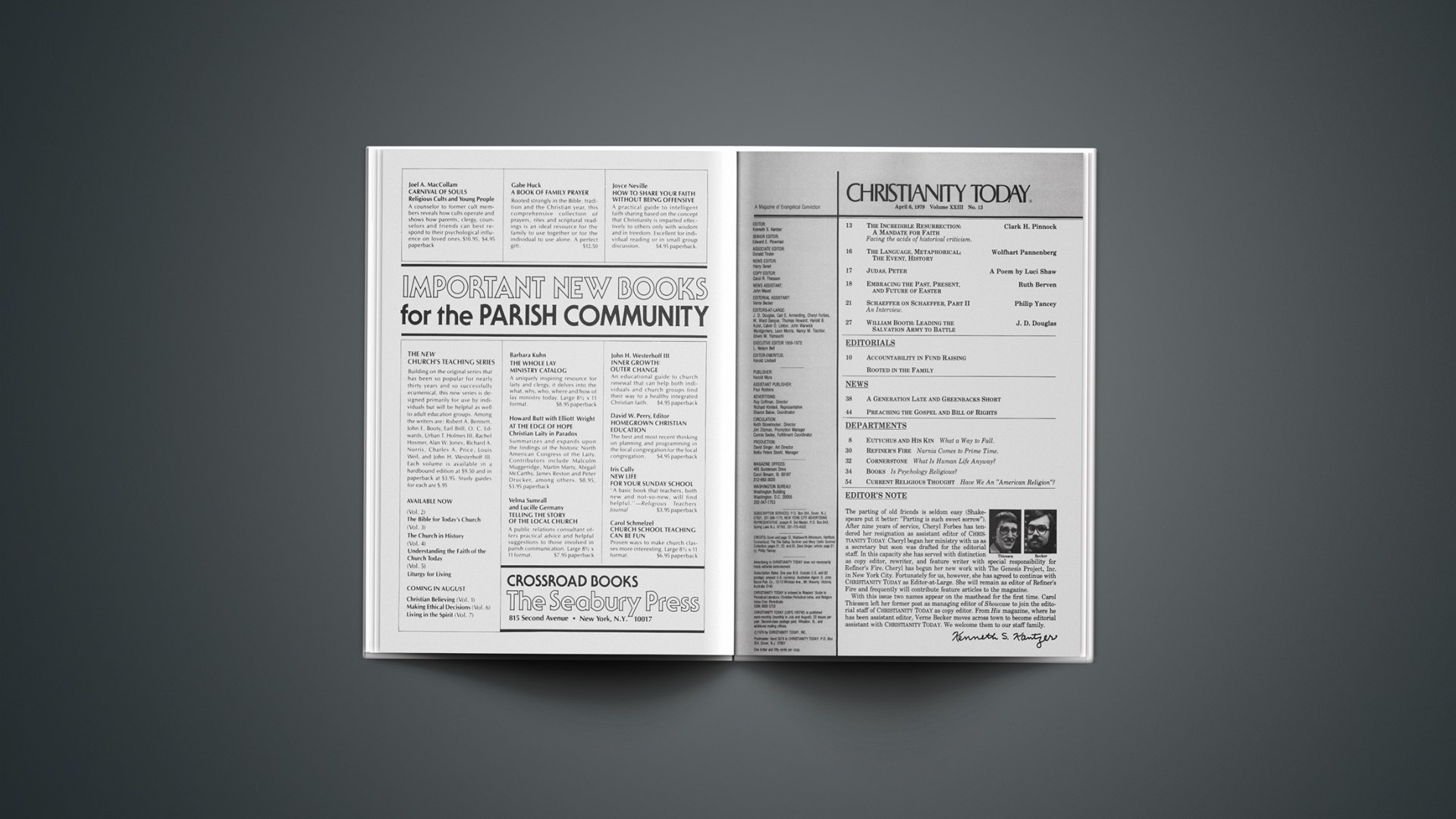
The parting of old friends is seldom easy (Shakespeare put it better: “Parting is such sweet sorrow”). After nine years of service, Cheryl Forbes has tendered her resignation as assistant editor of CHRISTIANITY TODAY. Cheryl began her ministry with us as a secretary but soon was drafted for the editorial staff. In this capacity she has served with distinction as copy editor, rewriter, and feature writer with special responsibility for Refiner’s Fire. Cheryl has begun her new work with The Genesis Project, Inc. in New York City. Fortunately for us, however, she has agreed to continue with CHRISTIANITY TODAY as Editor-at-Large. She will remain as editor of Refiner’s Fire and frequently will contribute feature articles to the magazine.

With this issue two names appear on the masthead for the first time. Carol Thiessen left her former post as managing editor of Showcase to join the editorial staff of CHRISTIANITY TODAY as copy editor. From His magazine, where he has been assistant editor, Verne Becker moves across town to become editorial assistant with CHRISTIANITY TODAY. We welcome them to our staff family.

News from the North American Scene: March 23, 1979

Moonies disrupted a congressional inquiry into religious cults last month, booing and shouting at Senator Robert Dole (R. Kan.), who chaired the one-day hearing under tight security. At least ninety Unification Church leaders had lobbied unsuccessfully to quash the hearings. Southern Baptists and other church spokesmen warned against any government regulation of religious groups.

Bishops of the Anglican Church of Canada recently decided to allow the ordination of self-admitted, but nonpracticing, homosexuals.

Organizational shuffling: Development Assistance Services, a three-year-old consulting firm for overseas poor relief, merged with and became a division of World Relief, an arm of the National Association of Evangelicals. Far Eastern Gospel Crusade and Missionary Internship split to become separate and autonomous organizations.

A U.S. Court of Appeals in Philadelphia affirmed a lower court’s ruling that Transcendental Meditation is religious in nature and should not be taught in public high schools (Nov. 18, 1977, issue, p. 56). A TM course had been taught as an elective in five New Jersey high schools, partly through funding from the Health, Education, and Welfare Department, until challenged by a group of parents.

The Internal Revenue Service has revised its proposed guidelines that would limit tax exemptions to private schools considered racially discriminatory (Jan. 5, 1979, issue, p. 42). The original proposal required that private schools meet four out of five criteria for determining whether they are racially discriminatory, while the revised procedures allow the IRS to consider each case according to the specific circumstances of a given school.

The American Indian population is 40 percent Christian, according to what has been called the most comprehensive survey of Christian missions among Indians—World Vision’s Native American Christian Community. Of 320,000 Indian Christians in the U.S., the largest number, or 177,000, are Catholic. Mormons are making the greatest gains, however, adding 1,000 Indian converts per year over the last six years.

Campus Crusade for Christ: Going It Together

Campus Crusade for Christ sometimes is criticized by local pastors, who say the San Bernardino, California-based organization thrusts evangelism programs upon them without their consent or assistance. However, unity was the goal of a two-day conference for evangelical pastors last month at Campus Crusade headquarters.

The conference was designed to unify evangelical clergymen, as well as to include discussion on the relationships between parachurch groups and the local church. More than 160 pastors from the U.S. and Canada attended.

The pastors intended to “cut out duplication and overlapping” in their evangelism efforts, said Buckner Fanning, pastor of Trinity Baptist Church in San Antonio. He and Campus Crusade President Bill Bright conceived the idea for the conference, and were its cohosts.

Fanning and a seven-man steering committee invited pastors to the conference from a variety of denominations and geographic regions. Most of them had large church memberships; half of them have media ministries, said Fanning. Conference speakers included pastors E. V. Hill, of Mount Zion Missionary Baptist Church in Los Angeles, W. A. Criswell of First Baptist Church in Dallas, and Sam Coker, of Grace United Methodist Church in Atlanta. Charles Malik, former president of the United Nations general assembly and an executive committee member of Campus Crusade’s “Here’s Life” effort, was keynote speaker.

Future task force and joint meetings are planned, says Buckner, to include pastors from “a broader base,” and more parachurch and media representation. They will coordinate world evangelism programs and ways to “Christianize” America—getting people “committed and involved in Christ,” not just telling them how to become Christians, said Fanning. The pastors, he added, are not forming “another new group,” but regard themselves as a loose “confederation.”

Christian Education: Dobson Puts His Kids Where His Mouth Was

Men should give their families first priority, said James Dobson last month at the Roman Catholic Religious Education Congress in Anaheim, California. “If the family is going to survive,” he challenged the males in his audience, “it will be because husbands and fathers again begin to assume the lead in the family.”

That being said, the noted pediatrician revealed that he would be taking his own advice. Dobson, who has been making public appearances for the last fifteen years, said this would be his last speaking engagement. He wanted to spend more time with his 10-year-old son and 13-year-old daughter.

On the staff of the University of Southern California School of Medicine and author of such child-rearing books as Dare to Discipline and The Strong-Willed Child, Dobson cited a Cornell University study showing that fathers of preschool children on the average spend 37.7 seconds per day in real contact with their youngsters. In contrast, the study indicated that children watch television approximately fifty-four hours per week.

While traveling to his dying father’s bedside, Dobson recalled to his audience, he had thought how much his father had influenced his life—especially during the times when they tramped the woods together. At that time Dobson asked himself, “What will my kids recall when I’m dying?” Since then, Dobson has rearranged his schedule to allow more time at home and has decided to record his radio program entirely in Los Angeles, which is nearer his home.

Dobson’s “The Strong-Willed Child,” was one of 135 workshops in a five-day program that included four general assemblies and fourteen liturgies. There were 100 congress participants and over 22,000 delegates, from the United States, Canada, and overseas.

Peace Causes: New Players on the Bandwagon

Southern Baptists are more often noted for evangelism than social activism. But at least 400 Baptists joined a growing movement for peace causes, now being exhibited by certain evangelical groups. They attended a Convocation on Peacemaking and the Nuclear Arms Race, which was held with the blessings of prominent Baptists including President Jimmy Carter and Pastor W.A. Criswell of the First Baptist Church of Dallas.

The two-day conference, held last month at Deer Park Baptist Church in Louisville, was billed as a response to a resolution passed at the denomination’s annual conference last June, which called for greater nuclear arms control. Appropriately, conference delegates issued a call for nuclear disarmament. They also endorsed the proposed strategic arms limitation treaty (SALT II) with the Soviet Union. Local Baptist churches were asked to actively preach peace causes.

Responsible for organizing the conference were Glen H. Stassen, an ethics professor at Southern Baptist seminary; Robert Parham, student government president at the seminary (who introduced the arms control resolution at the conference); and Carman Sharp, Deer Park pastor. Conference speakers came from government and church sectors, and not all were Baptists.

Speakers, identified closely with the peace movement, included Dale Brown, professor of theology at Bethany Theological Seminary (Church of the Brethren); Gordon Cosby, pastor of Church of the Savior in Washington, D.C.; and Richard Barnet, director of the Institute of Policy Studies in Washington.

Further to the north last month, another peacemaking activity took place—this time in the form of a protest. Groups from the historic peace churches—Quakers, Church of the Brethren, and Mennonites—joined a diverse contingent of antiwar activists, senior citizens, and civic groups in opposition to a military arms and equipment exhibit being held near O’Hare International Airport in the Chicago suburb of Rosemont.

At one time, the arms bazaar had been promoted as one of the world’s most important defense marketing confabs. Its sponsor, a Washington-based publishing firm, Defense and Foreign Affairs Publications, invited over forty thousand military defense specialists.

However, of a predicted turnout of 100 exhibitors, only thirty showed up. Participants at the arms exhibit, “Defense Technology ’79,” were few. Protest groups took credit for curtailing interest in the exhibit. (Antiwar groups earlier succeeded in getting the exhibit canceled in Florida, hence the move to Chicago.)

An interfaith group that was formed to protest the Viet Nam War, Clergy and Laity Concerned, engineered the most visible protests. Its Midwest director, Ron Freund, organized demonstrations at the exhibition center. Over two thousand persons demonstrated on the first day of the exhibit. Freund, who has a Quaker background, also was a spokesman for a conglomeration of fifty secular and religious groups, the Mobilization for Survival, that protested the exhibit.

Interestingly, the peace activists were joined by a faculty group from nearby Wheaton College. Prior to the arms exhibit, they issued a printed statement that labeled the exhibit “a flagrant violation of the Judeo-Christian ethic regarding war and violence.” The professors urged a letter-writing campaign to seek cancellation of the event.

Signing the protest statement, “An Evangelical Protest,” were twenty-one persons—mostly Wheaton faculty but including a few area evangelicals. The coalition of protesting faculty was unique since it joined avowed pacifists with “just war” advocates, according to Wheaton professor Morris Inch. Inch, a military veteran, opposed the exhibit with the others as a “commercialization of war.”

Fund Raising: Swaplisters Stock in Trade

The Democratic National Committee and evangelist Ruth Carter Stapleton traded computerized lists of names of past and potential contributors recently, in a curious intermingling of religious and political fund raising.

Patricia Segal, the Democratic committee’s direct mail specialist, told the New York Times that her organization had traded lists with more than 150 profit and nonprofit groups in the last two years. This “even-steven” trade of 5,000 names, addresses, and zip codes each was “routine,” said Miss Segal.

The President’s sister since had sent two fund raising appeals to the Democrats’ 5,000; she is involved in building a $2 million retreat center, Holovita, near Dallas, Texas. The Democrats have given up on Mrs. Stapleton’s supporters, however. After one test fund raising appeal, which “didn’t really work,” according to Segal, no other mailings were sent … perhaps a monetary way of showing that religion and politics don’t necessarily mix.

Mennonites: Withholding from Tax Withholding

Nearly five years ago, Cornelia Lehn asked her employer, the General Conference Mennonite Church, not to remit the military tax portion of her paycheck to the Internal Revenue Service (IRS). Lehn, then curriculum editor working in the denomination’s offices in Newton, Kansas, said she could no longer contribute money to support the military structure of the United States on grounds of conscience.

What began as one person’s request emerged as the central issue at the denomination’s midtriennium conference last month in Minneapolis. Over 700 General Conference Mennonites argued the question: should Christians and their churches pay taxes that go to support the military?

Some Mennonites have advocated “war tax resistance,” and a few refuse to pay the military portion of their income taxes (see Nov. 3, 1978, issue, p. 58). A number wanted the denomination to stop entirely its collection of taxes from church employees that would be spent by the military. But others shied away from denominational tax resistance, saying it would put the church in direct violation of federal law and of biblical injunctions to “honor the king.”

So in a compromise of sorts, they adopted a final resolution approving war tax resistance—but as it could be obtained through proper government channels. They mandated their church during the next three years to “engage in a serious and vigorous search to use all legal, legislative, and administrative avenues for achieving a conscientious objector exemption from the legal requirements that the conference withhold income taxes from the wages of its employees.”

The issues of militarism and war taxes have been building for some time in the Mennonite Church, one of the so-called historic peace churches of the Anabaptist tradition that was known for its nonviolent, civil disobedience in the sixteenth century.

The 60,000-member General Conference Mennonite Church, the second largest of more than a score of Mennonite bodies in North America, stated in 1971 that, “We stand by those who feel called to resist the payment of that portion of taxes being used for military purposes.” At the 1977 triennium sessions, delegates ordered a congregational study of civil disobedience and war tax resistance. Early in 1978, an attitude survey on church and government was conducted, and two study guides were prepared. In recent months, Mennonites have taken part in nationwide peacemaking conferences, and one denominational official was arrested while taking part in demonstrations at a nuclear weapons facility.

Denominational leaders have been uncertain how to reconcile activist and conservative factions among them. Some feared that if radical actions were taken at last month’s conclave some of the group’s 300 congregations might leave the conference. Others were less skeptical.

Conferees were disagreed on whether the church’s refusal to remit employees’ military taxes to the IRS would, in fact, violate the law, as Elmer Neufeld, denominational president, thought it would. In opening the meetings, Neufeld said, “We had said we would support tax resisters (in 1971), but now we are asked to take action that would put the conference body into violation of the law.”

A Harvard theology professor disagreed. “We are not being asked to violate the law but to test the law,” said Gordon Kaufman. “The law is not correct until it has been declared correct by the Supreme Court and it has not been so declared. In this country, it is a matter of civil responsibility to test the law.”

Kaufman saw this testing as fundamental to the Anabaptist-Mennonite tradition that “the church is not to be an agent of the state. We are a peace church—or say we are—yet we are collecting taxes for military purposes.” (The denomination thus far has not withheld war taxes from employees’ wages. Lehn’s request was denied by the general board on grounds that it would be illegal for an employer to act as a tax collector for the IRS).

The demands of the war tax resistance faction were watered down somewhat by an amendment process. Duane Heffelbower, a California attorney and member of the denomination’s administrative council, suggested a direct encounter with the government, if no provisions were made for allowing the church war tax exemptions. A first draft of the final resolution had called for a direct test of the First Amendment—which would include the option of honoring employees’ requests that their military tax not be withheld—should a three-year inquiry into legal avenues for war tax resistance prove fruitless.

This “civil disobedience” clause was deleted after some debate, however, and was amended to read, “If no relief can be found within the three-year period they shall again bring the question to the conference.” Hence, no immediate church-state confrontation was foreseen.

Heffelbower thought the search for war tax exemptions would be successful anyway. “The government appreciates people of principle,” he said. “The problem of government is to know when it has met such people, for the tax laws have attracted a great number of crackpots.”

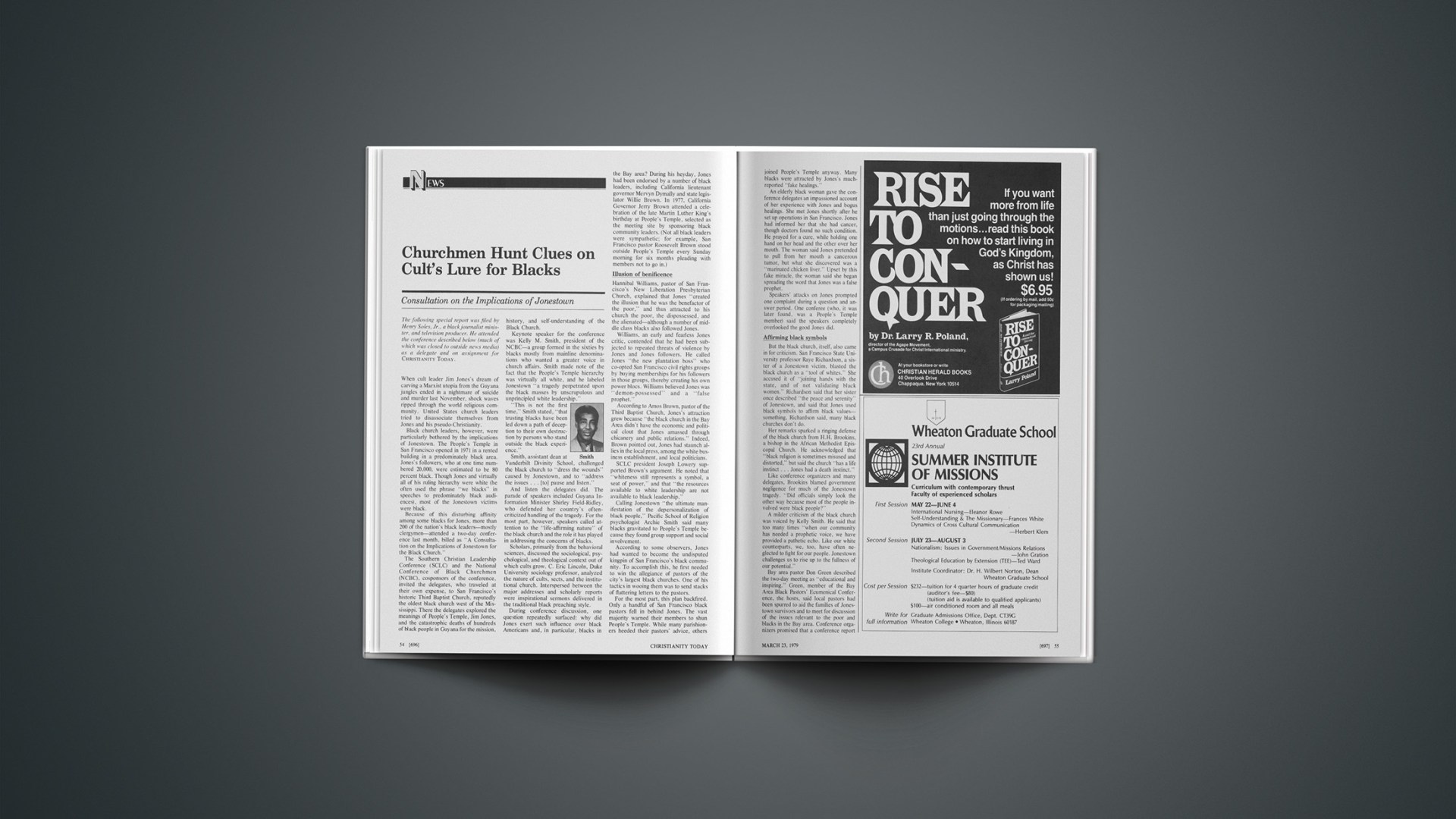
Churchmen Hunt Clues on Cult’s Lure for Blacks

Consultation on the Implications of Jonestown

The following special report was filed by Henry Soles, Jr., a black journalist minister, and television producer. He attended the conference described below (much of which was closed to outside news media) as a delegate and on assignment forCHRISTIANITY TODAY.

When cult leader Jim Jones’s dream of carving a Marxist utopia from the Guyana jungles ended in a nightmare of suicide and murder last November, shock waves ripped through the world religious community. United States church leaders tried to disassociate themselves from Jones and his pseudo-Christianity.

Black church leaders, however, were particularly bothered by the implications of Jonestown. The People’s Temple in San Francisco opened in 1971 in a rented building in a predominately black area. Jones’s followers, who at one time numbered 20,000, were estimated to be 80 percent black. Though Jones and virtually all of his ruling hierarchy were white (he often used the phrase “we blacks” in speeches to predominately black audiences), most of the Jonestown victims were black.

Because of this disturbing affinity among some blacks for Jones, more than 200 of the nation’s black leaders—mostly clergymen—attended a two-day conference last month, billed as “A Consultation on the Implications of Jonestown for the Black Church.”

The Southern Christian Leadership Conference (SCLC) and the National Conference of Black Churchmen (NCBC), cosponsors of the conference, invited the delegates, who traveled at their own expense, to San Francisco’s historic Third Baptist Church, reputedly the oldest black church west of the Mississippi. There the delegates explored the meanings of People’s Temple, Jim Jones, and the catastrophic deaths of hundreds of black people in Guyana for the mission, history, and self-understanding of the Black Church.

Keynote speaker for the conference was Kelly M. Smith, president of the NCBC—a group formed in the sixties by blacks mostly from mainline denominations who wanted a greater voice in church affairs. Smith made note of the fact that the People’s Temple hierarchy was virtually all white, and he labeled Jonestown “a tragedy perpetrated upon the black masses by unscrupulous and unprincipled white leadership.”

“This is not the first time,” Smith stated, “that trusting blacks have been led down a path of deception to their own destruction by persons who stand outside the black experience.”

Smith, assistant dean at Vanderbilt Divinity School, challenged the black church to “dress the wounds” caused by Jonestown, and to “address the issues … [to] pause and listen.”

And listen the delegates did. The parade of speakers included Guyana Information Minister Shirley Field-Ridley, who defended her country’s often-criticized handling of the tragedy. For the most part, however, speakers called attention to the “life-affirming nature” of the black church and the role it has played in addressing the concerns of blacks.

Scholars, primarily from the behavioral sciences, discussed the sociological, psychological, and theological context out of which cults grow. C. Eric Lincoln, Duke University sociology professor, analyzed the nature of cults, sects, and the institutional church. Interspersed between the major addresses and scholarly reports were inspirational sermons delivered in the traditional black preaching style.

During conference discussion, one question repeatedly surfaced: why did Jones exert such influence over black Americans and, in particular, blacks in the Bay area? During his heyday, Jones had been endorsed by a number of black leaders, including California lieutenant governor Mervyn Dymally and state legislator Willie Brown. In 1977, California Governor Jerry Brown attended a celebration of the late Martin Luther King’s birthday at People’s Temple, selected as the meeting site by sponsoring black community leaders. (Not all black leaders were sympathetic; for example, San Francisco pastor Roosevelt Brown stood outside People’s Temple every Sunday morning for six months pleading with members not to go in.)

Illusion Of Benificence

Hannibal Williams, pastor of San Francisco’s New Liberation Presbyterian Church, explained that Jones “created the illusion that he was the benefactor of the poor,” and thus attracted to his church the poor, the dispossessed, and the alienated—although a number of middle class blacks also followed Jones.

Williams, an early and fearless Jones critic, contended that he had been subjected to repeated threats of violence by Jones and Jones followers. He called Jones “the new plantation boss” who co-opted San Francisco civil rights groups by buying memberships for his followers in those groups, thereby creating his own power blocs. Williams believed Jones was “demon-possessed” and a “false prophet.”

According to Amos Brown, pastor of the Third Baptist Church, Jones’s attraction grew because “the black church in the Bay Area didn’t have the economic and political clout that Jones amassed through chicanery and public relations.” Indeed, Brown pointed out, Jones had staunch allies in the local press, among the white business establishment, and local politicians.

SCLC president Joseph Lowery supported Brown’s argument. He noted that “whiteness still represents a symbol, a seat of power,” and that “the resources available to white leadership are not available to black leadership.”

Calling Jonestown “the ultimate manifestation of the depersonalization of black people,” Pacific School of Religion psychologist Archie Smith said many blacks gravitated to People’s Temple because they found group support and social involvement.

According to some observers, Jones had wanted to become the undisputed kingpin of San Francisco’s black community. To accomplish this, he first needed to win the allegiance of pastors of the city’s largest black churches. One of his tactics in wooing them was to send stacks of flattering letters to the pastors.

For the most part, this plan backfired. Only a handful of San Francisco black pastors fell in behind Jones. The vast majority warned their members to shun People’s Temple. While many parishioners heeded their pastors’ advice, others joined People’s Temple anyway. Many blacks were attracted by Jones’s much-reported “fake healings.”

An elderly black woman gave the conference delegates an impassioned account of her experience with Jones and bogus healings. She met Jones shortly after he set up operations in San Francisco. Jones had informed her that she had cancer, though doctors found no such condition. He prayed for a cure, while holding one hand on her head and the other over her mouth. The woman said Jones pretended to pull from her mouth a cancerous tumor, but what she discovered was a “marinated chicken liver.” Upset by this fake miracle, the woman said she began spreading the word that Jones was a false prophet.

Speakers’ attacks on Jones prompted one complaint during a question and answer period. One conferee (who, it was later found, was a People’s Temple member) said the speakers completely overlooked the good Jones did.

Affirming Black Symbols

But the black church, itself, also came in for criticism. San Francisco State University professor Raye Richardson, a sister of a Jonestown victim, blasted the black church as a “tool of whites.” She accused it of “joining hands with the state, and of not validating black women.” Richardson said that her sister once described “the peace and serenity” of Jonestown, and said that Jones used black symbols to affirm black values—something, Richardson said, many black churches don’t do.

Her remarks sparked a ringing defense of the black church from H.H. Brookins, a bishop in the African Methodist Episcopal Church. He acknowledged that “black religion is sometimes misused and distorted,” but said the church “has a life instinct … Jones had a death instinct.”

Like conference organizers and many delegates, Brookins blamed government negligence for much of the Jonestown tragedy. “Did officials simply look the other way because most of the people involved were black people?”

A milder criticism of the black church was voiced by Kelly Smith. He said that too many times “when our community has needed a prophetic voice, we have provided a pathetic echo. Like our white counterparts, we, too, have often neglected to fight for our people. Jonestown challenges us to rise up to the fullness of our potential.”

Bay area pastor Don Green described the two-day meeting as “educational and inspiring.” Green, member of the Bay Area Black Pastors’ Ecumenical Conference, the hosts, said local pastors had been spurred to aid the families of Jonestown survivors and to meet for discussion of the issues relevant to the poor and blacks in the Bay area. Conference organizers promised that a conference report would be distributed to the delegates’ respective denominational headquarters. They hoped the conference proceedings would stimulate dialogue among local congregations regarding the implications of Jonestown.

Meanwhile, Bay area clergymen from various church groups filed a joint suit against People’s Temple. They sought to free funds to pay burial expenses for Jonestown victims and to reimburse families of survivors, who have already paid large amounts for funeral expenses.

What, then, should be the mission of the black church in light of Jonestown? To enrich the life and fellowship of the church as the family of God, said Lowery and Smith, and “expand the churches’ resources to deal with the poor and the helpless.” Lowery urged the delegates to “put on the shoes of sensitivity to human need” and to preach one gospel that is “both spiritual and social, and both evangelical and prophetic.”

Before his demise, Jones frequently predicted an impending fascist-inspired race war between blacks and whites. But at the close of the San Francisco conference, Lowery’s message to black churches was one of healing: he called for a holistic gospel that would minister to the needs of all society.

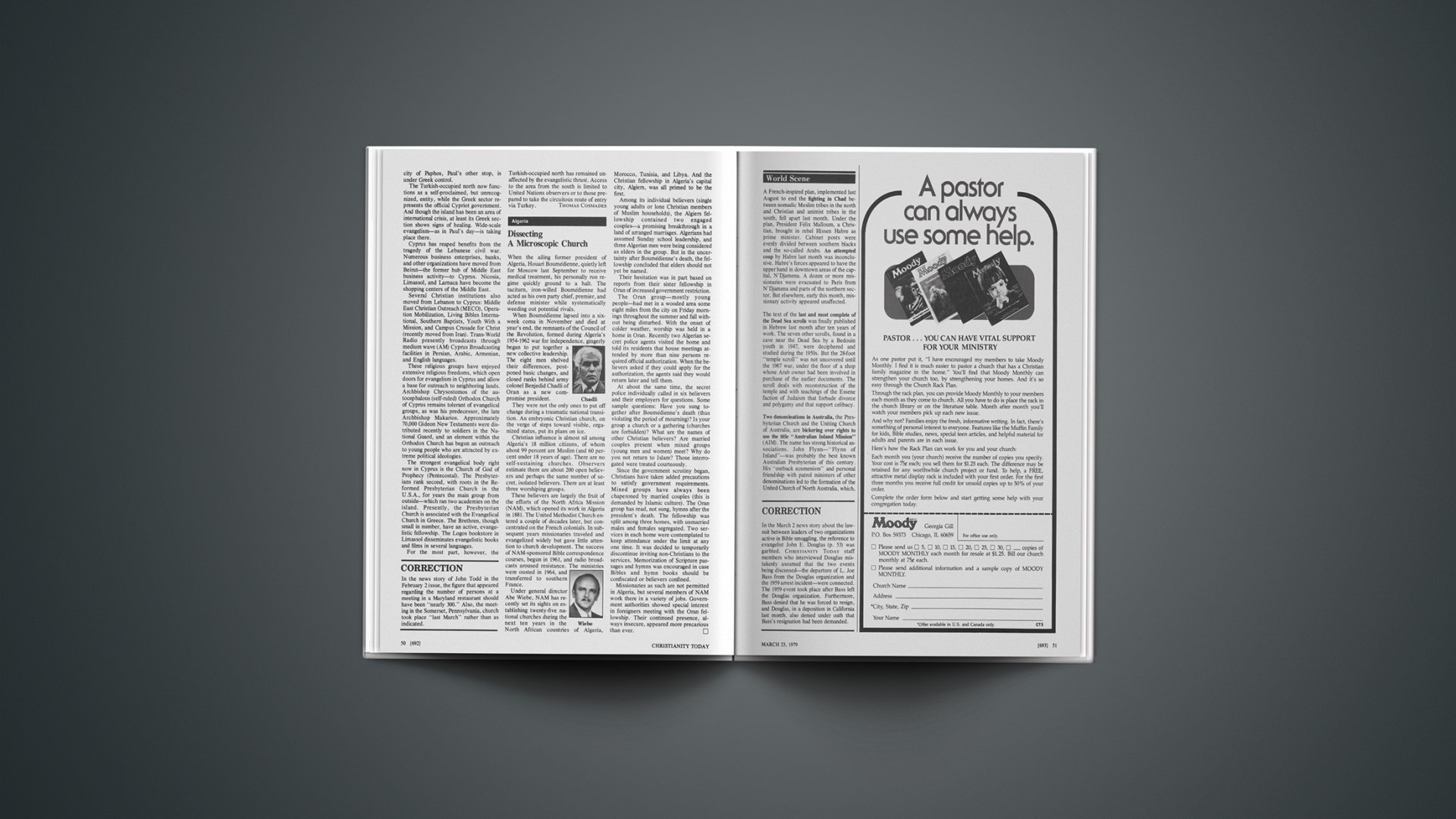
World Scene: March 23, 1979

A French-inspired plan, implemented last August to end the fighting in Chad between nomadic Muslim tribes in the north and Christian and animist tribes in the south, fell apart last month. Under the plan, President Félix Malloum, a Christian, brought in rebel Hissen Habre as prime minister. Cabinet posts were evenly divided between southern blacks and the so-called Arabs. An attempted coup by Habre last month was inconclusive. Habre’s forces appeared to have the upper hand in downtown areas of the capital, N’Djamena. A dozen or more missionaries were evacuated to Paris from N’Djamena and parts of the northern sector. But elsewhere, early this month, missionary activity appeared unaffected.

The text of the last and most complete of the Dead Sea scrolls was finally published in Hebrew last month after ten years of work. The seven other scrolls, found in a cave near the Dead Sea by a Bedouin youth in 1947, were deciphered and studied during the 1950s. But the 28-foot “temple scroll” was not uncovered until the 1967 war, under the floor of a shop whose Arab owner had been involved in purchase of the earlier documents. The scroll deals with reconstruction of the temple and with teachings of the Essene faction of Judaism that forbade divorce and polygamy and that support celibacy.

CORRECTION

In the March 2 news story about the lawsuit between leaders of two organizations active in Bible smuggling, the reference to evangelist John E. Douglas (p. 53) was garbled. CHRISTIANITY TODAY staff members who interviewed Douglas mistakenly assumed that the two events being discussed—the departure of L. Joe Bass from the Douglas organization and the 1959 arrest incident—were connected. The 1959 event took place after Bass left the Douglas organization. Furthermore, Bass denied that he was forced to resign, and Douglas, in a deposition in California last month, also denied under oath that Bass’s resignation had been demanded.

Two denominations in Australia, the Presbyterian Church and the Uniting Church of Australia, are bickering over rights to use the title “Australian Inland Mission” (AIM). The name has strong historical associations. John Flynn—“Flynn of Inland”—was probably the best known Australian Presbyterian of this century. His “outback ecumenism” and personal friendship with patrol ministers of other denominations led to the formation of the United Church of North Australia, which, in turn, influenced the formation of the Uniting Church, comprised of the Methodist Church and major elements of the Presbyterian and Congregational Churches. Both denominations are claiming bequests made out to the AIM.

Archbishop of Canterbury, Donald Coggan, spoke out last month against what he called pitiless strikes. “What we all need is a change of heart and mind, what Christians call repentance,” he said. Recent strikes have disrupted hospitals, schools, and garbage collection. Disaster lies ahead, he warned, for a people whose passion is to grab and not to give.

The Evangelical Alliance has assumed a major role in Britain’s National Initiative in Evangelism (NIE), recently begun as a ten-year evangelistic effort involving most of the nation’s churches. The archbishop of Canterbury presided at a launching service for the NIE last month. The Evangelical Alliance is calling a National Congress on Evangelism for April 1980, to be held in Wales. The congress program and evangelistic effort are being planned by Clifford Hill, Alliance secretary for evangelism and church growth.

Last month marked the fiftieth anniversary of the Italian-Vatican treaty, signed by Benito Mussolini and Pope Pius XI. Some believe the concordat, currently under joint revision, should instead be abrogated, but the Christian Democrat and Communist parties are calling only for revision.

Finnish authorities recently seized 2,500 Bibles, concealed in three autos, that were destined for the Soviet Union. A new customs agreement with the Soviets names the Bible as contraband. The customs agreement, reluctantly signed by the Finns at Soviet insistence, has been protested by the Arrangements Committee of the European Helsinki Group as a violation of the Helsinki agreement.

Churches in the (East) German Democratic Republic (GDR) have decided to form one body that would include all the Lutheran state churches. The resulting United Evangelical Church in the GDR would merge the five provincial churches of the Evangelical Church of the Union and the three of the United Evangelical Lutheran Church. The merger is scheduled in stages beginning in 1981.

Christians of the Sgaw Karen tribe of northern Thailand, aided by Swedish Baptist missionaries, reported a breakthrough to the animistic Pwo Karen tribesmen early this year. Six Pwos were baptized in the Yuam River of the Mae Saraing area; these new Christians now can work within the tightly-knit clan system to evangelize their evil spirit-worshiping relatives.

Japanese television this week completed airing a series of thirteen weekly evangelistic telecasts over a Tokyo channel. The series, which took the Pacific Broadcasting Association a year to produce, was sponsored by a group of evangelical pastors and laymen. Church members gave out handbills to housewives outside supermarkets to promote the telecasts, and letter responses are being referred to local churches for follow-up. Believers in Nagoya plan to sponsor the series there in the fall.

The Aymara Indians of Bolivia have formed a missionary association to sponsor their own missionaries to Navajo Indians in the United States. The Aymara tribe, which has had little contact with the outside world, numbers about one million and has been extremely responsive to the Christian message. In recent years, reports indicate an average of one Aymara church has been established each week, a rate that has brought evangelism among the Aymara close to saturation level.

The president and the secretary general of the Colombian Evangelical Federation have protested a growing backlash in that country against all non-Roman Catholics, triggered by the Jonestown tragedy in Guyana. They say in a report: “We refuse to be indiscriminately compared with sects in Colombia for which we are not responsible.” They also restate Protestant beliefs, including “respect for life and the human person.”

Last month an area in eastern Bolivia half the size of Ohio was under three to six feet of water. An estimated 10,000 families lost their homes or crops. Aid was being channeled through ANDEP, the association of evangelicals in Bolivia. The World Gospel Mission, Assemblies of God, and Mennonite Central Committee were among those distributing aid.

Sentenced in mid-1978 to six months’ imprisonment, three Romanian Christians filed an appeal. The verdict last month: their sentences were upheld and increased to six years. Gypsy evangelist Ion Samu, his brother, and an assistant pastor of the Gypsy church in Medias were arrested for holding an evangelical service in a village near Medias.

Personalia

R. Ronald Burgess was selected as convener of the Coordinating Council of Professional Religious Associations in Higher Education, which consists of a variety of Protestant, Catholic, and Jewish professional groups that address ministry concerns in higher education. Burgess, an Assemblies of God pastor and religious affairs coordinator at Memphis State University, reportedly is the first evangelical ever elected to the post.

Singer Anita Bryant placed first for the second consecutive year in the Most Admired Woman Poll of Good Housekeeping magazine. Readers cited her courage and faith in her ongoing opposition to the homosexual rights movement.

Edward L. Hayes, professor and academic dean at Conservative Baptist seminary in Denver, was named executive director of Mount Hermon Christian Conference Center near Santa Cruz, California. In July he succeeds William D. Gwinn, who resigned after fifteen years as director of the 73-year-old interdenominational camping and retreat center.

Singer Johnny Cash was given Youth for Christ’s “Man-of-the-Year-Award” during the organization’s annual staff conference. The award, which has been given only three other times in YFC’s thirty-five-year history, recognizes persons making a significant contribution to worldwide youth evangelism. Cash was cited specifically for his involvement in the YFC television special “Where Have All the Children Gone?”

Deaths

EMANUEL A. DAHUNSI, 61, called one of the most influential church leaders among nationals in Africa; general secretary of the 300,000-member Nigerian Baptist Convention, pastor, and Bible translator; on January 30, in Ogbomosho, Nigeria, in an auto accident.

FRANK P. WHITE, 49, United Presbyterian Church consultant who pioneered efforts to show denominations how they can influence corporations in which they have investments, a founder of the ecumenical, social action agency, the Interfaith Center on Corporate Responsibility; on February 5, in New Hampshire, in an auto accident.

Apple PodcastsDown ArrowDown ArrowDown Arrowarrow_left_altLeft ArrowLeft ArrowRight ArrowRight ArrowRight Arrowarrow_up_altUp ArrowUp ArrowAvailable at Amazoncaret-downCloseCloseEmailEmailExpandExpandExternalExternalFacebookfacebook-squareGiftGiftGooglegoogleGoogle KeephamburgerInstagraminstagram-squareLinkLinklinkedin-squareListenListenListenChristianity TodayCT Creative Studio Logologo_orgMegaphoneMenuMenupausePinterestPlayPlayPocketPodcastRSSRSSSaveSaveSaveSearchSearchsearchSpotifyStitcherTelegramTable of ContentsTable of Contentstwitter-squareWhatsAppXYouTubeYouTube