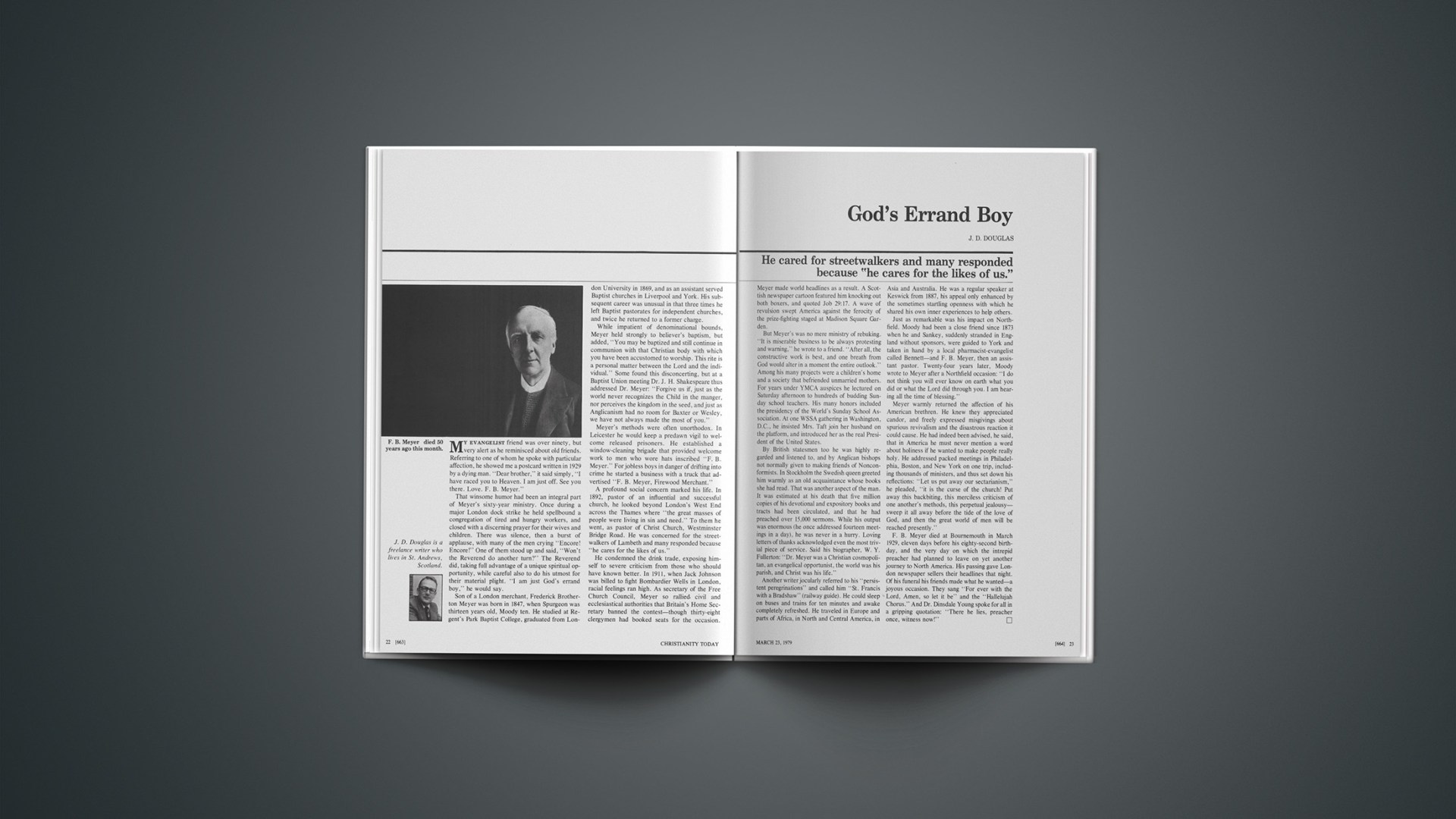
God’s Errand Boy

My evangelist friend was over ninety, but very alert as he reminisced about old friends. Referring to one of whom he spoke with particular affection, he showed me a postcard written in 1929 by a dying man. “Dear brother,” it said simply, “I have raced you to Heaven. I am just off. See you there. Love. F. B. Meyer.”

That winsome humor had been an integral part of Meyer’s sixty-year ministry. Once during a major London dock strike he held spellbound a congregation of tired and hungry workers, and closed with a discerning prayer for their wives and children. There was silence, then a burst of applause, with many of the men crying “Encore! Encore!” One of them stood up and said, “Won’t the Reverend do another turn?” The Reverend did, taking full advantage of a unique spiritual opportunity, while careful also to do his utmost for their material plight. “I am just God’s errand boy,” he would say.

Son of a London merchant, Frederick Brotherton Meyer was born in 1847, when Spurgeon was thirteen years old, Moody ten. He studied at Regent’s Park Baptist College, graduated from London University in 1869, and as an assistant served Baptist churches in Liverpool and York. His subsequent career was unusual in that three times he left Baptist pastorates for independent churches, and twice he returned to a former charge.

While impatient of denominational bounds, Meyer held strongly to believer’s baptism, but added, “You may be baptized and still continue in communion with that Christian body with which you have been accustomed to worship. This rite is a personal matter between the Lord and the individual.” Some found this disconcerting, but at a Baptist Union meeting Dr. J. H. Shakespeare thus addressed Dr. Meyer: “Forgive us if, just as the world never recognizes the Child in the manger, nor perceives the kingdom in the seed, and just as Anglicanism had no room for Baxter or Wesley, we have not always made the most of you.”

Meyer’s methods were often unorthodox. In Leicester he would keep a predawn vigil to welcome released prisoners. He established a window-cleaning brigade that provided welcome work to men who wore hats inscribed “F. B. Meyer.” For jobless boys in danger of drifting into crime he started a business with a truck that advertised “F. B. Meyer, Firewood Merchant.”

A profound social concern marked his life. In 1892, pastor of an influential and successful church, he looked beyond London’s West End across the Thames where “the great masses of people were living in sin and need.” To them he went, as pastor of Christ Church, Westminster Bridge Road. He was concerned for the streetwalkers of Lambeth and many responded because “he cares for the likes of us.”

He condemned the drink trade, exposing himself to severe criticism from those who should have known better. In 1911, when Jack Johnson was billed to fight Bombardier Wells in London, racial feelings ran high. As secretary of the Free Church Council, Meyer so rallied, civil and ecclesiastical authorities that Britain’s Home Secretary banned the contest—though thirty-eight clergymen had booked seats for the occasion. Meyer made world headlines as a result. A Scottish newspaper cartoon featured him knocking out both boxers, and quoted Job 29:17. A wave of revulsion swept America against the ferocity of the prize-fighting staged at Madison Square Garden.

But Meyer’s was no mere ministry of rebuking. “It is miserable business to be always protesting and warning,” he wrote to a friend. “After all, the constructive work is best, and one breath from God would alter in a moment the entire outlook.” Among his many projects were a children’s home and a society that befriended unmarried mothers. For years under YMCA auspices he lectured on Saturday afternoon to hundreds of budding Sunday school teachers. His many honors included the presidency of the World’s Sunday School Association. At one WSSA gathering in Washington, D.C., he insisted Mrs. Taft join her husband on the platform, and introduced her as the real President of the United States.

By British statesmen too he was highly regarded and listened to, and by Anglican bishops not normally given to making friends of Nonconformists. In Stockholm the Swedish queen greeted him warmly as an old acquaintance whose books she had read. That was another aspect of the man. It was estimated at his death that five million copies of his devotional and expository books and tracts had been circulated, and that he had preached over 15,000 sermons. While his output was enormous (he once addressed fourteen meetings in a day), he was never in a hurry. Loving letters of thanks acknowledged even the most trivial piece of service. Said his biographer, W. Y. Fullerton: “Dr. Meyer was a Christian cosmopolitan, an evangelical opportunist, the world was his parish, and Christ was his life.”

Another writer jocularly referred to his “persistent peregrinations” and called him “St. Francis with a Bradshaw” (railway guide). He could sleep on buses and trains for ten minutes and awake completely refreshed. He traveled in Europe and parts of Africa, in North and Central America, in Asia and Australia. He was a regular speaker at Keswick from 1887, his appeal only enhanced by the sometimes startling openness with which he shared his own inner experiences to help others.

Just as remarkable was his impact on Northfield. Moody had been a close friend since 1873 when he and Sankey, suddenly stranded in England without sponsors, were guided to York and taken in hand by a local pharmacist-evangelist called Bennett—and F. B. Meyer, then an assistant pastor. Twenty-four years later, Moody wrote to Meyer after a Northfield occasion: “I do not think you will ever know on earth what you did or what the Lord did through you. I am hearing all the time of blessing.”

Meyer warmly returned the affection of his American brethren. He knew they appreciated candor, and freely expressed misgivings about spurious revivalism and the disastrous reaction it could cause. He had indeed been advised, he said, that in America he must never mention a word about holiness if he wanted to make people really holy. He addressed packed meetings in Philadelphia, Boston, and New York on one trip, including thousands of ministers, and thus set down his reflections: “Let us put away our sectarianism,” he pleaded, “it is the curse of the church! Put away this backbiting, this merciless criticism of one another’s methods, this perpetual jealousy—sweep it all away before the tide of the love of God, and then the great world of men will be reached presently.”

F. B. Meyer died at Bournemouth in March 1929, eleven days before his eighty-second birthday, and the very day on which the intrepid preacher had planned to leave on yet another journey to North America. His passing gave London newspaper sellers their headlines that night. Of his funeral his friends made what he wanted—a joyous occasion. They sang “For ever with the Lord, Amen, so let it be” and the “Hallelujah Chorus.” And Dr. Dinsdale Young spoke for all in a gripping quotation: “There he lies, preacher once, witness now!”

G. Douglas Young is founder and president of the Institute of Holy Land Studies in Jerusalem. He has lived there since 1963.
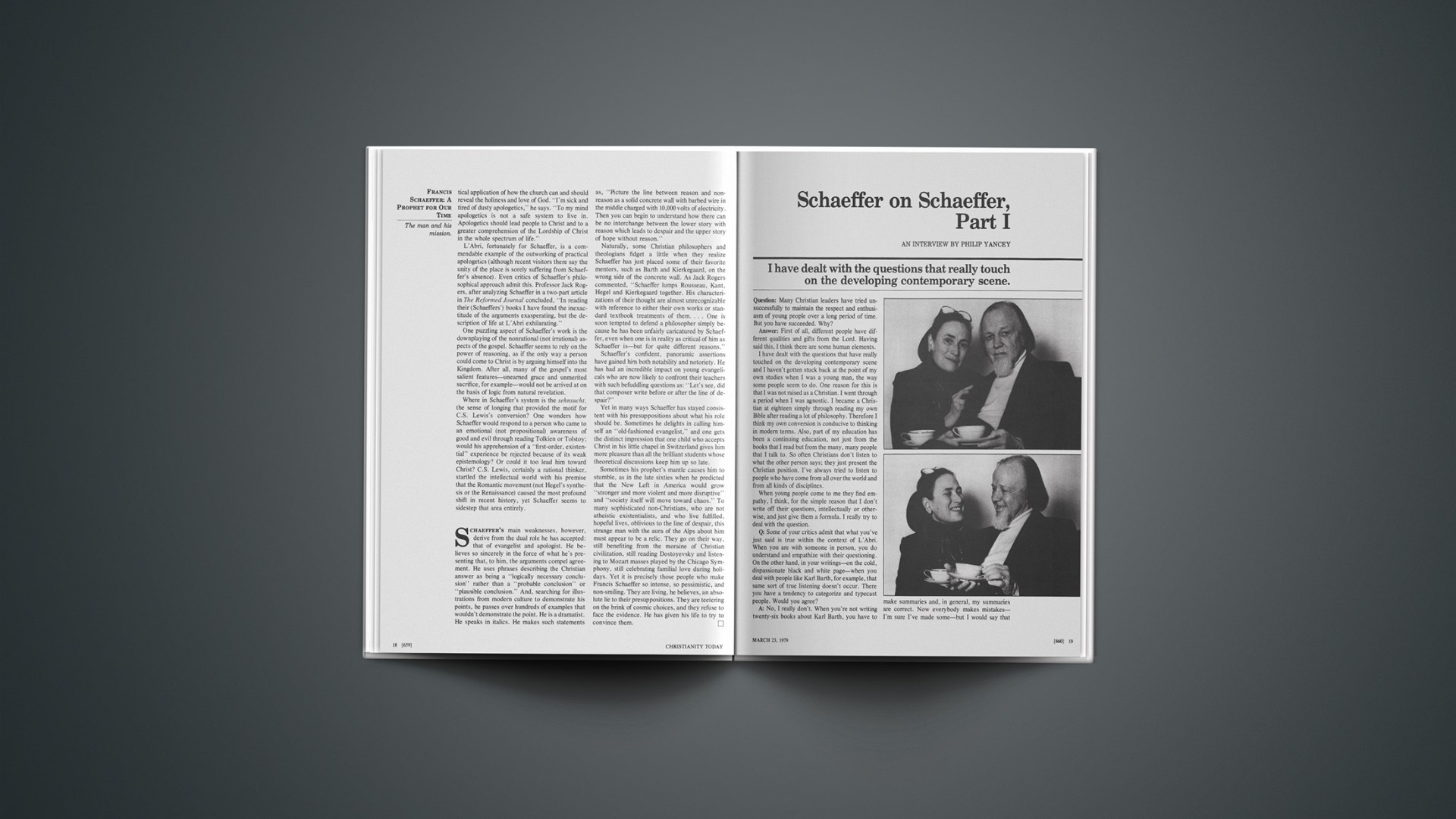
Schaeffer on Schaeffer, Part I: A Compassionate Critic

Question: Many Christian leaders have tried unsuccessfully to maintain the respect and enthusiasm of young people over a long period of time. But you have succeeded. Why?

Answer: First of all, different people have different qualities and gifts from the Lord. Having said this, I think there are some human elements.

I have dealt with the questions that have really touched on the developing contemporary scene and I haven’t gotten stuck back at the point of my own studies when I was a young man, the way some people seem to do. One reason for this is that I was not raised as a Christian. I went through a period when I was agnostic. I became a Christian at eighteen simply through reading my own Bible after reading a lot of philosophy. Therefore I think my own conversion is conducive to thinking in modern terms. Also, part of my education has been a continuing education, not just from the books that I read but from the many, many people that I talk to. So often Christians don’t listen to what the other person says; they just present the Christian position. I’ve always tried to listen to people who have come from all over the world and from all kinds of disciplines.

When young people come to me they find empathy, I think, for the simple reason that I don’t write off their questions, intellectually or otherwise, and just give them a formula. I really try to deal with the question.

Q: Some of your critics admit that what you’ve just said is true within the context of L’Abri. When you are with someone in person, you do understand and empathize with their questioning. On the other hand, in your writings—on the cold, dispassionate black and white page—when you deal with people like Karl Barth, for example, that same sort of true listening doesn’t occur. There you have a tendency to categorize and typecast people. Would you agree?

A: No, I really don’t. When you’re not writing twenty-six books about Karl Barth, you have to make summaries and, in general, my summaries are correct. Now everybody makes mistakes—I’m sure I’ve made some—but I would say that I’ve tried to treat other thinkers compassionately. In the type of writing I do, you must summarize: you can’t possibly deal with all the nuances. So I try to find the central things they’ve said and the results they’ve had and present them, and I always hold my breath because I know there are certain nuances that would sound different if I were talking for two hours instead of writing on one page.

Q: When How Should We Then Live? was breaking sales records, your publisher took out a full-page ad in the New York Times, asking, “Why is the secular media ignoring this book?” Does it disappoint you that the secular media has not picked up on your thoughts?

A: Yes, in a way; because I have tried to write my books to two audiences, the Christians and the non-Christians. The first publisher I offered a book to turned it down because, he said, it seemed directed at both audiences. I was sure books could be written and directed at both audiences, and factually this has proved to be true. Many non-Christians, whom Christianity wouldn’t normally reach, have been touched and even changed.

I’m disappointed, sure, because I’d like to see as big an impact as we can for the Lord in that world. Yet in order to be accepted in the secular media area, you generally have to be within their framework and I’m outside of it. But I don’t know anyone who has really taken a clear Christian position who has been more widely accepted in the secular area.

Q: In the evangelical world, at least, you have become a media figure with people bidding for your book contracts and audiences of seven thousand packing auditoriums, when you’ve been accustomed to a room of thirty people discussing issues. Has that been a difficult adjustment for you?

A: It hasn’t really, because I believe it is just an extension of my previous work. The Lord gave us something that none of us were sure could occur: an intimacy in the midst of those seven thousand which I found just as intimate as I did speaking to a hundred people in our chapel at L’Abri. So I haven’t found any tension at all there. As far as the actual commercial side of it, you have to live in the world you’re in. And this is the world we live in, in the same way supermarkets are in our generation. You might wish that the Christian booksellers’ business was a different business than it is in our present day. But if you’re going to publish books, you have to publish them in a setting that exists and not one that doesn’t exist.

Q: Do you think that you have been substantially tially changed by all that’s happened?

A: I’ve thought and prayed about this. I don’t see changes. Far more important than my own opinion is that of my friends who would be very honest, and they don’t seem to find any change either. Now, who knows? I have to wait to talk to the Lord on Judgment Day to be sure.

Q: Your wife very vividly describes your compassion for people. You care for people, and you listen to them intently. Have you always had this quality?

A: I think it is a gift.

Q: Was it present before you were a Christian? Were you drawn toward people?

A: I don’t think so. Neither was my intellectual interest. I got rotten grades until I became a Christian, and after that I always studied to try to excel. I graduated magna cum laude from Hampden-Sydney College even though in high school I hardly made it.

Incidentally, I would want to add something else—I know I have an analytical mind, and one thing I’ve learned in a long lifetime is that you don’t meet many people who have really analytical minds. This I had before I was a Christian. I became a Christian after analyzing the liberalism I was hearing preached on one side, and the philosophy I was reading on the other.

But I really believe that my ability to sit and talk with one person or seven thousand and answer the questions the way I answer them, covering the intellectual spectrum, is as much a gift of God as anything, and I think the Lord can take it away. As long as that gift is useful in this world, I’m thankful to have it.

Since I’ve had cancer we’ve realized more than ever before how God has used our work. I have professors in law who write and say, “After all my law studies it was reading your books that made me understand the modern framework of law.” Or people in medicine who write and say, “The whole discussion of medical ethics fell into place.”

Q: Could you give me a brief summary of the crucial thinkers who set you going on the way you’ve ended up, even back in college days?

A: Literally hundreds of people have influenced my thought. But there were certain key people who made a real difference in my thinking. It goes all the way back to my junior high school days where I had just one art teacher. I came from a family which was not interested in art at all. I didn’t even know she was a Christian, but she opened the door for me to an interest in art.

Then I had a professor in college, my philosophy professor, who was brilliant. I was his favorite student, because I think I probably was the only student in the class who understood him and stimulated him. He used to invite me down at night to sit around his pot-bellied stove and just discuss. He and I ended up in two very different camps. He became committed to neo-orthodox thinking, but he was very important in stimulating my intellectual processes.

Q: What historical people did you derive large benefit from? Of course the Reformers in a theological sense.

A: I tried to study the whole spectrum of the historic Christian background, specifically out of the Reformation, so I come from a Reformed background by choice. Then I went to Westminster for two years and to Faith Seminary. Cornelius Van Til and Allan MacRae of Biblical Theological Seminary stirred my intellectual thought. Those who are trying to minimize me try to link my thinking only into the Princeton thinking of Hodge and Warfield and so on. But a careful reading of my works shows that, although I am very thankful for those men and their day of history, I don’t believe they were facing the same problems we are facing in our day. My theological position would be similar to theirs, but our respective presentations are necessarily different.

Q: Because of the breadth of fields that you try to cover, are you pretty much limited to secondary sources? There’s no way you could encompass music, art, philosophy, literature, science, etc., through primary sources.

A: Secondary sources are very important to me, of course. On the other hand, I do try to keep up on primary things I think are crucial, so that when I read a secondary source I have a really good basis of judgment.

Also, you must realize that I do not work in isolation. L’Abri is not myself. L’Abri is made up now of a group of scholars. The outstanding example, I guess, is Rookmaker, whom I met first when he was still a student. Both he and I say that we have kicked stuff around for so long that in large areas, including art, we would hesitate to say who thought of an idea first. So I haven’t worked in isolation. I think that anybody who goes back searching for one or two people who can explain my position in my writings and my attitudes is pursuing a hopeless task.

Q: Have any of your major views significantly changed in the last decade—I mean, really abrupt reversals?

A: If I thought for a couple of days I might think of something. Not basic ones, I think. I’ve made tremendous shifts in details. But I think not in major views.

Q: At what point, then, was your basic framework pretty well developed?

A: Theologically, it was developed all the way back before I went to seminary. When I went to Hampden-Sydney College, the Bible professor, the college president, and the college chaplain were outstanding Christians. But I never would have had the equipment or the content to write the books I’ve written and deal with the people I deal with across such a wide area if I had remained in the United States. I think going to Europe was providential: it gave a wider intellectual framework from people coming from all over the world.

People often say, “Why don’t you come and help your own country?” But Edith and I have often said we think we’ve been greater help to the United States by having gone to Europe.

Q: Do you read in other languages?

A: No. And it’s been a limitation. My family’s all bilingual (French), but I’m not.

Q: As your role has changed over the years, do you think you have been subjected to different, specific attacks of Satan?

A: Yes, there would be a greater danger of spiritual pride, dealing with large numbers and with so many people reading the books. But then I quickly counteract that by saying I’ve never seen greater spiritual pride in my life than when somebody was elected president of the Sunday school class with three people in it. Pride is something inside you. Mere size doesn’t change the danger of it. Spiritual pride is something we’re all prone to. I believe Satan is playing chess against me and against you and he is clever enough to play it on the existential board we’re living on at the moment.

G. Douglas Young is founder and president of the Institute of Holy Land Studies in Jerusalem. He has lived there since 1963.
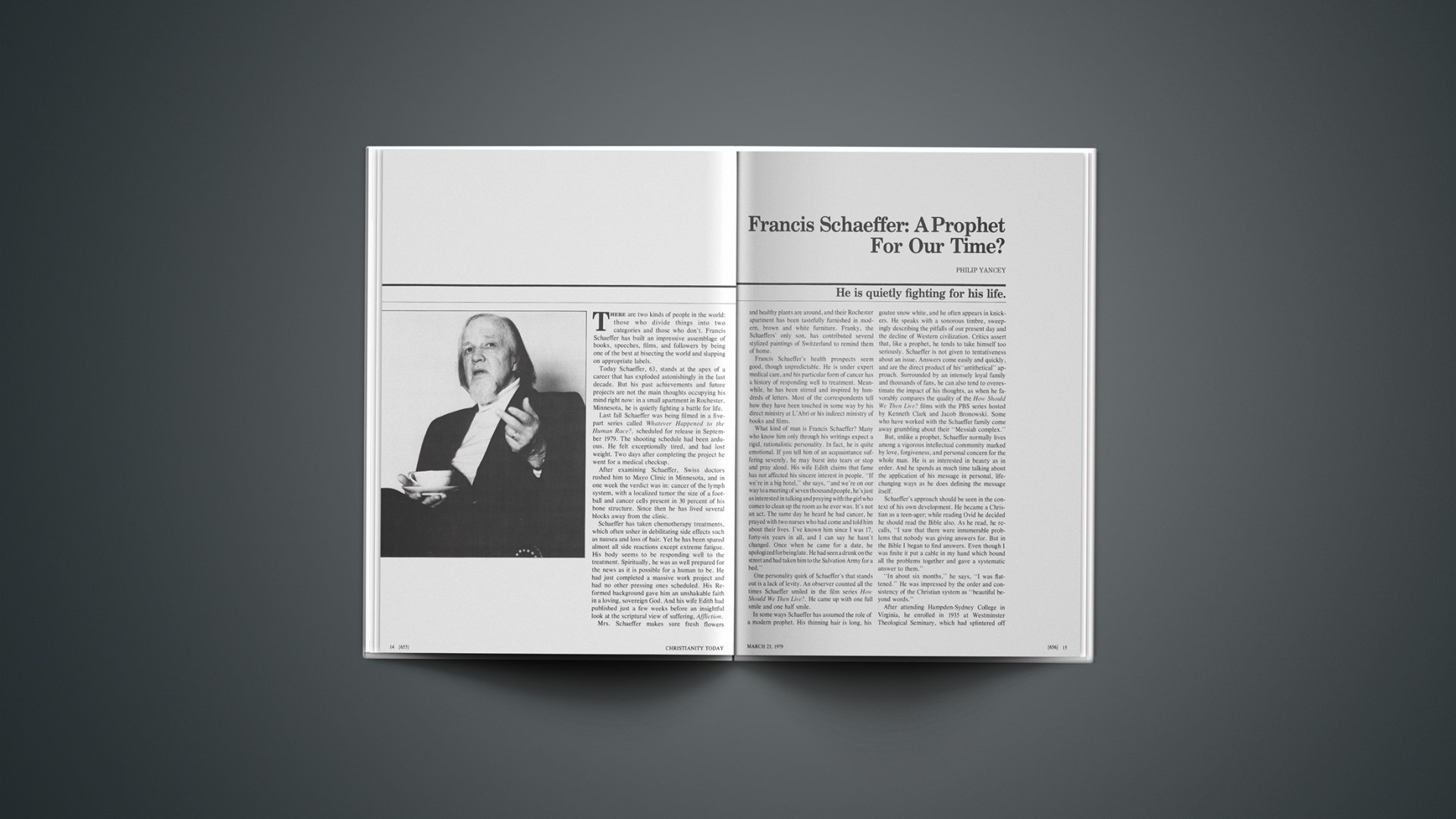
Francis Schaeffer: A Prophet for Our Time?: The Man and His Mission

He is quietly fighting for his life.

There are two kinds of people in the world: those who divide things into two categories and those who don’t. Francis Schaeffer has built an impressive assemblage of books, speeches, films, and followers by being one of the best at bisecting the world and slapping on appropriate labels.

Today Schaeffer, 63, stands at the apex of a career that has exploded astonishingly in the last decade. But his past achievements and future projects are not the main thoughts occupying his mind right now: in a small apartment in Rochester, Minnesota, he is quietly fighting a battle for life.

Last fall Schaeffer was being filmed in a five-part series called Whatever Happened to the Human Race?, scheduled for release in September 1979. The shooting schedule had been arduous. He felt exceptionally tired, and had lost weight. Two days after completing the project he went for a medical checkup.

After examining Schaeffer, Swiss doctors rushed him to Mayo Clinic in Minnesota, and in one week the verdict was in: cancer of the lymph system, with a localized tumor the size of a football and cancer cells present in 30 percent of his bone structure. Since then he has lived several blocks away from the clinic.

Schaeffer has taken chemotherapy treatments, which often usher in debilitating side effects such as nausea and loss of hair. Yet he has been spared almost all side reactions except extreme fatigue. His body seems to be responding well to the treatment. Spiritually, he was as well prepared for the news as it is possible for a human to be. He had just completed a massive work project and had no other pressing ones scheduled. His Reformed background gave him an unshakable faith in a loving, sovereign God. And his wife Edith had published just a few weeks before an insightful look at the scriptural view of suffering, Affliction. Mrs. Schaeffer makes sure fresh flowers and healthy plants are around, and their Rochester apartment has been tastefully furnished in modern, brown and white furniture. Franky, the Schaeffers’ only son, has contributed several stylized paintings of Switzerland to remind them of home.

Francis Schaeffer’s health prospects seem good, though unpredictable. He is under expert medical care, and his particular form of cancer has a history of responding well to treatment. Meanwhile, he has been stirred and inspired by hundreds of letters. Most of the correspondents tell how they have been touched in some way by his direct ministry at L’Abri or his indirect ministry of books and films.

What kind of man is Francis Schaeffer? Many who know him only through his writings expect a rigid, rationalistic personality. In fact, he is quite emotional. If you tell him of an acquaintance suffering severely, he may burst into tears or stop and pray aloud. His wife Edith claims that fame has not affected his sincere interest in people. “If we’re in a big hotel,” she says, “and we’re on our way to a meeting of seven thousand people, he’s just as interested in talking and praying with the girl who comes to clean up the room as he ever was. It’s not an act. The same day he heard he had cancer, he prayed with two nurses who had come and told him about their lives. I’ve known him since I was 17, forty-six years in all, and I can say he hasn’t changed. Once when he came for a date, he apologized for being late. He had seen a drunk on the street and had taken him to the Salvation Army for a bed.”

One personality quirk of Schaeffer’s that stands out is a lack of levity. An observer counted all the times Schaeffer smiled in the film series How Should We Then Live?. He came up with one full smile and one half smile.

In some ways Schaeffer has assumed the role of a modern prophet. His thinning hair is long, his goatee snow white, and he often appears in knickers. He speaks with a sonorous timbre, sweepingly describing the pitfalls of our present day and the decline of Western civilization. Critics assert that, like a prophet, he tends to take himself too seriously. Schaeffer is not given to tentativeness about an issue. Answers come easily and quickly, and are the direct product of his “antithetical” approach. Surrounded by an intensely loyal family and thousands of fans, he can also tend to overestimate the impact of his thoughts, as when he favorably compares the quality of the How Should We Then Live? films with the PBS series hosted by Kenneth Clark and Jacob Bronowski. Some who have worked with the Schaeffer family come away grumbling about their “Messiah complex.”

But, unlike a prophet, Schaeffer normally lives among a vigorous intellectual community marked by love, forgiveness, and personal concern for the whole man. He is as interested in beauty as in order. And he spends as much time talking about the application of his message in personal, life-changing ways as he does defining the message itself.

Schaeffer’s approach should be seen in the context of his own development. He became a Christian as a teen-ager; while reading Ovid he decided he should read the Bible also. As he read, he recalls, “I saw that there were innumerable problems that nobody was giving answers for. But in the Bible I began to find answers. Even though I was finite it put a cable in my hand which bound all the problems together and gave a systematic answer to them.”

“In about six months,” he says, “I was flattened.” He was impressed by the order and consistency of the Christian system as “beautiful beyond words.”

After attending Hampden-Sydney College in Virginia, he enrolled in 1935 at Westminster Theological Seminary, which had splintered off from Princeton Theological Seminary in 1929, under the leadership of J. Gresham Machen in the Fundamentalist-Modernist controversy. A year after Schaeffer entered the seminary, Machen was suspended by his denomination for setting up an independent mission board, and he formed the Orthodox Presbyterian Church.

Carl McIntire and some others subsequently withdrew from the new denomination, forming the Bible Presbyterian Church and Faith Theological Seminary. Francis Schaeffer followed the McIntire forces, finishing up at Faith.

Later, of course, McIntire repudiated the direction Schaeffer took with L’Abri. It is important to note that Schaeffer’s early training took place amid controversy. Learned men were defining terms, drawing battle lines, splitting doctrinal hairs. Schaeffer survived it all, somehow learning how to listen compassionately to different viewpoints, and emphasizing love and unity in the church.

For ten years Schaeffer was pastor of a church in St. Louis. Then, in 1947, a survey trip to thirteen European countries changed his life. He came away stimulated by the intellectual climate, but deeply concerned about the spiritual state of Europe. Though some countries were experiencing a postwar resurgence in religious interest, Schaeffer concluded that the neo-orthodox roots of their message would doom the long-term impact of the renewal.

For the next five years, Schaeffer was an itinerant evangelist across the Continent and in Scandinavia. He lectured on church history tracing Christian origins back to the first church in Acts and through the Reformation. He especially attacked the liberal trends personified by Karl Barth whose thoughts he labeled in a 1951 pamphlet as “insanity.” Besides lecturing, he and Edith helped churches organize children’s work.

L’Abri grew out of the Schaeffers’ ministry in the Swiss town of Champery, where they summered. He held services in an unused chapel of the mostly Catholic town. Some girls at a cosmopolitan finishing school began to attend the church, then to frequent the Schaeffers’ house and, as he recalls, “I was amazed in those discussions to find that I could answer those girls’ questions in a way that a lot of them actually became interested.”

In 1955 Schaeffer formed L’Abri (French for “shelter”) as an independent “faith” mission. U.S. response was mixed: “You mean you’re going to open your home to dropout sons and daughters of rich parents, without charging? What will you do all day? What is your ministry?” Edith’s book L’Abri chronicles the turmoil of those first few years. Their son Franky contracted polio, a daughter fought rheumatic fever, and the whole family had a bout with food poisoning. Worse, their entire village was almost swept away by avalanches, and at one point the Schaeffers were surreptitiously ordered to leave Switzerland for “having a religious influence on the town.” Financial needs were also pressing. They had begun L’Abri with a vow that they would never directly solicit funds or students—all must come because of the Lord’s leading.

Word soon got out, among European students and American visitors, that “There’s a man up there in the mountains who can answer your questions.” The trickle of guests began.

Today the Swiss branch of L’Abri services some 110 people at a time. In addition, many people rent chalets and share in L’Abri activities. Smaller branches exist in France, England, and Holland, and a new one will open in Massachusetts this year.

While L’Abri can affect only a few score people at a time, through books and films Francis Schaeffer’s thoughts have spread throughout the world so that today he is hailed as one of evangelicalism’s leading spokesmen. “Missionary to the intellectuals,” Time called him. And Eternity said he had “more influence with today’s youth—from members of the dropout world to the disillusioned heirs of evangelicalism—than any other man.”

Schaeffer’s thirteen books and seven booklets have sold well over two million copies, not to mention his wife’s books and those of other L’Abri staff members. His first three works (Escape From Reason, The God Who Is There and He Is There and He Is Not Silent) are packaged together as a trilogy, and InterVarsity Press even markets a booklet called “Introduction to Francis Schaeffer” in which he explains how all the various books fit together. The books tend to be repetitious, and didactic, but they cover a broad range of topics, and all are readable by the educated consumer.

His first book came about after Schaeffer had been touring U.S. colleges and universities delivering a lecture called “Speaking Historic Christianity Into the Twentieth Century.” He got an enthusiastic response at Wheaton College in 1968, in the midst of that era’s student turmoil. Students were delighted with a man who believed orthodox doctrine and yet tried to interpret the “worldly” thought and art which surrounded them. Schaeffer then allowed Jim Sire to edit his tapes into the first few books.

The only books Schaeffer has written intentionally (as opposed to someone adapting his spoken material) are the two connected with his film series, How Should We Then Live? and Whatever Happened to the Human Race? (due out in June). How Should We Then Live? grew out of a challenge from Billy Zeoli of Gospel Films, who had seen Kenneth Clark’s Civilization and was convinced an evangelical reply was needed—either from Schaeffer or from Malcolm Muggeridge. Whatever Happened to the Human Race? was the brainchild of Franky Schaeffer, now 26, who is producing and directing it. It will deal specifically with the three topics of abortion, euthanasia, and infanticide, and will feature Schaeffer and Dr. C. Everett Koop of Philadelphia.

How Should We Then Live? has set an all-time record in number of bookings for its distributor, Gospel Films, and the $12.95 book (published by Fleming Revell) after coasting atop the religious bestsellers list for months, still sells 1,500 copies a month.

Reflecting on his life, Schaeffer seems to take most delight in pointing out the things he pioneered, such as his early fight against racism and his call for Christians to use their wealth compassionately. L’Abri spearheaded a model of community long before radical Christians took up the cause. There was considerable sacrifice involved in the early days of L’Abri, with the Schaeffer’s wedding presents wiped out, sheets torn, holes burned in the rug, kids vomiting in the rooms.

As for his contributions to thought, Schaeffer speaks most proudly of two messages. First, his dual stress of orthodoxy and the need for love and community. He says now he wishes he had stressed more strongly specific applications, such as arguments, against racism and for distributed wealth. Second, his encouragement of Christians to operate as whole persons within all of culture, giving them a framework for interpreting books, painting, music, and movies.

Schaeffer’s system of thought is grounded in the “antithesis” which he stresses so often: that if a statement is true, the opposite of that statement cannot be true. In personal contacts Schaeffer attempts to furrow backwards until a person admits what his presuppositions are. He will then follow them logically until the person sees the contradiction in his conclusions. To Schaeffer “no non-Christian can be consistent with the logic of his presuppositions.”

In other words, start with a presupposition that the world came about by chance. Schaeffer would lead you, intellectually, until you concluded inevitably that man cannot have meaning and that none of his actions made any difference in the world. There is no “outside force” to be accountable to. To Schaeffer, a person who starts with presuppositions that exclude God must become “an atheist in religion, an irrationalist in philosophy and completely immoral in the wider sense.” Schaeffer is at his best in finding contemporary examples of people who admit those presuppositions and conclusions but fail to live consistently with them. For example, Jean Paul Sartre asserted there is no basis for ethical judgments of right and wrong, yet he broke his own principles by denouncing French treatment of Algeria on moral grounds.

“Pre-evangelism” is the term Schaeffer uses to describe this process of bringing a person to see the logical result of his own presuppositions. Thereafter, Schaeffer presents the Christian alternative, and shows how the Christian conception of a world created by an intelligent designer makes more sense.

A Ph.D. candidate at Yale, Thomas V. Morris, analyzed the philosophical roots of Schaeffer’s thoughts in a Moody Press book, Francis Schaeffer’s Apologetics: A Critique, concluding that Schaeffer’s approach is really a jazzed-up version of the argument from design. Morris is sympathetic to most of Schaeffer’s basic premises, but dislikes his generalizing, sweeping style.

Schaeffer sees a huge rupture in the history of thought cracking open about the time of Hegel, who rejected the antithesis mode of thinking in favor of synthesis. Sören Kierkegaard took Hegel’s synthesis approach and applied it to the realm of theology, thus becoming, in Schaeffer’s words, “the father of all modern existential thought, both secular and theological.” The natural world of the visible and created began to swallow up the unseen world. We can only be sure, say the moderns, of the seen world. The unseen world is not known through reason: it is known through irrational “leaps of faith.”

Schaeffer does not like leaps of faith, at least in doctrine. He believes doctrine must derive from a carefully reasoned, step-by-step approach based on the verbal revelation God has given in the Bible. Ironically, however, Schaeffer practices great faith in his own spiritual life. Anyone who reads the story of L’Abri knows it took immense faith to continue despite the adversities that confronted the community.

Unlike some apologists, Schaeffer does not restrict his inquiry to the field of knowledge. He is a preacher also, and devotes equal time to the practical application of how the church can and should reveal the holiness and love of God. “I’m sick and tired of dusty apologetics,” he says. “To my mind apologetics is not a safe system to live in. Apologetics should lead people to Christ and to a greater comprehension of the Lordship of Christ in the whole spectrum of life.”

L’Abri, fortunately for Schaeffer, is a commendable example of the outworking of practical apologetics (although recent visitors there say the unity of the place is sorely suffering from Schaeffer’s absence). Even critics of Schaeffer’s philosophical approach admit this. Professor Jack Rogers, after analyzing Schaeffer in a two-part article in The Reformed Journal concluded, “In reading their (Schaeffers’) books I have found the inexactitude of the arguments exasperating, but the description of life at L’Abri exhilarating.”

One puzzling aspect of Schaeffer’s work is the downplaying of the nonrational (not irrational) aspects of the gospel. Schaeffer seems to rely on the power of reasoning, as if the only way a person could come to Christ is by arguing himself into the Kingdom. After all, many of the gospel’s most salient features—unearned grace and unmerited sacrifice, for example—would not be arrived at on the basis of logic from natural revelation.

Where in Schaeffer’s system is the sehnsucht, the sense of longing that provided the motif for C.S. Lewis’s conversion? One wonders how Schaeffer would respond to a person who came to an emotional (not propositional) awareness of good and evil through reading Tolkien or Tolstoy; would his apprehension of a “first-order, existential” experience be rejected because of its weak epistemology? Or could it too lead him toward Christ? C.S. Lewis, certainly a rational thinker, startled the intellectual world with his premise that the Romantic movement (not Hegel’s synthesis or the Renaissance) caused the most profound shift in recent history, yet Schaeffer seems to sidestep that area entirely.

Schaeffer’s main weaknesses, however, derive from the dual role he has accepted: that of evangelist and apologist. He believes so sincerely in the force of what he’s presenting that, to him, the arguments compel agreement. He uses phrases describing the Christian answer as being a “logically necessary conclusion” rather than a “probable conclusion” or “plausible conclusion.” And, searching for illustrations from modern culture to demonstrate his points, he passes over hundreds of examples that wouldn’t demonstrate the point. He is a dramatist. He speaks in italics. He makes such statements as, “Picture the line between reason and non-reason as a solid concrete wall with barbed wire in the middle charged with 10,000 volts of electricity. Then you can begin to understand how there can be no interchange between the lower story with reason which leads to despair and the upper story of hope without reason.”

Naturally, some Christian philosophers and theologians fidget a little when they realize Schaeffer has just placed some of their favorite mentors, such as Barth and Kierkegaard, on the wrong side of the concrete wall. As Jack Rogers commented, “Schaeffer lumps Rousseau, Kant, Hegel and Kierkegaard together. His characterizations of their thought are almost unrecognizable with reference to either their own works or standard textbook treatments of them.… One is soon tempted to defend a philosopher simply because he has been unfairly caricatured by Schaeffer, even when one is in reality as critical of him as Schaeffer is—but for quite different reasons.”

Schaeffer’s confident, panoramic assertions have gained him both notability and notoriety. He has had an incredible impact on young evangelicals who are now likely to confront their teachers with such befuddling questions as: “Let’s see, did that composer write before or after the line of despair?”

Yet in many ways Schaeffer has stayed consistent with his presuppositions about what his role should be. Sometimes he delights in calling himself an “old-fashioned evangelist,” and one gets the distinct impression that one child who accepts Christ in his little chapel in Switzerland gives him more pleasure than all the brilliant students whose theoretical discussions keep him up so late.

Sometimes his prophet’s mantle causes him to stumble, as in the late sixties when he predicted that the New Left in America would grow “stronger and more violent and more disruptive” and “society itself will move toward chaos.” To many sophisticated non-Christians, who are not atheistic existentialists, and who live fulfilled, hopeful lives, oblivious to the line of despair, this strange man with the aura of the Alps about him must appear to be a relic. They go on their way, still benefiting from the moraine of Christian civilization, still reading Dostoyevsky and listening to Mozart masses played by the Chicago Symphony, still celebrating familial love during holidays. Yet it is precisely those people who make Francis Schaeffer so intense, so pessimistic, and non-smiling. They are living, he believes, an absolute lie to their presuppositions. They are teetering on the brink of cosmic choices, and they refuse to face the evidence. He has given his life to try to convince them.

G. Douglas Young is founder and president of the Institute of Holy Land Studies in Jerusalem. He has lived there since 1963.
Neither for nor against Religion

It is one thing to speak of relative religious neutrality by government (see preceding editorial). The question, however, has struck close to home for Americans, not least for the CHRISTIANITY TODAY staff, with the controversy over evangelistic activity in the four high schools of the Glenbard school district just east of our offices in Carol Stream, Illinois. (See news story, Mar. 2 issue, p. 62.)

We believe that activities that are explicitly religious should not be officially sponsored by the school administration or any other agency of government. But neither do we believe that government should hinder organized private activities except as necessary to preserve a reasonable amount of order.

Religious organizations should not be granted special favors or denied privileges available to other organizations. If, for example, announcements of outside activities are permitted on bulletin boards or over the public address system, religious groups should be able to so advertise just as do the Little League or the promoters of some rock concert. If vendors of soft drinks or peanuts can stock machines in designated places, distributors of religious literature should have corresponding rights. If students can have guests join them at lunch, then guests associated with evangelistic organizations should be permitted as well. If Boy Scout or Future Farmer groups are allowed use of school facilities for meetings so should religious groups.

It is deplorable that on many campuses all kinds of political, vocational, social, recreational, and economic activities are permitted (some of them patently illegal) except those that can be labelled religious. Evangelicals and adherents of other religious views do not need government endorsement, but they should certainly not have government hindrance as they go about their mission in an orderly way.

Of course, evangelicals should not expect or desire opportunities for themselves that they would deny to Mormons, Unificationists, Hare Krishnas, or any other proselytizing movement. Groups that are not concerned about aggressively spreading the truth as they see it, including many that inconsistently bear the name Christian, are in the forefront, along with humanists, of seeking to ban any religion for the public schools. But they should not be allowed to impose their understanding of religion upon the rest of us. We agree that official promotion of religion should cease. But our public schools dare not deny to religion the right of functioning along with other competing aspects of human life and culture. To argue otherwise would be to promote antireligious discrimination.

Ideas

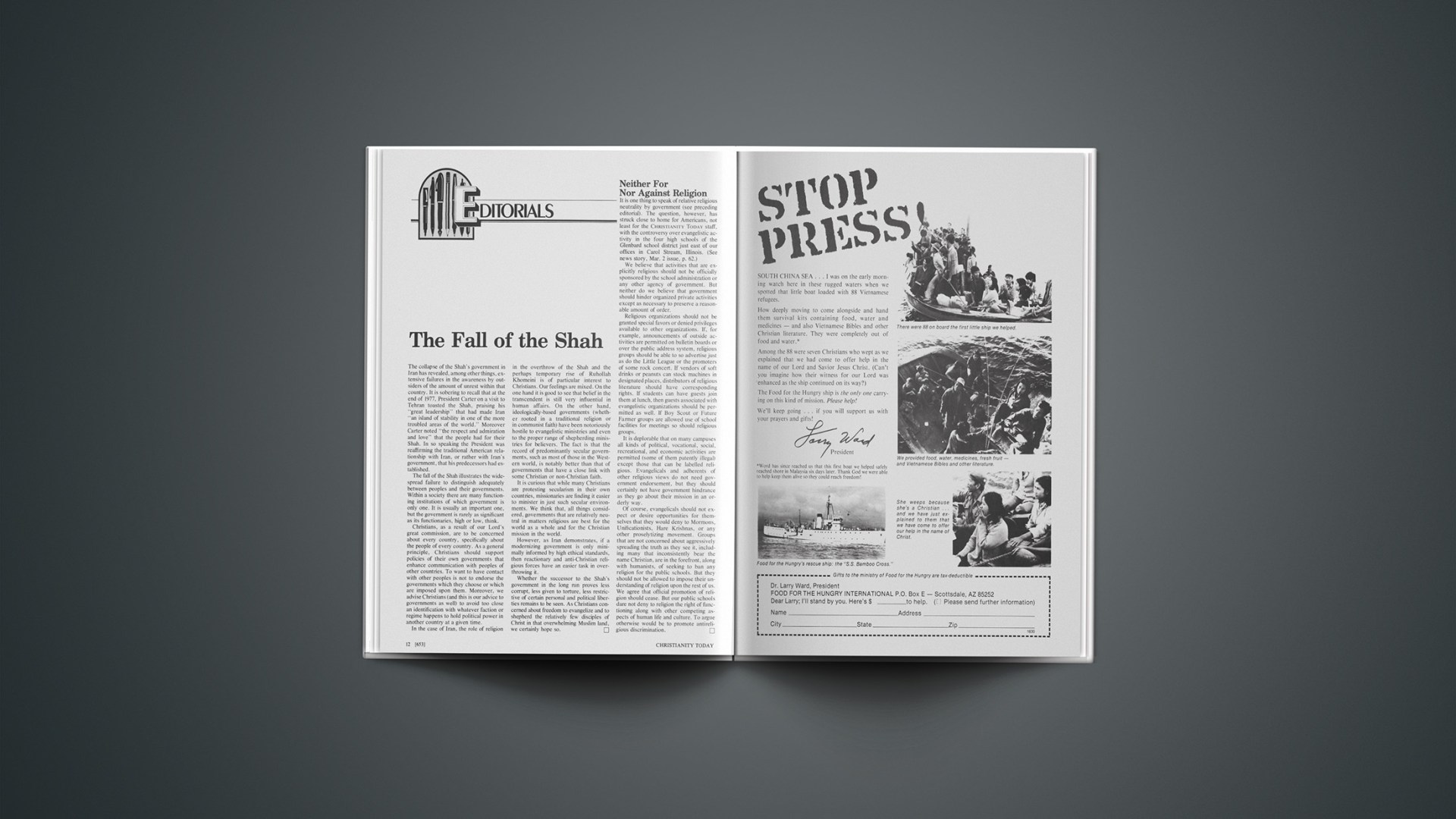
The Fall of the Shah

The collapse of the Shah’s government in Iran has revealed, among other things, extensive failures in the awareness by outsiders of the amount of unrest within that country. It is sobering to recall that at the end of 1977, President Carter on a visit to Tehran toasted the Shah, praising his “great leadership” that had made Iran “an island of stability in one of the more troubled areas of the world.” Moreover Carter noted “the respect and admiration and love” that the people had for their Shah. In so speaking the President was reaffirming the traditional American relationship with Iran, or rather with Iran’s government, that his predecessors had established.

The fall of the Shah illustrates the widespread failure to distinguish adequately between peoples and their governments. Within a society there are many functioning institutions of which government is only one. It is usually an important one, but the government is rarely as significant as its functionaries, high or low, think.

Christians, as a result of our Lord’s great commission, are to be concerned about every country, specifically about the people of every country. As a general principle, Christians should support policies of their own governments that enhance communication with peoples of other countries. To want to have contact with other peoples is not to endorse the governments which they choose or which are imposed upon them. Moreover, we advise Christians (and this is our advice to governments as well) to avoid too close an identification with whatever faction or regime happens to hold political power in another country at a given time.

In the case of Iran, the role of religion in the overthrow of the Shah and the perhaps temporary rise of Ruhollah Khomeini is of particular interest to Christians. Our feelings are mixed. On the one hand it is good to see that belief in the transcendent is still very influential in human affairs. On the other hand, ideologically-based governments (whether rooted in a traditional religion or in communist faith) have been notoriously hostile to evangelistic ministries and even to the proper range of shepherding ministries for believers. The fact is that the record of predominantly secular governments, such as most of those in the Western world, is notably better than that of governments that have a close link with some Christian or non-Christian faith.

It is curious that while many Christians are protesting secularism in their own countries, missionaries are finding it easier to minister in just such secular environments. We think that, all things considered, governments that are relatively neutral in matters religious are best for the world as a whole and for the Christian mission in the world.

However, as Iran demonstrates, if a modernizing government is only minimally informed by high ethical standards, then reactionary and anti-Christian religious forces have an easier task in overthrowing it.

Whether the successor to the Shah’s government in the long run proves less corrupt, less given to torture, less restrictive of certain personal and political liberties remains to be seen. As Christians concerned about freedom to evangelize and to shepherd the relatively few disciples of Christ in that overwhelming Muslim land, we certainly hope so.

Eutychus and His Kin: March 23, 1979

I have been a classified ad afficionado for years. I first got intrigued with them in college, when I began reading Saturday Review. Through the magazine’s ups and downs—and it’s been like a roller coaster lately—the classified section has remained a constant, a stabilizing force in the face of editorial changes and design quirks. (It seems to me that someone tried to dispense with the SR classifieds, but reader outrage brought them back, even more enticing than before.)

Classified ads are not easy to write. The average length, just a few lines, puts great demands on the creativity of the advertiser. (You might say it’s an advertising version of “let your yea be yea, your nay, nay.”)

Anyone can come up with a splashing winner if given slick paper, four-color possibilities, and a full page to work with. But to grab a potential buyer, get him to read, and then beguile him enough to sell him something—that’s a tough assignment.

I don’t know where SR finds its classified ad people, but they deliver the goods every issue. Take a couple of examples: “LEARN 10 LANGUAGES A YEAR while striding for exercise.” That one’s got it all. You’ve stamped the envelope before you know it. Or, “FREE BOOK. Prophet Elijah Coming Before Christ.” That’s a recurring ad in the latest SR. Makes me suspicious. Is it a plant? Would a reputable magazine tamper with such a big reader favorite? Surely, that’s no place for humor. Anyway, it sounds more like it belongs in a CT classified section.

Which brings me to the relatively new and burgeoning section of this journal—Marketplace. With pleasure, I noted its appearance a couple of years ago. As I said, I like classifieds.

But, again, I find suspicious entries interspersed with the real thing (“WONDERS NEVER CEASE” or “BACK FROM BRINK!”). And each ends with one name: Lawing.

Who is this Lawing? He appears too often and has so many addresses. Is he ubiquity personified? Either that, or he heads a vast, evangelical conglomerate—a rival, a fierce competitor for my own company, Evangelical Amusements, about which I have written upon occasion. He bears watching—or should I say reading? Candy bars stamped with “Oh taste and see that the Lord is good.” A sure winner. I wish I’d thought of that. Maybe Lawing would consider a merger.

EUTYCHUS IX

Unbounded Joy

Your editorial on “Human Engineering” (Jan. 19) was a great encouragement to this particular believer. It was gratifying to see such a prominent evangelical spokesmagazine being so current and concerned about an area of ethics so much neglected by the evangelical community. To add unbounded joy to my gratitude though, you also published a very thoughtful article on the same subject by Craig Ellison. Good for you!

ROBERT A. CASE II

Yakima, Wash.

Intellectual Integrity

An article with the intellectual integrity and depth of “Things of the Spirit, Matters of the Mind” by David L. McKenna (Feb. 2) is most helpful to those of us seriously concerned with the consequences of conservative Christianity. Thank you for publishing it.

FRED SMITH

Dallas, Tex.

Spiritual Exercise

I have just read and reread Dr. Vernon Grounds’ article “Getting Into Shape Spiritually” (Feb. 2), and have enjoyed the challenge of spirituality that he presents. Many of us as pastors and church leaders are too often not in shape for the confrontations of the day, and thus, are too soon exhausted.

JAMES W. GREEN

Faith Baptist Church

Hillsboro, Ore.

A Lesson To Learn

Thank you for your important editorial “The Bewitching of the Churches” and the extensive news article by Mr. Plowman, “The Legend(s) of John Todd” (Feb. 2). In the aftermath of Jonestown, the Christian community needs this type of information and warning. Perhaps the churches should start applying the same biblical guidelines when inviting speakers as Paul did for the office of bishop (elder) in 1 Timothy 3:6: “He must not be a recent convert, or he may be puffed up with conceit and fall into the condemnation of the devil.”

DONALD DYKSTRA

Lansing, Ill.

Congratulations and hearty thanks for the editorial and article on the Todd mania. You have rendered an important service to those who have been seeking information their own church leaders cannot seem to supply. I share your dismay that so many Christian people are vulnerable to this kind of sensationalism. I shouldn’t wonder if some might become quite upset with you for trying to take from them a scenario of doom to which they have become attached! But do not far too many members of the flock want or need to be kept frightened and a certain number of the shepherds find it useful to keep them that way?

WALTER C. UTT

Angwin, Calif.

You have no need to apologize for the coverage you devoted to the ministry of John Todd and the unfortunate response he evoked from hundreds of churches and pastors who were too willing to be judgmental of other, legitimate Christian perspectives and, at the same time, quick to absorb Todd’s fabrications. If someone had been as thorough about Jim Jones three years ago, many lives might be different today. I hope you never feel the need to apologize for exposing such opportunists and cult leaders. We need more, not less, of the same!

JOEL A. MACCOLLAM

St. Mary’s Episcopal Church

Glendale, Calif.

I just finished reading your story “The Legends of John Todd.” Congratulations on a superb job of … reporting.

Houston Chronicle

LOUIS MOORE

Houston, Tex.

The news article on John Todd was disturbing to me, although not because of Todd or his activities. While I am deeply concerned for those individuals whom he has deceived, I am not overly concerned by his particular brand of heresy. John Todds have plagued the Christian church since the first century when Philip baptized the magician Simon Magus who later tried to buy God’s miraculous power from Peter. Simon Magus was rebuked and faded from history as will John Todd, while the church continues to minister to a world in need of God’s love. What disturbed me about the article was a reported statement by Todd that, “To survive, Christians must arm themselves,” etc. Apparently, Todd is building a following based upon the premise that Christians must survive at all costs. It is my conviction, however, that it is not the business of Christians to survive but to serve God and minister to his children throughout the world. Perhaps, if we were more concerned with the self-giving devotion to God’s love which led early Christians to eternal life, but not always to survival, we would not be so easily deceived by the John Todds and Simon Maguses who will continue to appear.

MARVIN MCCLAIN, JR.

United Methodist Church

Fort Meyers, Fla.

Ground Cut

The review of Armegeddon Now! (Feb. 2) authored by Dwight Wilson and reviewed by Timothy P. Weber almost made my day. After the decades-long dreary record of Bible prophecy addicts pointing to this demigod and that one, to this notable event and another as sure fulfilment of prophetic scripture, it is refreshing to find that an unprejudiced and objective exposure of these follies has been written. I am delighted that a scholastically qualified person has dealt with these obvious misuses of the Bible, and, I hope, cut the ground from under many a “Lo, here” or “Lo, there” enthusiast today.

DONALD E. KOHLSTAEDT

Spokane, Wash.

Deficiency Addressed

Being involved for a number of years as a professor and dealing with the preparation of men for the ministry, I want to express my appreciation for the article, “Preaching with Power and Purpose,” by Lloyd Perry (Feb. 2). I feel that while it was intended for ministers in general, in a positive way it addresses itself to a great deficiency in our colleges and seminaries today. While, of course, there are exceptions, I am wondering if our educational institutions are really training men who can preach the Scriptures in a sound academic manner, without the loss of a burning, bleeding, broken heart.

RONALD G. WELLNER

First Alliance Church

Charlotte, N.C.

One Sentence Clincher

Mark Noll’s article, “America’s Battle Against the Bottle” (Jan. 19) was excellent. His last sentence (“… which should suggest that evangelicals frame their arguments against liquor in terms of expedience rather than divine absolutes”) was the clincher.

HELEN LOUISE HERNDON

St. Louis, Mo.

As a student of the pre-Civil War temperance reform, I appreciated Marie Noll’s article on the subject. As contemporary Christians we are lacking in historical perspective on this and similar issues. Particularly in the antebellum era, this movement for social reform was led by evangelicals of high standing in their communities, intent upon realizing in America a Christian republic in the best sense of the word. Even in the deep South, where reform sentiment supposedly was lacking, the temperance movement flourished under the leadership of men like John Belton O’Neall of South Carolina, president of the Baptist state convention and chief justice of the state supreme court, who was as committed to a Christian republic as Lyman Beecher. Present-day evangelicals possessed of a social conscience will find kindred spirits and a heritage of activism among the workers in the antebellum temperance reform.

DOUGLAS CARLSON

Savoy, Ill.

Reader’s Answer

Being a graduate student in psychology and having a seminary background, I read “Is Psychotherapy Unbiblical” (Jan. 19) with interest. Unfortunately, Humphries fell short of my expectations in that he never adequately answered his own question. One might infer that since therapy has been of help to people it falls in the area of common grace just as auto mechanics or printing. Unquestionably he made no attempt to integrate the Bible and “the couch,” but rather presented them as parallels with occasional (and problematic) crossings. A second disappointment was that he lumped all therapy (there are over twelve major ones in use today) together. His bias appears to be Freudian, but that is not the problem. He should have acknowledged his bias so that readers do not misconstrue or become confused about what goes on in a therapy session.

RONALD R. HOOEY

Saddle Brook, N. J.

Crux of Issue

I appreciated very much your feature article and editorial dealing with “Human Engineering” (Jan. 19). Mr. Ellison is to be commended for his easy to understand presentation of the issue and his mind stimulating questions which must not be ignored by evangelicals. The editors are also to be commended for placing their fingers on the crux of the issue—that absolutes are foundational in determining the extent and limitation of human engineering; without them “trouble ahead” is certain.

CHARLES KELLEY

Arlington, Tx.

Editor’s Note from March 23, 1979

Francis Schaeffer is a prophet for our times. In this issue of CHRISTIANITY TODAY he speaks to you and me. We don’t need to accept everything he says. The only prophets from whom you have to accept everything are those who speak to us the words of Holy Scripture. But Francis Schaeffer has much to say to our generation and we had better listen. He paints his message in bold broad stripes. Sometimes we wish we could read between the lines of his writings or investigate more carefully the supporting footnotes. We may even wish to argue a point or two—or several. But we need to hear him because he typifies radical Christianity at its best. He takes the Bible—all of it—with dreadful seriousness and seeks to apply it honestly, fearlessly, and radically (at its roots) to contemporary life and culture.

J. D. Douglas, editor-at-large for CHRISTIANITY TODAY, writes of a very different kind of prophet from a generation past. F. B. Meyer, who died in 1929, just half a century ago, was often known as “Meyer of The Christian,” a weekly newspaper of which Jim Douglas was the last editor (it closed in 1969).

Presenting the Prince of Peace

Part I on the author’s Mideast visit with other evangelical leaders last April was printed in the previous issue (Mar. 2).

In spite of scheduling confusions and President Sadat’s backbreaking swing through Egypt on a food projects tour, the Egyptian head of state personally arranged to receive the evangelical leaders at his home in Aswan on a Friday, the Muslim day of rest when he normally grants no audiences whatever.

When I asked the President about his contacts with Christianity, he revealed a most significant fact. He said that when he had been a political prisoner early in his career, the one thing that had sustained him had been the books of Lloyd Douglas. To be sure, I thought immediately of the salvatory portrait of our Lord in The Robe; but I thought also of the lesser-known work of Douglas, Magnificent Obsession, in which true happiness and success come to a physician who makes the person and work of Jesus his chart and compass. Anwar Sadat is also a man with a magnificent obsession—a magnificent obsession for peace. Is it too much to suppose that, consciously or unconsciously, he acquired it from his indirect contact with the Prince of Peace?

I had a few moments alone with the President after the television cameras and newsmen were gone. The opportunity seemed ripe to stress the uniqueness of Christ to a man who told us he plans to build a mosque, a synagogue, and a church on Mt. Sinai—thus making Peter’s mistake of wanting to build tabernacles indiscriminately to Jesus and to mere religious leaders (see Matt. 17:1–8). I said: “When you flew to Israel in November, you were willing to lose everything you had—including your presidency—for the sake of bringing peace to others. That makes me think of the center of the Christian gospel: that God loved us so much that he came to earth to die for us, so we might be freed from the curse of sin and have true peace in our hearts.” My object was to help Sadat “to lift up his eyes and see no man, save Jesus only.”

In Amman, the capital of Jordan, we were received by Crown Prince Hassan, speaking for King Hussein. We had been expecting royal pomp and circumstance, but the Crown Prince appeared in a business suit and lectured to us on the Mideast crisis very much like a university professor. The Prince is an Oxford graduate in history and economics, and told us that his religious—or, better, philosophical—position was that of a humanist. The architect of Jordan’s pro-Western, thoroughly capitalist economic order, Hassan clearly believed that the problems of the Mideast could be solved by a thoroughgoing analysis of economic and socio-political factors.

Recognizing the weaknesses in the Crown Prince’s technocratic humanism, I thought it worthwhile to attempt a witness using Socratic method. In a question picked up by Jordanian television, I asked him why he thought the Israelis were so naïve as to what constitutes safe military boundaries. Then I suggested an answer to my own question: Might it not be that each Mideast nation tends to rely on its own “simple” solution—military or socio-economic—to complex issues, instead of seeing that no answer will work without mutual trust? Do we not locate the problem always in the other nation instead of seeing that “all have sinned and fallen short of the glory of God”? Each man and each nation must seek God’s standards of justice and righteousness, not self-confidently thinking that humanistic perfection can be achieved by tinkering with five-year plans. The way to life always goes by way of the Cross, on which we ourselves have to be crucified with Christ.

Crossing the sandbagged, machine-gun-defended Allenby bridge between Jordan and Israel, we found ourselves in the last phase of our mission. Here we met the Israeli president, the prime minister, and other government leaders.

At the finest restaurant in Jerusalem we were guests of Moshe Shamir, head of one of the parties in the Knesset (the Israeli Parliament). A creative writer who has had his historical novels published in America, Shamir is a patriot who insists that Israel establish its military security to make it independent of any outside power, including the United States. Were Israel to enter into closer relations with America, he claimed, it would become even more difficult to persuade Russia to allow Jewish emigration. Egypt, Shamir said, is a dictatorship, and Sadat is “cocksure of himself.” Israel “must not cover her eyes and say ‘come and embrace me.’ ”

When Shamir mentioned Hemingway’s For Whom the Bell Tolls, I cited Hemingway’s source of that line: seventeenth-century Christian poet and preacher John Donne, who reminded us that the death of any man diminishes every other man—since we all participate in a common humanity. Nationalism easily becomes a monster that deceives us into thinking that we can go it alone. Just as man needs God’s grace and cannot save himself, so men need other men, and nations must learn to live with other nations as brothers even for minimal survival.

John Warwick Montgomery is professor at large, Anaheim Christian Theological Seminary, Anaheim, California.

Open Doors in the Middle East

The mission should remind evangelicals of the responsibility such a role carries.

Last April, I was privileged to be one of six evangelical leaders chosen to visit Egypt, Jordan, and Israel, and to meet with their leaders on the current Mideast crisis. All expenses were paid by the three governments and we met not only lesser policy makers but heads of state: personal sessions were arranged with President Sadat, Crown Prince Hassan, and Prime Minister Begin. Sadat even let us use his presidential jet for the flight from Cairo to Amman, Jordan.

Why an “Evangelical Fact-Finding Mission on the Mideast Crisis”? Principally, to be sure, because the Egyptian, Jordanian, and Israeli governments want the support of American evangelicalism for their respective positions, and the mission offered an opportunity to enhance friendship with a segment of the American public that is steadily rising in importance and with which President Carter identifies. The mission should remind American evangelicals of the new public image they have acquired, and the responsibilities such a role carries.

An evangelical is committed to “present the gospel to every creature.” Inevitably, therefore, the lines of influence did not run just one way. Here I give some thoughts on the witnessing opportunities the fact-finding mission offered.

The Egyptian Ministry of Culture and Information arranged lavish dinners for the fact-finding mission at the Cairo Hilton and Sheraton hotels. In the very table arrangements and seating, the Lord’s hand was evident. Thus my wife and I found ourselves seated next to Nabil Saad and his wife. Mr. Saad is the ministry officer who handles the French language news broadcasts on multilingual Egyptian television. My theological doctorate is from the University of Strasbourg, I hold the teaching diploma from the International Institute of Human Rights in France, and am one of the fifty living members of the French Gastronomical Academy; my wife and I have a home in Strasbourg and live there part of each year. Mr. Saad and I actually had common acquaintances in France! Needless to say, conversation flourished. Here’s a sample:

Saad. We Egyptians are not like the other Muslim peoples. We are empirical—we are concerned with concrete facts, with the realities of the world.

Montgomery. Why do you suppose that difference exists? You are all Muslims.

Saad. That’s a fascinating question.

Montgomery. Let me suggest an answer. Unlike other Muslim countries, Egypt was Christian long before it was Muslim. Indeed, Alexandria was once the intellectual and theological center of Western Christendom. Think of Clement of Alexandria. Why, St. Augustine, bishop of Hippo, was an Egyptian. Now Christianity is the most empirical religion of all: It claims—and historical evidence overwhelmingly supports its claim—that God concretely entered this world in Jesus Christ, and the reality of his resurrection opens up the reality of a new life, available to every man. Why don’t you look to Jesus Christ to discover the source of your own wonderful heritage?

A parallel opportunity was afforded when the group met with Dr. Petros Ghali, Egyptian secretary of state for foreign affairs, and his companion when he made his historic peace flight to Israel on November 19, 1977. Dr. Ghali had taken his doctorate in France, so again a common ground was readily established which facilitated our efforts and gave more immediate sympathy and respect for our mission. In a penetrating analysis, Dr. Ghali observed that Israel—or at least its leadership—has much difficulty trusting President Sadat’s peace initiative because it is a young nation, still seeking to develop self-identity, while surrounded by older, self-assured nations, many of which have threatened its very existence. Thus Israel understandably tends to overreact militarily, requires military assurances that are of dubious value, and finds hidden motives in a genuine offer of peace. (To be concluded in the next issue.)

John Warwick Montgomery is professor at large, Melodyland Christian Center, Anaheim, California.

World Scene: March 02, 1979

World Scene

Paraguay placed a ban on Jehovah’s Witnesses last January just three days before a scheduled international assembly of Witnesses in the capital, Asunción. Witnesses say their work is officially banned or curtailed in forty-nine countries.

Membership in Britain’s leading non-Anglican churches dropped by more than 50,000 last year, according to the 1979 directory of the Free Church Federal Council. Similar losses have been recorded in the previous two years.

Christians in Sweden are protesting a proposal that religious television programs be pulled from the state’s general audience Channel One and placed on special interest Channel Two. The Lutheran archbishop and Baptist Union general secretary jointly signed a protest appeal to the radio-television monopoly.

In an apparent attempt to avoid any replay of Iran’s Islamic backlash, President Anwar Sadat of Egypt is having the Egyptian parliament consider ways of applying Sharia, or Islamic law. A 1977 bill to make abandonment of Islamic religion a crime punishable by death was shelved after strong protest by Patriarch Shenouda III of the Coptic Orthodox Church. But other applications of the bill could deny non-Muslims their property rights.

Israel’s controversial anti-bribery law, passed two years ago, prohibits offering material or other benefits to induce persons to change religions. Fears that the law was intended to inhibit all evangelism were allayed when minister of justice Shmuel Tamir entered an interpretation into the official Knesset (parliament) gazette: The law is not intended, he said, “to restrict in any way their religious freedom” or “impede them from the pursuit of normal educational or philanthropic activities.”

India’s evangelical churches last year contributed nearly 300,000 rupees (approximately $36,000) to cross-cultural evangelism. The India Evangelical Mission, a wing of the Evangelical Fellowship of India, currently fields seventy-three national missionaries in tribal areas of India and in the Andaman Islands.

First evidence that the church has not been entirely wiped out in Cambodia surfaced recently. Christian & Missionary Alliance missionary Paul Ellison, assisting the Far East Broadcasting Company with Cambodian-language programs, reports news of “about fifty Christians” who are part of an agricultural commune and “a group of about eight” in another province who meet regularly with their young pastor.

Apple PodcastsDown ArrowDown ArrowDown Arrowarrow_left_altLeft ArrowLeft ArrowRight ArrowRight ArrowRight Arrowarrow_up_altUp ArrowUp ArrowAvailable at Amazoncaret-downCloseCloseEmailEmailExpandExpandExternalExternalFacebookfacebook-squareGiftGiftGooglegoogleGoogle KeephamburgerInstagraminstagram-squareLinkLinklinkedin-squareListenListenListenChristianity TodayCT Creative Studio Logologo_orgMegaphoneMenuMenupausePinterestPlayPlayPocketPodcastRSSRSSSaveSaveSaveSearchSearchsearchSpotifyStitcherTelegramTable of ContentsTable of Contentstwitter-squareWhatsAppXYouTubeYouTube