Pro Athletes Outreach: A Training Huddle for Purposeful Pros

Evangelist Billy Graham’s view, as articulated last summer to a group of major league baseball players in Kansas City, is that “an evangelical awakening in America actually started in the sports world.”

Howard Hendricks of Dallas Theological Seminary goes a step further. When 100 professional athletes, essentially football, baseball, and soccer players, met last month for five days of spiritual discussion, Hendricks told them: “I can’t think of a group with greater impact for Jesus Christ than you.” Their seminar was conducted by Pro Athletes Outreach at the Dallas Marriott Hotel (Jan. 31-Feb. 4) and it had international significance.

Argentina and Chile sent a delegation of thirty-four soccer players, executives, and journalists to Dallas to mingle with the nearly 300 Americans. The visitors’ objective was to learn how to start in their countries chapel services and Bible studies for athletes.

“A tremendous beginning,” said Eddie Waxer of Miami, whose personal sports ministry involves world-wide soccer and tennis. “The South Americans have learned plenty about what happens to athletes when there is a personal commitment to Jesus Christ.”

Quarterback Terry Bradshaw and six teammates from the Super Bowl champions left behind their Pittsburgh Steeler playbooks, and instead carried Bibles to the conference. The eighty American footballers were joined by ten soccer notables from the South plus half a dozen baseball players, a bowler, and a tennis player or two.

Quarterbacks drew the customary focus. Roger Staubach of the Dallas Cowboys, outmanuevered by Bradshaw in the National Football League championship game, listened to conference speakers along with quarterbacks Craig Morton of Denver and Jim Zorn of Seattle.

“When we played in Seattle,” Morton recalled, “Norm Evans was on the field with the Seahawks for the coin toss. Norm asked me if I was coming to the Dallas conference. He was gentle, not pushy. That’s why we are here. Susan and I have grown in the Lord at this meeting.”

Bradshaw’s wife, skater Jo Jo Starbuck, attended the seminar meetings, and she shared her faith with youngsters attending an indoor soccer exhibition at the hotel.

Pro Athletes Outreach (PAO) is headed by Evans, who earned two Super Bowl rings with the Miami Dolphins before his transfer to Seattle. Evans, a rugged blocking lineman for fourteen professional seasons, now considers ending his career at the age of thirty-six to become full-time president of the organization based in Phoenix.

For several years Phoenix businessman Arlis Priest was the primary financial man for PAO, which he now serves as board chairman. For a nominal fee, athletes and wives receive scholarships covering travel and hotel charges. Many athletes maturing in the faith now contribute to cover the registration cost of others.

“We had joy at this conference,” he said, “and excitement about the lives that were changed.”

The South American budget of $40,000 was raised by Waxer and a close friend, Paul Eshleman, Campus Crusade for Christ executive. Paul is the son of Ira Lee (Doc) Eshleman, whose vision produced the first conference in 1971 in Dallas. It now moves about the country to other cities.

“Eddie and Paul raised the $40,000 to pay the bills,” said Doc Eshleman. “We had thirty-six players and four wives at the first one.”

Athletes in Action (AIA), the sports arm of Campus Crusade, took over the conference for several years in the middle 1970s. Responsibility since has passed into the hands of the players themselves. This group is headed by Evans, and fellow football players Mike McCoy of Oakland, and Jeff Siemon of Minnesota.

AIA maintains close ties with PAO by sending many field representatives to the conference. The Fellowship of Christian Athletes (FCA) also took part at Dallas through a ten-man staff headed by former football player Bill Krisher. The FCA ministry has centered on college and high school athletes for 25 years. PAO has three conferences a year—one essentially for football in the winter, and others for baseball and soccer in the fall and for basketball and hockey in the summer.

Some forty baseball players received training last October in St. Petersburg, Florida, with another sports ministry, Baseball Chapel, which entered its seventh season in 1979. The organization reached 1,000 players every Sunday last season with services for all 26 major league teams, and in many of the 120 minor league cities.

“The conference objective is to train these pros,” explained Priest, “so that they can use their platform for God’s glory.”

Athletes generally are recruited for the conference through pregame chapel services. Doc Eshleman spoke to both teams before the Pro Bowl game last month in Los Angeles that wound up the football season. Fifty players heard the message, and one, John Hanna of Boston, handed out Bibles instead of cigars on the arrival of a new baby in his home.

Before the Super Bowl in Miami, Presbyterian pastor Lane Adams of Memphis spoke to twenty Pittsburgh players and several visitors. Howard Hendricks, who leads Bible study for the Cowboys in the regular season, conducted Super Bowl chapel for Dallas. Hendricks was the featured Bible teacher at the conference.

One wife confessed at an open microphone during a time of sharing as the conference closed: “I’ve been a spiritual cripple.”

Kansas City football player Charlie Getty left with this prayer: “God, don’t let me be the same person when I go home.” Leonardo Veliz, Chilean soccer captain, said, “I’ve never felt so close to God before.”

Greg Brezina, Atlanta linebacker, stood arm in arm with place kicker Mike Michel of the Philadelphia Eagles. Michel’s missed field goal at the gun in a game between the two teams allowed Atlanta to make the December playoffs.

“I was in shock on the field,” Michel related. “An arm went around my shoulder and a voice said, ‘I’m Greg Brezina. Having Jesus Christ in your heart is more important than anything that happens in football.’ ”

Many saw this on television without knowing what Brezina said. Michel reported he had received encouraging letters from hundreds of Christians.
News from the North American Scene: March 02, 1979

North American Scene

William Howard, the black American Baptist pastor who was recently elected president of the National Council of Churches, called for a redistribution of wealth in the United States. Speaking at the annual prayer breakfast sponsored by California governor Jerry Brown, Howard said his solution to the disparity between rich and poor was not necessarily Marxist, but one that could be worked out in church forums. Speakers in previous years at Brown’s nontraditional prayer breakfasts have been Martin Luther King, Sr., Brazilian archbishop and human rights activist Dom Helder Camara, and anthropologist Gregory Bateson.

The United States membership in the Salvation Army increased by 60 percent over the last twenty years, according to retiring national commissioner Paul S. Kaiser. There were 400,000 U.S. members and 2.5 million worldwide in 1977. Kaiser said that Army growth has been greatest in Africa, Indonesia, and South Korea.

Carmino de Cantazaro, who was elected the first Canadian bishop of the fledgling Anglican Church of North America, now has rejected the post—saying he would not be consecrated. He was one of the first priests to resign from the Anglican Church of Canada to join the new denomination, which was organized by Episcopalians upset by their parent church’s approval of women priests and modernization of the Book of Common Prayer (Nov. 17, 1978, issue, p. 40). A “high” vs. “low” church controversy, which erupted at the formative convention last October, reportedly continues among constituents.

The U.S. Catholic Bishops, who recently approved a special offering for church media work, organized four public hearings this month: Catholic parishioners will set priorities on how the $7 million collection will be spent. Half of the funds will be spent on a national level, and half will remain with the dioceses. Input has been requested for this project since, according to one Catholic official, “there are lots of definitions of evangelism.”

The Episcopal Church has joined other religious groups now providing help for resettlement of Indochinese refugees in the U.S. John A. Huston, refugee officer for the Washington (state) Association of Churches, has agreed to serve as a consultant to the Presiding Bishop’s Fund for World Relief, in its efforts to find placement for 1,000 refugees by April.

CORRECTION

In the religious census of Congress that appeared in the December 1, 1978, issue, Gephart (D-Mo.) should have been listed as a Baptist.

Personalia

Citing health reasons, Cecil Todd has resigned as director of Revival Fires Ministries, a television ministry based in Joplin, Missouri. Todd, who was director for fourteen years, will stay active in evangelistic outreach programs. His successor is Reggie Thomas, a member of the organization’s original board of directors.

Harold A. Sevener has been named president of the American Board of Missions to the Jews. He replaces Daniel Fuchs, who has become chairman of the board of directors. Sevener, an ABMJ staff member since 1965, did graduate work at San Francisco Seminary and at Hebrew University in Jerusalem.

Deaths

JOHN A. TOEWS, 66, moderator of the Mennonite Brethren Churches of North America (Canadian Conference) and past president of Mennonite Brethren Bible College in Winnipeg; on January 13, in Winnipeg, of a heart attack.

Religion in Public Schools: The Glen Ellyn Nine Push for Neutrality

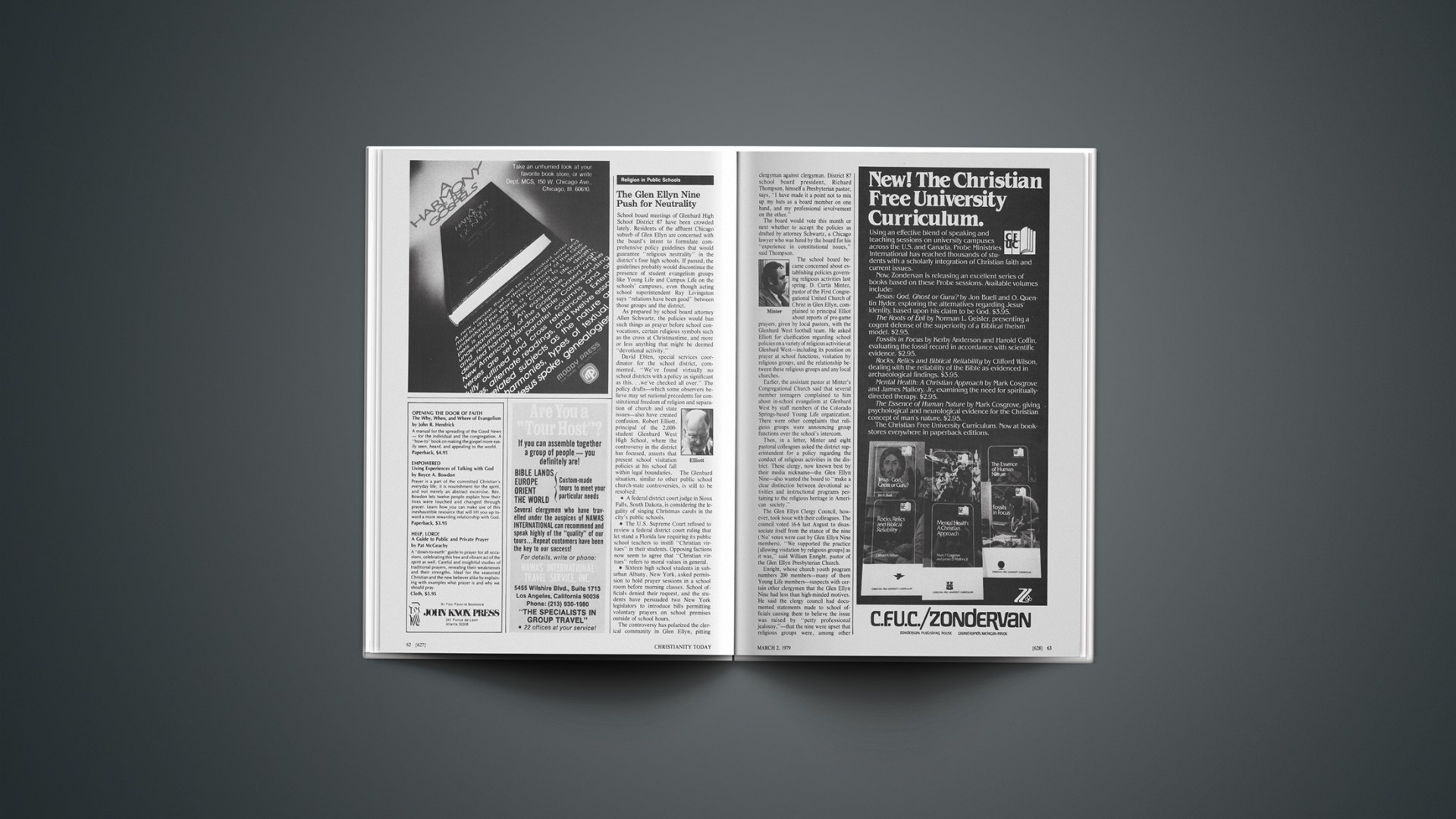
School board meetings of Glenbard High School District 87 have been crowded lately. Residents of the affluent Chicago suburb of Glen Ellyn are concerned with the board’s intent to formulate comprehensive policy guidelines that would guarantee “religious neutrality” in the district’s four high schools. If passed, the guidelines probably would discontinue the presence of student evangelism groups like Young Life and Campus Life on the schools’ campuses, even though acting school superintendent Ray Livingston says “relations have been good” between those groups and the district.

As prepared by school board attorney Allen Schwartz, the policies would ban such things as prayer before school convocations, certain religious symbols such as the cross at Christmastime, and more or less anything that might be deemed “devotional activity.”

David Eblen, special services coordinator for the school district, commented, “We’ve found virtually no school districts with a policy as significant as this … we’ve checked all over.” The policy drafts—which some observers believe may set national precedents for constitutional freedom of religion and separation of church and state issues—also have created confusion. Robert Elliott, principal of the 2,000-student Glenbard West High School, where the controversy in the district has focused, asserts that present school visitation policies at his school fall within legal boundaries. The Glenbard situation, similar to other public school church-state controversies, is still to be resolved:

• A federal district court judge in Sioux Falls, South Dakota, is considering the legality of singing Christmas carols in the city’s public schools.

• The U.S. Supreme Court refused to review a federal district court ruling that let stand a Florida law requiring its public school teachers to instill “Christian virtues” in their students. Opposing factions now seem to agree that “Christian virtues” refers to moral values in general.

• Sixteen high school students in suburban Albany, New York, asked permission to hold prayer sessions in a school room before morning classes. School officials denied their request, and the students have persuaded two New York legislators to introduce bills permitting voluntary prayers on school premises outside of school hours.

The controversy has polarized the clerical community in Glen Ellyn, pitting clergyman against clergyman. District 87 school board president, Richard Thompson, himself a Presbyterian pastor, says, “I have made it a point not to mix up my hats as a board member on one hand, and my professional involvement on the other.”

The board would vote this month or next whether to accept the policies as drafted by attorney Schwartz, a Chicago lawyer who was hired by the board for his “experience in constitutional issues,” said Thompson.

The school board became concerned about establishing policies governing religious activities last spring. D. Curtis Minter, pastor of the First Congregational United Church of Christ in Glen Ellyn, complained to principal Elliot about reports of pre-game prayers, given by local pastors, with the Glenbard West football team. He asked Elliott for clarification regarding school policies on a variety of religious activities at Glenbard West—including its position on prayer at school functions, visitation by religious groups, and the relationship between these religious groups and any local churches.

Earlier, the assistant pastor at Minter’s Congregational Church said that several member teenagers complained to him about in-school evangelism at Glenbard West by staff members of the Colorado Springs-based Young Life organization. There were other complaints that religious groups were announcing group functions over the school’s intercom.

Then, in a letter, Minter and eight pastoral colleagues asked the district superintendent for a policy regarding the conduct of religious activities in the district. These clergy, now known best by their media nickname—the Glen Ellyn Nine—also wanted the board to “make a clear distinction between devotional activities and instructional programs pertaining to the religious heritage in American society.”

The Glen Ellyn Clergy Council, however, took issue with their colleagues. The council voted 16–6 last August to disassociate itself from the stance of the nine (‘No’ votes were cast by Glen Ellyn Nine members). “We supported the practice [allowing visitation by religious groups] as it was,” said William Enright, pastor of the Glen Ellyn Presbyterian Church.

Enright, whose church youth program numbers 200 members—many of them Young Life members—suspects with certain other clergymen that the Glen Ellyn Nine had less than high-minded motives. He said the clergy council had documented statements made to school officials causing them to believe the issue was raised by “petty professional jealousy,”—that the nine were upset that religious groups were, among other things, draining their own youth programs.

Minter says he “objects to that charge,” though he regrets having made “some references to personnel in a particular local church situation,” involving prayer in the football locker room. He said, “If I were motivated by petty jealousy, I would not be interested in the pursuit of a public school policy.”

Clergymen on both sides of the controversy have definite opinions. The Glen Ellyn Nine see themselves as protecting the rights and dignity of religious minorities. Thomas Streitor, of Faith Lutheran Chuch, said he would prefer that no groups gain access to the school, if it were a question of all groups entering or none at all. Another Lutheran pastor, Don Marxhausen, was upset by any proselytizing in the public schools, saying it is an example of “hitting on people.”

Some pro-visitation pastors believe the Glen Ellyn Nine have no interest in verbal evangelism. Enright calls their stand: “A complete sell-out to secular humanism.”

Since the original complaints to Glenbard West principal Elliott, the school has stopped using its intercom for announcements. Prayer before football games has been nixed. Elliott prepared guidelines pertaining to school visitation, which express in writing what had been in general practice: a maximum of four staff members of a group can visit no more than twice a week, and only in the lunchroom with their own club members.

For the time being, Young Life and Campus Life staff members were contemplating how their ministries would be affected if board policies forbade their presence. In interviews, they said their campus visits are important for building relationships between students, but that their ministries would not die should the doors be closed.

George Korver, a Campus Life director in the area, said he would be disappointed if Campus Life was banned from Glenbard: “I believe we can provide friendships with kids, and that’s an important part of their lives.”

Emory Griffin, a speech professor at Wheaton College and a national board member of Young Life, says the issue is one of free speech, not separation of church and state. He regards the school as a public place where “every viewpoint ought to be heard.” Griffin believes that all groups, not just religious groups, should be allowed into the schools, but under guidelines established by the principal and when their presence does not hinder the educational process.

Most public opinion so far has been for keeping the religious groups on campus. Principal Elliott has a chubby folder of letters, all but one in favor of keeping things the way they are. In a poll conducted by the Glenbard West student senate, 1,009 West students responded to the question, “Do you object to authorized representatives of recognized religious organizations visiting our campus?” More than 800 students said they did not.

School board president Thompson said this majority will not affect the final policy decision. “The matter of majority-minority is not a matter of primary consideration. We’re going to do what we feel is within the perimeters of the law.”

Bernard Robinson, the rabbi of a nearby Jewish synagogue, has become aligned with the Glen Ellyn Nine. He has spoken at board meetings for the rights of religious minorities and has sought advice and support from the Anti-Defamation League of the Jewish organization, B’nai B’rith. He said existing policies at Glenbard violate separation of church and state principles.

Those advocating the presence of religious groups at Glenbard schools are really saying, according to the rabbi, “we’ve got a nice comfortable mixture of church and state here; let’s not meddle with it; let’s keep our community nice and white and Christian.”

Amidst all the discussion and legal wrangling, school goes on in the Glenbard district. Principal Elliott says, “I’ve told the school attorney, ‘I’m not really interested in your long, philosphical flights of fancy and your legal problems. I’ve got a school to run.’ ”

A Magnetic Pope Tugs at Opposing Latin Forces

If the Roman Catholic Church keeps John Paul II traveling, it might either revitalize the church, or kill its Pope. At least in Mexico, where John Paul opened the third Conference of Latin American Bishops (CELAM), the church shows signs of being revitalized.

From the moment he kissed the concrete at Mexico City’s airport last January 26, until his final “muchas gracias” on January 31, the Pope had the attention of Mexicans well in hand. Federal police reported that 20 million saw the Pope personally during his six-day visit (the most conservative estimates say 10 million). They crowded into stadiums and plazas and filled open fields and road sides to wave at John Paul, whose itinerary was so intense that observers marveled at his ability to keep going so enthusiastically.

Serious challenges awaited the Pope in Mexico, but he responded with directness. In his first address, the Pope called Mexicans to remain faithful to the Roman Catholic Church: Mexico is fast becoming a secular nation, some believe, through its radical constitutional separation of church and state; it is the only Latin American country without official Vatican relations. But when the Pope cried, “Mexico always faithful” at his first speaking engagement, the crowds picked up his cry and chanted it at every gathering that the Pope attended.

Social and political pressures in Latin America are fragmenting what once was considered an indivisible church. Progressives have aligned themselves in various positions around the “theology of liberation,” a controversial social action dogma that calls for an uplifting of the poor, often through violent or Marxist methods. Conservatives are using all their influence to retain something of the ecclesiastical status quo. John Paul tried to reconcile the factions, saying, “There is not, as some pretend, a ‘new church’ different from the ‘old church.’ There is the single church with new aspects, but always the same in essence.”

Papal authority and direction surfaced as a topic in his speeches: “The churches’ magistrates, who are an extension of Christ’s authority, are the only guarantee against losing the just way.”

The Polish Pope expressed his devotion to the Virgin Mary during his Mexican excursion. He opened the CELAM conference at the Basilica of the Virgin of Guadalupe, a church outside Mexico City that was built on the site where Mary, according to the native story, appeared 1531 to an Aztec convert named Juan Diego. (Mary is designated as the Patroness of all the Americas by the Vatican.)

The Pope said that the Virgin of Guadalupe is the seat of wisdom, and that she guides the future, the past, and the present. He offered to her the entire Latin American Catholic Church as her property, while professing that she provides the spiritual unity that binds the church together. The pontiff hoped the Virgin would let him reach into the hearts of Mexicans and all Latin Americans. (Some evangelicals were concerned by the Pope’s adoration of Mary, saying that when devotion to the Virgin increases, so does persecution of evangelicals.)

Evangelism, the theme of the CELAM conference, is a sticky matter in Catholic Latin America. To many bishops, evangelization means the conversion of the collective conscience so that cultural and national values are changed—not just a matter of spreading the gospel so that men are transformed from within. The Pope agrees with this in part, but he says the church should avoid getting involved in any political outworkings of evangelization.

The church may make recommendations and even strongly criticize governments, the Pope stated, but it must not resort to violence. He emphasized the spiritual ministry of the church.

During his appearances in five Mexican cities, John Paul repeated his devotion to Mary, while his multitudinous hearers echoed back their faith in her, in the Pope, and in the church. He also criticized divorce, and he said that population growth is a sign of a healthy nation (an apparent attempt to discredit contraception on a sociological basis). While supporting the right to private ownership of property, the Pope pointed out that government expropriation may be the best solution in some circumstances.

To the Mexicans, the Pope appeared as a man of exceeding charisma. Lines of police could barely hold back the surging crowds, out to see their Pope who traveled 260 miles in open vehicles under Mexico’s tropical sun to make thirty speeches overall. The people perceived a kind man, a man attentive to their hurts and longings, a man who contrasted sharply with the cold professionalism often associated with their priests and bishops. Indeed, a new approach to pastoral ministry may be the greatest legacy of John Paul’s trip, say some observers.

However, many evangelicals were upset by certain remarks that were made in reference to the Pope. At a mass officiated by the Pope at the Palafoxian seminary, the official guide stated that John Paul II “fills the place of Christ, is the greatest human mediator between God and man, and is assisted by the Holy Spirit and cannot err.” During his appearance in Oaxaca, a priest who later received a papal blessing led the crowd in shouting, “For those who have sight, you, John Paul II, are for us, Christ.”

Many observers wondered why the Pope, who referred so frequently to Mary in his public discourses, focused more on Jesus Christ and Scripture when addressing church officials.

John R. Quinn, San Francisco archbishop and president of the U.S. National Conference of Catholic Bishops, defended this seeming duplicity in the Pope’s pronouncements: “The common people are not able to deal with complex issues, so the Pope speaks to them of Mary. However, he can speak of Christ and the Scriptures to the bishops. After all, the Lord used parables with the common people, and spoke differently to his disciples.”

Some evangelicals among the “common people” are worried about the outcome of the Pope’s visit and the CELAM conference, because many of them have paid dearly for their publicly expressed Christian faith. In isolated areas of Mexico, severe persecution continues. Evangelical Covenant missionary Rick Lane reported one such incident as occurring in October 1978: a pastor visited the village of Gueloxi to inspect the construction of an evangelical chapel, was attacked by a mob, forced to run for his life, then hid in a hole for two days.

Dave Cummings, of the Trans-World Baptist Mission, told how an independent Mexican evangelist was hacked to death in the plaza of Ejutal (a city in the state of Oaxaca, located southeast of Mexico City) two years ago. In July 1978, the Mother Superior in Ejutla warned Cummings and other evangelicals never to come back. They did, but are having great difficulty in establishing a church there.

The saddest news of all for evangelicals may come from Santa Rosa Matagallinas, a city also located in the state of Oaxaca. Santa Rosa residents Isidro Patricio and Nahúm Venegas, who were converted through missionary efforts of the Southern Baptist Convention, said that since 1974, four believers have been murdered, several wounded, and others harassed—all by local people acting under the instigation of parish priest Carlos Salvador.

Ambushes, armed attacks on the homes of evangelicals, and church-burnings are normal fare, they report. Isidro pulled off his shirt to reveal the scars of a shotgun attack he suffered on September 6 last year.

However, some Santa Rosa evangelicals report being protected from attack under miraculous circumstances—saying it is as if an invisible curtain protects them from attackers. Pastor Rogelio Vásquez says he walked through several ambushes without being seen. Salvador, the local priest, since has been moved from the parish, but the aggression reportedly continues in Santa Rosa. Government agencies in the district capital of Sola de Vega have done little to change the situation.

Presbyterian pastor Nicolás Fuentes, who heads the Mexico City-based National Committee for Defense of Evangelicals, said, “Our evangelical chapels are destroyed, we are forbidden to preach, and our pastors are persecuted. In this committee, we receive a minimum of twenty cases per year of flagrant violations against evangelicals by Catholic mobs.” (He said that of Mexico’s 65 million people, 5 million are evangelicals.)

Evangelical leaders across Latin America recognize that aggression against evangelicals is not promoted by the Roman Catholic leadership, but they wonder why the violence is not condemned publicly by local bishops and cardinals. To them, signs of renewed vitality in the Mexican Roman Catholic Church as a result of the Pope’s visit, appear to be a mixed blessing.

Episcopalians: Rapid Take-off for a New Mission Board

The South American Missionary Society of the Episcopal Church in the U.S. (SAMS-USA), an evangelical association in only its third year of operation, has projected a hundred-fold increase in its original budget. That announcement, by board chairman Richard Kew, is indicative of the rapid growth of this tiny missionary society within the three-million-member Episcopal Church (U.S. total).

Founded in 1976 with a budget of $4,000, the society has placed three missionaries in South America; has two more doing deputation work in the United States; has purchased a building in Wantaugh, New York, for its national headquarters; and last month hired a second full-time home administrator to direct regional operations out of Charlestown, South Carolina.

“We’ve only tapped about 10 per cent of the dioceses in the country,” said Kew, who is assistant rector of Christ Church in Hamilton, Massachusetts. “In 1979 we’re projecting a budget of just under $400,000.”

The new missionary effort has functioned in harmony with the New York-based World Missions Executive Board of the Episcopal Church. “They’ve been very supportive of this evangelical effort,” Kew said.

SAMS-USA is the North American branch of an international society based primarily in Great Britain and Australia. Kew, himself a transplanted Briton, said that SAMS-UK and SAMS-Australia have approximately 150 missionaries in the field. The original society was founded in 1843, “but for some reason there never was a U.S. branch,” Kew said.

The idea for a U.S. branch grew from a meeting in fall, 1976, of the Fellowship of Witness, an evangelical association within the denomination, at Kew’s Christ Church. Urbana ’76, one of the triennial student missions conferences sponsored by Inter-Varsity Christian Fellowship, also provided an impetus. A guiding force at both meetings was Elisabeth Elliot, the missionary-writer who is a member of Christ Church and the SAMS-USA board.

“Until July of 1978 we didn’t have a full-time home staff,” Kew said. “Now we have two full-time administrators, and three missionaries at work in the field.” Officials of the fledgling missions group hope to double their number of missionaries in the field by 1980. The executive director of SAMS-USA is Paul Walter, and Bill Kitchen is director of the South Carolina office.

Suit and Countersuit

Suit And Countersuit

Bass and Bankov’s suit allows for the naming of as many as ten other defendants who participated in some way in the alleged defamations. Two have been identified so far: Jim Dimov, a former UE employee and Bankov relative who runs a small Bible-smuggling organization in Hollywood, and JTTCW founder Richard Wurmbrand, 70. They were named in November 1977, and June 1978, respectively, after appearing for pre-trial testimony.

Dimov, who attended the same church in Burgas, Bulgaria, as the Bankov family, testified that Bankov had been a deacon but never a pastor. He also claimed that Bankov, during a period of disillusionment with UE in 1970, referred repeatedly to Bass as a “gangster.”

Richard Wurmbrand’s testimony was not heard. When he attempted to give a preliminary statement, Bass-Bankov lawyer David Nissen objected. A scuffle and shouting match ensued, and Wurmbrand walked out.

A month before he was named a defendant, the elder Wurmbrand resigned from the JTTCW board. Christians should not take part in lawsuits against each other, he argued, and JTTCW therefore should not defend itself against Bass and Bankov. “It was my opinion to give [the money] to them plus a flower to show that we love them in spite of their sins,” explained the JTTCW founder in a letter to his constituents last fall. He indicated that although he will not defend himself personally against the lawsuit he now believes JTTCW as an organization must fight legally to protect donors’ funds.

Following much debate among board members, Michael Wurmbrand and JTTCW in November 1977 filed a cross complaint against Bass and virtually the entire UE camp. It denies the Bass-Bankov charges, and also alleges defamation and asks for $4 million in damages. JTTCW attorney Carl Pearlston told reporters that it was necessary to file the countersuit in order to subpoena vital evidence in UE’s files.

The JTTCW defense strategy seems to center on establishing the truthfulness of some of Wurmbrand’s allegedly defamatory remarks and on showing that Filka Bankov’s accusations against Bass were made of her own volition—and before she had met Wurmbrand.

Bad Will Building

The Senior Wurmbrand and Bass have been feuding off and on since 1966, when Bass asked him to join UE following the refugee’s appearance in a U.S. Senate chamber where he bared his back in front of TV cameras. Viewers saw scars that Wurmbrand said came from beatings administered during his imprisonment in Communist Romania. A dispute erupted soon after Wurmbrand joined UE. Wurmbrand demanded to take over leadership of UE because, he alleges, UE was doing little work overseas and there were questions about finances. Bass’s version of the squabble differs; he says it amounted to a power grab by Wurmbrand. Whatever, Wurmbrand quit under pressure in February, 1967, and with the $10,000 balance due him on his UE contract he set up JTTCW a few blocks from UE headquarters in Glendale (UE has since moved).

Until the end of World War II Richard Wurmbrand, who traces his conversion to the witness of a Hebrew Christian killed by Nazis, headed up an Anglican mission to Jews in Romania. He was ordained a Lutheran when an Anglican bishop was forbidden entry to the country. Following the war, Wurmbrand worked under Swedish Lutherans until his arrest by Communists in 1948. He spent two terms and a total of fourteen years in prison.

Son Michael says he studied for four years at a university in Cluj, Romania, and got a divinity degree from a Protestant school in Paris, where he studied under Oscar Cullmann. He was ordained in 1970 in Switzerland, he says, by a since-deceased Norwegian Lutheran bishop.

Bass grew up in Arkansas and attended high school in Fort Smith. In 1953, at age sixteen, he dropped out after completing tenth grade. With a friend he struck out for Portland, Oregon, where he studied for a year at Bethesda Bible Institute, a Pentecostal school operated by the Wings of Healing organization. Bass indicated that he had been converted and “baptized in the spirit” in 1950. Then came two short stints as a missionary worker in Nigeria. He returned to the United States and became missionary director with the American Evangelistic Association (AEA), headed by evangelist John E. Douglas of Baltimore.

Douglas says he received numerous complaints about Bass, and the AEA board finally demanded his resignation. The showdown came, recalls Douglas, over a 1959 incident in which Bass was arrested and charged with taking money from a Georgia woman under false pretenses. The charges were apparently dropped after Bass agreed to make restitution.

In 1960, Bass established Evangelism Center in Tulsa, the forerunner to UE. He traveled to Yugoslavia to film evangelistic meetings being conducted by American evangelist Nick Gruick (see April 13, 1973, issue, p. 44). While there, Bass himself spoke in three church services and gave greetings or prayed at several others, according to the Pentecostal leader who was his interpreter. Bass also made a short visit to Poland following a crusade by Oral Roberts. From his Yugoslavia pictures Bass produced a movie and a pictorial booklet, both entitled “The Red World.” In them, Bass portrayed himself as an evangelist holding the “first series of crusades ever held behind the Iron Curtain,” with “thousands marked by the Communists” because they accepted Christ under his ministry. (Yugoslavian Pentecostal leaders who saw the film and book told CHRISTIANITY TODAY that there are numerous fabrications in them, a contention Bass rejects.)

Bass targeted Eastern Europe as a mission field, changed the name of his organization to Underground Evangelism in 1962, and moved to California.

Conspiracy Or Doodling

More than three dozen witnesses have given depositions (pre-trial testimony) so far in the current litigation, and more may be scheduled. The witnesses have included police officers, Bulgarian national and expatriate clergy, Bankov’s former employer, ex-UE employees, former intimates of the Bass family, friends of Filka Bankov, journalists, and attorneys. Hundreds of documents have been introduced as evidence.

Wurmbrand’s attorneys say that much of the testimony and evidence reflects unfavorably on Bass and Bankov. For example, they point out Bulgarian Pentecostal leaders, including Bankov’s former pastor in Burgas, testified at meetings in Western Europe that Bankov had not been ordained and had never been a pastor. Similar testimony was given by other persons who knew Bankov in Bulgaria. Former associates of Bankov said that he had on occasion spoken disparagingly of Bass and UE.

Bass maintained a bar in his home in La Crescenta (he has recently moved farther west to Ventura), according to witnesses who said they were present at parties when the UE founder mixed, served, and drank alcoholic beverages. A female ex-UE employee testified reluctantly that Bass on a number of occasions had taken her to Los Angeles-area motels where they drank and had sex. Other testimony and exhibits were introduced by Wurmbrand in an apparent attempt to show Bass had deceived the UE constituency about facts pertaining to UE work, personnel, and finances.

Bass contends that the cross-examinations by his attorney cast doubt on key points in these testimonies and he says that the witnesses refused to take lie detector tests. He brands the drinking and sex allegations that emerged in the testimonies as false. Some of the exhibits, asserts Bass, are “sheer fabrications.” He claims that old UE magazines were “cut apart, photocopied, and taken out of context” to create false impressions.

For months, Filka Bankov resisted giving a deposition but finally did so last spring after she was granted immunity from prosecution in a 1976 extortion case in which she and the Bass family had figured. In disjointed testimony replete with crucial memory lapses, Miss Bankov told a story that differed sharply from accounts she gave earlier to friends, police, attorneys, and journalists. The upshot of her new account: all that she had said against Bass, her father, and UE had originated with Michael Wurmbrand, who had bought her allegiance and used her in an attempt to destroy UE. Bass alleges that her earlier version was the result of brainwashing by Wurmbrand.

At one point Miss Bankov told of a late 1976 visit by a CHRISTIANITY TODAY journalist who had been studying UE affairs since 1973. She said that the reporter identified himself as an agent flown in by Wurmbrand to offer her an apartment, a car, and “anything I wanted,” in exchange for leaving home and joining Wurmbrand. The reporter frightened her, she indicated, when he told her of having heard that Bass had murdered a Canadian and “a few other girls.” (Miss Bankov’s version of the conversation is disputed by the journalist. An eyewitness, Miss Bankov’s former high school counselor, was present throughout the interview, and following the interview Miss Bankov wrote letters indicating that it had been a question-answer session and that she suspected Bass had sent the journalist.)

Among the materials provided as evidence by Maria Tarr was a scrap of paper containing a few scrawled notes made by Michael Wurmbrand during a conversation they had. It lists the names of Bass, his wife Lois, Bankov, and Filka Bankov. The word “split” is printed in large letters. Under Miss Bankov’s name are the words “her writing,” “story,” and “letters?” Under a heading, “Who contacted,” are “District Attorney,” “I.R.S.,” “U.S. Postal Auth.” and “Reporters!” A final entry appears: “(1) Orig. should be finished.” An arrow connects this entry to the name of Lois Bass.

To Bass, the notes were proof of a vast conspiracy. Wurmbrand, however, stated in an interview that the notes were little more than doodling while he and Mrs. Tarr discussed various possibilities raised by Miss Bankov, including a scenario that had Lois Bass and a lover—UE staffer David Hathaway of Britain—attempting to take control of UE from Bass.

Pressing Charges By Press

Armed with Miss Bankov’s deposition and Wurmbrand’s notes, Bass last September published a fourteen-page booklet entitled “Conspiracy—The Attempt to Destroy Underground Evangelism.” Tens of thousands of copies reportedly were distributed worldwide. Pointing to Wurmbrand’s notes, Bass reported that a “plan to destroy Underground Evangelism” had been “uncovered, involving an agency of Communist Bulgaria [the Bulgarian Orthodox Church in America], its Moscow-trained officials [churchmen who had studied theology in Moscow] and others.”

The booklet purports to show that the anti-UE plot was hatched in Eastern Europe, and that Maria Tarr—whom Bass refers to as Maria Stogonov, the “hand-picked” secret agent of the Communists—carried out the plan by bringing Filka Bankov and Michael Wurmbrand together, and that Wurmbrand became the chief tool in the conspiracy. A strong assist, says the booklet, came from a reporter, identified publicly by Bass as the CHRISTIANITY TODAY journalist who interviewed Miss Bankov.

The booklet goes on to say that Bass and Bankov “are taking steps to end the legal case. It has served its purpose, which was to question the people involved and get the truth out.” Readers are assured that “not one cent of donations to UE has been used for legal expenses.” (Elsewhere, however, Bass has stated that any proceeds from the lawsuit will be used to reimburse UE for legal costs.)

Wurmbrand responded in December with a seventy-eight-page book that summarizes the testimony of many of the witnesses, the events leading up to the lawsuit, and other aspects of the case. Most of the book is devoted to photographic reproductions of deposition excerpts, letters, other exhibits, and alleged misrepresentations in UE publications and financial statements.

Disseminated widely, the Wurmbrand book labels the conspiracy theory a “coverup” and concludes:

“Bass ignored what the witnesses have testified, concentrating on who he thinks the witnesses are, twisting testimony out of context and meaning so as to fit his made-up explanations. By inventing fraudulent charges of forging documents, brainwashing, and bribery, Joe Bass has followed the oldest [of] rules in propaganda—discredit your opponents so that you do not have to deal with what they say.”

In the book, Wurmbrand and his lawyers say that they know of no steps taken by UE to end the case and that no compromise settlements have been proposed by the plaintiffs.

Bass in January released “Conspiracy Part II” to counter information in Wurmbrand’s book. In it, he indicates that the case will be taken to court after all; it would have been dropped, he suggests, if Wurmbrand had acknowledged that the charges he made were false. Conspiracy II purports to show that Filka Bankov was the victim of mind control at the hands of Wurmbrand and that the testimony of many of the witnesses is false or unreliable. A supplementary document seeks to rebut or explain exhibits published in the Wurmbrand book.

Published materials disseminated by both UE and JTTCW constitute an almost unprecedented amount of reporting on a lawsuit in process by the principals involved. Despite the volume, however, the conflicting accounts generate more questions than answers.

West Coast Bible Smugglers: Less Cloak and More Dagger

Underground Evangelism duels with Jesus To The Communist World

Charges and countercharges of scandal, corruption, and conspiracy have been piling up in a bitter legal battle between two of the world’s largest organizations specializing in gospel outreach in Communist-ruled countries: Underground Evangelism (UE), based in Los Angeles, and Jesus to the Communist World (JTTCW) next door in Glendale. The multi-million-dollar defamation suit, initiated by UE leaders in Los Angeles Superior Court (Case C192860), in March, 1977, is the most serious confrontation between the two groups in more than a decade of feuding.

Over $250,000 has already been spent on the case, observers estimate, and the end is nowhere in sight. Both sides have filed an array of motions, and the case conceivably could drag on for years before going to trial. Leaders of other organizations, apparently fearful that the bad publicity may harm all Christian work, have been trying for months to arrange an out-of-court settlement. As of early February, no way had been found to permit an exit considered honorable by both sides.

More than honor is at stake. In its last published financial report, dated March 31, 1977, UE reported worldwide annual income of nearly $8.2 million, up from $6.6 million the preceding year. The JTTCW report of December 31, 1977, showed global income of more than $5.8 million, an increase of nearly $700,000 over 1976. The next reports, due out soon, also are expected to show increases. But there may be reason for concern in both camps. Increasingly, contributors are demanding assurance that their gifts are not being used to finance the lawsuit. In Britain, the Evangelical Missionary Alliance leadership last summer called on donors to withhold contributions from both organizations until the case is resolved. (Both groups have branches in a number of countries.)

Some leaders of dissident Christian movements in Eastern Europe have expressed fears that the court fight may disrupt the flow of smuggled Christian literature and other support into their countries. A group of Soviet refugee workers in West Germany recently severed their association with UE, partly to protest the lawsuit, according to reports. Even critics of UE in other missions say UE produces much good literature, and they don’t want to see that work crippled.

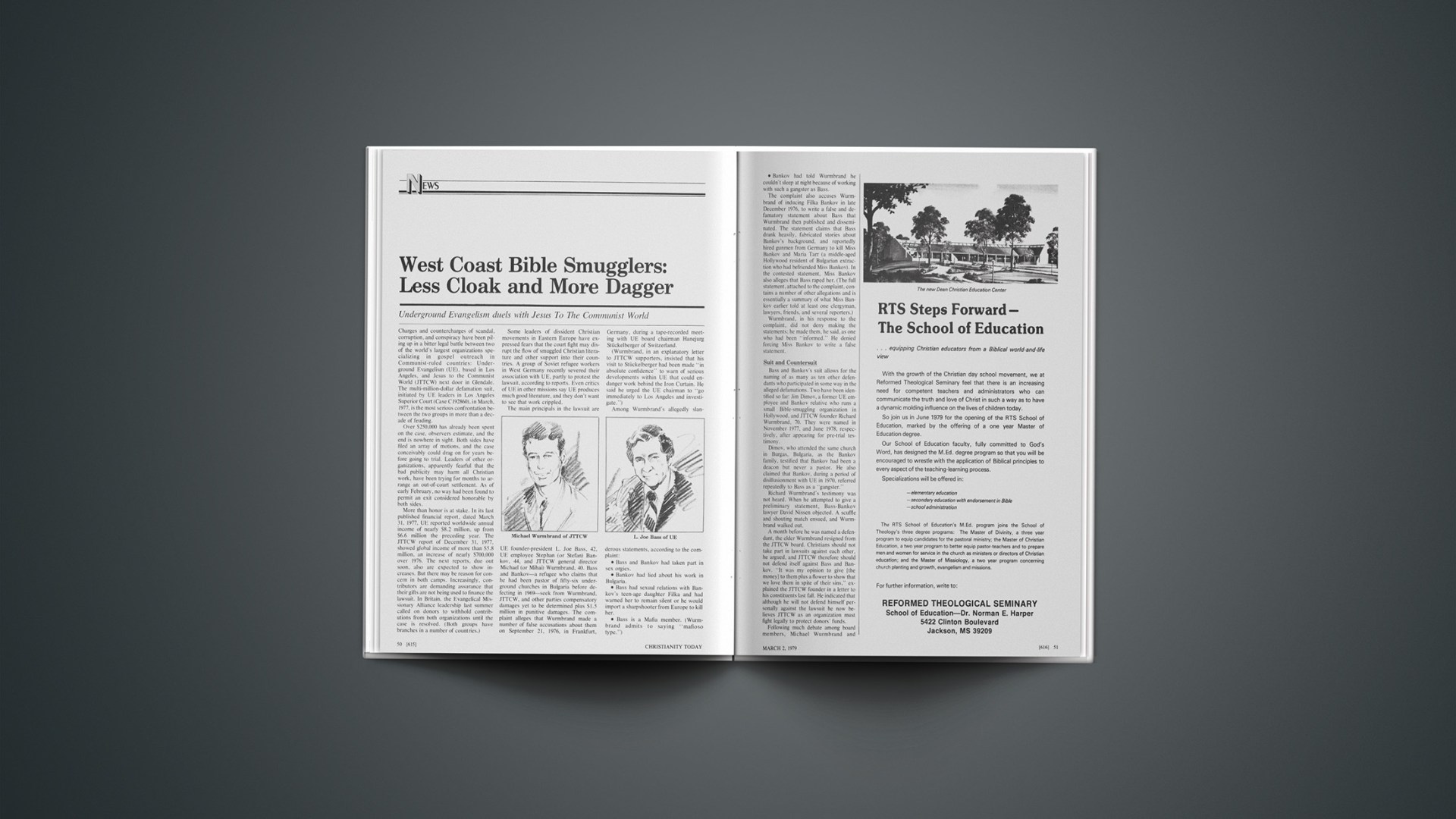
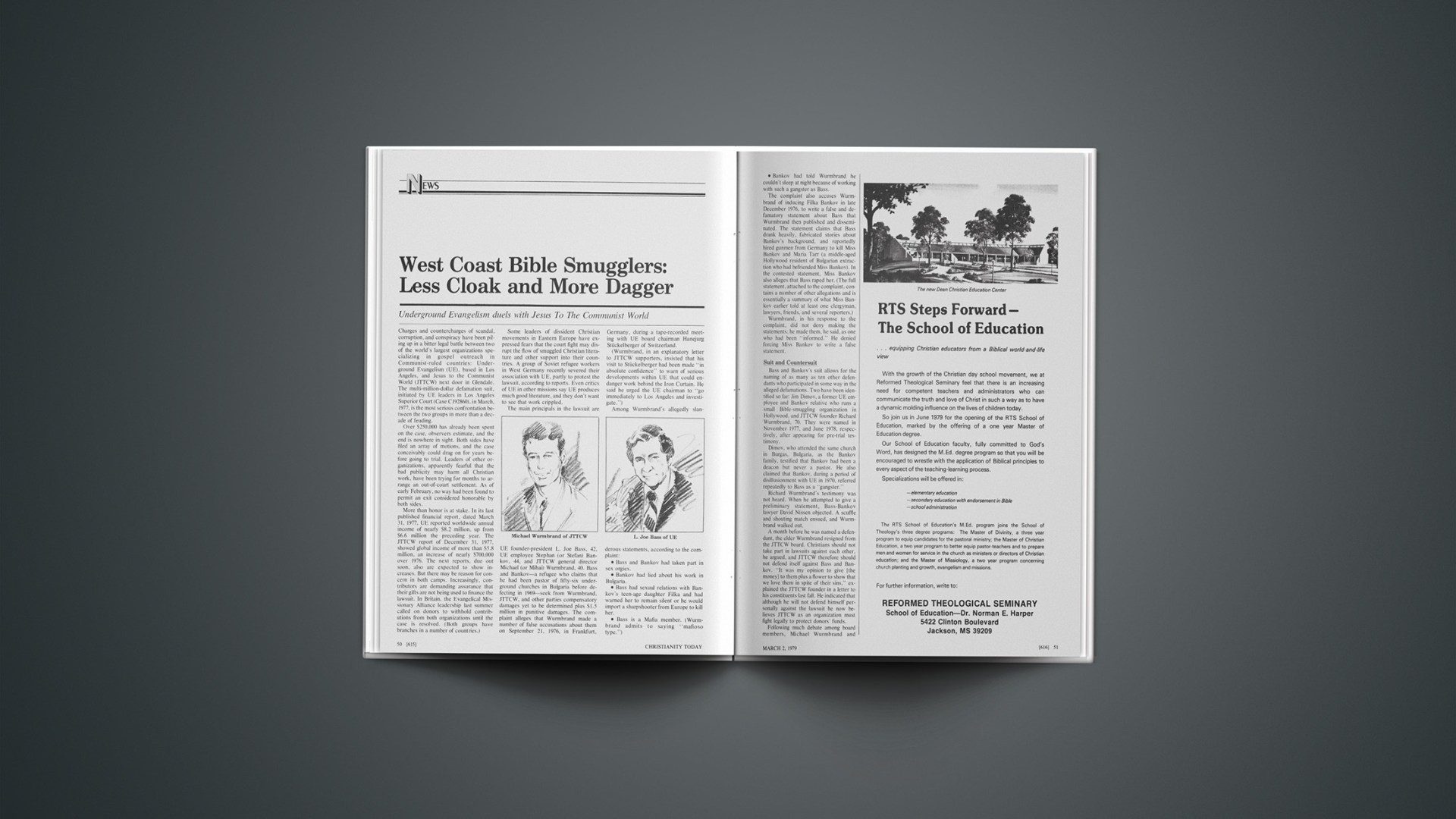
The main principals in the lawsuit are UE founder-president L. Joe Bass, 42, UE employee Stephan (or Stefan) Bankov, 44, and JTTCW general director Michael (or Mihai) Wurmbrand, 40. Bass and Bankov—a refugee who claims that he had been pastor of fifty-six underground churches in Bulgaria before defecting in 1969—seek from Wurmbrand, JTTCW, and other parties compensatory damages yet to be determined plus $1.5 million in punitive damages. The complaint alleges that Wurmbrand made a number of false accusations about them on September 21, 1976, in Frankfurt, Germany, during a tape-recorded meeting with UE board chairman Hanejurg Stückelberger of Switzerland.

(Wurmbrand, in an explanatory letter to JTTCW supporters, insisted that his visit to Stückelberger had been made “in absolute confidence” to warn of serious developments within UE that could endanger work behind the Iron Curtain. He said he urged the UE chairman to “go immediately to Los Angeles and investigate.”)

Among Wurmbrand’s allegedly slanderous statements, according to the complaint:

• Bass and Bankov had taken part in sex orgies.

• Bankov had lied about his work in Bulgaria.

• Bass had sexual relations with Bankov’s teen-age daughter Filka and had warned her to remain silent or he would import a sharpshooter from Europe to kill her.

• Bass is a Mafia member. (Wurmbrand admits to saying “mafioso type.”)

• Bankov had told Wurmbrand he couldn’t sleep at night because of working with such a gangster as Bass.

The complaint also accuses Wurmbrand of inducing Filka Bankov in late December 1976, to write a false and defamatory statement about Bass that Wurmbrand then published and disseminated. The statement claims that Bass drank heavily, fabricated stories about Bankov’s background, and reportedly hired gunmen from Germany to kill Miss Bankov and Maria Tarr (a middle-aged Hollywood resident of Bulgarian extraction who had befriended Miss Bankov). In the contested statement, Miss Bankov also alleges that Bass raped her. (The full statement, attached to the complaint, contains a number of other allegations and is essentially a summary of what Miss Bankov earlier told at least one clergyman, lawyers, friends, and several reporters.)

Wurmbrand, in his response to the complaint, did not deny making the statements; he made them, he said, as one who had been “informed.” He denied forcing Miss Bankov to write a false statement.

Minister’s Workshop: Let’s Polish Our Delivery

People in the pew are reluctant to offer critical advice.

Good preaching—we hear much analysis of it. But many people ignore one of its important components: delivery. Everyone who speaks in church constantly needs to review the “p’s and q’s” of oral communication. Inattention to this matter jeopardizes the effectiveness of sermons that may otherwise be excellent.

While completing degrees in public address, some graduate students recorded a number of preachers from the community. The speakers were told that the project included a phonetic analysis of their voices.

The students discovered that several speakers could have vastly improved their delivery. For example, one man enunciated inadequately. Another simply needed to open his mouth wider and stop talking through his teeth. More vigorous use of tongue and lips could have improved the articulation of others. Nasalities could have been reduced. Squeaky or raspy voices with proper exercises could have been moderated.

Neither the people in the pew or in the classroom criticize our delivery, fellow church speaker. If your voice, gestures, or idiosyncracies of delivery grates on the listeners’ ears, they will patiently bear it. Or they may transfer to another church, or even stop listening to any preacher.

A study of graduates of Yale College from 1702 to 1779 shows that 79 per cent of the ministers served one congregation all their lives. How longsuffering these congregations must have been if they were subjected to a ministerial monotone, an insipid manuscript shuffler, a prancer, a bombastic shouter, a nose twitcher, or maybe a two-hour scowler. Outstanding content could hardly have compensated for badly delivered sermons.

If the pulpit pounder needs advice on how to more effectively communicate, the church members will rarely suggest it. Even preachers are reluctant to advise their colleagues. The possible price of ruined fellowship is too much. We must, if necessary, “heal ourselves.” Egotism, out of the way.

What are some of the more obvious manners of church speakers that keep them from being effective proclaimers of God’s Word?

Overuse of particular words or phrases is one. For example, you may overuse such phrases as, “We know,” “Certainly we believe,” “It is true,” “We see,” or “We believe.” People like variety. Try to use synonyms. Vary the words or phrases you use to make transitions.

You will lose people’s attention when you never use the rhetorical pause, vary your rate of speaking, or change your volume. No one pays attention to a droning airplane engine. But when that engine slows down, speeds up, roars and purrs, sputters, and even stops and starts during operation, it rivets the attention of all its hearers.

A continuous procession of “ah’s” to cover your search for the correct word or phrase is also nerve racking. Better to use a manuscript skillfully than to exhaust people’s patience. You may be producing teenagers who stay alert just to count the number of “ah’s” in your address.

“Bodily exercise profiteth little,” said Paul. On the other hand, some exercise is beneficial. Here the golden mean is true for the speaker when it involves gestures. Pacing back and forth like a sentry on quick-time duty may lose significance when you do it fifty-two times a year.

At the same time people do not want to gaze at a public statue, particularly one that depends on the pulpit to keep it upright. Variety is the word. Overuse of any particular gesture makes it ineffective. Remember that familiarity fosters boredom.

Nervous idiosyncracies are another detriment to the speaker addressing the same assembly week after week. Don’t pull an ear, straighten a necktie, toss back hair that is falling over your forehead. However, these mannerisms do make the speaker human. And no one wants to listen to a robot of mechanical perfection. Despite his imperfections, each speaker has a distinctive personality that God can use.

Although the Lord can and sometimes does use the person careless or ignorant about his sermon delivery, God might be able to multiply his use of that person if more attention were given to the task. Public speaking is a learned art. Forgotten skills can be improved. The needs of the church demand it.

Here are some suggestions to help you: Reread textbooks and look for ideas in new books. Use the tape recorder at least once a month. Count the “ah’s.” Note your rate and pitch. Do you speak so rapidly that some people can’t follow you? What about your enunciation? How’s your English? Do you read the Bible in a mechanical, lifeless manner, never noticing the setting, the conversation?

Ask an objective person who has nothing to gain by flattering you to periodically “check you out.” Perhaps there is a speech teacher in the congregation or community who, if asked, would be thoroughly candid about your delivery.

The ancient Greeks and Romans lavished time, effort, and money on public speaking—this in honor of the gods and for the praise of men. Don’t our reasons for being effective communicators surpass theirs?—RICHARD HOSTETTER, Winston-Salem Bible College, Winston-Salem, North Carolina.

Refiner’s Fire: Singer Bruce Springsteen: No Respite from Rebellion

The automobile and rock ‘n’ roll music become means for escape.

One setting and theme repeat in most of the songs. It is night time, a couple in a car are making an attempt to break away from the trap of their home town to freedom. Control over your life becomes the goal. Most of Bruce Springsteen’s songs deal with the struggle of young people to free themselves from the restrictions of their parents’ world. As with scenes from Rebel Without a Cause, Springsteen stages confrontations. Adopting James Dean’s persona, he continues to voice the dissatisfaction of one generation with the preceding one. The automobile and rock ‘n’ roll music become means for escape from the confinement of family and hometown.

Reaction against an older generation is common among young people, especially those in the United States after World War II. In the fifties rebellion took the form of rock ‘n’ roll, fast cars, leather jackets, and tough street language. But what was the purpose? In the sixties rebellion reflected a romantic idealism that the world could become a utopian society of peace and love. That notion collapsed. Rebellion in the seventies continues because that’s the role young people play. Although the music of the seventies has mellowed, Springsteen still sees rock ‘n’ roll as rebel music.

Springsteen retells the story of struggling with his parents over his choice of vocations. His father wanted him to be a lawyer, his mother wanted him to write. But he wanted to become a rock star. In the song, “Blinded by the Light,” Springsteen tells how he ignored his mother’s warning: “Mama always told me not to look into the sights of the sun/Oh but, Mama, that’s where the fun is.” Springsteen sees rock ‘n’ roll as an escape from the boredom and sterility of modern life. Having been raised in what he describes as a culturally deprived home with few books and little music, rock ‘n’ roll liberated him and brought life and hope.

He voices the frustration of youths who see their parents work day after day in jobs they dislike. They live in tension and hatred.

Springsteen decries the rebellious struggle, which consists of “us” against “them.” The “flag of piracy” flies in “Grown’ Up.” He says that when the crowd says “Sit down, I stood up.” The deadend mentality of the home town is cast aside: “It’s a town full of losers/And I’m pulling out of here to win.”

This vague hope that there is some magical answer to all of the problems in life threads through Springsteen’s four albums. “Badlands” decries aspects of society, which, according to Springsteen, is a prison from which one must escape. It is in the night freedom awaits.

I believe in the faith that can save me,

I believe in the hope

And I pray, that someday it may raise me

Above these badlands.

But what alternative does Springsteen offer? He writes in “Incident on 57th Street,” “We may find out on the street tonight, baby/Or we may walk until the daylight maybe.”

You may infer from Springsteen’s songs that he looked around at his parents’ world, a fading resort town in New Jersey, and decided anything would be better. Yet he offers no alternative but autonomy. What you find in the night is sometimes dissatisfying. In “4th of July, Asbury Park (Sandy),” Springsteen admits that playing pinball and living the carnival life on the boardwalk leave him unfulfilled, as do dreams:

Talk about a dream

try to make it real

You wake up in the night,

With a fear so real,

Spend your life waiting,

For a moment that just don’t come.

Springsteen discovered that even success as a rock ‘n’ roll star has its disappointments. His picture was on the cover of Time and Newsweek the same week. He was stunned by the adulation of the public and embroiled for over a year in a legal battle to free himself from his ex-manager. In the song, “Something in the Night,” he writes: “Soon as you’ve got something/they send someone to try and take it away.”

Racing cars soon lose their glamor and excitement, as in “Racin’ in the Street,” where the girlfriend “cries herself to sleep at night.”

She sits on the porch of her Daddy’s house

But all her pretty dreams are torn

She stares off alone into the night

With the eyes of one who hates for just being born.

Springsteen refers to religion, but not as something that provides an answer. In “Incident on 57th Street” “his sister prays for lost souls/And breaks down in the chapel after everyone goes.” Satan is encountered out in the streets at night in “It’s Hard to Be a Saint in the City.”

The devil appeared like

Jesus through the steam in the street

Showin’ me a hand I knew even the cops couldn’t beat

I felt his hot breath on my neck as I dove into the heat

It’s so hard to be a saint when you’re just a boy out on the street.

Springsteen deals with a religious theme most extensively in “Adam Raised a Cain.” He compares himself to Cain. He describes the antagonism between himself and his father as he grew up. “In the Bible Cain slew Abel/And East of Eden he was cast.” Springsteen refers also to the passing of sins of one generation upon subsequent generations: “You’re born into this life paying/for the sins of somebody else’s past./You inherit the sins, you inherit the flames/Adam raised a Cain.”

Just as Adam raised an obedient son and a disobedient son, society produces those who are willing to play by the rules and submit to authority and those who rebel. Springsteen takes Sides with the rebels. He unites his voice with the poets, writers, painters, actors, and those throughout history who have found virtue in nonconformity.

Bruce Springsteen has succeeded by speaking for a generation in its third decade of rebellion. His concert tours are sell-outs. Each show vibrantly reaffirms belief in the changing power in rock ‘n’ roll. Yet listeners may find indications of insincerity in Springsteen’s works, especially in his latest album, “Darkness on the Edge of Town.” It all seems a pose, the lyrics of rebellion inflated. Yet, you cannot deny his ability to connect with the inner feelings of young people. Since he has chosen to stay with the same settings and themes, Springsteen may find his place in American society as the perpetual teenage rebel.

Daniel J. Evearitt is a graduate student at Drew University.

Theology

Theology and Apologetics

There were also several surveys of doctrine, new editions of time-tested works.

Evangelicalism has been more in the public consciousness the past few years than at any time in decades. But we must not let interest in the evangelical movement detract either from the God whom we worship or from the truths about him and his relationships to men. This article surveys books issued last year on the various theological topics, on the individuals and groups whose reflections on these topics have been thought worthy of study, and on the religious rivals to Christian theology. I have included books in the survey that speak on these subjects in a helpful way to various readers; inclusion does not necessarily signify my agreement with the views they advocate.

The most notable systematic theology to appear last year was the first volume of Essentials of Evangelical Theology (Harper & Row) by Donald Bloesch. It discusses God, authority, and salvation; the second and final volume, due out shortly, covers life, ministry, and hope.

Karl Rahner, prominent Roman Catholic theologian, is author of Foundations of Christian Faith (Seabury), a major overview of traditional doctrines in nontraditional language.

Select Lectures in Systematic Theology (Banner of Truth) by John Murray was issued as volume two of his collected writings. The writings come from different times and occasions, but they have been organized so as to cover the traditional categories of systematics. Murray taught theology at Westminster Seminary from 1930 to 1966 and was widely appreciated in the English-speaking world. (Murray’s sixteenth- and seventeenth-century predecessors had their teachings collated in 1861 by Heinrich Heppe, and Baker has reprinted a revised and translated edition entitled Reformed Dogmatics.)

Another addition last year was the sixth and final volume of Dogma (Sheed) by Michael Schmaus, written in a post-Vatican II spirit by a leading German Catholic systematics professor. The last volume treats soteriology and eschatology.

From systematic works intended primarily for college and seminary classrooms we turn now to those aimed at a more general market. Foundations of the Christian Faith (InterVarsity) by James Montgomery Boice is a four-volume series of which the first two have appeared. Boice is a popular pastor and radio preacher well known for his expository ministry and his commitment to biblical inerrancy and Reformed theology. On an even more popular level is the eight-volume Victor Know and Believe Series (Victor) edited by Bruce Shelley of Conservative Baptist Seminary. (The individual volumes of this series are mentioned in their appropriate categories below.) This series is perhaps the best currently available for older youth and adult study groups that want more than a brief overview of doctrine.

There were also several one-volume surveys of doctrine, many of them new editions of time-tested works. Pocket Guide to Christian Beliefs (InterVarsity) by I. Howard Marshall will probably have the broadest acceptance. Our Faith and Fellowship (Gospel Publishing House) by G. Raymond Carlson represents a Pentecostal understanding while The Bible Tells Us So (Banner of Truth) by R. B. Kuiper and An Introduction to Biblical Truths (Baker) by Alexander DeJong represent Reformed theology. The Classic Christian Faith (Augsburg) by Edgar Carlson is a Lutheran approach while The Faith Once Given (Westminster) by George Ricker is a modern Methodist pastor’s presentation. The intermediate student who wants a different and thought-provoking approach can consider The Christian Story: A Narrative Interpretation of Basic Christian Doctrine (Eerdmans) by Gabriel Fackre. If, however, you want something very simple and trustworthy consider Light on the Heavy (Victor) by Jerry Jenkins and Pulpit Words Translated for Pew People (BMH) by Charles Turner.

The following three books are foundational rather than overviews and are for the theological student and those who want to think theologically: The Christian Mind: How Should a Christian Think? (Servant) by Harry Blamires, a Briton in the tradition of C. S. Lewis, The Study of Theology (Fortress) by Gerhard Ebeling, on the interrelations among the disciplines of seminary and university, and The Grammar of Faith (Harper & Row) by Paul Holmer, on the relation between theology and faith: a theme oft-neglected by modern theologians.

Before looking at the many subdivisions of theology and apologetics here are a few books that survey the evangelical movement, particularly its theology. Fundamentalism (Westminster) by James Barr is a scathing and, in many crucial ways, an unfair attack on all evangelicals. Nevertheless, some of his points need thoughtful consideration. In a partial attempt at balance, the same publisher offers The Evangelical Challenge by Morris Inch. It is a helpful overview of the evangelical movement and a needed balance not only to Barr but also to The Worldly Evangelicals (Harper & Row) by Richard Quebedeaux, which has received more media attention. Quebedeaux provocatively (and too readily) categorizes some of the evangelical subgroups and highlights trends.

The proceedings of a blue ribbon conference of evangelical leaders held in Atlanta in late 1977 were issued as Evangelicals Face the Future (William Carey) edited by Donald Hoke. For a comparison with yesteryear, see The Thought of the Evangelical Leaders (Banner of Truth) edited by John Pratt, which gives notes of a major fortnightly London gathering for the period 1798–1814.

Evangelical Roots (Nelson) edited by Kenneth Kantzer is a collection of essays in tribute to the late Wilbur Smith. The essays range widely, as did Smith’s interests, over the Bible, theology, apologetics, and history. Contributors include many prominent evangelical leaders and the essays are of wider reader interest than is customary for tribute volumes.

Robert Webber of Wheaton College is a key figure in a small but vocal group of evangelicals calling for a much greater appreciation of the earlier Christian centuries. Common Roots (Zondervan) presents his outlook, while a book he coedited with Donald Bloesch, The Orthodox Evangelicals (Nelson), presents the papers and responses surrounding “The Chicago Call” issued by a 1977 conference of mostly younger evangelicals who called for increased historical awareness. The call and the issues it raises deserve consideration.

To foster our learning from Christians of centuries past, Paulist last year launched three open-ended series of reprints or new editions of classic writings. The Spiritual Masters are small, inexpensive paperbacks such as The Book of the Lover and Beloved by Ramon Lull and Counsels of Light and Love by St. John of the Cross. The Classics of Western Spirituality series includes Jewish, Muslim, and American Indian writings, but the Christian volumes, at least, should be in all theological and many personal libraries. Among books offered last year were The Way to Christ by Lutheran mystic Jacob Boehme and The Life of Moses by Gregory of Nyssa, one of the leading orthodox thinkers of the fourth century.

The Ancient Christian Writers project was launched in 1945 to provide definitive English editions but progress has been sporadic. Now Paulist has selected forty key volumes and rebound them with extensive promotion. Every Bible college, seminary, and major general library should have these writings, and this edition is a convenient way to build up a patristics collection. Sample volumes: Sermons for Christmas and Epiphany and The Problem of Free Choice by Augustine, A Commentary on the Apostles’ Creed by Rufinus, and a two-volume Case Against the Pagans by Arnobius of Sicca. The church fathers belong to the whole body of Christ, not just to any one portion of it. The Protestant Reformers drew appreciatively from them, but their descendants need to be reintroduced. (For these last two series Paulist sells not only through bookstores, but by direct mail offers; write 545 Island Rd., Ramsey, NJ 07446.)

While on this subject we mention Silent Fire (Harper & Row) edited by Walter Holden Capps and Wendy Wright, a convenient brief collection of excerpts spanning the history of Western Christian mysticism, and The Apostolic Fathers (Nelson) edited by Jack Sparks, a new edition of seven of the earliest post-canonical orthodox Christian writings.

GOD Since God is obviously studied in every division of theology, there is little that concentrates just on him. These titles are all in popular style: The Living God (Victor) by Robert Duncan Culver, Behold Your God (Zondervan) by Myrna Alexander, Our Heavenly Father (Logos) by Robert Frost, The Glory of God (Multnomah) by J. Dwight Pentecost, and Your God? (Seabury) by Lèon Joseph Suenens. Two reprints: The Trinity in the Universe (Kregel) by Nathan Wood and The God of the Bible (Nelson) by Robert Lightner.

PROBLEM OF EVIL A major treatment of this perennial question is Affliction (Revell) by Edith Schaeffer. Brief, helpful discussions by two evangelical theologians: Hope for a Despairing World (Baker) by Philip Hughes and The Roots of Evil (Zondervan) by Norman Geisler.

MAN Like God, man as a division of theology is not the subject of many books. Four noteworthy ones, all at the intermediate level, are I Believe in Man (Eerdmans) by George Carey, Christian Anthropology and Ethics (Fortress) by James Childs, Jr., Man: The Image of God (Alba) by Joseph Fichter, and Man: Ruined and Restored (Victor) by Leslie Flynn.

SCRIPTURE Books about the Bible are the subject of other surveys in this issue. The doctrine of Scripture, particularly with reference to the term “inerrancy,” will likely be calling forth a number of books in years to come. Finding weaknesses in a 1977 book, Biblical Authority (Word) edited by Jack Rogers, was The Foundation of Biblical Authority (Zondervan) edited by James Montgomery Boice. Four popular cases for that viewpoint: The Bible: Breathed From God (Victor) by Robert Saucy, God’s Incomparable Word (Victor) by Harold Lindsell, Solid! (Standard) by Jack Cottrell, and The Saviour and the Scriptures (Baker reprint) by Robert Lightner.

CHRIST Although reflection on the person and work of Christ is unavoidable, the Christian must first and always remember that He is the living Lord to be worshiped. A helpful compilation of thoughts from preachers, poets, and even a few theologians is Every Knee Shall Bow (Revell) by Joan Winmill Brown. When God Became Man (Moody) by George Lawlor, Jesus: God, Ghost, or Guru? (Zondervan) by Jon Buell and O. Quentin Hyder, and Jesus Christ: The God-Man (Victor) by Bruce Demarest, are good evangelical introductions to christology. God Incarnate (InterVarsity) by George Carey refutes a much-noted heretical book of 1977.

The range of views in the Roman Catholic Church is shown by three major christologies for advanced students: Jesus Christ, Liberator (Orbis) by Leonardo Boff, The Eternal Son (Our Sunday Visitor) by Louis Bouyer, and Christology at the Crossroads (Orbis) by Jon Sobrino. A radical Protestant stance is offered in A Theology of Encounter (Pennsylvania State University) by Charles Ketcham.

SALVATION David Wells has provided a very useful comparison of six approaches in modern theology in The Search for Salvation (InterVarsity). A wider range of views, past and present, is briefly surveyed by Fisher Humphreys in The Death of Christ (Broadman). An introductory overview is provided in Salvation: God’s Amazing Plan (Victor) by Millard Erickson. Other brief statements from evangelicals: God Forgives Sinners (Baker) by W. E. Best, The Biblical Doctrine of Regeneration (InterVarsity) by Helmut Burkhardt, and The Invincible Cross (Word) by Frank Crumpler. The Death of Christ (Williams and Watrous [Box 3182, Irving, TX 75061]) by Norman Douty is a defense of Christ’s death for all men. Two defenders of the view that he died only for the elect, Gordon Clark and Fred Klooster, wrote respectively on Predestination in the Old Testament (Presbyterian and Reformed) and Calvin’s Doctrine of Predestination (Baker). Self-realization and Faith (Lutheran Education Association) by Thomas Droege and Rags to Righteousness (Pacific Press) by Gordon Hyde give, respectively, a sacramental and an Adventist view of salvation. The Centrality of the Resurrection: A Study in Paul’s Soteriology (Baker) by Richard Gaffin, Jr., was originally a doctoral thesis at Westminster Seminary.

Advanced students should know of The Origins of the Christian Doctrine of Sacrifice (Fortress) by Robert Daly, Sacrifice and the Death of Christ (Westminster) by Frances Young, and Suffering, Innocent and Guilty (London: SPCK) by Elizabeth Moberly.

Conversion (Alba) edited by Walter Conn, is a collection of essays from a variety of Catholic and ecumenical Protestant theologians.

THE HOLY SPIRIT This area of doctrine is intertwined with charismatic theology in general and the decision whether to list a title here or with denominational theology is far from clear-cut.

In general, the following titles aim to present what the authors take to be the biblical teaching on the Spirit. None of the authors are considered part of the charismatic movement and hence these books provide ample evidence that noncharismatic Christians are interested in the Spirit also. An easy-to-read, systematic presentation of the biblical data is offered by Billy Graham in The Holy Spirit (Word). The same material is grouped by biblical author rather than by topic in Holy Spirit (Eerdmans) by Michael Ramsey, the former archbishop of Canterbury. Other popular expositions of the biblical data to note are The Holy Spirit and You (BMH) by Bernard Schneider, The Holy Spirit: Common Sense and the Bible (Zondervan) by Eric Fife, Flamed by the Spirit (Brethren Press) by Dale Brown, and Charismata: God’s Gifts for God’s People (Westminster) by John Koenig.

The following titles aim to present biblical teaching on the Spirit. None of the authors are considered charismatic, hence these books show there is also noncharismatic interest in the Spirit.

A major collection of essays by Lutheran scholars surveys the understanding of the Spirit over the centuries: The Holy Spirit in the Life of the Church (Augsburg) edited by Paul Opsahl. A helpful companion to this is a collection of statements about the Spirit by ancient, medieval, and modern authors: Witnesses to the Holy Spirit (Judson) compiled by Warren Lewis.

More specialized but still popularly-aimed studies of the work of the Holy Spirit include Symbols of the Holy Spirit (Tyndale) by C. Gordon Brownville, Culture and Controversy: An Investigation of the Tongues of Pentecost (Dorrance) by R. Clyde McCone, Understanding Spiritual Gifts (Moody) by Robert Thomas, and Dreams: A Way to Listen to God and Discernment: A Study in Ecstasy and Evil (both Paulist), both by Morton Kelsey. McCone is a Wesleyan minister and a professor of anthropology. He marshalls biblical and historical data to contend that the tongues of Pentecost and at Corinth were not languages that the speaker had not learned (as both friend and foe of tongues for today have usually thought), but rather normal speech bearing witness to God.

A technical work, denying the personality of the Holy Spirit, is God as Spirit (Oxford) by G. W. H. Lampe of Cambridge.

THE CHURCH Earl Radmacher, president of Western Conservative Baptist Seminary, offers a trade edition of a major biblical and historical study of the doctrine of the church, What the Church Is All About (Moody). A less formal historical reflection is The Integrity of the Church (Broadman) by E. Glenn Hinson of Southern Baptist Seminary. A brief overview is The Church: God’s People (Victor) by Bruce Shelley.

Two other books in this area also belong in all theological libraries. The authors of This Is the Day: The Biblical Doctrine of the Christian Sunday (Attic Press [Greenwood, SC 29646]), Roger Beckwith and Wilfrid Stott, not only show why the early church rightly conducted its worship on the first day of the week instead of on the Sabbath, but also call for devoting most of Sunday to worship, not just a small part of the day. Infant Baptism and the Covenant of Grace (Eerdmans) by Paul Jewett marshalls exegetical, theological, and historical arguments in favor of believer baptism, while maintaining a covenant theology. Skip it if you don’t want to risk changing your mind.

LAST THINGS In addition to continued interest in general eschatology there has been renewed interest in individual eschatology, fueled by reports of dying and then coming back to tell about it. The Edge of Death (InterVarsity) by Phillip Swihart is a brief but excellent overview of the recent discussion of the medical, pastoral, testimonial, and theological aspects of dying. A good philosophical approach to the question of immortality is Bruce Reichenbach’s, Is Man the Phoenix? (Eerdmans). Persons and Life After Death (Barnes & Noble) is for specialists in philosophy. Why Do I Have to Die? (Regal) by David Hubbard answers the question of the title briefly and biblically. What Are They Saying About Death and Christian Hope? (Paulist) by Monika Hellwig tries to explain modern Catholic thinking on individual eschatology to the layperson.

Popular evangelical overviews of general eschatology are The Future Explored (Victor) by Timothy Weber, The Last Things (Eerdmans) by George Eldon Ladd, Biblical Prophecy for Today (Baker) by J. Barton Payne, Bible Prophecy: Questions and Answers (Herald) by Paul Erb, and The Hereafter: What Jesus Said About It (Revell) by R. Earl Allen.

Two critiques of dispensationalism come from a relatively new publisher, Paideia (Box 1450, St. Catherines, Ontario): Is the Bible a Jigsaw Puzzle? An Evaluation of Hal Lindsey’s Writings by T. Boersma, and Hal Lindsey and Biblical Prophecy by C. Vanderwaal. Meanwhile, interest in the Middle East continues to call forth books reflecting dispensational views such as Arabs, Oil and Energy by Edgar James and Israel’s Destiny by S. Maxwell Coder (both Moody), and The Two Jerusalems in Prophecy (Loizeaux) by David Clifford. Exposition offers a more scholarly book on the subject, To Whom the Land of Palestine Belongs by Christopher Hong.

EVANGELISM One of the key ways to distinguish evangelicals from other Protestants and from most Catholics is by noting their concern for evangelism. Much theological writing takes its starting point from this concern, either to reaffirm it or to redirect it. The books listed in this section are scholarly and not primarily concerned with techniques.

The Battle for World Evangelism (Tyndale) by Arthur Johnston and Quest for Authority (Evangel Publishing House [P.O. Box 28963, Nairobi, Kenya]) by Norvald Yri are both thoroughly documented surveys of the departure of the ecumenical movement in this century from its original interest in missions.

Contemporary Missiology (Eerdmans) by J. Verkuyl of the Free University of Amsterdam is a major survey not only of missionary thought and methods but also of theological developments in Third World countries.

Theology and Mission (Baker), edited by David Hesselgrave, consists of the papers and responses at a consultation in 1976 concerned with several crucial issues facing evangelical missions.

Three shorter books genuinely concerned with mission are by authors who have been more ecumenically active: Five Lanterns at Sundown: Evangelism in a Chastened Mood (Eerdmans) by Alfred Krass, The Open Secret: Sketches for a Missionary Theology (Eerdmans) by Lesslie Newbigin, and Courage, Church! (Orbis) by Walbert Bühlmann.

POPULAR APOLOGETICS Apologetics seeks to relate Christian theology both to other fields of learning and activity and to alternate theologies. This includes answering the challenges posed to Christian faith. More scholarly treatments, along with some popular ones that are narrowly focused, are listed in subsequent categories. Here we list books aimed at the general reader.

Right With God (Moody) by John Blanchard and Live a New Life (Tyndale) by David Watson are for those seriously interested in becoming Christians.

Concerning Scandals (Eerdmans) is a modern translation of a work by John Calvin showing that objections to the gospel and their answers haven’t changed all that much. The following titles are of uneven value, but at least they provide ideas: Faith in the Center Ring (Fortress) by Joan Berry, Why Doesn’t God Do Something? (Bethany Fellowship) by Phoebe Cranor, What Else? (Standard) by Douglas Dickey, How Can We Believe?(Broadman) by Robert Dean, Proofs of Christianity (Gospel Publishing House) by Charles Harris, Counselor, State Your Case! (Accent) by Roger Himes, Understanding Your Faith (Abingdon) by H. Newton Maloney, Letters to Michael (Christian Literature Crusade) by Mara, Does Christianity Make Sense? (Victor) by Mike Phillips, Objections Answered (Regal) by R. C. Sproul, and The Gospel for the Person Who Has Everything (Judson) by William Willimon.

Two books relating Christianity to popular culture are Star Trek: Good News in Modern Images (Sheed) by Betsy Caprio (also on Star Wars and Close Encounters) and Something to Believe In: Is Kurt Vonnegut the Exorcist of Jesus Christ Superstar? (Harper & Row) by Robert Short, who wrote The Gospel According to Peanuts.

Three books for the intermediate student that reflect debates over apologetic methodology are Faith Founded on Fact (Nelson) by John Warwick Montgomery, Christianity Rediscovered (Fides/Claretian) by Vincent Donovan, and Invitation to Faith: Christian Belief Today (Augsburg) by Paul Jersild.

THEOLOGY AND NATURAL SCIENCE There were a number of major books in this crucial area, which, for so many, is the major point of conflict between orthodoxy and modern knowledge. Carl Henry has assembled essays from an outstanding array of evangelical scientists and scholars in Horizons of Science (Harper & Row). Preparatory readings for a World-Council-of-Churches-sponsored conference to be held this July have been gathered by Paul Abrecht and others in Faith, Science, and the Future (WCC [150 route de Ferney, Geneva, Switzerland]). How to Think About Evolution and Other Bible-Science Controversies (InterVarsity) is a helpful introduction by L. Duane Thurman, biology professor at Oral Roberts.

Four major historical monographs: Religious Origins of Modern Science (Eerdmans) by Eugene Klaaren, The Road of Science and the Ways to God (University of Chicago) by Stanley Jaki, Science and Religion in America, 1800–1860 (University of Pennsylvania) by Herbert Hovenkamp, and Science and the Bible in Lutheran Theology (University Press of America) by William Hausmann.

Four evangelical reflections: Science, Chance, and Providence (Oxford) by Donald MacKay), Nature and Miracle (Wedge [229 College St., Toronto, Ontario]) by Harry Diemer, The Unity in Creation (Dordt College [Sioux Center, IA 51250]), and Science and Faith (Zondervan) by Arthur Custance. Anyone working in this field should also consult Science as a Human Endeavor (Columbia) by George Kneller.

In recent years most books on science aimed at the average evangelical have argued for a recently created earth as the only view that is both biblical and scientific. Earlier stalwarts (such as Scofield) who allowed for an old earth were said to be making needless compromises. Dan Wonderly is committed to biblical inerrancy but he offers impressive evidence for an old earth in God’s Time-Records in Ancient Sediments (Crystal Press [1909 Proctor St., Flint, MI 48504]). The young earth position is represented by That You Might Believe (Good News) by Henry Morris, Evolution: The Fossils Say No! (Creation-Life) by Duane Gish, Up With Creation! (Creation-Life) edited by Duane Gish and Donald Rohrer, and The Moon: Its Creation, Form, and Significance (BMH) by John Whitcomb and Donald DeYoung.

THEOLOGY AND HISTORY The philosophy of history has always been concerned with questions to which the Bible speaks. Questions raised about historical method are significant because the historicity of biblical events is widely doubted. A good evangelical introduction to the study of the past is History in the Making (InterVarsity) by Roy Swanstrom. Three major monographs: Knowledge and Explanation in History: An Introduction to the Philosophy of History (Cornell) by R. F. Atkinson, Has History Any Meaning? A Critique of Popper’s Philosophy of History (Cornell) by Burleigh Taylor Wilkins, and Pasts and Futures or What Is History For? (Thames and Hudson) by Jean Chesneaux.

THEOLOGY AND PSYCHOLOGY For a long while religion was on the defensive against the claims of psychology to have “explained” it. More recently, many psychologists have argued that their insights could be utilized within a Christian framework. This view is found in The Human Puzzle (Harper & Row) by David Myers and Religion and Psychology (Alba) by E. F. O’Doherty. At the same time, the actual practice of psychology has been increasingly criticized by the secular world. People who are professionally treated for psychological illness reportedly do not get better any differently from people who are not so treated. See The Psychological Society (Random) by Martin Gross.

THEOLOGY AND ART Two important studies: Art Needs No Justification (InterVarsity) by H. R. Rookmaaker and Art and the Theological Imagination (Seabury) by John Dixon, Jr.

HISTORICAL THEOLOGY By far the most important book in this area was The Growth of Medieval Theology(A.D. 600–1300) (University of Chicago) by Jaroslav Pelikan, the third of his projected five-volume history of doctrine. The student of religious thought in America will be greatly indebted to the work of Ernest Sandeen and Frederick Hale in compiling American Religion and Philosophy: A Guide to Information Sources (Gale). A helpful survey that focuses on leading theologians is Historical Theology: An Introduction (Eerdmans) by Geoffrey Bromiley. A very good study of a much-maligned movement is Understanding Pietism (Eerdmans) by Dale Brown.

Several relatively short books on nineteenth and twentieth century European thinkers who influenced theology appeared last year. Well-known evangelical scholar Bernard Ramm writes on Sartre, Nietzsche, and five others in The Devil, Seven Wormwoods, and God (Word). Many of the same men are the subjects of Mirrors of Man in Existentialism (Collins) by Nathan Scott, Jr. Three studies that begin with Schleiermacher and trace influences on and from him are A Romantic Triangle (Scholars) by Jack Forstman, A Dubious Heritage (Paulist) by Louis Dupré, and Tradition and the Modern World (University of Chicago) by B. A. Gerrish. Related is Culture-Protestantism: German Liberal Theology at the Turn of the Twentieth Century (Scholars) by George Rupp. Researchers should be familiar with an unannotated list of more than two thousand works, Existentialism and Phenomenology (Whitston) compiled by Leonard Orr.

A much-needed corrective to widespread views on southern religion is provided by E. Brooks Holifield in The Gentleman Theologians: American Theology in Southern Culture, 1795–1860 (Duke).

Freethought in the United States (Greenwood) by Marshall Brown and Gordon Stein is a comprehensive bibliography with helpful introductions. It reminds us that the church has flourished for centuries alongside anti-Christian propaganda.

DENOMINATIONAL THEOLOGY The second of seven proposed volumes of Profiles in Belief (Harper & Row) by the late Arthur Piepkorn is a mammoth compilation of more than 700 pages on the following denominational traditions: Lutherans, Anglicans, Reformed churches, Mennonites, Baptists, most Methodists, Christian Churches and Churches of Christ, Dunkard Brethren, Swedenborgians, and several other small groups. The next two volumes are to treat the remaining Protestants. Both the theological distinctives and the organizational expressions in America of the respective denominational families are presented in detail and with reasonable objectivity. The set belongs in all theological and major public and college libraries.

Anglican theology, if it exists, is the subject of Stephen Sykes’s The Integrity of Anglicanism (Seabury), while an evangelical approach is presented in two noteworthy pamphlets, Across the Divide (Marcham) by R. T. Beckwith, G. E. Duffield, and J. I. Packer and The Evangelical Anglican Identity Problem (Latimer) by J. I. Packer.

E. Y. Mullins’s Axioms of Religion (Broadman), a classic statement of principles especially stressed by Baptists, has been updated by Herschel Hobbs.

The largest Catholic publisher in the country, Paulist, has titles ranging over a wide theological spectrum. Prominent on their list are books of constructive charismatic theology, naturally reflecting Catholic perspectives to a greater or lesser degree. From last year’s offerings see Experiencing God by Donald Gelpi, A Charismatic Theology by Heribert Mühlen, Remove the Heart of Stone by Donal Dorr, The Charismatic Renewal and Ecumenism by Kilian McDonnell, and This Promise Is for You by David Parry. Also of particular interest to Catholic charismatics is Pope Paul and the Spirit (Ave Maria) by Edward O’Connor.

Two very important books address charismatic theology within the broader context of evangelical theology. Fire in the Fireplace (InterVarsity) by Charles Hummel is thorough and, to a large degree, sympathetic. The Charismatics: A Doctrinal Perspective (Zondervan) by John MacArthur, Jr. is critical but polite. An Evaluation of Claims to the Charismatic Gifts (Baker) by Douglas Judish, a Lutheran, is primarily exegetical. A Charismatic Truce (Nelson) by David Shibley is a short appeal for ending hostilities.

Note that most of the books in the section on the Holy Spirit touch more or less closely on charismatic theology as well.

Books by Catholic theologians are scattered throughout this survey. A few titles that relate specifically to Catholicism as a system are mentioned here. The most important, Toward Vatican III: The Work That Needs to be Done (Seabury) edited by David Tracy, consists of papers from a variety of approaches presented at a conference sponsored by Notre Dame. Vatican Encounter: Conversations With Archbishop Marcel Lefebvre (Sheed) by Jose Hanu reflects the views of the best-known archconservative. What Are They Saying About Dogma? (Paulist) by William Reiser is a short, sympathetic look at the changing attitudes deplored by Lefebvre. Searching for Truth (Collins) is by Peter Kelly, who remains a Catholic despite his leaving the priesthood over doctrinal disagreements. Everything You Wanted to Know About the Catholic Church But Were Too Pious to Ask (Thomas More) is by Andrew Greeley, a prolific writer who is unlikely to leave the priesthood in spite of his endless disagreements with officialdom. Greeley is amusing, exasperating, and sometimes insightful.

The Unification Church of Sun Myung Moon still receives disproportionately large attention. Scholarly symposia to note: Science, Sin, and Scholarship (Massachusetts Institute of Technology) edited by Irving Louis Horowitz, Exploring Unification Theology (Rose of Sharon [GPO Box 2432, New York, NY 10001]) edited by M. Darrol Bryant and Susan Hodges, and A Time for Consideration (Edwin Mellen Press [225 West 34th St., Suite 918, New York, NY 10001]) edited by M. Darrol Bryant and Herbert Richardson. Also see Rev. Sun Myung Moon (University Press of America) by Chong Sun Kim.

PARTICULAR THINKERS Access to Church Dogmatics, the multi-volume set by Karl Barth, is facilitated by the appearance of an Index Volume (T. & T. Clark [38 George St., Edinburgh 2, Scotland]) with Scripture, name, and subject indexes. The same volume includes almost 300 pages of excerpts from the Dogmatics arranged according to the Sundays of the church year. A different but comparable selection is offered in Preaching Through the Christian Year (Eerdmans). In both cases preachers who do not follow the church year can still benefit from the material.

Of the many scholarly monographs on major religious figures, here are some of particular interest: Anselm and Talking About God (Oxford) by G. R. Evans, Knowing God: Religious Knowledge in the Theology of John Baillie (University Press of America) by William Tuck, Karl Barth’s Theology of Mission (InterVarsity) by Waldron Scott, Becoming and Being: The Doctrine of God in Charles Hartshorne and Karl Barth (Oxford) by Colin Gunton, Edward John Carnell: Defenderof the Faith (University Press of America) by John Sims, God as Dynamic Actuality: A Preliminary Study of the Process Theologies of John B. Cobb, Jr. and Schubert M. Ogden (University Press of America) by James Caraway, The Religious Thoughts of Samuel Taylor Coleridge (Barnes & Noble) by David Pym, A Key to Dooyeweerd (Presbyterian and Reformed) by Samuel Wolfe, Religion on Trial: Mircea Eliade and His Critics (Temple University) by Guilford Dudley III, The Christology of Hegel (Scholars) by James Yerkes, The Mystical Element in Heidegger’s Thought (Ohio University) by John Caputo, Hume’s Philosophy of Religion (Barnes & Noble) by J. C. A. Gaskin, Science, Metaphysics, and the Chance of Salvation: An Interpretation of the Thought of William James (Scholars) by N. S. Levinson, Images of Salvation in the Fiction of C. S. Lewis (Harold Shaw) by Clyde Kilby, The Taste for the Other: The Social and Ethical Thought of C. S. Lewis (Eerdmans) by Gilbert Meilaender, History, Method, and Theology (Scholars), on Lonergan and Dilthey, by Matthew Lamb, Availability: Gabriel Marcel and the Phenomenology of Human Openness (Scholars) by Joe McCown, Merton’s Palace of Nowhere (Ave Maria) by James Finley, Thomas Merton: Prophet in the Belly of a Paradox (Paulist) edited by Gerald Twomey, H. Richard Niebuhr (Word) by Lonnie Kliever, Anders Nygren (Word) by Thor Hall, Ritschl: A Reappraisal (Collins) by James Richmond, and Schleiermacher the Theologian (Fortress) by Robert Williams.

Systematic Theology Today (University Press of America) by Thor Hall briefly reports on the activities of more than 500 practicing theologians in North America.

PHILOSOPHICAL THEOLOGY The following titles will be of interest to advanced students of religion and theology. These books share a common concern for questions that are central to Christianity and they tend to be speculative rather than expository in character. Often they provide more help by the questions they raise than by the answers they proffer. The Religious Imagination and the Sense of God (Oxford) by John Bowker, The Fragile Universe (Barnes & Noble) by T. Patrick Burke, Continuum (Marek) by Robert Casselman, Theology of the Christian Word (Paulist) by Frederick Crowe, A Reason to Hope (Collins) by David Edwards, Subjectivity and Religious Belief (Eerdmans) by C. Stephen Evans, The Lure of God: A Biblical Background for Process Theism (Fortress) by Lewis Ford, Religious Reason (Oxford) by Ronald Green, Dynamic Transcendence (Fortress) by Paul Hanson, The Center of Christianity (Harper & Row) by John Hick, God Beyond Knowledge (Barnes & Noble) by H. A. Hodges, Christian Hope (Seabury) and The Humility of God (Westminster) both by John Macquarrie, Analogy and Talking About God (University Press of America) by John Morreall, Thinking About Religion (Prentice-Hall) by Richard Purtill, The Bursting of New Wineskins (Pickwick) by Carl Raschke, Stories of God (Thomas More) by John Shea, The Dynamics of Religion (Harper & Row) by Peter Slater, Talking of God (Paulist) by Terrence Tilley, Commitment to Care (Devin-Adair) by Dean Turner, God and Utopia (Seabury) by Gabriel Vahanian, and The Remaking of Christian Doctrine (Westminster) by Maurice Wiles.

A survey of five distinct approaches (including process, existential, and phenomenological theology) is Stanley Sutphin’s Options in Contemporary Theology (University Press of America).

If you want to catch up on what you missed in this area before last year, start with the newly published Philosophy of Religion: An Annotated Bibliography of Twentieth-century Writings in English (Garland) by William Wainwright. This excellent guide should be in all theological and major college libraries.

COLLECTED ESSAYS AND SERMONS The following collections of writings by single authors represent a variety of confessional stances. Most of them are examples of the less formal writings of the respective authors and they treat a wide range of subjects. Men and Affairs (Westminster) by William Barclay (a collection of book reviews), Adventure of Faith (Mission Messenger [139 Signal Hill Dr., St. Louis, MO 63121]) by W. Carl Ketcherside, Signposts for the Future (Doubleday) by Hans Küng, Newman Against the Liberals (Arlington) by John Henry Newman, Letters of A. W. Pink (Banner of Truth), The Philosophy of Paul Ricoeur (Beacon), by Paul Ricoeur, The True Christian (Baker) by J. C. Ryle, Ernst Troeltsch: Writings on Theology and Religion (John Knox), Basic Christianity (Friends United Press) and A Philosopher’s Way (Broadman) both by D. Elton Trueblood, and The God of Hope (Presbyterian and Reformed) by Cornelius Van Til.

There were also four collections of essays by many authors that were too wide-ranging to be classified. At the Edge of Hope (Seabury), edited by Howard Butt, grows out of the North American Congress of the Laity in Los Angeles, February 1978. Process and Relationship (Religious Education Press), edited by Iris Cully and Kendig Cully, is a festschrift for Randolph Crump Miller. Theology Confronts a Changing World (Twenty-Third Publications), edited by Thomas McFadden, has essays by ten Catholic scholars. The Necessity of Systematic Theology (University Press of America) is edited by John Jefferson Davis of Gordon-Conwell Seminary as a supplementary text.

WORLD RELIGIONS A helpful annotated list of some 2,000 books, classified by religion, is provided in The Religious Life of Man: Guide to Basic Literature (Scarecrow) by Leszek Karpinski. The scope is the same in the essay-style A Reader’s Guide to the Great Religions: Second Edition (Free Press) edited by Charles Adams, issued in 1977.

Two survey texts that look at various widespread features of religions are Introduction to the Study of Religion (Harper & Row) edited by T. William Hall and Introducing Religion: From Inside and Outside (Prentice-Hall) by Robert Ellwood. (For the latter, the same publisher and author have a companion of Readings on Religion.)

In the wake of the Jonestown horror, it is timely to have the major collection of scholarly essays, Understanding the New Religions (Seabury) edited by Jacob Needleman and George Baker. A briefer focus on the attractions of three groups is The Cults Are Coming! (Abingdon) by Lowell Streiker. Unfortunately, evangelicals have too often limited their study of the cults to a statement of official teachings and how they differ from orthodoxy, neglecting the complex sociological, psychological, and economic factors.

Six other books that look at one or more aspects shared among world religions: Christian Faith in a Religious Plural World (Orbis) edited by Donald Dawe and John Carman, Two Sacred Worlds (Abingdon) by Larry Shinn, Religion in Planetary Perspective (Abingdon) by William Mountcastle, Jr., Mysticism and Philosophical Analysis (Oxford) edited by Steven Katz, The Inner Eye of Love: Mysticism and Religion (Harper & Row) by William Johnston, and The Intra-Religious Dialogue (Paulist) by R. Panikkar.

ASIAN RELIGIONS Useful additions to the reference shelf are Eastern Definitions (Doubleday) by Edward Rice, on key terms from Hinduism, Buddhism, Islam, and smaller Asian-based religions, and Harper’s Dictionary of Hinduism (Harper & Row) by Margaret and James Stutley, which is probably the most accurate and exhaustive work of its kind.

Books relating Christianity to one of the Asian religions include Dialogue: The Key to Understanding Other Religions (Westminster) by Donald Swearer (using Theravada Buddhism as an example), Two Masters, One Message (Abingdon) by Roy Amore (comparing Buddha and Christ), The Pantheism of Alan Watts (InterVarsity) by David Clark (on a thinker who tried but realized he could not integrate Christianity and Buddhism), Confucianism and Christianity (Kodansha) by Julia Ching, The Koran in the Light of Christ (Franciscan Herald) by Giulio Basetti-Sani, and Invasion From the East (Augsburg) by Howard Wilson (rather welcoming the “invasion”).

JUDAISM Every year the number of books on Judaism is enormous, especially in proportion to the Jewish population. Here are some titles with particular emphasis on Jewish-Christian relations. The most important is Evangelicals and Jews in Conversation on Scripture, Theology, and History (Baker) edited by Marc Tanenbaum, Marvin Wilson, and A. James Rudin. A brief but valuable evangelical approach is provided by Richard DeRidder in God Has Not Rejected His People (Baker). Both biblical and contemporary issues are addressed in The Lord’s Prayer and Jewish Liturgy (Seabury) edited by Jakob Petuchowski and Michael Brooke and Jesus the Jew (John Knox) by Markus Barth. A historical overview is presented by Charlotte Klein in Anti-Judaism in Christian Theology (Fortress). (Less studied is anti-Christianism in Jewish thought, but see the testimony of Ken Levitt, whose family was violently opposed to his conversion from Judaism to Christianity, in Kidnapped for My Faith [Bible Voice].) The Holocaust Years: Society on Trial (Bantam) is an excellent collection of readings edited by Roselle Chartock and Jack Spencer. See also The Jewish Return Into History: Reflections in the Age of Auschwitz and a New Jerusalem (Schocken) by Emil Fackenheim and A Theology of Auschwitz (John Knox) by Ulrich Simon. For Christians who want simple overviews of Judaism by and for Jews, see Living Jewish (Everest) by Michael Asheri and The Modern Meaning of Judaism (Collins) by Roland Gittelsohn, representing Orthodox and Reformed outlooks, respectively.

OCCULTISM It is significant that in this presumably secular and scientific age there should be increased interest in the occult and various paranormal phenomena, some benign, much decidedly dangerous. (Parallel resurgences have occurred before as in the so-called Enlightenment.) In approaching this subject Christian leaders face a dilemma: to debunk the occult is to side with antisupernaturalists and to be ill-prepared to minister to believers enticed into or unduly afraid of some form of occultic activity; to publicize it could give people ideas they might not otherwise have had. So the following books are mentioned with more than the usual cautionary warnings. Research libraries should have Psychic and Religious Phenomena Limited (Greenwood), a bibliographical index to thousands of psychic experiences, compiled by Clyde King. Major theological and general libraries need the two-volume Encyclopedia of Occultism and Parapsychology (Gale) edited by Leslie Shepard. Although much of the material is based on earlier works, there has been a conscientious attempt to update and fill in gaps. Especially noteworthy is the intention to issue periodical supplements from the same editor and publisher called Occultism Update, the first of which has already appeared. The set has more than 5,000 entries on persons, groups, happenings, writings, and so forth. Mysteries (Putnam) by Colin Wilson is a major, sympathetic overview of the field in narrative form. Shorter overviews by evangelicals opposing occultism are Wizards That Peep (Northwestern) by Siegbert Becker and Satan’s Devices (Kregel) by Kurt Koch. More restricted evangelical warnings in a style that can reach those who have been attracted by non-Christian sensationalism are ESP or HSP? (Melodyland) by Ralph Wilkerson and War of the Chariots (versus von Däniken) and Close Encounters: A Better Explanation (re the movie), both published by Creation-Life and written by Clifford Wilson (joined by John Weldon for the second).

In the wake of the Jim Jones Guyana horror and the deplorable John Todd phenomenon, we need serious study of the attractions of such movements. Although the names of the group and its members are changed, sociologist William Sims Bainbridge says that his book, Satan’s Power: A Deviant Psychotherapy Cult (University of California) is true. More general scholarly theories about the paranormal that are worth considering are The ESP Experience: A Psychiatric Validation (Basic) by Jan Ehrenwald and The Wayward Gate: Science and the Supernatural (Beacon) by Philip Slater.

Solomon Nigosian too sympathetically describes Occultism in the Old Testament (Dorrance). The Stars and the Bible (Exposition) by Clyde Ferguson and 12 Signs, 12 Sons: Astrology in the Bible by David Womack (Harper & Row) are the latest of a long series of committed Christian attempts to baptize astrology. A brief evangelical refutation is Run Your Life by the Stars? (Victor) edited by William Petersen. A thorough, humanistic refutation that deserves to be widely known is Astrology Disproved (Prometheus) by Lawrence Jerome.

G. Douglas Young is founder and president of the Institute of Holy Land Studies in Jerusalem. He has lived there since 1963.

Apple PodcastsDown ArrowDown ArrowDown Arrowarrow_left_altLeft ArrowLeft ArrowRight ArrowRight ArrowRight Arrowarrow_up_altUp ArrowUp ArrowAvailable at Amazoncaret-downCloseCloseEmailEmailExpandExpandExternalExternalFacebookfacebook-squareGiftGiftGooglegoogleGoogle KeephamburgerInstagraminstagram-squareLinkLinklinkedin-squareListenListenListenChristianity TodayCT Creative Studio Logologo_orgMegaphoneMenuMenupausePinterestPlayPlayPocketPodcastRSSRSSSaveSaveSaveSearchSearchsearchSpotifyStitcherTelegramTable of ContentsTable of Contentstwitter-squareWhatsAppXYouTubeYouTube