Dying to the God Who Is Me: Everyman’s Identity Crisis

Who owns us is what makes us important.

In an advertisement for a humane society in a recent issue of an English magazine there is a photograph of a dog and a cat lying side by side in unaccustomed harmony, the dog showing the whites of his eyes as he glances warily toward his companion, the cat lying serenely at ease, forepaws demurely turned inward. The legend over their heads calls them “A Couple of VIP’s—Very Important Pets.” And the next line declares: “What makes them important is who owns them.”

And thus, with throwaway casualness, a nameless ad-writer has resolved the major problem of contemporary sensibility. I allude, of course, to the question of personal identity and self-worth. Or as a student of mine once quaintly asked me: “How do I find out how I stack up worth-wise?” (He was reading Milton at the time, and was having a hard time understanding how so well-educated a poet could believe in the cosmic significance of the actions of a couple of human beings, a species now known to be an accidental eruption of a hundred or two pounds of warm meat and bones walking about on a negligible planet and bearing a terminal disease called Life.)

As the truism has it, “the problem of the nineteenth century was the death of God; that of the twentieth century is the death of man.” Oddly enough, the inevitability of the second following from the first seems not to have been apparent to those of the nineteenth century who so joyously discovered man’s godhood. Nietzsche’s famous exhortation had a fine ring to it: “Let your will say: The Superman shall be the meaning of the earth.” It was equally heartening to hear the words of George Bernard Shaw (who once declared in an interview that he had solved every major problem of his time): “We must replace the man by the superman.”

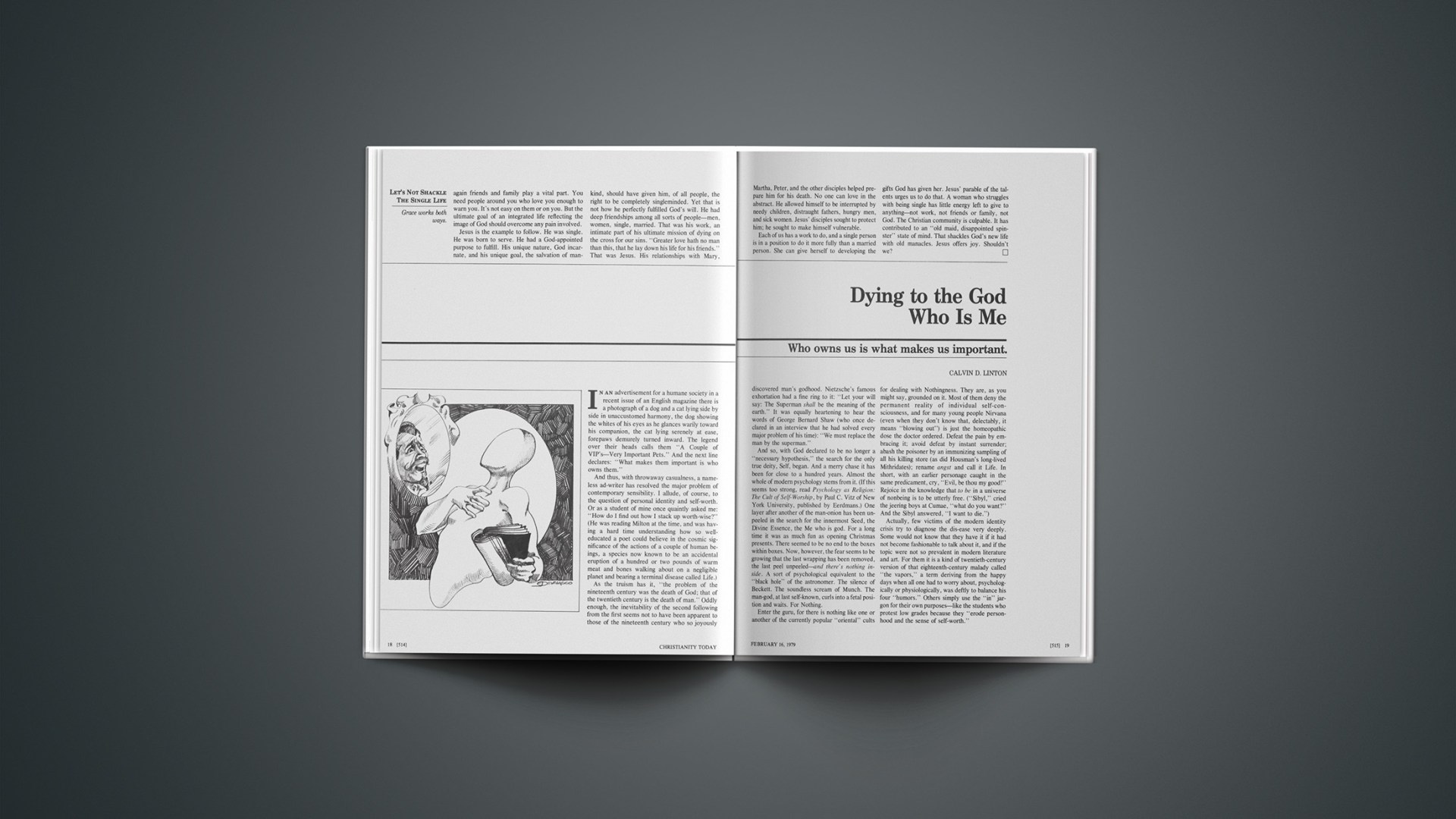
And so, with God declared to be no longer a “necessary hypothesis,” the search for the only true deity, Self, began. And a merry chase it has been for close to a hundred years. Almost the whole of modern psychology stems from it. (If this seems too strong, read Psychology as Religion: The Cult of Self-Worship, by Paul C. Vitz of New York University, published by Eerdmans.) One layer after another of the man-onion has been unpeeled in the search for the innermost Seed, the Divine Essence, the Me who is god. For a long time it was as much fun as opening Christmas presents. There seemed to be no end to the boxes within boxes. Now, however, the fear seems to be growing that the last wrapping has been removed, the last peel unpeeled—and there’s nothing inside. A sort of psychological equivalent to the “black hole” of the astronomer. The silence of Beckett. The soundless scream of Munch. The man-god, at last self-known, curls into a fetal position and waits. For Nothing.

Enter the guru, for there is nothing like one or another of the currently popular “oriental” cults for dealing with Nothingness. They are, as you might say, grounded on it. Most of them deny the permanent reality of individual self-consciousness, and for many young people Nirvana (even when they don’t know that, delectably, it means “blowing out”) is just the homeopathic dose the doctor ordered. Defeat the pain by embracing it; avoid defeat by instant surrender; abash the poisoner by an immunizing sampling of all his killing store (as did Housman’s long-lived Mithridates); rename angst and call it Life. In short, with an earlier personage caught in the same predicament, cry, “Evil, be thou my good!” Rejoice in the knowledge that to be in a universe of nonbeing is to be utterly free. (“Sibyl,” cried the jeering boys at Cumae, “what do you want?” And the Sibyl answered, “I want to die.”)

Actually, few victims of the modern identity crisis try to diagnose the dis-ease very deeply. Some would not know that they have it if it had not become fashionable to talk about it, and if the topic were not so prevalent in modern literature and art. For them it is a kind of twentieth-century version of that eighteenth-century malady called “the vapors,” a term deriving from the happy days when all one had to worry about, psychologically or physiologically, was deftly to balance his four “humors.” Others simply use the “in” jargon for their own purposes—like the students who protest low grades because they “erode personhood and the sense of self-worth.”

For all that, the malady is real and deep-rooted. It is also peculiarly prevalent in our age, as compared to earlier periods in the world’s history. This assertion cannot be proved, I suppose, for the cry “Who am I?” surely has regularly arisen from this planet ever since the primal disaster in Eden; but one simply does not find the query permeating the literature, art, and philosophy of earlier ages as it does ours. Importantly, no doubt, this difference is owing to the fact that personal identity is most readily established and stabilized through relationships, and ours is a time when irrelevance is preached not only as a fact but as essential to individual liberty. A relationship implies duties and restraints; the circle that impinges on another has lost some of its “wholeness.” In earlier ages, a person (even the pagan) related himself to the divine, the supernatural, the transcendant, and it was more self-identifying even to consider yourself the plaything of malign deities than to see yourself as an accidental, irrelevant speck of an aberration called “self-consciousness.” If the gods hate us, at least we must be there. Much better, of course, and much more conducive to a sense of identity, was to be surrounded by the age-old household gods, lares and penates (the Old Testament terraphim), even if the higher gods seemed far off and uncaring. The sight of the sacred, household snake, slithering benignly about the atrium, sipping from his cream bowl, probably helped. Citizenship (how identifying to say, “I am a Roman!”), vocation, and even class distinctions provided the environment in which each individual could see himself as a part of a greater whole, to the enhancement of identity and self-respect.

In the Christian era, the whole religious, social, and political hierarchy provided those definitions, duties, and relationships that fostered self-knowledge. Not to know yourself in relationship to them was to be clearly deficient as a person (Lear’s problem was that “he hath ever but slenderly known himself”), and to learn your place in the cosmic scheme was to gain wisdom. Granted all the imperfections and inequities of the older system of “cosmic order,” it was still better for your self-knowledge and self-esteem than present-day fragmentation and irrelevance. The dash for “total freedom” cannot stop until it tumbles into total formlessness, a universe of the absurd, which is without definable characteristics—including “worth,” “self,” or anything else. The great god Me brings the temple down on his own head.

To speak of this god in the singular is, of course, vastly to misconstrue the faith. It is not a religion of the corporate Human Self (as in Humanism), but of everyone’s own self. It is the ultimate debasement of human religion (using that term as utterly different from God’s revelation of himself in his Word), for it achieves the maximum proliferation of gods, a condition anthropologists usually equate with the most debased societies. No wonder its public worship services are indistinguishable from mob scenes, for each Me-god wants not only to speak but to dominate. Righteous indignation—the most comforting of all emotions in the bosom of one who doubts his own identity and worth—and a momentarily fused hatred of common enemies, real or imagined, may for a time give a facade of unity; but quickly and inevitably are restored (in Milton’s words) “… Tumult and Confusion all imbroiled,/And Discord with a thousand various mouths” (Paradise Lost, II, 966–7). Paradoxically, each Me-god cries for “communication.” “You’re not listening to Me!” they wail. On the contrary. I hear them. To paraphrase Goethe, “One understands their intention—and one is embarrassed.”

Less shattering than the public worship services, but equally pathetic, are the daily, solitary devotions of Me worshipers. “Role playing” is popular and is much encouraged by the psychological fraternity. So is “aggressiveness training” and much demanding of your “rights” (whence derived or by whom authoritatively administered is left a bit vague). “Role playing” is supposed to compensate for the lack of real sense of inner identity, and is given visible support by the wearing of costumes instead of clothing. Training in aggressiveness and in demanding your “rights” usually go together, notably in widely popular academic courses in such things as “Consciousness Raising and Aggressiveness Building.” (“Are you getting all that’s coming to you?” asks an advertising brochure for such a course. I hope that the ultimate answer, by the grace of God, will be No.) All of which fosters the frequent use of the two pronouns that the Me-god loves next to his own name: My and Mine.

liquid

He gathered me from inferno

rolled and pressed

the white hot mass—

smoothed me in sizzling water

stretched and sheared polished me in the flame;

shaped me

with Infinite care

hollowed me

with His breath

to house the Shekinah

and shed glimmerings

of His grace.

ANDREA HERLING

It might be noted in passing that the Me-god has succeeded an earlier and rather more admirable deity, the I-god. This latter at least identified himself with the nominative case, that which acts, and says, “I will not serve!” The other is content with the objective case, that which is merely acted upon, as a jelly fish rhythmically waves its translucent umbrella inward, ingesting whatever happens to be nearby, algae or garbage. To change the figure, the god Me is an empty house, swept and garnished, waiting for eight unwanted tenants to move in (Matt. 12:44–45).

But we have too long neglected our patient cat and dog—whose happy lot, we are told, is to have their identity, value, and security depend on one thing: who owns them.

The least percipient reader will need no help in seeing whither my concluding words will tend. No theme more permeates Scripture than the truth that God is the only creator and owner of the entire universe; and, more wonderfully, that the redeemed are the peculiar possession of God—foreknown, sought, bought, and paid for (“not with corruptible things, as silver and gold … but with the precious blood of Christ …” [1 Peter 1:18–19]). We exist because God thinks of us; we are of value because he loves us.

Even at the mundane level, people generally recognize that it is not self-consciousness which gives us our identity (we may think that we are Napoleon, or an isosceles triangle) but others’ consciousness of us. If we were to move about unseen, unheard, and unnoticed by others, we should doubt our own reality. And it is on the esteem of others that we base our self-esteem. At least we use the principle every time we try to enhance our importance. “I’m sure Mr. Bigboss will see me,” we coolly tell the officious receptionist; “I’m an old friend of his.” It is always more a matter of who knows us, and with what degree of esteem, than of how many know us. Not to be in the mind of anyone, not to be loved by anyone, is (like Mrs. Dalloway in Virginia Woolf’s novel of the same name) to be dead. “I am forgotten as a dead man out of mind,” laments David (Ps. 31:12).

To be in the mind of God is truly to exist. (The most terrible final fate of the lost is to come into the mind of God no more.) But to be loved by God, the sole arbiter of value, is to rise to heights of glory—to be “like unto treasure hid in a field; the which when a man hath found, he hideth, and for joy thereof goeth and selleth all that he hath, and buyeth that field” (Matt. 13:44); or like “one pearl of great price,” to purchase which the merchant “went and sold all that he had, and bought it” (Matt. 13:46)—this is to know a sense of worth as far transcending the wildest babblings of the great-god-Me clan as heaven is from hell.

Presumably, no final, cautionary note need be made at this point, but to be on the safe side it will be made anyway: To believe that God’s knowledge of us is the sole ground of our identity (and that some day we shall know as we are known), to believe that he loves us, and to accept the incalculable value he sets on us is utterly to exclude boasting and totally to abase human pride, not to swell it. The loss to the old Self, that which cried “Glory to Me in the highest” is of not less than everything, for it acknowledges that it has been judged, deemed worthy of death, and slain. “I am crucified with Christ: nevertheless I live; yet not I, but Christ liveth in me: and the life which I now live in the flesh I live by the faith of the Son of God, who loved me, and gave himself for me” (Gal. 2:20).

Happy little cat and dog; happy we. What makes us important is who owns us.
Let’s Not Shackle the Single Life: Grace Goes Both Ways

A single life need not and should not be a makeshift affair.

The warm evening drifted into dusk. My aunt and I went out on the porch after the dinner dishes had been washed and put away, the kitchen floor swept, the fixtures polished. In two months I would begin college. My parents had raised me with the question, What are you going to do? always in front of me. That night even the summer stars seemed to ask it.

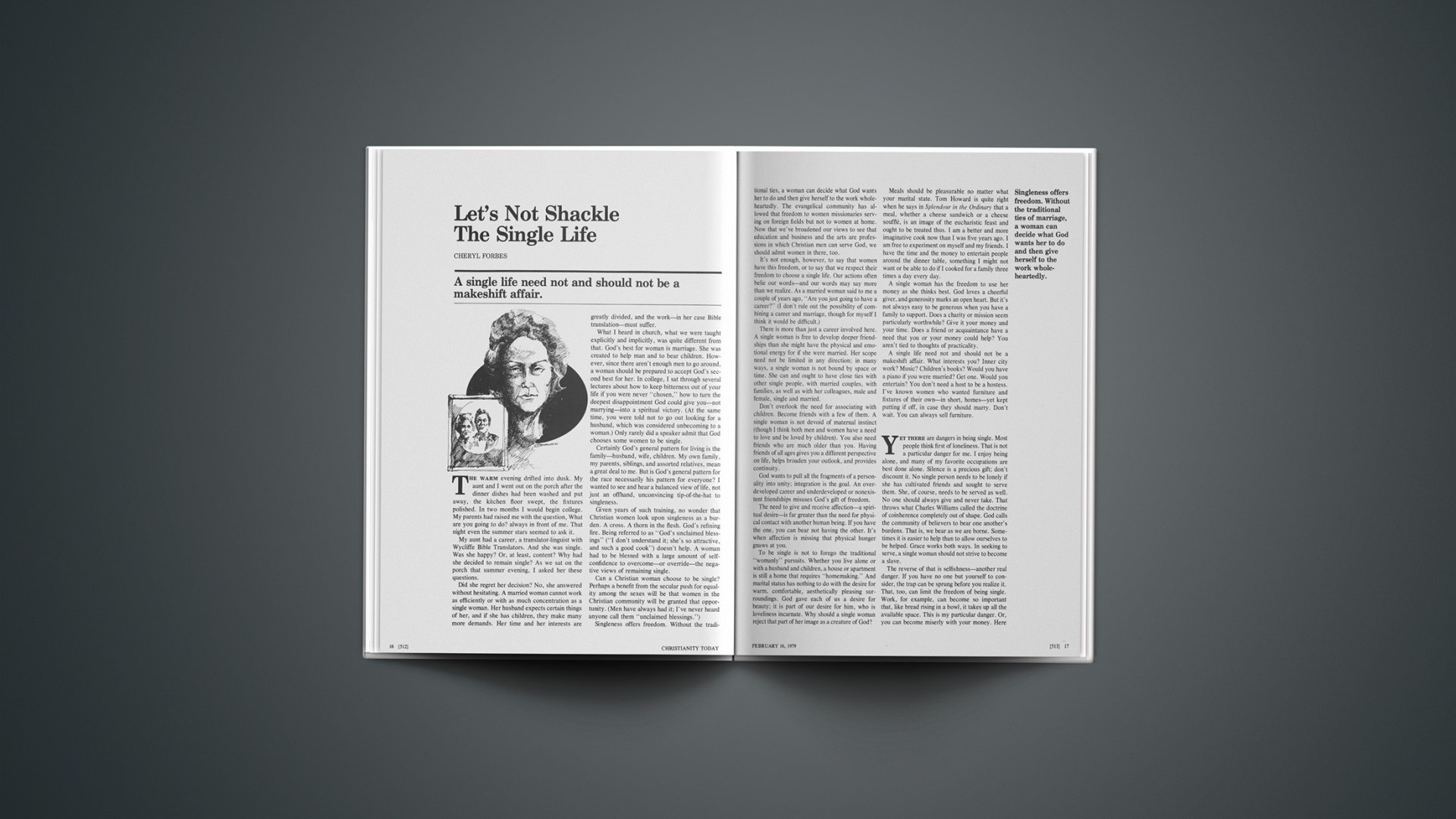
My aunt had a career, a translator-linguist with Wycliffe Bible Translators. And she was single. Was she happy? Or, at least, content? Why had she decided to remain single? As we sat on the porch that summer evening, I asked her these questions.

Did she regret her decision? No, she answered without hesitating. A married woman cannot work as efficiently or with as much concentration as a single woman. Her husband expects certain things of her, and if she has children, they make many more demands. Her time and her interests are greatly divided, and the work—in her case Bible translation—must suffer.

What I heard in church, what we were taught explicitly and implicitly, was quite different from that. God’s best for woman is marriage. She was created to help man and to bear children. However, since there aren’t enough men to go around, a woman should be prepared to accept God’s second best for her. In college, I sat through several lectures about how to keep bitterness out of your life if you were never “chosen,” how to turn the deepest disappointment God could give you—not marrying—into a spiritual victory. (At the same time, you were told not to go out looking for a husband, which was considered unbecoming to a woman.) Only rarely did a speaker admit that God chooses some women to be single.

Certainly God’s general pattern for living is the family—husband, wife, children. My own family, my parents, siblings, and assorted relatives, mean a great deal to me. But is God’s general pattern for the race necessarily his pattern for everyone? I wanted to see and hear a balanced view of life, not just an offhand, unconvincing tip-of-the-hat to singleness.

Given years of such training, no wonder that Christian women look upon singleness as a burden. A cross. A thorn in the flesh. God’s refining fire. Being referred to as “God’s unclaimed blessings” (“I don’t understand it; she’s so attractive, and such a good cook”) doesn’t help. A woman had to be blessed with a large amount of self-confidence to overcome—or override—the negative views of remaining single.

Can a Christian woman choose to be single? Perhaps a benefit from the secular push for equality among the sexes will be that women in the Christian community will be granted that opportunity. (Men have always had it; I’ve never heard anyone call them “unclaimed blessings.”)

Singleness offers freedom. Without the traditional ties, a woman can decide what God wants her to do and then give herself to the work wholeheartedly. The evangelical community has allowed that freedom to women missionaries serving on foreign fields but not to women at home. Now that we’ve broadened our views to see that education and business and the arts are professions in which Christian men can serve God, we should admit women in there, too.

It’s not enough, however, to say that women have this freedom, or to say that we respect their freedom to choose a single life. Our actions often belie our words—and our words may say more than we realize. As a married woman said to me a couple of years ago, “Are you just going to have a career?” (I don’t rule out the possibility of combining a career and marriage, though for myself I think it would be difficult.)

There is more than just a career involved here. A single woman is free to develop deeper friendships than she might have the physical and emotional energy for if she were married. Her scope need not be limited in any direction; in many ways, a single woman is not bound by space or time. She can and ought to have close ties with other single people, with married couples, with families, as well as with her colleagues, male and female, single and married.

Don’t overlook the need for associating with children. Become friends with a few of them. A single woman is not devoid of maternal instinct (though I think both men and women have a need to love and be loved by children). You also need friends who are much older than you. Having friends of all ages gives you a different perspective on life, helps broaden your outlook, and provides continuity.

God wants to pull all the fragments of a personality into unity; integration is the goal. An overdeveloped career and underdeveloped or nonexistent friendships misuses God’s gift of freedom.

The need to give and receive affection—a spiritual desire—is far greater than the need for physical contact with another human being. If you have the one, you can bear not having the other. It’s when affection is missing that physical hunger gnaws at you.

To be single is not to forego the traditional “womanly” pursuits. Whether you live alone or with a husband and children, a house or apartment is still a home that requires “homemaking.” And marital status has nothing to do with the desire for warm, comfortable, aesthetically pleasing surroundings. God gave each of us a desire for beauty; it is part of our desire for him, who is loveliness incarnate. Why should a single woman reject that part of her image as a creature of God?

Meals should be pleasurable no matter what your marital state. Tom Howard is quite right when he says in Splendour in the Ordinary that a meal, whether a cheese sandwich or a cheese soufflé, is an image of the eucharistic feast and ought to be treated thus. I am a better and more imaginative cook now than I was five years ago. I am free to experiment on myself and my friends. I have the time and the money to entertain people around the dinner table, something I might not want or be able to do if I cooked for a family three times a day every day.

A single woman has the freedom to use her money as she thinks best. God loves a cheerful giver, and generosity marks an open heart. But it’s not always easy to be generous when you have a family to support. Does a charity or mission seem particularly worthwhile? Give it your money and your time. Does a friend or acquaintance have a need that you or your money could help? You aren’t tied to thoughts of practicality.

A single life need not and should not be a makeshift affair. What interests you? Inner city work? Music? Children’s books? Would you have a piano if you were married? Get one. Would you entertain? You don’t need a host to be a hostess. I’ve known women who wanted furniture and fixtures of their own—in short, homes—yet kept putting if off, in case they should marry. Don’t wait. You can always sell furniture.

Yet there are dangers in being single. Most people think first of loneliness. That is not a particular danger for me. I enjoy being alone, and many of my favorite occupations are best done alone. Silence is a precious gift; don’t discount it. No single person needs to be lonely if she has cultivated friends and sought to serve them. She, of course, needs to be served as well. No one should always give and never take. That throws what Charles Williams called the doctrine of coinherence completely out of shape. God calls the community of believers to bear one another’s burdens. That is, we bear as we are borne. Sometimes it is easier to help than to allow ourselves to be helped. Grace works both ways. In seeking to serve, a single woman should not strive to become a slave.

The reverse of that is selfishness—another real danger. If you have no one but yourself to consider, the trap can be sprung before you realize it. That, too, can limit the freedom of being single. Work, for example, can become so important that, like bread rising in a bowl, it takes up all the available space. This is my particular danger. Or, you can become miserly with your money. Here again friends and family play a vital part. You need people around you who love you enough to warn you. It’s not easy on them or on you. But the ultimate goal of an integrated life reflecting the image of God should overcome any pain involved.

Jesus is the example to follow. He was single. He was born to serve. He had a God-appointed purpose to fulfill. His unique nature, God incarnate, and his unique goal, the salvation of mankind, should have given him, of all people, the right to be completely singleminded. Yet that is not how he perfectly fulfilled God’s will. He had deep friendships among all sorts of people—men, women, single, married. That was his work, an intimate part of his ultimate mission of dying on the cross for our sins. “Greater love hath no man than this, that he lay down his life for his friends.” That was Jesus. His relationships with Mary, Martha, Peter, and the other disciples helped prepare him for his death. No one can love in the abstract. He allowed himself to be interrupted by needy children, distraught fathers, hungry men, and sick women. Jesus’ disciples sought to protect him; he sought to make himself vulnerable.

Each of us has a work to do, and a single person is in a position to do it more fully than a married person. She can give herself to developing the gifts God has given her. Jesus’ parable of the talents urges us to do that. A woman who struggles with being single has little energy left to give to anything—not work, not friends or family, not God. The Christian community is culpable. It has contributed to an “old maid, disappointed spinster” state of mind. That shackles God’s new life with old manacles. Jesus offers joy. Shouldn’t we?

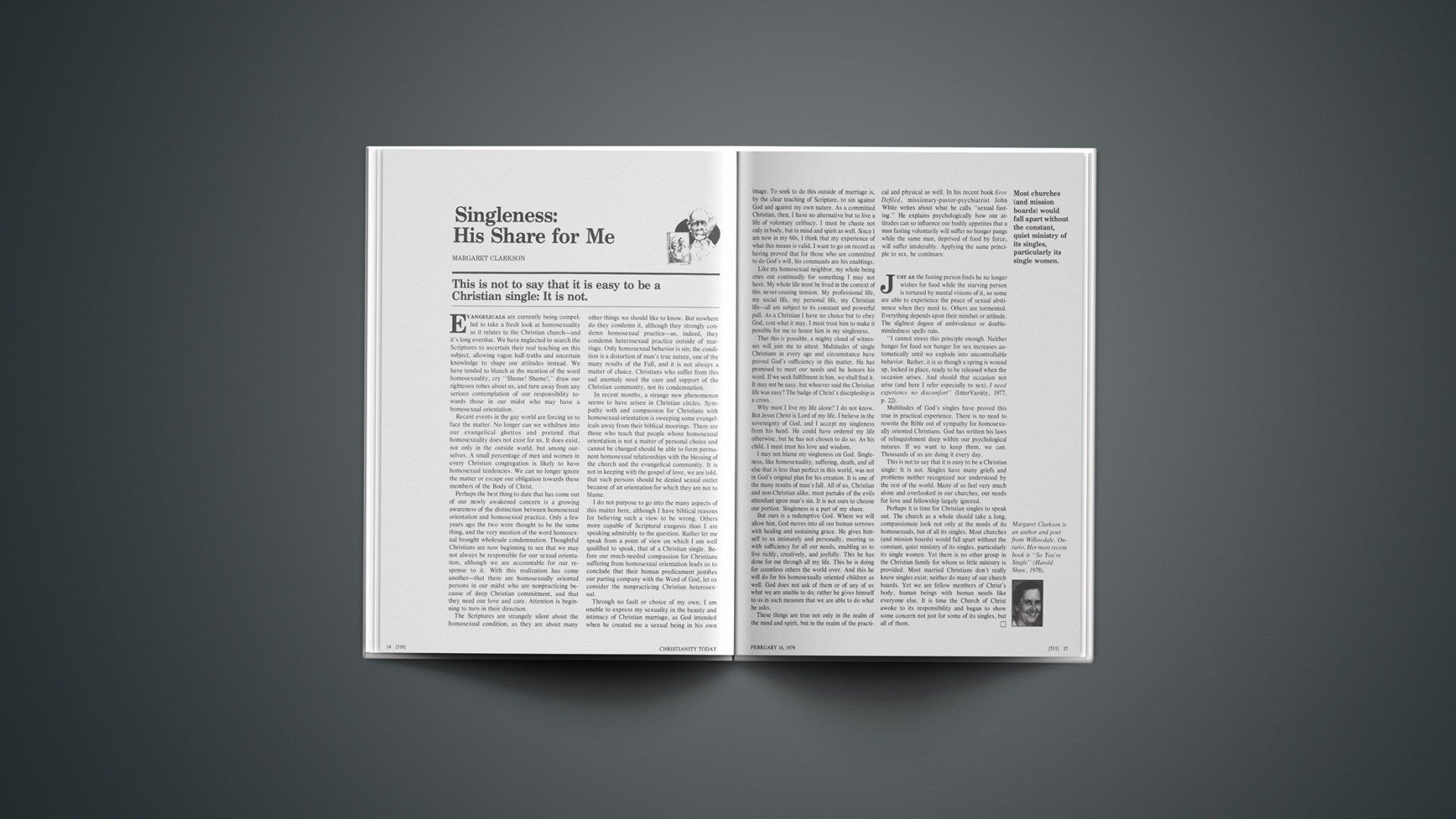
Singleness: His Share for Me: God Is Sufficient

This is not to say that it is easy to be a Christian single: It is not.

Evangelicals are currently being compelled to take a fresh look at homosexuality as it relates to the Christian church—and it’s long overdue. We have neglected to search the Scriptures to ascertain their real teaching on this subject, allowing vague half-truths and uncertain knowledge to shape our attitudes instead. We have tended to blanch at the mention of the word homosexuality, cry “Shame! Shame!,” draw our righteous robes about us, and turn away from any serious contemplation of our responsibility towards those in our midst who may have a homosexual orientation.

Recent events in the gay world are forcing us to face the matter. No longer can we withdraw into our evangelical ghettos and pretend that homosexuality does not exist for us. It does exist, not only in the outside world, but among ourselves. A small percentage of men and women in every Christian congregation is likely to have homosexual tendencies. We can no longer ignore the matter or escape our obligation towards these members of the Body of Christ.

Perhaps the best thing to date that has come out of our newly awakened concern is a growing awareness of the distinction between homosexual orientation and homosexual practice. Only a few years ago the two were thought to be the same thing, and the very mention of the word homosexual brought wholesale condemnation. Thoughtful Christians are now beginning to see that we may not always be responsible for our sexual orientation, although we are accountable for our response to it. With this realization has come another—that there are homosexually oriented persons in our midst who are nonpracticing because of deep Christian commitment, and that they need our love and care. Attention is beginning to turn in their direction.

The Scriptures are strangely silent about the homosexual condition, as they are about many other things we should like to know. But nowhere do they condemn it, although they strongly condemn homosexual practice—as, indeed, they condemn heterosexual practice outside of marriage. Only homosexual behavior is sin; the condition is a distortion of man’s true nature, one of the many results of the Fall, and it is not always a matter of choice. Christians who suffer from this sad anomaly need the care and support of the Christian community, not its condemnation.

In recent months, a strange new phenomenon seems to have arisen in Christian circles. Sympathy with and compassion for Christians with homosexual orientation is sweeping some evangelicals away from their biblical moorings. There are those who teach that people whose homosexual orientation is not a matter of personal choice and cannot be changed should be able to form permanent homosexual relationships with the blessing of the church and the evangelical community. It is not in keeping with the gospel of love, we are told, that such persons should be denied sexual outlet because of an orientation for which they are not to blame.

I do not purpose to go into the many aspects of this matter here, although I have biblical reasons for believing such a view to be wrong. Others more capable of Scriptural exegesis than I are speaking admirably to the question. Rather let me speak from a point of view on which I am well qualified to speak, that of a Christian single. Before our much-needed compassion for Christians suffering from homosexual orientation leads us to conclude that their human predicament justifies our parting company with the Word of God, let us consider the nonpracticing Christian heterosexual.

Through no fault or choice of my own, I am unable to express my sexuality in the beauty and intimacy of Christian marriage, as God intended when he created me a sexual being in his own image. To seek to do this outside of marriage is, by the clear teaching of Scripture, to sin against God and against my own nature. As a committed Christian, then, I have no alternative but to live a life of voluntary celibacy. I must be chaste not only in body, but in mind and spirit as well. Since I am now in my 60s, I think that my experience of what this means is valid. I want to go on record as having proved that for those who are committed to do God’s will, his commands are his enablings.

Like my homosexual neighbor, my whole being cries out continually for something I may not have. My whole life must be lived in the context of this never-ceasing tension. My professional life, my social life, my personal life, my Christian life—all are subject to its constant and powerful pull. As a Christian I have no choice but to obey God, cost what it may. I must trust him to make it possible for me to honor him in my singleness.

That this is possible, a mighty cloud of witnesses will join me to attest. Multitudes of single Christians in every age and circumstance have proved God’s sufficiency in this matter. He has promised to meet our needs and he honors his word. If we seek fulfillment in him, we shall find it. It may not be easy, but whoever said the Christian life was easy? The badge of Christ’s discipleship is a cross.

Why must I live my life alone? I do not know. But Jesus Christ is Lord of my life. I believe in the sovereignty of God, and I accept my singleness from his hand. He could have ordered my life otherwise, but he has not chosen to do so. As his child, I must trust his love and wisdom.

I may not blame my singleness on God. Singleness, like homosexuality, suffering, death, and all else that is less than perfect in this world, was not in God’s original plan for his creation. It is one of the many results of man’s fall. All of us, Christian and non-Christian alike, must partake of the evils attendant upon man’s sin. It is not ours to choose our portion. Singleness is a part of my share.

But ours is a redemptive God. Where we will allow him, God moves into all our human sorrows with healing and sustaining grace. He gives himself to us intimately and personally, meeting us with sufficiency for all our needs, enabling us to live richly, creatively, and joyfully. This he has done for me through all my life. This he is doing for countless others the world over. And this he will do for his homosexually oriented children as well. God does not ask of them or of any of us what we are unable to do; rather he gives himself to us in such measure that we are able to do what he asks.

These things are true not only in the realm of the mind and spirit, but in the realm of the practical and physical as well. In his recent book Eros Defiled, missionary-pastor-psychiatrist John White writes about what he calls “sexual fasting.” He explains psychologically how our attitudes can so influence our bodily appetites that a man fasting voluntarily will suffer no hunger pangs while the same man, deprived of food by force, will suffer intolerably. Applying the same principle to sex, he continues:

Just as the fasting person finds he no longer wishes for food while the starving person is tortured by mental visions of it, so some are able to experience the peace of sexual abstinence when they need to. Others are tormented. Everything depends upon their mindset or attitude. The slightest degree of ambivalence or double-mindedness spells ruin.

“I cannot stress this principle enough. Neither hunger for food nor hunger for sex increases automatically until we explode into uncontrollable behavior. Rather, it is as though a spring is wound up, locked in place, ready to be released when the occasion arises. And should that occasion not arise (and here I refer especially to sex), I need experience no discomfort” (InterVarsity, 1977, p. 22).

Multitudes of God’s singles have proved this true in practical experience. There is no need to rewrite the Bible out of sympathy for homosexually oriented Christians. God has written his laws of relinquishment deep within our psychological natures. If we want to keep them, we can. Thousands of us are doing it every day.

This is not to say that it is easy to be a Christian single: It is not. Singles have many griefs and problems neither recognized nor understood by the rest of the world. Many of us feel very much alone and overlooked in our churches, our needs for love and fellowship largely ignored.

Perhaps it is time for Christian singles to speak out. The church as a whole should take a long, compassionate look not only at the needs of its homosexuals, but of all its singles. Most churches (and mission boards) would fall apart without the constant, quiet ministry of its singles, particularly its single women. Yet there is no other group in the Christian family for whom so little ministry is provided. Most married Christians don’t really know singles exist; neither do many of our church boards. Yet we are fellow members of Christ’s body, human beings with human needs like everyone else. It is time the Church of Christ awoke to its responsibility and began to show some concern not just for some of its singles, but all of them.

G. Douglas Young is founder and president of the Institute of Holy Land Studies in Jerusalem. He has lived there since 1963.

Ideas

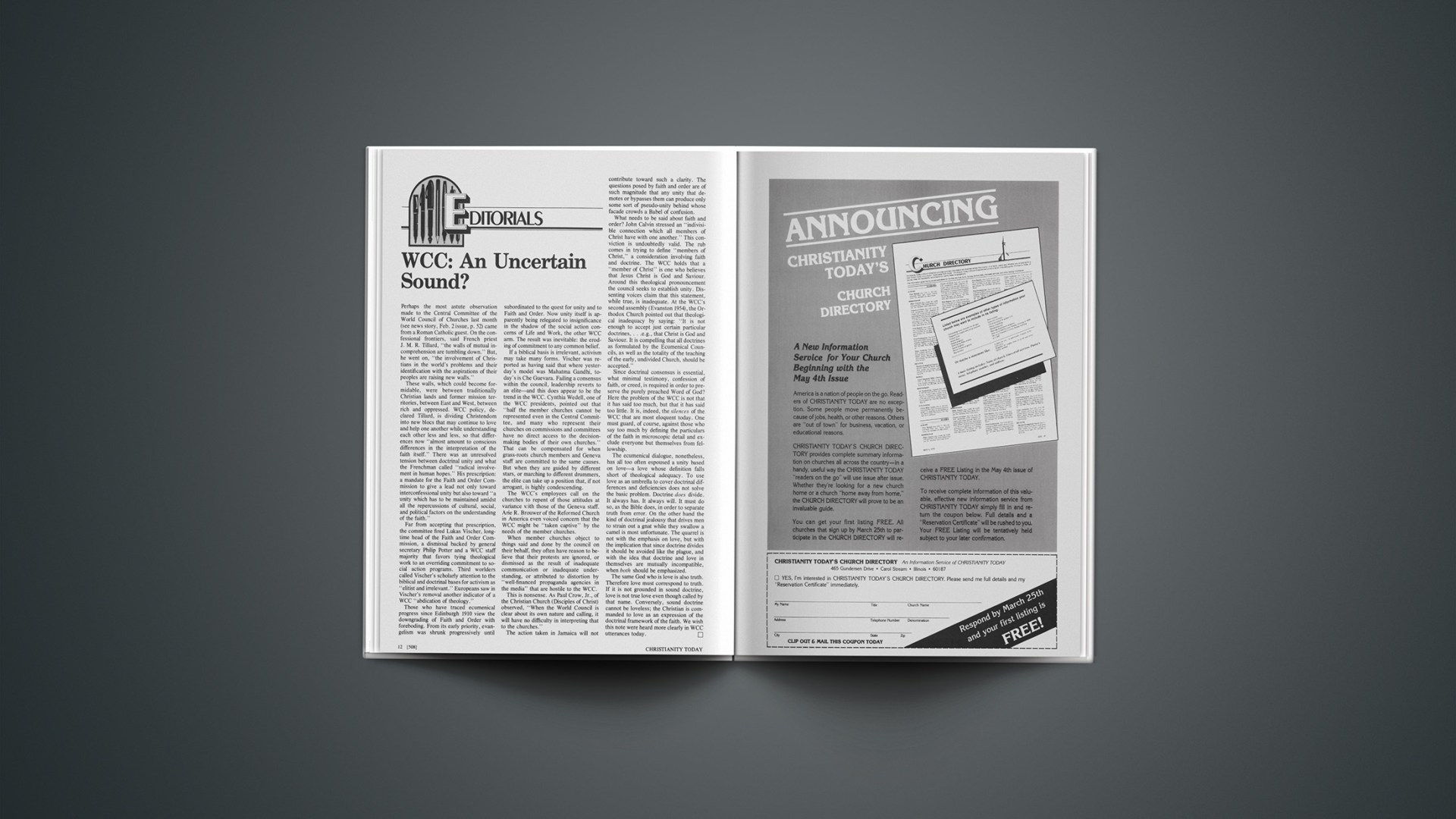
WCC: An Uncertain Sound?

Perhaps the most astute observation made to the Central Committee of the World Council of Churches last month (see news story, Feb. 2 issue, p. 52) came from a Roman Catholic guest. On the confessional frontiers, said French priest J. M. R. Tillard, “the walls of mutual incomprehension are tumbling down.” But, he went on, “the involvement of Christians in the world’s problems and their identification with the aspirations of their peoples are raising new walls.”

These walls, which could become formidable, were between traditionally Christian lands and former mission territories, between East and West, between rich and oppressed. WCC policy, declared Tillard, is dividing Christendom into new blocs that may continue to love and help one another while understanding each other less and less, so that differences now “almost amount to conscious differences in the interpretation of the faith itself.” There was an unresolved tension between doctrinal unity and what the Frenchman called “radical involvement in human hopes.” His prescription: a mandate for the Faith and Order Commission to give a lead not only toward interconfessional unity but also toward “a unity which has to be maintained amidst all the repercussions of cultural, social, and political factors on the understanding of the faith.”

Far from accepting that prescription, the committee fired Lukas Vischer, long-time head of the Faith and Order Commission, a dismissal backed by general secretary Philip Potter and a WCC staff majority that favors tying theological work to an overriding commitment to social action programs. Third worlders called Vischer’s scholarly attention to the biblical and doctrinal bases for activism as “elitist and irrelevant.” Europeans saw in Vischer’s removal another indicator of a WCC “abdication of theology.”

Those who have traced ecumenical progress since Edinburgh 1910 view the downgrading of Faith and Order with foreboding. From its early priority, evangelism was shrunk progressively until subordinated to the quest for unity and to Faith and Order. Now unity itself is apparently being relegated to insignificance in the shadow of the social action concerns of Life and Work, the other WCC arm. The result was inevitable: the eroding of commitment to any common belief.

If a biblical basis is irrelevant, activism may take many forms. Vischer was reported as having said that where yesterday’s model was Mahatma Gandhi, today’s is Che Guevara. Failing a consensus within the council, leadership reverts to an elite—and this does appear to be the trend in the WCC. Cynthia Wedell, one of the WCC presidents, pointed out that “half the member churches cannot be represented even in the Central Committee, and many who represent their churches on commissions and committees have no direct access to the decision-making bodies of their own churches.” That can be compensated for when grass-roots church members and Geneva staff are committed to the same causes. But when they are guided by different stars, or marching to different drummers, the elite can take up a position that, if not arrogant, is highly condescending.

The WCC’s employees call on the churches to repent of those attitudes at variance with those of the Geneva staff. Arie R. Brouwer of the Reformed Church in America even voiced concern that the WCC might be “taken captive” by the needs of the member churches.

When member churches object to things said and done by the council on their behalf, they often have reason to believe that their protests are ignored, or dismissed as the result of inadequate communication or inadequate understanding, or attributed to distortion by “well-financed propaganda agencies in the media” that are hostile to the WCC.

This is nonsense. As Paul Crow, Jr., of the Christian Church (Disciples of Christ) observed, “When the World Council is clear about its own nature and calling, it will have no difficulty in interpreting that to the churches.”

The action taken in Jamaica will not contribute toward such a clarity. The questions posed by faith and order are of such magnitude that any unity that demotes or bypasses them can produce only some sort of pseudo-unity behind whose facade crowds a Babel of confusion.

What needs to be said about faith and order? John Calvin stressed an “indivisible connection which all members of Christ have with one another.” This conviction is undoubtedly valid. The rub comes in trying to define “members of Christ,” a consideration involving faith and doctrine. The WCC holds that a “member of Christ” is one who believes that Jesus Christ is God and Saviour. Around this theological pronouncement the council seeks to establish unity. Dissenting voices claim that this statement, while true, is inadequate. At the WCC’s second assembly (Evanston 1954), the Orthodox Church pointed out that theological inadequacy by saying: “It is not enough to accept just certain particular doctrines, … e.g., that Christ is God and Saviour. It is compelling that all doctrines as formulated by the Ecumenical Councils, as well as the totality of the teaching of the early, undivided Church, should be accepted.”

Since doctrinal consensus is essential, what minimal testimony, confession of faith, or creed, is required in order to preserve the purely preached Word of God? Here the problem of the WCC is not that it has said too much, but that it has said too little. It is, indeed, the silences of the WCC that are most eloquent today. One must guard, of course, against those who say too much by defining the particulars of the faith in microscopic detail and exclude everyone but themselves from fellowship.

The ecumenical dialogue, nonetheless, has all too often espoused a unity based on love—a love whose definition falls short of theological adequacy. To use love as an umbrella to cover doctrinal differences and deficiencies does not solve the basic problem. Doctrine does divide. It always has. It always will. It must do so, as the Bible does, in order to separate truth from error. On the other hand the kind of doctrinal jealousy that drives men to strain out a gnat while they swallow a camel is most unfortunate. The quarrel is not with the emphasis on love, but with the implication that since doctrine divides it should be avoided like the plague, and with the idea that doctrine and love in themselves are mutually incompatible, when both should be emphasized.

The same God who is love is also truth. Therefore love must correspond to truth. If it is not grounded in sound doctrine, love is not true love even though called by that name. Conversely, sound doctrine cannot be loveless; the Christian is commanded to love as an expression of the doctrinal framework of the faith. We wish this note were heard more clearly in WCC utterances today.

Eutychus and His Kin: February 2, 2016

Hello. You have reached the office of the Center for Anytimechurching. All our lines are busy right now, but if you would care to hold, your call will be taken in turn.

We at the Center offer a wide variety of modern services not available at the local community church. The staff gears the programs for specific, homogeneous groups, but we also offer a mixed-group option. Every night of the week we have scheduled small group meetings, house Bible studies, or such fellowship parties as gourmet dinners or simple-lifestyle-arts-and-crafts get togethers. We run a school that goes from kindergarten through college, and our continuing education department offers courses ranging from how to grow house plants to conversational Chinese. We even teach lacquering.

When you join our center, you receive a plastic yeschurch card embossed with your personal church number. We enter it in our computer, which provides a printout profile of you and the programs for which you are registered. Registration must be done with this card. And as you enter the sanctuary you must insert the card in the time-saving worship terminal located in the vestibule. At that time you punch in the amount of your offering.

This card will also entitle you to use our new drive-up sermon service. If you miss one of our six, streamlined Sunday morning services, merely drive up to our video window, insert your card, and the small screen will show you the service you missed. We also have a twenty-four-hour pastoral counseling center. By using your card at the small mini-terminal and pushing the appropriate problem button—for example, alcoholism, marital problems, depression—you will receive an hour-long cassette counseling session. The counselor on the tape will insert encouraging phrases and understanding grunts and hums at scientifically determined places during the … Hello. This is 7499083×R2D2. May I help you?

EUTYCHUS IX

Danger Foreseen

Even after carefully considering Mr. Humphries’ article “Is Psychotherapy Unbiblical?” (Jan. 19), I still have a fundamental objection to psychotherapy. I believe it is one of our major functions as reborn persons to confront the world in love with our godly morality. The danger I see is using the process of psychotherapy to change behavior, not the moral standards of God. Appealing to the conscious mind of the “patient” will not result in conviction and change, because the mind is in itself fallen. Hebrews 4:12 says, “The Word of God is living and active … it judges the thoughts and attitudes of the heart.”

Psychotherapy would only have value then, to help us understand the processes by which men interact. But divorced from any absolute, it becomes merely one man’s soul dealing with another’s, not the Spirit of God dealing through any believer to those around him.

JIM AND JANICE WALLIS

St. Louis, Mo.

Uplifting Depression

Ironically, I found Virginia Stem Owens’s article on depression to be very uplifting. “Naming the Darkness” (Jan. 19) is timely in light of the widely held belief that all moods of depression are of Satan and that upon conversion, no Christian need ever fall from the pinnacle of joy. If this view is used as a witnessing device, imagine the new Christian’s confusion when he awakens to an unexplainable slump. I believe that real “victorious living” is that which faces the Slough of Despond head-on, and seeks to love God more desperately. Thank you for printing such a satisfying article.

GARY L. RODDY

Omaha, Neb.

Exceeding the Normal

Whenever the name of Thomas Howard appears on an article the reader knows that there will be presented good ideas well expressed. “The Touchstone” (Jan. 5) however, exceeded Dr. Howard’s usual high standard. In reading it, the realization came that here is a mind of much the same order as that of C. S. Lewis. Let us have more!

THE REV. JAMES MILLER

Holy Orthodox Church

Lexington, Ky.

I very much appreciate Thomas Howard for his thoughtful iconoclasm. I find him to be largely on-target. I have some difficulty, however, with his elevation of the structured over the unstructured in human life. To restate his own metaphor, he makes it abundantly clear that for him, structure is the paté of life, while the lack thereof is merely pubulum. It’s an unfortunate choice of words, for one must certainly question the assumption that paté is always preferable to pabulum. The former is certainly more fattening and esoteric than the latter, but is it better for you? Everyone knows by now that Tom Howard likes structure and ritual. He has provided a needed corrective for the “do-it-yourself’ mentality that sometimes pervades the contemporary church. However, let’s not let him rob the faith entirely of its spontaneous and intuitive dimensions. If unstructured freedom necessarily degenerates into chaos, so also must we realize that structure itself easily becomes a god that may be worshiped in place of the one true God, in whose nature is expressed that wondrous combination of spontaneity and structure.

PHILIP E. HAKANSON

Kenmore, N.Y.

Thank you for the entire January 5 issue, and particularly “The Touchstone.” I have often felt that Christians have been carried away either by wholehearted acceptance of the new and trendy or close-minded rejection. We certainly do need to remain skeptical, yes, even discriminating, toward any philosophy or movement which contradicts the clear teaching of Scripture. Thank God he still raises up his voices crying in the wilderness as Thomas Howard: “Don’t be too hasty. Accept only the new which opens and fulfills the old.”

THE REV. MICHAEL DOMINICK

Door Village United Methodist Church

La Porte, Ind.

Mission Methods

Recently, I have noticed an increase of mission related articles. One such article, “Evangelizing Muslims: Are There Ways?” (Jan. 5), is an exceptionally well-written text. I rejoice to see traditional methodology being replaced by the indigenous culture while retaining biblical truth. I am optimistically looking forward to other missions making use of this method that Phil Parshall has introduced to us. Thank you CHRISTIANITY TODAY for printing it. I am praying that God will lead you to publish the articles that we need to help us grow spiritually.

WALLACE MORTON

Franklinville, N.C.

Appealing Menu

May I say amen to your editorial “What’s on the Menu?” (Jan. 5). The lead article “Church Priorities for ’79” has opened wide the door to the real Kingdom if your readers do not object too strenuously. The follow-up action question may be “How shall the Body of Christ be led into battle against the foe: How shall the church be tested?” In trying to summarize the opinions obtained by John Maust I found denominational labels easily applied.… In the thirty-six responses I hear a confessional cry not only for themselves but also for ourselves as well. Is this not mute evidence that every pastor, seminary teacher, Bible teacher, professional, and lay person alike is at least a part of the problem? Who can show church members how to live an active role for Christ? How we deal with this can determine how much impact we can have on diminishing the … problem. Christian Growth

JOHN MCINTIRE

Winchester, Va.

Cross Section Questioned

It seems somewhat inconsistent that the “cross section of opinion” news assistant John Maust presented in “Church Priorities for ’79” (Jan. 5) included only three responses from women out of a total of thirty-six. If, indeed, Maust sought response from “persons at all levels of church ministry,” how could he have missed a significant number of women in ministry and Christian publishing? World-Wide Missions

GAIL A. HOWARD

Pasadena, Calif.

A Matter Of Rebellion

Clark H. Pinnock’s article on theological method was very informative (“An Evangelical Theology: Conservative and Contemporary,” Jan. 5). However, he fails to see the problem of both liberalism and formalism as one of sinful rebellion rather than just one of emphasis, and therefore can say nothing about their sinful presuppositions. He then is in the unsavory position of trying to “balance” two anti-Christian principles to form a Christian perspective. The remedy for sin is found only in the gospel. The “creative proposals” we should seek is the call for repentance.

THOMAS E. CAMPBELL

Cape Elizabeth, Me.

Preparation For Death

I am writing regarding your advertisement in the December 15 issue for the book. Beyond Death’s Door. Such statements as “All through recorded history people have predicted life after death. But only now with modern resuscitation methods are we beginning to see beyond death’s door” (from the book’s front cover), and “Best seller with new evidence of the existence of heaven and hell …” (from the advertisement) certainly don’t indicate much confidence in the Bible’s authority on such matters. Christ had much to say regarding eternity. The vivid account of Lazarus and the rich man, Christ’s reply to the Sadducee’s “marriage trap” (Luke 20:34–38), what Christ is preparing for us in John 14, and the judgment that awaits those who ignore God (Matt. 25:41–46) explain to us all we need to know to prepare ourselves and help others prepare for death and judgment (Heb. 9:27). And yet Christ never used the experiences of those he brought back to life to validate his teaching. The reason he didn’t seems apparent in Luke 16:31: “If they hear not Moses and the prophets, neither will they be persuaded, though one rose from the dead.” … Resorting to subjective, out-of-body experiences puts us on … unbiblical ground.

JIM MOFFIT

Milton, Fla.

Rooftop Quality

I have never responded to a periodical before, but I feel compelled to. Dr. Koop’s article on medical ethics (“Medical Ethics and the Stewardship of Life,” Dec. 15) was extremely helpful and well-timed, as I am just now “wading through” my first year of medical school. Even though I was raised in a Christian environment, I am beginning to see how easily the “prevailing values” concerning issues such as abortion, birth control, and euthanasia can be inculcated into my thinking. Koop’s comments were so specific and practical. I only wish I had an evening with him for further discussion. To say these areas are not emphasized in the standard medical school curriculum is an understatement.… There was barely time to ask the right questions, much less ponder the answers.

MARK C. HOLLAND

Davis, Calif.

Dr. Koop’s fine Christian opinion on abortion and medical ethics should be shouted from the rooftops!

JACK R. COX, M.D.

Teague, Tex.

Complex Systems

I appreciated Dr. Paul Brand’s reminder of the wonderful complexity of the natural system—that the creative process has to be considered “difficult” (“God’s Astounding Laws of Nature,” Dec. 1). By viewing the natural world as something that came about “by a wave of a magic wand” I was failing to appreciate the greatness of God’s power. However, I cringed a bit at some of the words Dr. Brand used in describing God’s conception of creation. Though he convincingly points out that creation was not a thoughtless act on God’s part, his use of the words “planning” and “forethought” makes God’s thought appear to be a process. Though creation itself is obviously a process, its conception in God’s eternally all-knowing mind could not have been. Here I feel Dr. Brand’s concept of God is too anthropomorphic.

VIRGINIA JAQUES

Seebe, Alberta

Editor’s Note from February 16, 1979

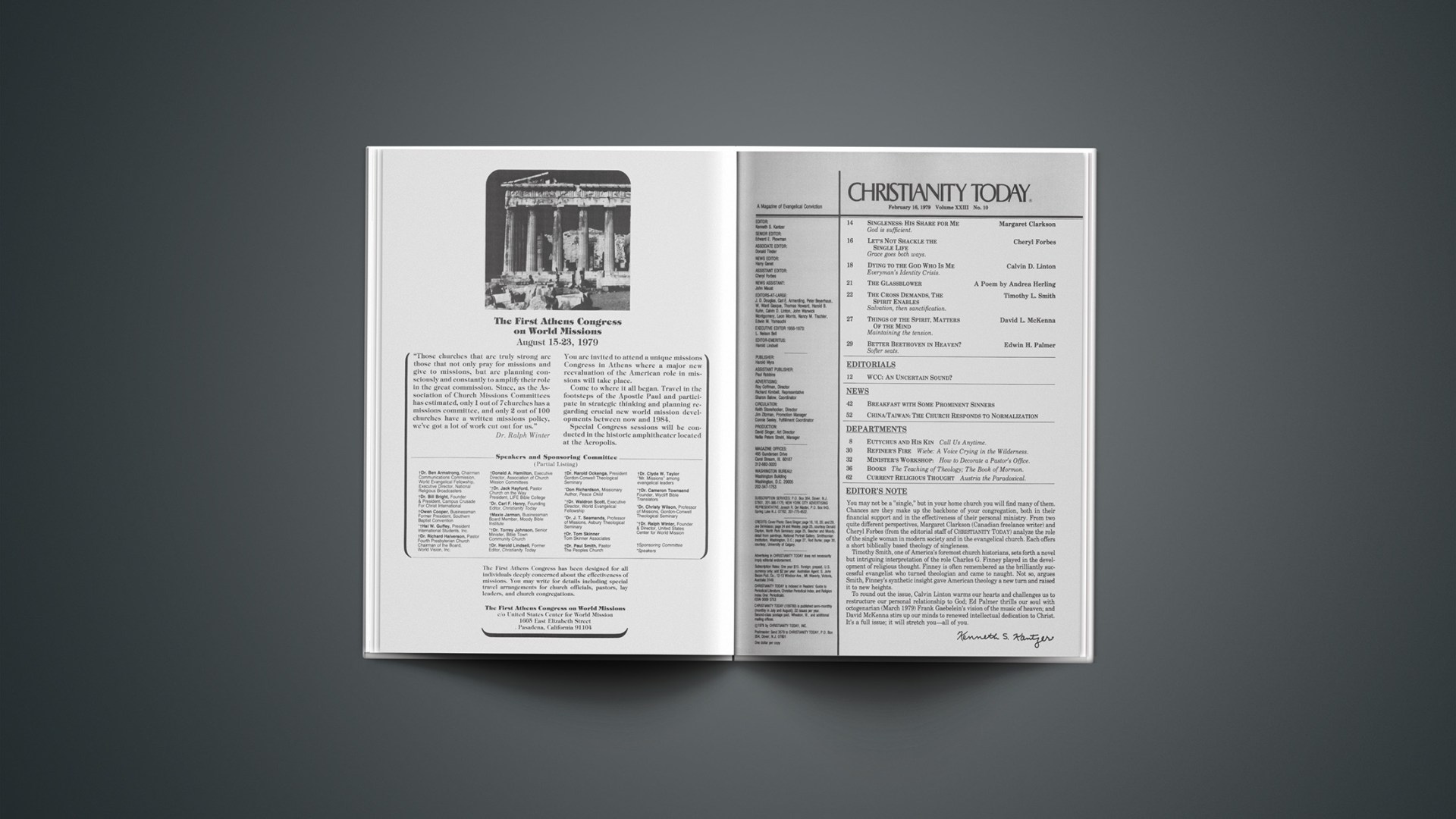
You may not be a “single,” but in your home church you will find many of them. Chances are they make up the backbone of your congregation, both in their financial support and in the effectiveness of their personal ministry. From two quite different perspectives, Margaret Clarkson (Canadian freelance writer) and Cheryl Forbes (from the editorial staff of CHRISTIANITY TODAY) analyze the role of the single woman in modern society and in the evangelical church. Each offers a short biblically based theology of singleness.

Timothy Smith, one of America’s foremost church historians, sets forth a novel but intriguing interpretation of the role Charles G. Finney played in the development of religious thought. Finney is often remembered as the brilliantly successful evangelist who turned theologian and came to naught. Not so, argues Smith, Finney’s synthetic insight gave American theology a new turn and raised it to new heights.

To round out the issue, Calvin Linton warms our hearts and challenges us to restructure our personal relationship to God; Ed Palmer thrills our soul with octogenarian (March 1979) Frank Gaebelein’s vision of the music of heaven; and David McKenna stirs up our minds to renewed intellectual dedication to Christ. It’s a full issue; it will stretch you—all of you.

Editor’s Note from February 02, 1979

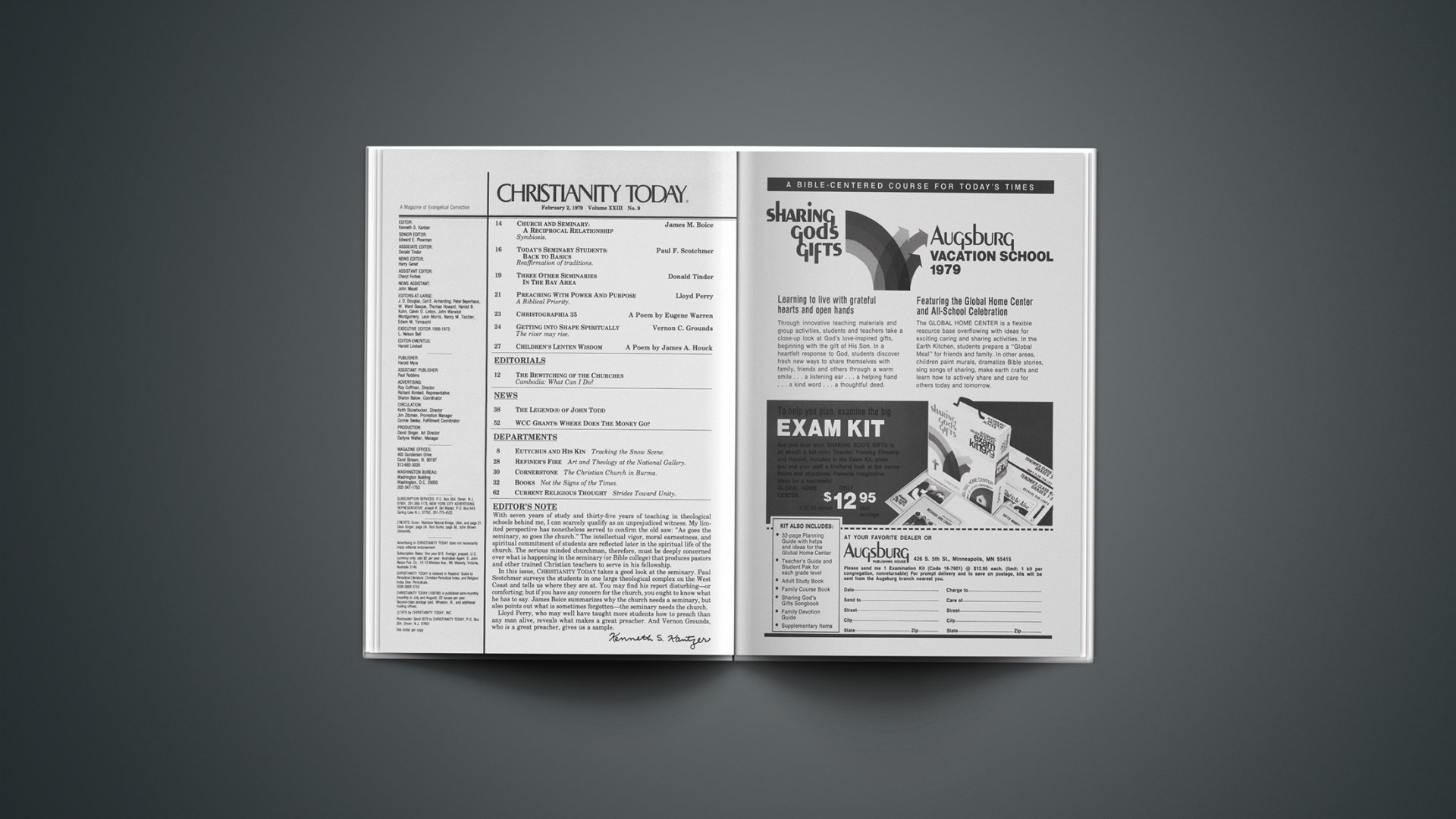
‘As goes the seminary, so goes the church.’

With seven years of study and thirty-five years of teaching in theological schools behind me, I can scarcely qualify as an unprejudiced witness. My limited perspective has nonetheless served to confirm the old saw: “As goes the seminary, so goes the church.” The intellectual vigor, moral earnestness, and spiritual commitment of students are reflected later in the spiritual life of the church. The serious minded churchman, therefore, must be deeply concerned over what is happening in the seminary (or Bible college) that produces pastors and other trained Christian teachers to serve in his fellowship.

In this issue, CHRISTIANITY TODAY takes a good look at the seminary. Paul Scotchmer surveys the students in one large theological complex on the West Coast and tells us where they are at. You may find his report disturbing—or comforting; but if you have any concern for the church, you ought to know what he has to say. James Boice summarizes why the church needs a seminary, but also points out what is sometimes forgotten—the seminary needs the church.

Lloyd Perry, who may well have taught more students how to preach than any man alive, reveals what makes a great preacher. And Vernon Grounds, who is a great preacher, gives us a sample.

News

Getting into Shape Spiritually

If you find it exhausting to race against men on foot, how will you compete against horses?

May I offer some advice? Get better acquainted with Jeremiah. We know him superficially from the preaching we have heard and the reading we have done. But I am urging that we come to know as intimately as possible this great prophet. Why? From him we can learn how to steadfastly serve God in a time of crisis, in a time of decadence and corruption, in a time of greed and stupidity, in a time when violence and vice seem to undermine society everywhere.

A priest of acute sensitivity and probing insight, Jeremiah started his public ministry under King Josiah, who was killed in battle with Egypt at Meggido. Four weak rulers came after him. Jeremiah served God during the darkest period of his people’s history—a period of degradation and tumult. The policies pursued by the government were woefully shortsighted and absolutely contrary to God’s will. The people zealously practiced their religion, which was little more than empty ritual. Paganism flourished. Egypt and then Babylon threatened to, and finally did, destroy the peace and security of Israel. Like a frail canoe caught in rock-studded rapids, the nation plunged headlong into defeat, and exile. Jeremiah in the midst of the tumult faithfully delivered Jehovah’s repeated warnings and entreaties.

The Good Shepherd suffered. Why should we be lambs who are petted and protected?

But who listened as he pleaded and denounced and wept? Only a handful of people who feared God. Jeremiah was mocked, reviled, hated, and imprisoned. After the Babylonians smashed Jehoiakim, fellow Jews dragged him to Egypt. Undaunted, he stubbornly served God.

Chapter twelve describes the earlier days of the prophet’s ministry. Hated and hounded by angry neighbors in his own village, young Jeremiah became wary, discouraged, and bewildered. He turned to God for answers.

You have right on your side, Yahweh,

When I complain about you,

But I would like to debate a point of justice with you.

Why is it that the wicked live so prosperously?

Why do scroundrels enjoy peace?

You plant them; they take root.

You are always on other lips, yet so far from their hearts (Jer. 12:1–2, JB).

God did not answer the prophet’s questions. Instead God responded with his own questions: If you find it exhausting to race against men on foot, how will you compete against horses? If you are not secure in a peaceful country, how will you manage in the thickets of the Jordan?

The thrust here is sharp and plain. God is saying to Jeremiah, “Yes, your service so far has been tough and tiring, but service that lies before you will prove far tougher. So get ready to run as you have never run before. Get ready to fight with all your strength. The river is rising.”

That is God’s word to us today. Get ready. Unlike Jeremiah, most of us have not faced conflict, loneliness, heartache, and suffering. Rather, our families praise us, our friends applaud us, and our churches admire us. Occasionally, tough problems trouble us. Yet, what are these compared with the suffering of Jeremiah? We need to hear and heed God’s warning to young Jeremiah. A faithful witness for Jesus Christ may sooner or later plunge us into situations so tough and tiring that they will tax our resources to the breaking-point. Get ready. The river may rise.

What can we do? The anecdote about a young man who worked for Lord Joseph Duveen suggests an answer. Duveen, American head of the art firm that bore his name, planned in 1915 to send one of his experts to England to examine some ancient pottery. He booked passage on the Lusitania. Then the German Embassy issued a warning that the liner might be torpedoed. Duveen wanted to call off the trip: “I can’t take the risk of your being killed,” he said to his young expert.

“Don’t worry,” the man replied. “I’m a strong swimmer, and when I read what was happening in the Atlantic, I began hardening myself by spending time every day in a tub of ice water. At first I could stand it only a few minutes, but this morning I stayed in that tub nearly two hours.”

Naturally, Duveen laughed. It sounded preposterous. But his expert sailed; the Lusitania was torpedoed. The young man was rescued after nearly five hours in the chilly ocean, still in excellent condition. Just as he did, we need to condition ourselves. We must persistently practice devotional discipline and develop a biblical mindset.

On the wall of my office hangs a portrait of Deitrich Bonhoeffer. It challenges, rebukes, and inspires me. Bonhoeffer was a brilliant man who received his Ph.D. at 21. He could have spent his years in ease and distinction as a professor, but the river was rising. The Nazi regime under Adolph Hitler had been attempting to co-opt the church. Many German Christians, however, among them Karl Barth, refused to acknowledge any spiritual or ecclesiastical authority except that of Jesus Christ. So the battle was joined.

In 1935, Bonhoeffer accepted the task of creating and directing a seminar at Finkenwalde, far out in the country. He and his students followed a strict regimen of devotional discipline without any relaxation of scholarship. What was it like?

“The day began with half an hour of common prayer: antiphonal repetition of the psalms, lessons from the Old and New Testaments, two chorales, one Gregorian chant and finally an extempore prayer. Breakfast followed, and after breakfast the students found they were to meditate for half an hour in silence upon a passage of Scripture, which was set for the whole week. Then followed a morning of study: homiletics, exegesis and the groundwork of dogmatics. Then came lunch, recreation, further study and after supper an evening of relaxation, music, reading aloud or games. The day ended with a further half-hour of common prayer, after which complete silence was required until breakfast the next morning (The Life and Death of Dietrich Bonhoeffer by Mary Bosenquet, Hodder and Stoughton, 1968, p. 152).

Why this stress on a Bible-centered meditation, which smacked of pietism and fanaticism? Even Karl Barth objected that such discipline suggested—as he put it—“the eros and pathos of the cloister.” Bonhoeffer’s student and friend Eberhard Bethge explains, in part paraphrasing his beloved mentor:

“Why do I meditate? Because I am a Christian, and therefore every day is a day lost for me in which I have not penetrated deeper into the understanding of the word of God in Scripture.… Because I need a firm discipline of prayer. We like to pray according to our mood, short, long or not at all. That is self-will. Prayer is not a free offering to God, but a service which it is our duty to render, and which he requires.… How do I meditate? There is free meditation, and meditation on the Scriptures. For the firm establishment of our prayer, we recommend meditation on Scripture. And also for the disciplines of our thoughts. In addition the knowledge of being united with others who are meditating on the same text, will endear to us the scriptural meditation” (pp. 153–158). Bethge continues by paraphrasing a letter written by Bonhoeffer that describes the devotional process:

“We begin our meditation with a prayer for the Holy Spirit, and with a prayer for recollection for ourselves and for all those whom we know to be also meditating. Then we turn to the text. By the end of our meditation we should like to be at the point at which we can give thanks out of a full heart. What text, and for how long the same text? It has proved fruitful to meditate for a week on a single text of from ten to fifteen verses. It is not a good plan to meditate on a new text every day, as we are not always equally receptive, and the texts are generally much too large.… The time for meditation is in the morning before the beginning of work. Half an hour will be the shortest time which a meditation requires. Complete outward quiet and resolution not to be distracted by anything, however important, are necessary foundations …” (p. 158).

Bonhoeffer inculcated that practice into the students at Finkenwalde. He personally and steadfastly maintained it himself. And all the while the river was rising.

Bonhoeffer left Finkenwalde. He abandoned pacifism and joined the unsuccessful conspiracy to kill Adolph Hitler. Arrested, he spent months and months in prison under threat of execution. Even in prison he maintained his devotional regimen. With dark waters rising around him, Bonhoeffer kept his spiritual footing. Payne Best, an English officer captured by the Nazis and imprisoned in the same jail as Bonhoeffer, had opportunity to observe him during the last days of his life. Best writes this tribute: “Bonhoeffer was different—just calm and normal, seemingly perfectly at his ease … his soul really shone in the dark desperation of our prison.… He was one of the very few men I’ve ever met to whom his God was real and ever close to him.”

Sunday night, April 8, 1945, Bonhoeffer at the request of his fellow-prisoners conducted a service at which he expounded two texts: Isaiah 53:5, “through His stripes we are healed” and First Peter 1:3, “Blessed be the God and Father of our Lord Jesus Christ who according to his abundant mercy hath begotten us again to a living hope by the resurrection from the dead.” Best comments that “he reached the hearts of all,” finding just the right spirit. As the service ended, a door was flung open; two men stood in the entrance who commanded “Pastor Bonhoeffer, take your things and come with us.” The next morning Bonhoeffer died.

The prison doctor gives this account: “Sometime between five and six o’clock, the prisoners … were let out of their cells and the verdicts read to them. Through the half-open door of a room in one of the huts I saw Pastor Bonhoeffer, still in his prison clothes, kneeling in fervent prayer to the Lord his God. The devotion and evident conviction of being heard that I saw in the prayer of this intensely captivating man moved me to the depths” (p. 278).

The prisoners were ordered to undress. They were led down a short flight of steps to a secluded place in a clump of trees. They were granted a few minutes of time. Naked, under the scaffold in the spring woods with the flowers blooming, Bonhoeffer knelt to offer his last prayer. Five minutes later he was dead. Three weeks later Adolph Hitler committed suicide. The flood of Nazism had swept away a great and tough soul strengthened by spiritual discipline. We should follow his example and practice devotional discipline.

At the same time we must develop a biblical mindset. If we keep immersing ourselves in the Bible we will not be lighthearted Pollyannas who blithely sing: “God’s in His heaven, All’s right with the world.” On the contrary, we will look at the world realistically and somewhat pessimistically. But above that will be an overarching optimism. We know that, despite all the tragedy in the world, God will triumph. Although man’s best efforts will invariably backfire, as biblicists we will thank God for the joys and victories he gives us. But we will never lose sight of the suffering of life on this planet. We will not ignore Luke, who said that “through much tribulation [we will] enter the kingdom of God.” Or Paul, who wrote that “Christ suffered for us, leaving us an example that ye should follow in his steps.” Or Jesus: “In the world ye shall have tribulation.”

The Good Shepherd suffered. Why should we be lambs who are petted and protected? The practice of positive thinking—now better known as possibility thinking—or even by nights of fervent prayer, cannot permanently prevent the river from rising. Neither should we expect that, when the river rises, God will whisk us out of the flood with his heavenly helicopter. Biblicists ought to anticipate trouble, but not be shaken by it.

As the service ended, a door was flung open, and two men stood in the entrance and commanded, “Pastor Bonhoeffer, take your things and come with us.” The next morning Bonhoeffer was shot.

Studying Scripture and persistently praying will develop in us a biblical mindset that confidently anticipates God’s eventual triumph but only after trouble. By developing a biblical mindset we will become spiritually tough.

The experience of Ralph Covell, the professor of missions at Conservative Baptist Theological Seminary, illustrates what I mean by a biblical mindset. He and his wife Ruth had served four years in China, when the river began to rise. Mao Tse-tung and his Communist forces pushed Chiang Kai-shek back until the free Chinese retreated to Taiwan. The Red Star dominated Peking. The Covells were detained for three months before they could leave the country. Ralph told me that during the span of enforced activity he read and pondered the Book of Revelation. And out of all those much-debated symbols with their complex interpretive problems, one message emerged: Our Lord Jesus is going to be the victor.

A friend told me of an incident that happened while he was in seminary. Since the school had no gymnasium, he and his friends played basketball in a nearby public school. The elderly janitor waited patiently until the seminarians finished playing. Invariably he sat there reading his Bible. One day my friend asked him what he was reading. The man answered, “The Book of Revelation.” Surprised, my friend asked if he understood it.

“Oh, yes,” the man assured him. “I understand it.”

“What does it mean?”

Very quietly the janitor answered, “It means that Jesus is gonna win.”

That is the best commentary I have ever heard on that book. Jesus is going to win. That is the biblical mindset. That is the confidence we need as we face the future when—God alone knows when—the river may begin to rise again.

Vernon C. Grounds is president of Conservative Baptist Theological Seminary, Denver, Colorado.

Strides toward Unity in Latin America

Most of the Protestant denominations have resisted the ecumenical movement.

The ecumenical cause has faced many setbacks in Latin America. The first “Evangelical Congress” was held in Panama City in 1916. The second one was held in Havana in 1929, when delegates expressed a desire for an international and interdenominational federation of evangelical churches. The attempt to form a continuation committee, however, was frustrated by economic and political problems. Another conference—the “First Latin American Evangelical Conference,” often referred to in this part of the world as CELA I—occurred in Buenos Aires in 1949. Again, no permanent organization materialized. CELA II, which met in Lima in 1961, decided to establish an ecumenical structure, but no practical steps were taken until representatives of several national church councils met in Rio de Janeiro in 1963. The “Provisional Commission for Latin American Evangelical Unity” (UNELAM) came into existence in Montevideo in 1964, with a membership of nine national councils and various independent churches. CELA III, held in Buenos Aires in 1969, committed to UNELAM a number of tasks. In the succeeding years (for a time under the able leadership of Emilio Castro, the present-day Director of the WCC Commission on World Mission and Evangelism), UNELAM through a number of conferences and publications actively prepared the ground for a Latin American council of churches. Finally, at the meeting of WCC-related churches, which took place at Huampani (near Lima, Peru) in November, 1977, the delegates decided to convene an “assembly of churches” to be held in Mexico in September, 1978. They wanted to organize this council with the hope that this new body would promote Christian unity, foster discussion, rediscover the prophetic role of the church in Latin American, make Christ’s presence visible, and coordinate the efforts on behalf of human rights and the elimination of poverty and hunger.

The assembly took place at Oaxtepec (a holiday center in Mexico) last September. Three hundred forty people representing 110 denominations and ten “ecumenical organisms” in nineteen countries attended. Organizers made a special effort to attract denominations that are unrelated to the ecumenical movement. Representatives from many of these churches did attend. It was obvious that a workable Latin American council of churches needs theologically conservative churches. However, the executive committee that was elected to carry out the decisions of the assembly does not reflect the Protestant constituencies in Latin America, which are overwhelmingly Pentecostal. The executive committee consists of five Methodists, three Lutherans, one each from Anglican, Baptist, and Salvation Army ranks, and only two Pentecostals. Such a leadership will find it difficult to truly represent the majority of Protestants. Nevertheless, delegates decided to establish the “Latin American Council of Churches” (in formation) (CLAI), with the understanding that the membership and organization will only be made definite at the next assembly, which will take place within the next four years.

The creation of the new organization meant the demise of UNELAM. The official objectives of CLAI were: (1) to promote the unity of the people of God as a local expression of the universal church and as a sign of a contribution to the unity of Latin American people; (2) to encourage evangelism in the churches; (3) to cooperate in the search for adequate guidelines for a faithful interpretation of the Gospel; (4) to help discover the mission of the church in the continent particularly in relation to the poor and oppressed; (5) to deepen the search for Christian unity, recognizing the riches present in the diversity of traditions and expressions of the Christian faith; and (6) to promote theological reflection so as to attain a true autonomy of the church in Latin America. Federico J. Pagura, bishop of the Methodist Church in Argentina, was appointed president of CLAI.

While the assembly was in session, President Somoza of Nicaragua was trying to wipe out the widely supported movement attempting to overthrow him. The assembly sent a cable urging him to resign, a letter to UN Secretary Kurt Waldheim asking him to intercede to end the bloodshed, and a letter to the people of Nicaragua expressing solidarity with them in their plight. Another letter, addressed to President Carter, asked him to free four Puerto Ricans who have been imprisoned for more than twenty years. A letter was also sent to the Latin American Episcopal Conference (CELAM), composed of all the Roman Catholic bishops, which wished them God’s presence at their forthcoming meeting.

The main document issued by the assembly was an 800-word “Letter to the Churches.” The letter defines Christian unity as “a reflection of and a participation in the love unity of the Father, the Son and the Holy Spirit,” confesses “our indifference to the cry of the neglected, the oppressed and the needy,” and asks Christians in Latin America “to respond to the demands of justice of God’s Kingdom in terms of obedient and radical discipleship.” There are paragraphs about “Power Structures” (in which “true demonic powers of oppression and dehumanization” are entrenched), “The Neglected Sectors of Society” (the children, the young, the elderly, and the women), “Native Peoples” (deprived of their lands, exploited, and discriminated against), “Pastoral Action on behalf of the Broken and in Defense of Life,” “Ecological Responsibility,” and “The Situation in Nicaragua.” Echoing the World Council of Churches (WCC) statement of faith, in the closing paragraph the assembly acknowledges “Jesus Christ as God and Savior according to the Scriptures” and “a common calling.” The delegates hoped that during formation of the new ecumenical structure “the Holy Spirit may call the churches and ecumenical organisms in the continent to join the Council, which will be a visible expression of our unity.”

In 1910 representatives from Latin America were excluded from the conference in Edinburgh that led ultimately to the WCC. Many people doubted the propriety of Protestant missionary work in this region.

Understandably, most Protestant churches have resisted the ecumenical movement. With approximately 350 denominations throughout Latin America, Protestantism has rightly been described as “divided and fissaparous.” Christian unity needs a boost. The Oaxtepec assembly is only the latest of many attempts to create a Latin American council of churches. Whether it will turn out to be only another attempt or a significant organization remains to be seen.

C. René Padilla is the director of Ediciones Certeza, the publishing house of the International Fellowship of Evangelical students in Buenos Aires, Argentina.

World Scene: February 02, 1979

Updates from the global Church

The news media in Colombia was critical of evangelicals, in addition to religious cults, in the wake of the People’s Temple killings in Guyana, say missionary sources there. Wycliffe Bible Translators reportedly bought a full-page ad in a leading Bogotá daily newspaper to explain themselves. Matters have calmed somewhat, but sources say the Colombian government is less willing to let new missionaries enter the country, especially those planning to work with Indians.

Through their Washington embassy, Soviet officials are distributing press releases that extol the health of churches in Russia. The articles give glowing accounts of growth within Russian Orthodox and Baptist church bodies. Lillian Block, the managing editor of Religious News Service, said issuance of the articles is a “very recent development.… We never got [the articles] before.…” She said the releases “would have you believe that religion is thriving in the Soviet Union. I throw them in the wastebasket.”

Communist authorities in Poland censored parts of Pope John Paul II’s Christmas message to his home diocese in Cracow—cutting out references to a martyred eighteenth-century patron, St. Stanislaus, reportedly because he symbolized Polish nationalism. The entire message was read in many Catholic churches there, however. In speeches last month, the Pope increasingly attacked Marxist regimes that take away religious freedoms.

An Israeli architect, Tsvi Lissar, designed plans for a $2 million interfaith house of worship for Muslims, Christians, and Jews that would stand atop Mt. Sinai. He reportedly submitted his idea to Egyptian president Anwar Sadat, who had expressed interest in the idea, and whose country would gain the property under the Camp David accords.

Kenya president Daniel Arap Moi recently released from jail the country’s twenty-five political prisoners, making Kenya—according to some press accounts—the only African nation without such prisoners. The All African Council of Churches commended the action by Moi, a professing Christian who assumed power last fall (October 6, 1978, issue, page 51).

The churches of Britain and Wales launched a Nationwide Initiative in Evangelism (NIE) on January 22 that may extend for two years. This attempt to stimulate effective evangelism at the local church level is backed by the Church of England and member denominations in the British Council of Churches and the Evangelical Alliance. The Roman Catholics are also officially represented. One observer calls the NIE “the most significant ecumenical venture in Britain since the Reformation.”

The Indonesian minister of religion at a recent mass rally of Christians in the Jakarta Sports Palace said that his decrees restricting evangelistic methods (see the November 3, issue, page 70) were not intended to keep Christians from evangelizing. The nationally televised speech of the Muslim official was hailed by Christians, who earlier had protested that his decrees contradicted the guarantee of religious freedom in the Indonesian constitution.

Liberia marked its twenty-fifth year of operation last month. ELWA, the first missionary broadcasting station in Africa, is operated by the Sudan Interior Mission. The station now broadcasts in forty-five languages in northern and central Africa for forty-three transmission hours a day. An anniversary celebration at the end of last month featured a Liberian-written historical drama.

Deaths

A. C. FORREST, 62, for twenty-three years the editor of the United Church Observer, the monthly magazine of Canada’s largest Protestant denomination, the United Church of Canada; on December 27, in his Toronto home, of a heart attack.

PAUL B. PETERSON, 83, co-founder and president since 1931 of the Eastern European Mission, editor of the mission’s Gospel Call magazine; on December 8, in Pasadena, California, of a heart attack.

Apple PodcastsDown ArrowDown ArrowDown Arrowarrow_left_altLeft ArrowLeft ArrowRight ArrowRight ArrowRight Arrowarrow_up_altUp ArrowUp ArrowAvailable at Amazoncaret-downCloseCloseEmailEmailExpandExpandExternalExternalFacebookfacebook-squareGiftGiftGooglegoogleGoogle KeephamburgerInstagraminstagram-squareLinkLinklinkedin-squareListenListenListenChristianity TodayCT Creative Studio Logologo_orgMegaphoneMenuMenupausePinterestPlayPlayPocketPodcastRSSRSSSaveSaveSaveSearchSearchsearchSpotifyStitcherTelegramTable of ContentsTable of Contentstwitter-squareWhatsAppXYouTubeYouTube