Iran: Iranian Turmoil: East Pushing West

When ambassadors of Western nations in Iran recommended early last month that all “nonessential” personnel and their dependents leave the country, the international airport in the capital city of Teheran was jammed. Anxious foreigners needed little prodding to leave the strife-torn Middle Eastern nation of 34 million.

Violent demonstrations against Shah Mohammed Reza Pahlavi had threatened the safety of all Iranians, but particularly persons from the West whose governments supported the Shah and his program of modernization that is opposed by conservative Muslims. Christian mission agencies from Western nations also were affected, and in some cases their personnel were evacuated or advised not to return to the country. Campus Crusade for Christ International, which has its Middle East headquarters in Teheran, temporarily removed some of its staff members to the safety of Cyprus, and consideration was being given to the future of the Crusade’s Iranian ministry.

Certain Iranian missions groups with headquarters in the United States were holding on last month, though the continuing violence threatened to curtail their programs. Syngman Rhee, missions official in the U.S. office of the United Presbyterian Church, said his denomination had no plans to evacuate its dozen U.S. personnel from Iran. Henry Turlington, a Southern Baptist who pastors an English-speaking church in Teheran, had sent word to his home office that he and his wife would stay. Other Southern Baptist couples, who were outside Iran during the worst of the violence early last month, were advised not to return.

No Western missionaries had been physically harmed. (An American oil executive was killed in Ahwaz in late December, however.) For the most part, anti-American reaction surfaced in “Yankee Go Home” graffiti on city walls, telephone threats, and letters of warning. But it was enough to send packing 20,000 of 41,000 Americans living in Iran, with more waiting to depart.

Anti-American, rather than anti-Christian sentiments, were behind most problems facing U.S.-based missions agencies and U.S. missionaries. “Although there has been a feeling of anti-Americanism expressed in various ways,” said Rhee in a news release, “there have not been any specific feelings expressed against the church or the presence of missionaries.”

Many missionaries in Iran were distressed by these developments, according to Matthew and Alice Baldwin, Wheaton Graduate School students who recently surveyed the leaders of eleven mission agencies in Iran. Some missionaries said they were encountering hostilities in areas of Iran where previously they had received trust and understanding.

In Iran, where thousands of teachers, businessmen, and technicians from the West were welcomed under the Shah’s program of modernization, the opportunity for Christian witness reportedly was greater than in other Middle Eastern nations. Some missionaries said there has been renewed interest in Christianity in a land where 98 per cent of the population is Muslim.

James Neeley, of the Assemblies of God, said, “There is a sense of expectancy among our national believers.”

Allyn Huntzinger, based in Iran with International Missions, said he is receiving up to 300 applications per month for the Bible correspondence program he directs. Huntzinger estimates there are 5,000 Protestant Christians in Iran—half of them evangelical. He said that since 1963, 23,000 Iranians have completed his Bible courses and those of Operation Mobilization.

If the violence against Americans continues, Iranian Christians will be forced into positions of leadership. Several organizations have prepared for this possibility, the Baldwins discovered, since anti-Western feelings have been building for some time.

At least forty-seven Iranians have been trained so far by eight U.S.-based missions to continue their present ministries, including church-planting and discipling, village evangelism, radio and literature work, and theological education. A Campus Crusade for Christ official in Teheran reported, “God has providentially brought to us three nationals with differing backgrounds; one Muslim, one Assyrian, and one Armenian.”

Nationals are leading other ministries: The United Presbyterian Church, which entered Iran in the nineteenth century as one of the first Protestant groups in Iran, oversees the Evangelical Church of Iran, which numbers about 3,000 nationals. The Iran Bible Society has been under national leadership for fifty years, and the Anglican Church of Iran, founded in 1869 by missionary Robert Bruce, now has an Iranian Bishop, Hassan Dehquae-Tafti.

Henry Martyn is often called the father of Protestant missions in Iran. A close friend of India missionary William Carey, Martyn arrived in Iran in 1811 and compiled the first New Testament translation in Persian.

According to Huntzinger of International Missions, there are about 150,000 “nominal Christians” in Iran. Most of these are Assyrian and Armenian Christians that live in northwestern Iran. Among foreign congregations, the Korean Presbyterian Church in Teheran is “on fire, and one of the most evangelical,” say the Baldwins.

There are about fourteen English-speaking congregations in Iran; these are composed mostly of employees and their families of the 500 U.S. corporations with Iranian offices.

Observers weren’t sure what to expect if the opposition, which has rallied behind exiled Muslim leader Ayatollah Khomeini, toppled the Shah, who ascended the throne thirty-eight years ago. Khomeini was exiled in 1963 for his anti-Shah stance, but last month he exhorted the nation’s 32 million Shiite Muslims from his home in Paris. He has pledged himself to establishing an Islamic republic.

Backing him was a loose, but powerful, contingent that included Marxists, a once-loyal middle class upset by spiraling inflation, and fanatical Muslims who oppose the modernism of the West—its alcohol, movies, and women’s rights.

Shiite Muslims reportedly have promised to extend religious freedoms to officially recognized religious minorities, if they succeed in establishing their Islamic republic. (Khomeini claimed in a newspaper interview that his Islamic government would consist of public elections and a constitution based on Islamic laws; he denied that Iran would return to a feudalists, primitive Muslim society.)

If that is true, Iranian Christians and the 25,000 Zoroastrians would be left alone, according to some observers. The Zoroastrians, who believe in the ultimate triumph of good over evil and follow the teachings of the ancient prophet Zoroaster, are accepted because they are native to Iran; their faith was the official religion of Iran until Arab Muslim conquerors arrived in the seventh century.

However, the 100,000 Jews and 250,000 followers of the Bahai faith aren’t expected to fare as well. Many Jews began emigrating to Israel and other nations after being targeted by anti-Shah protestors. Opposition to the Bahai faith likewise is strong among the conservative Muslims, who regard the sect as illegal.

In any event, missionaries say that the political and religious upheavals threaten Western missions. Only months before, some missiologists and veteran missionaries had said that Iran was a key to the evangelization of the Middle East. At the recent Lausanne Conference on Muslim Evangelism, the Ali-Haqq tribe was isolated as one of the most potentially receptive peoples in the Middle East.

By necessity, however, future Christian revival in Iran may come through Iranian Christians only, some conclude. The director of a Teheran-based mission agency said, “God is thinning the troops.”
CBN: Tuning on to Telephone

Reporting from Colombia

Necessity was the proverbial mother of invention for Christian Broadcasting Network (CBN) personnel in Colombia, where circumstances spurred what seems to be an effective, new approach to evangelism.

According to spokesmen for the religious television network based in Virginia Beach, Virginia, contract problems caused the CBN station in the capital city of Bogotá to stop broadcasting last summer (CBN officials say the station is scheduled to resume broadcasting soon). So rather than remain idle, network personnel and counselors began experimenting with telephone evangelism.

Last July, volunteer counselors of the Bogotá 700 Club counseling center began staffing five telephones, twelve hours a day. Their reported goal: to contact every home and office in the metropolitan Bogotá area of 5 million population. Contacts are asked whether they would be interested in hearing about Christ. If so, they are counseled by phone, and a follow-up visit is scheduled.

Response has been positive, according to CBN personnel. An estimated 300 to 400 people are making Christian commitments each month. Arturo Paba, coordinator of counseling, said, “It appears that people are far freer and more ready to speak about Christian matters over the phone; often, it is as though people have simply been waiting for such a call.”

During follow-up visits, CBN workers ask to show video tapes of 700 Club programs. The director of a private college was converted this way, and two weeks later she requested a video screening of the 700 Club for her school. Over 130 pupils made commitments to Christ as a result. The same woman requested another showing for a monthly parent-teachers meeting, and thirty-five parents received Christ, three of whom later opened their homes to weekly Bible study and prayer meetings.

CBN officials bill their telephone evangelism program as a combination of mass and personal evangelism. From 6,000 to 10,000 calls are made each month, and, since the calls are person-to-person, there is an intimate approach.

Witness to a Captive Audience

Reporting from the Philippines

A five-year-old mission agency with offices in the United States and Manila is coordinating a unique prison ministry in the Filipino capital city of 2 million, and a number of jail inmates reportedly have made Christian commitments as a result.

Action International Ministries (U.S. office) with Christ for Greater Manila (AIM-CGM) sponsored Christmas programs in eleven municipal and provincial jails of metropolitan Manila. The number of inmates in each jail varied from 40 to 1,730, and about 4,000 total heard Christmas music and a Gospel message, played games, and received gifts of toiletries during the programs.

AIM-CGM staff members distributed “New Life for Now,” a booklet in the native Tagalog dialect, that they say encouraged many to receive Christ. CGM, which has about forty Filipino staff members, works with Filipino churches in literature and personal evangelism programs, and with the city’s poor.

“The government has been super about letting us into the jails,” said Tom Bacanic, a co-founder of AIM-CGM who works at the U.S. headquarters in Lynwood, Washington.

AIM-CGM also distributed gifts and conducted Christmas programs in two detention centers for runaway and underprivileged Filipino “street children,” in a mental institution, in five large squatters camps, and in a center for Vietnamese refugees. The agency had funding for its programs from several interdenominational mission organizations, including the World Relief Commission, World Concern, and two relief organizations based in England.

Father Zacharia’s Fall from Grace

Reporting from Egypt

“It is a pity that in a country where Christians are a minority something like this should happen.” So said a leading Protestant churchman in Egypt about events in his country over the last ten months.

Things seemed fine a year ago. Relationships between the small Protestant community and the Coptic Orthodox Church, which claims 10 per cent of Egypt’s 40 million population, were better than in years. An evangelical renewal movement, led by priest Zacharia Botros (known throughout Egypt as Father Zacharia), was gathering momentum in the Coptic Orthodox Church. Thousands were thronging to Zacharia’s Bible-teaching rallies on Thursday nights at a church in the Cairo surburb of Heliopolis, and his followers were spreading the renewal message throughout the predominantly Muslim country (see April 7, 1978, issue, page 58).

Then Pope Shenouda III and church officials, alarmed by what they alleged were Protestant and evangelical Protestant elements in Zacharia’s teachings, closed down the rallies, banned Zacharia from preaching, and ordered his leading workers to spend Thursday nights in instruction sessions with Shenouda (see July 21, 1978, issue, page 51). A trial was set for Zacharia, several bishops were chosen to oversee it, and a date was set but then postponed indefinitely.

Zacharia had extolled grace and faith above good works and church tradition in his doctrine of salvation. Following his suspension, Orthodox leaders published a series of attacks against the priest’s views. The barrage also hit beliefs cherished by the Protestants, who reacted with a reaffirmation of their faith. So far, Protestant leaders “have been able to restrain themselves from any explicit attack upon Orthodox teaching,” says a source.

In an apparent effort to improve his situation, Zacharia recently published a booklet titled, “Orthodoxy Is My Denomination.” In it, he states that the Coptic Orthodox Church has kept the doctrines of the apostles and early church fathers. He assigns baptism a role in salvation, upholds the seven sacraments of the church as necessary means of grace, and virtually recants the teaching of justification by faith, according to a Protestant leader who has read the book.

Despite Zacharia’s seeming penance, he has not been reinstated by Shenouda, and there are still uncertainties about whether he must face a trial.

News from the North American Scene: February 02, 1979

Mennonite pastor Peter Ediger was sentenced recently to six months of unsupervised probation on a conviction of trespassing at the Rocky Flats nuclear weapons plant northwest of Denver (see November 3, issue, page 59). Ediger and nine codefendants, including Daniel Ellsberg and two other Arvada, Colorado, Mennonite church members, were among those involved in the continuing blockade of railroad tracks leading into the plant. Ediger, a divisional staff member of his denomination (General Conference), saw his action as a “Christian witness” toward alleged dangers imposed by the plant.

For the third straight year, the Southern Baptist Convention reported fewer baptisms performed in its 35,000 churches. There were about 337,000 baptisms in 1978, the lowest figure in 27 years.

Christian and Missionary Alliance officials recently set guidelines for a proposed global expansion project, which would double the church’s North American constituency by 1987. The CMA board of managers said that 840 new churches will be needed in North America to double CMA membership to 385,000. Also proposed was an increase in the number of CMA missionaries by 200 to a 1,200 total. The eight-year program is to begin April 1.

Officials of Holy Trinity Catholic Church in Washington, D.C., refused to stop their plans for a $400,000 remodeling project, as demanded by a social activist who had vowed a fast to the death unless the money was used to help the city’s poor (see October 6, issue, page 47). Mitch Snyder, a member of the Washington-based Community for Creative Non-Violence who has a history of protest activities, gave up his total fast after eleven days, soon after the church stated, “… It is not reasonable for us to submit to your judgment.”

When asked in a recent Gallup Poll why people join cults such as the People’s Temple, 15 per cent of the respondents cited primarily the need for leadership. About 13 per cent thought cults offered a lure of personal happiness, and another 13 per cent blamed cult involvement on gullibility. The poll indicated that the People’s Temple massacre in Guyana was the most widely followed event of 1978.

Over 7 million copies of the Good News Bible have been placed in circulation since the first copies were published two years ago, the American Bible Society announced. Nearly 60 million copies of “Good News for Modern Man,” the New Testament part of the Good News Bible, first published in 1966, are in circulation.

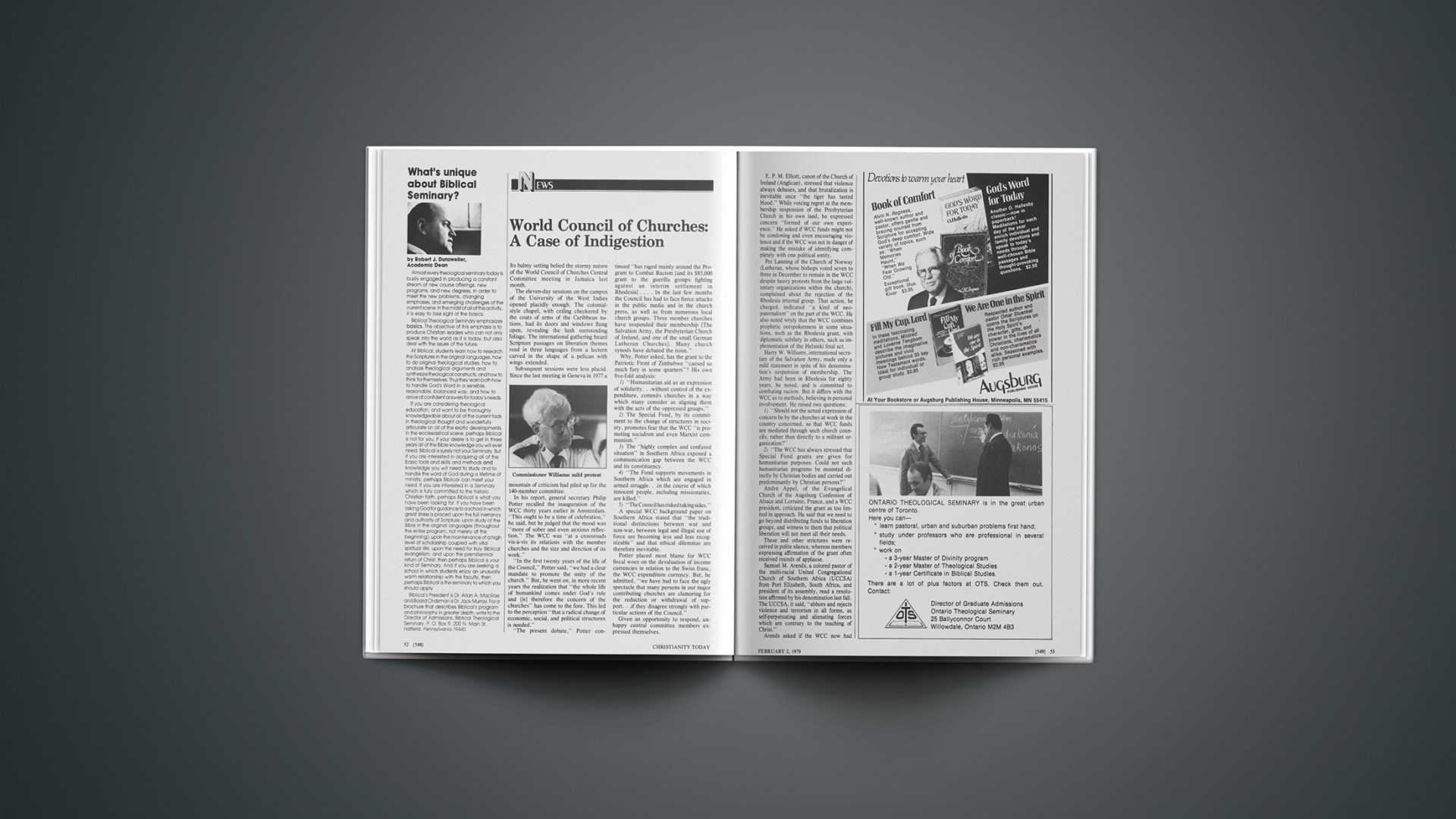
A Case of Indigestion

Its balmy setting belied the stormy nature of the World Council of Churches Central Committee meeting in Jamaica last month.

The eleven-day sessions on the campus of the University of the West Indies opened placidly enough. The colonial-style chapel, with ceiling checkered by the coats of arms of the Caribbean nations, had its doors and windows flung open, revealing the lush surrounding foliage. The international gathering heard Scripture passages on liberation themes read in three languages from a lectern carved in the shape of a pelican with wings extended.

Subsequent sessions were less placid. Since the last meeting in Geneva in 1977 a mountain of criticism had piled up for the 140-member committee.

In his report, general secretary Philip Potter recalled the inauguration of the WCC thirty years earlier in Amsterdam. “This ought to be a time of celebration,” he said, but he judged that the mood was “more of sober and even anxious reflection.” The WCC was “at a crossroads vis-à-vis its relations with the member churches and the size and direction of its work.”

“In the first twenty years of the life of the Council,” Potter said, “we had a clear mandate to promote the unity of the church.” But, he went on, in more recent years the realization that “the whole life of humankind comes under God’s rule and [is] therefore the concern of the churches” has come to the fore. This led to the perception “that a radical change of economic, social, and political structures is needed.”

“The present debate,” Potter continued “has raged mainly around the Program to Combat Racism [and its $85,000 grant to the guerilla groups fighting against an interim settlement in Rhodesia].… In the last few months the Council has had to face fierce attacks in the public media and in the church press, as well as from numerous local church groups. Three member churches have suspended their membership [The Salvation Army, the Presbyterian Church of Ireland, and one of the small German Lutheran Churches]. Many church synods have debated the issue.”

Why, Potter asked, has the grant to the Patriotic Front of Zimbabwe “caused so much fury in some quarters”? His own five-fold analysis:

1) “Humanitarian aid as an expression of solidarity … without control of the expenditure, commits churches in a way which many consider as aligning them with the acts of the oppressed groups.”

2) The Special Fund, by its commitment to the change of structures in society, promotes fear that the WCC “is promoting socialism and even Marxist communism.”

3) The “highly complex and confused situation” in Southern Africa exposed a communication gap between the WCC and its constituency.

4) “The Fund supports movements in Southern Africa which are engaged in armed struggle … in the course of which innocent people, including missionaries, are killed.”

5) “The Council has risked taking sides.”

A special WCC background paper on Southern Africa stated that “the traditional distinctions between war and non-war, between legal and illegal use of force are becoming less and less recognizable” and that ethical dilemmas are therefore inevitable.

Almost every theological seminary today is busily engaged in producing a constant stream of new course offerings, new programs, and new degrees, in order to meet the new problems, changing emphases, and emerging challenges of the current scene. In the midst of all of this activity, it is easy to lose sight of the basics.

Biblical Theological Seminary emphasizes basics. The objective of this emphasis is to produce Christian leaders who can not only speak into the world as it is today, but also deal with the issues of the future.

At Biblical, students learn how to research the Scriptures in the original languages, how to do original theological studies, how to analyze theological arguments and synthesize theological constructs, and how to think for themselves. Thus they learn both how to handle God’s Word in a sensible, reasonable, balanced way, and how to arrive at confident answers for today’s needs.

If you are considering theological education, and want to be thoroughly knowledgeable about all of the current fads in theological thought and wonderfully articulate on all of the exotic developments in the ecclesiastical scene, perhaps Biblical is not for you. If your desire is to get in three years all of the Bible knowledge you will ever need, Biblical is surely not your Seminary. But if you are interested in acquiring all of the basic tools and skills and methods and knowledge you will need to study and to handle the word of God during a lifetime of ministry, perhaps Biblical can meet your need. If you are interested in a Seminary which is fully committed to the historic Christian faith, perhaps Biblical is what you have been looking for. If you have been asking God for guidance to a school in which great stress is placed upon the full inerrancy and authority of Scripture, upon study of the Bible in the original languages (throughout the entire program, not merely at the beginning), upon the maintenance of a high level of scholarship coupled with vital spiritual life, upon the need for truly Biblical evangelism, and upon the premillennial return of Christ, then perhaps Biblical is your kind of Seminary. And if you are seeking a school in which students enjoy an unusually warm relationship with the faculty, then perhaps Biblical is the seminary to which you should apply.

Biblical’s President is Dr. Allan A. MacRae and Board Chairman is Dr. Jack Murray. For a brochure that describes Biblical’s program and philosophy in greater depth, write to the Director of Admissions, Biblical Theological Seminary, P. O. Box 9, 200 N. Main St., Hatfield, Pennsylvania 19440.

Potter placed most blame for WCC fiscal woes on the devaluation of income currencies in relation to the Swiss franc, the WCC expenditure currency. But, he admitted, “we have had to face the ugly spectacle that many persons in our major contributing churches are clamoring for the reduction or withdrawal of support … if they disagree strongly with particular actions of the Council.”

Given an opportunity to respond, unhappy central committee members expressed themselves.

E. P. M. Elliott, canon of the Church of Ireland (Anglican), stressed that violence always debases, and that brutalization is inevitable once “the tiger has tasted blood.” While voicing regret at the membership suspension of the Presbyterian Church in his own land, he expressed concern “formed of our own experience.” He asked if WCC funds might not be condoning and even encouraging violence and if the WCC was not in danger of making the mistake of identifying completely with one political entity.

Per Lønning of the Church of Norway (Lutheran, whose bishops voted seven to three in December to remain in the WCC despite heavy protests from the large voluntary organizations within the church), complained about the rejection of the Rhodesia internal group. That action, he charged, indicated “a kind of neo-paternalism” on the part of the WCC. He also noted wryly that the WCC combines prophetic outspokenness in some situations, such as the Rhodesia grant, with diplomatic subtlety in others, such as implementation of the Helsinki final act.

Harry W. Williams, international secretary of the Salvation Army, made only a mild statement in spite of his denomination’s suspension of membership. The Army had been in Rhodesia for eighty years, he noted, and is committed to combating racism. But it differs with the WCC as to methods, believing in personal involvement. He raised two questions:

1) “Should not the actual expression of concern be by the churches at work in the country concerned, so that WCC funds are mediated through such church councils, rather than directly to a militant organization?”

2) “The WCC has always stressed that Special Fund grants are given for humanitarian purposes. Could not such humanitarian programs be mounted directly by Christian bodies and carried out predominantly by Christian persons?”

André Appel, of the Evangelical Church of the Augsburg Confession of Alsace and Lorraine, France, and a WCC president, criticized the grant as too limited in approach. He said that we need to go beyond distributing funds to liberation groups, and witness to them that political liberation will not meet all their needs.

These and other strictures were received in polite silence, whereas members expressing affirmation of the grant often received rounds of applause.

Samuel M. Arends, a colored pastor of the multi-racial United Congregational Church of Southern Africa (UCCSA) from Port Elizabeth, South Africa, and president of its assembly, read a resolution affirmed by his denomination last fall. The UCCSA, it said, “abhors and rejects violence and terrorism in all forms, as self-peipetuating and alienating forces which are contrary to the teaching of Christ.”

Arends asked if the WCC now had adopted as policy a statement he attributed to Anwar M. Barkat of Pakistan, chairman of the Program Unit on Justice and Service, on the necessity of accepting violence as a tactic for combating racism. Barkat denied having made the statement, and central committee moderator Edward W. Scott of Canada hastily ruled Arends out of order.

There is no Rhodesian member on the central committee, but Cornelius D. Watyoka of the Christian Council of Rhodesia was present as an advisor. In conversation, Watyoka expressed appreciation of the confidence in black Rhodesians indicated by the grant, but expressed doubts as to its effectiveness.

The committee upheld the view of a review body that the administration of the Special Fund “has so far been in accordance with the established and accepted criteria” set by it, and endorsed continuation of the Fund “with clearer interpretation.” A proposed amendment to the effect that the Fund should make use “wherever possible of indigenous Christian agencies to deliver the humanitarian services desired” was overwhelmingly defeated.

A sticking point with member churches who have refused to contribute to the Special Fund has been that its administrative costs were charged to the general budget. The Presbyterian Church in Ireland issued such a protest.

There was talk of entirely separating the Fund from the PCR, but finally the committee merely endorsed the recently established practice of requesting Fund supporters to make an additional 10 per cent grant for Fund administration.

Some objected to a report paragraph that attributed scruples in the churches about use of the Fund to “strong kinship, investment, and other economic ties with racist societies in Southern Africa.” The minority won addition of a sentence: “We are aware also that questions are raised and criticism voiced in good faith by member churches.”

The central committee prescribed only moderate austerity for the WCC, whose reserves were described as “pretty well depleted.” A budget deficit of 4.5 million Swiss francs in a 1979 budget of 29.5 million francs is to be retrieved by a budget cut of 3 million francs in 1980 and a further 3 million francs in 1981. This is expected to involve a reduction of about twenty in staff in 1980.

The report of an advisory committee on “The Search for a Just, Participatory, and Sustainable Society” (JPSS) moved beyond liberation struggle issues to a struggle for reshaping the structures of society. “The unity of the Church is no end in itself,” the paper declared. “In the Kingdom of God the unity of the Church and the unity of humankind will be one. As Christians … we wait and work for a new creation, not for a new Christendom.”

“The liberating power of Jesus Christ and his Spirit,” the report went on, “enables people to challenge existing structures of economic, political, military, and scientific technological power.… The people themselves have to demand [the New International Economic Order] of their governments.… It means changes in the production structure and employment policies which will only be possible through a certain ‘socialization’ of decisions that have so far been taken autonomously on the basis of interests of the private sector.”

Patriarch Pimen, the new Russian Orthodox primate, in a letter to the central committee, objected to this thrust. “We see the true purpose of the World Council of Churches,” he wrote, “in its being a Council of Churches, their instrument for the achievement of unity in faith and for the success of their common service.”

André Appel spoke for Lutheran protestors when he complained that the WCC fails to differentiate between the justice of God found in the Bible and human justice which, he said, varies with regimes and trends. “All righteousness is accomplished in Jesus Christ,” he asserted. “We haven’t fulfilled our role as witnesses to the Gospel.”

After fielding several critical comments, the east Asian presenter of the report bristled. “You must understand,” he said, “that some of us younger third-world theologians do not like your traditional theology.”

Instead of receiving the report as a basis for further work, the committee accepted it as a progress report, which, together with a discussion in the committee, would form a basis for further work.

Near the beginning of the session, Jamaica prime minister Michael Manley, himself an old New International Economic Order advocate, told the assembly, “We are all very pleased to note the increasing shift in emphasis from the philosophical debate about social activisim in the Christian Church to a concern that activist intentions should be effective.”

Not all central committee members, apparently, were as pleased as their host.

HARRY GENET

Financial Disclosure by Television

W. Eugene Scott, a Pentecostal television preacher with a penchant for the dramatic, successfully rescued the tiny Faith Broadcasting Network (FBN) from financial oblivion. But now the California-based pastor is locked in a battle of his own—with state legal officials over matters of financial disclosure. According to Scott, the outcome of legal proceedings against him could affect the First Amendment freedoms of every church in California. The white-haired preacher sees himself as “fighting everybody’s battle” within the religious community.

Members of Faith Center, a charismatic church in Glendale, called Scott to rescue them financially in Scott late 1975. Their church, with its FBN network of three stations, was over $3.5 million in debt, with assets of only $2 million. In desperation, they turned to Scott, a financial and management consultant in Pentecostal circles. Scott had a record of getting religious organizations out of financial difficulties, and he advised Oral Roberts during the founding of Oral Roberts University.

Scott’s first step was to establish several interlocking corporations—including a travel agency and a publishing company—under the aegis of Wescott Christian Center, a sister church to Faith Center located in Oroville, California. But in the process of getting FBN out of debt, he disputed with legal authorities in California and Connecticut who, he said, were disallowing the normal church tax exemptions for Faith Center. Scott’s problems were complicated by differing state laws, allegedly overzealous government investigators, and reported mismanagement by his predecessors at FBN.

When government officials charged him with the nonpayment of back taxes, Scott took his case to the airwaves. He challenged public officials by name night after night on “The Festival of Faith.” (His controversial live television program runs several days a week, lasting all evening or all night, depending on Scott’s mood or endurance.) He charged some government agencies with illegalities, and he even invited certain officials by name to appear with him on camera.

When his transmitter man at the FBN station in Hartford, Connecticut (WHCT-TV), was arrested for trespassing on station property that the state claimed had fallen to it for nonpayment of back taxes, Scott asked his viewers to telephone their protests to the governor and public officials of Hartford. Later, the mayor apologized on WHCT-TV, saying that perhaps the sheriff’s office had exceeded its authority.

Meanwhile, Faith Center paid $80,000 in back taxes under protest in May, 1977, after the Hartford station was temporarily taken off the air when it refused to pay taxes, claiming tax exempt status. The church filed a $7.7 million lawsuit against the city of Hartford soon after.

When the cameramen and production staff of his Hartford station wanted to unionize, Scott positioned the cameras and then fired the entire staff in front of a startled television audience. The National Labor Relations Board has conducted hearings regarding the incident.

Since then Scott has become entangled with the Federal Communications Commission (FCC) and the California attorney general’s office. Two former employees (fired by Scott) complained that Scott used monies solicited for one purpose for another. The FCC then demanded the names of all FBN contributors.

Scott’s current battle is with the California attorney general. When Scott received a subpoena on May 1, 1978, demanding that he produce over ten years of church records—including minutes of all meetings and membership lists—he balked.

Scott, the pastor and president of FBN, declared that his church records were “inviolable” on the basis of the First Amendment. He challenged the attorney general to take the case before a grand jury, but reportedly was refused since his is a civil action and not subject to the same procedures of a criminal act.

Curiously, Scott has not withheld financial records from outsiders or his television audience. He has disclosed his records to a private accountant and to certain evangelicals, including Clyde Narramore. Scott often holds network and church documents before a close-up camera on his “Festival of Faith” program. “He has nothing to hide,” says one Scott-watcher. “It’s just that he doesn’t want the government demanding to see church records.”

Last November 3, Scott appeared in Los Angeles Superior Court in an unsuccessful attempt to squash the subpoenas against him. He broke a self-imposed fast of three days with a 4 a.m. bacon and eggs breakfast, the Los Angeles Times reported, when he had received commitments from 3,000 followers to appear at the hearing with him. His supporters upheld their pledges, judging by the crowds at the courthouse when Judge Charles H. Phillips upheld the subpoenas requiring that Scott answer questions about church finances. Phillips also granted a petition from the attorney general that would compel the church to produce financial records.

Phillips based his decision on the California Corporations Code, saying that it applies to churches. Phillips said any church must use its funds for purposes stated in its articles of incorporation.

Judge Phillips said the code allows the attorney general to inspect and supervise records of churches whether or not any wrongdoing is suspected. He said that a “charitable trust” is created, such that expenditure of donated funds (even as little as “ten cents,” he said) is subject to the attorney general’s supervision.

Phillips, however, limited his probe of church records to the past five years, instead of ten as requested by the attorney general’s office. He also did not issue a subpoena for income tax records.

In a subsequent ruling, Phillips also allowed Faith Center to withhold information that is purely religious. Scott’s attorneys, say the latest ruling by Phillips provides a convenient “escape clause,” since all records of the church may be defined as “religious.”

Scott is appealing the decision anyway. He still refuses to produce any records of the church as requested by Phillips. He says the earlier ruling would violate the freedoms of every church in California, and that only Faith Center is in a position to appeal.

Scott will be charged with contempt if he does not produce church records by February 20. In the interim, he is following past custom by raising a band of vocal followers, mostly from fundamentalist and Pentecostal groups. He mailed transcripts of Phillips’s November decision to 4,000 pastors in California, and speaks of holding freedom rallies. And then, of course, there is his television program.

Scholarship: Mixing Politics and Proof Texts

Modern Middle Eastern politics has intruded upon one of the most spectacular recent finds relating to the Ancient Near East. The result has been a loss, at least by delay, to scholars in general and to students of the patriarchal period of Old Testament history in particular.

David Noel Freedman of the University of Michigan made these charges to some 400 members and friends of the Evangelical Theological Society (ETS) at a plenary session of its thirtieth anniversary meeting. About seventy papers (mostly presented to sub-groups that met simultaneously) were read and discussed over the three day period, December 27–29, at Trinity Evangelical Divinity School near Chicago.

Freedman deplored the “present sad state of affairs” which is hindering scholarly investigation of some 15,000 clay tablets surviving from the royal archives of Ebla. The tablets, which are now housed in Aleppo, Syria, provide a concentrated picture of the economic life of a major city in what is now Syria. The language is probably a collateral ancestor of biblical Hebrew, Ugaritic, and Aramaic. Earlier identifications with biblical place and personal names were announced, but many of these are now being retracted.

The Ebla tablets date from the middle of the third millennium before Christ. Even though this is about 500 years before Abraham, father of the nation of Israel, modern Syrians apparently are afraid that Israelis will use the ancient tablets to justify occupation of Syrian territory.

The most accessible and authoritative English treatment of Ebla consists of an article written by the only one who can both decipher the language and has access to the tablets, Giovanni Pettinato. His article appeared in the May, 1976, issue of Biblical Archaeologist, which is edited by Freedman. In the next issue in September, the head of the excavations, Paolo Matthiae, reported on the archeological aspects of the find. Now these two Italians are said to be accusing editor Freedman of altering the articles.

In an English-language magazine in Damascus, Freedman is charged with being a “paid Zionist agent.” CHRISTIANITY TODAY has learned that denials by scholars of any relevance of the Ebla tablets to biblical studies may now be an unofficial Syrian requirement for gaining access to the tablets.

In other conference presentations, outgoing president Stanley Gundry of Moody Bible Institute said that inerrancy of Scripture, though a crucial issue, “should not be allowed to become the preoccupation of evangelical theology.” Also demanding attention, he said, are such ecclesiological matters as the nature and mission of the church, the role of parachurch organizations, and the role of women in leadership positions. Gundry asked for consideration of the challenges raised by the Chicago Call (see June 3, 1977, issue, p. 32), while keeping in mind episcopacy and liturgy on the part of many who issued the call.

Gundry also called for theological reflection on missiological issues, including the extent to which all theology is shaped by culture: “Those who speak of Latin American or black or feminist theology just say theology for their own beliefs when what they should say is North American, white, male theology.”

Gundry foresaw, as did many other speakers, a narrowing of the gap between dispensational and covenant theology. He stressed the importance of hermeneutics—the principles (or, as some use the term, the practice) of interpretation—as the underlying issue for inerrancy, ecclesiology, and missiology.

The new president of the ETS is Marten Woudstra, who teaches Old Testament at Calvin Seminary. Interestingly, the president elected at the founding meeting of the ETS in 1949 was Clarence Bouma, who was also a teacher at Calvin.

Judging the Future of Herbert Armstrong

Herbert W. Armstrong, who built his Worldwide Church of God (WCG) into an $80 million religious empire, saw his power crumble last month under the weight of alleged financial mismanagement. In a suit filed in Los Angeles Superior Court, the California state attorney general’s office accused Armstrong and top aide Stanley Rader of “pilfering” millions of WCG dollars and of selling church property at prices below market value. Then the court placed the church in receivership—in effect, giving all control of church financial matters to a retired California judge, Steven Weisman.

There had been other charges of financial misdoings within the WCG during its thirty-two years in Pasadena. Son Garner Ted, at one time the heir apparent to WCG leadership, was excommunicated after making such allegations. But the most recent charges may prove to be the most damaging to the 100,000-member church. Superior Court Judge Julius M. Title already has denied one motion to remove the temporary receiver (January 10), and in court proceedings last month he was to decide whether to make that receivership permanent.

Even if the court finds the claims invalid and returns financial control to the WCG hierarchy, the future of the church probably has been affected in permanent, and certainly damaging, ways. In the wake of the suit, the WCG was shaken by threats of defections, an internal power struggle, and revelations of extravagant spending by WCG leaders.

Coplaintiffs in the suit (which also named as defendants the WCG Ambassador College and its cultural center) were six former members of the WCG. What particularly upset them was the sale of church holdings at prices far below their actual value. The sale of the Texas branch of Ambassador College for $10.6 million, when it was reportedly worth over $30 million, was “the last straw,” said plaintiff Earl Timmons (see January 5, issue, page 47).

Timmons told the Pasadena Star-News that “Big Sandy [the 1,600-acre college] is not just a college, but a place for all the people to observe the church holidays.… It is something we’ve been paying on for years and years.”

The legal action against the WCG signified an ongoing, joint investigation by church members, said Timmons. “Hundreds have been piecing together bits and pieces for years,” he said. He reserved judgment against Armstrong, saying the ailing 86-year-old leader had been “misled” by other church officials. Timmons and the other plaintiffs preferred that a responsible board of trustees be set up to handle church finances, with Armstrong serving as an emeritus leader.

Timmons said that the defendants would have continued selling off church property “until the church was dissolved,” and that the suit would, in effect, save the church, not destroy it.

Records ‘Destroyed’

Other charges in the suit, as revealed in the Los Angeles Times, were: 1) that Armstrong and Rader were not providing an accounting of church finances according to state laws governing charitable organizations; 2) that the two men pilfered property and assets of the church “for their own use and benefit” amounting to millions of dollars each year; 3) that they “shredded and destroyed” financial records after removing them from the church office on the Ambassador College campus. (After the suit was filed, the court stationed twenty security guards outside church offices to prevent tampering with church records.)

Central to the case is the issue of “public trust,” and whether a court has the right to determine how a church spends its funds. A Los Angeles judge stated that “the state, while concerned with religious rights, has a responsibility to see that charitable organizations disburse their funds in … the public trust.”

Allan Browne, the chief attorney for the WCG, argued otherwise, saying that the WCG should be able to spend its monies as it deems fit. His comments came after revelations of extravagant outlays for gifts and world travel as revealed in the Los Angeles Times, which acquired WCG financial records for the fiscal year, 1975–76.

Included was $1.7 million for travel, lodging, and public relations. The church spent thousands of dollars for world airline travels. (Armstrong, himself, usually travels in his own Grumman II jet.) Expenditures included gifts of crystal glassware for the late Israeli premier Golda Meir and President Ferdinand Marcos of the Philippines and $26 for golf balls for King Leopold of Belgium.

When asked why the church courted world leaders, Stanley Rader, the general counselor and treasurer of the WCG, claimed this was all part of the WCG goal to “spread the Gospel.” Rader told the Los Angeles Times, “I don’t think it is their [the state’s] right to tell Mr. Armstrong he should not give golf balls to King Leopold.”

Meanwhile, Browne argued that the temporary receivership would destroy the church financially. He told the court that the WCG both spends and collects about $1 million per week. The receivership was causing members not to tithe, he complained, so that “a million dollars worth of checks have been bouncing.”

Top Level Shake-Up

Armstrong stayed in his Tucson home during court proceedings, but from there he directed a shake-up of top level church personnel that resulted in confusion for all involved. First, he named C. Wayne Cole as executive director of the church, replacing Rader, and he implied that he would go along with the state’s inquiry. Cole, popular within the WCG and reportedly its longest-serving minister, lasted only one day in his new post.

Armstrong rescinded Cole’s appointment and instead named WCG clergyman Roderick Meredith, identified with conservatives in the church and reportedly a supporter of Rader. Armstrong then excommunicated Cole and three other top officials of the church. Hillel Chodos, attorney for the plaintiffs, alleged that Rader “apparently went to Armstrong and persuaded him to rescind the order to cooperate.”

Garner Ted, the popular radio and television evangelist, was not named in the suit. He had established his own church six months earlier in Tyler, Texas, where he remained during the preliminary court proceedings.

Garner Ted told the Dallas Times Herald that Rader was causing most of the problems in the WCG. Garner called Rader an “evil man” who had gained increasing control over Ted’s ailing father, who still is recuperating from a heart attack suffered more than a year ago. (When asked on a Pittsburgh radio talk show last November whether he would ever consider returning to the WCG, Garner Ted said he would not, unless Rader, his former rival in the WCG, left the organization.

But father Herbert’s misfortune may be his son’s gain. Several Worldwide Church leaders announced that they were awaiting the outcome of court proceedings before deciding whether to join Garner Ted’s fledgling Church of God, International.

Garner Ted’s church mailing list has increased to 5,000 and he claims a daily church income of $2,000. His expanding radio ministry numbers fourteen stations nationwide, and he has announced plans to return to television broadcasting perhaps “no later than the new fall season in 1979.” One-night “personal appearance campaigns” are projected.

Quality four-color booklets are distributed free upon request, and a monthly magazine—evidently a counterpart of the WCG’s slick journal The Plain Truth—was to make its debut this month, CHRISTIANITY TODAY correspondent Joseph Hopkins learned.

Apparently Armstrong’s son has profited from his experience in the WCG. Garner Ted announced—even before legal actions were taken against the WCG—that his own church would make regular financial reports to its constituents. His church books would be reviewed periodically in an outside audit.

For father Herbert, however, there is no longer the question of voluntary disclosure of finances. The California attorney general has seen to that.

Personalia

Andrew Leigh Gunn, 48, resigned as executive director of the Americans United for Separation of Church and State, the influential organization with headquarters in Silver Springs, Maryland, that is involved in issues of First Amendment religious freedoms.

Recently elected as president of the American Scientific Affiliation (ASA) was A. Kurt Weiss, a Hebrew Christian and professor at the University of Oklahoma Health Sciences Center in Oklahoma City. The ASA is a 3,000-member evangelical organization for scientists.

First president of the School of Theology of the International Christian Graduate University is Ronald Jenson, who has been pastor of the Church of the Savior in the Philadelphia area. The theology school, first of many parts projected for the university, opened last fall. Presidency of the university is retained by Bill Bright, who also heads Campus Crusade in San Bernardino, California, where the school is presently located.

Theology

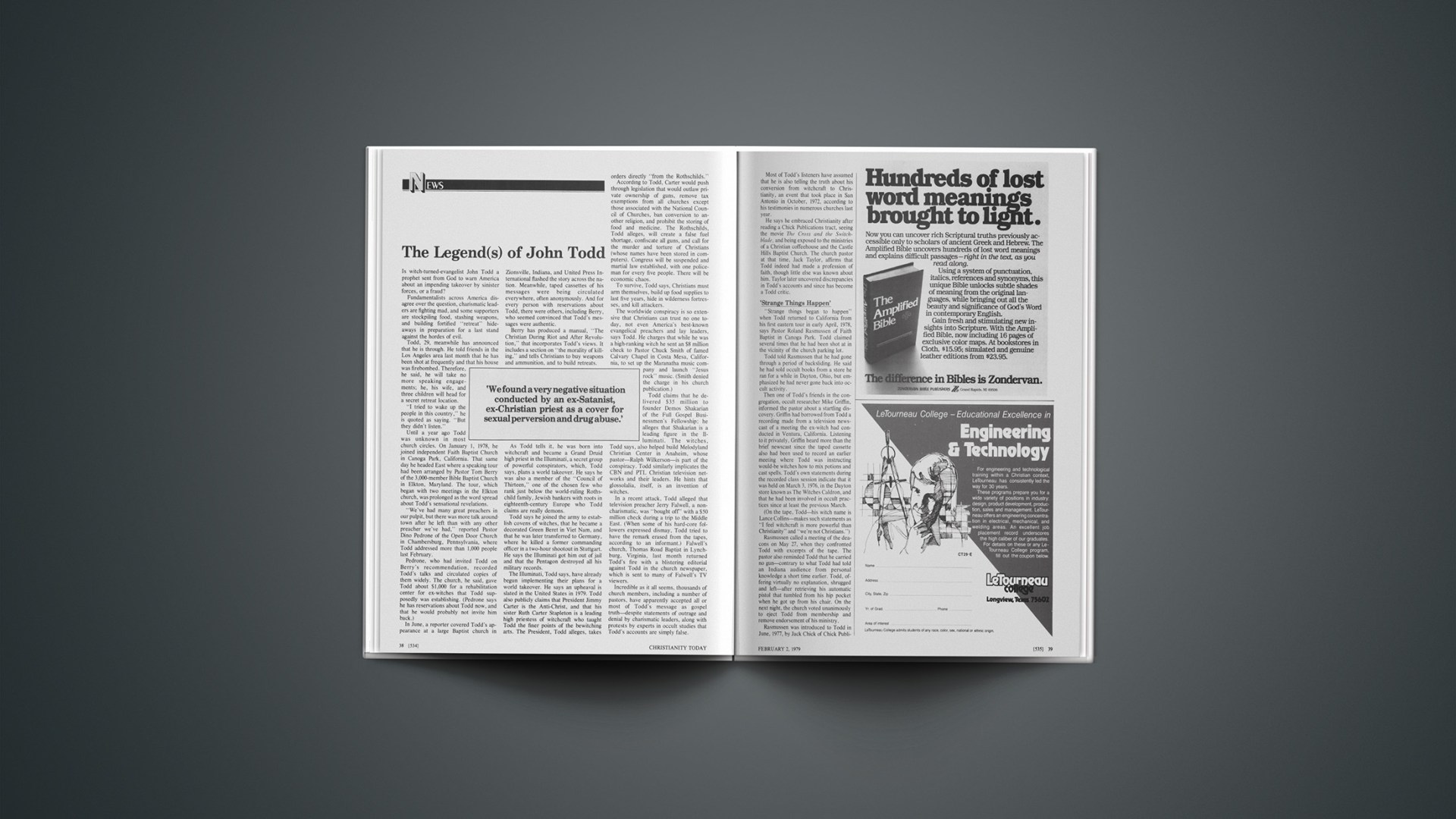
The Legend(s) of John Todd

Is witch-turned-evangelist John Todd a prophet sent from God to warn America about an impending takeover by sinister forces, or a fraud?

Fundamentalists across America disagree over the question, charismatic leaders are fighting mad, and some supporters are stockpiling food, stashing weapons, and building fortified “retreat” hideaways in preparation for a last stand against the hordes of evil.

Todd, 29, meanwhile has announced that he is through. He told friends in the Los Angeles area last month that he has been shot at frequently and that his house was firebombed. Therefore, he said, he will take no more speaking engagements; he, his wife, and three children will head for a secret retreat location.

“I tried to wake up the people in this country,” he is quoted as saying. “But they didn’t listen.”

Until a year ago Todd was unknown in most church circles. On January 1, 1978, he joined independent Faith Baptist Church in Canoga Park, California. That same day he headed East where a speaking tour had been arranged by Pastor Tom Berry of the 3,000-member Bible Baptist Church in Elkton, Maryland. The tour, which began with two meetings in the Elkton church, was prolonged as the word spread about Todd’s sensational revelations.

“We’ve had many great preachers in our pulpit, but there was more talk around town after he left than with any other preacher we’ve had,” reported Pastor Dino Pedrone of the Open Door Church in Chambersburg, Pennsylvania, where Todd addressed more than 1,000 people last February.

Pedrone, who had invited Todd on Berry’s recommendation, recorded Todd’s talks and circulated copies of them widely. The church, he said, gave Todd about $1,000 for a rehabilitation center for ex-witches that Todd supposedly was establishing. (Pedrone says he has reservations about Todd now, and that he would probably not invite him back.)

‘We found absolutely no foundation for the charges of persecution made by the Todds; rather we found a very negative situation conducted by an ex-Satanist, ex-Christian priest as a cover for sexual perversion and drug abuse.’

In June, a reporter covered Todd’s appearance at a large Baptist church in Zionsville, Indiana, and United Press International flashed the story across the nation. Meanwhile, taped cassettes of his messages were being circulated everywhere, often anonymously. And for every person with reservations about Todd, there were others, including Berry, who seemed convinced that Todd’s messages were authentic.

Berry has produced a manual, “The Christian During Riot and After Revolution,” that incorporates Todd’s views. It includes a section on “the morality of killing,” and tells Christians to buy weapons and ammunition, and to build retreats.

As Todd tells it, he was born into witchcraft and became a Grand Druid high priest in the Illuminati, a secret group of powerful conspirators, which, Todd says, plans a world takeover. He says he was also a member of the “Council of Thirteen,” one of the chosen few who rank just below the world-ruling Rothschild family, Jewish bankers with roots in eighteenth-century Europe who Todd claims are really demons.

Todd says he joined the army to establish covens of witches, that he became a decorated Green Beret in Viet Nam, and that he was later transferred to Germany, where he killed a former commanding officer in a two-hour shootout in Stuttgart. He says the Illuminati got him out of jail and that the Pentagon destroyed all his military records.

The Illuminati, Todd says, have already begun implementing their plans for a world takeover. He says an upheaval is slated in the United States in 1979. Todd also publicly claims that President Jimmy Carter is the Anti-Christ, and that his sister Ruth Carter Stapleton is a leading high priestess of witchcraft who taught Todd the finer points of the bewitching arts. The President, Todd alleges, takes orders directly “from the Rothschilds.”

According to Todd, Carter would push through legislation that would outlaw private ownership of guns, remove tax exemptions from all churches except those associated with the National Council of Churches, ban conversion to another religion, and prohibit the storing of food and medicine. The Rothschilds, Todd alleges, will create a false fuel shortage, confiscate all guns, and call for the murder and torture of Christians (whose names have been stored in computers). Congress will be suspended and martial law established, with one policeman for every five people. There will be economic chaos.

To survive, Todd says, Christians must arm themselves, build up food supplies to last five years, hide in wilderness fortresses, and kill attackers.

The worldwide conspiracy is so extensive that Christians can trust no one today, not even America’s best-known evangelical preachers and lay leaders, says Todd. He charges that while he was a high-ranking witch he sent an $8 million check to Pastor Chuck Smith of famed Calvary Chapel in Costa Mesa, California, to set up the Maranatha music company and launch “Jesus rock” music. (Smith denied the charge in his church publication.)

Todd claims that he delivered $35 million to founder Demos Shakarian of the Full Gospel Businessmen’s Fellowship; he alleges that Shakarian is a leading figure in the Illuminati. The witches, Todd says, also helped build Melodyland Christian Center in Anaheim, whose pastor—Ralph Wilkerson—is part of the conspiracy. Todd similarly implicates the CBN and PTL Christian television networks and their leaders. He hints that glossolalia, itself, is an invention of witches.

In a recent attack, Todd alleged that television preacher Jerry Falwell, a non-charismatic, was “bought off” with a $50 million check during a trip to the Middle East. (When some of his hard-core followers expressed dismay, Todd tried to have the remark erased from the tapes, according to an informant.) Falwell’s church, Thomas Road Baptist in Lynchburg, Virginia, last month returned Todd’s fire with a blistering editorial against Todd in the church newspaper, which is sent to many of Falwell’s TV viewers.

Incredible as it all seems, thousands of church members, including a number of pastors, have apparently accepted all or most of Todd’s message as gospel truth—despite statements of outrage and denial by charismatic leaders, along with protests by experts in occult studies that Todd’s accounts are simply false.

Most of Todd’s listeners have assumed that he is also telling the truth about his conversion from witchcraft to Christianity, an event that took place in San Antonio in October, 1972, according to his testimonies in numerous churches last year.

He says he embraced Christianity after reading a Chick Publications tract, seeing the movie The Cross and the Switchblade, and being exposed to the ministries of a Christian coffeehouse and the Castle Hills Baptist Church. The church pastor at that time, Jack Taylor, affirms that Todd indeed had made a profession of faith, though little else was known about him. Taylor later uncovered discrepancies in Todd’s accounts and since has become a Todd critic.

‘Strange Things Happen’

“Strange things began to happen” when Todd returned to California from his first eastern tour in early April, 1978, says Pastor Roland Rasmussen of Faith Baptist in Canoga Park. Todd claimed several times that he had been shot at in the vicinity of the church parking lot.

Todd told Rasmussen that he had gone through a period of backsliding. He said he had sold occult books from a store he ran for a while in Dayton, Ohio, but emphasized he had never gone back into occult activity.

Then one of Todd’s friends in the congregation, occult researcher Mike Griffin, informed the pastor about a startling discovery. Griffin had borrowed from Todd a recording made from a television newscast of a meeting the ex-witch had conducted in Ventura, California. Listening to it privately, Griffin heard more than the brief newscast since the taped cassette also had been used to record an earlier meeting where Todd was instructing would-be witches how to mix potions and cast spells. Todd’s own statements during the recorded class session indicate that it was held on March 3, 1976, in the Dayton store known as The Witches Caldron, and that he had been involved in occult practices since at least the previous March.

(On the tape, Todd—his witch name is Lance Collins—makes such statements as “I feel witchcraft is more powerful than Christianity” and “we’re not Christians.”)

Rasmussen called a meeting of the deacons on May 27, when they confronted Todd with excerpts of the tape. The pastor also reminded Todd that he carried no gun—contrary to what Todd had told an Indiana audience from personal knowledge a short time earlier. Todd, offering virtually no explanation, shrugged and left—after retrieving his automatic pistol that tumbled from his hip pocket when he got up from his chair. On the next night, the church voted unanimously to eject Todd from membership and remove endorsement of his ministry.

Rasmussen was introduced to Todd in June, 1977, by Jack Chick of Chick Publications in nearby Cucamonga, and Rasmussen was in turn introduced to Berry. Chick, a Baptist, says he first heard Todd in 1973 at a meeting of charismatic evangelist Doug Clark’s “Amazing Prophecies” group. Impressed, Chick featured Todd in several Christian comic-book stories. Despite the controversy, he says he still believes Todd, though he admits to “not knowing what to believe” about Todd’s charge that prominent charismatic ministers are agents of the Illuminati.

Support From Clergy

Berry and four other prominent Baptist ministers, along with several associates, met with Todd at Villa Baptist Church in Indianapolis. They later released a paper reaffirming their beliefs that Todd is genuinely born again, that he is sincerely trying to serve Christ, and that his accounts of experiences in the ruling circles of witchcraft “are reliable reports.”

Todd, however, hit the road again with a heavy schedule of meetings, some of them arranged by Berry. At a closed meeting of nearly 3,000 pastors and lay leaders hosted by Berry in a Maryland restaurant, Todd again recounted his experiences as a witch and as a member of the Illuminati. He also retraced his conversion in 1972 in San Antonio.

But Todd apparently didn’t tell everything. CHRISTIANITY TODAY has learned, for example, that Todd showed up in Phoenix early in 1968 as a 19-year-old Pentecostal storefront preacher with a wife named Linda and her four-year-old child Tanya. While staying with relatives, he called Pastor James Outlaw of the Jesus Name Church and asked to be rebaptized. Todd said he had been studying the teachings of William Brannam and wanted to be rebaptized in the name of Jesus only. (Brannam taught that God manifests himself in different ways at different times but is always Jesus.)

Todd testified to Outlaw that he had been a witch while in “the navy” but was converted while attending a storefront Pentecostal church in southern California.

Outlaw says Todd disappeared and returned months later without Linda. Todd explained that God had given them a prophecy to split up and seek other mates. The pastor says he and his wife admonished Todd about the error of such thinking but nevertheless helped him get a job as a busboy in a Mexican restaurant. Then Todd disappeared again and did not return until late 1972 or early 1973. Outlaw introduced Todd this time to Pentecostal Ken Long, a local leader of the Jesus movement who operated the “Open Door” coffeehouse.

Long, who has since switched from Pentecostalism and become pastor of Bible Heritage Free Will Baptist Church in Phoenix, enlisted Todd as a coffeehouse worker. “Things began happening,” declares Long. “John Todd did miracles.” Long says he watched Todd heal a handicapped youth’s leg.

On one excursion, Long and Todd met Sharon Garver in San Antonio. She returned with them to Phoenix and married Todd in August, 1973. Meanwhile, Long says he began getting reports that Todd was trying to seduce teenage girls at the coffeehouse. (Two later confessed that they had sexual relations with him.) Four girls revealed that Todd wanted them to form a witches coven and that he told them that he was still in witchcraft. Long later removed Todd from the coffeehouse ministry.

Todd drifted from job to job and then struck paydirt. He gave his “testimony” during a telethon for a Christian TV station. He claimed that the Illuminati were financing some fundamentalist churches, that he had been the Kennedy family’s personal warlock (“John F. Kennedy was not really killed; I just came back from a visit with him on his yacht”), and that he had witnessed the stabbing of a girl by Senator George McGovern in an act of sacrifice.

More than $25,000 was pledged during the telethon and the management offered to employ Todd—who was then, reportedly, packing a .38 snub-nosed revolver. He eventually declined. Doug Clark heard of Todd and invited him to appear on his “Amazing Prophecies” show. Overnight Todd became a hit in charismatic circles in southern California, and he and Sharon moved to Santa Ana.

Soon the Todds were hosting dozens of young people at a weekly Bible study in their home. A few young people were converted, said Sharon, but there were distressing things, too. She said that Todd was blending elements of witchcraft with his Christian teaching and seducing some of the girls, several of whom confided in leaders at Melodyland Christian Center. In an ugly confrontation with Melodyland church leaders around Christmas, 1973, Todd denied the charges and stormed out.

A Matter Of Records

Clark denounced Todd on TV, and the Todds headed back to San Antonio. Throughout their marriage Todd had been using drugs, says Sharon, and he was dropping in and out of witchcraft. He spoke of trying to reinlist in the army (he had served from February, 1969, to July, 1970), and he obtained his army records. (Although he is still telling audiences that the records do not exist, CHRISTIANITY TODAY has obtained a copy that shows he spent only twenty-five days overseas—in Germany, not Viet Nam.)

Family members say that Todd was witnessing to Sharon’s relatives about Christ but at the same time was trying to enlist them in witchcraft, apparently for sexual reasons. He made Sharon’s teenage sister pregnant, alleged both Sharon and the sister. The latter says she finally received Christ several months ago, but had been turned off to Christianity almost completely by Todd. (Todd declined to be interviewed for this report.)

Finally, the lanky 6′4″ Todd left Sharon in mid-1974 and went to Dayton where he met Sheila Spoonmore. The pair apparently lived together for about two years before getting married. During this period Todd operated The Witches Caldron. He attracted the attention of authorities when parents of teenage girls complained he was corrupting their children’s morals. One 16-year-old finally agreed to tell the police what was going on at Todd’s house and store. She said that witchcraft initiation rites were carried out in the nude, and that Todd had forced her to have oral sex.

Todd pleaded guilty to contributing to the unruliness of a minor and served two months of a six-month sentence in a county institution. Chick and a lawyer succeeded in getting him released early for medical reasons. (He was said to be having seizures.) He was placed on five years’ probation which he promptly broke by leaving the state. He traveled to Phoenix, where Ken Long got him a job as a cook in a steak house. “Todd swore he was out of witchcraft for good,” says Long, “but after only two weeks on the job he was talking to two girls about plans to open up an occult bookstore.” Todd, however, abruptly left town, and Long has not seen him since.

Todd’s occult operation in Dayton held a temporary charter as the Watchers Church of Wicca under the National Church and School of Wicca, headquartered in New Bern, North Carolina. Todd appealed to Wicca head Gavin Frost and civil rights specialist Isaac Bonnawitz to help him with the police problems in Dayton. Both men investigated quietly, and Frost announced their findings in the Wicca news letter:

“We found absolutely no foundation for the charges of persecution made by the Todds; rather we found a very negative situation conducted by an ex-Satanist, ex-Christian priest as a cover for sexual perversion and drug abuse. Todd is armed and dangerous, and any activity by him should immediately be reported to the Church of Wicca.”

Todd’s police record shows that a felony warrant was issued against him in New Mexico for passing a bad check. He was arrested in Columbus in 1968 for malicious destruction of property. He was treated for drug overdose at an army installation in Maryland in 1969. A warrant for his arrest awaits him in Ohio, as does a judgment against him for $22,000 in a defamation case.

Todd claims many of the police are associated with Freemasonry, an Illuminati organization, and therefore should be considered enemies. In an interview, Berry said he thinks the theory is a plausible one. The freemasonry is what forced Strom Thurmond off the Bob Jones University board after Todd spread the word that the senator is a mason.

Todd was given psychiatric examinations twice while in the army. His records indicate evidence of an unstable home background and possible brain damage as a result of beatings. The second examination a few months later labeled his malady “emotional instability with pseudologica phantastica.” Todd finds it difficult to tell reality from fantasy, says a medical report. It spoke of homocidal threats he had made on another, false suicide reports, and a severe personality disturbance. It saw no hope for change and recommended Todd’s discharge.

Pastor Clifford Wicks of the 850-member Grace Brethren Church in Somerset, Pennsylvania, cancelled Todd after he delivered the third of four scheduled messages in his church last month.

Wicks said reaction to Todd was mixed and that some persons experienced revival. However, Wicks reported one particularly disturbing reaction to Todd. Some people in the community, expressing a sense of dismay and helplessness at the coming events as predicted by Todd, said: “Pastor, we will not allow them to torture our families; we have decided that we will kill our children before that happens.”

Apple PodcastsDown ArrowDown ArrowDown Arrowarrow_left_altLeft ArrowLeft ArrowRight ArrowRight ArrowRight Arrowarrow_up_altUp ArrowUp ArrowAvailable at Amazoncaret-downCloseCloseEmailEmailExpandExpandExternalExternalFacebookfacebook-squareGiftGiftGooglegoogleGoogle KeephamburgerInstagraminstagram-squareLinkLinklinkedin-squareListenListenListenChristianity TodayCT Creative Studio Logologo_orgMegaphoneMenuMenupausePinterestPlayPlayPocketPodcastRSSRSSSaveSaveSaveSearchSearchsearchSpotifyStitcherTelegramTable of ContentsTable of Contentstwitter-squareWhatsAppXYouTubeYouTube