Books

Book Briefs: February 2, 1979

Not The Signs Of The Times

Armageddon Now!, by Dwight Wilson (Baker, 1977, 258 pp., $4.95 pb), is reviewed by Timothy P. Weber, assistant professor of church history, Conservative Baptist Seminary, Denver, Colorado.

Dwight Wilson, professor of history at Bethany Bible College, has written an intriguing and often disturbing study of American premillennialism in the twentieth century. Unlike most books on prophetic themes, this one is about the history of a school of interpretation, rather than the results of an interpreter’s study.

Basically using a chronological approach, Armageddon Now! traces premillennialist responses to Russia and Israel from 1917 to the present. Wilson argues that during those years premillennialism was characterized by a loose literalism that repeatedly failed in its attempt to match biblical prophecy and current events, a fatalistic determinism that often expressed itself in racism and denials of basic Christian justice, and an opportunism that employed sensationalism and prophetic blunders because such approaches were thought to be useful in saving souls.

Although premillennialists claimed to be able to identify the signs of the approaching end of the age, their history “is strewn with a mass of erroneous speculations which have undermined their credibility.” For example, at least some prominent premillennialists have interpreted nearly every major international crisis of this century as the harbinger of Armageddon, including the Russo-Japanese War, the two world wars, the war for Israeli independence, the Suez crisis, and the Arab-Israeli wars of 1967 and 1973. They saw the rise of the revived Roman empire of the last days in the League of Nations, the expansion of Mussolini’s Italy, the United Nations, the European Defense Community, NATO, and more recently the Common Market. They believed that the Russian-led northern confederacy was formed at the signing of the Brest-Livotsk Treaty, the Rapollo Treaty, the Nazi-Soviet Pact, and the rise of the Soviet Bloc after World War II. In due course, they identified the “kings of the east” as Turkey, the ten lost tribes of Israel, Japan, India, and China. Similarly, premillennialists pinpointed the start of the “latter rain” in 1897, 1917, and 1948; they marked the end of the “times of the Gentiles” in 1895, 1917, 1948, and 1967. Among possible candidates for Antichrist, premillennialists listed Mussolini, Hitler, and Henry Kissinger, to name a few. In light of this record, Wilson concludes that “such loose literalism … is not more precise than the figurative interpretations of which these literalists are so critical.”

Furthermore, the author claims that most premillennialists are guilty of a deterministic view of things, which is unethical and even antinomian. Because they believe that the world will get worse and worse before Jesus comes, premillennialists expend little energy trying to change it. For instance, since persecution of the Jews is a sign of the end, premillennialists have done little to stop it. Consequently, Wilson wants to hold premillennialists partly responsible for Russian, Nazi, and American anti-Semitism.

Wilson is even more critical of premillennialists’ carte blanche support of the state of Israel. Convinced that the founding of Israel was a fulfillment of biblical prophecy, they fail to apply to Israel the same standards of equity and justice that they demand of other states. For example, since the Bible promises the Jews the land from the Nile to the Euphrates, premillennialists tend to close their eyes and ears to any rightful claims of the native Arab population. To Wilson, such an attitude is nothing more than “the ends justify the means.” It forces premillennialists to applaud Israel for doing what they condemn in other nations. “Even if the right of Israel to exist as a nation be granted, the situation still demands that the decision be made on the basis of just and moral considerations rather than merely on the grounds that it fulfills prophecy.” In general, Wilson believes that premillennialists overlook the “usual definitions of aggression and violation of international law” for Israel.

Finally, Wilson contends that premillennialists excuse their frequent miscalculations and mistakes in prophetic interpretation because the cry of “Armageddon Now!” is such a useful evangelistic “tool of terror to scare people into making a decision for Christ.” In the battle for souls, “mights” and “maybes” are not nearly as effective as dogmatic and sensational “there’s-no-doubt-about-its.” Therefore, Wilson thinks premillennialist leaders are motivated more by a sense of opportunism than by any objective search for truth.

What should we say about this book? First of all, many premillennialists, especially those of the dispensationalist variety, are not going to like it. There is something unsettling about seeing the respected pillars of the premillennialist movement paraded in all their errant glory. But those who do not like the story Wilson tells will not be able to accuse him of lack of documentation for his point of view. In fact, at times the book seems to suffer from over-documentation. Too often the reader has the feeling that he is wading through capsule summaries of books and articles on prophetic themes or that he is covering familiar ground. The plot of the book frequently gets submerged in the details of who said what about which event in the light of biblical prophecy. Despite this heavy documentation, the book contains no index. For the scholar’s sake, I wish it did.

Wilson also has a tendency to overstate his case. To accentuate his thesis he occasionally resorts to a little benign sarcasm. In light of the enormous amounts of evidence he produces, some might think he showed remarkable reserve in some of the comments he made, but the material is powerful enough to speak for itself.

Furthermore, on a number of points Wilson seems unable to explain the obvious ambiguities within American premillennialism. For example, he does not adequately account for how premillenialists can be uncritically pro-Israel and anti-Semitic at the same time. Also he is hard pressed to explain why premillennialists who traditionally have refused to get involved in “political” causes have recently taken out ads in leading newspapers and formed ad-hoc organizations to undergird what appears to be a softening of U.S. support for Israel. Wilson claims that this becoming overtly political is simply a reflection of the growing concern of neo-evangelicalism with political issues. But this can hardly be the case since most premillennialists still would not call themselves neo-evangelicals, and though they might be willing to sign a petition on behalf of Israel, they would flatly refuse to sign one on behalf of open housing or world hunger relief.

Despite these shortcomings, Wilson has written an important book. For the most part, premillennialists have put all their time and energy into producing popular books on eschatology or more scholarly attempts to settle the many exegetical issues that still divide them. Very few, however, have written historical studies—except for polemical or apologetical purposes. I hope that as a result of Wilson’s work premillennialists will take their own history more seriously.

Especially now, during the current revival of interest in biblical prophecy, premillennialists can greatly benefit from the kind of poise and perspective the study of history brings. Once they discover the dismal record of attempting to match biblical prophecy with current events, contemporary premillennialists may hesitate to become too dogmatic with such identifications. If they know their past, premillennialists might be spared making the same kind of mistakes in the present. Wilson doubts it. He concludes that the patterns of opportunism and sensationalism are so deeply ingrained that the old patterns will continue, with premillennialism losing what credibility it has left. I for one hope he is wrong.

The Centrality Of Christ’S Resurrection

To Die and To Live: Christ’s Resurrection and Christian Vocation by Paul S. Minear (Seabury, 1977, 162 pp., $8.95), is reviewed by A. A. Trites, associate professor of biblical studies, Acadia Divinity School, Wolfville, Nova Scotia.

Minear introduces “a thought experiment” in the first part of his book, which he works out in the second. The experiment moves from the analysis of all communities to the analysis of religious communities. He isolates four problems facing the great religions of the world—the problems of revelatory agents, language, events, and the paradigmatic adequacy of the revelatory events. The chapter closes by noting that the Bible attempts a theistic answer to these concerns. The rest of the book is a serious effort to reveal the conceptual adequacy of the central events of Christianity—the death and resurrection of Christ. This task is attempted by an exposition of five key texts.

The first is Acts 3:15, which describes “the clarifying event” of the cross and resurrection. Here we have an illuminating study of three interlocking acts of murder, resurrection, and witness. Thus the death and resurrection of Jesus are twin events that are inseparable and interdependent and that have the power to unify many themes which otherwise would be entirely separate. Similar Christocentric patterns are observable in Hebrews 11 and 12, John 14, First Peter and Colossians 1. They offer varied but impressive testimony to the centrality of Christ’s death and resurrection. The chapter then outlines fourteen supporting propositions, and closes with some reflections on the “conflict of cosmologies,” which the author views as representing “the nub of modern misunderstanding of the gospel story.”

The remainder of the book unfolds the meaning of four texts. The first deals with Christ’s cross as a central theological event, which includes the crucifixion of the world (Galatians 6:14–15), the second with the cosmic vocation of the church (Ephesians 3:8–10), the third with the presence of Christ in his church (John 17:20–24), and the fourth with a prophetic vision of the end of the world (Mark 13:24–27).

To Die and To Live deeply probes Christian vocation as defined by the suffering, sacrificial character of Christ’s ministry. It unravels Paul’s “principalities and powers” and makes their exposition pertinent to contemporary Christian service. It studies the high priestly prayer in terms of “the bridge between the generations,” and it tackles the exegetically difficult Mark 13 passage with a concern to do justice to Mark’s original message to his readers faced with suffering and even possible martyrdom. The biblical correspondence between “first” and “last things” is carefully examined, and Galatians 6:14–15 is unfolded as a “triple crucifixion.”

This is a profound, seminal work, abounding in provocative comments, sensitive quotation of apposite poetry, and thoughtful insights into the mission of the Church. It demands to be read reflectively. The reader should ask, “Lord, what would you have me to do?”

Calls To Anti-Smut Activism

How to Stop the Porno Plague, by Neil Gallagher (Bethany Fellowship, 1977, 252 pp., $3.50 pb), Hustler for the Lord, by Larry Jones (Logos, 1978, 173 pp., $1.95 pb), and Telegarbage, by Gregg Lewis (Nelson, 1977, 164 pp., $2.95 pb), are reviewed by William T. Bray, communications consultant, Wheaton, Illinois.

The apparent powerlessness of evangelicalism to affect popular culture is the focus of these three controversial and disturbing books. Burning with a sense of moral outrage, they call evangelicals to spearhead the organization of broader community action against pornography and sexually explicit broadcasting. Two of the books do an admirable job as basic organization manuals. Telegarbage is the more motivational, and Porno Plague emphasizes community action and organization. Although more biographical and sensational, Hustler for the Lord carries the same theme. Whatever the real meaning of the proclaimed religious revival in the United States, it is apparently of no effect on the quality of mass media entertainment. Taken as a group, these books are somewhat frightening and often uncomfortably honest and forthright.

The underlying and usually unspoken accusation of all three books is the same: Evangelical indifference over the last 20 years lies at the root of the moral crisis in the communication arts. The authors advocate a brand of community activism that is not particularly associated with the sedate evangelicalism of this century. Not only are we very uncomfortable with the political process involved with attempting to set community standards, but our long neglect of the secular communication arts and entertainment fields has left us without alternatives to offer.

Thoughtful readers will quickly miss a strong biblical or theological basis for the community activism, corporate witness, and national standards of righteousness that are sought by these authors. The secularism of the apologetic stems from the object of their own personal crusades. They have been more concerned with the reaction of the news media, local government, the courts, and the police. It is obvious that all three men began their crusades without much community or church support. The courage that such antipornography campaigns require shows through from time to time as the prose gets tense and defensive. Some confrontations are described in a way that becomes almost embarrassingly personal. But you have to admire the kind of person who wages an all-out war against the local convenience store magazine rack.

Little in any of the books suggests real Christian alternatives. The response of these men is basically negative, but in light of the escalating emphasis on sex and violence in prime-time television it could be that a negative response would be better than no response at all.

The methods outlined in these books are constitutional and have worked time and again over the years. There is little new here, but much that is still untried by most evangelicals.

Telegarbage is by far the best written of the three. Television is defined as the cultural magnum force of our times. Lewis makes a lucid appeal for bringing it under control. “TV,” he insists, “has usurped many of the functions of religion. It provides explanations for the way things are; it interprets reality by offering its own world view. It establishes standards and values for attitudes and behavior.” The doctrines of the telecult he describes are sex, violence, and materialism. Because the influence of television is almost omnipresent in the U.S., today, Lewis thinks that even the strongest moral defenses can soften, tolerate, accept, and even adopt the messages presented on the screen. But the power of TV as a model for behavioral transfer is only part of the sinister influence. Lewis demonstrates that video is the principal force subliminally suggesting values and promoting consumer patterns that are opposed to Christian morality. As well as urging Christian protest and selective boycotts of programming, Lewis alone urges Christians to create alternatives for prime-time viewing. Evangelicals have got to begin “showing” their message instead of “telling” their message, if we are to have influence on the tube.

Telegarbage has names, sample letters, and action plans for Christians who want to take an active role in changing TV programming. An even greater wealth of such practical material is found in How to Stop the Porno Plague. Geared to the mass-marketing channels of distribution for books and magazines, the book tries to stay within constitutional and realistic approaches and strategies. The author believes that existing display and sales laws, properly monitored and enforced, could cripple the open distribution of obscenity in most American communities. How to Stop the Porno Plague is an encyclopedia of protest. The book reviews model obscenity ordinances and outlines the steps necessary to get them passed and enforced. Practically every aspect of a typical public information and agitation campaign is covered, including fundraising, educational activities, and media relations. Neil Gallagher is a tireless activist who has successfully plugged the mass-marketing pipeline for pornography in a number of communities. Out of his experience, he offers a number of thoughtful arguments and answers to almost any question or objection regarding why Christians protest obscenity. Gallagher’s mind for details is reflected in lists of definitions, sequential strategies, and samples of all kinds of printed materials used in antipornography protest campaigns.

Of the three titles, Hustler for the Lord is the most disappointing. Promoted as “the rebirth of Larry Flynt,” it is actually the disjointed tale of the running feud of an evangelist with Flynt and with local smut peddlers in Oklahoma. Sandwiched between contrived-sounding monologues representing confrontations that Larry Jones had while battling against Hustler magazine, are teasing references and anecdotes about Flynt, his family, and his staff. Jones never really delivers. Someone else will still have to write the real story of the Larry Flynt conversion. Most disappointed will be the reader who picks up the book to find out how Flynt is going to reconcile his publishing business with his new found faith. Hustler for the Lord is not all bad, but it reads like what it really is: a quick exploitation book hyped to sell in the wake of a sensational conversion. On the positive side, the genuine love that Larry Jones seems to have for Flynt does show through. So does the great courage that Jones has demonstrated in stepping out against the whole pornography industry. But this book can only be recommended for the hardy few who get deeply involved in the whole area.
Theology

Children’s Lenten Wisdom

Ashes, ashes, all fall down

Upon their knees before their God;

Ashes, ashes, all fall down

And bare their backs for chast’ning rod.

Ashes, ashes, all fall down

Christ’s forty days to emulate;

Ashes, ashes, all fall down

Upon their sins to meditate.

Ashes, ashes, all fall down

Anticipate the Christ’s return;

Ashes, ashes, all fall down

The discipline of sorrow learn.

Soon the pocketful of posey,

Soon the Crucified will rise;

Soon the ring around the rosey,

Soon Easter anthem swell the skies.

But now we learn from children’s game

The time to smile, the time to frown;

Recurring Lent is still the same:

Ashes, ashes, all fall down.

Church Life

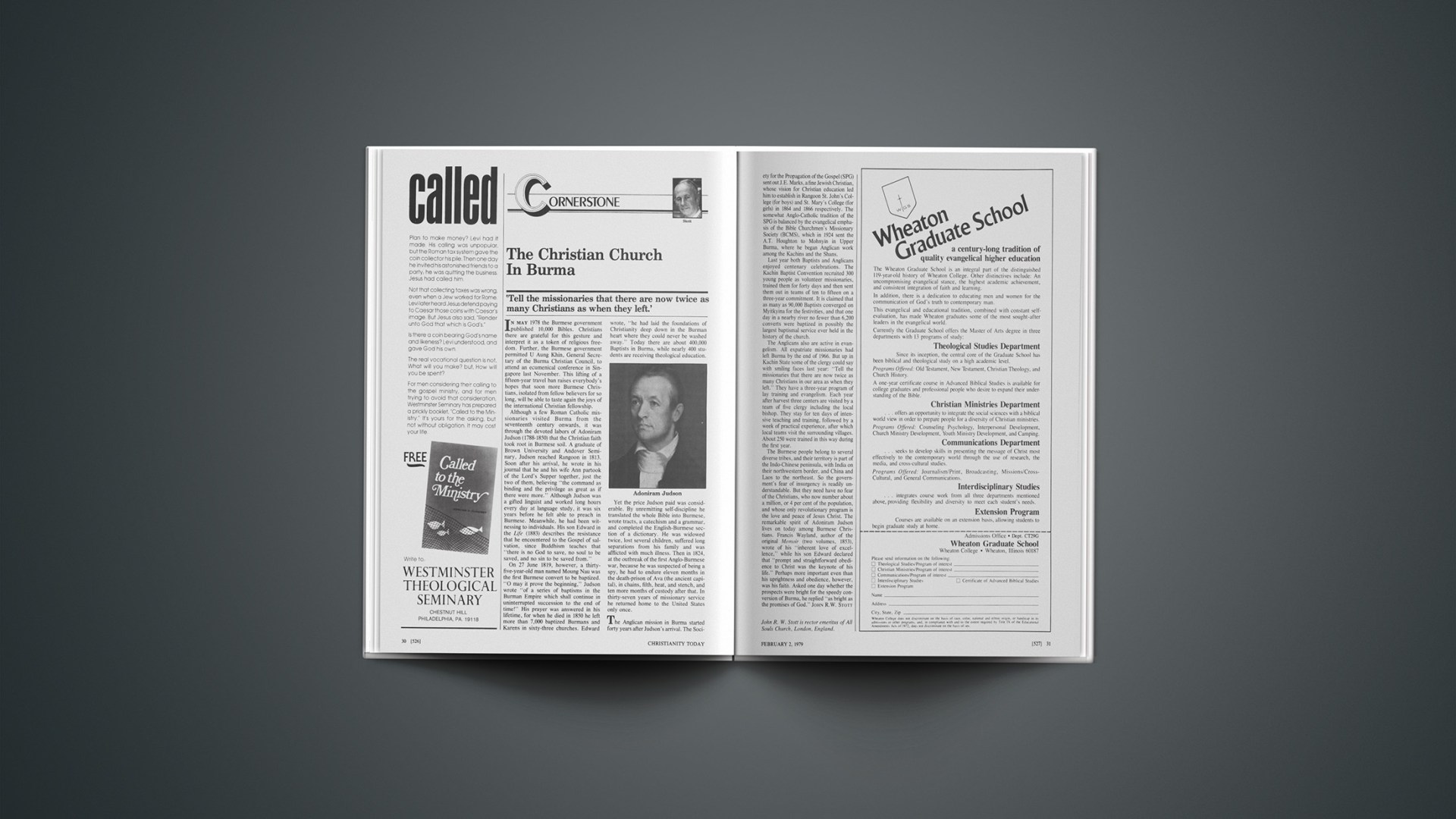
The Christian Church in Burma

‘Tell the missionaries that there are now twice as many Christians as when they left.’

In May 1978 the Burmese government published 10,000 Bibles. Christians there are grateful for this gesture and interpret it as a token of religious freedom. Further, the Burmese government permitted U Aung Khin, General Secretary of the Burma Christian Council, to attend an ecumenical conference in Singapore last November. This lifting of a fifteen-year travel ban raises everybody’s hopes that soon more Burmese Christians, isolated from fellow believers for so long, will be able to taste again the joys of the international Christian fellowship.

Although a few Roman Catholic missionaries visited Burma from the seventeenth century onwards, it was through the devoted labors of Adoniram Judson (1788–1850) that the Christian faith took root in Burmese soil. A graduate of Brown University and Andover Seminary, Judson reached Rangoon in 1813. Soon after his arrival, he wrote in his journal that he and his wife Ann partook of the Lord’s Supper together, just the two of them, believing “the command as binding and the privilege as great as if there were more.” Although Judson was a gifted linguist and worked long hours every day at language study, it was six years before he felt able to preach in Burmese. Meanwhile, he had been witnessing to individuals. His son Edward in the Life (1883) describes the resistance that he encountered to the Gospel of salvation, since Buddhism teaches that “there is no God to save, no soul to be saved, and no sin to be saved from.”

On 27 June 1819, however, a thirty-five-year-old man named Moung Nau was the first Burmese convert to be baptized. “O may it prove the beginning,” Judson wrote “of a series of baptisms in the Burman Empire which shall continue in uninterrupted succession to the end of time!” His prayer was answered in his lifetime, for when he died in 1850 he left more than 7,000 baptized Burmans and Karens in sixty-three churches. Edward wrote, “he had laid the foundations of Christianity deep down in the Burman heart where they could never be washed away.” Today there are about 400,000 Baptists in Burma, while nearly 400 students are receiving theological education.

Yet the price Judson paid was considerable. By unremitting self-discipline he translated the whole Bible into Burmese, wrote tracts, a catechism and a grammar, and completed the English-Burmese section of a dictionary. He was widowed twice, lost several children, suffered long separations from his family and was afflicted with much illness. Then in 1824, at the outbreak of the first Anglo-Burmese war, because he was suspected of being a spy, he had to endure eleven months in the death-prison of Ava (the ancient capital), in chains, filth, heat, and stench, and ten more months of custody after that. In thirty-seven years of missionary service he returned home to the United States only once.

The Anglican mission in Burma started forty years after Judson’s arrival. The Society for the Propagation of the Gospel (SPG) sent out J.E. Marks, a fine Jewish Christian, whose vision for Christian education led him to establish in Rangoon St. John’s College (for boys) and St. Mary’s College (for girls) in 1864 and 1866 respectively. The somewhat Anglo-Catholic tradition of the SPG is balanced by the evangelical emphasis of the Bible Churchmen’s Missionary Society (BCMS), which in 1924 sent the A.T. Houghton to Mohnyin in Upper Burma, where he began Anglican work among the Kachins and the Shans.

Last year both Baptists and Anglicans enjoyed centenary celebrations. The Kachin Baptist Convention recruited 300 young people as volunteer missionaries, trained them for forty days and then sent them out in teams of ten to fifteen on a three-year commitment. It is claimed that as many as 90,000 Baptists converged on Myitkyina for the festivities, and that one day in a nearby river no fewer than 6,200 converts were baptized in possibly the largest baptismal service ever held in the history of the church.

The Anglicans also are active in evangelism. All expatriate missionaries had left Burma by the end of 1966. But up in Kachin State some of the clergy could say with smiling faces last year: “Tell the missionaries that there are now twice as many Christians in our area as when they left.” They have a three-year program of lay training and evangelism. Each year after harvest three centers are visited by a team of five clergy including the local bishop. They stay for ten days of intensive teaching and training, followed by a week of practical experience, after which local teams visit the surrounding villages. About 250 were trained in this way during the first year.

The Burmese people belong to several diverse tribes, and their territory is part of the Indo-Chinese peninsula, with India on their northwestern border, and China and Laos to the northeast. So the government’s fear of insurgency is readily understandable. But they need have no fear of the Christians, who now number about a million, or 4 per cent of the population, and whose only revolutionary program is the love and peace of Jesus Christ. The remarkable spirit of Adoniram Judson lives on today among Burmese Christians. Francis Wayland, author of the original Memoir (two volumes, 1853), wrote of his “inherent love of excellence,” while his son Edward declared that “prompt and straightforward obedience to Christ was the keynote of his life.” Perhaps more important even than his uprightness and obedience, however, was his faith. Asked one day whether the prospects were bright for the speedy conversion of Burma, he replied “as bright as the promises of God.”

John R. W. Stott is rector emeritus of All Souls Church, London, England.

Theology

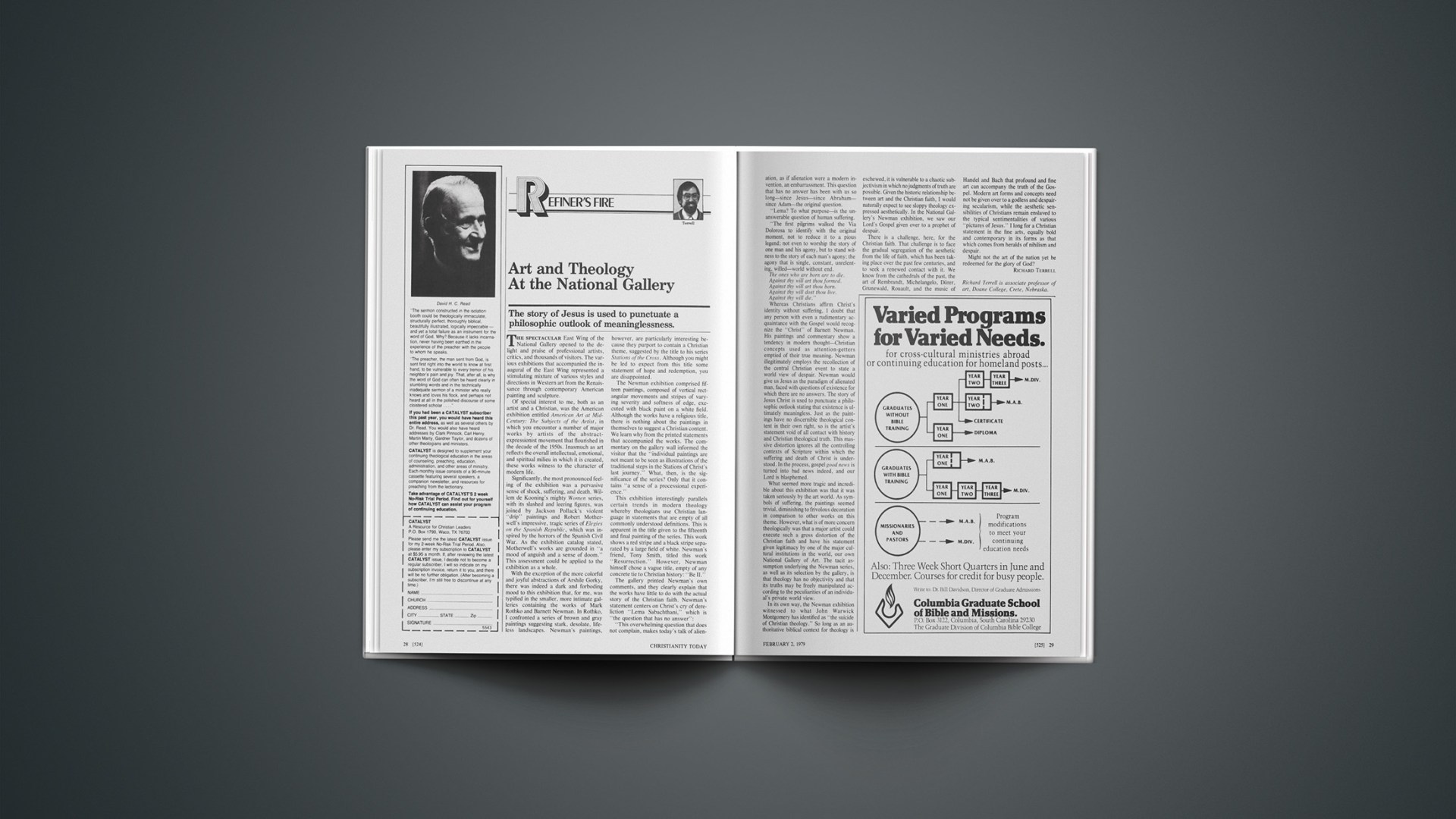
Art and Theology at the National Gallery

The story of Jesus is used to punctuate a philosophic outlook of meaningfulness.

The spectacular East Wing of the National Gallery opened to the delight and praise of professional artists, critics, and thousands of visitors. The various exhibitions that accompanied the inaugural of the East Wing represented a stimulating mixture of various styles and directions in Western art from the Renaissance through contemporary American painting and sculpture.

Of special interest to me, both as an artist and a Christian, was the American exhibition entitled American Art at Mid-Century: The Subjects of the Artist, in which you encounter a number of major works by artists of the abstract-expressionist movement that flourished in the decade of the 1950s. Inasmuch as art reflects the overall intellectual, emotional, and spiritual milieu in which it is created, these works witness to the character of modern life.

Significantly, the most pronounced feeling of the exhibition was a pervasive sense of shock, suffering, and death. Willem de Kooning’s mighty Women series, with its slashed and leering figures, was joined by Jackson Pollack’s violent “drip” paintings and Robert Motherwell’s impressive, tragic series of Elegies on the Spanish Republic, which was inspired by the horrors of the Spanish Civil War. As the exhibition catalog stated, Motherwell’s works are grounded in “a mood of anguish and a sense of doom.” This assessment could be applied to the exhibition as a whole.

With the exception of the more colorful and joyful abstractions of Arshile Gorky, there was indeed a dark and forboding mood to this exhibition that, for me, was typified in the smaller, more intimate galleries containing the works of Mark Rothko and Barnett Newman. In Rothko, I confronted a series of brown and gray paintings suggesting stark, desolate, lifeless landscapes. Newman’s paintings, however, are particularly interesting because they purport to contain a Christian theme, suggested by the title to his series Stations of the Cross. Although you might be led to expect from this title some statement of hope and redemption, you are disappointed.

The Newman exhibition comprised fifteen paintings, composed of vertical rectangular movements and stripes of varying severity and softness of edge, executed with black paint on a white field. Although the works have a religious title, there is nothing about the paintings in themselves to suggest a Christian content. We learn why from the printed statements that accompanied the works. The commentary on the gallery wall informed the visitor that the “individual paintings are not meant to be seen as illustrations of the traditional steps in the Stations of Christ’s last journey.” What, then, is the significance of the series? Only that it contains “a sense of a processional experience.”

This exhibition interestingly parallels certain trends in modern theology whereby theologians use Christian language in statements that are empty of all commonly understood definitions. This is apparent in the title given to the fifteenth and final painting of the series. This work shows a red stripe and a black stripe separated by a large field of white. Newman’s friend, Tony Smith, titled this work “Resurrection.” However, Newman himself chose a vague title, empty of any concrete tie to Christian history: “Be II.”

The gallery printed Newman’s own comments, and they clearly explain that the works have little to do with the actual story of the Christian faith. Newman’s statement centers on Christ’s cry of dereliction “Lema Sabachthani,” which is “the question that has no answer”:

“This overwhelming question that does not complain, makes today’s talk of alienation, as if alienation were a modern invention, an embarrassment. This question that has no answer has been with us so long—since Jesus—since Abraham—since Adam—the original question.

“Lema? To what purpose—is the unanswerable question of human suffering.

“The first pilgrims walked the Via Dolorosa to identify with the original moment, not to reduce it to a pious legend; not even to worship the story of one man and his agony, but to stand witness to the story of each man’s agony; the agony that is single, constant, unrelenting, willed—world without end.

The ones who are born are to die.

Against thy will art thou formed.

Against thy will art thou born.

Against thy will dost thou live.

Against thy will die.”

Whereas Christians affirm Christ’s identity without suffering, I doubt that any person with even a rudimentary acquaintance with the Gospel would recognize the “Christ” of Barnett Newman. His paintings and commentary show a tendency in modern thought—Christian concepts used as attention-getters emptied of their true meaning. Newman illegitimately employs the recollection of the central Christian event to state a world view of despair. Newman would give us Jesus as the paradigm of alienated man, faced with questions of existence for which there are no answers. The story of Jesus Christ is used to punctuate a philosophic outlook stating that existence is ultimately meaningless. Just as the paintings have no discernible theological content in their own right, so is the artist’s statement void of all contact with history and Christian theological truth. This massive distortion ignores all the controlling contexts of Scripture within which the suffering and death of Christ is understood. In the process, gospel good news is turned into bad news indeed, and our Lord is blasphemed.

What seemed more tragic and incredible about this exhibition was that it was taken seriously by the art world. As symbols of suffering, the paintings seemed trivial, diminishing to frivolous decoration in comparison to other works on this theme. However, what is of more concern theologically was that a major artist could execute such a gross distortion of the Christian faith and have his statement given legitimacy by one of the major cultural institutions in the world, our own National Gallery of Art. The tacit assumption underlying the Newman series, as well as its selection by the gallery, is that theology has no objectivity and that its truths may be freely manipulated according to the peculiarities of an individual’s private world view.

In its own way, the Newman exhibition witnessed to what John Warwick Montgomery has identified as “the suicide of Christian theology.” So long as an authoritative biblical context for theology is eschewed, it is vulnerable to a chaotic subjectivism in which no judgments of truth are possible. Given the historic relationship between art and the Christian faith, I would naturally expect to see sloppy theology expressed aesthetically. In the National Gallery’s Newman exhibition, we saw our Lord’s Gospel given over to a prophet of despair.

There is a challenge, here, for the Christian faith. That challenge is to face the gradual segregation of the aesthetic from the life of faith, which has been taking place over the past few centuries, and to seek a renewed contact with it. We know from the cathedrals of the past, the art of Rembrandt, Michelangelo, Dürer, Grunewald, Rouault, and the music of Handel and Bach that profound and fine art can accompany the truth of the Gospel. Modern art forms and concepts need not be given over to a godless and despairing secularism, while the aesthetic sensibilities of Christians remain enslaved to the typical sentimentalities of various “pictures of Jesus.” I long for a Christian statement in the fine arts, equally bold and contemporary in its forms as that which comes from heralds of nihilism and despair.

Might not the art of the nation yet be redeemed for the glory of God?

Richard Terrell is associate professor of art, Doane College, Crete, Nebraska.

Church Life

Preaching with Power and Purpose

Success may never appear in time, but it will in eternity.

We need to revitalize preaching. Mass media is competing with us for the attention of our congregations. Our challenge is to make preaching effective once more. People are asking, Is the Bible true? How does it affect me? Does the minister really know what he’s talking about? Seminaries have tended to relegate homiletics courses to the “nonscholastic” part of the curriculum. Preachers, not professors, teach them.

Not that we haven’t preached “to the ends of the earth”—from the Washington Monument, the White House, football fields, as well as via satellite. Still, too many people find Eutychus a kindred spirit. They either snooze through the sermon or put their minds into neutral.

Why is preaching ineffective? Some people blame it on the lecture method of preaching. The congregation never gets to react immediately to the sermon. Others blame the dogmatic style of preachers. Or, they blame the language ministers use—theological jargon, terms, and references that, they claim, only interest and make sense to seminarians or other pastors. John Killinger in The Centrality of Preaching in the Total Task of the Ministry wrote, “People are not tired of preaching but of non-preaching, of badly garbled, irrelevant drivel that has in so many places passed for preaching because there was no real preaching to measure it against” (Word, 1969, p. 21).

We have imported the idioms of the world into our music, programming, finances, fellowship, and preaching. Preachers quote poets or novelists rather than Scripture. We play down the great scriptural truths about man and his sins. We don’t declare the dichotomy that exists between the kingdom of this world and the kingdom of God. Other people think that we should do away with preaching entirely. Sell the churches, they say, and go to homes for discussion groups. Yet, there is a church building boom and a proliferation of church growth seminars and programs.

God still uses biblical preaching to reach us and bring us to himself. As Lloyd George, British Prime Minister during the First World War, declared, “When the chariot of humanity gets stuck … nothing will lift it out except great preaching that goes straight to the mind and heart. There is nothing in this case that will save the world but what was once called, ‘the foolishness of preaching.’ ”

The Bible makes preaching a priority. The Old Testament prophets heralded God’s judgment and promises. The New Testament contains six Greek words that describe the biblical and more popular terms for preaching. John the Baptist in Matthew 3:1 heralds and proclaims Christ’s coming. In First Corinthians 15:1, the term means telling good news or sharing glad tidings. Other Greek words for preaching include bearing witness, discoursing, conversing, and teaching. The Great Commission admonishes us to preach the Good News.

Why then, is preaching on the decline? We have failed to put preaching on firm philosophical and theological foundations. Preaching is the art, homiletics the science, the sermon the result. Good preaching can only be based on sound homiletical theory. We must determine the purposes, the definitions, and the qualifications of preaching before we select what to say and how.

Preach With Purpose

We must preach the mighty works of God, not opinions or ideals. Preaching is a sacred trust, a blessed opportunity, and a divine call. The goal is not to catch the spirit of the age, but to correct it with God’s truth. The preacher is a thermostat, not a thermometer. He proclaims as a herald the mighty deeds of redemption that have been consummated in history and the word that has been committed to our stewardship.

Charles Simeon (1759–1836) ranks as one of the greatest preachers of all time. He had a threefold object behind his communication of the Gospel. He sought with the help of the Holy Spirit to humble the sinner, to exalt the Saviour, and to promote holiness.

The preacher is a steward. He must feed the household. The preacher is a herald who proclaims the mighty acts of God. He is a witness for Jesus. And the Holy Spirit is the counsel for the defense. Charles Koller, one of the great teachers of homiletics in this country, said the preacher should so present Jesus Christ that people will come to know him, love him, serve him, and yield their lives to him.

The construction of the sermon should not follow Rousseau’s advice for writing a love letter. He said you should begin without knowing what you are going to say and end without knowing what you have said. In contrast to this, the preacher must design his sermon to make the Good News live in the language and culture of the people. He needs to know and understand the problems that face his congregation. He should give them the answers.

To preach effectively, a minister must get the attention of his congregation and keep it. He is not a showman, but a communicator. The ultimate end is response from the congregation. The church will succeed only when this purpose is achieved.

Preach As An Ambassador

We cannot divorce the preacher from his preaching. In a very real way, the man is his message. Sermons that have become incarnated in a preacher can withstand any challenge. The minister must be a competent, resourceful person with a mature emotional life that creates effective rapport with others. The Bible contains no finer characterization of the exalted, spiritual nature of the minister’s vocation than that of being an ambassador of Jesus Christ. As an ambassador, he becomes an official envoy, a diplomat of the highest rank, and a resident representative of his sovereign Lord. But the Lord does not ask for volunteers; he appoints his ambassadors. God provides the appointed ambassador with the inerrant Word of God, with which the ambassador can bring people to Christ. Most people to whom we preach don’t know the Bible well. They need help, and the preacher provides it.

The Preacher should measure his ministry in terms of eternity rather than time. Like the prophets, he may sigh anxiously, but he will not despair, for he knows that in God’s good time the challenge will be worth it all. The stamp of success may never appear in time, but it will in eternity. Success does not come automatically with a seminary degree, ordination, or even a call to a church. It comes when the Holy Spirit enables a preacher to communicate the Good News and bring life to a dying humanity.

A minister is motivated by his desire to please Jesus Christ. He is also motivated by the fact that God holds him accountable for his life. He knows that one day he must appear before the judgment seat of Christ.

The message is reconciliation. The preacher becomes a liaison between God and the parishioners. He has a commission to bring the two parties together. The preacher’s ability to apply Scripture—to show its pertinence to the congregation—determines the impact it will have. Spurgeon said that the sermon begins with the application. Without that, a sermon is like a doctor who gives a sick man a lecture on health, but sends him out of the office without a prescription.

Boldness and sincerity must characterize the preacher in his presentation of the Gospel, as well as a gentleness. When James Stewart of Edinburgh preached at Morningdale, people packed the church. The people knew this prophet loved them. The effectiveness of preaching declines when a gulf develops between the preacher and his people. Holiness must characterize his life so that those who see him may have a good example. Phillips Brooks said, “And first among the elements of power which make success, I must put the supreme importance of character, of personal uprightness, and purity impressing themselves upon the men who witness them.” Quintilian said that the good speaker must be a good man. Saint Francis made the same point when he said, “No use to go anywhere to preach unless we preach while we go.”

Preach To People

The effective sermon proves itself by what happens to the person who hears it. Some aspect of every sermon should touch every listener. No one should walk away from the church without some spiritual insight. The sermon provides the meeting place for the soul and God; preaching nurtures souls. The pastoral precedes the prophetic. The preacher earns his right to be a prophet by the faithful fulfillment of the pastoral office.

The sermon should emerge from the experience and thought of the preacher. He cannot change lives by eloquent hearsay. He cannot share what he does not possess or reveal what he has not seen. That which comes out of his heart will go into the heart of the listener.

The sermon must speak to the listener’s situation. Phillips Brooks in his two hundred published sermons directed about 50 per cent of them to the seekers and the same number toward the saints. Charles Spurgeon in his sixty-three volumes of sermons had about the same ratio. The preacher must make certain that he preaches to all of the people and not just to a select few.

The effective biblical preacher should analyze his audience, which normally has four segments of people in terms of attitudes toward him and his message. As well as believers, it includes apathetic people, people with doubts, and usually some people who are hostile to the Gospel. He must elicit and hold the attention of the apathetic. He will present doubters with convincing facts. The hostile he must win in the first words he speaks.

The pastoral precedes the prophetic. The preacher earns his right to be a prophet by the faithful fulfillment of the pastoral office.

The believers in the audience present one of his greatest challenges, for they are most likely to become dissatisfied with a vague, general, abstract presentation. The preacher’s message ought not to contain principles, generalizations, and conclusions without an explanation of how the preacher arrived at them. Exposition is just a lesson; exposition plus application is a sermon. The effective use of visual aids, audience participation, facts, details, and examples will enhance his effectiveness with believers. The effective preacher will keep the language simple and understandable.

Love will persuade people to do what the preacher wishes them to do, much more than superior knowledge or first-rate delivery of a sermon. A young man went to Horatio Bonar one day and said, “Dr. Bonar, I love to preach, but nothing happens when I preach.” Dr. Bonar is reported to have turned to the young man and to have said, “But young man, do you love people?”

Preach With Power

A. J. Gordon was asked for his explanation of the decline in the effectiveness of preaching in his day. He replied: “This decline is due, we believe, more than anything else to an ignoring of the Holy Spirit as the supreme inspirer in preaching … the true preacher does not simply use the Spirit, he is used by the Spirit.” We can see the work of the Holy Spirit in four stages: the conviction of sin to enable the unbeliever to see his need; illumination to acknowledge Jesus Christ as Lord and Saviour; regeneration to create new life; and finally sanctification to transform the new life into Christ-like purity.

The Holy Spirit in John 3:8 is compared to a wind that stirs the heart. In Acts 2 he is a fire that purifies. In Isaiah 61 he is oil that invigorates, and in Revelation 22 water that refreshes. Modern preaching needs the stirring, purifying, invigorating, and refreshing that comes through the presence and power of the Holy Spirit. And modern preaching needs the flashing eye, the pulsating song, and the tremendous enthusiasm that characterized preaching in the spirit-filled church at Pentecost. He also needs to pray. The way of prayer is the way of power. The powerful preacher must learn to pray alone and with others. He must be known for his consistent and persistent prayer.

I remember standing in the darkness at the foot of Glazier Point in Yosemite National Park. I waited for the avalanche of burning coals to fall from the high cliff into the valley. A voice broke the stillness of the night and cried out in the darkness, “Let the fire fall.” Another voice came back through the darkness, “The fire falls.” I watched as a cascade of burning embers fell over the edge of the point like a great wall of fire. I will never forget the amazing sight of seeing the fire fall. I say today as I did that night, “O God, in the darkness of our night, Let the fire fall.” For that to happen, we need preachers on whom the fire of God has fallen. Preaching is God’s method of witnessing to the world. We have no alternative. Preaching must be revitalized if we are to do God’s task. It must be preaching with purpose—to reconcile a world to Jesus Christ. It must be preaching to people—where they are, in their need. Above all, it must be preaching by the power of the Holy Spirit of God.

Lloyd Perry is professor of practical theology and director of the doctor of ministry program at Trinity Evangelical Divinity School, Deerfield, Illinois.

Church Life

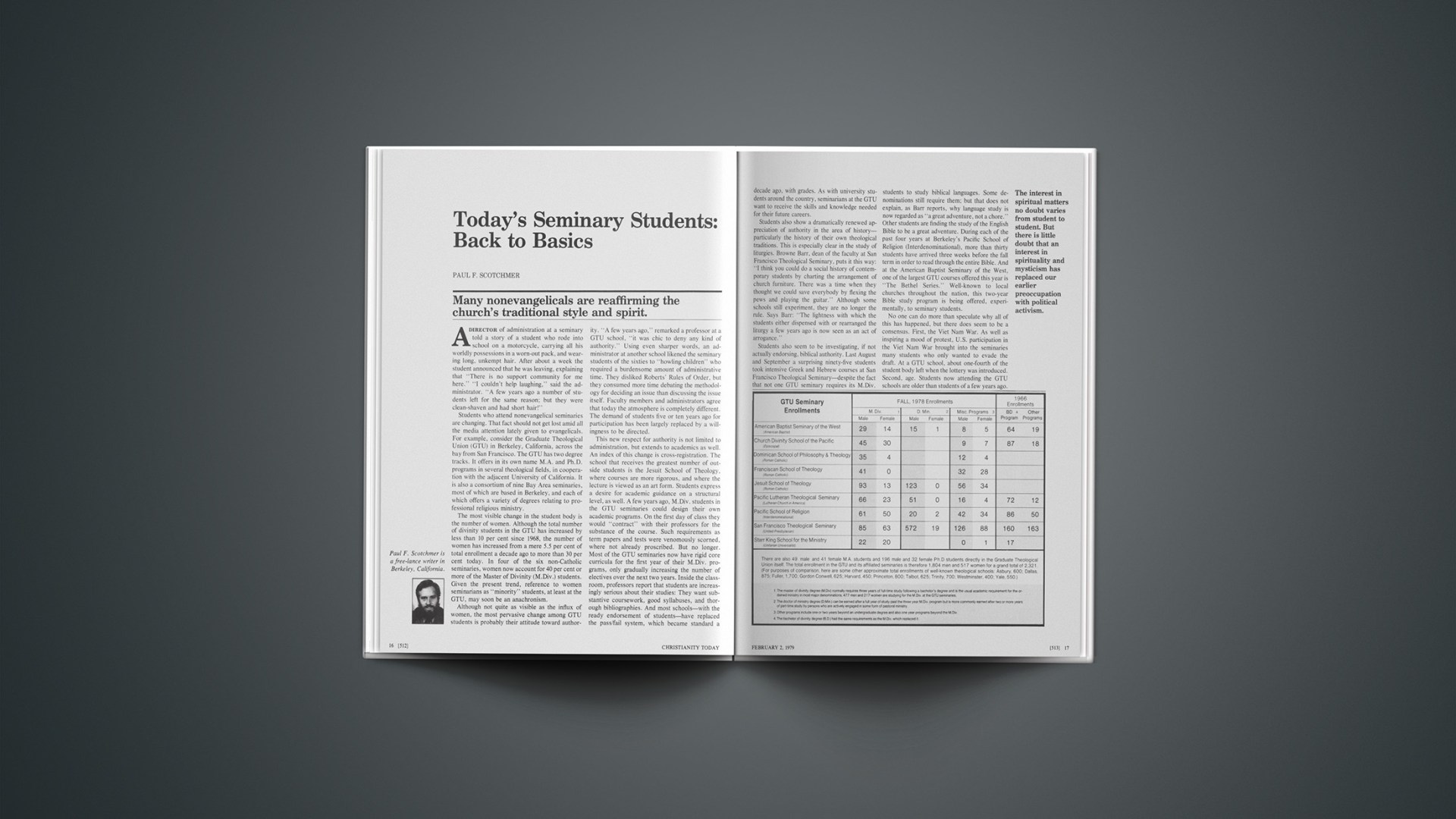
Today’s Seminary Students: Back to Basics

Many nonevangelicals are reaffirming the church’s traditional style and spirit.

A director of administration at a seminary told a story of a student who rode into school on a motorcycle, carrying all his worldly possessions in a worn-out pack, and wearing long, unkempt hair. After about a week the student announced that he was leaving, explaining that “There is no support community for me here.” “I couldn’t help laughing,” said the administrator. “A few years ago a number of students left for the same reason; but they were clean-shaven and had short hair!”

Students who attend nonevangelical seminaries are changing. That fact should not get lost amid all the media attention lately given to evangelicals. For example, consider the Graduate Theological Union (GTU) in Berkeley, California, across the bay from San Francisco. The GTU has two degree tracks. It offers in its own name M.A. and Ph.D. programs in several theological fields, in cooperation with the adjacent University of California. It is also a consortium of nine Bay Area seminaries, most of which are based in Berkeley, and each of which offers a variety of degrees relating to professional religious ministry.

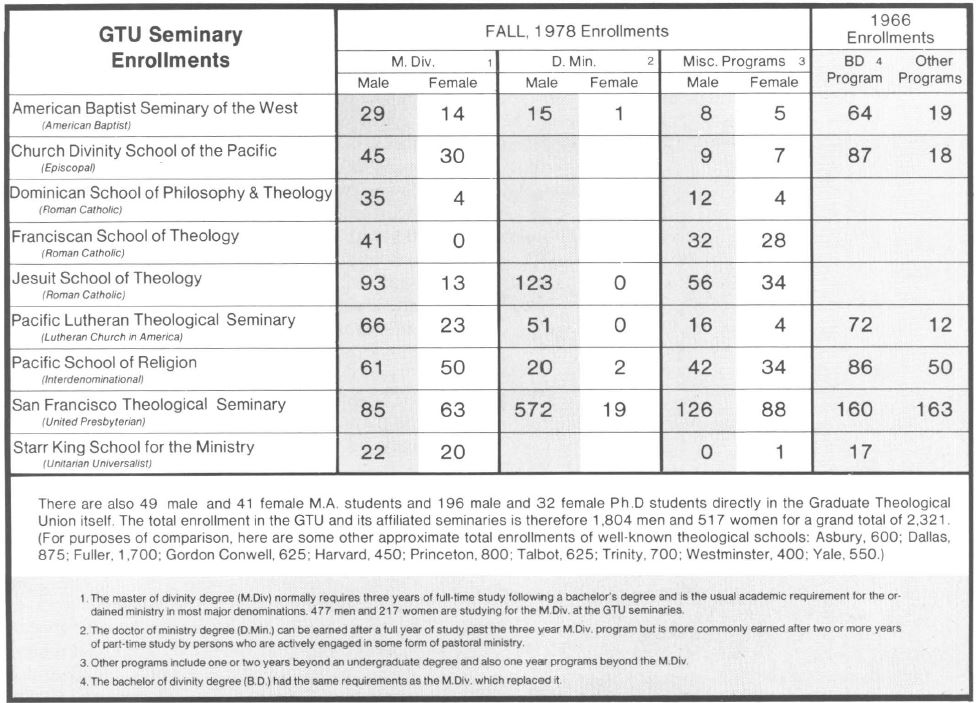
The most visible change in the student body is the number of women. Although the total number of divinity students in the GTU has increased by less than 10 per cent since 1968, the number of women has increased from a mere 5.5 per cent of total enrollment a decade ago to more than 30 per cent today. In four of the six non-Catholic seminaries, women now account for 40 per cent or more of the Master of Divinity (M.Div.) students. Given the present trend, reference to women seminarians as “minority” students, at least at the GTU, may soon be an anachronism.

Although not quite as visible as the influx of women, the most pervasive change among GTU students is probably their attitude toward authority. “A few years ago,” remarked a professor at a GTU school, “it was chic to deny any kind of authority.” Using even sharper words, an administrator at another school likened the seminary students of the sixties to “howling children” who required a burdensome amount of administrative time. They disliked Roberts’ Rules of Order, but they consumed more time debating the methodology for deciding an issue than discussing the issue itself. Faculty members and administrators agree that today the atmosphere is completely different. The demand of students five or ten years ago for participation has been largely replaced by a willingness to be directed.

This new respect for authority is not limited to administration, but extends to academics as well. An index of this change is cross-registration. The school that receives the greatest number of outside students is the Jesuit School of Theology, where courses are more rigorous, and where the lecture is viewed as an art form. Students express a desire for academic guidance on a structural level, as well. A few years ago, M.Div. students in the GTU seminaries could design their own academic programs. On the first day of class they would “contract” with their professors for the substance of the course. Such requirements as term papers and tests were venomously scorned, where not already proscribed. But no longer. Most of the GTU seminaries now have rigid core curricula for the first year of their M.Div. programs, only gradually increasing the number of electives over the next two years. Inside the classroom, professors report that students are increasingly serious about their studies: They want substantive coursework, good syllabuses, and thorough bibliographies. And most schools—with the ready endorsement of students—have replaced the pass/fail system, which became standard a decade ago, with grades. As with university students around the country, seminarians at the GTU want to receive the skills and knowledge needed for their future careers.

The interest in spiritual matters no doubt varies from student to student. But there is little doubt that an interest in spirituality and mysticism has replaced our earlier preoccupation with political activism.

Students also show a dramatically renewed appreciation of authority in the area of history—particularly the history of their own theological traditions. This is especially clear in the study of liturgies. Browne Barr, dean of the faculty at San Francisco Theological Seminary, puts it this way: “I think you could do a social history of contemporary students by charting the arrangement of church furniture. There was a time when they thought we could save everybody by flexing the pews and playing the guitar.” Although some schools still experiment, they are no longer the rule. Says Barr: “The lightness with which the students either dispensed with or rearranged the liturgy a few years ago is now seen as an act of arrogance.”

Students also seem to be investigating, if not actually endorsing, biblical authority. Last August and September a surprising ninety-five students took intensive Greek and Hebrew courses at San Francisco Theological Seminary—despite the fact that not one GTU seminary requires its M.Div. students to study biblical languages. Some denominations still require them; but that does not explain, as Barr reports, why language study is now regarded as “a great adventure, not a chore.” Other students are finding the study of the English Bible to be a great adventure. During each of the past four years at Berkeley’s Pacific School of Religion (Interdenominational), more than thirty students have arrived three weeks before the fall term in order to read through the entire Bible. And at the American Baptist Seminary of the West, one of the largest GTU courses offered this year is “The Bethel Series.” Well-known to local churches throughout the nation, this two-year Bible study program is being offered, experimentally, to seminary students.

No one can do more than speculate why all of this has happened, but there does seem to be a consensus. First, the Viet Nam War. As well as inspiring a mood of protest, U.S. participation in the Viet Nam War brought into the seminaries many students who only wanted to evade the draft. At a GTU school, about one-fourth of the student body left when the lottery was introduced. Second, age. Students now attending the GTU schools are older than students of a few years ago.

Seminary enrollment data from 1978

This, too, relates to the exodus of draft-evaders. Also, more students are attending seminary after a “religious experience” of some sort. And many of them have changed careers to do so. Third, the wave of conservatism sweeping the country. Seminary education, as with secular education, seems to be undergoing a back to the basics movement. As a student put it: “Maybe around here you can do far-out stuff, and that’s acceptable, but for people in the congregations, it’s a different thing. You can’t get too far away from the basics.” Students today understand this before they leave seminary.

After the change of attitude toward authority, the most striking difference between GTU seminary students today versus five or ten years ago is in the area of spirituality. The interest in spiritual matters no doubt varies from student to student. But there is little doubt that an interest in spirituality and mysticism has replaced an earlier preoccupation with political activism.

Students a few years ago took such courses as “Social Change in White Churches”—an undisguised attempt to transform local congregations in the Bay Area into political advocacy groups. The students did not simply study church-and-state relations, but “Church, State, and the Right to Revolution”; not simply art, but “War and Peace and Politics in Art”; and not simply poetry, but “The Poetry of Protest.” This has changed. The Center for Urban Black Studies, which used to attract scores of students to its courses—particularly to “The Pastor as Revolutionary”—has nearly withered in the dry heat of indifference. The center canceled one of its two classes scheduled for this fall: lack of interest. The other has four students enrolled. Outside the classroom political activism is conspicuously absent, even within the powerful women’s block. The Center for Women and Religion is weaker, and remonstrances against every use of “sexist language” no longer seem to be a categorical imperative.

I don’t want to suggest that GTU seminarians have abandoned their interest in the relationship between religion and society. The Center for Ethics and Social Policy is thriving, and forums on social thought and social concern are numerous. But students study the relationships between religion and society. They ask questions, rather than assume answers.

“Spirituality is the thing now,” states GTU Registrar Elizabeth Over. The largest classes today are likely to have such titles as “Studies in Spirituality: 1570–1870,” “Spirituality and Social Justice,” and “The Varieties of Spiritual Experience.” Between January and June of 1978 there were no less than thirty events having to do with spirituality—mostly eastern. Not atypical was the program entitled “Mantra, Meditation, and Prayer,” with Sant Keshevadas; and at the Pacific School of Religion there was a series last year on “Yoga and Movement,” followed by formal meditation—for Vespers. Students were so interested in eastern religions that three adjunct professors were brought into the GTU last year to help teach them. But reports indicate that fascination with the human potential movement and eastern religion is waning. At the same time, Christian spirituality appears to be in the ascendant. Chapel attendance at the various seminaries has increased dramatically. There are reports of spontaneous prayer groups here and there. And the Shalom Prayer Group, a charismatic fellowship of mostly GTU students, attracts as many as seventy-five people to its weekly meetings at the Jesuit seminary.

Observers can only surmise why students have a renewed interest in spirituality. L. Doward McBain, president of the American Baptist Seminary of the West, pinpointed the most important reason: “The dangerous world in which we live, in which great powers can vaporize most of civilization, has had its effect on theology. We’re not permanent in this world.” McBain also points to an internal factor: the increased vitality of the church itself, particularly with the evangelical awakening. Browne Barr concurs. Although he admits that the GTU seminaries have not grown larger from the groundswell of evangelicalism, he believes that “a sense of the transcendent” has been brought into the GTU seminaries by way of evangelicalism “in a new and refreshing way.” Evangelicalism, combined with the emphasis on meditation in eastern religion, helps explain, says Barr, why “prayer is no longer a naughty word.”

Now when students study the relationship between religion and society they ask questions rather than assume answers.

Where is this new breed of seminary students headed? Here we hit upon another major change: the reawakening of the parish ministry. James Jones, professor and director of field education at the Church Divinity School of the Pacific (Protestant Episcopal), noted that just five years ago it was hard to persuade students to take field work in local parishes. “They wanted something more exotic.” Now he has trouble keeping them out of the parish. Every faculty member and administrator interviewed agreed that the local parish has regained a position of respectability among seminary students. The realities of the job market may have something to do with this shift, but that does not entirely explain it. Jones points out that while only one-third of the seminary students in 1972 intended to become pastors, the vast majority actually did so when it came time to find a position. The difference between then and now is that “today’s students enter and leave with the idea of going into the parish ministry.”

Paul F. Scotchmer is a freelance writer in Berkley, California.

————————-

Three Other Seminaries In The Bay Area

The nine GTU seminaries represent most major American denominational traditions, especially when you realize that the Pacific School of Religion has many Methodists attending and historically has Congregational ties. There are also three major non-GTU seminaries. Therefore, the Bay Area, along with Chicago, is one of the two most representative centers of theological education in the country.

San Francisco Baptist Theological Seminary was founded in 1958 and uses facilities provided by Hamilton Square Baptist Church in downtown San Francisco. It was originally part of the Conservative Baptist movement, but that tie was broken several years ago. It is not now linked to any Baptist denomination. The school has no women students; sixteen men are studying for the M.Div. and four more for the Th.M. It stands “solidly in the position of Fundamental separatism, defending the dispensational premillennial interpretation of the Word of God.” As such it is more or less similar to about a dozen graduate schools scattered across the country, mostly young and baptistic, that have emerged to train ministers (along with the older undergraduate Bible colleges) for the fundamentalist wing of evangelicalism.

Golden Gate Baptist Theological Seminary is the western-most of six Southern Baptist Convention-owned schools and is located in Mill Valley, a dozen miles north of San Francisco. It was founded in 1944, symbolizing the westward expansion of the largest Protestant body in the country. In the fall of 1977 it enrolled 474 students in its various programs, over 200 more than it did a decade earlier. Only about 6 per cent of the M.Div. students are women. Neither Golden Gate, nor any of the GTU seminaries, are any match in size for the four Southern Baptist seminaries in the heartland of the denomination: In the fall of 1977 they enrolled more than 7,700 students.

Saint Patricks’ Seminary is in Menlo Park, thirty miles south of San Francisco, and serves about eighty-five students preparing to become Roman Catholic diocesan priests. Such priests normally engage in pastoral careers. There are about fifty such seminaries and their nationwide enrollment in 1977 was a little over 3,000, about 60 per cent of the level of a decade ago. There are another fifty or so seminaries closely identified with religious orders, including the three in the GTU. Nationwide, there are about 2,000 students in them. Priests in religious orders are more likely to engage in academic, missionary, or other specialized ministries. (When much larger figures for Catholic seminarians are reported they include boys in the high school and college level stages of preparation for the priesthood.)

Absent from among the Bay Area seminaries is a strong multi-denominational evangelical institution such as Asbury, Dallas, Fuller, Gordon-Conwell, Trinity, or Westminster. A small start at partially filling this void is to be made this September when regular operations commence for the New College for Advanced Christian Studies adjoining the GTU. New College, however, does not intend to offer an M.Div. (See news story, Oct. 6, 1978, p. 50.) Saint Joseph of Arimathea Anglican Theological College is also being launched in Berkeley to provide priests for Anglo-Catholics.

Church Life

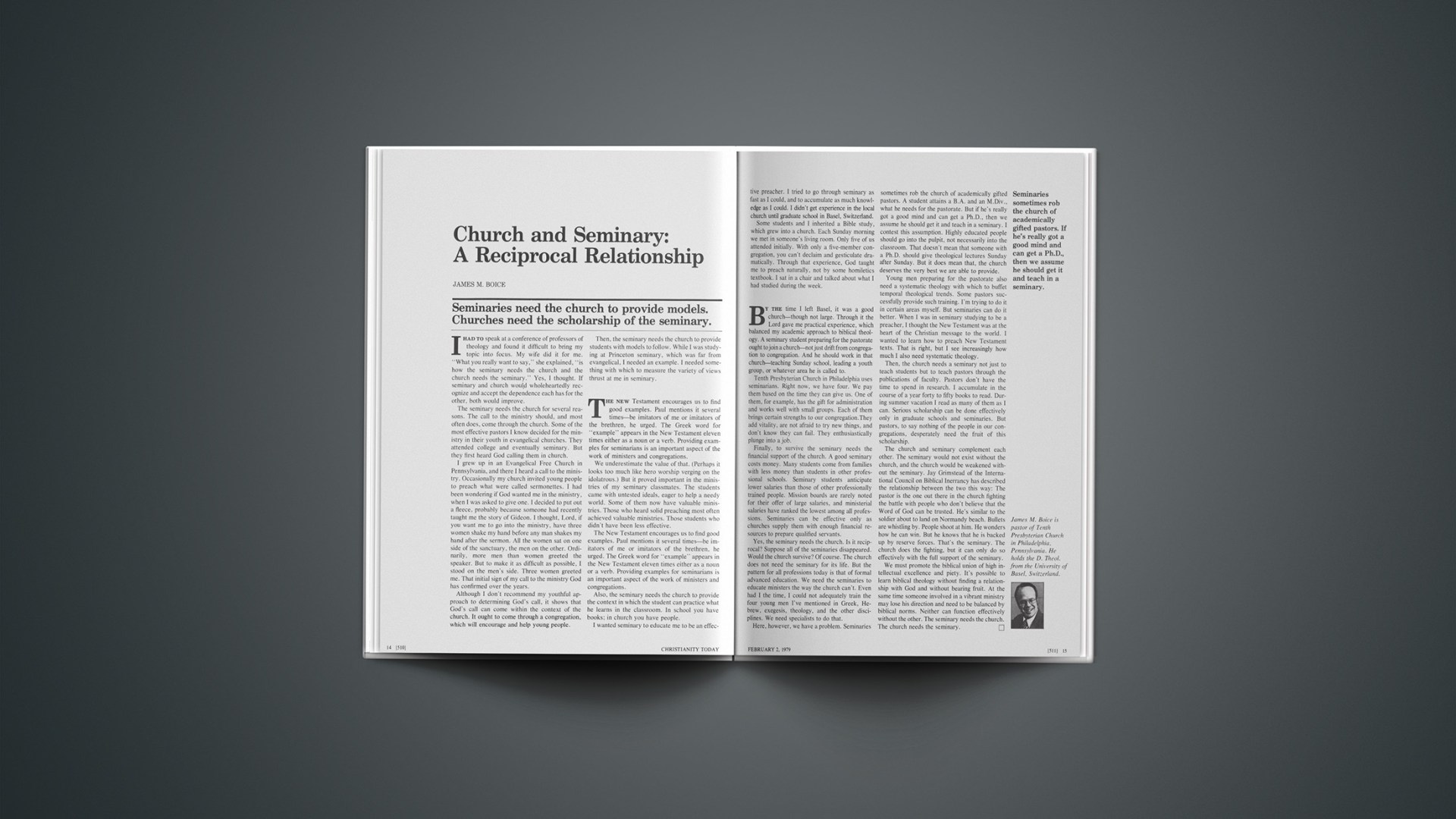
Church and Seminary: A Reciprocal Relationship

Seminaries need the church to provide models. Churches need the scholarship of the seminary.

I had to speak at a conference of professors of theology and found it difficult to bring my topic into focus. My wife did it for me. “What you really want to say,” she explained, “is how the seminary needs the church and the church needs the seminary.” Yes, I thought. If seminary and church would wholeheartedly recognize and accept the dependence each has for the other, both would improve.

The seminary needs the church for several reasons. The call to the ministry should, and most often does, come through the church. Some of the most effective pastors I know decided for the ministry in their youth in evangelical churches. They attended college and eventually seminary. But they first heard God calling them in church.

I grew up in an Evangelical Free Church in Pennsylvania, and there I heard a call to the ministry. Occasionally my church invited young people to preach what were called sermonettes. I had been wondering if God wanted me in the ministry, when I was asked to give one. I decided to put out a fleece, probably because someone had recently taught me the story of Gideon. I thought, Lord, if you want me to go into the ministry, have three women shake my hand before any man shakes my hand after the sermon. All the women sat on one side of the sanctuary, the men on the other. Ordinarily, more men than women greeted the speaker. But to make it as difficult as possible, I stood on the men’s side. Three women greeted me. That initial sign of my call to the ministry God has confirmed over the years.

Although I don’t recommend my youthful approach to determining God’s call, it shows that God’s call can come within the context of the church. It ought to come through a congregation, which will encourage and help young people.

Then, the seminary needs the church to provide students with models to follow. While I was studying at Princeton seminary, which was far from evangelical, I needed an example. I needed something with which to measure the variety of views thrust at me in seminary.

The New Testament encourages us to find good examples. Paul mentions it several times—be imitators of me or imitators of the brethren, he urged. The Greek word for “example” appears in the New Testament eleven times either as a noun or a verb. Providing examples for seminarians is an important aspect of the work of ministers and congregations.

We underestimate the value of that. (Perhaps it looks too much like hero worship verging on the idolatrous.) But it proved important in the ministries of my seminary classmates. The students came with untested ideals, eager to help a needy world. Some of them now have valuable ministries. Those who heard solid preaching most often achieved valuable ministries. Those students who didn’t have been less effective.

The New Testament encourages us to find good examples. Paul mentions it several times—be imitators of me or imitators of the brethren, he urged. The Greek word for “example” appears in the New Testament eleven times either as a noun or a verb. Providing examples for seminarians is an important aspect of the work of ministers and congregations.

Also, the seminary needs the church to provide the context in which the student can practice what he learns in the classroom. In school you have books; in church you have people.

I wanted seminary to educate me to be an effective preacher. I tried to go through seminary as fast as I could, and to accumulate as much knowledge as I could. I didn’t get experience in the local church until graduate school in Basel, Switzerland.

Some students and I inherited a Bible study, which grew into a church. Each Sunday morning we met in someone’s living room. Only five of us attended initially. With only a five-member congregation, you can’t declaim and gesticulate dramatically. Through that experience, God taught me to preach naturally, not by some homiletics textbook. I sat in a chair and talked about what I had studied during the week.

By the time I left Basel, it was a good church—though not large. Through it the Lord gave me practical experience, which balanced my academic approach to biblical theology. A seminary student preparing for the pastorate ought to join a church—not just drift from congregation to congregation. And he should work in that church—teaching Sunday school, leading a youth group, or whatever area he is called to.

Tenth Presbyterian Church in Philadelphia uses seminarians. Right now, we have four. We pay them based on the time they can give us. One of them, for example, has the gift for administration and works well with small groups. Each of them brings certain strengths to our congregation. They add vitality, are not afraid to try new things, and don’t know they can fail. They enthusiastically plunge into a job.

Finally, to survive the seminary needs the financial support of the church. A good seminary costs money. Many students come from families with less money than students in other professional schools. Seminary students anticipate lower salaries than those of other professionally trained people. Mission boards are rarely noted for their offer of large salaries, and ministerial salaries have ranked the lowest among all professions. Seminaries can be effective only as churches supply them with enough financial resources to prepare qualified servants.

Yes, the seminary needs the church. Is it reciprocal? Suppose all of the seminaries disappeared. Would the church survive? Of course. The church does not need the seminary for its life. But the pattern for all professions today is that of formal advanced education. We need the seminaries to educate ministers the way the church can’t. Even had I the time, I could not adequately train the four young men I’ve mentioned in Greek, Hebrew, exegesis, theology, and the other disciplines. We need specialists to do that.

Seminaries sometimes rob the church of academically gifted pastors. If he’s really got a good mind and can get a Ph.D., then we assume he should get it and teach in a seminary.

Here, however, we have a problem. Seminaries sometimes rob the church of academically gifted pastors. A student attains a B.A. and an M.Div., what he needs for the pastorate. But if he’s really got a good mind and can get a Ph.D., then we assume he should get it and teach in a seminary. I contest this assumption. Highly educated people should go into the pulpit, not necessarily into the classroom. That doesn’t mean that someone with a Ph.D. should give theological lectures Sunday after Sunday. But it does mean that, the church deserves the very best we are able to provide.

Young men preparing for the pastorate also need a systematic theology with which to buffet temporal theological trends. Some pastors successfully provide such training. I’m trying to do it in certain areas myself. But seminaries can do it better. When I was in seminary studying to be a preacher, I thought the New Testament was at the heart of the Christian message to the world. I wanted to learn how to preach New Testament texts. That is right, but I see increasingly how much I also need systematic theology.

Then, the church needs a seminary not just to teach students but to teach pastors through the publications of faculty. Pastors don’t have the time to spend in research. I accumulate in the course of a year forty to fifty books to read. During summer vacation I read as many of them as I can. Serious scholarship can be done effectively only in graduate schools and seminaries. But pastors, to say nothing of the people in our congregations, desperately need the fruit of this scholarship.

The church and seminary complement each other. The seminary would not exist without the church, and the church would be weakened without the seminary. Jay Grimstead of the International Council on Biblical Inerrancy has described the relationship between the two this way: The pastor is the one out there in the church fighting the battle with people who don’t believe that the Word of God can be trusted. He’s similar to the soldier about to land on Normandy beach. Bullets are whistling by. People shoot at him. He wonders how he can win. But he knows that he is backed up by reserve forces. That’s the seminary. The church does the fighting, but it can only do so effectively with the full support of the seminary.

We must promote the biblical union of high intellectual excellence and piety. It’s possible to learn biblical theology without finding a relationship with God and without bearing fruit. At the same time someone involved in a vibrant ministry may lose his direction and need to be balanced by biblical norms. Neither can function effectively without the other. The seminary needs the church. The church needs the seminary.

James M. Boice is a pastor of Tenth Presbyterian Church in Philadelphia, Pennsylvania. He holds the D. Theol. from the University of Basel, Switzerland.

The Bewitching of the Churches

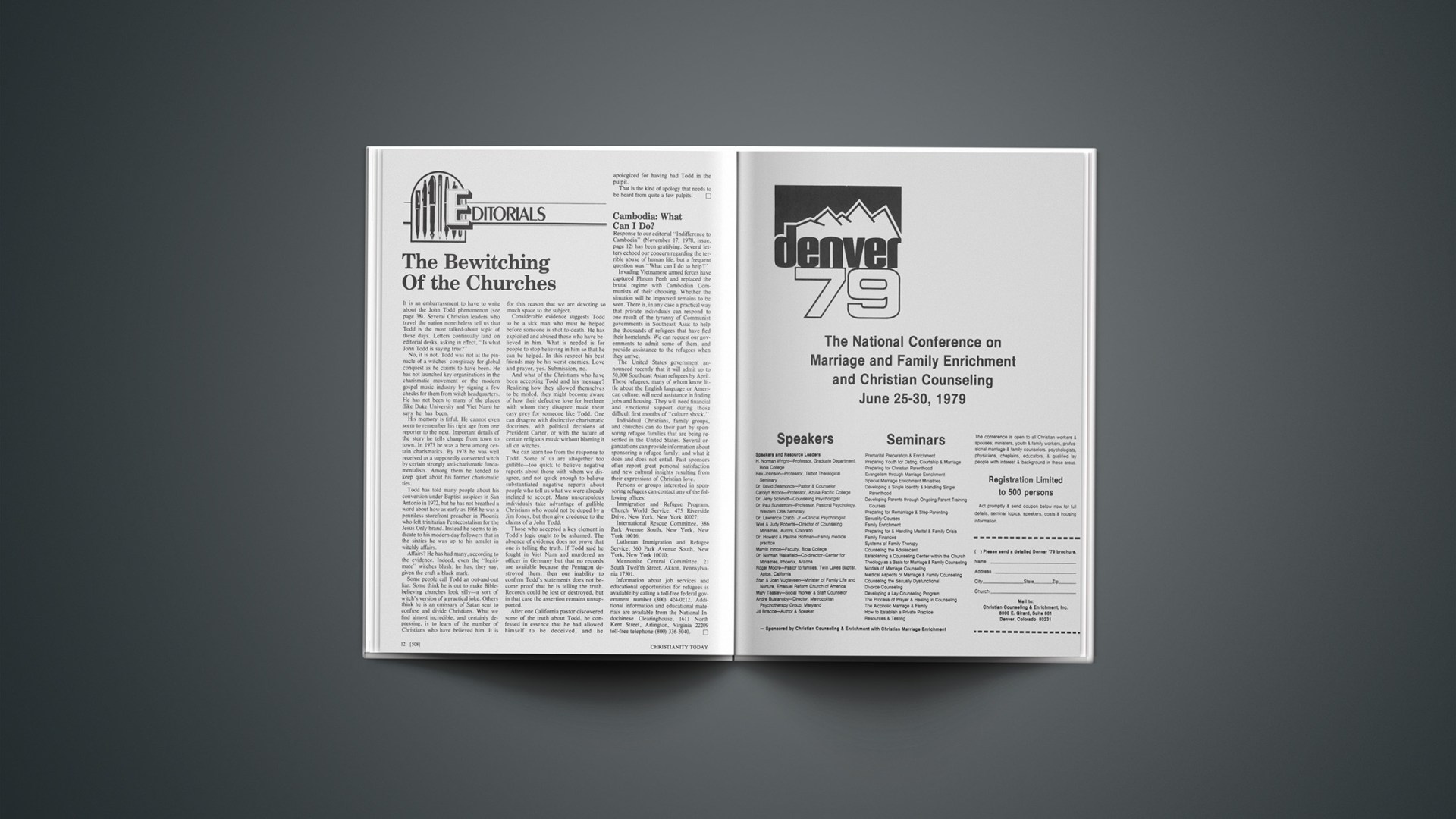
It is an embarrassment to have to write about the John Todd phenomenon (see page 38). Several Christian leaders who travel the nation nonetheless tell us that Todd is the most talked-about topic of these days. Letters continually land on editorial desks, asking in effect, “Is what John Todd is saying true?”

No, it is not. Todd was not at the pinnacle of a witches’ conspiracy for global conquest as he claims to have been. He has not launched key organizations in the charismatic movement or the modern gospel music industry by signing a few checks for them from witch headquarters. He has not been to many of the places (like Duke University and Viet Nam) he says he has been.

His memory is fitful. He cannot even seem to remember his right age from one reporter to the next. Important details of the story he tells change from town to town. In 1973 he was a hero among certain charismatics. By 1978 he was well received as a supposedly converted witch by certain strongly anti-charismatic fundamentalists. Among them he tended to keep quiet about his former charismatic ties.

Todd has told many people about his conversion under Baptist auspices in San Antonio in 1972, but he has not breathed a word about how as early as 1968 he was a penniless storefront preacher in Phoenix who left trinitarian Pentecostalism for the Jesus Only brand. Instead he seems to indicate to his modern-day followers that in the sixties he was up to his amulet in witchly affairs.

Affairs? He has had many, according to the evidence. Indeed, even the “legitimate” witches blush: he has, they say, given the craft a black mark.

Some people call Todd an out-and-out liar. Some think he is out to make Bible-believing churches look silly—a sort of witch’s version of a practical joke. Others think he is an emissary of Satan sent to confuse and divide Christians. What we find almost incredible, and certainly depressing, is to learn of the number of Christians who have believed him. It is for this reason that we are devoting so much space to the subject.

Considerable evidence suggests Todd to be a sick man who must be helped before someone is shot to death. He has exploited and abused those who have believed in him. What is needed is for people to stop believing in him so that he can be helped. In this respect his best friends may be his worst enemies. Love and prayer, yes. Submission, no.

And what of the Christians who have been accepting Todd and his message? Realizing how they allowed themselves to be misled, they might become aware of how their defective love for brethren with whom they disagree made them easy prey for someone like Todd. One can disagree with distinctive charismatic doctrines, with political decisions of President Carter, or with the nature of certain religious music without blaming it all on witches.

We can learn too from the response to Todd. Some of us are altogether too gullible—too quick to believe negative reports about those with whom we disagree, and not quick enough to believe substantiated negative reports about people who tell us what we were already inclined to accept. Many unscrupulous individuals take advantage of gullible Christians who would not be duped by a Jim Jones, but then give credence to the claims of a John Todd.

Those who accepted a key element in Todd’s logic ought to be ashamed. The absence of evidence does not prove that one is telling the truth. If Todd said he fought in Viet Nam and murdered an officer in Germany but that no records are available because the Pentagon destroyed them, then our inability to confirm Todd’s statements does not become proof that he is telling the truth. Records could be lost or destroyed, but in that case the assertion remains unsupported.

After one California pastor discovered some of the truth about Todd, he confessed in essence that he had allowed himself to be deceived, and he apologized for having had Todd in the pulpit.

That is the kind of apology that needs to be heard from quite a few pulpits.

Eutychus and His Kin: February 2, 1979

In its ever-rigorous search for new areas of ministry, Evangelical Amusements has decided that the northern states of this country have been ignored for too long. There are vast groups of unchurched people, bundled up and burdened down with parkas, snow, sin, mittens, ice, face masks, and wind. How do you reach them? Use snowmobiles.

A snowmobile can go where the snow culture is. And it’s faster than cross country skis. A large sm with a wide ski base has enough room to carry the tools of the evangelistic trade—a Bible and an offering plate—as well as cooking gear, a rifle, a fishing pole or two, maybe even a tent.

Also, a snowmobile doesn’t make you as winded as skiing. How could you have breath enough to preach, if you are huffing and puffing from ski exertion? A preacher needs all the wind he can get.

You do have the problem, though, of gasoline. Carry an extra gallon or two. It’s no fun to be stranded in the North Woods alone, with just your sm as companion. Anyway, it’s a bad witness to seem so unprepared. People up north cover all contingencies. Survival is the snowword. For those stewardship-conscious preachers, just remember. You may be spending money on gas, but you’ll save on hotel and food bills.

Once you’ve got your snowmobile, you might think you’re ready to set out on your preaching itinerary. A word of caution, however. An sm is not a car. Or a cycle. Or a motorboat. Steering is not easy. But with practice you can avoid spruce trees, rocks, roots, and the local rabbit or grouse. (There are better ways to kill your dinner. That’s what the rifle is for.) A traveling prayer might be in order, as well. And don’t let the speedometer go to your head. So it says the sm can go eighty to a hundred miles an hour. Remember that sound principle of moderation in all things, snowmobile speed included.

Now, who is the targeted audience? Other snowmobilers, first of all. But don’t look for them in the morning or the afternoon. You may spend all your time on your machine. But most sm-ers work for a living, so they take their rides at night. Remember to pack a flashlight.

Then, there are the ice fishermen—a hardy breed. If you want to evangelize them you’d better get used to the cold. Evangelical Amusements doesn’t recommend Southerners to go into this ministry. Try not to beat the fishermen onto the lakes, though. They know when to drive their trucks onto the ice. You may snowmobile yourself right into the water.

A final piece of advice. Keep an extra supply of Delcos on hand. You wouldn’t want your battery-operated socks to go dead in the middle of the invitation.

EUTYCHUS IX

Classified Humor

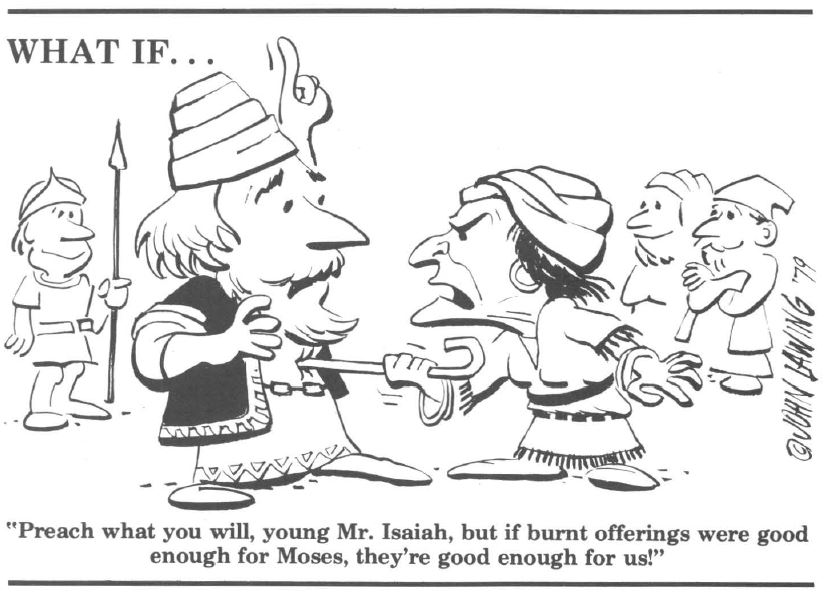
I have just read your December 1 issue and was particularly amused with your new look in the classifieds. Amused, since even before Mr. Lawing moved to make the classifieds “interesting,” they were causing me an occasional laugh. Who says Christians don’t have a sense of humor? The classifieds prove they do.

RON RIESINGER

Mc Allen, Tex.

CHRISTIANITY TODAY is a valuable and deeply appreciated magazine, and efforts to improve the classified ad section are well intentioned. I love jokes, wit, and humor. I strongly object, however, to the so-called humorous ads by Lawing. They are not funny or humorous. The reader feels like he has been “taken in” or “suckered” upon reading those ads. They are not in keeping with the tradition of CHRISTIANITY TODAY. I, therefore, urgently request you to stop the fake ads at once. Thank you for your consideration of my request.

ROBERT W. MAYES

First Presbyterian Church

McMinnville, Tenn.

Kudos For Two

I wish to compliment CHRISTIANITY TODAY on the two articles I read in the December 15 issue. Item number one: (News, page 38) “Jim Jones: Man Who Would Be God.” I found this most interesting and well written. This article really brought things to light and made me understand how such a cult can get started. This was the devil’s doing from beginning to end. Item number two (News, page 41): “PTL: Please Toss a Lifesaver.” … Again, this article was well put together.… I receive five or six magazines every month but I must say CHRISTIANITY TODAY tells me more than all the others.

W. C. SCARBERT

Aurora, Ill.

Disagreement Filed

I greatly appreciate CHRISTIANITY TODAY. I applaud the interview “Medical Ethics and Stewardship of Life” with Dr. Koop in your December 15 issue. Your “Born in a Barn” editorial (Dec. 15) has an objectionable attitude for me. It somehow says a believer should feel guilty unless he goes to “extraordinary lengths to confine himself to poverty, danger, exile, and unimportance at Christmas time.” The author implies that there is something wrong with living in the “white-dominated North American continent”; or that it is unholy to live in “comfortable suburbs”; or that it would automatically be righteous if “undocumented workers” from Mexico came into the U.S. at will.… The exhortation to be obsessed with identifying with the poor, the third world, and certain ethnic groups or you are somehow unchristian and exploitative represents a shallow analysis. We need not to be beaten with this double standard any more.

RICHARD JORGENSEN

First Christian Church

Tujunga, Calif.

Return to Nam

I applaud the November 17 editorial pointing out the lack of an evangelical outcry against the butchery taking place in Cambodia. Perhaps a reason for this lack of concern is that the name Cambodia brings us back to Viet Nam and a national feeling of guilt. Yet, this is no excuse for the Christian. We seem to have forgotten that Christian voices in the past caused reform to take place. Thank you for stirring me up. I am drafting a letter to my congressman today.

JOHN J. SCHULTZ

Portland, Oreg.

In your November 17 editorial regarding Cambodia you make passing mention of not wanting another Viet Nam. For those of us who were there, Viet Nam can be a very compelling reason for staying out of Cambodia. Keeping a Christian attitude toward other human beings is a difficult task when you are in a situation where your enemy has little to no respect for human Life. My heart goes out to those who suffer in Cambodia just as it did to those in Viet Nam. I find, however, my compassion is tempered with a sense of reality.… As a Christian, I must voice my protest over the taking of innocent lives in Cambodia but as a nation I do not think we are ready to give another 500,000 lives in a no win war. These opinions are my own and do not necessarily represent those of the United States Navy or any other governmental agency.

MARK H. MASCHO, JR.

Otis Air Force Base, Mass.

Christians in Australia

Surveys show that fewer people believe in God.

The mainline churches in Australia are not flourishing. Congregations and their influence in the community are on the decline. Enemies of the church rejoice and prophesy its early demise. Friends make excuses and wait in hope.

How bad is it? Recently a daily paper in Melbourne ran a series under the general heading, “Christianity in Australia.” The paper printed articles by representatives of the Anglican, Roman Catholic, and Uniting Churches.

Each representative examined the situation in his own church and gave his view on what should be done. The newspaper, in introducing the series, did not disguise how it saw the situation. It referred to a “mass swing of the sixties and seventies away from God and church,” which, it said, “shows little sign of slowing.” “Surveys show that fewer people believe in God and that regular church attendance is confined to perhaps 20 per cent of the population. It spoke of “the drought in religious vocations which has forced most denominations to prune service and teaching programmes.”

The churchmen agreed that the situation is bad. The Anglican, John Gaden, saw his church as “bumbling along on alien soil.” He spoke of its close links with Britain and saw the role of its clergy as “chaplains to the status quo.” He spoke of the production of an Australian Prayer Book as a significant event, though he found it questionable whether the Anglican church in this country “has any national identity.” Looking to the future he saw a need for Anglicans to “reach out” to people outside the churches. He looked for “a new ecumenism,” concerned not so much with merging structures as with having Christians of different traditions work together. He looked for a larger part to be played by lay people.

Not many people would argue with him. Certainly Anglicans as much as any people have a need to “reach out.” And a kind of ecumenism in which people are more concerned to work with other Christians than to concentrate on organizational structures must gain wide support.

I doubt whether the Anglican Church in Australia is quite as English as Gaden contends. But it has its problems. Few people would hold that it is making significant progress.

The second writer, George Pell, was from the Roman Catholic Church. He saw a number of changes in his church, “but the biggest change in Australia is that many of the young and middle-aged have drifted from the church and many who remain are uncertain and confused.” He noticed that many defectors no longer believe in God, a difference from earlier crises. Pell rejected euphemisms like “strategic withdrawal” and faced squarely the fact that the churches are in trouble. This is not simply a statistical matter, for “the churches are losing not numbers but people.” And the people they are losing are not being “liberated into a happy secular world; they are being set adrift.…”

Pell welcomes the changes brought about by Vatican II. And for the future he looks above all for “a recognition of the Cross, the necessity of sacrifice, and a corporate discipline in fundamentals which is not vitiated by appeals to freedom of conscience.” He also looks for an ecumenism that will not necessarily mean one church, an ecumenism that “is not the coming together of the churches for mutual solace or to curse the darkness. It is not the rearrangement of deck chairs while the ship is sinking.” It is rather increased cooperation in the work of the church and the service of the world. But he thinks that there may be only two groups in Australia in the not too distant future, one comprising Roman Catholics, Anglicans, and Lutherans, and the other “Evangelical Protestants.”

For Pell the situation is far from reassuring. But he looks for improvement. The church may have reached the bottom of the trough. An outsider is in no position to evaluate his optimism, but his insistence on the central place of the cross is welcome. I see no effective Christian work that does not make the cross central.

The third church to contribute to the series was the Uniting Church, a Church inaugurated at a service on June 22, 1977, when the Congregational, Methodist, and the Presbyterian Churches came together (with some not inconsiderable groups remaining outside the merger). Graeme Griffin wrote that the Uniting Church should not be seen as just another denomination, for its very name “Uniting” means that it is always open to new possibilities of uniting with other groups of Christians. Once again we have the ecumenical note struck, but this time with more emphasis on organizational union.

This church is no more healthy than the others. Some people were unhappy with the union and a Presbyterian church and some Congregational churches remain. The structures set up by the Uniting Church have taken time to settle in and understandably there have been tensions. Lay people are challenging the place of ordained ministers. Griffin sees it as significant that the next moderator of the Synod of Victoria is to be a laywoman.

Griffin makes no attempt to gloss over the problems his church faces. His second article, “Merger Brings Conflict,” stresses the tensions. But he is basically optimistic. His church is “an essay in hope” and Griffin is not lacking in this commodity.

From the survey it is plain that the mainline denominations are in some trouble in this country. It is also plain that things are beginning to happen.

A curious feature of the survey is that no attempt was made to include the evangelicals. Those in the Anglican Church are perhaps included by implication, but there are many other evangelicals. Such denominations as the Baptists and the Salvation Army went unnoticed. Some of the liveliest congregations are in such denominations.

The newspaper spoke of a “drought in religious vocations.” We have not noticed this in my college. In each of the last six years we have broken our record for the number of theological students in training—a strange drought. Other evangelical institutions report similar numbers.

Evangelicals have come together in recent years in the Evangelical Alliance, which has stimulated thought and action. Such movements as the “Festival of Light,” which have been strongly supported by evangelicals, have been very active. Evangelical books are read. The Bible is studied.

Although the whole story is far from bright, it is not as bleak as the paper printed it. When the evangelical contribution is included, there is more to be optimistic about. There is a long way to go, but at least we have begun.

Leon Morris is principal of Ridley College, Victoria, Australia.

Apple PodcastsDown ArrowDown ArrowDown Arrowarrow_left_altLeft ArrowLeft ArrowRight ArrowRight ArrowRight Arrowarrow_up_altUp ArrowUp ArrowAvailable at Amazoncaret-downCloseCloseEmailEmailExpandExpandExternalExternalFacebookfacebook-squareGiftGiftGooglegoogleGoogle KeephamburgerInstagraminstagram-squareLinkLinklinkedin-squareListenListenListenChristianity TodayCT Creative Studio Logologo_orgMegaphoneMenuMenupausePinterestPlayPlayPocketPodcastRSSRSSSaveSaveSaveSearchSearchsearchSpotifyStitcherTelegramTable of ContentsTable of Contentstwitter-squareWhatsAppXYouTubeYouTube