Crusade Boosts Gospel Ground Swell

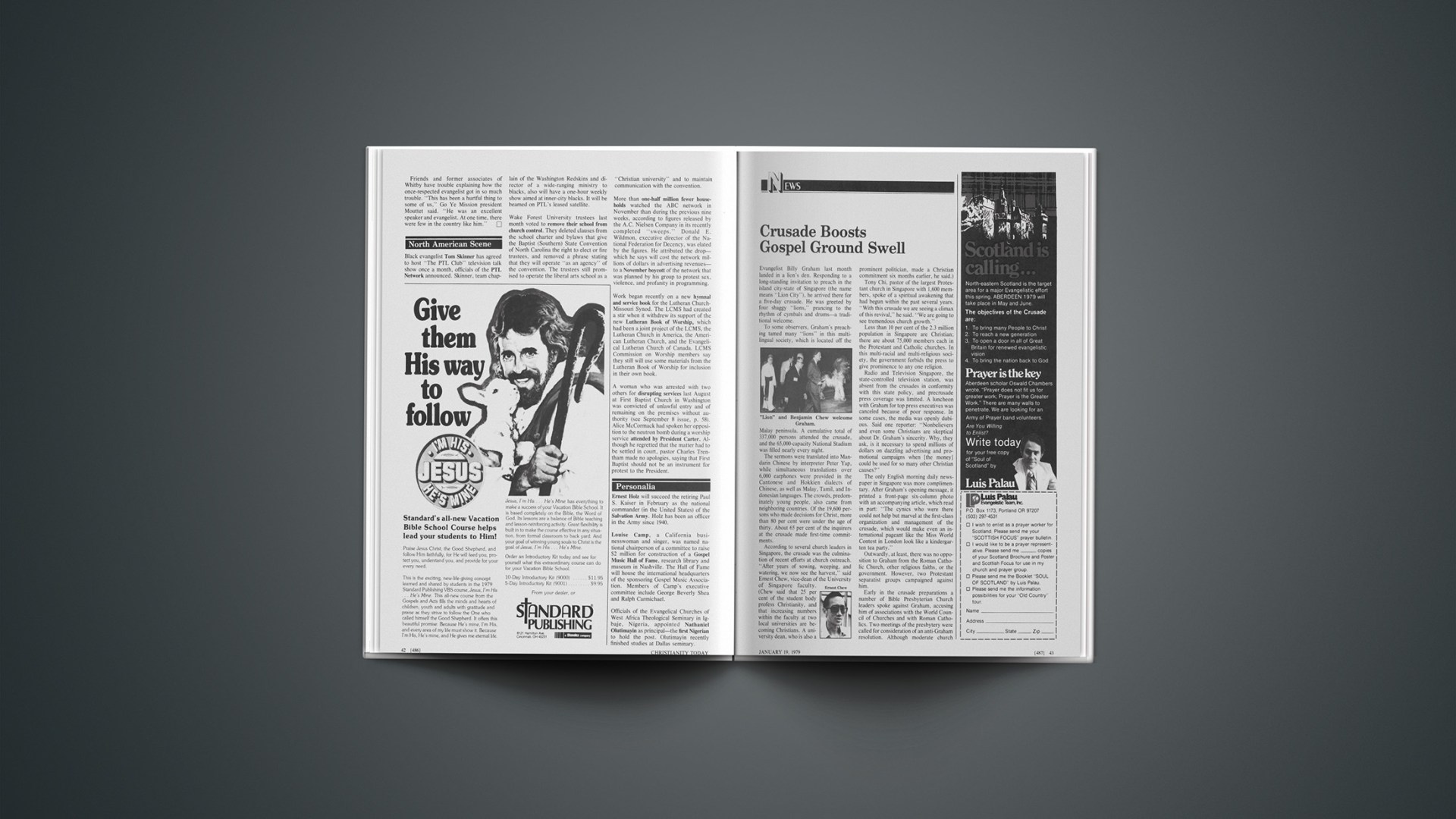
Evangelist Billy Graham last month landed in a lion’s den. Responding to a long-standing invitation to preach in the island city-state of Singapore (the name means “Lion City”), he arrived there for a five-day crusade. He was greeted by four shaggy “lions,” prancing to the rhythm of cymbals and drums—a traditional welcome.

To some observers, Graham’s preaching tamed many “lions” in this multilingual society, which is located off the Malay peninsula. A cumulative total of 337,000 persons attended the crusade, and the 65,000-capacity National Stadium was filled nearly every night.

The sermons were translated into Mandarin Chinese by interpreter Peter Yap, while simultaneous translations over 6,000 earphones were provided in the Cantonese and Hokkien dialects of Chinese, as well as Malay, Tamil, and Indonesian languages. The crowds, predominately young people, also came from neighboring countries. Of the 19,600 persons who made decisions for Christ, more than 80 per cent were under the age of thirty. About 65 per cent of the inquirers at the crusade made first-time commitments.

According to several church leaders in Singapore, the crusade was the culmination of recent efforts at church outreach. “After years of sowing, weeping, and watering, we now see the harvest,” said Ernest Chew, vice-dean of the University of Singapore faculty. (Chew said that 25 per cent of the student body profess Christianity, and that increasing numbers within the faculty at two local universities are becoming Christians. A university dean, who is also a prominent politician, made a Christian commitment six months earlier, he said.)

Tony Chi, pastor of the largest Protestant church in Singapore with 1,600 members, spoke of a spiritual awakening that had begun within the past several years. “With this crusade we are seeing a climax of this revival,” he said. “We are going to see tremendous church growth.”

Less than 10 per cent of the 2.3 million population in Singapore are Christian; there are about 75,000 members each in the Protestant and Catholic churches. In this multi-racial and multi-religious society, the government forbids the press to give prominence to any one religion.

Radio and Television Singapore, the state-controlled television station, was absent from the crusades in conformity with this state policy, and precrusade press coverage was limited. A luncheon with Graham for top press executives was canceled because of poor response. In some cases, the media was openly dubious. Said one reporter: “Nonbelievers and even some Christians are skeptical about Dr. Graham’s sincerity. Why, they ask, is it necessary to spend millions of dollars on dazzling advertising and promotional campaigns when [the money] could be used for so many other Christian causes?”

The only English morning daily newspaper in Singapore was more complimentary. After Graham’s opening message, it printed a front-page six-column photo with an accompanying article, which read in part: “The cynics who were there could not help but marvel at the first-class organization and management of the crusade, which would make even an international pageant like the Miss World Contest in London look like a kindergarten tea party.”

Outwardly, at least, there was no opposition to Graham from the Roman Catholic Church, other religious faiths, or the government. However, two Protestant separatist groups campaigned against him.

Early in the crusade preparations a number of Bible Presbyterian Church leaders spoke against Graham, accusing him of associations with the World Council of Churches and with Roman Catholics. Two meetings of the presbytery were called for consideration of an anti-Graham resolution. Although moderate church leaders would not endorse it, the church took an official stand of nonsupport toward Graham. Individual church members were allowed to participate in the crusade, however, and several church leaders did so.

More aggressive in its opposition was the Jesus Saves Mission. Several weeks before the crusade, its members stood outside churches to distribute anti-Graham leaflets. The demonstrators usually were ignored, though one church called the police. The police cautioned a Jesus Saves Mission leader not to stage unlawful demonstrations at the stadium; the mission took the advice.

Unity among the 237 participating Protestant churches highlighted the event, said some church leaders. Alfred Yeo, a pastor and crusade general secretary, said, “In my years of ministry, I have never seen so much united prayer, cooperation, work, and training. Many pastors have met, worked, and prayed together for the first time.”

Committees from participating churches provided 50 supervisors, 5,500 counselors, 3,000 ushers, and 200 laborers who worked all night processing cards from inquirers. Another 4,500 people sang in the crusade choir. Follow-up was to be done by 1,800 nurture group leaders.

About $294,000, or 85 per cent of the total crusade budget, was raised before the crusade began. Sim Miah Kian, a finance company executive, commented, “This sum is above the target set. It shows again that the Lord will provide all our needs.”

Rain fell intermittently each day of the crusade, but stopped before the services. Three days before the crusade, meteorological stations recorded the heaviest rainfall in their history—20.5 inches in 24 hours. Seven persons died in the flooding that resulted, and 1,000 persons were evacuated from their homes.

Still, the turnouts were large. Observers noted that an average attendance at soccer matches in the National Stadium is 25,000, but an overflow crowd of 75,000 attended the closing service. “There may never be another moment like this again,” Graham said.

Anglican Bishop B. I. Chiu saw an immediate lesson from the crusade. “We in the churches,” he said, “are being shown how much more willing our lay people are to be used for evangelism than we thought. We now have a greater supply of lay evangelists, teachers, and pastors through the training they have received in preparing for the crusade.”

Singapore resident Jim Chew, deputy Pacific area director of the Navigators, saw future benefits. “Those from neighboring Asian countries who have attended the crusade will bring the good news of Christ back to their nations,” he said. “Second, Singaporeans who committed their lives to Christ will be those who will … go to other countries to become ambassadors of Jesus Christ.”

Operation Mobilization

Victory in Port

An unusual ship—perhaps the oldest passenger vessel afloat—dropped anchor early this month in the Veracruz, Mexico, harbor. From the mast flew the flag of Malta, on the bow was the Greek name Doulos (“servant”), and lashed to the deck were assorted vans and station wagons mostly of ancient British origin.

Aboard were 200 volunteer crew and staff members (plus about fifty children) from two dozen nations. They were intent on a mission that could be described as, well, heavenly. Some went ashore to assist with a citywide evangelistic crusade led by Luis Palau, the well-known Latin evangelist. Others readied the ship for a four-week influx of thousands of visitors to educational and religious book exhibits, Christian leadership conferences, and outreach training sessions.

If past experience is repeated, by the time the Doulos sets sail for Barranquilla, Colombia, at the end of the month, thousands of Bibles and Christian books will have been purchased by local residents, large quantities of tracts will have been distributed, and the Christian community in the area will be stronger numerically and spiritually. (The ship was in Tampico, Mexico, during most of December, following a three-week call at Portsmouth, Virginia. Before that, it had visited ports in Germany, France, Spain, Portugal, and England.)

The 428-foot, 6,822-ton Doulos is a former Italian cruise liner that was purchased in December, 1977, for $770,000 by Operation Mobilization (OM), an independent mission movement specializing in short-term service. The Doulos is the larger of two ships deployed by OM. The other—the 289-foot, 2,319 ton Logos (Greek for “word”)—was bought from the Danish government in 1970 for $170,000. The two ships have attracted more than 3 million visitors in 100 ports around the world, according to George Miley, a Virginian who has directed the ship ministries of OM since 1972. Nearly 20 million pieces of educational and religious literature have been distributed, OM records show.

Book sales help keep the ships afloat. Although the bulk of support comes from contributions, about 30 per cent of operating costs are underwritten by profits from the sale of books, Miley estimates.

The Logos carries 250 tons of books, the Doulos carries 320 tons. Among the 4,000-plus titles in ten languages are science and medical textbooks, Encyclopedia Britannica sets, and other secular reference works, along with a wide variety of religious books. The educational books help the ships gain entry to Third World ports otherwise closed to Christian missionaries, and they provide a valuable alternative to the high-quality, low-cost educational books flooding into Third World nations from the Soviet Union.

To run the Logos in 1977 cost $2,500 a day, including ship, crew, and ministry expenses, says Miley. He believes that it will cost at least twice as much to operate the Doulos this year. Fuel is a major expense item. The Logos consumes a ton of oil per day in port (to run generators) and six tons daily on the sea; the Doulos burns three tons per day in port and fourteen tons at sea.

Most of the support for OM comes from contributors in the United States, England, and Germany, though increasing amounts are coming from backers in Switzerland, Sweden, and Canada, says Miley. Each of the “full-time” missionaries (most serve a year or two) is expected to raise support from among friends and churches. (The minimum required of Americans is $125 per month.) There are no salaries. All money is deposited in a common treasury from which group and personal expenses are dispensed. If a crew member needs a pair of shoes, explains Miley, he simply submits a request to his department head.

The ships enable OM to house, transport, train, and equip workers efficiently (about 400 serve on the ships). Advance teams clear the way with authorities, and they make program arrangements with local church leaders and missionaries. Joint evangelistic projects are planned, and conferences for pastors, young people, and other groups are scheduled, often featuring internationally known speakers. (The Doulos can hold 600 conference guests at a time, the Logos about one-fourth as many. Tents are sometimes erected on deck or an adjacent pier to accomodate large crowds.)

OM takes a low-key approach to evangelism in ports of predominantly Muslim countries and other places where an assertive brand of Christianity is not welcome. Ship visits are sponsored under the name of an affiliate, Educational Book Exhibits. People line up by the thousands to browse and buy: 100,000 in Madras, India, during a two-week visit; 140,000 in Bombay; 16,500 in Tunis, Tunisia; 12,000 in Messina, Sicily; and 6,000 on a single day alone in Bangkok.

Bibles and other Christian books are snapped up along with the educational works. Ashore, workers give away free tracts and engage in personal evangelism. Last spring, for example, fifty young people in Manila handed out 250,000 tracts in a single day, according to an OM spokesman, and the Logos crew recorded more than 1,000 professions of faith in Christ while the ship was in port. (In Muslim countries, tracts are distributed much more discreetly, says the spokesman.) Occasionally, the Logos has carried hundreds of tons of relief goods to areas stricken by disasters.

OM was founded twenty-one years ago by George Verwer, a New Jersey native who became a Christian under the preaching of evangelist Billy Graham at a rally in New York City in 1955. Verwer later went to Moody Bible Institute and, to make ends meet, he sold fire extinguishers and Scripture portions. During the summers of 1957 and 1958 he did evangelistic work in Mexico with other Christian students. As a result of their efforts, a Christian bookstore was opened in Saltillo and a Gospel radio broadcast was launched; both were left in the hands of nationals they trained.

Out of these experiences came the basic OM strategy: Recruit young people for short-term service stints (from a holiday break or a summer to two years), use evangelistic projects to train them, serve areas of the world where Christian outreach is difficult, and work closely with nationals and other missions in planting new churches.

Verwer applied the strategy in Spain in 1960 and 1961 with impressive results. In 1962 he used 300 young people from two dozen countries to spread the Gospel in major cities of Western Europe. They distributed 25 million tracts and pamphlets; these brought some 20,000 mailed responses from people wanting the free Gospel of John and a Bible correspondence course offered in the tracts. Fifty mission and church organizations joined in the followup work.

Some 2,000 young people from thirty countries answered the call to help evangelize Europe in the summer of 1963. More than 400 churches and twenty-five mission agencies cooperated. Witness teams went house-to-house in thousands of towns and villages. The following summer, Verwer recruited about 1,000 people to assist in the ongoing followup work.

Verwer, 40, says he has had a concern for “closed” countries since he began OM. While in Spain in 1960 he studied Russian. Months later he was arrested and ejected from the Soviet Union for distributing Scripture portions. Other OM workers in ensuing years suffered similar treatment, especially in Muslim countries. In 1971, for instance, four young workers were arrested in Libya and jailed for eight months for handing out tracts. Verwer remains undeterred, though. OM over the years has maintained one of the most significant literature ministries among Eastern European nations, and it is almost alone in efforts to evangelize Turkey.

Tens of thousands of young people have been trained by OM, Verwer figures, and his records show that 500 permanent missionaries in thirty-five countries—along with a number of national leaders—got their start with OM.

Verwer and his wife and three children live in a modest, plainly furnished flat, and when they are on the road with hundreds of OM recruits they eat the same thin soup and make do with the same spartan living conditions. “Spiritual revolution is caught more than taught,” says Verwer. Eschewing publicity, he believes OM runs on prayer. When the treasury once ran dry, stranding the Logos in the Canary Islands without fuel, Verwer rallied his people for an entire week of prayer, and the contributions came rolling in.

The use of ships for religious purposes can be traced back at least as far as Noah’s day. Renowned evangelist George Whitefield reportedly bought a ship in the 1730s for gospel outreach along the coasts of American colonies. But OM is the first to develop the concept into an evangelistic art. The Doulos is the latest example.

Among the persons on hand to welcome the Doulos at Portsmouth, Virginia, was Mrs. Frances Sommes Parramore of Winton, North Carolina. As a fifteen-year-old when her father was mayor of nearby Newport News, she had christened the ship as the S.S. Medina in August, 1914. It served as an American coastal freighter for more than three decades, then was outfitted as an Italian passenger liner. After OM acquired it and gave it a new name just over a year ago, Archbishop of Canterbury Donald Coggan took the main part in a ceremony recommissioning the ship for use in the Lord’s service.

In OM, even ships get converted.

EDWARD E. PLOWMAN

World Scene

Galatian Baptist Church of Ankara, Turkey, was declared unauthorized last month in an official communication of the Turkish government. The English language congregation, established in 1966, is the only Southern Baptist church in Turkey. Its pastor, James F. Leeper, was expelled from Turkey last September, reportedly on grounds that he disseminated religious propaganda. Southern Baptist mission officials have protested and have asked the State Department to seek official status for the congregation.

The prime minister of the Solomon Islands, which became independent last July, is an active lay preacher in the South Sea Evangelical Church. Peter Keniloria, 35, is the son of a Melanesian missionary to the Solomons.

The Far East Broadcasting Company has announced negotiation of a twenty-five-year lease for property on the island of Saipan. Shortwave radio towers that will transmit to China will be constructed on the site.

New customs laws in Finland specifically prohibit Bible “smuggling,” an activity that has led to much friction with the Soviet Union. “All carriage of the Bible and other religious matter,” the new law states, will be treated as “smuggling.”

The Italian Senate began discussion last month of a revision of a 1929 treaty governing relations between the government and the Vatican. Under the new proposals, Roman Catholicism would no longer be recognized as the state religion of Italy, and public school students would not have to take part in religion classes when they oppose them for reasons of conscience. The current Lateran Treaty was concluded during the rule of Fascist leader Benito Mussolini. Revision has been in process for eleven years.

Cults: Is Forum Integrity Eclipsed by Moon?

Cults

Is Forum Integrity Eclipsed by Moon?

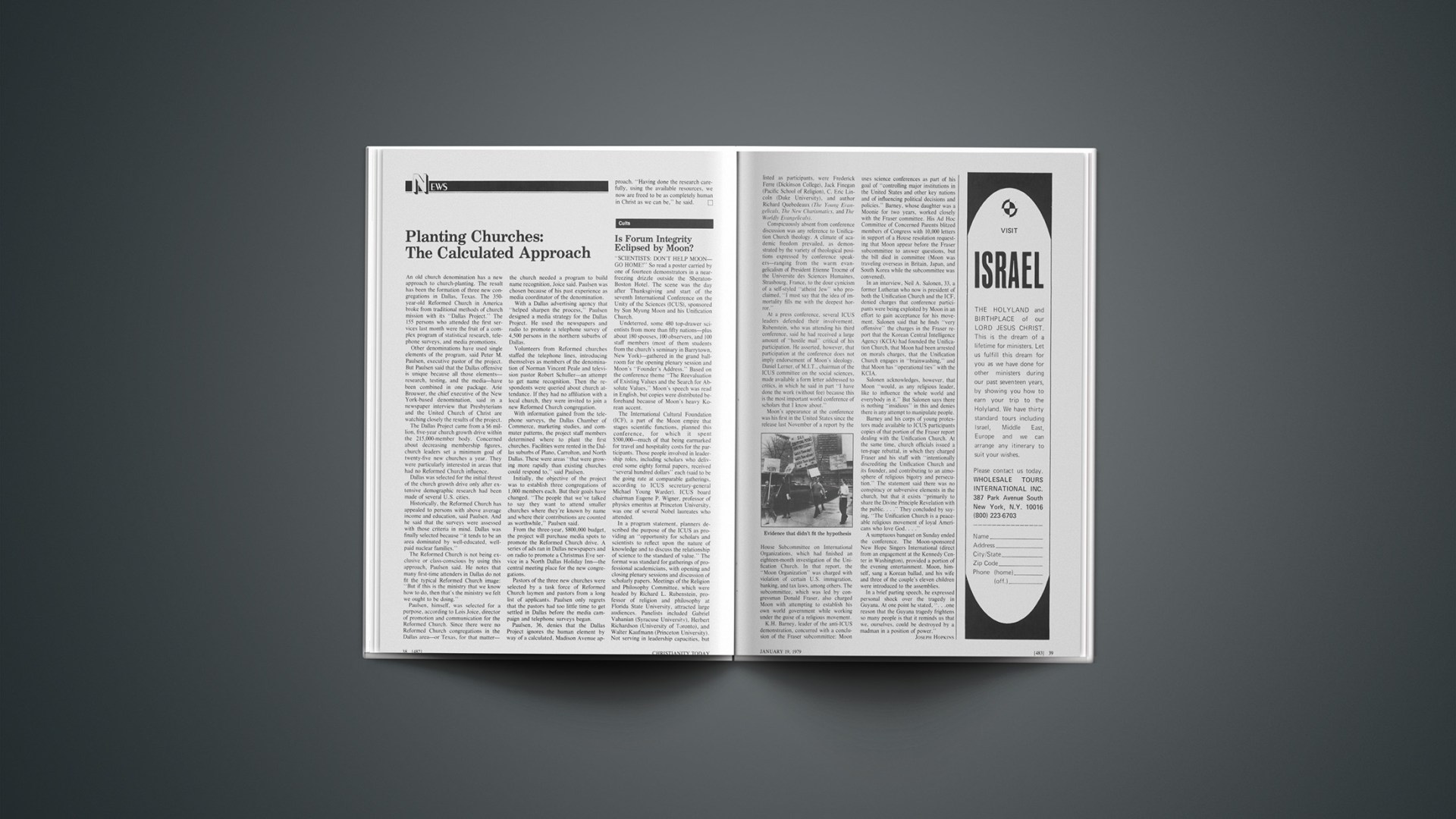
“SCIENTISTS: DON’T HELP MOON—GO HOME!” So read a poster carried by one of fourteen demonstrators in a near-freezing drizzle outside the Sheraton-Boston Hotel. The scene was the day after Thanksgiving and start of the seventh International Conference on the Unity of the Sciences (ICUS), sponsored by Sun Myung Moon and his Unification Church.

Undeterred, some 480 top-drawer scientists from more than fifty nations—plus about 180 spouses, 100 observers, and 100 staff members (most of them students from the church’s seminary in Barrytown, New York)—gathered in the grand ballroom for the opening plenary session and Moon’s “Founder’s Address.” Based on the conference theme “The Reevaluation of Existing Values and the Search for Absolute Values,” Moon’s speech was read in English, but copies were distributed beforehand because of Moon’s heavy Korean accent.

The International Cultural Foundation (ICF), a part of the Moon empire that stages scientific functions, planned this conference, for which it spent $500,000—much of that being earmarked for travel and hospitality costs for the participants. Those people involved in leadership roles, including scholars who delivered some eighty formal papers, received “several hundred dollars” each (said to be the going rate at comparable gatherings, according to ICUS secretary-general Michael Young Warder). ICUS board chairman Eugene P. Wigner, professor of physics emeritus at Princeton University, was one of several Nobel laureates who attended.

In a program statement, planners described the purpose of the ICUS as providing an “opportunity for scholars and scientists to reflect upon the nature of knowledge and to discuss the relationship of science to the standard of value.” The format was standard for gatherings of professional academicians, with opening and closing plenary sessions and discussion of scholarly papers. Meetings of the Religion and Philosophy Committee, which were headed by Richard L. Rubenstein, professor of religion and philosophy at Florida State University, attracted large audiences. Panelists included Gabriel Vahanian (Syracuse University), Herbert Richardson (University of Toronto), and Walter Kaufmann (Princeton University). Not serving in leadership capacities, but listed as participants, were Frederick Ferre (Dickinson College), Jack Finegan (Pacific School of Religion), C. Eric Lincoln (Duke University), and author Richard Quebedeaux (The Young Evangelicals, The New Charismatics, and The Worldly Evangelicals).

Conspicuously absent from conference discussion was any reference to Unification Church theology. A climate of academic freedom prevailed, as demonstrated by the variety of theological positions expressed by conference speakers—ranging from the warm evangelicalism of President Etienne Trocmé of the Universite des Sciences Humaines, Strasbourg, France, to the dour cynicism of a self-styled “atheist Jew” who proclaimed, “I must say that the idea of immortality fills me with the deepest horror.”

At a press conference, several ICUS leaders defended their involvement. Rubenstein, who was attending his third conference, said he had received a large amount of “hostile mail” critical of his participation. He asserted, however, that participation at the conference does not imply endorsement of Moon’s ideology. Daniel Lerner, of M.I.T., chairman of the ICUS committee on the social sciences, made available a form letter addressed to critics, in which he said in part “I have done the work (without fee) because this is the most important world conference of scholars that I know about.”

Moon’s appearance at the conference was his first in the United States since the release last November of a report by the House Subcommittee on International Organizations, which had finished an eighteen-month investigation of the Unification Church. In that report, the “Moon Organization” was charged with violation of certain U.S. immigration, banking, and tax laws, among others. The subcommittee, which was led by congressman Donald Fraser, also charged Moon with attempting to establish his own world government while working under the guise of a religious movement.

K.H. Barney, leader of the anti-ICUS demonstration, concurred with a conclusion of the Fraser subcommittee: Moon uses science conferences as part of his goal of “controlling major institutions in the United States and other key nations and of influencing political decisions and policies.” Barney, whose daughter was a Moonie for two years, worked closely with the Fraser committee. His Ad Hoc Committee of Concerned Parents blitzed members of Congress with 10,000 letters in support of a House resolution requesting that Moon appear before the Fraser subcommittee to answer questions, but the bill died in committee (Moon was traveling overseas in Britain, Japan, and South Korea while the subcommittee was convened).

In an interview, Neil A. Salonen, 33, a former Lutheran who now is president of both the Unification Church and the ICF, denied charges that conference participants were being exploited by Moon in an effort to gain acceptance for his movement. Salonen said that he finds “very offensive” the charges in the Fraser report that the Korean Central Intelligence Agency (KCIA) had founded the Unification Church, that Moon had been arrested on morals charges, that the Unification Church engages in “brainwashing,” and that Moon has “operational ties” with the KCIA.

Salonen acknowledges, however, that Moon “would, as any religious leader, like to influence the whole world and everybody in it.” But Salonen says there is nothing “insidious” in this and denies there is any attempt to manipulate people.

Barney and his corps of young protestors made available to ICUS participants copies of that portion of the Fraser report dealing with the Unification Church. At the same time, church officials issued a ten-page rebuttal, in which they charged Fraser and his staff with “intentionally discrediting the Unification Church and its founder, and contributing to an atmosphere of religious bigotry and persecution.” The statement said there was no conspiracy or subversive elements in the church, but that it exists “primarily to share the Divine Principle Revelation with the public.…” They concluded by saying, “The Unification Church is a peaceable religious movement of loyal Americans who love God.…”

A sumptuous banquet on Sunday ended the conference. The Moon-sponsored New Hope Singers International (direct from an engagement at the Kennedy Center in Washington), provided a portion of the evening entertainment. Moon, himself, sang a Korean ballad, and his wife and three of the couple’s eleven children were introduced to the assemblies.

In a brief parting speech, he expressed personal shock over the tragedy in Guyana. At one point he stated, “… one reason that the Guyana tragedy frightens so many people is that it reminds us that we, ourselves, could be destroyed by a madman in a position of power.”

JOSEPH HOPKINS

The Ncc

Skipping Out Over Walker

If the National Council of Churches (NCC) doesn’t want Lucius Walker, then the Interreligious Foundation for Community Organization (IFCO) doesn’t want the NCC.

That’s the upshot of the IFCO decision last month to dissociate the organization from the NCC Division of Church and Society. Its board of directors was angered by the firing of Walker last November as the head of the NCC division. The NCC executive committee had voted to dismiss Walker on grounds of fiscal mismanagement within the division, citing budget deficits there of $228,000 (see the Dec. 1, 1978, issue, page 48).

Walker, a black social activist, was the first director of IFCO when it formed in 1967, and he was instrumental in bringing IFCO into the Division of Church and Society two years ago. (IFCO, a coalition of religious and community groups involved in funding a variety of minority and social action programs, has retained its corporate form and tax status, however.)

Walker told the Religious News Service that the IFCO decision to support him expressed disapproval toward “the disengagement of the Council from the social issues which confront us.”

IFCO benefited by its association with the NCC, since it makes financial appeals to many of the same denominations that support the NCC, said Dean Kelley, the acting administrator of the Division of Church and Society. Likewise, the NCC gained by its IFCO link, said Kelley, since IFCO had ties with community groups, minority caucuses, and Third World interests that the NCC otherwise alone did not.

Although the NCC executive committee must give final approval for the IFCO pull-out, Kelley said that most ties would be severed this month. IFCO officials planned to move from NCC headquarters in Manhattan to a Harlem brownstone that has a much lower rent.

Walker’s severance pay from the NCC runs out in March, and the IFCO board has asked him to become its paid executive director after that time. He was considering that offer, and in the interim was serving as a volunteer consultant to the group.

Financial Dealings

Short Cut: Convincing Preacher to Con Man

James Roy Whitby, Sr., a former Southern Baptist pastor and evangelist, is finding himself in deeper trouble with the law these days. He was indicted with four other men last month by a Muskogee, Oklahoma, grand jury on twenty-seven counts of mail fraud and aiding and abetting in mail fraud, eight counts of security fraud violations, and one count of conspiracy with thirteen overt acts.

The indictment further weakens Whitby’s once-firm reputation. While he was director of the Tulsa, Oklahoma, Youth for Christ (YFC) organization, he reportedly helped lead singer Anita Bryant—then a Tulsa high school student—to Christ. At one time, the 50-year-old Whitby did a “fantastic job as an evangelist,” said a former associate.

But when the indictment was served, Whitby already was in federal custody in Tulsa. He was convicted last September of defrauding an 83-year-old Tulsa area woman of $25,000 and of the interstate transportation of that money, according to FBI officials in Oklahoma City. Whitby began serving a two-and-one-half-year jail term last November on that charge.

Federal authorities have been investigating Whitby since 1974. He was arrested nearly two years ago on a complaint that he defrauded a Swiss bank through a bond issue in the name of Gospel Outreach, a short-lived mission agency that Whitby founded in Tulsa. However, that charge was dismissed at the request of federal authorities who were still investigating the case (see the April 15, 1977, issue, page 60).

The recent indictment against Whitby marks the culmination of that earlier investigation; it alleges that Whitby and the codefendants sold more than $4 million in worthless Gospel Outreach bonds to persons in the United States and Europe. The indictment also alleges that prospective buyers were told the bonds were backed by property in New Cuyama, California, which was valued at $6.7 million. However, the indictment continues, the land was worth only $1.5 million and the men didn’t own it. The complaint also alleges that the men offered 9 per cent interest payments on the bonds once every six months. When the first payments fell due, it is alleged, only five dollars were in the Gospel Outreach account in the Case State Bank of Stonewall, Oklahoma. The investors were not paid, and Whitby allegedly began denying that the bonds ever existed.

Whitby has often been a man to take “short cuts,” according to a former associate. He left the Tulsa YFC organization after twenty years in 1968—about the time that YFC headquarters began instituting tighter controls on local chapters, according to international president Jay Kesler (although Kesler said the controls may not have been the reason that Whitby finally left the organization).

According to Kesler, YFC established a chartering process that included the signing of the doctrinal statement used by the National Association of Evangelicals, formation of an interdenominational board of directors, and an annual outside audit. Kesler said that Whitby disagreed with the chartering procedures and felt that YFC was “becoming too centrally controlled.”

After leaving YFC, Whitby became a traveling evangelist. He used the respected Go Ye Mission and its Christian boarding school, Markoma School of the Bible, for a home base. Homer Mouttet, president of the Tahlequah, Oklahoma, mission, said that Whitby worked from there in 1968 and 1969 and was a member of its board of directors.

However, Whitby was “released” from the Go Ye Mission board in 1972, said Mouttet. “He was dabbling in things that we just couldn’t back,” Mouttet explained. He believed that Whitby’s original motives were “genuine,” but that he got involved in “questionable acts.”

In 1972 Whitby became fully involved with his Gospel Outreach organization; it reportedly was established to help needy people around the world, and, according to Mouttet, was involved in fundraising for religious groups and projects.

Whitby made headlines in early summer, 1972, when he organized a small band of young people for a 1,000-mile, fundraising march from Tulsa to San Miguel, Mexico. The young people collected donations as they went, and enough money was raised for construction in San Miguel of an orphanage, a school classroom, and a dormitory for underprivileged Mexicans.

For a time, Whitby was involved in a mission operation known as the Ethiopian Call, which was organized by Oklahoma physicians. Religious News Service reported at the time that Whitby proposed to raise money for the operation by striking silver medallions of the late Emperor Haile Selassie to be sold for $50 each. Whitby was doing some type of mission work in the Philippines until last April. A friend of Whitby said that Whitby asked him to donate 1,900 Holstein heifers to the Philippines project.

Whitby is scheduled for jury trial later this month in a Muskogee federal courtroom. FBI officials said he faces a maximum sentence of 180 years on the thirty-six counts.

The other men named in the indictment with Whitby were Ray Evan Mason, 46, the former president of the Case State Bank in Stonewall, two Chicago area securities dealers, and Tillman Jackson, a former Baptist pastor from Los Angeles.

With the exception of Case, all of the men have been previously tried and convicted of federal fraud violations, FBI officials say. Jackson was once imprisoned on conspiracy charges in connection with fraudulent transactions of the now defunct Baptist Foundation of America. Whitby’s intercession on his friend’s behalf before a California parole board was instrumental in getting Jackson a suspended sentence.

Friends and former associates of Whitby have trouble explaining how the once-respected evangelist got in so much trouble. “This has been a hurtful thing to some of us,” Go Ye Mission president Mouttet said. “He was an excellent speaker and evangelist. At one time, there were few in the country like him.”

North American Scene

Black evangelist Tom Skinner has agreed to host “The PTL Club” television talk show once a month, officials of the PTL Network announced. Skinner, team chaplain of the Washington Redskins and director of a wide-ranging ministry to blacks, also will have a one-hour weekly show aimed at inner-city blacks. It will be beamed on PTL’s leased satellite.

Wake Forest University trustees last month voted to remove their school from church control. They deleted clauses from the school charter and bylaws that give the Baptist (Southern) State Convention of North Carolina the right to elect or fire trustees, and removed a phrase stating that they will operate “as an agency” of the convention. The trustees still promised to operate the liberal arts school as a “Christian university” and to maintain communication with the convention.

More than one-half million fewer households watched the ABC network in November than during the previous nine weeks, according to figures released by the A.C. Nielsen Company in its recently completed “sweeps.” Donald E. Wildmon, executive director of the National Federation for Decency, was elated by the figures. He attributed the drop—which he says will cost the network millions of dollars in advertising revenues—to a November boycott of the network that was planned by his group to protest sex, violence, and profanity in programming.

Work began recently on a new hymnal and service book for the Lutheran Church-Missouri Synod. The LCMS had created a stir when it withdrew its support of the new Lutheran Book of Worship, which had been a joint project of the LCMS, the Lutheran Church in America, the American Lutheran Church, and the Evangelical Lutheran Church of Canada. LCMS Commission on Worship members say they still will use some materials from the Lutheran Book of Worship for inclusion in their own book.

A woman who was arrested with two others for disrupting services last August at First Baptist Church in Washington was convicted of unlawful entry and of remaining on the premises without authority (see September 8 issue, p. 58). Alice McCormack had spoken her opposition to the neutron bomb during a worship service attended by President Carter. Although he regretted that the matter had to be settled in court, pastor Charles Trentham made no apologies, saying that First Baptist should not be an instrument for protest to the President.

Personalia

Ernest Holz will succeed the retiring Paul S. Kaiser in February as the national commander (in the United States) of the Salvation Army. Holz has been an officer in the Army since 1940.

Louise Camp, a California businesswoman and singer, was named national chairperson of a committee to raise $2 million for construction of a Gospel Music Hall of Fame, research library and museum in Nashville. The Hall of Fame will house the international headquarters of the sponsoring Gospel Music Association. Members of Camp’s executive committee include George Beverly Shea and Ralph Carmichael.

Officials of the Evangelical Churches of West Africa Theological Seminary in Igbaje, Nigeria, appointed Nathaniel Olutimayin as principal—the first Nigerian to hold the post. Olutimayin recently finished studies at Dallas seminary.

Planting Churches: The Calculated Approach

An old church denomination has a new approach to church-planting. The result has been the formation of three new congregations in Dallas, Texas. The 350-year-old Reformed Church in America broke from traditional methods of church mission with its “Dallas Project.” The 155 persons who attended the first services last month were the fruit of a complex program of statistical research, telephone surveys, and media promotions.

Other denominations have used single elements of the program, said Peter M. Paulsen, executive pastor of the project. But Paulsen said that the Dallas offensive is unique because all those elements—research, testing, and the media—have been combined in one package. Arie Brouwer, the chief executive of the New York-based denomination, said in a newspaper interview that Presbyterians and the United Church of Christ are watching closely the results of the project.

The Dallas Project came from a $6 million, five-year church growth drive within the 215,000-member body. Concerned about decreasing membership figures, church leaders set a minimum goal of twenty-five new churches a year. They were particularly interested in areas that had no Reformed Church influence.

Dallas was selected for the initial thrust of the church growth drive only after extensive demographic research had been made of several U.S. cities.

Historically, the Reformed Church has appealed to persons with above average income and education, said Paulsen. And he said that the surveys were assessed with those criteria in mind. Dallas was finally selected because “it tends to be an area dominated by well-educated, well-paid nuclear families.”

The Reformed Church is not being exclusive or class-conscious by using this approach, Paulsen said. He notes that many first-time attenders in Dallas do not fit the typical Reformed Church image: “But if this is the ministry that we know how to do, then that’s the ministry we felt we ought to be doing.”

Paulsen, himself, was selected for a purpose, according to Lois Joice, director of promotion and communication for the Reformed Church. Since there were no Reformed Church congregations in the Dallas area—or Texas, for that matter—the church needed a program to build name recognition, Joice said. Paulsen was chosen because of his past experience as media coordinator of the denomination.

With a Dallas advertising agency that “helped sharpen the process,” Paulsen designed a media strategy for the Dallas Project. He used the newspapers and radio to promote a telephone survey of 4,500 persons in the northern suburbs of Dallas.

Volunteers from Reformed churches staffed the telephone lines, introducing themselves as members of the denomination of Norman Vincent Peale and television pastor Robert Schuller—an attempt to get name recognition. Then the respondents were queried about church attendance. If they had no affiliation with a local church, they were invited to join a new Reformed Church congregation.

With information gained from the telephone surveys, the Dallas Chamber of Commerce, marketing studies, and commuter patterns, the project staff members determined where to plant the first churches. Facilities were rented in the Dallas suburbs of Plano, Carrolton, and North Dallas. These were areas “that were growing more rapidly than existing churches could respond to,” said Paulsen.

Initially, the objective of the project was to establish three congregations of 1,000 members each. But their goals have changed. “The people that we’ve talked to say they want to attend smaller churches where they’re known by name and where their contributions are counted as worthwhile,” Paulsen said.

From the three-year, $800,000 budget, the project will purchase media spots to promote the Reformed Church drive. A series of ads ran in Dallas newspapers and on radio to promote a Christmas Eve service in a North Dallas Holiday Inn—the central meeting place for the new congregations.

Pastors of the three new churches were selected by a task force of Reformed Church laymen and pastors from a long list of applicants. Paulsen only regrets that the pastors had too little time to get settled in Dallas before the media campaign and telephone surveys began.

Paulsen, 36, denies that the Dallas Project ignores the human element by way of a calculated, Madison Avenue approach. “Having done the research carefully, using the available resources, we now are freed to be as completely human in Christ as we can be,” he said.

Book Briefs: January 19, 1979

Love God With All Your Mind

Developing a Christian Mind by Nancy Barcus (InterVarsity, 1977, 103 pp., $2.95 pb), All Truth Is God’s Truth by Arthur Holmes(Eerdmans, 1977, 145 pp., $3.95 pb), and Preserving the Person by C. Stephen Evans (InterVarsity, 1977, 177 pp., $4.95 pb), are reviewed by Ronald Nash, head, department of philosophy and religion, Western Kentucky University, Bowling Green, Kentucky.

Most Christians preach and practice a truncated gospel. Although the first and great commandment obliges us to love God with all our minds, the church continues to be afflicted with an unbiblical disparagement of the intellect accompanied by an unhealthy emphasis on emotionalism. I regret that Christian publishers more often than not pander to this deplorable state with light-weight testimonies of famous sinners or assorted prescriptions for curing sexual maladjustment. Three recent books stand out as exceptions to the prevailing antiintellectualism among evangelicals.

Nancy Barcus pleads with Christians to develop a Christian mind. What is needed, she urges, is a “renewal of the Christian mind.” Knowledge, she states, “is not an isolated or an unchristian part of the world. It is part of the very fabric of what it means to be a Christian.” Arthur Holmes believes that the recognition that God is the ground of all truth should undercut the wide-spread depreciation of so-called secular learning among evangelicals. The common Christian practice of compartmentalizing knowledge into sacred and secular branches is unbiblical and leads to the mischievous notion that secular knowledge is in some way less important and worldly, unfit for the “spiritual” Christian. Although the truth revealed in Scripture is sufficient for faith and conduct, it is not exhaustive. The truth to be mastered outside of Scripture is every bit as much the truth of God. Even revealed truth requires study and interpretation, tasks that can be aided by an education in such “secular” subjects as philosophy and history. Holmes warns against the erroneous belief that faith provides the Christian with a short-cut to the truth that eliminates any need for a grounding in secular areas of learning. Especially dangerous is the practice of many charismatics of elevating their own religious experiences above revealed truth. In such hands, the experiences of some individual or group become a pattern into which the truth of the Word of God must be squeezed. Holmes counters that experience should be tested by truth; Scripture should not be subordinated to our experiences.

Stephen Evans focuses on the arena of the social sciences, where an intellectual battle over the nature of man is raging. Christian theology has an obvious stake in the view of man as a self-conscious, responsible agent who makes choices and who has purposes and reasons for his actions. But the very view of man as a person is the subject of attacks emanating from the social and behavioral sciences. These disciplines have been captured by a positivistic mind-set that emphasizes causal explanations that are mechanical, impersonal, and nonteleological. A key question for our time then is: Are the scientific and personalistic views of man compatible? If not, must the presuppositions of a scientific method that depersonalizes man be modified, or must major alterations be made in the view of man as a person? Evans carefully notes that the real source of the trouble is not the social sciences per se. Rather, the problem results from social scientists opting for a particular philosophy of social science (positivism), by which Evans means “the tendency to make scientific procedures and theories the ultimate source of truth and the ultimate account of the nature of reality.”

Evans questions whether the advocate of a mechanistic view of man can avoid a self-stultifying view of knowledge. That is, does the behaviorist view of man hold consequences that make knowledge, including the “knowledge” of the behaviorist, impossible? Doesn’t the very possibility of knowledge require that the knower be a person (as opposed to a machine)? Does the mechanist’s view of man undercut his own claims to knowledge? Advocates of a mechanistic view of man also make value judgments. Does their mechanism also undermine this process? The implications of the behavioral view of man are especially disconcerting in the political arena. The position not only suggests the possibility of unlimited control over and manipulation of human beings; it leaves a liberal society without any objective ideals that would effectively limit such manipulation. Evans’s major contribution is a lengthy discussion of a number of possible routes to resolving the conflict between the personalistic and mechanistic views of man. Some people prefer to resolve the tension by limiting science either by arguing that there are areas of knowledge off-limits to the scientific method or by rejecting the ultimacy of truth provided by the scientific method. Other approaches surrender to positivism and attempt to reinterpret the notion of man so as to make it more compatible with present trends in the behavioral sciences. Others seek resolution of the conflict by attempting to humanize science, by replacing the antipersonalistic philosophy of science that grounds so much contemporary social science. As Evans sets out ways in which a Christian might relate each of these options to a biblical view of man, he makes some points that will surprise readers uninformed about recent discussions. For example, he concedes that a dualistic view of man may not be essential to Christian theology. I think Evans is wise in not restricting the Christian scientist’s options too drastically. His taxonomy of available options is helpful and should generate some worthwhile discussion among Christian philosophers, theologians, and social scientists.

More Christians need to read books like these; more Christians need to be writing books like these. Will Christian publishers help make such books available? Let’s hope so.

A Classic Study Of Pain

Where Is God When It Hurts?, by Philip Yancey (Zondervan, 1977, 187 pp., $3.95), is reviewed by James A. Zitzman, Jr., promotion manager, CHRISTIANITY TODAY.

Where is God when it hurts? Why does he feel so close in our time of joy, yet so distant in time of sorrow? Why does he allow us to suffer at all?

American Christians avoid such questions, fearing the mysteries of the problem of pain. When the specter of pain forces us to react, we respond weakly, defensively. Maybe we don’t have “enough faith.” Or we have some hidden sin. Or we attempt to deaden the suffering with injections of goodwill and cheer.

In the first chapter of his book, Yancey tells of a young bride battling Hodgkin’s disease. The girl and her husband, when told she has only a 50 per cent chance to live, react with anger against the God who seems to have turned on them. Christian visitors, seeking to console the couple, only confuse them with different interpretations and approaches to their questions.

The suffering of his friends started Yancey searching for “a message Christians can give to those who suffer.” His quest lasted five years and resulted in this book.

When I first heard that Yancey was working on a book about pain, I assumed that essentially he would paraphrase C.S. Lewis’s Problem of Pain. I have always thought that Lewis’s classic apologetic could not speak to the average Christian. I welcomed a paraphrase. Yancey, however, chose to write his own book—with powerful results.

Yancey guides the reader through the book, mapping every section in advance. He uses a conversational style that questions, informs, perhaps concludes, then illustrates. His approach allows him to treat complex questions without losing either the layman or the theologian.

The book has three sections. The first probes the biological and theological purposes of pain. The second reports on how some Christians have dealt with extreme pain, notably Joni Eareckson and Brian Sternberg. In the final section, Yancey searches for ways to deal with pain when it does come. The logical pattern followed within each section (raising a question, reporting on theological and scientific evidence, presenting examples of people dealing with the question, discussing Christian responses) also forms the introduction and three sections into the book.

After presenting in his introduction the intellectual and emotional questions aroused by pain, Yancey surveys the intellectual, emotional, and biological purposes of pain. He rounds out his reasoning with examples and explains the remarkable functioning of the nervous system. He reports on the horror of lepers, people without pain. He notes that the ability to feel pain is not only necessary for survival, but is often required for pleasure and fulfillment.

Yancey then says that “though pain may have been intended as a smooth, efficient warning system, suffering is raging out of control.” Like Lewis, Yancey points to man’s misuse of freedom as the source of his agony. “Suffering,” he says, “is consistent with the Christian view of the universe that reveals our home as a stained planet.”

All of us would agree that pain has value in protecting our bodies. Most Christians would agree that pain has value as a reminder of this “bent” world. But Yancey observes that all this reasoning only deals with pain in the abstract. People don’t experience pain that way, he says, but in “piercing, specific jolts.”

These specific jolts transform the intellectual answers into “sounding brass and clanging cymbals.” Throughout the remaining two sections of the book, Yancey searches for a more adequate response.

He begins by recording and comparing the responses of several of God’s children inflicted with pain: the sufferings of Job, the struggles of Joni Eareckson, the frustrations of Brian Sternberg, and the tortures of a minister in Dachau. He analyzes the attitudes of each person and then attempts to distill them into basic, universal principles. After all that, Yancey approaches in the third section the fundamental question: How can we cope with pain?

We can cope, the author says, if we remember our suffering Lord. Here is a Christian’s unique contribution to the discussion of pain: We believe that God himself has borne all the sorrows and pains of the world he created. God designed the complex system of nerves that provides the mechanism for suffering. God allowed man’s misused freedom to twist and distort his creation. And he emptied himself to experience poverty, starvation, loneliness, fatigue, scourging, humiliation, crucifixion, and death. Finally, he promised to set aright what man despoiled.

Despite all of the interviews, reading, hours at hospital bedsides, and prayerful study of God’s Word, Yancey admits that he cannot provide adequate answers for all the questions he has raised. The problem of pain remains an enigma. However, his study melted his anger toward pain and left him “with a solid faith in a Person which no amount of pain can erode.” Because of the personal style of the book, he shares this maturing process with the reader. He partially illumines the mystery and—more importantly—teaches the reader to approach that mystery correctly. His sensitive questioning and honest approach result in a helpful book that could become a classic.

Variety In Earliest Christianity

Unity and Diversity in the New Testament, by James D. G. Dunn (Westminster, 1977, 480 pp., $19.50), is reviewed by Charles Wanamaker, graduate student, University of Durham, Durham, England.

Every serious reader of the New Testament will have noticed that certain theological features are characteristic of particular writers. John, for example, is unique in his “Word” Christology, and only Hebrews portrays Christ as the heavenly High Priest. Such differences form the starting point for this book. According to Dunn, the research into the history of religions in general and the study of early Christian traditions in particular have made it impossible “to conceive of first-century Christianity as a clearly defined entity, easily extractable from its historical context.” Earliest Christianity was characterized by immense diversity of thought and practice; despite this, it developed as an identifiable movement. Dunn explores both aspects.

Dunn looks for the unifying strand of earliest Christianity. In New Testament preaching, he finds great diversity, but he also perceives a central core, the proclamation of the resurrected and exalted Jesus. He explores other features of earliest Christianity, including primitive confessions, the role of tradition, the use of the Old Testament, the concept of ministry, patterns of worship, the sacraments, and the role of the Holy Spirit (the subject of Dunn’s two previous books).

Dunn raises a crucial christological question: Was the continuity justified between the historical Jesus and the exalted Christ that Christians preached? Dunn attempts to connect this question to the unity and diversity of belief found in the New Testament. The problem, however, is a modern one. The early disciples’ experience of the resurrected Jesus provided all the continuity they needed for proclaiming him as the resurrected and exalted Christ. Nevertheless, Dunn presents several historical reasons for connecting the historical Jesus with the Christ of faith. The only one not found in his earlier book, Jesus and the Spirit, is his argument that Jesus foresaw his death as vicarious suffering and expected divine vindication.

The second section of the book concentrates on the supposed diversity of earliest Christianity. In successive chapters, Dunn examines Jewish Christianity, Hellenistic Christianity, apocalyptic Christianity, and early Catholicism. Unfortunately, he glosses over the problems created by such categories. Apocalyptic Christianity, for example, did not exist as a separate movement, and the boundaries between Jewish and Hellenistic Christianity are notoriously difficult to delimit. Because of the categories he uses and the way in which he points forward to later developments such as the Ebionite, Gnostic, and Montanist heresies, he produces a misleading and one-sided emphasis on diversity. He does, however, find two unifying elements common to both Jewish and Hellenistic Christianity. They both sought to maintain the unity between the earthly Jesus and the exalted Christ, and they both insisted on the importance of love. Dunn argues that because Jewish Ebionites and Hellenistic Gnostics violated these principles they fell outside the acceptable limits of Christianity.

The conclusion of the book struggles with the nature and function of the New Testament canon. This question is becoming increasingly important among biblical scholars who maintain a personal Christian commitment. Dunn’s answer is certainly not the final one, though it is an important statement. He sees the abiding value of the canon in the very unity and diversity it preserves. The canon illustrates the acceptable variety that is permissible within Christianity and provides a “norm” for its development. The canon is of further value because it reports the events that determined the Christian religion and because it has an irenic function when divergent forms of Christianity encounter one another.

Dunn has written an important book, one of the first to deal exclusively with the complex problems of unity and diversity in the New Testament. It also raises the question of what orthodoxy was and is. Students should find it valuable. Nevertheless, I have several reservations. Does Hebrews, for example, really preserve an adoptionist Christology? Does the prologue of John in fact give evidence of an earlier stage of theological reflection than is found in the rest of the Gospel? How much is really known about the Lucan or Johannine communities, or earliest Palestinian Christianity? Has Dunn sufficiently recognized the limited nature of the evidence?

I think that the fundamental weakness of the book is its overemphasis on diversity. That the New Testament reveals differences in earliest Christianity is indisputable. But the variety exists primarily in the particulars, not in the universals. Dunn limits the unity of the New Testament to the belief that the earthly Jesus became the exalted Lord. In reality, the overarching unity extends to such features as a common Scripture (the Old Testament), a common Gospel, a common faith, common sacraments, and common ethical concerns. This book deserves to be read and discussed not so much for the answers Dunn offers, but for the questions he raises. As the author states in the introduction, he wishes to provoke rather than define. In this he succeeds.

Church Life

Reaffirm Your Family Ties

Visibly communicate that the parents are an integral part of the wedding ceremony.

The custom of giving the bride away has been criticized recently as archaic, inappropriate, and meaningless. Women are no longer chattels of the father and the husband. No longer does the father provide a dowry in terms of money, goods, or estate that his daughter brings to the marriage as compensation for the fact that she is a female (although some people suggest that the tradition of the bride’s family bearing the brunt of the wedding expense is a persistent remnant of this earlier practice).

A father once said to me at a wedding rehearsal, “I’ll go along with that part in the ceremony, but I really don’t believe I’m doing anything significant by giving my daughter away. She was gone long before today!” In a sense that is true. The change in a parent-child relationship, which comes with maturity, starts long before a wedding day. The choice of a mate is only another symbol of what has been happening for years. Thus, in many churches, new and revised orders for the Service of Marriage either make the giving of the bride optional, or omit it altogether.

After twenty years of conducting marriage ceremonies, most couples I talk with still want their ceremony to include some acknowledgment of family ties. Some of them want something different from the traditional question, yet they agree that even though the original intention is no longer valid, the act still has significance.

The moment is packed with deep emotion. But you ought not solve a problem, nor meet a need, by just removing what is unsatisfactory. Replace it with something else. I suggest that we rename this portion of the marriage service and call it “Reaffirming Family Ties.” I discuss this with every bride and groom. More and more couples respond positively. Here is the way it works.

The parents of the groom and the mother of the bride are led to their seats in the traditional manner. The father escorts the bride down the aisle. But when she gets to where the groom is waiting, her father immediately sits with his wife.

At the point in the ceremony where the bride is normally given in marriage, I ask both sets of parents to come forward and stand behind their son and daughter. This follows:

“Mr. and Mrs. _____; Mr. and Mrs. _____; I have asked you to come forward now because your presence at this time is a rich testimony of the importance of family ties. You have encouraged N_____ and N_____ to come to this moment in the spirit of creating a new family constellation. You are giving your children to life’s adventure, and not merely away from yourselves.

“This is what you raise your children for; to let them go—their way. And in their going, they come back again and again to share their discoveries and their joys with you. They confirm for you, who are parents, that you have fulfilled your task. Now, your new role is to support and encourage your son and daughter in theirs.

“It seems right, then, to ask you all, mothers and fathers, to make a vow, just as N_____ and N_____ will make theirs to each other in a moment.

“Do you support N_____ and N_____ in their choice of each other, and will you encourage them to build a home marked by openness, understanding, and mutual sharing? (The parents will answer, ‘We do.’) Mr. and Mrs. _____ and Mr. and Mrs. _____; thank you for your good influence and steady ways that bring N_____ and N_____ to this day.”

The parents may be seated at this point. However, I have seen some mothers and fathers pause a moment to exchange spontaneous signs of affection with the bride and groom through a brief embrace, a handshake, or a whispered word of love.

You might consider one final act in the ceremony to reinforce this reaffirmation of family ties. It is customary at the conclusion of the service to have the ushers return following the recessional and escort the mothers of the bride and groom out of the church, with the fathers walking behind. Why not have the parents leave with the wedding party, falling in step behind the last bridesmaid and usher? This visibly communicates that mothers and fathers, too, are an integral part of the ceremony, not just spectators. Also, from a practical standpoint, this eliminates that awkward pause between the time the ushers leave and return to get the mothers, who must leave before the guests can.

A word of caution. Some weddings do not have both sets of parents present. Through death or divorce, there may be only one parent on the bride’s or groom’s side. There are several other combinations possible. This situation does not mean you must reject the idea of reaffirming family ties. But it will require additional sensitivity to the feelings of the parents, some assurance that they are secure in their single status, and some slight revision in the service itself.

Not all couples or parents will want to try this. But enough of them will to confirm your decision to talk about it with them. The ones who choose to stay with the tradition will have had an opportunity to think about marriage as a rite of passage that not only floods a new home with joy, but also flows back into the homes from which the new husband and wife both came.

EDWIN R. LINCOLN, pastor, First Congregational Church, Guilford, Connecticut.

A Meeting of the Board: A Satire

If Jesus had done things our way

Pete: This meeting has been called at the request of Matt, John, Tom, and Little Jim. Bart, will you please open with prayer?

Bart: Almighty God, we ask your blessing on all we do and say and earnestly pray that you will see our side as your side. Amen.

Pete: Jesus, we have been following you around for some time, and we are getting concerned about the attendance figures. Tom, how many were on the hill yesterday?

Tom: Thirty-seven.

Pete: It’s getting to be ridiculous. You’re going to have to pep things up. We expect things to happen.

John: I’d like to suggest you pull off more miracles. That walking on water bit was the most exciting thing I have ever seen, but only a few of us saw it. If a thousand or so had a chance to witness it, we would have more than we could handle on the hill.

Little Jim: I agree. The healing miracles are terrific, but only a limited number really get to see what has happened. Let’s have more water to wine, more fish and chips (it never hurts to fill their stomachs), still more storms, give more signs. This is what the people need.

Pete: Right. And another thing, publicity is essential, and you tell half the people you cure to keep it quiet. Let the word get around.

Matt: I’m for miracles, but I want to hear a few stories I can understand. This “those who have ears to hear, let them hear” business just clouds the issue. You have to make it clear or most of us aren’t going to be able to take anything home.

Big Jim: I’d like to offer an order of service. First a story, then a big miracle followed by an offering, then maybe a saying or something, followed by a small miracle to bring them back next time. Oh yes, and a prayer if you like.

Tom: We have to do something.

Little Jim: That’s for sure. Attendance has been awful.

Judas: I’d like to say if we are going to continue to meet in this upper room, we ought to do something about the carpet.…

Theology

Is Psychotherapy Unbiblical?

A caring Christian community and biblically based counseling are not always enough.

During the past twenty-five years evangelicals have become much more alert to the special needs of people who are emotionally and psychologically disturbed. Biblically based counseling, as developed by Jay Adams, Bill Gothard, and others, has shown that the solution to emotional problems may often lie in the forthright application of biblical principles. Healing ministries, especially those that emphasize the healing of memories, have often been helpful to troubled persons who have not found relief through psychiatry. At the same time, Christians trained in psychology and psychiatry have attempted to show that their disciplines may play a role in the healing process.

We should remember, however, that the traditional ministries of the church have always had a healing influence. Indeed, I believe that the church does most for mental health when it does its regular business. As God heals us spiritually through conversion, confession, worship, Bible study, and prayer, he also brings us powerful resources for the healing of our emotions and personalities. Not only is spiritual health more important than emotional health, it facilitates emotional health as it brings peace of mind and freedom from guilt.

Spiritual health does not, during this life, guarantee emotional health; but emotional disturbances that are not resolved through the direct spiritual ministries of the church often respond to the sense of warmth and caring acceptance found within a fellowship of believers. As it brings men and women into a relationship with God, the church also brings them into a relationship with one another. John reminds us, “This commandment we have from Him, that the one who loves God should love his brother also” (1 John 4:21, NASB). In a technological, hedonistic society where many find their lives lacking in meaningful relationships, the church’s capacity to provide love and fellowship can be a powerful agent of mental health. Man’s greatest need, after his need for God, is to give and receive human love. This need often goes unfulfilled. The mobility that is prevalent in our society brings a separation of extended families, and divorce severs nuclear family ties. The motivation of individual fulfillment tends to diminish those ties that are left. A caring Christian community can counteract this trend.

Many of the problems that do not respond to the love of a Christian may respond to biblically based counseling. However, there is still a place for the healing role of psychotherapy. To understand its potential value, let us first distinguish psychotherapy from biblically based counseling. Biblical counseling is largely didactic and inspirational; it identifies biblical principles that may help resolve problems in living and encourages the troubled person to apply these principles in his life. Psychotherapy, on the other hand, tries to help the troubled person understand himself. It is relatively nondirective. Its goals are to develop insight and a corrective emotional experience within a relationship.

The biblical counselor must qualify for the work by being a man or woman of God. The psychotherapist’s primary qualification is a technical one: He or she must be well versed in the science of psychology. The biblical counselor directs the light of Scripture on problems that are difficult to resolve even when they are well understood; his concerns are such things as true guilt over real sin, the fear that life has no meaning, and the fear of death. The psychotherapist must understand the complexities of mental functioning because he tries to help people who don’t really understand what is wrong with them. Good candidates for psychotherapy are people who have a persistent sense of unease even though “it doesn’t make sense” for someone in their circumstances to be upset. In short, then, biblical counseling and psychotherapy differ in style, immediate objectives, and the kinds of problems they treat.

The fundamental components of psychotherapy are the secure relationship that develops between the patient and the therapist and the verbal interchange that arises out of that relationship. As the patient comes to feel secure in the presence of the psychotherapist, he tends to present clues, in his words and his actions, to the nature of the unconscious conflict that underlies his apparently inexplicable symptoms.

One of the primary tools of the psychotherapist is “transference,” the tendency of the patient to react to the therapist in the same manner in which he reacted to earlier important figures in his life. This tool becomes very important, because most unconscious conflicts have their genesis in early relationships and because many aspects of those relationships, which the patient may live out in the transference, are not available to his conscious recall. Psychoanalytic theory assumes that transference inevitably develops in therapy; it is not created by the therapist, but is simply observed by him. Similar reactions occur in everyday life. For example, the knot in the stomach of many a conscientious person when he is in the presence of judges, policemen, teachers, and other figures of authority is probably a transference-like phenomenon rising out of his early respect for, and fear of, an authoritarian parent.

The crucial importance of transference lies in its clarification of issues not only in past relationships but also in the patient’s current life. The problems that started in the past usually carry over into the present. Transference causes current maladaptive reactions—the things that caused the patient to seek treatment in the first place—to be dramatized while they are actually occurring. If the patient has problems with authority figures, he will react to the therapist as he reacts to real authorities in his life, and so his problems can be examined when they occur.

Psychotherapy thus becomes a laboratory in which the patient can learn insight, that is, self-understanding with a sense of conviction. If the therapist simply announces his conclusion that the patient has a certain problem, the patient may respectfully (if he respects people in authority), or even skeptically, make a note of the therapist’s theory. He may say, “My doctor says my problem is.…” But when the maladaptive behavior comes to his attention when it is actually occurring, he develops insight and says, “Now I know that my problem is.…”

When the unconscious basis for emotional symptoms is discovered through psychotherapy, it is usually found to involve (1) an impulse and (2) a prohibition from the superego or conscience. The goal of therapy is not to eliminate the prohibition or, putting it conversely, to gratify the impulse. The goal of the therapist, who attempts not to impose his own moral standards, is to uncover the conflict and make it conscious so that the patient can then use his conscious mind to resolve it. The therapist assumes that the counter-productive solution, such as the neurotic symptom of anxiety, has evolved in the unconscious and would not be necessary if the conscious mind applied itself to the problem.

Let us suppose that a patient with free-floating anxiety always experiences it in situations where he is confronted with an authoritarian male. At the beginning of his treatment he may not even have made this connection. Perhaps he is aware only that he may sometimes feel very disagreeable anxiety when his conscious mind sees nothing to be frightened of. The basis for this anxiety may become apparent to the therapist as he notices that in the therapy sessions the patient’s anxiety attacks always occur after he, the therapist, has taken some sort of positive or authoritative position. The therapist will want the patient to see not only what circumstances provoke his anxiety but also why those circumstances are threatening to him. Very often this will help the patient develop insight into the traumatic early-life experiences that caused him to have an unnatural fear of authority figures.

In the initial achievement of insight, the therapist plays the role of an objective outsider who guides the patient in his efforts at self-observation and self-understanding. In the subsequent phase of therapy, often called “working through,” the therapist may also play the role of teacher. He will encourage the patient to continue his efforts to understand himself and to see how his fear of authority figures is interfering with his present life. He will help the patient judge when his reactions to authorities are excessive and when they are not. He will attempt to help the patient develop new modes of dealing with authority figures, and he will encourage him to practice his new behavior in the psychotherapy sessions.

For example, if a patient is so fearful of authority that he is always apologizing, even when he has nothing to be apologetic about, the psychotherapist will encourage him to stop apologizing. If he deferentially accepts everything that the therapist says, he will be encouraged to question the therapist’s statement when he is not convinced by them. The psychotherapeutic relationship is a laboratory learning experience that helps the patient not only to observe old patterns but also to establish new, more effective ones.

Psychotherapy becomes a laboratory in which the patient can learn insight, that is, self-understanding with a sense of conviction.

The working-through also involves the analysis of the patient’s resistances. The person who is not able to express resentment directly usually has developed some devious techniques for expressing it indirectly. For example, the patient made anxious by authority figures may unconsciously express his resentment toward them through passive-aggressive techniques. He may deferentially agree with everything the therapist says but may also come late for most of his sessions, offering apparently valid excuses. In time it may become evident that the excuses are less valid than they seem and that the lateness is the patient’s way of thumbing his nose at the therapist because he is afraid to confront him directly.

Then the therapist must point out that the patient’s problem is making life hard for him in two ways: He is incapacitated by the symptom, anxiety, and his way of coping with it, of expressing his resentment, alienates other people and interferes with his own conscious goals. Of course, if the patient happens to be getting enough gratification from his coping behavior, his symptom may prove quite resistant to psychotherapy.

One objection Christians raise to the type of psychotherapeutic process I have outlined is that it encourages the patient to deny responsibility for his own behavior. But in fact the psychotherapeutic approach may solidly reinforce, rather than undermine, the requirement that the patient behave responsibly. It assumes that the symptom itself is a sign of a failure to behave responsibly, and therefore the therapist’s effort to remove the symptom is always in the service of replacing it with responsible behavior. Furthermore, psychotherapy resists the patient’s resistances, which represent a tendency to be comfortable with the symptom because of the subtle way he has developed of expressing the impulse that gives rise to the symptom.

The psychotherapist may assume that at first the patient will be unable to control his symptom because of its roots in his unconscious mind, but even then he at least expects the patient to behave responsibly enough to enter into the treatment that may bring him freedom from the symptom. Even at the beginning of treatment there is no necessity that the symptom, which the patient cannot control, be considered nonsinful. Christians who object to the psychotherapeutic approach seem to assume that the psychotherapist is excusing the patient’s behavior when he assumes that the patient cannot control it. This is a curious objection, in view of the fact that the Bible emphasizes man’s responsibility before God even though he is a fallen creature with an inevitable tendency to sin that he cannot control.

A second Christian objection to psychotherapy is that it advocates the resolution of conflicts by the unbridled expression of impulses. This is as invalid as the first. Neither Freud nor his followers thought that solutions came through impulsive abandon or through the destruction of the conscience. They assumed that the conscience was an essential part of the personality and a necessary device for man living in society. They could not value social relatedness, as they did, without realizing that the impulse gratification of each individual had to be controlled. In The Future of an Illusion Freud portrayed religion as a destructive force in society, but he clearly argued that moral values are necessary for the preservation of culture. He stated, “The strengthening of the superego is a highly valuable psychological possession for culture. Those people in whom it has taken place, far from being the foes of culture, become its supporters.” We may argue that Freud had no philosophical justification for maintaining morality without religious underpinnings, but the fact remains that he did recognize the need for moral values.

It may be said that psychotherapy is an undeifying process because it encourages excessive introspection.

Some other objections to the process of psychotherapy are more difficult to resolve. It may be said that psychotherapy is an unedifying process because it encourages excessive introspection in general and focuses on man’s baser desires in particular. Encouraging a patient to express his sexual fantasies is seen as contrary to Paul’s injunction that we think on “whatsoever things are pure.”

The example of Scripture itself may be helpful in resolving this point. The Bible deals rather explicitly with some sordid events. When it does so, its descriptions are not prurient; that is, they do not encourage the reader to revel in the sordidness. The position of the writers of the Bible seems to have been that it is more important to be factual than to be pure, if being pure would involve ignoring some significant facts. This same position could be taken by every psychotherapist; the therapy should not encourage sensual gratification through fantasy, but it should allow the patient to be more honest about the current contents of his fantasy life.

The more general objection that psychotherapy requires the patient to be overly introspective is perhaps the truest objection. However, it is no different than the objection in general medicine that the patient should not take medicines because every medicine has potential side effects. Some people would actually take this extreme position, but most people would agree that medicine, when carefully prescribed by a doctor, should be taken as a necessary evil: The potential benefit outweighs the risk. Similarly, the introspection involved in psychotherapy may be viewed as a potential hazard that is outweighed by the potential benefits of the treatment.

I believe that Scripture positively endorses the principles of psychotherapy. Psychotherapy can relieve suffering; it is based on an honest and caring human relationship; and its primary goal is the growth of the patient. Miracles of healing have their place, and confrontation with biblical principles is essential. But there is also a place for therapy that occurs within a caring relationship and has as its goal the enhancement of the patient’s capacity to give and receive love.

Robert H. Humphries is a senior staff psychiatrist with the Silver Hill Foundation, a private psychiatric hospital in New Canaan, Connecticut. He also maintains a limited private practice.

Naming the Darkness: Our Gethsemane Experience

One might, upon searching fruitlessly for the word “depression” in a Bible concordance, conclude that no such emotional state existed in antiquity. There is neither a Greek nor a Hebrew word that corresponds exactly to our English term. The New Testament speaks of being sorrowful, distressed, troubled, perplexed, in agony, and very heavy, all of which seem to be more industrious states of suffering than what we mean by the modern affliction of depression.

The Old Testament, when describing states of inner agony, is more graphic: “Out of the depths I cry to thee, O Lord,” begins Psalm 130. Using the same spatial metaphor, Psalm 69 recreates a powerful image of one “sunk” in despair: “Save me, O God! For the waters have come up to my neck. I sink in deep mire, where there is no foothold; I have come into deep waters, and the flood sweeps over me. I am weary with my crying; my throat is parched. My eyes grow dim with waiting for my God.” Isaiah, who prefers the image of “desolate places” to objectify this inner state, describes the experience this way: “Among those in full vigor we are like dead men. We all growl like bears, we moan and moan like doves.”

Still, both the psalmist and the prophet are documenting a response to a clearly identifiable situation. In the Psalms, it is the ever present enemy who makes the poet’s life miserable. In Isaiah he is protesting lack of justice. The very recognition of such a solid source of one’s unhappy state makes it slightly, but significantly, different from what we call depression today. Indeed, the absence of a cause to which we can pin our sudden drop in spirit is what frightens us about depression.

Where we do find an example of this supposedly modern emotional phenomenon is in the book of Ecclesiastes. Like Luther, I had long dismissed this book as a most unfortunate inclusion in the canon. The author, obviously well off, seemed nevertheless constantly bogged down in ennui and incapable of joy. This ancient philosopher is always brought up short at the dead end of merely human wisdom. “I might as well be chasing the wind,” he admits. As with the psalmist and the prophet, there is no precise word in his lexicon for depression. Yet his constant refrain of “vanity” comes closer to what we mean by that state of physical and spiritual inertia than any other ancient term. In fact, in some ways it surpasses our contemporary term, specifying as it does the content of depression, the feeling that nothing is quite worth the effort.

Yet the very fact of the inclusion of Ecclesiastes in the canon of Scripture shows that there is no human experience that cannot be embraced by faith. The Bible encompasses all of life, even futility and doubt. The writer of Ecclesiastes was correct about at least one thing. There is nothing new under the sun. Neither Darwin nor Freud nor all the philosophers and scientists of the Enlightenment invented depression.

Ecclesiastes may have recorded our earliest case of depression, but in the thousands of years that followed, its proliferation has been widely documented. The Stoic philosophers and the statesmen helplessly watching the disintegration of the Roman court were no strangers to it. It played a part in the chaos and confusion that accompanied the break up of the civilized world in the fifth century. Curing the Renaissance, Robert Burton’s huge Anatomy of Melancholy was a best-seller. Hamlet is, at least in one sense, a case study in depression. “What should such fellows as I do,” he asks, “crawling between earth and heaven?” The first obstacle that Bunyan’s pilgrim on his progress toward the Celestial City has to overcome is the Slough of Despond.

Of all the illustrations, however, perhaps the most instructive is Martin Luther. His markedly severe depressions were not abated by the renewal of his faith or the posting of the Ninety-five Theses. Neither his translation of the Bible into German nor his marriage to Katherine von Bora alleviated permanently these psychological seizures. In fact, the agony of these times of darkness only intensified as he grew older. Lest any twentieth-century sufferer imagine that his private throes of depression bring him unspeakably near the edge of ruin, let him listen to Luther’s own description of his emotional and spiritual extremity. “For more than a week I was close to the gates of death and hell. I trembled in all my members. Christ was wholly lost. I was shaken by desperation and blasphemy of God” (in Roland Bainton’s Here I Stand, Abingdon, 1950, p. 36). He even entertained the notion of writing a book about these Anfechtungen, “for without them no man can understand Scripture, faith, the fear or the love of God.”

Thus, despite the fear we all have of these black holes in our worlds, which seem to suck us into an incomprehensible quagmire of doubt and despair, they often turn out to be, as Luther’s biographer claims they were for him, a mode of revelation. The fear of depression, especially among Christians, has been so great, appearing to be the antithesis of faith and the opposite of what is currently called “victorious living,” that we have shied away from any close examination of the pit. When we do manage to cast a furtive eye at its murky depths, our involuntary defense mechanisms immediately try to protect us from the perilous vision by finding another name for what lurks there. We say that it is loneliness or bereavement or failure and thereby imagine that the cause has been identified and can then be either eliminated or ameliorated.

Pilgrim’s episode in the Slough of Despond, however, shows that the frantically sought for “cause” of depression is nothing less than the total experience of being human. Not any particular death in the family, not any single failure, not an isolated disappointment, but an overwhelming conviction of the helpless human condition. “The name of the slough was Despond. Here, therefore, they wallowed for a time, being grievously bedaubed with dirt; and Christian, because of the burden that was on his back, began to sink in the mire.”

After Help has rescued Christian from the slough, Bunyan enters his own dream to ask him the question we all would like to pose: “Sir, wherefore, since over this place is the way from the city of Destruction to yonder gate, is it, that this plat is not mended, that poor travellers might go thither with more security?”

Help’s answer is not to point out a causeway across the swamp built of pop-psychology or self-help instructions or the sustained mirage of inspirational writing. His answer is in fact what we all tremble to hear. “This miry slough is such a place as cannot be mended …; for still, as the sinner is awakened by his lost condition, there arise in his soul many fears and doubts, and discouraging apprehensions, which all of them get together, and settle in this place.”

When Help says that it is “such a place as cannot be mended,” he is in earnest. He has no cosmetic cheer to apply to the bleak landscape. Indeed, he goes further with his discomfiting truth-telling, explaining that though it “is not the pleasure of the King that this place should remain so bad,” nevertheless the effort of sixteen hundred years to reclaim the swamp has been fruitless: “here have been swallowed up at least twenty thousand cart-loads, yea millions of wholesome instructions, that have at all seasons been brought from all places of the King’s dominions, (and they that can tell, say, they are the best materials to make good ground of the place) if so be it might have been mended; but it is the Slough of Despond still, and so will be when they have done what they can” (The Standard Bunyan, Hitchcock and Walden, 1876, p. 114).

Once we have stopped fighting the fact that the Slough of Despond is a reality that cannot be avoided, not even by Christians, and once we have realized that we can see it more clearly for what it is once we remove the rose-colored spectacles being shoved at us like headache remedies, then we can get on with the business of slogging through it. Despair is a deadly sin. If one does remain in the slough, he eventually suffocates. But just as fatal is it to struggle out on the wrong side, as Christian’s companion Pliable did, and return to the city of Destruction because we cannot bear the experience of spiritual suffering.

Some of Luther’s advice suffices for the milder bouts of depression. He admonishes the sufferer simply to ignore his heavy heart and instead to shun solitude and seek convivial company, discussing irrelevant matters. Music, dancing, joking, and feminine company he found especially helpful. However much one feels driven to fasting, it should be avoided at such times. Manual labor too offers surcease. “A good way, counseled Luther, to exorcise the Devil was to harness the horse and spread manure on the fields” (Bainton, p. 364).

There are, however, times when the simple remedies fail us as they failed him. No distraction can delight us, no favored face make us smile. In those days, it is “the world,” not our particular circumstances nor our singular situation or relationships, but the actual, objective, physical world itself, that turns fetid and sour, like the lilies that fester. This is the experience that Sartre writes of so horrifyingly in Nausea, when sitting on a park bench, looking at a tree, he is convinced of the voracious stupidity of the cosmos.

The figuration of this state of depression when everything in the world seems somehow hollow, off-center, and shabby varies with individuals. Some become obsessed with the dirt and disorder of human living, the fouled nest. The fact that human beings can do nothing—not eat, sleep, work, or study—without causing dirty dishes, smelly clothes, muddy feet, worn out furniture, smudged pages, becomes the central cosmological fact of life. All human living is symbolized in our own excrescences; that is the burden on Christian’s back.

Some people in a state of depression experience the world as armed and dangerous. Everything becomes a portent of its hostility—the splinter in the finger as much as the cancerous tumor. Every thing threatens to undo us with its harmful intentions. The world is demonstrably ungracious and not to be trusted. The very physical world gives way beneath the touch and we live in a world of delusion and bad dreams.

Others see the world literally turn grey before their very eyes. They become incapable of perceiving color in an antisacramental rejection of the joy of life. Some people retreat into sleep, getting up later and going to bed earlier every day to escape the pain of consciousness.

At such times it is not the devil we feel is assailing us but God himself. In all Luther’s severest depressions, he found it was God who was his adversary rather than Satan. “I dispute much with God with great impatience,” he said. His chief source of comfort during these times was the example of the Canaanite woman who had the temerity to badger Christ into healing her daughter (Bainton, p. 363).

In these times of emotional extremity, there is often a transvaluation of feelings. A disputatious anger is sanctified by its ability to keep us from suffocating in despair. The playwright Lillian Hellman wrote about a particularly cantankerous friend of hers “that sadness often looked like temper, often turned into it, as if he were rejecting despair for something healthier” (Pentimento, Signet, 1973, p. 194). Likewise, Luther’s shaking his fist in God’s face was far better than turning his back on him.

All these hard truths about depression, while neglected in our age of mandatory optimism, should nevertheless leave room for the insights of someone like George MacDonald, a seer whose simplicity and strangeness convicts us with a truth we can scarcely name. In his tale, At the Back of the North Wind, the boy Diamond is seized by North Wind, a changeable, incomprehensible creature, and blown about with her on her adventures. Sometimes this means pollinating flowers with gentle breezes and sometimes it means sinking a ship in a storm. Promising to take him to the country of marvels that lies at the back of the North Wind, she carries him to a polar region full of spires and caves of ice. There, for the first time in their acquaintance, North Wind becomes motionless, “with drooping arms and head.” Diamond is frightened and demands if she is ill.

“No. I am waiting.”

“What for?”

“Till I’m wanted.”

“You don’t care about me any more,” said Diamond, almost crying now.

“Yes I do. Only I can’t show it. All my love is down at the bottom of my heart. But I feel it bubbling there.”

North Wind then tells the boy that if he wants to go to the country at her back, he must go through her.

“I don’t know what you mean.”

“I mean just what I say. You must walk on as if I were an open door, and go right through me.”

“But that will hurt you.”

“Not in the least. It will hurt you though” (Macmillan, 1956, pp. 110–111).

Here is a new and illuminating image of the depression we feel even as redeemed humanity. It recognizes the cold inertia that sometimes settles on our hearts not as a matter of mud and filth but as a time of waiting and dormancy. As North Wind explains to Diamond, she must be still if South Wind is to blow. The periods of spiritual inertia we experience would perhaps be easier to bear if we simply recognized our need for expanses of inactivity instead of demanding a bustling busy spirituality that is mostly an attempt to fulfill a culturally conditioned expectation. Indeed, there are quite a few biblical counsels of passivity—to be still, to watch, to rest. Somehow we have mistaken our exuberance for our faithfulness, and when it begins to ebb, as it must from time to time, we become frantic with fear that we are losing our faith. We have a hard time sitting quietly and feeling it bubble at the bottom of our hearts, even when they are icy.

Beyond that, there is the realization that we must go through the frozen land where all seems lifeless in order to emerge in the pleasant pastures at the back of the North Wind and that the journey is necessarily painful. As North Wind later tells Diamond before his death, “I don’t think I am just what you fancy me to be. I have to shape myself various ways to various people. But the heart of me is true. People call me by dreadful names, and think they know all about me. But they don’t. Sometimes they call me Bad Fortune, sometimes Evil Chance, sometimes Ruin; and they have another name for me which they think the most dreadful of all” (p. 386).

Gethsemane was the place where Jesus had to face that most dreadful word. Not just death, but the desertion of God the Father. The picture of anguish we have there should be enough to banish forever the easy triumphalism of current commercial Christianity. Obedience in the face of despair was the example he set us, and the one even his most bedeviled disciples have followed. None of his companions smugly advised him to “claim the victory.”

Both the biographers of Luther and of C. S. Lewis have reminded us of their dark days before death, sometimes grim to the point of terrifying hallucinations. Does this mean that the spiritually advanced, like Job who was “blameless and upright,” are allowed to see depths of darkness the rest of us are sheltered from? Roland Bainton observed that the ones “who are disposed to fall into despondency as well as to rise into ecstasy may be able to view reality from an angle different from that of ordinary folk. Yet it is a true angle, and when the problem or the religious object has been once so viewed, others less sensitive will be able to look from a new vantage point and testify that the insight is valid” (Bainton, p. 361). It is only from that vantage point which lies at the back of the North Wind that we will be able to give the right name to our depression.

Theology

America’s Battle against the Bottle

Evangelical support of temperance is no cause for embarrassment in our intemperate society.

January 16, 1979, marks an important anniversary in American history. But no one will have noticed it. Sixty years ago, we ratified the Eighteenth Amendment to the United States Constitution, which made the country “dry.” The issue of drinking is still alive in evangelical circles. Let’s look at how evangelical attitudes toward drink developed over the years.

If in 1630 someone could have asked godly John Winthrop, first governor of Puritan Massachusetts, what Bible passage best summed up his attitude toward alcoholic beverages, he might have replied, Psalm 104:14–15: “Thou dost cause the grass to grow for the cattle, and plants for man to cultivate, that he may bring forth food from the earth, and wine to gladden the heart of man.…” If three hundred years later well-known revivalist Billy Sunday had been asked the same question, he may well have replied, Proverbs 20:1: “Wine is a mocker, strong drink a brawler; and whoever is led astray by it is not wise.” American Christians have held widely differing attitudes toward strong drink. Most believers before 1800 regarded the moderate use of alcoholic beverages, particularly beer and wine, as a privileged blessing from a gracious God. A significant minority still do. A few believers before 1800 saw drinking as a sinful blight with which no Christian should ever be associated. Now that is the majority opinion.

In the early days of settlement in America, Christians, no less than other colonists, provided themselves with fermented spirits. The persecuted Pilgrims carried with them an ample supply of “hot water,” as it was then called, when they arrived aboard the Mayflower in 1620. The pious Reverend Francis Higginson embarked for Massachusetts Bay in 1629 with forty-five casks of beer and twenty gallons of brandy for the use of his family and the wider Puritan community. (You can read about this in the pamphlet by Gerard Carson, “Rum and Reform in Old New England,” Old Sturbridge Village, 1966.) By 1670 the cultivation of apples had advanced to the point in New England where hard cider, or applejack, became standard fare at most public gatherings, including the ordination of ministers. When Jonathan Edwards’s father was ordained in 1698, for example, provision for the festivities included fourteen pounds of mutton, eighty-eight pounds of beef, four quarts of rum, and eight quarts of wine.

New England did, however, take strong measures against those who overindulged in drink. The punishment was not a night in the city jail to dry out, as now, but time in the stocks or a whipping. The venerable Cotton Mather spoke from the pulpit against the immoderate use of alcohol, particularly the excessive tippling that went on when local militia companies gathered for Training Days. He was also concerned that drunkenness among the Indians made them incapable of receiving the Gospel. Yet Mather, too, looked upon the milder forms of liquor as good gifts of the Creator to the creature. Some historians think it was Mather who coined the old New England proverb: “Wine is from God, but drunkenness from the devil.” In short, no one felt any tension between Christianity and the moderate use of alcohol. Of the Scotch-Irish who came to America from Londonderry, Ireland, for example, it was said: “The Derry Presbyterians never gave up a pint [i.e., point] of doctrine, nor a pint of rum.”

The ready use of liquor by colonial Christians was due as much to living conditions as to theological convictions. The colonial diet was monotonous; settlers ate great quantities of meat that had been preserved by salting; lives were filled with hardship and disease; liquor was widely thought to be of general medicinal value; and there was no central heating. All of these factors encouraged the use of alcoholic beverages. In addition, the trade in sugar, molasses, and rum had come to be an important part of colonial economic life by the mid-eighteenth century. Venerated patriot leaders such as Sam Adams, John Hancock, and Paul Revere were among the many people who engaged in the illegal, but highly profitable, rum traffic with the West Indies and Africa.

Reaction to the use of alcohol set in with the revival of Christianity at the start of the nineteenth century, known as the Second Great Awakening. One of the leaders of that movement, Lyman Beecher, disgustedly tells of a meeting of Connecticut ministers that was marred by an unseemly use of alcohol: “The sideboard with the spillings of water, and sugar, and liquor, looked and smelled like the bar of a very active grogshop.” In Beecher’s opinion, such untoward use of alcohol befogged the minds and contaminated the spirits of the Connecticut ministers; it was “nullifying the means of grace.”

Beecher was one of the leaders of the Second Awakening, a movement that combined zeal in evangelism with a fervor for social reform. As spiritual revival spread throughout the country, concern for the character of American life spread just as rapidly. Believers labored for the conversion of lost America, and they worked to transform America into a godly land. The perfectarian impulse in American life came to the fore not only in the zealous efforts of the revivalists, but also in the effort to clean up the lives of the people. Not the least of concerns was intemperance.

Beecher himself set out the case against “ardent spirits” in a hard-hitting book first published in 1826. Its title summed up its contents very well: Six Sermons on the Nature, Occasion, Signs, Evils, and Remedy of Intemperance. Beecher condemned beverage alcohol because of the harm it did to “the health and physical energies of a nation,” to the “national intellect,” to the “military prowess of a nation,” to the “patriotism of a nation,” to the “national conscience or moral principle,” to the “national industry,” and to “civil liberty.” But Beecher’s greatest concern about liquor was “the moral ruin it works in the soul.” Very obviously, Beecher saw liquor reform as part of the effort to smooth the way for the Gospel and to improve American society.

At least four problems confronted believers, however, as they began to turn aside from the widespread use of drink. First, should reform be directed toward moderation in the use of alcoholic beverages or total abstinence from them? As early as 1780 American Methodists declared themselves for total abstinence, but the first voluntary temperance society in Connecticut, established at Litchfield in 1789, argued only for moderation. By the 1840s, temperance opinion was coming down on the side of total abstinence, as when Beecher argued in the tenth edition of his Six Sermons: “There is no prudent use of ardent spirits, but when it is used as a medicine.”

This point of view did not, to make a bad pun, go down easily, particularly on the frontier. In tiny New Salem, Illinois, in the 1830s, for example, some of the citizens were confirmed teetotalers, including young Abraham Lincoln who had had several disquieting experiences with liquor. But Dr. John Allen, founder of the New Salem temperance society as well as of its debating society and its Sunday school, “found his worst opponents among the church members, most of whom had their barrels of whiskey at home.”

Many believers who would have condemned the New Salem whiskey drinkers had their doubts about less intoxicating drinks. When Lyman Beecher first spoke out against the use of liquor, he made no mention of wine or beer because he knew that most Christians considered them acceptable beverages. Yet gradually these milder forms of alcohol fell under condemnation also. So effective was the drive to suppress all forms of liquor that even the White House went “dry” for a few years after the Civil War. “Lemonade Lucy” Hayes (a Methodist) and Mrs. James A. Garfield (of the Disciples of Christ) served no alcohol of any kind at presidential functions. Thus, from 1876 to 1881 the temperance crusade conquered the White House where, in the words of a visiting statesman, “the water flowed like champagne.” As an aside, it is important to note that among evangelical immigrants from Europe, particularly from Germany and Holland, the distaste for beer and wine never took hold. To this day hymn-singing and beer-drinking often go hand in hand in Dutch Reformed Grand Rapids or German Lutheran St. Louis.

A third related issue was “the communion question.” Would the practice of the Christian centuries be altered to exclude fermented beverage from the Lord’s Supper? As teetotalism continued to grow, and as some Bible commentators even interpreted the “wine” of Scripture as an unfermented drink, it was not long before grape juice replaced wine in many Baptist, Presbyterian, Disciples, Mennonite, and other evangelical churches. B. B. Warfield, the defender of biblical inerrancy, was one of a small handful to resist this move. Warfield argued that the integrity of the Bible—which did read “wine” and not “grape juice”—was at stake, but his argument had little effect.

The last issue concerned the public implementation of abstinence. At first reformers relied upon public sentiment. But then they sought legal means to prohibit the sale and use of alcoholic beverages. Maine instituted the first prohibition law in 1846. As the nineteenth century wore on, the Methodist church—with its strong perfectionist bent—spearheaded the drive to outlaw all forms of alcoholic beverage. The Anti-Saloon League and the Women’s Christian Temperance Union, under the dynamic leadership of Frances Willard, gave broad public impetus to the drive. These evangelically based organizations were aided, surprisingly enough, by some Roman Catholics who wanted to prove themselves good fellow Americans. The drive for prohibition was also helped by many proponents of the social gospel, who saw the movement as a way to improve the quality of American life.

When the Eighteenth Amendment to the Constitution, prohibiting “the manufacture, sale, or transportation of intoxicating liquors,” took effect on January 17, 1920, millions of evangelicals heralded the bright dawning of a new day. In Norfolk, Virginia, Billy Sunday staged a funeral service for “John Barleycorn,” in which much of the Christian animus against the liquor trade was summed up. “Good-by, John,” the revivalist said. “The reign of tears is over.… The slums will soon be only a memory. We will turn our prisons into factories and our jails into storehouses and corncribs. Men will walk upright now, women will smile, and the children will laugh. Hell will be forever for rent” (Herbert Asbury, The Great Illusion: An Informal History of Prohibition, Greenwood, 1968, pp. 144–145).

Prohibition had praiseworthy aims, and its actual effects seem to have been positive. But it was rejected by the decision-makers of the nation. Evangelicals gradually gave up the effort to outlaw drink, and the Twenty-first Amendment (1933) ended the “noble experiment” itself.

The acknowledged social cost of alcoholism, the carnage done by drunken drivers, the admittedly dangerous effects of alcohol on intellectual capacity, and the increased willingness to recognize alcohol as a mind-altering drug have justified much of the evangelical testimony against intemperance.

Yet the battle against liquor went on. Although more evangelicals probably drink now than in the 1930s, sentiment is still unanimous against the immoderate use of alcohol. And a majority of modern evangelicals probably would still be counted as total abstainers.

This resistance by evangelicals to intemperance is no cause for embarrassment in modern American society. The acknowledged social cost of alcoholism, the carnage done by drunken drivers, the admittedly dangerous effects of alcohol on intellectual capacity, and the increased willingness to recognize alcohol as a mind-altering drug have justified much of the evangelical testimony against intemperance. In spite of an inability to convince the American public about the dangers of drink, evangelicals have made the case against intemperance honestly and competently.

The evangelical crusade against drink has not been without difficulties, however. Some evangelicals have made opinions on liquor more important for fellowship and cooperation than attitudes toward the person of Christ or the nature of salvation. This is particularly unfortunate since the Bible speaks clearly about Christ and salvation, but not about the question of total abstinence. Ardent concern for intemperance has also blinded evangelicals to other abuses in society that need Christian correction and reform. A good number of evangelicals, including many people in the Reformed and Lutheran communions, have continued to enjoy wine, beer, and even moderate amounts of harder spirits as gifts of God, which should suggest that evangelicals frame their arguments against liquor in terms of expedience rather than divine absolutes.

Mark A. Noll is a fellow of a National Endowment for the Humanities program at Northwestern University in Evanston, Illinois.

Theology

Engineering Humans

Who is to do what to whom?

For further comment on this topic see our editorial on page 12 of this issue.

A revolution is underway. Its long-range effects promise to be more dramatic than those of the Copernican, Industrial, and Darwinian revolutions. The combined results of research and application in genetics, brain physiology, pharmacology, and psychology present us with the prospects of fundamental changes in human values, functioning, and relationships.

The human engineering revolution refers to the modification of human beings through genetic, physiological, or psychological intervention. Human engineering could begin at four points: before conception; at conception; prenatally; postnatally.

Genetic Control

Prior to conception, controlling the number of births may be exercised through contraception or sterilization. When used with genetic screening, either of these procedures may also serve as quality control techniques. If genetic screening suggests that a baby might be defective, parents can choose whether or not to keep the child and whether they should try to reproduce at all. Such selective reproduction will affect the human gene pool and the occurrence of genetic defects.

Approximately 250,000 defective births occur annually in the United States, about 20 per cent of known genetic causes. More than 2,000 genetically distinct defects have been identified. The annual cost of institutionalizing people with Downs syndrome is $1.7 billion. About 5 million couples now need genetic counseling. Today, it’s the couple’s decision to risk having defective children. Tomorrow, it may be the government’s. Famine, overpopulation, and the cost of institutions may change who decides who can procreate.

Couples may end up childless if they are prevented from risking a defective child or if they choose not to reproduce. This is where some other techniques become attractive. Among those techniques being developed for use during the conception period are: artificial insemination; in vitro fertilization; and cloning.

Artificial insemination, an imprecise selection procedure, involves the mechanically assisted fertilization of the egg cell by a donor. It raises some thorny moral issues. If the donor is not the husband, is that adultery?

When an egg is removed from the ovary, fertilized in the laboratory, and returned to the uterus of a hormonally prepared female, the technique is in vitro fertilization. You get a “test-tube baby.” You have greater control over the product when you can choose which egg to fertilize. The mother may or may not be the original donor of the egg. The recent birth of Louise Brown in Great Britain shows that the procedure can succeed.

Cloning involves removing an egg cell, substituting any adult body cell nucleus for the original nucleus, and implanting the renucleated egg in a prepared uterus. Cloning is asexual reproduction; no father is required. The offspring is genetically identical with the donor of the body cell nucleus. We could have a cloned mammal by the end of this century.

The major techniques being developed for use during the prenatal period are: amniocentesis (with abortion); gene transfer or surgery; and ectogenesis. Of these procedures amniocentesis is currently being applied and ectogenesis is probably the farthest from realization.

Amniocentesis is the procedure of withdrawing a small amount of amniotic fluid from the uterus. Fetal cells are then removed from the fluid and a culture is done. Researchers estimate that more than 500 metabolic genetic deficiencies will be determined this way by 1980. Amniocentesis by itself is only a diagnostic device. If the fetus is defective, then a choice must be made between several options: The fetus may be allowed to develop and be born genetically defective; the fetus may be aborted; at some point in the future, genetic surgery may be performed; other medical treatments such as fetal blood transfusions or fetal surgery may be performed. The first three options raise a number of ethical issues.

Genetic surgery is the purest form of genetic engineering. It involves changing the genome by means of special enzymes and bacterial plasmids. Eventually, direct manipulation of human genes may be able to free people from genetic defects. In addition precise genetic changes toward some “ideal” human may become possible.

Ectogenesis is fertilization and gestation of a fetus in a special incubator. A baby “born” in this way would be the true “test-tube baby,” though the stainless steel apparatus being developed is larger and much more complex than a test tube. Spontaneously aborted fetuses have been kept alive for up to forty-eight hours in the fetal incubator, but waste disposal is a problem. The cost of developing ectogenesis would be generally prohibitive, though it could be used to help scientists develop more efficient fetal immunization and genetic engineering procedures by making the fetus more accessible to treatment.

Avariety of postnatal, genetically oriented techniques are also being developed, such as direct injection of a missing enzyme and implanting a missing enzyme under the skin so that small amounts leak into the bloodstream. Other procedures include nutritional control and organ transplants.

Psychological Control

In addition to genetically oriented procedures, there are eight psychological techniques by which human beings can have their attitudes, feelings, values, states of consciousness, or behavior modified. These techniques may be divided into two categories: biopsychological intervention and environmental manipulation.

Biopsychological intervention is accomplished through the use of psychosurgery, psychoactive drugs, or electrical stimulation of the brain. These procedures involve some form of direct physical intervention, focused primarily on the brain and involve changing the internal structure or state of the organism.

Psychosurgery refers to the destruction of a portion of the brain in order to modify undesirable behaviors or states of mind. Usually, healthy portions of the brain are destroyed through use of a cutting instrument of electrolytic lesion. Psychosurgery seems to affect a person’s general emotional state rather than controlling a specific behavior pattern. The most predominant use of psychosurgery has been to control pathological aggression or violent and uncontrollable behavior among children, epileptics, institutionalized prisoners, and mentally ill people. With the advent of modern psychoactive drugs, psychosurgery seems to have declined from over 70,000 procedures in the late 1940s to mid-1950s to about 500 to 700 per year currently in the United States.

Psychoactive drugs are chemical agents that affect the psychological state or behavior of the user. They are used as therapeutic agents, for recreation, and as performance-enhancers. As many as 37 million Americans legally and illegally each year use such sedatives as barbituates. They spend $2.5 billion annually on psychoactive drug prescriptions, and at least $2 billion more on illegal drugs. Psychoactive drugs have the highest rate of entry of any legitimate drugs. The National Institute of Mental Health lists more than 1,000, and the list is expanding rapidly. New research is producing drugs with more direct action and fewer side effects. These drugs include major tranquilizers such as Thorazine, such antidepressants as amphetamines and Ritalin, and such minor tranquilizers as barbituates.

There are many reasons for this startling increase in drug use. We have discovered that tranquilizers virtually eliminated the need for psychosurgery or strait jackets, substantially reduced the use of shock therapy, and made it possible to place patients in the community at much lower cost than long-term hospitalization. In addition, the “happiness ethic” of Americans has encouraged widespread drug use. We use drugs in wholesale fashion to cope with the more-or-less normal stresses of life, depression, and boredom. Many critics also argue that doctors, who are largely dependent upon pharmaceutical house ads for their information, have encouraged overuse.

The third form of biopsychological intervention currently being developed is electrical stimulation of the brain (ESB). This technique involves putting electrodes into specific regions of the brain and discharging electrical current. The electrical stimulation can be varied and controlled with or without the subject’s knowledge. ESB has not yet been accepted as a standard therapeutic technique but is likely to become more accepted because of its flexibility and non-destructive effects. The production or inhibition of rage, sleep, motor functions, peace, and sexual activity have all been demonstrated through ESB. The mood of schizophrenics seems to improve for several days. It can help relieve anxiety, depression, and epileptic seizures. It is important to note, however, that electrodes placed in a specific part of the brain do not always produce a particular behavior. The technique is still imprecise.

Information control provides selected information and we form and change attitudes and values, establish emotional responses, and direct our behavior on that basis. Information not only provides a basis upon which to act, but it also shapes self-concepts, which, in turn, strongly influences behavior. The two most powerful forms of information control are the educational system and mass media, especially television. Both technologies provide ideals and norms that are either directly or indirectly reinforced.

Biofeedback, primarily used to relieve stress, involves the monitoring and control of various autonomic nervous system responses by means of auditory or visual feedback provided by a machine to which the patient is connected by means of electrodes. Brain waves, heart rate, respiration rate, and other internal processes previously thought to be outside of conscious control can be controlled through use of biofeedback apparatus.

Conditioning, probably the most well-known psychological control technique, takes two forms: classical and operant. Classical conditioning involves pairing a previously neutral stimulus with an unconditioned stimulus that is biologically linked with a natural or unconditioned response. Through this association the previously neutral stimulus becomes capable of eliciting the conditioned response. The most well known example is the Pavlovian dog, which salivated at the sound of the bell after the sound of the bell and the sight of food had been associated. Operant conditioning is the positive or negative reinforcement of certain behavior. In general, positive reinforcement increases the probability and rate of a response; negative reinforcement decreases it. Operant conditioning has become widely and successfully applied in hospitals, schools, smoking clinics, diet clubs, and prisons.

“Brainwashing,” a complex mixture of information control, conditioning, and coercion, involves domination of the environment by the modification agents. To be effective it does not need to involve physical torture, psychoactive drugs, or invasion of the brain through surgery or stimulation. Rather, attempts to break down trust, the removal of personal emotional supports, physical exhaustion, implied or overt threats, positive reinforcement for compliance, repetition, and group pressures to conform are used to break down the defenses of the individual. The recruiting procedures of some new cults and the deprogramming that has tried to counter them are similar to classic brainwashing. Are they successful? Outside the controlled environment, many individuals seem to return to their original views.

Of all the psychological control techniques, psychoactive drugs and information control seem to have the greatest potential for mass use. At this point, behavior conditioning and biofeedback seem to be the most precise.

Basic Issues

The motivation behind human engineering research is, for the most part, commendable. The scientists want to alleviate suffering by the correction of genetic or behavioral defects; therapeutically control and rehabilitate those who are societally dangerous; and improve the overall functioning and future potential of the human race. Perhaps the techniques are inappropriate or we haven’t the right to do such things. But few people would argue with the goal of helping people to function better.

For many scientists the issue centers on the freedom of inquiry which, until recent years, was rarely challenged. Two premises underlie this freedom of inquiry, which, until recent years, was rarely challenged. Two premises underlie this ways in which their findings are applied; and that progress is the highest good, and it can only be guaranteed if we try to control our future. People on the other side argue that the right to know is not absolute, for the very act of investigation frequently raises moral issues. When progress is absolutized, people tend to justify unethical means to accomplish the ends. Those people who oppose human engineering research and application fear political abuse and the alteration of human beings in ways that violate human integrity and dignity.

First, with regard to political abuse, opponents usually point to the medical-political abuses of knowledge for what they considered a higher goal, that is, human perfection. In response to claims that this could only happen in a dictatorship, opponents point out that the vast majority of contemporary governments are dictatorships. Furthermore, the pressures of overpopulation, famine, and economic difficulties may force many remaining nondictatorships to become so in the future. Opponents of human engineering generally would concede that most scientists are not attempting to be malicious or oligarchical elitists. But they point out that scientists are not free of the desire for power.

Second, opponents also argue against human engineering because it poses a danger to the integrity and dignity of human beings. For example, the new genetic and psychological technology makes possible the apparently noncoercive control of persons. That is, a person could conceivably be unaware of being genetically programmed and thus controlled. Those people subjected to various electrical, chemical, and conditioning interventions might not know they are being externally controlled. Further, people might actually prefer the controlled state if it is found to be as pleasurable as some reports of psychoactive drug use and electrical stimulation indicate.

Ironically, the fundamental issue on both sides of the debate is control. Many scientists don’t want their activity controlled and the citizen doesn’t want his life controlled either. Within this context specific issues have emerged. These include informed consent; protection of the institutionalized; and review of proposed research.

The informed consent issue centers on the right of the individual to privacy and the exercise of political choice to protect himself from a scientist’s right to know. Is it ever possible for a layperson to be genuinely informed of technical procedures in such a way that he can reasonably assess personal risk? Is it possible to get true consent from mentally deficient persons?

Related to that is the protection of the institutionalized and minorities. The institutionalized groups under primary focus currently include prisoners, the mentally retarded, and those in mental hospitals. The issue of minority rights becomes involved, since the majority of prisoners are members of minority races. People in each institution tend to come from lower socioeconomic groups. How can the rights of religious, racial, sexual, and political minorities be protected if their beliefs and behaviors seem to be counter to the public good? What if human engineering could make them compatible? The procedures used in the Soviet Union to quiet dissidents by declaring them mentally ill, hospitalizing them for years, and subjecting them to abusive “rehabilitation” procedures, makes the issue a live one. Experimental medical procedures are often first tried on such populations. The distinction between therapy and experimentation frequently becomes murky.

A third, and related, issue is the review of research. Who should review scientific research and decide whether it is ethical and should be performed? Until recently these decisions were considered either the sole province of the individual researcher, or were subject only to a professional review committee. An increasing number of persons is demanding that experimentation involving human subjects or with significant human implications not only involve more rigorous institutional review, but that it also be subject to public review.

Value Implications

In addition to these specific issues, the technology of human engineering raises a number of important questions about traditional Western values. It has fundamental implications for our conceptions of the individual, the family, and the state. For example, cloning, genetic surgery, ectogenesis, and psychosurgery raise difficult questions regarding human nature. What does it mean to be human? Does psychosurgery create a new person? Is a test-tube baby a human being? Does a person on drugs or using ESB for pleasure become less of a person? Do these procedures violate human dignity and integrity? Do fetal research and abortion constitute murder?

The value of the individual is significant in the formation of ethical guidelines. It will largely determine which side the private-right versus the public-good issue a group will decide for. If people are individually valuable, ethics will focus on safeguarding individual rights. Any other view will subordinate individual good to the good of the state or of the greatest number.

The procedures of human engineering also raise basic questions about the nature of the family. How will asexual reproduction affect the husband-wife relationship? What about the parent-child relationship of an in vitro fertilization? Who are the child’s parents? Will amniocentesis and genetic screening strengthen or weaken family bonds?

To what extent will we eventually consider these techniques as essential for the attainment of such widely accepted values as progress, security (personal, family, and national), happiness, and life? Will they become rights for individuals? Will people be able to demand drugs, ESB, or genetic surgery in the name of the pursuit of happiness? Should they become individual rights? Should the government be allowed to invoke human engineering for the good of the people as a new kind of benevolent despotism?

Are happiness and freedom always compatible? Does the pursuit of happiness sometimes mean the decline of freedom? Or does the protection of individual freedom mean that certain human engineering techniques will have to be restricted?

At this point, the evangelical scientist and community should be actively involved in helping to develop an ethical framework, which would recognize the legitimate domain of scientific investigation but would also grapple with constructing appropriate guidelines to protect individual freedom dignity. The evangelical is committed to truth and ethics. Governmental and scientific bodies that ignore this are short-sighted.

On the other hand, evangelicals cannot arrogantly think that only their way will lead to the safeguarding of the human race. The traditional values derived from our Christian heritage are unlikely to be changed significantly. Concern about the ethics of human engineering experimentation and application provides a common meeting place for science and Christianity. Commitment to a conservative Christian theological position has characteristically carried with it some specific concerns about human research on people.

1. Protection of individual integrity and dignity. Basic human nature ought not be violated by research procedures or applications. Does it enhance or impair the person’s ability to relate to, worship, and glorify God? Does it enslave or enhance a person’s capacity to make choices?

2. Compatibility with creation ordinances. What implications do the procedures have for marriage, family identity, morality, fidelity, and loyalty? Does genetic engineering violate the boundaries of creation? Is man usurping God’s role?

3. Specific ethical guidelines. What are the biblical principles that will provide the basis for an ethic of human experimentation? The Bible does not seem to be against change. It does not even absolutize individual rights.

4. Manipulation and discussion. To what extent are human engineering procedures manipulative and dehumanizing? The scriptural pattern seems to establish discussion as the means for change. Should manipulative procedures that are used in some research be partially or totally opposed?

5. Improvement. Does God set any limits on biological or psychological movement toward perfection by technological means? Should such techniques be used to aid the development of the fruits of the activity of God’s Spirit?

6. Compassion and ambition. Does our biblical responsibility for human beings affect taking risks that may or may not have good results? Can we oppose the development and application of procedures that may relieve suffering just because of the risks? What are the demands and limits of compassion? How can we protect ourselves from the confounding of compassion and ambition?

Craig W. Ellison is chairman and professor of psychology and urban studies, Simpson College, San Francisco, California. He edited “Modifying Man: Implications and Ethics” (University Press of America, Washington, D.C.).

Apple PodcastsDown ArrowDown ArrowDown Arrowarrow_left_altLeft ArrowLeft ArrowRight ArrowRight ArrowRight Arrowarrow_up_altUp ArrowUp ArrowAvailable at Amazoncaret-downCloseCloseEmailEmailExpandExpandExternalExternalFacebookfacebook-squareGiftGiftGooglegoogleGoogle KeephamburgerInstagraminstagram-squareLinkLinklinkedin-squareListenListenListenChristianity TodayCT Creative Studio Logologo_orgMegaphoneMenuMenupausePinterestPlayPlayPocketPodcastRSSRSSSaveSaveSaveSearchSearchsearchSpotifyStitcherTelegramTable of ContentsTable of Contentstwitter-squareWhatsAppXYouTubeYouTube