Eutychus and His Kin: January 5, 1979

“Good day, Reverend. Do you have a few moments to.… Good. Here’s my card. Why don’t we sit down and I’ll explain our service. What is it? Well, idyll spelled IDL—oh, you’re not familiar with us? Interior Decorating for the Lord is a subsidiary of Evangelical Amusements, which has just been bought by Yatsumitso. Yes, that’s right, the company that made your sanctuary piano. The chairman of the board has read all the marketing reports about the evangelical boom—we are a very successful company, let me assure you—and since Yatsumitso was already in the churches, in a manner of speaking, the chairman decided to test the waters even further.

“Now, I can see by looking around your office—this is where you do all your counseling, right? Yes, I thought so. Had many successes? Many troubled souls found peace and security lately? Sorry to hear that. Are you sure you aren’t rationalizing? Oh, I grant you that prayer is a part of it and that God’s time is not always our time. But he did give us minds to figure out better techniques to make his message more, shall we say, accessible to our generation. And that, not to put too fine a point on it, is why I am here.

“What can I do? Didn’t you have courses in counseling in seminary? Right. That’s no longer enough. In fact IDL is putting together a seminary course based on our proven techniques of office decoration. Perhaps your successor will have his counseling degree with an emphasis on color scheme or furniture placement.

“Yes. That’s what I’ve been talking about all along. Look at the color of this office. White may be fine for hospitals, but not for a pastor’s office. Sterile. Uncreative. Cold. Uninviting. The first thing we do is to warm it up. You want people to find you receptive, don’t you?

“And this furniture. The desk is disgraceful. Look at those dents, scratches. Why, aren’t those marks? Oh, your son did that. I would have suggested paragoric. Your parishioners want a family man, but you can’t have the evidence in the furniture. This chair will also have to be replaced. I can hardly sit still, much less listen to you. You need a grouping. Sitting behind a desk is fine for scolding the janitor, but not for reassuring a depressed personality. Let’s add a sofa, and a few soothing pictures, perhaps of a more idyllic time, say the country in bloom. The snow scene goes. Yes, I know it matches the walls. That’s the trouble. Perhaps a few plastic plants. Nothing so upsets a counselee as to see a dying philadendron. And I can do the whole job for only a few thousand dollars.

“You’ve heard enough? Then I’ll have my crew start next week. What? Well, if you’re willing to take that kind of responsibility. I suppose the Holy Spirit is better than nothing. But if you should change your mind.…”

EUTYCHUS IX

Author’s Views

Calvin Seerveld’s article “Gospel of Creation” (Nov. 17), which I am extremely disappointed to find in a magazine purporting to uphold the inerrancy of Scripture, reveals his own weak and neo-orthodox view of the Bible.… Such neo-orthodoxy undercuts the very breadth of God’s, revelation and casts us onto the shifting sands of humanistic relativism.

JOHN KESSLER

Forward Baptist Church

Toronto, Canada

Confusing Head

Imagine our surprise when we picked up the November 3, issue and turned to page 12 to see: “Midwest Christian College Recalls 1972–75 Alumni: Faulty Biology Text Stated as Reason.” Further reading clarified the headline, of course, but we began to wonder how many people who know about our college would simply have seen the headline, concluded that it meant us, and questioned what was happening here. Let it be stated, then, that Midwest Christian College has not recalled her alumni nor has she a faulty biology text. We continue to develop preachers and Christian educators as we have for more than thirty years. We continue to strive for increasing effectiveness, ever seeking ways to do the job better. But we have not recalled any alumni!

FACULTY

Midwest Christian College

Oklahoma City, Okla.

Lifting Up Thanks

I would like to thank CHRISTIANITY TODAY and Alzina Stone Dale for her contemporary psalm of thanksgiving (“Thanksgiving Is Not Ash Wednesday,” Nov. 17). How uplifting it was to be made to feel the Thanksgiving worship she experienced in the past and now which echoes the ancient psalmist who encouraged us to “offer up thanksgiving unto the Lord for all his benefits to us” and not feel guilty. At times, the giving of thanks, the exulting in the blessings of God upon us, the sheer enjoyment of our relationship to God, is the only appropriate thing to do or the only thing we feel like doing. That’s my kind of Thanksgiving. Thank you for helping me worship that way in my study. I hope to do the same in public worship this Thanksgiving season.

WESLEY L. HENRY

Cookeville, Tenn.

Although I agree with Alzina Dale that we as a people have allowed Thanksgiving to be joyless, I have some problems with her theology. Since when has America become a chosen people or a chosen nation? I am quite comfortable with the fact that Christians have been elected and chosen by God as a nation of priests. But to lump all Americans together, as if we, as a people, were a second Israel is too much. Biblically there is no basis for comparing America with Israel, because God chose one nation and that was Israel and when Israel did not live up to God’s calling as a people, to shine like a light for the world to see, God chose for himself a diversity of peoples to be the chosen children of God, and they are the Church, not the U.S. or any other nation.

PAUL V. STUNKEL

Washington. Pa.

Tribe of Solzhenitsyn

Sometimes when we receive a shipment of several items in one package the most valuable are found at the bottom of the package. So it was in the November 17 issue. The last article by Harold Kuhn (Current Religious Thought. “Solzhenitsyn and Some Spiritual Implications”) tells about Solzhenitsyn’s speech at the Harvard Commencement on June 8. Here we have a refugee from totalitarian Russia holding up a very real and unpleasant mirror to our nation’s moral decadence. And it is not to our credit that this man had the courage to make the remarks he did at one of the supposed citadels of Western civilization. Commencement addresses have a habit of becoming pointless pablum for the entertainment of the populace. No doubt his audience at Harvard did not appreciate his remarks but that is just where they were needed. It is not often that the “intelligentsia” have such basic truths thrown in their faces. More power to Solzhenitsyn. May his tribe increase.

Louis W. DEVRIES

Grand Rapids, Mich.

Melodyland Regroups

Re the news articles on Melodyland School of Theology in your issues of December 1 (“Dissonance Jars the Melodyland Harmony”) and December 15 (“Melodyland Lingers: Is the Song Ended?”): We asked journalist Yurica to delay sending articles on the Melodyland faculty difficulty until the situation became clearer. As a result of her precipitate articles many inaccuracies need to be corrected.

1. “The school faculty” did not ask for a major reorganization. Only certain faculty did so, not including our heavyweights: Walter Martin, world renown specialist on the cults; Dr. Michael Esses, Semitic specialist of international repute: Dr. Donald Reiter, leading Baptist spokesman and practical theologian; Old Testament scholar Dr. John Rea; and so forth.

2. Eleven faculty members and two staff persons who signed the ultimatum have broken their contracts with the institution and left in the middle of the school year. Only four of these faculty members had earned doctorates, and a number of them were part-time professors. Typical of current replacements is Rodney Rosenbladt, formerly of the Westmont College philosophy department. We continue with twenty-five faculty members and no retrenchment of instruction.

3. President Rodman Williams disengaged himself from the dissident faculty and continues as president.

4. It is simply untrue that the “problems at the school are not theological in nature.” One of the chief factors precipitating the dissident faculty’s ultimatum was the firing of a staff member who, like several other professors who have now left us, found unpalatable Melodyland’s exceedingly strong statement on the inerrancy of Scripture and rejection of the higher critical method.

5. The dissident faculty sent an unsolicited letter to the regional accrediting association imparting the kind of misleading information that abounds in your articles by Yurica, but this has now been rectified with the executive secretary of the association. Melodyland’s accreditation status remains unchanged.

May we request more responsible news coverage of our activities in the future? Bearing false witness against a neighbor is a serious spiritual matter.

JOHN WARWICK MONTGOMERY

Professor at Large

Melodyland School of Theology

Anaheim, Calif.
Editor’s Note from January 05, 1979

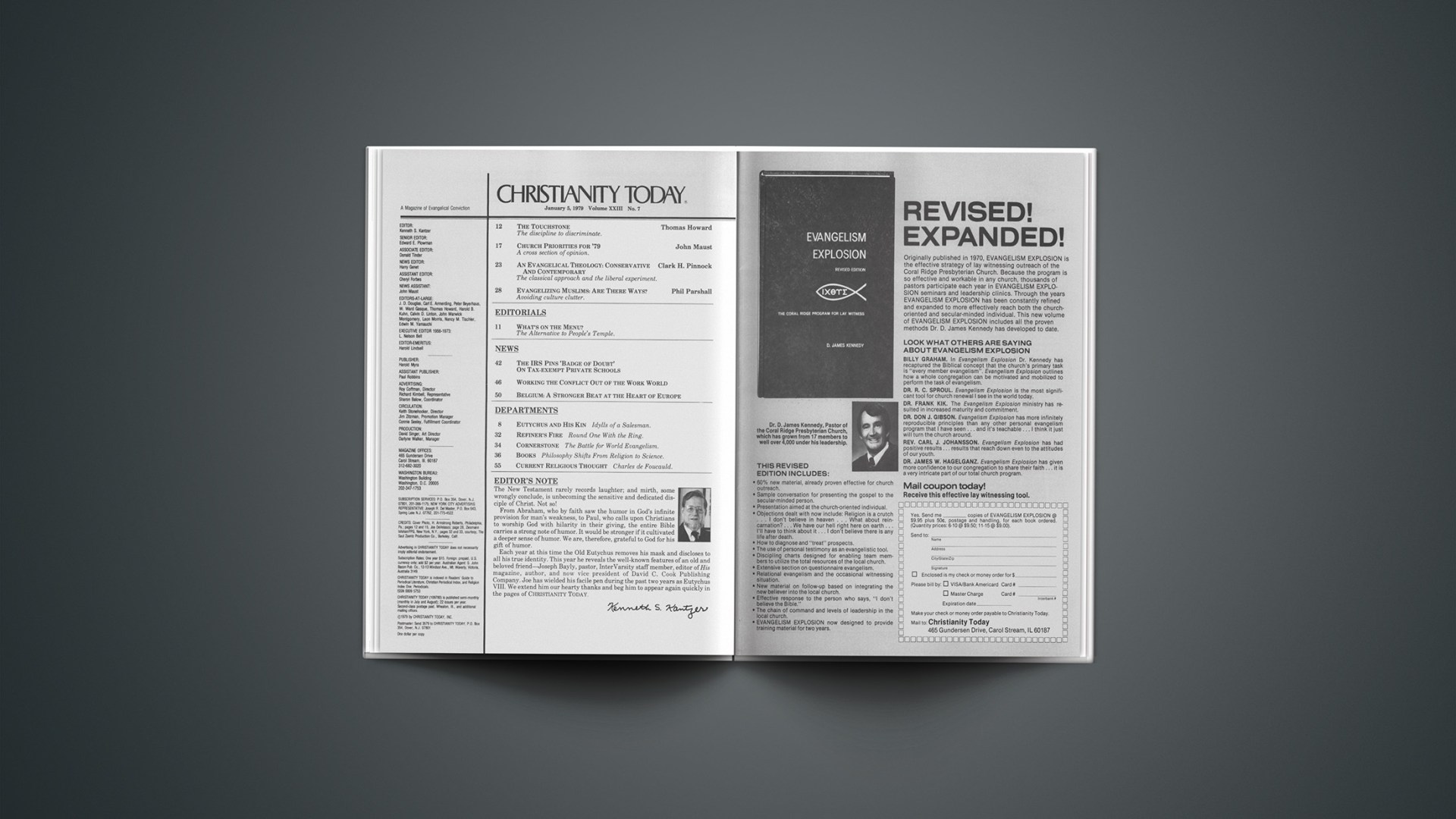
The New Testament rarely records laughter; and mirth, some wrongly conclude, is unbecoming the sensitive and dedicated disciple of Christ. Not so!

From Abraham, who by faith saw the humor in God’s infinite provision for man’s weakness, to Paul, who calls upon Christians to worship God with hilarity in their giving, the entire Bible carries a strong note of humor. It would be stronger if it cultivated a deeper sense of humor. We are, therefore, grateful to God for his gift of humor.

Each year at this time the Old Eutychus removes his mask and discloses to all his true identity. This year he reveals the well-known features of an old and beloved friend—Joseph Bayly, pastor, InterVarsity staff member, editor of His magazine, author, and now vice president of David C. Cook Publishing Company. Joe has wielded his facile pen during the past two years as Eutychus VIII. We extend him our hearty thanks and beg him to appear again quickly in the pages of CHRISTIANITY TODAY.

A Report on F.E.E.T.

The acronym “F.E.E.T.” looks like something out of James Bond, but it has nothing to do with espionage—unless you consider the theological climate in Europe to have become so radical that evangelicals by definition constitute an infiltration movement. F.E.E.T. stands for the Fellowship of European Evangelical Theologians, a group “founded to promote evangelical theology in Europe in a spirit of loyalty to the Bible.” Full membership is open to “those engaged in theological research or who are teaching at a [European] university or college” and to “pastors and laity who have given evidence of serious theological concerns by their literary production”; associate membership is “open to non-European theologians working temporarily in Europe.” All members must subscribe to the doctrinal basis of the Fellowship, which, much like the Apostles’ Creed, represents what C.S. Lewis termed “mere Christianity”: the trinitarian work of God in creation, redemption, and sanctification. As to biblical authority, the fellowship is committed to “the divine inspiration of holy scripture and its consequent entire trustworthiness and supreme authority in all matters of faith and conduct.”

During the week of August 21–25, the second European Conference of F.E.E.T. took place at the beautiful, wooded “New Life Center” (Neues Leben Zentrum), established five years ago by dynamic German evangelist Anton Schulte at Altenkirchen, between Cologne and Frankfurt am Main. Present were close to sixty leading European evangelical theologians from denominational backgrounds as diverse as Lutheran and Pentecostal and from countries as widely separated geographically and ideologically as Norway, Yugoslavia, and East Germany. The official languages of the conference were English, French, and German, and through the simultaneous translations of such crack linguists as Frederick Burklin from German Bible Institute of Greater Europe Mission (Seeheim) each participant could hear all papers and discussions in these three tongues. For organizing such aspects of the conference with strategic care, credit was due especially to Neil Britton, formerly of Aiglon College, Switzerland, who served as conference coordinator.

Of the four plenary papers, two were of a fairly limited exegetical scope, and two ranged into wider theological and philosophical territory. The more strictly focused essays were both delivered by theologians from Scotland—thus reinforcing the (attractive) stereotype of meticulous, textual Scottish theological scholarship. Howard Marshall of Aberdeen analyzed “Dialogue With the Non-Christian World in the New Testament,” concluding—over against the “dialog” school of contemporary liberal churchmen—that in the New Testament “the traditional picture of a church communicating and proclaiming the faith once-for-all delivered to the saints is a well-founded one. There is not the slightest suggestion that the church and the world conversed as equal partners in the search for truth.” David F. Wright of Edinburgh performed a similar analysis of patristic writers, with special attention to Justin Martyr, and arrived at much the same conclusion: “Justin was no apologetic trimmer, no partner in a dialogue of give-and-take.… For Christianity’s contemporary dialogue with other creeds and ideologies, Justin’s guidelines point the way to an evaluation of their beliefs which may be neither wholly negative (for the Logos has ever sown truth among all races) nor uncritically positive (for man’s grasp of the teaching of the Logos is at best fragmentary and distorted). Above all, Justin shows us how to retain the Christological focus in such dialogue.”

Jan Veenhof of Amsterdam and Klaus Haacker of the Kirchliche Hochschule at Wuppertal-Barmen endeavored to analyze the concept of truth in systematics and biblical theology respectively; their approaches and results were much the same, and elicited parallel reactions from a good number of the conference participants. Both essayists made much of the fact that the Hebrew words for “truth” and “faith” have a common root. For Veenhof this offered the opportunity to criticize the “orthodox Protestant theology of post-Reformation times,” which allegedly hyperobjectified truth along Greek lines, instead of recognizing that “when an Israelite qualifies a person or thing as true, this qualification does not refer to conformity to the actual idea but to the realization of the expectation that one can cultivate on the basis of the respective relationship.” Although appreciating Veenhof’s related criticism of Tillich’s correlation principle, many participants saw his discomfort with truth-as-correspondence as potentially harmful to biblical authority and his picture of classical Protestant orthodoxy as an imprecise straw man (contrast the writings of Robert Preus).

Haacker, in his more nuanced paper, admitted that the “Greek” or “formal” concept of truth appears in the Bible, especially in forensic or courtroom imagery, but argued that this is a minor theme. After all, Rahab the harlot served Israel by lying and was rewarded for it; God sends a lying spirit into King Ahab’s court prophets; and so forth. Much of this had uncomfortable parallels with James Pike’s existential and situational position in Doing the Truth. To be sure, Haacker’s basic argument was that “whereas in our philosophical tradition the question of truth is related to the valuation of statements or knowledge, and thus only affects a limited area of human existence, the biblical terms that we translate with the word ‘truth’ are comprehensive norms for the whole of human behavior and being, right into the deepest levels of the personality.” But could not this excellent point have been made without invidious comparisons of formal truth with personal truth? Why must both-and be turned into either-or?

Among the workshop essays were a superlative plea, by Yugoslavia’s foremost young evangelical theologian Peter Kuzmic, for a mature and informed evangelical dialogue—without compromise—with Marxism; a keen argument by Hans Kvalbein of Oslo that primitive Christianity did not assimilate a hellenistic culture but provided that society with an eschatological witness to revelation; an epistemologically ambiguous but nonetheless stimulating “dialogue in and with philosophy” by L’Abri staff member Udo Middelmann; and valuable insights into dialogue with Eastern religions (by Bruce Nicholls of New Delhi) and the dialogual task facing the theology of missions (by Jacques Blocher of the Institut Biblique at Nogent-sur-Marne, France). A common subject of dinner table conversation was the supposed brain-drain resulting from the recent immigration of European evangelical scholars to the western hemisphere (James Packer, Klaus Bockmühl, both to Regent College, Vancouver, for example). But the F.E.E.T. Conference was itself the best evidence that European evangelical theology need not fear the future.

John Warwick Montgomery is professor at large, Melodyland Christian Center, Anaheim, California.

Zaire Protestants: A Good First Century

Last month 68,000 people packed the Stade du 20 mai in Kinshasha, the biggest stadium in Zaire, to celebrate the centenary of the arrival of Protestant missions. The crowd showed the infectious enthusiasm that has helped make the 6.5 million Protestants in Zaire the largest French-speaking Protestant community in the world.

Itofo Bokambanza Bokeleale, president of the Church of Christ in Zaire (CCZ), which sponsored the rally, applauded the early missionary effort. The record is one of the more remarkable growth stories in African church history. When the first missionary, Henry Craven, landed in Zaire in 1878, there were no Christians. He established a mission at Pala Bala, near the modern port city of Matadi and soon was joined by other British missionaries from his own Livingstone Inland Mission and from the Baptist Missionary Society.

The British missionaries, wanting to quickly establish stations across Africa and halt the southward expansion of Islam, penetrated the interior along the course of the Zaire (Congo) River. Two Jamaicans were sent to Zaire by the American Baptist Foreign Missionary Society in 1884—the first American-sponsored missionaries.

Development of the church was constant, though slow and costly. In some outlying areas, buried missionaries outnumbered the living. Protestant work doubled during the two decades between the wars (1919–1939). The next big influx followed World War II and raised the missionary force to more than 1,000. The church grew accordingly in Zaire, until today the Protestant community includes one-fourth of the 25 million population.

Local congregations belong to formerly independent denominations that were merged by government decree to form the CCZ, the only recognized Protestant body. Denominational identity was maintained, though denominations are now called communities. The 11,220 parishes are served by about 2,500 ordained and an equal number of unordained ministers. The CCZ also operates 2,830 primary schools and 6,092 secondary schools, which have a total attendance of 1 million students. The other major institutional work of the CCZ is medical. Its sixty-three hospitals around the country form the hub for maternity clinics, dispensaries, leprosariums, sanitoriums, and health centers.

Shoddy Power Politics

Bokeleale heads this religious conglomerate. Dressed for the centennial celebration in a long, white robe capped by a cardinal-type cape, addressed as monseigneur, and wearing a large crucifix, he could have been a Roman Catholic prelate instead of a Protestant minister. Bokeleale’s ecclesiastical garb and title symbolize a growing controversy between the CCZ president and many of the fifty-three member communities. In 1975, Bokeleale suggested to the CCZ national synod that regional presidents be elected to the position of bishop and that each community follow suit for its own leaders.

Bokeleale’s own community, the Disciples of Christ in Zaire (DCZ), took that step the following year. Replacing its congregational style of government with an episcopal one, the DCZ made its general secretary a bishop and conferred the title of honorary bishop on Bokeleale. Bishop Harms of the Evangelical Lutheran Church in Germany performed the consecration ceremony.

Some leading Protestants, both inside and outside the CCZ administration, strongly objected to what they saw as an attempt by Bokeleale to change the fundamental government of the church. Four pastors published a 150-page document entitled, “Is Christ Still the Head of the Protestant Church in Zaire?” The four ministers described Bokeleale’s moves as “an attempt to convert the entire Protestant community of the CCZ to an episcopal church without consultation with or consent by its members.”

Opposing Bokeleale has its problems. One of the four pastors who wrote the 150-page document was the CCZ vice-president; he is no longer in Zaire and no longer an official of the CCZ. Another of the pastors, from the influential French-language International Parish of Kalina, was threatened by Bokeleale with dismissal from his church. The director of the Bible Society of Zaire openly criticized Bokeleale and lost his job.

The issue these men and others raised is neither new nor insignificant. It is, in their words, “unity in diversity,” or the right of autonomous CCZ communities to maintain their own essential character and autonomy without interference or pressure to conform to a contrary form of government set by the CCZ national leadership. Their concern differs little from that which motivated others in 1971 to protest on the basis of religious liberty the formation of the CCZ (see April 14, 1972, issue, page 4; November 24, 1972, issue, page 9). In both instances, people opposed bringing the autonomous communities under a strong, centralized authority.

Even the Disciples of Christ Community is having second thoughts. During their annual general assembly in July, members rescinded their action of 1976 regarding bishops and the episcopacy. They returned to the congregational concept of church government, with a general secretary as administrator. Despite its internal power struggle, the CCZ still provides for evangelism, development, education, and women’s ministries to its member communities.

Political Shambles

Zaire is going through one of its most difficult periods since 1960. David Lamb, in the International Herald Tribune, summarizes the current state of the republic: “The economy President Mobutu nationalized is being denationalized. The authenticity campaign has been largely abandoned. The corruption that he promised to end continues unchecked, with Mobutu himself the biggest offender. The army that he pledged to reorganize remains only a mob with guns that prey on the public. The agricultural sector that he vowed to revise still is struggling along at a plodding pace.”

Part of the agricultural problem stems from an unusually severe drought in the rain forests of the Lower Zaire Province, the fertile area that feeds the Kinshasa population. Instead of the normal seventy inches of rainfall, last year the region had only nine inches. Some districts have not had rain for nineteen months.

The thousands of Angolan war refugees who have fled to drought-stricken Lower Zaire compound the problem. Thousands more are homeless and starving in Shaba Province following civil war there in two successive years. Nearly a million refugees are living in Zaire.

Such Christian relief agencies as World Vision International and Church World Service are funneling millions of dollars in relief aid to the war refugees and drought victims through local churches and mission stations within the distressed areas. Secular organizations, including the International Relief Commission, coordinate their efforts with the Protestant and Catholic churches. The Zaire Protestant Relief Agency of the CCZ acts as a clearinghouse for this aid.

The CCZ and its member communities had been central to education programs in Zaire since the beginning of missions and modern civilization in the country. When the government decided in 1975 to nationalize the educational structure, between 90 and 95 per cent of the schools were still administered by Catholics and Protestants.

Three disastrous years of public education followed. The entire system became morally and financially bankrupt. In some instances, teachers exacted sexual favors from female students in exchange for passing grades, and funds for salaries and administrative expenses disappeared en route to the schools. Finally, in 1978, the government admitted shortcomings in the schools and returned the administration back to the church—a massive task involving 3 million students, 80,000 teachers, and finances that since 1965 have averaged about 20 per cent of the total national budget (see January 7, 1977, issue, page 43).

An unexpected result of the school nationalization was a spiritual awakening among the students. “After the abolition of the confessional youth movements and religion courses in schools, a remarkable spontaneous movement arose among some young people,” noted the CCZ centenary special, It’s a Miracle. “Having learned the habit of Bible reading with the aid of Scripture Union material, they themselves created in their respective parishes Bible study groups, which quickly attracted the attention of a good number of their fellows.”

The Scripture Union directors in Zaire had experienced problems in getting young people out to their summer camps. Some programs attracted only a dozen youths. But once religion was no longer a curricular activity, the camps began to fill. Leaders are now forced to limit registration in some camps, as attendance has climbed to above two hundred.

Some Scripture Union students formed a group, “Chain of Integrity,” during the period of nationalized education. The students, recognizing that Christians must combat corruption with honesty, met to encourage each other in resisting temptation. The movement has spread to adult Christians in business and professional occupations.

Spiritual awakening is not limited to the young. A new generation of evangelism-minded British Baptist missionaries is moving into areas along the Zaire River to revive once-active churches. A tent evangelist in western Zaire near Bomba followed relief trucks into refugee camps, and now over 1,000 Angolan converts are being discipled. Three years ago a congregation began in Kinshasa with about thirty adults; now more than 400 believers attend each Sunday, and they are building a church to accommodate 1,000.

The Centennial celebrants who jammed into Stade du 20 mai had reason to cheer. Neither power politics in the CCZ hierarchy or Zairian economic and political shambles stopped church growth. The church had a good first century, and the second promises to be even better.

ROBERT L. NIKLAUS

Terrorist-Shy Irish Church Rebuffs Wcc

The Presbyterian Church in Ireland suspended its membership within the World Council of Churches (WCC) last month. The reason: a protest against the controversial Program to Combat Racism of the WCC, particularly its grant last summer to the Patriotic Front of Zimbabwe (Rhodesia).

The action was taken during a special session of the General Assembly of the church and carried by a vote of 561 to 393. More than half of the presbyteries had requested the special meeting.

Suspension does not mean complete withdrawal of membership from the WCC. Instead, the Presbyterian Church of Ireland will cease its participation in the affairs of the WCC, except for certain Christian education and missions programs. (Of the 575 congregations, 475 are in Northern Ireland, where members make up about 20 per cent of the population.)

The Presbyterian Church in Ireland has consistently opposed antiracism grants and has refused to contribute funds to the Program to Combat Racism. The church will continue to discuss the antiracism grants with the WCC. An Irish delegation planned to meet this month in London with WCC officials, a day after Salvation Army leaders were to discuss their self-imposed suspension for the same reason from the WCC.

Complete withdrawal by the Irish church from the WCC would require the vote of two successive general assemblies of the Irish Presbyterians, says A. J. Weir, clerk of the general assembly. The next regular meeting won’t take place until June.

At the recent special session of the general assembly, the church reaffirmed its stand against racism. It also recognized the political, economic, and ethical pluralism that exists within the WCC.

The Presbyterian Church in Ireland, which feels it has no small experience in dealing with terrorists, from the beginning has charged the WCC with making grants to “anti-racist” organizations without making provision for accountability on how the money is spent. The church fears that the WCC is identifying more with conflict and terrorism than with sufferers of injustice.

A statement made recently by the Inter-Church Relations Board of the Irish Church points out that “grants made by well-intentioned donors to paramilitary or guerrilla groups, or to their supporting organizations, do not end simply with humanitarian aid, even when so used, but strengthen generally the power of the particular group or individual administering them.…”

The statement continued, “It would be as wrong and offensive to entrust ecumenical church grants, however earmarked, to the organization of Ian Smith and his colleagues as it is to give to the Patriotic Front in their violent confrontation.”

It is expected that the antiracism grants will be high on the agenda when the WCC Central Committee gathers next January in Jamaica.

DECOURCY H. RAYNER

Misery Relievers Also Love Company

Although their home constituencies differ, evangelical relief agencies aiding flood victims in North India or boat people in Southeast Asian waters often end up working with the same government officials and church groups for the same purposes.

Last month, representatives of ten relief and development agencies formed an umbrella organization that will provide a better communication among themselves and the groups they represent.

The initial members of the Association of Evangelical Relief and Development Organizations (AERDO) are all based in the United States and Canada.1They are Compassion International, Compassion/Canada, Development Assistance Services, Food for the Hungry, Food for the Hungry/Canada, Institute for International Development. Inc., MAP International, World Concern, World Relief NAE, and World Vision International. However, the group is holding charter membership open for a year and is soliciting the membership of sister organizations overseas. AERDO offices will be established in Seattle, Washington.

AERDO will not be involved in relief funding. Its thrust instead will be exchange of information, setting of standards, and coordinating programs. It aims to be to relief and development mission agencies what the Evangelical Foreign Missions Association (EFMA) and the Interdenominational Foreign Mission Association (IFMA) are to evangelism and church-planting mission agencies. AERDO officials also seek a liason role between their organization and the EFMA and IFMA on the one hand, and national church groups on the other.

In addition, says AERDO president Arthur Beals of World Concern, “We wish to provide information about development that will enable Christians to understand its relationship to the other tasks we have in implementing the Great Commission.”

No sooner was AERDO formed than it spawned another group: the Consortium of Evangelical Relief and Development Organizations (CERDO), composed of several AERDO members. CERDO is designed for joint projects, for technical support, and as a conduit for governmental relief and development funds not available to individual church agencies. Its office will be in Washington, D.C. (CERDO has no creedal stipulations of its own, but limits participation to members of AERDO, who must subscribe to the National Association of Evangelicals statement of faith.)

President John Robinson of MAP International says CERDO will seek funding where a consortium makes better sense than for several smaller agencies to work alone—reducing red tape and funneling government funds to projects proposed and approved by its member agencies. He cautions that consortium members must be agencies that are viable apart from the partial government funding.

Spain Cuts Its Ties To Church—Almost

In a popular referendum early this month, voters in Spain were expected to ratify a new constitution that had been overwhelmingly approved a month earlier by the Spanish Parliament. Since all of the leading parties favored the new constitution, its approval was considered nearly certain.

Under the new parliamentary monarchy Spain would no longer have an official religion—ending 500 years of church-and-state union, at least in theory.

The new constitution would open the door to acceptance of a new Law of Religious Liberty, which has already been worked out by representatives of the various religious groups and the Spanish government. Included in the law is an interpretation of Article 16 of the constitution, which concerns religious freedom.

Spanish Protestants have already expressed disagreement with the new constitution, particularly to sections where the politics of consensus led to a backtracking from the pointed declaration in an early draft that the Spanish state was not “confessional.” Article 16 states that there is to be no official religion. But a sentence that was inserted after discreet lobbying by the bishops of the eighty-member Episcopal Conference (Roman Catholic), raises serious doubts. The sentence says, “The public authorities will keep in mind the religious beliefs of the Spanish society and will maintain … cooperation with the Catholic Church and the other confessions.” Protestants fear that mention of the Catholic church by name in reality gives it special considerations denied the others.

Among the notable changes, the new Constitution would end discrimination in burial places and end restrictions in the establishment of new churches. Also, the Constitution would establish legal rights in marriages and in the religious education of children, and the freedom to change one’s religious beliefs. The 1953 Concordat between the Vatican and the Franco regime that proclaimed Catholicism the state religion is being revised to bring it into line with the new Constitution.

A major problem yet to be resolved is separation of church and state finances. The Roman Catholic Church has received some $85 million annually from the Spanish government to pay its clergy and maintain its extensive holdings. The Spanish government, on the other hand, has relied heavily on church schools and teachers for the education of children.

A new agreement, still being drafted, is likely to prevail. It places a “religious” tax upon citizens, which is to be paid along with the income tax. Each person would be able to designate the religious group he wants to receive his tax, with the Spanish government keeping the tax of those who fail to express a preference. Protestant churches oppose taxation, maintaining that local congregations are responsible for financing their own activities.

In whatever manner the deliberately vague passages of the Constitution are worked out, Spain has decisively shed its image as the most Catholic country in Western Europe. It was already considerably less Catholic than its reputation. Perhaps now that will be official.

DALE G. VOUGHT

World Scene

Pope John Paul II received rebel Archbishop Marcel Lefebvre in private audience last month. The French prelate, who is under church suspension because he rejects the reforms of Vatican II and insists that mass be said only in Latin, requested the meeting. Vatican sources believe Lefebvre may be seeking reconciliation.

The Presbyterian Church of South Africa is unhappy about World Council of Churches support for the Rhodesian Patriotic Front. But instead of terminating membership in the WCC, the denominational assembly decided to divert its membership fees to relief efforts directed toward “WCC victims” in the Rhodesian conflict.

PTL: Please Toss a Lifesaver

Jim Bakker, founder-president of the PTL Network, has been warning viewers that his North Carolina-based international Christian television enterprise is in danger of going under.

PTL has accumulated more than $13 million in debts, and about $6 million of its accounts were past due last month, according to a network official in Charlotte. Hundreds of calls have poured in from creditors, said the source, and some suppliers of books, Bibles, and other goods served notice that they will send no more shipments until they are paid.

In early November, the management was a weekend late in scraping together enough money to meet the biweekly payroll of $250,000 for some 800 employees, the first such delay in the five-year history of PTL. (Workers got their second paycheck of the month on time, but cash flow reportedly was still tight.)

A contractor has stopped work on PTL’s proposed $100 million headquarters and educational complex known as the Total Living Center: The contractor was owed $2.5 million—$500,000 of it long overdue.

So far, only a camp and conference center have been completed on the 1,400-acre site, which is located just across the state line in Fort Hill, South Carolina. The site was purchased for $1.6 million last year amid clashes between PTL and state and local officials over taxes and fund-solicitation registration.

New studios, a university campus, and a retirement village are among the planned facilities. In the meantime, the 300 students in the entering class of PTL’s Heritage University, along with the 300 students from another PTL school for grades kindergarten through twelfth grade, are meeting in temporary quarters in Charlotte. (The university presently offers a two-year undergraduate program in communications and theology.)

A serious crisis occurred recently when NET Television of Ann Arbor, Michigan, the firm that duplicates tapes of PTL shows for nationwide distribution, threatened to stop its tape reproduction. NET and PTL officials finally worked out a payment schedule aimed at reducing the more than $1 million owed by PTL.

The network also fell behind in payments to RCA, which supplied PTL with more than $2 million in camera and studio equipment. Air time costs PTL more than $1 million per month, and these bills have also been accumulating. Meanwhile, the network is unable to fulfill some offers it made for free material and other orders for goods.

Staff unrest has come with the finance crunch. Bakker (pronounced Baker) fired 60 of 690 employees last June, explaining the move would save the company $500,000 a year and stave off bankruptcy. But complaints surfaced that people were being asked to work many hours of overtime without pay and that the layoffs were intended to prod or punish those who balked.

Bakker denied the charges, but he did complain about a poor turnout of volunteers for workdays at the camp center. “We’re missionaries,” Bakker told a reporter. “You don’t serve God for eight hours a day and then punch out.” Half of those dismissed were rehired later, and scores of new people were added to the work force.

Bakker embarked on an around-the-world missions tour in October, and he says he found that PTL was behind in its obligations in some of its foreign ministries. Upon his return home, he discovered a huge backlog in unprocessed mail. Contributions had been banked, but acknowledgments, gift offers, and follow-up offering envelopes had not been sent to thousands of viewers, according to a spokesman. A computer foul-up had misprocessed much of the mail that did go through the system, Bakker also explained later. The result: Money pledges that once averaged $1.5 million per week had dipped sharply. Workers were mobilized around the clock to clear the backlog.

Meanwhile, a clash developed between Bakker, 39, and PTL executive vice-president Robert Manzano. The dispute ended with the resignation of the 36-year-old Manzano, but both men insisted that their parting was amicable and without animosity.

Bakker discussed the financial difficulties of the network last month during a fund-raising telethon that is aired semiannually on the popular “PTL Club” talk-and-variety show. (Most of the 203 stations and 3,000 cable hookups that carry the “PTL Club” broadcast shows that were taped two or three weeks earlier. The PTL telephone number is flashed frequently on the screen, and viewers can call in prayer requests, money pledges, and testimonies to Charlotte, where operators around the clock attend a bank of phones.)

Appealing for “immediate” help, Bakker encouraged viewers to charge their pledges to their credit cards. PTL officials had negotiated with the North Carolina National Bank of Charlotte to receive cash for pledges charged to the callers’ credit cards without signed authorization. By agreement, PTL promised to make refunds to the bank if any callers reneged. About $70,000 in credit-card pledges arrived during the first week of the campaign, and only $6,000 had to be refunded, according to a PTL official.

North Carolina National, however, canceled the arrangement when Bakker announced on TV that PTL might be “within days of … closing.” Bakker promptly switched PTL business to another bank, and he told reporters that he believes the past-due accounts will be cleared up by the end of next month.

Another controversy cropped up last month—this one involving Bakker’s personal affairs. It was disclosed that Bakker and his family soon would move into a $195,000 house in an exclusive Charlotte neighborhood. As it turned out, the home was purchased for the Bakkers by Kentucky businessman Harry Ranier.

Bakker said he had failed in persuading Ranier to donate the money instead to Heritage University. Already the owner of an $80,000 home in suburban Charlotte, Bakker said he and his wife will live in the house rent-free but will not accept the title to it.

Bakker, a former Assemblies of God evangelist from Michigan, got the idea for PTL while working at the Virginia-based Christian Broadcasting Network (CBN). In 1965, he pioneered the talk-and-variety show format for Christian television with a show known today as “The 700 Club.”

When Bakker launched PTL, its initials stood for “Praise the Lord.” He later changed the meaning to “People That Love.” The network’s $5 million studio is considered one of the best-equipped in North America, and it is part of a twenty-five-acre headquarters complex patterned after colonial Williamsburg, Virginia.

More than 50,000 persons have called PTL over the past two years to testify that they were born again after watching the “PTL Club,” according to network officials. New converts are offered Bible correspondence courses, and more than 2,000 pastors of various denominations have been recruited from across the country to assist with follow-up, officials say. Support comes from “partners” who number in the hundreds of thousands.

A Spanish version of the “PTL Club,” featuring a Spanish-speaking host, is aired in eighteen countries, and the English-language version is broadcast in several African countries, the Philippines, and some Caribbean areas. There are plans for a Japanese version, as well.

Melodyland Lingers: Is The Song Ended?

After two weeks of meetings, emotion, and tension, many of the teachers and administrators of Melodyland School of Theology (MST) discontinued their employment with the school in mid-November. They charged that their employment contracts and agreements had been breached in significant ways by Chancellor Ralph Wilkerson and his board of directors.

Those who withdrew from the Anaheim, California, school were eight full-time faculty, four part-time faculty (two of whom served in other staff positions as well), and four full-time staff members. These, plus four who had previously resigned, formed the teaching and administrative core of MST. They included the vice-presidents for administration and finance, and for academic and student affairs, the dean of students, the registrar, the public relations director, the head librarian, the coordinator of student services, and the director of the social work program.

Following the mass exodus, only one full-time faculty member, John Rea, remained at MST along with J. Rodman Williams, president of the school. Wilkerson stated that there were still twenty other MST teachers, but as of late last month all were part-time.

After laboring for months with his faculty on the proposed reorganization program of the school (see the December 1 issue, page 46), which required Ralph Wilkerson to relinquish his control over the school, Williams apparently reversed himself and chose to continue as president on Wilkerson’s terms. When asked to comment, Williams said, “I feel that I should not make any statements at this time.”

Winter quarter classes will be held, though the new class schedule offers only about half of the normally scheduled classes. There are almost no electives, and at least one required class has been dropped. Some classes are being taught by students. The schedule indicates that classes for the Master of Social Work Program “will be announced.”

Accredited Christian institutions in the Southern California area are assisting Melodyland students by reviewing and discussing the transfer of their credits.

Throughout the confrontation period, Wilkerson refused to accept any part of the four-point program submitted by the faculty. “God gave me the vision. I am now the chancellor, and I’ll continue to be the chancellor,” he said.

A spokesman for the faculty stated, “One thing should be kept in mind. We have acted together as a corporate body in unity. No one person drafted the reorganization proposal, but the entire group participated as a whole. Integrity was the key factor in all of our decisions. In the end we realized that we could not stay at MST and keep our integrity intact.”

The faculty cited instances of censorship by Wilkerson. One was his “urging” in writing that all academic papers be submitted for reading by his administration prior to publishing. Another was the taping of all classroom lectures, which, in some instances, allegedly were used as evidence for censorship. Faculty spokesmen said that it was this tension-creating, authoritarian style that triggered their reorganizational requests.

In addition to the enormous staffing and financial problems still dogging the school, MST faces the potential possibility of having its charter to confer degrees revoked by the Office of Private Post Secondary Education of the State of California. The school was given until the end of November to comply with the state requirements. The state vocational program, which certifies schools that veterans may attend and receive benefits for, is scheduled to review the MST status in March. In February, the school must also face an accreditation team, with its accreditation-candidacy status at stake.

KATHERINE YURICA

The Seminaries: Glum Over ‘Gays’

Avowed homosexuals who want to enter the ministry create peculiar problems, as the presidents at Iliff School of Theology in Denver and at Garrett-Evangelical Theological Seminary in Evanston, Illinois, are finding out.

At these United Methodist schools admitted homosexuals have asked to start or continue studies to prepare for a pastoral ministry. They were turned down.

Last May, Garrett refused to allow two homosexual students to continue in the three-year master of divinity (M.Div.) program, the one that prepares students for the pastorate. The students, Terry Colbert and James Mason, were told they could transfer to other Garrett programs—such as its joint doctoral program with adjacent Northwestern University. They decided not to. Each sought ordination within the United Methodist Church and completion of the M.Div. program.

Local boards of ministry decide whether to ordain a pastoral prospect. United Methodist seminaries only “prepare people and certify them as fit for ministry,” said Garrett president Merlyn Northfelt. Garrett does not admit or advance known homosexuals to its professional ministry (M.Div.) program.

The issue lay dormant until last month when a faculty committee at Northwestern threatened to end academic cooperation with Garrett unless the latter ended “exclusionary” policies against homosexuals. Northwestern was founded by Methodists, but now is independent; it shares library and certain recreational facilities with Garrett students.

The policy-making Faculty Senate at Northwestern passed a resolution asking the General Faculty Committee to be less hasty; it instructed committee chairman Arthur Veis to organize a further discussion of the matter with Garrett faculty representatives.

Under contention is whether the M.Div. at Northwestern is only intended to lead to ordination. Northwestern says no; Garrett says yes. Faculty committeeman Veis said, “If the program leads directly to ordination, which I don’t think it does, then it’s reasonable for the church to have its standards. But if it’s an academic program,” he added, “then the issue is one of academic freedom—then it’s unjust to dismiss students because of their [sexual] preferences.”

Garrett president Northfelt last month had not reacted to the Northwestern faculty resolution. He said that the only news he had received of the threatened end to academic cooperation between the schools had come from the Northwestern student newspaper. “We (Garrett) will do nothing until we get an official request,” he said.

At Iliff school president Jameson Jones this fall refused (he preferred the word “returned”) the application of Lucius Allen Grooms of Washington, D.C. Grooms was a candidate for ministry in a gay denomination, the Metropolitan Community Church, and is not a United Methodist.

Jones, who is president of the Association of United Methodist Theological Schools—a group comprising chief executives from the thirteen United Methodist seminaries—based his decision on financial grounds. He wanted to know if Iliff’s admission of an admitted homosexual would result in a loss of funding from the United Methodist Church.

The United Methodist Book of Discipline says that church funds cannot be given to “any ‘gay’ caucus or group” or be used for promoting “the acceptance of homosexuality.” Iliff receives $300,000 annually from the United Methodist Church, one-third of its educational and general budget, and school officials didn’t want to jeopardize that by admitting Grooms.

Jones asked for clarification of the funding matter from the Division of Ordained Ministry Task Force on Seminary Support. The group supervises distribution of the $6 million raised each year from the local churches for the seminaries.

The task force has been working to “design a process by which the Division of Ordained Ministry can engage in a discussion of those issues (homosexual education and funding) during its next meeting,” which will take place in March. Task force chairman Virgil Bjork hopes that the seminary presidents, who have appointed their own study task force, and the Division of Ordained Ministry will study all aspects of the homosexual question—including admission to seminaries, advancement in degree programs, funding, and ordination.

“If we do not take the initiative in clarifying these issues,” he said, “someone will press for it. Then the issues will not be clarified within the context of rationality and healthy dialogue.”

The problem probably won’t disappear. At Lexington Theological Seminary (Disciples of Christ), an admitted homosexual was refused his degree in 1976 after completing coursework within a master of divinity program. This fall, a circuit court judge in Kentucky ordered the school to award the degree. The judge said that Lexington had not sufficiently forewarned students that homosexuals would not be awarded degrees. Now Lexington president Wayne H. Bell awaits an appellate court hearing regarding his appeal of that decision.

Methodist official Bjork summed up. “Historically, the church has had ordained homosexuals. It’s the coming out of the closet that generates difficulty.”

Wesleyan Tug-Of-War On Pentecostal Link

About 200 scholars, pastors, and students jammed into tiny Mt. Vernon, Ohio, last month for what some observers called the most significant meeting of the fourteen-year-old Wesleyan Theological Society (WTS). The conferees studied the often controversial Wesleyan-Holiness doctrine of “baptism in the Holy Spirit.”

The openness of their dialogue may signify a theological turning point for the denominations represented within the WTS—most of which also belong to the Christian Holiness Association (CHA), a grouping of about fifteen church bodies that includes Nazarenes, Wesleyans, and Free Methodists.

At issue was what one speaker termed “an embarrassing divergence between John Wesley and his spiritual heirs.” (Wesley did not have a doctrine of the baptism in the Holy Spirit, at least in those terms, and he didn’t refer to Pentecost in his description of “entire sanctification” as did Holiness churches formed after his departure from the scene.)

Also at stake for the conferees gathered on the Mt. Vernon Nazarene College campus was the relationship between Holiness theology and Pentecostalism. Many church historians say Pentecostalism emerged from the Holiness movement at the turn of the century, though some Holiness officials have tried to deny that link and strongly criticize Pentecostalism. Holiness churches historically regarded Pentecostalism as “Holiness heresy” since it tied baptism in the Holy Spirit to speaking in tongues. The Holiness doctrine of baptism in the Spirit involves “entire sanctification”—a second, but non-tongues, encounter with the Holy Spirit.

A variety of spirit baptism positions were heard by conferees. United Methodist Robert W. Lyon issued a sharp challenge to the traditional Holiness doctrine. He assumed a more Wesleyan stance. A New Testament scholar at Asbury seminary, Lyon said there is no biblical basis for a doctrine of baptism in the Holy Spirit as a “second blessing.” Instead, he said that “conversion is the truly sanctifying experience.”

After questioning, however, Lyon affirmed his commitment to the classical Wesleyan doctrine of “entire sanctification” as a “perfecting” of what was begun in conversion.

Alex Deasley, New Testament theologian from Nazarene Theological Seminary, surprised some of the conferees by accepting a great portion of Lyon’s exegesis. (Deasley’s Nazarene church is committed to the spirit baptism doctrine.) Deasley argued that the “purifying” theme in Pentecostal imagery could be applied to the whole of salvation experience—whether it was effected at conversion or realized in a post-conversion experience. Free Methodist theologian George A. Turner, however, defended the more conservative post-Wesley doctrinal position held by most Holiness churches.

Discussion was extended and intense. Evangelist Morton Dorsey, a president of the CHA two decades ago, objected from the floor to what he believed was the dialogue of revisionism, a denial of the “spiritual reality” preached in the Holiness movement for more than a century. Others disagreed, calling the shifts more semantic in character.

Melvin Dieter, WTS president and church historian at Asbury, said that, in any case, the dialogue at the conference was important. He wanted a “new forthrightness in theological dialogue” within the WTS. Dieter also called for “new aggressiveness” in conversation between related theological traditions, from Calvinistic evangelicalism to Pentecostalism.

In his presidential address, Dieter recognized the historical and theological links between the Holiness tradition and Pentecostalism. He cautioned that a more classical exegesis should not be allowed to undercut the experiential depth of the Holiness movement.

Nazarene theologian Mildred Bangs Wynkoop aroused some “amens,” as well as some shocked looks when she declared the conference discussions were “provincial.” She doubted whether the Holiness movement was ready for the “whole Wesley,” and said the issues involved had no simple answers. She called for fuller attention to the complicated historical, semantic, and biblical questions at stake. Bangs emphasized the Christocentric nature of Wesley’s thought, as well as the broader work of the Holy Spirit throughout human history.

Wesleyan church historian Clarence Bence echoed Bangs. He also sought an eschatology that was built on Wesley, but that avoided the “cultural pessimism” of a Hal Lindsey and the “historical utopianism” of some liberation theologians.

United Methodist Lawrence Wood of Asbury seminary is president-elect of the WTS, which now numbers about 1,100 members.

DONALD W. DAYTON

Bishops’ Grief Wins Ear Of Chief

Roman Catholic leaders are both angry and frustrated by what they feel is increasing government intrusion into church affairs, and last month they took their case to President Jimmy Carter. Four top prelates, representing the National Conference of Catholic Bishops (NCCB), later told reporters that Carter had given them a sympathetic hearing.

Archbishop John Quinn of San Francisco, NCCB president, said there was “immediate agreement” by Carter that church-and-state problems exist, not only for Catholics but also for other religious groups. The bishops, said Quinn, also expressed “a mounting concern about the need for aid to parents of … private school children”—a gentle reminder of an as-yet-unfulfilled Carter campaign promise. The President asked the bishops to send him a detailed listing of their specific concerns.

The bishops’ twenty-minute meeting with Carter came at the conclusion of the semiannual meeting of the Washington-based NCCB at a hotel three blocks from the White House. Although their three-day agenda was jammed with budgetary and housekeeping items, the 264 bishops devoted a large chunk of time to the government issue.

Bishop after bishop voiced complaints against what was described as unfair and unwarranted actions by government regulatory agencies, including the Internal Revenue Service and the U.S. Department of Labor. Especially criticized was the National Labor Relations Board (NLRB), which has claimed jurisdiction over parochial school and other institutional employees in such matters as unionization and unemployment compensation. (A case involving the NLRB and parochial schools in Chicago and Fort Wayne, Indiana, is currently before the U.S. Supreme Court.)

Some bishops lamented that Carter had received strong help from the church hierarchy in winning important legislative battles, but had failed to protect the church from harsh treatment by certain presidential appointees. “The White House and Administration used us when it was something they wanted,” fumed one bishop.

Cardinal Terence Cooke of New York suggested that the bishops set up an ecumenical monitoring process, possibly with the assistance of church colleges, to help guard against government interference in church work. By consent (no vote was taken), the bishops agreed that a watchdog was needed. However, they decided to assign the role to their own officers rather than to establish a new committee. (Cooke attended the meeting with Carter, as did Quinn, NCCB general secretary Thomas C. Kelly, and Archbishop John R. Roach of St. Paul and Minneapolis, the NCCB vice-president.)

In other actions:

• The bishops decided for the first time to respond officially to conclusions of Protestant and Catholic theological dialogue groups. The first response will be made to the Lutheran-Catholic dialogue.

• An NCCB committee listened to statements from 20 of the some 1,500 persons who attended a conference in Baltimore Where ordination of Catholic women was advocated. The women demonstrated outside the NCCB meeting hall and chided the bishops for not permitting them to make a report to the full body.

The ordination issue was not on the agenda, but at one session six bishops urged the NCCB to begin serious discussion of the woman’s role in ministry. No action was taken, and leaders reaffirmed that church teaching prohibits the ordination of women. The only reason for any talks, suggested Quinn, would be to “elicit a better acceptance of the teaching of the church.”

Personalia

C. M. Ward, well-known Pentecostal radio preacher, has retired after twenty-five years as speaker on the Assemblies of God thirty-minute program, “Revival-time.” Ward also resigned as president of Bethany Bible College in order to give full time to writing and speaking ministries.

Philip Yancey has given up the editorship at Campus Life magazine to become editor of Campus Life Books—a book line copublished with Zondervan. The move will give Yancey more time for writing and research; a frequent contributor to CHRISTIANITY TODAY, Yancey has more than 250 articles in sixty-four publications to his credit.

Teen-Age Preacher

Teen-Age Preacher

Jones’s journey toward self-worship ended in death in Guyana. But it began in the tiny eastern Indiana town of Lynn, where casket-making is the main industry. Jones apparently confessed Christ as a boy under the influence of a neighbor and Nazarene church member, Mrs. Myrtle Kennedy. He began preaching as a teenager and at the age of 18, he married Marceline Baldwin, a nurse at the Richmond, Indiana, hospital where they both worked.

Jones enrolled at Indiana University but dropped out during his sophomore year to give more time to preaching. He continued his studies, however, in night school classes at Butler University in Indianapolis and finished after ten years with a degree in education. In 1953, he became pastor of the Christian Assembly church (Methodist) in Indianapolis, but a dispute erupted and he left. Jones later said the congregation had opposed his bringing blacks into the church: others, however, attributed the conflict to his becoming a Pentecostal.

For the next few years, Jones held Sunday afternoon healing services in church buildings he rented. In 1956, Jones opened People’s Temple in leased quarters. He sold monkeys door-to-door to purchase a synagogue in a black neighborhood a year later. Interestingly, the synagogue had been headed by Rabbi Maurice Davis, who in recent years has been an organizer of efforts to deprogram cult members.

Persons who attended People’s Temple in those early years recalled in interviews that the services were much like those in any old-fashioned Pentecostal church. Blacks and whites got along relatively well, they said.

But there were things that disturbed members in the inner circle.

Jones and a few Temple members attended a spiritualist camp meeting in the late 1950s, and Jones came back a believer in reincarnation, said the man who served as Jones’s associate pastor until 1963 (when he was replaced by an Assemblies of God minister). “Quite a few spiritualists began attending the church after that,” he said.

Jones had ESP, some ex-members insist. “He accurately predicted events, including the death of a woman who jumped from a hospital window,” said one. Jones believed he was “guided” by a supernatural “spirit,” said a former university classmate.

Fateful Visit

The next major change within Jones occurred in 1961 when he and some young people visited Father Divine in Philadelphia. Following that visit Jones frequently alluded to the black preacher whose interracial following regarded him as the personification of God. It was soon evident to the inner circle that Jones no longer believed in the virgin birth of Christ, that he believed in evolution, and that he wanted people to pay more attention to him than the Bible.

“The Bible is a black idol; you people worship it,” he charged. Jones, known for years as “Jimmy,” assumed the title of “Father.”

“He did some good things,” says former member Judy McNaulty. “But he just got power and changed.” (Mrs. McNaulty’s brother, Charles Beikman, was being held in Guyana in the throat-slashing deaths of a mother and three children.)

Jones began emphasizing pacifism and brotherhood in his sermons, but he also warned that blacks might perish some day at the hands of white racists. He complained that bigots had persecuted him. At that time, white members began leaving the church, some because of the racial emphasis, others because of theological differences.

Indianapolis resident Edward Mueller remembers another side of Jones: “He tried to get me to be a minister, but he wasn’t sincere. He said there was no easier way to make it. Once he told me, ‘Just look at my hands: they’re not dirty.’ ”

On the side, Jones ran a community center and two nursing homes. In 1961, the mayor of Indianapolis appointed him director of the city’s Human Rights Commission. Then Jones spent nearly two years in Brazil where he studied the methods of a Brazilian faith healer. When Jones returned to Indianapolis, he found the spirits lagging and attendance dwindling at the Temple.

In 1964 Jones applied for ordination within the Christian Church (Disciples of Christ), a 1.3 million-member mainline denomination that is very prominent in the ecumenical movement. John Harms, now retired in Oklahoma, was regional executive minister of the denomination at that time, and he served on the committee that examined Jones. Harms was uneasy about Jones’s “emotion-oriented religious background” and about his lack of seminary training. “But because he [Jones] seemed to be groping for a more rational approach to religion, and because he was an effective leader of the poor and oppressed,” said Harms, “the committee decided to recommend that People’s Temple proceed with his ordination.”

Harms, who never heard Jones preach, says he did not favor the decision, believing that Jones needed the discipline of an academic preparation and a good theological foundation.

The Migration

On the advice of his good friend Ross Case, Jones took more than 150 followers to California in 1965 and set up spiritual shop there. From his new pulpit in Redwood Valley outside Ukiah, Jones began preaching that the Bible was an unreliable document. He denounced its moral standards, often throwing the Bible to the floor, spitting and stomping upon it. Before his congregation, which soon grew to 3,000 members, Jones called Jesus a bastard and Mary a whore.

Richard Taylor, an American Baptist pastor in Ukiah during Jones’s tenure there, recalls one frequent Jones liturgy: “Who am I?” Jones yelled. “Jesus Christ,” the people answered.

Jones’s name was substituted for Jesus in tradition hymns. He believed himself to be the reincarnation not only of Jesus Christ, but of Lenin, Buddha, and the Bahai prophet Bab, all rolled into one. His followers believed him “The Living Word,” and Jones’s magazine by that name glorified his powers on every page.

Jim Jones had an obsession for power. Almost every abberant feature of his church can be traced either to that or to his obsession with sex. Richard Taylor explains that “He achieved successive levels of power over his followers until he actually controlled their lives.” And according to Jeannie Mills, who was instrumental in blowing the whistle on Jones following her exit from the Temple in 1975, Jones’s decision in 1964 to join the Disciples of Christ was the result of a deliberate search for an organization in which he could remain completely autonomous.

Jones’s thirst for power was slaked by political interests. He held political office in every place he lived. Throughout California, Jones was respected by politicians as a man able to mobilize thousands of people.

The politicians failed to realize that Jones was manipulating them, not serving them. A favorite game was to get endorsements from important public figures by giving them carefully staged tours of the church’s clinic, legal aid office, and dining facilities for the indigent. Members of the Temple acted the part of cured heroin addicts, indigents glutting themselves on Temple feasts, and sick people being treated at the clinic—all following a Jones script. Visiting dignitaries were invited to address Temple worship services. A guest would be photographed, unaware that militant-looking blacks with raised fists were part of the picture—blackmail material.

Evolving Commitment

Jones’s manipulation of politicians appears almost comic compared with what he did to his followers. Grace Stoen, an outspoken defector from the church, said that Jones gradually but drastically changed his followers. A commitment evolved until Jones possessed the body, mind, and soul of someone.

Initially a Temple member pledged a portion of his time. But what was so attractive about this bizarre outfit? “Warmth,” says Mills, “first, last, and most important.” The individual was never alone but genuinely part of a community. People were not judged according to their status in the secular world. In the People’s Temple, a white man with a Ph.D. from MIT could direct the junior choir and a black man with a sixth-grade education could be associate minister. “I found people who weren’t impressed by what I had, but by what I was,” says Mills. Although she confesses to have been a racist when she first entered the Temple in 1969, Mills changed when she discovered that “It’s very, very beautiful to see black and white people together in a living, working, functioning society.”

The electric atmosphere of Temple worship services also attracted people—enough to retain their interest for four hours at a stretch. Worship began with singing by a polished choir and then moved into a testimony service during which members of the congregation told of the miraculous healings and prophetic revelations of their leader. They expressed gratitude for the protection and sense of security they received from Jones’s ministry. Following an offering Jones would begin his “sermon.” Jones never preached expository sermons. Rather he ranted about local, state, and federal politics, interspersed with four or five or more offerings for various causes. The last hour of the service was given to healings and revelations. Week after week, he appeared to make good on his original promise to Archie Ijames to perform miracles. Supposedly people were freed from their wheelchairs and crutches. The blind were made to see and the deaf to hear. Often someone would appear to dramatically die. Then Jones would “cure their maladies” and resurrect the “dead.”

Few people knew that Jones hired people on whom to perform these miraculous healings and resurrections. Neither did they know that his henchmen snooped in their files, medicine cabinets, garbage cans, and so forth, to provide Jones with material for his mysterious revelations. Those who did know were either discredited, paid off, or party to the charade.

Jones extolled the virtues of Temple membership: “Ask the city hall if they know your pastor. They won’t. But they know us.… Do they care about you at your church? People love you here, even if they don’t know you.”

After Jones got a person’s time, he went for their material possessions. Jones used a variety of tactics to get his parishioners’ dollars. He shamed them publicly and encouraged them to compete with their donations. Nonresidents of the Temple were expected to tithe 25 per cent of their income; residents gave everything they had in return for maintenance by the Temple and an allowance as low as two dollars a week. The Temple from 1968 to 1976 received thirty real estate properties. The block-long parking lot behind the San Francisco Temple is still crowded with cars donated by church members for resale by the Temple.

Draining Schedule

Next, Jones demanded total participation in the Temple community to the exclusion of the outside world. Here is a typical week of Temple life, as recounted by a member.

Sunday: morning meeting in Redwood Valley from 11 A.M to 3 P.M., evening meeting from 6 P.M. to 2 A.M.; Monday: planning commission meeting from 7 P.M. to 7 A.M.; Wednesday: catharsis session from 7 P.M. to 1 A.M.; Friday: meeting in San Francisco from 7 P.M. to 1 A.M. followed by overnight travel to Los Angeles on eleven Greyhound-type buses owned by the Temple; Saturday: meetings from 2 P.M. to 1 A.M.; Sunday: meeting in Los Angeles from 11 A.M. to 4 P.M. followed by the return trip to Redwood Valley in time for school or work Monday morning. (Asked how many of the meetings were actually for worship, Jeannie Mills said, “All of them. They were all worship-Jim-Jones meetings, including the planning commission meetings.”)

Besides meetings, fulltime workers had other demanding responsibilities. Service projects were expected from everyone, ranging from work in the Temple clinic, legal aid service, and dining room, to writing letters to politicians (each person writing up to 100 such letters in a week), and other forms of political activism. Many members only got four to six hours of sleep a night. In the process, they were drained physically and emotionally, becoming more malleable in Jones’s hands. Fraternizing by important members of the community with old acquaintances was forbidden, and a punishable offense.

That was not enough. Not only was the community raised to a position of supreme importance, but the individual was reduced to almost total submission, to what could be called a state of “mortification.” During the so-called catharsis sessions, members of the community were expected to confess to various sins (real or not) for which they were physically punished. Mills wryly noted that people seldom volunteered confessions. Other members readily accused them.

Until several years ago, punishments were relatively mild. Over time they increased in severity. What began with three or four swats of the belt became in Jonestown a week in solitary confinement in a small, subterranean cubicle. Jones also enjoyed watching ill-matched boxers or tormenting people with snakes.

Jones also at times forbade married couples to have sexual intercourse—at least with each other. But reports indicate that Jones freely indulged in relations with both sexes. Should a woman be tempted to leave the Temple for lack of sexual activity, Jones would either satisfy her needs (if he found her attractive) or commission one of his lieutenants to do so.

Exclusive Loyalty

Case said Jones could tolerate no loyalty to anyone but himself. Breaking the sexual bonds between husband and wife was the surest way to undermine interpersonal loyalty.

With an arsenal of psychological weapons, Jones succeeded in robbing his followers of their time, their property, and their dignity. Against this background, perhaps the murders and suicides of his disciples is less mystifying. The last supper of cyanide-laced Flavour-Aid was merely the final act of servitude to the man who wanted and tried to be “God.”

Since the death orgy in Guyana took place, the secular media has given massive coverage to this religion-related story. Before the deaths occurred, press investigations of People’s Temple were few, though New West magazine published an investigative feature on People’s Temple in August, 1977, alerting at least the San Francisco area to the bizarre practices of the cult.

A first investigative report was filed in 1972 by Lester Kinsolving, an Episcopal priest-turned journalist. Writing for the San Francisco Examiner, Kinsolving prepared an eight-article series on People’s Temple that was killed after publication of only the first four articles.

Upset by Kinsolving’s revelations of cruelty, fake healings, and immorality within the Temple, Jones had placed more than 100 pickets outside the Examiner offices on the third day of the article series. Kinsolving contends the Examiner killed the series as a result of pressure from lawyers and politicians who owed favors to Jones.

At that time, Kinsolving tried to arouse the attention of law-enforcement bodies. (He says he received numerous threats in the aftermath of the series and that his house was burglarized.) In addition, Kinsolving chided officials in the Disciples of Christ for not disavowing Jones.

Church In Action

Indeed, many complaints have been directed toward the Disciples of Christ since the killings. Why did the church take no action?

The regional headquarters of the denomination had organized a committee to review allegations against Jones and People’s Temple. Tim Stoen, a 1960 graduate of Wheaton (Illinois) College who joined the Temple and later defected, had given the committee documents showing what really was happening behind the Temple’s closed doors, says cult defector Mills.

She said, “They [the committee] were told … They were made aware of things going on inside the church, and they did not care to check into it.”

Asked about these charges, review committee chairman Scott Lathrup contends this was a case of the the words of Temple defectors against the words of Temple members.

Mills said, however, that the documents taken by Stoen to church officials contained an affidavit from several former Temple members. Stoen was a deputy district attorney for Mendocino and San Francisco Counties during his years in the Temple; many say he was Jones’s right-hand man for a time.

Cult defector Mills alleges that Disciples of Christ regional president Karl Irvin did nothing because Jones had blackmailed him. Irvin denies this.

He, like Disciples of Christ president Kenneth Teegarden, says no action was taken against Jones because Disciples of Christ bylaws do not provide for the expulsion of a local congregation.

In a news release issued after the killings and after a deluge of questions from church members, Teegarden explained the official church stance. He said, at present, congregations can withdraw only at their own initiative. (He also said the committee investigation of Jones was never completed since Jones was out of the country and could not be confronted.)

As a result of the killings, however, Teegarden said, “We [the church] will initiate … a proposal … for removing congregations from fellowship.”

Still, the question remains why so many people joined the cult. Many, like Stoen, came from evangelical backgrounds and were initially attracted by the urban outreach of People’s Temple.

Cult defector Mills said she had found the warmth of the community attractive. Ever since her departure, Mills says, she has been “looking desperately” for a similar environment. “In no church [I visited] did more than perhaps the usher and one greeter say hello to me,” she said.

Reflecting upon her first visit to People’s Temple, she said, “I felt like I had died and gone to heaven.”

Religion In Transit

A second printing of the New International version of the Bible by Zondervan will bring the total number of copies in print to 1.6 million by year-end. Bookstores ordered all the initial 1.2-million press run before the October 27 publication date. With an exclusive thirty-year contract to publish the new translation, Zondervan expects a sales windfall. The Wall Street Journal reported that the company already has upped its sales prediction for this year by $3 million to a $41 million total.

Gambling opponents have “I told you so” crime statistics from Atlantic City, New Jersey. Within the two months after the first casino gambling houses opened there last May, street crime increased by 25 per cent. Public safety Commissioner Edwin J. Roth blamed the increase on the influx of visitors to the resort city.

Jim Jones: Man Who Would Be ‘God’

Who is Jim Jones—the social-spiritual cult leader of the People’s Temple whose 900 followers in Guyana committed murder-suicide last month?CHRISTIANITY TODAYstudies the sequence of events leading to that tragic death orgy. Correspondent Paul Scotchmer, based in San Francisco, interviewed former People’s Temple members there, while senior editor Edward Plowman assisted by investigating Jones’s Indiana origins.

Perhaps the mysterious power of fallen cult leader Jim Jones is explained best by a conversation more than thirteen years ago inside the home of cult defector Ross Case.

Case, then an associate pastor of the People’s Temple in Indianapolis, had just moved to Ukiah, California. Case thought Ukiah would be the safest place during the imminent nuclear holocaust predicated by his good friend Jones.

People’s Temple member Archie Ijames was visiting Case in his new California home one night in February, 1965. And Case didn’t like what Ijames had to say.

Jones had issued an ultimatum to Ijames and another Temple associate: Choose me or Jesus. Jones had said: “You go out and preach Jim Jones, and I’ll back it up with miracles.”

Ijames chose to follow Jones. He told Case, “I felt like I had to do it, even if I fell on my face.” Ijames told Case that he had decided to “submit my mind completely” to Jim Jones.

Jones followed Case to California (originally a suggestion by Case). But after his discussion with Ijames, Case decided not to follow Jones. He broke off from the Temple, and for that action, Jones would later ridicule and defame Case.

Book Briefs: December 15, 1978

Pro And Con On The Charismatic Movement

What About Continuing Revelation and Miracles in the Presbyterian Church Today?, by Robert L. Reymond (Presbyterian and Reformed, 1977, 64 pp., $1.95 pb), The Spirit Within You, by J. Terry Young (Broadman, 1977, 192 pp., $4.95 pb), The Spirit of God, by Thomas Hopko (Morehouse Barlow, 1976, 132 pp., $3.50 pb), Essays on Renewal, by Leon Joseph Suenens (Servant Books, 1977, 131 pp., $2.95 pb), Experiencing the Holy Spirit, by Jim McNair (Bethany Fellowship, 1977, 171 pp., $3.50), and Fire in the Fireplace: Contemporary Charismatic Renewal, by Charles E. Hummel (Inter-Varsity, 1978, 275 pp., $4.95 pb), are reviewed by Erling Jorstad, professor of history and American studies, St. Olaf College, Northfield, Minnesota.

Whatever else critics or friends of the neo-Pentecostal (or charismatic) renewal claim for it, none can deny that it has shattered long-nourished stereotypes, produced much excellent scholarship (along with much fluff) on pneumatology, and brought together in worship, and in debate, Christians who had rarely before spoken to each other. The movement today has a momentum all its own; like an escalator, it has people getting on and getting off as it keeps moving.

These generalizations are wondrously illuminated by a comparative study of these recent books. Three continents, five communities of faith, administrators, pastors, and professors all are represented. Two are critics, two are outside observers, two are friends—a nice mix.

First, the critics. Reymond of Covenant Theological Seminary cites the Westminster Confession of Faith and also draws on Kuyper, Warfield, and Vos to support his contention that charismatics must not be allowed to hold the office of deacon or elder in the Presbyterian church. He argues from an exegesis of First Corinthians 14 that the “sign gifts” are no longer present today. Further, true worship excludes “non-rational elements” (meaning tongues and prophecies). To him, simply because some neo-Pentecostalists claim new revelations and charismatic gifts “in no way establishes the legitimacy of either after the apostolic age.” Citing Warfield, he argues that there is little evidence for miracle-working in the post-Apostolic age; the miracle workers after then came from without—“a heathen world” (p. 48). Hence, when church officials apply Westminster standards, they must exclude those prophecying or speaking in tongues from these positions.

The other critic, J. Terry Young of New Orleans Baptist Seminary, delivers both a blistering attack on the teaching of the baptism in the Holy Spirit and the attendant gifts, and restates what “fullness of life in the Holy Spirit” means in light of Scripture and church teaching. He denies the validity of any second baptism; he states “every believer has the Holy Spirit dwelling within him” and denies the need for any “second crisis-type experience” to know the fruits and gifts of the Holy Spirit.

The last portion of the book summarizes the person and work of the Holy Spirit. You know that the Spirit dwells within through the “watermarks” of vision, understanding, love, and fellowship; no signs replace these permanent evidences of the indwelling Spirit. Critics of neo-Pentecostalism will find their convictions strongly supported in this work. Friends of the movement have a handy summary of why many Christians, committed to scriptural evidence, resist their cause.

The next two books are far less polemical, yet in their way also suggest some of the theological distance the movement has traveled. Hopko of St. Vladimer’s Seminary encapsulates Eastern Orthodox teachings on the Holy Spirit. The study is more devotional and pastoral than analytic, using Scripture, hymns, teachings of the church fathers, and liturgies. Touching only briefly on neo-Pentecostalism, Hopko states that the Corinthian gifts are given so that “the fruit of the Spirit can grow in human life.” The gifts are seeds for an abundant life, not ends in themselves. The major portion of the book is an exposition of Orthodox pneumatology, a fascinating counterpoint to much of Western teaching.

The book by Suenens, who is probably the leading Catholic bishop involved in charismatic renewal, is a collection of ten of his essays written since 1970. They were issued to commemorate the fiftieth anniversary of his ordination. Only two essays concern themselves with neo-Pentecostalism; the author calls for a reunion of “charismatic” and “social” Christians (his terms). He argues that no permanent polarizations must necessarily follow from the differences today. Other essays contain excellent pastoral advice on fidelity and sexuality; some, such as those on the Vatican Council and on Mary, are for Catholic readers.

In another realm altogether is the book by McNair, a New Zealand Baptist evangelist. He presents a primer for those newly committed to or about to join the renewal movement and who are fearful of the criticisms that their new life is too emotional and unscriptural. The author seeks not to persuade the critics but to support the wavering and the worried. He has no doubts that the baptism in the Holy Spirit is “a full biblical experience.” Such an experience is “the pentecostal reality portrayed in the Bible.”

McNair accepts the classic Pentecostal teachings of growth toward Christlikeness. Whatever term you give to the second baptism, he states, “the gift of tongues is shown to be a basic part of the Christian gospel and Christian life, part of God’s good news for his people.” Finally, “Whatever else is said about the other gifts, this remains certain—tongues and prophecy are intended for every believer.”

The final two chapters draw a roadmap for the journey toward an authentic understanding of baptism in the Holy Spirit. The author’s advice is forceful, direct, and assuring. In sum, this work is for those who want to believe the neo-Pentecostal commitment and need a vigorous verbal recharging of the spiritual battery.

No reader should be surprised at the vastly different reactions toward the charismatic movement. However, continued polarization is not the only alternative. We have in the historical and analytic book by Hummel a fresh and attractive case for moderation. The work should be carefully studied by inquiring persons along every point on the spectrum.

Several features stand out. The author, director of faculty ministries for Inter-Varsity Christian Fellowship, has done his homework. He has utilized the most recent and responsible scholarship available: Dunn on First Corinthians, McDonnell on tongues, Culpepper on history, among others. Next, he acknowledges that the scriptural record is anything but perfectly clear on the meaning of the sign gifts. He thus avoids the old “fallacy of the undivided middle,” which we learned about in college courses in logic. Finally, Hummel seeks to gently persuade the reader to avoid the pitfalls of the sour nay-sayers or the overheated cheerleaders.

Hummel himself is sympathetic toward the neo-Pentecostal movement, but keeps the evidence rather than his personal preference in front of the reader. His work is divided into four parts: history, Luke and Acts, Paul and Corinthians, and current issues. After briefly reviewing the history of the movement in Part One, and fully discussing Luke’s teachings on the Holy Spirit in Part Two, he moves to the center of the argument in his Pauline exegesis. “Paul does not declare that tongues was causing the greatest difficulty because the Christians prized this gift above the other charisms. His severest criticism occurs in the first eleven chapters and is aimed at the party spirit, divisions, sexual immorality, lawsuits, and disorder at the Lord’s Supper. The charism of tongues appears to be less of a problem to Paul than it is to modern interpreters who call it overvalued and ostentatious” (p. 158). That tongues is a genuine gift is clear; that it is the centerpiece of Paul’s teaching is a claim not supported by the record.

How does Hummel resolve the differences between the opposing camps? This review cannot do justice to his careful study, but two passages show his perspective. He states that the phrase “baptism in the Spirit” does not occur as such in the New Testament. But the phrase “baptize with (in) the Spirit” does occur seven times. In each case, Hummel shows, the meaning is slightly different; or at least the reader must respect the possibility of more than one interpretation. The author goes on to develop what those interpretations could be. Paul uses the phrase about spirit baptism as “a once and for all action in the Spirit at conversion incorporating the individual into the body of Christ.” Luke, however, uses it to describe “the enduement with power for effective witness and service which, after Pentecost, was frequently repeated.”

Or a second example, “Neither Luke nor Paul teaches that speaking in tongues is a sign of the individual’s inner spiritual development. In the Acts it is often one evidence of the Spirit’s outpouring, of which there are also others. But it cannot be taken as the sign of a second inner experience of baptism in the Spirit. Paul presents this charism as one of many which builds the body, not as a mark of spiritual maturity (or immaturity)” (p. 197).

How, though, would Hummel keep the movement alive, sensitive to criticism, yet faithful to the Scriptures? He reminds us that “the heart of charismatic renewal is not tongues nor baptism in the Spirit.…” Rather it is commitment to “the full range of charisms as manifestations of the Holy Spirit to meet the needs of the Christian community.” All the gifts are needed every day for the building up of the church, a body that needs daily renewal. The gifts are not the property of a few high-ranking leaders, nor the possessions of some people for private use. These are to be developed throughout the whole body to build up the Christian community.

But specifically how? Hummel calls for frequent discussion within congregations for information and direction. He pleads with us to expect the Holy Spirit to make his presence known. The author tells us not to fear the gifts simply because they might be misused, nor to hesitate to ask for them out of fear of not knowing where such searchings might lead. But, we can ask, what about the disputes and divisiveness in the churches? He writes that “We should realize that it is people, not the truth, who cause division.” People use different terminology and they have conflicting and often faulty communications systems.

But all of that has been said before. Hummel contributes, in his summation, some original insights. We need to exercise all the gifts, avoid a tendency toward individualism, remain open to change, recognize what the nonessentials in a dispute might be, and accept “the loving unity possible amid marked diversity of perspective” concerning spiritual gifts.

The way of moderation is the most difficult path to follow. Hummel notes that such a path “does not yet give answers to some of the profound questions it raises.” But we can be sure, he concludes, God is renewing his church, one means being the neo-Pentecostal movement. This book brings together for us a constructive statement of where to begin and what to expect.

Tension In Modern Life

Facing Up to Modernity: Excursions in Society, Politics, and Religion, by Peter L. Berger (Basic, 1977, 246 pp., $11.50), is reviewed by Lewis Rambo, assistant professor of religion and psychology, San Francisco Theological Seminary, San Anselmo, California.

This book is a collection of eighteen essays demonstrating the range, depth, and vitality of Peter Berger’s thought. By profession a sociologist, Berger explores various facets of the contemporary world with both analytical objectivity and passionate conviction. Berger believes that a sociologist should seek to be as detached as possible in the process of examining the social dimension of modern life, but he also recognizes that the sociologist is a person with values that unavoidably influence his work. He urges an honest recognition of one’s biases.

The unifying theme of the book is the diverse ways that “modernity” shapes contemporary society and consciousness. By modernity Berger means a host of factors that have important consequences on religion, politics, and self-understanding. The pivotal essay in the book, “Toward a Critique of Modernity,” identifies five characteristics of modernity. First, there is the process of abstraction—a style or mechanism by which life is quantified and simplified, thereby sacrificing its richness and complexity. Among the common products of such abstraction are IBM data cards and Social Security numbers. Second, there is a shift in the approach to time. Instead of being concerned primarily with the past or the present, modernity is preoccupied with the future.

Third, there is a process of individuation in which people are progressively separated from their families, communities, and cultures. The individual self becomes a fragile, but frantically preserved, entity with little sense of identity. A fourth characteristic of modernity is the multiplication of options and the resulting freedom of choice for individuals. This can be liberating for some, but in many cases it results in a terrifying loss of stability and certainty. The “liberated” self is precarious and often is in desperate search for meaning and purpose. Secularization is the fifth facet of modernity that Berger discusses. Secularization is not only the declining influence of religious institutions on the modern world, but also the multiplication of religious options within a modern society. When there is diversity, certitude and confidence are lost. Secularization’s impact is also felt in the virtual disappearance of the supernatural within the public life of most “advanced” societies. Religion tends to become basically a private affair.

The split between the public and private spheres produces tensions within the individual that must be alleviated in some manner. In this connection, Berger’s essay “Toward a Sociological Understanding of Psychoanalysis” is an illuminating study of the way in which psychology as a discipline, as a science, and as an ideology functions in modern society. Psychological therapy serves as an institution that mediates between the public and private spheres of life in order to heal and maintain eroding identities.

In another fascinating essay, “A Sociological View of the Secularization of Theology,” Berger chides the “death of God” theologians as being scholars who have too easily accommodated themselves to the thought forms of secularity. Secular theology is, in fact, self-liquidating. On the other hand, he does not believe that the defensive posture of the more orthodox is much better. The conservative Christian often rejects modernity without carefully examining it. Berger’s penetrating insights force both the “liberal” and the “conservative” to do rigorous work in order to meet the challenges of the modern world.

Berger urges the church to take a stand of courageous affirmation in order to stem the tide of alienation, spiritual lassitude, and meaninglessness in the essay entitled “A Call for Authority in the Christian Community.” Berger is critical of those theologians who assume the superiority of the “modern mind” and reject the message of the Bible because it is, to them, “primitive.” Thoughtful reconsideration of the Christian tradition, including those elements of the supernatural, leads to a renewal of appreciation for the power and promise of the Gospel of Jesus Christ.

Facing up to Modernity contains many excellent essays that will serve as a good introduction to those unfamiliar with Berger, and for those who have read his other books, this collection brings together some vintage articles. One will not always agree with Berger, but those interested in wrestling with important topics could find few who surpass Berger’s sharp intellect and crisp, lively style of writing. If you wish to savor some of Berger’s other books, consider these. Invitation to Sociology is a general introduction to the field. For an example of his work in the sociology of religion see The Sacred Canopy. For a more complete understanding of the effects of modernity on contemporary consciousness see The Homeless Mind. Those who are interested in ethics and political science should read Pyramids of Sacrifice. As a demonstration of Berger’s enormous range of interests see his novel, Protocol of a Damnation.

Freire: Third World Theorist

Paulo Freire: His Life, Work and Thoughts, by Denis Collins (Paulist, 1977, 94 pp., $2.45 pb), is reviewed by Samuel F. Rowen, coordinator of curriculum development, Missionary Internship, Farmington, Michigan.

Paulo Freire has become one of the most significant forces in education in the Third World. His best known book, Pedagogy of the Oppressed, has been translated into many languages. It is difficult to engage in discussions on the mission of the church without coming across the use of the ideas of “praxis” and “conscientization,” which are central to his thought.

He is important for those concerned with missions because many Latin American evangelical theologians feel that his pedagogy is the most relevant to the political realities of their countries. In a recent church conference in Manila all of the discussions centered around the ideas of Freire. I personally asked a Catholic priest from a parish in Manila where he was looking for theological assistance, Europe or Latin America. He forcefully replied, “Latin America. The European church is too doctrinal. It is to Gutierrez and Freire that we are looking because they speak to our realities.”

In Paulo Freire: His Life, Work and Thoughts we are introduced to the person and his writings that are making such a profound impact. Collins shows us that the eclectic thought of Freire is both disturbing to people and also appealing to many diverse groups: “The Latin American reader understands Freire because of an experience of political struggle or an involvement in a social movement which has a socio-economic framework. The Catholic reader identifies with Freire’s humanist orientation and feels on familiar ground with Freire and the philosophers who have influenced him. The Marxist reader recognizes in Freire’s writings a number of contemporary currents which Marxist thinkers (Gramsci, Lukacs, Marcuse) are used to dealing with. The reader who happens to be an educator finds accents of liberation which characterize progressive tendencies in the contemporary pedagogical debate” (p. 26).

Collins traces the major sources of influence on Freire’s life and thought. His growing up with poverty led him to commit himself to seeking the “maximum self-development and growth in freedom of all men and women.” Collins identifies five philosophical strains that, combined with his own classical humanism, shape his thought: (1) personalism; (2) existentialism; (3) phenomenology; (4) Marxism; (5) Christianity.

Freire was influenced by Emmanuel Mounier’s personalism and tried to demonstrate that “the impulse to remake the world, which receives so much Christian disapproval, has a Christian origin” (p. 29). Collins portrays Freire in an optimistic light as he implements his educational philosophy. Best known for the literacy work in northeastern Brazil, Freire believes that all education is political and therefore should lead to freedom. This is captured in the title of one of his works: Education as the Practice of Freedom. Because of the political implications of his pedagogy, Freire is exiled from Brazil and is presently a consultant with the World Council of Churches in Geneva.

Freire’s pedagogical method is dialogical in nature. Education should assist man in generating the “themes” of his own existence. This process is one of defining the problems and discovering the limits inherent in a situation. As man begins to “name” the world for himself he becomes free to change his world. Praxis is the point at which reflection and action come together authentically. Reflection without action is mere verbalism; action without reflection is activism. In praxis the authentic word is spoken because it includes both reflection and action in an ongoing process. To speak a word apart from praxis is to produce “an alienating and alienated blah.”

Collins has given us an excellent introduction to Freire’s life and philosophy. At times it is hard to read, but this reflects the difficulty of Freire himself. Collins intends to give a sympathetic introduction to Freire. This he does well. However, he does not deal critically with some of the major issues that are unresolved in Freire’s thought. For example, Freire has been criticized for his inability to root praxis in history. It is the question of liberation for what. Harvie Conn of Westminster Seminary has attempted to root the idea of praxis in the biblical idea of covenant.

It would be wrong to ignore Freire on the basis of what he does not do. He is profoundly affecting the thought of the Third World. Every missionary should be conversant with his ideas. Paulo Freire: His Life, Works and Thought provides an excellent introduction to this difficult, but significant, man.

For Philosophical Sophisticates

Reason and Religion, edited by Stuart C. Brown (Cornell, 1977, 315 pp., $15.00, $6.95 pb), is reviewed by Irving Hexham, assistant professor of philosophy of religion, Regent College, Vancouver, British Columbia, Canada.

This volume is a collection of papers delivered at five symposiums at a conference sponsored by the Royal Institute of Philosophy held at the University of Lancaster in England in 1975. It is a stimulating work, which presents, in a readily accessible form, the views of a number of leading contemporary philosophers.

The topics covered by the symposiums were wide-ranging: Hugo Meynell and Harry Stopes-Roe discussed the intelligibility of the universe; Norman Malcolm and Colin Lyas argued about the grounds of religious belief: Peter Winch and Stuart Brown were concerned with meaning rather than with questions of truth; D.Z. Phillips and Richard Swinburne treated the problem of personal identity and immortality. The debates were heavily Wittgensteinian, although Karl Popper and others make occasional appearances. The arguments are ones that may strike many evangelical Christians as strange, and yet they are those that have preoccupied Anglo-Saxon philosophers for the last decade.

This is a book for the philosophically sophisticated. It is not a book for young Christians or people who simply dabble in philosophy. It is a hard book to read, and can be, at times, disturbing to faith. For those who have had a philosophical education, it is a stimulating and exciting book that opens up new avenues of thought. As such, it would make an excellent textbook in an advanced course on contemporary religious philosophy.

Minister’s Workshop: Mr. Ubiquitous

But most of all,” Harold said, “he’s really aware of what’s going on. He knows everything that’s happening.” Harold and Darrell had been raving about their pastor. They talked about his acts of kindness, his fine preaching, and his administrative ability.

I knew their pastor. Everything they said was true. And the half had not been told. He was what I’d call the ubiquitous minister—seeming to be everywhere at once.

“I’ll bet he even does janitorial work,” I said, laughing. “True,” Darrell replied, his eyes beaming. “Why, one morning I came to church and saw him sweeping out the kitchen area.”

For some people that’s the ideal minister. He (or she) is everything wrapped into one package. He takes care of the church, the people, the budget, the committees, and he knows everything that goes on in Sunday school, youth activities, and social affairs.

But nagging thoughts trouble me about the ubiquitous minister. After all the dust from his swirling activities settles, is that what he really wants? Is that what the Lord wants?

Plaudits from the congregation supply nourishment for the hungry ego. It’s even better when they tack on, “I don’t see how you do it all. You’re always around. Mr. Everywhere. No matter how busy, you always make time.” Although the minister’s ego expands from these words, it may turn out to be unhealthy for the congregation.

For instance, Gene became pastor of a congregation with a membership listed as nearly 600 but with a regular attendance of 125. Within six months, Gene had activities humming. Attendance picked up, new programs abounded. The budget doubled in three years. But in the fifth year, Gene moved to a different church. The church is back to an average attendance of 125, much like it was before Gene came on the scene. “In a lot of ways he hurt the church,” a member said. “He kept everything in his grip. Nothing went on without his approval.”

That was the real problem. Gene became the final voice on everything. And when the final voice left, much of the growing stopped. He received praise and respect. But what did he do for the congregation? I ask questions like that because I can understand Gene. My tendency is also to be the hub of every wheel—a dangerous position.

First, we’re not teaching the people to do for themselves. Gene appointed committees regularly. And if they didn’t function efficiently or quickly enough, he came through like Superman, greased the machinery, and everything worked out on time. Eventually, most of the leaders simply allowed Gene to make the decisions and direct all the action. And when he left, so did everything else. He forgot a serious principle—one that helped start and propel the Protestant Reformation—the priesthood of believers.

Second, it doesn’t allow for growth. We grow as we assume responsibility. Or as we try and fail. We face indecision and question our own abilities to fulfill a task and come out of the experience more mature. But people similar to Gene won’t let people fail—but then, they don’t let them succeed either.

In our church, we have Bible studies and prayer groups in homes. When I attended the Thursday Bible study for the first time, they had already been operating with lay leadership. When it came time for the study, one of them said, “You’ve come to direct us and show us how to do it, I guess.” “Nope. I came to study with you,” I replied. And I meant it. But the authority figure (me) soon discovered that he knew more about the passage involved than anyone else; he understood the cultural background that helped in explaining the passage; and having had Greek in seminary, he could give them a few lessons on why the aorist tense made the passage mean something slightly different than it appears in most English translations. I almost opened my mouth to explain the text to them. Then a thought struck me. Would I be of more help in listening? Is it possible that although they have less education and fewer tools for Bible study the Holy Spirit might speak through them? I decided to sit back and wait to be asked for help.

Although I made occasional brief comments, I didn’t really contribute much to the study. I didn’t need to. I believe I could have taught the lesson better than Ken. But I would have cheated them. Each person thought seriously about the passage. Those folks began to ask how each verse affected life for the Christian today. The participants grew in their experience. And I know that people learn more from thinking, studying, and grappling for themselves than always sitting with hands folded, waiting for the authority figure to drop great deposits of wisdom into their hands.

Finally, the ubiquitous minister points everything toward himself. God uses people. That’s why he distributes talents among everyone. But he never puts all talents into the life of a single individual. Paul wrote so often about the body of Christ. All of us, he said, are parts, and none of us is anything alone.

This became clear to me recently when I talked with an editor friend, Dick. We mentioned a manuscript of mine that had gone to another publisher. I had been waiting nearly three months for a final word about its acceptance. “Since he asked for the manuscript, shouldn’t you have heard by now?” Dick asked.

“Not necessarily. I know how he works. It’s a good publishing house but he makes all the ultimate decisions about everything they publish. He travels a lot and that means authors often have to wait a long time.”

“I hope they have good insurance on him,” he said.

As Dick spoke, it suddenly became clear to me that many ministers work the same way. Several years ago, one of those ubiquitous types, at forty-three, awakened in the coronary care unit of a local hospital. His doctor wouldn’t let him even step inside the church office for six weeks. He waited an additional two weeks before he preached again. Do you know what happened? The elders called an emergency meeting. “We can always get someone to come in and preach for us. But we’re elders. We ought to be able to do everything MacIvers did. We can’t preach as well, but we can try. We can visit the sick and do a lot of other things ourselves,” an elder said. Although a few expressed doubt, they agreed to try. Two of the fifteen elders alternated preaching on Sunday. Another elder taught the pastor’s Sunday school class. Others divided up visiting the sick and contacting prospects.

When Tom MacIvers returned to a full schedule, he discovered a much stronger church. It also required restyling his ministry. “Even today,” he said, four years later, “I realize that members are doing some tasks I could do better, but I’m delighted that I have a congregation of people who feel this is their church. They used to call it MacIvers’s church.”

What does all this say? There’s only one ubiquitous person—God himself. A minister finds the areas that by training, temperament, and talent, he can fulfill. Then part of his joy, as well as responsibility, is to enable others to fulfill themselves and find their place of ministry in Jesus Christ.

Cecil B. Murphey is pastor of Riverdale Presbyterian Church, Riverdale, Georgia.

Refiner’s Fire: Taking Satan Seriously

We are, of course, as faddish in our treatment of the spirit world as in our relationship to everything else. For the past few years we have been enchanted with the Devil and his infernal legions. Witches and wizards have become all too predictable a part of our lives, from T.V. comedies to college courses. Films of diabolical possession and exorcism, or even diabolical impregnation and parturition have shocked and titillated the masses. Americans apparently find the notions of Old Ned both charmingly ridiculous and ominously believable. Taught in our youth to accept the literal reality of the Devil, we are ridiculed in our maturity for such belief. The trivialization of the occult is an extension of this attack on the theology of evil, a cheapening of it that reduces sin to entertainment.

C. S. Lewis has his charming Screwtape note that one of the Devil’s favorite ploys is the encouragement of the disbelief in his own infernal reality. Once convinced that evil is no more than superstitious flim-flam, we can relax, content in our faith in human decency and self-sufficiency. The medieval image of the good angel and the bad angel fighting for the soul is laughingly reduced to Flip Wilson’s “The debbil made me do it.”

Tolstoy believed in evil, in the reality of Satan, in “the power of darkness.” So did Dostoyevsky; so does Solzhenitsyn. Even Conrad, for whom evil was in the universe, not beyond it, saw that deep in the human being lay “the heart of darkness.” Graham Greene believes this in an impressively literal and supernatural way. So did Dorothy L. Sayers. In fact, she studied how the Devil has fared in literature. And she wrote her own version of one of the most famous “devil plays.”

From medieval moralities to modern immoralities, there has been a diminution in the character of Satan. Santayana also noted that the treatment of Mephistopheles in Marlowe’s Faustus and in Goethe’s Faust reflect the cultural intellectual contexts that produced the plays and their audiences. Sayers went further: She notes that Marlowe saw temptation that a faith in human sufficiency leads to damnation. Even though the author was apparently not a Christian, he accepted the doctrine as true. Goethe, on the other hand, did not. His Faust redeems himself through his love of his fellow man and his constant striving. In his view, Satan is no threat to the tireless social activist. And, as Sayers points out, such a man senses no need for supernatural intervention to achieve his salvation. He can handle it all by himself. Thus, the romantic eliminates the human need for God in his elimination of the power of Satan.

Returning to the more realistic view that Sayers finds in her beloved Dante, she insists that Satan is real. Not created in his evil by God, but the effect of God’s goodness, he stands as a frightening power in the universe and in man’s existence. Freedom of choice makes no sense unless there is an evil as well as a good. Thus, when she wrote The Devil to Pay, Sayers made her Faustus ask that Mephistopheles take away the knowledge of good and evil. The price for such “innocence” is, of course, his soul.

It is interesting that Sayers sees a flabby liberalism as the first step toward Faustus’s damnation. Sounding like a modern politician, Faustus exhorts the crowd in Rome with stirring words: “I would free you from the burden of fear and pain and poverty that God has laid upon you.” When the people create new evils from the gold he showers upon them (young people mug old cripples and leave them in greater pain than they knew before), he grows disillusioned. (Now he sounds like a president whose war on poverty has just failed):

I too love men; but they are all against me.

They hug their chains; the sacrificial iron

Cankers them at the core. I am not afraid

To suffer; for their sakes I would be damned

Willingly, so I first might do away

Suffering forever from the pleasant earth.

But neither God nor men will allow him to serve as the substitutionary sacrifice. Unable to become Christ for suffering man, he seeks to forget that suffering exists. Thus his escape into devil-given ignorance—and damnation. In the end he wastes his life on vulgar conjuring tricks, trying to avoid the awareness of approaching death. Sadly, he admits, like a world-weary modern Sybarite: “I gave all I had for happiness.” His lesson, still unlearned on the day of his death, is that happiness is not an end, but “something that comes of itself, when we are busy about other matters.”

Only at the moment of death is Faustus reminded of hell. He protests: “Death and hell? Don’t speak those words. They madden me. I’ll not hear them.” Ironic, urbane Mephistopheles, the eternal realist, responds dryly: “Stop your ears and welcome. But die you must and be damned.” The joke on Mephistopheles is that Faustus, by retreating from his humanity, no longer has a soul worth damning. At his death, only the brutal soul of a dog remains in the corpse. In a final judgment, Faustus is given the choice of living the uncommitted life, between heaven and hell, like those trimmers so miserable in Dante’s ante-Hell, or accepting damnation.

Mephistopheles, summing up the reality of evil for our age, says: “I am the price that all things pay for being, the shadow on the world, thrown by the world, standing in its own light, which light God is.” Faustus discovers God at last, only in the moment when he acknowledges the reality of evil, of hell. Until he sees this, he cannot know the full glory and power of God.

The play was not a success—perhaps because it came to the London stage just as the Second World War was starting and death became a matter of immediate concern for the British, not a subject for entertainment. But neither has it been revived as the Wimsey stories and other Sayers plays have been. The critic, though aware of certain formal problems in the drama, must suspect that the play does not speak to the contemporary mood of England or America. Other variants of the Faust legend have been successful (as in, Will Success Spoil Rock Hunter?), but they were handled as comedy. Our age apparently wants to giggle its way past unacknowledged and therefore unreal hell into a heaven that imposes no entrance requirements.

We do not seem to accept the reality of evil and its dramatic potential if set in exotic climes or remote periods—or if the evil-doer is Nixon or some member of his infernal troups. The notions that evil is personal, that death awaits us, and that our eternal home could be Hell—these possibilities are as remote and fantastic to Americans as star wars. Perhaps that is why Sayers clothed her tale in late medieval, early Renaissance garb.

We, like Faustus, have hungrily bought Mephistopheles’s shoddy wares. (Where are the consumer advocates when we really need them?) Playing with the trinkets of affluence, thrilled by our destruction of others and our hopes for the preservation of ourselves, we ignore the realities of death and damnation. If Satan is no more than a spooky voice, exorcised by the end of the film, we are secure in our splitlevel complacency. Certainly no devil can demand the soul of a twentieth-century American. It would be an outrageous attack on our civil rights. We are delivered from evil by seat belts and redeemed by the GNP. If we sniff a puff of infernal smoke in Manson’s tribal rituals, or in Watergate or Koreagate, we know that the judicial system, in its power and glory, will preserve us.

Milton, Bunyan, Dante, and Sayers are voices of the loyal opposition: They took evil seriously, and they took free will seriously. We know good by knowing evil. Our postlapsarian freedom can no longer be innocent (and childish) or ignorant (and brutish). We must acknowledge that evil is well and living in New York, not to mention Washington, Hollywood, and London; or we shall fail to seek the good that even New York can make out of adversity. By refusing to take Satan seriously we fail to see the need for a redeeming God.

Nancy M. Tischler is professor of English and humanities, Pennsylvania State University, the Capitol Campus, Middletown, Pennsylvania.

Apple PodcastsDown ArrowDown ArrowDown Arrowarrow_left_altLeft ArrowLeft ArrowRight ArrowRight ArrowRight Arrowarrow_up_altUp ArrowUp ArrowAvailable at Amazoncaret-downCloseCloseEmailEmailExpandExpandExternalExternalFacebookfacebook-squareGiftGiftGooglegoogleGoogle KeephamburgerInstagraminstagram-squareLinkLinklinkedin-squareListenListenListenChristianity TodayCT Creative Studio Logologo_orgMegaphoneMenuMenupausePinterestPlayPlayPocketPodcastRSSRSSSaveSaveSaveSearchSearchsearchSpotifyStitcherTelegramTable of ContentsTable of Contentstwitter-squareWhatsAppXYouTubeYouTube