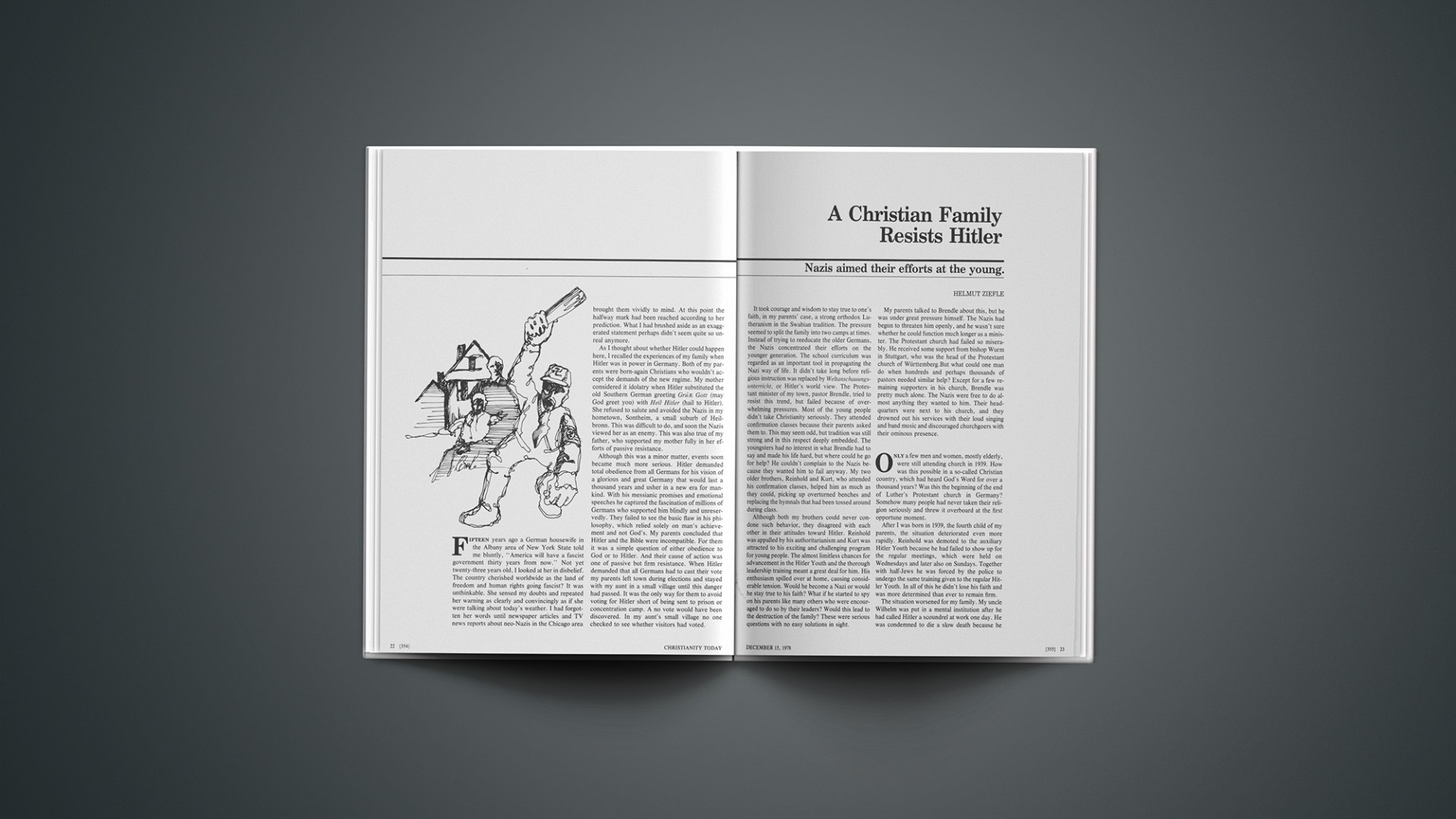
A Christian Family Resists Hitler: A German Remembers

Fifteen years ago a German housewife in the Albany area of New York State told me bluntly, “America will have a fascist government thirty years from now.” Not yet twenty-three years old, I looked at her in disbelief. The country cherished worldwide as the land of freedom and human rights going fascist? It was unthinkable. She sensed my doubts and repeated her warning as clearly and convincingly as if she were talking about today’s weather. I had forgotten her words until newspaper articles and TV news reports about neo-Nazis in the Chicago area brought them vividly to mind. At this point the halfway mark had been reached according to her prediction. What I had brushed aside as an exaggerated statement perhaps didn’t seem quite so unreal anymore.

As I thought about whether Hitler could happen here, I recalled the experiences of my family when Hitler was in power in Germany. Both of my parents were born-again Christians who wouldn’t accept the demands of the new regime. My mother considered it idolatry when Hitler substituted the old Southern German greeting GrüÆ Gott (may God greet you) with Heil Hitler (hail to Hitler). She refused to salute and avoided the Nazis in my hometown, Sontheim, a small suburb of Heilbronn. This was difficult to do, and soon the Nazis viewed her as an enemy. This was also true of my father, who supported my mother fully in her efforts of passive resistance.

Although this was a minor matter, events soon became much more serious. Hitler demanded total obedience from all Germans for his vision of a glorious and great Germany that would last a thousand years and usher in a new era for mankind. With his messianic promises and emotional speeches he captured the fascination of millions of Germans who supported him blindly and unreservedly. They failed to see the basic flaw in his philosophy, which relied solely on man’s achievement and not God’s. My parents concluded that Hitler and the Bible were incompatible. For them it was a simple question of either obedience to God or to Hitler. And their cause of action was one of passive but firm resistance. When Hitler demanded that all Germans had to cast their vote my parents left town during elections and stayed with my aunt in a small village until this danger had passed. It was the only way for them to avoid voting for Hitler short of being sent to prison or concentration camp. A no vote would have been discovered. In my aunt’s small village no one checked to see whether visitors had voted.

It took courage and wisdom to stay true to one’s faith, in my parents’ case, a strong orthodox Lutheranism in the Swabian tradition. The pressure seemed to split the family into two camps at times. Instead of trying to reeducate the older Germans, the Nazis concentrated their efforts on the younger generation. The school curriculum was regarded as an important tool in propagating the Nazi way of life. It didn’t take long before religious instruction was replaced by Weltanschauungsunterricht, or Hitler’s world view. The Protestant minister of my town, pastor Brendle, tried to resist this trend, but failed because of overwhelming pressures. Most of the young people didn’t take Christianity seriously. They attended confirmation classes because their parents asked them to. This may seem odd, but tradition was still strong and in this respect deeply embedded. The youngsters had no interest in what Brendle had to say and made his life hard, but where could he go for help? He couldn’t complain to the Nazis because they wanted him to fail anyway. My two older brothers, Reinhold and Kurt, who attended his confirmation classes, helped him as much as they could, picking up overturned benches and replacing the hymnals that had been tossed around during class.

Although both my brothers could never condone such behavior, they disagreed with each other in their attitudes toward Hitler. Reinhold was appalled by his authoritarianism and Kurt was attracted to his exciting and challenging program for young people. The almost limitless chances for advancement in the Hitler Youth and the thorough leadership training meant a great deal for him. His enthusiasm spilled over at home, causing considerable tension. Would he become a Nazi or would he stay true to his faith? What if he started to spy on his parents like many others who were encouraged to do so by their leaders? Would this lead to the destruction of the family? These were serious questions with no easy solutions in sight.

My parents talked to Brendle about this, but he was under great pressure himself. The Nazis had begun to threaten him openly, and he wasn’t sure whether he could function much longer as a minister. The Protestant church had failed so miserably. He received some support from bishop Wurm in Stuttgart, who was the head of the Protestant church of Württemberg. But what could one man do when hundreds and perhaps thousands of pastors needed similar help? Except for a few remaining supporters in his church, Brendle was pretty much alone. The Nazis were free to do almost anything they wanted to him. Their headquarters were next to his church, and they drowned out his services with their loud singing and band music and discouraged churchgoers with their ominous presence.

Only a few men and women, mostly elderly, were still attending church in 1939. How was this possible in a so-called Christian country, which had heard God’s Word for over a thousand years? Was this the beginning of the end of Luther’s Protestant church in Germany? Somehow many people had never taken their religion seriously and threw it overboard at the first opportune moment.

After I was born in 1939, the fourth child of my parents, the situation deteriorated even more rapidly. Reinhold was demoted to the auxiliary Hitler Youth because he had failed to show up for the regular meetings, which were held on Wednesdays and later also on Sundays. Together with half-Jews he was forced by the police to undergo the same training given to the regular Hitler Youth. In all of this he didn’t lose his faith and was more determined than ever to remain firm.

The situation worsened for my family. My uncle Wilhelm was put in a mental institution after he had called Hitler a scoundrel at work one day. He was condemned to die a slow death because he had openly expressed his true feelings about this dictator. Rather than killing him instantly they gave him pills that caused irrational behavior. Even his wife was fooled by this and thought that he really was mentally sick. But my parents were suspicious, as were other relatives. With the Lord’s help he was finally released. But the Nazis castrated him first, so that his “undesirable” offspring couldn’t threaten the master race. Even so, he was more fortunate than most patients, who didn’t survive the ordeal.

Freedom is rarely taken away at once. It usually happens slowly and subtly. This was especially the case between 1941 and 1945. When Hitler demanded greater and greater sacrifices, resistance became more and more difficult. The Nazis tried to beat my father into submission but failed; God had protected him. They also threatened my mother with imprisonment because she didn’t attend the women’s meetings of the party. She was saved by God’s grace through the report of an understanding Nazi doctor that excused her from these meetings because of phlebitis. My sister Ruth was likewise threatened with imprisonment because she refused to salute during meetings of the girls’ sessions of the Hitler Youth.

The Nazis had infiltrated every facet of public life and were on the verge of destroying my family as well—not in a spectacular fashion—but with constant threats, harassment, and propaganda. Each week the Nazi precinct captain of our neighborhood made his rounds to collect money for his party. Each gift was painstakingly recorded and those who refused to give were soon black-listed as enemies of the Nazi cause. My family was certain that its name was on such a list. It was no secret that all of these so-called enemies of the Nazis would be taken care of—that is, killed—as soon as they won the war. Without doubt the Nazis had no room in their new way of life for Christians who took their religion seriously. Christ didn’t fit in their Nietzschean image of the new heroic man who controls his destiny ruthlessly and without the attributes of genuine love.

There were relatively few Christians my parents could rely on and find strength and encouragement from. Almost every one was afraid and was so busy with simply staying alive that no organized effort of resistance seemed possible. Some Christians whom we had trusted threw their faith overboard and embraced Hitler’s philosophy as the wave of the future. A good friend of ours who was drafted to the Russian front in 1942 left his Bible with my father saying, “I don’t need this book anymore. My new religion is Hitler and his program.” These incidents discouraged my parents; it showed how easy it was for some Christians to give up their faith for temporary worldly glory and success. While others waivered my parents continued to practice and live their Christian faith. They attended church as regularly as they could and continued daily devotions with us children. This practice gave my family an inner strength that helped it withstand the ever-increasing storm of new crises.

In addition to this threat from within, air-raids and bombings became more frequent during the last three years of the war and made life almost unbearable. Here, too, God showed his mercy by keeping us alive. As long as the family could stay together it was much easier to encourage one another in the faith and face the adversities of the day. But when Reinhold was drafted in 1943 and Kurt in 1944 this unity was broken by the harsh realities of a deteriorating war. Would they be able to remain Christians far from home where they were subjected daily to Nazi propaganda? As it turned out God worked miracles here, too. Because of his firm stand for God, Reinhold was publicly ridiculed by the Nazis and dismissed from his unit, which was later almost completely wiped out during the Allied invasion of France. His subsequent transfer to another unit had almost certainly saved his life. Kurt, while on a leave of absence, had his arm broken in three places by an exploding bomb during an air attack on Sontheim in January of 1945. Realizing at that moment that God, not Hitler, was his sovereign master, he gave his life fully to him. It took more than a year before he could use his arm again but God had restored his soul.

Although the end of the war was already in sight, many Germans refused to believe that Hitler could let them down and believed in his promises of superweapons (Wunderwaffen), which would bring ultimate victory. Blinded almost to the end, they failed to see that God whom they had ignored so obviously had spoken. In the midst of their ruined cities their dreams of glory and greatness were destroyed with every passing day.

Much suffering and much hardship could have been avoided if all Christian families had kept their faith. My family was tested. We survived with the grace of God, and he united us again after the war—but not until 1950 when Reinhold was finally released from a prisoner of war camp in Poland. The power of the Nazis was broken and we were free again to worship as we pleased. What a great and cherished gift. Remembering those events will ensure that the prediction of that German housewife will never come true.

G. Douglas Young is founder and president of the Institute of Holy Land Studies in Jerusalem. He has lived there since 1963.
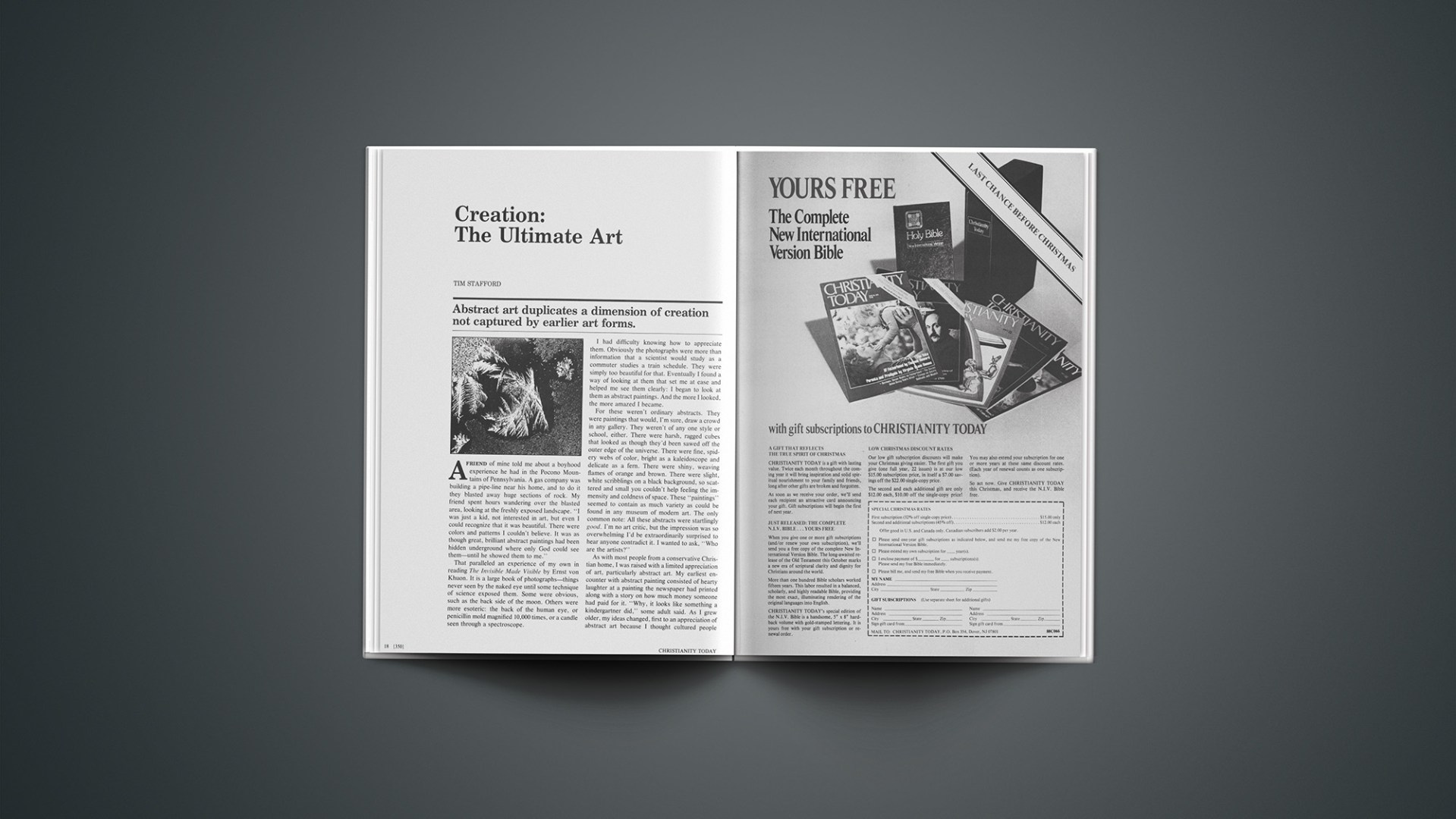
Creation: The Ultimate Art: Can an Off-Ramp Be Art?

A friend of mine told me about a boyhood experience he had in the Pocono Mountains of Pennsylvania. A gas company was building a pipe-line near his home, and to do it they blasted away huge sections of rock. My friend spent hours wandering over the blasted area, looking at the freshly exposed landscape. “I was just a kid, not interested in art, but even I could recognize that it was beautiful. There were colors and patterns I couldn’t believe. It was as though great, brilliant abstract paintings had been hidden underground where only God could see them—until he showed them to me.”

That paralleled an experience of my own in reading The Invisible Made Visible by Ernst von Khuon. It is a large book of photographs—things never seen by the naked eye until some technique of science exposed them. Some were obvious, such as the back side of the moon. Others were more esoteric: the back of the human eye, or penicillin mold magnified 10,000 times, or a candle seen through a spectroscope.

I had difficulty knowing how to appreciate them. Obviously the photographs were more than information that a scientist would study as a commuter studies a train schedule. They were simply too beautiful for that. Eventually I found a way of looking at them that set me at ease and helped me see them clearly: I began to look at them as abstract paintings. And the more I looked, the more amazed I became.

For these weren’t ordinary abstracts. They were paintings that would, I’m sure, draw a crowd in any gallery. They weren’t of any one style or school, either. There were harsh, ragged cubes that looked as though they’d been sawed off the outer edge of the universe. There were fine, spidery webs of color, bright as a kaleidoscope and delicate as a fern. There were shiny, weaving flames of orange and brown. There were slight, white scribblings on a black background, so scattered and small you couldn’t help feeling the immensity and coldness of space. These “paintings” seemed to contain as much variety as could be found in any museum of modern art. The only common note: All these abstracts were startlingly good. I’m no art critic, but the impression was so overwhelming I’d be extraordinarily surprised to hear anyone contradict it. I wanted to ask, “Who are the artists?”

As with most people from a conservative Christian home, I was raised with a limited appreciation of art, particularly abstract art. My earliest encounter with abstract painting consisted of hearty laughter at a painting the newspaper had printed along with a story on how much money someone had paid for it. “Why, it looks like something a kindergartner did,” some adult said. As I grew older, my ideas changed, first to an appreciation of abstract art because I thought cultured people liked it, and then, as a gradual result of hours staring at paintings I didn’t understand and had to struggle hard to like, to a genuine appreciation.

I kept a slight antipathy—or edginess—toward abstract art that I never had for the Impressionists, for example. I’m not sure why, though I can think of a number of possible reasons.

I may not have entirely laid my background to rest; it may yet be hovering in some dark corner of my brain. But I prefer to think of another, more interesting, possibility. It has to do with a lack of categories. Some impulse in men makes them want to give things names and a frame of reference. That’s why people who really love wildflowers memorize all those names—even the phylums and classes. The names don’t make the colors any brighter or the blossoms more profuse. But if you know what a daisy looks like, everything daisy-ish is measured against that.

There is something pleasing in assigning everything to its proper place. If daisies started turning up in just any color, with just any shape, and just any number of petals, I’m not sure the riot of variety would be quite as pleasant as it sounds, at least to real flower lovers. All their books would have to be thrown away; their appreciation of flowers would be like that of a child who only notices flowers when he sees one he thinks is pretty.

Abstract art tends to confound us in the same way. There is no physical object to compare the painting to, and so no standards. Perhaps judging good art comes down to personal taste, but I can assure you that if I painted your portrait your personal taste wouldn’t enter the question: It would be bad, because it would not look like you.

No such precise standard exists for abstract art. At one time there were schools and periods to refer to, but now they change every week. A pair of pantyhose is as likely to be considered a sculpture as a bronze figure.

I’m not sure whether our need for categories is a fault or a virtue, but in this case I’m inclined to think it’s a fault. Categories can be something we cling to because we aren’t able to enjoy something on its own. Names are fine—God, after all, told Adam to name the animals. But the best names convey character. There are times when categories or names reveal nothing.

Abstract art began, and much of it seems to continue, in a spirit of rebellion against the forms of the past. I don’t mean to cast rebellion in a negative light: These artists weren’t necessarily spoiled brats having a tantrum. They were men and women convinced that what they had to express was inexpressible in painting or sculpture as they knew it. These artists weren’t about to copy something. Their art was an attempt to capture something not seen or imagined before; they were making the invisible visible, perhaps taking a picture of their own souls, or capturing the “true” structure of the earth. In that sense they were understood as rebelling against God, for what God had created was not enough (to their minds) to express their own vision of life. Great art stretches visible reality: Michelangelo’s men are more like supermen. The Impressionists played with light. Renoir made a woman’s skin more than flesh.

The Invisible Made Visible proves that there was beauty and truth beyond what the naked eye could see. God had made more beauty than we imagined, and had hidden it in places we couldn’t penetrate: under the earth, beneath the eye, in microscopic vistas. Artists had known that instinctively: They had been unsatisfied with what they saw only with the eye.

But now the argument must turn the other way. If the actual world has proven the artists right, what have the artists proven about the world? We are all familiar with the argument for the existence of God based on the idea that the order of the universe indicates a designer—the argument from design. A stronger argument might be called the argument from art.

Abstract artists left the visible, created world. Their art seemed very original—an expression of their sometimes eccentric personalities, a vision only they could see. Now, through a discovery of science, we learn that they were not so original as thought; work similar to theirs is scattered everywhere, and has been since creation. How can we best explain these works? It is simplest to conclude that they were produced by a personality as original and artistic as the artists’.

At this point someone might object. His argument might run this way: “If, looking at the structure of an atom, I found a portrait of the Mona Lisa, I would have to admit that the Creator was a person. But abstract art is another matter. As a matter of fact, much abstract art celebrates the haphazard, the accidental. For some of the most famous paintings, the artist literally threw paint at the canvas to make chance patterns. The similarity you see between the created universe and the creation of abstract art is simply due to man adopting a bit of the machine-like haphazardness of nature. By doing so, the painters get close to the haphazard nature of reality.

“As for the beauty in The Invisible Made Visible, it is similar to the famous monkeys typing out Shakespeare—if they type long enough, they might create something we call beautiful, but to get that you have to discard a very great deal that is not beautiful. What you saw in The Invisible Made Visible was an artist’s choice of which of the haphazard scribblings of nature were beautiful. That they were beautiful proves nothing about their nature; it proves only that human beings are capable of finding beauty in anything.”

I can almost follow this argument. The evidence does seem to show that humans are capable of finding beauty in almost anything—though I would emphasize the “almost,” since it seems unlikely that the output of a computer, or a factory assembly line, will soon be acclaimed as art, any more than it seems likely that McDonald’s, however admirable their ingenious and efficient packaging, will be seen as centers of haute cuisine.

But it does seem that, wherever we look, whether at nature or at man’s additions to nature—a highway’s curves as it climbs a mountain, for instance—we can see art. It is as though art is inescapable. The engineer who designed the wings of an airplane or the curve of a highway had no aesthetic criteria in mind, yet we find beauty in his work.

The explanation is not difficult. Nothing is really haphazard or accidental; everything is at least governed by physical laws. Even the painter who threw paint at his paintings can’t escape this: the way the paint dribbles down the canvas is ruled by gravity, and by the qualities in the canvas and the paint, which are not arbitrary at all. And of course, the artist was looking for a particular effect, which is not arbitrary either. Even the sun shining on his canvas is far from arbitrary, and without that sun we could not see his work at all.

So the artist who made the microscopic vistas of The Invisible Made Visible is inescapably a partner in what appears to be arbitrary. If he is an artist with personality, as I have argued, then it is not surprising that art that attempts to be totally arbitrary still remains in some way beautiful. Whether with the intent of the artist or not, a work of art says, “Look how interesting even a glob of paint can be, or even a pair of pantyhose.” It expands our way of seeing. Rather than lowering art to the commonplace, it lifts the commonplace to art—which is surely what God intended. It is selective, of course, but only selective in order to bring the audience—and the artist—further along to appreciating the beauty of all created things.

That is not to suggest that we have to admire anything foisted on us as art, or acclaim the message behind each and every work. Artists can be and often are wrong about the nature of man and his condition. But though art has its intellectual component, a painting is more than a visual statement. It appeals primarily to our feelings and our imagination. As a statement it may be quite wrong or inadequate, and ought to be judged so. But as an appeal to our visual imagination, it can still provoke us to see better.

But I must concede one point. You can believe that there is no personality behind the created work, and that the beauty we see is only an imposition of our imaginations. (It is worth noting that even something we think of as unmistakably beautiful—the Alps—were thought of as harsh and ugly until the nineteenth century.) But then you will have to explain how it comes that we see beauty everywhere. What quality is it in man that sees beauty in a haphazard arrangement of things? Where did that quality of seeing beauty come from? For we are, according to an atheist’s argument, of the same stuff that the mountains and the bacteria are made of; the same randomness inspired our creation. What accident could have made us see what is not really there? It seems easier, and more consistent, to believe in a God who created the beautiful world and the people who can perceive it as beautiful. Such a God would have another similarity to the expressive personality of the abstract artist, who from his imagination creates strangely beautiful things and then teaches his audiences to see them as beautiful. God made, with his words, a strangely beautiful world; then he made creatures who were capable of seeing it as he did.

If that is right the Creator is artist, a great one, for his work is incredibly varied. His art has at times the warmth of Chagall, at times the chill of Giacommetti. It is all schools. We could say, to turn it around, that all schools are from his School; that all artists come from this Artist; that we are all truly made in his image, in all our variety of feeling and expression. If God’s art is mirrored in both Picasso and Rembrandt, Van Gogh and Mondrian, cave man and Andy Warhol, then what a great Creator he must be. He must be a God literally beyond all imagination, for all the imagination of centuries of artists has not been able to outdo him in splendor or variety.

What does this say, then, about the place of man’s art? Should we give it up, as a futile attempt to do what God has already done? No. That would make us give up everything, for he has done everything that is of much consequence. We should instead, in our art and our lives, mirror his creation. Then all that we do will be praise, for that is the meaning of praise: We shine back at him what he has shown us. The realistic painter and the abstract painter can share this task, to illuminate the beauty of what God has made.

G. Douglas Young is founder and president of the Institute of Holy Land Studies in Jerusalem. He has lived there since 1963.
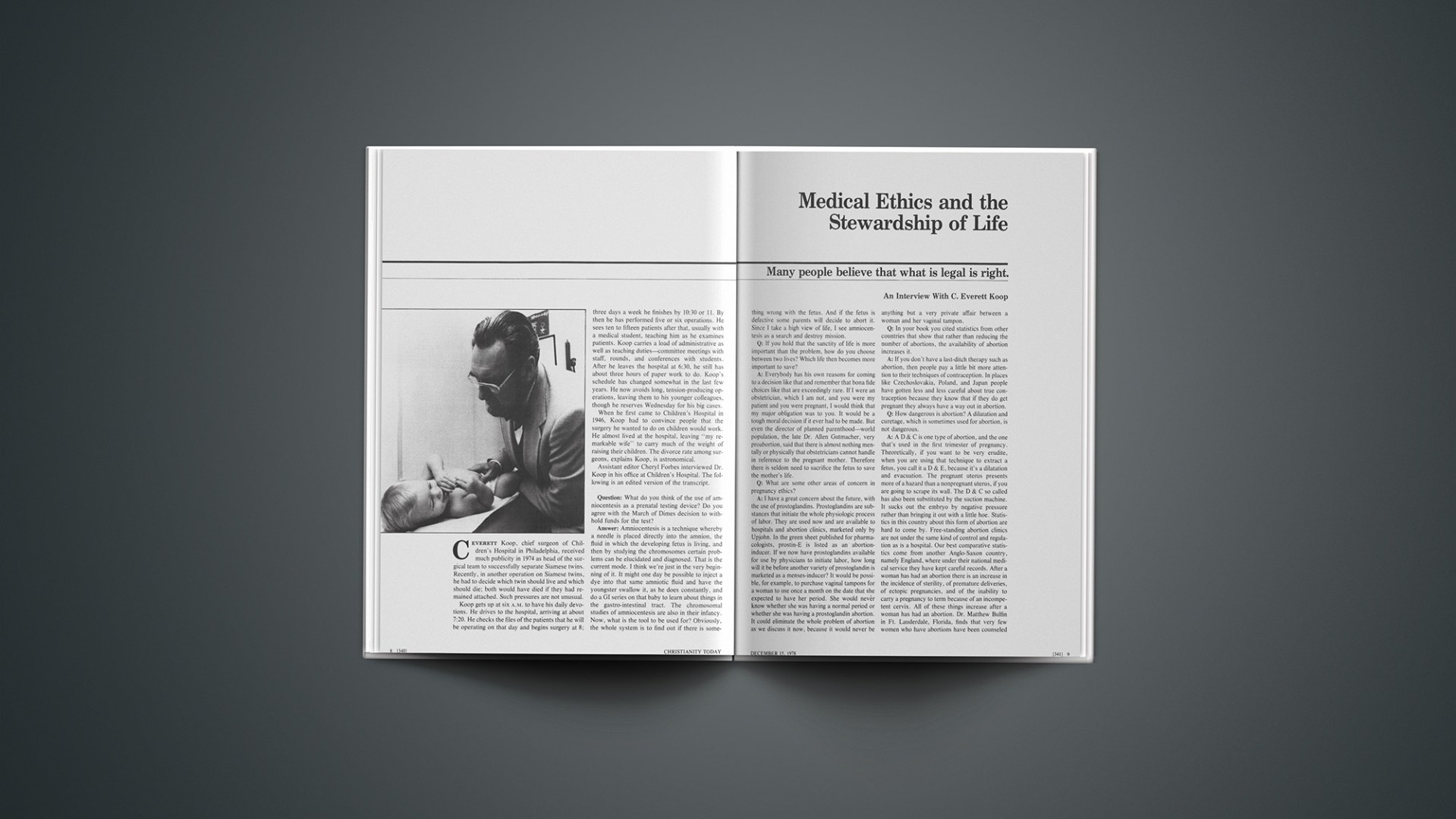
The Pietistic Heritage of Schleiermacher: Are We Mimicking His Mistakes?

Most students of theology recognize Schleiermacher’s influence on modern theology—an influence that is becoming more and more obvious in recent studies and discussions. But not as many realize the extent to which his Moravian-pietistic background affected his life and thought. Schleiermacher reacted vigorously against his pious youth, yet carried many of its values with him all his life. A study of his life provides insight into the development of modern theology, and it warns evangelicals today of potential problems.

Friedrich Ernst Schleiermacher was born on November 21, 1768, the son of a Reformed Prussian army chaplain. In 1778, his father experienced a deep religious awakening. As he put it, Christ’s atoning sacrifice on the cross became the basis of a whole new life for him. His experience, and later his wife’s, were part of a significant awakening among the Moravians.

The Moravian movement arose in early fifteenth-century Bohemia among the followers of John Huss. In the seventeenth century the church expanded significantly under the patronage of Count Zinzendorf. Known for their spiritual fervor and their diligence in business, the Moravians emphasized the depravity of man and the love of God revealed in the reconciling death of Christ. The cross was central to their worship and to their personal religious experience. Their ministry among the “diaspora,” or non-Moravian churches, especially influenced the Schleiermachers. Without seeking to proselytize, the Moravians worked in the state (Lutheran and Reformed) churches, awakening their membership to true faith in Christ and in his atoning death.

Immediately following their religious awakening, Schleiermacher’s parents determined that their three children should be educated by the Moravians. So at the age of fourteen, Ernst Schleiermacher enrolled in their school at Niesky, and from there he transferred to their seminary at Barby in 1785.

Schleiermacher longed deeply to appropriate the peace represented by the community. He reveled in the beauty and dignity of the daily services. The ideas of corruption and forgiveness struck a responsive chord in his sensitive nature. He often spoke of the way every talk and lecture during that time stressed man’s sin and his need for God’s grace.

By all appearances, Schleiermacher fit easily into the Herrnhuters, as the Moravians were also known. In 1785 he wrote this poem to his sister Lotte on her birthday:

Behold him there upon the cross

And thus be blessed with satisfying hours,

The martyred one beloved by us,

The sacred one beloved by us.

But inside, a struggle was taking place that eventually led to his break from the community. Although he believed in the supernatural and the peace of forgiveness, the complete experience of these things eluded him. The certainty he sought “seemed ever to flee,” he wrote later.

Schleiermacher’s parents tried to encourage him and constantly feared he would be drawn back into the world. His mother counseled him in a letter: “You ask for advice as to how you are to acquire the spirit of Christ. Oh! If you really do feel the need, … then only pray in truth and in simplicity of heart to our dear Saviour.… Flee with your consciousness of imperfection, with your every want and desire to the Son of God, to receive grace, yea, one after another, from his abundance” (Letters, vol. I, p. 26). His father meanwhile suggested he read books written by those who “understood the love and power of God who died for us.”

The struggle worsened. At age nineteen, after a long silence, Schleiermacher finally wrote to his father: “It pains me in the depth of my soul, that I must now announce to you something that will cause your hope [in me] to waver.… I cannot believe that He who called himself the Son of Man, was the true eternal God. I cannot believe that his death was a vicarious atonement, because he never expressly said so himself; and I cannot believe it to have been necessary, because God, who evidently did not create men for perfection but for pursuit of it, cannot possibly intend to punish them eternally, because they have not attained it” (pp. 46, 47).

Despite the pleas of his parents (“Who has deluded you?” his father wrote in desperation), Schleiermacher’s personal theology remained dubious. While preparing for his theological ordination exam he wrote to a former classmate: “I am afraid my guardian angel will take fright and fly away, when I shall have to give answers and speeches over theological subtleties that in my heart I laugh at” (Leben Schleiermachers, by Wilhelm Dilthey, p. 53). Schleiermacher left the community and began his studies at the great university at Halle in the spring of 1787. The distance in miles was short, but in thought Halle was another world. And so began the definitive development of the father of modern theology.

But why did he reject the peace and security of the seminary? What made him overturn his parents’ faith? Behind his confession to his father lay attitudes that would prove decisive in his thinking. The first reason for Schleiermacher’s rejection of his past was surely due to his conception of personal initiative and moral freedom. Schleiermacher reacted to his pietistic experience by affirming that each individual was responsible to fulfill and develop himself without coercion. This concept closely paralleled Enlightenment thinking to the extent that he would later refer to his entrance into Halle as the decisive moment in his development. For this was his “original act of freedom,” which allowed him to begin his process of self-discovery.

Thinking complete submission to the Moravian community incompatible with this emancipation, Schleiermacher wrote in his Soliloquies: “What reason have I to disdain anything that proceeds so readily and freely and happily from my inward being and its activity?” (ed. by Friess, p. 102). And this was precisely what his Moravian background, at least in Schleiermacher’s opinion, had done: In exalting God’s initiative it disdained human activity. So Schleiermacher felt compelled to leave the community.

Curiosity about the world also compelled him to leave. Likely, the stir created by Enlightenment thinking had penetrated the seminary at Barby. And because his teaching there lacked a positive doctrine of creation, this implied that many of the advances in science were contrary to the Creator’s intention, since they were not given in nature. No wonder Schleiermacher complained to his father that different views were not given a fair hearing at seminary. “How could I believe on mere assertion,” he wrote, “that all objections raised by our modern theologians and supported by critical, exegetical and philosophical reasons were nought?” (Letters, vol. I, p. 57). To a young vigorous mind the newer views of the goodness and potential of the world were more appealing than a mentality of retreat from the world and an emphasis on depravity.

He expressed his feelings much later in a letter to his fiancée Henrietta von Willich: “Nature cannot indeed oppose [one’s] freedom, can force nothing upon one which is in reality foreign.… It rules with wonderful power over the combinations and relations between various energies and tendencies.… Let holy nature rule!” (Letters, vol. II, p. 143).

Here both of Schleiermacher’s objections to his Moravian background come to expression: the freedom of man and the teeming potential of nature. For Schleiermacher, man lives in happy interdependence with the world. This structure does not take the place of man’s relation to God (he was no pantheist), but it is the way in which man experiences his dependence upon God. Schleiermacher grounded his theology in this experience of joyful dependence at the core of man’s self-consciousness.

Nevertheless, the Moravians shaped some of Schleiermacher’s thinking. His ranking the primacy of the active religious life over doctrinal truth and his mystical tendencies developed from what he learned at Barby. In part, Schleiermacher’s error lay not only in what he rejected of his past but also in what he retained. As he himself put it in a letter of 1802: “I have become a Herrnhuter again, only of a higher order” (Letters, vol. I, p. 284).

For Schleiermacher the personal reality of religion was always more important than doctrine about Christianity. Like many modern evangelicals, he was always afraid knowledge would replace faith. As a result he seemed less interested in the truth of theological statements than in their function in the religious life. This led him to strange views of certain traditional doctrines. Schleiermacher thought the two natures of Christ, the Virgin Birth, and miracles in the New Testament were not so much false, as without value in developing Christian religious affections. (What you thought about them, Schleiermacher used to say, depended on your attitude to the New Testament documents, and Schleiermacher’s views were often quite traditional.)

Here lies one of the causes of the modern split between faith and history. It is the expression of the traditional pietistic elevation of life over thought. Schleiermacher errs at this point by insisting Christianity is not a belief about Christ but a life with him, while in fact it is both.

Schleiermacher’s pietistic influence, however, deserves our apreciation at one point. The young Schleiermacher had carefully observed the role of the elders in the Moravian community. They stood in the place of God, directing the growth of each member in his own personal faith and life with Christ. From this, Schleiermacher developed his conception of “formation,” the idea that had such an influence on the pedagogy pervading Europe and America. This idea marked a fundamental stage in the freeing of the individual from collective thinking—a stage allowing the personal growth that we take for granted today.

Finally, Schleiermacher’s Moravian background helped to shape his view that religious sentiment must permeate all of life. Significantly, in a day of Romantic nature mysticism, Schleiermacher repudiated nature religion. Quite early he confessed on this subject: “My religion is so through and through heart-religion that I have no room for any other” (Letters, vol. I, p. 194). When Joseph, at the close of the dialogue in Christmas Eve (1805), sums up the content of the Christmas message as “speechless joy” before which all words are inadequate, he is expressing the pietistic idea that all the reality of religion focuses on the personal experience of the heart with the Saviour. Schleiermacher came to believe that all theology is nothing more than the expression and elucidation of this pious feeling of dependence upon God. Here in one sense he never left the Herrnhuters.

How can we assess Schleiermacher’s reaction to his background? It may well be true that he misunderstood much of the teachings of the Moravian community—how much or how little would be the object of a separate study. In any case, Schleiermacher reflected the weaknesses of pietism. Wilhelm Dilthey in his biography of Schleiermacher notes that this form of Christianity devalues life, narrowing it to the limits of religious feelings so that nothing of the Christianity of Augustine, Pascal, or Bach can find expression. The real weakness of the Herrnhuters, says Dilthey, lay in their inability to allow the strong depths of emotion they awakened to acquire scientific and artistic direction. They failed to permit the realities of God’s creative and redemptive work in history to shape their religious life.

Schleiermacher’s search was to become the search of every modern person. Both in what he left and in what he retained, he helped initiate the search of modern theology for an authentic religious experience—one that is personally satisfying and yet truly integrative, one that fits the joy and tears of all human experience. Schleiermacher strained “to reconcile religion with the freedom of science and the beauty of life” (Leben Schleiermachers, p. 34).

Perhaps it was the weakness of pietism to suggest that this reconciliation is impossible in a fallen world. But Schleiermacher, for his part, failed to see how the death and resurrection of Christ can make such harmony possible. In his Christian Faith he says of Christ’s death: “These sufferings in themselves have only the loosest connection with His reaction against sin” (ed. by Mackintosh and Stewart, p. 436). For Schleiermacher, Christ’s real work made his life absolutely dependent upon God.

Perhaps in the end Schleiermacher knew better and returned to the teaching of his youth. For as he lay dying (in February, 1834) he called for communion and said: “I have never clung to the dead letter, and we have the atoning death of Jesus Christ, his body and blood. I have ever believed and still believe that the Lord Jesus gave communion in water and wine” (Letters, vol. II, p. 338).

Pietism at its best taught that faith in Christ’s work and an openness to life based on God’s revelation are far from incompatible; they are inseparable. Sadly, this view was not expressed to Schleiermacher by his Moravian community, and he did not believe such a compatibility was possible. Herein lies an example for evangelicals today. Reaction to a narrow exposure of theology that does not accurately represent the full scope of biblical and integrative faith can result in the perpetuation of the mistakes that befell Schleiermacher and that have reaped such a bitter harvest in modern theology.

G. Douglas Young is founder and president of the Institute of Holy Land Studies in Jerusalem. He has lived there since 1963.
Medical Ethics and the Stewardship of Life: An Interview with C. Everett Koop

Ceverett Koop, chief surgeon of Children’s Hospital in Philadelphia, received much publicity in 1974 as head of the surgical team to successfully separate Siamese twins. Recently, in another operation on Siamese twins, he had to decide which twin should live and which should die; both would have died if they had remained attached. Such pressures are not unusual.

Koop gets up at six A.M. to have his daily devotions. He drives to the hospital, arriving at about 7:20. He checks the files of the patients that he will be operating on that day and begins surgery at 8; three days a week he finishes by 10:30 or 11. By then he has performed five or six operations. He sees ten to fifteen patients after that, usually with a medical student, teaching him as he examines patients. Koop carries a load of administrative as well as teaching duties—committee meetings with staff, rounds, and conferences with students. After he leaves the hospital at 6:30, he still has about three hours of paper work to do. Koop’s schedule has changed somewhat in the last few years. He now avoids long, tension-producing operations, leaving them to his younger colleagues, though he reserves Wednesday for his big cases.

When he first came to Children’s Hospital in 1946, Koop had to convince people that the surgery he wanted to do on children would work. He almost lived at the hospital, leaving “my remarkable wife” to carry much of the weight of raising their children. The divorce rate among surgeons, explains Koop, is astronomical.

Assistant editor Cheryl Forbes interviewed Dr. Koop in his office at Children’s Hospital. The following is an edited version of the transcript.

Question: What do you think of the use of amniocentesis as a prenatal testing device? Do you agree with the March of Dimes decision to withhold funds for the test?

Answer: Amniocentesis is a technique whereby a needle is placed directly into the amnion, the fluid in which the developing fetus is living, and then by studying the chromosomes certain problems can be elucidated and diagnosed. That is the current mode. I think we’re just in the very beginning of it. It might one day be possible to inject a dye into that same amniotic fluid and have the youngster swallow it, as he does constantly, and do a GI series on that baby to learn about things in the gastro-intestinal tract. The chromosomal studies of amniocentesis are also in their infancy. Now, what is the tool to be used for? Obviously, the whole system is to find out if there is something wrong with the fetus. And if the fetus is defective some parents will decide to abort it. Since I take a high view of life, I see amniocentesis as a search and destroy mission.

Q: If you hold that the sanctity of life is more important than the problem, how do you choose between two lives? Which life then becomes more important to save?

A: Everybody has his own reasons for coming to a decision like that and remember that bona fide choices like that are exceedingly rare. If I were an obstetrician, which I am not, and you were my patient and you were pregnant, I would think that my major obligation was to you. It would be a tough moral decision if it ever had to be made. But even the director of planned parenthood—world population, the late Dr. Allen Gutmacher, very proabortion, said that there is almost nothing mentally or physically that obstetricians cannot handle in reference to the pregnant mother. Therefore there is seldom need to sacrifice the fetus to save the mother’s life.

Q: What are some other areas of concern in pregnancy ethics?

A: I have a great concern about the future, with the use of prostoglandins. Prostoglandins are substances that initiate the whole physiologic process of labor. They are used now and are available to hospitals and abortion clinics, marketed only by Upjohn. In the green sheet published for pharmacologists, prostin-E is listed as an abortion-inducer. If we now have prostoglandins available for use by physicians to initiate labor, how long will it be before another variety of prostoglandin is marketed as a menses-inducer? It would be possible, for example, to purchase vaginal tampons for a woman to use once a month on the date that she expected to have her period. She would never know whether she was having a normal period or whether she was having a prostoglandin abortion. It could eliminate the whole problem of abortion as we discuss it now, because it would never be anything but a very private affair between a woman and her vaginal tampon.

Q: In your book you cited statistics from other countries that show that rather than reducing the number of abortions, the availability of abortion increases it.

A: If you don’t have a last-ditch therapy such as abortion, then people pay a little bit more attention to their techniques of contraception. In places like Czechoslovakia, Poland, and Japan people have gotten less and less careful about true contraception because they know that if they do get pregnant they always have a way out in abortion.

Q: How dangerous is abortion? A dilatation and curetage, which is sometimes used for abortion, is not dangerous.

A: A D & C is one type of abortion, and the one that’s used in the first trimester of pregnancy. Theoretically, if you want to be very erudite, when you are using that technique to extract a fetus, you call it a D & E, because it’s a dilatation and evacuation. The pregnant uterus presents more of a hazard than a nonpregnant uterus, if you are going to scrape its wall. The D & C so called has also been substituted by the suction machine. It sucks out the embryo by negative pressure rather than bringing it out with a little hoe. Statistics in this country about this form of abortion are hard to come by. Free-standing abortion clinics are not under the same kind of control and regulation as is a hospital. Our best comparative statistics come from another Anglo-Saxon country, namely England, where under their national medical service they have kept careful records. After a woman has had an abortion there is an increase in the incidence of sterility, of premature deliveries, of ectopic pregnancies, and of the inability to carry a pregnancy to term because of an incompetent cervix. All of these things increase after a woman has had an abortion. Dr. Matthew Bulfin in Ft. Lauderdale, Florida, finds that very few women who have abortions have been counseled on what some of the subsequent dangers are.

Q: What should you tell a woman who is contemplating abortion?

A: She should be shown photographs of exactly what she is aborting. She also needs some spiritual guidance. Many women early on in pregnancy go through a time of depression when they do not want the child. If they have only one kind of counseling available—to abort—women may live to regret it.

Q: What about an unmarried, pregnant Christian?

A: That’s where we Christians are reprehensible. I’ve been involved for a long time and was instrumental in founding the Evangelical Child and Family service in Philadelphia largely because of my concern for Christian unwed mothers. One would expect that evangelical Christians, having understood the grace of God, would be most gracious under these circumstances. They are not. They are judgmental and it’s to our detriment that this can be said of us. My son and his wife took to live with them a Christian girl who was pregnant and carried her child to term. She knew she couldn’t raise the child, so I made arrangements for it to be adopted by a Christian couple who were on cloud nine at the prospect. I knew of another unwed pregnant woman who joined a very conservative, fundamentalist, independent church in the suburbs because she wanted to be in a Christian community when her child was born. I was afraid that the poor girl would get the cold shoulder. To my absolute amazement and delight, that congregation rallied around her. They provided her with babysitting and child care until she could finish her education to become a teacher. She is now raising that child herself. It could not have been possible without that church. Unfortunately, such experiences are exceptions.

Q: Would you always recommend adoption?

A: In general, yes. There just aren’t many babies around to adopt these days. People are willing to adopt racially different babies, ethnically different babies, even handicapped children. I don’t think having a single parent is nearly as good for a child as the usual arrangement.

Q: That might be a blessing sprung from the curse.

A: Oh, it’s a blessing, but many childless couples will not be able to have it. I wrote the introduction for a book published by Good News Press called Chosen Children. It’s the trials and tribulations of parents who adopted handicapped children and made it work. The outstanding emotional experiences in my pediatric surgical career have been to get to know parents who went out of their way to adopt handicapped children.

Q: Explain the difference between birth control and contraception.

A: Birth control is a big umbrella that covers any kind of plan or procedure that prevents birth. Contraception is a form of birth control; abortion is a form of birth control. Many people use the terms contraception and birth control as if they were synonyms; they’re not. The morning-after pill is not a contraceptive, but it is a birth control medication. An IUD is not a contraceptive; it is something that’s effective in birth control.

Q: And you would not approve of those two methods.

A: I would not. They affect the already fertilized egg.

Q: Is there a problem with the use of the word fetus?

A: Fetus is a perfectly good Latin word for an unborn baby. It was used primarily in medical circles. I am convinced that we are using certain words to depersonalize the unborn baby. It doesn’t pose such a problem when you decide to kill it. It’s easier to kill a fetus than an unborn baby.

Q: What other language problems are there?

A: You never see the term unborn baby used in proabortion circles. The most flagrant semantic fraud that has been carried out is one by obstetricians who changed the definition of pregnancy. The definition of pregnancy when I went to medical school and when you were born was that period of time between fertilization of the egg, or conception, and delivery of the baby. Now, pregnancy is called that period of time between implantation of the fertilized egg in the uterine wall and the delivery of the baby. If pregnancy doesn’t begin until implantation, and you prevent implantation as with an IUD, the patient doesn’t have to face the fact that she is destroying a fertilized egg that could have become a baby. The IUD used to be called IUCD, interuterine contraceptive device, but the word contraceptive was removed long ago, because IUDs aren’t contraceptive. An IUD acts after the egg is fertilized by a sperm. The IUD sits in the uterus and prevents the egg from nestling onto the wall and getting its blood supply.

Q: Are medical students different today?

A: In talking on rounds to medical students who have never known medicine when abortion was illegal, I find that they have an entirely different concept of the worth of human life—it’s cheap.

Q: What do you tell these medical students?

A: I tell them that when I was in their place the very word abortionist was a loathsome thing; now the abortionist is likely to be the professor of obstetrics in the medical school. There was a time when everybody believed that it was wrong to destroy an unborn baby. Now a great many people feel that it is right to do that. Many people believe that what is legal is right. There are thousands of women who would never have an abortion, I am sure, if the law said it’s wrong.

Q: What would you consider extreme measures to save an infant’s life?

A: Let’s say that a newborn has a situation where so much of his intestine is destroyed that there is not enough left to support life. It would be possible to put that child on total intravenous nutrition and keep him alive for many months but with the ultimate understanding that eventually one would run out of veins and the child would eventually die because you could no longer provide nutrition. To use that type of nutrition would be to me in that circumstance extraordinary care that I would elect not to use. Knowing that the situation was hopeless anyway, I would provide just the usual (not extraordinary) care and the youngster would therefore not live as long. However, no active step would be taken to shorten the child’s life and he would be treated with all the love and care and compassion that we had.

Q: Do you differentiate between certain extraordinary means and others, then?

A: I’m best known for a series of operations on newborn babies, children born without a rectum, with intestinal obstruction, with no connection between throat and stomach, with their abdominal organs in the umbilical cord. It would not be possible for me to have achieved the survival statistics I have if I didn’t use extraordinary care. But even in that category there are patients that I know are not going to make it and in them I would taper the extraordinary care. There are three things that I must know to make a decision. I must know the patient, his disease, and how the patient responds to the disease. I’ve never killed anyone, but I have frequently been relieved when a child under my care has died. I have told the family that this is a blessing in disguise. But that doesn’t entitle me to distribute showers of blessings to other people by destroying their children, even though they have big hardships ahead of them.

Q: What should the relationship between doctor and patient be?

A: There are two different kinds of conversations that take place. There are pediatricians who go to parents at a most difficult time. Picture the emotional situation. You’ve been waiting for nine months. All that’s in your mind is the Gerber baby with the pink cheeks, but what you’ve got is what they call wrongful life. In this emotional disappointment the physician comes in and explains that the baby will not have a life worthy to be lived and that he thinks it should not be fed. That is a terrible decision to have a mother and father make about their own child. If they’re dealing with a pediatrician who would like to see all children born normal, but if they’re not born normal he’d rather see them die, as I would not, then you get one kind of information. Some intensive care physicians in newborn nurseries claim that 14 per cent of their patients die because treatment was deliberately withheld. If this were twenty-five years ago, I would say that a lot of doctors would have done this reluctantly. But that’s not the case now. When I first came into this branch of surgery, I was the sixth person in the country who practiced pediatric surgery exclusively. When I first came to this hospital there were babies who died without a surgical consultation—babies that I could have fixed. A lot of people think that the deformity they see is a lethal one. It’s not. Those children live on and on. Even if you don’t feed a child it sometimes takes a month for it to starve to death. The film Who Shall Survive, put out by Johns Hopkins, showed the decision-making process on the part of the staff and the family to let a mongoloid child with intestinal obstruction die. The intestinal obstruction could have been fixed by a twenty-minute operation, which has about a 98 per cent effectiveness. Mongolism is not curable. Mongoloid children are mentally deficient; some are educable, some are not. They are loving, cute little kids, but a great burden to their parents. So they decided that they would let this child die. They put the baby in a corner of the ward and hung up a sign that said “nothing by mouth.” It took twenty-eight days, as I recall, for the child to die. When this film was showed at the Kennedy Center I am told that a jury of twelve men not only condemned the decision but also the inhumane way in which it was done.

Q: How do you deal as a Christian and doctor with the distrust many people feel toward doctors?

A: I deplore the attitude that the doctor knows it all and doesn’t consider the patient capable of understanding his explanation. I am on the side of the layman when he has a physician like this. I can’t think of anything more reprehensible than the attitude of that kind of physician. I approach a family as intelligent human beings who are entitled to know everything they can understand about their child and his problem. I draw pictures on the wall of my examining room to explain things. They and I are allies against the disease that affects their child. I seldom have a distrusting parent. The rapport that I have with parents is great and when something goes wrong they don’t say, “This is the fault of that magician Koop, who hasn’t told us anything.” They say they knew this was one of the possibilities. We have a law that says that a patient is entitled to informed consent. But it has always been my position as a Christian physician that it was a Christian’s obligation to give the information to his patient that permitted his consent to be informed.

Q: You encourage your patients to ask questions?

A: I do. I not only encourage them to ask questions, but I give all the answers about that particular problem that I have learned over the years parents ask. I frequently say facetiously to my patients that they now know as much as their pediatrician does about this problem. I thoroughly enjoy my relationship with the parents and their children. If you told me that I could never operate again, that would not bother me. But if you told me I couldn’t have a relationship with patients’ families I would be upset. That’s where I really get my kicks. That’s what I enjoy. I enjoy more than anything in the world taking parents who have a sore point of anxiety about their child’s health and relieving it. You can’t always straighten out the problem, but you can straighten out the anxiety.

Q: How do you feel about the state getting involved with parents who want to remove their children from doctor-recommended treatment?

A: I think that in general a patient has the right to choose what will be done with his body. I think that’s moral and ethical, and I think that if a patient decides that he will not take his physician’s advice, that’s his business. Now you can extend that to the minor child who is not able to make his own decisions. In general you can say it is the right and the privilege of the parents to make the decision about what will be done with their child. The law supports that. If I were to do something to your child without your permission, legally that is assault and battery. Now, there are lines that have to be drawn and I’m willing to draw them. If parents come to me and say that they don’t want to go through with this treatment for their child, then I have got to decide what the consequences will be. If the problem is something that can wait I would not press the issue. But if it’s cancer chemotherapy, I would sit down with them and find out why they didn’t want it and what they thought it could and couldn’t do. In most circumstances I would probably convince the family that it was the right thing to do, or I would agree with the parents that it was the wrong thing to do. I might even suggest to them that they stop chemotherapy. But then you have a situation like a Jehovah’s Witness, who will not permit you to give a life-saving blood transfusion to his dying child with a ruptured ulcer. In that case I would go to court to get an order to care for the child.

Q: What about a case where the parents take the child off prescribed cancer therapy and the state takes the child away from the parents?

A: It’s a horrendous problem that I would try to avoid. But there are some parents with real hang-ups and no matter how hard you try you can’t win them all. When you’re talking about cancer chemotherapy you’re up against an emotional circumstance. You’re dealing with a child who may die with or without chemotherapy. The side effects of it are terrible—he gets bald, needs transfusions, looks like death warmed over. Some parents just aren’t emotionally able to put their child through that. I try to put my ethical and moral decisions in the same stewardship category that I put my money and my time. If I have a patient with a life or death problem, I consider that he is given to me as a steward.

The state is encroaching on medicine. If we could just keep such matters in the realm of trust between doctor and patient we’d be way ahead. There is a certain trust in medicine that you acknowledge when you go to see a doctor. There are a lot of things that I know you don’t know and you’ve got to trust me to use the things that I know for you and your welfare. A difficulty that has now come on the scene is the living will. That takes the problem out of the realm of trust and puts it into the form of a contract. It works to the detriment of the patient and the physician. The language of the living will can be confusing. For one thing, you or I could be in our terminal illness right now and not know it. Well, you don’t want decisions made next month based on a terminal illness that won’t kill you for another twenty years. Just the word terminal is difficult. Or, if you have a living will and I am in an accident ward when you are brought to me, I might be concerned that if I do certain things it may violate that living will. What if you weren’t restored to health after treatment? Or suppose you and I are both in a car accident. You have a living will and I don’t. Well, the doctors treat me first, because I don’t have one. I could get the care you probably ought to get. You might die and I might get the very vegetative existence you were trying to avoid.

Q: How do you know when you go to a doctor that he is trustworthy?

A: When I retire I plan to write a book called How to Find Good Medical Care. You’ll need to wait till then for an answer.

Q: Do you think that there is such a thing as passive euthanasia?

A: No. Passive euthanasia is a cop-out. I was asked to separate Siamese twins. They had a single heart and were both dying. If we hadn’t operated they both would have died. It was possible to separate them but in so doing one being would have to die. It took me about ten minutes after I knew the facts to make up my mind about what should be done. One child would have ended up with a four-chambered heart and been viable and one would have ended up with a two-chambered heart and been dead already. My reasoning was that one child was parasitic on the other and if I didn’t get rid of the parasite the other would die. Although I didn’t enjoy what I did, there was a moment in that operation when I put a hemeostat on the caratid artery of the baby girl and she died. I was talking to a lawyer about this several weeks ago in a public debate. He thought that what I did was totally out of keeping with my prolife stance. It may be out of keeping, but it’s not out of keeping with my ethics or with what I understand my role to be as a steward. He asked why I didn’t just cut the blood vessel and let her bleed to death. Then I wouldn’t have had to say that I caused her death by putting the ligature on her blood vessel. That to me is nothing but a cop-out. You’d be trying to say that she bled to death passively versus being killed actively. In either event it was my willful decision that made it happen.

Q: If you could save a patient by plugging him into a machine but don’t, isn’t that passive euthanasia?

A: No. But it’s called passive euthanasia by those who would like active euthanasia to follow it immediately.

Q: Well, what would you call it?

A: I call it the withholding of therapy that might be considered heroic or extraordinary. That’s what physicians do all the time, but they don’t consider that they are practicing euthanasia of any kind. Take my mother—an 86-year-old Christian lady, widowed for eighteen years, arthritic, riddled with cancer, who wanted nothing better than to go to heaven. At a fine hospital, where the blood tests that they carried out on her last illness cost $6,000, she died of kidney failure. It would have been possible to keep my mother alive for probably a month in coma with dialysis. So there’s a therapy available, but I think that the decision to withhold it was just about as easy as to decide to take a glass of water when you’re thirsty. It had nothing to do with euthanasia. There’s no time when feeding a patient could be called heroic. There’s no time when giving an intravenous to a dried up old lady could be considered heroic. But there are times that you make decisions in different circumstances because of age and other things. I decided not to give an aged uncle of mine extraordinary care. I told the doctor to give him the best nursing care that he could. It meant giving him water but it did not mean giving him an IV. So there an IV was an extraordinary thing. I had a young patient who was dehydrated. He would have died without an IV, and he had about sixty years of life left. Not to have started an IV immediately would have been wrong. Try to write that in a book of instructions for residents. You can’t. What was extraordinary yesterday is ordinary now. Who would have thought when they put the first pacemaker in somebody’s chest to keep his heart going that there would be literally 100,000 people walking around this country today with pacemakers? There was a day when oxygen was extraordinary. The terms have to be tailored to the individual circumstances and they also have to be tailored to the skills of the physician. For a general practitioner dealing with a patient in a community hospital in a town of 10,000 what he would consider extraordinary and what I would, working in the middle of a very sophisticated medical center, are two entirely different things.

Q: What do you think of denying women on welfare abortion?

A: It’s victory for the wrong reason. I know that the prolife people were very jubilant over the passage of the Hyde Amendment. And if I’m against abortion I guess I have to be pleased over that too, because it means that about 475,000 abortions that were funded by the government will not be done if the law is adhered to. But I hate to have it come about on the basis of an economic decision. I would much rather have it come about on the basis of a moral and ethical decision.

Q: Don’t you think that such jubilation is hurting the prolife cause?

A: Yes. It puts the prolife person who is jubilant over the Hyde Amendment into the position where he can be criticized about the poor.

Q: You do a lot of counseling on death and dying. What do you tell parents?

A: There’s nothing more difficult in life than to lose a child. I’ve been through this and I would say that it is the most devastating of experiences. You expect to bury your mother and father. Every married couple knows that one of them will die before the other under most circumstances. But you don’t expect that you’re going to have to bury your children. And therefore when a child is dying it is not only a tremendous emotional episode for the family, but it is an affront to the community.

I consider this counseling unpleasant but rewarding. You can guide parents through the last year of their child’s life and end up so that they are comfortable with their position and don’t bear any animosity toward the hospital. You can also help their friends recognize that the medical profession in general and that hospital in particular did the best they could. That’s just the way I try to teach our residents to be an ally with the parents against the disease that affects the child. I ask the resident to work with the parents of a dying child in such a way that they will come back and work in the hospital as a volunteer.

It’s one of the best opportunities for Christian witness that one could have. I have to bring parents to understand what I had to understand when I lost my own child. There is no place for “what if” and “if only” kinds of questions. I understand from what I can reconstruct about my twenty-year-old son’s death that if he could have taken the clip off his belt and hooked it into a piton, a two-second maneuver, he wouldn’t have been killed. I could plague myself for the rest of my life with “if only” he had done it or “what if” he had the time to do it.

Families that are going to lose a child from something such as a tumor lose their child twice. They lose him when you finally make clear to them what the prognosis is and they lose him when his death finally takes place. The second death is a lot easier than the first death many times. One of the difficult things about a child who dies is that it isn’t over as it is when your grandmother dies. Parents have problems with anniversaries. I have parents who call me on the anniversary of their child’s death or they call me every year on the day after Thanksgiving, because it’s become a custom. I receive more Christmas cards from parents of dead children than I do from parents of living children. There is what I call a ritual of closing the circle in families who lose a child in a hospital like this. They have to come back and talk to the doctor or they have to come back to the place where it all happened. That wraps the thing up neatly and they can put it to rest in a different part of their lives, where it’s not going to produce acute anxiety and pain all the time.

Another thing that I’m very concerned about is the child who is expected to die and doesn’t. That family is really an abandoned family. Let’s say that Janey was expected to die of a tumor and sure enough the radiation therapy took hold and two years later she’s called cured. Whereas the whole system is geared to the support of the parent whose child might die and whose child does die, few recognize the tremendous hole in the life of the family who has been living in the expectancy of a death and they suddenly realize that it’s not going to happen. All the supports that were bolstering them up are withdrawn because the child is cured and they’re almost frantic. These people have to be let down very, very carefully. I find that this is the time when families fall apart. The tragedy of the impending death of a child will keep an unstable marriage together but as soon as they’re told their child is cured, then parents separate and the thing falls apart. The cured child as a patient is just beginning to get some of the attention he deserves.

Q: You’re working on a film with Francis Schaeffer. What’s it about?

A: Francis Schaeffer and I have been working for about a year and a half now on a project called “Whatever Happened to the Human Race?” There is a book manuscript written and we have already filmed five forty-five-minute documentary movies. The first three of these cover the subject of abortion, infanticide, and euthanasia. The last two are Schaeffer’s alone and in them he presents his own Christian base and presents some authoritative answers based upon the Word of God to the problems we raise. We plan to take these films in the form of a two-day seminar in twenty cities in America, beginning in Philadelphia in the fall of 1979.

Broken Resolutions

Broken Resolutions

Samuel Johnson, that eccentric genius who compiled the first Dictionary of the English Language, struggled painfully and unsuccessfully year after year to productively manage his time and habits. He regularly subjected himself to searing introspection. He engaged in psychic dissection annually at Easter—and his ruthless honesty is a sad commentary on human nature. He writes in his diary for September 18, 1764, “I have outlived many friends. I have felt many sorrows. I have made very few improvements. Since my resolution formed last Easter I have made no advancement in knowledge or in goodness; nor do I recollect that I have endeavored it. I am dejected but not hopeless.” Then a year later, Easter, April 7, 1765: “When I consider how vainly I have hitherto resolved at this annual commemoration of my Saviour’s death, to regulate my life by His laws, I am almost afraid to renew my resolution. Since last Easter I have reformed no evil habits, my time has been unprofitably spent, and seems as a dream that has left nothing behind … it is necessary to combat evil habits singly. I purpose to rise at eight because though I shall not yet rise early, it will be much earlier than I now rise, for I often lie till two.” Skip to the entry for July 22, 1773: “The other day looking over old papers, I perceived a resolution to rise early always occurring. I think I was ashamed, or grieved, to find how long and how often I have resolved, what yet except for about one-half year I have never done. My nights are now such as give me no quiet rest whether I have not lived resolving till the possibility of performance is past, I know not. God help me, I will yet try.” Is the picture brighter by Easter, April 2, 1779? Scarcely! “Of resolutions I have made so many with so little effect, that I am almost weary, but, by the Help of God, am not yet hopeless. Good resolutions must be made and kept. I am almost seventy years old, and have no time to lose.” Here, finally, is the entry for Easter, April 14, 1781, three years before Johnson’s death at the age of 73: “I have corrected no external habits, nor have kept any of the resolutions made in the beginning of the year, yet I hope still to be reformed, and not to lose my whole life in idle purposes. Many years are already gone, irrevocably past, in useless misery, that what remains may be spent better, grant O God.”

Only Johnson’s genius, spurred on by his poverty, enabled him under pressure to write what he did. But how much more might he have achieved if he had succeeded in developing a life style that embodied his deepest desires and convictions.

How about us? Have we been developing in discipline, in depth and consistency of fellowship with God, in productivity for our Lord? Will we look back on 1979 and regret the resolutions unfulfilled, the people unreached, the books unread, the plans unimplemented, the letters unanswered, the hours uninvested with eternity’s values in view? Or will the coming year be different? Next December will we be able to testify that by God’s enablement significant progress has been made in grace and usefulness?—VERNON GROUNDS, president, Conservative Baptist Theological Seminary, Denver, Colorado.

Ideas

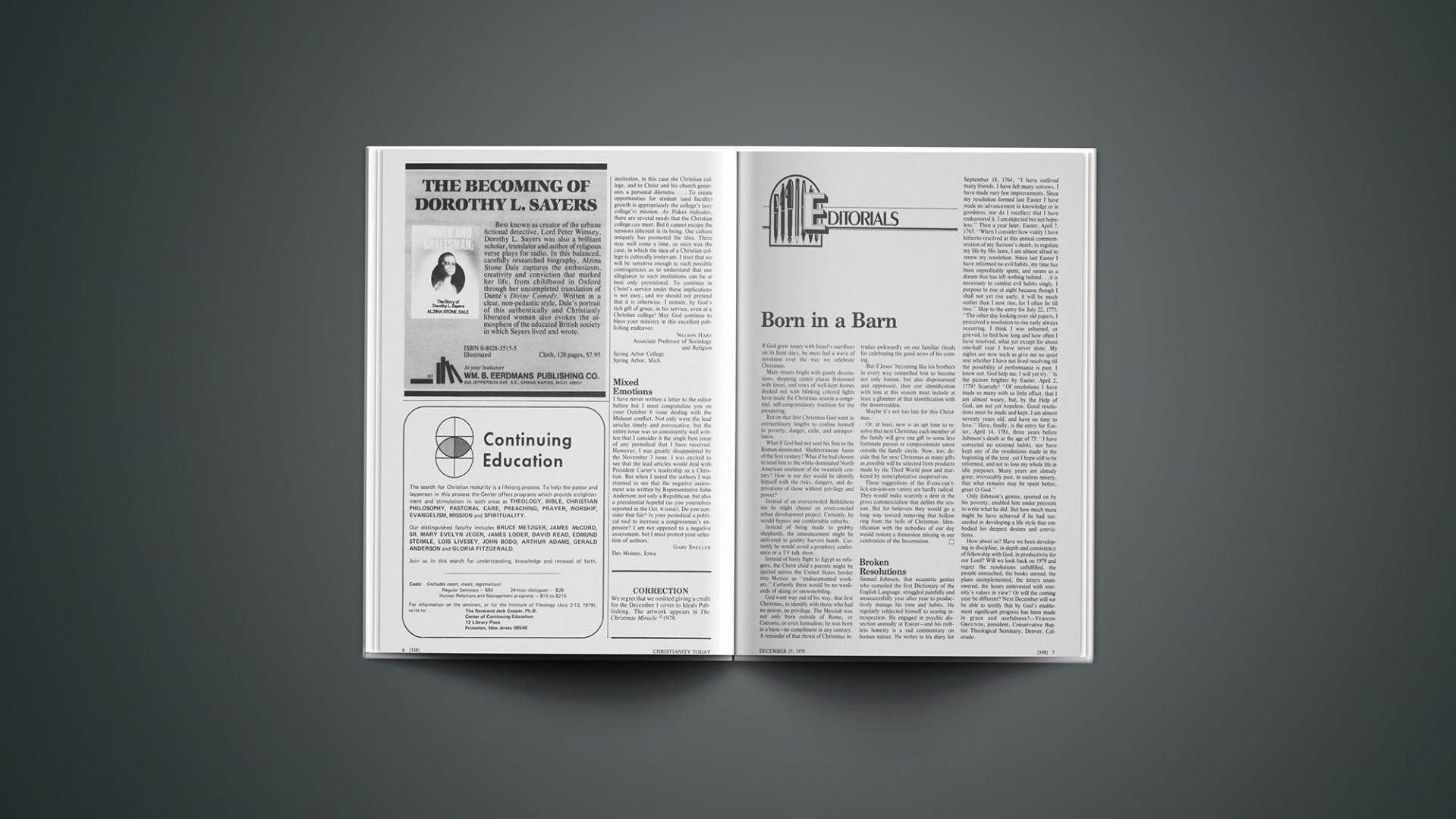
Born in a Barn

If God grew weary with Israel’s sacrifices on its feast days, he must feel a wave of revulsion over the way we celebrate Christmas.

Main streets bright with gaudy decorations, shopping center plazas festooned with tinsel, and rows of well-kept homes decked out with blinking colored lights have made the Christmas season a congenial, self-congratulatory tradition for the prospering.

But on that first Christmas God went to extraordinary lengths to confine himself to poverty, danger, exile, and unimportance.

What if God had not sent his Son to the Roman-dominated Mediterranean basin of the first century? What if he had chosen to send him to the white-dominated North American continent of the twentieth century? How in our day would he identify himself with the risks, dangers, and deprivations of those without privilege and power?

Instead of an overcrowded Bethlehem inn he might choose an overcrowded urban development project. Certainly, he would bypass our comfortable suburbs.

Instead of being made to grubby shepherds, the announcement might be delivered to grubby harvest hands. Certainly he would avoid a prophecy conference or a TV talk show.

Instead of hasty flight to Egypt as refugees, the Christ child’s parents might be ejected across the United States border into Mexico as “undocumented workers.” Certainly there would be no weekends of skiing or snowmobiling.

God went way out of his way, that first Christmas, to identify with those who had no power, no privilege. The Messiah was not only born outside of Rome, or Caesaria, or even Jerusalem; he was born in a barn—no compliment in any century. A reminder of that thrust of Christmas intrudes awkwardly on our familiar rituals for celebrating the good news of his coming.

But if Jesus’ becoming like his brothers in every way compelled him to become not only human, but also dispossessed and oppressed, then our identification with him at this season must include at least a glimmer of that identification with the downtrodden.

Maybe it’s not too late for this Christmas.

Or, at least, now is an apt time to resolve that next Christmas each member of the family will give one gift to some less fortunate person or compassionate cause outside the family circle. Now, too, decide that for next Christmas as many gifts as possible will be selected from products made by the Third World poor and marketed by nonexploitative cooperatives.

These suggestions of the if-you-can’t-lick-em-join-em variety are hardly radical. They would make scarcely a dent in the gross commercialism that defiles the season. But for believers they would go a long way toward removing that hollow ring from the bells of Christmas. Identification with the nobodies of our day would restore a dimension missing in our celebration of the Incarnation.

Eutychus and His Kin: December 15, 1978

“One-third of all children born in the world today will die before they reach five years of age” (letter from a relief agency).

“ ‘All the architectural glories of Christendom are not worth the life of one child.’ So wrote the distinguished Methodist leader Colin Morris in 1968 in his prophetic Include Me Out, a tract provoked by the discovery outside his home in Zambia of a young boy who had died of starvation” (Christian Century).

A company in Tarzana, California, announces a line of “beautiful caskets for animals.” Prices range from $49 to $145, depending on size of pet, casket line, and so forth.

A Christian TV talk-show M.C. appeals for contributions to a $100 million university building project.

The “Christian embassy” in Washington, D.C., purchased two or three years ago for $500,000, has been sold to a small Muslim oil-producing nation for $1.5 million.

A letter from a radio missionary in Marseille, France, asks for help. “Compared to the same month last year, letter response from [Muslim] North Africa was up by 30 per cent in January, 120 per cent in April, 350 per cent in July (a record increase). With this kind of encouragement, we are reluctant to give up.… There is a money crisis such as we haven’t had for years. If we play some of our best songs again [because of the lack of money even to buy new records], listeners are going to start calling us ‘the merry-go-round.’ Forward ‘like a mighty army’? I think we often look and sound like a rag-tag band. Yet God is with us.”

How long will God be with us?

EUTYCHUS VIII

Question for A Question

I read with interest the two articles under the title, “Does His Christianity Count?”, asking myself the question, count for what? Why are we linking an individual’s faith with the quality of the job being performed? Do we ask that kind of question of college presidents, business executives, janitors, or even magazine editors? While none of us is above criticism for the way we perform or do not perform at our jobs, I question the value of linking that performance to the individual’s faith.… John Anderson is a politician and a good one, one whom I respect from our state. I believe CHRISTIANITY TODAY did him no favor by asking him to comment on Jimmy Carter’s leadership abilities by linking them to his character or his faith. The result is that John Anderson reflects a tone of scorn regarding the moral qualities of a fellow Christian. I did not appreciate that tone. Politics and religion make strange bedfellows. When one uses a religious platform for political criticism or a political platform for religious criticism, more is said of the critic than the person being criticized.

DAVID J. FRENCHAK

Chicago, Ill.

I think it hardly an accident that your November 3 issue with Jimmy Carter’s picture on the front and long article about his “fine” Christianity should reach me shortly before the election. Mind you, this is not written because of any partisan politics; but solely because such a definitely political article has no place in a religious magazine. However, the fact that it was published by you does definitely illustrate how very lightly spiritual matters are considered today.

J. DELMAR CRAWFORD

Pittsburgh, Pa.

President Carter’s Christianity, like his policies, is difficult to understand. He says he opposes abortion, yet he has refused to lift a finger to support the prolife movement. He and his wife make an ostentatious show of not serving hard liquor at White House functions, yet he has tolerated his staff using hard drugs. While publicly stressing his “born again” style of Christianity, Carter has filled his administration with McGovern-type liberals who at best are indifferent and at worst are openly contemptuous of the basic morality of Middle America. What does it matter if the president teaches Sunday school if under his administration the vast powers of the federal government are used to push programs that strike at the basic tenets of Christianity? Is the man a fool or a hypocrite?

THOMAS J. MULLEN, JR.

Whitehouse Station, N.J.

The two articles about President Carter’s moral leadership in the November 3 issue of CHRISTIANITY TODAY require a response concerning Congressman John B. Anderson’s evaluation. The article could have been prepared for a Republican Party rally. Congressman Anderson is over halfway through his article of destructive criticism before he arrives at President Carter’s induction into office, when his leadership began.

MAUDE F. DUNAGAN

Bellingham, Wash.

Strategy As a Tool

It is unfortunate that Dr. White equated all Christian communicators who use audience analysis with the segment who do so in order to sell Christian “stars” (Books, “How Can I Get Them to Listen?”, Nov. 3). I am sure that he was not thinking of those of us who are missionary broadcasters. I am sure that he realizes that we are not out to sell anything nor are we “in the business” of making money. Careful attention to the programs from HCJB (Quito, Ecuador) will immediately assure the listener that doctrine, truth, and theology are neither thin nor less persuasive because of our use of audience analysis. We believe with all of our hearts that the entrance of God’s Word gives light, but as radio broadcasters we also realize that there will be no entrance if there is no audience. Therefore, it is our desire to use all proper means available to insure the fact that we do have a listening audience. Knowledge of who is listening, why they listen, when they listen, in what language they listen, and what is their understanding or lack of understanding concerning scriptural truth, enables us to produce programs that will capture our listeners’ attention and provide just one of many means for the Holy Spirit to minister to the needs of those who are tuned to HCJB. In this way, we use marketing strategy only as a tool, which, when properly implemented, can bring men and women to a knowledge of the Lord Jesus Christ.

KAY LANDERS

HCJB

Quito, Ecuador

Christian College Service

Your efforts in the continuing discussion about the value of Christian liberal arts education are appreciated. Yet in all [that’s written] about the Christian college, from Arthur Holmes’s The Idea of a Christian College to your November 3 articles by Glenn Arnold and J. Edward Hakes, something is lacking. We need to confront directly the question of allegiance. To be in allegiance to a human institution, in this case the Christian college, and to Christ and his church generates a personal dilemma.… To create opportunities for student (and faculty) growth is appropriately the college’s (any college’s) mission. As Hakes indicates, there are several needs that the Christian college can meet. But it cannot escape the tensions inherent in its being. Our culture uniquely has promoted the idea. There may well come a time, as once was the case, in which the idea of a Christian college is culturally irrelevant. I trust that we will be sensitive enough to such possible contingencies as to understand that our allegiance to such institutions can be at best only provisional. To continue in Christ’s service under these implications is not easy, and we should not pretend that it is otherwise. I remain, by God’s rich gift of grace, in his service, even at a Christian college! May God continue to bless your ministry in this excellent publishing endeavor.

NELSON HART

Associate Professor of Sociology and Religion

Spring Arbor College

Spring Arbor, Mich.

Mixed Emotions

I have never written a letter to the editor before but I must congratulate you on your October 6 issue dealing with the Mideast conflict. Not only were the lead articles timely and provocative, but the entire issue was so consistently well written that I consider it the single best issue of any periodical that I have received. However, I was greatly disappointed by the November 3 issue. I was excited to see that the lead articles would deal with President Carter’s leadership as a Christian. But when I noted the authors I was stunned to see that the negative assessment was written by Representative John Anderson; not only a Republican, but also a presidential hopeful (as you yourselves reported in the Oct. 6 issue). Do you consider that fair? Is your periodical a political tool to increase a congressman’s exposure? I am not opposed to a negative assessment, but I must protest your selection of authors.

GARY SNELLER

Des Moines, Iowa

CORRECTION

We regret that we omitted giving a credit for the December 1 cover to Ideals Publishing. The artwork appears in The Christmas Miracle© 1978.

Editor’s Note from December 15, 1978

Christmas reminds us anew that God has not forgotten us. He loves us—loves us so much that he sought out our lonely planet wandering on its stray path through the universe and visited us. He entered our human race, and for our salvation lived and died and rose again. He still loves us. By his spirit he now woos us to repent of our sin and to place our trust in the strong hands of the Saviour. And in Christ we have everything that brings ultimate meaning to human existence.

It is well that Christmas marks the end of the old year for the passing of it is also a time of annual reckoning. The bottom line, honestly drawn, cuts sharply across our human pride. Excuses fall away. We stand alone and naked before our Maker.

Yet Christmas reminds us once again that divine grace triumphs over human sin and sorrow. With Isaac Watts we sing: “Joy to the World! The Lord is Come; Let earth receive her king. Let every heart prepare Him room, And heaven and nature sing.”

Wayfaring Reflections

Had a good holiday?” asked my neighbors when I returned last weekend after a two-month working stint abroad. The same bright question had greeted me not long ago after a longer sojourn in Asia. Nothing will convince them that traveling 33,000 miles over fourteen countries, sleeping in planes and in twenty-five different beds, losing ten pounds in weight, being jostled at countless airports and hotels, is anything but a joyful junket.

They tell me and each other how lucky I am to have had all that Oriental sun, and please would I not forget the church jumble sale tomorrow. Seldom do they ask questions about the places I visit or the purpose of my work: perhaps they have experienced too many tedious sessions of holiday slides. I leave them to the only world most of them have known. I feel dismayed and a little superior at their insularity, yet envy them their innocence. I know that when Christian Aid or the Seventh-day Adventists collect for relief work and medical missions, the generous hearts of my neighbors will shame me.

Should I try to tell them of the leprosy clinic and resettlement villages that so impressed me in Korea? Of my embarrassment in Indonesia when the poor workers building their own church, with whom I had prayed in their little hut, insisted on driving me back in their ancient van to my expensive hotel? Of those eager, likeable theological students in Burma who hailed my Saturday afternoon arrival as “providential” because “the elders” who usually monopolized Western visitors were for once out of town? Of another country that now has no Christian church building, but in which the Christian presence is making effective impact through medical work? Of another sensitive area in which the Body of Christ has suffered because of lightning visits by brethren with more zeal than wisdom, who have distributed Christian literature without consulting local believers who knew that approach to be imprudent?

The wandering journalist soon finds himself confronted by a cruel dilemma. Some Asian countries lend themselves to spectacular stories, but they cannot be told simply because Christians have to go on living there. Let me illustrate this with a cautionary tale.

A British girl felt called to serve in one such Asian land. She gave her testimony at the valedictory meeting in her own rural church. The story was picked up by a local newspaper. This, in turn, caught the attention of the efficient press clipping agency used by the country in question. Word reached the Asian capital via the London embassy. That girl’s visa was canceled, and the whole thing was made to reflect on Christians in that country. It reminded me of my old church history professor who, on the first day of lectures, said, “Gentlemen, learn reticence.” Communist countries particularly have an ongoing testimony that could be jeopardized by visiting believers who have not “done their homework.”

During that Asian tour I received much kindness. Many people went to enormous trouble on my behalf, especially when I spurned the “establishment tour” and turned up unexpectedly in some remoter area. A little enterprise on our part means so much to witnesses in lonely places. And the usual prudent precautions about food and water are somehow divinely waived when refreshment is brought in love. (A clumsy sentence but wanderers will understand.)

I mentioned reticence, but let me be un-reticent about some bewildering experiences in three countries.

1. In one I called on the general secretary of the national council of churches. Having made an appointment the previous day, I arrived hot, dusty, and thirsty after trying to find his office in the noonday sun. He sent someone out to ask what I wanted, but eventually I was admitted to a frigid welcome, no glass of cold water (which the national hospitality prescribed), and a two-cigarette-long interview of monological tendencies. Then I found what was bugging him: He’d been saving up Western journalistic misdemeanors for the next of that breed to drop by—and there I was answerable for all the gaffes of my fellows. My restraint was all of grace, and we parted with some degree of cordiality. I did miss that glass of water, though.

2. In a second country I called a missionary society and asked if I could see one of its workers two days later. The spokesman was abrupt. Mr. X was out of town. I persisted. Was there someone else who saw visitors? I mentioned Mr. Y, whom I knew. Was he there? He was, but the spokesman could not presume to make an appointment for a busy man. Finally I got a date with a third officer. The busyness I appreciated, and the problem posed by unexpected callers. What depressed me was the unfriendly attitude I had encountered. I wanted to say, “Dear missionary friend, if ever you are 9,000 miles from home and hear my voice at the end of a telephone line, 1 promise I won’t make you feel a nuisance, even though you are obviously no angel unawares.” I didn’t. More grace. Let me add that I was subsequently given a warm welcome at the office of the missionary society, and an apology that there had been some misunderstanding about my identity. For some vague reason that explanation made me feel a little uncomfortable.

3. In India I had a very different reception from that given in either of the two Christian sources cited above. This was in New Delhi, at the hands of a Hindu who had never heard of Hebrews 13:2. We got into casual conversation. He turned out to be an air force captain, due to be married shortly. I inquired about his girl. He told me her name, and added ruefully, “But I never get to see her. Sometimes I telephone and we talk for a little, but if her mother answers I just say hello-how-are you and hang up.” Hindu arranged marriages not infrequently throw up situations like that.

My Hindu friend took me sightseeing. Perched on the back of his scooter I had my first introduction to the Indian capital—and my first outing in ten weeks. He spoke of his country’s history, tactfully omitting any direct reference to British imperialism, and of his hopes for its future. He took me for a meal, and next day insisted on making the trip to the airport to see me off. He asked what a Protestant was, and why the Reformation. He was interested in the kind of things I wrote about. “Will you do me a great favor?” he said as finally we shook hands, “will you send me some of your articles?”

Waving to that stocky uniformed figure as I walked out to the plane, two questions haunted me. What had I ever written that would speak to the condition of a sophisticated young Hindu? And if he were converted, would he become as insufferable as some Christians I know?

Of course it’s unfair to compare the good in one with the bad in another. Of course I ought to ponder how much worse one would be if he were not a Christian, how much better a Hindu would be if he were. But there lingers an uneasy (and dubiously sound) feeling that perhaps discussion with those of other faiths should not be as onesided as I had thought.

J. D. Douglas is an author and journalist living in St. Andrews, Scotland.

Salting within the System

Two leading evangelicals are currently helping draft a new constitution for the fifteen million people of Peru. They form part of a Constitutional Assembly of 100 elected delegates, chosen from 1,200 candidates.

The evangelicals are Pedro Arana and Arnaldo Alvarado. Arana, better known outside Peru, is the secretary of the International Fellowship of Evangelical Students (the umbrella organization for groups such as Inter-Varsity Christian Fellowship) for western South America. He is also an elder in the Presbyterian Church of Pueblo Libre (Lima), having studied theology in Edinburgh, Scotland. Alvarado is a former race car driver and member of the Christian and Missionary Alliance Church of Lima.

Alvarado has long been a participant in the American Popular Revolutionary Alliance political party (APRA), which won the majority of seats in the Assembly. Arana also ran under APRA sponsorship, although he has not yet joined the party in spite of receiving the fourth highest total of votes for any APRA candidate. Arana believes it was the evangelical balloting that elected him, even though evangelicals total only about 2 per cent of the population of Peru.

A third evangelical candidate, however, Luciano Wise, was eliminated.

The task before the Assembly, which was convened last July, is to write a new constitution that will incorporate the socialist changes brought to the country during eleven years of military rule. If the Assembly fails to do this, several generals have warned that its work will be annulled. Upon completion of an acceptable document, elections are to be called immediately for a civilian government. The Assembly has until July 28, 1979, to finish its assignment.

Arana is participating in a study group on state and church, whose findings will help delineate this aspect of the constitution. A former evangelical senator, José Ferreira (IEP), and lawyer Carlos García (Baptist) meet frequently with Arana to counsel him.

This is the highest that evangelicals have risen in Peruvian affairs since General San Martín invited British Bible Society missionary James Thompson to Lima to create an educational system based on the Scriptures (1821). Shortly after, repressive measures by the Roman Catholic Church seriously curtailed evangelical work.

In 1967, laws that prohibited the public proclamation of evangelical beliefs were repealed. When General Juan Velasco seized power in 1968, free exercise of religious faith became legal. Velasco’s aim was to establish a “pluralistic social democracy dedicated to Christian and human values.” Before the end of his eight-year tenure, however, ominous rumblings sounded in his speeches about politically organizing “basic structure groups”—churches, clubs, charities. “Christian” was heard less frequently, and “socialist” grew more common. Many Roman Catholic bishops became restive.

General Morales Bermúdez, who took the presidency from Velasco, said publicly he would continue in the socialist pattern, but sought warmer relations with the Catholic hierarchy. Some Protestant leaders feared a crack-down on their activities. But several local observers think the current difficulty in acquiring visas for Protestant missionaries has nothing to do with Roman Catholic opposition, but rather is a vestige of the vociferous anti-Americanism of the Velasco regime.

The ideas and values of Protestants are well known throughout Peru. Their churches and pastors are theological conservatives. Yet despite the freedom to preach and practice faith in God publicly and privately, the evangelical movement has not progressed as well as in some South American nations. This is largely because of painful historic divisions. The National Evangelical Council is seeking to remedy denominational mistrust but sometimes gets caught in crossfire between national churches and missionary organizations.

The Peruvian Roman Catholic Church is not united either, and has at least four visible groups. Scores of North American priests, many of them Maryknollers, are militant progressives who want greater social involvement for the church. A theology of liberation movement has been strong among younger clerics, but may be losing its appeal. Official power still rests with the conservatives, led by Cardinal Juan Landázuri.

Charismatics are the growing segment of the Catholic Church in Peru. Being very few in number ten years ago, they now meet in scores of large meetings in many cities. Wycliffe missionary Al Shannon conducts a weekly Bible class for 600 Roman Catholic charismatics in Lima. Last January at a retreat, sixty priests received a spiritual blessing that, in the words of one, “is the same as what you evangelicals call the new birth.” Sources high in the Catholic hierarchy believe the charismatic movement offers more hope than the theology of liberation, “which has caused us nothing but trouble.”

Evangelicals Arana and Alvarado recognize that they are few among 100 delegates. But they expressed their motivation in a pre-election statement: “It is through a personal encounter with Jesus Christ that the new man is born—the man that Peru so desperately needs in order to achieve the positive transformation our people desire. This is an opportunity to fulfill our function of salt and light.”

Religion In Transit

Their meetings lacked the blessings of either the Vatican or the U.S. Conference of Catholic Bishops. But the 2,000 delegates attending the Second Conference on the Ordination of Roman Catholic Women last month in Baltimore weren’t bothered and perhaps yelled a little louder. They want women priests and full rights for women within the church. Until that happens, the Catholic lay women and nuns (and about 150 sympathetic priests and laymen) at the conference will consider such as-yet-to-be-approved recommendations as a national boycott of church collections and a nationwide boycott next April 29 of all masses in which a male priest presides.

The Annual Council of the Seventh-day Adventist Church has voted down a request for formation of a separate administrative structure for black members. Blacks make up one-fifth of the half-million-member body, and most belong to predominately black churches.

Personalia

Already serving a one-year term in a Soviet labor camp for “parasitism,” dissident Baptist Peter Vins was threatened with an additional seven years’ imprisonment for allegedly distributing anti-Soviet propaganda in the camp. Vins, 22, the son of imprisoned Baptist pastor Georgi Vins, has declared a hunger strike.

Robert P. Dugan has become director of the National Association of Evangelicals’ office of public affairs in Washington. An immediate past president of the Conservative Baptist Association of America, Dugan will team with Floyd Robertson, now the associate director.

G. Douglas Young, 70, founder of the 31-year-old American Institute of Holy Land Studies in Jerusalem, has retired as president, but will continue to teach Judeo-Christian studies there. His successor is George Giacumakis, 41, history professor at California State University at Fullerton.

DEATHS

ROBIN E. NIXON, 47, principal of St. John’s College in Nottingham, England, an Anglican evangelical who specialized in New Testament studies and edited The Churchman: in Nottingham, of a heart attack.

M. SEARLE BATES, 81, internationally-known China expert and Christian Church (Disciples of Christ) missionary there for 30 years, who was writing a history of twentieth century Christianity in China; on October 28, of a heart attack.

World Scene

Two Southern Baptist Home Mission Board officials in October visited Cuba for the first time in seventeen years. They found that the West Cuba Baptist Convention had increased from 100 to 105 churches, with five in formation.

The Church of England voted to bar women from the priesthood at its General Synod in London last month, despite the pleas of Archbishop of Canterbury Donald Coggan and a majority in the House of Bishops and the House of Laity. Women’s ordination was opposed by a majority in the House of Clergy, however (approval by all three was needed), who argued that the step would harm Christian unity, particularly with the Roman Catholic and Eastern Orthodox churches. Synod rules bar broaching of the issue again for five years.

Soviet authorities have granted permission for the importation of 25,000 Russian Bibles—the largest shipment of Bibles ever made to the Soviet Union. The import permit, which also allows shipment of two thousand Russian concordances, was granted to the All-Union Council of Evangelical Christians-Baptist. The supplier is the United Bible Societies. Russian Baptists have obtained about 10,000 Bibles, printed during the last few years by the Orthodox Press in Moscow, but the demand for Scriptures considerably exceeded the supply.

The nine largest denominations in Ethiopia—including Orthodox and Catholic, as well as Protestant—have founded a Council for Cooperation of Churches in Ethiopia. Its main purpose: joint efforts at improving “the welfare of needy people” in Ethiopia. Ethiopia faces what may be its worst drought and famine. More than four million persons are near starvation in north-central Tigre Province and the Wollo region of central Ethiopia.

The Seventh-day Adventist Church has closed its Middle East college in Beirut, Lebanon. The school had been occupied of late by Christian militia forces involved in that nation’s civil war. The denomination’s Afro-Mideast Division plans to reestablish the school near Nairobi in Nandy Hills, Kenya.

Muslim Arabs living in Israel were allowed to participate in the Hajj—the pilgrimage to Mecca—last month for the first time since Israel was created thirty years ago.

Church leaders in Burma have at last been given government permission to participate in international church gatherings. Ending a fifteen-year ban on travel, Burma Council of Churches general secretary U Aung Khin was granted permission to attend a World Council of Churches regional meeting in Singapore in October.

Apple PodcastsDown ArrowDown ArrowDown Arrowarrow_left_altLeft ArrowLeft ArrowRight ArrowRight ArrowRight Arrowarrow_up_altUp ArrowUp ArrowAvailable at Amazoncaret-downCloseCloseEmailEmailExpandExpandExternalExternalFacebookfacebook-squareGiftGiftGooglegoogleGoogle KeephamburgerInstagraminstagram-squareLinkLinklinkedin-squareListenListenListenChristianity TodayCT Creative Studio Logologo_orgMegaphoneMenuMenupausePinterestPlayPlayPocketPodcastRSSRSSSaveSaveSaveSearchSearchsearchSpotifyStitcherTelegramTable of ContentsTable of Contentstwitter-squareWhatsAppXYouTubeYouTube