The Innkeeper: A Tale of Christmas

Gaius sighed wearily. Outside the air was fresher. In the room he had just left the voices were loud. The night air muted the sound. Lights flickered in the windows of rooms opening onto the court. But the clear stars were not dimmed. He thought of the mountains where the air would be fresher still, cooler, sharper. Sitting in the quiet of the hills with the warmth of the dying fire would make a man content. He sighed again. Perhaps someday he could afford a manager, and, then, time with the pastured flocks and nights under the stars.

A pounding on the heavy door brought him back to his present responsibilities. As the pounding continued he called out, “Yes, I’m coming.” But he did not hurry. The place was full anyway. This census business was beginning to tire him. A full house had its financial advantages, but demands of it week after week seemed more than it was worth. The help grumbled with overwork. He had not had a single afternoon in over a month to get away from the city and into the hills. A man had to have time alone, to relax, to renew himself with the energy of the earth through his feet. No, the Roman census with the increased business it brought was no blessing to him.

He opened the small window in the door. There were six men on horseback. Immediately a voice commanded, “You. Be quick. Open the door.”

“I’m sorry, sir,” Gaius answered, ignoring the order, “we don’t have a single room. Even the chair by our fire has been claimed.”

“Let us in. There must be room somewhere. We can’t stay in the streets.”

Gaius should have left the door firmly shut. He knew that. But it wouldn’t be safe for anyone to wander the streets this late. He hesitated, and was lost, though he began, “Have you tried …”

“We’ve tried everywhere,” cut in the impatient speaker. “Let us into your courtyard, if nowhere else.”

Gaius unbarred the door, but he stood in the doorway regarding the group. Three of the men looked as though they might be of some importance. The other three he took for slaves. The speaker dismounted and made to enter around Gaius. The innkeeper still hesitated and then turned to lead the men into the court. How could he leave them to the streets all night? he argued with himself.

Indicating a corner of the yard where they could sleep, he led the slaves and their horses to the stables. The smell of the warm beasts and the heavy scent of fresh hay greeted him. Contentment seeped into him as he helped the slaves settle the horses in. Animals seldom had trouble making room for more, he mused.

He lingered in the stable. Here was a society he loved. The years as an innkeeper slipped away. He was a boy—tagging along with his uncle to the pastures, unaware as yet of the complexities of the world of adult responsibility. All there was for him was the hills; the hills where he came to know the stupidity of sheep and the danger from a hungry predator; the hills of fierce storms and whims of wind that shoved clouds about the burning sky. Sitting beside a pool pulling brambles from a sheep’s coat, or gazing at the sun sinking below the horizon—there he had known satisfaction. That was his real life: hours of solitude, days of reflection. Sheep were only animals, but they were capable of showing affection. Their nuzzles of appreciation were better payment than the silver paid for a night’s lodging. The greedy hunger of a new lamb at its mother’s tits had made him happy as he watched. He could still feel the pressure of the orphan lamb he had spoiled and petted, insistent against his leg for attention. And he had never forgotten the shock and sickness he felt when he came across a half-eaten carcass the first time. The blood had been so red against the white wool. Such was the violence of the hills, but it was part of the whole scheme of being—of living and dying. He had felt at home in the mountains and the cycles of their years.

What strange things chart a man’s destiny. Marrying Suzanne, confident he could forget his Roman patrimony and the problems that caused with his Jewish grandparents, forget the harsh sound of soldiers’ feet on the cobbled streets, forget the tiring rush of the city. A shepherd forever, until the sudden death of Suzanne’s father, and in a single night his life was redrawn. He and Suzanne moved into the life her father, and his father had followed. Only occasionally was he bitter, less so as the years passed; but the longing for the life of the hills never left him.

He heard a commotion in the courtyard. Sighing again, he turned from his reverie and became innkeeper again. The voices were muffled, but he could hear a tentative knocking over the growls of the men in the yard. Gaius hated turning people away more than the fatigue of serving their needs. People weren’t able to take care of themselves in the streets in these times. The luxuries of civilization exacted their price. When the three men saw him, they eased their grumbles and turned to the wall. The knocking, to his aggravation, continued.

Gaius crossed the court and opened the window. Peering out he saw two figures, a taller one supporting someone bent over. Cautiously he unbarred the door. If this were a ruse there were enough strong arms at hand to stop any robbers.

“How can I help you? I haven’t a room left in the place. There are people sleeping here in the yard.” Then he added apologetically, “The census, you know.”

“Yes, the census.” The voice hinted of great weariness, but it was controlled. “If you could let us even stay in the courtyard for the night.”

The bent figure—it was a woman, Gaius could see now, a young woman—sagged against the man. He strengthened his support as he said, “My wife. She is about to give birth. There is no room anywhere. Even your court …”

Gaius opened the door wide. “Step in here, please.” He took the woman’s arm. She felt tense, as if struggling to bear her pain in silence. “The stable will be protected and warm. It is clean. Come. This way.”

With the gentleness of a lover, Gaius guided the lady to the stable. The slaves started to attention when they entered, but seeing it was only the innkeeper, they returned to their sleeping positions near their masters’ horses. Toward one corner was an empty stall, unused but laid with fresh bedding. As soon as the lady was seated, Gaius became the solicitous host.

“Rest here. I’ll return shortly with some blankets and food.” He turned away as the young woman bent over to suppress a moan.

He hurried across the court, stopping to bar the door. The sky was clear and brilliant with stars. In the kitchen he roused Anna, the serving girl, to prepare a cold supper of cheese and bread and wine. Then he went to his own rooms.

As he entered, the soft light of a night lamp cast mellow colors on the face of Suzanne. He paused in the doorway. Seeing her lying there in the unguarded trust of sleep, he knew she was worth this life. His love reached out and held her. Her hair was dark against the bedclothes. They rose and fell just perceptibly with her slow breathing. In the muted light he could imagine her as she looked the night after their wedding. He warmed to her, his beautiful Suzanne. He went to the bed and kissed her closed eyes. She stirred and almost woke. “Suzanne.”

Oh—gaius.” She smiled through her sleep and caressed him with her eyes. Then she was fully awake and sitting up. “Is anything wrong?”

“No, just more people.” Before she could reply he hurried on, “But one is a woman, already with the pains of childbirth. She may need your help.” “Where is she? We don’t have a corner left.” “I’ve put them in the stable. It’s warm and …”

“The stable! Why we must let them have this room.”

“No, Suzanne. This room will not be taken for any guests. The stable is a fine place. It’s warm and clean and quiet. We can make her comfortable in the straw.”

Suzanne was already dressing. “I’ll take care of the mother. Have you seen to food and light and …”

“Go to the woman, my love. I’ll look to the other matters.” He took her in his arms. Neither of them was young, but he held her as he had years ago, and the strength of their life together made the years as nothing. She was a good midwife. The woman could have no better help.

Gaius gathered pillows and blankets. He met Anna and told her to bring lights first and then to serve the supper in the stable. He led the way across the court. The sleeping figures did not stir.

Suzanne was bent over the woman talking in low tones. The man stood nearby. He turned to Gaius as the innkeeper approached. “This is very good of you and your wife.” The voice was strong but not loud, and Gaius thought he recognized a northern accent.

The innkeeper busily made a pallet of sweet-smelling straw. His wife helped the woman to it. Then he made a bed at a little distance for the man. Anna had returned with food. Gaius served the man, whose eating seemed more out of politeness than hunger. Gaius dismissed the girl with a word to return in an hour.

Child-bearing could take time. He prepared himself for a long night. He glanced at the women. They exchanged whispers. How beautiful my wife is, he thought, bending over that young girl with the confidence and strength of her maturity. No, he thought again, the woman could find no better midwife, even in a palace.

He turned his attention to the man. “Your wife will be fine. It’s only too bad the census had to be taken at such a time for her. But Rome doesn’t wait for the birth of one child. I dare say, not even for an emperor’s child. You are from Galilee?”

“Yes, from Nazareth. But it is right that the child be born here in Bethlehem.”

“Bethlehem is a good place. Home of kings. My Suzanne’s family have lived here for a long time. They are of the house of David, as is my mother’s family. You’re here for the census, aren’t you?”

“Yes, my wife and I are both descendants of David.”

“What work is it that your son—I’m sure it will be a son—will inherit? By the look of your young wife, this must be her first child.”

“I am a carpenter. And, yes, this is Mary’s first child.” He looked to where his wife was reclining.

Gaius was impressed with this younger man’s self-possession at the birth of his first child. He seemed to have a sureness beyond his years: not arrogance, but a comfortable maturity. The two men grew silent, each caught away in his own thoughts.

Gaius was again in the hills. The sheep would look like grey rocks on the dark hills. The sky would make him aware of his smallness in the great universe. The companionship of the other shepherds would give him peace in the fire and the human contact they would share.

He thought of his uncle, his mother’s brother, who had taken them into his home when his Roman father had gone down with his ship. Belonging to two worlds had its advantages. But somehow, at bottom, he had felt neither Roman nor Jewish. In the cities it sometimes mattered. But never in the hills. And having been once to Rome as a small child with his father, he did not desire the unending stone and constant noise of the bad-smelling cities. Someday … someday.

He was brought back to the present by a moan. The woman Mary was obviously in labor. Suzanne was quiet and efficient in her ministration and encouragement.

Gaius turned to the carpenter. “Let’s go outside for awhile.”

Reluctantly the man turned and followed Gaius. They stood in the courtyard. It was after midnight and the world was incredibly silent. The stillness felt kinetic, as if a great power held the universe quiet. Time seemed suspended.

Then Suzanne was at his side. “Please, waken Martha and have her come to assist me.” She turned to the other man. “Joseph, your son will soon be here. Wait here in the court, until you hear his first cry.” She squeezed his arm and then smiled at Gaius before returning to the stable.

Gaius went to the kitchen. The serving girl was sleeping. He roused her to waken Martha, and ordered her to go herself also to aid his wife. Then he returned to his vigil with the man Joseph.

The stars moved west. The silent world slept on. Finally, suddenly, a cry broke the stillness. Joseph turned to the stable door, but did not move toward it. Gaius clapped his shoulders and smiled. “That sounded like a healthy cry. Shall we go see your new son?” And he suddenly realized that everyone had spoken all night as if there had been no doubt that the child would be a son. He smiled ruefully to himself and led the new father to his family.

The dawn showed in the east. Birds had been calling for some time. Gaius, with Suzanne, was crossing the courtyard, which slept in dark shadows, when the knocking sounded. “Go on to bed. I’ll be with you in a moment,” he said to his wife.

He went to the door. “Who’s there?”

“Gaius? It’s Andrew. We’ve come to see the child.”

“The child?” Gaius was busily unbarring and opening the door. “How did you know about the child? Come in. Come in, Andrew. Judah. Benjamin. Joshua. It’s good to see you. But how did you know about the child?”

“Gaius, you won’t believe this, but tonight a messenger from God appeared to us in the hills. He told us that the Messiah had been born here in Bethlehem. He said as a sign we would find the Saviour sleeping in a manger. Your inn just seemed like the place we were to come, seeing that we don’t know anyone else who would open their door to strangers, and shepherds at that, at this time of night. Do you have a newborn child here?”

But Gaius was hardly listening as he looked at his friends. Could it be that this child, born in his stable, was indeed the Messiah? Andrew was, of all men, the skeptic. He obeyed the laws as was his religious duty, but with little enthusiasm or devotion. If any man would be careful in ascribing to messengers a supernatural origin, it would be Andrew. And then—with a stab of jealousy—why should he have missed it? If he had not been here, wouldn’t he have been with them? Had he not been here, perhaps the child would have been born in another place, and the messenger would have come to other shepherds. Why shepherds? Why his friends? Why his inn?

Whatever might have been he would never know. But that he had been at his work when the couple came to the door had given him a privilege of service no one could have asked for.

Mutely he led them to the stable. There, by the light of the lamp, they could see Mary as she lay in Joseph’s arms. She seemed at such peace, sleeping after her ordeal. Joseph put his finger to his lips. In the manger the baby’s face could just be seen peeking from the swaddling clothes. Although he was quiet, his eyes were open.

Good Friday Thoughts on Christmas

Betrayal, trial ,

A friend’s denial ,

And birth leads to a cross.

Frankincense, myrrh ,

Bright gold, warm fur ,

Are in the end but dross.

Manger and star ,

Wise men from far ,

And great joy unrestrained;

A birth indeed ,

But in that seed

The ending was contained.

He came to die

On cross hung high ,

His love for man to show.

Did babe foresee

The nails, the tree

Where kings would not bow low?

JAMES A. HOUCK

The shepherds stood a little distance from the family. Mary stirred, opened her eyes, and smiled a welcome to the men.

“We were sent by an angel.” It was Andrew, but an Andrew held by awe. “Is this truly our Messiah?”

Mary looked into Joseph’s face. The carpenter nodded assent. “Yes,” he said. “His name is Jesus.”

There was a noise of people awakening in the courtyard. Gaius turned from the stall and went out into the growing light of the morning. He nodded to his guests who had slept in the stony court. He passed through the kitchen and left orders with Anna to see that the morning service was completed. Then he went to his bedroom.

Suzanne lay awake, waiting for him. He undressed and lay down beside her. He still did not speak, but he took her in his arms with great gentleness and reverence.

She nestled her face in his chest. Then she said, “He is a beautiful boy. He will make a fine, strong man.”

“Did you know they say he is the Messiah?” His voice came as from a long way off.

“Mary told me. It’s a very strange story. It is almost too much to believe, but somehow I do believe it.”

“An angel came and told Andrew and the others about him.” He could feel her surprise in his arms. “They are with them now.”

There was a time of silence, and the comfort of their love was around them.

Then, very softly, Suzanne asked, “Gaius, are you sorry you were not in the fields with them?”

He was silent, full of wonder at her love that knew his most hidden thoughts. His arms tightened around her. With his chin he caressed her hair. Lightly he kissed her eyes, and finally said, “No, my love. If we should be allowed to make a place for the Lord to be born, it is enough. Today we will move them into the inn. But surely it will not be a finer place than the room you made for them in our stable.”

G. Douglas Young is founder and president of the Institute of Holy Land Studies in Jerusalem. He has lived there since 1963.

Sometimes I Forget to Tell You How Much I Love You

A Story of Love at Christmas

The nativity is a time to take courage. How brave am I? Can I bear, without breaking apart, this extraordinary birth?… The enfleshing of the Word which spoke the galaxies made the death of that Word inevitable. All flesh is mortal, and the flesh assumed by the Word was no exception in mortal terms. So the birth of the Creator in human flesh and human time was an event as shattering and terrible as the eschaton. If I accept this birth I must accept God’s love, and this is pain as well as joy because God’s love, as I am coming to understand it, is not like man’s love.

What one of us can understand a love so great that we would willingly limit our unlimitedness, put the flesh of mortality over our immortality, accept all the pain and grief of humanity, submit to betrayal by that humanity, be killed by it, and die a total failure (in human terms) on a common cross between two thieves?

What kind of flawed, failed love is this? Why should we rejoice on Christmas Day? This is where the problem lies, not in secular bacchanalias, not in Santa Clauses with cotton beards, loudspeakers blatting out Christmas carols the day after Thanksgiving, not in shops full of people pushing and shouting and swearing at each other as they struggle to buy overpriced Christmas presents.

No, it’s not the secular world which presents me with problems about Christmas, it’s God.

Cribb’d, cabined, and confined within the contours of a human infant. The infinite defined by the finite? The Creator of all life thirsty and abandoned? Why would he do such a thing? Aren’t there easier and better ways for God to redeem his fallen creatures?

And what good did it all do? The heart of man is still evil. Wars grow more terrible with each generation. The earth daily becomes more depleted by human greed. God came to save us and we thank him by producing bigger and better battlefields and slums and insane asylums.

And yet Christmas is still for me a time of hope, of hope for the courage to love and accept love, a time when I can forget that my Christology is extremely shaky and can rejoice in God’s love through love of family and friends.

Christology: I’m all right through the first verses of John’s Gospel, verses which are in the language of poetry which breaks through reason and strengthens my courage. My heart lifts at that first great cry which brought creation into being; Christ, the second person of the Trinity making all those galaxies burning with incredible brightness, those brilliant flaming suns which themselves are not the light which made them: I rejoice. It’s the Word, the Light coming to us as Jesus of Nazareth, which confounds my imagination … If I am to say anything about Christmas it must be through the particular, so let me tell the story of one particular Christmas.…

That Christmas evoked in me that response which makes me continue to struggle to understand, with the mind in the heart, the love of God for his creation, a love which expressed itself in the Incarnation. That tiny, helpless baby whose birth we honor contained the Power behind the universe, helpless, at the mercy of its own creation.

We had our usual full house of family and friends. Bion was again home from college. Our second daughter and son-in-law, Maria and Peter, were home from England, where Peter has a research job in theoretical chemistry at the University of Warwick. Our elder daughter and son-in-law, Josephine and Alan, had recently moved into a large and comfortable apartment at the General Theological Seminary, where Alan is associate professor of ascetical theology, and there was a good deal of going back and forth between the two households.

Maria and Peter had not expected to come home for Christmas; it seemed an unwarranted expense. But when Peter’s mother, Dorothy, had a heart attack they came immediately.… Saturday night the rest of our household went to bed rather late, after a lovely long evening of conversation. We were deep in sleep when the phone rang; it was one of Peter’s sisters. One of the hospital nurses had gone to check on Dorothy and found her dead in her sleep.

Maria and Bion stayed up to wait for Peter while he drove from Poughkeepsie. Hugh and I felt that we would be more useful the next day if we got some sleep, so we turned out the light with heavy hearts.

In the morning I was awake before Hugh, so I slipped out quietly. Maria’s and Peter’s door was open and their lights on, so I knocked and went in. Peter was lying in bed, looking drawn and dry-eyed, although Bion and Maria told me later that he had done a lot of crying the night before, which relieved me, and I knew that he would need to do more crying later.

I sat beside him and took his hand.

“Madeleine, are you going to church this morning?”

“No, Peter, I want to stay here with you.” …

Peter was very torn within himself about his mother’s funeral, and Christmas the next day. The loss of a mother is always a grief, but Dorothy had lived her life, and had died as she would have wished to die, with none of the pain and terror she had dreaded. So I put my arms about Peter and said, “On Christmas Day I think it’s all right for you to relax and enjoy being with so many people you love and to help us make it a happy day for Lena and Charlotte.” …

Was that advice to a bereaved son all right? Is it proper to grieve and rejoice simultaneously?

If the love I define in my own heart as Christian love means anything at all; yes. If the birth of Christ as Jesus of Nazareth means anything at all; yes.…

Oh, yes, according to Scripture the Lord throws a few thunderbolts when he is angry, but by now we must have angered him so much that it’s a wonder he hasn’t wiped us out entirely, at least on this recalcitrant planet. We are surely one of his failures. He loved us enough to come to us, and we didn’t want him, and this incredible visit ended in total failure, and this failure gives me cause to question all failure, and all success.

And even after failure he continues to be concerned for us. We can, if we will, recognize him as he is manifested in love, total, giving love. And I believe that in one way or another we are all meant to receive him as Mary did.

The church is quiet. There is no room for sentimentality here after Dorothy’s funeral in the sterile atmosphere of the mortuary. It would be easy now for me to close off, to say no, no, to the pain. But the name of the pain is love, love so great that it was willing to share and redeem our living and dying. It was a very small gift that God gave us for Christmas two thousand years ago: only a baby: only himself.

In the funeral parlor that morning I had been alienated from myself in cold and darkness: now I was thrown into myself in a loveliness of light.

When Alan got up into the white and gold pulpit to preach, his voice was hoarse—it was the beginning of an abcess on his tonsils—but his words were clear and part of the light; and the meaning of the Word made flesh was itself the light.

As we got back to the seminary we sat down to relax and have a drink together, and Hugh said that when he had been putting the children to bed Lena had turned to him and said, “You know, Gum, sometimes I forget to tell you how much I love you, but I do.”

And that, too, was Christmas.

This is the irrational season

When love blooms bright and wild

Had Mary been filled with reason

There’d have been no room for the child.

Madeleine L’Engle is the author of “A Wrinkle in Time,” which won the Newburry Award in 1963, and many other books. Her latest novel, “A Swiftly Tilting Planet,” was published this fall. This excerpt is taken from “The Irrational Season,” copyright 1977 by Crosswicks, Ltd., and is used by permission of Seabury Press, New York.

The Way up Is down: A Theology of Christmas: The Cornerstone of Theology

Christmas is good I news—the best of all good news. It tells us what God is like, it tells us what man is like, and it tells us what the Christian life is like. This is all man needs to know to live and die by—but he needs to know all of it.

Most people, including many Christians, are turned off by theology, even a theology of Christmas. While I was teaching a Sunday school class, a young carpenter interrupted me saying politely but firmly, “Theology is just not where I’m at. I work hard all week long and when I come to church on Sunday, I need my heart warmed and not a lecture on some fine points of ancient theology. I need something practical to tell me how to live when I return to my job tomorrow morning.” Although that Sunday school lesson may have been unreasonably dry and remote, the Christmas story as sketched by the Apostle Paul in the second chapter of Philippians could not be more practical. It penetrates right to the essence of the Christian life. It hits man exactly where he is. The apostle affirms that life at its highest and best flows out of a right relationship to God: “For me to live is Christ.” Then in verse five Paul defines this best and noblest of all living in a short but stiff lesson in theology—a theology of Christmas.

“Have this attitude in yourselves which was also in Christ Jesus, who, although He existed in the form of God, did not regard equality with God a thing to be grasped, but emptied Himself, taking the form of a bondservant, and being made in the likeness of men. And being found in appearance as a man, He humbled Himself by becoming obedient to the point of death, even death on a cross. Therefore also God highly exalted Him, and bestowed on Him the name which is above every name, that at the name of Jesus every knee should bow, of those who are in heaven, and on earth, and under the earth, and that every tongue should confess that Jesus Christ is Lord, to the glory of God the Father” (Phil. 2:5–11, NASB).

Christmas Begins With God

Though this passage is not ordinarily identified with the Christmas story, the biblical author begins his lesson in theology where the true story of Christmas must always begin—with God. Jesus Christ, he declares, existed before his birth at Bethlehem in the form of God. The word form in the Greek world had as many meanings as it does in our world. The philosophers had a specific meaning for the term. They believed everything had form and matter. Matter was what made something real rather than imaginary. Matter was the stuff of which something was made, and form was what distinguished one unit of matter from another. A chair and a table, for example, may have been identical in matter, both composed of wood. But a chair was certainly not a table, and a table was not a chair. It was its form that made the chair a chair instead of a table.

In biblical vocabulary, form was often used as a synonym for image. It referred to an outward appearance that reflected its true nature. By the form of God, therefore, Paul is not speaking of a theophany such as the Greek gods and goddesses who sometimes appeared to be what they really were not. Nor is he referring merely to the external appearance by which God made his presence visible, as in the burning bush Moses saw. Christ was the exact replica of God the Father. He existed long before his birth into the human race at Bethlehem, and he existed the way God existed—in all the divine glory and majesty of Jehovah himself. For Paul, Jesus Christ embraced whatever it meant to be God. He was the Lord of glory (1 Cor. 2:8) and in his own right displayed the glory of one uniquely begotten of his heavenly father (John 1:14).

The second half of verse six reinforces the same thought, although its meaning is often obscured by faulty translation. Scripture does not say that Christ was less than God’s equal. Nor does it say that because he was humble, he did not seek the exalted state of deity. Instead, the passage teaches that Christ did not think a grasping nature was part of God’s nature. No doubt, a popular Greek misconception saw God as inclined to seize for himself everything within his power, but that is far from the true God revealed in the Bible. Here the divine Christ, far from grasping the prerogatives of glory and majesty appropriate to him as deity, deliberately chose to empty himself of his divine glory in order to become man.

The passage carries no suggestion that in doing so he ceased to be God. Indeed, if he was truly and fully God, this would be a contradiction in terms. Rather, he who was God and rightly possessed as his own the glories of the supreme deity, chose not to hold onto these glories but to come down into this world and take upon himself a God-created form of being—the antithesis of God in glory and honor.

Beyond this, the exalted Christ chose to become a servant or slave—the lowliest social level of man. And eventually he permitted himself to be put to death on a cross—the most ignominious and shameful of deaths. On a hill of infamy outside the ancient city of Jerusalem he was crucified on a cross between a thief and a murderer.

Without the Bible story we could, perhaps, imagine how God might have made his entry into our planet, if indeed, we could ever imagine such an unthinkable thing as God becoming man. We would surely imagine him as a super-Caesar descending from the heavens with a panoply of splendor that would surpass the czars of Russia. There, the object of rapt adoration by all the world, he would descend into our sphere to set mankind straight. But that’s not how it was. He became a helpless baby lying in a dirty stall of barnyard animals. Like any slave, he stood at the beck and call of every human being. Eventually he was nailed to a tree and left to die a death too debasing for any freeborn Roman citizen. Christ the mighty maker became the lowly slave.

Why? Because he loved you and me. Despite our sin and alienation from a holy God, he loved us. He wished to redeem us and to win us back to himself so that we might be his people and enjoy fellowship with him forever. That is why he chose to come down into this world, to be born as a baby in Bethlehem, to be led out to Calvary, and there to die for our sins. This love is the central meaning of Christmas—the heart of its theology.

But God did not abandon his Christ there. The final verses of this passage tell us that God the Father exalted this self-sacrificing God who had become man in order to redeem lost humanity. The God-man—known to us as Jesus, the crucified slave—now reigns, and one day he will have uncontested reign over the entire universe—the adored and only deity of all beings.

So much for the theology of Christmas. Now for the application. How can I relate to this improbable story of Christmas—a story about the God of heaven and earth born into this world over two millennia ago as a tiny helpless baby? How can we apply this theology of Christmas to living in the twentieth century?

Christmas Tells What God Is Like

First of all, Christmas tells us what God is like. Despite what many philosophers have conjectured, God is not a remote being in the heavens, uninterested in the daily toils and agonies of humankind. Rather, he is a person who acts, loves, grieves, rejoices, suffers, and enters fully into the stress of history. Most important of all, the God of the Bible in his essential nature is self-giving love. Holy? Yes, he is holy. But he is holy-love and, by God’s own standard, his greatest glory was his greatest humiliation; his greatest humiliation brought his greatest exaltation. The God of the Bible, the only God who is really there, is a god of infinite, self-sacrificing love. The creator and sustainer of the universe, whose existence gives ultimate structure to all reality and in whose being we all live and move and have our being, is infinite, absolute love.

The God who reveals himself in Jesus has at the quintessential center of his being, pure, passionate, sacrificial love for us. Renowned theologian Karl Barth once summarized his understanding of what Christianity was all about like this: “Jesus loves me, this I know, for the Bible tells me so.” God loves us and in the person of Jesus came down into this world to tell us so, to redeem us from our sin, and to claim us for himself in eternal fellowship.

Christmas Tells What Man Is Like

Second, this passage also tells us what man is like. According to the Bible each human being holds infinite value. Of course, he also sins. The context of this passage and of the entire Bible will not permit us to overlook it. We are lost in our sin and alienated from God. And it is the infinite worth of a human soul that renders sin so infinitely and unutterably tragic.

Man lives with a paradox in this century. He is capable of walking on the moon, sending space probes to other planets, and even reaching out beyond the stars. Yet he cannot find meaning and direction for his life. “I will tell you what human life is: It is an unpleasant interruption of nothingness,” Clarence Darrow once said. And H. G. Wells, known in the early years of his life as the world’s greatest optimist, came eventually to the despair of a man who lives without God. “Here I am at sixty-five,” he wrote in his autobiography, “still searching for peace; but a dignified peace is but an empty dream.”

On our university campuses thirty years ago, it was essential to warn against human pride and to stress that man, as a sinner, is helpless to transform himself into ultimate good. But in 1978, the mood of modern man is radically different. Today’s student needs to recognize the worthiness of life. The temptation is to conceive of oneself as nothing. It is peculiarly a temptation that attacks the middle-aged. What does my life count for? Nothing! That is a lie of the devil. God himself declared that we are of infinite value to him. And what he has declared to be true, we dare not deny.

Christmas reminds us that we are the kind of being in whom God could and, indeed, did become incarnate. The infinite God of heaven was born into the human race, to which you and I belong. The biblical doctrine of man revealed in the story of Christmas is mind-shattering.

Christmas Tells What The Christian Life Is Like

Third, this passage teaches us the essential nature of the Christian life. Man’s greatest good is found in a life of humble self-sacrificing love for God and for our fellow men. Do not be misled by the word humble. Humility has never been a popular virtue. A humble person never seems to get his share of life’s good things or recognition for what he has accomplished. Humility has also been devalued by our misunderstanding of what the Bible means by humility.

Not Self Debasement

We tend to think humility calls us to think, “I am nothing. I am no good and can do nothing worthwhile.” Jesus didn’t do that. He knew he was the divine Son of God. And his humility consisted not in his refusal to admit who he was but in his willingness to give up his station—to suffer terrible loss for our good. Scripture avows our identity and our infinite value. We are the kind of being in whom God himself became incarnate. We have no right to despise God’s creation. Biblical humility, the humility of Jesus Christ, is a willingness to sacrifice for the service of God and our fellow human beings because we love them.

Not Loss Of Selfhood

Similarly, the Christian life is not based on a Buddhistic denial of one’s selfhood, an absorption of one’s identity into the all of the universe. This view sometimes surfaces even in Christian circles, and it is often based on a false interpretation of Galatians 2:20: “I have been crucified with Christ and I no longer live, but Christ lives in me” (NIV). But biblical ethics involve a denial not of self but of selfishness. In selfishness everything in the world is evaluated on the basis of what it will contribute to me. God calls the Christian to renounce selfishness, not his personal identity. God doesn’t desire to obliterate the Christian’s personality, but to perfect and enoble it. The Christian, then, is not to become Christ and thus to cease having his own personal existence, but is to become Christ-like and thus enjoy an eternal fellowship of holy persons.

Not Asceticism

Asceticism likewise fails to constitute the ideal Christian life. According to asceticism, we develop our inner self and find the good life by denying all things good and beautiful. The biblical ideal is just the reverse. It encourages us to enjoy these things. Denying ourselves these things is wrong in two ways. It is wrong, first, because it keeps us from recognizing the goodness of God’s creation. God made things beautiful for us to see, good for us to taste, and delightful for us to hear and to touch and to smell. He delights in our enjoyment of them.

Asceticism errs for another and more basic reason. It is at heart merely another form of selfishness, since it still concentrates on self. It seeks to promote one part of me by cutting out another part. It keeps me wholly consumed and guided by selfish concern for myself. Since asceticism centers all my concern on myself, it tends to make me a small, hard, proud person who is inconsiderate and perhaps cruel to others.

The biblical servant of God invariably concerns himself with others—God and his fellow men. His love for others motivates his thought and action. The servant of God may, for the sake of discipline, give up some things to serve others better, but he will never deny God’s good creation. He will enjoy God’s good things when he can share them with others and when they do not keep him from serving God and others. All that we are and have we are to share in service to God and man.

Not Legalism

The biblical theology of Christmas also frees us from legalism. By definition, of course, Christians would agree good works save no one. Christian ethics are based on the fundamental assumption that love is mightier than fear. The Christian does not live out his life in suspense waiting for the final judgment of God. Rather, a Christian’s life begins with full forgiveness and acceptance by God. He lives free from fear of divine punishment. He lives filled with the forgiving love of a holy God.

Yet he may slip inadvertently into the sub-biblical view that the Christian life is developed by keeping the law. Benjamin Franklin had that idea. Each week he tried to develop in himself a particular virtue. All too often, contemporary Christians judge their progress in the Christian life by how rigorously they obey rules. This understanding of the Christian life embraces something less than the wholeness of life and the complexity of human responsibility. Such legalism de-personalizes the Christian life. The Christian life calls us to a relationship with a God who loves us, not a set of detailed rules for right living. The Jewish rabbis counted 613 laws in the Old Testament and the New Testament adds many more, but no one achieves goodness merely by obeying a code of conduct. As used in both testaments, the root meaning of law is instruction. God’s law is his instruction; it tells us what perfect love means.

The Lord taught his disciples that the greatest commandment is to love God. The next greatest is like it: to love our neighbor as ourselves. The royal law of love functions in a double manner. It enables us to know exactly what ought to be done. We ask “What is, in fact, the act of love?” And the commandments of the Bible tell us in practical and precise detail what is truly the act of love toward God and toward our fellow men.

Love also moves us to do what ought to be done. Frequently we know what love requires and fail to carry it out. The Levite in the story of the good Samaritan knew very well what love required of him. As a religious leader of the Jews he knew the Old Testament commandment “Love your neighbor.” So he knew that love would require him to get off his donkey and help his fellow Jew lying helpless by the side of the road. With vivid imagination, Soren Kirkegaard pictures the Levite as glorying in the wonderful moral beauty and excellence of the law of love as he made his donkey walk by on the other side of the road. He knew the law of love. He lacked only one thing: love itself.

But Not License

Though the Christian life frees us from legalism, it offers no life of license despite prevalent caricature. As evangelicals, we are sometimes faulted for teaching that we are saved by faith without good works and, therefore, we can live wicked and licentious lives with no fear of eternal punishment or accountability. Yet the Bible teaches something very different from this. He who brings us to faith also creates new life within us. God does not do one without the other. The Bible teaches that good works always accompany true faith. Nevertheless, the Bible also teaches that only faith, not good works, is the condition for Christian salvation.

Not Imitation Of Christ

Furthermore, the Christian life is more than the imitation of Christ’s earthly life. The so-called example theory of the atonement errs at this point. It advocates that the Christian ask in each situation, “What would Jesus do?” No doubt every Christian would be better if he followed the pattern of what Jesus did, but the twentieth-century Christian seldom can follow exactly in his steps. God rarely wishes us to be put to death. The Philippians passage does not teach that our life is to be a life of imitation. But as with Christ, our guiding principle is to be love informed by the Holy Scripture. Self-sacrificing love, not a desire to imitate Christ, ought to motivate our thought and action. Like Christ, we are to serve: first God and then all people. For man, as for our Lord, the way up to the greatest exaltation and fulfillment is the way down to humble, loving service.

The Conclusion Of The Matter

This passage in Philippians—the story of Christmas—brings us face to face with the paradox so utterly devastating to those who spend their lives in relentless hedonism. He who selfishly seeks his own good all his life never arrives at the greatest of human satisfactions. Yet, he who loses his life will save it. Christ showed this to us, for with the joy of anticipating our salvation, he gave himself to die in our behalf.

The believer must realize that God may lead him to some harsh corner of the earth and there ask him to live out his life and eventually die there. God did just that to his well-beloved son, Jesus Christ. Dare we demand he treat us differently? In the end, God will fill our lives with joy and blessing. This is the paradox of the Christian life. The deepest joys of eternal life are not found in seeking pleasure but in self-forgetful love for others.

And that is what the biblical story of Christmas tells us about the Christian life. And that is what it means to live in the spirit of Christmas.

G. Douglas Young is founder and president of the Institute of Holy Land Studies in Jerusalem. He has lived there since 1963.
God’s Astounding Laws of Nature: An Interview with Paul Brand

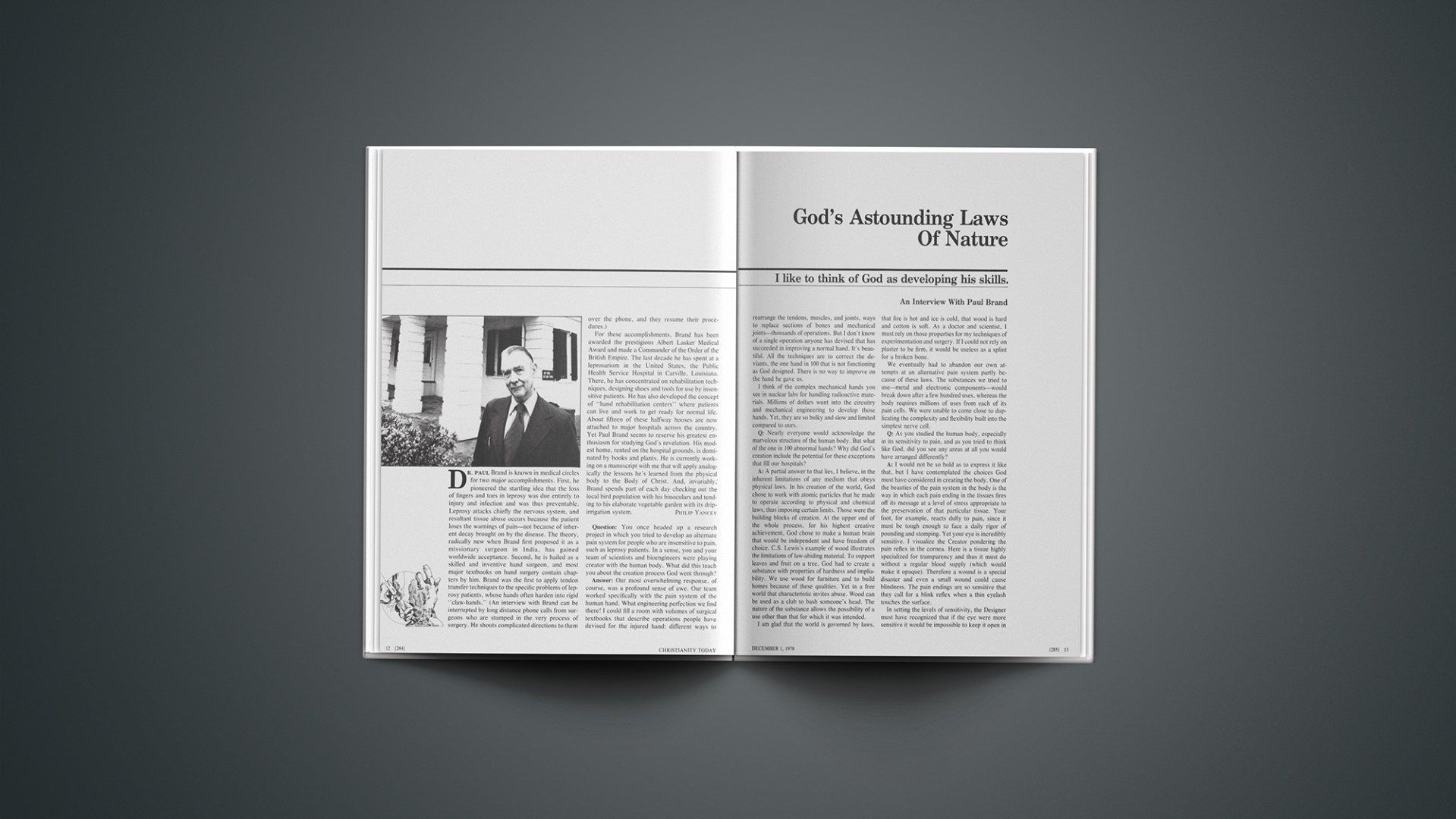
Dr. paul Brand is known in medical circles for two major accomplishments. First, he pioneered the startling idea that the loss of fingers and toes in leprosy was due entirely to injury and infection and was thus preventable. Leprosy attacks chiefly the nervous system, and resultant tissue abuse occurs because the patient loses the warnings of pain—not because of inherent decay brought on by the disease. The theory, radically new when Brand first proposed it as a missionary surgeon in India, has gained worldwide acceptance. Second, he is hailed as a skilled and inventive hand surgeon, and most major textbooks on hand surgery contain chapters by him. Brand was the first to apply tendon transfer techniques to the specific problems of leprosy patients, whose hands often harden into rigid “claw-hands.” (An interview with Brand can be interrupted by long distance phone calls from surgeons who are stumped in the very process of surgery. He shouts complicated directions to them over the phone, and they resume their procedures.)

For these accomplishments, Brand has been awarded the prestigious Albert Lasker Medical Award and made a Commander of the Order of the British Empire. The last decade he has spent at a leprosarium in the United States, the Public Health Service Hospital in Carville, Louisiana. There, he has concentrated on rehabilitation techniques, designing shoes and tools for use by insensitive patients. He has also developed the concept of “hand rehabilitation centers” where patients can live and work to get ready for normal life. About fifteen of these halfway houses are now attached to major hospitals across the country. Yet Paul Brand seems to reserve his greatest enthusiasm for studying God’s revelation. His modest home, rented on the hospital grounds, is dominated by books and plants. He is currently working on a manuscript with me that will apply analogically the lessons he’s learned from the physical body to the Body of Christ. And, invariably, Brand spends part of each day checking out the local bird population with his binoculars and tending to his elaborate vegetable garden with its drip-irrigation system.

PHILIP YANCEY1Philip Yancey, writer and executive editor of “Campus Life” magazine, lives in Wheaton, Illinois.

Question: You once headed up a research project in which you tried to develop an alternate pain system for people who are insensitive to pain, such as leprosy patients. In a sense, you and your team of scientists and bioengineers were playing creator with the human body. What did this teach you about the creation process God went through?

Answer: Our most overwhelming response, of course, was a profound sense of awe. Our team worked specifically with the pain system of the human hand. What engineering perfection we find there! I could fill a room with volumes of surgical textbooks that describe operations people have devised for the injured hand: different ways to rearrange the tendons, muscles, and joints, ways to replace sections of bones and mechanical joints—thousands of operations. But I don’t know of a single operation anyone has devised that has succeeded in improving a normal hand. It’s beautiful. All the techniques are to correct the deviants, the one hand in 100 that is not functioning as God designed. There is no way to improve on the hand he gave us.

I think of the complex mechanical hands you see in nuclear labs for handling radioactive materials. Millions of dollars went into the circuitry and mechanical engineering to develop those hands. Yet, they are so bulky and slow and limited compared to ours.

Q: Nearly everyone would acknowledge the marvelous structure of the human body. But what of the one in 100 abnormal hands? Why did God’s creation include the potential for these exceptions that fill our hospitals?

A: A partial answer to that lies, I believe, in the inherent limitations of any medium that obeys physical laws. In his creation of the world, God chose to work with atomic particles that he made to operate according to physical and chemical laws, thus imposing certain limits. Those were the building blocks of creation. At the upper end of the whole process, for his highest creative achievement, God chose to make a human brain that would be independent and have freedom of choice. C.S. Lewis’s example of wood illustrates the limitations of law-abiding material. To support leaves and fruit on a tree, God had to create a substance with properties of hardness and impliability. We use wood for furniture and to build homes because of these qualities. Yet in a free world that characteristic invites abuse. Wood can be used as a club to bash someone’s head. The nature of the substance allows the possibility of a use other than that for which it was intended.

I am glad that the world is governed by laws, that fire is hot and ice is cold, that wood is hard and cotton is soft. As a doctor and scientist, I must rely on those properties for my techniques of experimentation and surgery. If I could not rely on plaster to be firm, it would be useless as a splint for a broken bone.

We eventually had to abandon our own attempts at an alternative pain system partly because of these laws. The substances we tried to use—metal and electronic components—would break down after a few hundred uses, whereas the body requires millions of uses from each of its pain cells. We were unable to come close to duplicating the complexity and flexibility built into the simplest nerve cell.

Q: As you studied the human body, especially in its sensitivity to pain, and as you tried to think like God, did you see any areas at all you would have arranged differently?

A: I would not be so bold as to express it like that, but I have contemplated the choices God must have considered in creating the body. One of the beauties of the pain system in the body is the way in which each pain ending in the tissues fires off its message at a level of stress appropriate to the preservation of that particular tissue. Your foot, for example, reacts dully to pain, since it must be tough enough to face a daily rigor of pounding and stomping. Yet your eye is incredibly sensitive. I visualize the Creator pondering the pain reflex in the cornea. Here is a tissue highly specialized for transparency and thus it must do without a regular blood supply (which would make it opaque). Therefore a wound is a special disaster and even a small wound could cause blindness. The pain endings are so sensitive that they call for a blink reflex when a thin eyelash touches the surface.

In setting the levels of sensitivity, the Designer must have recognized that if the eye were more sensitive it would be impossible to keep it open in a slightly dusty atmosphere, or in smoke, or perhaps when the wind is blowing. Yet as a doctor concerned primarily with disease and injury, I might have wished for that greater sensitivity.

The same is true with the lining of the trachea and larynx. We get impatient when we are forced to cough, but patients dying of lung cancer must sometimes wish that the Creator had made the mucosa of the trachea more intolerant of tobacco smoke. Even omnipotence cannot please everybody.

Q: Let’s talk for a moment about your concept of omnipotence. As I understand it, you view omnipotence in terms of the potential power, not the process it describes. For example, I can describe a Russian weightlifter as the most powerful man in the world. But his task of lifting the weights he attempts is not easier for him than lifting the weights that challenge me; he still has to grunt and sweat and exert. Is there an analogy there to the way you interpret God’s omnipotence?

A: There may be. I don’t even like the word omnipotence. The word conveys a simplistic view of the Creator and Sustainer of the Universe, as if he merely had to wave a magic wand and it all came into being. Man’s creative effort in producing the Sistine Chapel or the lunar lander required tremendous planning and forethought, and I can envision God going through a similar process of planning and experimentation in his act of creation. The more I delve into the natural laws—the atom, the universe, the solid elements, molecules, the sun, and, even more, the interplay of all the mechanisms required to sustain life—I am astounded. The whole creation could collapse like a deck of cards if just one of those factors were removed. To build a thing like our universe had to require planning and thought, and that, I believe, is the strongest argument for the presence of God in creation.

From the chance collision of molecules you may sometimes derive a sudden, exciting pattern, but it quickly disperses. Some people really think that all the design and precision in nature came by chance, that if millions of molecules bombard each other for long enough, a nerve cell and sensory ending at exactly the right threshold will be bound to turn up. To those people I merely suggest that they try to make one, as I did, and see what chance is up against.

I see God as a careful, patient designer, and I don’t think that the fact that I call him God makes it easy. There are billions of possibilities of ways in which atoms could combine, and he had to discard all but a very few as being inadequate. I don’t think I can fully appreciate God unless I use the word difficult to describe the creative process.

I like to think of God developing his skills, as it were, by creating amoebae and then ants and cockroaches, developing complexity until he comes to people, the zenith of creation. Again, he was confronted with options at every decision. A person who breaks his leg skiing could wish for stronger bones. Perhaps bone could have been made stronger (though scientists have not been able to find a stronger, suitable substance for implanting) but he would have then made the bones thicker and heavier. If it were heavier you probably wouldn’t be able to ski, because you would be too bulky and inert.

Take a model of the human skeleton and look at the tiny size of the bones in the fingers and toes. Those bones in the toes support all your weight. If they were larger and thicker, many athletic events would be impossible. If fingers were thicker, so many human activities—such as playing stringed instruments—would be impossible. The Creator had to make those difficult choices between strength and mobility and weight and volume.

Q: And animals were given different qualities based on their needs. Some are stronger and faster than man, and can see and hear better.

A: Right, you can only call creation perfect in relation to other options available. Even human types differ. Is an American better than a Vietnamese? The American is bigger, but it takes more food to sustain him. If food becomes short, the Vietnamese will survive because they can get by on a bowl of rice and the Americans will die out. So physical qualities are not good or bad but good in certain circumstances. I have tremendous admiration for the balance by which the world has come out with evidence of thought behind it. But every stage of development—moving from the inanimate to the animate, single-cell to multi-cell, developing the nervous system—required thought and choice. That’s why I define omnipotence the way I do.

Q: When you speak of pain, and even death, you seem to include these within God’s overall design for this planet. These are generally seen as evidence of the twisted, or fallen, state of the world. How do you reconcile these elements with your belief in a wise, loving Creator?

A: I cannot easily imagine life on this planet without pain and death. Pain is a helpful, essential mechanism for survival. I could walk with you through the corridors of this leprosarium and show you what life is like for people who feel little pain. I see patients who have lost all their toes simply because they wore tight, ill-fitting shoes that caused pressure and cut off circulation. You or I would have stopped wearing those shoes or adjusted our way of walking. But these patients didn’t have the luxury of pain to warn them when they were abusing their flesh.

You’re familiar with the stereotyped image of leprosy, with its loss of fingers. That abuse comes because the leprosy bacillus destroys pain cells, and the patients are no longer warned when they harm their bodies through normal activity. On this world, given our material environment, I would not for a moment wish for a pain-free life. It would be miserable. I mentioned earlier that 99 of 100 hands are perfectly normal. The statistics are exactly reversed for those people insensitive to pain: Nineteen of each twenty of them have some sort of malformity or dysfunction, simply because their pain system is not working properly.

As for death, when I look at the world of nature, its most impressive feature as a closed system is the lavish expenditure of life at every level. Every time a whale takes a mouthful he swallows a million plankton. Every garden pond is a scene of constant sacrifice of life for the building up of other life. Death is not some evil intruder who has upset beautiful creation; it is woven into the very fabric and essence of the beautiful creation itself. Most of the higher animals are designed so that they depend for their survival on the death of lower levels of life. Having created this food pyramid, and placed man at its apex, the Creator instructed him to enjoy and to use it all responsibly. In modern, Western culture, we tend to see a certain ruthlessness and lack of love in nature, but I believe that viewpoint comes from a civilization whose main contact with animal life is through domestic pets and children’s anthropomorphic animal stories.

Q: Just a minute, now. It is true that pain and death fit into the present system of life on earth, but weren’t these factors introduced as a result of man’s rebellion and fall? Are you saying that the Garden of Eden contained pain and death?

A: Well, anything I say about the Garden of Eden must be conjecture, because we’ve been given very little data about it. I feel reasonably sure that Adam felt pain, if his body was like mine. If there were sharp rocks on which he could have hurt himself, I hope he had a pain system to warn him. The pain network is so inextricably tied to the functions of the body—it tells you when to go to the bathroom, how close you may go to the fire, and carries feelings of pleasure as well as pain—that I could not imagine a worthwhile body in this world without it.

And, i believe physical death was present before the fall also. The very nature of the A chain of life requires it. You cannot have soil without the death of bacteria; you couldn’t have thrushes without the death of worms. The shape of a tiger’s teeth are wholly inappropriate for eating plant matter (and even vegetarians thrive off the death of plants, part of the created order). A vulture would not survive unless something died. I don’t see death as being a bad thing at all.

Q: But the explicit warning given Adam was “In that day you shall surely die.”

A: I think the precise phrasing is important: “in that day.” The whole story strongly indicates to me that God was speaking of spiritual life—the breath of God, the image of himself that he reserved exclusively for human beings. I believe Adam was biologically alive before God breathed into him the breath of life; the Hebrew suggests a spiritual life, a direct link of communication and fellowship between God and man. And after Adam’s rebellion, I think immediately “in that day” that link was broken. God had to search out Adam after his sin. I don’t think his curse referred to physical death at all, and I assume Adam would have died biologically if he had not rebelled. As for thorns and thistles and the pain of childbirth, I’m not really adequately prepared to interpret those. We’re given so few details of the creation before and after the fall.

Q: It still sounds strange to hear someone vigorously defending pain. You work in a hospital populated by people insensitive to pain. Having met leprosy patients, I can easily agree to the void created in their lives by the absence of pain. But if you worked in a cancer ward, say, among people who feel constant, unrelieved pain, could you praise pain so confidently there?

A: I have worked in places of great suffering: the clinics treating victims of the London bombings during the war, surgical wards in Indian hospitals. The one legitimate complaint you can make against pain is that it cannot be switched off. It can rage out of control, as with a terminal cancer patient, even though its warning has been heard and there is no more that can be done to treat the cause of pain. I’m sure that less than I per cent of pain is in this category that we might call out of control. Ninety-nine per cent of all the pains that people suffer are short-term pains, correctable situations that call for medication, rest, or a change in a person’s life style.

In our experiments with alternative pain systems, we learned it was self-defeating to attach a cut-off switch. We had a glove that, when pressed too hard, would emit an electric shock. But if the patient was turning a screwdriver too hard and the electric shock went off, I have seen him overrule the pain signal and switch it off. As a result, he might injure himself. To make a useful system we would have to eliminate the cut-off switch, or place it out of the patient’s reach. I can see why God didn’t allow a cut-off switch.

Don’t forget, the absolutely best pain-relieving drug in the world is the opium seed of the poppy, which people have used throughout recorded history. God did make allowances for pain that rages out of control. There are many ways open to us to relieve a dying person with terminal cancer.

Q: Have you given any thought to the resurrected world of the afterlife? Little evidence is given about it in the Bible specifically, and yet you insist so strongly on the necessity of pain in this world. What about the next? The Bible hints that it will be radically different in heaven in regards to pain.

A: I really don’t know. Jesus could walk through a solid door in his resurrection body, so it seems clear the afterlife will be governed by a different set of physical laws. There will be some continuity. His body, and those of the three on the Mount of Transfiguration, were recognizable, and it’s true that Jesus even bore the scars of his pain from this world. Thomas touched them.

It’s a spiritual world, and it’s difficult to conjecture what it will be like when our spiritual forms are fully developed. Will children still have resurrection bodies of children? I think of my mother, Granny Brand, who lived to be ninety-five. She struggled as a missionary for seventy years under harsh conditions in India. Gradually the decades of poor sanitation and Indian diseases and poor nutrition caught up with her, and her body was bent and twisted. She thought herself so ugly that she would not allow a mirror in her house. Yet when she rode her donkey into a village, the people who knew her saw her as a beautiful person, a messenger of love. Perhaps we will relate in heaven so much on that basis that physical appearance will become irrelevant. I don’t know how pain fits in. If the verse “tears shall be no more” is to be taken literally, then our eyes will be very different, for in this world we quickly go blind without tears.

Q: What about some of the psychological parallels to physical pain? I’m thinking particularly of emotions we generally view as negative, such as guilt and fear. Do you see these as contributing to health in the same way that physical pain does?

A: Guilt has some spiritual value in that it impels you toward cleansing. It is a pain to the conscience that something is wrong that should be dealt with. Two steps are necessary. First, the person must find the cause of the guilt, just as a person must find the cause of his pain. Much of modern counseling deals with this process of rooting out reasons for guilt.

But then there must be a further step—a pathway out of the guilt. Unless it is aimed at cleansing, guilt is a useless encumbrance. Guilt as such doesn’t lead you anywhere, just as pain does not: They both simply point out a condition that needs attention. In this sense, guilt is certainly a good thing, if it is directional, pushing you toward something. The perceived purpose of it is for you to get rid of the sense of guilt, which you don’t like. Underlying that is the more significant purpose of uprooting and dealing with the cause of guilt. It’s the same with pain.

In modern society the tendency has been to approach pain as if it were the enemy. We get rid of the pain without asking why did the pain come. Pain-killing medicine can quiet the pain, but that can be bad if its cause is not determined. I believe modern psychology has concentrated on guilt as an evil and attempted to suppress or excise guilt. Just stop feeling guilty, they say. Live your life as you want. But in the Christian context, guilt is very valuable. It pushes you to right the wrong that is the cause of your guilt, and gives you the outlet of forgiveness to purge it.

When used properly, fear, too, is an absolute essential element of human life, a protective instinct without which the human race would never have survived. A mother isn’t happy to leave a baby alone until it has grown to have a healthy fear of fire or fear of heights. Fear also supplies, through adrenalin, increased heart rates and other mechanisms to tap abnormal reserves of strength. The trick is to have the right amount of fear, and to control it properly.

Q: We know that pain and struggle produce character, that often in the realm of music and art the tensions of childhood result in creative genius. Do you think the tendency in America to try to balance everyone out through self-help books, counseling and advice, and so forth can be unhealthy? I often wonder how a psychiatrist would have handled Beethoven.

A: There are problems in this area. One is a trend to eliminate variety. I think variety is exciting and lovely, yet we set up norms and tend to reject people who do not match. If one does not hit the proper standard of height, weight, figure, shape of nose, outgoing personality, and extroversion, his psyche is bruised and he loses the will to succeed. Anyone who doesn’t conform to our artificial goals does badly. When a child is bookish and is clumsy with sports and doesn’t shine in conversation, society tends to discard him. But that’s the material from which research scientists come. I feel we try too much to push people into molds.

Another danger is the tendency of modern culture to remove risk and adventure from life. Most of our excitement happens to us vicariously, as we watch it on TV. We shelter our kids, removing them from risky situations, and as a result stunt their growth. I always maintained that of our six children, I would much rather have four survivors who truly lived, with adventure and self-determination in the face of risk, than end up with six fearful, timid youngsters. Fortunately, all six have survived, but each one of them could tell you some hair-raising tales of what they went through in finding their own independence.

This tendency to eliminate risk is compounded upon the old. I visited a very tidy hospital for old people, where the superintendent showed me with great pride how each person had a separate room and a clean bed. They lie there all day. I asked why they were not allowed to get up and walk about. He said, “Well if they do, we find that they sometimes fall and break their hips. If they go outdoors they catch cold and if they meet each other they exchange infections. By keeping them in their separate little rooms they don’t get infected, they don’t break their legs, they don’t catch cold.” I carried away from there a memory of bodies that were alive, but of spirits that were caged.

Q: Your emphasis on restoring the human spirit brings up an interesting line of questions. In rehabilitation, you work with very few patients, lavishing in each one thousands of dollars and man-hours a year. In fact, at Carville the ratio of staff to patients is almost one-to-one, isn’t it? Does it bother you that in India millions of people are going without the most primitive kind of medical treatment while these patients receive so much?

A: I don’t like the juxtaposition of the two cases—people in India and patients here. I work with quadriplegics and other disabled persons who require lavish expenditures of money, yes. The opportunity to work with a person and to help set his spirit free is one of my most inspiring challenges. No effort is too great and no expense should be spared to restore activity to such a one or to help the spirit rise above its physical limitations.

Even in India I was faced with terrible choices of priorities. After I applied hand surgery techniques to the specific case of leprosy, our staff was able to remake hands. We could turn a rigid, frozen claw-hand into a flexible, usable hand and allow a beggar to find work. But our time and resources were limited, so we had to make choices, just as hospitals in the U.S. must make choices among their kidney dialysis patients. Did we give a hospital bed to one long-term case for a year, or to twelve short-term cases for one month each, or fifty cases for one week each? Did we repair an older patient with gross deformities or a younger one with his whole life ahead of him? The most pathetic cases—those with missing limbs and exposed bones—were often the last we would treat; we tried to focus on less-developed cases to prevent further abuse. These were wrenching choices. Yet in no way did that background of alternatives devalue the worth of the human spirit we did choose to treat.

Q: I have heard it said, by an Indian in fact, that Western medical advances applied to India upset the natural balance. Years ago, the birth rate was high, but only a third of the babies survived infancy. Now the birth rate remains high, but most of them live. He accused the West, and missionaries in particular, of causing India’s overpopulation because of their charitable aid.

A: And in a real sense he’s right. Missionaries on the whole have not been the chief offenders. They’re too inefficient and localized. But the World Health Organization comes in with massive resources and wipes out killing diseases. I would have to say I would not go to India with a life-saving mission without tying it at least to education for limiting population. While in India, my specific task was with crippling diseases; I helped remake human spirits, and that, I think, is wholly legitimate. The expense required by one of our operations could have saved 100 people from cholera, but I still maintain that spirit-saving activity was worth it.

Q: Jesus said, “Love your neighbor as yourself.” Modern media has made that command infinitely more complex and burdensome. Because of television, the whole world is our neighbor. On evening news programs we watch the progress of famines, wars, and epidemics. How can we possibly respond to all of these disasters?

A: You can’t, not in the sense in which Jesus meant it, at least. You must remember the context in which he was speaking. He meant family, nearby villages, Capernaum. Jesus healed people, but in a very localized area. In his lifetime he did not affect the Celts or the Indians or the Aztecs. And I think an intolerable burden of guilt such as you describe merely numbs us and keeps us from responding. We must have a sense of touch to those we love.

Westerners, with our opulent life styles, are very sensitive on this point. But I really don’t believe that kids born in Bangladesh amid poverty suffer all that much more than a spoiled child in a rich country. In Plato’s Cave he pictured people being born and brought up entirely in darkness, and as a result their range of appreciation of beauty, light, and joy was very different from that of a person on the ground. When they come up to the light, dazzled, they learn to appreciate a new range of happiness. This, to me, is a deep perception of the human spirit. A child develops a norm, above which is happiness and below which is suffering.

Not long ago I was in Bombay, among the awful refugee villages between the airport and the city. Children live in stinking, ghastly shacks, held up by sticks, reeking with human excrement, fleas, and lice. Yet you’ll see a child coming out of the hovel and playing tag and hopskotch with a lighthearted air. Their ability to enjoy the basics of life seems greater than that of a spoiled kid the day after Christmas, whining and smashing his new toys out of boredom.

Q: How do you maintain a sense of Christian compassion in your work? In India you saw thousands of patients regularly with the same afflictions. After examining 3,000 abused hands, how can you maintain your compassion?

A: I don’t know that I do it very well. In India I did learn the importance of a sense of touch. Sometimes when we were treating a serious case and had prescribed some drug, the relatives of the patient would go and purchase the medicine, then come back and ask me to give it to the patient “with my good hands.” They believed the medicine was more able to help the patient if it were given by the hand of the physician. Interesting, isn’t it, that Jesus always touched his patients?

I probably remember a person’s hands better than his face. I connect a person’s occupation with his hands—often you can read it by the hand. I try to individualize what the loss of sensation or the stiffness in his hands means in his work. When I return to India to teach, I can often remember a patient’s hands with startling vividness. I’ll recognize someone and say right off, “You’ve lost some more of your ring finger.”

Q: Doesn’t your emphasis on the personal aspect of mission run counter to some of the trends in missions today, where we isolate which groups are most responsive to the Gospel and go after those groups with a specific approach?

A: Yes, it does contradict those trends. I don’t believe mission work is necessarily more effective as it becomes more specialized. My father moved into a mountain community in India to preach the Gospel. Within a year his tasks were part medical, part agricultural, part education, evangelism, and translation. He responded to the needs of the people around him. I think that’s missions at its best.

The christian way of multiplying is the biological way, not the arithmetical way: One becomes two and two becomes four and four becomes eight. I have seen good Christian medical works in India gradually lose their original mission. They become institutionalized, with a building and staff to support, and soon they have to charge fees for their patients. To make the work more self-supporting, they branch out into specialized surgery techniques. Soon they’re doing brain surgery with all sorts of sophisticated equipment, and the people they actually came to reach, the poor, malnourished Indians, cannot afford the hospital. Christian witness shines when a young person goes out to work among villagers, working with their sanitation, diarrheal disease, improving nutrition, cutting down on child birth. Eventually more good is done through this kind of personal ministry, I believe.

Jesus Christ did not have to touch people as he healed them. He could easily, with that same power, have waved a magic wand. In fact, a wand would have reached more people than a touch. He could have divided the crowd into groups: paralyzed people over there, feverish people here, people with leprosy there, and raised his hands to heal each group en masse, but he chose not to. No, his mission was to people, individual people who happened to have a disease. They came to him because they had a disease, but he touched them because they were humans and because he loved them. You can’t readily demonstrate love to a crowd. Love is generally person to person.

Ideas

Inerrancy Matters

What difference does it make whether or not the whole Bible is inerrant? Isn’t it enough that the Bible be totally reliable on matters of faith and practice? This kind of question has been increasingly asked in conservative Christian circles over the past few decades. It used to be that those who challenged the Bible’s trustworthiness when it spoke about natural phenomena, human events, and its own literary origins also denied, doubted, or drastically reinterpreted what the Bible taught on such central doctrines as the existence of God, the lordship of Christ, and eternal life. Naturally any debates with such persons focused on the issues that were at the heart of the Good News.

But times have changed. Many Christians who have no hesitancy in affirming such fundamental doctrines as the deity of Christ, his Virgin Birth, substitutionary atonement, bodily resurrection, and the Second Coming think that affirming total biblical inerrancy is unnecessary or even harmful. From their viewpoint inerrancy is akin to a modern day pharisaism, seeking to impose on the people of God more than God himself has chosen to do. To insist on inerrancy is seen as tantamount to telling God how he must reveal himself. We are reminded that until recently many Christians were in effect telling God that he simply must have an infallible spokesman heading the church lest everything go haywire. Of course other Christians have denied the relevancy of these parallels and have been alarmed at the movement away from inerrancy. The launching of the International Council on Biblical Inerrancy and its recently issued Chicago Statement is one of their responses. (See news story, Nov. 17 issue, p. 36.).

The trustees and editors of CHRISTIANITY TODAY affirm in our statement of faith (which is identical to the one used by Gordon-Conwell seminary) that the “books of the Bible as originally written were inspired of God, hence free from error. They constitute the only infallible guide in faith and practice.” Far from being neutral on this issue, we are committed to the inerrant authority of the Bible. Nevertheless, we do feel that it is important to represent fairly the views of those who differ from us. Moreover, this magazine, ever since it began, has published articles, reviews, and other features by men and women who do not affirm inerrancy. To those with whom we are in essential agreement on inerrancy, we say that we best serve them by stressing the common beliefs of evangelicals. We intend to continue to show that defenders of inerrancy can speak to a wide range of issues facing the church and are not confined to strumming only one string. Indeed, we urge all Christians concerned about inerrancy to take care that they do not regard it as the only issue that matters.

Biblical inerrancy is not a peripheral matter. It is an important aspect of the larger question of biblical authority in particular and hence of authority generally. No one avoids, even if only implicitly, the question of authority. It is certainly a fundamental issue dividing Christians from non-Christians. It is also one of the key issues dividing Christians among themselves. Disputes over authority have been at center stage during the entire existence of the church. Paul had to defend his apostolic authority. The church fathers fought Gnosticism and other strong challenges to the teaching of the canonical scriptures. East and West split over the nature of papal authority and within the West popes had to contend against councils and kings. No sooner had the Protestant Reformers reasserted the supremacy of biblical authority than widespread and increasingly influential challenges arose to the notion that any supernatural guidance to man exists, whether it be the Holy Spirit, an organization, a man, or a book.

Evangelicals who believe that God chose to inspire his Word so that it includes errors have at least two problems. First, they must reconcile their view of Scripture with the teaching and practice of Christ their Lord. Jesus found plenty of fault with common interpretations of the Bible, but he did not question the truth of the text itself. Second, they must show how they distinguish the truths from the errors without in the process making man himself the final authority on what he will accept and reject.

Of course there are problems with the idea of inerrancy. Even after the obviously necessary delimitations of the term (so that, for example, the Bible is not charged with error because it refers to the sun setting or the mountains skipping) there “exist difficult problems of apparent discrepancies,” to use the wording of an early draft of the Chicago Statement. There is no advantage to pretending that difficulties do not exist or are of no consequence. They must be recognized, admitted, and honestly studied. Evangelicals who are questioning or even denying inerrancy are hardly likely to be won back to such a position without the utmost respect being given to the reasons that have led them away from it.

We also urge everyone to remember that a discussion of inerrancy is not analogous to political campaigns and lawmaking. In politics certain skills and strategies are used to enable a candidate or a bill (however modified) to win and the others lose. Votes are decisive even when they choose what hindsight proves to have been the inferior candidate or policy. Whether the Scriptures are inerrant is not going to be decided by voting. If the Bible is not inerrant, no amount of debating skill and political maneuvering can make it so. And if the Bible is inerrant, deficiencies in the skills of those arguing for it, or their poor manners, do not invalidate the truth.

It should be obvious that a person’s view of inerrancy should be shaped by what he thinks is true. The idea should not be supported merely to keep in good standing with, for example, a denomination. It should not be opposed (or not affirmed) in order to curry favor, for example, with one’s colleagues in academia.

Just as those who do not affirm inerrancy can be orthodox in other beliefs (and may even think that their views on the Bible are the ones held by Christ) so, correspondingly, affirmation of inerrancy is no guarantee of either right doctrine or right practice. Many contemporary deviant Christian movements subscribe to inerrancy as did the medieval church. Moreover, those who do affirm inerrancy and are orthodox in doctrine need continually to remind themselves that God’s providing us with an inerrant word is but a means to the end that we may more readily “approve what is excellent, and may be pure and blameless for the day of Christ, filled with the fruits of righteousness which come through Jesus Christ, to the glory and praise of God” (Phil. 1:10, 11).

Eutychus and His Kin: December 1, 1978

When I read a recent news item that L. M. Clymer, president of Holiday Inns, was resigning his position because of a corporate decision to invest $25 million in a gambling casino in Atlantic City—a decision he had protested on moral grounds—I was impressed. Here was that rare modern man who was willing to sacrifice power and money for his convictions.

So I wrote to Mr. Clymer, expressing my appreciation for his action, and for the irenic way in which he had announced it.

I have now received a reply from which I quote: “You will understand that this was not of my own strength or will, but Christ acting through me. In him all things are possible. The assurance and peace which he has brought me in this decision are the greatest testimony I can give of his love for each of us.”

God, give its more L. M. Clymers in business, in the professions, in government, in every part of American life.

EUTYCHUS VIII

Keen Disappointment

I was keenly disappointed in the treatment given to the New International Version in the October 20 issue of CHRISTIANITY TODAY. The editorial was very good, underlining the need for understandable translations and reminding us of the use of everyday language in the original texts. The positive attitude toward new translations was very healthy. However, the article by Leland Ryken, “The Literary Merit of the New International Version,” had an entirely different impact that tended to erase the good effects of the editorial.

JOHN A. ZOLLER

West Oneonta, N.Y.

The October 20 issue carried an article by Leland Ryken dealing with the literary merit of the New International Version. I am somewhat concerned that CHRISTIANITY TODAY would, in my opinion, waste two pages dealing with the “literary merit” of a version of Scripture. I appreciate good literature and its value, but the question is whether or not literary value is any concern of God’s or should be a concern of ours, in his Word!… Is not God’s concern that we understand and do his Word? The chief test for a translation of Scripture seems to be its ability to communicate truth. I think it’s very nice that we are concerned about literary merit; however, I believe that God is concerned with one thing, and that is communication. I find it difficult to believe that “God’s way and God’s thought” would relate to a translation’s value as literature! May we be concerned about knowing God and what he says to us first, foremost, and finally.

DENNIS L. GORTON

Northwest Church

Farmington Hills, Mich.

This morning I saw my first issue of your magazine and was intrigued, because my academic field in seminary and graduate school was Old Testament and Semitics, and two of your articles were devoted to the New International Version and a third was a comparison of twelve English-language versions. To my horror I found that the Living Bible was included among the twelve as a “version”—oh, well, the original twelve had their Iscariot.

DONALD W. GOODWIN

The United Church

Oak Ridge, Tenn.

May I please make two comments about Ryken’s evaluation of the literary merit of the NIV? First, he may be an associate professor of English, but his English, which is actually that of 1611, certainly isn’t mine. Our language has changed drastically since then, but he writes as though he isn’t aware of it. Second, it would have been helpful had he known Hebrew. For if he had, he would not have endorsed the RSV—particularly in the Old Testament, where the RSV freely emends the Masoretic Text. As for LaSor’s review, he makes “authoritative” prounouncements about several passages where no interpreter has a right to be dogmatic. For example, it is by no means certain that Genesis 1:1 is a dependent clause; the Hebrew does not clearly use the verb to return in Psalm 23:6; the Hebrew does not clearly read “young woman” in Isaiah 7:14; the clause in Ezekiel 38:2 probably should not be rendered the way he indicates; etc., etc.

KENNETH L. BARKER

Professor of Semitics and Old Testament

Dallas Theological Seminary

Dallas, Tex.

Lasting Satisfaction?

I predict that Sandra Majorowicz will find no lasting happiness in the singles group which she praised in her article “Single Adults Are Grown Up, Too” (Oct. 20). Any group which declares itself special (or accepts this designation from others), and isolates itself, is bound to have problems. Majorowicz describes a group of insecure people trying to show that they can succeed on their own. They’re trying too hard to fulfill “their” needs.… I have sought happiness and found only loneliness and sorrow. I have followed God’s will in visiting the sick and the prisoner and experienced indescribable joy. Keep your specialized groups concentrating on their own problems. Give me individuals, married or single, members of denominations or unattached, who seek to know the will of God and do it.

DON MATSCHULL

Dallas, Tex.

I jumped for joy reading your recent article “Single Adults Are Grown Up, Too.” As a single adult, I feel deeply the frustration of being considered not quite a “whole person” and the accompanying alienation in not being able to fellowship or assume responsibility among marrieds within the local church. Why is it that marriage is the spiritual plateau that must be reached before acceptance to fellowship can be realized? Contrary to popular belief, the Holy Spirit does bestow gifts to single adults to be used within the context of the local church, and fellowship with couples is needed for the full development of those gifts given by God to mature his body.

KEITH DIETZ

Frederick, Md.

Issue of The Heart

I am grateful to God and deeply appreciative for Douglas Kiesewetter’s editorial (“The Root of All Evil,” Oct. 20). The author reaches depths of truth and challenge rarely touched when such subjects are considered. His insights are vitally important to us all.… This is good editorializing as well as good preaching! It touches the heart of the issue, and the issue is the heart! We need to hear this kind of prophetic voice. Give us lots more!

GEORGE TAYLOR

New Life Ministries Church

Columbus, Ga.

Love Distorted

I was appalled to read in the October 20 issue (News, “An Aggressive Faith”) that Paul Lindstrom, pastor of the Church of Christian Liberty, is recruiting a unit of commandos to send to Rhodesia to avenge the murder of British Pentecostal missionaries. Does Lindstrom believe that the Gospel of Jesus Christ is served by putting bullets through the heads of its enemies? It is a nauseating distortion of the love that the Lord taught his church. Christians have faced martyrdom with love, courage, and prayer for their persecutors since the earliest days of the Church. Lindstrom’s attitude repudiates their acts of witness, as well as the obedience of Jesus himself in dying for us on the cross.

JOHN E. BORREGO

St. Francis Episcopal Church

Greensboro, N. C.

Painfully Appalled

Because Elizabeth Elliot’s books Through Gates of Splendor and Shadow of the Almighty have had such a mighty impact on my life, it was with pain and disbelief that I read her interview “Not About Women Only” and her article “Furnace of the Lord” in the October 6 issue. How could she, such a stickler for detail, be so careless with her facts?… I said I was pained, but not so much because of her errors of fact obviously based on a short visit to Israel and a complete lack of knowledge of Judaism, but because she uses half-truths to build her theology of Israel. Her bias towards Jews and Israel is evident. Note her vitriolic language: “And although Israel is militantly a racist political state …” Because of the blessing she has in the past been to me and to so many others, I pray that God will cause her to re-examine her facts and her motives.

DAVID BIVIN

Jerusalem, Israel

How disheartening it was to learn that those thousands of dollars and thousands of hours spent in my education at the seminary where Elliot occasionally teaches have all been in vain. Had I only known that my shelf of Lewis was all I needed I would not have wasted all this time and money pursuing the trivialities of Barth, Brunner, and Wesley.

DAVID L. JAMES

S. Hamilton, Mass.

Reading Materials For Fairies

I appreciate the series of articles on “South Africa” (July 21) … often your articles are so rambling and impractical that only fairies who lived a thousand years should spend the time to read them.

DAVID P. TEAGUE

Dorchester, Mass.

Editor’s Note from December 01, 1978

Classified ads seldom make fascinating reading, but then classified ads are seldom written by John Lawing, our CHRISTIANITY TODAY cartoon artist. Now that you are in on the secret, you may want to read right through the entire section of classified ads just to be sure you don’t miss his contributions. In this issue he has two. Turn to page 56.

We think they make the section more interesting, and so we have asked John to prepare a whole series of ads. He has established a chain of fictional businesses ranging from the Lawing Ski Lodge in Tallahassee, Florida, to the Lawing Surfboard Works in International Falls, Montana. We have not yet faced the question of what to do if Lawing, Inc., should ever want to run a legitimate classified ad. But starting this issue you just don’t dare miss them.

And you may, incidentally, find some other buys you can’t afford to miss—plus some good humor.

Solzhenitsyn and Some Spiritual Implications

When Alexander Solzhenitsyn rose to address the 15,000 assembled faculty, graduates, and parents for the Harvard Commencement on June 8, he must have had feelings akin to those of Paul at Mars Hill. Both men enjoyed an unprecedented opportunity—and faced serious problems.

Solzhenitsyn could not have failed to know that The Gulag Archipelago presented deep challenges to the conventional wisdom of many of his listeners. By documenting the manner of administration of “justice” in the U.S.S.R. through the decades, he laid to rest the comfortable fiction that the accounts of Communist atrocities were the invention of “the kept Western press.” More devastating still is his tracing of the massive system of penal camps to 1917, which demolished the cherished fantasy that “Stalin betrayed the Revolution.”

Now, as if to challenge further the liberal chic, Solzhenitsyn reminded fashionable academia of some (to him) serious shortcomings in the accepted ethos of our Western scene. The sea of umbrellas must have quivered slightly—it was raining—as he denounced the triviality of segments of the media for “the revolting invasion of publicity” with the mania for telling all.

Equally unpalatable must have been Solzhenitsyn’s designation of much of broadcasting as “television stupor.” It seems that there is a tacit agreement within sophisticated circles that TV is doing a massive service in democratizing our people—even if it does so by a large-scale vulgarization of life, language, and manners. Scarcely less pleasing was his criticism of our popular music as intolerable. It is chic to view rock music as the finest fruit of the tree of the counterculture, and one can scarcely expect a sophisticated audience, in Harvard or elsewhere, to appreciate such criticism.

I lack the knowledge to evaluate some of Solzhenitsyn’s social and political views. What appeals to me after reading and rereading his speech is that it abounds in spiritual insights that by their implications touch deeply our national life.

Outstanding among these is his treatment of legalistic life in the West. Setting this against the lack of “any objective legal scale” as is the case in Communist lands, he points out that the West bases its concept of law not only upon the letter of the law but upon the ideal of pushing the limit of all legal frames. Thus, our society sees no place for self-restraint in the approach to behavior, so long as some jury or some majority of justices consider it permissible within the limits of the law.

The net result of this is, of course, norms and forms of public behavior that impose a minimum of self-discipline, or none at all. Thus, by implication Solzhenitsyn accuses the West of a new legalism, the net result of which is “an atmosphere of moral mediocrity.” Advocates of ever-widening boundaries of behavior stifle those who wish to excel. Worse still, they leave society, through their extreme defense of the rights of the individual, helpless against the violent.

The West also seems defenseless against what Solzhenitsyn calls “the abyss of human decadence.” An ethos that makes its guide the ever-expanding boundaries of legal permission ends up being terrorized by violent people whose civil rights take precedence over both public order and public safety.

Solzhenitsyn touched another sensitive nerve when he referred to the thin moral veneer of a nation in which, during a brief power failure in its largest city, its citizens “start looting and creating havoc.” He might well have mentioned the further decay evident when the media carried the word of a pundit, to the effect that “when people are hungry, they steal.” Item: steal stereos and bedroom suites?

In this connection, Solzhenitsyn called attention to the fact that while pressing the limits of legality produces only weak characters, personal discipline produces character, whether under conditions of freedom or even of oppression. In this connection, contrast the cowering confessions that marked the conduct of the victims of the rigged trials in the U.S.S.R. from 1917 to 1963, with the courageous manner in which Anatoly Shcharansky and Alexander Ginsburg stood like men and faced their accusers in recent Soviet court sessions. The years of self-discipline have produced character in them.

(It might be helpful to recall that these men stood tall in defense of what the West believed it was getting at Helsinki, in exchange for final recognition of the boundaries that imprison the peoples of the East. Where do we hear protests today from the intelligentsia of our land?)

What lies behind the massive forces for decadence, for the love for mediocrity, for the loss of taste, for the decline of civility, and for the loss of will in the West? Solzhenitsyn offers a solution to this riddle—one that again was scarcely calculated to produce cheers of agreement in academic circles. In measured language, he lays much of the blame for the current failure of nerve in the West upon a mind-set that “did not admit the existence of intrinsic evil in man.” A consequence of this denial is a social mentality that cannot “see any higher task than the attainment of happiness on earth.” With evident pathos, he points out that everywhere in the West there has been a “liberation” from the moral heritage of the Christian faith, a loss of the “great reserves of mercy and sacrifice” produced by it.

Although none will reject man’s struggle for human rights out of hand, what Solzhenitsyn deplores is that such a struggle may be carried to a point at which “man’s sense of responsibility to God grew dimmer and dimmer.” Underlying all this is his conviction that when the intrinsic evil of the human heart and its corollary of man’s need for God’s grace is lost, man falls prey to a loss of spiritual responsibility—to freedom from religion. Such loss opens men and societies to a materialistic humanism.

These significant spiritual losses cause Solzhenitsyn to plead for a return to theological realism with respect to human evil and to a vital acceptance of the true, eternal dimensions of the human soul. He dares to hope that after decades of wallowing in triviality, impurity, violence, and spiritual oppression, the human spirit now is ready to see and hear whatsoever things are pure, lovely, and of good report—things superior to those offered by sensational media, by invasion of human privacy, and by mass entertainment.

As occurred following Paul’s address on Mars Hill, some representatives of the liberal chic and its conventional wisdom mocked Solzhenitsyn. Their media have attempted to dismiss him as “an Orthodox mystic” or as “a hermit from Vermont.” I hope that some people are willing to listen to him. Should not the architects who create the values of the West, and those responsible for inculcating them, take notice?

Harold B. Kuhn is professor of philosophy of religion, Asbury Theological Seminary, Wilmore, Kentucky.

Finns Sense a Sixth Revival Movement

They’re talking about revival in Finland.

An upsurge of spiritual interest and activity has been evident among Finns over the past year and a half, and secular and church media alike have devoted major attention to it. Thousands of people have been flocking to meetings where the ministry of the Holy Spirit and the need for deeper commitment to Christ are emphasized. Evangelistic outreach and missionary interest are also part of the new spiritual wave. Dozens of the 600 parishes of the Evangelical-Lutheran Church of Finland (ELCF), which claims about 92 per cent of the country’s 4.8 million population, are involved, along with non-Lutheran congregations.

At the center of some of the more sensational press coverage is Niilo Yli-Vainio, a Pentecostal lay preacher who came out of a disability-enforced retirement. He began preaching again in 1977 after he and his wife were “miraculously” healed of cancer, as he has testified in crowded meetings throughout Finland. Some observers say that his meetings have attracted more than 200,000 so far, an estimate others insist is exaggerated. Many people have claimed to be physically healed as well as spiritually renewed at these meetings. In a number of the services persons who are prayed for appear to faint, a phenomenon Yli-Vainio describes as “slain in the Spirit.”

Last summer Archbishop Martti Simojoki—the ELCF primate who has since retired—publicly rebuked Yli-Vainio for “commanding” God to heal. (The successor to Simojaki, consecrated last month, is professor Mikka Juva, 60, chancellor of the University of Helsinki, and more neutral in his stance toward the charismatic movement.) In return, some of Yli-Vainio’s followers have charged that the ELCF is tradition-bound and spiritually dead, and they have encouraged members to leave it and join a group more in step with the Spirit. However, Yli-Vainio has counseled his Lutheran listeners to stay in their church and work for renewal from within, advice apparently accepted by most of them—and appreciated by the ELCF leaders.

As the movement has spread among ELCF congregations, it has become more moderate, with much less emphasis on tongues and healing. It is still known in the press and in the church as the charismatic movement, even though most of its leaders have never spoken in tongues—a situation that exists elsewhere in Europe as well.

Among the movement’s early leaders within the ELCF were Erkki Pennanen, pastor of a church in the suburbs of Tampere, and Seppo Loytty, dean of the cathedral in Mikkeli. Pennanen experienced spiritual renewal at a Yli-Vainio meeting and, together with other pastors, conducted a revival service in April at the Alexander Church in Tampere. Nearly 1,000 people crowded to the altar to confess their sins and to seek God’s blessings. More than 1,300 people attended a repeat meeting in the same church in September. Also in September, the Mikkeli cathedral hosted a revival conference for church leaders that drew nearly 350 pastors and other church professionals, and more than 2,000 persons attended a session open to the public.

Earlier, about 140 pastors and workers attended a similar leadership conference in Helsinki, where the movement is spearheaded by the evangelism-oriented People’s Bible Society and individuals like theologian Ulla-Christina Sjonnan, a worker in a Swedish-speaking parish.

A breakthrough in church opinion occurred in August when Bishop Kalevi Toiviainen of the Mikkeli diocese issued a pastoral letter expressing cautious approval of the revivalists. “Congregations should not adopt a condemnatory attitude to the charismatic movement, in spite of the features it contains which are alien to Lutheranism,” he advises his pastors. “The longing for spiritual renewal inherent in the movement may prove a blessing for the congregations of our church.” Those in search of renewal should not be alienated or abandoned, he said, “but one should try to pray, search, and discover with them.” He did warn against pushing the sacraments into the background, ignoring the church’s institutional reality, and viewing speaking in tongues and healing as required proof of the Holy Spirit’s presence.

Cathedral dean Loytty and Sikku Paunonen, the top missions executive of the People’s Bible Society, were invited to explain the renewal movement at a meeting of the ELCF’s eight bishops in September. During the meeting, several bishops spoke warmly of the movement. The pastors and lay leaders involved in the movement in the Tampere diocese are genuinely renewed pepple, commented Bishop Erkki Kansanaho of Tampere. He added that he had been “deeply touched” by their testimonies. As the meeting ended, Loytty and Paunonen were commended, “You are Lutherans and ministers—ordained to do what you are doing,” said one bishop.

Increasingly, the People’s Bible Society (PBS) is providing leadership and direction for the renewal movement. PBS emerged from a revival movement in the early 1940s that was sparked by renowned Scandinavian evangelist Frank Mangs. With 135 staff workers and a budget of $2.5 million, PBS is the largest evangelistic service organization within the Lutheran church. It provides congregations with guest speakers and full-scale preaching missions (250 last year), sponsors evangelism teams and mobile ministries, publishes the 65,000-circulation weekly tabloid Sana and a wide range of Christian literature, runs nine conference centers (80,000 registrants last year), and conducts a ministry among university students in Finland’s three largest cities (there are nearly 100 cell groups, and an annual Bible conference attracts hundreds of students).

The PBS has worked closely with Campus Crusade for Christ, borrowing generously from its materials and methods. Three pastors and a lay leader traveled to the United States in 1976 to study Crusade’s “Here’s Life” campaign, and then returned to plan a similar effort for Tampere. More than 100 workers were trained, and last month they launched a ten-day “Here’s Life Tampere” crusade. When it was all over, 40,000 evangelistic calls had been logged, the ten Lutheran churches that were involved reported capacity crowds at Sunday services, and many people were enrolled in freshly organized follow-up groups. “The entire city was shaken,” declared one pastor.

PBS executive Veli-Pekka Toiviainen was the prime mover behind the 1973 Congress of Evangelism in Helsinki (attended by 1,100 delegates) and served as its general secretary. Last year, 1,500 attended a landmark missions conference in Helsinki run by PBS missions specialist Sikku Paunonen. “These two happenings got people moving toward the evangelization of the church,” declared Toiviainen.

Christianity came to Finland from both East and West as early as the tenth and eleventh centuries. The Orthodox faith (claiming 61,000 members today) took root among the Karelians, the easternmost tribe, while the other tribes adopted Roman Catholicism, which was spread by the Swedes. Lutheranism was brought to Finland in the 1500s by reformer Mikael Agricola, a disciple of Martin Luther at Wittenberg, and supplanted Catholicism.

Until 1809, when the Russians acquired Finland from the Swedes, the Church of Finland was a part of the Church of Sweden. Soon after Finland won its independence from Russia in 1917, the government enacted freedom-of-religion legislation, making the life and work of non-ELCF churches easier. The ELCF remains, however, as the country’s “folk” or state church. It enjoys a large measure of autonomy, but some decisions are subject to the approval of the parliament, which provides the church with most of its funding through taxes. Public schools include religious instruction in classroom teaching.

As in other Nordic countries, the question of church-and-state relationships is under consideration. Veteran observers see no major changes in the near future—only the continuation of a gradual process of detachment.

Four regional revival movements in the eighteenth and nineteenth centuries and at least one major movement since World War I has made a lasting imprint upon Finnish Lutheranism, according to church historians. The movements, which became institutionalized, each have their own organizations, publishing programs, and summer mass meetings (a useful gauge of movement strength), but all have remained within the church.

The Supplicationists make prayer the central element of individual and family religious practice and of their public meetings. Scattered in southwestern Finland, they sponsor an annual summer conference attended by 4,000 to 5,000 people. Traditionalists, they cling to an old Bible translation and hymnal. Their roots go back to the early days of revival in the 1700s when people swooned, spoke in tongues, and prophesied about the end of the world. Under the leadership of pastors, the emotionalism gave way to quiet prayer.

Speaking in tongues also marked the early (but not later) phases of the Awakened movement, sparked in 1796, and strongly influenced by pietism. The movement emphasizes the importance of a daily fresh beginning and a daily struggle. Between 20,000 and 25,000 gather for the movement’s annual summer conference.

The Evangelical movement broke away from the Awakened in the 1840s, placing greater emphasis on assurance of salvation and less on sinfulness and struggle in the Christian life. Strong doctrinal teaching is still a hallmark of the movement (known today as the Lutheran Evangelical Association of Finland), which draws from 10,000 to 15,000 to its yearly conference.

The Laestadian movement is named after its founder, Lars Levi Laestadius, a vicar in Lapland who, in the middle 1940s, traded his cynicism and legalism for salvation in Christ, thanks to a young Lappish girl who testified how she had received the peace of God when the blood of Jesus cleansed her. The blood of Christ became central in the movement’s preaching services and sins were confessed before the entire congregation. In time, the movement became exclusivist and legalistic; several splits occurred. The largest ongoing group, the Conservative Laestadians, is led by laymen. Discipline is still strict, and the conduct of individual members is monitored. There are 300 local societies, and from 40,000 to 50,000 people attend the annual conference.

The so-called Fifth or Neo-Pietist revival movement came out of the preaching of Erho Muroma in the 1920s and 1930s. The movement’s identity is preserved in a number of organizations, but mainly in the Finnish Lutheran Mission (FLM), formed in 1967 by several evangelical groups, including the Finnish affiliate of the International Fellowship of Evangelical Students. As the second-largest mission society in the Lutheran church (the Finnish Missionary Society is largest), the FLM carries on a variety of ministries. It has stirred up some controversy by its bitter opposition to the World Council of Churches and by its apparent snub of local churches. Most active Finnish church members belong both to a local parish and to a local chapter of a revival or mission organization. The FLM once indicated that membership in one of its branches was more important than memership in a local church.

There have been other revivals, including the one that produced the People’s Bible Society, but Finnish church leaders don’t classify them as movements. Some believe that the current charismatic wave may be the beginning of a “sixth” revival movement. Others differ, among them Dean Mauri Larkio of the Helsinki Cathedral, where a number of charismatic meetings are held. “It is not a separate movement,” he said. “I believe it is something that will touch and be part of the entire church.”

There are still problems. Lethargy plagues many parishes, and only 2.3 per cent of the population is in church on Sundays. (Church authorities are quick to point out that surveys show 15 to 18 per cent listen to weekly church broadcasts, that Finland’s highest radio audience ratings are for the daily broadcasts of morning and evening devotions, and that about 25 per cent of members attend weekday activities and meetings.)

As a result of all the years of revival activity, Finland leads the Nordic countries in theological and ecclesiastical health (ahead of Norway, Sweden, Iceland, and Denmark). For example: “The majority of Finnish pastors are theologically conservative,” states Bishop John Vikström, who heads the ELCF’s 300,000-member Swedish-speaking diocese.

Today Finland is experiencing a new spiritual wave. Says PBS journalist Tapani Ruokanen, “The Church of Finland is not what it used to be.”

Afrikaaners Reject Multi-Racial Synod

The influential General Synod of the white Dutch Reformed Church (Nederduits Gereformeede Kerk or NGK) of South Africa last month overwhelmingly voted against forming a single synod that would include its three Non-White sister churches of Blacks, Indians, and Coloureds—churches that are the fruits of its own missionary work. The sister churches at present have their own synods.

The advisory Federal Council that includes representatives from the four churches last March proposed the creation of an all-embracing supersynod. The Federal Council, which meets only once every four years, has no administrative powers and can only make recommendations to the various Dutch Reformed synods.

The NGK General Synod decision not to merge with its Non-White sister churches in a single decision-making synod might cause a split in this largest church in South Africa with almost three million members.

Leaders of the Black and Coloured churches have warned that their churches might now decide to “go it alone” on the way of unity after last month’s decision. The General Synod (itself a merger of eight White synods) also narrowly voted down a proposed amendment that would have referred the merger question to a special commission for further study. It did, however, opt to retain its links to the Black, Indian, and Coloured churches through the Federal Council.

Correction

The name of the bishop of Gothenburg, Sweden, on page 55 of the October 20 issue should have been listed as Bertil E. Gartner. We regret the error.

One of the strongest opponents of an all-embracing, multi-racial synod was J. D. Vorster, a leader of the Cape Synod withing the NGK. Speaking against the motion, he reportedly said, “They want to integrate. We must not give them an opening.” Vorster is the brother of the previous prime minister of South Africa, B. John Vorster, who is now state president. (Pieter Botha, who succeeded Vorster as prime minister, is an NGK elder.)

Leaders of the Non-White churches, in commenting on the decision of the General Synod, express deep concern and regret. Clergyman Sam Buti, scribe of the NGK in Africa (Black) and president of the South African Council of Churches said, “The decision will not stop our seeking unity with the other churches.” The NGK in Africa, which has many White preachers, voted several weeks earlier in favor of full integration from the congregational level on up. Buti believes that Whites might now want to join the Black integrated churches on an individual basis.

Another major issue at the meeting of the General Synod was the charismatic renewal movement. The Synod accepted the statement by a special investigation committee, saying that all gifts of the Holy Spirit are in operation today as they were in the apostolic era. The committee even suggested that there might be more gifts today than are mentioned in the Bible. The committee report did say that believers should not overemphasize spiritual gifts. But the decision came as a surprise. Previously, some converts who practiced certain gifts were criticized in their churches, and many left.

In contrast to the Reformed Church stand, the annual conference of the Methodist Church in South Africa recently voted for racial equality, not only in the church, but throughout South Africa in adherence to the principle of one man, one vote. Methodist ministers also were instructed to inform prospective new members of the church of its stance on racial issues. The Methodists also resolved that the fight in Rhodesia and Namibia (South-West Africa) is no longer between Whites and Blacks. Instead, they say, it pits those who seek a solution by negotiation and reconciliation against those who seek their own interests by the power of the gun.

PEET SIMONIS

Muslims: Probing For New Approaches

One hundred and fifty delegates last month explored the evangelistic possibilities in the Muslim world during a week-long conference at Colorado Springs, Colorado, co-sponsored by the Lausanne Committee for World Evangelization and World Vision International.

Delegates read forty foundation papers prior to their arrival. (Response to this conceptual and statistical groundwork was a prerequisite for attendance.) In session, the delegates planned new approaches and determined areas for new study in four spheres: church and nationhood, theological research and training, communication media, and evangelism and church growth.

A coordinating office, to be located at World Vision headquarters in Monrovia, California, will issue the conference report. Later, the office will serve as a clearinghouse for information coming in from task forces established at the conference.

Religion In Transit

Clergy and school pressure forced the nation’s largest brewery, Anheuser-Busch, to suspend test marketing and promotion of “Chelsea”—the so-called baby beer. Considered a non-alcoholic beverage with less than 5 per cent alcohol content, the foamy, malt-based drink was packaged like bottled beer. Protests were that Chelsea would promote a favorable attitude toward beer drinking among youngsters.

Last month the U.S. Conference of the World Council of Churches defended the council’s controversial Program to Combat Racism—the fund from which $85,000 was recently taken to give the Patriotic Front of Zimbabwe (Rhodesia) for humanitarian purposes. (See Sept. 8 issue, p. 60.) Critics said the money would be spent for guns by the Patriotic Front, which is fighting against an interim political settlement in Rhodesia. Conference participants blamed the uproar on “widespread misinformation in the secular media in North America which have equated activities of liberation groups with irresponsible behavior.” They also claimed that Christians in Africa, Asia, and Latin America supported the grant.

Officials of many private and church-related schools are agitated by a proposal now before the Internal Revenue Service. The IRS may revoke the tax exempt status of private schools “formed or substantially expanded at or about the time of desegregation of public schools” unless those schools can prove they are not racially discriminatory. The IRS has received thousands of protest letters; it will hold a public hearing on the matter early next month.

Lutheran and Roman Catholic theologians still disagree on the divisive doctrine of papal infallibility, but their attitudes are more conciliatory. That’s the gist of a 9,000-word statement issued by a U.S. Lutheran-Catholic theological working team—the result of ten separate discussions over the last four and one half years. One conclusion: “The ultimate trust of Christians is in Christ and the gospel, not in a doctrine of infallibility, whether of scripture, the church or the Pope.” The Lutheran theologians support the “indefectibility of the church”—that it is protected from irremediable error—and said their position has much in common with infallibility.

Southern Baptist evangelist James Robison was the willing recipient of the 1,600-acre east Texas campus of Ambassador College, formerly owned by Herbert W. Armstrong and the Worldwide Church of God. Virginia businessman F. William Menge bought the Big Sandy, Texas, property that includes 330 buildings, a 16,000-seat convention center, an airplane hanger and landing strip, and recreational facilities for $10.6 million, and gave it to Robison’s evangelistic association (of which he is a board member). The property has an estimated value of $30 to $50 million, and financial difficulties in the Armstrong church may have prompted the bargain sale. Robison will use the property for youth retreats, discipleship training, and as a retirement center.

Personalia

Neal C. Wilson has been elected president of the three-million-member Seventh-day Adventist Church. A former missions worker in the Middle East and current vice-president of the church, Wilson succeeds Robert H. Pierson. President for the past twelve years, Pierson resigned suddenly for health reasons.

President Carter has selected former New York mayor Robert F. Wagner, a Catholic, to be his personal representative to the Vatican. Unsalaried and without diplomatic status, the position first was created by Franklin D. Roosevelt.

In an administrative shuffle, Henry M. Morris has become president at Christian Heritage College. Morris will continue as director of the Institute for Creation Research, San Diego-based research division of the eight-year-old liberal arts school. Co-founder and president of the college Tim LaHaye was elevated to the position of chancellor.

World Scene

For the first time in ten years an evangelical church in Portugal has been closed down. The church in Mirandela was ordered officially closed by the mayor of the town, an action viewed “with great concern” by the Evangelical Alliance of Portugal.

A large home southeast of London that was originally built for David Livingstone, the Scottish explorer and missionary, has been sold to the Unification Church of Sun Myung Moon. The property, located in Chiselhurst, Kent, had been a convent for the Roman Catholic Sisters of Mercy for the last thirty years. The Sisters sold the house at public auction. They say they would not have agreed to the sale if they had known the identity of the purchasers, who used their full name, Holy Spirit Association for the Unification of World Christianity.

A prominent Greek Orthodox priest has urged that the Ecumenical Patriarchate be moved from Istanbul to escape the pressures that he says are being applied by the Turkish government. Cleric Constantine N. Dombalis, vicar for Virginia of the Greek Orthodox Diocese of the South, said the Greek Orthodox population in Istanbul has shrunk from 300,000 to 7,000 since 1925. “How can you select a superior hierarchy for 100 million Orthodox when you are limited to 7,000 residents of Constantinople?” he asked. “The potential for greatness is vastly diminished.”

Two seminarians who were suspected of being agents for the Soviet secret police were expelled from the only Roman Catholic seminary in Lithuania, according to the latest issue of an underground church publication. The Chronicle of the Catholic Church in Lithuania reports that Communist officials retaliated by forcing the expulsion “of two exemplary seminarians” from the seminary at Kaunas, and that the KGB is pressuring the seminary “to reinstate their two men.”

The Chronicle (see above item) also reports a confrontation between security police and Roman Catholic parishioners in a Soviet village. About 500 troops, many leading dogs, came at dawn to Rashkovo. The homes of all Roman Catholics in the villages were surrounded. The Catholics’ hunting rifles were confiscated, and their children were locked inside the village school. Then, after removing its religious objects, Soviet soldiers razed the Catholics’ new church with bulldozers.

Ethiopian authorities last month arrested Gudina Tumsa, general secretary of the Evangelical Church Mekane Yesus (Lutheran). They gave no reason for the arrest of Tumsa, who has traveled much outside Ethiopia. The twenty-year-old Lutheran body numbers about 1,300 congregations and has more than 200 Ethiopian pastors.

A Council of Churches in Namibia (South-West Africa) was formed last month by six Protestant denominations: Anglican, Congregational, African Methodist Episcopal, and three Lutheran bodies. Its leaders already have endorsed a United Nations’ plan to send peacekeeping forces there to supervise national elections and a transition to independent rule. Namibia is a former German colony that is now administered by South Africa. South African officials have pushed for “internal” elections next month, but have also agreed to UN-sponsored elections next April. The church leaders are calling the second internationally-observed elections in Namibia.

Evangelicals in Lebanon report that rightist militia forces, who usually are labeled Christian in the press, are hardly their protectors. At least five Beirut Baptist and Brethren churches have been seized and occupied by the militias, and thousands of dollars in ransom money have been demanded for their return.

A ship owned by World Vision International, “Operation Seasweep,” was involved in the rescue of 153 Vietnamese refugees during a recent seven-day period. The refugees were found adrift in crowded boats in the South China Sea as “Seasweep” was criss-crossing the waters between the Malay peninsula and Viet Nam.

DEATH

HAROLD K. SHEETS, 75, general superintendent for eleven years of the Wesleyan Methodist Church, which merged with the Pilgrim Holiness body in 1968 to form the Wesleyan Church; on October 8 in Marion, Indiana, after a long illness.

The Turin Shroud at Credibility Corner

The Turin Shroud At Credibility Corner

The Shroud of Turin once again is out of sight, but certainly not out of mind. The celebrated cloth was returned to its sealed, silver casket last month, but not before it had been viewed by an estimated 3.3 million pilgrims and scrutinized by an international team of scientists. Many Christians who formerly ignored the shroud as a Catholic relic or harmless hoax await results of the scientific tests with more than casual expectancy.

Tests results aren’t due for another six months to two years, but the scientists intend to prove whether the fourteen-by-three-foot piece of twilled linen is in fact, the burial sheet of the crucified Christ (see book review, p. 32).

Kenneth Stevenson, IBM computer technician and spokesman thirty American scientists who studied the shroud, expressed his opinion: “The historical and scientific evidence indicates to me that the shroud is authentic.”

Raised in a Catholic church and converted by Protestant friends in 1970, Stevenson says the tests can’t prove 100 per cent that the shroud is Christ’s burial sheet. “But whether it is art work or for real, the shroud will always be the most accurate portrayal of the suffering Christ that the world has ever seen,” he said. “It’s medically, scripturally, historically, and culturally accurate. And at this point I defy anyone to show me evidence to the contrary.”

Archbishop Anastasio Ballastrero of Turin prompted the recent public display of the shroud—its first in forty-five years—in observance of the 400th year the shroud has rested in Turin. For more than six weeks, devout pilgrims and curious tourists jammed this otherwise ordinary Italian automobile manufacturing town. At least twenty Catholic cardinals viewed the shroud during the forty-three day exhibition that ended last month.

Once inside the dim renaissance cathedral, visitors peered upwards at the shroud and saw the faint negative image of a man with markings that seem to fit Christ. Floodlamps illuminated the shroud where it hung twelve feet above the floor inside a bomb- and bullet-proof glass case.

As soon as public viewing ended, church officials removed a protective cloth backing from the shroud and an international scientific team began a rushed program of complicated tests. Archbishop Ballastrero had allowed only five days for “nondestructive” tests on the shroud, so the scientists worked non-stop and in shifts.

Their goals: to determine how the man’s image became imprinted on the cloth, to establish the age of the cloth, and to reveal any unseen details on the cloth through image enhancement techniques.

About 250 scientists had gathered two days before the tests for a seminar sponsored by the International Institute of Shroud Study. Included in that group was a thirty-member American delegation, the U.S. Research Conference on the Shroud. Billed as a scientific seminar, the conference sometimes delved into the spiritual and mystical implications of the shroud. A Belgian delegate was rebuked for sharing his insights on visions, rather than on science.

Harry Gove, chairman of the physics department at the University of Rochester, described his new method for Carbon 14 dating. Gove said he could determine the age of the shroud within 100 years by using a single thread eight inches long. Church officials have rejected Carbon 14 testing in the past because a portion of the shroud fiber would have to be destroyed. They weren’t convinced by Gove’s proposal and refused permission for the test.

But many observers believe Archbishop Ballastrero was magnanimous even in allowing the tests. Turin Catholics have believed the shroud was Christ’s burial sheet for 400 years without needing scientific proof. Apparently, Ballastrero allowed the tests both to appease scientists who for years have been asking permission to experiment on the shroud, and to put the controversy to rest once and for all.

A high point of the shroud seminar was a presentation by Eric Jumper and John Jackson, U.S. Air Force Academy physics instructors who led the American scientific team. They showed two life-size, three-dimensional cardboard models of the body depicted on the shroud. Raised as Roman Catholics and professing Christians, Jumper and Jackson based their models on complex computer-indicated profiles done by them—mostly at their own cost and on their own time with volunteer help.

While in Turin, Jumper and Jackson directed a diverse United States team, many of whom were from the Los Alamos scientific laboratory in New Mexico and the Jet Propulsion Laboratories in Pasadena, California. Even more mixed were the religious backgrounds of the scientists; there were Protestants, Catholics, Jews, a Mormon, and several agnostics.

“From a credibility standpoint,” Stevenson said, “we couldn’t have assembled a better group. No one can say this is a Catholic study or a study by ‘Jesus freaks,’ as it has been called.”

The various scientific groups that tested the shroud hope Ballastrero will let them test the shroud again. According to Peter Rinaldi, a Catholic priest, and vice-president of the Holy Shroud Guild in New York, test results will be given first to Humberto II, the last king of Italy, now living in exile in Portugal. Humberto is of the family of Savoy, which owns the shroud.

Until test results are revealed, controversy focuses upon several unresolved questions. Theologians argue regarding modern translations of the Bible, which say Christ was wrapped in “pieces of linen” rather than a single burial sheet. Others say the tests are inconclusive—that the image on the shroud could belong to any man crucified during the Roman era.

But the cloth is attracting a more receptive hearing in evangelical circles, according to Stevenson. He has received letters of support from American pastors who previously rejected the shroud’s claims.

“This is something I’ve been praying about for the two-and-one-half years that I’ve been involved with this project,” Stevenson said. “There have been times when I’ve said, ‘Lord, if this shroud is real, why the total silence, or at worst, the antagonism from the evangelical community?’ Now I finally see the door opening.”

New Denomination Is Born In Controversy

The following news account is based largely on a report filed by correspondent Ruthanne Garlock.

Breakaway Episcopalians of what was tentatively known as the Anglican Church in North America met last month for their first church convention. They christened their fledgling denomination as the Anglican Catholic Church, and in many respects, the 250 delegates who gathered in Dallas resembled worrisome parents—trying to decide how best to raise their infant church.

Tensions were evident within the assembly. Feelings were almost as strong as those that caused the traditionalist Episcopalians to split from their parent church after it approved in 1976 the ordination of women priests and the modernization of the Book of Common Prayer.

The delegates did manage to approve a provisional constitution. But discussion of the proposed document almost never made the conference agenda. Early in the deliberations, delegates of two dioceses walked out of the meeting to protest the seating of the Southwest diocese (Texas and Missouri) because of the questionable status of two of its priests. One Southwest priest had been divorced and remarried and another had been deposed by authorities in the Haitian church.

The church’s four bishops had split in a vote for seating the diocese. James Mote of Denver and C. Dale Doren, Pittsburgh, had voted to seat the diocese, while bishops Peter Watterson of West Palm Beach, Florida, and Robert Morse of Oakland, California, voted against it and had led the walkout of the protesting dioceses.

Mote agreed to change his earlier vote to seat the Southwest diocese if the protesting delegates would return to the conference. But the protesting delegates, who had spent half a day in caucus, said they would come back only if conditions were met in their “Four-point Mandate.” Its four conditions were: to call the bishops to chair the meetings, to dissolve the assembly and convene a synod, to give the Southwest diocese a voice, but no vote, and to conduct a vote by orders.

The so-called Four-point Mandate narrowly got approval in a vote among the assembly. Angry words were tossed about, such as calling the bishops who led the walkouts “popes.”

Then the convention assembly began a line-by-line study and revision of the proposed constitution. When they were through only one-third of it, an Arizona delegate asked for immediate approval of the entire document. Those articles that had not yet been examined would be provisional and non-binding for the time being, according to the suggested plan.

That procedure met the unanimous approval of the lay and clergy delegates, many anxious to have something tangible to show for their first-convention efforts. All but one of the bishops—Bishop Morse—accepted the recommendation also. Now the constitution needs the approval of at least four of the seven dioceses within the church to take effect.

The root issue of the convention was “high church” versus “low church.” Carroll Simcox, president of the Fellowship of Concerned Churchmen (lay group that organized the convention), said the “high church” advocates led the walkout against the Southwest diocese because its low church advocates would give less power to the bishops and distribute the powers of decision-making to the church body as a whole.

Simcox, who is a visiting professor at the Episcopal Theological Seminary in Kentucky and a former editor of an Episcopal publication The Living Church, was disappointed by the superior power of the high church faction at the convention. Though he had intended to break from the Episcopal Church before the convention, he now is making “an agonizing reappraisal” of that decision.

Episcopal Church observers are watching the development of the infant denomination closely. (Its four bishops were ordained only last January.) Membership within the Anglican body is estimated to be 25,000, with about 165 member congregations, and no one knows for sure whether it will grow.

Two additional bishops have been elected, but are not yet consecrated: William Burns, 59, of the Diocese of the Resurrection, serving New York, New Jersey, and Pennsylvania, and Carmino de Catanzaro, 62, elected the first Canadian bishop of the church. There is presently no diocese in Canada, but Catanzaro will officiate over church missions in Ontario and Quebec as well as parishes in Ontario. The Anglican body also plans to open its own seminary next fall, St. Joseph of Arimathea’s Anglican Theological College, on the campus of the University of Caifomia at Berkeley.

One Episcopal official believes the Anglican body won’t attract as many discontented Episcopalians as expected. “There are many conservative Episcopalians who have no intention of breaking away, but they vocally support the Anglican Catholic Church, hoping it will fight their battles for them.”

Lutheran Unity: An Uncertain Warble

Vice-President Walter F. Mondale has received boos and cheers during convention speeches. But in an address last month at the ninth biennial American Lutheran Church (ALC) convention, the Presbyterian layman heard high warbling calls from the 1,000 voting delegates.

The strange call was introduced earlier in the conference of the 2.4-million-member body by ALC president David W. Preus, as he welcomed another guest speaker—Lutheran World Federation president Joseph Kibira. Preus said the call was a joyous greeting of honor in Kibira’s native Tanzania.

But another call at the convention—one heard more frequently at Lutheran gatherings—was the call to unity. ALC delegates voted to establish altar and pulpit fellowship with the 112,000-member Association of Evangelical Lutheran Churches (AELC). The AELC, a group that split from the Lutheran Church-Missouri Synod in 1976 over doctrinal differences, earlier had invited the ALC and the Lutheran Church in America (LCA) to consider an “organic church union” of all three bodies.

ALC delegates rejected that idea (the LCA accepted it), but they asked the AELC to join the Committee on Lutheran Unity. Representatives of the AELC, the ALC, and the LCA constitute this committee that will meet in January. Structural union of the three churches will be their first item on the agenda.

Earlier in the convention, Preus asked the AELC to become a non-geographic church district within the ALC. AELC president William Kohn was cool to the idea—wanting instead a three-church union including the LCA.

Preus was miffed by criticism that he was “holding back” on progress toward Lutheran union. But Preus believes a structural union with the LCA and AELC at present might hamper the more important goal of Christian mission.

In lengthy discussion, ALC delegates voted to forbid infant communion—upholding a similar decision by LCA in a joint statement on communion practices.

Other convention action included:

• A call to increased dialogue between Roman Catholics and Lutherans on the local church level.

• Creation of a task force with 50 per cent women membership that will study the abortion question and present a position paper at the 1980 convention.

• Election of Arnold Mickelson to a third six-year term as ALC general secretary and aproval of a 1979 budget of $31 million.

Full Disclosure: Coming Halfway

About sixty-five representatives of evangelical organizations approved guidelines for establishing a sort of evangelical Better Business Bureau at a meeting last month in Chicago. The ad hoc group continued its discussion of voluntary financial disclosure that originally began during a meeting last December (see Jan. 13 issue, p. 44). Both meetings were called by George Wilson, executive vice-president of the Billy Graham Evangelistic Association, and Stanley Mooneyham, president of World Vision.

At the earlier meeting, the organizational leaders expressed adamant opposition to government legislation of church financial matters. Instead, they advocated voluntary disclosure by evangelical groups. Particularly, the conferees had opposed the Charity Disclosure Bill (HR 41), which would have required charitable organizations that seek contributions to list the percentage going to the proclaimed work of the organization. (HR 41 died in congressional committee this fall.)

A six-member committee was assigned at the first meeting to establish uniform standards for financial disclosure by evangelical groups, and it gave its report last month. The committee members suggested several guidelines that evangelical groups should follow to become part of the projected “policing” organization.

Those guidelines included the recommendation that each member group is to: 1) make available to its donors an annual audit; 2) secure an outside accounting firm to do the audit; 3) form a finance and audit committee of nonemployees; 4) create an active governing board of directors, mostly of nonemployees; 5) provide a statement of purpose and of faith (“of an evangelical Christian perspective”).

The committee members, who were chosen by Wilson and Mooneyham, will determine how these elements can be implemented within the as-yet-to-be named central organization. A full report will be given at a meeting of the entire group next March in Chicago.

Some observers wonder if the guidelines are complete enough. Former National Association of Evangelicals director of field services Edward Hales, for example, pointed out that no mention was made of publishing detailed figures showing the breakdown of ministry versus overhead expenditures. But the essential elements suggested by the committee—voluntary disclosure and outside auditing—got “unanimous approval” from the conferees, according to Wilson.

Apple PodcastsDown ArrowDown ArrowDown Arrowarrow_left_altLeft ArrowLeft ArrowRight ArrowRight ArrowRight Arrowarrow_up_altUp ArrowUp ArrowAvailable at Amazoncaret-downCloseCloseEmailEmailExpandExpandExternalExternalFacebookfacebook-squareGiftGiftGooglegoogleGoogle KeephamburgerInstagraminstagram-squareLinkLinklinkedin-squareListenListenListenChristianity TodayCT Creative Studio Logologo_orgMegaphoneMenuMenupausePinterestPlayPlayPocketPodcastRSSRSSSaveSaveSaveSearchSearchsearchSpotifyStitcherTelegramTable of ContentsTable of Contentstwitter-squareWhatsAppXYouTubeYouTube