

The Christian Collegian after a Decade of Change: Out from behind the Ivy: Five Similarities with Secular Students

Spiritual euphoria, not doctrine, interests students.

I cannot praise a fugitive and cloistered virtue, unexercised and unbreathed, that never sallies out and sees her adversary, but slinks out of the race where that immortal garland is to be run for, not without dust and heat.

John Milton, Areopagitica

The unrest that rocked the nation in 1968 also rustled the ivy on Christian campuses. Sometimes in slow-motion and with lower volume, evangelical collegians often function like delayed, videotape replays of their peers at secular campuses. This is true despite the long-standing caricature of Christian students as members of a monastic subculture. But that stereotype wasn’t completely true forty to fifty years ago when radios were banned in Christian college dormitories and classroom and dining halls had sexually segregated seating arrangements. In talking to Christian college administrators, students, and alumni last summer, I noted the following similarities between students on the evangelical campus and their peers on secular campuses.

One

During the last fifteen years, students at Christian colleges have been part of a nationwide slide in academic skills. J. Edward Hakes, vice-president and dean of the faculty at Trinity College in Deerfield, Illinois, says, “Students tend to be less prepared in the basics as a result of their secondary school. They have difficulty in writing a correct sentence and paragraph.” A decrease in the Christian collegian’s ability to think logically has been observed by Dr. C. Fred Dickason, chairman of the theology department at Moody Bible Institute. But at many evangelical colleges, the drop in the Scholastic Aptitude Test and other national standardized test scores was not as steep as the national norms.

A few Christian college administrators think that their students are harder to motivate today than ten years ago. David McKenna, president of Seattle Pacific University, observes that “students don’t seem to be uncomfortable in the presence of big ideas. There’s a tendency to be uncritical.” At Bethel College in St. Paul, Minnesota, George Brushaber is concerned about the students’ historical parochialism. “They don’t have much recognition of the traditions of history from which they come—no sense of the historical church,” he says. On the positive side, Hakes sees evangelical students coming to college with a broader academic spectrum than a decade ago: “They’re taking courses in psychology, sociology, and philosophy that were largely absent from high school curriculum ten years ago.”

Students at evangelical schools think they are serious about their studies, reflecting a similar returning-to-the-tomes trend on most secular campuses. Steve Wells, sophomore at Greenville College in Greenville, Illinois, says, “Most of the kids come here to study. Even those who want to mess around respect those who are serious.”

A 1978 Wheaton College graduate, Patricia Bullmore, sees the seriousness stemming from two motivations: stiff requirements for graduate school admission and the desire to get an excellent educational experience. Although previous training and attitudes may be as poor as their former high school classmates, Christian students are taking seriously the stewardship responsibility inherent in a costly undergraduate education.

Two

Even preceding the schismatic 60s, Christian collegians have questioned, rejected, or ignored conduct codes. By the end of the 60s, most state schools had stopped any attempt to be in loco parentis. Brigham Young University is probably the only major university in the United States that continues to enforce a conduct standard. (The BYU code gives specific regulations regarding skirt lengths, general grooming standards, and prohibitions that include the consumption of coffee and tea, as well as alcoholic beverages and drug usage.) A 1969 report for the Center for the Study of Evaluation at UCLA summed up the role of parent for secular school: “The notion of in loco parentis—the institution as a substitute parent—is giving way to demands that students be treated as responsible adults who need not answer to the institution for their actions outside the classroom.”

Alumni of Christian colleges who were in school in the late 60s estimate that 30 per cent to 60 per cent of their classmates violated the conduct codes, particularly the ban against movies. Most of the code violators apparently did not flaunt their actions in front of their peers. A Christian college paper contained an editorial typifying student reaction to unexplained rules.

The student, faced with a seemingly unending list of rules, cannot hope to keep them all. People take more than one dessert. People play cards with traditional decks. People cut across the grass. People break the dress code. Every student breaks one rule or another.

“And in breaking one rule, he learns to live with himself having broken that rule; so he learns the difference between an unbreakable set of laws and laws as they are enforced. Misdemeanors that used to bother him, bother him no more.”

The 60s evangelical collegian frequently complained that he wasn’t trusted. Strict codes made evangelical students feel that they weren’t respected enough to make basic life style decisions on their own. As a direct result of the questioning and turmoil of the 1968–1970 period, several Christian colleges now have involved students in the rewriting of conduct codes and have invited them to join faculty committees and meetings.

A small percentage of students showed their disdain of Christian values by using profanity, attending X-rated films (the rating code was introduced in 1968), and bringing skin magazines into the dorms. The late Paul Little, assistant to the president of Inter-Varsity, commented that as he visited Christian college campuses in the late 60s, he found more Playboy and similar magazines in dormitory lounges than he did Christian periodicals.

A factor that contributed to the students’ frustration and questioning about the code in Christian colleges was the conflicting opinions they received from deans and faculty. A dean would approve a movie and another would forbid it. One would state that the pledge applied from matriculation to commencement while another dean would interpret the code as applying only when the student was on campus. Many faculty members thought that it was not their responsibility to counsel students on such matters or police the students’ adherence to the pledge.

In some schools in the late 60s, the code was strictly enforced for the first two or three weeks and then largely ignored for the rest of the academic year, except for flagrant violations. This inconsistency confused conscientious students who didn’t know how seriously the school felt about its code.

A 1974 survey of the alumni of Moody Bible Institute (1945–1971) showed that these graduates retained elements of the MBI code that had the strongest biblical foundation. These were items dealing with Christian witnessing, daily prayer, Bible reading, and church membership and attendance.

Three

Since 1968, probably the strongest similarity between secular and Christian campuses has been student activism. Evangelical student leaders, at least, were well aware of the Viet Nam War and the social issues of 1968. They expressed their views, mostly antiwar and prominority rights, in student newspapers and yearbooks and in the formation of antiwar protest organizations and public forums. On some Christian campuses ROTC programs and participants were picketed and occasionally pelted with over-ripe vegetation.

Some Christian colleges prohibited any form of protest or questioning of national or campus policy. Quite predictably, this bottling up of student opinion led to the planning and the occasional production of underground papers and radio stations. These became forums for students to say what they really thought about such topics as irrelevant chapels, insensitive deans, unrealistic schedules, social policies, unappetizing food, bedbugs, or Viet Nam.

The Christian college student sometimes viewed the school administrators as inaccessible or unapproachable. Certain school presidents and deans tried to smash this stereotype by hosting question-and-answer chapels, writing guest columns in student publications, appearing on student talk shows, holding special open forums, and eating regularly with the students in the dining hall.

At Gordon, the dean of faculty, R. Judson Carlberg, says, “I think we’re within the activist legacy of the 1960s. I believe Christian students have become a little more reasonable—not so much fired by emotion. Here at Gordon we find students still concerned about politics, about social issues, but they’re not going out and demonstrating, tearing buildings down, or sitting in offices. They’re taking a more constructive approach to meeting social needs. We have a number of students who are working in the inner city of Boston—working with some of the tutoring projects. Others have become involved in the 1978 political campaigns on the local, state, and federal levels.”

Taylor University president Robert G. Baptista says, “My impression is that there is almost an apathy that has set in on the campus in the late 70s. I’m not trying to put a value judgment on either apathy or unrest. As a college administrator it may be easier to deal with apathy, but I’m not sure that’s the really desirable situation. Someplace in between would be desirable.”

Four

Students at Christian colleges have attitudes and emotions that parallel their peers across the United States.

At Trinity College, Hakes notes, “They have a rather strict code which governs themselves behaviorally, but they will tend to wink at those who follow behavioral patterns that most Christians would not accept.” Homosexuality is discussed much more openly and emphatically today. In the mid-60s this subject was only whispered about with little knowledge. Today articles exploring the issue in the nation and on Christian campuses appear in college papers.

Like his secular counterpart, the young person studying at a Christian school seems more fatigued and depressed than in previous years. Henry Nelson, dean of student affairs at Wheaton College, attributes this in part to the rat-race society at large, the academic pressures to get top grades in preparation for graduate school, the high expectations of Christian parents, and the escalating costs of attending college. He says that there appears to be an increase in suicides and attempted suicides among college students across the country. This subject seems to be avoided, and extremely poor records are kept at both secular and Christian colleges.

Since 1968, respect for authority has generally diminished on evangelical campuses, though the substitute is not necessarily disrespect. In some cases, the new attitude is a desire for a personal relationship with administration, deans, and faculty. Open hostility to chapel speakers has receded to a courteous withholding of judgment until after the service.

Job security seems to concern more Christian students today than in 1968. Doris Roethlisburger, chairman of the English department at Trinity College, has noticed a rejection of independence among the women students. She has noticed women students continuing to choose the traditional majors of nursing and social work, but now for different reasons. “Servanthood is really muddied up with psychological fulfillment,” she says.

The negative attitude toward the church that typified the late 60s has decreased during this decade. Today students generally support local church programs much more enthusiastically and some of them are involved in starting house churches and mission congregations.

In 1968 when the Christian college student arrived on campus and had time to look around and think, he often noted that 90 to 95 per cent of the student body was white. The reason soon became obvious. Most of his fellow students came from suburban, small town, or rural America. Through the media’s coverage of black America’s involvement in the Viet Nam War, in the Poor People’s March, and in campus demonstrations, the Christian student’s attitude toward blacks was changed. In chapel he heard Tom Skinner and Bill Pannell speak of Jesus as a revolutionary, and he read of the evangelical’s heritage in Christian social action in Sherwood Wirt’s Social Conscience of a Conservative.

Student pressure during this period resulted in the rescinding of invitations to some guest speakers because of their unbiblical racial positions.

Five

The inward look of American culture has affected the Christian student’s spiritual life. Several Christian educators think that their students are not as concerned about doctrinal matters as they used to be. Many students think it doesn’t make an awful lot of difference what you believe. Other deans say that today’s Christian students are more interested in spiritual euphoria. Reaction to a service in chapel depends more on the spiritual high than getting information from the Bible. They don’t see the total implications of Jesus Christ and his lordship over all of life. But students are still interested in evangelism.

At Fort Wayne Bible College, Gene Hovee, dean of students, says that there is a definite spiritual hunger today, but that it’s quite different in many respects from before. “There used to be a desire to get hold of biblical teaching; you don’t see as much now.”

Carlberg sees the students at Gordon personalizing their faith. They want to know why they believe what they do. He has been encouraged to see students become more involved in Christian outreach. “There is less of a tendency among students to compartmentalize life,” says Carlberg. “They want to bring their Christianity into all spheres of life. The student today generally does not borrow his Christian beliefs from his parents or his college.”

At Moody, Dickason sees another dimension in the Christian collegian’s background: “We have students coming to us who have experimented in the occult and therefore are more open to demon deception because of their previous invitation and investigation in this area.” Dickason has counseled many students and others with occult-related problems.

McKenna does not believe that evangelical students have sufficient undergirdings of an examined, critical, discriminating faith to hold them through the rest of their lives. He fears that evangelicalism has sentimentalized religion, and students have symbolized it as a kind of PTL movement. “There is a need for the greater understanding of the sense of the tragic, and a sense of the cost of forgiveness,” he says. McKenna thinks that these students reflect to a lesser degree the same situation throughout the entire evangelical world. At the same time McKenna sees students as being open to examining their faith.

Six

Over the last decade Christian college students and their parents have participated in the battle of the buck along with everyone else in the American economy. For the evangelical college student, the school bill increases generally have not been as large as those of secular universities. But they have been just as real.

In 1967–68 the bill for tuition, room and board, and fees for a year had reached the following levels: $1027 at The King’s College; $2173 at Barrington College; $1160 at Wheaton; and $1875 at Biola. By the 1977–78 school year those charges had risen to $3850 at King’s: $4300 at Barrington; $4338 at Wheaton: and $3979 at Biola. These costs have risen much more sharply than the incomes of many evangelical families.

The economic situation has led to the establishment of financial aid departments in most evangelical colleges. These departments, added to many schools since 1968, attempt to put together a financial package for each student who has a funding need. This can contain a number of parts: outright grants, loans, scholarships, and work-study programs. These arrangements enable students to attend the college of their choice when family resources would not otherwise permit.

Most of the money for this student aid comes from federal and state sources. Stuart Michael, director of financial aid at Wheaton, says, “From the federal viewpoint their rationale is that enough money should be provided to enable a student a choice between which college he would like to attend, based only on the school’s program and the student’s interests, and not the cost of the school.”

Some of the federal programs available to full-time college students include Basic Educational Opportunity Grant (up to $1600 available to students with financial need); the National Direct Student Loan (up to $5000 for a four-year course, which is to be paid back after graduation at 3 per cent interest): the Supplemental Educational Opportunity Grant (outright financial awards for the student who is in exceptional need); the College Work-Study Program (funds provided for on-campus jobs); and the Guaranteed Student Loan program.

The student applies for this monetary help through the College Scholarship Service or a similar program, which does an analysis of the student’s parents’ ability to pay. The student or parent must fill out an eight-page form, which is then analyzed to determine how much the family should be able to pay.

Schools in the Christian College Consortium have from 45 to 70 per cent of their students receiving financial aid of some type. Some Christian colleges are distributing two to three million dollars worth of federal and state aid each year. Participation in federal financial aid programs puts the schools under Health, Education and Welfare regulations.

I am encouraged to see that evangelical young people no longer cut themselves off from the continent of contemporary culture while cloistered in our Christian schools. That’s the way to be salt for society. Evangelical students should not have to experience shock upon reentering society. Students who attended secular graduate schools discovered it was taking them an entire school year to understand their new classmates. Yet, evangelical students could unconsciously adopt non-Christian ideologies and life styles. The landscape of American higher education already contains too many examples of colleges and universities that permitted the values of secular society to absorb Christian distinctives when Christianity met current culture.

As our Christian young people enroll in evangelical colleges and Bible institutes, they should be excited and inspired by the creative ways these institutions are challenging the nonbiblical status quo. They should see their Christian faith as a positive alternative to the materialistic and unjust segments of contemporary society.

G. Douglas Young is founder and president of the Institute of Holy Land Studies in Jerusalem. He has lived there since 1963.
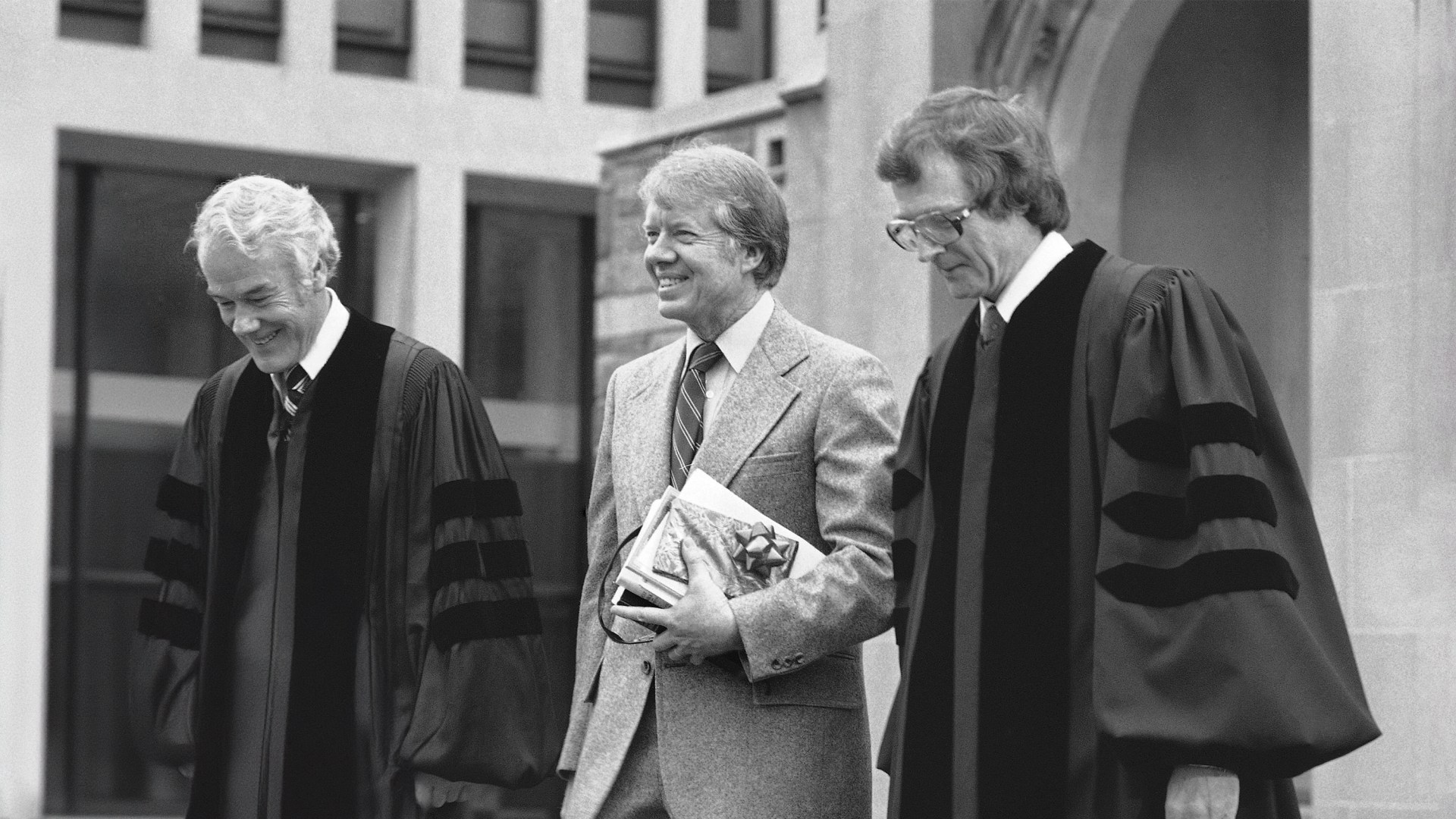
Does Carter’s Christianity Count?: Moral Leadership Is Essential

One of Jimmy Carter’s biggest contributions has been the model of his private life.

Associated Press / Edits by CT

It has been two years since Jimmy Carter won the presidency of the United States on a platform that pledged, in part, that he would bring newness of spirit to the American people. He was a confessed “born again” Christian; ergo, he was a moral person.

The fact that CHRISTIANITY TODAY is running articles on Carter’s morality indicates that there is still doubt in the minds of many people, including evangelicals, as to how moral the president really is and how well he has integrated his belief in Christ with the demands of his office.

I have a sense of confidence in his morality. But my confidence is tempered by what I perceive as serious or potentially serious problems. First, private morality. During the 1976 campaign, the people I associate with—reporters, by nature a cynical lot—treated Carter’s faith as somewhat suspect, perhaps a device for winning the votes of the millions of Americans who viewed themselves as born-again Christians. Some people wondered whether they wanted a person who actively said he prayed for guidance from God to occupy the office holding the key to unleashing a nuclear attack.

That has changed. Nearly every reporter I know accepts the genuineness of Carter’s Christian experience, just as I do. Even those reporters who are not especially endeared to him as a person or endeared with his political positions concede that he is a devout Christian. One of my colleagues has said on occasion, “All Jimmy Carter cares about is God and Sunday school. The best way to get to know him is to hear him teach Sunday school.”

In his right-front pew at church each Sunday, Carter begins the worship hour in prayer by leaning far forward, bowing his head and resting it on his hand. Nowhere does he so obviously feel “at home” as he does in Sunday school or in worship at the Baptist church.

I recently completed a book, to be published soon by Macmillan, that compiles and arranges by theme most of Carter’s public statements on his faith as well as the word-for-word transcripts of seven or eight of the Sunday school lessons he has taught on a fairly regular monthly basis. My editor, who is not an evangelical, commented that Carter seems to have become increasingly more spiritual during his presidency. That was my conclusion as well.

He has a mastery of the Bible and his understanding of the basic doctrines of sin, salvation, the cross, the Holy Spirit, and the second coming is evangelical and biblically orthodox. Here are excerpts from what Carter has said.

On Confessing Sin

“Suppose we kneel down at our bed at night and say, ‘Lord, forgive me of all my sins.…’ I don’t believe it works unless we’re willing to say, ‘God, today I was not kind to my husband or wife, my children. God, today in a business transaction I cheated a little bit. God, today most of the time I was separated from you. God, today I told two or three lies or misled people a bit. God, today I had a chance to do some kind things or I had a chance to forgive someone I had hatred for and who hurt me. I didn’t.’ Enumerate them! Call them by name. Under those circumstances, all your sins are wiped away.”

On Salvation

“We’re not saved because we’re Americans; we’re not saved because we come from a community that’s stable; we’re not saved because our parents were Christians; we’re saved because God loves us; we’re saved by grace through one required attitude—that’s faith in Christ.”

A Prayer For Discipline

“Let us come … to worship you, opening our hearts to reexamine our sins and shortcomings. May we reestablish a closer relationship with Christ, and be made more aware of the needs of our neighbors and our human needs. We have a personal responsibility to represent you. May we have a personal relationship through prayer and the study of the Word.”

On Death

“Physical life is not the most important thing in God’s eyes. We attach great importance to death, funerals, bereavement, and so forth. If we are Christians, that’s the beginning of our promised life with Christ. What Christ was saying was, the destruction of a human being’s relations with one another, relations with God, are much more important than even the loss of one’s life.”

His spiritual disciplines are well known. He and his wife read Scripture together each night. He prays frequently during the day—“Almost like breathing,” he once commented to me. His personal disciplines also are well known (and by citing these I do not claim these are marks of spirituality). He says he has never smoked a cigarette in his life. He drinks so little as to be almost a teetotaler. But he is not adverse to working on Sunday.

And Carter witnesses. Jokes bounced around the White House press room when it was revealed he prayed at congressional leadership breakfasts before the likes of house speaker Tip O’Neill and other politicians from smoke-filled rooms. He says his witnessing missions in the late 1960s revitalized his faith and brought him to a closer union with the Holy Spirit. He has dropped hints that after he leaves office he might become a foreign missionary. He urged the Southern Baptists to increase their number of foreign missionaries, and last spring he remarked to the Southern Baptist Convention’s Missionary Service Corps, “I wish, in a way, that I was free to do more. After my service in my present office, I intend to do more.…”

I believe that one of Carter’s biggest contributions as president has been the morality and model of his private life. It is important that individuals have persons to whom they look as models. It is just as important that a nation have a leader to whom it can look as a model of private morality. Recent presidents have failed utterly here and we have been embarrassed as a result. Carter has been exemplary, not only in his spiritual depth but in, for instance, his love for the arts and nature, which exceeds that of almost any recent president.

Jordan’s King Hussein, a Moslem, once told Carter in my hearing: “Few world statesmen in recent memory have so clearly and unmistakably defined the personal responsibility of people in high government positions. You have recognized that those who make decisions on behalf of the nation must reflect a code of behavior equal to that of the nation as a whole.”

Yet, I see concerns. There are very few, if any, evangelicals in Carter’s White House inner circle or even his second level of advisers. Why? Why do so few of Carter’s family or his closest aides share the vigor of his faith? Most members of his inner circle have been with him since he was Georgia governor. They believe in Carter and are almost fanatically loyal to him, but they often speak and behave in a way that seems a flagrant mockery of what obviously is of central importance to him. Has he ever witnessed to them? And what of his loyalty to them? Is it so blind that he overlooks their indiscretions? I know that each person is singly responsible for his or her relationship to God, and one must not hold another responsible. I also know that even if Carter’s closest aides were to follow his example, that would not necessarily result in their trust in Christ. But why do they not respect him at least to the extent that even though they may not share the depth of his belief they do try to respect his life style in their actions?

Of greater concern is the fact that, to my knowledge, Carter does not participate in a small group for spiritual fellowship and growth. He apparently depends almost entirely for his nurture on his daily personal devotions and Sunday worship at the Baptist church. I think the greatest thing that Christians can pray for in regard to Jimmy Carter is that a small group of politically unambitious but spiritually vital persons will spring up around him.

Second, public morality. It is not adequate that a president simply be a Christian. He must also bring to bear the demands of the Gospel on every aspect of his administration, especially in dealing with the poor and the powerless of this nation and the world. It is my belief that Carter has tried as hard and effectively as any contemporary American politician to integrate his private beliefs with his public policies. There are several notable examples.

If Carter were to leave office tomorrow, history probably would remember him for his emphasis on human rights. You can question just how successful he has been in restoring human rights to the millions of oppressed persons in this country and the rest of the world: He acknowledges this. But Carter says that at the least he has raised the consciousness of every world leader to the matter of human rights. He has pointed out that violations of human rights occur in America as well as in other nations.

Carter traces the origins of human rights to the Old Testament Law and Prophets. He once said: “I have been steeped in the Bible since childhood, and I believe that anyone who reads the ancient words of the Old Testament with both sensitivity and care will find there the idea of government as something based on a voluntary covenant rather than force—the idea of equality before the law and the supremacy of law over the whims of any ruler; the idea of dignity of the individual human being and also of the individual conscience; the idea of service to the poor and to the oppressed.…” Often he has expanded his definition of human rights to include the right to a job, a place to live, an education, and good health.

He also has defined power in terms of servanthood, a concept developed by the prophet Isaiah and later by Jesus Christ. He told employees at the Department of Health, Education and Welfare that he came “not as first boss’ but as ‘first servant.’ ” “There is a close correlation between worship services and correcting wrongs,” he said on one occasion. “That’s what the Bible teaches, because Jesus Christ never hid himself seven days a week in the synagogue. He walked the streets. He touched blind eyes. He healed those who were crippled. He pointed out injustice. He brought about compassion and brotherhood and love. And he changed lives.…”

But the keen observer will realize that Carter’s administration has fallen far short of his lofty words. There are some bright spots. During his presidency, unemployment has dropped about 2 per cent. Of all presidential appointments, about 20 per cent have gone to women—five times as many as during the previous administration. Yet, no one can claim to have adequately responded to Malachi’s admonition not to oppress the wage earner when 6 per cent of the nation’s workforce do not have jobs and the percentage is twice as high for blacks and six times as high for black teen-agers. No one can claim to have adequately achieved justice when the role of most women in the government, even some with college degrees, is still that of the clerk-typist.

Time and time again the biblical writers speak of concern for the widow, the orphan, and the alien. Yet millions of people remain locked in poverty and on welfare rolls. The task before the nation is to change the institutional causes of these gripping human problems. Jimmy Carter’s task has just begun. Many evangelicals, such as Jim Wallis and Wes Michaelson at Sojourners magazine, have aspired to prophetic roles in calling America and the president to national righteousness. They have pointed to the unevenness of the Carter Administration in its human rights policies throughout the world and its inconsistency of talking about nuclear disarmament while actively considering plans to build the neutron bomb. All of us, including Jimmy Carter, need to pay attention to what they are saying.

“The virtues which we admire in private life and profess in our religion become secondary qualities in our rulers. The test of greatness in tsars or presidents is not in their private lives or even in their good intentions, but in their deeds” (Nicholas and Alexandra by Robert K. Massie, Atheneum, 1967).

Yet, the modern prophets enjoy a luxury that Jimmy Carter does not. They can write with the knowledge that their words will not much affect the nation or the world. This gives them an abandon that the president does not have. Every time Carter yawns or utters the simplest statement the mass media, of which I am a part, records it and distributes it around the world. It is analyzed and tested in the furnace of the public, the Republican party, the Soviet Union, China, and who knows who else. He has to speak with great care. His words determine the course of events.

But our responsibility as Christians and as citizens require that we continually probe the president’s actions and motives. Has Carter been inconsistent in applying the standards of human rights throughout the world because he is devious and lacks courage? Is his failure to press for welfare reform the result of not paying attention to what the Bible says about the widow, the orphan, and the alien? Was he being dishonest in making campaign promises that he now has had to set aside temporarily, such as tax reform?

Not necessarily. Politics is the art of the possible and of constructing fragile coalitions. The complexity of our age and the seriousness of our problems and the colliding interests of people probably are too demanding for one person, even the president, to handle in the way he or she feels best. The compromise energy bill fell far short of what Jimmy Carter proposed in April 1977 when he described his approach as being “the moral equivalent of war.” But the sad truth was that the compromise, even with the gradual deregulation of natural gas, was about the only version that Congress would enact.

Nowhere has this been illustrated more dramatically than in Carter’s handling of the Mideast crisis, During the 1976 campaign. Carter said on several occasions that he believed modern Israel was the fulfillment of biblical prophecy. A short while ago I was speaking to a group of evangelical college students and during the question-and-answer period a student raised the matter of the Middle East. He contended that Carter was not seeking to restore to Israel the boundaries that God promised Abraham in Genesis 15—the river of Egypt (probably Wadi Arish, in the middle of the Sinai) and the river Euphrates. Thus the president was being unfaithful to Scripture. God is a God of history and eventually his will shall be accomplished in the Middle East. But had Carter pressed for those boundaries in 1978, there probably would have been a conflagration that would have destroyed Israel and probably brought war to the world. I suggested to the student that the best thing that Carter could do to help Israel was to take steps that would help insure its survival as a nation.

Most diplomats and journalists see the problems of the Middle East through a political lens. From the very start of his conversations with Israel’s Menachem Begin, a Jew, and Egypt’s Anwar Sadat, a Moslem, Carter emphasized the religious nature of the ancient dispute. He sought unity on the fact that all three of them were religious persons and looked to Abraham as their father. And when the three leaders came down from the Camp David summit, Carter said their first agreement in the marathon negotiations had been to ask the people of the world to pray.

When Carter was reporting to Congress on Camp David, he added a sentence extemporaneously to his speech: “And I would like to say, as a Christian, to these two friends of mine, the words of Jesus, ‘Blessed are the peacemakers, for they shall be the children of God.’ ” It was a moral statement from a moral man.

Wesley G. Pippert is a reporter who covers the White House for United Press International.

Does Carter’s Christianity Count?: Faith, Virtue, and Honor Are Not Enough

The world is too complicated to substitute good intentions for experience.

Despite the appealing image that President Jimmy Carter has tried to cultivate—of being open and candid and honest—doubt lingers as to how well he lives up to his own standards. Maybe they are impossibly high, but by proclaiming them so strongly, Carter should have expected to be judged harshly. The question is: How hard does he try?

Perhaps Jimmy Carter has not been president long enough, but it might be useful to try to put him in historical perspective. Let’s look first at the campaign of 1976.

As a candidate, Jimmy Carter was criticized—roundly and rightly, I believe—for being vague on the issues. It may be that he was not sufficiently well-informed or even sufficiently concerned to take strong positions. More charitably, you might speculate that he deliberately side-stepped controversy in the interests of continuing the post-Watergate healing process that Gerald Ford had nobly begun.

Whatever the motivation, the result was that Carter soft-pedaled ideology and instead appealed for support on the basis of that more amorphous quality he liked to call “character.” He consciously tried to subordinate substance to style. It is hard to remember, looking back, what major philosophical positions he took, what clear programmatic commitments he made—or even where, in general, he seemed to place himself on the political spectrum. On the other hand, it is easy to recall the personal image he projected: the soft-spoken Georgian outsider tilting with the Washington Goliath; a leader “as good as the American people”; our own latter-day George Washington who would never tell a lie.

If his purpose were simply to emerge as the least objectionable candidate and paper over party divisions, he could not have devised a better strategy. Avoiding specifics, he avoided giving offense. The constituency he cultivated was oriented to Jimmy Carter the man, rather than to any set of ideas, plans, and goals that he represented.

Now, I have no objection to a candidate selling himself on the basis of his innate virtue and honor; indeed, I wish there were more to go around. But although virtue and honor have their place and constitute a necessary consideration in electing a president, they are, in and of themselves, hardly sufficient.

The world is too complicated and precarious to be led by those who think good intentions are a reasonable substitute for knowledge and experience. The patience of our citizens is tried enough as it is to be governed by leaders who require on-the-job training in the massive and mysterious ways of the federal government. I’m all for fresh faces and new blood, but, really: The task is so challenging, you have to get off to a running start if you intend to have any impact.

Yet I can understand the public mood that propelled the one-term Georgia governor to the highest office in our land. It was a mood that had soured on politicians who seem to know and promise too much. Issue-oriented campaigns like those of Goldwater and McGovern held unpleasant memories of ideological wrangling. Too specific and aggressive in their platforms, they antagonized as many voters as they attracted. As for the Hubert Humphreys and Gerald Fords, they were perceived, however unfairly, to be shop-worn apologists for any despised thing a voter associated with Washington.

Moreover, the credibility gap that had plagued administrations of both parties during the previous decade cheapened the very value of platforms and promises: They didn’t seem to be kept very often. In 1964, candidate Lyndon Johnson affected to be practically a peace-nik compared to his opponent. But shortly into his new term he plunged this nation into its most disastrous episode of war. Richard Nixon some years later campaigned on his unimpeachable record of anticommunism, and then, safely elected, announced to the world one night that he had decided to go to Peking and propose toasts to Chairman Mao.

Given the rapid pace of events in the third quarter of the twentieth century, it is possible voters found themselves hoping that false promises would not be made, that the president would preserve for himself the flexibility to examine each situation anew and adapt to changing circumstances. Finally, Americans had developed such a mainstream of values and policies that, to many, the critical concern about a candidate was not his stand on particular issues but more intangible things, such as his leadership ability or his trustworthiness. All in all, the electorate was left by 1976 not a little susceptible to candidates who were “fuzzy” on the issues, yet righteous in their rhetoric.

Jimmy Carter sensed this mood and exploited it well. In fact, he even went to the trouble of developing two quite different images to suit the new public mood. One conveyed competence, the ability to run the government efficiently and decisively; the other conveyed character, the ability to run it honestly and morally. He struck at times the pose of the competent manager: the Annapolis graduate who understood discipline, the nuclear engineer conversant in the detail and complexity of policy problems, the successful businessman who knew how to make decisions and meet a payroll. At other times Jimmy Carter could have been mistaken for a Baptist preacher: sprung up from the red clay of Georgia, heir to the homespun wisdom of a small-time farmer, just regular straight-and-narrow plain folk, making speeches from the stump that sounded like sermons from the pulpit.

If the public wasn’t sure what specifics Carter stood for, one or another of those general images was apparently enough to convince it he could be president. After an era of worldly and sophisticated types at the White House who still managed to go so wrong, the romantic notion of the American presidency had again become appealing: that all it takes to run the country is common sense and hard work. That, of course, is why Truman has enjoyed such a revival. Lest Jimmy Carter lose a chance to bathe in reflected glory, you may remember that one of our new president’s first official acts was to recall from the Truman Library in Independence, Missouri, that famous desk plate that says, “The Buck Stops Here.” It is reminiscent of the none-too-subtle way Richard Nixon once compared himself to a famous predecessor: When Watergate was at its height, and Nixon was coming under unceasing attack, he volunteered the analysis that Abraham Lincoln had been maligned in his day, too. Regrettably, this did not in truth make Nixon a Lincoln, nor is Jimmy Carter necessarily a Harry Truman.

Nonetheless, from the outset of his presidency, Carter behaved boldly, as though the comparison and confidence were deserved. It was the preacher and political activist in him coming out. He had not run for two long years to be president only to arrive at the White House and sit on the Truman balcony.

For all his previous fuzziness on the issues, it turned out Carter had a huge agenda tucked away in his coat pocket. He took it out, turned to Congress, and demanded immediate action. Among other things he wanted: national health insurance, welfare reform, an energy package that even Santa Claus couldn’t deliver, civil service reform, extensive reorganization of the Executive Branch, wholesale reforms of the tax code he had called a “disgrace to the human race,” hospital cost-containment, and a streamlining of Pentagon operations that would save the country a promised $8 billion.

Never mind if these proposals were only half-developed or still in the conception stage, or if they were delivered to Congress with amazing naïveté about what it takes to get something passed in that complex, independent body. It should have surprised no one that the president found himself stalled on major fronts. And for having raised expectations so unrealistically high, respect for his performance plummeted all the more. He only slowly learned the need for compromise—let alone the art of it—and his relations with the Congress have often been in disrepair. His standing in the polls has been at times an embarrassment to the country as well as to the president himself.

It is one thing when the president acts this way on the domestic front; the damage can be limited because the Congress acts as a check and balance. In foreign affairs, however, where the president serves as our one spokesman, the damage can be much more severe and less reversible.

The litany of missteps is long and familiar: the confused and indelicate handling of Mideast matters, which has been overcome at strategic points largely because the countries involved are strong and independent enough to make progress on their own; the costly battles with the Senate over Panama and the F-15 sale to Saudi Arabia, which might have been averted by more adroit Congressional relations; the abortive Anglo-American initiatives in Rhodesia; the fiasco of our nonpolicy toward Ethiopia and Somalia in the Horn of Africa; the quarrels with Japan over trade and with Pakistan over nuclear reprocessing; the blunt announcement of a timetable for Korean withdrawal, unnerving allies who hadn’t been consulted; and our dangerously unstable relations with the Soviet Union—and, in their trail, uncertain prospects for a timely, fair, and meaningful agreement on stragetic arms limitations. Even the much-touted administration success in lifting the Turkish arms embargo was achieved more in spite of, than because of, the president’s efforts, considering that on this issue Republicans were his mainstay, and fellow Democrats his leading antagonists.

The pattern in these cases is distressingly similar: Carter, the moralist, receives a revelation, hands it down uncompromisingly, and is startled when it is rebuffed. He then starts over at square one, having lost valuable time, as well as the advantage.

Perhaps the classic example of this modus operandi in foreign affairs was his early lecturing on human rights, which, admirable as its motivation, turned out to have been conducted in such a public and sanctimonious way as to provoke the pride of the offenders, cause hardening of positions, and in the end proved counterproductive. Carter’s actions, more ideological than practical, confirmed the age-old paradox that the best is sometimes the enemy of the good. Our black-and-white perceptions of right and wrong are not always shared universally, and to try to impose American standards on countries of widely varying circumstances itself raises moral questions. It’s true that much of the American public seemed in the last election to have soured on too much Kissinger-like realpolitik. Americans yearned for more undiluted morality in our foreign policy. This showed up in the responsive chord that both Carter and Reagan struck in seeming to take strong ideological stands on such issues as human rights and the Panama Canal. People do like to stand for something, and it is much more exciting to talk boldly than in a wishy-washy, though practical, way. And it is much more satisfying to the conscience.

But look at it another way. If we’re really determined to be so perfectly moral, why is there no greater public outcry raised against continued deployment of tens of thousands of troops in Korea serving to defend the repressive regime of President Park? Why do we prop up Mobutu in Zaire with economic and military aid, or Baby Doc in Haiti, or Somoza in Nicaragua? For that matter, if we want to make an unambiguous moral statement, why not just unilaterally disarm this very moment?

Of course, the reason in all these cases is that foreign policy issues, like most situations, are complex and have to be judged in context rather than in isolation. America has many interests, and they all have to be assigned a certain importance and weighed one against the other. Opinions may differ on what policy is proper in those particular cases, but reasonable people should be of one mind that the decisions at the bottom line should be balanced. They cannot be dictated by any absolute standard. I believe that President Carter has come around to this viewpoint. I will credit him with this: He’s a good learner. It is unfortunate that the Administration has had to learn its lessons at the expense of the leadership our nation has urgently needed for two years.

Indeed, Carter’s greatest success on the foreign affairs front, the Camp David agreements, is testimony to how far the president has come around in terms of his diplomatic style and perspective, and a vindication of the approach favored by his predecessors. It is hard to remember at this point how severely he once criticized the quiet and personalistic diplomacy of Henry Kissinger, so much does he seem now to have emulated it, certainly in the instances of his success. With respect to Mideast peace, the discovery should not have been unexpected: Having first tried to impose grand American designs and exert public pressure on the sensitive parties, he finally realized that the most effective way to resolve problems is simply to let the parties negotiate for themselves, though the president can still perform a key role in getting them together and, in a low-key way, offering them options.

Jimmy Carter is a good man; I respect him. But the problem is that he is too conscious of his image, and, unfortunately, hasn’t decided what kind of image to project. The unhappy result for both him and his country is that he sometimes exemplifies two very different personalities, alternating between one of excessive moralism, and one that represents politics-as-usual, when he seems to suspend his proudest virtues. We are left to wonder: Why not choose a more down-to-earth middle ground? Say what you mean, and mean what you say. For a decent man, morality at that point will only come naturally.

John B. Anderson is a Republican congressman from Rockford, Illinois.

Ideas

Consumerism and Christian Higher Education

Evangelical colleges and Bible schools have yet to be affected by consumerism in the way the above mock headline suggests. However, Christian higher education will probably soon feel the impact of consumerism in other ways. The constituents of evangelical colleges may ask some pointed questions about what kind of product such schools are releasing. And they have a right to know.

Earlier this year Jonathan Kaufman wrote a guest column for the New York Times, “Yale Cheated Me out of Truly Liberal Education.” Are some of our alumni ready to write a similar piece? Can the glowing claims of school catalogues and promotional literature be documented in the lives of graduates? Socrates reminds us that the “life that is unexamined is not worth living.” Have we been giving the graduates of our evangelical colleges the opportunities and the instruments that will help them examine their lives five, ten, fifteen, twenty, or thirty years after the commencement service?

A 1974 survey on doctrine and Christian conduct of Moody Bible Institute alumni revealed that these graduates wanted to talk to their school. After completing a twenty-one-page questionnaire, more than half of the 1,332 respondents took time to write some personal comments. (A few of them wrote two or three typed pages.) They seemed to be saying, “Why hasn’t anyone asked us these questions before?” At most Christian schools, no one has ever taken the time to ask graduates how their Christian liberal arts education has affected their lives.

Also in 1974, a survey was made of 311 Christian colleges, Bible colleges, and seminaries, from Appalachian Bible Institute to Yale Divinity School. The returns revealed that only seven schools had ever polled their graduates about doctrine and Christian conduct, and then only as incidental items appended to general demographic surveys. Not one school had devoted an entire survey to the doctrine, the conduct, or the values of their graduates. The situation probably hasn’t changed much during the last four years.

What do Christian educators really know about their final product? Do the trustees have a clear picture? Do they talk frequently with graduates? What questions are these boards asking about their alumni?

What about the administration? Why has so little effort been made to find out who the graduates are? How can school administrations lead students if they don’t know what the students are like? (A sad footnote. Even when educators have conducted surveys, they don’t tell people the results. Are the followers of the one who called himself truth afraid of it?)

What about the faculty? In some Christian schools, individual departments have done a superior job of keeping in touch with their graduates. Updating a curriculum would not be the only benefit. Opinions of alumni could help deans form more realistic codes of conduct, ones that are more biblically based and that would lay the foundation for a Christian life style. The code of conduct in Christian colleges has often been viewed by students as a wooden weight they grudgingly dragged for four years and then dropped with a crash at commencement.

Today we have the tools, the methods, and the personnel to find out what graduates think. It’s easy to get books on how to design a questionnaire and judge the responses. (See, for example, James Engel, How Can I Get Them to Listen?, Zondervan, 1977). Failure to know our alumni and reckon with their views could even result in the closing of some of our schools in the next decade.

Christian educators need to know how to serve students. Responses to questionnaires could give us clues as to why some of our graduates leave evangelicalism after graduation to adopt non-Christian life styles. Surely a Christian college has a responsibility to its graduates even after the last tuition check has cleared the bank or the last chord of the commencement recessional hymn has sounded. Let’s not wait until consumerism catches up with us.—GLENN F. ARNOLD, associate professor of journalism, Wheaton Graduate School, Wheaton, Illinois.

Who Is Really Doing Satan’S Work?

Guerrilla wars. Terrorist attacks. Political assassinations. Recent international violence has caused the deaths of many innocent people. Christians are appalled by these senseless killings. Unfortunately, less attention within the church is focused on a different kind of violence. It involves little bloodshed and is rarely punishable by death or imprisonment. Most of us must plead guilty to this crime: violence of the tongue—the gossip that can destroy a person or a group’s reputation.

Ray Kroc, founder and head of the McDonald’s fast food chain, was recently a victim of such verbal violence. Somewhere the rumor started that he contributes large sums of money to the Church of Satan.

Without checking the facts, certain church groups and individuals risked a man’s reputation in order to warn their constituents not to buy hamburgers from a possible Satanist. Informal boycotts against the company began, and one McDonald’s official says, “Some loss of business can be attributed to this rumor.” Worse than any financial damage that Kroc may have suffered, however, is the damage levied to his reputation.

When the rumor started, Kroc called it “utterly ridiculous.” Kroc has been a Congregational church member since childhood and has given money to many religious and humanitarian groups. But he denies ever giving a cent to the Satanists. He has made a large contribution for the construction of Robert Schuller’s Crystal Cathedral and was scheduled to share Schuller’s television pulpit one Sunday this month.

Since the rumor was most pervasive within churches, a McDonald’s staff member met with church leaders in the South—the area where the rumor appeared to start—asking them to quell the fears of their parishioners. Fortunately, a major denominational news agency researched the rumor, which had appeared in several of its state level publications, and declared it “unfounded.” An Ohio pastor who printed the rumor in his church bulletin later retracted it after he studied the situation. Despite these refutations, Kroc now must play a game of catch-up to restore his good name. And that is not an easy game to play.

A similar case involves the Federal Communications Commission, which has had to use tax money for several years to handle some eight million letters from church members who thought the commission was going to ban religious broadcasting. The FCC was supposedly responding to a petition from Madalyn Murray O’Hair that she, in fact, never filed. The Milam-Lansman petition, which could have been harmful to religious broadcasting, was denied in August, 1975. (See news stories in issues for June 23, 1978, p. 43, and January 7, 1977, p. 41.)

Of course, McDonald’s is big enough to survive this flutter. Indeed, most hungry people care little about the spiritual purity of a Big Mac.

But if only a portion of the fervor that motivates an uninformed campaign like that against Kroc were channeled into the war against gossip, the church would be well-served.—J.M.

Eutychus and His Kin: November 3, 1978

“If you want to know what it’s like to be a pastor, put on a deerskin shirt and take a walk through the woods on the first day of hunting season.”

I don’t know who said it (just that he was an older pastor in New England), but I think he was on target.

Another pastor—this one a Presbyterian from Seattle—said something similar: “People expect the minister, his wife, and children to be perfect. But you know they don’t really think this, or they wouldn’t be so quick to criticize.”

Criticism can help us examine ourselves, help us grow. “Critics are the unpaid guardians of my soul” was the mature reaction of E. Stanley Jones to those who caviled or found fault with his work or writings.

But criticism can also be destructive. It is my opinion that more than a few children of the manse and of Christian organizations turn aside from faith and church because of treatment their parents received at the mouths of those they served. Parents may learn humility through the criticism; children may learn to despise the work of the Lord for hurts inflicted on the mother and father they love.

The law of kindness should determine our thoughts and words about our leaders. Bishop Stephen Neill has the last word, and it is an encouraging one: “Criticism is the manure in which the servants of the Lord grow best.”

EUTYCHUS VIII

Word Choice

In the Sept. 22 issue (News, “Catholic Charismatics: An Evangelical Thrust”), the Catholic charismatics are spoken of with the use of the word “evangelical.” But in my conversations with such people, I have discovered that in spite of their refreshing enthusiasm, they will not admit to any alteration of the Roman Catholic position. In other words, a full and free salvation is not yet theirs to proclaim. That being the case, the word “evangelical” is not yet the word. I hope some day it will be.

EDWARDS E. ELLIOTT

The Garden Grove Orthodox

Presbyterian Church

Garden Grove, Calif.

Reid and Intuition

It was very good to see Thomas Reid receive long overdue recognition in the recent article by Michael L. Peterson (“Reid Debates Hume: Christian Versus Skeptic,” Sept. 22). Reid’s epistemological critique of Hume and, more particularly, of the Lockean conception of perception is certainly a valuable tool for modern evangelical apologetics. It is, however, somewhat disturbing to see Reid’s reliance on intuition and the common sense of mankind proposed as a royal way to Christian truth. Speaking as an individual, and presumably part of common humanity, I do not intuit the kind of human freedom which was so clear and distinct to Reid and his successors. Nor from my Reformed perspective do I see Jeremiah (Jer. 17:9), the Apostle Paul (Rom. 9:19–21), or our Lord himself (John 6:37) intuiting that which for Reid was merely common sense about human freedom. Speaking as a historian, recent studies (Bozeman, Protestants in an Age of Science; Meyer, The Instructed Conscience) have shown all too clearly how easy it has been for American followers of Reid to make his common sense realism anything but an ally of scriptural Christianity. In taking nationalistic, anthropocentric, and individualistic convictions to be the common intuitions of mankind, they bequeathed elements of a sub-biblical faith to modern evangelicals who need to rely far less on the instability of intuition and far more on the realities of revelation.

MARK A. NOLL

Mundelein, Ill.

Perfect Balance

My thanks for the fine article by John Montgomery, “Luther, Anti-Semitism, and Zionism” (Current Religious Thought, Sept. 8). Though I usually approach Montgomery’s articles with a rather negative enthusiasm, I found his vindication of Luther and his brief spiritual analysis of Zionism to be both insightful and helpful. The article intrinsically set forth a good balance between anti-Semitism on the one hand and an uncritical support of Israel on the other. Well done!

TOM BLANCHARD

Denver, Colo.

Christian Affirmation

Mark Marchak’s article “Painting as Propaganda” (Refiner’s Fire, Sept. 22) was an interesting, informed, and truly stimulating and thought-provoking piece of writing. His parallels between art in the Soviet Union and in the church are very much to the point. CHRISTIANITY TODAY deserves to be commended for publishing articles like Mark Marchak’s. By doing so, you affirm that Christians can be sensitive, perceptive, and can have good taste in art.

(THE REV.) MICHAEL G. VIISE

Minot, N.Dak.

Dirty Smear

In the past CHRISTIANITY TODAY has kept fairly clean of the ideological knife-and-twist wars between “left” and “right.” It is with deep anguish that I see the ugly smear against conservatives show up in your pages. In the Thomas Tarrants interview (“Terrorism Today,” Sept. 22) the smear starts with the deceptive use of the term “right-wing,” listing as examples: Nietzsche, Fascist, neo-Nazi, anti-Semitic, anti-Negro, anti-Communist, and fundamentalist. Then comes the switch from the term “right-wing” to “conservative” when Tarrants is quoted as saying, “There is entirely too much of an affinity between conservative politics and evangelical Christianity.…” American conservatives have nothing in common with the KKK, the National States’ Rights Party, etc., except for anticommunism, and even there we reject their Zionist superconspiracy theory. American conservatism is also at opposite political poles from socialistic dictatorships such as Fascism or Nazism. Therefore, the honest journalist ought to avoid the term “right-wing” altogether. A serious rift has, for some time, been growing between evangelical liberals and conservatives, which, if not healed, will rend the evangelical camp irreparably in two. CHRISTIANITY TODAY, with its large readership from both camps, is uniquely positioned to bring the two camps together. But this won’t be accomplished by publishing false caricatures of God’s people. Please open your pages to conservative writers for balance.

FRANK VOSLER

New Albany, Ohio

Promise Of God

Thanks abundantly for the recent article, “Parents and Prodigals” by Virginia Stem Owens (June 23). While it may “leave the taste of sawdust” (see Eutychus, Aug. 18) in the mouths of some, I believe she said something that for too long has been unsaid.… Parents cannot save their children from sin; neither can they somehow infuse the Holy Spirit into them. What God does promise parents is an endless, inexhaustible supply of agape love, accepting, unconditional, and true, love that takes over where our love ends. This is the love we can pour out on our children abundantly in any circumstance.…

GEORGIA NELSON

Penn Valley, Calif.

Highest Calling

I heartily endorse Paul Benjamin’s article, “The Urgency of the Equipping Ministry” (Sept. 22). This article is another reminder of the gap between the New Testament understanding of pastoral ministry and the superstar mentality that has infected the majority of our churches today. The New Testament puts emphasis on plural leadership in the local congregation, ministry through God’s equipping graces, and leadership growing out of discipleship—all under the unique headship of Jesus Christ and empowered by the Spirit. There is no higher calling than the shepherding ministry in which God uses men and women not only to feed the flock but also to equip it so that all believers truly are ministers. If pastors can be trained to be equippers (both in seminary, where this ministry is often neglected, and on the job), this will go a long way toward renewing the church and revolutionizing its impact in society.

HOWARD A. SNYDER

Light and Life Men International

Winona Lake, Ind.

Double Standard

Your news story “Stormy Weather at the W.C.C.” (Sept. 8) evoked the following (irreverant? irrelevant?) response in me. Isn’t it a notable curiosity that American Christians, living in a country that was “born in a revolution,” are so critical of the turn toward violence which has been taken by many people aspiring for independence in Rhodesia and South Africa? Is it because the oppression experienced by the blacks of Rhodesia and South Africa is so minor as compared with the disgraces inflicted upon the longsuffering American colonists that people laud the American uprising and condemn the Africa one? As a Christian who believes that the way of the cross means the way of nonviolence, always, I do nevertheless believe that selective objection to war and violence is better than no objection at all. However, a selective process which prefers the violence of the rich and the powerful to that of the poor and oppressed does not have much to commend itself to biblical people. Perhaps the time is right in the church for an agonizing reappraisal of the whole question of violence.

JOHN K. STONER

Mennonite Central Committee

Akron, Pa.

Unusual Accord

Although I am not accustomed to finding myself agreeing totally with any article or editorial in CHRISTIANITY TODAY, I find that I am in total accord with the editorial “Selling in God’s Name” (Aug. 18). Having worked in bookstores of evangelical conviction for over five years, I agree with both the editorial’s much-needed criticism of the “junk food” books and gospel “trinkets” as well as the well-balanced appraisal of our wealth in books and music of quality. CHRISTIANITY TODAY is to be congratulated for its boldness and sensitivity. Thank you for finally publishing what I have been thinking for some time.

JOHN KOHLENBERGER

Portland, Oreg.

Dare to Be Biblical

As an anthropologist who has been directly involved in missions for a quarter of a century, I was most interested in the dialogue between Peter Wagner and Ray Stedman (“The Melting Pot,” Aug. 18). As Wagner points out, the homogenous unit principle is based on empirical evidence drawn from sociological theory. In many cases churches do grow that way today. But, as Stedman indicates, is this the kind of church the New Testament speaks about?—where racial, economic, social, and political barriers were all broken down through the cross. Certainly, no church has ever grown more—quantitatively as well as qualitatively—as the church of the first century, but that growth was not along homogenously discreet ethnic or class lines. I’ve often wondered what would happen if the church of today would dare to live out its message as the New Testament describes.

WILLIAM J. KORNFIELD

Columbia, S.C.

Editor’s Note from November 03, 1978

For all too many Americans election day only comes every four years. By this they deny themselves their birthright. Elections are held every fall, and for most parts of our nation important electoral decisions are scattered throughout the year.

In a democracy I cannot escape a moral and spiritual responsibility to vote. If I view my government as the establishment of a den of iniquity I must reckon with the fact that I am a part of the electorate that established that government. Neither can I rationalize my failure to vote by arguing that among so many millions my single vote counts for nothing. I still must answer to God for my fraction of the total vote, and I must bear that much responsibility for the kind of government I get—good or bad.

Be sure to read the pro and con evaluations of President Carter’s moral leadership. (See pages 14 and 15.) One or the other (or both) may make you angry, but they will do you good.

The Boat People

Every now and then a hopelessly overcrowded little boat arrives at Darwin. Jammed with refugees, it has made the hazardous voyage from Viet Nam with inadequate supplies, often with nothing more than a compass and a page torn from a school atlas as navigational aids. Typically the boat has far too many people in it for even reasonable comfort as the people scramble for places in the boat that they hope will bring them to a new life. More often than not the boat is in pretty poor shape. The refugees must know that there is a good chance that they will not survive (it has been estimated that at least half the ships sink on the way). The little boats were not designed for long ocean voyages and they are usually not in the best of shape to start with.

But still they come. Despite the dangers and the hardships they keep coming. The refugees may not know all the hazards into which they are thrusting themselves but they do know what they are fleeing from. So they continue to make the effort.

So far those who have reached Australia have been allowed to stay and efforts have been made to find jobs and places in the community for them. But there have also been voices raised in protest. Unemployment in this country is high so some ask, Why should we allow these people to come in and take jobs away from native-born Australians? Others point to recognized immigration procedures and ask why these people should be allowed to jump the queue. There have been allegations that some who arrive in the little boats are not really refugees, destitute and friendless, but wealthy people who choose this way of getting away from their problems in their own land and starting afresh in this one.

In our world there are many groups of refugees and no real solution to the problem has been found. The Palestinians are a continuing reminder that the problem can be lasting and intractable. So there they are, in many countries throughout the world, minority communities without rights, without possessions, and often without hope.

It is rarely that they are given anything remotely resembling a welcome from the host country. Indeed, the opposite is often the case, for a minority group, especially an ethnic minority, forms a splendid scapegoat. When troubles arise in our community most of us are happy to find someone on whom we can heap the blame. It is comforting to divert attention from our inability to solve our problems by saying that really it is not our fault. If it were not for these aliens in our midst we would be all right.

So it is that minority groups are rarely regarded as valued members in the community. Few of us are guiltless when we think of black people in Australia and the U.S.A., of Asians in Britain, of Chinese in Viet Nam, of Palestinians in Lebanon, to name but a few. It is so easy to be hostile to the stranger within our gates, however he got there and however just his cause. Even if the majority community is hopelessly in the wrong the attitude is the same. Majorities are more interested in scapegoats than in justice.

Christians ought to be the leaders in mitigating such evils. We profess to follow one who pronounced a blessing on those who welcomed the needy and the stranger (Matt. 25:34–36) and who pronounced a curse on those who failed to make use of this kind of opportunity (Matt. 25:41–43). His “Inasmuch as you did it (or did it not) to one of the least of these my brothers, you did it (or did it not) to me” rings in our ears. The Bible leaves little doubt as to what our attitude should be.

It is a matter for profound sorrow that the track record of the Christian Church in this matter is far from uniformly good. In our thinking about minorities we are often all too representative of the communities in which we live. The lines have sometimes been drawn as hard in the churches as anywhere. It is not difficult to find examples of professing Christians who have shown anything but love to the underprivileged in their area. All too often we have been just as ready as anyone to ostracize our minorities and to make them the scapegoats for the ills in our midst.

When we are tempted to make yet another scapegoat we might profitably reflect on the origin of the term. Leviticus 16 lays down the procedures to be followed by old Israel on the annual Day of Atonement. There are solemn rituals to be gone through and sacrifices to be offered. The part that concerns us is that in which “Aaron shall lay both his hands upon the head of the live goat, and confess over him all the iniquities of the people of Israel, and all their transgressions, all their sins; and he shall put them upon the head of the goat, and send him away into the wilderness by the hand of a man who is in readiness” (Lev. 16:21). The goat was not thought of as sinning. It was the community that sinned. But the high priest “put” the people’s sins on the goat and then sent him off into the wilderness.

What distinguishes the classical scapegoat from our modern tendency to find someone we can blame for all our ills is the Bible’s clear recognition that the community has sinned. The repetition is impressive. The high priest was to confess “all the iniquities of the people of Israel, and all their transgressions, all their sins.” There was no evasion or equivocation or attempt at avoiding responsibility. The people had sinned and they knew it. They came humbly to God confessing those sins and seeking forgiveness. The scapegoat ritual witnessed to the fact that God had provided a way of dealing with the sins of the people.

In the New Testament Jesus is seen as fulfilling perfectly all that the Old Testament ritual had foreshadowed. The Epistle to the Hebrews makes use of the Day of Atonement ceremonies to bring out the truth that Jesus has carried away the sins of his people and they will see them no more.

But it also insists that the people who have been forgiven in this way should live as the forgiven. In particular this Epistle urges on us the importance of brotherly love, of right treatment of strangers and of prisoners, of love in marriage. For good measure it adds a warning against a wrong kind of love, love of money (Heb. 13:1–6).

Confronted with the boat people or any other minority it is this kind of thing that should guide Christians. One has suffered in our stead, suffered for our sins. Suffered. It is not for us then to make minorities into scapegoats. Rather we are to find the path of love and pursue it resolutely in the spirit of him, whose we are and whom we serve.

Leon Morris is principal of Ridley College, Melbourne, Victoria, Australia.

An Aggressive Faith

The 250 members of the independent Church of Christian Liberty in the Chicago suburb of Prospect Heights mean it when they sing “Onward Christian Soldiers.” Their pastor, conservative Paul Lindstrom, recently dispatched an armed fighting unit to eastern Rhodesia. Its immediate goal is to reopen mission stations that have been closed by attacks from Robert Maguabe’s guerrilla troops who operate from neighboring Mozambique. The venture was prompted by the murder last June of twelve Britons at a mission station in Umtali, which is run by the Elim Pentecostal Church.

Giles Pace, a 34-year-old former Green Beret who Lindstrom calls a “born again believer,” leads the fighting unit, which will eventually number 300. Pace told reporters in Rhodesia recently that he was “not interested in dialogue or detente. We will shoot the bastards [black guerrillas] on sight.”

Lindstrom makes no apologies for Pace’s comments, saying that the guerrillas, according to Hebrews chapter 12, are illegitimate in God’s eyes. They are “not unsavable,” Lindstrom says, but they are “unregenerate murderers of missionaries and self-declared enemies of the work of Christ.” Suspicious persons seen carrying guns within the borders of mission stations controlled by the church-financed troops will be met with force, says Lindstrom—“not out of retaliation, but according to righteousness and justice.”

Lindstrom’s policy of mixing bullets with the Bible did not begin with his most recent venture. He once threatened to send mercenary troops into Viet Nam to rescue American prisoners of war.

The Prospect Heights minister gained national recognition as head of the Remember the Pueblo Committee. He actively fought for the release of the eighty-three American soldiers held captive in North Korea, and he frequently scooped the government announcements regarding the status of the men with the help of sympathetic sources inside the Defense Department. Lindstrom even beat the official announcement of their release by several hours.

Lindstrom, who describes his thirteen-year-old church as having “evangelical and Calvinistic-reformed persuasions,” says the Rhodesian venture is for “missionary purposes.” His army is not composed of mercenaries, but of “Christian young men with military experience in Viet Nam.” The Trinity seminary graduate defends his commander-type role: “Though God says ‘Vengeance is mine,’ the Lord uses men to fulfill his purpose.”

David Eyling, director of Elim Pentecostal Church missionary activities, washes his hands of the Lindstrom venture. Leslie Wigglesworth, who was mission director at Umtali at the time of the massacre, has speculated that Lindstrom’s army will be “taken up by the Rhodesian Army. I don’t think the government will allow a private military force to operate.”

Not so, in Lindstrom’s view. He says the Rhodesian government is sympathetic and will send help if any major conflict breaks out at the mission stations. Lindstrom says his church is in direct communication with the Salisbury government. Indeed, for several months, he has tried to bring the four-man transitional government to speak at his church on the future of Christian missions there.

Lindstrom apparently has been successful. The U.S. State Department granted the four men entry visas earlier this month. Prime Minister Ian Smith and Ndabaningi Sithole, a black clergyman, were expected to arrive in America first, to be followed shortly thereafter by the remaining members of the four-man interim government, Chief Jeremiah Chirau and Bishop Abel Muzorewa. Lindstrom renewed his invitation to the men, and expected them to visit his church sometime during their stay.

Lindstrom, who has John Birch Society ties and is frequently in demand as a speaker, also is head master of his church’s Christian Liberty Academy. About 150 students attend the school, which is adjacent to his $250,000 church. Another 1,400 students learn Lindstrom’s brand of conservative back-to-the-basics education by correspondence. Lindstrom’s church has fought legal battles in Nebraska and Minnesota for parents of children who take the course; the states have held the parents in violation of compulsory school attendance laws.

Lindstrom’s military defense of the Gospel may continue, if for no other reason than that financial donations from sympathetic persons around the country keep rolling in. Lindstrom says his fighting unit has received no financial support from the Rhodesian government.

Integrated Belief

The 25,000 delegates in the Louisiana Superdome stood to signal their unanimous selection of Joseph H. Jackson as president of the National Baptist Convention, U.S.A. (NBC). Another man might have been awed, but probably not the 74-year-old Jackson. Jackson’s election last month was his twenty-sixth in a row as head of the largest black denomination—6.5 million members—in this country.

Often called the “incorporated body,” to distinguish it from the smaller 2.5-million-member National Baptist Convention of America that split from it in 1915, the NBC in recent years has emphasized racial integration. The election of Jackson, pastor of the 2,000-member Olivet Baptist Church in Chicago, insures that policy.

Jackson thinks that his steady push for “civil rights within the constitution” has kept him in office. He has always advocated black equality through working within the system. In his annual address at the New Orleans convention, Jackson said, “All of us must work for the correction and the cleansing of our country, but not for its destruction.”

Jackson’s establishment approach has angered black activists in the past, yet he has steadily pursued equal rights. He has been at odds with fellow Chicagoan Jesse Jackson (no relation), magnetic leader of the nationally known People United to Save Humanity (PUSH) program. The NBC president says Jesse Jackson has abandoned integration as a priority to emphasize black self-reliance and black pride.

Reacting against what they saw as Jesse Jackson’s betrayal of the push for equal rights, NBC convention delegates in 1975 issued a call to continue working for racial integration. This year the convention delegates reaffirmed that call.

NAACP executive director Benjamin Hooks explained at a convention gathering for young people, “Blacks still have a long, long way to go.” He added, “We’re not asking white folks to come down but merely to move over and make room for us.”

Convention delegates discussed more items than equal rights during the six-day convention. They passed a proposal giving teachers the right to strike—but only when it “was subordinate to the responsibility of teaching children.” NBC leaders asked support for black colleges, and a $10,000 endowment was established at each of three schools: two predominately white Baptist seminaries, Southern in Louisville and Colgate-Rochester in Rochester, and a black Bible college, American Baptist in Nashville.

The Commission on Evangelism met during the convention, and Jackson said it preaches the “power of Jesus Christ to be saved.” In his view, that means “winning people to Christ through social salvation”—that the church should preach Christ in the context of a person’s place of business and apply Christian principles to everyday problems.

As Jackson plans his twenty-sixth term in office, another black leader, Thomas Kilgore, will look for other work within the Progressive National Baptist Convention (PNBC). Kilgore stepped down as president of the predominately black PNBC, church of Martin Luther King, Sr., Jesse Jackson, and Ralph Abernathy. He had served two single-year terms—the maximum allowed under church bylaws. Selected to replace him at the PNBC convention in Los Angeles in August was Brooklyn pastor William A. Jones.

The denomination split as a reform movement from the NBC seventeen years ago, and its members acted quickly to insure a limited term for president. Progressive Baptists generally oppose what some call the “hip pocket” style of leadership in the other two large black Baptist denominations—the NBC and the unincorporated National Baptists, who again elected long-time president James C. Sams of Jacksonville, Florida, at their September convention.

The Progressive Baptists wanted to distribute the power throughout the church and gain a more streamlined organization. In fact, Kilgore’s goal as president of the PNBC was getting more accurate statistical data from PNBC churches that often regard their membership statistics as their business alone, says PNBC general secretary Sloan Hodges. Church officials also differ as to who belongs to the denomination. Kilgore’s 1,900-member Los Angeles Second Baptist Church, for example, also holds membership in the American Baptist Churches in the U.S.A., a mostly white group. (For a time, Kilgore was president of the latter group—making him possibly the only person ever to preside over two denominations at the same time.)

In any case, PNBC national membership ranges anywhere from Kilgore’s estimate of 450,000 to the 750,000 figure given by secretary Hodges. (A denominational news release claimed one million.) Kilgore says it will take several more years for the PNBC to get an accurate figure.

The 5,000 delegates attending the recent PNBC convention greeted a parade of eminent guests: California governor Jerry Brown, United Nations ambassador Andrew Young, and evangelist Ruth Carter Stapleton. They heard outgoing president Kilgore’s call to support black businessmen. Kilgore, 65, estimated that 90 per cent of the money earned by blacks leaves the community. Kilgore also asked for stronger leadership from black pastors; he criticized clergymen who don’t get involved and who hide behind “bogus degrees.”

All three major black Baptist denominations are active in the National and World Councils of Churches. Joseph Jackson has been active in the WCC hierarchy. Each denomination has liberal and conservative theologians in its membership, with most members falling somewhere in between.

Another gathering of black churchmen was held last month, but this conference involved black pastors within the predominately white United Methodist Church. The 200 pastors who met at Garrett seminary in Evanston worried about a declining black membership in the denomination, which they blamed on increasing affluence and secularization among blacks. Black membership in the United Methodist Church has dropped by 20,000 from 1967 and by one million from 1958.

The pastors said they had difficulty relating to inner city blacks, many of whom talk a “different language.” Also, the more affluent pastors lack experience in dealing with poverty.

The black Catholic clergy in this country have noted a similar evangelism problem. Bishop Joseph Houwze, a black from Biloxi, Mississippi, said evangelizing the black unchurched was “not unlike mission work in foreign countries,” a reference to the Catholic church’s outreach in black, non-Catholic urban areas.

Earlier this month, the church again set aside two days to focus on black needs and raise funds for the National Office for Black Catholics. An estimated one million blacks are members of the American Catholic church, about 4 per cent of the black population.

DEATHS

GAINES S. DOBBINS, 92, pioneer Southern Baptist educator on the Southern Baptist Theological Seminary faculty for thirty-six years and prolific writer, who was the first Southern Baptist to teach Christian journalism; at his home in Birmingham, of an apparent heart attack.

ROBERT W. FRANK, 88, United Presbyterian minister and former president of McCormick Theological Seminary; in Denver, after a sudden illness in his home.

MERVEL S. LUNN, SR., 91, for thirty-eight years the head of Nazarene Publishing House and former treasurer of the International Church of the Nazarene; in Bethany, Oklahoma, after a short illness.

VALERIAN GRACIAS, 77, the first native Roman Catholic cardinal of India and patriot who rallied Indian Catholics to defend their homeland during a 1962 Communist Chinese invasion; in Bombay, of cancer.

F. EPPLING REINARTZ, 77, leader in the United Lutheran Church in America before its 1962 merger with the Lutheran Church in America, former president of Lutheran Theological Southern Seminary, and an organizer of Lutheran World Action; in Columbia, South Carolina, after an extended illness.

Mad At Jimmy

Prolife groups are fuming about President Jimmy Carter’s appointment of an abortion rights leader, Sarah Weddington, as his top adviser on women’s issues. “I think it’s a total insult to any evangelical—this is the crassest example of Carter’s inconsistency with his expressed commitment to biblical principles,” said Curtis Young, executive director of the Christian Action Council (CAC).

One of the most vocal Protestant prolife groups (there are about 3,000 assorted antiabortion groups around the country), the CAC vainly tried to get Carter to reconsider the appointment. The CAC, in fact, was born as an evangelical response after an event in which Weddington played a leading role. She argued for and won the landmark 1973 Supreme Court decision Roe vs. Wade, which overturned nearly all state laws restricting abortion.

Young was among signers of a letter of protest to President Carter soon after Weddington’s appointment. Other signers included Jean Gartan, head of the recently formed Lutherans for Life, Robert Holbrook, national coordinator of Baptists for Life, and Presbyterian pastor James M. Boice. The White House acknowledged the letter indirectly through a Carter staff member.

Reacting to church criticism, Weddington, who is the daughter of a United Methodist clergyman, has restated her position on abortion. She said she is not “proabortion,” but “prochoice.” “Nobody I know is for abortion,” she said. “What they are for is the right of the individual woman to have a choice.”

Weddington gained national recognition after showing her judicial skills in Roe vs. Wade, and women’s rights groups embraced the Texas native as one of their own. She was elected president of the National Abortion Rights Action League, a group whose purpose is to secure a woman’s right to have an abortion. Weddington believes a woman should have the right to an abortion without her husband’s consent, and that a girl should have the right to an abortion without her parents’ consent.

Known for her skill as a speaker, Weddington is working for passage of the Equal Rights Amendment—her first priority right now. She says her liberal views on abortion won’t affect her relationship with President Carter, who opposes federally funded abortions except in cases where the mother’s life is in danger or when the pregnancy results from rape or incest.

But then, several evangelical leaders assert that Carter’s views on abortion don’t differ much from those of Weddington anyway. Harold O. J. Brown, Trinity seminary professor and founding member of the CAC, says Carter’s past record of appointments indicates a more proabortion stance than is commonly believed. Only HEW secretary Joseph Califano among Carter staff members has taken a strong antiabortion stance, says Brown.

Propositioned California

What Howard Jarvis was for the California tax revolt and Proposition 13, state senator John Briggs is to a proposal that is just as controversial now on the November 7 ballot in California. The Briggs bill, Proposition 6, would require that school boards fire teachers and other education employees who publicly advocate homosexual acts.

California church groups are split in their opinion of the bill. Some say it would start a “witch hunt,” and others, like Briggs, assert that it would eliminate practicing homosexuals, persons “unfit to teach,” from the school system.

Briggs, now a Catholic, describes himself as a “born again Christian” from a “fundamental, Pentecostal” background. He is canvassing mostly fundamentalist churches throughout California to get support for his cause.

Briggs and Ray Batema, pastor of the 7,000-member Pomona Central Baptist Church, last June formed a fund-raising group, the Citizens for Decency and Morality. They hope to pay for the needed publicity and television promotions. Briggs says he still owes $500,000 “just from getting the bill on the ballot.”

Recently, Briggs and Batema met with the influential and nationally known pastor of the Thomas Road Baptist Church in Lynchburg, Virginia, Jerry Falwell, who enthusiastically supports Proposition 6. Falwell sent letters to 1,400 churches in California in support of the bill, and he promised to hold a rally for the bill in Orange County this month.

Briggs discounts claims that Proposition 6 could encourage McCarthy-type hunts for homosexuals. He said a similar bill in California that was repealed three years ago was not abused.

But other California churches don’t agree. The Presbytery of San Diego, which includes thirty-six churches, recently branded the bill “unnecessary and potentially dangerous.” Also on record against Proposition 6 are the board of directors of the Southern California Council of Churches (which includes membership from thirteen denominations), the 136-church Southern California Conference of the Church of Christ, and a council of Jewish congregations.

Ironically, some of the strongest opposition has come from Presbyterian groups. Last May, the national governing body of the church met in San Diego and rejected a study committee’s recommendation that practicing, self-admitted homosexuals be ordained to the ministry.

World Scene

A Nigerian evangelistic outreach program, “Operation Good News,” has been launched to present the Gospel clearly to all 65 million Nigerians. Approved by the Second National Congress on Evangelization, the program will be implemented, starting next month, by nineteen state committees under general coordinator Yemi Lapido, who also directs Campus Crusade in Nigeria.

Luis Palau and members of his team have launched the Luis Palau Evangelistic Team as a distinct organization. The Argentine born evangelist was until recently the executive director of Overseas Crusades. The separation was amicable. Dick Hillis of Overseas Crusades is on the board of Palau’s new organization, and Palau continues on the Overseas Crusades board.

Gangs of Muslim fanatics are terrorizing Coptic Christians in rural areas of Egypt. Members of the banned but tolerated Muslim Brotherhood are behind many of the attacks, which have increased over the last two years, according to Shawky F. Karas, president of the American Coptic Association. He cited a recent incident in the Upper Nile village of Tawfikia in which a Coptic priest and his two sons were killed and his wife attacked. The attackers, Karas said, were punishing the priest for persuading one of his flock “not to adopt the Islamic religion.”

Israeli ambassador Simcha Dinitz told Baptist leaders in a one-and-a-half-hour meeting late last month that he would “put all his weight” behind efforts to stop harassment of Christians in Israel who might be adversely affected by the new antiproselyte law. The law, passed by the Israeli Knesset last April, makes it a criminal action to offer “material benefit” to a person in Israel to “induce him to change his religion.” Baptists and other Christians worry that local Israeli officials will interpret the law in ways that will harm Israeli Christians and Christian ministries.

Five oriental Orthodox churches endorsed the idea of reuniting with the Roman Catholic Church at a meeting in Vienna last month. They concluded that most major doctrinal issues could be settled but have not resolved differences over the role of the pope. The churches split from Rome and the rest of Eastern Orthodoxy when they rejected parts of the creed of the Council of Chalcedon in A.D. 451. The churches are the Coptic in Egypt, the Armenian, the Ethiopian, the Syrian Jacobite, and a Syrian church in south India.

The new Spanish constitution would guarantee religious liberty and disestablish the Roman Catholic Church as the state church. Still in draft form, the constitution does specify that the state “will maintain cooperative relations with the Catholic Church and the other confessions.” The draft is now being finalized by the Cortēs (lower house), but then must be approved by the Spanish Senate and by a national referendum before being proclaimed into law by King Juan Carlos.

Religion In Transit

The thirteen-member governmental Ethics Advisory Board began public hearings last month to study the moral issues involved in government funding for research of “in vitro fertilization”—the technique that gave birth to “test tube baby” Louise Brown. The board—which includes lawyers, doctors, businessmen, a medical ethicist, and a Catholic priest—is gathering testimony on the subject, and will decide early next year whether funds should be released for “test tube baby” research (banned since 1973). A Harris poll of 1,500 American women taken shortly after Miss Brown’s birth showed 85 per cent approval of test tube procedures for women who can’t conceive normally.

A coalition of the American Indian Movement and the Southern Christian Leadership Conference may be in the offing. SCLC president and United Methodist minister Joseph Lowery visited AIM activist leader Russell Means in his Sioux Falls, South Dakota, jail cell, and said afterwards, “We discussed how black and Indian leadership might work together for a common objective—legislation and programs that fight poverty in our respective communities.”

About 800,000 orders are being filled for the newly published Lutheran Book of Worship, but controversy surrounding the hymnal hasn’t died. Paul Peterson, LCMS pastor in St. Paul, Minnesota, who helped develop the book while serving on the LCMS Commission on Worship, was upset when the LCMS rejected the hymnal for containing false doctrine and hymns “not compatible with Lutheran Theology.” Last month he left the synod, noting his “deep feeling of frustration” with the LCMS, to become associate pastor of a Lutheran Church in America congregation, also in St. Paul.

Corrie Ten Boom, 86, is resting in her Placentia, California, home after hospital treatment for a stroke she suffered in August. The popular author and lecturer has almost completely recovered, though therapists are still working to help her overcome some speech difficulties.

About 1,000 Spanish-speaking Catholics held a rally in San Bernardino, California, last month to protest the selection of an Anglo, Philip Straling, as bishop-designate of the new Catholic Diocese of San Bernardino. Sixty-five per cent of 235,000 Catholics in the diocese are Hispanic. Rally supporters hope that their regional demonstration would be the first of many around the country to encourage more appointments of Spanish-speaking bishops. Leaders estimate that from one-fourth to one-half of the baptized Catholics in this country are Hispanic, but note that only eight of the 350 bishops are Hispanic.

CBS Television has dropped its long-running “Lamp Unto My Feet” and “Look Up and Live” Sunday morning programs in favor of a weekly ninety-minute news program, “Sunday Morning.” Network spokesmen say that religious news will be a regular feature of the show (scheduled to begin in mid-January) and that it will often be pre-empted for religious specials.

A rabbi and four women, who describe themselves as a Quaker, a Unitarian, a mother, and a “non-believer,” have obtained a court order blocking implementation of Kentucky’s “Ten Commandments law.” A Franklin County judge upheld their complaint that the law showed religious preference. Just days before, the attorney general of Kentucky had reaffirmed the constitutionality of the law, which was passed last June. It would require the display of framed copies of the Ten Commandments in public school classrooms, provided the copies are paid for by private donations.

The Regent College board of directors has elected James M. Houston as the first chancellor of the Vancouver school. Prior to his appointment, Houston had been the principal. Old Testament professor (and CHRISTIANITY TODAY editor-at-large) Carl E. Armerding was named acting principal to fill Houston’s vacated slot.

Personalia

The international headquarters of Nicky Cruz Outreach has been moved from Raleigh, North Carolina, to Colorado Springs. One hundred fifty acres of mountain property outside the city was given to him. He plans to train Christian parents to take troubled children into their homes.

Carl W. Tiller has been named director of the Interchurch Center, the building in Manhattan that houses Protestant, Jewish, and Roman Catholic agencies. Tiller had been associate secretary for the Baptist World Alliance since 1972.

As the announced U.S. national chairman for the global Here’s Life evangelism effort sponsored by Campus Crusade, Edward L. Johnson will seek funding to meet the one billion dollar goal set for the project. Johnson now is head of a holding company for eleven California savings and loan asociations.

The Scandinavians: No Neutrality on Graham

At times the press mauled him, demonstrators booed him and threw garbage, leading churchmen shunned him or criticized him publicly, and multitudes were apathetic. Yet evangelist Billy Graham concluded his Skandia ’78 campaign in Scandinavia on a note of hope.

“I believe you are on the verge or at the beginning of a great spiritual awakening,” he told a near-capacity Stockholm audience of 10,000 on a bright Sunday afternoon early this month. “You have the people, the history, and the finances.”

Graham was also speaking to a vast television audience throughout Sweden, Norway, and Iceland. The five Stockholm crusade rallies were beamed from a fairground hall live or by videotape on closed-circuit TV to thirty-one churches and other meeting places in twenty-four cities in the three countries. Preliminary reports indicated that attendance ran as high as 80 per cent of the 50,400-seat capacity of all meeting locations combined. In Bergen, Norway, for example, 4,200 persons gathered in a 5,000-seat public hall for the first live telecast from Stockholm.

The evangelist also preached at a special Sunday morning service that was aired nationally from the Stockholm hall by one of Sweden’s two television channels (both are run by the government). On the preceding Sunday he preached to a stadium crowd of 20,000 in Oslo, Norway, and most of the rally was carried during prime time that night on Norway’s only TV channel. Presumably, the bulk of the 4.1 million Norwegians heard Graham preach the Gospel, along with many of the 8.3 million Swedes.

Hundreds of people streamed forward in both the live and television sites when Graham invited his listeners to receive Christ. It was a rare sight in Scandinavia, where church membership and attendance have been sharply declining.

Lutheranism is the stated faith of the land in both Norway and Sweden, claiming more than 90 per cent of the population in each country. Laced with theological liberalism, it is cool—and sometimes hostile—toward revival emphasizing personal acceptance of Christ. At the same time, it clings to past ways and rituals, which fail to attract the younger generation.

The ecclesiastical situation is not as bleak in Norway as it is in Sweden, yet it was in Norway that Graham encountered his stiffest opposition. Newspapers complained about the costs of the evangelistic campaign, about foreign “methodology” in religious matters, about Graham’s past association with Richard Nixon, and about his hawkishness toward communism years ago. Lutheran bishop Andreas Aarflot of Oslo was quoted as saying that what happens every day in the churches of Norway is more important than the visit of an evangelist. A coalition of groups and individuals formed “Action Billy Graham ’78” to oppose him. Members included scientists, psychologists, actors, writers, and a radical group known as the Heathen Society. They released press statements, held public meetings, and discouraged people from attending the single Graham evangelistic meeting in Oslo. The Heathen Society warned that it would attempt to disrupt the stadium rally.

In a crowded press conference, Graham handled the tough questions and criticisms deftly, and he even scored a point or two of his own. He said he agreed with Bishop Aarflot, then explained that there can be no reaping without long-term cultivation. (He later visited Aarflot in a three-hour meeting described by an aide as “cordial,” though he declined to endorse the Graham campaign. Two of the ten bishops voiced approval, however, and two were said to be sympathetic.)

Graham spoke at several Christian leadership gatherings while he was in town. At a crowded pastor’s meeting, a young woman member of the Heathen Society hurled a mixture of red paint and chemicals that splashed on (but did not stain) the evangelist’s suit and white shirt. “I love that young woman because Christ loves her,” said Graham after she was ushered out.

Both the believers and the opposition stepped up their activity on the weekend of the stadium meeting. There were Christian youth rallies, open-air meetings in downtown plazas, and a Saturday night torchlight witness march through downtown streets, led by the marching brass band of the Filadelfia Church in Oslo, a large Pentecostal congregation. In all, about 2,000 persons were involved. Action ’78 members debated Christians at the open-air meetings and handed out anti-Graham leaflets.

In the forefront of the Action ’78 coalition was Levi (pronounced LEH-vee) Fragell, a leader of the Humanist Society. Fragell, 40, is the son of a well-known Norwegian Pentecostal evangelist and was himself a preacher until he dropped out of the faith at age twenty-two. A former journalist, he is press secretary for the Minister of Justice. Some Graham campaign workers suspected that he was behind government roadblocks that slowed down preparations for the television phase of the campaign, but no one offered proof. Fragell, who complained about Graham’s alleged ease of access to the government TV monopoly, said that his university training had convinced him that Christianity is not true. Young people and children need to be protected from the psychological manipulation of evangelists, he said.

At the Stadium, two dozen Heathen Society demonstrators, applauded by 100 or so scattered sympathizers, kept things stirred up amid chilly overcast conditions and showers. The same woman who had thrown the red mixture at Graham slashed the ropes holding a large thematic banner behind the choir, then climbed a tall light tower to unfurl a sign that had been hidden there earlier. Its message: “When Christians get power, they will kill!” Police arrested her. (Posters of the Heathen at the earlier rallies contained obscenities.) A young woman hidden on another light tower let loose a long blast on an air horn that drowned out all other sound. She also showered leaflets on the crowd. Pockets of demonstrators chanted, “Billy, go home.” Four men ran onto the field but were hauled off quickly, and the crowd applauded. Their apparent mission was to light fuses to smoke bombs beneath the platform, but these had been discovered and removed before the meeting.

Graham and his interpreter, Pentecostal editor Oddvar Nilsen, retained their composure and kept on preaching. The evangelist urged love for the demonstrators. Relatively few responded publicly to his invitation to receive Christ, possibly because of the confusion and uncertainty, possibly because of cultural and other reasons.

As Graham left the field, surrounded by aides and reporters, the Heathen—just a few yards away—threw plastic bags of garbage. Several splattered reporters. None hit the evangelist.

Many of the press reports the next day of the stadium rally were fairer than pre-rally coverage, and some were even favorable to Graham. Several papers editorialized against the demonstrators. A number of individuals in the Action ’78 group disavowed the Heathen tactics and announced they were bowing out of the anti-Christian coalition. Many complaints were registered against Fragell for his role in the opposition efforts. Little of the disturbance came through on the televised portions, and viewers thought the applause was for Graham’s preaching.

Most Norwegians seemed embarrassed at the way Graham was treated, and an outpouring of support for him came from the Christian community. Working together in campaign preparations brought unity to many Christians, said Anfin Skaaheim, director of the Norwegian phase of Skandia, and the demonstrations created even more unity. More than 2,000 people were trained for counseling and follow-up ministries in the television phase of the campaign, and they will be a force for spiritual good in Norway in the years ahead.

A quieter time awaited Graham in Sweden. Crowds ranged from 7,000 to 10,500 in the fairground hall. The people listened intently as Graham preached. Responses to the invitations were slow at first, but a “breakthrough”—as Graham’s aides described it—came on the third night, when a number of young people walked forward. At the end, revival-like conditions prevailed.

Supplementing the 800-voice choir of volunteers from many churches were American singers George Beverly Shea (of Scandinavian descent), Evie Tournquist (who addressed the crowds and sang in both Norwegian—her parents’ tongue—and Swedish), and Myrtle Hall. Several associate evangelists assisted with preparatory preaching campaigns in other cities, and a team of 100 technicians under the direction of British communications specialist David Rennie tended the complicated television responsibilities.

Sven Bergholm, an Orebro Mission Society (Baptist) pastor who served as General Chairman of the Stockholm Crusade, said at the closing Sunday meeting, “We thank Billy Graham, who has kept the cross central in his preaching … This means that some have turned away from his platform, but millions of others have found life.” Bergholm told a reporter later, “I think it’s God’s time for Scandinavia. We need Billy Graham’s kind of preaching here.”

Not everyone agreed. There were bitter attacks against Graham in the press, and two television specials gave distorted views. “Spiritual rape,” snapped one writer in describing the response to Graham’s invitations to receive Christ. Many young people walked to the front of the hall, some of them weeping, and a paper ran a picture with a headline, “Weeping children at the feet of Billy Graham.” Aftonbladet, the big afternoon daily, bellowed, “Children can be hurt.” A high school welfare official charged that Graham had violated child-protection laws. (Among other things, the laws forbid parents to spank their children, and violators are subject to jail or loss of their children.)

The young people had another view, though. A seventeen-year-old and her boyfriend who came forward indicated that their tears were from a sense of release and happiness. Others gave similar explanations. An obviously happy young woman who had decided for Christ at the meeting the previous night said that she had prayed, “God, if you exist, please let me be a new person when I come home.”

Most of the evangelist’s clergy support came from the Free (non-Lutheran Protestant) Churches. Archbishop Olaf Sundby of Uppsala, Primate of the Church of Sweden and a president of the World Council of Churches, was out of the country during the meetings. In a private statement to a crusade leader earlier, he said he believes that Graham is a man of God, and he said he would pray for the campaign.

Bishop Ingmar Stroem of Stockholm was cool toward Graham, but Bishop E. Gartner of Gothenburg—an evangelical—supported him. (Graham held a successful crusade in Gothenburg in January, 1977. This year, several theologians at the state church’s theological faculty [seminary] in Uppsala released a paperback book criticizing Graham and the Gothenburg meetings.)

Christianity in Sweden is usually traced to Ansgar, the pioneer missionary monk from Denmark, who baptized his first Swedish convert in 830. In 1544 the parliament declared Sweden an “evangelical kingdom.” About fifty years later the country officially became Lutheran. All Swedes were considered members of the church. About 95 per cent of the Swedes still belong, but only 3 per cent or so are in a Lutheran service on most Sundays. Per capita giving is about US$1.50 per year.

Curiously, a large number of Free Church members are also members of the state church even though they never attend. These are troubled times for the Church of Sweden. There is a shortage of pastors to serve its 2,600 parishes. Few young people are active in the church. In some parishes not one person shows up for the Sunday service. Controversies rage over the ordination of women and over government-initiated proposals aimed at achieving separation of church and state. Women have been ordained in the church since 1958, thanks to government legislation, and there are now about 275 female ministers. A conscience clause was written into the 1958 law enabling a minister opposed to the ordination of women to be exempted from ministerial duties that “would be contrary to this conviction about such ordination.” The clause also contained a vaguely worded guarantee that a candidate could not be denied ordination because of his beliefs about women’s ordination. Some parliament members have introduced proposals to scrap the conscience clause.

Published surveys show that nearly half of the church’s ministers are opposed to women’s ordination and that one-third will leave the church if the issue is pressed. A few already have left.

An assembly of the church has been called for early next year to deal with the ordination controversy and the church-and-state separation issue. The separation proposals are the result of twenty years of work. If enacted, they would rescind the right of parishes to levy taxes (collected as part of the local income tax), provide the church with an annual government compensatory grant of more than US$80 million, and give the church control over its own affairs.

Church members would pay a church levy, and the government would assist in collecting it. Population records would be shifted to a secular office, and the church would oversee burials only upon request. In families where parents are members, children would be considered adherents only up to the age of eighteen years if not baptized by then.

Ten bishops have endorsed the proposals, but three—including Stroem in Stockholm—have voiced opposition. The three say the provisions on membership are “entirely unusable” because “personal decision shall be the decisive factor for membership in the Church of Sweden … This would change the present church into a more restricted structure in which people, uncertain of their faith, could not be accommodated.” The prospect of the “drastically reduced number of members … would, in turn, bring about a weakening of the financial resources of the church,” they warn.

Accords by both church and state are needed before the proposals can become law. All of the major church organizations are on record favoring the changes.

As for the church’s spiritual problems, there is evidence that the growing charismatic influence in its midst may provide the basis for renewal, according to observers inside and outside the church. Bible study, evangelistic concern, and personal spirituality are hallmarks of the movement, they say. Others, though, see little hope without theological reform in the seminaries at Lund and Uppsala.

Revivals are not unknown in Sweden’s history. Pietists had an impact in the eighteenth century. Later many received Christ under the preaching of British Methodist George Scott, chaplain at the British embassy. After he was thrown out of Sweden in the 1830s for his activities, a well-educated Lutheran lay leader—Charles Rosenius—took his place on the preaching circuit. He became pastor of Bethlehem Church in Stockholm and a leader in the Evangelical National Missionary Society (ENMS), a theologically conservative and semi-independent movement within the Church of Sweden. The movement split in 1878 over doctrinal and polity issues, and from the schism the Swedish Mission Covenant Church emerged, a congregational denomination that grew to more than 150,000 members in this century (it is now down to 87,000).

The new denomination produced some of Sweden’s greatest evangelists, among them Frank Mangs, Bertil Paulson, and John Hedlund. It is a pluralistic group, sheltering evangelicals and neo-orthodox Baptists and Pedo-Baptists alike under the same church roof. Its members gave Billy Graham strong support in Stockholm. The ENMS, meanwhile, has retained its evangelical emphasis, but its adherents have declined from a high of about 100,000 in 1940 to 25,000 or so today.

Baptists appeared on the scene in the 1840s and grew rapidly (63,500 members in 684 congregations in 1930) despite persecution by the state church. Controversies over doctrine and polity, however, prompted three schisms that produced the Free Baptist movement (1,500 members today), the Pentecostal movement (95,000 members), and the Orebro Mission Society (20,000 members), a Pentecostal Baptist body. The parent Swedish Baptist Union currently has about 22,000 members. It is theologically pluralistic.

Other groups include the Salvation Army (38,000 members), Methodists (8,000 members), and the Swedish Alliance Mission. Altogether, the Free Churches have about 300,000 members, representing a sharp decline over the past twenty years.

The largest Free Church congregation in Scandinavia is the 6,000-member Filadelfia Church in Stockholm, the anchor congregation of the 550-church Pentecostal movement in that country, one of the few church bodies registering growth. About 2,000 attend Sunday morning services at the 3,000-seat church; other members attend services at branch locations. Filadelfia was ejected from the Baptist Union in 1913 over the issues of open communion and Pentecostalism. Its pastor, Lewi Pethrus said he had received the baptism of the Holy Spirit during a visit with English Methodist Thomas B. Barratt.

Pethrus also was a key figure behind the growth of Swedish Pentecostal foreign missionary thrust. Today some 900 Swedish Pentecostals are serving abroad. A success story: Rwanda, Africa, where a Swedish-spawned work has grown from 1,000 members in 1960 to 66,000 members presently.

A dispute among Pentecostals in Norway has spilled over to Sweden and is causing division. It revolves around the booming ministry of popular Norwegian charismatic leader Aril Edvardsen, who has been ostracized by the main Pentecostal leaders in Norway, mostly over issues of methodology and power. Filadelfia has come out against Edvardsen, while Pastor Stanley Sjoeberg of City Church—leader of the Sweden charismatic movement—supports him.

For part of one week, though, the disputes and the dreariness of the Swedish ecclesiastical scene seemed to be forgotten as people gathered in a hall and heard words of life and hope from Graham. Outside, as if in affirmation, the sky cleared on Sunday afternoon and the flaming yellows, oranges, and reds of the foliage seemed to come alive in the crisp autumn air. It was a bright day for the Swedes.

The Short Papacy: A Hard Act To Follow

Pope John Paul’s thirty-four-day papacy was the shortest since Leo XI’s twenty-six-day stint in 1605. But John Paul’s four-and-a-half weeks in the Vatican may have transformed the climate for Roman Catholic papacy for years to come.

When the College of Cardinals began meeting to select a new pope for the second time in two months, its choice of a successor to John Paul loomed as a much tougher assignment than for Paul VI. By his contagious charm and creative style in stressing continuity, the former Patriarch of Venice had raised expectations for healing in the Roman Catholic Church. There had been little time for John Paul to firmly imprint his policies on the church, but the direction was already clear: conservatism in doctrine and discipline, liberalism in the use of authority and in openness to culture.

An outgoing person with a pastoral image who called to mind a popular predecessor, Pope John XXIII, John Paul by his interregnum made it doubly difficult for the College of Cardinals to again elect a diplomat in the curial mold. But, as Monsignor John A. Egan of University of Notre Dame observed, “These are exactly the same cardinals who elected John Paul.”

When the cardinals chose John Paul, they had been looking for a neutral figure who could heal the conservative-reformist rifts that had been widened by fifteen years of constant change. They wanted an Italian pastor in the 62-to-68 age bracket who would be doctrinally firm but conciliatory.

Their criteria would remain roughly the same this time. And, as on the two preceding occasions, the College of Cardinals had to select a man who would not incur the veto of the arch-conservative bloc. It was reported that Paul VI and John Paul both received at least twenty blank ballots from the traditionalists—a thinly veiled warning to liberal candidates.

But without John Paul on the scene, the cardinals would have to bend on at least one criterion (age or pastoral background, for instance). Observers expressed strong doubts that the tenuous coalition that elected John Paul in record time could duplicate their feat, even in a much longer time span.

Tackling ‘Big Daddy’

A United States trade embargo of Uganda was virtually assured late last month by virtue of an amendment that passed both houses of Congress. The amendment, attached to International Monetary Fund legislation, was the work of Senators Mark Hatfield (R-Ore.) and Lowell Weicker (R-Conn.). All it needed was President Jimmy Carter’s signature.

The fragile economy in Uganda is based solely on coffee exports, and the United States bought one-third of its coffee exports in 1977 at a cost of $245 million. Hatfield maintains that as Uganda’s largest free-world trading parter the United States provides much of the hard currency essential for keeping Amin’s repressive regime in power. Hatfield said that more than 85 per cent of Amin’s revenues come from international coffee sales, and “finance some 20,000 mercenaries that make up the Ugandan army. Take away Amin’s revenue sources,” Hatfield said in a Senate floor speech, “and you eliminate his base of military strength.” The embargo is intended to weaken Amin’s hold so that the people of Uganda can take action against him.

Senator Weicker faulted the Carter administration for not matching its human rights rhetoric with action. The boycott, he says, “would put the United States on record before the world as refusing to traffic with a genocidal madman.”

Hatfield, who has been working toward the Uganda embargo since early last spring, believes his commitment to this issue is based on biblical values. Amin’s regime, he declares, is responsible for the deaths of between 250,000 and 500,000 people.

Latin Evangelicals: A Mind Of Their Own

About 300 delegates made ecumenical history at meetings last month of the Assembly of Latin American Churches. Amid the tropical vegetation of a government-owned vacation spot, Oaxtepec, near Mexico City, the delegates laid the foundations for a Latin American Council of Churches—though no permanent structure was established.

Debate on the proposal was heated at times. But the mood at the conference was generally cordial, despite the diversity of those who attended. The delegates represented 20 countries, 110 churches, 10 ecumenical agencies, and many denominations. The theme: “The unity of the people of God and their role in Latin America.” That unity was expressed during indepth Bible studies of Ephesians and daily premeeting worship programs.

During workshops and plenary sessions, the delegates mulled over major papers that dealt with the mission and unity of the Latin American church. Of particular note were papers presented by Carmelo Alvarez, new rector of Latin America Theological Seminary in San José, Costa Rica, and by Emilio Castro, head of the Division of World Mission and Evangelism of the World Council of Churches.

Even before the meetings convened, many delegates had decided that the time was not right for creation of a Latin American church council. There was, however, overwhelming acceptance of a proposal by World Council of Churches official José Miguez Bonino for creation of a “Council of Churches in Formation.” Delegates elected twelve persons from six regions of Latin America and asked them to get reactions on the proposal. They will report back in four years, when a final decision will be made.

The delegates summarized their activities and recommendations in a newsletter sent to churches and related organizations throughout Latin America. The letter included a plea “to respond to the demands of justice of the kingdom of God in obedient and radical discipleship.”

When delegates set aside ecumenical matters, they discussed human rights. The church, heard the delegates, needs to remember the forgotten people in Latin America—the women, children, political prisoners and their families, the elderly, and Indian tribespeople.

The crisis in Nicaragua peaked during the conference, and delegates prayed for that nation and its bloody civil war. They wrote letters to various United States and Latin American agencies. The delegates expressed solidarity with the rebels who were fighting against Nicaraguan president Samoza, and pointed out the human rights abuses of his administration. Conference leaders took an offering and sent the money to a church agency already working with the poor of Nicaragua. The group sent a delegation to local churches in Nicaragua.

Delegates had mixed reactions to the meeting. Some delegates liked the appeal given to Latin church unity. Others felt uncomfortable with what they saw as links with causes such as Jimmy Carter’s approach to human rights.

Other people feared that leftist factions would dominate the meetings, which came close to fulfillment. These elements claimed that the CIA was infiltrating Latin churches, praised Cuba as the only free country in Latin America, and distributed propaganda leaflets during the sessions.

On the other hand, some delegates claimed that the conference was only a Protestant counterpart to the upcoming meeting of the Roman Catholic bishops of Latin America in Puebla, Mexico (CELAM III). That meeting should deal with similar issues, though observers claim that the bishops look more favorably on liberation theology than do Protestant Latin American churches. Yet the organizing committee for the evangelical assembly insists that any such connection between CELAM and Oaxtepec ’78 is mere coincidence.

That more than 80 per cent of the delegates took a strong evangelical position (close to 70 per cent were Pentecostal) determined the slant of debates, of voting, and above all, of the spiritual atmosphere. The latter not only silenced the leftist voices, but gave the elected body an evangelical mandate that it could not lightly dismiss.

In that sense, say observers, Oaxtepec ’78 was an important step for the Latin American evangelical churches, though nagging questions remain. If there is a leftist backlash, what form will it take and how effective will it be? Will Geneva honor the spirit of independence and leave one of its offspring in the hands of an overwhelmingly evangelical majority? The answers to these and other questions may emerge long before the next meeting convenes in four years.

PABLO E. PEREZ

European Believers: Grasping The Issues

Representatives from thirteen countries came to grips with real issues at a session of the European Evangelical Alliance Council held in London last month.

Regarding Spain, Portugal, and Greece, where governmental attitudes to religious liberty were ambivalent, the council was alert to the possibilities of pressure, since all three were applicants for membership of the European Economic Community (EEC). Portugal, moreover, was in dire economic straits, not least because some 900,000 refugees from Angola had increased its population by close to 10 per cent. Many of the refugees had become receptive to the Gospel, but the country badly needs “a stable democratic government to lead it out of the dark tunnel whose exit still seems very far away.”

The growth and outreach of the cults were noted; in many parts of Europe there was a confrontation situation. Any proposed conference to discuss the matter was fiercely resented. Delegates thought, however, that the resort to litigation by the cultists was losing them sympathy. Some member countries reported a resurgence of Islam, and dissatisfaction that the WCC tended to regard Islam as another religion on the same basis as Christianity. There was no such toleration from the Muslim side. Although Christians had a concern for the physical well-being of Muslims in Western lands, there was a theological battle involved here, and a duty to press home the uniqueness of Christ.

The representative from one East European country called for greater discernment on the part of Western visitors behind the Iron Curtain. Too often they had not done their homework, and had established links with “generals without armies,” who spoke for no one but themselves and were not identifiably in the mainstream of the day-by-day evangelical testimony in their homelands.

Admitted to membership during the three-day London meetings was the Panhellenic (Greek) Evangelical Alliance. Its representatives were warmly welcomed by the Reverend A. Morgan Derham, the first British president in the twenty-five-year history of the European Evangelical Alliance.

J. D. DOUGLAS

Periodicals

Although published under primarily humanist auspices, theological libraries should be receiving The Skeptical Inquirer, which is a journal issued twice a year. It reports scientific investigation into claims of paranormal occurrences that many people accept in a religious way. Such religiosity rivals not only secular humanism but also biblical Christianity. The latest issue (spring-summer ’78, vol 2. no. 2) includes, for example, reports on Uri Geller, biorhythms, and the disinclination of the government to get back into investigating UFOs (contrary to the normal desire of government to get into anything it can). There were also ten major book reviews ($10/year [$15 for libraries], Box 5, Amherst Branch, Buffalo, NY 14226).

Such well-known evangelicals as Pete Gillquist, Jon Braun, and Jack Sparks have been involved in recent years with a church fellowship known as the New Covenant Apostolic Order. Subscribe to its new quarterly tabloid, Again, to find out more about the group ($2/year, P.O. Box 17047, Seattle, WA 98107).

Libraries serving students thinking about military chaplain service should subscribe to Chaplaincy, a quarterly published by the General Commission on Chaplains and Armed Forces Personnel (the major interdenominational organization in the field). The first issue appeared at the beginning of 1978, but it is a successor to the older Chaplain. The new beginning apparently is intended to herald a more practical orientation. A monthly four-page Chaplaincy Letter, a news supplement, comes with subscriptions, which cost $15/year from 5100 Wisconsin Ave., N.W., Suite 310, Washington, DC 20016.

School and church libraries serving record listeners and concertgoers should add to their collections Contemporary Christian Music, a monthly tabloid launched in July, 1978. It is sent free to members of the music industry; others can receive it for $7.50 for twelve issues from 3633 W. MacArthur Blvd., Suite 400, Santa Ana, CA 92704. There are numerous special columns, including ones for news from the east, the west, and Nashville. There are also top twenty-five listings under three categories: contemporary, southern gospel, and inspirational/M.O.R. (middle of the road).

Theological libraries, as well as many individuals with a special interest in Jewish studies, will want to subscribe to the newly launched quarterly, Shoah: A Review of Holocaust Studies and Commemorations. Impressive sponsors and editorial board members have been assembled. Obtain the next four issues for $6 from the National Jewish Conference Center, 250 W. 57th St., Suite 923, New York, NY 10029.

Christians interested in the arts should be aware of Arkenstone, “a bimonthly journal created to provide an arena for artistic expression and discussion within an historical biblical perspective.” The May-June, 1978, issue, was vol. 2, no. 3 and included articles on Clyde Kilby and Evelyn Waugh, as well as on poetry and parables ($5/year; Box 12926, St. Louis, MO 63141).

The West Changes Its Mind

Modern European Thought: Continuity and Change in Ideas, 1600–1950, by Franklin L. Baumer (Macmillan, 1977, 541 pp., $14.95), is reviewed by William W. Wells, visiting professor of church history and historical theology, Regent College, Vancouver, British Columbia.

To say that the title of Baumer’s book lacks punch is an understatement; because of that, I almost refused to review it. After reading the first twenty or thirty pages, I forgave the author his unfortunate title, for the book is excellent.

Modern European Thought traces the major shift in intellectual perspective that has occurred in the West since 1600. At the beginning of that period, Europeans thought in terms of a static universe; today, Europeans and their American descendants conceptualize their world in dynamic terms. In Baumer’s words, we no longer think in terms of “being,” but in terms of “becoming”; he focuses on that shift.

The author raises what he takes to be the five perennial questions (at least in the West): what ought one to think about God, nature, man, society, and history. Having posed these questions, Baumer says that he will examine how they were answered during each of four centuries, seventeenth through twentieth. That’s the introduction. Baumer then plunges headlong into a discussion of how Europeans understood nature during the seventeenth century. From there on, the book unfolds as one might expect up to the half way point. The nineteenth century, however, turns out to be a special case. Baumer confesses that he can find no unified perspective in the welter of opinion current at that time. So while retaining his five major questions, he divides the chapter on the nineteenth century into subsections entitled, respectively: The Romantic World, The New Enlightenment, The Evolutionary World, and Fin-de-Siecle. In the final chapter, he returns to his original structure; our present century manifests a unified thought pattern: the triumph of becoming.

Throughout the book, Baumer majors in philosophy (although Hegel receives less attention than I would have expected). But he also extensively treats theology, political thought, philosophy of history, and the history and philosophy of science. Forty-two well chosen plates illustrate the shift in perspective from the history of art. (Regrettably they were poorly reproduced by the publisher.) Occasional references are made to European literature.

The task was ambitious; I am delighted to report that the author was equal to the task. Given the subject matter, the work could have been ponderous, but to the contrary it was exciting and stimulating to read. Furthermore, the book shows not only that a shift in perspective occurred between 1600 and 1950, but also the reasons for that shift.

Don’t relegate this book to an ivy-covered tower, however. The implications of Baumer’s study for the understanding and presentation of the Christian faith are many. For example, if the average contemporary person does in fact think at the deepest level in terms of a dynamic, changing cosmos, how can one speak to such a person as the God who is the same, yesterday, today, and forever?

Baumer’s study is essential for ministers and college and seminary teachers. It will be a standard work for years to come.

Apple PodcastsDown ArrowDown ArrowDown Arrowarrow_left_altLeft ArrowLeft ArrowRight ArrowRight ArrowRight Arrowarrow_up_altUp ArrowUp ArrowAvailable at Amazoncaret-downCloseCloseEmailEmailExpandExpandExternalExternalFacebookfacebook-squareGiftGiftGooglegoogleGoogle KeephamburgerInstagraminstagram-squareLinkLinklinkedin-squareListenListenListenChristianity TodayCT Creative Studio Logologo_orgMegaphoneMenuMenupausePinterestPlayPlayPocketPodcastRSSRSSSaveSaveSaveSearchSearchsearchSpotifyStitcherTelegramTable of ContentsTable of Contentstwitter-squareWhatsAppXYouTubeYouTube