

Book Briefs: October 20, 1978

Survey Of Bioethical Issues

Issues of Life and Death, by Norman Anderson (InterVarsity, 1977, 130 pp., $2.95 pb), is reviewed by Robert A. Case, II, Yakima, Washington.

In 1969 Spitzer and Saylor published a collection of articles entitled Birth Control and the Christian (Tyndale) in an attempt to focus evangelical attention on that particular area of ethics. Although that collection served as an instigator of evangelical opinion in bioethics, it has several current weaknesses for today’s reader. Most importantly, it was pre-Roe v. Wade (U.S. Supreme Court abortion decision in 1973), a fact that now makes some of the contributions less than relevant. Also, since it was evangelicalism’s first broad attempt to cover an area in bioethics, several of the articles were not up to high standards of scholarship.

All this is simply to say that there is no one book that evangelicals can use to help guide their thinking in the area of bioethics. Norman Anderson has attempted to fill that void with his latest, Issues of Life and Death. This outstanding British legal scholar has given us such fine works as Morality, Law and Grace; Christianity and Comparative Religion; and Christianity: The Witness of History. His little booklet, “The Evidence for the Resurrection.” is one of the prime tools used in college evangelism in Britain.

Anderson has now turned his weighty capabilities to bioethics in a one-volume survey covering the full gamut of human life—inception of life to prolongation of life to termination of life. As he moves along these stages (in a series of lectures) he touches upon such diverse subjects as artificial insemination, genetic engineering, birth control, sterilization, abortion, when and under what circumstances is a human life terminated, organ transplantation, suicide, war, capital punishment, self-defense, revolution, and even civil disobedience. Needless to say, in a 130-page book only the most cursory treatment is given. However, the ultimate value of his book is that some treatment is given. There are, though, several unfortunate weaknesses.

In his initial chapter, “The Sanctity of Human Life,” Anderson gives a brief survey of some of the leading British humanist positions on the value of human life. This is a contribution worth the price of the book. He rightly concludes: “To the humanist man may be regarded as the apex of the evolutionary process, while to the Christian the fundamental fact is that man was created, by whatever means, ‘in the image’ and ‘after the likeness’ of God. To the humanist, again, the exciting point has been reached at which man can consciously take a part in furthering his own evolution, while to the Christian some of the undreamed of possibilities—actual or potential—which are being explored today by medical research may be regarded as an opportunity for man to fulfill, in a new and more intelligent way, the divine command to ‘fill the earth and subdue it.’ ”

When he moves to genetic engineering the author explains what he believes to be the foremost principle for Christian consideration in this complex area of the life sciences: “the fact [is] that ‘nature’ as we know it, can provide us with no adequate criterion, for the ‘whole creation has been groaning in travail together until now.’ ” Anderson rightly says “no criterion,” because “nature has been affected by cosmic sin.” The criterion must be derived from God’s revealed will. Anderson fails to make plain that God’s will is preeminently discerned through the Scriptures. A little exegesis here would have helped immeasurably. A further weakness of the chapter is that lawyer Anderson relies too heavily on a secular secondary scientist source (Our Future Inheritance: Choice or Chance?, by Alan Jones and Walter Bodmer) for much of his material.

In the chapter on birth control the author erroneously discusses “abortion.” but then in today’s climate that is understandable, though not very helpful. (Perhaps it’s the influence of the abovementioned proabortion book.) This part of the book I found to be entirely unsatisfactory and inconsistent with the tightly reasoned biblicism we have come to expect from Anderson’s eminent legal mind. He concludes with what has become an all too familiar Christian cop-out. “The only answer I can give at this point is that we must grapple with the problem before God earnestly and responsibly—but with the scales weighted, I think, always in favor of reverence for human life.” One misses in this chapter the articulate and anguished evangelical plea for the unborn of Harold O. J. Brown.

In his chapter on the prolongation of life Anderson uses the inexcusable term “monster” to refer to a human baby that is grotesquely misshapen at birth. He defines a monster as “one born with no proper brain or so grossly deformed as not to be human in any meaningful sense of that term.” One need only talk briefly with such Christian physicians as C. Everett Koop of Children’s Hospital in Philadelphia to see how foolish that is. When the author discusses mongoloids his rationale for not letting them die at birth is socially derived: “mongols are frequently very affectionate, arouse a corresponding love in their parents, and exercise a humanizing influence on those who care for them.” Whatever happened to Romans 9:20 or Isaiah 29:16 when one approaches the physical formation of the human body and mind? A positive contribution of this chapter is the clear thinking of Gordon Dunstan of King’s College, London, upon which Anderson draws.

Finally, Anderson comes to his chapter on termination of life and it is in this section that we find some of the best exegesis of the book. He discusses capital punishment, and with the help of Derek Kidner he exegetes Genesis 4. Anderson is, of course, on more familiar ground here and it shows as he brings more Scripture to bear on the topics under view. He has a helpful segment on “just revolution” as he intertwines First Kings and Judges into his basic position that the Old Testament supports the concept of a “just revolution” as it supports the concept of a “just war.” This chapter is vintage Anderson as he takes on the positions of Ellul, Cleage, Shaull, Carmichael, Colin Morris, and Maillard, and like the first chapter, it represents the best of the book.

Norm Anderson’s little book is an attempt to fill a gap in evangelical ethical literature for a one-volume compendium of bioethical opinion and scholarship. The attempt largely fails due to a lack of application of Second Corinthians 10:5. And there is simply very little new scholarship evident in the book. Most of it is a rehash of previously published work.

One must still look to Koop’s The Right to Live: The Right to Die, or Cliff Bajema’s The Meaning of Personhood for a unified evangelical approach to even a few issues in the field of bioethics. Ethics classes in Christian colleges around the country are still waiting for a good textbook.

Was The New Testament At Qumran?

The First New Testament, by David Estrada and William White, Jr. (Nelson, 1978, 128 pp., $5.95), is reviewed by Gordon D. Fee, professor of New Testament, Gordon-Conwell Theological Seminary, South Hamilton, Massachusetts.

Six years ago a Spanish specialist in ancient writing, Father José O’Callaghan, created a mild stir in the world of New Testament scholarship when he suggested that nine small Greek fragments from cave 7 of Qumran should be identified as remains of early copies of the New Testament. The most important of these was fragment 5, which had ten visible letters (plus seven or eight partial letters), and which O’Callaghan claimed to be a portion of Mark 6:52–53.

The response to O’Callaghan’s discoveries was virtually unanimous: His contention was not proved. It was an interesting suggestion, but it had too many strikes against it to merit acceptance. To make his identification work. O’Callaghan had to eliminate a prepositional phrase from the text of Mark (against all other evidence), read an obvious t as a d (permissible in nonliterary papyri, but scarcely possible in a clearly literary text like this one), and repeatedly refused to admit the existence of an obvious iota in line 2. This last item in particular completely undermined his whole case.

This claimed identification of fragment 5 led O’Callaghan to find eight other New Testament texts in cave 7. These other claims have not been accepted for two reasons. In seven cases the fragments are so small, with so few visible letters, that they admit to dozens of identifications. (For example, in fifteen minutes I was able to locate fragment 7 [O’Callaghan’s Mark 12:17] in five different places in the Septuagint, as well as in John 1:14.) Moreover, the four larger fragments from cave 7 (1, 2, 3, 19) are clearly not New Testament texts. (One is from the Old Testament, one from the Pseudepigrapha, and two are from unknown texts.) Why identify the smaller fragments with the New Testament when, like the larger fragments, they are more likely Old Testament or other non-Christian texts? In any case, these smaller fragments are nearly worthless, because they can be fitted almost anywhere.

Nonetheless, two men have now come to O’Callaghan’s defense in a book they call “the final fruition of all the debates and trials.” Would that it were so. Estrada and White rely almost totally on O’Callaghan and they simply never take the objections to his claimed identifications seriously. A thorough discussion of the data, pro and con, would have been useful. Instead, we receive an emotional attack on O’Callaghan’s “detractors.” who, we are told, took “awesome offense” at O’Callaghan’s discovery and greeted him “with jeers and acidic criticism.” The reason for this offense, they argue, is that O’Callaghan’s discovery overthrows the presuppositions of all kinds of unbelief by proving the authenticity of the Bible. But even if O’Callaghan were correct, nothing really changes, for recognition of an early date for one or more of the New Testament writings has never guaranteed belief in their truthfulness.

As bad as these chapters are, the errors of chapter seven, where the authors discuss the fragments themselves, are worse. Consider two examples out of many I could have chosen. On the basis of five letters, O’Callaghan identified fragment 7 as Mark 12:17. Although O’Callaghan himself considered this identification as only probable, Estrada and White throw all caution to the wind. Indeed they are nearly ecstatic because the fragment contains “both the name Jesus and the title Caesar.” However, the “Jesus” they claim to have found (in O’Callaghan’s reconstructed letter ois) is in fact not in the reconstructed text at all, but one whole line above where there is nothing at all. The letters ois they read as “Jesus” are the final letters in autois (“them”).

Similarly, in their discussion of fragment 8 (O’Callaghan’s James 1:23–24), Estrada and White make a considerable point of the fact that this fragment is on the left margin with three lines in neat rows. This, they correctly argue, means that the stichometries (number of letters per line) must be fairly even. But they are quite in error when they go on to assert that “this is the single aspect of O’Callaghan’s careful effort that is overlooked by would-be critics who feel they have found alternative passages that will satisfy the requirements of the fragments.” On the contrary. In this case “O’Callaghan’s careful effort” to arrive at his identification with a stichometry of 23 letters per line necessitated his removing the words gar heauton against all known manuscripts of James. On the other hand, C. H. Roberts and I quite independently showed how this fragment, among other places, could be identified with Zechariah 8:8, with a perfect stichometry of 22 letters per line and with absolutely no tampering with the text of Zechariah.

The Unreal Jesus

The Real Jesus, by Garner Ted Armstrong (Sheed, 1977, 280 pp., $8.95), is reviewed by Joseph M. Hopkins, professor of religion, Westminster College, New Wilmington, Pennsylvania.

Garner Ted Armstrong, erstwhile radio-television voice of “The World of Tomorrow” and executive vice-president of the Worldwide Church of God (until toppled by his father, Herbert W. Armstrong, last May), wrote this unusual book. The Real Jesus is Armstrong’s first venture into the field of commercial book publishing. Written for laity, it addresses its intended readers at their own level in a lively, colorful, interesting, and stimulating manner. The first and final chapter headings provide samples of Armstrong’s cryptic, attention-grabbing style. Chapter one is entitled “The Birth of Jesus: The Greatest Story Never Told.” And chapter twenty’s caption is “A Step Through Stone.” The narrative, which traces Jesus’ earthly life from incarnation to resurrection, is embellished by the author’s rich imagination, but given an aura of authenticity by appropriate quotes from Josephus, Tacitus, and the Talmud. The result is a biography of Jesus based on the Gospels, conjecture, and ancient non-Christian writings. The result reflects the distinctive theology of Armstrongism: an eclectic blend of a certain rigid fundamentalism with significant cultic aberrations.

Allowing for Armstrong heresy, The Real Jesus does make for interesting, provocative, and at times astute reading. Armstrong challenges traditional Christians to think about who Jesus was and is, what he was like during the days of his flesh, and the significance of his earthly mission and eschatological reign. But evangelicals are rightly concerned with the potential of the book for luring inquirers or poorly-grounded Christians to the unreal Jesus of Armstrong distortion.

Kohlberg And Conversion

I’m Saved, You’re Saved—Maybe, by Jack Renard Pressau (John Knox, 1977, 146 pp., $6.95), is reviewed by Samuel F. Rowen, coordinator of curriculum development, Missionary Internship, Farmington, Michigan.

It was with great interest that I approached the reading of I’m Saved, You’re Saved—Maybe. I am concerned about the variety of ways in which people conceptualize the meaning of salvation. The fact that Pressau used the psychological approach of Lawrence Kohlberg made the prospect all the more interesting. For three years I participated in a research project at Michigan State University on the cognitive developmental theory of moral judgment propounded by Kohlberg and his associates at Harvard University. (See the article on Kohlberg by Ruth Beechick in our December 30, 1977, issue, page 12.)

Pressau writes clearly and from the posture of an inquirer. He invites response. The book is essentially his hypothesis on how people conceptualize the meaning of salvation: “This book is a giant hypothesis. It is a grandchild of Piaget’s theory of cognitive development, the son of Kohlberg’s theory of moral development, and … the half-brother of James Fowler’s stages-of-faith-development concept” (p 115).

A hypothesis is to be tested, according to Pressau, in terms of the criteria of usefulness, rather than of truth or falsehood. It is useful in its power to explain, predict, and control. The hypothesis is one of many explanations of religious development that can be used to suggest actions for influencing behavior.

The author outlines the essence of Kohlberg’s theory, which is built upon Piaget’s theory of cognitive development. An individual develops through a series of stages of cognitive moral development. There are six stages, two stages within each level of development. The two stages within each level represent an earlier and later form of development within the level. Some recent writers believe that the most crucial aspect of the theory is in the idea of the levels. Pressau seems to recognize this and gives a separate chapter to each level: the preconventional, the conventional, the postconventional. The labels for the levels at first may seem to be uninspiring, but upon reflection they are highly descriptive. There is a level of moral development to which most people progress (conventional) and there is development that precedes it and that goes beyond it.

The book does not attempt to analyze Kohlberg’s theory, but to test its utility in regards to a specific issue—the different ways people conceptualize salvation. The perceptions of salvation are: Stage 1—God, my Rewarder-Punisher; Stage 2—God, my personal covenant giver; Stage 3—Christ, our Model; Stage 4—Christianity, our Belief-Behavior System; Stage 5—Christ, Redeemer of the World’s Power Systems; Stage 6—Christ, the Universal Uniting Point. The differing approaches to evangelism of such groups as Young Life, Child Evangelism, Campus Crusade for Christ, and Inter-Varsity Christian Fellowship are used to illustrate the different ways (stages) that people think about salvation.

There are several crucial points in Pressau’s use of Kohlberg’s developmental stages that reflect a misunderstanding of Kohlberg and possible lack of knowledge of some of the more recent writings in the field. The latter problem may be the result of the publishing time-lag. First, crucial to the theory is the distinction between content and structure. A person may use the same words, but have a different structural development in mind. Pressau fails to grasp the full import of structure and builds his descriptions on content. This is why he misuses the theory and ends up labeling people. He labels Bonhoeffer’s statement “We Lutherans,” showing as Stage 4 that he was a loyal churchman and his “religionless Christianity” as Stage 6. It is totally inappropriate to use the stage labels for isolated statements. The above statements could be used at various levels of development. The statements reflect content and not structure.

Second, there are several aspects of Kohlberg’s theory that are accepted without critical comment. Stage 4 is called the Law and Order Stage and the acceptance of the Decalogue is at best Stage 4 development. However, the biblical idea of law is the fullest expression of the justice expressed in Level III. Even the lex talionis is more properly described as jus talionis and reflects the highest level of moral development.

Third, in the most recent writings of Kohlberg he is finding it more difficult to distinguish between Stages 5 and 6. Part of the problem is that there are so very few at the top. Pressau falls into this trap and ends up making his particular “content” of the Christian faith the highest stage. Evangelicals can hardly rise above Stage 4 because of their content. Pressau is left with the “fish-hook” method of development, trying to pull others up to where he is. This approach runs counter to Piaget, which sees development as a process of finding equilibrium. The posture of the teacher is to help an individual to explore his disequilibrium rather than entice him upwards. Our Lord’s view of discipleship, “You are all brethren …” (Matthew 23:1–8), implies a reciprocal view of development rather than a top-down model.

Pressau is to be commended for trying to apply the promising insights of Kohlberg to the work of the church. There are some helpful insights to the various ways people conceptualize salvation. However, the book is not the best place to begin to understand Kohlberg and assess his usefulness. It is hoped that evangelicals will not dismiss Kohlberg because of the conclusions of this book.

Minister’s Workshop: Single Adults Are Grown up, Too

IAM SINGLE.

I have close friends. I date. I find my vocation fulfilling and challenging. I am satisfied with my life—except for one thing. There is no place in the church for me.

In a June 4, 1976, editorial, CHRISTIANITY TODAY charged that the church still believes that single people are abnormal. That’s true in 1978. Most church singles programs seem to be designed for lonely misfits in need of therapy and counseling. Even current literature about Christian singles succumbs to this faulty concept, as William Lyons did in A Pew for One Please. He said, “I believe—I believe very strongly—that single people have a great need for psychological help; and in great part this need could be met through participation in a church singles program” (p. 107).

I won’t go to that kind of program. I don’t have a great need for psychological help. I need a singles group that accepts me for who I am—a whole person—and that will meet my needs for Christian fellowship and spiritual food without insulting my personality.

For a single balanced person, that sort of group is almost impossible to find. Fortunately I found one, and its characteristics reveal principles that will create a group appealing to any normal single adult.

First, we lead ourselves. This is crucial, because bringing in a professional to lead a singles group shouts loud and clear that the church does not consider the single to be an adult capable of leadership. Does the church hire a marriage counselor to teach Sunday school classes of adult married couples? Then why is a professional needed to babysit adults who happen to be unmarried?

Therefore leadership should be assumed by members of the singles group. The group I attend perhaps has an extreme version of that philosophy, for we do not have officers. Instead we have a Steering Committee consisting of six members. Every three months two of the members leave and are replaced through an election. This committee has the responsibility for the behind-the-scenes organization and leads the opening and closing moments of our meetings, but the weekly program is delegated to a different group member each week. We do not want a group of leaders and followers, so we try to distribute responsibility among all the members.

We also think that single people have unique spiritual needs. Remember, as a married person’s spirituality is developed in the context of marriage, so a single person’s spirituality is shaped by his being single. A single person needs a way of thinking, acting, and praying that integrates singleness with life and helps him discover the qualities he possesses to build up the body of Christ. So our weekly Sunday evening meetings are spent studying some aspect of our faith.

Yet that area must be handled carefully. In the two years my group has been in existence, we have discovered certain crucial guidelines for our studies. First, no lectures. We don’t want to be told what to think. We prefer to discuss, argue, and come to our own conclusions. Simulation games, case studies, buzz groups—we’ve used all these methods. Or we divide into groups of five or six to discuss how specific Scripture references apply to a particular situation.

Relevance is another essential ingredient for us. We are struggling to create life styles that glorify God. We want to serve him in our jobs. We feel responsible for other people. We don’t want musty old truths that remain in the days before Christ. Rather we want to wrestle with the problems facing us and come up with answers to help us witness for Christ.

For example, we recently finished an eight-week study on Old Testament prophets. Finding modern-day significance in Habakkuk could be a challenge, but the three members who led the meeting managed to do it. Through a creative skit, we learned that when the Israelites complained about their circumstances God told them to remember what he had done for them in the past. We then applied that principle by writing down instances when God had worked powerfully in our lives. As we were sharing these experiences with each other, we learned what the Israelites had learned—God is in control.

My group realizes, though, that spiritual emphasis must be complemented by fellowship, since we do not have the support of a spouse. Part of this need is met during our scheduled weekly meeting. Often we spend the first half hour getting to know each other by answering a question such as “What kind of toothpaste do you use” or “What was the highlight of your week?” We have found that this breaks the ice and helps us talk with each other more easily after the meeting. After all, we already know something about each other. And we make sure we have snacks available after the meeting; this encourages people to stay and talk.

We also need social interaction apart from the scheduled meetings. Yet my group is cautious in this area, because a social policy can easily destroy a singles group. Often too many activities are planned. The result: The group demands a member’s complete attention and provides an escape from the world. We don’t want that, so we never plan more than two social functions each month. We’ve found that an informal volleyball night and a more organized party such as a potluck supper meet our need to establish friendships without stifling our lives.

The purpose of the social activities must also be kept in mind. Too many singles groups slip into the dating/mating game complex. This destroys the effectiveness of the group. Competition for dates ruins the unity. Unaccompanied males and females always feel out of place. Romance is not the sum total of life, and normal single adults enjoy times of fun and fellowship with the opposite sex without romantic pursuit.

That is not to say dating should be discouraged. Rather, it should be handled in a different way. Because of the few number of social activities our group holds, plenty of nights are left free for dating. Or if a date includes a group activity, the couple deals with our group as individuals, not as a couple.

The mechanics of a singles group are not nearly as important as following the above principles. Meeting times, frequency of meetings, types of social activities—all those details should be determined by the individuals in the group and what they prefer. What is important is to remember the basic needs of single people. We need to be treated as the responsible adults we are. We need fellowship with our peers to help us integrate our singleness with a couple-centered society and provide the support a marriage partner usually supplies. And we need, like all other people, to learn about God and grow more mature in our walk with him. Respect our integrity, and you’re on your way to building an effective singles group.

Sandra Majorowicz is editorial coordinator at The Evangelical Alliance Mission (TEAM), Wheaton, Illinois.

“And They All Said the Same”

Mark 14:26–31

Skating on thin ice had always

been my forte, cursive figure

eights my specialty. I’d never

stubbed my toe, never eaten

crow. Four leaf clovers lined

my path with Irish luck. I thought

sin a dark age fiction banished

by the Galilean’s golden

rule. Later and luckless, my amulets

up in smoke in the holocaust,

I and all my friends were loved.

EUGENE H. PETERSON

Stanislaw Lem is a “major writer and one of the deep spirits of our age,” wrote critic Theodore Solotaroff. After reading six of Lem’s novels, a number of short stories, and an essay, I am convinced that Solotaroff is right. Yet few American readers have ever heard of Lem. I keep asking my friends if they have read The Futurological Congress (1974) or The Investigation (1974) or Memoirs Found in a Bathtub (1973) or The Cyberiad (1974) or The Invincible (1973) or Solaris (1971) or Star Diaries (1976) or Mortal Engines (1977). Their blank expressions tell it all.

Nonetheless, Stanislaw Lem is a giant of Eastern European literature: his work has been commended by well-known American writers and critics. Six of the titles listed above have appeared in mass-market editions in the United States (Seabury has published the bulk of these titles in hardback; Avon is the paperback publisher of these). Remaining yet untranslated from the Polish are numerous articles and nonfiction works on culture, medicine, cybernetics, and philosophy, especially the philosophy of science.

Stanislaw Lem was born in Lwow in 1921. In 1944 he moved to Krakow, Poland, where he now lives. During the Nazi occupation he was forbidden a university education, but he subsequently studied medicine and, following in his parents’ footsteps, became a doctor. Writing, however, has always been his first love.

There are two reasons for Lem’s obscurity in the English-speaking world. First, his works have only recently begun to be translated and published. Second, he has chosen to express himself primarily in science fiction. And only in the last decade—with the burst of interest in such writers as Ray Bradbury, Isaac Asimov, and Kurt Vonnegut, Jr.—has science fiction become a respectable literary form. With Stanislaw Lem I believe that the science fiction genre has reached maturity.

Lem’s novels and stories generally take the form of parables. To Lem the world of twentieth-century man has been completely naturalized. No myths are left in which to believe. “Culture has been robbed of all its coats and veils,” he writes in “Culture and Futurology,” and “we have been freed of falsity and given a truth instead that is incapable of effectively replacing this falsity.” The result is that we no longer have a place to stand. Lem’s agony of spirit is expressed again and again in parabolic form. In The Cyberiad Trurl tells a tale pregnant with philosophic import. The king to whom the tale is directed then says, “Go then in peace, my friend, and continue to hide your truths, too bitter for this world, in the guise of fairy story and fable.” This comment could stand as a motto for Lem himself. Another of his characters says, “If but for a single instant you could see this world of ours the way it really is—undoctored, unadulterated, uncensored—you would drop in your tracks!”

So Lem’s approach to narrative art is to conceal in story in order to reveal in principle the enigmatic nature of a world that stands before us bearing no ultimate meaning at all. Lem, in other words, is a naturalist who realizes that all meaning is meaning made up by those who are conscious—whether as biologically conscious machines (human beings) or as mechanically conscious beings (robots).

Three themes recur in Lem’s novels: the problem of meaning in a naturalistic world governed by chance and necessity, artificial intelligence and consciousness (cybernetics), and the problem of distinguishing between illusion and reality.

In The Cyberiad the first two themes are intricately interwoven. Consider, for example, one episode, “the story of how the Great Constructor Trurl [himself a robot], with the aid of an ordinary jug, created a local fluctuation, and what came of it.” Trurl, on one of his many journeys across the galaxies, passed by a planet on which a huge pile of cybernetic garbage had accumulated left over from a previous cybernetic civilization long since dead:

“Nothing took place in this garbage dump but garbage.” Then along came Trurl who, in order to get out of the way of the tail of a comet, began “frantically jettisoning out the spaceship window whatever lay in reach … [including] an old earthenware jug with a crack down the middle. This jug, accelerating in accordance with the laws of gravity and boosted by the comet’s tail, crashed into a mountain side above the dump, fell, clattered down a slope of junk toward a puddle, skittered across some mud, and finally smacked into an old tin can; this impact bent the metal around a copper wire, also knocked some pieces of mica between the edges, and that made a condenser, while the wire, twisted by the can, formed the beginnings of a solenoid, and a stone set in motion by the jug, moved in turn a hunk of rusty iron, which happened to be a magnet, and this gave rise to a current.”

In short, after a whole series of “necessary” consequents prompted by the chance strike of a jug, “there came into being a Logic Circuit, and five more, and another eighteen in the spot where the jug finally shattered into bits.” So emerged “a creature of pure accident.” Lem calls him “Mymosh the Selfbegotten, who had neither mother nor father, but was son unto himself, for his father was Coincidence and his Mother—Entropy.” Mymosh, then, not knowing his origin, sees his image reflected in a puddle and exclaims, “Truly, I am beautiful, nay perfect, which clearly implies the Perfection of All Created Things!! Ah, and how good must be the One Who fashioned me!”

As the story unfolds, Mymosh, just by thinking, creates a whole universe (he calls it Gozmos), which in turn is destroyed as Mymosh’s “rust-eaten skull cracked open at the touch of an earthenware shard, pushed by a puff of air.” So the logical Mymosh and the rational world of Mymosh was created and destroyed by accident.

What are we to make of this parable? Here is an accident-produced, self-conscious, intelligent machine who reasons that it has been created by an all-wise and good creator. Is Lem satirizing Christians who argue that finite personality implies Infinite Personality as its cause? Or is he pointing out the essential irrationality of thinking that intelligence and consciousness could come from accident?

Perhaps he is doing both. As a naturalist, Lem must account for the origin of personality from that which is not personal. But as he accounts for it along familiar naturalist lines, he realizes that such an account is essentially absurd. So he is stuck. Either he acknowledges an Infinite-Personal origin to the universe and man, or he is forced into some kind of nihilism. Lem, it would seem, wants neither. Yet there is no third alternative. Since he is too honest to take an irrational leap to faith in human “Logic Circuits,” he leaves us facing the Enigma, hiding his bitter truths in the guise of fable.

The third major theme is treated in depth in The Futurological Congress, as Lem sets the problem of distinguishing between appearance and reality in a far-flung future world where consciousness is controlled by drugs. Ijon Tichy, a character who appears in many of Lem’s stories, is attending a futurological congress in an overpopulated city in Costa Rica on the verge of revolution. While a guest at the Hilton Hotel, Tichy drinks water from the faucet and immediately begins to hallucinate. Gradually he realizes what has happened and is put on guard against a repetition. Nonetheless, during an attack on the hotel by revolutionaries Tichy and several other futurologists retreat to the sewer system. While he awaits a return to normal, Tichy succumbs to a chemical-warfare agent and again begins hallucinating. The bulk of the book details his illusions during the next few hours.

The hallucinated events themselves cover a period of several months. It is not, however, the events that concern us here; it is the argument about appearance and reality—an argument that takes place during the hallucination.

“Listen, Professor,” says Tichy to Trottelreiner, another futurologist, “do you happen to know any foolproof method of telling whether one is in his right mind or not?”

“Well, I always carry some vigilax on me,” says the Professor. “Vigilax disperses all states of somnolence, trances, illusions, figments, nightmares.”

But Tichy sees the problem immediately: “The medicine may work … but it certainly won’t if it’s a figment of itself.”

For a major portion of his hallucination Tichy lives in a totally “psychemized” (drug-controlled) world. There were no more churches; the place of worship was the pharmacy. “Spontaneous feelings are not to be indulged.… One should always use the drug appropriate to the occasion.” Throughout this long episode Tichy struggles to determine whether he is hallucinating or not.

The problem is one of ground rules for the game of knowledge. Unless we have some reason to believe our perceptions fit reality, we are left with only an endless series of masks; there is no real face to the world. The reductionist view of naturalism does not provide a ground for that certainty. One of the characters in Tichy’s psychodrama says, “All perception is but a change in the concentration of hydrogen ions on the surface of the brain cells.” Knowledge is chemistry. If so, so is one’s reasoning about knowledge. We can therefore be certain about nothing: “By introducing properly prepared mascons to the brain, one can mask any object in the outside world behind a fictitious image—superimposed—and with such dexterity, that the psychemasconated subject cannot tell which of his perceptions have been altered, and which have not.” Obviously if everyone were to live under the manipulative power of drugs, no one would know what is really the case. So, Professor Trottelreiner says, there are soothseers: “Soothseeing is the right to take vigilanimides—for the purpose of determining how things are in reality. For someone has to know.”

But, you will notice, even the soothseers get their ability from drugs—vigilanimides. No one in such a society can be sure he is not being manipulated. Even Professor Trottelreiner is not really aware of what the truth is.

Eventually Tichy “wakes up” back in the sewer underneath the Hilton, no wiser about illusion and reality than before. Still, he has run through all the tricky permutations of the problem. And one thing emerges clearly—at least for me: There must be a ground zero for human perception—something so basic that it remains certain or at least unquestioned. On this a structure of knowledge can be built. Without it one is an epistemological vagabond, a nihilist nomad.

Where does Stanislaw Lem stand in relation to this issue? That is a question I have asked myself over and over as I have read and reread such books as The Futurological Congress, Memoirs Found in a Bathtub, and The Investigation. The answer is not easy. A critic puts Lem clearly in the camp of the relativists: “Lem’s major novels have at their cognitive core the simple and difficult realization that no closed reference system, however alluring to the weary and poor in spirit, is viable in the age of relativity theory and post-cybernetic sciences.” If this is what Lem is saying, then he is leaving us with no moorings of any kind. Tichy’s struggle to distinguish between appearance and reality is, then, on principle unresolvable. The story line of The Futurological Congress with all its fits and starts, all its shifts without transition from one vision to another, into nothing and out of nothing, from the sewers of Costa Rica to a psychemized society fifty years into the future and back again, is a giant paradigm of every human life.

That is, it is a giant paradigm of human life on naturalist principles. For a Christian, Lem’s ruminations are a brilliant symbol of life as it must be understood if God is not there, if he has not created us in his image, if he has not redeemed us by his Son, if he has not revealed to us the essential nature of himself and thus of us as well. Indeed, Stanislaw Lem is “one of the deep spirits of our age.” And that tells us a lot about our age—a lot we need to know.

James W. Sire is editor of InterVarsity Press and author of “The Universe Next Door” and “How to Read Slowly: A Christian Guide to Reading With the Mind.”

Matthew 5:30

Because it offended me,

I lopped off my right hand

and dropped it behind me

into the shadowy noplace

where the Adversary is said to lurk

It fell as a root

and burrowed thumb-first

into the blind field,

sprouting fine white tendrils

Its chill blossom, a crown of fingers,

wavers in my sleep,

the petals cold and blue

I pluck that bloom for candles,

lighting them with a knife

dipped in blood and water

The light they shed is a web of shadows,

on which that severed hand lurches,

a maimed spider,

dribbling behind it a thread of regret

Better to lose that crabbed part

than to find at the end

my whole body grown to a stalk of weed

to be plucked up and burnt,

a candle of desire burning itself to naught

EUGENE WARREN

In 1943 I produced a paper-back volume entitled Are the New Testament Documents Reliable?—my literary firstborn. From the fifth edition (1960) onward, its title was modified to The New Testament Documents: Are They Reliable?

When the first edition appeared, the teenage son of a friend of mine picked it up from his father’s table, thumbed through it, and remarked: “I suppose he takes 118 pages to say ‘Yes’!” He was right: the directors of the InterVarsity Press would not have encouraged me to write the little book if they had thought it at all possible that my answer might be “No”; and if, contrary to their expectation, “No” had been the answer, they would not have published it.

That edition was reviewed in the journal Theology by a theologian of my own age-group (now Professor of New Testament in the University of London). He commented on my remark that the professional theologian is apt to be more skeptical than the professional historian by saying that “this is presumably because the theologian is driven to a more exacting technique of criticism by the fact that the Gospels are not written purely as historical documents” and added: “In the question which the author supplies as his title there is another question latent, ‘Reliable as what?’ ”

This was a point worth making. What matters above all else is the reliability of the New Testament documents (and indeed of the scriptures as a whole) as a corpus of witness to the self-revelation of God in Christ. In my book I was concerned rather with their reliability as a record of historical fact. This is not irrelevant to their theological reliability: since the Christian revelation was given (as its earliest proponents claimed) in the course of human history, it is not unimportant to examine its foundation documents from the standpoint of historical criticism, which is what my little book undertook to do.

Archaeological research continues to provide pieces of evidence bearing on the New Testament record. The excavations at Caesarea, for example, begun in 1956 and continued in the following years, have provided the only extant inscriptional reference to Pontius Pilate and the earliest known Jewish mention of Nazareth. The reference to Pilate comes in an inscribed stone found during excavations in the Caesarean theatre in 1961: it records the erection of a Tiberieum, a building dedicated to the Emperor Tiberius, by Pontius Pilate, who is described as “prefect” (not “procurator”) of Judaea. The mention of Nazareth comes in a fragmentary Hebrew inscription found during excavations in 1962 in the northern part of the city. The inscription, on a marble tablet, listed the twenty-four priestly courses (cf. 1 Chron. 24:3–19), with a note of the places in Galilee where the members of each course lived after the destruction of the temple by the Romans and the erection of the pagan city of Aelia Capitolina on the site of Jerusalem. (The identity of the priestly courses was preserved for centuries after they had ceased to discharge their functions in the temple, against the day when they might be called upon to resume them.) The eighteenth course, Happizzez (1 Chron. 24:15), is assigned to Nazareth (nṣrt). While the place-name Nazareth occurs in Greek in the Gospels and subsequent Christian literature, this Caesarean inscription presents its earliest Hebrew occurrence: the next earliest is in a piyyuṭ or liturgical poem of the eleventh century A.D.

Many a topographical detail that comes to light from the world of the New Testament helps to place a New Testament reference in its proper setting and to fix it more securely in historical geography. This is so, for instance, with the port of Troas (more fully, Alexandria Troas) which is mentioned twice in the narrative of Acts and twice in Paul’s correspondence. Dr. C.J. Hemer has recently brought out the importance of this place as a focal point in communications under the Roman Empire: this goes far to explain Paul’s desire to preach the gospel there (2 Cor. 2:12) and the existence of a Christian community there a year or two later (Acts 20:6 ff.).

The texts from Qumran (popularly called the Dead Sea Scrolls), discovered in 1947 and the following years, constitute another form of archaeological evidence. The great majority of the texts thus far published belong to the last two centuries B.C., but they have provided welcome information about the religious background of the gospel story, against which the New Testament, and particularly those parts of it which have a Palestinian setting, can be read with fresh understanding.

When the Qumran scrolls were first discovered, it was thought that their main importance would lie in the light they threw on the history of the Old Testament text. But it was quickly realized that their relevance to the study of the New Testament was even greater than to the study of the Old, and it is New Testament students in particular who have paid closest attention to them.

When my book on the New Testament documents was first written, I was a university teacher of classics, academically interested in the New Testament as a body of Greek historical and religious literature. A new perspective has been dictated by my subsequent life and work in a theological faculty, thanks to which I am aware of aspects of the question which scarcely occurred to my mind thirty-five years ago. The book did indeed include a chapter on the Gospels, in which some attention was paid to source criticism and Aramaic origins; but important dimensions of gospel study were passed over without mention.

There was a time when Mark’s narrative was regarded as being for the most part a straightforward and unsophisticated record of fact, by contrast with the Fourth Gospel, which was taken to be essentially a theological treatise, presented in narrative style. No such contrast would be drawn today between Mark and John. Mark writes with a theological motive throughout—the proclamation of Jesus as Son of God. This title is given to him in the first sentence of Mark’s Gospel (according to the fuller text) and is still more emphatically bestowed upon him by the heavenly voice at his baptism: “Thou art my beloved Son” (Mark 1:11). It reappears at the end of the record when (of all people) the centurion who is in command at the crucifixion expresses the significance of the death of Jesus and incidentally divulges the messianic secret: “Truly this man was the Son of God!” (Mark 15:39). Mark, that is to say, emphasizes Jesus’ divine sonship as clearly as John does. But this recognition of Mark’s theological motive does not at all impair the historical value of his narrative: why should it? The question of the historicity of the gospel record is largely independent of the literary criticism of the gospels or the theology of the evangelists.

Where gospel criticism is concerned, I devoted some pages of the aforementioned book to the older solution offered to the “Synoptic problem” in terms of literary sources. The main lines of literary source-criticism stand, but interest has shifted to pre-literary history of the gospel material, explored by means of tradition criticism and redaction criticism. Tradition is the handing down and dissemination of the gospel material in the believing community, more especially by word of mouth before written records began to be made; redaction is the treatment given by the individual evangelists to the material which they received by tradition.

Tradition criticism (of which form criticism is one aspect) has suffered in one influential school of thought by its association with a thorough-going skepticism about the historicity of the material which is theologically or philosophically motivated and has no essential connection with the critical method. This skepticism appears, for example, in the ruthless, and indeed arbitrary, application of “criteria of authenticity” such as would not be countenanced by historical critics working in other fields.

Most questionable of these criteria is the “criterion of dissimilarity,” according to which nothing in the tradition can be confidently acknowledged as a genuine saying or action of Jesus if it is paralleled in rabbinical records or in the life and thought of the early church. It is antecedently improbable that Jesus differed at every point from his Jewish contemporaries, or that men and women in the early church did not inherit his teaching and repeat it and adapt it to fresh situations. The picture emerging from an exclusive concentration on the unique features in Jesus’ practice and preaching could be a completely distorted one.

The criterion of dissimilarity, however, while inadmissible as an argument against the authenticity of material which does not conform with it, can be used with caution as an argument for the genuineness of material which does conform with it. For example, Jesus engaged in lively controversy with his contemporaries on the question of sabbath observance, which was not a major issue in the early church. Circumcision, on the other hand, was a major issue in the early church, but on this Jesus is not recorded as making any pronouncement at all. (His allusion to current practice in John 7:22 f. is not a pronouncement on circumcision.) We may conclude that both his engagement in the sabbath controversy and his nonengagement in the circumcision controversy are true to history.

Again, with the single and significant exception of Stephen, the early church does not appear to have taken over from Jesus the use of the designation “the Son of Man.” The criterion of dissimilarity might suggest that Jesus’ distinctive employment of this phrase is historically well grounded. Curiously, however, several scholars who most confidently invoke the criterion of dissimilarity are unwilling to give it due weight here: they think it unlikely that Jesus ever spoke of “the Son of Man” and certain that he never used the phrase to designate himself. On the other hand, the use of Abba in addressing God, which was taken over by the early church, is almost universally (and rightly) recognized as Jesus’ most characteristic locution. So even those who attach highest importance to the criterion of dissimilarity modify it when they consider that there is good reason for doing so.

The fact that Jesus is not recorded as making a pronouncement to which disputants on either side of the circumcision controversy could have appealed should warn us against accepting uncritically the argument that utterances, possibly made in his name by prophets in the church, were readily included in the tradition of his ministry. The same warning is provided by the care which Paul takes, in answering the Corinthians’ questions about marriage and divorce, to distinguish between what “not I, but the Lord” says and what “I say, not the Lord” (1 Cor. 7:10, 12): he does not invest his own judgment with the authority of the historical Jesus, whose ruling on this matter has been preserved independently in the gospel record (Mark 10:2–12).

Again, we must remember that the pre-literary phase of the gospel tradition lasted not much more than one generation—two generations at the most, where the Johannine tradition is concerned. This means that eyewitnesses of the historical events were around, and their testimony, if necessary, would serve to check any gross distortion of the tradition. When Paul summarizes the kerygma which he had received and delivered in turn to others, he includes a reference to eyewitnesses. Among the resurrection appearances of Jesus he lists the occasion when he appeared to more than 500 people—“most of whom,” he adds, “are still alive, though some have fallen asleep” (1 Cor. 15:6).

Paul wrote these words about twenty-five years after the event. Ten years later (more or less) Mark wrote his Gospel, probably in the first instance for the Christians of Rome who about that time were undergoing persecution under Nero. The gap of thirty-five years between the events recorded and Mark’s recording of them is not a seriously long one: it is comparable to the gap separating us today from the events of World War II. No one, writing an account today of those events, could hope to get away with it if he misrepresented them in terms which could be refuted by many people’s recollection of them; they would certainly say to him, “You are wasting your breath: I remember it as if it were yesterday!” Vincent Taylor had good reason to remark that if some proponents of form criticism were right, “the disciples must have been translated to heaven immediately after the Resurrection.” No matter how emphatically the dogma is repeated that the early Christians had no interest in the historical Jesus for his own sake, the dogma is a priori improbable, and there is no necessity for any one to accept it without proof.

The tradition was handed down along various lines and in a variety of centers. There was not the central control which one finds in the transmission of rabbinical tradition, imposing near-verbal identity on all its forms. Instead of such a central control, the early Christians had the presence of the living Spirit, not only keeping the ministry of Jesus fresh in their minds but interpreting it and applying it to their changing situations. But it remained essentially the same tradition as it was received by the various evangelists—not by the three Synoptists only but by all four.

When we come to consider the redactional activity of the evangelists, we must beware of a further fallacy—that which ignores the possibility that the evangelist was at all influenced in his personal reworking and presentation of the tradition by any factual information that he might have possessed outside the tradition. One recent writer on Matthew’s redactional activity, sharing the common recognition of his Gospel as a new and enlarged edition of Mark’s, goes almost to the extreme of denying that Matthew had any independent source for his non-Markan material: this material is all part of Matthew’s editorial work, so that the author of the Sermon on the Mount turns out to have been not Jesus, but Matthew. Such a conclusion is the reductio ad absurdum of the method.

When Mark himself received the tradition, some of it—pre-eminently the passion narrative—had already taken shape as a continuous record. Other elements may have come to him as isolated units, but Mark skillfully arranged them so as to weave them into a coherent pattern. Did Mark make up this skillful arrangement as he thought fit, or was he acquainted, over and above the traditional material, with an outline of the story which followed a generally chronological sequence and provided him with a thread, so to speak, on which to string the beads of tradition?

In 1932 C.H. Dodd argued that Mark did know such an outline, which could be traced not only in his Gospel but also in some of the speeches in Acts (especially Acts 10:36–43) and in certain passages in the New Testament epistles. His argument has been subjected to severe (but not fatal) criticism. Thirty years earlier, however, Allan Menzies anticipated later form critics by expressing the view that Mark was the first “to gather the narratives about Jesus together into a connected history,” but differed from them in concluding that to “find the cord on which all these pearls were to be placed” and to “fix their proper position on that cord” Mark “must have been guided by one who knew the life of Jesus not only as a set of isolated stories but as a connected whole inspired by a growing purpose.” My reading of Mark’s record persuades me that Menzies was right (and any one who pleases is at liberty to recall here the tradition of Papias that Mark set Peter’s reminiscences down in writing). The sequence of Mark’s story is too coherent to be accidental and too spontaneous to be contrived.

Luke, by his own account, derived the information in his twofold history from a variety of sources. Some of those which he used for his Gospel are revealed to us by comparative gospel study; Mark’s record was one of them. The establishment of the sources of Acts must be a more speculative exercise. Much more attention has been paid in recent years than formerly to Luke’s theological perspective. He is said to have replaced the original eschatological note of the Christian message by an emphasis on salvation history, in which (under the impact of the delay of the parousia) a third age of indefinite duration (the age of the church) was added to the age of Israel and the age of Christ: the age of Christ, instead of being the climax of all things, now became the mid-point of time. This account of the matter is at least an over-statement, but even if it were not, it is difficult to see how a change in theological perspective would adversely affect the historical trustworthiness of the narrative. (It might rather be argued that the historical events affected the theological perspective.)

The historical trustworthiness of Luke’s narrative is specially wide open to inspection in that he alone of the evangelists places the events he records in the context of contemporary world history. This becomes particularly relevant to our purpose when his narrative moves out of its Palestinian setting into the main centers of Graeco-Roman civilization, as it does from Acts 11:19 onwards.

When the canons of historical criticism are applied to Acts, its trustworthiness remains unimpaired for all the emphasis laid on the author’s stylistic concern or theological perspective. We may be told that we should concentrate less on the details of the story of Paul’s voyage and shipwreck and more on the art with which the story is told, but the historian will continue to recognize this narrative as “one of the most instructive documents for the knowledge of ancient seamanship.” As for the broad outline of the book, it remains true, as was said by a Lord Chief Justice of England fifty years ago, “that the best short general picture of the Pax Romana and all that it meant—good roads and posting, good police, freedom from brigandage and piracy, freedom of movement, toleration and justice—is to be found in the experience, written in Greek, of a Jew who happened to be a Roman citizen—that is, in the Acts of the Apostles.”

The author of Acts writes with a purpose: in one way or another he is concerned to commend and defend the gospel and those who preach it. Yet for his work, as a modern English historian of imperial Rome puts it, “the confirmation of historicity is overwhelming.… Roman historians have long taken it for granted.”

We do not have the same kind of comparative material to control the record of Acts as the other Gospels supply for Luke’s “former treatise,” but we have comparative material of another kind in the earlier letters of Paul. The sequence of Paul’s apostolic career which can be established from his letters agrees closely with the sequence outlined in Acts (when regard is had to the gaps in both bodies of literature). Moreover, while in his letters Paul speaks in his own person whereas in Acts we see him from another man’s personal and theological point of view, it is nevertheless the same Paul who is presented to our view.

As for John’s record, self-evidently theological as it is from the prologue, with its affirmation of the incarnation of the Eternal Word, right on to Thomas’s confession of the risen Christ as “my Lord and my God” (John 20:28) and beyond that into the epilogue, the narrative form is not simply the literary framework in which the theology is presented. John presents his teaching in the form of a gospel because he is aware of the danger of dehistoricizing the Christian faith implicit in the docetic tendencies of the age in which he wrote. At a certain point in time, he maintains, the Eternal Word became flesh and appeared on earth as true man; at another point in time, several years later, the man in whom the Eternal Word had become incarnate died on a cross, and the reality of his death could be vouched for by a reliable eye-witness. Nevertheless, in these historical events truth of permanent and universal validity is embodied and made available to men and women for their acceptance.

C.H. Dodd, insisting that love is, “as a matter of fact, the only kind of union between persons of which we can have any possible experience,” goes on to point out that, according to John, this is the kind of union into which believers are brought with God.

“He makes use of the strongest expressions for union with God that contemporary religious language provided, in order to assure his readers that he does really mean what he says: that through faith in Christ we may enter into a personal community of life with the eternal God, which has the character of agapē, which is essentially supernatural and not of this world, and yet plants its feet firmly in this world, not only because real agapē cannot but express itself in practical conduct, but also because the crucial act of agapē was actually performed in history, on an April day about A.D. 30, at a supper-table in Jerusalem, in a garden across the Kidron valley, in the headquarters of Pontius Pilate, and on a Roman cross at Golgotha. So concrete, so actual is the nature of the divine agapē; yet none the less for that, by entering into the relation of agapē thus opened up for men, we may dwell in God and He in us” (The Interpretation of the Fourth Gospel, Cambridge University Press, 1953, p. 199).

The scholar who has just been quoted devoted much time and study to what he called “historical tradition in the Fourth Gospel.” His conclusions have tended to confirm the findings more tentatively published by a number of other scholars from 1938 onwards—that the Fourth Evangelist was not simply concerned to compose an imaginative reconstruction of the record found in the earlier Gospels, in which he could give free rein to his theological insights, but drew upon a trustworthy tradition, independent of Mark’s, which preserves topographical details of Jesus’ early ministry and aspects of his teaching which are not found in our other records. Yet this tradition agrees with the Markan outline not only in beginning with the preaching of John the Baptist (on which it gives welcome information not obtainable from the Synoptists) and in ending with the passion and resurrection narratives, but in placing the central crisis of Jesus’ ministry in Galilee, immediately after the feeding of the multitude. This independent tradition was not only preserved in the memory of the last survivor of Jesus’ closest companions but was also probably kept alive and vigorous in the continuing life of at least one Christian community.

When critical trends of the present day are neither accepted uncritically nor repudiated without examination, but subjected to the same analytical scrutiny as they apply to the New Testament documents, they will be found to make their own contribution to validating the historicity of those records. And when criticism has done its perfect work, the last word remains with those who listen to the New Testament message in its entirety, bearing witness not only to events of the first century but to the abiding way of faith and life, and who recognize, because of its response in their own experience, that this message has “the ring of truth.”

Evangelism in the Anglican Tradition: An Interview with Maurice A. P. Wood

The bishop of Norwich, whose diocese northeast of London dates back more than thirteen centuries, said in his enthronement sermon in 1971 that he felt the church has too long been concerned with its own worship, its own activity, and its own members. Evangelistic outreach has been a lifelong passion of the Right Reverend Maurice A. P. Wood, and in the sermon he quoted William Temple as noting that “the church is the one society organized for its non-members.” Bishop Wood urged that the church be geared for “continuous, congregational, home-spun, compassionate evangelism, year in, year out.” Bishop Wood has been a parish minister, a chaplain to Royal Marine Commandos during World War II (and winner of the Distinguished Service Cross), principal of Oak Hill Theological College, and a director of the Billy Graham Evangelistic Association of Great Britain. Editor-at-large J. D. Douglas edited the interview.

Question: Bishop Wood, a great many believers have a hard time associating an Anglican prelate with a zealous evangelistic spirit. How did you come by it?

Answer: I was really born into mass evangelism because of the involvement of my father, Arthur Wood, and my uncle, Frederick Wood. They learned it from Torrey and Alexander, who in turn were influenced by Moody and Sankey. The Wood brothers evangelized in all the great halls of England as well as in parish missions in Anglican churches all over the country. It means, therefore, that from the earliest days I was brought up to think and ponder this whole question of strengths and problems of mass evangelism. Unfortunately, in those days the Church of England as such was not as concerned with evangelism as it is today.… During my ministry I have seen evangelism developing steadily in the Anglican church, for which I thank God tremendously.

Q: What do you regard as the chief snares or drawbacks connected with the use of mass evangelism in the United Kingdom?

A: In England we like to consider that we are not swayed unnecessarily by emotion.… But a human being has got a heart that beats, and it responds to the heart of the love of God, so, of course, there is always emotion. What I think we have to be careful of in all our evangelistic preaching is that we don’t use emotionalism for its own sake, that we don’t put in stories which particularly draw out a false emotionalism which is not linked with the true emotion of the love of God reaching out to sinful men and women. The way I see it, my heart must be stirred by the love of Jesus from his cross, but my mind must be informed as to the content of my eternal need, and what God in Christ has done for me upon the cross. Ultimately my will must be stirred, because it seems to me that in evangelism—personal, church-based, mass evangelism, or any other sort—the point of attack is the decision-making process, where ultimately in my inner heart and consciousness I say yes or no to Jesus Christ. I don’t think any evangelism is going to be effective unless the heart is touched by the love of God, the mind is really enlightened by the truth of God’s Word, and then the will is challenged by God himself in Christ by his Spirit.

Q: To what extent is radio and television being used as an evangelistic medium in Britain today?

A: The national networks are so constructed that we cannot use either radio or television as we want to for evangelistic work. Time cannot be bought on BBC or independent television or radio, so we are dependent on the invitation (through the “Religious Advisors”) of the bodies concerned, to preach or speak. In fact, many of us with evangelistic insights are often invited to take part in programs, and there is no constraint placed on us. One of my own broadcasts, “How Can I Find God?,” has now become a booklet which has already sold over 310,000 copies. As for BBC local radio, possibilities are limited, but lively local Christian groups are now producing good evangelistic material. The very limited commercial radio also accepts such material.

Q: As a member of the House of Lords, are you able to do any evangelistic work among the people of that great body?

A: The bishops lead daily prayers, each for three weeks of the year. The two archbishops and twenty-four of the bishops of the Church of England are in the Lords, taking their seat, by royal command, in order of seniority, as others die or retire. When I was last on duty I was not quite sure that enough people were coming to the opening prayers, so I made some special efforts to increase the attendance. I said, “I have come a long way to take prayers in the House of Lords today, 112 miles to London, and perhaps you would like to come in.” I am glad to say that I influenced two elderly Scottish peers to come in! On a more serious level, I might mention the moral issues that are being debated and the opportunity I have to participate. I have been in the House of Lords only since October, 1976. I made my maiden speech in one of those moral debates.

Q: What specifically are these moral issues?

A: I was referring to two in which I was personally involved, one which had to do with the importance of the Christian family, and the other with euthanasia. We have also had a full-scale debate on sex education in schools, and on the Christian content in religious instruction in schools, when strong Christian voices were heard in the Lords.

Q: Would it be amiss for you to comment on the Royal Family, on whether its present situation in any sense helps in the evangelization of Great Britain?

A: It helps in two ways. First there is the very widespread influence which the Royal Family has in its example of regular churchgoing, and the fact that Her Majesty the Queen is the constitutional head of the Church of England. It also helps in a family way in that the Royal Family has given leadership in terms of Christian family life, and this has its own impact on the cohesion of the nation in its family approach.… I’m thinking of the Queen Mother also.… In their own persons they have always stood for and emphasized the importance of Christian family life, so both faith and family are areas in which the Royal Family gives a quiet steady leadership. This was particularly evident during 1977, the great Silver Jubilee Year, with its call to Christian rededication and unselfish service to the country, in which Her Majesty has set a shining Christian example to the nation and to the world.

Q: Would you favor disestablishment?

A: No. I believe the stability of our country, and the growing opportunity for spiritual revival, stem from the penetration of Christianity at every level into the life of the nation. A Christian sovereign offers leadership in the Established Churches of both England and Scotland. Bishops are continually invited by the temporal peers to take an active part in debates on Christian and moral issues in the House of Lords. Great national occasions, such as the Coronation, the Silver Jubilee of Her Majesty, and the Annual Remembrance Day Services related to World War I and II give the Church of England potential opportunities for public Christian proclamation. As a bishop of the Church of England I am welcomed to colleges, factories, schools, prisons, business houses, and hospitals, and I value these opportunities immensely, and find them evangelistically very important, if grasped with sensitivity.

Q: What more could Christians do to bring peace to Northern Ireland?

A: The Christian churches and the rank and file of Christians are right in the forefront of reconciliation in Northern Ireland. Although the Irish question is essentially political and cultural, the denominational differences soften and humanize, rather than exacerbate, the deep difficulties. This was illustrated by a recent program showing a Roman Catholic and a Church of England army chaplain working closely together in caring for their soldiers in the British army.

Q: How do you account for the fact that despite the continued real “presence” of the institution in so many ways in England, the message of the church is treated with indifference?

A: I do not accept your question! The anxiety and the economic and social and moral problems in our country today are opening up new areas of gospel proclamation through the Christian institutional structures, and I am encouraged by the opportunities. I find on every side a new willingness to listen to the Gospel of Christ Jesus, the living Lord of History.

Q: What will it take to engage more attention and respect for the things of God? What positive things do you see happening toward this end?

A: For the first time in modern church history in England, the voluntary Christian agencies, such as the Bible Society, the Billy Graham Evangelistic Association in Great Britain, the Church Pastoral Aid Society, the Church of England Evangelical Council, the Evangelical Alliance, and the Scripture Union, among others, are joining with the Archbishops’ Council for Evangelism and the Board for Mission and Unity of the General Synod of the Church of England to further “A National Initiative for Evangelism” (agreed upon at the General Synod of November, 1977). We are planning a national assembly for discussion and planning, not later than 1980.

I believe in every sort of evangelism, from mass evangelism with its wide outreach (in the Billy Graham Evangelistic Association pattern) to the one-to-one encounter in the counseling room, and from sector evangelism in schools and colleges to continuous home-spun local church-based evangelism. Basically I believe every committed Christian must accept the Christ-given commission not only to worship God but also to witness personally for Christ, by word and by life, and through compassionate service. I believe the ship of the church of Christ, the world over, needs to change direction from voyaging in the shallow shoals of self-preservation. It needs to turn out across the reefs into the uncharted depths, and even to face the danger of loss, for the sake of saving others. Like the early disciples we need together to “launch out into the deep and let down the nets” in obedience to Christ’s last command.

I believe the day of evangelism is with us now, in a new way.

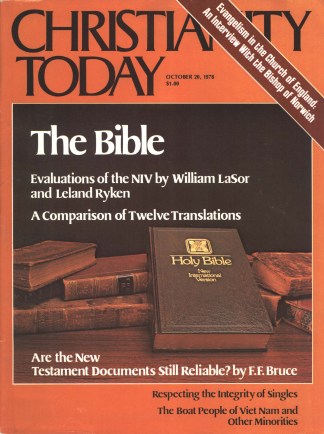
A Dozen Bibles: A Survey

With all the publicity attending the completion of the New International Version, it is time to evaluate the wide range of English translations that we now have available. We give here some information about a dozen of them (only translations of both testaments are included, hence the omission of such New Testaments as Phillips). Every Bible-believer should be familiar with the following translations and should have copies of most if not all of them.

We still recommend “How To Choose a Bible” (December 5, 1975, issue, p. 7), by Gerald Hawthorne, a Greek professor and able preacher. Also see a major comparative review of three of the translations mentioned below (LB, MLB, NASB) in our October 8, 1971, issue, p. 16.

For further information on the translations we mention (plus many more) we highly recommend The History of the Bible in English: Third Edition by F. F. Bruce (Oxford), available in either cloth or paper binding. This new edition adds information on the translations issued since the 1961 and 1970 editions (which were confusingly titled The English Bible). Also worthwhile is So Many Versions? by Sakae Kubo and Walter Specht (1975, Zondervan pb). For a good collection of articles expressing various views on principles of translation see The New Testament Student and Bible Translation edited by John Skilton (1978, Baker or Presbyterian and Reformed pb).

The dates for each translation are for the first release of the whole Bible, which usually followed the New Testament by several years. Keep in mind that many translations are regularly revised so as to incorporate suggestions that were made for improving them.

KING JAMES VERSION (KJV, 1611, many publishers). This classic came at a British monarch’s approval of a resolution “that a translation be made of the whole Bible, as consonant as can be to the original Hebrew and Greek.” Most leading scholars of the day were involved. The original KJV, also known as the “Authorized Version,” included the Apocrypha and marginal notes reflecting uncertainties and variant readings in the manuscript. Its elegant prose was ideal for public reading. Updatings in spelling and renderings were made regularly into the 1800s, so the copies we have today are not identical with the 1611 edition. Despite intervening centuries and advances in linguistic and textual knowledge, the KJV retains a unique place in Christian hearts. Attempts to replace it by three authoritative translations, the Revised Version (1885), the American Standard Version (1901), and the Revised Standard Version (1952), proved futile. Annual sales of the KJV remain higher than any one of the recent translations. It is unlikely that any modern translation will ever dominate the field as the KJV has done for more than three centuries.

THE AMPLIFIED BIBLE (AB, 1964, Zondervan). This version was prepared under the auspices of the Lockman Foundation and Zondervan. Special notice goes to Frances Siewert who was researcher for the translation committee. The title comes from the alternative renderings and additional words supplied in the text itself (usually in parentheses or brackets) rather than in the margin or as footnotes. It is awkward to read the AB aloud and many critics feel that it loses both the readability of a freer translation and the precision of a stricter one.

GOOD NEWS BIBLE (GNB, 1976, American Bible Society, Collins, Nelson). The American Bible Society sponsored this runaway best seller (also known as Today’s English Version). The emphasis is on colloquial language, spoken rather than written. Some poetical passages do not fare well with such treatment, but many scholars agree with Walter Abbott that this translation is “not only clear and accurate, but also a masterpiece of modern linguistic study.” Many people think it combines the best attributes of readability while remaining close to the originals. A special advantage of this translation is the inexpensiveness of many of its bindings.

THE HOLY BIBLE IN THE LANGUAGE OF TODAY (Beck, 1976, Holman). The late William F. Beck was a Missouri Lutheran scholar who, proficient in Hebrew and Greek, spent much of his professional life translating the Bible, working through manuscripts and papyri to get the exact meaning of the original texts. The translation is simple and precise. Beck’s avowed goal was “to have God talk to the hearts of people in their language.” His work has been hailed as both faithful and readable. Beck died in 1966, just after completing his translation; fellow scholars edited the work through to publication.

THE JERUSALEM BIBLE (JB, 1966, Doubleday). This respected translation is a product of Catholic scholarship under the leadership of a British priest, Alexander Jones. The name comes because the annotations are translated from a French version prepared at a Dominican center for biblical studies in Jerusalem. Unlike previous English Catholic ventures, this translation was made from Hebrew and Greek rather than Latin. Naturally the Apocrypha is included. The style is quite readable and freeflowing.

No modern translation will ever dominate the field as the King James Version has.

THE LIVING BIBLE (LB, 1971, Tyndale). Although called a paraphrase, this work of Kenneth Taylor is bound and marketed like a translation. Indeed, a strong case can be made that there is no essential distinction between paraphrase and translation, but rather a continuum between more literal and looser translations. The preface says that “its purpose is to say as exactly as possible what the writers of the Scriptures meant, and to say it simply, expanding where necessary for a clear understanding by the modern reader.” This is essentially the goal of any translation, although the KJV, for example, usually italicized what it considered necessary expansions. Many evangelical scholars have felt that too many passages are interpreted too freely or imaginatively. But the phenomenal worldwide success of this volume testifies that its idiomatic use of language has made the Bible lively for multitudes of people.

THE MODERN LANGUAGE BIBLE (MLB, 1959, Zondervan). This was long known as the Berkeley Version for the California residence of the translator of the New Testament, Gerrit Verkuyl. A committee of twenty evangelicals, under Verkuyl’s chairmanship, produced the Old Testament. In general, reviewers have found more to commend this translation than has the buying public. The many explanatory footnotes sometimes become pious observations.

THE NEW AMERICAN BIBLE (NAB, 1970, several publishers). The Catholic Biblical Association of America used the original language instead of the traditional Latin in this translation. (While being prepared it was usually called the “confraternity” version.) The fifty-member team includes a few “separated brothers” and thus “fulfills the directive” of Vatican II. The NAB naturally includes the Apocrypha and appears to be the standard translation for Catholics who prefer not to use translations prepared by Protestants. Don’t confuse it with the NASB.

NEW AMERICAN STANDARD BIBLE (NASB, 1971, several publishers). Sponsored by the Lockman Foundation, this translation aims at adhering as closely as possible to the original language of Scripture, and doing so in a fluent and readable style. It was undertaken in the conviction that the American Standard Version of 1901 “retains its acceptability for pulpit reading and personal memorization.” Nonetheless, the staunchly evangelical translation team found it necessary to depart from the ASV policy of word-for-word literalness. The approach remains conservative, however, following Hebrew and Greek rather than English patterns. Marginal notes and cross-references are a prominent feature.

NEW ENGLISH BIBLE (NEB, 1970, Cambridge, Collins, Oxford). This British translation was intended to be used alongside the King James. It aimed at conveying a “timeless” English, at being accurate yet not pedantic, and at removing “a real barrier between a large proportion of our fellow-countrymen and the truth.” It was prepared under the auspices of all of the large denominations in Great Britain. The translators held that faithfulness does not always demand a word-for-word rendering, and that the chief criterion of translation is intelligibility.

NEW INTERNATIONAL VERSION (NIV, 1978, Zondervan). Work began in earnest on this translation in 1967 when the New York International Bible Society backed the project. “Few translations since the King James,” it is claimed, “have been as carefully done as this one. At each stage of the process there has been a wrestling of various minds with the sacred text and an honest attempt to say in simple, clear English what the Bible writers express in the originals.” The translators were concerned with its literary quality. The NIV team was evangelical, international, and from a wide range of denominations.

REVISED STANDARD VERSION (RSV, 1952, several publishers). A revision of the 1901 American Standard Version, its aim was to “embody the best results of modern scholarship as to the meaning of the Scriptures, and express this meaning in English diction which is designed for use in public and private worship and preserves those qualities which have given to the King James Version a supreme place in English literature.” Although produced under the auspices of most of the larger American Protestant denominations, this translation has won acceptance also in many Catholic and evangelical circles. Many biblical commentaries have used the RSV as their basic text.

Consider a Study Bible

Annotated study editions are available for the NASB, an advantage over the NIV, which right now has no concordance and has relatively few footnotes (which give alternate renderings and sources of Old Testament quotes in the New Testament). By contrast all NASB editions have extensive marginal cross-references to related passages and almost all of them have concordances. The KJV and RSV have long had study editions.

In addition, there are at least three NASB study editions to choose from. The Ryrie Study Bible, newly released by Moody Press, was prepared by Charles Ryrie of Dallas seminary. (The New Testament has been out since 1976 and the same study helps are also available with the KJV.) The Open Bible, with notes from twenty-eight scholars, has been available from Thomas Nelson for three years using the KJV and will soon be available with the NASB also. For two years A. J. Holman has had a “study edition” of the NASB, with helps from fourteen scholars. These helps were transferred mostly from an earlier edition of the RSV.

All three NASB study editions not only have concordances but equally useful topical indexes to the themes of Scripture. They also have several general articles on Bible study, plus introductions and outlines for each book of the Bible. The Open Bible in a few instances and Ryrie also have explanatory and doctrinal footnotes on the same page as the text. There are advantages to this procedure (which is familiar to users of the Scofield Reference Bible with which Ryrie is in doctrinal accord), but there is a drawback if a reader does not sufficiently distinguish between the inspired Word of God and the uninspired comments on it. In general, Ryrie’s notes reflect a scholarly, evangelical consensus. He indicates in places that there are differing interpretations among believers, but on other matters, especially with respect to predictions of future events, Ryrie gives no hint of widespread differences among devout Bible students.

What Kind of Version Is the New International?: Just a Small Sampling

With the number of new translations of the Bible that have been published in the past thirty years, I am constantly being asked, “Which is the best version?” What I do when a new translation appears is to use portions of it for private devotional reading, portions for public reading in my classes or chapel messages, and portions for careful critical analysis in my preparation of exegetical lectures or scholarly articles. This article is based on a small sampling of the New International Version (NIV).

TYPOGRAPHY. The page proofs that were supplied to me were at once pleasing to the eye. The type is a modern type-face, clear and sufficiently bold, set in paragraphs (not in verses, like the King James Version or the New American Standard Bible) that occupy the width of the page (not in two columns, like the Revised Standard Version or the Good News Bible), with the poetic portions set in poetic form. Double-column editions are available in the NIV also. The text is divided into sections, with editorial headings set in italics as shoulder-heads before each section. Footnotes are rarely used, and then to explain the meanings of words in the text (e.g. “Lo-Ruhamah means not loved,” Hos. 1:6), or to give variant readings (e.g. “Masoretic Text; Samaritan Pentateuch, Septuagint, and Syriac: ‘He jammed the wheels of their chariots’;” Exod. 14:25), or to indicate conjectural readings or translations (e.g. “angels” in Job 38:7 has a footnote “Hebrew the sons of God”). There are no references to other passages in the side margins (as in the NASB).

READABILITY. Reading the NIV, both silently in my private use and aloud in my classes, I was pleased with the style of the work. It does not have the freshness of the GNB or the high style of the New English Bible, nor does it have the somewhat stilted style of the NASB. It reads well. On the other hand, I had the feeling that it was not markedly different from the RSV (which deliberately tries to retain the style of the KJV). In fact, when a student recently asked me, “What is the reason for the New International Version?” I was hard put for an answer, and I remarked, somewhat facetiously, “So evangelicals won’t have to use the RSV.” In my sampling, I did not find the NIV measurably superior to the RSV.

ACCURACY OF TRANSLATION. Far more important than any other critique when we are dealing with the Bible is the question, “Does it accurately translate the original text, whether Hebrew, Aramaic, or Greek?” Since we believe that the Bible is the Word of God, and since we believe that the original Scriptures were inspired so that they had the authority of God himself, we must insist that this authority be in no way diluted or diminished by faulty translation.

But before we take up the quality of the NIV translation, I would like to raise the question “What is a good translation?” There is a view that insists on word-for-word literalness. To anyone who will give this careful thought, it will become apparent that such a translation will sometimes result in nonsense, for we do not speak in words but in phrases and clauses, in sentences and paragraphs. A second view claims that a good translation must render the phrases and clauses in literal equivalents, taking into consideration figures of speech, poetic imagery, and so forth. The NASB is perhaps the best example of this kind of translation, although the KJV in the Old Testament is generally a fairly accurate translation of the Hebrew and Aramaic text. The modern trend is to insist upon a “dynamic equivalent,” the purpose of which is to create in the reader or hearer of the translation the same emotional effect that the original Scriptures would have had on their hearers and readers. The Good News and Jerusalem Bibles—and to a large extent the Living Bible—are examples of dynamic equivalents.

The New International Version is not a dynamic equivalent translation, and in this respect it is not a “modern” translation. Compare the following:

Rebuke Egypt, that wild animal in the reeds;

rebuke the nations, that herd of bulls with their calves.

until they all bow down and offer you their silver.

Scatter those people who love to make war!

Ambassadors will come from Egypt;

the Sudanese will raise their hands in prayer to God (Ps. 68:30–31, GNB).

Rebuke the beast among the reeds,

that herd of bulls among the calves of the nations.

Humbled, may it bring bars of silver.

Scatter the nations who delight in war.

Envoys will come from Egypt;

Cush will submit herself to God (Ps. 68:30–31, NIV).

The NIV is notably closer to the Hebrew text in this passage. The difficult word Mitrappēs, translated “humbled” in the NIV, is rendered “trampling under foot” in the NASB and “till every one submit himself” in the KJV. The RSV has “trample under foot.” Now, let us turn to some of the passages that present problems in any translation, and see what the NIV has done with them.

Genesis 1:1. In Hebrew, this is a dependent clause, to be translated something like, “When in the beginning God created the heavens and the earth,” with the main predication in the words “then God said, ‘Let there be light.’ ” The NIV translates it as a main clause (as do the KJV, RSV, and NASB, but not the JB, NEB, or GNB).

Genesis 6:2, 4. The problem here is not with translation, for the Hebrew text clearly reads “sons of God.” Rather, it is a matter of interpretation: Are these “sons of God” human or divine beings? In my opinion, a translation should not attempt to settle this question, but should leave it for the commentaries. The NIV translates the words literally. The GNB, on the other hand, interposes an interpretation by translating “supernatural beings,” thus unintentionally lending support to the fanciful theories of Von Däniken and others.

Exodus 20:13. The Hebrew word is murder, which is an entirely different word from the word to kill. NIV, and all recent versions that I am aware of, translate the commandment correctly, “You shall not murder.”

Psalm 2:12. The problem here is the meaning of the Hebrew word bar. When the RSV emended the text to get “kiss his feet,” evangelicals loosed a storm of protest, not realizing that the passage was a problem even to the Septuagint and Vulgate translators, as the margin in the NASB recognizes. The GNB has “bow down to him,” with several other possibilities in the margin. The NEB has “kiss the king,” with other suggestions in the margin. The NIV has “Kiss the Son,” with only a marginal note “or son.”

Psalm 23:6. The Hebrew clearly uses the verb to return: “And I shall return into the house of the Lord at length of days.” The NASB acknowledges this as “another reading” in the marginal note. The GNB gives a dynamic equivalent, “and your house will be my home as long as I live”—which, in my opinion, is not a true equivalent, for it speaks only of this life and says nothing about any hope for the life to come. The NIV goes along with the other versions by translating “and I will dwell in the house of the Lord forever.”

Psalm 45:6. The Hebrew text is to be translated either “Your throne, O God” or “Your throne is God.” The RSV translates “your divine throne,” with a marginal note giving alternate translations. The GNB reads “The kingdom that God has given you,” with marginal translations that follow the RSV and the Hebrew. The NEB reads “Your throne is like God’s throne.” The NIV has “Your throne, O God,” with no note. Some sort of note could be included, since the psalm is clearly addressed to the king (45:1), “the most excellent of men” (45:2).

Isaiah 7:14. The Hebrew clearly reads, “Behold, the young woman (is) pregnant and bearing a son.” This is not a denial of the virgin birth of Jesus, for that is clearly taught in Matthew 1:18–20 and Luke 1:31–35. I have discussed this at some length in a monograph on Isaiah 7:14, and briefly in a volume I coedited with Ward Gasque, Scripture, Tradition, and Interpretation (Eerdmans, 1978). The NEB correctly renders the Hebrew clause. The NIV translates “The virgin will be with child.”

Ezekiel 38:2. As pointed, the Hebrew word for “prince” is in construct, hence the clause must be translated “prince of Rosh, Meshech, and Tubal.” The NASB translates correctly; the RSV and NIV translate “chief prince of Meshech and Tubal.”

Daniel 7:13. The Aramaic reads “like a son of man,” which is an idiom for “human being.” The GNB renders the passage, “I saw what looked like a human being.” The NASB reads “One like a Son of Man.” The NEB’s reading, “one like a man,” is acceptable. In my opinion, the scriptural passage is capable of supporting the concept of incarnation, for the heavenly person is also human. The NIV renders “one like a son of man.”

Daniel 9:26. The Hebrew reads, “an anointed (one) will be cut off.” The RSV translates correctly. The NEB reads, “one who is anointed shall be removed,” an acceptable paraphrase. The GNB dynamically renders it, “God’s chosen leader will be killed unjustly,” which leaves for the interpreter the identification of this anointed one. But the NASB interprets rather than translates, using the term “the Messiah,” the capital M indicating a technical term, which did not come into use until the writing of the pseudepigraphic Psalms of Solomon probably within a century of the time of Christ. The NIV makes almost the same error by translating it “the Anointed One,” but offers a marginal note, “an anointed one.”

SUMMARY. This is scarcely enough material for a satisfactory evaluation. It will take months of work, at least, to isolate and study passages where there is some problem of meaning or interpretation. At this writing, I am reasonably certain that the NIV is a reliable translation. But, as is the case with all translations, every passage must be evaluated on its own merits. I think that a capable Bible student must have at least some ability to compare the translation with the original languages. At the same time, I believe that every translation throws light on some portions of God’s word, and for that reason I welcome new translations. I congratulate the team that labored long and hard to produce the NIV, and I hope that they will be willing to revise it as valid criticisms are presented.

G. Douglas Young is founder and president of the Institute of Holy Land Studies in Jerusalem. He has lived there since 1963.

The Literary Merit of the New International Version

The standards of expectation for any new translation of the Bible are perhaps higher than most people realize. To justify its existence, a modern translation must not merely be as good as existing versions—it must be better. The literary merits of the New International Version can be evaluated in terms of clarity, effective diction, vivid expression, respect for the principles of poetry, and smoothness of rhythm.

The prime literary virtue of the NIV is clarity. For example, “Sheol” is translated as “the grave,” and the statement “he will not let your foot slip” conveys the realism of the journey to Jerusalem better than saying that God will not let one’s foot “be moved” (KJV, RSV). The sixth and ninth commandments of the Decalogue are rendered “you shall not murder” and “you shall not give false testimony.” “Dishonest scales” and “accurate weights” are an improvement over “false balance” and “just weight” (KJV, RSV). The lover in the Song of Solomon is “faint with love,” not “sick of love” (KJV) or “sick with love” (RSV). And I hope it will dispel some follies to read that “it is good for a man not to marry” instead of “not to touch a woman” (KJV).

The NIV fares less well in the area of diction. Given the time-honored scale of high, middle, and low styles, the NIV tends toward the low or ordinary. Its dialogues, especially, are filled with colloquial or informal diction, including contractions: “I’ll work for you seven years,” Jacob tells Laban, and the latter replies, “It’s better to give her to you than to some other man.” The exclamation, “How beautiful you are, my darling!/Oh, how beautiful!” (Song of Sol. 1:15) is prosaic and trite; “Behold, you are beautiful, my love;/behold you are beautiful” (RSV) is poetic and other-than-ordinary, as indeed the lovers themselves are. In Revelation 3:20 the words of Christ suggest almost an intrusive salesman or the neighborhood brat spoiling a Sunday afternoon nap: “Here I am! I stand at the door and knock.”

With this inclination toward an everyday idiom, the NIV loses the exaltation and grandeur and eloquence that the King James possesses in such abundance. Gone from the NIV are the “behold” and “lo” and “yea” and “even” constructions that give the King James and Revised Standard such power. Psalm 27:14, which is enlivened in the KJV with “wait, I say, on the Lord” and in the RSV and “yea, wait for the Lord!” is tamed down in the NIV to “wait on the Lord.” “O magnify the Lord with me” (KJV, RSV) is defused to “Glorify the Lord with me.” “Wash me thoroughly from my iniquity” (RSV) has more vigor than “wash away all my iniquity” (Ps. 51:2). The King James definition of faith in Hebrews 11:1–2 is exhilarating; the NIV reads more like a political platform: “Now faith is being sure of what we hope for and certain of what we do not see. This is what the ancients were commended for.”

At the level of style, the NIV tuned its lyre too low. There are several reasons why the Bible should be written in a style that conveys exaltation, dignity, and grandeur: Its elevated sentiments and experiences transcend the commonplace, its emotional intensity requires an exalted idiom, its ceremonial use in public worship calls for dignity, and the King James tradition has established a moderately formal style as the norm. Once the novelty of modern colloquial versions wears off, I fear that we will find that this type of familiarity, too, breeds contempt.

A characteristic weakness of modern translations is that they rob the Bible of its vividness, showing a preference for the abstract. When judged by the criterion of vividness and concreteness, the NIV is good but not outstanding. The “creeping things” of early Genesis have become, abstractly, “creatures that move along the ground.” “My heart overflows with a goodly theme” (RSV) is toned down to “my heart is stirred by a noble theme” (Ps. 45:1). The evocative “bottomless pit” of Revelation has evaporated into “the Abyss.” And the preacher’s doleful insight into the futility of life under the sun is lost in horrible abstraction “Meaningless! Meaningless!”/says the Teacher./“Utterly meaningless!/Everything is meaningless” (Eccles. 1:2).

Still, there is much to commend. Joseph’s “coat of many colors” (KJV), robbed of its evocativeness by the RSV’s “long robe with sleeves,” makes a partial comeback with “a richly ornamented robe.” And, as in the KJV (but not in the RSV), the psalmist’s soul “pants” for God “as the deer pants for streams of water” (Ps. 42:1).

A chief literary test for any translation of the Bible is its treatment of the poetry. Poetry uses language in a way that ordinary prose discourse does not. Specifically, it uses concrete images, figures of speech, archaisms, conventional language (or “poetic diction”), and inverted word order. The NIV, while of course preserving most of the figures of speech, shows a decided tendency to “normalize” the poetry in the direction of prose, too often ignoring the way in which poetry gains its effects by deviating from ordinary prose.

To illustrate, I have paired some passages from the King James (and in one instance the Revised Standard) and the NIV, respectively: “in the day that thou eatest thereof thou shalt surely die”/“when you eat of it you will surely die”; “house of bondage”/“land of slavery”; “graven image”/“idol”; “I shall not want”/“I shall lack nothing”; “still waters”/“quiet waters”; “you are the fairest of the sons of men”/“you are the most excellent of men”; “on their hands they will bear you up”/“They will lift you up in their hands.” In each case, the NIV has done one thing or another to give us a prose Bible, even in places where a poetic Bible is more appropriate.

Rhythm is one of the most important features of the Bible. A successful rhythm is one that ebbs and flows smoothly, avoids abrupt stops between words and phrases, and provides a sense of continuity. For a book that is read aloud as often as is the Bible, and for a book whose utterances are so frequently charged with strong feeling, smooth rhythm is a major ingredient, and its absence makes itself felt at once when one listens to an oral reading.

Like most modern translations, the NIV is weak in the area of rhythm. There will, of course, never again be a translation to match the pulsating and incantatory rhythms of the King James, but the Revised Standard managed to retain much of its fluidity by preserving many of the “and” connectives. The NIV often deletes them, and the result is a style that is staccato and abrupt when read aloud.

To illustrate, I will again give pairs of passages, the first from the RSV and the second from the NIV: “in all that he does, he prospers”/“whatever he does prospers”; “great is the Lord, and greatly to be praised”/“great is the Lord, and most worthy of praise”; “he does not deal with us according to our sins”/“he does not treat us as our sins deserve”; “I will sing to the Lord as long as I live”/“I will sing to the Lord all my life.” Whereas the RSV has enough unaccented syllables to keep the phrases flowing, the NIV loads its lines with too many words that require a full stop between them.

The proliferation of modern translations raises literary problems. The Bible is a communal book and a shared possession. It is, moreover, an oral work, having been continuously uttered aloud and listened to even when there have been written copies. The Bible is also the most aphoristic book ever written, filled with memorable statements that live in the consciousness and rise to the lips.

To be all of these things, however, and to permeate the thought and speech of believers, people must read the same Bible. One can imagine what the status of Shakespeare or Milton studies would be if people used half a dozen different versions. For Protestants the King James Bible has until recently been the common Bible. It has become too archaic for most modern readers, but given its historical importance and literary excellence, the best modern translation is one that retains the King James wording and phrasing wherever possible. That translation is the RSV, not the NIV, and except for the superior clarity of the NIV in some instances, the RSV is, in my view, a much better literary achievement and more worthy of acceptance as the standard modern Bible.

G. Douglas Young is founder and president of the Institute of Holy Land Studies in Jerusalem. He has lived there since 1963.

Ideas

Which Version Should We Use?

Many Christians seem confused by the availability of so many different translations of the Bible. Older Christians did not face so many choices. They had to learn the language of the King James, and if they could do it, why can’t others? God has indeed marvelously blessed the King James translation over the centuries. But language changes; it does not remain static; and new translations are needed.

CHRISTIANITY TODAY recommends that no version should be the “standard,” neither the King James nor any other translation. You can memorize Scripture from a variety of translations. It’s more important to understand a verse than to know how it is worded in a certain version. Preachers, aware of the variety of translations used by their audiences, can use them together in sermons to expound Scripture. A Bible study group may wish everyone to have a common translation, but why not rotate which translation you use? You can get more out of the Bible when you read different translations of the same passage. (You can also get the same benefit by studying Scripture in a foreign language.)

We must never forget that the principal purpose of words is communication. Jesus Christ who is the incarnate Word of God looked and acted like a man of his time. In the same way, the written Word of God was inspired in the everyday languages of the people who first received it.

Since the Greek of the New Testament differed from the older Greek of the classical Athenian writers, scholars long thought it a special “Holy Ghost” dialect. With the discoveries of ancient documents, we now realize that New Testament Greek differs from the classical because it was the common, somewhat simplified, dialect spread by the conquering Alexander the Great.

We welcome the appearance and increased use of translations that more clearly communicate the meaning of the original Hebrew and Greek to readers today. And there is evidence that understanding of God’s Word is significantly enhanced by modern versions.

For example, the principal of a major Christian school in Maryland carefully tested more than 300 students in grades four through eight in schools in three states. He compared the King James (modified by paragraphing, repunctuations, and modernization of the most blatant archaisms), the New American Standard, and the New International. In every school, at every grade level, and on each of the four kinds of tests, the New International proved to communicate the best, the King James least so, and the New American Standard half-way between. And that despite the regular usage of the King James in home and school by most of the students. Those without such a background could be expected to fare worse.

For example, researchers at Georgia State University compared the readability of the Good News Bible, the Revised Standard, and the King James. The Good News came out notably better than either of the more traditional versions. Indeed, researchers found the RSV and KJV in key respects to resemble the instructions for Federal Income Tax forms.

We understand the written Word of God best when we read and hear it in our own language—in the vernacular of the day. The gap between what we read in the Bible and what we face in secular culture is wide enough without confronting the reader with an unfamiliar vocabulary and archaic grammar.

The presence of many good alternatives to the King James will keep any one of them from becoming dominant. That should ensure that Bible translating will continue. We want to clearly communicate to contemporary men what God revealed to the ancient readers of Hebrew and Greek millenia ago. We need to hear, to understand, and to obey his Word every bit as much now as people did then.

The Root Of All Evil

There is much wistful talk in evangelical circles about the need for revival in the American church, but few offer any serious diagnosis or propose a realistic cure for the church’s lethargy. Many explanations have been advanced but the best one may have been largely ignored by evangelicals—and it’s found in First Timothy 6:10. It says, “Loving money leads to all kinds of evil, and some men in the struggle to be rich have lost their faith and caused themselves untold agonies of mind” (Phillips). Perhaps the reason for the maladies that beset America is that the Christians who live in the richest nation in history have their biblical financial priorities askew.

Before you reject this with a “That’s not me, brother,” consider this warning from Moses: “Take heed … lest, when you have eaten and are full and have built goodly houses and lived in them, and when your herds and flocks multiply, and your silver and gold is multiplied, then your heart be lifted up, and you forget the LORD your God, … and you say in your heart. ‘My power and the might of my hand have gotten me this wealth.’ You shall remember the LORD your God, for it is he who gives you power to get wealth” (Deut. 8:11–14, 17–18).

An antidote to this spiritual poison would, of course, be Christian giving. The Preacher in Ecclesiastes comments that “there is a grievous evil which I have seen under the sun: riches were kept by their owner to his hurt” (Eccles. 5:13). From Abraham and Melchizedek (Gen. 14), to Malachi and the nation of Israel (Mal. 3), to Paul and the collection for Jerusalem (2 Cor. 9), Scripture is clear that God expects all Christians to hold “their” possessions with an open hand, freely offering them to those in need at his direction. Just as day-old manna spoiled, hoarded property loses its power to satisfy our needs.

But giving per se is no remedy for the Deuteronomy 8 disease. Giving must be done with the proper attitude and in the proper manner to please God. Malachi gets right to the heart of the issue when he decries Israel for their unworthy gifts (Mal. 1:7–14). The Israelites sacrificed to the Lord the blind, the lame, and the sick from their flocks and even railed at having to fulfill this duty. In response to this, God says “I have no pleasure in you, and I will not accept an offering from your hand.”

How often do we as Christians give our Lord the left-overs? We live to the limit of our desires and then give the scraps off our table to him. Like the children of Israel, we bring to him that for which we had no use. The Israelites wanted to dispose of the worst of their flocks. This was good animal husbandry, yet the Lord demanded the best, the spotless, the unblemished. Our actions often proclaim that we feel that the Creator and Sustainer of the universe is only worthy of the tattered residue of our lives and possessions.

The New Testament erects a positive standard with respect to material possessions that provides an alternative to the attitudes evident in Malachi 1. Our Lord gave freely from his earthly poverty to meet the needs of others and he expected others to do so, whatever their state. The stories of the widow’s mite (Mark 12:42 ff.) and of Lazarus and Dives (Luke 16:19 ff.) show that the biblical imperative of giving crosses the whole economic spectrum.

First John 3:16–18 sets down the general principles for the Christian use of wealth. The Apostle says, “we ought to lay down our lives for the brethren. But if any one has the world’s goods and sees his brother in need, yet closes his heart against him, how does God’s love abide in Him? Little children, let us not love with word, or with tongue, but in deed and in truth.” Paul tells us not to seek our own advantage, but rather let “every man seek another’s wealth” (1 Cor. 10:24). It is this spirit of servanthood, of sensitivity to the needs of others, that is so dramatically lacking in the American church. Most Christians are so concerned with the accretion of material goods that they have no vision for the needy world around them.

Where is the spirit that Paul exhorted Timothy to exhibit when he wrote, “if we have food and clothing, with these we shall be content” (1 Tim. 6:8)? Quite in opposition to that attitude, evangelical circles are increasingly pervaded by a theology of worldly success. We are told, or at least encouraged to infer, that the godly man will be a material success, that prosperity is concomitant to spirituality. Some evangelical leaders even proclaim that God is glorified by a lavish life style. We are children of the King and should live as befits royalty.

There is no denying that God can and does provide material prosperity, but it is a crucial misunderstanding of Scripture to claim that financial success is part of our guaranteed earthly birthright. Paul warns us to “withdraw from those who suppose that gain is godliness” (1 Tim. 6:5). Moreover, many people assume that the blessing of God on our financial lives must be flaunted ostentatiously to prove that “God always goes first class.” This, too, is a tragic misapprehension of the scriptural injunction: “all of you, clothe yourselves with humility toward one another for God is opposed to the proud, but gives grace to the humble” (1 Pet. 5:5).

God does not demand an other-worldly asceticism of us. Paul denigrates this as mere “will-worship” (Col. 2:23) and affirms the fact that God “richly furnishes everything to enjoy” (1 Tim. 6:17). America’s prosperity can be a great source of pleasure to Christians, but we must not seek that enjoyment as an end in itself. Rather, we ought to receive it as an incidental by-product of following God (Matt. 6:33). Paul concludes his instruction to Timothy concerning proper financial priorities by saying, “As for the rich in this world, charge them not to be haughty, nor to set their hopes on uncertain riches, but on God.… They are to do good, to be rich in good deeds, liberal and generous, thus laying up for themselves a good foundation for the future, so that they may take hold of the life which is life indeed” (1 Tim. 6:17–19).

The denial of this standard by the church could well be the source of its present impotence and ennui, for Christ said, “If you are not fit to be trusted to deal with the material wealth of this world, who will trust you with the true riches” (Luke 16:11, Phillips)? Revival in our midst and renewal of our crumbling society can come only as we individually and corporately eschew the love of money in favor of more lasting and truly profitable values.—DOUGLAS H. KIESEWETTER, JR., Christian Stewardship Assistance, Dallas, Texas.

Cosmomorphism

About twenty years ago Elton Trueblood suggested in his Philosophy of Religion that we should construct a big word, composed of several Greek derivatives, to counter the word anthropomorphism. Pantheists, believers in an impersonal God, have used that word to frighten people who believe in a personal God.

I have finally come up with such a word—cosmomorphism. It roughly translates “having the form of the world,” just as anthropomorphism means “having the form of man”—and both of them are dangerous.

The Scripture warns that, even though man is made in the image of God, we must be cautious in our comparisons. “God is not man, that he should lie, or a son of man, that he should repent” (Num. 23:19). “For my thoughts are not your thoughts, neither are your ways my ways, says the LORD” (Isa. 55:8).

The Bible also warns against comparing God with nature. When God prohibited idolatry he said, “You shall not make yourself a graven image, or any likeness of anything that is in heaven above, or that is in the earth beneath, or that is in the water under the earth” (Exod. 20:4). In short, you can’t capture the essence of God completely by either human or natural comparisons.

But now that I’ve coined cosmomorphism I’m beginning to think that it may be worse than anthropomorphism. Here’s why: The Scripture says that God made only one creature in his image—man. That means that God is more like man than he is a rock or a tiger. Further, if God revealed himself uniquely in the person of Jesus that makes pantheism look pretty weak when it says that God is just an impersonal being. Why did it require a person to fully reveal God?

As C. S. Lewis has so aptly observed maybe God’s difference from man isn’t the way white differs from black, but more similar to the way that a perfect circle differs from a child’s first attempt to draw one. Anthropomorphism, then, isn’t quite as dangerous as we’ve been told and cosmomorphism may mislead more than it would help.

Could this mean that the biblical literalist is closer to the truth than the sophisticated demythologizer?

Can John Doe be smarter than Rudolph Bultmann?

What a thought.—ARLIE J. HOOVER, dean, Columbia Christian College, Portland. Oregon.

Eutychus and His Kin: October 20, 1978

The most daring expression of dissent in Communist East Europe is probably the “flying universities” in five Polish cities, according to a recent Washington Post article.

At considerable risk, students—anywhere from 10 to 150 at a time—attend lectures held in crowded apartments.

The idea is to teach these Polish students about all elements of their country’s history, political evolution, and battle for independence, and facts totally excluded from the Moscow-oriented university courses that have marked the post-World War II era.

If Polish students are willing to take such a risk, American students might be willing, too. So why not start some flying Christian universities in this country? American students need to be taught about the heavenly kingdom, about the freedom man once had and lost. After all, Bible and theology, facts about the Christian faith and life have been totally excluded from the humanism-oriented courses that have marked American higher education for a century.

“Flying universities”: what a great name for such ad hoc lectures. I’m sure some married students would be willing to open up their apartments; they have little to lose at this point in their lives. Time, place, and subject of the lecture could be passed along the underground communication system.

Seminary professors could be smuggled into the cities and out again before the authorities became aware of their subversive activities. If one should be caught and imprisoned—well, we can cross that bridge when we come to it.

Look, I know this couple with an apartment over that seafood place in Harvard Square.…

EUTYCHUS VIII

Johnny-Come-Latelys

The article “What About Divine Healing?” by Karin Michaelson in the September 8 issue of CHRISTIANITY TODAY is interesting, and doubtless accomplishes the purpose of the writer—to give a critique on the literary style of a few modern writers on divine healing. But it hardly lives up to the promise of the title. After all, the writers mentioned are “Johnny-come-latelys” and amateurs when it comes to the ministry of divine healing. Why not authorize some knowledgeable person to tell the full story of the restoration of the ministry of divine healing to the church, during the last seventy-five years? This story would have to start with A. B. Simpson, through whose healing ministry a great world-wide denomination, the Christian and Missionary Alliance, was founded. It would have to include Amy Semple McPherson, through whose ministry thousands of medically authenticated miracles were performed. It would have to include Charles Price, Kathryn Kuhlman, Oral Roberts. These are the “heavyweights” of the divine healing ministry. They are the ones responsible for the restoration of this gift to the Christian church. Their literary style may not please Michaelson but their ministry speaks for itself.

I did not note one case of actual healing mentioned in the article. Theory yes—case history no. It has been my privilege to be a foreign missionary all my life. On one occasion we saw over 300 people healed from the most insidious diseases—totally healed—in two weeks time. These included cholera, typhoid, malaria, dengue, venereal diseases, and leprosy. Isn’t this “what divine healing is all about”?

MAYNARD L. KETCHAM

Charlotte, N. C.

As one who is very active in divine healing and other dimensions of modern health care, I believe Michaelson was right on target in assessing the critical problem to be a need to harmonize a theology of suffering with a theology of healing. So many modern prophets of divine healing cause spiritual distortion with their theology of glory or “health on a platter.” … However, Michaelson does not venture into some of the other knotty problems that this scientific age presents to us in the healing ministry. I find among laymen the prevailing question to be the relationship of medical science to divine healing. Until they understand the nature of wholistic healing, many laymen have difficulty synthesizing “wonder drugs” and modern health care with the laying-on-of-hands and prayer.

GARTH D. LUDWIG

Pittsburgh, Pa.

Big Is Better

Read the interview with Chaim Potok in the September 8, 1978 issue. It started out to be interesting and pleasant. The pleasantness stopped when I turned the page and had to get out my magnifying glass to finish reading. I hope you will never again use such small type.

RONALD A. GREILICH

Salem United Methodist Church Lodi, Calif.

It is my opinion that the recent interview of Chaim Potok by Cheryl Forbes is certainly one of the most perceptive and one of the most important articles that CHRISTIANITY TODAY has ever published. Thank you.

DAVID W. BAKER

Chester, Nova Scotia

Seeking The Facts

In his recent remarks on “Luther, Anti-Semitism, and Zionism” (Current Religious Thought, Sept. 8), John Warwick Montgomery rightly points out that “secularism, not Christian faith, is the real source of modern anti-Semitism.” This observation must not obscure, however, the fact that secular sources found ready religious support all along the way.…

LUDWIG R. DEWITZ

Columbia Theological Seminary Decatur, Ga.

Female Takeover

Is it now CHRISTIANITY TODAY’S “evangelical conviction” that women are to take over the leadership in shaping world opinion—even in Christian magazines? In the September 8 issue three of the four lead articles were by women … I love women. I married one. But it doesn’t mean I have given up the authority in my house, nor the leadership of shaping the opinions of my household. I take seriously the Scripture which placed me in that responsibility. Moreover, because I love my wife, it does not mean that I read Woman’s Day, nor that I am, or ever will be, interested in receiving spiritual guidance and instruction from it for my life. If CT is to become the Woman’s Day of the Christian world, you can count me out. I will not pay to receive it in my house.

M. J. MICHAUX

Colorado Springs, Colo.

Heavenly Deceit

I am writing to tell you I am a former Moonie and I know that Joseph Hopkins’s August 18 news item, “Meeting Moonies on Their Territory,” might lead some congregations to accept their double talk. I went into churches in the Philadelphia area and I want you to know our definite goal was to proselytize. I was not deprogrammed out, but suffered for more than a year because I was not. I left because … I saw a friend allowed to become violently ill because of the leadership’s unconcern. He had to return to his parents to get needed medical attention. This, plus the help of some good Christians led me out of this dangerous cult where I wasted over two years of my life. I know now everything about the Moon cult is a lie. The deception is unbelievable—they call it heavenly deceit but I call it blasphemy and out and out lying to achieve their aims. They lied to Hopkins, and they brainwashed me.

DAN GLISSMAN

Turtle Creek, Pa.

Something Amiss

As soon as I read the article by Judy Peace (“Bad to Be Black and Bright,” July 21) I knew there was something wrong about it. Those of us who know black South African women know that not one of them would feel it a shame that their infant child was bright. When I read the article a second time, I realized Judy’s mistake. As a visitor to this country, she had not picked up the fact that the word “shame” in South Africa usually means the opposite of what it means in America. The Dictionary of South African English defines “shame” as “an exclamation … of warmth towards something endearing … or small.”

C. W. PARNELL

The Baptist Theological College of South Africa

Wynberg, South Africa

Statement required by the act of August 12, 1970, section 3685, Title 39, United States Code, showing ownership, management, and circulation of

CHRISTIANITY TODAY

Published 22 times per year at 465 Gundersen Drive, Carol Stream, Illinois 60187.

The names and addresses of the publisher and editor are: Publisher: Harold L. Myra, 465 Gundersen Drive, Carol Stream, Illinois 60187; Editor, Kenneth Kantzer, 465 Gundersen Drive, Carol Stream, Illinois 60187.

The owner is CHRISTIANITY TODAY, Inc., 465 Gundersen Drive, Carol Stream, Illinois 60187.

The known bondholders, mortgagees, and other security holders owning or holding one per cent or more of total amount of bonds, mortgages, or other securities are: None.

I certify that the statements made by me above are correct and complete.

Harold L. Myra

Apple PodcastsDown ArrowDown ArrowDown Arrowarrow_left_altLeft ArrowLeft ArrowRight ArrowRight ArrowRight Arrowarrow_up_altUp ArrowUp ArrowAvailable at Amazoncaret-downCloseCloseEmailEmailExpandExpandExternalExternalFacebookfacebook-squareGiftGiftGooglegoogleGoogle KeephamburgerInstagraminstagram-squareLinkLinklinkedin-squareListenListenListenChristianity TodayCT Creative Studio Logologo_orgMegaphoneMenuMenupausePinterestPlayPlayPocketPodcastRSSRSSSaveSaveSaveSearchSearchsearchSpotifyStitcherTelegramTable of ContentsTable of Contentstwitter-squareWhatsAppXYouTubeYouTube