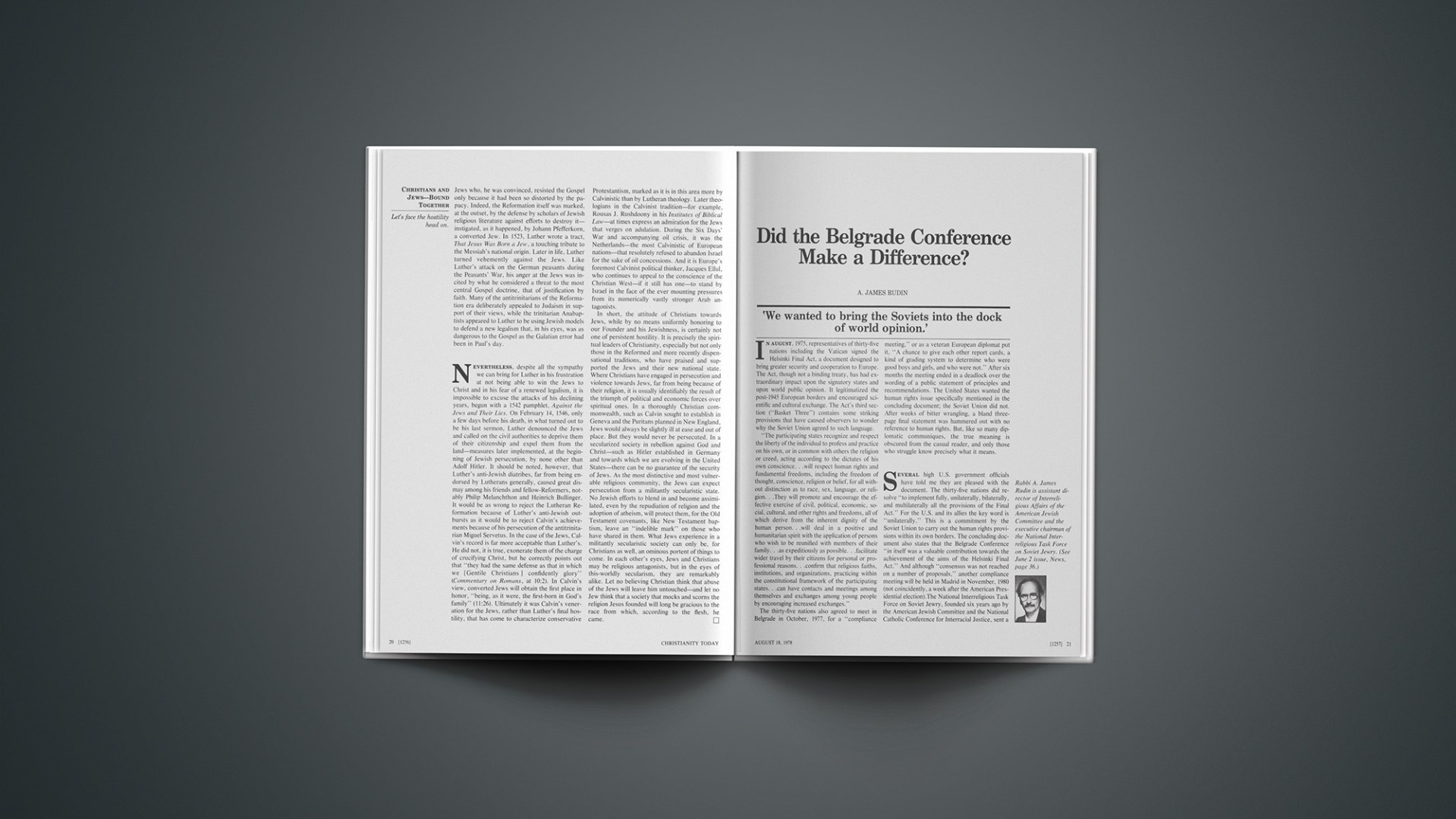
Did the Belgrade Conference Make a Difference?

A first-hand report.

‘We wanted to bring the Soviets into the dock of world opinion.’

In august, 1975, representatives of thirty-five nations including the Vatican signed the Helsinki Final Act, a document designed to bring greater security and cooperation to Europe. The Act, though not a binding treaty, has had extraordinary impact upon the signatory states and upon world public opinion. It legitimatized the post-1945 European borders and encouraged scientific and cultural exchange. The Act’s third section (“Basket Three”) contains some striking provisions that have caused observers to wonder why the Soviet Union agreed to such language.

“The participating states recognize and respect the liberty of the individual to profess and practice on his own, or in common with others the religion or creed, acting according to the dictates of his own conscience … will respect human rights and fundamental freedoms, including the freedom of thought, conscience, religion or belief, for all without distinction as to race, sex, language, or religion … They will promote and encourage the effective exercise of civil, political, economic, social, cultural, and other rights and freedoms, all of which derive from the inherent dignity of the human person … will deal in a positive and humanitarian spirit with the application of persons who wish to be reunified with members of their family … as expeditiously as possible … facilitate wider travel by their citizens for personal or professional reasons … confirm that religious faiths, institutions, and organizations, practicing within the constitutional framework of the participating states … can have contacts and meetings among themselves and exchanges among young people by encouraging increased exchanges.”

The thirty-five nations also agreed to meet in Belgrade in October, 1977, for a “compliance meeting,” or as a veteran European diplomat put it, “A chance to give each other report cards, a kind of grading system to determine who were good boys and girls, and who were not.” After six months the meeting ended in a deadlock over the wording of a public statement of principles and recommendations. The United States wanted the human rights issue specifically mentioned in the concluding document; the Soviet Union did not. After weeks of bitter wrangling, a bland three-page final statement was hammered out with no reference to human rights. But, like so many diplomatic communiques, the true meaning is obscured from the casual reader, and only those who struggle know precisely what it means.

Several high U.S. government officials have told me they are pleased with the document. The thirty-five nations did resolve “to implement fully, unilaterally, bilaterally, and multilaterally all the provisions of the Final Act.” For the U.S. and its allies the key word is “unilaterally.” This is a commitment by the Soviet Union to carry out the human rights provisions within its own borders. The concluding document also states that the Belgrade Conference “in itself was a valuable contribution towards the achievement of the aims of the Helsinki Final Act.” And although “consensus was not reached on a number of proposals,” another compliance meeting will be held in Madrid in November, 1980 (not coincidently, a week after the American Presidential election). The National Interreligious Task Force on Soviet Jewry, founded six years ago by the American Jewish Committee and the National Catholic Conference for Interracial Justice, sent a seven-person delegation during the Belgrade Conference to press for full implementation of Basket Three. The group represented evangelicals, mainline Protestants, Catholics, and Jews, and was made up of clergy and lay people, men and women, blacks and whites—a microcosm of America’s religious communities. From the moment the Interreligious Task Force arrived in the Yugoslavian capital, it was clear that Basket Three and the issue of human rights dominated the proceedings.

While in Belgrade the Task Force met with the leaders of six delegations (the United States, Great Britain, Holland, Spain, the Vatican, and Hungary), as well as with Senator Robert Dole, Senator Claiborne Pell, and Representative Millicent Fenwick. Fenwick and Senator Clifford Case were the coauthors of the bill that established the official United States “watchdog” commission, an extremely valuable body that collects and publishes data, complaints, and testimony relating to the Final Act’s many provisions.

The Helsinki Final Act is best understood as a rough equation: Basket One (borders) plus Basket Two (technical and scientific exchange) equals Basket Three (human rights and religious liberty). Most Western and neutral countries agreed with the arithmetic, but the Soviet Union and many of the Eastern European nations did not, hence the great difficulty in agreeing on a statement of consensus in Belgrade.

Everywhere the American religious leaders went in Belgrade’s sleek new Sava Conference Center they heard the same question: “How serious is the United States’s commitment to human rights and how much is the Soviet Union willing to yield on this issue to gain the advantages of Baskets One and Two?” Our Western allies (the NATO and Common Market countries) were all more or less committed to Basket Three (who, after all, in the so-called Free World is opposed to human rights?). The real question was what price does a Western nation have to pay vis-à-vis the Soviet Union for its pro-Basket Three stance? Will it suffer economically? Will the Soviet Union threaten it militarily or diplomatically?

Just as the United States provides a “nuclear shield” for the West, so, too, at Belgrade our government supplied our allies with a “human rights shield.” Wielding that shield and leading the campaign against the Soviet Union was the head of the American delegation, Justice Arthur J. Goldberg, a personal appointment of President Carter. Goldberg was the only diplomat of international stature and reputation at the conference. The other thirty-four nations sent middle-level foreign service types to Belgrade, a clear reflection of their view of the conference.

Because of Justice Goldberg’s vigorous leadership and his long involvement in the struggle for human rights and religious liberty, there was a tendency at Belgrade to “let Arthur do it.” He was the one diplomat who publicly cited the names of Soviet Jews and Christians who are “Prisoners of Conscience,” he listed the dates of arrest, the jails where the prisoners are being held, and the alleged charges against them. Goldberg put the muscles, sinews, and flesh of specificity onto the skeleton of abstract commitment to human rights. Justice Goldberg clearly dominated the Sava Center as he attempted to rally the timid and diffident, the fence-sitters, and the human rights relativists. His acknowledged mediation skills were a great asset as he dealt with such disparate states as San Marino, the Soviet Union, Canada, Bulgaria, Malta, and the Vatican.

The Holy See pursued a delicate and highly nuanced policy at Belgrade. One of the Vatican officials in Belgrade stated it most clearly to the visiting Interreligious Task Force delegates: “We were aggressively against the Soviet Union after World War II … in Italy, in Hungary, Poland, many places. Now we have shifted to nonpublicized interventions in human rights. Of course, we are committed to religious liberty and Basket Three, but by quiet diplomacy, at the right time and the right place—efficacy, efficacy, that’s the important thing.”

Pope Paul’s public condemnation of the recent trials of Soviet dissidents was especially welcome since we were told in Belgrade not to expect any statements or public interventions from the Vatican that call attention to the many Christian and Jewish prisoners in the Soviet Union.

If Arthur Goldberg was the central personality present at Belgrade, there were two persons who hovered over the Sava Center like Banquo’s ghost in Macbeth. One was Anatoly Shcharansky, the imprisoned young Soviet Jewish engineer. His case was mentioned often, especially by the American delegation, at both the public and private conference sessions, as well as in the corridors. Shcharansky, charged with treason by the Soviet authorities, had been held in jail for over a year without a trial and without the right to select his own attorney. He has been called a “CIA agent,” a charge that President Carter has publicly denied. Shcharansky is a leader in the Soviet Jewish activist community and he is also a key member of the ad hoc Helsinki monitoring groups that have been set up inside the Soviet Union. Thus, Shcharansky represents both symbolically and actually two important forces in Soviet society today. His arrest, detention, trial, and lengthy sentence, was a calculated attempt to intimidate and stifle all human rights activities within the Soviet Union.

Pastor Georgi Vins, the Executive Secretary of the Churches of the Evangelical Christians and Baptists, is the other person whose case was vigorously pressed at Belgrade. As a leader of the free or underground Evangelical Church inside Russia, Vins is currently serving a five-year prison sentence with five additional years of exile after that. In 1975 he was found guilty of “unauthorized religious activities.” Soviet authorities are also harassing Pastor Vins’s nineteen-year-old son, Peter. This is part of the campaign to suppress the evangelical churches.

Shcharansky and Vins were the litmus paper tests of Belgrade. They were the linchpins of the Conference and because the Soviet Union is susceptible to public world opinion, and because it does react, sometimes in a Byzantine way, Belgrade was a highly important setting to bring the Soviets into the dock of world public opinion. And, indeed, one of the most hopeful signs emerging from the conference is that such compliance meetings will be held on a regular basis, the next scheduled for Madrid in two years.

Did the Belgrade Conference make a difference?

Yes, for several reasons. First, the Soviet Union was confronted with clearly documented cases of gross human rights violations, all in defiance of the Helsinki Final Act. The Press, especially in Western Europe, carried many articles on the continuing failure of the Soviets to implement Basket Three. Second, compliance meetings are now “regularized” (a bureaucratic term meaning the thirty-five nations will meet at set times to continue the process of reporting on compliance—the “report cards” will be issued again). Third, the argument that a nation’s “internal affairs” are not open to discussion or critique was shattered at Belgrade. After one of Ambassador Goldberg’s strong speeches about Soviet human rights violations, the Russians, in a mood of embarrassment and desperation sharply criticized alleged American human rights abuses (“the Wilmington N.C. Ten”). Goldberg welcomed discussion of American society and the Soviets by their anti-American statement tacitly confirmed the right of one nation to criticize another’s “internal affairs.”

Fourth, the governments and the peoples of Europe have now made heavy political, diplomatic, and emotional investments in the Helsinki Final Act. True cooperation and security now seems possible for all of Europe after centuries of strife and warfare. Human rights is part of that investment; it will be neither simple nor easy to remove it from the European scene. As if to confirm this view, the Soviet Union and the United States along with the other thirty-three nations have termed the Belgrade Conference a “success.” And the European peoples now have the reality and the hope of family reunification, student exchanges, human rights, and religious liberties. As religious men and women know so well, hope once experienced can never be taken away.

But the grave danger is that the specific human rights charges raised by Justice Goldberg at Belgrade will be viewed merely as an American concern. The Western nations and the Vatican must speak out clearly and often for all oppressed peoples in the Soviet Union. “Letting Arthur do it” may be a convenient and easy tactic for our allies, but it is ultimately self-defeating.

A Pilgrim’S “Cantabile” For Flight

With Pachebel’s D Major Canon still

At large in me, and all my heaven-bound

Enthusiasm straining hard to will

One will, I vowed to run but heard a sound

That beckoned me to walk a charted road,

Deciding that a hurried pace was not

The way He took.

What’s more, I dropped the load

I thought I’d always bear; and found a plot

So undeserved, so filled with ecstasy

I cried my little boyhood heart to sleep,

And rested in His love-then woke to see

That all my promises were His to keep.

Now when I hear that repetitious tune,

I’m like a butterfly without cocoon.

JAMES A. REIN HARD

D. Bruce Lockerbie is chairman of the Fine Arts department at The Stony Brook School, Stony Brook, New York. This article is taken from his 1976 lectures on Christian Life and Thought, delivered at Conservative Baptist Theological Seminary in Denver, Colorado.
Christians and Jews—Bound Together

Let’s face the hostility head on.

What advantage has the Jew?… Much, in every way! What if some of them were unfaithful?” Thus Saul of Tarsus, better known to history as Paul, who styled himself “a Hebrew of the Hebrews” (Phil. 3:5) expressed the attitude of one early Christian towards the Jews (Rom. 3:1–2). “I ask then, has God rejected his people? God forbid!” (Rom. 11:1).

Paul did not hesitate to criticize his ancestral people, even while attesting the zeal for God of unconverted Jews (Rom. 10:2). Paul’s prayer that Israel, which God had hardened against Jesus the Messiah, might yet be saved (Rom. 10:1) is cited by the contemporary German theologian, the late Paul Althaus, as an indication of the fact that “hardening” or “passing over” by God is not definitive, in the sense of double predestination. The relationship of believing Christians, Jews but especially Gentiles, to unbelieving Jews has always been a complex one. The special place of the Jewish people in God’s plan is acknowledged; God’s faithfulness to his covenant with them, despite their stubbornness, becomes a source of assurance to Gentile Christians as well, who also know themselves to be “chosen in him [Christ] before the foundation of the world” (Eph. 1:4). The knowledge that God has a blessed future for the Jewish people despite their resistance to the claims of Christ encourages Gentiles to hope for their own unbelieving relatives, on the basis of the promise of Acts 16:31, even though they may see scant evidence of faith in members of their household. Yet, at the same time, as the Gentile disciple of Jesus acknowledges a certain primacy of God’s favor to the Jew, he frequently cannot avoid irritation and exasperation, or even anger, with the Jews who disdain the Messiah who came first for them, and only in the second place to the Gentile.

For this reason, it may well be true that it is precisely the Christians with the deepest sense of who Jesus Christ is and what he has done who can be most resentful, indifferent, or even contemptuous of Jewish attitudes towards Jesus. At the same time, it is also exactly those orthodox, fundamentalist, or evangelical Christians who do understand and acknowledge that the Jew had and still has a special place and dignity in God’s plan. The so-called liberal Christian may be a social anti-Semite, but is rarely a religious one, for he cannot blame the Jew for rejecting messianic claims he himself demythologizes. The conservative Christian may sense a terrible frustration, even anger, at the way in which the non-Messianic Jew rejects Jesus. Nevertheless, by the same biblical authority that tells him that Jesus is able to save him to the uttermost, the Gentile Christian also learns that the Jews retain a special place in God’s affection. Although Paul was the Apostle to the Gentiles, in many respects he is the most deeply Jewish of New Testament writers; he repeatedly attests his continued love and respect for his former coreligionists.

Nevertheless, Paul’s philosemitism, if we may call it such, does not stand alone in the New Testament. John the Evangelist, called “the divine” by early Christians, although racially as Jewish as Paul, has contributed to Christian hostility to Jews by his frequent use of the term, “the Jews” for those Jews who rejected and killed Jesus. The Jews who accepted Jesus, in John’s language, are no longer called Jews. John’s distinction between “Jews” (those Jews who rejected the Messiah) and disciples (those, in John’s day almost all Jews, who accepted him) was not recognized by pagan contemporaries: for them Jews and Christians, at least at the outset, were all alike, even though it was occasionally the non-Messianic Jews who provoked the public authorities against the Christians, also largely ethnic Jews (e.g. Acts 18:12–23).

At the outset, unbelieving Jews provoked governmental reprisals against Christians as disturbers of the peace. But soon the shoe was on the other foot. Of all the civil uprisings and rebellions that troubled the Pax Romana, none was fiercer than the Jewish War of A.D. 66–70, which ended in the reconquest and destruction of Jerusalem. Prompted by what they took to be God’s guidance, members of the Jerusalem church fled the city before its fall. For this reason, Christian Jews were regarded as traitors by the Jewish survivors of the war, and from A.D. 70 onward there was no longer a significant distinctively Jewish Christian community. Converted Jews began to assimilate and to lose their ethnic identity among Gentile Christians. Unconverted Jews often confounded Gentile Christians, who claimed to be the legitimate heirs of Old Testament traditions, with their superior knowledge of the Bible. A converted Gentile philosopher, Justin Martyr (first half of the second Christian century), intellectually the most distinguished scholar among early Gentile converts, has given us an extensive defense of Christianity against learned Jewish objections, his Dialogue with Trypho (circa 150). Justin’s Dialogue sets a high level for religious discussion. It ends with Trypho wishing Justin a good voyage to Rome (where Justin ultimately won the martyr’s crown) and Justin in turn praying that Trypho and his friends might come to acknowledge Jesus as the Messiah.

Nevertheless, such Christian cordiality towards Jews, although frequently voiced in the writings of other Church Fathers, became more and more mingled with expressions of hostility. The third-century African Christian Tertullian contrasted Gentile learning unfavorably with the wisdom of Solomon. But—especially as pagans utilized Jewish attitudes to embarrass Christians—Christian rejection of the Jews and things Jewish became more common. The anti-Christian Emperor Julian the Apostate (361–363) made an attempt to involve the Jews in his short-lived effort to discredit Christianity by an attempt to rebuild their Temple. The tendency of the church in the patristic era to an otherworldly asceticism, and—especially since Augustine—to amillennialism, was accompanied by a growing disdain for the Jews. Thus, centuries later, a Lutheran amillennialist, John T. Mueller, calls premillennialism not merely a “figment of the human mind,” but, citing the Augsburg Confession, a Jewish opinion (Christian Dogmatics, Concordia, 1955, p. 621; the relevant article of the Augsburg Confession, XVII, is interpreted differently by Lutheran premillennialists, who hold that it condemns as a Jewish opinion only the view that there will be a return of Christ, or the Messiah, before any resurrection of the saints). The important thing to note here is that Christians have tended to be more hostile to the unconverted Jews of their day as they tended to spiritualize the biblical doctrine of the millennium and advocate an otherworldly, ascetic approach to discipleship. But it is precisely the characteristic of so-called fundamentalists and evangelicals not to spiritualize the millennium nor to mistake the biblical call for a separated life for a command to asceticism. Thus, among the most conservative Protestants, an emotional hostility to unbelieving Jews because of their denial of Christ is frequently mingled with grudging or even romantic admiration of the Jews for God’s acknowledged faithfulness to them.

The greatest of early Latin-speaking theologians, Augustine (354–435), frequently cited as one of the early representatives of Christian hostility to Jews, nevertheless places the ancient Jews head and shoulders above the pagans in his great theological study of history, The City of God (e.g. Book IV, chapter xxxiv). Augustine notes the grudging respect of the great pagan philosopher Seneca for the Jews, based on the fact that they alone among ancient peoples “know the cause of their rites.” He praises the superior spiritual discernment of Jews compared to Gentile peoples (On Christian Doctrine, Book III, chapter vi). Augustine’s older Greek-speaking contemporary, John Chrysostom, criticizes the Jews for rejecting Christ and gives evidence of some hostility, but claims, following Paul, to want to do away with “every suspicion of hatred.” Apparently Jews and Christians engaged in mutual conviviality, for the fourth-century Synod of Laodicaea prohibits feasting and sharing unleavened bread with Jews, classing them together with Christian heretics. The great fourth-century Cappadocian Father, Gregory of Nyssa, warned against fellowship with unbelieving Jews as a temptation to apostasy. Although these synodical and theological warnings clearly evince a certain hostility to the Jews, they also give evidence of the fact that fraternization was by no means unknown.

It was the early Middle Ages, when a renewed “Roman Empire”—actually the Germanic kingdom of the Franks—sought to protect Europe from Islam that religiously based anti-Semitism became apparent among Christians. For a time the Muslims appeared intellectually superior to European Christians, and their Jewish interpreters and popularizers formed convenient targets for Christian hostility. When Christian Europe went on the offensive against Islam in the Crusades, in many cases the “infidels” within Europe—the Jews—suffered first. The spread of a Yiddish-speaking Jewish diaspora in Eastern Europe, particularly Poland and Russia, resulted from the dispersion of medieval German-speaking Jews in a series of persecutions that attended the Crusades (Yiddish is essentially medieval German written in Hebrew script and with many Hebrew loan-words).

The fact that an outbreak of anti-Semitism among Christians has several times coincided with conflicts between Christian Europe and Islam (under Charlemagne, during the Crusades, and during the wars for the liberation of Spain in the fifteenth century) should not be overlooked today, when the largely Muslim oil-producing nations are squeezing “Christendom”—Europe and America—and placing us under pressure to abandon support for the state of Israel. Where “Christian” anti-Semitism has flourished, it has generally done so in the context of a “Christian state,” where the Jews appeared as a threat to political rather than religious unity. (This offers a precise parallel to the persecution of Christians in pagan Rome, which was largely for political, not religious, reasons.) It is precisely the most spiritual of Christians—Wesleyans and other evangelicals in eighteenth-and nineteenth-century Britain, Pietists in nineteenth-century Germany—who have been most tolerant of Jews and Jewishness. It was the anti-Christian Hitler, who also fought against both Protestantism and Catholicism, who unleashed the incredible “Holocaust” against European Jews. Many Jews today, especially in the context of the recent NBC television series, “The Holocaust,” are interpreting Hitler’s atrocities as the expression of religious, i.e. Christian, anti-Semitism. This is a dangerous error, for—as Jewish political philosopher Hannah Arendt pointed out—it is precisely the suppression of Christianity that sets the stage for virulent persecution of the Jews. Conversely, anti-Semitism is a phenomenon that paves the way for totalitarianism and the persecution of Christianity. Thus Christians have every reason to fear a rise of anti-Semitism, for it is a prelude to anti-Christianity, while Jews are ill-advised to foster secularism to the detriment of popular Christianity, for that in turn is a prelude to persecution of the Jews.

It is generally acknowledged that the Calvinistic wing of the Reformation was the least inimical branch of Christianity with respect to the Jews. Indeed, Calvin himself as well as his most rigorous followers was accused of obscuring the difference between the New Testament and the Old and with seeking to set up a Christian theocracy patterned on Old Testament Israel. Yet, Paul’s acknowledgment that God has maintained his covenant love for Israel appears in a paraphrase by John Calvin: “Of old, certain peculiar prerogatives of the church [by this term, Calvin means God’s covenant people, the Jews in the centuries before Christ, and particularly the New Testament people after Christ] remain among the Jews. In like manner, today we do not deprive the papists of those traces of the church which the Lord willed should among them survive the destruction. God had once for all made his covenant with the Jews … their treachery could not obliterate his faithfulness.… Whence the Lord called the children born to them his children” (Institutes of the Christian Religion, Book IV, Chapter ii: 11). Unfortunately, Martin Luther’s record is less creditable. At the beginning of his career as a Reformer, Luther optimistically set out to evangelize the Jews who, he was convinced, resisted the Gospel only because it had been so distorted by the papacy. Indeed, the Reformation itself was marked, at the outset, by the defense by scholars of Jewish religious literature against efforts to destroy it—instigated, as it happened, by Johann Pfefferkom, a converted Jew. In 1523, Luther wrote a tract, That Jesus Was Born a Jew, a touching tribute to the Messiah’s national origin. Later in life, Luther turned vehemently against the Jews. Like Luther’s attack on the German peasants during the Peasants’ War, his anger at the Jews was incited by what he considered a threat to the most central Gospel doctrine, that of justification by faith. Many of the antitrinitarians of the Reformation era deliberately appealed to Judaism in support of their views, while the trinitarian Anabaptists appeared to Luther to be using Jewish models to defend a new legalism that, in his eyes, was as dangerous to the Gospel as the Galatian error had been in Paul’s day.

Some Noteworthy Titles

Here are some of the titles released in the last year or so that should be of particular interest to our readers who want to learn more about Jews and Judaism.

A basic reference work, one that should be in just about any library from high school on up, is the New Standard Jewish Encyclopedia, recently issued in its fifth edition, with major updating since it was first published in 1959. It is edited by Geoffrey Wigoder and published in America by Doubleday. The encyclopedia was prepared in Israel by some two hundred scholars and there are more than 2,000 double-column pages of entries on almost everything Jewish.

We Jews: Invitation to a Dialogue by Efraine Rosenzweig (Hawthorn) is by a rabbi with experience in trying to communicate something of the diversity of Jewishness to Christian audiences. Jewish Ideas and Concepts by Steven Katz (Schocken) attempts to give a systematic overview of Jewish religious thought. Rabbi: The American Experience by Murray Polner (Holt) is a popular account of what rabbis are like in a wide variety of settings. Christians need to recognize that much Jewishness does not express itself in religious categories, at least not the kind that Christians are used to. Ultraorthodox Jews make colorful copy on the press and TV documentaries but they are only one part of the Jewish people. For a good selection of writings by major, nontraditional thinkers, see Modern Jewish Thought edited by Nahum Glatzer (Schocken). An essentially secular position is frequently encountered among people of Jewish ancestry and is advocated in Humanistic Judaism by Sherwin Wine (Prometheus).

We need to read what Jews say of themselves as well as reading what Christians have to say. God Has Not Rejected His People by Richard De Ridder (Baker) is a brief book with useful suggestions for further reading. Most evangelical writing on Jews is from a dispensationalist stance, but De Ridder teaches at Calvin seminary, so his book is a welcome sign that other evangelicals can also be concerned about Jews. Contrary to what most Jews think a Jew can be a Christian. Judaism as a religion (to which non-Jews can convert) is distinguishable from ethnic Jewishness. Some recent Jewish Christian writings: Over the Stumbling Block: Inviting Jews to Jesus by Dan Wishnietsky (Broadman) is brief, with half of it relevant Scripture quotes; Chosen: Communicating With Jews of All Faiths by Lee Amber (Vision House) has a question-and-answer format and stresses diversity; Some of My Best Friends Are Christians by Zola Levitt (Regal) is a chatty, how-to-witness guide: Christ in the Passover by Ceil and Moishe Rosen (Moody), tells how Orthodox Judaism’s passover testifies to Messiah; The Underground Church of Jerusalem (Nelson) and the fictional An Israeli Love Story (Moody), both by Zola Levitt, give interesting but not definitive insights into Jewish Christianity in Israel. Jews and “Jewish Christianity” by David Berger and Michael Wyschogrod (Ktav) criticizes the kind of book mentioned above and is aimed in part at Jews who might convert.

Of special interest is Evangelicals and Jews in Conversation on Scripture, Theology, and History edited by Marc Tanenbaum, Marvin Wilson, and A. James Rudin (Baker). The book includes seventeen papers presented at a New York conference in 1975 between leading scholars and ministers from the evangelical and Jewish communities. Ecumenically oriented Christians are much more likely to have at least implicitly repudiated attempts to encourage Jews to accept Jesus as Messiah. For a collection of official statements by church groups see Stepping Stones to Further Jewish-Christian Relations compiled by Helga Croner (Anti-Defamation League). Samuel Sandmel’s When a Jew and Christian Marry (Fortress) is quite interesting. It is aimed at the couple who have already made the decision.

Honor the Promise: America’s Commitment to Israel by Robert Drinan (Doubleday) is a staunchly pro-Israel book by the Jesuit congressman from Massachusetts.

Finally, reading for a lifetime can be found in Bibliographical Essays in Medieval Jewish Studies, the second volume of a series launched in 1972 with The Study of Judaism: Bibliographical Essays and sponsored jointly by the Anti-Defamation League and Ktav Publishing House.

DONALD TINDER

Nevertheless, despite all the sympathy we can bring for Luther in his frustration at not being able to win the Jews to Christ and in his fear of a renewed legalism, it is impossible to excuse the attacks of his declining years, begun with a 1542 pamphlet, Against the Jews and Their Lies. On February 14, 1546, only a few days before his death, in what turned out to be his last sermon, Luther denounced the Jews and called on the civil authorities to deprive them of their citizenship and expel them from the land—measures later implemented, at the beginning of Jewish persecution, by none other than Adolf Hitler. It should be noted, however, that Luther’s anti-Jewish diatribes, far from being endorsed by Lutherans generally, caused great dismay among his friends and fellow-Reformers, notably Philip Melanchthon and Heinrich Bullinger. It would be as wrong to reject the Lutheran Reformation because of Luther’s anti-Jewish outbursts as it would be to reject Calvin’s achievements because of his persecution of the antitrinitarian Miguel Servetus. In the case of the Jews, Calvin’s record is far more acceptable than Luther’s. He did not, it is true, exonerate them of the charge of crucifying Christ, but he correctly points out that “they had the same defense as that in which we [Gentile Christians] confidently glory” (Commentary on Romans, at 10:2). In Calvin’s view, converted Jews will obtain the first place in honor, “being, as it were, the first-born in God’s family” (11:26). Ultimately it was Calvin’s veneration for the Jews, rather than Luther’s final hostility, that has come to characterize conservative Protestantism, marked as it is in this area more by Calvinistic than by Lutheran theology. Later theologians in the Calvinist tradition—for example, Rousas J. Rushdoony in his Institutes of Biblical Law—at times express an admiration for the Jews that verges on adulation. During the Six Days’ War and accompanying oil crisis, it was the Netherlands—the most Calvinistic of European nations—that resolutely refused to abandon Israel for the sake of oil concessions. And it is Europe’s foremost Calvinist political thinker, Jacques Ellul, who continues to appeal to the conscience of the Christian West—if it still has one—to stand by Israel in the face of the ever mounting pressures from its numerically vastly stronger Arab antagonists.

In short, the attitude of Christians towards Jews, while by no means uniformly honoring to our Founder and his Jewishness, is certainly not one of persistent hostility. It is precisely the spiritual leaders of Christianity, especially but not only those in the Reformed and more recently dispensational traditions, who have praised and supported the Jews and their new national state. Where Christians have engaged in persecution and violence towards Jews, far from being because of their religion, it is usually identifiably the result of the triumph of political and economic forces over spiritual ones. In a thoroughly Christian commonwealth, such as Calvin sought to establish in Geneva and the Puritans planned in New England, Jews would always be slightly ill at ease and out of place. But they would never be persecuted. In a secularized society in rebellion against God and Christ—such as Hitler established in Germany and towards which we are evolving in the United States—there can be no guarantee of the security of Jews. As the most distinctive and most vulnerable religious community, the Jews can expect persecution from a militantly secularistic state. No Jewish efforts to blend in and become assimilated, even by the repudiation of religion and the adoption of atheism, will protect them, for the Old Testament covenants, like New Testament baptism, leave an “indelible mark” on those who have shared in them. What Jews experience in a militantly secularistic society can only be, for Christians as well, an ominous portent of things to come. In each other’s eyes, Jews and Christians may be religious antagonists, but in the eyes of this-worldly secularism, they are remarkably alike. Let no believing Christian think that abuse of the Jews will leave him untouched—and let no Jew think that a society that mocks and scorns the religion Jesus founded will long be gracious to the race from which, according to the flesh, he came.

D. Bruce Lockerbie is chairman of the Fine Arts department at The Stony Brook School, Stony Brook, New York. This article is taken from his 1976 lectures on Christian Life and Thought, delivered at Conservative Baptist Theological Seminary in Denver, Colorado.
Should the Church Be a Melting Pot?

A question of culture.

The “homogeneous unit principle,” offered by Fuller Seminary’s School of World Mission, has become a controversial subject. It stresses that churches grow most quickly along their own cultural lines—thus, for instance, you can expect a church that tries to combine black and white American cultures to grow very slowly, if at all. As an introduction for CHRISTIANITY TODAY readers, we asked Tim Stafford, west coast editor of Campus Life magazine, to get together C. Peter Wagner of Fuller Seminary and Ray Stedman, a pastor at Peninsula Bible Church, for a discussion of the principles.

Stafford: The New Testament upholds the unity of the Church of Jesus Christ, which overcomes cultural distinctions like Jew, Greek, slave, free. Dr. Wagner, why do you think we should maintain cultural homogeneity in the church?

Wagner: We need to ask the sociological question, “How do churches empirically grow?” When churches don’t grow, and the Great Commission is not being fulfilled because somehow the church is irrelevant to the community, what are the reasons for this? One of them, we’ve found, is a failure to discern the principle of homogeneity.

I think the sociological level is a starting point. The second level is biblical/theological/ethical. Even if the homogeneous unit principle does help reach the lost sheep and bring them into the fold, that is not a sufficient reason for a Christian to hold it. But we start by asking, “Do churches grow better?” We find that they do.

Stedman: I question the validity of making numerical growth a kind of supreme measure of whether a church is succeeding or not. We need to produce the kind of a church the Lord wants—one that mixes all castes, clans, creeds, and races. That’s what demonstrates the quality of reconciliation.

I would agree that numbers is a sign of health in a church, just as you can detect health in a child by the fact that he is growing. But culturally you should see gradual change. The world is always divided into classes, castes, racial and vocational divisions, and that’s where you need to start. But you mustn’t stay there.

For one thing, you lose the value of various backgrounds and the flavor of diversity. Second, you don’t demonstrate to the world the reconciling character of the Gospel. I don’t think people are impressed when they come into a church of, for example, Republicans at prayer. They don’t come out of a church like that and say, “My, what tremendous power is evident here.” What it appears to be is often what it really is: a social club made up of people who like the same life style. A church can grow like that, but it does not fulfill the mind of the Lord for the church.

It impresses people to see Republicans and Democrats living and loving and working together; likewise with hippies and businessmen, blacks and Chinese and whites.

Wagner: Empirical studies don’t bear this out. Churches where outsiders see their kind of people grow faster. Do you have any evidence that the other is really attractive?

Stedman: I can’t compare figures with you, but I can use our own church as an example of this. I think that we have some very distinct life styles mingling and comingling. Yet it’s a growing church. The walls keep bulging out; we have to keep getting new people; we have to start new services. All the marks of growth are there.

We have, for instance, a group of single adults that meets in a restaurant on Sunday mornings. It’s growing fast, now about 550 strong. It grew from about forty within five years time. It’s had three divisions and each one is growing just as rapidly as the original. But even within that group, there are all kinds of people.

Wagner: Suppose I were called to be pastor of your church, Ray. You left and I went in, and I said, “You know, one of the first things we ought to do here is, we ought to stop those singles from meeting alone in that restaurant. We ought to bring them into our married couples’ classes.” Would you agree with that procedure?

Stedman: No. As I say, I think there’s a basis for starting works on a homogeneous basis of appeal. Marital status is one.

Wagner: By describing a singles ministry where the singles meet by themselves, you’re describing the homogeneous unit principle.

Stedman: But it’s still a unit within the whole body of the church. We’re talking about the church itself as a unit. There may have been those kinds of divisions in the church at Jerusalem, but the whole of the church brings together those various groups.

Wagner: As the church growth movement has analyzed it, the larger the church gets in membership, the more it can absorb fellowships of different homogeneous units.

In our church, Lake Avenue Congregational, we detected a couple of years ago that one of our problems of growth was in the adult Sunday school. We knew that our Sunday school classes were getting too big. Since then our classes have been dividing and growing.

The Pathfinders were what you could classify as young parents. They were all white, similar educationally, from the same area, and so forth. But there were members from South Pasadena, Arcadia, and San Marino, who were upper socioeconomic. There was also a group of people who lived in Pasadena, Altadena, and San Gabriel, who were a slightly lower socioeconomic group. So they said, “Definitely we don’t want to split along these lines.” They divided the class on a completely random selection.

But for a period of time, two to three months, if anybody was dissatisfied with his or her group, he could change. And lo and behold, all the people from South Pasadena, San Marino, and Arcadia were voluntarily in one class, and all the Pasadena and Altadena people were in another class.

We tried to bypass the homogeneous unit principle, or to prove that it didn’t necessarily hold. Predictably, it didn’t work. This is just part of the innocent human nature that God has made in us.

Stedman: But what you’re calling a homogeneous principle is really a characteristic of the flesh. It’s a reflection of the innate selfishness of human beings, who want to be with our own people in our own group where we feel comfortable. The Spirit of God has come to counteract the flesh. It’s a process, and it takes time. In no one period of time or in one church are you going to see the process totally completed. But that to me would really mark growth in a church—I mean growth in a biblical dimension. People should grow in their ability to reach out across gaps and chasms to other people of different backgrounds and cultures, to show love and understanding.

Wagner: We divide the classes to win unbelievers to Jesus Christ. If we’re going to do that we need to offer them a starting point, namely, groups of their own homogeneous unit. When unbelievers come in, they will feel welcomed and folded in a group of their own kind of people. Christians can form conglomerate fellowship groups, and perhaps in some cases it’s the will of the Holy Spirit. My argument is that insisting on this across the board reduces the chance of embracing unbelievers. They are in the flesh.

Stedman: Maybe we agree more than we think we do. When you evangelize you almost always will do it on a homogeneous principle. But its purpose is to introduce new Christians to a larger group with a much more diverse background. When you look at the church you should see what the world is unable to create.

Wagner: In my book Your Church Can Grow, and in a new book, Our Kind of People, to be published by John Knox Press and is on the ethical implications of the homogeneous unit principle, I give an example of what I am saying: Temple Church in Pershing Square in Los Angeles. It’s a Baptist church right in a mosaic of inner city ethnic groups. In one church they have an Anglo congregation, a Spanish congregation, a Chinese congregation, and a Korean congregation. And they’re aiming for two more, at least. They all participate in the government of the church. Everyone is a member of Temple Church.

Stedman: Do they then intermix in worship services?

Wagner: I was coming to that. They have to worship in four different languages. But the first Sunday of every quarter they all get together in the “Sounds of Heaven” celebration. No sermon, since they couldn’t understand it. But they minister to each other in music, in testimony, in baptisms. The pastor’s vision is to build a new sanctuary with a round cylinder in the middle and five partitions going out with soundproof walls. That way every congregation worships in its own language and style, except at a predetermined time each Sunday morning, when the walls all go up. One of the congregations in the center ministers to all the congregations for a period of time, and then they go back to their own service. To me this is a beautiful illustration. When Koreans go to that church, they’re with their own people. They can be won to Christ. They say, “Yeah, I understand the Gospel.” For one thing, it’s in their language. Each congregation maintains cultural integrity. Yet there’s a sense of interdependence and love among all the four congregations.

We have in our unified school district, 43 per cent blacks, 38 per cent whites, and the others are other ethnic groups. We bus our children to schools. I live in an integrated neighborhood. Our children go to integrated schools. Blacks need Christ. Whites need Christ. But there’s no way one church can meet the needs of both of those communities. If we began having a service with soul music that ran two-and-a-half hours, with the kind of black preaching that appeals to our black community, we would be considered ridiculous by everybody. We would stop winning people to Christ. But why should we do this, when New Revelation Baptist Church is winning numbers of unbelievers who are black, and we’re winning numbers of unbelievers who are white? Neither one is racist.

Stedman: That troubles me. You’re denying the reconciling power of the Gospel. I think there has to be a time when you get them together. You’re only saying you couldn’t do it because it would be difficult. But I think it could be done. The church can be flexible and have services of different styles, with all the people joining and belonging to the same church.

Wagner: That can happen. I’ve been to churches that had two different services, and actually had two homogeneous units. One homogeneous unit goes to one service, and the other goes to another, which isn’t much different from going to one church on this corner and one church on that corner.

Generally speaking, churches that have tried bicultural models, with certain exceptions, have been unsuccessful.

Stedman: But the Great Commission is still incomplete until they have become disciples. It’s not just, go and win people to Christ, but to make disciples of all men. Disciples are those who have learned to love and live together despite differences. Diversity in unity is the great hallmark of the church as distinct from the world.

Wagner: But to deny people the privilege of worshiping God in their culture doesn’t seem to me to be a Christian virtue.

Stedman: I don’t think you deny it to them. You adjust to it. You have varying styles available in different times and places within the church. But the important thing is that people sense that they belong to a larger body that includes all these groups.

We’ve experimented in this way. There’s a black church in East Palo Alto that we’ve exchanged pastors with. We’ve taken our congregation over there and met with them; they’ve come over and met with us; we’ve exchanged choirs and choral groups. We’ve had close ties with this church. But to try to merge the two churches and have joint services together at this stage would be difficult, unwelcome to both groups.

Wagner: You’re one step ahead of us, and I envy you for it.

Stafford: We’ve been talking as though cultural distinctives are neutral ethically. But some people would say that the reason black people are uncomfortable with whites and white people are uncomfortable with blacks is that whites are racist. In erecting an all-white church there’s an inescapable aura of offense to blacks, which is an extension of our whole culture. Given the fact that the separation of blacks and whites in America is central to our economic problems, central to our social problems, and central to our educational problems, shouldn’t the church be doing more than just exchanging pastors or having an occasional choir cross town? Shouldn’t the church embody the answer to our racial situation?

Wagner: My position is that culture is not sinful. There are always demonic elements in every culture, but it’s not sinful to worship God in your language or in your style.

I think that one of the major manifestations of this today is the evangelism of the Jews. In the New Testament the Judaizers were insisting that Gentiles, in order to be true followers of Jehovah, needed to be circumcised and keep the law and the Sabbath. But the Jews through the centuries have had the tables turned on them. In the last hundred years or so it’s been fairly well agreed that much of the so-called mission work to the Jews was largely Gentilizing, rather than Judaizing. Mission agencies insisted, in an implicit form, that Jews, in order to become true followers of Jesus needed to join Gentile churches and that Jewish men needed to marry Gentile women.

Much more recently the messianic synagogue movement has arisen. Members say that it’s possible for a Jew to follow Jesus Christ, to bar mitzvah his children, to keep a kosher kitchen, to attend messianic synagogue on Friday night, to wear yarmulkes in a service, to grow beards, to marry Jewish women, and to still be Jews and be followers of “Yeshua Hamashiac,” Jesus the Messiah. The multiplication of these synagogues is a testimony to the vitality of the homogeneous unit principle.

Now the question is, does this increase or decrease hostility between Jews and Gentiles? Most Jews who have been won to Christ in messianic synagogues love Gentiles more than they ever have before. Since I learned more about the messianic synagogue movement, I have felt much closer and more appreciative of Jews. It has helped break down barriers; they’re now following Jesus the Messiah and we’re following the same Jesus. They’re doing it their way and we’re doing it our way, but we’re all brothers and sisters in Christ and we rejoice together and love each other much more than we did before.

Stedman: Long-range, you may have a breakdown of cultures, as you visit each other’s services. It may become possible to mingle some of these congregations and see people move from one to another.

Now to come back to your original question, Tim, I think there are some dangerous elements in the idea of having homogeneous groups that make no attempts to break down these barriers. Take the whole question of black-white relationships in the South. I strongly believe that had white Christians who won their slaves to Christ really treated them as Christian brothers and sisters the whole race issue might never have sprung up in the South. In the early church there was a cultural breakdown going on in the intermingling of slaves and masters in the same congregation.

Wagner: I don’t think so. There was probably a slave church in Rome that met by itself.

Stedman: Well, why, then, in the letters to the Ephesians and to the Colossians and so on do we have the words addressed to both groups right in the same letter? “To the church at Colossae. To the church at Ephesus. Masters, treat your slaves rightly. Slaves, be faithful to your masters.” These were read to the congregation. They were evidently all sitting there together.

Wagner: Let’s go to the New Testament now, because this is very important. If this homogeneous unit principle is not the way New Testament churches developed, that’s sufficient evidence to scrap it.

Jesus was born into a culture. He was not a Gentile. He was not a Samaritan. He was a Jew. Not only was he a Jew, but he was a very special kind of Jew. Among Jews, there were many different homogeneous units. There were priestly and secular classes. He was not a priest, but a layman. There were also socioeconomic classes. He was of the working class. There was a much more important division between Hellenists and Hebrews. He was not a Hellenist, he was a Hebrew. There was another important difference among Hebrews, and that was between Galileans and Judaeans. He was a Galilean. He was an Aramaic-speaking Galilean Jew, a specific homogeneous unit in the sociocultural makeup of the first century.

Since Jesus grew up in that culture—and if he was truly human, he was thoroughly a part of that culture; that’s a theological deduction—it would be natural for him to form his own inner circle from those of his own homogeneous unit. Eleven of the twelve disciples were Aramaic-speaking Galilean Jews, with one exception, Judas Iscariot. Ish-Kerioth means man of Kerioth, which was a Judaean village. There were two candidates to replace Judas—Joseph Barsabbas, who was probably a Cyprian, and Matthias, who was an Aramaic-speaking Galilean Jew. Matthias was chosen.

The basic ministry of these twelve people was not conglomerate or crosscultural. When Jesus sent them out he said, “Go not into the way of the Gentiles; into the city of the Samaritans enter not; but go rather to the lost sheep of the house of Israel.” They were going to their own people. When the Syrophoenician woman came along, Jesus used language that could be considered racist. At first he gave her the silent treatment. He finally healed her daughter, because of her faith. Compassion always crosses culture. But Jesus initially wanted nothing to do with her, if we can take the text at face value. And there are other examples, as when the Holy Spirit sent Paul and Barnabas to the Gentiles. Paul’s churches were mostly started as splinter synagogues. The people in them were mostly God-fearers, not Jews or proselytes, although there were some of them; those God-fearers began winning the Gentiles. So the churches that Paul left behind were Gentile churches.

Stedman: That’s a beautiful example, Pete, of approaching the Scriptures with a conclusion already in mind. You can interpret various passages so that they seem to support one conviction, but when you approach it from another point of view you find something entirely different.

Wagner: I grant you that. But it’s a reasonable way to read the Scriptures.

A Balanced Stride

Readers should not side exclusively with the ideas of just one of these men. The emphasis of both is important.

If C. Peter Wagner thought or taught that the “homogeneous unit” was the governing principle of church life I would be concerned. But he seems aware that homogeneity, if twisted, can be a convenient excuse for bigotry. Obviously, specialization has to stop somewhere, or churches would be tailored just for men, or women, or the elderly, or children.

On the other hand, you cannot have a congregation where year after year everyone who attends will not only be welcomed but also feel at home. Given the differences in people, at some point some people will feel out of place, whether because of language, culture, age, style, or emphasis. Wouldn’t Ray Stedman agree that Christ’s church should be composed of congregations with varying personalities? Certainly assimilation is not the ultimate answer.

The question, then, is not who is right, but which emphasis is best for me? I would have been wise several years ago to have heeded Wagner. He warned me not to try to reach too many different people in one church. Sure enough, the congregation eventually split in our attempt to extend our imperfect love too far and too fast. We were young and obsessed with solving in a few years problems that had been centuries in the making.

This does not mean, however, that Christians are not to consistently work toward reconciliation in all areas of life. I thank God for other congregations that continue to work to remove the walls that keep us from loving each other. Even the most painful lessons I learned from black believers made me a more healthy person spiritually. The world needs to see the reconciling love of the Gospel in our local churches. “Balance” is the appropriate word. The two positions are not that much in conflict. But were I forced to choose between growth versus reconciliation, I would choose the latter.

DAVID R. MAINS

David R. Mains was formerly copastor of Circle Church in Chicago, an experimental black-white congregation. He now serves as director of Chapel of the Air in Carol Stream, Illinois.

Stedman: I don’t think that’s an argument in your favor. I preached through the Gospel of Mark not long ago and I saw that Jesus spent at least half of his ministry traveling among Gentiles. He didn’t preach only among the Jews. If you trace his work with the disciples, in Mark’s Gospel, particularly, you see that he is trying to break down the cultural barriers of the Jews, so they could see the whole of the world.

Wagner: But no matter how many months Jesus spent in Gentile territory, it doesn’t change the fact that when he left there, he left Galileans behind. They weren’t even Hellenists, to say nothing of Gentiles. Jesus started no Gentile church. When Peter later went to the house of Cornelius, that breakthrough blew everybody’s mind. The way I see it, all those acts of Jesus—the parable of the good Samaritan, the healing of the centurion’s servant, and the potential contacts that he did have with Gentiles—were all serving to prepare the way.

Stedman: They were deliberate teaching methods of his to break down the limited cultural background of the disciples.

Wagner: Those are your words, not mine. My words are that he was preparing the way for his final command, which they had not heard before, “Make disciples of all nations.” They needed to have that preparation in order to go out. Jesus was a good teacher, but even when he left, none of the twelve fully understood that.

Stedman: But that was because they were lacking the Holy Spirit. Jesus said, “Wait in Jerusalem until the Spirit comes. Don’t try to evangelize, yet.” The Holy Spirit came at Pentecost, and now all of us have him. We should start immediately to break down these cultural barriers as soon as people come to Christ.

Stafford: Peter, you said earlier that all culture is neutral. Are there times when, because of a political or racial situation, the atmosphere is inflamed and the church needs to violate the homogeneous unit principle?

Wagner: Yes. I call them “social disaster areas.” South Africa may be one of those social disaster areas today. I believe that the churches in South Africa may have to violate the homogeneous unit principle. They may have to sacrifice growth temporarily in order to combat the racism of that country.

Stedman: What would you say about Japan? I have thought for a long time that Japan’s culture deliberately encourages deception: putting on a face, being polite to people you are ready to murder, hiding every real feeling. I think that the Gospel in Japan must confront that.

Wagner: I don’t have an opinion on Japan, but I will always contend that every culture has a demonic element, and that the entrance of the Gospel into any culture has to change part of that culture.

Stafford: But how do you tell? You talked about blacks and whites in America. Some see that as a sign of the demonic in our culture. We could even talk about the white suburban culture that makes up our home churches. A good many Christians are saying it represents a wealthy, ingrown, proud, and secure mentality that needs to be confronted. It produces an atmosphere of comfortable religion that is antagonistic to the Gospel. I assume that you don’t agree with that. But how do we make the distinction? The South African Christians don’t agree that their country is a social disaster area either. Some would, but the vast majority of white South Africans wouldn’t.

Wagner: That’s a very hard decision for someone to make, and I can’t really decide about someone else’s culture.

Stafford: How about America?

Wagner: America has gone through an interesting change. I think the sixties will go down as the most important decade of the century, socially. We have made a subtle sociopsychological change in America, which I think is positive. For the first time in our history, our academic and legal systems are recognizing the valid existence of disparate groups in America. The idea before the sixties was that everybody melts together in a “melting pot.” Now the idea is that America is a society in which people can affect each other like ingredients in a stewpot, so that they all come out of the pot differently from the way they went in, but they all maintain their identity.

Few are talking any more about an integration of black and white churches, diluting the minority culture, but rather about a mature recognition of each cultural expression. If the Spanish prefer to worship in Spanish rather than in English, then I don’t think they should be denied their privilege to do that.

Stafford: I don’t think the issue is denying a minority the right to maintain its own culture. The issue is the right of the majority culture to be isolated from the minority culture. If it’s true that every culture has within it a demonic element, that element needs to be confronted. Any majority culture has the ability to ignore other cultures. A black in America can’t ignore whites. A white can almost completely ignore blacks in most parts of America. Doesn’t the Holy Spirit confront the arrogance of people in a majority culture by forcing them to confront others, by forcing them out into the highways and biways of other cultures? Isn’t it a high responsibility for pastors to work in that?

Wagner: I agree. Not only a responsibility of pastors, but the responsibility of prophets. We need to listen to the Sojourners, The Other Side, people like Ron Sider. I agree that this is the way the body of Christ works.

Stafford: Doesn’t the homogeneous unit principle, in application, contradict that a good percentage of the time? If our churches are geared toward a white suburban culture, if our jobs and our homes and the places we eat are solidly in the majority, when are we contradicted by other cultures?

Wagner: We’re not, unfortunately. The homogeneous unit principle is a starting point. If it’s an ending point, it’s sub-Christian. If we don’t form these relationships where we’re judged, and flavored, and blessed by Christians of other cultures, we are missing out on God’s best. How to do it is hard to say.

D. Bruce Lockerbie is chairman of the Fine Arts department at The Stony Brook School, Stony Brook, New York. This article is taken from his 1976 lectures on Christian Life and Thought, delivered at Conservative Baptist Theological Seminary in Denver, Colorado.

Ideas

Selling in God’s Name

Much of the talk about an evangelical resurgence is based on impressions and guesses. However, one objectively measurable sign of growth is to be found in the religious book industry. Last month the Christian Booksellers Association held its annual convention in Denver with more than 700 suppliers exhibiting their wares. Seven years earlier they had also met in Denver. Then there were just about 1,000 member stores; now there are more than 2,400 in the United States and another 250 elsewhere. Store sales have been increasing by more than 15 per cent each year, well ahead of both inflation and what other small retailers have done. The industry as a whole, including mass market paperback and book club sales, is estimated to be doing about $600 million worth of business a year.

But is this good? Not entirely. Much of what is spent on books and the other items carried in Christian bookstores could be put to better uses. An area that I hesitate to criticize is the sale of Bibles, which provides about one-fourth of the income of CBA member stores.

Other books of various kinds account for about 40 to 45 per cent of store sales. Just as foods differ widely both in nutritional value and in taste appeal, so do books. There is, to put it bluntly, a lot of “junk food” on the bookrack. Junk books aren’t grossly heretical; they won’t poison you. But the money and time they consume could be used far more profitably. Let’s remember, however, that lamentations over the quality of literature have always been with us. There was no golden age of books when only pearls were purveyed. The fact is that there are more good books for Christians now than ever before. One of the principle purposes of this magazine is to publicize them in our briefs, reviews, and surveys. But there are also more bad, or nutritionless, books that are well packaged and skillfully advertised. Buyer beware!

About one-third of a retailer’s sales are neither Bibles nor books. Sunday school curricula account for part of the rest. Stores also sell music in amazing variety. The range of musical tastes in the body of Christ in our time is probably unprecedented. Music can be well or poorly done in any style. I urge our readers not to be too quick to condemn a style that they do not like in toto whether because it is too syrupy, too snappy, too sultry, or too solemn.

And then to save the worst for last, there is what is known as the “product” line, sometimes called “trinkets” and less flattering names. This is about all that Denver’s morning paper, the Rocky Mountain News, noticed as they toured the equivalent of three-and-one-half football fields of exhibits. One day almost the whole front page of the tabloid was occupied by pictures of three products: a T-shirt for a dog (yes) emblazoned with a cross, two Frisbees affirming God’s care, and sixteen bumper stickers (sample: “Christians have more fun, especially later!”). The paper’s article barely mentioned books and ignored Bibles totally.

Many Christians have long been accustomed to Scripture plaques hanging around. Today posters and bumper-stickers and T-shirts are a comparable means of making a statement. We don’t want to limit God’s ability to use rather bizarre ways to alert people to his word. However, I urge Christians who make, sell, and buy imprinted products to beware of trivializing the message of the God whom we worship. We must remember that standards of taste take precedence over the fleeting attention-grabber. The God who ordained the tabernacle of splendor is not honored by that which is tawdry, sleazy, and cheap.

The numerical growth in the sales of evangelical books and products is noteworthy, as is the increased professional competence of the industry. The diversity of needs being addressed and audiences being contacted is also a welcome sign. But ever more attention must be given to improving across the board the quality of what is offered for sale in the name of the living God.—D. T.

Don’t Believe Everything You Read

Newsweek featured Ruth Stapleton on its July 17 cover. Long before her brother, Jimmy Carter, became governor of Georgia, Stapleton had a wide-ranging ministry of evangelism and promoted a nonsensational kind of inner healing. Newsweek rightly reported that she “draws the core of her constituency from those middle-class evangelicals who have discovered that personal happiness does not automatically follow from being born again or baptized in the Holy Spirit.” But it then proceeded to attribute statements to her as direct quotations that, if she really means them, would be about as thoroughgoing a repudiation of her constituency as one could imagine. “But who knows, maybe God was in Buddha just like he was in Jesus,” and “I believe that Jesus was just a man,” are statements attributed by Newsweek to Stapleton. She firmly denies saying anything like them and instead affirms adherence to the historical doctrines of orthodox Christianity. Newsweek, however, says their quotes “accurately reflect” what she said in recorded interviews.

If Stapleton practices duplicity, sometimes professing orthodoxy (as in her interview with CHRISTIANITY TODAY, November 4, 1977, issue, page 10), sometimes espousing rank heresy, Newsweek should have said so. We think that all involved could be more sensitive to the nuances of theology. It is no quibble whether Jesus was a man through whom God worked or God himself become man.

As a general principle, readers should be alert to the journalist’s understandable desire to arouse interest. In a recent press conference Stapleton said that a reporter defended the use of “sensationalism” with reference to her.

Ruth Stapleton has felt the pressure of sharp criticism from many Christians who have chosen to believe secular reports. Commenting on the media coverage of her “controversial friendship” with Hustler publisher Larry Flynt, she said, “If Jesus taught us to reach out to all people, regardless of their station in life, how can Christians be so critical when someone tries to follow his example?” Stapleton, by the way, firmly believes that Flynt has been born again, but just as clearly maintains that he is only a babe in Christ and that she has had little influence on the decisions he made between his conversion and the attempt on his life.

Neither Newsweek nor any other second-hand account should be the source for determining anybody’s beliefs. Don’t believe everything you read even if it’s in quotation marks. Examine the fruit … it’s the biblical way.

Eutychus and His Kin: August 18, 1978

‘I Was Sick … I Was in Prison’

Karl Barth and Cornelius Van Til. The names represent two widely divergent theological/philosophical outlooks. Both men exerted strong influence on more than a generation through their teaching and writing.

And each had a pastor’s heart. (Dr. Van Til is alive and still has it.)

Every Sunday morning Professor Barth went to the Basel, Switzerland, jail to visit the prisoners and preach to them. He went from cell to cell.

Every Sunday afternoon Professor Van Til went to the Chestnut Hill. Pennsylvania, hospital to visit the sick and share the Gospel with them. He went from bed to bed.

Granted that this similarity does not erase the differences—many of them at the heart of Christian belief—between Van Til and Barth, I still find their shared sense of personal mission and responsibility an exciting thing.

I think it was Bishop Stephen Neill who suggested that the church’s theologians should be its evangelists, and its evangelists the church’s theologians.

It’s beautiful when the two are combined in one person.

EUTYCHUS VIII

Pilgrims of Stewardship

As usual I am way behind in reading your wonderful publication. I wanted to comment, however, on the excellent article “On Wealth and Stewardship” by Klaus Bockmühl (Current Religious Thought, June 23). God is teaching us concerning many areas that need correction and the subject dealt with in this article is probably one of the most needed. And the most difficult for us to bow to. If we could only live more like the pilgrims God says we are.

GERARD COUENHOVEN

Minneapolis, Minn.

I read Klaus Bockmühl’s article several times. This is indeed an area in need of more attention and action. Unfortunately, however, Bockmühl has been lured away from the realities of life and made captive of clockwork theory. One reality that shatters the comfort of such theory is that there never is any “going back to the biblical tradition”—whatever the biblical tradition is. Even in the Bible there is no magic formula which we need only to plug in and watch work. In addition to this, though we need to have a more narrow concept of relieving the burden of the needy, Bockmühl’s concept is unhealthily narrow.

STANLEY J. RODES

Kansas City. Mo.

The Taste Of Sawdust

By and large I greatly appreciate what the editors are doing to enrich the Christian community with CHRISTIANITY TODAY. Having just read the two lead articles on the family (“Parents and Prodigals” by Virginia Stem Owens and “The Yoke of Fatherhood” by Thomas Howard, June 23), I find myself left with a taste somewhat akin to sawdust in my mouth. Howard’s piece, although well-written and constructed, seemed so abstract, pseudointellectual, almost rambling in its approach. My goodness, I agree with his thesis, but is such a stream-of-consciousness approach the best way to go with your lead? Then Owen’s depressing article. I guess that Howard’s approach wouldn’t have bothered me so much had it not been followed by such a negative viewpoint. Is [being a mother] as frustrating as she presents it? Are children such monsters, so difficult to raise and so unpredictable in their outcome? Does the Bible really offer so little to help the perplexed parent? Where’s the balance we readers so need, the encouragement, the models of true parental success? I’m not calling for Christian success stories, but I would have appreciated at least some encouragement in this particular issue with this particular topic.

JAMES M. KUTNOW

Dallas, Tex.

Kudos for beautiful cover picture. Do it again.

RALPH R. BELL

Escondido, Calif.

Alone Is Beautiful

I wish to thank you for your recent article in Minister’s Workshop, “A Need to Be Alone” (June 23). This piece should be must reading for all pastors who strive to minister to God’s people. The realization that we, as pastors, need to be replenished as our cups are emptied is evident, not only in Victor Pentz’s article, but should be realized through common sense that you can’t run on an empty tank. Thanks once again, and keep up the good work.

(THE REV.) DOUGLAS E. ADAMS

Elmwood-Carthage Presbyterian Church

Cincinnati, Ohio

Language Sins

Talk about mixed emotions. In the June 2 issue you published a very thought-provoking article by my favorite writer, Ron Durham (“Evil and God: Has Process Made Good Its Promise?”) and then commit the type of sin against our language one might expect from The Enquirer or its ilk. I refer to the supposed news article “Sears, Roebuck: Accounts Closed,” wherein twice your reporter used the phrase “explicit sex” to describe the content of “Charlie’s Angels” and “Three’s Company.” Your description of these two shows might well have included adjectives such as “tasteless, banal, repetitious in theme, lacking in entertainment value,” and so forth, but explicit sex! Precision in language would require us to reserve such phrases for the content of adult book store fare, where it would properly apply.… My major disappointment is that your calibre of journal would use the same exaggeration and editorializing in reporting as all the other periodicals. Shame.

CLYDE N. GORDON

Atlanta, Ga.

Thank you for Durham’s article on process theology. I hope that the article marks the beginning of a long dialogue between process and more conservative theologians.… That dialogue may bring us a fuller understanding of God, and help us to realize that any one group’s claim to completely understand God must be relegated to the category of intellectual idolatry. Unfortunately, that dialogue which offers so much promise, has begun on a less than ideal footing with Durham’s article. As often seems to be the case, process theology seems to be criticized here by one who either does not understand the system, or who wishes to destroy it and will use any means, including half-truths.

DANIEL J. G. G. BLOCK

Golden Valley, Minn.

Unto the Inner City

I appreciated the message of your article on urban seminary training (“Urban Perspective on Pastoral Education,” June 2). I’m happy to know that some conservatives are willing to accept the challenge of a most necessary ministry to the losers who must live in the run-down neighborhoods in our large cities.… If we Christians cannot make the Christian faith meaningful and useful to the people of the inner city, the people who cannot help themselves or who have not learned how. then our Christian faith is irrelevant.

(THE REV.) CHARLES H. KAMP

Park Memorial and First Avenue Presbyterian Churches

Evansville, Ind.

Editor’s Note from August 18, 1978

The controversy between Newsweek senior editor Kenneth Woodward and Ruth Stapleton, evangelist sister of President Carter, warms up. CHRISTIANITY TODAY reports the fracas on page 8. Without taking sides, CHRISTIANITY TODAY makes the point that although consistency is a noble virtue anyone has the right to set the record straight regarding his personal religious convictions.

New Directions in Theological Education

Significant new directions were taken in theological education in India and Asia in recent years. There are various reasons for this. By and large, theological education was heavily dependent on the West. This has been true in matters of curricula, training methods, personnel, and finance. Only recently has theological education begun to take roots in Asian soil, bringing about its inevitable renewal and changes. Also, there is a new awareness and appreciation of the context of theological education. Three areas where we see new directions might be noted.

First, there has been a radical rethinking of the nature and task of theological education. As in the case of secular education, it has been patterned after traditional European educational systems. It trained only an elite, a professional class that stood aloof from the grassroots-level church members. It took men away from the rural areas to the urban centers. It perpetuated a concept of Christian ministers as a specially qualified and privileged class of people.

But the context of theological education had to be taken seriously, and that context is both the life of the church and the struggles and aspirations of society at large. The Theological Education Fund, an agency of WCC, which has had a keen interest in theological education in the Third World, gave particular attention to the importance of “context” for the training of ministers. Their publications, as well as those of a host of Asian agencies, have dealt with what is understood as “doing theology” in context.

Seminaries in Asia were more occupied with Western theological systems than with the problems and experiences of the church at home. Therefore, the issues dealt with in the classrooms tended to be mere academic gymnastics. During recent years, seminaries have made earnest attempts to correct this situation.

So also there is an increased awareness that creative and functional theology should seriously concern itself with an understanding of and a meaningful life in the society at large with all its victories and struggles. That is to say, its orientation should increasingly be the Asian renaissance and dynamics of change. Theological training that shuts itself off from the world is only an attempt at brainwashing the students, and not education.

In all the enthusiasm for contextualization, the danger has been to minimize the importance of the Bible and the Christ of history for Christian theology, and of theology being reduced to sanctified sociology. In our understanding of theology, its relevance should never be emphasized at the expense of its uniqueness.

Another development is the rediscovery of the importance of the total person of the trainee. The center of the educational process is the student and not the curricula. Excellence in theological education cannot be measured in terms of academic standards in the realm of cognitive knowledge. In the biblical concept of knowledge, to know is to experience in an intimate way. Academic discipline in the abstract as we know it today has no place. Therefore, training is not just imparting some knowledge to be rationally grasped, but rather the building up of God’s men and women for Christ’s mission in the world.

Second, there have been significant changes in the patterns or methods of training and consequently structures of education. One sees rapid development of many patterns of nonformal theological training. This is true in other parts of the world and to a large degree in the area of secular education also.

The movement of Theological Education by Extension, influenced by its earlier success in Latin America, had a phenomenal growth in India and in many countries of Asia. Unlike Latin America, TEE in Asia tries to reach lay leaders rather than those already in Christian work. Also, the programs in many cases are sponsored by seminaries that continue to have steadily growing residential programs.

The extension education pattern has many advantages over the traditional residential training. The former is based on the principle of natural selection of leaders and development process. The students continue to live in their own cultural milieu, support themselves, and study through the same life experiences of the people whom they serve. It reverses the elitist concept of the trained and paid ministers who become a professional class. In addition to TEE, many lay training centers, institutions for frontier ministries, research programs, and so forth also have emerged recently, initiated by both church agencies and seminaries.

Structures for theological education also have gone through major changes. In India, for example, some three years ago a new national structure was established by combining together functions of primarily two bodies. The Senate of Serampore had legislative and academic concerns, but the functions of the Board of Theological Education were of a consultative, missiological, and creative nature. Under the new system each member seminary is given maximum freedom in forming their own curricula and developing teaching methods to meet diverse needs.

In the other two major associations of theological institutions in Asia also, namely, the Northeast Asia Association and Southeast Asia Association, the member institutions are given freedom and flexibility to develop contextual studies and methodologies. Only a structure that is alert to the rapidly changing circumstances and needs and is a servant to its mission can be an effective one.

Third, there has been a new understanding of the Christian ministry and consequently a concern for the training of the whole church. In regions where the Christian population is a small minority, it becomes urgent for the ministry of Christ that the whole church be mobilized for it.

Christian ministry is the ministry of every member of the church. The world comes in contact with the church through its laity. Where a living church meets the world, the latter confronts the Gospel. The Word comes to the world through the whole church. Therefore, all Christians are called to do Christ’s ministry. The church in Asia as never before seems to have launched recently many programs for the training of the laity.

Unfortunately, theologically trained full-time ministers often spend all their time in ministering sacraments and doing administrative work. They get very little time for their preaching-teaching ministry for which they are specifically trained. Plans have been suggested in certain cases for the church to ordain for the sacramental and pastoral ministry people who would do it on a part-time basis, supporting themselves through secular professions. This will release theologically trained ministers for a fulltime ministry of teaching and strengthening the laity. Lay people are at an advantage over the professional ministers in their witness for Christ. They live and work with the great majority of non-Christians at every sphere of life. Women can be effective in reaching homes and through homes children and youth in particular.

Another problem is that many people who are already in the Christian ministry, such as pastors and evangelists, are those without any formal theological training. Residential seminary studies cost much and produce too few workers to meet the needs. Seminary graduates with their degree-level training often do not fit into many ministries, particularly in village and rural situations. The church-at-large in Asia is based in rural areas. There has been an increasingly felt need for grassroots-level training of Christian workers.

In ancient India, schools were called “gurukulam” or the “teacher’s house,” because the pupils studied as they served their teacher, living with him in his home. In any adequate understanding of theological education, the central place should be given to one’s total commitment to Christ, the teacher, and his service of him in the world.

Saphir P. Athyal is principal of Union Biblical Seminary, Yeotmal, India.

The Unchurched: Believers at Heart?

A majority of American adults who for one reason or another have rejected the institutional church still adhere to most traditional Christian beliefs and values. This is perhaps the most noteworthy finding of a Gallup poll, “The Unchurched American,” released last month.

The survey was conducted by the Gallup organization for a coalition of twenty-nine religious groups convened by The National Council of Churches. The sponsoring groups ranged from The American Lutheran Church to Worldwide Marriage Encounter and included Southern Baptists, Roman Catholics, Methodists, Episcopalians, Lutherans, Presbyterians, and other bodies. Both the church groups and the Gallup organization contributed to the $42,500 cost of the survey.

Polling was done in mid and late April in 300 “scientifically selected localities” and included 848 “churched” and 1,255 “unchurched” adults.

The “unchurched” were defined as those who were not members of a church or synagogue or had not attended a worship service (apart from weddings or funerals) during the past six months. Forty-one per cent of adult Americans, or 61 million people, fell into this category.

George Gallup, Jr., told a press conference that the results showed both good and bad news for the churches. On the favorable side he cited the remarkably small degree of change in basic beliefs of both the churched and unchurched. Large majorities still believe in the resurrection and divinity of Christ, the efficacy of prayer, life after death, and the inspiration of the Bible, as did respondents in similar 1952 and 1965 surveys. (Apparently, the sustained assault on orthodox doctrine by radical theologians and assorted “demythologizing” malcontents has been largely ignored by the American populace.)

Gallup found that many of the unchurched were “very religious,” with 25 per cent of them reporting a significant “born-again” experience. The unchurched generally believe that religion is a good thing and they want their children to receive religious and moral training both at home and in school—though only 43 per cent are presently providing it.

In addition, a large majority of the unchurched are still able to state a “religious preference,” 55 per cent Protestant and 18 per cent Catholic. Sixty-eight per cent believe in the resurrection of Christ, 64 per cent believe in his deity, and 57 per cent are confident of life after death. Fully 27 per cent believe that the Bible is “the actual Word of God to be taken literally, word for word.” Another 46 per cent believe it is the “inspired Word of God.” Finally, the unchurched were more likely than the churched to have had a “sudden religious experience.”

Why have they dropped out then? The reason most often cited was that church “teachings about beliefs were too narrow.” Cited next was the churches’ inordinate “concern for money.” The third most frequent criticism was that the churches’ “moral teachings were too narrow,” which may underscore the corrosive effects of the sexual revolution and its attendant permissiveness upon American society. (The unchurched are more apt than churchgoers to welcome wide acceptance of sexual freedom, 37 per cent to 19 per cent, along with use of marijuana, 28 per cent to 11 per cent. Overwhelming majorities in both groups, however, would welcome more emphasis in society on traditional family ties.)

A number of practical reasons for dropping out were also cited. Many people reduced their church involvement because of competitive recreational interests and activities. Some blamed frequent moving to new communities. Some felt that the church had not helped them at crucial times in their lives. Others were unhappy with the pastors and people of previous parishes.

The church is also caught in the crunch over change. Twenty-three per cent of the lapsed indicated that they disliked traditional worship while 9 per cent opposed the radical change in liturgy and ritual found in many churches. Similarly, 16 per cent were unhappy that the church or synagogue “wasn’t willing to work seriously” for political and social change, while 12 per cent of the defectors opposed church involvement in political or social issues. On balance, though, Dean Hogue, a religious sociologist at Catholic University in Washington, D.C. and a designer of the survey, said that “the number who left because of changes in the church was not as large as the number who left because of lack of changes.”

Although most of the unchurched do not express harshly anticlerical or antireligious sentiments, they are down on the institutional church. Only 38 per cent expressed “a great deal” or “quite a lot” of confidence in the church, compared to 80 per cent of the churched.

Gallup commented that millions of the unchurched are “all charged up with no place to go.” He warned that “the churches can ill afford to lose” those who might one day revitalize the institution.

Demographically, the unchurched are more likely to be young, single, and male. They are somewhat more mobile than the general population and somewhat more inclined to be nonjoiners of organizations in general than churchgoers. They are also twice as likely to be single or divorced, suggesting that many churches may have failed to make single or divorced people feel at home in their programs.

On the negative side are some surprising results that, as Gallup says, “represent a severe indictment of organized religion.” Large percentages of both the churched and unchurched believe that today’s churches “have lost the real spiritual part of religion,” “are too concerned with saving the organization,” “are not effective in helping people find meaning in life,” and “are not concerned enough with social justice.”

The survey concludes that there has been a marked decline in the importance people place on religion in their daily lives, with only 53 per cent saying that it is “very important” compared to 75 per cent who felt that way in 1952 and 70 per cent in 1965.

An individualistic streak and a disgust with the quality of religious education also showed up in the data. Eighty-six per cent of the unchurched and 76 per cent of the churched agree strongly or moderately that “an individual should arrive at his or her own religious beliefs independent of any churches or synagogues.” Almost nine often unchurched and seven of ten churched believe that “one can be a good Christian or Jew and still not attend church or synagogue.”

Dislike of Sunday school or church school instruction was widespread among both churched and unchurched. The churched were “considerably more often” likely to have received religious instruction in the home than the unchurched. The quality of religious instruction may have been a factor in the church dropout rate. Seventy-seven per cent of the unchurched had received religious training in childhood, 59 per cent attended church weekly in youth, and 40 per cent received training for confirmation or church membership.

Interestingly, only 83 per cent of Americans today say they received religious training as a child, compared to 94 per cent in 1952, a factor possibly related to the greater secularization of society and public education. Today, this figure has slid even lower. Only 72 per cent of the churched and 43 per cent of the unchurched reported providing any kind of religious education during the last two years.

Such responses may indicate that a high degree of religious illiteracy exists in the United States.

Church Roundup In Grand Rapids

Five of North America’s smaller Reformed and Presbyterian denominations staged an unprecedented display of family unity in Grand Rapids, Michigan, last month. The national governing bodies of the five—the Christian Reformed Church, the Orthodox Presbyterian Church, the Presbyterian Church in America, the Reformed Presbyterian Church, Evangelical Synod, and the Reformed Presbyterian Church of North America—met concurrently on the Calvin College and Seminary campus. The unique scheduling was the achievement of a loose federation formed by the five in 1975 known as the North American Presbyterian and Reformed Council (NAPARC). Communicant strength of the NAPARC bodies is about 270,000, with more than half of that number in the Christian Reformed Church in the U.S. and Canada.

The simultaneous sessions were held in five different meeting halls at Calvin. College officials said the 1,200 visitors occupied all available campus housing and several nearby motels. Mealtimes in two dining halls were occasions to meet across denominational lines. There were also informal receptions and joint worship occasions. No combined business meetings were held, however.

Joel Nederhood, the Christian Reformed radio and television preacher, addressed the single major joint event, a worship service in the field house. On the platform with him, and extending greetings from their groups, were the presiding officers of the five meetings. Alluding to both the unity and diversity the unusual session displayed, Nederhood said the participants were there “to announce to all who observe … we are prepared to represent our Saviour in manifold ways.” He challenged his listeners to “bring the judgment of Jesus to the North American continent.”

Although no business was conducted jointly, similar actions were taken by some of the bodies. The Orthodox Presbyterian Church, Presbyterian Church in America, and the Reformed Presbyterian Church, Evangelical Synod, agreed to begin talks on the possibilities of a three-way merger. The same three also decided to establish a joint commission on chaplains and military personnel.

The following is a summary of other significant actions:

Christian Reformed Church. By a vote of 87 to 64 the General Synod decided to open the lay office of deacon to women when local churches opt for it. The “Koinonia Declaration” adopted by some South African Christians was commended to member bodies of the Reformed Ecumenical Synod (RES), including those in South Africa. The document (see January 27 issue, page 24) calls for Christians to pray for those in authority but to obey God rather than men when “there is conflict between the law of God and the state’s expectation of us.…” It also urges the church to “dissociate itself from an exclusively white as well as an exclusively black theology which distorts the vital message of Scripture.”

Deaths

LOUIS H. BENES, JR., 72, long-time editor of the Church Herald and former president of the Reformed Church in America; in Grand Rapids, Michigan, of an apparent heart attack.

HOWARD E. CONASTER, 52, pastor of the 5,000-member Beverly Hills Baptist Church and leader of the Southern Baptist charismatic movement; in Dallas, of cancer.

ABRAHAM LINCOLN DAVIS, 63, pastor of New Zion Baptist Church in New Orleans, civic and political leader, and founder with Martin Luther King, Jr., and others of the Southern Christian Leadership Conference (it was organized at his church); in New Orleans.

JAMES L. KELSO, 85, Old Testament scholar and well-known biblical archeologist (he is credited with discovering the ancient city of Bethel); in Pittsburgh.

PATRICK J. RYAN, 75, former Chief of U.S. Army Chaplains, a Roman Catholic priest; in Washington, D.C.

CECIL UNDERWOOD, 75, retired Southern Baptist minister who baptized evangelist Billy Graham in 1938, when Graham—of Presbyterian background—was a teen-ager in a Florida Bible college; in Palatka, Florida.

D.H.T. VOLLENHOVEN, 85, cofounder with Herman Dooyeweerd of the important Amsterdam School of Christian philosophy; in Amsterdam.

Orthodox Presbyterian Church. The assembly asked NAPARC to convene a joint study on the subject of women in the diaconate. Commissioners also reaffirmed Orthodox Presbyterian membership in the Reformed Ecumenical Synod and commended it to the Presbyterian Church in America and the Reformed Presbyterian Church Evangelical Synod. RES is an international federation of Calvinist denominations. One member, the Reformed Churches in the Netherlands, is also a member of the World Council of Churches and a contributor to its Program to Combat Racism. The dual loyalties has caused controversy within some other RES member bodies.

Presbyterian Church in America. Unconditional opposition to abortion was voted, and members were urged to work for legislation to protect the unborn. The assembly also voted to become a partner of the Reformed Presbyterian Church, Evangelical Synod, in the operation of Covenant College, Lookout Mountain, Tennessee.

Reformed Presbyterian Church Evangelical Synod. By a vote of 85 to 79 the General Synod sent to its presbyteries a proposal that would explicitly exclude women from the office of deacon.

Reformed Presbyterian Church of North America. The governing body of the group, known as the “Covenanters,” sent its lower judicatories a proposal to drop from ordination vows a question about public “covenanting [as] an ordinance of God to be observed by churches and nations.” Such covenanting has been a part of the denomination’s history since 1643.

ARTHUR H. MATTHEWS

Religion in Transit

Delegates to the Virginia Annual Conference of the United Methodist Church voted 765 to 533 to withdraw their year-old endorsement of the Equal Rights Amendment. The withdrawal was proposed by President Luther W. White III of Randolph-Macon College, who argued that state laws already assure equal rights for women. Fourteen clergywomen later issued a statement saying they were “deeply distressed by the action.” Many denominational and ecumenical groups are backing the ERA, and they are lobbying for an extension of the March, 1979, deadline for its ratification by the states.

The U.S. Census Bureau estimates that the U.S. population age 65 and older is expected to reach 31.8 million—12.2 per cent of the total population—by the year 2000.

A three-year study commissioned by the prestigious 1,100-member Catholic Theological Society (CTS) and conducted by three nuns and two priests concludes that there is no valid reason why women should not be ordained priests. The report, issued at the annual CTS meeting in Milwaukee last month, rejects arguments set forth in a 1977 Vatican declaration that reaffirmed an all-male priesthood.

Keep an eye on that lawsuit involving the Irvine, California, school district. The American Civil Liberties Union contends that it has violated constitutional provisions separating church and state by letting religious groups lease school facilities for their meetings. The action is “an attack on Christianity,” asserts pastor William D. Clancey of Believer’s Faith Center, which uses Irvine High School’s auditorium for Sunday services. Many congregations across the country meet in public school facilities. This arrangement could eventually be affected by the outcome of the Irvine case.

Girls younger than age 18 should have the right to get abortions without parental consent, the United Presbyterian Synod of the Northeast (New Jersey, New York, and New England) said in a resolution. About 1,000 delegates took part in the meeting.

General secretary Claire Randall of the National Council of Churches and priest-administrator Brian Hehir of the U.S. Catholic Conference were among the notables who accompanied President Jimmy Carter to Panama to witness post-ratification formalities involving the treaties that will turn over the Panama Canal and Canal Zone to Panama by the year 2000. Ms. Randall was chosen, explained an NCC aide, because a White House spokeswoman had said, “The National Council of Churches did as much as any single organization to achieve ratification of the treaties.”

The comeback trail is sometimes a bit steep. Only thirty-one people turned out in Wichita, Kansas, to hear evangelist Billy James Hargis, according to news reports. It was described as his first anticommunism rally in four years. In that time he has suffered health problems, troubles with the Internal Revenue Service, a split in his organization, and allegations in the national press of bisexual activities with students at the Tulsa college he formerly headed. Fund-raising appeals mailed by his organization paint a picture of dire financial need. Hargis, however, has told reporters that income has returned to normal levels and that his own health is better.

World Scene

Representatives of eight religious groups, including General Secretary Philip Potter of the World Council of Churches, joined with leaders of seventeen other international non-governmental organizations, in promoting disarmament before the United Nations General Assembly last month, the first time such organizations had been permitted a place at the assembly rostrum in an official meeting.

The General Assembly of the Presbyterian Church in Ireland, at a meeting in Dublin, voted 241 to 129 against a return of the death penalty in Northern Ireland.

A broadcast by the Ethiopian state radio last month said that hundreds of thousands of people are starving in the northeastern province of Wollo.

The African Inland Mission reports that its African Inland Church in six African nations now numbers more than 750,000 baptized believers in 5,000 churches that are served by nearly 1,000 pastors.

Since 1968, when it became independent from the Dutch Reformed Church of South Africa, the Reformed Church in Zambia has grown from 20,000 to 50,000 persons in thirty-eight congregations, according to a church news service report.

One of the world’s most famous masterpieces, Leonardo da Vinci’s “The Last Supper,” is being ravaged by mildew and will disappear unless urgent action is taken, a top Italian art curator warned last month. The chief culprit: Milan’s smog. Sulfur particles are interacting with the paints used by Leonardo in the 1490s, when he painted the scene on the interior wall of a Milan church. Other perils cited by the expert: increasingly heavy traffic outside the church, which may cause the wall to collapse, and changes in air quality inside caused by thousands of visitors.

Nearly 33,000 Bibles, more than half of them in a new translation, were recently purchased by Hungarians, thanks to a half-price sale sponsored by Hungary’s Protestant and Orthodox churches. Some 4,500 New Testaments were also snatched up in the sale, funded partly by the British-based United Bible Societies.

The United Church of Christ in the Philippines at its recent assembly went on record against one-man rule in the country, asked for an end to martial law, and called for “the immediate restoration of all the civil and political liberties of the citizens.”

The latest study by the Population Reference Bureau puts world population at 4.219 billion. Seven countries have more than 100 million people. In millions, they are: China, 930; India, 634.7; the Soviet Union, 261; the United States, 218.4; Indonesia, 140.2; Brazil, 115.4; Japan 114.4. (U.S. Census Bureau analyst John S. Aird says China’s population passed the one billion mark this spring.)

A Crisis in the Coptic Church

The Coptic Orthodox Church of Egypt may be headed for its most serious doctrinal controversy since the Council of Chalcedon in 451 A.D., when the church fathers from Alexandria walked out amid differences over interpretation of the two natures of Christ. As a result of Chalcedon, the Egyptians separated themselves from Constantinople and Rome, a cleavage that exists to this day. The current clash, however, is an internal one, and it involves the doctrine of justification by faith, the place of the church and tradition, the shape of renewal, and powerful personalities. It has spilled into the pages of the nation’s leading newspaper, Al-Ahram, and it threatens to embroil increasingly agitated Protestant bystanders.

After one establishment writer published in an official Coptic organ a series of articles attacking what seemed like the Protestant evangelical position on justification by faith, a committee of aroused Protestant leaders visited him. He sheepishly insisted that he had aimed not at the Protestants but at the other side in the Coptic Orthodox controversy.

The “other side” is led by priest Zacharia Botros, 44, and the leader of the majority opposition is none other than the church’s patriarch himself, Pope Shenouda III. Both are gifted preachers and Bible teachers, and both command large personal followings (see April 7 issue, page 58).

Botros, known throughout Egypt as Father Zacharia, says that through study of the Bible he came into a deeper relationship with Christ a few years ago. Also, he says, he has experienced the power of the Holy Spirit in his ministry, and a number of people have been healed physically and emotionally as a result. He has spoken in tongues, but it was a private experience, he explains, and he does not promote it in his meetings. He believes that the church has strayed from its original mooring on Scripture, that it has elevated good works and church tradition to the same level as grace and faith in the doctrine of salvation.

Father Zacharia came to the pastoral staff of Saint Mark’s Church in the Cairo suburb of Heliopolis several years ago from a northern parish where Shenouda, then a bishop, was his superior. Even then, Shenouda found reason to reprimand him for his theological beliefs, according to one source, and he suspended the priest from his pulpit. The “punishment,” however, freed Zacharia for further Bible study and itinerant preaching throughout Egypt.

At St. Mark’s, a Thursday night Bible study led by Zacharia was soon attracting more than 3,000, many of them students and young adults. An emerging core of leaders engaged in evangelistic and publishing activities, opened new churches, and became involved in social ministries.

Among those who have professed faith in Christ and been baptized under Zacharia’s ministry are an estimated 200 former Muslims, according to Zacharia’s associates. Some are being cared for in community houses associated with the renewal movement. Zacharia’s critics have cited the Muslim conversions in their opposition to him. The Copts nominally represent only about 10 per cent of Egypt’s 40 million population, and militants in the overwhelming Muslim majority want to make Egypt a Muslim state. This would result in outright repression of the Orthodox and Protestants alike, say observers. So far, the moderate Muslims have been holding the line against the radicals, but the Christian leaders don’t want anyone in their own camp to rock the boat. They say they are already victims of discrimination, and a confrontation with Muslims would only make matters worse.

In early March, Shenouda summoned Zacharia and his leaders to the cathedral in Cairo and laid down guidelines for belief and practice. Then he clamped a ban on all their outside preaching and publishing until after Orthodox Easter, an injunction that Zacharia agreed to obey as he “waited on the Lord.” Finally, in mid-May, the pope ordered an end to the Thursday night meetings. The large hall in Heliopolis was barred shut, and police were posted in front to handle the crowd. Hundreds of people drove to the cathedral in protest and demanded to see Shenouda, but he turned them away and suggested that he might meet with a small delegation.

Shenouda appointed an eloquent preacher from Upper Egypt to serve at St. Mark’s with the apparent aim of taking over the Thursday night sessions. The official church weekly, edited by Shenouda, heavily publicized the new man’s appointment. Many of Zacharia’s followers—who range far beyond Cairo—wrote open letters of protest to Al-Ahram, which published some—along with letters endorsing Shenouda’s action. Several of the latter were signed by bishops and Shenouda’s fellow clergymen.

There were rumors last month that Zacharia would be placed on trial and drummed out of the church, but there was no official confirmation. If that happens, a major schism may take place. It may also set back Orthodox-Protestant relations many years.

Advice To Graduates

U.S. Ambassador to the United Nations Andrew Young urged the graduating class of the University of Maryland’s Eastern Shore campus last month to “get a Bible” and read a chapter a day. “It won’t hurt you at all,” he said in his commencement address, “and it will give you more illumination and purpose of life. It’s better to invest $15 in a Bible now than $25 an hour for a psychiatrist later.”

Young is a United Church of Christ clergyman.

Weighing the Votes

If there is a possibility that an attempt to remove a bottleneck will instead destroy the entire bottle, is the attempt worth the risk? That, in effect, was the question faced last month by commissioners (delegates) to the Presbyterian Church in the U.S. (Southern) General Assembly in Shreveport, Louisiana.

At the risk of further fracturing the denomination, which underwent schism in 1973, the PCUS assembly voted 206 to 198 to try to clear a constitutional obstacle that has often been blamed for the failure of merger plans and doctrinal proposals. The church’s top governing body sent to its presbyteries (district governing bodies) a constitutional amendment that would alter the method of counting their votes in the future.

Currently, three-fourths of the presbyteries must vote approval of any merger or confessional change before an assembly can declare it to be the law of the denomination. The more than one-fourth of the presbyteries that have blocked some of the plans of recent denominational leaders have often been the small ones, and their votes counted as much as those of the larger districts. The proposed amendment would “weight” the votes of presbyteries according to their size in balloting on future issues, thereby giving the larger (and usually more liberal) districts more of a voice.

Against the advice of some of its elder statesmen, the assembly directed that the amendment could be added to the constitution if approved by a simple majority (instead of three-fourths) of the presbyteries. Former moderator R. Matthew Lynn, who was serving as chairman of an advisory committee on constitutional matters, insisted that a three-fourths vote would be necessary to adopt it. J. McDowell Richards, another former moderator and retired president of Columbia Seminary, warned that the vote could be a “watershed” in the denomination, but commissioners turned a deaf ear. Instead, they followed the recommendation of committee chairman Robert B. Smith of Midland, Texas, who asked, “How long will the great majority which has been manipulated by a small handful be willing to remain in slavery?”

To some observers the action of the Shreveport assembly paralleled the 1969 version, held in Mobile, Alabama. At that meeting, when Lynn served as moderator, the assembly directed that only a simple majority of the presbyteries could approve a constitutional amendment which would make possible the union of PCUS and United Presbyterian prebyteries—even though the denomination had not voted for union at the national level. Opponents called that action “back-door merger.”

The 1969 meeting also took initiatives toward confessional change and merger discussions with the United Presbyterians. The combination of events resulting from the Mobile decisions led some of the PCUS conservatives to leave the denomination and form what is now the Presbyterian Church in America.

A number of influential evangelicals who stayed in the PCUS reasoned that because of the three-fourths rule it had not formally departed from its doctrine or polity.

A draft plan for union with the United Presbyterians was presented at this year’s assembly, but it was sent to the presbyteries for study, not for a vote. If the vote-counting plan passes it will probably be forwarded to the district governing bodies for action next year, observers predict.

Smith, the committee chairman who presented the new voting plan, is a member of the PCUS half of the committee on union with the United Presbyterian Church. Symbolizing the younger generation of denominational leaders, he found himself arguing against Lynn, his predecessor in the pulpit of First Presbyterian Church, Midland, Texas.

Another Texas leader of the denomination made a place in history at Shreveport when she was named the first woman moderator of the PCUS assembly. Sara Bernice Moseley, 60, of Sherman, was elected by a vote of 246 to 152 over a Mobile pastor, John Crowell. Mrs. Moseley has held a variety of offices in the church, including that of moderator of Covenant Presbytery in Northeast Texas. That district body voted just last month to merge with its United Presbyterian counterpart.

On another issue related to merger the assembly voted that even though a minister is not in a union presbytery he can be a member of two denominations if he is working for a program sponsored by both.

Giving

Charitable giving in the United States in 1977 rose to $35.2 billion, and $16.54 billion (47 per cent) of it—the biggest chunk—went to religion, reports Giving USA, a publication of the American Association of Fund-Raising Counsel. Next came health and hospitals ($4.76 billion) and education ($4.66 billion).

Pressing Upward

Awards were handed out at last month’s annual meeting in Atlanta of the Religion Newswriters Association—the people who report religion as staffers with the secular press. Jeanne Pugh of the St. Petersburg Times (Florida) received the James O. Supple Award for excellence in reporting. The Harold Schachern Award went to Virginia Culver of the Denver Post for her weekly supplement on religion, judged to be the best newspaper religion section in the country. Ron Lee of the Columbia Daily Tribune in Missouri was given the Louis Cassels Award for excellence in reporting religion for papers with 50,000 or less circulation. The awards are named for pioneer members of the organization who have died.

Marjorie Hyer of the Washington Post was elected president, succeeding religion editor William A. Reed of the Nashville Tennessean.

Evangelical Feminists: Ministry Is the Issue

The issue was ministry—ministry for women. And for a change, the question was not whether or not. It was how.

The event? A national conference on “Women and the Ministries of Christ,” sponsored jointly by the Southwest chapter of the Evangelical Women’s Caucus (EWC) and Fuller Seminary, and held last month in Pasadena, California. The conference, held at the Hilton Hotel and the Fuller campus, attracted participants from thirty states and thirty-two denominations. More than 800 women and about fifty men attended.

Conference organizer Phyllis Hart, psychology professor at Fuller’s School of Psychology, drew cheers and thunderous applause when she welcomed the “daughters of Abigail, Priscilla, and Sarah” to the conference, then added: “And we want you men to feel welcome too. We’re using the word ‘daughters’ generically.”

Plenary speakers for the three-day event were Becky Manley Pippert, national evangelism consultant for InterVarsity Christian Fellowship; Virginia Ramey Mollenkott, professor of English at William Paterson College in New Jersey; and Roberta Hestenes, instructor of communication and educational ministries at Fuller.

The stated purpose of the conference was to explore the role of Christian women and to work toward “equipping, training, and encouraging women in their ministries for Christ.” Although, as conference planner Liz Nordquist acknowledged, there was a faction of women present who “came to argue for traditional women’s roles,” the majority seemed unified in their belief that women are indeed called into all facets of Christian ministry. A few women complained that the program had a liberal bias and did not permit debate.

“Ministry is a gift we receive, not a demand that we make,” Roberta Hestenes stated in her opening comments. “We do not do God a favor when we enter into ministry. God does us the favor. Our lives are invested with significance way beyond ourselves.” She likened the situation of evangelical women today to that of Paul, who, in writing to the Corinthians, had to defend not only his qualifications as a minister of the Gospel but also the legitimacy of his calling. To her, the gathering was a “second-stage conference.” She explained: “I’ve been to many events where women have been told to find themselves. I’ve been to very few where women have been told what to do once they have found themselves.”

If women were told to do anything at the conference, it was to “find each other,” to build throughout the nation a network of evangelical women who had “found themselves.” It was not for the drafting of resolutions or declarations that the conference was called, said Liz Nordquist. Rather, it was to bring evangelical women of various perspectives into dialogue, “to unify on the essentials, and to agree to disagree,” she said.

The meeting was the second national conference sponsored by the EWC, an organization that grew out of a task force of Evangelicals for Social Action in 1974, which in turn had its roots in the 1973 Chicago Declaration of Evangelicals for Social Concern. The first conference, held in Washington, D.C., in 1975, attracted 350 participants. The average woman at Pasadena was a little older (in her mid-thirties), and there were more church women and fewer “counter-culture” women than at Washington. “This conference indicates that biblical feminism has come of age,” declared Ms. Hestenes.

Planners scheduled eleven study-and-discussion groups that dealt with such issues as biblical authority and biblical feminism; women and the ministry in the local congregation; language, liturgy, and liberation; and building Christian families in an age of change. Participants could also choose three out of ninety-five workshops, among them: discovering our foremothers, the Holy Spirit as female, urban ministries, living a simple life-style, assertiveness, battered women, mothering, evangelicals and the Equal Rights Amendment, sex roles, and the single woman as pastor.

Among the more than eighty evangelical leaders, clergy, teachers, and writers who led the discussion groups and workshops were: Lucille Sider Dayton, founder of the feminist journal Daughters of Sarah; Fuller president David Hubbard; Editor Sharon Gallagher of Radix magazine; Alvera and Berkeley Mickelson from Bethel College and Seminary; Walt and Ginny Hearn, affiliated with the Berkeley Christian Coalition; Karin Granberg Michaelson from the Sojourners community in Washington, D.C.; and authors Rosalind Rinker (Prayer—Conversing with God), Evelyn Christenson (What Happens When Women Pray), Nancy Hardesty and Letha Scanzoni (All We’re Meant to Be), Paul Jewett (Man as Male and Female), and many more.

Although the issue of homosexuality seemed a likely controversy for the conference (held just weeks after the General Assembly of the United Presbyterian Church met in San Diego to vote on the homosexual ordination question), conference leaders worked hard to keep it out of the limelight. Individual workshops were held by authors Don Williams (The Bond that Breaks: Will Homosexuality Split the Church?) and Letha Scanzoni and Virginia Mollenkott (Is the Homosexual My Neighbor?). Williams sets forth the traditional evangelical view that homosexual practice is sin and that the church therefore cannot approve homosexual life-styles, while the women coauthors take a much more permissive position. A scheduled debate between the two positions was canceled by conference leaders, who wanted to avoid creating a mistaken impression that homosexuality was a major conference issue. They also feared that such a debate might jeopardize the spirit of unity which prevailed at the event.

The unity theme was also sounded by Fuller’s Hubbard, who cautioned that the “kingdom cause” of spreading the Gospel message must “loom above all other causes to which we attach ourselves.” Becky Pippert emphasized the importance of bringing all areas of life under subjection to Christ. “Why is Jesus’ desire to be Lord of our lives so important?” she asked. “Because he is the only one who can control us without destroying us.”

Words like “sisters” and “daughters” and references to God as “Mother” repeatedly graced the conference hymns, Scripture readings, and prayers, perhaps making some aware for the first time of what author Nancy Hardesty called “the language issue.” Speaking briefly to the conference, she said, “The sting of being excluded, the weariness of translating the language to somehow force my own inclusion, I think, are all part of the reason why I’ve always had trouble feeling that God really loved me.” How language is used is important, she said, because it forms thought patterns and thus influences behavior. She called for women to join her in requiring the Christian community to use more responsible, inclusive language.

At a communion service on the closing night, Virginia Mollenkott received a standing ovation after delivering an address based on Second Timothy 1:7 (“For God has not given us the spirit of fear; but of power, and of love, and of a sound mind”). Christian feminists, she said, seek liberty and “freedom from servility.” But, she pointed out, “we do not seek liberty and autonomous power in order to aggrandize our ego natures. We seek liberty and autonomous power in order to serve each other out of reverence to Christ.” God was incarnated as a free male, not a slave or a woman, she contended, because “Jesus came into the world to teach us that the proper use of power is to use it on behalf of those who have no hope. He had to have power to teach its proper use.” She challenged women to step out with “holy boldness” to fulfill any ministry to which God calls them.

(Ms. Mollenkott, who received her early training at ultra-conservative Bob Jones University, was probably the most controversial platform personality. She made it clear that she was on the opposite side from such traditionalists on the women’s issue as Elisabeth Elliot, Marabel Morgan, and Bill Gothard.)

A festive celebration accompanied communion. There were dramatic readings. White-robed dancers and violinists performed in the aisles, and daisies were distributed to the crowd. The communion elements were served by seven women, each ordained in a different denomination. Tears flowed down the faces of many who received communion from a woman for the first time in their lives.

For one twenty-nine-year-old woman who said she had felt God’s call to the pastorate when she was fourteen, it was a time of realization and healing. “When I saw those women take the elements,” she said, “I knew in my heart that God had called me to be part of that group. But I had said ‘no’ because of fear of rejection by family and friends and because I wanted to obey those in authority who said it was not for women, that it was not God’s voice calling me.” The healing has come, she said, in realizing that God could again open doors for her to enter the ministry. “If God called me back, I’d be willing to do it this time. I’ve paid a very high cost for ignoring God’s calling, and I won’t do it again.”

To open the EWC business meeting on the day after the conference, Letha Scanzoni gave an overview of the development of the evangelical women’s movement. She noted that the EWC came as an outgrowth of the 1973 Chicago Declaration, which states: “We acknowledge that we have encouraged men to prideful domination and women to irresponsible passivity. We call both men and women to mutual submission and active discipleship.”

She charged that “detractors” like Richard Quebedeaux (in his book The Worldly Evangelicals) have incorrectly assessed the evangelical women’s movement as “a product of the secular women’s movement” of the late 1960s and 1970s. “The EWC is much more than a warmed-over, imitative, Christianized version of secular feminism,” she asserted. “We did not become feminists and then try to fit our Christianity into feminist ideology. We became feminists because we were Christians.… We heralded the feminist movement because we were convinced that the church had strayed from a correct understanding of God’s will for women.”

Following her speech, the group spent several hours going over proposed bylaws, which were eventually approved. The EWC thus moved from a loose network of autonomous chapters into a formally constituted national organization.

Where the evangelical feminist movement goes from Pasadena remains to be seen. But, said Roberta Hestenes, “We’re in this for keeps, for life, for eternity.”

The Dutch Connection

It was just over thirty-five decades ago that the Dutch in a bargaining session with American Indians traded trinkets worth sixty guilders (about $24) for the Island of Manhattan. A couple of years after that transaction the Dutch brought over their first clergyman, Jonas Michaelius. In 1628 he organized the first church in New Amsterdam (now New York). Fifty persons participated in the congregation’s first communion service.

Last month spiritual descendants of those Dutch believers gathered in Manhattan for a 350th anniversary observance, a celebration that capped the annual General Synod meetings of the Reformed Church in America (RCA). The big birthday party was linked by a transcontinental telephone hookup with gatherings of RCA members in twelve other locations. Some 10,000 celebrants heard an exuberant anchorman exclaim, “We are the first North American institution to chalk up 350 years of continuous activity of any kind, and we are the first denomination to enjoy a continent-wide technical hookup which allows us to celebrate coast-to-coast!”

The five-day meeting on the Columbia University campus was more like a family reunion than an annual business meeting of the RCA’s national governing body. The approximately 275 delegates, in a somewhat festive mood, reviewed their roots and looked after some housekeeping matters—seemingly intent on avoiding clashes over controversial issues.

Evidence of the Dutch influence was at hand. Chartered buses bringing airline passengers to the campus took a route that included Amsterdam Avenue. The meeting site was adjacent to that section of the city named for another Dutch city: Haarlem. Among the antiquities preserved on the compact Colombia campus are gates from a long-gone Reformed church. And a couple of blocks away was the river first explored by Henry Hudson, sailing under a Dutch flag in 1609. Some New York libraries noted the Dutch influence with special exhibits.

The flagship congregation of the RCA in New York, the 4,275-communicant-member Marble Collegiate Church, was host to the anniversary worship and communion service. Seldom known outside RCA circles as an RCA member, the church in lower Manhattan claims on a streetside plaque that it is the direct descendant of the church started in 1628 by dominie Michaelius and Peter Minuit, director general of the Dutch West India Company and an elder of the church.

A modern-day Dutchman, theologian Hendrikus Berkhof of Leyden, was imported to preach the anniversary sermon. He reminded his listeners that Michaelius, “the first president of your church,” and Minuit clashed over application of the faith before the congregation was three years old.

Even though he is a former president of the General Synod, Marble Collegiate’s well-known senior pastor, Norman Vincent Peale, was not at any of the synod sessions to clash with anyone on anything. He was back in town to preach the next Sunday, however. Other staff members of Marble Collegiate’s sister churches handled host-pastor duties during the week. Arthur Caliandro, one of Marble Collegiate’s ministers, came to the last night’s birthday party to extend greetings.

Even though several potentially explosive issues were mentioned in official reports to the synod, delegates chose not to solve them this year if it meant destroying the gala observance’s spirit. An example was the question of women’s ordination. Albertus Bossenbroek, the retiring synod president, lamented in his message on the first day that “we have not been able to do more for our women who are in Christian ministry.” The denomination’s constitution permits lay women to serve on local church consistories (boards), but repeated attempts to amend the document to authorize ordination of women ministers have failed. Such an amendment requires the affirmative vote of two-thirds of the classes (regional judicatories). Another attempt last year failed when the classes voted 26 for and 19 against.

Advocates of women’s ordination chose not to push for constitutional action this year. Instead, they staged a service at nearby Union Seminary one night. It featured RCA women who have found work as ministers outside the denomination. On the synod floor, the advocates settled for formation of an official “committee on women for the purpose of ministering to the needs of women in Christian ministry …” and a directive to the executive committee to convene a meeting “for the purpose of affirming them in their Christian ministry and offering them our encouragement, support, and counsel.”

(Within a month after adjournment of the synod, two New York area classes ordained women to the ministry despite the lack of explicit constitutional authority. They were the second and third to do so, the first having acted five years ago.)

The synod averted a doctrinal showdown at its anniversary meeting by simply approving a poetic confessional document, “Our Song of Hope,” as “a statement of the church’s faith for use in its ministry of witness, teaching, and worship.” The denomination’s official creeds are the Heidelberg Catechism, the Belgic Confession and the Canons of Dort, but in 1974 the synod gave “Song” the status of a provisional confession for four years. Opponents of the short contemporary statement did not have to fight an anticipated attempt to give it constitutional status this year. The author, Dean Eugene Heideman of Western Seminary, agreed with the synod executive committee that “the church is not yet ready” to add to its confessional documents.

Off Course At Due West?

As usual, the General Synod of the Associate Reformed Presbyterian Church (ARPC) held its annual meeting at Bonclarken, the Southern-based denomination’s quiet mountain retreat in North Carolina. However, for the 250 commissioners (delegates) representing the denomination’s 150-plus congregations with about 22,000 members, the meeting last month was anything but quiet. Proponents of biblical inerrancy, who had scored impressive gains in recent synods, this time lost decisive votes.

Among the synod actions was postponement of a proposal to require ordinands to affirm inerrancy. The denominational governing body also turned aside a motion that would have had the force of denying financial aid to Erskine College and Seminary until the institutions comply with synod directives. Trustees of the schools had resisted earlier efforts to force a more conservative stance on Scripture, claiming that bowing to synod pressure could endanger accreditation.

Lack of confidence in the college and seminary, located at Due West, South Carolina, has been at the heart of other problems in the denomination. One case involves Prosperity Church near Charlotte, North Carolina, which issued a pastoral call to someone who had graduated not from Erskine but from Westminster Seminary in Philadelphia. The local ARPC presbytery (district governing body) declined to ordain the candidate, Stephen Stout, who had expressed reservations about supporting the denominational schools. The synod took action upholding the presbytery’s refusal to ordain him. (A recent influx of ministers trained at Reformed Seminary in Jackson, Mississippi, at Covenant Seminary in St. Louis, at Westminster, and at other evangelical schools has been seen as a threat by supporters of Erskine.)

Under prodding by conservative elements, the synod three years ago applied for membership in the North American Presbyterian and Reformed Council (NAPARC), a fellowship of five church bodies. NAPARC decided to investigate the ARPC’s stand on Scripture before accepting the application, and no action has been taken yet. This year’s ARPC synod mulled over a recommendation to withdraw the application but finally voted instead to “suspend” the attempt to join the group.

Some conservatives in the ARPC were upset when they learned that the NAPARC churches had not received the usually routine but nevertheless official invitations to send fraternal delegates to greet the ARPC gathering. Representatives of two non-NAPARC bodies, however, had been invited: the Presbyterian Church in the U.S. (Southern) and the United Presbyterian Church. How much should be read into the omission remains to be seen. Happily, when some fraternal delegates from NAPARC denominations showed up at Bonclarken anyway, the ARPC commissioners approved a motion to receive them.

The RCA’s ecumenical relationships, often the subject of intense debate at past synods, took up little time on this year’s agenda. The denomination was a charter member of both the World Council of Churches (WCC) and the National Council of Churches (NCC). RCA leaders were surprised to learn that WCC general secretary Philip Potter came to New York the week of the synod meeting. He came to address the United Nations, not the RCA synod. A sentence in the NCC’s report to the member denomination drew fire unexpectedly from the floor. A section on plans for a new edition of the revised Standard Version of the Bible, whose copyright is owned by the NCC, acknowledged that “there is growing sentiment that even sexist language appearing in the original texts should be changed.” Someone made an issue of the point, and the delegates went on record opposing any tampering with the Bible texts.

Councils representing various minority groups in the RCA, a legacy from the turmoil of the last decade, were discussed. However, attempts to phase out the autonomous groups were defeated by the synod.

A paper on homosexuality was approved for study with little discussion. It called on the church to affirm that homosexuality “is not an acceptable, alternative lifestyle” but states that “denial of human and civil rights to homosexuals is inconsistent with the Biblical witness and Reformed theology.” The document is the first of two on the subject planned by the denomination’s theological commission.

Church growth was a major synod theme. The RCA has been experiencing an erosion of its post-World War II membership gains in the past decade. In 1977 there was a net loss of six churches (to 915) and 532 communicant members (to 214,635). It was reported that a successful “church growth fund” drive raised $6 million to encourage expansion of the RCA. About $500,000 is earmarked for opening work overseas (in Indonesia and—in cooperation with an ecumenically aligned Pentecostal group—in Venezuela). The remainder of the fund will be used for domestic projects. Among them is expansion into “sun belt” states never before served by the RCA, with Texas and North Carolina among the immediate targets. Much of the growth of the last two decades has been in California and Florida.

In another manifestation of its concern for expansion, the synod elected evangelists to its top offices. A veteran missionary to Africa, Harvey Hoekstra, was elevated from vice-president to president. He is now attached to the Michigan-based Portable Recording Ministries organization. Edwin Mulder, former minister of evangelism for the denomination and now a pastor in Hackensack, New Jersey, was elected vice-president.

On its 350th birthday, the church which brought revivalist Theodore Freyling-huysen to colonial America and sent abroad Samuel Zwemer, the pioneer apostle to the Muslim world, indicated that it may have some more good years ahead.

ARTHUR H. MATTHEWS

Apple PodcastsDown ArrowDown ArrowDown Arrowarrow_left_altLeft ArrowLeft ArrowRight ArrowRight ArrowRight Arrowarrow_up_altUp ArrowUp ArrowAvailable at Amazoncaret-downCloseCloseEmailEmailExpandExpandExternalExternalFacebookfacebook-squareGiftGiftGooglegoogleGoogle KeephamburgerInstagraminstagram-squareLinkLinklinkedin-squareListenListenListenChristianity TodayCT Creative Studio Logologo_orgMegaphoneMenuMenupausePinterestPlayPlayPocketPodcastRSSRSSSaveSaveSaveSearchSearchsearchSpotifyStitcherTelegramTable of ContentsTable of Contentstwitter-squareWhatsAppXYouTubeYouTube