Missionaries and Other Christians Are Dying in Rhodesia

June was the bloodiest month yet for missionaries caught in the six-year-old guerrilla war in Rhodesia. Twenty missionaries and dependents died violent deaths in the southern African nation last month. Unofficial reports put at sixteen the number who were killed in the previous eighteen months.

The deaths of the overseas white Christian workers were only a small part of the overall carnage. In addition to the military casualities on both sides, about 175 white civilians and large numbers of black civilians—estimates range from 2,000 to more than 3,500—have been killed. Many other blacks have been hideously maimed by terrorists.

More than half of the missionary deaths in June occurred at the Emmanuel mission school at Vumba, where eight adults—five of them women—and four children were murdered in a raid on the night of June 23. Another teacher died later of her injuries. The victims were axed, clubbed, and bayoneted.

Black colleagues on the faculty of the school, as well as the 250 black students, were rousted out of bed and told to leave, but none was hurt. According to the students, the raiders identified themselves as guerrillas of the Zimbabwe African National Union (ZANU) force led by Robert Mugabe.

Mugabe, however, denied responsibility and blamed the Rhodesian government instead. He said that his “freedom fighters” were in touch with witnesses to the raid who recognized the murderers as members of the Rhodesian security forces. The Army unit known as the Sealous Scouts, he alleged, was the group responsible for the Vumba killings.

Similar charges were made last year in One World, a magazine published in Geneva by the World Council of Churches. The WCC periodical said that the secret commando unit at times dressed and equipped its forces like guerrillas in an attempt to discredit them in the eyes of the world. The unit’s attacks are concentrated on defenseless civilians in order to make it appear that the anti-government forces are completely heartless or uninterested in the kind of welfare work done by the victims, according to Army deserters quoted by the magazine. (ZANU has been a recipient of WCC anti-racism grants.)

The Vumba casualties were British Pentecostals affiliated with the Elim Mission of Cheltenham, England. Ronald Chapman, the mission’s director in Umtali, Rhodesia, declared after the raid that the killers were ZANU forces who had infiltrated from across the border in Mozambique, less than five miles from the school. At the mass funeral in Umtali, however, he said only, “We pray that God will be merciful to those who have perpetrated such an action of shame that they might know grief and repentance and God’s mercy.”

Aware of the possibility of such a raid, Elim officials had been making arrangements to house their personnel in Umtali, a fortified town ten miles from Vumba. The raid came only a couple of days before the victims were to be moved to Umtali.

Their funeral—at Umtali—was publicized around the world. A detailed account by reporter Michael T. Kaufman in The New York Times carried the headline: “Missionaries in Rhodesia Bury Dead Without Rancor.” Kaufman reported that Chapman and other “religious” speakers from various Christian groups “stressed the work of the dead missionaries in what was described as their imitation of Christ and offered praise and thanksgiving for their welcome into the kingdom of heaven.” He said that there was no hint of anger except in the remarks of Umtali mayor Douglas Reed. The mayor was quoted as telling the funeral throng of 600: “I am sure that most Rhodesians will join me in the fervent hope that the perpetrators of this ghastly deed will be speedily brought to justice.”

Clayfooted Idols

When Scotland’s soccer team left Glasgow to compete in the final stages of the recent World Cup series in Argentina, 30,000 fans gave them a rousing sendoff. Alas, they were quickly eliminated, after lamentable performances against outsiders Peru and Iran. The humiliation could be a judgment from God to punish the country for its “idolatry,” declared separatist clergyman Jack Glass. Said he: “I believe that God had to do something to show us that our football idols had clay feet and that the real victory is his.”

Such is the dismay among Scots that one of them resident in England took space in a newspaper renouncing the land of his birth and advertising for an elocutionist to help him get rid of his Scottish accent.

J. D. DOUGLAS

The Elim school was on property known as the Eagle school, which had enrolled only white children. It was vacated by the whites because of the frequent guerrilla incursions. The British missionaries had moved in after their own location farther north on the border of Mozambique had become even more exposed to hostilities.

Although not all Africans and missionaries agreed with the government view that ZANU headquarters had ordered the killings, there was wide consensus that guerrilla forces have a strategy of closing as many schools and other institutions as possible. Newsweek quoted the Anglican bishop of Mashonaland, Paul Burrough, as saying, “There is a concentrated effort on the part of the guerrillas to break down all community structures across the country, and the church is one of those structures.” The Washington Post quoted an unidentified Catholic priest as saying, “The guerrillas are telling the people, ‘Don’t go to church.’ ”

Some political analysts see the recent attacks as an attempt to so terrify the population that voters will not turn out for the upcoming national elections. The interim government formed by the “internal settlement” leaders have promised a plebiscite, but the “external” faction led by Mugabe and others does not want such a vote. One Rhodesian source told the Post correspondent, “If they can stop the children from going to school, then they can stop their parents from voting.”

School after school has been closing in the midst of the southern hemisphere’s academic year. Among the announced closings last month was Solusi College, the first Seventh-day Adventist missionary venture in Africa. Located near the Botswana border, it had been in operation since 1894 on land granted by Cecil Rhodes, founder of the country. Today Adventists in Rhodesia have 40,000 baptized adult members in 225 congregations. In addition to the 125-student senior college, a secondary school with 241 pupils and an elementary school with 232 were also closed. Political unrest was cited by Adventist officials as the reason for the action.

Throughout the nation, missionaries have had a prominent role in education. Statistics for 1977 indicate that mission-operated schools enrolled 60 per cent of the high school population and 10 per cent of the primary school population. Some missionary schools had been forced to close before 1977, but Christian teachers from abroad were still instructing more than 117,000 Rhodesians last year.

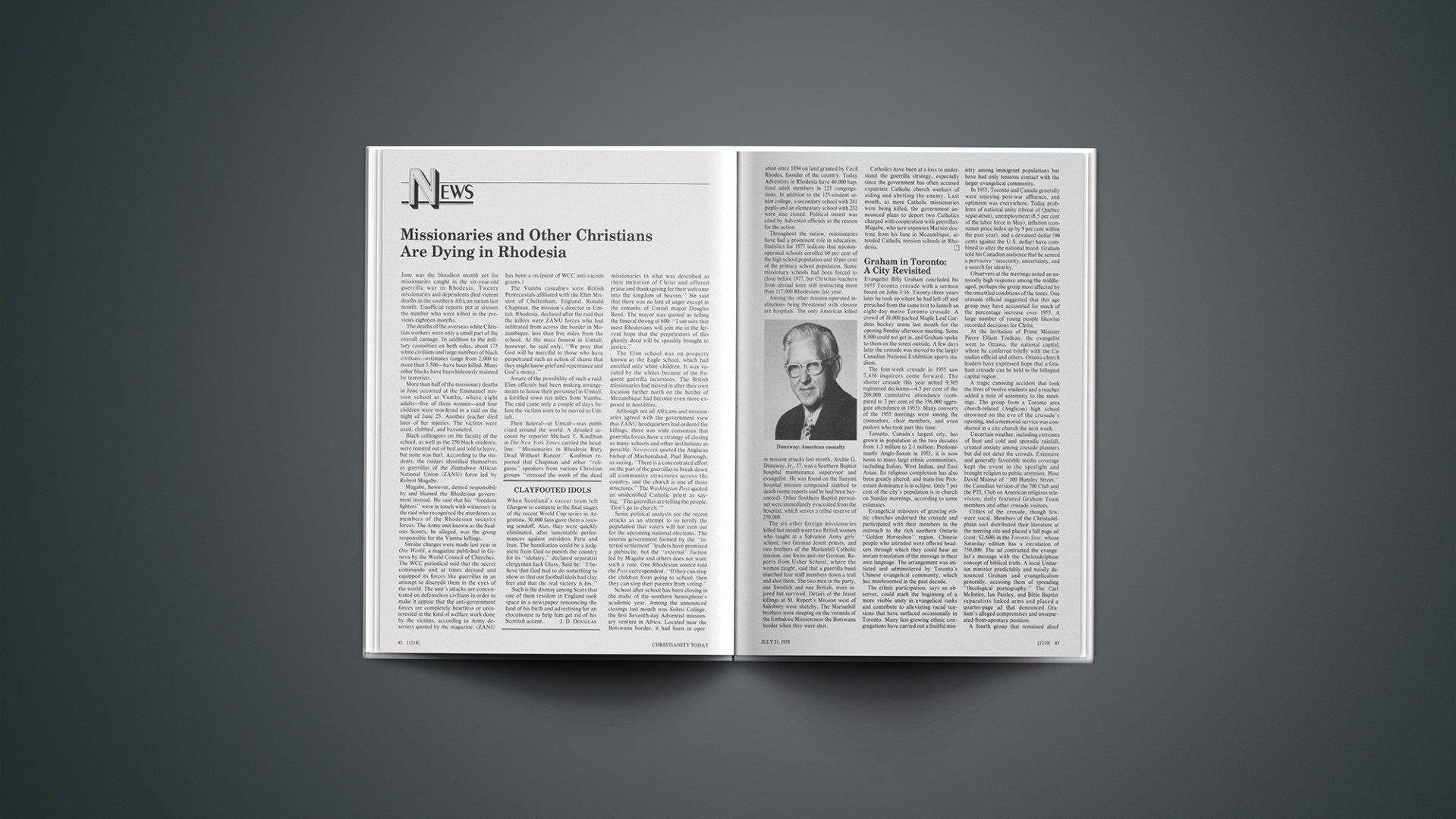
Among the other mission-operated institutions being threatened with closure are hospitals. The only American killed in mission attacks last month, Archie G. Dunaway, Jr., 57, was a Southern Baptist hospital maintenance supervisor and evangelist. He was found on the Sanyati hospital mission compound stabbed to death (some reports said he had been bayoneted). Other Southern Baptist personnel were immediately evacuated from the hospital, which serves a tribal reserve of 250,000.

The six other foreign missionaries killed last month were two British women who taught at a Salvation Army girls’ school, two German Jesuit priests, and two brothers of the Marianhill Catholic mission, one Swiss and one German. Reports from Usher School, where the women taught, said that a guerrilla band marched four staff members down a trail and shot them. The two men in the party, one Swedish and one British, were injured but survived. Details of the Jesuit killings at St. Rupert’s Mission west of Salisbury were sketchy. The Marianhill brothers were sleeping on the veranda of the Embakwe Mission near the Botswana border when they were shot.

Catholics have been at a loss to understand the guerrilla strategy, especially since the government has often accused expatriate Catholic church workers of aiding and abetting the enemy. Last month, as more Catholic missionaries were being killed, the government announced plans to deport two Catholics charged with cooperation with guerrillas. Mugabe, who now espouses Marxist doctrine from his base in Mozambique, attended Catholic mission schools in Rhodesia.

Graham in Toronto: A City Revisited

Evangelist Billy Graham concluded his 1955 Toronto crusade with a sermon based on John 3:16. Twenty-three years later he took up where he had left off and preached from the same text to launch an eight-day metro Toronto crusade. A crowd of 18,000 packed Maple Leaf Gardens hockey arena last month for the opening Sunday afternoon meeting. Some 8,000 could not get in, and Graham spoke to them on the street outside. A few days later the crusade was moved to the larger Canadian National Exhibition sports stadium.

The four-week crusade in 1955 saw 7,436 inquirers come forward. The shorter crusade this year netted 9,305 registered decisions—4.5 per cent of the 209,000 cumulative attendance (compared to 2 per cent of the 356,000 aggregate attendance in 1955). Many converts of the 1955 meetings were among the counselors, choir members, and even pastors who took part this time.

Toronto, Canada’s largest city, has grown in population in the two decades from 1.3 million to 2.1 million. Predominantly Anglo-Saxon in 1955, it is now home to many large ethnic communities, including Italian, West Indian, and East Asian. Its religious complexion has also been greatly altered, and main-line Protestant dominance is in eclipse. Only 7 per cent of the city’s population is in church on Sunday mornings, according to some estimates.

Evangelical ministers of growing ethnic churches endorsed the crusade and participated with their members in the outreach to the rich southern Ontario “Golden Horseshoe” region. Chinese people who attended were offered headsets through which they could hear an instant translation of the message in their own language. The arrangement was initiated and administered by Toronto’s Chinese evangelical community, which has mushroomed in the past decade.

The ethnic participation, says an observer, could mark the beginning of a more visible unity in evangelical ranks and contribute to alleviating racial tensions that have surfaced occasionally in Toronto. Many fast-growing ethnic congregations have carried out a fruitful ministry among immigrant populations but have had only tenuous contact with the larger evangelical community.

In 1955, Toronto and Canada generally were enjoying post-war affluence, and optimism was everywhere. Today problems of national unity (threat of Quebec separatism), unemployment (8.5 per cent of the labor force in May), inflation (consumer price index up by 9 per cent within the past year), and a devalued dollar (90 cents against the U.S. dollar) have combined to alter the national mood. Graham told his Canadian audience that he sensed a pervasive “insecurity, uncertainty, and a search for identity.”

Observers at the meetings noted an unusually high response among the middle-aged, perhaps the group most affected by the unsettled conditions of the times. One crusade official suggested that this age group may have accounted for much of the percentage increase over 1955. A large number of young people likewise recorded decisions for Christ.

At the invitation of Prime Minister Pierre Elliott Trudeau, the evangelist went to Ottawa, the national capital, where he conferred briefly with the Canadian official and others. Ottawa church leaders have expressed hope that a Graham crusade can be held in the bilingual capital region.

A tragic canoeing accident that took the lives of twelve students and a teacher added a note of solemnity to the meetings. The group from a Toronto area church-related (Anglican) high school drowned on the eve of the crusade’s opening, and a memorial service was conducted in a city church the next week.

Uncertain weather, including extremes of heat and cold and sporadic rainfall, created anxiety among crusade planners but did not deter the crowds. Extensive and generally favorable media coverage kept the event in the spotlight and brought religion to public attention. Host David Mainse of “100 Huntley Street,” the Canadian version of the 700 Club and the PTL Club on American religious television, daily featured Graham Team members and other crusade visitors.

Critics of the crusade, though few, were vocal. Members of the Christadelphian sect distributed their literature at the meeting site and placed a full page ad (cost: $2,600) in the Toronto Star, whose Saturday edition has a circulation of 750,000. The ad contrasted the evangelist’s message with the Christadelphian concept of biblical truth. A local Unitarian minister predictably and noisily denounced Graham and evangelicalism generally, accusing them of spreading “theological pornography.” The Carl McIntire, Ian Paisley, and Bible Baptist separatists linked arms and placed a quarter-page ad that denounced Graham’s alleged compromises and unseparated-from-apostasy position.

A fourth group that remained aloof from the crusade was a large segment of the United Church of Canada, the country’s largest Protestant denomination. A prominent United Church minister, J. Berkeley Reynolds, was a vice chairman of the crusade committee, and individual United Church ministers and members actively participated. However the well-known United Church Observer editor, A. C. Forrest, and other denominational leaders were openly critical of what they regarded as Graham’s failure to address social ills.

A school of evangelism that was conducted in conjunction with the crusade attracted about 900 ministers, seminarians, and other church leaders from five provinces, twenty-eight states (U.S.), and seventy-one denominations.

The Graham team includes a proportionately large number of Canadians—Leighton Ford, George Beverly Shea, John Wesley White, Ralph Bell, Tedd Smith, and Homer James. Another Canadian honored at the crusade was evangelical patriarch Oswald J. Smith, 88-year-old founder of Toronto’s Peoples Church, world missionary statesman, and author of numerous books and hundreds of hymns. Graham paid public tribute to the veteran minister. The 1,600-member Peoples Church, whose present pastor is Paul B. Smith, son of the founder, strongly supported the crusade.

The crowd of 45,000 at the closing service seemed deeply stirred as the 4,500-voice crusade choir made the lakefront stadium echo to the powerful strains of “How Great Thou Art.” That hymn, of Scandinavian origin but now familiar to English-speaking audiences everywhere, was introduced to North America at the 1955 Toronto crusade.

Crusade chairman Desmond Hunt, Anglican rector of the downtown Church of the Messiah, reported that the $643,000 budget had been over-subscribed and that the surplus would be designated to purchase of television time in Canada and to alleviation of suffering in the typhoon-stricken area of India, where the Graham organization has been sending aid.

Other Graham crusades this year are scheduled to be held in Kansas City, Oslo, Stockholm, and five cities in Poland (October 6 to 16).

LESLIE K. TARR

Graham: A Deficit

The Billy Graham Evangelistic Association (BGEA) and five affiliate organizations posted a combined deficit of $3.2 million last year, according to the first full financial report made public by Graham’s Minneapolis headquarters.

The statement shows that the six groups had a total income last year of $38.4 million and expenditures of $41.6 million, 89 per cent of it for evangelism and 11 per cent for administration and fund-raising. Income of the BGEA itself was $27.7 million, down $1 million from 1976, and expenditures were $30.4 million, up $2.7 million. Comparative figures covering the two years were not available for the affiliates: World Wide Pictures, World Wide Publications (also known as Grason), the Blue Ridge Broadcasting Corporation (which operates a religious radio station in Black Mountain, North Carolina), the Christian Broadcasting Association (which operates a radio station in Honolulu), and the Billy Graham Evangelistic Association of Canada. The totals do not include finances of evangelistic crusades; these are handled by local committees.

A separate report for the Dallas-based World Evangelism and Christian Education Fund (WECEF) shows a balance of $15.5 million at the end of 1977 after $7.7 million was released during the year for construction of the Graham Center at Wheaton College in suburban Chicago. The balance is earmarked for completion of the center and for other projects. Graham set up the fund in 1970 to aid projects in missions, evangelism, and Christian education. Some of the money comes from the BGEA.

Newspaper stories about the generally unknown WECEF account, along with certain disclosure requirements that surfaced in Minnesota, preceded issuance of the financial report, which cleared the air. Normally, parachurch agencies are required to file public financial statements with the Internal Revenue Service, but the BGEA is exempt because it is listed in government files as a church.

The Graham organization has nothing to hide, explained BGEA executive vice president George Wilson to reporters. It’s just that the “little” donor, whose average gift of $ 10 or so accounts for most BGEA income, might be discouraged from giving when he sees the millions of dollars listed on financial reports, he suggested.

It is unclear if the hubbub in the press over Graham finances contributed to the dip in income. Among other things, Wilson blames weather conditions that impeded mail service last winter. (Some observers point out that with the proliferation of television preachers—many vying for virtually the same pool of contributors to underwrite their multi-million-dollar budgets—a pinch was inevitable.)

Whatever, possible cutbacks are being considered in BGEA radio and television programming in order to deal with the declining dollars and escalating costs (especially in postage), Wilson told a Minneapolis reporter.

Record Offering

Ever the possibility thinker, television pastor Robert H. Schuller of the Garden Grove Community Church in the Los Angeles suburbs announced a Sunday offering goal of $1 million for June 18. The money, he said, was needed to continue construction of the $14 million mostly glass Crystal Cathedral next door. For more than two months he plugged the special offering. When the appointed Sunday finally arrived, Schuller led off the collections with his own contribution of $150,000—the profit from a sale of a condominium he bought nine years ago with a $9,000 down payment and $30,000 mortgage. Instead of offering plates, the ushers used hardhats and wheelbarrows. Into them was dropped $1,251,376 in cash and checks by the some 5,000 persons in the three morning services, Schuller later announced.

It may be a record for a church offering on a single day. Church spokesman Michael Nason said the previous largest known collection in one day was $886,881 on May 22, 1977, for a building project at the Broadway Church of Christ in Lubbock, Texas.

Canada: Issues of Unity

No Christians have the right collectively to assert that any specific constitutional arrangement—past, present, or future—possesses divine approval, the 104th General Assembly of the 169,000-member Presbyterian Church in Canada (PCC) was told when it met last month in Hamilton, Ontario. The 250 commissioners (delegates) were listening to a report of a special committee on national unity, chaired by clergyman William R. Russell of Montreal.

All constitutions are basically human inventions, said the committee. It added: “Nevertheless, in its divinely appointed mission as the conscience of the state, the church has the responsibility to speak out on behalf of unity in difference. This principle is implicit in the Christian understanding of human relationships.”

The threat of separatism posed by the province of Quebec led the 1977 PCC assembly to appoint a committee representative of all parts of Canada to study and report upon the church’s attitude toward this danger to Canadian unity. The comprehensive report, printed in both French and English, was largely a theological statement based on “The Declaration of Faith Concerning Church and Nation,” a document adopted by the PCC some twenty years ago.

The assembly approved the special committee’s statement which called for an atmosphere of openness and an attitude of reconciliation on the part of all Canadians as they face political developments, especially as they relate to Quebec and issues of national unity.

Proposals for closer relationships with the United Church of Canada brought forward after three years of conversations with a delegation from that body were sent to the PCC’s forty-four presbyteries for study and report to the 1979 General Assembly. A joint report on the conversations, which at no time dealt with organic union, called for closer cooperation at every level of church life, an annual national consultation concerned primarily with doctrine, mission and social action, and initiation of changes in present practice that would permit mutual reception of ministers by the two denominations.

Last year’s General Assembly turned down a request for financial help and support from the Presbyterian Church of Australia. That church was being split at the time by the union with Congregationalists and Methodists. About two-thirds of the Presbyterians entered the uniting church. This year’s assembly turned down the recommendation of the Committee on Inter-Church Relations that the two churches be given equal recognition. Instead it reaffirmed its fraternal relationship with the Presbyterian Church of Australia and recognized the Uniting Church of Australia simply as “a member of the World Alliance of Reformed Churches.”

In swift action without any hint of dissension the commissioners elected two college principals (presidents). William Klempa will go from Rosedale Presbyterian Church in Toronto to Montreal on August 1 as principal of Presbyterian College. J. Charles Hay, who has acted as principal of Knox College, Toronto, since the death a year ago of Allan L. Farris, was given permanent status.

However, the appointment of a professor of church history to fill a teaching vacancy left by Farris prompted debate. Many commissioners were apparently upset because the search committee proposed a U.S. candidate rather than one of the several Canadians nominated by presbyteries. By a vote of 98 to 94 the General Assembly appointed the committee’s choice, Calvin Augustine Pater of Westport, Massachusetts, a recent Harvard graduate.

The commissioners met against the backdrop of a somewhat forboding special issue of the denomination’s publication, The Presbyterian Record. It dealt with “The State of the Church.” One of the contributors wrote: “Were the present trend to continue, there is little doubt that our denomination soon would be reduced to a mere remnant.” Editor James Dickey pointed out that the membership of the denomination is declining at the rate of 3,206 people a year and that it has become the oldest religious body in Canada in terms of membership age. The church’s comptroller said that “real” giving in the church is also on the decline, and he projected sizeable deficits for 1978 and 1979.

The downward trends have prompted some of the denomination’s leaders to do a lot of hard soul-searching, the publication indicates. To reverse the trends, say the writers, there must be a “return to basics” and a rediscovery of a “distinctive Presbyterian witness.”

DECOURCY H. RAYNER

Sainthood And Taxes

It was only a matter of time before mail-order religion king Kirby J. Hensley of Modesto, California, got around to elevating mortals to sainthood. Five dollars will do it, he says, and the amount includes a certificate that attests to the canonized status. “A ticket to see Saint Peter,” he calls it.

Hensley, 66, founded the believe-whatever-you-wish Universal Life Church fifteen years ago by offering clergy credentials through the mail for two dollars. That was about 6.5 million “ordinations” and 30,000 “church charters” ago, he estimates. His enterprise also provides a doctor of divinity degree for $20. A doctor of philosophy in religion degree is conferred for a donation of $100.

Hensley, who employs about a dozen workers, claims he takes no salary from the church. He tells reporters that he was once a hobo and that he has never learned how to read and write. He apparently knows how to sign his name on checks, however. His organization’s average income exceeds $1 million annually, but in good years it has been much better than that, according to Hensley watchers. Hensley declines to comment about finances.

Benched

Remember municipal court judge Hugh Wesley Goodwin of Fresno, California? He’s the judge who attracted wide attention—much of it critical—for offering some criminal defendants the option of mandatory attendance at church services and Bible studies instead of jail sentences. He was defeated in an election last month and will leave the bench at the end of the year, when, he says, he will become “a missionary.” Some people, apparently ignoring testimonies of changed lives and attitudes, want him out sooner. A judiciary watchdog committee has filed formal misconduct charges against him for mixing religion with his rulings. The judge vows that he will fight the charges. It’s okay to separate the church from the state, he says, but it’s a “serious mistake” to try to separate God from government.

Goodwin, the son of a minister, a descendent of slaves, and the county’s first black judge, said his defeat in the recent election was “a message from God that I have accomplished my mission here and it’s time to move on.”

Government officials in New York don’t think the Hensley operation is a laughing matter. In 1976, 211 of the 236 adult residents of Hardenburgh. a rural New York town of low-income workers, obtained ordinations from Hensley in hopes of gaining relief from property taxes. Several non-profit organizations had bought large parcels of land in the area, removing them from the tax rolls and creating a heavier burden for local citizens (see October 22, 1976, issue, page 48). Tax assessors in Hardenburgh and in three neighboring clergy boom towns granted tax exemptions to the newly ordained. In doing so, the assessors violated explicit instructions from the state’s Board of Equalization and Assessment.

The case ended up in court, and last December a New York State Supreme Court justice ruled that the Hensley ministers were improperly removed from the tax rolls. The judge permitted them to remain off the rolls this year, though, because his ruling came so late. Under the ruling, assessment review boards in the towns are to decide if the mail-order clerics should be restored to the tax rolls. This will involve following “ample guidelines” established by the courts to determine whether the Universal Life Church is a religion under state law. Whether such reviews will be free from bias is open to question. The members of the Hardenburgh tax review board, for example, hold ordination credentials from Hensley.

Tax assessor Robert Kerwick says that 213 “ordained” taxpayers in Hardenburgh alone have received church charters and are holding religious services in their homes for family members and friends. The homes have all been removed from the property tax rolls, he told CHRISTIANITY TODAY, because they function primarily as live-in places of worship. Hearings have been held to determine whether they qualify, and the “ministers” have brought in records showing that services indeed were being held.

“A lot of people may be reading the Bible for the first time,” commented Kerwick. He noted that a lot of the services centered on studies in the book of Genesis. (Many of the town’s residents also attend services of the Episcopal and Reformed Church in America churches in town.)

It costs $6,800 to send a Hardenburgh youngster to school, said Kerwick. Who is picking up the tab, now that virtually everybody in town is exempt from taxes? Other New Yorkers, he replied.

The people in Hardenburgh have a point in what they are doing, said Kerwick. They want to force the state to do something about the problem of higher taxes that are the result, at least partially, of exemptions being granted to an ever increasing number of non-profit corporations, he indicated.
Book Briefs: July 21, 1978

Understanding The Message Of Job

Job, by Francis I. Andersen (InterVarsity, 1976, 294 pp., $7.95), is reviewed by Elmer B. Smick, professor of Old Testament, Gordon-Conwell Theological Seminary, South Hamilton, Massachusetts.

Here is an up-to-date, scholarly, and yet practical commentary on Job. Its greatest strength comes from the author’s understanding of the languages and culture of the Ancient Near East. He is a highly qualified semiticist, who has accomplished the difficult task of joining fine scholarship and practical Christian piety. Too often they never meet. The comments are broadly evangelical. What one thinks of the theology of the author will depend on his own perspective. Andersen’s theology is not systematic. He does not hesitate to criticize the Reformed doctrine of original sin and in doing so sounds like he would champion the cause of Pelagius over Augustine. And yet, with Job, he rejects the Pelagian views of Eliphaz. Andersen claims that such a doctrine as total depravity “if permitted to deny any possibility of goodness in human conduct must contradict the premise of the book of Job that its hero was a ‘blameless and upright man’ (1:1).” On the one hand the book itself makes clear that “blameless and upright” does not mean “sinless.” Even Job’s protestations of innocence and his negative confession (chapter 31) only relate to his present suffering. Job admits he is a sinner in 7:20 and Andersen comments on this. On the other hand only the most extreme Reformed theologian would deny any possibility of goodness in human conduct. Depravity in man is his complete tendency to sin, to rebel against his Creator. Reformed theologians assert the view of a continued though marred image of God in man. Is it true that Job had nothing to repent of? Andersen will not admit to any self-righteousness in Job or any real repentance even in 42:2–6. All have sinned so God is not unjust in any suffering he allows Satan to inflict. Job was not suffering for any immediate sin and in that sense was innocent. Although Job did not curse God as Satan predicted, he came very close. Andersen’s statement that Job needed no repentance is annoying in the light of the many unfortunate things Job says, even suggesting that God is an unjust bully (chapter 9). For this Job did repent (42:1–6) but in it all his relationship with the Lord was genuine while the counselors mouthed the truth in empty clichés without love for God or Job.

Andersen does not hesitate to present his evangelical position forthrightly. The doctrines of the person of Christ and his substitutionary atonement come through clearly. Is the author a universalist? His language is ambiguous. Without doubt he handles the problem of human suffering with great empathy and understanding. He states that Job, not the counselors, sees God as truly sovereign. God may give or retrieve his gifts at his pleasure but the counselors want to put God in a box and make him predictable. Interestingly, Andersen, who attacks some aspects of Reformed theology, has no trouble with the sovereignty of God. Sometimes he uses the language of a hide-bound Calvinist, who might use words that imply that God is the author of evil. Andersen criticizes Eliphaz for “binding God to certain rules” in order to “safeguard God’s morality.” He says, “To bring God under obligation to a morality beyond His will is a threat to His sovereignty, especially when it is a man who thinks he knows what that morality should be.” Such a view must be balanced with a proper emphasis on the unity of God’s revealed truth. He has revealed a good deal of what his morality is and he does not contradict himself. The book of Job doesn’t answer the problem of evil by teaching that God creates it. It leaves it unanswered. The closest we can get is God’s permitting Satan to touch Job. Andersen sees that Job’s task in the dialogue is to “normalize,” that is, “find the rightness of his relationship with God as it is ‘now’ (6:3)” (p. 124). He sees this as the key to the understanding of the book that Job, through his suffering, is brought to understand that the highest wisdom is to love God for himself alone. Job does not know why he is suffering and is never given a rational answer. Although the reader understands the role of Satan, this is never revealed to Job. Andersen is on target in seeing that the theology of the comforters was a correct theology as far as it went—a man reaps what he sows. But Job’s was a special case and their platitudes did not apply. Job’s suffering was not punitive. So all their fine theology instead of helping him simply added to his pain.

He repeatedly attacks stoicism and Manichaeism as dehumanizing philosophies with the claim that the Puritan tradition had some degree of infection from these heresies. He is to be commended for correcting any failure to allow for the full expression of human emotion that has been stifled to a great extent in western Christendom. Jesus’ tears and the full vent of his emotions are likened to Job’s, but the analogy must not be carried too far or we find ourselves with a pelagian soteriology at least for the Old Testament. Such a view would destroy the theological unity of Scripture and the unity of the covenant of grace that the Apostle Paul took such pains to present in Romans and Galatians. The book of Job can be used as a basis for forming a theology only after a proper hermeneutic is employed. So it may be unfair to talk about Augustinianism versus Pelagianism if based on this or that passage of Job outside the total context of the book and the whole of the Old Testament especially as interpreted by that divine commentary, the New Testament.

Andersen’s knowledge of the languages and literature of the ancient Near East enables him to provide many insights and interpret difficult passages that critical scholars have formerly emended or deleted. A valid form of textual criticism is practiced with deftness and caution. This commentary is unique in its sensitivity to the poetic form so prominent in Job. There are many original insights showing the drive toward symmetry in larger units of literature including the entire format of the book. The ABA pattern of Prose-Poetry-Prose of the Prologue, Dialogue, Epilogue has often been noted. But Andersen sees a good deal more than this and considers it a mark of the artistic integrity of the book. Whole units of literature covering a few verses or several chapters display a beautiful chiasm. For example the speech of Eliphaz in chapters four and five show an ABC-D-C’B’A’ pattern. In this case he may be seeing more than is there, but he is to be commended for his sensitivity to this important feature of Semitic poetry, which others have overlooked.

The idea that the Old Testament contains a dozen creation stories is a questionable way of expressing a richness of figurative language that had its roots in various creation accounts. To say the figure of Yahweh laying the foundation of the earth like that of a house (38:4–6) is a creation story simply carries the figure too far. Andersen puts to good use the demythologizing principle used by the Hebrews, though he appears to believe it was sometimes left incomplete. For example, the language used of the Canaanite gods is used for the Hebrew angels. But who is to say when this is only partial. The same principle should be applied to the creation language whether in Genesis or elsewhere in the Old Testament.

Finally it is not the policy of the series of Tyndale Old Testament Commentaries of which this is a part to print the text. This makes them less expensive but in this difficult book the text would have aided the reader in what is otherwise too involved to follow. The problem surfaces, for example, in the attempt to explain to the reader how a simple change in vowels would clarify the text of 3:10.

Despite some theological reservations I find this one of the most helpful commentaries ever written on the book of Job.

Filmstrips

Winston House (430 Oak Grove, Minneapolis, MN 55403) offers Introducing Judaism in four parts. After a brief historic glimpse the viewer is introduced into the life of a big, modern American Jewish synagogue. After a tour around the synagogue, one goes on to the Sabbath, the Life Cycle, and the Festivals. This filmstrip demonstrates the strong social and cultural cohesiveness of Judaism. Moving beyond the centrality of the synagogue into the mainstream of American life is the problem treated in Shtetl to Suburb: The American Jew by Multi-Media (Box 5097, Stanford, CA 94305). “Shtetl” is the term for a self-imposed Jewish ghetto, an American creation. Unlike the European ghetto from which there was no escape, the shtetl was the Jewish immigrants’ response to the American encounter and was paralleled by other groups. Unfortunately the filmstrip reinforces the stereotype of advanced education and entry into the professions as hallmarks of Jewish life in America. It could have given a larger sympathetic overview of what it means to be a Jew.

Encore Visual Education (1235 S. Victory Blvd., Burbank, CA 91502) offers five filmstrips on Israel’s Land and People. Basically aimed at the upper elementary grades, it is meant for classroom use. However, if the introductory “Picture Glossary for Israel” is omitted, the other four filmstrips can be used for older groups as primers on geography, economy, kibbutzim, and Israelis. The series, though secular, is informative and can be coordinated with any church’s efforts to increase its understanding of Israel.

An unusually fine series on literature is offered by Thomas S. Klise Company (Box 3418, Peoria, IL 61614) and two representative filmstrips are Samuel Taylor Coleridge’s “The Rime of the Ancient Mariner” in The Mariner’s Sad Wisdom, and a survey of the contributions of Graham Green in Greene’s Sinners. Produced for the discriminating reader, these filmstrips delve into the religious roots and implications of literary artists. Both written and narrated by Thomas Klise, himself a novelist of recent celebrity (The Last Western), viewers will not readily agree with his commentary. Some will think Klise reads too little orthodoxy into Coleridge, and too much into Greene, and vice versa. Evangelical literati may doubt the relevance of orthodox Christianity at all, especially in regard to Greene. This series features choice art and a narrative of subliminal depth. Evangelicals should be challenged to produce a comparable series on Milton, T.S. Eliot, Alan Paton, Dostoevski, and the brilliant circle of the English Inklings (C.S. Lewis, J.R.R. Tolkien, Charles Williams, et al).

The value of The Eucharist: Bond of Love from Alba House (Canfield, OH 44406) is to help dispel Protestant notions that the Roman Catholic Mass is either unintelligible or excessively ritualistic. It presents a modern Roman Catholic understanding of the Eucharist as Christ given to the world through persons, rather than stressing miraculous changes in wafers and wine.

DALE SANDERS

Portland, Oregon

Helping People With Problems

Effective Biblical Counseling, by Lawrence J. Crabb (Zondervan, 1977, 191 pp., $6.95), is reviewed by Frances J. White, coordinator of counseling concentration, Wheaton Graduate School, Wheaton, Illinois.

With the local church in mind Crabb presents a model of counseling. He wants to provide a biblically sound theoretical and practical base for persons in a local church who work with deeply troubled people. These helpers, classified as Level III counselors, are trained not only to encourage (Level I counselors) or exhort (Level II counselors) but also to enlighten. To enlighten means to help the counselee change his faulty beliefs to health-producing biblical ones. This process is the basis of what Crabb calls effective biblical counseling.

He starts by defining the goal of biblical counseling as promoting Christian maturity. To him this involves: “(1) immediate obedience in specific situations and (2) long range character growth” (p. 23).

In chapter two the author does a good job of explaining four approaches to the relationship of secular theories of counseling and biblical truths. The first is to totally divorce the two (“Separate But Equal”). The second is to mix the common insights of the two (“Tossed Salad”). The third is to completely disregard secular insights (“Nothing Buttery”). The last, adhered to by Crabb, is to integrate into a Christian model those secular insights and techniques that can withstand the scrutiny of Scriptural truth, thereby arriving at a position where discovered and revealed truth are compatible (“Spoiling the Egyptians”).

The second division discusses personal needs, motivation, and personality structure. The need for personal worth, which was lost with the Fall, is our basic drive, with security (love) and significance as primary roads to worth. According to the author, satisfying these needs motivates people. A person must consciously replace faulty beliefs with biblical ones to develop a new pattern of behavior and to free himself of such debilitating emotions as anxiety, resentment, and guilt.

Crabb develops his counseling strategy from this perspective. He proposes seven stages for a counselor to follow. Once the problem stemming from faulty feelings (Stage I), behavior (Stage 2), and thinking (Stage 3) are identified, the way is opened to teach correct biblical thinking to arrive at a “renewed mind” and spiritual maturity. He concludes by strengthening his thesis that the local church has the resources to counsel people.

Crabb knows that he has “grossly oversimplified” the methods of a counselor. He limits his book to an overview of the counseling model. Yet he is obviously aware of the skills that could make or break a successful counseling process. His failure to deal with the variables that complicate, short-circuit, or prolong the counseling process increases the danger among paraprofessionals of becoming dogmatic. The popularized terminology, charts, and explanations of personality structure, also increases this risk. A complementary book to deal with specific methods could minimize this danger, as well as being a valuable contribution to the “Level III counselor.”

A second area that could be misleading is that of the goal of counseling. All counselors want their patients to reach maturity. However, Crabb should have mentioned the need and legitimacy of working toward intermediary goals on the road to maturity.

Certain issues are inherent in this sort of book. For example, Crabb thinks that as the body life concept gains momentum, the deeply rooted problems of individuals begin to surface. He says that they can be effectively treated by a Level III counselor (six months to a year of weekly two-and-one-half-to three-hour classes) as the individuals function in the milieu of the particular body of believers with whom a trusting, warm relationship has already been established. Current research supports his thesis. In this context Crabb considers the role of the professional to be to train Christians in local churches whose gifts lie in counseling and to provide backup resources when necessary. Whether there is full accord with his ideas or not, simply the number of problems and often formidable expense of professional help accentuates the need of training lay people. Professional Christian therapists should join Crabb in developing conceptual frameworks, working models, and strategy plans for their application. Otherwise, amateur methods could result in a regression of the growing positive attitude toward seeking needed help.

A further issue stems from the author’s strong cognitive orientation. “The order is invariant: first the facts (a renewed mind), then the faith (doing what the facts suggest), and then the feelings (the facts become experientially and subjectively real).” Does Scripture support primarily a cognitive orientation of therapy or is cognition one of the many characteristics of man? This raises such questions as possible pluristic models that address all known aspects of the characteristics of man. In short, aren’t several models possible provided they accede to revealed truth wherever conflict arises? Books such as this one encourage Christian therapists to think through, modify, correct, and enhance their own philosophical presuppositions with their implications for counseling strategies.

Facing Sickness

Make Your Illness Count, by Vernon J. Bittner (Augsburg, 1977, 126 pp.,$3.50 pb), and God Speaks Through Suffering, by T. B. Maston (Word, 1977, 95 pp., $3.25 pb), are reviewed by Karin Granberg Michaelson, Sojourners Fellowship, Washington, D. C.

The account of Paul’s thorn in the flesh, the story of Job, and countless other examples in Scripture have often been taken to imply that illness and suffering are sent from God to serve a creative purpose in the lives of individuals which only God knows and intends. These two books approach illness from a different vantage than do the many books that testify to healing.

T. B. Maston, a retired professor of Christian ethics at Southwestern Baptist seminary writes movingly from his own experience with suffering, the lifelong handicap of his son Tom. His is no glib equating of suffering with God’s will. He lets God be God and leaves room for mystery in the Christian life—for painful unanswered questions. Perhaps most importantly he focuses on the uniqueness of his family’s situation, doesn’t try to include all situations of suffering, and raises the question, what will we let God do for us and through us because of our suffering. He attributes the existence of pain and-suffering to the price we pay for human freedom. Although he does not share an openness to prayers for healing of even congenital defects, his is not a stoic, pagan response of resignation. Rather it is the response of his particular faith; God speaks in sickness and in health. If we can listen we will always be comforted and find meaning.

Vernon Bittner is a well-known figure in clinical pastoral education, a chaplain and pastor familiar with sickness and suffering. In his book he utilizes many case histories from both his parish and hospital experiences. He explains that for many people illness becomes a wasted opportunity for growth and service. Bittner does not assume that God’s ordinary intention is toward wholeness and healing. For him God’s healing power is the power given to accept our suffering. Like Maston, prayer for release from suffering, or specifically prayer for healing, seems to be no part of his particular perspective.

I wished that Maston and Bittner were more open to an exploration of the special healing power available to the church. Lacking is the conviction that God’s will can be seen as dynamic, not static, a force that always calls the Christian to greater faith and hope, regardless of the outcome of individual suffering. Absent is the belief that the faith and hope to pray for healing need not be fundamentally opposed to that faith and hope which accepts what is given.

Briefly Noted

LOOKING FOR ADDRESSES and other information on denominations and specialized religious organizations takes a lot of time. Doctrinal emphases or historical ties need to be known but frequently are not readily discernible. Two recent reference tools will therefore be welcomed by journalists, scholars, pastors, and the curious. Libraries should add them to their reference collections. A Directory of Religious Bodies in the United States by J. Gordon Melton (Garland [545 Madison Ave., New York, NY 10022], 305 pp., $21) alphabetically lists more than 1,200 “primary religious bodies” (also known as denominations, churches, sects, and cults) with their addresses; then he groups them into several families and subfamilies. Far more numerous and elusive than denominations are the groups that are either subdivisions of denominations (such as the seemingly endless Roman Catholic orders) or that are independent and have specialized roles, such as Youth for Christ or Scripture Press. More than 1,500 of this kind of “secondary” agency are listed in a Directory of Religious Organizations in the United States of America, compiled by the staff of the publisher (Consortium Books [Box 9001, Wilmington, NC 28401], 553 pp., $62.50). There is little overlap between the two directories. Both tasks are mammoth. Melton’s directory, though not without flaws, is much more comprehensive than the Consortium product. Moreover, the latter would have done better to have the organizations in one alphabet instead of arbitrarily dividing them into nine categories. But there is a single-alphabet index and this should be consulted first. The brief descriptions accompanying each entry are helpful. (By the way, Consortium is soon to issue two large volumes in which Melton tells more about the denominations that he has listed and classified in his directory.) Although the prices seem steep, anyone who has spent time and money trying to chase down data on religious groups will know their value.

ACTIVITIES FOR CHILDREN fill twelve large, well-illustrated volumes of about 150to 175 pages selling for $5.95 each. They have been issued as the Can, Make, and Do Books by the Creative Resources division of Word. Joy Wilt is the principal compiler. The series is rich with ideas for anyone who works with children. Four volumes are devoted to activities for the five senses, three give tips about puppets and props, two concentrate on how to make costumes, and games, seasons and holidays, and rhythm and movement each take a volume. The ideas are creative, practical, and seemingly endless. Daycare centers, Sunday schools, and elementary schools should buy this set.

CHURCH TREASURERS, here’s a major book for you: Complete Handbook of Church Accounting by two Manfred Holcks, a father and a son, both accountants (Prentice-Hall, 300 pp., $17.95). The authors are experts on church money matters and the book is full of forms and tables that accompany a comparatively readable text.

Although billed as a practical book, Regarding Religious Education (Religious Education Press [1531 Wellington Rd., Birmingham, AL 35209], 181 pp., $6.95 pb) by Mary Cove and Mary Mueller concentrates on the theory behind Christian education and how it relates to practice. Topics include teaching for living and dying, the prophetic role of religious education, and teacher development.

Periodicals

The long-awaited Old Testament Abstracts has now appeared with the February, 1978, issue. There are to be three issues/year for a subscription price of $11. (Write OTA at Catholic University of America, Washington, DC 20064.) The first issue has classified abstracts of 314 articles from scholarly journals of diverse theological orientation. There are also about 100 abstracts of books.

A bimonthly magazine for Christian women, which says it “will try to bridge the gap between Moody Monthly and Ms,” was launched with the March–April issue. Its title is Free Indeed and for subscriptions (at $8/year) write Box 261, Kutztown, PA 19530. The thirty-two-page first issue includes a variety of articles, such as ones on Jesus and women in Luke, Dorothy Sayers, and establishing financial credit.

World Evangelization is a quarterly news bulletin and prayer calendar from the Lausanne Committee for World Evangelization. Write for a sample to P.O. Box 1100, Wheaton, IL 60187. From the same address, for one dollar each, one can obtain the first two Lausanne Occasional Papers, on evangelizing “homogeneous units” and on the Gospel and culture.

A growing problem to which Christians are far from immune now has a scholarly quarterly journal of its own. The Journal of Divorce is under secular auspices, but many seminaries will want it as a resource for their pastoral counseling courses. The first issue was Fall 1977. Subscriptions are $18 for individuals, $35 for libraries. Write Haworth Press, 149 Fifth Ave., New York, NY 10010.

Following Paul in Turkey

For many years I have cherished the desire to follow “in the steps of St. Paul” (to quote the title of H. V. Morton’s justly famous book, first published in 1936), by visiting the Pauline sites of Greece and Turkey. At last I was able to do so in early April of this year, and was fortunate to have my friends Dick and Thea Van Halsema of the Reformed Bible College as companions and guides. In 1962 they drove their whole family through these parts (described in Thea’s delightful book Safari for Seven) and have since led several tour groups. Our most moving experience was to trace the Turkish part of the first missionary journey.

Perga in Pamphylia

Sailing from Cyprus Paul, Barnabas, and Mark landed at Perga, whose harbor in those days was located several miles up the Cestrus River, well protected from Cilician pirates. We wandered among the ruins of the city. Two rounded towers survive, which once framed the Victory Portal leading onto the twenty-one meters-wide main street. This consisted of two ways, separated by a central water channel and flanked by two rows of Ionic columns, each colonnade being paved with mosaic and lined with shops. But Paul did not linger there. Why not? And why did young John Mark desert?

We know that Paul was sick when he arrived on the Galatian plateau (Gal. 4:13, 14). I think William Ramsay was the first to suggest that he caught malaria in the low-lying swamps of Pamphylia and that his ‘thorn (or stake) in the flesh’ referred to the stabbing headaches that resulted. Certainly his eyesight was affected, or he would never have thanked the Galatians that, if they could have done so, they would have plucked out their eyes and given them to him (Gal. 4:15). It may be that his fever led him to seek the cool of the higher ground. I have sometimes imagined that Mark did not like the look of the nasty Pamphylian mosquitoes (I searched for some, but it was the wrong season), or perhaps he was scared of the bandits who were known to lurk in the Taurus mountains ahead of them. At all events, he went back to Jerusalem, and Paul regarded it as a serious defection.

Pisidian Antioch and Iconium

We do not know if Paul and Barnabas had to walk over the Taurus mountains, or whether a chariot or horses carried them at least part of the way. In either case they had about 150 miles to cover, and a steep climb through the pass. Yet the mission in Antioch was vigorous, and specially notable as the first occasion on which Paul deliberately “turned to the Gentiles.” A pair of Egyptian vultures circled over the nearby village of Yalvac as we drove through, an omen of the dereliction we were to see. For nothing is left of Pisidian Antioch except some arches of a noble first century B.C. Roman aqueduct, in a crevice of which a pair of Black Redstarts had built their nest.

Expelled by hostile Jews from Antioch, Paul and Barnabas journeyed southeast between the Sultan and Taurus ranges about 100 miles to Iconium (the modern Konya). I wondered if they had an eye for the beauties of plain, river, lake, and mountain that filled their horizons in every direction. I think so. For when later they reached Lystra, Paul preached about “the living God who made the heaven and the earth and the sea and all that is in them” (Acts 14:15). In contrast to the disappearance of Pisidian Antioch, Konya is Turkey’s fourth largest town, with some 300,000 inhabitants. Called by William Ramsay “the Damascus of Asia Minor,” it is situated on the edge of a broad, well-watered plain, and is today a flourishing emporium for wheat and Turkish rugs.

Lystra and Derbe

According to Everett C. Blake and Anna G. Edmonds in Biblical Sites in Turkey (1977), there is still some residual uncertainty about which of two tumuli mounds covers the ruins of Lystra, and which of three or four the city of Derbe. For Lystra we visited a rather oblong mound a mile or more west of the village of Hatunsaray. A few lichen-covered stones and pieces of column littered its eastern slope, while its flat summit appeared to be occupied by moles, ground squirrels, and a fox whose heaps and holes betrayed their unseen presence. As I stood there, a pair of Hoopoes flew by down below, displaying in their undulating flight their striking plumage of black, white, and pink.

Paul was brutally stoned in Lystra, dragged out of the city, and left in the gutter for dead. The following day he left for Derbe. How could his bruised and battered body manage to travel those sixty or seventy miles? He could hardly have walked that distance, even with Barnabas’s help. Perhaps they went by horse or chariot. I think they will have been refreshed (as I was) by the sight of the snow-capped peaks of Pusala Dagi on their right and Karadag (“Black Mountain”) ahead of them, and by the pretty song of the Calandra Larks in the fields.

After driving through three villages of mud houses north of Karaman a brisk forty-minute walk brought us to Kerti Höyük, the most favored site for Derbe. It is another green tumulus and stands out in lovely relief against the brown earth of the ploughed fields around and the Black Mountain behind. Here Paul and Barnabas “preached the good news … and won a large number of disciples.” But there are no disciples there now, or indeed any human beings at all. Instead, as we approached the swamp that surrounds the base of the mound, twelve pairs of Ruddy Shelduck took to flight, honking in an amiable but melancholy fashion, their cinnamon bodies gleaming in the evening sunlight. Elegant Black-winged Stilts and other waders and duck had also found good feeding grounds in the Derbe marsh.

So of the four Galatian cities Paul and Barnabas evangelized, all of which were proud Greek or Roman colonies in their heyday, only one survives. The other three are deserted, unexcavated sites. Yet what humans have abandoned, birds have adopted as their home. In future I shall always associate Pisidian Antioch with Black Redstarts, Lystra with Hoopoes, and Derbe with Ruddy Shelduck, yes and the solitary pillar of Diana’s Temple in Ephesus with the white Storks that had built their nest on its capital.

Paul could well have continued his journey east and south through the Cilician Gates to his hometown of Tarsus. But if this was a temptation to him, he resisted it, for he retraced his steps to Lystra, Iconium, and Antioch in order to strengthen the disciples in the midst of their persecutions. We, however, did go on to Tarsus, a city of 115,000 people, all of whom are Moslems except for two Christian families. We visited the museum, but found no reference to Paul. Would the museum director accept an exhibition display of Paul if one were presented to him, we asked? He said he would. It would certainly seem appropriate in the birthplace of one of Tarsus’s most distinguished sons.

JOHN R. W. STOTT

John R. W. Stott is rector emeritus of All Souls Church, London, England.

Richard E. Kim: The Military and Morality

Like Lieutenant Park, one of the characters in his first novel, The Martyred, Richard E. Kim was raised in a Christian family. His grandfather, a Presbyterian minister, was executed by the Communists during the Korean War. Kim is now an English professor and novelist; he lives in the United States.

The task of self-definition consumes both of Kim’s novels, but it produces no easy solutions. At the conclusion of the second novel, The Innocent, Major Lee, a Korean Hamlet and Kim’s hero, responds to the army chaplain when the latter asks him how he can bear to leave his country shortly after a military coup: “There is a riddle, Chaplain, a great riddle that Colonel Min has left behind me. I have to learn to live that, too.” The explanation of Major Lee’s riddle of self-definition begins in Kim’s first novel, a finalist in the 1964 National Book Awards. The novels form a continuing exploration of the riddle of young Lee, introducing him as a lieutenant, fresh from his instructorship in Western civilization at the national university. Lee’s self-discovery leads him through the Korean War and a post-war coup from which he emerges as a brilliant military strategist. Young Major Lee, the “innocent” of the title of the second novel, is deeply concerned for salvation, the salvation of the civilization whose history he has taught, and for the salvation of Korea.

As a young lieutenant and a still young major, he tries to discover where salvation lies and how it can be fitted into the confines of war-torn and post-war Korea. Lee tries to use “pure” religionless idealism as a guide through the tangle of plots, counterplots, and military jealousies that form most of the action of the two novels. Most of these plots and hidden actions remain deliberately unsolved. Lee is a post-Christian man who believes his ancestral faith is insufficient to lead him to moral stability through the tangles created by expediency, practicality, and propaganda, but his own “pure” idealism is deliberately presented as limited and ineffective.

Lee’s story opens in The Martyred in Pyongyang, a city under seige in the early days of the Korean War. Earlier in the conflict, the Communists had rounded up fourteen Christian ministers in the city and had shot twelve of them, leaving the question, “Why were two spared?” Colonel Chang, Lee’s superior in military intelligence, wants to know why. The South Korean forces hope to use the incident as a propaganda tool and plan to stage a well-publicized memorial service. However, a captured North Korean officer tells a strange story. He states that the twelve ministers were not martyrs but cowards who died denying their faith and pleading for mercy. Is the North Korean lying to excuse his own actions or not? Military intelligence must have the truth before the memorial service can be held. The truth about the “martyrs” constantly shifts along with the teller of the tale. Reverend Shin, one of the survivors of the execution, promises to reveal the truth about the cowardice of the twelve, but he chooses instead to silently bear his cross of despair to defeat the despair of his congregation. He accuses himself as the coward and begs Lee not to reveal that his story about the holy deaths of the martyrs is a falsehood. Lee asks, unbelievingly, “To give them the illusion of hope? The illusion of life beyond the grave?” Shin replies, “Yes, Yes … Despair is the disease of those weary of life, life here and now full of meaningless sufferings. We must … not let the sickness of despair corrupt the life of man and reduce him to a mere scarecrow” (The Martyred, George Braziller, 1964, p. 256). Salvation from despair is the main function of Christianity in Kim’s novels, but Lee seeks a faith based on shifting, always ambiguous facts.

When the somewhat older Lee becomes a major in The Innocent, he is no longer a supporting player in a general moral dilemma, but the hero of his own. He must decide whether he is willing to close his eyes to corrupt means, if the end, purification of a corrupt central government by military coup, is good. Lee’s decision is complicated by the fact that he has designed the military junta’s successful strategy and also by his mingled admiration of and repulsion for the enigmatic Colonel Min. Lee is still a believer in salvation, not God’s supernatural salvation, but the salvation of the good in men, obtainable by political means. Min, enigmatic as always, disagrees. Major Lee states, “Then you will agree with me that it is the good in man that will ultimately destroy the evil in the world.” The colonel replies, “Perhaps the evil in man can be destroyed only by the evil in man. Who knows?” (Houghton Mifflin, 1968, p. 71).

Not Lee. Going to a meeting with a general, Lee and Min see a mountain looming like a nightmare landscape: “The arousee mountains, black and brooding, massive and menacing, now taking part in the eerie slaughter of sounds, seemed to come closing in on us slowly and inexorably, nearer and nearer from all sides, threatening to squeeze and crush us” (pp. 73–74). Like the mountains, man’s evil nature is about to crush Lee’s burgeoning vision of a perfect Korea.

At the end of The Innocent, Lee is forced into exile before the coup he planned is successfully carried out. He is exiled because his fellows have judged him ineffectual in the complex work of uniting imperfect means to desirable political ends. Kim judges his young hero, Major Lee, as a man of simple and philosophically pure intentions, unable to bring about the good he thinks is possible. Kim’s pessimistic view of pure humanism shows the need for a faith that values human nature correctly, neither overvaluing the good nor underestimating the evil. The only person able to maintain this type of mental balance is Chaplain Koh, who ultimately achieves sainthood by living his life for the Korean refugees he cares for.

Richard E. Kim’s novels are among a small and select group that accurately examine the roles of Christian faith and moral idealism in weaving the tangled fabric of political and military life. These novels demonstrate a need for Christian faith, without advocating it directly. But this Christian faith must be a faith alternately flexible and practical in helping an intelligent man to live righteously in a decidedly unrighteous world.

Barbara Standley Worden is associate professor of communications, Friends Bible College, Haviland, Kansas.

Those Incomprehensible British Fundamentalists: Part Three

Last of three parts.

The heresy label is no longer a ‘functionally useful instrument.’

What does modern criticism affirm about God, Jesus Christ, and the Bible? The updated theology proposed by Professor James Barr of Oxford ought to interest religious observers everywhere, for his claims have far-reaching implications.

Sweeping innovations in traditional theology are inevitable, says Barr, who in derision tacks the term “fundamentalism,” the title of his latest book, on the present evangelical upsurge. “Modern theology and the critical study of the Bible have initiated, and are initiating, massive changes in the way Christians understand the Bible, God and Jesus Christ,” Barr writes (p. 185). Major alterations may be in prospect concerning “belief in God, the understanding of Christ, the character of faith, the ethical demands of Christianity” (p. 186). According to Barr, the scope of impending theological revision is so extensive that the heresy label is no longer a “functionally useful instrument” for evaluating theological opinions.

Barr deplores the mainstream Christian tendency to take biblical texts “as a close transcript of divine reality” instead of only fallible approximations (p. 334). By emphasizing “veracity as significance” rather than as correspondence with reality, he can find truth in myth as readily as in historical fact.

What does Barr tell us about the new image of God? He repudiates the traditional view that God operates out of what he calls “a static perfection” and declares instead that God’s nature is imperfect, vacillating, changing (p. 277). (If that be so, it is difficult to tell by what standard of perfection Barr measures the deity and, moreover, just what God is or will be.) The Bible presents God, in Barr’s opinion, as one who “can change his mind,” “regret what he has done,” and be “argued out of positions he has already taken up” (p. 277). (Strange, then, that a twentieth-century scholar would think the ancient writings still give some significant clue to his nature.) Through their “historical approach to reality,” biblical criticism and modern theology have enabled us to escape from the Greek misrepresentations of an essentially perfect God, says Barr.

Barr rejects a God who works miracles only in some times and places (p. 253), although he does profess to believe in the resurrection “in some sense.” He thinks we best preserve biblical miracles by considering them highly unlikely (p. 236). (A reader might find that it takes a bigger miracle than the whale’s swallowing Jonah to digest Barr’s assurances that liberal critics don’t allow their assumptions about the supernatural to influence historical-literary judgments [p. 236].) Indeed, Barr openly states that all historical as well as literary questions “should be treated as a matter of normal human relations” (p. 237). Predictive prophecy is rejected on the ground that “exact knowledge of future events” implies “divine determinism” and “a dictation view of inspiration” (pp. 255 f.).

We therefore shouldn’t be surprised when Barr tells us that theology should not set out “from the idea of an antecedent ‘revelation,’ the communication of which is the essential function of scripture.” Revelation “would not … be the first and initiatory article in statements of Christian belief: in other words, authority is not the first thing to be stated nor the thing from which all else has to be derived” (p. 288). Barr’s new theology for contemporary man therefore clouds the priority of God in his’ revelation and God’s sovereign authority in his Word; it also forfeits, as we shall see, the cognitive validity of Jesus’ teaching and the doctrinal reliability of the Bible.

Barr does not stop with merely revising the historic Christian view of God. “Christological orthodoxy has to go too,” he declares (p. 172). He demands more emphasis on Jesus’ humanity and implies that a shared human nature requires fallibility (p. 214). “It may well be,” Barr writes, “that any formulation that would satisfy our present understanding” of the person of Christ “would be unorthodox or heretical in terms of the ancient discussions” (p. 172).

For barr, Jesus’ teaching has no permanent validity. Jesus, he says, did not teach “eternally correct information”; rather, his teaching is “time-bound and situation-bound” (p. 171). Jesus’ teaching is “functional” in character: “what he taught was not eternal truth valid for all times and situations, but personal address concerned with the situation of Jesus and his hearers at that time” (p. 171). Barr deplores the invocation of Jesus’ “personal and spiritual authority” in support of Moses’ or Daniel’s or Isaiah’s authorship of certain Old Testament books. If, as Barr insists, Jesus’ teaching is time-bound and culture-bound, none of his statements about anything is permanently valid.

Barr calls in fact for a critical view of scriptural “truth and meaning” (p. 159) with a “quite different way of looking at the Bible, and at truth” (p. 160). He does not consider the Bible to be a unified theological corpus, and he disowns those who invoke it to establish doctrinal positions (p. 78). But he nonetheless appeals to the Bible without apology when decrying evangelical convictions and emphases (p. 107). According to Barr, the Bible is a collection of traditions; in it are legends, history, history-like matter, ethical reflection and guidance, and doctrine that originally was considered definitive of pure religion (p. 180).

In the past, Barr acknowledges, Christians believed the Bible in whole and part to be the “Word of God” (pp. 180 f.). But “historical and critical investigation” now requires a different view (p. 263).

Although he insists that most theologians would gladly agree that “scripture should be received as authoritative” (p. 163), Barr deplores the fact that evangelicals make scriptural authority the supreme theological concern. Just what he means by biblical authority deserves our attention. But first we should note that he thinks nonfundamentalists were wrong in attacking fundamentalists for interpreting the Bible literally and for insisting on verbal inspiration. Before we read too much into such “recantations,” however, we should be aware that, much as he reformulates the conception of scriptural authority, Barr restores these emphases in a quite nonevangelical way.

Barr concedes that modernist hostility to the fundamentalist emphasis on the literal meaning of the Bible resulted from a deliberate, ill-advised effort to embarrass fundamentalists (p. 54). Yet Barr disowns the literal truth of the Bible and sets the critics and himself up as the guardians of its literal meaning. Evangelicals he depicts, meanwhile, as more interested in inerrancy than in literal sense; he cites their acceptance of an age-theory of creation, for example, and of telescoped genealogies in the patriarchal era. (An evangelical observer finds it remarkable to hear that the literal interpretation of what Moses said is what J, P, or D really means.)

Barr thinks, moreover, that nonfundamentalists erred in rejecting conservative insistence on verbal inspiration, an emphasis he declares “not … unreasonable” (p. 287). (But evangelicals believe the doctrine, says Barr, only because the Bible presumably teaches it [pp. 260 f., 268]—as if logical consistency meant no more to evangelicals than it does to many recent nonevangelicals.) This renewed emphasis on inspiration differs decidedly from the historic evangelical view, however, and in two important ways: (1) Barr expressly repudiates the connection of divine inspiration with inerrancy (pp. 167, 188) and any insistence that inspiration is the source from which the Bible’s authority derives (p. 299); and (2) he extends inspiration far beyond the canonical scriptures.

Evangelicals, says Barr, will probably never find a stronger formulation of biblical inerrancy than B. B. Warfield’s view (p. 303). He predicts that mediating evangelicals who compromise one track or another of scriptural inerrancy will “have cause to worry about the integrity of their position and the chances of its future viability” (p. 303).

Barr says the Bible is errant in doctrinal as well as ethical, historical, and scientific matters (p. 313). He caricatures the evangelical concern for “objectivity” that places “the centre of authority … beyond the range of human opinion altogether” (p. 311). Second Timothy 3:16 and Second Peter 1:20–21, he contends, will not bear the weight of an inerrancy doctrine; they cannot be expressly coordinated with the present canon. What’s more, he assigns Second Timothy and Second Peter to postapostolic sources (pp. 78 f.). According to Barr, the evangelical argument for inerrancy is a philosophical one: God is perfect, and any scriptures he inspired would therefore be perfect (p. 277). Barr opts for the least worthy alternative, namely, that the God of the Bible is less than all-perfect and inspired an errant Bible (p. 277). He criticizes the clergy who imply that the Gospels give us “real incidents and actual words of Jesus” (p. 335). He resists the “craving for a Bible which at least in parts would be infallible and historically accurate” and deplores the evangelical notion that errorlessness means principally “correspondence with reality and events.”

Inspiration, albeit errant, Barr extends to include oral tradition—its recording, copying, addition of exegetical comments, editing by redactors, and translation as one total complex (p. 297). In this broader context he quite willingly speaks of the Bible as “inspired,” even as “verbally inspired” (vowel pointings also). Since inspiration here extends to supposed late redactors, why exclude biblical critics who have uncovered J, D, P, and E (and those who now have doubts about E)? Why not include interpreters of the Koran or of the Book of Mormon no less than interpreters of the Bible? It is not surprising that Barr should declare inspiration “in the end … not very important” (p. 209); the essential thing is “that the fundamentalist concept of verbal inspiration be totally dismantled” (p. 289).

Whatever else Barr says about the Bible, he clearly does not make the church answerable to Scripture; rather he considers “the doctrine of Scripture … a special part of the doctrine of the church” (p. 288). He criticizes even Roman Catholic theology for defending traditional authorships and historical and scientific aspects of the Bible instead of viewing the Bible as “only one part of the total tradition of the church,” the totality of which, he says, is only a theological “witness to God and Jesus Christ” (p. 106). This approach, adds Barr, would give “substantial freedom to biblical criticism”; any alteration it requires in the church’s dogmatic structure would be considered “legitimate and necessary” (p. 107). To evaluate Scripture is a prerogative Barr assigns to “the community of the church,” and, in his view, no segment of that community is more competent to make this evaluation than modern biblical critics like himself.

Barr wavers between emphasizing critical consensus (when this consensus coincides with his own views) and emphasizing the necessary tentativeness of critical investigation (when this deflates evangelical claims). Not the slightest doubt tinges his certainty (except regarding E) over late editorial redaction of the Pentateuch; evangelicals who dispute the theory (nonevangelical dissenters like Umberto Cassuto and Cyrus Gordon are ignored) he deplores as threats to the critical enterprise. Barr stresses that whether we deal with the simpler Marcan narratives or the more developed Johannine theology, what the Gospels put before us is “the interpretation of Jesus given by such and such a current within the early church” (p. 335); the implication is that the historical factuality of the Gospel record is in doubt. In his disdain for conservative views Barr debunks the authority even of William F. Albright, who more significantly than Barr has influenced the recent current of biblical thought. Barr insists that while critical scholarship may from time to time veer in more conservative directions, “it is probable that the main trend in both theology and biblical study has long passed a point of no return, where arguments arising from traditional conservatism cease to have relevance or interest …” (p. 338). The link he insists upon between historical criticism and modern theology depends on a biased formulation that apparently commits him to reject certain conclusions.

Barr proposes to reconstruct the ecumenical community in such a way that evangelicals who link the Christian faith with “a certain kind of intellectual apologetic” are excluded (p. 339). He deplores an “apparatus or argument” that replaces faith with a “dependence on rational use of evidence” and that takes inerrancy—especially of the historical details of the Bible—as the primary guarantee of scriptural authority, instead of associating faith with “the religious functioning of the Bible.” He would slam the ecumenical door on those who will not “compromise with other currents of theology,” especially contemporary biblical criticism (p. 339).

Pervading this mood is an antifundamentalist dogmatism that reflects the very arrogance Barr scorns among fundamentalists. While he lashes out against evangelicals who brashly write off theological opponents (pp. 162 f., 308, 324), he boldly declares fundamentalist doctrine and apologetic “completely wrong” (p. 8). He questions whether fundamentalists belong in the church, disapproves their appointment to educational faculties, and laments the increasing evangelical impact on professional biblical circles. Such declarations may be but the tip of an emerging iceberg of antifundamentalist animus and antievangelical hostility in contemporary ecumenism.

Evangelicals do not, of course, reject “the religious functioning of the Bible.” What they reject is the practice of reducing the Bible’s authoritative function to its life-transforming impact alone and, of pushing aside its role as the bearer of divinely revealed ideas (propositional truths guaranteed by God). In Barr’s view, the Bible functions authoritatively, not as a channel of objective revelatory information, but only in the dynamic trust of the church. However, there is one significant rider: In Barr’s personal response, Scripture apparently does function cognitively to stigmatize fundamentalists as outcasts. This introduces into the ecumenical community an intolerance that automatically excludes innumerable Christians since apostolic times and that gives neoprotestant theologians the keys to the kingdom. Heresy is no longer considered a significant concept except under one circumstance, that is, where it “Barrs” a consistent evangelical alternative. Surely an ecumenical inclusivism that welcomes evangelical Christianity only if it subscribes to neoprotestant theology and to modern critical dogmas loses the right to call itself either ecumenical or Christian.

For barr, Scripture is a witness to “what happened” when its writers came into personal “contact with God” (p. 299). Its authority is only functional, and this it wields by correlating its witness with the inner transformation of the believer; the cognitive role of the Bible as a bearer of trustworthy objective information and of revealed doctrines is stripped away. As a result, error in the Bible is for Barr a matter of indifference.

To limit the Bible to this merely functional impact raises great, staggering problems. The functionalists can proffer no objective reasons why the Bible ought to sustain a redemptive experience of God in Christ, or why such an experience ought to be found in Christ alone; they cannot even insist that God or Christ objectively exists. Their theory can provide no logical basis for challenging contradictory responses in different lives. Nor can it validate any objective authority for Scripture; according to this theory only those portions of the Bible that function transformingly are considered authoritative, and they only when they function in this way, while whatever literature that may similarly function transformingly may equally well be considered Scripture.

In Barr’s projection of the new theology as an alternative to fundamentalism, what if anything remains of the apostolically proclaimed faith? The emphasis on transformed creaturehood surely is central to the New Testament (cf. John 3:3; 2 Cor. 5:17). Certainly the Bible functions with life-renewing power in the lives of believers. But in the historical Christian view, Scripture operates in this way because of certain antecedent realities: the existence of the sovereign Creator-Redeemer authoritatively disclosed in his revelation; the incarnation, atonement, and bodily resurrection of Christ Jesus; the cognitively reliable witness to the Messiah borne by the uniquely inspired prophets and apostles; and the Spirit’s use of this witness to persuade and convict human beings. The scriptures are the objective propositional disclosure of the truth of God, and their universal and continuing function cannot be sustained apart from an acceptance of their divine inspiration and authority.

In the absence of revelatory doctrine, Barr’s theological perspective is understandably askew, except for the first article in his confession of faith, his whole-souled devotion to liberal criticism. For the rest of his confession, the most we get from Barr is, “We believe in the resurrection and in some degree in other miracles also” (p. 236); not even the content of these beliefs is clearly defined, as indeed it cannot be if Scripture functions noncognitively. Barr’s slim credo may commend itself to a small circle of critical scholars, but it is not likely to challenge a secular age or to provide a great commission for an already confused church. To win out over fundamentalist faith, Barr’s alternative would require more credulity than even many critical minds can muster. A world long deprived of ultimate truth may, to Barr’s surprise, show itself again—as in the apostolic age—more open to classic evangelical orthodoxy than are professional religionists.

Barr would like each generation to welcome the emergence of the new as a manifestation of God’s kingdom. This would suggest that future generations may view contemporary theology with much the same derision that neoprotestant theology now reserves for evangelical orthodoxy. But Barr is convinced that current critical thought somehow has a transcendent basis. Although extensive changes may be demanded of traditional theism, he thinks that “the rise of liberal theology or the rise of biblical criticism at the least may be positive elements in the movement of the world process towards its consummation” (p. 340). Barr believes that although the Bible, in view of its supposed theological disharmony and noncognitive function, cannot accredit evangelical views, it nonetheless can somehow confer cognitive dignity on his alternative: “The liberal quest is in principle a fully legitimate form of Christian obedience in the church, and one that has deep roots … even within the Bible itself” (p. 344).

It must be exasperating to those who hold this view of historical progress that in recent decades many radically novel critical theories have fallen by the wayside while the growing evangelical movement is putting the remaining nonevangelical alternatives increasingly on the defensive. Barr may see in these developments a resurgence of fundamentalism, as he derisively calls it. In reality, modern man is clearly turning aside from the obscure and ever-shifting caprices of liberal criticism and grasping once again for at least a few basic fundamentals of biblical faith.

D. Bruce Lockerbie is chairman of the Fine Arts department at The Stony Brook School, Stony Brook, New York. This article is taken from his 1976 lectures on Christian Life and Thought, delivered at Conservative Baptist Theological Seminary in Denver, Colorado.

Religion Up, Morality Down

How to have a reformation.

It’s time to unwrap the cross.

Last year, Billy Graham and I had back-to-back press conferences at the National Religious Broadcasters Convention. As I waited in the wings for my turn, Ko Durieux, a Dutch telecaster, asked, “We read all about people in America being born again, that this was the Year of the Evangelical, that thousands—perhaps millions—are coming to Christ. Yet, we also see in America abortion on the increase, deterioration of the family structure, the crime rate increasing. How is it that so many can be born again and your society still be so sick?”

I said a quiet prayer of thanks that the question was asked of Billy Graham, not of me. But it has continued to plague me. Reports of a mighty religious revival are coming from all quarters. Gallup reports that one in three adult Americans claims to be born again and that one out of five adults attends Bible study or prayer meetings at least once a week. Time and Newsweek labeled 1976 the “Year of the Evangelical” and “born again” has become the fashionable catch phrase of the times. Church attendance is up after a seventeen-year decline; evangelical churches especially are thriving. Fifty-eight per cent of Americans say their religion is “very important” to them; 44 per cent believe that religion is increasing in its influence on American life, an opinion held by only 14 per cent in 1970.

Accounts from South America, Africa, and behind the Iron Curtain indicate that what is so evident here is no isolated phenomenon. This is good news, and some are proclaiming the arrival of the “Third Great Awakening” of modern times. Dare we hope so? Maybe. But first we need to know how much substance lies beneath the slick surface of America’s religious veneer. After a recent survey Gallup put the issue squarely: “Religion is increasing its influence on society but morality is losing its influence. The secular world would seem to offer abundant evidence that religion is not greatly affecting our lives.”

How is it possible that upwards of 50 million Americans profess to have experienced the regenerative power of new life in Christ and yet are not permeating the world with the values of Christ? Some reasons for our failure spring quickly to mind: Much contemporary teaching and literature pays no more than lip service to the real meaning of servanthood and commitment. “Love one another as I have loved you,” Christ commands. For him, that meant laying down his life; it can mean no less for us. Simplistic “Jesus saves” and “Heaven is yours now!” messages saturate the media and adorn automobile bumpers. It is superficial and perhaps this accounts for the little impact we have. Our fascination with such miracles as healing deformed limbs obscures for us the greatest miracle of all—that the Word became flesh. Such a Gospel depends, it seems today, not on revealed truth, but on showmanship. We lack “the deep conviction of sin and repentance that have marked past religious awakenings,” according to Richard Lovelace of Gordon-Conwell seminary.

Divisions within the body of Christ over theological, social, and structural issues too numerous to list here rob us of spiritual unity, hence of power. Many believers—some expecting the Lord’s return any moment, others merely content with their own piety—seem to care only about rescuing lost souls. But personal holiness without social holiness is disobedience to Christ’s second great commandment and a disembodying of the Gospel. Francis Schaeffer correctly warns that Christians are failing to stand squarely on biblical authority. Finally, some argue that it is too early for a new awakening’s impact to be felt. Yet when revival broke out spontaneously in Wales in 1904, its impact was felt throughout the country within months.

Each of these explanations has an element of truth in it; yet I believe that there is a more deeply rooted, more pervasive, and perhaps less easily identifiable flaw. I am a relatively new Christian, but I cannot help wondering whether we have not so accommodated the Gospel to twentieth-century humanism that what we offer is no more than a better way for man to achieve his humanistic goals—from personal gratification to nationalistic power. Unless our words are absolutely clear, the Gospel is heard as an appeal to egocentric desires and jingoism. When, for example, we say that “Christ will give you a more abundant life,” the word abundant is understood in this age of obsessive materialism to mean “the good things of life.”

The current awakening runs the risk of not making a clear distinction between the Jesus Christ of the Scriptures and the vague deity of American civil religion. I love my country, but when we suggest that God has singled out America for his chosen purpose, wrapping the flag around the cross, we confuse the enduring kingdom of God with the crumbling works of man and make the Gospel hostage to the political fortunes of a nation. We often thoughtlessly equate our Christ with a typically American stereotype: white, upper middle class, dwelling among the “good” people who drive station wagons and go to handsome churches on Sunday; then we are baffled when two-thirds of the world surrenders to alien forces like the humanist fraud of Marxism. The reason is obvious: they promise at least to give the hungry their daily bread while our response seems irrelevant to someone with an empty belly. We speak of our compassion for the poor, but we expect some relief agency to meet the need. For every problem we expect an institutional, preferably governmental, solution. Then when the institution fails, our frustration intensifies, blinding us to any sense of personal responsibility.

Jacques Ellul, in his Political Illusion (Knopf, 1967), contends that in the governments of the world we are creating monolithic, technological, all-controlling, impersonal goliaths—computer-like monsters that will devour our individual identities and personal responsibility. As the media rivet our attention upon the crisis of the moment, “politics obsesses and gives us hallucinations, fixing our eyes on false problems, false means, and false solutions.” Ellul concludes that “the real problems cannot be resolved by political means”; but “what is needed is a conversion of the citizen, not to a certain political ideology, but on a much deeper level of his conception of life itself—his presuppositions, his myths.” My point in citing Ellul is not that we should ignore government; Christians must strive to see that it and other institutions of society are influenced to be God’s instruments for restraining sin and promoting justice.

But we cannot abdicate the responsibility Christ demands; we cannot rely on man’s institutions to respond to human need. That four out of five crimes are committed by exconvicts underscores the now generally accepted fact that prisons cannot rehabilitate; man’s institutions, incapable of genuine compassion, cannot change human hearts—except to cause them to become further hardened. But in those same prisons I have for the past two years seen the mighty working of God’s Spirit changing lives, as Christians, one by one, take the Gospel to those people in need. The impact on society is dramatic as men and women come out of prison, not as hardened criminals but as new creatures in Christ.

What is required in prison—and elsewhere—is individual involvement and total commitment, meeting the whole human need, genuinely sharing pain, thereby living the Gospel. Ellul puts it eloquently: “… until we have wrestled with God till the break of day. like Jacob; that is, until we have struggled to the utmost limits of our strength, and have known the despair of defeat …, our so-called ‘confidence’ in God, and our ‘orthodoxy’ are nothing less than hypocrisy, cowardice, and laziness. When we have really understood the actual plight of our contemporaries, when we have heard their cry of anguish, and when we have understood why they won’t have anything to do with our ‘disembodied’ Gospel, when we have shared their sufferings, both physical and spiritual in their despair and their desolation, when we have become one with the people of our own nation and of the universal Church, as Moses and Jeremiah were one with their own people, as Jesus identified Himself with the wandering crowds, ‘sheep without a shepherd,’ then we shall be able to proclaim the Word of God—but not till then!” (The Presence of the Kingdom, Seabury, 1967, pp. 140–141).

Lest this article be simply another rhetorical polemic, let me offer some concrete suggestions.

Be an authentic witness to one other person. We have discovered, as have others like Volunteers in Probation (Michigan) and M-2 (California), that one-on-one programs in prison cut the repeat-offender rate dramatically. No amount of teaching, preaching, or prison-supported programs can be a substitute for the personal involvement of individual Christians. There are 300,000 men and women in prison; 300,000 Christian families could cut the crime rate dramatically (while $17 billion in government spending can’t even dent it). I am called to prison; you may be called to the inner city, juvenile centers, nursing homes, or hospitals. The point is the same.

Teach another to be a disciple. We spend so much effort teaching others to win still others that evangelism becomes almost an end in itself. But think what could happen if each committed Christian called one other person to a deeper walk with Christ. The impact within the body of Christ would be powerful.

Get involved with moral issues. Christians do respond to public campaigns dealing with life style issues, such as homosexuality, prolife, and the broadcast of explicit sex on prime-time television. But we need to do more across the whole range of moral issues. We must actively support Christians who are leading in such causes.

Encourage Bible study and biblical preaching in your church. Evangelicals may be outnumbered in many denominations, but you can still be God’s agent for renewal.

Urge your church to expand its vision. Missionary support is increasing. But do we care as much about the ghetto down the block as we do about evangelizing Africa? The church can open its doors to those in need in its own neighborhood. A church in Washington, D.C., has taken responsibility for two large housing co-ops in the inner city. That church, though small, has made its ministry felt throughout the nation’s capital. Your church can also have such an impact.

Each day demonstrate the whole Gospel. The Apostle James, in the earliest New Testament epistle, indicates the incongruity of mouthing formulas—be warmed, be filled—without doing something to meet our brothers’ and sisters’ needs. What might happen if fifty million believers each day would meet one human need?

Examine how much of your Christian effort involves genuine compassion. The world sees evangelicals as self-centered separatists, concerned only with syrupy sermons and tent revivals. Such evangelical organizations as World Vision shatter this image. If you are not involved yourself, get behind groups that are involved with the problems of the world.

This listing is by no means all-inclusive; but it is a beginning. If we begin to do these things, we will reassert the historical role of the Church in meeting the needs of society. In the Great Awakening of the early nineteenth century, literally thousands of Christian societies grew directly out of a deepening evangelical commitment. One could not say then, as Gallup does today, that religion was not greatly affecting lives, because it was—dramatically—from the elimination of the barbaric slave trade in England to the elimination of dueling in America, from poor house and prison reform to treatment and care of alcoholics. Young men’s Christian groups and organizations to feed the poor were sprouting in every city.

We must realize once again that the Church of Jesus Christ is not an evangelical fellowship club. It is a holy nation, a royal priesthood, the very living presence of God’s rule here and now, the means through which God brings about not mere revival but reformation.

D. Bruce Lockerbie is chairman of the Fine Arts department at The Stony Brook School, Stony Brook, New York. This article is taken from his 1976 lectures on Christian Life and Thought, delivered at Conservative Baptist Theological Seminary in Denver, Colorado.

South Africa Today

Toward understanding the Africaaner.

The situation in South Africa is paradoxical and complex. In the following section, we offer what we hope is a fair and informative look at the situation. Judy Boppell Peace lived with her family in South Africa for eight years. This true story is taken from her book “The Boy Child Is Dying” (© 1978 by Inter-Varsity Christian Fellowship and used by permission of InterVarsity Press). D. Stuart Briscoe, minister of Elmbrook Church in Milwaukee, Wisconsin, spent two months in South Africa last summer. He listened, observed, and talked publicly and privately with people of all races. We have edited the oral report he gave to his church, in which he tries to explain to Americans how and why white South Africans think and act as they do. Nicholas Wolterstorff, professor of philosophy at Calvin College in Grand Rapids, Michigan, takes a more scholarly and dispassionate look at South Africa. We conclude with a statement by Basil C. Leonard, a colored South African student.

THE EDITORS

Bad to Be Black And Bright

JUDY BOPPELL PEACE

William was puttering around the garden.

He had “a room” at the back of the property, provided by the landlord as part of his pay for keeping up the yard. I suspect his quality of work was in direct proportion to his estimation of his own value as a person, which wasn’t very high. He glanced sideways at me as I sauntered up.

“My wife may be coming to stay tomorrow. Her time is near for the baby to come and I want her close to me and to a hospital. Do you mind?” William was asking much more than if we minded. It is against South African law for a black man and woman to live as man and wife in a “white area.” They might begin to believe they belonged there. The police raided servants’ quarters periodically to be sure no “illegal natives” were on the premises. If a man’s wife was found with him, she could go to jail and the occupants of the “white house” could be fined fifty rand for “harboring people unnecessary to the area.”

“William, I’m glad she is coming. We will help watch out for her.”

One night, not long afterwards, Dick and I were awakened by a sharp, insistent knock.

William stood wringing his hands. Victoria, down on her hands and knees, was wild eyed, frantic with pain.

“Get her on the bed,” said Dick, “I’ll call the ambulance.”

He and William, feeling their part of the job was over, disappeared into the living room.

Victoria was beyond reason. She grabbed me around the neck and seemed quite capable of strangling me.

“Victoria, let go and listen to me,” I shouted. I had just had our first child by natural childbirth so the method was familiar to me. “I can show you a way to breathe that will help the pain. You can control yourself and make this a lot easier!”

We both felt desperate enough to try anything and before long she was huffing and puffing regularly.

The baby arrived as the ambulance pulled up. We were greatly relieved, for the baby was born still encased in the sack and neither Victoria nor I were sure of what to do.

“Thank God you’re here,” I said to the two white men at the door. “The baby has been born, but something is wrong. We need your help.”

“If the baby is born, we’ll be leaving, lady. Our orders were just to pick up a woman in labor!”

“Do you know how to save that baby?” I asked.

“That’s not the question, lady. You see, legally, we were called to take a black woman in labor to the hospital and—”

“I don’t care about legalities. If you don’t get in there and help that baby, I’ll have it in every paper in South Africa and America that you two are murderers.” This I said very quietly, as I blocked the door with my arm.

Once the baby was out of danger, the men agreed to take Victoria and the baby to the hospital where the cord would be cut, as they did not see this as their responsibility. I wrapped the baby up for protection against the night air. The men refused to touch her once they had dealt with the sack. As they carried the stretcher out, one of the men turned to me and said, “You must be new to this country, lady. Your attitudes will change!”

I sat deep in thought for a long time after they left. It was hard for me to believe what had just happened. I think I had always felt it was instinctive to save a baby’s life if you could, but these men had not wanted to.

Late in the morning I answered a knock at the door to find Victoria standing there with her baby.

“What are you doing here?” I asked.

“The hospital was too crowded. I was lying on the floor in the hall. I was hungry and no one had fed me, so I walked home,” she said. The black hospital was about a half hour’s drive from our house.

A year later I again opened the door to discover Victoria standing there. She had come to show us Tandi, a beautiful bright one year old.

“Victoria, she is so bright,” I said.

“Yes, isn’t that a shame,” she replied. Victoria knew that to grow up bright and black in South Africa is to live a life of perpetual pain and frustration.

It All Goes Back to The Battle of Blood River

D. STUART BRISCOE

As I see it, South Africa is startlingly unique among all nations of the world. It claims boldly to be a Christian nation.

That’s not unique, you say. America makes the same claim.

No, America doesn’t. America claims only to be a godly nation. On our coins we engrave the words “In God We Trust” but not “In Jesus Christ We Trust.” And there’s a big difference between claiming to be a God-trusting nation (without even defining God), and claiming to be a Christian nation.

To give you a little idea of other sorts of things you experience in South Africa, consider this. They got television only two years ago. And when they watch TV, the first half of an evening’s programming is in English; the second half is in Afrikaans. That’s the night. The next night they reverse the order.

Here’s another, more interesting fact. Every day the first item televised is Bible reading and prayer. And the last thing on at night is an epilogue presented usually by a thoroughly evangelical minister of the Gospel. Thus, each day of nationally controlled television presents the Gospel.

Not only that. South African schools have compulsory religious education. I grew up in England under a system in which I suffered from such a practice, where it doesn’t matter whether the teacher is an atheist or a Buddhist or nothing at all; he teaches religion because it’s his job. At best he gives an inane talk on comparative religion; at worst he gives something that destroys the tenets of the Christian faith. But not in South Africa. There the stipulated objective of the compulsory religious education courses is “that young people may come to know Jesus Christ as their Lord and Saviour.”

I also learned to my utter amazement that young men drafted into the South African Army are taught that in order to lead a disciplined life they must make time for daily prayer and Bible study. Quiet time is built into the South African soldier’s daily schedule.

I doubt that you’ve read or heard these things. But this nation, which is experiencing tremendous social problems, does all of them. I don’t know of another nation that does.

It seems to me that if there is a professedly Christian nation in the world, and if the rest of the world is taking a long, hard look at that nation for whatever reasons, every Christian ought to do the same. Any Christian might have to answer some tough questions about such a nation.

I spent two months in South Africa. During that time I spoke to thousands of people. I found white South Africans eager to discover more of what the Word of God says. I found them deeply concerned about the situation of their country. And I found that they feel deeply hurt by the attitudes of Westerners toward them and their nation. Frankly, they just don’t understand our attitude.

“Why is it,” they ask, “that America and Britain and many other Western powers are so friendly to the Communist nations with whom they have nothing in common and so hateful toward those with whom they have so much in common?”

Despite their bewilderment, they were eager to find out what God might be saying. I tried to examine just what Scripture really is saying, and sought to apply it to the contemporary situation.

At this stage, it’s painful for white South Africans to examine their situation in the light of Scripture. It’s far easier to examine Scripture in the light of your own prejudices. But it’s a much nobler thing to examine your prejudices in the light of what Scripture says. By and large, I found my listeners ready to engage in this more difficult kind of examination.

During my visit I had access to all racial groups. The meetings were integrated. If that had not been the case, I would not have gone. But before I went they made it clear that every person would be free to attend; throughout the weeks there was absolutely no problem with apartheid.

Now let me try to give you some details about the South African situation. First, the political. You can’t talk with anybody without getting political within twenty-three seconds. With the best will in the world you say to yourself that you’re not going to talk politics, but there’s absolutely no way to avoid it.

White South Africans say, “Listen, we were here first. This is not a colonizing situation. We were in South Africa long before the black people ever came.

“Our history,” they say, “is not like America’s. What happened in America? The British went in and practically exterminated the American Indians—and then brought in slaves. But we never exterminated anyone or brought in any slaves.”

As with everything else, it just depends on who’s writing the history. In certain South African caves archeologists have discovered wall paintings and carvings of Negroid people that date back to the fifth century. Some people are happy to know that. Others don’t want to know it at all.

There is no question that black people had not arrived down in the Cape when the Dutch settlers first arrived in 1652. Yet at the same time I have no doubt that black people were in the northern areas of Transvaal, possibly in the Orange Free State and parts of Natal before the whites ever got there. So the argument of who came first is deadlocked.

In 1688 the French Huguenots arrived. (Perhaps their greatest contribution to South Africa was showing how to plant vineyards.) But 115 years later, in 1803, a momentous occasion took place: The British took over. Now, while the Dutch were farming and having their problems with the Hottentots, and while the British were busy taking over, something else was happening—a tremendous migration from the north of the Zulu tribe.

Among the Zulus was a warrior called Chaka. Chaka was a remarkable man. Chaka was able to round up the Zulus and make them a mighty nation of mighty warriors.

The Dutch couldn’t get along with the English. The Dutch, of course, resented the fact that though they had arrived first the English had not come in and taken over. In 1835 what’s known as the Great Trek took place. In the Great Trek, one-fifth of the population of the Cape Province headed north to escape the hassle.

Others who had already headed north ran into a black tribe whose name is spelled X-h-o-s-a (pronounced O-cl-sa. The first record of those white migrants’ contacts with the Xhosas says, “We met some black people who cluck like hens”). The trekkers ran into the Xhosas, the Zulus—and into fierce battles. This may seem irrelevant, but it’s very important in deed. In 1838 a tremendous turning point came in South African history: the Battle of Blood River took place.

A group of the Dutch (Afrikaans) trekkers moving up from Cape Province, feeling hurt that they had to leave what they felt was theirs, and looking for new territories ran straight into the Zulus. The Zulus came against them by the thousands, but the trekkers positioned their ox wagons in a circle, a laager. Within the laager, their women loaded the guns and the men kept firing. The result: Thousands of Zulus were massacred, and three—only three—trekkers were killed.

The trekkers’ explanation for their action was that the Zulus had earlier massacred a little group of their people. The river near there became known as Blood River because, according to reports of that 1838 battle, Zulu blood made the river run red.

Neither the blacks nor the whites have ever forgotten the Battle of Blood River. In South Africa today there is terrible distrust. In many areas there’s bitter hatred between the two. And it stems from the atrocities of blacks on whites and whites on blacks.

I am convinced that you can adequately understand South Africa’s present situation only if you take time to read its history. You need to know, for example, that in 1860 the British brought in some natives of India to work in sugar cane plantations and factories. Those Indians were 83 per cent Hindus, 12 per cent Muslims, 5 per cent Christians. Since then, these Indians have multiplied to 700,000. And today they’re 83 per cent Hindus, 12 per cent Muslims, 5 per cent Christians.

In 1899 the Boer War took place. Boer is the Afrikaans word for farmer. Those farmers were rough-tough characters, who fought to their dying days. Remember that, because it is from the Boers that the Afrikaans mentality comes. In one of the Boers’ fights with the British, one of their prisoners was a fellow named Winston Churchill. Churchill managed to escape to a place called Pietermaritzburg.

The Union of South Africa came into being in 1910. Immediately the government decided to have two official languages, English and Dutch. No tribal languages. To keep both the English and the Dutch happy they decided to make Cape Town the seat of parliament, Pretoria the seat of government, and Bloemfontein the seat of the Supreme Court. The Dutch and the English had little time for each other. Neither was going to learn the other’s language. And the four provinces had always an uneasy alliance with each other. From the beginning, deep-rooted differences have separated the people of South Africa.

As soon as the Union was formed, more developments began to take shape. In 1913 the Native Land Act proclaimed that a certain large portion of the land was “inalienable Bantu land.” Bantu is the word the whites use for the blacks. Since then, those areas of South Africa have remained the possession of the Bantus. The Labor Act (1926) defined two kinds of labor: civilized and uncivilized. Civilized labor was that done by people who conformed to European standards. And uncivilized labor was done (I quote) “by people who are barbarous.”

In 1948 the National Party came to power, and it’s remained in power. When they call a new election the only question is, By how much will they increase their majority? The official policy of the Nationalist Party is what they call apartheid—an Afrikaans word meaning apartness or separateness. The man who propounded the theory of apartheid above all others was Dr. Daniel Malan, who eventually became prime minister. According to Malan, “Apartheid is the only way that justice can be done for all the peoples of South Africa.” In a nutshell you can describe the apartheid policy like this: “There are white people and black people. The whites will govern the whites; and when the whites can allow the blacks to govern the blacks, they will. But blacks must never govern whites.”

The most puzzling thing about that policy is that it stems, according to those who propound it, from calvinistic theology! God is free to do whatever he chooses to do. The apartheid people’s twisted application of this is that God in his infinite wisdom chose to make white people and black people and that each is totally different. Therefore, to try to make the two races anything but totally different is to fight against the sovereignty of God.

They go even further. They tell you that God made the whites superior to the blacks. Using Scripture passages about God’s establishing the bounds of man’s habitation and about how a particular race should be to Israel the drawers of water and the hewers of wood, they say that egalitarian nations are going against the plan of God.

The National party encountered no difficulty establishing apartheid in 1948. In 1949 it disen franchised the Indians, who previously had had voting rights. In 1950 it passed an act saying that any sexual activity between whites and nonwhites was illegal and punishable by immediate imprisonment. And that year they also passed legislation to classify whites, blacks, coloreds (those of mixed races), and Asian people. Everybody was registered. At the same time they passed the Group Area Act, which assigned certain regions for the people of each racial group.

By that act, if you’re black you must carry your certification of blackness with you at all times, and you can never live in a nonblack area. If you’re white, of course the white areas are open to you. But you cannot live in any other area, nor would you want to, because the areas reserved for whites are far superior to the others.

In 1961, when the British government pressured South Africa to change the policy the country left the British Commonwealth. Two years later it passed a number of acts that give the South African minister of justice authority to detain anybody suspected of “Communist activity” for a period of up to 170 days without any charges and without letting anybody know where he was. Thousands of people have been imprisoned under this act. Nobody knows just how many, but the Encyclopedia Britannica uses a figure of three quarters of a million people.

In addition to this power, the minister of justice can place under house arrest whomever he feels is endangering the State. He can also place a five-year ban on any such person. Under it, the person may receive no visitors; he cannot be quoted; and he must report to police at least once a week. The rationale behind all this is that anyone considered subversive to the state must not be allowed to threaten the State. So any suspect is whipped off, put under ban, or put under house arrest.

An aspect of the Nationalists’ grand plan is what they call the homeland policy. According to this, apartheid will achieve its glorious fulfillment when all black people have been put into their own tribal areas, given total rights to those areas with freedom to govern their own affairs, and finally given their independence there. When that has happened the independent black nations in the prescribed areas will be free to join in some kind of federation if they so desire. To date, two homelands have arrived at that stage of independence, Transkei and Bophuthatswana. Nobody else has recognized their nationhood yet, except the South Africans, and considerable confusion surrounds the whole situation. But they’re going ahead with the policy.

Probably the next in line is Ciskei. I visited Ciskei. I found a number of believers there who were working carefully with the leadership of that emerging nation (or whatever you may want to call it) and were firmly convinced that independence is the way to go. So the idea of separate development is that the only way blacks can really have a chance in South Africa is to be given their own areas and to go their own way. If you try to integrate them with whites, they just can’t compete.

It’s difficult to shake white South Africans in that belief, or to get them to admit that if the blacks had equal opportunity and encouragement, maybe they could function better. The whites will not listen to such talk. I think many of them are absolutely sincere in their belief that it’s in everyone’s best interest to live peacefully but always separately. Tragically, it isn’t working.

A second reason for South Africa’s apartheid legislation is their inordinate fear of communism. That nation says, “If you’re going to be a Christian you’ve got to be anti-Communist.” To a certain extent they are rather like extreme right-wingers in America who seem to want to prove their Christianity by their anticommunism. South Africa emphasizes that it is a Christian, anti-Communist country. They see Communists all over the place. With some justification they say, “What on earth are the Western powers playing at? Can’t they see what happened in Angola and in Mozambique? You sit in the United Nations and debate, but the Communists are taking over Mozambique on one of our borders. And what are they trying to do in Southwest Africa? Don’t you understand that as soon as we pull out of west Africa the Communists will be on both our east border and on our west? Look at Europe. Europe’s gone. Look at North America. It’s going. We are the last bastion of anticommunism. We’re the last bastion of those who will stand for Christian truth. We’ve got to stand firm against communism.”

Third, there’s no question that the Nationalists, the Afrikaaners, take great pride in their history. Any nation should take pride in some parts of its history. But in South Africa you find what is known as the laager mentality. They say, “Please go back to America and tell those two prize idiots, Carter and Young, that they’re going exactly the wrong way about things. Because the more they close in on us the more we’re going to go into our laager; and the more we go into our laager the tougher we’ll be. We’ll fight to the last drop of blood. We’ll never accept anything other than separate development.”

Notice the statistics. South Africa has 4.6 million whites. It has 2.4 million coloreds. It has 8 million Indians. The Nationalist Party is now taking steps to get the coloreds and the Indians to join them on apartheid policy. If that should happen, they would add up to more than 7 million. But how many blacks are there? Eighteen million.

The people in power are outnumbered and they know it. Projections for the year 2000 indicate 35 million blacks, 6 million whites, 6 million coloreds, and perhaps 2 million Indians. That’s 14 million against 35 million. But the whites say, “Yes, Africa is against us, the world is against us, but we’ll not allow those Communists to infiltrate our situation.” Just recently the foreign minister said, “We’ll fight them like cornered, trapped animals.” That’s the mentality of South African whites.

What about the blacks there? A delightful black believer with whom I had fellowship said, “I loathe and detest apartheid. It is contrary to everything I know about God. It is in flat opposition to everything I know of Jesus Christ. It’s in complete opposition to what the Church of Jesus Christ stands for. I hate it as much as I hate violence.”

That man lives in Soweto. Now the very name Soweto is demeaning. It’s an abbreviation for South-West Township, an allotted area for blacks near Johannesburg. Soweto is where that man and (by government statistics) 1.5 million other blacks are required to live. Residents of the area say that nearly 3 million make their “homes” in that area.

The urban blacks are understandably restless. “Even supposing that the practice of apartheid might work for people who still live out in the rural tribal areas,” they say, “what on earth do the authorities think they are going to do with the 6 million blacks who are crowded into the city areas, who have never even seen the rural areas? Are they going to try to ship us out there?” Proponents of apartheid have never really addressed their theories to the plight of the urban blacks.

Talk to whites about this and they simply say, “Well, it’s the Communists. The Communists are stirring up trouble.” The whites seem unable to understand that while unquestionably Communists are active, they can be active only where there are areas in which to act. Whites don’t seem to understand how they are humiliating the blacks. Nor do they seem to understand that most blacks are not like their stereotypes. It almost seems that the whites don’t want to know.

So black believers find themselves in a very tricky situation. If they stand up and speak for what they believe Christ wants them to say, they’re branded by many whites as Communists. And if they do not stand up and speak in the name of Christ they are rejected by other blacks who say, “Jesus Christ would not have tolerated such a situation. Jesus said he came to preach deliverance to captives. Jesus Christ said he came to emancipate the oppressed. What’s happened to your Jesus? What’s happened to your church?”

South Africa’s black believers are caught in a vise. They desperately need our prayers. They desperately ask for our prayers. I spent a lot of time with those believers and I want to tell you they’re not Communists. I want to tell you they’re not stupid. They’re brave and beautiful believers in Jesus Christ.

Did you read about the crackdown in Soweto? Did you read how all the black newspapers were closed down? Did you read how many people were banned? And did you read how many churches and Christian organizations were raided at dawn? Every one of the believers with whom I spent time and had beautiful fellowship most likely were under surveillance by the secret police. Even while I was there a number of believers told me quite frankly, “We know our phones are tapped. We know as soon as we have a visit from a certain person that immediately afterwards we’ll have a visit from the security police. They track our every move.”

Getting away from all the ideologies, and getting down to the human level, you find prejudice, distrust, hatred. And I haven’t even talked about the coloreds or the Indians. In many ways those people are in an even more pitiful position than the blacks, because there’s no homeland for them. The British brought the Indians over from their Asian homeland, but the British aren’t about to take them back there. And there’s no homeland for the coloreds because the coloreds are an absolute embarrassment. You see, the coloreds are products of the good old calvinistic burgers doing some things they should not have done with the young women of Malaya and Singapore, whom they brought to South Africa to work, and with the Bushmen, Hottentots, and Bantu.

Where does the church fit in all this? The church is supposed to be a unique society. It is supposed to build bridges where the rest of society erects barriers. The church is to be a place of repentance and faith—a society in which people who have come to the foot of the cross and called sin sin, have repented of it, and have been forgiven by the blood of Christ are one.

You find all sorts of people kneeling at the same cross—black ones, white ones, colored ones, yellow ones. All have two things in common: they are sinners, they are redeemed. How can you kneel at the foot of the cross to receive redemption from sin and then have nothing to do with the sinner next to you, who is experiencing the same redemption?

Although I understand the immense problem confronting the nation of South Africa, and although I have no easy answers, one thing I do know is that the church needs to be in the midst of this appalling confusion. The church needs to be a living witness to what it is to be a community of redeemed sinners—a community that in its love for Jesus Christ loves all others who love him. I met many believers of all races who are committed to this concept of the church and who are endeavoring to make it work even when it sometimes leads them into danger.

It’s time for all God’s people to say honestly and genuinely, “I am your brother; you are my brother.” And not just to say it, but to engage in activities that demonstrate it.

I suspect that if our own situation in America ever gets as much pressure upon it as theirs has, we’re going to be much like they are. Then it’s going to become evident to a secular, cynical, hostile society that we Christians are really not much different from anybody else.

The church is intended to be the mouthpiece of God. Well, God’s Word speaks of justice and righteousness. When the church sees injustice on its doorsteps, it had better speak out.

Curiously, the church in South Africa is just now experiencing a remarkable renewal movement, charismatic in nature. Churches that had been quite cold and dull are now popping. Some of the people like the popping and others can’t stand it, but popping they are. Some churches feel threatened by this development. Others welcome it.

The young and older believers are also divided. One older believer said he was certainly going to vote for the Nationalists; and I heard that man’s two young sons say, “Father, we are shocked beyond understanding. We cannot understand how under any circumstances you can live with your Christian conscience if you do such a thing.” Totally divided. This is the story of South Africa. It’s a nation divided, with a church divided, in desperate need of a mighty touch of God.

Can Violence Be Avoided?

NICHOLAS WOLTERSTORFF

Early on the morning of last October 19 the police and security officers of South Africa, under orders from Minister of Justice James T. Kruger, fanned out across the country, banning some eighteen black organizations, banning the country’s largest black newspaper, The World, arresting its editor, arresting some fifty other people, banning the editor of The Daily Dispatch, banning the Christian Institute and its courageous leader, Dr. C. F. Beyers-Naude—with none of these actions being at any point whatever subject to judicial review.

This all happened two months and a day after Steve Biko, the gentle and sensitive leader of a black consciousness movement called the Black People’s Convention, had been arrested without warrant and detained without charge, and a month later was found dead in his cell. After offering a series of other explanations for Biko’s death, the government eventually admitted that he died of massive brain damage, supposedly self-inflicted. At the subsequent trial it was revealed that Biko had been chained naked in his cell for days on end.

What is going on in South Africa? What accounts for these gross travesties of justice, inflicted by a government that calls itself Christian?

People in South Africa often talk about the “complexity” of their problems, sometimes using this “complexity” to justify inaction on their part toward the solution of those problems. And the situation is indeed complex. In particular, it cannot be understood simply as a case of racism such as we experience in this country. We can grasp the essence of the problem, however, if we can understand something of the nature of the Afrikaaner character, something of why the Afrikaaner has implemented the policy of apartheid, something of how that policy is implemented, and then something of the current mood among the blacks.

The original white settlement in South Africa occurred in 1652, when Jan van Riebeeck and some followers settled on the tip of southern Afica as representatives of the Dutch East India Company. The Afrikaaners are descendents of those original Dutch settlers, plus later Dutch immigrants, and later Huguenot immigrants. Thus the Afrikaaners can trace their ancestry back in South Africa almost as far as Americans can trace their ancestry back in the United States. The Afrikaaners are colonialists in Africa no more and no less than Americans are colonialists in America.

The history of the Afrikaaner, from the eighteenth century onward, is the history of a long series of painful, often brutal, entanglements—with the British, who for centuries were determined to have South Africa as part of their colonial empire, and with the blacks, whom the Afrikaaners met and battled at various points as they kept traveling north to escape the British. It was in the crucible of this often painful history that the character of the Afrikaaner people was forged.

Here is not the place to attempt a full description of that character. A few features are crucial, though, for understanding the present situation. Most important is the intense Afrikaaner sense of peoplehood, of folk-identity. The Afrikaaners are bound together by a more intense bond of folk-identity than almost any other people on the face of the globe today. They are, if you will, a “tribe.” Nothing in our experience enables us North Americans to understand their deep and passionate sense of identity. So intense are their feelings on this matter that those who depart significantly from the convictions of the Afrikaaner people are first ostracized, and then eventually branded as traitors. I have already mentioned Beyers-Naude, the courageous leader of the Christian Institute. Beyers, though an Afrikaaner who can trace his Afrikaaner ancestry back for centuries, has for more than a decade now publicly opposed the policy of apartheid. I shall never forget another Afrikaaner, sitting in my living room in Grand Rapids, discussing Beyers with me, and at the end of the discussion saying, with intense passion, “Beyers is a traitor.”

Secondly, the Afrikaaners as a whole have a fierce sense of independence. Having fought off the British for centuries they are determined that no one will tell them what to do—no foreigner, but also no one in South Africa. They are determined that they and they alone will determine their destiny. They are determined that they and they alone will identify their country’s problems, that they and they alone will decide what the solutions will be, and that they and they alone will decide when and how those solutions are to be implemented. Their government frequently adds, “All grievances will be investigated and will be eliminated where justified.” But what it means thereby is that it will decide which grievances to investigate, and that it will decide which grievances to eliminate.

Thirdly, the Afrikaaner has a passionate love of order, a passionate fear of disorder. This appears, for example, in the structure of Afrikaaner society, which is profoundly hierarchical, from the top down, with old people having enormous power. And there is great attention to ceremony and ritual. The structure is like that of Northern European society up to, say, seventy-five years ago. Those near the bottom of the hierarchy are regarded, in paternalistic fashion, as children who must be shaped and formed and developed until some of them are one day capable of filling the top slots. And all the blacks together are explicitly spoken of as children, with the “father” of these “children” being thought of as one of those old-fashioned parents who rarely thinks in terms of the rights of the child but only in terms of the need to mold and form the child. I have before me the October 19 text of Justice Minister Kruger, in which he attempts to justify the bannings and jailings. Here the word “justice” nowhere occurs, nor any synonym thereof. By contrast, references to law and order occur five times: “endanger the maintenance of law and order,” “endanger the maintenance of public order,” and so forth.

Fourth, the Afrikaaner is a deeply religious people, and more specifically, he is deeply attached to the Christian religion. He is a faithful church-goer, he naturally thinks along theological lines, his public television closes the broadcast day with devotions, and he sees himself, as did our own early Puritans, as a people called by God.

This is by no means a full description of the Afrikaaner character. I have said nothing, for example, of the Afrikaaner’s passionate love for the wide-open prairies, rather like that of the American pioneer of a century ago. But let me move on now to a bit of history.

In the 1930’s some progressive thinkers among the Afrikaaners, as well as some conservative ones, began to reflect along the following lines. They were vividly aware of the general policy of the English, when confronted with diverse languages and cultures, of trying to impose the English language and Anglo-Saxon culture on that diversity. They had painfully experienced that policy themselves when, for example, they had been forbidden to use their own Afrikaans language in their schools. They were, in short, aware of how oppressive a policy of forced “integration” can be. So they began to say to themselves: Wouldn’t it be more liberating to protect and encourage linguistic and cultural diversity rather than flatten it out? Wouldn’t it be more liberating to have a multi-national society in which distinct cultures live side by side? Distinct cultural identity was of course what the Afrikaaner had all these years fought for on his own behalf in the face of the English. But confronted with the sizeable diversity of black tribes within South Africa these intellectuals now envisioned a multi-national society as liberating for the blacks as well. Why not allow each tribe to preserve its own cultural identity? And why not even allow them to dwell on their ancestral land, if that is possible?

Thus was born the vision of separate development, or apartheid, and the vision of the homelands. I do not wish to suggest that its original motivations were entirely idealistic. But I think it important to see that, in its beginnings, it was in some measure idealistic. It was seen as an attractive alternative to the oppressive character of the Anglo-Saxon strategy of forced integration. And it was customarily given a religious grounding: It was said that God, who over the course of history had created many distinct peoples, surely did not want these all destroyed but instead wanted his kingdom to consist of a rich mosaic of diverse peoples, each with its distinct culture living in obedience to the Lord.

Then in 1948, to everyone’s surprise, the dominantly Afrikaaner Nationalist party came into power. It forthwith proceeded to implement this visionary ideology, engaging in a social reconstruction more massive than anything we have seen in our century except for that which has taken place in various countries seized by Communists. In a massive outpouring of legislation the Nationalist Party enacted into law the visionary ideal of separate development, which was first sketched out by Afrikaaner intellectuals in the 1930’s.

Now one can adopt varying responses to this vision of separate cultural development. While recognizing its dangers, and the confusions in the arguments for it, I myself have a good deal of sympathy for it. It seems to me that the policy of forcing one language and one culture on a linguistically and culturally diverse populace has in fact often been profoundly oppressive and humiliating. But what any of us may think of this visionary ideal has by now become by and large irrelevant. For what we are now confronted with in South Africa is a situation in which, ironically, the distinct cultures are all being rapidly destroyed by South Africa’s Western capitalism; and a situation in which the visionary ideal is being implemented with appalling injustice. For what is crucial to see is that the policy in its implementation does not so much encourage the distinctness of various cultures but forces their separateness. Let me be specific concerning some of the injustices.

1. Only the whites in South Africa are given a voice in the implementation of the policy of separate development. One would have thought that if distinct cultures were to be encouraged, then representatives of the distinct cultures would each be given a voice in the formation of the policy. No such thing has happened. Whites, and whites alone, have political voice in the formation of national policy. The blacks have systematically been deprived of all their political rights. For they have been regarded as children, not capable of wise decisions.

2. Secondly, the homelands are in the main not contiguous units of land, but disconnected parcels sprinkled about within white South Africa. One would have thought that if distinct cultures were to be given their ancestral homelands, then at least those lands would be contiguous units.

3. Thirdly, the policy known as “job reservation”—a policy whereby a great many jobs are reserved exclusively for whites—results in grievous inequity. Certain positions are just closed to blacks, regardless of their training and competence. As one might expect, these are by and large the upper echelon jobs. It’s true that certain positions are open to both blacks and whites. But then one comes across another appalling inequity. Almost invariably the blacks are paid substantially less for the same work in the same job than whites. The supervisor of one of the gold mines that I visited told me that for the same work in the same position whites are paid up to ten times as much as blacks. When asked to explain this policy he replied that blacks don’t need as much to live on. The Afrikaaner thinks of his wealthy capitalist culture as built by himself. The truth is just as much that it has been built on the backs of cheap black labor. And what may be added is that in spite of the Afrikaaner’s devotion to the family, the “pass laws” in South Africa are such that often a black laborer has to be separated from his family for months and months at a time. Systematically the laws destroy the black family.

4. The so-called “coloreds” in South Africa are mulattoes, mainly descendents of the children resulting from interbreeding between the original Dutch and Huguenot settlers, and blacks. Most of these coloreds have been Afrikaaner in culture and language for centuries. Yet, while earlier they had the right to vote on national affairs, they too have now been deprived of that right. Thereby the racism that is mixed-in with the visionary ideal is revealed. For though the culture of the coloreds is “right,” being Afrikaaner, their skin color is wrong.

5. Lastly, a word must be said about the detention laws in South Africa. In the “Terrorism Act,” for example, one finds first an extremely broad definition of “acts of terrorism,” including actions that none of us would ever dream of regarding as acts of terrorism. And then there is a provision that says that a police officer of the rank of lieutenant-colonel or above may arrest without warrant for purposes of interrogation anyone whom he suspects of violating the terrorism act. The person may be held incommunicado for as long as the police and security officers wish, without a charge ever being filed against him, without the public ever being notified where he is being held, without the prisoner ever being given access to an attorney, and without any of these actions at any point being subject to judicial review. It was under such a detention provision that Steve Biko was detained. These provisions are not part of some special legislation to be put into effect in declared states of emergency. They are part of the normal legislation in South Africa. What one sees at this point is one of the characteristic signs of a police state.

My list could go on. But my point has been made. Whatever one thinks of the vision of separate development and distinct homelands, the policy has been implemented with appalling injustice. And that is the situation confronting us today.

It is regularly said in reply, by Afrikaaners and even by Americans, to charges such as these that the blacks “have it better” in South Africa than anywhere else in Africa. And it is added that even the blacks know this, as is evidenced by the fact that they are continually coming in from other African countries to work in the gold mines and other enterprises. My answer is two-fold. How could the fact that the blacks have it better in South Africa than elsewhere in Africa possibly be a justification for wreaking these appalling injustices upon them? Can one ever excuse injustice by observing that other people are still worse off? And secondly, how can a Christian possibly adopt the materialist notion that the criterion for “having it better” is having more pay? When the black man’s family is destroyed but his paycheck is larger, is that “having it better” by any defensible Christian standard? When his leaders are arrested without warrant but he makes more money, is that “having it better” by any defensible Christian standard? Would the Afrikaaner himself ever regard that as “having it better”? Has he himself not been willing historically to put up with great hardship for the sake of his rights?

I have talked so far about Afrikaaners, their character and their policies. And I have talked about them at length, for it is difficult for an American to understand them. But what is of equal importance in the dynamics of contemporary South Africa is the rapidly increasing phenomenon of black consciousness. More and more the blacks are beginning to think of themselves not primarily as members of separate tribes but as united in their blackness. And more and more they are refusing to feel humiliated on account of their blackness. More and more they are beginning instead to feel proud of being black. And more and more there is rising among them a steely determination to secure their rights, if possible peacefully, if necessary with violence—as indeed the Afrikaaner has historically fought violently for his rights. Although their articulate leaders are systematically banned and arrested, yet this black consciousness grows apace. And whereas five years ago the blacks might have been willing to settle for something less than majority rule, in the judgment of most observers majority rule is now the least of their demands. I think there is no chance whatsoever of this black consciousness diminishing; all it can do is increase.

And so the nature of the conflict is starkly clear. The Afrikaaner is determined that he and he alone will decide the future course of South Africa, and at this point he is determined that that future will include apartheid. In particular, he is trying by every means to avoid granting full political rights to the urban blacks. Improve the conditions of the urban blacks, yes. Grant certain rights to the homeland blacks, yes. But political rights to the urban blacks? Never. At the same time the urban blacks are more and more determined to secure their political rights and to have a voice in South Africa’s future. Thus there are now in South Africa two immense forces on collision course.

One can easily see the strategy that the government is following. The government is willing to allow blacks and whites to talk as much as they want—to chatter. “Talk is cheap.” And so it says that South Africa has a free press. But as soon as a movement arises that bears the promise of developing in such a way that the situation in South Africa will be significantly reshaped, the government will do all it can to snuff out that movement. That is what accounts for the arrests and the bannings. The government believes that apartheid is a God-ordained, liberating, policy, and that the blacks in South Africa have it good and know they have it good. Consequently it sees unrest as due to Communist and anarchist agitators, or “dupes” of these. And it does whatever it deems necessary to snuff out such unrest and to restore “law and order.” It is willing to postpone justice to that indefinite day in the future when all is nicely in order.

Those Who Are Left Behind

It is winter time and it is raining heavily in one of the most picturesque cities of the world—Cape Town.

Three people stand at a bus stop, all getting soaked. A bus comes along, but unfortunately the upper deck is already full. The white traveler gets on and leaves two people stranded, even though the bus has half of the lower deck empty.

We who are left behind don’t say a word. We have grown so accustomed to it that it doesn’t bother us any longer; anyway, we speak different languages. The silence continues.

In the articles on South Africa in this issue much has been said about the whites and the blacks, with the coloreds mentioned briefly. This is a sure reminder of treatment received in South Africa. So much is done to keep the white in power and the black out of the ruling quarters; the colored finds himself ignored.

Americans love to talk about their heritage. Yet the colored population has not had this chance. There are several theories about their origin. A white South African will accept Stuart Briscoe’s explanation: Dutch plus women from Malaya and Singapore, whereas another group would claim it to be Dutch plus black (with Bushmen and Hottentots as well). South African whites reject the latter because it ties them in too closely with a people they are unwilling to accept.

Most of the factory workers, mechanics, carpenters, general tradesmen, and artisans come from the colored population. Realizing the abilities of the coloreds, the “very kind” government has been making available jobs that before were only for whites. All of these changes are usually widely broadcast. But no one mentions the vast differences in wages and salaries between whites and coloreds who hold the same jobs. The government justifies its position by the absurd argument that the cost of living of the nonwhite population is lower and yet we have to buy from the same stores and fill up at the same gas stations.

Why is the colored squeezed into this position of helplessness? The reasons are many and deep-rooted, but can be summarized as follows.

Many coloreds are fair-skinned and would definitely not be recognized as colored in the United States, whereas others have darker complexions and would be called black by Americans. The former group finds it much easier to identify with the whites, but they are rejected; the latter group would identify more easily with South African blacks, and yet they too are rejected as not being truly black. The third section of the colored group does not identify with either side, but yet has to live with both groups. This makes people hesitate to trust each other. Economically and educationally coloreds have been granted more opportunities than any of the other minority groups in South Africa, but we have been denied political rights.

Politically, the Vorster party has organized a Colored Representative Council (CRC). This play-parliament lets some great colored politicians come together and discuss the future of their people. And that’s all they do. This organization has little or no power.

The colored people are greatly divided among all mainline denominations as well as many independent churches. The biblical teaching in many of these churches is shallow since their ministers have not had the opportunity of a seminary education.

Where do you begin to explain the social situation of South Africa to a nation like America that has been endowed with so much freedom?

BASIL C. LEONARD

Basil C. Leonard is a member of the colored group in South Africa. Presently he is a student at Trinity seminary and is preparing for a ministry in South Africa. The hope of the South African church lies in the hands of talented young evangelicals like Basil—colored, white, and black.

I do not know whether South Africa can avoid conflagration. Its chances of doing so are steadily diminishing, for reasons I have tried to explain. What slim hopes there are for avoiding conflagration seem to me mainly to lie in the Christian consciousness of the religiously conservative of the Afrikaaners. These are people of the Bible. And its prophetic liberating message still speaks to them, albeit in heavily muffled fashion. Especially some of the younger intellectuals among the religiously conservative Afrikaaners are at this point intensely anguished. They are now being pulled in two between their loyalty to Christ and their loyalty to their people. Their anguish is the anguish that St. Paul felt when he had to choose between Christ and his ancestral people.

Last November a remarkably courageous document called “The Koinonia Declaration” was issued, signed by some blacks, some English whites, and some of these religiously conservative, young Afrikaaner intellectuals. The main points of the declaration were printed in the January 27, 1978, issue of CHRISTIANITY TODAY. In characteristic fashion, sufficient pressure was applied to these signers to destroy any possibility of a movement arising from the issuance of this declaration. And yet my guess is that the agonized alteration of consciousness that is taking place among these young Afrikaaner intellectuals is something that cannot any longer be reversed. I think the question now is when they will be granted courage sufficient to express their convictions and suffer the profound alienation from their people that is bound to come their way.

What can we as North American Christians do? Not much, other than to speak clearly the call of the Gospel. Remind the Afrikaaner of God’s call for justice. Call his attention to the grievous injustices that he is wreaking and the rampant statism that he is practicing, and pronounce God’s work of judgment upon them. Insist that American corporations either leave South Africa or treat their nonwhite employees with dignity and equity, in defiance of the practices of apartheid. And stand on the side of that suffering mass of humanity in South Africa—the blacks. Listen to them. Speak on their behalf. And never forget that millions and millions of them are fellow Christians who along with us are part of Christ’s body. Painful as it is to see, what we are witnessing in South Africa today is not white Christian pitted against black pagans. We are witnessing white Christians oppressing black Christians. We are witnessing Christ’s body engaged in internal strife, torn and bleeding.

Identify the infection. Speak the healing word. Bind up the wounds. And pray that the Lord who came to bring freedom to the captives and light to those who sit in darkness in the shadow of death may send his Spirit upon this beautiful land, with its multitude of immensely vigorous, generous, and likeable persons, so that the agony of its people may be lifted—the agony of the blacks who suffer at the hands of the whites, and the agony of the whites who suffer at the hands of their own desperate fear of what would happen if.…

Ideas

Solzhenitsyn: More than Barking Dogs

Morality. Dare we write the word and offer it to our secular culture? It usually brings cries of dogmatism, fanaticism, zealotry. We have two recent examples: Alexander Solzhenitsyn and John Gardner.

Solzhenitsyn has been writing of morality for some time. His view of the artist is that of poet-priest, of bearer of moral truth to a world morally bankrupt, a novelist in the tradition of Tolstoy. So long as Solzhenitsyn told the truth about the Soviet Union we cheered. But when he had the audacity last month at Harvard University to claim that Western society, too, was morally impoverished, many of us jeered.

The Nobel Prize winner, admitting that he was an outside observer, in his commencement address “A World Split Apart,” questioned our materialism, our manipulation of the law, our decadent art, and our lack of political courage. (For those who would like to read the complete text, see the July 7 issue of National Review in your local library.)

Solzhenitsyn questioned these things from a Christian perspective, which was the most disturbing aspect of all to secular journalists and commentators. I do not agree with his answer—a return to some sort of benevolent, righteous one-person rule. Democracy has in it the possibility to right its wrongs. Only a government by the people can keep in check the sins of the people. Yet, I cannot fault his analysis. In fact, at some points he sounded like Jesus in his arguments with the rulers of his day. Or Amos.

“People in the West,” said Solzhenitsyn, “have acquired considerable skill in using, interpreting and manipulating law.… Any conflict is solved according to the letter of the law.… If one is right from a legal point of view, nothing more is required, nobody may mention that one could still not be entirely right.… I have spent all my life under a communist regime and I will tell you that a society without any objective legal scale is a terrible one indeed. But a society with no other scale but the legal one is not quite worthy of man either.… Wherever the tissue of life is woven of legalistic relations, there is an atmosphere of moral mediocrity, paralyzing man’s noblest impulses.”

Jesus told the Pharisees that they were tombs filled with dead men’s bones because they, too, manipulated the law. Amos told the Israelites, “I hate, I despise your feast days.… Though ye offer me burnt offerings and meat offerings, I will not accept them.… But let judgment run down as waters and righteousness as a mighty stream” (Amos 5:21–22, 24). The letter and not the spirit of the law suffices in our society. That is not to say that you should do away with the letter to correct this problem. It is to say that you must fulfill both aspects of the legal system: the law itself, and that which underlies it. If you disregard one or the other you disregard both.

We don’t like to hear that we are a corrupt, doomed society. We can criticize ourselves but we don’t want outsiders to do so. That may be another reason why people have reacted so vehemently to what Solzhenitsyn said. Yet he spoke as a friend, a resident-in-exile. He stated clearly that were he in the East he would speak of the “calamities” of the East and he did so when he still lived there at great cost to himself. Not surprisingly he found himself a “prophet not without honor, save in his own country.” Because he is here, he chose to deal with our calamities: “There are meaningful warnings which history gives a threatened or perishing society. Such are, for instance, the decadence of art.…” Has he said anything other than what such Christian thinkers as Francis Schaeffer or Malcolm Muggeridge have been saying? Or what John Gardner says in his new book On Moral Fiction (Basic Books, 1978)?

Gardner, a prize-winning novelist, though not with the international reputation of Solzhenitsyn, has also spoken the word morality to our society. The reviewers jeered him, too. He writes that our society is without a moral foundation and that we can see this illustrated most vividly in our fiction. As with Solzhenitsyn, people have accused him of attacking our society with a cleaver rather than a stiletto (though at least no one has claimed that he has no right to do so). Gardner’s and Solzhenitsyn’s approach admittedly is heavy-handed and single-minded; a prophet with a vision can be as irritating as sand in the eyes. But since when have true prophets been comfortable? Prophets want their listeners to heed what they have to say to them. At times you must throw some sand to do that.

Gardner thinks that an artist to be an artist must work from a moral perspective, must uphold certain absolute moral truths, and must try to move men to behave rightly. Although Gardner might consider Solzhenitsyn a propagandist (it’s hard to understand the distinction he makes between moral art and propaganda), that is also Solzhenitsyn’s position. In the recently published Gulag Archipelago Three (Harper & Row, 1978), he writes: “For them, for today’s zeks [prisoners] my book is no book, my truth is no truth, unless there is a continuation, unless I go on to speak of them, too. Truth must be told—and things must change! If words are not about real things and do not cause things to happen, what is the good of them. Are they anything more than the barking of village dogs at night?” (p. 478).

There the similarity ends. Although Gardner says that we need to uphold absolute moral truth, he does not know where the foundation for such truth is to be found. Solzhenitsyn says it is found in the Christian faith. He is right.

The Soviet novelist found it the hard way, through the prison system in the U.S.S.R. Because of that experience, gruelingly and lovingly told in the three volumes of Gulag and in his other books, he has won the right to speak on the spiritual state of Western society. We should listen. It is a proof of the validity of his charges that we have rejected his moral indictment. The worst corruption of all is the corruption that refuses to recognize itself. In such decadence there is no cure. In Christian terms, the honest recognition of sin is the first step toward repentance and salvation.

In the final installment of Solzhenitsyn’s “experiment in literary investigation,” he tells the stories of escape attempts and hunger strikes, of resistance to the archipelago, the prisons scattered across the Soviet Union like islands in a sea. He explains in his foreword that these are lighter words than the dark words of the first two volumes. Yet, it follows on the theme of the last part of the second volume, “The Soul and Barbed Wire,” where he blesses prison life for his conversion. He writes in volume three that “dismayed by the hopeless length of my sentence, stunned by my first acquaintance with the world of Gulag, I could never have believed at the beginning of my time there that my spirit would recover by degrees from its dejections” (p. 37).

When Solzhenitsyn told the 1978 graduating class of Harvard that the Soviet people were spiritually stronger than people in the West he was talking about the men and women he knew in prison and in exile. Such as the religious poet Anatoly Vasilyevich Silin, who in prison mentally wrote and memorized poetry. Or the Baptists he met who were imprisoned for their faith. Or those who staged the long hunger strike at Kengir prison. Or the men who spent all their time planning and attempting escapes.

These people struggled even though they knew that their struggles were doomed to fail. Their stories are moving but ultimately more depressing than the bleakness of the first two volumes. Nothing changes. Perhaps the prisoners had it better for a short while at Kengir, or for a few days some men managed to elude the police, but eventually the guards and the dogs and the barbed wire regain the power. Volume three ends; the archipelago remains.

This work should not be underestimated; as difficult as it is to read, and it must be read, Gulag is a massive achievement. It is more impressive when we learn that at no time during its writing was the author able to have the numerous parts of the narrative before him.

Christians know that when persecution comes and a person’s faith is tried he becomes stronger spiritually. Can we in the West confidently say that we could survive what the Soviet people have survived? Can Western Christians say, without doubt, that we could overcome the harsh persecution of the Soviet Union—or of Uganda, or of North Korea, or of many other places in the world today?

Morality. Dare we write the word? Dare we not?—C.F.

Eutychus and His Kin: July 21, 1978

The Eclectic Sandwich Bar

The Catalyst is a snack bar staffed and managed by Fuller seminary students. Here are some items from the menu.

St. Francis: a humble sandwich. Provolone, cucumber, sprouts, tomato, wheat bread.

John Wesley: the perfect sandwich. Swiss, provolone, sprouts, tomato, sheepherder bread.

Martin Luther: sin and eat boldly. Beef on german rye.

John Calvin: made for “two-lips.” Ham, swiss, lettuce, tomato, french roll.

Harold Lindsell: the inerrant sandwich. Ham, cheddar, cucumber, sprouts, rye.

The Heretic: syncretist’s delight. Any two meats, cheeses, vegies on any bread.

To these, our Eutychus snack bar adds the following:

Francis Schaeffer: why then should we live? Liverwurst, swiss cheese, peanut butter, strawberry jam on pita.

Jim Bakker: the “electric church” sandwich. Porkroll, Tomato, Lettuce.

Donald McGavran: the church growth sandwich. Six-foot-long submarine (hoagie, hero).

Robert Schuller: this is the sandwich, etc. Pheasant under crystal.

Jerry Falwell: old-time sandwich. Red-eye gravy on biscuit. (No fixed price—contributions accepted.)

Bob Jones: the pure sandwich. White meat on white bread, or dark meat on dark bread. No substitutions.

EUTYCHUS VIII

Filing Material

Thank you for Ronald O. Durham’s piece on process theology (June 2). I found it a helpful elucidation of Whitehead’s difficult views and I intend to file it. I was troubled, however, by one point: Durham’s seeming willingness to abdicate an evangelical stance in favor of engaging Whitehead’s philosophy on its own ground. Whitehead rejected the biblical view of God as “barbaric.” Thus he also dismissed any possibility of special revelation as evangelicals conceive of it. Instead he pursued a speculative philosophical method in which everything, including God, is brought before the bar of reason and given a rigorous going over. Anything that could not stand his rational examination was eliminated.

A. DUANE LITFIN

Assistant Professor of Practical Theology Dallas

Theological Seminary

Dallas, Tex.

On the Nose

I thought the June 2 issue was superb, especially William Wells’s review of James Barr’s Fundamentalism, and not only for its cogent analysis. He pointed out very clearly the essential issue of the whole inerrancy controversy; namely, what is and should be the believer’s attitude toward the Bible?

DOUGLAS FOSTER

Missoula, Mont.

Battle Cries

As a follow-on to your editorial on “Decent Speech on the Airwaves” (May 19) it should be noted that more than indecent language is affecting the general welfare. There has been a deterioration in the moral tone of much of the programming selected for airing on television and radio …

The network and stations become only middlemen between the sponsors and the audience—a broker of air time for commercial exposures. Government and citizen attacks on broadcasters miss the true offenders. To get at the roots, visible criticism needs to be leveled at those companies which use indecent programming to hawk their wares. Let’s quit railing against the broadcasters and start working over the sponsors!

LAWRENCE W. WRIGHT

Edmonds, Wash.

A Call To Action

Donald Tinder’s laudable insistence in “A View of the Holocaust” (Editorials, May 19) … that we search for a preventive lesson in the ruins of the Holocaust, despite Elie Wiesel’s assertion that the disaster is unutterably unique, prompts me to write.… To recoil in horror and disbelief at the appallingly routine and systematic dehumanization and murder of Jews in Nazi Germany is natural. It helps us to preserve our sanity, just as the use of slander and euphemism helped the Nazis preserve theirs. But if the magnitude of the tragedy is unique (and there are some who would dispute even that), its roots are not. There is at least one, “down home” lesson to be learned from it. Once I can begin to persuade myself that my neighbor and not my circumstances could be the problem standing in the way of some imagined happiness, I may well find myself tempted to move him out of the way, as I would any impediment. Unfortunately, the logic of that action dictates that I will not have truly solved my problem until, left to my own devices, I am able to remove him completely. That fatal attitude, in all its gradations, is as available to us now as it was then.

BILL WIELAND

Crawfordsville, Ind.

Timely Music

I want to thank you and Dr. Leafblad for the fine article “What Sound Church Music?” (May 19). Especially timely and helpful were the “four prevalent approaches to church music,” which have no support in Scripture.

Evangelical Christianity needs to learn the lesson that God is the one who calls men to salvation, man only proclaims it, and God does not need our gimmicks in order to save men … no, not even contemporary music. It seems we have forgotten that though we are in the world that we are not of the world, and that rather than being conformed to the world, our minds are to be transformed.

JAMES L. DAY

Big Trees Community Bible Church

Arnold, Calif.

Your special music issue left me cold and sad. I fear that the concept of excellence presented by Leafblad prohibits most believers from pleasing God. There is something far more important than technical excellence when the redeemed soul makes melody before its Redeemer. And the Christ Church program of Oak Brook offers little to the 100-member fellowship with its simple folk who love to sing.

More importantly, I searched for some small mention of the music of American blacks. There is the very rich heritage of the spirituals. And how can you present Stookey and Girard without mention of just one like Walter and Eddie Hawkins, James Cleveland, or Andrae Crouch? Their music is used and enjoyed by blacks and whites alike. A magazine on Christianity today must broaden beyond the main-line churches and schools, to include a vast host of people making praise in all sorts of rhythms and beats.

Pontiac, Mich.

WILLIAM C. FORBES

Correction

We regret the recent error that slipped by us in “Evil and God: Has Process Made Good Its Promise?” (June 2). “We quote the world” should have read “We quote the word.”

Striking Pose

Thank you for the very striking cover to your May 5 issue. Annie Dillard’s face is as unique as her writing. Both are haunting, beautiful, and full of both certainty and question. Cheryl Forbes takes issue with Dillard’s belief that God is “animated in nature; yet … quite apart from his creation.” Ms. Forbes observes that “you can’t have it both ways.” Can’t you? Mustn’t we all come to grips with a God whose nature is a paradox to our finite understanding, who is both Lamb and Lion, who often works outside our rationalist framework, who is, in this case, both immanent and transcendent?

One of Dillard’s most pervasive questions is about pain in the world and the nature of the God who permits it. Cheryl Forbes speaks to the crux of the matter: “The answer to the question ‘Does God care?’ (was) given in the Incarnation. What we know of pain and irrationality God knows because Christ does.”

LUCI SHAW

Editor

Harold Shaw Publishers

Wheaton, Ill.

Editor’s Note from July 21, 1978

Evangelical Christians have been prone—too prone—to judge leniently the system of apartheid in South Africa because they identified with the protestant orthodoxy in the South African church and because they admired the staunch anticommunism of the South Africa republic. In this issue, CHRISTIANITY TODAY seeks first to understand apartheid and then condemns it as flatly contradictory to biblical ethics both in practice and in theory.

Apple PodcastsDown ArrowDown ArrowDown Arrowarrow_left_altLeft ArrowLeft ArrowRight ArrowRight ArrowRight Arrowarrow_up_altUp ArrowUp ArrowAvailable at Amazoncaret-downCloseCloseEmailEmailExpandExpandExternalExternalFacebookfacebook-squareGiftGiftGooglegoogleGoogle KeephamburgerInstagraminstagram-squareLinkLinklinkedin-squareListenListenListenChristianity TodayCT Creative Studio Logologo_orgMegaphoneMenuMenupausePinterestPlayPlayPocketPodcastRSSRSSSaveSaveSaveSearchSearchsearchSpotifyStitcherTelegramTable of ContentsTable of Contentstwitter-squareWhatsAppXYouTubeYouTube