

Those Incomprehensible British Fundamentalists

First of three parts

The conservative conception of truth is ‘shallow and elementary.’

Conservative Christians on both sides of the Atlantic will be keenly interested in a book entitled Fundamentalism. Its author is James Barr, distinguished Oriel Professor of the Interpretation of Holy Scripture at Oxford University. Having taught at both Edinburgh and Princeton in past years, Barr is an international observer of the religious scene. In the book he focuses on the British (mainly English) movement that he calls fundamentalism. His thesis is that conservative Christianity is logically incoherent and contradicts biblical faith, and that authentic Christianity, instead of resisting modern theology and biblical criticism, will welcome and promote them.

Barr dismisses as “completely wrong” not only the “entire intellectual apologetic” of fundamentalism but also “its doctrinal position, … especially in regard to the place of the Bible” (p. 8). He writes: “I do not find any of its intellectual arguments to have validity except in very minor respects” (p. 9). Fundamentalism, he complains, “uses the form, rather than the reality, of biblical authority to provide a shield” for its particular religious tradition (p. 11); its stance toward nonevangelical churchmen he sees as “fundamentalist mythology” (p. 100).

The present welcome for fundamentalistic religion is largely due, says Barr, to the current tendency to regard all forms of Christian belief—“the more rational and philosophical forms” and “the most widely irrational or the most unthinkingly biblicistic”—as equally absurd, intellectually if not emotionally (p. 102). Barr declares also that “conservatism was predicated … upon a rationalistic pattern of thought, and gained its security in fact from reason” (p. 220). He berates fundamentalists for their strongly intellectualistic underpinnings and the powerful role they assign to reason in biblical interpretation (p. 275). Because of their appeal to reason, Barr declares that “theologically … the dynamics of the fundamentalist group must be considered as a betrayal of justification by faith” (p. 321).

Yet Barr dismisses these intellectual interests as sham. The conservative conception of truth is “shallow and elementary,” he says (p. 129). “Fundamentalist polemics and apologetics are … a mass of inconsistencies of all kinds” (p. 314). And, contradicting his reproach of the role assigned to reason in scriptural interpretation, Barr censures conservative evangelicals for not insisting at least on “a very modest role for intellect in the handling of the Bible” (pp. 129 f.). “The average fundamentalist,” he declares, “seldom or never makes a philosophical statement, nor does he read a book of philosophy” (p. 271). Conservative students “probably know nothing about Hegel” except for fragments that they prize for assailing critical scholarship (p. 148).

According to Barr, “the fundamentalist policy is not to listen to the non-conservative arguments and then reject them: it is that the non-conservative arguments should not be heard at all” (pp. 315, 320). Modern conservative literature attributes to “all non-conservative theologians and biblical critics … a closed mind, … narrow prejudice, … failure to pay attention to modern trends in discovery and science, and … ignorance and incompetence” (p. 332).

Are such comments the balanced observations of a gifted scholar or the exasperated reactions of a biased observer? The evangelical reader must be patient and not decide prematurely.

Much research for his volume, Barr tells us, was provided by the British publisher, SCM Press. This is the publishing arm of the Student Christian Movement, which long ago forfeited the evangelical emphasis it once had to the Universities and Colleges Christian Fellowship (formerly Inter-Varsity). Barr also credits Bishop John A. T. Robinson with contributing to his judgments (pp. 102, 349 n. 1).

Barr assures us from the outset that “most Christians do not approve of or like” the characteristics of fundamentalism (p. 1), that the term is widely considered synonymous with “narrowness, bigotry, obscurantism and sectarianism” (p. 2). The personal religious attitude of fundamentalism, he says, is “pathological” (p. 5); “fundamentalism is a pathological condition of Christianity” (p. 318).

According to Barr, fundamentalism is “a constellation of differing positions disposed around the centrality and inerrancy of the Bible” (p. 324). It invokes Scripture not to criticize its own traditions but to validate them (p. 37). Fundamentalists impose “their own preconceived theology … upon the texts” (p. 66). They believe “hundreds” of questionable things not because Jesus and the New Testament validate these beliefs but because they hold to the inerrancy of Scripture (p. 75). “The Bible in Fundamentalism is comparable to the Virgin Mary in Roman Catholicism”; to “analyze and criticize its seamless fabric is sacrilegious” (pp. 36 f.). The Bible is given a mythical role that undergirds the fundamentalist outlook (p. 37). Indeed, fundamentalists take “a completely unprincipled … approach … to the Bible” (p. 49), Barr affirms.

The most scholarly fundamentalist apologists, Barr adds, make “opposition to critical scholarship … the one supreme goal” (p. 82). Fundamentalists use critical tools solely to produce “conservative and traditional results” (p. 158).

Besides evaluative judgments like these, however questionable, one must note also Barr’s radical misconceptions of fundamentalist doctrine and his exaggerations that become misrepresentation. The Bible, not Christ, says Barr, is the “absolute and perfect symbol” in fundamentalist religion (p. 37). Fundamentalism holds that faith in Christ and personal salvation “are not separable from the inerrancy of the Bible” (p. 37). The fundamentalist so emphasizes Christ’s deity that “he knows nothing of the idea that Jesus Christ is equally God and man” (pp. 169 f.). Fundamentalists stress “the universal and almost metaphysical character of sin” (p. 26; Barr here might have noted Reinhold Niebuhr’s insistence on the intrinsic inevitability of sin, a concept that fundamentalists reject). Moreover, fundamentalists are said to believe in the sinlessness of the biblical prophets and apostles (p. 179). They insist, Barr adds, that the Bible cannot be “understood rightly except with prayer” (p. 33). The role of the supernatural is not very important for fundamentalists, says Barr; they manipulate it at will to preserve the semblance of inerrancy for Scripture (p. 278).

Barr also overstates fundamentalist weaknesses. He declares that fundamentalism exhausts its energies in disputes over inerrancy of scriptural authorship to the neglect of such theological concerns as whether biblical thought differs from that of other ancient religions, whether the covenant is the center of Old Testament theology, and what significance “the Son of Man” bears in the New Testament. Without a hint that most scientists at that time believed the earth had originated rather recently, Barr ridicules the use of Ussher’s chronology as the norm for early fundamentalism. He contends that conservative evangelicals consider “the ethical teaching of Jesus … not only useless but actually harmful if it is put before men as a way of life independently of the doctrine of atonement and personal faith” (p. 113)—as if fundamentalists did not believe that unrepenting men and nations should be told of the criteria by which Christ will judge them at his return.

Many of us who once were uncritically associated with fundamentalism and who later energetically criticized it in the light of Scripture will find far too many of these judgments excessive. Few if any fundamentalists anywhere on earth will see themselves reflected in the mirror Barr holds up. If his portrayal is accepted, it is nothing short of astonishing that fundamentalism has bewitched certain gifted members of the British academic community whom Barr almost repetitiously mentions and castigates.

American evangelicals have for a generation distinguished between what is desirable and what is undesirable in fundamentalism. We did not have to wait till 1977 and Barr to realize that fundamentalist preaching is often exegetically shallow, that fundamentalism uncritically elevated certain prudish traditions to scriptural status, that not infrequently its spokesmen argue that historical criticism “inevitably” tears apart the whole fabric of faith, and that many fundamentalists tend to appropriate selected bits of nonevangelical scholarship rather than to initiate creative studies, so that serious students all too often turn to mediating scholars for productive challenge. It may be proper to recall, among other literature, my own The Uneasy Conscience of Modern Fundamentalism (1947), my CHRISTIANITY TODAY series on “Dare We Renew the Modernist-Fundamentalist Controversy?” (June–July, 1957), and the volume Evangelical Responsibility in Contemporary Theology (Wilkinson Lectures, 1957). We have not silently accepted the welcome fundamentalism gave to an overly simple, fragmented, and polemical theology and its shunning of hard philosophical engagement; the crass use of Madison Avenue techniques to promote evangelism; the extreme dispensationalist minimizing of the Sermon on the Mount; the gnostic eschatological insights claimed by some modern dispensationalist expositors; the temptation to make the expectation of Christ’s return a basis for resigning oneself to the social structures that now exist; the reluctance to criticize privileged elements of power and wealth in society; the confusing of civil religion with the kingdom of God; the suspicion of higher learning and of technical theological study; the lay preoccupation with sensationalism.

“If You Eye Cause You To Sin”

St. Mark 9:42–50

Limping into paradise,

a black patch over my one

offending eye, I’m glad to see

the children on the greengold lawns

gamboling unoffended.

More than once those kids strecthed

my pieties to the breaking point,

and once or twice a little beyound.

Now I wonder how the new earth

atmosphere changes what I

thougt was twelve-tone noise to magic ftute music.

EUGENE H. PETERSON

But when Barr declares that millenarian interest among fundamentalists is fueled by the modern appetite for witchcraft, the irrational, and the exotic (p. 206), when he asserts that fundamentalists welcome millenarian views because they entail “more violent rejection of modern theology and all biblical criticism” along with ideas of historical progress (p. 200), and when he ex pounds numerous other fanciful notions like these, we may rightly wonder whether London’s notorious fog may at times blur academic vision at Oxford. Fundamentalists, Barr tells us, restrict “fellowship in the community of Christ” to those who hold that “Moses wrote the entire Pentateuch, that Isaiah wrote the book named after him, and that Titus was written by St. Paul” (p. 266). Now, fundamentalists do indeed insist that the Pentateuch did not come from post-Mosaic sources nor Titus from post-apostolic sources, but I have yet to find one even in England who has added these beliefs to the Apostles’ Creed.

In doctrinal matters, too, Barr holds some strange notions about fundamentalism. He tends to misinterpret the evangelical insistence on general revelation, vis-à-vis Barth, as an unqualified acceptance of natural theology (p. 275). He declares that fundamentalism considers historical conservatism in biblical criticism “more important than evangelical Christianity” (p. 152).

Barr’s antifundamentalist bias is evident when he chooses to commend as the best example of evangelical ethical thought a work whose basic approach he says is “not very ethical and not very Christian at all” (pp. 116 f.). Barr is critical when conservative moralists demand social changes that conflict with his own views. He laments the enthusiasm for capitalism, yet he doesn’t display similar indignation over the ideological support given to socialism by many influential British churchmen (pp. 108 f.). He protests the resignation to the cultural status quo found among many evangelicals, yet he gives no hint that it was not evangelical Christianity but liberal Christianity that superficially viewed much modern historical development as a preliminary phase of the kingdom of God. A noteworthy non sequitur is found in Barr’s argument that eighteenth-and nineteenth-century evangelical leaders like Wilberforce and Shaftesbury and Wesley exhibited deep social concern because they lacked “hard unrelenting insistence on the inerrancy of the Bible” and would not have rejected critical views of Scripture (p. 116). Yet in the end Barr is constrained to defend evangelicals against the criticism that they are unconcerned “for the common life of mankind, for the rebuking of sin in social and political matters, or for the support of necessary reforms and improvements” (p. 113) and to moderate this censure into a softer complaint that evangelicals give priority to changing individuals rather than changing structures.

Barr complains that conservative evangelicals discourage the reading of nonconservative writers. Here he wholly misreads the American scene, if not the British scene as well. Nonevangelical works are much more fully read and evaluated and quoted on evangelical campuses than are evangelical works on ecumenical campuses. In one instance, at an ecumenical seminary that announced in print that its curriculum represented all Christian viewpoints, students as a last resort picketed—futilely—to get a single elective course on twentieth-century evangelical scholars. Barr apparently dismisses existing evangelical works on theology and philosophy as mediocre because their stance is evangelical. It is significant that he speaks of evangelical students’ “pressing” for the inclusion of evangelical literature on required-reading lists (p. 123). He acknowledges that in recent decades scholarship has become increasingly important for evangelicals, but then he goes on to say that evangelicals’ interest in ancient Near Eastern history and languages—from which many nonevangelical scholars are withdrawing—is largely propagandists (pp. 122 f.), a motivation to which Barr’s own viewpoints are presumably immune. Barr charges conservative scholars who oppose evolutionary explanations of the religion of Israel with “a clear attempt at denying freedom of research, only the latest in a long series of such attempts from the same quarter” (p. 148). That charge is beneath the dignity of a scholar of Barr’s stature; it is patently untrue.

Barr takes offense, on the other hand, when conservative writers quote nonconservatives who defer to conservative positions on biblical history and dating. Are such writers—Barr included—to be wholly ignored, or to be quoted only in an adversary role? Barr also laments (without here voicing uneasiness even about Tillich or Bultmann) the fundamentalist dismissal of modern theologians who “restate the gospel in categories that can be understood by the modern world” (p. 161). Fundamentalists are apparently damned if they do and damned if they don’t, because in Barr’s view they apparently are damned fundamentalists.

The payoff comes when Barr tells us that children who follow their parents’ fundamentalist commitment may be victims of manipulative indoctrination. He adds that when children of nonevangelical parents become fundamentalists, they may share in the modern psychology of revolt against their parents by viewing their parents as only nominal Christians (p. 327).

In short, Barr acknowledges no logical reason for the existence and survival of fundamentalists. Fundamentalist theological concerns, he asserts, are marked by “a failure of intellectual understanding” (p. 160). “Their failure to look critically into their own position and to consider whether it has involved, or still involves, philosophical elements, is total” (p. 276).

Whatever we do with Barr’s representations (and we must avoid discarding the wheat with the chaff and must give due consideration to theological aspects of his work that touch the vital nerve of evangelical witness today), his pungent portrait of fundamentalism raises several questions.

If fundamentalism is as disreputable as Barr declares it to be, why should a distinguished professor of biblical interpretation serving on one of the world’s most prestigious university faculties take the time to write such a lengthy book about it?

If fundamentalism is as repugnant as Barr says it is, why does an influential core of British university professors find many of its theological emphases persuasive?

If fundamentalism is as repulsive as Barr would have us believe, why do hundreds of gifted university students on scores of prestigious campuses respond to its appeal while ecumenical student ministries founder?

If barr is correct in his analysis, we are, in short, left with the colossal problem of comprehending these incomprehensible British fundamentalists.

It will help little, at this point, to distinguish between fundamentalism and evangelical Christianity. Barr recognizes that fundamentalists prefer to be called “conservative evangelicals” (p. 2)—or, more accurately, evangelicals. While he does not claim that “all conservative evangelicals are fundamentalists,” he holds that “the overlap is very great” (p. 5). More importantly, most evangelicals would doubtless reject Barr’s basis of distinction. Barr imports into the term “fundamentalism” everything he finds to be odious in evangelical Christianity and then stretches the term “evangelical” to embrace modern theology and biblical criticism as well. He confesses he is unsure whether the line between fundamentalism and evangelicalism is to be drawn slightly differently in America and in Britain (p. 5). But his terminology fluctuates; among the terms he uses are “old-fashioned Christian fundamentalist,” “fundamentalist,” “average fundamentalist,” “normal fundamentalist,” “extreme and consistent fundamentalist,” “fundamentalist-evangelical,” “evangelical,” “more average conservative evangelical,” “interdenominational conservative evangelical,” “consistent evangelical,” “strongly conservative evangelical tradition,” “new conservative,” “liberal evangelicalism,” and “critical … and non-conservative.” These distinctions sometimes recall the Delphic oracle, as when Barr himself writes: “Admitting exceptions, and dissociating modern conservative evangelicalism from the extreme …, it remains broadly true that … or at least …” (pp. 115 f.).

Barr’s imprecise terminology allows him to manipulate what he prefers or dislikes into one category or another. But his elastic use of “fundamentalism” to include at times not only what is biblically deplorable but also what is evangelically commendable forces the conservative scholar who seeks to refute Barr to identify himself on crucial matters with the fundamentalist cause, even where he would prefer to detach himself from much of the so-called fundamentalist mentality. In this way Barr wins the shallow propaganda victory of forcing those who deplore his extreme positions to come to the defense of what he prelabels an ugly fundamentalism. At one point he asserts that B. B. Warfield “moulded the set of ideas we now know as fundamentalism” (p. 262). Yet anyone familiar with classic evangelical works knows how energetically Warfield, Machen, and many other evangelicals fought certain aberrations that Barr identifies in fundamentalism.

The cat is out of the bag, however, when Barr candidly tells us that in his view “we must thoroughly reject the claim, that in order to be a consistent evangelical, one must also be a conservative evangelical” (p. 61). It is clearly conservative Christianity, or evangelical orthodoxy, that Barr repudiates; his lament over fundamentalism is an apologetic artifice for promoting a nonevangelical alternative.

The remaining installments of this article may serve to show that those incomprehensible fundamentalists whom Barr castigates are perhaps not so unintelligible as are the disconcerted nonevangelicals for whom Barr speaks.

D. Bruce Lockerbie is chairman of the Fine Arts department at The Stony Brook School, Stony Brook, New York. This article is taken from his 1976 lectures on Christian Life and Thought, delivered at Conservative Baptist Theological Seminary in Denver, Colorado.

Urban Perspective on Pastoral Education

We cannot fail the cities.

IF Christianity fails the cities, it fails—period.” So says David Frenchak, director of the Seminary Consortium for Urban Pastoral Education (SCUPE), an agency through which several evangelical seminaries are making a partial breakthrough in ministerial training geared for the awesome challenge of city churches in the 1980s.

When critics of Christianity say that the church has already failed the cities, Frenchak, a Boston pastor for eight years before he came to the Chicago-based SCUPE directorship in 1976, responds that the charge is partly true. He gives several reasons why he and his associates in this pastoral education program make such emphatic statements about the necessity of a vital urban church ministry.

Reason one: sheer numbers. More than 47 million Americans now live in the country’s ten largest metropolitan areas, and all ten are growing. Reason two: credibility. The nation is watching to see whether the church can meet human needs. Reason three: basic theological considerations. Our Lord taught his disciples to help the poor and oppressed—the vast majority of whom now live in cities. Such ministry is not easy, but if the church is to be strong, it must exercise its muscles. If we avoid the difficult, we’ll grow soft.

Seminaries participating in the Consortium thus far are Bethel (St. Paul), Calvin (Grand Rapids), Mennonite (Elkhart, Indiana), Northern Baptist (Lombard, Illinois), and North Park (Chicago). Administrators of Conservative Baptist, North American Baptist, and Trinity have participation under consideration. Through SCUPE, which serves as the department of urban mission for each school, the cooperating seminaries make available a full year of specialized courses and practicum for students who choose it—normally as the middle year of a Master of Divinity program. The consortium’s curriculum combines intense academic study with field work to produce ministers, not social workers. It integrates sociological study with theological education, but it emphasizes parish ministry. What is the philosophy behind this? At SCUPE’s small, crowded suite, I interviewed Frenchak and three key members of the executive committee who also serve on the faculty. Each is a practitioner-educator with ten to twenty years of experience in urban church work.

Olson: As you see it, what special ingredients are indispensable for effective urban pastoral education?

Bill Leslie: Something that builds optimism about city churches. Whenever I mention the city, people go into despair. Christians need a truer picture of God’s ultimate triumph. They need a deeper understanding that Jesus Christ is as much Lord of the city as of any other place. They need to know that God is not bound by political structures or any other kind of structures. Effective urban ministers believe that even the gates of hell will yield to the presence of God’s people in whom the Holy Spirit dwells. They remember too that according to the Bible the poor are more open to the Gospel than others are. So a biblical optimism about city ministry needs to pervade the education of urban pastors.

Another indispensable ingredient has to do with values. One must learn to measure success in a city church by what’s happening to people. Not by “scalps, shekels, and sanctuaries” (to quote a student’s lament), but by God’s bringing wholeness to broken lives. Awareness at this point only comes through being present with people in their own setting and situation. It’s essential that the trainee live and work in a city parish during his education.

Bud Ipema: Experience in an urban community with impoverished people and with people of differing cultures is absolutely necessary. The actual doing of ministry or attempting it in such situations is vital. At the same time, the student needs to think theologically about that. He needs to talk to people with experience, with his peers, and with the people to whom he is ministering.

Certain theological considerations are particularly pertinent: the biblical mandate to minister to the poor—and the concept of God as just and demanding justice, for example. And in this connection the student needs both the theory and the experience of uncovering and using the special resources that exist in a large city. I find that pastors often fall short of meeting their people’s needs simply because they don’t know about the social agencies around them. An urban minister must learn how to use them. He must also help his folk learn to condition those agencies, to infuse good where there may be some corruption. This calls for special training.

Ray Bakke: A city is not just “normal life accelerated.” It’s a different kind of life. The average pastor without a specialized education just doesn’t know how to relate to a city church. He’s tempted in frustration to reduce the church’s message to a simple formula and to retreat to inner piety rather than to deal with the systems around him. So he needs a broad biblical concept of God’s kingdom and of the city church as part of that kingdom. That kind of ecclesiology can save him from two perils: existentialism (just running on feelings) and parish pragmatism (doing whatever seems to get quick results). Academic study alone will not give him that kind of ecclesiology. He must gain it through involvement with city churches that is combined with sound theological reflection.

Dave Frenchak: The city offers the church opportunities to be prophetic—to confront institutional and systemic evils. This calls for education that is not available in seminaries located in suburban or rural communities. The difference is not so complete as to require that all three years of an M. Div. program be replaced; but it’s different enough to require much more than a summer or two in the city. At SCUPE we feel it requires an intensive year of living, working, and studying in the city, with direct, supervised involvement in the ministry of an urban local church.

Exposure to successful models is especially important. Ray has his students look at nine different urban models to understand the wide range of urban churches. And at the heart of each student’s SCUPE training is his intimate involvement in a church where he serves for twenty hours each week under the direction of its pastor. Our former students say that our program opened whole new worlds to them.

Olson: Specifically, how does traditional seminary training fall short of preparing students for effective urban ministry?

Ipema: In traditional systems, students tend to see theology as theoretical rather than practical. Since so many of them are isolated from urban life, they relegate theology to the study section of their minds rather than learning to apply it to people’s needs. The theology of ministry often goes wanting.

Frenchak: If you look at the history of theology you see two schools of thought: the training of churchmen and the training of scholars. Our evangelical seminaries do train churchmen; but too much of the training is being done outside the church. Even the best of our seminaries tends to isolate itself from the very institution from which it is training leaders. There’s too little on-the-job training. The majority of seminary professors are academicians—they’ve never been pastors. I’d say that their awareness of the present urban church situation rates a score of three on a scale of ten.

Bakke: Theology courses are taught from an apologetic viewpoint more often than from an ecclesiological viewpoint. Apologetics is necessary, of course; but urban pastoral candidates need to see the nature of the church in God’s plan much more clearly than most of them do. And they need to see ministry not as a technique, not as something half-detached from the purposes of God, but as an essential element of theology.

The normal seminary assumes an environmental neutrality that renders it incapable of dealing adequately with the city. Most of their faculty members, administrators, and students possess such a middle class ethos and milieu (because that’s where they come from geographically and sociologically) that they can’t be critical about their attitudes. When seminary graduates get out into an urban cross-cultural or subcultural situation, that’s when they begin to say, “What I was taught doesn’t fit here!”

An inner city pastor’s counseling work, for example, differs from his suburban brothers. In an upper or middle class suburban situation the counseling often relates to inner problems—anxieties, neuroses, insecurities. But in a typical urban church, where most of the members are not professionals (but the pastor is and indeed must be), the pastor’s role is a bit like that of the old frontier pastor. He must sometimes be a paralegal resource, and sometimes a facilitator for many other sorts of human needs. To fulfill that role he must draw on a considerable variety of agencies. The urban pastor and his family need also to learn how to live in a city apartment, how to live with the public school system, how to be happy on a smaller salary than they might enjoy in some other church, and how not to look upon their urban pastorate as a stepping stone to a more prestigious parish elsewhere.

Leslie: Clearly, the best way to learn is on site. To get the flavor and the feel of the city, you must live in it—not just for a day or two, or a week, or a few weeks of a summer, but six or seven days a week for most of the months of a year. That way you can experience the city’s many different moods and surges.

It’s impossible for most seminaries to create credible urban ministry departments on campus. One problem is what it would cost. A greater problem is the necessity of having professors who are really in touch with the urban scene. You could take Ray or Bud or Dave or me out of Chicago and stick us in at the campus of Gordon or Bethel or Trinity, but in three or four years we’d be out of touch, because the city constantly changes. People who teach urbar ministry must be practitioners. They must use the city as their laboratory.

Olson: What common denominator, if any, do you observe in students who choose the SCUPE type of training?

Ipema: A high level of commitment. To choose urban ministry at this point is to decide to go contrary to the normal flow, which is out to suburban settings or to small cities. Apart from that, I think our students are as diverse in heritage and personality as seminarians in general.

Frenchak: I agree. Every one of our faculty members would say the same. Students in programs such as ours are not here because it’s another thing to do. They’re here because they feel they’ll be dealing with life. And they have a strong sense of mission to people of different national origins, rather than to people of a single cultural entity.

Bakke: Most of these students (and this also goes for the people who administer the program and teach in it) grow up as conservative Christians. Most of us came from outside the city, but we experienced a growing awareness of the urban problem and a deepening desire to do something about it. I think that pastors who come to serve in the city usually start out from parochial backgrounds. But their inquiring minds are unhappy with the average character of American life. They’re discontent with the priorities of the average church, the materialism, and the common notions of what success means. They’re not radicals; they don’t chuck the good things of their evangelical heritage; but in a quiet way they apply themselves to a different kind of commitment.

Olson: You’ve often described the need for well-trained black pastors, especially in the sections of the inner city that have a large black population. Yet you have no blacks in the student body this year. Why? How do you plan to meet the needs of blacks and predominantly black churches?

Leslie: We and our sponsoring seminaries face a challenge at this point, because our student body comes only from their student bodies. We need to help each other. Until SCUPE came into being the average black person seeking ministerial training would not choose an evangelical seminary because it simply could not prepare him for ministry to blacks.

Recent demographic projections by a leading black sociologist indicate, by the way, that the city is steadily becoming more pluralistic as blacks move out of the inner city and whites move in. In the 1980s the cities will have fewer all-black churches, and a larger number of integrated ones. I look forward to the day when white congregations will think nothing of having a black pastor, and vice versa.

Frenchak: Adding students from one or more black seminaries would increase the opportunity for cross-cultural fertilization, both in the student body and in the program in general. I have recently talked with John Perkins of Voice of Calvary and with other black leaders. And I am contacting black seminaries, inviting them to join the consortium.

We’re also deeply interested in placing students of whatever racial background in black churches under the supervision of black pastors, and we plan to do more of this. Even now, about half the placements are in either black churches or in churches with a large percentage of black members.

Ipema: Most of my own ministry for twelve years has been and still is with blacks, so I feel the problem keenly. I think we must remember that the SCUPE program has a broader purpose than to give blacks skills. The program has now developed to where it can serve black students well, and I’d like to see us move in that direction.

An important related question is, How do we expose nonblack students to black churches and to black culture? We’re preparing to do this by adding blacks to the faculty. We only have one black member on our board right now, but we will add to that, at least when we add a black seminary to the consortium.

Bakke: Your question requires several answers. First we use black and Spanish church supervisors in placement settings. Second, our students come from seminaries whose constituents are overwhelmingly white. As a link between them and urban Americans, we are pushing for racial, geographical, and methodological diversification in ministry. Third, we are also focusing on the internationality of cities. Worldwide, the major metropolitan cities are yellow (Asian); the fastest growing are brown (Latin American); even in the U.S., rural black migration to cities has been supplanted by international immigration from many parts of the world. Fourth, many urbanologists see a diminishing significance to race in urban America, and a heightening significance of class conflicts, which clearly cut across racial lines. SCUPE must address all these factors, because they make an impact on the urban church and its pastoral leadership.

Olson: You’ve mentioned the role of the pastors to whom you assign students for supervision of field work. What keys do these pastors hold?

Ipema: The pastor’s role is crucial. A vital function of the pastor is that of helping the student integrate into the community. He directs the intern in terms of the needs of that particular community. And, much more important, he evaluates the intern week by week. Not just theological reflection (which is important), but also constructive criticism of the student’s performance in a particular situation.

This of course takes time and energy, and it naturally produces some tension between learning and the practical matter of getting certain tasks accomplished. To give and to get as much as possible, a pastor needs a good image of himself. Is he reasonably content with his own abilities and with his relationship to his church and his community? Does he possess enough skills or enough ability to accept his weaknesses, so he won’t feel threatened by the intern’s questions? If the answer is yes, he will welcome the opportunity that the arrangement affords for him to both teach and learn.

Leslie: In coaching a seminarian, a pastor has to be open. A real two-way process will be of great value to both the student and the pastor. Both must be open.

Bakke: Many urban pastors did not study the way these students have. They’ve learned a lot by hard knocks. They may have had little chance to reflect on their hard-knock lessons. Yet they can make highly significant contributions to students’ training and service, because a student simply must have the experience of working with a good minister. Students need to know what a pastor does, from day one. And in return they need to support the pastors who sponsor them.

Besides coaching students in this way, the supervising pastors make suggestions about our program. They have a representative on the SCUPE committee. And together they teach a course called “The Urban Church as a Learning Laboratory.”

Olson: What specific skills do you seek to develop?

Frenchak: Here’s a list of seven, which we may rework somewhat as we go along:

1. Ability to analyze one’s neighborhood and local church.

2. Ability to think theologically on Christian mission in a city.

3. Knowledge of certain basic skills of urban pastoral care.

4. Knowledge of preaching and administration in an urban church.

5. Ability to work with other churches and agencies.

6. Ability to lead an urban community.

7. Depth of commitment, reflected in lifestyle.

There are many lifestyle problems for some of the students and for their spouses, especially for those whose field work is among the poor and oppressed. There have been no dropouts, however, in either year. Our students from last year without exception still prefer a city ministry, and some of them are already engaged in it full-time.

D. Bruce Lockerbie is chairman of the Fine Arts department at The Stony Brook School, Stony Brook, New York. This article is taken from his 1976 lectures on Christian Life and Thought, delivered at Conservative Baptist Theological Seminary in Denver, Colorado.

Genetic Engineering: Blessing or Curse?

An introductory look.

Genetic engineering has sparked more controversy than any scientific subject since the birth of the nuclear age in the 1940s. Scientists, congressmen, and citizens’ groups have hotly debated man’s newfound power to manipulate genetic material. These genes form something like a set of blueprints. It determines all of the hereditary characteristics of an organism.

Nothing is more fundamental to life than genes and heredity. We know that differences between various life forms, such as birds, insects, and plants are due to genetic differences. And we all know how many of our own characteristics are fixed by what we inherited from our parents. Thus, when scientists toy with genetic material, it’s the same as manipulating life itself. It’s perhaps the greatest act in the game of man attempting to “play God.” And the implications of genetic engineering for Christians and non-Christians alike are profound.

The cauldron began to boil in 1973. It became apparent then that spectacular genetic manipulations weren’t just the stuff of science fiction, but real possibilities. The key development was the discovery of methods to chop up genetic material and put it back together. In this way, material from different species can be “spliced” together, to give a new recombined (or recombinant) set of genes. The result is the creation of new genetic species with unique hereditary traits.

So far, most of the new genetic species that have been created are simple bacteria. These are far easier to manipulate than such higher life forms as fish or birds or insects. This is not to say that manipulations with higher life forms won’t be done at some future point. But apart from that, the implications of the bacteria work are in themselves staggering.

For example, take the spectacular achievement in genetic engineering announced during congressional hearings held in the fall of 1977. Through an elegant series of clever tricks, scientists in San Francisco successfully inserted into a common bacteria the gene that gives instructions for producing an important human brain hormone. In this way, a bacterium—one of the lowest forms of life—was made able to produce a hormone associated with the brain of the highest form of life.

The San Francisco experiment highlights the major issues surrounding genetic engineering. On the one hand, it shows the enormous benefit that comes from this technology. The brain hormone in question, somatostatin, is extremely valuable for medical purposes. But it’s hard to obtain in sufficient amounts; it’s usually obtained only by grinding up brain tissue. But having it produced by a simple bacterium solves the problem; the bacteria can be grown in large amounts in an ordinary laboratory. And these bacteria will produce in a day more brain hormone than can be obtained by extracting the tissues of thousands of brains. Thus, by genetic engineering large amounts of heretofore rare and precious substances can be readily isolated.

But there’s another side. There is potential danger when a human hormone is placed in a simple and common bacterium. The difficulty is that bacteria closely related to those used in laboratory research commonly inhabit the human intestinal tract. Moreover, bacteria such as these are readily airborne and thus transmitted among and between populations. This situation creates a hazard.

For example suppose that some laboratory bacteria produce large amounts of a human hormone; the bacteria escape the laboratory and end up in a human intestinal tract, or pass the hormone gene to a bacterium that resides there. If large amounts of the hormone are now produced in the intestinal tract, one can easily imagine that this could lead to serious, perhaps fatal disease. This is because hormones generally regulate the body’s equilibrium. Too much of a particular hormone could tip the scales too far in one direction.

This worry is shared by laymen and scientists alike. It has sparked a congressional investigation and the establishment by the National Institutes of Health of restrictive guidelines for this kind of genetic research. Fortunately, in the case of the San Francisco experiment, elaborate precautions were taken so as to assure that the hormone-producing bacteria would not pose a threat to humans.

Another question raised by genetic engineering experiments is whether artificial genetic species created by scientists will upset the balance of nature in some unforeseen way. The argument is that by tampering with the very essence of life itself, through the construction of artificial genetic combinations, scientists will unwittingly perturb nature to the detriment of all. This argument is difficult to prove, but it’s still a worry.

Regardless of the viewpoint, it’s clear that genetic technology has opened up a bold new era for science. Bacteria producing human hormones is but one example of countless applications of this technology. Research is moving at a blistering pace; the excitement is white hot; and imaginations are running wild. Many biological scientists view it as a glorious age.

At this point, we can raise the question of how we should respond to these exciting developments and the complex issues that they raise. And we can also ask about the impact of the new technology on spiritual values.

First of all, we are obliged to take seriously the recent advances in genetic engineering. These advances cannot and should not be ignored. The new genetics is not simply another one of the breakthroughs in technology of the kind that made possible television, jet travel, or high-speed computers. These technologies affect the way in which we live. But the ramifications of genetic engineering are far more profound. This technology, which gives scientists the ability to manipulate genes and heredity, has to do with the process of life itself. That means it affects everyone.

Congress hopes to come up with legislation that will regulate genetic engineering in such a way as to allow the maximum benefits with the minimum risk. It’s a tough order to fill. A key issue is how much autonomy should be given to local governments to formulate rules and to regulate genetic engineering in their own geographical areas. The research and technology have spread so fast that medical centers, universities, and industrial laboratories throughout the country are now doing research in this area. Also, in any locale some of the simpler experiments can even be done by a college undergraduate. Obviously, with the rapid dissemination of this technology local citizens should be concerned and should discuss the policies that will regulate the activity in their region. Citizens’ groups have already formed and local debate has begun. It’s not yet clear what legislation will come out. But regardless of that, we must educate ourselves so that we can influence the decisions that are made. The main concern is to assure that dangerous pathogens, which have a chance of escaping to the population, are not created. There are procedures that can be followed to greatly minimize this risk. And in every locale we must encourage strict adherence to these procedures.

We must also think about the broader implications of this new technology. For years to come there will be a concern about whether, in the course of time and of large scale genetic experimentation, living organisms will be adversely affected by an unfavorable restructuring of the balance of nature. There is little to say about this possibility; we don’t know enough. But it behooves us to be sensitive to the possibilities and to act with discrete and conscientious concern should we become aware of a worrisome situation.

There is no question that genetic engineering has spiritual ramifications. It’s one of a long series of scientific advances that shifts thinking from the metaphysical to the physical. It takes some of the mystery out of life. This is not to say that this is bad or that we shouldn’t try to understand life and nature with penetrating scientific insight. But if we substitute that insight for faith in and mystical reverence for the God behind it all, then we’ve lost something.

What’s more, we have to worry that the great insight into the mechanisms of life and the power to manipulate these mechanisms in extraordinary ways can make us see humans and life itself as so much machinery. It can boil down to a distraction from the concept of a human as a child of God, with special spiritual endowments. This is not the fault of genetic engineering or of any other technology; it’s simple human short-sightedness. And here Christians can bring a sensitive spiritual perspective to the issues at hand.

Genetic engineering is an extraordinary achievement of science and technology. The potential benefits are immense, but there are enough dangers and unknowns that it could become a curse instead of a blessing. Which it will be depends upon the conscientious participation of all of us in the decisions that govern this activity. Christians must maintain a spiritual perspective and encourage that perspective among others. In these ways, we can assure that our scientific explorations into genetics bring the blessings they’re intended to give.

D. Bruce Lockerbie is chairman of the Fine Arts department at The Stony Brook School, Stony Brook, New York. This article is taken from his 1976 lectures on Christian Life and Thought, delivered at Conservative Baptist Theological Seminary in Denver, Colorado.

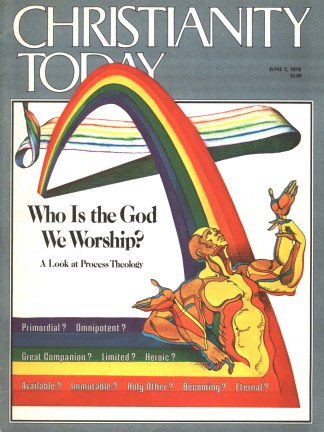
Evil and God: Has Process Made Good Its Promise?

Another look at Whitehead.

The world was veering crazily between the evils of two world wars when A. N. Whitehead argued that evil was explainable within his “process” view of reality. His proposal so impressed Daniel Day Williams that he could promise:

“A radical new possibility has opened up for theology. This is the interpretation of the love of God in relation to a new metaphysical doctrine in which God is involved in time and becoming. In this conception of God’s being it is possible to reconceive the relation of love to suffering and to consider what it means for God to act in history” (The Spirit and the Forms of Love, pp. 90, 91).

How radical, really, is this possibility? And now that it has been with us for more than a generation, how successful has it been?

In Whitehead’s day, theodicy—the attempt to justify the ways of God in the face of evil—had come to a tired standstill. The argument that evil is merely the absence of good tended to pale amid the atrocities of war. Something more powerful than nothing, than the mere absence of something, seemed to seethe beneath mankind’s evil acts. And do the evils of existence—“natural disasters” such as earthquake, famine, and flood—spring from nothing? For some, such facts of life have always pointed to malevolent being, not to a vacuum; to something like C. S. Lewis’s “hideous strength,” not to the absence of power.

Evil as the result of man’s freedom, and in punishment for his wrong choices, had met with greater success but had not really won the day. “God wills the good but allows the evil” offered comfort of sorts. But it was more difficult to explain why we choose evil when we know the good. And Calvin’s highly logical “dreadful decree,” that God’s sovereignty requires that he be responsible even for particular evils, had cast doubt on the adequacy of this solution.

A related idea held that evil is necessary, or contributory, to the good. Were it not for the cross, we could not experience the joy of the crown. “O felix culpa!” went the Roman prayer—O blessed fault (Adam’s sin), without which we would never have known God’s grace. And Leibniz constructed a mathematician’s theorem to describe God standing at creation and gazing knowingly down the stream of history before selecting the best of all possible worlds. Evil for him (as for Whitehead) was a condition without which there could be no world at all.

But for all their ingenious logic, theologians had never been able to show a reasonable relation between our sins and our agonies, or between the way the world must work and the way we suffer. The God of Augustine and Aquinas, Calvin and Leibniz, was omnipotent, omniscient, and omnipresent; immutable, impassible, and alone having necessary being. What, then, can it mean to say that in the world of a God like this evil is also “necessary”? Is God, after all, limited by his creation? If this much evil—the slow death by starvation of innocent children in drought-stricken India, for example—is necessary, then why create a world at all?

And although Adam and Eve succumbed to the serpent, and I, too, succumb, could not an omnipotent God dam the flood of subsequent evils just this side, say, of the more hideous forms of cancer? Or if God’s sense of justice requires a life here and there, can he not be satisfied with the life of some incorrigible criminal and spare my six-year-old friend who is dying a lingering death from a disease that was built into his genes? Suppose we all miss a base now and then; is that reason enough to expel us from the game?

Such questions against the classical arguments seemed to be gaining more credibility than the arguments themselves. They contributed to the comparative silence of neoreformation theology on the problem of evil. Even Luther had held that evil is an irrational, “alien work” of the hidden nature of God. Similarly, for Karl Barth, evil cannot be rationalized because it is related to das Nichtige, the unspeakable break in the relationship between Creator and creature.

With theodicy ridden to exhaustion, how could Whitehead and his followers dare to take it up again? They did it seizing the dilemma by its two horns, God and the world, and redefining both. First we must rid theology of the static concept of a God to whom we pay, in Whitehead’s phrase, “excessive metaphysical compliments”—attributing to him omnipotence, perfection, and all the rest. Neither can the world be considered simply an object over against God, a lifeless creation separate from a distant Giver of life. Rather, we are to think in terms of a God-world organism, an ensouled universe, a stream of vitality and creativity, a becoming of events.

Very well. What’s a problem like evil doing in a world like that?

Creativity and Conflict

The one overriding fact of life, process holds, is that it is teeming with creativity, “the category of the ultimate.” Everything that exists has the capacity to react to its environment and to act, in turn, on other realities (Whitehead called them “actual entities”). Since God himself exists, he not only partakes of this creativity but also is acted upon. Instead of seeing God as the awesome but distant Creator pictured by classical theism, Whitehead viewed him as “the great companion—the fellow-sufferer who understands.” In this, his “consequent nature,” God can be touched with the feeling of our infirmities because he is very much a part of the infirm world.

But why is the world infirm? Simply because in a world where all actual entities or events are endowed with creativity, they must also be presumed to have some sense of choice. That is the essence of creativity. But in a world of space and time, those choices often conflict. It is in one sense an evil that I cannot at once be here with my family and there with my ailing mother. But it is not an ultimate evil; it is simply an inevitable part of living in a real world.

Obviously we have heard this line before, in terms of Leibniz’s best of all possible worlds. But process believes that its dynamic view of matter contributes an element of freedom not previously entertained. Absolute evil is denied because every particle of reality retains the “indeterminancy” of the proton and electron, whirling about their nucleus. And why do some molecules form themselves into copper, rather than flesh; some into matter, rather than mind? And what force within the brain cell enables a material body to be influenced by an immaterial thought? Only a kind of low-grade, or at least metaphorical, “consciousness.”

Of course this picture of a virile, creative universe is interrupted when the present passes into the past. Minds and bodies and matter all “die.” But we quote the world, for a second glance reveals the old life taken up into the new. The young sapling has within its cells the nourishment of the leaves decaying at its roots; the dying father’s seed lives in his heir; the stone thrown into the pool sends ripples to the farthest edge before it sinks to the bottom. Hence the “perpetual perishing” of the world is not tragic. All passes into “objective immortality.” Because God is also an actual entity, he is so present to this process that he can ensure that nothing of value will ever be lost.

Still, process must admit that no actual event is absolutely free. The molecule of copper inherited a past. Its potential was not unlimited; it was suited for becoming metal and not flesh. Some principle of limitation seems to be at work, outlining and limiting the options from which units of reality “choose.” But who sets these options? “God,” process answers—this time, God in his “primordial” aspect.

For a process theodicy, this means that God has not abandoned the world to chaos. While his creation enjoys freedom, it is a freedom within certain boundaries. God longs for creation to follow his “subjective aim” for it, but it sometimes rebels, in its freedom, and evil results. Hence his power of limitation is only a gentle nudge, a persuasive but never a tyrannical or omnipotent force. God is “the Eros of the universe,” not its Absolute Ruler. For Whitehead, notions of God’s omnipotence were a distortion modeled after the medieval king: “When the Western world accepted Christianity, Caesar conquered, and the received text of Western theology was edited by his lawyers” (Process and Reality). God is only “the poet of the world,” asserted Whitehead, “with tender patience leading it by his vision of truth, beauty, and goodness.”

What Has Process Wrought?

The process approach has a certain beauty, and it seems to offer all the right pieces to the puzzle of evil. Its God is more akin to the biblical God than the distant, Unmoved Mover of Hellenistic theology. But despite these positive aspects, we must ask what it has done to go beyond the inadequacies and inconsistencies of older theodicies.

First, it is fair to ask whether process is consistent with its own stated limitations and goals. Does it abide by its own rules?

One of Whitehead’s rules was that God must be the exemplification of, not the exception to, the way the world works. We must not have one category for bodies and another for minds, one metaphysic for creation and another for God. This has proved an attractive rule for philosophers interested in developing natural theology. But a difficulty appears when we ask this sort of God about the problem of evil. Our most profound reflections on suffering and evil usually end in a cry, and appeal to One far greater than the structures of our evil world. Unexceptional beings suffer and die, without the capacity to redeem such a loss of values. All actual entities perish. In the process system, even God is an actual entity, an unexceptional being. What hope can agonizing humanity gain from a God-in-process if that process leads toward even the death of God?

Whitehead suddenly shifts ground at this point. There is, after all, one exception to the rule about an unexceptional God. Unlike all other actual entities, God does not participate in the perpetual perishing of the world. As it turns out, therefore, even process appeals to a category that is a glaring exception to its own metaphysical game plan. A nonperishing God is needed by theodicy; but it is not a God yielded by Whitehead’s own method.

A similar inconsistency lies in the process concept of the mental quality of matter, although we cannot pursue it here. We can only note that attributing “choice” to the material world requires a language game other than pure metaphysics. Whitehead does not show how he overcomes Kant’s “limits” against moving from the phenomenal to the noumenal. Biblical theology may do something like what process wants to do when it speaks of a “fallen” world, or of a creation that “groans,” or of tombs that burst open; but that is the language of revelation. A consistent process approach rules out that move, seeking salvation by metaphysics alone.

Whatever Happened to God?

The process theologian John Cobb was concerned about Whitehead’s inconsistent shift to an exceptional God, or to a God in his primordial nature, when the going gets tough in the empirical world. Cobb insists rather that we search for a deity fully explicable “in terms of the principles operative elsewhere in the system” (A Christian Natural Theology). What sort of God would this yield for theodicy, even if it could be done consistently?

It must be admitted that God as “actual entity,” alongside the rest of us, is companionable. He is even heroic, stalwartly enjoining us to submit bravely to the world process even though, to the empirical eye, it ends irrevocably in death. Further, there is a certain attraction these days to any scheme that can debunk scholastic ideas of immutability, omnipotence, and the rest of the attributes of God that have survived the razors of generations of Occams. We no longer delight in paying metaphysical compliments.

Yet when we have enjoyed the companionable, heroic, pared-down God, whom do we worship? And to whom do we attach our hopes that prima facie irredeemable evil will one day meet its Redeemer? In his consequent nature God is incapable of functioning as Redeemer. In his primordial aspect he is too gentle to overpower even actual entities, not to speak of any Cosmic Adversary. In short, Stephen Ely’s perceptive title of nearly thirty-five years ago is still relevant; we must question The Religious Availability of Whitehead’s God.

Paradoxically, even the classical God was more “available.” To use such ideas as immutability, impossibility, and aseity to suggest that the orthodox God is brittle, distant, and insensitive is to construct a straw God in whom few have ever believed. These ideas were developed by the early church fathers under the pressure of paganism and polytheism. They were designed not to show how God was removed from history or the world process but to show that he was One God; that he was not ruled by the passions that embroiled pagan deities in debauchery; and that the world depended on him for its being, not he upon the world (Cf. G. L. Prestige, God in Patristic Thought).

This is no brief for clinging to the patristic language of God. A part of the task of theology is to develop more adequate terminology. The point is that process has often substituted its own terms with no advantage for theodicy and with considerable loss in religious availability. For transcendence, process substitutes a primordial God, but one who lacks any real divine power. For immanence, process prefers a consequent God, but one who does not outlive his perishing companions. We may be excused for being reluctant to make this swap, which neither solves the problem of evil nor leaves intact a God who can promise one day to do so.

The Gospel in Process

A consistent process view of reality has little place for the one event Christians consider to be centrally important to the problem of evil: the incarnation-resurrection, the Good News that God was in Christ reconciling this process to himself. The claim of the New Testament documents is that if we ever hope to see the point (telos) of currently baffling evil, we must view reality from the standpoint of that supreme evil, the cross. And we are offered the resurrection faith as the proleptic triumph over the power of darkness. Far from being an example of the way the world usually works, this event was an intrusion, an enfleshed Message from another realm who was then transformed in order to “return.” Christ appears in the mode of the prophet, one with a message he claims to have received from outside the world process, which otherwise seems doomed. What happens to this claim in process theology?

Whitehead’s answer is that prophets, or those who believe themselves to be revealing a message from another realm, are mostly mad, ignorant, or deceived. The odds are so heavy against their authenticity that “apart from some method of testing perhaps it is safer to stone them, in some merciful way” (The Function of Reason).

The process theologian Norman Pittenger cannot accept without reservation the claim that Christ’s nature was qualitatively different from that of the common run of men (see his books The Word Incarnate and Christology Reconsidered). And for Schubert Ogden, “There is not the slightest evidence that God has acted in Christ in any way different from the way in which he primordially acts in every other event” (Cf. Process Philosophy and Christian Thought, p. 349). Such denials of the biblical witness are serious for a Christian view of evil. Even though we do not grace our concept with the term “theodicy,” living and dying in faith requires an implicit and functional notion of evil. For this, as John Hick says, “a knowledge of the structure of reality, or of the character of our total environment is required” (Evil and the God of Love). While “Jesus came preaching,” not doing theodicy, he did claim to know, beyond what man knows, “the character of our total environment.” Against Whitehead, the early Church measured this prophet’s authenticity by the resurrection. It was this event that designated the visible Christ the Son of the invisible God (Rom. 1:4). The means of this miraculous fusion of Mind with matter is not described. But when the early fathers defined Christ as one who was “of the same substance” as the Father, it was not paying Jesus excessive metaphysical compliments. The fathers knew that our struggle with evil hinges on whether Jesus was in some sense one with the Creator. Against Barth, it is at the point of the consummate evil of the cross that we can speak, at least in faith, of the containment, if not the explanation, of all evil.

Obviously, we should not expect process thought or any other philosophy to develop a high Christology. But neither should we be expected to welcome enthusiastically a system that can only reassure us, when we cry from our pits of despair, that we should take heart because God is there with us, albeit with no plan and no power and no precedent to kindle our hopes. We can rightly question an approach that slights the most important ground Christians have for believing that the problem of evil has a solution, however hidden it may be at present.

And Christian humility seems to require that we admit that the solution does in fact remain hidden. Those who accept the “answer” of Christ do so in hope, and “hope that is seen is not hope.” We confess we live in a world that includes apparently structural evil, great injustice, and excruciating pain beyond all human reason. On the basis of the Christ event, we believe that such a world is not outside the rational structure of creation; but the rationale itself escapes us. And it is that event, not metaphysics or elaborate logic, which must be proclaimed to a world sometimes numbed by what the Apostle Paul admitted is a mystery of iniquity.

D. Bruce Lockerbie is chairman of the Fine Arts department at The Stony Brook School, Stony Brook, New York. This article is taken from his 1976 lectures on Christian Life and Thought, delivered at Conservative Baptist Theological Seminary in Denver, Colorado.

Ideas

A Surplus of Ministers?

Several denominations have more clergy seeking positions than they have positions seeking clergy. This is particularly true for denominations that have been losing members. The situation is such that if present trends continue (and of course they never do exactly), according to one report, “there will be an Episcopal priest for every lay member of that denomination in the year 2004.” The United Presbyterians would find themselves in the same fix only seven years later.

We would remind would-be clergypersons who can’t find positions that there is a long tradition of ministers gathering a flock through evangelism. Whatever shortage of vacant pulpits certain groups may have, there is no shortage of potential converts to Christianity. In fact, many denominations are growing instead of shrinking. Although much of that growth may be at the expense of declining denominations, at least some of it is by gaining adherents from among the previously unchurched.

Nor is there any shortage of Christians who need to be ministered to. The rising divorce rate among believers is just one example of the need for counseling and other forms of mutual ministry in the body of Christ.

God may never lead you into full-time ministry, but this in no way lessens your potential to wholeheartedly serve God as an active member of a congregation. (Conversely, holding a full-time position does not automatically mean that you are a servant of God.)

The responsibility for the ministry of the church ultimately belongs to God himself. The Lord Jesus Christ is the head of the Church, and he is not capriciously equipping disciples for ministries that don’t exist. It may be that denominations have created job descriptions and academic programs that contribute to an apparent oversupply of ministers. But let us never confuse what denominations do and the mistakes they make with the work of the Holy Spirit.

We need not worry about any excess supply of clergy. People with suitable gifts and training who faithfully proclaim God’s Word and who are genuinely guided by him will find sufficient opportunities and challenges.—D.T.

Economic Enemy Number One

In its 1978 convention in Minneapolis, the National Association of Evangelicals called upon the United States government to “take to itself a new sense of economic responsibility including a balanced budget, more careful spending and the limitations of its bureaucratic growth.” One can hope that this signals increased concern by Christians for seeking solutions for America’s biggest economic problem: inflation.

Like the sun that shines on the just and the unjust, so inflation shines equally upon the church and society. The price of goods and services is presently climbing at an annual rate of about 7 per cent in America. But inflation is not just a problem for people here.

Churches have been appalled at the financial needs of missionaries. Some of them have added a cost-of-living increase to their missionary support program, just as they have done for their own pastors. Some churches have decided not to support additional missionaries until the ones they presently help are adequately compensated. A few churches, because of rising costs, have chosen not to expand their present missionary program.

Many Americans wrongly assume that it costs less to live in other countries. But Organization Resources Counselors reports that a couple who lives on a thousand dollars a month in the states needs $1,400 to live comparably in Rome or Buenos Aires and about $2,000 a month in Manila or Vienna.

The local church is also feeling pinched. The cost of building new churches and adding to present structures has been increasing at the annual rate of 12 to 15 per cent for several years.

The purchasing power of the pastor’s salary can keep pace with inflation only if he has an automatic cost-of-living increase of about 6 to 8 per cent annually. A pastor is not getting a raise unless it surpasses the 7 per cent rate of inflation. Otherwise, he is merely keeping pace. Among older pastors, inflation wipes out early retirement. With only Social Security and little in savings through the years of active service, many pastors will find the cost of living too high to manage with their meager earnings. Many ministers living in church-provided homes could not face the cost of living and of their own housing.

Yet another area that should be of concern to the church is voluntary giving. Inflation erodes the givers’ disposable income. Discretionary funds are the largest source of funds for voluntary agencies in this country. Inflation restricts the ability of a generous spirit to give as he or she would like. The pressure of voluntary agencies to survive is real. Missions have had to cut back on needed projects. Churches have had to cut back on their 1978 budgets. Unless they are exceeding a 7 per cent growth in receipts per year they are standing still economically. But what about solutions?

William Simon, former Secretary of the Treasury, recently said that “out-of control government is the root cause of unbridled price increases.” Part of his suggested solution to the runaway economy and the erosion of the dollar is to “slow down the tremendous growth in government by first attacking the budget deficit and then by a cut in spending across the board.” He even goes so far as to find merit in the proposal to amend the Constitution to require a balanced federal budget at a level no more than a certain fixed percentage of the gross national product.

However, President Carter in a speech in April to the American Society of Newspaper Editors comes closest to exposing the root of the problem: “We want something to be done about our problems—except when the solutions affect us. We want to conserve energy, but not change wasteful habits. We favor sacrifice, as long as others go first. We want to abolish tax loopholes—unless it’s our loopholes. We denounce special interests, except for our own.”

This statement reminds us that economic enemy number one is not only inflation; it is the individual who insists on looking out for his own interests, the interests of “number one” as slang puts it, instead of being willing to change his habits, to sacrifice the loopholes favorable to himself, and in general to look to national and worldwide interests as well as his own.—C. RICHARD SHUMAKER, director, Institute of Slavic Studies, Wheaton, Illinois.

Eutychus and His Kin: June 2, 1978

Test of Current Religious Knowledge

Here is the first Eutychus Quiz. Answers will be found at the end of this column. If you get all six right, you live in California. Four or five, you work for a Christian advertising agency. Three or under, you are reading this in a study. (Shame on you.)

1. What new product will “guide family members while walking in the house at night … offer the gentle reassurance and inspiration of religious faith shining through the night]

(a) Gospel flashlight; (b) 700 Club’s satellite telecast; (c) Faithful Night Light.

2. A string sonata is horsehairs scraping across catgut, producing sound at predictable decibel levels in a particular pattern. This description is similar to what current phenomenon:

(a) Description of sexual love in books; (b) Portrayal of sexual love on stage and in movies; (c) Inferences about sexual love on TV.

3. What two words in the English language have a greater number of synonyms than any other words:

(a) faith and hope; (b) shirts and pants; (c) drunk and insane.

4. Americans are on a collecting binge. What are they collecting:

(a) dolls, miniature furniture, beer cans, guns, model railroads, African violets, stamps, coins, buttons; (b) lasting friendships.

5. Who said this? “Christians who would not expect Paul to have had in mind the entire range of 20th Century knowledge about geography … stumble blindly into assuming he had a 20th Century knowledge of behavioral science”:

(a) Karl Menninger; (b) John Ehrlichman; (c) Ralph Blair.

6. Name the version in which the following quotation is found, “Where two thousand or three thousand are gathered together in my name, there am I in the midst of them”:

(a) TEV; (b) LB; (c) NASB; (d) TCV.

Answers: 1. (a) Faithful Night Light, developed by Faithful Enterprises of Beverly Hills, “casts sky-blue light through the image of either a Christian cross or a Jewish Star of David.” 2. All three. 3. (c) 4. (a) 5. (c) Self-styled “chief apologist for the homosexual lifestyle,” in “Evangelicals Concerned,” homosexual newsletter. 6. (d) The California Bible.

EUTYCHUS VIII

On Sex And Sources

I am relieved that someone so expert in early church history has unscrambled the dates I wrongly assigned to Tertullian and Ambrose (“Were the Puritans Right About Sex?”, April 7). The remainder of Mr. Dunaway’s objections are matters of interpretation and in no way affect my main thesis.

I think I can restate my summary of Athanasius’s views on virginity to my critic’s satisfaction: Athanasius cites virginity as a doctrine distinctive to the teaching of Christ and therefore proof that Christianity is the true religion; this argument appears in De Incarnatione Verbi Dei and Vita Antoni. For his additional views, one should consult De Virginitate and In Pasionem et Crucem Domini.

Regarding Origen’s castration, I did not, of course, intend to imply that his shocking extremism was the norm in medieval Catholicism. I do maintain, contrary to Dunaway, that Origen’s view on the virtue of virginity is indeed representative of the early church’s attitude, since it has many parallels in the writings of the fathers. Nor can I agree that the church excommunicated Origen “for that very act.” St. Jerome insists that the proceedings of the councils against Origen were not based on any doctrine but were due solely to jealousy over his eloquence and reputation. The New Catholic Encyclopedia accepts this interpretation, showing that Origen found himself in trouble because he preached while still a layman and was ordained as a priest without the knowledge of his bishop Demetrius, who was the moving force behind his loss of ordination.

Dunaway’s personal aversion to the Council of Trent should not be allowed to obscure the accuracy of my statement that it was a major Catholic council whose object, according to The Catholic Encyclopedia, “was the definitive determination of the doctrines of the Church” and which made official many of the teachings of the medieval Catholic church, including the doctrine of virginity that I cited.

The letters and telephone calls I have received about my article suggest that Dunaway is not alone in wishing to know where the data that I cited can be found. There are several surveys that cover the material very well and that will direct a reader to the primary sources. They include the following:

Roland Bainton, What Christianity Says About Sex, Love, and Marriage; William G. Cole, Sex in Christianity and Psychoanalysis; Oscar E. Feucht, ed., Sex and the Church; Roland M. Frye, “The Teachings of Classical Puritanism on Conjugal Love,” Studies in the Renaissance, II (1955), 148–159; C. S. Lewis, chapter one of The Allegory of Love; E. C. Messenger, The Mystery of Sex and Marriage (volume two is the key book and bears the individual title Two in One Flesh); G. Rattray Taylor, Sex in History; Maurice Valency, chapter one of In Praise of Love. Anyone who reads these sources will find my data corroborated several times over and will see that in regard to medieval Catholicism I have uncovered only the tip of the iceberg.

For the apparently numerous Lutherans who suspect that I pulled Luther’s comment “if the wife refuse, let the maid come” out of the air, may I say that the source is Luther’s sermon entitled “The Estate of Marriage,” volume forty-five, page 33, in the fifty-six-volume American edition of Luther’s works.

LELAND RYKEN

Professor of English

Wheaton College

Wheaton, Ill.

Kantzervative

Your April 7th interview with Dr. Kenneth Kantzer reveals the wisdom of your choice. Looking forward to CHRISTIANITY TODAY’s Kantzervative approach!

DAVE MACPHERSON

Liberty, Mo.

Praise and Questions

The interview with Malcolm Muggeridge (April 21) was the most refreshing article I have read in many a day. Instead of relativism and situation ethics here is a vital relationship between a man’s faith and his understanding of life and reality in general. Wow! But now … you should indicate why in the italics before the article, you wrote, “You may not agree with all of Muggeridge’s views; we do not, but the interview is thought-provoking, nevertheless.” Why do you not agree with him? I do! It’s your tum; the ball is in your court. That is, how do you differ from Muggeridge?

GIFFORD H. TOWLE

Amherst, Mass.

• We do not agree with him that birth control is unnecessary in India.-ED.

Why are the evangelical magazines so enamored with Malcolm Muggeridge? Is be another of the trophies in the evangelical game room? If he has been captured, it has certainly not brought him into the fold of evangelicalism. This is obvious from his own doctrinal confession, whether he likes being cross-examined about dogma or not.

I think the secularists are laughing at us all. “Well, they couldn’t get Muggeridge all the way down the aisle, but they’ve at least gotten him to raise his hand for evangelicalism.” Shame on us all for displaying so prominently in our magazines and conventions such a half-done convert.… better evidences of the gospel’s power can be found.

WILLIAM VARNER

Independent Bible Church

Willow Grove, Pa.

Editor’s Note from June 02, 1978

With this issue Carl F. H. Henry begins a three-part analysis of the most vigorous attack against evangelicalism to surface in recent years. Oxford University don James Barr writes this hard-hitting polemic mistitled Fundamentalism. Henry’s response is stiff theology but worth reading for two reasons. It reveals clearly the theological climate faced by conservative evangelical students in the religion departments and theological faculties of the great universities of Christendom. It also demonstrates that evangelicals, left, right, and center are in this thing together—all tarred with the same brush.

Concerning Oberammergau: 1980

For over a year now, a cloud has hovered over the village of Oberammergau, location of the world-famous Passion Play. My wife and I recently visited this Bavarian village, spending some time with persons vitally concerned with the course of the upcoming decentennial commemoration of the crucifixion of our Lord, due in 1980.

The mood of Oberammergau has for months been one of uneasiness, due to the controversy over the form and staging of the coming presentations. The text used in recent presentations has been adapted from a script written 300 years ago. Until recently, there were few major objections to it. From time to time members of the Jewish community have felt that parts of the script made too much of the role of Jewish authorities in the trial and death of Jesus. However, the major stimulus to controversy came with pronouncements in the midsixties of the Vatican Ecumenical Council, which sparked suggestions for a radical revision of the Passion Play script that would avoid reference to, or suggestion of, Jewish responsibility for the death of our Lord.

The village of 4,200 has for a decade been divided into two camps, that of the “no-change traditionalists” and the “now-play progressives.” The latter have campaigned for a replacement of the seventeenth-century script with a more recent one, in which the forces of evil leading to the death of Jesus are shown allegorically. This would serve to absolve the Jewish religious authorities of our Lord’s time of responsibility for the crucifixion event. As the controversy has progressed, however, it has become clear that the demands for the elimination of that, plus the correction of some historical errors, have served as a pretext for a demand by some for a thorough updating of the play. Such a script has been prepared. The traditionalists, who call themselves the “1980 Passion Play Citizens’ Action Group,” reject the new version as newfangled and irreverent. Anton Preisinger, who played the part of the Christus in 1970, feels the new version is unsuited to Oberammergau and to amateur players.

We were privileged to go behind the scenes and see the displays of costumes and properties. A survey of the materials made ready for the revised presentation (and there have been three rehearsals with the new format this summer) indicates that there is a wide departure from the historic Play. Such props as the cross, the staging, and the costumes for most of the lead characters, suggest a thorough modernization of the upcoming presentations of 1980. The August rehearsals, which were an immediate sellout, seem to have been trial balloons, by which sentiment for or against the new form could be determined.

There are other significant departures in the proposed new version. Formerly this presentation was designedly “amateur,” using (with a solitary exception in 1950) only villagers as characters. The newer format would require not only cast members from outside Oberammergau, but some professional actors as well. The part of Mary, formerly reserved for a single woman of the village under age thirty-five, may now be played by one not meeting these specifications.

By the best information that visitors from outside Oberammergau can secure, the alteration goes much further. Responsible citizens of Oberammergau have held that the proposed new version will radically alter the deeper meaning of the play. Originally planned and presented in response to a vow, made as the village was spared in the plague of 1633, the Passion Play was essentially that—a pledged dramatization of the death of our Lord. The new version is said by persons familiar with it to be more in the manner of a medieval morality play, out of keeping with the original design.

The play as given in recent decades has been embellished by a number of supportive scenes, given by groups from the two wings flanking the main stage. These scenes are introduced by a narrator whose lines highlight the coming main-stage presentation. The wife of the narrator, who served as a personal guide to our party, confided to my wife and me the misgivings of her husband, and the feeling that he would probably not narrate in 1980 if the revised script were used.

The modernization proposed would, it seems clear, alter greatly the thrust of the play, and thus appeal to a somewhat different audience than has been the case in the recent past. It was reported that some of the supporting scenes would, if the new plan were adopted, reflect Bavarian folk festivals, rather than the emphasis originally intended. Some have maintained that the proposed musical alterations would include adaptations of the Bavarian Schuhplattler and the introduction of some rock music.

Although much of the pressure for modernization has come from the younger townsfolk, whom the conservatives view as being overly reflective of the secularized German society, there have reportedly been some older people favoring change. The people who want the traditional script regard themselves as guardians of the historic vow and spirit of Oberammergau. These people are also distressed by the commercialization of the Passion Play, as visitors from distant lands seek out the village’s major event and repeatedly fill its 5,200-seat theater with its mammoth open-air stage.

Word has just come to the effect that the issue has been resolved, at least for the present (according to the Washington Post, March 7, 1978). It seems that the municipal council in charge of the affairs of Oberammergau had decided that on the basis of the response to the three presentations last August, it was prepared to go along with the use of the modernized version in 1980. Then in March in the municipal elections, the present council was voted out, and one was elected that opted for the traditional presentation.

This decision does not, of course, settle the matter of the feelings of the world Jewish community, to whom the presentation of the passion of our Lord is, quite understandably, offensive. Whether or not the script is needlessly expressive of the involvement of first-century Jewish leaders in the crucifixion, it remains that any such presentation, if true to the Gospel narratives, can scarcely be regarded as complimentary to them. We attended the play in 1950, 1960, and 1970. We followed the German text carefully, and did not ourselves feel the material to be as negative toward the Jewish leaders as some regard it to be.

The naïve person would, of course, say that Jewish organizations today should take this in stride, just as do persons of other nations or races when they see presentations that are not especially complimentary to them. However, as Christians we must remember that none of us has experienced any national or racial catastrophy of the extent and the malignancy of the Holocaust during the nightmare called Hitlerism.

Bearing the Holocaust in mind, one can understand the fears of Jewish people that even if the Oberammergau presentation expressed only the New Testament narrative, yet it is a selective presentation, and is seen by well over 200,000 persons from all parts of the world every ten years. Fear of anti-Semitism is understandably a constant with the Jewish community, and the fear of actively reviving this disease is a very real factor in the thinking of Jewish people, and especially those who narrowly survived the Holocaust or who lost loved ones during this nightmare.

As Christians we need to understand this aspect of the question that revolves around Oberammergau. Although it would alter the entire economics of this delightful Bavarian village, one could wish that the observance of our Lord’s Passion could be less commercialized, less showy, and perhaps inclusive of a smaller number of people. The controversy catches evangelicals between their concern for God’s ancient people on the one hand and the integrity of the passion narratives in the Gospels on the other. I feel this dilemma keenly and have no final word of resolution for it.

Oral Roberts: Faith in the City of Faith

Following a political battle of monumental proportions, Oklahoma evangelist Oral Roberts emerged late last month with state approval to start construction of the hospital portion of a huge medical complex on his university campus in Tulsa. The evangelist had first sought permission for a 777-bed hospital. During controversy over whether Tulsa needs or can afford another hospital, Roberts earlier this year offered a scaled-down request for 294 beds as a compromise. Authorities okayed the 294 beds with the understanding that Roberts can proceed with the other beds if the need is demonstrated and if the other hospitals in town are not hurt by the newcomer.

Roberts says God told him to build the medical center and gave him the details for it in a vision during a sojourn on a desolate California desert. He explained that he had gone to the desert to pray following the death of his daughter and her husband in a plane crash in February, 1977.

The evangelist returned from the desert and announced the launching of the City of Faith medical complex. He described it to his television audience: Arising from a common base would be a sixty-story clinic and diagnostic center, flanked on the west by a thirty-story hospital and on the east by a twenty-story research center. At the front would be sixty-foot-high sculptured hands (signifying the hand of medicine and the hand of prayer), with a wide tree-lined stream flowing from a large fountain. Further, said Roberts, God told him that it was to be opened debt free and that he should ask his “partners” (donors) to send contributions of $7, $77, $777, and $7,777.

The price tag of the complete complex: an estimated $250 million or more. So far, according to sources at the 3,800-student Oral Roberts University (ORU), the evangelist has raised more than $27 million of the $55 million initial-stage costs. The complex is to be an integral part of the ORU medical school, which is scheduled to open this fall with fifty students. A dental school is also to open this fall. (The twelve-year-old ORU is located on 500 acres on Tulsa’s posh south side, with assets estimated at $150 million.)

Ground-breaking for the center came on January 24, Roberts’s sixtieth birthday. Then came protests and pressures from some in Tulsa’s medical and political communities. The Tulsa Hospital Council went on record opposing the complex and endorsing “appropriate means to discourage project implementation.”

Members of the hospital council said that the city’s five big private hospitals and suburban facilities were already in trouble, with nearly 1,000 of 2,944 licensed beds not in use because of lack of demand. At the same time, said the medical people, the hospitals were struggling to pay off $150 million in construction bonds. The proposed ORU hospital, they pointed out, would be located only two miles from the largest general hospital in the state. The new hospital, they predicted, would drain patients and staff from the others, driving costs of health care still higher. Some hospitals might go under, they warned.

Roberts, known best for his emphasis on faith healing, argued that the City of Faith would not be simply another local operation. It would, like the Mayo Clinic in Minnesota, attract patients and staff from around the world, he insisted. The center, he said, would emphasize research on heart, cancer, and aging problems.

ORU’s vice provost for medical affairs, James E. Winslow, Jr., went even further and suggested that the City of Faith would draw so many ailing people to Tulsa that all the other hospitals would benefit from the overflow. Of the 400,000 prayer-request letters that Roberts gets each month, 100,000 refer to “clear-cut medical problems—22,000 with cancer, 26,000 with heart disease,” he said. Already, 250,000 visitors come to Tulsa every year to visit the ORU prayer tower, he said, and 30,000 of Roberts’s “partners” come annually to attend spiritual seminars. If that many healthy people come to ORU, he theorized, from 500,000 to 1.2 million sick people a year might seek help at the City of Faith. (Winslow was formerly the ORU basketball team physician.)

Federal laws required Roberts to submit the hospital part of the proposed center to a review process. The review proceedings were set up under 1974 congressional legislation designed to eliminate costly duplication in health-care facilities around the country. State or regional planners are required to certify that a new facility is needed. The three-member Oklahoma Health Planning Commission is the certifying body in that state. It is served by an advisory body, the Oklahoma Health Systems Agency (OHSA), which has both staff and volunteer members, including consumer representatives.

Dented Income In Dentsville

They believe in taking a stand on principle at Rehoboth United Methodist Church in Dentsville, a small community near Columbia, South Carolina. Eight years ago the church agreed to let Dentsville Piggly Wiggly supermarket use a church-owned parking lot on a ten-year lease basis at $400 a month. Recently, the store began selling beer and wine, and the church board unanimously voted to cancel the lease. A fence encloses the parking lot today, and a large sign informs passersby and wouldbe parkers that Piggly Wiggly broke the lease by deciding to sell strong drink.

The action was taken because the United Methodist Church’s Book of Discipline that was operative when the lease was written “prohibited United Methodists from making any profit, directly or indirectly, from the sale of alcohol,” explained pastor Ron Pettit. Earlier, his members had opposed the store’s license application at a hearing.

Piggly Wiggly owner James P. Mc-Keown III, whose store is open seven days a week, says that he must sell alcoholic beverages now in order to meet the competition from other stores in the area. “No one sold beer and wine when we first came out here,” he said, so the no-alcohol stipulation was not a big problem at that time.

Piggly Wiggly’s customers will have no major hassle in finding a place to park, but the church will miss the income from the parking lot. The amount represents one-eighth of the church’s budget.

Twice the OHSA voted (by 19 to 6 and 12 to 7) to recommend that the planning commission reject the hospital proposal.

Roberts pulled out the stops. He asked his three million partner-families to pray and to write letters to Oklahoma government officials and the health planning commission. An amendment was introduced in the state legislature; it apparently was designed to exempt ORU from planners’ control. In March, Roberts traveled to HEW headquarters in Washington, where he complained of unfair hearing procedures to Henry Foley, head of HEW’s Health Resources Administration. Foley said he would send a top aide to investigate. The Washington Star later quoted sources as saying that the probe never occurred.)

The campaign paid off. Some 400,000 letters poured into commission headquarters during a six-week period, virtually all pro-Roberts. Governor David Boren said his mail hit 1,500 pro-Roberts letters a day. Thirty-eight of Oklahoma’s forty-eight state senators and forty of the 101 house members—some with budget authority over the health and welfare agencies headed by the three commissioners—publicly backed the hospital.

Following a two-hour hearing in a packed auditorium in the capitol at Oklahoma City, the commissioners voted unanimously to approve the City of Faith hospital. Both Roberts and his opponents in the Tulsa hospital community gave strong emotion-laden appeals for their respective causes during the hearing.

A spokesman for the commissioners said that their staff study had turned up fewer empty beds than reported by the OHSA and that there were doubts about the ability of Tulsa’s existing hospitals to handle ORU’s medical students. It would be wrong to assume that the commissioners had caved in under pressure from legislators, he told reporters. The action, he affirmed, “is an expression of the sentiment of the people of Oklahoma.”

(HEW secretary Joseph A. Califano, Jr., acknowledged in a press conference that he had once represented Roberts as an attorney. But, said he, that would not require him to disqualify himself should an appeal be lodged with HEW against the hospital’s inclusion of construction costs in Medicare-Medicaid reimbursement—as recommended in the commission’s action.)

Roberts and his followers meanwhile are exulting in God’s power “to move mountains.”

Scientology: What Do the Records Reveal?

Church of Scientology documents seized by the Federal Bureau of Investigation (see May 5 issue, page 46) “indicate that the church has been waging an extensive, sophisticated campaign to identify, attack, and discredit its ‘enemies,’ including Justice Department investigators, other public officials, and inquiring journalists,” the Washington Post reported late last month in a copyrighted story by reporter Ron Shaffer.

Quoting sources “close to an intensive federal investigation of the Scientologists’ activities,” Shaffer said that an attack-and-destroy campaign by the church’s Guardian’s Office to silence critics “has involved illegal surveillance, burglaries, forgeries, and many forms of harassment.”

A number of covert operations carried out by Scientologists are documented in the church’s internal memoranda and directives, the sources alleged to Shaffer. The reporter cites the following allegations:

• Scientologists obtained the personal stationery of author Paulette Cooper, who had written a book in 1971 entitled The Scandal of Scientology. A bomb threat was typed on the paper, and it was mailed to a Scientology office, which reported the threat to police. Miss Cooper was arrested in connection with the charge. She denied writing the note, but the paper had her fingerprints on it, and federal prosecutors charged her with perjury. The charges were eventually dropped after Miss Cooper submitted to lengthy questioning under a truth-serum drug, but in the process she reportedly suffered a nervous breakdown.

• Scientology agents staged a phony hit-and-run accident involving then mayor Gabriel Cazares of Clearwater, Florida. Cazares had been a central figure in a dispute with Scientologists over the church’s purchase of a Clearwater hotel (see February 27, 1976, issue, page 41). During a visit to Washington, D.C., the mayor was a passenger in a car driven by a female Scientology agent. The agent struck a pedestrian in a park, sped from the scene, and urged Cazares not to report the “accident.” Unknown to Cazares, the pedestrian was another Scientology agent who helped to stage the accident. Later, the Scientologists tried to use the incident against the mayor in a political campaign.

• An attempt was made to discredit a Clearwater reporter who had covered the arrival of the Scientologists in town and the ensuing dispute. A Scientology agent forged the rough draft of a newspaper story under his byline and slipped it to state legislators whom the reporter was covering. The story supposedly linked Florida politicians to the Mafia.

• Scientology members were placed in at least three government agencies to collect information and steal documents related to the agencies’ dealings with the church. The agencies: the Justice Department, the Internal Revenue Service, and the Drug Enforcement Administration.

• A harassment campaign was directed against prosecutors handling Scientology cases. The campaign included telephone calls and background investigations that sought details ranging from grades in school to personal habits.

Spokesman Greg Layton of the Founding Church of Scientology in Washington denied the allegations in the Washington Post story. He said the church has documentation to refute the charges, and he implied that the Post had been supplied with a compilation of “false reports” as part of a government harassment campaign against the church. Other Scientology members voiced similar sentiments, but as of early this month the church’s national headquarters in Los Angeles had not released any official comment regarding the allegations. Information officer Arthur Maren did issue a news release that suggested “corrupt officials” in government had used the press, including the Post, “for smear campaigns to try and invalidate the traditional reform role of the church.…”

After the Post articles appeared, Scientology attorney Phillip J. Hirshkop petitioned the federal district court in Washington. He asked the court to obtain and destroy whatever seized documents the Post might possess along with notes pertaining to them. He argued that the documents had been improperly leaked to the newspaper by government agents who were reviewing them. Judge John H. Pratt, however, rejected the request. He said that it was a “clear violation” of First Amendment rights, and he indicated that a subpoena for the reporter’s materials would not be enforced. Pratt agreed with a Post attorney that Shaffer could invoke privilege and not answer questions about the documents if he were called on to testify in court.

A Justice Department official said that an investigation would be conducted in an attempt to find out the source of the Post story.

Maren’s news release was issued to acknowledge that the Church of Scientology “has been ‘spying’ on the government for years.” The government, he said, calls it spying, “but we call it reform action.…” He explained that Scientologists “have been involved in exposing government illegalities and coverups for years, and this is a legitimate and traditional function of the church.” The reform-action program was code-named Snow White in Scientology’s inner circles, Maren indicated.

The publicist, recently released after spending some seven months in jail for refusing to answer questions for a federal grand jury investigating the church, explained that the Snow White project was kept confidential because “we didn’t want to embarrass government officials.” He said that when certain materials were found, they were turned over to government agencies and congressional committees. The raids of Scientology churches and seizure of documents by FBI agents last July were aimed mostly at Snow White, he suggested. “Apparently some dishonest bureaucrats found the Snow White program upsetting,” he commented. (The Scientologists have filed a $750 million lawsuit against the FBI agents and virtually every government officer and agency connected with the raids.)

Maren outlined what he claimed were some Snow White accomplishments and activities (documentation concerning Interpol, the international police intelligence agency based in France; publication of confidential IRS policies; exposure of inhumane conditions in South African mental institutions where more than 8,000 blacks were confined; leadership in use of the Freedom of Information Act). He then announced the formation of a national “spy network of honest citizens” to “expose and publicize illegal government activities.” Maren urged “every honest government employee” to turn over to the new group information on illegal government activities and dishonest officials. “We will investigate, document, expose, and publish what we find,” he pledged.

The release concluded by listing the names of thirty-eight present and former employees of the Drug Enforcement Agency who at one time worked for the Central Intelligence Agency. There is no indication in the release as to why they were named. Also named were two foreigners connected with Interpol: the Scientologists say they have been involved in drug traffic. In addition, the release cited alleged FBI intelligence operations against groups in Los Angeles.

There are about two dozen Scientology churches in the United States and three times that number abroad. More than three million members are claimed, according to press reports. Observers question the membership figure (an average exceeding 30,000 members per church), but it seems to be in line with Scientology’s broad definition of membership and with reported income. Informers have told federal investigators that Scientology’s U.S. churches may gross more than $100 million a year. Much of this money comes from fees for church courses and Scientology-style counseling, in which advanced members attempt to help others to achieve a “clear” or untroubled state with the assistance of a mechanical device known as an E-meter.

The church has been embroiled in legal confrontations almost since its founding in 1952 by L. Ron Hubbard, a science fiction writer and author of Dianetics, The Modern Science of Mental Health, the bestseller bible of the Scientology movement. Many of the church’s problems with the government involve tax issues. Only about half of its U.S. branches have been able to obtain tax-exempt status. Some legal decisions have viewed it more as a business or secular philosophy than a religion.

One thing is certain in light of the Washington Post revelations: Scientology’s most serious legal battle is yet ahead.

A Jewish Look At Luther

Martin Luther’s legacy to his spiritual heirs includes a certain discomfort about Jews. Generations of Lutherans have disclaimed his 1543 treatise, “On the Jews and Their Lies,” but it keeps coming up, most recently on the NBC television network’s “Today” show. In his old age the Reformer wrote that Jewish schools and synagogues should be burned. A New York psychoanalyst and author of a book on the Nazi era, Arnold Hutschnecker, cited a passage from the 400-year-old controversial work during a “Today” interview that dealt with NBC’s “Holocaust” series last month. Luther contributed to anti-Semitic feeling that “has existed in Germany for hundreds of years,” Hutschnecker claimed.

Lutheran leaders issued protests immediately. They requested air time from the network to reply. NBC said no, but “Today” host Tom Brokaw next day told viewers that the remarks had “caused a stir in the Lutheran community in this country.” He then attempted to put the quotation in context and expressed the hope that the Luther statements “will not be misused.”

The NBC’s dramatized documentary, viewed by an estimated 120 million persons on four successive evenings, was widely hailed as a broadcasting triumph. More than 50 per cent of the nation’s television audience watched some nights. In New York alone an estimated six million saw the initial installment. The series sparked commentaries and letters to the editor in media all over the nation. Critics were unhappy with the film’s commercial interruptions, and some thought the production smacked too much of Hollywood.

A carefully planned educational program was prepared for use in schools and churches in connection with the telecasts. Interfaith “remembrance” services were held in many communities. The Anti-Defamation League of B’nai B’rith said it had distributed nine million newspaper supplements about the Holocaust. Religious News Service reported that a Washington pro-Israel lobby, the American Israel Public Affairs Committee, sent a copy of the novel on which the series was based to each member of Congress, key administration officials, and members of the Washington press corps. A note was enclosed mentioning the committee’s opposition to the proposed sale of jet fighters to the Jewish state’s Arab neighbors.

The telecasts and associated emphasis on the Holocaust came on the eve of the thirtieth anniversary of the founding of the modern state of Israel.

Martin Luther’s offensive quotation was not cited as such, but one prominent Jewish spokesman accused the Lutheran Church-Missouri Synod (LCMS) of having “sadly revived the medieval image of the Jews” in an evangelism program. Rabbi James Rudin of the American Jewish Committee last month scored the synod’s 1977 convention resolution on Jewish evangelism and a witnessing manual used in the church. “By singling out Jews for intensive proselytizing,” he declared, “the Lutheran Church-Missouri Synod has, in effect, branded Judaism as an inadequate and incomplete religion.… The resolution is a moral affront to the Jewish people and to forty centuries of Jewish religious life and theological self-understanding.”

Rudin’s blast came after a series of consultations with Missouri Synod officials. Accounts of the results of the conversations differ. Erwin J. Kolb, executive secretary of the LCMS board of evangelism, said members of the synod’s Jewish-witness committee agreed that Rudin had some valid criticisms of their materials. He disclosed that the committee also agreed to make certain changes in the manual and that Rudin would be allowed to review the final manuscript. Meanwhile, stated Kolb, all parties agreed not to make public statements. The new edition of the manual is not due until this July, but Rudin went public with more criticism in April. Rudin, when asked about the agreement, said he had agreed with Kolb that no reporters would attend their meetings but that he made no promise about public statements.

In another ticklish situation related to Lutheran views of Jewish questions, the American Lutheran Church recently suspended two Long Island congregations that incorporated Hebrew traditions into church life. Following a long squabble, denominational officials last year officially charged that the Gospel was being “subordinated” to Jewish tradition. Pastors and people wore skull caps and prayer shawls, and one ritual slaughter of goats was reported. Kosher kitchens were being kept by some members of the congregations. Neighborhood Jews, as well as area Lutherans and some other Christians exclaimed “about time” when the denomination cracked down, reported the Lutheran Forum Letter.

Memo to Lutherans: ‘Let’s Merge’

At its founding convention in December, 1976, the Association of Evangelical Lutheran Churches (AELC) formalized the split in the 2.8-million-member Lutheran Church-Missouri Synod (LCMS). This followed years of controversy over doctrinal interpretation and administrative practice.

At the AELC’s second convention, held last month in Milwaukee, the 135 voting delegates gave almost unanimous voice approval to the view that the young denomination’s chief business is to go out of business—by trying to spark “organic church union” among the bulk of U.S. Lutherans. (The AELC has about 110,000 members in 245 congregations.)

A “Call for Lutheran Union” adopted by the delegates envisions in late 1979 a “consultation … to establish an implementation process” for the union of the Lutheran denominations that have formally committed themselves to a merger goal by that time. The document states as axiomatic what the LCMS would officially reject: “Lutherans are already united in a common, Gospel-centered witness to the Christian faith through our common commitment to the Scriptures and the Lutheran Confessions.” Therefore, the call reasons, there should be a “move beyond cooperation, which though admirable in itself, does not enable Lutherans to exhibit and express fully the oneness which God has given.”

A few delegates argued that it is presumptuous or premature for a denomination so young and so small to speak up in such a way. After a couple hours of polite discussion, however, those who felt that the call would be salutary—or that the AELC at least should speak its collective mind and see what happens—easily carried the day.

Although the call is addressed to “all Lutheran church bodies in North America,” no one suggested at the convention that a favorable response is likely from the LCMS, the 400,000-member Wisconsin Evangelical Lutheran Synod, or the several largely isolationist U.S. Lutheran minibodies. Instead, chief targets of the call are the three-million-member Lutheran Church in America (LCA) and the 2.4-million-member American Lutheran Church (ALC), both of which have national conventions this year.

The presidents of the ALC and LCA brought fraternal greetings to the assembled delegates. The ALC’s David Preus endorsed coordination, cooperation, and even partial merger “whenever such actions … clearly” make the church “more effective in mission.” But as a result of the ALC’s own recent restructuring, he said, “we are a church on the move. We have gotten our act together. We are functioning effectively.…” This is not the time, he suggested, to spend time, energy, and resources on “organizational matters.” He foresaw the likelihood of “booby traps,” including “unnecessary theological … battles,” in major merger efforts.

Greeted with a standing ovation, Preus was simply applauded when he finished. The LCA’s Robert Marshall, though, managed to bring the delegates to their feet after as well as before his endorsement of the AELC call. Having recently surprised many by announcing he will not run for reelection as LCA president, Marshall forcefully reiterated his personal as well as the LCA’s constitutional support for North American Lutheran union. Working at structural union, he affirmed, would help, not detract from, Lutheran mission and ministry. Citing examples of the difficulties he has experienced in cooperative efforts, Marshall said “the time that we have spent on cooperation that fizzled is far greater than any time that’s going to be spent on achieving Lutheran union.”

Besides approving the union call, delegates overwhelmingly reelected AELC’s part-time president William Kohn, pastor of Capitol Drive Lutheran Church in Milwaukee. Also, they directed the AELC national office to “refuse to do business with any financial institutions making loans to the private or public sector of South Africa until apartheid injustice is eliminated.” Other resolutions were adopted urging AELC members to join Jews in commemorating the holocaust, to “respond to the issues of injustice to American Indians,” to support programs fighting world hunger, and to “continue working toward changing our language style in church communications … to be non-racist and non-sexist.”

TOM DORRIS

Churchmen in a Huff

Tuition tax credits, abortion, human rights, foreign sales of military hardware, deductions for charitable contributions, and youth camp safety are issues enough to keep Washington’s church-related lobbyists busy. But in this congressional election year they have another worry: a bill to regulate lobbying.

A bill (H. R. 8494) opposed by most religious lobbies passed the House of Representatives last month by a vote of 259 to 140. Congresswoman Barbara Jordan of Texas, one of the bill’s staunch supporters, said it would simply “… require these organizations to disclose … exactly what they are doing.” Introduced by George E. Danielson of California, the measure requires lobbying groups that spend a certain amount of staff time or money in Congress to report to the comptroller general their total expenditures for such activities, the identity of lobbyists, and a description of the issues on which they are working. Churches must report if they seek to influence legislation, and then must pass the expenditure “thresholds” described in the bill.

Similar proposals are pending in the Senate but they are sure to encounter stiff opposition in committee. Among the opponents of tighter regulation of lobbying are the U.S. Catholic Conference, the Baptist Joint Committee on Public Affairs, the United Church of Christ, and the American Civil Liberties Union. Among the proponents are Common Cause and AFL-CIO union lobbyists. Barry Lynn, a United Church of Christ representative on Capitol Hill, called the measure “a slap in the face of democracy.” John W. Baker of the Baptist committee considers it a simple question of religious liberty and served notice that if enacted into law the provisions would not be followed by his organization.

At the other end of Pennsylvania Avenue, Washington’s best-known Baptist went on record in favor of the legislation. President Carter told a news conference that his Adminstration has “been actively involved in drafting (the bill) in the strongest possible terms, and I do support it.”

The Capitol Hill Baptists were closer to the position of their White House brother on another piece of hot legislation: tuition tax credits. The Administration continued to oppose the credits as unconstitutional aid to private schools (many are church-related). Instead, White House spokesmen asked Congress for more grants and loans for students and their institutions. While the Baptists and Methodists active in Congressional affairs generally agreed with the Administration position, Roman Catholics and some evangelicals in the private school movement continued efforts to salvage tax relief for parents of their students.

Members of the House Ways and Means Committee, who handle all tax proposals, dealt the Administration a serious blow last month when they rejected a Carter proposal on charitable deductions. They voted to permit taxpayers who choose the “standard deduction” on their income tax returns also to itemize their charitable contributions—including gifts to churches. William P. Thompson, the United Presbyterian executive who is president of the National Council of Churches, had asked the committee to treat such contributions differently from other deductible items. In his testimony he said such treatment “is not a ‘loophole’ for avoiding taxation since the gifts deducted do not remain under the control of the giver but go to benefit the whole community, often with greater efficiency and effect than the same amount paid in taxes.”

Even if Congress settles all the tax questions early, as it would like to do in this election year, it will still have plenty of other issues to keep the lobbyists busy. Revision of the federal criminal code (including gun control), foreign aid, and ethics in government are issues about which church representatives are waiting to have their say. A “sleeper” issue that has aroused heated discussion in past years, the Youth Camp Safety Bill introduced by Senator Alan Cranston of California, has recently come back to life with White House blessings. Administration support came with introduction of provisions to encourage state enforcement. Some camp operators and religious groups have opposed similar legislation in the past on grounds that it would mandate government interference in religious activities.

St. Paul Speaks: ‘No’ to Gays

Homosexuality, seldom discussed publicly a few years back, may be one of the top political issues of 1978. Voters in St. Paul, Minnesota, last month served notice that Middle America might be tuning out the talk about gay rights. Led by Pastor Richard A. Angwin of Temple Baptist Church, citizens of St. Paul went to the polls in unusually large numbers for a referendum and voted two-to-one to repeal a city ordinance banning homosexual discrimination. Television viewers around the nation saw some of the victory celebration at Temple Baptist. Asked why a city with liberal leanings would produce such a vote, Angwin told reporters, “You can’t be progressive about sin.”

As in other cities around the country, however, the religious community was not all on one side of the St. Paul issue. United Methodist bishop Wayne K. Clymer sent a letter of support for homosexuals’ rights to St. Paul members of his denomination. The Minnesota [Methodist] Conference Board of Church and Society opposed the repeal of homosexual protections in the ordinance. Charles Purdham, United Methodist district superintendent in the area, said of the vote, “It appears that those who support human rights issues did not take seriously the possibility that the repeal vote would win and thus did not bother to vote. If so, then fear and apathy have combined to deprive people of their just rights as citizens and children of God.” The bishop commented that the vote was indicative of “how deeply imbedded fear and anxieties of people are on this issue.” He also suggested that “the vote accurately reflected where the country is at this time.”

Both proponents and opponents of repeal quoted Roman Catholic archbishop John R. Roach of the Minneapolis-St. Paul archdiocese to bolster their positions. Those favoring retention of the gay rights measure quoted the part of his statement that said “economic security and social equality” should be provided for those who “find themselves to be homosexual in orientation through no fault of their own.” Champions of repeal quoted Roach when he said, “In affirming the rights of homosexuals, we must not neglect the right of the larger community. The Catholic Community … cannot sanction the gay lifestyle as a morally acceptable alternative to heterosexual marriage.” The archdiocesan newspaper, the Catholic Bulletin, was clearer on the issue. It took a position against granting “special protection” to homosexuals. A representative of the archbishop noted that the paper has always been free to express views independent of those of the prelate. The priests’ senate of the archdiocese opposed repeal.

Among the national figures associated with the pro-repeal forces were Carl Lundquist, president of nearby Bethel College and Seminary and of the National Association of Evangelicals, singer Anita Bryant, and television preacher Jerry Falwell.

After the St. Paul vote, gay activists served notice that they were preparing to fight those who are out to set back their cause in other parts of the country. Not only are the homosexuals and their supporters trying to get friendly ordinances onto the books in many cities, but they also are trying to put those already enacted beyond voter recall. Politicians in the District of Columbia are currently debating procedures that would make it impossible for the citizens to vote on certain “human rights” measures. So far the discussion concerns procedures recently added to the District’s home rule charter providing for initiatives and referenda. No one has formally proposed an election on any part of the human rights issue. However, candidates for mayor and city council posts are taking sides on the subject, and voters may be able to take an indirect stand on the issue when they choose the District’s executive and legislative leaders later this year.

San Francisco, meanwhile, has elected an avowed homosexual to the city council and has passed an anti-bias ordinance. Over 300,000 signatures were collected in California to put on the state ballot this year an initiative that would bar homosexual teachers. Some 1,000 people attended a Los Angeles rally against the referendum. Among the national and state politicians lending their names to the cause was former Democratic presidential candidate George McGovern. The senator told the crowd, “I had to accept this invitation because of the basic principles you and I stand for in all the struggles against discrimination. I don’t think anyone needs to be told this is a controversial area, but I don’t think there’s any need for controversy over someone’s freedom to personal privacy and against prejudice.” He added that he came to the meeting because he did not want “any Americans to feel alone and deserted.”

Homosexual teachers have won court cases in several states, but their cause suffered a setback last year when the U.S. Supreme Court let stand Washington state and New Jersey decisions that allowed the dismissal of homosexuals. Teachers have been the focus of the argument in many of the cities and states around the country. A Gallup Poll last year indicated that although the majority of those surveyed believe that homosexuals should have their job rights protected legally, about two-thirds feel that such protection should not be applied to school teachers.

The issue may eventually reach a showdown in Congress. Edward Koch, now New York City’s mayor, is known as the principal sponsor of a bill still pending in Congress to guarantee homosexual rights at the federal level. Among the cosponsors was congressman Frederick W. Richmond of Brooklyn who last month entered the District of Columbia’s first offenders’ program after being caught soliciting homosexual favors from an undercover policeman. Earlier he had been seeking to buy the sexual services of a sixteen-year-old boy. About twenty New York politicians, mostly fellow members of Congress but including Koch, rallied to Richmond’s defense. In effect, they called for his reelection. Homosexuals and their opponents probably will be watching closely to see whether the voters return Richmond and the colleagues who supported him to Congress.

Future Church: One on One?

Are there too many clergy in the pipeline? How many are too many? Would one minister per lay person be more than enough?

A study released last month indicated that if current trends continue the Episcopal Church will have an equal number of lay and clergy members in just over a quarter century. They found that other groups have a similar clergy glut.

The study of twelve main-line predominantly white denominations was reported at a recent conference of seminary placement officers, denominational executives, and regional church leaders at Duke University. The conference and the research—by Jackson W. Carroll of the Hartford Seminary Foundation and Robert L. Wilson of Duke Divinity School—were financed by the Lilly Endowment.

Findings of the researchers did not get high grades from one United Methodist official who had earlier withdrawn from the study’s steering committee. Robert Watts Thornburg, an executive in the United Methodist Division of the Ordained Ministry, complained that the Lilly project’s study method was so broad-based that it failed to consider the uniqueness of the Methodist itinerant system. Carroll and Wilson had predicted that the Methodists would have a preacher for every person in the pew by the year 2038 if membership continues to decline and ordinations continue to increase at the current rates. To the contrary, said Thornburg, “all indications are that there is no oversupply and that, in fact, there could be a shortage by 1984.”

The authors of the study concede that the trends may not be reliable long-term indicators. For instance, they suggest that the declining membership may soon “bottom out.” They even see the possibility of a “significant religious awakening” that could throw out all their predictions. Such awakenings, they admit, are hard to predict, since “the Spirit, like the wind, blows where it will.…”

Lacking any significant change in the trends, however, they predict that at least through 1985 the effects of the current oversupply are likely to be felt. One reason for the oversupply in most major denominations is the increasing number of women studying for the ministry. In the Episcopal Church, for example, 18.4 per cent of those earning seminary degrees are female, the researchers said. Other figures show that about half of all current Episcopal seminary students are women.

Another reason has to do with the post-World War II baby boom’s contributions to the job market in the past decade, coupled with the sudden falloff in the birth rate in recent years.

In addition to the Episcopal and United Methodist churches, the greatest oversupply of clergy is in the United Church of Christ, the United Presbyterian Church, and the Presbyterian Church in the U.S. (Southern), according to the researchers. Even the 13-million-member Southern Baptist Convention faces a serious situation, they said. Although membership is not yet in decline, they pointed out, the denomination’s seminaries are virtually filled (with about 9,000 students). Current projections show the Baptists having one pastor for every lay member by the year 2023, the study concludes.

Catholic ‘Crisis’

Although one study indicates that American Protestantism is faced with an oversupply of clergy (see preceding story), that is certainly not the case with the Roman Catholic Church. It is generally agreed among Catholic leadership that a critical clergy shortage exists, and a number of Catholic researchers say the situation will get much worse before it gets better.

Sociologist Richard Schoenherr of the University of Wisconsin, who codirected with Andrew Greeley a landmark study of the American priesthood in 1972, is quoted in the National Catholic Reporter as saying that the random closings of parishes and the cancellation of programs headed by priests are bound to reach “epidemic proportions” in the early 1980s.

The independent Catholic weekly in a special report on the crisis points out that there were 59,000 priests and 46,000 seminarians in America in 1966. Currently, according to estimates, there are 51,000 active priests and 16,800 seminarians—a net loss of 14 per cent of the priests in twelve years and 64 per cent of the seminarians. The experts, according to the newspaper, predict a net loss of 25 per cent of the priests nationally by 1985, “and no one has attempted to estimate where the seminarians will be by then.”

The loss factors involve resignations, retirements, and deaths. Schoenherr’s studies found that between 1966 and 1973 the church lost about 17 per cent of its active priests (more than 10,000) through resignations. About 15 per cent of the priests (8,800) have retired since 1966, the Reporter concluded from its studies, noting that some men retired early and some were persuaded to stay on past retirement age. An estimated 10 per cent (5,900) of the non-retired priests died between 1966 and 1978, the paper added. The priests who remain are frequently overworked and frustrated, adding to the pressures to drop out, the paper indicated.

If the present rates of loss persist, projections indicate that by the year 2015 the church will experience a 50 per cent loss of clergy, said the Reporter.

Conditions vary from diocese to diocese, the newspaper found, and in some dioceses in Texas and the Dakotas “the shortage generally is regarded as a fullblown crisis.”

To illustrate its story, the paper cited the following incidents:

• A 110-year-old church was closed in Freeburg, Minnesota. A clergy spokesman told the press that the move was necessitated by the “extreme shortage of priests.”

• Bishop Joseph Brunini told a Jackson, Mississippi, church audience: “There is a vocation crisis in this diocese at the present time and in five years it will be a major disaster.… [Therefore] I am calling a five-year moratorium on any priest serving outside the diocese.”

• Bishop Glennon P. Flavin of Lincoln, Nebraska, noted in a pastoral bulletin that only seven young men were beginning studies for the priesthood in the diocese, less than half the number of entering students the year before. He called on his priests to promote vocational ministry, then added: “By the way, since we will have no ordinations to the priesthood until June, 1979, no priest of the diocese may die until then. This is an order.”

Religion in Transit

A suit was filed against the Smithsonian Institution in Washington, D.C., seeking to halt the museum’s use of taxpayer’s money to propagate the evolutionary theory of the origin of man. The move was led by radio evangelist Dale Crowley and his son Dale, Jr., a Washington pastor.

The 200,000-member Morality in Media organization has called for a national TV blackout on May 23 to protest the networks’ plans to increase sex-oriented television programming in the fall season. A reduction in advertising revenues “seems to be the only language the networks understand,” said MIM’s chairman, Rabbi Julius G. Neumann.

A Dallas Seminary student, Jeff Wells, 23, finished second in the famed Boston marathon last month. He ran the twenty-six-mile course in two hours, ten minutes, and fifteen seconds—two seconds behind winner Bill Rodgers of Massachusetts, but ahead of 862 men and 154 women. His seminary roommate John Lodwick finished eighth. Wells has his eyes on the 1980 Olympics in Moscow.

The Roman Catholic Church in Ireland has relaxed its opposition to legalizing contraceptives, making it likely that the Irish parliament will pass legislation this year allowing them to be sold. The bishops reiterated their stern opposition to contraception on moral grounds but said that the state is not necessarily bound to prohibit what the church deems wrong. Studies indicate that tens of thousands of Irish Catholic women are using birth control pills.

Ukrainian Baptist Peter Vins, 21, of Kiev, the son of Georgi Vins, the imprisoned leader of dissident or unregistered Baptists in the Soviet Union, was sentenced last month to one year in prison for “parasitism” (not having work) and “hooliganism” (possession of two Bibles). Stated Clerk William P. Thompson of the United Presbyterian Church sent a cable to Soviet leader Leonid I. Breshnev, appealing for the release of both Peter and Georgi Vins.

The Chili Wasn’T So Hot

The 500-member First Church of God in the little town of Benton, Illinois, had a problem: How do you pay off a big mortgage on a new church building when income is already tight?

Into the picture stepped Dallas oilman Robert Philpot with an answer. He had a new engine additive named Add-A-Tune that he wanted to introduce, but he needed a way to capture attention. He and First’s pastor, J. Lloyd Tomer, decided to team up. Philpot leased for the church a lavishly appointed Convair 880 jet that had belonged to the late rock king, Elvis Presley. Tomer endorsed Add-A-Tune and organized a nationwide tour of the plane that was to begin this month in Dallas.

Admission to the plane—named Lisa Marie for Presley’s daughter—will be granted for a $300 donation to the church, Tomer announced. Those who tour the plane will receive free color photos of the jet’s interior and a case of Add-A-Tune.

Those who can’t afford or don’t want to tour the plane will be treated to a free “Tribute to Elvis” show featuring the Stamps Quartet, Presley’s backup group for six years. The performance will also feature a thirty-minute puff for the lubricant and a chance to buy Elvis-related photos.

Tomer estimated that “probably 5,000 couples will go through the plane each day” of the tour. If so, he projected, income will total $150 million. As a fundraising idea, he said, “this sure beats chili suppers.”

Apple PodcastsDown ArrowDown ArrowDown Arrowarrow_left_altLeft ArrowLeft ArrowRight ArrowRight ArrowRight Arrowarrow_up_altUp ArrowUp ArrowAvailable at Amazoncaret-downCloseCloseEmailEmailExpandExpandExternalExternalFacebookfacebook-squareGiftGiftGooglegoogleGoogle KeephamburgerInstagraminstagram-squareLinkLinklinkedin-squareListenListenListenChristianity TodayCT Creative Studio Logologo_orgMegaphoneMenuMenupausePinterestPlayPlayPocketPodcastRSSRSSSaveSaveSaveSearchSearchsearchSpotifyStitcherTelegramTable of ContentsTable of Contentstwitter-squareWhatsAppXYouTubeYouTube