Sudden Floods

The eleven o’clock news was on television as Pam and Al sipped their tea and nibbled their snacks cozily watching the dilemma of people in Santa Cruz as they fled their flooded homes in the midst of the storm. “Isn’t it awful, dear?” Pam asked as she slid into a more comfortable position in her deep armchair, secure in the dry stability of her own lovely home farther down the same California coast. The rain was drumming on the tile roof, but it had been a welcome sound for a week now after the drought, and the fact that it was harder than ever didn’t penetrate the emotions of either husband or wife, nor sound any alarm in their minds. “I’ll take the cups out to rinse them,” said Pam, as she disappeared into the kitchen. A shriek followed that ealm remark, “Come quick.… oh.…” and Al bounded out to see what was happening. Water was pouring in under the doors and when the front door was opened to see what was going on, a foot deep river of water swooshed into the living room, down the stairway to the next floor.… The next minutes were spent in moving furniture, pulling up rugs, trying to get everything out of the path of the rushing torrent, as well as lugging a door that was conveniently off its hinges to use as a barrier to divert the flow. Minutes became hours as the work continued, and days were involved in trying to repair the damages and dry out the musty odor that penetrated the house.

How many people have recently had a vivid demonstration of what it means to be totally secure, warm, dry, able to choose what they want to be doing with their time and energy—and a moment later have been plunged into danger from floods of water, snow, land slides, or waves of the sea beating their homes apart? The deluge, whatever it is, does not stop at bringing destruction and fear, discomfort, and even injury, but suddenly the use of time and energy is no longer a thing of choice. There are things to be done which are a necessity, and people throw themselves into hard work without counting the hours, or announcing that it is bedtime. The thing of making a choice is suddenly thrown away as the flood sweeps in. There is a reality that strips life of any of the “taken-for-granted” freedoms of choice and lays bare the naked basic necessities of survival and salvage.

But of that day and hour knoweth no man, no, not the angels of heaven but my Father only. But as the days of Noe were, so shall also the coming of the Son of man be. For as in the days that were before the flood they were eating and drinking, marrying and giving in marriage, until the day that Noe entered into the ark, and knew not until the flood came, and took them all away; so shall also the coming of the Son of man be. Then shall two be in the field; and the one shall be taken, and the other left.… Watch therefore: for ye know not what hour your Lord doth come.… Blessed is that servant, whom his lord when he cometh shall find so doing” (Matt. 24:36–40, 42, 46).

Is there anything to do in preparation for a flood? It depends on the situation but in some places sandbags, or a wall built deeper, higher, and stronger, or a ditch to divert the water to one side and another, would be helpful, if made “in time.” The choice to use time this way exists before the flood starts to pour through the house, not while it is taking place. “Watch therefore” is not a meaningless phrase to sing lustily, or to listen to as some soloist sings. Choices of the use of time ahead of time are involved. When we are tempted to feel the agony of “how long oh Lord, how long?” with a desperation of feeling that he will never return to fulfill his promises to us we need to turn back to Psalm 90 and reread, “LORD, thou hast been our dwelling place in all generations. Before the mountains were brought forth, or ever thou hadst formed the earth and the world, even from everlasting to everlasting, thou art God. Thou turnest man to destruction; and sayest, Return, ye children of men. For a thousand years in thy sight are but as yesterday when it is past, and as a watch in the night. Thou carriest them away as with a flood: they are as a sleep: in the morning they are like grass which groweth up. In the morning it flourisheth, and groweth up; in the evening it is cut down, and withereth” (Ps. 90:1–6). A thousand years is as a day to him, as well as a day being at times like a thousand years. Suddenly the number of years of waiting for the return of Jesus will be at an end. The warning that he will come is strong and vivid, and related to sudden floods which we all know about not only in reading in Genesis of the flood but in experiencing the suddenness of spilling a glass of grape juice over a fresh tablecloth, or a flood of snow or water pouring into our houses.

The whole point of the constant warnings, the constant pointing back to Noah’s time, the constant admonitions to “watch” is that we are to make choices in the use of our time and energies in the now while we can make choices, to do that which the word watch defines. We are to be expectant of the Lord’s return, and are to be aware of the fact that when he does come it will be a sudden thing.

“But ye, brethren, are not in darkness, that that day should overtake you as a thief. Ye are all the children of light, and the children of the day: we are not of the night, nor of darkness. Therefore let us not sleep, as do others; but let us watch and be sober.… But let us, who are of the day, be sober, putting on the breastplate of faith and love …” (1 Thess. 5:4–6, 8a). The watching is not a sitting in a chair comfortably waiting for a shock to take place at some distant far-off unimaginable time, but it is a thing of getting the wall built, the sandbags ready, the ditch dug, ahead of time.

How? By actively living in some very real measure in accord with Ephesians 6:11–19, which ends with “And take the helmet of salvation, and the sword of the Spirit, which is the word of God: praying always with all prayer and supplication in the Spirit, and watching thereunto with all perseverance and supplication for all saints” (v. 17 and 18). This passage gives active things to be persevering in doing, as active as building a wall or digging a ditch. What kind of “watching” is ours in today’s available wakeful hours?

We can sit in an armchair and theorize about our theological position on the second coming all we want, but that is not what the Lord means by watch. With the literal following of the definition of watching will come a literal difference of not being taken unawares when the sudden flood of prophetic promises becomes a then present reality.
Ideas

How to Cope with Television

The following guest editorial gives one view of how to cope with television. Everybody is taking aim at the tube these days. Now that spring and reruns have arrived, maybe we can find other diversions. What did people do before television? Or before radio?

For one thing, people worked longer hours outside the home and had more chores to do inside it. Also, judging by the length of commentaries and books of sermons, and by the number and frequency of religious periodicals, Christians used to read a good deal more. CHRISTIANITY TODAY does what it can, not only to provide alternative fare to television, but to direct our readers to other options, especially books.

But if you can’t avoid television altogether, at least be discriminating. Martin E. Marty of the University of Chicago has observed that articles in conservative Catholic and Protestant periodicals “consistently assume great familiarity among the readers with the most minute details of the very prime-time shows that serious humanist critics describe as dehumanizing, trivializing, banal, boorish.” He concludes that there aren’t more references to the really worthwhile public or commercial shows because not enough readers watch them.

Don Morlan of the University of Dayton accuses the public of hypocrisy. Like any business, commercial television has to provide what its customers want. The ratings systems that networks use are not rigged. They are intended to measure as accurately as possible what people watch, or if they watch anything at all. Networks make expensive program changes even in midseason in response to the ratings. Morlan rightly says that we have “a national system in which the public has unmatched control in determining media content.” Last February the National PTA released its list of the top ten shows for the fall season. By the time the list appeared, three had already been cancelled. (But then so had three programs of their worst ten.)

No one makes anyone watch television, either in general or in particular. If you do watch, do so carefully. If you don’t like a particular show, forget it. If certain episodes or portions of a basically enjoyable program disturb you, then let the local station or the networks know (ABC, 1330 Avenue of the Americas, New York 10019; CBS, 51 West 52 St., New York 10019; NBC, 30 Rockefeller Plaza, New York 10020). And if you take the trouble to write, be polite, get to the point, and in addition to any complaints, compliment what you do like. It’s a good idea to follow such guidelines when you write any business, agency, or magazine.

The Demon In the Box

The impact of television fully struck me when I was working for a political candidate. At the time I was living in a large apartment complex and had been assigned to call on each family there. Moving from one identical apartment to another, I soon lost any sense of what part of the building I was in.

One bit of interior decoration always stayed the same, though. The television set was nearly always on. When I knocked on the door to talk about politics I hoped I had knocked during a commercial. Otherwise I was an intruder. Whoever opened the door was slow coming and quick to take my literature and shut the door.

That in itself wasn’t odd; I don’t like being interrupted by a stranger pushing a political point of view either. What struck me as strange was that there was as little variety in what was happening inside an apartment as in its floor plan. Think of it. For hours on end, night after night, only a few programs captivated most of those families. I imagined an unending series of identical doors, behind which families sat immobilized, immersed in the hypnotic flow of pictures and words. I saw the identical cubicles of my apartment complex multiplied many times across the country, and everywhere the same programs being watched.

Most of what we read and hear about on television focuses on its effect on children and/or potential criminals. That is certainly appropriate. But I am worried about the effect of television on adults. Statisticians tell us that the average American household watches television six hours a day, forty-two hours a week, which is probably more hours than people work. That much time is bound to affect them, just as anything we do—whether it’s reading the Bible or going to baseball games—affects us. I doubt that the effect of television is good.

But I am not alone. Many people are angry at TV and its effects. Perhaps that anger was depicted most vividly in the popularity of the film Network. For some of my friends and acquaintances Network seemed to provoke an almost religious excitement—the sort of feeling you might expect in, say, an anti-Communist society listening to Alexander Solzhenitsyn describing Soviet repressions. These people seem not just annoyed at TV; they seem to hate and fear it. To them, it is a monster, a demon devouring society.

Of course, the words “devil” or “demon” aren’t used, except perhaps rhetorically. Most Americans don’t believe in demons. But as far as television-haters are concerned, they hold that TV exerts a force over people that they are helpless to resist. Demons possessed the studios in Network, where the competition for ratings destroyed any sense of morality or even of sense. The protests against the system became a TV series and worked to strengthen the network of evil. (Indeed, the networks did screen Network.)

Or, perhaps the demons inhabit the box. The only cure is a kind of exorcism. The demon box must be driven out of the house, and as though reassuring themselves, heroic couples talk loudly about how they don’t have a television any more. Forsaking television (along with losing weight) seems to be the last heroic deed possible in our society.

There is something demonic about TV. Think of the ghostly, fluorescent images playing in the half-dark room before an audience of slumped forms. Think of children, who could be playing outside on a sunny day, instead choosing a dark room, and doing so day after day.

But all the talk of demons is shattered by a simple piece of equipment: the off-on button. There is no need for exorcising the danger. With a poke of the finger you can kill it entirely.

Nothing is shown on TV that the viewers do not voluntarily watch. It may be true that the producers and writers should be ashamed of themselves for airing certain shows. But, shouldn’t we be ashamed of ourselves for even being tempted to watch them?

Primitive cultures are often governed by fear of demons. They believe that there are certain places and things demons inhabit, which you must avoid at all costs—a swamp, a dead tree, a haunted house. In the New Testament the view is different. With the exception of the herd of pigs, in which the demons had a short tenure, New Testament demons only inhabit people. The central problem here is not in avoiding the things (or people) that demons live in, but in finding out how to get them out of the people they already inhabit.

This observation could help us with television. The problem does not live in the TV; the problem lives in us. If television is demonic, it is we who are possessed.

This is an uncomfortable conclusion. I am radical about reforming television but staunchly conservative about reforming myself. But perhaps this conclusion offers us some hope. We aren’t going to do away with television or with any form of technology that tends to enslave us. Most people like TV just the way it is, anyway. But if we cannot reform our environment we can in Christ reform ourselves.

Please don’t misunderstand; I’m not speaking against campaigns for better programming. I hope that reform will be successful. But I think we ought to have the modesty to admit that the reason we need reform is that we are weak.

While I was growing up, my father had no doubt that TV was a vice. We did not own a TV, but occasionally—often at World Series time—he would come home with a set he had rented. We became, joyfully, a family of zombies. Day or night, we sat in front of the set, our eyes glazed and staring. Reading, talking, playing stopped. Not a bit selective, we would watch anything—cartoons, soaps, test patterns.

After a few weeks, we woke up. The TV would lose some of its hold on us, and we would come home from school and the TV would be gone.

The man who rented television sets regularly offered to sell one to my father. “You could have bought one by now, Mr. Stafford, with all the money you’ve spent on rentals.” But my father would thank him and decline. His view had much to commend it. It was moderate, it did not waste energy railing against demon TV; nor did we fight about how much we could watch it. And it was humble. He regarded himself and his children as weak human beings who were better off not tempted too much. I recommend the viewpoint, if not the method, to those who are angry with television.—TIM STAFFORD, west coast editor, Campus Life magazine.

The Whole Flock of God

A young lamb cavorting in a field, is delightful to watch—until he wanders away from his mother and from the rest of the flock. Then the lamb quickly becomes bewildered as he senses that he is lost.

Most of us are not personally familiar with the ways of sheep and shepherds and so hold unrealistic, overly romantic views about them. And in some places where sheep are numerous, such as New Zealand, they are watched by specially trained dogs and are not tended by shepherds. This is not how it was done in biblical times.

Jesus knew what sheep were like. The people who listened to him teach did, too. When Jesus compared them to sheep they knew it was no compliment. Yet, believers were comforted when they understood what Jesus meant. In Matthew 18:10–14, for instance, Christ told the parable of missing sheep. The passage hints that the lost one is a lamb (v. 10), not a ewe. He knew how easy it was for one of a hundred sheep to wander off. The immature need special care and are helpless without it—sheep and people.

When the good shepherd discovers that a lamb has gone astray, he goes after it (v. 12), even when the lost one represents only 1 per cent of the flock. Some expositors suggest that the other ninety-nine sheep were abandoned by the master when he went to look for the lost one. The text does not say this. In his absence the shepherd no doubt provided for the care of the sheep.

Finding the stray lamb is cause for joy, and not only because he is no longer lost (vv. 13–14). The departure of that lamb left a gap in the flock. His return restores wholeness to the fold. That too is cause for rejoicing.

It would be good if we could remove some of the nastiness from the abortion controversy, but I suppose that is unlikely. Militant crusaders have little time for the niceties of parliamentary debate. But that is a characteristic of all crusaders, and it is true of people on both sides of the abortion question. A writer on the op-ed page of The New York Times recently lamented the escalating violence of the antiabortion movement and then proceeded to do violence to the truth by identifying the U.S. Catholic bishops with an extreme right-wing coalition and questioning their constitutional right to urge their position on an important question of public morality.

Recently certain supporters of the prolife movement have adopted some of the tactics of civil disobedience that were forged in the fires of the civil rights and antiwar demonstrations of the 1960s and early 1970s. They have not only picketed abortion clinics around the country but, in certain instances, have engaged in sit-ins and physically blocked the entrances. The number of those arrested in scattered incidents around the country is growing, and the varied decisions of the courts reflect judicial perplexity.

For the prolife movement to engage in acts of civil disobedience creates some troubling dilemmas for many liberals who applauded the civil rights and antiwar demonstrations but now resent what they see as interference with the constitutional rights of women who wish to have abortions. But if an immoral war justifies the violation of civil law and if immoral segregation statutes should be defied, is not the systematic destruction of human life another reason important enough to invoke a higher law? One that would justify, for example, trespassing on another’s property? At least that is the way some prolifers see it.

Let me say, though, that I am against such tactics. Even though I recognize their legitimacy, I do not think they will work. In fact, I think they can be self-defeating. They harden resistance and close minds. What the abortion debate needs is not barricades but communication. The tragedy of permissive abortion can only be fully recognized when seen as part of a total vision of human life and love. That vision is easily obscured in American life today, and it will not be rescued by narrow passions.

No theory of civil disobedience, of course, can justify acts of violence that endanger the safety of the innocent. The recent firebombing of an abortion clinic in Cleveland injured two persons. Bishop James A. Hickey not only condemned the bombing but responded to the irresponsible accusations of William Baird, proabortion crusader nonpareil, with an invitation to dialogue. Although Mr. Baird had called for a “battle plan” to combat abortion opponents, he left the meeting with Bishop Hickey’s representatives with the remark that there are “decent people on both sides.” Now there’s a triumph for civility.—JOSEPH A. O’HARE, editor-in-chief of America. This editorial appeared in the March 11, 1978, issue of America and is reprinted by permission.

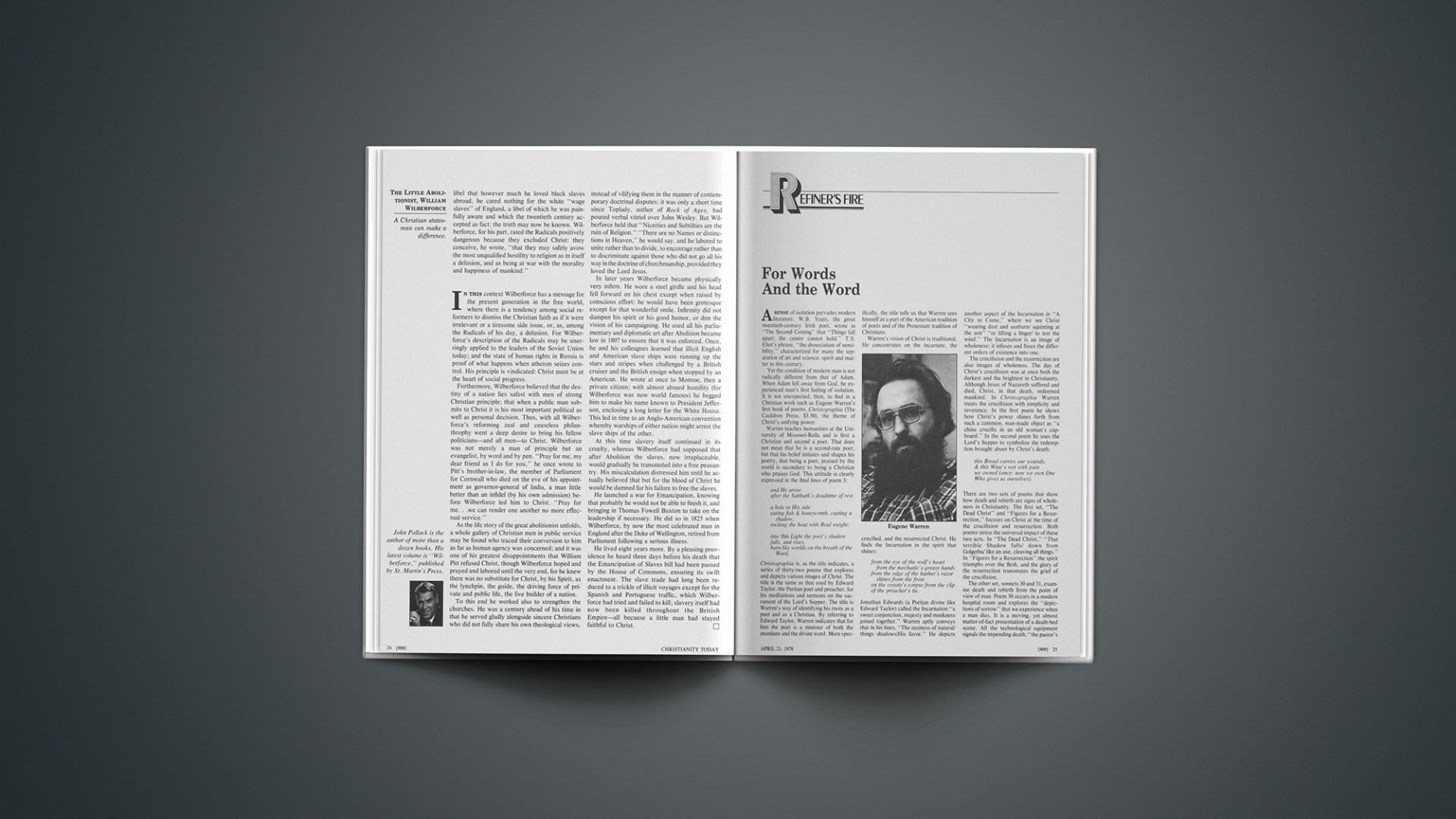
Refiner’s Fire: For Words and the Word

A sense of isolation pervades modern literature. W.B. Yeats, the great twentieth-century Irish poet, wrote in “The Second Coming” that “Things fall apart; the center cannot hold.” T.S. Eliot’s phrase, “the dissociation of sensibility,” characterized for many the separation of art and science, spirit and matter in this century.

Yet the condition of modern man is not radically different from that of Adam. When Adam fell away from God, he experienced man’s first feeling of isolation. It is not unexpected, then, to find in a Christian work such as Eugene Warren’s first book of poems, Christographia (The Cauldron Press, $3.50), the theme of Christ’s unifying power.

Warren teaches humanities at the University of Missouri-Rolla and is first a Christian and second a poet. That does not mean that he is a second-rate poet, but that his belief initiates and shapes his poetry, that being a poet, praised by the world is secondary to being a Christian who praises God. This attitude is clearly expressed in the final lines of poem 3:

and He arose

after the Sabbath’s deadtime of rest

a hole in His side

eating fish & honeycomb, casting a shadow,

rocking the boat with Real weight:

into this Light the poet’s shadow

falls, and rises,

born like worlds on the breath of the Word.

Christographia is, as the title indicates, a series of thirty-two poems that explores and depicts various images of Christ. The title is the same as that used by Edward Taylor, the Puritan poet and preacher, for his meditations and sermons on the sacrament of the Lord’s Supper. The title is Warren’s way of identifying his roots as a poet and as a Christian. By referring to Edward Taylor, Warren indicates that for him the poet is a minister of both the mundane and the divine word. More specifically, the title tells us that Warren sees himself as a part of the American tradition of poets and of the Protestant tradition of Christians.

Warren’s vision of Christ is traditional. He concentrates on the incarnate, the crucified, and the resurrected Christ. He finds the Incarnation in the spirit that shines:

from the eye of the wolf s heart

from the mechanic’s greasy hands

from the edge of the barber’s razor

shines from the frost

on the coyote’s corpse from the clip

of the preacher’s tie.

Jonathan Edwards (a Puritan divine like Edward Taylor) called the Incarnation “a sweet conjunction, majesty and meekness joined together.” Warren aptly conveys that in his lines, “The easiness of natural/things shadows/His favor.” He depicts another aspect of the Incarnation in “A City to Come,” where we see Christ “wearing dust and sunburn/squinting at the sun” “or lifting a finger/to test the wind.” The Incarnation is an image of wholeness; it infuses and fuses the different orders of existence into one.

The crucifixion and the resurrection are also images of wholeness. The day of Christ’s crucifixion was at once both the darkest and the brightest in Christianity. Although Jesus of Nazareth suffered and died, Christ, in that death, redeemed mankind. In Christographia Warren treats the crucifixion with simplicity and reverence. In the first poem he shows how Christ’s power shines forth from such a common, man-made object as “a china crucifix in an old woman’s cupboard.” In the second poem he uses the Lord’s Supper to symbolize the redemption brought about by Christ’s death:

this Bread carries our wounds,

& this Wine’s wet with pain

we owned (once: now we own One

Who gives us ourselves).

There are two sets of poems that show how death and rebirth are signs of wholeness in Christianity. The first set, “The Dead Christ” and “Figures for a Resurrection,” focuses on Christ at the time of the crucifixion and resurrection. Both poems stress the universal impact of these two acts. In “The Dead Christ,” “That terrible Shadow falls/down from Golgotha/like an axe, cleaving all things.” In “Figures for a Resurrection” the spirit triumphs over the flesh, and the glory of the resurrection transmutes the grief of the crucifixion.

The other set, sonnets 30 and 31, examine death and rebirth from the point of view of man. Poem 30 occurs in a modern hospital room and explores the “depictions of sorrow” that we experience when a man dies. It is a moving, yet almost matter-of-fact presentation of a death-bed scene. All the technological equipment signals the impending death; “the pastor’s nervous prayer scatters upward”; “the patient curls his tongue for a last word”; and “the gate of sorrow opens to the Lord.” This sonnet matches on a human level “The Dead Christ,” and the sonnet immediately following it, “Christ came juggling from the tomb,” is a match for “Figures for a Resurrection.” This latter sonnet with its lines, “Hey! Listen—that chuckle in the dark,/that clean blast of laughter behind”—delightfully evokes the power of Christ to overcome and transform. Not only does Christ juggle “death’s stone pages”—the monuments we erect for earthly remembrance but also our “stone dead” corpses—but he also tosses them and us higher and higher until “we fall out” of our tombs, out of our dead selves, and become, like Christ, jugglers “dancing and juggling our griefs like sizzling balls of light.”

Light and stones are the matter of Christographia. Many of the poems imply that fallen man is a stone. “Shall these stones live?” Warren asks in number 5. In poem 6 “the spiteful rejecters” of Christ’s light “ride sealed” “in darkness under outer stones.” Yet in ancient times stones marked the limits and the foundations of cities, and the city is also a concern of Warren. Eleven of the thirty-two poems treat various views of the city. There is the modern city with its garbage-filled streets, the ancient and holy city of Jerusalem, the city of Paphos sacred to Venus, the pagan goddess of love, and the city of Ephesus, sacred to Artemis. Christians, Warren suggests, have been and are tempted by the attractions of sexual pleasure and business success.

Framed by its circle of twelve stones, the ancient city is emblematic of Christ, who is the circumference of the circle, the shape of eternity, and the center of the circle. The city is the earthly community that man forms out of love for his fellow man, and it is the shadow of the heavenly community, the spiritual place, “the urban bride of the carpenter,/Love,” the new Jerusalem of Revelation whose “Light was like a stone most precious,” “the Castle Joyous,” whose “Keeper sings/songs of Home,” the place where “out of the dust/ & stones, Abraham’s children rise,/stones of light/raising a city/unmarkt by Cain.”

That Christ can make “stones of light” testifies to his unifying and renewing powers. Light dominates Warren’s Christographia. Almost every poem speaks of the light that is Christ. There is the “swiftness of light” (1), “the light sings” (2), a “bath of light” (3), “lineaments of light” (4), “snuffed out Light” (9), “City of Light” (11), “our tongues aflame with new light” (12), “supernatural light” (13), “living light” (14), “Central Light” (15), “rumors of light” (17), “stones of light” (18), “pearls of light” (20), “constellated tongues of light” (22), “radial light” (23), “light in light” (25), “imagination’s coherent light” (29), “light pulsing the heart beat” (30), and “balls of light” (31).

In the last poem Warren uses two quotations to indicate the ways that the Light of Life works for man. “By His light all this is lightened” and “by your light we see the light.” Those who love God above all else and who love their neighbors as themselves find in the light who is Christ an easing of their earthly burden and the way to him. They find, as Warren says in poem 29, “all things whole/in the Spirit’s harmonic flash.”

Christographia is an exceptional first book. The poems are not only erudite and complex, encompassing much of Christian history and theology, but they are also simple and sensitive. Their appearance on the page is at first a little difficult and disconcerting to the reader, but this difficulty is overcome with a careful reading of the poems aloud. One of the outstanding qualities of this book is that there is no prideful display of piety. The poems are quietly and solidly set forth. They are powerfully effective because they are written from a dedication and a love for the word and the Word.

Larry Vonalt teaches in the department of humanities at the University of Missouri-Rolla.

The Little Abolitionist, William Wilberforce

A Christian statesman of whatever nation can change the times in which he lives.

On an early June day in 1803 the future president, James Monroe, in London to negotiate a trade treaty, wrote such a charming letter to William Wilberforce, the celebrated leader of the campaign to abolish the slave trade, that Wilberforce nearly jumped into his carriage at once in order to make Monroe’s acquaintance. The two men met shortly afterwards and became lifelong friends.

Wilberforce never visited the United States, but he remains a figure of great importance to American history, since without his twenty-year campaign in Parliament against the British trade it is doubtful whether the American slave trade would have been simultaneously abolished by Congress in 1807. Moreover, Wilberforce belongs to the whole world, not merely to the country of his birth, and is specially significant for the present time as a preeminent example of a Christian statesman, a proof that a faithful Christian may indeed achieve much good in the political arena.

Wilberforce was a delightful character, whom to know is to love, as I discovered when researching among the magnificent collection of his letters in the manuscript department of Duke University Library at Durham, North Carolina, and in more than one hundred deposits in eighty locations, public and private, in Britain and America. He was tiny, and looked rather like Pickwick, except for a remarkably ugly nose. He had a wonderful smile and he laughed a lot; he had a voice that, whether you were listening to him in Parliament or in conversation in a country house or a London drawing room, made you long to hear him more.

Although he had wasted his years of formal education, he educated himself later and had a well-stored brain. He had great mental energy, though he inclined to dissipate it in attempting too many things at once. His strong sense of purpose prompted a slave trader to complain that “it grows more vigorous from blows.” Yet, above all, his friends would remember “that peculiar sunshine which he threw over a company by the influence of a mind perpetually turned to love and praise.”

In his boyhood, after the early death of his father, a rich merchant in Yorkshire, he had lived with an evangelical uncle and aunt and had been much influenced by John Newton, the hymnwriter and preacher who once had been a slave trader. Wilberforce’s mother took fright at this evangelical influence, removed him, and scrubbed his soul until Newton could say sadly of the young member of Parliament and bosom friend of Pitt the Prime Minister that nothing Christian was left in Wilberforce except for an unusually high moral tone.

Then, in 1785, Wilberforce underwent a prolonged, agonizing, but thorough conversion (perhaps, theologically, it was a rededication) to the Christ of his boyhood, through the influence of a brilliant mathematician, Isaac Milner, and their reading the Bible together, which became Wilberforce’s best loved book, “written to plain unlettered men in a plain popular way.… My judgement rests altogether on the Word of God,” he would say.

His conversion released a flood of compassion as he looked around at the hundreds of causes that tugged at a perceptive young Christian’s heartstrings in the England of the late eighteenth century. He had already begun to be a social reformer when his zeal focused on that most terrible of man’s inhumanities to man, the Atlantic slave trade. This, for hundreds of years, had torn men, women, and children from their homes in Africa and forced the survivors of the voyage into brutal slavery in the sugar cane and cotton fields of the New World.

Wilberforce had become concerned first for the condition of the slaves. Then he realized with horror the criminal damage inflicted upon Africa. Only from that did his mind move to the trade itself. It was the fearful mortality of the “Middle Passage,” the long voyage of the slave ships, that finally convinced him: “As soon as I had arrived thus far in my investigation of the Slave Trade,” he would tell the House, “I confess to you so enormous, so dreadful, so irremediable did its wickedness appear that my own mind was completely made up for Abolition. Let the consequences be what they would, I determined I would never rest until I had effected Abolition.… When we think of eternity, and of the future consequences of all human conduct, what is there in this life which should make any man contradict the principles of his own conscience, the principles of justice, the laws of religion and of God?”

At first in 1786 he forecast quick success, for there was already a strong current of disgust with the trade, both in Britain and in the United States, though no one dared wish the economic ruin that was expected to follow Abolition. Wilberforce believed also that slavery itself would die a natural death once the source of slaves had dried up. But disappointments and parliamentary defeats put him back, year after year. His health broke and forever after he was kept alive by opium, which the medical profession of those days regarded as a “pure drug” carrying no moral obloquy, though the cure itself wreaked some havoc on Wilberforce’s physique and affected especially his eyesight.

The slave trade lobby used every art and subterfuge, including the threat that if an abolition bill was passed by the Westminster Parliament, the British sugar islands in the Caribbean would declare themselves independent and apply to join the United States. Threats, fears, and personal abuse could not dissuade Wilberforce. He told one friend that although in other matters a politician might be free to push or to hold back as tactics dictated, yet “in the present instance where the actual commission of guilt is in question, a man who fears God is not at liberty.” If he thought immediate abolition would “cause an insurrection in our islands, I should not for an instant remit my most strenuous endeavours.” His sons, when quoting the letter in their official biography, expunged this revolutionary sentiment.

Throughout the twenty-year campaign for Abolition, Wilberforce showed himself a masterly politician. Indeed, it is as a statesman, empowered and directed by faith in Christ, that he stands or falls and not, as his sons tried to make out in their dreary five volume biography, as a religious person who happened to be in politics (and as their religious views no longer coincided with their father’s when they wrote, they sought to fashion him into something other than he had been, and the real, delightful, many-sided Wilberforce disappeared for nearly 140 years).

Wilberforce proved to an age of political corruption that Christian principles may be followed without compromise; indeed, he was mainly responsible for the great change that gradually spread across public life, turning, as it were, the eighteenth century with its venality and jobbery into the nineteenth century with its probity. Wilberforce fought bribery and nepotism. He set such high standards, and his great achievement of Abolition brought him after 1807 such unique prestige, that his influence eventually pervaded and directed the broad stream of public affairs, though he never held office.

He is a proof that a Christian statesman of whatever nation can change the times in which he lives, though he cannot do so alone. It is a matter of history that for two generations at least after Wilberforce the British character was molded by attitudes that were essentially his; that a Christian social conscience attacked the abuses that had grown up in the more pagan age that had coincided with the early industrial revolution and that a Christian compassion relieved its victims.

Wilberforce was a social reformer who touched all manner of causes at home and abroad, from prisons, hospitals, the morals of the rich and the wages and relief of the poor, to the recruitment of the clergy, the distribution of the Bible, and compensation to Africa.

He always emphasized that social progress needs a Christian base. And it was for this that he was hated by the Radicals, the loudest-voiced social reformers of his day. They even spread the libel that however much he loved black slaves abroad, he cared nothing for the white “wage slaves” of England, a libel of which he was painfully aware and which the twentieth century accepted as fact: the truth may now be known. Wilberforce, for his part, rated the Radicals positively dangerous because they excluded Christ: they conceive, he wrote, “that they may safely avow the most unqualified hostility to religion as in itself a delusion, and as being at war with the morality and happiness of mankind.”

In this context Wilberforce has a message for the present generation in the free world, where there is a tendency among social reformers to dismiss the Christian faith as if it were irrelevant or a tiresome side issue, or, as, among the Radicals of his day, a delusion. For Wilberforce’s description of the Radicals may be unerringly applied to the leaders of the Soviet Union today; and the state of human rights in Russia is proof of what happens when atheism seizes control. His principle is vindicated: Christ must be at the heart of social progress.

Furthermore, Wilberforce believed that the destiny of a nation lies safest with men of strong Christian principle; that when a public man submits to Christ it is his most important political as well as personal decision. Thus, with all Wilberforce’s reforming zeal and ceaseless philanthrophy went a deep desire to bring his fellow politicians—and all men—to Christ. Wilberforce was not merely a man of principle but an evangelist, by word and by pen. “Pray for me, my dear friend as I do for you,” he once wrote to Pitt’s brother-in-law, the member of Parliament for Cornwall who died on the eve of his appointment as governor-general of India, a man little better than an infidel (by his own admission) before Wilberforce led him to Christ. “Pray for me.… we can render one another no more effectual service.”

As the life story of the great abolitionist unfolds, a whole gallery of Christian men in public service may be found who traced their conversion to him as far as human agency was concerned; and it was one of his greatest disappointments that William Pitt refused Christ, though Wilberforce hoped and prayed and labored until the very end, for he knew there was no substitute for Christ, by his Spirit, as the lynchpin, the guide, the driving force of private and public life, the live builder of a nation.

To this end he worked also to strengthen the churches. He was a century ahead of his time in that he served gladly alongside sincere Christians who did not fully share his own theological views, instead of vilifying them in the manner of contemporary doctrinal disputes: it was only a short time since Toplady, author of Rock of Ages, had poured verbal vitriol over John Wesley. But Wilberforce held that “Niceities and Subtilties are the ruin of Religion.” “There are no Names or distinctions in Heaven,” he would say, and he labored to unite rather than to divide, to encourage rather than to discriminate against those who did not go all his way in the doctrine of churchmanship, provided they loved the Lord Jesus.

In later years Wilberforce became physically very infirm. He wore a steel girdle and his head fell forward on his chest except when raised by conscious effort: he would have been grotesque except for that wonderful smile. Infirmity did not dampen his spirit or his good humor, or dim the vision of his campaigning. He used all his parliamentary and diplomatic art after Abolition became law in 1807 to ensure that it was enforced. Once, he and his colleagues learned that illicit English and American slave ships were running up the stars and stripes when challenged by a British cruiser and the British ensign when stopped by an American. He wrote at once to Monroe, then a private citizen; with almost absurd humility (for Wilberforce was now world famous) he begged him to make his name known to President Jefferson, enclosing a long letter for the White House. This led in time to an Anglo-American convention whereby warships of either nation might arrest the slave ships of the other.

At this time slavery itself continued in its cruelty, whereas Wilberforce had supposed that after Abolition the slaves, now irreplaceable, would gradually be transmuted into a free peasantry. His miscalculation distressed him until he actually believed that but for the blood of Christ he would be damned for his failure to free the slaves.

He launched a war for Emancipation, knowing that probably he would not be able to finish it, and bringing in Thomas Fowell Buxton to take on the leadership if necessary. He did so in 1825 when Wilberforce, by now the most celebrated man in England after the Duke of Wellington, retired from Parliament following a serious illness.

He lived eight years more. By a pleasing providence he heard three days before his death that the Emancipation of Slaves bill had been passed by the House of Commons, ensuring its swift enactment. The slave trade had long been reduced to a trickle of illicit voyages except for the Spanish and Portuguese traffic, which Wilberforce had tried and failed to kill; slavery itself had now been killed throughout the British Empire—all because a little man had stayed faithful to Christ.

John Pollock is the author of more than a dozen books. His latest volume is Wilberforce, published by St. Martin’s Press.

Evangelicals and the Inerrancy Question

Some guidelines for action

Time and Newsweek, those infallible and inerrant analysts of all that is American, tell us that 1976 was the year of the evangelicals. I am pessimistic.

Sydney Ahlstrom, foremost historian of the American church today, argues that America has now arrived at the end of a four-hundred-year cycle. It has come to the end of an epoch dominated by evangelical Christianity. Though I am more inclined to agree with the learned Yale professor than I am with Time and Newsweek, I am nevertheless more optimistic. A more accurate analysis will direct us away from both of these extremes.

In the past two centuries the percentage of American people affiliated with any Christian church rose from less than 10 per cent to nearly 70 per cent of the total population. Accompanying this amazing growth of the church, however, has been the Americanization of the church. It would be far truer to say that America has conquered the church than that the church has conquered America. As Will Herberg has so brilliantly shown in his book Protestant, Catholic, Jew, one can truly be an American only through membership in a church, and the real values of the church are far more the social and political principles that hold together the melting pot of the United States than the principles of Holy Scripture.

Within the mainline Protestant church in America, moreover, evangelicalism has gradually lost its once dominant position. Beginning in the latter part of the nineteenth century and culminating shortly after the first World War, the leadership of American denominations turned from evangelicalism to the neo-Christianity of liberalism. By 1930, leadership in most of the mainline Protestant denominations was clearly in the hands of liberals, and each decade since has witnessed a declining leadership role on the part of conservative evangelicals.

Evangelicalism not only declined in mainline denominations but unfortunately also withdrew everywhere from the centers of influence and power. It became an ever smaller subculture in the overall American church scene, defensive in its reactions and ghettolike in its psychology.

This decline of evangelicalism was partly compensated for (but only partly so) by the growth of the independent movement in the early and middle years of our century, and even more by the development of numerous small evangelical bodies that followed the traditional pattern of the older mainline denominations in their general understanding and practice of Christianity. These bodies, almost exclusively evangelical, have grown rapidly through the middle of the twentieth century and on through our day. Many such small denominations have doubled their membership every fifteen years or so.

The most spectacular growth of evangelicalism, however, is to be found in the Pentecostal denominations and in the newer charismatic fellowships. Introducing a type of piety alien to traditional Protestantism but, in most instances, unequivocally evangelical, the modern Pentecostal movement came into being during the early part of this century. Until 1960, its influence was confined to small, splintered, and often despised sects on the fringe of mainstream Christianity. But in the middle and final thirds of our century the charismatic movement really caught fire. In the last decade, it began to penetrate the mainline denominations, and now it is difficult to find a large congregation in any of the traditional church bodies of America unaffected by the charismatic movement—even including many Roman Catholic churches. Estimates of the total number of charismatics in the United States, including membership in Pentecostal denominations and practicing charismatics in churches not traditionally Pentecostal, vary from three to five million. The vast majority of them are committed evangelicals.

The evidences of this evangelical resurgence are not hard to discover. Evangelicals have returned to the offensive. Whereas nonevangelical seminaries are barely holding their own by the admission of large numbers of women students, by the inclusion of a great many postgraduate candidates who have little or no intention of seeking ordination to Christian ministry, and by the introduction of the new doctor of ministry degree, evangelical schools, on the other hand, are overflowing everywhere even after allowance is made for many of these changes in their own programs.

Apart from works on psychology, the occult, sex, marriage, and the family, publishers are finding it difficult to market religious books that come from the pens of nonevangelical writers. But evangelical publishers everywhere are prospering in unprecedented ways—so much so that many older publishing houses that have long discouraged any evangelical representation on their lists are now openly courting evangelical writers and evangelical audiences. Even evangelical magazines and periodicals are flourishing. Evangelicals, too, are increasing in their maturity; they are becoming more and more alert to the implications of Christianity for human life and culture.

The alternatives to evangelicalism, by contrast, have not fared well. The historicism and rationalism of liberal theology have not proved religiously effective; religious liberalism, at least in its traditional forms, seems everywhere in decline. For a time, the surge of the biblical theology movement seemed to give new life to a reconstructed and repentant liberalism. The ambivalence of the biblical theology movement, however, carried its own seeds of ultimate disintegration. In liberal forms, its views on the “mighty acts of God” do not clearly distinguish it from the older liberalism (except in rhetoric), as Langdon Gilkey has frequently called to our attention. The more orthodox vocabulary of the conservative neoorthodoxy of the last generation has proved itself neither clear nor convincing.

Barthians, who brought so much promise to the theological scene in the late 1940s and 1950s, never really caught on in the United States, and with the misnamed and ill-fated death-of-God movement, simply disappeared in the 1960s. In Europe, Barthian theology dissolved before our eyes in the late 1950s and 1960s and was replaced by the cold winds of Bultmann and a new rationalism. Voices of new and even intriguing theologies rose here, there, and everywhere; but none could garner a following. Barth was honored as the creator of the great modern theological paradigm by whose theological structure everyone else could be measured, assessed, and located on the current theological map, but only a handful of professional scholars read his voluminous tomes. Although all admitted to the magic influence of his spell, none dared to call himself Barthian.

The theological world of the 1970s, therefore—by default if for no better reason—is interested in hearing what evangelicalism has to say just at the time when evangelicals themselves have recouped some of their losses and endeavored again to move into the open forum of religious debate. With this reentrance of evangelicalism upon the theological battlefield has come new influence from the nonevangelical world and, indeed, some casualties among the evangelical forces. This should be no surprise to anyone; casualties are always the price of serious warfare, spiritual or otherwise.

Probably the most emotion-stirring issue on the current scene is that of the precise nature of biblical authority, and particularly of biblical inerrancy, together with the question of how we are to use the Bible to build a valid and normative theology. This is certainly the issue for evangelicals at this time, though it has never been far from the center of their concern.

Granted, therefore, evangelicalism is neither king nor corpse. But it may be, as Newsweek prophesied, that “1976 may yet turn out to be the year that the evangelicals won the White House but lost cohesiveness as a distinct force in American religion and culture.” I should like to propose some guidelines to enable evangelicals, while keeping themselves under the judgment of all of Scripture, to develop an effective strategy for action with reference to the doctrine of inerrancy.

1. Evangelicals should never again dare to withdraw from the intellectual battlefield of the day and hope thus to protect their delicate faith from worldly attack. Such antiintellectualism is irresponsible. Not only does it lead inevitably to loss of faith, but there is something inherently antibiblical and anti-Christian about such an egoprotecting stance. It is a reflection of little faith. It is inconsistent with the commands of our Lord to go into all the world and to let the light shine as a city built on a hill.

2. Inerrancy, the most sensitive of all issues to be dealt with in the years immediately ahead, should not be made a test for Christian fellowship in the body of Christ. The evangelical watchcry is “Believers only, but all believers.” Evangelicals did not construct the church and do not set its boundaries. Christ is Lord and he is Lord over his church. The bounds of fellowship are determined by our relationship to Christ and by the life we share in him by grace through faith alone.

The question is frequently raised: “Can one be an evangelical if he doesn’t believe in inerrancy?” Since all obviously do not use the word evangelical to mean the same thing, we must draw these conclusions: the word means several things; the same person does not always use the word to mean the same thing; and the meanings of words change by debasement or enrichment.

Several distinct meanings for the word “evangelical” can be documented. On the basis of its derivation, “evangelical” in its broadest sense refers to all people who hold to the essential Good News that sinful men are saved solely by the grace of God, conditioned only on commitment to Jesus Christ, the divine-human Lord and Saviour of man. Historically a second meaning of the term has evolved. Because of the characteristic unity of doctrine espoused and defended by the early Protestants, whether Lutheran, Reformed, Anglican, or Anabaptist, the word “evangelical” has tended in a narrower sense to denote all who remain fully committed to Protestant orthodoxy. Between the broad and the narrow usage no one has ever been able to maintain a hard and fast boundary. History shows considerable disagreement as to how many and what departures a Christian believer can make before he ceases to be evangelical in the narrow sense but remains so in the broad sense. Finally, of course, the term sometimes refers merely to historical churches and movements originally characterized by orthodox Protestant or evangelical theology, irrespective of whether the body continues to adhere to traditional evangelical doctrine.

Disregarding for the moment the last or institutional definition of the word, “evangelical” is therefore frequently used in a broad sense to include all who adhere to the Christian Gospel and in a narrow sense to include all who are fully committed to traditional orthodox Protestantism. One who rejects a doctrine characteristic of traditional Protestant orthodoxy—the Virgin Birth, for example, or an inerrant Scripture—may defend himself by arguing that that particular doctrine is not really an essential element of traditional Protestantism. Or he may defend his evangelicalism by appealing to the broader definition: he really does believe in the essential gospel—the “evangel” of Christianity.

Granted that a rose by any other name smells just as sweet, there is some value in resisting the debasement of verbal coins and immense value in identification with one’s cultural and religious roots. I am indisposed, therefore, to relinquish the word evangelical to suborthodox viewpoints. Yet I confess that I myself sometimes use the word in a broader sense, and I know that many others do also. In any case, all who employ the term must depend upon context and qualifiers to make plain the sense in which they are using it whenever it is important that the term be understood precisely and exactly.

3. Although the doctrine of inerrancy should not be made a test for Christian fellowship and cannot be presumed to be included in the term evangelical as sometimes used, inerrancy, nevertheless, is important. It is even essential for consistent evangelicalism and for a full Protestant orthodoxy. Consequently many evangelical institutions and denominations require commitment to inerrancy for their officers and for ordination to the Christian ministry. Not only is this a wise safeguard, but it must also be defended in view of the specific purpose of the group or individuals for whom it is required. To remove the word inerrancy from the platform of the Evangelical Theological Society, for example, would be to remove its raison d’être. To fail to require belief in the inerrancy of Scripture on the part of its leadership would be to jeopardize the evangelical heritage of a strict orthodoxy.

4. The case for inerrancy rests precisely where it has always rested: on the lordship of Christ and his commission to his representatives, the prophets and the apostles. Just because it rests on Christ and on Christ’s authority, therefore, the question of inerrancy will remain a key doctrine of the evangelical church for as long as Christ is Lord. Evangelicals must remember, however, that this basis must be set forth anew for every generation.

5. There is an imminent danger of debilitating division within evangelical ranks over this issue and even of destruction of some evangelical forces. In the interest of truth and for the sake of obedience to the Gospel, some of this may be necessary. When it is necessary, so be it. Clear and difficult distinctions must be set forth in love even when they will lead to unwanted misunderstanding and division. But some of the danger to evangelicalism is due only to dust in the air, and a little sprinkling of cold water would clear the atmosphere.

6. Evangelicals must show that inerrancy is not a new doctrine. It is not a fundamentalist heresy of the twentieth century. It seems ridiculous, but even that stalwart defender of the authority of Scripture, John Calvin himself, cannot be taken for granted. One of the charges Calvin was responsible for leveling against Servetus, and for which Servetus was brought to trial, included the indictment that Servetus had taught that the Bible was not true in a minor geographical detail of the Old Testament. Yet in spite of that fact, Paul Lehman of Union Seminary of New York flatly argues that Calvin held to an errant view of Scripture, and this interpretation was apparently adopted by McNeil, America’s greatest Calvin scholar of this generation.

7. Evangelical scholars must not concentrate so exclusively on inerrancy in their doctrinal studies and writings as to seem to make it the focus of the Gospel or the central and fundamental doctrine of Christian faith, thus replacing Christ. Such a move would create a warped and unattractive image of Christianity and discourage many people, not because they see objections to that doctrine, but because they see that it is not the Gospel.

8. The presuppositions of the opponents of a full-fledged orthodoxy must be spelled out explicitly, and these must be set forth in contrast with sharply and clearly delineated presuppositions of evangelical faith. All too often many contemporary thinkers have predetermined their conclusions on the basis of prior commitments as to personal theism: the supernatural, the nature of truth, the possibility of knowledge, the use of language, and other highly mooted philosophical and theological tenets. These must be exposed for what they really are—invalid assumptions fundamentally inconsistent with biblical faith. They must be replaced with valid presuppositions, inherently consistent with each other and with clear biblical teaching.

9. Inerrancy must be carefully defined and the entire church must be instructed that such precise definition will not weaken faith. Sometimes a weak faith must be destroyed in order to make room for a genuine and stronger faith. But in any case, the day is long past when evangelicals can refuse to face up to difficult arguments in their public writings on the grounds that they do not wish to give free hearing to the doctrine of devils.

10. Evangelicals must show that they are not insisting upon a single word as a shibboleth but rather are witnessing to the complete truthfulness and divine authority of Scripture. The words “infallibility,” “trustworthiness,” “plenary inspiration,” “inerrancy as to teaching,” or “inerrant in all it affirms” are all adequate. But all can be and are being used with qualifications and limitations so as to mean the opposite of what was originally intended. These qualified words are used to mean that some of what Scripture says or affirms or teaches is not true.

The word “inerrancy” is by no means free from such abuse and ambiguity. As applied to biblical inspiration, it is used by some to mean exact and precise language throughout the whole of Scripture, literal interpretation of Scripture, or dictation methodology for the production of Scripture—all excesses of the right. According to others, inerrancy means that Scripture is certain to accomplish its purpose, that Scripture will never lead us astray from the Gospel, or that Scripture is infallible only in limited areas such as its formal didactic passages or in those parts representing divine revelation—all excesses of the left.

11. Evangelicals must show the relevance of inerrancy thus defined. It is not a “death by a thousand qualifications.” Neither is it a useless defense of “Bible X”—the unknown Bible no one has ever seen, ever will see, or ever expects to see. Rather, evangelicals must show that it is just because we believe the autographs were inerrant that we have an objective path to truth. The assurance that we possess the correct text (on the basis of the objective and public data of textual criticism) plus the assurance that we possess the true meaning of Scripture (on the basis of the objective and public data of grammar and syntax and usage) provides for the inerrantist the support for his conviction that he has the truth of God.

12. Evangelicals need to demonstrate how one can build a valid systematic theology and thereby provide the church, in a practical and biblically ordained way, with a norm for thought and life today. Evangelicals are in a remarkably good position to interact—indeed, they must interact—with works such as David Kelsey’s The Uses of Scripture or the attempts by Brevard Childs to build a new biblical theology on a Scripture that is neither divorced from the text nor arranged into patterns of the history of religion.

This task must not be left merely to negative reactions against others who have set the issues and formed the lines of interaction according to their own presuppositions. Rather, evangelicals must set themselves to the positive construction of prolegomena if they would gain a hearing for our day.

13. Evangelicals must relate their doctrine of inerrancy to current New Testament scholarship. It is my conviction that most heresies grow out of firm but one-sided grasping for truth. Consistent evangelicals, for example, must discover the piece of truth that gives strength to such basically antievangelical methodologies as the “redaction criticism” of Willi Marxsen and others. But they must also be sufficiently alert and expert to draw the lines that inevitably distinguish truth from error.

14. Old and New Testament experts should concentrate on the exposition of Scripture. In recent decades evangelicals have been pushed by their doctoral mentors into linguistic studies (usually comparative linguistics instead of biblical Hebrew and Greek) and into historical analysis, but have carefully avoided expositions of Scripture that employ the analogy of Scripture in order to set forth the whole Bible and its teaching in all its richness.

There are two special tragedies of our day: first, the most exhaustive and comprehensive theological word books were produced by nonevangelicals but are translated and published and read by evangelicals; and second, the best current commentaries are almost all reprints. Those that are newly written and are of quality are seldom by evangelicals—the very people who profess greatest loyalty to the Bible and its teachings.

15. Old and New Testament specialists must assume a proper responsibility to their Lord and to the church for the employment of their expertise in aiding in the construction of evangelical doctrine. Any Old or New Testament expert in a church-related and evangelical school who seriously says, “I am not interested in biblical doctrine” ought immediately to question the state of his own evangelicalism.

16. Finally, a word seems appropriate both to those who are evangelical and as such defend the doctrine of biblical inerrancy, and to those who as evangelicals are not at ease with the word “inerrant.”

To those who confess their evangelical faith but are not at ease with inerrancy, I would say:

a. Do not think you will win liberals and neoorthodox theologians to evangelicalism by fighting what you consider to be the bad view of the Bible held by more conservative evangelicals.

b. Proceed constructively as evangelicals if you are evangelical. It is always easier to tear down than it is to build anew. Your first and primary responsibility as theologians is to build the instruction of our Lord into a meaningful whole, a positive body of doctrine and ethical guidance.

c. I know of no instance in which an institution has preserved complete doctrinal orthodoxy on all points except that of inerrancy for as long as a full generation. Maybe, as some have said, it can be done. But limited inerrancy is a difficult line to draw. For one thing, I see no biblical instruction as to where to draw a line between the parts of the Bible that we accept as the Word of God and as binding upon us, and other parts of biblical teaching and instruction that we set aside. Let those who argue for a limited inerrancy prove just once that they and their institutions can remain on that thin knife edge.

17. We evangelicals must reverse our role if we wish an effective strategy for our day. For seventy years we have been Green Berets furiously waging a rearguard mission to search and destroy the enemy. We must stop picturing ourselves as embattled guerrillas on the defensive. We must see ourselves primarily as heralds and persuaders.

If in order to illustrate the importance of adhering to inerrancy we employ the illustration of a row of dominoes, let us not forget that it is only an illustration; like all illustrations, it must not be pressed at all points. There is, for example, nothing of mechanical inevitability by which an individual or institution that moves to an errancy view of the Bible must necessarily reject all orthodox doctrines. By his Spirit God can stay and has stayed the process and even at times has reversed it. It is worthwhile to endeavor by all means to persuade our brothers in Christ of the truth and value of a doctrine of inerrancy. It is desirable to seek by every honorable means to penetrate and reclaim institutions that are wavering in their stand on this issue.

Moreover, evangelical strategy must incorporate a multidimensional perspective that is adequately comprehensive. Evangelicals must stop consuming all their energies by putting out brush fires of departures from orthodoxy. They must not permit those who waffle on inerrancy to set the agenda for evangelical action, and they especially must not permit them to determine the way to present the case for biblical authority.

Conservative evangelicals must take great care, lest by too hasty a recourse to direct confrontation they push into unorthodoxy the wavering scholar or student troubled by problems in the biblical text or by some of the common connotations of the word “inerrant.” Surely it is better first to make every effort to win to a right understanding of biblical inerrancy all who by any means are winnable. And anyone who accepts with adequate seriousness the lordship of Jesus Christ is certainly winnable or should be presumed to be winnable.

And in all that we do let us remember that orthopraxy is the crown of orthodoxy. Let us dialogue and debate in love with liberals in such a way that if our love for the liberals does not shine through our discourse, we lay down our pens. And with our fellow evangelicals deemed less consistent than ourselves, we must remember that honesty—intellectual and spiritual as well as financial—is not a policy; it alone is right. And as we defend what we believe to be our Lord’s instruction as to the inerrancy of biblical authority, we are not out to conquer, kill, and destroy. We are rather witnesses seeking to share, convince, and persuade fellow believers in Christ to follow our Lord and their Lord in the path of obedience to his written Word.

D. Bruce Lockerbie is chairman of the Fine Arts department at The Stony Brook School, Stony Brook, New York. This article is taken from his 1976 lectures on Christian Life and Thought, delivered at Conservative Baptist Theological Seminary in Denver, Colorado.

The Fearful Symmetry of Freedom

Out of the dungeon

Curiously enough, it was walking about the streets of Moscow in the early thirties that I first began to ponder upon what freedom meant, and what rights, if any, were vested in us just by virtue of belonging to the human race—what is called, heaven knows why, homo sapiens. I was doing a stint there at the time as correspondent for the old Manchester Guardian, then in the heyday of its reputation as the mouthpiece of the liberal mind at its brightest and best. Already I had come to realize, I must say with some inward anguish, the fraudulence of all the hopes I had entertained of finding in the USSR a free, brotherly, prosperous, and peaceable society in process of being set up under the auspices of a dictatorship of the proletariat. Instead, I was confronted with authoritarian government carried to a pitch far exceeding, for instance, the Brithish Raj in India, my only previous experience of the kind.

I spent a lot of time perambulating the Moscow streets and rubbing shoulders with the Muscovites similarly bent, this being the only unsupervised, unprogrammed contact with them permissible to foreigners. These were the beneficiaries under the Revolution. In principle, their freedom and human rights were specifically and everlastingly guaranteed; in practice they had neither freedom nor rights other than to read and think and believe and do whatever those set in authority over them considered appropriate. I found their anonymous presence oddly fascinating, and even appealing, aloof and remote as they were; so wrapped up in themselves, and, at the same time, a collectivity rather than a collection of separate individuals as in other towns I had known, like London or Paris. Mingling with them, I had a queer sort of almost mystical certainty which remains with me still, that as they were, so we were all fated to be. In them, for those with eyes to see, might be discerned the fearful symmetry of things to come.

It was not at all, let me hasten to add, that I envisaged the realization of the Marxist apocalypse of a triumphant proletariat taking over power and establishing themselves everywhere in authority for evermore; the final fulfillment of the promise in the Magnificat of the mighty being put down from their seats and the humble and meek exalted, of the hungry being filled with good things and the rich sent empty away. No, the feeling I had was something else; a sense that a phase of history was coming to an end, that Man struggling to be free, with rights pertaining to his individual status, was going to give place to Man as part of a collectivity, a tiny digit in a huge total, and that in Moscow this new arrangement was being tried out and could be observed. There, as it seemed to me, a new serfdom was taking shape which would set a pattern for the future. Thenceforth I have never doubted that a key to our present discontents is simply that the burden of being free has come to seem too heavy to be borne, and that, consciously or unconsciously, willfully or under duress, the prevailing disposition is to lay it down. In a famous scene in Dostoevsky’s novel The Brothers Karamazov, the Chief Inquisitor turns away the returned Christ because he brings with him, as he had before, the dreaded gift of freedom. Governments, as it seems to me, whatever their ideology, are going to show themselves of a like mind with the Chief Inquisitor.

This view was reinforced by the truly extraordinary antics of visiting West European and American intellectuals for whom Moscow in the thirties was a place of pilgrimage, as Peking is today to their heirs and successors. They arrived there, an unending procession, ranging from famous figures like a Bernard Shaw, a Julian Huxley, an André Gide, a Lincoln Steffans, to crazed clergymen who could not keep away from the anti-God museums, drivelling dons, an occasional eccentric millionaire, miscellaneous actual or aspiring intelligentsia of every sort and condition, all concerned to do obeisance to a regime which, in its practice if not in its theory, represented everything they purported to abhor, but which nonetheless, they insisted, held out the prospect of enlarging human freedom and enhancing human rights for all mankind. The credulity with which they accepted at its face value whatever their guides handed out to them, provided a spectacle of rare comedy, and I cherish its memory as such. At the same time, it was a portent. If these, who at home were the ardent custodians of human rights and freedom, were so ready, and even eager, when they were in the USSR, to throw them to the Kremlin wolves, what chance was there of defending them when, as they must, they came under attack as our turbulent twentieth century unfolded? Solzhenitsyn has immortalized this tragi-comic scenario, this great betrayal by the Enlightenment’s last legatees, in his hilarious account of an official visit by Mrs. Eleanor Roosevelt to a Soviet labor camp where he was incarcerated. At the time I could not, of course, envisage the final irony—that these very intellectuals would provide the style and manner of thinking of the pundits and gurus of the media, especially television, destined to hold the whole Western world in thrall.

Some fifteen years later I went to Washington, this time as correspondent for a Conservative newspaper, the London Daily Telegraph. In the intervening years there had been another devastating war, ostensibly fought for freedom and human rights, which involved accepting the Red Army as a liberating force, and at the Nuremberg war crimes tribunal American and British judges sitting alongside Russian ones in condemning the defeated Germans for infringing human rights by partitioning Poland, which they had done in collaboration with the Soviet Government under the terms of the Nazi-Soviet Pact, and for using forced labor, which continues to be a permanent feature of life in the USSR—vide The Gulag Archepelago. The Germans were also convicted of infringing human rights by the practice of compulsory sterilization and euthanasia, whose legalization is now being recommended in Western countries on humanitarian and compassionate grounds. Thus it has taken just thirty years to translate a war crime into an exercise in humanity and reinforcement of human rights.

I came to Washington not at all in the ebullient mood of my arrival in Moscow, but even so there was a sense of excitement in venturing into what was still called the New World. Moreover, America at this time had a position of preeminence among other nations in terms of weaponry and wealth unparalleled in modern times. Phrases like “manifest destiny” were again being bandied about, and human rights were very much in, and on, the air, with the Freedom Bell tolling on all appropriate, and sometimes inappropriate, occasions. Roosevelt, for instance, had launched his Four Freedoms, one of which—Freedom from Want—appearing on the almost worthless currency notes circulating in Italy during the allied occupation, caused considerable wry mirth among the local populace. Human rights, likewise, figured in numerous declarations, preambles, statements of intent, and solemn undertakings, as in the proceedings of the United Nations, which had risen, phoenix-style, out of the ashes of the old League of Nations.

No people, it is safe to say, in all history have been so specifically and lavishly certified to be free and in the full enjoyment of all their human rights as the Americans. Yet, I asked myself, were their freedoms and their human rights real or illusory? Certainly, as long as they had money, unlike the Muscovites, they could do as they pleased, read whatever they wanted to read, go wherever they had a mind to. Moreover, thanks to the Supreme Court and other judiciaries, their human rights were constantly being extended, so that they could sleep with whomever they wanted to sleep with, male or female, break a marriage and enter into another just as the fancy took them, choose any one of an ever-increasing variety of television programs, abort an inconvenient birth, stupify themselves with drugs, immerse themselves in porn, and ultimately, if they so wished, just with the aid of a hypodermic syringe or some sleeping tablets, bring their days to an end. All this with the advertisers and the media making straight the way.

Was it freedom ever burgeoning or a servitude ever more exacting? Human rights or human fantasies? Seeking to answer, I turned to the American motorways as I had in the USSR to the crowded Moscow streets; six lanes a side, and the endless stream of vehicles roaring along in both directions from nowhere to nowhere; the man at the wheel easefully surveying the ever-extending vista of tarmac, a cigarette drooping from his mouth, behind him a suit from the cleaners swinging gently to and fro on its hanger; the radio on, from Muzak to Newzak, and then back to Muzak,drooling tunes followed by drooling news, followed by more drooling tunes, and so on ad infinitum, the whole effect calculated to keep the driver’s mind in a state of vacuity, and so receptive to the advertisements which regularly punctuated both Muzak and Newzak, urging him to eat this, wear this, anoint and perfume himself with this, tone up his bowels with this, and tone down his body-odor with this. Then, as the evening comes on and the tarmac darkens, the neon signs come out; each cluster of homes displaying the basic four—food, drugs, beauty, gas—the four pillars of the American way of life.

Having now looked at two versions of freedom in contemporary terms, and the human rights that go therewith, the one a servitude to an all-powerful state and the other to an all-demanding ego, I turn to what the Apostle Paul called the glorious liberty of the children of God, the only true and lasting freedom there is, and the only basis on which human rights can exist at all and be valid. Words which, as St. Augustine woefully remarked, have a beginning and an end, are inadequate to describe this other freedom, deriving, as it does, from eternity and not from time, and carrying with it human rights as belonging to God’s creation and so participating in his purposes, rather than with reference to any earthly laws or instrument. It was this freedom and these were the human rights that Solzhenitsyn discovered in what were in worldly circumstances, the most abject imaginable—a Soviet prison camp. “It was only when I lay there on rotting prison straw,” he writes, “that I sensed within myself the first stirrings of good. Gradually it was disclosed to me that the line separating Good and Evil passes not through states, nor between classes, nor between political parties, but through every human heart and through all human hearts.” And he concludes: “So, bless you, prison, for having been in my life.” Others, we may be sure, in the grisly Gulag Archepelago, will likewise have been discovering freedom and their human rights as beings created by God in his image, while the representatives of governments were appending their signatures to the ludicrous Helsinki Agreement on Human Rights, and afterwards entering into interminable and meaningless discussions in Belgrade as to what the agreement’s terms meant and whether they had been duly observed.

In the world of the motorways, too, the victims of that other servitude may discover their true freedom and human rights, rejecting all the different allurements of what Pascal called “licking the earth,” and hearing beneath the drooling Muzak and Newzak the clear sweet voice of human brotherhood and companionship with God. Suddenly caught up in the wonder of God’s love flooding the universe, made aware of the stupendous creativity which animates all life, and of our own participation in it—every color brighter, every meaning clearer, every shape more shapely, every word written and spoken more coherent. Above all, every human face, all human companionship, all human encounters recognizably a family affair; the animals, too, flying, prowling, burrowing, all their diverse cries and grunts and bellowing and the majestic hill-tops, the gaunt rocks giving their blessed shade, and the rivers making their way to the sea—all irradiated with the same new glory. This is freedom—the sense of belonging to God’s creation; these are our human rights—to participate in the realization of his purposes for it.

No people have been so lavishly certified to be free and in the full enjoyment of all their human rights as the Americans.

It is like coming to after an anaesthetic; reconnecting with reality after being enmeshed in fantasy, picking out familiar shapes and faces with delighted recognition. There is a kind of vision expressing this which has often come to me; an adaptation, I dare say, of Plato’s famous image of the shadows in the cave. I find myself imprisoned in the tiny dungeon of my ego, fettered and bound hand and foot with the appetites of the flesh and the will, unable to move or to see. Then I notice that light is somehow filtering in, and I become aware that there is a window through which I can look out. Looking out, I see the vast expanses of eternity bathed in the light of God’s universal love. The window focuses this light as the Incarnation focused God’s love, thereby miraculously bringing it within the dimensions of time, and procuring my release. My bonds and fetters fall away; I break out of the tiny dungeon of my ego like a butterfly out of its crysalis. I am free.

One of the many pleasures of old age is to become ever more sharply aware of the many mercies and blessings God showers upon us. Almost every day I discover new ones. What joy, for instance, to be confronted with power and authority in disarray in all their guises everywhere! How reassuring and diverting to find all our egotistic pursuits being made to seem derisory! As the quest for money, by the presses that print more and more of it, and the Arab sheiks into whose artless hands more and more of it falls. As carnality, by erotomania and porn, the reductio ad absurdum of sex, and accompanying sterility rites and inexorable drift into impotence. As celebrity, by the media which bestow it so lavishly on auto-cued newsreaders, cinematic beauty queens, miming pop stars and grunting prize-fighters. As knowledge, by sociology and kindred studies, with their computers, public opinion polls and other devices for making false deductions from incorrect data. I could go on and on; if C.S. Lewis were alive today, he would, I feel sure, have Screwtape complaining to his lord and master, Old Nick himself, that there was scarcely one plausible vice left on the calendar.

Again, how thankful we should be that the two rival prospectuses for a man-made kingdom of heaven on earth, the Soviet model based on power and privation, and the American one based on affluence and self-indulgence, both come to look ever more unconvincing. Sixty years of what is called social engineering in the USSR and its satellite countries have only served to provide the most promising scope since the Dark Ages for proclaiming the good news of the Christian revelation. As for the pursuit of happiness—with the media to promote it and an ever-rising Gross National Product to finance it—still the psychiatric wards are overflowing and the roads to the East teeming with bearded and bra-less drop-outs who resolutely refuse to join in. Just supposing, I have often reflected, God had handed over the gruesome task of exploding Marx’s turgid dialectics by attempting to implement them to the Germans and the Japanese instead of the Russians and the Chinese, how immeasurably worse our present plight would be. Likewise, if he had entrusted the British rather than the Americans with wealth and nuclear power abounding.

The other day the very charming and holy Archbishop of Los Angeles, Cardinal Manning, was kind enough to refer to me publicly as a prophet. I wanted to adapt the words of Amos when he was similarly categorized: “I am no prophet, nor am I a prophet’s son; I am an herdsman, a gatherer of sycamore plants, and the Lord took me as I followed my flock,” and say: “I am no prophet, I am a journalist, a collector of news stories, and the Lord took me as I sat at my typewriter.” If, however, I were to venture upon an essay in prophecy, it would be this—whatever may happen to the nightmare utopias of the twentieth century, whether they mutually destroy one another or, metaphorically speaking, fall into one another’s arms, however deep the darkness that may fall upon our world, of one thing we may be certain; in some forgotten jungle a naked savage will feel impelled to daub a stone with colored mud and prostrate himself before it, thereby opening yet another chapter in man’s everlasting and indefatigable quest for God, making one more humble acknowledgment of the mystery of his existence and his destiny.

D. Bruce Lockerbie is chairman of the Fine Arts department at The Stony Brook School, Stony Brook, New York. This article is taken from his 1976 lectures on Christian Life and Thought, delivered at Conservative Baptist Theological Seminary in Denver, Colorado.

From Fantasy to Reality

Malcolm Muggeridge was interviewed recently when he was visiting Canada. The interviewers were: Martin Gibling, doctoral student at Ottawa University, Dennis Pape, auxiliary chaplain at the university and pastor of the French Baptist Church in Ottawa, and Sonia Williams, an arts student, also at the university. You may not agree with all of Muggeridge’ s views; we do not, but the interview is thought-provoking, nevertheless. The following article is an edited version of the interview.

Gibling: Why are you a Christian?

Muggeridge: That’s not a simple question for me. I can’t, like some people can, say that on such a minute I was converted, and the whole of my life changed. To me it has been a process, influenced by the professions I’ve practiced in my life—writing, journalism, radio journalism, TV journalism. The world is full of fantasy; there must be some reality somewhere, and the only reality that I’ve found is the reality of the Christian faith. That would be, though oversimplified, how I would explain it.

Gibling: But you have traveled widely yourself in many countries, and I would imagine you have had a wide experience of other religions. Why particularly the Christian?

Muggeridge: Well, when I taught for some years in India, I got to know something about Hinduism. And I taught for a time in Cairo, and my students were Muslims or Coptic Christians. But I think the culture of Western Europe, my culture, finds expression for a Western European most adequately, beautifully, and convincingly in the Christian religion. Perhaps had I been born in Burma, or China, I might have seen it differently. But I think it is true that the culture most people grow up in is related to the religion that appeals to them, and whereas everything in Christianity is related to the literature that I love very much, the music I love, the buildings I know, like the great cathedrals, then that naturally predisposes one to find truth in that. Had I been born somewhere else, then I might have been different.

Gibling: One of your recent books was entitled Jesus: The Man Who Lives. Does the resurrection have an important part in your belief?

Muggeridge: Well, it is a part of the Christian faith. St. Paul said, “If Christ did not rise from the dead, then we are of all men most miserable.” I firmly believe that the Incarnation was a reality. In other words, the idea of God was translated into a man. I never feel that the historical approach to Christianity, or the dogmatic approach to Christianity, is very fruitful. In fact, I think one of the reasons why Christianity is declining is because Christians have been prepared to accept a historical or factual critique of it. I think religion is more like a work of art than a work of philosophy or theology. You see a work of art in its totality, and this impresses one. So does a religion. If you say “Do you believe in such and such and such?” that question does not interest me. It is the totality of the Christian faith as it is expressed in the Gospels, the Epistles, as expressed in the writings of the great Christian mystics, as expressed in the art of the Christians—that seems to me to be true.

Gibling: It seems to me too that you have always been impressed with the lives of people who have reflected Christian values and their beliefs, like your series on A Third Testament.

Muggeridge: This is because I think a religion is also an experience, rather than a theory. It is something that people live, rather than something they can express as a theory of life. People who live the Christian faith seem to me to convey the reality of religion much better, more fruitfully, than any theoretical abstraction, any set dogma. One of the reasons that I don’t in fact belong to any denomination is because I would resent very much being cross-examined about dogma.

Gibling: Do you feel that the church has relevance in modern society? Because, in the student world particularly, the power and authority of the church is diminishing. Is the church relevant?

Muggeridge: Well, I think the church is relevant, because if Christianity is true, and if the church is in some degree a custodian of Christianity, then it is a custodian of the truth, and truth can never be irrelevant. What was relevance and truth a million years ago, will be so a million years hence. Truth is not a thing that is subject to fashion. The presentation of truth may change, but the central truth cannot lose its relevance. The waning power and influence of the church is a separate thing. That is due to the fact that it had certain affiliations with the structure of power, and those affiliations to a great extent have been lost. I think it might be a good thing for the church that it has. If the church, like the Church of England, is part of the State, part of the setup of power, well, that means that it is committed to the actions of the State. That is very unsatisfactory.

Gibling: How do you see truth as being preserved in society, particularly if there is no dogma?

Muggeridge: I don’t say there is no dogma. I think it is quite right to have dogma. You need dogma. But I don’t think that they can be equated with, as it were, a scientific proposition, because they are concerned with the dimension of faith, which does not come into the scientific proposition. When I said that I am not going to be cross-examined about dogma, I mean that I am not going to be cross-examined about dogma as though they were scientific propositions. Like, “Do you believe in the Virgin Birth?” as someone might ask, “Do you believe that the square on the hypotenuse of a right-angled triangle equals the square of the other two sides?” No, I don’t believe it, in that sense, but I think that with the dimension of faith, which is a gift one gets through believing, that in the light of that, the dogma of the Christian faith are comprehensible, and acceptable, but not in the sense that they are, as it were, propositions.

Williams: Does that mean that if there are no rational propositions, as in science, people cannot understand, appreciate, or consider Christianity, without this dimension of faith? If so, what about dogma?

Muggeridge: Well, I think that without faith Christianity becomes merely a set of propositions, which makes it very admirable, but it is not a religious faith. I think that things like the sacraments are part of this faith. It seems to me that faith is the essential ingredient. I think that it is that extra dimension of faith which makes it difficult to talk about these things to people who have not got it. They say, “How can a woman conceive a child, without going through the normal processes?” because in scientific terms this is impossible.

Gibling: What would you say, for instance, to students who ask you about the question of faith?

Muggeridge: Well, I would say that, first of all, of course, you start off humbly recognizing that the greatest minds, the most creative men and women, for some fifteen or sixteen centuries, have had this faith, and therefore it is absurd to just dismiss it as something that is a mere instance of credulity. Take, for example, Pascal, who was a brilliant intellect, and a most eminent scientist: he came to see in his great apologia of the Christian faith, Les Pensées, that this intellect, that the processes which led him to make remarkable discoveries in science were different processes from the processes which led him to believe in the Christian revelation, though they were related. Therefore, I would say to you first of all, in humility, study the writings of a Pascal, a St. Augustine, a Thomas Aquinas, a Tolstoy, a William Blake. Study these, because these are men to whom faith was a great reality. Then, having done that, in great humility, you may suddenly find that the drama of our Lord’s life, which I quite agree in scientific “either-or” terms is a nonsense, suddenly becomes real: as you might read the drama of King Lear, which is much more real than the vague historical writings about King Lear from which Shakespeare derived the play. Or his Julius Caesar, which he got from Plutarch, a much more profound study of Julius Caesar than Plutarch’s. In humility, and meditation, in prayer, in relating one’s self to the people who have had the greatest insights in these matters that this is the way to go. The way to reach faith is through creative art and literature rather than through metaphysics or theology or a dialectic of any kind. That is how one can understand it.

Gibling: How does your experience of art and literature, particularly in Europe, contribute to your understanding of the Christian faith?

Muggeridge: To a fantastic degree. Because I think the artists have better understood what faith is and have been able to convey what it is about. I think of books like Dostoevsky’s “Brothers Karamazov,” or Tolstoy’s “Resurrection.” These books reveal the nature of the Christian faith better than theological studies, or studies in terms of “contemporary criticism,” “historicity,” and things like that.

Gibling: Do you feel that your own creativity has been enhanced by your understanding of faith?

Muggeridge: I think, in humility, that I can understand reality better.

Pape: The cross of Christ seems so central to the whole Christian story. What do you think about the cross? So many writers think about it as substitution. Christ died for us.

Muggeridge: Well, I think there is no question that it was substitution. To me the cross is central. Take that away and there would be nothing left. In the cross the Resurrection is implied. The cross is one of the most creative and illuminating things in Christianity. Out of this cross and Jesus’ Passion—the scene of suffering and defeat—came two thousand years of creativity and joy and hope. That is the great lesson of the cross. At the same time, there is the sense that through Jesus’ enacting this drama, it is available to all of us to enact, as it were with him, and to receive the same illumination. In that sense, of course, it was for us.

Pape: So often the cross is spoken of in relation to the sense of man’s guilt and his wrongdoing. Do you see it also in that light?

Muggeridge: I see the cross as an image of man’s inperfection: that man was a fallen creature. Therefore, he and his works are imperfect, but at the same time, through this drama this imperfection can reach after perfection, as through the Incarnation a mortal man can reach after God. It shows us exactly how the inadequacy of our fallen nature can be elevated. In that sense our Lord died for us.

Pape: Do you mean in the sense of restoring the image that we lost?

Muggeridge: That’s right. The Fall involved our degradation. It involved the fact that we are carnal beings. Yet we have this extraordinary possibility that the Incarnation provides, of reaching out from that towards Eternity, which is our true habitat. I like Augustine’s imagery of the earthly city and of the City of God. The Passion is the cable bridge between these two concepts.

Pape: You mean a link between man and God?

Muggeridge: Yes, between time and eternity. A link provided by the Incarnation. It is miraculous and a wonderfully enlarging contribution to human lives. Take away the Incarnation, and what are we? We are simply creatures who play out this little brief drama in time, and then it’s all over; there’s not much to that.

Pape: Then there really is no meaning. It does not matter whether we are good or bad.

Muggeridge: Right. Then you are in the position of the hedonist, or the suicide, or the purely cynical person who says, “Well, here I am briefly, let me snatch what satisfaction I can.” The things you snatch are secondary, unsatisfying things. Then, suddenly, through the Incarnation, you have this new vista, which you can enter into, the image of being re-born, new born. Or, in medical terms, “like coming to, after an anaesthetic.” You have been anaesthetized on the earth, and then you come to, and you see your true life, which our Lord shows.

Gibling: How do you see the issue of human life and abortion, in view of what you have been saying about man’s creation by God, and the Incarnation of Christ?

Muggeridge: Well, I see the act of obliterating a conceived human being as one of the most evil things that could ever happen. A society that would actually tolerate that, or would regard that as a form of humanitarianism, has completely lost all sense of reality, and is therefore doomed. I cannot imagine anything more appalling than that a life that contains the fantastic potential the Incarnation reveals should be put out before it could realize that potential.

Gibling: Why do you feel that human life is of such great significance?

Muggeridge: Because it is related to the destiny that is revealed to us through the Incarnation. If I did not believe in the Christian revelation, then what is another baby or two? It doesn’t matter very much. Even in worldly terms, though the Western races are destroying themselves by abortion, it is not of great significance. It is only of great significance to the extent that you recognize in the creature a human being, conceived with the potential that was revealed in the Incarnation.

Gibling: How do your experiences in researching the life of Bonhoeffer and of life in German prison camps affect your views on human life?

Muggeridge: Well, it confirmed my feeling that if the Western world adopted similar practices, it would, in one way or another, meet the same end as the Nazi regime. In other words, there was nothing that they could do that would be more destructive or ruinous than to follow this dreadful course. What the Nazis did was, from their point of view, perfectly logical. They did see men as purely “bodies,” and therefore if a body is imperfect, get rid of it. If somebody is coming into being in the womb of a Jewess, and you do not want any more Jews in your society, stop it, and this is quite logical. But of course, as Western peoples come to adopt similar practices, they are simply following in the same way as the Nazis, and they will meet with the same end—destruction. They are offending against the fundamental conditions of civilized existence.

Williams: So, in that way, truth is rational, because of its rational consequences?

Muggeridge: Certainly, certainly. Very true. Human beings themselves, Western people, feel this instinctively. It is very significant to me that they dropped all this clamor for euthanasia when they found out the Nazis had been doing it. It has taken them thirty years to get it out of their system, so that they can face the taunt of following in the steps of the Nazis. And they still don’t like you to mention it. You see, they try to falsify the evidence, and suggest that it was just another piece of Nazi terrorism, but that just is not true. It was perfectly legal, done in a legal way. The German medical profession cooperated fully. It was a logical application of their philosophy of life. And this is what people here who advocate it can’t bear to hear, and which I take every opportunity of assuring that they shall hear! Abortion is part of the same thing. I think, of course, so is contraception. I think the Catholic church is absolutely right. If you divorce eroticism from its purpose, you create the sort of conditions out of which come abortion and euthanasia.

Gibling: What is the significance of marriage, then, in our modern society?

Muggeridge: You young people talk about modern society as if it were something other! I see the significance of marriage exactly as I would have if I had been born many centuries ago. It is a relationship between a man and a woman. As it happens, my own marriage has been exceedingly happy; I had my golden wedding anniversary this year. When I think of that, and what a lifelong companionship like that is worth at the end of one’s days, and the joy of having children and grandchildren, it overwhelms me. To prefer the sort of fugitive or passing fancies for which young people today are prepared to sacrifice all their lives seems to me absolutely laughable. They throw away something of infinite value. You see again, “God is not mocked,” and unless you recognize the Christian basis of marriage and the value of the Christian home, this is what will happen. If marriage is erotic satisfaction, then it is quite clear that monogamy won’t meet that need. It only meets that need if it represents something much more than that.

Gibling: So you feel upset and concerned about the trends to relax certain sexual practices?

Muggeridge: No, I wouldn’t say I feel upset. Again, it is the question of the greatest drama in existence. It works itself out, and we cannot judge it altogether. When people say “I am upset about the behavior of the young,” or “I am worried about what is happening in Bulgaria,” I never feel like that myself. I think that certain things produce certain consequences. If you say, “I demand sexual gratification, irrespective of any institution, and I demand the right to prevent its consequences,” then I know what will happen to man. Namely: unhappiness. The busting up of the Christian way of life will soon follow. I’m not upset about it, because the consequences are obvious. I feel entitled to point out what the consequences will be.

Gibling: It seems to me that your views on abortion have a little more emotion in them.

Muggeridge: They have emotion in them, because I love children a great deal. And I love the whole idea of the continuing life. When you are old and see your grandchildren, it is a very beautiful thing. You are coming to the end of your life; they are beginning theirs. You recognize in them similarities to yourself and to your wife. These things are very beautiful, and they give you a tremendous sense of the glory of life. Therefore, this idea that just out of some whim or fancy a woman would be prepared to sacrifice such a tremendous thing is sad.

Gibling: What alternative do you see for people who are considering abortion? How should they cope with this kind of problem?

Muggeridge: They should not have abortions! People have only started having abortions recently. Abortion was unknown when I was your age. You never heard of anyone having an abortion. It was awfully inconceivable.

Pape: Isn’t the question of abortion, though, the result of the liberalization of sex? Shouldn’t we address that question?

Muggeridge: I relate the two; I refuse to separate them. I think it is ridiculous to talk about abolishing abortion. You must talk of abolishing contraception. If you have contraception, you will have abortion. And the two are connected. This is my emphasis.

Williams: Isn’t that rather impractical? What does that mean in terms of overpopulation? In India, for example?

Muggeridge: In practical terms, my dear girl, that’s a lot of phooey. Overpopulation in Canada and Australia! This is part of the most ludicrous con trick I’ve ever known. Imagine twenty million Canadians spread in this huge country! Or the Australians, just clinging to a tiny bit of the coast. When they go to London, they ask what is going to happen to them!

Williams: What about the Indians?

Muggeridge: The Indians? Of course, I’ve lived in India, and know it pretty well. There again, it’s rubbish to say it is overpopulated. The point is, of course, that the whole economy of the world is cockeyed. I mean, it is utterly ridiculous that there should be such enormous consumption in one little bit of it. If the world wanted to, Indian agriculture could be stimulated to produce different foods to support all those people. Clearly, the idea that there is no food for them is absolute nonsense. If the resources of the world were used for that purpose, instead of for such trivial, selfish purposes, there would be enough. The population explosion is one of the great examples of how human beings invent ridiculous things to justify their own selfishness. When I was young, they used to do it about the poor, you see. They would say, “Well, of course the poor live in the slums. They are always having children. There are too many of them.” They used to do it about Ireland. They used to say: “The Irish! They are always producing children. What can you do?” Then they would order another chop, and a bottle of wine! I mean, the whole thing is quite ridiculous. All those things are a lot of nonsense. I know you won’t believe it, but they were all invented to justify selfishness.

Williams: So we have been brainwashed?

Muggeridge: Yes, you have been brainwashed. If you take just a simple thing: supposing you were able to send people out to India with contraceptives. They are very abhorrent, you know, to Indian women, with their ethical sense, their love of children, and their whole idea of life, which is to bear children. They are sorry if anyone cannot have children, or if they have few children. The idea is that this would solve the question. First of all, it hasn’t reduced the problem, because they don’t choose them, the simple country folk. Secondly, insofar as it has been effective, it is the middle class Indian, the Western-educated Indian, who has adopted this horrible practice, and they are the very people, in a sense, who are wanted. I mean, it is likely that they would be engineers and doctors. They have reduced their numbers, but village people haven’t. If you were to halve the population of India tomorrow, there would be only half as much food, because the bulk of the population is engaged in producing food. I mean, it is astonishing that so ridiculous a proposition could be widely believed.

Williams: Getting more personal, I find it appealing to have the safety of not having children until I want to begin to raise a family.

Muggeridge: My dear, you must judge it for yourself. But it has not been my experience of life that there is anything to be gained from that. I think it is beautiful for women to have children when they are young. It is a joyful thing. It doesn’t stop people from doing anything that really matters, only from doing stupid things. That is my view. It is a very beautiful thing to see a young woman having her first child. You know, there is a glow about it, when these things are fresh and new. Then to think I must go and have a tour of Italy, or something, before that! To me it is complete nonsense.

Gibling: So your personal experience of marriage has in no way damaged your sense of personal enjoyment?

Muggeridge: It has enhanced it. But of course I have behaved as badly as anybody else. I am not setting myself up as a pattern of good behavior. I just mean that the institution of marriage and the family is a wonderful thing.

D. Bruce Lockerbie is chairman of the Fine Arts department at The Stony Brook School, Stony Brook, New York. This article is taken from his 1976 lectures on Christian Life and Thought, delivered at Conservative Baptist Theological Seminary in Denver, Colorado.

Eutychus and His Kin: April 21, 1978

A Diamond Is for A Few Years

“To most people my diamond says I’m engaged. To me it says I’m in love.”

That’s the copy on a De Beers Consolidated Mines ad in the current issue of Psychology Today.

The ring is prominently displayed on the young woman’s finger as she embraces a young man, from a subordinate position, in a field.

I assume that he gave her the ring. If this is so, I’m puzzled by her words, “To me it says I’m in love.” Surely his gift of at least a carat to celebrate and bind their engagement should mean “He loves me.” But no, to her it means “I’m in love.”

Maybe I’m reading too much into a copywriter’s words. But words that cost $19,090 for space and additional thousands for preparation are not thoughtlessly chosen. They are meant to reflect the target audience’s attitude, not to mold it.

What’s the difference between “I’m in love” and “He loves me”?

Maybe the difference between Playboy and Song of Solomon, between narcissistic love and marriage love, between a marriage that will last a few years and one that will grow until death’s parting.

The woman in the ad has low expectations of her future husband, I suspect. Her experience leads her to delight in being in love, not in being loved by a man who—according to Christian teaching—must love his wife as Christ loved the church, even to the extreme of sacrificing his life for her.

—And for me: Does the diamond of grace mean that I’m in love, or that He loves me?

EUTYCHUS VIII

After Decades Of Reading

I have just finished reading the article “Pain: The Tool of the Wounded Surgeon” (March 24). I think this article is the most important single article I have ever read in my life and I am nearly 71, having been a Christian since my early teens. I know at least a dozen people who need this article—many of whom are suffering extremely.

DONALD W. WHIPPLE

Tacoma, Wash.

All the Facts

Congratulations on the excellent feature report on Burgess Carr and the problems of the All Africa Conference of Churches in your March 24 issue (News, “Varieties of Piety: An African Shakeup”). This is undoubtedly the best report to date on the subject published in either the secular or the religious press. This affair is so involved and complicated that it must have taken months to get all the facts. The person or persons who researched it are to be highly commended. DARRELL TURNER Religious News Service Protestant Editor New York, N.Y.

• Associate editor Arthur H. Matthews researched and wrote the story.—ED.

Close Encounter Of the Right Kind

I would like to nominate Harold O.J. Brown for Best Motion Picture Review With Evangelical Content for his masterful and brilliant critique of Close Encounters of the Third Kind (Refiners Fire, March 10). His accurate analysis, interesting anecdotes, and biblical content were enough to provide any reader with a Close Encounter with the Word of God.

WOODROW NICHOLS

Spiritual Counterfeits Project

Berkeley, Calif.

I have just read the guest editorial “UFOlogy and Christianity” and the Refiner’s Fire “Fantasy of Alien Good” (March 10). I had hoped for a deeper discussion and a clearer stand on the UFO phenomenon and movies such as “Close Encounters.” Indeed, UFOlogy has become a religion and we must understand why and deal with it honestly. It seems to me that humanity is rebelling at the ultimate meaninglessness and lack of personal identity forced upon it by accepting scientific evolution and rejecting the “ancient religions.” In 2001, A Space Odyssey we are coaxed to believe that the human race is being raised from our evolutionary beginning to modern man by an alien intelligence that has not yet revealed its identity to us. In Close Encounters that alien intelligence reveals itself. This hope of the Ultimate Revelation of the identity of the alien intelligence gives meaning and identity to its believers: a modern, scientific identity to replace what scientific evolution stripped away. Some believe that all major religious prophets were alien visitors and that now humanity is maturing to the point that the alien beings can begin to accustom us to their existence and then finally, The Close Encounter. These believers anticipate that “Great Day” as we Christians anticipate the Coming of Christ.… It seems possible to me that Satan as the anti-Christ could easily establish his world government by promising peace and safety from the overwhelming throne of a space ship. Because of the association of the occult with UFOlogy I am convinced that the UFO religion is Satanic. It seems there is enough evidence regarding UFOs that it, too, demands a verdict. I would like to see CHRISTIANITY TODAY cover this in depth in a future issue.

LAWRENCE E. SCHANZ

Dexter, Ore.

I am amazed at the pointless depth into which people have written articles on UFOs and the films Star Wars and Close Encounters. It seems that no one any longer gives any consideration to the entertainment aspect of some films, books, etc. Brown discusses, at perhaps an overly high intellectual level, his inability to find an underlying moral or message in Close Encounters. As a result he termed it “contentless mysticism.” He seems to have overlooked the possibility that sometimes a film or book is produced for its face value: entertainment for the public, and money for the producers. True, more than surface effort went into the production of Close Encounters and Star Wars but a deep moral lesson or societal statement just isn’t there, and wasn’t meant to be.… It was a sad day for me when my English instructors showed me that most literature was written to present an idea or societal statement. It opened my mind, but lessened my enjoyment for the entertainment aspects of the written work. Brown is now doing the same for my appreciation of a truly entertaining film.

DUANE L. BURGESS

Centerville, Ohio

An Issue Of Discrimination

Bishop Sims’s pastoral statement on homosexuality (Feb. 24) was so splendid that it seems a shame to take issue at any point. However, his statement, “The time is gone when in the name of Christ anyone may justly persecute a homosexual or mount a political effort to seek a policy of discrimination,” raises some searching questions. Apart from the ambiguity of the term “persecute” (is enforcing laws persecution?), I am most concerned with the implication that society has no right to restrict avowed and practicing homosexuals in forms and places of service. Is not the refusal to marry two homosexuals or to ordain a practicing homosexual a “policy of discrimination”? Yet Bishop Sims pleads for such refusal on sound moral grounds. Would not the same reasons extend to the rights of a community to ban a known and impenitent homosexual from the classroom? Are parents “persecuting” when they insist that their children should not be exposed to one whom the community—including the children—knows to be sexually deviant?

The fact that such a teacher (or soldier or policeman or city mayor) would “have no need to persuade the impressionable” misses the point. The knowledge of their identity and of the community’s tolerance would in itself be persuasive enough. A person with a bad cold does not need to design to infect others to accomplish it. The virulence of the cold will see to that. In the case of the homosexual the contagion is in the atmosphere of moral compromise and acceptance which would be inevitable and all-pervasive. It is this very acceptance by society of their lifestyle as harmless and proper which the gays are so vociferously demanding, and which apparently Bishop Sims would abet them in obtaining. But if communities succumb they needn’t be surprised if their children get the message that such issues no longer matter. What is needed is not this kind of capitulation (misguidedly in the name of charity) but a massive wall of opposition that says to the avowed and practicing homosexual, “Sorry—but some positions are not open to you.” And that wall can indeed be raised “in the name of Christ.” Anything else sacrifices the love of our children on the altar of a professed love for the deviant. Loving him in a Christian way does not mean placing no restrictions on him.

RICHARD S. TAYLOR

Editor

Beacon Dictionary of Theology

Port Orchard, Wash.

Of the valuable and informative articles in CHRISTIANITY TODAY the recent statement by Bishop Sims on homosexuality was one of the finest. It is a remarkably calm and compassionate treatment of a wildly provocative subject.

LOREN STEINHAUER

Bothell, Wash.

Bennett J. Sims does well to recognize the sainthood of some homosexually oriented persons and to call for continued ordination of persons who are, with much discipline and grace, not acting out a homosexual lifestyle. It would be nice, though, for the homosexual celibate to feel free to be open with his congregation about this orientation and, through continued struggle, God’s sufficiency. How else can the church expect to honestly address sexuality and touch personal need?

True, we do not know Paul’s specific “thorn in the flesh,” but this not knowing need not be our example but rather, that many of us will need to live with some thorn or other. Bearing one another’s burdens requires that we share these burdens with each other. I can not imagine people close to Paul not knowing his thorn quite well. Still, his message is God’s redeeming power, that great strength available to human weakness.

RUTH MCNEILLY

Rosemead, Calif.

After reading the article one thing became very clear to me: Bishop Sims is using his “theology” to undercut the force of authority behind the Scripture.… He has forgotten apparently that God has not given the church any authority outside of his revealed will; or to put it bluntly the Bible dictates and the church follows.

ROY F. WOODS

Staff Sergeant, USAF

Keesler AFB, Miss.

Bennett Sims makes many fine points, particularly when he says that “In regard to homosexuality, the most important witness of Scripture is not condemnation, but the promise of liberation.” But when he suggests that “the non-practicing homosexual who seeks healing” may be eligible for ordination, he is lowering the biblical standard for elders, in my opinion. The person who has publicly admitted bondage to any specific sinful tendency should be able to testify that he has been delivered from it, not merely that he desires such, before he is considered for ordination. “The overseer must be above reproach” (1 Tim. 3:6), and his testimony should have passed the test of time. Certainly there should be a place of ministry for those who meet Sims’s qualifications, but not in the highest offices of the local church.

JAMES R. JOHNSON

Three Hills, Alberta

Something More

“What Is to Be Done About World Hunger?” This is a worthy question for Christians to consider, but I was saddened and disturbed at the way in which it was handled in the editorial of February 24. Three statements particularly upset me. “We are told, in essence, that poor countries are poor because rich countries keep them that way.” What I hear is don’t blame me! Remember Cain? “Then the Lord said to Cain, ‘Where is Abel your brother?’ He said, “I do not know; am I my brother’s keeper?’ ” (Gen. 4:9).

“The United States has a land area nearly five times that of Mexico. Is it any wonder that so many Mexicans illegally enter the United States each year?” What I hear is stay away from me! Remember Jesus? “For I was hungry and you gave me food, I was thirsty and you gave me drink, I was a stranger and you welcomed me, I was naked and you clothed me, I was sick and you visited me, I was in prison and you came to me” (Matt. 26:35–36).

“It is unlikely that any combination of helpful or harmful actions by the richer nations will really have much effect, no matter how beneficial or repressive.” “Poor countries should take immediate and continuing steps to stabilize their populations.” What I hear is it’s your problem, not mine! Remember James? “If a brother or sister is ill-clad and in lack of daily food, and one of you says to them, ‘Go in peace, be warmed and filled,’ without giving them the things needed for the body, what does it profit?’ (James 2:15, 16).

Surely a Christian periodical that is committed to the whole truth of the Scriptures must have something more to recommend that its rich Christian readers do about world hunger.

J. RAYMOND KNIGHTON

President

MAP International

Carol Stream, Ill.

The editorial seems like a classic instance of passing by on the other side. In essence the editorial says that America and other wealthy nations carry no substantial responsibility for the poverty of poor nations and that their poverty is their own fault because of overpopulation.

The editorial denies that colonialism effected a vast transfer of wealth from poorer to richer nations. I would hope the readers of CHRISTIANITY TODAY would not be satisfied with this blanket assertion before doing more substantive research on their own.… The editorial asserts that colonialism was not essential to prosperity and cites the cases of Spain, Portugal, and Britain to demonstrate that “the achievement of great colonial empires has not proved to be a permanent guarantor of prosperity.” But it was a great temporary source of prosperity and it is only because the colonies refused to continue pouring their riches into the mother country that the arrangement could not be permanent. Are we being told that colonial exploitation is above reproach because it has failed in its intention to be permanent? The readers of CHRISTIANITY TODAY surely deserve better advice.

JOHN K. STONER

Executive Secretary

Peace Section (U.S.)

Mennonite Central Committee

Akron, Pa.

First Place

This is just to let you know that I thank you for your magazine. The February 24 issue was my first copy. The first story I read was Song of the Lyre. It’s tremendous.

DAVID GUTIERREZ

Antioch Christian Church

Los Angeles, Calif

Editor’s Note from April 21, 1978

With this issue I assume responsibility as editor of C.T. Transition from professor of theology and dean of a seminary to editor of a wide-ranging journal of Christian thought is, I have found, neither easy nor instantaneous; but it certainly is exciting.

In this issue Ed Plowman continues his round-up of news gathered during his recent trip to the Near East and to the Orient. In the last issue he updated the evangelical mission in Thailand and wrote of the renewed concern for Bible study and of the spiritual awakening in some Coptic churches. Next issue we go to Singapore and to what God is doing today in that strategic city of the Far East. The church of God is one, and evangelicals in America share joys and sorrows with brothers and sisters around the world.

The British Isles: Continued Disunion

That most underrated American James Durante once complained he was so hard pressed that if anything happened to him he wouldn’t be able to worry about it for two weeks. If you, too, dear reader, are currently booked up solid with worries, be warned: this is a somber column. If you don’t like the idea, skip all but the final few lines.

First, some forthright remarks about the Week of Prayer for Christian Unity were uttered by Bishop Patrick Rodger of Manchester. As one would expect from the fifty-seven-year-old Scot who so nearly became WCC general secretary in 1966, the bishop said it would be better not to pray for unity at all unless we think we have some part to play in bringing about the answer to prayer.

In another area, however, the bishop has shown himself opposed to courageous activity. Last fall he censured one of his clergy for allowing an American woman priest, the Reverend Alison Palmer, to celebrate communion in a parish church. Last month the same vicar again broke the rules by making his deaconess wife a concelebrant at communion.

Deaconess Phoebe Willetts has now told why, in an article carried by the church newsletter. She revealed that she is dying of cancer, and she spoke of her attempt during the past decade to discover what it meant to be a woman parish priest (though she cannot be so ordained). She had realized that “women must wake up and stretch themselves to discover their identity in Christ, and stop being what men expect them to be.”

Women, she continued, must learn to love men enough to stand up to them and challenge their way of running the church and the world. The feminine side of human nature was the missing element in the Church (of England), and that was why it was “so hopelessly defective.” No man, declared Deaconess Willetts, could take from her the belief that Jesus Christ had ordained her to be a priest: “a male dominated Church cannot be the people of God, for an apartheid religious institution is disobedient to the will of God and is not the Church for which Christ died.” She concluded her article: “So goodbye, dear brothers and sisters. I bequeath to you my vision of a new Church that you must bring to birth for me.”

Bishop Rodger is quoted as saying that “no Christian … would wish to make harsh judgments” on what was probably “Mrs. Willetts’s farewell service,” but he adds: “Mr. and Mrs. Willetts are well aware that their action was unlawful, and that it is bound to cause distress and perplexity to a good many of their fellow-Anglicans.”

Soon afterwards Cardinal Hume of Westminster, addressing the Church of England general synod, courteously but firmly indicated that if Anglicans did ordain women it would do nothing to help toward unity with Rome, Orthodoxy, or Old Catholics. Like Bishop Rodger, the cardinal regards a divided Christendom as a scandal that diminished the credibility of Christ’s message to the world. He did list four areas in which the Church’s voice ought to be heard: human dignity, race relations, pornography, and disarmament.

Another Roman Catholic leader, Archbishop Thomas Fee, primate of All Ireland, found himself in trouble for urging Britain’s withdrawal from Northern Ireland. Said an editorial in the (Anglican) Church of Ireland’s official publication: “Many Protestant clergy and people who have worked for Christian unity in the most unfavourable of circumstances in Northern Ireland are today disheartened, sickened, saddened and appalled at the Roman Catholic Primate’s ill-considered intervention.” By doing this, according to the editorial, he had played into the hands of Ian Paisley. Dr. Fee, it should be explained, had made no secret of his Republican sympathies since his appointment last year.

His intervention proved also to be illtimed, for subsequently a Protestant father and his ten-year-old daughter were killed, and his young son seriously injured, by an IRA car bomb. Archbishop Fee was among those voicing public condemnation. Generally the dreadful carnage continues in that unquiet province. Only a few days ago a Protestant driver and seven Catholic pupils escaped when another bomb, attached to their bus, fell off and exploded harmlessly in the road.

An insidious and growing influence on the English scene was spotlighted when twenty members of the anti-immigration National Front tried to disrupt an ecumenical meeting in a multi-racial area. They shouted abuse at the speaker, a local vicar, read political slogans during a period of private prayer, and even made a mock prayer of their own. “No one who was present,” said the vicar, Dr. David Bronnert, a well known evangelical, “could fail to see the evils of racial hatred in contrast with the gospel of God’s love for people of all races.”

In Scotland there are gloomy notes too (I’m getting them all out of my system at once). It is disclosed that over one-third of Kirk members do not bother to take communion at least once a year, that only 13,000 new members join each year while some 20,000 lapse and another 20,000 die, and that membership for the first time has slumped below the million mark. The average offering per member is less than fifty cents a week.

The Church of Scotland general assembly this year will be discussing a proposed union with the country’s 10,000 Methodists. This has brought an unexpectedly bitter attack from the London-based Methodist Recorder, which not so long ago was strongly encouraging the (abortive) Methodist union with the Church of England. Sample sentence: “Methodism has more to do in Scotland than lose itself in the stultifying, sixteenth-century, presbyterian, Calvinistic Church of Scotland.” That editor evidently does not know modern Scotland very well!

The merger is opposed within the Kirk too, where a strongly Presbyterian group says that it would “destroy the Church of Scotland as we know it and as our forefathers fashioned it with such energy and at such cost.” Glasgow minister Johnston McKay, who edits his presbytery’s monthly newspaper and believes that union should begin locally, puts it graphically to the outrage of the establishment: “This is one man’s voice hopefully starting a concerted shout in the direction of the supporters of organic unity: get lost.”

There we are—a fair selection of current religious thinking in our islands, and a fair reflection of human inanity. It depressed me when I read it over; then it sent me to check on something William Temple had said about the sovereignty of God. Here it is: “While we deliberate, He reigns; when we decide wisely, He reigns; when we decide foolishly, He reigns; when we serve Him self-assertively, He reigns; when we rebel and seek to withhold our service, He reigns—the Alpha and the Omega which is, and which was, and which is to come, the Almighty.”

Apple PodcastsDown ArrowDown ArrowDown Arrowarrow_left_altLeft ArrowLeft ArrowRight ArrowRight ArrowRight Arrowarrow_up_altUp ArrowUp ArrowAvailable at Amazoncaret-downCloseCloseEmailEmailExpandExpandExternalExternalFacebookfacebook-squareGiftGiftGooglegoogleGoogle KeephamburgerInstagraminstagram-squareLinkLinklinkedin-squareListenListenListenChristianity TodayCT Creative Studio Logologo_orgMegaphoneMenuMenupausePinterestPlayPlayPocketPodcastRSSRSSSaveSaveSaveSearchSearchsearchSpotifyStitcherTelegramTable of ContentsTable of Contentstwitter-squareWhatsAppXYouTubeYouTube