Eutychus and His Kin: March 10, 1978

Adventures in Evangelicaland

“First Anita Bryant, now. Chuck Colson.”

“What’s the connection between those two?”

“Cream pies, that’s what. They have both suffered for their faith by having cream pies thrown into their faces.”

“You talk as if that entitles them to a place in Foxe’s Book of Martyrs.

“Can you think of anything faced by American Christians that could better qualify someone?”

“Yeah, it’s good for the rest of the world to realize that we also suffer.”

“You know, it’s a shame how the world is so anxious to take advantage of someone who’s recently been born again.”

“Like Eldridge Cleaver?”

“Yes, like Eldridge Cleaver. I find it inexcusable that some ad agency should take advantage of his innocence about Christian things by trying to get him to endorse a line of pants, especially that kind.”

“I agree. They have no business exploiting him, making a profit from him, when he is such a new, untaught Christian.”

“Right on. They ought to leave him to the church, to para-church organizations, and the Christian media.”

EUTYCHUS VIII

Nice Design

Your edition of the January 13 issue just arrived today (late as usual). The tardiness is more than compensated for by the improved art work, or really the layout and design. The wide margins and their use for quotes and biographical information—very nice.… Because a topic is serious doesn’t mean it has to look heavy and/or boring.… The review of Bruce Cockburn’s music (Refiner’s Fire) was well done. I bought a tape of Phil Keaggy after your column on him, and was very pleased.

JOHN H. BRAY

Barrie, Ontario

The Good Things

“Expedition” by Elva McAllaster (Dec. 30) … challenges mind and spirit alike, is biblical in sensibility, and well crafted. The only flaw I see is the repetition of line one at the end, which seems unnecessary and “cute.” But that is a minor point. The poem is excellent.… Not enough people, including myself, point out the good things.

MATTHEW R. BROWN

Midland, Mich.

Wesleyans And Scripture

The report of the meeting of the Wesleyan Theological Society under the title “Wesleyan Issues” in your December 9 issue suggests, somewhat awkwardly, the troubles which Wesleyans and other evangelicals whose roots lie deep in eighteenth and nineteenth century piety have had in fending off the narrow view of the doctrine of the inerrancy of Scripture which B. B. Warfield and, recently. Harold Lindsell have tried to make definitive of evangelical orthodoxy. The Christian Holiness Association has not “softened” its statements on Scripture in recent years, but simply clarified the fact that we Wesleyans stand in an older and much broader evangelical tradition than that represented by modern neo-Calvinist scholasticism.

That position is, simply, that the Scriptures are inerrant in matters of faith and doctrine: and that those matters are not accurately understood by reference to the verbal inspiration of every word of Scripture, whether in the original autographs or modern translations, but in the meanings of the messages about faith and righteousness, history and hope, which whole passages of Scripture set forth. Understanding these meanings and messages requires both critical and reverent reflection by men and women of deepest faith, whose commitment to fellowship with all disciples, in the power of the Holy Spirit, is thoroughgoing. And it requires them to consider those passages in the larger context of the “book” of the Bible in which each appears. For this reason, the followers of Christ, beginning with the apostles, have been theologians, not echo boxes. They have trusted the Holy Spirit to illuminate the Scriptures, and so to guide them into all truth, just as Jesus promised.

TIMOTHY L. SMITH

Professor of History

The Johns Hopkins University

Baltimore, Md.

A Small Post-Script

Thielicke’s article on “Why the Holocaust” (Jan. 27) is thought-provoking. Naturally, the author cannot deal with all the aspects of the problem, yet it is a little surprising that he hardly refers to the ominous presence of antisemitism in German society prior to Hitler.

May I add a little post-script dealing with this aspect of things? In the final year of the war a lady belonging to the higher ranks of German society was allowed to go to Switzerland for health reasons. Buying a book in a Christian bookshop in Basel she complained about the Allied air attacks on defenseless women and children in Germany. The saleslady serving her—she is the source of my information—remarked about all the women and children killed in Auschwitz, to which the German lady replied: “Yes, but they were Jewish women and children!”

LUDWIG R. DEWITZ

Columbia Theological Seminary

Decatur, Ga.

I do not believe Helmut Thielicke. He protests that he didn’t even remotely suspect the full extent of what was happening in Nazi Germany. Who did know the full extent except the Nazi masters? Now some are even protesting that Hitler didn’t know of the orders to exterminate the Jews, that they were given without his knowledge and consent.

With 1,000 concentration camps in Germany and occupied countries, with millions of men, women, and children used as slave labor in factories, marched in the streets, moved across country in cattle cars, gassed and incinerated, Germans who could see, hear, and smell knew something horrible and of great magnitude was going on (“beating wings of darkness circling about us”).

No, they didn’t know the full extent but they knew enough to have said as Bodelschwingh is quoted as saying, “over my dead body” or now say they lacked the courage to do so. Christ’s new commandment was “to love one another even as I have loved you”—to be willing to die for one another which obviously they weren’t.

RUFUS H. CRAIG

Alexandria, La.

Your gala Nazi issue would have been laughable and unworthy of serious attention had it not been for the presence of the article by Robert Clouse. Clouse spent most of his time traducing and defaming the brave women (such as those of the Missouri delegation), who stood up to the degeneracy of the I.W.Y. Convention. I wonder if Professor Clouse was in Houston? If so, what are his views about the grotesque immorality there, the likes of which resembled that of Berlin at the height of “Weimar Culture”? Was he offended by the repression of the minority by the leader Bella Abzug? Maybe this is only offensive to Clouse when done by Herman Goering at a Reichstag session.…

Clouse anguishes over the “press for conformity.” Well said, for this was Hitler’s concern. The same Adolf Hitler who loathed the bourgeois Christians of Germany, and promised the destruction of their culture regardless of the outcome of World War II. Indeed, it was not the despised middle class who furnished the criminals of the Third Reich, but it was the failed academics such as Joseph Goebbels, Ernst Hanfstaengl, and Dietrich Eckart. Academics anxious to curry favor with those in positions to further their careers. These men worshiped the state, considered themselves socialists, and ridiculed the “paranoia” of the bourgeoisie. They re-wrote history, in the same manner as Clouse, to toe an ideological line and to create justification for their own fashionable views. The intellectual dishonesty of Germany’s academic community of the 1930s and the same intellectual charlatanism of Clouse’s article of 1978, is the genuine danger to our culture.

DWIGHT PRADE

St. Louis, Mo.

“Why the Holocaust” is truly enlightening and provocative. I found myself underlining so many principles which would deceive many of us. Not only has Herr Thielicke given us insight into what was taking place in Germany during the Third Reich, but he has also served a forewarning to those of us who live in a Christian milieu where God and country go hand in hand.

I was especially touched as I read his one sentence, “The soil of men’s hearts had been plowed and there was great readiness to repent.” How sad to think there were so few true shepherds to guide those ready to enter into the Kingdom by faith and repentance. The commentaries by the three American historians were also excellent, making the whole an informative, thought-provoking package. Thank you for such a timely article.

HELEN LOUISE HERNDON

St. Louis, Mo.

Good Word For Verbicide

I want to thank you and D. G. Kehl for the excellent article (“Have You Committed Verbicide Today”, Jan. 27). We are often so frantically busy using the medium of language to try to capture some notice for our ideas that we rarely have time to pay attention to the medium itself, apart from anything we wish to do with it. And as Christians we have perhaps more of a stake in language than anyone; for if God is to communicate his message through us to the world, then his word and our expression of it must remain intelligible to that world, or we shall end up “full of sound and fury, signifying nothing.” Dr. Kehl’s article was a timely reminder of the “awful” (in the old sense) responsibility we have in our speech, that “every word shall be accounted for.”

PETER GORHAM

University of Californi

Irvine, Calif.
Editor’s Note from March 10, 1978

This is C.T.’s annual book issue. Included is a list of twenty-five books that Donald Tinder, our book editor, suggests you add to your library. Some of them contain opinions we disagree with, but the learning process includes getting acquainted with various sides of issues so that we come out with opinions formed on the basis of the data, not on guesswork.

I highly recommend the article on loneliness, a disease suffered by so many today. I have found that a sense of the presence of Jesus and the knowledge of the indwelling Spirit has helped me; it can help you. When your C. T. arrives, friend wife and I will be enjoying the balmy breezes of Florida after a very snowy Chicago winter.

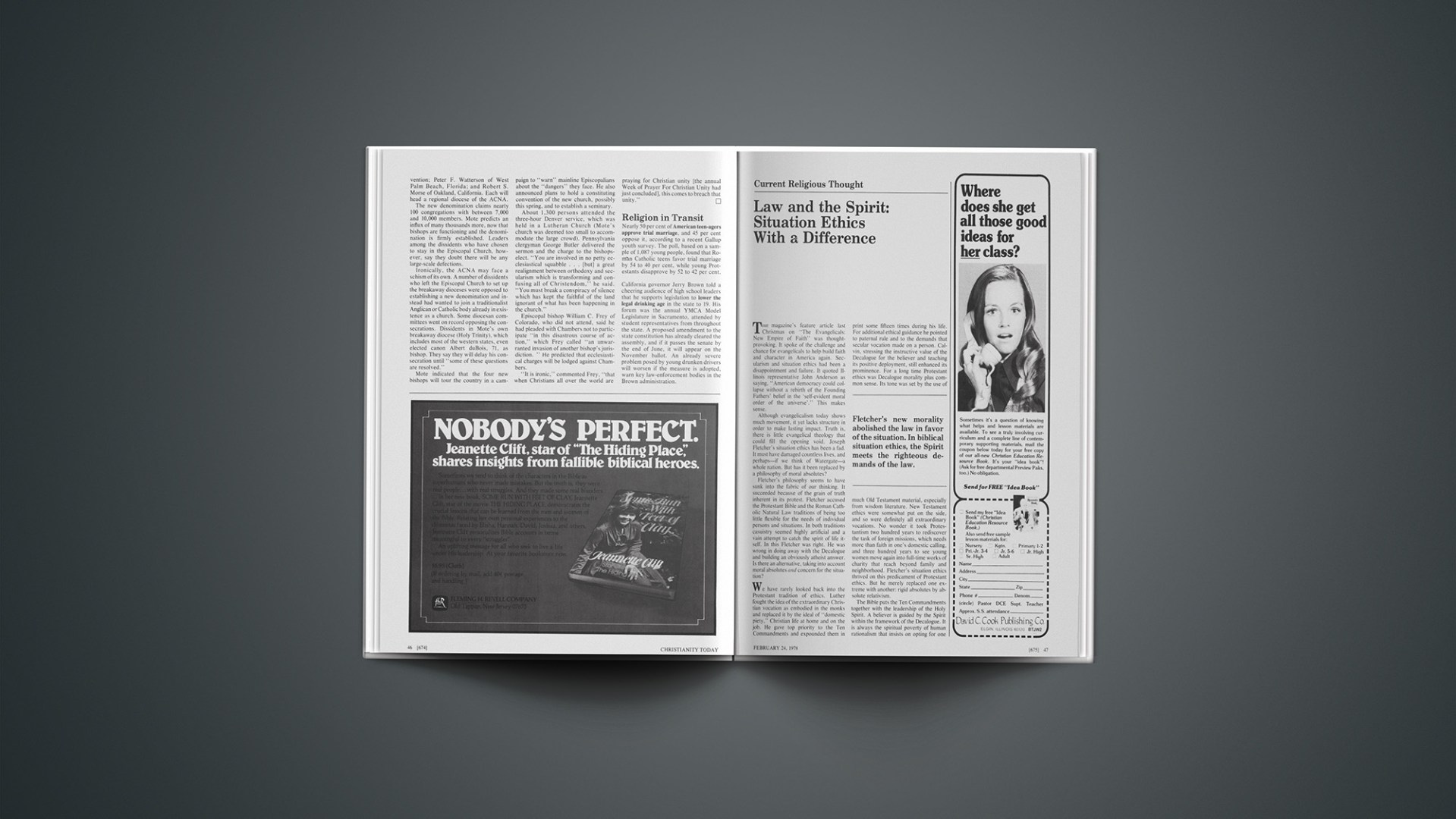
Law and the Spirit: Situation Ethics with a Difference

Time magazine’s feature article last Christmas on “The Evangelicals: New Empire of Faith” was thought-provoking. It spoke of the challenge and chance for evangelicals to help build faith and character in America again. Secularism and situation ethics had been a disappointment and failure. It quoted Illinois representative John Anderson as saying. “American democracy could collapse without a rebirth of the Founding Fathers’ belief in the ‘self-evident moral order of the universe’.” This makes sense.

Although evangelicalism today shows much movement, it yet lacks structure in order to make lasting impact. Truth is, there is little evangelical theology that could fill the opening void. Joseph Fletcher’s situation ethics has been a fad. It must have damaged countless lives, and perhaps—if we think of Watergate—a whole nation. But has it been replaced by a philosophy of moral absolutes?

Fletcher’s philosophy seems to have sunk into the fabric of our thinking. It succeeded because of the grain of truth inherent in its protest. Fletcher accused the Protestant Bible and the Roman Catholic Natural Law traditions of being too little flexible for the needs of individual persons and situations. In both traditions casuistry seemed highly artificial and a vain attempt to catch the spirit of life itself. In this Fletcher was right. He was wrong in doing away with the Decalogue and building an obviously atheist answer. Is there an alternative, taking into account moral absolutes and concern for the situation?

We have rarely looked back into the Protestant tradition of ethics. Luther fought the idea of the extraordinary Christian vocation as embodied in the monks and replaced it by the ideal of “domestic piety,” Christian life at home and on the job. He gave top priority to the Ten Commandments and expounded them in print some fifteen times during his life. For additional ethical guidance he pointed to paternal rule and to the demands that secular vocation made on a person. Calvin, stressing the instructive value of the Decalogue for the believer and teaching its positive deployment, still enhanced its prominence. For a long time Protestant ethics was Decalogue morality plus common sense. Its tone was set by the use of much Old Testament material, especially from wisdom literature. New Testament ethics were somewhat put on the side, and so were definitely all extraordinary vocations. No wonder it took Protestantism two hundred years to rediscover the task of foreign missions, which needs more than faith in one’s domestic calling, and three hundred years to see young women move again into full-time works of charity that reach beyond family and neighborhood. Fletcher’s situation ethics thrived on this predicament of Protestant ethics. But he merely replaced one extreme with another: rigid absolutes by absolute relativism.

The Bible puts the Ten Commandments together with the leadership of the Holy Spirit. A believer is guided by the Spirit within the framework of the Decalogue. It is always the spiritual poverty of human rationalism that insists on opting for one or the other: Scripture without Spirit or Spirit without Scripture. The formula for Christian ethics must surely be, Scripture and the Spirit.

We often seem to forget about the works of the Spirit. They include not only inspiration of Scripture and regeneration of the believer, as some admit, or speaking in tongues and healing of the sick, as others insist, but also the simple, regular leading of God’s sons and daughters (Romans 8:14). As Rudolf Schnackenburg, the Catholic exegete, puts it: “Biblical revelation intends the submission of human existence under God so that man no longer seeks his own way but listens to and obeys what God will say. All moral endeavour is brought into the dialogue with God, even more: under God’s guidance.” Or, as that famous biblical scholar of the first half of our century, Adolf Schlatter, said: “God’s Spirit is present in man and the force to move him, just as much as a sinful will.”

Guiding the Christian right through the obstacles that arise on his path, the Spirit of Christ will always remain in harmony with the book that speaks of Christ. Christ is the norm for the guidance of the Spirit. The Ten Commandments are like the safety rails on a motorway, protecting the driver from the abyss or uncertain ground to his right and left, and one is surely grateful for them. On the other hand no one would wish to drive his car, steering wheel locked, solely by means of those safety rails. What we need is inside-control.

The Ten Commandments are the framework of the good life, not the target. A frame by itself is still empty. It only defines the scene of action. It still needs to be filled. That is why Paul can say, “Love is the fulfillment of the Law” (Rom. 13). The Decalogue does not always tell us in a given situation which of good options to choose.

That is why the Holy Spirit steps into the picture. He teaches those who are willing to listen and to learn what God expects from them at that moment. His guidance will be the application of God’s written word in a new situation. Fletcher’s new morality abolished the law in favor of the situation. Biblical situation ethics is convinced that the Spirit will meet the righteous demands of the law (Rom 8:4). Law and the Spirit fit together: they are the word of the same God.

Moreover, the Holy Spirit will put the situation into the perspective of God’s Kingdom. The new morality remained a prisoner of the same old narrow yard as described by casuistry, and was all bound up by the contradictions in home and job. The Holy Spirit will again add vision to virtue, and lift up our horizons to include the greater calling: Christ’s commission to establish obedience of faith among all the nations.

Religious Broadcasters: ‘In the Public Interest’

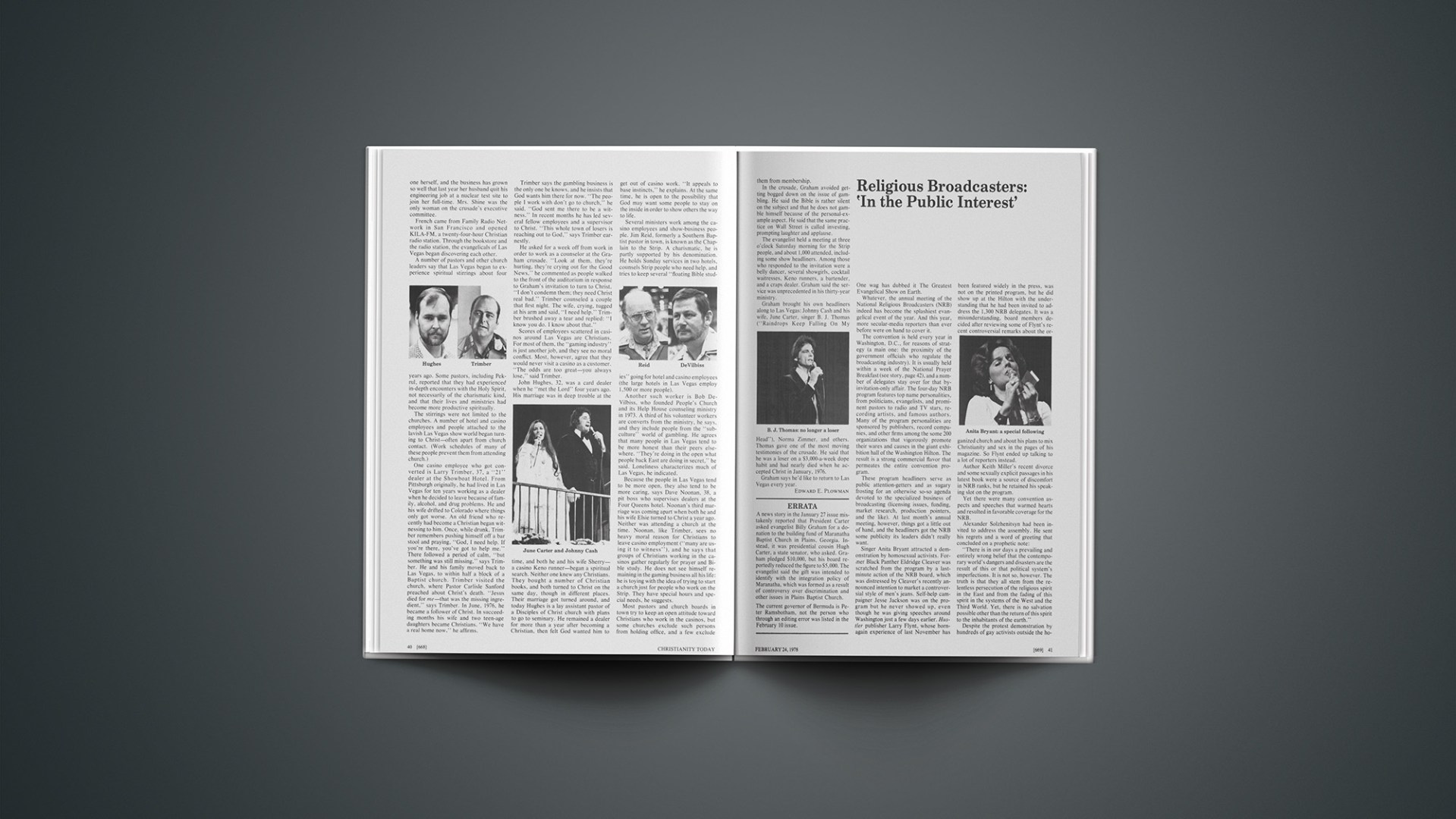
One wag has dubbed it The Greatest Evangelical Show on Earth.

Whatever, the annual meeting of the National Religious Broadcasters (NRB) indeed has become the splashiest evangelical event of the year. And this year, more secular-media reporters than ever before were on hand to cover it.

The convention is held every year in Washington, D.C., for reasons of strategy (a main one: the proximity of the government officials who regulate the broadcasting industry). It is usually held within a week of the National Prayer Breakfast (see story, page 42), and a number of delegates stay over for that by-invitation-only affair. The four-day NRB program features top name personalities, from politicians, evangelists, and prominent pastors to radio and TV stars, recording artists, and famous authors. Many of the program personalities are sponsored by publishers, record companies, and other firms among the some 200 organizations that vigorously promote their wares and causes in the giant exhibition hall of the Washington Hilton. The result is a strong commercial flavor that permeates the entire convention program.

These program headliners serve as public attention-getters and as sugary frosting for an otherwise so-so agenda devoted to the specialized business of broadcasting (licensing issues, funding, market research, production pointers, and the like). At last month’s annual meeting, however, things got a little out of hand, and the headliners got the NRB some publicity its leaders didn’t really want.

Singer Anita Bryant attracted a demonstration by homosexual activists. Former Black Panther Eldridge Cleaver was scratched from the program by a last-minute action of the NRB board, which was distressed by Cleaver’s recently announced intention to market a controversial style of men’s jeans. Self-help campaigner Jesse Jackson was on the program but he never showed up, even though he was giving speeches around Washington just a few days earlier. Hustler publisher Larry Flynt, whose born-again experience of last November has been featured widely in the press, was not on the printed program, but he did show up at the Hilton with the understanding that he had been invited to address the 1,300 NRB delegates. It was a misunderstanding, board members decided after reviewing some of Flynt’s recent controversial remarks about the organized church and about his plans to mix Christianity and sex in the pages of his magazine. So Flynt ended up talking to a lot of reporters instead.

Author Keith Miller’s recent divorce and some sexually explicit passages in his latest book were a source of discomfort in NRB ranks, but he retained his speaking slot on the program.

Yet there were many convention aspects and speeches that warmed hearts and resulted in favorable coverage for the NRB.

Alexander Solzhenitsyn had been invited to address the assembly. He sent his regrets and a word of greeting that concluded on a prophetic note:

“There is in our days a prevailing and entirely wrong belief that the contemporary world’s dangers and disasters are the result of this or that political system’s imperfections. It is not so, however. The truth is that they all stem from the relentless persecution of the religious spirit in the East and from the fading of this spirit in the systems of the West and the Third World. Yet, there is no salvation possible other than the return of this spirit to the inhabitants of the earth.”

Despite the protest demonstration by hundreds of gay activists outside the hotel and occasional heckling inside the hall where Anita Bryant was singing and speaking, most NRB participants remained calm—and solidly in support of the singer. It was clear that she was articulating their concern in her call for a return to “God’s Bible morality” in America. It is time, she said, for Christians to “start coming out of the closet.” In a press conference she replied to a question about her feelings toward homosexuals. “God loves them,” she said. “I love them. I love them enough to tell them the truth—that homosexuality is wrong, not by my standards but by God’s standards.… I have never had any hate in my heart for any of them as individuals.”

Malcolm Muggeridge, the 75-year-old former editor of the British humor magazine Punch, delighted his audience with a devastating attack on the secular media. The media, he said, are responsible for much of society’s hopeless predicament today. He painted a gloomy picture of the future, offering only one ray of hope. “In the reality of Christ,” he stated, “we see our only hope, our only prospect, in a darkening world.”

Speaking more optimistically, evangelist Luis Palau and television pastor Jerry Falwell gave rousing presentations about the wide-open opportunities ahead for the religious broadcasters, who already claim to reach 100 million or more Americans.

And so it went. Marabel Morgan (The Total Woman), LaBelle Lance (wife of the former Carter Administration figure, Bert Lance), and other public figures put in a good word for Christ, and their testimonies were quoted in the press.

There was even a cheery word from the Federal Communications Commission. At a luncheon meeting, commissioner Robert E. Lee solemnly assured NRB members that the FCC would never restrict religious programming because “we consider it in the public interest.”

The N.R.B. At A Glance

Here is a summary of the facts and figures that emerged from last month’s annual convention of the National Religious Broadcasters (NRB) association (see story this page):

• Attendance: nearly 1,300 registered delegates. They represented 850 NRB members, including radio and TV station owners and operators, producers, and mission agencies with broadcast ministries. The meeting was covered by 218 accredited press personnel, an all-time record; most represented secular media, some from overseas.

• A resolution was adopted calling for a campaign to fight the “deterioration of moral and ethical values” as reflected in sex and violence on TV and radio (Christians were urged to monitor programs, turn off offending ones, and register formal complaints).

• Guidelines for fund-raising and financial accountability were adopted in a step toward self-regulation, and delegates went on record opposing a proposed congressional bill, H.R. 41, that seeks to subject the field of charitable fund-raising to complicated federal regulations enforced by postal authorities.

• Most officers were reelected, including NRB president Abe C. Van Der Puy of HCJB in Quito, Ecuador; the title of Ben Armstrong, executive secretary for eleven years, was upgraded to executive director. A budget of $362,000 was approved for the coming year.

• Current membership of the NRB, which was organized in 1943 and is an affiliate of the National Association of Evangelicals, includes about 325 Christian radio and TV stations. It was reported that new Christian radio stations are going on the air at the rate of one every week, Christian TV stations at one per month.

Hearty Fare For Breakfast

Heartier-than-usual fare was served on both the menu and the program of the annual National Prayer Breakfast this month. The Washington Hilton Hotel prepared nearly 3,000 plates of mushroom quiche and spicy beef sausage for a crowd of dignitaries that heard spirited calls for dependence on Christ. Some seasoned participants thought the event was one of the outstanding ones in the twenty-six-year series of prayer breakfasts.

The featured speaker was Max Cleland, a Viet Nam veteran and multiple amputee who is the head of the Veterans Administration. Cleland said he easily identified with Paul’s confession that “by the grace of God I am what I am.” He acknowledged that after he lost his limbs it took him several years to come to the point of totally depending on God. In fact, he said, it took him at least a year to admit that God had not made a mistake in allowing him to live through the war.

In his twenty-minute testimony, Cleland recalled his election to the Georgia Senate with Jimmy Carter and then his unsuccessful attempt to become that state’s lieutenant governor. Before that statewide race he had believed he trusted God in a general way while he “held the cards close to my chest.” At the same time, he noted, he believed he was the “captain of my soul and the master of my fate.” After losing the race, Cleland said, he realized that he had allowed his ego to drive him not only to unemployment and financial debt but also to a greater debt of being unable to heed “deeper sensibilities.”

Just one job offer came to him, and as he was driving to Washington to talk about this position, that of a congressional staffer, he did something he had never done before,” he said. He asked God to forgive him, and he “took a leap of faith” that marked the beginning of his Christian walk, Cleland said. Now, he said, he can understand the meaning of Paul’s assertion that God uses the weak things to proclaim his strength. Gaining peace of mind and an assurance of God’s sovereignty were worth the brokenness and despair he experienced, Cleland indicated. He got a standing ovation after his message, which he concluded by reading the “Confederate Soldier’s Prayer.” That prayer calls its author “most richly blessed” even though God did not give him what he prayed for.

President Carter followed Cleland to the speaker’s stand and cited the VA executive as an example of what true faith can mean. It was the second time that Carter had been the guest of honor at the National Prayer Breakfast, and he spoke again of his “very personal” relationship with God as a born-again person. “Born again” has a very simple meaning for “those of us who have a Christian faith,” the President told his audience. Conversion, he said, makes believers “brothers and sisters of one another.”

While the Christian family thrives on close ties, the President declared, the broader family of man must interest national leaders. He recalled meetings he has had in recent months “in quiet, lonely, private times” with non-Christian Middle East leaders who spoke to him of their faith. The religious fervor shown by some of them has impressed him, Carter acknowledged. He also revealed that before his visit to India last year he read the Hindu text, the Bhagavad Gita. After his meeting with India leaders and his visits to sacred spots in their country he felt a “kinship” with Indian politicians, “who have not always been our friends in recent years,” Carter said.

Previously, federal judge John Sirica had read the first twelve verses of Proverbs 3 and commented on the need for politicians to seek God’s help in their work. The President mentioned this Scripture in his remarks and concluded by urging his listeners to follow the example of Solomon when he first asked for wisdom.

Marine Corps commandant Louis H. Wilson preceded his reading of John 21 with the comment that those at the meeting were “continuing a custom which our Lord began when he had breakfast with his disciples.” The “prayer for national leaders” was led by Texas congresswoman Barbara Jordan, who confessed human inadequacies and asked for help “to resist the inclination to be the senior partner.” Montana governor Thomas L. Judge started the fast-paced program with an invocation that ended with a plea for understanding that “we can do all things through Jesus Christ, who strengthens us.”

Representative Berkley Bedell of Iowa, reporting for the House Prayer Breakfast group, called the National Prayer Breakfast “a shining light for all the world,” but he acknowledged criticism of the annual event. The weekly meetings held in various branches of government are conducted with no publicity and with great benefit to the participants, he said. They are valuable to the degree that participants gain inner strength for their lives. And, he concluded, in both the small meetings and the large national breakfast, the presence of the Holy Spirit is more important than the presence of all the dignitaries.

Senator Richard G. Lugar of Indiana reported for the group that meets each Wednesday in the Senate. He said one benefit of the gatherings is the realization of how dependent members are on God, “who sent his only son that we might believe on him.”

Alabama senator James Allen presided, and the program ended with former Senator Harold Hughes leading in prayer for the nation. Hughes left politics to spend his time in the ministries of “The Fellowship,” the group that organizes the National Prayer Breakfast and related meetings throughout the year.

Missing

Back in 1960 some alumni leaders of Notre Dame university celebrated St. Patrick’s Day by traveling to Rome to present to Pope John XXIII a brand-new Cadillac. They bought the car after the alumni president on a visit to the Vatican garage discovered the only American car there to be “a dumpy old thing.” Following Pope John’s death, the car presumably became part of Pope Paul VI’s fleet.

Five years ago a U.S. highway-safety agency discovered that 1960 Cadillacs had a steering defect, and General Motors was ordered to recall the vehicles. GM fought the order in court and only recently lost the case. Although the firm did not have to issue the recall to overseas owners, GM offered to fix the Pope’s car quickly and at no expense.

A search of the Vatican garage, however, produced no 1960 Cadillac, and Vatican officials say they cannot find it anywhere. One official said that Pope John may have given the car away, “possibly to a mission.”

Pope Paul has been using a Mercedes-Benz for years.

Along The Canal With The Gospel

Tourists flocking to Panama these days make sure they see at least one sight: an ocean liner going through the locks of the Panama Canal. But non-engineers are sometimes not impressed with the routine that gets the great ships across the isthmus, surely but slowly. The New York Times last month quoted one spectator as saying, “It’s like watching grass grow.”

That comment is not very different from the observation of some veteran church watchers in Panama and the Canal Zone. If anything, church progress has been slower than that of ships on the ocean-to-ocean trek. There has been a national preoccupation with the questions of whether and when the United States will turn the canal over to Panama, and political concerns have had a higher priority than evangelism for some religious leaders. Some groups, like the Assemblies of God, are growing, but others seem to be withering on the vine.

Against this background and a history of little inter-church cooperation on the isthmus, evangelicals planned an unusual evangelistic campaign in Panama and the Canal Zone last month. And lest the message be considered “made in the U.S.A.,” two Africans were invited to lead “Mission ’78.” The event was also called the “Africa-Panama Crusade” with the theme, “God’s Message of Love.”

Exiled Anglican bishop Festo Kivengere of Uganda and Michael Cassidy, the white South African who founded the African Enterprise organization, preached together in nine public rallies and in a variety of other meetings. Also on the team was black evangelist Ernie Wilson, born in Panama but now based in Philadelphia.

The crusade attracted a cumulative attendance estimated at 15,000, and it was considered the most successful inter-church effort since Billy Graham addressed some 18,000 at a rally twenty years ago. More than ninety churches in the republic and in the zone supported the campaign in one way or another. Among them were independent Bible churches primarily serving American citizens in the zone, the Salvation Army, small black congregations in Panama, and the Episcopal Church. While the mission failed to get the support of national organizations of the large Assemblies of God and Foursquare Gospel churches, some Pentecostal congregations were involved.

Chief spark plug behind the crusade was Fred Denton, an Episcopal layman and U.S. citizen who has been in business in Panama and other Central American nations for years. After presenting the idea to Kivengere and Cassidy when they were preaching in Nicaragua two years ago, Denton got the endorsement of the diocesan evangelism committee on which he served. Episcopal bishop Lemuel Shirley agreed to become the honorary president of the executive committee for the crusade. He provided a $2,000 contribution from the diocesan treasury and opened a church residence for the use of the committee’s executive secretary.

With a long history of helping various evangelical groups in their Panamanian contacts, Denton called on a number of them to aid “Mission ’78.” Latin America Mission lent a missionary, Donald Sendek, to serve as executive secretary. Sendek’s wife, a Colombian, handled a variety of office chores. The “Libreria Caribe” bookstore became the point of contact for correspondence follow-up. Radio station HOXO not only broadcast the services but also provided public-address systems for the meetings. A Methodist school, the Pan American Institute, lent its gymnasium in Panama City for the rallies four nights. The government of Panama agreed to let the mission use the boxing arena in the city of Colon five nights and the domed “Nuevo Panama Gymnasium” in Panama City for the closing rally. The site of counselor training in Colon was the Young Men’s Christian Association.

Except for the first two rallies (in the Canal Zone’s Balboa Stadium), all the public meetings were conducted in English and Spanish. Song sheets were English on one side and Spanish on the other. Although many Panamanians are bi-lingual, a large proportion speak only Spanish and a substantial number (including blacks of West Indies descent) only English.

Denton, born in Puerto Rico and fluent in both languages, addressed the crowd in Spanish and English at the closing rally. “This is not the end but a step forward in the work of the church here on the isthmus,” he declared.

His optimism was based partly on the fact that several hundred church members of many denominations had worked together in the crusade, laying a foundation for cooperation in future projects. About 100 of those who were trained actually worked in the rallies as counselors. Another 100 ushered, and more than 200 sang in the choirs. Denton, who was chairman of the crusade executive committee, was very hopeful that the 700 who came forward for counseling would be assimilated into the churches. About a quarter of those registering decisions indicated that they were making their first public professions of faith.

Counseling was offered at the end of each rally by either Cassidy or Kivengere. The black and white pair, sometimes described as “the impossible dream from Africa,” shared the sermon every night. The Ugandan would begin one night and then call on his South African colleague to finish the presentation, and Cassidy would start the next night.

In their messages the evangelists often spoke of the troubles of their own nations. They avoided the politics of the Panama Canal issue but suggested that their listeners should be prepared for hard times and should pray for the leaders of their countries.

Freedom, a popular theme in Panama, was picked up often by the Africans. “For freedom Christ has set us free,” Cassidy told the crowd at one rally. “God doesn’t want blacks in bondage to whites or whites to blacks. He wants freedom and justice.… Our only bondage is to be to him.”

Kivengere, giving the invitation at the final evangelistic meeting, said those accepting God’s offer of salvation through Christ are “free to inherit everything which God has got.” In his sermon he had told of his escape from his own nation after the death of Archbishop Janani Luwum last February. Ugandan Christians have set an example for those who would be “set free from hate,” Kivengere said. Panama, he added, “needs free Christians.”

During the crusade, the last United States senators to visit the isthmus before the beginning of floor debate on the proposed treaties were being given red-carpet tours. Final Senate action may come in March.

Among the religious groups that have taken a stand on the canal issue, calling for ratification of the treaties signed by President Carter, are the National Council of Churches, the U.S. Catholic Conference, the Episcopal Church, the United Methodist Church, the United Presbyterian Church, and the Church of the Brethren. On the itinerary of the last delegation of senators to visit Panama in January was a conference with Episcopal bishop Shirley and Roman Catholic archbishop Marcos McGrath.

Children Of God: New Revelations

The following article is a condensation of a well-documented report filed by correspondent Joseph M. Hopkins. Professor Hopkins has written several definitive articles and a book on the controversial Children of God sect. The group emerged from the fringes of the Jesus movement among youth in the late 1960s.

Recent defections from the Children of God (COG) sect reveal that founder-leader David “Moses” (“Mo” for short) Berg apparently is still in charge and is still propagating some bizarre tenets of faith. (A letter purporting to be from Berg surfaced last year. In it, the writer confessed that he had sinned. He then apologized and ordered COG members to disband and return home. COG leaders disavowed the letter, and a later communication purporting to be from the authentic Berg indicated that the first letter was a hoax.)

Among the latest defectors are John Moriconi, 23, and his wife Linda. They were the “shepherd” and “shepherdess” of the Richmond, Virginia, COG colony. Moriconi joined COG five years ago. He listed twenty reasons for quitting. Most of them involved Berg’s new doctrines and practices, and Moriconi offered recent “Mo letters” by Berg as evidence.

The letters contain these revelations:

• COG’s name has been changed to “Family of Love.” The term “colony” has been abolished in favor of “home.”

• COG was to be restructured as of this month. Gone is the hierarchy of prime ministers, ministers, archbishops, bishops, regional shepherds, and district shepherds. The “homes” will be led by a “servant” and “handmaiden,” who will report directly to “king and queen counselorships,” a sort of regional headquarters in Rome (for Europe and Africa), Tokyo (North America and the Pacific), and Lima, Peru (for Latin America). In a letter dated last month, Berg declared: “The King is taking back the reins of government and we’re going back to a direct dictatorship!… So as of my birthday, February 18, 1978, you’re all fired.…” He ordered elections of local leaders on that date. Said he: “Throw out the tyrants and put in your own choice of leaders [whom] you know love and care for you!”

• No more than half of the members of overseas “homes” can be Americans after April 1. Polygamous relationships with nationals are suggested as one way to cope with the requirement.

• Trial marriages are preferable to “formal legal marriages” to determine if the relationships will work.

• Each home must submit to regional headquarters a monthly “Flirty Fish witnessing report.” (Under the recently revealed Flirty Fish policy, COG male and female members alike are admonished to “go to bed … if necessary” with potential converts and donors in an effort to “win their souls for Jesus.”) The report asks a listing of the number of sexual encounters with “fish” (outsiders), mates, and non-mate members, along with the number of spiritual decisions that are made.

• Each member is to keep a Flirty Fish (FF) diary, detailing “your best” FF experiences, the type of job and income bracket of the fish, the expenditures in fulfilling the FF policy (clothing, jewelry, perfume, travel, drinks), and the gifts presented by grateful fish, whether money or goods. Each home is to list the “top three FF lovers of the month,” with the “total number loved” by each and “number of times.” Females are encouraged to ply their fish with wine, consuming it “prayerfully … and in sober moderation.”

• “Gifts” from beneficiaries of COG women applying the FF policy are to be sought. “We can’t afford to just continue supporting some kind of religious brothel ministering to men who don’t pay their way …,” Berg complains. “Happy hookin’!—But make it pay!” he says.

• COG disciples and leaders—including Berg himself and his common-law wife, Maria—have been afflicted by venereal disease. Berg seems to find comfort in his belief that Jesus had sexual relationships with a number of women and that he too must have contracted VD.

• At least 10 per cent of COG’s women become pregnant as a result of FF evangelism. Maria is said to have borne a son recently to a fish named Carlos, and the evidently proud Berg endowed the boy with his own first name.

One semi-secret (“disciples only”) letter released by the Moriconis contains Berg’s reaction to a cover-story interview article with two ex-COG members that appeared in CHRISTIANITY TODAY last February. He calls it a “smear” by “two of our backsliders,” but he seems to have partly enjoyed the attention. He comments: “Your OL’ Lion finally made the front cover!—ha!”

In a letter dealing with Islam last fall, Berg exposed how far he has drifted from his doctrinal moorings as a Protestant minister years ago. He says: “… I don’t even believe in the Trinity. You can’t find that word in the Bible, so why should I believe it?”

Although defections are on the un-crease, so is COG membership—if COG statistics are to be believed. Membership in 1977 soared from 6,929 to 8,068, including 3,650 live-in adults, 1,451 children, and 2,967 part-time members. Only 10.5 per cent of COG members reside in the United States. The number of colonies—now homes—increased from 736 to 842 in seventy-three countries, the COG report asserts.

Breakaway Bishops

Amid Gregorian chants, blaring trumpets, the aroma of burning incense, and other trappings of Anglican tradition, the first four bishops of the fledgling Anglican Church in North America (ACNA) were consecrated at a controversial service late last month in Denver.

Or were they?

Some leaders of the Episcopal Church (from whom the ACNA split) insist that a consecration cannot be valid if fewer than three officially recognized bishops do the consecrating. Since only two bishops took part in the Denver service, they argue, the consecrations are not valid, and the ACNA therefore cannot function as a fully independent church body.

Other church authorities, however, point out that ecclesiastical law does not state that there must be three bishops. They say that the transmission of orders through even a single bishop has been considered valid, though irregular. (According to Anglican, Roman Catholic, and Orthodox teachings, succession to the position of bishop through the laying on of hands must be traced back in an unbroken line to Christ himself.)

One test of the validity of the service may come later this year when the worldwide Anglican Communion acts on the ACNA’s request for membership and recognition. As titular head of the Church of England, Archbishop of Canterbury Donald Coggan is considered the top leader of the Anglican Communion. Coggan announced through a press spokesman last month that he would not recognize the breakaway body. Leaders of the ACNA assert that Coggan has no authority to deep-freeze their church. The withholding of recognition, they say, must be a corporate act of the world body, which has a membership of twenty-five Anglican denominations.

The two bishops who took part in the Denver service were Albert A. Chambers, 71, the retired bishop of Springfield, Illinois, and Francisco J. Pagtakhan, a bishop of the Philippine Independent Church, a 3.5-million-member body that split from the Roman Catholic Church in 1902. Two other bishops had been scheduled to participate: Mark Pae, 52, of the Anglican Church in South Korea, and Charles F. Boynton, 71, a retired suffragan (assistant) bishop of New York.

Chambers, long an advocate of traditionalist causes in the Episcopal Church, has been identified with the breakaway group since its formative stages last summer. At the 1976 convention of the Episcopal Church, he was a leading voice in the opposition to women’s ordination and the revision of the denomination’s book of worship. The convention’s approval of these two measures resulted in wide dissent and the departure or schism of dozens of the Episcopal Church’s 7,200 parishes.

Boynton was unable to participate in the Denver service because of illness, but he sent his blessings. Pae was warned by Coggan to stay away, according to Dale D. Doren of the Pittsburgh area, the first of the four who were consecrated. Doren, formerly a missionary administrator who served under Pae, had been elected a bishop by the Korean church but had returned to the United States. Pae sent a letter approving Doren’s consecration at Denver. After his ceremony was over, Doren assisted in the consecration of the other three men: James O. Mote, 55, whose Denver parish was the first to bolt the Episcopal Church after the 1976 convention; Peter F. Watterson of West Palm Beach, Florida; and Robert S. Morse of Oakland, California. Each will head a regional diocese of the ACNA.

The new denomination claims nearly 100 congregations with between 7,000 and 10,000 members. Mote predicts an influx of many thousands more, now that bishops are functioning and the denomination is firmly established. Leaders among the dissidents who have chosen to stay in the Episcopal Church, however, say they doubt there will be any large-scale defections.

Ironically, the ACNA may face a schism of its own. A number of dissidents who left the Episcopal Church to set up the breakaway dioceses were opposed to establishing a new denomination and instead had wanted to join a traditionalist Anglican or Catholic body already in existence as a church. Some diocesan committees went on record opposing the consecrations. Dissidents in Mote’s own breakaway diocese (Holy Trinity), which includes most of the western states, even elected canon Albert duBois, 71, as bishop. They say they will delay his consecration until “some of these questions are resolved.”

Mote indicated that the four new bishops will tour the country in a campaign to “warn” mainline Episcopalians about the “dangers” they face. He also announced plans to hold a constituting convention of the new church, possibly this spring, and to establish a seminary.

About 1,300 persons attended the three-hour Denver service, which was held in a Lutheran Church (Mote’s church was deemed too small to accommodate the large crowd). Pennsylvania clergyman George Butler delivered the sermon and the charge to the bishops-elect. “You are involved in no petty ecclesiastical squabble … [but] a great realignment between orthodoxy and secularism which is transforming and confusing all of Christendom,” he said. “You must break a conspiracy of silence which has kept the faithful of the land ignorant of what has been happening in the church.”

Episcopal bishop William C. Frey of Colorado, who did not attend, said he had pleaded with Chambers not to participate “in this disastrous course of action,” which Frey called “an unwarranted invasion of another bishop’s jurisdiction.” He predicted that ecclesiastical charges will be lodged against Chambers.

“It is ironic,” commented Frey, “that when Christians all over the world are praying for Christian unity [the annual Week of Prayer For Christian Unity had just concluded], this comes to breach that unity.”

Religion In Transit

Nearly 50 per cent of American teen-agers approve trial marriage, and 45 per cent oppose it, according to a recent Gallup youth survey. The poll, based on a sample of 1,087 young people, found that Roman Catholic teens favor trial marriage by 54 to 40 per cent, while young Protestants disapprove by 52 to 42 per cent.

California governor Jerry Brown told a cheering audience of high school leaders that he supports legislation to lower the legal drinking age in the state to 19. His forum was the annual YMCA Model Legislature in Sacramento, attended by student representatives from throughout the state. A proposed amendment to the state constitution has already cleared the assembly, and if it passes the senate by the end of June, it will appear on the November ballot. An already severe problem posed by young drunken drivers will worsen if the measure is adopted, warn key law-enforcement bodies in the Brown administration.

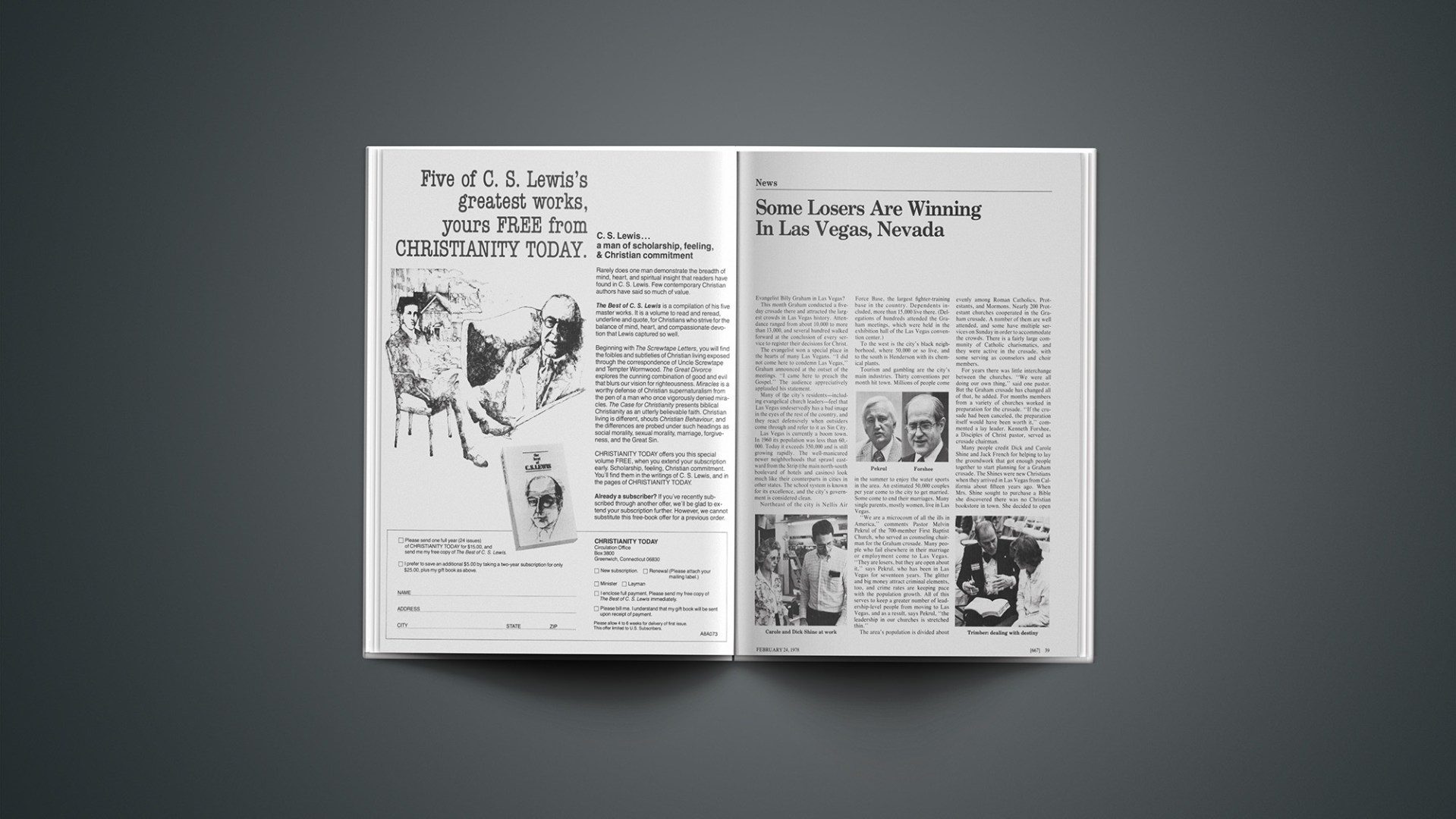
Some Losers Are Winning in Las Vegas, Nevada

Evangelist Billy Graham in Las Vegas?

This month Graham conducted a five-day crusade there and attracted the largest crowds in Las Vegas history. Attendance ranged from about 10,000 to more than 13,000, and several hundred walked forward at the conclusion of every service to register their decisions for Christ.

The evangelist won a special place in the hearts of many Las Vegans. “I did not come here to condemn Las Vegas,” Graham announced at the outset of the meetings. “I came here to preach the Gospel.” The audience appreciatively applauded his statement.

Many of the city’s residents—including evangelical church leaders—feel that Las Vegas undeservedly has a bad image in the eyes of the rest of the country, and they react defensively when outsiders come through and refer to it as Sin City.

Las Vegas is currently a boom town. In 1960 its population was less than 60,000. Today it exceeds 350,000 and is still growing rapidly. The well-manicured newer neighborhoods that sprawl eastward from the Strip (the main north-south boulevard of hotels and casinos) look much like their counterparts in cities in other states. The school system is known for its excellence, and the city’s government is considered clean.

Northeast of the city is Nellis Air Force Base, the largest fighter-training base in the country. Dependents included, more than 15,000 live there. (Delegations of hundreds attended the Graham meetings, which were held in the exhibition hall of the Las Vegas convention center.)

To the west is the city’s black neighborhood, where 50,000 or so live, and to the south is Henderson with its chemical plants.

Tourism and gambling are the city’s main industries. Thirty conventions per month hit town. Millions of people come in the summer to enjoy the water sports in the area. An estimated 50,000 couples per year come to the city to get married. Some come to end their marriages. Many single parents, mostly women, live in Las Vegas.

“We are a microcosm of all the ills in America,” comments Pastor Melvin Pekrul of the 700-member First Baptist Church, who served as counseling chairman for the Graham crusade. Many people who fail elsewhere in their marriage or employment come to Las Vegas. “They are losers, but they are open about it,” says Pekrul, who has been in Las Vegas for seventeen years. The glitter and big money attract criminal elements, too, and crime rates are keeping pace with the population growth. All of this serves to keep a greater number of leadership-level people from moving to Las Vegas, and as a result, says Pekrul, “the leadership in our churches is stretched thin.”

The area’s population is divided about evenly among Roman Catholics, Protestants, and Mormons. Nearly 200 Protestant churches cooperated in the Graham crusade. A number of them are well attended, and some have multiple services on Sunday in order to accommodate the crowds. There is a fairly large community of Catholic charismatics, and they were active in the crusade, with some serving as counselors and choir members.

For years there was little interchange between the churches. “We were all doing our own thing,” said one pastor. But the Graham crusade has changed all of that, he added. For months members from a variety of churches worked in preparation for the crusade. “If the crusade had been canceled, the preparation itself would have been worth it,” commented a lay leader. Kenneth Forshee, a Disciples of Christ pastor, served as crusade chairman.

Many people credit Dick and Carole Shine and Jack French for helping to lay the groundwork that got enough people together to start planning for a Graham crusade. The Shines were new Christians when they arrived in Las Vegas from California about fifteen years ago. When Mrs. Shine sought to purchase a Bible she discovered there was no Christian bookstore in town. She decided to open one herself, and the business has grown so well that last year her husband quit his engineering job at a nuclear test site to join her full-time. Mrs. Shine was the only woman on the crusade’s executive committee.

French came from Family Radio Network in San Francisco and opened KILA-FM, a twenty-four-hour Christian radio station. Through the bookstore and the radio station, the evangelicals of Las Vegas began discovering each other.

A number of pastors and other church leaders say that Las Vegas began to experience spiritual stirrings about four years ago. Some pastors, including Pekrul, reported that they had experienced in-depth encounters with the Holy Spirit, not necessarily of the charismatic kind, and that their lives and ministries had become more productive spiritually.

The stirrings were not limited to the churches. A number of hotel and casino employees and people attached to the lavish Las Vegas show world began turning to Christ—often apart from church contact. (Work schedules of many of these people prevent them from attending church.)

One casino employee who got converted is Larry Trimber, 37, a “21” dealer at the Showboat Hotel. From Pittsburgh originally, he had lived in Las Vegas for ten years working as a dealer when he decided to leave because of family, alcohol, and drug problems. He and his wife drifted to Colorado where things only got worse. An old friend who recently had become a Christian began witnessing to him. Once, while drunk, Trimber remembers pushing himself off a bar stool and praying, “God, I need help. If you’re there, you’ve got to help me.” There followed a period of calm, “but something was still missing,” says Trimber. He and his family moved back to Las Vegas, to within half a block of a Baptist church. Trimber visited the church, where Pastor Carlisle Sanford preached about Christ’s death. “Jesus died for me—that was the missing ingredient,” says Trimber. In June, 1976, he became a follower of Christ. In succeeding months his wife and two teen-age daughters became Christians. “We have a real home now,” he affirms.

Trimber says the gambling business is the only one he knows, and he insists that God wants him there for now. “The people I work with don’t go to church,” he said. “God sent me there to be a witness.” In recent months he has led several fellow employees and a supervisor to Christ. “This whole town of losers is reaching out to God,” says Trimber earnestly.

He asked for a week off from work in order to work as a counselor at the Graham crusade. “Look at them, they’re hurting, they’re crying out for the Good News,” he commented as people walked to the front of the auditorium in response to Graham’s invitation to turn to Christ. “I don’t condemn them; they need Christ real bad.” Trimber counseled a couple that first night. The wife, crying, tugged at his arm and said. “I need help.” Trimber brushed away a tear and replied: “I know you do. I know about that.”

Scores of employees scattered in casinos around Las Vegas are Christians. For most of them, the “gaming industry” is just another job, and they see no moral conflict. Most, however, agree that they would never visit a casino as a customer. “The odds are too great—you always lose,” said Trimber.

John Hughes, 32, was a card dealer when he “met the Lord” four years ago. His marriage was in deep trouble at the time, and both he and his wife Sherry—a casino Keno runner—began a spiritual search. Neither one knew any Christians. They bought a number of Christian books, and both turned to Christ on the same day, though in different places. Their marriage got turned around, and today Hughes is a lay assistant pastor of a Disciples of Christ church with plans to go to seminary. He remained a dealer for more than a year after becoming a Christian, then felt God wanted him to get out of casino work. “It appeals to base instincts,” he explains. At the same time, he is open to the possibility that God may want some people to stay on the inside in order to show others the way to life.

Several ministers work among the casino employees and show-business people. Jim Reid, formerly a Southern Baptist pastor in town, is known as the Chaplain to the Strip. A charismatic, he is partly supported by his denomination. He holds Sunday services in two hotels, counsels Strip people who need help, and tries to keep several “floating Bible studies” going for hotel and casino employees (the large hotels in Las Vegas employ 1,500 or more people).

Another such worker is Bob DeVilbiss, who founded People’s Church and its Help House counseling ministry in 1973. A third of his volunteer workers are converts from the ministry, he says, and they include people from the “subculture” world of gambling. He agrees that many people in Las Vegas tend to be more honest than their peers elsewhere. “They’re doing in the open what people back East are doing in secret,” he said. Loneliness characterizes much of Las Vegas, he indicated.

Because the people in Las Vegas tend to be more open, they also tend to be more caring, says Dave Noonan, 38, a pit boss who supervises dealers at the Four Queens hotel. Noonan’s third marriage was coming apart when both he and his wife Elsie turned to Christ a year ago. Neither was attending a church at the time. Noonan, like Trimber, sees no heavy moral reason for Christians to leave casino employment (“many are using it to witness”), and he says that groups of Christians working in the casinos gather regularly for prayer and Bible study. He does not see himself remaining in the gaming business all his life: he is toying with the idea of trying to start a church just for people who work on the Strip. They have special hours and special needs, he suggests.

Most pastors and church boards in town try to keep an open attitude toward Christians who work in the casinos, but some churches exclude such persons from holding office, and a few exclude them from membership.

In the crusade, Graham avoided getting bogged down on the issue of gambling. He said the Bible is rather silent on the subject and that he does not gamble himself because of the personal-example aspect. He said that the same practice on Wall Street is called investing, prompting laughter and applause.

The evangelist held a meeting at three o’clock Saturday morning for the Strip people, and about 1,000 attended, including some show headliners. Among those who responded to the invitation were a belly dancer, several showgirls, cocktail waitresses, Keno runners, a bartender, and a craps dealer. Graham said the service was unprecedented in his thirty-year ministry.

Graham brought his own headliners along to Las Vegas: Johnny Cash and his wife, June Carter, singer B. J. Thomas (“Raindrops Keep Falling On My Head”), Norma Zimmer, and others. Thomas gave one of the most moving testimonies of the crusade. He said that he was a loser on a $3,000-a-week dope habit and had nearly died when he accepted Christ in January, 1976.

Graham says he’d like to return to Las Vegas every year.

Errata

A news story in the January 27 issue mistakenly reported that President Carter asked evangelist Billy Graham for a donation to the building fund of Maranatha Baptist Church in Plains, Georgia. Instead, it was presidential cousin Hugh Carter, a state senator, who asked. Graham pledged $10,000, but his board reportedly reduced the figure to $5,000. The evangelist said the gift was intended to identify with the integration policy of Maranatha, which was formed as a result of controversy over discrimination and other issues in Plains Baptist Church.

The current governor of Bermuda is Peter Ramsbotham, not the person who through an editing error was listed in the February 10 issue.

Book Briefs: February 24, 1978

The Nature Of Scripture

Biblical Authority, edited by Jack Rogers (Word, 1977, 196 pp., $6.95, $4.50 pb), is reviewed by Norman L. Geisler, professor of philosophy of religion, Trinity Evangelical Divinity School, Deerfield, Illinois.

Seven scholars here respond to Harold Lindsell’s Battle for the Bible. In the foreword, Paul Rees claims that what is at issue “is not evangelical commitment but evangelical comprehension.” Many who defend the inerrancy of Scripture, he charges, “are hard put to show wherein their positions differ practically from the dictation formula they repudiate.” With regard to Lindsell’s claim of “total inerrancy that extends to the minutiae of chronology or geography or grammar” Rees gives a resounding “No.” He feels that the discussion occasioned by Lindsell’s book “threatens to create a serious cleavage in the evangelical community.”

Jack Rogers of Fuller Seminary rethinks the history of Christianity and concludes that, apart from the unwholesome influence of Aristotelian-scholastic philosophy, which allegedly came into Protestantism via Turretin, there is no support for the classical doctrine of inerrancy. According to Rogers, even the great Christian thinker Augustine believed that “the Holy Spirit had ‘permitted’ one of the Scripture writers to compose something at variance from what another biblical author had written.” And contrary to the claim of a scientifically errorless Bible, Rogers maintains that “for Augustine, Scripture was not a textbook of science.” The great Reformer Luther did not accept the inerrancy of Scripture, says Rogers: “for him, Christ alone was without error and was the essential Word of God.” It may also come as a surprise to many Calvin scholars to hear that this great Reformer neither believed in the inerrancy of every word of Scripture nor thought “that the Bible’s teaching had to be harmonized with science.” Not until what Rogers calls “post-Reformation scholasticism,” especially Turretin, did the doctrine of inerrancy emerge. At this point some Protestants adopted a thomistic “natural theology” and the belief in “rationally demonstrable external evidence of the Bible’s authority.” Before this, according to Rogers, the internal testimony of the Spirit was the basis for belief in the authority of Scripture. Rogers agrees that Scripture is “not to be used as a source of information in the sciences.” This post-Reformation scholastic doctrine of inerrancy with its concomitant rational and evidential apologetic was, according to Rogers, unfortunately adopted by the old Princeton theologians Hodge and Warfield. According to Rogers, Briggs, who opposed Warfield’s belief in inerrancy, “was historically correct in claiming that the Institutio of Francis Turretin has become the textbook at Princeton and that the Westminster Divines were ignored.” Rogers cites James Orr, Herman Bavinck, and Abraham Kuyper as men who did not hold to inerrancy. He quotes Bavinck as saying, “Historical, chronological and geographical data are never in themselves the object of the witness of the Holy Spirit.”

The sharp edge of Rogers’s sword is felt most in his conclusions. Of Lindsell he says, “It is historically irresponsible to claim that for two thousand years Christians have believed that the authority of the Bible entails a modern concept of inerrancy in scientific and historical details.” He accuses John Gerstner of being “equally irresponsible” in saying “that the old Princeton theology of Alexander, Hodge, and Warfield is the only legitimate evangelical, or Reformed, theological tradition in America.” Rogers chastises Francis Schaeffer for his demand for reasons prior to faith and for “a prior commitment to Aristotelian philosophy.” Pleading against the use of the word “inerrancy,” Rogers concludes, “We are called, not to argue Scripture’s scientific accuracy but to accept its saving message.”

In the third chapter Clark Pinnock, an alleged believer in inerrancy, makes a passionate plea to avoid the extremes of liberalism, neo-reformationalism, and the hyperfundamental “veneration for the divine authority of scripture.” He claims it is an “overbelief” to “identify God’s Word with the words of the Bible.” Pinnock too repudiates the Warfieldian approach to inerrancy. In an apparent change of position, Pinnock no longer holds that inerrancy refers to the autographs. In view of his admission that the copies do have errors, it seems strange that Pinnock wishes to claim that the Bible is still “inerrant.” Further, Pinnock claims that inerrancy is not a logical corollary of inspiration because “God uses fallible spokesmen all the time to deliver his word.” Likewise, Pinnock repudiates the belief that inerrancy is the necessary foundation for epistemology, calling such a belief an example of the “fortress mentality.” Likewise, Lindsell’s claim that “biblical inerrancy is the only sure bulwark against apostasy” is rejected as a “gross overstatement.” Neither is inerrancy theologically decisive for Pinnock. He claims, “Minute inerrancy may be a central issue for the telephone book but not for psalms, proverbs, apocalyptic, and parables.” Pinnock implies that belief in inerrancy of detail is possible only for those, like Warfield, who do not take the difficulties of the Bible seriously. In short “the Warfieldian theory of perfect errorlessness” is not the “evangelical badge” Lindsell claimed, says Pinnock. Another noticeable shift to a more subjective and experiential apologetic emerges in his conclusion that “the moving of the Spirit accomplishes more on behalf of biblical authority than all the arguments of conservative evangelicals ever could.” It is questionable whether such a disjunction of God and reason is legitimate.

Berkeley Mickelsen of Bethel Seminary attempts a survey of the Bible’s view of its own authority. He argues that one must begin inductively with the text of Scripture and not abstractly with any definition of authority. “Doctrinal statements … cannot be final.” Mickelsen claims that “the authority to which we go is still God and his Word, the Bible.” This raises a perplexing question as to how one would get to God apart from his Word. Are there other sources of revelation for us today? According to Mickelsen, “the things revealed are found in the words of the law” (this is in apparent contrast to the view reflected in First Corinthians 2:13 that it is words themselves that are revealed by God). He claims that “revelation involves truths about God” (in apparent contrast to the view indicated in John 17:7 that verbal revelation is the truth about God). Mickelsen believes that attempts to reconcile some apparent contradictions (which utilize the law of non-contradiction) are a “form of rationalization.” He believes that “instead of discussing what the Bible does not do (i. e., ‘have any errors’) we need to concentrate on the positive note. The Bible teaches truth.” One wonders what this will accomplish, for surely if the Bible teaches only truth, then it must be without error and we are right back to an inerrant Scripture—unless Mickelsen means to deny that the Bible teaches only truth. If the Bible teaches some error, then of course it is not errorless. Other ambiguous statements by Mickelsen are his claim that “biblical authority rises out of a unique series of relationships” and that “authority is felt and perceived in dialogue, by in-depth person-to-person communication.” This all sounds very subjective and existential. In surveying the biblical data on authority Mickelsen concludes that “the highest view of authority in the Bible is obedience surrounded by love.” The problem as he sees it with those on the other side of “the battle for the Bible” is a “printing press mentality” in which God’s authority is identified with the written Word. Rather, when we look “at the contents of the Bible, we sense authority as we perceive the interaction of God with his chosen servants.… The various linguistic expressions and categories highlight this interaction.” To my mind, this view is not perceptibly different from the neo-orthodox assertion that the Bible is not a propositional revelation but a record of the personal revelation of God with men.

Bernard Ramm’s response to Lindsell is to attack the premise that his “doctrine of Scripture is the essence of Christianity.” This claim is a theological oddity, says Ramm, because: (1) it reduces to a small group those who are true to Christianity; (2) it is contrary to the teaching of the Reformers; (3) God’s acts in history preceded their being written; (4) one would have to conclude that some cults are orthodox since they hold this inerrant view of Scripture; (5) the use of Scripture is more important than the theory of Scripture; and (6) it emerges from a “Bible-only” mentality that makes “the record of revelation more primordial than the original revelation.” Even if we overlook some questionable assumptions in Ramm’s arguments, they seem to be directed against a straw man. What evangelical—surely not Lindsell—believes that the Bible is the “essence of Christianity”? Many hold the Reformers’ view that “justification by faith alone” is the material principle of Christianity and that “the Scriptures alone” is the formal principle. But this is not to say that the Bible is the essence of Christianity. Ramm pleads for a broader view of revelation that includes the Bible as well as tradition, claiming that the “sola scriptura of the Reformers did not mean a total rejection of tradition.” Ramm implies that some evangelicals use Scripture as the only test for truth in all areas in such a way that they idolize Scripture and make it what Emil Brunner called a “paper pope.” However, by the same kind of argument would not Ramm have to conclude that one who uses the logical law of non-contradiction to assess all truth has made logic the essence of his faith? Does Ramm, like many existentialists, wish to give up this law of logic as a sine qua non of truth?

Earl Palmer in his chapter attempts to show how the Bible ought to function as an authority over experience, visions, and the like. With few exceptions the chapter seemed to fit better the other side of the “battle.” He argues against basing one’s faith on a “mystical Christ” apart from the concrete Christ of history. He warns against using visions as a source of our message and holds to the inspiration of the written Word. Palmer then offers a brief series of principles of interpretation to enable one to understand God’s authoritative Word and apply it to our lives. One would question what he means when he says the Bible “receives its authority in borrowed fashion from its center, who is Jesus Christ.” Does not the Bible receive its authority from the Spirit of God who inspired it? Was not Christ’s role one of confirming this authority to us (e.g., Matt. 5:17) and conveying the Father to us (e.g., Luke 24:27, 44)?

In the last chapter David Hubbard, Fuller Seminary’s president, offers “a way out” of the current “battle.” In essence his solution is to reject the classical Hodge-Warfield view that all parts of Scripture are inspired. Hubbard praises Rogers’s view of the history of biblical authority. Like others, Hubbard holds to an experiential test for truth based on “the inner witness of the Spirit as the chief evidence of the Bible’s inspiration and authority.” He finds it unnecessary “to try to harmonize all biblical statements with each other and with the result of scientific and archeological discovery.” Hubbard seems to go much beyond the evidence when he claims that defending literal inerrancy “may lead to a collapse of trust in the gospel itself.” Likewise, he wrongly blames the Lindsellian view of inerrancy for leading to neglect of major theological themes and for occasioning allegorical interpretations of Scripture. Hubbard denies that Genesis gives us an “academic account of our beginnings. They are a powerful sermon (almost a song) that celebrates God’s power and glory.” The Gospel must not be read as we read the newspaper (historically?), he says. Hubbard salutes but refuses to canonize Warfield’s view of inerrancy: “we can seek a better approach to leave with our children.”

Hubbard’s “way out” of the problem is to go back to the Reformation view of the subjective “internal testimony of the spirit” to the “self-authenticating power of the Word.” He does not tell us how we will maintain evangelical Christianity against the Mormon view of the self-authenticating witness of God for the Book of Mormon and other such fideistic claims.

Hubbard, Rogers, and Mickelsen have a distaste for evidential and rational apologetics, which they stereotype as “aristotelian,” “scholastic,” or “thomistic.” At times their overreaction to these “systems” seems to lead them dangerously close to denying the very laws of logic common to all “systems,” including their own. Hubbard at one point yields to the temptation warned against by his colleague, becomes very a priori, and legislates that “error theologically must mean that which leads us astray from the will of God or the knowledge of his truth.”

Like others, Hubbard admits that the Bible may err on “minute details of chronology, geography, history, or cosmology,” but nowhere does he prove there are such errors, nor are we told how to distinguish a minor error in history and science from a major one. Hubbard makes the errancy view even clearer when he says, “Scripture is not a collection of infallible rules …; proverbs used for raising children in an ancient society are not automatically binding on Christian youth today.… Psalms may not always be reproduced in the lives of God’s people.”

Hubbard concludes with a plea for a fresh interpretation of Scripture, which he briefly attempts on some crucial texts. He admits that “Jesus and the Jews shared a high view of the divine character of the Old Testament” as shown in John 10:34–36 and Matthew 5:17, but he strangely concludes that “we seem to get no help from this passage for our basic question: the definition of inerrancy”! The same is true, in his opinion, of Second Timothy 3:16, 17 and Second Peter 1:20, 21. What Hubbard is certain about is that we must maintain an openness to this kind of “biblical scholarship along with fresh exegesis.” His exhortation to be “aware today of the dangers of imposing a philosophy on the Scripture” is well spoken but not so well practiced, inasmuch as, in my opinion, at least, he himself has not avoided imposing critical and existential philosophies on his understanding of Scripture.

Overall the book is a helpful contribution to the task of clarifying essential differences on this crucial doctrine. It is a plea for continuing to use the term “evangelical” to include those who believe the Bible does contain “minor” factual errors and a plea not to divide Christians over this issue. The opponents are sure to ask: “Is this a plea for peace at any price—even the price of truth?” Some may agree with the late Edward John Carnell, “It is better to be divided by truth than to be united by error.” At any rate, let us continue the discussion; the nature of Scripture is certainly fundamental Christian doctrine.

A Pastor Fights Demons

Battling the Hosts of Hell: Diary of an Exorcist, by Win Worley (New Leaf, 1977, 244 pp., $2.95 pb), is reviewed by Lila Wistrand-Robinson, linguistic consultant, Topeka, Kansas.

In a manner that will bring either shock or disbelief to the ordinary evangelical, Win Worley recounts his experiences during the three years when he went from an orthodox, fundamentalist Baptist ministry to a charismatic ministry with rather frequent encounters with demonism. Part one consists of actual diary sketches, written after memorable occasions of exorcism that interrupted the author’s busy schedule as full-time public school teacher and pastor. Part two amplifies on his ministry of delivering individuals from evil spirits through the name of Jesus Christ. Part three, a most interesting section, gives testimonies of sixteen people delivered from many types of evil spirits through Worley’s ministry. Part four further explains this type of ministry.

The violent, loud, blasphemous actions of people under demonic attack that are described in this book are typical descriptions of demon activity as given in the book and movie The Exorcist. They also correspond to events told by missionaries from all parts of the world where exorcism is practiced. In any language or culture the symptoms are of the same general form as described by Worley. Missionaries and pastors who have dealt with demon-attacked individuals are acquainted with the violence and dangers that may accompany the spiritual battle of exorcism.

The majority of evangelicals have never observed exorcism, nor have they recognized overt demonic activity; that is, demons speaking as demons through the human agent. A missionary in a Mexican Indian village states that though all Indian children are dedicated to the devil in that village, and that the devil is regularly given offerings of appeasement, satanic activity is usually covert rather than overt, because it is not openly challenged by Christian forces. Only when strongly challenged in the name of Christ, or when meeting Christian forces in some manner, does the demon speak through the human medium.

Filmstrips

Here is the tool that many have been waiting for. In simple, but not simplistic language, with realistic, informal dialog, and with interesting pictures and collages, a series of four filmstrips presents a carefully orchestrated approach to evangelism. The Touch of His Hand is produced by World Home Bible League (16801 Van Dam Rd., South Holland, IL 60473). Included is a teacher’s manual, which makes unusually effective use of the filmstrips themselves, a take-home study, and the offer of home Bible correspondence courses. The general approach will be appreciated most by those who adhere to classical orthodoxy.

Mission agencies generally produce filmstrips not to sell but as aids to raising funds. Not Innocent, But Forgiven by The Evangelical Alliance Mission (Box 969, Wheaton, IL 60187) is a superior production. Longer than the typical filmstrip, it is about the ministry of TEAM in Irian Jaya, the Indonesian portion of New Guinea. It includes a very good interaction with contemporary theories of primitive cultures.

The Good News for New Readers program of the American Bible Society (1865 Broadway. New York. NY 10023) is described in So That They May Know. Mass literacy movements around the world have greatly increased the demand for literature, and the creation of simplified Scripture portions seeks to meet this need. Focusing on Latin America, Lives Filled With His Love shows the success of the Good

News for New Readers program, and notes the variety of government incentives to facilitate the distribution of simplified Scripture portions. While understandably accentuating the work of the ABS There Is Always Time is a compendium of ways to hand out Scripture that will spark the evangelistic imagination. This filmstrip will enhance any evangelistic endeavor.

The Churches in the 70’s succinctly grasps the genius of seven varieties of Christians (Eastern Orthodox. Roman Catholic, Lutheran. Presbyterian, Episcopal, Methodist, and Baptist) and the nuances of their differences. The two filmstrips uncritically assume the framework of ecumenism to be the World Council of Churches. The text presents each variety in its traditional sense, rather than focusing on extremes. The photos and sound successfully capture the spirit of each church. The producer is Alba House (Canfield, OH 44406). From the same producer comes Friendship With God subtitled “The Catholic Message for a Contemporary World.” There is no doubt that the Roman Catholic Church in all its myriad parties is both in ferment and renewal. This film portrays the contemporary side of traditional Catholicism and its teaching. Photos reveal the pervasive influence of Protestantism: one sees a neon “Jesus Saves” sign and a girl hugging her Living Bible.

DALE SANDERS

Portland, Oregon

Why is it that Worley sees demon activity regularly and other pastors go through a lifetime of service without consciously recognizing demon activity or demon voices? Is it because Worley lives in a more wicked city than other pastors? Certainly the devil does not restrict his activity to particular large cities as in the metropolitan Chicago area of Worley’s church. The author implies that when a pastor learns to recognize the source of all hatred and enslavement—the devil himself—he will not stand helpless, as so many do today in the face of drug addiction, divorce, parental rejection, sexual sins, and other problems that are handed over to the psychologists or psychiatrists, who have now given even obvious demon possession a technical name. Aside from purely physiological causes, Worley says that the basic cause of all these problems is spiritual, and the counselor who refuses to accept this limits his ability to aid the troubled person. The world exerts pressure, the flesh responds, but the root of the problem is the devil. In Genesis 3, the fruit looked good and the flesh wanted it, but Satan was the one urging and arguing for breaking God’s clear ruling. Demons are his emissaries.

Two matters in this book will especially shock an evangelical: (1) that born-again believers are said to be inhabited by demons, and (2) that this type of ministry should characterize the Church when the noise and confusion appear to contradict the command to do all things “in decency and in order.” It is generally taught that when the Holy Spirit comes in through salvation (or subsequent to salvation, depending on one’s persuasion) he takes over and the individual cannot be indwelt by demons, temporarily or permanently. Repeatedly, individuals in this book say that they were attacked by demons, at times as many as thirty or forty of them, following their salvation experience, implying that at salvation these demons did not automatically leave. Worley is very careful to say that the believers are not possessed by demons, drawing a distinction between possession and temporary oppression. We are commanded to be “filled with the Spirit.” This has ordinarily been taken to mean an emptying of self-will and self-desire, with a submission to what God would have the believer say and do and be. Worley suggests that we have neglected the fact that, to be filled with the Holy Spirit, we must not only be empty of self but also of demons and demonic power over which the self has no conscious control. We have taken for granted that an intrinsic tenet of salvation is release from the power of sin and Satan, immediate and complete. Then why do so many professed believers fall into deep sin? We are told to reckon ourselves dead to sin, a definite decision of the will and of the mind. Then why must some outsider exorcise a Christian? Why can’t a person exorcise himself? Because “reckoning oneself dead to sin” is a matter of dealing with conscious types of sin. In demon activity no amount of conscious will can control what the demon will do when he takes control. Worley mentions the use of tongues in his exorcisms. Those opposed to glossalalia will probably be upset by this, but should not write him off completely.

A forthcoming sequel to Worley’s first book will be Conquering the Hosts of Hell-An Open Triumph. A missionary in Brazil practices exorcism without the noise and confusion of wrestling with the demons Worley reports. Following many violent battles and tumultous exorcisms, this missionary suffered a heart attack, which left him incapable of such violence. Now he speaks to the demons without touching the suffering person. Contrary to Worley’s belief, this missionary does not accept what he calls the “demons-in-believers heresy.” He feels that once Christ comes in, light casts out darkness.

In this day when weird, satanic movies are increasing on the market, and when witchcraft and devil worship are becoming more prominent, Worley’s book is timely. Christians, and pastors especially, must recognize that in propagating the Gospel we are battling the hosts of hell. Just as hosts of angels are on our side to protect and to aid in the battle, hosts of demons are unwilling to give ground unless actively opposed in Christ’s name.

Religion’S Role In Culture

Contemporary Transformations of Religion, by Bryan Wilson (Oxford, 1976, 116 pp., $6.50), is reviewed by Kenneth Zaretzke, Issaquah, Washington.

Here is a brief, accurate, and unusually clear and articulate discussion of the topic, though it is a little light on theory. According to the author, religion is transformed as society becomes dominated by technology and rational planning. Sociologists call it secularization. A community declines and relationships, defined by what people do rather than by who people are, become impersonal. Where this happens, the need for religion naturally declines. Personal styles no longer affect social structure.

In the process of secularization the problem is not so much that religion is challenged as that its values are difficult to apply in impersonal societies that are undergoing rapid social change. Although Wilson doesn’t come out and say it that way, traditional Christianity in particular just doesn’t fit into the technological order of things: secularism today has all the horses and all the king’s men.

Against this predominantly secular transformation of religion, such cults as Scientology, Hare Krishna, Children of God—and more recently in the “human potential” field—Transactional Analysis, Esalen Institute (the most sophisticated of them all; see George Leonard’s The Transformation), est, and TM have sprung up because of the deepest needs of people. These cults are “transient and volatile.” They “tell us that living in secular society is painful, and they intimate modern man’s permanent condition of bereavement at the loss of community. But they do not provide the basis for a new religious culture.”

Why is this so? The cults break away from tradition, which is often seen in the newer cults as a barrier to self-fulfillment. What the individual wants is the only consideration. The new cults cannot transform or renew society because their adherents consciously or unconsciously oppose culture. It does not necessarily follow, says Wilson, that if individuals only find themselves, society will somehow come into its own. (T.S. Eliot uses a similar argument in “The Idea of a Christian Society.”) Because of this, one cannot just recognize any event as genuinely religious. “Unlike some sociologists,” says Wilson, “I do not regard the Rolling Stones, because of the enthusiasm they engender, as the modern-day equivalents of Moody and Sanky.”

From a sociological perspective religions are always dying. But there is much to commend Wilson’s conclusion that “In the modern world it is not clear that they have any prospect of rebirth.” Today Christianity is becoming more individualistic, with socially marginal forms. Wilson may be right when he concludes that an integrated, religiously-informed culture is a thing of the past.

Briefly Noted

COPING WITH SINGLENESS. Singles are getting more attention as they voice their special needs and churches realize how overlooked this group has been. One out of every three American adults is a single—never married, separated or divorced, or widowed. Woman Alone: Confident and Creative (Broadman, 151 pp., $3.25 pb) by Sarah Frances Anders, a single herself, points out the myths surrounding the single woman in a “paired society” and gives a statistical description of single women in the U.S. Another single, James E. Towns, has written One Is Not A Lonely Number (Crescendo [Box 28218, Dallas, TX 75228], 125 pp., $1.95 pb). Towns discusses the identity crises of singles and includes sections on being a single parent, handling finances, and planning a church curriculum. An amusing, easy reading paperback, Old Maid Is A Dirty Word (Campus Crusade for Christ, 59 pp., n. p., pb) by Judy Downs Douglas is full of deep insights and illustrates the frustrations of the never-married.

Minister’s Workshop: How to Leave a Pastorate

Ministers are more surprised than anyone else to discover that when the time comes to leave a congregation they do not know how to say good-bye. Many pastors look upon those final weeks as a meaningless marking of time. Some pastors have even destroyed the good work that they have done in previous years by inappropriate behavior as they have left a community. Congregations often are of little help. They, too, find it hard to say farewell.

Since the pastor takes the initiative in leaving, he should also take the initiative in making the last weeks as effective as possible. He ought to take a fresh look at his role and ask himself how his leaving at this time will affect each member of his congregation. Some of them will feel rejected by his departure. Others will be threatened, for they have depended upon him as a primary source of love and worth. He has been involved in important aspects of his parishioners’ lives. That will be interrupted. Some people will feel guilty and vaguely responsible for his leaving.

The minister should realize that in some instances the congregation as a whole may feel rejected and will reject him in return. Even if the congregation feels that the pastor is going on to bigger and better fields, what kind of reward is that for its loyalty? It implies that the congregation is less important than the next one that the pastor will serve. To lose a pastor is to receive a negative judgment. It is difficult for the congregation not to be critical of its departing pastor.

The pastor can reassure the congregation of its importance and uniqueness. He should avoid comparisons and should help his parishioners do the same. This will enable the pastor to talk about the mission of that congregation, and about what the will of God means in his own life.

During the final weeks of his ministry the pastor should also attempt to heal strained relationships with members who may have negative feelings toward him. That category usually includes people who are antagonistic toward all authority—not necessarily toward the pastor as a person. It may be that only as the minister is no longer the authority can the antagonistic church member feel free to establish any kind of relationship.

Every congregation also includes independent people who need pastoral support but cannot accept it. These people often shoulder heavy responsibility and occupy lonely positions in their church, home, work, and civic life. Perhaps they have repeatedly rejected the pastor’s overtures of friendship. In the last weeks of a pastorate these relationships may bloom. When a minister accepts a new position, he then has something in common with those independent people.

Proper good-byes to children in a congregation are often overlooked. Many of the children are not going to understand why the pastor’s children, who are their friends, have to move away. And they are not going to understand why this man who has been their pastor and their vacation Bible school leader is now going to leave them. The pastor and his family should visit Sunday school, and sit down and talk with the children about why they are leaving. The pastor can explain the meaning of God’s will and can move into a friend-pastor role, making the situation easier for the next pastor.

Ending the pastor’s counseling ministry properly is also essential. The minister usually knows at least a month in advance that he’s moving. He has a commitment to his counselees and needs to do everything in his power to stimulate growth in the final sessions. Some counselees may feel free to discuss things that they have never felt at liberty to share before. The minister also should refer his counselees to other counselors.

Relocation is sometimes difficult for the children. The minister and his wife should pray that their children will grow as a result of the move. Parents should also pray that the experience will expand their children’s understanding of being in full-time Christian service. During a time guaranteed to be free of interruption—such as after an evening meal—each family member could deal with the change in his own way. Elation, excitement, shock, and grief are all natural responses to the news. Why a child feels a certain way may be more important than what he or she feels. The parents should tell the children their thoughts on moving, too.

Casual family rituals, free from public fanfare, can also prepare the pastor and his family for moving. These include saying good-bye not only to people but also to important places. Examples are: a school that the children have attended, the hospital where a child was born, and the church where the family has worked and worshiped. As they visit these places they should think about the good times that have occurred there.

Special attention should be given to the house and grounds where the family has lived. In the weeks before moving day the importance of the children’s bedrooms, the wife’s kitchen, and the minister’s study needs to be acknowledged and celebrated. A last manicure of the lawn and enjoyment of the shade of a favorite tree can help bring a sense of gratitude and well-being.

Obviously, no minister can hope to accomplish all of this before leaving a pastorate. He can only do so much. The important thing is for him to leave knowing that he has shown courage in a crucial moment in his own life, in the life of his family, and in the life of the church. He needs to be able to say, “I have taken the initiative in leaving relationships on an upswing. We all know that I am no longer the pastor, but we do know that we are friends.” Every pastor needs to realize that he can plan how to end a piece of his work. He can conclude it on an optimistic, positive, redemptive note, or he can end it on a pessimistic, destructive, and antagonistic one. He has the choice, and he will live with that choice for the rest of his life.—FRED MCGEHEE, consultant, Sunday School Board, Southern Baptist Convention.

Novices

A child teeters a bit on the new bicycle needing a thoughtful person to clear the way ahead of him or her as this balance is different from the former three wheel support. A skiier tries the new thing he or she has learned in the first ski class with an intake of breath at his or her own daring, expecting some sort of empathy from people standing on the side lines. A twelve-year-old steers the motor boat for the first time and speeds it up beyond his yet to be learned control, with the jerking weaving rowboat coming toward him being inexpertly rowed by its new young owner. The fish is too big and its flops too strong for the success of the shiny new rod and reel in the hands of its new owner trying to pose as an expert. Awkward hands try to form rolls from the dough attempting to make the simplelooking twists for the first time. Novices in every area of possible skill to human beings whether in creativity, recreation, farming, or science labs, snow bound hunting and fishing, or city production, are to be seen everywhere. Novices of every age, size, type, and personality surround us. We think we can recognize novices, and we know when we are ourselves the novice in some area that is brand new to us.

It has hit me recently, however, that there is an area in which we are all novices all the time, an area that we take for granted too often in other people, and also in ourselves. Age. What age are you? Have you ever been this age before? Does it seem strange to you that other people expect you to be this particular age, and take it for granted? I remember when my mother was sixy-three and I was a brand new mother of our first baby girl at twenty-three. I can still feel the acceptance by myself that sixty-three was a reasonable age for mother to be, but that it was astonishing that I was now a mother of twenty-three and expected to be all that a pastor’s wife, gardener, creative cook, Sunday school teacher, and a host of other things was expected to be at the advanced age of twenty-three. I had never been twenty-three before. Now as I feel the complete strangeness of being sixty-three and of having a forty-year-old daughter and a sixteen-year-old granddaughter, of having thirteen grandchildren of varying ages, all new ages now that 1978 is here, it occurs to me that everyone is a “novice” at being the age they are right now. We have put up new calendars. We have started our new engagement books, we have written ahead in our blank books the dates that are already fixed ahead for this year. Yet, 1978 has never been lived before by any of us, and the age we are now has never been our personal age before. Each new born baby is a novice at being a baby in your arms. Each toddler is a novice at being able to walk and to verbalize a few words or phrases. Each teen-ager is a novice at being a teen-ager, each person in their twenties has never been in the twenties before. The same thing must be said about every age in life, and for those whom one is apt to pass by as “just old people” whether walking along with canes, or sitting outside the old folks home, it is important to remember that they have never been old before. Each one is a novice at being that particular age. Hospitals are full of people who have never had a crippling accident before, who have never been paralyzed before, who have never had cancer before.

You and I are novices at living within the particular kind of situation we are living in right now, with the circumstances that will surround us in our personal lives in 1978 as well as in the world’s present moment of history. We are each one a “novice” at being the age we are this year, as we face the situations, circumstances, tragedies, joys, hardships, and happy surprises. We need to recognize that when we are tempted to shout “Act your age” to a child, or an older person. That person has never been that age before, nor have you or I ever been this age before. We should look at ourselves and everyone with new eyes, recognizing that it is not an easy transition for anyone to find one year more behind them. The expectation of everyone else presupposes a skill for “being” whatever is expected of this present number of years attached to us. We are all a bit wobbly on this new “bicycle” or “boat” or “tractor” or “plane” or “stilts,” which represent our new age, and which the on watchers are expecting us to demonstrate with some sort of skill.

We need each other’s understanding and compassion, and many others in our circle of family or friends need our understanding and compassion. Year by year we are novices. We have never been this age before, nor have we lived this combination of circumstances in the midst of this set of demands upon our brains, emotions, physical endurance, psychological makeup, experience, spiritual depth, faithfulness in prayer. This particular set of demands combined with this particular age we are has never been lived by any of us, nor any other person before. “But people have been every age before,” you may exclaim indignantly. Yes, but we walk a unique, diverse, significant way, made up of who we are as individuals, and the things required of us as individuals by a personal God, who treats us as persons. No one has ever walked our path before, at our age. This we must understand about each other in the plea for intercession, as well as in the plea for patience with one another. Paul speaks to us in First Thessalonians 5:14, to be patient to all, and in verse seventeen to pray without ceasing. We are to remember one another’s need of help, as well as to admonish each other to depend utterly upon the Lord. Verse twenty-four quiets our fears as we feel our inadequateness to “be our age,” as we are told, “Faithful is he that calleth you, who also will do it.” Our heavenly father knows we are novices, and has called not an imaginary person whom other people may think we are, but has called the real me and the real you, the novice. He is faithful to fulfill in us the work he has begun in us, and to do through us what he has asked us to do. But Paul goes on in verse twenty-five, with no canceling out of God’s promise to give what he needed in the help of all the Thessalonians and what each of us needs from each other, “Brethren pray for us.” He, Paul, had never walked that way before, nor have we.

Sex and Homosexuality

A Pastoral Statement

The issue of homosexuality is more than just a hot topic among journalists and television reporters. It is of grave concern for the church. The Right Reverend Bennett J. Sims, Bishop of Atlanta of the Episcopal Church, has written a pastoral statement on the subject. Although intended for use in that denomination (and thus includes references to the episcopal form of church government), we have seldom read anything on this painful subject that so clearly and lovingly applies biblical principles in dealing with homosexuals in the church and society. We commend it to our readers. For those who might want additional copies, write: Communications Department, Episcopal Diocese of Atlanta, 2744 Peachtree Road, N. W., Atlanta, Georgia 30305.

Homosexuality has overtaken all other problems in the church as the most potentially troublesome and least settled issue. There are significant reasons for this.

First, sexuality touches every human being with special intensity and mystery. Personal neutrality about sex is impossible. Sex is an inner engine of clamoring power by design of Another. Therefore it is difficult to be carefully rational in dealing with sexual issues. It seems inevitable that in seeking to state a position on homosexuality any person, clergy or lay, will argue from deeply conditioned assumptions that carry strong feelings with them. Although I aim in this pastoral statement to be reasonable, faithful, and just, I acknowledge at the outset the conditioning of traditional teaching and a heterosexual personal identity.

A second reason for the explosiveness of the homosexual issue is that a prevailing moral consensus to which generations have been accustomed is now under attack. A moral offensive has been mounted against a long-cherished moral position. The consensus shaped by the Judeo-Christian tradition has always understood homosexual orientation and homosexual genital acts as perversions of God’s intention. Today this view is being aggressively challenged. A growing body of avowed and practicing homosexuals, both within the church and outside it, are pressing for acceptance of homosexuality as normal and healthy. From within the church there are those who demand a radical shift from rejection to affirmation of homosexuality as a part of the creation that God deems good. Anglican theologian Norman Pittenger thinks that homosexual orientation is an expression of the God-intended variety of his Creation. Most of us are totally unprepared for such a proposed moral reversal and tend to recoil in stupefaction or outrage or both. Compassion and sober judgment are difficult to muster as we face the leading edges of what may be a mounting controversy.

A third reason for the turbulence over homosexuality is our inexperience in dealing with sex as a religious issue. Christians practice sexuality along with all the rest of humanity; we use and abuse it; we fantasize about it, joke, worry, even pray about it. But we are not practiced, most of us, in gathering the whole range of sexual reality into religious reflection. Additionally, we are not helped in the church by the confusion of conviction among medical and psychological theorists. Although by resolution and majority vote the American Psychiatric Association removed homosexuality from its lists of pathologies, there is no agreement in the secular sciences that homosexuality is or is not a correctable abnormality of personality development. Some clinicians and therapists claim that some homosexual persons may be “constitutional” (born to be so), and perhaps the majority of practicing homosexuals insist that this is so. On the other hand, it is equally evident that in many cases homosexuality is an amenable personality dysfunction that with courage, will, and adequate healing help can be overcome in favor of a decisive heterosexual orientation.

A further reason for our discomfort is the failure of the church to have come to grips with homosexuality long ago as an occasion of forthright ministry and healing. The effect of this failure has been to abet the forces that have compelled homosexuals into silence, furtiveness, social ostracism, and immense burdens of personal guilt from which—until the emergence of Gay Liberation—there seemed no enduring release.

Implied in all these reasons, especially the last, is a plea that as Christian people for whom heterosexuality has been and will remain the norm we resist any impulse to be hateful toward a minority in our midst. Such responses tend to betray unresolved malice and dreads in ourselves.

The General Convention of the Episcopal Church in 1976 adopted the following resolution: “… it is the sense of this General Convention that homosexual persons are children of God who have a full and equal claim with all other persons upon the love, acceptance and pastoral concern and care of the Church” (Resolution A-69). This resolution in no way requires that homosexuality be endorsed as a normal and morally acceptable lifestyle, but it does rule out for Episcopalians all cruel attacks on their identity, politically or personally.

The pastoral statement that follows is a reflection on what others have said and written, on both sides of the argument; it includes firm deductions based on my own theological loyalties. In any arena of fresh controversy involving Christians of differing views it is not possible to state the Christian position—and certainly never flawlessly, since “we see through a glass darkly.” But my reading on homosexuality and my counseling with homosexuals have reinforced in me a traditional view, and this, in effect, becomes my personal position as a bishop. Still of greater importance than the conviction is the hope that only a firm position makes possible: that there may be mounted a ministry of healing to the homosexual, first to address an anguish of alienation and second to seek replacement of the homosexual condition, be it either ambivalent or fixed with a decisive heterosexual orientation.

This statement is in three parts: biblical, theological, and practical. In the biblical portion I seek to understand the chief texts of Scripture that bear upon homosexuality. In the theological section I try to place sexuality itself in the context of Christian doctrine and the promise of new life. In the practical section I try to deal with two critical matters of decision-making that are inescapable for a bishop of the Episcopal Church: marriage and ordination.

Biblical Considerations

There appear to be two extremities about the authority of the Bible on homosexuality. At one extreme, it is enough that the Bible condemns homosexuality, not only in practice, but in terms of a personal condition (it is held). That ends the discussion. At the other extreme, it is irrelevant that the Bible deals judgmentally with homosexuality, since (it is held) the Bible reflects merely the then contemporary social attitudes, or the peculiar inhibitions of some writers—or that the Bible does not address homosexuality explicitly, but only in reference to prevailing behavior in pagan religious circles.

Although Christians have never agreed on the precise meaning of “the authority of Scripture,” it is my view that no adequate Christian position on homosexuality can be taken without regard for the Bible as a decisive norm. In the use of Scripture I seek a middle ground between the extremities described above, drawing upon the careful study of David A. Scott, professor of theology at the Virginia Theological Seminary. Dr. Scott has done a careful analysis of the relevant biblical texts, citing the challenges of those who would reinterpret Scripture to favor homosexuality. What follows in the biblical section is largely a summary of Scott’s unpublished study, with some deductions of my own.

The texts are Genesis 1 and Genesis 2; Genesis 19:1–26; Leviticus 18:22 and 20:13; Romans 1:18–32; First Corinthians 6:9; First Timothy 1:10. Scholars agree that of the two creation accounts in Genesis, chapter two is the older. In this older account, sexual differentiation is not linked to procreation but rather to the unitive meaning of “one flesh.” In the later account, chapter one, sex is tied to procreation, which, by definition, rules out homosexuality as a divine intention. But proponents of reevaluation argue that since the earlier and deeper teaching of the creation tradition does not link sex with procreation, there is implied a legitimacy of sexual acts expressing a unitive love between persons even of the same sex. (In the theological section I will offer a critique of this proposal that a unitive love concept between consenting homosexuals may be grounded in Genesis.)

In the story of the destruction of Sodom, Genesis 19:1–26, the condemnation of homosexuality is challenged by reinterpreters on the grounds that inhospitality, not homosexuality, is the point at issue in arousing the divine wrath. The key Hebrew word in the text can be translated so as to convey a non-sexual meaning. The men of Sodom who demanded “to know” (yadha) Lot’s male guests were therefore not bent on homosexual assault, but on the interrogation of aliens who had entered the city. The problem with this interpretation is that Lot offers his daughters as substitutes for his male guests, using the same verb (yadha) “to know,” and here the meaning is clearly sexual. Still, it may be argued that it is never explicitly stated that the men of Sodom were homosexual rapists. This traditional interpretation is an inference from Lot’s attempt at appeasement by offering his daughters, the men’s refusal of the offer, and their subsequent violent treatment of Lot.

The passage is further challenged by reinterpreters on the grounds that all later Old Testament references to the sin of Sodom (as in the Prophets) omit explicit reference to homosexuality and speak instead of the sins of pride, injustice, and unrighteousness. Moreover, in the single New Testament reference to the sin of Sodom (2 Pet. 2:6–10) no direct reference is made to homosexuality. In any event, those who seek to reinterpret Genesis 19:1–26 point out that even if it does intend homosexual assault as the cause of God’s wrath, this is not the character of homosexual liaison for which homosexuals seek approval today—that is, acts expressing tenderness and commitment between consenting adults.

Leviticus 18:22 and 20:13 are traditionally read as unambiguous repudiations of homosexual genital acts. “You shall not lie with a man as with a woman” (18:22, NEB). “If a man has intercourse with a man as with a woman, they both commit an abomination” (20:13, NEB). These seem clear as condemning homosexual activity, but two challenges have been advanced. The first holds that these proscriptions make no distinction between “constitutional” (born to be so) homosexuals and predominately heterosexual persons who indulge in deviations from their own norms. It is alleged that, since no such distinction was then known, “constitutional” homosexuals are exempted from the prohibition.

The second challenge is based on the fact that these are single verses embedded in a detailed code of multiple prohibitions primarily concerned with idolatrous religious practices. Obedience to the code of prohibitions, which forbade homosexual acts, was to behave as a faithful Jew—to distinguish a Jew from pagan idolators among whom the Jews lived. Therefore, it can be argued that when homosexuality is not an expression of idolatrous practice in a rival religion, the prohibition against homosexual genital acts loses its force, since homosexual activity no longer signifies apostasy against one’s own religion. Again, as proponents point out, genital acts between homosexuals within a covenant of loyalty and tenderness are not explicitly repudiated in any of the Genesis or Leviticus passages.

However, it must be insisted that these passages do not come to us as isolated dictums, like scattered epics and aphorisms out of a general human history. They are part of the even tapestry of the Word of God—threads and patterns in a larger picture. They must be seen in their special framework, which is the context of the whole Old Testament. In the Old Testament heterosexual sex is clearly and repeatedly affirmed as God’s will for humanity. Homosexual love, however lofty, is never explicitly approved. Indeed, wherever homosexuality is named it is condemned.

Turning to the New Testament, Jesus of Nazareth is not remembered in the Gospels (or anywhere in the New Testament) as having spoken of homosexuality. But the teaching of our Lord is clear with respect to marriage: he affirmed heterosexual marriage to be God’s original and enduring will for men and women. As for the directly relevant passages, they are in the Roman and Corinthian epistles of St. Paul and a later epistle attributed to Paul, First Timothy.

First Timothy 1:10 lists homosexuals along with immoral persons, kidnappers, liars, perjurers—all subject to the condemnation of God’s law. This seems clear as a late New Testament judgment against homosexuality. The question remains open, however, whether the passage refers to persons with a homosexual orientation, or only to homosexuals who engage in genital acts. This raises a distinction between the categories of “being” and “doing,” which are better dealt with in connection with the Corinthian and Roman passages, and in the theological section as well.

First Corinthians 6:9 carries a list of vices similar to those listed in First Timothy, all of them condemned, including homosexuality. However, in this passage St. Paul (as the authentic writer) strikes a critical note not included in First Timothy. In verse eleven he makes the point that “such were some of you.” His meaning is that by God’s grace certain persons known to him had been freed from these sins, including homosexuality. Still, the question remains open as to the meaning of being freed: was it freedom from the old identity (being) in favor of a new one as a heterosexual, or was it freedom from the compulsion to engage in homosexual acts (doing), while retaining the old identity? We do not know, and Christian teaching must make a judgment as to the Pauline meaning that “excludes homosexuals from the Kingdom of God.” Most Christian communions would understand St. Paul to intend a distinction between being and doing—that it was perverse behavior he condemned, not sinful identity since, as he writes in another passage relevant to the homosexual issue: “We know that the judgment of God rightly falls upon those who do such things” (Rom. 2:3, italics mine).

This brings the analysis to Romans and to that passage traditionally regarded as the sternest repudiation of homosexuality in the New Testament. Speaking of the perversity of those who turn against the loving lure of God Paul writes, “God gave them up to dishonorable passions. Their women exchange natural relations for unnatural, the men likewise gave up natural relations with women and were consumed with passion for one another, men committing shameless acts with men and receiving in their own person the due penalty for their error” (Rom. 1:26–27).

Two kinds of challenge have been advanced against the traditional understanding of this passage. First, it is pointed out that the theme of this whole section in Romans is not homosexuality as such, but the wrath of God upon a disobedient humanity, homosexuality being but a consequence of a generalized human bondage to original sin. The real point at issue, it is argued, is not homosexuality at all, but rather the human perversity of dishonor to God and its consequences. The effect of this argument is to suggest that there exists a wholly other motivation for homosexual activity than perverse dishonor to God; thus when homosexuality is set in the motivating context of love for God and one another, the activity escapes altogether the condemnation intended by this passage. This seems an argument from silence that defeats itself morally. In context the condemnation of homosexual activity is bound to apply equally to all other forms of behavior that St. Paul condemns. The logical effect of the exemption argument is to suggest that, given the proper motivation, there are loving ways to be “full of envy, murder, strife, deceit, malignity …” (Rom. 1:29 ff.). This is moral absurdity.

A second kind of challenge advances the view that St. Paul is simply cataloging sinful manifestations against nature, and that “constitutional” homosexuality is therefore exempted, since it is an expression of what is natural for those so “constituted.” Agreement with this argument requires an admission that there is a category of divine intention into which some men and women are born as “constitutional” homosexuals. This is unsubstantiated. Agreement with the argument also means that St. Paul implied a distinction between a morality of inversion (“constitutional”) and a morality of perversion. And this is not open to substantiation, since we cannot talk to St. Paul.

Again, as in the case of the Old Testament, the New Testament references need to be viewed as part of a whole fabric. The teaching of Jesus about marriage, the teaching of St. Paul and other writers of the New Testament are unanimous and undeviating in portraying heterosexual love as God’s will, and therefore good and normative. Against this background, and considering the arguments advanced that dispute a traditional biblical understanding of homosexuality, I cannot escape the conclusion that homosexual behavior is explicitly and implicitly regarded as deviate and sinful, especially in what has long been viewed as the linchpin passage, Romans 1:26 ff.

But implied in this conclusion is a distinction that I feel must be made between homosexual identity and homosexual activity. Although it is abundantly clear from Scripture that both heterosexual being and doing are unanimously affirmed, and that homosexual doing is condemned, it is not clear from Scripture just what morality attaches to homosexual being. What are we to say about the morality of an unsought homosexual orientation? This calls upon theology.

Theological Considerations

Once again, for Christians, the biblical evidence is a decisive norm. But for most of us it is not exhaustive, even for the biblically conservative. That is why the Christian tradition has always included interpretation in the forms of teaching and preaching, which in their most traditional approaches are simply the continual opening of the darkness and mystery of human life to the illumining lift of the Word of God. This is theology.

A trinitarian theological approach can illume the darkness and mystery of human sexuality. First, it is affirmed that humanity is made in the image of God (creation). Second, humanity is in bondage to sin, which distorts that image in so deep and original a way that only the gracious action of God through his Son can break the bondage (redemption). Third, we live now in the age of the Spirit, sent by God to be his empowerment for our growth in outreaching love, maturity, and holiness (sanctification).

In regard to the image of God it is crucial to any Christian understanding of sex that the divine image in humanity is incomplete without both man and woman, which is to hold that the aim of Christian sexuality is not personal satisfaction but interpersonal completeness. “The two shall become one flesh” (see Gen. 2:24 and Mark 10:8). This is the ancient prescription. One plus one equals one: completeness. It remains a great mystery since human experience is imperfect, even in rapture. But from the mystery we can discern the meaning of the ideal of completeness, which is the union of opposites, or the coming together of differences. This does not mean simply genital differences (though this is fundamental to a biblical understanding of sexuality), but such differences as personality, temperament, social function, and aspiration, all gathered into the physical symbol of genital differentiation.

This understanding rejects homosexuality as a distortion of divine intent:

“It is not a valid model of sexuality, for it affirms incompleteness … It is probably true that any love is better than no love in a loveless world. But love is not a single, lone act isolated from other acts. It is part of a whole, the ordering of relation … Fulfillment must be found outside the self if it is to affect the self. But in sexual matters fulfillment is completeness, the coming together of differences” (John W. Dixon, Jr., “The Sacramentality of Sex,” in Male and Female: Christian Approaches to Sexuality, ed. by Barnhouse and Holmes, Seabury, 1976).

Instantly, this explains the fearful psychodynamics of heterosexuality: how and why sex is, at one and the same time, a bewitching lure and the very rocks and shoals on which relationships run aground. We long for completeness, but the coming together of opposites is enormously difficult work.

It also explains why Christian marriage is always a life-long contract. Only a commitment of that duration and moral force suffices to provide most men and women the time and security to discover and grow in the unselfishness required to bring opposites together. The ominous rise in divorce rates, the proliferating pornography, the increasing hedonism and preoccupation with sex for its own sake are all symptoms of the moral failure of our culture to rise to the inherent challenge of divinely created sexuality: that it is sacramental. Sex is a symbol of personal commitment to give and receive at the deepest levels of interpersonal sharing and fidelity. And it is not humanity’s gift to itself; it is God’s bestowal and it carries conditions.

Which, therefore, is worse from the standpoint of the Giver: heterosexual lasciviousness and promiscuity, or the deviate nature of homosexuality, which so readily gives rise to liaisons of convenience and short-term commitments? Who can know? But two conclusions seem clear.

First, widespread scorn among heterosexuals for the sacramental ideal of sex (and its imperfect fulfillment in even the best marriages) is decidedly not a justification for endorsing homosexuality, even where its proponents profess an ideal of fidelity in a homosexual relationship. The use of one failure to cast more favorable light upon another failure is the first circle in a spiral of collapsing morality.

Second, in reference to the biblical standard of sexuality and sexual behavior, St. Paul’s conclusion about the basic human condition applies with fresh force in our time: “For there is no distinction; since all have sinned and fallen short of the glory of God” (Rom. 3:22b and 23). Sin is the innate perversity of the human spirit (which we who write of sex must acknowledge as we write) that rebels against the sovereign will of God. All relationships up and down the scale of normal-abnormal are soiled, to the degree of our rebellion, by this sinister power of alienation: original sin.

Repentance is the moral and spiritual mechanism by which we lay hold of the healing, reintegrating work of God in Jesus Christ, his work of restoring to human identity its image of intended godliness.

In regard to homosexuality, the most important witness of Scripture is not condemnation, but the promise of liberation. St. Paul is explicit about the contrast effected by the love of God in Christ between an old life in bondage to sin and a new life of freedom. And Christian freedom is never license to live as before (Gal. 5:13). It is the gift of power to have done with alienating, guilt-inducing behavior. This is the freedom of inner harmony and healing, accomplished again and again as persons are open in penitence and resolve.

Repentance means the decision to be personally responsible for choices. It is the refusal to drift, the refusal to delay. And this refusal rests on a critical prior decision, which is the refusal to pass the buck. This is the precondition to repentance: the refusal of all self-pity and self-justification by which human ingenuity concocts blameworthy figures (of whom there is always an abundant supply) such as Eve and the serpent, and even God himself as a last resort, whom Adam cleverly blames as the inventor of “that woman whom thou gavest to be with me” (Gen. 3:12). The vicious consequence of this refusal of responsibility is the abdication of human freedom.

One wonders how much the insistence upon a “constitutional” homosexuality is not at bottom a contemporary expression of blaming God as a last resort, the shift of responsibility for one’s being, and the parallel abdication of freedom. This is a very difficult question and needs to be dealt with compassionately even when conviction compels us to challenge the idea of “constitutional” homosexuality. The moral problem that attaches to the idea of homosexuality as fixed in one’s being is that it tends to the loss of moral freedom. There are at least two arguments that must be met in challenging the moral appropriateness of this “constitutional” idea.

First it is claimed that homosexuality is genetic. Therefore, personal responsibility for the condition would be as inappropriate as an apology for blue eyes or old age. However, geneticists point out that any gene clustering in the embryo that does not or cannot lead to reproduction and therefore to the perpetuation of a species gene pool is by definition “maladaptive.” That is to say, such a clustering is counterproductive of the fundamental purpose of genetic behavior. In these terms homosexuality, if it be genetic in origin, cannot be reproductive of the race and therefore represents in its very condition a deviation from genetic norms. It is a violation of genetic purpose. Whether one can be morally responsible for the arrangement of his or her genes is doubtful; here is reason enough for an attitude of compassion to replace public contempt.

But again, compassion does not mean endorsement! At the deep genetic level, homosexuality appears to be what it has always been in the valuation of Scripture: a deviation from the norm of God’s will in creating us male and female. And each person, having to function within the limits of a life no one chooses, each of us with impairments of some kind, is responsible before God for what he or she does with the gift of life in reference to God’s revealed will.

Second, it is claimed that homosexuality originates at preconscious levels of personality formation, so early in life as to be immovably fixed as part of one’s being. This argument moves up the scale from the physiological to the psychological level. It is decidedly true that most strong homosexual orientation has a history of damaging parental and interpersonal influences that operate early and powerfully on the emotional development of a child at the unconscious level. Homosexuality does appear to be an unconscious adaptive step taken by a threatened personality for its self-protection. But here, at this level, it is far less doubtful than at the genetic level that one can be absolved of moral responsibility. A careful Freudian scholar. Robert Stoller, makes the point that:

“Freud believed perversion is motivated, i.e., that a person is somehow in his depths, in part responsible for his perversion. The deviant act, Freud felt, is the product of the great human capacity for choice and so ultimately has a moral quality (even if one’s responsibility is mitigated because the choice is unconscious and was arrived at because of unsought threatening circumstances in childhood)” (quoted by Ruth Tiffiny Barnhouse, “Homosexuality,” Anglican Theological Review, June, 1976).

A Christian psychotherapist, Barnhouse comments that if this were not true, then psychotherapy could never work. This is so because we cannot change what is beyond our control:

“The process of psychotherapy entails a very large element of helping the sufferer to understand that he is not a victim of something beyond himself, but that choices made in the past, however unconsciously, can be reviewed and new decisions taken” (p. 127, italics mine).

Therapy that does not rest upon such an assumption must necessarily rest upon some other, which would be empty of moral content unless it held a person responsible for choices. Without moral content therapy is simply manipulative. It cannot respect the critical ingredient of moral freedom as expressing every human being’s unique individuality. The important thing to notice here is that an amoral psychotherapy that seeks to absolve the sufferer from moral responsibility is not only anti-Christian, it is actually heretical to orthodox Freudian assumptions. Christian theology and Freudian psychoanalytic theory agree here. What this argument leads to is that unless the church is ready to challenge homosexual claims about the normalness of homosexuality, then the church in effect joins in reducing and degrading the humanity of the very people to whom the church needs to minister.

It would be untrue to them and to the Gospel of Christ to speak of compassion without cost, as if the mercy of God, which all of us claim as believers, were available apart from the conscious assumption of moral responsibility. There is no such thing as cheap grace, no such gift as a redeemed and liberated life without entrance upon the crucifixion of the “old man.” God’s love is not a pat on the head, but a refiner’s fire, because he honors us in the freedom he bestows upon us as responsible, from the beginning of our growing up to the end of our final chance in this life. This means that every failure along the way to take a step of growing up involves us in moral default. Putting it positively, every assumption of responsibility for the choices we make is a claim upon personal maturity and freedom. This is a moral victory.

Repentance is a rich old word. Repentance is the way back to the recovery of lost chances. Repentance is the way forward to maturity and virtue. Repentance claims the healing power of the universe, which is implicit in every instance of inner healing, whatever the auspices, and is explicit in the revelation of God in Jesus Christ as redeemer of a sinful humanity.

“The fruit of the Spirit is love, joy, peace, patience, kindness, goodness, faithfulness, gentleness, self-control; against such there is no law …” (Gal. 5:22–23). We know that in history and in the present moment, Christian persons of homosexual orientation manifest the fruit of the Spirit, even while they struggle, as all human beings must, against the works of the flesh: “immorality, impurity, licentiousness, … enmity, strife, jealousy, anger … (Gal. 5:19–20). And we know that Christian persons of homosexual orientation have regarded their condition with sorrow and contrition, but, unable to change, have drawn on the Spirit for the power of forbearance and chastity, which is sanctification indeed.

I have in mind here, especially, clergy of the church who, in commitment to Christ, have offered an enduring inner blemish for God’s use that divine power may be perfected in human weakness. St. Paul is the author of this valuation of infirmities from which we are not to be delivered, but which by their offering become the very material out of which God fashions strength of character and sanctity of life (2 Cor. 12:7–9).

The personal goal of the Christian life goes by a fine old name: sainthood. Sainthood always represents the victory of the Holy Spirit who conquers, where he is given decisive reign, the compulsion of our gross appetites. “I mean this:” writes Paul, “if you are guided by the Spirit you will not fulfill the desires of your lower nature” (Gal. 5:16, NEB). Implicit here is the answer to the question on which Scripture is explicitly silent: that is, whether homosexual identity (being) is condemned. From the evidence, the answer must be no, it is not. The whole weight of Jesus’ own ministry makes a distinction between sin and the sinner, insisting on God’s love for the wayward, patiently seeking the wayward’s redemption. In the case of homosexuality, the stubbornness of its grip may be utterly unconquerable as a fixed and primary sexual orientation, but personal character may be so lifted (sainted) by the Spirit’s power as to free the homosexual from the need for homosexual activity.

Sexuality and sexual behavior are dimensions of humanness, but they do not constitute a person as a human being. They cannot, in actual fact, because there are persons who for reasons of physical impairment, or psychic makeup, or commitment to celibacy, never engage in genital sex with a partner. Such persons do not lose their humanness. Indeed, humanness can be heightened in terms of sensitivity and selflessness, which are the spiritual goals of the gift of sex as we Christians understand the gift.

The pastoral question is how to be just, as we face openly the homosexual issue. How to hew to the norms of a good and God-intended sexuality while reaching out in compassion for those in the thrall of a distortion. I suggest two modes of ministry.

First, that we take seriously the promise of the Spirit’s work at the corporate level, which is communion with one another. All the works of the Spirit are instrumental to unity: love, joy, peace.… Somehow the church cannot be in the Spirit and in calculated strife at one and the same time. Let heterosexual Christians rely on the Spirit to put away censoriousness and dread. Let homosexual Christians rely on the Spirit to put away rage and any need to proselytize.

The time is surely gone when, in the name of Christ, anyone may justly persecute a homosexual or mount a political effort that deliberately seeks a public policy of discrimination. A trust that homosexuals have no need to persuade the impressionable into homosexual experimenting would dissipate the fears that give rise to persecution.

Second, out of the conviction that God wills healing, let us hold to the norm of heterosexuality and trust the Spirit’s power to make flourish anew the church’s healing gifts. Let us dare the possibility that God himself has willed that we be compelled in our time to look squarely into the homosexual’s ancient sufferings and so be forced to find in his Spirit the power of healing that he may withhold until we seek it.

What this means is that the place of the homosexual in the church is not acceptance as representing a third order of legitimate sexuality (which adds something to the created orders of male and female), but acceptance as one in process of growth and change. All of us are human “becomings,” our beings intended by God to respond to the summons of maturity as we bear the cruciformity of life and find it the way toward “the measure of the stature of the fullness of Christ” (Eph. 4:13). For the homosexual in process this may mean the development through healing into a new identity as a heterosexual—or development through healing into a new sanctity that accepts a thorn in the flesh as a means of grace.

Practical Considerations

Always the practice of the church must go forward in the absence of perfection. Decisions must be made in the foreknowledge of their flaws, since nothing we do is unmarred by the partiality of our wisdom. But two primary decisions must be made now and in the days ahead with respect to homosexuality.

The aim of sexuality as understood in Christian terms is not satisfaction, but completeness. The argument for this, advanced in the theological section, rules out the church’s altering its tradition with regard to marriage. The church is right to confine its blessing exclusively to heterosexual marriage. Completeness of sexuality is the bringing together of radical differences, male and female. “The two shall become one flesh” (Gen. 2:24). By this standard, homosexual liaison witnesses to incompleteness. For the church to institutionalize by liturgical action a relationship that violates its own theological assumptions about sex is inadmissable. This does not suggest that homosexuals are incapable of sincerity and loftiness of commitment. That is a matter of individual choice and conscience, for which individuals must make answer. But the church’s liturgical action is not individual. It is corporate. It is also public. It witnesses to what the church stands for and to what it advocates as good for society as a whole.

Here it is crucial to distinguish between (1) the “avowed and practicing” homosexual and (2) one with a dominant homosexual orientation about which he or she is willing to do one of two things: either submit the condition to a ministry of healing, or, finding after prolonged attempts at healing that the condition is incurable, is ready to sublimate that sexual impulse in a commitment to celibacy and continence.

In the case of the first, the “avowed and practicing” homosexual, ordination is inadmissable on two grounds. First, as in Christian marriage, ordination is a corporate and proclamational act. By means of its ordination liturgy, the church proclaims its values, not simply for itself, but in evangelistic terms for the social order. The ordination of an avowed and practicing homosexual in my judgment involves the church in a public denial of its own theological and moral norms on sexuality. Second, one of the vows required of an ordinand commits him or her to the fashioning of personal (and family or community) life after the manner of Christ so as to be a wholesome example to the church. The ordination of an avowed and practicing homosexual would require the church’s sanction of such a lifestyle, not only as acceptable, but worthy of emulation. On the basis of the foregoing biblical and theological considerations this is inadmissable.

In the case of the second, the non-practicing homosexual who seeks healing, it is my judgment that the door to ordination must be kept open. To close it on categorical grounds would be to deny all that we profess about the promises of liberation and healing. It would also deny what we have experienced of personal growth and change in heterosexual persons who present themselves for selection, candidacy, and training for ordination. Final judgment as to personal suitability for ordination is reserved to the bishop, with the advice and consent of canonically stipulated boards of review. In the case of a homosexual seeking healing, the judgment as to fitness needs to be made on an individual basis in the course of a searching, challenging, and supportive process, which is the prevailing policy by canon law in all dioceses of the Episcopal Church with respect to all who seek ordination.

We are at a critical moment in the American pilgrimage. The wind of a well-intended permissiveness that sought the release of human creativity has blown us a whirlwind. It would be easy to hoist a white flag of despair. On its underside, permissiveness has spawned a moral anarchy that is nowhere more lurid than in our self-serving sexuality. But it is simply not in the created nature of the human spirit to be fulfilled by wantonness. As a counterthrust to the forces that would send society down to an unruly demise, many of us sense abroad and in ourselves a new hunger and thirst after righteousness—a longing for dependable order to ennoble human ardor. God grant us as a church to stand tall for what we have received and believe, that the world may know on whom to count for what endures to sustain and nourish human souls. But let us resolve never to seek for others what we are unready to seek for ourselves: lives given over to Christ daily, allowing him to use whatever infirmity there be in us to work his will in making all things new.

D. Bruce Lockerbie is chairman of the Fine Arts department at The Stony Brook School, Stony Brook, New York. This article is taken from his 1976 lectures on Christian Life and Thought, delivered at Conservative Baptist Theological Seminary in Denver, Colorado.

Ideas

What Is to Be Done about World Hunger?

The Third World is receiving lots of publicity. We hear of oppression, extreme poverty, and malnutrition. We also hear conflicting explanations why such suffering exists. A common explanation—probably assertion would be a better term—is continually made, and not uncommonly to Christian audiences.

We are told, in essence, that poor countries are poor because rich countries keep them that way. The plight of the Third World, say exponents of that view, is due to an economic system under the control of countries bordering the North Atlantic Ocean (together with some others such as Japan and Australia). Christians and other ethically sensitive people are reported to feel embarrassment and shame because the rich countries are oppressing poor countries.

We can readily understand why poor countries feel the need to blame others for their predicament. After all, comparatively rich nations also blame others for the problems that they have. What is true for countries is also true for individuals.

However, nothing is gained by hurling blame on others. Instead, efforts should be directed toward squarely facing the facts of poverty and then doing what one can about them. A key fact is that most of the poorer nations have been poor for centuries. Moreover, only a few centuries ago the nations that are considered rich today were also poor.

It is often asserted that colonialism effected a vast transfer of wealth. But there are few parallels to the massive removal of gold to Spain from what is now Peru. It is far more common to find material conditions having improved in colonized lands from what they were before conquest. This end does not justify the means. But it should make us hesitate before blaming colonialism for the problems of poor nations.

Nor was colonialism essential to prosperity. Scandinavia, Germany, Austria, Switzerland, and Japan are rich despite little or no help from colonies. Indeed, in the cases of Spain, Portugal, and, increasingly, Britain, the achievement of great colonial empires has not proved to be a permanent guarantor of prosperity. The British administration of India, for example, did more for that sub-continent than it would have done for itself. There are studies indicating that it cost Britain more than she received in return to administer and protect her empire.

A resolution of one of the problems of poor countries rests with them—that is, reversing the growth in population. In 1950 the population of Latin America was about 165 million. By 1977 this had more than doubled to 342 million. In 1950 the population of Africa was some 220 million. By 1977 it too had more than doubled to over 450 million. In India the figure was 382 million in 1950 and 642 million in 1977.

Various attempts have been made by the developed nations to help developing ones. But much of that has meant little because of uncontrolled population growth. Gains in agricultural technology by the poor nations at best did no more than keep pace with the growing populations; in some cases they are worse off.

Moreover so far as the future is concerned expert predictions portray a situation for the poorer nations that will worsen. Limiting the population growth should be a major policy of poor countries. When a rate of growth is 2 per cent per year a country will double its population in thirty-five years. When the growth rate is 3.5 per cent the population will double in only twenty years.

Consider Mexico, where the population is growing at a 3.5 per cent rate. In 1950 its population was about 27 million. By 1977 it had passed 62 million. If unchecked by the year 2000 it will be 125 million, and twenty years later it will be more than 250 million. In less than seventy-five years the population of Mexico will be greater than the projected population of the United States, assuming the rates in both countries continue as they are. The United States has a land area nearly five times that of Mexico. Is it any wonder that so many Mexicans illegally enter the United States each year?

There is no way that rich nations can force poor nations to control their population growth. Even suggestions that they do so often lead to irrational cries of genocide and racism.

So long as population growth remains unchecked, it is unlikely that any combination of helpful or harmful actions by the richer nations will really have much effect, no matter how beneficial or repressive. Rather than blame their poverty on others, poor countries should take immediate and continuing steps to stabilize their populations.

Carter And Marston

President Carter has had a lot of important things on his mind, and the fate of the federal prosecutor in Philadelphia, who until recently was David Marston, cannot be high on his priority list. It ought to be, for we think he acted unethically in dismissing Marston.

It is apparently routine when presidents take office for the U.S. attorneys of the opposing party to resign. If the appointee doesn’t do that, then he or she is fired. But President Carter said that he wouldn’t conduct politics by what used to be acceptable behavior. He won primaries and then the election in part because he promised to bring a new approach to governing. He specifically promised to remove the Department of Justice (and the U.S. attorneys who serve in it) out of the clutches of political favoritism and protectionism. Quite apart from the merits of the Marston affair, we ask what the President has done to fulfill that promise. We think that to have broken with the past by repudiating the tradition that disallows prosecutors from being of a different political party would have been a good way to begin. In many other ways President Carter has felt free to ignore the old rules. Why not this practice also?

Many people have faulted him for not being particularly concerned about stroking senators and representatives, though we have not done so. He has been criticized for being too forthright in speaking up for human rights instead of being diplomatic with brutal rulers. Although he has largely backed down because of the howl from Capitol Hill, he tried to cut back severely on the pork-barrel dam building projects that presidents and congressmen traditionally love.

But even if one grants the propriety of the President continuing the old custom, he should not have fired Marston once he learned that Representative Joshua Eilberg, a Democrat, was under investigation by Marston’s office. President Carter’s embarrassment at reversing the decision to fire Marston would have been a small price to pay for avoiding the appearance of a cover-up.

If Eilberg were innocent, he had nothing to fear from Marston, even if the prosecutor was a bit too aggressive and politically ambitious. With few exceptions, U.S. juries in recent years have not convicted people who have been charged from apparently political motives. If Eilberg is guilty then the investigation has been hampered and perhaps derailed. There is enough political corruption without President Carter seeming to be indifferent to it.

It is irrelevant that the President was unaware that Eilberg was under investigation when the congressman phoned him. What matters is how the President acted once he did find out. He has changed his mind before when new facts came to light; he should have changed it in this case.

At least one can hope that the publicity surrounding this episode will cause Marston’s successor to vigorously pursue the investigation of Eilberg. And perhaps U.S. attorneys in the future will not resign or be fired when a president of a different party takes office.

He Made Religion Readable

A news flash on Scottish radio one afternoon last month gave a report quickly passed throughout the country: “Willie Barclay’s dead.” It stunned even those with no known faith whose attention had been caught through one of Barclay’s gripping television presentations. When CHRISTIANITY TODAY had interviewed him two years ago and asked him about them and how he did it, Barclay said he always had in mind a man about to read his Sunday newspaper. “My job,” he said simply, “stop him!” Through his books also (sales about seven million) he communicated the Christian faith as few in modern times have done. It was said of him, as it was of C. S. Lewis, that he had made righteousness readable.

A bank manager’s son born seventy years ago in Wick, he was ordained in 1933 and for thirteen years served a parish on industrial Clydeside where his members were largely shipyard and factory workers. In 1946 he was invited to become lecturer in New Testament at Glasgow University and was promoted to a professorship in 1964. His lectures were as lucid as his public appearances on the media and his Daily Study Bible, which was translated into ten foreign languages. Students esteemed him as a warmhearted counselor and friend. Barclay enjoyed a joke against himself. A woman had once asked the location of his church. “I don’t have a church at the moment,” he replied. “Never mind,” she said comfortingly to the veteran communicator, “I’m sure you’ll get one soon.”

Soon after his retirement from Glasgow in 1974 he was appointed to a visiting professorship at Strathclyde University (a largely technical institution) to analyze professional ethics in the business world. Barclay’s theological outlook was that of a liberal universalist, but (unlike many liberals) his tolerance extended to evangelicals, many of whom have been the beneficiaries of his thoughtfulness and courtesy.

Combating Conversions

The spread of legalized gambling is a fact of contemporary American life. But more and more leaders are coming to realize that it is not a fact to be celebrated. Perhaps the arrival of casinos in Atlantic City this year has awakened some people along the eastern seaboard who previously thought that the gambling menace was confined to Nevada. New Jersey’s approval of casino operations and the establishment of lotteries from Maryland to New England have demonstrated that state-approved games of chance are not just the domain of Las Vegas.

Advocates of legalized gambling argue that illegal rackets, often directed by criminal syndicates, flourish when there is no legal way to bet. The nation’s capital, for instance, still has not legalized gambling. But Brant Coopersmith, head of a citizens’ commission studying such a scheme for the District of Columbia, reported that “numbers is a part of the life of this city.” He proposed that city sponsorship of betting would “guarantee an honest game, a fair payout, and make money for the District of Columbia at the same time.”

Some of the city’s black pastors are upset at the proposal. Since they are close to many of the potential victims of the gambling—the poor of the community—they know what it will mean for these people. They think that gambling is not only immoral but that it is a form of regressive taxation hurting the poor. These pastors have considerable influence at the District Building, Washington’s city hall. They recently got Mayor Walter Washington to veto a measure that would have reduced penalties for drug offenses: They have also been speaking out against proposed legislation sought by the homosexual community.

Another new entry into the gambling fray is Maryland Churches United, a council of Protestant and Orthodox bodies. Their state’s lottery is attempting to entice customers with the slogan, “It’s O.K. To Play,” and the council people don’t like that. They believe it conveys the message that gambling is morally acceptable. Lottery boosters say it means that participation is legal and not under the control of criminal bosses. Members of congregations across the state are being asked to sign a petition that states, “We believe that it is morally wrong for the state of Maryland to mount aggressive publicity campaigns designed to convert Maryland citizens into gamblers. Specifically, we object strenuously to the state lottery agency’s slogan, ‘It’s O.K. To Play.’ ”

Conversion is what this battle is all about. Increasing numbers of church leaders see that the forces of evil are trying, with official sanction, to convert their communities. They also realize that the people for whom they are concerned are about to become victimized by some of the so-called victimless crimes. Beyond the spiritual issue they see the great social costs. This is good; we just hope it is not too late. Concerned people of all theological viewpoints should support one another in the effort to halt the spread of gambling—legal or illegal.

United Presbyterians And Homosexuality

The United Presbyterian Church has gone through a ten-year period of declining church and Sunday school enrollments. As just one indicator of slipping vitality, its missionary force overseas has declined by about 60 per cent. Now a new and threatening shadow promises added turmoil and division.

At stake is the recommendation of a special task force appointed by the highest organ of the denomination, the General Assembly, to ordain “self-affirmed” homosexuals. The nineteen-member task force voted fourteen to five in favor of the ordination of “practicing homosexuals if the person manifests such gifts as are required for ordination.” A minority report was filed by the five dissenting members, which argued in effect that practicing homosexuals are living in sin. The minority respectfully but firmly stated the biblical view; “homosexuality is not God’s wish for his children.… Even where the homosexual orientation has not been consciously sought or chosen, it is neither a gift of God nor a state or condition like race; it is the result of man’s fallen condition.…”

In general, the entire task force agreed that, as has been customary, ordination procedures belong to the jurisdiction on the district level (called the presbytery) not to the nationwide General Assembly. However, seeking to confine the question of homosexual ordination to the district level would seem to be in direct conflict with the recent controversy involving the attempted ordination of Walter Kenyon. (See Jan. 31, 1975, issue, p. 30.) In that case the highest judicial court of the denomination overruled the Pittsburgh Presbytery that had agreed to ordain Kenyon. Kenyon’s “sin,” by the way, was to believe that he could not conscientiously participate in the ordination of women to the ministry, in accordance with what he believes is biblical teaching. He was willing to serve with them in the denomination. Nevertheless, his ordination was revoked.

The Presbyterian Book of Order (1976–1977, Section 44.10) clearly states that “To the General Assembly also belongs the power of deciding in all controversies respecting doctrine and the interpretation of the Constitution of the Church; of reproving, warning, or bearing testimony against error in doctrine or immorality in practice in any church, presbytery, or synod.…”

If certain presbyteries do start ordaining admitted and practicing homosexuals, appeal can (and should) be made to the General Assembly. Despite the recommendation of the majority of the task force to keep the matter on the presbytery level, there appears to be no way, short of amending the denomination’s constitution, that appeal to the General Assembly’s permanent judicial commission could be averted.

When the issue comes to the floor of the annual meeting of the General Assembly this May in San Diego, it may adopt the recommendation of the majority of the task force, it may rule against the ordination of practicing homosexuals, or it may try to postpone the issue by appointing yet another commission to restudy the case or some similar strategem. We think that the issue is extremely important. Moreover, the opposing views are based upon just about all the information that can be expected to be accumulated. Therefore, the General Assembly ought to decide clearly one way or the other.

No case can be made from Scripture for endorsing the practice of homosexuality. Both the Old and the New Testaments witness against this kind of lifestyle. One might as well endorse heterosexual promiscuity. Is the ordination of admitted and practicing adulterers next on the agenda of some United Presbyterians?

Up to this point no other major denomination has accepted homosexuality as a valid and biblical lifestyle. If the United Presbyterians take this step it is likely that other prominent denominations would follow. We can think of no better way to guarantee division and the further erosion of any denomination.

Those Who Die in the Lord

Recently one of our editors attended a funeral; we share his reflections with our readers.

I went to a memorial service for the wife of a long-time friend who spent her last few years in a nursing home. My mind strayed from the service, traveling a different road in a mood of contemplation.

I thought of the soul of this sister, which had been caged in an infirm body; now it was free. It was temporarily unclothed that later it might be reclothed in an immortal body fit for an immortal soul. The new body would be deathless, disease-free, perfect in all of its parts, and in need of no repairs forever.

I thought of the closed eyes. They would see no more until that moment when they shall be opened to see the new world and behold the radiant faces of the saints of all ages. Then she would see also the saint of saints, the Lord Jesus, and his hands and feet that forever bear the marks of his passion.

Her lips were sealed and could speak no word of either praise or criticism. But they would later be unsealed and devoid of all defilement. No unkind word, no impure thought, no word of condemnation or of bitterness should be spoken or heard through the halls of houses or in the streets of the city.

The hands were folded; their work was done. But they shall be unfolded when spirit and body are rejoined and labor shall begin again. It will not be work for a lifetime but rather work for endless ages. Its purpose shall be the glory of the Redeemer and its recipients shall be the sons and daughters of the kingdom who shall then truly love their neighbors as they love themselves.

There was no way the corpse could rise and walk from the coffin to the streets of the city of man. But those feet would some day walk again in eternity. They would carry my sister along the streets of the heavenly city, which are paved with gold. They would carry her along the banks of that river of the water of life. They would never bring her to cathedral or tower or church; they would carry her to the throne of God before whom she would bow in adoration and praise to the Lamb that was slain for her salvation.

She had heard the summons that comes to those who love the Lord and she was no longer with us. Although dead, she seemed to be speaking. I heard her voice and was comforted, for she was echoing the words spoken to John long ago: “Blessed indeed are the dead who die in the Lord” (Rev. 14:13).

Apple PodcastsDown ArrowDown ArrowDown Arrowarrow_left_altLeft ArrowLeft ArrowRight ArrowRight ArrowRight Arrowarrow_up_altUp ArrowUp ArrowAvailable at Amazoncaret-downCloseCloseEmailEmailExpandExpandExternalExternalFacebookfacebook-squareGiftGiftGooglegoogleGoogle KeephamburgerInstagraminstagram-squareLinkLinklinkedin-squareListenListenListenChristianity TodayCT Creative Studio Logologo_orgMegaphoneMenuMenupausePinterestPlayPlayPocketPodcastRSSRSSSaveSaveSaveSearchSearchsearchSpotifyStitcherTelegramTable of ContentsTable of Contentstwitter-squareWhatsAppXYouTubeYouTube