Refiner’s Fire: The Rolling Stones: The Darker Side of Rock

The English rock band The Rolling Stones more than any other group represents the characteristics critics of pop music find repulsive. Since its beginning in 1962 it has cultivated an image of outrageousness, vulgarity, rebellion, arrogance, and sensuality. Although many parents actually enjoy the music of the Beatles, few of them can tolerate The Rolling Stones. The Beatles were the fun-loving, mop-topped entertainers, but the Stones are everything parents least want their children to emulate. As the “bad boys of rock n’ roll” the Stones attracted the attention of millions of young people who identified with that image and that music and who felt that the group sang what they felt inside. A newspaper account reported that “The Stones are perverted, outrageous, violent, repulsive, ugly, tasteless, incoherent. A travesty. That’s what’s so good about them.” In a generation seeking to break with the past into an era of personal freedom the Stones provided the stance and the music to fuel the effort. The group’s influence on rock music has been far-reaching. Today’s “punk rock” movement is little more than the Stones carried to extreme. It rejects society by mocking its standards.

Stylistically the Stones are an extension of black rhythm and blues music. Lead singer Mick Jagger, who with guitarist Keith Richard writes nearly all of the songs, gives the group an explosive, energetic, almost frantic sound. Stones concerts work the fans into a frenzied, ecstatic capitulation to the music. The driving beat and the stage antics of Jagger result in a communal release of frustration and energy. As one of the songs says; “We gotta vent our frustration, before we blow a 50 amp fuse.”

Some people see the 1960s as a reactionary period when the restrictive and inhibiting factors of society were exploded and when unlimited personal freedom became the watchword. Seen from this perspective, the music of that era helped publicize this attitude. A Stones’ song, “Jumping Jack Flash” describes how teen-agers felt when they rejected the restrictions with which they had grown up. Jagger and Richard always portray family life as unhealthy. Mother cannot face the pressures of daily existence and is forced to go “running for the shelter” of her tranquilizers (“Mother’s Little Helper”). Life borders on the edge of mental illness as people seem headed for their “19th Nervous Breakdown.” Father is the misunderstood, ignored breadwinner (“2000 Man”). The whole family is confused and disjointed, no one communicates, and love is absent (“Family”). The song that most clearly illustrates the philosophy of the group is “(I Can’t Get No) Satisfaction.” This song became an anthem of the mid-60s; self-gratification was the goal, drugs and sex the means. The group that disdained “Mother’s Little Helper” glorified its use of drugs, even though it presented grave dangers (“Sister Morphine”). An endless stream of sex partners were to be used and then cast aside like “Yesterday’s Paper.” This elevation of personal satisfaction over any authority, law, or concern for others has become the basic outlook of many young people in the 70s. The Stones have kept its older fans, and the group has gained a new audience of teenagers who reject constraints and strive for personal gratification. An observer of Jagger has concluded that “the protest he leads appeals to the young because it is a protest against growing up into a world seen as cynical, uncaring and unaffectionate. He offers to an army of emotional children the unlimited excitement and license that adulthood invariably curtails.”

The music and the stage presentations of The Rolling Stones have always exuded sexuality. The tight-fitting pants, gestures, and deliberate sexual references support the group’s message that casual sexual relationships are acceptable. “Let’s Spend the Night Together” urged young people to do what they want without giving morality a second thought. Many of the Stones’s songs are decidedly male-oriented; women are just sex objects. Some people say that the group is misogynistic. An early song, “Under My Thumb,” is particularly graphic in putting women in a subordinate position. “Star Star,” “Brown Sugar,” “Honky Tonk Women,” and other songs demean women. The advertising campaign promoting their latest studio album. Black and Blue, focused on this side of their image.

The group views man as evil, subject more to biological than to intellectual or spiritual motivations. This acceptance of man’s evil nature is clearly described in “Paint It Black”: “I see the girls walk by/In their summer clothes/I have to turn my head/Until my darkness goes.” The song adds that “I look inside myself and see my heart is black.” Early schooling gives no moral grounding, according to “Sitting on a Fence.” In a moral vacuum sensual urgings can control behavior.

The darkest side of The Rolling Stones has been their toying with satanic and demonic notions. Mick Jagger has consciously taken an anti-Christ position, causing the label “Satan’s Jesters” to be applied to the group. In the late 60s era of flower power and love children the Stones released an album entitled Their Satanic Majesties Request that, by its art work, appeared to be dedicated to Satan. On a later album, “Sympathy for the Devil” called for another look at the evil power behind earthly activities. The Devil is depicted as a “man of wealth and taste” who has presided over world history. He was there when Jesus had his “moment of doubt and faith” and made sure that Pilate “washed his hands to seal his fate.” He was on the scene when the Tsar was toppled in the Russian Revolution and rode with Hitler’s tanks through Europe. The song asks that those people who meet Satan treat him with respect and sympathy or else have their souls “laid to waste.” Written in the first person and sung by Mick Jagger, the words and music take on an eerie, evil mood. It was during this particular song that a man was killed at one of their concerts; Jagger said that something funny always happens when the group sings that song. For a couple of years it was left out of the Stones’s concerts. This evil imagery is picked up again in “Sway” where a “demon life” has people in its sway. “Dancing With Mr. D.” describes a graveyard meeting with the Devil that, though toying with satanic worship, requests that the Lord keep his hand on the situation. “All Down the Line” also seeks a righteous or rescuing presence to be on hand: “I need a sanctified girl/With a sanctified mind to help me now,/I need a shot of salvation,/Baby, once in a while.” This acceptance of evil as the permanent nature of man coupled with satanism adds to the image of The Rolling Stones as vulgar, coarse, and perverted.

Their references to Christianity are few. In “Prodigal Son” the Bible story is twisted. When the wayward son returns it is the father who falls down to beg forgiveness. A recent song, “Crazy Mama,” belittles Christianity: “Well your old time religion is just superstition.” Clearly Christianity has been rejected by the group. And no group in rock music today has so consistently cultivated a more adolescent anti-Christian image than The Rolling Stones. How long can they survive into middle age?

Daniel J. Evearitt is a graduate student at Drew University.
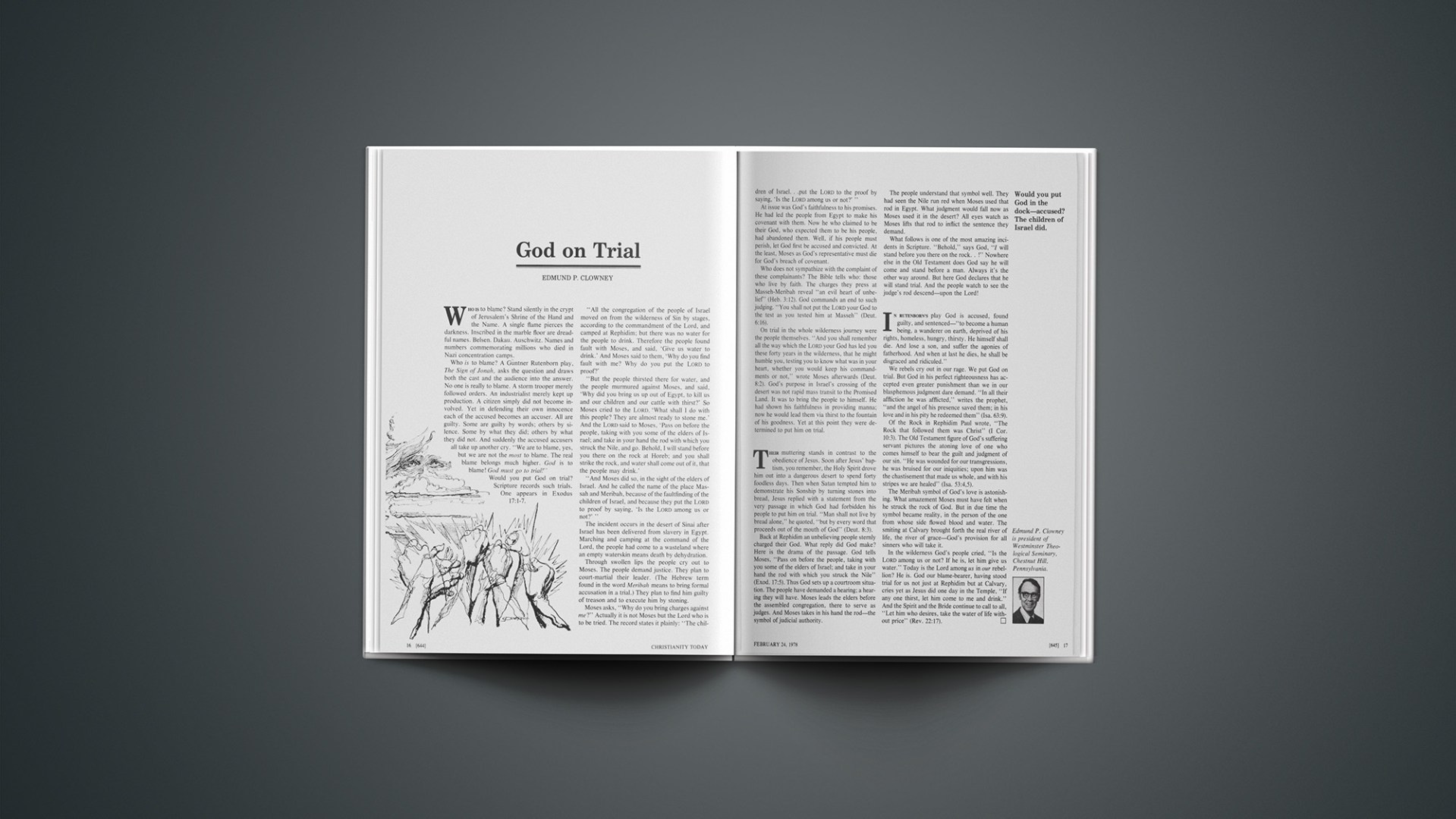
God on Trial

Who is to blame? Stand silently in the crypt of Jerusalem’s Shrine of the Hand and the Name. A single flame pierces the darkness. Inscribed in the marble floor are dreadful names. Belsen. Dakau. Auschwitz. Names and numbers commemorating millions who died in Nazi concentration camps.

Who is to blame? A Guntner Rutenbom play, The Sign of Jonah, asks the question and draws both the cast and the audience into the answer. No one is really to blame. A storm trooper merely followed orders. An industrialist merely kept up production. A citizen simply did not become involved. Yet in defending their own innocence each of the accused becomes an accuser. All are guilty. Some are guilty by words; others by silence. Some by what they did; others by what they did not. And suddenly the accused accusers all take up another cry. “We are to blame, yes, but we are not the most to blame. The real blame belongs much higher. God is to blame! God must go to trial!”

Would you put God on trial? Scripture records such trials. One appears in Exodus 17:1–7.

“All the congregation of the people of Israel moved on from the wilderness of Sin by stages, according to the commandment of the Lord, and camped at Rephidim; but there was no water for the people to drink. Therefore the people found fault with Moses, and said, ‘Give us water to drink.’ And Moses said to them, ‘Why do you find fault with me? Why do you put the LORD to proof?’

“But the people thirsted there for water, and the people murmured against Moses, and said, ‘Why did you bring us up out of Egypt, to kill us and our children and our cattle with thirst?’ So Moses cried to the LORD. ‘What shall I do with this people? They are almost ready to stone me.’ And the LORD said to Moses, ‘Pass on before the people, taking with you some of the elders of Israel; and take in your hand the rod with which you struck the Nile, and go. Behold, I will stand before you there on the rock at Horeb; and you shall strike the rock, and water shall come out of it, that the people may drink.’

“And Moses did so, in the sight of the elders of Israel. And he called the name of the place Massah and Meribah, because of the faultfinding of the children of Israel, and because they put the LORD to proof by saying, ‘Is the LORD among us or not?’ ”

The incident occurs in the desert of Sinai after Israel has been delivered from slavery in Egypt. Marching and camping at the command of the Lord, the people had come to a wasteland where an empty waterskin means death by dehydration.

Through swollen lips the people cry out to Moses. The people demand justice. They plan to court-martial their leader. (The Hebrew term found in the word Meribah means to bring formal accusation in a trial.) They plan to find him guilty of treason and to execute him by stoning.

Moses asks, “Why do you bring charges against me?” Actually it is not Moses but the Lord who is to be tried. The record states it plainly: “The children of Israel … put the LORD to the proof by saying, ‘Is the LORD among us or not?’ ”

At issue was God’s faithfulness to his promises. He had led the people from Egypt to make his covenant with them. Now he who claimed to be their God, who expected them to be his people, had abandoned them. Well, if his people must perish, let God first be accused and convicted. At the least, Moses as God’s representative must die for God’s breach of covenant.

Who does not sympathize with the complaint of these complainants? The Bible tells who: those who live by faith. The charges they press at Masseh-Meribah reveal “an evil heart of unbelief” (Heb. 3:12). God commands an end to such judging. “You shall not put the LORD your God to the test as you tested him at Masseh” (Deut. 6:16).

On trial in the whole wilderness journey were the people themselves. “And you shall remember all the way which the LORD your God has led you these forty years in the wilderness, that he might humble you, testing you to know what was in your heart, whether you would keep his commandments or not,” wrote Moses afterwards (Deut. 8:2). God’s purpose in Israel’s crossing of the desert was not rapid mass transit to the Promised Land. It was to bring the people to himself. He had shown his faithfulness in providing manna; now he would lead them via thirst to the fountain of his goodness. Yet at this point they were determined to put him on trial.

Their muttering stands in contrast to the obedience of Jesus. Soon after Jesus’ baptism, you remember, the Holy Spirit drove him out into a dangerous desert to spend forty foodless days. Then when Satan tempted him to demonstrate his Sonship by turning stones into bread, Jesus replied with a statement from the very passage in which God had forbidden his people to put him on trial. “Man shall not live by bread alone,” he quoted, “but by every word that proceeds out of the mouth of God” (Deut. 8:3).

Back at Rephidim an unbelieving people sternly charged their God. What reply did God make? Here is the drama of the passage. God tells Moses, “Pass on before the people, taking with you some of the elders of Israel; and take in your hand the rod with which you struck the Nile” (Exod. 17:5). Thus God sets up a courtroom situation. The people have demanded a hearing; a hearing they will have. Moses leads the elders before the assembled congregation, there to serve as judges. And Moses takes in his hand the rod—the symbol of judicial authority.

The people understand that symbol well. They had seen the Nile run red when Moses used that rod in Egypt. What judgment would fall now as Moses used it in the desert? All eyes watch as Moses lifts that rod to inflict the sentence they demand.

What follows is one of the most amazing incidents in Scripture. “Behold,” says God, “I will stand before you there on the rock …!” Nowhere else in the Old Testament does God say he will come and stand before a man. Always it’s the other way around. But here God declares that he will stand trial. And the people watch to see the judge’s rod descend—upon the Lord!

In rutenborn’s play God is accused, found guilty, and sentenced—“to become a human being, a wanderer on earth, deprived of his rights, homeless, hungry, thirsty. He himself shall die. And lose a son, and suffer the agonies of fatherhood. And when at last he dies, he shall be disgraced and ridiculed.”

We rebels cry out in our rage. We put God on trial. But God in his perfect righteousness has accepted even greater punishment than we in our blasphemous judgment dare demand. “In all their affliction he was afflicted,” writes the prophet, “and the angel of his presence saved them; in his love and in his pity he redeemed them” (Isa. 63:9).

Of the Rock in Rephidim Paul wrote, “The Rock that followed them was Christ” (1 Cor. 10:3). The Old Testament figure of God’s suffering servant pictures the atoning love of one who comes himself to bear the guilt and judgment of our sin. “He was wounded for our transgressions, he was bruised for our iniquities; upon him was the chastisement that made us whole, and with his stripes we are healed” (Isa. 53:4, 5).

The Meribah symbol of God’s love is astonishing. What amazement Moses must have felt when he struck the rock of God. But in due time the symbol became reality, in the person of the one from whose side flowed blood and water. The smiting at Calvary brought forth the real river of life, the river of grace—God’s provision for all sinners who will take it.

In the wilderness God’s people cried, “Is the LORD among us or not? If he is, let him give us water.” Today is the Lord among us in our rebellion? He is. God our blame-bearer, having stood trial for us not just at Rephidim but at Calvary, cries yet as Jesus did one day in the Temple, “If any one thirst, let him come to me and drink.” And the Spirit and the Bride continue to call to all, “Let him who desires, take the water of life without price” (Rev. 22:17).

D. Bruce Lockerbie is chairman of the Fine Arts department at The Stony Brook School, Stony Brook, New York. This article is taken from his 1976 lectures on Christian Life and Thought, delivered at Conservative Baptist Theological Seminary in Denver, Colorado.

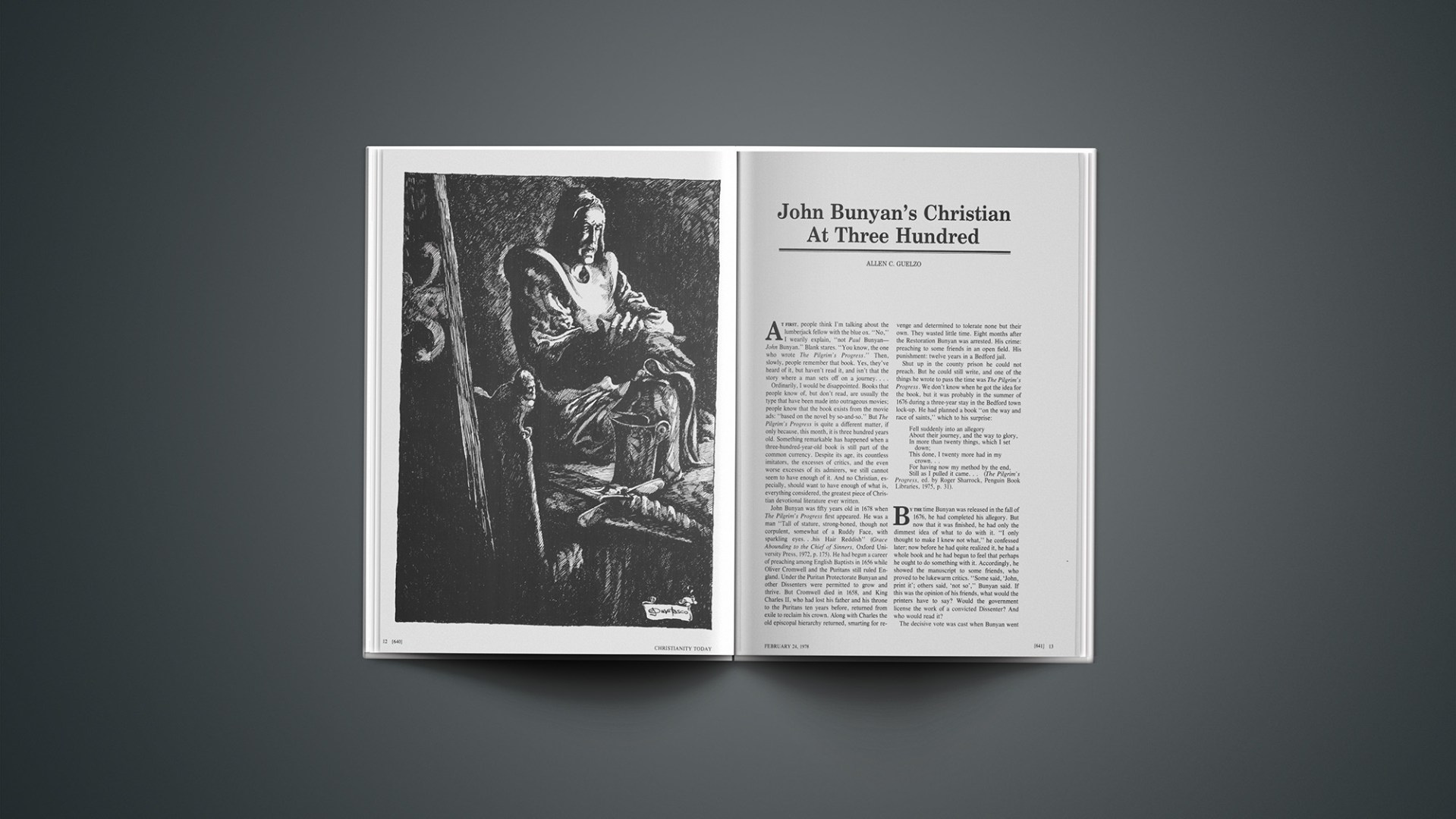
John Bunyan’s Christian at Three Hundred

Despite its age people still read “The Pilgrim’s Progress”.

At first, people think I’m talking about the lumberjack fellow with the blue ox. “No,” I wearily explain, “not Paul Bunyan—John Bunyan.” Blank stares. “You know, the one who wrote The Pilgrim’s Progress.” Then, slowly, people remember that book. Yes, they’ve heard of it, but haven’t read it, and isn’t that the story where a man sets off on a journey.…

Ordinarily, I would be disappointed. Books that people know of, but don’t read, are usually the type that have been made into outrageous movies; people know that the book exists from the movie ads: “based on the novel by so-and-so.” But The Pilgrim’s Progress is quite a different matter, if only because, this month, it is three hundred years old. Something remarkable has happened when a three-hundred-year-old book is still part of the common currency. Despite its age, its countless imitators, the excesses of critics, and the even worse excesses of its admirers, we still cannot seem to have enough of it. And no Christian, especially, should want to have enough of what is, everything considered, the greatest piece of Christian devotional literature ever written.

John Bunyan was fifty years old in 1678 when The Pilgrim’s Progress first appeared. He was a man “Tall of stature, strong-boned, though not corpulent, somewhat of a Ruddy Face, with sparkling eyes … his Hair Reddish” (Grace Abounding to the Chief of Sinners, Oxford University Press, 1972, p. 175). He had begun a career of preaching among English Baptists in 1656 while Oliver Cromwell and the Puritans still ruled England. Under the Puritan Protectorate Bunyan and other Dissenters were permitted to grow and thrive. But Cromwell died in 1658, and King Charles II, who had lost his father and his throne to the Puritans ten years before, returned from exile to reclaim his crown. Along with Charles the old episcopal hierarchy returned, smarting for revenge and determined to tolerate none but their own. They wasted little time. Eight months after the Restoration Bunyan was arrested. His crime: preaching to some friends in an open field. His punishment: twelve years in a Bedford jail.

Shut up in the county prison he could not preach. But he could still write, and one of the things he wrote to pass the time was The Pilgrim’s Progress. We don’t know when he got the idea for the book, but it was probably in the summer of 1676 during a three-year stay in the Bedford town lock-up. He had planned a book “on the way and race of saints,” which to his surprise:

Fell suddenly into an allegory

About their journey, and the way to glory,

In more than twenty things, which I set down;

This done, I twenty more had in my crown …

For having now my method by the end,

Still as I pulled it came … (The Pilgrim’s Progress, ed. by Roger Sharrock, Penguin Book Libraries, 1975, p. 31).

By the time Bunyan was released in the fall of 1676, he had completed his allegory. But now that it was finished, he had only the dimmest idea of what to do with it. “I only thought to make I knew not what,” he confessed later; now before he had quite realized it, he had a whole book and he had begun to feel that perhaps he ought to do something with it. Accordingly, he showed the manuscript to some friends, who proved to be lukewarm critics. “Some said, ‘John, print it’; others said, ‘not so’,” Bunyan said. If this was the opinion of his friends, what would the printers have to say? Would the government license the work of a convicted Dissenter? And who would read it?

The decisive vote was cast when Bunyan went to London to see John Owen, one-time chaplain to Oliver Cromwell and now the last remaining spokesman for the persecuted Puritans. Owen’s influence had gotten Bunyan out of prison, and now Bunyan showed him what he had done in prison. Owen must have liked it. He put Bunyan into the hands of his own printer, Nathaniel Ponder, who ran off the first copies and applied for a license to sell them. On February 18, 1678, after the usual haggling and delays, the license was granted, and Ponder was free to sell to all the world, for one pound sixpence, The Pilgrim’s Progress from THIS WORLD to That which is to come: Delivered under the Similitude of a DREAM.

Even at the distance of three hundred years, the result is astonishing. Within a year, two editions had been completely sold out and Nat Ponder was compelled to print a third. Bunyan could only marvel, with a sort of innocent egotism, that, from France to New England “So comely doth my pilgrim walk/That thousands of him daily sing and talk” (p. 213). In 1684 Bunyan wrote a sequel (he was content to call it The Pilgrim’s Progress, the Seconde Parte), which turned out to be nearly as popular as the original. By the time Bunyan died in 1688 eleven English editions of his “similitude” had been issued, as well as French, Dutch, and German versions. And this, remember, was the seventeenth century when printing was slow and prices prohibitive. It is no exaggeration at all to say that, short of the Bible, there had never been anything like it in England’s “green and pleasant land” (Puritan’s Progress, by Monica Furlong, Coward, McCann. Geoghan, 1975, p. 181).

Nor did it stop there. That almightly arbiter of the English language, Samuel Johnson, disliked lengthy books, but The Pilgrim’s Progress was one of the few he wished were longer. In 1726 Jonathan Swift was hoping that Gulliver’s Travels would have “as good a run” as The Pilgrim’s Progress, and Alexander Pope felt supremely complimented when he learned that his works were being hawked in the streets “like Bunyan’s.” Louisa May Alcott used it in Little Women, Nathaniel Hawthorne imitated it in “The Celestial Railroad,” and George Bernard Shaw praised it whenever he could. Above all it became the sort of book that tradesmen and crofters (tenant farmers) read to themselves, read to each other, then to their children, and finally passed on to their grandchildren. “In the wildest parts of Scotland,” wrote Macauley, “The Pilgrim’s Progress is the delight of the peasantry; in every nursery, The Pilgrim’s Progress is a greater favorite than Jack the Giant-killer” (Critical Historical Essays, by Tom D. Macauley, Putman, 1903, p. 276). In a word, it has become part of our imagination as a culture; and not ours alone, since editions of the book have appeared in over two hundred languages, not to mention adaptations as plays, poetry, and Ralph Vaughan Williams’s resplendent opera.

But none of that, of course, explains why this particular book should speak so profoundly to the evangelical mind, or why we should take the trouble to read it today. Here, then, is where the critic and lecturers step in. With the best of motives, they have proceeded to describe The Pilgrim’s Progress in terms that might frighten people away from reading it. We are told, for one thing, that the story is a great allegory. We are informed that Bunyan uses the majestic language of the King James Bible. Finally, we are told that Bunyan really pays no attention to theology.

To begin with, I acknowledge that The Pilgrim’s Progress is an allegory. Somewhere along the way we acquired the notion that an allegory should not be read for the thrill of the story, but for the sake of the “idea.” We are not supposed to ask who the hero and the villain are, but rather what they stand for, as though they were only ideas dressed up in literary clothes. Yet, that is not the intention of the great writers of allegory. They are telling a story and use that particular form because it best suits the plot.

Bunyan from the very beginning of his tale sweeps us into the action of a journey, not into an abstract world of symbols. From the first sentence the sense of motion does not stop until the pilgrim arrives at the Celestial City. There is no bar to cross, no special interpretive glasses to put on. Immediately the stage is set, the pilgrim is introduced, and we are pulled along by the urgency of Bunyan’s pilgrimage.

Bunyan was not creating airless abstractions. Mr. Honest, for instance, protests that he is “not Honesty in the abstract, but Honest is my name, and I wish that my nature shall agree to what I am called.” Someone else would have spiritualized this fellow into Honestness; Bunyan merely recognizes him for what he already is, an honest man. The idea here is to attach the correct name to the person whose actions deserve that name. We ought not to think that Old Honest stands for Honesty, but that honest people are like Old Honest.

In this way, Bunyan gives us a book full of people who dance, weep, sing, and rejoice. At times they are uncomfortably real. We can see that Mr. Worldly-Wiseman is every inch a gentle-man—too much a gentleman, as his conversation reveals, to go on a pilgrimage. So he warns Christian, with the maddeningly fatherly indulgence of a local banker, “Hear me; I am older than thou art.” For Mr. Worldly-Wiseman’s part, it is more important to “live by honest neighbors, in credit and good fashion … I could direct thee to the obtaining of what thou desirest, without the dangers that thou in this way wilt run thyself into …” (Pilgrim’s Progress, p. 50). In one sense, Mr. Worldly-Wiseman stands for the temptation of foolish wisdom. But he appears to us as the sort of condescending humbug who lacks the courage to believe and be saved and so spends his time diverting others from believing. Haven’t we all heard arguments like this before?

But then there is also the time-worn platitude that Bunyan “speaks in the organ tones of the King James Bible”—a polite way of saying that Bunyan imitates the Authorized Version. Bunyan’s language was his own and that of the people of his native Bedford. It sounds like King James only when he quotes Scripture. The proof of that, of course, is in the reading:

Christian: I was born in your dominions, but your service was hard, and your wages such as a man could not live on, for the wages of sin is death.

Appollyon: Thou hast done in this, according to the proverb, changed a bad for a worse; but it is ordinary for those who have professed themselves his [Christ’s] servants, after a while to give him the slip; and return again to me; do thou so too, and all shall be well (pp. 90–91).

No one in the King James Bible talks like that, but they did in Bedford, and, to a certain extent, still do.

That doesn’t mean that the story lacks grandeur; at times Bunyan’s words have the bright ring of clashing steel. Mr. Valiant-for-Trust wields “a right Jerusalem blade” when three brigands attack him. “They have left upon me, as you see, some marks of their valour,” he says, but adds confidently, that they “have also carried away with them some of mine.”

I fought till my sword did cleave to my hand, and when they were joined together, as if a sword grew out of my arm, and when the blood ran through my fingers—then I fought with most courage (p. 349).

Perhaps a grisly incident; but “nowhere in all Shakespeare” marveled Bernard Shaw, “is there a touch like that.” Just as Valiant-for-Truth’s courage rises to meet the passion of combat, so “the sentences go straight to their marks, and their concluding phrases soar like the sunrise, or swing and drop like a hammer.” And there is nothing that imitates the King James Bible. Bunyan did not need to do that; he drew from life.

The most curious piece of wrongheaded admiration is, unfortunately, the one that I hear the most. It goes something like this: “Bunyan was a wonderful, warm-hearted Englishman whose broadmindedness triumphed over his narrow evangelical outlook and produced a classic that can be enjoyed without any thought of its theological content.” I can understand someone being confused over Bunyan’s fervent evangelicalism. I can even understand someone stoutly resisting it. But I don’t know how anyone can pretend that it doesn’t exist—or, if it does, that it’s unimportant.

“This book,” Bunyan said, “will make a traveller of thee,” because he expected it to “direct thee to the holy land” and salvation in Christ (pp. 36–37). He would not thank those who want to hail it as some sort of literary masterpiece, and simply leave it there. Bunyan was overtly, deliberately, and unashamedly didactic. Christian’s conversation with Faithful becomes a discussion of the relationship of law and grace; Faithful’s question-and-answer session with Talkative unrolls the doctrine of assurance in very specific terms; Christian explains the elements of the imputed righteousness of Christ to Ignorance, and when Ignorance protests, Christian is given the opportunity to introduce yet another doctrine, the authority of Scripture. And so on.

Discovering this may give us a jolt, particularly if we have been lulled into thinking that The Pilgrim’s Progress was written for the comfort of the world in general. Beneath the flesh of allegory is the tough, exacting psychology of Puritan conversion. As such the book cannot be made into a benevolent, open-minded spiritual essay. Nor should we desire to. You may enjoy The Pilgrim’s Progress because of its allegory or its style. But for me the real excitements of the book are Christian excitements, and the joys, Christian joys. It is for this reason that Bunyan has never become obsolete, because an audience for those joys and excitements has never been lacking, not even today. Eventually Bunyan’s world may grow too distant to be of interest, and he could fade out of literary fashion. But he will not fade among those who are themselves pilgrims. Those who belong to that company still find in the exuberance of The Pilgrim’s Progress an invigorating refreshment that no other book can supply.

D. Bruce Lockerbie is chairman of the Fine Arts department at The Stony Brook School, Stony Brook, New York. This article is taken from his 1976 lectures on Christian Life and Thought, delivered at Conservative Baptist Theological Seminary in Denver, Colorado.

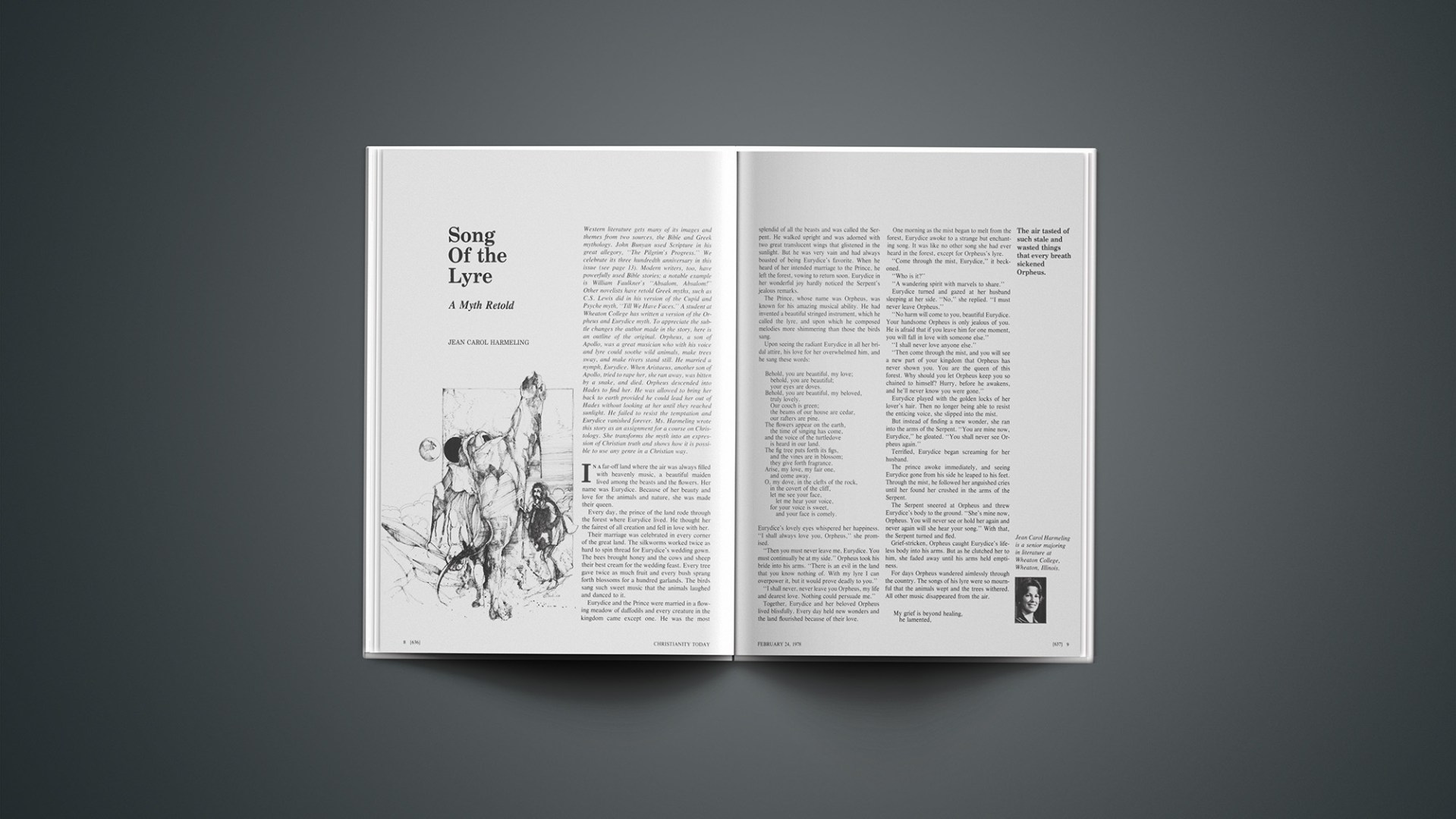
Song of the Lyre

A Myth Retold

Western literature gets many of its images and themes from two sources, the Bible and Greek mythology. John Banyan used Scripture in his great allegory, “The Pilgrim’s Progress.” We celebrate its three hundredth anniversary in this issue (see page 13). Modern writers, too, have powerfully used Bible stories; a notable example is William Faulkner’s “Absalom, Absalom!” Other novelists have retold Greek myths, such as C.S. Lewis did in his version of the Cupid and Psyche myth, “Till We Have Faces.” A student at Wheaton College has written a version of the Orpheus and Eurydice myth. To appreciate the subtle changes the author made in the story, here is an outline of the original. Orpheus, a son of Apollo, was a great musician who with his voice and lyre could soothe wild animals, make trees sway, and make rivers stand still. He married a nymph, Eurydice. When Aristaeus, another son of Apollo, tried to rape her, she ran away, was bitten by a snake, and died. Orpheus descended into Hades to find her. He was allowed to bring her back to earth provided he could lead her out of Hades without looking at her until they reached sunlight. He failed to resist the temptation and Eurydice vanished forever. Ms. Harmeling wrote this story as an assignment for a course on Christology. She transforms the myth into an expression of Christian truth and shows how it is possible to use any genre in a Christian way.

In a far-off land where the air was always filled with heavenly music, a beautiful maiden lived among the beasts and the flowers. Her name was Eurydice. Because of her beauty and love for the animals and nature, she was made their queen.

Every day, the prince of the land rode through the forest where Eurydice lived. He thought her the fairest of all creation and fell in love with her.

Their marriage was celebrated in every comer of the great land. The silkworms worked twice as hard to spin thread for Eurydice’s wedding gown. The bees brought honey and the cows and sheep their best cream for the wedding feast. Every tree gave twice as much fruit and every bush sprang forth blossoms for a hundred garlands. The birds sang such sweet music that the animals laughed and danced to it.

Eurydice and the Prince were married in a flowing meadow of daffodils and every creature in the kingdom came except one. He was the most splendid of all the beasts and was called the Serpent. He walked upright and was adorned with two great translucent wings that glistened in the sunlight. But he was very vain and had always boasted of being Eurydice’s favorite. When he heard of her intended marriage to the Prince, he left the forest, vowing to return soon. Eurydice in her wonderful joy hardly noticed the Serpent’s jealous remarks.

The Prince, whose name was Orpheus, was known for his amazing musical ability. He had invented a beautiful stringed instrument, which he called the lyre, and upon which he composed melodies more shimmering than those the birds sang.

Upon seeing the radiant Eurydice in all her bridal attire, his love for her overwhelmed him, and he sang these words:

Behold, you are beautiful, my love;

behold, you are beautiful;

your eyes are doves.

Behold, you are beautiful, my beloved,

truly lovely.

Our couch is green;

the beams of our house are cedar,

our rafters are pine.

The flowers appear on the earth,

the time of singing has come,

and the voice of the turtledove

is heard in our land.

The fig tree puts forth its figs,

and the vines are in blossom;

they give forth fragrance.

Arise, my love, my fair one,

and come away.

O, my dove, in the clefts of the rock,

in the covert of the cliff,

let me see your face,

let me hear your voice,

for your voice is sweet,

and your face is comely.

Eurydice’s lovely eyes whispered her happiness. “I shall always love you, Orpheus,” she promised.

“Then you must never leave me, Eurydice. You must continually be at my side.” Orpheus took his bride into his arms. “There is an evil in the land that you know nothing of. With my lyre I can overpower it, but it would prove deadly to you.”

“I shall never, never leave you Orpheus, my life and dearest love. Nothing could persuade me.”

Together, Eurydice and her beloved Orpheus lived blissfully. Every day held new wonders and the land flourished because of their love.

One morning as the mist began to melt from the forest, Eurydice awoke to a strange but enchanting song. It was like no other song she had ever heard in the forest, except for Orpheus’s lyre.

“Come through the mist, Eurydice,” it beckoned.

“Who is it?”

“A wandering spirit with marvels to share.”

Eurydice turned and gazed at her husband sleeping at her side. “No,” she replied. “I must never leave Orpheus.”

“No harm will come to you, beautiful Eurydice. Your handsome Orpheus is only jealous of you. He is afraid that if you leave him for one moment, you will fall in love with someone else.”

“I shall never love anyone else.”

“Then come through the mist, and you will see a new part of your kingdom that Orpheus has never shown you. You are the queen of this forest. Why should you let Orpheus keep you so chained to himself? Hurry, before he awakens, and he’ll never know you were gone.”

Eurydice played with the golden locks of her lover’s hair. Then no longer being able to resist the enticing voice, she slipped into the mist.

But instead of finding a new wonder, she ran into the arms of the Serpent. “You are mine now, Eurydice,” he gloated. “You shall never see Orpheus again.”

Terrified, Eurydice began screaming for her husband.

The prince awoke immediately, and seeing Eurydice gone from his side he leaped to his feet. Through the mist, he followed her anguished cries until her found her crushed in the arms of the Serpent.

The Serpent sneered at Orpheus and threw Eurydice’s body to the ground. “She’s mine now, Orpheus. You will never see or hold her again and never again will she hear your song.” With that, the Serpent turned and fled.

Grief-stricken, Orpheus caught Eurydice’s lifeless body into his arms. But as he clutched her to him, she faded away until his arms held emptiness.

For days Orpheus wandered aimlessly through the country. The songs of his lyre were so mournful that the animals wept and the trees withered. All other music disappeared from the air.

My grief is beyond healing,

he lamented

my heart is sick within me.

For the wound of the daughter of

my people is my heart wounded,

I mourn, and dismay has taken

hold on me.

Take up weeping and wailing for

the mountains,

and a lamentation for the pastures

of the wilderness,

because they are laid waste so that

no one passes through,

and the lowing of cattle is not

heard;

both the birds of the air and the

beasts

have fled and are gone.

Orpheus knew that there was a hope of bringing Eurydice back to himself. But it was a very toilsome way and it would mean much suffering for him.

In the depths of the forest was a black cave through which one could find his way down to the Underworld or the Land of the Dead. It was a perilous journey that had never been traveled, but so unbearable was Orpheus’s heartbreak that he decided no pain or danger would be too great if it meant restoring his beloved to his arms.

He took his lyre with him, and as he was about to enter the mouth of the cave, he heard strange hissing noises all around him.

“I sshall win! I sshall win!”

“You shall be damned, Serpent,” cried Orpheus, “and never see this land again.”

Inside the cave darkness enshrouded him. The air tasted of such stale and wasted things that every breath sickened Orpheus. He found the road to be as slippery and jagged as the jaw of a wild beast. It tore his feet and bruised his legs. But the song of his lyre penetrated the blackness and directed his way. It showed him where to rest and it renewed his strength. Without the sweetness of the lyre’s melody, he would have been unable to bear the choking atmosphere. He felt that he was being constricted by something black and evil.

Orpheus knew what that meant. He was entering the Realm of the Serpent. The beast had never really belonged to Orpheus’s kingdom. His vanity had set him apart from fellowship with the other beasts. Since he could not be made their ruler, secretly he created his own kingdom. Orpheus knew of it, as he knew of everything in his land, but he had let the Serpent freely roam through the forest. Now Orpheus must destroy him.

For several days the Prince journeyed. The road seemed interminable. Then suddenly it began winding up instead of down. He climbed until he reached a pinnacle of rock overlooking a gigantic cavern. A bitter wind from nowhere yowled as furiously as a pack of wounded animals, and nearly toppled Orpheus as he watched. As abruptly as it had started, the yowling stopped. The air was strangely calm. Then the pinnacle and cragged rocks and mighty cavern below vanished. Orpheus stood in the throne room of a glorious palace. Everything he saw was gilded with purest gold, and the fragrance of honeysuckle and sweet wine thrilled his senses.

A jeweled curtain parted, revealing a woman draped in silver gauze. Orpheus gasped, for she was the exact image of Eurydice. Her beauty was incomparable, and as he watched she came toward him. The brilliance of the room dimmed as all of it focused on her. Light and fire swirled around the two of them, plunging the room into a sea of sensuality. Then, twining her supple arms about his neck, Eurydice whispered into his ear:

Fall down before the Serpent,

Worship him and all will be well,

Fall down before the Serpent,

Worship him and all these things

Shall be yours.

Her lips parted, begging to be kissed, but in the greatest of agony, Orpheus tore her arms from his neck and flung her to the ground. “Away from me, Serpent!” Instantly everything disappeared and Orpheus found himself back upon the pinnacle.

Twice more the vision appeared to Orpheus, and each succeeding time his agony increased as he refused Eurydice. The third time that he was returned to the pinnacle he was met with a pulsating cloud of smoke. Suddenly it engulfed the entire cavern floor in flames. A portion of the stone wall moved aside and in an assault of fire the Serpent emerged, more immense than ever before. But the splendour was gone; only terror remained. Horned wings covered his head and body like spears and every pore oozed forth black slime.

“Come and prevail against me, Orpheus,” he jeered; “Sing me a song on your lyre.”

Orpheus cast his lyre upon the rock and it sprang back as a golden sword and shield. He climbed down from the pinnacle to the edge of the burning cavern floor and shouted, “You shall be damned forever, Serpent!”

The beast gripped Orpheus in one sweeping motion and prepared to throw him into the flames. But Orpheus acted more swiftly and thrust his sword into the Serpent’s eye. Roaring with pain, he hurtled Orpheus against the rock and began stinging him with his tail.

Stunned from the repeated blows, Orpheus barely managed to roll himself into a crevice where the Serpent could not reach him. Mustering his strength, Orpheus jabbed at the attacking stinger and pierced the beast’s flesh. At this he struggled from the opening in the rock and lashed out again. The Serpent was upon him now, the flames licking about his feet, but not burning them. Orpheus tried to put out the Serpent’s other eye while the Serpent continued stinging every part of his body.

Steadily weakening, Orpheus dragged himself higher up the rock, but in fury the Serpent threw him down again. Orpheus tried again, and as the Serpent lunged at him, he grabbed the rock. This time the Serpent opened his venomous mouth as if to devour Orpheus. But he raised his sword and stabbed through the Serpent’s other eye. In a flood of blood, Orpheus fell again upon the rocks as the screaming Serpent blindly began flinging boulders at him.

Half-lame, Orpheus struggled to reach the pinnacle, which would place him above the Serpent’s head.

“Higher, Serpent,” he called, at last back at the top. “I’m up … higher!”

The Serpent, howling, lunged upwards with his arms flailing. Orpheus flung his shoulder against the pinnacle of rock, and, straining with all the strength left in him, rolled a boulder down upon the Serpent’s head. That caused an avalanche and rock after rock crashed into him, until in a fit of pain, the Serpent lurched backwards into the flames. The cavern wall from which he had emerged opened once more. With a last flash of fire it enveloped the Serpent and he was gone.

Orpheus threw his shield and sword into the flames. They melted immediately and his lyre sprang back to him. But his wounds did not heal. As he resumed his journey, they went with him.

He was at the end of his descent, however, for on the other side of the cavern flowed a foaming, black river. On the opposite bank lay a vast, barren land shadowed with ghostly images. Sitting on the bank, a miserable Eurydice shivered and moaned.

Orpheus wept with longing for her, and she glanced up.

“Who is there?”

“It is I,” cried Orpheus, “Come to me, Eurydice.”

“Orpheus?! No, you are all bloodied and ugly. You frighten me!”

“It is because I have crushed the Serpent in order to be with you again. Let me tell you.”

He sat down upon the bank and began to play his lyre and sing:

Set me as a seal upon your heart,

as a seal upon your arm;

for love is strong as death,

jealousy is cruel as the grave,

Its flashes are flashes of fire,

a most vehement flame.

Many waters cannot quench love,

neither can floods drown it.

If a man offered for love

all the wealth of his house,

it would be utterly scorned.

Eurydice began weeping again. “It is you, Orpheus. O, my beloved, I want to come to you, but how can I get across this river?”

“Step into it, Eurydice.”

Eurydice obeyed, and as she did the foaming waters pulled back. Crying with joy she ran into her husband’s yearning arms. In silent ecstasy they clung to each other. Then Eurydice spoke.

“O, Orpheus, where do we go from here? Shall we go back to our forest?”

“Eventually,” soothed Orpheus, stroking her hair. “It will be a long journey back. However, there is nothing to fear, for the Serpent can no longer harm you. He will try, but his defeat has been too great.”

Secure in his arms, Eurydice began her ascent. And as they traveled, the song of Orpheus’s lyre resounded everywhere.

D. Bruce Lockerbie is chairman of the Fine Arts department at The Stony Brook School, Stony Brook, New York. This article is taken from his 1976 lectures on Christian Life and Thought, delivered at Conservative Baptist Theological Seminary in Denver, Colorado.

Eutychus and His Kin: February 24, 1978

God’s Book And Guiness’s

On a stormy Sunday morning we were visiting a little church at land’s end—literally—on the Oregon coast. The minister began to pray, “Here we are, a group of little people, way out on the edge of nowhere … with Thy Word.”

Little flock, little pastor, little people. Little at any time, but especially at the end of the big seventies.

Today’s catchword is growth, church growth. A church that stays the same size (unless it is already enormous, I suppose) is perceived as failure.

The church is called the “household of God” (Eph. 2:19), the “family” of Jesus Christ (Eph. 3:15). Members are called brothers and sisters. So we have a New Testament parallel between church and family.

Is it stretching that parallel to suggest that procreation is not the only function, or the determining test for success, in the family? No, the family normally enjoys times of birth, of growth. But for long periods of time it does not, its reason for being is other than increasing in size.

Bringing children into the Kingdom as well as into the world, nurturing them, training them to make decisions and cope with a wide range of problems, nursing them through physical, emotional and spiritual illnesses: these are worthy functions of any family even during periods when it remains constant in size.

A family with twelve members isn’t better or more successful than one with four. It may just be noisier.

Back to Oregon. I guess what impressed me most was that pastor’s qualifying statement, “with Thy Word.” Where God’s Word is believed and taught, any church is big—big enough for God, if not for Guiness.

EUTYCHUS VIII

Dividing Lines

I came home the other day after having just turned in my thesis on Christian community to find your magazine with a cover story on … community! (“Journey to Renewal,” Jan. 13).

After reading the article, I was encouraged by Dr. Lundquist’s emphasis on the need for Christians to have some kind of daily corporate demonstration of Christianity. Other things about Dr. Lundquist’s article, however, distressed me. In particular, one should rejoice, to be sure, that the “theological variations” he listed had lost their divisiveness in the Christian communities he visited. But the prominent place of Catholic communities in the article suggests, by implication, that their theology should be tolerated as well. At this point, Lundquist has lost his theological integrity. Some theological issues must be divisive because they are absolutes. This does not mean that we should encourage division. But on the other hand, simply because we have let non-absolutes be divisive in the past does not mean that we should keep true absolutes from being divisive now.

HERB REESE

Dallas, Tex.

I found Lundquist’s article, “Journey to Renewal,” very discouraging. He has revealed quite dearly the basic assumption underlying the modern “renewal movement”—that doctrine is not considered really very important. There is a denial of the principles of the Reformation. The Reformers taught us the sufficiency of Scripture. Now this objective standard is being placed in the background as the emphasis shifts to subjective, charismatic experiences. This drift back to what is really a Roman Catholic viewpoint should be shocking to any Protestant. Lundquist speaks of being “In a Catholic setting … laying hands upon a kneeling priest.…” Certainly we must be thankful for the spirit of love in Christ, but what has happened to the spirit of Mr. Valiant for Truth, that great hero of The Pilgrim’s Progress? Where would the “renewal movement” be if we began once again to “… earnestly contend for the faith which was once delivered unto the saints” (Jude 3)?

MARSHALL C. ST. JOHN

The Bible Presbyterian Church

Concord, N.C.

What’s the Source?

Thank you very much for the most interesting interview with Cornelius Van Til (Dec. 30). There is, however, one question that might have been asked in order to further elucidate his position on the Word and sovereignty of God.

If one must presuppose the Bible’s truth because of the sovereignty of God, how, then, is one to evaluate the Christian Bible and teachings with those of another religious persuasion whose followers, for reasons of their deity’s sovereignty, must also presuppose the truth of their written revelation? If Van Til would point to the subjective conviction of the Holy Spirit, could not the person of another faith point also to his own inward verification? Were Van Til then to look at objective historical criteria to support the superiority of the Christian revelation over another, would this not be the very thing he repudiated, namely, the application of any human test to God’s Word? Might not even subjective verification be an example of this? It seems, then, that Van Til is left with merely the hope that he has chosen the one true revelation of God which, of course, every cult and sect assumes of their source of truth.

PAUL VON FANGE

Lutheran High School

Mayer, Minn.

Pressing A Question

J. Robert McQuilkin’s article (“Public Schools: Equal Time for Evangelicals,” Dec. 30) is informative and provocative. It raises several educational policy questions with which Christian parents should be concerned. Although McQuilkin does not elaborate upon it to a great extent, it seems to me that the most pressing question is whether or not evangelicals can in good conscience continue to support public schooling as they have for a century and a half.

JAMES C. CARPER

Assistant Professor of Foundations of Education

Tulane University

New Orleans, La.

I identify with the article.… When my wife recently recommenced teaching, she was instructed by the Christian authorities in the public schools that she was not to read the Bible or pray with the children because of the objection from certain secularist humanists! I have long contended that whether the Supreme Court intended to erase Bible reading and prayer per se from the public school classroom is a moot question. Look at the result!

McQuilkin speaks of “released time” for religious instruction under the auspices of the public schools. We experienced this in Australia, where our children attended public schools for a time. That there is value is beyond question. What I question is whether one can seriously equate one to two hours of specialized religious instruction per week with an integration of Christ and the Bible into the whole curriculum.

In any event, McQuilkin’s statement is sure to be the classic war-cry of serious-minded evangelicals: “Free the Christian teacher to teach his religious and moral convictions as the secular humanist is free to teach his.”

GENE L. JEFFRIES

Dean

Arkansas Institute of Theology

Fayetteville, Ark.

Understanding Children

For the most part I have no quarrel with the editing of the manuscript—even the changing of the title (“Reading, Writing, And … Right From Wrong?,” Dec. 30). However, I am very concerned about one change which resulted in a substantive error. I wrote that as an example of a stage I response to the Heinz story, the child may say, “He shouldn’t have done that because then he’d be a thief if they caught him and put him in jail” (note page 10 of the manuscript). It was edited to read, “He shouldn’t have done that because now he’s a thief and they might catch him and put him in jail.” The statement as it now reads is a combination of stages 4 and 2 and in no way typifies stage 1. “Now he’s a thief” would be at stage 4 and “they might catch him and put him in jail” is a typical stage 2 concern. To the stage 1 child, the man is not a thief unless he is caught and punished.

The reason most adults do not understand the thinking processes of children is because they constantly do this kind of reinterpreting of the child’s speech to fit in logically with adult patterns of thought. Piaget found that young children are incapable of either true induction or true deduction and therefore have difficulty with problems adults find easy to solve. I’m concerned about misinforming the reader and also do not wish those who are in the field of moral judgment to consider that I do not know the area I have written about.

BONNIDELL CLOUSE

Professor of Educational Psychology

Indiana State University

Terre Haute, Ind.

Working Writers

May I suggest that you inform writers submitting articles to be considered for your pages of the extent to which their articles may undergo revision. In the process, my own recent article (“Salvation According to Scripture: No Middle Ground,” Dec. 9) not only enjoyed some improvements—for which I offer thanks—but also suffered the imposition of grammatical mistakes (such as a split infinitive and a pronoun with a nonsensical antecedent), stylistic weakening (such as the substitute of passive verbs for active and of the verb to be for verbs of action), an exegetically erroneous insertion (Matt. 25:31–46 says nothing about “amount” of charity), wholesale recasting of sentences, and omissions of supportive scriptural references, words, phrases, and even whole paragraphs—including some of major argumentative importance. All this happened without any advance notice, let alone consultation with or permission from me as author. Let writers beware and readers understand that what they read may differ markedly from what was written!

ROBERT H. GUNDRY

Professor of New Testament and Greek

Westmont College

Santa Barbara, Calif.

Not Satisfied

Regarding the lead article in the January 13 issue, on the Vanauken book, “A Severe Mercy”: your condensation spoiled that book for me. I’m sorry you were not satisfied to do just a book review. Midland Park, N.J.

M. GRASSER

On Target

Ruth Beechick is right on target in cautioning about humanistic values which may be concealed in moral development theory, and in urging biblical revelation as the only basis for truly Christian moral education (“Lawrence Kohlberg: Why Johnny Can Be Good Without Being Religious,” Dec. 30).

Kohlberg’s stages, however, refer to cognitive structures, and so basic are these structures to the process of moral reasoning in all human beings that even Christian thinking cannot escape them. In a recent book called I’m Saved, You’re Saved, Maybe, Jack R. Pressau also makes use of Kohlberg’s six-stage typology to show how our Christian understanding of “salvation” changes with our moral stage framework. He also evaluates movements such as Youth for Christ and Campus Crusade from the perspective of moral development theory, noting with a pragmatism akin to First Corinthians 9:22 that you cannot work with people except where they actually are. The Kohlberg approach may not have all the answers, but on the whole, it seems to represent less of a threat to Christian education than behavioristic or psychoanalytic ideas of how morality develops.

LENNART PEARSON

Librarian

Presbyterian College

Clinton, S.C.

Correction

In the January 27 issue, page 14, John W. Doberstein was misspelled with a “v.” We regret the error.

Editor’s Note from February 24, 1978

Homosexuality is a secular and a religious phenomenon demanding attention. It is particularly important since at least one denomination will be asked to open its doors to the ordination of practicing homosexuals. Bishop Bennett J. Sims of Atlanta has written a splendid biblical, pastoral, and compassionate article. I think his basic points are unassailable. Additional copies of the article can be secured from Bishop Sims’s office (see p. 23 for address). This article is worth the price of a year’s subscription to CHRISTIANITY TODAY.

Son of God, or Fabricated ‘Christ’? Does It Matter?

Dr. John R. W. Stott has perceptively reviewed the volume The Myth of God Incarnate (Nov. 4). Stott lays bare the heart of the issue when he treats language and outlines the use of myth by the contributors to the book.

I don’t want to duplicate Stott’s work. But I would like to call attention to the major implications of the alleged mythical origin of the historic doctrine of the incarnation.

The seven writers know how their theses will affect the Christian community, and through it the world as well. This is especially true of the writers of the five essays in Part II, “Testing the Development.” The contributors think that the Nicene Creed and the Chalcedonian Symbol are irrelevant to our age and thus dispensable.

The writers also agree that all formulations of religious faith are culturally conditioned, and therefore reflect local and transitory elements of a given civilization. Certainly no one would deny that in any formulation of motifs of metaphysical subjects, including those of religion, current idiom, prevalent modes of expression, and conventional points of emphasis will play a part. The essential question is, whether cultural conditioning will corrupt the truth of such formulations. To this question, editor John Hick would answer yes.

This involves the larger issue of whether either the early church or the church of the fourth and fifth centuries was concerned with the propositional truth of the doctrines that it professed. Would the essential demands of the early church with respect to, say, the experiences of its members of new life through faith in Jesus Christ have been met by a non-metaphysical Jesus? Would their need for a basis for faith have been met by a minimal Jesus who merely “embodies a full response of man to God, [and] also expresses and embodies the way of God toward men” (p. 8)?

By asserting that we possess no reliable data concerning the claims of our Lord during his life (a strand that weaves in and out through the volume), the writers surrender all belief in Jesus’ self-awareness of preexistence and deity. The Johannine and Pauline statements at this point are set aside as being constructs of indigenous gnostic and eschatological myths, mingled perhaps with Hellenistic divinizatior motifs.

The same agnostic attitude toward the Gospel narratives leads the writers, especiaily Frances Young and Leslie Houlden, to attribute the rise of incarnation-doctrine to a Weltanschauung in which supernatural modes of expression were a major means for the conveying parabolically high value judgments upon persons whose moral and spiritual impact had been felt in a special measure in their times.

The contributors toThe Myth of God IncarnateSay nothing that is new. What makes it important is that the critical-historical method has been used on a specific doctrine.

Along with the supposed mythological source and understanding of the incarnation, the authors relegate the Christian view of creation, the fall, and redemption to historically relative concepts. Where historical verifiability is beyond reach (i.e. by the scientific model), the only alternative permitted is the mythological model.

Much is made of the necessity, particularly in the fourth and fifth centuries of the Christian era, for what is termed “Christianizing” of political and social conditions. This tendency, it is alleged, accorded to Jesus (Christ) the qualities that also made necessary the assertion of preexistence and empirical incarnation. Houlden sees this process as responsible for the distortion of the “real” image of Jesus, as well as for the envisioning of the Father as an old man.

The panelists think that they have, by the application of the critical-historical method, shown that Jesus was just a man. They identify him with a group of religious geniuses of history. If he was more intensively conscious of God and more passionately devoted to a life of obedience to God, yet he was in no sense qualitatively different from Gautama The Buddha or Gandhi.

This line of thinking displaces any view of the essential uniqueness of Christianity. John Hick’s chapter “Jesus and the World Religions” repudiates Christian evangelism. He thinks that the Christian church should abandon the policy of securing converts to Christianity. Hick envisions a Jesus who is “a man of universal destiny,” an insider in all “major religious and also secular traditions” of the world.

Several factors from this book should engage the attention of evangelicals. One of these is the lack of any sense of loss upon the part of the writers at what they have surrendered. In place of this there appears something of a feeling of relief that supernaturalism, which has always disturbed the secular mind, has now been rejected.

The contributors also think that mainline churches which have, informally at least, adopted the program suggested in the volume, are now doing very well. The prospects for doing better are seen as good, providing the church will thoroughly “outgrow its theological fundamentalism, its literal interpretation of the idea of incarnation …” (p. 183).

I wonder whether the pitiable showing of many segments of mainline Protestantism in decline of membership (in relation to the growing population), in dwindling of church attendance, and in the drying up of funds and candidates for missionary endeavor, justifies such optimism. It may also be noteworthy that one of the writers, Maurice Wiles, is Chairman of the Doctrine Commission of the Church of England.

The volume says nothing that is new and that has not been expressed by some theologian or other at some time. What makes it significant is that so much of the conventional wisdom of the critical-historical method has been brought to bear upon a specific doctrine.

Of greater concern is the question that arises in the mind of the evangelical reader. If the writers of the volume should prove to be wrong, what will they have to say when they face in judgment the One whom they have so systematically downgraded?

Israeli Law: Toward Convert Control

Christians in Israel say it is an insult and a threat to human rights. Orthodox Jews who support it consider it a wall of defense and part of their future salvation. Moderate Jews are embarrassed by it and they fear a setback in Jewish-Christian relations.

On both sides of the Atlantic people in high places have been talking about the new law that is to take effect in Israel on April 1. It imposes a prison term of up to five years upon anyone offering “material inducement” to people to change their religion. The convert who receives such a payoff can spend up to three years in jail.

An emergency committee of the United Christian Council in Israel said in a telegram addressed to Prime Minister Menahem Begin that the law could be “misused in restricting religious liberty in Israel.” Council leaders said they had not been consulted about the bill, which the Knesset (parliament) passed in late December, and they claimed that their inquiries had been ignored. They even suggested that the bill had been “hastily pushed through” at a time when everybody knew the Christians would be involved in Christmas celebrations.

Church leaders in Israel vigorously deny offering inducements to prospective converts. Yet many rabbis seem to believe the practice is widespread. Rabbi Yehuda Meir Abrahamowitz, the Knesset member who introduced the bill, said: “We are a small nation, and every Jewish soul is dear to us. There are hundreds of missionaries operating here, and it has to stop.”

Abrahamowitz’s bill does not mention the missionaries (most work among Arabs or are attached to churches or other organizations of long standing), but an explanatory note attached to it charges that they were offering “huge sums of money” to “ensnare the souls” of the poor. It also alleged that they tried to induce people to emigrate and encouraged soldiers to desert.

“None of the Christian communities in the country known to us engages in such practices,” the Christian Council told Begin.

Abrahamowitz, a member of an ultra-Orthodox group, says that seventy to eighty Jews convert annually to Christianity. Other religious leaders fear the number is higher. (A mission observer says that probably fewer than two dozen Jews a year profess faith in Christ.)

Jewish leaders tend to use the term Christian as a synonym for Gentile. They say that as many as 500 “Christians” annually are converted to Judaism, often in connection with marriage. The new law applies to Jews as well as Christians, say the ultra-Orthodox rabbis.

Much depends on how the law will be interpreted and enforced. Liberal Israelis say the law is unenforceable. “How can you prove anything?” asked Yosef Immanuel, secretary of the Israel Interfaith Committee. He said his government-backed organization has examined countless allegations of conversion-for-money but that “nothing ever comes out of our investigations.”

“What constitutes an inducement?” asks a Christian leader. Legalists could argue that a day-care center or a school open to Jews as well as Gentiles is an inducement. And what about a Christian who gives a gift as a sincere act of charity or friendship? The law will lead to harassment of Christians, says Roman Catholic worker David Jaeger. Others say that it would be easy to “set up” a Christian or lie in order to get the Christian in trouble. A book or pamphlet given in witness of faith could be considered an inducement.

Whatever, the new law reflects the increased power of Israel’s religious politicians, people needed by Begin for support in his coalition cabinet. In the past, the socialist-led governments of Israel blocked passage of numerous anti-missionary bills.

Israelis are sensitive to American public opinion, suggests one Hebrew Christian leader, and they appreciate the moral support evangelicals have given Israel in the past. A letter to Ambassador Simcha Dinitz (Embassy of Israel, 1621 22nd Street, Washington, D.C. 20008) might help to ameliorate the situation of the missionaries, he says.

Israeli officials have had to grapple with another religious issue that is getting press attention: Does a Jew who believes that Jesus is the Messiah have the right to become an Israeli citizen under the Law of Return?

Under the Law of Return, anyone whose mother is a Jew or who has been converted to Judaism is eligible for Israeli citizenship. In the past some evangelical believers who have “converted” to Judaism have had that right of citizenship denied. The authorities in effect decided that the conversions had been a ruse to gain entry to evangelize and therefore were not valid. Part of the problem is that most Jewish leaders do not believe that one can be truly Jewish and a follower of Jesus at the same time.

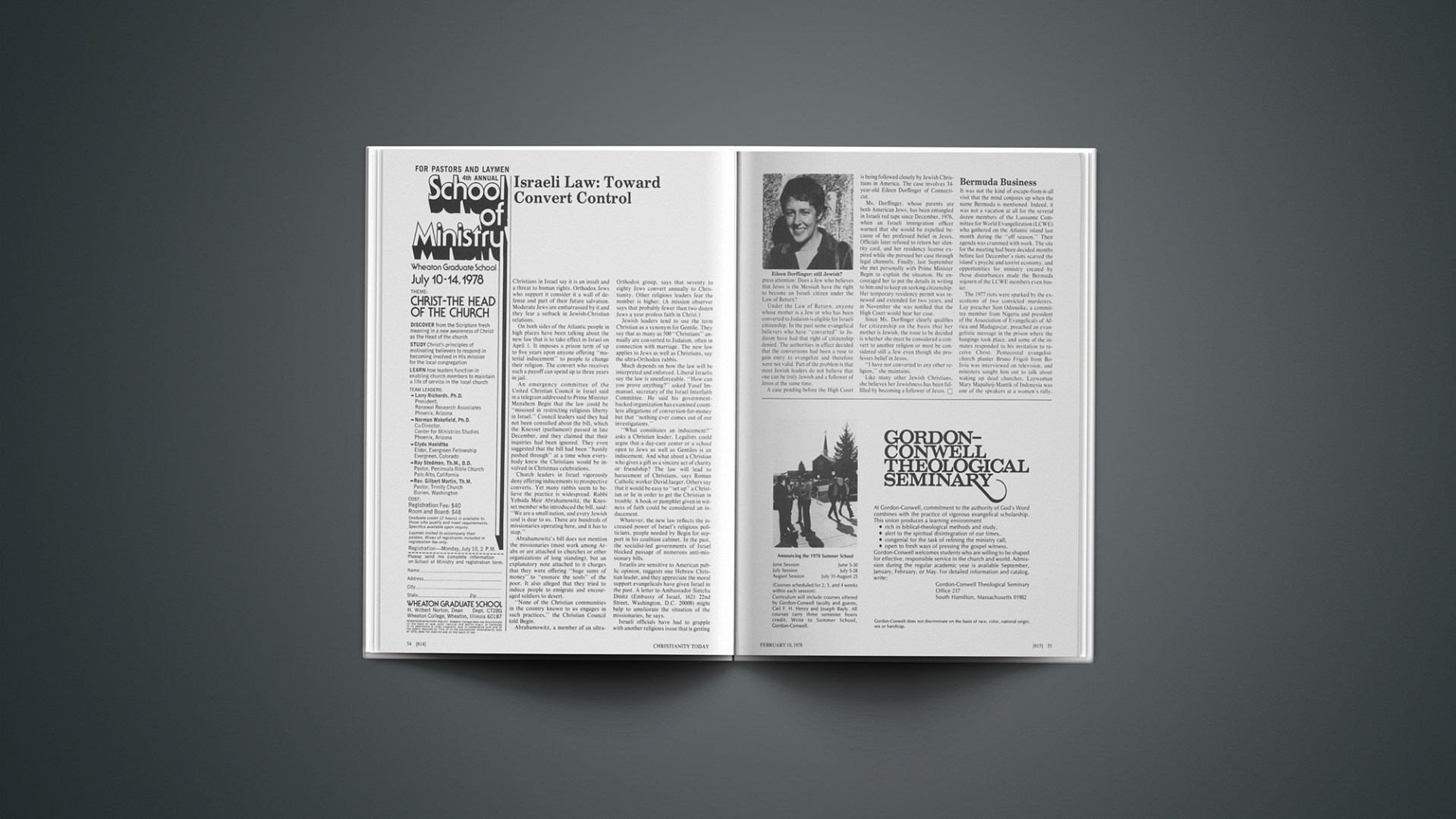
A case pending before the High Courtis being followed closely by Jewish Christians in America. The case involves 34-year-old Eileen Dorflinger of Connecticut.

Ms. Dorflinger, whose parents are both American Jews, has been entangled in Israeli red tape since December, 1976, when an Israeli immigration officer warned that she would be expelled because of her professed belief in Jesus. Officials later refused to return her identity card, and her residency license expired while she pursued her case through legal channels. Finally, last September she met personally with Prime Minister Begin to explain the situation. He encouraged her to put the details in writing to him and to keep on seeking citizenship. Her temporary residency permit was renewed and extended for two years, and in November she was notified that the High Court would hear her case.

Since Ms. Dorflinger clearly qualifies for citizenship on the basis that her mother is Jewish, the issue to be decided is whether she must be considered a convert to another religion or must be considered still a Jew even though she professes belief in Jesus.

“I have not converted to any other religion,” she maintains.

Like many other Jewish Christians, she believes her Jewishness has been fulfilled by becoming a follower of Jesus.

Bermuda Business

It was not the kind of escape-from-it-all visit that the mind conjures up when the name Bermuda is mentioned. Indeed, it was not a vacation at all for the several dozen members of the Lausanne Committee for World Evangelization (LCWE) who gathered on the Atlantic island last month during the “off season.” Their agenda was crammed with work. The site for the meeting had been decided months before last December’s riots scarred the island’s psyche and tourist economy, and opportunities for ministry created by those disturbances made the Bermuda sojourn of the LCWE members even busier.

The 1977 riots were sparked by the executions of two convicted murderers. Lay preacher Sam Odunaike, a committee member from Nigeria and president of the Association of Evangelicals of Africa and Madagascar, preached an evangelistic message in the prison where the hangings took place, and some of the inmates responded to his invitation to receive Christ. Pentecostal evangelist-church planter Bruno Frigoli from Bolivia was interviewed on television, and ministers sought him out to talk about waking up dead churches. Laywoman Mary Mapalieij-Mantik of Indonesia was one of the speakers at a women’s rally, and a woman came to her later in the week for spiritual help. Preaching invitations came from about thirty churches, and Anglican bishop Jack Dain of Australia found Edwin Leather, the island’s governor, in his congregation. The governor met privately later with some of the committee’s clergymen, and his wife attended a civic leaders’ luncheon addressed by Anglican bishop Festo Kivengere of Uganda. Every member of the panel was a dinner guest in a Bermudan home. The LCWE chairman, evangelist Leighton Ford, ended his stay with an evangelistic meeting in Bermuda’s largest theater.

Although the LCWE members spent more time than might have been expected to make an impact on the tiny British colony (population: about 55,000), they reserved most of their schedule for consideration of worldwide evangelical impact. It had been two years since the full committee met last, and the next meeting will be in 1980. The main item on the crowded agenda was planning for the 1980 Consultation on World Evangelization, which the committee will sponsor as a follow-up to the 1974 Lausanne congress. On a smaller scale than the Lausanne meeting, the consultation is designed to assess progress since 1974, “to seek fresh vision and power for the task Christ has given to his church until he comes,” and to develop strategies for completing the evangelization task. The mandate of the LCWE itself will be up for review at the consultation. Third World sites are being considered for the event, which is scheduled for January, 1980. David Howard, on loan from Inter-Varsity Christian Fellowship, will direct it.

Planning for the future was done against a backdrop of reports on the church situation around the world. Explosive growth in Latin America prompted the LCWE to increase its membership to forty-nine, reserving the new seat for an additional representative from that area. Opposition to the Gospel in many areas led the groups to step up its intercessory prayer program around the world. Concern for those still unreached by the church undergirded a decision by the committee to encourage more projects through its strategy-working unit. The need for better intellectual preparation for the evangelistic task was behind the approval of a series of consultations and publications.

One of the more sensitive issues discussed at the meeting was the LCWE’s relationship with other international bodies. The panel reaffirmed the position that it will cooperate on a functional level with certain organizations (such as the World Evangelical Fellowship), but it ruled out any organic connection. Some of the projects and smaller consultations will be sponsored jointly with other groups. The main 1980 consultation, however, will be under the exclusive control of the LCWE executive committee.

Appreciated

Brevity and a well-worn prayer won accolades for Episcopal clergyman David H. Lewis, Jr., in the Virginia senate. Each senate floor session customarily opens with a prayer by a specially invited clergyman, a different one each time. Lewis asked the Lord to help the senators change the things they could, accept the things they could not change, and be able to discern the difference. “Amen,” he said, and he stepped from the dias. The still-standing senators, some of them endurance veterans of eternally long orations to God, broke with all known tradition and applauded him. The ovation lasted longer than the prayer.

Ford was reelected LCWE chairman, and seminary president Saphir Athual of India was named deputy chairman. The term of Gottfried Osei-Mensah, executive secretary, continues for two more years.

Whether the LCWE continues to exist after 1980 will be one of the topics of the consultation scheduled for that year, but members at the Bermuda meeting seemed to assume that it does have a future. They adopted a constitution (for purposes of being registered in the headquarters nation, Kenya), a document that provides for triennial meetings of the full committee and more frequent sessions of the eleven-member executive committee.

For a week prior to the policy-making meeting some of the LCWE members participated in one of the consultations in the series it is sponsoring. “Gospel and Culture” was the subject, and some of the top thinkers in the missiology field were among the thirty-three leaders who attended. Anglican scholar John Stott of London was chairman and the drafter of the final report. Participants “agreed” to commend the document to the churches for study, but none was asked to sign it.

Entitled the Willowbank Report (for the conference center where the consultation was held), the paper is one of a projected series to be published as “Lausanne Occasional Papers.” It urges churches to “contextualize” the Gospel in order to share it effectively in their own culture. While noting that many evangelicals have “been too negative towards culture” in the past, the document calls for caution as Christians seek to put the message in the proper context. It identifies the communication of the Gospel as “the very heart of our concern.”

God’s Word was intended “for ordinary people,” the report states, but “no Christian witness can hope to communicate the Gospel if he or she ignores the cultural factor.” The paper acknowledges that even the most culturally perfect communication sometimes will not produce evangelistic results and that the Holy Spirit often uses imperfect witnesses. The missionary is urged to be humble in work, patiently trusting God to bring about the harvest.

If missionaries to North America’s Navajo Indians 100 years ago would have had access to the Willowbank Report’s theories, that tribe would be substantially evangelized now, commented Peter Wagner of the Fuller Seminary School of World Mission. Meanwhile, it was announced to the LCWE that a South American tribe, the Aymaras, has caught the vision and is planning a missionary thrust onto North American reservations.

ARTHUR H. MATTHEWS

Transition In Angola

The following report was written by a special correspondent with close ties to Angola.

“Twenty years from now we expect no churches to exist in Angola,” declared Marxist-Leninist Angola president Agostinho Neto on May 22, 1977.

In mid-January, eight months after Neto’s dark words, the Roman Catholic bishops of Angola, beginning to feel the heat, publicly protested “the virtual disappearance of freedom of speech and religious tolerance in the country.”

In his May speech last year to a large public assembly, the Moscow-oriented Neto laid down Marxist ideological guidelines for the country and for the formation of an all-powerful, elitist ruling party (the MPLA), as decreed by Lenin. (The widely heralded First Party Congress, originally set for this past September had to be postponed until December. The delay was attributed mostly to a lethal revolt by an anti-Neto faction within the party itself last May 27 that shook the party and country violently. It was primarily the Cubans who saved Neto’s cause. Said Neto at the time: “No party member can be a church member, and no church member can be a member of the party.”)

However, Neto, who worked with great determination against the Portuguese for over nineteen years before seizing presidential power, is a pragmatist willing to work gradually to transform Angola into a full-fledged Marxist state, according to a veteran observer of Angolan affairs. The ruler constantly points out that “this is a period of transition to scientific socialism.” The transition, though, has been slowed by the remnants of anti-government forces from the recent civil war. They are scattered throughout the vast Angola bush.

Although he is supported in power by Cuban might and Russian money, Neto so far has permitted a surprising amount of religious freedom in the transition. Accordingly, Angola churches are free to function openly, except for restrictions associated with military dangers, such as the continued bush fighting. The churches are full on Sundays, with baptisms numbering—as usual in Africa—in the hundreds at a time. Church leaders are free to travel and carry on denominational conferences. Bibles are being sold widely. Several Christians have even gone outside Angola seeking church help and training. Both the Angola Association of Evangelicals (AAE) and its government-preferred, WCC-backed rival, the Angola National Council of Churches (ANCC), are free to function. (The AAE, established in 1974, represents 60 per cent of the Protestants in Angola, while the ANCC, begun in 1976, represents 40 per cent. The majority of Angola’s 6.4 million population are said to adhere to tribal religions, while 40 per cent—mostly Catholics—profess Christianity.)

Even foreign missionaries have been allowed in Angola. Some forty Swiss, Canadian, and American missionaries were in Angola as of last month and more are hoping to enter. But there are risks. In mid-January, 1978, a Swiss missionary nurse was kidnapped by anti-government forces presumably to make use of her medical services and to demonstrate their control of the countryside. Most of the missionaries therefore live and work in the Cuban-controlled cities and towns built by the Portuguese near the coast. All rural mission stations built in the interior since the first Protestant missionaries entered Angola in 1881 (following David Livingstone’s arrival in 1854) have been totally sacked and destroyed by the MPLA-Cuban forces.

The Mobile Word

The Bible on wheels? Well, sort of. The American Bible Society has asked its regional offices in some of the nation’s biggest cities to study the feasibility of placing Scripture portions in taxicabs across the country. A pilot project is already under way in Asheville, North Carolina. It is the brainchild of Allergist Claude A. Frazier. The idea hit him when he was riding a Chicago cab more than a year ago and spotted a Bible lying on the seat beside the driver. He contacted the Bible society and drummed up support for his vision. Local church groups agreed to fund the Bible booklets in Asheville cabs. A number of cab owners and dispatchers have commented favorably on the project, and they are stocking the booklets in their taxis.

“People read newspapers in cabs,” says Frazier. “Why shouldn’t they read the Bible?”

He seems unperturbed by preliminary soundings that the idea will not catch on in the bigger cities. The problems and the needs of people are the same everywhere, he says. If there is a Scripture booklet in the cab, someone will read it, he affirms.

With so much freedom, what are the Catholic bishops so concerned about? Said the Angolan bishops: “Roman Catholics have suffered discrimination for their beliefs and now fear the effects of the systematic propaganda by the authorities in favor of atheism.” Among other things, they cited:

• Pressures in the factory and workshop against any “worker”—the theoretical basic building-block of a Marxist-Leninist state—who is religious.

• The abolition of all religious holidays (there were six Catholic public holidays in Angola under the Portuguese). December 25, now a secularized holiday that is called “Day of the Family,” is the only one still intact.

• The government’s monopoly on the distribution of essential food (half the country’s food requirements must be imported).

• The ceaseless barrage of atheistic propaganda through the state-controlled radio and mass media.

• Indoctrination of all school children by Communist-rewritten history and other school textbooks.

Late last month the government closed the Catholic radio station, and the government newspaper attacked the bishops for drawing up a “provocative, insulting, slandering, and reactionary document” attacking the country’s Marxist rule.

Although Catholic fears and discomfort in Angola are well-founded, Protestants so far have not sensed that much difference between the Communists and the former Portuguese colonial regime. Protestants have always “suffered discrimination for their beliefs” under the previous, heavily Catholic Portuguese empire, according to a former missionary. Nevertheless, most Protestant leaders are expecting the worst as Neto gets deeper into “the transition.”

McIntire a Winner

Separatist leader Carl McIntire last month won a court battle against Cape May, New Jersey, officials who had attempted to collect taxes on his beachfront Bible conference facilities. State tax-appeals judge Carmine F. Savino, Jr., ruled that the Christian Admiral Hotel and its property were exempt from real-estate taxes. The city had billed McIntire for nearly $200,000 in taxes and interest.

Judge Savino moved immediately to hear another McIntire appeal, one involving more than $350,000 in taxes and interest levied against the modern structure in Cape May that had been intended to house the library and offices of Shelton College. McIntire relocated the college in Florida years ago after a hassle with New Jersey authorities over accreditation, and the building has been vacant most of the time since then. Savino was expected to rule on the case this month.

The judge said that his opinion in the Christian Admiral matter was based on several findings: gift-shop sales and fees for room and board were not made for profit; the building was devoted to religious purposes; the life style of McIntire and others gave no indication that funds were used for any purpose than the spread of their Christian beliefs; and McIntire and his followers are “God-fearing, hard-working members of society completely devoted to the fundamental Protestant work ethic that places moral enhancement above material gains.

The city indicated it would appeal the ruling to the state’s Supreme Court. Meanwhile, Charles W. Sandman, Jr., a former congressman who is one of McIntire’s attorneys, was quoted in press accounts as saying that his client would drop his appeals on four other Cape May properties, including the Windsor and Congress Hall hotels.

Contributions

Contributions to ten major U.S. denominations surveyed by the National Council of Churches out-paced inflation in 1976, the latest year for which figures are available. The denominations 1The ten: American Baptist Churches, American Lutheran Church, Christian Church (Disciples of Christ), Episcopal Church. Lutheran Church in America, Presbyterian Church in the U.S. (Southern), United Church of Christ, United Methodist Church, United Presbyterian Church, Lutheran Church-Missouri Synod. reported total contributions of $3.67 billion, an increase of 7.1 per cent over the $3.42 billion reported in 1975. Inflation that same period crept along at 6 per cent. The increase came despite a net loss in membership of more than 200,000, according to the NCC.

In studies of forty-three denominations, the NCC found that the average church member gave $149.75 to the church in 1976, up from $138.54 in 1975.

Of each dollar contributed in 1976, twenty-one cents was earmarked by congregations for mission work or other spending outside the local church, down by about a penny from 1975.

In Canada, twenty-five Canadian denominations or units of U.S. denominations reported total giving of $276 million in 1976, with a per capita gift of $131.50, up from $255.1 million and per capita giving of $118.34 in 1975.

Name Change

The National Prohibition Party is no more—at least for a while. To get away from its image as a single-issue group, it is changing its name on a limited, experimental basis, according to party leader Earl F. Dodge. Its new name, the National Statesmen Party, won over Good Government Party and Family Protection Party in a poll of more than 200 of the party’s faithful.

Dodge laments the single-issue image that has kept many people from taking the party seriously. He says the party’s principles have not changed: the group still favors the eventual prohibition of the manufacture and sale of alcoholic beverages, for example. It will take many years for that to happen, says Dodge, but meanwhile there are other things to emphasize, such as right-to-work laws and tax reform. The party, he said, favors “the maximum amount of individual freedom possible.”

The Prohibition Party, founded in 1868, reached its zenith in 1892, when its presidential candidate—Civil War general John Birdwell—got 271,000 votes. In the early 1900s, the party elected several congressmen, a few governors, and a large number of local officials. It was considered part of the nation’s progressive movement then.

Dodge said the party “was the first to advocate women’s suffrage, child labor laws, and direct election of senators.”

Religion in Transit

Thirty-three years ago United Methodist clergyman Joe Andrews was one of 9,117 Army chaplains on active duty during World War II. He retired at the end of January, and the Army gave a banquet to mark the occasion. He was the last of the Army chaplains who served during that war.

As expected, a review committee of the Lutheran Church-Missouri Synod recommended that the LCMS publish its own version of the proposed Inter-Lutheran Book of Worship hymnal, thereby cutting still another tie to other Lutheran bodies. Although the LCMS had been a partner in drawing up the proposed joint hymnal and had succeeded in getting some of its viewpoints reflected in the book, latter-day conservatives decided the changes weren’t far-reaching enough.

Southern Baptist Seminary in Louisville has become perhaps the first accredited seminary in the nation to offer the Ph.D. degree in evangelism

Personalia

Anthropology professor James O. Buswell III of Wheaton College was elected president of the American Scientific Affiliation, an evangelical organization of scholarly persons active in the fields of science.

Indiana industrialist J. Irwin Miller, a lay leader in the Christian Church (Disciples of Christ), was named recipient of this year’s special Religion in American Life award. It is given annually to “a captain of industry who expresses his religious faith through public service.” Miller was the first layman to serve as president of the National Council of Churches. He served on the Central Committee of the World Council of Churches for eight years. He has also been active in United Nations work.

Poul Hartling, 63, the new United Nations High Commissioner for Refugees, is an ordained minister of the Church of Denmark (Lutheran). An active Christian since his youth, he served several churches as pastor and taught seminary before becoming involved in politics. From 1973 to 1975 he was Denmark’s Prime Minister.

World Scene

Twelve persons, including five missionaries with Overseas Missionary Fellowship and five of their children, along with two other children of missionaries, were killed last month when a mini-bus from OMF’s 150-bed Manorom Christian Hospital in Thailand collided with a truck. The dead included two surgeons. An obstetrician and a child were critically injured. All were from Europe, Australia, or New Zealand.

Evangelist Abraham Kandjibi of the Evangelical Lutheran Ovambokavango Church in South-West Africa (Namibia), the father of ten, was shot and killed, apparently by guerrillas.

A feature-length documentary motion picture based on the life and works of the late British scholar-author C. S. Lewis is being produced this year by the Lord and King firm of suburban Chicago.

The merger of Britain’s United Reformed Church and the Churches of Christ is off. Fewer than the necessary two-thirds of the congregations of the Churches of Christ approved the merger plan. The URC has about 175,000 members, and the COC has approximately 4,000.

Depreciation of the U.S. dollar and West German mark will lead to an estimated deficit of $2.5 million in the 1978 $14 million budget of the World Council of Churches, according to WCC projections.

Worldwide Lutheran membership stands at 70.4 million people, studies show.

Church and secular relief officials are warning that the Sahel region of Africa, devastated several years ago by drought and famine in which tens of thousands died, is facing a similar crisis this year.

Deaths

WILLIAM BARCLAY, 70, Church of Scotland clergyman and theological educator, world-renown Bible scholar, and author of The Daily Study Bible; in Glasgow, Scotland, after suffering for months from Parkinson’s disease.

CECIL A. KETTLE, 68, founding director and former president of Christian Nationals’ Evangelism Commission, an early advocate of “national-to-national” outreach; in Santa Cruz, California, after a long illness.

Calm has returned to Briansk in the Soviet Union. The legally recognized Baptist congregation there had moved in September into a building its members had constructed without a building permit across the street from a monument to Lenin. Police evicted the worshippers in a scuffle that resulted in a number of reported injuries and international press coverage. Through negotiations with denominational and government officials, the congregation recently purchased a building described as comfortable and accessible, and services are now being held there.

The future of missionary work in Bangladesh, a nation of 83 million, is uncertain. Visas of older missionaries are not being renewed, and government officials say they want to phase out all Protestant workers eventually. One edict called for everyone to be out this year, but under diplomatic pressure the order was withdrawn, according to mission sources.

The Roman Catholic, Anglican, Presbyterian, Methodist, and Evangelical churches of Ghana last month announced their reciprocal recognition of Christian baptism. Baptism will not have to be repeated if administered in accord with the “rightful forms” of Christ’s command, said a joint statement. The statement also said that the church bodies will seek to work toward unity in all sectors of church life and doctrine.

Operation Mobilization now has a second ship, an older but larger vessel than the Logos, known in ports from Europe to the Far East for its book exhibits (and gospel outreach). The new acquisition has been rechristened Doulos (Greek for “servant”).

Erratum

A typographical error in the January 27 issue resulted in the misspelling of the name of Walter Kaiser, former president of the Evangelical Theological Society.

Bracing for Battle

Schism in the United Presbyterian Church? It might happen if the UPC’s General Assembly this May adopts the proposed policy statement of a denominational task force that spent fifteen months studying whether self-acknowledged practicing homosexuals can be ordained. In summary, the task force said that according to constitutional mandate ordination decisions must be made by the presbyteries (area governing units) and congregations involved, not by the General Assembly. But it also said that ordination of homosexuals who are otherwise qualified should be permitted.

Two years ago the Presbytery of New York City asked the UPC General Assembly for guidance on whether to ordain an avowed homosexual under its jurisdiction. The assembly replied that the ordination of such a person was “at the present time injudicious if not improper,” but it asked a representative group of clergy of laity and clergy to study the issue and make recommendations. The nineteen-member group finished its work many weeks ago. It issued both a majority and minority report. The majority report contained about 150 pages of study material and a twenty-eight-page proposed policy statement approving the ordination of homosexuals. It was written by Byron E. Shafer, chairman of the religious studies department of Fordham University. The minority report, signed by five persons, asked the General Assembly to rule that the church’s constitution precludes the ordination of homosexuals.

The task force was chaired by lay-woman Virginia Davidson of Rochester, New York, a liberal. Members included pastors, theologians, lay leaders, an ethicist, and others selected to represent various viewpoints in the church. Among the minority was Richard Lovelace, a teacher at Gordon-Conwell Seminary.

In mid-January, the UPC Advisory Council on Church and Society met in Philadelphia and voted 12 to 3 to recommend adoption of the majority position of the task force. It is this recommendation that will be acted upon by the General Assembly in May in San Diego.

Nervous officials placed an embargo on news of the action until a six-page explanatory paper was mailed to all UPC pastors. It stressed that the General Assembly “may choose to accept or reject any or all of [the report] and the majority and minority recommendations, to change any or all of it, or to take some other action.”

Much of the material in the background paper is summarized in the proposed policy statement. Among the major points in the proposed statement are these:

• Sexual orientation is best understood as affectional attraction rather than sexual behavior, and homosexuality “is a strong, enduring, not consciously chosen and usually irreversible affectional attraction to and preference for persons of the same sex.”

• Homosexuality is “a minor theme in Scripture” and is not mentioned either by the prophets or by Jesus himself.

• In the full context of Scripture, “… we must conclude that Paul’s understanding of homosexual behavior does not adequately encompass the modern phenomenon of multiple forms of homosexuality arising from a variety of psychosocial causes.…”

• Homosexuals may be admitted to church membership or the ordained offices if they can give honest affirmation to the vows required and if the deciding body is satisfied that the candidates meet all the criteria for membership or ordination. (Deacons and ruling elders in UPC churches are ordained and take nearly the same vows as the clergy.)

Eternity In View

A majority of people in Iowa believe in heaven and hell, the Des Moines Register and Tribune discovered some time ago in a poll. More recently the newspaper took a follow-up poll and found that 31 per cent of the sample 605 Iowans interviewed think that they know someone who is going to hell, but that only 5 per cent believe they will end up there themselves. On the other hand, only 57 per cent of the men surveyed felt they would eventually land in heaven, while 72 per cent of the women saw themselves passing through the pearly gates someday. Those foreseeing themselves going to hell tended to be political independents or Democrats under age 35 and members of labor unions.

• Nothing in the church’s constitution either prohibits or requires the ordination of avowed homosexuals; the judgment of the ordaining body as to fitness of any candidate—judged as an individual—is the decisive factor.

• Ordination does not set a person apart “into a class or status separated from other Christians.”

• Continuing and widespread study is needed, including efforts to heal the church of its “homophobia,” described as the irrational fear of homosexuality and homosexuals.

The majority report also recommends that seminary admission standards be non-discriminatory, that UPC members work toward the decriminalization of private homosexual acts between consenting adults, and that members press for passage of laws prohibiting discrimination against homosexuals in employment, housing, and public accommodations.

The minority report concurs with a few of the majority’s recommendations (the sections on the need for study, decriminalization, and equal rights), but it states that “all of Scripture speaks with one voice, unequivocally demonstrating that homosexual practice is not the will of God for his beloved children [but is rather] a result of man’s fallen condition.” It also affirms that “our present understanding of God’s will for his people precludes the ordination” of self-professed practicing homosexuals.

Controversy over the issue is already widespread in the 2.6-million-member denomination. Two dozen former moderators (chief elected officers) of the church recently joined current moderator John T. Conner in issuing an appeal for moderation and prayer, pending action by the General Assembly.

If the assembly goes along with the task force majority, the action would give the church the most liberal policy toward homosexuality of any major American denomination.

Many observers in the UPC insist that the majority report has no chance of passing. Some point to a recent nationwide survey of UPC leaders: 71 per cent of the laity and 68 per cent of the pastors said they believed that ordination of homosexuals is “improper,” and 80 per cent of the laity plus 73 per cent of the pastors indicated that they would not accept a homosexual as their pastor.

Most conservatives in the UPC would probably identify with the reaction of Pastor John A. Huffman, Jr., of First Presbyterian Church in Pittsburgh when he learned of the proposals. He spoke out against the attempt of Gay Liberation forces to change the biblical definition of homosexual practices as sin, and he criticized “the attempt of this militant minority to take over” the UPC. He also warned that if the General Assembly adopts the proposals it would be doubtful whether he and many of the members of his church could “any longer remain in a denomination which is acting in defiance of biblical teaching.” His church has more than 2,200 members.

Important conservative leaders are already tooling up for battle. An all-day meeting has been scheduled for February 13 at Chicago’s O’Hare Hilton Hotel to consolidate forces and devise strategy. The meeting was called by the same group of thirteen pastors of influential churches and three educators who met in Chicago last November. They formulated at that time a document known as the Chicago Plan. The positions set forth in it are virtually the same as those in the minority report of the task force. It was drawn up partly in an attempt to prevent the task force from doing what it did.

Key persons from each of the UPC presbyteries have been invited by letter to the February meeting. The majority report turned out “to be stronger than we anticipated,” wrote Pastor Jerry R. Kirk of the 2,051-member College Hill Presbyterian Church of Cincinnati. “The future of our church is at stake,” he declared. He added: “The public confession of the power of the Gospel to truly liberate homosexuals is at stake as is that same power to heal homophobia within the church. The majority report tends to heighten homophobia rather than to heal it.” He indicated that the Chicago deliberations will be aimed at unifying and coordinating what he and his colleagues believe is the majority sentiment throughout the UPC membership. That sentiment, they feel, is expressed in the minority report of the task force.

The November meeting was convened by Pastor Harry B. Brahams of the 1,749-member LaJolla (California) Presbyterian Church and Pastor John H. Stevens of the 3,472-member First Presbyterian Church of Colorado Springs. Besides Kirk and Huffman, the other pastors who attended were:

Edward R. Danks, the 1,656-member Noroton Presbyterian Church, Darien, Connecticut; Lewis H. Evans, Jr., the 2,537-member National Presbyterian Church, Washington, D.C.; Richard Halverson, the 1,619-member Fourth Presbyterian Church, Bethesda, Maryland; Richard H. Leon, the 1,232-member First Presbyterian Church, Spokane, Washington; Ernest J. Lewis, the 1,911-member First Presbyterian Church, Evanston, Illinois; Robert M. Oerter, Jr., the 2,071-member Boulder (Colorado) Presbyterian Church; Earl F. Palmer, the 1,718-member First Presbyterian Church, Berkeley, California; Vahe Simonian, the 2,106-member Pasadena (California) Presbyterian Church; William J. Wiseman, the 4,726-member First Presbyterian Church, Tulsa.

There were strong hints that these men and their churches—along with hosts of others—will bolt the denomination if the 650-plus delegates at this year’s General Assembly adopt the task force’s recommendations.

An unofficial caucus known as Presbyterians for Gay Concerns is expected to lobby for passage of the majority report. The group’s coordinator is Chris Glaser, a graduate of Yale Divinity School and a ruling elder at West Hollywood Presbyterian Church in Los Angeles, where he receives denominational financial support to work among “the gay community.” A self-avowed homosexual, he was also one of the members of the task force majority.

Chair Shift

Trustees and administrators of the 4,300-student University of Richmond, a school related to the Virginia Southern Baptist Association, announced last month the transfer of the controversial chairman of the school’s department of religion to another post.

The chairman. Robert S. Alley, said the move was his own idea to help quiet the furor he caused in December when he addressed a small group of atheists at a Unitarian church. In that talk, which was covered by the Richmond News-Leader, he said that Jesus “never really claimed to be God or to be related to him.” Alley also told his listeners: “I don’t imagine for a minute that he would have had the audacity to claim deity for himself.” The professor said that Bible passages where Jesus talks about the Son of God were added to the text later by his followers. It was Paul, said Alley, who turned Jesus “into something other than a man.”

Three days after the story appeared, scores of Richmond-area Southern Baptist ministers held a special meeting to discuss the matter. University president E. Bruce Heilman, under fire from trustees, donors, church leaders, and alumni as a result of Alley’s comments, attended the meeting. He made a formal apology, explaining that he could not “muzzle” his teachers. (He was also under pressure from his faculty to protect the tenured Alley from censorship and outside interference.) The pastors issued a statement taking issue with Alley’s remarks as published. (Alley claimed that he was misquoted and misinterpreted.)

Alley’s new position involves administrative responsibility for an “area studies” program involving a variety of courses in several departments (but not religion). Alley is teaching the courses that he was scheduled to teach in the religion department this term. They have been moved to other departments in order to accommodate the students who had signed up for an Alley course before the big uproar took place.

Essentials

What is it that distinguishes a church-related college from its secular counterpart?

One set of answers emerged from a year-long study of fourteen church-related colleges by the National Council of Churches. The research was directed by President Merrimon Cuninggim of Salem College in Winston-Salem, North Carolina, and was funded in part by a Ford Foundation grant. Cuninggim listed eight “essentials” for a church-related college. It must:

• Consciously intend to maintain a relationship with a church or churches and have agreement from all its constituent groups about the nature of the relationship.

• Make provision for religion in all aspects of college life, taking seriously both the study of religion and worship.

• Integrate the church’s values into school policies and practices, including personnel policies.

• Be able to depend on the church’s understanding of the educational task.

• Receive tangible support from the church, such as money, recruitment of students, scholarship or loan funds, or legal aid.

• Feel it also receives intangible support from the church, such as encouragement to act in some area of social need or assurance of the church’s support against outside pressures.

• Influence—and be influenced by—the church.

• Know the reasons it wants to be related to the church and the reasons the church wants to be related to the college.

Most Influential

Who are the ten most influential persons on the American religious scene today?

That was the question posed by Christian Century magazine in a poll of thirty-five religion writers and editors, almost evenly divided between the secular and religious press.

Evangelist Billy Graham received nearly unanimous support as the most influential. After him came:

• Martin E. Marty, church historian and widely quoted religious-affairs analyst.

• President Jimmy Carter, Southern Baptist layman who has popularized the born-again movement.

• Rabbi Marc Tanenbaum, highly visible and vocal national director of interreligious affairs for the American Jewish Committee.

• President Theodore Hesburgh of Notre Dame university, a Roman Catholic priest who formerly headed the U.S. Civil Rights Commission.

• Evangelist Oral Roberts, Pentecostal-turned-Methodist faith healer who has a large TV ministry, a university, and plans for a medical center that may rival the world’s best.

• Bill Bright, founder and director of Campus Crusade for Christ, sponsor of the recent “Here’s Life, America” campaign.

• Jesse Jackson, the black Baptist minister who heads Operation PUSH, a self-help program.

• Anita Bryant, the Bible-quoting singer who has sparked nationwide opposition to homosexual activism.

• William P. Thompson, stated clerk of the United Presbyterian Church and president of the National Council of Churches.

Soviet Sojourn

Many months ago leaders of the All Union Council of Evangelical Christians-Baptists, the main Protestant body in the Soviet Union, invited founder-president Bill Bright of Campus Crusade for Christ to come and speak in their churches. In late December Bright filled that engagement. He took along his wife Vonette, an interpreter, and several aides. The three-week visit was another landmark event in recent East-West church developments. Bright preached to an estimated 15,000 persons in eleven services at churches in seven cities. At some of the churches his wife also addressed the overflow crowds.

Everywhere they went the Brights were welcomed warmly. The services, featuring choirs and orchestras, testimonial recitation of poetry, prayers, and as many as four sermons, lasted three and sometimes four hours. On Christmas Day. Bright spoke in two of the three services at the Baptist church in Leningrad. More than 2,000 attended each service in a sanctuary that seated only 600.

In Kiev, Bright preached to 500 or so (some stood outside in the snow in subzero temperature and listened to the service over loudspeakers) at the Reform Baptist church headed by Georgi Vins, a dissident Baptist leader who has been imprisoned since February, 1975, for his activities. Bright had a brief conversation with Vins’s wife, aide Robbie Gowdey told reporters. (Vins’s plight has attracted wide international attention, incuding a U.S. congressional resolution calling for his freedom. He is reported to be in failing health in a Soviet prison camp in Siberia. His Kiev congregation recently was given official recognition by authorities, thus enabling it to function within the law. Most Reform Baptist congregations do not have such official status yet.)

Other cities where Bright spoke included Moscow, Minsk, and Tula. There were many young people in the congregations, he noted. He invited his listeners to commit their lives to Christ, and people came forward for personal prayer. Some knelt at the altar and openly professed their faith in Christ. In each community there were tearful farewells as the Brights prepared to leave. Amid strains of “Blest Be The Tie That Binds” and “God Be With You Till We Meet Again” members waved white handkerchiefs and uttered prayers.

During his visit Bright met with a number of church leaders and government officials. The officials tried to explain to Bright the “different perspective” the Soviets have of religious freedom: the believers are free to worship in their prayer houses (churches), the government is free to promote its atheistic ideology elsewhere. At one point Bright reportedly inquired about the obvious shortage of Bibles. A shortage of paper was blamed. Bright then offered to send one million free Bibles—an offer that was “taken under advisement,” according to news accounts of his visit. “There is a great desire for Bibles in the Soviet Union,” Bright commented later.

In talks with reporters, Bright took note of the degree of religious freedom he had seen. “In the churches we’ve visited, there’s been no hindrance whatsoever, and we’ve been free to talk about Christianity in restaurants, on trains, and on planes,” he told a reporter with the New York Times News Service. He also noted the vitality of the Christianity to which he had been exposed. “It is not ritual, but reality,” he said.

“I accepted the invitation to speak to the churches in the Soviet Union,” stated Bright, “with the prayer that God would enable us not only to minister and be ministered to but also to build bridges of love and trust between the people of our respective countries.”

Book Briefs: February 10, 1978

Paul’S View Of Women

Women, Men, and the Bible, by Virginia Ramey Mollenkott (Abingdon, 1977, 144 pp., $3.95 pb), and Chauvinist or Feminist? Paul’s View of Women, by Richard and Joyce Boldrey (Baker, 1976, 71 pp., $2.95 pb), are reviewed by Philip Siddons, pastor, Wrights Corner United Presbyterian Church, Lockport, New York.

Those people who consider the Bible authoritative and without error and who work toward the equality of women in church and society (biblical feminists) agree that the greatest exegetical tasks lie with the Pauline material.

Christian feminist writings have shown that despite the heavily male-dominated culture, there were some advancements for women in Old Testament times. The fact that Jesus was a feminist has been demonstrated by contrasting his actions with the laws and customs of his first-century culture. But then there is Paul.

Up to this point on the issue of “women from the biblical perspective,” there have been four ways to deal with difficult Pauline passages. The first method has been to consider the passages in question as non-Pauline. This is done by attributing the problem verses to scribal addition. Then a passage presents little problem because it is not part of the Scriptural canon. The problem with this method is that it easily leads to judging verses to be non-canonical if a person does not like it.

A second method has been to limit the relevancy of Paul’s words to the century in which he lived. Some people believe that what Paul expressed on the issue of women only pertained to the first century. But the criteria to distinguish what is for all times from what is for the first-century reader only is often vague.

Great care must be taken in interpreting some passages as applying to specific rather than universal situations. There is a difference between the advice to “greet one another with a holy kiss” and the statement “if you confess that Jesus is Lord and if you believe in your heart that God raised Him from the dead, then you will be saved.”

The claim that Paul’s words on women only refer to the first century raises issue with the doctrine of Scripture as God’s word to all people. Specifically, why would God have a passage written if it was to be of no value for the rest of the readers throughout the centuries?

A third method of interpreting emphasizes that God spoke through fallen and limited human beings, that although God intended what was written to instruct, some of the passages reveal human incompleteness and a struggling toward wholeness. This is Mollenkott’s view.

But there is a fourth view. Throughout Scripture there is one perspective on the issue. If the literary context (the words, sentences, paragraphs, and book), the historical context (what the first-century readers knew and experienced), and the theological context (character of all Scripture) were carefully studied, Paul, like Jesus, would be clearly seen as an egalitarian. This is the Boldrey position, and the one I hold.

Women, Men, and the Bible will have a wide audience because of its forthrightness on the issue. Mollenkott contrasts the world’s way of relating (dominance-submission) to the Christian idea of relationships involving mutual submission of all people. She contrasts the one-sidedness of the Jewish culture and of today’s Total Woman view, with the life of Jesus and the teachings of Paul. The book also contains helpful discussions on the female/male imagery of God in the Bible, and sex-role stereotypes in society.

The crux of the issue, however, is dealt with in the fifth and sixth chapters: “Pauline Contradictions and Biblical Interpretation,” and “Learning To Interpret Accurately.”

Regarding the fourth view that the Pauline material is consistent with Jesus’ egalitarianism, Mollenkott admits that she has “not found their interpretations convincing.” Rather, she believes that “… some of the apostle Paul’s arguments reflect his personal struggles.” Interpreting the First Corinthians 11 verses, she states that “his conscience makes him uneasy” as he argues first from a rabbinic view, then from an egalitarian view. She argues further that there is evidence of conflict between Paul’s rabbinical background in First Corinthians 14 and his Christian insight in Galatians 3:28.

Mollenkott’s analysis of Paul’s argument in First Corinthians 11 helps us understand Paul’s greater concern for custom than for rabbinical theology on women. She is correct in working with the principle of interpretation that “one can not absolutize the culture in which the Bible was written …” and that God’s ultimate will for the human race does not necessarily dictate a government of kings and subjects, or masters and slaves.

But, she writes, “Like us all, Paul was a product of his own culture.” Just as some of David’s imprecatory Psalms reflect an unChristian-like vindictiveness toward enemies, so too some of Paul’s arguments for female subordination “contradict much of his own behavior and even certain passages he himself wrote … showing his struggling.” Paul, according to Mollenkott, was an “honest man in conflict with himself.”

Virginia Mollenkott is certainly aware of the problem. “Many people fear that if they admit that some of Paul’s arguments undergirding female submission reflect his rabbinical training and human limitations, the admission will undercut the authority of Scripture and the doctrine of divine inspiration” (p. 103). And she asks, “How then will we be able to sift out which passages reflect human limitations and which passages reflect the will of God for all times and all places? There is no easy formula” (p. 118).

Although Mollenkott holds firmly to the exegetical methodology of examining literary, historical, and theological contexts, the question of “Paul’s personal struggle with his rabbinical training and Christianity” remains one that needs continuing study in relation to Scriptural authority and inerrancy.

Mollenkott’s attempt to characterize these Pauline passages as his own struggle need not be done to achieve compatibility with the rest of Scripture. If further study were undertaken, especially on the literary and historical contexts of these passages, we would find that they are consistent with the rest of Scripture. There is satisfactory evidence that the First Corinthians 11 and 14 and First Timothy 2 passages are directed to specific individuals in those two local churches. And because Paul is admonishing a few disrupting people, those passages are consistent with the “mutual submission” and egalitarian thrusts of Galatians 3:28; Ephesians 5; Colossians 3, and with the life of Christ. Richard and Joyce Boldrey’s short book Chauvinist or Feminist? Paul’s View of Women takes this view.

In the foreword to the Boldrey book, Professor David Scholer (of Gordon-Conwell Theological Seminary) points out that studying the first-century culture doesn’t mean that we are “making the Bible culturally relative—only historically conditioned.” After all, Jesus wasn’t using taxicabs and skyscrapers in his parables.

Like Mollenkott and others have done, the Boldreys point out the radical nature of Paul’s treatment of women—compared to the first-century culture. The women leaders Paul mentioned in Romans 16, and the theme of mutual submission in Ephesians 5 and Colossians 3, are briefly contrasted to the first-century male-dominated scene.

But when dealing with the difficult Pauline passages, the authors state that “Paul’s application was not only culturally (rabbinically) conditioned but also based on ‘timeless truths’ of Christian freedom, and it was in many respects countercultural.”

According to Chauvinist or Feminist, Paul’s reasoning for veils on women during worship is twofold. First of all it is to remind all the worshipers that people were not created in their own image. Both men and women have power (exousia) over their heads. The second reason for veils is, unfortunately, discussed later in the book. It is that veils were necessary to distinguish Jewish Christian women from the pagan prostitutes of the Aphrodite cult who didn’t wear veils.

Regarding the First Timothy 2:11f passage, the Boldreys failed to emphasize the harshness of the rarely used word for authority (authentein). It meant to “dominate authoritatively.” However, they explain that in that passage “… Paul was not so anxious to protect men from subversive females as he was to protect the gospel from false teaching.” Paul was warning that individuals might be taken in (as Eve was) by deceptive domineering people who propagated heresy. (Possibly these individuals are referred to in 2 Tim. 3:6,7.) This is the same interpretation Scanzoni and Hardesty have in All We’re Meant To Be.

The Boldreys’ explanation of First Timothy 2:15 varies with the usual interpretation. Most scholars think that the “childbirth” refers to the incarnation of Christ promised to Eve by God in Genesis 3:15. The authors, however, paraphrase it: “she [any woman] will be a whole person in motherhood.”

The First Corinthians 14 passage that commands women not to speak in church is placed in its proper context of chapters 12 to 14. In these chapters Paul was dealing with disorderly charismatic worship services in a particular church. In this passage they say that Paul was not silencing all women for all times. Paul did not mind women praying and prophesying in church (c.f. 1 Cor. 11:5). Rather, he was merely advising them to conduct their worship without disorderly interruptions. (It may be interesting to recall that the first-century Jewish Christians continued to worship with the men and women separated on opposite sides of the church. It is a possibility that certain women may have been speaking across the aisle to their husbands during the services.)

There might well have been a lengthier discussion on whether a statement was intended for a specific congregation’s problem, or whether it was addressed to all Christians for all times. The brevity of the work is the reader’s greatest frustration. Donald Dayton’s annotated bibliography at the back of the book is most helpful for those who wish to do further study.

A Scientist On Genesis

The Genesis Record, by Henry M. Morris (Baker, 1976, 716 pp., $12.95), is reviewed by Lon Solomon, assistant professor of Old Testament, Capital Bible Seminary, Lanham, Maryland.

Of all the books of the Old Testament there is probably no more copious bibliography than on Genesis. Morris himself mentions no less than twenty-nine such works in his first appendix, and these do not include works of a non-orthodox slant. Nevertheless Morris’s commentary successfully fills a need.

There are three special strengths of this commentary. First, Morris writes from a position of respect for the Bible and love for Christ. He consistently reiterates his cardinal presupposition that the Bible “should normally be taken literally.” It is refreshing to find a commentator who follows the literal meaning throughout even if it places him in a position of sounding unscientific.

The second praiseworthy item, as one might have expected, is Morris’s treatment of the sections where current scientific interpretation of the data conflicts with the clear teaching of the Scriptures. His comments on the creation account and the flood are particularly good. It must be noted here that his approach to these areas is not technical, but is on the level of the layman.

This quickly draws attention to the third positive note of his work: its purpose. Morris’s goal is to present a book that is able to be grasped and applied by the average Christian as well as the technical expert. Its style is therefore one of smooth flowing narrative, easy to read and understand, purposely uncomplicated. He makes good common sense observations based primarily on the English text and tries to make practical application to Christians living in the twentieth century. Morris’s book is not intended to be a technical linguistic analysis, but a practical exposition suited for the average reader.

Despite these obvious strong points, however, the book has several weaknesses. The first, and by far the most serious, is that the weak linguistic background of the author shows. There are even several places where the Hebrew has been clearly misapprehended. In dealing with the interrelationship between verses one and two of the first chapter of Genesis, a critical point of syntax is missed when the author fails to notice that the “and” connecting verses one and two (simple waw) is not of the same type of that used in verses three and following (waw consecutive imperfects). Also, the misunderstanding of the syntax of the Hebrew absolute infinitive has caused the mistranslation “dying, you shall die” in Gen. 2:17 rather than the correct “you shall surely die.” Yet in all fairness to Morris, his commentary exhibits a wealth of work and investigation on his part in an attempt to compensate for this deficiency.

The other weaknesses are more minor and are concerned with Morris’s treatment of individual passages. The typology is somewhat overdone; many of the comments on the Babel incident are highly speculative; and the treatment of Ham’s sin and Canaan’s curse is woefully inadequate. All in all, Morris takes the standard positions on most of the difficult interpretive issues and adds very little real contribution in these areas.

Yet the strengths of The Genesis Record far outweigh its weaknesses. Its style as a narrative exposition rather than a technical analysis will appeal to the average Christian who simply wants to understand the Bible better; even the scientific problems are dealt with at a layman’s level. It fills the need for a practical study of Genesis that the majority of the Christian populace can use.

What The Puritans Thought

Introduction to Puritan Theology, edited by Edward Hindson (Baker, 1976, 232 pp., $8.95), is reviewed by J. Kenneth Grider, professor of theology, Nazarene Theological Seminary, Kansas City, Missouri.

This anthology of Puritan writings has twelve chapters on various doctrines, arranged in a kind of logical order. A superb foreword by James I. Packer introduces the reader to Puritanism generally and the continuing significance of its sober sermon treatises.

The twelve Puritans selected by editor Edward Hindson of Liberty Baptist College include both English and American writers covering a two-century period (c. 1550 to c. 1750). Hindson includes a helpful general introduction, and introduces each of the authors and the essays he has selected.

The writers are all basically Calvinists, as you expect Puritans to be. Some are Augustinian as they stress sin and grace, others are Bezan Calvinists (e.g. the supralapsarian William Perkins). Several of the chapters treat doctrines believed by both Arminian and Calvinist evangelicals.

Arminian readers will be particularly interested in, if not amazed by, John Owen’s chapter on limited atonement, in which he responds to the unlimited atonement views of Thomas More. Owen says that by “all nations” (Mt. 28:19), “every creature” (Mk. 16:15), “sinners” (Mt. 9:13), “the ungodly” (Rom. 5:6), and “that which was lost” (Luke 19:10), “… only the elect of God and believers are clearly intended” (p. 165). He also says, “In a word, all peculiar saving privileges belong only to God’s elect, and them alone, by the blood of Jesus Christ” (p. 166).

Although Owen applauds Paul, who does not “tie it [the Gospel] up to the confines of Jewry, 2 Cor. 5:19, 20; Rom. 10:18,” he himself proceeds unabashedly to say it is limited to the elect. Of the non-elect he says that “… the atonement was not for them.” He refers to “Grotius” as “that Ishmael”—Arminius’s student, who taught that Christ is referred to in the passage, “That all men through him might believe.” Owen says, “certainly John,” in answer to the question of whether the “through him” of this passage refers to Christ, or to John. He refers to the “Arminian sufficient grace” doctrine, “granted to all, … enabling them to obedience, … according as they who have it do make use of what they presently enjoy” as “repugnant to the whole dispensation of the new covenant.” He calls the doctrine “Pelagian poison” and “Popish merit,” and says that it is as “derogatory to the free grace of God … as any thing that the decaying estate of Christianity hath invented.…”

As an evangelical Arminian myself, I have been most interested in the recent symposium edited by Clark Pinnock, Grace Unlimited (Bethany Fellowship, 1975), which mines a precisely different ore from the same New Testament that Owens uses. Pinnock says, “The [ten] contributors to this volume are all convinced that belief in a limited election is mistaken.…” Pinnock also says, “There is no predestination to salvation or damnation in the Bible.” In the same book, Vernon C. Grounds, president of Denver’s Conservative Baptist Seminary, speaks of those “who align themselves with John Calvin … and … Benjamin B. Warfield,” who teach that the atonement is “limited,” and says, “Despite the wide acceptance of this position, especially among contemporary evangelicals, it quite flatly contradicts the overwhelming testimony of Scripture to the universality of God’s salvific grace.” Hindson says that no one has answered Owen with the care that Owen gives to opposing More’s Arminianism. In a sense, the Pinnock symposium does that.

Hindson seems to forget Owen’s careful support of a limited atonement when he writes, “It is totally unfair, though, to label them [the Puritans] hyper-Calvinists, for they made a full and free offer of Christ to sinners and urged them to seek Him.”

A small reason to read these seriously theological puritan writings is to see why they have been largely forgotten, and why John Bunyan’s The Pilgrim’s Progress is still so widely read.

Non-Violent Intervention

Blockade: A Guide to Non-Violent Intervention, by Richard K. Taylor (Orbis, 1977, 175 pp., $6.95 and $2.95 pb), is reviewed by Ronald J. Sider, associate professor of history and religion, Messiah College, Philadelphia, Pennsylvania.

This book is a testimonial to Gandhi’s dictum that “in a gentle way, you can shake the world.” It tells the fascinating story of how a small non-violent fleet of canoes and kayaks changed United States foreign policy in 1971.

The author of this first-person account is a committed evangelical Christian. Born a liberal Quaker, Dick Taylor was an ardent activist during the 1960’s, working for a time as a staff member for Martin Luther King’s Southern Christian Leadership Conference. Unlike many 60’s activists from liberal theological backgrounds who drifted away from the church when the civil rights and anti-war movements collapsed, Taylor moved the other direction. Convinced of historic Christianity’s belief in the deity and resurrection of Jesus of Nazareth, Taylor persisted in the search for justice because of his biblical faith that the Lord of history is always at work to correct oppression and injustice regardless of what politicians and the media happen to be saying. Taylor is now a member of Jubilee Fellowship of Germantown, an evangelical house church in Philadelphia.

Blockade reads like a well-written suspense-filled novel. But it is a factual account of how a few hundred people dramatically influenced U.S. foreign policy. In the summer and fall of 1971 the U.S. supplied the military dictatorship in Pakistan with large shipments of arms while the Pakistani government massacred hundreds of thousands of East Bengalis, permitted its soldiers to rape 25,000 women, and forced nine million refugees to flee to India.

At the beginning of the summer of 1971 American public opinion was unconcerned, in part because the U.S. government lied about U.S. arms shipments. Then a few hundred daring activists decided to launch a flotilla of canoes to blockade the Pakistani ships that docked at the harbors of Philadelphia, Boston, and Baltimore to pick up arms. Taylor describes how he felt just before trying to paddle his tiny canoe in front of the huge Pakistani freighter, the Padma. In spite of the possibility of imminent death, Dick recalls: “I felt a deep calm. In many past actions I had felt the presence of Christ’s Spirit. It was almost as if I was going to join God, who was already there, resisting the injustice I had finally seen. Now I felt the familiar touch.” Eventually the group closed the harbors in Philadelphia and Boston and helped persuade Congress to end arms shipments to Pakistan in November, 1971.

The gentle spirit of the protesters is one reason that the action was so effective (and that the book is so moving). Beginning with the assumption that “police … are as much beloved children of God as we are”, the protestors gently loved those who arrested them into seeing the validity of their cause. One of the officials who prosecuted those arrested in the canoe blockade of the Baltimore port confessed: “I admire anyone who fights for a peaceful cause in a peaceful manner. I admire gentle people and I think these were gentle people. I could tell the police were sympathetic also. The group had a manner about them that seemed to turn even the toughest policeman around” (pp. 51–52).

Blockade has two sections. In addition to the first section that describes the 1971 action, there is a lengthy manual outlining how to organize a non-violent direct action movement.

The book does not answer all the questions posed by the substance of the book. Taylor does not tell us how a non-violent direct activist exegetes Romans 13. Nor does he tell us whether (and if so why) the late 70’s are a time when non-violent direct action could be pursued successfully. I hope that in another volume Taylor will spell out more extensively the biblical theology that is presupposed in Blockade.

But Blockade is a moving, exciting book that raises an important issue. “In these years of America’s Bicentennial, we might do well to decide whether we want to continue aligning our nation with the rich and the powerful, the dictators and oligarchs of the world. If our identity is not with the King Georges of this earth, but with those revolutionaries who founded America, then we might find non-violent struggle a potent contemporary means to reshape America toward the vision of political liberty and economic justice for all” (p. xv).

Briefly Noted

Rejoice, You’re a Sunday School Teacher (Broadman, 94 pp., $3.25) by John Sisemore is perfect for the beginning Sunday School teacher. This “why-to” volume focuses on the teacher’s attitude toward teaching and attempts to communicate the challenge and excitement of her role. Another effective aid for the new teacher is Can I Help It If They Don’t Learn? (Victor, 119 pp., $1.95 pb). Written by Howard Mayes and James Long, this simple yet thorough volume outlines the basic principles of good teaching.

Evangelicals are beginning to accept the challenge of social action. Here are three guidebooks of specific activities. Ministry of Service: A Manual for Social Involvement by Marie Schultejann (Paulist, 113 pp., $1.95 pb) contains instructions for establishing volunteer programs like big brother/big sister or dial-a-driver. Charismatic Social Action by Sheila Fahey (Paulist, 180 pp., $4.95 pb) is not for charismatics only. The book discusses fifteen broad areas of need, then provides general suggestions for action. Tips for the pastor come from The Church and Community Resources by Marcus Bryand and Charles Kemp (Bethany Press, 96 pp., $3.95 pb). The book explains how to discover available resources and how to build a referral system.

For ways to make class time more exciting, note these three books: Breaking Communication Barriers with Roleplay (John Knox, 125 pp. $4.95 pb) is geared toward high schoolers and contains step-by-step instructions as well as four chapters of several suggested exercises on listening, understanding, love, and identity. Creative Drama in Religious Education by Isabel Burger (Morehouse-Barlow, 127 pp., $4.75 pb) is an effective teaching method for children—and it’s fun. Also for children is Let Them Worship (S.K.H.S. Publications, Room 301, 619 Avenue Road, Toronto, Ontario, Canada, 164 pp., $3.95 pb) by Kathleen Sladen. It provides resources to help the teacher prepare his students for adult worship. For a potpourri of ideas read Classroom Creativity (Seabury, 162 pp., $5.95 pb) by Elizabeth Jeep. This revised edition for teachers contains ideas from creative writing to the use of audiovisuals—a valuable addition to any church library.

Anyone involved in Christian education knows the need for good resource books. Six volumes of 77 Dynamic Ideas For … (Standard, 48pp., and $1.50 each) on subjects from preschoolers to the handicapped are basic but good aids—especially for beginning teachers.

The popular television show, All in the Family, is Spencer Marsh’s basis for Edith the Good (Harper & Row, 82 pp., $5.95, $2.95 pb). Laced with quotes and photos from the show, the book expounds on life and wholeness, illustrating the Presbyterian pastor’s thesis that everyone can be whole.

QUOTEBOOKS: Want to spice up your writing or speaking? Consider these alphabetically-arranged sources.

Quote Unquote (Scripture Press, 396 pp. $6.95, $4.95 pb), compiled by Lloyd Cory, is a volume packed with pithy sayings and anecdotes. Time to Laugh (Harvest House, 198 pp., $2.95 pb) by Bob Williams contains jokes geared more toward the teenage funny bone. In contrast, F. B. Proctor’s Treasury of Quotations on Religious Subjects (Kregel, 826 pp. $14.95) is a reprint of a volume first issued in 1887, featuring sermon notes and outlines on 3,000 subjects.

For the newest on current issues within Christian education, note the following books: The Religious Education We Need edited by James Lee (Religious Education Press, 174 pp., $8.95 and $5.95 pb), contains six essays by leading Catholic and Protestant educators that present their visions for the future and the improvements they seek. The frustrations of many people are reflected in the title of Morton Kelsey’s new book. Can Christians Be Educated? (Religious Education Press, 154 pp., $5.95 pb). He says yes, and then examines the underlying philosophies and attitudes that prevent learning. In Christian Education for Liberation (Abingdon, 111 pp., $3.95 pb), J. C. Wyn discusses such issues as what Christian education ought to accomplish, its role in moral education, and its relation to the “theology of liberation.”

In this day of mass communication, personal communication is endangered. Earle Koile thinks that learning to listen is essential and attempts to teach the reader to do just that. But Listening as a Way of Becoming (Regency, 131 pp., $5.95) is a little too psychological and clinical to be of help to the average person.

Proud Parenthood (Abingdon, 128 pp., $6.95) by Joseph L. Felix is a delightful book by a child psychologist who writes from the perspective of parenthood and psychology. Felix is particularly concerned to help parents draw on their own resources in developing solutions to some of the common problems of family living.

Periodical Notes

The Winter 1977 issue of Union Seminary Quarterly Review has four articles on aspects of “The Evangelicals” that should be of interest to those who choose that label as well as others: social conservatism, biblical hermeneutics, and the roles of women and of blacks. For a copy send $3 to 3041 Broadway, New York, New York 10027.

Five essays by Fuller Seminary students compose the latest (October) issue of Studia Biblica et Theologica. Among them are studies of “I Am” in John, the cursing of the fig tree, and the role of Charles Hodge in opposing the Presbyterian reunion of 1869. Subscriptions to the twice-yearly journal are $5 and should be sent to Gary Tuttle, 125 Harper Ave., New Haven, Connecticut 06515.

Apple PodcastsDown ArrowDown ArrowDown Arrowarrow_left_altLeft ArrowLeft ArrowRight ArrowRight ArrowRight Arrowarrow_up_altUp ArrowUp ArrowAvailable at Amazoncaret-downCloseCloseEmailEmailExpandExpandExternalExternalFacebookfacebook-squareGiftGiftGooglegoogleGoogle KeephamburgerInstagraminstagram-squareLinkLinklinkedin-squareListenListenListenChristianity TodayCT Creative Studio Logologo_orgMegaphoneMenuMenupausePinterestPlayPlayPocketPodcastRSSRSSSaveSaveSaveSearchSearchsearchSpotifyStitcherTelegramTable of ContentsTable of Contentstwitter-squareWhatsAppXYouTubeYouTube