Whose Signature?

A number of years ago New York papers were splashed with headlines concerning the exhibition of fury Salvador Dali displayed one fine morning on Fifth Avenue. A famous Fifth Avenue store had engaged him to design a window. He overlooked no details, and as far as he was concerned the window, which he finished late one night, was ready for his signature. The next day he found that someone had changed his work. Dali made a running start and jumped right through the plate glass window in front of startled passersby and window gazers. He destroyed the display. A melange of his work that included someone else’s ideas was not going to have his signature on it.

Dali jumped through a plate glass window of a fashionable Fifth Avenue department store. Every artist has his own way of displaying displeasure when his creation is changed.

Any creative person would react if his work were changed, whether it was an inferior painting with the signature of Rembrandt, or an architect’s plans turned into something he would never have made and even dislikes, whether it was a reflavored Chinese Wong Bok attributed to a cook who would never have made it that way or a film edited into something quite different from the original version. There is no work of art that can have a signature of one person when it’s been changed by another.

Most artists would not react as violently as Salvador Dali did. But there is nothing wrong with gently letting it be known that “This isn’t the way I did it. This isn’t the effect I wanted. This doesn’t communicate what I wanted it to.”

Art experts spend a lot of time determining the authenticity of certain paintings. Counterfeit paintings, an underground business, make money. A forged creative work is really a worse crime than a forged check, which only involves money.

We may get upset when people change our work, or when a counterfeit painting is passed off as genuine, but it is nothing to what the enemies of God do with his signature. When God finished the creation we are told that “God saw everything that he had made, and behold it was very good. And the evening and the morning were the sixth day.” We have God’s declaration that everything he made was good. His creation was perfect. Yet day after day we have people blaming our imperfect world on God. But the perfect creation was changed, vandalized, and spoiled by human beings.

Through the centuries many people have used God’s signature fraudulently. An outstanding example of this happened when Moses was receiving the Law, and Aaron was making a golden calf. Aaron claimed that this molten calf was the work of God. After the calf was made these words were said: “These be thy gods, O Israel, which brought thee up out of the land of Egypt.” And according to Jewish tradition, the holiest name of God was actually stamped upon the statue. The name of God, his signature, was placed upon a false representation of him. This adulterous worship substituted an idol for the living God as if there were no difference at all. No wonder the wrath of God was stirred up against them.

Falsifying a signature can take two forms: first, replacing the real signature for a more important one, and second, the placing of a signature of someone who did not make the creation upon the work of the one who did the work. Both of these have been done to the original creation of God and to the Word that he has given us.

Human beings without fear twist and change the Word of God, either adding to it and keeping his signature there, or removing his signature altogether and putting other signatures in his place. We should think about this as we read, “And the Word of the LORD came unto me saying …” or “the Word of the LORD came unto Elijah in the third year saying.…” We need to have the right kind of fear and awe concerning his Word. “Ye shall not add unto the word which I command you, neither shall ye diminish ought from it, that ye may keep the commandments of the LORD your God which I command you” (Deut. 4:2) and “For I testify unto every man that heareth the words of the prophecy of this book, if any man shall add unto these things, God shall add unto him the plagues that are written in this book: And if any man shall take away from the words of the book of this prophecy, God shall take away his part out of the book of life, and out of the holy city, and from the things which are written in this book” (Rev. 22:18, 19). There is an awesome seriousness in reading the Word of God and then tampering with it in some way. We can’t fail to tremble as we pray, “Lord give me your strength and your help hour by hour and day by day to not only not misrepresent what you have said, but to live as closely as possible in my weakness to what you have told me I am to be and to do.”

People have often claimed that God made something of which he had no part. Aaron and the golden calf is a prime example.

We need to reread Luke 16:19–31. The rich man wanted someone to go tell his brothers the truth, but Abraham replied, “If they hear not Moses and the prophets, neither will they be persuaded, though one rose from the dead.” In John 5:39,46, 47 Jesus says to the Pharisees who had added so much to God’s Word that they did not even recognize him, nor his words of truth as he stood before them. “Search the scriptures; for in them ye think ye have eternal life: and they are they which testify of me.… For had ye believed Moses, ye would have believed me: for he wrote of me. But if ye believe not his writings, how shall ye believe my words?” Changing works of art and leaving the signature is distressing enough, but the signature of the living God is everlasting, and can brook no substitute in content or in claim to authorship.
Ideas

Why so Much Mail?

“Junk mail” is a bit of derisive nomenclature commonly used to refer to the volume of unsolicited mail sent to us each year. It gains easy access to our homes. Here is how we unwittingly give ourselves away.

We do lots of business by mail. We subscribe to magazines, send donations to secular and religious charities, apply for credit cards, and borrow money. All of which gets us on mailing lists. Our unknowing cooperation doesn’t stop there. The organizations with which we correspond indicate similar businesses or charities that might interest us. When we respond to any direct mail appeal, it shows that we are susceptible.

List rentals and direct mail appeals are common today. Many professional list-preparing companies exist. They prepare lists based on public announcements, such as weddings, births, and the purchase of houses. Direct mail is a major way of getting sellers and buyers and donors and charities together. Many products, such as magazines, rely heavily on this kind of solicitation. And it makes up a large part of the income of many “cause” organizations as well as of countless charities and religious organizations.

“Direct mail” appeals are expensive; their “packages” must be written and designed. There are printing and mailing costs. If it is a first-time package from a particular company our names and addresses were probably on a mailing list rented from someone else. Since a good response to one of these mailings is just two per cent, which doesn’t cover the costs for the entire mailing, the supplier or charity must find ways to do so (even so, a two per cent response is far higher than for other forms of advertising). Renting lists to others is one way to cover costs. Mailing lists are almost never sold; they are rented for a specified one-time use, or they may be swapped between organizations that agree to make one-time use of all or part of each other’s lists.

Despite its high costs, direct mail can be less expensive than a billboard or magazine ad—if it works. Ads in newspapers and general magazines are only appropriate for services and products of broad interest. The same is true for television. Direct mail promotions are efficient; they are only sent to those who have already qualified as possible prospects based on their past purchases or contributions. It would be difficult for smaller organizations or ones of special interest to promote their services or expand their clientele without list rentals and direct mail advertising.

Direct mail advertising provides people with information about products, charities, and services in which they have shown an interest. But for those people who want to avoid such unsolicited mailings the Direct Mail Marketing Association has provided—at the government’s urging—a mail preference service to either have your name removed or added to mailing lists. Although the required form emphasizes name removal, more people are now requesting that their names be added to rather than removed from lists.

A Christian needs to ask if it is ethical for an organization to rent its mailing lists. There is no simple answer. Even organizations that disapprove of renting or exchanging their active lists will often rent their “inactives,” for example, subscribers of a magazine who have not renewed. If there are organizations that don’t even rent “inactives,” chances are they do rent lists from others. In both cases the ethical question remains. If it is wrong to rent out a list, is it not also wrong to rent lists yourself? If someone enters into a transaction and specifies that his name not be passed along to anyone else, such a request should be honored. As long as that remedy is available we think that any ethical objections are subsumed under the broader question of the ethics of advertising.

A person can’t refuse to see television ads when watching a commercial program. If you read newspapers or magazines, other than those that do not have advertising, you can’t avoid advertisements. Almost all advertising is unsolicited. And direct mail packages can be thrown away. You don’t even need to open them (hence the importance given to the allurement of the envelope by direct mail experts).

CHRISTIANITY TODAY does rent its subscriber lists to other organizations if, after screening, the organization appears to be reputable and the products or services seem to be worthy of consideration. Since more than three-fourths of our subscribers became such through direct mail solicitation, it would be inconsistent to refuse to rent or exchange lists. From time to time the magazine now carries a brief notice informing the readers of this policy and of the options available.

Meditation On an Iceberg

“It may be only the tip of the iceberg.” That is the evaluation of one observer of the church-state scene after H. Curtis Meanor, federal district judge at Newark, New Jersey, ruled unconstitutional the use of $40,000 in federal funds for the teaching of Transcendental Meditation (see news article, page 56).

Albert Menendez, an executive with Americans United for Separation of Church and State, said his organization has documented appropriations of some $500,000 in local, state, and federal tax funds for Transcendental Meditation activities in a five year period ending in 1976. The fact that TM has shown up from coast to coast in such public institutions as high schools, prisons, and adult education institutes seems to confirm that TM has done considerable dipping into the tax till. One reason that church-state watchdogs have no accurate figure on how much government money has been spent on TM is that it has obtained appropriations under several names. The courses at the high schools in the Newark area were named “Science of Creative Intelligence for Secondary Education—First Year Course—Dawn of the First Year of the Age of Enlightenment.” The missionaries of the Hindu-based movement have promoted the integration of their teaching into tax-supported programs by identifying it as ways of learning better study techniques, relaxation, or communications. Even in the literature inviting people to pay their own way into the classes labeled as TM, the assertion is made that TM is secular and not religious. The deception has worked all too often.

Judge Meanor did not buy the claim that Maharishi Mahesh Yogi’s disciples were not teaching religion, however. The value of his decision is that it clearly labels TM for what it is, a religious movement with doctrines and liturgies. He reached his conclusion after hearing thorough presentations from both sides. TM’s lawyers, from one of the nation’s top firms, presented voluminous exhibits to prove their case, and they lost.

Even if the Meanor decision is not affirmed by any appellate courts, the record in the Newark case is full of information that will be helpful to those who need documentation on TM as a religion. And it should also be an encouragement to those who might be somewhat weary in their attempts to keep anti-Christian teaching out of public school curricula. If the Christian faith cannot be promoted in American institutions, neither can any other. Vigilant citizens can use this ruling to chip away at that iceberg.

Exploited Children

Last month the United States Senate and the House of Representatives almost unanimously passed separate bills that would outlaw the use of minors in producing pornography and would make it a crime to distribute material depicting minors in sexually explicit acts. A house-senate conference committee needs to resolve differences in the two bills.

The condemnation of child pornography is relatively easy for lawmakers, the courts, and the public at large. But let’s face it, the vast quantities of child pornography that have been prepared and sold are proof that there are thousands, maybe millions, of people who are willing to pay high prices to see pictures of naked children engaging in sexual acts. So there is a constituency who will seek to evade the law and who will decry the government’s attempt to legislate morality.

But the United States government does have a constitutional responsibility to use its powers to protect people (whether they be young or old) from being abused. It would be preferable simply to persuade people to refrain from abusing other people. But when voluntary compliance fails, then in clear cases of abuse the force of law is warranted.

Support for legislation outlawing child pornography is not to be taken as indifference to adult pornography. Both are wrong in the sight of God. However, adult pornography usually involves informed consent among all concerned. Both producers and users are clearly sinning, but there are sins which it may not be expedient to make crimes. Bringing legitimate pressures against adult pornography by refusing to patronize or by restricting the places of business must continue to be a main concern.

The same bills also make it a crime to transport boys across state lines for the purposes of engaging in prostitution. It has long been a crime, under the Mann Act, to transport girls for that purpose. To many people it will come as a revelation that there are such things as boy prostitutes. Indeed there are, perhaps as many as 300,000, aged 8 to 17, in the United States alone. In many other countries boy prostitution is even more widespread. Such boys sell themselves to men, many of whom are otherwise heterosexual. Two responsible studies of this hidden problem have recently appeared and we recommend them to those who might be able to minister to these neglected and abused youngsters.

For Money or Love: Boy Prostitution in America (Vanguard, 236 pp., $8.95) is by Robin Lloyd, a journalist who began carefully investigating the subject when his own teenage boys were solicited near a beach one summer. Sexual Experience Between Men and Boys: Exploring the Pederast Underground (Association Press, 247 pp., $10.95) is by Parker Rossman, a clergyman and former professor at Yale Divinity School, whose study follows social scientific guidelines and is based in part on questionnaires and interviews with 1,000 men who have sexual relations with boys, and with 300 of the boys.

One Out Of Ten

How many people would fly if they knew that there was a one out of ten chance that the plane would crash? Probably not many. But flying is in fact safer (on the basis of fatalities per passenger mile) than riding in a car.

How many people would drink alcoholic beverages if they knew that there was a one out of ten chance that by doing so they would become alcoholics? Yet, the number of people who drink is rising despite the high incidence of alcoholism. And alcoholism affects not only the sufferer himself, but those around him. Nor is alcoholism an inconvenience, such as a minor automobile accident from which one quickly recovers, but it is chronically debilitating.

Social pressures to drink are apparently increasing, and at younger and younger ages. Many Christians defend drinking in moderation. But in the light of the high incidence of alcoholism in many societies around the world, Christians and anyone else interested in being a good steward of the creation entrusted to us by God should seriously question the wisdom of drinking. Is it right to take such a needless risk of becoming alcoholic? Is it right to set an example for others that can lead to their becoming alcoholics? The chances are one out of ten—for those who drink.

X-Rating Rock Radio

Although concerned parents do what they can to reduce the amount of sex and violence their children see on television, few of them realize that what is heard on the radio may do far more damage.

Consider this sampling of just the titles of the “Top Forty” hits on typical teeny bopper stations: “Nobody Does It Better” (Carly Simon); “I Just Wanna Make Love to You” (Foghat); “Do Ya Wanna Get Funky with Me” (Peter Brown). The lyrics of the songs fill in the details. While one singer croons “How could it be wrong when it feels so right” another angry lover asks his girl “Do ya wanna make love, or do ya just wanna fool around?”

Sex on radio is nothing new. Bob Dylan’s still-popular song “Lay Lady Lay” must be nearly ten years old. But many of the risqué lyrics of the sixties were either unintelligible to the listener or else drowned out by driving rhythms and twanging guitars. Today the lyrics are more prominent. This is unfortunate, because musical groups are now expressing perverted views of love and sex even more explicitly.

Three factors contribute to the mindnumbing effect of radio. First, it can be everywhere—in the student’s bedroom, in the car, in school study halls, and in stores and restaurants. He wakes to it in the morning, and goes to sleep to it at night. Second, composers combine debased lyrics with catchy tunes or rhythms. Third, repetition increases the problem. The more popular a song becomes, the more often it is played. The biggest hits can be heard two, three, or even four times an hour.

What can concerned parents do to minimize their children’s listening to such radio? First, don’t issue a decree against all rock or country music, even if you can’t stand it yourself. Reserve your condemnations for that which is lyrically contrary to the Word of God or outside the realm of good taste. That will keep you plenty busy.

Second, teach your children discernment. Explain that they may listen to any music that does not pervert or cheapen love or sex. They may listen to the radio more closely and realize for themselves how disgusting most of it is. Parents will have to be discerning in their listening habits, too. In most locations this calls for much greater use of the FM band than the AM.

Finally, encourage creative alternatives. Help your children spend more time reading. Give them music lessons. Attend local concerts and cultural events as a family. Don’t substitute television for radio. Encourage the appreciation of a variety of musical genres, including folk, classical, rock, jazz, and religious. And practice this general rule: don’t prohibit one kind of activity without providing a realistic alternative.

‘I Can Do All Things’

“I can do all things in him [Christ] who strengthens me” (Phil. 4:13) is an oft-quoted verse. But as is usually the case it needs to be understood in its context. Paul does not mean that anything he wants to do can be done because of the power Christ supplies. Despite the value that he sees in planning to visit the Philippians, he is not certain that he will be released from prison to do so (1:27). He might want to see the Philippians, but he does not presume that he will see them. He is inclined to think he will, but the matter is in God’s hands.

What Paul means by “doing all things” is having the strength that God supplies to do whatever is God’s will for Paul. That includes at times being “abased” and at times “abounding,” at times having “abundance” and at times “facing hunger” (4:12).

Paul had learned to be content no matter what the circumstances (4:11). And he could be content because Christ was supplying the needed strength not only to endure hardship but, just as important, to enjoy pleasant circumstances without feeling as if they were owed to him.

Finally, notice that Paul is giving a personal testimony, and he obviously wants his fellow Christians to come to his level of maturity. But he is not suggesting that we use his words as an excuse for merely telling our fellow Christians to “be content” when they are hungry or otherwise suffering. If it is within our power to help others, then, as the Philippian Christians were used of God, so God might use us to fulfill the promise that “my God will supply every need of yours according to his riches in glory in Christ Jesus” (4:19).

Refiner’s Fire: Of Heroes and Devils: The Supernatural on Film

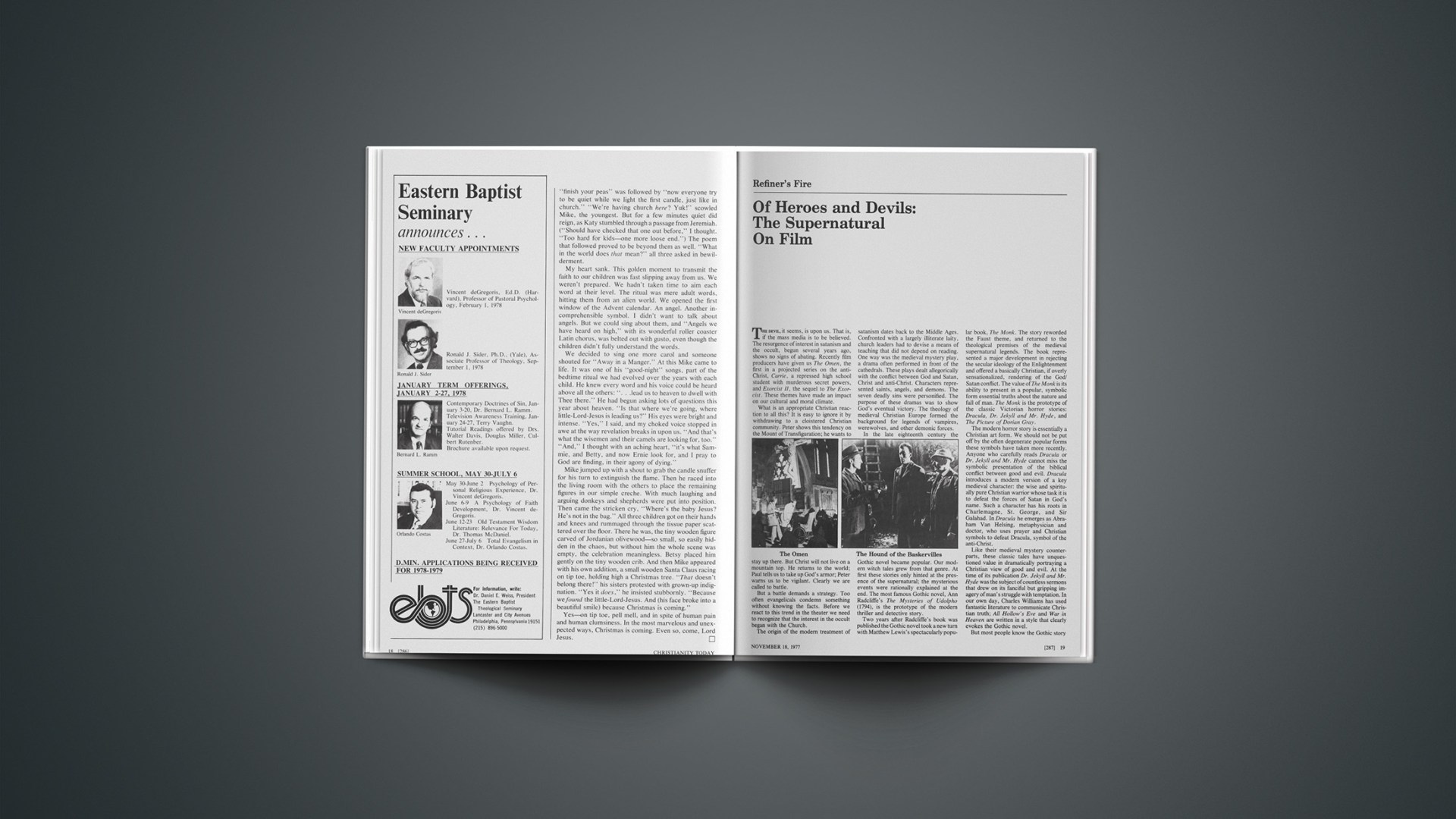
The devil, it seems, is upon us. That is, if the mass media is to be believed. The resurgence of interest in satanism and the occult, begun several years ago, shows no signs of abating. Recently film producers have given us The Omen, the first in a projected series on the anti-Christ, Carrie, a repressed high school student with murderous secret powers, and Exorcist II, the sequel to The Exorcist. These themes have made an impact on our cultural and moral climate.

What is an appropriate Christian reaction to all this? It is easy to ignore it by withdrawing to a cloistered Christian community. Peter shows this tendency on the Mount of Transfiguration; he wants to stay up there. But Christ will not live on a mountain top. He returns to the world; Paul tells us to take up God’s armor; Peter warns us to be vigilant. Clearly we are called to battle.

But a battle demands a strategy. Too often evangelicals condemn something without knowing the facts. Before we react to this trend in the theater we need to recognize that the interest in the occult began with the Church.

The origin of the modern treatment of satanism dates back to the Middle Ages. Confronted with a largely illiterate laity, church leaders had to devise a means of teaching that did not depend on reading. One way was the medieval mystery play, a drama often performed in front of the cathedrals. These plays dealt allegorically with the conflict between God and Satan, Christ and anti-Christ. Characters represented saints, angels, and demons. The seven deadly sins were personified. The purpose of these dramas was to show God’s eventual victory. The theology of medieval Christian Europe formed the background for legends of vampires, werewolves, and other demonic forces.

In the late eighteenth century the Gothic novel became popular. Our modera witch tales grew from that genre. At first these stories only hinted at the presence of the supernatural; the mysterious events were rationally explained at the end. The most famous Gothic novel, Ann Radcliffe’s The Mysteries of Udolpho (1794), is the prototype of the modern thriller and detective story.

Two years after Radcliffe’s book was published the Gothic novel took a new turn with Matthew Lewis’s spectacularly popular book, The Monk. The story reworded the Faust theme, and returned to the theological premises of the medieval supernatural legends. The book represented a major development in rejecting the secular ideology of the Enlightenment and offered a basically Christian, if overly sensationalized, rendering of the God/Satan conflict. The value of The Monk is its ability to present in a popular, symbolic form essential truths about the nature and fall of man. The Monk is the prototype of the classic Victorian horror stories: Dracula, Dr. Jekyll and Mr. Hyde, and The Picture of Dorian Gray.

The modern horror story is essentially a Christian art form. We should not be put off by the often degenerate popular forms these symbols have taken more recently. Anyone who carefully reads Dracula or Dr. Jekyll and Mr. Hyde cannot miss the symbolic presentation of the biblical conflict between good and evil. Dracula introduces a modern version of a key medieval character: the wise and spiritually pure Christian warrior whose task it is to defeat the forces of Satan in God’s name. Such a character has his roots in Charlemagne, St. George, and Sir Galahad. In Dracula he emerges as Abraham Van Helsing, metaphysician and doctor, who uses prayer and Christian symbols to defeat Dracula, symbol of the anti-Christ.

Like their medieval mystery counterparts, these classic tales have unquestioned value in dramatically portraying a Christian view of good and evil. At the time of its publication Dr. Jekyll and Mr. Hyde was the subject of countless sermons that drew on its fanciful but gripping imagery of man’s struggle with temptation. In our own day, Charles Williams has used fantastic literature to communicate Christian truth; All Hollow’s Eve and War in Heaven are written in a style that clearly evokes the Gothic novel.

But most people know the Gothic story line more through films than books. Several critics think that Gothic films serve as an index to a nation or culture’s ultimate hopes, fears, and beliefs. Siegfried Kracaur, for example, in his book From Calgari to Hitler argues that the German fantasy film of the twenties shows the mind set that surfaced in the thirties as Nazism. From 1920 to 1926 the Germans filmed popular versions of Dracula and Dr. Jekyll and Mr. Hyde, as well as specific German legends such as The Golem and The Student of Prague. A film like The Golem already contains the idea that the Jews traffic in occult forces, an idea that Hitler could transform into the “Jewish world conspiracy.”

Interestingly enough the Van Helsing hero is not really found in these films, not even in the Dracula of 1922. Much more evident is his Victorian first cousin, Sherlock Holmes. Though not a “Christian warrior” Holmes does reflect a Christian moral world view. Despite being a rationalist hero, he does have brushes with apparently supernatural figures out of medieval legend, especially as his creator Arthur Conan Doyle became more interested in spiritualism and psychic phenomena. Holmes’s most supernatural adventure The Hound of the Baskervilles was filmed numerous times in Germany during the rise of Nazism and a copy of the film was found in Hitler’s personal library.

The Gothic film has usually surfaced in times of national distress. After post-war Germany the next wave appeared in the United States during the depression (1931–1936). The most significant films of this era, Dracula, Frankenstein, Dr. Jekyll and Mr. Hyde are quite theological. The 1932 Jekyll presents the futility of justification by good works more graphically than any church-produced film. The Van Helsing of this era was the fine character actor Edward Van Sloan. Slow and deliberate in manner, he gave the impression of a wise old teacher. People have objected that the Dracula films present Christian symbols as little more than white magic talismen. And there is some truth to this. Nonetheless, with Dracula and the rest of the Gothic tradition we are dealing with folklore and symbolism. Since Dracula is only a symbol, Christianity, too, is presented in symbolic form through the cross, the Bible, or Holy Water. Symbols cannot present all biblical truth, but they can communicate certain truths and for this reason they are found in Scripture itself. The effect is lost when we try to be literal about such imagery; this is like asking the date of “once upon a time.”

From 1936 to 1939 very few Gothic films were produced. The outbreak of World War II brought another wave of them. Sequels to the earlier films were produced (Son of Frankenstein, Son of Dracula). Earlier classics were refilmed in spectacular fashion: The Hound of the Baskervilles (1939), Dr. Jekyll and Mr. Hyde (1941), The Picture of Dorian Gray (1944). Smaller productions with penny dreadful titles like The Return of the Vampire (1944) dealt effectively with Satan, temptation, and redemption and used medieval symbolism.

After World War II the Gothic film lay dormant until the late fifties when it reappeared in Great Britain. Terence Fisher, considered by some people the greatest director in the history of film, graphically used Christian symbols. No one has ever done it so explicitly, and that occasionally flawed his films. Still, Fisher gave film one of its greatest Christian warriors. His Van Helsing, played by the distinguished actor Peter Cushing, is a virile crusader against satanic forces. New Testament scholars would be astounded to hear Fisher’s Van Helsing tracing the origin of vampirism back to the second-century mystery religions. Peter Cushing also played a metaphysically oriented Sherlock Holmes for Fisher in a fine remake of the Hound of the Baskervilles. Fisher’s heroes are practical men who realize the satanic nature of evil and the need to combat it on a spiritual level. Despite some misfires Fisher produced a series of minor masterpieces: Dracula (1958), Revenge of Frankenstein (1958) (Fisher’s Frankenstein films were about the scientist, not the monster, and represent an attack on secular science’s more grandiose assumptions), Brides of Dracula (1960), Curse of the Werewolf (1961), and The Devil Rides Out (1967). Fisher’s successes were widely imitated throughout the sixties.

That brings us to the present Gothic film. No longer appealing only to a select audience, these films now play to a general public that is often ignorant of their roots and their long history. The current wave of Gothic films began in 1967 with Roman Polanski’s Dance of the Vampires (or Fearless Vampire Killers), a spoof of Fisher’s Dracula films. This film introduces two themes that break with all Gothic film up to that point. The first is the eclipse of the Gothic hero. The second is the triumph of evil. Polanski’s film portrays Van Helsing as a blundering dolt whose misguided efforts actually aid evil. Polanski further developed these themes the following year in Rosemary’s Baby. Here the closest thing to a Van Helsing figure is Rosemary’s actor friend, portrayed by Maurice Evans. He falls victim to a witch’s curse and Rosemary is left alone with the witches. She gives birth to the anti-Christ and evil triumphs. That same year, 1968, young British director Michael Reeves made a remarkable film dealing with the seventeenth century witch hunts. Witchfinder General shows good and evil feeding off each other; the distinction between the two is blurred.

The Exorcist (1973) borrowed heavily from Fisher and Polanski. Father Merrin is an old and infirm Van Helsing figure. At first he shows strength in combating the demon, but his heart gives out before the exorcism can be completed. Perhaps the best adjective to describe this film is ugly. The symbolic character of the old Gothic films is gone. Whereas the older films caught something of the cosmic nature of evil, this realistic approach reduced satanic activity to the possession of a small girl in an otherwise secular world. The metaphor is mixed and it is not surprising that the ending is ambiguous. Fisher went to see The Exorcist reluctantly and was appalled by it.

Current films such as The Omen and Carrie continue this trend. The fairy tale quality of the earlier films, often their saving grace, is missing. The Omen is filled with classic Gothic trappings, but the book of Revelation is treated like a medieval werewolf legend. The primary effect of the story is to suggest that the anti-Christ is a myth, not in the sense of a symbol that stands for a greater reality but as a fable that has no reality. The Van Helsing figure once again is old and weak; evil triumphs. Brian De Palma’s Carrie is another step down. Its Christian symbols are a hodgepodge of Baptist fundamentalism and Roman Catholicism. The extreme viciousness of many of its characters is never adequately explained and their general fiendishness makes the last half hour of the film an unrelenting blood bath. Here the lines of good and evil are so blurred that it’s impossible to speak of a conflict between them.

If Van Helsing has fared poorly of late, Sherlock Holmes has done no better. Portrayed by Basil Rathbone and Peter Cushing, Holmes could serve as a symbol of Christian morality. Few films in the present Holmes revival have anything to do with the Conan Doyle stories. Holmes, like Van Helsing, is weakened and compromised. Film directors reject a strong moral symbol. At the same time people seem fascinated by the character. The symbol may no longer stand for a moral reality but people somehow wish it still did.

While we should criticize the current excesses of the Gothic film, we should also heed its warnings. These films may only be reflecting our present moral climate. Why has the triumph of evil apparently become a resounding symbol of our time? The question is not easy. Part of the answer lies with the incessant accounts of war, corruption, and torture that seem destined to dominate the news for the remainder of this century. The symbol of a “Christian warrior” is only intelligible if in fact there are Christian warriors visibly “putting on the whole armor of God.”

Paul Leggett teaches at the Seminario Biblico Latinoamericano in San Jose, Costa Rica.

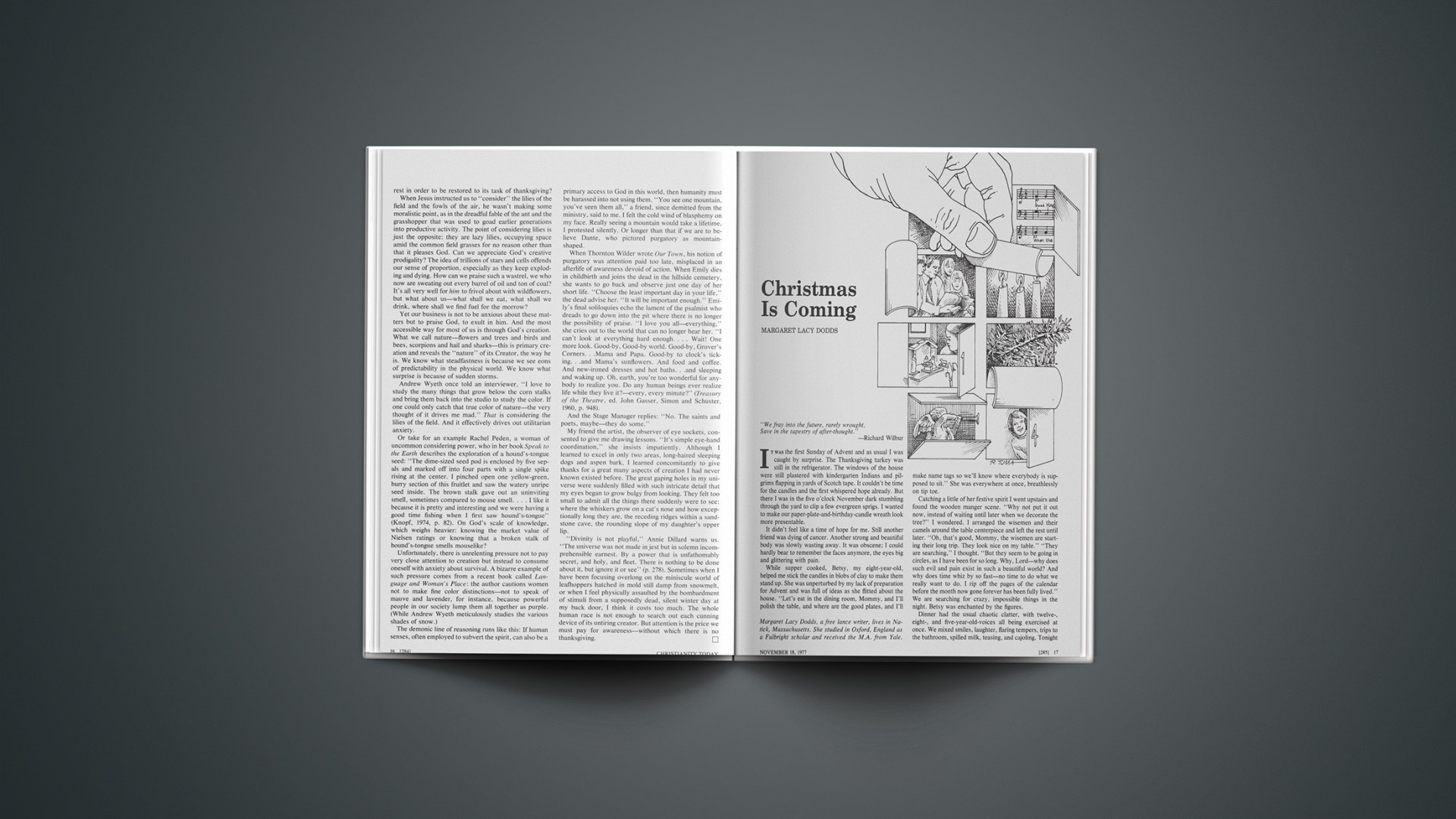
Christmas Is Coming

“We fray into the future, rarely wrought,

Save in the tapestry of after-thought.”

—Richard Wilbur

It was the first Sunday of Advent and as usual I was caught by surprise. The Thanksgiving turkey was still in the refrigerator. The windows of the house were still plastered with kindergarten Indians and pilgrims flapping in yards of Scotch tape. It couldn’t be time for the candles and the first whispered hope already. But there I was in the five o’clock November dark stumbling through the yard to clip a few evergreen sprigs. I wanted to make our paper-plate-and-birthday-candle wreath look more presentable.

It didn’t feel like a time of hope for me. Still another friend was dying of cancer. Another strong and beautiful body was slowly wasting away. It was obscene; I could hardly bear to remember the faces anymore, the eyes big and glittering with pain.

While supper cooked, Betsy, my eight-year-old, helped me stick the candles in blobs of clay to make them stand up. She was unperturbed by my lack of preparation for Advent and was full of ideas as she flitted about the house. “Let’s eat in the dining room, Mommy, and I’ll polish the table, and where are the good plates, and I’ll make name tags so we’ll know where everybody is supposed to sit.” She was everywhere at once, breathlessly on tip toe.

Catching a little of her festive spirit I went upstairs and found the wooden manger scene. “Why not put it out now, instead of waiting until later when we decorate the tree?” I wondered. I arranged the wisemen and their camels around the table centerpiece and left the rest until later. “Oh, that’s good, Mommy, the wisemen are starting their long trip. They look nice on my table.” “They are searching,” I thought. “But they seem to be going in circles, as I have been for so long. Why, Lord—why does such evil and pain exist in such a beautiful world? And why does time whiz by so fast—no time to do what we really want to do. I rip off the pages of the calendar before the month now gone forever has been fully lived.” We are searching for crazy, impossible things in the night. Betsy was enchanted by the figures.

Dinner had the usual chaotic clatter, with twelve-, eight-, and five-year-old-voices all being exercised at once. We mixed smiles, laughter, flaring tempers, trips to the bathroom, spilled milk, teasing, and cajoling. Tonight “finish your peas” was followed by “now everyone try to be quiet while we light the first candle, just like in church.” “We’re having church here? Yuk!” scowled Mike, the youngest. But for a few minutes quiet did reign, as Katy stumbled through a passage from Jeremiah. (“Should have checked that one out before,” I thought. “Too hard for kids—one more loose end.”) The poem that followed proved to be beyond them as well. “What in the world does that mean?” all three asked in bewilderment.

My heart sank. This golden moment to transmit the faith to our children was fast slipping away from us. We weren’t prepared. We hadn’t taken time to aim each word at their level. The ritual was mere adult words, hitting them from an alien world. We opened the first window of the Advent calendar. An angel. Another incomprehensible symbol. I didn’t want to talk about angels. But we could sing about them, and “Angels we have heard on high,” with its wonderful roller coaster Latin chorus, was belted out with gusto, even though the children didn’t fully understand the words.

We decided to sing one more carol and someone shouted for “Away in a Manger.” At this Mike came to life. It was one of his “good-night” songs, part of the bedtime ritual we had evolved over the years with each child. He knew every word and his voice could be heard above all the others: “… lead us to heaven to dwell with Thee there.” He had begun asking lots of questions this year about heaven. “Is that where we’re going, where little-Lord-Jesus is leading us?” His eyes were bright and intense. “Yes,” I said, and my choked voice stopped in awe at the way revelation breaks in upon us. “And that’s what the wisemen and their camels are looking for, too.” “And,” I thought with an aching heart, “it’s what Sammie, and Betty, and now Ernie look for, and I pray to God are finding, in their agony of dying.”

Mike jumped up with a shout to grab the candle snuffer for his turn to extinguish the flame. Then he raced into the living room with the others to place the remaining figures in our simple creche. With much laughing and arguing donkeys and shepherds were put into position. Then came the stricken cry, “Where’s the baby Jesus? He’s not in the bag.” All three children got on their hands and knees and rummaged through the tissue paper scattered over the floor. There he was, the tiny wooden figure carved of Jordanian olivewood—so small, so easily hidden in the chaos, but without him the whole scene was empty, the celebration meaningless. Betsy placed him gently on the tiny wooden crib. And then Mike appeared with his own addition, a small wooden Santa Claus racing on tip toe, holding high a Christmas tree. “That doesn’t belong there!” his sisters protested with grown-up indignation. “Yes it does,” he insisted stubbornly. “Because we found the little-Lord-Jesus. And (his face broke into a beautiful smile) because Christmas is coming.”

Yes—on tip toe, pell mell, and in spite of human pain and human clumsiness. In the most marvelous and unexpected ways, Christmas is coming. Even so, come, Lord Jesus.

D. Bruce Lockerbie is chairman of the Fine Arts department at The Stony Brook School, Stony Brook, New York. This article is taken from his 1976 lectures on Christian Life and Thought, delivered at Conservative Baptist Theological Seminary in Denver, Colorado.

The Price of Praise

I have a friend, an artist, who says the first thing she notices about a person is the colored splotch on the inner part of the eye socket where it curves upward to become a part of the nose, whether it is blue or purple or maybe slightly green. When she told me this, it startled me, and I was glad I was wearing glasses that hid my own little spot of color until I could go home and check it out for myself. If she had said that the first thing she noticed was the firmness of a person’s handshake or the warmth of his smile or any of a dozen other characteristics by which we are admonished to judge people, I would not have felt self-conscious. But the inside of one’s eye socket? That suddenly seemed a naked, vulnerable spot.

Charles Williams, in Descent of the Dove (Oxford, 1939, pp. 57–62), says people have sought God in two seemingly contradictory ways: through the senses (that is, by apprehending his creation) and through the suppression of the senses, what is called the via negativa. “The Way of Affirmation was to develop great art and romantic love and marriage and philosophy and social justice,” he says; “the Way of Rejection was to break out continually in the profound mystical documents of the soul, the records of the great psychological masters of Christendom.”

But the way of rejection is one that few have followed. Williams cites an ancient canon, dating from the second or third century, to illustrate the church’s official attitude toward the material world: “If any bishop or priest or deacon, or any cleric whatsoever, shall refrain from marriage and from meat and from wine, not for the sake of discipline but with contempt, and, forgetful that all things are very good and that God made man male and female, blasphemously inveighs against the creation, let him either be corrected or deposed and turned out of the Church. And so with a layman.” (Italics mine.)

Now in no way would I want to undermine the validity of the via negativa. It has had little enough honor, especially in the Protestant tradition, where deprivation of the senses is usually “for your own good” rather than for God’s good. Indeed, how any good could derive from fasting, retreat, silence, or celibacy (despite our Lord’s practice of them all) has often escaped our notice as we clucked our tongues over the Roman monastic tradition. At least part of the success of the recent rapproachement between Protestants and Catholics can be attributed to the changes by which nuns dress like “normal people” and priests insist on matrimonial rights.

However, our defense of the former way, access to God through the full use of our senses, has of late been truncated and confused. The reasons are numerous and tiresome. For a start, most of the population is surrounded not by primary creation—the things that only God can make, such as trees—but by secondary or even tertiary creation—the things that God’s creatures can make or the things that God’s creatures’ creations, i.e., machines, can make. And those secondary and tertiary products are often shoddy enough to merit only the cursory attention they get.

So that when my friend speaks of the subtle colors on human faces, it strikes us as extraordinary, a little odd, even faintly amusing, but not of the earth-shaking importance it truly is. For how are we to give thanks for something we’ve never noticed? How shall we praise God for the world we’ve not paid proper attention to? Our practice of pigeonholing our praise into broad categories—family, friends, country, health, and the like—reminds me of the all-purpose five-second prayer I devised as a child for use on cold nights: “God bless everybody in the world. Amen.” When we pray in terms of everybody-in-the-world, we imagine ourselves to be dealing with a divine, omniscient bureaucracy. But God doesn’t love everybody-in-the-world. He loves each of us singly, knowing the hairs of our heads and the shadows of our eye sockets.

One of the chief champions of this way of the senses in the Protestant tradition is, surprisingly, Jonathan Edwards, whose reputation as a dour example of asceticism is due to his overly anthologized and journalistically interpreted sermon, “Sinners in the Hands of an Angry God.” On the contrary, Edwards’s early attention was absorbed by the natural sciences, the careful observation of spiders being his specialty. But natural science was not a mere sideline to his theological thought. His scrutiny of creation provided the full heart out of which he wrote his doctrine of creation, with which physics is only now catching up. “God not only created all things, and gave them being at first, but continually upholds them in being,” he says. “It will certainly follow from these things, that God’s preserving created things in being is perfectly equivalent to a continued creation, or to his creating those things out of nothing at each moment of their existence” (Works, II, 487 ff.).

Think of it. With each breath we take, God is again pumping into our lungs his exhalation of the breath of life, just as he did for Adam. If he withdrew his breath from the bubble of our world, it would instantly collapse. We are not a clock, once wound, running down. Developing this sense of continuous creation pulls the mask from our eyes, enables us to see creation hanging on God’s breath, dependent, contingent. And the precariousness makes it all the more precious.

The world’s existence hangs on God’s continuing to pay attention to it, and to be properly thankful we in turn must pay rapt attention to his crafting. But there are dangers. In Pilgrim at Tinker Creek, Annie Dillard tells of her meticulous search of her surroundings in rural Virginia, from the single-cell algae in her pond to the view of Alpha Centauri from her backyard. Sometimes the evidence is devastating: nature is wasteful, extravagant, cruel, predatory. Never does the evidence point to chance, mere random agitation of atoms; and sometimes it points to the universe as the creation of a madman, a sadist. Yet it is beauty itself that is ultimately the answer to her questions, the fact that we desire and seek out beauty, that we separate the beautiful from the broken in creation. “No, I’ve gone through this a million times, beauty is not a hoax,” she testifies. “Beauty is real. I would never deny it. The appalling thing is that I forget it” (Bantam, 1974, p. 273). It takes attention, rapt attention, to keep that reality before us. But our attention span is limited. Is this not perhaps the meaning of sleep, that dark bed of mystery in which our consciousness must rest in order to be restored to its task of thanksgiving?

When Jesus instructed us to “consider” the lilies of the field and the fowls of the air, he wasn’t making some moralistic point, as in the dreadful fable of the ant and the grasshopper that was used to goad earlier generations into productive activity. The point of considering lilies is just the opposite: they are lazy lilies, occupying space amid the common field grasses for no reason other than that it pleases God. Can we appreciate God’s creative prodigality? The idea of trillions of stars and cells offends our sense of proportion, especially as they keep exploding and dying. How can we praise such a wastrel, we who now are sweating out every barrel of oil and ton of coal? It’s all very well for him to frivol about with wildflowers, but what about us—what shall we eat, what shall we drink, where shall we find fuel for the morrow?

Yet our business is not to be anxious about these matters but to praise God, to exult in him. And the most accessible way for most of us is through God’s creation. What we call nature—flowers and trees and birds and bees, scorpions and hail and sharks—this is primary creation and reveals the “nature” of its Creator, the way he is. We know what steadfastness is because we see eons of predictability in the physical world. We know what surprise is because of sudden storms.

Andrew Wyeth once told an interviewer, “I love to study the many things that grow below the corn stalks and bring them back into the studio to study the color. If one could only catch that true color of nature—the very thought of it drives me mad.” That is considering the lilies of the field. And it effectively drives out utilitarian anxiety.

Or take for an example Rachel Peden, a woman of uncommon considering power, who in her book Speak to the Earth describes the exploration of a hound’s-tongue seed: “The dime-sized seed pod is enclosed by five sepals and marked off into four parts with a single spike rising at the center. I pinched open one yellow-green, burry section of this fruitlet and saw the watery unripe seed inside. The brown stalk gave out an uninviting smell, sometimes compared to mouse smell.… I like it because it is pretty and interesting and we were having a good time fishing when I first saw hound’s-tongue” (Knopf, 1974, p. 82). On God’s scale of knowledge, which weighs heavier: knowing the market value of Nielsen ratings or knowing that a broken stalk of hound’s-tongue smells mouselike?

Unfortunately, there is unrelenting pressure not to pay very close attention to creation but instead to consume oneself with anxiety about survival. A bizarre example of such pressure comes from a recent book called Language and Woman’s Place: the author cautions women not to make fine color distinctions—not to speak of mauve and lavender, for instance, because powerful people in our society lump them all together as purple. (While Andrew Wyeth meticulously studies the various shades of snow.)

The demonic line of reasoning runs like this: If human senses, often employed to subvert the spirit, can also be a primary access to God in this world, then humanity must be harassed into not using them. “You see one mountain, you’ve seen them all,” a friend, since demitted from the ministry, said to me. I felt the cold wind of blasphemy on my face. Really seeing a mountain would take a lifetime, I protested silently. Or longer than that if we are to believe Dante, who pictured purgatory as mountainshaped.

When Thornton Wilder wrote Our Town, his notion of purgatory was attention paid too late, misplaced in an afterlife of awareness devoid of action. When Emily dies in childbirth and joins the dead in the hillside cemetery, she wants to go back and observe just one day of her short life. “Choose the least important day in your life,” the dead advise her. “It will be important enough.” Emily’s final soliloquies echo the lament of the psalmist who dreads to go down into the pit where there is no longer the possibility of praise. “I love you all—everything,” she cries out to the world that can no longer hear her. “I can’t look at everything hard enough.… Wait! One more look. Good-by, Good-by world. Good-by, Grover’s Comers … Mama and Papa. Good-by to clock’s ticking … and Mama’s sunflowers. And food and coffee. And new-ironed dresses and hot baths … and sleeping and waking up. Oh, earth, you’re too wonderful for anybody to realize you. Do any human beings ever realize life while they live it?—every, every minute?” (Treasury of the Theatre, ed. John Gasser, Simon and Schuster, 1960, p. 948).

And the Stage Manager replies: “No. The saints and poets, maybe—they do some.”

My friend the artist, the observer of eye sockets, consented to give me drawing lessons. “It’s simple eye-hand coordination,” she insists impatiently. Although I learned to excel in only two areas, long-haired sleeping dogs and aspen bark, I learned concomitantly to give thanks for a great many aspects of creation I had never known existed before. The great gaping holes in my universe were suddenly filled with such intricate detail that my eyes began to grow bulgy from looking. They felt too small to admit all the things there suddenly were to see: where the whiskers grow on a cat’s nose and how exceptionally long they are, the receding ridges within a sandstone cave, the rounding slope of my daughter’s upper lip.

“Divinity is not playful,” Annie Dillard warns us. “The universe was not made in jest but in solemn incomprehensible earnest. By a power that is unfathomably secret, and holy, and fleet. There is nothing to be done about it, but ignore it or see” (p. 278). Sometimes when I have been focusing overlong on the miniscule world of leafhoppers hatched in mold still damp from snowmelt, or when I feel physically assaulted by the bombardment of stimuli from a supposedly dead, silent winter day at my back door, I think it costs too much. The whole human race is not enough to search out each cunning device of its untiring creator. But attention is the price we must pay for awareness—without which there is no thanksgiving.

D. Bruce Lockerbie is chairman of the Fine Arts department at The Stony Brook School, Stony Brook, New York. This article is taken from his 1976 lectures on Christian Life and Thought, delivered at Conservative Baptist Theological Seminary in Denver, Colorado.

Where Have All the Churches Gone?

Last summer I led a group of twenty college students on a cultural tour through the Far East. For three weeks we traveled in the People’s Republic of China by train and bus through six provinces. We saw schools, communes, factories, museums, exhibition halls, private homes, and numerous historical and scenic sites. Authorities gave us ample information on agriculture, industry, education, health care, wages, history, politics, revolution, and production. And we had a number of private and public discussions with our Chinese hosts. Not content with the planned tour, many of us played basketball, volleyball, table tennis, and fris-bees with the Chinese people. The language barrier—most of the students had had some Chinese—disappeared in laughter and good will. The one ingredient missing was religion.

The China I remember was dotted with temples, pagodas, and churches with a constant flow of worshipers through their doors. Yet a few months ago I saw no signs that the Chinese have any interest in religion, much less Christianity. I saw no open churches or temples. Religion is not taught in schools and religious books are not sold in the bookstores. No one discusses religion, either publicly or privately.

I looked for Catholic churches. I found civic centers, social institutions, schools, and stores. I saw fallen or tilted crosses on roof tops and wondered whether the younger generation knows what they mean. I walked through my old high school grounds; the school was founded by the Marianist brothers. We rode by my former seminary with its beautiful Gothic cathedral. The buildings are almost intact—just as I remember them. But the atmosphere is different. So are the people. The wall posters, slogans, and decorations are new. Chairman Mao’s portrait hangs high.

My students and I visited an ancient Buddhist monastery, which at one time had five hundred monks living in it. Now it is a mere historical relic. Only visitors view faces of Buddhas carved on the cliffs, the dilapidated pagodas, the cemetery, and the winding paths. We also saw a beautiful Taoist monastery, which was built during the Sung dynasty and restored in Ming. Its upturning and curved roofs with lines of mythological animals, its wood carvings, statues, and wall paintings are marvelous. Our guides enthusiastically called our attention to the structure, the artistic value, and the refined skill with which these objects were created. But on the religious meaning? Not a word. We asked questions about the significance of the wall paintings. No answer. When I explained the meanings of the scenes to my students the Chinese guides were surprised.

What happened to the monks? “Tamen huansu le,” they replied: they became secularized. Unaware that I am a Catholic priest, our host in Shanghai told me of a Catholic bishop who was tried because authorities found weapons and anti-communist literature at his home. He hastened to add that “there is freedom of belief in China, but there is also freedom of unbelief, and freedom of speaking against belief.” I saw the results of that principle.

After twenty-five years of silence people under forty are devoid of religious knowledge. One of our guides had never heard the name of Christ. When she saw one of my students reading The Last Temptation of Christ, by Nikos Kazantzakis, we got into a discussion about Jesus. What appalled me even more was the situation in my own family. I spent three days with my brothers. They were raised in a devout Catholic family, which produced two priests and one religious sister. As children they went to church, said their prayers, and studied their catechism. Now, like anybody else in the People’s Republic of China, they are indifferent, uninterested, and ignorant. When I told them I had become a priest, I saw no expression on their faces. My seventy-nine-year-old mother, however, has kept her faith. She asked me about the church in the United States, rejoiced that I am a priest, and treasured the medal we gave her. If most of my family is no longer practicing Christianity, I can easily understand what has happened to the whole of China.

D. Bruce Lockerbie is chairman of the Fine Arts department at The Stony Brook School, Stony Brook, New York. This article is taken from his 1976 lectures on Christian Life and Thought, delivered at Conservative Baptist Theological Seminary in Denver, Colorado.

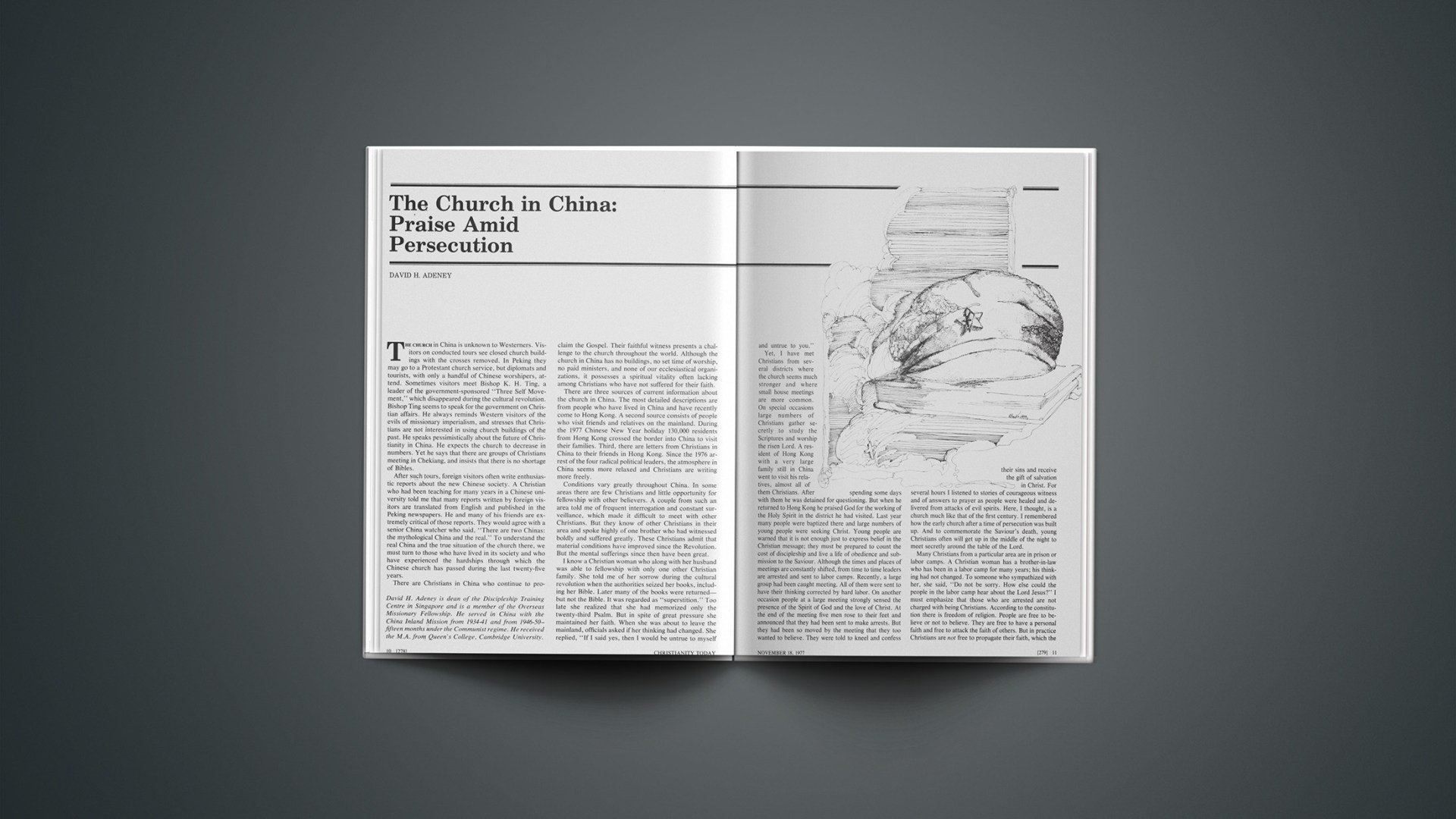
The Church in China: Praise amid Persecution

The church in China is unknown to Westerners. Visitors on conducted tours see closed church buildings with the crosses removed. In Peking they may go to a Protestant church service, but diplomats and tourists, with only a handful of Chinese worshipers, attend. Sometimes visitors meet Bishop K. H. Ting, a leader of the government-sponsored “Three Self Movement,” which disappeared during the cultural revolution. Bishop Ting seems to speak for the government on Christian affairs. He always reminds Western visitors of the evils of missionary imperialism, and stresses that Christians are not interested in using church buildings of the past. He speaks pessimistically about the future of Christianity in China. He expects the church to decrease in numbers. Yet he says that there are groups of Christians meeting in Chekiang, and insists that there is no shortage of Bibles.

After such tours, foreign visitors often write enthusiastic reports about the new Chinese society. A Christian who had been teaching for many years in a Chinese university told me that many reports written by foreign visitors are translated from English and published in the Peking newspapers. He and many of his friends are extremely critical of those reports. They would agree with a senior China watcher who said, “There are two Chinas: the mythological China and the real.” To understand the real China and the true situation of the church there, we must turn to those who have lived in its society and who have experienced the hardships through which the Chinese church has passed during the last twenty-five years.

There are Christians in China who continue to proclaim the Gospel. Their faithful witness presents a challenge to the church throughout the world. Although the church in China has no buildings, no set time of worship, no paid ministers, and none of our ecclesiastical organizations, it possesses a spiritual vitality often lacking among Christians who have not suffered for their faith.

There are three sources of current information about the church in China. The most detailed descriptions are from people who have lived in China and have recently come to Hong Kong. A second source consists of people who visit friends and relatives on the mainland. During the 1977 Chinese New Year holiday 130,000 residents from Hong Kong crossed the border into China to visit their families. Third, there are letters from Christians in China to their friends in Hong Kong. Since the 1976 arrest of the four radical political leaders, the atmosphere in China seems more relaxed and Christians are writing more freely.

Conditions vary greatly throughout China. In some areas there are few Christians and little opportunity for fellowship with other believers. A couple from such an area told me of frequent interrogation and constant surveillance, which made it difficult to meet with other Christians. But they know of other Christians in their area and spoke highly of one brother who had witnessed boldly and suffered greatly. These Christians admit that material conditions have improved since the Revolution. But the mental sufferings since then have been great.

I know a Christian woman who along with her husband was able to fellowship with only one other Christian family. She told me of her sorrow during the cultural revolution when the authorities seized her books, including her Bible. Later many of the books were returned—but not the Bible. It was regarded as “superstition.” Too late she realized that she had memorized only the twenty-third Psalm. But in spite of great pressure she maintained her faith. When she was about to leave the mainland, officials asked if her thinking had changed. She replied, “If I said yes, then I would be untrue to myself and untrue to you.”

Yet, I have met Christians from several districts where the church seems much stronger and where small house meetings are more common.

On special occasions large numbers of Christians gather secretly to study the Scriptures and worship the risen Lord. A resident of Hong Kong with a very large family still in China went to visit his relatives, almost all of them Christians. After spending some days with them he was detained for questioning. But when he returned to Hong Kong he praised God for the working of the Holy Spirit in the district he had visited. Last year many people were baptized there and large numbers of young people were seeking Christ. Young people are warned that it is not enough just to express belief in the Christian message; they must be prepared to count the cost of discipleship and live a life of obedience and submission to the Saviour. Although the times and places of meetings are constantly shifted, from time to time leaders are arrested and sent to labor camps. Recently, a large group had been caught meeting. All of them were sent to have their thinking corrected by hard labor. On another occasion people at a large meeting strongly sensed the presence of the Spirit of God and the love of Christ. At the end of the meeting five men rose to their feet and announced that they had been sent to make arrests. But they had been so moved by the meeting that they too wanted to believe. They were told to kneel and confess their sins and receive the gift of salvation in Christ. For several hours I listened to stories of courageous witness and of answers to prayer as people were healed and delivered from attacks of evil spirits. Here, I thought, is a church much like that of the first century. I remembered how the early church after a time of persecution was built up. And to commemorate the Saviour’s death, young Christians often will get up in the middle of the night to meet secretly around the table of the Lord.

Many Christians from a particular area are in prison or labor camps. A Christian woman has a brother-in-law who has been in a labor camp for many years; his thinking had not changed. To someone who sympathized with her, she said, “Do not be sorry. How else could the people in the labor camp hear about the Lord Jesus?” I must emphasize that those who are arrested are not charged with being Christians. According to the constitution there is freedom of religion. People are free to believe or not to believe. They are free to have a personal faith and free to attack the faith of others. But in practice Christians are not free to propagate their faith, which the government regards as a superstition. Since the holding of illegal meetings is strictly forbidden, those who are caught taking part in an illegal gathering are accused of being reactionary and anti-revolutionary. Many people who come from known Christian families find themselves on a blacklist and are discriminated against in many ways. Despite the hardships and dangers of a courageous Christian witness, the church continues to grow. When a Christian woman died, about 1,000 people attended her funeral. Authorities hesitate to interfere with funeral services, so the dead woman’s faith in Jesus could be proclaimed and the risen Saviour praised.

Shortly before my wife and I left Hong Kong a young man who had formerly served as a red guard described how he had come to know Christ. He had traveled to Peking and other parts of China during the cultural revolution. Although he had come from a Christian family, only when he returned to the city after a period of work in the country did he become a Christian. His home town has more freedom than in other places, and a number of groups meet regularly. With thousands of Christians in that city, there will be a group meeting in some home almost every evening. The elderly have little difficulty when they worship in small family groups. Young people have more of a problem. Some young Christians have been arrested and shipped to labor camps for short periods. But the Christians in that city are better organized than in most areas. Young people are divided into district groups and attend leadership-training sessions. They usually do not take Bibles to such meetings, since an official interruption would endanger their copies of the Scriptures. Before the meeting, the leader will write out the passage to be studied and make carbon copies. Thus after the study of each book of the Bible every person has his own handwritten copy. What is happening in that city may be happening on a smaller scale in other places. A man from a city some distance away from that young man’s home visited him and saw his Bible. Immediately he asked if he was a Christian. Hearing that he was, the visitor confessed that he too believed and held a meeting in his home.

Faith is often spread by reports of people being healed in answer to prayer. Once when a member of a Christian family was sick a large group of Christians gathered to pray. They were interrupted by Communist officials who asked them what they were doing and who told them that it was illegal to have such a gathering. They ordered the group to disperse. One of the officials, who had arrested a number of Christians, inquired further into their activities. On being told that in time of trouble or sickness Christians prayed for each other, he asked if they would be willing to pray for him. He had cancer. The Christians agreed. The official was healed and converted. Later he was arrested.

A young Christian man from another city described how difficult it was to have regular meetings. Yet he had a broad knowledge of the Scriptures. When I asked him how he knew the Bible so well, he told me of visits to other Christian homes to study the Bible with fellow believers. Christians in that particular city love and support each other. Although there was no organized church, believers tithed their money and were always ready to help needy Christians.

When Chinese Christians visit their mainland relatives, they find it difficult to contact Christians outside their immediate circle of family and friends. Some people can visit their relatives’ homes. Others, whose family members live in areas closed to visitors, have to meet their relatives in hotels. One of our friends visited Christian relatives who had suffered much during the cultural revolution. She was warned not to speak freely in the hotel room and to avoid any sensitive matters when the children were present. Visitors must realize that when they talk to people other than their own families those persons will probably be questioned later. Christians often take with them one or two copies of the Bible and perhaps a book such as Streams in the Desert, which is in much demand. Usually customs officials will alllow people to pass with one or two Bibles, but an elderly Chinese woman had her Bible thrown to the ground and described as superstition.

Although the message of the Gospel is carried by Christian radio broadcasts, it is impossible to estimate how many people are able to listen. A Christian was encouraged to meet a girl on a train who said she had become a Christian through listening to a broadcast. Another visitor learned of a family of new Christians who were being strengthened through Christian broadcasts.

During the last few months letters from Christians to friends in Hong Kong have contained more references to their faith than in the past. A young woman wrote: “My time for studying is very limited. I hope you will pray for me and ask the Lord to give me intelligence and wisdom, also to open my heart to understand his Word. It is very precious and we should carefully study it in order to have understanding.” An old man, rejoicing in the Lord, closed his letter with these words: “Whether old or young, the most important thing is to be God’s servant and carry out his will throughout one’s life. No matter at what time or in what place, we must always be prepared to meet God.”

No one knows how many Christians there are in China today, but we have ample evidence to make us confident that scattered in many parts of that land are small groups of Christians who worship the living Lord. We can learn new lessons of faith from Christians in China and we are responsible to take part in a ministry of intercession. “Upon your walls, O Jerusalem, I have set watchmen; all the day and all the night they shall never be silent. You who put the Lord in remembrance, take no rest, and give him no rest until he establishes Jerusalem and makes it a praise in the earth” (Isa. 62:6–7).

D. Bruce Lockerbie is chairman of the Fine Arts department at The Stony Brook School, Stony Brook, New York. This article is taken from his 1976 lectures on Christian Life and Thought, delivered at Conservative Baptist Theological Seminary in Denver, Colorado.

Eutychus and His Kin: November 18, 1977

A Seminary That Changed History

STUDENT: I can’t outline what you say.

TEACHER: Life and thought and conversation seldom conform to an outline.

STUDENT: But that makes it hard to prepare for the exam.

TEACHER: What exam?

STUDENT: The one at the end of your course.

TEACHER: You’ll be taking my exams the rest of your life.

STUDENT: I don’t understand a lot of what you’re teaching us.

TEACHER: You won’t for three years.

STUDENT: That’s the whole course.

TEACHER: No, it’s only the beginning of the course.

STUDENT: Do you have any idea what my class standing will be?

TEACHER: You’ll fail the course, along with the rest. But then all of you will turn the world upside down. Except one.

STUDENT: When we’ve finished, will we know as much as the Pharisees?

TEACHER: No, you won’t know as much, but you’ll be changed. Do you want to be changed?

STUDENT: I think so. Is your teaching relevant?

TEACHER: Is it true?

STUDENT: You seem to throw questions back at me instead of answering them.

TEACHER: That’s because the answers are in you, not in me.

STUDENT: Will we see you in class tomorrow?

TEACHER: The class continues at supper and the campfire tonight. Did you think I only taught words?

STUDENT: Is there an assignment?

TEACHER: Yes, help me catch some fish for supper.

EUTYCHUS VIII

A Question Of Volume

I note with amused interest your issue of September 9, wherein Wesley Pippert of UPI, in his article “Viewing the Family From the Oval Office,” reports that I “boisterously” asked President Carter “if it is true that although he is monogamous, he never held anything against staff members who were promiscuous.”

I will forgive Pippert the split infinitive (!) “boisterously asked,” because by striking contrast to the misleading report of the Washington Post, he has correctly reported that it was White House “staff members attending the news conference (who) applauded” President Carter’s statement.… Actually my question was: “Mr. President, Panax Newspapers has a tape-recorded interview with Dr. Peter Bourne (a top Carter aide) that while you are monogamous, you are tolerant of the sexual promiscuity within the White House staff. Is Dr. Bourne right or wrong?”

Panax Newspapers, for whom I now edit the supplement Washington Weekly, had reported Dr. Bourne’s tape-recorded and undeniably newsworthy statement—which The New York Times tried to discredit, but which the President himself eventually verified.…

Amidst the laughter, the President, having evaded the most critical aspect of my question, sought rather obviously to move rapidly to another question—as if he were Lot and I were Sodom. So I felt obliged to exercise the reporter’s right to one followup question, which, given the laughter and the President’s evasion course, seemed to require that I shift my baritone into overdrive. I cannot objectively evaluate my own manner, which Pippert evaluates as “boisterous.” Moreover, I am reluctant to question the evaluation of one of the ablest and kindest reporters in the entire White House Press Corps. But if I was in fact “boisterous,” your readers should know the rather extenuating circumstances as to why. They should also know that both UPI and AP are guaranteed Presidential recognition at every Presidential news conference—a privilege not available to any of the rest of us.

One other thing. In all of the coverage of my controversy with the State Department and Capitol Hill correspondents (in which the Senate Rules Committee has, for the first time since 1948, voted to review an appeal) no coverage was more complete and eminently fair than that of Arthur Matthews. Hence, I rejoice in your wise decision to leave him and Ed Plowman in Washington. In past, I have on occasion needled the magazine in my column—and I don’t believe I will ever agree with a majority of your editorials. Let me, however, salute the integrity of your Washington Bureau.

(REV.) LESTER KINSOLVING

Editor, Panax’ Washington Weekly

McNaught Syndicate

Washington, D.C.

Doctrinal Documents

Your report (“Missouri Synod After-math,” Aug. 26) on the Dallas convention of The Lutheran Church-Missouri Synod was both fair and accurate. However, the analysis on the defeat of the proposed new hymnal could be easily misunderstood. You state that “there were insinuations but no documented proof that the hymnal was doctrinally impure.”

As a member of the floor committee which considered the hymnal, I received much documented material which clearly proves there is false doctrine in the new hymnal. A few examples will suffice: substituting in the Apostles’ Creed “He descendeth to the dead” instead of “He descended into hell”; in the order for “individual confession and forgiveness” there is not a single reference to the fact that we receive God’s forgiveness only through the atoning blood of Jesus Christ; the prayer of commendation has the phrase for the departed, “Receive him into the arms of your mercy,” which is in effect a prayer for the dead; there is very little … in the marriage service that embodies what Scripture says about marriage.

ANDREW SIMCAK, JR.

St. Timothy Lutheran Church

Houston, Tex.

Asking for the Messiah

I read with some surprise the article by Belden Menkus entitled, “Are Jews Still Expecting the Messiah?” (Others Say, Aug. 26). Perhaps Mr. Menkus no longer anticipates a personal Messiah, but he is not a spokesman for all Jews.

In the April 18, 1977, issue of Newsweek a different view of Jewish thought and opinion is presented. Professor David Flusser (biblical archeologist and professor of religious history at Hebrew University in Jerusalem) commented, “I do not think that many Jews would object if the Messiah—when he came—was the Jew Jesus.”

Menkus may speak for one segment of the Jewish community but he is certainly inaccurate when he declares that the idea of a personal Messiah “has not been a subject of significant concern to the adherents of Orthodox Judaism for about 1,600 years.” A myriad of books and other publications have been written on just this subject. Synagogal prayers and readings are replete with references to the coming Messiah.

I agree with him that the best presentation of our message of good news is the right answer to each individual’s question. But there is a renewed interest in Jesus and in the entire messianic concept on the part of Jews today. We must approach each person as an individual, but for many Jews the messiahship of Yeshua Ben David (Jesus Son of David) is the right answer to the question being asked.

RUTH FLEISCHER

Communications Specialist

American Board of Missions to the Jews Englewood

Cliffs, N. J.

Thank you for Belden Menkus’s views on Jewish messianic expectations. Undoubtedly he is correct in speaking for Jewish scholars. I recently heard Rabbi Marc Tannenbaum say: “Jewish biblical scholars are meeting together around the world to reappraise Israel’s messianic mission in the world.” But, I am sure that many Jews devoted to their faith are expecting a personal Messiah. My guide in Jerusalem interpreted for me prayers at the wailing wall and at a Friday night synagogue service. The prayers were fervent, in many cases, with tears. They were praying: “Messiah come! Oh, come Messiah!”

BYRON S. LAMSON

Riverside, Calif.

As a missionary to the Jews, I was very interested in the August 26th Others Say by Belden Menkus, “Are Jews Still Expecting the Messiah?” It is indeed sad that the Jewish people are so far away from a biblical perspective that they are not even looking to the hope of God in the Messiah. The one thing we have found is that with all the worldly philosophies that the Jewish people engage in and with all of the traditional formulas that they follow, there is still an emptiness and lack of substance in their lives, of which the community is becoming more aware. This awareness is seen not only in the number of Jewish people in the last several years who have turned to Christ, but also in the official resistence encountered. Though according to Menkus the Christian message is being ignored, we have found an increased response from the lay people and the leadership of the Jewish community. We in the Jews for Jesus ministry, and other mission boards in the New York area, have seen increased opposition from certain hostile Jewish groups as they attempt to stop the Gospel message. Church and mission buses have been fire-bombed, windows broken, tires slashed, threats frequently made on the lives of the workers. I would not call this apathy. If the message of the Messiah has not been a relevant issue in the Jewish community for 1,600 years, maybe it is because we have not been presenting it and reminding the Jewish people of the biblical promises in such a way that they can understand. And the Jewish community in New York is understanding the message of Jesus that we are presenting, and much of the negative reaction proves it.

That the Reform and Orthodox Jewish communities are not seeking Messiah is no reason not to preach him, for I’m sure there are many who will realize their hunger only after being presented with the meal (Rom. 11:5). Indeed, the challenge for us is to make Christ the issue in the Jewish community, the unavoidable issue. Let us, as followers of Messiah, be such salt in the Jewish community that their thirst draws them to the living waters, which Jesus gives.

SAM NADLER

Director of New York Branch

Jews for Jesus

New York, N.Y.

Tongues And the Nazarenes

In your August 12 news story of “Charismatic Unity in Kansas City” there is reference to the opposition of the Church of the Nazarene and Wesleyan “like holiness” denominations. This should not surprise those former members since the history of the Church of the Nazarene reveals that she was organized by people coming together to stress the “Charisma of holiness” (which includes honesty) and rejecting speaking in tongues, extreme excesses in divine healing, and extravagant issues of millennialism so prominent in the revival at the turn of the century.

While we do accept the personal return of our Lord Jesus Christ and the divine miracle of healing, the issue of tongues was settled in 1919 when the term “Pentecostal” was dropped from our official name to distinguish us from those who speak in tongues …

I would hope that in the future equal space is given to quotes from current members of a denomination rather than former. The Church of the Nazarene has always been a coming together of people of like faith rather than a splitting of the membership. When I joined I promised not to inveigh against the doctrines, so anyone who is honest in his charisma and “speaks in tongues” would always have to be a “former” Nazarene.

J. OTTIS SAYES

Chairman

Division of Religion and Philosophy

Olivet Nazarene College

Kankakee, Ill.

Editor’s Note from November 18, 1977

Thanksgiving season is here again. We remember our Pilgrim forebears with emphasis on the latter half of their name, “grims.” Although their situation was difficult they persevered.

Indeed we give thanks to God for all his blessings. But how can Christians give thanks for the situation in Red China? Nine hundred million people lie bound in a spiritual prison camp worse than that in other Communist lands except Cambodia and Vietnam.

Let us eat our turkeys and pumpkin pies with joy over God’s provision for us, but let us also beg the Lord of the harvest to deliver China from its bondage and bring to its people the light of the glorious Gospel to be found in the face of Jesus Christ.

More on Liberation Theology

I want to thank the authors of “Today’s Oppressed: True ‘Exodus’ Heirs” (Others Say, June 3) for their courteous reply to my column of last February. The perspectives of these who live closer to the heart of Latin American liberation theology differ from those that guide the North American.

I am unable to see the relevance of the Marxist analysis for any advanced nation of today, however difficult its problems may be. Specifically I find it difficult to believe that such an analysis can be applied to a modern state without the loss in such areas of human freedom as are essential to the creative life of a people. Closely related to this is my feeling that revolution in a modern state is an anachronism. As such, it will inevitably move toward reactionary excesses, unacceptable to any Christian community.

I have a different theological understanding of the Exodus motif. Israel became a chosen people not because they were oppressed in Egypt but because of the sovereign will of God, which was first revealed with the call of Abram. Although the Exodus gave them one more push toward nationhood, their oppression by the Pharaohs added nothing to their vocation. Theologically, I find the statement that the Exodus was “God’s initial revelation of himself to Israel … in the context of deliverance from oppression …” unwarranted by either history or dogma. And I don’t see how it justifies the demand for a certain socio-economic system.

I am also perplexed by the insistence that the terms “injustice” and “violence” are synonymous. Latin American theologians seem semantically confused and misleading in equating economic exploitation (and this has without doubt characterized many of the policies of nations of the Northern Hemisphere) with violence, and thus affording a justification for armed violence as a means of securing justice.

It must be recognized at this point that I have never personally known the hopelessness of grinding poverty. Coming from a Swiss immigrant family, I cannot escape from a mentality that sees hope in working within an existing system; this difference in perspective no doubt colors my response to the demands of the theology that defines salvation as deliverance from an existing order. When the term capitalism is used by liberation theologians, they really mean the current world order, not merely the order of a few favored peoples.

Latin America occupies a peculiar place among the developing nations. Since it is basically Christian, it is natural that its religious leaders are concerned about economic and social issues.

With respect to the matter of the use of the term “universal salvation” by such writers as Gustavo Gutierrez and Hugo Assman, let me say that the objection raised by the Others Say article seems to rest upon imperfect inspection of sources, particularly the one to which I referred. Although articles for the Current Religious Thought page are not usually documented in detail, I should have called more specific attention to the words found on page sixty-seven of Assman’s volume, Theology for a Nomad Church. There Assman quotes directly from the writings of Professor Gutierrez to the effect that “the unvarnished affirmation of the possibility of universal salvation has radically changed the way we look at the Church’s mission in the world …”, and almost immediately pronounces the demise of “the old dualisms of natural-supernatural, nature-grace and so on (which) no longer express opposites.”

If language means what it is usually understood to mean, this latter quotation has little or nothing to do with the rejection of extra ecclesia nulla salus. Rather, Assman immediately attaches to the claim that the purely Salvationist understanding of the Church’s mission has been superseded, a denial of that which stands at the heart of the Evangel, and which is essential to the undergirding of the Great Commission. That is to say, if the Church’s mission subsumes all, including the “supernatural,” under the “natural,” what is left of her kerygma?

Since I have never known the hopelessness of real poverty, I cannot escape from viewing liberation theology in different colors.

A further word may be said at the point of the article by the theologians from San Jose that disclaims the assertion that liberation theologians see North American capitalism as the major cause of the misery of Latin America. Does not much of the more radical literature from South America denounce as enemy number one the multinationals? Is it not the constant charge that the development that is represented by the presence of North American industrial projects has served largely to create Latin America’s dependency? A candid reading of the literature will, I think, bear out the contention that liberation is seen in terms of the breaking of this dependency from abroad.

Finally, it needs to be mentioned that Latin America occupies a peculiar place in the world of developing nations; its countries are basically Christian. This makes the processes for improvement much different from those needed in non-Christian developing lands. It is natural therefore that its religious leaders should seek to effect a synthesis between the insights of the Church since Vatican II, and the needs for large-scale social and economic change. My question is whether many of the theological interpretations of Latin American liberation theology may be reached at too stiff a price—the price of the loss of the major mandate of the Lord of the Church to disciple the nations rather than to focus the energies of the Church too narrowly upon the “salvation of history.”

Apple PodcastsDown ArrowDown ArrowDown Arrowarrow_left_altLeft ArrowLeft ArrowRight ArrowRight ArrowRight Arrowarrow_up_altUp ArrowUp ArrowAvailable at Amazoncaret-downCloseCloseEmailEmailExpandExpandExternalExternalFacebookfacebook-squareGiftGiftGooglegoogleGoogle KeephamburgerInstagraminstagram-squareLinkLinklinkedin-squareListenListenListenChristianity TodayCT Creative Studio Logologo_orgMegaphoneMenuMenupausePinterestPlayPlayPocketPodcastRSSRSSSaveSaveSaveSearchSearchsearchSpotifyStitcherTelegramTable of ContentsTable of Contentstwitter-squareWhatsAppXYouTubeYouTube