Refiner’s Fire: Paul Simon: The Only Living Boy in New York

Those who were born during or after World War II have grown up under conditions unknown in previous generations. The threat of nuclear annihilation has made the world an increasingly fearful place in which to live. The horrors of war have shattered any hope that mankind is progressing toward a world utopia. Leading theologians have proclaimed the death of God. The inner feelings and anxieties of American youth living in this environment erupted into overt forms of expression during the 1960’s. What exactly took place in that decade is still being analyzed. Paul Simon began his career in that era. He expressed in song some of the turmoil of modern living. Throughout his music there is a constant underlying tone of pessimism whether one is talking about his years with Art Garfunkel (1963–1970) or his subsequent solo career.

Paul Simon’s poetic songs with their intellectual attitude and sophisticated message have found a large audience among young people. They find in them a depth of meaning with which to identify. Starting with the basic folk style, which enjoyed a revival in the early ’60’s, Simon’s music moved into folk-rock, a hybrid that coupled rich lyrics with electric and beat backgrounds. Not all of his songs are pessimistic or somber. Each album has a frivolous song or two that lightens his otherwise bleak outlook. He began his career with high school buddy Art Garfunkel in 1957 when as “Tom and Jerry” they had a rock’n’roll hit song “Hey, School Girl.” The frivolous side of his music seems to have surfaced more in his solo career, however.

Simon lives and records in New York City, his hometown. Perhaps this has colored his outlook on life, and influenced the imagery and settings of many of his songs. He is a man attempting to cope with life and to somehow come out on top.

“Patterns” examines the feeling that the world is out of control and that we have no control over our personal lives. Simon tells of lying on his bed with a streetlight throwing random shadows on the wall. He concludes that his life is like those shadows. Like a rat in a maze he is trapped in situations beyond his control.

Although stripped of all beliefs in an orderly and stable future, man continues to exist. “Kathy’s Song” finds Simon alone: “So you see I have come to doubt/All that I once held as true/I stand alone without beliefs/The only truth I know is you.” Each person fights to maintain his sanity in an uncaring society. Just as the “Sparrow” seeks help from others but finds none and dies, so each person faces life alone. The hit song “I Am A Rock” put into words what many people were feeling: I must keep to myself; I must avoid the pain of emotional attachments; safety comes in seclusion

The lack of communicatin between people is starkly portrayed in “The Sounds of Silence.” Simon tells of a dream in which a man views a crowd that hears but does not listen and talks but does not speak. Society is sick, for “silence like a cancer grows.” The singer cries out to be heard but his words fall on deaf ears as people turn to worship “the neon god they made.” The layers of meaning warn of the dangers of such silence. Relationships between people become unreal. On the fog-covered “Bleecker Street” Simon sees a “shadow touch a shadow’s hand” and in “The Dangling Conversation” a couple sharing the same room live worlds apart until, “I only kiss your shadow/I cannot feel your hand/You’re a stranger now unto me.” In “Flowers Never Bend With the Rainfall” Simon admits the dark loss of identity: “I don’t know what is real/I can’t touch what I feel.” A person can only continue to pretend, to go on each day seeking a way to cope with the bewilderment of living. Or perhaps you can find relief in that “Big Bright Green Pleasure Machine” that will “neutralize the brain.”

Many young people uprooted themselves to search for themselves. Simon reflects the loneliness of the road and the longing to return home in “Homeward Bound.” “Each town looks the same” and identity becomes blurred. “America” describes the search of someone who is forced to admit to himself that even on the road he has not found himself: “I’m lost” and “I’m empty and aching and I don’t know why,” he cries out. But solace is not found back in “My Little Town”; we cannot reconcile ourselves to living the life of our parents. The past also offers nothing. The success, style, and social status of “Richard Cory” ends in suicide. Nor does it seem that peace is found in isolation as “A Most Peculiar Man” points out. He, too, commits suicide.

Simon’s only solution to this loss of meaning and identity peculiar to modern civilization is to seek some level of comfort in companionship. “Bridge Over Troubled Water” pictures a life of mutual support where some ray of hope can be found when a couple walks over the rough waves of life. Like “The Boxer” Simon remains to face the foe and carry on. Yet relationships disintegrate, for “Everything Put Together Falls Apart.” So Simon finds himself asking in “Congratulations” if a man and a woman can really live in peace together.

Old age, a supposed time of satisfaction and reward, is unsettling. “Old Friends” tells of sharing a park bench, of the fear of death, and of the feeling that life has passed by the two old men.

Paul Simon toys with religion but seldom seriously considers it. Wednesday Morning, 3 A.M. (Simon and Garfunkel’s first album) contains “Go Tell It On The Mountain” and “You Can Tell The World,” two folk songs with the message that Christ has come to bring peace. Yet Simon doesn’t believe the lyrics he sings. The church is alive with the struggle for freedom in Simon’s “A Church Is Burning,” but the freedom is not freedom from personal sin. Rather it is civil rights and freedom for a suppressed minority. “Mrs. Robinson,” from the movie The Graduate, is consoled with the words, “Jesus loves you more than you will know” and “Heaven holds a place for those who pray,” but these seem little more than patronizing words. The young traveler “Duncan” finds temporary salvation in a young girl evangelist who preaches from the Bible and tells of the Pentecostal experience. But the real salvation comes late at night when he creeps into her tent to be awakened sexually. Many people felt that “Bridge Over Troubled Water” was a religious song, and some Christian groups include altered versions of it in their concerts. The sound of the song is religious, but the message is not. The same can be said of “Gone At Last,” a rousing gospel-styled number. “Love Me Like A Rock” plays with the idea of consecration warding off satanic attacks. The early song “Blessed” uses the Beatitudes as a jumping off point to “bless” the ugly side of society while crying out, “O Lord, why have you forsaken me?” In Simon’s latest album (Still Crazy After All These Years) he comes to grips with the God who in “My Little Town” had his eye on us. “Some Folks’ Lives Roll Easy” sees Simon brought to his knees for a brief moment:

And here I am, Lord

I’m knocking at your place of business

I know I ain’t got no business here

But you said if I ever got so low

I was busted,

You could be trusted.

Unfortunately, the next song finds him calling on God to bless the good things of life, so that we can all just “Have A Good Time.” Even though he seemed to be saying throughout his earlier work that the American dream was empty, and he admits in “American Tune” that “You can’t be forever blessed,” he reverts to the pattern of preceding generations and finds solace in things. His haunting “7 O’Clock News/Silent Night” admits that something profound has perverted modern society. Human relationships fall apart, love fades, people are not communicating, anxiety grows, time is flashing by, and society is self-destructing. Yet Simon cannot put his hand on a solution. Perhaps he will find religion, for his song “Silent Eyes,” which tells of God’s care for Jerusalem, may be an indication that he is still considering Judaism.

The songs of Paul Simon have spoken to people on many levels. His insights and poetic style have enabled him to find success. Yet he remains haunted by the realization that the good times of life cannot go on forever.

Daniel J. Evearitt is a graduate student at Drew University.

The Lusts of Modern Theology

Dean Inge, an English churchman of another generation, cautioned that the theologian who weds himself to contemporary thought will find himself a widower tomorrow. Recent liberal and radical theologians have failed to take Inge’s marriage counsel too seriously. Lusting after modernity, they have united their Christian faith to some fashionable view, only to discover that the partners are incompatible. The result has been that many recent theological hopefuls have divorced themselves from Christian views, retaining only the name and surviving influence of their previous Christian association.

The theologian and preacher who intends to remain faithful to the essential biblical word must be alert to alien ideas that pass themselves off as Christian by retaining the name from their broken union. My purpose in this article is to look into some basic aspects of modern thought that have been united in a marriage of convenience with Christian faith.

Foremost among those characteristics is the abandonment of essentialism.

Until recently it was the generally accepted view, both in philosophy and in theology, that each person has a genuine selfhood, a distinctive human nature. Each begins his existence with a real “essence,” or a “substantive self,” as it is called, that then develops through life’s experiences. There is an “I” beyond, behind, and within all the psychic activities of individual life. The reality of this continuing substance, or essence, was considered a fundamental postulate of all truth and faith, and as such it had not only the backing of the Platonic-Aristotelian tradition but also the blessing of the church.

Now this is supposedly obsolete. We are now assured that there is no such “static self’ behind man’s actions and functions. The self is only an observable unity of these actions and functions; just that, and no more.

This of course has serious implications for the doctrines of God and Christ. Following the lead of Paul Tillich, several modern theologians have denied outright the biblical view of God as divine personality. For if there is no distinctive selfhood in the individual man, made in the image of God, such a personal selfhood cannot be credited to God either. The term God is no more than a code word for a mere succession of ideas or activities or whatever that religious people pronounce divine. However God is conceived, we are told, he is not to be thought of as a personal being.

Such a conception is quite at odds with the biblical picture of God, and with what Christians know and believe him to be. In the Scriptures, God is revealed as the living God, as the possessor of a distinct selfhood. It does not make Christian faith easier to accept if God is presented as the ground of being or a stream of activity or some other such notion.

It is in Christology that the attempted wedding of this modern denial of the substantival self with biblical truth has been the most reckless. Since man’s nature is understood in terms of activity and function, so, too, it is argued, must Christ’s. He, like the rest of us, is the sum total of his actions and functions. True, in his case, these came to be esteemed as having a distinctiveness sufficient to designate him divine.

So there has arisen a crop of Christologies that deny that Christ is a unity of two distinct natures in one person. The right question to be asked concerning the person of Christ, it is asserted, is not “What is his nature?,” the question with which Chalcedon was preoccupied, but “What is his function?”

Although the answers given to the question of Christ’s function differ considerably in terminology, there is general agreement that when Jesus spoke of himself as the Son of God, and of God as “my Father,” he did not mean “of one substance with the Father.” Instead Christ is to be designated divine because he acted in a unique way. So, for example, John Knox, in The Humanity and Divinity of Christ (1967) contends that Jesus was credited with the terms of divinity solely because the church came to believe that God acted in him in a marked fashion. And Nels Ferré in his Jesus: Christ and Lord considers our Lord’s deity to consist in his possessing the agapé content of God’s matchless love.

Allied to the current view of human selfhood is the so-called dynamic view of the universe. Historical theology was framed in the belief of what we may call the “created-givenness” of the world. But this view, under the tutelage of Lloyd Morgan, A. N. Whitehead, and Charles Hartshome, is written off as static. Instead we are bidden to conceive of reality as essentially creative, as a process of becoming. There is no fixed order; there is movement, activity, development. This creative activity gives birth to mutations that bring forth new existences. There is thus both continuity of process and the emergence of novelty.

The union of this idea with theology has not been all bad. In some respects it has enriched our conception of God. On the other hand, it has had baneful consequences for Christology. It yields at best a Nestorian view of the person of Christ. For when Christology is approached from the perspective of process thought, Christ is seen merely as a signal mutation within the creative process.

One of the most thorough attempts to unite process thought with Christology is that of Norman Pittenger. In both The Word Incarnate (1959) and Christology Reconsidered (1974) he conceives of God as continually acting creatively in the world and somehow finding fulfillment in the process. Within this continuity of process, according to Pittenger, there has emerged in Christ a genuine novelty. But, then, every person is also a mutation in the development process; each is, in a real sense, a new product. God is at work in every man, but in the man Jesus of Nazareth he found full existential response, so that, in Christ, the union of God and man was “clinched” and “established.” The difference between Christ and other men is, therefore, only a matter of degree; in Christ the divine indwelling was raised to the highest pitch. Pittenger readily admits that this view can hardly be distinguished from Nestorianism.

A second major characteristic of present-day thinking is the repudiation of “verticalism.”

Early theology climaxing in Augustine strongly asserted God’s otherness from the world, and his action in it as sovereignly direct and immediate. During the Middle Ages, despite the counter horizontal emphasis made by Albert the Great and Thomas Aquinas, this relation of God to the world was conceived virtually in a deistic fashion. God had brought the world into existence as a finished article, and it was to be accepted as it was. To interfere with it was considered irreligious and impious. This reasoning was advanced at the time against every scientific attempt to improve man’s lot. It was the church’s task to relieve what misery it could by acts of charity without seeking to alter God’s unalterable cosmos.

One prominent illustration of this attitude comes from the reign of Philip II of Spain. A suggestion was submitted to the authorities for improving navigation of the rivers Tajo and Manzanares so that easier communication might be had with isolated groups of the population. But the request was refused, on the grounds, according to the official report, that “if God had so willed that these rivers should be navigable then he would have made them so with a single word, as he formerly did when he said ‘fait lux.’ ” The report goes on to declare, “It would be a bold infringement of the right of Providence if human hands were to venture to try to improve what God for unfathomable reasons has left unfinished.”

The sixteenth-century Reformers did not greatly change this situation. For by portraying God’s relation to the world almost exclusively in terms of the divine omnipotence, they virtually excluded God from his world. The Reformation witnessed the abandonment of natural theology and introduced a fideism in which knowledge of God was restricted to faith alone. Thus was God left outside the rational sphere, the sphere that meanwhile was to dominate the life of Western man.

If the Reformers, for the very best of reasons, seemed to exclude God from the world, Kant in his turn certainly put the reality of God outside the realm of pure reason. But he did allow him a place within the areas of practical reason and morality. Schleiermacher, consequently, sought to relocate God in the emotions and feelings, an area where the rational understanding had not yet penetrated. But soon Freud was to appear and subject this region to scientific analysis, with the result that here, too, no place was allowed for God.

And so, with God edged out of the world both outside and inside man’s experience, where else could religion have scope but in action? It was concluded therefore that “the true interpretation of the meaning revealed by theology is achieved only in historical praxis [practical use]” (Gustavo Gutierrez, The Theology of Liberation, 1974 [English translation]). So general has this emphasis on praxis become that much contemporary theology is almost exclusively horizontal, and its validity is judged according to the measure allowed to man’s active participation in building for himself a better world. Man is consequently conceived as a one-dimensional being whose destiny is planned toward a more human future. Commitment to the world is then equated with the experience of faith, and the church’s sole reason for existence is to be in “the vanguard in humanizing the world” (Edward Schillebeeckx, God and the Future of Man).

This thesis, which has come to full flower in the theology of liberation, began with the publication of Jürgen Moltmann’s Theologie der Hoffnung in 1964 (English translation, Theology of Hope, 1967). Moltmann emphasized the cosmic range of Christian hope and regarded eschatology as the dominating motif of the whole New Testament message. In contast to the Reformers, he discounted the desire for individual salvation and stressed the universal and social application of God’s reconciling work in Christ. The New Testament salvation (sõtria), he insists, must be understood as shalõm (peace) in the Old Testament sense. “This does not mean,” he then declares, “merely salvation of the soul, individual rescue from the evil world, comfort from the troubled conscience, but also the realization of the eschatological hope of justice, the humanizing of man, the socializing of humanity, peace for all creation.” Yet Moltmann did allow for an ultimate fulfillment of the eschatological promise by an act of God from beyond history, at an end-time, with the parousia of Christ.

But it was precisely on this score, that he had dispatched God to the future, that he was criticized. The critics asserted that he did “not keep sufficiently in mind the participation of man in his own liberation” (Gutierrez) and so, according to Hugo Assmann, “ran the risk of relegating man to the role of an inactive spectator.”

Moltmann yielded to the criticism. In subsequent works he took a more radical view of how the kingdom of God is to be brought about in human society, giving man a more active share in establishing its universal sway. This stronger stress on the fulfillment of “the eschatological hope of justice, the humanizing of man, the socializing of humanity, peace for all creation” comes out in such declarations as this: “The humanity of man comes to its reality in the human kingdom of the Son of Man. In the kingdom of the Son of Man man’s likeness to God is fulfilled. Through this human man God finally asserts his rights over his creation” (Man: Christian Anthropology in the Conflicts of the Present, 1974 [English translation]). The Christian consciousness must consequently be a consciousness of mission. Such a consciousness, however, “does not ask about God’s universal plan for the coming ages, but asks rather about Christ’s universal mission to all men” (Planning and Hope, 1971 [English translation]). In his Religion, Revolution and the Future, the second word in the title struck a welcoming note with those who had come to believe that a more hostile posture was required of those who, in the interest of the kingdom of God, sought the liberation of man from all injustice and the equalization of all in a humanized society.

Yet Moltmann’s allowances were not enough for those who thought that the increasing radicalization of social praxis, the building of a just society based on a new relationship of the means of production, is the only way of establishing the kingdom of God.

The theologies of liberation and revolution drew upon several sources, including the naturalism of Feuerbach; Blondel’s “philosophy of action”; Bloch’s idea of history as open-ended, so that there is always the possibility of the novem, the new; and Marx’s thesis that social conditions are but the reflex and echo of the economic conditions, so that change for the better can be brought about only by the revolutionary redistribution of the economic forces of society. According to one advocate of the theology of revolution, Carl E. Braaten, “the vision of the radically new is what links revolutionary action with eschatological hope.” But basic to such theologizing is the obliteration of the natural-supernatural dualism that has always been a presupposition of biblical faith. Thus Gutierrez declares, “The temporal-spiritual and profane-sacred antitheses are based on the natural-supernatural distinctions. But the theological evolution of the last term has tended to stress the unity which eliminates all dualism” (The Theology of Liberation).

There is, therefore, only one world, the secular. We are to look to this world and not to one beyond for “true life.” In this connection the story of the Exodus from Egypt is regarded as “paradymatic.” Israel was promised a land in which it could establish itself as a society free from misery and alienation. In the whole episode the active participation of Israel is emphasized. “By working,” therefore, at “transforming the world, breaking out of his servitude, building a just society, and assuming his destiny in history, man forgets himself. In Egypt, work is alienation and, far from building a just society, contributes rather to increasing injustice and to widening the gap between exploiters and the exploited” (Gutierrez, The Theology of Liberation). So “man’s freedom is to become a praxis that makes the world different”; for “God needs man for the creation of his future” and “awaits for what man can give to the new tomorrow” (Rubem A. Alves, A Theology of Human Hope).

The result of all this is the rejection of a climactic return of Christ to bring an end to human history and to set up God’s eternal kingdom of righteousness beyond history. For the hope of the kingdom is to be realized within the historic process, almost totally by human endeavor. When salvation is viewed from the perspective of alienation, at once political, economic, and racial, the only right Christian response, it is maintained, is what Johannes Metz calls “a political theology,” which he equates with an “eschatological theology,” and which Braaten calls “the politics of eschatological hope for a society.” The ethical outworking of this thesis, as Rubem Alves sees it, is “the creation of a new world” by the liberation of man from the ills—such as poverty, exploitation, and disease—that result from alienation. In Moltmann’s theology of hope, God and man work together to bring about man’s salvation. In the theologies of liberation and revolution, man does it alone, with perhaps a helping hand from God now and then to steady him on the course.

Can what purports to be a Christian theology remain essentially biblical if it is squeezed into the framework of an alien metaphysic? It must surely be evident that Christian faith cannot remain biblical if it loses contact with its biblical foundations. To proclaim it truly one must maintain its own presuppositions. For faith has, as Augustine says, its own “secret metaphysic.” That is to say, there is a biblical world view in which alone Christian doctrines find their reality and their rationale. One pillar of this biblical world view is that there is a spiritual realm that cannot be totally equated with the material and the physical. If the spiritual sphere is denied and the doctrines of the Gospel are confined within a one-dimensional framework, the result must be an unbiblical faith, a Christianity cut off from historical revelation.

To have a biblical Word we must take with it the biblical world view. To maintain the Christian message we must retain the Christian metaphysic. The justification of this metaphysic is the task of the apologist. It falls to him to give cogency and certainty to Christian theism, in which context alone the biblical revelation of God comes with saving significance.

D. Bruce Lockerbie is chairman of the Fine Arts department at The Stony Brook School, Stony Brook, New York. This article is taken from his 1976 lectures on Christian Life and Thought, delivered at Conservative Baptist Theological Seminary in Denver, Colorado.

What Is Happy about Halloween?

I have a private war with Halloween, and I want to share it with you. Perhaps I’m only tilting against windmills in Don Quixote fashion. But I don’t think so. Some people might wonder why I want to “deprive little children of all the fun and excitement of a holiday that is a special time to them.” Well, there are lots of reasons.

For one thing Halloween has become a questionable and increasingly dangerous night. And it’s not due to ghouls and goblins. Each year more vandalism occurs, more property damaged. Older children beat up younger children. In fact, that happened to me one Halloween when I was a small child. Much worse is what some adults are doing—putting hallucinogenic drugs in candy, or razor blades in apples. You’ve heard the horror stories.

But that’s not the only reason I question this particular holiday. It’s such an extraordinary time. We do some bizarre things on Halloween, don’t we? Dressing up as spooks, goblins, and witches. Calling on people and demanding goodies. I wonder if we know why we do these things. Why do we go along with it? Because it’s tradition? That isn’t enough of a reason.

Let me put it this way. The Passover celebration in a Jewish home begins when the youngest son asks his father, “Daddy, why is this night different from all other nights?” Then the father tells him of the mighty works of God surrounding the Exodus of Israel from Egypt. But what would you say if your son or daughter were to ask about Halloween, “Why is this night different from all other nights?” How would you explain the shenanigans of Halloween?

Most people know that the word itself comes from All Hallows Eve, the evening before All Hallows. Therefore it has something to do with All Saints and the Christian Church. But what?

It comes as quite a surprise to discover that this celebration predates the Christian Church by several centuries. In fact, it goes back to a practice of the ancient Druids in Britain, France, Germany, and the Celtic countries, who lived hundreds of years before Christ was born. This celebration honored one of their deities, Samhain. Lord of the Dead. Samhain called together all the wicked souls who had died within the past twelve months and had been condemned to inhabit the bodies of animals. The date for this celebration was the last day of October, the eve of the Celtic new year. It was a time of falling leaves and general seasonal decay, and it seemed appropriate to celebrate death. That’s what it was—a celebration of death. It honored the god of the dead and the wicked spirits of the dead. The Druids believed that on this particular night the souls of the dead returned to their former homes to be entertained by the living. If acceptable food and shelter were not provided these evil spirits would cast spells, cause havoc and terror, and haunt and torment the living. They demanded to be placated. Look closely. Here is the beginning of “trick-or-treat.” Evil spirits demanding a “treat.” If they didn’t get it, you got a “trick.”

James Napier writing in Folklore says that these beliefs and practices were not confined to northern Britain, but were widespread and—with some variations—practiced the world over by pagan peoples. In Cambodia, for instance, people used to chant, “Oh, all you our ancestors who are departed deign to come and eat what we have prepared for you, and bless your posterity to make it happy.” In Mexico jars of food and drink were set on a table in a central room; the family went out with torches to greet the evil spirits and bid them in. Then they would kneel around the table and pray to these spirits to accept their offerings.

But how did all this become associated with Christianity? There’s another part of the story that goes back to Rome. The Roman Pantheon was built by the Emperor Hadrian in about A.D. 100 as a temple to the goddess Cybelé and various other Roman deities. It became a principal place of worship where Roman pagans prayed for their dead. Then, Rome was sacked, the barbarians came in, and they took over the Pantheon, along with everything else. After several centuries it fell into disrepair. In A.D. 607 it was recaptured by the Emperor Phocas and he turned it over as a gift to Pope Boniface IV.

Boniface reconsecrated it to the Virgin Mary. This was part of a general policy that wherever pagan celebrations were well established, they would be continued and incorporated into Christian worship. (Only the names were changed to protect the innocent.) So, if you worshiped a certain god, and you were conquered and “Christianized,” you could continue that same celebration. Only now you would offer it to one or another of the saints. (Rather a questionable way of evangelizing, but it was effective if you were interested in numbers.) No longer were Roman pagans gathering to pray to the goddess Cybelé for their dead. Now the Roman Catholics were gathering to pray to the goddess Mary for their dead. And they did so in the same temples.

For two centuries the major celebration in the Pantheon took place in May and was called “All Saints Day.” Then in A.D. 834 it was deliberately moved to the first of November. Why? To coincide with those ancient Druidic and pagan practices that had been going on for centuries. The Church wanted to accomodate the recently conquered German Saxons and the Norsemen of Scandinavia; it baptized yet another celebration.

That’s the wedding of All Saints Day to Halloween. Thoroughly, utterly, totally pagan: the worship of the dead, the placating of evil spirits, the honoring of the Lord of the Dead, the transferring to Mary of pagan esteem that was previously given to Cybelé. Where does this leave us?

First, there is an appropriate way of honoring the “saints” who have gone before us. But it is not to pray to them. We are nowhere in Scripture invited to pray to the saints. We are to honor them, surely, and to praise God for their good examples that encourage us. The book of Hebrews says, “we are surrounded by a cloud of witnesses.” Not witnessing us, but witnessing to us, saying, “Hang in there, keep going, it’s worth it.” Mary had confessed herself a sinner. Just like you. Just like me.

She called Jesus her Saviour—only a sinner needs a Saviour—and she worshiped her Son. It would horrify Mary to have us pray to her. The Scripture says “Seek the Lord while he may be found, call upon him while he is near.” It is idolatry and blasphemy to pray to human beings, no matter how good they might be.

Second, we are nowhere given any warrant to pray for the saints. The whole notion of praying for the saints comes from the doctrine of purgatory. But Scripture doesn’t teach purgatory. It teaches that “to be absent from the body” if you are a Christian is “to be present with the Lord.” One of our articles of faith says that “the Romanish Doctrine concerning Purgatory Pardons, Worshipping and Adoration, as well of Images as of Relics, and also Invocation of Saints, is a fond thing, vainly invented, and grounded upon no warranty of Scripture, but rather repugnant to the Word of God.” So we are not to pray to the saints and we are not to pray for the saints. The Collect for All Saints Day says, “Grant us grace so to follow thy blessed saints in all virtuous and godly living.” That’s the appropriate prayer—a prayer for ourselves.

So what about Halloween? I would like to propose an alternative to the way we have come to observe it. I don’t think you can simply take it away from children without putting something in its place. How about an All Saints Party? Why not a party on the night of Halloween that still provides an evening of fun and celebration for the children as well as adults but transforms that fun into something distinctly Christian? My parishioners responded so enthusiastically to the challenge last year that United Press International ran a story about our activities and newspapers all over the country picked it up. We want to make our “All Saints Party” an annual event.

If there must be costumes for the party, how about trying to dress as we imagine the saints of old did. Joan of Arc or Francis of Assissi. Or your favorite Bible characters—Joseph or Luke or John. What about sponsoring a contest to determine which person comes closest to our understanding of the saints? Or maybe make costumes designed around a Bible text or theme, with a prize for the best interpretation. Or why not plan a party around Pilgrim’s Progress, the way Louisa May Alcott’s Little Women did. Act out a scene from Paradise Lost or “Samson Agonistes.”

Whatever we do, let’s not have any ghosts, witches, or monsters. Let’s leave that to the Prince of Darkness. We must focus on light. And personally I want nothing whatsoever to do with the whole business of trick-or-treat; I would love to see Christians refuse to participate in it altogether.

The early Israelites were warned that “When you come into the land which the Lord your God gives you, you shall not learn to follow the abominable practices of those nations. There shall not be found among you anyone who has anything whatsoever to do with the occult or with the contacting of the spirits of the dead. For whoever does these things is an abomination to the Lord” (Deut. 18:9–12). Surely this applies to us as well.

John W. Howe is rector of Truro Episcopal Church in Fairfax, Virginia. He has the M.Div. from Yale University.

Deciding What We Deserve

The idea of recompense makes many people uneasy these days. Both Christians and morally sensitive non-Christians have trouble uttering the word “deserve.” This is why the grading system in America’s colleges and universities is in a shambles. There is a growing reluctance to recompense good work with good grades and bad work with bad grades; people feel uncomfortable saying, “Johnny deserved to fail.”

In discussing the matter of salaries with students and colleagues, I have found an aversion to the idea of paying people differently according to the merit of their work. They simply can’t say, “Employee A deserves more money than employee B because his work is better.”

We no longer have penal institutions. We have instead correctional institutions. This means, at least for those who create the vocabulary of the debate, that we no longer punish our criminals; we re-educate them. No one wants to ask, “What does a thief deserve?” We would rather ask, “How can we retool him so that he doesn’t make a nuisance of himself again?”

How shall we view this aversion to the law of recompense? Is it the tender sprout of a genuinely Christian ethic ready to burst into full bloom and fill the world with the fragrance of equality and dignity? Or is it rather the hauling up of another moral anchor?

I will leave that for the reader to decide as I try to answer this quesion: When is it right and when is it wrong to transcend the law of recompense? By the “law of recompense” I mean that principle according to which a person receives no more and no less than what he deserves; what determines the size of his reward or punishment is the goodness or evil of his action.

I call it a “law” because I believe it is the binding, universal substructure of all moral existence. In other words, it is the foundation upon which any system of ethics must be built to accord with reality. And as a Christian I believe that it has its origin in the nature of God and that he, insofar as he must be himself, is bound to act in accordance with the law of recompense. I hope it will become clear that this is not an arbitrary presupposition but is grounded in reason and in Scripture.

It is easy to agree that to transgress against the law of recompense by treating a person worse than he deserves is almost always wrong. (There may be some rare exception in which one might harm an innocent person in order to prevent him from hurting many others unawares.) Ask yourself how you would appeal a judge’s decision that you were to spend five years in jail for jay-walking (assuming that the law permitted such a sentence). Your basic argument would probably be that the crime of jay-walking does not injure the state or its citizens so severely as to merit this severe punishment. Your argument would be based on the law of recompense: it is unjust to treat a person worse than he deserves.

The other way of setting aside the law of recompense is to treat a person better than he deserves. That is, one may decide not to punish a guilty person or to punish him less than his evil action deserves. This is what I mean by transcending the law of recompense. And here is where the uneasiness with the idea of recompense sets in—understandably so, for the issue involved here is extremely complex, whether one approaches it from a theory of natural law or from New Testament exegesis.

Again and again the New Testament commends to us examples of transcending the law of recompense. If someone strikes you on the cheek, turn to him the other also; bless those who curse you; do good to those who hate you; pray for those who persecute you; forgive those who wrong you seventy times seven; repay no one evil for evil; do not avenge yourselves (Matt. 5:39; Luke 6:28; Matt. 5:44; 18:22; Rom. 12:14, 17; 1 Thess. 5:15; 1 Pet. 3:9). No wonder Christians feel uneasy with the idea of recompense, an eye for an eye and a tooth for a tooth. Does not even God himself cause the sun to rise and the rain to fall on the unjust as well as the just (Matt. 5:45)? And, to get to the heart of the matter, is not the most important thing in life the pardon for sins that we enjoy in Christ? In the death of Christ, God, because of his great love for us, transcended the law of recompense.

Or did he? If the law of recompense had been completely abandoned, then why the cross? Why did the Son of God “according to the definite plan and foreknowledge of God” have to die (Acts 2:23)? Why didn’t God on one clear day in eternity simply say, “In spite of the fact that the human race in its pride and self-sufficiency has sinned against me and deserves eternal destruction, I will overlook what it deserves and bless it forever and that’s that”? He did not do that because the law of recompense is not a legal statute outside God that he consults for guidance, a principle that can be set aside under extenuating circumstances. It is not an impersonal code established by our reason to which God must conform. Rather, the law of recompense is an expression of who God is.

If we were to be spared from the punishment we deserve and to enjoy the smile of God’s countenance forever, then Christ had to die; the Lord had to lay on him the iniquity of us all (Isa. 53:6). God had to send his own son in the likeness of sinful flesh and for sin in order to condemn or recompense sin in the flesh (Rom. 8:3). Christ had to become a curse for us (Gal. 3:13). For the curse and the condemnation under which sin stands are irrevocable. God never sweeps any evil under the rug.

Because of what happened on the cross, Paul says that all of us ungodly people will be treated as innocent if we believe in Jesus (Rom. 4:5; 3:24). So if we focus on ourselves, it is true that the law of recompense has been transcended: we are not requited according to our iniquities. But if we focus on God we see that he has not been untrue to himself. There has been due recompense for sin; the glory that we failed to render to our Creator has been duly repaid in the obedient death of his son. So the law of recompense is not nullified by the mercy of God that we as believers cherish so much.

What of those who do not believe? How does the God of righteousness relate to them? He is patient and longsuffering, bestowing upon them sun and rain, seed time and harvest, and the witness of his servants. But they presume upon the riches of his kindness, and by their hard and unrepentant hearts they store up wrath to fall upon them on the day of wrath, when God’s righteous judgment will be revealed (Rom. 2:4, 5). As Paul says to the Thessalonians, the Lord Jesus will be “revealed from heaven … inflicting vengeance upon those who do not know God and upon those who do not obey the gospel of our Lord Jesus; they shall suffer the punishment of eternal destruction …” (2 Thess. 1:7–9). “ ‘Vengeance is mine, I will repay,’ says the Lord” (Rom. 12:19). For those who do not take refuge in the cross of Christ there will be only wrath and fury in the end. For them the last word of the law of recompense is Hell. And it is not correctional or remedial; it is punitive and eternal (2 Thess. 1:9; Matt. 25:46; Rev. 20:10, 15).

Our own practice of transcending the law of recompense derives its proper meaning from the death of Christ. When the New Testament calls us to turn the other cheek and not to render evil for evil but to forgive, it is calling for a behavior that mirrors the work of God in Christ. Accordingly, the twofold source from which our transcending the law of recompense should spring is, first, the mercy of God that we have experienced in Christ and naturally want to extend to others, and second, the inner peace or contentment that we derive from this mercy. We thus show that Christ has freed us from the craving to exalt our own ego by squashing others down (even if they deserve it).

From the work of God in Christ we derive also the twofold goal at which our merciful behavior should aim. The first part is the glorification of God. If we endure wrong without a spirit of retaliation for Christ’s sake, we are saying in effect that God is gloriously trustworthy, for he has promised that this momentary affliction is preparing for us an eternal weight of glory beyond all comparison (2 Cor. 4:17f.), so that we don’t need to secure our own glory by showing up the offender. Secondly, our transcending the law of recompense should aim at the conversion of the unbelieving opponent. Our hope is that he will see our good deeds and give glory to our Father in heaven (Matt. 5:16; 1 Pet. 2:12; 3:16).

Ultimately the law of recompense is still fulfilled. If our offender repents and believes on Jesus, all his sins, including his slap on our cheek, will be laid upon Jesus and there duly condemned and punished. If he dies in his sin, then he will reap in wrath and fury all that he has sown, including the slap on our cheek.

Is it always right for the believer to transcend the law of recompense? In my opinion, no. I see at least three spheres of life in which it is both socially devastating and contrary to the will of God to transcend the law of recompense consistently. The first is the parent-child relationship. The parent who makes it his rule to transcend the law of recompense, always turning the other cheek, always answering his child’s insolence with sweet talk, and never punishing disobedience, is destroying his child. Where is that child going to learn that each person is held accountable for his deeds? How is he ever going to conceive of the holiness and the wrath of God? And if the parent should defend his approach by saying, “I want my child to know that God is a God of mercy,” my response would be that he is making it impossible for that child to appreciate mercy. One cannot appreciate mercy unless one knows that according to the law of recompense he deserves condemnation. This child will not learn this if his arrogance and disobedience are continually rewarded instead of punished.

The Old Testament wise man said, “Discipline your son while there is hope; do not set your heart on his destruction.… If you beat him with the rod you will save his life from Sheol.… He who spares the rod hates his son, but he who loves him is diligent to discipline him” (Prov. 23:13 f.; 13:24). And nowhere in the New Testament is this deep insight called into question. Paul writes, “Bring up your children in the discipline of the Lord” (Eph. 6:4). In other words, take heed, parents, for you hold an awesome post as God’s deputies and are to administer his discipline, punishing evil, rewarding the good, and training your children properly.

The second sphere of life where it is destructive and contrary to the will of God consistently to transcend the law of recompense is the economic order of society. The economic counterpart to the law of recompense is that the value of goods and services should be truly reflected in the remuneration received for them. Where there is no direct correspondence between the value of goods and services on the one hand and prices and wages on the other, the economy will deteriorate and collapse.

To illustrate: if we have to pay as much for a loaf of bread as we do for a car—that is, if we are forced to transcend the law of recompense and reward the bakers far more than they deserve—then the people will starve, and before they starve they will revolt, and that will mean the destruction of the economic order. Or if the garbage collectors demand $50,000 a year and we grant it, the tax burden will become unbearable. No economic order can last if the law of recompense is abused in this way.

The Apostle Paul had to deal with an abuse of this kind. Soon after he had founded the church at Thessalonica and had gone away, somebody began spreading the idea that the day of the Lord was at hand. The result was that some people stopped working and began living a life of idleness. But apparently they expected to be fed by those who were still producing. That is, they expected their Christian brothers to overlook the law of recompense and to reward them with food that they were doing nothing to deserve. Paul wrote to remind them of an established principle: “For even when we were among you, we gave you this command: If any one will not work, let him not eat. We hear that some of you are living in idleness, mere busybodies, not doing any work. Now such persons we command and exhort in the Lord Jesus Christ to … earn their own living” (2 Thess. 3:10–12). In other words: do not transcend the law of recompense.

The third sphere of life in which it is destructive and against the will of God consistently to transcend the law of recompense is governmental authority, specifically the responsibility of governments to make and enforce laws. If, all of a sudden, robbery and murder, rape and fraud were consistently pardoned rather than punished, if the police and the courts always turned the other cheek and returned good for evil, only a dreamer could think that civilized society would last a year.

According to the New Testament, it is God’s will that governments maintain order in a fallen society by administering justice in accordance with the law of recompense. Romans 13 describes the secular ruler as God’s servant, one whose proper function is to commend good behavior and to manifest the wrath of God by punishing evil behavior. “He does not wield the sword in vain” (Rom. 13:4). The punitive function of government is not seen as a necessary evil that God simply permits. It is viewed rather as an expression of God’s righteous opposition to evil and his loving concern that fallen societies not plummet into chaos.

If this line of thinking is correct and there are at least these three spheres of life in which it is God’s will that men requite others according to their deeds, how shall we reconcile this with the repeated commands in Scripture not to avenge ourselves?

The answer some give is that the Christian must not be involved in an institution in which he would have to participate in the outworking of punishment or recompense, such as a police force. But I do not think it is possible to carry this answer through consistently as one reads and tries to live by the New Testament. What is the difference in principle between a parent’s spanking his child for disobedience and a policeman’s knocking a thief over the head with a billy club because he disobeyed the law and tried to run off with a woman’s purse? To carry this suggestion through consistently would, for me, mean the abandonment of very important biblical teachings, and would result in very unloving behavior.

My own suggestion is that it is possible for behavior that accords with the law of recompense to spring from the same source and aim at the same goal as behavior that transcends the law of recompense. And when human recompense does spring from that source and aim at that goal, it is not sin.

There are at least three ways of expressing the source from which proper recompense might come. First, it must spring out of an experience of God’s mercy. The Christian who recompenses rightly knows that he is utterly unworthy of the grace in which he stands and yet feels totally secure and fulfilled in the love of his heavenly Father; his act of recompense does not spring from a sense of fear or of personal frustration or from a desire to exalt himself by putting another down.

Secondly, the believer’s decision to punish another person will spring from a humble submission to the sovereign Creator, whose prerogative it is to render to a man according to his deeds but who has ordained that in some spheres of life his human creatures be involved in administering his retributive justice on his behalf. It is too simple to say recompensing evil is not man’s business but God’s, for apparently God has chosen to employ parents and policemen, for example, in his business and has thus made it their business as well.

Why do people today avoid using the word deserve? Is it the tender sprout of a genuinely Christian ethic? I leave it to the reader to decide.

I do not mean to say that employers who recompense employees according to their merit are God’s agents in precisely the same way that secular rulers are. I want only to stress that in some circumstances economic conformity to the law of recompense is God’s will and that when Christian employers conform to the law of recompense they need not think they are usurping a prerogative of God. They are doing his will on earth and in that sense are his agents.

Thirdly, recompense must spring from a dependence upon God’s willingness to give wisdom to his servants so that they know in specific situations what is right and wrong and what punishments accord with what offenses.

And finally, the goal at which both the transcendence and the execution of recompense aim is the glorification of God: not this time by witnessing directly to his mercy but by witnessing to his justice, which is an essential ray of the glory that streams out from his person. Even here mercy is not neglected, however, for an expression of the justice of God furnishes the context a sinner needs to understand God’s mercy.

I believe that if an act of recompense springs from this threefold source—(1) a humble dependence upon the mercy of God in which one does not act out of frustration or fear, (2) a submission to God’s prerogative to recompense evil, which in some cases he does through human agents, and (3) a faith that God will give wisdom to his servants—and if its aim is the glory of God rather than self-exaltation, it is good.

I have not attempted to provide any absolute criterion for deciding whether an act of recompense or an act transcending the law of recompense is right in a particular situation. Ought one to weave a whip and drive the robbers out of the temple (John 2:15) or to put down the stones and say to the harlot, “Neither do I condemn you” (John 8:11)? The New Testament does not offer absolute rules for making that kind of decision. Instead it offers the power of God to transform us by renewing our minds, so that with our new mind, the mind of Christ, we can in every situation “prove what is the will of God, what is good and acceptable and perfect” (Rom. 12:2).

D. Bruce Lockerbie is chairman of the Fine Arts department at The Stony Brook School, Stony Brook, New York. This article is taken from his 1976 lectures on Christian Life and Thought, delivered at Conservative Baptist Theological Seminary in Denver, Colorado.

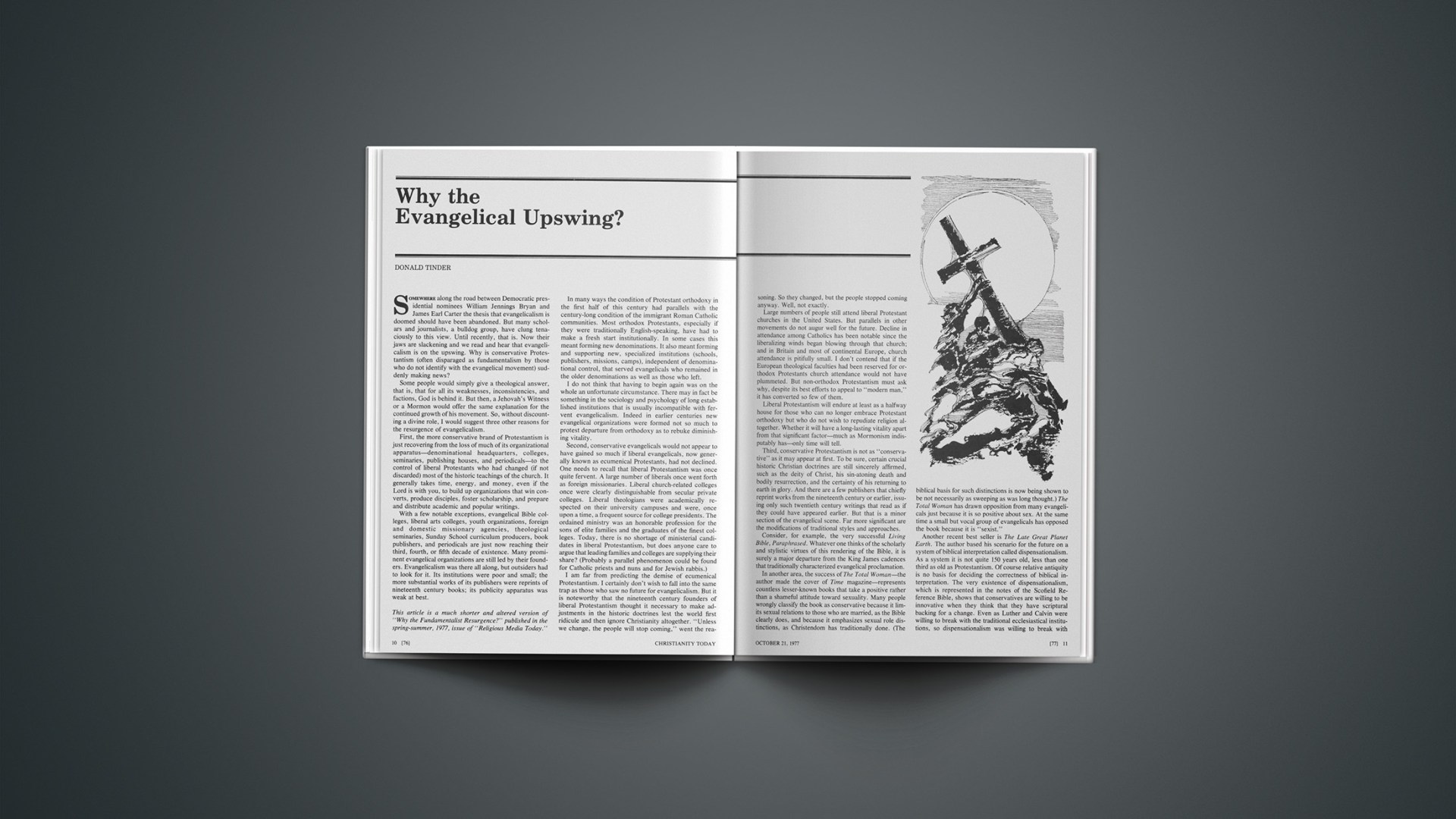
Why the Evangelical Upswing?

Somewhere along the road between Democratic presidential nominees William Jennings Bryan and James Earl Carter the thesis that evangelicalism is doomed should have been abandoned. But many scholars and journalists, a bulldog group, have clung tenaciously to this view. Until recently, that is. Now their jaws are slackening and we read and hear that evangelicalism is on the upswing. Why is conservative Protestantism (often disparaged as fundamentalism by those who do not identify with the evangelical movement) suddenly making news?

Some people would simply give a theological answer, that is, that for all its weaknesses, inconsistencies, and factions, God is behind it. But then, a Jehovah’s Witness or a Mormon would offer the same explanation for the continued growth of his movement. So, without discounting a divine role, I would suggest three other reasons for the resurgence of evangelicalism.

First, the more conservative brand of Protestantism is just recovering from the loss of much of its organizational apparatus—denominational headquarters, colleges, seminaries, publishing houses, and periodicals—to the control of liberal Protestants who had changed (if not discarded) most of the historic teachings of the church. It generally takes time, energy, and money, even if the Lord is with you, to build up organizations that win converts, produce disciples, foster scholarship, and prepare and distribute academic and popular writings.

With a few notable exceptions, evangelical Bible colleges, liberal arts colleges, youth organizations, foreign and domestic missionary agencies, theological seminaries, Sunday School curriculum producers, book publishers, and periodicals are just now reaching their third, fourth, or fifth decade of existence. Many prominent evangelical organizations are still led by their founders. Evangelicalism was there all along, but outsiders had to look for it. Its institutions were poor and small; the more substantial works of its publishers were reprints of nineteenth century books; its publicity apparatus was weak at best.

In many ways the condition of Protestant orthodoxy in the first half of this century had parallels with the century-long condition of the immigrant Roman Catholic communities. Most orthodox Protestants, especially if they were traditionally English-speaking, have had to make a fresh start institutionally. In some cases this meant forming new denominations. It also meant forming and supporting new, specialized institutions (schools, publishers, missions, camps), independent of denominational control, that served evangelicals who remained in the older denominations as well as those who left.

I do not think that having to begin again was on the whole an unfortunate circumstance. There may in fact be something in the sociology and psychology of long established institutions that is usually incompatible with fervent evangelicalism. Indeed in earlier centuries new evangelical organizations were formed not so much to protest departure from orthodoxy as to rebuke diminishing vitality.

Second, conservative evangelicals would not appear to have gained so much if liberal evangelicals, now generally known as ecumenical Protestants, had not declined. One needs to recall that liberal Protestantism was once quite fervent. A large number of liberals once went forth as foreign missionaries. Liberal church-related colleges once were clearly distinguishable from secular private colleges. Liberal theologians were academically respected on their university campuses and were, once upon a time, a frequent source for college presidents. The ordained ministry was an honorable profession for the sons of elite families and the graduates of the finest colleges. Today, there is no shortage of ministerial candidates in liberal Protestantism, but does anyone care to argue that leading families and colleges are supplying their share? (Probably a parallel phenomenon could be found for Catholic priests and nuns and for Jewish rabbis.)

I am far from predicting the demise of ecumenical Protestantism. I certainly don’t wish to fall into the same trap as those who saw no future for evangelicalism. But it is noteworthy that the nineteenth century founders of liberal Protestantism thought it necessary to make adjustments in the historic doctrines lest the world first ridicule and then ignore Christianity altogether. “Unless we change, the people will stop coming,” went the reasoning. So they changed, but the people stopped coming anyway. Well, not exactly.

Large numbers of people still attend liberal Protestant churches in the United States. But parallels in other movements do not augur well for the future. Decline in attendance among Catholics has been notable since the liberalizing winds began blowing through that church; and in Britain and most of continental Europe, church attendance is pitifully small. I don’t contend that if the European theological faculties had been reserved for orthodox Protestants church attendance would not have plummeted. But non-orthodox Protestantism must ask why, despite its best efforts to appeal to “modern man,” it has converted so few of them.

Liberal Protestantism will endure at least as a halfway house for those who can no longer embrace Protestant orthodoxy but who do not wish to repudiate religion altogether. Whether it will have a long-lasting vitality apart from that significant factor—much as Mormonism indisputably has—only time will tell.

Third, conservative Protestantism is not as “conservative” as it may appear at first. To be sure, certain crucial historic Christian doctrines are still sincerely affirmed, such as the deity of Christ, his sin-atoning death and bodily resurrection, and the certainty of his returning to earth in glory. And there are a few publishers that chiefly reprint works from the nineteenth century or earlier, issuing only such twentieth century writings that read as if they could have appeared earlier. But that is a minor section of the evangelical scene. Far more significant are the modifications of traditional styles and approaches.

Consider, for example, the very successful Living Bible, Paraphrased. Whatever one thinks of the scholarly and stylistic virtues of this rendering of the Bible, it is surely a major departure from the King James cadences that traditionally characterized evangelical proclamation.

In another area, the success of The Total Woman—the author made the cover of Time magazine—represents countless lesser-known books that take a positive rather than a shameful attitude toward sexuality. Many people wrongly classify the book as conservative because it limits sexual relations to those who are married, as the Bible clearly does, and because it emphasizes sexual role distinctions, as Christendom has traditionally done. (The biblical basis for such distinctions is now being shown to be not necessarily as sweeping as was long thought.) The Total Woman has drawn opposition from many evangelicals just because it is so positive about sex. At the same time a small but vocal group of evangelicals has opposed the book because it is “sexist.”

Another recent best seller is The Late Great Planet Earth. The author based his scenario for the future on a system of biblical interpretation called dispensationalism. As a system it is not quite 150 years old, less than one third as old as Protestantism. Of course relative antiquity is no basis for deciding the correctness of biblical interpretation. The very existence of dispensationalism, which is represented in the notes of the Scofield Reference Bible, shows that conservatives are willing to be innovative when they think that they have scriptural backing for a change. Even as Luther and Calvin were willing to break with the traditional ecclesiastical institutions, so dispensationalism was willing to break with more traditional Protestant understandings of the details of the return of Christ to earth.

Yet another example of evangelical innovation is the Pentecostal-charismatic movement, which is essentially a twentieth century phenomenon. Short-lived and geographically restricted precursors of this kind of religious expression have often occurred; our century is seeing the first sustained and widespread dissemination of it. Even as many evangelicals fault the freedom of the Living Bible, the attitudes toward sex of The Total Woman, and the detailed descriptions of the future in The Late Great Planet Earth, so many of them fault the exegetical under-pinnings and the experiential emphasis of the charismatic movement. But such willingness to be innovative has contributed greatly to the flourishing state of “conservative” Protestantism.

Apart from the Living Bible each of these examples has secular counterparts. But it would be wrong to assume that evangelicals are simply exploiting cultural trends to gain converts. The doctrines of The Late Great Planet Earth were taught and published long before the interest in ancient astronauts, astrology, or doomsday became popular. It would also be wrong to assume that the climate of the age does not have anything to do with renewed evangelical appreciation for sex within marriage, which is reflected by The Total Woman.

What to an outside critic is opportunism is seen by an insider as an appropriate channel through which the message of historic Christian doctrine can flow. Are the masses, for whatever reason, showing a renewed interest in demons? Then evangelist Billy Graham will write a bestseller on Angels, both to give a balanced view and also to present the Gospel. Does deemphasis on the literary classics mean that fewer common people groove with the King James? Then make available a Living Bible in every day language. Because of this widespread unwillingness to be tenaciously conservative in method and message, evangelicals are having the impact that they are on the nation.

Evangelicalism, therefore, has blossomed not because it is new but because it was ignored for so long by outsiders. It flourishes because the institutions that give it visibility have only lately reached maturity. It appears to prosper more than it otherwise would because other expressions of Protestantism have lost some of the preeminence that they enjoyed for two or three generations. And it flourishes because, though conserving the doctrines at the heart of Christianity, it is innovative in a variety of other ways.

What of the future of Protestant orthodoxy? It is unlikely that it will ever regain the prominent position it enjoyed before the Civil War. But it is also unlikely that it will face any sterner challenges, unless it be total political persecution, than have already been confronted over the past century. Completely new factors comparable to the emergence of urban, technological society or to academic-led scepticism about the supernatural are unlikely to emerge. Other people may not like evangelicalism but for now they will have to live with it.

D. Bruce Lockerbie is chairman of the Fine Arts department at The Stony Brook School, Stony Brook, New York. This article is taken from his 1976 lectures on Christian Life and Thought, delivered at Conservative Baptist Theological Seminary in Denver, Colorado.

Eutychus and His Kin: October 21, 1977

Let’s All Think Negative Thoughts

A few months before Donald Grey Barnhouse died he met with Norman Vincent Peale. In the course of their time together Barnhouse suggested that Peale write a new book, The Power of Negative Thinking.

That book was never written, but a variant has just been produced by Donald G. Smith. It is How to Cure Yourself of Positive Thinking (E. A. Seeman Publishing, $7.95; the price establishes a mood for the book).

It’s about time that such a book was written. There’s been entirely too much positive thinking around for years, too much optimism. It’s unreal. Reality is found in a theory I happen to subscribe to: a pessimist is an optimist with experience. So, evidently, does Mr. Smith.

The author takes on positive thinking (aren’t those words a contradiction in terms?) from Peale to the loud-mouthed community leader who jumps to the platform and demands, “Everybody sing!”

“As in the case of Saint George,” Smith suggests, “it was enough to be anti-dragon. There were plenty of proprincess hand-wringers back at the castle.”

Now I don’t want to be a hand-wringer. My mother was one, until we got our first washer, and she developed strong hands. Too strong, I thought as a child.

But after she got the washer, her hand was wrung. I mean that it went through the wringer, which was even worse than hand-wringing.

That’s where I think we are today: between the hand-wringers and the wringer. And it’s hard to be positive in such a situation.

EUTYCHUS VIII

Paul Seen Clearly

I want to express to you my profound appreciation for printing Leon Morris’s “Paul, Apostle of Love” (Current Religious Thought, Sept. 9). Morris is especially accurate in his depiction of the great apostle’s attitude toward women—his teaching of mutual subjection of Christian husbands and wives, his encouragement of theological education for women, his tributes to female leaders and workers in the early church, and so forth. My son was named after the apostle Paul, and Morris’s column is a glad reminder of why I’ve always been pleased with that choice.

VIRGINIA R. MOLLENKOTT

Hewitt, N.J.

Sounding The Alarm

After reading “Is Self-Love Biblical?” (Aug. 12), I found that I was not only disappointed but even alarmed. I was disappointed in that there was nothing given that would help a Christian counselor help others out of the dilemma of selfdepreciation. I was also disappointed in that Piper obviously is attacking a “straw man”.… A Christian counselor using the Good Samaritan parable as the basis of his philosophy of self-love is not seeking to develop a new redemptive system with man at the center. Rather, he is in hopes of leading the counselee to a greater appreciation of the redemption which is already his in Jesus Christ. My disappointment was also increased by the realization that Piper’s concern was evidently intuitively attained rather than thorough careful research.…

However, if disappointment was all I received from the article, I could have closed the cover and forgotten it. That wasn’t possible because of my alarm at the implications of the article and its effect on Christian counselors coming to it with a hope similar to my own. There is the implication that narcissism and self-esteem are equivalent as well as the suggestion that Jesus assumed that self-love is a given. Will these implications lead some who counsel in whatever capacity to assume that to encourage a fellow believer to a greater appreciation of his glorified condition is to promote narcissism?

JOE D. LIVINGSTON

Director of Counseling

California Center for Biblical Studies

Culver City, Calif.

Piper reveals a fundamental misconception. He makes the common error of equating positive self-esteem with narcissistic egocentricity and sinful pride.… It is not falsely striving to find goodness and worth in myself where none exist. Rather, it is a realistic appraisal and acceptance of both my strengths and weaknesses, accompanied by a generally good feeling about who God has made me to be.

The Good News of Christ teaches me to see myself, as well as other people, as God sees us—not only as sinners, but also as essentially valuable persons, created in God’s image and redeemed by Christ’s precious blood. In Christ I can begin to love and accept myself and others because in Christ God loves and accepts us unconditionally. Only then am I truly freed to forget my selfish preoccupation with false feelings of inadequacy and worthlessness and then I can begin to love God unreservedly and to selflessly minister to the needs of others. “All human beings” do not “love themselves” in this way, because they have not known the love of God for them. The prideful, sinful self-love of the priest and Levite is not to be equated with healthy self-esteem, nor is the loving selflessness of the Samaritan to be equated with its opposite. Piper has either never experienced the debilitating pain of low self-esteem, or else he has not yet known the joyous experience of deliverance from it.

ROD MARTIN

Willowdale, Ont., Canada

The Christian And Culture

The Christian’s relationship to secular culture is a serious problem for our generation, as it has been for all those before us. CHRISTIANITY TODAY, more than any evangelical publication I know, provides articles which enable the reader to form enlightened attitudes.

One stunning example is the cover story on Robert Hale, “When You Care Enough to Sing the Very Best” (Aug. 26). As a longtime opera lover and a fan of Wilder and Hale, I am most appreciative for Hale’s dealing with the issues of operatic morality, character assumption, and Christian commitment. And I commend Cheryl Forbes for her finese in interviewing.

The editors who months ago formulated the policy to run cultural-aesthetic material in CHRISTIANITY TODAY deserve credit and thanks.

CAROLYN KEEFE

West Chester State College

West Chester, Pa.

As Concert Co-ordinator for Robert Hale and Dean Wilder, it is my privilege to write and express my deepest appreciation for the review of Robert Hale.

I wanted to … let you know of the many phone calls and letters that we have continued to receive from the time this particular issue reached the news stands and, also, [from] all those who are regular subscribers to CHRISTIANITY TODAY. We have had nothing but praise and continued registrations of approval for the fine article and extremely good taste in which the magazine presented Hale, both as an opera star, and, also, as a gospel singer.

HAROLD J. STEPHANZ

Hale-Wilder Concerts

Ft. Lauderdale, Fla.

Since Cheryl Forbes demonstrates an otherwise commendable concern about the negative attitude evangelicals too often show toward the arts (her first question for Clyde Kilby is, “Do evangelicals still fear the arts?”, Sept. 9), it is lamentable that [in her introduction to the Hale interview] she calls the music for the Black Mass scene of Boïto’s Mefistofele “sickeningly seductive.” This unfortunate phrase suggests that Boïto appealed to prurient interests, whereas anyone familiar with this powerful opera and with the New York City Opera’s production knows that Boïto suggests both the terror and fascination of Hell.

C. S. Lewis reminds us that “it is a very old critical discovery that the imitation in art of unpleasing objects may be a pleasing imitation.” Boïto’s Mefistofele is a revolting character who sings beautifully, and she should not appear to warn evangelicals away from a superb opera. While her interviews with Kilby and Robert Hale are for the most part commendable efforts to exonerate evangelicals from Martin Marty’s charge in A Nation of Behavers that they are generally anti-intellectual and suspicious of the arts, Forbes ought not to appear to condemn a great work of art.

BYRON NELSON

Assistant Professor of English

West Virginia University

Morgantown, Pa.

Bravo! CHRISTIANITY TODAY gets better with each issue! It’s good to see a journal meet some issues. Three articles in particular were outstanding in the August 26 issue. The interview with Robert Hale … the report on Harrington and O’Hair … and the article by Klaus Bockmühl on the Ten Commandments. Keep up the good work.

KEN WILSON

Decatur Seventh-day Adventist Church Decatur, Tenn.

Editor’s Note from October 21, 1977

CHRISTIANITY TODAY has received a grant to poll clergymen, lay people, seminary teachers, and denominational officials to find out what they believe. The poll, to be conducted by Gallup, will compare its findings with those of earlier surveys to see how beliefs have changed. Sometime next year we will carry the results of this significant project.

Friend wife and I recently welcomed beautiful Lindsay Ann into the family—our fourth grandchild and second granddaughter. Born to Judy and Bill Wood, Lindsay has captivated us all.

Scotland: A Path Still Overgrown

Just before Vatican Council II began, the moderator of the Church of Scotland general assembly made history by calling on John XXIII. I commented in this journal that he who had crossed the continent to Rome might now consider crossing the street (literally) to the Free Kirk general assembly where another job of reconciliation had still to be done. With true liberal intolerance a religious weekly called my remark “mischievous.” Ecumenicity is a splendid practice so long as one follows the guidelines laid down by those who know about such things.

Of course it takes two for rapproachment. In 1965 the big Kirk’s moderator did go across the road. A substantial number of the Wee Frees had earlier opposed the visit (some of them walked out when he appeared), and it was decided he should not be allowed to speak. The visitor cunningly directed to his fellow moderator some words loud enough to be heard by the assembly he was banned from addressing.

Since then the Edinburgh street has remained uncrossed. During this year’s assembly meetings our new moderator, the Right Reverend John R. Gray, decided to look in on the Free Kirk assembly. This was entirely a personal initiative; he was prepared merely to sit in the gallery and listen to the deliberations. A bit of admirably quixotic behavior, as the Free Kirk had previously indicated lack of enthusiasm for any formal visit. The whole project fell flat. Mr. Gray had left it too late; the Free Kirkers had packed up. He did manage a ten-minute chat in his counterpart’s office, but the host insisted no conclusions were to be drawn.

The current issue of the Monthly Record of the Free Church of Scotland carries a most comprehensive editorial, reflecting that body’s attitude to other denominations and to its own “unfortunate public image.” Written by newly-appointed editor the Reverend Donald Macleod who titles it “Peculiar People,” the piece begins by outlining distinctives of the church that originated in the Disruption of 1843. Through unions in 1901 and 1929 the majority of the original Free Kirk’s descendants returned to the national church. The present Free Church numbers perhaps 20,000 members and adherents. But to return to the editorial. Every minister, elder, and deacon of the Free Kirk, it points out, is bound to the Westminster Confession without reservation (the Church of Scotland recognizes “liberty of opinion on such points of doctrine as do not enter into the substance of the Faith”). The Free Kirk does not sing hymns, but only metrical psalms without instrumental accompaniment. And it believes in discipline, holding that membership of the church is only for believers, and that “members of the visible church must at least have the appearance of being Christians.” It would indeed be mischievous were I to comment on the latter point!

Turning to relations with other churches, the magazine has a rare good word for Roman Catholicism, and cites agreement on major points of doctrine. These include the Virgin Birth, propitiatory atonement, a literal resurrection, and a physical second coming. Admittedly much of this seems calculated only to make out a case, not in favor of Rome but against Anglicans, Methodists, and other Presbyterians (there is a purpose of marriage at present between the Big Kirk and Scottish Methodists).

The editorial wisely concedes exceptions. “We have many true brethren in the Church of Scotland and gladly acknowledge that many of the ablest expositors of the doctrines we love are within its borders.” But it sees leading representatives of the denominations named as having their roots in the Enlightenment rather than in the Reformation. “Schleiermacher is their common father and Wellhausen, Barth and Bultmann their mentors.” This is a not unfair statement for Presbyterians and Methodists, but it might have been worded differently for the Church of England in which there is currently a resurgence of evangelical scholarship.

There is an even more unhappy attempted contrast: “In the Free Church a man would be deposed from the ministry for denying the doctrine of Hell. In the Church of Scotland, he would run a far greater risk by proclaiming it.” That second sentence reflects a dismally imprecise use of language that would tend to mislead those unacquainted with the Church of Scotland, which is neither notable for disciplinary measures nor bereft of those who preach the doctrine of hell.

“We are a different breed,” says Mr. Macleod, “we cannot agree to sink our differences and concentrate on the great things we have in common. It is precisely the great things that we do not have in common.” I’d be wary of conclusions drawn from contrasting the best in one church with the worst in another. But there is a valid point. The average Free Kirk member could tell you the reason for the hope that is in him, in terms identifiable with historic Christianity. The average Church of Scotland member couldn’t.

Referring later to the press, the editorial makes no distinction between secular and religious traders in words. We are evidently all the same: “interested in news, not in truth.” We see Free Kirkers as “ogres from the past,” sporadically engaged in “bigoted and Pharisaical denunciation of ordinary human beings.” The editor calls for self-questioning to find if there is truth in the caricature; he does not call for Free Kirk reappraisal of its attitude to the media and to public relations generally. Such a move might do something to remedy also what Mr. Macleod calls “the curious combination of complacency and fatalism which threaten to destroy us.” The Free Kirk, be it said, is not best known in modern Scotland for evangelical outreach, though its missionary history is a remarkable one. The point is perhaps covered by implication when the editorial points the need for denominational repentance. “We shall not answer for the sins of either the Church of Rome or the Church of Scotland. But we shall answer for our own.”

An odd omission is any reference to cooperation with other evangelicals where there is a large measure of doctrinal agreement. Such cooperation does exist, if sometimes frowned upon. I have many friends in the Free Kirk despite my dubious links with “the establishment.”

A postscript. Some years ago, after a session of the Free Kirk assembly, I accompanied two of its ministers to a coffee shop. Both were smoking, which act brought a lengthy public rebuke from an irate little lady of unknown antecedents. They looked abashed, so I intervened.

Not without sinful pride at finding myself on the side of the angels, a conservative Church of Scotland minister pleading for liberal Free Kirk delinquents, I said I didn’t smoke, but that surely she should allow my colleagues liberty of conscience on things not of the substance of the faith. She would have none of it. “There’s mair hairm din in the name of liberty of conscience than anything else,” she said darkly.

Now I don’t know just what to take out of all that, except for an uncomfortable feeling that holy wobbling had once more proved to be my undoing.

The Episcopal Spirit of St. Louis

When the triennial convention of the Episcopal Church is held in 1979, the ranks will probably be thinner than at the 1976 sessions, where delegates authorized a new prayer book and ordination of women to the priesthood. Some 1,750 Episcopalians who are unhappy with the 1976 actions met in St. Louis last month to lay the groundwork for a new Anglican denomination in America.

They came from all over the United States and from Canada (ordination of women has also been authorized there), but the participants stopped short of formally organizing a new denomination. Instead, many of them signed a six-page “Affirmation of St. Louis” and took home copies for parishoners to sign. The document claims the Episcopal conventions of recent years have caused schism “by their unlawful attempts to alter faith, order, and morality.” The signers insist that they want only traditional Anglicanism.

The formal organization of the new denomination, which has the tentative name of the Anglican Church in North America, could come early next year. Signers of the affirmation have stated, meanwhile, that they will not recognize actions taken against them by the Episcopal Church (or by the Anglican Church of Canada).

“We affirm that the claim of any schismatic person or body against any church member, clerical or lay, for his witness to the whole faith is with no authority of Christ’s true church, and any such inhibition, deposition, or discipline is without effect and is absolutely null and void,” a key passage of the document declares.

While denying the spiritual authority of the U.S. and Canadian Episcopalians, signers of the St. Louis document insisted that they want to continue in communion with the “See of Canterbury and all other faithful parts of the Anglican Communion.” One reason that no breakaway diocese has been officially constituted yet is that the dissidents are having trouble finding three bishops in full communion with Canterbury to consecrate their own new bishops. James Mote, rector of a Denver parish that broke away soon after the 1976 convention, is the nominee for bishop of the non-geographical Diocese of the Holy Trinity. He was named at a meeting of the diocese held in connection with the St. Louis gathering. Other dioceses are being formed with the encouragement of the coalition that organized the unprecedented gathering. Proponents of the split say that when three bishops are ready to be consecrated there will be three bishops ready to perform the ceremonies—even though the consecrators may thus be subjecting themselves to ecclesiastical discipline.

Reporters at St. Louis spotted about ten bishops in attendance, even though only two were known to be in sympathy with the meeting’s organizers. Among the prelates attending was the Episcopal Church’s top officer, Presiding Bishop John M. Allin. He asked to be given a spot on the program, but he was not allowed to speak. At a communion service during the conclave he went forward and knelt at the feet of two California priests who had been deposed, accepting the elements from them. The presiding bishop told reporters that he was against divorce and went to St. Louis to see if he could do anything to help avoid a split.

A month before the St. Louis meeting the presiding bishop invited some of the dissident priests, including some who had already been deposed, to visit with him in Connecticut. A two-paragraph statement issued after that session said that the discussion was “marked by cordiality and an open exchange of views” and that conversations would be continued. Five men, including Mote, met with Allin.

No date has been announced for the next meeting of the breakaway body, but the coalition expects it to be within a year. To be considered a constitutional assembly it would have to be convened by episcopal authority. Thus the formation of the denomination must await consecration of the bishops.

The number of Episcopalians who would go into the new body is anybody’s guess; estimates have ranged from 50,000 to 500,000. The organizations that formed the coalition behind the St. Louis meeting claim a membership of 50,000. They believe they will be joined by thousands of others when Episcopalians realize that there is another denomination to which they can belong. One official of the coalition said that many priests who came to St. Louis “just unhappy” went away determined to lead their parishes out of the denomination. It was estimated that a quarter of those attending were clergymen. Participants ranged from the “low-church” evangelicals to “high-church” Anglo-Catholics.

While no one knows how many will leave, many observers believe that the anticipated split will be the largest in Episcopalian history. The denomination has 2.8 million members. There have been few defections since the Reformed Episcopalian Church was formed a century ago. Even as the coalition was trying to encourage the formation of a new denomination, a number of individual Episcopalians—lay and clergy—were transferring their membership into other churches. Some went into such groups as the Old Catholic Church and the Orthodox Church in America.

In Australia, meanwhile, the Anglican General Synod took a step that could lead to the ordination of women. After a three-hour debate, the three houses of the synod resolved that “the theological objections raised do not constitute a barrier” to the priesthood for women. The motion that finally passed was a substitute for one declaring “there are no theological objections” to females in the ministry. Approval in principle is only the first of several actions that must be taken before the first woman can be validly ordained in Australia.

Pastoral Training Under Tutors

Preparing men for the ministry is too important to be left up to seminaries. That was the message of the fifth General Assembly of the Presbyterian Church in America (PC A) last month as it adopted a unique approach to ministerial training. In effect, it will require future pastors in the young denomination to undergo four years of preparation beyond college, with at least one of those years spent working under an experienced pastor.

Candidates will have three options:

• Three years in an established seminary plus one year under a pastor’s tutelage.

• Two years in a seminary plus two under a tutor.

• Two years under a tutor studying academic subjects, followed by two concentrating on “practical” subjects.

Parts of the plan go into effect immediately, but the constitutional provision that mandates a fourth year of training before ordination must be approved by a majority of the denomination’s regional presbyteries and two future assemblies. Presbyteries, which retain the final judgment on a candidate’s qualifications, will be required under the proposed amendment to license a man for a year before ordination. Currently, licensure is optional.

The 62,000-member denomination, formally established in 1973, has no seminary of its own. In its action on theological education, the assembly advised the presbyteries to “be diligent in counseling candidates for the ministry to attend seminaries that are committed” to the church’s doctrinal position. It listed as examples three institutions approved at the first assembly (Westminster of Philadelphia, Covenant of St. Louis, and Reformed of Jackson, Mississippi) and a fourth proposed from the floor this year (Reformed Presbyterian of Pittsburgh). The PCA education committee, which recommended the wide-ranging new approach to candidate preparation, ruled out establishment of a PCA-controlled seminary. The cost of starting such a school would be “phenomenal” and “prohibitive at this time,” said the report. Without such an institution under its control, the denomination is in no position to direct the preparation of its candidates unless it adds the year beyond a master of divinity degree.

The most innovative feature of the new educational approach is the option of four years of post-college study outside seminary altogether. “Under the tutelage of qualified ministers” of the PCA, candidates who choose this option would spend the first half of the course mastering the academic subjects and the last half in the “practical” area. The assembly emphasized that its approval of this option “is not to lessen the demands of academic achievement for ministers in the PCA, but rather to allow more flexibility to our ministerial candidates in achieving the academic and practical requirements” for ordination. Those going the tutorial route would still be required, for instance, to learn the original language of the Bible.

For the second year in a row the PCA governing body declined to plunge into the college business. The 1976 assembly turned down a proposal to buy an available site to start a denominational college. This year commissioners (delegates) heard a proposal that the PCA share control of Covenant College, Lookout Mountain, Tennessee, with the Reformed Presbyterian Church, Evangelical Synod, which is on record favoring such shared control. Over seventy of the college’s 550 students are from the PCA. After long debate the question was sent back to the education committee with instructions that it clarify Covenant’s policies on use of government funds.

An assembly budget of $4.1 million was adopted, with half earmarked for the church’s growing overseas agency. To promote its domestic expansion, the 400-congregation body launched a campaign for $5 million to start new churches.

One of the assembly’s most intense debates was on a resolution to ask President Carter to maintain the present American military presence in Korea. There was little evidence that commissioners favored the reduction of troop strength, but there was considerable opposition to church action on what was seen as a “political” issue. Proponents finally won by invoking the Westminster Confession of Faith statement that in “cases extraordinary” church bodies could venture outside the ecclesiastical realm and petition the civil authorities. This case was described as extraordinary in view of the possibility that a North Korean Communist invasion could endanger the lives of thousands of Christians in South Korea.

The assembly declined to accept the invitation from the Presbyterian Church in the U.S. (Southern) to send an “ecumenical delegate” to the next PCUS assembly (see July 29 issue, page 35). Most PCA members and churches were formerly in the PCUS. On the eve of the PCA assembly in suburban Atlanta, Georgia, the PCUS headquarters announced that a PCA congregation, the first to do so, had returned to the PCUS fold. The thirty-six-member Pineville church in Pass Christian, Mississippi, left PCUS in 1974, joined PCA, and then became independent. PCA’s annual report for 1976 showed that it received four more former PCUS congregations.

Jackson: Keeping It Cool

Pastor Joseph H. Jackson, 73, of Olivet Baptist Church in Chicago was reelected by acclamation as president of the nation’s largest black denomination, the 6.5-million-member National Baptist Convention, U.S.A.

In another action, the 10,000 delegates at last month’s annual meeting of the NBCUSA in Miami denounced the use of school busing to achieve racial integration as “political expediency” at the cost of quality education, racial strife, and community pride. Jackson proposed the resolution, claiming that busing really delays the solution to the problem of school segregation: integrated residential neighborhoods, where schools would be integrated automatically.

The participants declared in another resolution that homosexuals should not be discriminated against as long as they practice their life style in private.

Jackson, serving his twenty-fifth term as NBCUSA president, told reporters he felt the most significant action of the convention was approval of a $40,000 grant to Meharry Medical School in Nashville to set up a perpetual scholarship fund. Meharry, a United Methodist-related institution, reportedly has trained 43 per cent of the black doctors and dentists in the United States. The 100-year-old school has fallen on hard times and is running sixty to ninety days behind in paying its bills, according to a United Methodist report. President Lloyd C. Elam asked 500 of the school’s administrators, staff, and faculty members who make more than $10,000 a year to cut back to thirty-two hours weekly. The faculty senate, however, has called on the teachers to work a full schedule for the next few months even though they may not get paid for it.

In his press interview, Jackson called on other black leaders who have been criticizing President Carter’s domestic policies to cool it. If Carter is forced into applying “phony economics” for short-term employment gains, he warned, it could be disastrous for everyone over the long haul.

A member of the Central Committee of the World Council of Churches, Jackson favors church involvement in economic and social concerns, but he is a political conservative on many domestic issues. He says civil disobedience is unpatriotic in a democratic system that provides for constitutional ways to bring about change in the law, but he endorses such tactics and even armed revolution in countries like South Africa where, he says, blacks are oppressed and have no legal recourse.

Truth After Myth

In recent years one of the most notable developments on the British campus scene has been the decline in support for the Student Christian Movement (SCM), the liberal arm of interdenominational work among students. The SCM’s publication of Honest to God in 1963 may have been a financial bonanza, but it predictably did nothing for the cause of Christ in the colleges.

This summer, SCM Press did it again with The Myth of God Incarnate, a title that will do nothing to discourage sales among the humanist echelons, and that is a fair indication of the book’s provocative contents. (See Sept. 23, page 30.) Most of the seven contributors are Anglicans; the editor, Professor John Hick, is a minister of the United Reformed Church (a 1972 union of English Presbyterians and English and Welsh Congregationalists).

Within a few weeks a paperback reply came from orthodox sources. The Truth of God Incarnate (Hodder and Stoughton). One of its five writers, veteran missionary bishop Stephen Neill, summarizes The Myth this way: “It seems that we are being offered a God who loved us a little, but not enough to wish to become one of us; a Jesus who did not rise from the dead, and therefore offers no answer to the great and bitter problems of humanity; and a gospel which is just one of many forms of salvation, and perhaps not that which is most suitable to modern Western man.”

The Truth’s editor is Canon Michael Green of Oxford, well-known evangelical speaker and unashamed advocate of what he calls “traditional full-blooded Christianity, complete with an inspired Bible and an incarnate Christ.”

His associates include Roman Catholic bishop and theologian Christopher Butler and (perhaps more surprisingly) Professor John Macquarrie, the widely published theologian not previously known for defending orthodoxy. It is reported that Inter-Varsity Press declined to undertake publication of The Truth because of the broad base from which Green insisted on launching it.

J. D. DOUGLAS

Muzzling An Advocate

The Vatican last month ordered Jesuit priest John J. McNeill to stop speaking and writing on the subject of homosexuality. He was charged with advocating and promoting theological views that are contrary to church teaching. He was also accused of allowing “false hopes” to be raised in the homosexual community by suggesting that the Roman Catholic Church will change its position. Additionally, he was instructed to remove from future editions of his well-publicized book, The Church and the Homosexual, the words imprimipotest, which indicate that official permission has been granted to publish the work. The Vatican said permission was given on the basis that the views were simply being presented to the theological community for scholarly discussion. But, said the Vatican, McNeill had instead become involved in pushing a position that is contrary to traditional church teaching on homosexuality.

McNeill, who describes himself as a homosexual committed to priestly celibacy, insists that homosexual practice can be morally good and should be viewed in the same way as heterosexual relations.

Police Blotter

Crime is on the increase in church circles. The following are among a number of cases that have been highlighted in press accounts recently:

James G. Fish and his wife Pauline of Fort Lauderdale, Florida, were found guilty of bilking churches and developers in four states out of more than $600,000.

According to testimony, the couple established the Consortium Funding Corporation to arrange loans for institutions seeking funds for development. For this service, the pair charged an advance fee, which they promised to return if loans could not be obtained. A number of witnesses, including pastors, said they or their churches were offered loans but received neither them nor refunds of their advance fees. The indictment stated that the Fishes had induced an official of the National Church Aid Association of Springfield, Missouri, to give them a list of churches seeking financial aid.

President Robert E. Hayes, Sr., of Wiley College, a United Methodist-related black school in Marshall, Texas, and two of his former aides, were charged in a federal indictment on ten counts of alleged embezzlement of federal education funds. The indictment alleges that the three conspired to “embezzle, steal, and convert to their own use and the use of others $255,948” in federal aid funds between 1972 and 1975, and that they issued false fiscal reports to the government. The indictment came following months of investigation by FBI agents and investigators from the U.S. Department of Health, Education, and Welfare. Hayes insists he and the others are innocent but declines to comment further.

In Wilmington, Delaware, authorities arrested Jay Patrick Green, Jr., 28, and charged him with producing an estimated $250,000 in counterfeit $20 bills. Green was seized as he was closing down his print shop. Officers found sheets of uncut bills in his apartment, where he lived with a girl friend, according to press reports. Green, who headed firms known as Patrician Press and Literature Discovery, formerly ran Creative Christian Libraries, which advertised in leading Christian publications but failed to deliver on many prepaid orders and did not refund the money to customers. He has been associated with his father in similar businesses in the past. In 1974 he was sentenced to a prison term of from eighteen months to five years in Kent County, Michigan, for passing a bogus check, but was apparently released on probation, say the press accounts.

Authorities are investigating numerous allegations involving Tabernacle Hospital in Chicago, described as the first hospital in the country to be owned by a black church. The hospital is owned by Tabernacle Baptist Church of Chicago, whose pastor is Louis Rawls. Rawls is president of the hospital board and also directs the Tabernacle Foundation and a related music company. Five former hospital officials claim that federal funds held by the hospital may have been diverted to Rawls’s church and other enterprises.

The Internal Revenue Service has tax liens on the hospital totaling more than $800,000; a government audit shows that the hospital failed to pay to the federal government hundreds of thousands of dollars withheld from employees’ pay-checks.

Meanwhile, the Chicago Board of Health has ordered Tabernacle not to admit any more patients until things get sorted out. A rash of fires of mysterious origin recently destroyed many of the hospital’s administrative records, and police and fire units were still investigating the blazes last month. The police were also searching for a suspect in the murder of John Dawkins, 33, a former hospital employee found shot to death in his apartment on September 2. He reportedly was a personal secretary to Rawls.

Reporters were unable to reach Rawls for comment.

Religion in Transit

City attorney John R. Risher of Washington, D.C., has ruled that it is a constitutional violation for the University of the District of Columbia to provide office space and other assistance to campus ministers as has been done in the past for a Roman Catholic nun and a Baptist minister.

Pastor Eugene McGee of First Alliance Church in New York City and his congregation sponsor outreach efforts to the Jewish community. Things began happening after the church held a conference on the topic in June. There were anonymous telephone threats of bodily harm, a door and three stained-glass windows were broken, and a $15,000 bus was fire-bombed. One caller identified himself as a member of the Jewish Defense League, but the JDL formally disavowed any involvement. Rabbi Marc Tanenbaum of the American Jewish Committee said he deplores both the violence against the church and the evangelism directed at the Jewish community.

The right of teachers in parochial schools to organize for collective bargaining was endorsed by the U.S. Catholic Conference in a report described as advisory and not binding. Unions of school teachers exist in about two dozen of the Catholic Church’s 165 dioceses, according to estimates, and disputes involving the issue of union membership are before the courts in five dioceses.

A United Press survey shows that twenty-four states and the District of Columbia are still providing Medicaid funds for abortion, despite the U.S. Supreme Court’s ruling in June that such payments are not obligatory. The federal government warns it will stop reimbursing states that continue to provide public funds for welfare abortions. (A California study shows that taxpayers spent $27 million for 77,000 abortions of 142,600 reported in that state in 1976. Formerly, the federal government picked up 90 per cent of the bill; the state will fund the program for now, but cutbacks are expected soon.)

It was bound to happen: a Christian comic-strip version of Superman—Gospelman—has made his appearance. The super-hero is the creation of Walter Zacharius, a former publisher of such “girlie” magazines as Swank and Gallery. Zacharius, who says he has been born again, has launched a new varied-feature family magazine, Nashville-Gospel, available on newstands. Amy Carter is the cover girl of a recent issue. In another issue Gospelman emerges victorious in a clash with publisher Larry Flynt of Hustler.

Personalia

Don Kessinger, 35, Chicago White Sox infielder and a former All Star player with the Chicago Cubs, is the first winner of the Danny Thompson Memorial Award for “exemplary Christian spirit in baseball.” The award, sponsored by Baseball Chapel, will be presented by Commissioner Bowie Kuhn at the second game of the World Series on October 12. It is in honor of Danny Thompson, a Texas Rangers infielder who died of leukemia last year. Thompson, who professed Christ as Saviour in 1973, was a chapel leader for the Minnesota and Texas teams. All twenty-six major-league teams now have chapel services, with total attendance averaging about 400 per Sunday.

New presidents: Eldon R. Fuhrman, Wesley Biblical Seminary, Jackson, Mississippi; Stanley D. Letcher, Jr., Midwest Christian College, Oklahoma City.

Resigned: J. Richard Palmer, 61, as president of Scarritt College in Nashville, Tennessee, a United Methodist school; Gordon Werkema, as president of the Christian College Consortium, based in Washington, D.C. (he has accepted an executive post at Seattle Pacific University).

World Scene

President-for-life Idi Amin of Uganda, a Muslim, banned all but three Christian denominations from operating in Uganda on grounds that they are security risks. Roman Catholic, Anglican, and Orthodox churches can continue to function, but Baptists, Seventh-day Adventists, the Salvation Army, and other groups must close down. About 90 per cent of the country’s 11 million inhabitants are estimated to be nominally Christian. Amin did not indicate how long the closures are to remain in effect.

More than one-third of Norway’s 1,700 churches are closed and empty each Sunday because there are not enough clergymen to go around, according to a Church of Norway (Lutheran) report. It says the situation is serious in the Bjorgvin diocese, where some 100 churches are empty each week.

The Marxist government of Burma, a predominantly Buddhist nation, has published 10,000 copies of a Bible edition in Burmese. Christian representatives in the parliament had complained about the unavailability of Bibles. Burmese Christians say they cannot get exchange funds to import Scriptures from abroad, and they cannot obtain paper to print Bibles themselves. The new Bibles were placed on sale in parliament for $4.80 each.

Assurances have been given to Egypt’s Coptic Christian minority that a controversial draft law—one that would make abandonment of the Islamic faith a crime punishable by death—will be shelved, according to Coptic sources. Pope Shenouda III had led a week-long prayer vigil and fast of Copts (estimated to number six million out of Egypt’s 40 million population) to protest the proposed law, which was drawn up at the request of Muslim conservatives in the People’s Assembly. It includes other tough measures based on the Koran. There has been a recent resurgence of hard-core Muslim fundamentalism, especially among young people, and Egyptian leaders are worried that it may lead to increased violence. A former minister of religious affairs was recently murdered, and members of a fanatic Muslim youth group were arrested for the crime.

More than 2,000 black, white, and “colored” Christian leaders of a variety of denominations took part in a week-long “deliberately integrated” charismatic conference on the Holy Spirit in Johannesburg, South Africa. It was sponsored by Logos International, the New Jersey-based charismatic publishing firm. Anglican archbishop Bill Burnett of Capetown served as conference chairman. He was assisted by clergyman Nicholas Bhengu, founder of the Back to God Crusade in South Africa and son of a Zulu chief, and retired Anglican bishop Alphaeus Zulu of Zululand, South Africa, along with others. About 100 black leaders attended from Rhodesia, according to press reports. The main emphasis that emerged was the need for unity in the church.

The general assembly of the World Psychiatric Association at its sixth congress in Honolulu voted by a narrow margin to censure the Soviet Union for abuse of psychiatry for political purposes, and a committee was established to investigate allegations. Some 4,000 delegates from sixty-three countries attended. A number of national psychiatric societies sided with the Soviet delegates, who claimed that they were victims of “unsubstantiated slander.” Former Soviet prisoners, including Christians, have claimed they were drugged and tortured in psychiatric institutions in attempts to alter their beliefs or drive them insane.

The Communist government in what was formerly South Viet Nam is giving the church “many problems” and “some persecution,” according to sources quoted in the Alliance Witness. The sources say forty-five Protestant pastors, including the former army chaplains, have been imprisoned, and others are endangered. Controls have been imposed on religious activities, church property has been confiscated, work schedules have been arranged to interfere with church gatherings, and a person may be denied employment for attending church services, say the sources. (The largest Protestant body in Viet Nam is the Evangelical Church, which grew out of the work of the Christian and Missionary Alliance.)

Deaths

SAMUEL FLOYD PANNABECKER, 81, a leader of the General Conference Mennonite Church and president emeritus of Associated Mennonite Biblical Seminary; in Goshen, Indiana.

JOHN NEVIN SAYRE, 93, Episcopal clergyman active in pacifist causes and the world peace movement, and chairman for many years of the International Fellowship of Reconciliation; in South Nyack, New York.

THOMAS F. STALEY, 74, Presbyterian layman and financier (a founder of the Reynolds Securities firm) who established a foundation to bring to school and college campuses “a persuasive presentation of the Christian gospel in a climate of conviction” (programs are conducted currently at more than 200 educational institutions); in Port Chester, New York, of a heart attack.

Billy in Budapest: Hungary Opens Its Heart

News Editor Edward E. Plowman last month traveled to Hungary to cover the series of meetings at which evangelist Billy Graham preached. It was the evangelist’s first official visit to preach in a Soviet-bloc country. The following account is the second of two reports written by Plowman. The first one appeared in the September 23 issue.

“I’ll never forget Hungary,” said evangelist Billy Graham several times during his week-long preaching visit to that country last month.

The people of Hungary who met and heard the 58-year-old American preacher will not forget him either. That was evident at Graham’s final service in Hungary. It was held in the Sun Street Baptist Church at the height of the Friday evening rush hour. Some 2,000 people filled the church and overflowed into the courtyard, where the service was broadcast on loudspeakers. It was a farewell service: emotions ran high, and there were tears and embraces. Graham preached on a topic from the Book of Hebrews: “Things That Change.”

It was a fitting topic, for a lot of changes had been noted throughout the week. According to pastors, hundreds of lives had been changed through encounters with Jesus Christ, whose death and resurrection Graham had proclaimed everywhere he preached.

Without elaborating, the evangelist said his thinking had undergone some changes. He said that his outlook now encompasses the entire world, and he indicated that his attitude toward Eastern Europe is more open. Also, he stated that he now places more emphasis on the Christian’s social responsibility than he did in earlier years. In a press conference, he said he was surprised by Hungary’s industrial progress (“the traffiic jams remind me of America”), by the material well-being of the people, and by the degree of religious freedom he found.

It was not stated in any press handouts, but it was nevertheless obvious that some changes had taken place in attitudes toward Graham on the part of government and church leaders. They seemed impressed by his personal warmth and sincerity, by his genuine interest in Hungary, and by his concern for the total man in his preaching.

Already there is talk of a return visit to Hungary. Nothing is official at this time, and no details have been discussed, but it is likely that a future Graham visit will get much broader church support and smoother government clearance.

In all, the evangelist preached to an estimated 27,000 persons, including more than 12,000 at a rural church camp some twenty-five miles north of Budapest. The Sunday morning open-air service received little advance publicity other than by word of mouth, yet local church leaders described it as the largest gathering for a Protestant religious service since before World War II.

Graham preached to overflow crowds twice at the Sun Street Church (once with sound piped to two other crowded churches) and at Baptist churches in Debrecen and Pecs. Additionally, he addressed hundreds of pastors, seminarians, and church workers in two convocations in Budapest.

Nearly half of those at the jam-packed meeting in Pecs, a bustling city of 150,000 in southern Hungary, were young people. They marked their Bibles and took notes as Graham preached. One teen-ager in the choir wept openly as singer Archie Dennis, a black from New Orleans, sang, “How Great Thou Art.”

Prior to the service, Graham conferred with Roman Catholic bishop Jozsef Cserhati of the Pecs diocese. Bishop Cserhati, a leader in the ongoing church-state dialogue in Hungary, said that only five million of the country’s supposed seven million Catholics can be accounted for, and that only three million of these practice their faith. However, said he, there are spiritual stirrings among young people, and many of them “are coming to Christ.” Without Christ, added the Catholic leader, there can be no hope of creating the new man for the new society.

Later in the week the evangelist conferred with Deputy Premier Gyorgi Aczel, the theoretician of the ruling Hungarian Socialist Workers Party who represents the government in the church-state dialogue. Aczel briefed Graham on church-state relationships, and the evangelist explained his belief in Christ. Graham also asked Aczel to relay greetings from President Carter to Party Secretary Janos Kadar. The pair agreed that the world needs to find a way to achieve and maintain peace.

Also at the meeting was Imre Miklos, who heads the State Office for Church Affairs, the government agency that oversees religious matters. Both Aczel and Miklos seemed interested in pursuing conversation about issues of faith and society.

In an earlier meeting, Graham and Miklos engaged in a sort of mini evangelical-Marxist dialogue. Both men explained and discussed their convictions about life. Miklos, who extolled the Bible as a book “full of wisdom,” said he feels that Communists observe better the Ten Commandments—except for the first one—than many Christians. Graham acknowledged that churches have often failed at this point, but he said a great revival of “living by the Bible” is going on, and many Christians are trying to obey the Lord and his commandments.

The evangelist met several times with U.S. ambassador Philip Kaiser, and the ambassador hosted the Graham party, Miklos, and Hungarian church leaders at a reception at the U.S. embassy. Singer Dennis and pianist Tedd Smith presented a short concert.

Four of Graham’s aides—Cliff Barrows, John Akers, T. W. Wilson, and Denton Lotz—preached to large church audiences during the week, and the evangelist’s wife Ruth visited with residents of a home for the elderly operated by Seventh-day Adventists.

There were light touches, too: at a collective farm Graham donned a heavy shepherd’s coat and was coaxed to pose for photographers atop a large horse whose saddle was not strapped. En route to Debrecen a stop was made to sample authentic goulash. Meanwhile, Mrs. Graham visited a Budapest department store, and the Graham party toured a light-bulb factory.

One of the most important persons in the Graham party was Alexander Haraszti, an Atlanta-area physician who is a leader of Hungarian Baptist churches in America. A linguist and ordained minister as well as a doctor, he served as Graham’s interpreter, and his skill won the admiration of many Hungarians. Haraszti can be admired for his persistence, too, for he spent many hours and thousands of his own dollars in travel and telephone expenses over the past five years arranging for the Graham visit. The person with whom he worked the closest was Sandor Palotay, president of the Hungarian Council of Free Churches (CFC), an alliance of Baptist, Methodist, Pentecostal, Seventh-day Adventist, and other small denominations. The official invitation to Graham came from Palotay and the CFC. Palotay played the key role in obtaining government permission to invite the evangelist.

On his last full day in Budapest, Graham told some three dozen reporters at a press conference that his goals in coming to Hungary had been fulfilled:

• He had come to preach the Gospel, and he had done so in five services, with hundreds having made decisions for Christ.

• He had wanted to meet with the leaders of the churches, and this aim was achieved in meetings with leaders of the Catholic, Reformed, Lutheran, and smaller Protestant denominations. Graham, who also visited with Jewish leaders, said he had not met so many of a country’s religious leaders in so short a time as in Hungary. He also met with several Soviet Baptist leaders, including Alexei Bichkov, who is president of the European Baptist Federation.

• He had come to see how churches exist in a socialist society. He said he found freedom to worship and to preach. There are problems, he said, “but I can report that the church is very much alive in Hungary.”

• He had come to “get a perspective” on life in a socialist society. He said that he had learned a lot but that it would take a long time to digest everything before he can make a complete evaluation.

• He had hoped to “build bridges,” and some had been built. Citing one example, he said that Bishop Tibor Bartha of the Reformed Church had accepted his “challenge” that more emphasis needs to be placed on evangelism in the churches of Hungary, and that he in turn had accepted Bartha’s challenge to become more active in seeking reconciliation between churches and between the peoples of the world.

Until the night before Graham’s arrival, Bartha—a Graham critic in past years—had refused to be among those giving official welcome speeches at the opening service in the Sun Street church. He finally gave in, and he uncorked one of the warmest public welcomes of the entire week. Later, he confessed that he had gained a new appreciation for Graham and his ministry through close-up contact with the evangelist.

In response to a question with delicate political overtones, Graham said Christians in the East and in the West both live in societies that are secular and materialistic, and they face similar problems.

One reporter wanted to know what changes in thinking Graham had undergone in Hungary. “I have not joined the Communist Party since coming here, nor have I been asked to,” replied the evangelist, prompting laughter among both Hungarian reporters and Western news people. “I think the world is changing, and we on both sides are beginning to understand each other more,” he remarked.

An estimated 65 per cent of Hungary’s population is Roman Catholic, and 25 per cent is Protestant. Of the latter, about two million are members of the Reformed Church and 500,000 are Lutherans, according to church leaders. The Baptists are the largest of the small groups.

On the way to the Budapest airport early on the Saturday of departure, the Graham motorcade passed a stadium that seats 110,000.

A pastor in the front seat of one car turned to a Western reporter in the rear seat. With a wink and a smile he pointed to the stadium and said: “The next time Billy comes to Budapest.…”

Perhaps.

Raising the ‘Dead’ In Europe

“When you speak of evangelizing Wales,” asked a British Broadcasting Corporation reporter, “aren’t you flogging a dead horse?”

The question was directed at Latin American evangelist Luis Palau, who replied, “Oh, it may be dead all right, but Jesus Christ has resurrection power. He can raise any dead horse.”

Palau went on to crisscross Wales, speaking in a variety of situations to cumulative total audiences estimated at 60,000. During his month in the British principality some 1,500 people registered decisions for Christ with the Palau team.

Climaxing the visit was an eleven-day crusade in Cardiff Castle. The last evangelist to conduct meetings inside that fortress was John Wesley two centuries ago. The last united evangelistic campaign in the city of Cardiff was conducted in 1904 by American R. A. Torrey, and over the years it has gained a reputation as a “hard city” for such efforts.

Despite early fall rains and chilling winds, the Cardiff meetings attracted record crowds. The Western Mail, the leading morning paper in Wales, described one of the castle services as “the largest religious gathering in Wales.”

Palau was not the only evangelist from across the Atlantic getting a warm welcome in Europe at summer’s end. Nicky Cruz, the former New York gang leader born in Puerto Rico, preached in seven cities in the Netherlands, Switzerland, Denmark, and Finland. Cumulative attendance was estimated at 28,000, with 1,240 decisions for Christ reported. After the tour Cruz said he plans to undertake missionary ventures in South America, Europe, and the “American ghettos” in the future. He explained, “I want to go where the Gospel has never been preached, instead of convincing the already convinced.”

European evangelicals who assisted with the meetings indicated that many of their countrymen are unconvinced and that the Latin evangelists are welcome to come back to tell many of them for the first time of the power of the Gospel.

On Tour

Atheist Madalyn Murray O’Hair and her two sons filed suit in federal court in Austin, Texas, in an effort to have “In God We Trust” removed from American currency. The slogan is unconstitutional, said Ms. O’Hair, because it “compels plaintiffs to subscribe to and affirm a belief which is antithetical to plaintiffs’ most deeply held convictions.…” Because it is necessary to handle money, notes the suit, the plaintiffs are thereby compelled to disseminate religious symbolism with which they disagree.

The suit was filed during a break in Ms. O’Hair’s cross-country debate tour with evangelist Bob Harrington (see August 26 issue, page 34). That tour, arranged by a promoter, is scheduled to hit dozens of cities by the end of the year. It has recently encountered some unfavorable press coverage, however, and pastors and church leaders are increasingly speaking out against it.

Mike Pigott, a Nashville Banner reporter, followed the pair to five cities in three states. He reported that all of their debates were alike, that they made the same speeches, that they walked on and off the stage on cue, and that they set each other up for the same one-liner comments in city after city.

Just before arriving in Raleigh, North Carolina, Harrington’s band, “Little Richie Jarvis and Our Brother’s Keeper,” abruptly quit, charging that the debates were theatrical and money oriented.

Harrington was also criticized by some pastors for accepting from porno publisher Larry Flynt (Hustler) a $155,000 luxury tour bus with a custom interior.

In response to all the criticism, Harrington denied that the debates are rigged. He said repetition occurs because there are only a few ways to make the same point or state the same message. He said he had to dismiss the band members because not enough money was coming in to pay them adequately. As for the bus, he said that it can be used in the ministry, and that the love of money, not money itself, is evil.

Audiences are given envelopes in which donations can be designated to either Harrington or Ms. O’Hair, and Harrington sells “Victory Kits” containing albums, books, and other literature (in some cities he charges $10 for the kit, in other cities $20). He also collects names and addresses for his mailing list. So far, say the O’Hair people, the tour has been a financial and public-relations success for their side. Harrington, who pays all the bills, insists he is barely breaking even. He estimates that rental and promotional costs run about $5,000 per rally.

A band member disputes Harrington, however. He says Zonnya LaFerney, Harrington’s business manager, told him that the average donation is between $3 and $5 (she and two assistants count the offerings), and the average crowd size is 2,000 to 3,000. She was also quoted as saying the crowd in Dekin, Illinois, purchased 300 kits at $20 each.

A poor turn-out of about 1,000 greeted the atheist and the evangelist in South Bend, Indiana, last month, and both were heckled.

In a major editorial, the Nashville Banner said the whole thing is “deplorable.” The paper called the debate series “a debasing performance” that shows “contempt for honest views of those in the crowd who have taken the bait—and baiting.… It is show biz. It is bunk.”

Still, many Harrington supporters feel he is doing the country a service, and they say that if he has been tarnished it is only because he has been willing to get into the arena and take on the forces of atheism in close combat that is bound to leave some battle scars.

Apple PodcastsDown ArrowDown ArrowDown Arrowarrow_left_altLeft ArrowLeft ArrowRight ArrowRight ArrowRight Arrowarrow_up_altUp ArrowUp ArrowAvailable at Amazoncaret-downCloseCloseEmailEmailExpandExpandExternalExternalFacebookfacebook-squareGiftGiftGooglegoogleGoogle KeephamburgerInstagraminstagram-squareLinkLinklinkedin-squareListenListenListenChristianity TodayCT Creative Studio Logologo_orgMegaphoneMenuMenupausePinterestPlayPlayPocketPodcastRSSRSSSaveSaveSaveSearchSearchsearchSpotifyStitcherTelegramTable of ContentsTable of Contentstwitter-squareWhatsAppXYouTubeYouTube