Taking the World’s Temperature

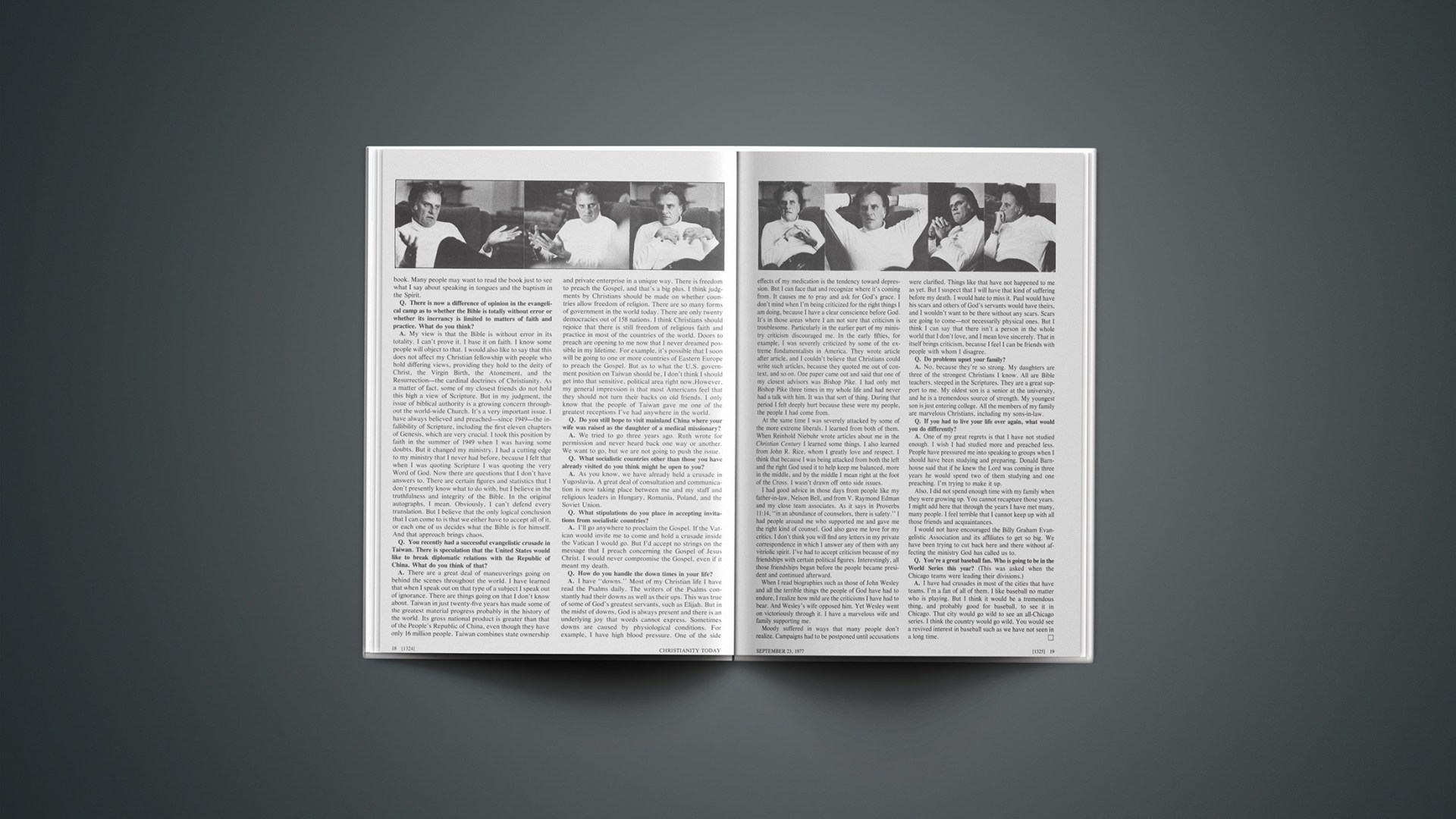
Here is the second part of an interview the editors conducted last month with the evangelist. The first part appeared in the August 26 issue.

Question. What did you think of Anita Bryant’s campaign and how do you feel about the demands being made by homosexuals?

Answer. She is a very brave woman. Homosexuality is a sin. That is the teaching of Scripture. I think she was right in emphasizing that God loves the homosexual and we should love the homosexual and present Christ to the homosexual. Some things she and her associates said I would not have said in the same way.

I did not join in the local conflict in Dade County because I have become fearful of getting diverted from my primary role as proclaimer of the Gospel. I’m asked to lead drives against pornography, against liquor, and so on. I have learned to endorse what moral issues Christian ought to stand for. I don’t always take a leadership role because my primary job is to preach the Gospel of Jesus Christ and I don’t want anything to divert me from that. I was also fearful that her campaign might galvanize and bring out into the open homosexuality throughout the country, so that homosexuals would end up in a stronger position. Whether that is going to materialize I do not know.

Q. What is the spiritual temperature of the human race? Have you noticed any changes over the last year or two?

A. I think a gigantic battle is going on between the forces of evil and the forces of God all over the world on a scale I have not known in my lifetime. I think there is a wide-open door in many parts of the world indicating a deep spiritual hunger. There is a spiritual vacuum. At the same time, the forces of evil are becoming more vicious, more hostile, more out in the open, as evidenced, for example, by so many new motion pictures on the devil—monster and horror pictures. Take the violence in the streets in many parts of the world, the kidnappings, the terrorism. The recent blackout in New York is a dramatic illustration. The veneer of civilization is very, very thin. Right underneath are the forces of evil just waiting for their moment to pounce, and maybe even to take over as much as they can of the world.

This brings us to a point Christians must wrestle with, namely, what does it mean to be separated from the world? People want to hear sermons about that. It doesn’t mean that we’re to get out of the world and forget the world’s spiritual or social needs. It does mean that we are to remain unspotted from the world and the forces of evil. Christians have grown permissive without knowing it. Although there is a growing interest in Bible study and in living a disciplined life for Christ, we haven’t made it clear that we’re to be separated from unclean things, situations, and people. Jesus mingled with the world; that’s one thing. But we must be separated from the evils of the world. There are things that have become acceptable to me over the years, primarily I suppose because of the influence of television. I have to be careful now because I find myself watching things that were not previously part of my life. Others, I’m sure, are similarly affected and that’s why we need more teaching on separation. All in all, I see the battle lines being drawn. Efforts are being made to destroy Christianity, whether through violence, which takes lives, or in classrooms where professors are undermining faith with sophistry.

Q. Are you saying then that the spiritual situation has, over the last twenty-five or thirty years, deteriorated?

A. I couldn’t say that, because I don’t know. I don’t see the situation as deteriorating. I see evil as being more out in the open. On the other side, there is a greater receptivity to the Gospel than there was twenty years ago.

Q. How can you say that when communist influence and domination has been extended so much in recent years?

A. Well, I actually think that the evangelism of the future might come out of the Soviet Union. We’re hearing so many stories of young people being converted there and in all of Eastern Europe. This shows the spiritual hunger and the response to the Gospel.

Q. What’s your appraisal of the charismatic movement?

A. I think the charismatic movement has been used of God in many areas of the world—for example, Sweden. It has awakened some people. It has made an impact. Look at the Episcopal Church and the Roman Catholic Church, where people are longing for an experience and a personal relationship with Christ. I think in other areas of the world and in the church it has been divisive.

Q. What do you mean by divisive?

A. The charismatic movement itself has been very divided. The charismatic conference this past summer in Kansas City indicated that. There was a great sense of unity there, but at the same time there was a recognition of the diversity in interpreting various important passages of Scripture. By and large, however, it has been a movement that has opened many doors for the Gospel. Of course, every time something genuine comes along the devil has his counterfeits. We have a great deal of counterfeit evangelism. We have Elmer Gantrys beginning to rise in a way we have not seen in the last few years.

Q. You are writing a book about the Holy Spirit. What has the work of this book done for you in your personal life?

A. You’d have to ask my wife, Ruth. Seriously, it has caused me to be aware of the person and work of the Holy Spirit in a way I never was before. Also, it has caused me to be less sure of some of the positions I have held. I have read different sides of different questions that have led me to rethink some of my ideas. I was extremely interested in a recent issue of Christian Life, which listed the charismatic beliefs. I checked off those I agreed with, and found only one that I had some difficulty with.

Q. Which one was it?

A. The alleged lack of interest among charismatics in the authority of the Bible and in theology generally. Now if this list was an accurate summary of charismatic views, then I would say they certainly are part of the evangelical mainstream.

Q. What are you going to say in your book about the baptism or the filling of the Spirit, with speaking in tongues as its sign?

A. I think if I were to say now what I am going to say in the book it would take some interest away from the book. Many people may want to read the book just to see what I say about speaking in tongues and the baptism in the Spirit.

Q. There is now a difference of opinion in the evangelical camp as to whether the Bible is totally without error or whether its inerrancy is limited to matters of faith and practice. What do you think?

A. My view is that the Bible is without error in its totality. I can’t prove it. I base it on faith. I know some people will object to that. I would also like to say that this does not affect my Christian fellowship with people who hold differing views, providing they hold to the deity of Christ, the Virgin Birth, the Atonement, and the Resurrection—the cardinal doctrines of Christianity. As a matter of fact, some of my closest friends do not hold this high a view of Scripture. But in my judgment, the issue of biblical authority is a growing concern throughout the world-wide Church. It’s a very important issue. I have always believed and preached—since 1949—the infallibility of Scripture, including the first eleven chapters of Genesis, which are very crucial. I took this position by faith in the summer of 1949 when I was having some doubts. But it changed my ministry. I had a cutting edge to my ministry that I never had before, because I felt that when I was quoting Scripture I was quoting the very Word of God. Now there are questions that I don’t have answers to. There are certain figures and statistics that I don’t presently know what to do with, but I believe in the truthfulness and integrity of the Bible. In the original autographs, I mean. Obviously, I can’t defend every translation. But I believe that the only logical conclusion that I can come to is that we either have to accept all of it, or each one of us decides what the Bible is for himself. And that approach brings chaos.

Q. You recently had a successful evangelistic crusade in Taiwan. There is speculation that the United States would like to break diplomatic relations with the Republic of China. What do you think of that?

A. There are a great deal of maneuverings going on behind the scenes throughout the world. I have learned that when I speak out on that type of a subject I speak out of ignorance. There are things going on that I don’t know about. Taiwan in just twenty-five years has made some of the greatest material progress probably in the history of the world. Its gross national product is greater than that of the People’s Republic of China, even though they have only 16 million people. Taiwan combines state ownership and private enterprise in a unique way. There is freedom to preach the Gospel, and that’s a big plus. I think judgments by Christians should be made on whether countries allow freedom of religion. There are so many forms of government in the world today. There are only twenty democracies out of 158 nations. I think Christians should rejoice that there is still freedom of religious faith and practice in most of the countries of the world. Doors to preach are opening to me now that I never dreamed possible in my lifetime. For example, it’s possible that I soon will be going to one or more countries of Eastern Europe to preach the Gospel. But as to what the U.S. government position on Taiwan should be, I don’t think I should get into that sensitive, political area right now. However, my general impression is that most Americans feel that they should not turn their backs on old friends. I only know that the people of Taiwan gave me one of the greatest receptions I’ve had anywhere in the world.

Q. Do you still hope to visit mainland China where your wife was raised as the daughter of a medical missionary?

A. We tried to go three years ago. Ruth wrote for permission and never heard back one way or another. We want to go, but we are not going to push the issue.

Q. What socialistic countries other than those you have already visited do you think might be open to you?

A. As you know, we have already held a crusade in Yugoslavia. A great deal of consultation and communication is now taking place between me and my staff and religious leaders in Hungary, Romania, Poland, and the Soviet Union.

Q. What stipulations do you place in accepting invitations from socialistic countries?

A. I’ll go anywhere to proclaim the Gospel. If the Vatican would invite me to come and hold a crusade inside the Vatican I would go. But I’d accept no strings on the message that I preach concerning the Gospel of Jesus Christ. I would never compromise the Gospel, even if it meant my death.

Q. How do you handle the down times in your life?

A. I have “downs.” Most of my Christian life I have read the Psalms daily. The writers of the Psalms constantly had their downs as well as their ups. This was true of some of God’s greatest servants, such as Elijah. But in the midst of downs, God is always present and there is an underlying joy that words cannot express. Sometimes downs are caused by physiological conditions. For example, I have high blood pressure. One of the side effects of my medication is the tendency toward depression. But I can face that and recognize where it’s coming from. It causes me to pray and ask for God’s grace. I don’t mind when I’m being criticized for the right things I am doing, because I have a clear conscience before God. It’s in those areas where I am not sure that criticism is troublesome. Particularly in the earlier part of my ministry criticism discouraged me. In the early fifties, for example, I was severely criticized by some of the extreme fundamentalists in America. They wrote article after article, and I couldn’t believe that Christians could write such articles, because they quoted me out of context, and so on. One paper came out and said that one of my closest advisors was Bishop Pike. I had only met Bishop Pike three times in my whole life and had never had a talk with him. It was that sort of thing. During that period I felt deeply hurt because these were my people, the people I had come from.

At the same time I was severely attacked by some of the more extreme liberals. I learned from both of them. When Reinhold Niebuhr wrote articles about me in the Christian Century I learned some things. I also learned from John R. Rice, whom I greatly love and respect. I think that because I was being attacked from both the left and the right God used it to help keep me balanced, more in the middle, and by the middle I mean right at the foot of the Cross. I wasn’t drawn off onto side issues.

I had good advice in those days from people like my father-in-law, Nelson Bell, and from V. Raymond Edman and my close team associates. As it says in Proverbs 11:14, “in an abundance of counselors, there is safety.” I had people around me who supported me and gave me the right kind of counsel. God also gave me love for my critics. I don’t think you will find any letters in my private correspondence in which I answer any of them with any vitriolic spirit. I’ve had to accept criticism because of my friendships with certain political figures. Interestingly, all those friendships began before the people became president and continued afterward.

When I read biographies such as those of John Wesley and all the terrible things the people of God have had to endure, I realize how mild are the criticisms I have had to bear. And Wesley’s wife opposed him. Yet Wesley went on victoriously through it. I have a marvelous wife and family supporting me.

Moody suffered in ways that many people don’t realize. Campaigns had to be postponed until accusations were clarified. Things like that have not happened to me as yet. But I suspect that I will have that kind of suffering before my death. I would hate to miss it. Paul would have his scars and others of God’s servants would have theirs, and I wouldn’t want to be there without any scars. Scars are going to come—not necessarily physical ones. But I think I can say that there isn’t a person in the whole world that I don’t love, and I mean love sincerely. That in itself brings criticism, because I feel I can be friends with people with whom I disagree.

Q. Do problems upset your family?

A. No, because they’re so strong. My daughters are three of the strongest Christians I know. All are Bible teachers, steeped in the Scriptures. They are a great support to me. My oldest son is a senior at the university, and he is a tremendous source of strength. My youngest son is just entering college. All the members of my family are marvelous Christians, including my sons-in-law.

Q. If you had to live your life over again, what would you do differently?

A. One of my great regrets is that I have not studied enough. I wish I had studied more and preached less. People have pressured me into speaking to groups when I should have been studying and preparing. Donald Barn-house said that if he knew the Lord was coming in three years he would spend two of them studying and one preaching. I’m trying to make it up.

Also, I did not spend enough time with my family when they were growing up. You cannot recapture those years. I might add here that through the years I have met many, many people. I feel terrible that I cannot keep up with all those friends and acquaintances.

I would not have encouraged the Billy Graham Evangelistic Association and its affiliates to get so big. We have been trying to cut back here and there without affecting the ministry God has called us to.

Q. You’re a great baseball fan. Who is going to be in the World Series this year? (This was asked when the Chicago teams were leading their divisions.)

A. I have had crusades in most of the cities that have teams. I’m a fan of all of them. I like baseball no matter who is playing. But I think it would be a tremendous thing, and probably good for baseball, to see it in Chicago. That city would go wild to see an all-Chicago series. I think the country would go wild. You would see a revived interest in baseball such as we have not seen in a long time.

Paul D. Steeves is assistant professor of history and director of Russian studies at Stetson University in Deland, Florida. He has the Ph.D. from the University of Kansas and specializes in modern Russian history.

The Myth of the Self-Sufficient Man

Man has never needed science to inform him that he is far above all other things living and nonliving. Our physical and our mental capacities are too obviously superior for man to miss this point.

Yet the scientific approach to the study of man has taught us much. From physics, from chemistry, from biology, from psychology, from sociology, from anthropology came an outpouring of information, and it seemed for a time that we would soon learn all we needed to know to understand everything about man, his nature, and his world.

Many people of today may yearn for the balmy years late in the last century and early in this one when science reigned supreme; when the delightful enlightenment notion of the perfectibility of man was still tenable; when the myth of the progressive evolution of man to higher and higher levels of attainment was assumed by all; and when the religious faith of scientistic determinism remained a vibrant option in the marketplace of Weltanschauungs. Every day, in every way, things did seem to be getting better. Man could seem secure in his sense of autonomy and unafraid of his future. He was in control; God was no longer needed.

This secular and materialistic world view dominated the academic and professional communities during the early decades of this century. And under the guise of scholarly “higher criticism” it also penetrated very deeply into the Christian churches.

This profound change in the thinking of the intellectual elite could be borne for a time by Western society without undue harm. From the Judeo-Christian tradition a rich matrix of assumptions about the nature of man and ethical guides for living had permeated the people, and many continued to hold this tradition in its entirety. Even those in the intellectual community who sniped and sometimes sneered at the sacred took for granted the Christian anthropology of man, even when they denied the Christ who gave this high view of man its substance.

Then unsettling things began happening. A kind of uncertainty started to appear in physics, the queen bee of all the sciences. With the work of Maxwell, Planck, Einstein, and others, that which had once seemed firm, secure, mechanical, measurable, and ultimately verifiable now appeared much more ephemeral. The basic datum of physics became energy rather than matter. With atomic physics it became apparent that at the very core of nature the observer must become a participant in what he was observing and that this affected his findings. The notion of the fully objective scientific observer could be held no more. Heisenberg’s “principle of uncertainty” and Bohr’s “principle of complementarity” became much more relevant to the new knowledge in physics than were the more deterministic models of yesteryear. Bertalanffy’s concept of “open systems” became more congenial to the intellectual temper of the modern hard sciences than the idea of uniformitarianism within a closed system so dominant only a hundred years ago.

What is more, in Germany, where the spirit of Nietzsche had waxed its strongest and where science had flourished as in no other land, a spirit of evil arose that revulsed the entire Western world. Hitler did much to take the sheen from secular humanism.

Then, horror of horrors, the greatest technical achievement of modern science was exploded over Japan. With this the security that so many had till then found in the religion of materialistic determinism faded away. Then came the woes of modern man. The rape of planet earth. Changes and more changes. More and more for the body, less and less for the nurture of the spirit. Feelings of alienation and meaninglessness. “Future Shock,” as so clearly described by Toffler, was upon us. And we were without the living hope of the Christian faith to carry us through these woes.

Just when the technology of science had reached its maturity and the discoveries of science had reached their zenith, scientism failed as a world view (though its death rattles are still sounding loud and clear in academic and professional circles). And some eternally important questions that had seemed stilled for a time again came to the fore. Who am I? Where am I going? What is my purpose? What is the meaning of suffering, of defeat, of death? What is the basis for the dignity and worth of myself and of my fellow man? What is our ultimate destiny?

Jesus of Nazareth in Judea, the son of Mary, is a very real figure in space and in time. While he was here on earth, he asserted that he was the Messiah, the Christ long before predicted by the prophets of the Jews, and he declared that the miraculous deeds he did validated this claim. He suffered the agonizing death of crucifixion under the charge of blasphemy, i.e., calling himself God. This charge he in no way denied. Rather, he claimed for himself identity with a unique sonship to the very God who had been revealing himself to the Jewish nation for the millennium and a half before that time.

This uniquely remarkable man gave full credence to the Jewish scriptures as God-given and God-inspired. He discussed the wonderful account those scriptures gave of the creation of man by God and the subsequent fall of man in Adam. This account was important and informative in regard to both the nature of man and the reason for Jesus’ own sojourn among us. And this teaching, unique to the Jewish scriptures, of man wonderfully and perfectly created and man woefully and terribly fallen, is of singular importance to the subject we are considering.

In that remarkably short book known as the New Testament, we are informed—by eyewitnesses—that this Jesus of history, who had died and had been buried for three days in a tomb, broke the bonds of death in a bodily resurrection from the grave. Forty days later, like Enoch of the Old Testament, he was “translated,” and taken into heaven. After that, we who are in space, in time, and in history saw him no more. But his short visit among us changed the course of history, altered the map of the world, and changed the hearts and minds of men as no other historical incident before or since has done.

Belief in this man Jesus does radical things to one’s perspective of himself, to one’s ideas of his own nature, and to one’s appreciation of himself in relation to his fellow man.

The Bible says that Jesus “led captivity captive and gave gifts unto men.” What sort of freedom did he offer? What kinds of gifts did he give?

Jesus made extreme and even, some would say, absurd claims. “I am the light of the world,” said he. “I am come that ye may have life and have it more abundantly.” He saw himself not only as the liberator of man, but as the giver of life to man. “God hath not given us a spirit of fear, but a spirit of power, and of love and of a sound mind,” said the Apostle Paul.

Now what are the particulars of claims like this, and how do they apply to the work of those of us who are counselors and therapists?

First of all, the cardinal Judeo-Christian doctrines give us a place to start as we seek to serve and to liberate the potential of our fellow man. Consider these three great biblical teachings: (1) man and woman are created in the image of God; (2) man is a being of such a nature that the everlasting God himself would choose him as the place for his own habitation, as he did in Jesus; and (3) each person is of such worth in the eye of God, his Maker, that God himself would suffer on the cross to enable man to have life here and eternal life hereafter. These three teachings combine to establish man as a being of worth, of unique dignity, and of responsibility.

Amid the endless galaxies surrounding us, man is not an insignificant being. Despite his seemingly limitless capacity for acts of folly and perversity, man remains a being of infinite worth. Despite the degree of his physical or mental handicap, his emotional disorder, his mental retardation, his social deviance, his criminality, his schizophrenia, his learning disability, the person coming to us for help, this our fellow man, remains a being of such dignity and worth that he demands our very utmost in respect, love, and service. His God-likeness cannot be denied him.

Through doctrines like these Jesus liberates our potential by giving us a firm basis for believing in the inherent worth of ourselves and of our fellow human beings.

As created beings we are necessarily dependent beings. Created in the image of God, we are made in and for relationship and for family. As the triune God is in family, so we created in his image are in family; we are complete only in relationship to others. God in his revelation of himself to us in the Old Testament, God through the Christ, God through his revelation by the apostles, repeatedly informs us that without him we can do nothing. Only in him, in being rightly related to him and to our fellow man, can we find ourselves.

Having recognized man’s dependency as central to his true identity, we find ourselves in a position to examine the uniquely Christian orientation to human freedom. The Christian knows that true freedom is found only in subjection, that this is the only way to avoid the worst subjection, subjection to the self. “Whosoever loseth his life for my sake,” said Jesus, “shall find it.” We are “bound yet free,” said the Apostle Peter. “You shall know the truth and the truth shall make you free,” said our Lord, and this “truth” of which he spoke was himself, a person in space, in time, in history, one with whom we can establish a personal relationship.

Jesus also frees us to fulfill our human potential by making it unnecessary to pretend either to ourselves or to others that we are autonomous, self-sufficient, and heroic beings. There is real freedom in being accepted by the living God as the helplessly dependent beings that we know ourselves to be, and that we are surely known to be by those nearest to us.

Jesus knows that we need—not “want” but “need”—to be related to others. God told us this long before Ribble, Spitz, Bowlby, and others so fully demonstrated it scientifically. Alone and without love we die. Life itself is as dependent on relationship with others as it is on food.

Man, created in the image of God, is not only a dependent being but also a responsible and accountable one. In his revelation of himself in the Bible, God never hesitates to face us with profound paradoxes. Indeed, the biblical view of the nature of man is the only one capable of measuring up to the utter complexity we find in our scientific study of man, and in the persons we psychiatrists deal with in our professional practice.

Having been made in the image of the God who has created him, man is a being capable of independent thought, freedom of choice, and the ability to decide between right and wrong. In short, man has freedom of the will. In all God’s dealings with man, as recorded in both the Jewish and the Christian scriptures, he approaches him as a being with free will. As such God holds man responsible and accountable for his own acts.

This is both a glorifying and a terrifying perspective on man. With the freedom to choose goes the responsibility for choice. Along with the capacity to sin goes the expectation of judgment. But, without this very dreadful accountability to a sovereign God, man would be demeaned. If he could not sin, neither could he do good. Freedom cannot exist without accountability.

What has this discussion of free will and of sin to do with our professional lives as psychiatrists? Much. Again and again we are forced to say to our patients, “The responsibility to decide rests with you.” This approach (which is very helpful to patients) rests squarely on the Judeo-Christian presupposition that man has freedom of the will and can change his behavior.

An agnostic colleague of mine told me a few years ago that he gave up psychiatry because he could no longer say to his patients with any degree of honesty, “You must decide that for yourself.” He no longer thought his patients had this capacity. Therefore he was right to give up clinical psychiatry.

Medicine, counseling, all the helping professions, drive from and are dependent upon these inherently Christian presuppositions about the nature of man: that man has inherent dignity and worth; that his identity is found in dependency and relationships; that he has freedom of the will. While our professions have done much to increase the true freedom of man, let us never forget how dependent we are on the revelation of Jesus Christ for our working presuppositions.

God in Christ liberates our potential not only by telling us who we are but also by giving to our lives a sense of purpose and a sense of destiny—that is, a reason for being and an ultimate end that is more than nothingness.

He wants us to emulate his limitless love for us in our love for others. As he, God himself, suffered on the cross because of his love for us, so he would have us to suffer, to spend ourselves, and to be spent, for others. As he reached down and touched and healed us who are poor and weak and broken in spirit, so we are to reach out to others who are also despairing and hurt, wounded and depressed. As he loved us who had alienated ourselves from him, so we should love our neighbor. He wants us to love even our enemies. And he knows that as beings created in his image we are capable of doing just that. “We love,” said St. John, “because he first loved us.” When we have learned to take and to give love, even when we don’t want to, then we have learned to live indeed.

The love I speak of here has both chest and heart in it. It is love that will even dare to seem unkind in order to work for the benefit of the other precious human being. This kind of love the Greeks and the New Testament call “agape”; unfortunately, we don’t have a good English equivalent. This kind of love, love that dares to put the other first and that operates without seeking its own reward, is what Jesus offers us as the high road to happiness. And every time we come even close to loving like this, we again learn full well that he’s right, that we are then at our very best, and are living up to our God-created potential. At times like this happiness comes to us as a boon, an unsought and often unexpected companion.

God, in Jesus, wants us to devote our days to the fruitful purpose of glorifying him and serving our fellow man. And beyond that he offers us a high and glorious destiny. Life does not stop with death. He who rose from the grave has conquered death itself. Death becomes not the end of life but merely a transition to a new, a better, and an eternal life. As surely as Jesus transformed the cross from a symbol of hatred to a symbol of love, he transformed death from a time of fear to a time of hope. When you have lived for a few days in the shadow of death, as I did after a major heart attack some years ago, you realize that the victory over death given us by Jesus has very real meaning in life. Jesus increases our potential for living by enabling us to die in peace, in comfort, and in hope.

Jesus further liberates us to fulfill our human potential by giving us absolute moral codes to live by. As a Christian I believe that God has given us broad but clear guidelines as to what we should do and should not do, if we are to live our lives successfully. And as a psychiatrist I can see that those who follow his way of love and his laws do lead richer, fuller, and more useful lives than those who do not. A system of absolute values provides a structure to our lives that gives us a basis for working out the problems we meet day by day.

Among the many aspects of life in which the absolute ethical principles revealed in the Bible have a liberating effect, let us look at sex. Most people do not regard the Bible as a sexually liberating book. They are wrong. From the creation account in Genesis—where it is reported that “God created man in his own image, in the image of God created he him, male and female created he them … and God looked upon everything that he had made and saw that it was very good”—until the very last page of the Revelation of St. John the divine, the Bible encourages the full enjoyment of sexuality within marriage.

The Song of Songs is a fullsome expression of the sexual joys an engaged woman anticipates in her marriage. It’s interesting to speculate how the average congregation would react to a Bible-thumping sermon with Proverbs 5:18, 19 as its text: “Rejoice in the wife of thy youth, let her breasts satisfy thee at all times and be thou ravished always with her love.” That is pretty sexy stuff.

The openness of the sexual embrance is a powerful lever toward openness in interpersonal relationships and communication, and God’s absolute injunction against fornication and adultery recognizes this. Sexual communion is too beautiful and too bonding to be entered into lightly. God tells us plainly in Genesis that in the consummation of the sexual act the man and the woman become one flesh, a new unity. This wonderful reality, well known to true loves, of two becoming one flesh in sexual union is used by Jesus as the basis for his teaching on divorce. It is also the basis for the teaching on the free expression of sexuality within marriage given by the Apostle Paul. In recent years Paul has often been accused of being a male chauvinist. Most assuredly, this he was not. Please read the seventh chapter of his first letter to the Corinthian church. There you will find that Paul gives the priority of place in the fulfillment of sexual needs to the woman. “Let the husband render unto the wife due benevolence,” as the King James version quaintly renders it. The husband has really no choice in this matter—he is not to defraud his wife of her sexual pleasure. When she says, “come,” he is to come whether he wants to or not. The same thing is true of the wife to her husband. Each is no longer master, or even owner, of her or his own body. In matters sexual they are now to be in total subjection to each other.

Just as we find true personal freedom only in subjection to Christ, so we find true sexual freedom only in subjection to our mates. God is not one to separate body and spirit. He knows that when we give our bodies as the plaything of the other person, we make our very persons his or her plaything. And God knows that our persons are not things to be played with frivolously by the other. With this personal pleasure-giving should go personal commitment to the giver by the taker, whether male or female.

In God’s treatment of our sexuality, we can see the wonderful way in which his absolutes give structure, and through structure richer meaning and liberation of action. Add to this God-given sexual freedom within a disciplined situation the wonderful Christian idea of “agape” love and you start to get the stuff of which real marriages can be made, marriages in which man and woman can find personal fullfillment and children can find a true home. This love enriches life. It liberates us to be the fully human, sexual beings that God created us to be—richly male and richly female.

Another way in which Jesus releases the potential of man is by freely offering him total release from the pangs of guilt. Everyone in the social sciences recognizes guilt as a major problem to man. Whether objective or subjective, rational or irrational, guilt is an ever-present burden for man. It appears that we are born with an innate sense of “oughtness”; it seems also that we come equipped with an earnest expectation of punishment for our transgression of our own moral code—whatever the code might be. All societies possess a moral code that they are unable to live up to. As one person expressed it, “to exist is to be guilty.”

Who among us is not objectively guilty again and again? Who among us has not hurt his neighbor, demeaned or injured himself, and given offense to his God in acts of either omission or commission? And who among us is not burdened by irrational guilt as well—guilt related to oedipal or pre-oedipal conflicts, guilt related to our faulty perception of ourselves and of other persons? Who in the counseling professions has not seen in patients the inhibiting effect of guilt—real or imagined—on their growth and development as persons and on their ability to express and to give of themselves? Guilt and its close companion, self-abasement, bind us in fetters as real as bands of steel.

It is necessary and right that a large portion of the many hours we spend in professional counseling should be devoted to the resolution of irrational guilts of our clients. But far above this in importance is the good news (the Gospel), announced on God’s behalf by the Church, that through Jesus Christ God can accept us fully just as we are. God has reached down to us sinners and set us free. We human beings, reeking with the stench of sin and filled with guilt both real and imagined, are reconciled to our Creator through Jesus the Christ, seen as just in his sight, counted as his adopted children, liberated in him.

God in Jesus has delivered the Christian from the bondage of his guilt, as surely as he delivered the Jews from political bondage in Egypt. Those who accept this deliverance find themselves freed from the threat of that very judgment and condemnation they so richly deserve. This is the great promise of the gift of God, given first to Abraham and fulfilled 1,500 years later in Jesus Christ.

The Christian theses of human worth and dignity, of human dependency, of man’s free will, of man’s proneness to sin, of man’s need for purpose and meaning in his life, of man’s absolute need for love, of man’s need for a sense of ultimate destiny, of man’s need for absolute moral precepts, of man’s need for surcease from the pangs of guilt, and of man’s desire for ultimate acceptance—all these are ways in which the Christian faith frees men and women to fulfill their glorious potential as human beings made in the image of God.

Paul D. Steeves is assistant professor of history and director of Russian studies at Stetson University in Deland, Florida. He has the Ph.D. from the University of Kansas and specializes in modern Russian history.

Eutychus and His Kin: September 23, 1977

What Jesus Is Serious About

A letter appealing for funds has just arrived from an organization called Light of Light Ministries and Evangel Association, International (LLMEAI), of Enid, Oklahoma.

“We are confident,” says director Reverend Douglas J. Heffner, Sr., “that as Born Again Believers grasp the certainty of this ‘vision,’ qualified and dedicated Christians will gather together to plan, etc.”

What is the “vision” for which LLMEAI has come into being and for which it seeks the support of Christians?

It is the purchase, for twenty-five million dollars, of a Boeing 747 jet. “747 for Christ, Angel One” is evidently their name for the 231-foot-long, 199-foot-wide airplane, which will doubtless require another several million dollars annually for maintenance, gas, landing fees, and salaries.

Why this project? First, because “we know Jesus is serious about this.” Then, to airlift missionaries. To serve as a “vessel of honor” to glorify the name of the Lord among all nations and peoples. To provide a Christian witness. To serve as a flying classroom. To serve as the focal point for city-wide crusades (in cities with a properly stressed runway at least two miles in length).

Well, why not? Big corporations have Learjets, Playboy’s Hugh Hefner used to have his corporate jet (a big job, but not a 747). So why shouldn’t one of our own Christian non-profit corporations have a 747? After all, some of them—like their secular counterparts—already own plush facilities in resort areas for the entertainment of their executives and VIPs.

St. Paul, you missed it.

You could have collected money to buy a ship as avessel of honor” and sailed the Mediterranean in style. Instead, you chose to collect money for starving Christians and traveled by common carrier.

EUTYCHUS VIII

Knowing Who You Are

Thanks for the perceptive article by Thomas Howard (“Who Am I,” July 8). Having gone through personal counseling and a type of therapy in a D.Min. program, I have found it very helpful and therapeutic to discover more about myself. But it is helpful only as an addition to knowing my basic identity, established thirty years ago, as that of a child of God.

WILLIAM K. WEBB

Calvary Baptist Church

Clifton, N.J.

Prophets, Not Politicians

W. Ward Gasque’s article “Is Man’s Purpose an Enigma?” (July 29) touched on an issue that has been and will continue to be divisive in the church. This is the issue of the purpose and role of government in the economy of God. Gasque in an uninformed manner sees God represented in man against the backdrop of the cultural mandate. He extends this viceregency not only to the material creation but also over his fellowman.… There are several deficiencies in this position. First, the cultural mandate is not the basis for social justice.… The existence of government became necessary not from creation (which was good) but from the fall of man into sin. Second, in ignoring the fall of man Gasque neglects the rule of God by the two kingdoms—a teaching which has guided both Lutheran and Reformed traditions in its understanding of God’s rule in the present world. Finally, in the tradition of enlightened humanism. Gasque relativizes government to one of “mankind’s great achievements.” He would thus have redeemed man (for who else can love the way God commands us to) and ultimately the Church. He would have us be the police and the judge in the world. He would have the Church bear the sword. Gasque needs to realize that the Church’s responsibility is to speak to and for justice, not bring it about. The Church’s role in this fallen creation is prophetic—not political.

JACK A. MAYFIELD

First Presbyterian Church

Andrew, Iowa

Trouble From Initials

In your news story “Polling the Preachers” (July 8) you speak of the United Church of Christ, when in fact the church involved in the four-church clergy poll is the United Church of Canada. The initials of both churches are identical (UCC); unfortunately, someone saw the initials, jumped to a conclusion, and led off the item with a statement that makes nonsense because it refers to the wrong denomination, even though I suspect that the United Church of Christ clergy would hold similar views to the United Church of Canada.

JAMES A. TAYLOR

Managing Editor

The United Church Observer

Toronto, Ont.

Leadership Vs. Management

As a Presbyterian layman and elder, I believe Edward R. Dayton’s article “Lifting Ministers From the Mud” (July 29) is most timely. I have noted that many ministers who have had no experience in secular pursuits lack a knowledge of the fundamentals of management. Most do much better in the area of leadership.

This leads me to a criticism of the article. Dayton appears to fall into a common error of today, considering management and leadership as synonymous. I submit that they are not. One definition of the difference is that “management deals with things; leadership deals with people.” Another is that “leadership and management embody entirely different traits. One seeks to inspire men. The other needs compromise and consensus to conserve resources.” Dayton also incorrectly quotes President Eisenhower in regard to management rather than leadership. I believe the correct quote is, “Leadership is the ability to get a person to do what you want him to do, when you want it done, in a way you want it done, because he wants to do it.”

In his comments regarding equating “management” and “business” and the difficulty of “managing” a church using volunteers that must be motivated, Dayton illustrates the confusion of management and leadership. I submit that what is needed to motivate (as well as secure) volunteers is leadership, not management. On the other hand, if good management is not practiced in the organization and work of the church, the resulting confusion, conflict, and wasted time will soon discourage and drive away the formerly motivated volunteers.

RODNEY BONCK, JR.

Williamsburg, Va.

With Compliments

I wanted to compliment you on the excellent July 29 issue—especially Richard L. Strauss’s article on “The Family Church: Any Place for Singles?” and the article by Gerald Ford on “Lessons From the Presidency”.… I found them spiritually uplifting.… I am a new subscriber and have enjoyed [the magazine] very much and found it helpful … in my own ministry.

WARREN SMITH

Campus Lutheran Church

Kearney State College

Kearney, Neb.

Editor’s Note from September 23, 1977

With this issue CHRISTIANITY TODAY completes its twenty-first year of publication. I’m in my thirteenth year of service and my ninth year as editor. Our circulation is 144,000 and we need $135,000 in gift income, beside circulation and advertising revenue, to balance the budget by the end of our fiscal year.

When I came to CHRISTIANITY TODAY we required $450,000 a year in gift income. Today, because of inflation, that would be equivalent to $750,000. This year we needed $300,000, half of which has come in. We are grateful for the improved financial picture. Special kudos go to our publisher, Harold Myra.

From now on all mailing labels will show the month and year of the expiration for each subscription.

Paul, Apostle of Love

In modern times Paul has not had a very good press. Thus Okot p’Bitek writes: “This ex-Pharisee, who has been described as the ugly little Jew, was a small man barely five feet tall, bow-legged, a chronic malaria patient with serious eye trouble. We learn from Acts Chapter IX that he became a mental case for a short time, and on recovery he joined the Christians whom he had formerly persecuted. Paul was a great woman hater” (Let the Earth Hear His Voice, p. 1219). Apart from the statements that Paul was an ex-Pharisee and that he joined the Christians whom he had earlier persecuted, none of this, of course, can be substantiated.

One wonders whether such writers ever take the trouble to read Paul. So much of what Paul contributed to our understanding of the Christian faith has passed into the common stock of Christian knowledge that few realize what we owe to him. Most Christians would, for example, unhesitatingly call John “the Apostle of love.” But Paul used the word agape, “love,” seventy-five times, while it is found in John’s Gospel only seven times, with a further eighteen in First John. True, John uses the corresponding verb more often than Paul (thirty-six times as against thirty-three), but Paul has an emphasis on love that ought not to be overlooked. He, not John, wrote First Corinthians 13, and the importance of love pervades all his writings. He addresses people as “beloved” twenty-seven times (next are II Peter and I John, each with six). He is fond of the word “brother” (one hundred and thirty-three times, with Acts next at fifty-seven).

These days we are fond of singing about “amazing grace.” About two out of every three New Testament occurrences of the word are in Paul (one hundred out of one hundred and fifty-five). Paul loved to dwell on what the grace of God is and does.

We should also include peace, that “peace of God, which passes all understanding.” The expression is, of course, a quotation from Paul (Phil. 4:7), who uses the word peace forty-three times, with Luke’s thirteen being next. It is not only that the concept means so much to Paul that he repeatedly uses it in a way the other New Testament writers do not. He brings out its significance as in Ephesians 2, where Christ’s atoning work is seen as bringing peace with God and man. In line with this Paul sometimes sees the atonement as a process of reconciliation. Some modern theologians see reconciliation as the most important single way of viewing Christ’s saving work. But those who press this view rarely go on to notice that this is an insight practically confined to Paul.

Indeed, much of what we commonly accept about Christ’s saving work we owe to Paul. We talk naturally about the Cross, but none of the New Testament writers does this except Paul. The Cross is mentioned in the accounts of the crucifixion and once in Hebrews. But apart from this it is only Paul who uses the term. So with the death of Christ. Other writers refer to it, of course, but they do so by using expressions like “the blood.” Explicit references to Christ’s death are almost all Pauline.

So is it with some of the concepts we commonly use to interpret that death. Paul taught us to speak of justification. In the sense of being accepted before God this idea is found once only in the Gospels, twice in Acts (in a speech of Paul’s, Acts 13:39) and three times in James in what seems to be a discussion aroused by some recollection of Paul’s teaching (James 2:21, 24, 25). We cannot say that the terminology is purely Pauline but we can say that it is only Paul in the New Testament who develops it into a significant category for interpreting Christ’s saving work. Imputation is also a Pauline concept, as is adoption.

Surprisingly, so is the Gospel. Paul uses the word “gospel” no less than sixty times out of its seventy-six New Testament occurrences (next is Mark with eight). In line with this is his love for the promises of God. The word promise is found in Paul twenty-six times, with the next most frequent use fourteen in Hebrews (since Hebrews is so much shorter, this shows that the concept is important to this writer also). Paul’s interest in promise is plain. He sees the purpose of God as marked out by the promises He made and coming to their fullness in the Gospel.

We often refer to our Saviour simply as Christ and it would seem that this too we owe to Paul. Paul uses the term three hundred and seventy-nine times and it is found in every one of his epistles. But outside Paul the most frequent use is in Acts where it is found twenty-five times. The highest number in the Gospels is nineteen in John and the highest in the non-Pauline epistles is twenty-two in First Peter. To speak of Christ is thus characteristically Pauline and while this is not confined to his writings it is not found anywhere else with anything like the frequency in Paul. This apostle also uses the human name Jesus quite often. His total of two hundred and thirteen times is exceeded only by John with two hundred and thirty-seven. Matthew has the name only one hundred and fifty times with both Mark and Luke in the eighties. Paul loved to dwell on the name of his Saviour.

P’Bitek’s verdict that Paul was a “great woman hater” is one that is often heard these days. Why is a mystery. If we were asked who of the New Testament writers was most interested in women we would probably say Luke. And we would be wrong. Luke uses the word “woman” forty-one times, but Paul sixty-four. And his words are not those of a woman-hater. It is true that he says that women should be in subjection to their husbands, but this is part of his argument that all Christians should be in subjection to one another (Eph. 5:21ff.).

He tells us that women should keep silence in the churches and learn by asking questions at home (1 Cor. 14:34ff.). We tend to fasten our attention on what was a first century commonplace, that women did not speak in public assemblies. And we pass over Paul’s revolutionary idea that Christian women should learn about the faith. Where else in the first century do we find the idea that women should learn? Everybody accepted the idea that education was for men.

Paul is clear that a wife has rights over her husband’s body, just as he has over hers (1 Cor. 7:4). He sees both sexes as equally necessary “in the Lord” (1 Cor. 11:11). He pays glad tribute to the work of women with whom he had labored (Phil. 4:3). In Romans 16 he refers to thirteen women as against eighteen men, not a bad proportion in a first century document.

Let us be done with the nonsense that Paul was a narrow-minded fanatic, principally noteworthy for his hatred of women. He was a great soul, and his influence on all subsequent Christianity may be gauged from the fact that so much that is now accepted as basic Christianity we owe under God to the great Apostle.

Assemblies of God: A Leader Upheld

Despite the fact that the 899,000-member Assemblies of God (AOG) is one of the fastest-growing denominations in the world, the secular media and even the religious press generally have paid little attention to the denomination. This year the press is at last taking note, but not necessarily for religious reasons.

In January, a nationally syndicated column by Jack Anderson and Jack Whitten aired allegations involving Thomas F. Zimmerman, the AOG’s general superintendent, and Don Shelton, the AOG’s stewardship director who has since resigned. Reporter Gale Baldwin of the Springfield, Missouri, Daily News published longer accounts at about the same time (the AOG is headquartered in Springfield). The stories disclosed that Zimmerman was chairman of the board of directors of Springfield’s Empire Bank, where most AOG funds were deposited. (The deposits were cut sharply in early 1976 when church leaders decided to limit the amount that could be deposited in any single bank.) Zimmerman, claimed the Anderson column, also held bank stock worth from $80,000 to $160,000.

The press accounts suggested that Zimmerman, Shelton, and Milton McCorcle, an AOG layman, had used their positions to gain potential profit personally in the purchase of 100 acres of land across from the proposed shopping center that Shelton had helped plan and Zimmerman’s bank had helped to finance. There were also other charges of financial improprieties and mismanagement at AOG headquarters. They apparently stemmed from questions and objections stated to Zimmerman and other church officials months earlier by Andrew Nelli, chairman of the AOG committee on finance and vice president of the Carnation company in Los Angeles. Others, including a group of reform-minded AOG ministers and lay members, became aware of the confrontation over finances, and when no action was taken, they leaked word to the press. After the press accounts appeared, Zimmerman resigned as bank chairman and divested himself of the stock but declined to comment publicly. Shelton resigned his AOG stewardship post saying he no longer could be effective in raising money for the church. Shelton also blamed the mess on “jealous and ambitious people who wished a change in leadership at our church.” He said he had done “absolutely nothing wrong.”

The Executive Presbytery, the AOG’s thirteen-member interim governing board, stated “categorically” that “not one cent” of AOG money had been “misapplied to any private venture.” The statement was based in part on the official audit of AOG books made by the Memphis firm of Frazee, Thomas, and Pate in March, 1976. Two of the firm’s partners, William Frazee and Earl Pate, are members of an AOG church whose pastor is James Hamill, one of the thirteen executive presbyters.

Although the executive presbyters seemed persuaded in their own minds that all was well, they did call for a “special audit” of the church’s stewardship department. They gave the job to Frazee, Thomas, and Pate—setting off more conflict-of-interest charges. The new audit, reported the presbyters, showed no evidence of misuse of AOG funds “by diversion, misappropriation, personal borrowing, or in any other improper manner.” In a three-page statement, they said an “intensive investigation” showed that Zimmerman had done nothing “illegal or unethical.” Shelton did not fare as well: the presbyters said they “deplored his involvement in real estate transactions and politics.” (A controversial land deal in 1973 involving Shelton and McCorcle was settled out of court.)

Zimmerman sent a three-page letter to the AOG’s ministers, apologizing for “an error in judgment that involved my participation in a relationship which has brought embarrassment to our fellowship.” He said he had resigned from the bank’s board, divested himself of the stock, and was in the process of selling his land holdings. Press reports indicated that the stock shares were sold to other members of the bank’s voting trust, five of whom were members of the AOG.

Some AOG ministers, educators, and other members were not satisfied with the way the Zimmerman case was handled. They thought the investigation had not been as thorough or as objective as it could have been. They were unhappy that no mention of a crucial situation appeared in the denomination’s publications. (When asked about this, one AOG official told a religious press assembly last spring that the less people know about such matters, the easier it is to iron everything out.) Critics also alleged privately that Zimmerman had become too powerful in his nearly eighteen years in office and that the atmosphere at AOG headquarters and among the clergy was stifling as a result.

Last month nearly 5,000 voting delegates and several thousand other AOG members gathered in Oklahoma City for the six-day meeting of the General Council, the AOG’s biennial convention. The delegate registration was the largest in the AOG’s sixty-three year history. On the eve of that convention, two unofficial AOG publications—Agora and Restoration—and the independent National Courier, charismatic-oriented tabloid, dealt with the AOG leadership issue.

Agora, a new “magazine of opinion” published by a group of AOG educators and pastors (the chief staff members are associated with the 650-student Southern California College), took a moderate view. The situation is neither the AOG equivalent of Watergate that some contend it is, said the editors, nor is it the result of a “conspiracy attacking the evangelical society,” as held by the executive presbyters. However, they said, there is a need to confront “the problem of accountability and integrity in denominational leadership.” They recommended that “only those persons be elected or reelected to leadership positions who are willing to live in the light of close observation, maintain behavior above reproach, and become by nature self-revealers.” The editors also called for more openness in AOG official proceedings, with members having the right of access to all but personally sensitive minutes of deliberative bodies.

Restoration, published jointly by nine large AOG churches that want closer connections between the AOG and the charismatic movement, explored what could be expected under the leadership of each of three possible successors to Zimmerman should Zimmerman choose not to run. (He is 65.)

The National Courier published a wrap-up account of the controversy and in an unusual move praised Zimmerman editorially but recommended that “serious prayer be given to effecting a change in leadership at this time.” Zimmerman’s “confessed error in judgment has brought division” that may make it difficult to hold the AOG together if he does not bow out, said the Courier.

For three days prior to the General Council meeting, the matter was rehashed in closed sessions of the General Presbytery, the 200-member policy-making and advisory body of the AOG. First, Zimmerman reviewed the allegations, gave his responses, then called for “open, frank discussion” (there was little). He also proposed a new study by an independent committee composed of presbytery members. The committee was chosen and it began its review immediately. Meanwhile, a district superintendent, Eugene Jackson of Tennessee, introduced a resolution blaming the whole affair on an attack of the devil through the press, whose actions were “deplored” as irresponsible. The measure criticized a “breach of ministerial ethics” by Zimmerman’s critics, and it called for disciplinary action to be taken at the district level against the editors of Agora and Restoration. It was passed by voice vote without discussion. An attempt the next day to reconsider the resolution was soundly defeated, but cooler heads prevailed the third day, and the measure was rescinded (but not expunged from the minutes). A source said a door was left open, however, for disciplinary action to be taken at the district level. This could range from a letter of reprimand to cancellation of ministerial credentials (the latter is unlikely, said the source).

The special committee returned with a report giving Zimmerman a clean bill of health. A strong statement of confidence in Zimmerman’s leadership was adopted by a secret-ballot vote of 168 to 8. It expressed satisfaction with the “thorough and impartial” investigation by the executive presbyters and said no evidence of wrongdoing could be found. It also went on record “as deploring the action of those who choose to bypass the scriptural remedies available within the church for resolving differences between bretheren, but who resort to divisive methods to express personal grievances.

The statement of confidence was received without opposition in one of the first actions of the General Council. Zimmerman was given a standing ovation when he was introduced to give the keynote message.

Another early business item was the election of officers. Under AOG procedure, every delegate submits a secret written nomination. If any nominee receives two-thirds of the nominations, he is declared elected. There had been considerable pre-convention speculation that if Zimmerman failed to be reelected on the nomination ballot he would step out of the running (he had received 93 per cent four years ago). Zimmerman was accorded another ovation when the results were announced: he received 2,700–79.4 per cent—of the 3,399 votes cast (2,266 were needed to win on the first ballot).

Zimmerman’s acceptance speech was the most moving part of the council’s proceedings, and it was punctuated often by sustained applause. He spoke forthrightly, at times sounding deeply saddened, at other times expressing a strong get-tough position. He said he had always tried to be “transparent and open,” and that he had always put God’s will first in his life. He indicated his bank relationship had been on the basis of service to the community, and—contrary to press reports—he said he had never had much over $5,000 in bank stock. The controversial land transaction, he said, was a “very legitimate” one that “any of you would have done under similar circumstances.” But, said he, it was a privilege to lay “1000 per cent” of himself and all of his possessions “on the altar of God.” He stressed that he and his wife were not wealthy.

As for the vote, said Zimmerman, the count was “exactly what I looked to God for as a sense of direction,” suggesting that he would have stepped aside had he received less. He said he had considered seriously the possibility of retiring this year but that the “circumstances that have transpired robbed me of that option.” When the sheep are under attack, he said, “the shepherd doesn’t run.”

He denied that the size of the vote indicated a fracture in the fellowship. “For anyone to get elected on the nomination ballot after all the politicking that has gone on is a small wonder in itself,” he declared. He said he would not resort to “power and might” in his administration but that he would not vacillate in decision-making when strength of leadership is called for.

As for the press, said Zimmerman, the AOG will not rely on newspapers outside or inside the perimeters of the church to tell it how to vote. “We have done all the muckraking we need to do,” said Zimmerman, “and we don’t need the world to design our agenda.”

When Zimmerman finished his speech, the audience gave him another standing ovation. There were no floor challenges then or later to anything he said, and the matter was not referred to in any of the successive business proceedings. Some critics said they still had serious questions, but they admitted privately that they were too “afraid” to speak out. “They could take away my papers,” explained one pastor. (AOG government is a blend of congregational and presbyterian forms: local churches are autonomous, but ministers are ordained by district councils, and they are subject to discipline by the denomination.)

The size of the Zimmerman vote defies analysis. When compared to the 1973 vote, it seems to show slippage in his popularity—especially if many of those who left right after the voting took place had come purposely to support the general superintendent. On the other hand, if many of those were people who do not normally attend council meetings but who came this year specifically to vote against Zimmerman, then his true support might be greater than indicated on the surface.

Another factor was also present in voting factors. One respected AOG layman explained it this way: “Sure, I’m not totally satisfied by the explanations, and I think it’s time for a change. But Tom has been a great leader. He has done a lot for our church and he doesn’t deserve to go out under a cloud. So I voted for him.”

Indeed, the AOG has prospered abundantly during Zimmerman’s administration. In the past ten years alone there has been a 57 per cent increase in U.S. members (to 898,711 with about 500,000 additional adherents). The increase since the last biennial council meeting has been a whopping 14.4 per cent, the biggest two-year hike in twenty years. Overseas members and adherents number 4.7 million in ninety-eight countries, an increase of 182 per cent over a decade ago and 17 per cent in the last two years. At the present rate of growth, the AOG’s overseas constituency will double every seven years. (Brazil already has a larger AOG constituency than the United States, and the AOG in South Korea has become that nation’s fastest growing denomination.) There are 1,136 AOG foreign missionaries (teamed with more than 27,000 foreign national ministers). And another 200-plus missionaries work among American Indians and Alaskan native people. Last year U.S. members of the AOG contributed $41.2 million for denominational work, nearly half of it for foreign missions. The AOG is a member of the National Association of Evangelicals. Under Zimmerman’s leadership, the church has gained respectability and acceptance that it did not formerly have in evangelical and main-line church circles.

The size of the average AOG church remains rather small: the median is about 100 members. There are a number of big churches, however, and some have grown spectacularly. For example, Calvary Assembly in Winter Park, Florida, has grown from an attendance of some 300 in 1970 to more than 4,000 presently, and the church’s annual income has reached $2 million under the leadership of the pastor, Roy Harthern. Westside Assembly in Davenport, Iowa, led by its well-known pastor, Tom Barnett, has grown from fewer than 100 in 1971 to more than 3,000 this year. AOG members tend to represent the blue-collar segment of society and are not as educated collectively as, say, Episcopalians. Increasingly, though, business and professional people are joining AOG churches, and there is much more emphasis on higher education among AOG youth than in the past (there are ten colleges and Bible colleges and a graduate school of theology affiliated with the AOG).

Part of the AOG influx comes from charismatics who have left (or who have been asked to leave) main-line churches. In the past, the AOG’s official attitude toward the charismatic movement has been cool for a number of reasons. (AOG people, who generally believe that pentecostals belong in pentecostal churches, cited alleged excesses, immaturity in doctrine and practice, and ecumenical compromise on the part of charismatics.) That attitude now is changing, and some of the AOG’s most respected pastors are leading the way. Many charismatics who have not felt at home in the non-institutional fellowships they drifted into after leaving their churches now are finding a welcome in more and more AOG churches (the average AOG Sunday worship service is structured very much like that in the typical non-AOG evangelical church).

At this year’s General Council, delegates approved a resolution calling for dialogue and closer ties with charismatics. In other actions, the delegates:

• Rejected a “sunshine” resolution calling for a study to determine how information on official proceedings can be made more accessible to members (opponents argued that enough information is already available through proper channels).

• Turned down a measure that would open the way for censure or disfellowship of any member found compromising the AOG’s anti-ecumenism position.

• Decided not to say anything about the right to emigrate and human-rights violations in the Soviet Union. (Delegates feared it would increase the hardship on the thousands of pentecostals who live there.)

• Adopted a wide-ranging resolution on morality, stating among other things that homosexuality is not a natural relationship, that television programs and sponsors ought to be boycotted if program material is degrading, and that President Carter and the churches of America ought to issue a call for prayer for national renewal.

• Referred back to committee a much-debated eight-page resolution that sought to define the limits of local-church sovereignty. Advocates wanted to establish procedures by which the denomination can intervene in the affairs of local churches that have severe problems or that want to sever relationships with the AOG. (Because of this issue, a number of AOG churches have recently taken constitutional steps to guarantee their autonomy and property rights.)

The AOG’s statements of faith commit the denomination to Arminian theology, premillennialism, aggressive evangelism, and a belief that glossolalia (speaking in tongues) is the initial sign of Holy Spirit baptism. They include a strong affirmation of the inerrancy of scripture, a theme that was heavily stressed at General Council meetings. Some of the younger AOG thinkers, including Gayle Erwin, a teacher at Southern California College (and one of the editors of Agora), believes inerrancy will be “one of the next big issues” in the AOG. Some AOG teachers have graduated from seminaries that do not hold the same view of inerrancy as the official AOG one, and their influence has been felt among AOG students.

At an educators’ luncheon, guest speaker Harold Lindsell of CHRISTIANITY TODAY reminded his listeners about the AOG’s position on scripture. “If you do not believe in the inerrancy of scripture,” he said, “then get out of the denomination.”

Most AOG leaders are convinced there is no major problem on that front. But if Erwin is correct, Lindsell may have sounded the battle cry for some future conflagration.

Meanwhile, the AOG grows on.

Kaput Courier

It started out to be a national newspaper that brought a Christian perspective to every area of life. In two years it went through several changes of purpose and experienced costly turnover of top editorial talent. The National Courier, a project of charismatic entrepreneur Dan Malachuk, finally folded this month. At the end it was featuring mostly news and views of charismatics for charismatics. The last issue was dated September 16.

The biweekly tabloid, Malachuk said, “just was not getting subscriptions.” An early plan to get it on the racks at supermarket checkout stands never worked. There was little more success with a network of distributors selling copies through bookstores and newsstands. An aggressive mail promotion never realized a renewal rate of more than 25 per cent.

All the problems were not financial, however. There were policy conflicts between management and editorial staffers. Some enterprise reporting intended for front page exposure failed to get front office approval. The top editorial position, that of managing editor, was not listed on the masthead in the final three issues. The last person to hold that job, James M. Talley, had a parting of the ways with the management early in the summer.

Malachuk said “most” of the Courier staffers would be absorbed into other enterprises of Logos International Fellowship, the umbrella organization. Some are moving to the bi-monthly Logos Journal magazine. That publication, he announced, will expand its news coverage before the end of the year and will go monthly as soon as possible. Other Courier people are moving over to the Logos book division.

As the last issue of the paper was being edited, three of six remaining editorial staff members did not have new Logos assignments, and they were being encouraged to look elsewhere for work.

Whether the business staff members who shift to other jobs will be able to generate enough advertising and circulation revenue to cover costs of the whole Logos operation remains to be seen. Malachuk, meanwhile, is putting increased emphasis on sponsorship of conferences and related travel. The organization, headquartered in Plainfield, New Jersey, is now promoting its “Annual Jerusalem World Conference on the Holy Spirit” for November. In July it conducted what it described as the fourth world conference on the Holy Spirit in Lausanne, Switzerland (the first three having been in Jerusalem). In contrast to the earlier meetings, however, the Lausanne edition attracted fewer Americans buying their travel through Logos. Over 70 per cent of the 1,500 attending were said to be from Europe.

Internationalizing Youth For Christ

Youth For Christ (YFC) directors from around the world gather every three years for a session which is perhaps unique in the Christian world. Each national leader from the fifty-two nations represented has equal voice in determining strategy and policy for the international evangelism movement. The latest in the series of triennial conferences was held last month in Rio de Janeiro. It attracted 128 delegates and guests from forty-eight countries.

The conferences opened amid repercussions from Brazil’s delicate international relations. The representatives from Liberia and Sierra Leone were turned back by Brazilian authorities who refused to grant visas. In addition, the delegate from Transkei, the new black South African state unrecognized by Brazil, was refused entrance.

Brazil was chosen as the site to coincide with the twenty-fifth anniversary of Brazil’s YFC, and the hosts even brought out Miss Brazil to help with conference details. While South Africa and Jamaica also celebrated their thirtieth anniversaries and Singapore its twentieth, Denmark was welcomed as a fledgling program.

The conference consisted of three parts: 1) inspiration, from such speakers as Samuel Kamaleson, vice-president-at-large for World Vision, and Gary Collins, author and Trinity Seminary professor; 2) information, where member countries shared seminars on what programs work best in their culture; and 3) council business.

During council business sessions, a new constitution was adopted which reaffirmed the autonomy of the council delegates and strengthened the authority of the board of directors. In an attempt to bring in more cosmopolitan leadership, the council agreed, in principle, to increase membership to fifteen. Five of the board members are headquarters officers, and the remainder will represent each of ten geographic regions. The first four regional representatives have been chosen, the latest being David Thomas, Liberia’s ambassador to the United Nations. Hopefully, the other six will be seated on an interim basis before the next council meeting.

Sam Wolgemuth was reelected both chairman of the council and president (or chief operating officer) of the international YFC. Canadian Jim Wilson, who has been executive director for six years, resigned to become vice-president-at-large. He has been headquartered in Geneva, Switzerland. His successor for the next three years will be Jim Groen, executive director of Denver YFC. In accepting the limited term Groen expressed a strong commitment to locate and develop a Third World leader for that position. While Groen is expected to be based in Denver, the Geneva office will continue.

Clearly, however, the main excitement of the conference came during the evening sessions when various regional leaders reported on their ministries. Contrary to U.S. trends, the proportion of the population under twenty-one is over 50 per cent and expanding in most other countries. Thus, the worldwide potential of youth evangelism is practically unlimited.

Delegates heard inspiring reports from such countries as Nepal, Egypt and Saudi Arabia. In Buddhist and Muslim countries such as these, a teenager’s conversion to Christ will practically guarantee his expulsion from home, and in some cases he may be arrested. In contrast, Korea Youth For Christ reported 80,000 conversions per year; there and in many African countries Youth For Christ has free access to schools, where religion is taught.

In typical free-wheeling Youth For Christ fashion, national programs have devised their own unique methods of reaching youth in their culture. Among those reported:

• Portugal: Burdened by a “minority complex” in a country where only one of 201 persons is an evangelical, YFC sponsored a table tennis team named Youth For Christ which eventually won the national championship and attracted major publicity.

• Brazil: Close location to the slums (favelas) in Belo Horizonte prompted YFC to begin camps and day care centers for impoverished slum-dwellers. Now four staff members follow up children sponsored by World Vision in these and other programs.

• Australia: Mass youth rallies of 3,000 and up net much response among teenagers, 90 per cent of whom have never held a Bible.

• Germany: YFC uses a “tea-mobile,” a sort of mobile coffee bar (coffee soon became outpriced)—a one-and-a-half story bus which parks in front of high schools. Students are invited into the vehicle for “rap sessions” and tea.

The conference ended with a communion service in which delegates from India and Pakistan and South Africa and the black African nations broke bread together in a show of unity. The council seems to be comfortably settling into a fully international character where the U.S. and Canada increasingly play a support role and not a “boss” role. This was shown by $48,000 in donations raised in the U.S., Holland, and Canada to pay expenses of the Third World delegates who would have equal voting strength. Veterans noticed more non-western dress than ever before and worship conducted in languages other than English.

PHILIP YANCEY

Florida Oranges: Peals of Protest

A church boycott against Florida orange juice?

That action was called for in a resolution passed by the 600-plus delegates at the annual meeting of the nine-year-old Universal Fellowship of Metropolitan Community Churches (MCC) last month in Denver. The MCC is a homosexual-oriented church body and its members are upset by singer Anita Bryant’s campaign against gay rights. The singer does commercials for the Florida Citrus Commission, so the MCC will keep up the boycott against Florida’s oranges and orange products until the commission “takes a stand that homosexuals have rights,” according to MCC founder-president Troy Perry. Moreover, the MCC wants the National Council of Churches and its thirty-three member-denominations to participate in the boycott, too.

The MCC, which adopted a $168,000 budget for next year, also voted to ask for the establishment of a White House commission to study child sexual abuse and child pornography. “This problem has got to be laid to rest,” declared Perry, author of The Lord Is My Shepherd and He Knows I’m Gay. “We’re not the child abusers. In 98 per cent of such cases, it’s the heterosexuals. And those aren’t our statistics. They’re from the Kinsey report.”

One of the most controversial issues in the MCC concerns “sexist” language in the liturgy. Perry told Denver Post reporter Virginia Culver that the MCC, like some other church groups, is trying among other things to eliminate language that refers to God only in the male form. But, said he, “There is as much resistance in this group to eliminating sexist language as there is in any church.” Gay churches, he asserted, “aren’t as liberal as most people think.” A convention resolution urged MCC churches to work out the issue peacefully. (Some churches apparently have split over it). Perry, who has a pentecostal background, described himself and the 115-congregation MCC as evangelical “born-again types.” On the other hand, he pointed out, the MCC is the best sexually integrated organization in the entire homosexual community. About one-fourth of the MCC’s ministers are women, he said, and 40 percent of the MCC’s 23,000 members are women.

Undesirable Date

Newport, Rhode Island, citizens will go to the polls September 13—all but the Jews that is. The municipal election falls on the Jewish holiday Rosh Hashanah, and it has created a furore of sorts since participation in such activity on a holy day would violate strict Jewish law. One rabbi said 300 families would be disenfranchised if the city did not shift the date.

City council members asked the help of Rhode Island governor Joseph Garrahy, and he asked for a ruling from the Supreme Court. The state tribunal said the voting could not be postponed since state law provides that only the dates of primaries can be shifted when they fall on religious holidays. Legislators quickly lined up to announce that when the next session of the legislature convenes they will introduce bills to authorize postponement of general elections also.

Meanwhile, Jews did not receive with too much enthusiasm the suggestion that they vote absentee. State law requires the voter who requests an absentee ballot to certify that he will be out of state or sick on election day, and Jewish leaders said this is “subterfuge” that they could not countenance.

A Question Of Consistency

If years of wrangling over leadership of the Lutheran Church-Missouri Synod (LCMS) have left the impression that it is the most conservative Lutheran body in North America, then the Wisconsin Evangelical Lutheran Synod (WELS) did its bit last month to correct the impression. Even though no one has yet proposed official discussions between the two conservative denominations, delegates to the WELS biennial convention resolved that “it would be premature at this time to begin formal doctrinal discussions with the Lutheran Church-Missouri Synod.” The WELS commission on inter-church relations had earlier reported on actions of the LCMS Dallas convention (see August 26 issue, page 36). The panel said that while a “renewed doctrinal concern” was reflected in Dallas actions, there were factors that “appeared to keep the convention from carrying through … with consistency.”

WELS, which now reports a membership of 400,000 and a growing program of missions at home and abroad, suspended fellowship with LCMS in 1961. The denominations disagreed then over the issue of LCMS relations with other less conservative Lutheran groups. The WELS commission told the 1977 convention that LCMS would have to end fellowship with the American Lutheran Church and withdraw from the Lutheran Council in the USA before any consideration could be given to doctrinal discussions.

Concentrated in Minnesota and Wisconsin, but with congregations in forty-five states, WELS is beginning new missions at the rate of twenty-five a year. It has 1,090 organized churches. Among the highlights of the convention program was dedication of a new $1.1 million facility for the adult mentally retarded at Belle Plaine, Minnesota.

Personalia

Few people decline invitations from the President of the United States, but the Greek Orthodox primate of the Americas, Archbishop Iakovos, did last month. He reluctantly passed up the opportunity to be in the American delegation at the funeral of his long-time friend, Archbishop Makarios (see August 26 issue, page 39), fearing political repercussions. He thought his presence on the embattled island of Cyprus might be misunderstood by the Turks, who are in control of the territory where the Orthodox patriarchate is located. Several Americans of Greek extraction were in the group, but among the others named by the President was his sister, lay minister Ruth C. Stapleton. Electors of the Church of Cyprus begin the process of choosing a new archbishop this month.

A Southern Baptist field representative for eight countries in Europe, Isam E. Ballenger, has been elected sixth president of the International Baptist Theological Seminary, Ruschlikon, Switzerland.

When Evangel College at Springfield, Missouri, fields its first varsity football team this fall, the coaching staff will include four former teammates on the professional Birmingham Americans squad in the World Football League. Latest to join the staff, as offensive line coach, is Paul Costa, who also was a Buffalo Bills tight end and tackle. Head coach is Denny Duron, and the other ex-Birmingham players are Mike Bartik and Gary Champagne.

New York City’s Riverside Church, affiliated dually with the American Baptist Churches and the United Church of Christ, for the second time in succession has called a United Presbyterian to be its senior minister. William Sloane Coffin, Jr., 53, former Yale chaplain and prominent social activist, will take over the Manhattan pulpit in November. Some members of the church opposed him on grounds that he has been divorced and is now separated from his second wife, but when the vote was taken the tally was 372 to 2. Coffin will be only the fourth pastor of the fifty-year-old church. The third, Ernest T. Campbell, resigned last year.

Loren Cunningham, founder-director of Youth With a Mission (YWAM), and Corrie ten Boom (The Hiding Place) are co-hosting a new weekly television program produced by YWAM. The series features interviews with Christian workers on location (Mother Teresa of India is among those who have been interviewed). YWAM is also producing “Promise Box,” a children’s program patterned after “Sesame Street.”

Viewing the Family from the Oval Office

(United Press International correspondent Wesley G. Pippert has been reporting on Jimmy Carter since early in his campaign for the presidency and is now assigned to cover the White House. In the following special report he takes a look at the President’s views and performance on family-related concerns.)

The text of the first speech that Jimmy Carter gave after receiving the Democratic presidential nomination a year ago began: “The American family is in trouble.”

“Forty per cent of all marriages in America now end in divorce,” he said as he stood on a flatbed truck earlier in Manchester, New Hampshire. “In 1960, one of every twenty women giving birth was not married; today the figure is about one in eight. The extended family is all but extinct.” He promised to analyze each federal program and any major decision in terms of how the American family would be affected. “I intend to construct an administration that will reverse trends we have seen toward a breakdown of the family in our country,” he said.

The surprising thing is not that he spoke those words, but that he is following through on his pledge. In a recent interview he said that the integrity of the family ought to be a factor in almost every program his Administration puts forward. “I would be inclined to put it as a much greater factor, perhaps more than some others,” he said.

His famous remark about “living in sin” was made in the context of relating a stable family life and one’s public service. “It’s very important that all of us in government not forget that no matter how dedicated we might be and how eager we are to perform well, that we need a stable family life to make us better servants of the people,” he said to employees at the Department of Housing and Urban Development. “So those of you who are living in sin, I hope you’ll get married. Those of you who have left your spouses, go back home. And those of you who don’t remember your children’s names, get reacquainted.” After the laughter subsided, Carter drove home his point: “But I think it’s very important we have stable family lives, and I’m serious about that.”

Carter’s remarks are all the more significant because they come at a time when many persons are saying that there is and ought to be no connection between one’s private and public lives.

Perhaps as a result of Carter’s feelings, his close aide Greg Schneiders married his long-time roommate on New Year’s eve. Cabinet Secretary Jack Watson, Appointments Secretary Tim Kraft, and Deputy Press Secretary Rex Granum all have married this year. On the other hand, Treasury Secretary W. Michael Blumenthal, who was chairman of the Bendix Corporation, and his wife have separated after a long marriage.

One Sunday while his wife was on a diplomatic visit to Latin America, Carter taught a Sunday-school lesson at First Baptist Church in Washington. In it he urged married persons to be faithful to their partners. Even, he added in words reminiscent of the prophet Hosea, when their partners are not faithful to them.

Tasty Tub

Build a mold six by four by two feet, and what does a church pour into it in the summer? Those could be the dimensions for a baptistry, but in the case of the Spanaway (Washington) Assembly of God the mold was for something else. It was for a frozen root beer treat for the congregation. Rowboat oars were used to mix 400 pounds of sugar, 100 pounds of corn syrup crystals, 350 gallons of water and two gallons of root beer flavoring. The result was a 3,320 pound delight.

A year earlier the congregation got some notice when it concocted a hot dog 189 feet long. Pastor Skip Bennett thinks the 1977 treat deserves mention in the Guinness Book of World Records, and the details have been forwarded. If it doesn’t make the book, maybe the 1978 (yet-to-be-disclosed) recipe will.

His own family life is exemplary. Gerald Ford, Richard Nixon, Lyndon Johnson, George McGovern, and other presidents and presidential candidates were not especially close to their brothers. Jimmy and Billy Carter, however, have genuine affection for one another. Last summer in Plains, Jimmy Carter went down to the peanut warehouse many mornings about 7 o’clock to sip coffee and chat with Billy in what was obvious mutual warmth. The President’s closeness to his sister Ruth Stapleton has been highlighted in a number of press accounts, especially those dealing with the spiritual impact she has had upon his life.

Carter has an extended family in the White House. Son Jeff and his wife are living there, and until their recent widely publicized departure from the executive mansion so were son Chip and his wife and baby, James Earl IV. (They went back to Plains, Georgia, to live in Carter’s home.) Other family members, including “Miss Lillian,” the President’s mother, have paid long visits.

During the campaign, many persons criticized Carter for what they believed were his positions on abortion and homosexuality. Now, supporters of abortion and gay rights are criticizing him. Carter and HEW secretary Joseph A. Califano, Jr., a Catholic, are opposing the use of federal funds for abortions, which would reduce the number of abortions in this country by several hundred thousand a year. And, in a recent interview on the family, he expressed belief that homosexuality is not normal. He said:

“I don’t see homosexuality as a threat to the family. What has caused the highly publicized confrontations on homosexuality is the desire of homosexuals for the rest of society to approve and to add its acceptance of homosexuality as a normal sexual relationship. I don’t feel it’s a normal relationship. But at the same time, I don’t feel that society, through its laws, ought to abuse or harass the individual. I think it’s one of those things that is not accepted by most Americans as a normal sexual relationship. In my mind it’s certainly not a substitute for the family life I described to you.”

His views of forgiveness toward those who differ from him are apparent. For example, at a recent news conference, journalist-Episcopal priest Lester Kinsolving boisterously asked whether it was true that although Carter was monogamous he never held anything against staff members who were promiscuous. “My relationship is monogamous,” Carter said amid laughter. “My preference is that those who associate with me—in fact, all people—would honor the same standards that I honor. But I’ve never held it against people who had a different standard from myself. “If there are some who have slipped from grace, then I can only say that I’ll do the best I can to forgive them and pray for them.”

Staff members attending the news conference applauded.

Tradition vs. Traditionalists

Pressures continue to mount on the rebel Roman Catholic traditionalist archbishop, Marcel Lefebvre (see July 29 issue, page 39). Other conservative Catholics are now aiming verbal barbs at him for his defiance of Pope Paul VI, thus possibly undercutting his base of support. One of the strongest attacks came last month when the leader of the American Catholic Traditionalist Movement, Gommar A. DePauw, told a reporter, “Lefebvre is a hypocrite.” The Long Island priest, who regularly says Masses in Latin, told the Providence (Rhode Island) Journal-Bulletin, “Lefebvre blew it. We may even have had Latin Masses again now if it hadn’t been for him.” DePauw, who attracted wide attention a decade ago for continuing traditional rites after Vatican Council II decreed worship in the vernacular, claims to have the Pope’s blessing for his own activity. In contrast, he says the Swiss-based Lefebvre is acting in defiance of the pontiff.

“About ten years ago,” DePauw revealed, “I asked Lefebvre to help lead our cause, but he couldn’t be bothered. Now he realizes there is a constituency for the Latin Mass, and he is running around taking up the torch. But he is leading the people over the cliff of schism.” The Belgian-born DePauw said language is not the issue between the rebel archbishop and the Vatican. The main problem is his operation of seminaries and ordination of priests.

The American traditionalist leader finds it particularly strange that the former archbishop of Dakar is now attacking decisions of Vatican II when he is on record as having voted in that council for most of its pronouncements. If, as Lefebvre charges, the council was the work of Satan, then would his participation not make him an instrument of the devil, DePauw asked.

“Now I’ve always said that Paul is a very weak Pope,” DePauw declared, “but he’s the only Pope we’ve got. You don’t go around calling the Pope a traitor.” He believes that if Lefebvre had not caused such controversy the Pope would have gone along with the British and other bishops who last year began to move in the direction of giving the traditionalists what they were requesting. DePauw discounts reports that some church officials have denounced his own work, saying that they are only “flunkies” who are not speaking for the Vatican.

The best known of the conservative Catholic papers in America, The Wanderer, has also joined the attack. A Franciscan priest, Milan Mikulich of Portland, Oregon, wrote in the weekly that Lefebvre had once promised the heads of three Vatican congregations that he would close the seminary at Econe, Switzerland. The promise was tape recorded in March, 1975, he wrote, and he examined a text “published by a strong defender of Archbishop Lefebvre.” The Franciscan said that the rebel’s acts are in direct violation of canon law which predates Vatican II. The writer said Lefebvre will certainly be excommunicated if he elevates one of his priests to the episcopate.

In the same issue of The Wanderer, editor A. J. Matt, Jr., called on followers of the archbishop to review his claims. He also appealed to the prelate and his advocates “to abandon their perilous course and consider the grave harm they do to the souls of thousands of their followers.”

Bishops around the world were also warning the faithful under their care to beware. In the Virginia suburbs of Washington, D.C., Bishop Thomas J. Welsh warned Catholics that they were risking their eternal salvation if they confessed their sins to a Lefebvre-ordained priest. Dan Dolan, the priest sent by the traditionalists to celebrate Mass at a motel near the nation’s capital, said just the opposite: “Hang on to this true Mass … if you want to save your souls.”

The Vatican newspaper, L’Osservatore Romano, continued its warnings, meanwhile. Lefebvre’s actions, it said, “provoke grave disorientation” among the faithful. The paper also commented on the “bleak future” facing the priests he has ordained.

Speaking to Lefebvre’s claim that he is upholding Catholic tradition, the Vatican journal said, “The real tradition requires unity with the Pope in harmony with the bishops of the church and the decisions of the Ecumenical Council.”

Vatican Variations

American Catholics will soon be joining those in about fifty other countries who get communion wafers in their hands instead of on their tongues. Target date for the instituting the practice is November 20.

Archbishop Joseph R. Bernardin, president of the National Conference of Catholic Bishops, emphasized in his announcement of a target date the fact that it is up to each bishop whether to allow the new practice and when to start it in his diocese. A majority of the bishops, in a mail ballot, requested the Vatican to allow communion in hand. The approval came through in July, and NCCB produced catechetical materials the following month to explain the change.

In another ruling, the Vatican seemed to relax—ever so slightly—its opposition to male sterilization. A decree from the Congregation for the Doctrine of the Faith published last month said men who had vasectomies could enter into valid marriages. Church sources stressed, however, that vasectomies were not being approved as a method of birth control. The operation was approved only when necessary for “serious medical reasons.” In the past, sterility has been a reason for annulment in Catholic marriage courts. Female sterilization was not mentioned in the decree. The new ruling reinforces the position of Vatican Council II which said that procreation is not the only purpose of marriage. Church sources also pointed out that the change was primarily a legal technicality and not an attempt to restate the church’s position on a moral issue.

Sister of Mercy

Elizabeth Candon is in a difficult position. She is Vermont’s secretary for human services. She is also a Roman Catholic nun. In her state job she oversees the medicaid program, which pays for welfare abortion. This has brought her into conflict with Bishop John Marshall of Burlington. He says the nun’s position contradicts Catholic teaching and can place her outside “the sacramental life of the church” and deprive her of her “good standing” as a Sister of Mercy. The bishop claims the state’s welfare abortion policy was set by Ms. Candon. Governor Richard Snelling, however, insists the ultimate responsibility for administering the program lies in his hands.

Ms. Candon says she personally is opposed to abortion but favors the use of state funds to pay for abortions for poor women.

Book Briefs: September 9, 1977

How Much More?

More Than Man: A Study in Christology, by Russell F. Aldwinckle (Eerdmans, 1976, 293 pp., $8.95), is reviewed by Bruce Demarest, associate professor of systematic theology, Conservative Baptist Seminary, Denver, Colorado.

Russell Aldwinckle, a theologian at McMaster Divinity College, Hamilton, Ontario, offers a penetrating reassessment of the relevance of Jesus Christ in the modern world. Very much at home in the theological literature, he ranges wide in his skillful evaluation of the competing claims made for the Man from Nazareth.

Aldwinckle applauds modern theology for recovering the authentic humanity of Jesus. With Baillie and Robinson he sounds the death knell of docetism. Yet he does not want us to stop at that point. There was something ostensibly “different” about Jesus, something that prompted the early Christians to speak of him in the language of divinity. Plainly, Jesus was “more than man.”

It is encouraging to find that Aldwinckle does not dismiss outright metaphysics and ontology in Christian theology. He asserts that an adequate Christology demands some ontological assertions about the Person, i.e., the “nature” of Jesus. He thus transcends the agnosticism of Bonhoeffer, who refused to speak of the “how” of the Incarnation. Similarly, Aldwinckle has little patience with the liberal bias against doctrine or dogma. Faith shorn of theological content vanishes in ineffable mysticism.

Aldwinckle bites the bullet when he insists that Christendom’s creeds and confessions were not gross mistakes. True, believers expressed their Lord’s significance in non-biblical language in a particular cultural context. Yet a classical creed such as Chalcedon was generally faithful to Scripture in defining heresy and affirming the reality of the God-man.

Granted, then, that Jesus was “more than man.” How are we today to interpret the divinity language of the early Church? Aldwinckle approaches the problem by working out a Christology “from below.” Orthodoxy’s Christology “from above,” with its models of Logos and preexistence, proves meaningless to the modern mind, he says. Hence we must start with the man Jesus, the carpenter of Nazareth. Aldwinckle then leaps to the conclusion that if Jesus was an authentic man, he could not have had the metaphysical attributes of God any more than we human beings have. The basic Christological category, then, is not a static nature but a dynamic relation between persons. Thus Aldwinckle claims that we are to “locate the divinity in the special and unique personal relationship which existed between Jesus and God.” In other words, “God was present in the relationship to Jesus in a way in which He is not present to Christian believers in general.” The reader may be inclined to reply that on this showing Jesus would differ from us in degree rather than in kind. But Aldwinckle anticipates this criticism with the retort that “the difference between Jesus and us is such that a difference of degree has become a difference in kind.”

Although the author issues a disclaimer, it is apparent that we are being served the old adoptionist Christology warmed over. Following Baillie, he views Jesus as a man chosen to enjoy a peculiar relation to God, to be the special channel of the divine revelation. Despite his noble intentions, Aldwinckle’s method is in error. The purely empirical starting point of a Christology “from below” fails to do justice to the full reality of the God of the Bible. A divinity fashioned from sense data alone is a truncated divinity. Only the ontological God who actually became man in Jesus Christ according to the Scriptures is the true and majestic God. Furthermore, Aldwinckle’s insistence that the man Jesus could never have possessed the divine attributes smacks of the untenable Kierkegaardian postulate of the “infinite qualitative distinction” between God and man. The antithesis between God and man is not of such an order that humanity is compromised when God assumes flesh.

The longest chapter in the book is entitled, “Jesus or Gotama?” In the light of current interest in comparative religions, Aldwinckle argues that Gotama the Buddha approximated the Christian view of the transcendent reality. Nevertheless, Jesus is final. Salvation is mediated only through him. But what about the destiny of the sincere Buddhist? “It seems incredible that the God whom Jesus revealed … would condemn millions of Buddhists to eternal separation from Himself simply because in their earthly life they were Buddhists. Even less believable is the idea that He would condemn them to eternal punishment.” Few evangelicals are likely to endorse Aldwinckle’s conclusion that God will grant an opportunity beyond this life for unbelievers to be saved.

What more shall we say about this carefully researched work that leaves no Christological stone unturned? Only that the author concedes too much to contemporary theological skepticism. In the attempt to communicate to modern man he surrenders to him.

Christianity And Marxism

Christians and Marxists: The Mutual Challenge to Revolution, by José Miguez Bonino (Eerdmans, 1976, 158 pp., $6.95), and A Marxist Looks at Jesus, by Milan Machovec (Fortress, 1976, 231 pp., $6.50), are reviewed by James S. Tinney, Ph.D. candidate in political science, Howard University, Washington, D.C.

The days of purist Marxism are over, agree Bonino and Machovec, who cite as examples: the earmarks of capitalist market economies, private incentives, and administrative bureaucracies that are appearing in the oldest socialist states; the failure of the socialist state to create the expected “new man”; the innovative quasi-socialist systems being created by new African states; and the new forms of struggle between “good” and “evil” in countries that have already described themselves as Marxist.

The hard-line atheism characteristic of materialist ideology appears to be a thing of the past (except in the U.S.S.R., where, Bonino admits, “disruption of religious and family traditions” is prevalent). Bonino and Machovec share, with other Marxists whom they cite, a functionalist explanation of Marxist atheism as the new approach. Says Machovec: Marx rejected Christian dogma “to free his followers for their task of radical criticism, not to create a new dogma of the non-existence of God for all eternity.” Whether Marx himself would agree with this appraisal is, of course, another question. This functionalist approach is one of many new appraisals of religion now being formulated by “thousands of Marxists.” Concludes Machovec, “It depends partly on Christians whether they go any further.”

In much the same vein, Bonino asserts that where the churches are no longer “reactionary,” Marxism is no longer anti-religious.

After reaching these points of agreement, however, these two authors part company. Machovec, a philosophy professor in Prague, Czechoslovakia, for seventeen years, is a convinced Marxist who sets out to reevaluate Christ and the Bible. Bonino is one of the more prominent Latin American Protestants, an Argentinian who is dean of graduate studies at the Higher Institute of Theological Studies in Buenos Aires. He is a self-professed evangelical who seeks a friendly reevaluation of Marxism.

In the long run, Bonino goes the farthest in the rapprochement. He decides that the basic ethos of capitalism is anti-Christian while that of Marxism is pro-Christian, “an historically scientific way to make love efficacious.” (In this, he is fairly typical of scores of Hispanic exponents of “liberation theology.”) Machovec, however, can come only so far as describing himself as a theist, certainly not as a Christian in the evangelical sense.

Machovec’s reading of the Bible (which he describes as “fantastically relevant” for atheists) does not lead him to an encounter with the Saviour. It ends with the worn distinctions between Jesus and “the Christ” that had their highest moments in the now-faded Bultmann era. While its search for a vital theism, and for the historic Jesus, could well serve as a stimulating introduction to religion for the Marxist atheist, for Christians of any designation it is boring rehash.

Its only surprising conclusions are that Jesus was not a Zealot or a political revolutionary of any stripe and that the revolution he espoused was more fundamental, and deeper, than a political event.

The greatest strength of Bonino’s book lies in its comprehensive criticisms of Marxism and in its call for renewal of both Marxism and the Christian church. No “party line” is apparent in this theologian, who is quick to criticize conventional Marxists for reflecting the monistic outlook common to German philosophies, for falling victim to the very type of absolutism they decry in others, and for losing to a large extent that ethos of love which theoretically is a part of socialism. He also decries the discrimination and repression that often characterize new socialist governments after revolutions.

This over-arching emphasis on the negative aspects of modern Marxists may come as a surprise to the reader who is not used to hearing about infighting and internal criticisms among Marxist revisionists. Bonino is certainly non-dogmatic in his Marxism. Although he is among the avant-garde of Latin American theologians who seek to find in Marxist criticisms of religion clues to the renewal of the church, he constantly subjects Marxism to the scrutiny of “Jesus Christ as Lord and Saviour, the reality and power of the Triune God, the witness of the Bible, and the story of God’s salvation.”

While he believes that Christianity does not have in itself a political theory (in this he differs from the “liberation theologians”), much less a scientific set of tools for social analysis or planning, he asserts that the Bible does raise questions and provide answers about the ultimate nature and foundation of the love and justice that should underlie political theories.

Zen Buddhism And Christianity

Zen Way—Jesus Way, by Tucker N. Callaway (Charles E. Tuttle, 1976, 263 pp., $8.50), is reviewed by Philip Blosser, Chiba, Japan.

Enough nonsense has been written about Zen. With the present glut of Orientalia in the tender-minded genre of “Christian Zen,” “Christian yoga,” and what not, it’s hard to avoid prejudging a book by its cover. I passed this one by more than once myself in the book shops of Tokyo.

Here is a rare little gem, a book at once suitable for the specialist and for the general reader, one that will be acceptable to both committed Zenists and Christians, yet is frank in laying bare the fundamental antithesis between them. The author hopes to deliver his readers forevermore “from the easy sentiment of unbridled Philos” that “feels it unfriendly to believe that different religions are truly different.” This is a long overdue book.

Tucker N. Callaway has been a student of Buddhism for some thirty years. He first went to Japan in 1947, four years after graduating from Southern Baptist seminary in Kentucky. In Japan he taught world religions and philosophy of religion at a major university for twenty years. Immersing himself in the study of Buddhism, he completed a doctoral dissertation in 1957 on the concept of deliverance in Mahayana Buddhism. It was published under the title Japanese Buddhism and Christianity. Subsequently, in association with the National Christian Council for the Study of Japanese Religions, he moved to Kyoto to be near Kyoto’s great Buddhist temples. Having mastered zazen, become fluent in Japanese, and acquired some competence in Chinese, he was readily admitted into the higher echelons of Japanese Buddhism and befriended by such eminent Buddhologists and masters as D. T. Suzuki, Zenkei Shibayama, Sohaki Ogata, and Saizo Inagaki—a singular privilege not fully appreciated, I am afraid, by most missionaries in Japan.

Zen Way-Jesus Way grows out of Callaway’s concern to “expose the foolishness written about Zen by some Western authors who have dabbled in it enough to learn some of its techniques and terminology, but have missed its essence.” Accordingly, he binds himself at the outset with a pledge to his Buddhist teachers “to present the Zen Buddhist position with complete faithfulness.” What he wishes to demonstrate is that “once the presuppositions of the Zen view of reality are firmly grasped, all the strange affirmations and antics of the Zen masters are logically consistent and thoroughly reasonable.”

This approach, though taken with apologies to his Zen friends “for stating in what I hope will be a clear, rational form what they would prefer to remain on the level of provocative encounter and abstruse comment,” is a very fruitful one. Callaway is able to cut through the jungle of misleading (and often simply erroneous) notions propounded by the Norman Vincent Peales of popular Buddhism, such as the assumed ineffability and incommunicability of “Buddhist truth,” or of anything remotely Oriental, for that matter. He clearly sets forth the basic assumptions of Zen Buddhism and compares them with those of Christianity.

The book is divided into three parts: (1) “The Logic of Zen: The Mind Is Everything and Everything Is Nothing”—a synoptic exposition of Zen starting from its own presuppositions, with abundant illustrations, insight, and humor, and some interesting parallels from Occidental philosophy; (2) “Some Personal Experiences in Buddhist Temples”—examples of practical application of the Zen Lebenweisheit, which add flesh and blood and warmth to the exposition (the full transcript of a conversation with D. T. Suzuki is included here); (3) “Zen Way—Jesus Way”—a comparative study, with particular attention to the antithetical epistemologies and, by implication, ontologies of the two “ways.” The book is well documented for its purpose. For those versed in Chinese it contains the Hannya-Shin-gyo (Skt., Prajnaparamita Hrdaya Sutra) with Japanese side-script, a key sutra in Dr. Callaway’s exposition of Mahayana Buddhism. Appended is a good glossary of technical terms, giving Japanese, Chinese, and some Sanskrit equivalents as well as English definitions.

The outstanding strength of the book lies in the author’s knack for what might be called demythologizing. First of all, he shows that in its myriad Bodhisattvas, cosmologies, and hierarchies and its distinctive ceremonies and arts, Mahayana Buddhism is “talking about the same thing in different vocabulary.” That is, when these external manifestations are “demythologized,” they are seen to be mere “useful means” (Jap., Ho-ben, Skt., Upaya), convenient metaphors for the masses, who have no real understanding of the true meaning of their religion.

Second, he succeeds in getting at the presuppositional differences between Mahayana Buddhism (with its dialectical emphasis stemming from Madhyamika and Yogacara roots) and Theravadin Buddhism (of the Hinayana type, with its realist emphasis). This enables one to see the areas of affinity between the trouble spots in the heart of Buddhism and those in the European tradition.

What conclusions does the author draw? Of Satori, the existential realization of Zen, he notes: “I can induce the experience in myself by deliberately holding my critical judgment in abeyance, and can know the serenity of perfect deliverance, of utter freedom, of ultimate escape” (p. 228). “If what I wanted was sheer, uninterrupted delight, freedom forevermore from tensions, struggles, the frustrations of failure, the aching load of responsibility, the agony of grief, the ache of guilt—if that is all I wanted, I would go Zen. Zen works, you know. It really works” (p. 227). “I can induce the experience by pretending, but to go the Zen Way seriously would be for me a willful act of self-deception” (p. 228).

The ultimate difficulty with Zen Buddhism seems to be the inexorable antithesis between the world of concrete experience and the Zen state of mind that can be induced only with the most intense efforts of concentration or momentary flashes of a transformed perspective.

Karl Barth’S Continuing Relevance

Jesus Is Victor! Karl Barth’s Doctrine of Salvation, by Donald Bloesch (Abingdon, 1976, 175 pp., $5.95 pb), is reviewed by Eric Lemmon, assistant professor of theology, Gordon-Conwell Theological Seminary, South Hamilton, Massachusetts.

The sheer ineptness of much that is written and spoken about Karl Barth is one bane of Barth scholars. A second is the probability that any scholar may himself be inept given the scope, depth, and sheer volume of Barth’s work. Donald Bloesch has written a book that is anything but inept, and most Barth scholars will recognize in it a good and comprehensive grasp of Barth and a fidelity to the variegations of his thought. It has been said that one either knows Barth comprehensively or does not know him at all. That Bloesch knows him comprehensively is apparent as he reflects on some of the nuances and niceties of Barth’s theology. Jesus Is Victor, though written more for the student than for Barth scholars, can stand up to the scrutiny of those who know Barth well.

Bloesch has done what few evangelicals have been willing to do: he acknowledges the great value of Barth’s work, not simply as technical theology but as, at very least, incipient evangelical theology. He knows where to agree with Barth and where to disagree with him. He commends Barth’s great appreciation for the biblical foundation of theology and his practice of doing theology biblically, something that many in their zeal to renounce Barth’s definition of revelation as it relates to Scripture do not acknowledge. Bloesch also points to Barth’s enormous skill as a theologian and to his great importance in the current and future epochs of theology. He says, for example, that although Barth “cannot be considered a sure and safe guide in the theological quest when taken only by himself,” when “united with the faith of the Protestant Reformation and when purified and corrected in the light of the Bible and the church tradition, his contribution has in estimable value for the church universal.”

Bloesch says that the major area of difference between evangelical theology and Barth is soteriology. This is so because of Barth’s emphasis on the universality of election in Christ and the implied salubrious effects on culture. In this connection he points out that Barth’s view of sin, often limited in the eyes of detractors to a simple notion of privation, is much more profound, but that it is nevertheless inadequate. He further takes issue with Barth on the non-personification of evil as das Nichtige and hence his definition of the devil as “hypostatised falsehood.” In the area of soteriology, Bloesch discusses without attempting to document the often noted theological similarities between Barth and P. T. Forsyth. In this discussion he includes comparisons to J. McCleod Campbell’s moral-satisfaction theory of the Atonement. Focusing on Barth’s own view, Bloesch notes the double strain of reconciliation and penal substitution. Here he may too easily dissociate Barth from Anselm, Barth emphasizing reconciliation and Anselm, commercial satisfaction. As I read Barth, he unquestionably sees God’s honor satisfied and his justice requited, superabundantly fulfilled for all men (the superfluous-merit idea of Anselm). (See Church Dogmatics II–1, pages 379, 380.) Bloesch acknowledges this in some measure but may overstate the differences. He is on very firm ground, however, when he sees Barth as “radicalizing penal substitution” in open hostility to the moral-influence theory that was a part of the subjectivist liberalism of Schleiermacher and Ritschl.

Bloesch carefully wends his way through the ambiguity of Barth’s statements on the universality of the election of Christ for all men. He seems to conclude that Barth is a universalist but a timid one (can one dare to speak of Barth like this?).

Among other noteworthy features of Jesus Is Victor is an excellent discussion entitled “Barth’s Continuing Relevance.” Here Bloesch properly takes issue with those who are trying to put Barth in the stream of radical theology and to identify him with the theologies of liberation. With keen awareness Bloesch discusses the very great, wide-ranging indebtedness of many theologians to Karl Barth, though none of them necessarily espouses Barth’s theology per se. I failed to find, in Bloesch’s several lists of notables influenced by Barth, any mention of Rudolph Bultmann, whose relation to Barth spanned several decades; their dialogue was formative, if only negatively, for both men.

There are some problems with Jesus Is Victor. For one, Bloesch criticizes Barth’s doctrine of Scripture as inadequate to the degree that he does not define inspiration properly. But Barth’s problem goes deeper than this to what is tantamount to misdefining revelation and confusing the Reformers’ categories of revelation and illumination. To my mind the biggest difficulty will come for those who know that Barth is regularly and formally called a technical irrationalist. Bloesch speaks directly of Barth’s theology as objective and even rationalistic. It will appear to some, especially those trained in philosophy, that Bloesch has not adequately distinguished Barth’s technical and principal epistemology from his penchant to ground salvation in the objective history of Christ. It is quite true that Barth believes faith is supremely objective, but it is in the definition of this history and this faith, as well as at other points, that Barth becomes the irrationalist that he has been seen to be by such scholars as Brand Blanshard. Bloesch himself does identify at least some of this ambiguity in his correct discussion of Barth’s use of Histone and Geschichte and in his chapter on Barth’s two conflicting orientations, i.e., Reformation and enlightenment.

Jesus Is Victor is a readable book with good footnotes (at the back, regrettably, rather than on the pages where they fit). It is an admirable assay of Barth’s soteriology. Teachers in seminaries and colleges will find it a good supplemental text to introduce students to Barth’s thought.

A Visit to Latin America

Six weeks’ exposure to Latin America, even though it was a second visit and involved brief stops in seven countries, hardly constitutes a foundation on which to base an informed judgment. At the same time, it may not be inappropriate for me to voice some impressions.

There is no doubt that Latin Americans regard themselves as an oppressed people. Although their deliverance from the colonial rule of Spain and Portugal was achieved some 150 years ago, they do not feel economically or politically free. For example, Professor José Miguez Bonino begins his Doing Theology in a Revolutionary Situation (1975) with a historical analysis, which argues that Christianity entered Latin America in two distinct but equally oppressive stages, namely “Spanish colonialism (Roman Catholicism) and North Atlantic neocolonialism (Protestantism).” “The basic categories for understanding our history,” he writes later, “are not development and underdevelopment but domination and dependence.” Not that the domination is entirely from outside, however. Dom Helder Camara, Roman Catholic Archbishop of Recife in Brazil, is a courageous protester against continuing political and economic oppression by Latin America’s own right wing oligarchies and military governments: “It is a serious matter that, while external colonialism is ended …, the worst form of colonialism continues, I mean internal colonialism.”

Now evangelical Christians have no business to ignore this situation, to declare that it is no concern of ours, and to attempt to defend our pietism by the quotation of texts wrenched from their total biblical context. God made man in his own image. He still does, in spite of the distortion of his image by the fall, and he sets himself against anything that undermines the full humanity of man. We should have no quarrel with liberation theologians, therefore, who see “humanization” as a proper goal for Christian aspiration; our quarrels with them are rather that they sometimes equate that process with the biblical understanding of salvation, tend to espouse both utopianism and universalism, and often resort to dubious exegesis to support their position. But when will evangelicals develop their own biblical theology of liberation? It is of little value to denounce if we have nothing better to offer.

Granted the Latin American consciousness of oppression, the visitor is bewildered by the variety of competing solutions that are being proposed. Maximum publicity is given to the minority who advocate violent revolution. If liberation from the Spanish conquistadores was won by violence, they argue, only violence today can wrest power from North American multinational corporations and Latin American oligarchies. Che Guevara remains a cult hero for many students. More challenging for Christians is the example of Camilo Torres, who was a Roman Catholic priest; a little over a decade ago he joined the Colombian guerrillas and was shot in action. “I took off my cassock to be more truly a priest,” he declared, and “the Catholic who is not a revolutionary is living in mortal sin.” Two things struck me as I read his writings. The first is his extraordinary naiveté. He imagined that Colombia was ripe for revolution and that, given leadership, the people would rise and seize power. But he lived in a dream world of his own; his policies lacked realism. More important, they lacked a biblical base. His justification for violent revolution was founded, paradoxically, on the command to love our neighbour. For “only by revolution,” he reasoned, “by changing the concrete conditions of our country, can we enable men to practise love for each other,” that is, by bringing food, clothing, and education to the majority. But he made no attempt to reconcile his advocacy of violence with the non-violent teaching and example of Jesus.

It is with relief that one turns to the writings of Dom Helde Camara, whom one might describe as the Martin Luther King of Latin America. “My personal conviction,” he said, “is that of a pilgrim of peace …; personally, I would prefer a thousand times to be killed than to kill.” This is not because he has a weak social conscience, however. He bases his nonviolence partly on the requirements of the Gospel, and partly on the demands of realism. “Non-violence means believing more passionately in the force of truth, justice, and love than in the force of wars, murder, and hatred,” he writes.

I also admire Archbishop Camara’s discerning mind. He avoids blanket condemnations. What deeply troubles me in the contemporary debate is both the uncritical hostility to capitalism of many Latin Americans and the equally uncritical hostility to communism of many North Americans. Must we be so ingenuous in our use of slogan words? Dr. Miguez has been outspoken against capitalism, but in personal conversation with him in Costa Rica he explained that his attack is on “profit as an end in itself,” whereas the proper goal for production should be “the satisfaction of human need.” What evangelical can possibly disagree with this, without thereby enthroning greed rather than altruism as his motivation? Personally, I want to continue defending the freedom for creative human enterprise for which capitalism stands, but only if such freedom is responsibly controlled and is not made the excuse either for the spoliation of God’s creation or for the exploitation of human beings made in his image.

What about socialism? Of course evangelicals reject the appalling brutalities committed in its name, and the materialistic philosophy and crushing of personal initiative with which it has been associated. But is that the end of the matter? Good Pope John XXIII dared to write in his encyclical Pacem in Terris (1963) that we should recognize in socialism “good elements worthy of approval.” Evangelicals are foolish to turn a blind eye to the genuine idealism and solidarity with the poor and oppressed that undoubtedly motivate many young socialists. Significantly, when Ecuadorian Bishop Leonidas Proaño addressed a large gathering of Marxist students in Quito about the authentic, compassionate, and radical Jesus of the Gospels, the students responded, “if we had only known this Jesus, we would never have become Marxists.”

So is there any solution to Latin America’s problems? I am still convinced that there is more hope in evangelization than in any other single Christian option. We are under the authority of the Lord Jesus who has commissioned us. And nothing is more humanizing than the Gospel. Through it men and women begin to be remade in the image of God. Moreover, the Gospel of God’s love supplies the most powerful of all incentives to rescue people from everything that dehumanizes them. But this assumes that we are proclaiming the true and full New Testament Gospel. We must not use the Gospel to administer fresh doses of opium to the people, inducing them to acquiesce meekly to the status quo by promising them joy and justice in the sweet bye-and-bye.

I think Dr. René Padilla is right when he insists that “there are no global solutions.” He does not say this despairingly, however, but because he believes (as I do) that God’s way is to supply in his new society a model of human community as sign of his kingdom, and to encourage his people to be innovative. For example, Christian social action can include such enterprises as Christian cooperatives like those initiated by John Perkins for his people in Mississippi, a Christian medical center operated voluntarily by Christian doctors and medical students in their spare time as in the Dominican Republic, community development schemes as at Huaylas in Peru, the literacy and development programs sponsored by Alfalit in several countries, Gregorio Landero’s combination of evangelistic and social work on the coast of Colombia, the improvement of agricultural techniques for Indians as in Northern Argentina, and even the founding of a bank by Christian graduates as in Venezuela. One ardently hopes that Christian missions in Latin America will increasingly seek to promote such projects alongside evangelization; without the accompanying good works the Gospel lacks credibility.

On Saying Good-Bye

Time is not always a genial host that gently shakes its parting guest by the hand. This is my final Footnotes in CHRISTIANITY TODAY. At the behest of the retiring editor, who wishes to give his successor liberty in soliciting magazine features, I bid this page a prompt farewell.

Since 1969 this evangelical commentary has appeared monthly. From the outset the title reflected frankly that my views were simply my own meanderings and merely marginal to the magazine’s editorial policy. Dispatched from every quarter of the globe, reporting evangelical strengths and weaknesses first hand, the page has reached for objectivity, fidelity, and balance.

CHRISTIANITY TODAY had not a single subscriber, not even an office, when God had led me in 1956 to accept the proffered editorship. On a beautiful California night my wife Helga and I drove, in silence and with clasped hands, to post the acceptance in the last outgoing mail. The magazine’s intended audience was clear. Sample issues went to Protestant clergymen of all affiliations, and then to intellectually alert lay leaders who, by keeping abreast of theological trends, might join in the battle for modern man’s wavering mind.

For the first Eutychus we narrowly missed enlisting C. S. Lewis. The ablest evangelical names on the Continent and in Britain joined prestigious American scholars in theological witness. Three years after our beginnings, a former religion editor of Time magazine acknowledged that to his surprise CHRISTIANITY TODAY attested the existence of an international interdenominational scholarship supportive of rational evangelical theism. Rewarding indeed it was, after hard editorial work, to win a listing of magazine articles in Reader’s Guide to Periodical Literature.

One of my life’s choice privileges has been face-to-face friendships with a worldwide vanguard of gifted evangelical scholars. Those abroad included Sir Norman Anderson, G. C. Berkouwer. F. F. Bruce, J. D. Douglas, Derek Kidner, Leon Morris, Donald Wiseman, and many others. They supplemented a galaxy of competent American participants spanning the alphabet from Gordon H. Clark to Cornelius Van Til and include former Britons like Geoffrey Bromiley and Philip Hughes. Others have gone ahead to Christ’s more intimate presence, among them Addison Leitch, Wilbur Smith, and Johannes Schneider who fled the Eastern European communists to find refuge in West Berlin. We were a sturdy team, welding evangelical links in a time when liberalism was unraveling and neo-orthodoxy was sounding increasingly discordant notes soon to signal God’s presumed death in neo-Protestant theology.

In American Christianity, An Historical Interpretation With Representative Documents (Scribner’s, 1963), H. Shelton Smith, Robert T. Handy, and Lefferts A. Loetscher singled out and reprinted much of CHRISTIANITY TODAY’S series of essays on “Dare We Renew the Modernist-Fundamentalist Controversy?” (June 10–July 22, 1957) as best reflecting the evangelical thrust to the post-liberal mind. I have discussed the issues of faith earnestly with nonevangelicals and quasi-evangelicals running the spectrum from Barth and Brightman and Bultmann to many others, the dialogue being sometimes carried on in closeted quarters.

Former staff colleagues dating back to the early era are now scattered far and wide in prestigious posts. Frank E. Gaebelein, among other efforts, carries on a brilliant editorial career as general editor of the twelve-volume international Expositor’s Bible Commentary. Richard Ostling is religion editor for Time magazine, and Russell Chandler a religion editor for the Los Angeles Times. James Boice is the gifted minister of Tenth Presbyterian Church in Philadelphia and radio speaker on The Bible Study Hour. Others have gone to important campus posts, Robert Cleath as professor of communications in California Polytech, James Daane as professor of practical theology at Fuller Seminary, and Frank Farrell to Simpson College after some years as editor of World Vision magazine. One of the ablest copy editors I know, Carol Friedley Griffith, remained with the staff full-time until the magazine’s Carol Stream relocation. Of the early editorial staff only David E. Kucharsky, who came from UPI’s Pittsburgh bureau, now remains. These were persons of dignity, scholarship, evangelical insight, and writing ability, and not easily given to pressure on editorial opinion; it was a privilege to serve with them. John Lawing, now with National Courier, came from Presbyterian Survey to add his artistic gifts and cartoons to these pages. For these individuals the demanding duties at CHRISTIANITY TODAY constituted a calling and ministry that fell notably even upon the secretarial staff then led by Irma Peterson who remained twenty years until retirement.

Nor shall I forget the day when, at Tyndale House, Cambridge, I enlisted that gifted Scot and church historian J. D. Douglas as editor of the British edition of CHRISTIANITY TODAY, which came to an untimely end when American supporters found it not promotionally serviceable.

Two associates from the first were Dr. L. Nelson Bell, executive editor, and J. Marcellus Kik, associate editor, both now deceased. I shall need to leave for another time the recounting of memoirs.

Across the years I have had reason to remember an experience in my pre-Christian teenage days. I once lost a job as a painter’s helper when I tried to straighten a three-story ladder. Perched uneasily aloft, my boss was retouching some windows when the ladder moved disconcertingly to the right. My instinctive effort to rectify the misalignment separated me from my job more quickly than it takes to say good-bye. I had learned that lesson well, I thought: don’t straighten tilting ladders, particularly not if they tilt too far right.

Leave-taking from a familiar setting can spell an indefinable emptiness. But someone has said that “it is never any good dwelling on good-byes.” Jerome Jerome put it even more bluntly: “Leave-takings are but wasted sadness. Let me pass out quietly.” Make the good-bye simple and sober, said Eugene Field: “I’m sure no human heart goes wrong that’s told ‘good-bye—God bless you!’ ”

To the many readers of this page, good-bye and God bless you. I wish CHRISTIANITY TODAY well. I wish Dr. Lindsell happy retirement. I wish his successor a distinguished career as literary spokesman and leader of the evangelical movement in a critical turning-time. Let us lengthen ladders to rest on the invisible Infinite, so that no shaking of other supports can threaten us. Sooner or later we must all reckon with Christ’s own plumbline—nothing more, nothing less.

Apple PodcastsDown ArrowDown ArrowDown Arrowarrow_left_altLeft ArrowLeft ArrowRight ArrowRight ArrowRight Arrowarrow_up_altUp ArrowUp ArrowAvailable at Amazoncaret-downCloseCloseEmailEmailExpandExpandExternalExternalFacebookfacebook-squareGiftGiftGooglegoogleGoogle KeephamburgerInstagraminstagram-squareLinkLinklinkedin-squareListenListenListenChristianity TodayCT Creative Studio Logologo_orgMegaphoneMenuMenupausePinterestPlayPlayPocketPodcastRSSRSSSaveSaveSaveSearchSearchsearchSpotifyStitcherTelegramTable of ContentsTable of Contentstwitter-squareWhatsAppXYouTubeYouTube