Book Briefs: August 12, 1977

What Next?

Dreams, Visions and Oracles, by Carl E. Armerding and W. Ward Gasque (Baker, 1977, 263 pp., $9.95), is reviewed by John V. Dahms, professor of New Testament, Canadian Theological College, Regina, Saskatchewan.

The title of this book might suggest another of the many volumes that claim to provide a detailed blueprint of the end of the age, set in a framework of dispensationalist premillennialism and perhaps interpreting current events as sure evidence that the rapture of the Church is not far off. The facts are quite otherwise. As stated in the preface, the editors’ purpose is to deal with Bible prophecy in a way that is “less sensational and essentially more biblical” than the treatment in The Late Great Planet Earth and other recent popular books on the subject.

Seventeen respected scholars contribute chapters, with a foreword by F. F. Bruce. There is, not surprisingly, some lack of continuity between the chapters and some unevenness in the level of understanding required of the readers. (According to the subtitle, the book is intended as “The Layman’s Guide to Biblical Prophecy”; it is for “the ordinary, intelligent reader.”) On the other hand, by choosing the symposium method the editors are able to present the book as representative of an evangelical consensus, an important consideration at a time when the popular books on Bible prophecy do not “represent the convictions of any of the historic confessions or of most evangelical theologians.”

However, the primary purpose of the book is not to put down popular literature that prompted it. Although the first three articles do deal with the rise of dispensationalist premillennialism and the tendency to fix times for prophetic events, the rest of the volume is almost entirely positive in its approach. Several chapters set forth background considerations and important guidelines for interpreting prophecy. A major section of the book is devoted to such themes as the Kingdom of God, the return of Christ, the millenium, the last judgment, and Israel’s relationship to the church.

Two features of the book are especially helpful. First, historical influences on matters relating to biblical prophecy are set forth; for example, W. Dyrness points out that Hal Lindsey’s first book gained appeal by appearing at a time when astrology was having its greatest revival in three hundred years, and J. W. Montgomery describes the circumstances that encouraged some early Christians to reject a literal millennium. Second, a number of writers take pains to show how biblical statements concerning the future accord with other teachings of Scripture; for example, R. Longenecker discusses how the return of Christ is “rooted in the covenant promise of God.” and J. P. Martin relates judgment as a future event to the emphasis in the Johannine Gospel and Epistles on “the present as the decisive time of judgment.” I think it is important to perceive the unity between the various items of eschatological expectation and other doctrines of the Christian faith.

Even those who heartily agree with the general view of prophecy in this volume may demur at some minor points. And some will question whether certain parts of it are written in a popular enough vein for a “Layman’s Guide.” Nevertheless, I highly recommend this book. May it be but the first of many volumes bringing to the attention of evangelical persons the historic and mainline understanding of biblical prophecy. Such books can never hope to gain the popularity of The Late Great Planet Earth and similar works, because they cannot excite the reader with the promise that we are in the last decades, cannot satisfy the desire to know in detail what is to happen, and cannot assure escape from the worst of tribulations. But they can serve as a constant reminder that there is another understanding of biblical prophecy whose advocates are just as devoted to the truth of God’s Word and just as eager for Christ’s return.

Has God Said?

I Believe in Revelation, by Leon Morris (Eerdmans, 1976, 159 pp., $2.95 pb), is reviewed by George W. Knight III, associate professor of New Testament, Covenant Seminary, St. Louis, Missouri.

Revelation-the doctrine that God makes himself known through the beauty and order of his creation, the message of the Bible, and climactically, through his Son—has been attacked by many theologians in recent years. Leon Morris’s aim in these pages is to counter that trend and lead us to a firm understanding of revelation and its manifestations.” So begins the description of this book on its cover, and apt and accurate words they are.

Written for the general reader as part of an “I Believe” series of books, this paperback volume serves as a current statement of evangelical thought on a controversial area of the Christian faith. It is not a technical monograph or an in-depth study, like the classic essays of B. B. Warfield. It is not a treatise dealing with difficult passages, like parts of the well-known works of William Arndt or E. J. Young. It is not another symposium of evangelicals, like The Infallible Word by the Westminster faculty or the volumes edited by Carl Henry. Nor is it an exposé like The Battle for the Bible, done so ably by Harold Lindsell. What then is this delightfully and carefully written book? It is an encyclopedic overview of the central question, Has God revealed himself to man? Morris begins with the broadest perspective, the philosophical and historical questions, and proceeds to the most specific, the question of the Bible itself and more particularly its message of salvation and life in Jesus Christ.

The author is quite abreast of the broad philosophical and theological spectrum. Anyone acquainted with Leon Morris’s academic itinerary both as a student and as a professor will be well satisfied with his breadth of perspective, and his footnotes and references bear out this confidence. Most particularly, Morris’s Cambridge doctoral dissertation on the meaning of Jesus Christ’s death has given him a vantage point from which to look at this larger question of revelation. Moreover, in a study in which the words of Jesus and his apostles have decisive significance, it is good to have a New Testament scholar as the guide.

Two recurring points keep the discussion on track. The first is that Morris continually asks, What does the Bible say? Does it say that God has revealed himself? Does it say that it itself is a vehicle for that revelation? Second, Morris continually exposes those who repudiate the Bible’s claims by showing their prejudicial a prioris. From what other than a “religious” presupposition can they say that revelation or the supernatural cannot exist and cannot be documented in historical writings? At this last point I find Morris is a bit too charitable in his polite request to “historians” to admit that the supernatural is outside their realm; I think instead that he should challenge them to recognize that if God has acted in history and his actions are observable—for example, the resurrection of Lazarus or of Jesus—then for historians to fail to take account of these facts is to be unscholarly and less than accurate. The same must be said for his defense of piety. Rather than concessively saying that piety is needed and is important alongside of scholarship, I think we must say that the word of God calls for a response of piety and that scholars who fail to say that or ridicule it have shown that their own defensiveness will not allow the text to have its say.

But this is not to suggest that Morris avoids the hard questions. Far from it. Take the matter of cultural relativity, for instance. According to this view, the Bible (or parts of it) is conditioned by the culture of its day and cannot be normative in another culture, particularly in ours today. Morris points out that there is not that much isolation for any culture, and that the common ground of human beings in all cultures is far more significant.

Morris clearly affirms his belief that although the word “inerrancy” is not found in Scripture, the concept is a necessary corollary of the fact that it is the God of truth who reveals himself, not a God to whom error is of no consequence. He cites nearly a page of references to Scripture passages that affirm this characteristic of God in his dealing with men.

Particularly in this treatment of inerrancy but also elsewhere in the book I was dismayed that certain relevant passages were not more thoroughly opened up. For example, John 10:35 says the “Scripture [that which is written, not just the message thereof] cannot be broken,” i.e., proved to be in error. And the passage quoted from the Old Testament in verse 34 is not dealing, strictly speaking, with the salvation message but is nevertheless the basis for the a fortiori argument of Jesus about his deity as the Son of God. However, Jesus was willing to build his argument on this small segment of Scripture because he believed that Scripture as a whole and every part of it could not be set aside or found to be in error. For Morris to say nothing about this passage in his discussion of inerrancy seems to me a rather grievous error, in view of Jesus’ value judgment!

In his last chapter, “Revelation Outside Christianity,” Morris skillfully marshalls passages in support of the point that “it is biblical teaching that God ‘did not leave himself without witness’ among the heathen (Acts 14:17).” But at the same time he fails to make it clear that the Bible (in the very passages he refers to and elsewhere) makes these distinctions between the fact that God has made himself known to them, and the fact that they have not really personally known God in a living and transforming relationship; between the fact that God has made himself known to them, and the fact that he has not made himself known through them; between the fact that the revelation among the heathen is natural or general revelation and is corrupted or suppressed when they write or speak of it, and the fact that the special, supernatural, and saving revelation is made known to and through his redeemed people and his chosen vessels of communication. The reader may be left with the impression that both sides of these sets of contrasting positions are true, which I think Morris did not intend and does not believe.

The positive thrust and position of the book, on the one hand, and the direction of its answers to opposing views, especially to those that claim to be within the ranks of Christendom, can be seen in these two quotations:

“The fact is that nobody comes to regard the Bible as the book that gives us God’s word because he has worked through it and come up with acceptable solutions to all the difficulties. He accepts it thankfully and regards it as reliable because that was the view of Christ and the apostles. It is this, and not our ability to explain difficulties, that is the justification for our holding the Bible to be God’s authoritative revelation. Conversely our inability to come up with satisfactory explanations does not compel us to abandon the Bible” (p. 140).

“He fears that the same cannot usually be said about the view of his more radical brother. The latter makes no claim to submitting to Christ or to anyone else in this matter. Rather he works out his concept of revelation according to his best insights. He may take notice of what Christ said or what the apostles said or what his colleagues say. But in the last resort his view of revelation is simply that which commends itself to him. His reasoning seems completely subjective” (p. 120).

Deuteronomy

The Book of Deuteronomy, by Peter C. Craigie (Eerdmans, 1976, 424 pp., $9.95), and Deuteronomy, by J. A. Thompson (InterVarsity, 1974, 320 pp., $7.95), are reviewed by Ronald Youngblood, professor of Old Testament, Bethel Seminary, St. Paul, Minnesota.

Although a seventh-century-B.C. date for Deuteronomy is still the reigning hypothesis in Pentateuchal higher criticism, scholars have by no means arrived at an agreement. G. Hölscher dated Deuteronomy (D) after the exile on the basis that a demand for a single sanctuary would have been impracticably idealistic in pre-exilic times. R. H. Kennett also proposed a late date for D since the law of sacrifice in H (the “Holiness” code of Leviticus), which he considered to be closely related to Ezekiel, is earlier than the law of sacrifice found in Deuteronomy 12. On the other hand, A. C. Welch proposed to date many of the laws of D during the Solomonic period or slightly later because of their primitive character, and E. Robertson dated D earlier still, feeling that it was composed under Samuel’s supervision to be used as a lawbook when the Israelite tribes were eventually united under a king. Moreover, G. T. Manley, in The Book of the Law, supported the essentially Mosaic origin of D in a closely reasoned presentation, while M. Kline, in Treaty of the Great King, showed that the outline of D coincides with that of the Hittite suzerainty treaties of the period from c. 1450 to c. 1200 B.C. (i.e., the period of Moses, whether he is dated early or late).

Enter evangelicals P. C. Craigie and J. A. Thompson, both of whom are solidly in the tradition of Manley and Kline. With Manley, both see the hand of Moses throughout D, though they do not deny the possibility—even the likelihood—of a later editorial touch here and there (Deuteronomy 34 being an obvious example). Following Kline’s lead, both are intrigued by the close similarity between the structure of D and the structure of Late Bronze Age political treaties; Craigie even proposes that the treaty form of the Sinaitic covenant has an Egyptian rather than a Hittite background. Both commentators, then, present traditional views about the date and authorship of D. though it is clear that they are thoroughly conversant with competing positions.

Thompson, an Australian, sprinkles archaeological notes throughout his work. Strangely enough, however, he locates Kadesh-barnea at Ain Kadesh rather than at Ain el-Qudeirat. Also, his reference to copper smelters in the Arabah needs revision in the light of recent reassessments of those installations as storehouses. But by and large Thompson is a sure-footed and reliable guide through the highways and byways of the Middle East. And the vast majority of his exegetical comments are eminently sane as well: for example. D’s policy of centralization envisions not Jerusalem but a series of sanctuaries in succession; at the end of the period of wilderness wandering, Moses restated the Decalogue to suit the new circumstances in which the people found themselves; the “thou” and “you” sections of D, instead of proving diversity of authorship, merely reflect difference in emphasis.

Craigie, a Canadian, treats us to numerous philological and lexical notes in his commentary. While agreeing with him at almost every point, I found myself wondering why “back(s)” as a translation for bmt is not so appropriate in the highly poetic context of Deuteronomy 32:13 (p. 381) as it is in 33:29 (pp. 402 f.). I also questioned his judgment that “ailing Aramean” is preferable to “wandering Aramean” in 26:5. His comments on the double inheritance-share received by the firstborn (21:17) would have been strengthened by a cross-reference to Second Kings 2:9, and the “fruit of the womb” (28:4) has a close parallel in Luke 1:42. A passing reference to the possibility that “thousands” in Deuteronomy 5:10 means “thousands of generations” (see 5:9) would have been welcome. But these are insignificant complaints when balanced against the author’s numerous helpful insights.

Both of these books are worthy contributions to their series (Craigie’s to the New International Commentary on the Old Testament and Thompson’s to the Tyndale Old Testament Commentaries) and to evangelical Old Testament scholarship. They should prove useful to clergyman and layman alike. Both commentators wear their scholarship lightly, and their devotion to Jesus Christ shines clearly from the printed page.

Furthermore, a deeply reverent attitude toward Scripture is everywhere evident. Craigie speaks for both when he states that D is ultimately not a human work but the work of God. In view of this, the essentially Mosaic date and authorship that both espouse is only to be expected. As Kline expressed it nearly fifteen years ago, “the Deuteronomic bark” seems once again to be drifting “in the general direction of the Mosaic port.”

May the fresh breezes continue to blow!

An Admirable Life Of Jesus

I Came to Set the Earth on Fire: A Portrayal of Jesus, by R. T. France (InterVarsity, 1976, 190 pp., $2.50 pb), is reviewed by Walter A. Elwell, associate professor of Bible and theology, Wheaton College, Wheaton, Illinois.

In this extremely well-written little book, R. T. France has put forward a sensitive and compelling portrait of Jesus. He begins by pointing out that although the Gospels are not biographical in the modern sense, and no precise chronology of Jesus’ life is possible, this does not mean nothing at all can be said. A broad historical picture of Jesus can be painted, and France draws upon a detailed knowledge of Jesus’ times to make his life understandable in historical terms. Discussions of Roman law. Jewish thought, geography, social problems, politics, and rabbinic teaching are laced throughout the book. It is all so deftly accomplished that one must reread the footnotes to see how much work has gone into the book and how carefully documented everything is.

France acknowledges that what he writes about Jesus is not wholly objective, but this hardly detracts from the book. No one is totally objective in what he writes. What is required is consistency and honesty in the handling of the sources, and here France scores highly. He never skirts a problem, attempts a facile reconciliation of conflicting accounts, falls back upon an artificial a priori theological doctrine, or refuses to acknowledge the difficulty of what he says (e.g., concerning miracles or the virgin birth).

On the debit side, France’s topical approach leads to a lack of integration. The book is advertised in this way: “Who is the real Jesus? Why did he say, ‘I came to set the earth on fire’?” But the answer is not made clear. The idea of setting the world on fire is mentioned just once; it plays no significant role in France’s reconstruction of Jesus. The Jesus France portrays comes from a middle-class family, is conspicuously opposed to violence, has no program for society, is not even remotely in sympathy with Zealot ideals, and is thoroughly apolitical—hardly a firebrand. A more prominent theme is that of Jesus the Ultimate Challenge—one who does not allow objectivity but demands decision; this idea runs throughout the book. Jesus drives men to extremes, making them take sides either for or against him. Another theme, though it is not fully developed, is that of Jesus the Compassionate One, the One Who Cared: “It was people that mattered, people in need, people and their response to God.… Jesus was interested in people, as people.” Other themes that occur are Jesus the New Israel and Jesus the Reconciler. But the various themes are not brought together very well, perhaps because France does not think such integration is possible (see p. 115).

As a brief survey of Jesus’ life, intended for the educated layman, this book is admirable. It is wholly positive and constructively apologetic, saying just enough to answer the questions in the mind of the reader but never overpowering. It confronts the reader with Jesus and lets him decide what responses to make.

The Rise Of Post-Christian Europe

James I (1976, 472 pp., $12.50), and Robespierre, The Voice of Virtue (1974, 266 pp., $9.95), both by Otto J. Scott and published by Mason/Charter, are reviewed by R. J. Rushdoony, president, Chalcedon Foundation, Vallecito, California.

In an effort to escape a confrontation with the living God, says Otto J. Scott, man has followed what Scott calls “holy fools,” leaders of efforts to create an alternative to Christian faith, who have thereby brought disaster to their followers. These leaders have sought either to use Christianity for their own ends or to destroy it in order to establish their own religion, humanism. James I sought to use Christianity and Robespierre to supplant it. A third “holy fool,” John Brown of Harper’s Ferry fame, is the subject of Scott’s third and forthcoming study.

In James I’s day, the Grand Design of the Calvinists was to replace royal sovereignty, with its claim to divine rights, with the sovereignty of God. After Knox, the goal of Calvinism was to combine political and social revolution with a theological revolution and to make the Reformed faith the foundation for the restructuring of society. The immediate goal was to unite Scotland, England, and the Netherlands, aid the Huguenots, help Reform triumph in all of northern Europe, and thereby create a new Christendom. Philip II of Spain had dreamed of restoring the old Catholic Christendom. Most monarchs, however, were thinking of a state-centered rather than a God-centered order.

In infancy, James I had been crowned by men who dreamed of the Grand Design, and he had been tutored in it, although very early his magnificent tutor George Buchanan recognized his reprobate nature. (Very early, too, James developed his homosexual tendencies.) From the beginning, James surrounded himself with pro-Catholic nobles and sought good relations with England’s old enemy, Spain. By exploiting the Catholics he was able to use them, as he used everyone else, to further, not Calvinist or Catholic goals, but royal ones. Scott makes clear what many scholars, misled by James’s sorry appearance and pomposity, have missed: “There had never been anything wrong with James’ intelligence; it was his character that was deficient.” James was a key figure in the shift of the climate of Europe from Christian man to politico-economic man, a shift that undermined the work of both the Reformation and the Counter-Reformation and gave us the modern era.

In Robespierre, the humanism is open and clear. A new world order, a millennium, is to be established on man’s terms. The full slogan of the French Revolution, seldom reproduced in our time, was “Liberty, Equality, Fraternity—or Death,” and the Reign of Terror, the Russian Revolution, and the social upheavals of our day were the result. Robespierre pushed through the legal abolition of Christianity, Catholic and Protestant, but not of the witchcraft and black magic cults. Judaism was banned also, and the death penalty was ordered for “the practice of any form of Christian or Judaic religion.” The goal was to de-Christianize France and to create a truly humanistic religion.

In France, the man in the street had become economic man, no longer Christian man. Earlier, Mirabeau had seen the issue and what revolution had to promise: “In the last analysis, the people will judge the Revolution by one consideration, and one only: will it put more money in their pockets? Will they be able to live more easily?” Anything was permissible for the rulers in their efforts to reach their revolutionary objectives, because man’s morality could be decreed only by man. An edict of d’Herbois and Fouchet began, “All is permitted those who act in the Revolutionary direction.” The fall of Robespierre came when he began to be heralded by an insane little group as the Messiah; Catherine Theot hailed him as the Son of God, and then as God. Robespierre’s enemies used this to overthrow him; the humanistic gods ended by tearing each other apart savagely.

Scott writes with superb ability, as a master of both language and history. Moreover, he writes as a Christian, one who sees all of history in terms of biblical faith. He is a scholar with a solid background in the world of commerce (the oil industry), as his study The Professional (1976) evidences. He does not see Christian faith as alien to that world or to modern history. Rather, he sees it as the critical and inescapable issue. Modern man may pretend to be indifferent to that faith, but behind that indifference a full-scale war is under way, because the challenge is felt; man cannot exist in indifference to the living God. Moreover, Scott sees man’s warfare against God as involving war against man as well, so that James, for example, in opposing the faith, was also renouncing his pledge to work for his kingdom’s welfare. As Scott notes, intellectuals still echo James’s belief that he could govern according to the common weal and not according to the common will. Humanistic intellectuals from James I to the present have assumed that they themselves could define, without reference to the word of God and the will of man, what constitutes the common good.

Both these studies are important, not only for what they say concerning the eras dealt with but for their implications for our times. Scott is aware that there is an implicit theology in all historiography. Instead of a morass of data, he gives us a coherent view, because, if God is the Lord of history, then history is more than a collection of data. For this reason, to read Scott’s studies means that things fall into place for us; our own perspective is clarified.

Briefly Noted: Feelings

Christians can have more difficulty in handling problems than non-Christians. They may feel they are supposed to be leading lives of continuous peace and victory with the strength God supplies, and so to the initial problem are added guilt and a feeling of having let God down. For general treatments see The Whole Christian: How You Can Find Physical, Mental, and Spiritual Health, by Elizabeth Skoglund (Harper & Row, 113 pp., $2.95 pb), The Strong Weak People, by Jay Kesler (Victor, 119 pp., $2.25 pb), Courage to Live: Help From the Bible For Life’s Problems, by John Bishop (Judson, 127 pp., $3.95 pb), and How to Live with Your Feelings, by Phillip Swihart (InterVarsity, 60 pp., $1.25 pb). Several emotions are treated, a chapter for each, in Healing Life’s Sore Spots, by Frank Kostyu (Hawthorn, 156 pp., $6.95), and Your Churning Place: Your Emotions, Turning Stress Into Strength, by Robert Wise (Regal, 142 pp., $2.95 pb). Numerous specific emotions are the subjects of separate books: To Anger, With Love, by Elizabeth Skoglund (Harper & Row, 108 pp., $6.95), Overcoming Anxiety, by Gerald Schomp (St. Anthony Messenger, 124 pp., $1.50 pb), Depression: What Is It? How Do We Cope? by Jack Dominian (Our Sunday Visitor, 224 pp., $3.95 pb), How to Beat the Blahs, by Arnold Prater (Harvest House, 112 pp., $1.75 pb), and Liberation From Guilt, by Harold Warlick, Jr. (Broadman, 128 pp., n.p., pb).

Courage Continued

Each of us remembers waking up to a dreary grey morning, when the weather outside matched the weather inside—rainy and foggy. I remember times in Chalet les Melezes when we had to scramble for every available bucket, pan, or bowl to catch the drips of the leaky roof. Yes, leaks in the roof turn a home into a dismal place; tiles and asbestos, tin and slates are not impenetrable. From time to time, each of us experiences an inner leak—much more demoralizing than holes in the roof. The condition of our inner house is threatened as leaks appear. We try to find containers to catch the dirt-stained drips. But what we should do is repair the roof.

The Bible tells us the ingredients of these leaks, and it warns us to seek the materials to repair them. God doesn’t give us sympathy to wallow in any kind of self-pity. We let ourselves feel the cold drip of fear, and streams of dismay, or the ebbing of courage. We huddle in our leaky houses and let the downpour drown out the word do. Does our father in Heaven ever stop telling us to “do?” We are to read, listen, and do.

Remember in the beginning of Deuteronomy how Moses reminded the people that the Lord God had told them to possess the land, to go into it because he had given it to them—to fear not and to not be discouraged. Yet the people listened to men, rather than to God. Their actions were based on believing someone else: “Whither shall we go up? Our brethren have discouraged our heart, saying, ‘The people is greater and taller than we; the cities are great and walled up to heaven …’ ” (Deut. 1:28). But Moses tells the people, “Then said I unto you, Dread not, neither be afraid of them. The LORD your God which goeth before you shall fight for you, according to all that he did for you in Egypt before your eyes; … Yet in this thing ye did not believe the LORD your God” (29 and 32).

Discouragement and fear had leaked through. The holes in the roof were made by their friends, “our brethren.” The Israelites let people spoil the security of trusting the Lord’s promises. The crack in the roof comes when we listen to people who insidiously hint or openly say that God cannot be trusted. God’s strong admonitions to “dread not, neither be afraid” are always accompanied by an action, something we are to go ahead and do to show that we trust his promises.

At the end of Deuteronomy 31:7, 8 Moses says to Joshua, “Be strong and of a good courage: for thou must go with this people into a land which the LORD hath sworn unto their fathers to give them; and thou shalt cause them to inherit it. And the LORD, he it is that doth go before thee, he will not fail thee neither forsake thee: fear not, neither be thou dismayed.” God repeats this directly to Joshua in Joshua 1:8, 9: “This book of the law shall not depart out of thy mouth; but thou shalt meditate therein day and night, that thou mayest observe to do according to all that is written therein: for then shalt thou make thy way prosperous and then shalt thou have good success. Have I not commanded thee? Be thou strong and of a good courage: be not afraid, neither be thou dismayed: for the LORD thy God is with thee whithersoever thou goest.”

God called upon Joshua to begin a project that stretched out impossibly before him; no man could accomplish it in his own strength. Yet God made it clear over and over again that he knew fear, dismay, even cowardice would be natural emotions and would be fostered by his friends. But God pointed Joshua to the law, to the word of God, and told him to read it, think about it, and fill his mind and emotions with what it said.

Joshua could be courageous because God would never fail him. It was not that circumstances would be easy and smooth. Joshua was asked to act on his believing what God had promised. As leaks came in the roof of his inner self, and fear or dismay dripped in, the tar paper and tile to mend the leaks would be found in rereading and meditating on God’s promises. And then—act. Do the next thing that God revealed. Joshua was to cross Jordan. Yours and mine are different. But there is always a next step to take and there is always someone around who will try to discourage us.

In 1 Chronicles 28:9 David says to Solomon, “And thou, Solomon my son, know thou the God of thy father, and serve him with a perfect heart and with a willing mind: for the LORD searcheth all hearts and understandeth all the imaginations of the thoughts: if thou seek him, he will be found of thee; but if thou forsake him, he will cast thee off forever. Take heed now; for the LORD hath chosen thee to build an house for the sanctuary: be strong and do it. Then David gave to Solomon the pattern.…” David forcefully tells his son to seek the Lord, and then to do what God wants him to do. Each generation needs to seek God on its own to find out what its specific tastes are.

But there is another continuity that seems to be connected with certain types of people. According to the word of God courage is not meant to belong only to certain individuals with a particular set of genes. There is meant to be a special continuity of courage that can be followed through history like a gleaming silver thread. Courage belongs to the people of God. Courage is our heritage. “And David said to Solomon his son, ‘Be strong and of good courage, and do it: fear not, nor be dismayed: for the LORD God, even my God, will be with thee; he will not fail thee, nor forsake thee, until thou hast finished all the work for the service of the house of the LORD. And, behold, the courses of the priests and the Levites, even they shall be with thee for all manner of workmanship every willing skillful man, for thy manner of service …’ ” (1 Chron. 28:20, 21a).

That is the gift for the people of God. What fantastic mending material is ours for the taking! Is it a grey, dismal, rainy, heavy day? Are you—am I—exhausted, and is there a leak letting in drips? We are meant to be strong and of good courage in order to do what no one else can do, what belongs to us at this particular moment of history. And on top of that, we are to keep this continuity of courage which has been passed down through the ages. People should see, hear, taste, feel, observe in every way that he will not fail us.

Ideas

The Market for Ministry

Such is the modern mindset that many North Americans summarily refuse to read any kind of religious book. The particular point of view of a given volume does not matter. If the theme seems religious, the book is disqualified. To be worth reading, a book must be void of any significant theological or spiritual content.

Most book stores stock very few religious titles. This has resulted in the emergence over the past few decades of specialized book stores featuring Bibles and religious books. But the recent increase in interest in religions generally and evangelical religion particularly has seen a tremendous surge in the number of religious books, readers, and accordingly, of the stores that bring them together. Throughout the United States and Canada there are now about 3,600 such stores.

The proprietors of these Christian book stores are usually committed church people who want to minister to others. At first, few of them were sufficiently sensitive to or even aware of management and marketing techniques that are needed to make their operations flourish. But with considerable help from the twenty-eight-year-old Christian Booksellers Association (CBA) the picture has changed dramatically in recent years. CBA tabulations show average store volume up from $46,300 in 1970 to $93,900 in 1976. Average increase in gross annual sales climbed from 11.7 per cent to 19.3 per cent in the same period. The CBA held its annual trade exhibit and convention in Kansas City last month and nearly 7,000 people attended with more than 1,000 stores represented. The increase over the previous year’s attendance was the biggest in CBA history.

With the new stores and increased sales, the number and the size of book publishing also has grown. John T. Bass, Executive Vice-President of CBA, says that his industry is second only to electronics in growth. Improvement in production, packaging, and content undoubtedly has contributed to its expansion. Few books, with some best-selling exceptions, are explicitly evangelistic; most are geared to those who are already Christians. Through testimony and instruction they seek to relate biblical principles to flesh-and-blood situations. Religious publishers are quick to address themselves to most issues that concern the general population. Books on homosexuality, the role of women, nutrition, pornography, criminal justice, and drug abuse are abundant. Of course, as with regular publishers, there isn’t necessarily a relationship between quantity and quality. Testimonies abound. Celebrities have books by and about themselves. Ordinary people are more likely to see print if they are severely injured or are captured (then released) while serving as missionaries in a war zone, or if they are converted from heavy involvement in drugs or the occult.

The sophistication of a new breed of Christian book stores is shown in the choice of such names as the Wet Net or the Vine and the Fig Tree. Other techniques are increasingly used to make their stores more appealing so as to draw customers who would be uneasy in a traditionally religious atmosphere. New stores continue to sprout up because of the potential for success; CBA figures show that the rate of failure was only 4.7 per cent last year, far lower than the figure for small businesses in general. Bass says the basic market remains the married woman between the ages of 26 and 48 because she is still the person in the family who can most easily shop during the day. Bass says that with all that growth only one in ten persons in an evangelical church visits a Christian book store. That leaves a huge market to develop.

A Pause For Appreciation

The mid-July power failure in New York City suspended what neither war nor weather nor any other circumstance had ever interrupted: the venerable daily report of Religious News Service. A note to subscribers explained, “With mail deliveries suspended, all electrical equipment dead, transportation, telephone, telex and cable facilities inoperative, it was impossible to produce a service. This is the first time in RNS’s 44-year history that the service was not issued on a scheduled publication day. We regret any inconvenience.”

RNS, operated by the National Conference of Christians and Jews, has become a basic tool for any North American intent on keeping abreast of religious developments. Under the very capable leadership of managing editor Lillian Block a package of stories totalling more than 5,000 words is compiled and distributed each weekday. The reportage is a model of fairness. Highly-charged issues are dealt with sensitively, and the result is better human understanding between people whose fundamental outlooks differ. The service was resumed as soon as power was restored, the break in the action having reminded many a subscriber that the material would be hard to do without.

Prime Time For Evangelicals

Last month CBS provided another example of the increased media attention to evangelicalism in a one-hour prime-time documentary called, simply, “Born Again.” The host, Bill Moyers, testified repeatedly to his own conversion experience, but he never specified whether he still agreed with the Bible teaching that precipitated it. He did make explicit that in this program he was a “neutral” reporter. One ought not to expect a secular network to do the work of an evangelist. What is expected is a fair treatment of the subject, while allowing for the limitations of time and of the medium.

In general, CBS did fairly well. They might have concentrated on the ignorant or the shysters or the flamboyant or on those who blend evangelical rhetoric with ultra-right-wing politics, to the detriment of both. But CBS did none of that. Moyers started with the Campus Crusade-backed Here’s Life America campaigns and Athletes in Action teams. He implied that subtle manipulation was involved. But an articulate spokesman for Campus Crusade defended using any legitimate and modern means to draw people to Christ.

In the middle of the program the cameras focused on deep south revivalism, showing long established methods by which the same basic message is proclaimed as do the “city slicker” Campus Crusaders. Moyers suggested that adolescent vulnerability was being exploited. It is true that there is a fine line, often unwittingly crossed, between doing what one can to call forth permanent decisions for Christ and bringing social and emotional pressure to bear to produce a short-lived profession. But the decade from age fifteen to twenty-five is crucial for making permanent one’s earlier childhood decisions and for reaching out to potential converts. Certainly one should try to lower the number of spurious professions, but not at the expense of being so low-key that even genuine conversions are delayed.

The strongest part of the program, happily, was the last segment where Moyers separately interviewed Eldridge Cleaver and Harold Hughes, who made numerous references to Chuck Colson. Hughes parried the devil’s advocate question about a secular psychological explanation for his mid-life conversion by quoting the blind man of John 9: “Though I was blind, now I see.” When asked why there are political (not to mention theological and other) differences among born-again people Hughes distinguished between conversion and maturity. A baby does not know calculus, he said. He did not point out that most grown-ups don’t know calculus either.

Martin Marty, a media favorite for expert commentary on religion, said he approved of individual conversions, but wasn’t as impressed when they involved large groups. Marty decried an overemphasis on celebrities (even though Luke himself couldn’t resist reporting that “not a few of the leading women” were converted under Paul’s preaching, thereby showing both a classist and a sexist slant in one phrase). Marty revealed his ignorance of Joni, a current leading religious best seller, when he asked, “Where are ‘born again’ books for the crippled?” Joni is a quadriplegic. He rightly suggested that, biblically and historically, conversion to Christ should be a life-shaking experience. Too often, today’s born-againer continues to behave pretty much as before, perhaps dropping a couple of vices, but not really having his life-style inconvenienced. To the extent that this charge is valid it deserves heeding.

For balance Moyers also could have included an intellectual more clearly identified with the born-again emphasis than Marty, an ex-Missouri Lutheran. When CBS reports on the more prestigious forms of Protestantism (and Moyers would be a good candidate to host such a show), they could use an analyst who is from the born-again camp. That would be still another sign of media maturity. Evangelicals would not only be reported on—even as one reports on South Sea islanders—but asked for their opinions.

Rhodesia’s Options

Two Protestant churchmen may hold the key to an orderly transition to black rule in Rhodesia. Christians around the world should pray that they will act responsibly and that black Rhodesians will rally round one or the other or both. Although United Methodist bishop Abel Muzorewa and the Reverend Ndabaningi Sithole are political rivals, both are relative moderates.

Prime Minister Ian Smith, who also needs our prayers, is obviously aware that dealing with Muzorewa and Sithole will be far easier than negotiating with militants operating from neighboring countries. Smith has called for a parliamentary election August 31 and has spoken of “a broad-based government incorporating those black Rhodesians who are prepared to work peacefully and constitutionally with the present government in order to establish a base from which we would be able to draw up our future constitution.” This statement was widely interpreted as hinting that Smith would prefer to achieve a settlement with Muzorewa and Sithole.

Muzorewa returned from a six-week tour last month and was hailed by a crowd of 20,000. “That was the largest throng ever to support a black nationalist leader in Rhodesia,” Religious News Service reported, and indicated that Bishop Muzorewa “may be the popular favorite of Rhodesian blacks.”

Refiner’s Fire: Phil Keaggy’s New Song

When Phil Keaggy found Christ as his Saviour in 1970, he began to express his newfound faith in song. He had played the guitar and written tunes from the age of ten and had formed his first band when he was fourteen. As cofounder of Glass Harp, a rock group, he was establishing a name for himself as a guitar virtuoso. When conversion came he began writing songs about his relationship with God. In time he left Glass Harp to devote himself totally to performing for Christ. He now travels singing a new song.

Keaggy’s two solo albums, What a Day (1973) and Love Broke Thru (1976), show him to be a fine singer-songwriter and a masterly guitarist. But more than that they reverberate with the joy he has found in being delivered from guilt, confusion, and drugs by the life-changing Christ.

What a Day was an almost singlehanded effort. Keaggy wrote all the songs, played all the instruments, and did all the vocal work. The effective blending of acoustic and electric guitars gives the album a rich, full texture not unlike that of the secular pop-rock groups The Eagles and America. Keaggy closely ties the musical score to the lyric line; this method, though it has its disadvantages, is the most common one among contemporary singer-songwriters. He handles his writing well, carefully combining biblical language and concepts with imagery that opens up fresh ways of viewing the Christian experience.

“That Is What the Lord Will Do For You” compares the new birth to the seasonal change of winter into spring; the Holy Spirit is a wind blowing fresh life into the heart. The tune and arrangement have the brisk crackle of expectancy, hinting at what this new life will hold. “Walking With Our Lord” is a jubilant song of praise and thanks enhanced by excellent acoustic guitar bridges between verses. God’s care for the sparrow and for his children is expressed in the lively “A Time and a Place.” Dialogue between a sparrow and a robin pictures man as always fretting and worrying as if he had no heavenly Father watching over him. Many of the songs show the saturation of biblical language into Phil Keaggy’s life. Perhaps the best example of this is “Rejoice,” which celebrates the joy of finding the Shepherd and the rejoicing of the angels when a soul is saved. The warmth of God’s presence is the theme of “Now I Can See.” The title cut, “What a Day,” shows the Beatles’ influence on Keaggy’s music; a Paul McCartneyish tune bears the message of the wonders of heaven.

What a Day is a testimony in song in which Keaggy praises God for his mercy and celebrates the joys of life with Christ. Keaggy’s voice is clear and his guitar playing is superb.

After that, he did not make an album for about three years, during which time he continued to tour, was married, and settled in upstate New York’s Love Inn, a Christian community. When he chose to record again, he went to Los Angeles to surround himself with some of the finest studio musicians in the business. The result was Love Broke Thru, a group effort with a broader spectrum of sound.

Love Broke Thru makes use of songs and lyrics by other Christians; yet through it all Keaggy presents his own relationship to Christ. Beatrice Clelland’s “Portrait of a Christian,” the anonymous “Disappointment,” and “As the Ruin Falls” by C. S. Lewis receive musical settings that strengthen their impact. “As the Ruin Falls,” a poem of selfishness broken by love in which a self-sufficient man discovers that God and fellow man do not exist only to serve his pleasure, is given a plush accompaniment of flute, acoustic guitar, and strings that enhances the meaning and mood of the work.

The original songs of the album show a maturation in Keaggy’s song-writing abilities. The standout song in the album is “Time,” a real rocker that warns of time’s end and the coming judgment. The gutsy guitar work is as fine as anything being recorded by Eric Clapton or George Harrison (two early influences on Keaggy). “Just the Same.” another fine electric guitar number, urges Christians to have compassion on the lost and confused; “I can feel your sorrow/ I can share your pain/ I can hear the questions exploding in your brain.” Phil Keaggy’s musical talents, his high standards in choosing material, and his strong faith in Christ enable him to make his music an attractive and effective medium for communicating the gospel message to his music-conscious contemporaries.

Daniel J. Evearitt is a graduate student at Drew University.

Power Failure

By what

anti-miracle are we

laming the man

who leaped for joy,

clutching the

lunch fish until

they rot

in our hands,

losing ninety-nine

sheep,

turning bread

back to stone

and wine

to water?

You Can Pray If You Want To

Jesse Louis Jackson is the founder and national president of PUSH (People United to Save Humanity). From 1967 to 1971 he served as a national director of Operation Breadbasket within the Southern Christian Leadership Conference. He attended Chicago Theological Seminary after graduating from North Carolina Agricultural and Technical State University and is an associate minister of Fellowship Baptist Church in Chicago. Now, at age thirty-five, he leads national PUSH campaigns for excellence in city schools and conducts crusades against sex and violence in the media. Glenn Arnold, associate professor of journalism at Wheaton Graduate School, conducted this interview.

Question. Do you recall spiritual experiences from your childhood?

Answer. Well, of course, I remember that the environment was “join the church,” but I was never pressured to do it. But when I made that decision—I was in the third grade—I could sense the delight in my parents. I remember crying as if some burden had lifted.

Q. What do you recall about your early church experience?

A. Sunday school, church attendance, and Baptist Training Union on Sunday afternoons were all part of our life-style then, to be sure. The first stage I ever spoke on was a pulpit during some Christmas or Easter pageant. The church for us was a social, cultural, spiritual matrix around which a lot of our life revolved, a place where we could express our talents, whether playing a piano or organ or singing, and gain acceptance, as it were, in the broader community.

Q. Is it true that you were a delegate to a Sunday-school convention at age nine?

A. Yes. That became a great source of growing up. When you went to these conventions, your mother was waiting to get a report back from the counselor. She would ask, “How was his conduct away from home?”

Q. Do you remember any particular pastor especially well?

A. The Reverend James S. Hall. He was the pastor who first introduced me to social action—Jesus and social change and Mahatma Gandhi. He was a young pastor, twenty-six or twenty-seven, and I was fourteen or fifteen at the time. Jackie Robinson was coming through Greenville. He couldn’t get off the plane to use the restroom or eat at the local airport. So Pastor Hall led a march, over much resistance from the community, because they just couldn’t understand why a preacher would do such things. He began to interpret the Gospel in its broader application.

Q. Would you describe your conversion experience?

A. Well, you know, I’m very sensitive about trying to interpret that, because I think that many people have been driven from the church by seeking some classical form that their conversion took. You know, “I remember the day! I remember the hour! I felt the power!” “I fell off a horse and woke up on a certain street.” I think people have been locked into a certain cataclysmic event, and people who may not have felt that way after trying often have felt that they haven’t been called or that they haven’t been converted. I really think that one can have high moments, but one in my judgment should never associate a convulsion with a conversion.

Q. What happened after you felt called to the ministry?

A. There was some equivocation in my mind about coming to seminary here in Chicago. I was first accepted at law school at Duke. I finally decided to come on a trial basis, because it was within the context of the civil-rights movement, and we would be downtown marching. When I first came here to Chicago, I drove all the way with my wife and baby. I sat down on the side of the bed; it was a fairly dreary day, and I cried. I was leaving one period and going into another. There are two significant periods in a person’s life—that’s to know when you were born and then to know why. It was clear to me why I was born and what my mission was.

Q. Did you feel that this was more like a confirmation of your call?

A. Yes, a real inner confirmation. And then of course during the years since that time, I’ve had other expressions of confirmation. Sometimes I’ve been at particular places at particular times that could not have been planned or predicted, circumstances that only God could have arranged. I was with Dr. King in Memphis when he was killed. That experience—the tragedy and the trauma of it, as well as the opportunity to interpret it—was unique. Other kinds of events also indicate to me that it is possible for man’s feet to be planted by God.

Q. Do you still enjoy preaching?

A. Oh, very much. It is the supreme joy of my life. I’m always humbled by the size of the crowds. I’m acutely aware that people don’t have to come to hear me preach. They don’t come to hear other people preach. I think when I was a little younger, I may have preached for reputation; but the older I get, I preach for edification. And when I see the crowds come in, I don’t feel so much good as I feel obligated. They come from so many walks of life, and they expect so much. A lot of them don’t even come to church ordinarily; and so to have prepared myself as best as possible as a vessel through which the Word of Truth might come is a very obligative state of existence.

Q. What kind of sermons do you preach?

A. Well, first of all, I speak to situations. But I tend to put my situations in biblical contexts. I’ve never experienced a situation where there was not a text that could adequately fit the situation, a biblical text.

When Mayor Daley died, for example, people were searching for profound things to say and searching for ways to interpret it. I remembered the last verse in the last chapter of Judges when there was no king in Israel, “And each man did what was right in his own eyes.” And that’s exactly what happened; all that breaking up into little groups and coalitions—the Jews, the Irish, and the blacks, and the Croatians—“there was no king and each man did what he thought was right in his own eyes.” You can just go on and on, searching for ways to marry the situations.

I think just talking about Ezekiel and describing the circumference of Babylon—describing the geography of Babylon and using some literal interpretation of bones and talking about physiological anatomy without any serious application to the valley in which you now stand—is a misuse of people’s time. That is not good preaching.

Q. Do you consider yourself an evangelical?

A. I consider myself an evangelical, but white evangelicals don’t. They shy away from me because of my social activism.

Q. Do you believe in the virgin birth of Jesus Christ?

A. Yes. It can’t be disproved. God is capable of all things.

Q. What do you believe about the doctrine of original sin?

A. Well, one has to know that Adam and Eve is a myth; I separate myth from a fairy tale. A fairy tale is a story that has no original truth. It was designed to be false. A myth is a way of conveying a message wherein there is a kernel of truth even though certain peripheral elements may not be literal.

Q. Do you believe in the bodily resurrection of Christ?

A. Well, you know, I do. If that tomb was guarded by military soldiers and they were not able to report that they were overthrown by some element and left, something happened. The disciples would not have lied to the point of each of them being destroyed through some violent death. They not only came back to protect themselves; they came back with enough convictions themselves to be crucified.

Q. Do you believe that Jesus Christ is the Son of God?

A. Oh yes, I do. I don’t believe Jesus is the only son of God. I think God’s world is too big for that.

Choose The High Road

The following is an excerpt from a speech Jesse Jackson gave last month at PUSH headquarters in Chicago. The cover photograph was taken during the speech.

One thing worse than not having life options is to have life options and not take advantage of them.

There was a one-hour presentation on television last night. Young men, some black and some white, somehow chose the wrong road. They became murderers. They did not choose the road of excellence. They chose the road of moral decay.

The low road is deceptive. It tells you that this is a beautiful road because we’ve got big hats and we’ve got high heeled shoes and we’ve got bangles on our arms and we’ve got money in our pockets and you don’t have anything but a book under your arm. Each young man talked about his mother and his father. Some of them said it was a broken home that put them on the low road. Almost always they argued that it was some peculiar circumstance that shoved them from innocence into the chaos of the low road.

There’s also a high road. You don’t walk it by just looking in the mirror. You’ve got to walk the high road by looking out of the window pane. Now I know that the mirror and the window pane are both glass. But in the mirror you see only yourself and begin to engage in a kind of narcissism. You become so wrapped up in self-pride that you think your personality is the center of the universe. You cannot mature by just looking in the mirror; you have to look out the window. Out of the window is the objective world. Out of the window there are four seasons. Out of the window are the sun, the moon, the stars, the grass. There are mountains, meadows, hot days, and electrical storms. There are ups and downs in that real world. So many of us just wallow in self-pity. People will pity us if we can’t type, but they won’t hire us. People will pity us if we don’t go to medical school, but they won’t let us be their doctors. Why complain about your eyes when there is a blind man down the street? Why complain about arthritis in your leg when there is another man walking on a peg? Look out the window.

We believe in inspiration. We believe in the Holy Spirit. Our roots are in the Church. We are able to interpret the Gethsemanes of life. We are able to interpret the Calvarys of life. We are able to celebrate the Easter Sundays of life because we have a religious foundation. We can know where we’re going. We can know that star, which is seen by night. We know who is in charge. Just because it rains, we don’t drown—for we know Somebody.

Q. Would you explain that?

A. I think that God has many sons. There are people all over the world—some who never heard of the Christian faith—who will be saved because they’re God’s children. I don’t think 900 million Chinese today who never heard the word “Jesus” are lost eternally because some white Christian missionary didn’t make it to China. I don’t believe that.

Q. Do you believe that they would have some awareness of God through nature or other means?

A. Through nature and through other people. God is not limited in his use of people and events through which to speak. Sometimes when he tries to speak through a given vehicle that is insufficient, then God will raise up others. But, you know, Jesus went on to define how you get to the Father. And even though we always say that you go through Jesus to get to God, Jesus did not always put on that restriction.

Q. What do you do with Acts 4:12, “There is no other name under heaven that has been given among men, by which we must be saved”?

A. I just take that as the evangelism of that day. It’s a good sermon. One might say that there is “no other way under heaven whereby man may be saved except through love.”

Q. Are there major differences between white and black evangelicals?

A. I told somebody one time that the classical difference between Dr. King and Billy Graham—both were evangelicals—was that Billy Graham would have preached to the slaves in Egypt and converted their souls and told them to go back to the fields; then he’d have gone and played golf with Pharaoh. Dr. King would have preached to change their souls and then taken them to Canaan.

See, it’s not enough to change people’s appetites and desire for freedom and then send them back to slavery, while you go play golf with Pharaoh. God wants the mind, body, and soul of his people. God is more likely to manifest himself when you change from the tendency of the oppressor to him as the liberator.

I think evangelicals by and large have been too insensitive to the environment in which God has sent us to evangelize. A part of the mission is the creation of a just world.

Q. What is the relation between your Christian faith and politics?

A. My religion compels me to be concerned about economics and international affairs. I would be violating the tenets of the faith if I were not involved in helping in housing, urban development, HEW, war and peace. How can you be a messenger for the Creator without a concern for the creation, for all the creatures?

Q. When did you first see Christianity functioning in a social context?

A. My mother was a real social servant of sorts. She had graduated from high school, and in our neighborhood in Greenville, South Carolina, she was one of the few people who could read. A lot of old people, when they would try to apply for Social Security, would come by the house, and Mama would fill out the papers for them. If they were sick, she would go to their house and try to make certain they got what was coming to them. A lot of them couldn’t even count well enough to take their money to the store. I appreciate the impression that made upon my own mind.

One experience stands out in my memory. Mr. Dave Robinson used to come by the house all the time. He couldn’t read or write. He got real sick, and Mother used to go down to his house every day and help him with his medicine and his liniment.

Anyhow, this Christmas, Daddy lost his job, and Mama had been ill, and we didn’t have any money. They were debating not going to church because we didn’t have any gifts to share. I remember Mama saying, “We don’t have any gifts to give, but we are members of the choir.” She was a lead singer in the choir. “We aren’t taking any gifts and we don’t expect to have any gifts. It’s okay; we can still participate.” So then we walked to church, three or four miles across town.

Later we came back home and walked up the flight of seventeen stairs. I shall never forget it. There were about six bags of groceries on the porch. They didn’t have any name written on them, and we assumed it was an accident. We saw some meat and we figured we’d at least put the meat in the refrigerator until someone claimed it. We wouldn’t dare touch it.

The next day Mr. Dave came by and said, “I don’t understand. You got the groceries in the living room. Somebody should have put them up.”

But Mama said, “No, nobody can put it up, because they belong to someone else; they were left here by accident.”

He said, “Oh no, it was not an accident. My Social Security check came, and I bought that for you and Charlie and the children for Christmas.”

That was a very spiritual experience, and made an imprint on my mind. The reason there was no writing on the groceries was that Mr. Dave couldn’t write. That was really “bread cast on the water,” returning toasted, with butter on it.

Q. Why don’t white evangelicals have a Jesse Jackson on the front lines of social issues?

A. Racism. I think that one great flaw in the American character is that of race, and the quicker that that cataract of race is pulled off the eye of the evangelicals and the Golden Rule is applied to all of God’s children and a compassion for those that have less is communicated, then the power of the evangelical will expand; his power will be unlimited.

Q. What should be the relationship between Christianity and the government in the United States?

A. One of the great dangers of Christianity in this country is that Christianity is determined by color and limited by culture. And too often we end up with a state religion where the flag flies higher than the cross. We end up respecting the cross but worshiping the flag. If God is the ultimate concern, that is what we will live and die for ultimately. There aren’t many Christians who will die about the cross.

Q. What lies behind your PUSH for excellence in inner-city public schools?

A. Our basic notion is that the death of ethics is the sabotage of excellence. There must be ethical standards. We’ve said in PUSH that the triangle is our symbol. We have economic generation, spiritual regeneration, and discipline. You need all three, because if you’re spiritually regenerated and disciplined you can get economic generation.

Q. Do you think prayer and Bible reading should be reinstated in the public schools?

A. Well, you know, actually they were never taken away. I think that in a pluralistic society that is heterogeneous, you cannot impose your religion on people of other religions. If a child is trained in Islam, you cannot have him standing up and saying the Lord’s Prayer. The court didn’t say that you couldn’t pray; the court said that you couldn’t make me pray. That’s all the law has said. I’ve been to many schools around this country where they still have prayer. And it’s not unconstitutional either.

Q. In your very busy worldwide schedule, what priority do you give to your own family and their needs?

A. I try to share with them a qualitative use of my time, but quantity, too. In summertime, periodically I’ll take my daughter on weekend trips with me so she can say things she’d never say if she wasn’t away from Mama and the boys. Then the next weekend I might take three of my boys with me. We begin to communicate. I have a basketball goal in my back yard, and we play ball together. And I sign my children’s report cards. Obviously their mother sends them off to school more than I do, but they finally got to come back this way before that report card goes back.

Q. If you could get one message across to the readers of CHRISTIANITY TODAY or white evangelicals in general, what would it be?

A. When you say “Our Father,” draw the “O” big enough to include all God’s children.

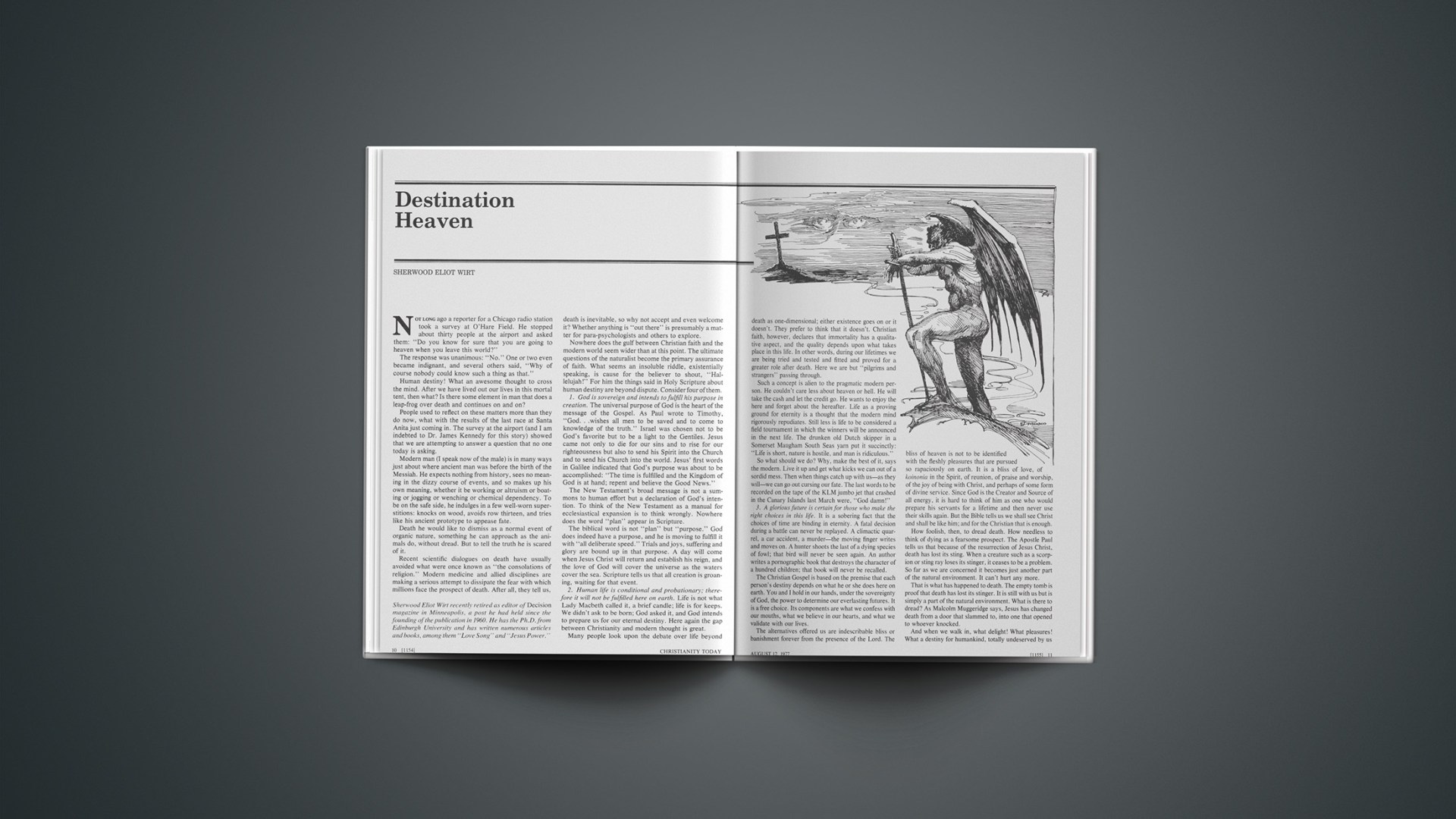
Destination Heaven

Not long ago a reporter for a Chicago radio station took a survey at O’Hare Field. He stopped about thirty people at the airport and asked them: “Do you know for sure that you are going to heaven when you leave this world?”

The response was unanimous: “No.” One or two even became indignant, and several others said, “Why of course nobody could know such a thing as that.” Human destiny! What an awesome thought to cross the mind. After we have lived out our lives in this mortal tent, then what? Is there some element in man that does a leap-frog over death and continues on and on?

People used to reflect on these matters more than they do now, what with the results of the last race at Santa Anita just coming in. The survey at the airport (and I am indebted to Dr. James Kennedy for this story) showed that we are attempting to answer a question that no one today is asking.

Modern man (I speak now of the male) is in many ways just about where ancient man was before the birth of the Messiah. He expects nothing from history, sees no meaning in the dizzy course of events, and so makes up his own meaning, whether it be working or altruism or boating or jogging or wenching or chemical dependency. To be on the safe side, he indulges in a few well-worn superstitions: knocks on wood, avoids row thirteen, and tries like his ancient prototype to appease fate.

Death he would like to dismiss as a normal event of organic nature, something he can approach as the animals do, without dread. But to tell the truth he is scared of it.

Recent scientific dialogues on death have usually avoided what were once known as “the consolations of religion.” Modern medicine and allied disciplines are making a serious attempt to dissipate the fear with which millions face the prospect of death. After all, they tell us, death is inevitable, so why not accept and even welcome it? Whether anything is “out there” is presumably a matter for para-psychologists and others to explore.

Nowhere does the gulf between Christian faith and the modern world seem wider than at this point. The ultimate questions of the naturalist become the primary assurance of faith. What seems an insoluble riddle, existentially speaking, is cause for the believer to shout, “Hallelujah!” For him the things said in Holy Scripture about human destiny are beyond dispute. Consider four of them.

1. God is sovereign and intends to fulfill his purpose in creation. The universal purpose of God is the heart of the message of the Gospel. As Paul wrote to Timothy, “God … wishes all men to be saved and to come to knowledge of the truth.” Israel was chosen not to be God’s favorite but to be a light to the Gentiles. Jesus came not only to die for our sins and to rise for our righteousness but also to send his Spirit into the Church and to send his Church into the world. Jesus’ first words in Galilee indicated that God’s purpose was about to be accomplished: “The time is fulfilled and the Kingdom of God is at hand; repent and believe the Good News.”

The New Testament’s broad message is not a summons to human effort but a declaration of God’s intention. To think of the New Testament as a manual for ecclesiastical expansion is to think wrongly. Nowhere does the word “plan” appear in Scripture.

The biblical word is not “plan” but “purpose.” God does indeed have a purpose, and he is moving to fulfill it with “all deliberate speed.” Trials and joys, suffering and glory are bound up in that purpose. A day will come when Jesus Christ will return and establish his reign, and the love of God will cover the universe as the waters cover the sea. Scripture tells us that all creation is groaning, waiting for that event.

2. Human life is conditional and probationary; therefore it will not be fulfilled here on earth. Life is not what Lady Macbeth called it, a brief candle; life is for keeps. We didn’t ask to be born; God asked it, and God intends to prepare us for our eternal destiny. Here again the gap between Christianity and modern thought is great.

Many people look upon the debate over life beyond death as one-dimensional; either existence goes on or it doesn’t. They prefer to think that it doesn’t. Christian faith, however, declares that immortality has a qualitative aspect, and the quality depends upon what takes place in this life. In other words, during our lifetimes we are being tried and tested and fitted and proved for a greater role after death. Here we are but “pilgrims and strangers” passing through.

Such a concept is alien to the pragmatic modern person. He couldn’t care less about heaven or hell. He will take the cash and let the credit go. He wants to enjoy the here and forget about the hereafter. Life as a proving ground for eternity is a thought that the modern mind rigorously repudiates. Still less is life to be considered a field tournament in which the winners will be announced in the next life. The drunken old Dutch skipper in a Somerset Maugham South Seas yarn put it succinctly: “Life is short, nature is hostile, and man is ridiculous.”

So what should we do? Why, make the best of it, says the modern. Live it up and get what kicks we can out of a sordid mess. Then when things catch up with us—as they will—we can go out cursing our fate. The last words to be recorded on the tape of the KLM jumbo jet that crashed in the Canary Islands last March were, “God damn!”

3. A glorious future is certain for those who make the right choices in this life. It is a sobering fact that the choices of time are binding in eternity. A fatal decision during a battle can never be replayed. A climactic quarrel, a car accident, a murder—the moving finger writes and moves on. A hunter shoots the last of a dying species of fowl; that bird will never be seen again. An author writes a pornographic book that destroys the character of a hundred children; that book will never be recalled.

The Christian Gospel is based on the premise that each person’s destiny depends on what he or she does here on earth. You and I hold in our hands, under the sovereignty of God, the power to determine our everlasting futures. It is a free choice. Its components are what we confess with our mouths, what we believe in our hearts, and what we validate with our lives.

The alternatives offered us are indescribable bliss or banishment forever from the presence of the Lord. The bliss of heaven is not to be identified with the fleshly pleasures that are pursued so rapaciously on earth. It is a bliss of love, of koinonia in the Spirit, of reunion, of praise and worship, of the joy of being with Christ, and perhaps of some form of divine service. Since God is the Creator and Source of all energy, it is hard to think of him as one who would prepare his servants for a lifetime and then never use their skills again. But the Bible tells us we shall see Christ and shall be like him; and for the Christian that is enough.

How foolish, then, to dread death. How needless to think of dying as a fearsome prospect. The Apostle Paul tells us that because of the resurrection of Jesus Christ, death has lost its sting. When a creature such as a scorpion or sting ray loses its stinger, it ceases to be a problem. So far as we are concerned it becomes just another part of the natural environment. It can’t hurt any more.

That is what has happened to death. The empty tomb is proof that death has lost its stinger. It is still with us but is simply a part of the natural environment. What is there to dread? As Malcolm Muggeridge says, Jesus has changed death from a door that slammed to, into one that opened to whoever knocked.

And when we walk in, what delight! What pleasures! What a destiny for humankind, totally undeserved by us planet-spoilers but made possible for us by the Cross, where Jesus of Nazareth bore our sins and fit us for heaven.

The only accurate information we have about heaven is found in the Word of God. If we accept that authority, we may not know all we want to about heaven, but we can be certain of some facts that are clearly taught in the biblical record: Heaven is reality. Heaven is beauty. Heaven is joy. Heaven is freedom. Heaven is worship. Heaven is communication. And heaven is where Jesus is.

What greater destiny is possible? Heaven is, to be sure, only part of the Christian life, but it is the last part and, from what we hear, the best.

4. Hell is certain for those who make the wrong choices.

If heaven is a certainty for those who make the right choices, hell is equally certain for those who choose some other way. Scripture tells us that Jesus is the Way, the Truth, and the Life. If we ignore him, deny him, oppose him, or bypass him, we may well pass through this life unscathed; millions have. But after that the judgment.

Hell, as David Augsburger has said, is actually a compliment to our freedom of choice. Were we all to be swept up to glory in a “triumph of grace” regardless of our commitment or lack of commitment to the Lord Jesus Christ, we would cease to be persons and become marionettes. Obviously we would not be free to choose or to take the consequences of our choice, for freedom means that the choice is really ours.

People get pretty emotional about hell, thanks to some of the bad preaching of the past. Emphasis is placed unduly upon distortions and cruelties, flames and torments, sulphur and brimstone. To get a true glimpse of hell, all a Christian has to do is to think what it would be like to live even for five minutes without God.

Billy Graham tells his audiences that God did not prepare hell for us; he prepared it for the devil and his angels, but if we insist on going there he will not stop us.

There was a period in my life when I was a prime candidate for Screwtape, Wormwood, Slubgob & Co. No longer. Thanks to Jesus Christ, were I to be stopped at O’Hare Field and asked if heaven is my destination, I would break the pattern and say, “Yes, praise God, hallelujah!” As Ethel Waters puts it, “I have a spiritual suitcase, and I know where I’m going.”

Human destiny is both a social and a personal matter, because we are told that the nations will one day be judged. Certainly history itself offers no solution to the future. Bible prophecies have made it clear that the world scene would become increasingly chaotic, and with the grim forecasts now coming from the various governments, we can see that our true “social security” lies only in God.

But ultimately the question of our destiny must be laid before us as individuals. Quo vadis? Which way?

Have you been thinking about death these days? Thinking about heaven? Thinking you’d like to go there?

You can, you know.

Climbing out of the Existential Ditch

Since Old Testament times, the people of God have been instructed to love their neighbors as they love themselves. And how we as selves relate to others has remained a problem through the centuries. In Jesus’ dialogue with the lawyer (Luke 10:25–37), the lawyer was concerned only with himself; he sought to “justify” his trickery. And in the Good Samaritan parable, self was the obstacle for two of the characters. The priest who passed by on the other side may have been a Jericho priest on his way to his once-a-year privilege of service in the Jerusalem temple. Had he touched a dead man (and the wounded traveler may have appeared to be dead), he would have become ritually unclean. His priestly privileges, therefore, would have been jeopardized by his going over to the injured man. He was concerned mainly with himself.

The Levite in the parable, who came over to the wounded man, probably was aware of a common scheme of robbers on that notoriously dangerous road to Jerusalem. The wounded man might have been a decoy to lure him closer to concealed robbers, so he was quick to leave the scene. He, too, was thinking mainly of himself.

Jesus has called us to a discipleship of loving our neighbor, and all people in the world are our neighbors. He went further and told us what is involved: “If anyone wants to come with me, he must forget himself, carry his cross, and follow me” (Mark 8:34, GNB).

Just how can one “forget himself”? Most people are wrapped up in their own problems. But Christianity from the start meets a person’s fundamental need to get out of the “existential ditch.”

Forgetting self is really forgetting about our own self-image—developing a non-self-consciousness. All of us at times become introspective. We observe ourselves as if we were watching a play in which we have the leading role. We are concerned about how we appear to others. We puzzle over what we can do to move closer toward our ideal self-concept.

The Freudian school and also the more recent Transactional Analysis theory have reinforced the human tendency to concentrate on self—especially the self of the past. It’s certainly helpful to face one’s experiences candidly, to try to sort out one’s strengths and weaknesses. But when we try to analyze our past precisely, we find it can’t be done. We are too complex. Our motives and emotions are unclear, and our rationalizations cloud our evaluations. William Glasser is correct in saying, in Reality Therapy, that the issue is not why something is done but of what value is it now.

Concentration on self is a result of the Fall. C. S. Lewis in Perelandra used a mirror in the Green Lady’s hands to make this point. Satan was trying to get Eve to a point where she would become conscious of her own self and to sense herself as an independent being—apart from God. He succeeded.

What is so refreshing in becoming a Christian is that Christ gives us a way out of ourselves. We can forget self. The basis for our becoming non-self-conscious is simply that in trusting Christ’s death to pay for our failures with God, we can know we are accepted.

Parents don’t review every mistake their children make during the day and evaluate the relationship accordingly. If they are good parents, their children sense an underlying acceptance, even when they are corrected. In the same way, we become non-self-conscious when we encounter Christ. We are confronted by the Jesus of the Scriptures. We realize that he died for us while we were sinners, and from there on we are free to stop analyzing ourselves. Christ accepts us, and this is the bridge to others. On the basis of our reconciliation with God through Christ, we can cross over to our neighbor.

What does “forgetting self” mean practically? Knowing we are accepted by God, we can open ourselves to others. We can actually risk getting out of ourselves and into other people’s lives. There will be times when we reach out to others and are rejected. The person we’re trying to touch will simply not respond, or may even reject us. But we’ve got to put aside worries about being rejected. We’ve got to cross over into other’s lives.

This ability takes time. We have to be patient as God helps us to move away from our self-consciousness. “God has not yet completed the work begun in us.” Growth is the substance of our spiritual pilgrimage.

Cover Story

Is Self-Love Biblical?

There once was a nymph named Narcissus

Who thought himself very delicious

So he stared like a fool

At his face in a pool

And his folly today is still with us.

According to the spirit of this decade, the ultimate sin is no longer the failure to honor God and thank him but the failure to esteem oneself. Self-abasement, not God-abasement, is the evil. And the cry of deliverance is not, “O wretched man that I am, who will deliver me?,” but, “O worthy man that I am, would that I could only see it better!”

Today the first and greatest commandment is, “Thou shalt love thyself.” And the explanation for almost every interpersonal problem is thought to lie in someone’s low self-esteem. Sermons, articles, and books have pushed this idea deep into the Christian mind. It is a rare congregation, for example, that does not stumble over the “vermicular theology” of Isaac Watts’s “Alas! And Did My Saviour Bleed”: “Would He devote that sacred head/ For such a worm as I?”

For a decade the cult of the self (to use Thomas Howard’s phrase) has been expanding phenomenally fast, and its professional members take every chance they get to put a mirror in front of us and tell us to like what we see.

What distresses me in all this is not only what I regard as an unbiblical shift of focus from God to man as the goal of redemption (see Ezekiel 36:22–32) but also the paucity of opposition to it. This article should be taken as one small vote against the cult of self-esteem.

Perhaps the biblical text most commonly used in spreading the message of self-esteem is, “You shall love your neighbor as yourself” (Lev. 19:18; Luke 10:27; Rom. 13:9; Gal. 5:14; James 2:8; see, for example Walter Trobisch, “Inferior Interior,” Eternity, April 1976). But this use almost always involves misinterpretation.

Even in Jesus’ day this command was being misunderstood. Might there be a connection between the old misunderstanding and the new one? The ancient error hinged on the term “neighbor” and was exposed by Jesus in the Parable of the Good Samaritan (Luke 10:29–37). The modern error hinges on the term “as yourself” and, so far as I know, has not been publicly challenged.

In Luke 10:26 a lawyer has just asked Jesus what he must do to inherit eternal life. But according to Luke the question is not sincere. The lawyer is not seeking eternal life; he is trying to test Jesus. Under the guise of a personal question he gives Jesus an academic quiz, hoping to entangle him in some heretical contradiction of the Old Testament. Then Jesus, with a view to exposing the man’s duplicity, turns the question back: “What is written in the Law? What do you read?” The man answers, “Love God with your whole being and your neighbor as yourself.” And Jesus simply agrees.

But now the lawyer is in trouble. It is evident to everybody that he already knew the answer to his question. His motive for asking it was not a sincere desire for information but a desire to trap Jesus in his words. Everyone can see now that he was insincere, hypocritical, guilty of the injustice of deceit. What will he do? Run away shamed like the Apostle Peter and weep bitterly over his sin? Or will he—with ten million other human beings before and after him—seek to save face?

“But he, desiring to justify himself, said to Jesus.…” And then comes the ancient error hinging on the term “neighbor”: “And who is my neighbor?” There is such a serious misunderstanding of God’s demand behind this question that Jesus will not answer it.

Very often our misunderstanding of God’s Word is due not to innocent intellectual slips or lack of information but rather to a deep unwillingness to submit to the demands of God. A person who intends to manage his own affairs, maintain his pride, and secure esteem and glory from his fellow human beings will twist the words of Jesus to support his own self-esteem. The evil of the human heart precedes and gives rise to many of our apparently intellectual misunderstandings of Scripture.

When Jesus told the lawyer that the answer to his own question was right, the lawyer’s duplicity was exposed. At that threat to his reputation and his self-regard, the sin of self-justification sprang up. The lawyer was deceived into thinking that the problem was not his own proud unwillingness to repent and obey but the ambiguity of the word “neighbor.” The question “Who is my neighbor?” was simply a face-saving device.

Another way of asking the lawyer’s question would be, “Teacher, whom do I not have to love? Which groups in our society are excluded from this commandment to love my neighbor? Surely the Romans, the oppressors of God’s chosen people, and their despicable lackeys, the tax collectors, and those half-breed Samaritans—surely these groups are not included in the term ‘neighbor.’ Tell me just who my neighbor is, Teacher, so that, as I examine the various candidates for my love, I will be sure to choose him alone.”

Jesus will have nothing to do with that kind of question. Instead of answering it outright—which was really impossible—Jesus tells a parable, the Parable of the Good Samaritan. A man, probably a Jew, was traveling from Jerusalem to Jericho when he was attacked by robbers. They stripped him, beat him, and left him half dead on the side of the road. Along came a priest and then a Levite, and when they saw the man they went by on the other side. Then came a Samaritan, and when he saw the wounded man, he felt compassion for him. He went to him and treated his wounds, using his own oil and wine. Then he set him on his own beast, brought him to an inn, and took care of him till the next day. He gave the innkeeper his own money to take care of the man and said he would stop by on his way back to make up the difference if it wasn’t enough.

Then Jesus puts a question back to the lawyer: “Which of these three does it seem to you became a neighbor to the one who fell among thieves?” The lawyer answers, “The one who showed mercy on him.” Jesus responds, “Go and do likewise.”

The point of Jesus’ parable was to show that the lawyer’s request for a definition of “neighbor” was simply a skirting of the real issue, namely, the kind of person he himself was. The lawyer’s problem was not to define the word “neighbor”: his problem—and the problem of every become human the kind being—was to of person who, because of compassion cannot pass by on the other side. No truly compassionate or merciful heart can stand idly by while the mind examines a suffering candidate to see if he fits the definition of neighbor.

If the lawyer had understood the intention of God’s command, he would have seen how irrelevant his question about his neighbor was. God’s intention is to call into being a loving, compassionate, merciful person whose heart summons him irresistibly into action when there is suffering within his reach, a person who will interrupt his schedule, risk some embarrassment, use up his oil and wine, and part with his money for the sake of a stranger. Be that person, Jesus says, and you will inherit eternal life: blessed are the merciful for they shall obtain mercy.

That then is the way the command “Love your neighbor as yourself” was misunderstood in Jesus’ day and how Jesus responded to it.

While the old error hinged on the word “neighbor,” the modern one hinges on the words “as yourself.” The modern interpretation of “Love your neighbor as yourself” makes two assumptions about “as yourself.” First, the words are assumed to be a command rather than a statement. That is, it is assumed that Jesus is calling people to love themselves so that they can then love others as they love themselves. Second, this self-love that Jesus is demanding is assumed to be equivalent to self-esteem, self-acceptance, a positive self-image, or the like. (See for example R. L. Pavelsky, “The Commandment of Love and the Clinical Psychologist,” Studies Biblica et Theologica, March, 1973.) The proponents of this interpretation put the two assumptions together like this: a person’s first task in obedience to Jesus is to develop a high self-esteem so that he can fulfill the second half of the command, to love others as he now loves himself.

Is this what Jesus meant? I think not. These two assumptions depend on each other, so let us look at them together to see if the text bears them out.

Grammatically it is impossible to construe the words “as yourself” as a command. When you supply the verb, the commandment reads simply, “You shall love your neighbor as you in fact already love yourself.” Jesus is not calling for self-love; he assumes that it already exists. As far as we know, Jesus never entertained the thought that there could be someone who didn’t love himself. To use the words of Paul in Ephesians 5:29, “No man ever hates his own flesh but nourishes and cherishes it.”

Now if this is so, the self-love that Jesus is talking about is quite different from the self-esteem that is so often assumed to be his meaning. To show what Jesus means by self-love we can pose the following question: Is it not reasonable to assume that the two uses of “love” in the command “Love your neighbor as you love yourself” will have the same meaning? Jesus makes it very plain what he means by the verb “love” in the first half. It means to interrupt your schedule and use up your oil, wine, and money to achieve what you think is best for your neighbor. It means to have a heart that is disposed to seek another person’s good.

Giving “love” the same meaning in the second part of the command, we get this: “You shall seek the good of your neighbor, just as you naturally seek your own good, and nourish and cherish your needy neighbor just as you by nature nourish and cherish yourself.”

Another way in which Jesus said essentially the same things was, “Whatever you wish that men would do to you, do so to them.” “Do so to them” corresponds to “Love your neighbor.” “Whatever you wish that men would do to you” corresponds to “as you love yourself.” Self-love is thus defined in the Golden Rule by the desire that we have for others to do us good.

In sum, then, “Love your neighbor as yourself” does not command but rather presupposes self-love. All human beings love themselves. Furthermore, this self-love of which Jesus speaks has nothing to do with the common notion of self-esteem. It does not mean having a good self-image or feeling especially happy with oneself. It means simply desiring and seeking one’s own good.

And we should note that Jesus’ point is not affected by the fact that most people have a distorted notion of what is good for them. A man may attempt to find his good in a bottle of bourbon or in illicit sex or in a fast motorcycle; still, all human beings desire and seek what they think, at least in the moment of choosing, is best for them. Thus Gunther Bornkamm is right when he says, “We are most skilled in the love of ourselves; whether in selfish passion or in cool reflection, whether prompted by blind instinct or by some ideal, we desire our own self” (Jesus of Nazareth).

Only when one sees “self-love” in this light will the tremendous force of the command “Love your neighbor as yourself” be apparent. Jesus is saying to the lawyer: Take note how much you love yourself, how you try to get the best place in the synagogues, how you seek to be seen praying on the streets, how you exercise all rigor to maintain purity. Now my command to you is: Take all that zeal, all that ingenuity, all that perseverence, and with it seek your neighbor’s well-being.

And with that, Jesus cuts the nerve of every merely selfish life-style. All our inborn self-seeking is made the measure of our self-giving. Do we seek to satisfy our hunger? Then we must with a similar urgency feed our hungry neighbor. Do we long for advancement in the company? Then we must seek out ways to give others as much opportunity and to stir up their will to achieve. Do we love to make A’s on tests? Then we must tutor the poor student who would love it no less. Do we hate to be laughed at and mocked? Then let there never be found on our lips a mocking word.

To sum up, the ancient misunderstanding of the command, “Love your neighbor as yourself” was the lawyer’s attempt to restrict the meaning of “neighbor” to a certain group and thus to raise a question that he hoped would conceal the real problem—namely, his failure to be the person that the commandment was calling him to be, one whose compassionate heart would not ever allow him to pass by on the other side of the road.

The modern misunderstanding of this commandment, most prevalent within the cult of the self, is the remarkably common notion that Jesus is not presupposing but commanding self-love and that self-love is equivalent to self-esteem, positive self-regard, and the like. Jesus stated it as a fact that people love themselves, and the meaning of this self-love, as is seen from the context, the Golden Rule, and Ephesians 5:28 f., is that all people desire and seek what they think is best for them. This universal human trait then becomes the rule to which all loving self-sacrifice must measure up.

It seems to me that there is but a hair’s difference between the self-justification that gave rise to the lawyer’s error and the craving for self-esteem that nourishes the more modern error. Just how intimately the two errors are related I will leave for the reader to ponder.

As I see it, the meaning of the command “You shall love your neighbor as yourself” is this: Our Lord is aiming to call into being loving, compassionate, merciful men and women whose hearts summon them irresistibly into action when there is suffering within their reach. And to that end, he demands that they again and again ask themselves this question: Am I desiring and seeking the temporal and eternal good of my neighbor with the same zeal, ingenuity, and perseverance with which I seek my own?

Eutychus and His Kin: August 12, 1977

Communication in Christian Marriage

A new type of book appeared at the Christian Booksellers convention in Kansas City last month. That was a handbook for husbands, a “Total Man” approach to marriage and the family.

Several publishers have examples of the genre on their fall lists. Before long others will follow. And it’s none too soon.

Why should Christian women be put through the guilt bath again and again, while men are untouched? Why have we no male Marabel Morgans to scathe the men?

Because men don’t read, that’s why. New York trade publishers estimate that 70 per cent of book purchases in the United States are by women. The comparable figure for Christian books is 80 per cent.

And counted among the men are all the book-buying pastors, whose purchases tend to be professional rather than personal—who give baths rather than take them.

I suppose that a lot of those women will buy the new “Total Man” books and leave them on the coffee tables or the TV set, with hope and a prayer that their husbands will pick them up and read them.

Or maybe they’ll put them under the dining room table. Surprise!

What should Christian men feel guilty about?

Grunting.

For a long time I’ve felt that more marriages are wrecked by grunting than by any other cause, except possibly headaches.

When a woman says something and her husband just grunts, she should not submit; she should grunt back.

“Do you know who I ran into at the mall this afternoon?”

“Grunt,” from behind the newspaper or in front of the TV.

—Now at this point the wife should resist the temptation to say that it was a traffic policeman, but he’s now off the critical list. Instead she should say, “Grunt.”

To which the husband will probably reply, “Grunt grunt.”

This will establish communication between the two of them, which psychologists tell us is absolutely necessary for a good marriage.

Before long the husband may even initiate the grunts. And then we will have another new publishing genre, Christian grunt books.

At that point men may begin to read.

EUTYCHUS VIII

A Stimulating Source

The news section of CHRISTIANITY TODAY is my favorite periodical reading. It is a source of unfailing stimulation and insight. You get more news and know more about what is going on in religion than any source at my disposal. Thank you for the job you are doing!

WILLIAM O. HARRIS

Christian Theological Seminary

Indianapolis, Ind.

Antidote To Isolation

I would like to thank you for the high quality of CHRISTIANITY TODAY. Being a missionary in Africa isolates one from the current trends and thoughts of the evangelical world at home. CHRISTIANITY TODAY fills the need to keep informed. In addition to the editorials, articles, and news, I find the issues devoted to new books and the book reviews in every issue very meaningful.

MICHAEL M. SHOCKLEY

Kumasi, Ashanti, Ghana

Clarifying The Record

Regarding your reference to my situation (News, “Terror in El Salvador,” June 17), I believe that fairness requires that the record be set straight. I was never declared a persona non-grata by the Salvadorean government nor was I legally deported, nor was it ever even insinuated that I was connected with the CIA. I was forced to leave the country when a disgruntled government official (or his wife!), whose grossly immoral son I had refused to recommend for a preaching position, used his personal influence to obligate the immigration officials to proceed against me. My passport was left untouched. When, two months later, the government became aware of what had happened, the President himself sent a telegram to our church, a copy of which I retain, informing them that the situation had been cleared up and that I could return to the country at any time. I did, only to have my life threatened in the church building at pistol point by the son I had refused to recommend. Prudence has me out of the country until the present violence, described in your article, passes and individual rights are once again restored.

BRUCE A. BELL

Director

Sociedad Evangelistica Las Américas, Inc.

Forest, Va.

Nets, Not Hooks

Never having heard a well-reasoned defense for the use of rock music in the cause of Christ, I read James Pennington’s article (Refiner’s Fire, July 8) with great expectations. His argument seems to be that rock and disco music are forms of “fun, not edification” which are familiar to young people, and are therefore effective bait which fishers of men should use, presumably without worrying too much about the possibility that the bait on the hook might be rotten.

Being convinced that ends can not justify means, I was a bit troubled by the possibility that Christ might have taught that fishers of men ought to use any old bait, good or bad, as long as they thought it might be effective. Troubled, that is, until I recalled that the apostolic fishermen did not use fish hooks; their fish were not lured, duped, and snared but simply gathered in with a net, with no need for bait. Has our God now become so small that he must trick men into becoming Christians by using as bait forms of music which have “failed or perhaps refused to say anything substantial about real life?”

K. J. RADIMER

Little Falls, N.J.

Evangelicals On Bioethics

The review of books on bioethics by Robert A. Case (June 17) was helpful, succinct, and fair-minded. But with his reference to the “ethical forfeiture” on the part of evangelicals to these issues, I would like to take exception.… Baker’s Dictionary of Christian Ethics (edited by Carl F. H. Henry) contains a number of essays on these kind of issues. And the volume Is It Moral to Modify Man? (edited by Claude S. Frazier) [has] essays from three evangelical contributors.

In 1968 the Christian Medical Society joined with CHRISTIANITY TODAY to co-sponsor an interdisciplinary symposium on abortion, sterilization, and contraception.… During the summer of 1975, under the aegis of CMS, Christian Legal Society, the American Scientific Affiliation, the Evangelical Theological Society, the Center for the Study of the Future, the Christian Association for Psychological Studies, the Christian College Consortium, the Institute for Advanced Christian Studies, and the Institute for Christian Studies (Toronto), psychologist Dr. Craig W. Ellison of Westmont College stimulated the calling of a conference to examine “Human Engineering and the Future of Man.” … Both CMS and the ASA have sought to provide continuing forums … for the consideration of these various difficult issues. And, incidentally, CMS meets triennally with fraternal Christian organizations from around the world to discuss issues in bioethics: Amsterdam (1963), Oxford (1966), Oslo (1969), Toronto (1972), Singapore (1975), and in 1978, Davos near Zurich.

LEWIS P. BIRD

Christian Medical Society Co-Chairman

Havertown, Pa.

Apple PodcastsDown ArrowDown ArrowDown Arrowarrow_left_altLeft ArrowLeft ArrowRight ArrowRight ArrowRight Arrowarrow_up_altUp ArrowUp ArrowAvailable at Amazoncaret-downCloseCloseEmailEmailExpandExpandExternalExternalFacebookfacebook-squareGiftGiftGooglegoogleGoogle KeephamburgerInstagraminstagram-squareLinkLinklinkedin-squareListenListenListenChristianity TodayCT Creative Studio Logologo_orgMegaphoneMenuMenupausePinterestPlayPlayPocketPodcastRSSRSSSaveSaveSaveSearchSearchsearchSpotifyStitcherTelegramTable of ContentsTable of Contentstwitter-squareWhatsAppXYouTubeYouTube